EP4566538A1 - Bioélectrode - Google Patents
Bioélectrode Download PDFInfo
- Publication number
- EP4566538A1 EP4566538A1 EP23850001.1A EP23850001A EP4566538A1 EP 4566538 A1 EP4566538 A1 EP 4566538A1 EP 23850001 A EP23850001 A EP 23850001A EP 4566538 A1 EP4566538 A1 EP 4566538A1
- Authority
- EP
- European Patent Office
- Prior art keywords
- cores
- protrusion
- bioelectrode
- protrusions
- core
- Prior art date
- Legal status (The legal status is an assumption and is not a legal conclusion. Google has not performed a legal analysis and makes no representation as to the accuracy of the status listed.)
- Pending
Links
Images




Classifications
-
- A—HUMAN NECESSITIES
- A61—MEDICAL OR VETERINARY SCIENCE; HYGIENE
- A61B—DIAGNOSIS; SURGERY; IDENTIFICATION
- A61B5/00—Measuring for diagnostic purposes; Identification of persons
- A61B5/24—Detecting, measuring or recording bioelectric or biomagnetic signals of the body or parts thereof
- A61B5/25—Bioelectric electrodes therefor
- A61B5/251—Means for maintaining electrode contact with the body
-
- A—HUMAN NECESSITIES
- A61—MEDICAL OR VETERINARY SCIENCE; HYGIENE
- A61B—DIAGNOSIS; SURGERY; IDENTIFICATION
- A61B5/00—Measuring for diagnostic purposes; Identification of persons
- A61B5/24—Detecting, measuring or recording bioelectric or biomagnetic signals of the body or parts thereof
- A61B5/25—Bioelectric electrodes therefor
- A61B5/263—Bioelectric electrodes therefor characterised by the electrode materials
- A61B5/268—Bioelectric electrodes therefor characterised by the electrode materials containing conductive polymers, e.g. PEDOT:PSS polymers
-
- A—HUMAN NECESSITIES
- A61—MEDICAL OR VETERINARY SCIENCE; HYGIENE
- A61B—DIAGNOSIS; SURGERY; IDENTIFICATION
- A61B2562/00—Details of sensors; Constructional details of sensor housings or probes; Accessories for sensors
- A61B2562/02—Details of sensors specially adapted for in-vivo measurements
- A61B2562/0209—Special features of electrodes classified in A61B5/24, A61B5/25, A61B5/283, A61B5/291, A61B5/296, A61B5/053
-
- A—HUMAN NECESSITIES
- A61—MEDICAL OR VETERINARY SCIENCE; HYGIENE
- A61B—DIAGNOSIS; SURGERY; IDENTIFICATION
- A61B2562/00—Details of sensors; Constructional details of sensor housings or probes; Accessories for sensors
- A61B2562/12—Manufacturing methods specially adapted for producing sensors for in-vivo measurements
- A61B2562/125—Manufacturing methods specially adapted for producing sensors for in-vivo measurements characterised by the manufacture of electrodes
-
- A—HUMAN NECESSITIES
- A61—MEDICAL OR VETERINARY SCIENCE; HYGIENE
- A61B—DIAGNOSIS; SURGERY; IDENTIFICATION
- A61B2562/00—Details of sensors; Constructional details of sensor housings or probes; Accessories for sensors
- A61B2562/16—Details of sensor housings or probes; Details of structural supports for sensors
- A61B2562/164—Details of sensor housings or probes; Details of structural supports for sensors the sensor is mounted in or on a conformable substrate or carrier
-
- A—HUMAN NECESSITIES
- A61—MEDICAL OR VETERINARY SCIENCE; HYGIENE
- A61B—DIAGNOSIS; SURGERY; IDENTIFICATION
- A61B5/00—Measuring for diagnostic purposes; Identification of persons
- A61B5/24—Detecting, measuring or recording bioelectric or biomagnetic signals of the body or parts thereof
- A61B5/25—Bioelectric electrodes therefor
- A61B5/279—Bioelectric electrodes therefor specially adapted for particular uses
- A61B5/28—Bioelectric electrodes therefor specially adapted for particular uses for electrocardiography [ECG]
-
- A—HUMAN NECESSITIES
- A61—MEDICAL OR VETERINARY SCIENCE; HYGIENE
- A61B—DIAGNOSIS; SURGERY; IDENTIFICATION
- A61B5/00—Measuring for diagnostic purposes; Identification of persons
- A61B5/24—Detecting, measuring or recording bioelectric or biomagnetic signals of the body or parts thereof
- A61B5/25—Bioelectric electrodes therefor
- A61B5/279—Bioelectric electrodes therefor specially adapted for particular uses
- A61B5/291—Bioelectric electrodes therefor specially adapted for particular uses for electroencephalography [EEG]
-
- A—HUMAN NECESSITIES
- A61—MEDICAL OR VETERINARY SCIENCE; HYGIENE
- A61B—DIAGNOSIS; SURGERY; IDENTIFICATION
- A61B5/00—Measuring for diagnostic purposes; Identification of persons
- A61B5/24—Detecting, measuring or recording bioelectric or biomagnetic signals of the body or parts thereof
- A61B5/25—Bioelectric electrodes therefor
- A61B5/279—Bioelectric electrodes therefor specially adapted for particular uses
- A61B5/296—Bioelectric electrodes therefor specially adapted for particular uses for electromyography [EMG]
Definitions
- This disclosure relates to bioelectrodes.
- a bioelectrode which is to be attached to a surface of a living body, is generally used to acquire biometric information such as an electrocardiogram, an electroencephalogram, or an electromyogram, which is based on a change in electric potential in the living body.
- a bioelectrode described in Patent Document 1 includes a plate-shaped portion and a plurality of protrusions protruding from the plate-shaped portion. These are made of insulating elastic members.
- a distal end of each of the plurality of protrusions is covered by a conductive resin layer.
- a conductive wire is disposed that is electrically connected to the conductive resin layer. This conductive wire is made of conductive fibers.
- Patent Document 1 WO 2020/095589
- a bioelectrode includes an electrode member, which is made of an elastic material with conductivity and includes a base having a shape of a sheet or a shape of a plate and including a first surface and a second surface facing in a direction opposite to a direction in which the first surface faces and a plurality of protrusions protruding from the second surface, and a plurality of cores, which is made of a material having a Young's modulus greater than that of the elastic material and being provided corresponding to two or more protrusions among the plurality of protrusions, wherein a distal end of each of the plurality of cores is disposed within a middle of a corresponding protrusion in a direction of protrusion.
- biometric information it is possible to execute measurement of biometric information over a long period in time and to reduce discomfort experienced by a subject when biometric information is measured.
- Fig. 1 is an exploded perspective view of a bioelectrode 1 according to a First Embodiment.
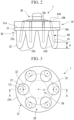
- Fig. 2 is a side view of the bioelectrode 1 according to the First Embodiment.
- Fig. 3 is a bottom view of the bioelectrode 1 according to the First Embodiment.
- Fig. 4 is a cross section taken along line A-A of Fig. 3 .
- the bioelectrode 1 is an electrode for detecting, as a biometric signal, a change in electric potential in a living body such as a human being or an animal.
- the bioelectrode 1 is used in a state in which the bioelectrode 1 is in contact with a surface of a living body to be measured.
- the bioelectrode 1 is suitably used to take an electroencephalogram in a state in which the bioelectrode 1 is in contact with a scalp, for example.
- the bioelectrode 1 is electrically connected to a measuring device for generating biometric information, such as an electroencephalogram, based on the biometric signal from the bioelectrode 1.
- the living body to be measured may be referred to as a subject.
- bioelectrode 1 is not limited to taking an electroencephalogram, and it may be measurement of biometric information such as an electrocardiogram or an electromyogram, for example.
- a portion of the living body in contact with the bioelectrode 1 is not limited to the scalp, and it may be, for example, an arm, a leg, a chest, or a back or the like, or alternatively, it may not be a region having hair.
- use of the bioelectrode 1 is not limited to use for measuring a biometric signal, and it may be a use for providing electrical stimulation to a living body, for example.
- the bioelectrode 1 includes a support member 10, an electrode member 20, a connector 30, and a core group 60. In the following, each of the elements of the bioelectrode 1 will be described sequentially.
- the support member 10 is a member for supporting the electrode member 20.
- the support member 10 is made of an insulating material, in other words, a dielectric material.
- the insulating material include a polymer such as silicone rubber, urethane rubber, fluorine rubber, and terpolymer rubber (EPDM) made from ethylene, propylene, and diene. From a viewpoint of enhancing adhesion between the support member 10 and the electrode member 20, the insulating material is preferably a polymer of the same type as that of a polymer constituting the electrode member 20.
- the support member 10 is discoid.
- the support member 10 includes a pair of plate surfaces 10a and 10b, a through hole 10c, and a plurality of notches 10d.
- the plate surface 10a is a surface for supporting the electrode member 20.
- the plate surface 10b is a surface facing in a direction opposite to a direction in which the plate surface 10a faces.
- the through hole 10c is a hole passing through the support member 10 in a thickness direction.
- the through hole 10c is open to each of the plate surface 10a and the plate surface 10b.
- Each of the plurality of notches 10d is a groove provided to an outer circumferential surface of the support member 10.
- a direction of depth of each of the plurality of notches 10d is a direction of radius of the support member 10, and each of the plurality of notches 10d extends from one of the plate surface 10a and the plate surface 10b, to the other. In the plurality of notches 10d, a part of the core group 60 is disposed.
- a shape of the support member 10 is not limited to the example shown in Fig. 1 , and it may be a polygon, for example.
- Each of the plate surface 10a and the plate surface 10b is not limited to a flat surface, and it may be a convex curved surface, a concave curved surface, or a conical surface, for example.
- a transverse-sectional shape of the through hole 10c is not limited to a circle, and it may be a polygon such as a square or a pentagon, for example.
- the support member 10 may be provided, or may be omitted, as appropriate, or it may be integrated with the electrode member 20.
- the electrode member 20 is a conductive member to be in contact with the surface of the living body.
- the electrode member 20 is made of an elastic material with conductivity.
- the elastic material includes a rubber material and a conductive particle, for example.
- the rubber material include silicone rubber, terpolymer rubber (EPDM) made from ethylene, propylene, and diene, nitrile rubber, and urethane rubber and the like. Among them, silicone rubber is suitably used as the rubber material, from a viewpoint of biocompatibility, etc.
- the conductive particle examples include a carbon particle, which is made of carbon black, carbon nanotubes, or graphite or the like, a metallic particle, which is made of metal such as silver, and a particle, which is made of a metal compound such as silver chloride.
- the elastic material may include not only the rubber material and the conductive particle but also a fiber-based material, such as a nonwoven fabric made of a resin material or a carbon material or the like, or a woven fabric, or it may include various additives.
- the electrode member 20 includes a base 21 and a plurality of protrusions 22.
- the base 21 is a portion of the electrode member 20 for supporting the plurality of protrusions 22.
- the base 21 is discoid.
- an outer shape of the base 21 is the same as an outer shape of the support member 10.
- the base 21 includes a first surface 21a and a second surface 21b.
- the first surface 21a is a surface that is in contact with the plate surface 10a of the support member 10.
- the first surface 21a is bonded by vulcanization bonding or by an adhesive or the like to the plate surface 10a.
- the second surface 21b is a surface facing in a direction opposite to a direction in which the first surface 21a faces.
- the second surface 21b is provided with the plurality of protrusions 22.
- a shape of the base 21 is not limited to the example shown in Fig. 1 , and it may be, for example, a polygon, or it may differ from the shape of the support member 10 in plan view.
- Each of the first surface 21a and the second surface 21b is not limited to a flat surface, and it may be a convex curved surface, a concave curved surface, or a conical surface.
- Each of the plurality of protrusions 22 is a protrusion protruding from the base 21. A distal end of each of the plurality of protrusions 22 is to be brought into contact with the surface of the living body.
- the electrode member 20 including the plurality of protrusions 22 for example, when the bioelectrode 1 is used to measure an electroencephalogram, head hair is pushed aside by the plurality of protrusions 22; accordingly, the distal end of each of the plurality of protrusions 22 is in suitable contact with the scalp. Thus, the biometric signal can be suitably measured.
- each of the plurality of protrusions 22 is spaced apart from another at regular angular intervals along a virtual circle 25 with a center O of the base 21 as a center. More specifically, a center C1 of a proximal end of each of the plurality of protrusions 22 is disposed on the virtual circle 25.
- the plurality of protrusions 22 are arranged in a balanced manner.
- the plurality of protrusions 22 are disposed to surround a circular region 28 that includes the center O of the base 21.
- the number of protrusions 22 is six.
- the arrangement of the plurality of protrusions 22 is not limited to the example shown in Fig. 3 ; for example, it may be an arrangement in which each of the plurality of protrusions 22 is spaced apart from another at irregular angular intervals along the virtual circle 25 as viewed in the direction of thickness of the base 21, or it may be an arrangement in which the center C1 is outside the virtual circle 25, or it may be an arrangement in which each of the plurality of protrusions 22 is arranged on a polygon, such as a virtual triangle or a virtual quadrilateral, with the center O as a center.
- the number of protrusions 22 is not limited to the example shown in Fig. 3 , and it may be five or less, or it may be seven or more. However, from a viewpoint of realizing stable contact between the living body and the electrode member 20, the number of the protrusions 22 is preferably three or more, and is more preferably four or more.
- Each of the plurality of protrusions 22 extends in a direction slightly inclined relative to the direction of thickness of the base 21 such that a center C2 of the distal end is disposed radially outward apart from the center C1 of the proximal end.
- This inclination allows an increase in a space between the above-mentioned region 28 and the living body surface, and an advantage is obtained in that it is easy to accommodate the hair in the space, as described below.
- An angle of this inclination is not particularly limited; in addition, from a viewpoint of ensuring good contact between the living body and the electrode member 20, it is preferably 10 degrees or more, and is more preferably 10 degrees or more and 45 degrees or less, and is still more preferably 10 degrees or more and 30 degrees or less.
- each of the plurality of protrusions 22 may extend in a direction parallel to the direction of thickness of the base 21.
- Each of the plurality of protrusions 22 has a tapered shape.
- a width of, or an area of a transverse section of, a protrusion 22 that is any one of the plurality of protrusions 22 is gradually reduced from a proximal end of the protrusion 22 toward a distal end of the protrusion 22.
- the width of the protrusion 22 may be substantially constant from the proximal end toward the distal end.
- a transverse-sectional shape of each of the plurality of protrusions 22 is a circle.
- a distal surface of each of the plurality of protrusions 22 has a convex curved shape.
- a transverse-sectional shape of each of the plurality of protrusions 22 is not limited to a circle, and it may be a polygon such as a square or a pentagon, for example.
- a shape of the distal surface of each of the plurality of protrusions 22 is not limited to the shape shown in the drawing, and it may be freely selected.
- a height h of the protrusion 22 is not particularly limited, and it is preferably 6 mm or more and 15 mm or less.
- the height h within such a range allows the distal end of the protrusion 22 to be in suitable contact with the living body surface with the hair.
- the height h within such a range allows the hair pushed aside by the protrusion 22 to be accommodated in the space between the region 28 and the living body surface appropriately. As a result, the distal end of the protrusion 22 can be in suitable contact with the living body surface.
- the height h of the protrusion 22 is a length of a portion of the protrusion 22 from the proximal end to the distal end in the direction of thickness of the base 21, in other words, in a normal direction of the second surface 21b.
- the electrode member 20 includes a plurality of holes 20a provided corresponding to the plurality of protrusions 22.
- Each of the plurality of holes 20a is a hole with a bottom that is open to the first surface 21a of the base 21.
- Each of the plurality of holes 20a passes through the base 21.
- a hole 20a that is any one of the plurality of holes 20a extends from the first surface 21a to a location of a middle of a corresponding protrusion 22 in a direction of protrusion of the corresponding protrusion 22.
- the location of the middle of the corresponding protrusion 22 in the direction of protrusion of the corresponding protrusion 22 denotes a location between a proximal end of the corresponding protrusion 22 and a distal end of the corresponding protrusion 22.
- a width of the hole 20a is substantially constant over the entire hole 20a in a length direction.
- a transverse-sectional shape of the hole 20a is a circle.
- a portion of a core 61 having a distal end 61a described below is inserted.
- a shape of the hole 20a is determined depending on a shape of the core 61 described below and it is not limited to an example shown in the drawings.
- the transverse-sectional shape of the hole 20a may differ from a transverse-sectional shape of the core 61.
- the connector 30 is a snap-fastener type of male connector. Although not shown, the connector 30 is connected by fitting to a female connector that is electrically connected to the measuring device. As shown in Fig. 1 and Fig. 4 , the connector 30 includes a first conductive member 40 and a second conductive member 50. Each of the first conductive member 40 and the second conductive member 50 is a cylinder with a bottom, which has a flange. Each of the first conductive member 40 and the second conductive member 50 is made of a metallic material such as stainless steel, for example. In addition, the first conductive member 40 and the second conductive member 50 are fitted to each other via the through hole 10c of the support member 10.
- the first conductive member 40 includes a first cylinder with a bottom 41 and a first flange 42.
- the first cylinder with a bottom 41 has a shape of a cylinder with a bottom that has an open end 41a, which is one end, and a closed end 41b, which is the other end.
- An outer circumferential surface of the first cylinder with a bottom 41 has a portion that is closer to the closed end 41b than to the open end 41a, the portion of the outer circumferential surface being provided with a reduced diameter portion 43 that is recessed radially.
- an outer diameter of the first cylinder with a bottom 41 is substantially equal to a diameter of the through hole 10c of the support member 10.
- the first flange 42 has a shape of a flange extending radially outward from the open end 41a.
- the first flange 42 is slightly inclined relative to a radius direction such that a radially outward end of the first flange 42 approaches closer to the closed end 41b.
- the first cylinder with a bottom 41 is inserted in the through hole 10c of the support member 10.
- a portion of the first cylinder with a bottom 41 protrudes from the plate surface 10b of the support member 10 so as to be capable of being fitted to the second conductive member 50; thus, the closed end 41b and the reduced diameter portion 43 are exposed to the outside of the through hole 10c.
- the first flange 42 causes the base 21 to be elastically deformed and is embedded in the base 21.
- the second conductive member 50 includes a second cylinder with a bottom 51 and a second flange 52.
- the second cylinder with a bottom 51 has a shape of a cylinder with a bottom that has an open end 51a, which is one end, and a closed end 51b, which is the other end.
- the second cylinder with a bottom 51 is shaped to have a diameter that is gradually reduced in a direction from the open end 51a toward the closed end 51b.
- An inner diameter of the open end 51a is substantially equal to an outer diameter of the reduced diameter portion 43.
- the second flange 52 has a shape of a flange extending radially outwardly from the open end 51a.
- the second flange 52 has a portion that is slightly inclined relative to the radius direction such that a radially outward end of the portion of the second flange 52 is farther away from the closed end 51b.
- the second cylinder with a bottom 51 covers the portion of the first cylinder with a bottom 41 protruding from the plate surface 10b of the support member 10 so as to be fit, as described above.
- the open end 51a is fitted to the reduced diameter portion 43.
- the support member 10 is sandwiched between the first flange 42 and the second flange 52; thus, the connector 30 is fixed to the support member 10.
- the core group 60 is an aggregate of a plurality of cores 61 for reinforcing the plurality of protrusions 22 of the electrode member 20.
- Each of the plurality of cores 61 is made of a material having a Young's modulus greater than that of the material of the electrode member 20.
- examples of the material of each of the plurality of cores 61 include a resin material and a metallic material. In a case in which a resin material is used as a material of a core 61 that is any one of the plurality of cores 61, when the core 61 has a complicated shape, it is possible to form the core 61 with high accuracy by injection molding or the like.
- the resin material is not particularly limited, and it is preferably a material having a melting point higher than molding processing temperatures of the materials of the electrode member 20 from a viewpoint of workability, and more specifically, a super engineering plastic having a melting point of 150 degrees Celsius or more is preferred.
- the resin material may include a conductive or insulating inorganic filler.
- a metallic material is used as a material of each of the plurality of cores 61, an advantage is obtained in that bending deformation of the protrusion 22 is allowed, and it is easy to reduce plastic deformation of the protrusion 22.
- the metallic material is not particularly limited, and it is preferably stainless steel from the viewpoint of corrosion resistance.
- each of the plurality of cores 61 may be insulating or conducting, and when the material is conducting, it is possible to contribute to improvement of the sensitivity of the bioelectrode 1.
- the core 61 is preferably in contact with either the first conductive member 40 or the second conductive member 50.
- the plurality of cores 61 is provided corresponding to the plurality of protrusions 22. At least a portion of each of the plurality of cores 61 is disposed within a corresponding protrusion 22.
- each of the plurality of cores 61 has the shape of a rod that has a distal end 61a and a proximal end 61b as both ends.
- Each of the plurality of cores 61 is disposed so as to extend in a direction along a direction of protrusion of the corresponding protrusion 22.
- a core 61 that is any one of the plurality of cores 61 has a portion that is inserted in a hole 20a of the electrode member 20, the portion of the core 61 having a distal end 61a.
- the distal end 61a is disposed within a middle of a corresponding protrusion 22 in a direction of protrusion of the corresponding protrusion 22.
- no core 61 exists between the distal end 61a and a distal end 22a of the protrusion 22. Consequently, a portion of the protrusion 22, which is disposed ahead of the distal end 61a, is easily deformed by external force compared to a portion of the protrusion 22 within which the core 61 exists.
- each of the plurality of cores 61 has a portion protruding from the electrode member 20. This portion is disposed in a notch 10d of the support member 10.
- a proximal end 61b of the core 61 is in contact with the second flange 52 of the second conductive member 50.
- movement of the core 61 in a length direction of the core 61 is restricted by the second conductive member 50. It should be noted that the core 61 may not be in contact with the second conductive member 50.
- examples of a method for preventing the core 61 from coming off from the hole 20a include not only a method caused by a configuration in which the core 61 is in contact with the connector 30, but also a method for fixing the core 61 to another member such as the electrode member 20 by an adhesive, and a method for sticking an adhesive tape on the plate surface 10b of the support member 10.
- a transverse-sectional shape of the core 61 is a circle.
- a distal surface of the core 61 is a convex curved surface.
- a radius of curvature of the distal surface of the core 61 is preferably equal to half a width W of the core 61.
- the width W of the core 61 is constant over substantially the entire core 61 in the length direction.
- a specific width W is determined depending on the type of material of the core 61 or the like, and it is not particularly limited; thus, from a viewpoint of ensuring required mechanical strength of the protrusion 22, it is preferably 1/5 or more and 1/2 or less of a width Wa of the protrusion 22 at a location of the distal end 61a of the core 61, or is more preferably 1/4 or more and 1/3 or less.
- the width W of the core 61 may not be constant; for example, it may gradually decrease toward the distal end 61a.
- the transverse-sectional shape of the core 61 is not limited to a circle; for example, it may be an ellipse, a polygon, or the like.
- a distance d between a distal end 61a of the core 61 and a distal end 22a of the protrusion 22 is preferably 2 mm or more and 3 mm or less.
- the distance d is within such a range, when the distal end 22a of the protrusion 22 is in contact with the surface of a living body, the protrusion 22 is suitably elastically deformed; thus, the subject has a comfortable feeling during use.
- the distance d is within such a range, it is also possible to ensure required rigidity of the protrusion 22.
- the bioelectrode 1 having the above-mentioned configuration is produced as follows, for example.
- the support member 10 is formed by injection molding or the like.
- each of the first conductive member 40 and the second conductive member 50 included in the connector 30 is formed by press molding or the like.
- the first cylinder with a bottom 41 of the first conductive member 40 is inserted into the through hole 10c of the support member 10; as a result, an assembly that is constituted of the support member 10 and the first conductive member 40 is obtained.
- the electrode member 20 is formed by insert molding in which the assembly is used as an insert.
- the support member 10 of the assembly is bonded by vulcanization bonding or the like to the electrode member 20, and a recess for accommodating the first flange 42 of the first conductive member 40 is formed on the first surface 21a of the electrode member 20.
- the second conductive member 50 is mounted to the first conductive member 40. As described above, the bioelectrode 1 is produced.
- the production of the electrode member 20 may be performed by insert molding in which the plurality of cores 61, together with, or in place of, the assembly described above, is used as an insert.
- each of the plurality of cores 61 is bonded by vulcanization bonding or the like to the electrode member 20.
- the support member 10 and the electrode member 20 should be bonded by an adhesive or the like to each other.
- the proximal end 61b preferably has a head portion, a width of which is greater than the width W, in other words, each of the plurality of cores 61 preferably has the shape of a nail.
- the bioelectrode 1 includes the electrode member 20 and the plurality of cores 61.
- the electrode member 20 is made of the elastic material with conductivity and includes the base 21, which has the shape of a sheet or the shape of a plate, and includes the first surface 21a and the second surface 21b facing in a direction opposite to a direction in which the first surface 21a faces, and the plurality of protrusions 22 protruding from the second surface 21b.
- the plurality of cores 61 is made of a material having a Young's modulus greater than that of the elastic material and is provided corresponding to two or more protrusions 22 among the plurality of protrusions 22.
- the distal end 61a of each of the plurality of cores 61 is disposed within a middle of a corresponding protrusion 22 in a direction of protrusion.
- a protrusion 22 is provided with a core 61 made of a material having a Young's modulus greater than that of an elastic material of the protrusion 22; thus, it is possible to increase rigidity of the protrusion 22. Accordingly, it is possible to reduce fatigue of the protrusion 22 caused by repeated use.
- a target portion of a living body has hair
- each of the plurality of cores 61 is disposed within the middle of the protrusion 22 in the direction of protrusion, it is possible to use flexibility of a distal portion of the protrusion 22. Thus, it is also possible to reduce discomfort experienced by a subject when biometric information is measured.
- each of the plurality of cores 61 has the shape of a rod extending in the direction of protrusion of the corresponding protrusion 22.
- interface between the protrusion 22 and the core 61 does not occur on the surface of the protrusion 22; thus, it is possible to prevent reduction in durability of the protrusion 22 caused by the core 61.
- each of the plurality of cores 61 is made of metal or resin; thus, it is possible to suitably reinforce a protrusion 22 by a core 61.
- the elastic material of the electrode member 20 includes the rubber material and the conductive particle; thus, it is possible to easily realize the electrode member 20 with a desired conductivity and elasticity.
- the distance d between the distal end 61a of each of the plurality of cores 61 and the distal end 22a of the corresponding protrusion 22 is preferably within a range of 2.0 mm or more and 3.0 mm or less. In this case, it is possible to obtain a good balance between rigidity of the protrusion 22 and flexibility of a distal portion of the protrusion 22.
- a proximal end of a core 61 that is any one of the plurality of cores 61 is provided with the head portion, a width of which is greater than a width of a middle of the core 61 in a length direction of the core 61, an advantage is obtained in that it is possible to easily improve positioning accuracy of the core 61 when the electrode member is formed by insert molding in which the core 61 is used as an insert.
- the bioelectrode 1 further comprises the support member 10 having a shape of a plate and being in contact with the first surface 21a.
- the support member 10 has the plurality of notches 10d through which the plurality of cores 61 passes.
- each of the plurality of protrusions 22 extends in a direction at an angle relative to the direction of thickness of the base 21.
- an advantage is obtained in that the hair is easily pushed aside by the plurality of protrusions 22.
- fatigue of the protrusions 22 easily occurs when no core 61 is used.
- an effect caused by provision of the cores 61 is significant.
- Fig. 5 is an exploded perspective view of a bioelectrode 1A according to the Second Embodiment.
- Fig. 6 is a cross section of the bioelectrode 1A according to the Second Embodiment.
- the bioelectrode 1A has the same configuration as the bioelectrode 1 according to the First Embodiment described above, except that a length of each of the plurality of cores 61 differs from that of the First Embodiment and that a support member 10A and a core structure 60A are provided in place of the support member 10 and the core group 60.
- the support member 10A has the same configuration as the support member 10 according to the First Embodiment, except that the plurality of notches 10d is omitted.
- the core structure 60A includes the plurality of cores 61, an annular member 62, and a protrusion 63. These are integrally made of the same material.
- the annular member 62 is a member for supporting the plurality of cores 61.
- the annular member 62 is interposed between the support member 10A and the electrode member 20.
- the annular member 62 is connected to the proximal end 61b of each of the plurality of cores 61.
- the protrusion 63 protrudes radially outward from a portion of the annular member 62 that is in a circumferential direction.
- the protrusion 63 is used for positioning the core structure 60A when the electrode member 20 is formed by insert molding in which the core structure 60A is used as an insert.
- two or more cores 61 among the plurality of cores 61 are in a single body.
- the cores 61 having such a configuration have an advantage in that positioning accuracy of the two or more cores 61 is easily enhanced.
- two or more members obtained by dividing the annular member 62 may be used in place of the annular member 62, and in this case, each of the two or more members allows two or more cores 61 to be in a single body.
- the bioelectrode 1A further includes the annular member 62 integrated with the plurality of cores 61.
- the annular member 62 integrated with the plurality of cores 61.
- the bioelectrode 1A further includes the support member 10 having a shape of a plate and being in contact with the first surface 21a.
- the annular member 62 is interposed between the base 21 and the support member 10.
- Fig. 7 is an exploded perspective view of a bioelectrode 1B according to the Third Embodiment.
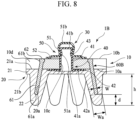
- Fig. 8 is a cross section of the bioelectrode 1B according to the Third Embodiment.
- the bioelectrode 1B has the same configuration as the bioelectrode 1 according to the First Embodiment described above, except that a core structure 60B is provided in place of the core group 60.
- the core structure 60B includes the plurality of cores 61 and the annular member 62. These are integrally made of the same material.
- the core structure 60B has the same configuration as the core structure 60A according to the Second Embodiment described above, except that a length of each of the plurality of cores 61 differs from that of the Second Embodiment and that the protrusion 63 is omitted.
- the support member 10 is interposed between the annular member 62 and the electrode member 20.
- the assembly is provided with the core structure 60B.
- the bioelectrode 1B further includes the support member 10 having the shape of a plate, being in contact with the first surface 21a, and being interposed between the base 21 and the annular member 62.
- the support member 10 includes plurality of notches 10d through which the plurality of cores 61 passes.
- Fig. 9 is a diagram showing an example of use of the bioelectrode 1.
- the example of use of the bioelectrode 1 according to the First Embodiment will be described with reference to Fig. 9 . It should be noted that the following example of use can be applied to a case in which the bioelectrode 1A or the bioelectrode 1B is used in place of the bioelectrode 1.
- a plurality of bioelectrodes 1 is appropriately arranged at a plurality of points of the head of a subject H.
- a measurement point Oz is disposed at the back X of the head.
- hairs tend to overlap; thus, it is difficult to obtain a good state of contact between the electrode member 20 and the scalp when the electrode member 20 does not include the plurality of protrusions 22.
- the electrode member 20 includes the plurality of protrusions 22 as described above, it is possible to obtain a good state of contact between the electrode member 20 and the scalp.
- each of the plurality of protrusions included in the bioelectrode is provided with a core; however, two or more protrusions among the plurality of protrusions included in the bioelectrode may be provided with cores, and a protrusion that is not provided with any core may exist.
- second flange 60... core group, 60A... core structure, 60B... core structure, 61... core, 61a... distal end, 61b... proximal end, 62... annular member, 63... protrusion, C1... center, C2... center, H... subject, O... center, Oz... measurement point, W... width, Wa... width, X... back of head, d... distance, h... height.
Landscapes
- Life Sciences & Earth Sciences (AREA)
- Health & Medical Sciences (AREA)
- Medical Informatics (AREA)
- Biophysics (AREA)
- Pathology (AREA)
- Engineering & Computer Science (AREA)
- Biomedical Technology (AREA)
- Heart & Thoracic Surgery (AREA)
- Physics & Mathematics (AREA)
- Molecular Biology (AREA)
- Surgery (AREA)
- Animal Behavior & Ethology (AREA)
- General Health & Medical Sciences (AREA)
- Public Health (AREA)
- Veterinary Medicine (AREA)
- Measurement And Recording Of Electrical Phenomena And Electrical Characteristics Of The Living Body (AREA)
Applications Claiming Priority (2)
| Application Number | Priority Date | Filing Date | Title |
|---|---|---|---|
| JP2022124857 | 2022-08-04 | ||
| PCT/JP2023/027555 WO2024029446A1 (fr) | 2022-08-04 | 2023-07-27 | Bioélectrode |
Publications (2)
| Publication Number | Publication Date |
|---|---|
| EP4566538A1 true EP4566538A1 (fr) | 2025-06-11 |
| EP4566538A4 EP4566538A4 (fr) | 2026-02-18 |
Family
ID=89848992
Family Applications (1)
| Application Number | Title | Priority Date | Filing Date |
|---|---|---|---|
| EP23850001.1A Pending EP4566538A4 (fr) | 2022-08-04 | 2023-07-27 | Bioélectrode |
Country Status (5)
| Country | Link |
|---|---|
| US (1) | US20250387060A1 (fr) |
| EP (1) | EP4566538A4 (fr) |
| JP (1) | JP7826491B2 (fr) |
| CN (1) | CN119584921A (fr) |
| WO (1) | WO2024029446A1 (fr) |
Family Cites Families (9)
| Publication number | Priority date | Publication date | Assignee | Title |
|---|---|---|---|---|
| JP2004275750A (ja) * | 2003-02-24 | 2004-10-07 | Tatsuzo Nakamura | 治療用器具 |
| JP5589593B2 (ja) * | 2009-06-29 | 2014-09-17 | ソニー株式会社 | 生体信号測定用装具 |
| JP5516137B2 (ja) * | 2010-06-28 | 2014-06-11 | ソニー株式会社 | 生体信号検出電極及び生体信号検出装置 |
| US11850052B2 (en) * | 2014-01-28 | 2023-12-26 | Medibotics Llc | Dry EEG electrode for use on a hair-covered portion of a person's head |
| WO2018186212A1 (fr) * | 2017-04-07 | 2018-10-11 | アルプス電気株式会社 | Électrode de mesure d'informations biologiques et procédé de mesure d'informations biologiques |
| JP2019166130A (ja) * | 2018-03-23 | 2019-10-03 | アルプスアルパイン株式会社 | 生体情報測定用電極 |
| WO2020095589A1 (fr) | 2018-11-09 | 2020-05-14 | 住友ベークライト株式会社 | Électrode biologique, capteur biologique et système de mesure de signal biologique |
| WO2021157287A1 (fr) * | 2020-02-07 | 2021-08-12 | Nok株式会社 | Bioélectrode |
| EP4176810B1 (fr) * | 2020-07-03 | 2025-01-01 | NOK Corporation | Bioélectrode |
-
2023
- 2023-07-27 CN CN202380053755.5A patent/CN119584921A/zh active Pending
- 2023-07-27 EP EP23850001.1A patent/EP4566538A4/fr active Pending
- 2023-07-27 JP JP2024539116A patent/JP7826491B2/ja active Active
- 2023-07-27 US US18/994,935 patent/US20250387060A1/en active Pending
- 2023-07-27 WO PCT/JP2023/027555 patent/WO2024029446A1/fr not_active Ceased
Also Published As
| Publication number | Publication date |
|---|---|
| EP4566538A4 (fr) | 2026-02-18 |
| JP7826491B2 (ja) | 2026-03-09 |
| CN119584921A (zh) | 2025-03-07 |
| US20250387060A1 (en) | 2025-12-25 |
| JPWO2024029446A1 (fr) | 2024-02-08 |
| WO2024029446A1 (fr) | 2024-02-08 |
Similar Documents
| Publication | Publication Date | Title |
|---|---|---|
| CN120676900A (zh) | 可穿戴监测装置 | |
| CA2866757C (fr) | Ensembles transducteur pour des applications seches de transducteurs | |
| US10842404B2 (en) | Electrode, wearable assembly and system | |
| TW201436763A (zh) | 線接面式乾電極 | |
| US20140107458A1 (en) | Resilient Sensor for Biopotential Measurements | |
| US10779742B2 (en) | Medical electrode and limb clamp for an ECG device | |
| EP4282464B1 (fr) | Casque d'électrode d'enregistrement et/ou de stimulation électrique | |
| EP4566538A1 (fr) | Bioélectrode | |
| CN114901144B (zh) | 生物体电极 | |
| EP4616804A1 (fr) | Bioélectrode | |
| EP4295770B1 (fr) | Bioélectrode | |
| EP4061474B1 (fr) | Électrode pour l'enregistrement de signaux électro-encéphalographiques et/ou la stimulation de patients | |
| JP7456230B2 (ja) | 生体用電極 | |
| EP4176810B1 (fr) | Bioélectrode | |
| US20230066856A1 (en) | Dry Electrode And Wearable Device | |
| JPWO2019181389A1 (ja) | 生体情報測定用電極 | |
| JP2025530543A (ja) | 電極 | |
| CN213309802U (zh) | 生物体信号传感器 | |
| JP2025067853A (ja) | 生体情報測定装置 | |
| JP2022080763A (ja) | 電極構造 |
Legal Events
| Date | Code | Title | Description |
|---|---|---|---|
| STAA | Information on the status of an ep patent application or granted ep patent |
Free format text: STATUS: THE INTERNATIONAL PUBLICATION HAS BEEN MADE |
|
| PUAI | Public reference made under article 153(3) epc to a published international application that has entered the european phase |
Free format text: ORIGINAL CODE: 0009012 |
|
| STAA | Information on the status of an ep patent application or granted ep patent |
Free format text: STATUS: REQUEST FOR EXAMINATION WAS MADE |
|
| 17P | Request for examination filed |
Effective date: 20250124 |
|
| AK | Designated contracting states |
Kind code of ref document: A1 Designated state(s): AL AT BE BG CH CY CZ DE DK EE ES FI FR GB GR HR HU IE IS IT LI LT LU LV MC ME MK MT NL NO PL PT RO RS SE SI SK SM TR |
|
| DAV | Request for validation of the european patent (deleted) | ||
| DAX | Request for extension of the european patent (deleted) | ||
| A4 | Supplementary search report drawn up and despatched |
Effective date: 20260115 |
|
| RIC1 | Information provided on ipc code assigned before grant |
Ipc: A61B 5/291 20210101AFI20260109BHEP Ipc: A61B 5/251 20210101ALI20260109BHEP Ipc: A61B 5/268 20210101ALI20260109BHEP Ipc: A61B 5/296 20210101ALI20260109BHEP Ipc: A61B 5/263 20210101ALI20260109BHEP |