ES2728735T3 - Pseudopolymorphic forms of an HIV protease inhibitor - Google Patents
Pseudopolymorphic forms of an HIV protease inhibitor Download PDFInfo
- Publication number
- ES2728735T3 ES2728735T3 ES16158480T ES16158480T ES2728735T3 ES 2728735 T3 ES2728735 T3 ES 2728735T3 ES 16158480 T ES16158480 T ES 16158480T ES 16158480 T ES16158480 T ES 16158480T ES 2728735 T3 ES2728735 T3 ES 2728735T3
- Authority
- ES
- Spain
- Prior art keywords
- compound
- formula
- solvent
- pseudopolymorphs
- water
- Prior art date
- Legal status (The legal status is an assumption and is not a legal conclusion. Google has not performed a legal analysis and makes no representation as to the accuracy of the status listed.)
- Expired - Lifetime
Links
- 239000004030 hiv protease inhibitor Substances 0.000 title description 3
- 229940122440 HIV protease inhibitor Drugs 0.000 title description 2
- 239000012453 solvate Substances 0.000 claims abstract description 33
- KFZMGEQAYNKOFK-UHFFFAOYSA-N Isopropanol Chemical compound CC(C)O KFZMGEQAYNKOFK-UHFFFAOYSA-N 0.000 claims abstract description 20
- CJBJHOAVZSMMDJ-HEXNFIEUSA-N darunavir Chemical compound C([C@@H]([C@H](O)CN(CC(C)C)S(=O)(=O)C=1C=CC(N)=CC=1)NC(=O)O[C@@H]1[C@@H]2CCO[C@@H]2OC1)C1=CC=CC=C1 CJBJHOAVZSMMDJ-HEXNFIEUSA-N 0.000 claims abstract description 6
- 239000003814 drug Substances 0.000 claims description 16
- 206010038997 Retroviral infections Diseases 0.000 claims description 2
- 150000001875 compounds Chemical class 0.000 description 71
- 239000002904 solvent Substances 0.000 description 56
- 238000000034 method Methods 0.000 description 52
- LFQSCWFLJHTTHZ-UHFFFAOYSA-N Ethanol Chemical compound CCO LFQSCWFLJHTTHZ-UHFFFAOYSA-N 0.000 description 43
- 239000000243 solution Substances 0.000 description 37
- XLYOFNOQVPJJNP-UHFFFAOYSA-N water Substances O XLYOFNOQVPJJNP-UHFFFAOYSA-N 0.000 description 32
- 239000000047 product Substances 0.000 description 25
- 239000013078 crystal Substances 0.000 description 22
- 239000000203 mixture Substances 0.000 description 22
- 238000002425 crystallisation Methods 0.000 description 19
- 230000008025 crystallization Effects 0.000 description 19
- 239000000126 substance Substances 0.000 description 19
- 238000012360 testing method Methods 0.000 description 15
- 239000008194 pharmaceutical composition Substances 0.000 description 14
- 230000008569 process Effects 0.000 description 13
- 238000000113 differential scanning calorimetry Methods 0.000 description 12
- 238000001035 drying Methods 0.000 description 12
- 239000002245 particle Substances 0.000 description 12
- IOLCXVTUBQKXJR-UHFFFAOYSA-M potassium bromide Chemical compound [K+].[Br-] IOLCXVTUBQKXJR-UHFFFAOYSA-M 0.000 description 12
- 230000004580 weight loss Effects 0.000 description 12
- 238000001704 evaporation Methods 0.000 description 11
- 230000008020 evaporation Effects 0.000 description 11
- 239000003960 organic solvent Substances 0.000 description 11
- 238000003860 storage Methods 0.000 description 11
- 238000003795 desorption Methods 0.000 description 10
- 229940079593 drug Drugs 0.000 description 10
- 230000036571 hydration Effects 0.000 description 10
- 238000006703 hydration reaction Methods 0.000 description 10
- 238000002360 preparation method Methods 0.000 description 10
- CSCPPACGZOOCGX-UHFFFAOYSA-N Acetone Chemical compound CC(C)=O CSCPPACGZOOCGX-UHFFFAOYSA-N 0.000 description 9
- YMWUJEATGCHHMB-UHFFFAOYSA-N Dichloromethane Chemical compound ClCCl YMWUJEATGCHHMB-UHFFFAOYSA-N 0.000 description 9
- XEKOWRVHYACXOJ-UHFFFAOYSA-N Ethyl acetate Chemical compound CCOC(C)=O XEKOWRVHYACXOJ-UHFFFAOYSA-N 0.000 description 9
- 238000001914 filtration Methods 0.000 description 9
- 238000004128 high performance liquid chromatography Methods 0.000 description 9
- 238000001179 sorption measurement Methods 0.000 description 9
- 238000002336 sorption--desorption measurement Methods 0.000 description 9
- 230000003595 spectral effect Effects 0.000 description 9
- AFVFQIVMOAPDHO-UHFFFAOYSA-N Methanesulfonic acid Chemical group CS(O)(=O)=O AFVFQIVMOAPDHO-UHFFFAOYSA-N 0.000 description 8
- WYURNTSHIVDZCO-UHFFFAOYSA-N Tetrahydrofuran Chemical compound C1CCOC1 WYURNTSHIVDZCO-UHFFFAOYSA-N 0.000 description 8
- 238000010521 absorption reaction Methods 0.000 description 8
- HHFAWKCIHAUFRX-UHFFFAOYSA-N ethoxide Chemical compound CC[O-] HHFAWKCIHAUFRX-UHFFFAOYSA-N 0.000 description 8
- 238000010438 heat treatment Methods 0.000 description 8
- 238000002329 infrared spectrum Methods 0.000 description 8
- 241000124008 Mammalia Species 0.000 description 7
- 238000001237 Raman spectrum Methods 0.000 description 7
- 230000008859 change Effects 0.000 description 7
- 239000006185 dispersion Substances 0.000 description 7
- 238000004519 manufacturing process Methods 0.000 description 7
- OKKJLVBELUTLKV-UHFFFAOYSA-N Methanol Chemical compound OC OKKJLVBELUTLKV-UHFFFAOYSA-N 0.000 description 6
- 238000001816 cooling Methods 0.000 description 6
- 238000009472 formulation Methods 0.000 description 6
- 230000004927 fusion Effects 0.000 description 6
- 230000007774 longterm Effects 0.000 description 6
- 238000001228 spectrum Methods 0.000 description 6
- 238000002411 thermogravimetry Methods 0.000 description 6
- 241000725303 Human immunodeficiency virus Species 0.000 description 5
- 238000001069 Raman spectroscopy Methods 0.000 description 5
- XAGFODPZIPBFFR-UHFFFAOYSA-N aluminium Chemical compound [Al] XAGFODPZIPBFFR-UHFFFAOYSA-N 0.000 description 5
- 229910052782 aluminium Inorganic materials 0.000 description 5
- -1 argon ion Chemical class 0.000 description 5
- 230000015572 biosynthetic process Effects 0.000 description 5
- 239000011521 glass Substances 0.000 description 5
- 239000012535 impurity Substances 0.000 description 5
- 239000007787 solid Substances 0.000 description 5
- 239000000725 suspension Substances 0.000 description 5
- ARXJGSRGQADJSQ-UHFFFAOYSA-N 1-methoxypropan-2-ol Chemical compound COCC(C)O ARXJGSRGQADJSQ-UHFFFAOYSA-N 0.000 description 4
- IJGRMHOSHXDMSA-UHFFFAOYSA-N Atomic nitrogen Chemical compound N#N IJGRMHOSHXDMSA-UHFFFAOYSA-N 0.000 description 4
- RTZKZFJDLAIYFH-UHFFFAOYSA-N Diethyl ether Chemical compound CCOCC RTZKZFJDLAIYFH-UHFFFAOYSA-N 0.000 description 4
- 108010010369 HIV Protease Proteins 0.000 description 4
- 208000036142 Viral infection Diseases 0.000 description 4
- 239000000654 additive Substances 0.000 description 4
- 238000001938 differential scanning calorimetry curve Methods 0.000 description 4
- 230000002401 inhibitory effect Effects 0.000 description 4
- 239000000463 material Substances 0.000 description 4
- 238000002844 melting Methods 0.000 description 4
- 230000008018 melting Effects 0.000 description 4
- 238000010899 nucleation Methods 0.000 description 4
- 239000000843 powder Substances 0.000 description 4
- VYPSYNLAJGMNEJ-UHFFFAOYSA-N silicon dioxide Inorganic materials O=[Si]=O VYPSYNLAJGMNEJ-UHFFFAOYSA-N 0.000 description 4
- 238000000870 ultraviolet spectroscopy Methods 0.000 description 4
- 230000009385 viral infection Effects 0.000 description 4
- 238000005033 Fourier transform infrared spectroscopy Methods 0.000 description 3
- PEDCQBHIVMGVHV-UHFFFAOYSA-N Glycerine Chemical compound OCC(O)CO PEDCQBHIVMGVHV-UHFFFAOYSA-N 0.000 description 3
- 238000004566 IR spectroscopy Methods 0.000 description 3
- 239000004698 Polyethylene Substances 0.000 description 3
- 125000002915 carbonyl group Chemical group [*:2]C([*:1])=O 0.000 description 3
- 239000003795 chemical substances by application Substances 0.000 description 3
- 238000000354 decomposition reaction Methods 0.000 description 3
- 238000006073 displacement reaction Methods 0.000 description 3
- 238000004090 dissolution Methods 0.000 description 3
- 230000000694 effects Effects 0.000 description 3
- 239000000839 emulsion Substances 0.000 description 3
- 150000002148 esters Chemical class 0.000 description 3
- 239000007789 gas Substances 0.000 description 3
- 150000002576 ketones Chemical class 0.000 description 3
- 239000012299 nitrogen atmosphere Substances 0.000 description 3
- 239000000546 pharmaceutical excipient Substances 0.000 description 3
- 238000000634 powder X-ray diffraction Methods 0.000 description 3
- 238000001953 recrystallisation Methods 0.000 description 3
- 238000000926 separation method Methods 0.000 description 3
- 238000007614 solvation Methods 0.000 description 3
- 238000003786 synthesis reaction Methods 0.000 description 3
- YLQBMQCUIZJEEH-UHFFFAOYSA-N tetrahydrofuran Natural products C=1C=COC=1 YLQBMQCUIZJEEH-UHFFFAOYSA-N 0.000 description 3
- 238000005292 vacuum distillation Methods 0.000 description 3
- 238000011179 visual inspection Methods 0.000 description 3
- 238000005406 washing Methods 0.000 description 3
- BWLBGMIXKSTLSX-UHFFFAOYSA-N 2-hydroxyisobutyric acid Chemical compound CC(C)(O)C(O)=O BWLBGMIXKSTLSX-UHFFFAOYSA-N 0.000 description 2
- 208000030507 AIDS Diseases 0.000 description 2
- 206010001513 AIDS related complex Diseases 0.000 description 2
- 238000005079 FT-Raman Methods 0.000 description 2
- WQZGKKKJIJFFOK-GASJEMHNSA-N Glucose Natural products OC[C@H]1OC(O)[C@H](O)[C@@H](O)[C@@H]1O WQZGKKKJIJFFOK-GASJEMHNSA-N 0.000 description 2
- 208000031886 HIV Infections Diseases 0.000 description 2
- CPLXHLVBOLITMK-UHFFFAOYSA-N Magnesium oxide Chemical compound [Mg]=O CPLXHLVBOLITMK-UHFFFAOYSA-N 0.000 description 2
- LRHPLDYGYMQRHN-UHFFFAOYSA-N N-Butanol Chemical compound CCCCO LRHPLDYGYMQRHN-UHFFFAOYSA-N 0.000 description 2
- 102000014961 Protein Precursors Human genes 0.000 description 2
- 238000002441 X-ray diffraction Methods 0.000 description 2
- 239000004480 active ingredient Substances 0.000 description 2
- 230000001154 acute effect Effects 0.000 description 2
- 230000001476 alcoholic effect Effects 0.000 description 2
- 150000001298 alcohols Chemical class 0.000 description 2
- 239000003513 alkali Substances 0.000 description 2
- 150000001348 alkyl chlorides Chemical class 0.000 description 2
- RDOXTESZEPMUJZ-UHFFFAOYSA-N anisole Chemical compound COC1=CC=CC=C1 RDOXTESZEPMUJZ-UHFFFAOYSA-N 0.000 description 2
- 229940124522 antiretrovirals Drugs 0.000 description 2
- 239000003903 antiretrovirus agent Substances 0.000 description 2
- WQZGKKKJIJFFOK-VFUOTHLCSA-N beta-D-glucose Chemical compound OC[C@H]1O[C@@H](O)[C@H](O)[C@@H](O)[C@@H]1O WQZGKKKJIJFFOK-VFUOTHLCSA-N 0.000 description 2
- 239000002775 capsule Substances 0.000 description 2
- 238000006243 chemical reaction Methods 0.000 description 2
- 230000003750 conditioning effect Effects 0.000 description 2
- 238000012937 correction Methods 0.000 description 2
- UKJLNMAFNRKWGR-UHFFFAOYSA-N cyclohexatrienamine Chemical group NC1=CC=C=C[CH]1 UKJLNMAFNRKWGR-UHFFFAOYSA-N 0.000 description 2
- 230000003247 decreasing effect Effects 0.000 description 2
- 239000007857 degradation product Substances 0.000 description 2
- 239000003085 diluting agent Substances 0.000 description 2
- 201000010099 disease Diseases 0.000 description 2
- 208000037265 diseases, disorders, signs and symptoms Diseases 0.000 description 2
- 238000001647 drug administration Methods 0.000 description 2
- 239000003995 emulsifying agent Substances 0.000 description 2
- 239000000796 flavoring agent Substances 0.000 description 2
- 239000008103 glucose Substances 0.000 description 2
- 238000011194 good manufacturing practice Methods 0.000 description 2
- 239000008187 granular material Substances 0.000 description 2
- 150000004820 halides Chemical class 0.000 description 2
- 150000004677 hydrates Chemical class 0.000 description 2
- 125000000959 isobutyl group Chemical group [H]C([H])([H])C([H])(C([H])([H])[H])C([H])([H])* 0.000 description 2
- 238000005259 measurement Methods 0.000 description 2
- NBTOZLQBSIZIKS-UHFFFAOYSA-N methoxide Chemical compound [O-]C NBTOZLQBSIZIKS-UHFFFAOYSA-N 0.000 description 2
- 239000003607 modifier Substances 0.000 description 2
- 229910052757 nitrogen Inorganic materials 0.000 description 2
- 230000006911 nucleation Effects 0.000 description 2
- 239000005022 packaging material Substances 0.000 description 2
- 239000000902 placebo Substances 0.000 description 2
- 229940068196 placebo Drugs 0.000 description 2
- 229910052700 potassium Inorganic materials 0.000 description 2
- 238000001556 precipitation Methods 0.000 description 2
- 125000002924 primary amino group Chemical group [H]N([H])* 0.000 description 2
- 238000012545 processing Methods 0.000 description 2
- OGHBATFHNDZKSO-UHFFFAOYSA-N propan-2-olate Chemical compound CC(C)[O-] OGHBATFHNDZKSO-UHFFFAOYSA-N 0.000 description 2
- 238000000746 purification Methods 0.000 description 2
- 230000005855 radiation Effects 0.000 description 2
- 239000011541 reaction mixture Substances 0.000 description 2
- 238000010992 reflux Methods 0.000 description 2
- 238000009738 saturating Methods 0.000 description 2
- 238000009331 sowing Methods 0.000 description 2
- 239000003381 stabilizer Substances 0.000 description 2
- 238000010561 standard procedure Methods 0.000 description 2
- 239000007858 starting material Substances 0.000 description 2
- 238000003756 stirring Methods 0.000 description 2
- 125000000472 sulfonyl group Chemical group *S(*)(=O)=O 0.000 description 2
- 239000004094 surface-active agent Substances 0.000 description 2
- LWIHDJKSTIGBAC-UHFFFAOYSA-K tripotassium phosphate Chemical compound [K+].[K+].[K+].[O-]P([O-])([O-])=O LWIHDJKSTIGBAC-UHFFFAOYSA-K 0.000 description 2
- 230000003612 virological effect Effects 0.000 description 2
- FKOZPUORKCHONH-UHFFFAOYSA-N 2-methylpropane-1-sulfonic acid Chemical compound CC(C)CS(O)(=O)=O FKOZPUORKCHONH-UHFFFAOYSA-N 0.000 description 1
- 244000215068 Acacia senegal Species 0.000 description 1
- GUBGYTABKSRVRQ-XLOQQCSPSA-N Alpha-Lactose Chemical compound O[C@@H]1[C@@H](O)[C@@H](O)[C@@H](CO)O[C@H]1O[C@@H]1[C@@H](CO)O[C@H](O)[C@H](O)[C@H]1O GUBGYTABKSRVRQ-XLOQQCSPSA-N 0.000 description 1
- RYGMFSIKBFXOCR-UHFFFAOYSA-N Copper Chemical compound [Cu] RYGMFSIKBFXOCR-UHFFFAOYSA-N 0.000 description 1
- 229920002261 Corn starch Polymers 0.000 description 1
- 229920000858 Cyclodextrin Polymers 0.000 description 1
- FBPFZTCFMRRESA-KVTDHHQDSA-N D-Mannitol Chemical compound OC[C@@H](O)[C@@H](O)[C@H](O)[C@H](O)CO FBPFZTCFMRRESA-KVTDHHQDSA-N 0.000 description 1
- 229910000530 Gallium indium arsenide Inorganic materials 0.000 description 1
- 229920000084 Gum arabic Polymers 0.000 description 1
- 208000037357 HIV infectious disease Diseases 0.000 description 1
- 241000713772 Human immunodeficiency virus 1 Species 0.000 description 1
- 241000713340 Human immunodeficiency virus 2 Species 0.000 description 1
- GUBGYTABKSRVRQ-QKKXKWKRSA-N Lactose Natural products OC[C@H]1O[C@@H](O[C@H]2[C@H](O)[C@@H](O)C(O)O[C@@H]2CO)[C@H](O)[C@@H](O)[C@H]1O GUBGYTABKSRVRQ-QKKXKWKRSA-N 0.000 description 1
- 229930195725 Mannitol Natural products 0.000 description 1
- 108091005804 Peptidases Proteins 0.000 description 1
- 102000035195 Peptidases Human genes 0.000 description 1
- 239000004365 Protease Substances 0.000 description 1
- 108010078762 Protein Precursors Proteins 0.000 description 1
- 229920002472 Starch Polymers 0.000 description 1
- 235000019486 Sunflower oil Nutrition 0.000 description 1
- 229910009372 YVO4 Inorganic materials 0.000 description 1
- 239000000205 acacia gum Substances 0.000 description 1
- 235000010489 acacia gum Nutrition 0.000 description 1
- 230000009471 action Effects 0.000 description 1
- 239000008186 active pharmaceutical agent Substances 0.000 description 1
- 238000002159 adsorption--desorption isotherm Methods 0.000 description 1
- 239000000443 aerosol Substances 0.000 description 1
- 150000001335 aliphatic alkanes Chemical class 0.000 description 1
- 238000012442 analytical experiment Methods 0.000 description 1
- 238000004458 analytical method Methods 0.000 description 1
- 239000010775 animal oil Substances 0.000 description 1
- 230000000798 anti-retroviral effect Effects 0.000 description 1
- XKRFYHLGVUSROY-UHFFFAOYSA-N argon Substances [Ar] XKRFYHLGVUSROY-UHFFFAOYSA-N 0.000 description 1
- 229910052786 argon Inorganic materials 0.000 description 1
- QVGXLLKOCUKJST-UHFFFAOYSA-N atomic oxygen Chemical compound [O] QVGXLLKOCUKJST-UHFFFAOYSA-N 0.000 description 1
- 238000010533 azeotropic distillation Methods 0.000 description 1
- 239000002585 base Substances 0.000 description 1
- QDHFHIQKOVNCNC-UHFFFAOYSA-M butane-1-sulfonate Chemical compound CCCCS([O-])(=O)=O QDHFHIQKOVNCNC-UHFFFAOYSA-M 0.000 description 1
- WUKWITHWXAAZEY-UHFFFAOYSA-L calcium difluoride Chemical compound [F-].[F-].[Ca+2] WUKWITHWXAAZEY-UHFFFAOYSA-L 0.000 description 1
- 229910001634 calcium fluoride Inorganic materials 0.000 description 1
- 238000004364 calculation method Methods 0.000 description 1
- 239000000969 carrier Substances 0.000 description 1
- 230000015556 catabolic process Effects 0.000 description 1
- 238000005119 centrifugation Methods 0.000 description 1
- 238000012512 characterization method Methods 0.000 description 1
- 239000007795 chemical reaction product Substances 0.000 description 1
- 230000001684 chronic effect Effects 0.000 description 1
- 230000004087 circulation Effects 0.000 description 1
- 239000003026 cod liver oil Substances 0.000 description 1
- 235000012716 cod liver oil Nutrition 0.000 description 1
- 238000005056 compaction Methods 0.000 description 1
- 229910052802 copper Inorganic materials 0.000 description 1
- 239000010949 copper Substances 0.000 description 1
- 239000008120 corn starch Substances 0.000 description 1
- 238000006731 degradation reaction Methods 0.000 description 1
- 239000002274 desiccant Substances 0.000 description 1
- 238000013461 design Methods 0.000 description 1
- 238000001514 detection method Methods 0.000 description 1
- 229940042399 direct acting antivirals protease inhibitors Drugs 0.000 description 1
- 239000002270 dispersing agent Substances 0.000 description 1
- 238000010494 dissociation reaction Methods 0.000 description 1
- 230000005593 dissociations Effects 0.000 description 1
- 238000004821 distillation Methods 0.000 description 1
- 238000009826 distribution Methods 0.000 description 1
- 239000003937 drug carrier Substances 0.000 description 1
- 230000007613 environmental effect Effects 0.000 description 1
- CCIVGXIOQKPBKL-UHFFFAOYSA-M ethanesulfonate Chemical compound CCS([O-])(=O)=O CCIVGXIOQKPBKL-UHFFFAOYSA-M 0.000 description 1
- 150000002170 ethers Chemical class 0.000 description 1
- 238000002474 experimental method Methods 0.000 description 1
- 235000019634 flavors Nutrition 0.000 description 1
- 235000013355 food flavoring agent Nutrition 0.000 description 1
- 238000004508 fractional distillation Methods 0.000 description 1
- 238000004108 freeze drying Methods 0.000 description 1
- 238000000227 grinding Methods 0.000 description 1
- 230000036541 health Effects 0.000 description 1
- 208000033519 human immunodeficiency virus infectious disease Diseases 0.000 description 1
- 238000010348 incorporation Methods 0.000 description 1
- 230000001939 inductive effect Effects 0.000 description 1
- 208000015181 infectious disease Diseases 0.000 description 1
- 230000002458 infectious effect Effects 0.000 description 1
- 238000001802 infusion Methods 0.000 description 1
- 239000004615 ingredient Substances 0.000 description 1
- 238000002347 injection Methods 0.000 description 1
- 239000007924 injection Substances 0.000 description 1
- 238000001990 intravenous administration Methods 0.000 description 1
- 238000011835 investigation Methods 0.000 description 1
- 239000008101 lactose Substances 0.000 description 1
- 239000007788 liquid Substances 0.000 description 1
- ZLNQQNXFFQJAID-UHFFFAOYSA-L magnesium carbonate Chemical compound [Mg+2].[O-]C([O-])=O ZLNQQNXFFQJAID-UHFFFAOYSA-L 0.000 description 1
- 239000001095 magnesium carbonate Substances 0.000 description 1
- 229910000021 magnesium carbonate Inorganic materials 0.000 description 1
- 235000014380 magnesium carbonate Nutrition 0.000 description 1
- 239000000395 magnesium oxide Substances 0.000 description 1
- 235000012245 magnesium oxide Nutrition 0.000 description 1
- 239000000594 mannitol Substances 0.000 description 1
- 235000010355 mannitol Nutrition 0.000 description 1
- 230000000873 masking effect Effects 0.000 description 1
- 229940098779 methanesulfonic acid Drugs 0.000 description 1
- UZKWTJUDCOPSNM-UHFFFAOYSA-N methoxybenzene Substances CCCCOC=C UZKWTJUDCOPSNM-UHFFFAOYSA-N 0.000 description 1
- 239000013081 microcrystal Substances 0.000 description 1
- 238000002156 mixing Methods 0.000 description 1
- 238000012986 modification Methods 0.000 description 1
- 230000004048 modification Effects 0.000 description 1
- 239000002159 nanocrystal Substances 0.000 description 1
- 239000002105 nanoparticle Substances 0.000 description 1
- 230000003287 optical effect Effects 0.000 description 1
- 150000002894 organic compounds Chemical class 0.000 description 1
- 239000001301 oxygen Substances 0.000 description 1
- 229910052760 oxygen Inorganic materials 0.000 description 1
- 239000008188 pellet Substances 0.000 description 1
- WXZMFSXDPGVJKK-UHFFFAOYSA-N pentaerythritol Chemical compound OCC(CO)(CO)CO WXZMFSXDPGVJKK-UHFFFAOYSA-N 0.000 description 1
- 239000000137 peptide hydrolase inhibitor Substances 0.000 description 1
- 239000008177 pharmaceutical agent Substances 0.000 description 1
- 230000000704 physical effect Effects 0.000 description 1
- 239000002504 physiological saline solution Substances 0.000 description 1
- 230000036470 plasma concentration Effects 0.000 description 1
- 230000010287 polarization Effects 0.000 description 1
- 229920001223 polyethylene glycol Polymers 0.000 description 1
- 239000005020 polyethylene terephthalate Substances 0.000 description 1
- 229920000139 polyethylene terephthalate Polymers 0.000 description 1
- 229920001451 polypropylene glycol Polymers 0.000 description 1
- 229910000160 potassium phosphate Inorganic materials 0.000 description 1
- 235000011009 potassium phosphates Nutrition 0.000 description 1
- 230000003389 potentiating effect Effects 0.000 description 1
- BDERNNFJNOPAEC-UHFFFAOYSA-N propan-1-ol Chemical compound CCCO BDERNNFJNOPAEC-UHFFFAOYSA-N 0.000 description 1
- 239000003380 propellant Substances 0.000 description 1
- 230000001681 protective effect Effects 0.000 description 1
- 238000012797 qualification Methods 0.000 description 1
- 239000010453 quartz Substances 0.000 description 1
- 238000005057 refrigeration Methods 0.000 description 1
- 239000013557 residual solvent Substances 0.000 description 1
- 239000012047 saturated solution Substances 0.000 description 1
- 230000035945 sensitivity Effects 0.000 description 1
- 239000000741 silica gel Substances 0.000 description 1
- 229910002027 silica gel Inorganic materials 0.000 description 1
- 238000004611 spectroscopical analysis Methods 0.000 description 1
- 239000007921 spray Substances 0.000 description 1
- 238000001694 spray drying Methods 0.000 description 1
- 238000013112 stability test Methods 0.000 description 1
- 239000008107 starch Substances 0.000 description 1
- 235000019698 starch Nutrition 0.000 description 1
- 238000007920 subcutaneous administration Methods 0.000 description 1
- 150000003871 sulfonates Chemical class 0.000 description 1
- 239000002600 sunflower oil Substances 0.000 description 1
- 230000001839 systemic circulation Effects 0.000 description 1
- UJJLJRQIPMGXEZ-UHFFFAOYSA-N tetrahydro-2-furoic acid Chemical compound OC(=O)C1CCCO1 UJJLJRQIPMGXEZ-UHFFFAOYSA-N 0.000 description 1
- 230000001225 therapeutic effect Effects 0.000 description 1
- 238000002076 thermal analysis method Methods 0.000 description 1
- 241001430294 unidentified retrovirus Species 0.000 description 1
- 210000002700 urine Anatomy 0.000 description 1
- 239000008158 vegetable oil Substances 0.000 description 1
- 235000013311 vegetables Nutrition 0.000 description 1
- 230000029812 viral genome replication Effects 0.000 description 1
- 230000006514 viral protein processing Effects 0.000 description 1
- 210000002845 virion Anatomy 0.000 description 1
Classifications
-
- C—CHEMISTRY; METALLURGY
- C07—ORGANIC CHEMISTRY
- C07D—HETEROCYCLIC COMPOUNDS
- C07D493/00—Heterocyclic compounds containing oxygen atoms as the only ring hetero atoms in the condensed system
- C07D493/02—Heterocyclic compounds containing oxygen atoms as the only ring hetero atoms in the condensed system in which the condensed system contains two hetero rings
- C07D493/04—Ortho-condensed systems
-
- A—HUMAN NECESSITIES
- A61—MEDICAL OR VETERINARY SCIENCE; HYGIENE
- A61P—SPECIFIC THERAPEUTIC ACTIVITY OF CHEMICAL COMPOUNDS OR MEDICINAL PREPARATIONS
- A61P31/00—Antiinfectives, i.e. antibiotics, antiseptics, chemotherapeutics
- A61P31/12—Antivirals
-
- A—HUMAN NECESSITIES
- A61—MEDICAL OR VETERINARY SCIENCE; HYGIENE
- A61P—SPECIFIC THERAPEUTIC ACTIVITY OF CHEMICAL COMPOUNDS OR MEDICINAL PREPARATIONS
- A61P31/00—Antiinfectives, i.e. antibiotics, antiseptics, chemotherapeutics
- A61P31/12—Antivirals
- A61P31/14—Antivirals for RNA viruses
- A61P31/18—Antivirals for RNA viruses for HIV
-
- A—HUMAN NECESSITIES
- A61—MEDICAL OR VETERINARY SCIENCE; HYGIENE
- A61P—SPECIFIC THERAPEUTIC ACTIVITY OF CHEMICAL COMPOUNDS OR MEDICINAL PREPARATIONS
- A61P43/00—Drugs for specific purposes, not provided for in groups A61P1/00-A61P41/00
Landscapes
- Organic Chemistry (AREA)
- Chemical & Material Sciences (AREA)
- Health & Medical Sciences (AREA)
- Life Sciences & Earth Sciences (AREA)
- General Health & Medical Sciences (AREA)
- Medicinal Chemistry (AREA)
- Nuclear Medicine, Radiotherapy & Molecular Imaging (AREA)
- Chemical Kinetics & Catalysis (AREA)
- Pharmacology & Pharmacy (AREA)
- General Chemical & Material Sciences (AREA)
- Animal Behavior & Ethology (AREA)
- Public Health (AREA)
- Veterinary Medicine (AREA)
- Virology (AREA)
- Communicable Diseases (AREA)
- Oncology (AREA)
- Bioinformatics & Cheminformatics (AREA)
- Engineering & Computer Science (AREA)
- AIDS & HIV (AREA)
- Tropical Medicine & Parasitology (AREA)
- Molecular Biology (AREA)
- Pharmaceuticals Containing Other Organic And Inorganic Compounds (AREA)
- Furan Compounds (AREA)
- Heterocyclic Carbon Compounds Containing A Hetero Ring Having Oxygen Or Sulfur (AREA)
- Organic Low-Molecular-Weight Compounds And Preparation Thereof (AREA)
Abstract
Un pseudopolimorfo de (3R,3aS,6aR)-hexahidrofuro [2,3-b] furan-3-il (1S,2R)-3-[[(4-aminofenil) sulfonil] (isobutil) amino]-1-bencil-2-hidroxipropilcarbamato, en donde el pseudopolimorfo es un solvato de isopropanol, que contiene 50% en moles de isopropanol.A pseudopolymorph of (3R, 3aS, 6aR) -hexahydrofuro [2,3-b] furan-3-yl (1S, 2R) -3 - [[(4-aminophenyl) sulfonyl] (isobutyl) amino] -1-benzyl -2-hydroxypropylcarbamate, wherein the pseudopolymorph is an isopropanol solvate, which contains 50 mol% of isopropanol.
Description
DESCRIPCIÓNDESCRIPTION
Formas pseudopolimórficas de un inhibidor de la proteasa del HIVPseudopolymorphic forms of an HIV protease inhibitor
Campo técnicoTechnical field
Esta invención se refiere a una novedosa forma pseudopolimórfica de (3R,3aS,6aR)-hexahidro-furo [2,3-b] furan-3-il (1S,2R)-3-[[(4-aminofenil) sulfonil] (isobutil) amino]-1-bencil-2-hidroxipropilcarbamato, y su uso médico.This invention relates to a novel pseudopolymorphic form of (3R, 3aS, 6aR) -hexahydro-furo [2,3-b] furan-3-yl (1S, 2R) -3 - [[(4-aminophenyl) sulfonyl] (isobutyl) amino] -1-benzyl-2-hydroxypropylcarbamate, and its medical use.
Antecedentes de la invenciónBackground of the invention
Las proteasas codificadas por virus, que son esenciales para la replicación vírica, son necesarias para el procesamiento de precursores de proteínas víricas. La interferencia con el procesamiento de precursores proteicos inhibe la formación de viriones infecciosos. De acuerdo con lo anterior, se pueden usar inhibidores de proteasas virales para prevenir o tratar infecciones virales crónicas y agudas. (3R,3aS,6aR)-hexahidrofuro [2,3-b] furan-3-il (1S,2R)-3-[[(4-aminofenil) sulfonil] (isobutil) amino]-1-bencil-2-hidroxipropilcarbamato tiene actividad inhibidora de la proteasa del HIV y es particularmente adecuado para inhibir los virus HIV-1 y HIV-2.Virus-encoded proteases, which are essential for viral replication, are necessary for the processing of viral protein precursors. Interference with the processing of protein precursors inhibits the formation of infectious virions. According to the above, viral protease inhibitors can be used to prevent or treat chronic and acute viral infections. (3R, 3aS, 6aR) -hexahydrofuro [2,3-b] furan-3-yl (1S, 2R) -3 - [[(4-aminophenyl) sulfonyl] (isobutyl) amino] -1-benzyl-2- Hydroxypropylcarbamate has HIV protease inhibitory activity and is particularly suitable for inhibiting HIV-1 and HIV-2 viruses.
La estructura del (3R,3aS,6aR)-hexahidrofuro [2,3-b] furan-3-il (1S,2R)-3-[[(4-aminofenil) sulfonil] (isobutil) amino]-1-bencil-2-hidroxipropilcarbamato, se muestra a continuación:The structure of (3R, 3aS, 6aR) -hexahydrofuro [2,3-b] furan-3-yl (1S, 2R) -3 - [[(4-aminophenyl) sulfonyl] (isobutyl) amino] -1-benzyl -2-hydroxypropylcarbamate, is shown below:

El compuesto de fórmula (X) y los procedimientos para su preparación se describen en los documentos EP 715618, WO 99/67417, US 6,248,775, y en Bioorganic and Chemistry Letters, Vol. 8, pp. 687-690, 1998, "Potent HIV protease inhibitors incorporating high-affinity P2-igands and (R)-(hydroxyethylamino)sulfonamide isostere", todos los cuales se incorporan en este documento como referencia.The compound of formula (X) and the procedures for its preparation are described in EP 715618, WO 99/67417, US 6,248,775, and in Bioorganic and Chemistry Letters, Vol. 8, pp. 687-690, 1998, "Potent HIV protease inhibitors incorporating high-affinity P2-igands and (R) - (hydroxyethylamino) sulfonamide isostere", all of which are incorporated herein by reference.
Los fármacos utilizados en la preparación de formulaciones farmacéuticas para uso comercial deben cumplir con ciertas normas, incluidas las directrices GMP (Good Manufacturing Practices) e ICH (International Conference on Harmonization). Dichas normas incluyen requisitos técnicos que abarcan una heterogénea y amplia gama de parámetros físicos, químicos y farmacéuticos. Es esta variedad de parámetros a considerar, que hacen de las formulaciones farmacéuticas una disciplina técnica compleja.Drugs used in the preparation of pharmaceutical formulations for commercial use must comply with certain standards, including the GMP (Good Manufacturing Practices) and ICH (International Conference on Harmonization) guidelines. These standards include technical requirements that cover a heterogeneous and wide range of physical, chemical and pharmaceutical parameters. It is this variety of parameters to consider, which make pharmaceutical formulations a complex technical discipline.
Por ejemplo, y como ejemplo, un fármaco utilizado para la preparación de formulaciones farmacéuticas debe cumplir una pureza aceptable. Existen pautas establecidas que definen los límites y calificación de impurezas en nuevas sustancias farmacéuticas producidas por síntesis química, esto es, impurezas reales y potenciales más probables de surgir durante la síntesis, purificación y almacenamiento de la nueva sustancia farmacéutica. Se establecen directrices para la cantidad de productos de degradación permitidos de la sustancia farmacéutica, o productos de reacción de la sustancia farmacéutica con un excipiente y/o un sistema de recipiente/cierre inmediato.For example, and as an example, a drug used for the preparation of pharmaceutical formulations must meet acceptable purity. There are established guidelines that define the limits and qualification of impurities in new pharmaceutical substances produced by chemical synthesis, that is, real and potential impurities most likely to arise during the synthesis, purification and storage of the new pharmaceutical substance. Guidelines are established for the amount of allowed degradation products of the pharmaceutical substance, or reaction products of the pharmaceutical substance with an excipient and / or an immediate container / closure system.
La estabilidad es también un parámetro considerado en la creación de formulaciones farmacéuticas. Una buena estabilidad asegurará que la integridad química deseada de las sustancias farmacéuticas se mantenga durante la vida útil de la formulación farmacéutica, que es el marco de tiempo sobre el cual se puede confiar en que un producto conserve sus características de calidad cuando se almacena bajo condiciones de almacenamiento esperado o dirigido. Durante este período, el fármaco se puede administrar con poco o ningún riesgo, ya que la presencia de productos de degradación potencialmente peligrosos no tiene consecuencias perjudiciales para la salud del receptor, ni el menor contenido del ingrediente activo puede causar submedicación.Stability is also a parameter considered in the creation of pharmaceutical formulations. Good stability will ensure that the desired chemical integrity of pharmaceutical substances is maintained during the shelf life of the pharmaceutical formulation, which is the time frame on which a product can be trusted to retain its quality characteristics when stored under conditions of expected or targeted storage. During this period, the drug can be administered with little or no risk, since the presence of potentially dangerous degradation products does not have harmful consequences for the health of the recipient, nor can the lower content of the active ingredient cause submedication.
Diferentes factores, tales como radiación luminosa, temperatura, oxígeno, humedad, sensibilidad al pH en soluciones, pueden influir en la estabilidad y pueden determinar la vida útil y las condiciones de almacenamiento. La biodisponibilidad es también un parámetro a considerar en el diseño de administración de fármacos de formulaciones farmacéuticamente aceptables. La biodisponibilidad se refiere a la cantidad y velocidad a la que la forma intacta de un fármaco particular aparece en la circulación sistémica después de la administración del fármaco. La biodisponibilidad exhibida por un fármaco es, de este modo, de relevancia para determinar si se alcanza una concentración terapéuticamente eficaz en el(los) sitio(s) de acción del fármaco.Different factors, such as light radiation, temperature, oxygen, humidity, pH sensitivity in solutions, can influence stability and can determine shelf life and storage conditions. Bioavailability is also a parameter to consider in the drug administration design of pharmaceutically acceptable formulations. Bioavailability refers to the amount and speed at which the intact form of a particular drug appears in the systemic circulation after drug administration. The bioavailability exhibited by a drug is thus of relevance to determine if a therapeutically effective concentration is reached at the site (s) of action of the drug.
Los factores fisicoquímicos y la formulación farmacotécnica pueden tener repercusiones en la biodisponibilidad del fármaco. Como tales, se deben considerar varias propiedades del fármaco tales como la constante de disociación, la velocidad de disolución, la solubilidad, la forma polimórfica, el tamaño de partícula, al mejorar la biodisponibilidad. También es relevante establecer que la formulación farmacéutica seleccionada es capaz de fabricar, más adecuadamente, de fabricar a gran escala.The physicochemical factors and the pharmaceutical formulation may have repercussions on the bioavailability of the drug. As such, several properties of the drug such as dissociation constant, dissolution rate, solubility, polymorphic form, particle size should be considered when improving bioavailability. It is also relevant to establish that the selected pharmaceutical formulation is capable of manufacturing, more adequately, of manufacturing on a large scale.
En vista de los diversos y muchos requisitos técnicos, y sus parámetros de influencia, no es obvio prever qué formulaciones farmacéuticas serán aceptables. Como tal, se descubrió inesperadamente que ciertas modificaciones del estado sólido del compuesto de fórmula (X) influyeron positivamente en su aplicabilidad en formulaciones farmacéuticas.In view of the many and many technical requirements, and their influence parameters, it is not obvious to predict which pharmaceutical formulations will be acceptable. As such, it was unexpectedly discovered that certain modifications of the solid state of the compound of formula (X) positively influenced its applicability in pharmaceutical formulations.
Resumen de la invenciónSummary of the Invention
La presente descripción se refiere a formas pseudopolimórficas del compuesto de fórmula (X) para la preparación de formulaciones farmacéuticas. Tales formas pseudopolimórficas contribuyen a formulaciones farmacéuticas en una estabilidad y biodisponibilidad mejoradas. Se pueden fabricar con una pureza suficientemente alta para ser aceptables para uso farmacéutico, más particularmente en la fabricación de un medicamento para inhibir la actividad de la proteasa del HIV en mamíferos.The present description relates to pseudopolymorphic forms of the compound of formula (X) for the preparation of pharmaceutical formulations. Such pseudopolymorphic forms contribute to pharmaceutical formulations in improved stability and bioavailability. They can be manufactured with a sufficiently high purity to be acceptable for pharmaceutical use, more particularly in the manufacture of a medicament for inhibiting HIV protease activity in mammals.
En un primer aspecto, la presente invención proporciona un pseudopolimorfo de (3R,3aS,6aR)-hexahidrofuro [2,3-b] furan-3-il (1S,2R)-3-[[(4-aminofenil) sulfonil] (isobutil) amino]-1-bencil-2-hidroxipropilcarbamato, que es la Forma J (isopropanolato), como se define en la reivindicación 1.In a first aspect, the present invention provides a pseudopolymorph of (3R, 3aS, 6aR) -hexahydrofuro [2,3-b] furan-3-yl (1S, 2R) -3 - [[(4-aminophenyl) sulfonyl] (isobutyl) amino] -1-benzyl-2-hydroxypropylcarbamate, which is Form J (isopropanolate), as defined in claim 1.
Los pseudopolimorfos proporcionados como referencia incluyen solvatos de alcohol, más en particular, solvatos de alcohol C1-C4; solvatos hidratados; solvatos de alcano, más en particular, solvatos de cloroalcano C1-C4; solvatos cetónicos, más en particular, solvatos cetona C1-C5; solvatos de éter, más en particular, solvatos de éter C1-C4; solvatos de cicloéter; solvatos de éster, más en particular, solvatos de ésteres C1-C5; y solvatos sulfónicos, más en particular, solvatos sulfónicos C1-4 del compuesto de fórmula (X). Los pseudopolimorfos preferidos son solvatos farmacéuticamente aceptables, tales como hidrato y etanolato.The pseudopolymorphs provided as a reference include alcohol solvates, more particularly, C1-C4 alcohol solvates; hydrated solvates; alkane solvates, more particularly, C1-C4 chloroalkane solvates; ketone solvates, more particularly, C1-C5 ketone solvates; ether solvates, more particularly, C1-C4 ether solvates; cycloether solvates; ester solvates, more particularly, C1-C5 ester solvates; and sulfonic solvates, more particularly, C1-4 sulfonic solvates of the compound of formula (X). Preferred pseudopolymorphs are pharmaceutically acceptable solvates, such as hydrate and ethanolate.
Los pseudopolimorfos particulares son la forma A (etanolato), la forma B (hidrato), la forma C (metanolato), la forma D (acetonato), la forma E (diclorometano), la forma F (solvato de acetato de etilo), la forma G (1-metoxi-2-propanolato), la forma H (anisolato), la forma I (tetrahidrofuranato) del compuesto de fórmula (X). Otro pseudopolimorfo particular es la forma K (mesilato) del compuesto de fórmula (X).Particular pseudopolymorphs are form A (ethanolate), form B (hydrate), form C (methanolate), form D (acetonate), form E (dichloromethane), form F (ethyl acetate solvate), form G (1-methoxy-2-propanolate), form H (anisolate), form I (tetrahydrofuran) of the compound of formula (X). Another particular pseudopolymorph is the K (mesylate) form of the compound of formula (X).
Los pseudopolimorfos del compuesto de fórmula (X) se preparan combinando el compuesto de fórmula (X) con un solvente orgánico, agua, o mezclas de agua y solventes orgánicos miscibles en agua, y aplicando cualquier técnica apropiada para inducir la cristalización, para obtener los pseudopolimorfos deseados.The pseudopolymorphs of the compound of formula (X) are prepared by combining the compound of formula (X) with an organic solvent, water, or mixtures of water and water-miscible organic solvents, and applying any appropriate technique to induce crystallization, to obtain desired pseudopolymorphs.
La descripción se refiere al uso de los pseudopolimorfos presentes, en la fabricación de formulaciones farmacéuticas para inhibir la actividad de la proteasa del HIV en mamíferos. En relación con el campo terapéutico, una realización preferida de esta invención se refiere a la forma pseudopolimórfica del compuesto de fórmula (X) como se define en la reivindicación 1, para uso en el tratamiento de una enfermedad viral de HIV en un mamífero que lo necesite, método que comprende administrar a dicho mamífero una cantidad eficaz de la forma pseudopolimórfica del compuesto de fórmula (X).The description refers to the use of the pseudopolymorphs present, in the manufacture of pharmaceutical formulations to inhibit HIV protease activity in mammals. In relation to the therapeutic field, a preferred embodiment of this invention relates to the pseudopolymorphic form of the compound of formula (X) as defined in claim 1, for use in the treatment of an HIV viral disease in a mammal that need, method comprising administering to said mammal an effective amount of the pseudopolymorphic form of the compound of formula (X).
Los siguientes dibujos proporcionan información adicional sobre las características de los pseudopolimorfos del compuesto de fórmula (X).The following drawings provide additional information on the characteristics of the pseudopolymorphs of the compound of formula (X).
Breve descripción de los dibujosBrief description of the drawings
La figura 1, la figura 2 y la figura 3 son los patrones de difracción de rayos X en polvo de la forma A (1:1).Figure 1, Figure 2 and Figure 3 are the powder X-ray diffraction patterns of form A (1: 1).
La figura 4 representa la forma A (1:1) en tres dimensiones con los átomos identificados.Figure 4 represents the A (1: 1) form in three dimensions with the atoms identified.
La figura 5 es una comparación de los espectros Raman de las formas A, B, D, E, F, H, (1:1) y la forma amorfa en la región de estiramiento de carbonilo de 1800-100 cm-1 y la región 3300-2000 cm-1.Figure 5 is a comparison of the Raman spectra of forms A, B, D, E, F, H, (1: 1) and the amorphous form in the carbonyl stretch region of 1800-100 cm -1 and the region 3300-2000 cm-1.
La figura 6 es una comparación de los espectros Raman expandidos de las formas A, B, D, E, F, H (1:1) y la forma amorfa en la región de estiramiento de carbonilo de 600-0 cirr1.Figure 6 is a comparison of the expanded Raman spectra of forms A, B, D, E, F, H (1: 1) and the amorphous form in the carbonyl stretch region of 600-0 cirr1.
La figura 7 es una comparación de los espectros Raman expandidos de las formas A, B, D, E, F, H, (1:1) y la forma amorfa en la región de estiramiento de carbonilo de 1400-800 cm-1. Figure 7 is a comparison of the expanded Raman spectra of forms A, B, D, E, F, H, (1: 1) and the amorphous form in the carbonyl stretch region of 1400-800 cm -1.
En las Figuras 5, 6 y 7, P1 corresponde a la forma A, P18 corresponde a la forma B, P19 corresponde a la forma amorfa, P25 corresponde a la forma E, P27 corresponde a la forma F, P50 corresponde a la forma D, P68 corresponde a la forma H, P69 corresponde a la forma C, P72 corresponde a la forma I, y P81 corresponde a la forma G.In Figures 5, 6 and 7, P1 corresponds to form A, P18 corresponds to form B, P19 corresponds to amorphous form, P25 corresponds to form E, P27 corresponds to form F, P50 corresponds to form D , P68 corresponds to form H, P69 corresponds to form C, P72 corresponds to form I, and P81 corresponds to form G.
La figura 8 es el termógrafo calorimétrico de barrido diferencial (DSC) de la forma A (1:1).Figure 8 is the differential scanning calorimetric thermograph (DSC) of form A (1: 1).
La figura 9 es el espectro infrarrojo (IR) que refleja los modos vibracionales de la estructura molecular de la forma A como un producto cristalinoFigure 9 is the infrared (IR) spectrum that reflects the vibrational modes of the molecular structure of form A as a crystalline product.
La figura 10 es el espectro IR que refleja los modos vibratorios de la estructura molecular de la forma B como un producto cristalinoFigure 10 is the IR spectrum that reflects the vibratory modes of the molecular structure of form B as a crystalline product.
Figura 11: Espectro IR de las formas A, B y forma amorfa, a un intervalo espectral de 4000 a 400 cm-1.Figure 11: IR spectrum of forms A, B and amorphous form, at a spectral range of 4000 to 400 cm -1.
Figura 12: Espectro 




Figura 15: Curvas del termógrafo DSC de la forma A (curva D), la forma A después de adsorción/desorción (ADS/DES) (curva E), y la forma A después de los ensayos de hidratación ADS/DES (curva F)Figure 15: DSC thermograph curves of form A (curve D), form A after adsorption / desorption (ADS / DES) (curve E), and form A after hydration tests ADS / DES (curve F )
Figura 16: Curvas termogravimétricas (TG) de la forma A (curva D), la forma A después de ADS/DES (curva E), y la forma A después de los ensayos de hidratación ADS/DES (curva F)Figure 16: Thermogravimetric (TG) curves of form A (curve D), form A after ADS / DES (curve E), and form A after hydration tests ADS / DES (curve F)
Figura 17: Curva TG de la forma A a 25°C en atmósfera de nitrógeno seco en función del tiempoFigure 17: TG curve of form A at 25 ° C in dry nitrogen atmosphere as a function of time
Figura 18: Curvas ADS/DES de la forma A.Figure 18: ADS / DES curves of form A.
Figura 19: Curvas ADS/DES de la prueba de hidratación de la forma AFigure 19: ADS / DES curves of Form A hydration test
Figura 20: Curvas ADS/DES de la forma BFigure 20: ADS / DES curves of form B
Figura 21: Espectro IR de la forma KFigure 21: IR spectrum of form K
Figura 22: Espectro Raman de la forma KFigure 22: Raman spectrum of form K
Figura 23: Curva DSC de la forma KFigure 23: DSC curve of form K
Figura 24: Curva TG de la forma KFigure 24: TG curve of form K
Figura 25: Isoterma ADS/DES de la forma K, lote 1Figure 25: ADS / DES isotherm of form K, lot 1
Figura 26: Isoterma ADS/DES de la forma K, lote 2Figure 26: ADS / DES isotherm of form K, lot 2
Descripción detalladaDetailed description
El término “polimorfismo” se refiere a la capacidad de una estructura química para que se produzca en diferentes formas y se sabe que se produce en muchos compuestos orgánicos, incluyendo fármacos. Como tales, las "formas polimórficas" o "polimorfos" incluyen sustancias farmacéuticas que aparecen en forma amorfa, en forma cristalina, en forma anhidra, a diversos grados de hidratación o solvatación, con moléculas de solvente atrapadas, así como sustancias que varían en dureza cristalina, forma y tamaño. Los diferentes polimorfos varían en propiedades físicas tales como solubilidad, disolución, estabilidad en estado sólido, así como comportamiento de procesamiento en términos de flujo de polvo y compactación durante la formación de comprimidos.The term "polymorphism" refers to the ability of a chemical structure to be produced in different forms and is known to occur in many organic compounds, including drugs. As such, "polymorphic forms" or "polymorphs" include pharmaceutical substances that appear in amorphous form, in crystalline form, in anhydrous form, at varying degrees of hydration or solvation, with trapped solvent molecules, as well as substances that vary in hardness crystalline, shape and size. The different polymorphs vary in physical properties such as solubility, dissolution, solid state stability, as well as processing behavior in terms of powder flow and compaction during tablet formation.
El término "forma amorfa" se define como una forma en la que no existe un orden tridimensional de largo alcance.The term "amorphous form" is defined as a form in which there is no long-range three-dimensional order.
En la forma amorfa, la posición de las moléculas entre sí es esencialmente aleatoria, esto es, sin disposición regular de las moléculas sobre una estructura de celosía.In the amorphous form, the position of the molecules with each other is essentially random, that is, without regular arrangement of the molecules on a lattice structure.
El término "cristalino" se define como una forma en la que la posición de las moléculas entre sí se organiza de acuerdo con una estructura de celosía tridimensional.The term "crystalline" is defined as a way in which the position of the molecules with each other is organized according to a three-dimensional lattice structure.
El término "forma anhidra" se refiere a una forma particular esencialmente exenta de agua. "Hidratación" se refiere al procedimiento de adicionar moléculas de agua a una sustancia que se produce en una forma particular e "hidratos" son sustancias que se forman mediante la adición de moléculas de agua. "Solvatación" se refiere al procedimiento The term "anhydrous form" refers to a particular form essentially free of water. "Hydration" refers to the process of adding water molecules to a substance that is produced in a particular way and "hydrates" are substances that are formed by the addition of water molecules. "Solvation" refers to the procedure
de incorporación de moléculas de un solvente a una sustancia que se presenta en forma cristalina. Por lo tanto, el término "solvato" se define como una forma cristalina que contiene cantidades ya sea estequiométricas o no estequiométricas de solvente. Dado que el agua es un solvente, los solvatos también incluyen hidratos. El término "pseudopolimorfo" se aplica a formas cristalinas polimórficas que tienen moléculas de solvente incorporadas en sus estructuras de celosía. El término pseudopolimorfismo se usa frecuentemente para designar solvatos (Byrn, Pfeiffer, Stowell, (1999) Solid-state Chemistry of Drugs, 2nd Ed., published by SSCI, Inc).of incorporation of molecules from a solvent to a substance that occurs in crystalline form. Therefore, the term "solvate" is defined as a crystalline form that contains either stoichiometric or non-stoichiometric amounts of solvent. Since water is a solvent, solvates also include hydrates. The term "pseudopolymorph" applies to polymorphic crystalline forms that have solvent molecules incorporated into their lattice structures. The term pseudopolymorphism is frequently used to designate solvates (Byrn, Pfeiffer, Stowell, (1999) Solid-state Chemistry of Drugs, 2nd Ed., Published by SSCI, Inc).
La presente descripción proporciona pseudopolimorfos de (3R,3aS,6aR)-hexahidrofuro [2,3-b] furan-3-il (1S,2R)-3-[[(4-aminofenil) sulfonil] (isobutil) amino]-1-bencil-2-hidroxipropilcarbamato.The present description provides pseudopolymorphs of (3R, 3aS, 6aR) -hexahydrofuro [2,3-b] furan-3-yl (1S, 2R) -3 - [[((4-aminophenyl) sulfonyl] (isobutyl) amino] - 1-benzyl-2-hydroxypropylcarbamate.
En esta solicitud se dan ejemplos de varios pseudopolimorfos e incluyen la Forma J (isopropanolato), así como las formas de referencia, a saber, la Forma A (etanolato), la Forma B (hidrato), la Forma C (metanolato), la Forma D (acetonato), la Forma E (diclorometano), la Forma F (solvato de acetato de etilo), la Forma G (1-metoxi-2-propanolato), la Forma H (anisolato), la Forma I (tetrahidrofuranato), o la Forma K (mesilato) del compuesto de fórmula (X).Examples of several pseudopolymorphs are given in this application and include Form J (isopropanolate), as well as reference forms, namely Form A (ethanolate), Form B (hydrate), Form C (methanolate), Form D (acetonate), Form E (dichloromethane), Form F (ethyl acetate solvate), Form G (1-methoxy-2-propanolate), Form H (anisolate), Form I (tetrahydrofuranate) , or Form K (mesylate) of the compound of formula (X).
Los solvatos pueden ocurrir en diferentes proporciones de solvatación. El contenido de solvente del cristal puede variar en diferentes proporciones dependiendo de las condiciones aplicadas. Las formas cristalinas de solvato del compuesto de fórmula (X) pueden comprender hasta 5 moléculas de solvente por molécula del compuesto de fórmula (X), que aparecen en diferentes estados solvatados incluyendo, entre otros, los cristales de hemisolvato, monosolvato, disolvato, trisolvato, cristales de solvatos intermedios, y mezclas de los mismos. Convenientemente, la proporción del compuesto de fórmula (X) con el solvente puede variar entre (5:1) y (1:5). En particular, la proporción puede variar de aproximadamente 0.2 a aproximadamente 3 moléculas de solvente por 1 molécula del compuesto de fórmula (X), más en particular, la proporción puede variar de aproximadamente 1 a aproximadamente 2 moléculas de solvente por 1 molécula del compuesto de fórmula (X), preferiblemente la proporción es 1 molécula de solvente por 1 molécula del compuesto de fórmula (X). El pseudopolimorfo de la reivindicación 1 contiene 50% en moles de isopropanol.Solvates can occur in different proportions of solvation. The solvent content of the crystal may vary in different proportions depending on the conditions applied. The crystalline solvate forms of the compound of formula (X) may comprise up to 5 solvent molecules per molecule of the compound of formula (X), which appear in different solvated states including, among others, hemisolvate, monosolvate, dissolvate, trisolvate crystals , intermediate solvate crystals, and mixtures thereof. Conveniently, the proportion of the compound of formula (X) with the solvent may vary between (5: 1) and (1: 5). In particular, the proportion may vary from about 0.2 to about 3 solvent molecules per 1 molecule of the compound of formula (X), more particularly, the proportion may vary from about 1 to about 2 solvent molecules per 1 molecule of the compound of formula (X), preferably the ratio is 1 molecule of solvent per 1 molecule of the compound of formula (X). The pseudopolymorph of claim 1 contains 50 mol% of isopropanol.
La difracción de rayos X en polvo es una técnica para caracterizar formas polimórficas incluyendo pseudopolimorfos del compuesto de fórmula (X) y diferenciar formas cristalinas de solvato de otras formas cristalinas y no cristalinas del compuesto de fórmula (X). Como tal, los espectros de difracción de rayos X en polvo se recogieron en un difractómetro de polvo Phillips PW 1050/80, modelo Bragg-Brentano. Los polvos de la forma A (1:1), alrededor de 200 mg de cada muestra, se empaquetaron en tubos capilares de vidrio de 0.5 mm y se analizaron de acuerdo con un método estándar en la técnica. El generador de rayos X se hizo funcionar a 45 Kv y 32 mA, utilizando la línea de cobre Ka como fuente de radiación. No hubo rotación de la muestra a lo largo del eje chi y los datos se recogieron entre 4 y 60° 2-theta de tamaño del paso. La forma A (1:1) tiene las posiciones de ángulo de dos-theta característicos de los picos como se muestra en la figura 1,2 y 3 a: 7,04° ± 0,5°, 9,24° ± 0,5°, 9,96° ± 0,5°, 10,66° ± 0,5°, 11,30° ± 0,5°, 12,82° ± 0,5°, 13,80° ± 0,5°, 14,56° ± 0,5°, 16,66° ± 0,5°, 17,30° ± 0,5°, 18,28° ± 0,5°, 19,10° ± 0,5-, 20,00- ± 0,5°, 20,50° ± 0,5°, 21,22° ± 0,5°, 22,68° ± 0,5°, 23,08° ± 0,5°, 23,66° ± 0,5°, 25,08° ± 0,5°, 25,58° ± 0,5°, 26,28° ± 0,5°, 27,18° ± 0,5°, 28,22° ± 0,5°, 30,20° ± 0,5°, 31,34° ± 0,5°, 32,68° ± 0,5°, 33,82° ± 0,5°, 39,18° ± 0,5°, 41,20° ± 0,5°, 42,06° ± 0,5°, y 48,74° ± 0,5°.X-ray powder diffraction is a technique for characterizing polymorphic forms including pseudopolymorphs of the compound of formula (X) and differentiating crystalline solvate forms from other crystalline and non-crystalline forms of the compound of formula (X). As such, the powder X-ray diffraction spectra were collected on a Phillips PW 1050/80 powder diffractometer, Bragg-Brentano model. Powders of form A (1: 1), about 200 mg of each sample, were packaged in 0.5 mm glass capillary tubes and analyzed according to a standard method in the art. The X-ray generator was operated at 45 Kv and 32 mA, using the Ka copper line as the radiation source. There was no rotation of the sample along the chi axis and the data were collected between 4 and 60 ° 2-theta in step size. Form A (1: 1) has the characteristic two-theta angle positions of the peaks as shown in Figure 1.2 and 3 at: 7.04 ° ± 0.5 °, 9.24 ° ± 0 , 5 °, 9.96 ° ± 0.5 °, 10.66 ° ± 0.5 °, 11.30 ° ± 0.5 °, 12.82 ° ± 0.5 °, 13.80 ° ± 0 , 5 °, 14.56 ° ± 0.5 °, 16.66 ° ± 0.5 °, 17.30 ° ± 0.5 °, 18.28 ° ± 0.5 °, 19.10 ° ± 0 , 5-, 20.00- ± 0.5 °, 20.50 ° ± 0.5 °, 21.22 ° ± 0.5 °, 22.68 ° ± 0.5 °, 23.08 ° ± 0 , 5 °, 23.66 ° ± 0.5 °, 25.08 ° ± 0.5 °, 25.58 ° ± 0.5 °, 26.28 ° ± 0.5 °, 27.18 ° ± 0 , 5 °, 28.22 ° ± 0.5 °, 30.20 ° ± 0.5 °, 31.34 ° ± 0.5 °, 32.68 ° ± 0.5 °, 33.82 ° ± 0 , 5 °, 39.18 ° ± 0.5 °, 41.20 ° ± 0.5 °, 42.06 ° ± 0.5 °, and 48.74 ° ± 0.5 °.
En otro conjunto de experimentos analíticos, se aplicó difracción única de rayos X a la forma A (1:1), que dio como resultado la siguiente configuración de los cristales, que se enumeran en la siguiente tabla.In another set of analytical experiments, single X-ray diffraction was applied to form A (1: 1), which resulted in the following crystal configuration, which are listed in the following table.
Tabla 1Table 1


La estructura tridimensional resultante de la forma A (1:1) se representa en la figura 4.The three-dimensional structure resulting from form A (1: 1) is represented in Figure 4.
La tabla 2 muestra las coordenadas atómicas (x 104) y los parámetros de desplazamiento isotrópico equivalente (A2 x 103) para la forma A (1:1). Los átomos se numeran como se muestra en la figura 4. Las coordenadas fraccionales x, y y z indican la posición de los átomos en relación con el origen de la celda unitaria. U(eq) se define como un tercio de la traza del tensor Uy ortogonalizado.Table 2 shows the atomic coordinates (x 104) and the equivalent isotropic displacement parameters (A2 x 103) for form A (1: 1). Atoms are numbered as shown in Figure 4. The fractional coordinates x, y and z indicate the position of the atoms in relation to the origin of the unit cell. U (eq) is defined as one third of the orthogonalized tensioner U trace.


La tabla 3 muestra los parámetros de desplazamiento anisótropo (A2 x 103) para la forma A (1:1). El exponente del factor de desplazamiento anisotrópico toma la fórmula:Table 3 shows the anisotropic displacement parameters (A2 x 103) for form A (1: 1). The exponent of the anisotropic displacement factor takes the formula:
■2ji2[/?2a*2í7|i ... 2 ■ 2ji2 [/? 2a * 2í7 | i ... 2 h k a* h k a * b*J7i2]b * J7i2]


La espectroscopia Raman se ha utilizado ampliamente para elucidar estructuras moleculares, cristalinidad y polimorfismo. Los modos Raman de baja frecuencia son particularmente útiles para distinguir diferentes envases moleculares en cristal. Como tal, los espectros Raman se registraron en un espectrómetro Bruker FT-Raman RFS100 equipado con un tubo fotomultiplicador y detectores ópticos multicanal. Las muestras colocadas en tubos capilares de cuarzo fueron excitadas por un láser de iones de argón. La potencia del láser en las muestras se ajustó a aproximadamente 100 mW y la resolución espectral fue de aproximadamente 2 cm-1. Se encontró que las formas A, B, D, E, F y H, (1:1) y la forma amorfa tienen los espectros Raman que aparecen en las figuras 5, 6 y 7.Raman spectroscopy has been widely used to elucidate molecular structures, crystallinity and polymorphism. Raman low frequency modes are particularly useful for distinguishing different molecular glass containers. As such, Raman spectra were recorded on a Bruker FT-Raman RFS100 spectrometer equipped with a photomultiplier tube and multichannel optical detectors. The samples placed in quartz capillary tubes were excited by an argon ion laser. The laser power in the samples was adjusted to approximately 100 mW and the spectral resolution was approximately 2 cm -1. It was found that forms A, B, D, E, F and H, (1: 1) and the amorphous form have the Raman spectra that appear in Figures 5, 6 and 7.
Además, las formas A y B se caracterizaron usando un accesorio |oATR (reflectancia total microatenuada) (Harrick Split-Pea con cristal Si). Los espectros infrarrojos se obtuvieron con un espectrofotómetro Nicolet Magna 560 FTIR, un separador de haz Ge en KBr y un detector de ventanas DTGS con KBr. Los espectros se midieron a una resolución de 1 cm-1 y 32 exploraciones cada uno, en un intervalo de longitud de onda desde 4000 a 400 cm-1 y aplicación de corrección de línea de base. Los números de onda para la forma A obtenidos se muestran en la siguiente tabla 4.In addition, forms A and B were characterized using an accessory | oATR (micro-cured total reflectance) (Harrick Split-Pea with Si crystal). Infrared spectra were obtained with a Nicolet Magna 560 FTIR spectrophotometer, a Ge beam separator in KBr and a DTGS window detector with KBr. The spectra were measured at a resolution of 1 cm-1 and 32 scans each, in a wavelength range from 4000 to 400 cm-1 and baseline correction application. The wave numbers for form A obtained are shown in the following table 4.
Tabla 4Table 4

El espectro IR de la figura 9 refleja los modos vibracionales de la estructura molecular como un producto cristalino. Los números de onda obtenidos para la forma B se muestran en la siguiente tabla 5.The IR spectrum of Figure 9 reflects the vibrational modes of the molecular structure as a crystalline product. The wave numbers obtained for form B are shown in the following table 5.
Tabla 5Table 5


El espectro IR de la figura 10 refleja los modos vibracionales de la estructura molecular de la forma B como un producto cristalino.The IR spectrum of Figure 10 reflects the vibrational modes of the molecular structure of form B as a crystalline product.
Siguiendo el mismo método IR analítico, la forma B y la forma amorfa también se caracterizaron y compararon con la forma A, como se muestra en las figuras 11 a 14. Los espectros IR de las diferentes formas físicas mostraron diferencias espectrales distintas, las más relevantes son las de la tabla 6:Following the same analytical IR method, form B and amorphous form were also characterized and compared with form A, as shown in Figures 11 to 14. IR spectra of the different physical forms showed different spectral differences, the most relevant They are those of table 6:
Tabla 6Table 6

Las formas físicas A, B y la forma amorfa se identifican mediante la interpretación espectral, centrándose en bandas de absorción específicas para cada forma. Las diferencias espectrales únicas y específicas entre formas se observan en 3 intervalos espectrales: desde 3750 a 2650 cm-1 (intervalo 1), desde 1760 a 1580 cm-1 (intervalo 2) y desde 980 a 720 cm-1 (intervalo 3).The physical forms A, B and the amorphous form are identified by spectral interpretation, focusing on specific absorption bands for each form. The unique and specific spectral differences between forms are observed in 3 spectral intervals: from 3750 to 2650 cm-1 (interval 1), from 1760 to 1580 cm-1 (interval 2) and from 980 to 720 cm-1 (interval 3) .
Intervalo 1 (desde 3750 a 2650 cm-1)Range 1 (from 3750 to 2650 cm-1)
Figura 11: La forma A muestra una banda doble con máximos de absorción a 3454 cm-1 y 3429 cm-1. La forma B muestra una sola banda de absorción a 3615 cm -1 y la forma amorfa muestra una banda de absorción única a 3362 cm -1.Figure 11: Form A shows a double band with absorption maximums at 3454 cm-1 and 3429 cm-1. Form B shows a single absorption band at 3615 cm -1 and the amorphous form shows a single absorption band at 3362 cm -1.
Intervalo 2 (desde 1760 a 1580 cm-1)Interval 2 (from 1760 to 1580 cm-1)
Figura 12: La forma A muestra una banda de absorción única a 1646 cm-1, la forma B muestra una banda de absorción única a 1630 cm-1 y la forma amorfa muestra una banda de absorción única a 1628 cm-1 con una intensidad claramente superior comparada con la banda de la forma B. Además, la forma amorfa muestra una banda ancha menos intensa a 1704 cm-1 comparada con ambas bandas de las formas A y B a aproximadamente 1704 cm-1.Figure 12: Form A shows a single absorption band at 1646 cm-1, form B shows a single absorption band at 1630 cm-1 and the amorphous form shows a single absorption band at 1628 cm-1 with intensity clearly superior compared to the band of form B. In addition, the amorphous form shows a less intense broadband at 1704 cm-1 compared to both bands of forms A and B at approximately 1704 cm-1.
Intervalo 3 (desde 980 a 720 cm-1)Interval 3 (from 980 to 720 cm-1)
Figura 13: La forma A muestra un conjunto distinto de 5 bandas de absorción a 911, 890, 876, 862 y 841 cm-1. La forma B muestra un conjunto similar, pero falta la banda de 876 cm-1. La forma amorfa muestra una única banda ancha a aproximadamente 750 cm-1, ambas formas A y B muestran dos máximos a aproximadamente 768 cm-1 y 743 cm-1. Figure 13: Form A shows a different set of 5 absorption bands at 911, 890, 876, 862 and 841 cm-1. Form B shows a similar set, but the 876 cm-1 band is missing. The amorphous form shows a single broadband at approximately 750 cm-1, both forms A and B show two maximums at approximately 768 cm-1 and 743 cm-1.
La termomicroscopia es otra técnica útil en el estudio de la cinética de estado sólido. Se puede cuantificar la cinética de los procedimientos de nucleación a partir de soluciones o fusión, incluyendo el análisis de la velocidad de nucleación. El método más simple y más utilizado es la determinación del punto de fusión. Como tal, se utilizó un controlador Mettler modelo FP 82 con etapa de calentamiento en un microscopio Leitz. Se colocaron unas pocas partículas de la forma A en un portaobjetos de vidrio y se observaron mientras se calentaba a 10°C por minuto. Se encontró que el intervalo de fusión para la forma A (1:1) estaba entre 90° y 110°C.Thermomicroscopy is another useful technique in the study of solid state kinetics. The kinetics of nucleation procedures can be quantified from solutions or fusion, including nucleation velocity analysis. The simplest and most used method is the determination of the melting point. As such, a Mettler model FP 82 controller with heating stage was used in a Leitz microscope. A few particles of form A were placed on a glass slide and observed while heating at 10 ° C per minute. The melting range for form A (1: 1) was found to be between 90 ° and 110 ° C.
En otro medio de caracterización, la solubilidad de la forma A (1:1) era también una materia objeto de estudio. Se determinó que su solubilidad en diferentes solventes a aproximadamente 23°C era la siguiente:In another means of characterization, the solubility of form A (1: 1) was also a subject under study. Its solubility in different solvents at approximately 23 ° C was determined to be as follows:
Tabla 7: Solubilidad aproximada para la forma A (1:1), en mg/mlTable 7: Approximate solubility for form A (1: 1), in mg / ml
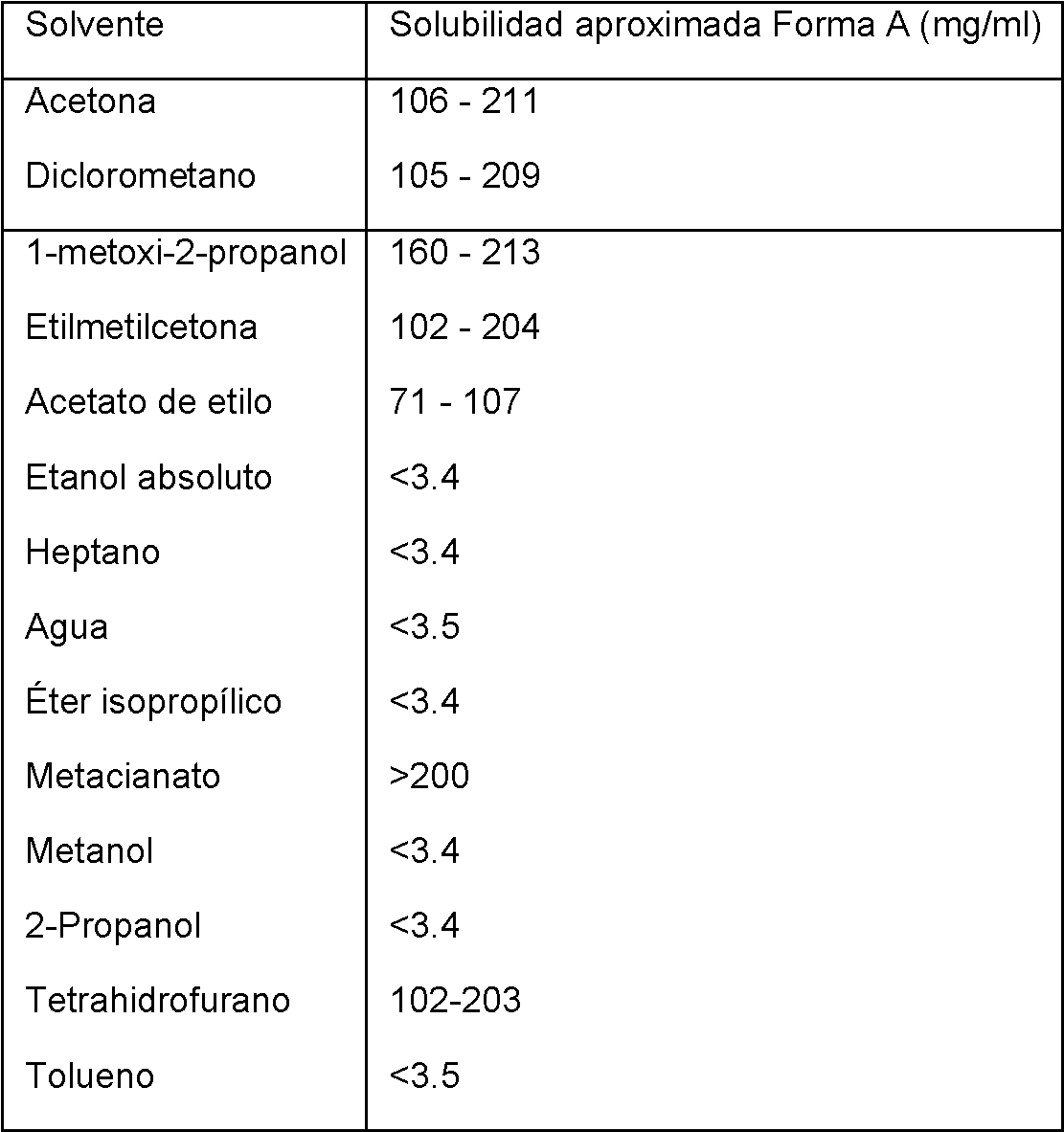
Se llevaron a cabo investigaciones de solubilidad adicionales en función del pH. Como tal, las solubilidades acuosas de la forma A (1:1) se midieron en solventes con diferentes pH. Se equilibró un exceso del soluto con el solvente a 20°C durante al menos 24 horas. Después de retirar el compuesto no disuelto, se determinó la concentración en solución usando espectrometría UV.Additional solubility investigations were carried out as a function of pH. As such, the aqueous solubilities of form A (1: 1) were measured in solvents with different pH. An excess of the solute was equilibrated with the solvent at 20 ° C for at least 24 hours. After removing the undissolved compound, the concentration in solution was determined using UV spectrometry.
Tabla 8: Solubilidad para la forma A (1:1) en función del pHTable 8: Solubility for form A (1: 1) as a function of pH

Se midió la solubilidad de la forma A (1:1) en función de HPpCD (hidroxipropil-p-ciclodextrina). Se equilibró un exceso de producto con el solvente durante 2 días a 20°C. Después de retirar el compuesto no disuelto, se determinó la concentración en solución usando espectrometría UV.The solubility of form A (1: 1) was measured as a function of HPpCD (hydroxypropyl-p-cyclodextrin). An excess product was equilibrated with the solvent for 2 days at 20 ° C. After removing the undissolved compound, the concentration in solution was determined using UV spectrometry.
Tabla 9: Solubilidad para la forma A (1:1) en función de HPpCDTable 9: Solubility for form A (1: 1) as a function of HPpCD

En un segundo aspecto, la presente descripción se refiere a procedimientos de preparación de pseudopolimorfos. Los pseudopolimorfos del compuesto de fórmula (X) se preparan combinando el compuesto de fórmula (X) con un solvente orgánico, o agua, o mezclas de agua y solventes orgánicos miscibles en agua, aplicando cualquier técnica apropiada para inducir la cristalización, y aislando los pseudopolimorfos deseados.In a second aspect, the present description refers to processes for preparing pseudopolymorphs. The pseudopolymorphs of the compound of formula (X) are prepared by combining the compound of formula (X) with an organic solvent, or water, or mixtures of water and water-miscible organic solvents, applying any appropriate technique to induce crystallization, and isolating the desired pseudopolymorphs.
Por técnicas para inducir la cristalización se entienden los procedimientos para la producción de los cristales que incluyen entre otros disolver o dispersar el compuesto de fórmula (X) en un medio solvente, llevando la solución o dispersión del compuesto de fórmula (X) y el(los) solvente(s) a una concentración deseada, llevando dicha solución o dispersión a una temperatura deseada, efectuando cualquier presión apropiada, eliminando y/o separando cualquier material o impurezas no deseados, secando los cristales formados para obtener los pseudopolimorfos en un estado sólido, si tal estado es deseado.Techniques for inducing crystallization are understood as the processes for the production of crystals that include, among others, dissolving or dispersing the compound of formula (X) in a solvent medium, carrying the solution or dispersion of the compound of formula (X) and the ( the) solvent (s) at a desired concentration, bringing said solution or dispersion to a desired temperature, making any appropriate pressure, removing and / or separating any unwanted material or impurities, drying the crystals formed to obtain the pseudopolymorphs in a solid state. , if such a state is desired.
Llevar la solución o dispersión del compuesto de fórmula (X) y solventes a una concentración deseada no implica necesariamente un aumento en la concentración del compuesto de fórmula (X). En ciertos casos, podría ser preferible una disminución o ningún cambio en la concentración. Al llevar dicha solución o dispersión a una temperatura deseada, se comprenderán los actos de calentamiento, enfriamiento o salida a temperatura ambiente. Las técnicas utilizadas para obtener una concentración deseada son las comunes en la técnica, por ejemplo, evaporación por destilación atmosférica, destilación al vacío, destilación fraccionada, destilación azeotrópica, evaporación de película, otras técnicas bien conocidas en la técnica y combinaciones de las mismas. Un procedimiento opcional para obtener una concentración deseada podría implicar también la saturación de la solución del compuesto de fórmula (X) y solvente, por ejemplo, adicionando un volumen suficiente de un no solvente a la solución para alcanzar el punto de saturación. Otras técnicas apropiadas para saturar la solución incluyen, a modo de ejemplo, la introducción de compuesto adicional de fórmula (X) a la solución y/o evaporación de una porción del solvente de la solución. Como se hace referencia en este documento, la solución saturada comprende soluciones en sus puntos de saturación o que exceden sus puntos de saturación, esto es, sobresaturada.Bringing the solution or dispersion of the compound of formula (X) and solvents to a desired concentration does not necessarily imply an increase in the concentration of the compound of formula (X). In certain cases, a decrease or no change in concentration may be preferable. By bringing said solution or dispersion to a desired temperature, the acts of heating, cooling or exiting at room temperature will be understood. The techniques used to obtain a desired concentration are those common in the art, for example, atmospheric distillation evaporation, vacuum distillation, fractional distillation, azeotropic distillation, film evaporation, other techniques well known in the art and combinations thereof. An optional procedure for obtaining a desired concentration could also involve saturation of the solution of the compound of formula (X) and solvent, for example, by adding a sufficient volume of a non-solvent to the solution to reach the saturation point. Other appropriate techniques for saturating the solution include, by way of example, the introduction of additional compound of formula (X) to the solution and / or evaporation of a portion of the solvent from the solution. As referenced herein, the saturated solution comprises solutions at their saturation points or that exceed their saturation points, that is, supersaturated.
La eliminación y/o separación de cualquier material no deseado o impurezas se puede realizar por purificación, filtración, lavado, precipitación o técnicas similares. La separación, por ejemplo, se puede llevar a cabo mediante técnicas conocidas de separación sólido-líquido. Los procedimientos de filtración conocidos para los expertos en el arte también se pueden usar en el presente procedimiento. Las filtraciones se pueden realizar, entre otros métodos, mediante centrifugación, o utilizando un filtro de estilo Buchner, un filtro o placas Rosenmund o una prensa de marco. Preferiblemente, la filtración en línea o la filtración de seguridad se pueden intercalar ventajosamente en los procedimientos descritos anteriormente, con el fin de aumentar la pureza de la forma pseudopolimórfica resultante. Además, también se pueden emplear agentes de filtración tales como gel de sílice, Arbocel®, diatomita de dicalita, o similares, para separar impurezas de los cristales de interés.The removal and / or separation of any unwanted material or impurities can be performed by purification, filtration, washing, precipitation or similar techniques. The separation, for example, can be carried out by known solid-liquid separation techniques. Filtration procedures known to those skilled in the art can also be used in the present process. Filtration can be performed, among other methods, by centrifugation, or using a Buchner style filter, a Rosenmund filter or plates or a frame press. Preferably, in-line filtration or safety filtration can be advantageously interleaved in the processes described above, in order to increase the purity of the resulting pseudopolymorphic form. In addition, filtration agents such as silica gel, Arbocel®, dicalite diatomite, or the like can also be used to remove impurities from the crystals of interest.
Los cristales obtenidos se pueden secar también, y dicho procedimiento de secado se puede usar opcionalmente en los diferentes pasos de cristalización, si se aplica más de un paso de cristalización. Los procedimientos de secado incluyen todas las técnicas conocidas para los expertos en el arte, tales como calentamiento, aplicación de vacío, circulación de aire o gas, adición de un desecante, liofilización, secado por pulverización, evaporación o similares, o cualquier combinación de los mismos.The crystals obtained can also be dried, and said drying process can optionally be used in the different crystallization steps, if more than one crystallization step is applied. Drying procedures include all techniques known to those skilled in the art, such as heating, vacuum application, air or gas circulation, addition of a desiccant, lyophilization, spray drying, evaporation or the like, or any combination thereof. same.
Los procedimientos para la cristalización de pseudopolimorfos del compuesto de fórmula (X) abarcan combinaciones múltiples de técnicas y variaciones de las mismas. Como tal, y a modo de ejemplo, la cristalización de pseudopolimorfos del compuesto de fórmula (X) se puede ejecutar disolviendo o dispersando el compuesto de fórmula (X) a una temperatura apropiada en el solvente, por lo que una parte de dicho solvente se evapora aumentando la concentración del compuesto de fórmula (X) en la dicha solución o dispersión, enfriando la dicha mezcla, y opcionalmente lavando y/o filtrando y secando los cristales de solvato resultantes del compuesto de fórmula (X). Opcionalmente, se pueden preparar pseudopolimorfos del compuesto de fórmula (X) disolviendo o dispersando el compuesto de fórmula (X) en un medio solvente, enfriando dicha solución o dispersión y posteriormente filtrando y secando el pseudopolimorfo obtenido. Otro ejemplo de preparación de solvatos del compuesto de fórmula (X) podría ser saturando el compuesto de fórmula (X) en el medio solvente, y opcionalmente filtrando, lavando y secando cristales obtenidos.The processes for the crystallization of pseudopolymorphs of the compound of formula (X) encompass multiple combinations of techniques and variations thereof. As such, and by way of example, the crystallization of pseudopolymorphs of the compound of formula (X) can be carried out by dissolving or dispersing the compound of formula (X) at an appropriate temperature in the solvent, whereby a part of said solvent evaporates increasing the concentration of the compound of formula (X) in said solution or dispersion, cooling said mixing, and optionally washing and / or filtering and drying the solvate crystals resulting from the compound of formula (X). Optionally, pseudopolymorphs of the compound of formula (X) can be prepared by dissolving or dispersing the compound of formula (X) in a solvent medium, cooling said solution or dispersion and subsequently filtering and drying the obtained pseudopolymorph. Another example of preparation of solvates of the compound of formula (X) could be saturating the compound of formula (X) in the solvent medium, and optionally filtering, washing and drying crystals obtained.
La formación de los cristales también puede implicar más de un procedimiento de cristalización. En ciertos casos, se pueden realizar ventajosamente una, dos o más etapas de cristalización adicionales por diferentes razones, tales como, para aumentar la calidad del solvato resultante. Por ejemplo, los pseudopolimorfos de la presente invención también se podrían preparar adicionando un solvente a un material base de partida inicial del compuesto de fórmula (X), agitando la solución a una temperatura fija hasta que las sustancias se resuelvan completamente, concentrando la solución por destilación a vacío, y enfriamiento. Se llevaría a cabo una primera cristalización y los cristales formados se volverían a lavar con un solvente, y seguido de la disolución del compuesto de fórmula (X) con el solvente para formar el pseudopolimorfo deseado. La recristalización de la mezcla de reacción ocurriría, seguida de una etapa de enfriamiento del reflujo. El pseudopolimorfo formado se filtraría opcionalmente y se dejaría secar. Al disolver o dispersar el compuesto de fórmula (X) en el solvente orgánico, agua o una mezcla de agua y solventes orgánicos miscibles en agua, se pueden obtener diferentes grados de dispersión, tales como suspensiones, emulsiones, suspensiones o mezclas; o preferiblemente obtener soluciones homogéneas de una fase.Crystal formation may also involve more than one crystallization process. In certain cases, one, two or more additional crystallization steps can be advantageously performed for different reasons, such as, to increase the quality of the resulting solvate. For example, the pseudopolymorphs of the present invention could also be prepared by adding a solvent to an initial starting base material of the compound of formula (X), stirring the solution at a fixed temperature until the substances are completely resolved, concentrating the solution by vacuum distillation, and cooling. A first crystallization would be carried out and the crystals formed would be washed again with a solvent, and followed by dissolving the compound of formula (X) with the solvent to form the desired pseudopolymorph. Recrystallization of the reaction mixture would occur, followed by a reflux cooling step. The formed pseudopolymorph would be optionally filtered and allowed to dry. By dissolving or dispersing the compound of formula (X) in the organic solvent, water or a mixture of water and water-miscible organic solvents, different degrees of dispersion can be obtained, such as suspensions, emulsions, suspensions or mixtures; or preferably obtain homogeneous solutions of a phase.
Opcionalmente, el medio de solvente puede contener aditivos, por ejemplo, uno o más agentes dispersantes, surfactantes u otros aditivos, o mezclas de los mismos del tipo normalmente utilizado en la preparación de suspensiones cristalinas y que están bien documentados en la bibliografía. Los aditivos se pueden utilizar ventajosamente para modificar la forma del cristal aumentando la indulgencia y disminuyendo el área superficial. El medio de solvente que contiene la solución se puede agitar opcionalmente durante un cierto periodo de tiempo, o agitar vigorosamente usando, por ejemplo, un mezclador u homogeneizador de alto cizallamiento o una combinación de estos, para generar el tamaño de gotita deseado para el compuesto orgánico.Optionally, the solvent medium may contain additives, for example, one or more dispersing agents, surfactants or other additives, or mixtures thereof of the type normally used in the preparation of crystalline suspensions and which are well documented in the literature. The additives can be used advantageously to modify the shape of the crystal by increasing the indulgence and decreasing the surface area. The solvent medium containing the solution can be optionally stirred for a certain period of time, or vigorously stirred using, for example, a high shear mixer or homogenizer or a combination thereof, to generate the desired droplet size for the compound. organic.
Ejemplos de solventes orgánicos útiles para la presente invención incluyen alcoholes C1-C4 tales como metanol, etanol, isopropanol, butanol, 1-metoxi-2-propanol, y similares; cloroalcanos C1-C4 tales como diclorometano; cetonas C1-C4 tales como acetona; éteres C1-C4 tales como anisol, y similares; cicloéteres tales como tetrahidrofurano; ésteres C1-C4 tales como acetato de etilo; sulfonatos C1-C4 tales como mesilato, etanosulfonato, butanosulfonato, 2-metil-1-propanosulfonato; y similares.Examples of organic solvents useful for the present invention include C1-C4 alcohols such as methanol, ethanol, isopropanol, butanol, 1-methoxy-2-propanol, and the like; C1-C4 chloroalkanes such as dichloromethane; C1-C4 ketones such as acetone; C1-C4 ethers such as anisole, and the like; cycloethers such as tetrahydrofuran; C1-C4 esters such as ethyl acetate; C1-C4 sulfonates such as mesylate, ethanesulfonate, butanesulfonate, 2-methyl-1-propanesulfonate; and the like
Ejemplos de mezclas de agua y solventes orgánicos miscibles en agua incluyen, mezclas de agua con todos los solventes orgánicos enumerados anteriormente, siempre que sean miscibles en agua, por ejemplo, etanol/agua, por ejemplo, en una proporción 50/50.Examples of mixtures of water and water-miscible organic solvents include water mixtures with all the organic solvents listed above, provided that they are miscible in water, for example, ethanol / water, for example, in a 50/50 ratio.
Los solventes preferidos son aquellos solventes farmacéuticamente aceptables. Sin embargo, los solventes farmacéuticamente no aceptables también pueden encontrar su uso en la preparación de pseudopolimorfos farmacéuticamente aceptables.Preferred solvents are those pharmaceutically acceptable solvents. However, pharmaceutically acceptable solvents may also find their use in the preparation of pharmaceutically acceptable pseudopolymorphs.
En un método preferido, el solvente es un solvente farmacéuticamente aceptable ya que da como resultado un pseudopolimorfo farmacéuticamente aceptable. En un método más preferido, el solvente es etanol.In a preferred method, the solvent is a pharmaceutically acceptable solvent since it results in a pharmaceutically acceptable pseudopolymorph. In a more preferred method, the solvent is ethanol.
En una realización particular, los pseudopolimorfos farmacéuticamente aceptables del compuesto de fórmula (X) se pueden preparar a partir de formas pseudopolimórficas del compuesto de fórmula (X), que puede no ser necesariamente farmacéuticamente aceptable. Por ejemplo, la forma A se puede preparar a partir de la forma J. Los pseudopolimorfos también se pueden preparar a partir de la forma amorfa.In a particular embodiment, the pharmaceutically acceptable pseudopolymorphs of the compound of formula (X) can be prepared from pseudopolymorphic forms of the compound of formula (X), which may not necessarily be pharmaceutically acceptable. For example, form A can be prepared from form J. Pseudopolymorphs can also be prepared from amorphous form.
En las mezclas de agua y solventes orgánicos miscibles en agua, la cantidad de agua puede variar de aproximadamente 5% en volumen a aproximadamente 95% en volumen, preferiblemente de aproximadamente 25% a aproximadamente 75% en volumen, más preferiblemente de aproximadamente 40% a aproximadamente 60% en volumen.In mixtures of water and water-miscible organic solvents, the amount of water may vary from about 5% by volume to about 95% by volume, preferably from about 25% to about 75% by volume, more preferably from about 40% by volume. approximately 60% by volume.
También se debe observar que la calidad del solvente orgánico seleccionado (absoluto, desnaturalizado u otro) también influye en la calidad resultante del pseudopolimorfo.It should also be noted that the quality of the selected organic solvent (absolute, denatured or other) also influences the quality resulting from the pseudopolymorph.
El control de la temperatura de precipitación y la siembra se puede utilizar adicionalmente para mejorar la reproducibilidad del procedimiento de cristalización, la distribución del tamaño de partícula y la forma del producto. Como tal, la cristalización se puede efectuar sin siembra con cristales del compuesto de fórmula (X) o preferiblemente en presencia de los cristales del compuesto de fórmula (X), que se introducen en la solución por siembra. La siembra también se puede efectuar varias veces a diversas temperaturas. La cantidad de material de siembra depende de la cantidad de la solución y se puede determinar fácilmente por un experto en el arte. The control of the precipitation temperature and the sowing can be used additionally to improve the reproducibility of the crystallization process, the particle size distribution and the shape of the product. As such, crystallization can be carried out without seeding with crystals of the compound of formula (X) or preferably in the presence of crystals of the compound of formula (X), which are introduced into the solution by seeding. Sowing can also be done several times at various temperatures. The amount of planting material depends on the amount of the solution and can easily be determined by one skilled in the art.
El tiempo de cristalización en cada etapa de cristalización dependerá de las condiciones aplicadas, de las técnicas empleadas y/o de los solventes utilizados.The crystallization time in each crystallization stage will depend on the conditions applied, the techniques used and / or the solvents used.
La ruptura de las partículas o agregados grandes de partículas después de la conversión del cristal se puede realizar adicionalmente con el fin de obtener un tamaño de partícula deseado y homogéneo. De acuerdo con lo anterior, las formas cristalinas de solvato del compuesto de fórmula (X) se trituran opcionalmente después de experimentar la conversión. La trituración o molienda se refiere a romper físicamente las partículas grandes o agregados de partículas usando métodos y aparatos bien conocidos en la técnica para la reducción del tamaño de partícula de polvos. Los tamaños de partícula resultantes pueden variar desde milímetros hasta nanómetros, produciendo, por ejemplo, nanocristales, microcristales.The rupture of the particles or large aggregates of particles after the conversion of the crystal can be performed additionally in order to obtain a desired and homogeneous particle size. According to the above, the crystalline solvate forms of the compound of formula (X) are optionally crushed after undergoing conversion. Crushing or grinding refers to physically breaking large particles or aggregates of particles using methods and apparatus well known in the art for reducing particle size of powders. The resulting particle sizes can vary from millimeters to nanometers, producing, for example, nanocrystals, microcrystals.
El rendimiento del procedimiento de preparación de los pseudopolimorfos del compuesto de fórmula (X) puede ser de 10% o más, un rendimiento más preferido variaría desde 40% a 100%.The yield of the process of preparing the pseudopolymorphs of the compound of formula (X) may be 10% or more, a more preferred yield would vary from 40% to 100%.
Curiosamente, el rendimiento varía entre 70% y 100%.Interestingly, the yield varies between 70% and 100%.
De manera apropiada, los pseudopolimorfos de la presente invención tienen una pureza superior al 90 por ciento. Más adecuadamente, los presentes pseudopolimorfos tienen una pureza superior al 95 por ciento. Aún más adecuadamente, los pseudopolimorfos presentes tienen una pureza superior al 99 por ciento.Suitably, the pseudopolymorphs of the present invention have a purity greater than 90 percent. More suitably, the present pseudopolymorphs have a purity greater than 95 percent. Even more adequately, the pseudopolymorphs present have a purity greater than 99 percent.
En un tercer aspecto, la presente descripción se refiere a una formulación farmacéutica que comprende una cantidad terapéuticamente eficaz de un pseudopolimorfo del compuesto de fórmula (X), y un portador o diluyente farmacéuticamente aceptable del mismo.In a third aspect, the present description refers to a pharmaceutical formulation comprising a therapeutically effective amount of a pseudopolymorph of the compound of formula (X), and a pharmaceutically acceptable carrier or diluent thereof.
En una realización, la presente descripción se refiere al uso de formas pseudopolimórficas farmacéuticamente aceptables del compuesto de fórmula (X), preferiblemente la forma A, en la fabricación de un medicamento para tratar enfermedades causadas por retrovirus, tales como infecciones por HIV, por ejemplo, síndrome de inmunodeficiencia adquirida (AIDS) y complejo relacionado con el AIDS (ARC).In one embodiment, the present description relates to the use of pharmaceutically acceptable pseudopolymorphic forms of the compound of formula (X), preferably form A, in the manufacture of a medicament for treating diseases caused by retroviruses, such as HIV infections, for example , acquired immunodeficiency syndrome (AIDS) and AIDS-related complex (ARC).
En otra realización, la presente descripción proporciona un método para el tratamiento de una infección retroviral, por ejemplo, una infección por HIV, en un mamífero tal como un ser humano, que comprende administrar al mamífero que lo necesite una cantidad antirretroviral eficaz de una forma pseudopolimórfica farmacéuticamente aceptable del compuesto de fórmula (X), preferiblemente la forma A.In another embodiment, the present description provides a method for the treatment of a retroviral infection, for example, an HIV infection, in a mammal such as a human being, comprising administering to the mammal in need an effective antiretroviral amount in a manner. Pharmaceutically acceptable pseudopolymorphic of the compound of formula (X), preferably form A.
La presente descripción también se refiere a un método en el que el tratamiento de una infección vírica de HIV comprende la reducción de la carga de HIV. La presente invención también se refiere a un método en el que el tratamiento de dicha infección vírica por HIV comprende el aumento del recuento de células CD4+. La presente invención se refiere también a un método en el que el tratamiento de dicha infección vírica de HIV comprende inhibir la actividad de la proteasa del HIV en un mamífero.The present description also refers to a method in which the treatment of an HIV viral infection comprises reducing the HIV burden. The present invention also relates to a method in which the treatment of said HIV viral infection comprises increasing the CD4 + cell count. The present invention also relates to a method in which the treatment of said HIV viral infection comprises inhibiting the activity of HIV protease in a mammal.
Las formas pseudopolimórficas farmacéuticamente aceptables del compuesto de fórmula (X), preferiblemente la forma A, también denominadas en este documento como los ingredientes farmacéuticos activos, se pueden administrar por cualquier ruta apropiada a la afección que se va a tratar, preferiblemente oralmente. Sin embargo, se apreciará que la ruta preferida puede variar con, por ejemplo, la condición del receptor.The pharmaceutically acceptable pseudopolymorphic forms of the compound of formula (X), preferably form A, also referred to herein as the active pharmaceutical ingredients, can be administered by any route appropriate to the condition to be treated, preferably orally. However, it will be appreciated that the preferred route may vary with, for example, the condition of the recipient.
Para cada una de las utilidades e indicaciones indicadas anteriormente, la cantidad requerida del ingrediente activo dependerá de un número de factores que incluyen la gravedad de la afección que se va a tratar y la identidad del receptor y, en última instancia, estará a la discreción del médico o veterinario. La dosis deseada preferiblemente se puede presentar como una, dos, tres o cuatro o más subdosis administradas a intervalos apropiados a lo largo del día.For each of the utilities and indications indicated above, the required amount of the active ingredient will depend on a number of factors that include the severity of the condition to be treated and the identity of the recipient and, ultimately, will be at the discretion from the doctor or veterinarian. The desired dose may preferably be presented as one, two, three or four or more sub-doses administered at appropriate intervals throughout the day.
Para una forma de administración oral, los pseudopolimorfos de la presente divulgación se mezclan con aditivos apropiados, tales como excipientes, estabilizadores o diluyentes inertes, y se llevan mediante los métodos habituales a las formas de administración apropiadas, tales como comprimidos, comprimidos recubiertos, cápsulas duras, soluciones acuosas, alcohólicas u oleosas. Ejemplos de portadores inertes apropiados son goma arábiga, magnesia, carbonato de magnesio, fosfato de potasio, lactosa, glucosa o almidón, en particular almidón de maíz. En este caso, la preparación se puede llevar a cabo tanto en gránulos secos como en gránulos húmedos. Los excipientes o solventes aceitosos apropiados son aceites vegetales o animales, tales como aceite de girasol o aceite de hígado de bacalao. Los solventes apropiados para soluciones acuosas o alcohólicas son agua, etanol, soluciones de azúcar, o mezclas de las mismas. Los polietilenglicoles y polipropilenglicoles son también útiles como otros auxiliares para otras formas de administración.For an oral administration form, the pseudopolymorphs of the present disclosure are mixed with appropriate additives, such as inert excipients, stabilizers or diluents, and are taken by the usual methods to appropriate administration forms, such as tablets, coated tablets, capsules. hard, aqueous, alcoholic or oily solutions. Examples of suitable inert carriers are gum arabic, magnesia, magnesium carbonate, potassium phosphate, lactose, glucose or starch, in particular corn starch. In this case, the preparation can be carried out both in dry granules and in wet granules. Suitable oily excipients or solvents are vegetable or animal oils, such as sunflower oil or cod liver oil. Suitable solvents for aqueous or alcoholic solutions are water, ethanol, sugar solutions, or mixtures thereof. Polyethylene glycols and polypropylene glycols are also useful as other auxiliaries for other forms of administration.
Para la administración subcutánea o intravenosa, los pseudopolimorfos del compuesto de fórmula (X), si se desea con las sustancias habituales para ello, tales como solubilizantes, emulsionantes u otros auxiliares, se ponen en solución, suspensión o emulsión. Los pseudopolimorfos del compuesto de fórmula (X) también se pueden liofilizar y los liofilizados obtenidos se utilizan, por ejemplo, para la producción de preparaciones para inyección o infusión. Los solventes apropiados son, por ejemplo, agua, solución salina fisiológica o alcoholes, por ejemplo, etanol, propanol, glicerol, además también de soluciones de azúcares tales como soluciones de glucosa o manitol, o alternativamente mezclas de los diversos solventes mencionados.For subcutaneous or intravenous administration, the pseudopolymorphs of the compound of formula (X), if desired with the usual substances for this, such as solubilizers, emulsifiers or other auxiliaries, are placed in solution, suspension or emulsion. The pseudopolymorphs of the compound of formula (X) can also be lyophilized and the lyophilisates obtained are used, for example, for the production of preparations for injection or infusion. Suitable solvents are, for example, water, physiological saline or alcohols, for example, ethanol, propanol, glycerol, in addition to sugar solutions such as glucose or mannitol solutions, or alternatively mixtures of the various solvents mentioned.
Las formulaciones farmacéuticas apropiadas para la administración en forma de aerosoles o pulverizaciones son, por ejemplo, soluciones, suspensiones o emulsiones de los pseudopolimorfos del compuesto de fórmula (X) en un solvente farmacéuticamente aceptable, tal como etanol o agua, o una mezcla de tales solventes. Si se requiere, la formulación también puede contener adicionalmente otros auxiliares farmacéuticos tales como surfactantes, emulsionantes y estabilizantes, así como un propulsor. Dicha preparación contiene habitualmente el compuesto activo en una concentración de aproximadamente 0.1 a 50%, en particular de aproximadamente 0.3 a 3% en peso. Los pseudopolimorfos de la presente divulgación también se pueden presentar en una formulación que comprende partículas de tamaño micrómetro, nanómetro o picómetro del pseudopolimorfo del compuesto de fórmula (X), cuya formulación puede contener otros agentes farmacéuticos y puede convertirse opcionalmente en forma sólida.Pharmaceutical formulations suitable for administration in the form of aerosols or sprays are, for example, solutions, suspensions or emulsions of the pseudopolymorphs of the compound of formula (X) in a pharmaceutically acceptable solvent, such as ethanol or water, or a mixture of such solvents If required, the formulation may also additionally contain other pharmaceutical auxiliaries such as surfactants, emulsifiers and stabilizers, as well as a propellant. Said preparation usually contains the active compound in a concentration of about 0.1 to 50%, in particular about 0.3 to 3% by weight. The pseudopolymorphs of the present disclosure may also be presented in a formulation comprising micrometer, nanometer or pyrometer sized particles of the pseudopolymorph of the compound of formula (X), the formulation of which may contain other pharmaceutical agents and may optionally be converted into a solid form.
Puede ser conveniente formular los presentes pseudopolimorfos en forma de nanopartículas que tienen un modificador de superficie adsorbido sobre su superficie en una cantidad suficiente para mantener un tamaño de partícula medio eficaz de menos de 1000 nm. Se cree que los modificadores de superficie útiles incluyen aquellos que se adhieren físicamente a la superficie del agente antirretroviral pero no se unen químicamente al agente antirretroviral.It may be convenient to formulate the present pseudopolymorphs in the form of nanoparticles having a surface modifier adsorbed on their surface in an amount sufficient to maintain an effective average particle size of less than 1000 nm. It is believed that useful surface modifiers include those that physically adhere to the surface of the antiretroviral agent but do not chemically bind to the antiretroviral agent.
Puede ser además conveniente almacenar los pseudopolimorfos del compuesto de fórmula (X) en materiales de envase que sean protectores frente a riesgos mecánicos, ambientales, biológicos o químicos, o degradación. Las sustancias farmacéuticas de acondicionamiento se pueden conseguir empleando materiales de embalaje impermeables a la humedad, tales como bolsas selladas de cierre de vapor. Los productos farmacéuticos de acondicionamiento, tales como comprimidos, cápsulas, se pueden conseguir empleando, por ejemplo, blísteres de aluminio.It may also be convenient to store the pseudopolymorphs of the compound of formula (X) in packaging materials that are protective against mechanical, environmental, biological or chemical hazards, or degradation. Pharmaceutical conditioning substances can be achieved using moisture-impermeable packaging materials, such as sealed vapor closure bags. Pharmaceutical conditioning products, such as tablets, capsules, can be achieved using, for example, aluminum blisters.
Se debe entender que, además de los ingredientes particularmente mencionados anteriormente, las formulaciones de esta invención incluyen otros agentes convencionales en la técnica teniendo en cuenta el tipo de formulación en cuestión, por ejemplo, los apropiados para administración oral pueden incluir agentes aromatizantes o agentes enmascaradores del sabor.It should be understood that, in addition to the ingredients particularly mentioned above, the formulations of this invention include other conventional agents in the art taking into account the type of formulation in question, for example, those suitable for oral administration may include flavoring agents or masking agents. of flavor
Los siguientes ejemplos están destinados sólo a la ilustración y no pretenden limitar el alcance de la invención de ninguna manera.The following examples are intended for illustration only and are not intended to limit the scope of the invention in any way.
Ejemplo 1Example 1
La síntesis a escala industrial de la forma A (1:1) se llevó a cabo utilizando las siguientes etapas. Primero se preparó una solución con isopropanol y (3R,3aS,6aR)-hexahidrofuro [2,3-b] furan-3-il (1S,2R)-3-[[(4-aminofenil) sulfonil] (isobutil) amino]-1-bencil-2-hidroxipropilcarbamato. La solución se concentró por destilación a vacío a 70°C y 200 500 mbar de presión y se enfrió de una T >35° a una T entre 15° y 20°C durante aproximadamente 10 horas. Los cristales formados se lavaron nuevamente con 13 litros de isopropanol y se filtraron. Se realizó una recristalización posterior a partir de etanol/agua (90 litros/90 litros). Esto fue seguido por una nueva etapa de disolución, pero con 60 litros de etanol en su lugar. Se produjo la recristalización de la mezcla de reacción a partir de etanol, seguido de una etapa de enfriamiento desde reflujo a -15°C aproximadamente y durante 10 horas. El etanolato formado se filtró y se dejó secar a aproximadamente 50°C y aproximadamente 7 mbar. El rendimiento de este procedimiento fue de al menos el 75%.The industrial scale synthesis of form A (1: 1) was carried out using the following steps. First, a solution was prepared with isopropanol and (3R, 3aS, 6aR) -hexahydrofuro [2,3-b] furan-3-yl (1S, 2R) -3 - [[((4-aminophenyl) sulfonyl] (isobutyl) amino ] -1-benzyl-2-hydroxypropylcarbamate. The solution was concentrated by vacuum distillation at 70 ° C and 200,500 mbar of pressure and cooled from a T> 35 ° to a T between 15 ° and 20 ° C for approximately 10 hours. The crystals formed were washed again with 13 liters of isopropanol and filtered. A subsequent recrystallization was performed from ethanol / water (90 liters / 90 liters). This was followed by a new stage of dissolution, but with 60 liters of ethanol in place. Recrystallization of the reaction mixture from ethanol occurred, followed by a cooling step from reflux to about -15 ° C and for 10 hours. The ethanolate formed was filtered and allowed to dry at about 50 ° C and about 7 mbar. The yield of this procedure was at least 75%.
Ejemplo 2 (Referencia)Example 2 (Reference)
En otro ejemplo se preparó una mezcla de la forma D y la forma B. Se usó acetona como solvente durante el procedimiento de cristalización para formar la forma D. El procedimiento de cristalización comprendió entonces la etapa de agitar el compuesto inicial de partida (10 g) en 70 ml de acetona. La solución se sometió a reflujo posteriormente hasta que el compuesto se resolvió por completo. Se adicionaron 40 ml de agua y la solución se enfrió posteriormente lentamente hasta temperatura ambiente y se agitó durante la noche. Los cristales formados se filtraron y se secaron en el horno de vacío a 50°C. 7.6 g de producto resultaron de la cristalización, siendo el rendimiento de este procedimiento de aproximadamente el 75%.In another example, a mixture of form D and form B was prepared. Acetone was used as a solvent during the crystallization process to form form D. The crystallization process then comprised the step of stirring the initial starting compound (10 g ) in 70 ml of acetone. The solution was subsequently refluxed until the compound was completely resolved. 40 ml of water were added and the solution was subsequently cooled slowly to room temperature and stirred overnight. The crystals formed were filtered and dried in the vacuum oven at 50 ° C. 7.6 g of product resulted from crystallization, the yield of this procedure being approximately 75%.
Ejemplo 3Example 3
En otro ejemplo se prepararon cristales de la forma J. Se usó isopropanol como solvente durante el procedimiento de cristalización para formar la forma J. El procedimiento de cristalización comprendió entonces la etapa de resolver el material inicial de partida en el solvente caliente. La solución se enfrió posteriormente hasta temperatura ambiente. Los cristales formados se filtraron y se secaron en el horno de vacío a 50°C. Los cristales contenían aproximadamente 50% molar de isopropanol.In another example crystals of the J form were prepared. Isopropanol was used as a solvent during the crystallization process to form the J form. The crystallization process then comprised the step of resolving the initial starting material in the hot solvent. The solution was subsequently cooled to room temperature. The crystals formed were filtered and dried in the vacuum oven at 50 ° C. The crystals contained approximately 50 mol% of isopropanol.
Ejemplo 4 (Referencia) Example 4 (Reference)
En este ejemplo, se calcularon las pérdidas de masa para diferentes pseudopolimorfos en experimentos termogravimétricos (TG). La termogravimetría es una técnica que mide el cambio de masa de una muestra a medida que se calienta, enfría o se mantiene a temperatura constante. Se colocaron aproximadamente 2 a 5 mg de muestra en una bandeja y se insertaron en el horno TG, modelo Netzsch Thermo-Microbalance TG 209 acoplado a un vector 22 de Espectrómetro FTIR Bruker. Las muestras se calentaron en una atmósfera de nitrógeno a una velocidad de 10°C/min, hasta una temperatura final de 250°C. El límite de detección de los solventes residuales fue del orden del 0.1% para una pérdida de solvente escalonada distinta en un intervalo de temperatura de estrecho (pocos grados Celsius).In this example, mass losses for different pseudopolymorphs were calculated in thermogravimetric experiments (TG). Thermogravimetry is a technique that measures the change in mass of a sample as it is heated, cooled or kept at a constant temperature. Approximately 2 to 5 mg of sample was placed in a tray and inserted into the TG oven, model Netzsch Thermo-Microbalance TG 209 coupled to a vector 22 of FTIR Bruker Spectrometer. The samples were heated in a nitrogen atmosphere at a rate of 10 ° C / min, to a final temperature of 250 ° C. The limit of detection of residual solvents was of the order of 0.1% for a different stepped solvent loss in a narrow temperature range (few degrees Celsius).
Se obtuvieron los siguientes datos de TG:The following TG data were obtained:
Forma A: se observó una pérdida de peso del 4.2% en el intervalo de temperatura de 25-138°C (etanol poca agua) y de 6.9% (etanol CO2) en el intervalo de temperatura de 25-200°C. La tasa de pérdida de etanol fue máxima a 120°C. La pérdida de CO2 se debió a la degradación química y fue visible a alrededor de 190°C.Form A: a weight loss of 4.2% was observed in the temperature range of 25-138 ° C (low water ethanol) and 6.9% (CO2 ethanol) in the temperature range of 25-200 ° C. The ethanol loss rate was maximum at 120 ° C. The loss of CO2 was due to chemical degradation and was visible at around 190 ° C.
Forma B: se observó una pérdida de peso de 3.4% en el intervalo de temperatura de 25-78°C (agua) y de 5.1% en el intervalo de temperatura de 25-110°C (etanol agua para T>78°C). De l1o-200°C, se perdió 1.1% de peso (etanol). Forma C: se observó una pérdida de peso del 2.1% en el intervalo de temperatura de 25-83°C (agua metanol) y de 4.2% en el intervalo de temperatura de 25-105°C (metanol para T>83°C, etapa distinta). De 105-200°C, además se perdió un 2.1% de peso (metanol). No se observó etanol en la fase gaseosa.Form B: a weight loss of 3.4% was observed in the temperature range of 25-78 ° C (water) and 5.1% in the temperature range of 25-110 ° C (water ethanol for T> 78 ° C ). From 1o-200 ° C, 1.1% of weight (ethanol) was lost. Form C: a weight loss of 2.1% was observed in the temperature range of 25-83 ° C (methanol water) and 4.2% in the temperature range of 25-105 ° C (methanol for T> 83 ° C , different stage). From 105-200 ° C, 2.1% of weight (methanol) was also lost. No ethanol was observed in the gas phase.
Forma D: se observó una pérdida de peso del 0.1% en el intervalo de temperatura de 25-50°C, del 4.2% en el intervalo de temperatura de 25-108°C (acetona etanol para T>50°C), del 8.2% en el intervalo de temperatura de 25-157°C (acetona etanol para T>108°C) y del 10.5% en el intervalo de temperatura de 25-240°C (acetona etanol para T>157°C).Form D: a weight loss of 0.1% was observed in the temperature range of 25-50 ° C, 4.2% in the temperature range of 25-108 ° C (acetone ethanol for T> 50 ° C), of 8.2% in the temperature range of 25-157 ° C (acetone ethanol for T> 108 ° C) and 10.5% in the temperature range of 25-240 ° C (acetone ethanol for T> 157 ° C).
Forma E: se observó una pérdida de peso del 0.2% en el intervalo de temperatura de 25-75°C (agua), del 1.8% en el intervalo de temperatura de 25-108°C (diclorometano etanol para T>75°C), del 6.8 % en el intervalo de temperatura de 25-157°C (diclorometano etanol para T>108°C) y del 8.8% en el intervalo de temperatura de 25-240°C (diclorometano etanol para T>157°C).Form E: 0.2% weight loss was observed in the temperature range of 25-75 ° C (water), 1.8% in the temperature range of 25-108 ° C (dichloromethane ethanol for T> 75 ° C ), 6.8% in the temperature range of 25-157 ° C (dichloromethane ethanol for T> 108 ° C) and 8.8% in the temperature range of 25-240 ° C (dichloromethane ethanol for T> 157 ° C ).
Forma F: se observó una pérdida de peso de 0.1% en el intervalo de temperatura de 25-50°C (probablemente agua), del 1.7% en el intervalo de temperatura de 25-108°C (acetato de etilo etanol para T>50°C), del 6.6% en el intervalo de temperatura de 25-157°C (acetato de etilo etanol para T>108°C) y del 9% en el intervalo de temperatura de 25-240°C (acetato de etilo etanol para T>157°C).Form F: a weight loss of 0.1% was observed in the temperature range of 25-50 ° C (probably water), of 1.7% in the temperature range of 25-108 ° C (ethyl acetate ethanol for T> 50 ° C), 6.6% in the temperature range of 25-157 ° C (ethyl acetate ethanol for T> 108 ° C) and 9% in the temperature range of 25-240 ° C (ethyl acetate ethanol for T> 157 ° C).
Forma G: se observó una pérdida de peso del 0.0% en el intervalo de temperatura de 25-50°C, del 3.7% en el intervalo de temperatura de 25-108°C (1-metoxi-2-propanol etanol para T>50°C, , etapa distinta), del 8% en el intervalo de temperatura de 25-157°C (1-metoxi-2-propanol etanol para T>108°C) y del 12.5% en el intervalo de temperatura de 25-240°C (1-metoxi) -2-propanol etanol para T>157°C).Form G: a weight loss of 0.0% was observed in the temperature range of 25-50 ° C, 3.7% in the temperature range of 25-108 ° C (1-methoxy-2-propanol ethanol for T> 50 ° C, different stage), 8% in the temperature range of 25-157 ° C (1-methoxy-2-propanol ethanol for T> 108 ° C) and 12.5% in the temperature range of 25 -240 ° C (1-methoxy) -2-propanol ethanol for T> 157 ° C).
Forma H: se observó una pérdida de peso del 0.8% en el intervalo de temperatura de 25-100°C (anisol poco etanol) y del 8.8% en el intervalo de temperatura de 25-200°C (anisol etanol para T>100°C).Form H: a weight loss of 0.8% was observed in the temperature range of 25-100 ° C (low ethanol anisole) and 8.8% in the temperature range of 25-200 ° C (ethanol anisole for T> 100 ° C).
Forma I: se observó una pérdida de peso del 0.3% en el intervalo de temperatura de 25-89°C (agua) y de 11.0% en el intervalo de temperatura de 25-200°C (tetrahidrofurano para T>89°C). No se observó etanol en la fase gaseosa. La tabla 10 muestra las pérdidas de masa esperadas aproximadas para diferentes formas en experimentos termogravimétricos (TG).Form I: a weight loss of 0.3% was observed in the temperature range of 25-89 ° C (water) and 11.0% in the temperature range of 25-200 ° C (tetrahydrofuran for T> 89 ° C) . No ethanol was observed in the gas phase. Table 10 shows the approximate expected mass losses for different shapes in thermogravimetric experiments (TG).


En otro conjunto de métodos termogravimétricos, la forma A, la forma A después de la adsorción/desorción, y Forma A después de los ensayos de hidratación de adsorción/desorción, se transfirieron todos a una bandeja de muestra de aluminio. La curva TG se registró en un termogravímetro TA Instrument Hi-Res TGA 2950 en las siguientes condiciones:In another set of thermogravimetric methods, form A, form A after adsorption / desorption, and Form A after adsorption / desorption hydration tests, all were transferred to an aluminum sample tray. The TG curve was recorded on a TA Instrument Hi-Res TGA 2950 thermogravometer under the following conditions:
temperatura inicial: temperatura ambienteinitial temperature: room temperature
velocidad de calentamiento: 20°C/minheating rate: 20 ° C / min
factor de resolución: 4resolution factor: 4
condición final: 300°C o <80 [% (p/p)]final condition: 300 ° C or <80 [% (w / w)]
Las curvas TG de las muestras se recogen en la figura 16.The TG curves of the samples are shown in Figure 16.
Tabla 11 muestra las pérdidas de masa para las formas ensayadas:Table 11 shows the mass losses for the forms tested:

La pérdida de peso a temperaturas de hasta 80°C se debe principalmente a la evaporación del solvente (agua) presente en la muestra. La pérdida de peso a temperaturas superiores a 80°C se debe principalmente a la evaporación del solvente (etanolato) presente en la muestra.The weight loss at temperatures up to 80 ° C is mainly due to the evaporation of the solvent (water) present in the sample. The weight loss at temperatures above 80 ° C is mainly due to the evaporation of the solvent (ethanolate) present in the sample.
Una curva de TG de la forma A a 25°C en atmósfera de nitrógeno seco en función del tiempo se recoge en la figura 17. La pérdida de peso a 25°C después de 10 horas fue alrededor del 0.6%. Esto se debió a la evaporación del solvente.A TG curve of form A at 25 ° C under a dry nitrogen atmosphere as a function of time is shown in Figure 17. The weight loss at 25 ° C after 10 hours was about 0.6%. This was due to evaporation of the solvent.
Ejemplo 5 (Referencia)Example 5 (Reference)
En otro ejemplo, se realizaron también mediciones de calorimetría diferencial de barrido (DSC). Para ello, se utilizó un sistema de análisis térmico Perkin Elmer DSC 204. De 2 a 5 mg de muestra de la forma A se pesaron con precisión en una bandeja DSC. Los experimentos se realizaron en una bandeja abierta. La muestra se equilibró a aproximadamente 30°C y luego se calentó a una velocidad de 10°C por minuto, hasta una temperatura final de 200°C. Los datos de DSC se obtuvieron siguiendo un método estándar en la técnica. La forma A se caracterizó por calorimetría diferencial de barrido (DSC) en la que mostró una endotermia aguda en el intervalo de 80-119°C, mostrando un pico a aproximadamente 105.6°C, con un inicio delta H=-98.33 J/g. De acuerdo con lo anterior, la forma A cristalina de solvato de etanol A del compuesto de fórmula (X) (1:1) mostró el patrón termográfico, que aparece en la figura 8.In another example, differential scanning calorimetry (DSC) measurements were also made. For this, a Perkin Elmer DSC 204 thermal analysis system was used. 2 to 5 mg of sample of form A were accurately weighed in a DSC tray. The experiments were performed in an open tray. The sample was equilibrated at approximately 30 ° C and then heated at a rate of 10 ° C per minute, to a final temperature of 200 ° C. DSC data was obtained following a standard method in the art. Form A was characterized by differential scanning calorimetry (DSC) in which it showed an acute endothermia in the range of 80-119 ° C, showing a peak at approximately 105.6 ° C, with a delta onset H = -98.33 J / g . In accordance with the above, the crystalline form A of ethanol solvate A of the compound of formula (X) (1: 1) showed the thermographic pattern, which appears in Figure 8.
En otro conjunto de mediciones de DSC, se examinó la forma A, la forma A después de la adsorción/desorción, y la forma A después de los ensayos de hidratación de adsorción/desorción. Se transfirieron aproximadamente 3 mg de las muestras a una bandeja de muestra Perkin Elmer de aluminio perforada de 30 pl. La bandeja de muestra se cerró con la cubierta apropiada y se registró la curva de DSC en un Perkin Elmer Pyris DSC, en las siguientes condiciones:In another set of DSC measurements, form A, form A after adsorption / desorption, and form A after adsorption / desorption hydration tests were examined. Approximately 3 mg of the samples were transferred to a 30 pl Perkin Elmer perforated aluminum sample tray. The sample tray was closed with the appropriate cover and the DSC curve was recorded on a Perkin Elmer Pyris DSC, under the following conditions:
temperatura inicial: 25°Cinitial temperature: 25 ° C
velocidad de calentamiento: 10°C/minheating rate: 10 ° C / min
temperatura final: 150°Cfinal temperature: 150 ° C
flujo de nitrógeno: 30 ml/min nitrogen flow: 30 ml / min
La forma A mostró una señal endotérmica a aproximadamente 104.6°C y un calor de fusión de 95.8 J/g provocado por la evaporación del etanolato y la fusión del producto. La forma A después de ADS/DES mostró una señal endotérmica amplia debido a una mezcla de la forma A etanolato y la forma B hidratada. La forma A después del ensayo de hidratación ADS/DES mostró una señal endotérmica a aproximadamente 73.5°C y un calor de fusión de 126 J/g causada por la evaporación del agua y la fusión del producto. Las curvas termográficas se representan en la figura 15.Form A showed an endothermic signal at approximately 104.6 ° C and a heat of fusion of 95.8 J / g caused by evaporation of ethanolate and melting of the product. Form A after ADS / DES showed a broad endothermic signal due to a mixture of form A ethanolate and form B hydrated. Form A after the ADS / DES hydration test showed an endothermic signal at approximately 73.5 ° C and a heat of fusion of 126 J / g caused by water evaporation and product melting. The thermographic curves are represented in Figure 15.
Ejemplo 6 (Referencia)Example 6 (Reference)
En otro ejemplo se ensayaron estudios de estabilidad de la forma A en tres condiciones diferentes. Se incluyeron condiciones de 25°C y 60% de RH, 40°C y 75% de RH, y 50°C. Estos estudios revelaron que a 25°C y 60% de RH, la estabilidad a largo plazo, la cantidad de etanol y agua es estable.In another example, stability studies of form A were tested under three different conditions. Conditions of 25 ° C and 60% RH, 40 ° C and 75% RH, and 50 ° C were included. These studies revealed that at 25 ° C and 60% RH, long-term stability, the amount of ethanol and water is stable.
Tabla 12 muestra el estudio de estabilidad para la forma A. Estabilidad a largo plazo a 25°C/60% de RH (humedad relativa), con botellas de vidrio marrón como recipiente de muestra.Table 12 shows the stability study for form A. Long-term stability at 25 ° C / 60% RH (relative humidity), with brown glass bottles as sample container.

Ejemplo 7 (Referencia)Example 7 (Reference)
Pruebas de adsorción-desorciónAdsorption-desorption tests
Se transfirieron aproximadamente 23 mg de la forma A en un analizador de sorción de vapor VTI modelo SGA100 y se registró el cambio de peso con respecto a la humedad atmosférica en las siguientes condiciones:Approximately 23 mg of form A was transferred on a VTI model SGA100 vapor sorption analyzer and the change in weight with respect to atmospheric humidity was recorded under the following conditions:
temperatura de secado: 40°Cdrying temperature: 40 ° C
equilibrio: < 0.05% en 5 minutos o 60 minutos.balance: <0.05% in 5 minutes or 60 minutes.
intervalo de datos: 0.05% o 2 min.data interval: 0.05% or 2 min.
temperatura: 25°Ctemperature: 25 ° C
primer ciclo RH (%) adsorción: 5, 10, 20, 30, 40, 50, 60, 70, 80, 90, 95First RH cycle (%) adsorption: 5, 10, 20, 30, 40, 50, 60, 70, 80, 90, 95
RH (%) desorción: 95, 90, 80, 70, 60, 50, 40, 30, 20, 10, 5RH (%) desorption: 95, 90, 80, 70, 60, 50, 40, 30, 20, 10, 5
segundo ciclo RH (%) adsorción: 5, 10, 20, 30, 40, 50, 60, 70, 80, 90, 95second cycle RH (%) adsorption: 5, 10, 20, 30, 40, 50, 60, 70, 80, 90, 95
RH (%) desorción: 95, 90, 80, 70, 60, 50, 40, 30, 20, 10, 5RH (%) desorption: 95, 90, 80, 70, 60, 50, 40, 30, 20, 10, 5
En la etapa de secado se registró aproximadamente 0.6% de pérdida de peso. El producto seco obtenido no era higroscópico, adsorbe hasta 0.7% de agua a alta humedad relativa. Durante el ciclo de desorción se registró una pérdida de peso del 1.4%, lo que indicó que el producto estaba perdiendo etanolato. El producto obtenido después de ADS/DES fue una mezcla de la forma etanolato y la forma hidratada.In the drying stage, approximately 0.6% weight loss was recorded. The dry product obtained was not hygroscopic, adsorbs up to 0.7% water at high relative humidity. A weight loss of 1.4% was recorded during the desorption cycle, indicating that the product was losing ethanolate. The product obtained after ADS / DES was a mixture of the ethanolate form and the hydrated form.
La curva ADS/DES se recoge en la figura 18.The ADS / DES curve is shown in Figure 18.
Ensayos de hidratación de adsorción-desorciónAdsorption-desorption hydration tests
Se transfirieron aproximadamente 23 mg de la forma A en un analizador de sorción de vapor VTI modelo SGA100 y se registró el cambio de peso con respecto a la humedad atmosférica en las siguientes condiciones:Approximately 23 mg of form A was transferred on a VTI model SGA100 vapor sorption analyzer and the change in weight with respect to atmospheric humidity was recorded under the following conditions:
equilibrio: <0.0005% en 5min. o 90min.balance: <0.0005% in 5min. or 90min.
intervalo de datos: 0.05% o 2mindata range: 0.05% or 2min
temperatura: 25°Ctemperature: 25 ° C
ciclo RH (%) adsorción/desorción: 5.95 repetir el ciclo 11 veces RH cycle (%) adsorption / desorption: 5.95 repeat cycle 11 times
Al final de este ensayo se registró una pérdida de peso del 5.2%. Esto fue comparable con el resultado TG (TG 5.4% hasta 80°C). La forma de etanolato se transfirió a una forma hidratada. Las curvas de prueba de hidratación ADS/DES se recogen en la figura 19.At the end of this trial a weight loss of 5.2% was recorded. This was comparable with the TG result (TG 5.4% up to 80 ° C). The ethanolate form was transferred to a hydrated form. The ADS / DES hydration test curves are shown in Figure 19.
Ejemplo 8 (Referencia)Example 8 (Reference)
La estabilidad de la forma A se estudió después del almacenamiento del compuesto en un recipiente de muestra con una cubierta interior hecha de un solo LD-PE (sellado en cadena) y una cubierta externa hecha de PETP/Alu/PE (Moplast) termosellada. Se realizó un estudio de estabilidad a largo plazo a 25°C/60% de RH, y un estudio de estabilidad acelerado a 40°C/75% de RH durante un período de 6 meses, y las muestras se analizaron en diferentes momentos como se muestra en las siguientes tablas.The stability of form A was studied after storage of the compound in a sample container with an inner cover made of a single LD-PE (chain sealed) and an outer cover made of heat-sealed PETP / Alu / PE (Moplast). A long-term stability study was performed at 25 ° C / 60% RH, and an accelerated stability study at 40 ° C / 75% RH over a period of 6 months, and the samples were analyzed at different times as It is shown in the following tables.
Tabla 13 Estabilidad a largo plazo a 25°C/60% de RHTable 13 Long-term stability at 25 ° C / 60% RH

Tabla 14 Estabilidad acelerada a 40°C/75% de RHTable 14 Accelerated stability at 40 ° C / 75% RH

La forma A mostró estabilidad química y cristalina en las condiciones mencionadas en las Tablas 13 y 14.Form A showed chemical and crystalline stability under the conditions mentioned in Tables 13 and 14.
Ejemplo 9 (Referencia)Example 9 (Reference)
La estabilidad de la forma A se estudió después de almacenar el compuesto en un recipiente de muestra con una cubierta interior hecha de LD-PE individual (sellado en cadena) y una cubierta externa hecha de bolsa de vapor loc (LPS) sellada térmicamente. Se realizó un estudio de estabilidad a largo plazo a 25°C/60% de RH, y un estudio de estabilidad acelerado a 40°C/75% de RH durante un período de 6 meses y las muestras se analizaron en diferentes momentos como se muestra en las siguientes tablas.The stability of form A was studied after storing the compound in a sample container with an inner cover made of individual LD-PE (chain sealed) and an outer cover made of thermally sealed loc vapor bag (LPS). A long-term stability study was conducted at 25 ° C / 60% RH, and an accelerated stability study at 40 ° C / 75% RH over a period of 6 months and the samples were analyzed at different times as shown in the following tables.
Tabla 15 Estabilidad a largo plazo a 25°C/60% de RHTable 15 Long-term stability at 25 ° C / 60% RH

Tabla 16: Estabilidad acelerada a 40°C/75% de RHTable 16: Accelerated stability at 40 ° C / 75% RH

La forma A mostró estabilidad química y cristalográfica en las condiciones mencionadas en las tablas 15 y 16.Form A showed chemical and crystallographic stability under the conditions mentioned in Tables 15 and 16.
Ejemplo 10 (Referencia)Example 10 (Reference)
Para los ensayos de estabilidad química, la forma A se almacenó durante un período de 1, 4 y 8 semanas bajo diferentes condiciones. Estas condiciones fueron 40°C/75% de RH, 50°C, RT/<5% de RH, RT/56% de RH, RT/75% de RH y luz 0.3da ICH. El compuesto se analizó después de almacenamiento por HPLC y por inspección visual. El método de HPLC utilizado en este estudio fue el método de HPLC 909. Los resultados de los ensayos se presentan en la siguiente tabla.For chemical stability tests, form A was stored for a period of 1, 4 and 8 weeks under different conditions. These conditions were 40 ° C / 75% RH, 50 ° C, RT / <5% RH, RT / 56% RH, RT / 75% RH and light 0.3da ICH. The compound was analyzed after storage by HPLC and by visual inspection. The HPLC method used in this study was the HPLC 909 method. The results of the tests are presented in the following table.
Tabla 17Table 17

Se concluyó que la forma A es químicamente estable después del almacenamiento en todas las condiciones investigadas.It was concluded that form A is chemically stable after storage in all conditions investigated.
Ejemplo 11 (Referencia)Example 11 (Reference)
Se caracterizaron diferentes fracciones de la forma B con termogravimetría (TG), calorimetría diferencial de barrido (DSC) y espectroscopia infrarroja (IR). Los resultados de los ensayos se presentan en la siguiente tabla.Different fractions of form B were characterized with thermogravimetry (TG), differential scanning calorimetry (DSC) and infrared (IR) spectroscopy. The results of the tests are presented in the following table.
Tabla 18Table 18

Ejemplo 12 (Referencia)Example 12 (Reference)
Se investigó la adsorción y desorción de agua a 25°C en diferentes condiciones de humedad relativa en 38 mg de la forma B. Se registró el cambio de peso en función de la humedad relativa. Los resultados se muestran en la figura 20. En la etapa de secado se registró aproximadamente un 5.6% de pérdida de peso para la forma B. El producto seco obtenido era higroscópico, adsorbe hasta 6.8% de agua a alta humedad relativa. Después del ciclo de desorción, permaneció en la muestra aproximadamente 1.2% de agua. El producto obtenido después de ADS/DES fue una mezcla de hidrato y producto amorfo.Adsorption and desorption of water at 25 ° C under different conditions of relative humidity in 38 mg of form B were investigated. Weight change was recorded as a function of relative humidity. The results are shown in Figure 20. In the drying stage, approximately 5.6% weight loss was recorded for form B. The dried product obtained was hygroscopic, adsorbs up to 6.8% of water at high relative humidity. After the desorption cycle, approximately 1.2% water remained in the sample. The product obtained after ADS / DES was a mixture of hydrate and amorphous product.
Ejemplo 13 (Referencia)Example 13 (Reference)
Las solubilidades acuosas de la forma B se midieron en solventes con diferentes pH. Se equilibró un exceso del soluto con el solvente a 20°C, durante al menos 24 horas. Después de retirar el compuesto no disuelto, se determinó la concentración en solución usando espectrometría UV.Aqueous solubilities of form B were measured in solvents with different pH. An excess of the solute was equilibrated with the solvent at 20 ° C, for at least 24 hours. After removing the undissolved compound, the concentration in solution was determined using UV spectrometry.
Tabla 19Table 19

Ejemplo 14 (Referencia)Example 14 (Reference)
La estabilidad de la estructura cristalina de la forma B se estudió después del almacenamiento del compuesto durante un período de dos semanas a temperatura ambiente (RT) bajo <5%, 56% y 75% de humedad relativa (RH), 50°C y 40°C/75% de RH. Las muestras fueron analizadas mediante termogravimetría (TG), calorimetría diferencial de barrido (DSC), espectroscopia infrarroja (IR) y difracción de rayos X (DRX). Los resultados de los ensayos se presentan en la siguiente tabla.The stability of the crystalline structure of form B was studied after storage of the compound for a period of two weeks at room temperature (RT) under <5%, 56% and 75% relative humidity (RH), 50 ° C and 40 ° C / 75% RH. The samples were analyzed by thermogravimetry (TG), differential scanning calorimetry (DSC), infrared spectroscopy (IR) and X-ray diffraction (DRX). The results of the tests are presented in the following table.
Tabla 20Table 20

Ejemplo 15 (Referencia)Example 15 (Reference)
En el programa de ensayo de estabilidad química, la forma B se almacenó durante un periodo de 1,4 y 9 semanas bajo diferentes condiciones. Estas condiciones fueron 40°C/75% de RH, 50°C, RT/<5% de RH, RT/56% de RH, rT/75% de RH y luz 0.3da ICH. El compuesto se analizó después de almacenamiento por HPLC y por inspección visual. El método de HPLC utilizado en este estudio fue el método de HPLC 909. Los resultados de los ensayos se presentan en la siguiente tabla, a partir de la cual se concluyó que la forma B es químicamente estable.In the chemical stability test program, form B was stored for a period of 1.4 and 9 weeks under different conditions. These conditions were 40 ° C / 75% RH, 50 ° C, RT / <5% RH, RT / 56% RH, r T / 75% RH and light 0.3da ICH. The compound was analyzed after storage by HPLC and by visual inspection. The HPLC method used in this study was the HPLC 909 method. The results of the tests are presented in the following table, from which it was concluded that Form B is chemically stable.
Tabla 21Table 21

Ejemplo 16 (Referencia)Example 16 (Reference)
La forma K se preparó adicionando ácido metanosulfónico puro a una solución de la forma A en THF a r.t. La forma K se mezcló posteriormente con haluro de álcali y se prensó en un pella (Ph. Eur.) y se analizó por espectrometría de infrarrojos (IR) en las siguientes condiciones:Form K was prepared by adding pure methanesulfonic acid to a solution of form A in THF at r.t. Form K was subsequently mixed with alkali halide and pressed into a pellet (Ph. Eur.) And analyzed by infrared (IR) spectrometry under the following conditions:
Aparato Espectrofotómetro Nicolet Magna 560 FTIRNicolet Magna 560 FTIR Spectrophotometer
número de barridos: 32number of sweeps: 32
resolución: 1 cm-1resolution: 1cm-1
intervalo de longitud de onda: 4000 a 400 cm-1wavelength range: 4000 to 400 cm-1
corrección de línea base: síbaseline correction: yes
detector: DTGS con ventanas de KBrdetector: DTGS with KBr windows
divisor de haz: Ge en KBrbeam splitter: Ge in KBr
haluro de álcali: KBr (bromuro de potasio)alkali halide: KBr (potassium bromide)
El espectro IR de la forma K, como se muestra en la figura 21, refleja los modos vibratorios de la estructura molecular del solvato mesilato como un producto cristalino.The IR spectrum of form K, as shown in Figure 21, reflects the vibratory modes of the molecular structure of the mesylate solvate as a crystalline product.
Tabla 22Table 22


Ejemplo 17 (Referencia)Example 17 (Reference)
La forma K se transfirió a una celda capilar de vidrio y se analizó mediante espectrometría Raman en las siguientes condiciones:Form K was transferred to a glass capillary cell and analyzed by Raman spectrometry under the following conditions:
Modo Raman: Raman No dispersivoRaman mode: Raman Non-dispersive
Aparato Módulo Nicolet FT-RamanNicolet FT-Raman Module Apparatus
número de barridos: 64number of sweeps: 64
resolución: 4 cm-1resolution: 4cm-1
intervalo de longitud de onda: 3700 a 100 cm-1Wavelength range: 3700 to 100 cm-1
láser: Nd: YVO4laser: Nd: YVO4
frecuencia de láser: 1064 cm-1laser frequency: 1064 cm-1
detector: InGaAsdetector: InGaAs
divisor de haz: CaF2beam splitter: CaF2
geometría de la muestra: 180° reflectanteSample geometry: 180 ° reflective
polarización: nopolarization: no
El espectro de Raman de la forma K, como se muestra en la figura 22, refleja los modos de vibración de la estructura molecular del mesilato como un producto cristalino.The Raman spectrum of form K, as shown in Figure 22, reflects the modes of vibration of the molecular structure of the mesylate as a crystalline product.
Tabla 23Table 23


Ejemplo 18 (Referencia)Example 18 (Reference)
Se transfirieron aproximadamente 3 mg de la forma K a una bandeja de muestra de aluminio TA-Instrument estándar. La bandeja de muestras se cerró con la tapa apropiada y la curva DSC se registró en un TA-Instruments Q1000 MTDSC equipado con una unidad de refrigeración RCS, en las siguientes condiciones:Approximately 3 mg of Form K was transferred to a standard TA-Instrument aluminum sample tray. The sample tray was closed with the appropriate lid and the DSC curve was recorded on a TA-Instruments Q1000 MTDSC equipped with an RCS refrigeration unit, under the following conditions:
temperatura inicial: 25°Cinitial temperature: 25 ° C
velocidad de calentamiento: 10°C/minheating rate: 10 ° C / min
temperatura final: 200°Cfinal temperature: 200 ° C
flujo de nitrógeno: 50 ml/minnitrogen flow: 50 ml / min
La curva DSC como se representa en la figura 23, muestra la fusión con descomposición de un producto cristalino. La fusión de la forma K tiene lugar a 158.4°C. Debido a la descomposición, el cálculo del calor de fusión sólo se puede usar para indicar la propiedad cristalina del producto.The DSC curve as depicted in Figure 23, shows the decomposition fusion of a crystalline product. The fusion of form K takes place at 158.4 ° C. Due to decomposition, the calculation of the heat of fusion can only be used to indicate the crystalline property of the product.
Ejemplo 19 (Referencia)Example 19 (Reference)
La forma K se transfirió a una bandeja de muestra de aluminio. La curva TG se registró en un termogravímetro TA Instruments H-Res TGA 2950 en las siguientes condiciones:Form K was transferred to an aluminum sample tray. The TG curve was recorded on a TA Instruments H-Res TGA 2950 thermogravometer under the following conditions:
temperatura inicial: temperatura ambienteinitial temperature: room temperature
velocidad de calentamiento: 20°C/minheating rate: 20 ° C / min
factor de resolución: 4resolution factor: 4
condición final: 300°C o <80 [% (p/p)]final condition: 300 ° C or <80 [% (w / w)]
La curva TG se muestra en la figura 24. La pérdida de peso de aproximadamente 0.2% hasta 60°C se debió a la evaporación del solvente. La pérdida de peso a temperaturas superiores a 140°C se debió a la evaporación y descomposición del producto.The TG curve is shown in Figure 24. The weight loss of approximately 0.2% up to 60 ° C was due to evaporation of the solvent. The weight loss at temperatures above 140 ° C was due to evaporation and decomposition of the product.
Ejemplo 20 (Referencia)Example 20 (Reference)
Adsorción-DesorciónAdsorption-Desorption
Se transfirieron aproximadamente 21 mg de la forma K a un analizador de sorción de vapor VTI modelo SGA100 y se registró el cambio de peso con respecto a la humedad atmosférica en las siguientes condiciones:Approximately 21 mg of the K form was transferred to a VTI model SGA100 vapor sorption analyzer and the weight change with respect to atmospheric humidity was recorded under the following conditions:
temperatura de secado: 40°Cdrying temperature: 40 ° C
equilibrio: < 0.05% en 5 min. o 60 minutos.balance: <0.05% in 5 min. or 60 minutes
intervalo de datos: 0.05% o 2.0 min.data range: 0.05% or 2.0 min.
temperatura: 25°Ctemperature: 25 ° C
primer ciclo RH (%) adsorción: 5, 10, 20, 30, 40, 50, 60, 70, 80, 90, 95First RH cycle (%) adsorption: 5, 10, 20, 30, 40, 50, 60, 70, 80, 90, 95
RH (%) desorción: 95, 90, 80, 70, 60, 50, 40, 30, 20, 10, 5RH (%) desorption: 95, 90, 80, 70, 60, 50, 40, 30, 20, 10, 5
segundo ciclo RH (%) adsorción: 5, 10, 20, 30, 40, 50, 60, 70, 80, 90, 95second cycle RH (%) adsorption: 5, 10, 20, 30, 40, 50, 60, 70, 80, 90, 95
RH (%) desorción: 95, 90, 80, 70, 60, 50, 40, 30, 20, 10, 5 RH (%) desorption: 95, 90, 80, 70, 60, 50, 40, 30, 20, 10, 5
La isoterma de adsorción-desorción se muestra en la figura 25. La forma K es higroscópica. En la etapa de secado inicial se registró una pérdida de peso del 0.3%, comparable al resultado TG. La forma K adsorbió hasta 1.5% de agua a alta humedad relativa. El producto se secó completamente durante el ciclo de desorción.The adsorption-desorption isotherm is shown in Figure 25. Form K is hygroscopic. In the initial drying stage there was a weight loss of 0.3%, comparable to the TG result. Form K adsorbed up to 1.5% water at high relative humidity. The product dried completely during the desorption cycle.
Se investigó un estudio diferente de la adsorción y desorción de agua por la forma K a 25°C en diferentes condiciones de humedad relativa en una cantidad de aproximadamente 18 mg del solvato de mesilato. Se registró el cambio de peso en función de la humedad relativa. El resultado se muestra en la figura 26.A different study of the adsorption and desorption of water by the K form at 25 ° C under different conditions of relative humidity in an amount of approximately 18 mg of the mesylate solvate was investigated. Weight change was recorded based on relative humidity. The result is shown in Figure 26.
En la etapa de secado se registra aproximadamente 0.6% de pérdida de peso para la forma K. El producto seco obtenido es ligeramente higroscópico, adsorbe hasta 1.7% de agua a humedad relativa alta. El producto se secó completamente durante el ciclo de desorción.In the drying stage approximately 0.6% of weight loss is recorded for form K. The dry product obtained is slightly hygroscopic, adsorbs up to 1.7% of water at high relative humidity. The product dried completely during the desorption cycle.
Ejemplo 21 (Referencia)Example 21 (Reference)
Las solubilidades acuosas de la forma K se midieron en solventes con diferentes pH. Se equilibró un exceso del soluto con el solvente a 20°C durante al menos 48 horas. Después de retirar el compuesto no disuelto, se determinó la concentración en solución usando espectrometría UV.Aqueous solubilities of form K were measured in solvents with different pH. An excess of the solute was equilibrated with the solvent at 20 ° C for at least 48 hours. After removing the undissolved compound, the concentration in solution was determined using UV spectrometry.
Tabla 24Table 24

Ejemplo 22 (Referencia)Example 22 (Reference)
La estabilidad de la estructura cristalina de la forma K lote 1 se estudió después del almacenamiento del compuesto durante un período de cuatro semanas a temperatura ambiente (RT) bajo una humedad relativa (RH) del 75%, 50°C y 40°C/75% de RH. La estabilidad de la estructura cristalina de la forma K lote 2 se estudió después del almacenamiento del compuesto durante un período de cuatro semanas a temperatura ambiente (RT) bajo <5%, 56% y 75% de humedad relativa (RH), 50°C y 40°C/75% de RH. Las muestras se analizaron con termogravimetría (TG), calorimetría diferencial de barrido (DSC) y espectroscopia infrarroja (IR). Los resultados de los ensayos se presentan en la siguiente tabla.The stability of the crystalline structure of form K lot 1 was studied after storage of the compound for a period of four weeks at room temperature (RT) under a relative humidity (RH) of 75%, 50 ° C and 40 ° C / 75% RH. The stability of the crystalline structure of form K lot 2 was studied after storage of the compound for a period of four weeks at room temperature (RT) under <5%, 56% and 75% relative humidity (RH), 50 ° C and 40 ° C / 75% RH. The samples were analyzed with thermogravimetry (TG), differential scanning calorimetry (DSC) and infrared (IR) spectroscopy. The results of the tests are presented in the following table.
Tabla 25Table 25


Ejemplo 23 (Referencia)Example 23 (Reference)
En el programa de ensayo de estabilidad química, la forma K lote 1 se almacenó durante un período de 1 y 4 semanas bajo diferentes condiciones. Estas condiciones fueron 40°C/75% de RH, 50°C, RT/75% de RH y luz 0.3da ICH. La forma K lote 2 también se almacenó durante un período de 1 y 4 semanas bajo diferentes condiciones. Estas condiciones fueron 40°C/75% de RH, 50°C, RT/<5% de RH, RT/56% de RH, RT/75% de RH y luz 0.3da ICH. El compuesto se analizó después de almacenamiento por HPLC y por inspección visual. El método de HPLC utilizado en este estudio fue el método de HPLC 909. Los resultados de los ensayos se presentan en la siguiente tabla.In the chemical stability test program, form K lot 1 was stored for a period of 1 and 4 weeks under different conditions. These conditions were 40 ° C / 75% RH, 50 ° C, RT / 75% RH and light 0.3da ICH. Form K lot 2 was also stored for a period of 1 and 4 weeks under different conditions. These conditions were 40 ° C / 75% RH, 50 ° C, RT / <5% RH, RT / 56% RH, RT / 75% RH and light 0.3da ICH. The compound was analyzed after storage by HPLC and by visual inspection. The HPLC method used in this study was the HPLC 909 method. The results of the tests are presented in the following table.
Tabla 26Table 26

Ejemplo 24 (Referencia)Example 24 (Reference)
Se realizó un ensayo aleatorizado, doble ciego, controlado con placebo, de dosis múltiples, para examinar la seguridad, tolerabilidad y farmacocinética de la forma A después de la administración oral dos o tres veces al día, en sujetos sanos. Se ensayaron cuatro dosificaciones de la forma A (400 mg b.i.d., 800 mg b.i.d., 800 mg t.i.d. y 1200 mg t.i.d.) en 4 paneles de 9 sujetos sanos. Dentro de cada panel, 6 sujetos fueron tratados con la forma A y 3 sujetos con placebo durante 13 días con una sola ingesta en la mañana del día 14. (b.i.d. = dos veces al día, t.i.d. = tres veces al día). A randomized, double-blind, placebo-controlled, multi-dose trial was conducted to examine the safety, tolerability and pharmacokinetics of form A after oral administration two or three times a day, in healthy subjects. Four dosages of form A (400 mg bid, 800 mg bid, 800 mg tid and 1200 mg tid) were tested in 4 panels of 9 healthy subjects. Within each panel, 6 subjects were treated with form A and 3 subjects with placebo for 13 days with a single intake on the morning of day 14. (bid = twice a day, tid = three times a day).
La forma A se absorbió fácilmente y los perfiles de tiempo de concentración de la forma A después de la dosificación repetida dependieron de la dosis administrada. Las concentraciones plasmáticas en estado estacionario se alcanzaron generalmente en 3 días, aunque C0h (conc. en el momento de la administración) y AUC24h (área bajo la curva o biodisponibilidad) disminuyeron ligeramente con el tiempo en todos los niveles de dosis. AUC24h y Css,av (conc. en estado estacionario medio) fueron proporcionales a la dosis (dosis diaria) a 400 mg b.i.d., 800 mg t.i.d. y 1200 mg t.i.d., pero era más que proporcional a la dosis a 800 mg b.i.d. La Cmax (concentración máxima) fue proporcional a la dosis con respecto a la dosis por toma. Menos del 2% de la forma A inalterada se excretó en la orina en todos los niveles de dosis. Form A was readily absorbed and concentration time profiles of form A after repeated dosing depended on the dose administered. Plasma concentrations at steady state were generally reached in 3 days, although C0h (conc. At the time of administration) and AUC24h (area under the curve or bioavailability) decreased slightly over time at all dose levels. AUC24h and Css, av (conc. In the middle steady state) were proportional to the dose (daily dose) at 400 mg b.i.d., 800 mg t.i.d. and 1200 mg t.i.d., but it was more than proportional to the dose at 800 mg b.i.d. The Cmax (maximum concentration) was proportional to the dose with respect to the dose per dose. Less than 2% of the unchanged form A was excreted in the urine at all dose levels.
Claims (3)
Applications Claiming Priority (1)
| Application Number | Priority Date | Filing Date | Title |
|---|---|---|---|
| EP02076929 | 2002-05-16 |
Publications (1)
| Publication Number | Publication Date |
|---|---|
| ES2728735T3 true ES2728735T3 (en) | 2019-10-28 |
Family
ID=29724454
Family Applications (4)
| Application Number | Title | Priority Date | Filing Date |
|---|---|---|---|
| ES03753571T Expired - Lifetime ES2498370T5 (en) | 2002-05-16 | 2003-05-16 | Pseudopolymorphic forms of an HIV protease inhibitor |
| ES14168686.5T Expired - Lifetime ES2638412T3 (en) | 2002-05-16 | 2003-05-16 | Pseudopolymorphic forms of an HIV protease inhibitor |
| ES10180831T Expired - Lifetime ES2503551T5 (en) | 2002-05-16 | 2003-05-16 | Pseudopolymorphic forms of an HIV protease inhibitor |
| ES16158480T Expired - Lifetime ES2728735T3 (en) | 2002-05-16 | 2003-05-16 | Pseudopolymorphic forms of an HIV protease inhibitor |
Family Applications Before (3)
| Application Number | Title | Priority Date | Filing Date |
|---|---|---|---|
| ES03753571T Expired - Lifetime ES2498370T5 (en) | 2002-05-16 | 2003-05-16 | Pseudopolymorphic forms of an HIV protease inhibitor |
| ES14168686.5T Expired - Lifetime ES2638412T3 (en) | 2002-05-16 | 2003-05-16 | Pseudopolymorphic forms of an HIV protease inhibitor |
| ES10180831T Expired - Lifetime ES2503551T5 (en) | 2002-05-16 | 2003-05-16 | Pseudopolymorphic forms of an HIV protease inhibitor |
Country Status (25)
| Country | Link |
|---|---|
| US (8) | US7700645B2 (en) |
| EP (4) | EP1567529B2 (en) |
| JP (1) | JP4864320B2 (en) |
| KR (2) | KR101128370B1 (en) |
| CN (1) | CN100475819C (en) |
| AP (1) | AP2052A (en) |
| AU (2) | AU2003271740B2 (en) |
| BR (1) | BRPI0311176B8 (en) |
| CA (1) | CA2485834C (en) |
| CY (3) | CY1115665T1 (en) |
| DK (3) | DK2767539T3 (en) |
| EA (1) | EA007120B8 (en) |
| ES (4) | ES2498370T5 (en) |
| HR (1) | HRP20041061B1 (en) |
| HU (1) | HUE034389T2 (en) |
| IL (1) | IL165140A0 (en) |
| LT (1) | LT2767539T (en) |
| MX (1) | MXPA04011427A (en) |
| NO (1) | NO331477B1 (en) |
| NZ (1) | NZ536497A (en) |
| PL (1) | PL215151B1 (en) |
| PT (3) | PT1567529E (en) |
| SI (3) | SI2767539T1 (en) |
| WO (1) | WO2003106461A2 (en) |
| ZA (1) | ZA200410154B (en) |
Families Citing this family (31)
| Publication number | Priority date | Publication date | Assignee | Title |
|---|---|---|---|---|
| PT2336134T (en) | 1998-06-23 | 2016-10-19 | The Board Of Trustees Of The Univ Of Illionis | Fitness assay and methods for reducing resistance of hiv to therapy |
| ES2498370T5 (en) * | 2002-05-16 | 2021-11-24 | Janssen Sciences Ireland Unlimited Co | Pseudopolymorphic forms of an HIV protease inhibitor |
| HRP20020614A2 (en) * | 2002-07-22 | 2004-06-30 | PLIVA-ISTRAŽIVAČKI INSTITUT d.o.o. | Rhombic pseudopolymorph of 9-deoxo-9a-aza-9a-methyl-9a-homoerythromycin a |
| ME01059B (en) | 2003-12-23 | 2012-10-20 | Janssen Sciences Ireland Uc | Process for the preparation of (3r,3as,6ar)-hexahydrofuro [2,3-b] furan-3-yl (1s,2r)-3-[[(4-aminophenyl) sulfonyl] (isobutyl) amino]-1-benzyl-2-hydroxypropylcarbamate |
| RU2421459C2 (en) | 2005-02-25 | 2011-06-20 | Тиботек Фармасьютикалз Лтд. | Synthesis of protease inhibitor precursor |
| MX2009004957A (en) * | 2006-11-09 | 2009-05-19 | Tibotec Pharm Ltd | Methods for the preparation of hexahydrofuro[2,3-b]furan-3-ol. |
| AR073248A1 (en) | 2008-09-01 | 2010-10-20 | Tibotec Pharm Ltd | PROCESS FOR THE PREPARATION OF (1S, 2R) -3- ((4-AMINOFENIL) SULFONIL) (ISOBUTIL) AMINO) -1- BENCIL-2- HYDROXYPROPYL CARBAMATE (3R, 3AS, 6AR) - HEXAHYDROFIDE- (2,3- B) FURAN-3- ILO (DARUNAVIR) AND USEFUL INTERMEDIATE COMPOUNDS IN THIS PROCESS. |
| CA2750774A1 (en) * | 2009-01-29 | 2010-08-05 | Mapi Pharma Limited | Polymorphs of darunavir |
| US8921415B2 (en) | 2009-01-29 | 2014-12-30 | Mapi Pharma Ltd. | Polymorphs of darunavir |
| PT2477992T (en) * | 2009-09-17 | 2017-03-20 | Mylan Laboratories Ltd | Processes for the preparation of darunavir and the amorphous form thereof |
| WO2011051978A2 (en) | 2009-10-30 | 2011-05-05 | Lupin Limited | A novel process for preparation of darunavir and darunavir ethanolate of fine particle size |
| EP2513116B1 (en) * | 2009-12-16 | 2015-08-19 | Hetero Research Foundation | Polymorphs of darunavir |
| EP2521728B1 (en) * | 2010-01-05 | 2016-09-07 | Cipla Limited | Crystalline darunavir hydrate and process for preparation thereof |
| PL2528923T3 (en) | 2010-01-28 | 2015-01-30 | Mapi Pharma Ltd | Process for the preparation of darunavir and darunavir intermediates |
| US8853430B2 (en) | 2010-05-20 | 2014-10-07 | Hetero Research Foundation | Crystalline hydrochloride salt of darunavir |
| WO2012107889A1 (en) | 2011-02-10 | 2012-08-16 | Ranbaxy Laboratories Limited | Process for the preparation of amorphous darunavir |
| LT2729130T (en) | 2011-07-07 | 2018-01-10 | Janssen Sciences Ireland Uc | Darunavir combination formulations |
| WO2013114382A1 (en) | 2011-12-05 | 2013-08-08 | Mylan Laboratories Ltd | Crystalline darunavir |
| EP2804869B1 (en) * | 2012-01-18 | 2019-06-12 | Aurobindo Pharma Limited | Novel solvates of darunavir |
| CN103509031B (en) * | 2012-06-20 | 2016-04-27 | 上海迪赛诺药业有限公司 | Prepare the method for Prezista amorphous substance |
| WO2014016660A2 (en) | 2012-07-24 | 2014-01-30 | Laurus Labs Private Limited | A process for preparation of darunavir |
| CA2889903C (en) | 2012-10-29 | 2021-03-09 | Manjinder Singh Phull | Antiviral phosphonate analogues and process for preparation thereof |
| US9346820B2 (en) * | 2013-09-11 | 2016-05-24 | Purdue Research Foundation | HIV-1 protease inhibitors having gem-di-fluoro bicyclic P2-ligands |
| WO2016092525A1 (en) * | 2014-12-12 | 2016-06-16 | Lupin Limited | Darunavir n-propanol solvate and process for preparation thereof |
| WO2016092527A1 (en) * | 2014-12-12 | 2016-06-16 | Sun Pharmaceutical Industries Limited | A process for the preparation of dolutegravir |
| RS63566B1 (en) * | 2015-03-19 | 2022-10-31 | Mycovia Pharmaceuticals Inc | ANTIFUNGAL COMPOUNDS AND MANUFACTURING PROCESSES |
| US11045423B2 (en) | 2016-08-08 | 2021-06-29 | Hetero Labs Limited | Anti-retroviral compositions |
| ES2952878T3 (en) | 2016-08-08 | 2023-11-06 | Hetero Labs Ltd | A multiclass antiretroviral composition |
| EP3532478B1 (en) | 2016-10-27 | 2021-05-26 | Gilead Sciences, Inc. | Crystalline form of darunavir free base |
| CN108727401A (en) * | 2017-04-20 | 2018-11-02 | 盐城迪赛诺制药有限公司 | Darunavir novel crystal forms and its preparation method and application |
| CN109053753A (en) * | 2018-08-05 | 2018-12-21 | 浙江大学 | A method of preparing Da Lunawei dihydrate crystal form |
Family Cites Families (16)
| Publication number | Priority date | Publication date | Assignee | Title |
|---|---|---|---|---|
| US5413999A (en) * | 1991-11-08 | 1995-05-09 | Merck & Co., Inc. | HIV protease inhibitors useful for the treatment of AIDS |
| JPH05230044A (en) | 1992-02-21 | 1993-09-07 | Hoechst Japan Ltd | Novel crystalline polymorphism of piretanide |
| US5968942A (en) | 1992-08-25 | 1999-10-19 | G. D. Searle & Co. | α- and β-amino acid hydroxyethylamino sulfonamides useful as retroviral protease inhibitors |
| EP0715618B1 (en) | 1993-08-24 | 1998-12-16 | G.D. Searle & Co. | Hydroxyethylamino sulphonamides useful as retroviral protease inhibitors |
| US6096779A (en) * | 1995-02-22 | 2000-08-01 | Hoechst Pharmaceuticals & Chemicals K.K. | Amorphous piretanide, piretanide polymorphs, process for their preparation and their use |
| CO4940492A1 (en) * | 1997-05-29 | 2000-07-24 | Merck & Co Inc | HIV PROTEASE INHIBITOR |
| GB9712253D0 (en) | 1997-06-13 | 1997-08-13 | Glaxo Group Ltd | Antiviral compound |
| US6287693B1 (en) * | 1998-02-25 | 2001-09-11 | John Claude Savoir | Stable shaped particles of crystalline organic compounds |
| GB9805898D0 (en) * | 1998-03-20 | 1998-05-13 | Glaxo Group Ltd | Process for the sythesis of hiv protease inhibitors |
| GB9807354D0 (en) | 1998-04-07 | 1998-06-03 | Glaxo Group Ltd | Antiviral compound |
| PT2336134T (en) * | 1998-06-23 | 2016-10-19 | The Board Of Trustees Of The Univ Of Illionis | Fitness assay and methods for reducing resistance of hiv to therapy |
| WO1999067254A2 (en) * | 1998-06-23 | 1999-12-29 | The United States Of America Represented By The Secretary, Department Of Health And Human Services | Multi-drug resistant retroviral protease inhibitors and use thereof |
| US6225317B1 (en) | 1998-11-19 | 2001-05-01 | Dupont Pharmaceuticals Company | Crystalline (-)-6-chloro-4-cyclopropylethynyl-4-trifluoromethyl-3,4-dihydro-2(1H)-quinazolinone |
| ES2254156T3 (en) | 1999-02-12 | 2006-06-16 | Vertex Pharmaceuticals Incorporated | ASPARTIL-PROTEASA INHIBITORS. |
| ES2498370T5 (en) | 2002-05-16 | 2021-11-24 | Janssen Sciences Ireland Unlimited Co | Pseudopolymorphic forms of an HIV protease inhibitor |
| EP2521728B1 (en) * | 2010-01-05 | 2016-09-07 | Cipla Limited | Crystalline darunavir hydrate and process for preparation thereof |
-
2003
- 2003-05-16 ES ES03753571T patent/ES2498370T5/en not_active Expired - Lifetime
- 2003-05-16 CN CNB038164590A patent/CN100475819C/en not_active Expired - Lifetime
- 2003-05-16 SI SI200332545T patent/SI2767539T1/en unknown
- 2003-05-16 AP AP2004003191A patent/AP2052A/en active
- 2003-05-16 HU HUE14168686A patent/HUE034389T2/en unknown
- 2003-05-16 EP EP03753571.3A patent/EP1567529B2/en not_active Expired - Lifetime
- 2003-05-16 DK DK14168686.5T patent/DK2767539T3/en active
- 2003-05-16 ES ES14168686.5T patent/ES2638412T3/en not_active Expired - Lifetime
- 2003-05-16 PL PL374321A patent/PL215151B1/en unknown
- 2003-05-16 BR BRPI0311176A patent/BRPI0311176B8/en active IP Right Grant
- 2003-05-16 AU AU2003271740A patent/AU2003271740B2/en not_active Revoked
- 2003-05-16 ES ES10180831T patent/ES2503551T5/en not_active Expired - Lifetime
- 2003-05-16 JP JP2004513292A patent/JP4864320B2/en not_active Expired - Lifetime
- 2003-05-16 WO PCT/EP2003/050176 patent/WO2003106461A2/en not_active Ceased
- 2003-05-16 CA CA002485834A patent/CA2485834C/en not_active Expired - Lifetime
- 2003-05-16 HR HRP20041061AA patent/HRP20041061B1/en not_active IP Right Cessation
- 2003-05-16 PT PT37535713T patent/PT1567529E/en unknown
- 2003-05-16 EA EA200401503A patent/EA007120B8/en unknown
- 2003-05-16 SI SI200332389T patent/SI1567529T2/en unknown
- 2003-05-16 LT LTEP14168686.5T patent/LT2767539T/en unknown
- 2003-05-16 PT PT141686865T patent/PT2767539T/en unknown
- 2003-05-16 DK DK03753571.3T patent/DK1567529T4/en active
- 2003-05-16 SI SI200332383T patent/SI2314591T2/en unknown
- 2003-05-16 KR KR1020047018426A patent/KR101128370B1/en not_active Expired - Lifetime
- 2003-05-16 MX MXPA04011427A patent/MXPA04011427A/en active IP Right Grant
- 2003-05-16 EP EP16158480.0A patent/EP3045460B1/en not_active Expired - Lifetime
- 2003-05-16 EP EP10180831.9A patent/EP2314591B2/en not_active Expired - Lifetime
- 2003-05-16 KR KR1020107024106A patent/KR20100119906A/en not_active Ceased
- 2003-05-16 PT PT101808319T patent/PT2314591E/en unknown
- 2003-05-16 DK DK10180831.9T patent/DK2314591T4/en active
- 2003-05-16 ES ES16158480T patent/ES2728735T3/en not_active Expired - Lifetime
- 2003-05-16 NZ NZ536497A patent/NZ536497A/en not_active IP Right Cessation
- 2003-05-16 EP EP14168686.5A patent/EP2767539B1/en not_active Expired - Lifetime
- 2003-05-16 US US10/514,352 patent/US7700645B2/en active Active
-
2004
- 2004-11-10 IL IL16514004A patent/IL165140A0/en unknown
- 2004-12-10 NO NO20045409A patent/NO331477B1/en not_active IP Right Cessation
- 2004-12-15 ZA ZA2004/10154A patent/ZA200410154B/en unknown
-
2009
- 2009-08-06 US US12/536,807 patent/US8518987B2/en not_active Expired - Fee Related
-
2012
- 2012-07-03 AU AU2012205289A patent/AU2012205289A1/en active Pending
-
2013
- 2013-07-11 US US13/939,494 patent/US20130303790A1/en not_active Abandoned
-
2014
- 2014-02-19 US US14/183,712 patent/US20140171499A1/en not_active Abandoned
- 2014-09-17 CY CY20141100755T patent/CY1115665T1/en unknown
- 2014-09-17 CY CY20141100756T patent/CY1117928T1/en unknown
-
2015
- 2015-08-04 US US14/817,827 patent/US20150336980A1/en not_active Abandoned
-
2017
- 2017-05-22 US US15/600,932 patent/US10000504B2/en not_active Expired - Lifetime
- 2017-08-23 CY CY20171100896T patent/CY1119311T1/en unknown
-
2018
- 2018-05-16 US US15/980,993 patent/US10858369B2/en not_active Expired - Lifetime
-
2020
- 2020-10-30 US US17/085,096 patent/US20210179631A1/en not_active Abandoned
Also Published As
Similar Documents
| Publication | Publication Date | Title |
|---|---|---|
| ES2728735T3 (en) | Pseudopolymorphic forms of an HIV protease inhibitor | |
| ES2560955T3 (en) | Diamine derivative crystal and its production process | |
| ES3018557T3 (en) | Salt of a pyrimido[6,1-a]isoquinolin-4-one compound | |
| ES2553574T3 (en) | Polymorphs of a pharmaceutical active substance | |
| HK1081969B (en) | Pseudopolymorphic forms of a hiv protease inhibitor |