ES2873550T3 - Alkaline and Acidic Water Manufacturing Process - Google Patents
Alkaline and Acidic Water Manufacturing Process Download PDFInfo
- Publication number
- ES2873550T3 ES2873550T3 ES16722508T ES16722508T ES2873550T3 ES 2873550 T3 ES2873550 T3 ES 2873550T3 ES 16722508 T ES16722508 T ES 16722508T ES 16722508 T ES16722508 T ES 16722508T ES 2873550 T3 ES2873550 T3 ES 2873550T3
- Authority
- ES
- Spain
- Prior art keywords
- water
- feed stream
- alkaline
- alkaline water
- ppm
- Prior art date
- Legal status (The legal status is an assumption and is not a legal conclusion. Google has not performed a legal analysis and makes no representation as to the accuracy of the status listed.)
- Active
Links
Classifications
-
- C—CHEMISTRY; METALLURGY
- C02—TREATMENT OF WATER, WASTE WATER, SEWAGE, OR SLUDGE
- C02F—TREATMENT OF WATER, WASTE WATER, SEWAGE, OR SLUDGE
- C02F9/00—Multistage treatment of water, waste water or sewage
-
- C—CHEMISTRY; METALLURGY
- C02—TREATMENT OF WATER, WASTE WATER, SEWAGE, OR SLUDGE
- C02F—TREATMENT OF WATER, WASTE WATER, SEWAGE, OR SLUDGE
- C02F1/00—Treatment of water, waste water, or sewage
- C02F1/02—Treatment of water, waste water, or sewage by heating
-
- C—CHEMISTRY; METALLURGY
- C02—TREATMENT OF WATER, WASTE WATER, SEWAGE, OR SLUDGE
- C02F—TREATMENT OF WATER, WASTE WATER, SEWAGE, OR SLUDGE
- C02F1/00—Treatment of water, waste water, or sewage
- C02F1/44—Treatment of water, waste water, or sewage by dialysis, osmosis or reverse osmosis
-
- C—CHEMISTRY; METALLURGY
- C02—TREATMENT OF WATER, WASTE WATER, SEWAGE, OR SLUDGE
- C02F—TREATMENT OF WATER, WASTE WATER, SEWAGE, OR SLUDGE
- C02F1/00—Treatment of water, waste water, or sewage
- C02F1/001—Processes for the treatment of water whereby the filtration technique is of importance
-
- C—CHEMISTRY; METALLURGY
- C02—TREATMENT OF WATER, WASTE WATER, SEWAGE, OR SLUDGE
- C02F—TREATMENT OF WATER, WASTE WATER, SEWAGE, OR SLUDGE
- C02F1/00—Treatment of water, waste water, or sewage
- C02F1/46—Treatment of water, waste water, or sewage by electrochemical methods
- C02F1/461—Treatment of water, waste water, or sewage by electrochemical methods by electrolysis
- C02F1/46104—Devices therefor; Their operating or servicing
- C02F1/4618—Devices therefor; Their operating or servicing for producing "ionised" acidic or basic water
-
- C—CHEMISTRY; METALLURGY
- C02—TREATMENT OF WATER, WASTE WATER, SEWAGE, OR SLUDGE
- C02F—TREATMENT OF WATER, WASTE WATER, SEWAGE, OR SLUDGE
- C02F1/00—Treatment of water, waste water, or sewage
- C02F1/46—Treatment of water, waste water, or sewage by electrochemical methods
- C02F1/461—Treatment of water, waste water, or sewage by electrochemical methods by electrolysis
- C02F1/46104—Devices therefor; Their operating or servicing
- C02F1/4618—Devices therefor; Their operating or servicing for producing "ionised" acidic or basic water
- C02F2001/46185—Devices therefor; Their operating or servicing for producing "ionised" acidic or basic water only anodic or acidic water, e.g. for oxidizing or sterilizing
-
- C—CHEMISTRY; METALLURGY
- C02—TREATMENT OF WATER, WASTE WATER, SEWAGE, OR SLUDGE
- C02F—TREATMENT OF WATER, WASTE WATER, SEWAGE, OR SLUDGE
- C02F1/00—Treatment of water, waste water, or sewage
- C02F1/46—Treatment of water, waste water, or sewage by electrochemical methods
- C02F1/461—Treatment of water, waste water, or sewage by electrochemical methods by electrolysis
- C02F1/46104—Devices therefor; Their operating or servicing
- C02F1/4618—Devices therefor; Their operating or servicing for producing "ionised" acidic or basic water
- C02F2001/4619—Devices therefor; Their operating or servicing for producing "ionised" acidic or basic water only cathodic or alkaline water, e.g. for reducing
-
- C—CHEMISTRY; METALLURGY
- C02—TREATMENT OF WATER, WASTE WATER, SEWAGE, OR SLUDGE
- C02F—TREATMENT OF WATER, WASTE WATER, SEWAGE, OR SLUDGE
- C02F2201/00—Apparatus for treatment of water, waste water or sewage
- C02F2201/46—Apparatus for electrochemical processes
- C02F2201/461—Electrolysis apparatus
- C02F2201/46105—Details relating to the electrolytic devices
- C02F2201/4612—Controlling or monitoring
- C02F2201/46125—Electrical variables
- C02F2201/46135—Voltage
-
- C—CHEMISTRY; METALLURGY
- C02—TREATMENT OF WATER, WASTE WATER, SEWAGE, OR SLUDGE
- C02F—TREATMENT OF WATER, WASTE WATER, SEWAGE, OR SLUDGE
- C02F2201/00—Apparatus for treatment of water, waste water or sewage
- C02F2201/46—Apparatus for electrochemical processes
- C02F2201/461—Electrolysis apparatus
- C02F2201/46105—Details relating to the electrolytic devices
- C02F2201/4612—Controlling or monitoring
- C02F2201/46145—Fluid flow
-
- C—CHEMISTRY; METALLURGY
- C02—TREATMENT OF WATER, WASTE WATER, SEWAGE, OR SLUDGE
- C02F—TREATMENT OF WATER, WASTE WATER, SEWAGE, OR SLUDGE
- C02F2201/00—Apparatus for treatment of water, waste water or sewage
- C02F2201/46—Apparatus for electrochemical processes
- C02F2201/461—Electrolysis apparatus
- C02F2201/46105—Details relating to the electrolytic devices
- C02F2201/46155—Heating or cooling
-
- C—CHEMISTRY; METALLURGY
- C02—TREATMENT OF WATER, WASTE WATER, SEWAGE, OR SLUDGE
- C02F—TREATMENT OF WATER, WASTE WATER, SEWAGE, OR SLUDGE
- C02F2209/00—Controlling or monitoring parameters in water treatment
- C02F2209/04—Oxidation reduction potential [ORP]
-
- C—CHEMISTRY; METALLURGY
- C02—TREATMENT OF WATER, WASTE WATER, SEWAGE, OR SLUDGE
- C02F—TREATMENT OF WATER, WASTE WATER, SEWAGE, OR SLUDGE
- C02F2209/00—Controlling or monitoring parameters in water treatment
- C02F2209/05—Conductivity or salinity
- C02F2209/055—Hardness
-
- C—CHEMISTRY; METALLURGY
- C02—TREATMENT OF WATER, WASTE WATER, SEWAGE, OR SLUDGE
- C02F—TREATMENT OF WATER, WASTE WATER, SEWAGE, OR SLUDGE
- C02F2209/00—Controlling or monitoring parameters in water treatment
- C02F2209/06—Controlling or monitoring parameters in water treatment pH
-
- C—CHEMISTRY; METALLURGY
- C02—TREATMENT OF WATER, WASTE WATER, SEWAGE, OR SLUDGE
- C02F—TREATMENT OF WATER, WASTE WATER, SEWAGE, OR SLUDGE
- C02F2209/00—Controlling or monitoring parameters in water treatment
- C02F2209/07—Alkalinity
-
- C—CHEMISTRY; METALLURGY
- C02—TREATMENT OF WATER, WASTE WATER, SEWAGE, OR SLUDGE
- C02F—TREATMENT OF WATER, WASTE WATER, SEWAGE, OR SLUDGE
- C02F2209/00—Controlling or monitoring parameters in water treatment
- C02F2209/10—Solids, e.g. total solids [TS], total suspended solids [TSS] or volatile solids [VS]
-
- C—CHEMISTRY; METALLURGY
- C02—TREATMENT OF WATER, WASTE WATER, SEWAGE, OR SLUDGE
- C02F—TREATMENT OF WATER, WASTE WATER, SEWAGE, OR SLUDGE
- C02F2303/00—Specific treatment goals
- C02F2303/04—Disinfection
Landscapes
- Chemical & Material Sciences (AREA)
- Organic Chemistry (AREA)
- Engineering & Computer Science (AREA)
- Environmental & Geological Engineering (AREA)
- Water Supply & Treatment (AREA)
- Hydrology & Water Resources (AREA)
- Life Sciences & Earth Sciences (AREA)
- Chemical Kinetics & Catalysis (AREA)
- Electrochemistry (AREA)
- General Chemical & Material Sciences (AREA)
- Water Treatment By Electricity Or Magnetism (AREA)
- Separation Using Semi-Permeable Membranes (AREA)
- Heat Treatment Of Water, Waste Water Or Sewage (AREA)
- Electrolytic Production Of Non-Metals, Compounds, Apparatuses Therefor (AREA)
Abstract
Un proceso de producción de agua alcalina y que tiene un pH de entre 10.0 y 12.0 y agua ácida a partir de una corriente inicial de agua que tiene un contenido total de sólidos disueltos entre 0 ppm y 10 ppm, mediante electrólisis con al menos un cátodo y al menos un ánodo, comprendiendo dicho proceso los pasos de; disolver una sal alcalina de cationes y aniones en la corriente inicial para producir una corriente de alimentación, que incluye la corriente inicial que contiene cationes y aniones de la sal alcalina y un residuo de sal alcalina no disuelta de propionato de sodio, electrolizar la corriente de alimentación aplicando un potencial eléctrico entre el cátodo y el ánodo de entre 0.5 V y 50 V para disociar el agua en iones hidrógeno e iones hidróxido y producir un agua alcalina adyacente a un cátodo y agua ácida adyacente a un ánodo, eliminar el agua alcalina, eliminar el agua ácida, y caracterizado por, dicho paso de disolver la sal alcalina en la corriente inicial se define además como calentar la corriente inicial de agua a una temperatura de al menos 65.55 °C (150 °F) y luego añadir la sal alcalina de un ácido carboxílico de alquilo inferior de propionato de sodio a la corriente inicial en un intervalo de 26 ppm a 1321 ppm para producir la corriente de alimentación, y eliminar el residuo de sal alcalina no disuelta de la corriente de alimentación antes de la electrólisis filtrando la corriente de alimentación, para permitir que el agua alcalina obtenida de dicho paso de aplicar el potencial tenga un pH bajo en el extremo inferior del intervalo y un pH alto en el extremo superior del intervalo.A process for the production of alkaline water that has a pH between 10.0 and 12.0 and acidic water from an initial stream of water that has a total content of dissolved solids between 0 ppm and 10 ppm, by electrolysis with at least one cathode and at least one anode, said process comprising the steps of; dissolving an alkaline salt of cations and anions in the initial stream to produce a feed stream, which includes the initial stream containing cations and anions of the alkali salt and an undissolved alkali salt residue of sodium propionate, electrolyzing the stream of power by applying an electrical potential between the cathode and the anode of between 0.5 V and 50 V to dissociate the water into hydrogen ions and hydroxide ions and produce an alkaline water adjacent to a cathode and acidic water adjacent to an anode, eliminate alkaline water, eliminating the acidic water, and characterized by, said step of dissolving the alkaline salt in the initial stream is further defined as heating the initial stream of water to a temperature of at least 65.55 ° C (150 ° F) and then adding the alkaline salt of a sodium propionate lower alkyl carboxylic acid to the initial stream in a range of 26 ppm to 1321 ppm to produce the feed stream, and remove the residue of undissolved alkaline salt from the feed stream prior to electrolysis by filtering the feed stream, to allow the alkaline water obtained from said potential applying step to have a low pH at the lower end of the range and a high pH at the lower end of the range. upper end of the range.
Description
DESCRIPCIÓNDESCRIPTION
Proceso de fabricación de agua alcalina y ácidaAlkaline and Acidic Water Manufacturing Process
Antecedentes de la invenciónBackground of the invention
1. Campo de la invención1. Field of the invention
La presente invención relaciona en general con una composición de agua alcalina y con un proceso para producir el agua alcalina.The present invention relates generally to an alkaline water composition and to a process for producing the alkaline water.
2. Descripción del estado de la técnica2. Description of the state of the art
Se han realizado diversos intentos para mejorar el agua potable alcalina. Uno de estos procesos se divulga en la patente de los Estados Unidos 6,572,902. El proceso incluye un paso de disolución de una sal alcalina de cationes y aniones en la corriente inicial para producir una corriente de alimentación que incluye la corriente inicial que contiene los cationes y los aniones de la sal alcalina y un residuo de sal alcalina no disuelta. El siguiente paso del proceso es electrolizar la corriente de alimentación para disociar el agua en iones hidrógeno e iones hidróxido y producir el agua alcalina adyacente al cátodo y el agua ácida adyacente al ánodo. Luego, se eliminan el agua alcalina y el agua ácida. La patente de los Estados Unidos 6,572,902 también divulga una composición de agua alcalina que incluye una pluralidad de iones sodio, una pluralidad de iones carbonato y una pluralidad de iones bicarbonato.Various attempts have been made to improve alkaline drinking water. One of these processes is disclosed in US Patent 6,572,902. The process includes a step of dissolving an alkaline salt of cations and anions in the initial stream to produce a feed stream that includes the initial stream containing the cations and anions of the alkali salt and an undissolved alkali salt residue. The next step in the process is to electrolyze the feed stream to dissociate the water into hydrogen ions and hydroxide ions and produce the alkaline water adjacent to the cathode and the acidic water adjacent to the anode. Then the alkaline water and acidic water are removed. US Patent 6,572,902 also discloses an alkaline water composition that includes a plurality of sodium ions, a plurality of carbonate ions, and a plurality of bicarbonate ions.
El documento JP 2003 047 962 divulga un proceso para producir electrolíticamente un agua alcalina a partir de una corriente inicial que tiene disuelta en la misma sal sódica de ácido acético.Document JP 2003 047 962 discloses a process for electrolytically producing alkaline water from an initial stream that has sodium salt of acetic acid dissolved in the same.
Resumen de la invenciónSummary of the invention
La invención proporciona un método de este tipo en el que el paso de disolver la sal alcalina en la corriente inicial se define además como añadir la sal alcalina de un ácido carboxílico de alquilo inferior a la corriente inicial en un intervalo de 26 ppm a 1321 ppm para producir la corriente de alimentación y permitir que el agua alcalina obtenida del paso de aplicar el potencial tenga un pH bajo en el extremo inferior del intervalo y un pH alto en el extremo superior del intervalo. También se describe una composición de agua alcalina que define una alcalinidad total de entre 40 ppm y 510 ppm y un total de sólidos disueltos de entre 58 ppm y 100 ppm y que incluye cero iones hidróxido.The invention provides such a method in which the step of dissolving the alkaline salt in the initial stream is further defined as adding the alkaline salt of a lower alkyl carboxylic acid to the initial stream in a range of 26 ppm to 1321 ppm. to produce the feed stream and allow the alkaline water obtained from the step of applying the potential to have a low pH at the lower end of the range and a high pH at the upper end of the range. Also disclosed is an alkaline water composition that defines a total alkalinity of between 40 ppm and 510 ppm and a total dissolved solids of between 58 ppm and 100 ppm and that includes zero hydroxide ions.
Ventajas de la invenciónAdvantages of the invention
La invención proporciona un agua alcalina que tiene cero iones hidróxido. La presente invención también proporciona un agua alcalina que es resistente a los cambios de pH.The invention provides an alkaline water having zero hydroxide ions. The present invention also provides an alkaline water that is resistant to changes in pH.
La invención proporciona un proceso para hacer el agua alcalina que elimina los iones hidróxido generados durante el paso de electrolizar el agua para producir el agua alcalina con cero iones hidróxido y es resistente a los cambios de pH.The invention provides a process for making water alkaline that removes hydroxide ions generated during the step of electrolyzing the water to produce alkaline water with zero hydroxide ions and is resistant to changes in pH.
Breve descripción de los dibujosBrief description of the drawings
Otras ventajas de la presente invención se apreciarán fácilmente, ya que las mismas se entenderán mejor por referencia a la siguiente descripción detallada cuando se considere en relación con los dibujos adjuntos en los que: La Figura 1 es un diagrama de flujo esquemático del proceso para producir agua alcalina y agua ácida.Other advantages of the present invention will be readily appreciated, as they will be better understood by reference to the following detailed description when considered in connection with the accompanying drawings in which: Figure 1 is a schematic flow diagram of the process for producing alkaline water and acidic water.
Descripción de la realización que habilitaDescription of the realization that enables
Un diagrama de flujo esquemático del proceso para producir agua alcalina y agua ácida de acuerdo con la presente invención se muestra mejor en la Figura 1.A schematic flow diagram of the process for producing alkaline water and acidic water in accordance with the present invention is best shown in Figure 1.
Un aspecto de la presente invención proporciona un proceso para producir agua alcalina que tiene un pH de entre 10.0 y 12.0 y agua ácida a partir de una corriente inicial de agua que tiene un contenido de TDS de entre 0 ppm y 10 ppm. El proceso utiliza una máquina de electrólisis que tiene al menos un cátodo, al menos un ánodo y al menos un filtro de membrana porosa. El filtro de membrana porosa tiene un tamaño de partícula de no más de 1 pm. La corriente inicial de agua que tiene un contenido de TDS de entre 0 ppm y 10 ppm se puede obtener enviando agua del grifo a través de una serie de sistema de filtración y/o sistema de purificación, por ejemplo, ultrafiltros y sistemas de ósmosis inversa. Alternativamente; la corriente inicial de agua con un contenido de TDS de entre 0 ppm y 10 ppm se puede comprar directamente a un fabricante.One aspect of the present invention provides a process for producing alkaline water having a pH of between 10.0 and 12.0 and acidic water from an initial stream of water having a TDS content of between 0 ppm and 10 ppm. The process uses an electrolysis machine that has at least one cathode, at least one anode, and at least one porous membrane filter. The porous membrane filter has a particle size of no more than 1 pm. The initial stream of water having a TDS content of between 0 ppm and 10 ppm can be obtained by sending tap water through a series of filtration system and / or purification system, for example ultrafilters and reverse osmosis systems. . Alternatively; the initial stream of water with a TDS content between 0 ppm and 10 ppm can be purchased directly from a manufacturer.
El proceso incluye un paso de calentar la corriente inicial a una temperatura predeterminada de al menos 65.55 °C (150 °F). Debería apreciarse que la corriente inicial se puede calentar utilizando cualquier fuente de calor, tal como, pero sin limitarse a, un calentador de agua. Después de calentar la corriente inicial de agua, se disuelve una sal alcalina de cationes y aniones en la corriente inicial para producir una corriente de alimentación que contiene los cationes, los aniones de la sal alcalina y un residuo de sal alcalina no disuelta.The process includes a step of heating the initial stream to a predetermined temperature of at least 65.55 ° C (150 ° F). It should be appreciated that the initial stream can be heated using any heat source, such as, but not limited to, a water heater. After heating the initial stream of water, a salt dissolves alkaline cations and anions in the initial stream to produce a feed stream containing the cations, anions of the alkali salt, and an undissolved alkali salt residue.
El siguiente paso del proceso incluye eliminar el residuo de sal alcalina no disuelta de la corriente de alimentación filtrando la corriente de alimentación a través del al menos un filtro de membrana porosa que tiene un tamaño de partícula de no más de 1 |jm. Alternativamente, se puede disponer una pluralidad de filtros en serie entre sí para eliminar el residuo de sal alcalina no disuelta de la corriente de alimentación. Luego, se esteriliza la corriente de alimentación. El paso de esterilizar la corriente de alimentación se define además como calentar la corriente de alimentación a una temperatura de ebullición de al menos 100 °C (212 °F) durante al menos tres minutos para esterilizar la corriente de alimentación y eliminar las bacterias. Debería apreciarse que la corriente de alimentación se puede esterilizar mediante otros métodos, tales como, pero no limitados a, la purificación ultravioleta (UV). A continuación, se esterilizan el cátodo, el ánodo y la máquina de electrólisis. El paso de esterilizar el cátodo, el ánodo y la máquina de electrólisis se define además como lavar la máquina de electrólisis y el cátodo y el ánodo con una solución alcalina que tiene un pH de al menos 11.5. Debe apreciarse que el cátodo, el ánodo y la máquina de electrólisis se pueden esterilizar mediante otros métodos tales como, pero no limitados, purificación Uv y/o usando un autoclave.The next process step includes removing the undissolved alkali salt residue from the feed stream by filtering the feed stream through the at least one porous membrane filter having a particle size of no more than 1 µm. Alternatively, a plurality of filters may be arranged in series with each other to remove residual undissolved alkali salt from the feed stream. Then, the feed stream is sterilized. The step of sterilizing the feed stream is further defined as heating the feed stream to a boiling temperature of at least 100 ° C (212 ° F) for at least three minutes to sterilize the feed stream and kill bacteria. It should be appreciated that the feed stream can be sterilized by other methods, such as, but not limited to, ultraviolet (UV) purification. Next, the cathode, anode and electrolysis machine are sterilized. The step of sterilizing the cathode, anode, and electrolysis machine is further defined as washing the electrolysis machine and cathode and anode with an alkaline solution having a pH of at least 11.5. It should be appreciated that the cathode, anode and electrolysis machine can be sterilized by other methods such as, but not limited to, Uv purification and / or using an autoclave.
En el siguiente paso del proceso, la corriente de alimentación se dirige a través de la máquina de electrólisis a un caudal predeterminado de tres litros por minuto. A continuación, la corriente de alimentación se electroliza para disociar el agua en iones hidrógeno e iones hidróxido y para producir el agua alcalina adyacente al cátodo y el agua ácida adyacente al ánodo. El paso de electrolizar la corriente de alimentación incluye además un paso de insertar el cátodo y el ánodo en la corriente de alimentación en una relación espaciada y un paso de aplicar un potencial eléctrico entre el cátodo y el ánodo. Sin estar ligado a ninguna teoría, al aplicar el potencial eléctrico entre el cátodo y el ánodo, el potencial eléctrico entre el cátodo y el ánodo hace que las moléculas de agua individuales se disocien en iones hidrógeno e iones hidróxido. Al mismo tiempo, el potencial eléctrico aplicado produce una corriente entre el cátodo y el ánodo para permitir que los iones hidrógeno migren al ánodo para producir el agua ácida y que los iones hidróxido migren al cátodo para producir el agua alcalina.In the next step of the process, the feed stream is directed through the electrolysis machine at a predetermined flow rate of three liters per minute. The feed stream is then electrolyzed to dissociate the water into hydrogen ions and hydroxide ions and to produce the alkaline water adjacent to the cathode and the acidic water adjacent to the anode. The step of electrolyzing the supply current further includes a step of inserting the cathode and anode into the supply current in a spaced relationship and a step of applying an electrical potential between the cathode and the anode. Without being bound by theory, by applying the electrical potential between the cathode and the anode, the electrical potential between the cathode and the anode causes individual water molecules to dissociate into hydrogen ions and hydroxide ions. At the same time, the applied electrical potential produces a current between the cathode and the anode to allow hydrogen ions to migrate to the anode to produce acidic water and hydroxide ions to migrate to the cathode to produce alkaline water.
A continuación, se elimina el agua alcalina. Después de eliminar el agua alcalina, el agua alcalina se aísla del aire ambiental y del agua ácida para evitar que el agua alcalina interactúe con el aire ambiental y el agua ácida. Debe apreciarse que el agua alcalina se puede almacenar bajo una atmósfera negativa para evitar la interacción entre el agua alcalina y el aire ambiental. Debido a que el agua alcalina tiende a reaccionar con el dióxido de carbono en el aire ambiental, reduciendo así el pH del agua alcalina, al almacenar el agua alcalina en la atmósfera negativa, el agua alcalina se aísla del aire ambiental para evitar la interacción entre el dióxido de carbono y el agua alcalina para preservar el pH del agua alcalina. Al mismo tiempo, se elimina el agua ácida. Después se elimina el agua ácida, puesto que el agua ácida se aísla del aire ambiental y del agua alcalina para evitar que el agua ácida interactúe con el aire ambiental y el agua alcalina. Debe apreciarse que el agua ácida se puede almacenar bajo una atmósfera negativa para evitar la interacción entre el agua ácida y el aire ambiental.The alkaline water is then removed. After removing alkaline water, alkaline water is isolated from ambient air and acidic water to prevent alkaline water from interacting with ambient air and acidic water. It should be appreciated that alkaline water can be stored under a negative atmosphere to avoid interaction between alkaline water and ambient air. Because alkaline water tends to react with carbon dioxide in ambient air, thereby reducing the pH of alkaline water, by storing alkaline water in negative atmosphere, alkaline water is isolated from ambient air to avoid interaction between carbon dioxide and alkaline water to preserve the pH of alkaline water. At the same time, acidic water is removed. The acidic water is then removed, since the acidic water is isolated from the ambient air and the alkaline water to prevent the acidic water from interacting with the ambient air and the alkaline water. It should be appreciated that acidic water can be stored under a negative atmosphere to avoid interaction between acidic water and ambient air.
El paso de disolver la sal alcalina en la corriente inicial se define además como la adición de la sal alcalina de un ácido alquilcarboxílico inferior de propionato de sodio a la corriente inicial. El propionato de sodio se agrega en un intervalo de 26 ppm a 1321 ppm para producir la corriente de alimentación que contiene los cationes de sodio y aniones de propionato, y el residuo de sal alcalina no disuelta de propionato de sodio. El propionato de sodio agregado permite que el agua alcalina obtenida del paso de aplicar el potencial tenga un pH bajo en el extremo inferior del intervalo y un pH alto en el extremo superior del intervalo. En otras palabras, la cantidad de propionato de sodio añadido a la corriente inicial tiene una relación directa con el pH del agua alcalina. Por ejemplo, una cantidad baja de propionato de sodio, por ejemplo 26 ppm, añadido a la corriente inicial produce el agua alcalina que tiene el pH bajo, por ejemplo 10.0, y una gran cantidad de sodio, por ejemplo 1321 ppm, añadido a la corriente inicial produce el agua alcalina que tiene el pH alto, por ejemplo 12.0.The step of dissolving the alkaline salt in the initial stream is further defined as the addition of the alkaline salt of a lower alkylcarboxylic acid of sodium propionate to the initial stream. Sodium propionate is added in a range of 26 ppm to 1321 ppm to produce the feed stream containing the sodium cations and propionate anions, and the undissolved alkali salt residue of sodium propionate. The added sodium propionate allows the alkaline water obtained from the apply the potential step to have a low pH at the lower end of the range and a high pH at the upper end of the range. In other words, the amount of sodium propionate added to the initial stream has a direct relationship with the pH of the alkaline water. For example, a low amount of sodium propionate, for example 26 ppm, added to the initial stream produces the alkaline water that has the low pH, for example 10.0, and a large amount of sodium, for example 1321 ppm, added to the Initial stream produces alkaline water which has high pH, for example 12.0.
El paso de aplicar el potencial eléctrico se define además como aplicar el potencial eléctrico de entre 0.5 V y 50 V entre el cátodo y el ánodo. La aplicación del potencial eléctrico provoca la migración de los iones hidrógeno hacia el ánodo para producir el agua ácida que tiene un pH entre 4.0 y 5.0. Además, la aplicación del potencial eléctrico provoca la migración de los iones hidróxido hacia el cátodo para producir el agua alcalina que tiene un pH entre 10.0 y 12.0. Al mismo tiempo, la aplicación del potencial eléctrico disocia los aniones de propionato en gas hidrógeno, dióxido de carbono y etileno y permite que el dióxido de carbono, el gas hidrógeno y los iones hidróxido reaccionen para producir iones carbonato e iones bicarbonato disueltos en el agua alcalina. Sin estar ligado a ninguna teoría, los iones bicarbonato también pueden reaccionar con los iones hidróxido para producir iones carbonato y moléculas de agua. El agua alcalina obtenida del proceso contiene los iones sodio presentes entre 10 ppm y 150 ppm, estando presentes los iones carbonato entre 31 ppm y 440 ppm, y estando presentes los iones bicarbonato entre 9 ppm y 70 ppm. El agua alcalina también incluye cero iones hidróxido y define la alcalinidad total entre 40 ppm y 510 ppm y el total de sólidos disueltos entre 58 ppm y 1000 ppm.The step of applying the electric potential is further defined as applying the electric potential between 0.5 V and 50 V between the cathode and the anode. The application of the electric potential causes the migration of hydrogen ions towards the anode to produce acidic water that has a pH between 4.0 and 5.0. Furthermore, the application of the electric potential causes the migration of hydroxide ions towards the cathode to produce alkaline water that has a pH between 10.0 and 12.0. At the same time, the application of the electrical potential dissociates the propionate anions into hydrogen gas, carbon dioxide and ethylene and allows the carbon dioxide, hydrogen gas and hydroxide ions to react to produce carbonate ions and bicarbonate ions dissolved in the water. alkaline. Without being bound by theory, bicarbonate ions can also react with hydroxide ions to produce carbonate ions and water molecules. The alkaline water obtained from the process contains sodium ions present between 10 ppm and 150 ppm, the carbonate ions being present between 31 ppm and 440 ppm, and the bicarbonate ions being present between 9 ppm and 70 ppm. Alkaline water also includes zero hydroxide ions and defines total alkalinity between 40 ppm and 510 ppm and total dissolved solids between 58 ppm and 1000 ppm.
También se describe una composición de agua alcalina. La composición de agua alcalina incluye una pluralidad de iones sodio que están presentes entre 10 ppm y 150 ppm, una pluralidad de iones carbonato que están presentes entre 31 ppm y 440 ppm, y una pluralidad de iones bicarbonato que están presentes entre 9 ppm y 70 ppm. La composición de agua alcalina también incluye cero iones hidróxido y define la alcalinidad total entre 40 ppm y 510 ppm y los sólidos disueltos totales entre 58 ppm y 1000 ppm. El agua alcalina tiene un pH entre 10.0 y 12.0, el índice de dureza entre 3.5 y 10.0 y el índice de Langelier entre 0.37 y 2.20. La composición de agua alcalina también tiene un potencial de oxidación-reducción (ORP) de entre -220 mV y -280 mV para proporcionar propiedades anticorrosión y antioxidantes al agua alcalina.An alkaline water composition is also disclosed. The alkaline water composition includes a plurality of sodium ions that are present between 10 ppm and 150 ppm, a plurality of carbonate ions that are present between 31 ppm and 440 ppm, and a plurality of bicarbonate ions that are present between 9 ppm and 70 ppm. The alkaline water composition also includes zero hydroxide ions and defines total alkalinity between 40 ppm and 510 ppm. and total dissolved solids between 58 ppm and 1000 ppm. Alkaline water has a pH between 10.0 and 12.0, the hardness index between 3.5 and 10.0, and the Langelier index between 0.37 and 2.20. The alkaline water composition also has an oxidation-reduction potential (ORP) of between -220 mV and -280 mV to provide anti-corrosion and antioxidant properties to alkaline water.
Para una mejor comprensión de la presente invención, a continuación se exponen ejemplos a manera de ejemplo de la presente invención. Los ejemplos a manera de ejemplo tienen únicamente fines ilustrativos y no limitan el alcance de la presente invención, cuyo alcance se define en las reivindicaciones adjuntas.For a better understanding of the present invention, exemplary examples of the present invention are set forth below. The exemplary examples are for illustrative purposes only and do not limit the scope of the present invention, the scope of which is defined by the appended claims.
Ejemplo 1Example 1
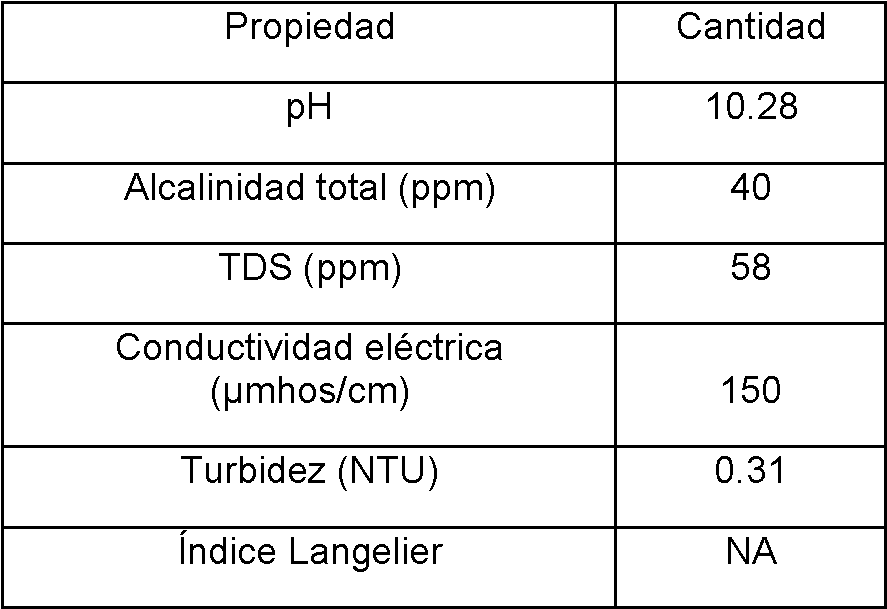
La corriente inicial de agua que tiene un TDS de 0 ppm se compró directamente a Arrowhead Distilled. La corriente inicial se calentó a 65.55 °C (150 °F). Se agregaron 0.25 g (26 ppm) de propionato de sodio a la corriente inicial para producir una corriente de alimentación. Se eliminó el residuo de propionato de sodio no disuelto desde la corriente de alimentación a través del primer filtro que tiene el tamaño de partícula de no más de 1 pm. A continuación, la corriente de alimentación se esterilizó calentando la corriente de alimentación a una temperatura de ebullición de al menos 100 °C (212 °F) durante al menos tres minutos para eliminar las bacterias del flujo de alimentación. La corriente de alimentación se electrolizó aplicando un potencial eléctrico de 34.32 V para producir el agua alcalina adyacente al cátodo y el agua ácida adyacente al ánodo. Los resultados fueron analizados por Western Environmental Testing Laboratory. La composición del agua alcalina y las propiedades del agua alcalina se establecen en la Tabla 1 and Tabla 2, respectivamente, a continuación:The initial stream of water having a TDS of 0 ppm was purchased directly from Arrowhead Distilled. The initial stream was heated to 65.55 ° C (150 ° F). 0.25 g (26 ppm) of sodium propionate was added to the initial stream to produce a feed stream. Undissolved sodium propionate residue was removed from the feed stream through the first filter having the particle size of no more than 1 pm. The feed stream was then sterilized by heating the feed stream to a boiling temperature of at least 100 ° C (212 ° F) for at least three minutes to remove bacteria from the feed stream. The feed stream was electrolyzed by applying an electrical potential of 34.32 V to produce the alkaline water adjacent to the cathode and the acidic water adjacent to the anode. The results were analyzed by the Western Environmental Testing Laboratory. The composition of alkaline water and the properties of alkaline water are established in Table 1 and Table 2, respectively, below:
Tabla 1: La composición del agua alcalina del Ejemplo 1Table 1: The composition of the alkaline water of Example 1

Tabla 2: Las propiedades del agua alcalina del Ejemplo 1Table 2: The properties of the alkaline water of Example 1
Ejemplo 2Example 2
La corriente inicial de agua que tiene un TDS de 0 ppm se compró directamente a Arrowhead Distilled. La corriente inicial se calentó a 65.55 °C (150 °F). Se agregaron 4 g (400ppm) de propionato de sodio a la corriente inicial para producir una corriente de alimentación. Se eliminó el residuo de propionato de sodio no disuelto desde la corriente de alimentación a través del primer filtro que tiene el tamaño de partícula de no más de 1 pm. A continuación, la corriente de alimentación se esterilizó calentando la corriente de alimentación a una temperatura de ebullición de al menos 100 °C (212 °F) durante al menos tres minutos para eliminar las bacterias del flujo de alimentación. La corriente de alimentación se electrolizó aplicando un potencial eléctrico de 21.15 V para producir el agua alcalina adyacente al cátodo y el agua ácida adyacente al ánodo. Los resultados fueron analizados por Western Environmental Testing Laboratory. La composición del agua alcalina y las propiedades del agua alcalina se establecen en la Tabla 3 and Tabla 4, respectivamente, a continuación: The initial stream of water having a TDS of 0 ppm was purchased directly from Arrowhead Distilled. The initial stream was heated to 65.55 ° C (150 ° F). 4g (400ppm) of sodium propionate was added to the initial stream to produce a feed stream. Undissolved sodium propionate residue was removed from the feed stream through the first filter having the particle size of not more than 1 pm. The feed stream was then sterilized by heating the feed stream to a boiling temperature of at least 100 ° C (212 ° F) for at least three minutes to remove bacteria from the feed stream. The feed stream was electrolyzed by applying an electrical potential of 21.15 V to produce the alkaline water adjacent to the cathode and the acidic water adjacent to the anode. The results were analyzed by the Western Environmental Testing Laboratory. The composition of alkaline water and the properties of alkaline water are established in Table 3 and Table 4, respectively, below:
Tabla 3: La composición del agua alcalina del Ejemplo 2Table 3: The composition of the alkaline water of Example 2

Tabla 4: Las propiedades del agua alcalina del Ejemplo 2Table 4: The properties of the alkaline water of Example 2

Ejemplo 3Example 3
La corriente inicial de agua que tiene un TDS de 0 ppm se compró directamente a Arrowhead Distilled. La corriente inicial se calentó a 65.55 °C (150 °F). Se agregaron 0.5 g (66 ppm) de propionato de sodio a la corriente inicial para producir una corriente de alimentación. Se eliminó el residuo de propionato de sodio no disuelto desde la corriente de alimentación a través del primer filtro que tiene el tamaño de partícula de no más de 1 |jm. A continuación, la corriente de alimentación se esterilizó calentando la corriente de alimentación a una temperatura de ebullición de al menos 100 °C (212 °F) durante al menos tres minutos para eliminar las bacterias del flujo de alimentación. La corriente de alimentación se electrolizó aplicando un potencial eléctrico de 32 V para producir el agua alcalina adyacente al cátodo y el agua ácida adyacente al ánodo. Los resultados fueron analizados por Western Environmental Testing Laboratory. La composición del agua alcalina y las propiedades del agua alcalina se establecen en la Tabla 5 y Tabla 6, respectivamente, a continuación:The initial stream of water having a TDS of 0 ppm was purchased directly from Arrowhead Distilled. The initial stream was heated to 65.55 ° C (150 ° F). 0.5 g (66 ppm) of sodium propionate was added to the initial stream to produce a feed stream. Undissolved sodium propionate residue was removed from the feed stream through the first filter having the particle size of no more than 1 µm. The feed stream was then sterilized by heating the feed stream to a boiling temperature of at least 100 ° C (212 ° F) for at least three minutes to remove bacteria from the feed stream. The feed stream was electrolyzed by applying an electrical potential of 32 V to produce the alkaline water adjacent to the cathode and the acidic water adjacent to the anode. The results were analyzed by the Western Environmental Testing Laboratory. The composition of alkaline water and the properties of alkaline water are set out in Table 5 and Table 6, respectively, below:
Tabla 5: La composición del agua alcalina del Ejemplo 3Table 5: The composition of the alkaline water of Example 3

Tabla 6: Las propiedades del agua alcalina del Ejemplo 3Table 6: The properties of the alkaline water of Example 3


Ejemplo 4Example 4
La corriente inicial de agua que tiene un TDS de 0 ppm se compró directamente a Arrowhead Distilled. La corriente inicial se calentó a 65.55 °C (150°F). Se agregaron 2.5g (250ppm) de propionato de sodio a la corriente inicial para producir una corriente de alimentación. Se eliminó el residuo de propionato de sodio no disuelto desde la corriente de alimentación a través del primer filtro que tiene el tamaño de partícula de no más de 1|jm. A continuación, la corriente de alimentación se esterilizó calentando la corriente de alimentación a una temperatura de ebullición de al menos 100 °C (212 °F) durante al menos tres minutos para eliminar las bacterias del flujo de alimentación. La corriente de alimentación se electrolizó aplicando un potencial eléctrico de 20 V para producir el agua alcalina adyacente al cátodo y el agua ácida adyacente al ánodo. Los resultados fueron analizados por Western Environmental Testing Laboratory. La composición del agua alcalina y las propiedades del agua alcalina se establecen en la Tabla 7 and Tabla 8, respectivamente, a continuación:The initial stream of water having a TDS of 0 ppm was purchased directly from Arrowhead Distilled. The initial stream was heated to 65.55 ° C (150 ° F). 2.5g (250ppm) of sodium propionate was added to the starting stream to produce a feed stream. Undissolved sodium propionate residue was removed from the feed stream through the first filter having the particle size of no more than 1 µm. The feed stream was then sterilized by heating the feed stream to a boiling temperature of at least 100 ° C (212 ° F) for at least three minutes to remove bacteria from the feed stream. The feed stream was electrolyzed by applying an electrical potential of 20 V to produce the alkaline water adjacent to the cathode and the acidic water adjacent to the anode. The results were analyzed by the Western Environmental Testing Laboratory. The composition of alkaline water and the properties of alkaline water are set forth in Table 7 and Table 8, respectively, below:
Tabla 7: La composición del agua alcalina del Ejemplo 4Table 7: The composition of the alkaline water of Example 4

Tabla 8: Las propiedades del agua alcalina del Ejemplo 4Table 8: The properties of the alkaline water of Example 4

Obviamente, muchas modificaciones y variaciones de la presente invención son posibles a la luz de las enseñanzas anteriores y se pueden poner en práctica de otra manera que la descrita específicamente dentro del alcance de las reivindicaciones adjuntas. Aquello que es técnica anterior en las reivindicaciones precede a la novedad establecida en la cláusula "caracterizado por". Se pretende que la novedad se recite de forma particular y distinta en la cláusula "caracterizado por", mientras que las recitaciones anteriores simplemente establecen la combinación antigua y bien conocida en la que reside la invención. Estos antecedentes deben interpretarse para cubrir cualquier combinación en la que la novedad inventiva ejerza su utilidad. El uso de la palabra "dicho" en las reivindicaciones del aparato se refiere a un antecedente que es una recitación positiva que se pretende incluir en la cobertura de las reivindicaciones, mientras que la palabra "el" precede a una palabra que no se supone que esté incluida en la cobertura de las reivindicaciones. Además, los números de referencia en las reivindicaciones son simplemente por conveniencia y no deben interpretarse de ninguna manera como limitantes. Obviously, many modifications and variations of the present invention are possible in light of the above teachings and can be practiced in a manner other than specifically described within the scope of the appended claims. That which is prior art in the claims precedes the novelty established in the clause "characterized by". The novelty is intended to be recited in a particular and distinct manner in the "characterized by" clause, while the above recitations simply state the ancient and well-known combination in which the invention resides. These antecedents should be interpreted to cover any combination in which the inventive novelty exercises its usefulness. The use of the word "said" in the apparatus claims refers to an antecedent that is a positive recitation intended to be included in the coverage of the claims, while the word "the" precedes a word that is not supposed to is included in the coverage of the claims. Furthermore, reference numbers in the claims are for convenience only and should not be construed as limiting in any way.
Claims (11)
Applications Claiming Priority (2)
| Application Number | Priority Date | Filing Date | Title |
|---|---|---|---|
| US201562162197P | 2015-05-15 | 2015-05-15 | |
| PCT/US2016/030900 WO2016186852A1 (en) | 2015-05-15 | 2016-05-05 | Process of making alkaline and acidic water |
Publications (1)
| Publication Number | Publication Date |
|---|---|
| ES2873550T3 true ES2873550T3 (en) | 2021-11-03 |
Family
ID=55967474
Family Applications (1)
| Application Number | Title | Priority Date | Filing Date |
|---|---|---|---|
| ES16722508T Active ES2873550T3 (en) | 2015-05-15 | 2016-05-05 | Alkaline and Acidic Water Manufacturing Process |
Country Status (12)
| Country | Link |
|---|---|
| US (1) | US11926541B2 (en) |
| EP (1) | EP3294677B1 (en) |
| JP (1) | JP6838051B2 (en) |
| CN (1) | CN107750238B (en) |
| CA (1) | CA2985741C (en) |
| CY (1) | CY1124600T1 (en) |
| DK (1) | DK3294677T3 (en) |
| ES (1) | ES2873550T3 (en) |
| HU (1) | HUE055106T2 (en) |
| MX (1) | MX388790B (en) |
| PL (1) | PL3294677T3 (en) |
| WO (1) | WO2016186852A1 (en) |
Families Citing this family (5)
| Publication number | Priority date | Publication date | Assignee | Title |
|---|---|---|---|---|
| CN110510708B (en) * | 2019-07-23 | 2022-05-10 | 山西中谱能源科技有限公司 | Method for producing acidic water or alkaline water by using electric energy |
| CN110563188B (en) * | 2019-10-22 | 2020-11-10 | 清华大学 | Method and system for preparing drinking weak alkaline water and strontium-rich electrolyte raw material water from salt-making distilled water |
| EP4114196A4 (en) * | 2020-03-06 | 2024-04-03 | G Water LLC | ALKALINE WATER COMPOSITIONS AND THEIR USES |
| US12486156B2 (en) | 2022-08-16 | 2025-12-02 | Generosity Water, Inc. | Alkaline water dispensing apparatus with water consumption tracking functionality |
| US11952290B2 (en) | 2022-08-16 | 2024-04-09 | Generosity Water, Inc. | System and method for producing alkaline water having pH stability and increased mineral content |
Family Cites Families (37)
| Publication number | Priority date | Publication date | Assignee | Title |
|---|---|---|---|---|
| US2867569A (en) | 1956-07-06 | 1959-01-06 | Colgate Palmolive Co | Electrolysis process |
| JPS5684089U (en) | 1979-11-30 | 1981-07-07 | ||
| US4325975A (en) | 1979-12-31 | 1982-04-20 | Lindon John A | Mineralized drinking water and method of making same |
| JPS6354431A (en) * | 1986-08-26 | 1988-03-08 | Agency Of Ind Science & Technol | Molding of diacetylene group-containing 1,3-substituted aromatic polyamide |
| US4971344A (en) | 1989-01-04 | 1990-11-20 | Rockshox, Inc. | Bicycle with a front fork wheel suspension |
| JPH0338296A (en) | 1989-06-30 | 1991-02-19 | Hiroshi Kuroe | Production of potable water and apparatus for it |
| US5306511A (en) | 1993-03-18 | 1994-04-26 | Sang Whang Enterprises, Inc. | Alkaline additive for drinking water |
| JPH06273938A (en) | 1993-03-18 | 1994-09-30 | Fuji Photo Film Co Ltd | Method for lowering ph of waste developer of photosensitive lithographic printing plate |
| JP3205698B2 (en) | 1995-08-01 | 2001-09-04 | 松尾 至晃 | Alkaline electrolyzed water |
| JP3481761B2 (en) | 1996-01-30 | 2003-12-22 | 忠正 中村 | Method of generating electrolyzed water |
| JP3408394B2 (en) | 1996-08-27 | 2003-05-19 | 株式会社日本トリム | Method for producing electrolytic hydrogen dissolved water and apparatus for producing the same |
| JPH10286571A (en) | 1997-04-16 | 1998-10-27 | Permelec Electrode Ltd | Electrolyzer for producing acidic and alkaline water |
| JP3915166B2 (en) | 1997-05-19 | 2007-05-16 | 松下電器産業株式会社 | Alkaline ion water conditioner |
| WO1999021437A1 (en) | 1997-10-28 | 1999-05-06 | Better Health Lab, Inc. | Alkaline additive |
| DE60118179D1 (en) * | 2000-06-02 | 2006-05-11 | Arch Chem Inc | TREATMENT OF CIRCULATING WATER SYSTEMS |
| JP3602773B2 (en) | 2000-06-08 | 2004-12-15 | 株式会社ミクニ | Anode electrolyzed water and method for producing the same |
| US6451328B1 (en) | 2000-08-03 | 2002-09-17 | Color Access, Inc. | Antioxidants in clusters of structured water |
| AU2002239438A1 (en) | 2000-10-27 | 2002-06-03 | Ingenuity And Ideas, Llc | 2,4-hexadienoic acid and derivatives as corrosion inhibitors |
| US6572902B2 (en) | 2001-04-25 | 2003-06-03 | Advanced H2O, Inc. | Process for producing improved alkaline drinking water and the product produced thereby |
| US7090878B2 (en) | 2001-05-31 | 2006-08-15 | The Procter & Gamble Company | Mineral fortified water |
| JP3705756B2 (en) * | 2001-08-02 | 2005-10-12 | 日本カーリット株式会社 | Electrolytic solution and electrolyzed water produced by the electrolytic solution |
| JP4089965B2 (en) * | 2002-05-16 | 2008-05-28 | Agcエンジニアリング株式会社 | Method for producing electrolytic ionic water and apparatus therefor |
| US7264847B2 (en) | 2003-02-19 | 2007-09-04 | Robert P. Bentley, Sr. | Lower alkyl carboxylic acid moieties for preventing oxidative corrosion of metals and organoleptic stabilizer for food and beverages |
| US20060275387A1 (en) | 2005-06-03 | 2006-12-07 | BAGLEY David | Processed water and therapeutic uses thereof |
| JP5087408B2 (en) * | 2005-12-28 | 2012-12-05 | 株式会社 オムシー | Carbon dioxide solution manufacturing method, manufacturing apparatus, and carbonated water |
| JP2009534390A (en) * | 2006-04-21 | 2009-09-24 | アムジェン インコーポレイテッド | Buffers for biopharmaceutical formulations |
| WO2008138357A1 (en) | 2007-05-13 | 2008-11-20 | Magued George Amin | Electrolyzed alkaline water multipurpose cleaner ph 12.5+/-1.5 |
| WO2008138358A1 (en) | 2007-05-13 | 2008-11-20 | Magued George Amin | Electrolyzed alkaline water for drinking ph 9.5 +/- 1.5 |
| JP2008293604A (en) | 2007-05-25 | 2008-12-04 | Elpida Memory Inc | Output circuit of semiconductor memory device, and data output method of the circuit |
| US9986752B2 (en) | 2008-05-23 | 2018-06-05 | Lawrence M. Green | Base medicinal liquid formulation for supporting the specific homeostatic acid-base balance of living tissue |
| EP2583567A1 (en) | 2011-10-18 | 2013-04-24 | Purac Biochem N.V. | Preservative combinations comprising propionic acid and vanillin and/or cinnamic acid |
| US20130122150A1 (en) | 2011-11-16 | 2013-05-16 | Robert Kim | Alkaline Antioxidant Mineral Water |
| CN102633328A (en) * | 2011-12-31 | 2012-08-15 | 邵鹏飞 | Acid oxidation potential sterilization water with fine control on pH value and preparation method of acid oxidation potential sterilization water |
| JP2014008433A (en) * | 2012-06-28 | 2014-01-20 | Panasonic Corp | Electrolytic water generator |
| JP5238899B1 (en) * | 2012-07-13 | 2013-07-17 | 稔 菅野 | Disinfecting water generating apparatus and disinfecting cleaning method |
| US9656887B2 (en) | 2012-10-25 | 2017-05-23 | The Water Company | Removal of ions from aqueous fluid |
| US9717267B2 (en) | 2013-03-14 | 2017-08-01 | The Coca-Cola Company | Beverages containing rare sugars |
-
2016
- 2016-05-05 CA CA2985741A patent/CA2985741C/en active Active
- 2016-05-05 HU HUE16722508A patent/HUE055106T2/en unknown
- 2016-05-05 PL PL16722508T patent/PL3294677T3/en unknown
- 2016-05-05 CN CN201680035530.7A patent/CN107750238B/en active Active
- 2016-05-05 WO PCT/US2016/030900 patent/WO2016186852A1/en not_active Ceased
- 2016-05-05 ES ES16722508T patent/ES2873550T3/en active Active
- 2016-05-05 DK DK16722508.5T patent/DK3294677T3/en active
- 2016-05-05 EP EP16722508.5A patent/EP3294677B1/en active Active
- 2016-05-05 JP JP2018511594A patent/JP6838051B2/en active Active
- 2016-05-05 US US15/573,260 patent/US11926541B2/en active Active
- 2016-05-05 MX MX2017014564A patent/MX388790B/en unknown
-
2021
- 2021-05-20 CY CY20211100438T patent/CY1124600T1/en unknown
Also Published As
| Publication number | Publication date |
|---|---|
| HUE055106T2 (en) | 2021-11-29 |
| DK3294677T3 (en) | 2021-05-31 |
| US11926541B2 (en) | 2024-03-12 |
| MX388790B (en) | 2025-03-20 |
| CA2985741C (en) | 2023-10-03 |
| EP3294677B1 (en) | 2021-03-17 |
| CA2985741A1 (en) | 2016-11-24 |
| PL3294677T3 (en) | 2021-10-18 |
| JP2018520871A (en) | 2018-08-02 |
| EP3294677A1 (en) | 2018-03-21 |
| CY1124600T1 (en) | 2022-07-22 |
| CN107750238A (en) | 2018-03-02 |
| WO2016186852A1 (en) | 2016-11-24 |
| CN107750238B (en) | 2021-04-02 |
| MX2017014564A (en) | 2018-03-09 |
| JP6838051B2 (en) | 2021-03-03 |
| US20180134586A1 (en) | 2018-05-17 |
Similar Documents
| Publication | Publication Date | Title |
|---|---|---|
| ES2873550T3 (en) | Alkaline and Acidic Water Manufacturing Process | |
| KR101436138B1 (en) | A seawater electrolysi and fuel cell complex system | |
| KR100874269B1 (en) | High efficiency seawater electrolysis apparatus and electrolysis method including pretreatment process | |
| KR101373389B1 (en) | On-site sodium hypochlorite generator for high concentration product | |
| KR20140032822A (en) | The removal apparatus of carbon dioxide using concentrated effluent of desalination plant and removing method thereof | |
| JP5818598B2 (en) | Water treatment system using reverse osmosis membrane | |
| WO2011044782A1 (en) | Super advanced sewage treatment method and device | |
| JP6171047B1 (en) | Electrolyzed water production apparatus and operation method thereof | |
| KR20140076540A (en) | A seawater electrolysi and fuel cell complex system | |
| CN100389076C (en) | A method for electrolytically degrading aniline or/and nitrobenzene in waste water | |
| JP3137831B2 (en) | Membrane processing equipment | |
| JP5731262B2 (en) | Desalination treatment method and desalination treatment system | |
| CN111233086A (en) | One-way anion exchange type water filtering and purifying system and method and water purifier | |
| JP2007237062A (en) | Artificial dialysis water manufacturing method and its manufacturing apparatus | |
| KR20140036609A (en) | Desalination method and system | |
| KR101070866B1 (en) | Sodium hypochlorite generating device using electrolysis and plasma discharge | |
| JP6285645B2 (en) | Waste water treatment method and waste water treatment equipment | |
| KR200391598Y1 (en) | Cold and Hot Water Sterilizing Purifier with Electrolyzer | |
| CN212151695U (en) | One-way anion exchange type water filtering and purifying system and water purifier | |
| JP2001179262A (en) | Pure water production equipment | |
| KR20060079643A (en) | Magnetized Water Ionizer Using Electrolyzer and Magnetizer | |
| KR102357480B1 (en) | Water treatment apparatus | |
| JP2009297685A (en) | Method and apparatus for producing fresh water | |
| CN109502845A (en) | A kind of ultrapure water preparation method | |
| WO2017138047A1 (en) | Water treatment apparatus |