ES2904691T3 - Oral Taxane Compositions and Methods - Google Patents
Oral Taxane Compositions and Methods Download PDFInfo
- Publication number
- ES2904691T3 ES2904691T3 ES16850378T ES16850378T ES2904691T3 ES 2904691 T3 ES2904691 T3 ES 2904691T3 ES 16850378 T ES16850378 T ES 16850378T ES 16850378 T ES16850378 T ES 16850378T ES 2904691 T3 ES2904691 T3 ES 2904691T3
- Authority
- ES
- Spain
- Prior art keywords
- pharmaceutical composition
- surfactant
- taxane
- docetaxel
- surfactants
- Prior art date
- Legal status (The legal status is an assumption and is not a legal conclusion. Google has not performed a legal analysis and makes no representation as to the accuracy of the status listed.)
- Active
Links
- 229940123237 Taxane Drugs 0.000 title claims abstract description 70
- DKPFODGZWDEEBT-QFIAKTPHSA-N taxane Chemical class C([C@]1(C)CCC[C@@H](C)[C@H]1C1)C[C@H]2[C@H](C)CC[C@@H]1C2(C)C DKPFODGZWDEEBT-QFIAKTPHSA-N 0.000 title claims abstract description 58
- 239000000203 mixture Substances 0.000 title claims description 81
- 238000000034 method Methods 0.000 title claims description 23
- 239000004094 surface-active agent Substances 0.000 claims abstract description 110
- 239000008194 pharmaceutical composition Substances 0.000 claims abstract description 79
- 238000010521 absorption reaction Methods 0.000 claims abstract description 14
- 230000002195 synergetic effect Effects 0.000 claims abstract description 9
- 239000012530 fluid Substances 0.000 claims abstract description 8
- 239000000725 suspension Substances 0.000 claims abstract description 7
- 230000002496 gastric effect Effects 0.000 claims abstract 6
- 229920000136 polysorbate Polymers 0.000 claims description 91
- 239000008389 polyethoxylated castor oil Substances 0.000 claims description 90
- 229920000053 polysorbate 80 Polymers 0.000 claims description 31
- 235000010482 polyoxyethylene sorbitan monooleate Nutrition 0.000 claims description 30
- 229940049937 Pgp inhibitor Drugs 0.000 claims description 19
- 229920001213 Polysorbate 20 Polymers 0.000 claims description 17
- 235000010486 polyoxyethylene sorbitan monolaurate Nutrition 0.000 claims description 17
- 239000000256 polyoxyethylene sorbitan monolaurate Substances 0.000 claims description 16
- 230000000996 additive effect Effects 0.000 claims description 15
- 239000000654 additive Substances 0.000 claims description 13
- 206010028980 Neoplasm Diseases 0.000 claims description 9
- 201000011510 cancer Diseases 0.000 claims description 7
- 239000000244 polyoxyethylene sorbitan monooleate Substances 0.000 claims description 7
- 229940068968 polysorbate 80 Drugs 0.000 claims description 7
- 238000011282 treatment Methods 0.000 claims description 7
- 229920002675 Polyoxyl Polymers 0.000 claims description 6
- 239000004359 castor oil Substances 0.000 claims description 5
- 235000019438 castor oil Nutrition 0.000 claims description 5
- ZEMPKEQAKRGZGQ-XOQCFJPHSA-N glycerol triricinoleate Natural products CCCCCC[C@@H](O)CC=CCCCCCCCC(=O)OC[C@@H](COC(=O)CCCCCCCC=CC[C@@H](O)CCCCCC)OC(=O)CCCCCCCC=CC[C@H](O)CCCCCC ZEMPKEQAKRGZGQ-XOQCFJPHSA-N 0.000 claims description 5
- 239000002748 glycoprotein P inhibitor Substances 0.000 claims description 5
- 239000003381 stabilizer Substances 0.000 claims description 5
- 229940068977 polysorbate 20 Drugs 0.000 claims description 4
- ULQISTXYYBZJSJ-UHFFFAOYSA-N 12-hydroxyoctadecanoic acid Polymers CCCCCCC(O)CCCCCCCCCCC(O)=O ULQISTXYYBZJSJ-UHFFFAOYSA-N 0.000 claims description 3
- 125000005456 glyceride group Chemical group 0.000 claims description 3
- 230000001225 therapeutic effect Effects 0.000 claims description 3
- 229950008882 polysorbate Drugs 0.000 claims 2
- ZDZOTLJHXYCWBA-VCVYQWHSSA-N N-debenzoyl-N-(tert-butoxycarbonyl)-10-deacetyltaxol Chemical compound O([C@H]1[C@H]2[C@@](C([C@H](O)C3=C(C)[C@@H](OC(=O)[C@H](O)[C@@H](NC(=O)OC(C)(C)C)C=4C=CC=CC=4)C[C@]1(O)C3(C)C)=O)(C)[C@@H](O)C[C@H]1OC[C@]12OC(=O)C)C(=O)C1=CC=CC=C1 ZDZOTLJHXYCWBA-VCVYQWHSSA-N 0.000 description 140
- 229960003668 docetaxel Drugs 0.000 description 135
- 238000009472 formulation Methods 0.000 description 66
- KRKNYBCHXYNGOX-UHFFFAOYSA-N citric acid Chemical compound OC(=O)CC(O)(C(O)=O)CC(O)=O KRKNYBCHXYNGOX-UHFFFAOYSA-N 0.000 description 34
- RCINICONZNJXQF-MZXODVADSA-N taxol Chemical compound O([C@@H]1[C@@]2(C[C@@H](C(C)=C(C2(C)C)[C@H](C([C@]2(C)[C@@H](O)C[C@H]3OC[C@]3([C@H]21)OC(C)=O)=O)OC(=O)C)OC(=O)[C@H](O)[C@@H](NC(=O)C=1C=CC=CC=1)C=1C=CC=CC=1)O)C(=O)C1=CC=CC=C1 RCINICONZNJXQF-MZXODVADSA-N 0.000 description 33
- 229930012538 Paclitaxel Natural products 0.000 description 32
- 229960001592 paclitaxel Drugs 0.000 description 32
- 230000036470 plasma concentration Effects 0.000 description 26
- 229920002685 Polyoxyl 35CastorOil Polymers 0.000 description 21
- QUANRIQJNFHVEU-UHFFFAOYSA-N oxirane;propane-1,2,3-triol Chemical compound C1CO1.OCC(O)CO QUANRIQJNFHVEU-UHFFFAOYSA-N 0.000 description 20
- CIWBSHSKHKDKBQ-JLAZNSOCSA-N Ascorbic acid Chemical compound OC[C@H](O)[C@H]1OC(=O)C(O)=C1O CIWBSHSKHKDKBQ-JLAZNSOCSA-N 0.000 description 18
- LFQSCWFLJHTTHZ-UHFFFAOYSA-N Ethanol Chemical compound CCO LFQSCWFLJHTTHZ-UHFFFAOYSA-N 0.000 description 15
- 238000011260 co-administration Methods 0.000 description 14
- 238000004090 dissolution Methods 0.000 description 13
- 239000012669 liquid formulation Substances 0.000 description 10
- OKKJLVBELUTLKV-UHFFFAOYSA-N Methanol Chemical compound OC OKKJLVBELUTLKV-UHFFFAOYSA-N 0.000 description 9
- 235000010323 ascorbic acid Nutrition 0.000 description 9
- 239000011668 ascorbic acid Substances 0.000 description 9
- 229960005070 ascorbic acid Drugs 0.000 description 9
- 229920001983 poloxamer Polymers 0.000 description 8
- 239000000693 micelle Substances 0.000 description 7
- WEVYAHXRMPXWCK-UHFFFAOYSA-N Acetonitrile Chemical compound CC#N WEVYAHXRMPXWCK-UHFFFAOYSA-N 0.000 description 6
- 229920002690 Polyoxyl 40 HydrogenatedCastorOil Polymers 0.000 description 6
- 241000700159 Rattus Species 0.000 description 6
- 238000010790 dilution Methods 0.000 description 6
- 239000012895 dilution Substances 0.000 description 6
- 230000000694 effects Effects 0.000 description 6
- 238000002347 injection Methods 0.000 description 6
- 239000007924 injection Substances 0.000 description 6
- 210000002784 stomach Anatomy 0.000 description 6
- XLYOFNOQVPJJNP-UHFFFAOYSA-N water Substances O XLYOFNOQVPJJNP-UHFFFAOYSA-N 0.000 description 6
- 102100033350 ATP-dependent translocase ABCB1 Human genes 0.000 description 5
- 241000124008 Mammalia Species 0.000 description 5
- 108010047230 Member 1 Subfamily B ATP Binding Cassette Transporter Proteins 0.000 description 5
- PMATZTZNYRCHOR-CGLBZJNRSA-N Cyclosporin A Chemical compound CC[C@@H]1NC(=O)[C@H]([C@H](O)[C@H](C)C\C=C\C)N(C)C(=O)[C@H](C(C)C)N(C)C(=O)[C@H](CC(C)C)N(C)C(=O)[C@H](CC(C)C)N(C)C(=O)[C@@H](C)NC(=O)[C@H](C)NC(=O)[C@H](CC(C)C)N(C)C(=O)[C@H](C(C)C)NC(=O)[C@H](CC(C)C)N(C)C(=O)CN(C)C1=O PMATZTZNYRCHOR-CGLBZJNRSA-N 0.000 description 4
- 108010036949 Cyclosporine Proteins 0.000 description 4
- 229920001223 polyethylene glycol Polymers 0.000 description 4
- 238000001556 precipitation Methods 0.000 description 4
- 239000000243 solution Substances 0.000 description 4
- 238000004458 analytical method Methods 0.000 description 3
- 229960001573 cabazitaxel Drugs 0.000 description 3
- BMQGVNUXMIRLCK-OAGWZNDDSA-N cabazitaxel Chemical compound O([C@H]1[C@@H]2[C@]3(OC(C)=O)CO[C@@H]3C[C@@H]([C@]2(C(=O)[C@H](OC)C2=C(C)[C@@H](OC(=O)[C@H](O)[C@@H](NC(=O)OC(C)(C)C)C=3C=CC=CC=3)C[C@]1(O)C2(C)C)C)OC)C(=O)C1=CC=CC=C1 BMQGVNUXMIRLCK-OAGWZNDDSA-N 0.000 description 3
- 229960001265 ciclosporin Drugs 0.000 description 3
- 201000010099 disease Diseases 0.000 description 3
- 208000037265 diseases, disorders, signs and symptoms Diseases 0.000 description 3
- 239000012738 dissolution medium Substances 0.000 description 3
- 210000001035 gastrointestinal tract Anatomy 0.000 description 3
- 238000004128 high performance liquid chromatography Methods 0.000 description 3
- 238000001990 intravenous administration Methods 0.000 description 3
- 229950005692 larotaxel Drugs 0.000 description 3
- SEFGUGYLLVNFIJ-QDRLFVHASA-N larotaxel dihydrate Chemical compound O.O.O([C@@H]1[C@@]2(C[C@@H](C(C)=C(C2(C)C)[C@H](C([C@@]23[C@H]1[C@@]1(CO[C@@H]1C[C@@H]2C3)OC(C)=O)=O)OC(=O)C)OC(=O)[C@H](O)[C@@H](NC(=O)OC(C)(C)C)C=1C=CC=CC=1)O)C(=O)C1=CC=CC=C1 SEFGUGYLLVNFIJ-QDRLFVHASA-N 0.000 description 3
- 239000007788 liquid Substances 0.000 description 3
- 229950001094 ortataxel Drugs 0.000 description 3
- BWKDAMBGCPRVPI-ZQRPHVBESA-N ortataxel Chemical compound O([C@@H]1[C@]23OC(=O)O[C@H]2[C@@H](C(=C([C@@H](OC(C)=O)C(=O)[C@]2(C)[C@@H](O)C[C@H]4OC[C@]4([C@H]21)OC(C)=O)C3(C)C)C)OC(=O)[C@H](O)[C@@H](NC(=O)OC(C)(C)C)CC(C)C)C(=O)C1=CC=CC=C1 BWKDAMBGCPRVPI-ZQRPHVBESA-N 0.000 description 3
- 239000002245 particle Substances 0.000 description 3
- 239000000546 pharmaceutical excipient Substances 0.000 description 3
- 239000002244 precipitate Substances 0.000 description 3
- 239000002904 solvent Substances 0.000 description 3
- 238000000527 sonication Methods 0.000 description 3
- 238000003756 stirring Methods 0.000 description 3
- 229940063683 taxotere Drugs 0.000 description 3
- MODVSQKJJIBWPZ-VLLPJHQWSA-N tesetaxel Chemical compound O([C@H]1[C@@H]2[C@]3(OC(C)=O)CO[C@@H]3CC[C@@]2(C)[C@H]2[C@@H](C3=C(C)[C@@H](OC(=O)[C@H](O)[C@@H](NC(=O)OC(C)(C)C)C=4C(=CC=CN=4)F)C[C@]1(O)C3(C)C)O[C@H](O2)CN(C)C)C(=O)C1=CC=CC=C1 MODVSQKJJIBWPZ-VLLPJHQWSA-N 0.000 description 3
- 229950009016 tesetaxel Drugs 0.000 description 3
- 229930105110 Cyclosporin A Natural products 0.000 description 2
- VYPSYNLAJGMNEJ-UHFFFAOYSA-N Silicium dioxide Chemical compound O=[Si]=O VYPSYNLAJGMNEJ-UHFFFAOYSA-N 0.000 description 2
- NKANXQFJJICGDU-QPLCGJKRSA-N Tamoxifen Chemical compound C=1C=CC=CC=1C(/CC)=C(C=1C=CC(OCCN(C)C)=CC=1)/C1=CC=CC=C1 NKANXQFJJICGDU-QPLCGJKRSA-N 0.000 description 2
- 241000202349 Taxus brevifolia Species 0.000 description 2
- AOBORMOPSGHCAX-UHFFFAOYSA-N Tocophersolan Chemical compound OCCOC(=O)CCC(=O)OC1=C(C)C(C)=C2OC(CCCC(C)CCCC(C)CCCC(C)C)(C)CCC2=C1C AOBORMOPSGHCAX-UHFFFAOYSA-N 0.000 description 2
- 239000002253 acid Substances 0.000 description 2
- WNLRTRBMVRJNCN-UHFFFAOYSA-N adipic acid Chemical compound OC(=O)CCCCC(O)=O WNLRTRBMVRJNCN-UHFFFAOYSA-N 0.000 description 2
- 239000007864 aqueous solution Substances 0.000 description 2
- 229920001400 block copolymer Polymers 0.000 description 2
- 210000004369 blood Anatomy 0.000 description 2
- 239000008280 blood Substances 0.000 description 2
- 210000000481 breast Anatomy 0.000 description 2
- 239000002775 capsule Substances 0.000 description 2
- 230000015556 catabolic process Effects 0.000 description 2
- 229930182912 cyclosporin Natural products 0.000 description 2
- 230000007423 decrease Effects 0.000 description 2
- 239000007857 degradation product Substances 0.000 description 2
- 238000006731 degradation reaction Methods 0.000 description 2
- 238000001514 detection method Methods 0.000 description 2
- 238000007922 dissolution test Methods 0.000 description 2
- 229950010692 docetaxel trihydrate Drugs 0.000 description 2
- XCDIRYDKECHIPE-QHEQPUDQSA-N docetaxel trihydrate Chemical compound O.O.O.O([C@H]1[C@H]2[C@@](C([C@H](O)C3=C(C)[C@@H](OC(=O)[C@H](O)[C@@H](NC(=O)OC(C)(C)C)C=4C=CC=CC=4)C[C@]1(O)C3(C)C)=O)(C)[C@@H](O)C[C@H]1OC[C@]12OC(=O)C)C(=O)C1=CC=CC=C1 XCDIRYDKECHIPE-QHEQPUDQSA-N 0.000 description 2
- 229940079593 drug Drugs 0.000 description 2
- 239000003814 drug Substances 0.000 description 2
- 238000002474 experimental method Methods 0.000 description 2
- 239000000499 gel Substances 0.000 description 2
- 239000007903 gelatin capsule Substances 0.000 description 2
- 229940093915 gynecological organic acid Drugs 0.000 description 2
- 210000003128 head Anatomy 0.000 description 2
- 239000012535 impurity Substances 0.000 description 2
- 239000003978 infusion fluid Substances 0.000 description 2
- 239000004615 ingredient Substances 0.000 description 2
- 210000004731 jugular vein Anatomy 0.000 description 2
- JVTAAEKCZFNVCJ-UHFFFAOYSA-N lactic acid Chemical compound CC(O)C(O)=O JVTAAEKCZFNVCJ-UHFFFAOYSA-N 0.000 description 2
- 210000004072 lung Anatomy 0.000 description 2
- 238000005259 measurement Methods 0.000 description 2
- BDAGIHXWWSANSR-UHFFFAOYSA-N methanoic acid Natural products OC=O BDAGIHXWWSANSR-UHFFFAOYSA-N 0.000 description 2
- 210000003739 neck Anatomy 0.000 description 2
- 238000003305 oral gavage Methods 0.000 description 2
- 150000007524 organic acids Chemical class 0.000 description 2
- 235000005985 organic acids Nutrition 0.000 description 2
- 239000003960 organic solvent Substances 0.000 description 2
- 239000006187 pill Substances 0.000 description 2
- 229940068965 polysorbates Drugs 0.000 description 2
- LOUPRKONTZGTKE-LHHVKLHASA-N quinidine Chemical compound C([C@H]([C@H](C1)C=C)C2)C[N@@]1[C@H]2[C@@H](O)C1=CC=NC2=CC=C(OC)C=C21 LOUPRKONTZGTKE-LHHVKLHASA-N 0.000 description 2
- 238000012453 sprague-dawley rat model Methods 0.000 description 2
- 238000003860 storage Methods 0.000 description 2
- 150000003445 sucroses Chemical class 0.000 description 2
- 150000003611 tocopherol derivatives Chemical class 0.000 description 2
- 239000003981 vehicle Substances 0.000 description 2
- 238000005303 weighing Methods 0.000 description 2
- DNXIKVLOVZVMQF-UHFFFAOYSA-N (3beta,16beta,17alpha,18beta,20alpha)-17-hydroxy-11-methoxy-18-[(3,4,5-trimethoxybenzoyl)oxy]-yohimban-16-carboxylic acid, methyl ester Natural products C1C2CN3CCC(C4=CC=C(OC)C=C4N4)=C4C3CC2C(C(=O)OC)C(O)C1OC(=O)C1=CC(OC)=C(OC)C(OC)=C1 DNXIKVLOVZVMQF-UHFFFAOYSA-N 0.000 description 1
- RZRNAYUHWVFMIP-KTKRTIGZSA-N 1-oleoylglycerol Chemical compound CCCCCCCC\C=C/CCCCCCCC(=O)OCC(O)CO RZRNAYUHWVFMIP-KTKRTIGZSA-N 0.000 description 1
- SGTNSNPWRIOYBX-UHFFFAOYSA-N 2-(3,4-dimethoxyphenyl)-5-{[2-(3,4-dimethoxyphenyl)ethyl](methyl)amino}-2-(propan-2-yl)pentanenitrile Chemical compound C1=C(OC)C(OC)=CC=C1CCN(C)CCCC(C#N)(C(C)C)C1=CC=C(OC)C(OC)=C1 SGTNSNPWRIOYBX-UHFFFAOYSA-N 0.000 description 1
- AXPBUYJDGMRABC-UHFFFAOYSA-N 2-[2-[4-[2-(6,7-dimethoxy-3,4-dihydro-1h-isoquinolin-2-yl)ethyl]phenyl]tetrazol-5-yl]-4,5-dimethoxyaniline Chemical compound C1=C(OC)C(OC)=CC(N)=C1C1=NN(C=2C=CC(CCN3CC4=CC(OC)=C(OC)C=C4CC3)=CC=2)N=N1 AXPBUYJDGMRABC-UHFFFAOYSA-N 0.000 description 1
- OSWFIVFLDKOXQC-UHFFFAOYSA-N 4-(3-methoxyphenyl)aniline Chemical compound COC1=CC=CC(C=2C=CC(N)=CC=2)=C1 OSWFIVFLDKOXQC-UHFFFAOYSA-N 0.000 description 1
- 108010078791 Carrier Proteins Proteins 0.000 description 1
- 229920001661 Chitosan Polymers 0.000 description 1
- 229920000858 Cyclodextrin Polymers 0.000 description 1
- FEWJPZIEWOKRBE-JCYAYHJZSA-N Dextrotartaric acid Chemical compound OC(=O)[C@H](O)[C@@H](O)C(O)=O FEWJPZIEWOKRBE-JCYAYHJZSA-N 0.000 description 1
- WHUUTDBJXJRKMK-UHFFFAOYSA-N Glutamic acid Natural products OC(=O)C(N)CCC(O)=O WHUUTDBJXJRKMK-UHFFFAOYSA-N 0.000 description 1
- 101000656751 Haloarcula marismortui (strain ATCC 43049 / DSM 3752 / JCM 8966 / VKM B-1809) 30S ribosomal protein S24e Proteins 0.000 description 1
- 101000748159 Homo sapiens Ubiquitin carboxyl-terminal hydrolase 35 Proteins 0.000 description 1
- 208000031226 Hyperlipidaemia Diseases 0.000 description 1
- 206010020751 Hypersensitivity Diseases 0.000 description 1
- 208000001953 Hypotension Diseases 0.000 description 1
- WHUUTDBJXJRKMK-VKHMYHEASA-N L-glutamic acid Chemical compound OC(=O)[C@@H](N)CCC(O)=O WHUUTDBJXJRKMK-VKHMYHEASA-N 0.000 description 1
- 206010024264 Lethargy Diseases 0.000 description 1
- 108090001030 Lipoproteins Proteins 0.000 description 1
- 102000004895 Lipoproteins Human genes 0.000 description 1
- 206010061902 Pancreatic neoplasm Diseases 0.000 description 1
- 229920000604 Polyethylene Glycol 200 Polymers 0.000 description 1
- OFOBLEOULBTSOW-UHFFFAOYSA-N Propanedioic acid Natural products OC(=O)CC(O)=O OFOBLEOULBTSOW-UHFFFAOYSA-N 0.000 description 1
- LCQMZZCPPSWADO-UHFFFAOYSA-N Reserpilin Natural products COC(=O)C1COCC2CN3CCc4c([nH]c5cc(OC)c(OC)cc45)C3CC12 LCQMZZCPPSWADO-UHFFFAOYSA-N 0.000 description 1
- QEVHRUUCFGRFIF-SFWBKIHZSA-N Reserpine Natural products O=C(OC)[C@@H]1[C@H](OC)[C@H](OC(=O)c2cc(OC)c(OC)c(OC)c2)C[C@H]2[C@@H]1C[C@H]1N(C2)CCc2c3c([nH]c12)cc(OC)cc3 QEVHRUUCFGRFIF-SFWBKIHZSA-N 0.000 description 1
- 206010038687 Respiratory distress Diseases 0.000 description 1
- 229920002472 Starch Polymers 0.000 description 1
- KDYFGRWQOYBRFD-UHFFFAOYSA-N Succinic acid Natural products OC(=O)CCC(O)=O KDYFGRWQOYBRFD-UHFFFAOYSA-N 0.000 description 1
- FEWJPZIEWOKRBE-UHFFFAOYSA-N Tartaric acid Natural products [H+].[H+].[O-]C(=O)C(O)C(O)C([O-])=O FEWJPZIEWOKRBE-UHFFFAOYSA-N 0.000 description 1
- 102000004243 Tubulin Human genes 0.000 description 1
- 108090000704 Tubulin Proteins 0.000 description 1
- 102100040048 Ubiquitin carboxyl-terminal hydrolase 35 Human genes 0.000 description 1
- BLGXFZZNTVWLAY-CCZXDCJGSA-N Yohimbine Natural products C1=CC=C2C(CCN3C[C@@H]4CC[C@@H](O)[C@H]([C@H]4C[C@H]33)C(=O)OC)=C3NC2=C1 BLGXFZZNTVWLAY-CCZXDCJGSA-N 0.000 description 1
- 235000007244 Zea mays Nutrition 0.000 description 1
- 240000008042 Zea mays Species 0.000 description 1
- 230000002159 abnormal effect Effects 0.000 description 1
- 230000001133 acceleration Effects 0.000 description 1
- 150000007513 acids Chemical class 0.000 description 1
- 239000001361 adipic acid Substances 0.000 description 1
- 235000011037 adipic acid Nutrition 0.000 description 1
- 238000004220 aggregation Methods 0.000 description 1
- 230000002776 aggregation Effects 0.000 description 1
- 238000013019 agitation Methods 0.000 description 1
- 239000000783 alginic acid Substances 0.000 description 1
- 235000010443 alginic acid Nutrition 0.000 description 1
- 229920000615 alginic acid Polymers 0.000 description 1
- 229960001126 alginic acid Drugs 0.000 description 1
- 150000004781 alginic acids Chemical class 0.000 description 1
- 230000002052 anaphylactic effect Effects 0.000 description 1
- 229940046836 anti-estrogen Drugs 0.000 description 1
- 230000001833 anti-estrogenic effect Effects 0.000 description 1
- 230000000118 anti-neoplastic effect Effects 0.000 description 1
- 238000013459 approach Methods 0.000 description 1
- 238000003556 assay Methods 0.000 description 1
- BLGXFZZNTVWLAY-UHFFFAOYSA-N beta-Yohimbin Natural products C1=CC=C2C(CCN3CC4CCC(O)C(C4CC33)C(=O)OC)=C3NC2=C1 BLGXFZZNTVWLAY-UHFFFAOYSA-N 0.000 description 1
- KDYFGRWQOYBRFD-NUQCWPJISA-N butanedioic acid Chemical compound O[14C](=O)CC[14C](O)=O KDYFGRWQOYBRFD-NUQCWPJISA-N 0.000 description 1
- 210000004027 cell Anatomy 0.000 description 1
- 230000032823 cell division Effects 0.000 description 1
- 238000006243 chemical reaction Methods 0.000 description 1
- 239000003795 chemical substances by application Substances 0.000 description 1
- LOUPRKONTZGTKE-UHFFFAOYSA-N cinchonine Natural products C1C(C(C2)C=C)CCN2C1C(O)C1=CC=NC2=CC=C(OC)C=C21 LOUPRKONTZGTKE-UHFFFAOYSA-N 0.000 description 1
- 239000006184 cosolvent Substances 0.000 description 1
- 229940097362 cyclodextrins Drugs 0.000 description 1
- 239000002254 cytotoxic agent Substances 0.000 description 1
- 229940127089 cytotoxic agent Drugs 0.000 description 1
- 231100000599 cytotoxic agent Toxicity 0.000 description 1
- -1 derivatives Substances 0.000 description 1
- 239000012897 dilution medium Substances 0.000 description 1
- 238000007598 dipping method Methods 0.000 description 1
- 229930004069 diterpene Natural products 0.000 description 1
- 150000004141 diterpene derivatives Chemical class 0.000 description 1
- 229960005295 docetaxel anhydrous Drugs 0.000 description 1
- 210000003743 erythrocyte Anatomy 0.000 description 1
- 150000002148 esters Chemical class 0.000 description 1
- 239000000328 estrogen antagonist Substances 0.000 description 1
- 239000003925 fat Substances 0.000 description 1
- 235000019253 formic acid Nutrition 0.000 description 1
- 235000011389 fruit/vegetable juice Nutrition 0.000 description 1
- 239000011521 glass Substances 0.000 description 1
- 235000013922 glutamic acid Nutrition 0.000 description 1
- 239000004220 glutamic acid Substances 0.000 description 1
- RZRNAYUHWVFMIP-HXUWFJFHSA-N glycerol monolinoleate Natural products CCCCCCCCC=CCCCCCCCC(=O)OC[C@H](O)CO RZRNAYUHWVFMIP-HXUWFJFHSA-N 0.000 description 1
- 150000002314 glycerols Chemical class 0.000 description 1
- 208000014829 head and neck neoplasm Diseases 0.000 description 1
- 238000010438 heat treatment Methods 0.000 description 1
- 150000004677 hydrates Chemical class 0.000 description 1
- 230000036543 hypotension Effects 0.000 description 1
- 208000015181 infectious disease Diseases 0.000 description 1
- 238000001802 infusion Methods 0.000 description 1
- 239000003112 inhibitor Substances 0.000 description 1
- 230000005764 inhibitory process Effects 0.000 description 1
- 239000007972 injectable composition Substances 0.000 description 1
- 230000000968 intestinal effect Effects 0.000 description 1
- 208000017169 kidney disease Diseases 0.000 description 1
- 239000004310 lactic acid Substances 0.000 description 1
- 235000014655 lactic acid Nutrition 0.000 description 1
- 150000002632 lipids Chemical class 0.000 description 1
- 201000004792 malaria Diseases 0.000 description 1
- VZCYOOQTPOCHFL-UPHRSURJSA-N maleic acid Chemical compound OC(=O)\C=C/C(O)=O VZCYOOQTPOCHFL-UPHRSURJSA-N 0.000 description 1
- 239000011976 maleic acid Substances 0.000 description 1
- 239000002609 medium Substances 0.000 description 1
- 239000002207 metabolite Substances 0.000 description 1
- 238000002156 mixing Methods 0.000 description 1
- 239000002736 nonionic surfactant Substances 0.000 description 1
- 229940097258 other antihypertensives in atc Drugs 0.000 description 1
- 230000002611 ovarian Effects 0.000 description 1
- 238000007911 parenteral administration Methods 0.000 description 1
- 208000033808 peripheral neuropathy Diseases 0.000 description 1
- 239000000825 pharmaceutical preparation Substances 0.000 description 1
- 150000003904 phospholipids Chemical class 0.000 description 1
- 230000003389 potentiating effect Effects 0.000 description 1
- 239000002243 precursor Substances 0.000 description 1
- 238000002360 preparation method Methods 0.000 description 1
- 239000000651 prodrug Substances 0.000 description 1
- 229940002612 prodrug Drugs 0.000 description 1
- 210000002307 prostate Anatomy 0.000 description 1
- 229960001404 quinidine Drugs 0.000 description 1
- 229960003147 reserpine Drugs 0.000 description 1
- BJOIZNZVOZKDIG-MDEJGZGSSA-N reserpine Chemical compound O([C@H]1[C@@H]([C@H]([C@H]2C[C@@H]3C4=C([C]5C=CC(OC)=CC5=N4)CCN3C[C@H]2C1)C(=O)OC)OC)C(=O)C1=CC(OC)=C(OC)C(OC)=C1 BJOIZNZVOZKDIG-MDEJGZGSSA-N 0.000 description 1
- MDMGHDFNKNZPAU-UHFFFAOYSA-N roserpine Natural products C1C2CN3CCC(C4=CC=C(OC)C=C4N4)=C4C3CC2C(OC(C)=O)C(OC)C1OC(=O)C1=CC(OC)=C(OC)C(OC)=C1 MDMGHDFNKNZPAU-UHFFFAOYSA-N 0.000 description 1
- 238000005070 sampling Methods 0.000 description 1
- 238000010008 shearing Methods 0.000 description 1
- 210000000813 small intestine Anatomy 0.000 description 1
- 239000007962 solid dispersion Substances 0.000 description 1
- 238000005063 solubilization Methods 0.000 description 1
- 230000007928 solubilization Effects 0.000 description 1
- 230000003381 solubilizing effect Effects 0.000 description 1
- 239000012453 solvate Substances 0.000 description 1
- 235000019698 starch Nutrition 0.000 description 1
- 235000000346 sugar Nutrition 0.000 description 1
- 150000008163 sugars Chemical class 0.000 description 1
- 239000006228 supernatant Substances 0.000 description 1
- 239000000454 talc Substances 0.000 description 1
- 229910052623 talc Inorganic materials 0.000 description 1
- 229960001603 tamoxifen Drugs 0.000 description 1
- 235000002906 tartaric acid Nutrition 0.000 description 1
- 239000011975 tartaric acid Substances 0.000 description 1
- RCINICONZNJXQF-XAZOAEDWSA-N taxol® Chemical compound O([C@@H]1[C@@]2(CC(C(C)=C(C2(C)C)[C@H](C([C@]2(C)[C@@H](O)C[C@H]3OC[C@]3(C21)OC(C)=O)=O)OC(=O)C)OC(=O)[C@H](O)[C@@H](NC(=O)C=1C=CC=CC=1)C=1C=CC=CC=1)O)C(=O)C1=CC=CC=C1 RCINICONZNJXQF-XAZOAEDWSA-N 0.000 description 1
- 238000012360 testing method Methods 0.000 description 1
- 238000002560 therapeutic procedure Methods 0.000 description 1
- JOXIMZWYDAKGHI-UHFFFAOYSA-N toluene-4-sulfonic acid Chemical compound CC1=CC=C(S(O)(=O)=O)C=C1 JOXIMZWYDAKGHI-UHFFFAOYSA-N 0.000 description 1
- 229960005026 toremifene Drugs 0.000 description 1
- XFCLJVABOIYOMF-QPLCGJKRSA-N toremifene Chemical compound C1=CC(OCCN(C)C)=CC=C1C(\C=1C=CC=CC=1)=C(\CCCl)C1=CC=CC=C1 XFCLJVABOIYOMF-QPLCGJKRSA-N 0.000 description 1
- 231100000331 toxic Toxicity 0.000 description 1
- 230000002588 toxic effect Effects 0.000 description 1
- VZCYOOQTPOCHFL-UHFFFAOYSA-N trans-butenedioic acid Natural products OC(=O)C=CC(O)=O VZCYOOQTPOCHFL-UHFFFAOYSA-N 0.000 description 1
- 238000011269 treatment regimen Methods 0.000 description 1
- ZEWQUBUPAILYHI-UHFFFAOYSA-N trifluoperazine Chemical compound C1CN(C)CCN1CCCN1C2=CC(C(F)(F)F)=CC=C2SC2=CC=CC=C21 ZEWQUBUPAILYHI-UHFFFAOYSA-N 0.000 description 1
- 229960002324 trifluoperazine Drugs 0.000 description 1
- 229910021642 ultra pure water Inorganic materials 0.000 description 1
- 239000012498 ultrapure water Substances 0.000 description 1
- 230000024883 vasodilation Effects 0.000 description 1
- 229960001722 verapamil Drugs 0.000 description 1
- OGWKCGZFUXNPDA-XQKSVPLYSA-N vincristine Chemical compound C([N@]1C[C@@H](C[C@]2(C(=O)OC)C=3C(=CC4=C([C@]56[C@H]([C@@]([C@H](OC(C)=O)[C@]7(CC)C=CCN([C@H]67)CC5)(O)C(=O)OC)N4C=O)C=3)OC)C[C@@](C1)(O)CC)CC1=C2NC2=CC=CC=C12 OGWKCGZFUXNPDA-XQKSVPLYSA-N 0.000 description 1
- 229960004528 vincristine Drugs 0.000 description 1
- OGWKCGZFUXNPDA-UHFFFAOYSA-N vincristine Natural products C1C(CC)(O)CC(CC2(C(=O)OC)C=3C(=CC4=C(C56C(C(C(OC(C)=O)C7(CC)C=CCN(C67)CC5)(O)C(=O)OC)N4C=O)C=3)OC)CN1CCC1=C2NC2=CC=CC=C12 OGWKCGZFUXNPDA-UHFFFAOYSA-N 0.000 description 1
- 229960000317 yohimbine Drugs 0.000 description 1
- BLGXFZZNTVWLAY-SCYLSFHTSA-N yohimbine Chemical compound C1=CC=C2C(CCN3C[C@@H]4CC[C@H](O)[C@@H]([C@H]4C[C@H]33)C(=O)OC)=C3NC2=C1 BLGXFZZNTVWLAY-SCYLSFHTSA-N 0.000 description 1
- AADVZSXPNRLYLV-UHFFFAOYSA-N yohimbine carboxylic acid Natural products C1=CC=C2C(CCN3CC4CCC(C(C4CC33)C(O)=O)O)=C3NC2=C1 AADVZSXPNRLYLV-UHFFFAOYSA-N 0.000 description 1
Classifications
-
- A—HUMAN NECESSITIES
- A61—MEDICAL OR VETERINARY SCIENCE; HYGIENE
- A61K—PREPARATIONS FOR MEDICAL, DENTAL OR TOILETRY PURPOSES
- A61K9/00—Medicinal preparations characterised by special physical form
- A61K9/10—Dispersions; Emulsions
-
- A—HUMAN NECESSITIES
- A61—MEDICAL OR VETERINARY SCIENCE; HYGIENE
- A61K—PREPARATIONS FOR MEDICAL, DENTAL OR TOILETRY PURPOSES
- A61K31/00—Medicinal preparations containing organic active ingredients
- A61K31/33—Heterocyclic compounds
- A61K31/335—Heterocyclic compounds having oxygen as the only ring hetero atom, e.g. fungichromin
- A61K31/337—Heterocyclic compounds having oxygen as the only ring hetero atom, e.g. fungichromin having four-membered rings, e.g. taxol
-
- A—HUMAN NECESSITIES
- A61—MEDICAL OR VETERINARY SCIENCE; HYGIENE
- A61K—PREPARATIONS FOR MEDICAL, DENTAL OR TOILETRY PURPOSES
- A61K31/00—Medicinal preparations containing organic active ingredients
- A61K31/33—Heterocyclic compounds
- A61K31/395—Heterocyclic compounds having nitrogen as a ring hetero atom, e.g. guanethidine or rifamycins
- A61K31/435—Heterocyclic compounds having nitrogen as a ring hetero atom, e.g. guanethidine or rifamycins having six-membered rings with one nitrogen as the only ring hetero atom
- A61K31/47—Quinolines; Isoquinolines
- A61K31/472—Non-condensed isoquinolines, e.g. papaverine
- A61K31/4725—Non-condensed isoquinolines, e.g. papaverine containing further heterocyclic rings
-
- A—HUMAN NECESSITIES
- A61—MEDICAL OR VETERINARY SCIENCE; HYGIENE
- A61K—PREPARATIONS FOR MEDICAL, DENTAL OR TOILETRY PURPOSES
- A61K45/00—Medicinal preparations containing active ingredients not provided for in groups A61K31/00 - A61K41/00
- A61K45/06—Mixtures of active ingredients without chemical characterisation, e.g. antiphlogistics and cardiaca
-
- A—HUMAN NECESSITIES
- A61—MEDICAL OR VETERINARY SCIENCE; HYGIENE
- A61K—PREPARATIONS FOR MEDICAL, DENTAL OR TOILETRY PURPOSES
- A61K47/00—Medicinal preparations characterised by the non-active ingredients used, e.g. carriers or inert additives; Targeting or modifying agents chemically bound to the active ingredient
- A61K47/06—Organic compounds, e.g. natural or synthetic hydrocarbons, polyolefins, mineral oil, petrolatum or ozokerite
- A61K47/08—Organic compounds, e.g. natural or synthetic hydrocarbons, polyolefins, mineral oil, petrolatum or ozokerite containing oxygen, e.g. ethers, acetals, ketones, quinones, aldehydes, peroxides
- A61K47/12—Carboxylic acids; Salts or anhydrides thereof
-
- A—HUMAN NECESSITIES
- A61—MEDICAL OR VETERINARY SCIENCE; HYGIENE
- A61K—PREPARATIONS FOR MEDICAL, DENTAL OR TOILETRY PURPOSES
- A61K47/00—Medicinal preparations characterised by the non-active ingredients used, e.g. carriers or inert additives; Targeting or modifying agents chemically bound to the active ingredient
- A61K47/06—Organic compounds, e.g. natural or synthetic hydrocarbons, polyolefins, mineral oil, petrolatum or ozokerite
- A61K47/08—Organic compounds, e.g. natural or synthetic hydrocarbons, polyolefins, mineral oil, petrolatum or ozokerite containing oxygen, e.g. ethers, acetals, ketones, quinones, aldehydes, peroxides
- A61K47/14—Esters of carboxylic acids, e.g. fatty acid monoglycerides, medium-chain triglycerides, parabens or PEG fatty acid esters
-
- A—HUMAN NECESSITIES
- A61—MEDICAL OR VETERINARY SCIENCE; HYGIENE
- A61K—PREPARATIONS FOR MEDICAL, DENTAL OR TOILETRY PURPOSES
- A61K47/00—Medicinal preparations characterised by the non-active ingredients used, e.g. carriers or inert additives; Targeting or modifying agents chemically bound to the active ingredient
- A61K47/06—Organic compounds, e.g. natural or synthetic hydrocarbons, polyolefins, mineral oil, petrolatum or ozokerite
- A61K47/22—Heterocyclic compounds, e.g. ascorbic acid, tocopherol or pyrrolidones
-
- A—HUMAN NECESSITIES
- A61—MEDICAL OR VETERINARY SCIENCE; HYGIENE
- A61K—PREPARATIONS FOR MEDICAL, DENTAL OR TOILETRY PURPOSES
- A61K47/00—Medicinal preparations characterised by the non-active ingredients used, e.g. carriers or inert additives; Targeting or modifying agents chemically bound to the active ingredient
- A61K47/06—Organic compounds, e.g. natural or synthetic hydrocarbons, polyolefins, mineral oil, petrolatum or ozokerite
- A61K47/26—Carbohydrates, e.g. sugar alcohols, amino sugars, nucleic acids, mono-, di- or oligo-saccharides; Derivatives thereof, e.g. polysorbates, sorbitan fatty acid esters or glycyrrhizin
-
- A—HUMAN NECESSITIES
- A61—MEDICAL OR VETERINARY SCIENCE; HYGIENE
- A61K—PREPARATIONS FOR MEDICAL, DENTAL OR TOILETRY PURPOSES
- A61K47/00—Medicinal preparations characterised by the non-active ingredients used, e.g. carriers or inert additives; Targeting or modifying agents chemically bound to the active ingredient
- A61K47/44—Oils, fats or waxes according to two or more groups of A61K47/02-A61K47/42; Natural or modified natural oils, fats or waxes, e.g. castor oil, polyethoxylated castor oil, montan wax, lignite, shellac, rosin, beeswax or lanolin
-
- A—HUMAN NECESSITIES
- A61—MEDICAL OR VETERINARY SCIENCE; HYGIENE
- A61K—PREPARATIONS FOR MEDICAL, DENTAL OR TOILETRY PURPOSES
- A61K9/00—Medicinal preparations characterised by special physical form
- A61K9/0012—Galenical forms characterised by the site of application
- A61K9/0053—Mouth and digestive tract, i.e. intraoral and peroral administration
-
- A—HUMAN NECESSITIES
- A61—MEDICAL OR VETERINARY SCIENCE; HYGIENE
- A61K—PREPARATIONS FOR MEDICAL, DENTAL OR TOILETRY PURPOSES
- A61K9/00—Medicinal preparations characterised by special physical form
- A61K9/10—Dispersions; Emulsions
- A61K9/107—Emulsions ; Emulsion preconcentrates; Micelles
- A61K9/1075—Microemulsions or submicron emulsions; Preconcentrates or solids thereof; Micelles, e.g. made of phospholipids or block copolymers
-
- A—HUMAN NECESSITIES
- A61—MEDICAL OR VETERINARY SCIENCE; HYGIENE
- A61K—PREPARATIONS FOR MEDICAL, DENTAL OR TOILETRY PURPOSES
- A61K9/00—Medicinal preparations characterised by special physical form
- A61K9/48—Preparations in capsules, e.g. of gelatin, of chocolate
- A61K9/4841—Filling excipients; Inactive ingredients
- A61K9/4858—Organic compounds
-
- A—HUMAN NECESSITIES
- A61—MEDICAL OR VETERINARY SCIENCE; HYGIENE
- A61P—SPECIFIC THERAPEUTIC ACTIVITY OF CHEMICAL COMPOUNDS OR MEDICINAL PREPARATIONS
- A61P35/00—Antineoplastic agents
-
- A—HUMAN NECESSITIES
- A61—MEDICAL OR VETERINARY SCIENCE; HYGIENE
- A61P—SPECIFIC THERAPEUTIC ACTIVITY OF CHEMICAL COMPOUNDS OR MEDICINAL PREPARATIONS
- A61P43/00—Drugs for specific purposes, not provided for in groups A61P1/00-A61P41/00
-
- Y—GENERAL TAGGING OF NEW TECHNOLOGICAL DEVELOPMENTS; GENERAL TAGGING OF CROSS-SECTIONAL TECHNOLOGIES SPANNING OVER SEVERAL SECTIONS OF THE IPC; TECHNICAL SUBJECTS COVERED BY FORMER USPC CROSS-REFERENCE ART COLLECTIONS [XRACs] AND DIGESTS
- Y02—TECHNOLOGIES OR APPLICATIONS FOR MITIGATION OR ADAPTATION AGAINST CLIMATE CHANGE
- Y02A—TECHNOLOGIES FOR ADAPTATION TO CLIMATE CHANGE
- Y02A50/00—TECHNOLOGIES FOR ADAPTATION TO CLIMATE CHANGE in human health protection, e.g. against extreme weather
- Y02A50/30—Against vector-borne diseases, e.g. mosquito-borne, fly-borne, tick-borne or waterborne diseases whose impact is exacerbated by climate change
Landscapes
- Health & Medical Sciences (AREA)
- Chemical & Material Sciences (AREA)
- Life Sciences & Earth Sciences (AREA)
- Veterinary Medicine (AREA)
- Animal Behavior & Ethology (AREA)
- Public Health (AREA)
- General Health & Medical Sciences (AREA)
- Pharmacology & Pharmacy (AREA)
- Medicinal Chemistry (AREA)
- Epidemiology (AREA)
- Oil, Petroleum & Natural Gas (AREA)
- Chemical Kinetics & Catalysis (AREA)
- General Chemical & Material Sciences (AREA)
- Engineering & Computer Science (AREA)
- Molecular Biology (AREA)
- Physiology (AREA)
- Nutrition Science (AREA)
- Biochemistry (AREA)
- Organic Chemistry (AREA)
- Nuclear Medicine, Radiotherapy & Molecular Imaging (AREA)
- Dispersion Chemistry (AREA)
- Biophysics (AREA)
- Bioinformatics & Cheminformatics (AREA)
- Medicinal Preparation (AREA)
- Pharmaceuticals Containing Other Organic And Inorganic Compounds (AREA)
- Medicines That Contain Protein Lipid Enzymes And Other Medicines (AREA)
Abstract
Una composición farmacéutica que comprende: un taxano; y un primer y segundo surfactantes en cantidades respectivas que mejoran al menos una de la solubilidad del taxano y la absorción del taxano de una manera sinérgica; en donde el taxano se disuelve en los surfactantes, y en donde la composición farmacéutica se formula para administración oral y forma una suspensión micelar al entrar en contacto con fluidos gastrointestinales.A pharmaceutical composition comprising: a taxane; and first and second surfactants in respective amounts that enhance at least one of taxane solubility and taxane absorption in a synergistic manner; wherein the taxane dissolves in the surfactants, and wherein the pharmaceutical composition is formulated for oral administration and forms a micellar suspension upon contact with gastrointestinal fluids.
Description
DESCRIPCIÓNDESCRIPTION
Composiciones de taxanos orales y métodosOral Taxane Compositions and Methods
Campo de la invenciónfield of invention
El campo de la invención son las composiciones farmacéuticas y los métodos para la administración oral de taxanos con una alta biodisponibilidad, típicamente alcanzada mediante el uso de combinaciones de distintos surfactantes, opcionalmente seguido de la administración o coadministración de un inhibidor de la glicoproteína P (PGP).The field of the invention is pharmaceutical compositions and methods for the oral administration of taxanes with high bioavailability, typically achieved through the use of combinations of different surfactants, optionally followed by the administration or co-administration of a P-glycoprotein (PGP) inhibitor. ).
AntecedentesBackground
El análisis siguiente sobre los antecedentes incluye información que puede ser útil para comprender la presente invención. No se admite que ninguna de la información que se proporciona en la presente descripción sea técnica anterior o relevante para la invención que se reivindica actualmente, o que cualquier publicación a la que se haga referencia específica o implícita es técnica anterior.The following background discussion includes information that may be helpful in understanding the present invention. None of the information provided in this description is admitted to be prior art or relevant to the presently claimed invention, or that any publication specifically or impliedly referenced is prior art.
Los taxanos son una clase importante de agentes citotóxicos que incluye paclitaxel (Taxol®), docetaxel (Taxotere® o Docecad), cabazitaxel, larotaxel, ortataxel, tesetaxel y similares. El paclitaxel es un diterpeno que se aísla del tejo del Pacífico. (Taxus brevifolia). Debido a que el paclitaxel se une a la tubulina, el paclitaxel tiene la capacidad de inhibir la división celular. En consecuencia, el paclitaxel se aprobó para el tratamiento de cánceres de ovario, mama, pulmón, cabeza y cuello y páncreas. Adicionalmente, el paclitaxel puede tratar efectivamente otras enfermedades como la malaria y la enfermedad renal. Sin embargo, el paclitaxel tiene una solubilidad muy baja en agua, lo que dificulta la formulación de terapias seguras y efectivas.Taxanes are an important class of cytotoxic agents that includes paclitaxel (Taxol®), docetaxel (Taxotere® or Docecad), cabazitaxel, larotaxel, ortataxel, tesetaxel, and the like. Paclitaxel is a diterpene that is isolated from the Pacific yew. ( Taxus brevifolia). Because paclitaxel binds to tubulin, paclitaxel has the ability to inhibit cell division. Consequently, paclitaxel has been approved for the treatment of ovarian, breast, lung, head and neck, and pancreatic cancers. Additionally, paclitaxel can effectively treat other diseases such as malaria and kidney disease. However, paclitaxel has very low solubility in water, making it difficult to formulate safe and effective therapies.
En un enfoque conocido para mejorar la solubilidad de taxanos para inyectables, las formulaciones de paclitaxel incluyen Cremophor® EL (Kolliphor® EL, aceite de ricino polioxil 35) o Tween® 80 (polisorbato 80) y etanol. Cuando se administra en tales formulaciones el Cremophor® EL (o Tween® 80) son tóxicos de forma independiente y presentan efectos secundarios tal como vasodilatación, hipotensión, dificultad respiratoria, letargo, reacciones de hipersensibilidad anafilácticas, hiperlipidemia, patrones anormales de lipoproteínas, agregación de eritrocitos y neuropatía periférica. Una opción para evitar estos efectos secundarios es administrar la composición farmacéutica por vía oral. Desafortunadamente, cuando se administran por vía oral, tales formulaciones de paclitaxel adolecen de una biodisponibilidad y absorción muy bajas.In a known approach to improve the solubility of taxanes for injection, paclitaxel formulations include Cremophor® EL (Kolliphor® EL, polyoxyl 35 castor oil) or Tween® 80 (polysorbate 80) and ethanol. When administered in such formulations, Cremophor® EL (or Tween® 80) are independently toxic and exhibit side effects such as vasodilation, hypotension, respiratory distress, lethargy, anaphylactic hypersensitivity reactions, hyperlipidemia, abnormal lipoprotein patterns, aggregation of erythrocytes and peripheral neuropathy. One option to avoid these side effects is to administer the pharmaceutical composition orally. Unfortunately, when administered orally, such paclitaxel formulations suffer from very poor bioavailability and absorption.
Una razón de la baja biodisponibilidad del paclitaxel que se administra por vía oral es que las formulaciones de paclitaxel adolecen de una baja estabilidad física en las condiciones que se encuentran en el tracto gastrointestinal (GI). Como se usa en la presente descripción, "estabilidad física" se refiere a la tendencia de un taxano a permanecer disuelto en solución o precipitar. Un taxano con una alta estabilidad física tiene una propensión a permanecer en solución, mientras que un taxano con una baja estabilidad física tiene una propensión a precipitar. Aunque las formulaciones farmacéuticas que contienen inicialmente taxanos disueltos, esos taxanos precipitan fácilmente en entornos clínicos, porque el paclitaxel es poco soluble en agua (solubilidad menor de 0,01 mg/mL). Algunos solventes orgánicos miscibles en agua disuelven parcialmente el paclitaxel. Sin embargo, cuando la concentración de paclitaxel está cerca de la saturación, la dilución de la solución con un fluido de infusión acuoso o jugos estomacales puede provocar la precipitación del paclitaxel. Ver la Patente de EE.UU. No. 6319943 de Joshi y otros en la col. 1, En. 44 a col. 2, En. 9; Ver la Patente de EE.UU. No. 6964946 a Gutierrez-Rocca y otros en la col. 10, En. 39-65. Adicionalmente, el paclitaxel precipita de formulaciones de Cremophor®/etanol tras la dilución con fluidos de infusión. Incluso se forman precipitados de paclitaxel en algunas composiciones durante el almacenamiento por períodos de tiempo prolongados. Una estrategia para prevenir la precipitación es disolver el paclitaxel en un medio anfifílico que forma micelas al mezclarlo con soluciones acuosas. Ventajosamente, el paclitaxel puede permanecer solubilizado en el interior de tales micelas mientras que el exterior hidrófilo mantiene las micelas suspendidas en soluciones acuosas. Ver la Patente de EE.UU. No. 6319943 de Joshi y otros en la col. 9, En. 11-41.One reason for the low bioavailability of orally administered paclitaxel is that paclitaxel formulations suffer from low physical stability under conditions encountered in the gastrointestinal (GI) tract. As used herein, "physical stability" refers to the tendency of a taxane to remain dissolved in solution or to precipitate. A taxane with high physical stability has a propensity to remain in solution, while a taxane with low physical stability has a propensity to precipitate. Although pharmaceutical formulations initially contain dissolved taxanes, those taxanes readily precipitate in clinical settings, because paclitaxel is poorly soluble in water (solubility less than 0.01 mg/mL). Some water-miscible organic solvents partially dissolve paclitaxel. However, when the concentration of paclitaxel is close to saturation, dilution of the solution with aqueous infusion fluid or stomach juices may cause precipitation of paclitaxel. See US Patent No. 6,319,943 to Joshi et al at col. 1, In. 44 to col. 2 in. 9; See US Patent No. 6964946 to Gutierrez-Rocca et al at col. 10, In. 39-65. Additionally, paclitaxel precipitates from Cremophor®/ethanol formulations upon dilution with infusion fluids. Paclitaxel precipitates even form in some compositions during storage for long periods of time. One strategy to prevent precipitation is to dissolve paclitaxel in an amphiphilic medium that forms micelles on mixing with aqueous solutions. Advantageously, paclitaxel can remain solubilized within such micelles while the hydrophilic exterior keeps the micelles suspended in aqueous solutions. See US Patent No. 6,319,943 to Joshi et al at col. 9, In. 11-41.
El Docetaxel es un derivado del paclitaxel, que está aprobado para el tratamiento de cánceres de mama, pulmón, próstata, estómago y cabeza y cuello. Típicamente, el docetaxel se formula de nuevo con surfactantes para administración parenteral, y al igual que el paclitaxel, la biodisponibilidad del docetaxel administrado por vía oral es muy baja. Otra razón para la baja biodisponibilidad puede ser que los taxanos son expulsados de las células diana por transportadores de múltiples fármacos, tal como la glicoproteína P (PGP). Para solucionar este problema, se realizan intentos de coadministrar taxanos con inhibidores de la PGP. Ver, por ejemplo, las Patentes de Ee .UU. Nos. 6245805 y 7041640 a Broder y otros; la Patente de EE.UU. No. 7115565 a Gao y otros. Las composiciones y métodos más cercanos al objeto de la invención se describen en la Patente de EE.UU. No. 6964946 de Gutierrez-Rocca y otros. Por ejemplo, las composiciones farmacéuticas de Gutiérrez-Rocca comprenden un taxano o derivado de taxano, al menos 30 % en peso de un portador, 0-70 % de un cosolubilizante. Gutierrez-Rocca también describe métodos en los que dichas composiciones farmacéuticas se administran para tratar enfermedades. Opcionalmente, se puede administrar un agente potenciador de la biodisponibilidad, específicamente ciclosporina, hasta 72 horas antes o hasta media hora después de la administración de la composición farmacéutica que contiene taxano. Ventajosamente, Gutiérrez-Rocca informa regímenes de tratamiento que dieron como resultado niveles plasmáticos de paclitaxel en el intervalo de 50-500 ng/ml, que es comparable a los niveles que se alcanzan durante 96 horas de infusión intravenosa sin los posibles inconvenientes, incomodidad, tiempo perdido y potencial para la infección. Sin embargo, este sistema adolece de numerosas desventajas. Más notablemente, las formulaciones son relativamente complejas y no solucionan la degradación de taxanos en varias formulaciones de portadores/cosolubilizantes y la precipitación de taxanos al entrar en contacto con los fluidos estomacales. Ver la Patente de EE.UU. No. 6319943 de Joshi y otros; Int'l Pub. No. WO2007/085067 de Machado y otros. Docetaxel is a derivative of paclitaxel, which is approved for the treatment of cancers of the breast, lung, prostate, stomach, and head and neck. Docetaxel is typically reformulated with surfactants for parenteral administration, and like paclitaxel, the bioavailability of orally administered docetaxel is very low. Another reason for low bioavailability may be that taxanes are expelled from target cells by multidrug transporters, such as P-glycoprotein (PGP). To overcome this problem, attempts are made to co-administer taxanes with PGP inhibitors. See, for example, US Pat. Nos. 6,245,805 and 7,041,640 to Broder et al.; US Patent No. 7115565 to Gao et al. Compositions and methods closest to the subject of the invention are described in US Patent No. 6964946 to Gutierrez-Rocca et al. For example, Gutierrez-Rocca pharmaceutical compositions comprise a taxane or taxane derivative, at least 30% by weight of a carrier, 0-70% of a co-solubilizer. Gutierrez-Rocca also describes methods in which said pharmaceutical compositions are administered to treat diseases. Optionally, a bioavailability-enhancing agent, specifically cyclosporine, may be administered up to 72 hours before or up to one-half hour after administration of the taxane-containing pharmaceutical composition. Advantageously, Gutiérrez-Rocca reports treatment regimens that resulted in plasma levels of paclitaxel in the range of 50-500 ng/mL, which is comparable to levels achieved during a 96-hour intravenous infusion without the potential inconvenience, discomfort, lost time, and potential for infection. However, this system suffers from numerous disadvantages. Most notably, the formulations are relatively complex and do not address taxane degradation in various carrier/co-solubilizer formulations and taxane precipitation upon contact with stomach fluids. See US Patent No. 6,319,943 to Joshi et al; Int'l Pub. No. WO2007/085067 of Machado et al.
Por lo tanto, aunque se producen ciertas formulaciones con biodisponibilidad mejorada para taxanos, todavía existe la necesidad de proporcionar sistemas y métodos para composiciones de taxanos orales y métodos con alta biodisponibilidad y solubilidad para taxanos.Therefore, while certain formulations with improved bioavailability for taxanes are produced, there is still a need to provide systems and methods for oral taxane compositions and methods with high bioavailability and solubility for taxanes.
Resumen de la invenciónSummary of the invention
El objeto de la invención proporciona composiciones, como se define en las reivindicaciones adjuntas, métodos y usos en los que se formula un taxano en una composición farmacéutica con una combinación de dos surfactantes, y más típicamente dos surfactantes químicamente distintos. Preferentemente, la composición farmacéutica se coadministra o se administra después de administración de un inhibidor de PGP (por ejemplo, ácido 4-oxo-4H-cromen-2-carboxílico [2-(2-(4-[2-(6,7-dimetoxi-3,4-dihidro-1H-isoquinolin-2-il)-etil]-fenil)-2H-tetrazol-5-il)-4,5-dimetoxi-fenil]-amida (HM30181)). Inesperadamente, la absorción del taxano después de la administración oral de la composición farmacéutica aumenta más que la suma del taxano que se absorbe cuando cualquiera de los surfactantes se administra individualmente con el taxano. Este efecto sinérgico se observa particularmente cuando los surfactantes se incluyen en la composición farmacéutica en intervalos específicos de relación (por ejemplo, de 60:40 a 85:15 en peso, que incluye los puntos finales). La mención de intervalos de valores en la presente descripción se destina simplemente a servir como método abreviado para referirse individualmente a cada valor separado que cae dentro del intervalo. A menos que se indique de otra forma en la presente descripción, cada valor individual se incorpora a la especificación como si se mencionara individualmente en la presente descripción.The object of the invention provides compositions, as defined in the appended claims, methods and uses in which a taxane is formulated in a pharmaceutical composition with a combination of two surfactants, and more typically two chemically different surfactants. Preferably, the pharmaceutical composition is co-administered or is administered after administration of a PGP inhibitor ( eg, 4-oxo-4H-chrome-2-carboxylic acid [2-(2-(4-[2-(6,7 -dimethoxy-3,4-dihydro-1H-isoquinolin-2-yl)-ethyl]-phenyl)-2H-tetrazol-5-yl)-4,5-dimethoxy-phenyl]-amide (HM30181)). Unexpectedly, the absorption of the taxane after oral administration of the pharmaceutical composition is increased by more than the sum of the taxane that is absorbed when either of the surfactants is administered individually with the taxane. This synergistic effect is particularly observed when the surfactants are included in the pharmaceutical composition in specific ratio ranges (eg, 60:40 to 85:15 by weight, including end points). Mention of ranges of values in the present description is simply intended to serve as a shorthand for individually referring to each separate value falling within the range. Unless otherwise indicated in this description, each individual value is incorporated into the specification as if it were mentioned individually in this description.
Preferentemente, la relación del primer surfactante al segundo surfactante en la composición farmacéutica es 65 (± 2): 35 (± 2) o 80 (± 2): 20 (± 2) en peso. En algunas modalidades, los números que expresan cantidades de ingredientes, propiedades tales como concentración, condiciones de reacción, etcétera, que se usan para describir y reivindicar ciertas modalidades de la invención deben entenderse como modificados en algunos casos por el término "aproximadamente". En consecuencia, en algunas modalidades, los parámetros numéricos que se establecen en la descripción que se escribe y las reivindicaciones adjuntas son aproximaciones que pueden variar en dependencia de las propiedades convenientes que se buscan obtener mediante una modalidad particular. Generalmente, el peso del primer y segundo surfactantes comprende no más del 90 %, no más del 92 %, no más del 94 %, no más del 96 % o el 98 % del peso total de la composición farmacéutica.Preferably, the ratio of the first surfactant to the second surfactant in the pharmaceutical composition is 65(±2):35(±2) or 80(±2):20(±2) by weight. In some embodiments, numbers expressing amounts of ingredients, properties such as concentration, reaction conditions, etc., that are used to describe and claim certain embodiments of the invention are to be understood as modified in some cases by the term "about". Accordingly, in some embodiments, the numerical parameters set forth in the accompanying description and claims are approximations that may vary depending on desirable properties sought to be obtained by a particular embodiment. Generally, the weight of the first and second surfactants comprises not more than 90%, not more than 92%, not more than 94%, not more than 96% or 98% of the total weight of the pharmaceutical composition.
Con respecto al taxano, los inventores contemplan que el paclitaxel, el docetaxel, el cabazitaxel, el larotaxel, el ortataxel, el tesetaxel y similares son adecuados para su uso en las composiciones farmacéuticas y métodos de la invención. En modalidades preferidas, el primer surfactante comprende polisorbato 80 (Tween® 80), y el segundo surfactante es preferentemente aceite de ricino hidrogenado polioxil 35 (Cremophor® EL), aceite de ricino hidrogenado polioxil 40 (Cremophor® RH 40) o polisorbato 20 (Tween® 20). En otras formas de modalidades preferidas, el polisorbato 20 (Tween® 20) es el primer surfactante, y el segundo surfactante es preferentemente un aceite de ricino polietioxilado (por ejemplo, Cremophor® EL o Cremophor® RH 40). En otras modalidades preferidas, el primer surfactante comprende aceite de ricino hidrogenado polioxil 35 (Cremophor® EL), y el segundo surfactante puede ser polioxilglicéridos de caprilocaproilo (Labrasol®) o ácido 12-hidroxiesteárico polioxietilado (Solutol® sA 15). Se apreciará que la composición farmacéutica puede incluir además un estabilizador tal como ácido cítrico y/o ácido ascórbico. (por ejemplo, 0,1-5 % en peso, preferentemente 0,5-1 % en peso). El uso de todos y cada uno de los ejemplos, o lenguaje ilustrativo (por ejemplo, "tal como") que se proporciona con respecto a ciertas modalidades en la presente descripción pretende simplemente iluminar mejor la invención y no plantea una limitación en el alcance de la invención que se reivindica de cualquier otra manera.With respect to the taxane, the inventors contemplate that paclitaxel, docetaxel, cabazitaxel, larotaxel, ortataxel, tesetaxel, and the like are suitable for use in the pharmaceutical compositions and methods of the invention. In preferred embodiments, the first surfactant comprises polysorbate 80 (Tween® 80), and the second surfactant is preferably polyoxyl 35 hydrogenated castor oil (Cremophor® EL), polyoxyl 40 hydrogenated castor oil (Cremophor® RH 40), or polysorbate 20 ( Tween® 20). In other forms of preferred embodiments, polysorbate 20 (Tween® 20) is the first surfactant, and the second surfactant is preferably a polyethoxylated castor oil ( eg, Cremophor® EL or Cremophor® RH 40). In other preferred embodiments, the first surfactant comprises polyoxyl 35 hydrogenated castor oil (Cremophor® EL), and the second surfactant may be polyoxyl caprylocaproyl glycerides (Labrasol®) or polyoxyethylated 12-hydroxystearic acid (Solutol® sA 15). It will be appreciated that the pharmaceutical composition may further include a stabilizer such as citric acid and/or ascorbic acid. ( eg 0.1-5% by weight, preferably 0.5-1% by weight). The use of any and all examples, or illustrative language (eg, "such as") provided with respect to certain embodiments in the present description is merely intended to better illuminate the invention and is not intended to limit the scope of the invention. the invention claimed in any other way.
Por tanto, los inventores contemplan un kit que comprende un inhibidor de PGP y una composición farmacéutica. La composición farmacéutica incluye un taxano y un primer y un segundo surfactante. Como se describió anteriormente, el primer y segundo surfactantes están presentes en cantidades respectivas que mejoran la absorción del taxano en más de una forma aditiva. El inhibidor de PGP se puede formular para su administración independientemente de la composición farmacéutica. Por ejemplo, el inhibidor de PGP se puede formular como una píldora para tomar por vía oral de una hora a cinco minutos antes de la composición farmacéutica. Alternativamente, el inhibidor de PGP se puede formular para la coadministración con la composición farmacéutica.Thus, the inventors contemplate a kit comprising a PGP inhibitor and a pharmaceutical composition. The pharmaceutical composition includes a taxane and a first and a second surfactant. As described above, the first and second surfactants are present in respective amounts that enhance the absorption of the taxane in more than an additive manner. The PGP inhibitor can be formulated for administration independently of the pharmaceutical composition. For example, the PGP inhibitor can be formulated as a pill to be taken orally one hour to five minutes before the pharmaceutical composition. Alternatively, the PGP inhibitor can be formulated for co-administration with the pharmaceutical composition.
En aspectos adicionales del objeto de la invención, un método para producir una composición farmacéutica incluye formular un taxano con el primer y segundo surfactantes, en donde el primer y segundo surfactantes están presentes en cantidades respectivas que mejoran la absorción del taxano en más de una forma aditiva. En los métodos preferidos, el primer y segundo surfactantes comprenden no más del 90 %, no más del 92 %, no más del 94 %, no más del 96 % o no más del 98 % en peso de la composición farmacéutica, y la relación en peso del primer surfactante con respecto al segundo surfactante en la composición farmacéutica está entre 60:40 y 85:15. In additional aspects of the subject invention, a method of producing a pharmaceutical composition includes formulating a taxane with the first and second surfactants, wherein the first and second surfactants are present in respective amounts that enhance the absorption of the taxane in more than one way. additive. In preferred methods, the first and second surfactants comprise no more than 90%, no more than 92%, no more than 94%, no more than 96%, or no more than 98% by weight of the pharmaceutical composition, and the ratio by weight of the first surfactant relative to the second surfactant in the pharmaceutical composition is between 60:40 and 85:15.
Otros aspectos más del objeto de la invención incluyen un método para tratar a un mamífero proporcionando en primer lugar un inhibidor de la glicoproteína P que se administra por vía oral al mamífero y, en segundo lugar, proporcionar una composición farmacéutica que se administra por vía oral como se describió anteriormente.Still other aspects of the subject invention include a method of treating a mammal by first providing an orally administered P-glycoprotein inhibitor to the mammal and, secondly, providing an orally administered pharmaceutical composition. as described above.
Por tanto, debe apreciarse que los métodos para aumentar al menos la biodisponibilidad oral de uno de los taxanos y el área bajo la curva para un taxano en una composición farmacéutica que se administra por vía oral pueden lograrse al incluir un primer y segundo surfactantes con un taxano en la composición farmacéutica que se administra por vía oral. La vida media, la concentración plasmática máxima y/o el tiempo para alcanzar la concentración plasmática máxima del taxano que se administra por vía oral también pueden aumentar.Therefore, it should be appreciated that methods of increasing at least the oral bioavailability of at least one of the taxanes and the area under the curve for a taxane in an orally administered pharmaceutical composition can be achieved by including first and second surfactants with a taxane in the pharmaceutical composition that is administered orally. The half-life, peak plasma concentration, and/or time to peak plasma concentration of orally administered taxane may also be increased.
Varios objetos, características, aspectos y ventajas del objeto de la invención se harán más evidentes a partir de la siguiente descripción detallada de las modalidades preferidas, junto con las figuras de dibujo adjuntas en las que los números similares representan componentes similares.Various objects, features, aspects, and advantages of the subject invention will become more apparent from the following detailed description of preferred embodiments, taken in conjunction with the accompanying drawing figures in which like numbers represent like components.
Breve descripción de las FigurasBrief description of the Figures
La Figura 1.1A es un gráfico que muestra el perfil de disolución de docetaxel a partir de una formulación de Tween® 80 al 100 % a pH 1,2, pH 4,0, pH 6,8 y pH 7,5.Figure 1.1A is a graph showing the dissolution profile of docetaxel from a 100% Tween® 80 formulation at pH 1.2, pH 4.0, pH 6.8, and pH 7.5.
La Figura 1.1B es un gráfico que muestra el perfil de disolución de docetaxel a partir de una formulación de Cremophor® EL al 100 % a pH 1,2, pH 4,0, pH 6,8 y pH 7,5.Figure 1.1B is a graph showing the dissolution profile of docetaxel from a 100% Cremophor® EL formulation at pH 1.2, pH 4.0, pH 6.8 and pH 7.5.
La Figura 1.1C es un gráfico que muestra el perfil de disolución de docetaxel a partir de una formulación de Tween® 20 al 100 % a pH 1,2, pH 4,0, pH 6,8 y pH 7,5.Figure 1.1C is a graph showing the dissolution profile of docetaxel from a 100% Tween® 20 formulation at pH 1.2, pH 4.0, pH 6.8, and pH 7.5.
La Figura 1.2A es un gráfico que muestra el perfil de disolución de docetaxel a partir de una formulación de Tween® 80 al 65 %/Cremophor® EL al 35 % a pH 1,2, pH 4,0, pH 6,8 y pH 7,5.Figure 1.2A is a graph showing the dissolution profile of docetaxel from a 65% Tween® 80/35% Cremophor® EL formulation at pH 1.2, pH 4.0, pH 6.8 and pH 7.5.
La Figura 1.2B es un gráfico que muestra el perfil de disolución de docetaxel de una formulación de Tween® 80 al 65 %/Cremophor® RH 40 al 35 % a pH 1,2, pH 4,0, pH 6,8 y pH 7,5.Figure 1.2B is a graph showing the dissolution profile of docetaxel from a 65% Tween® 80/35% Cremophor® RH 40 formulation at pH 1.2, pH 4.0, pH 6.8, and pH 7.5.
La Figura 1.2C es un gráfico que muestra el perfil de disolución de docetaxel de una formulación de Tween® 80 al 80 %/Tween® 20 al 20 % a pH 1,2, pH 4,0, pH 6,8 y pH 7,5.Figure 1.2C is a graph showing the dissolution profile of docetaxel from a 80% Tween® 80/20% Tween® 20 formulation at pH 1.2, pH 4.0, pH 6.8 and pH 7 ,5.
La Figura 1.2D es un gráfico que muestra el perfil de disolución de docetaxel de una formulación de Tween® 20 al 35 %/Cremophor® EL al 65 % a pH 1,2, pH 4,0, pH 6,8 y pH 7,5.Figure 1.2D is a graph showing the dissolution profile of docetaxel from a 35% Tween® 20/65% Cremophor® EL formulation at pH 1.2, pH 4.0, pH 6.8 and pH 7 ,5.
La Figura 1.2E es un gráfico que muestra el perfil de disolución de docetaxel de una formulación de Labrasol® al 20 %/Cremophor® EL al 80 % a pH 1,2, pH 4,0, pH 6,8 y pH 7,5.Figure 1.2E is a graph showing the dissolution profile of docetaxel from a 20% Labrasol®/80% Cremophor® EL formulation at pH 1.2, pH 4.0, pH 6.8 and pH 7, 5.
La Figura 1.2F es un gráfico que muestra el perfil de disolución de docetaxel de una formulación de Cremophor® EL al 50 %/Solutol® HS 15 al 50 % a pH 1,2, pH 4,0, pH 6,8 y pH 7,5.Figure 1.2F is a graph showing the dissolution profile of docetaxel from a 50% Cremophor® EL/50% Solutol® HS 15 formulation at pH 1.2, pH 4.0, pH 6.8 and pH 7.5.
La Figura 2.1 es un gráfico de la concentración plasmática de docetaxel frente al tiempo después de la administración de una formulación de docetaxel Tween® 80 al 100 % con y sin coadministración de HM30181. La Figura 2.2 es un gráfico de la concentración plasmática de docetaxel frente al tiempo después de la administración de una formulación de docetaxel Tween® 20 al 100 % con y sin coadministración de HM30181. La Figura 2.3 es un gráfico de la concentración plasmática de docetaxel frente al tiempo después de la administración de una formulación de docetaxel Cremophor® EL al 100 % con y sin coadministración de HM30181.Figure 2.1 is a graph of plasma docetaxel concentration versus time after administration of a 100% Tween® 80 docetaxel formulation with and without co-administration of HM30181. Figure 2.2 is a graph of plasma docetaxel concentration versus time after administration of a 100% Tween® 20 docetaxel formulation with and without co-administration of HM30181. Figure 2.3 is a graph of plasma docetaxel concentration versus time after administration of a 100% Cremophor® EL docetaxel formulation with and without co-administration of HM30181.
La Figura 2.4 es un gráfico de la concentración plasmática de docetaxel frente al tiempo después de la administración de una formulación de docetaxel Labrasol® al 100 % con y sin coadministración de HM30181. La Figura 3.1 es un gráfico de la concentración plasmática de docetaxel frente al tiempo después de la administración de una formulación de docetaxel Tween® 80 al 65 %/Cremophor® EL al 35 % con y sin coadministración de HM30181.Figure 2.4 is a graph of plasma docetaxel concentration versus time after administration of a 100% Labrasol® docetaxel formulation with and without co-administration of HM30181. Figure 3.1 is a graph of plasma docetaxel concentration versus time after administration of a docetaxel 65% Tween® 80/35% Cremophor® EL formulation with and without coadministration of HM30181.
La Figura 3.2A es un gráfico de la concentración plasmática de docetaxel frente al tiempo después de la administración de formulaciones de docetaxel Tween® 80 al 100 %, Cremophor® EL al 100 % y Tween® 80 al 65 %/Cremophor® EL al 35 % (docetaxel administrado solo).Figure 3.2A is a graph of plasma docetaxel concentration versus time after administration of docetaxel formulations Tween® 80 100%, Cremophor® EL 100%, and Tween® 80 65%/Cremophor® EL 35%. % (docetaxel administered alone).
La Figura 3.2B es un gráfico de la concentración plasmática de docetaxel frente al tiempo después de la administración de formulaciones de docetaxel Tween® 80 al 100 %, Cremophor® EL al 100 % y Tween® 80 al 65 %/Cremophor® EL al 35 % (docetaxel coadministrado con HM30181).Figure 3.2B is a plot of plasma docetaxel concentration versus time after administration. administration of docetaxel formulations Tween® 80 100%, Cremophor® EL 100 % , and Tween® 80 65%/Cremophor® EL 35% (docetaxel co-administered with HM30181).
La Figura 3.3A es un gráfico de la concentración plasmática de docetaxel frente al tiempo después de la administración de formulaciones de docetaxel Tween® 80 al 100 %, Tween® 20 al 100 % y Tween® 80 al 80 %/Tween® 20 al 20 % (docetaxel administrado solo).Figure 3.3A is a graph of plasma docetaxel concentration versus time after administration of docetaxel formulations 100% Tween® 80, 100% Tween® 20, and 80% Tween® 80/20-20 Tween®. % (docetaxel administered alone).
La Figura 3.3B es un gráfico de la concentración plasmática de docetaxel frente al tiempo después de la administración de formulaciones de docetaxel Tween® 80 al 100 %, Tween® 20 al 100 % y Tween® 80 al 80 %/Tween® 20 al 20 % (docetaxel coadministrado con HM30181).Figure 3.3B is a graph of plasma docetaxel concentration versus time after administration of docetaxel formulations Tween® 80 100%, Tween® 20 100% and Tween® 80 80/Tween® 20 20. % (docetaxel co-administered with HM30181).
La Figura 3.4A es un gráfico de la concentración plasmática de docetaxel frente al tiempo después de la administración de formulaciones de docetaxel Tween® 20 al 100 %, Cremophor® EL al 100 % y Tween® 20 al 65 %/Cremophor® EL al 35 % (docetaxel administrado solo).Figure 3.4A is a graph of plasma docetaxel concentration versus time after administration of docetaxel formulations Tween® 20 100%, Cremophor® EL 100%, and Tween® 20 65%/Cremophor® EL 35 % (docetaxel administered alone).
La Figura 3.4B es un gráfico de la concentración plasmática de docetaxel frente al tiempo después de la administración de formulaciones de docetaxel Tween® 20 al 100 %, Cremophor® EL al 100 % y Tween® 20 al 65 %/Cremophor® EL al 35 % (docetaxel coadministrado con HM30181).Figure 3.4B is a graph of plasma docetaxel concentration versus time after administration of docetaxel formulations Tween® 20 100%, Cremophor® EL 100%, and Tween® 20 65%/Cremophor® EL 35%. % (docetaxel co-administered with HM30181).
La Figura 3.5A es un gráfico que muestra la concentración plasmática de docetaxel frente al tiempo después de la administración de formulaciones de docetaxel Labrasol® al 100 %, Cremophor® EL al 100 %, y Cremophor® EL al 80 %/Labrasol® al 20 % (docetaxel administrado solo).Figure 3.5A is a graph showing plasma docetaxel concentration versus time after administration of Labrasol® 100%, Cremophor® EL 100%, and Cremophor® EL 80%/Labrasol® 20% docetaxel formulations. % (docetaxel administered alone).
La Figura 3.5B es un gráfico de la concentración plasmática de docetaxel frente al tiempo después de la administración de formulaciones de docetaxel Labrasol® al 100 %, Cremophor® EL al 100 %, y Cremophor® EL al 80 %/Labrasol al 20 % (docetaxel coadministrado con HM30181).Figure 3.5B is a graph of plasma docetaxel concentration versus time after administration of Labrasol® 100%, Cremophor® EL 100%, and Cremophor® EL 80%/Labrasol 20% docetaxel formulations ( docetaxel co-administered with HM30181).
Descripción detalladaDetailed description
Los inventores descubrieron sorprendentemente que la biodisponibilidad de los taxanos que se administran por vía oral, y particularmente el docetaxel, se puede incrementar sustancialmente al incluir una combinación de dos surfactantes distintos en las composiciones farmacéuticas que contienen taxanos. Se observó inesperadamente un aumento sinérgico en la biodisponibilidad de taxanos cuando la relación de los pesos de los surfactantes varió de 60:40 a 85:15 en peso, que incluyen los puntos finales. A menos que el contexto indique lo contrario, todos los intervalos establecidos en la presente descripción deben interpretarse como que incluyen sus puntos finales, y los intervalos de extremos abiertos deben interpretarse que incluyen solo valores comercialmente prácticos. De manera similar, todas las listas de valores deben considerarse como inclusivas de los valores intermedios a menos que el contexto indique lo contrario.The inventors surprisingly discovered that the bioavailability of orally administered taxanes, and particularly docetaxel, can be substantially increased by including a combination of two different surfactants in taxane-containing pharmaceutical compositions. A synergistic increase in taxane bioavailability was unexpectedly observed when the weight ratio of the surfactants ranged from 60:40 to 85:15 by weight, including endpoints. Unless the context indicates otherwise, all ranges set forth herein are to be construed as including their endpoints, and open-ended ranges are to be construed as including commercially practical values only. Similarly, all lists of values should be considered inclusive of intermediate values unless the context indicates otherwise.
En modalidades preferidas, la relación del primer surfactante respecto al segundo surfactante en la composición farmacéutica es aproximadamente 65 (± 2): 35 (± 2) o 80 (± 2): 20 (± 2) en peso, y el peso total del primer y segundo surfactantes comprende no más del 90 %, no más del 92 %, no más del 94 %, no más del 96 % o no más del 98 % en peso de la composición farmacéutica. Típicamente, la composición farmacéutica se administra después de la administración previa de un inhibidor de PGP (por ejemplo, administración previa entre 5 minutos y 60 minutos, típicamente 20-40 minutos).In preferred embodiments, the ratio of the first surfactant to the second surfactant in the pharmaceutical composition is about 65 (±2):35 (±2) or 80 (±2):20 (±2) by weight, and the total weight of the The first and second surfactants comprise not more than 90%, not more than 92%, not more than 94%, not more than 96% or not more than 98% by weight of the pharmaceutical composition. Typically, the pharmaceutical composition is administered after prior administration of a PGP inhibitor ( eg, between 5 minutes and 60 minutes prior, typically 20-40 minutes).
Como se usa en la presente descripción, los taxanos incluyen paclitaxel, docetaxel, cabazitaxel, larotaxel, ortataxel, tesetaxel y similares, y todos los polimorfos, solvatos, hidratos, etc. farmacéuticamente aceptables de los mismos. Igualmente, los compuestos de taxanos adecuados también incluirán profármacos, precursores, derivados, metabolitos y conjugados de taxanos. (por ejemplo, taxano—PEG, taxano— r Gd , etc.). Sin embargo, las modalidades especialmente preferidas incluyen docetaxel anhidro y docetaxel trihidratado en la composición farmacéutica. Típicamente, la concentración del taxano en la composición farmacéutica varía de 0,1 a 90 mg/mL. Más típicamente, la concentración de taxano es 5, 10, 15, 20, 25, 30, 35, 40, 45, 50, 55, 60, 65 o 70 mg/mL.As used herein, taxanes include paclitaxel, docetaxel, cabazitaxel, larotaxel, ortataxel, tesetaxel, and the like, and all polymorphs, solvates, hydrates, etc. pharmaceutically acceptable thereof. Likewise, suitable taxane compounds will also include taxane prodrugs, precursors, derivatives, metabolites, and conjugates. ( eg, taxane—PEG, taxane—rGd, etc.). However, especially preferred embodiments include docetaxel anhydrous and docetaxel trihydrate in the pharmaceutical composition. Typically, the concentration of the taxane in the pharmaceutical composition ranges from 0.1 to 90 mg/mL. More typically, the taxane concentration is 5, 10, 15, 20, 25, 30, 35, 40, 45, 50, 55, 60, 65, or 70 mg/mL.
Los surfactantes ilustrativos incluyen ésteres de PEG, ésteres de sacarosa, polisorbatos, ésteres de tocoferol, copolímeros de bloques plurónicos, vitamina E TPGS, Peceol™, Capryol™, Compritol®, surfactantes Gelucire®, Geleol™, Geloil™, Pharmasolve™ y quitosan-tiobutilamidina. BASF vende surfactantes para usar en preparaciones farmacéuticas (http: //www.pharma-ingre- dients.basf.com/Documents/ENP/Brochure/EN/Brochure_Solubilizer.pdf). Se contemplan el uso de Kolliphor® TPGS y otros surfactantes Kolliphor® en las composiciones farmacéuticas de la invención. Los surfactantes preferidos Tween® 80 (polisorbato 80), Tween® 20 (polisorbato 20), Cremophor® EL (Kolliphor® EL, aceite de ricino hidrogenado polioxil 35), Cremophor® RH 40Illustrative surfactants include PEG esters, sucrose esters, polysorbates, tocopherol esters, pluronic block copolymers, vitamin E TPGS, Peceol™, Capryol™, Compritol®, Gelucire®, Geleol™, Geloil™, Pharmasolve™ and chitosan surfactants. -thiobutylamidine. BASF sells surfactants for use in pharmaceutical preparations (http: //www.pharma-ingredients.basf.com/Documents/ENP/Brochure/EN/Brochure_Solubilizer.pdf). Kolliphor® TPGS and other Kolliphor® surfactants are contemplated for use in the pharmaceutical compositions of the invention. Preferred Surfactants Tween® 80 (polysorbate 80), Tween® 20 (polysorbate 20), Cremophor® EL (Kolliphor® EL, polyoxyl 35 hydrogenated castor oil), Cremophor® RH 40
(Kolliphor® RH 40, aceite de ricino hidrogenado polioxil 40), Solutol® HS 15 (Kolliphor® HS 15, ácido 12-hidroxiesteárico polioxietilado) y Labrasol® (polioxilglicéridos de caprilocaproilo).(Kolliphor® RH 40, polyoxyl 40 hydrogenated castor oil), Solutol® HS 15 (Kolliphor® HS 15, polyoxyethylated 12-hydroxystearic acid) and Labrasol® (polyoxycaprylocaproyl glycerides).
Para evitar la degradación de taxanos, la composición farmacéutica puede incluir además estabilizadores de ácido cítrico y/o ácido ascórbico. Otros ácidos orgánicos como se describió en Int'l Pub. No. WO2007/085067 de Machado y otros también se puede emplear. Por ejemplo, se pueden sustituir y/o añadir a la composición farmacéutica ácido mélico, ácido tartárico, ácido láctico, tosilato, ácido succínico, ácido glutámico, ácido algínico, ácido maleico y ácido adípico.To prevent the degradation of taxanes, the pharmaceutical composition may further include citric acid and/or ascorbic acid stabilizers. Other organic acids as described in Int'l Pub. No. WO2007/085067 to Machado and others can also be used. For example, melic acid, tartaric acid, lactic acid, tosylate, succinic acid, glutamic acid, alginic acid, maleic acid and adipic acid can be substituted and/or added to the pharmaceutical composition.
La composición farmacéutica puede comprender además excipientes tales como agua, etanol, polietilenglicoles de bajo peso molecular. (por ejemplo, PEG 200 y 400), almidones/azúcares, grasas y/o talco. Los excipientes también pueden incluir cualquiera de los solventes orgánicos solubles en agua, surfactantes no iónicos, lípidos insolubles en agua, líquidos/semisólidos orgánicos, ciclodextrinas y fosfolípidos que se describen por Strickley en Solubilizing Excipients in Oral and Injectable Formulations, Pharm. Res., vol. 21, no. 2, 201-229 (febrero de 2004). La composición farmacéutica resultante puede rellenarse en cápsulas de gel duro o de gel blando o administrarse en una preparación líquida.The pharmaceutical composition may further comprise excipients such as water, ethanol, low molecular weight polyethylene glycols. ( eg PEG 200 and 400), starches/sugars, fats and/or talc. Excipients can also include any of the water-soluble organic solvents, nonionic surfactants, water-insoluble lipids, organic liquids/semisolids, cyclodextrins, and phospholipids as described by Strickley in Solubilizing Excipients in Oral and Injectable Formulations, Pharm. Res., vol. 21, no. 2, 201-229 (February 2004). The resulting pharmaceutical composition can be filled into hard gel or soft gel capsules or administered in a liquid preparation.
Para mejorar aún más la biodisponibilidad del taxano, el objeto de la invención incluye un kit que comprende un inhibidor de PGP y una composición farmacéutica. Los inhibidores de PGP adecuados incluyen los que describe Srivalli y Lakshmi en OverView of P-glycoprotein inhibitors: a rational outlook, Brazilian J. Pharm. Sci., vol 48, n.3, pp 353-367 (julio/septiembre de 2012). Por ejemplo, pueden servir como inhibidores de PGP adecuados, Verapamilo, trifluoperazina, ciclosporina, otros antihipertensivos tales como quinidina y reserpina, yohimbina, antiestrogénico, tamoxifeno, toremifeno, vincristina antineoplásica y derivados de los mismos. También se contempla el uso de HM30181, XR9576 y GF120981. Ventajosamente, se demostró que el HM30181 aumenta la biodisponibilidad oral y la efectividad terapéutica del paclitaxel y es más potente que la ciclosporina A. Kwak J.-O., Lee S.H., Kim, M.S. y otros, Selective inhibition of MDR1 (ABCBl) by HM30181 increases oral bioavailability and therapeutic efficacy of paclitaxel, Eur. J. Pharm., 627, 92-98 (2010). Se apreciará que los ésteres de glicerol y PEG, ésteres de sacarosa, polisorbatos, ésteres de tocoferol, copolímeros de bloques plurónicos, Peceol, Gelucire y quitosan-tiobutilamidina pueden servir como inhibidores de PGP y como surfactantes (y/o excipiente).To further improve the bioavailability of the taxane, the object of the invention includes a kit comprising a PGP inhibitor and a pharmaceutical composition. Suitable PGP inhibitors include those described by Srivalli and Lakshmi in OverView of P-glycoprotein inhibitors: a rational outlook, Brazilian J. Pharm. Sci., vol 48, n.3, pp 353-367 (July/September 2012). For example, Verapamil, trifluoperazine, cyclosporine, other antihypertensives such as quinidine and reserpine, yohimbine, antiestrogen, tamoxifen, toremifene, antineoplastic vincristine and derivatives thereof may serve as suitable PGP inhibitors. The use of HM30181, XR9576 and GF120981 is also contemplated. Advantageously, HM30181 was shown to increase the oral bioavailability and therapeutic effectiveness of paclitaxel and to be more potent than cyclosporine A. Kwak J.-O., Lee S.H., Kim, M.S. et al., Selective inhibition of MDR1 (ABCBl) by HM30181 increases oral bioavailability and therapeutic efficacy of paclitaxel, Eur. J. Pharm., 627, 92-98 (2010). It will be appreciated that PEG glycerol esters, sucrose esters, polysorbates, tocopherol esters, pluronic block copolymers, Peceol, Gelucire and chitosan-thiobutylamidine can serve as PGP inhibitors and as surfactants (and/or carrier).
En un kit ilustrativo, el inhibidor de PGP puede formularse como una píldora para tomarse por vía oral hasta 72 horas antes y 72 horas después de la composición farmacéutica. Más típicamente, el inhibidor de PGP se administra media hora antes o al mismo tiempo que la composición farmacéutica. Generalmente, las formulaciones de inhibidores de PGP son consistentes con las dispersiones sólidas que se describen en Int'l Pub. No. WO2014092489 de Kim y otros. In an illustrative kit, the PGP inhibitor can be formulated as a pill to be taken orally up to 72 hours before and 72 hours after the pharmaceutical composition. More typically, the PGP inhibitor is administered half an hour before or at the same time as the pharmaceutical composition. Generally, PGP inhibitor formulations are consistent with the solid dispersions described in Int'l Pub. No. WO2014092489 by Kim et al.
El objeto de la invención también presenta métodos para producir una composición farmacéutica que incluyen formular un taxano con un primer y un segundo surfactante. El taxano se puede disolver en una mezcla del primer y segundo surfactante. Alternativamente, el taxano se puede disolver en un surfactante, seguido de la adición del otro surfactante. Más típicamente, debido a la solubilización inmediata relativamente pobre, se pueden tomar medidas auxiliares que incluyen especialmente calentamiento, sonicación, cizallamiento y/o períodos prolongados de agitación (por ejemplo, mediante el uso de agitadores). Las cantidades respectivas del primer y segundo surfactantes se seleccionan para mejorar la absorción del taxano en más de una forma aditiva, como se muestra con más detalle más abajo. En los métodos preferidos, el primer y segundo surfactantes comprenden no más del 90 %, no más del 92 %, no más del 94 %, no más del 96 % o no más del 98 % en peso de la composición farmacéutica, y la relación en peso del primer surfactante con respecto al segundo surfactante en la composición farmacéutica está entre 60:40 y 85:15.The subject of the invention also features methods for producing a pharmaceutical composition including formulating a taxane with a first and a second surfactant. The taxane can be dissolved in a mixture of the first and second surfactants. Alternatively, the taxane can be dissolved in one surfactant, followed by the addition of the other surfactant. More typically, due to the relatively poor immediate solubilization, ancillary measures may be taken including especially heating, sonication, shearing and/or prolonged periods of agitation (eg through the use of stirrers). The respective amounts of the first and second surfactants are selected to enhance the absorption of the taxane in more than one additive way, as shown in more detail below. In preferred methods, the first and second surfactants comprise no more than 90%, no more than 92%, no more than 94%, no more than 96%, or no more than 98% by weight of the pharmaceutical composition, and the ratio by weight of the first surfactant relative to the second surfactant in the pharmaceutical composition is between 60:40 and 85:15.
Los mamíferos pueden tratarse para varios cánceres y otras enfermedades que responden a taxanos de acuerdo con los métodos del objeto de la invención. En primer lugar, si se desea, se proporciona al mamífero un inhibidor de la glicoproteína P que se administra por vía oral para aumentar generalmente la absorción neta. En segundo lugar, se proporciona al mamífero una composición farmacéutica que se administra por vía oral como se describe en la presente descripción una vez que se administra el inhibidor de la glicoproteína P, típicamente después de aproximadamente 30 minutos. Se contempla que el tratamiento con las composiciones farmacéuticas de la invención aumente al menos la biodisponibilidad oral de uno de los taxanos, la vida media, la concentración plasmática máxima, el tiempo para alcanzar la concentración plasmática máxima y el área bajo la curva para un taxano en un fármaco que se administra por vía oral. Sin desear estar ligado a una teoría particular, una razón para la mejora en las propiedades farmacocinéticas del taxano cuando se administra en las composiciones farmacéuticas de la invención puede ser que los surfactantes forman micelas cuando se diluyen en fluidos estomacales/intestinales. Estas micelas, a su vez, se absorben más favorablemente que los taxanos que se administran en un único vehículo surfactante.Mammals can be treated for various cancers and other taxane-responsive diseases according to the methods of the subject invention. First, if desired, the mammal is provided with an orally administered P-glycoprotein inhibitor to generally increase net absorption. Second, the mammal is provided with an orally administered pharmaceutical composition as described herein after the P-glycoprotein inhibitor is administered, typically after about 30 minutes. Treatment with the pharmaceutical compositions of the invention is contemplated to increase at least one of the taxane's oral bioavailability, half-life, peak plasma concentration, time to peak plasma concentration, and area under the curve for a taxane. in a drug that is administered orally. Without wishing to be bound by any particular theory, one reason for the improvement in the pharmacokinetic properties of taxane when administered in the pharmaceutical compositions of the invention may be that the surfactants form micelles when diluted in stomach/intestinal fluids. These micelles, in turn, are more favorably absorbed than taxanes that are administered in a single surfactant vehicle.
Resultados ExperimentalesExperimental Results
1. Solubilidad y estabilidad física de formulaciones de docetaxel de un solo surfactante y dos surfactantes.1. Solubility and physical stability of single-surfactant and dual-surfactant formulations of docetaxel.
La solubilidad máxima de docetaxel en composiciones de surfactantes se resume en la Tabla 1.1, más abajo. The maximum solubility of docetaxel in surfactant compositions is summarized in Table 1.1, below.
Tabla 1.1.Table 1.1.
Tween 80 (%) Cremophor EL (%) Solubilidad máxima Solubilidad máxima (mg/mL) (mg/g)Tween 80 (%) Cremophor EL (%) Maximum solubility Maximum solubility (mg/mL) (mg/g)
100 0 36,34 33,14100 0 36.34 33.14
80 20 53,57 48,1880 20 53.57 48.18
65 35 42,26 38,4665 35 42.26 38.46
50 50 43,58 39,5250 50 43.58 39.52
0 100 26,77 24,870 100 26.77 24.87
Tween 80 (%) Tween 20 (%) Solubilidad máxima Solubilidad máximaTween 80 (%) Tween 20 (%) Maximum solubility Maximum solubility

100 0 54,03 48,52100 0 54.03 48.52
80 20 60,16 56,7580 20 60.16 56.75
20 80 42,35 40,2320 80 42.35 40.23
0 100 26,77 24,870 100 26.77 24.87
La solubilidad, la estabilidad física y la liberación de docetaxel en las formulaciones de un surfactante y de dos surfactantes se investigaron mediante el uso del aparato de disolución II de la USP 2011 (Copley, Reino Unido) mediante el uso de 400 mL de medio de disolución equilibrado a 37 ± 0,5 °C. Para simular las condiciones cambiantes del pH y los tiempos de tránsito a lo largo del tracto gastrointestinal, se usó el siguiente método de prueba de disolución ilustrativo:The solubility, physical stability, and release of docetaxel in the one-surfactant and two-surfactant formulations were investigated using the 2011 USP Dissolution Apparatus II (Copley, UK) using 400 mL of dilution medium. equilibrated solution at 37 ± 0.5 °C. To simulate changing pH conditions and transit times through the gastrointestinal tract, the following illustrative dissolution test method was used:
a. Llene 650 mg de la formulación líquida en una cápsula de gelatina de tamaño 0.a. Fill 650 mg of the liquid formulation into a size 0 gelatin capsule.
b. Establezca la velocidad de agitación de la paleta de disolución en 100 revoluciones por minuto (rpm). c. Introduzca la cápsula (en un dispositivo de inmersión) en el recipiente de disolución que contiene 400 mL de medio de disolución de pH 1,2 (HCl 0,1 N) durante 2 horas, ajustado a pH 4,0 (por adición de 100 mL de KH2 PO4 0,25 M y de KOH al 20 %; la concentración resultante de KH2 PO4 es 50 mM) durante 1 hora, y luego se ajusta a pH 6,8 (por adición de KOH) durante 1 hora y luego a pH 7,5 (por adición de KOH) durante 2 horas.b. Set the stirring speed of the dissolution paddle to 100 revolutions per minute (rpm). c. Insert the capsule (in a dipping device) into the dissolution vessel containing 400 mL of pH 1.2 dissolution medium (0.1 N HCl) for 2 hours, adjusted to pH 4.0 (by addition of 100 mL of 0.25 M KH 2 PO 4 and 20% KOH; the resulting concentration of KH 2 PO 4 is 50 mM) for 1 hour, then adjusted to pH 6.8 (by addition of KOH) for 1 hour. hour and then at pH 7.5 (by addition of KOH) for 2 hours.
d. Recoja las muestras en los siguientes puntos de tiempo: 0, 10, 20, 30, 60, 90 y 120 minutos para pH 1,2; 10, 20, 30 y 60 minutos para pH 4; 10, 20, 30 y 60 minutos para pH 6,8 y: 0, 10, 20, 30, 60, 90 y 120 minutos para pH 7,5. Reemplace un volumen equivalente de medio de disolución nuevo para compensar la pérdida debida a cada muestreo.d. Collect samples at the following time points: 0, 10, 20, 30, 60, 90, and 120 minutes for pH 1.2; 10, 20, 30 and 60 minutes for pH 4; 10, 20, 30 and 60 minutes for pH 6.8 and: 0, 10, 20, 30, 60, 90 and 120 minutes for pH 7.5. Replace an equivalent volume of fresh dissolution medium to compensate for loss due to each sampling.
e. Las muestras recogidas se centrifugan y los sobrenadantes se usaron para análisis por HPLC.and. The collected samples are centrifuged and the supernatants used for HPLC analysis.
Condiciones de HPLC para el análisis de docetaxel en formulaciones líquidas en pruebas de disolución.HPLC conditions for the analysis of docetaxel in liquid formulations in dissolution tests.
Dilución de la formulación líquida (Metanol = 1:30)Dilution of the liquid formulation (Methanol = 1:30)
Condiciones analíticas:Analytical conditions:
Instrumento: Agilent 1260 InfinityInstrument: Agilent 1260 Infinity
Parámetros cromatográficos:Chromatographic parameters:
Columna: Zorbax Eclipse Plus C18, 4,6*150 mm, 5 pm Column: Zorbax Eclipse Plus C18, 4.6*150mm, 5pm
Fase móvil: 0,2 % de ácido fórmico en agua (A); Acetonitrilo (B) (ver la Tabla 1.2) Mobile phase: 0.2 % formic acid in water (A); Acetonitrile (B) (see Table 1.2)
Régimen de flujo: 0,8 mL/minutosFlow rate: 0.8 mL/minute
Temperatura de la columna: 25 °CelsiusColumn temperature: 25 °Celsius
Volumen de inyección: 20 pLInjection volume: 20 pL
Longitud de onda de detección: 230 nmDetection wavelength: 230nm
Tabla 1.2.Table 1.2.

Las Figuras 1.1A, B y C muestran los perfiles de liberación de docetaxel a partir de formulaciones de un solo surfactante: Formulaciones de Tween® 80 al 100 %, Cremophor® EL al 100 % y Tween® 20 al 100 %, respectivamente. Las Figuras 1.1A y B muestran que la liberación de docetaxel fue lenta a pH 1,2 y pH 4, alcanzando la liberación máxima después de más de 210 minutos. Mientras la Figura 1.1C muestra que la liberación de docetaxel fue inicialmente más rápida, el % de liberación descendió rápidamente al 50 %, lo que indica que el docetaxel había precipitado en el medio de disolución. Figures 1.1A, B and C show the release profiles of docetaxel from single-surfactant formulations: 100% Tween ® 80, 100% Cremophor ® EL and 100% Tween ® 20 formulations, respectively. Figures 1.1A and B show that docetaxel release was slow at pH 1.2 and pH 4, reaching maximum release after more than 210 minutes. While Figure 1.1C shows that the release of docetaxel was initially faster, the % release rapidly dropped to 50%, indicating that the docetaxel had precipitated out of the dissolution medium.
Las Figuras 1.2 A-F muestran los perfiles de liberación de disolución de docetaxel a partir de formulaciones mixtas de surfactantes que comprenden combinaciones de Tween® 80, Tween® 20, Cremophor® EL, Cremophor® RH 40, Solutol® HS 15 y Labrasol® . Con todas las combinaciones de formulaciones, las concentraciones máximas se alcanzaron dentro de 30 minutos y se mantuvieron las liberaciones en estado estacionario más altas entre el 60 y el 80 %. Figures 1.2 AF show the dissolution release profiles of docetaxel from mixed surfactant formulations comprising combinations of Tween ® 80, Tween ® 20, Cremophor ® EL, Cremophor ® RH 40, Solutol ® HS 15 and Labrasol ® . With all combinations of formulations, maximum concentrations were reached within 30 minutes and the highest steady-state releases were maintained between 60 and 80%.
2. Biodisponibilidad de docetaxel a partir de formulaciones de un surfactante con y sin coadministración de HM30181.2. Bioavailability of docetaxel from formulations of a surfactant with and without coadministration of HM30181.
Las ratas Sprague Dawley® recibieron dosis por sonda oral con docetaxel (20 mg/kg) solo o docetaxel (20 mg/kg) coadministrado con HM30181 (10 mg/kg, 30 minutos antes de docetaxel) en varias formulaciones de un surfactante. Cada formulación se probó en un grupo de al menos 3 ratas (que pesaban alrededor de 180 a 350 g). Se recogieron muestras de sangre a través de una cánula en la vena yugular antes de la dosificación y a las 0,25, 0,5, 1,0, 2, 4, 8, 12 y 24 horas. Otro grupo de 3 ratas recibió una dosis intravenosa de docetaxel (5 mg kg) mediante el uso de la inyección de docetaxel disponible comercialmente (Taxotere® , Sanofi) para el cálculo de la biodisponibilidad relativa de docetaxel. Los datos farmacocinéticos mejoraron cuando se coadministró docetaxel con HM30181 (es decir, media hora después de la administración de HM30181) como lo demuestran los aumentos en la concentración plasmática máxima (Cmáx), el área bajo la curva (AUC) y la biodisponibilidad de docetaxel (F). El tiempo necesario para alcanzar la concentración plasmática máxima (Tmáx), el tiempo medio de residencia (MRT) y la vida media (ty2) también se informan en las tablas más abajo.Sprague Dawley ® rats were dosed by oral gavage with docetaxel (20 mg/kg) alone or docetaxel (20 mg/kg) co-administered with HM30181 (10 mg/kg, 30 minutes prior to docetaxel) in various formulations of a surfactant. Each formulation was tested in a group of at least 3 rats (weighing about 180 to 350 g). Blood samples were collected via jugular vein cannula prior to dosing and at 0.25, 0.5, 1.0, 2, 4, 8, 12 and 24 hours. Another group of 3 rats received an intravenous dose of docetaxel (5 mg kg) using commercially available docetaxel injection (Taxotere ® , Sanofi) for calculation of the relative bioavailability of docetaxel. Pharmacokinetic data were improved when docetaxel was co-administered with HM30181 (i.e. half an hour after HM30181 administration) as evidenced by increases in peak plasma concentration (Cmax), area under the curve (AUC), and bioavailability of docetaxel. (F). The time to reach maximum plasma concentration (Tmax), the mean residence time (MRT), and the half-life (t y 2) are also reported in the tables below.
La Figura 2.1 muestra las concentraciones plasmáticas de docetaxel después de la administración de docetaxel en Tween® 80 solo y cuando se coadministra con HM30181. Como se muestra en la Tabla 2.1, Tmáx, Cmáx, AUC, MRT, ty2 y la biodisponibilidad de docetaxel aumentó hasta en un orden de magnitud. Figure 2.1 shows the plasma concentrations of docetaxel after administration of docetaxel in Tween ® 80 alone and when co-administered with HM30181. As shown in Table 2.1, Tmax, Cmax, AUC, MRT, t and 2 and the bioavailability of docetaxel increased by up to an order of magnitude.
Tabla 2.1.Table 2.1.
Formulaciones Tmáx (h) Cmáx AUC0-t (h AUC0-~ MRT (h) t / (h) F % Formulations Tmax (h) Cmax AUC0-t (h AUC0-~ MRT (h) t / (h) F %
Tween 80 al 100 % 1,3 134,0 357,0 378,0 3,0 4,7 12,3 HM30181Tween 80 @ 100% 1.3 134.0 357.0 378.0 3.0 4.7 12.3 HM30181
Tween 80 al 100 % 0,5 43,7 34,5 36,3 0,7 0,4 1,2 Tween 80 at 100% 0.5 43.7 34.5 36.3 0.7 0.4 1.2
La Figura 2.2 muestra las concentraciones plasmáticas de docetaxel después de la administración de docetaxel en Tween® 20 solo y cuando se coadministra con HM30181. Como se muestra en la Tabla 2.2, aumentó la Cmáx, AUC y la biodisponibilidad de docetaxel. Figure 2.2 shows the plasma concentrations of docetaxel after administration of docetaxel in Tween® 20 alone and when co-administered with HM30181. As shown in Table 2.2, the Cmax, AUC and bioavailability of docetaxel were increased.
Tabla 2.2.Table 2.2.
Formulaciones Tmáx Cmáx (ng/mL) AUC0-t (h AUCo-« MRT (h) t/ (h) F (%) Formulations Tmax Cmax (ng/mL) AUC 0-t (h AUC o-« MRT (h) t / (h) F (%)
(h) ng/mL) (h(hr) ng/mL) (hr
ng/mL)ng/mL)
Tween 20 al 100 % 0,8 114,0 240,0 253,0 2,0 2,3 8,3Tween 20 at 100% 0.8 114.0 240.0 253.0 2.0 2.3 8.3
HM30181HM30181
Tween 20 al 100 % 0,3 87,2 62,8 92,5 1,3 4,9 2,2Tween 20 at 100% 0.3 87.2 62.8 92.5 1.3 4.9 2.2
La Figura 2.3 muestra las concentraciones plasmáticas de docetaxel después de la administración de docetaxel en Cremophor® EL solo y cuando se coadministra con HM30181. Como se muestra en Tabla 2.3, Cmáx aumentó tres veces. El AUC y la biodisponibilidad del docetaxel aumentaron aproximadamente ocho veces. Que estos resultados sean comparables a los datos obtenidos para las formulaciones de docetaxel polisorbato 80 es sorprendente a la vista de artículos recientes que informaron que el paclitaxel formulado en Cremophor® EL y etanol mostraron una menor biodisponibilidad oral que el paclitaxel formulado en polisorbato 80 y etanol. MM Malingre y otros, The co-solvent Cremophor EL limits absorption of orally administered paclitaxel in cancer patients, 85(10) BRITISH JOURNAL OF CANCER 1472, 1472-77 (2001); HA Bardelmeijer y otros, Entrapment by Cremophor EL decreases the absorption of paclitaxel from the gut, 49 CANCER CHEMOTHER PHARMACOL 119, 119-25 (2002). Los autores plantearon la hipótesis de que el Cremophor® EL reduce la Cmáx, el AUC y la absorción de paclitaxel al encapsular tanto el paclitaxel como la ciclosporina A en micelas, que se absorben pobremente en el intestino delgado. Figure 2.3 shows the plasma concentrations of docetaxel after administration of docetaxel in Cremophor® EL alone and when co-administered with HM30181. As shown in Table 2.3, Cmax increased threefold. The AUC and bioavailability of docetaxel were increased approximately eight-fold. That these results are comparable to data obtained for docetaxel polysorbate 80 formulations is surprising in view of recent articles reporting that paclitaxel formulated in Cremophor® EL and ethanol showed lower oral bioavailability than paclitaxel formulated in polysorbate 80 and ethanol. . MM Malingre et al., The co-solvent Cremophor EL limits absorption of orally administered paclitaxel in cancer patients, 85(10) BRITISH JOURNAL OF CANCER 1472, 1472-77 (2001); HA Bardelmeijer et al., Entrapment by Cremophor EL decreases the absorption of paclitaxel from the gut, 49 CANCER CHEMOTHER PHARMACOL 119, 119-25 (2002). The authors hypothesized that Cremophor® EL reduces the Cmax, AUC, and absorption of paclitaxel by encapsulating both paclitaxel and cyclosporin A in micelles, which are poorly absorbed in the small intestine.
Tabla 2.3.Table 2.3.
Formulaciones Tmáx (h) Cmáx AUCO-t AUCÜ-~ MRT (h) t / (h) F (%)Formulations Tmax (h) Cmax AUCO-t AUCÜ-~ MRT (h) t / (h) F (%)
(ng/mL) (h (h(ng/mL) (h (h
ng/mL) ng/mL)ng/mL) ng/mL)
Cremophor EL al 100 1,3 182,0 608,0 608,0 3,9 15,4 21,0Cremophor EL at 100 1.3 182.0 608.0 608.0 3.9 15.4 21.0
% HM30181%HM30181
Cremophor EL al 100 0,7 62,9 76,7 79,8 0,9 0,7 2,6Cremophor EL at 100 0.7 62.9 76.7 79.8 0.9 0.7 2.6
%%
La Figura 2.4 muestra las concentraciones plasmáticas de docetaxel después de la administración de docetaxel en Labrasol® solo y cuando se coadministra con HM30181. El efecto de HM30181 fue modesto en comparación con los resultados que se obtienen mediante el uso de Labrasol® como vehículo. Como se muestra en la Tabla 2.4, aumentó la Cmáx, a Uc y la biodisponibilidad de docetaxel. Figure 2.4 shows the plasma concentrations of docetaxel after administration of docetaxel in Labrasol® alone and when co-administered with HM30181. The effect of HM30181 was modest compared to the results obtained using Labrasol® as a vehicle. As shown in Table 2.4, the Cmax, Uc and bioavailability of docetaxel were increased.
Tabla 2.4.Table 2.4.
Formulaciones Tmáx Cmáx AUCü-t (h AUCü-» MRT (h) t / (h) F (%) Formulations Tmax Cmax AUC ü-t (h AUC ü-» MRT (h) t / (h) F (%)
(h) (ng/mL) ng/mL) (h(h) (ng/mL) ng/mL) (h
ng/mL)ng/mL)
Labrasol al 100 % 2,7 81,7 361,0 372,0 5,8 5,6 12,5Labrasol 100% 2.7 81.7 361.0 372.0 5.8 5.6 12.5
HM30181HM30181
Labrasol al 100 % 2,7 63,9 289,0 302,0 6,2 5,9 10,0Labrasol 100% 2.7 63.9 289.0 302.0 6.2 5.9 10.0
3. Biodisponibilidad de docetaxel a partir de formulaciones de dos surfactantes con y sin coadministración de HM30181.3. Bioavailability of docetaxel from two-surfactant formulations with and without coadministration of HM30181.
Las ratas Sprague Dawley® recibieron dosis por sonda oral con docetaxel (20 mg/kg) solo o docetaxel (20 mg/kg) coadministrado con HM30181 (10 mg/kg, 30 minutos antes de docetaxel) en varias formulaciones de dos surfactantes (en diferentes relaciones en peso). Cada formulación se probó en un grupo de al menos 3 ratas (que pesaban alrededor de 180 a 350 g). Se recogieron muestras de sangre a través de una cánula en la vena yugular antes de la dosificación y a las 0,25, 0,5, 1,0, 2, 4, 8, 12 y 24 horas. Otro grupo de 3 ratas recibió una dosis intravenosa de docetaxel (5 mg kg) mediante el uso de la inyección de docetaxel disponible comercialmente (Taxotere®, Sanofi) para el cálculo de la biodisponibilidad relativa de docetaxel. Los datos farmacocinéticos mejoraron cuando e1HM30181 se coadministró con HM30181 (es decir, media hora después de la administración de HM30181) como lo demuestran los aumentos en la concentración plasmática máxima (Cmáx), el área bajo la curva (AUC) y la biodisponibilidad de docetaxel (F). El tiempo necesario para alcanzar la concentración plasmática máxima (Tmáx), el tiempo medio de residencia (MRT) y la vida media (ty2) también se informan en las tablas más abajo.Sprague Dawley® rats were dosed by oral gavage with docetaxel (20 mg/kg) alone or docetaxel (20 mg/kg) co-administered with HM30181 (10 mg/kg, 30 minutes prior to docetaxel) in various formulations of two surfactants (in different weight ratios). Each formulation was tested in a group of at least 3 rats (weighing about 180 to 350 g). Blood samples were collected via jugular vein cannula prior to dosing and at 0.25, 0.5, 1.0, 2, 4, 8, 12 and 24 hours. Another group of 3 rats received an intravenous dose of docetaxel (5 mg kg) using commercially available docetaxel injection (Taxotere®, Sanofi) for calculation of the relative bioavailability of docetaxel. Pharmacokinetic data were improved when e1HM30181 was co-administered with HM30181 ( i.e., half an hour after HM30181 administration) as evidenced by increases in peak plasma concentration (C), area under the curve (AUC), and bioavailability of docetaxel. (F). The time to reach maximum plasma concentration (Tmax), mean residence time (MRT), and half-life (ty2) are also reported in the tables below.
La Figura 3.1 muestra el aumento de las concentraciones plasmáticas de docetaxel cuando se administra docetaxel en Tween® 80 y Cremophor® EL (65 % y 35 % en peso, respectivamente) después de la coadministración de HM30181. Como se muestra en la Tabla 3.1, aumentó la Cmáx, AUC y la biodisponibilidad de docetaxel. Figure 3.1 shows the increase in plasma concentrations of docetaxel when docetaxel is administered in Tween® 80 and Cremophor® EL (65% and 35% by weight, respectively) after co-administration of HM30181. As shown in Table 3.1, the Cmax, AUC and bioavailability of docetaxel were increased.
Tabla 3.1.Table 3.1.
Formulaciones Tmáx (h) Cmáx AUC0-t (h AUC0-~ (h MRT t / (h) F % Formulations Tmax (h) Cmax AUC0-t (h AUC0-~ (h MRT t / (h) F %
Tween 80 al 65 1,0 366,0 746,0 809,0 2,1 5,9 25,8 %/Cremophor EL al 35Tween 80 to 65 1.0 366.0 746.0 809.0 2.1 5.9 25.8%/Cremophor EL to 35
% HM30181%HM30181
Tween 80 al 65 0,5 97,6 118,0 133,0 1,6 4,5 4,1 %/Cremophor EL al 35Tween 80 to 65 0.5 97.6 118.0 133.0 1.6 4.5 4.1%/Cremophor EL to 35
%%
La Figura 3.2A muestra las concentraciones plasmáticas de docetaxel después de la administración de docetaxel formulado en Tween® 80 solo, Cremophor® e L solo y Tween® 80 al 65 %/Cremophor® EL al 35 %. La Figura 3.2B muestra las concentraciones plasmáticas de docetaxel después de la administración de las formulaciones de docetaxel con la coadministración de HM30181. Como puede verse en ambas Figuras 3.2A y B, las concentraciones plasmáticas de docetaxel después de la administración de docetaxel en Tween® 80 al 65 %/Cremophor® EL al 35 % excede modestamente las concentraciones plasmáticas alcanzadas cuando el docetaxel se formula en Tween® 80 y Cremophor® EL individualmente. La coadministración de docetaxel en Tween® 80 al 65 %/Cremophor® EL al 35 % con HM30181 dio como resultado un aumento de 3,75 veces en la Cmáx en comparación con la Cmáx que se observó cuando se administró solo el docetaxel en Tween® 80 al 65 %/Cremophor® EL al 35 %. Figure 3.2A shows the plasma concentrations of docetaxel after administration of docetaxel formulated in Tween ® 80 alone, Cremophor ® e L alone and Tween ® 80 65%/Cremophor ® EL 35%. Figure 3.2B shows the plasma concentrations of docetaxel after administration of the docetaxel formulations with co-administration of HM30181. As can be seen in both Figures 3.2A and B, the plasma concentrations of docetaxel after administration of docetaxel in 65% Tween ® 80/35% Cremophor ® EL modestly exceed the plasma concentrations achieved when docetaxel is formulated in Tween ® 80 and Cremophor ® EL individually. Co-administration of docetaxel in 65% Tween ® 80/35% Cremophor ® EL with HM30181 resulted in a 3.75-fold increase in Cmax compared to the Cmax observed when docetaxel was administered alone in Tween ® 80 to 65%/ Cremophor® EL 35%.
La Tabla 3.2 muestra el efecto de variar la relación entre el peso de Tween® 80 y Cremophor® EL en la Tmáx, Cmáx, AUC, MRT, ty 2, y la biodisponibilidad, cuando docetaxel se administró solo y se coadministró con HM30181. En este experimento, se observaron los valores más altos del AUC y biodisponibilidad de docetaxel cuando la relación de Tween® 80 con respecto al Cremophor® EL fue de 65 % al 35 % en peso. Table 3.2 shows the effect of varying the weight ratio of Tween ® 80 and Cremophor ® EL on Tmax, Cmax, AUC, MRT, t y 2, and bioavailability, when docetaxel was administered alone and co-administered with HM30181. In this experiment, the highest AUC and bioavailability values of docetaxel were observed when the ratio of Tween ® 80 to Cremophor ® EL was 65% to 35% by weight.
Tabla 3.2.Table 3.2.
Formulaciones Tmáx Cmáx AUCO-t AUCO-~ MRT h t / h F % Formulations Tmax Cmax AUCO-t AUCO-~ MRT h t / h F %

Sin HM30181 Tween 80 al 0,5 43,7 34,5 36,3 0,7 0,4 1,2 100 % Without HM30181 Tween 80 at 0.5 43.7 34.5 36.3 0.7 0.4 1.2 100%
Tween 80 al 80 0,5 67,8 86,8 94,6 1,9 1,8 3,0 %/Cremophor EL al 20 %Tween 80 to 80 0.5 67.8 86.8 94.6 1.9 1.8 3.0%/20% Cremophor EL
Tween 80 al 65 0,5 97,6 118,0 133,0 1,6 4,5 4,1 %/Cremophor EL al 35 %Tween 80 to 65 0.5 97.6 118.0 133.0 1.6 4.5 4.1%/Cremophor EL 35%
Tween 80 al 50 0,4 47,5 42,1 52,1 0,8 0,9 1,5 %/Cremophor EL al 50 %Tween 80 to 50 0.4 47.5 42.1 52.1 0.8 0.9 1.5%/Cremophor EL 50%
Cremophor al 100 % 0,7 62,9 76,7 79,8 0,9 0,7 2,6 Con HM30181 Tween 80 al 1,3 134,0 357,0 378,0 3,0 4,7 12,3 100 %100% Cremophor 0.7 62.9 76.7 79.8 0.9 0.7 2.6 With HM30181 Tween 80 at 1.3 134.0 357.0 378.0 3.0 4.7 12, 3 100%
Tween 80 al 80 1,2 67,4 198,7 214,9 1,9 2,0 6,9 %/Cremophor EL al 20 %Tween 80 to 80 1.2 67.4 198.7 214.9 1.9 2.0 6.9%/20% Cremophor EL
Tween 80 al 65 1,0 366,0 746,0 809,0 2,1 5,9 25,8 %/Cremophor EL al 35 %Tween 80 to 65 1.0 366.0 746.0 809.0 2.1 5.9 25.8%/35% Cremophor EL
Tween 80 al 50 1,0 189,0 599,0 671,3 2,7 4,9 20,7 %/Cremophor EL al 50 %Tween 80 to 50 1.0 189.0 599.0 671.3 2.7 4.9 20.7%/Cremophor EL 50%
Cremophor al 100 % 1,3 182,0 608,0 608,0 3,9 15,4 21,0 * relación óptima Tween 80/Cremophor ELCremophor 100% 1.3 182.0 608.0 608.0 3.9 15.4 21.0 * optimal ratio Tween 80/Cremophor EL
La Figura 3.3A y B muestran las concentraciones plasmáticas de docetaxel después de la administración de formulaciones de docetaxel en Tween® 80 al 100 %, Tween® 20 al 100 % y Tween® 80 al 80 %/Tween® 20 al 20 %. Cada composición farmacéutica se probó sin (Figura 3.3A) y con (Figura 3.3B) coadministración de HM30181. Como puede verse en la Figura 3.3B, las concentraciones plasmáticas de docetaxel después de la administración de docetaxel en Tween® 80 al 80 %/Tween® 20 al 20 % cuando se coadministra con HM30181 excede las concentraciones plasmáticas alcanzadas cuando el docetaxel se formula en Tween® 80 y Tween® 20 individualmente. Figure 3.3A and B show plasma concentrations of docetaxel after administration of docetaxel formulations in 100% Tween ® 80, 100% Tween ® 20, and 80% Tween ® 80/20% Tween ® 20. Each pharmaceutical composition was tested without (Figure 3.3A) and with (Figure 3.3B) coadministration of HM30181. As can be seen in Figure 3.3B, the plasma concentrations of docetaxel after administration of docetaxel in 80% Tween ® 80/20% Tween ® 20 when co-administered with HM30181 exceeds the plasma concentrations achieved when docetaxel is formulated in Tween ® 80 and Tween ® 20 individually.
La Tabla 3.3 muestra el efecto de variar la relación entre el peso de Tween® 80 y Tween® 20 en la Tmáx, Cmáx, AUC, MRT, ty2 y la biodisponibilidad, cuando docetaxel se administró solo y se coadministró con HM30181. En este experimento, se observaron los mayores valores de AUC y biodisponibilidad de docetaxel cuando la relación de Tween® 80 con respecto a Tween® 20 fue de 80 % a 20 % en peso. Table 3.3 shows the effect of varying the weight ratio of Tween ® 80 and Tween ® 20 on Tmax, Cmax, AUC, MRT, t y 2 and bioavailability, when docetaxel was administered alone and co-administered with HM30181. In this experiment, the highest AUC and bioavailability values of docetaxel were observed when the ratio of Tween ® 80 to Tween ® 20 was 80% to 20% by weight.
Tabla 3.3.Table 3.3.
Formulaciones Tmáx (h) Cmáx AUCO-t AUC0-~ MRT (h) t / (h) F % Formulations Tmax (h) Cmax AUCO-t AUC0-~ MRT (h) t / (h) F %

Sin HM30181 Tween 0,5 43,7 34,5 36,3 0,7 0,4 1,2 80 al 100 % Without HM30181 Tween 0.5 43.7 34.5 36.3 0.7 0.4 1.2 80 to 100%
Tween 80 al 80 0,4 26,1 28,3 41,3 1,5 NA 1,0 %/Tween 20 al 20 %Tween 80 to 80 0.4 26.1 28.3 41.3 1.5 NA 1.0%/Tween 20 to 20%
Tween 80 al 65 0,9 11,8 13,6 9,0 0,9 0,5 0,5 %/Tween 20 al 35 %Tween 80 to 65 0.9 11.8 13.6 9.0 0.9 0.5 0.5%/Tween 20 to 35%
Tween 20 al 100 % 0,3 87,2 62,8 92,5 1,3 4,9 2,2 Con HM30181 Tween 1,3 134,0 357,0 378,0 3,0 4,7 12,3 80 al 100 %100% Tween 20 0.3 87.2 62.8 92.5 1.3 4.9 2.2 With HM30181 Tween 1.3 134.0 357.0 378.0 3.0 4.7 12.3 80 to 100%
Tween 80 al 80 1,0 274,0 737,0 800,7 2,8 4,4 25,4 %/Tween 20 al 20 %Tween 80 to 80 1.0 274.0 737.0 800.7 2.8 4.4 25.4%/Tween 20 to 20%
Tween 80 al 65 1,0 41,2 138,0 188,0 5,3 NA 4,8 %/Tween 20 al 35 %Tween 80 to 65 1.0 41.2 138.0 188.0 5.3 NA 4.8%/Tween 20 to 35%
Tween 20 al 100 % 0,8 114,0 240,0 253,0 2,0 2,3 8,3 * relación óptima Tween 80/Tween 20100% Tween 20 0.8 114.0 240.0 253.0 2.0 2.3 8.3 * optimal Tween 80/Tween 20 ratio
La Figura 3.4A muestra las concentraciones plasmáticas de docetaxel después de la administración de formulaciones de docetaxel Tween® 20 al 100 %, Cremophor® EL al 100 % y Tween® 20 al 65 %/Cremophor® EL al 35 %. La Figura 3.4B muestra las concentraciones plasmáticas de docetaxel después de la administración de cada formulación de docetaxel con la coadministración de HM30181. Como puede verse en la Figura 3.4A, las concentraciones plasmáticas de docetaxel después de la administración de docetaxel en Tween® 20 al 65 %/Cremophor® EL al 35 % excede las concentraciones plasmáticas alcanzadas cuando el docetaxel se formula en Tween® 20 y Cremophor ® EL individualmente. La Figura 3.4A y B muestran claramente que la formulación Tween® 20 al 65 %/Cremophor® EL al 35 % alcanzó valores de Cmáx más altos que las formulaciones de Tween® 20 solo o de Cremophor® EL solo. Figure 3.4A shows the plasma concentrations of docetaxel after administration of docetaxel formulations Tween® 20 100%, Cremophor® EL 100%, and Tween® 20 65%/Cremophor® EL 35%. Figure 3.4B shows the plasma concentrations of docetaxel after administration of each docetaxel formulation with co-administration of HM30181. As can be seen in Figure 3.4A, the plasma concentrations of docetaxel after administration of docetaxel in 65% Tween® 20/35% Cremophor® EL exceeds the plasma concentrations achieved when docetaxel is formulated in Tween® 20 and Cremophor. ® EL individually. Figure 3.4A and B clearly show that the 65% Tween® 20/35% Cremophor® EL formulation achieved higher Cmax values than the Tween® 20 alone or Cremophor® EL alone formulations.
Las Figuras 3.5A y B muestran las concentraciones plasmáticas de docetaxel después de la administración de docetaxel en Labrasol®, Cremophor® EL y Labrasol® al 80 %/Cremophor® EL al 20 %. Cada composición farmacéutica se probó con y sin coadministración de HM30181. Es evidente que los valores de Cmáx fueron mayores cuando docetaxel se formuló en Labrasol® al 80 %/Cremophor® EL al 20 % en comparación con la formulación con los surfactantes individuales. Figures 3.5A and B show the plasma concentrations of docetaxel after administration of docetaxel in Labrasol®, Cremophor® EL and Labrasol® 80%/Cremophor® EL 20%. Each pharmaceutical composition was tested with and without coadministration of HM30181. It is evident that the Cmax values were higher when docetaxel was formulated in 80% Labrasol®/20% Cremophor® EL compared to the formulation with the individual surfactants.
Por tanto, en base a los datos anteriores, debería ser evidente que la adición de un segundo surfactante distinto proporciona significativamente más efectos aditivos sobre numerosos parámetros farmacocinéticos. Se puede calcular un valor aditivo teórico de acuerdo con la siguiente ecuación:Thus, based on the above data, it should be apparent that the addition of a second, different surfactant provides significantly more additive effects on numerous pharmacokinetic parameters. A theoretical additive value can be calculated according to the following equation:

Se observa un efecto sinérgico cuando el valor que se mede excede el valor aditivo teórico. Dicho de otra manera, la Cmáx, el AUC y la biodisponibilidad (F) aditivos deben ponderarse en base de la proporción de cada surfactante en las formulaciones de dos surfactantes. Por ejemplo, al usar los datos de la Tabla 3.2 para Tween® 80 al 100 %, Tween® 80 al 65 %/Cremophor® EL al 35 % y Cremophor® EL al 100 % con coadministración de HM30181, la biodisponibilidad (F) de docetaxel en Tween® 80 al 100 % fue 12,3 %; la biodisponibilidad (F) para el Cremophor® EL al 100 % fue del 21,0 %; y la F para Tween® 80/Cremophor® EL 65/35 fue del 25,8 %. Entonces, uno podría pensar de manera simplista que un efecto aditivo sería 12,3 % más 21,0 %, dando 33,3 %. El 25,8 % que se observó parece ser menos del 33,3 %, es decir, menor que el valor aditivo incorrecto. Este sería un análisis incorrecto. El análisis correcto es imaginar que el 65 % de la cantidad estándar de fármaco se administró en Tween® 80 y el 35 % en Cremophor® EL. La F aditiva entonces sería el promedio ponderado, o el 15,3 %. El 25,8 % que se observó fue 1,68 veces la F aditiva, claramente más que solo un aditivo y marcado correctamente como un sinérgico. En otro ejemplo al usar los datos de la Tabla 3.2 para Tween® 80 al 100 %, Tween® 80 al 65 %/Cremophor® EL al 35 % y Cremophor® EL al 100 % sin la coadministración de HM30181, la biodisponibilidad (F) teórica aditiva es del 1,7 %. La biodisponibilidad que se observó fue del 4,1 %, lo que da un aumento sinérgico de 2,4 veces en la biodisponibilidad.A synergistic effect is observed when the measured value exceeds the theoretical additive value. Stated another way, the additive Cmax, AUC, and bioavailability (F) should be weighted based on the proportion of each surfactant in the two-surfactant formulations. For example, using the data in Table 3.2 for 100% Tween® 80, 65% Tween® 80/35% Cremophor® EL, and 100% Cremophor® EL with coadministration of HM30181, the bioavailability (F) of docetaxel in 100% Tween® 80 was 12.3%; bioavailability (F) for 100% Cremophor® EL was 21.0%; and the F for Tween® 80/Cremophor® EL 65/35 was 25.8%. So one could simplistically think that an additive effect would be 12.3% plus 21.0%, giving 33.3%. The 25.8% that was observed appears to be less than 33.3%, ie less than the incorrect additive value. This would be an incorrect analysis. The correct analysis is to imagine that 65% of the standard amount of drug was administered in Tween® 80 and 35% in Cremophor® EL. The additive F would then be the weighted average, or 15.3%. The 25.8% that was observed was 1.68 times the additive F, clearly more than just an additive and correctly marked as a synergist. In another example using the data in Table 3.2 for 100% Tween® 80, 65% Tween® 80/35% Cremophor® EL, and 100% Cremophor® EL without co-administration of HM30181, the bioavailability (F) theoretical additive is 1.7%. The observed bioavailability was 4.1%, giving a synergistic 2.4-fold increase in bioavailability.
La Tabla 3.4 resume los valores teóricos del AUC y la biodisponibilidad oral derivados de los datos que se proporcionan en las Tablas 3.2 y 3.3. Debería ser fácilmente evidente que los datos son impredecibles y no muestran ninguna tendencia en la relación sinérgica a medida que varían la proporción y la identidad de las formulaciones de surfactantes. Por tanto, el aumento sinérgico del AUC y la biodisponibilidad de docetaxel que se administra por vía oral en Tween® 80 al 65 %/Cremophor® EL al 35 % (sin y con la coadministración de HM30181) es inesperado. Sorprendentemente, se observó un aumento sinérgico en el AUC y la biodisponibilidad cuando el docetaxel se administró por vía oral en Tween® 80 al 65 %/Tween® 20 al 35 % con coadministración con HM30181, pero no sin coadministración de HM30181. Table 3.4 summarizes the theoretical AUC and oral bioavailability values derived from the data provided in Tables 3.2 and 3.3. It should be readily apparent that the data is unpredictable and shows no trend in the synergistic relationship as the proportion and identity of the surfactant formulations vary. Therefore, the synergistic increase in AUC and bioavailability of docetaxel administered orally in 65% Tween® 80/35% Cremophor® EL (without and with co-administration of HM30181) is unexpected. Surprisingly, a synergistic increase in AUC and bioavailability was observed when docetaxel was administered orally in 65% Tween® 80/35% Tween® 20 with co-administration of HM30181, but not without co-administration of HM30181.
Tabla 3.4.Table 3.4.
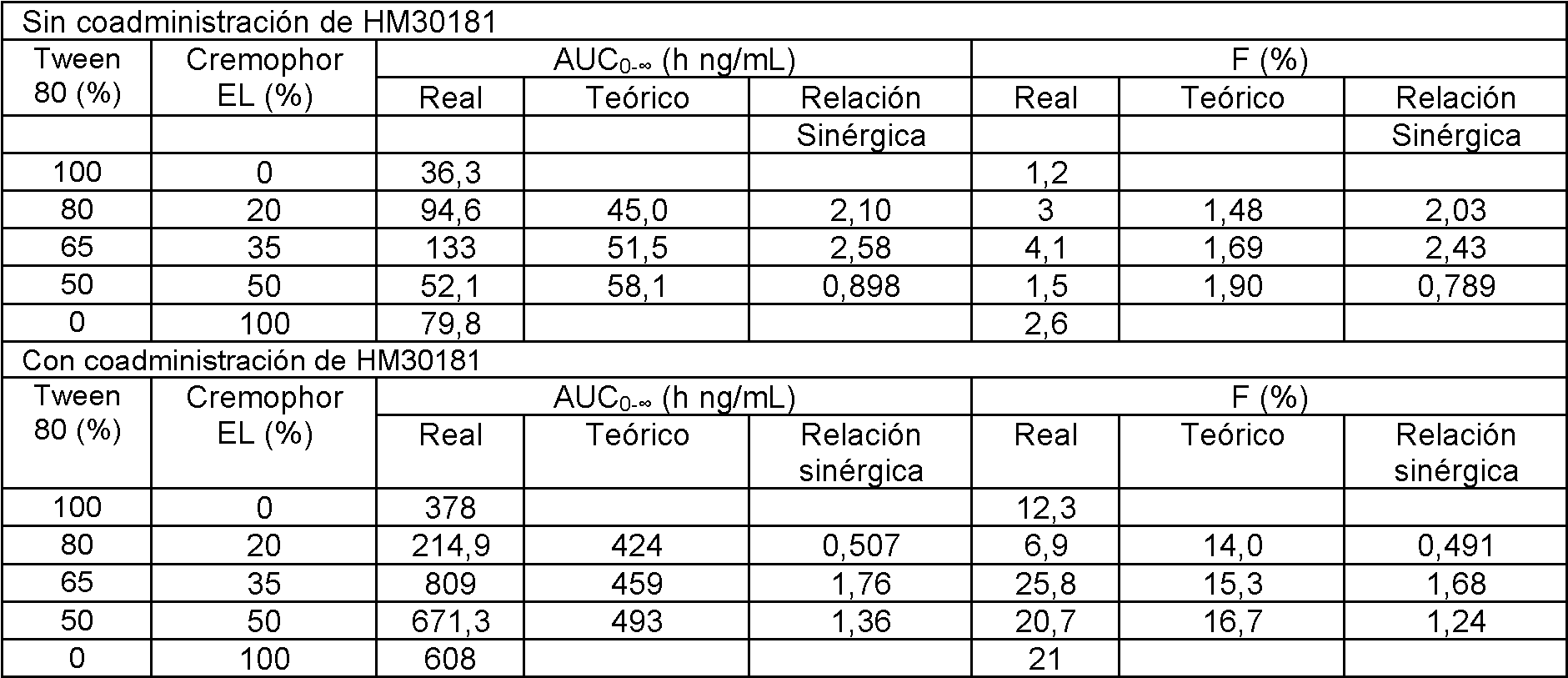

Tal hallazgo es especialmente inesperado ya que, al menos en teoría, el modo de acción de los surfactantes debería ser sustancialmente el mismo. La adición de un segundo surfactante distinto tiene por tanto el efecto técnico de aumentar sinérgicamente uno o más parámetros farmacocinéticos. Específicamente, se observaron aumentos especialmente notables donde el primer surfactante fue Tween® 80, Tween® 20, o Labrasol®, y el segundo surfactante fue Cremophor® EL o Tween® 20. Los resultados que se presentan en la presente descripción son especialmente inesperados, porque Malingre y Bardelmeijer, supra, enseñan que las formulaciones de Cremophor® EL disminuyen la biodisponibilidad del paclitaxel que se administra por vía oral.Such a finding is especially unexpected since, at least in theory, the mode of action of the surfactants should be substantially the same. The addition of a different second surfactant therefore has the technical effect of synergistically increasing one or more pharmacokinetic parameters. Specifically, especially notable increases were observed where the first surfactant was Tween® 80, Tween® 20, or Labrasol®, and the second surfactant was Cremophor® EL or Tween® 20. The results presented in the present description are especially unexpected, because Malingre and Bardelmeijer, supra, teach that Cremophor® EL formulations decrease the bioavailability of orally administered paclitaxel.
Además, se pudieron observar aumentos especialmente ventajosos en uno o más parámetros farmacocinéticos cuando las relaciones en peso del primer y segundo surfactantes estaban relativamente equilibradas, típicamente en un intervalo de entre 60:40 y 85:15.Furthermore, especially advantageous increases in one or more pharmacokinetic parameters could be observed when the weight ratios of the first and second surfactants were relatively balanced, typically in a range between 60:40 and 85:15.
4. Método ilustrativo para preparar una composición farmacéutica líquida que tiene una concentración de docetaxel de 45 mg/mL (Tween® 80 al 64,35 %, Cremophor® EL al 34,65 %, ácido ascórbico al 0,5 %, ácido cítrico al 0,5 %): 4. Illustrative method for preparing a liquid pharmaceutical composition having a docetaxel concentration of 45 mg/mL ( 64.35% Tween® 80, 34.65% Cremophor® EL, 0.5% ascorbic acid, citric acid at 0.5%):
a. Pese con precisión 1,95 g de Tween® 80 y 1,05 g de Cremophor® EL en un vial de vidrio de 20 mL. b. Mezcle bien en agitador con barra magnética.a. Accurately weigh 1.95 g of Tween® 80 and 1.05 g of Cremophor® EL into a 20 mL glass vial. b. Mix well on a magnetic stirrer.
c. Pese con precisión 16,5 mg de ácido ascórbico y 16,5 mg de ácido cítrico.c. Accurately weigh 16.5 mg of ascorbic acid and 16.5 mg of citric acid.
d. Agregue el ácido ascórbico y el ácido cítrico pesados en la mezcla de Tween® 80-Cremophor® EL de la "etapa b" con agitación vigorosa con barra magnética. d. Add the heavy ascorbic acid and citric acid to the Tween® 80-Cremophor® EL mixture from "step b" with vigorous stirring with a magnetic bar.
e. Someta a sonicación durante al menos 10 minutos para dispersar y disolver los ácidos orgánicos.and. Sonicate for at least 10 min to disperse and dissolve organic acids.
f. Continúe el ciclo de agitación y sonicación hasta que todos los ácidos se disuelvan. Puede tomar alrededor de 1-2 horas.F. Continue the cycle of shaking and sonication until all acids dissolve. It may take around 1-2 hours.
g. Pese con precisión 138 mg de docetaxel trihidratado.g. Accurately weigh 138 mg of docetaxel trihydrate.
h. Divida en varias porciones pequeñas (~30-40 mg cada una) y agregue a la mezcla de Tween® 80-Cremophor® EL-ácido ascórbico-ácido cítrico de la "etapa f" con agitación vigorosa con barra magnética a 35 grados Celsius.h. Divide into several small portions (~30-40 mg each) and add to “stage f” Tween® 80-Cremophor® EL-ascorbic acid-citric acid mixture with vigorous stirring with a magnetic bar at 35 degrees Celsius.
i. Someta a sonicación durante al menos 10 minutos para dispersar y disolver el docetaxel.i. Sonicate for at least 10 min to disperse and dissolve the docetaxel.
j. Continúe el ciclo de agitación y sonicación hasta que todo el docetaxel se disuelva. Esto puede tardar alrededor de 4 horas.J. Continue the cycle of shaking and sonication until all of the docetaxel is dissolved. This may take around 4 hours.
5. Medición de los tamaños de las micelas para composiciones farmacéuticas de docetaxel en uno o dos surfactantes en agua.5. Measurement of micelles sizes for pharmaceutical compositions of docetaxel in one or two surfactants in water.
Se diluyeron formulaciones de docetaxel con un solo surfactante y dos surfactantes a una concentración de 1,25 mg/mL (150 mg de docetaxel en 120 mL de agua) para simular las condiciones de dilución en un estómago humano. La Tabla 5.1 muestra los tamaños de partícula (nm) medidos mediante el uso de un Analizador de Partículas Delsa™ Nano C (Beckman Coulter, EE. UU.). Excepto para las composiciones de Labrasol®, que demostraron precipitación, todas las formulaciones permanecieron en su estado micelar bajo las condiciones de dilución esperadas en el estómago humano.Single-surfactant and dual-surfactant formulations of docetaxel were diluted to a concentration of 1.25 mg/mL (150 mg of docetaxel in 120 mL of water) to simulate dilution conditions in a human stomach. Table 5.1 shows the particle sizes (nm) measured using a Delsa™ Nano C Particle Analyzer (Beckman Coulter, USA). Except for the Labrasol® compositions, which demonstrated precipitation, all formulations remained in their micellar state under the dilution conditions expected in the human stomach.
_____________________________ Tabla 5.1._____________________________ Table 5.1.
Formulación___________________________ Tamaño de partícula (nm) Tween 80 al 100 % 17.9 Cremophor EL al 100 % 12,8 Labrasol al 100 % Formas de suspensión Tween 20 al 100 % 13.4 Tween 80 al 80 %/Cremophor EL al 20 % 14,2 Tween 80 al 65 %/Cremophor EL al 35 % 13.9 Labrasol al 20 %/Cremophor EL al 80 % 14.4 Tween 20 al 20 %/Cremophor EL al 80 % 14,6 Soiutol HS15 al 20 %/Cremophor EL al 80 % 18 6. Estabilidad acelerada de formulaciones líquidas con ácido ascórbico y/o ácido cítrico. Formulation___________________________ Particle Size (nm) 100% Tween 80 17.9 100% Cremophor EL 12.8 100% Labrasol Suspension Forms 100% Tween 20 13.4 80% Tween 80/20% Cremophor EL 14.2 Tween 80 65%/35% Cremophor EL 13.9 20% Labrasol/80% Cremophor EL 14.4 20% Tween 20/80% Cremophor EL 14.6 20% Soiutol HS15/80% Cremophor EL 18 6. Stability acceleration of liquid formulations with ascorbic acid and/or citric acid.
Las formulaciones de Docetaxel líquido de docetaxel a una concentración de 45 mg/mL con la siguiente relación de surfactantes se introdujeron en cápsulas duras de gelatina y se sometieron a condiciones de "estabilidad acelerada" (40 °C/75 % de humedad relativa):Docetaxel liquid formulations of docetaxel at a concentration of 45 mg/mL with the following ratio of surfactants were filled into hard gelatin capsules and subjected to "accelerated stability" conditions (40°C/75% relative humidity):
Ejemplo 1: Tween® 80 al 64,35 %, Cremophor® EL al 34,65 %, ácido ascórbico al 0,5 %, ácido cítrico al 0,5 %. Ejemplo 2: Tween® 80 al 64,35 %, Cremophor® EL al 34,65 %, ácido cítrico al 1 %Example 1: 64.35% Tween® 80, 34.65% Cremophor® EL, 0.5% ascorbic acid, 0.5% citric acid. Example 2: 64.35% Tween® 80, 34.65% Cremophor® EL, 1% Citric Acid
La Tabla 6.1 detalla la composición de cada una de las formulaciones. Table 6.1 details the composition of each of the formulations.
Tabla 6.1.Table 6.1.

Análisis HPLC de docetaxel en formulación líquida para productos de degradación.HPLC analysis of docetaxel in liquid formulation for degradation products.
Dilución de la formulación líquida (Metanol = 1:30)Dilution of the liquid formulation (Methanol = 1:30)
Mezcla adecuada para el sistema de docetaxel (USP, lote no F0K229) a 1 mg/mL con metanol. System-appropriate mix of docetaxel (USP, lot no. F0K229) at 1 mg/mL with methanol.
Se usó un estándar de formulación líquida para identificar los picos debidos a la presencia de surfactantes. Condiciones analíticas:A liquid formulation standard was used to identify peaks due to the presence of surfactants. Analytical conditions:
Instrumento: Agilent 1260 InfinityInstrument: Agilent 1260 Infinity
Parámetros cromatográficos:Chromatographic parameters:
Columna: Zorbax Eclipse Plus C18, 4,6*150 mm, 5 pmColumn: Zorbax Eclipse Plus C18, 4.6*150mm, 5pm
Fase móvil: Agua ultrapura (A); Acetonitrilo (B) (ver Tabla 6.2) Mobile phase: ultrapure water (A); Acetonitrile (B) (see Table 6.2)
Régimen de flujo: 1,2 mL/minutosFlow rate: 1.2 mL/minute
Temperatura de la columna: 45 °CelsiusColumn temperature: 45 °Celsius
Volumen de inyección: 20 pLInjection volume: 20 pL
Longitud de onda de detección: 230 nmDetection wavelength: 230nm
Otras condiciones siguen a la inyección de Docetaxel USP35:Other conditions follow Docetaxel USP35 injection:
Los ensayos para docetaxel y sus productos de degradación se realizaron al inicio, 1, 3 y 6 meses. Las Tablas 6.3 y 6.4 muestran que los niveles de impurezas para todas las formulaciones líquidas que contienen varias relaciones de ácido ascórbico y ácido cítrico permanecieron más abajo de los límites de la USP durante 6 meses a 40 °C y 75 % de humedad relativa. Estos resultados indican que las formulaciones líquidas son estables durante el almacenamiento ya que los niveles de todas las impurezas estaban más abajo de los criterios de aceptación de la USP.Assays for docetaxel and its degradation products were performed at baseline, 1, 3, and 6 months. Tables 6.3 and 6.4 show that impurity levels for all liquid formulations containing various ratios of ascorbic acid and citric acid remained below USP limits for 6 months at 40°C and 75% relative humidity. These results indicate that the liquid formulations are storage stable as the levels of all impurities were below USP acceptance criteria.
Tabla 6.2.Table 6.2.

Tabla 6.3. Formulación con ácido cítrico al 0,5 %/ácido ascórbico al 0,5 % Table 6.3. 0.5% citric acid/0.5% ascorbic acid formulation

Tabla 6.4. Formulación con ácido cítrico al 1 %. Table 6.4. Formulation with 1% citric acid.

En algunas modalidades, los parámetros numéricos deben interpretarse a la luz del número de dígitos significativos que se informan y aplicando técnicas de redondeo ordinarias. A pesar de que los intervalos numéricos y los parámetros que establecen el amplio alcance de algunas modalidades de la invención son aproximaciones, los valores numéricos establecidos en los ejemplos específicos se indican con la mayor precisión posible. Los valores numéricos que se presentan en algunas modalidades de la invención pueden contener ciertos errores que resultan necesariamente de la desviación estándar que se encontró en sus respectivas mediciones de prueba. In some embodiments, numerical parameters must be interpreted in light of the number of significant digits reported and by applying ordinary rounding techniques. Although the numerical ranges and parameters that set forth the broad scope of some embodiments of the invention are approximations, the numerical values set forth in the specific examples are given as accurately as possible. numerical values presented in some embodiments of the invention may contain certain errors that necessarily result from the standard deviation found in their respective test measurements.
Claims (15)
Applications Claiming Priority (2)
| Application Number | Priority Date | Filing Date | Title |
|---|---|---|---|
| US201562234868P | 2015-09-30 | 2015-09-30 | |
| PCT/CN2016/100807 WO2017054754A1 (en) | 2015-09-30 | 2016-09-29 | Oral taxane compositions and methods |
Publications (1)
| Publication Number | Publication Date |
|---|---|
| ES2904691T3 true ES2904691T3 (en) | 2022-04-05 |
Family
ID=58408671
Family Applications (1)
| Application Number | Title | Priority Date | Filing Date |
|---|---|---|---|
| ES16850378T Active ES2904691T3 (en) | 2015-09-30 | 2016-09-29 | Oral Taxane Compositions and Methods |
Country Status (12)
| Country | Link |
|---|---|
| US (2) | US10835511B2 (en) |
| EP (1) | EP3355881B1 (en) |
| JP (2) | JP6985276B2 (en) |
| KR (1) | KR102656954B1 (en) |
| CN (2) | CN108697683B (en) |
| AU (2) | AU2016333292B2 (en) |
| CA (1) | CA2999201C (en) |
| ES (1) | ES2904691T3 (en) |
| HK (1) | HK1258390A1 (en) |
| MX (1) | MX386381B (en) |
| TW (3) | TWI838700B (en) |
| WO (1) | WO2017054754A1 (en) |
Families Citing this family (12)
| Publication number | Priority date | Publication date | Assignee | Title |
|---|---|---|---|---|
| TWI838700B (en) * | 2015-09-30 | 2024-04-11 | 香港商慧源香港創新有限公司 | Oral taxane compositions and methods |
| US10188626B2 (en) * | 2015-11-03 | 2019-01-29 | Cipla Limited | Stabilized cabazitaxel formulations |
| CN112351779A (en) * | 2018-04-13 | 2021-02-09 | 慧源医疗有限公司 | Therapeutic combination of orally administered paclitaxel and a P-gp inhibitor for the treatment of angiosarcoma |
| JP7421499B2 (en) * | 2018-05-15 | 2024-01-24 | アメリカ合衆国 | Formulations and methods for the prevention and treatment of tumor metastasis and tumor development |
| CN113195005B (en) * | 2018-10-12 | 2023-07-21 | 国际先进加速器应用公司 | Pharmaceutical compositions comprising radiolabeled GRPR antagonists and surfactants |
| EP3893867A1 (en) | 2018-12-14 | 2021-10-20 | Athenex HK Innovative Limited | Therapeutic combinations of orally administered docetaxel and a p-gp inhibitor for the treatment of cancer |
| CA3159181A1 (en) * | 2020-01-24 | 2021-07-29 | Imran ALIBHAI | Therapeutic compounds, formulations, and uses thereof |
| IL301516A (en) | 2020-10-07 | 2023-05-01 | Athenex Inc | Acetamido-phenyltetrazole derivatives and methods of using the same |
| US20230301910A1 (en) * | 2020-11-09 | 2023-09-28 | Scai Therapeutics Co., Ltd. | Solid material and dispersion composition containing same |
| JP2023548966A (en) * | 2020-11-09 | 2023-11-21 | スカイ・セラピューティクス・カンパニー・リミテッド | Solid phase cyclosporin A and dispersion composition containing the same |
| CN116350619B (en) * | 2021-12-28 | 2025-04-08 | 北京抗创联生物制药技术研究有限公司 | An oral taxane pharmaceutical composition |
| CN118045200B (en) * | 2024-02-27 | 2025-07-18 | 中国海洋大学 | Nanometer drug carrier with P glycoprotein inhibition function, preparation method and application |
Family Cites Families (29)
| Publication number | Priority date | Publication date | Assignee | Title |
|---|---|---|---|---|
| US6964946B1 (en) * | 1995-10-26 | 2005-11-15 | Baker Norton Pharmaceuticals, Inc. | Oral pharmaceutical compositions containing taxanes and methods of treatment employing the same |
| US6245805B1 (en) | 1995-10-26 | 2001-06-12 | Baker Norton Pharmaceuticals, Inc. | Method, compositions and kits for increasing the oral bioavailability of pharmaceutical agents |
| EP0876145A4 (en) * | 1995-12-21 | 1999-04-21 | Genelabs Tech Inc | Taxane composition and method |
| US6458373B1 (en) | 1997-01-07 | 2002-10-01 | Sonus Pharmaceuticals, Inc. | Emulsion vehicle for poorly soluble drugs |
| GB9718903D0 (en) * | 1997-09-05 | 1997-11-12 | Glaxo Group Ltd | Method,compositions and kits for increasing the oral bioavailability of pharmaceutical agents |
| KR100661879B1 (en) | 1998-04-01 | 2006-12-27 | 스키에파마 캐나다 인코포레이티드 | Anticancer composition |
| US5922754A (en) * | 1998-10-02 | 1999-07-13 | Abbott Laboratories | Pharmaceutical compositions containing paclitaxel |
| US6136846A (en) | 1999-10-25 | 2000-10-24 | Supergen, Inc. | Formulation for paclitaxel |
| US7919113B2 (en) | 1999-12-30 | 2011-04-05 | Yissum Research Development Company Of The Hebrew University Of Jerusalem | Dispersible concentrate lipospheres for delivery of active agents |
| US7115565B2 (en) | 2001-01-18 | 2006-10-03 | Pharmacia & Upjohn Company | Chemotherapeutic microemulsion compositions of paclitaxel with improved oral bioavailability |
| KR100774366B1 (en) * | 2001-09-10 | 2007-11-08 | 주식회사 중외제약 | Paclitaxel Injection Composition |
| US20040092428A1 (en) * | 2001-11-27 | 2004-05-13 | Hongming Chen | Oral pharmaceuticals formulation comprising paclitaxel, derivatives and methods of administration thereof |
| CA2470826A1 (en) * | 2001-12-20 | 2003-07-03 | Bristol-Myers Squibb Company | Pharmaceutical compositions of orally active taxane derivatives having enhanced bioavailability |
| EP1498143A1 (en) | 2003-07-18 | 2005-01-19 | Aventis Pharma S.A. | Self-emulsifying and self-microemulsifying formulations for the oral administration of taxoids |
| KR100557093B1 (en) | 2003-10-07 | 2006-03-03 | 한미약품 주식회사 | Tetrazole derivatives having multi-drug resistance inhibitory activity and preparation method thereof |
| US7989490B2 (en) | 2004-06-02 | 2011-08-02 | Cordis Corporation | Injectable formulations of taxanes for cad treatment |
| EP1904052A4 (en) | 2005-06-17 | 2008-12-10 | Hospira Australia Pty Ltd | Liquid pharmaceutical formulations of docetaxel |
| US20070085067A1 (en) | 2005-10-18 | 2007-04-19 | Lewis John R | Gated parking corral |
| AR054215A1 (en) | 2006-01-20 | 2007-06-13 | Eriochem Sa | A PHARMACEUTICAL FORMULATION OF A TAXANE, A SOLID COMPOSITION OF A LIOFILIZED TAXAN FROM AN ACETIC ACID SOLUTION, A PROCEDURE FOR THE PREPARATION OF A SOLID COMPOSITION OF A TAXANE, A SOLUBILIZING COMPOSITION OF A LIOFILIZED TAXANE AND AN ELEMENTARY KIT |
| BRPI0600194A (en) | 2006-01-30 | 2007-10-23 | Quiral Quimica Do Brasil S A | docetaxel-containing pharmaceutical compositions and a degradation inhibitor and process for obtaining same |
| CA2686225A1 (en) | 2007-06-22 | 2008-12-31 | Scidose Llc | Solubilized formulation of docetaxel without tween 80 |
| AR063111A1 (en) | 2007-10-03 | 2008-12-30 | Eriochem Sa | A PHARMACEUTICAL FORMULATION OF TAXANO |
| KR101053780B1 (en) * | 2008-02-29 | 2011-08-02 | 동아제약주식회사 | Single liquid stable pharmaceutical composition containing docetaxel |
| US8541360B2 (en) | 2008-11-19 | 2013-09-24 | Ben Venue Laboratories, Inc. | Parenteral formulations comprising sugar-based esters and ethers |
| TW201240664A (en) * | 2010-09-01 | 2012-10-16 | Portola Pharm Inc | Methods and formulations of treating thrombosis with betrixaban and a P-glycoprotein inhibitor |
| JP5868414B2 (en) * | 2010-11-08 | 2016-02-24 | カディラ ファーマシューティカルズ リミテッド | Taxoid pharmaceutical composition |
| JP5777181B2 (en) | 2011-06-22 | 2015-09-09 | 富士フイルム株式会社 | Imaging lens and imaging apparatus |
| JO3737B1 (en) * | 2015-07-21 | 2021-01-31 | Athenex Therapeutics Ltd | Therapeutic combinations of orally administered paclitaxel and a P-gp inhibitor for the treatment of cancer |
| TWI838700B (en) * | 2015-09-30 | 2024-04-11 | 香港商慧源香港創新有限公司 | Oral taxane compositions and methods |
-
2016
- 2016-09-26 TW TW111106208A patent/TWI838700B/en active
- 2016-09-26 TW TW109143285A patent/TWI752750B/en active
- 2016-09-26 TW TW105131091A patent/TWI715636B/en active
- 2016-09-27 US US15/277,890 patent/US10835511B2/en active Active
- 2016-09-29 HK HK19100797.4A patent/HK1258390A1/en unknown
- 2016-09-29 ES ES16850378T patent/ES2904691T3/en active Active
- 2016-09-29 AU AU2016333292A patent/AU2016333292B2/en active Active
- 2016-09-29 CA CA2999201A patent/CA2999201C/en active Active
- 2016-09-29 JP JP2018536325A patent/JP6985276B2/en active Active
- 2016-09-29 KR KR1020187011838A patent/KR102656954B1/en active Active
- 2016-09-29 WO PCT/CN2016/100807 patent/WO2017054754A1/en not_active Ceased
- 2016-09-29 CN CN201680063516.8A patent/CN108697683B/en active Active
- 2016-09-29 MX MX2018003452A patent/MX386381B/en unknown
- 2016-09-29 EP EP16850378.7A patent/EP3355881B1/en active Active
- 2016-09-29 CN CN202111009477.2A patent/CN113521002B/en active Active
-
2020
- 2020-10-13 US US17/069,557 patent/US11963942B2/en active Active
-
2021
- 2021-11-25 JP JP2021191523A patent/JP7227334B2/en active Active
-
2022
- 2022-02-11 AU AU2022200919A patent/AU2022200919B2/en active Active
Also Published As
Similar Documents
| Publication | Publication Date | Title |
|---|---|---|
| ES2904691T3 (en) | Oral Taxane Compositions and Methods | |
| ES2831037T3 (en) | Oral self-emulsifying pharmaceutical composition of hydrophilic drugs and method of preparation | |
| ES2609640T3 (en) | Intravenous rolapitant formulations | |
| ES2283756T3 (en) | PHARMACO ADMINISTRATION ADMINISTRATION SYSTEMS FOR TAXOIDS. | |
| WO2012028101A1 (en) | Liquid compositions of insoluble drugs and preparation methods thereof | |
| ES2652509T3 (en) | Non-aqueous taxane proemulsion formulations and methods for preparing and using them | |
| ES2971042T3 (en) | Pharmaceutical composition for oral administration comprising taxane | |
| US9763880B2 (en) | Non-aqueous taxane formulations and methods of using the same | |
| KR20210078505A (en) | Intratumoral Injection Formulation | |
| CN116350619B (en) | An oral taxane pharmaceutical composition | |
| ES2895948T3 (en) | Pharmaceutical composition for oral administration comprising taxane at high concentration | |
| BR112018006510B1 (en) | ORAL TAXAN COMPOSITIONS AND METHODS | |
| HK1256760A1 (en) | Oral taxane compositions and methods | |
| HK1256760B (en) | Oral taxane compositions and methods | |
| BRPI1011764B1 (en) | Pharmaceutical composition: Oral auto-microemulsifier of a hydrophilic drug. |