ES2909744T3 - Polypropylene heterophasic composition - Google Patents
Polypropylene heterophasic composition Download PDFInfo
- Publication number
- ES2909744T3 ES2909744T3 ES18819122T ES18819122T ES2909744T3 ES 2909744 T3 ES2909744 T3 ES 2909744T3 ES 18819122 T ES18819122 T ES 18819122T ES 18819122 T ES18819122 T ES 18819122T ES 2909744 T3 ES2909744 T3 ES 2909744T3
- Authority
- ES
- Spain
- Prior art keywords
- range
- weight
- polypropylene
- propylene
- heterophasic
- Prior art date
- Legal status (The legal status is an assumption and is not a legal conclusion. Google has not performed a legal analysis and makes no representation as to the accuracy of the status listed.)
- Active
Links
Classifications
-
- C—CHEMISTRY; METALLURGY
- C08—ORGANIC MACROMOLECULAR COMPOUNDS; THEIR PREPARATION OR CHEMICAL WORKING-UP; COMPOSITIONS BASED THEREON
- C08L—COMPOSITIONS OF MACROMOLECULAR COMPOUNDS
- C08L23/00—Compositions of homopolymers or copolymers of unsaturated aliphatic hydrocarbons having only one carbon-to-carbon double bond; Compositions of derivatives of such polymers
- C08L23/02—Compositions of homopolymers or copolymers of unsaturated aliphatic hydrocarbons having only one carbon-to-carbon double bond; Compositions of derivatives of such polymers not modified by chemical after-treatment
- C08L23/10—Homopolymers or copolymers of propene
- C08L23/14—Copolymers of propene
-
- C—CHEMISTRY; METALLURGY
- C08—ORGANIC MACROMOLECULAR COMPOUNDS; THEIR PREPARATION OR CHEMICAL WORKING-UP; COMPOSITIONS BASED THEREON
- C08L—COMPOSITIONS OF MACROMOLECULAR COMPOUNDS
- C08L23/00—Compositions of homopolymers or copolymers of unsaturated aliphatic hydrocarbons having only one carbon-to-carbon double bond; Compositions of derivatives of such polymers
- C08L23/02—Compositions of homopolymers or copolymers of unsaturated aliphatic hydrocarbons having only one carbon-to-carbon double bond; Compositions of derivatives of such polymers not modified by chemical after-treatment
- C08L23/10—Homopolymers or copolymers of propene
- C08L23/14—Copolymers of propene
- C08L23/142—Copolymers of propene at least partially crystalline copolymers of propene with other olefins
-
- C—CHEMISTRY; METALLURGY
- C08—ORGANIC MACROMOLECULAR COMPOUNDS; THEIR PREPARATION OR CHEMICAL WORKING-UP; COMPOSITIONS BASED THEREON
- C08F—MACROMOLECULAR COMPOUNDS OBTAINED BY REACTIONS ONLY INVOLVING CARBON-TO-CARBON UNSATURATED BONDS
- C08F210/00—Copolymers of unsaturated aliphatic hydrocarbons having only one carbon-to-carbon double bond
- C08F210/04—Monomers containing three or four carbon atoms
- C08F210/06—Propene
-
- C—CHEMISTRY; METALLURGY
- C08—ORGANIC MACROMOLECULAR COMPOUNDS; THEIR PREPARATION OR CHEMICAL WORKING-UP; COMPOSITIONS BASED THEREON
- C08F—MACROMOLECULAR COMPOUNDS OBTAINED BY REACTIONS ONLY INVOLVING CARBON-TO-CARBON UNSATURATED BONDS
- C08F2420/00—Metallocene catalysts
- C08F2420/07—Heteroatom-substituted Cp, i.e. Cp or analog where at least one of the substituent of the Cp or analog ring is or contains a heteroatom
-
- C—CHEMISTRY; METALLURGY
- C08—ORGANIC MACROMOLECULAR COMPOUNDS; THEIR PREPARATION OR CHEMICAL WORKING-UP; COMPOSITIONS BASED THEREON
- C08F—MACROMOLECULAR COMPOUNDS OBTAINED BY REACTIONS ONLY INVOLVING CARBON-TO-CARBON UNSATURATED BONDS
- C08F4/00—Polymerisation catalysts
- C08F4/42—Metals; Metal hydrides; Metallo-organic compounds; Use thereof as catalyst precursors
- C08F4/44—Metals; Metal hydrides; Metallo-organic compounds; Use thereof as catalyst precursors selected from light metals, zinc, cadmium, mercury, copper, silver, gold, boron, gallium, indium, thallium, rare earths or actinides
- C08F4/60—Metals; Metal hydrides; Metallo-organic compounds; Use thereof as catalyst precursors selected from light metals, zinc, cadmium, mercury, copper, silver, gold, boron, gallium, indium, thallium, rare earths or actinides together with refractory metals, iron group metals, platinum group metals, manganese, rhenium technetium or compounds thereof
- C08F4/62—Refractory metals or compounds thereof
- C08F4/64—Titanium, zirconium, hafnium or compounds thereof
- C08F4/659—Component covered by group C08F4/64 containing a transition metal-carbon bond
- C08F4/65912—Component covered by group C08F4/64 containing a transition metal-carbon bond in combination with an organoaluminium compound
-
- C—CHEMISTRY; METALLURGY
- C08—ORGANIC MACROMOLECULAR COMPOUNDS; THEIR PREPARATION OR CHEMICAL WORKING-UP; COMPOSITIONS BASED THEREON
- C08L—COMPOSITIONS OF MACROMOLECULAR COMPOUNDS
- C08L2201/00—Properties
- C08L2201/10—Transparent films; Clear coatings; Transparent materials
-
- C—CHEMISTRY; METALLURGY
- C08—ORGANIC MACROMOLECULAR COMPOUNDS; THEIR PREPARATION OR CHEMICAL WORKING-UP; COMPOSITIONS BASED THEREON
- C08L—COMPOSITIONS OF MACROMOLECULAR COMPOUNDS
- C08L2205/00—Polymer mixtures characterised by other features
- C08L2205/02—Polymer mixtures characterised by other features containing two or more polymers of the same C08L -group
- C08L2205/025—Polymer mixtures characterised by other features containing two or more polymers of the same C08L -group containing two or more polymers of the same hierarchy C08L, and differing only in parameters such as density, comonomer content, molecular weight, structure
-
- C—CHEMISTRY; METALLURGY
- C08—ORGANIC MACROMOLECULAR COMPOUNDS; THEIR PREPARATION OR CHEMICAL WORKING-UP; COMPOSITIONS BASED THEREON
- C08L—COMPOSITIONS OF MACROMOLECULAR COMPOUNDS
- C08L2205/00—Polymer mixtures characterised by other features
- C08L2205/24—Crystallisation aids
-
- C—CHEMISTRY; METALLURGY
- C08—ORGANIC MACROMOLECULAR COMPOUNDS; THEIR PREPARATION OR CHEMICAL WORKING-UP; COMPOSITIONS BASED THEREON
- C08L—COMPOSITIONS OF MACROMOLECULAR COMPOUNDS
- C08L2308/00—Chemical blending or stepwise polymerisation process with the same catalyst
-
- C—CHEMISTRY; METALLURGY
- C08—ORGANIC MACROMOLECULAR COMPOUNDS; THEIR PREPARATION OR CHEMICAL WORKING-UP; COMPOSITIONS BASED THEREON
- C08L—COMPOSITIONS OF MACROMOLECULAR COMPOUNDS
- C08L2314/00—Polymer mixtures characterised by way of preparation
- C08L2314/06—Metallocene or single site catalysts
Landscapes
- Chemical & Material Sciences (AREA)
- Health & Medical Sciences (AREA)
- Chemical Kinetics & Catalysis (AREA)
- Medicinal Chemistry (AREA)
- Polymers & Plastics (AREA)
- Organic Chemistry (AREA)
- Crystallography & Structural Chemistry (AREA)
- Compositions Of Macromolecular Compounds (AREA)
- Addition Polymer Or Copolymer, Post-Treatments, Or Chemical Modifications (AREA)
Abstract
Composición heterofásica de polipropileno que comprende a. una matriz cristalina que es un copolímero al azar de propileno multimodal de etileno y/o alfa-olefina(s) C4-C12 como comonómeros adicionales y b. un elastómero amorfo de propileno-etileno que comprende opcionalmente alfa-olefina(s) C4-C12 como comonómeros adicionales dispersados en dicha matriz cristalina (a), en donde la composición heterofásica de polipropileno se caracteriza por i. una fracción soluble en xileno frío (XCS) según ISO 1652 en el intervalo del 5,0 al 16,5 % en peso, ii. un contenido de comonómero de la fracción XCS (Co(XCS)) en el intervalo del 8,0 al 16,5 % en peso, iii. y opcionalmente que cumple la inecuación 0,80 >= XCS / Co(XCS) >= 1,20, en donde XCS expresa la fracción soluble en xileno frío según ISO 1652 en [% en peso] y Co(XCS) es el contenido de comonómero de dicha fracción XCS en [% en peso].Heterophasic polypropylene composition comprising a. a crystalline matrix that is a multimodal propylene random copolymer of ethylene and/or C4-C12 alpha-olefin(s) as additional comonomers and b. an amorphous propylene-ethylene elastomer optionally comprising C4-C12 alpha-olefin(s) as additional comonomers dispersed in said crystalline matrix (a), wherein the polypropylene heterophasic composition is characterized by i. a cold xylene soluble fraction (XCS) according to ISO 1652 in the range of 5.0 to 16.5% by weight, ii. a comonomer content of the XCS fraction (Co(XCS)) in the range of 8.0 to 16.5% by weight, iii. and optionally satisfying the inequality 0.80 >= XCS / Co(XCS) >= 1.20, where XCS expresses the fraction soluble in cold xylene according to ISO 1652 in [% by weight] and Co(XCS) is the content of comonomer of said XCS fraction in [% by weight].
Description
DESCRIPCIÓNDESCRIPTION
Composición heterofásica de polipropilenoHeterophasic composition of polypropylene
La presente invención se refiere a una nueva composición heterofásica de polipropileno blanda con rigidez y propiedades ópticas mejoradas, así como al proceso por el que la composición heterofásica de polipropileno se produce. Además, la presente invención también se refiere a artículos fabricados a partir de la composición heterofásica de polipropileno inventiva, particularmente a artículos moldeados por soplado, moldeados por extrusiónsoplado o moldeados por inyección.The present invention relates to a novel soft polypropylene heterophasic composition with improved stiffness and optical properties, as well as to the process by which the polypropylene heterophasic composition is produced. Furthermore, the present invention also relates to articles made from the inventive heterophasic polypropylene composition, particularly to blow molded, extrusion blow molded or injection molded articles.
Información de antecedentesbackground information
Las poliolefinas, al igual que el polipropileno, se usan cada vez más en diferentes aplicaciones exigentes. Al mismo tiempo, existe una búsqueda continua de polímeros fabricados a medida que cumplan los requisitos de estas aplicaciones. Por ejemplo, los sistemas heterofásicos son conocidos por su buen comportamiento al impacto. Dichos copolímeros heterofásicos de propileno comprenden una matriz que es o un homopolímero de propileno o un copolímero de propileno al azar en el que se dispersa un copolímero elastomérico. Por lo tanto, la matriz de polipropileno contiene inclusiones (finamente) dispersas que no son parte de la matriz y dichas inclusiones contienen el copolímero elastomérico. El término "inclusión" según indica que la matriz y la inclusión forman diferentes fases dentro del sistema heterofásico, dichas inclusiones son visibles, por ejemplo, por microscopía de alta resolución, así como microscopía electrónica o microscopía de fuerza atómica, o se pueden identificar por análisis térmico dinámicomecánico (DMTA). Específicamente en el DMTA, la presencia de una estructura multifásica se puede identificar por la presencia de al menos dos temperaturas de transición vítrea distintas.Polyolefins, like polypropylene, are increasingly used in various demanding applications. At the same time, there is a continuous search for custom-made polymers that meet the requirements of these applications. For example, heterophasic systems are known for their good impact behavior. Said heterophasic propylene copolymers comprise a matrix which is either a propylene homopolymer or a random propylene copolymer in which an elastomeric copolymer is dispersed. Therefore, the polypropylene matrix contains (finely) dispersed inclusions that are not part of the matrix and said inclusions contain the elastomeric copolymer. The term "inclusion" as indicates that the matrix and the inclusion form different phases within the heterophasic system, such inclusions are visible, for example, by high-resolution microscopy, such as electron microscopy or atomic force microscopy, or can be identified by dynamic-mechanical thermal analysis (DMTA). Specifically in DMTA, the presence of a multiphase structure can be identified by the presence of at least two different glass transition temperatures.
Los copolímeros heterofásicos de propileno blandos son muy adecuados para su aplicación en el campo de artículos moldeados por extrusión-soplado (EBM), tales como botellas o envases vacíos.Soft propylene heterophasic copolymers are well suited for application in the field of extrusion blow molded (EBM) articles, such as empty bottles or containers.
Los copolímeros heterofásicos de propileno blandos son además muy adecuados para producir artículos compresibles como, por ejemplo, para aplicaciones médicas, farmacéuticas o de diagnóstico. Para estos artículos, se requieren buenas propiedades ópticas en el sentido de baja turbidez y/o buena claridad.Soft propylene heterophasic copolymers are also very suitable for producing compressible articles, for example for medical, pharmaceutical or diagnostic applications. For these articles, good optical properties in the sense of low haze and/or good clarity are required.
Es muy común usar o producir dichos artículos moldeados por extrusión-soplado en un proceso de soplado-llenadosellado (BFS).It is very common to use or produce such extrusion blow molded articles in a blow fill seal (BFS) process.
Actualmente, dichas botellas sopladas-selladas-selladas (BFS) se fabrican principalmente de polietileno de baja densidad (LDPE) debido a su excelente procesabilidad, buena transparencia y buena blandura para botellas plegables en combinación con la pureza más alta posible. La pureza resulta parcialmente del hecho de que este tipo de polímero no necesita muchos aditivos en general, en parte debido a la ausencia de residuos de catalizador. Sin embargo, el principal problema es la baja temperatura de fusión de las calidades de LDPE en sí.Currently, such blown-sealed-sealed (BFS) bottles are mainly made from low-density polyethylene (LDPE) due to its excellent processability, good transparency and good softness for collapsible bottles in combination with the highest possible purity. The purity results partly from the fact that this type of polymer does not need many additives in general, partly due to the absence of catalyst residues. However, the main problem is the low melting temperature of the LDPE grades themselves.
Dondequiera que las aplicaciones requieran esterilización, especialmente esterilización por vapor, la baja temperatura de fusión del LDPE limita la esterilización por vapor hasta una temperatura significativamente inferior a dichas temperaturas de fusión. Por consiguiente, el tiempo requerido para la apropiada esterilización es prolongado. Sin embargo, un tiempo de esterilización más largo requiere más energía. Además, las propiedades ópticas del LDPE después de la esterilización se deterioran mucho debido a la posterior cristalización y a la rugosificación superficial en el proceso.Wherever applications require sterilization, especially steam sterilization, the low melting temperature of LDPE limits steam sterilization to significantly below such melting temperatures. Consequently, the time required for proper sterilization is long. However, a longer sterilization time requires more energy. Furthermore, the optical properties of LDPE after sterilization deteriorate greatly due to subsequent crystallization and surface roughening in the process.
Para aplicaciones médicas, la retención de las propiedades ópticas después de la esterilización es incluso más importante. Sin embargo, todavía son un reto los sistemas heterofásicos que permiten a un experto producir artículos moldeados por extrusión-soplado esterilizables, como botellas de BFS, con alta claridad.For medical applications, the retention of optical properties after sterilization is even more important. However, heterophasic systems that allow a skilled person to produce sterilizable extrusion blow molded articles, such as BFS bottles, with high clarity are still a challenge.
Descripción del estado de la técnica:Description of the state of the art:
El documento de patente EP 2824142 B1 reivindica copolímeros heterofásicos de polipropileno basados en un catalizador de sitio único (SSC) que tienen una velocidad de flujo del fundido (MFR) en el intervalo de 0,5 -100 g/10 min, que comprenden una fracción soluble en xileno frío (XCS) en una cantidad del 12 - 60 % en peso, caracterizándose aún más dicha fracción XCS por un contenido de etileno del 18 - 70 % en peso y una viscosidad intrínseca (VI) que es superior a la VI de la fracción insoluble en xileno frío (XCI). No se indican propiedades ópticas para los polímeros respectivos, y ni la turbidez ni la blandura se pueden esperar en un intervalo adecuado.Patent document EP 2824142 B1 claims polypropylene heterophasic copolymers based on a single site catalyst (SSC) having a melt flow rate (MFR) in the range of 0.5-100 g/10 min, comprising a cold xylene soluble fraction (XCS) in an amount of 12 - 60% by weight, said XCS fraction being further characterized by an ethylene content of 18 - 70% by weight and an intrinsic viscosity (IV) that is higher than VI of the cold xylene insoluble fraction (XCI). No optical properties are indicated for the respective polymers, and neither haze nor softness can be expected in a suitable range.
El documento de patente EP 2886563 B1 reivindica copolímeros al azar bimodales de etileno-propileno para botellas moldeadas por extrusión-soplado (EBM) con buena transparencia, pero blandura y colapsabilidad limitadas.EP 2886563 B1 claims ethylene-propylene bimodal random copolymers for extrusion blow molded (EBM) bottles with good transparency, but limited softness and collapsibility.
El documento de patente WO 2016162359 A1 cubre mezclas de un copolímero al azar de etileno-propileno basado en SSC caracterizado por un punto de fusión relativamente bajo en el intervalo de 125 - 143 °C y una fracción XCS relativamente alta con 10 - 30% en peso de un elastómero predominantemente amorfo. Dicho elastómero es preferentemente un copolímero de bloque de estireno que es completamente soluble en xileno frío, lo que da como resultado un contenido de XCS total muy alto que, junto con el bajo punto de fusión, hace que las composiciones respectivas no sean adecuadas para las aplicaciones a las que se refiere aquí.Patent document WO 2016162359 A1 covers SSC-based ethylene-propylene random copolymer blends characterized by a relatively low melting point in the range of 125 - 143 °C and a relatively high XCS fraction with 10 - 30% by weight. weight of a predominantly amorphous elastomer. This elastomer is preferably a styrene block copolymer that is completely soluble in cold xylene, resulting in a very high total XCS content which, together with the low melting point, makes the respective compositions unsuitable for the applications to which which is referred to here.
El documento de patente WO 2017005667 A1 reivindica copolímeros heterofásicos al azar basados en catalizadores de tipo Ziegler-Natta (ZNC) que comprenden una fracción soluble en xileno frío (XCS) en una cantidad del 25 - 35 % en peso, caracterizándose dicha fracción XCS aún más por un contenido de etileno del 12 - 22 % en peso. En relación con la blandura de dichas composiciones, el contenido de XCS es bastante alto y hace que no sean adecuadas para las aplicaciones a las que se refiere aquí.Patent document WO 2017005667 A1 claims random heterophasic copolymers based on Ziegler-Natta (ZNC) type catalysts that comprise a fraction soluble in cold xylene (XCS) in an amount of 25-35% by weight, said XCS fraction still being characterized more for an ethylene content of 12-22% by weight. In relation to the softness of said compositions, the content of XCS is quite high and makes them unsuitable for the applications referred to here.
El documento de patente WO 2001092406 A1 describe composiciones de polímero de propileno que comprenden (A) 70 - 90 % en peso de un copolímero al azar de propileno con etileno, que contiene 1 - 6 % en peso de etileno, que tiene un contenido de fracción insoluble en xileno (XCI) a temperatura ambiente de no menos del 93 %; (B) 10 - 30 % en peso de un copolímero de propileno con etileno, que contiene 8 - 18 % en peso de etileno; en donde la relación (B)/C2B entre el porcentaje en peso de (B), con respecto al peso total de (A) y (B), y el porcentaje en peso de etileno en (B), con respecto al peso total de (B), representada en la fórmula anterior por C2B, es 2,5 o inferior. Las composiciones respectivas presentan una turbidez bastante más alta ya antes de la esterilización y un punto de fusión inferior a 150 °C, siendo ambos fenómenos contrarios a las aplicaciones presentemente referidas.WO 2001092406 A1 describes propylene polymer compositions comprising (A) 70-90% by weight of a random copolymer of propylene with ethylene, containing 1-6% by weight of ethylene, having a content of xylene insoluble fraction (XCI) at room temperature of not less than 93%; (B) 10-30% by weight of a copolymer of propylene with ethylene, containing 8-18% by weight of ethylene; where the ratio (B)/C2B between the percentage by weight of (B), with respect to the total weight of (A) and (B), and the percentage by weight of ethylene in (B), with respect to the total weight of (B), represented in the above formula by C2B, is 2.5 or less. The respective compositions have a considerably higher turbidity already before sterilization and a melting point lower than 150°C, both phenomena being contrary to the applications presently referred to.
El documento de patente WO 2006018812 A1 reivindica un envase moldeado por estirado-soplado que comprende una composición de polímero de propileno producida con un catalizador de metaloceno, comprendiendo la composición de polímero de propileno (i) 25,0 - 75,0 % en peso de un homopolímero o mini-copolímero al azar de propileno que contiene hasta 1,0 % en peso de al menos uno de etileno y alfa-olefinas C4-C10, que tiene un índice isotáctico superior a aproximadamente el 80 %; y (ii) 25,0 - 75,0 % en peso de un copolímero al azar de propileno y al menos una olefina elegida de etileno y alfa-olefinas C4-C10, que contiene aproximadamente 0,3 a aproximadamente 30 % en peso de dicha olefina, y que tiene un índice isotáctico superior a aproximadamente el 60 %; en donde la composición de polímero de propileno tiene una MFR de 1 - 50 g/10 min y una distribución de pesos moleculares (Mw/Mn) inferior a 3,5. Aunque no se indican parámetros normalizados para el rendimiento mecánico y óptico de las composiciones reivindicadas, la turbidez de las botellas inventivas está solo al mismo nivel que el ejemplo comparativo basado en ZNC, mientras que la resistencia al impacto es peor.Patent document WO 2006018812 A1 claims a stretch-blow molded container comprising a propylene polymer composition produced with a metallocene catalyst, the propylene polymer composition comprising (i) 25.0 - 75.0% by weight of a random propylene homopolymer or mini-copolymer containing up to 1.0% by weight of at least one of ethylene and C4-C10 alpha-olefins, having an isotactic index greater than about 80%; and (ii) 25.0 - 75.0% by weight of a random copolymer of propylene and at least one olefin selected from ethylene and C4-C10 alpha-olefins, containing about 0.3 to about 30% by weight of said olefin, and having an isotactic index greater than about 60%; wherein the propylene polymer composition has an MFR of 1-50 g/10 min and a molecular weight distribution (Mw/Mn) of less than 3.5. Although standardized parameters for mechanical and optical performance of the claimed compositions are not indicated, the haze of the inventive bottles is only at the same level as the ZNC-based comparative example, while the impact resistance is worse.
Los copolímeros heterofásicos de propileno al azar (RAHECO) son muy adecuados para aplicaciones blandas. Propylene heterophasic random copolymers (RAHECO) are well suited for soft applications.
Esto es especialmente cierto para polímeros producidos por catálisis con metaloceno (SSC). Dichos polímeros proporcionan buenas propiedades ópticas en el sentido de baja turbidez y alta claridad. Sin embargo, existen dos inconvenientes principales de los materiales basados en SSC:This is especially true for polymers produced by metallocene catalysis (SSC). Such polymers provide good optical properties in the sense of low haze and high clarity. However, there are two main drawbacks of SSC-based materials:
Debido a la excelente inserción de comonómero y los defectos de cadena, normalmente la temperatura de fusión (Tm) de dichos RAHECO basados en SSC es bastante baja. Dichas bajas temperaturas de fusión limitan la ventana de procesamiento para los procesos de esterilización, especialmente para los procesos de esterilización por vapor. Due to excellent comonomer insertion and chain defects, the melting temperature (Tm) of such SSC-based RAHECOs is usually quite low. Such low melting temperatures limit the processing window for sterilization processes, especially steam sterilization processes.
Por consiguiente, como se describe para el caso de LDPE, cuando la temperatura para la esterilización no se puede aumentar, se necesita prolongar el tiempo requerido para la apropiada esterilización. Sin embargo, un tiempo de esterilización más largo requiere más energía y puede inducir efectos de envejecimiento y posteriores a la cristalización adicionales no deseados sobre el polímero.Therefore, as described for the case of LDPE, when the temperature for sterilization cannot be increased, the time required for proper sterilization needs to be prolonged. However, a longer sterilization time requires more energy and may induce additional undesirable aging and post-crystallization effects on the polymer.
También debido a la distribución del comonómero altamente al azar, los grados de polipropileno basados en metaloceno tienden a ser mucho más blandos que los grados de Ziegler-Natta a un contenido de comonómero similar, proporcionando, sin embargo, menor comportamiento frente al impacto.Also due to the highly random comonomer distribution, metallocene-based polypropylene grades tend to be much softer than Ziegler-Natta grades at similar comonomer content, providing, however, lower impact performance.
Además, las propiedades ópticas se deteriorarán más rápido durante dichos procesos de esterilización. Los polímeros producidos con catálisis de metaloceno (SSC) también son conocidos por tener una distribución de pesos moleculares muy estrecha, que se sabe que más bien impide la procesabilidad en procesos de superficie libre como el moldeo por extrusión-soplado (EBM).Furthermore, the optical properties will deteriorate faster during such sterilization processes. Polymers produced with metallocene catalysis (SSC) are also known to have a very narrow molecular weight distribution, which is known to rather impede processability in free surface processes such as extrusion blow molding (EBM).
Por lo tanto, se requiere una nueva solución que proporcione una combinación de alta pureza, buena procesabilidad y resistencia a la esterilización, así como elevada temperatura de fusión y propiedades mecánicas mejoradas.Therefore, a new solution is required that provides a combination of high purity, good processability and resistance to sterilization, as well as high melting temperature and improved mechanical properties.
Objetivo de la invenciónPurpose of the invention
Por lo tanto, ha sido un objetivo de la presente invención proporcionar una composición heterofásica de polipropileno con elevada temperatura de fusión, propiedades mecánicas mejoradas, buenas propiedades ópticas antes y especialmente después de los procesos de esterilización.Therefore, it has been an object of the present invention to provide a polypropylene heterophasic composition with high melting temperature, improved mechanical properties, good optical properties before and especially after sterilization processes.
Los presentes inventores han identificado, por consiguiente, una composición heterofásica de polipropileno que comprende The present inventors have therefore identified a polypropylene heterophasic composition comprising
a) una matriz cristalina que es un copolímero al azar de propileno multimodal de etileno y/o alfa-olefina(s) C4-C12 como comonómeros adicionales ya) a crystalline matrix that is a multimodal propylene random copolymer of ethylene and/or C4-C12 alpha-olefin(s) as additional comonomers and
b) un elastómero de propileno-etileno amorfo que comprende opcionalmente cantidades menores de alfa-olefina(s) C4-C12 como comonómeros adicionales dispersados en dicha matriz cristalina (a), en donde la composición heterofásica de polipropileno se caracteriza porb) an amorphous propylene-ethylene elastomer optionally comprising minor amounts of C4-C12 alpha-olefin(s) as additional comonomers dispersed in said crystalline matrix (a), wherein the polypropylene heterophasic composition is characterized by
- una fracción soluble en xileno frío (XCS) según ISO 1652 en el intervalo del 5,0 al 16,5 % en peso,- a cold xylene soluble fraction (XCS) according to ISO 1652 in the range of 5.0 to 16.5% by weight,
- un contenido de comonómero de la fracción XCS (Co(XCS)) en el intervalo del 8,0 al 16,5% en peso, y opcionalmente- a comonomer content of the XCS fraction (Co(XCS)) in the range of 8.0 to 16.5% by weight, and optionally
- cumplir la inecuación 0,80 < XCS / Co(XCS) < 1,20,- fulfill the inequality 0.80 < XCS / Co(XCS) < 1.20,
en donde XCS expresa la fracción soluble en xileno frío según ISO 1652 en [% en peso] y Co(XCS) es el contenido de comonómero de dicha fracción XCS en [% en peso].where XCS expresses the cold xylene soluble fraction according to ISO 1652 in [% by weight] and Co(XCS) is the comonomer content of said XCS fraction in [% by weight].
En una realización particular, la invención se refiere a artículos moldeados, especialmente a artículos moldeados por soplado y especialmente a artículos soplados-llenados-sellados (BFS), que comprenden la composición heterofásica de polipropileno de la presente invención, además de a un proceso para producir dicha composición heterofásica de polipropileno.In a particular embodiment, the invention relates to molded articles, especially blow molded articles and especially blown-filled-sealed (BFS) articles, comprising the heterophasic polypropylene composition of the present invention, in addition to a process for producing said heterophasic polypropylene composition.
En una realización particular, la composición heterofásica de polipropileno comprende 80,0 - 90,0 % en peso de una matriz cristalina (a) que es un copolímero al azar de propileno multimodal de etileno y/o alfa-olefina(s) C4-C12 como comonómeros adicionales y 10,0 - 20,0 % en peso de un elastómero amorfo de propileno-etileno (b) que comprende opcionalmente cantidades menores de alfa-olefina(s) C4-C12 como comonómeros adicionales dispersados en dicha matriz cristalina (a),In a particular embodiment, the heterophasic polypropylene composition comprises 80.0 - 90.0% by weight of a crystalline matrix (a) that is a multimodal propylene random copolymer of ethylene and/or C4-alpha-olefin(s). C12 as additional comonomers and 10.0-20.0% by weight of an amorphous propylene-ethylene elastomer (b) optionally comprising minor amounts of C4-C12 alpha-olefin(s) as additional comonomers dispersed in said crystalline matrix ( a),
en donde la composición heterofásica de polipropileno se caracteriza por una fracción soluble en xileno frío (XCS) según ISO 1652 en el intervalo del 5,0 al 16,5 % en peso,wherein the heterophasic polypropylene composition is characterized by a cold xylene soluble fraction (XCS) according to ISO 1652 in the range of 5.0 to 16.5% by weight,
un contenido de comonómero de la fracción XCS (Co(XCS)) en el intervalo del 8,0 al 16,5% en peso, y opcionalmente que cumple la inecuacióna comonomer content of the XCS fraction (Co(XCS)) in the range of 8.0 to 16.5% by weight, and optionally satisfying the inequality
0,80 < XCS / Co(XCS)< 1,20,0.80 < XCS / Co(XCS) < 1.20,
en donde XCS expresa la fracción soluble en xileno frío según ISO 1652 en [% en peso] y Co(XCS) es el contenido de comonómero de dicha fracción XCS en [% en peso],where XCS expresses the cold xylene soluble fraction according to ISO 1652 in [% by weight] and Co(XCS) is the comonomer content of said XCS fraction in [% by weight],
y en dondeand where
el copolímero al azar de propileno multimodal (a) de etileno y o a-olefinas comprende (a1) 30,0 - 50,0 % en peso, basado en el peso total de la composición heterofásica de polipropileno, de una primera fracción de polipropileno que es un homopolímero de propileno o un copolímero al azar de propileno-etileno, que tiene un contenido de comonómero en el intervalo del 0,0 -1,0 % en peso, y/o una velocidad de flujo del fundido MFR2 en el intervalo de 2,0 - 10,0 g/10 min y (a2) 30,0 - 60,0% en peso, basado en el peso total de la composición heterofásica de polipropileno, de una segunda fracción de polipropileno que es un copolímero al azar de propileno-etileno, y opcionalmente que tiene un contenido de comonómero en el intervalo superior al 1 ,0 -7 ,0% en peso, y/o una velocidad de flujo del fundido MFR2 en el intervalo de 0,2 - 2,0 g/10 min.the multimodal propylene random copolymer (a) of ethylene and or α-olefins comprises (a1) 30.0 - 50.0% by weight, based on the total weight of the polypropylene heterophasic composition, of a first polypropylene fraction comprising is a propylene homopolymer or a propylene-ethylene random copolymer, having a comonomer content in the range of 0.0-1.0% by weight, and/or a melt flow rate MFR2 in the range of 2.0 - 10.0 g/10 min and (a2) 30.0 - 60.0% by weight, based on the total weight of the polypropylene heterophasic composition, of a second polypropylene fraction that is a random copolymer propylene-ethylene, and optionally having a comonomer content in the range of greater than 1.0 - 7.0% by weight, and/or a melt flow rate MFR2 in the range of 0.2 - 2.0 g/10 min.
En una realización adicional, la invención cubre el uso de la composición heterofásica de polipropileno para producir artículos moldeados, especialmente artículos moldeados previstos para fines de esterilización.In a further embodiment, the invention covers the use of the polypropylene heterophasic composition to produce molded articles, especially molded articles intended for sterilization purposes.
Descripción detallada:Detailed description:
Composición heterofásica de polipropilenoHeterophasic composition of polypropylene
La composición heterofásica de polipropileno comprendeThe heterophasic polypropylene composition comprises
(a) una matriz cristalina que es un copolímero al azar de propileno multimodal de etileno y/o alfa-olefina(s) C4-C12 como comonómeros adicionales y(a) a crystalline matrix that is a multimodal propylene random copolymer of ethylene and/or C4-C12 alpha-olefin(s) as additional comonomers and
(b) un elastómero amorfo de propileno-etileno que comprende opcionalmente cantidades menores de alfaolefina(s) C4-C12 como comonómeros adicionales dispersados en dicha matriz cristalina (a), en donde la composición heterofásica de polipropileno se caracteriza por(b) an amorphous propylene-ethylene elastomer optionally comprising minor amounts of C4-C12 alpha-olefin(s) as additional comonomers dispersed in said crystalline matrix (a), wherein the polypropylene heterophasic composition is characterized by
- una fracción soluble en xileno frío (XCS) según ISO 1652 en el intervalo del 5,0 al 16,5 % en peso,- a cold xylene soluble fraction (XCS) according to ISO 1652 in the range of 5.0 to 16.5% by weight,
- un contenido de comonómero de la fracción XCS (Co(XCS)) en el intervalo del 8,0 al 16,5% en peso, y opcionalmente- a comonomer content of the XCS fraction (Co(XCS)) in the range of 8.0 to 16.5% by weight, and optionally
- cumplir la inecuación 0,80 < XCS / Co(XCS) < 1,20,- fulfill the inequality 0.80 < XCS / Co(XCS) < 1.20,
en donde XCS expresa la fracción soluble en xileno frío según ISO 1652 en [% en peso] y Co(XCS) es el contenido de comonómero de dicha fracción XCS en [% en peso].where XCS expresses the cold xylene soluble fraction according to ISO 1652 in [% by weight] and Co(XCS) is the comonomer content of said XCS fraction in [% by weight].
El copolímero al azar de propileno multimodal de etileno y/ o alfa-olefinas (a) comprendido en la composición heterofásica de polipropileno puede contener alfa-olefinas seleccionados de alfa-olefinas C4 a C8, preferentemente de 1-buteno o 1-hexeno.The multimodal propylene random copolymer of ethylene and/or alpha-olefins (a) included in the composition Polypropylene heterophasic may contain alpha-olefins selected from C4 to C8 alpha-olefins, preferably 1-butene or 1-hexene.
En una realización preferida, el copolímero al azar de propileno multimodal de etileno y alfa-olefinas (a) comprende etileno y 1-buteno como comonómero.In a preferred embodiment, the multimodal propylene random copolymer of ethylene and alpha-olefins (a) comprises ethylene and 1-butene as comonomer.
En una realización especialmente preferida, el copolímero al azar de propileno multimodal (a) comprende, preferentemente consiste en, etileno como el único comonómero.In an especially preferred embodiment, the multimodal propylene random copolymer (a) comprises, preferably consists of, ethylene as the sole comonomer.
La composición heterofásica de polipropileno puede comprender 80,0 - 90,0% en peso del copolímero al azar de propileno multimodal (a) de etileno y o alfa-olefinas, preferentemente en el intervalo del 83,0 - 89,0 % en peso, más preferentemente en el intervalo del 84,0 - 88,0 % en peso.The heterophasic polypropylene composition may comprise 80.0 - 90.0% by weight of the multimodal propylene random copolymer (a) of ethylene and or alpha-olefins, preferably in the range of 83.0 - 89.0% by weight, more preferably in the range of 84.0-88.0% by weight.
El elastómero amorfo de propileno y etileno (b) también puede comprender alfa-olefinas seleccionadas de alfa-olefinas C4 a C8, preferentemente de 1-buteno o 1-hexeno. En una realización preferida, el elastómero amorfo de propileno y etileno y alfa-olefinas (b) comprende etileno y 1-buteno como comonómero.The amorphous propylene and ethylene elastomer (b) may also comprise alpha-olefins selected from C4 to C8 alpha-olefins, preferably 1-butene or 1-hexene. In a preferred embodiment, the amorphous elastomer of propylene and ethylene and alpha-olefins (b) comprises ethylene and 1-butene as comonomer.
En una realización especialmente preferida, el elastómero amorfo de propileno y etileno (b) comprende, más preferentemente consiste en, etileno como el único comonómero. La cantidad de elastómero amorfo de propileno-etileno (b) comprendida en la composición heterofásica de polipropileno puede estar en el intervalo del 10,0 - 20,0 % en peso, preferentemente en el intervalo del 11,0 -17,0 % en peso, más preferentemente en el intervalo del 12.0 -16,0 % en peso.In an especially preferred embodiment, the amorphous elastomer of propylene and ethylene (b) comprises, more preferably consists of, ethylene as the sole comonomer. The amount of amorphous propylene-ethylene elastomer (b) comprised in the polypropylene heterophasic composition may be in the range of 10.0-20.0% by weight, preferably in the range of 11.0-17.0% by weight. weight, more preferably in the range of 12.0-16.0% by weight.
El contenido total de comonómero de la composición heterofásica de polipropileno puede estar en el intervalo de hasta el 7,0 % en peso, como en el intervalo del 1,0 al 7,0, preferentemente en el intervalo del 2,5 - 6,5 % en peso, más preferentemente en el intervalo del 3,0 - 6,0 % en peso.The total comonomer content of the polypropylene heterophasic composition may be in the range of up to 7.0% by weight, such as in the range of 1.0 to 7.0, preferably in the range of 2.5-6, 5% by weight, more preferably in the range of 3.0-6.0% by weight.
La cantidad de una fracción soluble en xileno frío (XCS) en la composición heterofásica de polipropileno puede estar en el intervalo del 5,0 al 16,5 % en peso, preferentemente en el intervalo del 8,0 -16,0 % en peso, más preferentemente en el intervalo del 9,0 -15,0 % en peso.The amount of a cold xylene soluble fraction (XCS) in the polypropylene heterophasic composition may be in the range of 5.0 to 16.5% by weight, preferably in the range of 8.0-16.0% by weight. , more preferably in the range of 9.0-15.0% by weight.
El contenido de comonómero de dicha fracción soluble en xileno frío (Co(XCS)) puede estar en el intervalo del 8.0 -16,5 % en peso, preferentemente en el intervalo del 9,0 - 16,0 % en peso, más preferentemente en el intervalo del 10,0 -15,0 % en peso.The comonomer content of said cold xylene soluble fraction (Co(XCS)) may be in the range of 8.0-16.5% by weight, preferably in the range of 9.0-16.0% by weight, more preferably in the range of 10.0-15.0% by weight.
La fracción soluble en xileno frío (XCS) se puede caracterizar aún más por su viscosidad intrínseca, VI(XCS).The cold xylene soluble fraction (XCS) can be further characterized by its intrinsic viscosity, VI(XCS).
La VI(XCS) puede estar en el intervalo de como máximo 2,0 dl/g, preferentemente en el intervalo de 1,0 -1,9 dl/g, más preferentemente en el intervalo de 1,2 -1,8 dl/gThe VI(XCS) can be in the range of at most 2.0 dl/g, preferably in the range of 1.0 -1.9 dl/g, more preferably in the range of 1.2 -1.8 dl /g
La composición heterofásica de polipropileno se caracteriza por una relación específica entre la fracción soluble en xileno frío (XCS) y el contenido de comonómero de dicha fracción XCS. Por consiguiente, la relación de XCS/Co(XCS) puede estar en el intervalo de 0,80 - 1,20, preferentemente en el intervalo de 0,85 -1,15, más preferentemente en el intervalo de 0,90 -1,10.The heterophasic polypropylene composition is characterized by a specific ratio between the cold xylene soluble fraction (XCS) and the comonomer content of said XCS fraction. Therefore, the XCS/Co(XCS) ratio may be in the range of 0.80 - 1.20, preferably in the range of 0.85 -1.15, more preferably in the range of 0.90 -1 ,10.
La velocidad de flujo del fundido (MFR) se determina según ISO1133 a 230 °C y 2,16 kg de carga. La MFR puede estar en el intervalo de 0,3 - 3,5 g/10 min, preferentemente en el intervalo de 0,4 - 3,0 g/10 min, más preferentemente en el intervalo de 0,5 - 2,5 g/10 min.Melt Flow Rate (MFR) is determined according to ISO1133 at 230 °C and 2.16 kg load. The MFR may be in the range of 0.3 - 3.5 g/10 min, preferably in the range of 0.4 - 3.0 g/10 min, more preferably in the range of 0.5 - 2.5 g/10 min.
La composición heterofásica de polipropileno se puede caracterizar aún más por su por su temperatura de fusión y de cristalización como se ha determinado por calorimetría diferencial de barrido (DSC), Tm y Tc, respectivamente. La temperatura de cristalización Tc de la composición heterofásica de polipropileno puede estar en el intervalo de 95 -112 °C, preferentemente en el intervalo de 98 -111 °C, más preferentemente en el intervalo de 100 - 110°C. La composición heterofásica de polipropileno tiene una temperatura de fusión de al menos 145 °C, preferentemente en el intervalo de 149 - 160 °C, más preferentemente en el intervalo de 150 - 158 °C.The heterophasic polypropylene composition can be further characterized by its melting and crystallization temperature as determined by differential scanning calorimetry (DSC), Tm and Tc, respectively. The crystallization temperature Tc of the polypropylene heterophasic composition may be in the range of 95-112°C, preferably in the range of 98-111°C, more preferably in the range of 100-110°C. The polypropylene heterophasic composition has a melting temperature of at least 145°C, preferably in the range of 149-160°C, more preferably in the range of 150-158°C.
Se prefiere además que la composición heterofásica de polipropileno no tenga temperatura de fusión entre 0 -135 °C. La composición heterofásica de polipropileno también se puede caracterizar por su temperatura de transición vítrea (Tg) como se determina en análisis térmico dinámico-mecánico (DMTA).It is further preferred that the polypropylene heterophasic composition does not have a melting temperature between 0-135°C. The heterophasic polypropylene composition can also be characterized by its glass transition temperature (Tg) as determined by dynamic-mechanical thermal analysis (DMTA).
La temperatura de transición vítrea (Tg) puede estar en el intervalo de (-15) a 0 °C, preferentemente en el intervalo de (-10) a 0 °C, más preferentemente en el intervalo de (-8 ) a 0 °C. The glass transition temperature (Tg) can be in the range of (-15) to 0°C, preferably in the range of (-10) to 0°C, more preferably in the range of (-8) to 0°C. c.
Preferentemente, la composición heterofásica de polipropileno tiene exactamente una temperatura de transición vitrea en el intervalo entre (-15) y 0 °C.Preferably, the heterophasic polypropylene composition has exactly one glass transition temperature in the range between (-15) and 0°C.
La composición heterofásica de polipropileno de la presente invención se puede describir alternativamente por fracciones cristalinas y solubles (FC y FS) como se ha determinado usando el método CRYSTEX QC.The heterophasic polypropylene composition of the present invention may alternatively be described by crystalline and soluble fractions (FC and FS) as determined using the CRYSTEX QC method.
Por lo tanto, la composición heterofásica de polipropileno puede comprender una fracción soluble (FS) como se determina en el método de CRYSTEX QC en el intervalo del 7,5 -16,5 % en peso, preferentemente en el intervalo del 8,0 - 16,0 % en peso, más preferentemente en el intervalo del 9,0 - 15,0 % en peso, basado en el peso total de la composición heterofásica de polipropileno.Therefore, the polypropylene heterophasic composition may comprise a soluble fraction (SF) as determined by the CRYSTEX QC method in the range of 7.5 - 16.5% by weight, preferably in the range of 8.0 - 16.0% by weight, more preferably in the range of 9.0-15.0% by weight, based on the total weight of the polypropylene heterophasic composition.
La composición heterofásica de polipropileno de la presente invención puede comprender, por consiguiente, una fracción cristalina (FC) como se determina en el método CRYSTEX QC en el intervalo del 83,5 - 92,5 % en peso, preferentemente en el intervalo del 84,0 - 92,0 % en peso, más preferentemente en el intervalo del 85,0 - 91,0 % en peso.The heterophasic polypropylene composition of the present invention may therefore comprise a crystalline fraction (FC) as determined by the CRYSTEX QC method in the range of 83.5 - 92.5% by weight, preferably in the range of 84 0.0 - 92.0% by weight, more preferably in the range of 85.0 - 91.0% by weight.
El contenido de comonómero de la fracción soluble (FS) como se determina en el método CRYSTEX QC puede estar en el intervalo de 8,0 -16,5 % en peso, preferentemente en el intervalo de 9,0 -16,0 % en peso, más preferentemente en el intervalo de 10,0 -16,0 % en peso.The comonomer content of the soluble fraction (SF) as determined by the CRYSTEX QC method may be in the range of 8.0-16.5% by weight, preferably in the range of 9.0-16.0% by weight. weight, more preferably in the range of 10.0-16.0% by weight.
Por consiguiente, el contenido de comonómero de la fracción cristalina (FC) como se determina en el método CRYSTEX QC puede estar en el intervalo del 1,5 - 5,0 % en peso, preferentemente en el intervalo del 2,0 - 4,5 % en peso, más preferentemente en el intervalo del 2,5 - 4,0 % en pesoTherefore, the comonomer content of the crystalline fraction (FC) as determined in the CRYSTEX QC method may be in the range of 1.5 - 5.0% by weight, preferably in the range of 2.0 - 4, 5% by weight, more preferably in the range of 2.5 - 4.0% by weight
La viscosidad intrínseca (VI) total de la composición heterofásica de polipropileno puede estar en el intervalo inferior a 3,0 dl/g, preferentemente en el intervalo de 1,5 - 2,8 dl/g, más preferentemente en el intervalo de 1,8 - 2,5 dl/g. Las viscosidades intrínsecas de las fracciones cristalinas y solubles (FC y FS) de la composición heterofásica de polipropileno pueden ser diferentes.The total intrinsic viscosity (IV) of the polypropylene heterophasic composition may be in the range of less than 3.0 dl/g, preferably in the range of 1.5 - 2.8 dl/g, more preferably in the range of 1 .8 - 2.5dl/g. The intrinsic viscosities of the crystalline and soluble fractions (FC and FS) of the polypropylene heterophasic composition may be different.
La viscosidad intrínseca (VI) de la fracción soluble (FS) como se determina en el método CRYSTEX QC puede estar en el intervalo de hasta 2,0 dl/g, preferentemente en el intervalo de 1,0 -1,9 dl/g, más preferentemente en el intervalo de 1,2 -1,8 dl/g.The intrinsic viscosity (IV) of the soluble fraction (SF) as determined in the CRYSTEX QC method can be in the range up to 2.0 dl/g, preferably in the range 1.0 -1.9 dl/g , more preferably in the range of 1.2-1.8 dl/g.
La viscosidad intrínseca (VI) de la fracción cristalina (FC) como se determina en el método CRYSTEX QC puede estar en el intervalo de < 3,0 dl/g, preferentemente en el intervalo de 1,5 - 2,8 dl/g, más preferentemente en el intervalo de 1,8 -2,5 dl/gThe intrinsic viscosity (IV) of the crystalline fraction (FC) as determined in the CRYSTEX QC method can be in the range of < 3.0 dl/g, preferably in the range of 1.5 - 2.8 dl/g , more preferably in the range of 1.8 -2.5 dl/g
a) Matriz cristalina:a) Crystal matrix:
La composición heterofásica de polipropileno comprende una matriz cristalina compuesta de un copolímero al azar de propileno multimodal de etileno y/ o alfa-olefinas.The heterophasic polypropylene composition comprises a crystalline matrix composed of a multimodal propylene random copolymer of ethylene and/or alpha-olefins.
Las alfa-olefinas se pueden seleccionar de alfa-olefinas C4 a C8, preferentemente de 1-buteno o 1-hexeno.The alpha-olefins can be selected from C4 to C8 alpha-olefins, preferably 1-butene or 1-hexene.
En una realización preferida, el copolímero al azar de propileno multimodal de etileno y o a-olefinas comprende etileno y 1-buteno como comonómero.In a preferred embodiment, the multimodal propylene random copolymer of ethylene and or α-olefins comprises ethylene and 1-butene as comonomer.
En una realización especialmente preferida, el copolímero al azar de propileno multimodal comprende solo etileno como el único comonómero.In an especially preferred embodiment, the multimodal propylene random copolymer comprises only ethylene as the sole comonomer.
En una realización particularmente preferida, el copolímero al azar de propileno multimodal que forma la matriz cristalina consiste en propileno y etileno como únicos monómeros.In a particularly preferred embodiment, the multimodal propylene random copolymer forming the crystalline matrix consists of propylene and ethylene as sole monomers.
El término "copolímero al azar" se tiene que entender preferentemente según la IUPAC (Pure Appl. Chem., Vol. No.The term "random copolymer" is preferably to be understood according to IUPAC (Pure Appl. Chem., Vol. No.
68, 8, pp. 1591 a 1595, 1996).68, 8, p. 1591 to 1595, 1996).
La matriz cristalina puede tener un MFR en el intervalo de 0,2 a 50 g/10 min, preferentemente en el intervalo de 0,5 a 30 g/10 min, más preferentemente en el intervalo de 1,0 a 20 g/10 min.The crystalline matrix may have an MFR in the range of 0.2 to 50 g/10 min, preferably in the range of 0.5 to 30 g/10 min, more preferably in the range of 1.0 to 20 g/10 min. min.
La matriz cristalina puede tener un bajo contenido de comonómero, concretamente en el intervalo del 0,5 al 7,0 % en peso, preferentemente en el intervalo del 1,0 - 5,0 % en peso, tal como del 1,5 - 3,0 % en peso.The crystalline matrix may have a low comonomer content, particularly in the range of 0.5 to 7.0 wt%, preferably in the range of 1.0 - 5.0 wt%, such as 1.5 - 3.0% by weight.
La matriz cristalina es multimodal. Por lo tanto, la matriz cristalina comprende al menos dos fracciones de polipropileno, concretamente una primera y una segunda fracción de polipropileno (a1 y a2), que se pueden diferenciar en vista de su viscosidad, su contenido de comonómero, su tipo de comonómero o más de una de estas propiedades. The crystalline matrix is multimodal. Therefore, the crystalline matrix comprises at least two polypropylene fractions, namely a first and a second polypropylene fraction (a1 and a2), which can be differentiated in view of their viscosity, their comonomer content, their type of comonomer or more than one of these properties.
Preferentemente, las dos fracciones de polímero comprendidas por la matriz cristalina se diferencian en vista de su contenido de comonómero y/o sus viscosidades.Preferably, the two polymer fractions comprised by the crystalline matrix differ in view of their comonomer content and/or their viscosities.
Por consiguiente, se prefiere que la primera fracción de polipropileno (a1) se diferencie de la segunda fracción de polipropileno (a2) en vista de su contenido de comonómero y su viscosidad. Preferentemente, el contenido de comonómero y/o la viscosidad de la segunda fracción de polipropileno es superior al contenido de comonómero y/o la viscosidad de la primera fracción de polipropileno.Therefore, it is preferred that the first polypropylene fraction (a1) differs from the second polypropylene fraction (a2) in view of its comonomer content and its viscosity. Preferably, the comonomer content and/or viscosity of the second polypropylene fraction is higher than the comonomer content and/or viscosity of the first polypropylene fraction.
La primera fracción de polipropileno puede estar presente en la composición heterofásica de polipropileno en el intervalo del 30,0 - 50,0 % en peso, preferentemente en el intervalo del 35,0 - 45,0 % en peso, más preferentemente en el intervalo del 37,0 - 42,0 % en peso, basado en el peso total de la composición heterofásica de polipropileno. La segunda fracción de polipropileno puede estar presente en la composición heterofásica de polipropileno en el intervalo del 30,0 - 60,0 % en peso, preferentemente en el intervalo del 38,0 - 54,0 % en peso, más preferentemente en el intervalo del 42,0 - 51,0 % en peso, basado en el peso total de la composición heterofásica de polipropileno. La primera fracción de polipropileno (a1) puede ser un homopolímero de propileno o un copolímero al azar de propileno-etileno.The first polypropylene fraction may be present in the heterophasic polypropylene composition in the range of 30.0-50.0% by weight, preferably in the range of 35.0-45.0% by weight, more preferably in the range 37.0-42.0% by weight, based on the total weight of the polypropylene heterophasic composition. The second polypropylene fraction may be present in the polypropylene heterophasic composition in the range of 30.0 - 60.0% by weight, preferably in the range of 38.0 - 54.0% by weight, more preferably in the range 42.0-51.0% by weight, based on the total weight of the polypropylene heterophasic composition. The first polypropylene fraction (a1) can be a propylene homopolymer or a propylene-ethylene random copolymer.
El contenido de comonómero de la primera fracción de polipropileno puede estar en el intervalo del 0,0 - 1,0 % en peso, preferentemente en el intervalo del 0,0 - 0,8 % en peso, más preferentemente en el intervalo del 0,0 - 0,6 % en peso.The comonomer content of the first polypropylene fraction may be in the range of 0.0-1.0 wt%, preferably in the range of 0.0-0.8 wt%, more preferably in the range of 0 0.0 - 0.6% by weight.
En una realización particularmente preferida, la primera fracción de polipropileno es un homopolímero de propileno. El contenido de comonómero de la segunda fracción de polipropileno puede estar en el intervalo de superior al 1.0 - 7,0 % en peso, preferentemente en el intervalo del 1,5 - 6,5 % en peso, más preferentemente en el intervalo del 2.0 - 6,0 % en peso.In a particularly preferred embodiment, the first polypropylene fraction is a propylene homopolymer. The comonomer content of the second polypropylene fraction may be in the range of greater than 1.0 - 7.0% by weight, preferably in the range of 1.5 - 6.5% by weight, more preferably in the range of 2.0 - 6.0% by weight.
Las alfa-olefinas usadas como comonómeros en la primera y la segunda fracción de polipropileno se pueden seleccionar de alfa-olefinas C4 a C8, preferentemente de 1-buteno o 1-hexeno.The alpha-olefins used as comonomers in the first and second polypropylene fractions can be selected from C4 to C8 alpha-olefins, preferably 1-butene or 1-hexene.
En una realización preferida, el copolímero al azar de propileno multimodal de etileno y/o alfa-olefinas comprende etileno y 1-buteno como comonómero.In a preferred embodiment, the multimodal propylene random copolymer of ethylene and/or alpha-olefins comprises ethylene and 1-butene as comonomer.
En una realización especialmente preferida, la matriz cristalina comprende solo etileno como el único comonómero. La MFR de la primera fracción de polipropileno puede estar en el intervalo del 2,0 -10,0 g/10 min, preferentemente en el intervalo del 2,5 - 8,0 g/10 min, más preferentemente en el intervalo de 3,0 - 7,0 g/10 min.In an especially preferred embodiment, the crystal matrix comprises only ethylene as the sole comonomer. The MFR of the first polypropylene fraction may be in the range of 2.0 - 10.0 g/10 min, preferably in the range of 2.5 - 8.0 g/10 min, more preferably in the range of 3 0.0 - 7.0 g/10 min.
La MFR de la segunda fracción de polipropileno puede ser inferior a la MFR de la primera fracción de polipropileno: La MFR de la segunda fracción de polipropileno puede estar en el intervalo de 0,2 a inferior a 2,0 g/10 min, preferentemente en el intervalo de 0,3 -1,5 g/10 min, más preferentemente en el intervalo de 0,4 -1,3 g/10 min. b) Elastómero amorfo de propileno-etilenoThe MFR of the second polypropylene fraction may be lower than the MFR of the first polypropylene fraction: The MFR of the second polypropylene fraction may be in the range of 0.2 to less than 2.0 g/10 min, preferably in the range of 0.3-1.5 g/10 min, more preferably in the range of 0.4-1.3 g/10 min. b) Amorphous propylene-ethylene elastomer
El elastómero amorfo de etileno-propileno se caracteriza por una baja viscosidad, que es inferior a la viscosidad de la matriz cristalina.The amorphous ethylene-propylene elastomer is characterized by a low viscosity, which is lower than the viscosity of the crystalline matrix.
La MFR del elastómero amorfo de etileno-propileno puede estar en el intervalo de 8,0 -200 g/10 min, preferentemente en el intervalo de 10,0 -150 g/10 min, más preferentemente en el intervalo de 12,0 -100 g/10 min.The MFR of the amorphous ethylene-propylene elastomer may be in the range of 8.0 - 200 g/10 min, preferably in the range of 10.0 - 150 g/10 min, more preferably in the range of 12.0 - 100g/10 min.
El elastómero amorfo de etileno-propileno comprende propileno, etileno y/o alfa-olefinas como monómeros.The amorphous ethylene-propylene elastomer comprises propylene, ethylene and/or alpha-olefins as monomers.
Las alfa-olefinas se pueden seleccionar de alfa-olefinas C4 a C8, preferentemente de 1-buteno o 1-hexeno.The alpha-olefins can be selected from C4 to C8 alpha-olefins, preferably 1-butene or 1-hexene.
En una realización preferida, el elastómero amorfo de etileno-propileno comprende etileno y 1-buteno como comonómeros.In a preferred embodiment, the amorphous ethylene-propylene elastomer comprises ethylene and 1-butene as comonomers.
En una realización especialmente preferida, el elastómero amorfo de etileno-propileno comprende solo etileno como el único comonómero.In an especially preferred embodiment, the amorphous ethylene-propylene elastomer comprises only ethylene as the sole comonomer.
En una realización particularmente preferida, el elastómero amorfo de etileno-propileno consiste en propileno y etileno como los únicos monómeros. In a particularly preferred embodiment, the ethylene-propylene amorphous elastomer consists of propylene and ethylene as the only monomers.
El contenido de comonómero del elastómero amorfo de etileno-propileno es superior al de la matriz cristalina: el contenido de comonómero del propileno-etileno amorfo puede estar en el intervalo del 9,0 - 25,0 % en peso, preferentemente en el intervalo del 12,0 - 23,0 % en peso, más preferentemente en el intervalo del 13,0 - 23,0 % en peso.The comonomer content of the amorphous ethylene-propylene elastomer is higher than that of the crystalline matrix: the comonomer content of the amorphous propylene-ethylene may be in the range of 9.0 - 25.0% by weight, preferably in the range of 12.0 - 23.0% by weight, more preferably in the range of 13.0 - 23.0% by weight.
(c) Agente de nucleación(c) Nucleating agent
La composición heterofásica de polipropileno de la presente invención también puede comprender al menos un agente de nucleación (c) para la modificación a o y de polipropileno cristalino.The heterophasic polypropylene composition of the present invention may also comprise at least one nucleating agent (c) for the modification to or y of crystalline polypropylene.
Dicho tipo de agente de nucleación, comúnmente denominado agente de a-nucleación, puede estar presente en una cantidad relativa del 0,001 - 0,50 % en pesoSaid type of nucleating agent, commonly called a-nucleating agent, may be present in a relative amount of 0.001 - 0.50% by weight
Este al menos un agente de a-nucleación (c) se puede seleccionar de los grupos de agentes de nucleación particulares o solubles.This at least one α-nucleating agent (c) can be selected from the groups of particular or soluble nucleating agents.
Los agentes de nucleación particulares preferidos comprenden los grupos de (i) ácidos monocarboxílicos y ácidos policarboxílicos, (ii) sales de diésteres de ácido fosfórico, y (iii) agentes de nucleación poliméricos.Particular preferred nucleating agents comprise the groups of (i) monocarboxylic acids and polycarboxylic acids, (ii) salts of phosphoric acid diesters, and (iii) polymeric nucleating agents.
Los agentes de nucleación solubles comprenden (iv) derivados de sorbitol y (v) derivados de trisamida. Se prefieren especialmente los agentes de nucleación solubles.Soluble nucleating agents comprise (iv) sorbitol derivatives and (v) trisamide derivatives. Soluble nucleating agents are especially preferred.
Alternativamente, este al menos un agente de a-nucleación (c) se puede seleccionar de los grupos que comprenden Alternatively, this at least one α-nucleating agent (c) may be selected from the groups comprising
(i) sales de ácidos monocarboxílicos y ácidos policarboxílicos, por ejemplo benzoato de sodio o terc-butilbenzoato de aluminio; o sal de Ca de ácido 1,2-ciclohexanodicarboxílico, de la que se prefiere especialmente la sal de Ca de 1,2-ciclohexanodicarboxílico;(i) salts of monocarboxylic acids and polycarboxylic acids, for example sodium benzoate or aluminum tert-butylbenzoate; or 1,2-cyclohexanedicarboxylic acid Ca salt, of which 1,2-cyclohexanedicarboxylic Ca salt is especially preferred;
(ii) sales de diésteres de ácido fosfórico, por ejemplo 2,2'-metilenbis(4,6,-di-terc-butilfenil)fosfato de sodio o aluminio-hidroxi-bis[2,2'-metileno-bis(4,6-di-t-butilfenil)fosfato], e hidroxibis(2,4,8,10-tetra-terc-butil-6-hidroxi-12Hdibenzo(d,g)(1,3,2)dioxafosfocin 6-oxidato)aluminio, en donde se prefiere el hidroxibis(2,4,8,10-tetra-terc-butil-6-hidroxi-12H-dibenzo(d,g)(1,3,2)dioxafosfocin 6-oxidato)aluminio;(ii) salts of phosphoric acid diesters, for example sodium 2,2'-methylenebis(4,6,-di-tert-butylphenyl)phosphate or aluminum-hydroxy-bis[2,2'-methylene-bis(4 ,6-di-t-butylphenyl)phosphate], and hydroxybis(2,4,8,10-tetra-tert-butyl-6-hydroxy-12Hdibenzo(d,g)(1,3,2)dioxaphosphocin 6-oxidate )aluminum, where hydroxybis(2,4,8,10-tetra-tert-butyl-6-hydroxy-12H-dibenzo(d,g)(1,3,2)dioxaphosphocin 6-oxidato)aluminum is preferred;
(iii) polímeros cristalinos, como poli(vinilciclohexano) (PVCH), poli(4-metilpent-1-eno) (P4MP) y poli(tetrafluoroetileno), donde se prefiere PVCH;(iii) crystalline polymers, such as poly(vinylcyclohexane) (PVCH), poly(4-methylpent-1-ene) (P4MP), and poly(tetrafluoroethylene), where PVCH is preferred;
(iv) derivados de sorbitol, por ejemplo di(alquilbenciliden)sorbitoles como 1,3:2,4-dibencilidensorbitol, 1,3:2,4-di(4-metilbenciliden)sorbitol, 1,3:2,4-di(4-etilbenciliden)sorbitol y 1,3:2,4-Bis(3,4-dimetilbenciliden)sorbitol, así como derivados de nonitol, por ejemplo 1,2,3-tridesoxi-4,6;5,7-bis-O-[(4-propilfenil)metilen]nonitol; y(iv) sorbitol derivatives, for example di(alkylbenzylidene)sorbitols such as 1,3:2,4-dibenzylidene sorbitol, 1,3:2,4-di(4-methylbenzylidene)sorbitol, 1,3:2,4-di (4-ethylbenzylidene)sorbitol and 1,3:2,4-Bis(3,4-dimethylbenzylidene)sorbitol, as well as nonnitol derivatives, for example 1,2,3-trideoxy-4,6;5,7-bis -O-[(4-propylphenyl)methylene]nonitol; Y
(v) benceno-trisamidas como 1,3,5-bencenotrisamidas sustituidas como N,N',N"-tris-terc-butil-1,3,5-bencenotricarboxamida, N,N',N"-tris-ciclohexil-1,3,5-benceno-tricarboxamida y N-[3,5-bis-(2,2-dimetilpropionilamino)-fenil]-2,2-dimetil-propionamida.(v) benzene-trisamides such as substituted 1,3,5-benzenetrisamides such as N,N',N"-tris-tert-butyl-1,3,5-benzenetricarboxamide, N,N',N"-tris-cyclohexyl- 1,3,5-benzene-tricarboxamide and N-[3,5-bis-(2,2-dimethylpropionylamino)-phenyl]-2,2-dimethyl-propionamide.
Se prefiere especialmente que el al menos un agente de a-nucleación (c) en la composición heterofásica de polipropileno de la presente invención se seleccione de 1,3:2,4-25 dibencilidensorbitol, 1,3:2,4-Bis(3,4-dimetilbenciliden)sorbitol, 1,2,3-tridesoxi-4,6;5,7-bis-O-[(4-propilfenil)metilen]nonitol y N-[3,5-bis-(2,2-dimetilpropionilamino)-fenil]-2,2-dimetil-propionamida.It is especially preferred that the at least one α-nucleating agent (c) in the heterophasic polypropylene composition of the present invention is selected from 1,3:2,4-25 dibenzylidene sorbitol, 1,3:2,4-Bis( 3,4-dimethylbenzylidene)sorbitol, 1,2,3-trideoxy-4,6;5,7-bis-O-[(4-propylphenyl)methylene]nonitol and N-[3,5-bis-(2, 2-dimethylpropionylamino)-phenyl]-2,2-dimethyl-propionamide.
Caracterización física de la composición heterofásica de polipropilenoPhysical characterization of the polypropylene heterophasic composition
La composición heterofásica de polipropileno de la presente invención se puede caracterizar por propiedades mecánicas mejoradas y bien equilibradas.The heterophasic polypropylene composition of the present invention can be characterized by well-balanced and improved mechanical properties.
El módulo de flexión según ISO178 puede ser 900 MPa o inferior, preferentemente en el intervalo de 600 - 850 MPa, más preferentemente en el intervalo de 650 - 800 MPa.The flexural modulus according to ISO178 may be 900 MPa or less, preferably in the range of 600 - 850 MPa, more preferably in the range of 650 - 800 MPa.
La resistencia al impacto con probeta entallada (NIS) como se determina según ISO179/1eA a 23°C puede estar en el intervalo de 4,0 - 40,0 kJ/m2, preferentemente en el intervalo de 4,5 - 30,0 kJ/m2, más preferentemente en el intervalo de 5,0 - 20,0 kJ/m2.The Notched Specimen Impact Strength (NIS) as determined according to ISO179/1eA at 23°C may be in the range of 4.0 - 40.0 kJ/m2, preferably in the range of 4.5 - 30.0 kJ/m2, more preferably in the range of 5.0 - 20.0 kJ/m2.
La composición heterofásica de polipropileno también se puede caracterizar por sus propiedades ópticas, concretamente su turbidez, determinada según ASTM1003-D en placas de 1 mm moldeadas por inyección (Turbidez-i): Turbidez1 pueden estar en el intervalo de hasta el 25,0%, preferentemente en el intervalo del 2 ,0-22 ,0% , más preferentemente en el intervalo del 5,0 -19,0 %.The polypropylene heterophasic composition can also be characterized by its optical properties, specifically its haze, determined according to ASTM1003-D on injection molded 1mm plates (Haze-i): Haze1 can range up to 25.0% , preferably in the range of 2.0-22.0%, more preferably in the range of 5.0-19.0%.
La turbidez también se puede determinar en botellas de 0,3 mm de espesor, expresada entonces Turbideze. La Turbideze puede estar en el intervalo de < 25 %, preferentemente en el intervalo de 5,0 - 22,0, como 7,0 -19,0 %. Turbidity can also be determined on 0.3mm thick bottles, then expressed as Turbidity. Turbidity can be in the range of <25%, preferably in the range of 5.0-22.0, such as 7.0-19.0%.
La composición heterofásica de polipropileno tiene además una relación muy beneficiosa entre rigidez y turbidez, expresada por el índice de rendimiento óptico OPI y el índice de rendimiento óptico en botellas (OPIb) El OPI se determina dividiendo el módulo de flexión entre Turbidez-i.The heterophasic polypropylene composition also has a very beneficial relationship between stiffness and haze, expressed by the optical performance index OPI and the optical performance index in bottles (OPIb) The OPI is determined by dividing the flexural modulus by Haze-i.
El OPIb se determina dividiendo el módulo de flexión entre TurbidezB.The OPIb is determined by dividing the flexural modulus by TurbidityB.
El índice de rendimiento óptico OPI puede ser al menos 25 o superior, tal como 35 o superior o 40 o superior. Puede estar en el intervalo de 25 - 70, como preferentemente en el intervalo de 35 - 60, más preferentemente en el intervalo de 40 - 50.The optical performance index OPI may be at least 25 or higher, such as 35 or higher or 40 or higher. It may be in the range of 25-70, such as preferably in the range of 35-60, more preferably in the range of 40-50.
El índice de rendimiento óptico en botellas (OPIb) puede ser al menos 25 o superior, tal como 35 o superior. El OPIb puede estar en el intervalo de 25 - 70, como preferentemente en el intervalo de 35 - 60.The optical performance index in bottles (OPIb) can be at least 25 or higher, such as 35 or higher. The OPIb can be in the range of 25-70, preferably in the range of 35-60.
Los artículos finales, como botellas o envases producidos a partir de la composición heterofásica de polipropileno, se caracterizan por una altura de caída aceptable y buena carga superior, así como buenas propiedades ópticas antes y después de la etapa de esterilización.The final articles, such as bottles or containers produced from the polypropylene heterophasic composition, are characterized by an acceptable drop height and good top loading, as well as good optical properties before and after the sterilization step.
La altura de caída puede estar en el intervalo de 1,5 - 4,0 m, preferentemente en el intervalo de 2,0 - 2,5 m. La carga superior puede estar en el intervalo de al menos 250 N, preferentemente en el intervalo de 255 - 500 N, más preferentemente en el intervalo de 260 - 450 N.The drop height may be in the range of 1.5 - 4.0 m, preferably in the range of 2.0 - 2.5 m. The top load may be in the range of at least 250N, preferably in the range of 255-500N, more preferably in the range of 260-450N.
Las propiedades ópticas (turbidez y claridad) antes y después de la esterilización se determinaron en botellas de 0,3 mm de espesor, como se describe en la parte experimental.The optical properties (turbidity and clarity) before and after sterilization were determined on 0.3 mm thick bottles, as described in the experimental part.
TurbidezB a.e. expresa la turbidez en botellas antes de la esterilización, TurbidezB d.e. expresa la turbidez en botellas después de esterilización,TurbidityB a.e. expresses turbidity in bottles before sterilization, TurbidityB s.d. expresses turbidity in bottles after sterilization,
Por consiguiente, la claridad a.e. y d.e. expresan los valores relativos antes y después de la esterilización.Therefore, the clarity a.e. and of. express the relative values before and after sterilization.
Tanto la TurbidezB a.e. como la TurbidezB d.e. pueden estar, independientemente entre sí, en el intervalo de < 25 %, preferentemente en el intervalo de. 5,0 - 22,0 %, como 7,0 -19,0 %.Both TurbidityB a.e. as TurbidityB s.d. they may be, independently of one another, in the range of <25%, preferably in the range of. 5.0-22.0%, such as 7.0-19.0%.
La claridad a.e. puede estar en el intervalo de > 45 %, preferentemente en el intervalo de 50 - 78 %. La claridad d.e. puede estar en el intervalo de > 45 %, preferentemente en el intervalo del 50 - 78 %.The clarity a.e. it may be in the range >45%, preferably in the range 50-78%. The clarity of it may be in the range >45%, preferably in the range 50-78%.
La composición heterofásica de polipropileno de la presente invención puede comprender aditivos usuales, tales como antioxidantes, secuestrantes de ácidos, estabilizadores de UV o lubricantes hasta el 5 % en peso. Preferentemente, el contenido de aditivo es inferior al 3,0 % en peso, como inferior al 1,0 % en peso.The heterophasic polypropylene composition of the present invention may comprise usual additives, such as antioxidants, acid scavengers, UV stabilizers or lubricants up to 5% by weight. Preferably, the additive content is less than 3.0% by weight, such as less than 1.0% by weight.
Se entiende que dichos aditivos pueden estar presentes, incluso cuando la composición heterofásica de polipropileno se defina como "que consiste" en diversas fracciones.It is understood that such additives may be present, even where the polypropylene heterophasic composition is defined as "consisting" of various fractions.
Proceso de polimerizaciónpolymerization process
La presente invención también desvela un proceso de polimerización de la composición heterofásica de polipropileno de la presente invención.The present invention also discloses a polymerization process for the heterophasic polypropylene composition of the present invention.
La composición heterofásica de polipropileno de la presente invención se prepara normalmente y preferentemente en un proceso multietapa bien conocido en la técnica. Un proceso multietapa preferido es un proceso en fase gaseosa en bucle, tal como el desarrollado por Borealis A/S, Dinamarca (conocido como la tecnología BORSTAR(R)) descrito, por ejemplo, en la literatura de patentes, tal como en los documentos de patente EPA-0887379 oW O 92/12182. La invención se refiere preferentemente a la copolimerización de propileno, etileno y opcionalmente comonómeros adicionales como se ha definido anteriormente y a continuación, en un proceso de al menos tres etapas para formar la composición heterofásica de polipropileno. Preferentemente, el propileno y el etileno son los únicos monómeros usados.The heterophasic polypropylene composition of the present invention is normally and preferably prepared in a multi-stage process well known in the art. A preferred multistage process is a loop gas phase process, such as that developed by Borealis A/S, Denmark (known as the BORSTAR(R) technology) described, for example, in the patent literature, such as in documents of patent EPA-0887379 or W O 92/12182. The invention preferably relates to the copolymerization of propylene, ethylene and optionally additional comonomers as defined above and below, in a process of at least three stages to form the polypropylene heterophasic composition. Preferably, propylene and ethylene are the only monomers used.
Idealmente, el proceso de la invención emplea tres reactores principales, un primer reactor que funciona en masa, un primer reactor de fase gaseosa y un segundo reactor de fase gaseosa.Ideally, the process of the invention employs three main reactors, a first bulk reactor, a first gas phase reactor and a second gas phase reactor.
El proceso también puede utilizar una etapa de prepolimerización, que tiene lugar en un reactor separado antes de los tres reactores principales.The process can also use a prepolymerization stage, which takes place in a separate reactor before the three main reactors.
La primera fracción de polipropileno se produce en una etapa en masa, luego se transfiere a la segunda etapa en la que la segunda fracción de polipropileno se prepara en un primer reactor en fase gaseosa (GPR1) en presencia de la primera fracción de polipropileno. The first polypropylene fraction is produced in a bulk stage, then transferred to the second stage where the second polypropylene fraction is prepared in a first gas phase reactor (GPR1) in the presence of the first polypropylene fraction.
Esta mezcla, que es la matriz cristalina y que comprende dicha primera y segunda fracciones de polipropileno juntas, se transfiere a la tercera etapa en la que el elastómero amorfo de propileno-etileno se prepara en un reactor en fase gaseosa (GPR2) en presencia de la matriz cristalina.This mixture, which is the crystalline matrix and which comprises said first and second polypropylene fractions together, is transferred to the third stage in which the amorphous propylene-ethylene elastomer is prepared in a gas phase reactor (GPR2) in the presence of the crystal matrix.
Para las reacciones de copolimerización en fase en masa y gaseosa, la temperatura de reacción usada estará, en general, en el intervalo 60 a 115 °C (por ejemplo, 70 a 110 °C), la presión del reactor estará, en general, en el intervalo 10 a 40 bares para las reacciones en fase gaseosa, funcionando la polimerización en masa a presiones ligeramente más altas. El tiempo de residencia será, en general, 0,25 a 8 horas (por ejemplo, 0,3 a 3 horas).For bulk and gas phase copolymerization reactions, the reaction temperature used will generally be in the range 60 to 115°C (for example, 70 to 110°C), the reactor pressure will generally be in the range 10 to 40 bar for gas phase reactions, bulk polymerization operating at slightly higher pressures. The residence time will generally be 0.25 to 8 hours (eg 0.3 to 3 hours).
La MFR2 del polímero producido en la primera etapa, que es la primera fracción de polipropileno, puede estar en el intervalo de 2,0 a 10,0 g/10 min, la MFR2 del polímero producido en la segunda etapa, concretamente la segunda fracción de polipropileno, está en el intervalo de 0,2 a inferior a 2,0 g/10 min, y la MFR2 del polímero producido en la tercera etapa, concretamente el elastómero amorfo de propileno-etileno, está en el intervalo de 8,0 a 200,0 g/10 min. The MFR2 of the polymer produced in the first stage, which is the first polypropylene fraction, can be in the range of 2.0 to 10.0 g/10 min, the MFR2 of the polymer produced in the second stage, specifically the second fraction of polypropylene, is in the range of 0.2 to less than 2.0 g/10 min, and the MFR2 of the polymer produced in the third stage, namely the amorphous propylene-ethylene elastomer, is in the range of 8.0 at 200.0 g/10 min.
El contenido de comonómero del polímero producido en la primera etapa, concretamente la primera fracción de polipropileno, puede estar en el intervalo del 0,0 al 1,0 % en peso, preferentemente del 0,0 % en peso; el contenido de comonómero del polímero producido en la segunda etapa, concretamente la segunda fracción de polipropileno, puede estar en el intervalo de más del 1,0 al 7,0 % en peso, y el contenido de etileno del polímero producido en la tercera etapa, concretamente el elastómero amorfo de etileno-propileno, puede estar en el intervalo del 9,0 al 25,0 % en peso.The comonomer content of the polymer produced in the first stage, namely the first polypropylene fraction, may be in the range of 0.0 to 1.0% by weight, preferably 0.0% by weight; the comonomer content of the polymer produced in the second stage, namely the second polypropylene fraction, may be in the range of more than 1.0 to 7.0% by weight, and the ethylene content of the polymer produced in the third stage , specifically the amorphous ethylene-propylene elastomer, may be in the range of 9.0 to 25.0% by weight.
Catalizadores:Catalysts:
La composición heterofásica de polipropileno según la invención se puede obtener preferentemente por un catalizador de sitio único, más preferentemente que se puede obtener por un catalizador de metaloceno.The heterophasic polypropylene composition according to the invention is preferably obtainable by a single site catalyst, more preferably obtainable by a metallocene catalyst.

X es un ligando sigma, preferentemente cada X es independientemente un átomo de hidrógeno, un átomo de halógeno, grupo alcoxi C1-C6, grupo alquilo C1-C6, fenilo o bencilo, más preferentemente cada X es independientemente Cl o un grupo metilo y lo más preferentemente cada X es o Cl o un grupo metilo;X is a sigma ligand, preferably each X is independently a hydrogen atom, a halogen atom, C1-C6 alkoxy group, C1-C6 alkyl group, phenyl or benzyl, more preferably each X is independently Cl or a methyl group and more preferably each X is either Cl or a methyl group;
L es un puente de la fórmula -SiR82-, en donde cada R8 es independientemente un grupo hidrocarbilo C1-C20, tri(alquil C1-C20)sililo, preferentemente cada R8 es independientemente un grupo alquilo C1-C20 lineal, ramificado 0 cíclico, un grupo arilo C6-C20, aril C7-C20-alquilo o alquil C7-C20-arilo, más preferentemente un grupo alquilo C1-C20 lineal, ramificada o cíclico, incluso más preferentemente un grupo alquilo C1-C20 lineal o ramificado o un grupo cicloalquilo C3-C10, incluso más preferentemente un grupo alquilo C1-C6 lineal o ramificado o un grupo cicloalquilo C3-C7, por ejemplo metilo, etilo, n-propilo, i-propilo, n-butil o terc-butilo, incluso más preferentemente, ambos R8 son iguales y se seleccionan de metilo, etilo, n-propilo, i-propilo, n-butilo o terc-butilo, incluso más preferentemente metilo o etilo, incluso más preferentemente ambos R8 son metilo; n es 0, 1 o 2, preferentemente 1 o 2 y lo más preferentemente 1;L is a bridge of the formula -SiR 82 -, where each R 8 is independently a C1-C20 hydrocarbyl, tri(C1-C20 alkyl)silyl group, preferably each R 8 is independently a straight, branched C1-C20 alkyl group 0 cyclic, a C6-C20 aryl, C7-C20 aryl-alkyl or C7-C20 alkyl-aryl group, more preferably a linear, branched or cyclic C1-C20 alkyl group, even more preferably a linear or branched C1-C20 alkyl group or a C3-C10 cycloalkyl group, even more preferably a C1-C6 linear or branched alkyl group or a C3-C7 cycloalkyl group, for example methyl, ethyl, n-propyl, i-propyl, n-butyl or tert-butyl, even more preferably both R 8 are the same and are selected from methyl, ethyl, n-propyl, i-propyl, n-butyl or tert-butyl, even more preferably methyl or ethyl, even more preferably both R 8 are methyl; n is 0, 1 or 2, preferably 1 or 2 and most preferably 1;
R1 y R1' son iguales o pueden ser diferentes y pueden ser un grupo alquilo C1-C6 lineal o ramificado, preferentemente grupo alquilo C1 a C4 lineal o ramificado, por ejemplo metilo, terc-butilo; R2 y R2' son los mismos o pueden ser diferentes y son un grupo CH2-R9, siendo R9 H o un grupo alquilo C1-C6 lineal o ramificado, más preferentemente H o un grupo alquilo C1-C3 lineal o ramificado, lo más preferentemente H; R5 y R5' son iguales o son diferentes y pueden ser H o un grupo alquilo C1-C6 lineal o ramificado, por ejemplo metilo, etilo, n-propilo, ipropilo, n-butilo, i-butilo, sec-butilo y terc-butilo, o un grupo OR, en donde R es un grupo alquilo C1-C6, preferentemente H o un grupo alquilo C1-C4 lineal o ramificado o un grupo OR, en donde R es un grupo alquilo C1-C3; R6 y R6' son iguales o son diferentes y pueden ser H o un grupo C(R10)3, siendo R10 iguales o diferentes y R10 pueden ser H o un grupo alquilo C1-C6 lineal o ramificado, preferentemente H o un grupo C(R10)3, siendo R10 iguales o diferentes y R10 pueden ser un grupo alquilo C1-C3 lineal o ramificado;R 1 and R 1' are the same or may be different and may be a linear or branched C1-C6 alkyl group, preferably linear or branched C1 to C4 alkyl group, for example methyl, tert-butyl; R 2 and R 2' are the same or may be different and are a CH2-R 9 group, where R 9 is H or a straight or branched C1-C6 alkyl group, more preferably H or a straight or branched C1-C3 alkyl group , most preferably H; R 5 and R 5' are the same or different and can be H or a linear or branched C1-C6 alkyl group, for example methyl, ethyl, n-propyl, i-propyl, n-butyl, i-butyl, sec-butyl and tert-butyl, or an OR group, where R is a C1-C6 alkyl group, preferably H or a straight or branched C1-C4 alkyl group or an OR group, where R is a C1-C3 alkyl group; R 6 and R 6' are the same or different and can be H or a C(R 10 ) 3 group, R 10 being the same or different and R 10 can be H or a linear or branched C1-C6 alkyl group, preferably H or a C(R 10 ) 3 group, where R 10 is the same or different and R 10 can be a linear or branched C1-C3 alkyl group;
o R5 y R6 y/o R5' y R6' tomados conjuntamente forman un anillo de 4-7 miembros sin sustituir condensado con el anillo de benceno del resto indenilo, preferentemente forman un anillo de 5-6 miembros sin sustituir condensado con el anillo de benceno del resto indenilo; y 5 R7 y R7' pueden ser iguales o son diferentes y pueden ser H o un grupo alquilo C1-C6 lineal o ramificado, más preferentemente H.or R 5 and R 6 and/or R 5' and R 6' taken together form a fused 4-7 membered unsubstituted ring with the benzene ring of the indenyl moiety, preferably form a fused 5-6 membered unsubstituted ring with the benzene ring of the indenyl moiety; and R 7 and R 7' may be the same or different and may be H or a linear or branched C1-C6 alkyl group, more preferably H.
El complejo de metaloceno de sitio único, especialmente los complejos definidos por la fórmula (I) especificada en la presente invención, usados para la fabricación del polímero heterofásico de propileno (HECO), son simétricos o asimétricos. Complejos asimétricos significa que los dos ligandos de indenilo que forman el complejo de metaloceno son diferentes, es decir, cada ligando de indenilo posee un conjunto de sustituyentes que son o químicamente diferentes, o están situados en diferentes posiciones con respecto al otro ligando de indenilo. Con más precisión, son complejos de bis-indenil-metaloceno puenteados racémicos quirales. Mientras que los complejos de la invención pueden estar en su configuración syn, idealmente están en su configuración anti. Con el fin de la presente invención, anti racémico significa que los dos ligandos de indenilo están orientados en direcciones opuestas con respecto al plano del ciclopentadienil-metalciclopentadienilo, mientras que syn racémico significa que los dos ligandos de indenilo están orientados en la misma dirección con respecto al plano del ciclopentadienil-metal-ciclopentadienilo, como se muestra en la figura a continuación.The single-site metallocene complex, especially the complexes defined by the formula (I) specified in the present invention, used for the manufacture of the heterophasic polymer of propylene (HECO), are symmetric or asymmetric. "Asymmetric complexes" means that the two indenyl ligands that form the metallocene complex are different, that is, each indenyl ligand has a set of substituents that are either chemically different, or located in different positions relative to the other indenyl ligand. More precisely, they are chiral racemic bridged bis-indenyl-metallocene complexes. While the complexes of the invention may be in their syn configuration, they are ideally in their anti configuration. For the purpose of the present invention, anti-racemic means that the two indenyl ligands are oriented in opposite directions with respect to the plane of the cyclopentadienyl-metalcyclopentadienyl, while syn-racemic means that the two indenyl ligands are oriented in the same direction with respect to the plane of the cyclopentadienyl-metalcyclopentadienyl. to the cyclopentadienyl-metal-cyclopentadienyl plane, as shown in the figure below.

La fórmula (I) pretende cubrir ambas configuraciones, syn y anti. Por la naturaleza de sus químicas, se forman ambos pares de enantiómeros anti y syn durante la síntesis de los complejos. Sin embargo, usando los ligandos de la presente invención, es directa la separación de los 5 isómeros anti preferidos de los isómeros syn.Formula (I) is intended to cover both syn and anti configurations. By the nature of their chemistries, both pairs of anti and syn enantiomers are formed during the synthesis of the complexes. However, using the ligands of the present invention, the separation of the 5 preferred anti isomers from the syn isomers is straightforward.
Se prefiere que los complejos de metaloceno de la invención se empleen como el isómero anti racémico. Por lo tanto, idealmente, al menos el 95 % en moles, tal como al menos el 98 % en moles, especialmente al menos el 99 % en moles del catalizador de metaloceno, está en la forma isomérica anti racémica. En una realización preferida, al menos uno de los grupos fenilo está sustituido con al menos uno de R1 o R1', así n puede ser 0 solo para uno de los ligandos y no para ambos. Si n es 1, entonces R1 y R1' están preferentemente en la posición 4 (para) del anillo de fenilo y si n es 2, entonces R1 y R1' están preferentemente en las posiciones 3 y 5 del anillo de fenilo. Son posibles diferentes combinaciones para R1 y R1'. Ambos anillos de fenilo están sustituidos por R1 y R1', por lo que n puede ser igual o puede ser diferente para los dos anillos de fenilo y es 1 o 2.It is preferred that the metallocene complexes of the invention are used as the anti-racemic isomer. Ideally, therefore, at least 95 mol%, such as at least 98 mol%, especially at least 99 mol% of the metallocene catalyst is in the anti-racemic isomeric form. In a preferred embodiment, at least one of the phenyl groups is substituted with at least one of R 1 or R 1' , thus n can be 0 for only one of the ligands and not for both. If n is 1, then R 1 and R 1' are preferably in the 4 (para) position of the phenyl ring and if n is 2, then R 1 and R 1' are preferably in the 3 and 5 positions of the phenyl ring. . Different combinations for R 1 and R 1' are possible. Both phenyl rings are substituted by R1 and R1 ' , so n may be the same or may be different for the two phenyl rings and is 1 or 2.
Más preferentemente en el catalizador según la fórmula (I), M es Zr, X es independientemente un átomo de hidrógeno, un átomo de halógeno, o alquilo C1-C6, más preferentemente cada X es independientemente Cl o un grupo metilo y lo más preferentemente cada X es o Cl o un grupo metilo; L es un puente de la fórmula -SiR82-, en donde cada R8 es independientemente un grupo alquilo C1-C20 lineal o ramificado, incluso más preferentemente un grupo alquilo C1-C6 lineal o ramificado, por ejemplo metilo, etilo, n-propilo, i-propilo, n-butilo o terc-butilo, incluso más preferentemente, ambos R8 son iguales y se seleccionan de metilo, etilo, n-propilo, i-propilo, n-butilo o terc-butilo, incluso más preferentemente metilo o etilo, incluso más preferentemente ambos R8 son metilo; n es 1 o 2, preferentemente cada n es 1; R1 y R1' son iguales o pueden ser diferentes y pueden ser un grupo alquilo C1 a C4 lineal o ramificado, por ejemplo metilo, terc-butilo; R2 y R2' son iguales o pueden ser diferentes y son un grupo CH2-R9, siendo R9 H o alquilo C1-C3 lineal o ramificado, lo más preferentemente H; R5 y R5' son iguales o son diferentes y pueden ser H o un grupo alquilo C1-C4 lineal o ramificado, por ejemplo metilo, etilo, n-propilo, i-propilo, n-butilo, i-butilo, sec-butilo y terc-butilo, o un grupo OR, en donde R es un grupo alquilo C1-C3; R6 y R6' son iguales o son diferentes y pueden ser H o un grupo C(R10)3, siendo R10 iguales o diferentes y R10 pueden ser H o un grupo C(R10)3 , siendo R10 iguales o diferentes y R10 pueden ser un grupo alquilo C1-C3 lineal o ramificado; o R5 y R6 y/o R5' y R6' tomados conjuntamente forman un anillo de 5-6 miembros sin sustituir condensado con el anillo de benceno del resto indenilo; y R7 y R7' son H.More preferably in the catalyst according to formula (I), M is Zr, X is independently a hydrogen atom, a halogen atom, or C1-C6 alkyl, more preferably each X is independently Cl or a methyl group and most preferably each X is either Cl or a methyl group; L is a bridge of the formula -SiR 82 -, where each R 8 is independently a straight or branched C1-C20 alkyl group, even more preferably a straight or branched C1-C6 alkyl group, for example methyl, ethyl, n- propyl, i-propyl, n-butyl or tert-butyl, even more preferably both R 8 are the same and are selected from methyl, ethyl, n-propyl, i-propyl, n-butyl or tert-butyl, even more preferably methyl or ethyl, even more preferably both R 8 are methyl; n is 1 or 2, preferably each n is 1; R 1 and R 1' are the same or may be different and may be a straight or branched C1 to C4 alkyl group, for example methyl, tert-butyl; R 2 and R 2' are the same or may be different and are a group CH 2 -R 9 , R 9 being H or linear or branched C1-C3 alkyl, most preferably H; R 5 and R 5' are the same or different and can be H or a linear or branched C1-C4 alkyl group, for example methyl, ethyl, n-propyl, i-propyl, n-butyl, i-butyl, sec- butyl and tert-butyl, or an OR group, where R is a C1-C3 alkyl group; R6 and R6' are the same or different and can be H or a C(R 10 ) 3 group, R 10 being the same or different, and R 10 can be H or a C(R 10 ) 3 group, R 10 being the same or different and R 10 can be a linear or branched C1-C3 alkyl group; or R 5 and R 6 and/or R 5' and R 6' taken together form a unsubstituted 5-6 membered ring fused to the benzene ring of the indenyl moiety; and R7 and R7' are H.
En una variante, ambos de R5 y R6, así como R5' y R6', forman juntos un anillo 4-7 de miembros sin sustituir, preferentemente de 5-6 miembros, condensado con el anillo de benceno del resto indenilo y, opcionalmente y preferentemente, cada uno de R2 y R2' es un grupo alquilo C1 a C4, más preferentemente grupo metilo. Más preferentemente, ambos de R5 y R6, así como R5' y R6', forman un anillo de 5 miembros sin sustituir condensado con el anillo de benceno del resto indenilo y opcionalmente y preferentemente, cada uno de R2 y R2' es un grupo metilo. En otra variante también es posible que en ambos ligandos R5 y R6, así como R5' y R6', sean hidrógeno.In a variant, both of R5 and R6, as well as R5' and R6', together form an unsubstituted, preferably 5-6 membered, 4-7 membered ring fused to the benzene ring of the indenyl moiety and optionally and preferably each of R2 and R2' is a C1 to C4 alkyl group, more preferably a methyl group. More preferably, both of R5 and R6, as well as R5' and R6', form an unsubstituted 5-membered ring fused to the benzene ring of the indenyl moiety, and optionally and preferably, each of R2 and R2' is a methyl group. . In a further variant it is also possible that both ligands R5 and R6 as well as R5' and R6' are hydrogen.
Todavía una posibilidad adicional es que solo uno de los ligandos esté sin sustituir en la posición 5 y 6. En otras palabras, R5 y R6 o R5' y R6' son hidrógeno.A still further possibility is that only one of the ligands is unsubstituted at position 5 and 6. In other words, R5 and R6 or R5' and R6' are hydrogen.
Artículos:Articles:
La presente invención también identifica artículos moldeados que comprenden la composición heterofásica de polipropileno de la presente invención. Dichos artículos moldeados se pueden producir por moldeo por inyección o por soplado, preferentemente moldeo por extrusión-soplado. Preferentemente, dichos artículos moldeados por extrusiónsoplado son botellas o envases, preferentemente botellas o artículos moldeados para productos químicos domésticos o industriales, para cosméticos, para embalaje, aplicaciones farmacéuticas, sanitarias o médicas, o para aplicaciones alimentarias. Se prefieren especialmente los denominados artículos compresibles, como botellas blandas o ampollas y/o artículos producidos en el proceso de soplado-llenado-sellado.The present invention also identifies molded articles comprising the heterophasic polypropylene composition of the present invention. Said molded articles can be produced by injection or blow molding, preferably extrusion blow molding. Preferably, said extrusion blow molded articles are bottles or containers, preferably bottles or molded articles for household or industrial chemical products, for cosmetics, for packaging, pharmaceutical, sanitary or medical applications, or for food applications. Especially preferred are so-called squeezable articles, such as soft bottles or ampoules and/or articles produced in the blow-fill-seal process.
En una realización de la presente invención, los artículos moldeados por extrusión-soplado son botellas, ampollas o envases adecuados para aplicaciones médicas o sanitarias, como aplicaciones de soplado, llenado y sellado. Se prefiere que los envases o botellas tengan dimensiones de hasta 10 l, preferentemente 100 ml a 5 l, como 200 ml a 2 l, y/o un espesor de pared de 0,1 a 1,2 mm, como 0,2 a 0,8 mm.In one embodiment of the present invention, the extrusion blow molded articles are bottles, ampoules, or containers suitable for medical or sanitary applications, such as blow, fill, and seal applications. It is preferred that the containers or bottles have dimensions of up to 10 l, preferably 100 ml to 5 l, such as 200 ml to 2 l, and/or a wall thickness of 0.1 to 1.2 mm, such as 0.2 to 0.8mm
Igualmente se prefieren ampollas, envases pequeños o artículos compresibles, que tienen un volumen de 1 a 100 ml, tal como 2 a 75 ml, 3 a 50 ml o 5 a 30 ml.Ampoules, small packages or compressible articles, having a volume of 1 to 100 ml, such as 2 to 75 ml, 3 to 50 ml or 5 to 30 ml, are also preferred.
UsoUse
La composición heterofásica de polipropileno de la presente invención es útil para la producción de artículos o envases moldeados por soplado y moldeados por inyección, como botellas o ampollas o artículos compresibles. Es especialmente útil para ser convertida en artículos por el proceso de soplado-llenado-sellado.The heterophasic polypropylene composition of the present invention is useful for the production of blow molded and injection molded articles or containers, such as bottles or ampoules or compressible articles. It is especially useful for being made into articles by the blow-fill-seal process.
La composición heterofásica de polipropileno es además útil para producir artículos previstos para procesos de esterilización, especialmente para procesos de esterilización por vapor.The heterophasic polypropylene composition is further useful for producing articles intended for sterilization processes, especially for steam sterilization processes.
La composición heterofásica de polipropileno también es útil para producir artículos previstos para aplicaciones alimentarias, de embalaje, médicas, sanitarias, farmacéuticas o de diagnóstico.The heterophasic polypropylene composition is also useful for producing articles intended for food, packaging, medical, health, pharmaceutical or diagnostic applications.
La presente invención se describirá ahora con más detalle por los ejemplos proporcionados a continuación:The present invention will now be described in more detail by the examples given below:
Ejemplos:Examples:
Métodos de mediciónMeasurement methods
Velocidad de flu jo del fundidoMelt Flow Rate
La velocidad de flujo del fundido (MFR) se determina según ISO 1133 y se indica en g/10 min. La MFR es una indicación de la fluidez y, por lo tanto, de la procesabilidad, del polímero. Cuanto más alta sea la velocidad de flujo del fundido, menor será la viscosidad del polímero. La MFR2 del polipropileno se determina a una temperatura de 230 °C y una carga de 2,16 kg.The melt flow rate (MFR) is determined according to ISO 1133 and is indicated in g/10 min. The MFR is an indication of the fluidity, and therefore the processability, of the polymer. The higher the melt flow rate, the lower the polymer viscosity. The MFR2 of polypropylene is determined at a temperature of 230 °C and a load of 2.16 kg.
Calorimetría diferencial de barrido (DSC)Differential Scanning Calorimetry (DSC)
El análisis de calorimetría diferencial de barrido (DSC), la temperatura de fusión (Tm) y la entalpía del fundido (Hm), la temperatura de cristalización (Tc) y el calor de cristalización (He, Hcr) se miden con un calorímetro diferencial de barrido de Ta Instrument Q200 (DSC) en muestras de 5 a 7 mg. La DSC se realiza según ISO 11357 / parte 3 / método C2 en un ciclo de calentamiento / enfriamiento / calentamiento con una velocidad de barrido de 10 °C/min en el intervalo de temperatura de -30 a 225 °C. La temperatura de cristalización (Tc) y el calor de cristalización (Hc) se determinan de la etapa de enfriamiento, mientras que la temperatura de fusión (Tm) y la entalpía de fusión (Hm) se determinan de la segunda etapa de calentamiento. Differential Scanning Calorimetry (DSC) analysis, melting temperature (Tm) and enthalpy of melt (Hm), crystallization temperature (Tc) and heat of crystallization (He, Hcr) are measured with a differential calorimeter Ta Instrument Q200 (DSC) scan on 5 to 7 mg samples. DSC is performed according to ISO 11357 / part 3 / method C2 in a heating / cooling / heating cycle with a scan rate of 10 °C/min in the temperature range -30 to 225 °C. The crystallization temperature (Tc) and the heat of crystallization (Hc) are determined from the cooling stage, while the melting temperature (Tm) and the enthalpy of fusion (Hm) are determined from the second heating stage.
Soluble en xileno frío (XCS)Soluble in cold xylene (XCS)
La fracción soluble en xileno frío a temperatura ambiente (XCS, % en peso) se determina a 25 °C según ISO 16152; 5a edición; 01-07-2005.The fraction soluble in cold xylene at room temperature (XCS, % by weight) is determined at 25 °C according to ISO 16152; 5th edition; 07-01-2005.
Fracción soluble en hexano (C6 FDA)Soluble fraction in hexane (C6 FDA)
La cantidad de polímero extraíble en hexano según el método de la FDA (registro federal, título 21, Capítulo 1, parte 177, sección 1520, véase el Anexo B) se determinó a partir de películas producidas en una línea de extrusión de películas coladas PM30 con aproximadamente 220 °C de temperatura del fundido con L/D = 20 y un diámetro del husillo de 30 mm (zona de alimentación 4 D de largo, 5,8 mm de profundidad, zona de compresión 10 D de largo, zona de dosificación 6 D de largo, 2,3 mm de profundidad utilizando un paquete de tamices de 36 - 400 - 900 - 400 de malla/cm2 ) Una hilera de 200 mm con una abertura de la hilera de 0,55 a 0,60 mm, velocidad del husillo: 50 r / min y temperatura del rodillo de enfriamiento de agua: ambos rodillos 40 °C (unidad de calentamiento-enfriamiento), entrehierro: 0,5 mm, suministro de aire a la soplante de la cuchilla de aire: 1 bar. El espesor de película es 100 |jm. The amount of polymer extractable in hexane according to the FDA method (federal register, title 21, Chapter 1, part 177, section 1520, see Annex B) was determined from films produced on a PM30 cast film extrusion line. at approx. 220 °C melt temperature with L/D = 20 and a screw diameter of 30 mm (feed zone 4 D long, 5.8 mm deep, compression zone 10 D long, metering zone 6D long, 2.3mm deep using 36 - 400 - 900 - 400 mesh/cm2 sieve pack) One 200mm row with 0.55 to 0.60mm row opening, spindle speed: 50 r/min and water cooling roller temperature: both rollers 40°C (heating-cooling unit), air gap: 0.5mm, air supply to air knife blower: 1 bar. The film thickness is 100 µm.
La cantidad de polímero soluble en hexano se determina según el método de la FDA (registro federal, título 21, Capítulo 1, parte 177, sección 1520, véase el Anexo B) a partir de muestras de película preparadas como se ha descrito anteriormente. La extracción se realizó a una temperatura de 50 °C y un tiempo de extracción de 2 horas.The amount of hexane-soluble polymer is determined according to the FDA method (Federal Register, Title 21, Chapter 1, Part 177, Section 1520, see Attachment B) from film samples prepared as described above. The extraction was carried out at a temperature of 50 °C and an extraction time of 2 hours.
Esterilización por vaporsteam sterilization
La esterilización por vapor se realizó en una máquina de la serie Systec D (Systec Inc., EE. UU.). Las muestras se calentaron hasta una velocidad de calentamiento de 5 °C/min a partir de 23 °C. Después de ser mantenidas durante 30 min a 121 °C, se sacaron inmediatamente del esterilizador por vapor y se almacenaron a temperatura ambiente hasta que se procesaron posteriormente.Steam sterilization was performed on a Systec D series machine (Systec Inc., USA). Samples were heated up to a heating rate of 5°C/min from 23°C. After being held for 30 min at 121 °C, they were immediately removed from the steam sterilizer and stored at room temperature until further processing.
Método de fracciones cristalinas y solublesCrystalline and soluble fractions method
Las fracciones cristalinas (FC) y solubles (FS) de las composiciones de polipropileno (PP), así como el contenido de comonómero y las viscosidades intrínsecas de las fracciones respectivas, se analizaron por CRYSTEX QC, Polymer Char (Valencia, España).The crystalline (FC) and soluble (FS) fractions of the polypropylene (PP) compositions, as well as the comonomer content and the intrinsic viscosities of the respective fractions, were analyzed by CRYSTEX QC, Polymer Char (Valencia, Spain).
Una representación esquemática del instrumento CRYSTEX QC se muestra en la Figura 1a. Las fracciones cristalinas y amorfas se separan mediante ciclos de temperatura de disolución a 160 °C, cristalización a 40 °C y re-disolución en 1,2,4-triclorobenceno (1,2,4-TCB) a 160 °C como se muestra en la Figura 1b. La cuantificación de FS y FC y la determinación del contenido de etileno (C2) se logran por medio de un detector de infrarrojos (IR4) y un viscosímetro de 2 capilares en línea que se usa para la determinación de la viscosidad intrínseca (VI).A schematic representation of the CRYSTEX QC instrument is shown in Figure 1a. The crystalline and amorphous fractions are separated by temperature cycles of dissolution at 160 °C, crystallization at 40 °C and re-dissolution in 1,2,4-trichlorobenzene (1,2,4-TCB) at 160 °C as shown. shown in Figure 1b. The quantification of FS and FC and the determination of the ethylene content (C2) are achieved by means of an infrared detector (IR4) and an in-line 2-capillary viscometer used for the determination of the intrinsic viscosity (IV).
El detector de IR4 es un detector de longitud de onda múltiple que detecta absorbancia de IR en dos bandas diferentes (CH3 y CH2) para la determinación de la concentración y el contenido de etileno en copolímeros de etileno-propileno. El detector de IR4 se calibra con una serie de 8 copolímeros de EP con contenido de etileno conocido en el intervalo del 2 % en peso al 69 % en peso (determinado por RMN 13C) y para la calibración se usaron diversas concentraciones entre 2 y 13 mg/ml para cada copolímero de EP.The IR4 detector is a multi-wavelength detector that detects IR absorbance in two different bands (CH3 and CH2) for the determination of ethylene concentration and content in ethylene-propylene copolymers. The IR4 detector is calibrated with a series of 8 EP copolymers with known ethylene content in the range of 2 wt% to 69 wt% (determined by 13C NMR) and various concentrations between 2 and 13 were used for calibration. mg/ml for each EP copolymer.
La cantidad de fracción soluble (FS) y fracción cristalina (FC) se correlacionan mediante la calibración de XS con la cantidad de fracciones "solubles en xileno frío" (XCS) y respectivamente insolubles en xileno frío (XCI), determinadas según el método gravimétrico habitual según ISO 16152. La calibración de XS se logra probando diversos copolímeros de EP con contenido de XS en el intervalo del 2-31 % en peso.The amount of soluble fraction (SF) and crystalline fraction (FC) are correlated by XS calibration with the amount of "cold xylene soluble" (XCS) and respectively cold xylene insoluble (XCI) fractions, determined according to the gravimetric method. according to ISO 16152. XS calibration is achieved by testing various EP copolymers with XS content in the range of 2-31% by weight.
La viscosidad intrínseca (VI) del copolímero de EP original y sus fracciones solubles y cristalinas se determinan usando un viscosímetro de 2 capilares en línea y se correlacionan con la VI correspondiente determinada por el método convencional en decalina según ISO 1628. La calibración se logra con diversos copolímeros de EP-PP con VI = 2-4 dl/g.The intrinsic viscosity (IV) of the original EP copolymer and its soluble and crystalline fractions are determined using an on-line 2-capillary viscometer and are correlated to the corresponding IV determined by the conventional method in decalin according to ISO 1628. Calibration is achieved with various EP-PP copolymers with IV = 2-4 dl/g.
Se pesa una muestra de la composición de PP a analizar en concentraciones de 10 mg/ml a 20 mg/ml. Después del llenado automático del vial con 1,2,4-TCB que contiene 250 mg/l de 2,6-terc-butil-4-metilfenol (BHT) como antioxidante, la muestra se disuelve a 160 °C hasta que se logra la disolución completa, normalmente durante 60 min, con agitación constante de 800 rpm.A sample of the PP composition to be analyzed is weighed in concentrations from 10 mg/ml to 20 mg/ml. After automatic filling of the vial with 1,2,4-TCB containing 250 mg/l of 2,6-tert-butyl-4-methylphenol (BHT) as antioxidant, the sample is dissolved at 160 °C until it is achieved. complete dissolution, normally for 60 min, with constant stirring at 800 rpm.
Como se muestra en una Figura 1a y b, un volumen definido de la disolución de muestra se inyecta en la columna rellena de soporte inerte, donde está teniendo lugar la cristalización de la muestra y la separación de la fracción soluble de la parte cristalina. Este proceso se repite dos veces. Durante la primera inyección, se mide la muestra completa a alta temperatura, lo que determina la VI [dl/g] y C2 [% en peso] de la composición de PP. Durante la segunda inyección, se miden la fracción soluble (a baja temperatura) y la fracción (cristalina a alta temperatura) con el ciclo de cristalización ([% en peso] FS, [% en peso] C2, VI). E p significa copolímero etileno-propileno. As shown in a Figure 1a and b, a defined volume of the sample solution is injected into the column packed with inert support, where the crystallization of the sample and the separation of the soluble fraction from the crystalline part are taking place. This process is repeated twice. During the first injection, the entire sample is measured at high temperature, which determines the IV [dl/g] and C2 [wt%] of the PP composition. During the second injection, the soluble fraction (at low temperature) and the fraction (crystalline at high temperature) with the crystallization cycle ([wt%] FS, [wt%] C2, VI) are measured. E p means ethylene-propylene copolymer.
PP significa polipropileno.PP stands for polypropylene.
Análisis térm ico dinámico-mecánico (DMTA)Dynamic-mechanical thermal analysis (DMTA)
La temperatura de transición vitrea Tg se determina por análisis térmico dinámico-mecánico (DMTA) según ISO 6721 7. Las mediciones se hacen en modo de torsión en muestras moldeadas por compresión (40 x 10 * 1 mm3) entre -100 °C y 150 °C con una velocidad de calentamiento de 2 °C/min y una frecuencia de 1 Hz. El módulo de almacenamiento G' se determina a 23 °C según ISO 6721-7:1996. Las mediciones se hacen en modo de torsión en muestras moldeadas por compresión (40 * 10 * 1 mm3) entre -150 °C y 150 °C con una velocidad de calentamiento de 2 °C/min y una frecuencia de 1 Hz.The glass transition temperature Tg is determined by dynamic mechanical thermal analysis (DMTA) according to ISO 6721 7. Measurements are made in torsion mode on compression molded samples (40 x 10 * 1 mm3) between -100 °C and 150 °C. °C with a heating rate of 2 °C/min and a frequency of 1 Hz. The storage modulus G' is determined at 23 °C according to ISO 6721-7:1996. Measurements are made in torsion mode on compression molded samples (40 * 10 * 1 mm3) between -150 °C and 150 °C with a heating rate of 2 °C/min and a frequency of 1 Hz.
Módulo de flexiónflexural modulus
El módulo de flexión se determinó en la flexión de 3 puntos a 23 °C según ISO 178 en barras de ensayo de 80 * 10 * 4 mm3 moldeadas por inyección según EN ISO 1873-2.The flexural modulus was determined in 3-point bending at 23 °C according to ISO 178 on injection molded 80 * 10 * 4 mm3 test bars according to EN ISO 1873-2.
Resistencia al impacto con probeta entallada (NIS):Notched Specimen Impact Strength (NIS):
Se midió la resistencia al impacto con probeta entallada (NIS) de Charpy según ISO 179 1eA a 23 °C, usando especímenes de prueba de barras moldeadas por inyección de 80 * 10 * 4 mm3 preparadas según EN ISO 1873-2. Turbidez y claridadCharpy Notched Specimen Impact Strength (NIS) was measured according to ISO 179 1eA at 23 °C, using test specimens of 80 * 10 * 4 mm3 injection molded bars prepared according to EN ISO 1873-2. Turbidity and clarity
Se determinó la turbidez según ASTM D1003-00 en placas moldeadas por inyección de 60 * 60 * 1 mm3 según EN ISO 1873-2. Turbidez1 expresa un valor de turbidez determinado en placas de 1 mm de espesor.The turbidity was determined according to ASTM D1003-00 on injection molded plates of 60*60*1 mm3 according to EN ISO 1873-2. Turbidity1 expresses a turbidity value determined in 1 mm thick plates.
Medición de la claridad y la turbidez en botellas EBM de 0,3 mm de espesorClarity and turbidity measurement in 0.3 mm thick EBM bottles
Se determinaron la claridad y la turbidez de botellas según ASTM D1003.Clarity and haze of bottles were determined according to ASTM D1003.
La medición se hace en la pared externa de las botellas. Se cortan la parte superior e inferior de las botellas.The measurement is made on the outer wall of the bottles. The top and bottom of the bottles are cut off.
La pared redonda resultante se divide entonces en dos, horizontalmente. A continuación, de esta pared se cortan seis muestras iguales de aproximadamente 60 * 60 mm desde el borde hasta el centro. Los especímenes se colocan en el instrumento con su cara convexa orientada hacia el puerto de turbidez. Se miden la turbidez y la claridad para cada una de las seis muestras. El valor informado es el promedio de estos seis paralelos.The resulting round wall is then divided in two, horizontally. Next, six equal samples of approximately 60 * 60 mm from the edge to the center are cut from this wall. Specimens are placed in the instrument with their convex face facing the turbidity port. Haze and clarity are measured for each of the six samples. The reported value is the average of these six parallels.
Los valores de turbidez determinados en las botellas se indican como TurbidezB.The turbidity values determined on the bottles are indicated as TurbidityB.
Índice de rendimiento óptico (OPI)Optical Performance Index (OPI)
El índice de rendimiento óptico (OPI) indica la relación entre el módulo de flexión y la Turbidez-i, alternativamente, el OPI en las botellas se determina por la relación entre el módulo de flexión y el valor de turbidez como se determina en botellas de 0,3 mm de espesor (TurbidezB).Optical Performance Index (OPI) indicates the ratio of flexural modulus to i-Haze, alternatively, OPI in bottles is determined by the ratio of flexural modulus to haze value as determined in bottles of 0.3 mm thick (HazeB).
Por consiguienteTherefore
OPI = Módulo de flexión / Turbidez1OPI = Flexural Modulus / Turbidity1
OPIb = Módulo de flexión / TurbidezBOPIb = Flexural Modulus / TurbidityB
Prueba de caída en botellasbottle drop test
Para determinar la altura de caída, cada botella como se define a continuación se deja caer varias veces seguidas desde alturas crecientes. La prueba se detiene para cada botella cuando se produce la fractura. La prueba de caída se realiza en las botellas moldeadas por extrusión-soplado de 1 l con un espesor de pared de 0,6 mm como se describe a continuación. Las botellas se llenan hasta su hombro con agua. Para cada serie de pruebas se requiere al menos 12 botellas. Se dejan caer simultáneamente 4 botellas desde una altura inicial que se elige según la siguiente tabla, donde la altura de caída hasta la fractura esperada se ha determinado en pruebas previas o se ha elegido de la experiencia:To determine the drop height, each bottle as defined below is dropped several times in succession from increasing heights. The test stops for each bottle when the fracture occurs. The drop test is performed on the 1L extrusion blow molded bottles with a wall thickness of 0.6mm as described below. The bottles are filled up to his shoulder with water. For each series of tests, at least 12 bottles are required. 4 bottles are dropped simultaneously from an initial height that is chosen according to the following table, where the height of fall to the expected fracture has been determined in previous tests or has been chosen from experience:
Tabla 1 Parámetros de ensa o ara la altura de caídaTable 1 Test parameters for drop height

Las botellas que muestran fractura se desechan y la prueba continúa con el resto de las botellas con alturas crecientes. Los incrementos para aumentar la altura de caída se indican en la Tabla 1 anterior. La altura de caída hasta la fractura se indica para cada botella y la altura de caída hasta la fractura promedio se calcula según la siguiente fórmula:The bottles showing fracture are discarded and the test continues with the rest of the bottles with increasing heights. Increments to increase drop height are listed in Table 1 above. The drop height to fracture is indicated for each bottle and the average drop height to fracture is calculated according to the following formula:
hp X (&/)/ llg hp X (&/)/ llg
en dondewhere
hp = altura de caída hasta la fractura promedioh p = height of drop to average fracture
hi = altura de caída hasta la fractura individualh i = height of fall to individual fracture
ng = número total de envases que se dejan caer.n g = total number of containers dropped.
Carga superior (fuerza máxima)Top load (maximum force)
La carga superior determina la fuerza de deformación a una deformación de 1 mm, 2 mm y 3 mm de la botella redonda. Adicionalmente, se determinan la fuerza máxima Fmáx y la deformación en mm a Fmáx. Las botellas tienen una altura de 204 mm y un espesor de pared de 0,6 mm (como se define a continuación). Antes de la prueba, las botellas se acondicionan durante 7 días a 23 °C y una humedad relativa del 50 % (+/-5 %). Se elimina la rebaba del orificio de la botella. La carga superior se prueba en una máquina de prueba universal de la clase 1 según DIN 51221. Las botellas que se van a probar se ponen entre dos placas paralelas pulidas de acero endurecido, una placa se fija y la otra placa es móvil. Se registra la fuerza y los resultados se dan como Fmáx (N) y la deformación a la fuerza máxima (mm). Se prueban ocho botellas con velocidad de 10 mm/min usando una celda de carga de 2,5 kN. El resultado final es el promedio de dichas ocho botellas.The top load determines the deformation force at 1mm, 2mm and 3mm deformation of the round bottle. Additionally, the maximum force Fmax and the strain in mm at Fmax are determined. The bottles have a height of 204 mm and a wall thickness of 0.6 mm (as defined below). Before testing, bottles are conditioned for 7 days at 23°C and 50% (+/-5%) relative humidity. Burr is removed from the bottle hole. The top load is tested in a class 1 universal testing machine according to DIN 51221. The bottles to be tested are placed between two polished parallel plates of hardened steel, one plate is fixed and the other plate is movable. The force is recorded and the results are given as F max (N) and strain at maximum force (mm). Eight bottles are tested at a speed of 10 mm/min using a 2.5 kN load cell. The final result is the average of said eight bottles.
Descripción de las botellas usadas para las pruebas de altura de caída y de carga superiorDescription of cylinders used for drop height and top load tests
Se produjeron botellas de 1 l, que tenían un diámetro externo de 90 mm, un espesor de pared de 0,6 mm, una altura total de 204 mm y una altura del manto cilíndrico de 185 mm por moldeo por extrusión-soplado en una máquina B&W con una prensa extrusora de un solo husillo usando una temperatura del fundido de 190 °C y una temperatura del molde de 15 °C.1 liter bottles, having an outer diameter of 90 mm, a wall thickness of 0.6 mm, a total height of 204 mm and a cylindrical mantle height of 185 mm, were produced by extrusion blow molding on a machine. B&W with a single screw extruder using a melt temperature of 190°C and a mold temperature of 15°C.
Descripción del material:Material description:
CatalizadorCatalyst
El catalizador para producir el componente heterofásico de polipropileno de EI1 y EI2 fue rac-anti-Me2Si(2-Me-4-(ptBuPh)-Ind)(2-Me-4-Ph-5-OMe-6-tBu-Ind)ZrCl2 preparado como se describe en el documento de patente WO2013007650.The catalyst to produce the polypropylene heterophasic component of EI1 and EI2 was rac-anti-Me 2 Si(2-Me-4-(ptBuPh)-Ind)(2-Me-4-Ph-5-OMe-6-tBu -Ind)ZrCl 2 prepared as described in WO2013007650.
Preparación del sistema de catalizador sólido para EI1 y EI2Preparation of the solid catalyst system for EI1 and EI2
En el interior de la cabina con guantes, se mezclaron 80 pl de una mezcla seca y desgasificada de éster de acrilato de perfluoroalquiletilo en un vial con membrana de goma con 2 ml de una disolución al 30 % en peso de MAO en tolueno y se dejó que reaccionara durante la noche. Al día siguiente, se disolvieron 58,9 mg del metaloceno rac-anti-Me2Si(2-Me-4-Ph-6-fBu-Ind)(2-Me-4-Ph-5-OMe-6-íBu-Ind)ZrCl2 (0,076 mmoles, 1 equivalente) con 4 ml de la disolución de MAO en otra botella con membrana de goma y se dejó con agitación en el interior de la cabina con guantes. Después de 60 minutos, se añadieron sucesivamente 4 ml de la disolución de metaloceno MAO y 1 ml de la mezcla de éster de acrilato de perfluoroalquiletilo en disolución de MAO en un reactor de vidrio de emulsión de 50 ml que contenía 40 ml de hexadecafluoro-1,3-dimetilciclohexano mantenido a -10 °C y equipado con un agitador superior (velocidad de agitación = 600 rpm). La cantidad total de MAO es 5 ml (300 equivalentes). Se formó una emulsión roja inmediatamente (estabilidad medida de la emulsión = 16 segundos) y se agitó durante 15 minutos a 0 °C / 600 rpm. Entonces se transfirió la emulsión por un tubo de 2/4 de teflón a 100 ml de hexadecafluoro-1,3-dimetilciclohexano caliente calentado hasta 90 °C, y se agitó a 600 rpm hasta que se completó la transferencia. La velocidad se redujo a 300 rpm. Después de 15 minutos de agitación, el baño de aceite se retiró y el agitador se apagó. El catalizador se dejó sedimentar encima del hexadecafluoro-1,3-dimetilciclohexano y después de 35 minutos el disolvente se vació por el sifón. El catalizador rojo restante se secó durante 2 horas a 50 °C mediante un flujo de argón. Se obtuvieron 0,62 g de un polvo fluido rojo.Inside the glove box, 80 μL of a dry, degassed mixture of perfluoroalkylethyl acrylate ester in a rubber septum vial was mixed with 2 mL of a 30 wt% solution of MAO in toluene and allowed to dissolve. react overnight. The next day, 58.9 mg of the metallocene rac-anti-Me 2 Si(2-Me-4-Ph-6-fBu-Ind)(2-Me-4-Ph-5-OMe-6-íBu) were dissolved. -Ind)ZrCl 2 (0.076 mmol, 1 equivalent) with 4 mL of the MAO solution in another rubber septum bottle and left stirring inside the glove box. After 60 minutes, 4 mL of the metallocene MAO solution and 1 mL of the perfluoroalkylethyl acrylate ester mixture in MAO solution were successively added to a 50 mL emulsion glass reactor containing 40 mL of hexadecafluoro-1 ,3-dimethylcyclohexane kept at -10 °C and equipped with an overhead stirrer (stirring speed = 600 rpm). The total amount of MAO is 5 ml (300 equivalents). A red emulsion formed immediately (measured emulsion stability = 16 seconds) and was stirred for 15 minutes at 0 °C / 600 rpm. The emulsion was then transferred via 2/4 Teflon tube into 100 mL of hot hexadecafluoro-1,3-dimethylcyclohexane heated to 90°C and stirred at 600 rpm until transfer was complete. The speed was reduced to 300 rpm. After 15 minutes of stirring, the oil bath was removed and the stirrer was turned off. The catalyst was allowed to settle on top of the hexadecafluoro-1,3-dimethylcyclohexane and after 35 minutes the solvent was siphoned off. The remaining red catalyst was dried for 2 hours at 50°C under a flow of argon. 0.62 g of a red free-flowing powder was obtained.
PolimerizaciónPolymerization
La polimerización se realizó en una planta piloto Borstar, que comprendía un reactor de prepolimerización, un reactor de bucle y dos reactores de fase gaseosa. Las condiciones de polimerización se indican en la Tabla 2. Las propiedades de los EI y EC se enumeran en la Tabla 3.Polymerization was carried out in a Borstar pilot plant, comprising a prepolymerization reactor, a loop reactor and two gas phase reactors. The polymerization conditions are indicated in Table 2. The properties of the EI and EC are listed in Table 3.
El polímero usado en el EI1 y el EI2 se combinó en una prensa extrusora de doble husillo corrotante Coperion ZSK 57 a 220 °C con 0,2% en peso de Irganox B225 (mezcla 1:1 de Irganox 1010 (tetraquis(3-(3',5'-di-terc-butil-4 hidroxitoluil)-propionato de pentaeritritil-5 y tris(2,4-di-t-butilfenil)fosfato)fosfito) de BASF AG, Alemania) y 0,1 % en peso de estearato de calcio.The polymer used in EI1 and EI2 was blended in a Coperion ZSK 57 co-rotating twin screw extruder at 220°C with 0.2 wt% Irganox B225 (1:1 blend of Irganox 1010 (Tris(2,4-di-t-butylphenyl)phosphate)phosphite tetrakis(3-(3',5'-di-tert-butyl-4-hydroxytoluyl)-pentaerythrityl-5-propionate) from BASF AG, Germany) and 0.1% by weight of calcium stearate.
El EI2 se nucleó con 1700 ppm de Millad 3988 (1,3:2,4di(metilbenciliden)sorbitol), disponible en el mercado por Milliken.EI2 was nucleated with 1700 ppm Millad 3988 (1,3:2,4-di(methylbenzylidene)sorbitol), commercially available from Milliken.
El EC1 es un copolímero comparativo heterofásico al azar basado en un catalizador de tipo Ziegler-Natta (ZNC) como se describe en documento de patente WO 2017005667 A1.EC1 is a comparative heterophasic random copolymer based on a Ziegler-Natta type catalyst (ZNC) as described in WO 2017005667 A1.
El EC2 es el LE6609-PH de calidad comercial disponible de Borealis AG, Austria, y es un polietileno de baja densidad (LDPE) que tiene una densidad de 930 kg/m3 y una MFR (190 °C/2,16 kg) de 0,3 g/10 min.EC2 is the commercial grade LE6609-PH available from Borealis AG, Austria, and is a Low Density Polyethylene (LDPE) having a density of 930 kg/m3 and an MFR (190°C/2.16 kg) of 0.3g/10 min.
Preparación de las botellasPreparation of the bottles
Se produjeron botellas de 1 litro de capacidad en una máquina de moldeo por soplado "Fischer Muller". Los principales parámetros de procesamiento para la producción fueron:Bottles of 1 liter capacity were produced on a "Fischer Muller" blow molding machine. The main processing parameters for production were:
- Perfil de temperatura: 180 a 200 °C aplicado en la prensa extrusora, adaptador y cabezal- Temperature profile: 180 to 200 °C applied in the extruder, adapter and head
- Temperatura del fundido medida: 190 °C- Measured melt temperature: 190 °C
- Velocidad de la prensa extrusora (revolución por minuto; rpm): 13 a 16 rpm- Extruder press speed (revolution per minute; rpm): 13 to 16 rpm
- Se ajustó la abertura de la hilera para producir botellas de 0,6 mm de espesor para conseguir una botella con un peso de 40 g con la calidad comercial de Borealis RB307MO (copolímero de propileno al azar con una densidad de 902 kg/m3 y una MFR2 de 1,5 g/10 min)- Adjusted the die opening to produce 0.6mm thick bottles to get a bottle weighing 40g with the commercial grade of Borealis RB307MO (random propylene copolymer with a density of 902kg/m3 and an MFR2 of 1.5 g/10 min)
- Tiempo de ciclo: 12 a 16 segundos- Cycle time: 12 to 16 seconds
Para producir botellas de 0,3 mm de espesor, se ajustó la abertura de la hilera para conseguir una botella con un peso de 25 g con la calidad comercial de Borealis RB307MO.To produce 0.3mm thick bottles, the die opening was adjusted to achieve a bottle weighing 25g with Borealis commercial grade RB307MO.
Las botellas tuvieron un diámetro externo de 90 mm, un espesor de pared de 0,3 mm o 0,6 mm, respectivamente, una altura total de 204 mm y una altura del manto cilíndrico de 185 mm.The bottles had an external diameter of 90 mm, a wall thickness of 0.3 mm or 0.6 mm, respectively, a total height of 204 mm and a cylindrical mantle height of 185 mm.
Tabla 2: Detalles de la plo comparativo EC1:Table 2: Details of the comparative plot EC1:
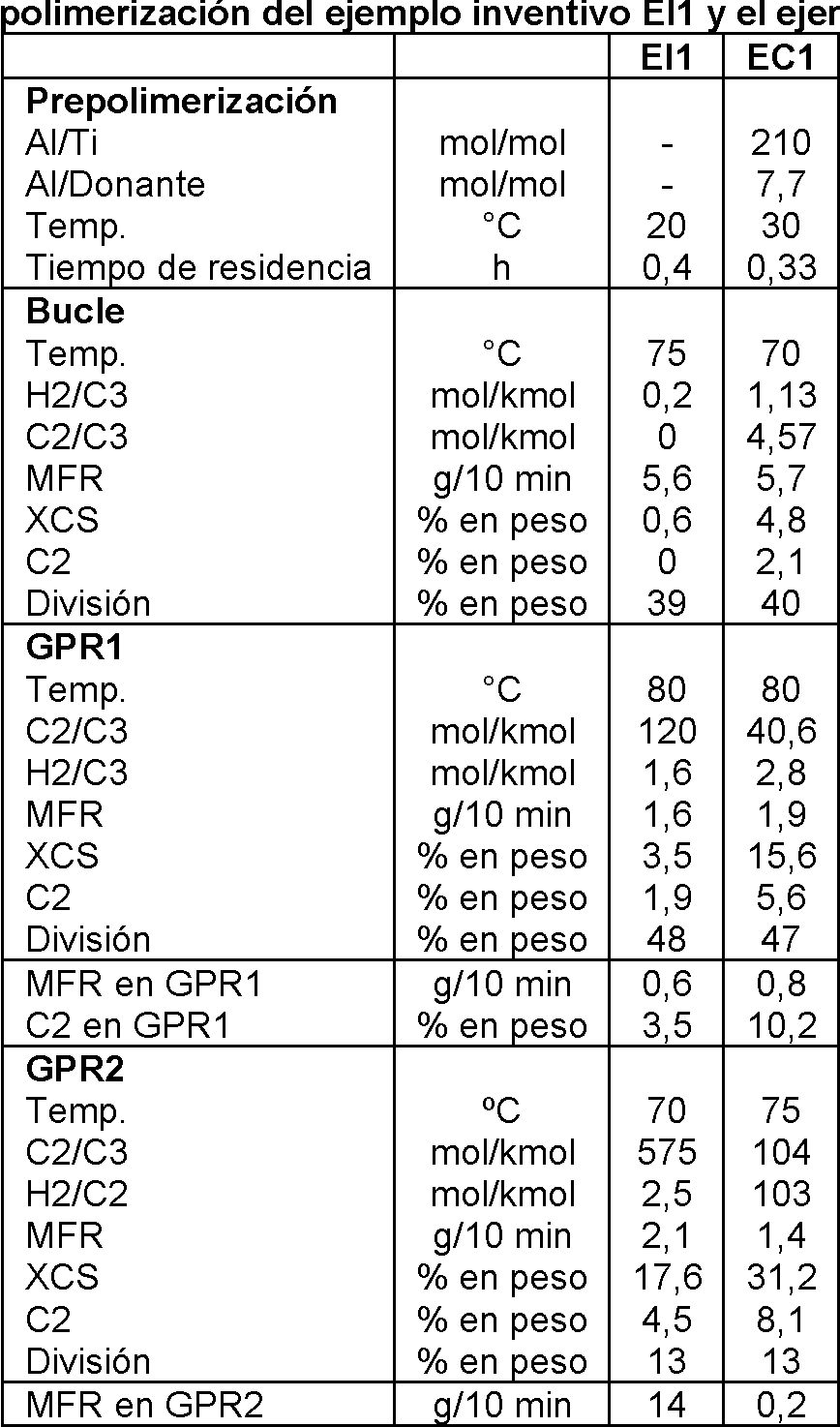
continuacióncontinuation

El experto conoce que la fracción de polímero producida en GPR1 se produce en presencia de la fracción de polímero precedente producida en el bucle y, por consiguiente, no se puede analizar como tal. Por tanto, es evidente que las propiedades C2 en GPR1 o GPR2 y MFR en GPR1 o GPR2 se han calculado basándose en las cifras disponibles para el material que procede del reactor precedente y los valores como determinables o determinados en el polímero como disponibles al final de dicha etapa de polimerización o como del polímero final.The skilled person knows that the polymer fraction produced in GPR1 is produced in the presence of the preceding polymer fraction produced in the loop and therefore cannot be analyzed as such. Therefore, it is evident that the properties C2 in GPR1 or GPR2 and MFR in GPR1 or GPR2 have been calculated based on the figures available for the material coming from the preceding reactor and the values as determinable or determined in the polymer as available at the end of said polymerization step or as the final polymer.
Tabla Pr i m ni l m l ^ in n i m rativosTable Pr i m ni l m l ^ in n i m ratives

Claims (15)
Applications Claiming Priority (2)
| Application Number | Priority Date | Filing Date | Title |
|---|---|---|---|
| EP17208983 | 2017-12-20 | ||
| PCT/EP2018/085368 WO2019121599A1 (en) | 2017-12-20 | 2018-12-18 | Heterophasic polypropylene composition |
Publications (1)
| Publication Number | Publication Date |
|---|---|
| ES2909744T3 true ES2909744T3 (en) | 2022-05-10 |
Family
ID=60811819
Family Applications (1)
| Application Number | Title | Priority Date | Filing Date |
|---|---|---|---|
| ES18819122T Active ES2909744T3 (en) | 2017-12-20 | 2018-12-18 | Polypropylene heterophasic composition |
Country Status (5)
| Country | Link |
|---|---|
| US (1) | US11084920B2 (en) |
| EP (1) | EP3728461B8 (en) |
| CN (1) | CN111433279B (en) |
| ES (1) | ES2909744T3 (en) |
| WO (1) | WO2019121599A1 (en) |
Families Citing this family (6)
| Publication number | Priority date | Publication date | Assignee | Title |
|---|---|---|---|---|
| EP3976676B1 (en) * | 2019-05-29 | 2023-05-10 | Borealis AG | C2c3 random copolymer |
| EP3812404B8 (en) | 2019-10-23 | 2025-08-13 | Borealis GmbH | Heterophasic polypropylene composition having improved mechanical properties |
| ES2984829T3 (en) * | 2020-08-13 | 2024-10-31 | Borealis Ag | Automotive composition |
| US20240191015A1 (en) * | 2021-03-24 | 2024-06-13 | Borealis Ag | Copolymer |
| WO2022263345A1 (en) * | 2021-06-14 | 2022-12-22 | Borealis Ag | Heterophasic propylene ethylene copolymer composition with excellent optical and sealing properties |
| EP4496818B1 (en) * | 2022-03-23 | 2026-03-11 | Borealis GmbH | High flow polypropylene composition for injection moulding applications |
Family Cites Families (18)
| Publication number | Priority date | Publication date | Assignee | Title |
|---|---|---|---|---|
| FI86867C (en) | 1990-12-28 | 1992-10-26 | Neste Oy | FLERSTEGSPROCESS FOR FRAMSTAELLNING AV POLYETEN |
| KR100353463B1 (en) * | 1994-04-11 | 2003-01-24 | 미쓰이 가가쿠 가부시키가이샤 | Process for producing propylene polymer composition and propylene polymer composition |
| FI111848B (en) | 1997-06-24 | 2003-09-30 | Borealis Tech Oy | Process and equipment for the preparation of homopolymers and copolymers of propylene |
| DE19829246A1 (en) * | 1998-06-30 | 2000-01-05 | Targor Gmbh | Polymer blends |
| DE60104509T2 (en) | 2000-05-31 | 2005-08-11 | Basell Poliolefine Italia S.P.A. | PROPYLENE POLYMERIC COMPOSITION WITH IMPROVED IMPACT TOLERANCE AND VERY GOOD OPTICAL PROPERTIES |
| EP1778780B1 (en) | 2004-08-18 | 2009-01-14 | Basell Poliolefine Italia S.r.l. | Stretch blow-molded containers from ziegler natta propylene polymer compositions |
| KR101918175B1 (en) | 2011-07-08 | 2019-01-29 | 보레알리스 아게 | Heterophasic copolymers |
| ES2543642T3 (en) * | 2012-11-29 | 2015-08-20 | Borealis Ag | Tiger Stripe Default Modifier |
| EP2787034A1 (en) | 2013-04-05 | 2014-10-08 | Borealis AG | High stiffness polypropylene compositions |
| PL2824142T3 (en) | 2013-07-12 | 2016-08-31 | Borealis Ag | Heterophasic copolymer |
| MX2016001930A (en) * | 2013-08-21 | 2016-05-26 | Borealis Ag | High flow polyolefin composition with high stiffness and toughness. |
| EP2886563B1 (en) | 2013-12-18 | 2017-05-10 | Borealis AG | Blow molded article with good mechanical and optical properties |
| US10100186B2 (en) * | 2014-02-06 | 2018-10-16 | Borealis Ag | Soft and transparent impact copolymers |
| CA2964654C (en) * | 2014-10-27 | 2019-03-12 | Borealis Ag | Heterophasic polypropylene with improved impact strength/stiffness balance, improved powder flowability, reduced emissions and low shrinkage |
| EP3280768B1 (en) | 2015-04-10 | 2018-12-19 | Borealis AG | Composition based on pp random copolymers and elastomers |
| ES2778674T3 (en) | 2015-07-08 | 2020-08-11 | Borealis Ag | Heterophasic Random Propylene Copolymer with Enhanced Clarity |
| ES2755382T3 (en) * | 2015-11-10 | 2020-04-22 | Borealis Ag | Heterophase polypropylene composition |
| US10800910B2 (en) * | 2016-10-25 | 2020-10-13 | Borealis Ag | High flow heterophasic polypropylene copolymers with improved mechanical and optical properties |
-
2018
- 2018-12-18 CN CN201880078247.1A patent/CN111433279B/en active Active
- 2018-12-18 ES ES18819122T patent/ES2909744T3/en active Active
- 2018-12-18 EP EP18819122.5A patent/EP3728461B8/en active Active
- 2018-12-18 US US16/769,510 patent/US11084920B2/en active Active
- 2018-12-18 WO PCT/EP2018/085368 patent/WO2019121599A1/en not_active Ceased
Also Published As
| Publication number | Publication date |
|---|---|
| EP3728461B8 (en) | 2022-03-30 |
| CN111433279B (en) | 2022-03-11 |
| EP3728461B1 (en) | 2022-02-23 |
| US11084920B2 (en) | 2021-08-10 |
| WO2019121599A1 (en) | 2019-06-27 |
| EP3728461A1 (en) | 2020-10-28 |
| US20210047502A1 (en) | 2021-02-18 |
| CN111433279A (en) | 2020-07-17 |
Similar Documents
| Publication | Publication Date | Title |
|---|---|---|
| ES2909744T3 (en) | Polypropylene heterophasic composition | |
| RU2745620C1 (en) | Polypropylene composition | |
| ES2331741T3 (en) | HETEROGENEAS POLYMERIC BLENDS AND MOLDED ITEMS FROM THE SAME. | |
| ES2450943T3 (en) | Heterophasic polypropylene with improved balance between stiffness and transparency | |
| ES2608963T3 (en) | High flow polypropylene with excellent mechanical properties | |
| ES2368024T3 (en) | COMPOSITION OF HIGH CAPACITY POLYPROPYLENE. | |
| BR112020017945A2 (en) | POLYPROPYLENE COMPOSITION | |
| CN101541879B (en) | Polyolefin compositions | |
| ES2977491T3 (en) | Polypropylene composition with improved optical properties and bleaching resistance | |
| ES2546002T3 (en) | Polypropylene composition for extrusion-blow molded bottles | |
| ES2625324T3 (en) | Bottles molded by extrusion and blown | |
| BR112014014840B1 (en) | propylene copolymer for blow molded articles | |
| ES2550228T3 (en) | Blow molding material | |
| BR112013005339B1 (en) | propylene resin sheet, and heat treatable packaging material | |
| US9540506B2 (en) | Random propylene copolymer for bottles with good optical properties | |
| US9487606B2 (en) | Random propylene copolymer for bottles with good optical properties and low hexane content | |
| ES2977502T3 (en) | Combination of heterophasic propylene-ethylene copolymer/propylene-butylene random copolymer | |
| ES2755382T3 (en) | Heterophase polypropylene composition | |
| BR112012032681B1 (en) | thermoformed article comprising a nucleated propylene-based polymer and thermoformed cup comprising a side wall composed of said polymer | |
| BR112017003374B1 (en) | Composition and process for the nucleation of a homogeneous propylene/alpha-olefin copolymer | |
| ES2896907T3 (en) | Bimodal Polypropylene Random Copolymer | |
| ES2635143T3 (en) | Blow molded article with good mechanical and optical properties | |
| ES2609113T3 (en) | Soft bottles | |
| US20050203264A1 (en) | Mini-random copolymer resins having improved mechanical toughness and related properties suitable for thin wall thermoforming applications | |
| ES3033103T3 (en) | Heterophasic propylene ethylene copolymer composition with excellent optical and sealing properties |