ES2955799T3 - Benzothiazepine compounds and their use as bile acid modulators - Google Patents
Benzothiazepine compounds and their use as bile acid modulators Download PDFInfo
- Publication number
- ES2955799T3 ES2955799T3 ES20705304T ES20705304T ES2955799T3 ES 2955799 T3 ES2955799 T3 ES 2955799T3 ES 20705304 T ES20705304 T ES 20705304T ES 20705304 T ES20705304 T ES 20705304T ES 2955799 T3 ES2955799 T3 ES 2955799T3
- Authority
- ES
- Spain
- Prior art keywords
- acid
- tetrahydro
- dioxide
- benzothiazepin
- oxy
- Prior art date
- Legal status (The legal status is an assumption and is not a legal conclusion. Google has not performed a legal analysis and makes no representation as to the accuracy of the status listed.)
- Active
Links
Classifications
-
- C—CHEMISTRY; METALLURGY
- C07—ORGANIC CHEMISTRY
- C07D—HETEROCYCLIC COMPOUNDS
- C07D281/00—Heterocyclic compounds containing rings of more than six members having one nitrogen atom and one sulfur atom as the only ring hetero atoms
- C07D281/02—Seven-membered rings
- C07D281/04—Seven-membered rings having the hetero atoms in positions 1 and 4
- C07D281/08—Seven-membered rings having the hetero atoms in positions 1 and 4 condensed with carbocyclic rings or ring systems
- C07D281/10—Seven-membered rings having the hetero atoms in positions 1 and 4 condensed with carbocyclic rings or ring systems condensed with one six-membered ring
-
- A—HUMAN NECESSITIES
- A61—MEDICAL OR VETERINARY SCIENCE; HYGIENE
- A61K—PREPARATIONS FOR MEDICAL, DENTAL OR TOILETRY PURPOSES
- A61K31/00—Medicinal preparations containing organic active ingredients
- A61K31/33—Heterocyclic compounds
- A61K31/395—Heterocyclic compounds having nitrogen as a ring hetero atom, e.g. guanethidine or rifamycins
- A61K31/55—Heterocyclic compounds having nitrogen as a ring hetero atom, e.g. guanethidine or rifamycins having seven-membered rings, e.g. azelastine, pentylenetetrazole
- A61K31/554—Heterocyclic compounds having nitrogen as a ring hetero atom, e.g. guanethidine or rifamycins having seven-membered rings, e.g. azelastine, pentylenetetrazole having at least one nitrogen and one sulfur as ring hetero atoms, e.g. clothiapine, diltiazem
-
- A—HUMAN NECESSITIES
- A61—MEDICAL OR VETERINARY SCIENCE; HYGIENE
- A61P—SPECIFIC THERAPEUTIC ACTIVITY OF CHEMICAL COMPOUNDS OR MEDICINAL PREPARATIONS
- A61P1/00—Drugs for disorders of the alimentary tract or the digestive system
- A61P1/16—Drugs for disorders of the alimentary tract or the digestive system for liver or gallbladder disorders, e.g. hepatoprotective agents, cholagogues, litholytics
-
- A—HUMAN NECESSITIES
- A61—MEDICAL OR VETERINARY SCIENCE; HYGIENE
- A61P—SPECIFIC THERAPEUTIC ACTIVITY OF CHEMICAL COMPOUNDS OR MEDICINAL PREPARATIONS
- A61P3/00—Drugs for disorders of the metabolism
-
- A—HUMAN NECESSITIES
- A61—MEDICAL OR VETERINARY SCIENCE; HYGIENE
- A61P—SPECIFIC THERAPEUTIC ACTIVITY OF CHEMICAL COMPOUNDS OR MEDICINAL PREPARATIONS
- A61P3/00—Drugs for disorders of the metabolism
- A61P3/06—Antihyperlipidemics
-
- A—HUMAN NECESSITIES
- A61—MEDICAL OR VETERINARY SCIENCE; HYGIENE
- A61P—SPECIFIC THERAPEUTIC ACTIVITY OF CHEMICAL COMPOUNDS OR MEDICINAL PREPARATIONS
- A61P3/00—Drugs for disorders of the metabolism
- A61P3/08—Drugs for disorders of the metabolism for glucose homeostasis
-
- A—HUMAN NECESSITIES
- A61—MEDICAL OR VETERINARY SCIENCE; HYGIENE
- A61P—SPECIFIC THERAPEUTIC ACTIVITY OF CHEMICAL COMPOUNDS OR MEDICINAL PREPARATIONS
- A61P3/00—Drugs for disorders of the metabolism
- A61P3/08—Drugs for disorders of the metabolism for glucose homeostasis
- A61P3/10—Drugs for disorders of the metabolism for glucose homeostasis for hyperglycaemia, e.g. antidiabetics
-
- A—HUMAN NECESSITIES
- A61—MEDICAL OR VETERINARY SCIENCE; HYGIENE
- A61P—SPECIFIC THERAPEUTIC ACTIVITY OF CHEMICAL COMPOUNDS OR MEDICINAL PREPARATIONS
- A61P9/00—Drugs for disorders of the cardiovascular system
Landscapes
- Health & Medical Sciences (AREA)
- Chemical & Material Sciences (AREA)
- Organic Chemistry (AREA)
- Pharmacology & Pharmacy (AREA)
- Animal Behavior & Ethology (AREA)
- Veterinary Medicine (AREA)
- Public Health (AREA)
- General Health & Medical Sciences (AREA)
- Life Sciences & Earth Sciences (AREA)
- Medicinal Chemistry (AREA)
- Nuclear Medicine, Radiotherapy & Molecular Imaging (AREA)
- Bioinformatics & Cheminformatics (AREA)
- Engineering & Computer Science (AREA)
- General Chemical & Material Sciences (AREA)
- Chemical Kinetics & Catalysis (AREA)
- Diabetes (AREA)
- Hematology (AREA)
- Obesity (AREA)
- Emergency Medicine (AREA)
- Endocrinology (AREA)
- Cardiology (AREA)
- Heart & Thoracic Surgery (AREA)
- Epidemiology (AREA)
- Gastroenterology & Hepatology (AREA)
- Pharmaceuticals Containing Other Organic And Inorganic Compounds (AREA)
- Peptides Or Proteins (AREA)
Abstract
La invención se refiere a derivados de 1,5-benzotiazepina de fórmula (I). Estos compuestos son moduladores de ácidos biliares que tienen actividad inhibidora del transportador apical de ácidos biliares dependiente de sodio (ASBT) y/o del transporte hepático de ácidos biliares (LBAT). La invención también se refiere a composiciones farmacéuticas que comprenden estos compuestos y al uso de estos compuestos en el tratamiento de enfermedades cardiovasculares, trastornos del metabolismo de los ácidos grasos y de la utilización de la glucosa, enfermedades gastrointestinales y enfermedades hepáticas. (Traducción automática con Google Translate, sin valor legal)The invention relates to 1,5-benzothiazepine derivatives of formula (I). These compounds are bile acid modulators that have inhibitory activity of the apical sodium-dependent bile acid transporter (ASBT) and/or hepatic bile acid transport (LBAT). The invention also relates to pharmaceutical compositions comprising these compounds and to the use of these compounds in the treatment of cardiovascular diseases, disorders of fatty acid metabolism and glucose utilization, gastrointestinal diseases and liver diseases. (Automatic translation with Google Translate, without legal value)
Description
DESCRIPCIÓNDESCRIPTION
Compuestos de benzotiazepina y su uso como moduladores de los ácidos biliaresBenzothiazepine compounds and their use as bile acid modulators
Referencia cruzada a solicitudes relacionadasCross reference to related requests
Esta solicitud reivindica prioridad a la Solicitud India No. 201911004690, presentada el 6 de febrero de 2019; Solicitud Sueca No. 1950463-8, presentada el 12 de abril de 2019; y Solicitud India No. 201911049986, presentada el 4 de diciembre de 2019.This application claims priority to Indian Application No. 201911004690, filed on February 6, 2019; Swedish Application No. 1950463-8, filed April 12, 2019; and Indian Application No. 201911049986, filed on December 4, 2019.
Campo técnicoTechnical field
La invención se refiere a derivados de 1,5-benzotiazepina de fórmula (I). Estos compuestos son moduladores de los ácidos biliares que tienen actividad inhibidora del transportador apical de ácidos biliares dependiente de sodio (ASBT) y/o del transporte de ácidos biliares del hígado (LBAT). La invención también se refiere a composiciones farmacéuticas que comprenden estos compuestos y al uso de estos compuestos en el tratamiento de enfermedades cardiovasculares, trastornos del metabolismo de los ácidos grasos y de la utilización de la glucosa, enfermedades gastrointestinales y enfermedades del hígado.The invention relates to 1,5-benzothiazepine derivatives of formula (I). These compounds are bile acid modulators that have inhibitory activity of the apical sodium-dependent bile acid transporter (ASBT) and/or liver bile acid transport (LBAT). The invention also relates to pharmaceutical compositions comprising these compounds and to the use of these compounds in the treatment of cardiovascular diseases, disorders of fatty acid metabolism and glucose utilization, gastrointestinal diseases and liver diseases.
AntecedentesBackground
Los ácidos biliares son detergentes fisiológicos que desempeñan una función importante en la absorción intestinal y el transporte de lípidos, nutrientes y vitaminas. También son moléculas de señalización que activan receptores nucleares y rutas de señalización celular que regulan el metabolismo de los lípidos, la glucosa y la energía. Los ácidos biliares son ácidos esteroides que se sintetizan a partir del colesterol en el hígado y se almacenan en la vesícula biliar como micelas mixtas. Durante la digestión, el duodeno desencadena la liberación de hormonas que hacen que la vesícula biliar se contraiga, liberando de esta manera ácidos biliares en el intestino delgado, donde permiten la absorción de vitaminas liposolubles y colesterol. Cuando llegan al íleon, los ácidos biliares se reabsorben en el intestino y se secretan a la sangre portal para regresar al hígado a través de la circulación venosa porta. De este modo, más del 90 % de los ácidos biliares se reciclan y regresan al hígado. Estos ácidos biliares luego se transportan a través de la membrana sinusoidal de los hepatocitos y se vuelven a secretar a través de la membrana canalicular hacia la bilis. En este primer paso, los hepatocitos absorben entre el 75 y el 90 % de los ácidos biliares, completando una ronda de circulación enterohepática. La fracción de ácidos biliares que escapa de ser depurada en el hígado ingresa a la circulación sistémica, donde los ácidos biliares libres son filtrados por el glomérulo renal, recuperados eficientemente en los túbulos proximales y exportados nuevamente a la circulación sistémica. Curiosamente, la mayoría de los ácidos biliares secretados a través de la membrana canalicular hacia la bilis se derivan de la reserva recirculante y menos del 10 % proviene de una nueva síntesis hepática de novo. La pequeña fracción de ácidos biliares que no se reabsorbe en el íleon llega al colon. Dentro del lumen intestinal, los ácidos biliares primarios se transforman en ácidos biliares secundarios bajo la acción de las bacterias intestinales, principalmente mediante reacciones de deshidroxilación simples o duales del núcleo esteroide. Los ácidos biliares que escapan a la absorción intestinal se excretan posteriormente por las heces.Bile acids are physiological detergents that play an important role in the intestinal absorption and transport of lipids, nutrients and vitamins. They are also signaling molecules that activate nuclear receptors and cellular signaling pathways that regulate lipid, glucose and energy metabolism. Bile acids are steroid acids that are synthesized from cholesterol in the liver and stored in the gallbladder as mixed micelles. During digestion, the duodenum triggers the release of hormones that cause the gallbladder to contract, thereby releasing bile acids into the small intestine, where they allow the absorption of fat-soluble vitamins and cholesterol. Upon reaching the ileum, bile acids are reabsorbed in the intestine and secreted into the portal blood to return to the liver via the portal venous circulation. In this way, more than 90% of bile acids are recycled and returned to the liver. These bile acids are then transported across the sinusoidal membrane of the hepatocytes and re-secreted through the canalicular membrane into the bile. In this first step, hepatocytes absorb 75 to 90% of the bile acids, completing one round of enterohepatic circulation. The fraction of bile acids that escapes clearance in the liver enters the systemic circulation, where free bile acids are filtered by the renal glomerulus, efficiently recovered in the proximal tubules, and exported back to the systemic circulation. Interestingly, the majority of bile acids secreted across the canalicular membrane into the bile are derived from the recirculating pool, with less than 10% coming from new de novo hepatic synthesis. The small fraction of bile acids that is not reabsorbed in the ileum reaches the colon. Within the intestinal lumen, primary bile acids are transformed into secondary bile acids under the action of intestinal bacteria, mainly through single or dual dehydroxylation reactions of the steroid nucleus. Bile acids that escape intestinal absorption are subsequently excreted in the feces.
En general, el sistema de transporte eficiente ayuda a mantener una reserva constante de ácidos biliares, asegurando niveles suficientemente altos de ácidos biliares conjugados en el intestino para promover la absorción de lípidos, así como reducir la carga bacteriana del intestino delgado. El sistema también minimiza la pérdida de ácidos biliares fecal y urinario y protege los compartimentos intestinal y hepatobiliar al eliminar detergentes potencialmente citotóxicos (según lo revisado por Kosters y Karpen (Xenobiotica 2008, vol. 38, p. 1043-1071); por Chiang (J. Lipid Res. 2009, vol. 50, p. 1955-1966) y por Dawson (Handb. Exp. Pharmacol. 2011, vol. 201, p. 169-203)).Overall, the efficient transport system helps maintain a constant reserve of bile acids, ensuring high enough levels of conjugated bile acids in the intestine to promote lipid absorption as well as reduce the bacterial load of the small intestine. The system also minimizes fecal and urinary bile acid loss and protects the intestinal and hepatobiliary compartments by removing potentially cytotoxic detergents (as reviewed by Kosters and Karpen (Xenobiotica 2008, vol. 38, p. 1043-1071); by Chiang ( J. Lipid Res. 2009, vol. 50, p. 1955-1966) and by Dawson (Handb. Exp. Pharmacol. 2011, vol. 201, p. 169-203)).
Se ha descubierto que la regulación del tamaño de la reserva de ácidos biliares desempeña una función clave en la homeostasis del colesterol mediante la conversión hepática del colesterol en ácidos biliares, que representa una ruta principal para la eliminación del colesterol del cuerpo. El hígado desempeña una función esencial en la eliminación de compuestos endógenos y xenobióticos del organismo. La secreción hepatobiliar normal y la circulación enterohepática son necesarias para la eliminación de compuestos endógenos tales como el colesterol y la bilirrubina y sus metabolitos del cuerpo, manteniendo de esta manera la homeostasis de los lípidos y los ácidos biliares. (Kosters and Karpen, Xenobiotica 2008, vol. 38, p. 1043-1071).Regulation of the size of the bile acid pool has been found to play a key role in cholesterol homeostasis through hepatic conversion of cholesterol to bile acids, which represents a major route for cholesterol removal from the body. The liver plays an essential role in the elimination of endogenous compounds and xenobiotics from the body. Normal hepatobiliary secretion and enterohepatic circulation are necessary for the removal of endogenous compounds such as cholesterol and bilirubin and their metabolites from the body, thereby maintaining lipid and bile acid homeostasis. (Kosters and Karpen, Xenobiotica 2008, vol. 38, p. 1043-1071).
La reabsorción de ácidos biliares en el íleon se puede inhibir mediante compuestos inhibidores del transportador apical de ácidos biliares dependiente de sodio (ASBT). Se ha informado que la inhibición de la reabsorción de ácidos biliares es útil en el tratamiento de varias enfermedades, que incluyen dislipidemia, diabetes, obesidad, estreñimiento, enfermedades del hígado colestásicas, esteatohepatitis no alcohólica y otras enfermedades hepáticas. Durante las últimas décadas se han divulgado una serie de compuestos inhibidores de ASBT, véanse, por ejemplo, los documentos WO 93/16055, WO 94/18183, WO 94/18184, WO 96/05188, WO 96/08484, WO 96/16051, WO 97/33882, WO 98/03818, WO 98/07449, WO 98/40375, WO 99/35135, WO 99/64409, WO 99/64410, WO 00/47568, WO 00/61568, WO 00/38725, WO 00/38726, WO 00/38727, WO 00/38728, WO 00/38729, WO 01/66533, WO 01/68096, WO 02/32428, WO 02/50051, WO 03/020710, WO 03/022286, WO 03/022825, WO 03/022830, WO 03/061663, WO 03/091232, WO 03/106482, WO 2004/006899, WO 2004/076430, WO 2007/009655, WO 2007/009656, WO 2011/137135, DE 19825804, EP 864582, EP 489423, EP 549967, EP 573848, EP 624593, EP 624594, EP 624595, EP 624596, EP 0864582, EP 1173205 y EP 1535913.Bile acid reabsorption in the ileum can be inhibited by compounds that inhibit the apical sodium-dependent bile acid transporter (ASBT). Inhibition of bile acid reabsorption has been reported to be useful in the treatment of several diseases, including dyslipidemia, diabetes, obesity, constipation, cholestatic liver diseases, nonalcoholic steatohepatitis, and other liver diseases. During the last decades a number of ASBT inhibitor compounds have been disclosed, see, for example, WO 93/16055, WO 94/18183, WO 94/18184, WO 96/05188, WO 96/08484, WO 96/ 16051, WO 97/33882, WO 98/03818, WO 98/07449, WO 98/40375, WO 99/35135, WO 99/64409, WO 99/64410, WO 00/47568, WO 00/61568, WO 00/ 38725, WO 00/38726, WO 00/38727, WO 00/38728, WO 00/38729, WO 01/66533, WO 01/68096, WO 02/32428, WO 02/50051, WO 03/020710, WO 03/ 022286, WO 03/022825, WO 03/022830, WO 03/061663, WO 03/091232, WO 03/106482, WO 2004/006899, WO 2004/076430, WO 2007/009655, WO 200 7/009656, W.O. 2011/137135, DE 19825804, EP 864582, EP 489423, EP 549967, EP 573848, EP 624593, EP 624594, EP 624595, EP 624596, EP 0864582, EP 1173205 and EP 153591 3.
A pesar del número de compuestos inhibidores de ASBT que se han informado previamente, subsiste la necesidad de compuestos moduladores de ácidos biliares adicionales que tengan un perfil optimizado con respecto a potencia, selectividad y biodisponibilidad.Despite the number of ASBT inhibitor compounds that have been previously reported, the need remains for additional bile acid modulating compounds that have an optimized profile with respect to potency, selectivity, and bioavailability.
Descripción detallada de la invenciónDetailed description of the invention
Se ha descubierto que ciertos derivados de 1,5-benzotiazepina son inhibidores potentes del transportador apical de ácidos biliares dependiente de sodio (ASBT) y/o del transportador de ácidos biliares del hígado (LBAT), y pueden ser útiles para tratar enfermedades en las que la inhibición de es deseable la circulación de ácidos biliares.Certain 1,5-benzothiazepine derivatives have been found to be potent inhibitors of the apical sodium-dependent bile acid transporter (ASBT) and/or the liver bile acid transporter (LBAT), and may be useful in treating diseases in that inhibition of bile acid circulation is desirable.
En un primer aspecto, la invención se refiere a un compuesto de la fórmula (I)In a first aspect, the invention relates to a compound of the formula (I)

en la quein which
R1 y R2 son cada uno independientemente alquilo C1-4;R 1 and R 2 are each independently C 1-4 alkyl ;
R3 se selecciona independientemente del grupo que consiste en hidrógeno, halógeno, hidroxi, alquilo C1-4, haloalquilo C1-4 , alcoxi C1-4, haloalcoxi C1-4 , ciano, nitro, amino, N-(alquilo C1-4)amino, N,N-di(alquilo C1-4)amino y N-(aril-alquilo C-i-4)amino;R3 is independently selected from the group consisting of hydrogen, halogen, hydroxy , C 1-4 alkyl, C 1-4 haloalkyl , C 1-4 alkoxy, C 1-4 haloalkoxy, cyano , nitro, amino, N-(C alkyl 1 - 4 )amino, N,N-di(C 1 - 4 alkyl)amino and N-(aryl-Ci-4 alkyl)amino;
n es un entero 1,2 o 3;n is an integer 1,2 or 3;
R4 se selecciona del grupo que consiste en hidrógeno, halógeno, hidroxi, ciano, alquilo C1-4 , cicloalquilo C3-6, alcoxi C1-4 , cicloalquiloxi C3-6 , alquiltio C1-4, cicloalquiltio C3-6 , amino, N-(alquilo C1-4)-amino y N,N-di(alquilo C1-4)amino; y R5A, R5B, R5C y R5D cada uno se selecciona independientemente del grupo que consiste en hidrógeno, halógeno, hidroxi, amino, alquilo C1-4 y alcoxi C1-4 ;R4 is selected from the group consisting of hydrogen, halogen, hydroxy, cyano, C 1 - 4 alkyl, C 3 - 6 cycloalkyl, C 1 - 4 alkoxy, C 3 - 6 cycloalkyloxy, C 1 - 4 alkylthio, C 3 - cycloalkylthio 6 , amino, N-(C 1-4 alkyl )-amino and N,N-di(C 1-4 alkyl )amino; and R5A, R5B, R5C and R5D are each independently selected from the group consisting of hydrogen, halogen, hydroxy, amino, C 1-4 alkyl and C 1-4 alkoxy;
o una sal farmacéuticamente aceptable del mismo;or a pharmaceutically acceptable salt thereof;
con la condición de que el compuesto no sea ácido 3-((7-bromo-3-butil-3-etil-1,1-dióxido-5-fenil-2,3,4,5-tetrahidro-1,5-benzotiazepin-8-il)oxi)propanoico racémico.provided that the compound is not acidic 3-((7-bromo-3-butyl-3-ethyl-1,1-dioxide-5-phenyl-2,3,4,5-tetrahydro-1,5- racemic benzothiazepin-8-yl)oxy)propanoic acid.
En algunas realizaciones, R1 es n-butilo.In some embodiments, R1 is n-butyl.
En algunas realizaciones, R2 es alquilo C2-4. En una realización preferida, R2 es metilo. En otra realización preferida, R2 es etilo. En otra realización preferida, R2 es n-propilo. En todavía otra realización preferida, R2 es n-butilo.In some embodiments, R2 is C2-4 alkyl . In a preferred embodiment, R2 is methyl. In another preferred embodiment, R2 is ethyl. In another preferred embodiment, R2 is n-propyl. In yet another preferred embodiment, R2 is n-butyl.
En algunas realizaciones, R3 se selecciona independientemente del grupo que consiste en hidrógeno, halógeno, hidroxi, amino, ciano, haloalquilo C1-4 , alcoxi C1-4 y haloalcoxi C1-4. En otra realización, R3 es hidrógeno. En una realización preferida, R3 se selecciona independientemente del grupo que consiste en hidrógeno, fluoro, cloro, bromo, hidroxi, ciano, trifluorometilo, metoxi y trifluorometoxi.In some embodiments, R3 is independently selected from the group consisting of hydrogen, halogen, hydroxy, amino, cyano, C 1-4 haloalkyl, C 1-4 alkoxy and C 1-4 haloalkoxy . In another embodiment, R3 is hydrogen. In a preferred embodiment, R3 is independently selected from the group consisting of hydrogen, fluoro, chloro, bromo, hydroxy, cyano, trifluoromethyl, methoxy and trifluoromethoxy.
En una realización preferida, n es 1, es decir, el anillo fenilo se sustituye con solo un sustituyente R3. En otra realización preferida, R3 está en la posición para.In a preferred embodiment, n is 1, that is, the phenyl ring is substituted with only one R3 substituent. In another preferred embodiment, R3 is in the stop position.
En algunas realizaciones, R4 se selecciona del grupo que consiste en halógeno, hidroxi, ciano, alquilo C1-4 , alcoxi C1-4 , alquiltio C1-4 , amino, N-(alquilo C1-4)amino y N,N-di(alquilo C1-4)amino. En una realización preferida, R4 se selecciona del grupo que consiste en fluoro, cloro, bromo, hidroxi, ciano, metilo, metoxi, etoxi, metiltio, etiltio, amino, metilamino y dimetilamino. En otra realización, R4 se selecciona del grupo que consiste en fluoro, cloro, bromo, metoxi, etoxi, metiltio, etiltio y dimetilamino. En otra realización, R4 se selecciona del grupo que consiste en cloro, bromo, metiltio y dimetilamino.In some embodiments , R4 is selected from the group consisting of halogen, hydroxy, cyano, C 1-4 alkyl, C 1-4 alkoxy, C 1-4 alkylthio , amino, N-(C 1-4 alkyl )amino and N ,N-di(C 1 - 4 alkyl)amino. In a preferred embodiment, R4 is selected from the group consisting of fluoro, chloro, bromo, hydroxy, cyano, methyl, methoxy, ethoxy, methylthio, ethylthio, amino, methylamino and dimethylamino. In another embodiment, R4 is selected from the group consisting of fluoro, chloro, bromo, methoxy, ethoxy, methylthio, ethylthio and dimethylamino. In another embodiment, R4 is selected from the group consisting of chloro, bromo, methylthio and dimethylamino.
En algunas realizaciones, R5A, R5B, R5C y R5D cada uno se selecciona independientemente del grupo que consiste en hidrógeno, halógeno, hidroxi, amino y alquilo C1-4. En algunas realizaciones, R5A y R5B cada uno se selecciona independientemente del grupo que consiste en hidrógeno, halógeno, hidroxi, amino, metilo y metoxi. En algunas realizaciones, R5A y R5B cada uno se selecciona independientemente del grupo que consiste en hidrógeno, halógeno, hidroxi, amino y metilo. En algunas realizaciones, R5C y R5D son cada uno independientemente hidrógeno o metilo. En otra realización, R5C es hidrógeno o metilo y R5D es hidrógeno.In some embodiments , R5A, R5B, R5C and R5D are each independently selected from the group consisting of hydrogen, halogen, hydroxy, amino and C 1-4 alkyl . In some embodiments, R5A and R5B are each selected regardless of the group consisting of hydrogen, halogen, hydroxy, amino, methyl and methoxy. In some embodiments, R5A and R5B are each independently selected from the group consisting of hydrogen, halogen, hydroxy, amino and methyl. In some embodiments, R5C and R5D are each independently hydrogen or methyl. In another embodiment, R5C is hydrogen or methyl and R5D is hydrogen.
En una realización preferida, el compuesto de la fórmula (I) es un compuesto de la fórmula (I-a):In a preferred embodiment, the compound of formula (I) is a compound of formula (I-a):

en la quein which
R2 es alquilo C1-4;R2 is C 1-4 alkyl;
R3 se selecciona independientemente del grupo que consiste en hidrógeno, halógeno, hidroxi, ciano, haloalquilo C1-4, alcoxi C1-4 y haloalcoxi C1-4;R3 is independently selected from the group consisting of hydrogen, halogen, hydroxy, cyano, C 1-4 haloalkyl, C 1-4 alkoxy and C 1-4 haloalkoxy;
n es un entero 1 o 2;n is an integer 1 or 2;
R4 se selecciona del grupo que consiste en halógeno, hidroxi, ciano, alquilo C1-4, alcoxi C1-4, alquiltio C1-4, amino, N-(alquilo C1-4)amino y N,N-di(alquilo C1-4)amino;R4 is selected from the group consisting of halogen, hydroxy, cyano, C 1-4 alkyl, C 1-4 alkoxy, C 1-4 alkylthio, amino, N-(C 1-4 alkyl)amino and N,N-di (C 1-4 alkyl)amino;
R5A y R5B cada uno se selecciona independientemente del grupo que consiste en hidrógeno, halógeno, hidroxi, amino y alquilo C1-4;R5A and R5B are each independently selected from the group consisting of hydrogen, halogen, hydroxy, amino and C 1-4 alkyl;
R5C es hidrógeno o alquilo C1-4;R5C is hydrogen or C 1-4 alkyl;
o una sal farmacéuticamente aceptable del mismo.or a pharmaceutically acceptable salt thereof.
En otra realización preferida, el compuesto de la fórmula (I) es un compuesto de la fórmula (I-b):In another preferred embodiment, the compound of formula (I) is a compound of formula (I-b):

en la quein which
R2 es metilo, etilo, n-propilo o n-butilo;R2 is methyl, ethyl, n-propyl or n-butyl;
R3 se selecciona del grupo que consiste en hidrógeno, fluoro, cloro, bromo, hidroxi, ciano, trifluorometilo, metoxi, y trifluorometoxi;R3 is selected from the group consisting of hydrogen, fluoro, chloro, bromo, hydroxy, cyano, trifluoromethyl, methoxy, and trifluoromethoxy;
R4 se selecciona del grupo que consiste en fluoro, cloro, bromo, hidroxi, ciano, metoxi, etoxi, metiltio, etiltio y dimetilamino; yR4 is selected from the group consisting of fluoro, chloro, bromo, hydroxy, cyano, methoxy, ethoxy, methylthio, ethylthio and dimethylamino; and
R5A se selecciona del grupo que consiste en hidrógeno, halógeno, hidroxi, amino y metilo; o una sal farmacéuticamente aceptable del mismo.R5A is selected from the group consisting of hydrogen, halogen, hydroxy, amino and methyl; or a pharmaceutically acceptable salt thereof.
En otra realización preferida, el compuesto de la fórmula (I) es un compuesto de la fórmula (I-b) como se definió anteriormente, todavía en la queIn another preferred embodiment, the compound of formula (I) is a compound of formula (I-b) as defined above, still wherein
R3 se selecciona del grupo que consiste en hidrógeno, fluoro, cloro, bromo, hidroxi y metoxi; yR3 is selected from the group consisting of hydrogen, fluoro, chloro, bromo, hydroxy and methoxy; and
R4 se selecciona del grupo que consiste en fluoro, cloro, bromo, metoxi, etoxi, metiltio, etiltio y dimetilamino. R4 is selected from the group consisting of fluoro, chloro, bromo, methoxy, ethoxy, methylthio, ethylthio and dimethylamino.
Los compuestos preferidos de la invención son compuestos de la fórmula (I-b), como se definió anteriormente, en la que R2 a R5A son como se indica en la Tabla 1 a continuación, o una sal farmacéuticamente aceptable del mismo:Preferred compounds of the invention are compounds of formula (I-b), as defined above, wherein R2 to R5A are as indicated in Table 1 below, or a pharmaceutically acceptable salt thereof:
Tabla 1Table 1


En una realización particular, el compuesto de la fórmula (I) se selecciona del grupo que consiste en:In a particular embodiment, the compound of formula (I) is selected from the group consisting of:
ácido (S)-3-((7-bromo-3-butil-3-etil-1,1-dióxido-5-fenil-2,3,4,5-tetrahidro-1,5-benzotiazepin-8-il)oxi)propanoico; ácido (R)-3-((7-bromo-3-butil-3-etil-1,1-dióxido-5-fenil-2,3,4,5-tetrahidro-1,5-benzotiazepin-8-il)oxi)propanoico; ácido 3-((7-bromo-3,3-dibutil-1,1-dióxido-5-fenil-2,3,4,5-tetrahidro-1,5-benzotiazepin-8-il)oxi)propanoico;(S)-3-((7-bromo-3-butyl-3-ethyl-1,1-dioxide-5-phenyl-2,3,4,5-tetrahydro-1,5-benzothiazepin-8-yl acid )oxy)propanoic; (R)-3-((7-bromo-3-butyl-3-ethyl-1,1-dioxide-5-phenyl-2,3,4,5-tetrahydro-1,5-benzothiazepin-8-yl acid )oxy)propanoic; 3-((7-bromo-3,3-dibutyl-1,1-dioxide-5-phenyl-2,3,4,5-tetrahydro-1,5-benzothiazepin-8-yl)oxy)propanoic acid;
ácido 3-((3-butil-7-cloro-3-etil-1,1-dióxido-5-fenil-2,3,4,5-tetrahidro-1,5-benzotiazepin-8-il)oxi)propanoico;3-((3-butyl-7-chloro-3-ethyl-1,1-dioxide-5-phenyl-2,3,4,5-tetrahydro-1,5-benzothiazepin-8-yl)oxy)propanoic acid ;
ácido (S)-3-((3-butil-7-cloro-3-etil-1,1-dióxido-5-fenil-2,3,4,5-tetrahidro-1,5-benzotiazepin-8-il)oxi)propanoico; ácido (R)-3-((3-butil-7-cloro-3-etil-1,1-dióxido-5-fenil-2,3,4,5-tetrahidro-1,5-benzotiazepin-8-il)oxi)propanoico; ácido 3-((3,3-dibutil-7-cloro-1,1-dióxido-5-fenil-2,3,4,5-tetrahidro-1,5-benzotiazepin-8-il)oxi)propanoico;(S)-3-((3-butyl-7-chloro-3-ethyl-1,1-dioxide-5-phenyl-2,3,4,5-tetrahydro-1,5-benzothiazepin-8-yl acid )oxy)propanoic; (R)-3-((3-butyl-7-chloro-3-ethyl-1,1-dioxide-5-phenyl-2,3,4,5-tetrahydro-1,5-benzothiazepin-8-yl acid )oxy)propanoic; 3-((3,3-dibutyl-7-chloro-1,1-dioxide-5-phenyl-2,3,4,5-tetrahydro-1,5-benzothiazepin-8-yl)oxy)propanoic acid;
ácido 3-((3,3-dibutil-7-(metiltio)-1,1-dióxido-5-fenil-2,3,4,5-tetrahidro-1,5-benzotiazepin-8-il)oxi)-2-hidroxipropanoico; ácido (S)-3-((3,3-dibutil-7-(metiltio)-1,1-dióxido-5-fenil-2,3,4,5-tetrahidro-1,5-benzotiazepin-8-il)oxi)-2-hidroxipropanoico;3-((3,3-dibutyl-7-(methylthio)-1,1-dioxide-5-phenyl-2,3,4,5-tetrahydro-1,5-benzothiazepin-8-yl)oxy)- acid 2-hydroxypropanoic acid; (S)-3-((3,3-dibutyl-7-(methylthio)-1,1-dioxide-5-phenyl-2,3,4,5-tetrahydro-1,5-benzothiazepin-8-yl acid )oxy)-2-hydroxypropanoic acid;
ácido (R)-3-((3,3-dibutil-7-(metiltio)-1,1-dióxido-5-fenil-2,3,4,5-tetrahidro-1,5-benzotiazepin-8-il)oxi)-2-hidroxipropanoico; (R)-3-((3,3-dibutyl-7-(methylthio)-1,1-dioxide-5-phenyl-2,3,4,5-tetrahydro-1,5-benzothiazepin-8-yl acid )oxy)-2-hydroxypropanoic acid;
ácido 3-((3-butil-3-etil-7-(metiltio)-1,1-dióxido-5-fenil-2,3,4,5-tetrahidro-1,5-benzotiazepin-8-il)oxi)propanoico; ácido (S)-3-((3-butil-3-etil-7-(metiltio)-1,1-dióxido-5-fenil-2,3,4,5-tetrahidro-1,5-benzotiazepin-8-il)oxi)propanoico; ácido (R)-3-((3-butil-3-etil-7-(metiltio)-1,1-dióxido-5-fenil-2,3,4,5-tetrahidro-1,5-benzotiazepin-8-il)oxi)propanoico; ácido 3-((3,3-dibutil-7-(metiltio)-1,1-dióxido-5-fenil-2,3,4,5-tetrahidro-1,5-benzotiazepin-8-il)oxi)propanoico; ácido 3-((3-butil-7-(dimetilamino)-3-etil-1,1-dióxido-5-fenil-2,3,4,5-tetrahidro-1,5-benzotiazepin-8-il)oxi)propanoico; ácido (S)-3-((3-butil-7-(dimetilamino)-3-etil-1,1-dióxido-5-fenil-2,3,4,5-tetrahidro-1,5-benzotiazepin-8-il)oxi)propanoico; ácido (R)-3-((3-butil-7-(dimetilamino)-3-etil-1,1-dióxido-5-fenil-2,3,4,5-tetrahidro-1,5-benzotiazepin-8-il)oxi)propanoico; ácido 3-((3,3-dibutil-7-(metiltio)-1,1-dióxido-5-fenil-2,3,4,5-tetrahidro-1,5-benzotiazepin-8-il)oxi)-2-hidroxi-2-metilpropanoico;3-((3-butyl-3-ethyl-7-(methylthio)-1,1-dioxide-5-phenyl-2,3,4,5-tetrahydro-1,5-benzothiazepin-8-yl)oxy acid )propanoic; acid (S)-3-((3-butyl-3-ethyl-7-(methylthio)-1,1-dioxide-5-phenyl-2,3,4,5-tetrahydro-1,5-benzothiazepin-8 -yl)oxy)propanoic; acid (R)-3-((3-butyl-3-ethyl-7-(methylthio)-1,1-dioxide-5-phenyl-2,3,4,5-tetrahydro-1,5-benzothiazepin-8 -yl)oxy)propanoic; 3-((3,3-dibutyl-7-(methylthio)-1,1-dioxide-5-phenyl-2,3,4,5-tetrahydro-1,5-benzothiazepin-8-yl)oxy)propanoic acid ; 3-((3-butyl-7-(dimethylamino)-3-ethyl-1,1-dioxide-5-phenyl-2,3,4,5-tetrahydro-1,5-benzothiazepin-8-yl)oxy acid )propanoic; acid (S)-3-((3-butyl-7-(dimethylamino)-3-ethyl-1,1-dioxide-5-phenyl-2,3,4,5-tetrahydro-1,5-benzothiazepin-8 -yl)oxy)propanoic; acid (R)-3-((3-butyl-7-(dimethylamino)-3-ethyl-1,1-dioxide-5-phenyl-2,3,4,5-tetrahydro-1,5-benzothiazepin-8 -yl)oxy)propanoic; 3-((3,3-dibutyl-7-(methylthio)-1,1-dioxide-5-phenyl-2,3,4,5-tetrahydro-1,5-benzothiazepin-8-yl)oxy)- acid 2-hydroxy-2-methylpropanoic acid;
ácido (S)-3-((3,3-dibutil-7-(metiltio)-1,1-dióxido-5-fenil-2,3,4,5-tetrahidro-1,5-benzotiazepin-8-il)oxi)-2-hidroxi-2-metilpropanoico;(S)-3-((3,3-dibutyl-7-(methylthio)-1,1-dioxide-5-phenyl-2,3,4,5-tetrahydro-1,5-benzothiazepin-8-yl acid )oxy)-2-hydroxy-2-methylpropanoic acid;
ácido (R)-3-((3,3-dibutil-7-(metiltio)-1,1-dióxido-5-fenil-2,3,4,5-tetrahidro-1,5-benzotiazepin-8-il)oxi)-2-hidroxi-2-metilpropanoico;(R)-3-((3,3-dibutyl-7-(methylthio)-1,1-dioxide-5-phenyl-2,3,4,5-tetrahydro-1,5-benzothiazepin-8-yl acid )oxy)-2-hydroxy-2-methylpropanoic acid;
ácido 3-((3-butil-3-metil-7-(metiltio)-1,1-dióxido-5-fenil-2,3,4,5-tetrahidro-1,5-benzotiazepin-8-il)oxi)propanoico; ácido (S)-3-((3-butil-3-metil-7-(metiltio)-1,1-dióxido-5-fenil-2,3,4,5-tetrahidro-1,5-benzotiazepin-8-il)oxi)propanoico; ácido (R)-3-((3-butil-3-metil-7-(metiltio)-1,1-dióxido-5-fenil-2,3,4,5-tetrahidro-1,5-benzotiazepin-8-il)oxi)propanoico; ácido 3-((3,3-dibutil-5-(3,4-difluorofenil)-7-(metiltio)-1,1-dióxido-2,3,4,5-tetrahidro-1,5-benzotiazepin-8-il)oxi)propanoico;3-((3-butyl-3-methyl-7-(methylthio)-1,1-dioxide-5-phenyl-2,3,4,5-tetrahydro-1,5-benzothiazepin-8-yl)oxy acid )propanoic; acid (S)-3-((3-butyl-3-methyl-7-(methylthio)-1,1-dioxide-5-phenyl-2,3,4,5-tetrahydro-1,5-benzothiazepin-8 -yl)oxy)propanoic; acid (R)-3-((3-butyl-3-methyl-7-(methylthio)-1,1-dioxide-5-phenyl-2,3,4,5-tetrahydro-1,5-benzothiazepin-8 -yl)oxy)propanoic; 3-((3,3-dibutyl-5-(3,4-difluorophenyl)-7-(methylthio)-1,1-dioxide-2,3,4,5-tetrahydro-1,5-benzothiazepin-8 acid -yl)oxy)propanoic;
ácido 3-((3,3-dibutil-5-(4-fluorofenil)-7-(metiltio)-1,1-dióxido-2,3,4,5-tetrahidro-1,5-benzotiazepin-8-il)oxi)propanoico; ácido 3-((3-etil-7-(metiltio)-1,1-dióxido-5-fenil-3-propil-2,3,4,5-tetrahidro-1,5-benzotiazepin-8-il)oxi)propanoico;3-((3,3-dibutyl-5-(4-fluorophenyl)-7-(methylthio)-1,1-dioxide-2,3,4,5-tetrahydro-1,5-benzothiazepin-8-yl acid )oxy)propanoic; 3-((3-ethyl-7-(methylthio)-1,1-dioxide-5-phenyl-3-propyl-2,3,4,5-tetrahydro-1,5-benzothiazepin-8-yl)oxy acid )propanoic;
O-(3-butil-3-etil-7-(metiltio)-1,1-dióxido-5-fenil-2,3,4,5-tetrahidro-1,5-benzotiazepin-8-il)serina;O-(3-butyl-3-ethyl-7-(methylthio)-1,1-dioxide-5-phenyl-2,3,4,5-tetrahydro-1,5-benzothiazepin-8-yl)serine;
ácido 3-((3-butil-7-(dimetilamino)-3-metil-1,1-dióxido-5-fenil-2,3,4,5-tetrahidro-1,5-benzotiazepin-8-il)oxi)propanoico; ácido (S)-3-((3-butil-7-(dimetilamino)-3-metil-1,1-dióxido-5-fenil-2,3,4,5-tetrahidro-1,5-benzotiazepin-8-il)oxi)propanoico;3-((3-butyl-7-(dimethylamino)-3-methyl-1,1-dioxide-5-phenyl-2,3,4,5-tetrahydro-1,5-benzothiazepin-8-yl)oxy acid )propanoic; acid (S)-3-((3-butyl-7-(dimethylamino)-3-methyl-1,1-dioxide-5-phenyl-2,3,4,5-tetrahydro-1,5-benzothiazepin-8 -yl)oxy)propanoic;
ácido (R)-3-((3-butil-7-(dimetilamino)-3-metil-1,1-dióxido-5-fenil-2,3,4,5-tetrahidro-1,5-benzotiazepin-8-il)oxi)propanoico;acid (R)-3-((3-butyl-7-(dimethylamino)-3-methyl-1,1-dioxide-5-phenyl-2,3,4,5-tetrahydro-1,5-benzothiazepin-8 -yl)oxy)propanoic;
ácido 3-((3-butil-7-cloro-3-etil-1,1-dióxido-5-fenil-2,3,4,5-tetrahidro-1,5-benzotiazepin-8-il)oxi)butanoico;3-((3-butyl-7-chloro-3-ethyl-1,1-dioxide-5-phenyl-2,3,4,5-tetrahydro-1,5-benzothiazepin-8-yl)oxy)butanoic acid ;
ácido (S)-3-(((R)-3-butil-7-cloro-3-etil-1,1-dióxido-5-fenil-2,3,4,5-tetrahidro-1,5-benzotiazepin-8-il)oxi)butanoico; ácido (R)-3-(((R)-3-butil-7-cloro-3-etil-1,1-dióxido-5-fenil-2,3,4,5-tetrahidro-1,5-benzotiazepin-8-il)oxi)butanoico; ácido (S)-3-(((S)-3-butil-7-cloro-3-etil-1,1-dióxido-5-fenil-2,3,4,5-tetrahidro-1,5-benzotiazepin-8-il)oxi)butanoico; ácido (R)-3-(((S)-3-butil-7-cloro-3-etil-1,1-dióxido-5-fenil-2,3,4,5-tetrahidro-1,5-benzotiazepin-8-il)oxi)butanoico; ácido 3-((3-butil-3-metil-7-(metiltio)-1,1-dióxido-5-fenil-2,3,4,5-tetrahidro-1,5-benzotiazepin-8-il)oxi)-2-hidroxipropanoico;(S)-3-(((R)-3-butyl-7-chloro-3-ethyl-1,1-dioxide-5-phenyl-2,3,4,5-tetrahydro-1,5-benzothiazepine acid -8-yl)oxy)butanoic acid; (R)-3-(((R)-3-butyl-7-chloro-3-ethyl-1,1-dioxide-5-phenyl-2,3,4,5-tetrahydro-1,5-benzothiazepine acid -8-yl)oxy)butanoic acid; (S)-3-(((S)-3-butyl-7-chloro-3-ethyl-1,1-dioxide-5-phenyl-2,3,4,5-tetrahydro-1,5-benzothiazepine acid -8-yl)oxy)butanoic acid; (R)-3-(((S)-3-butyl-7-chloro-3-ethyl-1,1-dioxide-5-phenyl-2,3,4,5-tetrahydro-1,5-benzothiazepine acid -8-yl)oxy)butanoic acid; 3-((3-butyl-3-methyl-7-(methylthio)-1,1-dioxide-5-phenyl-2,3,4,5-tetrahydro-1,5-benzothiazepin-8-yl)oxy acid )-2-hydroxypropanoic acid;
ácido (S)-3-(((R)-3-butil-3-metil-7-(metiltio)-1,1-dióxido-5-fenil-2,3,4,5-tetrahidro-1,5-benzotiazepin-8-il)oxi)-2-hidroxipropanoico;acid (S)-3-(((R)-3-butyl-3-methyl-7-(methylthio)-1,1-dioxide-5-phenyl-2,3,4,5-tetrahydro-1,5 -benzothiazepin-8-yl)oxy)-2-hydroxypropanoic acid;
ácido (R)-3-(((R)-3-butil-3-metil-7-(metiltio)-1,1-dióxido-5-fenil-2,3,4,5-tetrahidro-1,5-benzotiazepin-8-il)oxi)-2-hidroxipropanoico;acid (R)-3-(((R)-3-butyl-3-methyl-7-(methylthio)-1,1-dioxide-5-phenyl-2,3,4,5-tetrahydro-1,5 -benzothiazepin-8-yl)oxy)-2-hydroxypropanoic acid;
ácido (S)-3-(((S)-3-butil-3-metil-7-(metiltio)-1,1-dióxido-5-fenil-2,3,4,5-tetrahidro-1,5-benzotiazepin-8-il)oxi)-2-hidroxipropanoico;acid (S)-3-(((S)-3-butyl-3-methyl-7-(methylthio)-1,1-dioxide-5-phenyl-2,3,4,5-tetrahydro-1,5 -benzothiazepin-8-yl)oxy)-2-hydroxypropanoic acid;
ácido (R)-3-(((S)-3-butil-3-metil-7-(metiltio)-1,1-dióxido-5-fenil-2,3,4,5-tetrahidro-1,5-benzotiazepin-8-il)oxi)-2-hidroxipropanoico; acid (R)-3-(((S)-3-butyl-3-methyl-7-(methylthio)-1,1-dioxide-5-phenyl-2,3,4,5-tetrahydro-1,5 -benzothiazepin-8-yl)oxy)-2-hydroxypropanoic acid;
ácido 3-((3-butil-3-metil-7-(metiltio)-1,1-dióxido-5-fenil-2,3,4,5-tetrahidro-1,5-benzotiazepin-8-il)oxi)-2-hidroxi-2-metilpropanoico;3-((3-butyl-3-methyl-7-(methylthio)-1,1-dioxide-5-phenyl-2,3,4,5-tetrahydro-1,5-benzothiazepin-8-yl)oxy acid )-2-hydroxy-2-methylpropanoic acid;
ácido (S)-3-(((R)-3-butil-3-metil-7-(metiltio)-1,1-dióxido-5-fenil-2,3,4,5-tetrahidro-1,5-benzotiazepin-8-il)oxi)-2-hidroxi-2-metilpropanoico;acid (S)-3-(((R)-3-butyl-3-methyl-7-(methylthio)-1,1-dioxide-5-phenyl-2,3,4,5-tetrahydro-1,5 -benzothiazepin-8-yl)oxy)-2-hydroxy-2-methylpropanoic acid;
ácido (R)-3-(((R)-3-butil-3-metil-7-(metiltio)-1,1-dióxido-5-fenil-2,3,4,5-tetrahidro-1,5-benzotiazepin-8-il)oxi)-2-hidroxi-2-metilpropanoico;acid (R)-3-(((R)-3-butyl-3-methyl-7-(methylthio)-1,1-dioxide-5-phenyl-2,3,4,5-tetrahydro-1,5 -benzothiazepin-8-yl)oxy)-2-hydroxy-2-methylpropanoic acid;
ácido (S)-3-(((S)-3-butil-3-metil-7-(metiltio)-1,1-dióxido-5-fenil-2,3,4,5-tetrahidro-1,5-benzotiazepin-8-il)oxi)-2-hidroxi-2-metilpropanoico;acid (S)-3-(((S)-3-butyl-3-methyl-7-(methylthio)-1,1-dioxide-5-phenyl-2,3,4,5-tetrahydro-1,5 -benzothiazepin-8-yl)oxy)-2-hydroxy-2-methylpropanoic acid;
ácido (R)-3-(((S)-3-butil-3-metil-7-(metiltio)-1,1-dióxido-5-fenil-2,3,4,5-tetrahidro-1,5-benzotiazepin-8-il)oxi)-2-hidroxi-2-metilpropanoico;acid (R)-3-(((S)-3-butyl-3-methyl-7-(methylthio)-1,1-dioxide-5-phenyl-2,3,4,5-tetrahydro-1,5 -benzothiazepin-8-yl)oxy)-2-hydroxy-2-methylpropanoic acid;
ácido 3-((3-butil-3-etil-7-(metiltio)-1,1-dióxido-5-fenil-2,3,4,5-tetrahidro-1,5-benzotiazepin-8-il)oxi)-2-fluoro-2-metilpropanoico;3-((3-butyl-3-ethyl-7-(methylthio)-1,1-dioxide-5-phenyl-2,3,4,5-tetrahydro-1,5-benzothiazepin-8-yl)oxy acid )-2-fluoro-2-methylpropanoic acid;
ácido (S)-3-(((R)-3-butil-3-etil-7-(metiltio)-1,1-dióxido-5-fenil-2,3,4,5-tetrahidro-1,5-benzotiazepin-8-il)oxi)-2-fluoro-2-metilpropanoico;acid (S)-3-(((R)-3-butyl-3-ethyl-7-(methylthio)-1,1-dioxide-5-phenyl-2,3,4,5-tetrahydro-1,5 -benzothiazepin-8-yl)oxy)-2-fluoro-2-methylpropanoic acid;
ácido (R)-3-(((R)-3-butil-3-etil-7-(metiltio)-1,1-dióxido-5-fenil-2,3,4,5-tetrahidro-1,5-benzotiazepin-8-il)oxi)-2-fluoro-2-metilpropanoico;acid (R)-3-(((R)-3-butyl-3-ethyl-7-(methylthio)-1,1-dioxide-5-phenyl-2,3,4,5-tetrahydro-1,5 -benzothiazepin-8-yl)oxy)-2-fluoro-2-methylpropanoic acid;
ácido (S)-3-(((S)-3-butil-3-etil-7-(metiltio)-1,1-dióxido-5-fenil-2,3,4,5-tetrahidro-1,5-benzotiazepin-8-il)oxi)-2-fluoro-2-metilpropanoico;acid (S)-3-(((S)-3-butyl-3-ethyl-7-(methylthio)-1,1-dioxide-5-phenyl-2,3,4,5-tetrahydro-1,5 -benzothiazepin-8-yl)oxy)-2-fluoro-2-methylpropanoic acid;
ácido (R)-3-(((S)-3-butil-3-etil-7-(metiltio)-1,1-dióxido-5-fenil-2,3,4,5-tetrahidro-1,5-benzotiazepin-8-il)oxi)-2-fluoro-2-metilpropanoico;acid (R)-3-(((S)-3-butyl-3-ethyl-7-(methylthio)-1,1-dioxide-5-phenyl-2,3,4,5-tetrahydro-1,5 -benzothiazepin-8-yl)oxy)-2-fluoro-2-methylpropanoic acid;
O-((S)-3-butil-3-etil-7-(metiltio)-1,1-dióxido-5-fenil-2,3,4,5-tetrahidro-1,5-benzotiazepin-8-il)-D-serina;O-((S)-3-butyl-3-ethyl-7-(methylthio)-1,1-dioxide-5-phenyl-2,3,4,5-tetrahydro-1,5-benzothiazepin-8-yl )-D-serine;
O-((R)-3-butil-3-etil-7-(metiltio)-1,1-dióxido-5-fenil-2,3,4,5-tetrahidro-1,5-benzotiazepin-8-il)-D-serina;O-((R)-3-butyl-3-ethyl-7-(methylthio)-1,1-dioxide-5-phenyl-2,3,4,5-tetrahydro-1,5-benzothiazepin-8-yl )-D-serine;
ácido 3-((3-butil-3-etil-5-(4-fluorofenil)-7-(metiltio)-1,1-dióxido-2,3,4,5-tetrahidro-1,5-benzotiazepin-8-il)oxi)propanoico; ácido (S)-3-((3-butil-3-etil-5-(4-fluorofenil)-7-(metiltio)-1,1-dióxido-2,3,4,5-tetrahidro-1,5-benzotiazepin-8-il)oxi)propanoico;3-((3-butyl-3-ethyl-5-(4-fluorophenyl)-7-(methylthio)-1,1-dioxide-2,3,4,5-tetrahydro-1,5-benzothiazepin-8 acid -yl)oxy)propanoic; acid (S)-3-((3-butyl-3-ethyl-5-(4-fluorophenyl)-7-(methylthio)-1,1-dioxide-2,3,4,5-tetrahydro-1,5 -benzothiazepin-8-yl)oxy)propanoic acid;
ácido (R)-3-((3-butil-3-etil-5-(4-fluorofenil)-7-(metiltio)-1,1-dióxido-2,3,4,5-tetrahidro-1,5-benzotiazepin-8-il)oxi)propanoico;acid (R)-3-((3-butyl-3-ethyl-5-(4-fluorophenyl)-7-(methylthio)-1,1-dioxide-2,3,4,5-tetrahydro-1,5 -benzothiazepin-8-yl)oxy)propanoic acid;
ácido 3-((3-butil-3-etil-7-(metiltio)-1,1-dióxido-5-fenil-2,3,4,5-tetrahidro-1,5-benzotiazepin-8-il)oxi)-2-hidroxipropanoico; ácido (S)-3-(((R)-3-butil-3-etil-7-(metiltio)-1,1-dióxido-5-fenil-2,3,4,5-tetrahidro-1,5-benzotiazepin-8-il)oxi)-2-hidroxipropanoico;3-((3-butyl-3-ethyl-7-(methylthio)-1,1-dioxide-5-phenyl-2,3,4,5-tetrahydro-1,5-benzothiazepin-8-yl)oxy acid )-2-hydroxypropanoic acid; acid (S)-3-(((R)-3-butyl-3-ethyl-7-(methylthio)-1,1-dioxide-5-phenyl-2,3,4,5-tetrahydro-1,5 -benzothiazepin-8-yl)oxy)-2-hydroxypropanoic acid;
ácido (R)-3-(((R)-3-butil-3-etil-7-(metiltio)-1,1-dióxido-5-fenil-2,3,4,5-tetrahidro-1,5-benzotiazepin-8-il)oxi)-2-hidroxipropanoico;acid (R)-3-(((R)-3-butyl-3-ethyl-7-(methylthio)-1,1-dioxide-5-phenyl-2,3,4,5-tetrahydro-1,5 -benzothiazepin-8-yl)oxy)-2-hydroxypropanoic acid;
ácido (S)-3-(((S)-3-butil-3-etil-7-(metiltio)-1,1-dióxido-5-fenil-2,3,4,5-tetrahidro-1,5-benzotiazepin-8-il)oxi)-2-hidroxipropanoico;acid (S)-3-(((S)-3-butyl-3-ethyl-7-(methylthio)-1,1-dioxide-5-phenyl-2,3,4,5-tetrahydro-1,5 -benzothiazepin-8-yl)oxy)-2-hydroxypropanoic acid;
ácido (R)-3-(((S)-3-butil-3-etil-7-(metiltio)-1,1-dióxido-5-fenil-2,3,4,5-tetrahidro-1,5-benzotiazepin-8-il)oxi)-2-hidroxipropanoico;acid (R)-3-(((S)-3-butyl-3-ethyl-7-(methylthio)-1,1-dioxide-5-phenyl-2,3,4,5-tetrahydro-1,5 -benzothiazepin-8-yl)oxy)-2-hydroxypropanoic acid;
ácido 3-((3-butil-3-etil-5-(4-fluorofenil)-7-(metiltio)-1,1-dióxido-2,3,4,5-tetrahidro-1,5-benzotiazepin-8-il)oxi)-2-hidroxipropanoico;3-((3-butyl-3-ethyl-5-(4-fluorophenyl)-7-(methylthio)-1,1-dioxide-2,3,4,5-tetrahydro-1,5-benzothiazepin-8 acid -yl)oxy)-2-hydroxypropanoic acid;
ácido (S)-3-(((R)-3-butil-3-etil-5-(4-fluorofenil)-7-(metiltio)-1,1-dióxido-2,3,4,5-tetrahidro-1,5-benzotiazepin-8-il)oxi)-2-hidroxipropanoico;(S)-3-(((R)-3-butyl-3-ethyl-5-(4-fluorophenyl)-7-(methylthio)-1,1-dioxide-2,3,4,5-tetrahydro acid -1,5-benzothiazepin-8-yl)oxy)-2-hydroxypropanoic acid;
ácido (R)-3-(((R)-3-butil-3-etil-5-(4-fluorofenil)-7-(metiltio)-1,1-dióxido-2,3,4,5-tetrahidro-1,5-benzotiazepin-8-il)oxi)-2-hidroxipropanoico;(R)-3-(((R)-3-butyl-3-ethyl-5-(4-fluorophenyl)-7-(methylthio)-1,1-dioxide-2,3,4,5-tetrahydro acid -1,5-benzothiazepin-8-yl)oxy)-2-hydroxypropanoic acid;
ácido (S)-3-(((S)-3-butil-3-etil-5-(4-fluorofenil)-7-(metiltio)-1,1-dióxido-2,3,4,5-tetrahidro-1,5-benzotiazepin-8-il)oxi)-2-hidroxipropanoico;(S)-3-(((S)-3-butyl-3-ethyl-5-(4-fluorophenyl)-7-(methylthio)-1,1-dioxide-2,3,4,5-tetrahydro acid -1,5-benzothiazepin-8-yl)oxy)-2-hydroxypropanoic acid;
ácido (R)-3-(((S)-3-butil-3-etil-5-(4-fluorofenil)-7-(metiltio)-1,1-dióxido-2,3,4,5-tetrahidro-1,5-benzotiazepin-8-il)oxi)-2-hidroxipropanoico; (R)-3-(((S)-3-butyl-3-ethyl-5-(4-fluorophenyl)-7-(methylthio)-1,1-dioxide-2,3,4,5-tetrahydro acid -1,5-benzothiazepin-8-yl)oxy)-2-hydroxypropanoic acid;
ácido 3-((3-butil-3-etil-7-metoxi-1,1-dióxido-5-fenil-2,3,4,5-tetrahidro-1,5-benzotiazepin-8-il)oxi)propanoico; ácido (S)-3-((3-butil-3-etil-7-metoxi-1,1-dióxido-5-fenil-2,3,4,5-tetrahidro-1,5-benzotiazepin-8-il)oxi)propanoico; ácido (R)-3-((3-butil-3-etil-7-metoxi-1,1-dióxido-5-fenil-2,3,4,5-tetrahidro-1,5-benzotiazepin-8-il)oxi)propanoico; ácido 3-((3,3-dibutil-7-metoxi-1,1-dióxido-5-fenil-2,3,4,5-tetrahidro-1,5-benzotiazepin-8-il)oxi)propanoico;3-((3-butyl-3-ethyl-7-methoxy-1,1-dioxide-5-phenyl-2,3,4,5-tetrahydro-1,5-benzothiazepin-8-yl)oxy)propanoic acid ; (S)-3-((3-butyl-3-ethyl-7-methoxy-1,1-dioxide-5-phenyl-2,3,4,5-tetrahydro-1,5-benzothiazepin-8-yl acid )oxy)propanoic; (R)-3-((3-butyl-3-ethyl-7-methoxy-1,1-dioxide-5-phenyl-2,3,4,5-tetrahydro-1,5-benzothiazepin-8-yl acid )oxy)propanoic; 3-((3,3-dibutyl-7-methoxy-1,1-dioxide-5-phenyl-2,3,4,5-tetrahydro-1,5-benzothiazepin-8-yl)oxy)propanoic acid;
ácido 3-((3,3-dibutil-7-(metiltio)-1,1-dióxido-5-fenil-2,3,4,5-tetrahidro-1,5-benzotiazepin-8-il)oxi)-2-metoxipropanoico; ácido (R)-3-((3,3-dibutil-7-(metiltio)-1,1-dióxido-5-fenil-2,3,4,5-tetrahidro-1,5-benzotiazepin-8-il)oxi)-2-metoxipropanoico;3-((3,3-dibutyl-7-(methylthio)-1,1-dioxide-5-phenyl-2,3,4,5-tetrahydro-1,5-benzothiazepin-8-yl)oxy)- acid 2-methoxypropanoic acid; (R)-3-((3,3-dibutyl-7-(methylthio)-1,1-dioxide-5-phenyl-2,3,4,5-tetrahydro-1,5-benzothiazepin-8-yl acid )oxy)-2-methoxypropanoic acid;
ácido (S)-3-((3,3-dibutil-7-(metiltio)-1,1-dióxido-5-fenil-2,3,4,5-tetrahidro-1,5-benzotiazepin-8-il)oxi)-2-metoxipropanoico;(S)-3-((3,3-dibutyl-7-(methylthio)-1,1-dioxide-5-phenyl-2,3,4,5-tetrahydro-1,5-benzothiazepin-8-yl acid )oxy)-2-methoxypropanoic acid;
ácido 3-((3-butil-3-etil-7-(metiltio)-1,1-dióxido-5-fenil-2,3,4,5-tetrahidro-1,5-benzotiazepin-8-il)oxi)-2-hidroxi-2-metilpropanoico;3-((3-butyl-3-ethyl-7-(methylthio)-1,1-dioxide-5-phenyl-2,3,4,5-tetrahydro-1,5-benzothiazepin-8-yl)oxy acid )-2-hydroxy-2-methylpropanoic acid;
ácido (S)-3-(((R)-3-butil-3-etil-7-(metiltio)-1,1-dióxido-5-fenil-2,3,4,5-tetrahidro-1,5-benzotiazepin-8-il)oxi)-2-hidroxi-2-metilpropanoico;acid (S)-3-(((R)-3-butyl-3-ethyl-7-(methylthio)-1,1-dioxide-5-phenyl-2,3,4,5-tetrahydro-1,5 -benzothiazepin-8-yl)oxy)-2-hydroxy-2-methylpropanoic acid;
ácido (R)-3-(((R)-3-butil-3-etil-7-(metiltio)-1,1-dióxido-5-fenil-2,3,4,5-tetrahidro-1,5-benzotiazepin-8-il)oxi)-2-hidroxi-2-metilpropanoico;acid (R)-3-(((R)-3-butyl-3-ethyl-7-(methylthio)-1,1-dioxide-5-phenyl-2,3,4,5-tetrahydro-1,5 -benzothiazepin-8-yl)oxy)-2-hydroxy-2-methylpropanoic acid;
ácido (S)-3-(((S)-3-butil-3-etil-7-(metiltio)-1,1-dióxido-5-fenil-2,3,4,5-tetrahidro-1,5-benzotiazepin-8-il)oxi)-2-hidroxi-2-metilpropanoico;acid (S)-3-(((S)-3-butyl-3-ethyl-7-(methylthio)-1,1-dioxide-5-phenyl-2,3,4,5-tetrahydro-1,5 -benzothiazepin-8-yl)oxy)-2-hydroxy-2-methylpropanoic acid;
ácido (R)-3-(((S)-3-butil-3-etil-7-(metiltio)-1,1-dióxido-5-fenil-2,3,4,5-tetrahidro-1,5-benzotiazepin-8-il)oxi)-2-hidroxi-2-metilpropanoico;acid (R)-3-(((S)-3-butyl-3-ethyl-7-(methylthio)-1,1-dioxide-5-phenyl-2,3,4,5-tetrahydro-1,5 -benzothiazepin-8-yl)oxy)-2-hydroxy-2-methylpropanoic acid;
ácido 3-((3-butil-5-(4-fluorofenil)-3-metil-7-(metiltio)-1,1-dióxido-2,3,4,5-tetrahidro-1,5-benzotiazepin-8-il)oxi)propanoico;3-((3-butyl-5-(4-fluorophenyl)-3-methyl-7-(methylthio)-1,1-dioxide-2,3,4,5-tetrahydro-1,5-benzothiazepin-8 acid -yl)oxy)propanoic;
ácido (S)-3-((3-butil-5-(4-fluorofenil)-3-metil-7-(metiltio)-1,1-dióxido-2,3,4,5-tetrahidro-1,5-benzotiazepin-8-il)oxi)propanoico;acid (S)-3-((3-butyl-5-(4-fluorophenyl)-3-methyl-7-(methylthio)-1,1-dioxide-2,3,4,5-tetrahydro-1,5 -benzothiazepin-8-yl)oxy)propanoic acid;
ácido (R)-3-((3-butil-5-(4-fluorofenil)-3-metil-7-(metiltio)-1,1-dióxido-2,3,4,5-tetrahidro-1,5-benzotiazepin-8-il)oxi)propanoico;acid (R)-3-((3-butyl-5-(4-fluorophenyl)-3-methyl-7-(methylthio)-1,1-dioxide-2,3,4,5-tetrahydro-1,5 -benzothiazepin-8-yl)oxy)propanoic acid;
ácido 3-((3-butil-5-(4-fluorofenil)-3-metil-7-(metiltio)-1,1-dióxido-2,3,4,5-tetrahidro-1,5-benzotiazepin-8-il)oxi)-2-hidroxipropanoico;3-((3-butyl-5-(4-fluorophenyl)-3-methyl-7-(methylthio)-1,1-dioxide-2,3,4,5-tetrahydro-1,5-benzothiazepin-8 acid -yl)oxy)-2-hydroxypropanoic acid;
ácido (S)-3-(((R)-3-butil-5-(4-fluorofenil)-3-metil-7-(metiltio)-1,1-dióxido-2,3,4,5-tetrahidro-1,5-benzotiazepin-8-il)oxi)-2-hidroxipropanoico;(S)-3-(((R)-3-butyl-5-(4-fluorophenyl)-3-methyl-7-(methylthio)-1,1-dioxide-2,3,4,5-tetrahydro acid -1,5-benzothiazepin-8-yl)oxy)-2-hydroxypropanoic acid;
ácido (R)-3-(((R)-3-butil-5-(4-fluorofenil)-3-metil-7-(metiltio)-1,1-dióxido-2,3,4,5-tetrahidro-1,5-benzotiazepin-8-il)oxi)-2-hidroxipropanoico;(R)-3-(((R)-3-butyl-5-(4-fluorophenyl)-3-methyl-7-(methylthio)-1,1-dioxide-2,3,4,5-tetrahydro acid -1,5-benzothiazepin-8-yl)oxy)-2-hydroxypropanoic acid;
ácido (S)-3-(((S)-3-butil-5-(4-fluorofenil)-3-metil-7-(metiltio)-1,1-dióxido-2,3,4,5-tetrahidro-1,5-benzotiazepin-8-il)oxi)-2-hidroxipropanoico;(S)-3-(((S)-3-butyl-5-(4-fluorophenyl)-3-methyl-7-(methylthio)-1,1-dioxide-2,3,4,5-tetrahydro acid -1,5-benzothiazepin-8-yl)oxy)-2-hydroxypropanoic acid;
ácido (R)-3-(((S)-3-butil-5-(4-fluorofenil)-3-metil-7-(metiltio)-1,1-dióxido-2,3,4,5-tetrahidro-1,5-benzotiazepin-8-il)oxi)-2-hidroxipropanoico;(R)-3-(((S)-3-butyl-5-(4-fluorophenyl)-3-methyl-7-(methylthio)-1,1-dioxide-2,3,4,5-tetrahydro acid -1,5-benzothiazepin-8-yl)oxy)-2-hydroxypropanoic acid;
ácido 3-((3-butil-3-etil-7-(metilamino)-1,1-dióxido-5-fenil-2,3,4,5-tetrahidro-1,5-benzotiazepin-8-il)oxi)propanoico; ácido (S)-3-((3-butil-3-etil-7-(metilamino)-1,1-dióxido-5-fenil-2,3,4,5-tetrahidro-1,5-benzotiazepin-8-il)oxi)propanoico; y ácido (R)-3-((3-butil-3-etil-7-(metilamino)-1,1-dióxido-5-fenil-2,3,4,5-tetrahidro-1,5-benzotiazepin-8-il)oxi)propanoico; o una sal farmacéuticamente aceptable del mismo.3-((3-butyl-3-ethyl-7-(methylamino)-1,1-dioxide-5-phenyl-2,3,4,5-tetrahydro-1,5-benzothiazepin-8-yl)oxy acid )propanoic; acid (S)-3-((3-butyl-3-ethyl-7-(methylamino)-1,1-dioxide-5-phenyl-2,3,4,5-tetrahydro-1,5-benzothiazepin-8 -yl)oxy)propanoic; and acid (R)-3-((3-butyl-3-ethyl-7-(methylamino)-1,1-dioxide-5-phenyl-2,3,4,5-tetrahydro-1,5-benzothiazepin- 8-yl)oxy)propanoic acid; or a pharmaceutically acceptable salt thereof.
En algunas realizaciones, la invención se refiere a un compuesto de la fórmula (I), como se definió anteriormente, con la condición de que el compuesto no sea ácido 3-((7-bromo-3-butil-3-etil-1,1-dióxido-5-fenil-2,3,4,5-tetrahidro-1,5-benzotiazepin-8-il)oxi)propanoico racémico o cualesquier enantiómeros del mismo.In some embodiments, the invention relates to a compound of formula (I), as defined above, with the proviso that the compound is not 3-((7-bromo-3-butyl-3-ethyl-1 acid ,1-dioxide-5-phenyl-2,3,4,5-tetrahydro-1,5-benzothiazepin-8-yl)oxy)propanoic acid or any enantiomers thereof.
Como se utiliza en el presente documento, el término “halo” se refiere a fluoro, cloro, bromo y yodo.As used herein, the term "halo" refers to fluoro, chloro, bromine and iodine.
Como se utiliza en el presente documento, el término “alquilo C W se refiere a un grupo alquilo lineal o ramificado que tiene desde 1 hasta 6 átomos de carbono, y el término “alquilo C1-4” se refiere a un grupo alquilo lineal o ramificado que tiene desde 1 hasta 4 átomos de carbono. Ejemplos de alquilo C1-4 incluyen metilo, etilo, n-propilo, isopropilo, nbutilo, isobutilo, sec-butilo y tert-butilo.As used herein, the term "CW alkyl" refers to a linear or branched alkyl group having from 1 to 6 carbon atoms, and the term "C 1-4 alkyl" refers to a linear or branched alkyl group. branched which has from 1 to 4 carbon atoms. Examples of C 1-4 alkyl include methyl, ethyl, n-propyl, isopropyl, n-butyl, isobutyl, sec-butyl and tert-butyl.
Como se utiliza en el presente documento, el término “haloalquilo C1-4” se refiere a un grupo alquilo C1-4 lineal o ramificado, como se define en el presente documento, en el que uno o más átomos de hidrógeno se han reemplazado con halógeno. Ejemplos de haloalquilo C1-4 incluyen clorometilo, fluoroetilo y trifluorometilo.As used herein, the term “C 1-4 haloalkyl” refers to a linear or branched C 1-4 alkyl group, as defined herein, in which one or more hydrogen atoms have been attached. replaced with halogen. Examples of C 1-4 haloalkyl include chloromethyl, fluoroethyl and trifluoromethyl.
Como se utilizan en el presente documento, los términos “alcoxi C1-4” y “alquiltio C1-4” se refieren a un grupo alquilo C1-4 lineal o ramificado adherido al resto de la molécula a través de un átomo de oxígeno o azufre, respectivamente. As used herein, the terms “C 1-4 alkoxy” and “C 1-4 alkylthio” refer to a linear or branched C 1-4 alkyl group attached to the rest of the molecule through a carbon atom. oxygen or sulfur, respectively.
Como se utiliza en el presente documento, el término “cicloalquilo C3-6” se refiere a un anillo de hidrocarburo saturado monocíclico que tiene de 3 a 6 átomos de carbono. Ejemplos de cicloalquilo C3-6 incluyen ciclopropilo, ciclobutilo, ciclopentilo y ciclohexilo.As used herein, the term “C 3-6 cycloalkyl” refers to a monocyclic saturated hydrocarbon ring having 3 to 6 carbon atoms. Examples of C 3-6 cycloalkyl include cyclopropyl, cyclobutyl, cyclopentyl and cyclohexyl.
El término “arilo” denota un anillo monocíclico aromático compuesto de 6 átomos de carbono o un sistema de anillos bicíclico aromático compuesto de 10 átomos de carbono. Ejemplos de arilo incluyen fenilo, naftilo y azulenilo.The term "aryl" denotes a monocyclic aromatic ring composed of 6 carbon atoms or a bicyclic aromatic ring system composed of 10 carbon atoms. Examples of aryl include phenyl, naphthyl and azulenyl.
El término “amino” se refiere a un grupo -NH2. Como se utilizan en el presente documento, los términos “N-(alquilo C1-4)amino” y “N,N-di(alquilo C1-4)amino” se refieren a un grupo amino en el que uno o ambo(s) átomo(s) de hidrógeno, respectivamente, se reemplazan con un grupo alquilo C1-4 lineal o ramificado. Ejemplos de N-(alquilo C1-4)amino incluyen metilamino, etilamino y tert-butilamino, y ejemplos de N,N-di-(alquilo C1-4)amino incluyen dimetilamino y dietilamino.The term "amino" refers to a -NH 2 group. As used herein, the terms “N-(C 1-4 alkyl )amino” and “N,N-di(C 1-4 alkyl)amino” refer to an amino group in which one or both Hydrogen atom(s), respectively, are replaced with a linear or branched C 1-4 alkyl group. Examples of N-(C 1-4 alkyl)amino include methylamino, ethylamino and tert-butylamino, and examples of N,N-di-(C 1-4 alkyl)amino include dimethylamino and diethylamino.
Como se utiliza en el presente documento, el término “N-(aril-alquilo C1-4)amino” se refiere a un grupo amino en el que un átomo de hidrógeno se reemplaza con un grupo aril-alquilo C1-4. Ejemplos de N-(aril-alquilo C ^am in o incluyen bencilamino y feniletilamino.As used herein, the term “N-(aryl-C 1-4 alkyl)amino” refers to an amino group in which a hydrogen atom is replaced with an aryl-C 1-4 alkyl group. Examples of N-(aryl-C^am in o alkyl include benzylamino and phenylethylamino.
Como se utiliza en el presente documento, el término “farmacéuticamente aceptable” se refiere a aquellos compuestos, materiales, composiciones y/o formas de dosificación que son adecuados para uso farmacéutico humano y que son generalmente seguros, no tóxicos y no son biológicamente ni de otro modo indeseables.As used herein, the term “pharmaceutically acceptable” refers to those compounds, materials, compositions and/or dosage forms that are suitable for human pharmaceutical use and that are generally safe, non-toxic and are not biologically or otherwise undesirable.
Como se utiliza en el presente documento, el término “aproximadamente” se refiere a un valor o parámetro en el presente documento que incluye (y describe) realizaciones que se dirigen a ese valor o parámetro per se. Por ejemplo, la descripción que hace referencia a “aproximadamente 20” incluye la descripción de “20”. Los rangos numéricos son inclusivos de los números que definen el rango. En términos generales, el término “aproximadamente” se refiere al valor indicado de la variable y a todos los valores de la variable que están dentro del error experimental del valor indicado (por ejemplo, dentro del intervalo de confianza del 95 % para la media) o dentro del 10 por ciento del valor indicado, el que sea mayor.As used herein, the term “about” refers to a value or parameter herein that includes (and describes) embodiments that address that value or parameter per se. For example, the description that refers to “about 20” includes the description of “20”. Numeric ranges are inclusive of the numbers that define the range. Generally speaking, the term “approximately” refers to the indicated value of the variable and all values of the variable that are within the experimental error of the indicated value (for example, within the 95% confidence interval for the mean) or within 10 percent of the indicated value, whichever is greater.
Los compuestos de 1,5-benzotiazepina de fórmula (I), o sales farmacéuticamente aceptables de los mismos, son inhibidores del transportador apical de ácidos biliares dependiente de sodio (inhibidores de ASBT), del transportador de ácidos biliares del hígado (inhibidores de LBAT), o de los transportadores apicales de ácidos biliares dependientes de sodio y del hígado (inhibidores duales de ASBT/LBAT). Por lo tanto, son útiles en el tratamiento o prevención de afecciones, trastornos y enfermedades en las que es deseable la inhibición de la circulación de ácidos biliares, tales como enfermedades cardiovasculares, trastornos del metabolismo de los ácidos grasos y de la utilización de la glucosa, enfermedades gastrointestinales y enfermedades del hígado.The 1,5-benzothiazepine compounds of formula (I), or pharmaceutically acceptable salts thereof, are inhibitors of the apical sodium-dependent bile acid transporter (ASBT inhibitors), of the liver bile acid transporter (LBAT inhibitors ), or sodium- and liver-dependent apical bile acid transporters (dual ASBT/LBAT inhibitors). Therefore, they are useful in the treatment or prevention of conditions, disorders and diseases in which inhibition of the circulation of bile acids is desirable, such as cardiovascular diseases, disorders of fatty acid metabolism and glucose utilization. , gastrointestinal diseases and liver diseases.
Las enfermedades cardiovasculares y los trastornos del metabolismo de los ácidos grasos y la utilización de la glucosa incluyen, pero no se limitan a, hipercolesterolemia; trastornos del metabolismo de los ácidos grasos; diabetes mellitus tipo 1 y tipo 2; complicaciones de la diabetes, que incluyen cataratas, enfermedades micro y macrovasculares, retinopatía, neuropatía, nefropatía y retraso en la cicatrización de heridas, isquemia de tejido, pie diabético, arteriosclerosis, infarto de miocardio, síndrome coronario agudo, angina de pecho inestable, angina de pecho estable, accidente cerebrovascular, enfermedad oclusiva de arteria periférica, miocardiopatía, insuficiencia cardíaca, trastornos del ritmo cardíaco y reestenosis vascular; enfermedades relacionadas con la diabetes tales como resistencia a la insulina (alteración de la homeostasis de la glucosa), hiperglucemia, hiperinsulinemia, niveles sanguíneos elevados de ácidos grasos o glicerol, obesidad, dislipidemia, hiperlipidemia que incluye hipertrigliceridemia, síndrome metabólico (síndrome X), aterosclerosis e hipertensión; y para el aumentar los niveles de lipoproteínas de alta densidad.Cardiovascular diseases and disorders of fatty acid metabolism and glucose utilization include, but are not limited to, hypercholesterolemia; disorders of fatty acid metabolism; diabetes mellitus type 1 and type 2; complications of diabetes, including cataracts, micro- and macrovascular diseases, retinopathy, neuropathy, nephropathy and delayed wound healing, tissue ischemia, diabetic foot, arteriosclerosis, myocardial infarction, acute coronary syndrome, unstable angina pectoris, angina stable chest condition, stroke, peripheral artery occlusive disease, cardiomyopathy, heart failure, heart rhythm disorders and vascular restenosis; diabetes-related diseases such as insulin resistance (impaired glucose homeostasis), hyperglycemia, hyperinsulinemia, elevated blood levels of fatty acids or glycerol, obesity, dyslipidemia, hyperlipidemia including hypertriglyceridemia, metabolic syndrome (syndrome atherosclerosis and hypertension; and to increase high-density lipoprotein levels.
Las enfermedades y trastornos gastrointestinales incluyen estreñimiento (que incluyen estreñimiento crónico, estreñimiento funcional, estreñimiento idiopático crónico (CIC), estreñimiento intermitente/esporádico, estreñimiento secundario a diabetes mellitus, estreñimiento secundario a accidente cerebrovascular, estreñimiento secundario a enfermedad renal crónica, estreñimiento secundario a esclerosis múltiple, estreñimiento secundario a enfermedad de Parkinson, estreñimiento secundario a esclerosis sistémica, estreñimiento inducido por fármacos, síndrome del intestino irritable con estreñimiento (IBS-E), síndrome del intestino irritable mixto (IBS-il), estreñimiento funcional pediátrico y estreñimiento inducido por opioides); Enfermedad de Crohn; malabsorción primaria de ácidos biliares; síndrome del intestino irritable (IBS); enfermedad inflamatoria intestinal (IBD); inflamación ileal; y enfermedad por reflujo y complicaciones de la misma, tales como esófago de Barrett, esofagitis por reflujo biliar y gastritis por reflujo biliar. Gastrointestinal diseases and disorders include constipation (including chronic constipation, functional constipation, chronic idiopathic constipation (CIC), intermittent/sporadic constipation, constipation secondary to diabetes mellitus, constipation secondary to stroke, constipation secondary to chronic kidney disease, constipation secondary to multiple sclerosis, constipation secondary to Parkinson's disease, constipation secondary to systemic sclerosis, drug-induced constipation, irritable bowel syndrome with constipation (IBS-C), mixed irritable bowel syndrome (IBS-il), pediatric functional constipation and induced constipation by opioids); Crohn's disease; primary bile acid malabsorption; irritable bowel syndrome (IBS); inflammatory bowel disease (IBD); ileal inflammation; and reflux disease and complications thereof, such as Barrett's esophagus, bile reflux esophagitis, and bile reflux gastritis.
Una enfermedad del hígado como se define en el presente documento es cualquier enfermedad en el hígado y en los órganos conectados con el mismo, tales como el páncreas, vena porta, parénquima del hígado, árbol biliar intrahepático, árbol biliar extrahepático y vesícula biliar. En algunos casos, una enfermedad del hígado es una enfermedad del hígado dependiente de los ácidos biliares. Las enfermedades y trastornos del hígado incluyen, pero no se limitan a, un trastorno metabólico hereditario del hígado; errores congénitos de la síntesis de ácidos biliares; anomalías congénitas de las vías biliares; atresia biliar; atresia biliar post-Kasai; atresia biliar posterior a trasplante de hígado; hepatitis neonatal; colestasis neonatal; formas hereditarias de colestasis; xantomatosis cerebrotendinosa; un defecto secundario de la síntesis de BA; síndrome de Zellweger; enfermedad del hígado asociada a fibrosis quística; deficiencia de alfa1 -antitripsina; síndrome de Alagilles (ALGS); síndrome de Byler; un defecto primario de la síntesis de ácidos biliares (BA); colestasis intrahepática familiar progresiva (PFIC), que incluye PFIC-1, PFIC-2, PFIC-3 y PFIC no especificada, PFIC posterior a la derivación biliar y PFIC posterior al trasplante de hígado; colestasis intrahepática recurrente benigna (BRIC), que incluye BRIC1, BRIC2 y BRIC no especificada, BRIC posterior a la derivación biliar y BRIC posterior al trasplante de hígado; hepatitis autoinmunitaria; cirrosis biliar primaria (PBC); fibrosis del hígado; enfermedad del hígado graso no alcohólico (NAFLD); esteatohepatitis no alcohólica (NASH); hipertensión portal; colestasis; colestasis del síndrome de Down; colestasis inducida por fármacos; colestasis intrahepática del embarazo (ictericia durante el embarazo); colestasis intrahepática; colestasis extrahepática; colestasis asociada a nutrición parenteral (PNAC); colestasis baja asociada a fosfolípidos; síndrome de linfedema colestasis 1 (LSC1); colangitis esclerosante primaria (PSC); colangitis asociada a inmunoglobulina G4; colangitis biliar primaria; colelitiasis (cálculos biliares); litiasis biliar; coledocolitiasis; pancreatitis por cálculos biliares; enfermedad de Caroli; malignidad de los conductos biliares; malignidad que causa obstrucción del árbol biliar; estenosis biliares; colangiopatía por SIDA; colangiopatía isquémica; prurito debido a colestasis o ictericia; pancreatitis; enfermedad del hígado autoinmunitaria crónica que conduce a colestasis progresiva; esteatosis hepática; hepatitis alcohólica; hígado graso agudo; hígado graso del embarazo; hepatitis inducida por fármacos; trastornos por sobrecarga de hierro; defecto congénito de síntesis de ácidos biliares tipo 1 (BAS tipo 1); lesión del hígado inducida por fármacos (DILI); fibrosis hepática; fibrosis hepática congénita; cirrosis hepática; histiocitosis de células de Langerhans (LHC); ictiosis neonatal, colangitis esclerosante (NISCH); protoporfiria eritropoyética (EPP); ductopenia idiopática en la edad adulta (IAD); hepatitis neonatal idiopática (INH); escasez no sindrómica de conductos biliares interlobulillares (NS PILBD); cirrosis infantil de los indios norteamericanos (NAIC); sarcoidosis hepática; amilosis; enterocolitis necrotizante; toxicidades causadas por ácidos biliares séricos, que incluyen alteraciones del ritmo cardíaco (por ejemplo, fibrilación auricular) en el contexto de un perfil anormal de ácidos biliares séricos, miocardiopatía asociada con cirrosis del hígado (“colecardia”) y atrofia del músculo esquelético asociada con enfermedad del hígado colestásica; hepatitis viral (que incluyen hepatitis A, hepatitis B, hepatitis C, hepatitis D y hepatitis E); carcinoma hepatocelular (hepatoma); colangiocarcinoma; cánceres gastrointestinales relacionados con los ácidos biliares; y colestasis causada por tumores y neoplasias del hígado, del tracto biliar y del páncreas. Los compuestos de fórmula (I), o sales farmacéuticamente aceptables de los mismos, también son útiles en la potenciación la terapia con corticosteroides en la enfermedad del hígado.A liver disease as defined herein is any disease in the liver and organs connected therewith, such as the pancreas, portal vein, liver parenchyma, intrahepatic biliary tree, extrahepatic biliary tree and gallbladder. In some cases, a liver disease is a bile acid-dependent liver disease. Diseases and disorders of the liver include, but are not limited to, an inherited metabolic disorder of the liver; inborn errors of bile acid synthesis; congenital anomalies of the bile ducts; biliary atresia; post-Kasai biliary atresia; biliary atresia after liver transplant; neonatal hepatitis; neonatal cholestasis; hereditary forms of cholestasis; cerebrotendinous xanthomatosis; a secondary defect of BA synthesis; Zellweger syndrome; cystic fibrosis-associated liver disease; alpha1-antitrypsin deficiency; Alagilles syndrome (ALGS); Byler syndrome; a primary defect of bile acid (BA) synthesis; progressive familial intrahepatic cholestasis (PFIC), including PFIC-1, PFIC-2, PFIC-3, and PFIC unspecified, PFIC post-biliary bypass, and PFIC post-liver transplant; benign recurrent intrahepatic cholestasis (BRIC), including BRIC1, BRIC2, and unspecified BRIC, post-biliary bypass BRIC, and post-liver transplant BRIC; autoimmune hepatitis; primary biliary cirrhosis (PBC); liver fibrosis; nonalcoholic fatty liver disease (NAFLD); non-alcoholic steatohepatitis (NASH); portal hypertension; cholestasis; Down syndrome cholestasis; drug-induced cholestasis; intrahepatic cholestasis of pregnancy (jaundice during pregnancy); intrahepatic cholestasis; extrahepatic cholestasis; parenteral nutrition-associated cholestasis (PNAC); low cholestasis associated with phospholipids; lymphedema cholestasis syndrome 1 (LSC1); primary sclerosing cholangitis (PSC); immunoglobulin G4-associated cholangitis; primary biliary cholangitis; cholelithiasis (gallstones); gallstones; choledocholithiasis; gallstone pancreatitis; Caroli disease; bile duct malignancy; malignancy causing obstruction of the biliary tree; biliary strictures; AIDS cholangiopathy; ischemic cholangiopathy; pruritus due to cholestasis or jaundice; pancreatitis; chronic autoimmune liver disease leading to progressive cholestasis; hepatic steatosis; alcoholic hepatitis; acute fatty liver; fatty liver of pregnancy; drug-induced hepatitis; iron overload disorders; congenital bile acid synthesis defect type 1 (BAS type 1); drug-induced liver injury (DILI); liver fibrosis; congenital liver fibrosis; hepatic cirrhosis; Langerhans cell histiocytosis (LHC); neonatal ichthyosis, sclerosing cholangitis (NISCH); erythropoietic protoporphyria (EPP); idiopathic ductopenia in adulthood (IAD); idiopathic neonatal hepatitis (INH); non-syndromic paucity of interlobular bile ducts (NS PILBD); American Indian infantile cirrhosis (NAIC); hepatic sarcoidosis; amyloidosis; necrotizing enterocolitis; toxicities caused by serum bile acids, including cardiac rhythm disturbances (e.g., atrial fibrillation) in the setting of an abnormal serum bile acid profile, cardiomyopathy associated with cirrhosis of the liver (“cholecardia”), and skeletal muscle atrophy associated with cholestatic liver disease; viral hepatitis (including hepatitis A, hepatitis B, hepatitis C, hepatitis D, and hepatitis E); hepatocellular carcinoma (hepatoma); cholangiocarcinoma; bile acid-related gastrointestinal cancers; and cholestasis caused by tumors and neoplasms of the liver, biliary tract and pancreas. The compounds of formula (I), or pharmaceutically acceptable salts thereof, are also useful in potentiating corticosteroid therapy in liver disease.
Otras enfermedades que se pueden tratar o prevenir mediante los compuestos de fórmula (I), o sales farmacéuticamente aceptables de los mismos, incluyen síndromes de hiperabsorción (que incluyen abetalipoproteinemia, hipobetalipoproteinemia familiar (FHBL), enfermedad de retención de quilomicrones (CRD) y sitosterolemia); hipervitaminosis y osteopetrosis; hipertensión; hiperfiltración glomerular; prurito de insuficiencia renal; Los compuestos también son útiles en la protección contra la lesión renal asociada a enfermedades del hígado o metabólicas.Other diseases that can be treated or prevented by the compounds of formula (I), or pharmaceutically acceptable salts thereof, include hyperabsorption syndromes (including abetalipoproteinemia, familial hypobetalipoproteinemia (FHBL), chylomicron retention disease (CRD) and sitosterolemia ); hypervitaminosis and osteopetrosis; hypertension; glomerular hyperfiltration; renal failure pruritus; The compounds are also useful in protecting against kidney injury associated with liver or metabolic diseases.
El transporte de ácidos biliares en el cuerpo humano está controlado por la acción de los miembros de la familia SLC10 de proteínas transportadoras de solutos, en particular por el polipéptido cotransportador de taurocolato de Na+ (NTCP, también denominado transportador de ácidos biliares del hígado (LBAT); símbolo genético SLC10A1), que se expresa en la membrana sinusoidal de los hepatocitos, y por el transportador apical de ácidos biliares dependiente de sodio (ASBT, también denominado transportador ileal de ácidos biliares (IBAT), ISBT, ABAT o NTCP2; símbolo genético SLC10A2), que se expresa en la membrana apical de los enterocitos ileales, las células del túbulo renal proximal, el epitelio biliar, los colangiocitos grandes y las células epiteliales de la vesícula biliar. En el hígado, los ácidos biliares se extraen eficazmente de la sangre portal mediante el transportador de ácidos biliares del hígado (LBAT) y se vuelven a secretar a través de la membrana canalicular mediante la bomba de exportación de sales biliares (BSEP; símbolo genético ABCB11). La reabsorción de ácidos biliares en el íleon está a cargo del transportador apical de ácidos biliares dependiente de sodio (ASBT), donde comúnmente se lo conoce como transportador ileal de ácidos biliares (IBAT). Tanto LBAT como ASBT funcionan como cotransportadores electrogénicos de soluto de sodio que mueven dos o más iones de Na+ por molécula de soluto.The transport of bile acids in the human body is controlled by the action of members of the SLC10 family of solute transport proteins, in particular by the Na+ taurocholate cotransporter polypeptide (NTCP, also called liver bile acid transporter (LBAT). ); genetic symbol SLC10A1), which is expressed in the sinusoidal membrane of hepatocytes, and by the apical sodium-dependent bile acid transporter (ASBT, also called ileal bile acid transporter (IBAT), ISBT, ABAT or NTCP2; symbol genetic SLC10A2), which is expressed in the apical membrane of ileal enterocytes, proximal renal tubule cells, biliary epithelium, large cholangiocytes, and gallbladder epithelial cells. In the liver, bile acids are efficiently removed from the portal blood by the liver bile acid transporter (LBAT) and re-secreted across the canalicular membrane by the bile salt export pump (BSEP; gene symbol ABCB11). ). Reabsorption of bile acids in the ileum is carried out by the apical sodium-dependent bile acid transporter (ASBT), where it is commonly known as the ileal bile acid transporter (IBAT). Both LBAT and ASBT function as electrogenic sodium solute cotransporters that move two or more Na+ ions per solute molecule.
Los xenobióticos y endobióticos, que incluyen los ácidos biliares, son tomados por el hígado desde la sangre portal y secretados en la bilis mediante distintas proteínas de transporte con especificidades de sustrato individualizadas. Los ácidos biliares conjugados con glicina y taurina existen en forma aniónica y no pueden cruzar las membranas por difusión y, por lo tanto, dependen completamente de las proteínas de transporte de la membrana para entrar o salir del hepatocito (Kosters and Karpen, Xenobiotica 2008, vol. 38, p. 1043-1071). ASBT y LBAT prefieren las sales biliares conjugadas con glicina y taurina a sus contrapartes no conjugadas y demuestran una mayor afinidad por las sales biliares dihidroxi que por las sales biliares trihidroxi. Todavía no se han identificado sustratos distintos de los ácidos biliares para ASBT; sin embargo, también se descubrió que LBAT transporta una variedad de sulfatos esteroides, hormonas y xenobióticos. Xenobiotics and endobiotics, including bile acids, are taken up by the liver from the portal blood and secreted into the bile by different transport proteins with individualized substrate specificities. Bile acids conjugated to glycine and taurine exist in anionic form and cannot cross membranes by diffusion and are therefore completely dependent on membrane transport proteins to enter or exit the hepatocyte (Kosters and Karpen, Xenobiotica 2008, vol. 38, p. 1043-1071). ASBT and LBAT prefer bile salts conjugated to glycine and taurine over their unconjugated counterparts and demonstrate a greater affinity for dihydroxy bile salts than for trihydroxy bile salts. Substrates other than bile acids have not yet been identified for ASBT; however, LBAT was also found to transport a variety of steroid sulfates, hormones, and xenobiotics.
LBAT no está tan completamente caracterizado como ASBT en términos de requisitos de inhibición de fármacos. Dong et al. han identificado fármacos aprobados por la FDA que inhiben el LBAT humano y han comparado los requisitos de inhibición del LBAT y ASBT. Se realizaron una serie de estudios de inhibición del LBAT utilizando fármacos aprobados por la FDA, junto con el desarrollo de un modelo computacional iterativo. Los estudios de cribado identificaron 27 fármacos como nuevos inhibidores del LBAT, que incluyen irbesartán (Ki = 11.9 j M) y ezetimiba (Ki = 25.0 j M). La característica común del farmacóforo indicó que dos hidrófobos y un aceptor de enlaces de hidrógeno eran importantes para la inhibición de LBAT. De 72 fármacos cribados in vitro, un total de 31 inhibieron el LBAT, mientras que 51 fármacos (es decir, más de la mitad) inhibieron el ASBT. Por lo tanto, si bien hubo superposición de inhibidores, ASBT inesperadamente fue más permisivo para la inhibición de fármacos que LBAT, y esto puede estar relacionado con que los LBAT posean menos características farmacóforas (Dong et al., Mol. Pharm. 2013, vol. 10, p.LBAT is not as fully characterized as ASBT in terms of drug inhibition requirements. Dong et al. have identified FDA-approved drugs that inhibit human LBAT and compared the inhibition requirements of LBAT and ASBT. A series of LBAT inhibition studies were performed using FDA-approved drugs, along with the development of an iterative computational model. Screening studies identified 27 drugs as new LBAT inhibitors, including irbesartan (Ki = 11.9 j M) and ezetimibe (Ki = 25.0 j M). The common feature of the pharmacophore indicated that two hydrophobes and one hydrogen bond acceptor were important for the inhibition of LBAT. Of 72 drugs screened in vitro, a total of 31 inhibited LBAT, while 51 drugs (i.e., more than half) inhibited ASBT. Therefore, while there was overlap of inhibitors, ASBT was unexpectedly more permissive for drug inhibition than LBAT, and this may be related to LBATs possessing fewer pharmacophore characteristics (Dong et al., Mol. Pharm. 2013, vol 10, p.
1008-1019).1008-1019).
Vaz et al. describen la identificación de la deficiencia de LBAT como un nuevo error innato del metabolismo con un fenotipo clínico relativamente leve. La identificación de la deficiencia de LBAT confirma que este transportador es el principal sistema de importación de sales biliares conjugadas al hígado, pero también indica que los transportadores auxiliares son capaces de sostener el ciclo enterohepático en su ausencia (Vaz et al., Hepatology 2015, vol. 61, p.Vaz et al. describe the identification of LBAT deficiency as a new inborn error of metabolism with a relatively mild clinical phenotype. The identification of LBAT deficiency confirms that this transporter is the main import system of conjugated bile salts to the liver, but also indicates that auxiliary transporters are capable of sustaining the enterohepatic cycle in its absence (Vaz et al., Hepatology 2015, vol.61, p.
260-267). Estos hallazgos apoyan la hipótesis de que la inhibición de LBAT es un mecanismo de acción seguro, ya que los hepatocitos aún tienen la posibilidad de tomar la cantidad necesaria de ácidos biliares.260-267). These findings support the hypothesis that LBAT inhibition is a safe mechanism of action, since hepatocytes still have the possibility of taking up the necessary amount of bile acids.
Liu et al. describen la identificación de un nuevo tipo de hipercolanemia que se asocia con homocigosidad para la mutación p.Ser267Phe en SLC10A1 (LBAT). La frecuencia alélica de esta mutación en el gen SLC10A1 varía en diferentes poblaciones, observándose la mayor incidencia en el sur de China (8 % y 12 % en Han y Dai en China respectivamente) y en Vietnam (11 %). Se creía que esta hipercolanemia “oculta” afectaba al 0.64 % de los Han del Sur, al 1.44 % de la población china de Dai y al 1.21 % de la población vietnamita. También se observó un aumento en los niveles en suero de BA conjugados y no conjugados en individuos homocigotos. Liu et al. sugieren que este hallazgo se debe probablemente a una reducción del transporte de BA desde la circulación portal hacia los hepatocitos. Esto apoya la hipótesis de que la función fisiológica de la circulación enterohepática no es solo reciclar los ácidos biliares sino también eliminarlos de la circulación para lograr la homeostasis (Karpen and Dawson, Hepatology 2015, vol. 61, p. 24-27). Alternativamente, el hígado puede sintetizar niveles elevados de ácidos biliares para compensar la recirculación enterohepática reducida en los portadores homocigotos. Como LBAT también transporta ácidos biliares no conjugados, el aumento de ácidos biliares no conjugados en este estudio no fue sorprendente (Liu et al., Scientific Reports 2017, 7: 9214, p. 1-7).Liu et al. describe the identification of a new type of hypercholanemia that is associated with homozygosity for the p.Ser267Phe mutation in SLC10A1 (LBAT). The allele frequency of this mutation in the SLC10A1 gene varies in different populations, with the highest incidence observed in southern China (8% and 12% in Han and Dai in China respectively) and in Vietnam (11%). This “hidden” hypercholanemia was believed to affect 0.64% of the Southern Han, 1.44% of the Dai Chinese population, and 1.21% of the Vietnamese population. An increase in serum levels of conjugated and unconjugated BAs was also observed in homozygous individuals. Liu et al. suggest that this finding is probably due to a reduction in BA transport from the portal circulation to hepatocytes. This supports the hypothesis that the physiological function of the enterohepatic circulation is not only to recycle bile acids but also to remove them from the circulation to achieve homeostasis (Karpen and Dawson, Hepatology 2015, vol. 61, p. 24-27). Alternatively, the liver may synthesize elevated levels of bile acids to compensate for reduced enterohepatic recirculation in homozygous carriers. As LBAT also transports unconjugated bile acids, the increase in unconjugated bile acids in this study was not surprising (Liu et al., Scientific Reports 2017, 7: 9214, p. 1-7).
Se ha descubierto que LBAT está regulado a la baja en varias formas de lesión del hígado colestásica y colestasis, mientras que se ha descubierto que ASBT está regulado a la baja en una variedad de trastornos gastrointestinales tales como enfermedad de Crohn, malabsorción primaria de ácidos biliares, enfermedad inflamatoria intestinal e inflamación leal pero regulada a la baja en la colestasis. LBAT también funciona como receptor celular para la entrada viral del virus de la hepatitis B (VHB) y del virus de la hepatitis D (VHD), que a su vez es la principal causa de enfermedad del hígado y carcinoma hepatocelular.LBAT has been found to be downregulated in various forms of cholestatic liver injury and cholestasis, while ASBT has been found to be downregulated in a variety of gastrointestinal disorders such as Crohn's disease, primary bile acid malabsorption , inflammatory bowel disease, and loyal but downregulated inflammation in cholestasis. LBAT also functions as a cellular receptor for viral entry of hepatitis B virus (HBV) and hepatitis D virus (HDV), which in turn is the leading cause of liver disease and hepatocellular carcinoma.
Se ha investigado la inhibición de ASBT para disminuir los niveles de colesterol en plasma y mejorar la resistencia a la insulina, así como para aliviar la carga de ácidos biliares hepáticos en la enfermedad del hígado colestásica. Además, se ha descubierto que la inhibición de ASBT restablece los niveles de insulina y la normoglucemia, lo que establece que la inhibición de ASBT es un tratamiento prometedor para la diabetes mellitus tipo 2. Los inhibidores de ASBT también se utilizan para el tratamiento del estreñimiento funcional.Inhibition of ASBT has been investigated to lower plasma cholesterol levels and improve insulin resistance, as well as to alleviate hepatic bile acid load in cholestatic liver disease. Additionally, ASBT inhibition has been found to restore insulin levels and normoglycemia, establishing ASBT inhibition as a promising treatment for type 2 diabetes mellitus. ASBT inhibitors are also used for the treatment of constipation. functional.
Como ASBT se expresa predominantemente en el íleon (donde a menudo se lo denomina IBAT), no es necesario que los inhibidores de ASBT estén disponibles sistémicamente. Por otro lado, ASBT también se expresa en las células del túbulo proximal de los riñones. Por lo tanto, los inhibidores de ASBT disponibles sistémicamente también pueden inhibir la recaptación de ácidos biliares en los riñones. Se considera que esto conduciría a mayores niveles de ácidos biliares en la orina y a una mayor eliminación de ácidos biliares del cuerpo a través de la orina. Por lo tanto, se espera que los inhibidores de ASBT disponibles sistémicamente que ejercen su efecto no solo en el íleon sino también en los riñones conduzcan a una mayor reducción de los niveles de ácidos biliares que los inhibidores de ASBT no disponibles sistémicamente que solo ejercen su efecto en el íleon.As ASBT is predominantly expressed in the ileum (where it is often referred to as IBAT), ASBT inhibitors do not need to be systemically available. On the other hand, ASBT is also expressed in the proximal tubule cells of the kidneys. Therefore, systemically available ASBT inhibitors may also inhibit bile acid reuptake in the kidneys. It is thought that this would lead to higher levels of bile acids in the urine and greater removal of bile acids from the body through urine. Therefore, systemically available ASBT inhibitors that exert their effect not only in the ileum but also in the kidneys are expected to lead to a greater reduction in bile acid levels than systemically unavailable ASBT inhibitors that only exert their effect. effect on the ileum.
Los compuestos que tienen una alta potencia inhibidora de ASBT son particularmente adecuados para el tratamiento de enfermedades del hígado que causan colestasis, tales como colestasis intrahepática familiar progresiva (PFIC), síndrome de Alagilles, atresia biliar y esteatohepatitis no alcohólica (NASH).Compounds having high ASBT inhibitory potency are particularly suitable for the treatment of liver diseases that cause cholestasis, such as progressive familial intrahepatic cholestasis (PFIC), Alagilles syndrome, biliary atresia and nonalcoholic steatohepatitis (NASH).
La atresia biliar es una enfermedad del hígado pediátrica rara que implica un bloqueo parcial o total (o incluso ausencia) de grandes conductos biliares. Este bloqueo o ausencia provoca colestasis que conduce a la acumulación de ácidos biliares que daña el hígado. En algunas realizaciones, la acumulación de ácidos biliares se produce en el árbol biliar extrahepático. En algunas realizaciones, la acumulación de ácidos biliares se produce en el árbol biliar intrahepático. El estándar de atención actual es el procedimiento Kasai, que es una cirugía que elimina los conductos biliares bloqueados y conecta directamente una porción del intestino delgado con el hígado. Actualmente no existen terapias farmacológicas aprobadas para este trastorno. Biliary atresia is a rare pediatric liver disease that involves partial or complete blockage (or even absence) of large bile ducts. This blockage or absence causes cholestasis which leads to the accumulation of bile acids that damages the liver. In some embodiments, bile acid accumulation occurs in the extrahepatic biliary tree. In some embodiments, bile acid accumulation occurs in the intrahepatic biliary tree. The current standard of care is the Kasai procedure, which is a surgery that removes blocked bile ducts and directly connects a portion of the small intestine to the liver. There are currently no approved drug therapies for this disorder.
Se proporcionan, pero no se reivindican en el presente documento, métodos para tratar la atresia biliar en un sujeto en necesidad del mismo, los métodos que comprenden la administración de una cantidad terapéuticamente eficaz de un compuesto de fórmula (I), o una sal farmacéuticamente aceptable del mismo. En algunas realizaciones, el sujeto se ha sometido al procedimiento de Kasai antes de la administración de un compuesto de fórmula (I), o una sal farmacéuticamente aceptable del mismo. En algunas realizaciones, al sujeto se le administra un compuesto de fórmula (I), o una sal farmacéuticamente aceptable del mismo, antes de someterse al procedimiento de Kasai. En algunas realizaciones, el tratamiento de la atresia biliar disminuye el nivel de ácidos biliares en suero en el sujeto. En algunas realizaciones, el nivel de ácidos biliares séricos se determina mediante, por ejemplo, un ensayo enzimático ELISA o los ensayos para la medición de ácidos biliares totales como se describe en Danese et al., PLoS One. 2017, vol. 12(6): e0179200. En algunas realizaciones, el nivel de ácidos biliares en suero puede disminuir, por ejemplo, del 10% al 40 %, del 20 % al 50 %, del 30 % al 60 %, del 40 % al 70 %, del 50 % al 80 %, o en más del 90 % del nivel de ácidos biliares séricos antes de la administración de un compuesto de fórmula (I), o una sal farmacéuticamente aceptable del mismo. En algunas realizaciones, el tratamiento de la atresia biliar incluye el tratamiento del prurito.Provided, but not claimed herein, are methods of treating biliary atresia in a subject in need thereof, methods comprising administering a therapeutically effective amount of a compound of formula (I), or a pharmaceutically salt. acceptable of it. In some embodiments, the subject has undergone the Kasai procedure prior to administration of a compound of formula (I), or a pharmaceutically acceptable salt thereof. In some embodiments, the subject is administered a compound of formula (I), or a pharmaceutically acceptable salt thereof, prior to undergoing the Kasai procedure. In some embodiments, treatment of biliary atresia decreases the level of serum bile acids in the subject. In some embodiments, the level of serum bile acids is determined by, for example, an ELISA enzymatic assay or assays for the measurement of total bile acids as described in Danese et al., PLoS One. 2017, vol. 12(6): e0179200. In some embodiments, the serum bile acid level may decrease, for example, from 10% to 40%, from 20% to 50%, from 30% to 60%, from 40% to 70%, from 50% to 80%. %, or by more than 90% of the serum bile acid level prior to administration of a compound of formula (I), or a pharmaceutically acceptable salt thereof. In some embodiments, treatment of biliary atresia includes treatment of pruritus.
PFIC es un trastorno genético raro que se estima que afecta a entre uno de cada 50,000 a 100,000 niños nacidos en todo el mundo y causa una enfermedad del hígado progresiva y potencialmente mortal.PFIC is a rare genetic disorder estimated to affect one in every 50,000 to 100,000 children born worldwide and causes a progressive and life-threatening liver disease.
Una manifestación de PFIC es el prurito, que a menudo da como resultado una calidad de vida gravemente disminuida. En algunos casos, la PFIC provoca cirrosis e insuficiencia del hígado. Las terapias actuales incluyen la Derivación Biliar Externa Parcial (PEBD) y el trasplante de hígado; sin embargo, estas opciones pueden conllevar un riesgo sustancial de complicaciones posquirúrgicas, así como problemas psicológicos y sociales.One manifestation of PFIC is pruritus, which often results in severely diminished quality of life. In some cases, PFIC causes cirrhosis and liver failure. Current therapies include Partial External Biliary Diversion (PEBD) and liver transplantation; However, these options may carry a substantial risk of post-surgical complications, as well as psychological and social problems.
Se han identificado tres defectos genéticos alternativos que se correlacionan con tres subtipos de PFIC separados conocidos como tipos 1,2 y 3.Three alternative genetic defects have been identified that correlate with three separate PFIC subtypes known as types 1,2, and 3.
• PFIC, tipo 1, que a veces se denomina “enfermedad de Byler”, está causada por una secreción alterada de bilis debido a mutaciones en el gen ATP8B1, que codifica una proteína que ayuda a mantener un equilibrio adecuado de grasas conocidas como fosfolípidos en las membranas celulares de los conductos biliares. Un desequilibrio en estos fosfolípidos se asocia con colestasis y niveles elevados de ácidos biliares en el hígado. Los sujetos afectados por PFIC tipo 1 usualmente desarrollan colestasis en los primeros meses de vida y, en ausencia de tratamiento quirúrgico, progresan a cirrosis y enfermedad del hígado terminal antes del final de la primera década de vida.• PFIC, type 1, sometimes called “Byler's disease,” is caused by impaired secretion of bile due to mutations in the ATP8B1 gene, which encodes a protein that helps maintain a proper balance of fats known as phospholipids in the body. the cell membranes of the bile ducts. An imbalance in these phospholipids is associated with cholestasis and elevated levels of bile acids in the liver. Subjects affected by PFIC type 1 usually develop cholestasis in the first months of life and, in the absence of surgical treatment, progress to cirrhosis and end-stage liver disease before the end of the first decade of life.
• PFIC, tipo 2, que a veces se denomina “síndrome de Byler”, es causado por una secreción deficiente de sales biliares debido a mutaciones en el gen ABCB11, que codifica una proteína, conocida como bomba exportadora de sales biliares, que mueve los ácidos biliares fuera del hígado. Los sujetos con PFIC tipo 2 a menudo desarrollan insuficiencia del hígado durante los primeros años de vida y tienen un mayor riesgo de desarrollar un tipo de cáncer de hígado conocido como carcinoma hepatocelular.• PFIC, type 2, sometimes called “Byler syndrome,” is caused by impaired secretion of bile salts due to mutations in the ABCB11 gene, which encodes a protein, known as the bile salt export pump, that moves the bile acids outside the liver. Subjects with PFIC type 2 often develop liver failure during the first years of life and are at increased risk of developing a type of liver cancer known as hepatocellular carcinoma.
• La PFIC tipo 3, que normalmente se presenta en los primeros años de la infancia con colestasis progresiva, es causada por mutaciones en el gen ABCB4, que codifica un transportador que mueve los fosfolípidos a través de las membranas celulares.• PFIC type 3, which typically presents in early childhood with progressive cholestasis, is caused by mutations in the ABCB4 gene, which encodes a transporter that moves phospholipids across cell membranes.
Además, se ha propuesto que las mutaciones del gen TJP2, el gen NR1H4 o el gen Myo5b son causas de PFIC. Además, algunos sujetos con PFIC no tienen una mutación en ninguno de los genes ATP8B1, ABCB11, ABCB4, TJP2, NR1H4 o Myo5b. En estos casos, se desconoce la causa de la afección. Las mutaciones de ejemplo del gen ATP8B1 o la proteína resultante se enumeran en las Tablas 2 y 3, con una numeración basada en la proteína ATP8B1 humana de tipo silvestre (por ejemplo, SEQ ID NO: 1) o gen (por ejemplo, SEQ ID NO: 2). Las mutaciones d ejemplo del gen ABCB11 o la proteína resultante se enumeran en las Tablas 4 y 5, con una numeración basada en la proteína ABCB11 humana de tipo silvestre (por ejemplo, SEQ ID NO: 3) o gen (por ejemplo, SEQ ID NO: 4).Furthermore, mutations of the TJP2 gene, the NR1H4 gene, or the Myo5b gene have been proposed to be causes of PFIC. Additionally, some subjects with PFIC do not have a mutation in any of the ATP8B1, ABCB11, ABCB4, TJP2, NR1H4, or Myo5b genes. In these cases, the cause of the condition is unknown. Exemplary mutations of the ATP8B1 gene or resulting protein are listed in Tables 2 and 3, with numbering based on the wild-type human ATP8B1 protein (e.g., SEQ ID NO: 1) or gene (e.g., SEQ ID NOT: 2). Exemplary mutations of the ABCB11 gene or the resulting protein are listed in Tables 4 and 5, with numbering based on the wild-type human ABCB11 protein (e.g., SEQ ID NO: 3) or gene (e.g., SEQ ID NOT: 4).
Como pueden apreciar aquellos expertos en la técnica, una posición de aminoácido en una secuencia de proteínas de referencia que corresponde a una posición de aminoácido específica en la SEQ ID NO: 1 o 3 se puede determinar al alinear la secuencia de proteínas de referencia con SEQ ID NO: 1 o 3 (por ejemplo, utilizando un programa de software, tal como ClustalW2). Los cambios en estos residuos (denominados en el presente documento “mutaciones”) pueden incluir sustituciones de aminoácidos simples o múltiples, inserciones dentro o que flanquean las secuencias, y eliminaciones dentro o flanqueando las secuencias. Como pueden apreciar aquellos expertos en la técnica, una posición de nucleótido en una secuencia de gen de referencia que corresponde a una posición de nucleótido específica en la SEQ ID NO: 2 o 4 se puede determinar alineando la secuencia de gen de referencia con la SEQ ID NO: 2 o 4 (por ejemplo, utilizando un programa de software, como ClustalW2). Los cambios en estos residuos (denominados en el presente documento “mutaciones”) pueden incluir sustituciones de nucleótidos simples o múltiples, inserciones dentro o flanqueando las secuencias, y eliminaciones dentro o flanqueando las secuencias. Véase también Kooistra, et al., “KLIFS: A structural kinase-ligand interaction database,” Nucleic Acids Res. 2016, vol. 44, no. D1, pp. D365-D371.As can be appreciated by those skilled in the art, an amino acid position in a reference protein sequence that corresponds to a specific amino acid position in SEQ ID NO: 1 or 3 can be determined by aligning the reference protein sequence with SEQ ID NO: 1 or 3 (for example, using a software program such as ClustalW2). Changes in these residues (referred to herein as “mutations”) may include single or multiple amino acid substitutions, insertions within or flanking the sequences, and deletions within or flanking the sequences. As can be appreciated by those skilled in the art, a nucleotide position in a reference gene sequence that corresponds to a specific nucleotide position in SEQ ID NO: 2 or 4 can be determined by aligning the reference gene sequence with SEQ ID NO: 2 or 4 (for example, using a software program, such as ClustalW2). Changes in these residues (referred to herein as “mutations”) may include single or multiple nucleotide substitutions, insertions within or flanking the sequences, and deletions within or flanking the sequences. See also Kooistra, et al., “KLIFS: A structural kinase-ligand interaction database,” Nucleic Acids Res. 2016, vol. 44, no. D1, pp. D365-D371.
Secuencia de ADN canónica para ATP8B1 (SEQ ID NO: 2) - Uniprot ID O43520 Canonical DNA sequence for ATP8B1 (SEQ ID NO: 2) - Uniprot ID O 4 3520

Secuencia de ADN canónica para ATP8B1 (SEQ ID NO: 2)Canonical DNA sequence for ATP8B1 (SEQ ID NO: 2)


Tabla 2. Mutaciones ATP8B1 de ejemploTable 2. Example ATP8B1 mutations


Tabla 3. Mutaciones seleccionadas de ATP8B1 asociadas con PFIC-1Table 3. Selected ATP8B1 mutations associated with PFIC-1.


Referencias para las Tablas 2 y 3References for Tables 2 and 3
1 Folmer et al., Hepatology. 2009, vol. 50(5), p. 1597-1605.1 Folmer et al., Hepatology. 2009, vol. 50(5), p. 1597-1605.
2 Hsu et al., Hepatol Res. 2009, vol. 39(6), p. 625-631. 2 Hsu et al., Hepatol Res. 2009, vol. 39(6), p. 625-631.
3 Alvarez et al., Hum Mol Genet. 2004, vol. 13(20), p. 2451-2460.3 Alvarez et al., Hum Mol Genet. 2004, vol. 13(20), p. 2451-2460.
4 Davit-Spraul et al., Hepatology 2010, vol. 51(5), p. 1645-1655.4 Davit-Spraul et al., Hepatology 2010, vol. 51(5), p. 1645-1655.
5 Vítale et al., J Gastroenterol. 2018, vol. 53(8), p. 945-958.5 Vítale et al., J Gastroenterol. 2018, vol. 53(8), p. 945-958.
6 Klomp et al., Hepatology 2004, vol. 40(1), p. 27-38.6 Klomp et al., Hepatology 2004, vol. 40(1), p. 27-38.
’ Zarenezhad et al., Hepatitis Monthly: 2017, vol. 17(2); e43500.’ Zarenezhad et al., Hepatitis Monthly: 2017, vol. 17(2); e43500.
8 Dixon et al., Scientific Reports 2017, vol. 7, 11823.8 Dixon et al., Scientific Reports 2017, vol. 7, 11823.
9 Painter et al., Eur J Hum Genet. 2005, vol. 13(4), p. 435-439.9 Painter et al., Eur J Hum Genet. 2005, vol. 13(4), p. 435-439.
10 Deng et al., World J Gastroenterol. 2012, vol. 18(44), p. 6504-6509.10 Deng et al., World J Gastroenterol. 2012, vol. 18(44), p. 6504-6509.
11 Giovannoni et al., PLoS One. 2015, vol. 10(12): e0145021.11 Giovannoni et al., PLoS One. 2015, vol. 10(12): e0145021.
12 Li et al., Hepatology International 2017, vol. 11, No. 1, Supp. Supplement 1, pp. S180. Abstract Number: OP284.12 Li et al., Hepatology International 2017, vol. 11, No. 1, Supp. Supplement 1, pp. S180. Abstract Number: OP284.
13 Togawa et al., Journal of Pediatric Gastroenterology and Nutrition 2018, vol. 67, Supp. Supplement 1, pp. S363. Abstract Number: 615.13 Togawa et al., Journal of Pediatric Gastroenterology and Nutrition 2018, vol. 67, Supp. Supplement 1, pp. S363. Abstract Number: 615.
14 Miloh et al., Gastroenterology 2006, vol. 130, No. 4, Suppl. 2, pp. A759-A760. Meeting Info.: Digestive Disease Week Meeting/107th Annual Meeting of the American-Gastroenterological-Association. Los Angeles, CA, USA. May 19.14 Miloh et al., Gastroenterology 2006, vol. 130, No. 4, Suppl. 2, pp. A759-A760. Meeting Info.: Digestive Disease Week Meeting/107th Annual Meeting of the American-Gastroenterological-Association. Los Angeles, CA, USA. May 19.
15 Droge et al., Zeitschrift fur Gastroenterologie 2015, vol. 53, No. 12. Abstract Number: A3-27. Meeting Info: 32. Jahrestagung der Deutschen Arbeitsgemeinschaft zum Studium der Leber. Dusseldorf, Germany. 22 Jan 2016-23 Jan 201615 Droge et al., Zeitschrift fur Gastroenterologie 2015, vol. 53, No. 12. Abstract Number: A3-27. Meeting Info: 32. Jahrestagung der Deutschen Arbeitsgemeinschaft zum Studium der Leber. Dusseldorf, Germany. 22 Jan 2016-23 Jan 2016
16 Mizuochi et al., Clin Chim Acta. 2012, vol. 413(15-16), p. 1301-1304.16 Mizuochi et al., Clin Chim Acta. 2012, vol. 413(15-16), p. 1301-1304.
17 Liu et al., Hepatology International 2009, vol. 3, No. 1, p. 184-185. Abstract Number: PE405. Meeting Info: 19th Conference of the Asian Pacific Association for the Study of the Liver. Hong Kong, China. 13 Feb 2009-16 Feb 2009 18 McKay et al., Version 2. F1000Res. 2013; 2: 32. DOI: 10.12688/f1000research.2-32.v217 Liu et al., Hepatology International 2009, vol. 3, No. 1, p. 184-185. Abstract Number: PE405. Meeting Info: 19th Conference of the Asian Pacific Association for the Study of the Liver. Hong Kong, China. 13 Feb 2009-16 Feb 2009 18 McKay et al., Version 2. F1000Res. 2013; 2: 32. DOI: 10.12688/f1000research.2-32.v2
19 Hasegawa et al., Orphanet J Rare Dis. 2014, vol. 9:89.19 Hasegawa et al., Orphanet J Rare Dis. 2014, vol. 9:89.
20 Stone et al., J Biol Chem. 2012, vol. 287(49), p. 41139-51.20 Stone et al., J Biol Chem. 2012, vol. 287(49), p. 41139-51.
21 Kang et al., J Pathol Transl Med. 2019 May 16. doi: 10.4132/jptm.2019.05.03. [Epub ahead of print]21 Kang et al., J Pathol Transl Med. 2019 May 16. doi: 10.4132/jptm.2019.05.03. [Epub ahead of print]
22 Sharma et al., BMC Gastroenterol. 2018, vol. 18(1), p. 107.22 Sharma et al., BMC Gastroenterol. 2018, vol. 18(1), p. 107.
23 Uegaki et al., Intern Med. 2008, vol. 47(7), p. 599-602.23 Uegaki et al., Intern Med. 2008, vol. 47(7), p. 599-602.
24 Goldschmidt et al., Hepatol Res. 2016, vol. 46(4), p. 306-311.24 Goldschmidt et al., Hepatol Res. 2016, vol. 46(4), p. 306-311.
25 Liu et al., J Pediatr Gastroenterol Nutr. 2010, vol. 50(2), p. 179-183.25 Liu et al., J Pediatr Gastroenterol Nutr. 2010, vol. 50(2), p. 179-183.
26 Jung et al., J Pediatr Gastroenterol Nutr. 2007, vol. 44(4), p. 453-458.26 Jung et al., J Pediatr Gastroenterol Nutr. 2007, vol. 44(4), p. 453-458.
27 Bounford. University of Birmingham. Dissertation Abstracts International, (2016) Vol. 75, No. 1C. Order No.: AAI10588329. ProQuest Dissertations & Theses.27 Bounford. University of Birmingham. Dissertation Abstracts International, (2016) Vol. 75, No. 1C. Order No.: AAI10588329. ProQuest Dissertations & Theses.
28 Stolz et al., Aliment Pharmacol Ther. 2019, vol. 49(9), p. 1195-1204.28 Stolz et al., Aliment Pharmacol Ther. 2019, vol. 49(9), p. 1195-1204.
29 Ivashkin et al., Hepatology International 2016, vol. 10, No. 1, Supp. SUPPL. 1, pp. S461. Abstract Number: LBO-38. Meeting Info: 25th Annual Conference of the Asian Pacific Association for the Study of the Liver, APASL 2016. Tokyo, Japan. 20 Feb 2016-24 Feb 201629 Ivashkin et al., Hepatology International 2016, vol. 10, No. 1, Supp. SUPPL. 1, pp. S461. Abstract Number: LBO-38. Meeting Info: 25th Annual Conference of the Asian Pacific Association for the Study of the Liver, APASL 2016. Tokyo, Japan. Feb 20, 2016-Feb 24, 2016
30 Blackmore et al., J Clin Exp Hepatol. 2013, vol. 3(2), p. 159-161.30 Blackmore et al., J Clin Exp Hepatol. 2013, vol. 3(2), p. 159-161.
31 Matte et al., J Pediatr Gastroenterol Nutr. 2010, vol. 51(4), p. 488-493.31 Matte et al., J Pediatr Gastroenterol Nutr. 2010, vol. 51(4), p. 488-493.
32 Squires et al., J Pediatr Gastroenterol Nutr. 2017, vol. 64(3), p. 425-430.32 Squires et al., J Pediatr Gastroenterol Nutr. 2017, vol. 64(3), p. 425-430.
33 Hayshi et al., EBioMedicine. 2018, vol. 27, p. 187-199. 33 Hayshi et al., EBioMedicine. 2018, vol. 27, p. 187-199.
34 Nagasaka et al., J Pediatr Gastroenterol Nutr. 2007, vol. 45(1), p. 96-105.34 Nagasaka et al., J Pediatr Gastroenterol Nutr. 2007, vol. 45(1), p. 96-105.
35 Wang et al., PLoS One. 2016; vol. 11(4): e0153114.35 Wang et al., PLoS One. 2016; vol. 11(4): e0153114.
36 Narchi et al., Saudi J Gastroenterol. 2017, vol. 23(5), p. 303-305.36 Narchi et al., Saudi J Gastroenterol. 2017, vol. 23(5), p. 303-305.
37 Alashkar et al., Blood 2015, vol. 126, No. 23. Meeting Info.: 57th Annual Meeting of the American-Society-of-Hematology. Orlando, FL, USA. December 05 -08, 2015. Amer Soc Hematol.37 Alashkar et al., Blood 2015, vol. 126, No. 23. Meeting Info.: 57th Annual Meeting of the American-Society-of-Hematology. Orlando, FL, USA. December 05 -08, 2015. Amer Soc Hematol.
38 Ferreira et al., Pediatric Transplantation 2013, vol. 17, Supp. SUPPL. 1, pp. 99. Abstract Number: 239. Meeting Info: IPTA 7th Congress on Pediatric Transplantation. Warsaw, Poland. 13 Jul 2013-16 Jul 2013.38 Ferreira et al., Pediatric Transplantation 2013, vol. 17, Supp. SUPPL. 1, pp. 99. Abstract Number: 239. Meeting Info: IPTA 7th Congress on Pediatric Transplantation. Warsaw, Poland. Jul 13, 2013-Jul 16, 2013.
39 Pauli-Magnus et al., J Hepatol. 2005, vol. 43(2), p. 342-357.39 Pauli-Magnus et al., J Hepatol. 2005, vol. 43(2), p. 342-357.
40 Jericho et al., Journal of Pediatric Gastroenterology and Nutrition 2015, vol. 60(3), p. 368-374.40 Jericho et al., Journal of Pediatric Gastroenterology and Nutrition 2015, vol. 60(3), p. 368-374.
41 van der Woerd et al., PLoS One. 2013, vol. 8(11): e80553.41 van der Woerd et al., PLoS One. 2013, vol. 8(11): e80553.
42 Copeland et al., J Gastroenterol Hepatol. 2013, vol. 28(3), p. 560-564.42 Copeland et al., J Gastroenterol Hepatol. 2013, vol. 28(3), p. 560-564.
43 Droge et al., J Hepatol. 2017, vol. 67(6), p. 1253-1264.43 Droge et al., J Hepatol. 2017, vol. 67(6), p. 1253-1264.
44 Chen et al., Journal of Pediatrics 2002, vol. 140(1), p. 119-124.44 Chen et al., Journal of Pediatrics 2002, vol. 140(1), p. 119-124.
45 Jirsa et al., Hepatol Res. 2004, vol. 30(1), p. 1-3.45 Jirsa et al., Hepatol Res. 2004, vol. 30(1), p. 1-3.
46 van der Woerd et al., Hepatology 2015, vol. 61(4), p. 1382-1391.46 van der Woerd et al., Hepatology 2015, vol. 61(4), p. 1382-1391.
En algunas realizaciones, la mutación en ATP8B1 se selecciona de L127P, G308V, T456M, D554N, F529del, I661T, E665X, R930X, R952X, R1014X, y G1040R.In some embodiments, the mutation in ATP8B1 is selected from L127P, G308V, T456M, D554N, F529del, I661T, E665X, R930X, R952X, R1014X, and G1040R.
Secuencia de Proteínas Canónica de ABCB11 (SEQ ID NO: 3) - Uniprot ID O95342Canonical Protein Sequence of ABCB11 (SEQ ID NO: 3) - Uniprot ID O95342

Secuencia de ADN Canónica de ABCB11 (SEQ ID NO: 4)Canonical DNA sequence of ABCB11 (SEQ ID NO: 4)


Tabla 4. Mutaciones ABCB11 de ejemploTable 4. Example ABCB11 mutations
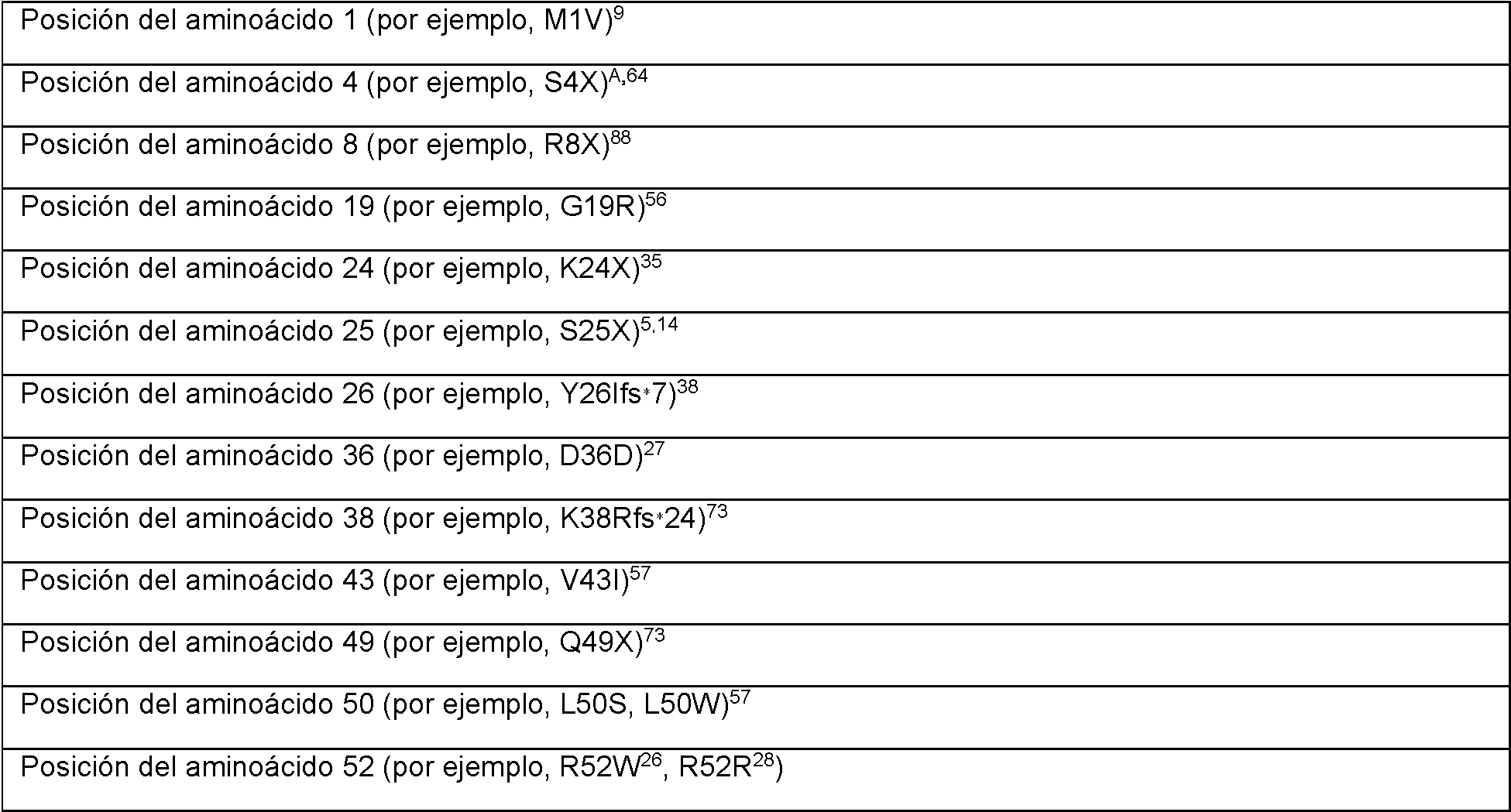


Tabla 5. Mutaciones de ABCB11 seleccionadas asociadas con FIC-2Table 5. Selected ABCB11 mutations associated with FIC-2.
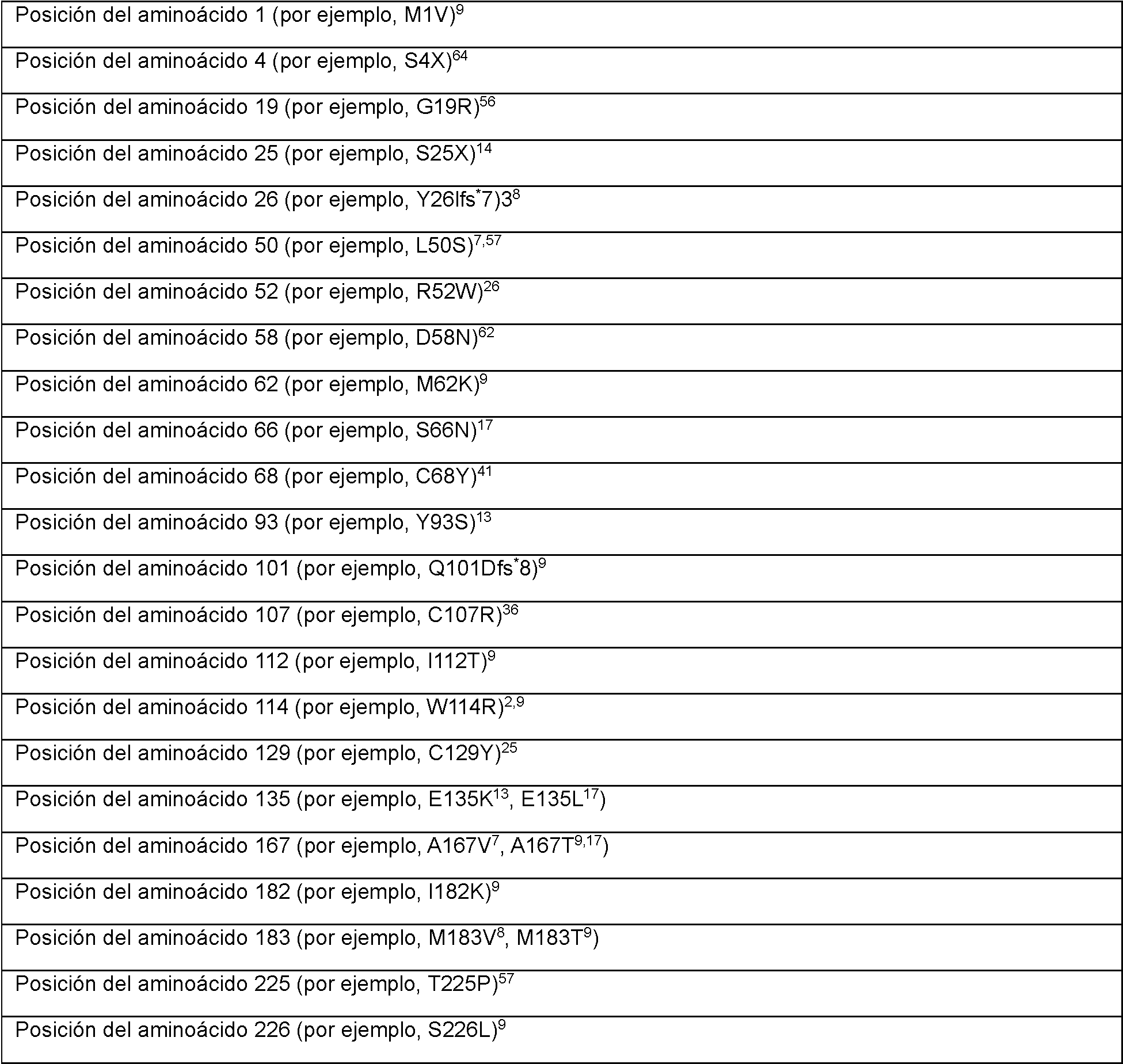


Referencias para las Tablas 4 y 5References for Tables 4 and 5
I Noe et al., J Hepatol. 2005, vol. 43(3), p. 536-543.I Noe et al., J Hepatol. 2005, vol. 43(3), p. 536-543.
* I2345Lam et al., Am J Physiol Cell Physiol. 2007, vol. 293(5), p. C1709-16.* I2345Lam et al., Am J Physiol Cell Physiol. 2007, vol. 293(5), p. C1709-16.
3 Stindt et al., Liver Int. 2013, vol. 33(10), p. 1527-1735.3 Stindt et al., Liver Int. 2013, vol. 33(10), p. 1527-1735.
4 Gao et al., Shandong Yiyao 2012, vol. 52(10), p. 14-16.4 Gao et al., Shandong Yiyao 2012, vol. 52(10), p. 14-16.
5 Strautnieks et al., Gastroenterology. 2008, vol. 134(4), p. 1203-1214.5 Strautnieks et al., Gastroenterology. 2008, vol. 134(4), p. 1203-1214.
6 Kagawa et al., Am J Physiol Gastrointest Liver Physiol. 2008, vol. 294(1), p. G58-67.6 Kagawa et al., Am J Physiol Gastrointest Liver Physiol. 2008, vol. 294(1), p. G58-67.
78Byrne et al., Hepatology. 2009, vol. 49(2), p. 553-567.78Byrne et al., Hepatology. 2009, vol. 49(2), p. 553-567.
8 Chen et al., J Pediatr. 2008, vol. 153(6), p. 825-832.8 Chen et al., J Pediatr. 2008, vol. 153(6), p. 825-832.
9 Davit-Spraul et al., Hepatology 2010, vol. 51(5), p. 1645-1655.9 Davit-Spraul et al., Hepatology 2010, vol. 51(5), p. 1645-1655.
10 Droge et al., Sci Rep. 2016, vol. 6: 24827.10 Droge et al., Sci Rep. 2016, vol. 6:24827.
II Lang et al., Pharmacogenet Genomics. 2007, vol. 17(1), p. 47-60.II Lang et al., Pharmacogenet Genomics. 2007, vol. 17(1), p. 47-60.
1213456Ellinger et al., World J Gastroenterol. 2017, vol. 23(29), p. :5295-5303.1213456Ellinger et al., World J Gastroenterol. 2017, vol. 23(29), p. :5295-5303.
13 Vitale et al., J Gastroenterol. 2018, vol. 53(8), p. 945-958.13 Vitale et al., J Gastroenterol. 2018, vol. 53(8), p. 945-958.
14 Knisely et al., Hepatology. 2006, vol. 44(2), p. 478-86.14 Knisely et al., Hepatology. 2006, vol. 44(2), p. 478-86.
15 Ellis et al., Hepatology. 2018, vol. 67(4), p. 1531-1545.15 Ellis et al., Hepatology. 2018, vol. 67(4), p. 1531-1545.
16 Lam et al., J Hepatol. 2006, vol. 44(1), p. 240-242. 16 Lam et al., J Hepatol. 2006, vol. 44(1), p. 240-242.
17 Varma et al., Hepatology 2015, vol. 62(1), p. 198-206.17 Varma et al., Hepatology 2015, vol. 62(1), p. 198-206.
18 Treepongkaruna et al., World J Gastroenterol. 2009, vol. 15(34), p. 4339-4342.18 Treepongkaruna et al., World J Gastroenterol. 2009, vol. 15(34), p. 4339-4342.
19 Zarenezhad et al., Hepatitis Monthly: 2017, vol. 17(2); e43500.19 Zarenezhad et al., Hepatitis Monthly: 2017, vol. 17(2); e43500.
20 Hayashi et al., Hepatol Res. 2016, vol. 46(2), p. 192-200.20 Hayashi et al., Hepatol Res. 2016, vol. 46(2), p. 192-200.
21 Guorui et al., Linchuang Erke Zazhi 2013, vol. 31(10), 905-909.21 Guorui et al., Linchuang Erke Zazhi 2013, vol. 31(10), 905-909.
22 van Mil et al., Gastroenterology. 2004, vol. 127(2), p. 379-384.22 van Mil et al., Gastroenterology. 2004, vol. 127(2), p. 379-384.
23 Anzivino et al., Dig Liver Dis. 2013, vol. 45(3), p. 226-232.23 Anzivino et al., Dig Liver Dis. 2013, vol. 45(3), p. 226-232.
24 Park et al., World J Gastroenterol. 2016, vol. 22(20), p. 4901-4907.24 Park et al., World J Gastroenterol. 2016, vol. 22(20), p. 4901-4907.
25 Imagawa et al., J Hum Genet. 2018, vol. 63(5), p. 569-577.25 Imagawa et al., J Hum Genet. 2018, vol. 63(5), p. 569-577.
26 Giovannoni et al., PLoS One. 2015, vol. 10(12): e0145021.26 Giovannoni et al., PLoS One. 2015, vol. 10(12): e0145021.
27 Hu et al., Mol Med Rep. 2014, vol. 10(3), p. 1264-1274.27 Hu et al., Mol Med Rep. 2014, vol. 10(3), p. 1264-1274.
28 Lang et al,. Drug Metab Dispos. 2006, vol. 34(9), p. 1582-1599.28 Lang et al. Drug Metab Dispos. 2006, vol. 34(9), p. 1582-1599.
29 Masahata et al., Transplant Proc. 2016, vol. 48(9), p. 3156-3162.29 Masahata et al., Transplant Proc. 2016, vol. 48(9), p. 3156-3162.
30 Holz et al., Hepatol Commun. 2018, vol. 2(2), p. 152-154.30 Holz et al., Hepatol Commun. 2018, vol. 2(2), p. 152-154.
31 Li et al., Hepatology International 2017, vol. 11, No. 1, Supp. Supplement 1, pp. S180. Abstract Number: OP284.31 Li et al., Hepatology International 2017, vol. 11, No. 1, Supp. Supplement 1, pp. S180. Abstract Number: OP284.
32 Francalanci et al., Laboratory Investigation 2011, vol. 91, Supp. SUPPL. 1, pp. 360A. Abstract Number: 1526. 33 Francalanci et al., Digestive and Liver Disease 2010, vol. 42, Supp. SUPPL. 1, pp. S16. Abstract Number: T.N.5.32 Francalanci et al., Laboratory Investigation 2011, vol. 91, Supp. SUPPL. 1, pp. 360A. Abstract Number: 1526. 33 Francalanci et al., Digestive and Liver Disease 2010, vol. 42, Supp. SUPPL. 1, pp. S16. Abstract Number: T.N.5.
34 Shah et al., J Pediatr Genet. 2017, vol. 6(2), p. 126-127.34 Shah et al., J Pediatr Genet. 2017, vol. 6(2), p. 126-127.
35 Gao et al., Hepatitis Monthly 2017, vol. 17(10), e55087/1-e55087/6.35 Gao et al., Hepatitis Monthly 2017, vol. 17(10), e55087/1-e55087/6.
36 Evason et al., Am J Surg Pathol. 2011, vol. 35(5), p. 687-696.36 Evason et al., Am J Surg Pathol. 2011, vol. 35(5), p. 687-696.
37 Davit-Spraul et al., Mol Genet Metab. 2014, vol. 113(3), p. 225-229.37 Davit-Spraul et al., Mol Genet Metab. 2014, vol. 113(3), p. 225-229.
38 Maggiore et al., J Hepatol. 2010, vol. 53(5), p. 981-6.38 Maggiore et al., J Hepatol. 2010, vol. 53(5), p. 981-6.
39 McKay et al., Version 2. F1000Res. 2013; 2: 32. DOI: 10.12688/f1000research.2-32.v239 McKay et al., Version 2. F1000Res. 2013; 2: 32. DOI: 10.12688/f1000research.2-32.v2
40 Liu et al., Pediatr Int. 2013, vol. 55(2), p. 138-144.40 Liu et al., Pediatr Int. 2013, vol. 55(2), p. 138-144.
41 Waisbourd-Zinman et al., Ann Hepatol. 2017, vol. 16(3), p. 465-468.41 Waisbourd-Zinman et al., Ann Hepatol. 2017, vol. 16(3), p. 465-468.
42 Griffin, et al., Canadian Journal of Gastroenterology and Hepatology 2016, vol. 2016. Abstract Number: A200. Meeting Info: 2016 Canadian Digestive Diseases Week, CDDW 2016. Montreal, QC, United States. 26 Feb 2016-29 Feb 201642 Griffin, et al., Canadian Journal of Gastroenterology and Hepatology 2016, vol. 2016. Abstract Number: A200. Meeting Info: 2016 Canadian Digestive Diseases Week, CDDW 2016. Montreal, QC, United States. Feb 26, 2016-Feb 29, 2016
43 Qiu et al., Hepatology 2017, vol. 65(5), p. 1655-1669.43 Qiu et al., Hepatology 2017, vol. 65(5), p. 1655-1669.
44 Imagawa et al., Sci Rep. 2017, 7:41806.44 Imagawa et al., Sci Rep. 2017, 7:41806.
45 Kang et al., J Pathol Transl Med. 2019 May 16. doi: 10.4132/jptm.2019.05.03. [Epub ahead of print]45 Kang et al., J Pathol Transl Med. 2019 May 16. doi: 10.4132/jptm.2019.05.03. [Epub ahead of print]
46 Takahashi et al., Eur J Gastroenterol Hepatol. 2007, vol. 19(11), p. 942-6.46 Takahashi et al., Eur J Gastroenterol Hepatol. 2007, vol. 19(11), p. 942-6.
47 Shimizu et al., Am J Transplant. 2011, vol. 11(2), p. 394-398.47 Shimizu et al., Am J Transplant. 2011, vol. 11(2), p. 394-398.
48 Krawczyk et al., Ann Hepatol. 2012, vol. 11(5), p. 710-744.48 Krawczyk et al., Ann Hepatol. 2012, vol. 11(5), p. 710-744.
49 Sharma et al., BMC Gastroenterol. 2018, vol. 18(1), p. 107.49 Sharma et al., BMC Gastroenterol. 2018, vol. 18(1), p. 107.
50 Sattler et al., Journal of Hepatology 2017, vol. 66, No. 1, Suppl. S, pp. S177. Meeting Info.: International Liver Congress / 52nd Annual Meeting of the European-Association-for-the-Study-of-the-Liver. Amsterdam, NETHERLANDS. April 19 -23, 2017. European Assoc Study Liver. 50 Sattler et al., Journal of Hepatology 2017, vol. 66, No. 1, Suppl. S, pp. S177. Meeting Info.: International Liver Congress / 52nd Annual Meeting of the European-Association-for-the-Study-of-the-Liver. Amsterdam, NETHERLANDS. April 19 -23, 2017. European Assoc Study Liver.
51 Jung et al., J Pediatr Gastroenterol Nutr. 2007, vol. 44(4), p. 453-458.51 Jung et al., J Pediatr Gastroenterol Nutr. 2007, vol. 44(4), p. 453-458.
52 Sciveres. Digestive and Liver Disease 2010, vol. 42, Supp. SUPPL. 5, pp. S329. Abstract Number: CO18. Meeting Info: 17th National Congress SIGENP. Pescara, Italy. 07 Oct 2010-09 Oct 201052 Sciveres. Digestive and Liver Disease 2010, vol. 42, Supp. SUPPL. 5, pp. S329. Abstract Number: CO18. Meeting Info: 17th National Congress SIGENP. Pescara, Italy. 07 Oct 2010-09 Oct 2010
53 Sohn et al., Pediatr Gastroenterol Hepatol Nutr. 2019, vol. 22(2), p. 201-206.53 Sohn et al., Pediatr Gastroenterol Hepatol Nutr. 2019, vol. 22(2), p. 201-206.
54 Ho et al., Pharmacogenet Genomics. 2010, vol. 20(1), p. 45-57.54 Ho et al., Pharmacogenet Genomics. 2010, vol. 20(1), p. 45-57.
55 Wang et al., Hepatol Res. 2018, vol. 48(7), p. 574-584.55 Wang et al., Hepatol Res. 2018, vol. 48(7), p. 574-584.
56 Shaprio et al., J Hum Genet. 2010, vol. 55(5), p. 308-313.56 Shaprio et al., J Hum Genet. 2010, vol. 55(5), p. 308-313.
57 Bounford. University of Birmingham. Dissertation Abstracts International, (2016) Vol. 75, No. 1C. Order No.: AAI10588329. ProQuest Dissertations & Theses.57 Bounford. University of Birmingham. Dissertation Abstracts International, (2016) Vol. 75, No. 1C. Order No.: AAI10588329. ProQuest Dissertations & Theses.
58 Stolz et al., Aliment Pharmacol Ther. 2019, vol. 49(9), p. 1195-1204.58 Stolz et al., Aliment Pharmacol Ther. 2019, vol. 49(9), p. 1195-1204.
59 Jankowska et al., J Pediatr Gastroenterol Nutr. 2014, vol. 58(1), p. 92-95.59 Jankowska et al., J Pediatr Gastroenterol Nutr. 2014, vol. 58(1), p. 92-95.
60 Kim. Journal of Pediatric Gastroenterology and Nutrition 2016, vol. 62, Supp. SUPPL. 1, pp. 620. Abstract Number: H-P-045. Meeting Info: 49th Annual Meeting of the European Society for Paediatric Gastroenterology, Hepatology and Nutrition, ESPGHAN 2016. Athens, Greece. 25 May 2016-28 May 2016.60 Kim. Journal of Pediatric Gastroenterology and Nutrition 2016, vol. 62, Supp. SUPPL. 1, pp. 620. Abstract Number: H-P-045. Meeting Info: 49th Annual Meeting of the European Society for Pediatric Gastroenterology, Hepatology and Nutrition, ESPGHAN 2016. Athens, Greece. May 25, 2016-May 28, 2016.
61 Pauli-Magnus et al., Hepatology 2003, vol. 38, No. 4 Suppl. 1, pp. 518A. print. Meeting Info.: 54th Annual Meeting of the American Association for the Study of Liver Diseases. Boston, mA, USA. October 24-28, 2003. American Association for the Study of Liver Diseases.61 Pauli-Magnus et al., Hepatology 2003, vol. 38, No. 4 Suppl. 1, pp. 518A. print. Meeting Info.: 54th Annual Meeting of the American Association for the Study of Liver Diseases. Boston, MA , USA. October 24-28, 2003. American Association for the Study of Liver Diseases.
62 Li et al., Hepatology International 2017, vol. 11, No. 1, Supp. Supplement 1, pp. S362. Abstract Number: PP0347. Meeting Info: 26th Annual Conference of the Asian Pacific Association for the Study of the Liver, APASL 2017. Shanghai, China. 15 Feb 2017-19 Feb 2017.62 Li et al., Hepatology International 2017, vol. 11, No. 1, Supp. Supplement 1, pp. S362. Abstract Number: PP0347. Meeting Info: 26th Annual Conference of the Asian Pacific Association for the Study of the Liver, APASL 2017. Shanghai, China. Feb 15, 2017-Feb 19, 2017.
63 Rumbo et al., Transplantation 2018, vol. 102, No. 7, Supp. Supplement 1, pp. S848. Abstract Number: P.752. Meeting Info: 27th International Congress of The Transplantation Society, TTS 2018. Madrid, Spain. 30 Jun 2018-05 Jul 2018.63 Rumbo et al., Transplantation 2018, vol. 102, No. 7, Supp. Supplement 1, pp. S848. Abstract Number: P.752. Meeting Info: 27th International Congress of The Transplantation Society, TTS 2018. Madrid, Spain. June 30, 2018-Jul 5, 2018.
64 Lee et al., Pediatr Gastroenterol Hepatol Nutr. 2017, vol. 20(2), p. 114-123.64 Lee et al., Pediatr Gastroenterol Hepatol Nutr. 2017, vol. 20(2), p. 114-123.
65 Sherrif et al., Liver international: official journal of the International Association for the Study of the Liver 2013, vol.65 Sherrif et al., Liver international: official journal of the International Association for the Study of the Liver 2013, vol.
33, No. 8, pp. 1266-1270.33, No. 8, pp. 1266-1270.
66 Blackmore et al., J Clin Exp Hepatol. 2013, vol. 3(2), p. 159-161.66 Blackmore et al., J Clin Exp Hepatol. 2013, vol. 3(2), p. 159-161.
67 Matte et al., J Pediatr Gastroenterol Nutr. 2010, vol. 51(4), p. 488-493.67 Matte et al., J Pediatr Gastroenterol Nutr. 2010, vol. 51(4), p. 488-493.
68 Lin et al., Zhongguo Dang Dai Er Ke Za Zhi. 2018, vol. 20(9), p. 758-764.68 Lin et al., Zhongguo Dang Dai Er Ke Za Zhi. 2018, vol. 20(9), p. 758-764.
69 Harmanci et al., Experimental and Clinical Transplantation 2015, vol. 13, Supp. SUPPL. 2, pp. 76. Abstract Number: P62. Meeting Info: 1st Congress of the Turkic World Transplantation Society. Astana, Kazakhstan. 20 May 2015-22 May 2015.69 Harmanci et al., Experimental and Clinical Transplantation 2015, vol. 13, Supp. SUPPL. 2, pp. 76. Abstract Number: P62. Meeting Info: 1st Congress of the Turkic World Transplantation Society. Astana, Kazakhstan. May 20, 2015-May 22, 2015.
70 Herbst et al., Mol Cell Probes. 2015, vol. 29(5), p. 291-298.70 Herbst et al., Mol Cell Probes. 2015, vol. 29(5), p. 291-298.
71 Moghadamrad et al., Hepatology. 2013, vol. 57(6), p. 2539-2541.71 Moghadamrad et al., Hepatology. 2013, vol. 57(6), p. 2539-2541.
72 Holz et al., Zeitschrift fur Gastroenterologie 2016, vol. 54, No. 8. Abstract Number: KV275. Meeting Info: Viszeralmedizin 2016, 71. Jahrestagung der Deutschen Gesellschaft fur Gastroenterologie, Verdauungs- und Stoffwechselkrankheiten mit Sektion Endoskopie -10. Herbsttagung der Deutschen Gesellschaft fur Allgemein- und Viszeralchirurgie. Hamburg, Germany. 21 Sep 2016-24 Sep 2016.72 Holz et al., Zeitschrift fur Gastroenterologie 2016, vol. 54, No. 8. Abstract Number: KV275. Meeting Info: Viszeralmedizin 2016, 71. Jahrestagung der Deutschen Gesellschaft fur Gastroenterologie, Verdauungs- und Stoffwechselkrankheiten mit Sektion Endoskopie -10. Herbsttagung der Deutschen Gesellschaft fur Allgemein- und Viszeralchirurgie. Hamburg, Germany. Sep 21, 2016-Sep 24, 2016.
73 Wang et al., PLoS One. 2016; vol. 11(4): e0153114.73 Wang et al., PLoS One. 2016; vol. 11(4): e0153114.
74 Hao et al., International Journal of Clinical and Experimental Pathology 2017, vol. 10(3), p. 3480-3487.74 Hao et al., International Journal of Clinical and Experimental Pathology 2017, vol. 10(3), p. 3480-3487.
75 Arnell et al., J Pediatr Gastroenterol Nutr. 2010, vol. 51(4), p. 494-499.75 Arnell et al., J Pediatr Gastroenterol Nutr. 2010, vol. 51(4), p. 494-499.
76 Sharma et al., Indian Journal of Gastroenterology 2017, vol. 36, No. 1, Supp. Supplement 1, pp. A99. Abstract Number: M-20. Meeting Info: 58th Annual Conference of the Indian Society of Gastroenterology, ISGCON 2017. Bhubaneswar, India. 14 Dec 2017-17 Dec 2017.76 Sharma et al., Indian Journal of Gastroenterology 2017, vol. 36, No. 1, Supp. Supplement 1, pp. A99. Abstract Number: M-20. Meeting Info: 58th Annual Conference of the Indian Society of Gastroenterology, ISGCON 2017. Bhubaneswar, India. Dec 14, 2017-Dec 17, 2017.
77 Beauséjour et al., Can J Gastroenterol. 2011, vol. 25(6), p. 311-314. 77 Beauséjour et al., Can J Gastroenterol. 2011, vol. 25(6), p. 311-314.
78 Imagawa et al., Journal of Pediatric Gastroenterology and Nutrition 2016, vol. 63, Supp. Supplement 2, pp. S51. Abstract Number: 166. Meeting Info: World Congress of Pediatric Gastroenterology, Hepatology and Nutrition 2016. Montreal, QC, Canada. 05 Oct 2016-08 Oct 2016.78 Imagawa et al., Journal of Pediatric Gastroenterology and Nutrition 2016, vol. 63, Supp. Supplement 2, pp. S51. Abstract Number: 166. Meeting Info: World Congress of Pediatric Gastroenterology, Hepatology and Nutrition 2016. Montreal, QC, Canada. 05 Oct 2016-08 Oct 2016.
79 Peng et al., Zhonghua er ke za zhi (Chinese journal of pediatrics) 2018, vol. 56, No. 6, pp. 440-444.79 Peng et al., Zhonghua er ke za zhi (Chinese journal of pediatrics) 2018, vol. 56, No. 6, pp. 440-444.
80 Tibesar et al., Case Rep Pediatr. 2014, vol. 2014: 185923.80 Tibesar et al., Case Rep Pediatr. 2014, vol. 2014: 185923.
81 Ng et al., Journal of Pediatric Gastroenterology and Nutrition 2018, vol. 66, Supp. Supplement 2, pp. 860. Abstract Number: H-P-127. Meeting Info: 51st Annual Meeting European Society for Paediatric Gastroenterology, Hepatology and Nutrition, ESPGHAN 2018. Geneva, Switzerland. 09 May 2018-12 May 2018.81 Ng et al., Journal of Pediatric Gastroenterology and Nutrition 2018, vol. 66, Supp. Supplement 2, pp. 860. Abstract Number: H-P-127. Meeting Info: 51st Annual Meeting European Society for Pediatric Gastroenterology, Hepatology and Nutrition, ESPGHAN 2018. Geneva, Switzerland. 09 May 2018-12 May 2018.
82 Wong et al., Clin Chem. 2008, vol. 54(7), p. 1141-1148.82 Wong et al., Clin Chem. 2008, vol. 54(7), p. 1141-1148.
83 Pauli-Magnus et al., J Hepatol. 2005, vol. 43(2), p. 342-357.83 Pauli-Magnus et al., J Hepatol. 2005, vol. 43(2), p. 342-357.
84 Jericho et al., Journal of Pediatric Gastroenterology and Nutrition. 60, vol. 3, p. 368-374.84 Jericho et al., Journal of Pediatric Gastroenterology and Nutrition. 60, vol. 3, p. 368-374.
85 Scheimann et al., Gastroenterology 2007, vol. 132, No. 4, Suppl. 2, pp. A452. Meeting Info.: Digestive Disease Week Meeting/108th Annual Meeting of the American-Gastroenterological-Association. Washington, DC, USA. May 19 -24, 2007. Amer Gastroenterol Assoc; Amer Assoc Study Liver Dis; Amer Soc Gastrointestinal Endoscopy; Soc Surg Alimentary Tract.85 Scheimann et al., Gastroenterology 2007, vol. 132, No. 4, Suppl. 2, pp. A452. Meeting Info.: Digestive Disease Week Meeting/108th Annual Meeting of the American-Gastroenterological-Association. Washington, DC, USA. May 19 -24, 2007. Amer Gastroenterol Assoc; Amer Assoc Study Liver Dis; Amer Soc Gastrointestinal Endoscopy; Soc Surg Alimentary Tract.
86 Jaquotot-Haerranz et al., Rev Esp Enferm Dig. 2013, vol. 105(1), p. 52-54.86 Jaquotot-Haerranz et al., Rev Esp Enferm Dig. 2013, vol. 105(1), p. 52-54.
87 Khosla et al., American Journal of Gastroenterology 2015, vol. 110, No. Suppl. 1, pp. S397. Meeting Info.: 80th Annual Scientific Meeting of the American-College-of-Gastroenterology. Honolulu, HI, USA. October 16 -21,2015.87 Khosla et al., American Journal of Gastroenterology 2015, vol. 110, No. Suppl. 1, pp. S397. Meeting Info.: 80th Annual Scientific Meeting of the American-College-of-Gastroenterology. Honolulu, HI, USA. October 16 -21,2015.
88 Droge et al., J Hepatol. 2017, vol. 67(6), p. 1253-1264.88 Droge et al., J Hepatol. 2017, vol. 67(6), p. 1253-1264.
89 Liu et al., Liver International 2010, vol. 30(6), p. 809-815.89 Liu et al., Liver International 2010, vol. 30(6), p. 809-815.
90 Chen et al., Journal of Pediatrics 2002, vol. 140(1), p. 119-124.90 Chen et al., Journal of Pediatrics 2002, vol. 140(1), p. 119-124.
91 Patente EE.UU. No. 9,295,67791 US Patent No. 9,295,677
En algunas realizaciones, la mutación en ABCB11 se selecciona deA167T, G238V, V284L, E297G, R470Q, R470X, D482G, R487H, A570T, N591S, A865V, G982R, R1153C, y R1268Q.In some embodiments, the mutation in ABCB11 is selected from A167T, G238V, V284L, E297G, R470Q, R470X, D482G, R487H, A570T, N591S, A865V, G982R, R1153C, and R1268Q.
Se proporcionan, pero no se reivindican, métodos para tratar PFIC (por ejemplo, PFIC-1 y PFIC-2) en un sujeto que incluyen realizar un ensayo en una muestra obtenida del sujeto para determinar si el sujeto tiene una mutación asociada con PFIC (por ejemplo, una mutación ATP8B1, ABCB11, ABCB4, TJP2, NR1H4 o Myo5b), y administrar (por ejemplo, específicamente o selectivamente administrar) una cantidad terapéuticamente eficaz de un compuesto de la fórmula (I), o una sal farmacéuticamente aceptable del mismo, al sujeto al que se le ha determinado que tiene una mutación asociada PFIC. En algunas realizaciones, la mutación es una mutación ATP8B1 o ABCB11. Por ejemplo, una mutación como se proporciona en una cualquiera de las Tablas 1-4. En algunas realizaciones, la mutación en ATP8B1 se selecciona de L127P, G308V, T456M, D554N, F529del, I661T, E665X, R930X, R952X, R1014X, y G1040R. En algunas realizaciones, la mutación en ABCB11 se selecciona deA167T, G238V, V284L, E297G, R470Q, R470X, D482G, R487H, A570T, N591S, A865V, G982R, R1153C, y R1268Q.Provided, but not claimed, are methods of treating PFIC (e.g., PFIC-1 and PFIC-2) in a subject that include performing an assay on a sample obtained from the subject to determine whether the subject has a mutation associated with PFIC ( for example, an ATP8B1, ABCB11, ABCB4, TJP2, NR1H4 or Myo5b mutation), and administering (e.g., specifically or selectively administering) a therapeutically effective amount of a compound of formula (I), or a pharmaceutically acceptable salt thereof , the subject who has been determined to have an associated PFIC mutation. In some embodiments, the mutation is an ATP8B1 or ABCB11 mutation. For example, a mutation as provided in any one of Tables 1-4. In some embodiments, the mutation in ATP8B1 is selected from L127P, G308V, T456M, D554N, F529del, I661T, E665X, R930X, R952X, R1014X, and G1040R. In some embodiments, the mutation in ABCB11 is selected from A167T, G238V, V284L, E297G, R470Q, R470X, D482G, R487H, A570T, N591S, A865V, G982R, R1153C, and R1268Q.
También se proporcionan, pero no se reivindican, métodos para tratar PFIC (por ejemplo, PFIC-1 y PFIC-2) en un sujeto en necesidad de los mismos, el método comprende: (a) detectar una mutación asociada con PFIC (por ejemplo, una mutación ATP8B1, ABCB11, ABCB4, TJP2, n R1H4 o Myo5b) en el sujeto; y (b) administrar al sujeto una cantidad terapéuticamente eficaz de un compuesto de la fórmula (I), o una sal farmacéuticamente aceptable del mismo. En algunas realizaciones, los métodos para tratar PFIC pueden incluir administrar una cantidad terapéuticamente eficaz de un compuesto de la fórmula (I), o una sal farmacéuticamente aceptable del mismo, a un sujeto que tiene una mutación asociada con PFIC (por ejemplo, una mutación ATP8B1, a Bc B11, ABCB4, TJP2, NR1H4 o Myo5b). En algunas realizaciones, la mutación es una mutación ATP8B1 o ABCB11. Por ejemplo, una mutación como se proporciona en una cualquiera de las Tablas 1-4. En algunas realizaciones, la mutación en ATP8B1 se selecciona de L127P, G308V, T456M, D554N, F529del, I661T, E665X, R930X, R952X, R1014X, yG1040R. En algunas realizaciones, la mutación en ABCB11 se selecciona deA167T, G238V, V284L, E297G, R470Q, R470X, D482G, R487H, A570T, N591S, A865V, G982R, R1153C, y R1268Q.Also provided, but not claimed, are methods for treating PFIC (e.g., PFIC-1 and PFIC-2) in a subject in need thereof, the method comprising: (a) detecting a mutation associated with PFIC (e.g. , an ATP8B1, ABCB11, ABCB4, TJP2, nR1H4 or Myo5b) mutation in the subject; and (b) administering to the subject a therapeutically effective amount of a compound of formula (I), or a pharmaceutically acceptable salt thereof. In some embodiments, methods of treating PFIC may include administering a therapeutically effective amount of a compound of formula (I), or a pharmaceutically acceptable salt thereof, to a subject having a mutation associated with PFIC (e.g., a mutation ATP8B1, to Bc B11, ABCB4, TJP2, NR1H4 or Myo5b). In some embodiments, the mutation is an ATP8B1 or ABCB11 mutation. For example, a mutation as provided in any one of Tables 1-4. In some embodiments, the mutation in ATP8B1 is selected from L127P, G308V, T456M, D554N, F529del, I661T, E665X, R930X, R952X, R1014X, and G1040R. In some embodiments, the mutation in ABCB11 is selected from A167T, G238V, V284L, E297G, R470Q, R470X, D482G, R487H, A570T, N591S, A865V, G982R, R1153C, and R1268Q.
En algunas realizaciones, se determina que el sujeto tiene una mutación asociada con PFIC en un sujeto o una muestra de biopsia del sujeto mediante el uso de cualesquier pruebas reconocidas en la técnica, que incluyen la secuenciación de próxima generación (NGS). En algunas realizaciones, se determina que el sujeto tiene una mutación asociada con PFIC utilizando una prueba o ensayo aprobado por una agencia reguladora, por ejemplo, aprobado por la FDA para identificar una mutación asociada con PFIC en un sujeto o una muestra de biopsia del sujeto o al realizar cualesquiera de los ejemplos no limitantes de ensayos descritos en el presente documento. Se describen métodos adicionales para diagnosticar PFIC en Gunaydin, M. et al., Hepat Med. 2018, vol. 10, p. 95-104. En algunas realizaciones, el tratamiento de PFIC (por ejemplo, PFIC-1 o PFIC-2) disminuye el nivel de ácidos biliares en suero en el sujeto. En algunas realizaciones, el nivel de ácidos biliares en suero se determina mediante, por ejemplo, un ensayo enzimático ELISA o los ensayos para la medición de ácidos biliares totales como se describe en Danese et al., PLoS One. 2017, vol.In some embodiments, the subject is determined to have a PFIC-associated mutation in a subject or a biopsy sample of the subject using any tests recognized in the art, including next generation sequencing (NGS). In some embodiments, the subject is determined to have a PFIC-associated mutation using a test or assay approved by a regulatory agency, e.g., approved by the FDA to identify a PFIC-associated mutation in a subject or a biopsy specimen from the subject. or by performing any of the non-limiting examples of tests described herein. Additional methods are described for diagnose PFIC in Gunaydin, M. et al., Hepat Med. 2018, vol. 10, p. 95-104. In some embodiments, treatment of PFIC (e.g., PFIC-1 or PFIC-2) decreases the level of serum bile acids in the subject. In some embodiments, the level of serum bile acids is determined by, for example, an ELISA enzymatic assay or assays for the measurement of total bile acids as described in Danese et al., PLoS One. 2017, vol.
12(6):e0179200. En algunas realizaciones, el nivel de ácidos biliares en suero puede disminuir, por ejemplo, del 10 % al 40 %, del 20 % al 50 %, del 30 % al 60 %, del 40 % al 70 %, del 50 % al 80 %, o en más del 90 % del nivel de ácidos biliares en suero antes de la administración de un compuesto de la fórmula (I), o una sal farmacéuticamente aceptable del mismo. En algunas realizaciones, el tratamiento de PFIC incluye tratamiento del prurito.12(6):e0179200. In some embodiments, the serum bile acid level may decrease, for example, from 10% to 40%, from 20% to 50%, from 30% to 60%, from 40% to 70%, from 50% to 80%. %, or by more than 90% of the serum bile acid level prior to administration of a compound of formula (I), or a pharmaceutically acceptable salt thereof. In some embodiments, treatment of PFIC includes treatment of pruritus.
Dado que LBAT se expresa sobre hepatocitos, LBAT y las sustancias inhibidoras de ASBT/LBAT duales necesitan tener al menos cierta biodisponibilidad y fracción libre en sangre. Debido a que los compuestos inhibidores de LBAT solo necesitan sobrevivir desde el intestino hasta el hígado, se espera que una exposición sistémica relativamente baja de dichos compuestos sea suficiente, minimizando de esta manera el riesgo potencial de efectos secundarios en el resto del cuerpo. Se espera que la inhibición de LBAT y ASBT tenga al menos efectos aditivos en la disminución de la concentración de ácidos biliares intrahepáticos. También se espera que un inhibidor dual de ASBT/LBAT pueda ser capaz de reducir los niveles de ácidos biliares sin inducir diarrea, como se observa a veces con los inhibidores de ASBT.Since LBAT is expressed on hepatocytes, LBAT and dual ASBT/LBAT inhibitory substances need to have at least some bioavailability and free fraction in blood. Because LBAT-inhibiting compounds only need to survive from the intestine to the liver, a relatively low systemic exposure of such compounds is expected to be sufficient, thus minimizing the potential risk of side effects in the rest of the body. Inhibition of LBAT and ASBT is expected to have at least additive effects in decreasing intrahepatic bile acid concentration. It is also expected that a dual ASBT/LBAT inhibitor may be able to reduce bile acid levels without inducing diarrhea, as is sometimes seen with ASBT inhibitors.
Se espera que los compuestos que tienen una alta potencia inhibidora de LBAT y suficiente biodisponibilidad sean particularmente adecuados para el tratamiento de la hepatitis. Se espera que los compuestos que tienen una potencia inhibidora dual de ASBT/LBAT y una biodisponibilidad suficiente sean particularmente adecuados para el tratamiento de la esteatohepatitis no alcohólica (NASH).Compounds having high LBAT inhibitory potency and sufficient bioavailability are expected to be particularly suitable for the treatment of hepatitis. Compounds having dual ASBT/LBAT inhibitory potency and sufficient bioavailability are expected to be particularly suitable for the treatment of nonalcoholic steatohepatitis (NASH).
NASH es una enfermedad del hígado crónica común y grave que se asemeja a la enfermedad del hígado alcohólica, pero que ocurre en personas que beben poco o nada de alcohol. En los pacientes con NASH, la acumulación de grasa en el hígado, conocida como enfermedad del hígado graso no alcohólico (NAFLD) o esteatosis, y otros factores tales como el colesterol LDL alto y la resistencia a la insulina inducen una inflamación crónica en el hígado y pueden provocar una cicatrización progresiva del tejido, conocida como fibrosis y cirrosis, seguidas finalmente por insuficiencia del hígado y muerte. Se ha descubierto que los pacientes con NASH tienen concentraciones séricas totales de ácidos biliares significativamente más altas que los sujetos sanos bajo condiciones de ayuno (aumento de 2.2 a 2.4 veces en NASH) y en todos los momentos posprandiales (aumento de 1.7 a 2.2 veces en NASH). Estos son impulsados por un aumento de los ácidos biliares primarios y secundarios conjugados con taurina y glicina. Los pacientes con NASH mostraron una mayor variabilidad en su perfil de ácidos biliares en ayunas y posprandial. Estos resultados indican que los pacientes con NASH tienen una mayor exposición en ayunas y posprandial a los ácidos biliares, que incluyen las especies secundarias más hidrofóbicas y citotóxicas. El aumento de la exposición a los ácidos biliares puede estar implicado en la lesión del hígado y la patogénesis de NAFLD y NASH (Ferslew et al., Dig Dis Sci. 2015, vol. 60, p.NASH is a common and serious chronic liver disease that resembles alcoholic liver disease, but occurs in people who drink little or no alcohol. In patients with NASH, the accumulation of fat in the liver, known as nonalcoholic fatty liver disease (NAFLD) or steatosis, and other factors such as high LDL cholesterol and insulin resistance induce chronic inflammation in the liver. and can cause progressive tissue scarring, known as fibrosis and cirrhosis, eventually followed by liver failure and death. Patients with NASH have been found to have significantly higher total serum bile acid concentrations than healthy subjects under fasting conditions (2.2- to 2.4-fold increase in NASH) and at all postprandial time points (1.7- to 2.2-fold increase in NASH). These are driven by an increase in primary and secondary bile acids conjugated to taurine and glycine. Patients with NASH showed greater variability in their fasting and postprandial bile acid profile. These results indicate that patients with NASH have increased fasting and postprandial exposure to bile acids, including the more hydrophobic and cytotoxic secondary species. Increased exposure to bile acids may be involved in liver injury and the pathogenesis of NAFLD and NASH (Ferslew et al., Dig Dis Sci. 2015, vol. 60, p.
3318-3328). Por lo tanto, es probable que la inhibición de ASBT y/o LBAT sea beneficiosa para el tratamiento de NASH.3318-3328). Therefore, inhibition of ASBT and/or LBAT is likely to be beneficial for the treatment of NASH.
La NAFLD se caracteriza por esteatosis hepática sin causas secundarias de esteatosis hepática, que incluye el consumo excesivo de alcohol, otras enfermedades del hígado conocidas o el uso prolongado de un medicamento esteatogénico (Chalasani et al., Hepatology 2018, vol. 67(1), páginas 328-357). La NAFLD se puede clasificar en hígado graso no alcohólico (NAFL) y esteatohepatitis no alcohólica (NASH). De acuerdo con Chalasani et al., la NAFL se define como la presencia de >5 % de esteatosis hepática sin evidencia de lesión hepatocelular en forma de abombamiento de hepatocitos. NASH se define como la presencia de >5 % de esteatosis hepática e inflamación con lesión de hepatocitos (por ejemplo, abombamiento), con o sin fibrosis del hígado. NASH también se asocia comúnmente con inflamación hepática y fibrosis del hígado, que puede progresar a cirrosis, enfermedad del hígado terminal y carcinoma hepatocelular. Si bien la fibrosis del hígado no siempre está presente en la NASH, la gravedad de la fibrosis, cuando está presente, se puede ligar con resultados a largo plazo.NAFLD is characterized by hepatic steatosis without secondary causes of hepatic steatosis, including excessive alcohol consumption, other known liver diseases, or long-term use of a steatogenic medication (Chalasani et al., Hepatology 2018, vol. 67(1) , pages 328-357). NAFLD can be classified into nonalcoholic fatty liver (NAFL) and nonalcoholic steatohepatitis (NASH). According to Chalasani et al., NAFL is defined as the presence of >5% hepatic steatosis without evidence of hepatocellular injury in the form of hepatocyte bulging. NASH is defined as the presence of >5% hepatic steatosis and inflammation with hepatocyte injury (e.g., bulging), with or without liver fibrosis. NASH is also commonly associated with liver inflammation and liver fibrosis, which can progress to cirrhosis, end-stage liver disease, and hepatocellular carcinoma. Although liver fibrosis is not always present in NASH, the severity of fibrosis, when present, can be linked to long-term outcomes.
Se presentan muchos enfoques utilizados para valorar y evaluar si un sujeto tiene NAFLD y, de ser así, la gravedad de la enfermedad, que incluye diferenciar si NAFLD es NAFL o NASH. En algunas realizaciones, la gravedad de NAFLD se puede evaluar utilizando el NAS. En algunas realizaciones, el tratamiento de NAFLD se puede evaluar utilizando el NAS. En algunas realizaciones, el NAS se puede determinar cómo se describe en Kleiner et al., Hepatology. 2005, 41(6):1313-1321. Véase, por ejemplo, la Tabla 6 para ver un esquema NAS simplificado adaptado de Kleiner.Many approaches are presented used to assess and evaluate whether a subject has NAFLD and, if so, the severity of the disease, including differentiating whether NAFLD is NAFL or NASH. In some embodiments, the severity of NAFLD can be assessed using the NAS. In some embodiments, NAFLD treatment can be evaluated using the NAS. In some embodiments, the NAS can be determined as described in Kleiner et al., Hepatology. 2005, 41(6):1313-1321. See, for example, Table 6 for a simplified NAS scheme adapted from Kleiner.
Tabla 6. Ejemplo de puntuación de actividad de NAFLD (NAS) con estadio de fibrosisTable 6. Example of NAFLD activity score (NAS) with fibrosis stage


En algunas realizaciones, el NAS se determina de forma no invasiva, por ejemplo, como se describe en la publicación de solicitud de EE. UU. No.2018/0140219. En algunas realizaciones, el NAS se determina para una muestra del sujeto antes de la administración de un compuesto de la fórmula (I), o una sal farmacéuticamente aceptable del mismo. En algunas realizaciones, la NAS se determina durante el periodo de tiempo o después del periodo de tiempo de la administración de un compuesto de la fórmula (I), o una sal farmacéuticamente aceptable del mismo. En algunas realizaciones, una puntuación NAS más baja durante el periodo de tiempo o después del periodo de tiempo de la administración de un compuesto de la fórmula (I), o una sal farmacéuticamente aceptable del mismo en comparación con antes de la administración del compuesto de la fórmula (I), o una sal farmacéuticamente aceptable del mismo indica tratamiento de NAFLD (por ejemplo, NASH). Por ejemplo, una disminución en la NAS en 1, en 2, en 3, en 4, en 5, en 6, o en 7 indica tratamiento de NAFLD (por ejemplo, NASH). En algunas realizaciones, la NAS que sigue a la administración de un compuesto de la fórmula (I), o una sal farmacéuticamente aceptable del mismo, es 7 o menos. En algunas realizaciones, la NAS durante el periodo de tiempo de la administración de un compuesto de la fórmula (I), o una sal farmacéuticamente aceptable del mismo, es 5 o menos, 4 o menos, 3 o menos, o 2 o menos. En algunas realizaciones, la NAS durante el periodo de tiempo de la administración de un compuesto de la fórmula (I), o una sal farmacéuticamente aceptable del mismo, es 7 o menos. En algunas realizaciones, la NAS durante el periodo de tiempo de la administración de un compuesto de la fórmula (I), o una sal farmacéuticamente aceptable del mismo, es 5 o menos, 4 o menos, 3 o menos, o 2 o menos. En algunas realizaciones, la NAS después del periodo de tiempo de la administración de un compuesto de la fórmula (I), o una sal farmacéuticamente aceptable del mismo, es 7 o menos. En algunas realizaciones, la NAS después del periodo de tiempo de la administración de un compuesto de la fórmula (I), o una sal farmacéuticamente aceptable del mismo, es 5 o menos, 4 o menos, 3 o menos, o 2 o menos.In some embodiments, the NAS is determined non-invasively, for example, as described in US Application Publication No.2018/0140219. In some embodiments, the NAS is determined for a sample from the subject prior to administration of a compound of formula (I), or a pharmaceutically acceptable salt thereof. In some embodiments, the NAS is determined during the time period or after the time period of administration of a compound of formula (I), or a pharmaceutically acceptable salt thereof. In some embodiments, a lower NAS score during the time period or after the time period of administration of a compound of formula (I), or a pharmaceutically acceptable salt thereof compared to before administration of the compound of formula (I), or a pharmaceutically acceptable salt thereof indicates treatment of NAFLD (eg, NASH). For example, a decrease in NAS by 1, 2, 3, 4, 5, 6, or 7 indicates NAFLD treatment (eg, NASH). In some embodiments, the NAS following administration of a compound of formula (I), or a pharmaceutically acceptable salt thereof, is 7 or less. In some embodiments, the NAS during the time period of administration of a compound of formula (I), or a pharmaceutically acceptable salt thereof, is 5 or less, 4 or less, 3 or less, or 2 or less. In some embodiments, the NAS during the time period of administration of a compound of formula (I), or a pharmaceutically acceptable salt thereof, is 7 or less. In some embodiments, the NAS during the time period of administration of a compound of formula (I), or a pharmaceutically acceptable salt thereof, is 5 or less, 4 or less, 3 or less, or 2 or less. In some embodiments, the NAS after the time period of administration of a compound of formula (I), or a pharmaceutically acceptable salt thereof, is 7 or less. In some embodiments, the NAS after the time period of administration of a compound of formula (I), or a pharmaceutically acceptable salt thereof, is 5 or less, 4 or less, 3 or less, or 2 or less.
Los enfoques adicionales para valorar y evaluar NASH en un sujeto incluyen determinar una o más de esteatosis hepática (por ejemplo, acumulación de grasa en el hígado); inflamación hepática; biomarcadores indicativos de uno o más de daño del hígado, inflamación hepática, fibrosis del hígado y/o cirrosis del hígado (por ejemplo, marcadores y paneles en suero). Ejemplos adicionales de indicadores fisiológicos de NASH pueden incluir la morfología del hígado, rigidez del hígado y el tamaño o peso del hígado del sujeto.Additional approaches to assess and evaluate NASH in a subject include determining one or more of hepatic steatosis (e.g., accumulation of fat in the liver); liver inflammation; biomarkers indicative of one or more of liver damage, liver inflammation, liver fibrosis and/or liver cirrhosis (for example, serum markers and panels). Additional examples of physiological indicators of NASH may include liver morphology, liver stiffness, and the size or weight of the subject's liver.
En algunas realizaciones, NASH en el sujeto se evidencia por una acumulación de grasa hepática y la detección de un biomarcador indicativo de daño en el hígado. Por ejemplo, la ferritina en suero elevada y los títulos bajos de autoanticuerpos en suero pueden ser características comunes de NASH.In some embodiments, NASH in the subject is evidenced by an accumulation of liver fat and the detection of a biomarker indicative of liver damage. For example, elevated serum ferritin and low serum autoantibody titers may be common features of NASH.
En algunas realizaciones, los métodos para valorar NASH incluyen formación de imágenes por resonancia magnética, ya sea mediante espectroscopia o mediante fracción de grasa con densidad de protones (MRI-PDFF) para cuantificar la esteatosis, elastografía transitoria (FIBROSCAN®), gradiente de presión venosa hepática (HPVG), medición de la rigidez hepática con MRE para diagnosticar fibrosis y/o cirrosis del hígado significativa y valorar las características histológicas de la biopsia de hígado. En algunas realizaciones, la formación de imágenes por resonancia magnética se utiliza para detectar una o más de esteatohepatitis (NASH-MRI), fibrosis de hígado (Fibro-MRI) y esteatosis. Véanse, por ejemplo, las Publicaciones de solicitud de EE. UU. Nos. 2016/146715 y 2005/0215882. En algunas realizaciones, el tratamiento de NASH puede incluir una disminución de uno o más síntomas asociados con NASH; reducción en la cantidad de esteatosis hepática; una disminución de la NAS; una disminución de la inflamación hepática; una disminución en el nivel de biomarcadores indicativos de uno o más de daño del hígado, inflamación, fibrosis del hígado y/o cirrosis del hígado; y una reducción de la fibrosis y/o cirrosis, una falta de progresión adicional de la fibrosis y/o cirrosis, o una ralentización de la progresión de la fibrosis y/o cirrosis en el sujeto después de la administración de una o más dosis de un compuesto de la fórmula (I), o una sal farmacéuticamente aceptable del mismo.In some embodiments, methods for assessing NASH include magnetic resonance imaging, either by spectroscopy or by proton density fat fraction (MRI-PDFF) to quantify steatosis, transient elastography (FIBROSCAN®), pressure gradient hepatic venous vein (HPVG), measurement of liver stiffness with MRE to diagnose significant liver fibrosis and/or cirrhosis and assess the characteristics histological liver biopsy. In some embodiments, magnetic resonance imaging is used to detect one or more of steatohepatitis (NASH-MRI), liver fibrosis (Fibro-MRI), and steatosis. See, for example, US Application Publications Nos. 2016/146715 and 2005/0215882. In some embodiments, the treatment of NASH may include a decrease in one or more symptoms associated with NASH; reduction in the amount of hepatic steatosis; a decrease in NAS; a decrease in liver inflammation; a decrease in the level of biomarkers indicative of one or more of liver damage, inflammation, liver fibrosis and/or liver cirrhosis; and a reduction in fibrosis and/or cirrhosis, a lack of further progression of fibrosis and/or cirrhosis, or a slowing of the progression of fibrosis and/or cirrhosis in the subject after administration of one or more doses of a compound of formula (I), or a pharmaceutically acceptable salt thereof.
En algunas realizaciones, el tratamiento de NASH comprende una disminución de uno o más síntomas asociados con NASH en el sujeto. Los síntomas de ejemplo pueden incluir uno o más agrandamiento del hígado, fatiga, dolor en la parte superior derecha del abdomen, hinchazón abdominal, agrandamiento de los vasos sanguíneos justo debajo de la superficie de la piel, agrandamiento de los senos en los hombres, agrandamiento del bazo, palmas rojas, ictericia y prurito. En algunas realizaciones, el sujeto es asintomático. En algunas realizaciones, el peso corporal total del sujeto no aumenta. En algunas realizaciones, el peso corporal total del sujeto disminuye. En algunas realizaciones, el índice de masa corporal (IMC) del sujeto no aumenta. En algunas realizaciones, el índice de masa corporal (IMC) del sujeto disminuye. En algunas realizaciones, la relación cintura y cadera (WTH) del sujeto no aumenta. En algunas realizaciones, la relación cintura y cadera (WTH) del sujeto disminuye.In some embodiments, the treatment of NASH comprises a decrease in one or more symptoms associated with NASH in the subject. Example symptoms may include one or more enlarged liver, fatigue, pain in the upper right part of the abdomen, abdominal bloating, enlarged blood vessels just below the surface of the skin, enlarged breasts in men, enlarged of the spleen, red palms, jaundice and pruritus. In some embodiments, the subject is asymptomatic. In some embodiments, the total body weight of the subject does not increase. In some embodiments, the total body weight of the subject decreases. In some embodiments, the subject's body mass index (BMI) does not increase. In some embodiments, the subject's body mass index (BMI) decreases. In some embodiments, the waist to hip ratio (WTH) of the subject does not increase. In some embodiments, the waist to hip ratio (WTH) of the subject decreases.
En algunas realizaciones, el tratamiento de NASH se puede valorar al medir la esteatosis hepática. En algunas realizaciones, el tratamiento de NASH comprende una reducción de la esteatosis hepática después de la administración de un compuesto de la fórmula (I), o una sal farmacéuticamente aceptable del mismo, como se describe en el presente documento. En algunas realizaciones, la esteatosis hepática se determina mediante uno o más métodos seleccionados del grupo que consiste en ultrasonografía, tomografía computarizada (CT), formación de imágenes por resonancia magnética, espectroscopia de resonancia magnética (MRS), elastografía por resonancia magnética (MRE), elastografía transitoria (TE). (por ejemplo, FIBROSCAN®), medición del tamaño o peso del hígado, o mediante biopsia del hígado (véase, por ejemplo, Di Lascio et al., Ultrasound Med Biol. 2018, vol. 44(8), p. 1585-1596; Lv et al., J Clin Transl Hepatol. 2018, vol. 6(2), p. 217-221; Reeder et al., J Magn Reson Imaging. 2011, vol. 34(4), spcone; and de Lédinghen V, et al., J Gastroenterol Hepatol. 2016, vol. 31(4), p. 848-855. Un sujeto diagnosticado con NASH puede tener más de aproximadamente 5 % de esteatosis hepática, por ejemplo, más de aproximadamente 5 % a aproximadamente 25 %, aproximadamente 25 % a aproximadamente 45 %, aproximadamente 45 % a aproximadamente 65 %, o más de aproximadamente 65 % de esteatosis hepática. En algunas realizaciones, un sujeto con más de aproximadamente 5 % a aproximadamente 33 % de esteatosis hepática tiene un estadio 1 de esteatosis hepática, un sujeto con aproximadamente 33 % a aproximadamente 66 % de esteatosis hepática tiene un estadio 2 esteatosis hepática, y un sujeto con más de aproximadamente 66 % de esteatosis hepática tiene un estadio 3 esteatosis hepática. En algunas realizaciones, la cantidad de esteatosis hepática se determina antes de la administración de un compuesto de la fórmula (I), o una sal farmacéuticamente aceptable del mismo. En algunas realizaciones, la cantidad de esteatosis hepática se determina durante el periodo de tiempo o después del periodo de tiempo de la administración del compuesto de la fórmula (I), o una sal farmacéuticamente aceptable del mismo. En algunas realizaciones, una reducción en la cantidad de esteatosis hepática durante el periodo de tiempo o después del periodo de tiempo de la administración del compuesto de la fórmula (I), o una sal farmacéuticamente aceptable del mismo, en comparación con antes de la administración del compuesto de la fórmula (I), o una sal farmacéuticamente aceptable del mismo, indica tratamiento de NASH. Por ejemplo, una reducción en la cantidad de esteatosis hepática en aproximadamente 1 % a aproximadamente 50 %, aproximadamente 25 % a aproximadamente 75 %, o aproximadamente 50% a aproximadamente 100% indica tratamiento de NASH. En algunas realizaciones, una reducción en la cantidad de esteatosis hepática en aproximadamente 5 %, aproximadamente 10 %, aproximadamente 15%, aproximadamente 20%, aproximadamente 25%, aproximadamente 30%, aproximadamente 35%, aproximadamente 40 %, aproximadamente 45 %, aproximadamente 50 %, aproximadamente 55 %, aproximadamente 60 %, aproximadamente 65 %, aproximadamente 70 %, aproximadamente 75 %, aproximadamente 80 %, aproximadamente 85 %, aproximadamente 90 %, o aproximadamente 95 % indica tratamiento de NASH.In some embodiments, treatment of NASH can be assessed by measuring hepatic steatosis. In some embodiments, the treatment of NASH comprises a reduction in hepatic steatosis following administration of a compound of formula (I), or a pharmaceutically acceptable salt thereof, as described herein. In some embodiments, hepatic steatosis is determined by one or more methods selected from the group consisting of ultrasonography, computed tomography (CT), magnetic resonance imaging, magnetic resonance spectroscopy (MRS), magnetic resonance elastography (MRE). , transient elastography (TE). (e.g. FIBROSCAN®), measurement of liver size or weight, or by liver biopsy (see, e.g., Di Lascio et al., Ultrasound Med Biol. 2018, vol. 44(8), p. 1585- 1596; Lv et al., J Clin Transl Hepatol. 2018, vol. 6(2), p. 217-221; Reeder et al., J Magn Reson Imaging. 2011, vol. 34(4), spcone; and de Lédinghen V, et al., J Gastroenterol Hepatol. 2016, vol. 31(4), p. 848-855 A subject diagnosed with NASH may have more than about 5% hepatic steatosis, for example, more than about 5% to about 25%, about 25% to about 45%, about 45% to about 65%, or more than about 65% hepatic steatosis. In some embodiments, a subject with more than about 5% to about 33% hepatic steatosis has a stage 1 hepatic steatosis, a subject with about 33% to about 66% hepatic steatosis has a stage 2 hepatic steatosis, and a subject with more than about 66% hepatic steatosis has a stage 3 hepatic steatosis. In some embodiments, the amount of hepatic steatosis is determined prior to administration of a compound of formula (I), or a pharmaceutically acceptable salt thereof. In some embodiments, the amount of hepatic steatosis is determined during the time period or after the time period of administration of the compound of formula (I), or a pharmaceutically acceptable salt thereof. In some embodiments, a reduction in the amount of hepatic steatosis during the time period or after the time period of administration of the compound of formula (I), or a pharmaceutically acceptable salt thereof, compared to before administration of the compound of formula (I), or a pharmaceutically acceptable salt thereof, indicates treatment of NASH. For example, a reduction in the amount of hepatic steatosis by about 1% to about 50%, about 25% to about 75%, or about 50% to about 100% indicates treatment of NASH. In some embodiments, a reduction in the amount of hepatic steatosis by about 5%, about 10%, about 15%, about 20%, about 25%, about 30%, about 35%, about 40%, about 45%, about 50%, approximately 55%, approximately 60%, approximately 65%, approximately 70%, approximately 75%, approximately 80%, approximately 85%, approximately 90%, or approximately 95% indicates NASH treatment.
En algunas realizaciones, la presencia de inflamación hepática se determina mediante uno o más métodos seleccionados del grupo que consiste en biomarcadores indicativos de inflamación hepática y una(s) muestra(s) de biopsia de hígado del sujeto. En algunas realizaciones, la gravedad de la inflamación hepática se determina a partir de una(s) muestra(s) de biopsia de hígado del sujeto. Por ejemplo, la inflamación hepática en una muestra de biopsia de hígado se puede valorar como se describe en Kleiner et al., Hepatology 2005, vol. 41(6), p. 1313-1321 y Brunt et al., Am J Gastroenterol 1999, vol. 94, p. 2467-2474. En algunas realizaciones, la gravedad de la inflamación hepática se determina antes de la administración de un compuesto de la fórmula (I), o una sal farmacéuticamente aceptable del mismo. En algunas realizaciones, la gravedad de la inflamación hepática se determina durante el periodo de tiempo o después del periodo de tiempo de la administración de un compuesto de la fórmula (I), o una sal farmacéuticamente aceptable del mismo. En algunas realizaciones, una disminución en la gravedad de la inflamación hepática durante el periodo de tiempo o después del periodo de tiempo de la administración de un compuesto de la fórmula (I), o una sal farmacéuticamente aceptable del mismo, en comparación con antes de la administración del compuesto de la fórmula (I), o una sal farmacéuticamente aceptable del mismo, indica tratamiento de NASH. Por ejemplo, una disminución en la gravedad de la inflamación hepática en aproximadamente 1 % a aproximadamente 50 %, aproximadamente 25 % a aproximadamente 75%, o aproximadamente 50% a aproximadamente 100% indica tratamiento de NASH. En algunas realizaciones, una disminución en la gravedad de la inflamación hepática en aproximadamente 5 %, aproximadamente 10 %, aproximadamente 15 %, aproximadamente 20 %, aproximadamente 25 %, aproximadamente 30 %, aproximadamente 35 %, aproximadamente 40 %, aproximadamente 45 %, aproximadamente 50 %, aproximadamente 55 %, aproximadamente 60 %, aproximadamente 65 %, aproximadamente 70 %, aproximadamente 75 %, aproximadamente 80 %, aproximadamente 85 %, aproximadamente 90 %, o aproximadamente 95 % indica tratamiento de NASH.In some embodiments, the presence of liver inflammation is determined by one or more methods selected from the group consisting of biomarkers indicative of liver inflammation and a liver biopsy sample(s) from the subject. In some embodiments, the severity of liver inflammation is determined from a liver biopsy sample(s) of the subject. For example, hepatic inflammation in a liver biopsy sample can be assessed as described in Kleiner et al., Hepatology 2005, vol. 41(6), p. 1313-1321 and Brunt et al., Am J Gastroenterol 1999, vol. 94, p. 2467-2474. In some embodiments, the severity of liver inflammation is determined prior to administration of a compound of formula (I), or a pharmaceutically acceptable salt thereof. In some embodiments, the severity of liver inflammation is determined during the time period or after the time period of administration of a compound of formula (I), or a pharmaceutically acceptable salt thereof. In some embodiments, a decrease in the severity of hepatic inflammation during the time period or after the time period of administration of a compound of formula (I), or a pharmaceutically acceptable salt thereof, compared to before Administration of the compound of formula (I), or a pharmaceutically acceptable salt thereof, indicates treatment of NASH. For example, a decrease in severity of liver inflammation at about 1 % to about 50%, about 25 % to about 75%, or about 50% to about 100% indicates treatment of NASH. In some embodiments, a decrease in the severity of liver inflammation by about 5%, about 10%, about 15%, about 20%, about 25%, about 30%, about 35%, about 40%, about 45%. about 50%, about 55%, about 60%, about 65%, about 70%, about 75%, about 80%, about 85%, about 90%, or about 95% indicates NASH treatment.
En algunas realizaciones, el tratamiento de NASH comprende el tratamiento de fibrosis y/o cirrosis, por ejemplo, una disminución en la gravedad de la fibrosis, una falta de progresión adicional de la fibrosis y/o cirrosis, o una desaceleración de la progresión de la fibrosis y /o cirrosis. En algunas realizaciones, la presencia de fibrosis y/o cirrosis se determina mediante uno o más métodos seleccionados del grupo que consiste en elastografía transitoria (por ejemplo, FIBROSCAN®), marcadores no invasivos de fibrosis hepática y características histológicas de una biopsia de hígado. En algunas realizaciones, la gravedad (por ejemplo, estadio) de la fibrosis se determina mediante uno o más métodos seleccionados del grupo que consiste en elastografía transitoria (por ejemplo, FIBROSCAN®), un sistema de puntuación de fibrosis, biomarcadores de fibrosis hepática (por ejemplo, biomarcadores no invasivos) y gradiente de presión venosa hepática (HVPG). Ejemplos no limitantes de sistemas de puntuación de fibrosis incluyen el sistema de puntuación de fibrosis NAFLD (véase, por ejemplo, Angulo et al., Hepatology 2007, vol. 45(4), p. 846 54), el sistema de puntuación de fibrosis en Brunt et al., Am. J. Gastroenterol. 1999, vol. 94, p. 2467-2474, el sistema de puntuación de fibrosis en Kleiner et al., Hepatology 2005, vol. 41(6), p. 1313-1321, y el sistema de puntuación de fibrosis ISHAK (véase Ishak et al., J. Hepatol. 1995, vol. 22, p. 696-699. En algunas realizaciones, la gravedad de la fibrosis se determina antes de la administración de un compuesto de la fórmula (I), o una sal farmacéuticamente aceptable del mismo. En algunas realizaciones, la gravedad de la fibrosis se determina durante el periodo de tiempo o después del periodo de tiempo de la administración de un compuesto de la fórmula (I), o una sal farmacéuticamente aceptable del mismo. En algunas realizaciones, una disminución en la gravedad de la fibrosis durante el periodo de tiempo o después del periodo de tiempo de la administración de un compuesto de la fórmula (I), o una sal farmacéuticamente aceptable del mismo, en comparación con antes de la administración del compuesto de la fórmula (I), o una sal farmacéuticamente aceptable del mismo, indica tratamiento de NASH. En algunas realizaciones, una disminución en la gravedad de la fibrosis, una falta de progresión adicional de fibrosis y/o cirrosis, o una desaceleración de la progresión de fibrosis y/o cirrosis indica tratamiento de NASH. En algunas realizaciones, la gravedad de la fibrosis se determina utilizando un sistema de puntuación tal como cualesquiera de los sistemas de puntuación de fibrosis descritos en el presente documento, por ejemplo, la puntuación puede indicar el estadio de la fibrosis, por ejemplo, estadio 0 (sin fibrosis), estadio 1, estadio 2, estadio 3, y estadio 4 (cirrosis) (véase, por ejemplo, Kleiner et al). En algunas realizaciones, una disminución en el estadio de la fibrosis es una disminución en la gravedad de la fibrosis. Por ejemplo, una disminución en 1, 2, 3, o 4 estadios es una disminución en la gravedad de la fibrosis. En algunas realizaciones, una disminución en el estadio, por ejemplo, desde el estadio 4 hasta el estadio 3, desde el estadio 4 hasta el estadio 2, desde el estadio 4 hasta el estadio 1, desde el estadio 4 hasta el estadio 0, desde el estadio 3 hasta el estadio 2, desde el estadio 3 hasta el estadio 1, desde el estadio 3 hasta el estadio 0, desde el estadio 2 hasta el estadio 1, desde el estadio 2 hasta el estadio 0, o desde el estadio 1 hasta el estadio 0 indica tratamiento de NASH. En algunas realizaciones, el estadio de fibrosis disminuye desde el estadio 4 hasta el estadio 3, desde el estadio 4 hasta el estadio 2, desde el estadio 4 hasta el estadio 1, desde el estadio 4 hasta el estadio 0, desde el estadio 3 hasta el estadio 2, desde el estadio 3 hasta el estadio 1, desde el estadio 3 hasta el estadio 0, desde el estadio 2 hasta el estadio 1, desde el estadio 2 hasta el estadio 0, o desde el estadio 1 hasta el estadio 0 que sigue a la administración de un compuesto de la fórmula (I), o una sal farmacéuticamente aceptable del mismo, en comparación con antes de la administración del compuesto de la fórmula (I), o una sal farmacéuticamente aceptable del mismo. En algunas realizaciones, el estadio de fibrosis disminuye desde el estadio 4 hasta el estadio 3, desde el estadio 4 hasta el estadio 2, desde el estadio 4 hasta el estadio 1, desde el estadio 4 hasta el estadio 0, desde el estadio 3 hasta el estadio 2, desde el estadio 3 hasta el estadio 1, desde el estadio 3 hasta el estadio 0, desde el estadio 2 hasta el estadio 1, desde el estadio 2 hasta el estadio 0, o desde el estadio 1 hasta el estadio 0 durante el periodo de tiempo de la administración de un compuesto de la fórmula (I), o una sal farmacéuticamente aceptable del mismo, en comparación con antes de la administración del compuesto de la fórmula (I), o una sal farmacéuticamente aceptable del mismo. En algunas realizaciones, el estadio de fibrosis disminuye desde el estadio 4 hasta el estadio 3, desde el estadio 4 hasta el estadio 2, desde el estadio 4 hasta el estadio 1, desde el estadio 4 hasta el estadio 0, desde el estadio 3 hasta el estadio 2, desde el estadio 3 hasta el estadio 1, desde el estadio 3 hasta el estadio 0, desde el estadio 2 hasta el estadio 1, desde el estadio 2 hasta el estadio 0, o desde el estadio 1 hasta el estadio 0 después del periodo de tiempo de la administración de un compuesto de la fórmula (I), o una sal farmacéuticamente aceptable del mismo, en comparación con antes de la administración del compuesto de la fórmula (I), o una sal farmacéuticamente aceptable del mismo.In some embodiments, the treatment of NASH comprises the treatment of fibrosis and/or cirrhosis, for example, a decrease in the severity of fibrosis, a lack of further progression of fibrosis and/or cirrhosis, or a slowing of the progression of fibrosis and/or cirrhosis. In some embodiments, the presence of fibrosis and/or cirrhosis is determined by one or more methods selected from the group consisting of transient elastography (e.g., FIBROSCAN®), non-invasive markers of liver fibrosis, and histological features of a liver biopsy. In some embodiments, the severity (e.g., stage) of fibrosis is determined by one or more methods selected from the group consisting of transient elastography (e.g., FIBROSCAN®), a fibrosis scoring system, biomarkers of liver fibrosis (e.g., FIBROSCAN®). for example, non-invasive biomarkers) and hepatic venous pressure gradient (HVPG). Non-limiting examples of fibrosis scoring systems include the NAFLD fibrosis scoring system (see, for example, Angulo et al., Hepatology 2007, vol. 45(4), p. 846 54), the fibrosis scoring system in Brunt et al., Am. J. Gastroenterol. 1999, vol. 94, p. 2467-2474, the fibrosis scoring system in Kleiner et al., Hepatology 2005, vol. 41(6), p. 1313-1321, and the ISHAK fibrosis scoring system (see Ishak et al., J. Hepatol. 1995, vol. 22, p. 696-699. In some embodiments, the severity of fibrosis is determined before administration of a compound of formula (I), or a pharmaceutically acceptable salt thereof. In some embodiments, the severity of fibrosis is determined during the time period or after the time period of administration of a compound of the formula (I). I), or a pharmaceutically acceptable salt thereof. In some embodiments, a decrease in the severity of fibrosis during the time period or after the time period of administration of a compound of formula (I), or a salt pharmaceutically acceptable salt thereof, compared to before administration of the compound of formula (I), or a pharmaceutically acceptable salt thereof, indicates treatment of NASH. In some embodiments, a decrease in the severity of fibrosis, a lack of Additional progression of fibrosis and/or cirrhosis, or a slowing of the progression of fibrosis and/or cirrhosis indicates treatment of NASH. In some embodiments, the severity of the fibrosis is determined using a scoring system such as any of the fibrosis scoring systems described herein, for example, the score may indicate the stage of the fibrosis, for example, stage 0 (no fibrosis), stage 1, stage 2, stage 3, and stage 4 (cirrhosis) (see, for example, Kleiner et al). In some embodiments, a decrease in the stage of fibrosis is a decrease in the severity of the fibrosis. For example, a decrease in 1, 2, 3, or 4 stages is a decrease in the severity of fibrosis. In some embodiments, a decrease in stage, for example, from stage 4 to stage 3, from stage 4 to stage 2, from stage 4 to stage 1, from stage 4 to stage 0, from stage 3 to stage 2, from stage 3 to stage 1, from stage 3 to stage 0, from stage 2 to stage 1, from stage 2 to stage 0, or from stage 1 to stage 0 indicates NASH treatment. In some embodiments, the fibrosis stage decreases from stage 4 to stage 3, from stage 4 to stage 2, from stage 4 to stage 1, from stage 4 to stage 0, from stage 3 to stage 2, from stage 3 to stage 1, from stage 3 to stage 0, from stage 2 to stage 1, from stage 2 to stage 0, or from stage 1 to stage 0 that following administration of a compound of formula (I), or a pharmaceutically acceptable salt thereof, as compared to before administration of the compound of formula (I), or a pharmaceutically acceptable salt thereof. In some embodiments, the fibrosis stage decreases from stage 4 to stage 3, from stage 4 to stage 2, from stage 4 to stage 1, from stage 4 to stage 0, from stage 3 to stage 2, from stage 3 to stage 1, from stage 3 to stage 0, from stage 2 to stage 1, from stage 2 to stage 0, or from stage 1 to stage 0 during the period of time of the administration of a compound of the formula (I), or a pharmaceutically acceptable salt thereof, compared to before the administration of the compound of the formula (I), or a pharmaceutically acceptable salt thereof. In some embodiments, the fibrosis stage decreases from stage 4 to stage 3, from stage 4 to stage 2, from stage 4 to stage 1, from stage 4 to stage 0, from stage 3 to stage 2, from stage 3 to stage 1, from stage 3 to stage 0, from stage 2 to stage 1, from stage 2 to stage 0, or from stage 1 to stage 0 after of the time period of the administration of a compound of the formula (I), or a pharmaceutically acceptable salt thereof, compared to before the administration of the compound of the formula (I), or a pharmaceutically acceptable salt thereof.
En algunas realizaciones, la presencia de NASH se determina mediante uno o más biomarcadores indicativos de uno o más de daño de hígado, inflamación, fibrosis de hígado y/o cirrosis de hígado o sistemas de puntuación de los mismos. En algunas realizaciones, la gravedad de NASH se determina mediante uno o más biomarcadores indicativos de uno o más de daño del hígado, inflamación, fibrosis del hígado y/o cirrosis del hígado o sistemas de puntuación de los mismos. El nivel del biomarcador se puede determinar, por ejemplo, al medir, cuantificar y monitorizar el nivel de expresión del gen o ARNm que codifica el biomarcador y/o el péptido o proteína del biomarcador. Ejemplos no limitantes de biomarcadores indicativos de uno o más de daño del hígado, inflamación, fibrosis del hígado y/o cirrosis del hígado y/o sistemas de puntuación de los mismos incluyen el índice de relación de aspartato aminotransferasa (AST) a plaquetas (APRI); la relación aspartato aminotransferasa (AST) y alanina aminotransferasa (ALT) (AAR); la puntuación FIB-4, que se basa en el APRI, los niveles de alanina aminotransferasa (ALT) y la edad del sujeto (véase, por ejemplo, McPherson et al., Gut 2010, vol. 59(9), p. 1265-9; ácido hialurónico; citoquinas proinflamatorias; un panel de biomarcadores que consiste en a2-macroglobulina, haptoglobina, apolipoproteína A1, bilirrubina, gamma glutamil transpeptidasa (GGT) combinados con la edad y el sexo de un sujeto para generar una medida de fibrosis y actividad necroinflamatoria en el hígado (por ejemplo, FIBROTEST®, FIBROSURE®), un panel de biomarcadores que consiste en bilirrubina, gamma-glutamiltransferasa, ácido hialurónico, a2-macroglobulina combinados con la edad y el sexo del sujeto (por ejemplo, HEPASCORE®; véase, por ejemplo, Adams et al., Clin. Chem. 2005, vol. 51(10), p. 1867-1873), y un panel de biomarcadores que consiste en inhibidor de tejido de metaloproteinasa-1, ácido hialurónico y a2-macroglobulina (por ejemplo, FlBROSPECT®); panel de biomarcadores que consiste en inhibidor de tejido de In some embodiments, the presence of NASH is determined by one or more biomarkers indicative of one or more of liver damage, inflammation, liver fibrosis and/or liver cirrhosis or scoring systems thereof. In some embodiments, the severity of NASH is determined by one or more biomarkers indicative of one or more of liver damage, inflammation, liver fibrosis and/or liver cirrhosis or scoring systems thereof. The level of the biomarker can be determined, for example, by measuring, quantifying and monitoring the expression level of the gene or mRNA encoding the biomarker and/or the biomarker peptide or protein. Examples not Limiting biomarkers indicative of one or more of liver damage, inflammation, liver fibrosis and/or liver cirrhosis and/or scoring systems thereof include the aspartate aminotransferase (AST) to platelet ratio index (APRI); the aspartate aminotransferase (AST) and alanine aminotransferase (ALT) ratio (AAR); the FIB-4 score, which is based on the APRI, alanine aminotransferase (ALT) levels, and the subject's age (see, for example, McPherson et al., Gut 2010, vol. 59(9), p. 1265 -9; hyaluronic acid; proinflammatory cytokines; a biomarker panel consisting of α2-macroglobulin, haptoglobin, apolipoprotein A1, bilirubin, gamma glutamyl transpeptidase (GGT) combined with a subject's age and sex to generate a measure of fibrosis and necroinflammatory activity in the liver (e.g., FIBROTEST®, FIBROSURE®), a panel of biomarkers consisting of bilirubin, gamma-glutamyltransferase, hyaluronic acid, a2-macroglobulin combined with the age and sex of the subject (e.g., HEPASCORE® ; see, for example, Adams et al., Clin. Chem. 2005, vol. 51(10), p. 1867-1873), and a panel of biomarkers consisting of tissue inhibitor of metalloproteinase-1, hyaluronic acid and a2-macroglobulin (e.g., FlBROSPECT®); biomarker panel consisting of tissue inhibitor
metaloproteinasas 1 (TIMP-1), propéptido amino terminal del procolágeno tipo III (PIIINP) y ácido hialurónico (HA) (por ejemplo, la puntuación de Fibrosis de Hígado Potenciada (ELF), véase, por ejemplo, Lichtinghagen R, et al., J Hepatol.metalloproteinases 1 (TIMP-1), procollagen type III amino-terminal propeptide (PIIINP) and hyaluronic acid (HA) (for example, the Enhanced Liver Fibrosis (ELF) score, see, for example, Lichtinghagen R, et al. , J Hepatol.
2013 Aug;59(2):236-42. En algunas realizaciones, la presencia de fibrosis se determina mediante uno o más de la puntuación FIB-4, un panel de biomarcadores que consiste en a2-macroglobulina, haptoglobina, apolipoproteína. A1, bilirrubina, gamma glutamil transpeptidasa (GGT) combinada con la edad y sexo de un sujeto para generar una medida de fibrosis y actividad necroinflamatoria en el hígado (por ejemplo, FIBROTEST®, FIBROSURE®), un panel de biomarcadores que consiste en bilirrubina, gamma-glutamiltransferasa, ácido hialurónico, a2-macroglobulina combinada con la edad y sexo del sujeto (por ejemplo, HEPASCORE®; véase, por ejemplo, Adams et al., Clin. Chem.2013 Aug;59(2):236-42. In some embodiments, the presence of fibrosis is determined by one or more of the FIB-4 score, a panel of biomarkers consisting of α2-macroglobulin, haptoglobin, apolipoprotein. A1, bilirubin, gamma glutamyl transpeptidase (GGT) combined with a subject's age and sex to generate a measure of fibrosis and necroinflammatory activity in the liver (e.g., FIBROTEST®, FIBROSURE®), a panel of biomarkers consisting of bilirubin , gamma-glutamyltransferase, hyaluronic acid, α2-macroglobulin combined with the age and sex of the subject (for example, HEPASCORE®; see, for example, Adams et al., Clin. Chem.
2005, vol. 51(10), p. 1867-1873), y un panel de biomarcadores que consiste en inhibidor de tejido de metaloproteinasas-1, ácido hialurónico y a2-macroglobulina (por ejemplo, FIBROSPECT®), y un panel de biomarcadores que consiste en inhibidor de tejido de metaloproteinasas 1 (TIMP-1), propéptido amino-terminal de procolágeno tipo III (PIIINP) y ácido hialurónico (HA) (por ejemplo, la puntuación de Fibrosis de Hígado Potenciada (ELF)). En algunas realizaciones, el nivel de aspartato aminotransferasa (AST) no aumenta. En algunas realizaciones, el nivel de aspartato aminotransferasa (AST) disminuye. En algunas realizaciones, el nivel de alanina aminotransferasa (ALT) no aumenta. En algunas realizaciones, el nivel de alanina aminotransferasa (ALT) disminuye. En algunas realizaciones, el “nivel” de una enzima se refiere a la concentración de la enzima, por ejemplo, dentro de la sangre. Por ejemplo, el nivel de AST o ALT se puede expresar como Unidades/L.2005, vol. 51(10), p. 1867-1873), and a biomarker panel consisting of tissue inhibitor of metalloproteinases-1, hyaluronic acid and a2-macroglobulin (e.g., FIBROSPECT®), and a panel of biomarkers consisting of tissue inhibitor of metalloproteinases-1 ( TIMP-1), procollagen type III amino-terminal propeptide (PIIINP), and hyaluronic acid (HA) (e.g., Enhanced Liver Fibrosis (ELF) score). In some embodiments, the level of aspartate aminotransferase (AST) does not increase. In some embodiments, the level of aspartate aminotransferase (AST) decreases. In some embodiments, the alanine aminotransferase (ALT) level does not increase. In some embodiments, the level of alanine aminotransferase (ALT) is decreased. In some embodiments, the “level” of an enzyme refers to the concentration of the enzyme, for example, within the blood. For example, the level of AST or ALT can be expressed as Units/L.
En algunas realizaciones, la gravedad de la fibrosis se determina mediante uno o más de la puntuación FIB-4, un panel de biomarcadores que consiste en a2-macroglobulina, haptoglobina, apolipoproteína a 1, bilirrubina, gamma glutamil transpeptidasa (GGT) combinada con una la edad y sexo del sujeto para generar una medida de fibrosis y actividad necroinflamatoria en el hígado (por ejemplo, FIBROTEST®, FIBROSURE®), un panel de biomarcadores que consiste en bilirrubina, gamma-glutamiltransferasa, ácido hialurónico, a2-macroglobulina combinado con la edad y sexo del sujeto (por ejemplo, HEPASCORE®; véase, por ejemplo, Adams et al., Clin. Chem. 2005, vol. 51(10), p.In some embodiments, the severity of fibrosis is determined by one or more of the FIB-4 score, a panel of biomarkers consisting of α2-macroglobulin, haptoglobin, apolipoprotein α 1, bilirubin, gamma glutamyl transpeptidase (GGT) combined with a the age and sex of the subject to generate a measure of fibrosis and necroinflammatory activity in the liver (e.g., FIBROTEST®, FIBROSURE®), a panel of biomarkers consisting of bilirubin, gamma-glutamyltransferase, hyaluronic acid, a2-macroglobulin combined with the age and sex of the subject (for example, HEPASCORE®; see, for example, Adams et al., Clin. Chem. 2005, vol. 51(10), p.
1867-1873 y un panel de biomarcadores que consiste en inhibidor de tejido de metaloproteinasa-1, ácido hialurónico y a2-macroglobulina (por ejemplo, FIBROSPECT®); y un panel de biomarcadores que consiste en inhibidor de tejido de metaloproteinasas 1 (TIMP-1), propéptido amino terminal del procolágeno tipo III (PIIINP) y ácido hialurónico (HA) (por ejemplo, la puntuación de Fibrosis de Hígado Potenciada (ELF)).1867-1873 and a biomarker panel consisting of tissue inhibitor of metalloproteinase-1, hyaluronic acid and a2-macroglobulin (e.g., FIBROSPECT®); and a biomarker panel consisting of tissue inhibitor of metalloproteinases 1 (TIMP-1), procollagen type III amino-terminal propeptide (PIIINP), and hyaluronic acid (HA) (e.g., Enhanced Liver Fibrosis (ELF) score) ).
En algunas realizaciones, la inflamación hepática se determina por el nivel de biomarcadores de inflamación de hígado, por ejemplo, citoquinas proinflamatorias. Ejemplos no limitantes de biomarcadores indicativos de inflamación de hígado incluyen interleucina-(IL) 6, interleucina-(IL) 1p, factor de necrosis tumoral (TNF)-a, factor de crecimiento transformante (TGF)-p, proteína quimiotáctica de monocitos (M C P)-1, proteína C reactiva (CRP), PAI-1 e isoformas de colágeno tales como Col1a1, Col1a2 y Col4a1 (véase, por ejemplo, Neuman, et al., Can. J. Gastroenterol. Hepatol.In some embodiments, liver inflammation is determined by the level of liver inflammation biomarkers, for example, proinflammatory cytokines. Non-limiting examples of biomarkers indicative of liver inflammation include interleukin-(IL) 6, interleukin-(IL) 1p, tumor necrosis factor (TNF)-a, transforming growth factor (TGF)-p, monocyte chemotactic protein ( M C P)-1, C-reactive protein (CRP), PAI-1 and collagen isoforms such as Col1a1, Col1a2 and Col4a1 (see, for example, Neuman, et al., Can. J. Gastroenterol. Hepatol.
2014, vol. 28(11), p. 607-618 y Patente de EE.UU. No. 9,872,844. La inflamación del hígado también se puede valor mediante el cambio de la infiltración de macrófagos, por ejemplo, midiendo un cambio en el nivel de expresión de CD68. En algunas realizaciones, la inflamación del hígado se puede determinar al medir o monitoriza niveles en suero o niveles circulantes de uno o más de interleucina-(IL) 6, interleucina-(IL) 1p, factor de necrosis tumoral (TNF)-a, factor de crecimiento transformante (TGF)-p, proteína quimiotáctica de monocitos (MCP)-1 y proteína C reactiva (CRP). 2014, vol. 28(11), p. 607-618 and US Patent No. 9,872,844. Liver inflammation can also be assessed by changing macrophage infiltration, for example by measuring a change in the expression level of CD68. In some embodiments, liver inflammation can be determined by measuring or monitoring serum levels or circulating levels of one or more of interleukin-(IL) 6, interleukin-(IL) 1p, tumor necrosis factor (TNF)-a, transforming growth factor (TGF)-p, monocyte chemotactic protein (MCP)-1 and C-reactive protein (CRP).
En algunas realizaciones, el nivel de uno o más biomarcadores indicativos de uno o más de daño de hígado, inflamación, fibrosis de hígado y/o cirrosis de hígado se determina para una muestra del sujeto antes de la administración de un compuesto de la fórmula (I), o una sal farmacéuticamente aceptable del mismo. En algunas realizaciones, el nivel de uno o más biomarcadores indicativos de uno o más de daño de hígado, inflamación, fibrosis de hígado y/o cirrosis de hígado se determina durante el periodo de tiempo o después del periodo de tiempo de la administración de un compuesto de la fórmula (I), o una sal farmacéuticamente aceptable del mismo. En algunas realizaciones, una disminución en el nivel de uno o más biomarcadores indicativos de uno o más de daño de hígado, inflamación, fibrosis de hígado y/o cirrosis de hígado durante el periodo de tiempo o después del periodo de tiempo de la administración de un compuesto de la fórmula (I), o una sal farmacéuticamente aceptable del mismo, en comparación con antes de la administración del compuesto de la fórmula (I), o una sal farmacéuticamente aceptable del mismo, indica tratamiento de NASH. Por ejemplo, una disminución en el nivel de uno o más biomarcadores indicativos de uno o más de daño de hígado, inflamación, fibrosis de hígado y/o cirrosis de hígado en al menos aproximadamente 5%, al menos aproximadamente 10%, al menos aproximadamente 15%, al menos aproximadamente 20 %, al menos aproximadamente 25 % al menos aproximadamente 30 %, al menos aproximadamente 35 %, al menos aproximadamente 40 %, al menos aproximadamente 45 %, al menos aproximadamente 50 %, al menos aproximadamente 55 %, al menos aproximadamente 60 %, al menos aproximadamente 65 %, al menos aproximadamente 70 %, al menos aproximadamente 75 %, al menos aproximadamente 80 %, al menos aproximadamente 85 %, al menos aproximadamente 90 %, al menos aproximadamente 95 %, o al menos aproximadamente 99 % indica tratamiento de NASH. En algunas realizaciones, la disminución en el nivel de uno o más biomarcadores indicativos de uno o más de daño de hígado, inflamación, fibrosis de hígado y/o cirrosis de hígado que sigue a la administración del compuesto de la fórmula (I), o una sal farmacéuticamente aceptable del mismo, es al menos aproximadamente 5 %, al menos aproximadamente 10 %, al menos aproximadamente 15%, al menos aproximadamente 20%, al menos aproximadamente 25%, al menos aproximadamente 30 %, al menos aproximadamente 35 %, al menos aproximadamente 40 %, al menos aproximadamente 45 %, al menos aproximadamente 50 %, al menos aproximadamente 55 %, al menos aproximadamente 60 %, al menos aproximadamente 65 %, al menos aproximadamente 70 %, al menos aproximadamente 75 %, al menos aproximadamente 80 %, al menos aproximadamente 85 %, al menos aproximadamente 90 %, al menos aproximadamente 95 %, o al menos aproximadamente 99 %. En algunas realizaciones, el nivel de uno o más biomarcadores indicativos de uno o más de daño de hígado, inflamación, fibrosis de hígado y/o cirrosis de hígado durante el periodo de tiempo de la administración de un compuesto de la fórmula (I), o una sal farmacéuticamente aceptable del mismo, es al menos aproximadamente 5 %, al menos aproximadamente 10%, al menos aproximadamente 15%, al menos aproximadamente 20%, al menos aproximadamente 25%, al menos aproximadamente 30 %, al menos aproximadamente 35 %, al menos aproximadamente 40 %, al menos aproximadamente 45 %, al menos aproximadamente 50 %, al menos aproximadamente 55 %, al menos aproximadamente 60 %, al menos aproximadamente 65 %, al menos aproximadamente 70 %, al menos aproximadamente 75 %, al menos aproximadamente 80 %, al menos aproximadamente 85 %, al menos aproximadamente 90 %, al menos aproximadamente 95 %, o al menos aproximadamente 99 %. En algunas realizaciones, el nivel de uno o más biomarcadores indicativos de uno o más de daño de hígado, inflamación, fibrosis de hígado y/o cirrosis de hígado después del periodo de tiempo de la administración de un compuesto de la fórmula (I), o una sal farmacéuticamente aceptable del mismo, es al menos aproximadamente 5 %, al menos aproximadamente 10%, al menos aproximadamente 15%, al menos aproximadamente 20%, al menos aproximadamente 25%, al menos aproximadamente 30 %, al menos aproximadamente 35 %, al menos aproximadamente 40 %, al menos aproximadamente 45 %, al menos aproximadamente 50 %, al menos aproximadamente 55 %, al menos aproximadamente 60 %, al menos aproximadamente 65 %, al menos aproximadamente 70 %, al menos aproximadamente 75 %, al menos aproximadamente 80 %, al menos aproximadamente 85 %, al menos aproximadamente 90 %, al menos aproximadamente 95 %, o al menos aproximadamente 99 %.In some embodiments, the level of one or more biomarkers indicative of one or more of liver damage, inflammation, liver fibrosis and/or liver cirrhosis is determined for a sample from the subject prior to administration of a compound of the formula ( I), or a pharmaceutically acceptable salt thereof. In some embodiments, the level of one or more biomarkers indicative of one or more of liver damage, inflammation, liver fibrosis and/or liver cirrhosis is determined during the time period or after the time period of administration of a compound of formula (I), or a pharmaceutically acceptable salt thereof. In some embodiments, a decrease in the level of one or more biomarkers indicative of one or more of liver damage, inflammation, liver fibrosis and/or liver cirrhosis during the time period or after the time period of administration of a compound of formula (I), or a pharmaceutically acceptable salt thereof, compared to before administration of the compound of formula (I), or a pharmaceutically acceptable salt thereof, indicates treatment of NASH. For example, a decrease in the level of one or more biomarkers indicative of one or more of liver damage, inflammation, liver fibrosis and/or liver cirrhosis by at least about 5%, at least about 10%, at least about 15%, at least about 20%, at least about 25% at least about 30%, at least about 35%, at least about 40%, at least about 45%, at least about 50%, at least about 55%, at least about 60%, at least about 65%, at least about 70%, at least about 75 %, at least about 80%, at least about 85%, at least about 90%, at least about 95%, or at least about 99 % indicates NASH treatment. In some embodiments, the decrease in the level of one or more biomarkers indicative of one or more of liver damage, inflammation, liver fibrosis and/or liver cirrhosis following administration of the compound of formula (I), or a pharmaceutically acceptable salt thereof, is at least about 5%, at least about 10%, at least about 15%, at least about 20%, at least about 25%, at least about 30%, at least about 35%, at least about 40%, at least about 45%, at least about 50%, at least about 55%, at least about 60%, at least about 65%, at least about 70%, at least about 75%, at least about 80%, at least about 85%, at least about 90%, at least about 95%, or at least about 99%. In some embodiments, the level of one or more biomarkers indicative of one or more of liver damage, inflammation, liver fibrosis and/or liver cirrhosis during the time period of administration of a compound of formula (I), or a pharmaceutically acceptable salt thereof, is at least about 5%, at least about 10%, at least about 15%, at least about 20%, at least about 25%, at least about 30%, at least about 35% , at least about 40%, at least about 45%, at least about 50%, at least about 55%, at least about 60%, at least about 65%, at least about 70%, at least about 75%, at least about 80%, at least about 85%, at least about 90%, at least about 95%, or at least about 99%. In some embodiments, the level of one or more biomarkers indicative of one or more of liver damage, inflammation, liver fibrosis and/or liver cirrhosis after the time period of administration of a compound of formula (I), or a pharmaceutically acceptable salt thereof, is at least about 5%, at least about 10%, at least about 15%, at least about 20%, at least about 25%, at least about 30%, at least about 35% , at least about 40%, at least about 45%, at least about 50%, at least about 55%, at least about 60%, at least about 65%, at least about 70%, at least about 75%, at least about 80%, at least about 85%, at least about 90%, at least about 95%, or at least about 99%.
En algunas realizaciones, el tratamiento de NASH disminuye el nivel de ácidos biliares en suero en el sujeto. En algunas realizaciones, el nivel de ácidos biliares en suero se determina mediante, por ejemplo, un ensayo enzimático ELISA o los ensayos para la medición de ácidos biliares totales como se describe en Danese et al., PLoS One. 2017, vol. 12(6): e0179200. En algunas realizaciones, el nivel de ácidos biliares en suero se puede reducir en, por ejemplo, 10 % a 40 %, 20 % a 50 %, 30 % a 60 %, 40 % a 70 %, 50 % a 80 %, o en más de 90 % del nivel de ácidos biliares en suero antes de la administración de un compuesto de la fórmula (I), o una sal farmacéuticamente aceptable del mismo. En algunas realizaciones, la NASH es NASH con colestasis concomitante. En la colestasis, se bloquea la liberación de bilis, que incluyen los ácidos biliares, del hígado. Los ácidos biliares pueden causar daño a los hepatocitos (véase, por ejemplo, Perez MJ, Briz O. World J. Gastroenterol. 2009, vol. 15(14), p. 1677-1689) que probablemente conduzcan o aumenten la progresión de la fibrosis (por ejemplo, cirrosis) y aumenten el riesgo de carcinoma hepatocelular (véase, por ejemplo, Sorrentino P et al., Dig. Dis. Sci. 2005, vol. 50(6), p. 1130-1135 y Satapathy SK y Sanyal AJ. Semin. Liver Dis 2015, vol. 35(3), p. 221-235. En algunas realizaciones, el tratamiento de NASH incluye el tratamiento del prurito. En algunas realizaciones, el tratamiento de NASH con colestasis concomitante incluye el tratamiento del prurito. En algunas realizaciones, un El sujeto con NASH con colestasis concomitante tiene prurito. In some embodiments, treatment of NASH decreases the level of serum bile acids in the subject. In some embodiments, the level of serum bile acids is determined by, for example, an ELISA enzymatic assay or assays for the measurement of total bile acids as described in Danese et al., PLoS One. 2017, vol. 12(6): e0179200. In some embodiments, the serum bile acid level may be reduced by, for example, 10% to 40%, 20% to 50%, 30% to 60%, 40% to 70%, 50% to 80%, or by more than 90% of the serum bile acid level prior to administration of a compound of formula (I), or a pharmaceutically acceptable salt thereof. In some embodiments, NASH is NASH with concomitant cholestasis. In cholestasis, the release of bile, including bile acids, from the liver is blocked. Bile acids can cause damage to hepatocytes (see, for example, Perez MJ, Briz O. World J. Gastroenterol. 2009, vol. 15(14), p. 1677-1689) which likely leads to or increases the progression of fibrosis (for example, cirrhosis) and increase the risk of hepatocellular carcinoma (see, for example, Sorrentino P et al., Dig. Dis. Sci. 2005, vol. 50(6), p. 1130-1135 and Satapathy SK and Sanyal AJ. Semin. Liver Dis 2015, vol. 35(3), p. 221-235. In some embodiments, the treatment of NASH includes the treatment of pruritus. In some embodiments, the treatment of NASH with concomitant cholestasis includes the treatment In some embodiments, a subject with NASH with concomitant cholestasis has pruritus.
En la Tabla 7 se proporcionan biomarcadores de ejemplo para NASH.Example biomarkers for NASH are provided in Table 7.
Tabla 7. Biomarcadores de NASH de ejemploTable 7. Example NASH Biomarkers
Biomarcadores de fibrosis de hígadoBiomarkers of liver fibrosis
Índice de relación de aspartato aminotransferasa (AST) a plaquetas (APRI)Aspartate aminotransferase (AST) to platelet ratio index (APRI)
Relación de aspartato aminotransferasa (AST) y alanina aminotransferasa (ALT) (AAR)Aspartate aminotransferase (AST) to alanine aminotransferase (ALT) ratio (AAR)
Puntuación FIB-41FIB-41 Score
Ácido hialurónicoHyaluronic acid
Citoquinas proinflamatoriasProinflammatory cytokines
Un panel que incluye a2-macroglobulina, haptoglobina, apolipoproteína A1, bilirrubina, gamma glutamil transpeptidasa (GGT) combinada con la edad y sexo de un sujeto para generar una medida de fibrosis y actividad necroinflamatoria en el hígado (por ejemplo, FIBROTEST®, FIBROs Ur E®) A panel that includes α2-macroglobulin, haptoglobin, apolipoprotein A1, bilirubin, gamma glutamyl transpeptidase (GGT) combined with a subject's age and sex to generate a measure of fibrosis and necroinflammatory activity in the liver (e.g., FIBROTEST®, FIBRO s U r E®)
Un panel que incluye bilirrubina, gamma-glutamiltransferasa, ácido hialurónico, a2-macroglobulina combinado con la edad y sexo del sujeto (por ejemplo, HEPASCORE®2)A panel that includes bilirubin, gamma-glutamyltransferase, hyaluronic acid, a2-macroglobulin combined with the subject's age and sex (e.g., HEPASCORE®2)
Un panel que incluye inhibidor de tejido de metaloproteinasa-1, ácido hialurónico y a2-macroglobulina (por ejemplo, FIBROSPECT®)A panel that includes tissue inhibitor of metalloproteinase-1, hyaluronic acid, and α2-macroglobulin (e.g., FIBROSPECT®)
Un panel que incluye inhibidor de tejido de metaloproteinasas 1 (TIMP-1), propéptido amino terminal del procolágeno tipo III (PIIINP) y ácido hialurónico (Ha ) (por ejemplo, puntuación de Fibrosis de Hígado Potenciada (ELF)3) Biomarcadores de inflamación del hígado45A panel including tissue inhibitor of metalloproteinases 1 (TIMP-1), procollagen type III amino-terminal propeptide (PIIINP), and hyaluronic acid (Ha) (e.g., Enhanced Liver Fibrosis (ELF) 3 score) Biomarkers of inflammation of the liver45
Interleucina-(IL) 6Interleukin-(IL) 6
Interleucina-(IL) 1pInterleukin-(IL) 1p
Factor de necrosis tumoral (TNF)-aTumor necrosis factor (TNF)-a
Factor de crecimiento transformante (TGF)-pTransforming growth factor (TGF)-p
Proteína quimiotáctica de monocitos (MCP)-1Monocyte chemotactic protein (MCP)-1
Proteína C reactiva (CRP)C-reactive protein (CRP)
Isoformas de colágeno PAI-1 (por ejemplo, C o lla l, Col1a2 y Col4a1)PAI-1 collagen isoforms (e.g., Collal, Col1a2, and Col4a1)
Cambio de infiltración de macrófagos (por ejemplo, un cambio en el nivel de expresión de CD68)Change of macrophage infiltration (for example, a change in the expression level of CD68)
Referencias para la Tabla 7References for Table 7
1 McPherson et al., Gut. 2010, vol. 59(9), p. 1265-1269.1 McPherson et al., Gut. 2010, vol. 59(9), p. 1265-1269.
2 Adams, et al. Clin Chem. 2005, vol. 51(10), p. 1867-1873.2 Adams, et al. Clin Chem. 2005, vol. 51(10), p. 1867-1873.
3 Lichtinghagen, et al. J Hepatol. 2013, vol. 59(2), p. 236-242.3 Lichtinghagen, et al. J Hepatol. 2013, vol. 59(2), p. 236-242.
4 Neuman, et al. Can J Gastroenterol Hepatol. 2014, vol. 28(11), p. 607-618.4 Neuman, et al. Can J Gastroenterol Hepatol. 2014, vol. 28(11), p. 607-618.
5 Patente de los EE.UU. No. 9,872,8445 US Patent No. 9,872,844
Algunos compuestos de la fórmula (I), o sales farmacéuticamente aceptables de los mismos, pueden mostrar una fracción libre más alta en plasma. En algunas realizaciones, la fracción libre es mayor de aproximadamente 0.2 %, tal como mayor de aproximadamente 0.4 %, tal como mayor de aproximadamente 0.6 %, tal como mayor de aproximadamente 0.8 %, tal como mayor de aproximadamente 1.0 %, tal como mayor de aproximadamente 1.25 %, tal como mayor de aproximadamente 1.5%, tal como mayor de aproximadamente 1.75%, tal como mayor de aproximadamente 2.0 %, tal como mayor de aproximadamente 2.5 %, tal como mayor de aproximadamente 3 %, tal como mayor de aproximadamente 4 %, tal como mayor de aproximadamente 5 %, tal como mayor de aproximadamente 7.5 %, tal como mayor de aproximadamente 10 %, o tal como mayor de aproximadamente 20 %. Algunos compuestos de la fórmula (I), o sales farmacéuticamente aceptables de los mismos, se pueden excretar en la orina. En algunas realizaciones, la fracción del compuesto que se excreta en la orina es mayor de aproximadamente 0.2 %, tal como mayor de aproximadamente 0.4 %, tal como mayor de aproximadamente 0.6 %, tal como mayor de aproximadamente 0.8 %, tal como mayor de aproximadamente 1.0 %, tal como mayor de aproximadamente 2 %, tal como mayor de aproximadamente 3 %, tal como mayor de aproximadamente 5 %, tal como mayor de aproximadamente 7.5 %, tal como mayor de aproximadamente 10 %, tal como mayor de aproximadamente 15 %, tal como mayor de aproximadamente 20 %, tal como mayor de aproximadamente 30 %, o tal como mayor de aproximadamente 50 %.Some compounds of formula (I), or pharmaceutically acceptable salts thereof, may show a higher free fraction in plasma. In some embodiments, the free fraction is greater than about 0.2%, such as greater than about 0.4%, such as greater than about 0.6%, such as greater than about 0.8%, such as greater than about 1.0%, such as greater than about 1.25%, such as greater than about 1.5%, such as greater than about 1.75%, such as greater than about 2.0%, such as greater than about 2.5%, such as greater than about 3%, such as greater than about 4 %, such as greater than about 5%, such as greater than about 7.5%, such as greater than about 10%, or such as greater than about 20%. Some compounds of formula (I), or pharmaceutically acceptable salts thereof, can be excreted in the urine. In some embodiments, the fraction of the compound that is excreted in the urine is greater than about 0.2%, such as greater than about 0.4%, such as greater than about 0.6%, such as greater than about 0.8%, such as greater than about 1.0%, such as greater than about 2%, such as greater than about 3%, such as greater than about 5%, such as greater than about 7.5%, such as greater than about 10%, such as greater than about 15% , such as greater than about 20%, such as greater than about 30%, or such as greater than about 50%.
Luego de la absorción desde el intestino, algunos compuestos de la fórmula (I), o sales farmacéuticamente aceptables de los mismos, se pueden hacer circular a través de la circulación enterohepática. En algunas realizaciones, la fracción del compuesto se hace circular a través de la circulación enterohepática es mayor de aproximadamente 0.1 %, tal como mayor de aproximadamente 0.2 %, tal como mayor de aproximadamente 0.3 %, tal como mayor de aproximadamente 0.5 %, tal como mayor de aproximadamente 1.0 %, tal como mayor de aproximadamente 1.5 %, tal como mayor de aproximadamente 2 %, tal como mayor de aproximadamente 3 %, tal como mayor de aproximadamente 5 %, tal como mayor de aproximadamente 7 %, tal como mayor de aproximadamente 10 %, tal como mayor de aproximadamente 15 %, tal como mayor de aproximadamente 20 %, tal como mayor de aproximadamente 30 % o tal como más de aproximadamente 50 %.After absorption from the intestine, some compounds of formula (I), or pharmaceutically acceptable salts thereof, can be circulated through the enterohepatic circulation. In some embodiments, the fraction of the compound circulated through the enterohepatic circulation is greater than about 0.1%, such as greater than about 0.2%, such as greater than about 0.3%, such as greater than about 0.5%, such as greater than about 1.0%, such as greater than about 1.5%, such as greater than about 2%, such as greater than about 3%, such as greater than about 5%, such as greater than about 7%, such as greater than about 10%, such as greater than about 15%, such as greater than about 20%, such as greater than about 30%, or such as greater than about 50%.
Algunos compuestos de la fórmula (I), o sales farmacéuticamente aceptables de los mismos, pueden causar la excreción renal de las sales biliares. En algunas realizaciones, la fracción de ácidos biliares circulantes que se excretan por la ruta renal es mayor de aproximadamente 1 %, tal como mayor de aproximadamente 2 %, tal como mayor de aproximadamente 5 %, tal como mayor de aproximadamente 7 %, tal como mayor de aproximadamente 10 %, tal como mayor de aproximadamente 15%, tal como mayor de aproximadamente 20%, o tal como mayor de aproximadamente 25 %.Some compounds of formula (I), or pharmaceutically acceptable salts thereof, may cause renal excretion of bile salts. In some embodiments, the fraction of circulating bile acids that are excreted via the renal route is greater than about 1%, such as greater than about 2%, such as greater than about 5%, such as greater than about 7%, such as greater than about 10%, such as greater than about 15%, such as greater than about 20%, or such as greater than about 25%.
Algunos compuestos de la fórmula (I), o sales farmacéuticamente aceptables de los mismos, pueden mostrar una permeabilidad mejorada u óptima. La permeabilidad se puede medir en células Caco2 y los valores se dan como valores de Papp (permeabilidad aparente) en cm/s. En algunas realizaciones, la permeabilidades mayor de al menos aproximadamente 0.1 x10 -6 cm/s, tal como mayor de aproximadamente 0.2 x10 -6 cm/s, tal como mayor de aproximadamente 0.4 x10 -6 cm/s, tal como mayor de aproximadamente 0.7 x10 -6 cm/s, tal como mayor de aproximadamente 1.0 x10 -6 cm/s, tal como mayor de aproximadamente 2 x 10 -6 cm/s, tal como mayor de aproximadamente 3 x 10 -6 cm/s, tal como mayor de aproximadamente 5 x 10 -6 cm/s, tal como mayor de aproximadamente 7 x 10 -6 cm/s, tal como mayor de aproximadamente 10x10 -6 cm/s, tal como mayor de aproximadamente 15 x 10-6 cm/s.Some compounds of formula (I), or pharmaceutically acceptable salts thereof, may exhibit improved or optimal permeability. Permeability can be measured in Caco2 cells and values are given as Papp (apparent permeability) values in cm/s. In some embodiments, the permeabilities greater than at least about 0.1 x10 -6 cm/s, such as greater than about 0.2 x10 -6 cm/s, such as greater than about 0.4 x10 -6 cm/s, such as greater than about 0.7 x10 -6 cm/s, such as greater than approximately 1.0 x10 -6 cm/s, such as greater than approximately 2 x 10 -6 cm/s, such as greater than approximately 3 x 10 -6 cm/s, such as such as greater than approximately 5 x 10 -6 cm/s, such as greater than approximately 7 x 10 -6 cm/s, such as greater than approximately 10x10 -6 cm/s, such as greater than approximately 15 x 10 -6 cm /s.
Algunos compuestos de la fórmula (I), o sales farmacéuticamente aceptables de los mismos, pueden mostrar una biodisponibilidad mejorada u óptima. En algunas realizaciones, la biodisponibilidad oral es mayor de aproximadamente 5 %, tal como mayor de aproximadamente 7 %, tal como mayor de aproximadamente 10 %, tal como mayor de aproximadamente 15 %, tal como mayor de aproximadamente 20 %, tal como mayor de aproximadamente 30 %, tal como mayor de aproximadamente 40 %, tal como mayor de aproximadamente 50 %, tal como mayor de aproximadamente 60 %, tal como mayor de aproximadamente 70 % o tal como mayor de aproximadamente 80 %. En otras realizaciones, la biodisponibilidad oral está entre aproximadamente 10 y aproximadamente 90 %, tal como entre aproximadamente 20 y aproximadamente 80 %, tal como entre aproximadamente 30 y aproximadamente 70 % o tal como entre aproximadamente 40 y aproximadamente 60 %.Some compounds of formula (I), or pharmaceutically acceptable salts thereof, may show improved or optimal bioavailability. In some embodiments, the oral bioavailability is greater than about 5%, such as greater than about 7%, such as greater than about 10%, such as greater than about 15%, such as greater than about 20%, such as greater than about 30%, such as greater than about 40%, such as greater than about 50%, such as greater than about 60%, such as greater than about 70%, or such as greater than about 80%. In other embodiments, the oral bioavailability is between about 10 and about 90%, such as between about 20 and about 80%, such as between about 30 and about 70%, or such as between about 40 and about 60%.
Algunos compuestos de la fórmula (I), o sales farmacéuticamente aceptables de los mismos, pueden ser un sustrato para transportadores relevantes en el riñón.Some compounds of formula (I), or pharmaceutically acceptable salts thereof, may be a substrate for relevant transporters in the kidney.
Algunos compuestos de la fórmula (I), o sales farmacéuticamente aceptables de los mismos, pueden dar lugar a concentraciones de ácidos biliares en el intestino, el hígado y el suero que no provocan efectos gastrointestinales adversos.Some compounds of formula (I), or pharmaceutically acceptable salts thereof, may give rise to concentrations of bile acids in the intestine, liver and serum that do not cause adverse gastrointestinal effects.
Algunos compuestos de la fórmula (I), o sales farmacéuticamente aceptables de los mismos, pueden disminuir la concentración de ácidos biliares en el hígado sin causar trastornos gastrointestinales tales como diarrea.Some compounds of formula (I), or pharmaceutically acceptable salts thereof, can decrease the concentration of bile acids in the liver without causing gastrointestinal disorders such as diarrhea.
Como se utiliza en el presente documento, los términos “tratamiento”, “tratar” y “que trata” se refieren a revertir, aliviar, retrasar la aparición o inhibir el progreso de una enfermedad o trastorno, o uno o más síntomas del mismo, como se describe en el presente documento. En algunas realizaciones, el tratamiento se puede administrar después de que se hayan desarrollado uno o más síntomas. En otras realizaciones, el tratamiento se puede administrar en la ausencia de síntomas. Por ejemplo, el tratamiento se puede administrar a un individuo susceptible antes de la aparición de los síntomas (por ejemplo, a la luz de una historia de síntomas y/o a la luz de factores genéticos u otros factores de susceptibilidad). El tratamiento también se puede continuar después de que los síntomas hayan desaparecido, por ejemplo, para prevenir o retrasar su recurrencia.As used herein, the terms “treatment”, “treat” and “which treats” refer to reversing, alleviating, delaying the onset or inhibiting the progress of a disease or disorder, or one or more symptoms thereof, as described herein. In some embodiments, the treatment may be administered after one or more symptoms have developed. In other embodiments, the treatment may be administered in the absence of symptoms. For example, treatment may be administered to a susceptible individual prior to the onset of symptoms (e.g., in light of a history of symptoms and/or in light of genetic or other susceptibility factors). Treatment may also be continued after symptoms have disappeared, for example to prevent or delay their recurrence.
Una sal farmacéuticamente aceptable adecuada de un compuesto de la invención es, por ejemplo, una sal de adición básica de un compuesto de la invención que es suficientemente ácida, tal como una sal de metal alcalino (por ejemplo, una sal de sodio o potasio), una sal de metal alcalinotérreo (por ejemplo, una sal de calcio o magnesio), una sal de amonio o una sal con una base orgánica que proporciona un catión fisiológicamente aceptable, por ejemplo una sal con metilamina, dimetilamina, trimetilamina, piperidina, morfolina o tris-(2-hidroxietil)amina.A suitable pharmaceutically acceptable salt of a compound of the invention is, for example, a basic addition salt of a compound of the invention that is sufficiently acidic, such as an alkali metal salt (for example, a sodium or potassium salt). , an alkaline earth metal salt (for example, a calcium or magnesium salt), an ammonium salt or a salt with an organic base that provides a physiologically acceptable cation, for example a salt with methylamine, dimethylamine, trimethylamine, piperidine, morpholine or tris-(2-hydroxyethyl)amine.
Algunos compuestos de la fórmula (I), o sales farmacéuticamente aceptables de los mismos, pueden tener centros quirales y/o centros isoméricos geométricos (isómeros E y Z). Se debe entender que la invención abarca todos dichos isómeros ópticos, diastereoisómeros e isómeros geométricos que poseen actividad inhibidora de ASBT y/o LBAT. La invención también abarca cualquiera y todas las formas tautoméricas de compuestos de la fórmula (I), o sales farmacéuticamente aceptables de los mismos, que poseen actividad inhibidora de ASBT y/o LBAT. Ciertos compuestos de la fórmula (I), o sales farmacéuticamente aceptables de los mismos, pueden existir tanto en formas no solvatadas como solvatadas, tales como, por ejemplo, formas hidratadas. Se debe entender que la invención abarca todas las formas solvatadas que poseen actividad inhibidora de ASBT y/o LBAT.Some compounds of formula (I), or pharmaceutically acceptable salts thereof, may have chiral centers and/or geometric isomeric centers (E and Z isomers). It should be understood that the invention encompasses all said optical isomers, diastereoisomers and geometric isomers that possess ASBT and/or LBAT inhibitory activity. The invention also encompasses any and all tautomeric forms of compounds of formula (I), or pharmaceutically acceptable salts thereof, possessing ASBT and/or LBAT inhibitory activity. Certain compounds of formula (I), or pharmaceutically acceptable salts thereof, may exist in both unsolvated and solvated forms, such as, for example, hydrated forms. It should be understood that the invention encompasses all solvated forms that possess ASBT and/or LBAT inhibitory activity.
En otro aspecto, la invención se refiere a una composición farmacéutica que comprende una cantidad terapéuticamente eficaz de un compuesto de la fórmula (I), o una sal farmacéuticamente aceptable del mismo, y uno o más excipientes farmacéuticamente aceptables. Los excipientes pueden, por ejemplo, incluyen agentes de carga, aglutinantes, desintegrantes, deslizantes y lubricantes. En general, las composiciones farmacéuticas se pueden preparar de manera convencional utilizando excipientes convencionales.In another aspect, the invention relates to a pharmaceutical composition comprising a therapeutically effective amount of a compound of formula (I), or a pharmaceutically acceptable salt thereof, and one or more pharmaceutically acceptable excipients. Excipients may, for example, include bulking agents, binders, disintegrants, glidants and lubricants. In general, pharmaceutical compositions can be prepared in a conventional manner using conventional excipients.
Los ejemplos de agentes de carga adecuados incluyen, pero no se limitan a, dihidrato de fosfato de dicalcio, sulfato de calcio, lactosa (tal como monohidrato de lactosa), sacarosa, manitol, sorbitol, celulosa, celulosa microcristalina, almidón seco, almidones hidrolizados y almidón pregelatinizado. En determinadas realizaciones, el agente de carga es manitol y/o celulosa microcristalina. Examples of suitable bulking agents include, but are not limited to, dicalcium phosphate dihydrate, calcium sulfate, lactose (such as lactose monohydrate), sucrose, mannitol, sorbitol, cellulose, microcrystalline cellulose, dry starch, hydrolyzed starches and pregelatinized starch. In certain embodiments, the bulking agent is mannitol and/or microcrystalline cellulose.
Los ejemplos de aglutinantes adecuados incluyen, pero no se limitan a, almidón, almidón pregelatinizado, gelatina, azúcares (tales como sacarosa, glucosa, dextrosa, lactosa y sorbitol), polietilenglicol, ceras, gomas naturales y sintéticas (tales como goma acacia y goma tragacanto), alginato de sodio, derivados de celulosa (tales como hidroxipropilmetilcelulosa (o hipromelosa), hidroxipropilcelulosa y etilcelulosa) y polímeros sintéticos (tales como copolímeros de ácido acrílico y ácido metacrílico, copolímeros de ácido metacrílico, copolímeros de metacrilato de metilo, copolímeros de metacrilato de aminoalquilo, copolímeros de ácido poliacrílico/ácido polimetacrílico y polivinilpirrolidona (povidona)). En determinadas realizaciones, el aglutinante es hidroxipropilmetilcelulosa (hipromelosa).Examples of suitable binders include, but are not limited to, starch, pregelatinized starch, gelatin, sugars (such as sucrose, glucose, dextrose, lactose and sorbitol), polyethylene glycol, waxes, natural and synthetic gums (such as gum acacia and gum tragacanth), sodium alginate, cellulose derivatives (such as hydroxypropylmethylcellulose (or hypromellose), hydroxypropylcellulose and ethylcellulose) and synthetic polymers (such as copolymers of acrylic acid and methacrylic acid, methacrylic acid copolymers, methyl methacrylate copolymers, copolymers of aminoalkyl methacrylate, polyacrylic acid/polymethacrylic acid copolymers and polyvinylpyrrolidone (povidone)). In certain embodiments, the binder is hydroxypropylmethylcellulose (hypromellose).
Los ejemplos de desintegrantes adecuados incluyen, pero no se limitan a, almidón seco, almidón modificado (tal como almidón (parcialmente) pregelatinizado, glicolato de almidón de sodio y carboximetilalmidón de sodio), ácido algínico, derivados de celulosa (tales como carboximetilcelulosa de sodio, hidroxipropil celulosa e hidroxipropilcelulosa poco sustituida (L-HPC)) y polímeros reticulados (tales como carmelosa, croscarmelosa de sodio, carmelosa de calcio y PVP (crospovidona) reticulada). En determinadas realizaciones, el desintegrante es croscarmelosa de sodio.Examples of suitable disintegrants include, but are not limited to, dry starch, modified starch (such as (partially) pregelatinized starch, sodium starch glycolate and sodium carboxymethyl starch), alginic acid, cellulose derivatives (such as sodium carboxymethyl cellulose , hydroxypropyl cellulose and low substituted hydroxypropyl cellulose (L-HPC)) and cross-linked polymers (such as carmellose, croscarmellose sodium, calcium carmellose and cross-linked PVP (crospovidone). In certain embodiments, the disintegrant is croscarmellose sodium.
Los ejemplos de deslizantes y lubricantes adecuados incluyen, pero no se limitan a, talco, estearato de magnesio, estearato de calcio, ácido esteárico, behenato de glicerilo, sílice coloidal, dióxido de silicio acuoso, silicato de magnesio sintético, óxido de silicio granulado fino, almidón, lauril sulfato de sodio, ácido bórico, óxido de magnesio, ceras (tales como cera de carnauba), aceite hidrogenado, polietilenglicol, benzoato de sodio, polietilenglicol y aceite mineral. En determinadas realizaciones, el deslizante o lubricante es estearato de magnesio o sílice coloidal.Examples of suitable sliders and lubricants include, but are not limited to, talc, magnesium stearate, calcium stearate, stearic acid, glyceryl behenate, colloidal silica, aqueous silicon dioxide, synthetic magnesium silicate, fine granulated silicon oxide , starch, sodium lauryl sulfate, boric acid, magnesium oxide, waxes (such as carnauba wax), hydrogenated oil, polyethylene glycol, sodium benzoate, polyethylene glycol and mineral oil. In certain embodiments, the slider or lubricant is magnesium stearate or colloidal silica.
La composición farmacéutica se puede recubrir convencionalmente con una o más capas de recubrimiento. También se contemplan capas de recubrimiento entérico o capas de recubrimiento para la liberación retardada o dirigida del compuesto de la fórmula (I), o sales farmacéuticamente aceptables de los mismos. Las capas de recubrimiento pueden comprender uno o más agentes de recubrimiento y opcionalmente pueden comprender plastificantes y/o pigmentos (o colorantes).The pharmaceutical composition can be conventionally coated with one or more coating layers. Also contemplated are enteric coating layers or coating layers for delayed or targeted release of the compound of formula (I), or pharmaceutically acceptable salts thereof. The coating layers may comprise one or more coating agents and may optionally comprise plasticizers and/or pigments (or colorants).
Los ejemplos de agentes de recubrimiento adecuados incluyen, pero no se limitan a, polímeros a base de celulosa (tales como etilcelulosa, hidroxipropilmetilcelulosa (o hipromelosa), hidroxipropilcelulosa, acetato ftalato de celulosa, acetato succinato de celulosa, acetato succinato de hidroxipropil metilcelulosa y ftalato de hidroxipropil metilcelulosa)., polímeros a base de vinilo (tales como alcohol polivinílico) y polímeros a base de ácido acrílico y derivados de los mismos (tales como copolímeros de ácido acrílico y ácido metacrílico, copolímeros de ácido metacrílico, copolímeros de metacrilato de metilo, copolímeros de metacrilato de aminoalquilo, copolímeros de ácido poliacrílico/ácido polimetacrílico). En determinadas realizaciones, el agente de recubrimiento es hidroxipropilmetilcelulosa. En otras realizaciones, el agente de recubrimiento es alcohol polivinílico.Examples of suitable coating agents include, but are not limited to, cellulose-based polymers (such as ethylcellulose, hydroxypropylmethylcellulose (or hypromellose), hydroxypropylcellulose, cellulose acetate phthalate, cellulose acetate succinate, hydroxypropyl methylcellulose acetate and phthalate succinate. of hydroxypropyl methylcellulose), vinyl-based polymers (such as polyvinyl alcohol) and polymers based on acrylic acid and derivatives thereof (such as copolymers of acrylic acid and methacrylic acid, copolymers of methacrylic acid, copolymers of methyl methacrylate , aminoalkyl methacrylate copolymers, polyacrylic acid/polymethacrylic acid copolymers). In certain embodiments, the coating agent is hydroxypropylmethylcellulose. In other embodiments, the coating agent is polyvinyl alcohol.
Los ejemplos de plastificantes adecuados incluyen, pero no se limitan a, citrato de trietilo, triacetato de glicerilo, citrato de tributilo, ftalato de dietilo, citrato de acetiltributilo, ftalato de dibutilo, sebacato de dibutilo y polietilenglicol. En determinadas realizaciones, el plastificante es polietilenglicol.Examples of suitable plasticizers include, but are not limited to, triethyl citrate, glyceryl triacetate, tributyl citrate, diethyl phthalate, acetyltributyl citrate, dibutyl phthalate, dibutyl sebacate and polyethylene glycol. In certain embodiments, the plasticizer is polyethylene glycol.
Los ejemplos de pigmentos adecuados incluyen, pero no se limitan a, dióxido de titanio, óxidos de hierro (tales como óxidos de hierro amarillo, marrón, rojo o negro) y sulfato de bario.Examples of suitable pigments include, but are not limited to, titanium dioxide, iron oxides (such as yellow, brown, red or black iron oxides) and barium sulfate.
La composición farmacéutica puede estar en una forma que sea adecuada para administración oral, para inyección parenteral (que incluye inyección intravenosa, subcutánea, intramuscular e intravascular), para administración tópica o para administración rectal. En una realización preferida, la composición farmacéutica está en una forma adecuada para la administración oral, tal como un comprimido o una cápsula.The pharmaceutical composition may be in a form that is suitable for oral administration, for parenteral injection (including intravenous, subcutaneous, intramuscular and intravascular injection), for topical administration or for rectal administration. In a preferred embodiment, the pharmaceutical composition is in a form suitable for oral administration, such as a tablet or capsule.
La dosificación requerida para el tratamiento terapéutico o profiláctico dependerá de la ruta de administración, la gravedad de la enfermedad, la edad y el peso del paciente y otros factores normalmente considerados por el médico tratante, al determinar el régimen y el nivel de dosificación adecuados para un paciente en particular.The dosage required for therapeutic or prophylactic treatment will depend on the route of administration, the severity of the disease, the age and weight of the patient, and other factors normally considered by the treating physician in determining the appropriate dosage regimen and level for a particular patient.
La cantidad del compuesto que se va a administrar variará según el paciente que se esté tratando, y puede variar desde aproximadamente 1 μg/kg de peso corporal hasta aproximadamente 50 mg/kg de peso corporal por día. Una forma de dosis unitaria, tal como un comprimido o cápsula, contendrá usualmente de aproximadamente 1 a aproximadamente 250 mg de ingrediente activo, tal como aproximadamente 1 a aproximadamente 100 mg, o tal como aproximadamente 1 a aproximadamente 50 mg, o tal como aproximadamente 1 a aproximadamente 20 mg, por ejemplo, aproximadamente 2.5 mg, o aproximadamente 5 mg, o aproximadamente 10 mg, o aproximadamente 15 mg. La dosis diaria se puede administrar como dosis única o dividida en una, dos, tres o más tomas unitarias. Una dosis diaria administrada por vía oral de un modulador de ácidos biliares está preferiblemente dentro de aproximadamente 0.1 a aproximadamente 250 mg, más preferiblemente dentro de aproximadamente 1 a aproximadamente 100 mg, tal como dentro de aproximadamente 1 a aproximadamente 5 mg, tal como dentro de aproximadamente 1 a aproximadamente 10 mg, tal como dentro de aproximadamente 1 a aproximadamente 15 mg, o tal como dentro de aproximadamente 1 a aproximadamente 20 mg.The amount of the compound to be administered will vary depending on the patient being treated, and may range from about 1 μg/kg body weight to about 50 mg/kg body weight per day. A unit dosage form, such as a tablet or capsule, will usually contain from about 1 to about 250 mg of active ingredient, such as about 1 to about 100 mg, or such as about 1 to about 50 mg, or such as about 1 to about 20 mg, for example, about 2.5 mg, or about 5 mg, or about 10 mg, or about 15 mg. The daily dose may be administered as a single dose or divided into one, two, three or more unit doses. An orally administered daily dose of a bile acid modulator is preferably within about 0.1 to about 250 mg, more preferably within about 1 to about 100 mg, such as within about 1 to about 5 mg, such as within about 1 to about 10 mg, such as within about 1 to about 15 mg, or such as within about 1 to about 20 mg.
En otro aspecto, la invención se refiere a un compuesto de la fórmula (I) In another aspect, the invention relates to a compound of formula (I)

en la quein which
R1 y R2 son cada uno independientemente alquilo C1-4;R1 and R2 are each independently C 1-4 alkyl;
R3 se selecciona independientemente del grupo que consiste en hidrógeno, halógeno, hidroxi, alquilo C1-4, haloalquilo C1-4, alcoxi C1-4, haloalcoxi C1-4, ciano, nitro, amino, N-(alquilo C1-4)amino, N,N-di(alquilo C1-4)amino y N-(aril-alquilo C1-4)amino;R3 is independently selected from the group consisting of hydrogen, halogen, hydroxy, C 1-4 alkyl, C 1-4 haloalkyl, C 1-4 alkoxy, C 1-4 haloalkoxy, cyano, nitro, amino, N-(C alkyl 1-4 )amino, N,N-di(C 1-4 alkyl)amino and N-(aryl-C 1-4 alkyl)amino;
n es un entero 1, 2 o 3;n is an integer 1, 2 or 3;
R4 se selecciona del grupo que consiste en hidrógeno, halógeno, hidroxi, ciano, alquilo C1-4, cicloalquilo C3-6, alcoxi C1.4 , cicloalquiloxi C3-6, alquiltio C1-4, cicloalquiltio C3-6, amino, N-(alquilo C1-4)-amino y N,N-di(alquilo C1-4)amino; y R4 is selected from the group consisting of hydrogen, halogen, hydroxy, cyano, C 1-4 alkyl, C 3-6 cycloalkyl, C 1.4 alkoxy, C 3-6 cycloalkyloxy, C 1-4 alkylthio, C 3-6 cycloalkylthio, amino, N-(C 1-4 alkyl)-amino and N,N-di(C 1-4 alkyl)amino; and
R5A, R5B, R5C y R5D cada uno se selecciona independientemente del grupo que consiste en hidrógeno, halógeno, hidroxi, amino, alquilo C1-4 y alcoxi C1-4;R5A, R5B, R5C and R5D are each independently selected from the group consisting of hydrogen, halogen, hydroxy, amino, C 1-4 alkyl and C 1-4 alkoxy;
o una sal farmacéuticamente aceptable del mismo, para uso como un medicamento.or a pharmaceutically acceptable salt thereof, for use as a medicament.
En otro aspecto, la invención se refiere a un compuesto de la fórmula (I), o una sal farmacéuticamente aceptable del mismo, para uso en el tratamiento o prevención de cualesquiera de las enfermedades mencionadas en el presente documento. La invención también se refiere al uso de un compuesto de la fórmula (I), o una sal farmacéuticamente aceptable del mismo, en la fabricación de un medicamento para el tratamiento o prevención de cualesquiera de las enfermedades mencionadas en el presente documento. La invención también se refiere a un método para tratar o prevenir cualesquiera de las enfermedades mencionadas en el presente documento en un sujeto, tal como un hombre, que comprende administrar al sujeto en necesidad de dicho tratamiento o prevención una cantidad terapéuticamente eficaz de un compuesto de la fórmula (I), o una sal farmacéuticamente aceptable del mismo.In another aspect, the invention relates to a compound of formula (I), or a pharmaceutically acceptable salt thereof, for use in the treatment or prevention of any of the diseases mentioned herein. The invention also relates to the use of a compound of formula (I), or a pharmaceutically acceptable salt thereof, in the manufacture of a medicament for the treatment or prevention of any of the diseases mentioned herein. The invention also relates to a method of treating or preventing any of the diseases mentioned herein in a subject, such as a man, comprising administering to the subject in need of said treatment or prevention a therapeutically effective amount of a compound of formula (I), or a pharmaceutically acceptable salt thereof.
Terapia de combinaciónCombination therapy
En un aspecto de la invención, los compuestos de la fórmula (I), o sales farmacéuticamente aceptables de los mismos, se administran en combinación con al menos otro agente terapéuticamente activo, tal como con uno, dos, tres o más otros agentes terapéuticamente activos. El compuesto de la fórmula (I), o una sal farmacéuticamente aceptable del mismo, y al menos otro agente terapéuticamente activo se pueden administrar simultáneamente, secuencialmente o por separado. Los agentes terapéuticamente activos que son adecuados para combinación con los compuestos de la fórmula (I) incluyen, pero no se limitan a, agentes activos conocidos que son útiles en el tratamiento de cualquiera de las afecciones, trastornos y enfermedades antes mencionados.In one aspect of the invention, the compounds of formula (I), or pharmaceutically acceptable salts thereof, are administered in combination with at least one other therapeutically active agent, such as with one, two, three or more other therapeutically active agents. . The compound of formula (I), or a pharmaceutically acceptable salt thereof, and at least one other therapeutically active agent may be administered simultaneously, sequentially or separately. Therapeutically active agents that are suitable for combination with the compounds of formula (I) include, but are not limited to, known active agents that are useful in the treatment of any of the aforementioned conditions, disorders and diseases.
En una realización, los compuestos de la fórmula (I), o sales farmacéuticamente aceptables de los mismos, se administran en combinación con otro inhibidor de ASBT. Inhibidores de ASBT adecuados se describen en los documentos WO 93/16055, WO 94/18183, WO 94/18184, WO 96/05188, WO 96/08484, WO 96/16051, WO 97/33882, WO 98/03818, WO 98/07449, WO 98/40375, WO 99/35135, WO 99/64409, WO 99/64410, WO 00/47568, WO 00/61568, WO 00/38725, WO 00/38726, WO 00/38727, WO 00/38728, WO 00/38729, WO 01/66533, WO 01/68096, WO 02/32428, WO 02/50051, WO 03/020710, WO 03/022286, WO 03/022825, WO 03/022830, WO 03/061663, WO 03/091232, WO 03/106482, WO 2004/006899, WO 2004/076430, WO 2007/009655, WO 2007/009656, WO 2011/137135, DE 19825804, EP 864582, EP 489423, EP 549967, EP 573848, EP 624593, EP 624594, EP 624595, EP 624596, EP 0864582, EP 1173205 y EP 1535913.In one embodiment, the compounds of formula (I), or pharmaceutically acceptable salts thereof, are administered in combination with another ASBT inhibitor. Suitable ASBT inhibitors are described in WO 93/16055, WO 94/18183, WO 94/18184, WO 96/05188, WO 96/08484, WO 96/16051, WO 97/33882, WO 98/03818, WO 98/07449, WO 98/40375, WO 99/35135, WO 99/64409, WO 99/64410, WO 00/47568, WO 00/61568, WO 00/38725, WO 00/38726, WO 00/38727, WO 00/38728, WO 00/38729, WO 01/66533, WO 01/68096, WO 02/32428, WO 02/50051, WO 03/020710, WO 03/022286, WO 03/022825, WO 03/022830, WO 03/061663, WO 03/091232, WO 03/106482, WO 2004/006899, WO 2004/076430, WO 2007/009655, WO 2007/009656, WO 2011/137135, DE 19825804, EP 864582, EP 489423, EP 549967 , EP 573848, EP 624593, EP 624594, EP 624595, EP 624596, EP 0864582, EP 1173205 and EP 1535913.
En otra realización, los compuestos de la fórmula (I), o sales farmacéuticamente aceptables de los mismos, se administran en combinación con un aglutinante de ácidos biliares (también denominado secuestrante de ácidos biliares o resina), tal como colesevelam, colestiramina o colestipol. En una realización preferida de dicha combinación, el aglutinante de ácidos biliares se formula para la liberación en el colon. Ejemplos de tales formulaciones se describen, por ejemplo, en WO 2017/138877, WO 2017/138878, WO 2019/032026 y WO 2019/032027. In another embodiment, the compounds of formula (I), or pharmaceutically acceptable salts thereof, are administered in combination with a bile acid binder (also called bile acid sequestrant or resin), such as colesevelam, cholestyramine or colestipol. In a preferred embodiment of said combination, the bile acid binder is formulated for release in the colon. Examples of such formulations are described, for example, in WO 2017/138877, WO 2017/138878, WO 2019/032026 and WO 2019/032027.
En otra realización, los compuestos de la fórmula (I), o sales farmacéuticamente aceptables de los mismos, se administran en combinación con un inhibidor de DPP-IV, que incluye gliptinas tales como sitagliptina, vildagliptina, saxagliptina, linagliptina, gemigliptina, anagliptina, teneligliptina, alogliptina, trelagliptina, omarigliptina, evogliptina, gosogliptina y dutogliptina, o una sal farmacéuticamente aceptable de los mismos.In another embodiment, the compounds of formula (I), or pharmaceutically acceptable salts thereof, are administered in combination with a DPP-IV inhibitor, including gliptins such as sitagliptin, vildagliptin, saxagliptin, linagliptin, gemigliptin, anagliptin, teneligliptin, alogliptin, trelagliptin, omarigliptin, evogliptin, gosogliptin and dutogliptin, or a pharmaceutically acceptable salt thereof.
En otra realización, los compuestos de la fórmula (I), o sales farmacéuticamente aceptables de los mismos, se administran en combinación con un inhibidor de la HMG CoA reductasa, tal como fluvastatina, lovastatina, pravastatina, simvastatina, atorvastatina, pitavastatina, cerivastatina, mevastatina, rosuvastatina, bervastatina o dalvastatina, o una sal farmacéuticamente aceptable de las mismas.In another embodiment, the compounds of formula (I), or pharmaceutically acceptable salts thereof, are administered in combination with an HMG CoA reductase inhibitor, such as fluvastatin, lovastatin, pravastatin, simvastatin, atorvastatin, pitavastatin, cerivastatin, mevastatin, rosuvastatin, bervastatin or dalvastatin, or a pharmaceutically acceptable salt thereof.
En otra realización, los compuestos de la fórmula (I), o sales farmacéuticamente aceptables de los mismos, se administran en combinación con un inhibidor de la absorción de colesterol tal como ezetimiba, o una sal farmacéuticamente aceptable de los mismos.In another embodiment, the compounds of formula (I), or pharmaceutically acceptable salts thereof, are administered in combination with a cholesterol absorption inhibitor such as ezetimibe, or a pharmaceutically acceptable salt thereof.
En otra realización, los compuestos de la fórmula (I), o sales farmacéuticamente aceptables de los mismos, se administran en combinación con un agonista de PPAR alfa, que incluye fibratos tales como clofibrato, bezafibrato, ciprofibrato, clinofribrato, clofibrida, fenofibrato, gemfibrozilo, ronifibrato y simfribrato, o una sal farmacéuticamente aceptable del mismo.In another embodiment, the compounds of formula (I), or pharmaceutically acceptable salts thereof, are administered in combination with a PPAR alpha agonist, including fibrates such as clofibrate, bezafibrate, ciprofibrate, clinofibrate, clofibride, fenofibrate, gemfibrozil , ronifibrate and simfribrate, or a pharmaceutically acceptable salt thereof.
En otra realización, los compuestos de la fórmula (I), o sales farmacéuticamente aceptables de los mismos, se administran en combinación con un agonista de PPAR gamma, que incluye tiazolidinedionas tales como pioglitazona, rosiglitazona y lobeglitazona, o una sal farmacéuticamente aceptable de los mismos.In another embodiment, the compounds of formula (I), or pharmaceutically acceptable salts thereof, are administered in combination with a PPAR gamma agonist, including thiazolidinediones such as pioglitazone, rosiglitazone and lobeglitazone, or a pharmaceutically acceptable salt of the themselves.
En otra realización, los compuestos de la fórmula (I), o sales farmacéuticamente aceptables de los mismos, se administran en combinación con un agonista de PPAR alfa/gamma dual, que incluye glitazares tales como saroglitazar, aleglitazar, muraglitazar o tesaglitazar, o una sal farmacéuticamente aceptable de los mismos.In another embodiment, the compounds of formula (I), or pharmaceutically acceptable salts thereof, are administered in combination with a dual PPAR alpha/gamma agonist, including glitazars such as saroglitazar, aleglitazar, muraglitazar or tesaglitazar, or a pharmaceutically acceptable salt thereof.
En otra realización, los compuestos de la fórmula (I), o sales farmacéuticamente aceptables de los mismos, se administran en combinación con un agonista de PPAR alfa/delta dual, tal como elafibranor.In another embodiment, the compounds of formula (I), or pharmaceutically acceptable salts thereof, are administered in combination with a dual PPAR alpha/delta agonist, such as elafibranor.
En otra realización más, los compuestos de la fórmula (I), o sales farmacéuticamente aceptables de los mismos, se administran en combinación con un agonista pan de PPAR (es decir, un agonista de PPAR que tiene actividad en todos los subtipos: a, y y 6), tales como como IVA337.In yet another embodiment, the compounds of formula (I), or pharmaceutically acceptable salts thereof, are administered in combination with a pan PPAR agonist (i.e., a PPAR agonist having activity in all subtypes: a, and and 6), such as VAT337.
En otra realización, los compuestos de la fórmula (I), o sales farmacéuticamente aceptables de los mismos, se administran en combinación con moduladores del receptor farnesoide X (FXR), que incluye los agonistas de FXR tales como cafestol, ácido quenodesoxicólico, ácido 6a-etil-quenodesoxicólico. (ácido obeticólico; INT-747), fexaramina, tropifexor, cilofexor y MET409.In another embodiment, the compounds of formula (I), or pharmaceutically acceptable salts thereof, are administered in combination with farnesoid -ethyl-chenodeoxycholic. (obeticholic acid; INT-747), fexaramine, tropifexor, cilofexor, and MET409.
En otra realización, los compuestos de la fórmula (I), o sales farmacéuticamente aceptables de los mismos, se administran en combinación con un modulador del receptor TGR5, que incluye agonistas de TGR5 tales como ácido 6a-etil-23(S)-metilcólico (INT-777).In another embodiment, the compounds of formula (I), or pharmaceutically acceptable salts thereof, are administered in combination with a TGR5 receptor modulator, including TGR5 agonists such as 6a-ethyl-23(S)-methylcholic acid. (INT-777).
En otra realización, los compuestos de la fórmula (I), o sales farmacéuticamente aceptables de los mismos, se administran en combinación con un agonista de FXR/TGR5 dual tal como INT-767.In another embodiment, the compounds of formula (I), or pharmaceutically acceptable salts thereof, are administered in combination with a dual FXR/TGR5 agonist such as INT-767.
En otra realización, los compuestos de la fórmula (I), o sales farmacéuticamente aceptables de los mismos, se administran en combinación con ácido ursodesoxicólico (UDCA). En todavía otra realización más, los compuestos de la fórmula (I), o sales farmacéuticamente aceptables de los mismos, se administran en combinación con ácido noursodesoxicólico (no-UDCA).In another embodiment, the compounds of formula (I), or pharmaceutically acceptable salts thereof, are administered in combination with ursodeoxycholic acid (UDCA). In yet another embodiment, the compounds of formula (I), or pharmaceutically acceptable salts thereof, are administered in combination with noursodeoxycholic acid (non-UDCA).
En otra realización, los compuestos de la fórmula (I), o sales farmacéuticamente aceptables de los mismos, se administran en combinación con un modulador de FGF19, tal como NGM282.In another embodiment, the compounds of formula (I), or pharmaceutically acceptable salts thereof, are administered in combination with an FGF19 modulator, such as NGM282.
En otra realización, los compuestos de la fórmula (I), o sales farmacéuticamente aceptables de los mismos, se administran en combinación con un agonista de FGF21, tal como BMS-986036.In another embodiment, the compounds of formula (I), or pharmaceutically acceptable salts thereof, are administered in combination with an FGF21 agonist, such as BMS-986036.
En otra realización, los compuestos de la fórmula (I), o sales farmacéuticamente aceptables de los mismos, se administran en combinación con un inhibidor de integrina, tal como PLN-74809 y PLN-1474.In another embodiment, the compounds of formula (I), or pharmaceutically acceptable salts thereof, are administered in combination with an integrin inhibitor, such as PLN-74809 and PLN-1474.
En otra realización, los compuestos de la fórmula (I), o sales farmacéuticamente aceptables de los mismos, se administran en combinación con un inhibidor de CCR2/CCRS, tal como cenicriviroc.In another embodiment, the compounds of formula (I), or pharmaceutically acceptable salts thereof, are administered in combination with a CCR2/CCRS inhibitor, such as cenicriviroc.
En otra realización, los compuestos de la fórmula (I), o sales farmacéuticamente aceptables de los mismos, se administran en combinación con un inhibidor de caspasa proteasa, tal como emricasan.In another embodiment, the compounds of formula (I), or pharmaceutically acceptable salts thereof, are administered in combination with a caspase protease inhibitor, such as emricasan.
En otra realización, los compuestos de la fórmula (I), o sales farmacéuticamente aceptables de los mismos, se administran en combinación con un inhibidor de galectina-3, tal como GR-MD-02. In another embodiment, the compounds of formula (I), or pharmaceutically acceptable salts thereof, are administered in combination with a galectin-3 inhibitor, such as GR-MD-02.
En otra realización, los compuestos de la fórmula (I), o sales farmacéuticamente aceptables de los mismos, se administran en combinación con un inhibidor de estearoil-CoA desaturasa (SCD), tal como aramcol (ácido araquidil amido colanoico).In another embodiment, the compounds of formula (I), or pharmaceutically acceptable salts thereof, are administered in combination with a stearoyl-CoA desaturase (SCD) inhibitor, such as aramcol (arachidyl amido cholanoic acid).
En otra realización, los compuestos de la fórmula (I), o sales farmacéuticamente aceptables de los mismos, se administran en combinación con un inhibidor de la quinasa 1 reguladora de la señal de apoptosis (ASK1), tal como selonsertib.In another embodiment, the compounds of formula (I), or pharmaceutically acceptable salts thereof, are administered in combination with an inhibitor of apoptosis signal regulatory kinase 1 (ASK1), such as selonsertib.
En otra realización, los compuestos de la fórmula (I), o sales farmacéuticamente aceptables de los mismos, se administran en combinación con un inhibidor de LOXL2, tal como simtuzumab.In another embodiment, the compounds of formula (I), or pharmaceutically acceptable salts thereof, are administered in combination with a LOXL2 inhibitor, such as simtuzumab.
En otra realización, los compuestos de la fórmula (I), o sales farmacéuticamente aceptables de los mismos, se administran en combinación con un inhibidor de ACC, tal como GS-0976.In another embodiment, the compounds of formula (I), or pharmaceutically acceptable salts thereof, are administered in combination with an ACC inhibitor, such as GS-0976.
En otra realización, los compuestos de la fórmula (I), o sales farmacéuticamente aceptables de los mismos, se administran en combinación con un agonista del receptor p de la hormona tiroidea, tal como MGL3196.In another embodiment, the compounds of formula (I), or pharmaceutically acceptable salts thereof, are administered in combination with a thyroid hormone p receptor agonist, such as MGL3196.
En otra realización, los compuestos de la fórmula (I), o sales farmacéuticamente aceptables de los mismos, se administran en combinación con un agonista de GLP-1 tal como liraglutida.In another embodiment, the compounds of formula (I), or pharmaceutically acceptable salts thereof, are administered in combination with a GLP-1 agonist such as liraglutide.
En otra realización, los compuestos de la fórmula (I), o sales farmacéuticamente aceptables de los mismos, se administran en combinación con un péptido similar al glucagón dual y agonistas del receptor de glucagón, tales como SAR425899.In another embodiment, the compounds of formula (I), or pharmaceutically acceptable salts thereof, are administered in combination with a dual glucagon-like peptide and glucagon receptor agonists, such as SAR425899.
En otra realización, los compuestos de la fórmula (I), o sales farmacéuticamente aceptables de los mismos, se administran en combinación con un inhibidor portador de piruvato mitocondrial, tal como MSDC-0602K.In another embodiment, the compounds of formula (I), or pharmaceutically acceptable salts thereof, are administered in combination with a mitochondrial pyruvate-carrying inhibitor, such as MSDC-0602K.
En otra realización, los compuestos de la fórmula (I), o sales farmacéuticamente aceptables de los mismos, se administran en combinación con un agente antioxidante, tal como vitamina E.In another embodiment, the compounds of formula (I), or pharmaceutically acceptable salts thereof, are administered in combination with an antioxidant agent, such as vitamin E.
En otra realización, los compuestos de la fórmula (I), o sales farmacéuticamente aceptables de los mismos, se administran en combinación con un inhibidor de SGLT1, un inhibidor de SGLT2 o un inhibidor de SGLT1 y SGLT2 dual. Ejemplos de dichos compuestos son dapagliflozina, sotagliflozina, canagliflozina, empagliflozina, LIK066 y SGL5213.In another embodiment, the compounds of formula (I), or pharmaceutically acceptable salts thereof, are administered in combination with an SGLT1 inhibitor, an SGLT2 inhibitor or a dual SGLT1 and SGLT2 inhibitor. Examples of such compounds are dapagliflozin, sotagliflozin, canagliflozin, empagliflozin, LIK066 and SGL5213.
En otra realización, los compuestos de la fórmula (I), o sales farmacéuticamente aceptables de los mismos, se administran en combinación con un inhibidor de diacilglicerol O-aciltransferasa 2 (DGAT2), tal como DGAT2RX y PF-06865571.In another embodiment, the compounds of formula (I), or pharmaceutically acceptable salts thereof, are administered in combination with a diacylglycerol O-acyltransferase 2 (DGAT2) inhibitor, such as DGAT2RX and PF-06865571.
En otra realización, los compuestos de la fórmula (I), o sales farmacéuticamente aceptables de los mismos, se administran en combinación con un inhibidor del ácido graso sintasa (FASN), tal como TVB-2640.In another embodiment, the compounds of formula (I), or pharmaceutically acceptable salts thereof, are administered in combination with a fatty acid synthase inhibitor (FASN), such as TVB-2640.
En otra realización, los compuestos de la fórmula (I), o sales farmacéuticamente aceptables de los mismos, se administran en combinación con un activador de la proteína quinasa activada por AMP (AMPK), tal como PXL-770. In another embodiment, the compounds of formula (I), or pharmaceutically acceptable salts thereof, are administered in combination with an AMP-activated protein kinase (AMPK) activator, such as PXL-770.
En otra realización, los compuestos de la fórmula (I), o sales farmacéuticamente aceptables de los mismos, se administran en combinación con un antagonista del receptor de glucocorticoides (GR), un antagonista del receptor de mineralocorticoides (MR) o un antagonista dual de GR/Mr . Ejemplos de dichos compuestos son MT-3995 y CORT-118335.In another embodiment, the compounds of formula (I), or pharmaceutically acceptable salts thereof, are administered in combination with a glucocorticoid receptor (GR) antagonist, a mineralocorticoid receptor (MR) antagonist or a dual glucocorticoid antagonist. GR/M r . Examples of such compounds are MT-3995 and CORT-118335.
En otra realización, los compuestos de la fórmula (I), o sales farmacéuticamente aceptables de los mismos, se administran en combinación con un antagonista del receptor cannabinoide 1 (CB1), tal como IM102.In another embodiment, the compounds of formula (I), or pharmaceutically acceptable salts thereof, are administered in combination with a cannabinoid 1 (CB1) receptor antagonist, such as IM102.
En otra realización, los compuestos de la fórmula (I), o sales farmacéuticamente aceptables de los mismos, se administran en combinación con un activador de Klothop (KLB) y del receptor del factor de crecimiento de fibroblastos (FGFR), tal como MK-3655 (anteriormente conocido como NGM-313).In another embodiment, the compounds of formula (I), or pharmaceutically acceptable salts thereof, are administered in combination with an activator of Klothop (KLB) and fibroblast growth factor receptor (FGFR), such as MK- 3655 (previously known as NGM-313).
En otra realización, los compuestos de la fórmula (I), o sales farmacéuticamente aceptables de los mismos, se administran en combinación con un inhibidor del ligando 24 (CCL24) de quimiocina (motivo cc), tal como CM101. In another embodiment, the compounds of formula (I), or pharmaceutically acceptable salts thereof, are administered in combination with a chemokine (cc motif) ligand 24 (CCL24) inhibitor, such as CM101.
En otra realización, los compuestos de la fórmula (I), o sales farmacéuticamente aceptables de los mismos, se administran en combinación con un antagonista A3, tal como PBF-1650.In another embodiment, the compounds of formula (I), or pharmaceutically acceptable salts thereof, are administered in combination with an A3 antagonist, such as PBF-1650.
En otra realización, los compuestos de la fórmula (I), o sales farmacéuticamente aceptables de los mismos, se administran en combinación con un antagonista del receptor P2x7, tal como SGM 1019.In another embodiment, the compounds of formula (I), or pharmaceutically acceptable salts thereof, are administered in combination with a P2x7 receptor antagonist, such as SGM 1019.
En otra realización, los compuestos de la fórmula (I), o sales farmacéuticamente aceptables de los mismos, se administran en combinación con agonistas del receptor P2Y13, tales como CER-209. In another embodiment, the compounds of formula (I), or pharmaceutically acceptable salts thereof, are administered in combination with P2Y13 receptor agonists, such as CER-209.
En otra realización, los compuestos de la fórmula (I), o sales farmacéuticamente aceptables de los mismos, se administran en combinación con un oxisterol sulfatado, tal como Dur-928.In another embodiment, the compounds of formula (I), or pharmaceutically acceptable salts thereof, are administered in combination with a sulfated oxysterol, such as Dur-928.
En otra realización, los compuestos de la fórmula (I), o sales farmacéuticamente aceptables de los mismos, se administran en combinación con un antagonista del receptor de leucotrieno D4 (LTD4), tal como MN-001.In another embodiment, the compounds of formula (I), or pharmaceutically acceptable salts thereof, are administered in combination with a leukotriene D4 (LTD4) receptor antagonist, such as MN-001.
En otra realización, los compuestos de la fórmula (I), o sales farmacéuticamente aceptables de los mismos, se administran en combinación con un inhibidor de células T destructoras naturales (NKT1) de tipo 1, tal como GRI-0621. En otra realización, los compuestos de la fórmula (I), o sales farmacéuticamente aceptables de los mismos, se administran en combinación con un compuesto antilipopolisacárido (LPS), tal como IMM-124E.In another embodiment, the compounds of formula (I), or pharmaceutically acceptable salts thereof, are administered in combination with a type 1 natural killer T cell (NKT1) inhibitor, such as GRI-0621. In another embodiment, the compounds of formula (I), or pharmaceutically acceptable salts thereof, are administered in combination with an anti-lipopolysaccharide (LPS) compound, such as IMM-124E.
En otra realización, los compuestos de la fórmula (I), o sales farmacéuticamente aceptables de los mismos, se administran en combinación con un inhibidor de VAP1, tal como BI1467335.In another embodiment, the compounds of formula (I), or pharmaceutically acceptable salts thereof, are administered in combination with a VAP1 inhibitor, such as BI1467335.
En otra realización, los compuestos de la fórmula (I), o sales farmacéuticamente aceptables de los mismos, se administran en combinación con un agonista del receptor de adenosina A3, tal como CF-102.In another embodiment, the compounds of formula (I), or pharmaceutically acceptable salts thereof, are administered in combination with an adenosine A3 receptor agonist, such as CF-102.
En otra realización, los compuestos de la fórmula (I), o sales farmacéuticamente aceptables de los mismos, se administran en combinación con un activador de SIRT-1, tal como NS-20.In another embodiment, the compounds of formula (I), or pharmaceutically acceptable salts thereof, are administered in combination with a SIRT-1 activator, such as NS-20.
En otra realización, los compuestos de la fórmula (I), o sales farmacéuticamente aceptables de los mismos, se administran en combinación con un agonista del receptor 1 del ácido nicotínico, tal como ARI-3037MO.In another embodiment, the compounds of formula (I), or pharmaceutically acceptable salts thereof, are administered in combination with a nicotinic acid receptor 1 agonist, such as ARI-3037MO.
En otra realización, los compuestos de la fórmula (I), o sales farmacéuticamente aceptables de los mismos, se administran en combinación con un antagonista de TLR4, tal como JκΒ-121.In another embodiment, the compounds of formula (I), or pharmaceutically acceptable salts thereof, are administered in combination with a TLR4 antagonist, such as JκΒ-121.
En otra realización, los compuestos de la fórmula (I), o sales farmacéuticamente aceptables de los mismos, se administran en combinación con un inhibidor de cetohexoquinasa, tal como PF-06835919.In another embodiment, the compounds of formula (I), or pharmaceutically acceptable salts thereof, are administered in combination with a ketohexokinase inhibitor, such as PF-06835919.
En otra realización, los compuestos de la fórmula (I), o sales farmacéuticamente aceptables de los mismos, se administran en combinación con un agonista del receptor de adiponectina, tal como ADP-335.In another embodiment, the compounds of formula (I), or pharmaceutically acceptable salts thereof, are administered in combination with an adiponectin receptor agonist, such as ADP-335.
En otra realización, los compuestos de la fórmula (I), o sales farmacéuticamente aceptables de los mismos, se administran en combinación con un inhibidor de autotaxina, tal como PAT-505 y PF8380.In another embodiment, the compounds of formula (I), or pharmaceutically acceptable salts thereof, are administered in combination with an autotaxin inhibitor, such as PAT-505 and PF8380.
En otra realización, los compuestos de la fórmula (I), o sales farmacéuticamente aceptables de los mismos, se administran en combinación con un antagonista del receptor 3 (CCR3) de quimiocina (motivo c-c), tal como bertilimumab.In another embodiment, the compounds of formula (I), or pharmaceutically acceptable salts thereof, are administered in combination with a chemokine (c-c motif) receptor 3 (CCR3) antagonist, such as bertilimumab.
En otra realización, los compuestos de la fórmula (I), o sales farmacéuticamente aceptables de los mismos, se administran en combinación con un estimulador del canal de cloruro, tal como cobiprostona y lubiprostona.In another embodiment, the compounds of formula (I), or pharmaceutically acceptable salts thereof, are administered in combination with a chloride channel stimulator, such as cobiprostone and lubiprostone.
En otra realización, los compuestos de la fórmula (I), o sales farmacéuticamente aceptables de los mismos, se administran en combinación con un inhibidor de la proteína de choque térmico 47 (HSP47), tal como ND-L02-s0201. En otra realización, los compuestos de la fórmula (I), o sales farmacéuticamente aceptables de los mismos, se administran en combinación con un inhibidor del factor de transcripción de la proteína de unión al elemento regulador de esteroles (SREBP), tal como CAT-2003 y MDV-4463.In another embodiment, the compounds of formula (I), or pharmaceutically acceptable salts thereof, are administered in combination with a heat shock protein 47 (HSP47) inhibitor, such as ND-L02-s0201. In another embodiment, the compounds of formula (I), or pharmaceutically acceptable salts thereof, are administered in combination with a sterol regulatory element binding protein (SREBP) transcription factor inhibitor, such as CAT- 2003 and MDV-4463.
En otra realización, los compuestos de la fórmula (I), o sales farmacéuticamente aceptables de los mismos, se administran en combinación con una biguanidina, tal como metformina.In another embodiment, the compounds of formula (I), or pharmaceutically acceptable salts thereof, are administered in combination with a biguanidine, such as metformin.
En otra realización, los compuestos de la fórmula (I), o sales farmacéuticamente aceptables de los mismos, se administran en combinación con insulina.In another embodiment, the compounds of formula (I), or pharmaceutically acceptable salts thereof, are administered in combination with insulin.
En otra realización, los compuestos de la fórmula (I), o sales farmacéuticamente aceptables de los mismos, se administran en combinación con un inhibidor de glicógeno fosforilasa y/o un inhibidor de glucosa-6-fosfatasa.In another embodiment, the compounds of formula (I), or pharmaceutically acceptable salts thereof, are administered in combination with a glycogen phosphorylase inhibitor and/or a glucose-6-phosphatase inhibitor.
En otra realización, los compuestos de la fórmula (I), o sales farmacéuticamente aceptables de los mismos, se administran en combinación con una sulfonilurea, tal como glipizida, glibenklamida y glimepirida.In another embodiment, the compounds of formula (I), or pharmaceutically acceptable salts thereof, are administered in combination with a sulfonylurea, such as glipizide, glibenklamide and glimepiride.
En otra realización, los compuestos de la fórmula (I), o sales farmacéuticamente aceptables de los mismos, se administran en combinación con una meglitinida, tal como repaglinida, nateglinida y ormiglitinida.In another embodiment, the compounds of formula (I), or pharmaceutically acceptable salts thereof, are administered in combination with a meglitinide, such as repaglinide, nateglinide and ormiglitinide.
En otra realización, los compuestos de la fórmula (I), o sales farmacéuticamente aceptables de los mismos, se administran en combinación con un inhibidor de glucosidasa, tal como acarbosa o miglitol.In another embodiment, the compounds of formula (I), or pharmaceutically acceptable salts thereof, are administered in combination with a glucosidase inhibitor, such as acarbose or miglitol.
En otra realización, los compuestos de la fórmula (I), o sales farmacéuticamente aceptables de los mismos, se administran en combinación con un inhibidor del escualeno sintasa, tal como TAK-475. In another embodiment, the compounds of formula (I), or pharmaceutically acceptable salts thereof, are administered in combination with a squalene synthase inhibitor, such as TAK-475.
En otra realización, los compuestos de la fórmula (I), o sales farmacéuticamente aceptables de los mismos, se administran en combinación con un inhibidor de PTPB1, tal como trodusquemina, ertiprotafib, JTT-551 y claramina. Preparación de compuestosIn another embodiment, the compounds of formula (I), or pharmaceutically acceptable salts thereof, are administered in combination with a PTPB1 inhibitor, such as trodusquemine, ertiprotafib, JTT-551 andclaramine. Preparation of compounds
Los compuestos de la invención se pueden preparar como un ácido libre o una sal farmacéuticamente aceptable del mismo mediante los procesos que se describen a continuación. A lo largo de la siguiente descripción de dichos procesos se entiende que, cuando sea apropiado, se agregarán grupos protectores adecuados y posteriormente se eliminarán de los diversos reactivos e intermedios de una manera que será fácilmente entendida por un experto en la técnica de la síntesis orgánica. Los procedimientos convencionales para utilizar dichos grupos protectores, así como ejemplos de grupos protectores adecuados se describen, por ejemplo, en Greene's Protective Groups in Organic Synthesis by P.G.M Wutz and T.W. Greene, 4th Edition, John Wiley & Sons, Hoboken, 2006.The compounds of the invention can be prepared as a free acid or a pharmaceutically acceptable salt thereof by the processes described below. Throughout the following description of such processes it is understood that, where appropriate, suitable protecting groups will be added and subsequently removed from the various reagents and intermediates in a manner that will be readily understood by one skilled in the art of organic synthesis. . Conventional procedures for using such protecting groups, as well as examples of suitable protecting groups, are described, for example, in Greene's Protective Groups in Organic Synthesis by P.G.M Wutz and T.W. Greene, 4th Edition, John Wiley & Sons, Hoboken, 2006.
Métodos generalesGeneral methods
Todos los solventes utilizados eran de calidad analítica. Para las reacciones se utilizaron habitualmente solventes anhidros disponibles comercialmente. Los materiales de partida estaban disponibles de fuentes comerciales o se prepararon de acuerdo con los procedimientos de la literatura. 1,1 -dióxido de 7-bromo-3,3-dibutil-8-metoxi-5-fenil-2,3,4,5-tetrahidro-1,5-benzotiazepina y 1,1 -dióxido de 3,3-dibutil-8-hidroxi-7-(metiltio)-5-fenil-2,3,4,5-tetrahidro-1,5-benzotiazepina se puede preparar como se describe en el documento WO 02/50051 (método 26). El 1,1 -dióxido de 7-bromo-3-butil-3-etil-8-hidroxi-5-fenil-2,3,4,5-tetrahidro-1,5-benzotiazepina se puede preparar como se describe en el documento WO 96/16051. (Ejemplo 21). El 1,1 -dióxido de 3-butil-3-etil-8-metoxi-7-(metilamino)-5-fenil-2,3,4,5-tetrahidro-1,5-benzotiazepina se puede preparar como se describe en el documento WO 2019/234077 (Intermedio 154). La temperatura ambiente se refiere a 20-25 °C. Las composiciones de las mezclas de solventes se dan como porcentajes en volumen o relaciones en volumen.All solvents used were of analytical grade. Commercially available anhydrous solvents were usually used for the reactions. Starting materials were available from commercial sources or prepared according to literature procedures. 7-Bromo-3,3-dibutyl-8-methoxy-5-phenyl-2,3,4,5-tetrahydro-1,5-benzothiazepine 1,1-dioxide and 3,3-1,1-dioxide Dibutyl-8-hydroxy-7-(methylthio)-5-phenyl-2,3,4,5-tetrahydro-1,5-benzothiazepine can be prepared as described in WO 02/50051 (method 26). 7-Bromo-3-butyl-3-ethyl-8-hydroxy-5-phenyl-2,3,4,5-tetrahydro-1,5-benzothiazepine 1,1-dioxide can be prepared as described in document WO 96/16051. (Example 21). 3-Butyl-3-ethyl-8-methoxy-7-(methylamino)-5-phenyl-2,3,4,5-tetrahydro-1,5-benzothiazepine 1,1-dioxide can be prepared as described in document WO 2019/234077 (Intermediate 154). The ambient temperature refers to 20-25°C. The compositions of solvent mixtures are given as volume percentages or volume ratios.
LCMS:LCMS:
Nombre del instrumento: Agilent 1290 infinity II.Instrument name: Agilent 1290 infinity II.
Método A: Fase móvil: A: HCOOH al 0.1 % en H2O: ACN (95:5), B: ACN; índice de fluidez: 1.5ml/min; columna: ZORBAX XDB C-18 (50 x 4.6 mm) 3.5 μM.Method A: Mobile phase: A: 0.1% HCOOH in H 2 O: ACN (95:5), B: ACN; flow rate: 1.5ml/min; column: ZORBAX XDB C-18 (50 x 4.6 mm) 3.5 μM.
Método B: Fase móvil: A: NH4HCO3 10 mM en agua, B: ACN; índice de fluidez: 1.2 ml/min; columna: XBridge C8 (50 x 4.6 mm), 3.5 μM.Method B: Mobile phase: A: 10 mM NH 4 HCO 3 in water, B: ACN; flow rate: 1.2 ml/min; column: XBridge C8 (50 x 4.6 mm), 3.5 μM.
Método C: Fase móvil: A: HCOOH al 0.1 % en agua: ACN (95:5), B: ACN; índice de fluidez: 1.5 ml/min; columna: ATLANTIS dC18 (50 x 4.6 mm), 5 μM.Method C: Mobile phase: A: 0.1% HCOOH in water: ACN (95:5), B: ACN; flow rate: 1.5 ml/min; column: ATLANTIS dC18 (50 x 4.6 mm), 5 μM.
Método D: Fase móvil: A: NH4OAc 10 mM en agua, B: ACN; índice de fluidez: 1.2 ml/min; columna: Zorbax Extend C18 (50 x 4.6 mm) 5 μM.Method D: Mobile phase: A: 10 mM NH 4 OAc in water, B: ACN; flow rate: 1.2 ml/min; column: Zorbax Extend C18 (50 x 4.6 mm) 5 μM.
Método E: Fase móvil: A: TFA al 0.1 % en agua: ACN (95:5), B: TFA al 0.1 % en ACN; índice de fluidez: 1.5 ml/min; columna: XBridge C8 (50 x 4.6 mm), 3.5 μM.Method E: Mobile phase: A: 0.1% TFA in water: ACN (95:5), B: 0.1% TFA in ACN; flow rate: 1.5 ml/min; column: XBridge C8 (50 x 4.6 mm), 3.5 μM.
Método F: Fase móvil: A: TFA al 0.1 % en agua, B: TFA al 0.1 % en ACN; índice de fluidez: 0.8 ml/min; columna: ZORBAX ECLIPSE PLUS C18 (50x2.1 mm), 1.8 μM.Method F: Mobile phase: A: 0.1% TFA in water, B: 0.1% TFA in ACN; flow rate: 0.8 ml/min; column: ZORBAX ECLIPSE PLUS C18 (50x2.1 mm), 1.8 μM.
Método G: Fase móvil: A: TFA al 0.1 % en agua, B: TFA al 0.1 % en ACN; índice de fluidez: 0.8 ml/min; columna: Acquity UPLC BEH C18 (2.1 x 50 mm), 1.7 μm.Method G: Mobile phase: A: 0.1% TFA in water, B: 0.1% TFA in ACN; flow rate: 0.8 ml/min; column: Acquity UPLC BEH C18 (2.1 x 50 mm), 1.7 μm.
UPLC:UPLC:
Nombre del instrumento: waters Acquity Clase IInstrument name: waters Acquity Class I
Método A: Fase móvil: A: HCOOH al 0.1 % en agua, B: HCOOH al 0.1 % en ACN; Índice de fluidez: 0.8 ml/min; Columna: Acquity UPLC HSS T3 (2.1 x 50) mm; 1.8 μm.Method A: Mobile phase: A: 0.1% HCOOH in water, B: 0.1% HCOOH in ACN; Flow rate: 0.8 ml/min; Column: Acquity UPLC HSS T3 (2.1 x 50) mm; 1.8μm.
HPLC:HPLC:
Nombre del instrumento: Instrumentos de la serie Agilent 1260 Infinity II como se muestra a continuación utilizando % con detección UV (maxplot).Instrument Name: Agilent 1260 Infinity II Series Instruments as shown below using % with UV detection (maxplot).
Método A: Fase móvil: A: NH4HCO3 10 mM en agua, B: ACN; índice de fluidez: 1.0 ml/min; columna: XBridge C8 (50 x 4.6 mm, 3.5 μm).Method A: Mobile phase: A: 10 mM NH 4 HCO 3 in water, B: ACN; flow rate: 1.0 ml/min; column: XBridge C8 (50 x 4.6 mm, 3.5 μm).
Método B: Fase móvil: A: TFA al 0.1 % en agua, B: TFA al 0.1 % en ACN; índice de fluidez: 2.0 ml/min; columna: XBridge C8 (50 x 4.6 mm, 3.5 μm). Method B: Mobile phase: A: 0.1% TFA in water, B: 0.1% TFA in ACN; flow rate: 2.0 ml/min; column: XBridge C8 (50 x 4.6 mm, 3.5 μm).
Método C: Fase móvil: A: NH4OAc 10 mM en agua mili-q, B: ACN; índice de fluidez: 1.0 ml/min; columna: Phenomenex Gemini C18 (150 x 4.6 mm, 3.0 μm).Method C: Mobile phase: A: 10 mM NH4OAc in milli-q water, B: ACN; flow rate: 1.0 ml/min; column: Phenomenex Gemini C18 (150 x 4.6 mm, 3.0 μm).
Método D: Fase móvil: A: NH4HCO3 10 mM en agua mili-q, B: ACN; índice de fluidez: 1.0 ml/min; columna: X-Bridge C8 (50 x 4.6 mm, 3.5 μm).Method D: Mobile phase: A: 10 mM NH 4 HCO 3 in milli-q water, B: ACN; flow rate: 1.0 ml/min; column: X-Bridge C8 (50 x 4.6 mm, 3.5 μm).
SFC quiral:Chiral SFC:
Nombre del instrumento: PIC SFC 10 (analítico) (analítico)Instrument name: PIC SFC 10 (analytical) (analytical)
La relación entre CO2 y el cosolvente varía entre 60:40 y 80:20The ratio between CO 2 and the cosolvent varies between 60:40 and 80:20
Método A: Fase móvil: isopropilamina al 0.5 % en IPA; índice de fluidez: 3 ml/min; columna: YMC Amylose-SA (250 x 4.6 mm, 5 μm).Method A: Mobile phase: 0.5% isopropylamine in IPA; flow rate: 3 ml/min; column: YMC Amylose-SA (250 x 4.6 mm, 5 μm).
Método B: Fase móvil: isopropilamina al 0.5 % en IPA; índice de fluidez: 3 ml/min; columna: Chiralpak AD-H (250 x 4.6 mm, 5 μm).Method B: Mobile phase: 0.5% isopropylamine in IPA; flow rate: 3 ml/min; column: Chiralpak AD-H (250 x 4.6 mm, 5 μm).
Método C: Fase móvil: amoniaco 20 mM en metanol; índice de fluidez: 3 ml/min; columna: YMC Cellulose-SC (250 x 4.6 mm, 5 μm).Method C: Mobile phase: 20 mM ammonia in methanol; flow rate: 3 ml/min; column: YMC Cellulose-SC (250 x 4.6 mm, 5 μm).
Método D: Fase móvil: metanol; índice de fluidez: 3 ml/min; columna: Lux A1 (250 x 4.6 mm, 5 μm).Method D: Mobile phase: methanol; flow rate: 3 ml/min; column: Lux A1 (250 x 4.6 mm, 5 μm).
Método E: Fase móvil: isopropilamina al 0.5 % en metanol; índice de fluidez: 5 ml/min; columna: Lux C4.Method E: Mobile phase: 0.5% isopropylamine in methanol; flow rate: 5 ml/min; column: Lux C4.
Método F: Fase móvil: isopropilamina al 0.5 % en metanol; índice de fluidez: 3 ml/min; columna: YMC Cellulose-SC. Método G: Fase móvil: isopropilamina al 0.5 % en metanol; índice de fluidez: 3 ml/min; columna: Lux A1.Method F: Mobile phase: 0.5% isopropylamine in methanol; flow rate: 3 ml/min; column: YMC Cellulose-SC. Method G: Mobile phase: 0.5% isopropylamine in methanol; flow rate: 3 ml/min; column: Lux A1.
Método H: Fase móvil: isopropilamina al 0.5 % en IPA; índice de fluidez: 3 ml/min; columna: Lux A1 (250 x 4.6 mm, 5 μm).Method H: Mobile phase: 0.5% isopropylamine in IPA; flow rate: 3 ml/min; column: Lux A1 (250 x 4.6 mm, 5 μm).
Método I: Fase móvil: isopropilamina al 0.5 % en metanol; índice de fluidez: 3 ml/min; columna: Chiral CCS (250 x 4.6 mm, 5 μm).Method I: Mobile phase: 0.5% isopropylamine in methanol; flow rate: 3 ml/min; column: Chiral CCS (250 x 4.6 mm, 5 μm).
Método J: Fase móvil: isopropilamina al 0.5 % en IPA; índice de fluidez: 5 ml/min; columna: YMC Cellulose-SC AD-H (250 x 4.6 mm, 5 μm).Method J: Mobile phase: 0.5% isopropylamine in IPA; flow rate: 5 ml/min; column: YMC Cellulose-SC AD-H (250 x 4.6 mm, 5 μm).
Método K: Fase móvil: isopropilamina al 0.5 % en metanol; índice de fluidez: 4 ml/min; columna: (R,R)-Whelk-01 (250 x 4.6 mm, 5 μm).Method K: Mobile phase: 0.5% isopropylamine in methanol; flow rate: 4 ml/min; column: (R,R)-Whelk-01 (250 x 4.6 mm, 5 μm).
Método L: Fase móvil: isopropilamina al 0.5 % en IPA; índice de fluidez: 3 ml/min; columna: Chiralcel OX-H (250 x 4.6 mm, 5 μm).Method L: Mobile phase: 0.5% isopropylamine in IPA; flow rate: 3 ml/min; column: Chiralcel OX-H (250 x 4.6 mm, 5 μm).
Método M: Fase móvil: isopropilamina al 0.5 % en IPA; índice de fluidez: 5 ml/min; columna: YMC Cellulose-SC (250 x 4.6 mm, 5 μm).Method M: Mobile phase: 0.5% isopropylamine in IPA; flow rate: 5 ml/min; column: YMC Cellulose-SC (250 x 4.6 mm, 5 μm).
Método N: Fase móvil: metanol, índice de fluidez: 5 ml/min; columna: Chiralcel OX-H (250 x 4.6 mm, 5 μm).Method N: Mobile phase: methanol, melt flow rate: 5 ml/min; column: Chiralcel OX-H (250 x 4.6 mm, 5 μm).
Prep-HPLC:Prep-HPLC:
Nombre del instrumento: Agilent 1290 Infinity IIInstrument name: Agilent 1290 Infinity II
Método A: Fase móvil: A: TFA al 0.1 % en agua; Fase móvil; B: TFA al 0.1 % en CAN; índice de fluidez: 2.0 ml/min; Columna: X-Bridge C8 (50 x 4.6 mm, 3.5 μm).Method A: Mobile phase: A: 0.1% TFA in water; Mobile phase; B: 0.1% TFA in CAN; flow rate: 2.0 ml/min; Column: X-Bridge C8 (50 x 4.6 mm, 3.5 μm).
Método B: Fase móvil: A: NH4OAc 10 mM en agua; B: ACN; índice de fluidez: 35 ml/min; columna: x select C18 (30 x 150 mm, 5 μm).Method B: Mobile phase: A: 10 mM NH 4 OAc in water; B: ACN; flow rate: 35 ml/min; column: x select C18 (30 x 150 mm, 5 μm).
Método C: Fase móvil: A: NH4HCO3 10 mM en agua; B: ACN; índice de fluidez: 1.0 ml/min; columna: XBridge C8 (50 x 4.6 mm, 3.5 μm).Method C: Mobile phase: A: 10 mM NH 4 HCO 3 in water; B: ACN; flow rate: 1.0 ml/min; column: XBridge C8 (50 x 4.6 mm, 3.5 μm).
Método D: Fase móvil: A: HCOOH al 0.1 % en agua; B: ACN; índice de fluidez: 1.0 ml/min; columna: X-select C18 (30 x 150 mm, 5 μm).Method D: Mobile phase: A: 0.1% HCOOH in water; B: ACN; flow rate: 1.0 ml/min; column: X-select C18 (30 x 150 mm, 5 μm).
SFC preparativo quiral:Chiral preparative SFC:
Nombre del instrumento: PIC SFC 100 y PSC SFC 400Instrument name: PIC SFC 100 and PSC SFC 400
La relación entre CO2 y cosolvente varía entre 60:40 y 80:20. The ratio between CO 2 and cosolvent varies between 60:40 and 80:20.
Método A: Fase móvil: isopropilamina al 0.5 % en IPA; índice de fluidez: 3 ml/min; columna: YMC Amylose-SA (250 x 30 mm, 5 |jm).Method A: Mobile phase: 0.5 % isopropylamine in IPA; flow rate: 3 ml/min; column: YMC Amylose-SA (250 x 30 mm, 5 |jm).
Método B: Fase móvil: isopropilamina al 0.5 % en IPA; índice de fluidez: 3 ml/min; columna: Chiralpak AD-H (250 x 30 mm, 5 jm).Method B: Mobile phase: 0.5% isopropylamine in IPA; flow rate: 3 ml/min; column: Chiralpak AD-H (250 x 30 mm, 5 jm).
Método C: Fase móvil: amoniaco 20 mM en metanol; índice de fluidez: 3 ml/min; columna: YMC Cellulose-SC (250 x 30 mm, 5 jm).Method C: Mobile phase: 20 mM ammonia in methanol; flow rate: 3 ml/min; column: YMC Cellulose-SC (250 x 30 mm, 5 jm).
Método D: Fase móvil: metanol; índice de fluidez: 3 ml/min; columna: Chiral CCS (250 x 30 mm, 5 jm).Method D: Mobile phase: methanol; flow rate: 3 ml/min; column: Chiral CCS (250 x 30 mm, 5 jm).
Método E: Fase móvil: metanol; índice de fluidez: 3 ml/min; columna: Lux A1 (250 x 30 mm, 5 jm).Method E: Mobile phase: methanol; flow rate: 3 ml/min; column: Lux A1 (250 x 30 mm, 5 jm).
Método F: Fase móvil: isopropilamina al 0.5 % en IPA; índice de fluidez: 3 ml/min; columna: Lux A1 (250 x 30 mm, 5 jm ).Method F: Mobile phase: 0.5% isopropylamine in IPA; flow rate: 3 ml/min; column: Lux A1 (250 x 30 mm, 5 jm).
Método G: Fase móvil: isopropilamina al 0.5 % en metanol; índice de fluidez: 3 ml/min; columna: Chiral CCS (250 x 30 mm, 5 jm).Method G: Mobile phase: 0.5% isopropylamine in methanol; flow rate: 3 ml/min; column: Chiral CCS (250 x 30 mm, 5 jm).
Método H: Fase móvil: isopropilamina al 0.5 % en IPA; índice de fluidez: 5 ml/min; columna: YMC Amylose-SC (250 x 30 mm, 5 jm).Method H: Mobile phase: 0.5% isopropylamine in IPA; flow rate: 5 ml/min; column: YMC Amylose-SC (250 x 30 mm, 5 jm).
Método J: Fase móvil: isopropilamina al 0.5 % en IPA; índice de fluidez: 3 ml/min; columna: Chiralcel OX-H (250 x 30 mm, 5 jm).Method J: Mobile phase: 0.5% isopropylamine in IPA; flow rate: 3 ml/min; column: Chiralcel OX-H (250 x 30 mm, 5 jm).
Método K: Fase móvil: isopropilamina al 0.5 % en metanol; índice de fluidez: 5 ml/min; columna: YMC Cellulose-SC (250 x 30 mm, 5 jm).Method K: Mobile phase: 0.5% isopropylamine in methanol; flow rate: 5 ml/min; column: YMC Cellulose-SC (250 x 30 mm, 5 jm).
Método L: Fase móvil: metanol; índice de fluidez: 5 ml/min; columna: Chiralcel OX-H (250 x 30 mm, 5 jm).Method L: Mobile phase: methanol; flow rate: 5 ml/min; column: Chiralcel OX-H (250 x 30 mm, 5 jm).
HPLC preparativo quiral:Chiral Preparative HPLC:
Nombre del instrumento: Agilent 1260 Infinity IIInstrument name: Agilent 1260 Infinity II
Método A: Fase móvil: A: TFA al 0.1 % en n-hexano; B: etanol; índice de fluidez: 15 ml/min; Columna: Chiralpak IA (250 x 19 mm, 5.0 jm).Method A: Mobile phase: A: 0.1% TFA in n-hexane; B: ethanol; flow rate: 15 ml/min; Column: Chiralpak IA (250 x 19 mm, 5.0 jm).
AbreviaturasAbbreviations
ACN acetonitriloACN acetonitrile
DCM diclorometanoDCM dichloromethane
DMAP 4-dimetilaminopiridinaDMAP 4-dimethylaminopyridine
DMF dimetilformamidaDMF dimethylformamide
IPA alcohol isopropílicoIPA isopropyl alcohol
LCMS cromatografía líquida - espectrometría de masasLCMS liquid chromatography - mass spectrometry
HPLC cromatografía líquida de alto rendimientoHPLC high performance liquid chromatography
PE éter de petróleoPE petroleum ether
SFC cromatografía de fluidos supercríticosSFC supercritical fluid chromatography
TFA ácido trifluoroacéticoTFA trifluoroacetic acid
THF tetrahidrofuranoTHF tetrahydrofuran
TLC cromatografía de capa finaTLC thin layer chromatography
UPLC cromatografía líquida de ultra rendimientoUPLC Ultra Performance Liquid Chromatography
La invención se describirá ahora mediante los siguientes ejemplos que no limitan la invención en ningún aspecto. Ejemplos The invention will now be described by means of the following examples which do not limit the invention in any respect. Examples
Intermedio 1 Intermediate 1
(E)-3-((7-bromo-3-butil-3-etil-1,1-dióxido-5-fenil-2,3,4,5-tetrahidro-1,5-benzotiazepin-8-il)oxi)acrilato de etilo y (Z)-3-((7-bromo-3-butil-3-etil-1,1-dióxido-5-fenil-2,3,4,5-tetrahidro-1,5-benzotiazepin-8-il)oxi)acrilato de etilo(E)-3-((7-bromo-3-butyl-3-ethyl-1,1-dioxide-5-phenyl-2,3,4,5-tetrahydro-1,5-benzothiazepin-8-yl) ethyl oxy)acrylate and (Z)-3-((7-bromo-3-butyl-3-ethyl-1,1-dioxide-5-phenyl-2,3,4,5-tetrahydro-1,5- ethyl benzothiazepin-8-yl)oxy)acrylate

A una solución agitada de 1,1 -dióxido de 7-bromo-3-butil-3-etil-8-hidroxi-5-fenil-2,3,4,5-tetrahidro-1,5-benzotiazepina (0.5 g, 1.1 mmol) en DMF seca (20 ml), se agregaron (E)-3-bromoacrilato de etilo (0.59 g, 3.3 mmol), carbonato de sodio (0.35 g, 3.3 mmol) y bromo de tetra-butil amonio (0.035 g, 0.1 mmol) a temperatura ambiente y la mezcla de reacción se calentó a 85-90 °C durante 5 horas. Después de la finalización de la reacción (monitorizada por TLC), la mezcla de reacción se vertió en agua enfriada con hielo y se extrajo con EtOAc (3x 15 ml). La capa orgánica combinada se lavó con solución salina (20 ml), se secó sobre Na2SO4 anhidro y se concentró bajo vacío para producir el compuesto del título crudo como una mezcla de los isómeros (E) y (Z) (relación 1:1). La mezcla se purificó mediante cromatografía en columna Isolera (eluyente: EtOAc/PE al 8-9 %; Gel de sílice: 230-400 de malla) para producir la primera fracción de elución que corresponde al isómero (E) y la segunda fracción de elución que corresponde al isómero (Z).To a stirred solution of 7-bromo-3-butyl-3-ethyl-8-hydroxy-5-phenyl-2,3,4,5-tetrahydro-1,5-benzothiazepine 1,1-dioxide (0.5 g, 1.1 mmol) in dry DMF (20 ml), ethyl (E)-3-bromoacrylate (0.59 g, 3.3 mmol), sodium carbonate (0.35 g, 3.3 mmol) and tetra-butyl ammonium bromine (0.035 g) were added. , 0.1 mmol) at room temperature and the reaction mixture was heated to 85-90 °C for 5 hours. After completion of the reaction (monitored by TLC), the reaction mixture was poured into ice-cold water and extracted with EtOAc (3x 15 ml). The combined organic layer was washed with brine (20 mL), dried over anhydrous Na 2 SO 4 and concentrated under vacuum to afford the crude title compound as a mixture of the (E) and (Z) isomers (ratio 1 :1). The mixture was purified by Isolera column chromatography (eluent: 8-9% EtOAc/PE; Silica Gel: 230-400 mesh) to produce the first elution fraction corresponding to the (E) isomer and the second fraction of elution corresponding to the (Z) isomer.
Isómero (E): Rendimiento: 32 % (0.28 g, sólido blancuzco). RMN 1H (400 MHz, DMSO-da): 87.80 (d, J = 12.2 Hz, 1H), 7.66 (s, 1H), 7.38-7.25 (m, 4H), 7.10-7.04 (m, 2H), 5.47 (d, J = 12.3 Hz, 1H), 4.13 (q, J = 7.1 Hz, 2H), 3.81-3.78 (m, 2H), 3.46 (s, 2H), 1.54-1.50 (m, 1H), 1.43-1.30 (m, 3H), 1.21 (t, J = 7.08 Hz, 3H), 1.12-0.98 (m, 4H), 0.74-0.71 (m, 6H). LCMS: (Método A) 552.1 (M+ 2), Tr. 3.33 min, 97.8% (Máx). Isómero (Z): Rendimiento: 41 % (0.23 g, sólido blancuzco). RMN 1H (400 MHz, DMSO- d6): 87.60 (s, 1H), 7.37-7.31 (m, 2H), 7.21-7.19 (m, 3H), 7.07-7.03 (m, 2H), 5.32 (d, J = 6.9 Hz, 1H), 4.11 (q, J = 6.9 Hz, 2H), 3.78-3.74 (m, 2H), 3.42-3.38 (m, 2H), 1.51-1.29 (m, 4H), 1.22 (t, J = 7.2 Hz, 3H), 1.08-1.01 (m, 4H), 0.73-0.71 (m, 6H). LCMS: (Método A) 552.1(M+ 2), Tr. 3.18 min, 98.2 % (Máx).Isomer (E): Yield: 32% (0.28 g, whitish solid). 1H NMR (400 MHz, DMSO-da): 87.80 (d, J = 12.2 Hz, 1H), 7.66 (s, 1H), 7.38-7.25 (m, 4H), 7.10-7.04 (m, 2H), 5.47 ( d, J = 12.3 Hz, 1H), 4.13 (q, J = 7.1 Hz, 2H), 3.81-3.78 (m, 2H), 3.46 (s, 2H), 1.54-1.50 (m, 1H), 1.43-1.30 (m, 3H), 1.21 (t, J = 7.08 Hz, 3H), 1.12-0.98 (m, 4H), 0.74-0.71 (m, 6H). LCMS: (Method A) 552.1 (M+ 2), Tr. 3.33 min, 97.8% (Max). (Z)-isomer: Yield: 41% (0.23 g, off-white solid). 1H NMR (400 MHz, DMSO- d6): 87.60 (s, 1H), 7.37-7.31 (m, 2H), 7.21-7.19 (m, 3H), 7.07-7.03 (m, 2H), 5.32 (d, J = 6.9 Hz, 1H), 4.11 (q, J = 6.9 Hz, 2H), 3.78-3.74 (m, 2H), 3.42-3.38 (m, 2H), 1.51-1.29 (m, 4H), 1.22 (t, J = 7.2 Hz, 3H), 1.08-1.01 (m, 4H), 0.73-0.71 (m, 6H). LCMS: (Method A) 552.1(M+ 2), Tr. 3.18 min, 98.2% (Max).
Intermedio 2Intermediate 2
Ácido (E)-3-((7-Bromo-3-butil-3-etil-1,1-dióxido-5-fenil-2,3,4,5-tetrahidro-1,5-benzotiazepin-8-il)oxi)acrílico(E)-3-((7-Bromo-3-butyl-3-ethyl-1,1-dioxide-5-phenyl-2,3,4,5-tetrahydro-1,5-benzothiazepin-8-yl acid )oxy)acrylic

A una solución agitada de (E)-3-((7-bromo-3-butil-3-etil-1,1-dióxido-5-fenil-2,3,4,5-tetrahidro-1,5-benzotiazepin-8-il)oxi)acrilato de etilo (Intermedio 1; 0.28 g, 0.48 mmol) en una mezcla de 1,4-dioxano y agua (3 ml; 5:1), se agregó hidróxido de litio (0.04 g, 0.96 mmol) y la mezcla resultante se agitó a temperatura ambiente durante 12 horas. Después de la finalización de la reacción (monitorizada por TLC), la mezcla de reacción se concentró bajo vacío. El residuo obtenido se acidificó con HCl diluido (1.5 N, 2 ml) y la parte acuosa se extrajo con EtOAc (2 x15 ml). La capa orgánica combinada se lavó con agua (15 ml), solución salina (15 ml) y se secó sobre Na2SO4 anhidro. La parte orgánica se concentró bajo vacío y el material crudo se purificó mediante cromatografía en columna Isolera (eluyente: MeOH/DCM al 2-3 %; gel de sílice: 230-400 de malla) para producir el compuesto del título. Rendimiento: 60 % (150 mg, sólido blancuzco).To a stirred solution of (E)-3-((7-bromo-3-butyl-3-ethyl-1,1-dioxide-5-phenyl-2,3,4,5-tetrahydro-1,5-benzothiazepine Ethyl -8-yl)oxy)acrylate (Intermediate 1; 0.28 g, 0.48 mmol) in a mixture of 1,4-dioxane and water (3 ml; 5:1), lithium hydroxide (0.04 g, 0.96 mmol) and the resulting mixture was stirred at room temperature for 12 hours. After completion of the reaction (monitored by TLC), the reaction mixture was concentrated under vacuum. The residue obtained was acidified with dilute HCl (1.5 N, 2 ml) and the aqueous part was extracted with EtOAc (2 x15 ml). The combined organic layer was washed with water (15 mL), brine (15 mL) and dried over anhydrous Na 2 SO 4 . The organic part was concentrated under vacuum and the crude material was purified by Isolera column chromatography (eluent: 2-3% MeOH/DCM; silica gel: 230-400 mesh) to give the title compound. Yield: 60% (150 mg, off-white solid).
RMN 1H (400 MHz, DMSO-d6): 812.29 (s, 1H), 7.73 (d, J = 12.0 Hz, 1H), 7.65-7.64 (m, 1H), 7.37-7.34 (m, 2H), 7.28 7.25 (m, 2H), 7.09-7.05 (m, 2H), 5.39 (d, J = 12.0 Hz, 1H), 3.88-3.73 (m, 2H), 3.46 (s, 2H), 1.52-1.34 (m, 4H), 1.08 0.98 (m, 4H), 0.72-0.69 (m, 6H). LCMS: (Método A) 296.0 (M+H), Tr. 2.86 min, 95.59 % (Máx). HPLC: (Método B) Tr.1H NMR (400 MHz, DMSO-d6): 812.29 (s, 1H), 7.73 (d, J = 12.0 Hz, 1H), 7.65-7.64 (m, 1H), 7.37-7.34 (m, 2H), 7.28 7.25 (m, 2H), 7.09-7.05 (m, 2H), 5.39 (d, J = 12.0 Hz, 1H), 3.88-3.73 (m, 2H), 3.46 (s, 2H), 1.52-1.34 (m, 4H ), 1.08 0.98 (m, 4H), 0.72-0.69 (m, 6H). LCMS: (Method A) 296.0 (M+H), Tr. 2.86 min, 95.59 % (Max). HPLC: (Method B) Tr.
6.03 min, 97.02 % (Máx).6.03 min, 97.02% (Max).
Intermedio 3Intermediate 3
1,1 -dióxido de 7-Bromo-3,3-dibutil-8-hidroxi-5-fenil-2,3,4,5-tetrahidro-1,5-benzotiazepina7-Bromo-3,3-dibutyl-8-hydroxy-5-phenyl-2,3,4,5-tetrahydro-1,5-benzothiazepine 1,1-dioxide

A una solución agitada de 1,1-dióxido de 7-bromo-3,3-dibutil-8-metoxi-5-fenil-2,3,4,5-tetrahidro-1,5-benzotiazepina (2.0 g, 4.04 mmol) en DCM (20 ml) a -10 °C, se agregó BBr3 (1M en DCM, 8.0 ml, 8.09 mmol) y la mezcla resultante se agitó durante 3 horas a temperatura ambiente. Después de la finalización de la reacción (monitorizada por TLC), la mezcla de reacción se apagó con metanol (5 ml) y se concentró bajo vacío. El material crudo resultante se purificó mediante cromatografía en columna Isolera (eluyente: EtOAc/PE al 10-15 %; gel de sílice: 230-400 de malla) para producir el compuesto del título. Rendimiento: 83 % (1.6 g, sólido blancuzco).To a stirred solution of 7-bromo-3,3-dibutyl-8-methoxy-5-phenyl-2,3,4,5-tetrahydro-1,5-benzothiazepine 1,1-dioxide (2.0 g, 4.04 mmol ) in DCM (20 ml) at -10 °C, BBr 3 (1M in DCM, 8.0 ml, 8.09 mmol) was added and the resulting mixture was stirred for 3 hours at room temperature. After completion of the reaction (monitored by TLC), the reaction mixture was quenched with methanol (5 mL) and concentrated under vacuum. The resulting crude material was purified by Isolera column chromatography (eluent: 10-15% EtOAc/PE; silica gel: 230-400 mesh) to yield the title compound. Yield: 83% (1.6 g, off-white solid).
RMN 1H (400 MHz, DMSO-d6): 810.84 (s, 1H), 7.47 (s, 1H), 7.24 (t, J = 4.0 Hz, 2H), 7.08 (s, 1H), 7.01 (d, J = 7.9 Hz, 2H), 6.89 (t, J = 7.4 Hz, 1H), 3.68 (bs, 2H), 3.42 (s, 2H), 1.36-1.30 (m, 4H), 1.14-1.11 (m, 8H), 0.75 (t, J = 8.00 Hz, 6H). LCMS: (Método C) 482.0 (M++2), Tr. 3.15 min, 91.28% (Máx).1H NMR (400 MHz, DMSO-d6): 810.84 (s, 1H), 7.47 (s, 1H), 7.24 (t, J = 4.0 Hz, 2H), 7.08 (s, 1H), 7.01 (d, J = 7.9 Hz, 2H), 6.89 (t, J = 7.4 Hz, 1H), 3.68 (bs, 2H), 3.42 (s, 2H), 1.36-1.30 (m, 4H), 1.14-1.11 (m, 8H), 0.75 (t, J = 8.00 Hz, 6H). LCMS: (Method C) 482.0 (M++2), Tr. 3.15 min, 91.28% (Max).
Intermedio 4Intermediate 4
3-((3,3-dibutil-7-bromo-1,1-dióxido-5-fenil-2,3,4,5-tetrahidro-1,5-benzotiazepin-8-il)oxi)propanoato de etiloEthyl 3-((3,3-dibutyl-7-bromo-1,1-dioxide-5-phenyl-2,3,4,5-tetrahydro-1,5-benzothiazepin-8-yl)oxy)propanoate

A una suspensión agitada de 1,1-dióxido 7-bromo-3,3-dibutil-8-hidroxi-5-fenil-2,3,4,5-tetrahidro-1,5-benzotiazepina (Intermedio 3; 1.5 g, 3.12 mmol) en acrilato de etilo (10 ml) a temperatura ambiente, se agregó DMAP (0.04 g 0.31 mmol). La mezcla de reacción se calentó en un tubo sellado durante 24 horas a 100 °C. El progreso de la reacción se monitorizó mediante TLC, que indicó la conversión incompleta (~ 20 %) del material de partida. La mezcla de reacción luego se evaporó y se secó bajo vacío para producir el compuesto del título crudo, que se envió a la siguiente etapa sin ninguna purificación adicional. Rendimiento: 1.5 g (crudo, goma marrón).To a stirred suspension of 1,1-dioxide 7-bromo-3,3-dibutyl-8-hydroxy-5-phenyl-2,3,4,5-tetrahydro-1,5-benzothiazepine (Intermediate 3; 1.5 g, 3.12 mmol) in ethyl acrylate (10 ml) at room temperature, DMAP (0.04 g 0.31 mmol) was added. The reaction mixture was heated in a sealed tube for 24 hours at 100 °C. The reaction progress was monitored by TLC, which indicated incomplete conversion (~20%) of the starting material. The reaction mixture was then evaporated and dried under vacuum to produce the crude title compound, which was sent to the next step without any further purification. Yield: 1.5 g (raw, brown gum).
LCMS: (Método C) 583.2 (M++2), Tr. 3.59 min, 17.45 % (Máx).LCMS: (Method C) 583.2 (M++2), Tr. 3.59 min, 17.45% (Max).
Intermedio 5Intermediate 5
5-Cloro-6-metoxibenzo[d]tiazol-2-amina 5-Chloro-6-methoxybenzo[d]thiazol-2-amine

A una solución agitada de 3-cloro-4-metoxianilina (10 g, 63.4 mmol) en ácido acético (100 ml) a temperatura ambiente se agregó tiocianato de amonio (5.3 g, 69.8 mmol) y la mezcla luego se agitó durante 30 minutos. Se agregó en forma de gotas bromo (3.2 ml, 63.4 mmol) disuelto en ácido acético (20 ml) a la mezcla de reacción a 15 °C y la mezcla resultante se agitó durante 3 horas a temperatura ambiente. Después de la finalización de la reacción, el sólido obtenido se filtró, se lavó con ácido acético (20 ml) y luego se secó bajo vacío. El sólido luego se suspendió en agua (20 ml) y se basificó con solución de NaOH al 10 % a aproximadamente pH 10. El sólido se filtró, se lavó con agua (3 x25 m l) y luego se secó bajo vacío para producir el compuesto del título. Rendimiento: 80% (11 g, sólido blancuzco).To a stirred solution of 3-chloro-4-methoxyaniline (10 g, 63.4 mmol) in acetic acid (100 mL) at room temperature was added ammonium thiocyanate (5.3 g, 69.8 mmol) and the mixture was then stirred for 30 minutes. . Bromine (3.2 ml, 63.4 mmol) dissolved in acetic acid (20 ml) was added dropwise to the reaction mixture at 15 °C and the resulting mixture was stirred for 3 hours at room temperature. After completion of the reaction, the solid obtained was filtered, washed with acetic acid (20 ml) and then dried under vacuum. The solid was then suspended in water (20 mL) and basified with 10% NaOH solution to approximately pH 10. The solid was filtered, washed with water (3 x 25 mL) and then dried under vacuum to yield the compound of the title. Yield: 80% (11 g, whitish solid).
RMN 1H (400 MHz, DMSO-da): 87.53 (s, 1H), 7.41 (bs, 2H), 7.36 (s, 1H), 3.82 (s, 3H). LCMS: (Método A) 215.0 (M++H), Tr. 1.39 min, 97.22 % (Máx).1H NMR (400 MHz, DMSO-da): 87.53 (s, 1H), 7.41 (bs, 2H), 7.36 (s, 1H), 3.82 (s, 3H). LCMS: (Method A) 215.0 (M++H), Tr. 1.39 min, 97.22% (Max).
Intermedio 6Intermediate 6
Ácido 2-(((2-Amino-4-cloro-5-metoxifenil)tio)metil)-2-etilhexanoico2-(((2-Amino-4-chloro-5-methoxyphenyl)thio)methyl)-2-ethylhexanoic acid

A una solución agitada de 5-cloro-6-metoxibenzo[d]tiazol-2-amina (Intermedio 5; 8 g, 0.037 mol) en agua (120 ml) se agregó KOH (34 g, 0.596 mol) y la mezcla de reacción se agitó durante 16 horas a 120 °C. Después de la finalización de la reacción (monitorizada por LCMS), la mezcla de reacción se enfrió a temperatura ambiente. Se agregó en forma de gotas ácido 2-(bromometil)-2-etilhexanoico (13.29 g, 0.0558 mol; disuelto en 40 ml de THF) y la mezcla luego se agitó durante 16 horas a temperatura ambiente. Después de la finalización de la reacción (monitorizada por LCMS), la mezcla de reacción se enfrió a 0 °C y se acidificó con HCl concentrado (pH ~2). La mezcla de reacción se extrajo con EtOAc (2 x 25 ml). La capa orgánica combinada luego se lavó con agua (30 ml) y solución salina (30 ml), se secó sobre Na2SO4 anhidro y se concentró bajo vacío para obtener el material crudo. El material crudo obtenido se envió como tal a la siguiente etapa sin ninguna purificación adicional. Rendimiento: 21 g (crudo, goma marrón).To a stirred solution of 5-chloro-6-methoxybenzo[d]thiazol-2-amine (Intermediate 5; 8 g, 0.037 mol) in water (120 ml) was added KOH (34 g, 0.596 mol) and the mixture reaction was stirred for 16 hours at 120 °C. After completion of the reaction (monitored by LCMS), the reaction mixture was cooled to room temperature. 2-(Bromomethyl)-2-ethylhexanoic acid (13.29 g, 0.0558 mol; dissolved in 40 mL THF) was added dropwise and the mixture was then stirred for 16 hours at room temperature. After completion of the reaction (monitored by LCMS), the reaction mixture was cooled to 0 °C and acidified with concentrated HCl (pH ~2). The reaction mixture was extracted with EtOAc (2 x 25 ml). The combined organic layer was then washed with water (30 ml) and brine (30 ml), dried over anhydrous Na 2 SO 4 and concentrated under vacuum to obtain the crude material. The crude material obtained was sent as such to the next stage without any additional purification. Yield: 21 g (raw, brown gum).
UPLC: (Método A) 345.8 (M++H), Tr. 1.58 min, 90.21 % (Máx).UPLC: (Method A) 345.8 (M++H), Tr. 1.58 min, 90.21% (Max).
Intermedio 7Intermediate 7
3-Butil-7-cloro-3-etil-8-metoxi-2,3-dihidro-1,5-benzotiazepin-4(5H)-ona3-Butyl-7-chloro-3-ethyl-8-methoxy-2,3-dihydro-1,5-benzothiazepin-4(5H)-one

A una solución agitada de ácido 2-(((2-Amino-4-cloro-5-metoxifenil)tio)metil)-2-etilhexanoico (Intermedio 6; 21 g, 0.0607 mol) en EtOAc (130 ml) a 0 °C, se agregaron en forma de gotas trietilamina (12.26 g, 0.1214 mol) y solución de anhídrido 1-propanofosfónico (EtOAc al 50 %; 23.16 g, 0.073 mol) y la mezcla de reacción se agitó durante 16 horas a temperatura ambiente. Después de la finalización de la reacción (monitorizada por UPLC), se agregó agua (25 ml) a la mezcla de reacción y la capa acuosa se extrajo con EtOAc (2 x 25 ml). La capa orgánica combinada se lavó con solución salina (25 ml), se secó sobre Na2SO4 anhidro y se concentró bajo vacío. El material crudo se purificó mediante cromatografía en columna Isolera (eluyente: EtOAc/PE al 10-12%; gel de sílice: 230-400 de malla) para producir el compuesto del título. Rendimiento: 55 % (11 g, sólido blancuzco). To a stirred solution of 2-(((2-Amino-4-chloro-5-methoxyphenyl)thio)methyl)-2-ethylhexanoic acid (Intermediate 6; 21 g, 0.0607 mol) in EtOAc (130 mL) at 0° C, triethylamine (12.26 g, 0.1214 mol) and 1-propanephosphonic anhydride solution (50% EtOAc; 23.16 g, 0.073 mol) were added dropwise and the reaction mixture was stirred for 16 hours at room temperature. After completion of the reaction (monitored by UPLC), water (25 mL) was added to the reaction mixture and the aqueous layer was extracted with EtOAc (2 x 25 mL). The combined organic layer was washed with brine (25 mL), dried over anhydrous Na 2 SO 4 and concentrated under vacuum. The crude material was purified by Isolera column chromatography (eluent: 10-12% EtOAc/PE; silica gel: 230-400 mesh) to yield the title compound. Yield: 55% (11 g, off-white solid).
RMN 1H (400 MHz, DMSO-da): 59.61 (s, 1H), 7.16 (d, J = 14.8 Hz, 2H), 3.82 (s, 3H), 2.98 (s, 2H), 1.51-1.53 (m, 4H), 1.32-1.26 (m, 4H), 0.92-0.91 (m, 6 H). LCMS: (Método A) 328.1 (M++H), Tr. 2.60 min, 95.79% (Máx). HPLC: (Método B) Tr. 5.51 min, 97.62 % (Máx).1H NMR (400 MHz, DMSO-da): 59.61 (s, 1H), 7.16 (d, J = 14.8 Hz, 2H), 3.82 (s, 3H), 2.98 (s, 2H), 1.51-1.53 (m, 4H), 1.32-1.26 (m, 4H), 0.92-0.91 (m, 6 H). LCMS: (Method A) 328.1 (M++H), Tr. 2.60 min, 95.79% (Max). HPLC: (Method B) Tr. 5.51 min, 97.62% (Max).
Intermedio 8 Intermediate 8
3-Butil-7-cloro-3-etil-8-metoxi-5-fenil-2,3-dihidro-1,5-benzotiazepin-4(5H)-ona3-Butyl-7-chloro-3-ethyl-8-methoxy-5-phenyl-2,3-dihydro-1,5-benzothiazepin-4(5H)-one

A una solución agitada de 3-butil-7-cloro-3-etil-8-metoxi-2,3-dihidro-1,5-benzotiazepin-4(5H)-ona (Intermedio 7; 11 g, 0.034 mol) en yodobenceno (110 ml) se agregaron yoduro de cobre (I) (0.640 g, 0.0034 mol) y K2CO3 (9.25 g, 0.067 mol) y la solución se purgó con nitrógeno durante 20 minutos para desgasificación. Luego se agregó Tris[2-(2-metoxietoxi) etil]amina (2.16 g, 0.0067 mol) bajo atmósfera de nitrógeno y la mezcla de reacción resultante se calentó durante 40 h a 135 °C. Después de la finalización de la reacción (monitorizada por UPLC), la mezcla de reacción se filtró a través de celita y la almohadilla de celita se lavó con EtOAc (25 ml). El filtrado se concentró bajo vacío para obtener el material crudo que se purificó mediante cromatografía en columna Isolera (eluyente: EtOAc/PE al 3-5 %; gel de sílice: 230-400 de malla) para producir el compuesto del título. Rendimiento: 8 6 % (11.7 g, sólido marrón pálido). To a stirred solution of 3-butyl-7-chloro-3-ethyl-8-methoxy-2,3-dihydro-1,5-benzothiazepin-4(5H)-one (Intermediate 7; 11 g, 0.034 mol) in iodobenzene (110 ml), copper (I) iodide (0.640 g, 0.0034 mol) and K 2 CO 3 (9.25 g, 0.067 mol) were added and the solution was purged with nitrogen for 20 minutes for degassing. Tris[2-(2-methoxyethoxy)ethyl]amine (2.16 g, 0.0067 mol) was then added under a nitrogen atmosphere and the resulting reaction mixture was heated for 40 h at 135 °C. After completion of the reaction (monitored by UPLC), the reaction mixture was filtered through celite and the celite pad was washed with EtOAc (25 mL). The filtrate was concentrated under vacuum to obtain crude material which was purified by Isolera column chromatography (eluent: 3-5% EtOAc/PE; silica gel: 230-400 mesh) to yield the title compound. Yield: 8 6 % (11.7 g, pale brown solid).
RMN 1H (300 MHz, DMSO-d6): 57.40-7.39 (m, 3H), 7.29 (d, J = 7.2 Hz, 1H), 7.09 (d, J = 6.9 Hz, 2H), 6.96 (s, 1H), 3.91 (s, 3H), 3.16 (s, 2H), 1.57-1.55 (m, 4H), 1.19 (d, J = 6.9 Hz, 5H), 0.79 (t, J = 6.3 Hz, 7H). LCMS: (Método A) 404.1 (M++H), Tr. 3.19 min, 98.20 % (Máx).1H NMR (300 MHz, DMSO-d 6 ): 57.40-7.39 (m, 3H), 7.29 (d, J = 7.2 Hz, 1H), 7.09 (d, J = 6.9 Hz, 2H), 6.96 (s, 1H ), 3.91 (s, 3H), 3.16 (s, 2H), 1.57-1.55 (m, 4H), 1.19 (d, J = 6.9 Hz, 5H), 0.79 (t, J = 6.3 Hz, 7H). LCMS: (Method A) 404.1 (M++H), Tr. 3.19 min, 98.20% (Max).
Intermedio 9Intermediate 9
3-Butil-7-cloro-3-etil-8-metoxi-5-fenil-2,3,4,5-tetrahidro-1,5-benzotiazepina3-Butyl-7-chloro-3-ethyl-8-methoxy-5-phenyl-2,3,4,5-tetrahydro-1,5-benzothiazepine

A una solución agitada de 3-butil-7-cloro-3-etil-8-metoxi-5-fenil-2,3-dihidro-1,5-benzotiazepin-4(5H)-ona (Intermedio 8 ; 11.7 g, 0.029 mol) en THF (110 ml) a 0°C se agregó en forma de gotas dimetilsulfuro de borano (2M en THF; 73 ml, 0.144 mol) y la mezcla de reacción se sometió a reflujo durante 40 horas a 75 °C. Después de la finalización de la reacción (monitorizada por UPLC), la mezcla de reacción se enfrió a 0 °C y se apagó con metanol (50 ml). La solución resultante se calentó durante 2 horas a 65 °C, luego se enfrió a TAmb. y se concentró bajo vacío. El material crudo obtenido se purificó mediante cromatografía en columna Isolera (eluyente: EtOAc/PE al 8-10 %; gel de sílice: 230-400 de malla) para producir el compuesto del título. Rendimiento: 90 % (10.2 g, líquido incoloro).To a stirred solution of 3-butyl-7-chloro-3-ethyl-8-methoxy-5-phenyl-2,3-dihydro-1,5-benzothiazepin-4(5H)-one (Intermediate 8 ; 11.7 g, 0.029 mol) in THF (110 mL) at 0°C was added dropwise borane dimethylsulfide (2M in THF; 73 mL, 0.144 mol) and the reaction mixture was refluxed for 40 hours at 75°C. After completion of the reaction (monitored by UPLC), the reaction mixture was cooled to 0 °C and quenched with methanol (50 mL). The resulting solution was heated for 2 hours at 65 °C, then cooled to RT. and concentrated under vacuum. The crude material obtained was purified by Isolera column chromatography (eluent: 8-10% EtOAc/PE; silica gel: 230-400 mesh) to produce the title compound. Yield: 90% (10.2 g, colorless liquid).
RMN 1H (400 MHz, DMSO-d6): 57.19 (t, J = 7.2 Hz, 2H), 7.08 (s, 1H), 6.93 (s, 2H), 6.79 (d, J = 4.0 Hz, 2H), 3.82 (s, 3H), 2.76 (s, 2H), 1.26-1.24 (m, 9H), 0.76-0.71 (m, 6 H). LCMS: (Método A) 390.2 (M++H), Tr. 3.01 min, 99.61 % (Máx). 1H NMR (400 MHz, DMSO-d 6 ): 57.19 (t, J = 7.2 Hz, 2H), 7.08 (s, 1H), 6.93 (s, 2H), 6.79 (d, J = 4.0 Hz, 2H), 3.82 (s, 3H), 2.76 (s, 2H), 1.26-1.24 (m, 9H), 0.76-0.71 (m, 6 H). LCMS: (Method A) 390.2 (M++H), Tr. 3.01 min, 99.61% (Max).
Intermedio 10Intermediate 10
1,1 -dióxido de 3-Butil-7-cloro-3-etil-8-metoxi-5-fenil-2,3,4,5-tetrahidro-1,5-benzotiazepina 3-Butyl-7-chloro-3-ethyl-8-methoxy-5-phenyl-2,3,4,5-tetrahydro-1,5-benzothiazepine 1,1-dioxide
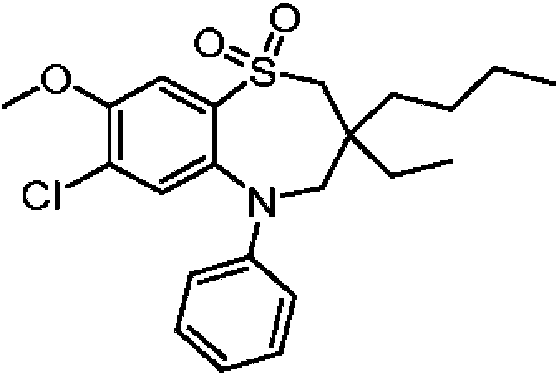
A una solución agitada de 3-butil-7-doro-3-etil-8-metoxi-5-fenil-2,3,4,5-tetrahidro-1,5-benzotiazepina (Intermedio 9; 10.2 g, 0.0261 mol) en 1,4-dioxano (100 ml) a temperatura ambiente se agregaron agua (100 ml) y oxona (81 g, 0.2615 mol) y la mezcla de reacción se agitó durante 24 horas a temperatura ambiente. Después de la finalización de la reacción (monitorizada por TLC), la mezcla de reacción se filtró a través de un embudo Büchner y el filtrado se extrajo con EtOAc (2 x 25 ml). La capa orgánica combinada se lavó con agua (25 ml) y solución salina (25 ml), se secó sobre Na2SO4 anhidro y se concentró bajo vacío. El material crudo se purificó mediante cromatografía en columna Isolera (eluyente: EtOAc/PE al 10-12%; gel de sílice: 230-400 de malla) para producir el compuesto del título. Rendimiento: 56 % (6.2 g, sólido amarillento).To a stirred solution of 3-butyl-7-doro-3-ethyl-8-methoxy-5-phenyl-2,3,4,5-tetrahydro-1,5-benzothiazepine (Intermediate 9; 10.2 g, 0.0261 mol) In 1,4-dioxane (100 ml) at room temperature, water (100 ml) and oxone (81 g, 0.2615 mol) were added and the reaction mixture was stirred for 24 hours at room temperature. After completion of the reaction (monitored by TLC), the reaction mixture was filtered through a Büchner funnel and the filtrate was extracted with EtOAc (2 x 25 ml). The combined organic layer was washed with water (25 mL) and brine (25 mL), dried over anhydrous Na 2 SO 4 and concentrated under vacuum. The crude material was purified by Isolera column chromatography (eluent: 10-12% EtOAc/PE; silica gel: 230-400 mesh) to yield the title compound. Yield: 56% (6.2 g, yellowish solid).
RMN 1H (300 MHz, DIVISOR): 87.50 (s, 1H), 7.27 (t, J = 7.8 Hz, 2H), 7.07-7.04 (m, 4H), 3.94 (s, 3H), 3.69 (s, 2H), 3.33 (s, 2H), 1.52-1.37 (m, 8H), 0.77-0.74 (m, 6H). LCMS: (Método A) 422.1 (M++H), Tr. 3.18 min, 98.51 % (Máx). 1H NMR (300 MHz, DIVIDER): 87.50 (s, 1H), 7.27 (t, J = 7.8 Hz, 2H), 7.07-7.04 (m, 4H), 3.94 (s, 3H), 3.69 (s, 2H) , 3.33 (s, 2H), 1.52-1.37 (m, 8H), 0.77-0.74 (m, 6H). LCMS: (Method A) 422.1 (M++H), Tr. 3.18 min, 98.51% (Max).
Intermedio 11Intermediate 11
1,1 -dióxido de 3-Butil-7-cloro-3-etil-8-hidroxi-5-fenil-2,3,4,5-tetrahidro-1,5-benzotiazepina3-Butyl-7-chloro-3-ethyl-8-hydroxy-5-phenyl-2,3,4,5-tetrahydro-1,5-benzothiazepine 1,1-dioxide

A una solución agitada de 1,1-dióxido de 3-butil-7-cloro-3-etil-8-metoxi-5-fenil-2,3,4,5-tetrahidro-1,5-benzotiazepina (Intermedio 10; 1.1 g, 2.60 mmol) en DCM (11 ml) a 0°C se agregó BBr3 (1M en DCM, 13.03 ml, 13.03 mmol) y la solución se agitó durante 1 hora a temperatura ambiente. Después de la finalización de la reacción (monitorizada por TLC), se agregó en forma de gotas metanol a 0 °C hasta que cesó la efervescencia. La mezcla de reacción se diluyó con DCM (20 ml) y se lavó con agua (2 x 20 ml) y solución salina (20 ml). La parte orgánica se secó sobre Na2SO4 anhidro y se concentró bajo vacío. El material crudo resultante se purificó mediante cromatografía en columna Isolera (eluyente: EtOAc/PE al 30-32 %; gel de sílice: 230-400 de malla) para producir el compuesto del título. Rendimiento: 94 % (1.0 g, sólido blancuzco).To a stirred solution of 3-butyl-7-chloro-3-ethyl-8-methoxy-5-phenyl-2,3,4,5-tetrahydro-1,5-benzothiazepine 1,1-dioxide (Intermediate 10; 1.1 g, 2.60 mmol) in DCM (11 ml) at 0°C BBr 3 (1M in DCM, 13.03 ml, 13.03 mmol) was added and the solution was stirred for 1 hour at room temperature. After completion of the reaction (monitored by TLC), methanol was added dropwise at 0 °C until effervescence ceased. The reaction mixture was diluted with DCM (20 ml) and washed with water (2 x 20 ml) and saline (20 ml). The organic part was dried over anhydrous Na 2 SO 4 and concentrated under vacuum. The resulting crude material was purified by Isolera column chromatography (eluent: 30-32% EtOAc/PE; silica gel: 230-400 mesh) to yield the title compound. Yield: 94% (1.0 g, off-white solid).
RMN 1H (400 MHz, DMSO-d6): 810.83 (s, 1H), 7.50 (s, 1H), 7.23 (t, J = 8.0 Hz, 2H), 6.99 (d, J = 7.6 Hz, 2H), 6.97 (s, 1H), 6.88 (t, J = 7.2 Hz, 1H), 3.64 (s, 2H), 3.28 (s, 2H), 1.51-1.34 (m, 4H), 1.12-1.02 (m, 4H), 0.77-0.72 (m, 6H). LCMS: (Método A) 408.2 (M++H), Tr. 2.87 min, 93.25 % (Máx).1H NMR (400 MHz, DMSO-d6): 810.83 (s, 1H), 7.50 (s, 1H), 7.23 (t, J = 8.0 Hz, 2H), 6.99 (d, J = 7.6 Hz, 2H), 6.97 (s, 1H), 6.88 (t, J = 7.2 Hz, 1H), 3.64 (s, 2H), 3.28 (s, 2H), 1.51-1.34 (m, 4H), 1.12-1.02 (m, 4H), 0.77-0.72 (m, 6H). LCMS: (Method A) 408.2 (M++H), Tr. 2.87 min, 93.25% (Max).
Separación de enantiómeros:Separation of enantiomers:
1,1-dióxido de (S)-3-butil-7-cloro-3-etil-8-hidroxi-5-fenil-2,3,4,5-tetrahidro-1,5-benzotiazepina y 1,1-dióxido de ®-3-butil-7-cloro-3-etil-8-hidroxi-5-fenil-2,3,4,5-tetrahidro-1,5-benzotiazepina (S)-3-butyl-7-chloro-3-ethyl-8-hydroxy-5-phenyl-2,3,4,5-tetrahydro-1,5-benzothiazepine and 1,1-dioxide ®-3-butyl-7-chloro-3-ethyl-8-hydroxy-5-phenyl-2,3,4,5-tetrahydro-1,5-benzothiazepine dioxide

Los dos enantiómeros de 1,1 -dióxido de 3-butil-7-cloro-3-etil-8-hidroxi-5-fenil-2,3,4,5-tetrahidro-1,5-benzotiazepina racémico (2.0 g, 4.9 mmol) se separaron mediante SFC quiral (método F). El material se concentró bajo vacío a 40 °C. La primera fracción de elución corresponde al enantiómero 1 y la segunda fracción de elución corresponde al enantiómero 2. Se desconoce la configuración absoluta de los dos enantiómeros.The two enantiomers of racemic 3-butyl-7-chloro-3-ethyl-8-hydroxy-5-phenyl-2,3,4,5-tetrahydro-1,5-benzothiazepine 1,1-dioxide (2.0 g, 4.9 mmol) were separated by chiral SFC (method F). The material was concentrated under vacuum at 40 °C. The first elution fraction corresponds to enantiomer 1 and the second elution fraction corresponds to enantiomer 2. The absolute configuration of the two enantiomers is unknown.
Enantiómero 1: Rendimiento: 45 % (900 mg, sólido blanco). LCMS: (Método A) 408.1 (M++H), Tr. 2.86 min, 94.09 % (Máx). HPLC: (Método B) Tr. 5.93 min, 96.49 % (Máx). SFC quiral: (Método H) Tr. 3.32 min, 95.52 % (Máx). (AR.NO: B601758)Enantiomer 1: Yield: 45% (900 mg, white solid). LCMS: (Method A) 408.1 (M++H), Tr. 2.86 min, 94.09% (Max). HPLC: (Method B) Tr. 5.93 min, 96.49% (Max). Chiral SFC: (Method H) Tr. 3.32 min, 95.52% (Max). (AR.NO: B601758)
Enantiómero 2: Rendimiento: 45 % (900 mg, sólido blanco). LCMS: (Método A) 408.2 (M++H), Tr. 2.88 min, 94.34 % (Máx). HPLC: (Método B) Tr. 5.93 min, 94.42 % (Máx). Pureza quiral: (Método H) Tr. 4.32 min, 100 % (Máx).Enantiomer 2: Yield: 45% (900 mg, white solid). LCMS: (Method A) 408.2 (M++H), Tr. 2.88 min, 94.34% (Max). HPLC: (Method B) Tr. 5.93 min, 94.42% (Max). Chiral purity: (Method H) Tr. 4.32 min, 100% (Max).
Intermedio 12Intermediate 12
3-((3-butil-7-cloro-3-etil-1,1-dióxido-5-fenil-2,3,4,5-tetrahidro-1,5-benzotiazepin-8-il)oxi)propanoato de etilo3-((3-butyl-7-chloro-3-ethyl-1,1-dioxide-5-phenyl-2,3,4,5-tetrahydro-1,5-benzothiazepin-8-yl)oxy)propanoate ethyl

A una suspensión agitada de 1,1-dióxido de 3-butil-7-cloro-3-etil-8-hidroxi-5-fenil-2,3,4,5-tetrahidro-1,5-benzotiazepina (Intermedio 11; 2.0 g, 4.91 mmol) en acrilato de etilo (10 ml) a temperatura ambiente, se agregó DMAP (0.06 g 0.49 mmol). La mezcla de reacción se calentó en un tubo sellado durante 24 horas a 100 °C. El progreso de la reacción se monitorizó mediante TLC, que indicó la conversión incompleta (~ 25 %) del material de partida. La mezcla de reacción luego se evaporó y se secó bajo vacío para producir el compuesto del título crudo, que se envió a la siguiente etapa sin ninguna purificación adicional. Rendimiento: 3.0 g (crudo, goma marrón).To a stirred suspension of 3-butyl-7-chloro-3-ethyl-8-hydroxy-5-phenyl-2,3,4,5-tetrahydro-1,5-benzothiazepine 1,1-dioxide (Intermediate 11; 2.0 g, 4.91 mmol) in ethyl acrylate (10 ml) at room temperature, DMAP (0.06 g 0.49 mmol) was added. The reaction mixture was heated in a sealed tube for 24 hours at 100 °C. The reaction progress was monitored by TLC, which indicated incomplete conversion (~25%) of the starting material. The reaction mixture was then evaporated and dried under vacuum to produce the crude title compound, which was sent to the next step without any further purification. Yield: 3.0 g (raw, brown gum).
LCMS: (Método C) 510.1 (M++2), Tr. 3.23 min, 10 % (Máx).LCMS: (Method C) 510.1 (M++2), Tr. 3.23 min, 10% (Max).
Intermedio 13Intermediate 13
Ácido 2-(((2-Amino-4-cloro-5-metoxifenil)tio)metil)-2-butilhexanoico2-(((2-Amino-4-chloro-5-methoxyphenyl)thio)methyl)-2-butylhexanoic acid

A una solución agitada de 5-cloro-6-metoxibenzo[d]tiazol-2-amina (Intermedio 5; 10 g, 0.046 mol) en agua (150 ml), se agregó KOH (40 g, 0.74 mol) y la mezcla de reacción se agitó durante 16 horas a 120 °C. Después de la finalización de la reacción (monitorizada por LCMS), la mezcla de reacción se enfrió a temperatura ambiente. Luego se agregó en forma de gotas ácido 2-(Bromometil)-2-butilhexanoico (12.33 g, 0.046 mol; disuelto en 50 ml de THF) y la mezcla se agitó durante 16 horas a temperatura ambiente. Después de la finalización de la reacción (monitorizada por LCMS), la mezcla de reacción se enfrió a 0 °C y se acidificó con HCl concentrado (pH ~2). La mezcla de reacción se extrajo con EtOAc (2 x 50 ml). La capa orgánica combinada luego se lavó con agua (50 ml) y solución salina (50 ml), se secó sobre Na2SO4 anhidro y se concentró bajo vacío para obtener el material crudo. El material crudo obtenido se envió como tal a la siguiente etapa sin ninguna purificación adicional. Rendimiento: 18.1 g (crudo, goma marrón).To a stirred solution of 5-chloro-6-methoxybenzo[d]thiazol-2-amine (Intermediate 5; 10 g, 0.046 mol) in water (150 mL), KOH (40 g, 0.74 mol) was added and the mixture The reaction mixture was stirred for 16 hours at 120 °C. After completion of the reaction (monitored by LCMS), the reaction mixture was cooled to room temperature. 2-(Bromomethyl)-2-butylhexanoic acid (12.33 g, 0.046 mol; dissolved in 50 mL THF) was then added dropwise and the mixture was stirred for 16 hours at room temperature. After completion of the reaction (monitored by LCMS), the reaction mixture was cooled to 0 °C and acidified with concentrated HCl (pH ~2). The reaction mixture was extracted with EtOAc (2 x 50 ml). The combined organic layer was then washed with water (50 mL) and brine (50 mL), dried over anhydrous Na 2 SO 4 and concentrated under vacuum to obtain the crude material. The crude material obtained was sent as such to the next stage without any additional purification. Yield: 18.1 g (raw, brown gum).
UPLC: (Método A) 374.9 (M++H), Tr. 1.74 min, 44.37 % (Máx).UPLC: (Method A) 374.9 (M++H), Tr. 1.74 min, 44.37% (Max).
Intermedio 14Intermediate 14
3,3-Dibutil-7-cloro-8-metoxi-2,3-dihidro-1,5-benzotiazepin-4(5H)-ona3,3-Dibutyl-7-chloro-8-methoxy-2,3-dihydro-1,5-benzothiazepin-4(5H)-one

A una solución agitada de ácido 2-(((2-Amino-4-cloro-5-metoxifenil)tio)metil)-2-butilhexanoico (Intermedio 13; 18.1 g, 0.048 mol) en EtOAc (110 ml) a 0 °C, se agregaron en forma de gotas trietilamina (9.77 g, 0.096 mol) y solución de anhídrido 1-propanofosfónico (EtOAc al 50 %) (18.47 g, 0.058 mol) y la mezcla de reacción se agitó durante 16 horas a temperatura ambiente. Después de la finalización de la reacción (monitorizada por UPLC), se agregó agua (25 ml) a la mezcla de reacción y la capa acuosa se extrajo con EtOAc (2 x 25 ml). La capa orgánica combinada se lavó con solución salina (25 ml), se secó sobre Na2SO4 anhidro y se concentró bajo vacío. El material crudo resultante se purificó mediante cromatografía en columna Isolera (eluyente: EtOAc/PE al 10-12 %; gel de sílice: 230-400 de malla) para producir el compuesto del título. Rendimiento: 28 % (4.78 g, sólido blancuzco).To a stirred solution of 2-(((2-Amino-4-chloro-5-methoxyphenyl)thio)methyl)-2-butylhexanoic acid (Intermediate 13; 18.1 g, 0.048 mol) in EtOAc (110 mL) at 0° C, triethylamine (9.77 g, 0.096 mol) and 1-propanephosphonic anhydride solution (50% EtOAc) (18.47 g, 0.058 mol) were added dropwise and the reaction mixture was stirred for 16 hours at room temperature. After completion of the reaction (monitored by UPLC), water (25 mL) was added to the reaction mixture and the aqueous layer was extracted with EtOAc (2 x 25 mL). The combined organic layer was washed with brine (25 mL), dried over anhydrous Na 2 SO 4 and concentrated under vacuum. The resulting crude material was purified by Isolera column chromatography (eluent: 10-12% EtOAc/PE; silica gel: 230-400 mesh) to yield the title compound. Yield: 28% (4.78 g, off-white solid).
RMN 1H (400 MHz, DMSO-d6): 8 9.60 (s, 1H), 7.16 (t, J = 11.6 Hz, 1H), 6.90 (s, 1H), 3.83 (s, 3H), 3.00 (s, 2H), 1.59 1.43 (m, 4H), 1.24-1.17 (m, 8 H), 0.76 (t, J = 4.0 Hz, 6 H). LCMS: (Método A) 358.1 (M++2), Tr. 3.10 min, 92.74 %(Máx). 1H NMR (400 MHz, DMSO-d 6 ): 8 9.60 (s, 1H), 7.16 (t, J = 11.6 Hz, 1H), 6.90 (s, 1H), 3.83 (s, 3H), 3.00 (s, 2H), 1.59 1.43 (m, 4H), 1.24-1.17 (m, 8 H), 0.76 (t, J = 4.0 Hz, 6 H). LCMS: (Method A) 358.1 (M++2), Tr. 3.10 min, 92.74 %(Max).
Intermedio 15Intermediate 15
3,3-Dibutil-7-cloro-8-metoxi-5-fenil-2,3-dihidro-1,5-benzotiazepin-4(5H)-ona3,3-Dibutyl-7-chloro-8-methoxy-5-phenyl-2,3-dihydro-1,5-benzothiazepin-4(5H)-one

A una solución agitada de 3,3-dibutil-7-cloro-8-metoxi-2,3-dihidro-1,5-benzotiazepin-4(5H)-ona (Intermedio 14; 4.78 g, 0.013 mol) en yodobenceno (40 ml) se agregaron yoduro de cobre (I) (0.25 g, 0.0013 mol) y K2CO3 (3.7 g, 0.026 mol) y la solución se purgó con nitrógeno durante 20 minutos para desgasificación. Luego se agregó Tris[2-(2-metoxietoxi)etil]amina (0 .8 6 g, 0.0026 mol) bajo atmósfera de nitrógeno y la mezcla de reacción resultante se calentó durante 40 horas a 135 °C. Después de la finalización de la reacción (monitorizada por UPLC), la mezcla de reacción se filtró a través de celita y la almohadilla de celita se lavó con EtOAc (15 ml). El filtrado se concentró bajo vacío para obtener el material crudo que se purificó mediante cromatografía en columna Isolera (eluyente: EtOAc/PE al 3-5 %; gel de sílice: 230-400 de malla) para producir el compuesto del título. Rendimiento: 70.6% (4.1 g, sólido marrón pálido).To a stirred solution of 3,3-dibutyl-7-chloro-8-methoxy-2,3-dihydro-1,5-benzothiazepin-4(5H)-one (Intermediate 14; 4.78 g, 0.013 mol) in iodobenzene ( 40 ml) copper (I) iodide (0.25 g, 0.0013 mol) and K 2 CO 3 (3.7 g, 0.026 mol) were added and the solution was purged with nitrogen for 20 minutes for degassing. Tris[2-(2-methoxyethoxy)ethyl]amine ( 0.86 g, 0.0026 mol) was then added under a nitrogen atmosphere and the resulting reaction mixture was heated for 40 hours at 135 °C. After completion of the reaction (monitored by UPLC), the reaction mixture was filtered through celite and the celite pad was washed with EtOAc (15 ml). The filtrate was concentrated under vacuum to obtain crude material which was purified by Isolera column chromatography (eluent: 3-5% EtOAc/PE; silica gel: 230-400 mesh) to yield the title compound. Yield: 70.6% (4.1 g, pale brown solid).
LCMS: (Método C) 434.1 (M++2), Tr. 3.55 min, 96.03 % (Máx).LCMS: (Method C) 434.1 (M++2), Tr. 3.55 min, 96.03% (Max).
Intermedio 16Intermediate 16
3,3-Dibutil-7-cloro-8-metoxi-5-fenil-2,3,4,5-tetrahidro-1,5-benzotiazepina 3,3-Dibutyl-7-chloro-8-methoxy-5-phenyl-2,3,4,5-tetrahydro-1,5-benzothiazepine
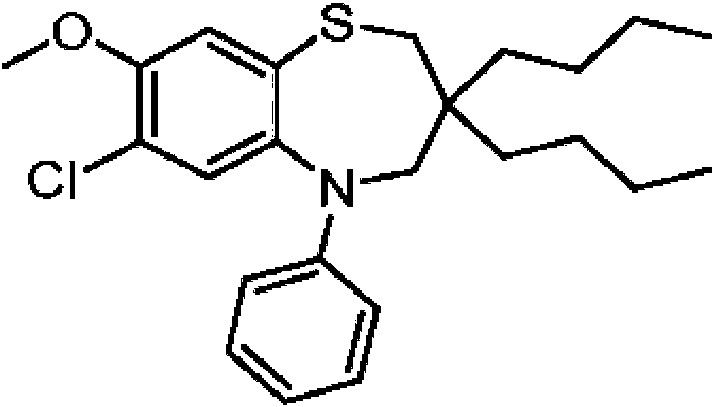
A una solución agitada de 3,3-dibutil-7-cloro-8-metoxi-5-fenil-2,3-dihidro-1,5-benzotiazepin-4(5H)-ona (Intermedio 15, 4.1 g, 0.009 mol) en THF (40 ml) a 0 °C, se agregó en forma de gotas dimetilsulfuro de borano (1M en THF, 47 ml, 0.047 mol) y la mezcla de reacción se sometió a reflujo durante 40 horas a 75 °C. Después de la finalización de la reacción (monitorizada por UPLC), la mezcla de reacción se enfrió a 0 °C y se apagó con metanol (50 ml). La solución resultante se calentó durante 2 horas a 65 °C, luego se enfrió a temperatura ambiente y se concentró bajo vacío. El material crudo obtenido se purificó mediante cromatografía en columna Isolera (eluyente: EtOAc/PE al 8-10 %; gel de sílice: 230-400 de malla) para producir el compuesto del título. Rendimiento: 84 % (3.3 g, líquido incoloro).To a stirred solution of 3,3-dibutyl-7-chloro-8-methoxy-5-phenyl-2,3-dihydro-1,5-benzothiazepin-4(5H)-one (Intermediate 15, 4.1 g, 0.009 mol ) in THF (40 mL) at 0 °C, borane dimethylsulfide (1M in THF, 47 mL, 0.047 mol) was added dropwise and the reaction mixture was refluxed for 40 hours at 75 °C. After completion of the reaction (monitored by UPLC), the reaction mixture was cooled to 0 °C and quenched with methanol (50 mL). The resulting solution was heated for 2 h at 65 °C, then cooled to room temperature and concentrated under vacuum. The crude material obtained was purified by Isolera column chromatography (eluent: 8-10% EtOAc/PE; silica gel: 230-400 mesh) to produce the title compound. Yield: 84% (3.3 g, colorless liquid).
RMN 1H (400 MHz, DMSO-da): 87.21 (t, J = 9.6 Hz, 2H), 7.06 (s, 1H), 6.95 (d, J = 10.4 Hz, 2H), 6.83 (t, J = 9.2 Hz, 2H), 6.77 (s, 1H), 3.82 (s, 3H), 3.57 (s, 2H), 3.32 (s, 2H), 1.30-1.20 (m, 4H), 1.10-1.00 (m, 8H), 0.76 (t, J = 4.00 Hz, 6H).1H NMR (400 MHz, DMSO-da): 87.21 (t, J = 9.6 Hz, 2H), 7.06 (s, 1H), 6.95 (d, J = 10.4 Hz, 2H), 6.83 (t, J = 9.2 Hz , 2H), 6.77 (s, 1H), 3.82 (s, 3H), 3.57 (s, 2H), 3.32 (s, 2H), 1.30-1.20 (m, 4H), 1.10-1.00 (m, 8H), 0.76 (t, J = 4.00 Hz, 6H).
Intermedio 17Intermediate 17
1.1 -dióxido de 3,3-Dibutil-7-cloro-8-metoxi-5-fenil-2,3,4,5-tetrahidro-1,5-benzotiazepina1,1-3,3-Dibutyl-7-chloro-8-methoxy-5-phenyl-2,3,4,5-tetrahydro-1,5-benzothiazepine dioxide

A una solución agitada de 3,3-dibutil-7-cloro-8-metoxi-5-fenil-2,3,4,5-tetrahidro-1,5-benzotiazepina (Intermedio 16; 3.3 g, 0.008 mol) en 1,4-dioxano (42 ml) a temperatura ambiente se agregaron agua (16 ml) y oxona (24.26 g, 0.08 mol) y la mezcla de reacción se agitó durante 24 horas a temperatura ambiente. Después de la finalización de la reacción (monitorizada por TLC), la mezcla de reacción se filtró a través de un embudo Büchnery el filtrado se extrajo con EtOAc (2x15 ml). La capa orgánica combinada se lavó con agua (25 ml) y solución salina (25 ml), se secó sobre Na2SO4 anhidro y se concentró bajo vacío. El material crudo se purificó mediante cromatografía en columna Isolera (eluyente: EtOAc/PE al 10-12 %; gel de sílice: 230-400 de malla) para producir el compuesto del título. Rendimiento: 68.7 % (2.4 g, sólido amarillento).To a stirred solution of 3,3-dibutyl-7-chloro-8-methoxy-5-phenyl-2,3,4,5-tetrahydro-1,5-benzothiazepine (Intermediate 16; 3.3 g, 0.008 mol) in 1 ,4-dioxane (42 ml) at room temperature, water (16 ml) and oxone (24.26 g, 0.08 mol) were added and the reaction mixture was stirred for 24 hours at room temperature. After completion of the reaction (monitored by TLC), the reaction mixture was filtered through a Büchner funnel, and the filtrate was extracted with EtOAc (2x15 ml). The combined organic layer was washed with water (25 mL) and brine (25 mL), dried over anhydrous Na 2 SO 4 and concentrated under vacuum. The crude material was purified by Isolera column chromatography (eluent: 10-12% EtOAc/PE; silica gel: 230-400 mesh) to yield the title compound. Yield: 68.7% (2.4 g, yellowish solid).
RMN 1H (400 MHz, DMSO-d6): 87.49 (s, 1H), 7.27 (t, J = 8.1 Hz, 2H), 7.08 (d, J = 7.5 Hz, 2H), 6.98 (s, 1H), 6.95 (t, J = 7.3 Hz, 1H), 3.93 (s, 3H), 3.70 (bs, 2H), 3.35 (s, 2H), 1.36-1.24 (m, 4H), 1.17-1.00 (m, 8H), 0.75 (t, J = 4.00 Hz, 6H). LCMS: (Método C) 452.3 (M++2), Tr. 3.53 min, 96.85 % (Máx).1H NMR (400 MHz, DMSO-d6): 87.49 (s, 1H), 7.27 (t, J = 8.1 Hz, 2H), 7.08 (d, J = 7.5 Hz, 2H), 6.98 (s, 1H), 6.95 (t, J = 7.3 Hz, 1H), 3.93 (s, 3H), 3.70 (bs, 2H), 3.35 (s, 2H), 1.36-1.24 (m, 4H), 1.17-1.00 (m, 8H), 0.75 (t, J = 4.00 Hz, 6H). LCMS: (Method C) 452.3 (M++2), Tr. 3.53 min, 96.85% (Max).
Intermedio 18Intermediate 18
1,1 -dióxido de 3,3-Dibutil-7-cloro-8-hidroxi-5-fenil-2,3,4,5-tetrahidro-1,5-benzotiazepina 3,3-Dibutyl-7-chloro-8-hydroxy-5-phenyl-2,3,4,5-tetrahydro-1,5-benzothiazepine 1,1-dioxide

A una solución agitada de 1,1-dióxido de 3,3-dibutil-7-cloro-8-metoxi-5-fenil-2,3,4,5-tetrahidro-1,5-benzotiazepina (Intermedio 17; 1.5 g, 3.33 mmol) en DCM (10 ml), se agregó BBr3 (1M en DCM, 6.6 ml, 6.66 mmol) a -10 °C y la mezcla resultante se agitó durante 3 horas a temperatura ambiente. Después de la finalización de la reacción (monitorizada por TLC), la mezcla de reacción se apagó con metanol (5 ml) y la mezcla de reacción se concentró bajo vacío. El material crudo resultante se purificó mediante cromatografía en columna Isolera (eluyente: EtOAc/PE al 10 15 %; gel de sílice: 230-400 de malla) para producir el compuesto del título. Rendimiento: 83% (1.2 g, sólido blancuzco).To a stirred solution of 3,3-dibutyl-7-chloro-8-methoxy-5-phenyl-2,3,4,5-tetrahydro-1,5-benzothiazepine 1,1-dioxide (Intermediate 17; 1.5 g , 3.33 mmol) in DCM (10 ml), BBr 3 (1M in DCM, 6.6 ml, 6.66 mmol) was added at -10 °C and the resulting mixture was stirred for 3 hours at room temperature. After completion of the reaction (monitored by TLC), the reaction mixture was quenched with methanol (5 mL) and the reaction mixture was concentrated under vacuum. The resulting crude material was purified by Isolera column chromatography (eluent: 10-15% EtOAc/PE; silica gel: 230-400 mesh) to yield the title compound. Yield: 83% (1.2 g, off-white solid).
RMN 1H (400 MHz, DMSO-d6): 810.79 (s, 1H), 7.50 (s, 1H), 7.24 (t, J = 8.2 Hz, 2H), 7.01 (d, J = 7.8 Hz, 2H), 6.91 (t, J = 9.0 Hz, 2H), 3.65 (bs, 2H), 3.29 (s, 2H), 1.40-1.30 (m, 5H), 1.20-1.12 (m, 7H), 0.74 (t, J = 4.0 Hz, 6H). LCMS: (Método C) 438.1 (M++2), Tr. 3.1 min, 96.07 % (Máx).1H NMR (400 MHz, DMSO-d6): 810.79 (s, 1H), 7.50 (s, 1H), 7.24 (t, J = 8.2 Hz, 2H), 7.01 (d, J = 7.8 Hz, 2H), 6.91 (t, J = 9.0 Hz, 2H), 3.65 (bs, 2H), 3.29 (s, 2H), 1.40-1.30 (m, 5H), 1.20-1.12 (m, 7H), 0.74 (t, J = 4.0 Hz, 6H). LCMS: (Method C) 438.1 (M++2), Tr. 3.1 min, 96.07% (Max).
Intermedio 19Intermediate 19
3-((3,3-dibutil-7-cloro-1,1-dióxido-5-fenil-2,3,4,5-tetrahidro-1,5-benzotiazepin-8-il)oxi)propanoato de etiloEthyl 3-((3,3-dibutyl-7-chloro-1,1-dioxide-5-phenyl-2,3,4,5-tetrahydro-1,5-benzothiazepin-8-yl)oxy)propanoate

A una suspensión agitada de 1,1-dióxido de 3,3-dibutil-7-cloro-8-hidroxi-5-fenil-2,3,4,5-tetrahidro-1,5-benzotiazepina (Intermedio 18; 1.2 g, 2.75 mmol) en acrilato de etilo (5 ml) a temperatura ambiente, se agregó DMAP (30 mg, 0.27 mmol). La mezcla de reacción se calentó en un tubo sellado durante 24 horas a 100 °C. El progreso de la reacción se monitorizó mediante TLC, que indicó la conversión incompleta (~20 %) del material de partida. La mezcla de reacción luego se concentró bajo vacío para producir el compuesto del título crudo, que se envió a la siguiente etapa sin ninguna purificación adicional. Rendimiento: 1 g (crudo, goma marrón).To a stirred suspension of 3,3-dibutyl-7-chloro-8-hydroxy-5-phenyl-2,3,4,5-tetrahydro-1,5-benzothiazepine 1,1-dioxide (Intermediate 18; 1.2 g , 2.75 mmol) in ethyl acrylate (5 ml) at room temperature, DMAP (30 mg, 0.27 mmol) was added. The reaction mixture was heated in a sealed tube for 24 hours at 100 °C. Reaction progress was monitored by TLC, which indicated incomplete conversion (∼20%) of the starting material. The reaction mixture was then concentrated under vacuum to produce the crude title compound, which was sent to the next step without any further purification. Yield: 1 g (raw, brown gum).
LCMS: (Método C) 537.3 (M++H), Tr. 3.55 min, 12.14 % (Máx).LCMS: (Method C) 537.3 (M++H), Tr. 3.55 min, 12.14% (Max).
Intermedio 20Intermediate 20
3-((3,3-dibutil-7-(metiltio)-1,1-dióxido-5-fenil-2,3,4,5-tetrahidro-1,5-benzotiazepin-8-il)oxi)-2-hidroxipropanoato de metilo3-((3,3-dibutyl-7-(methylthio)-1,1-dioxide-5-phenyl-2,3,4,5-tetrahydro-1,5-benzothiazepin-8-yl)oxy)-2 -methyl hydroxypropanoate

A una solución agitada de 1,1 -dióxido de 3,3-dibutil-8-hidroxi-7-(metiltio)-5-fenil-2,3,4,5-tetrahidro-1,5-benzotiazepina (0.5 g, 0.001 mmol) en DMF (4 ml) a temperatura ambiente, se agregaron CS2CO3 (0.73 g, 0.002 mmol) y oxirano-2-carboxilato de metilo (0.170 g, 0.002 mmol) y la mezcla de reacción luego se agitó durante 16 horas a 70 °C. El progreso de la reacción se monitorizó mediante TLC, que indicó la conversión incompleta del material de partida y formación de producto de eliminación. La mezcla de reacción se concentró bajo vacío para producir el material crudo que se purificó mediante cromatografía en columna Isolera (eluyente: EtOAc/PE al 25 %; gel de sílice: 230-400 de malla) para proporcionar el compuesto del título. Rendimiento: 8 % (50 mg, goma marrón).To a stirred solution of 1,1-dibutyl-8-hydroxy-7-(methylthio)-5-phenyl-2,3,4,5-tetrahydro-1,5-benzothiazepine dioxide (0.5 g, 0.001 mmol) in DMF (4 ml) at room temperature, CS 2 CO 3 (0.73 g, 0.002 mmol) and methyl oxirane-2-carboxylate (0.170 g, 0.002 mmol) were added and the reaction mixture was then stirred for 16 hours at 70 °C. The progress of the reaction was monitored by TLC, which indicated incomplete conversion of the starting material and formation of elimination product. The reaction mixture was concentrated under vacuum to yield crude material which was purified by Isolera column chromatography (eluent: 25% EtOAc/PE; silica gel: 230-400 mesh) to provide the title compound. Yield: 8 % (50 mg, brown gum).
LCMS: (Método E) 550.2 (M++H), Tr. 2.79 min y 532.2 (M++H), Tr. 2.96 min, 88.39 % (Máx).LCMS: (Method E) 550.2 (M++H), Tr. 2.79 min and 532.2 (M++H), Tr. 2.96 min, 88.39% (Max).
Intermedio 21Intermediate 21
1,1 -dióxido de 7-Bromo-3-butil-3-etil-8-metoxi-5-fenil-2,3,4,5-tetrahidro-1,5-benzotiazepina7-Bromo-3-butyl-3-ethyl-8-methoxy-5-phenyl-2,3,4,5-tetrahydro-1,5-benzothiazepine 1,1-dioxide

A una solución agitada de 1,1-dióxido de 7-bromo-3-butil-3-etil-8-mdroxi-5-feml-2,3,4,5-tetramdro-1,5-benzotiazepina (1.0 g, 2 mmol) en DMF seca (15 ml) a 0° C, se agregó hidruro de sodio (60 % en aceite mineral) (0.09 mg, 2.40 mmol) y la mezcla de reacción se agitó durante 10 min. Luego se agregó yoduro de metilo (0.4 ml, 6 mmol) a la mezcla de reacción y la mezcla se agitó a temperatura ambiente durante 30 minutos. Después de la finalización de la reacción (monitorizada por TLC), la mezcla de reacción se apagó con agua enfriada con hielo (2 ml) y la capa acuosa se extrajo con EtOAc (2 x 10 ml). La capa orgánica combinada se lavó con agua (15 ml), solución salina (15 ml), se secó sobre Na2SO4 anhidro y se concentró bajo vacío. El material crudo resultante se envió a la siguiente etapa sin ninguna purificación adicional. Rendimiento: 96 % (900 mg, crudo, sólido gomoso marrón).To a stirred solution of 7-bromo-3-butyl-3-ethyl-8-mdroxy-5-feml-2,3,4,5-tetramdro-1,5-benzothiazepine 1,1-dioxide (1.0 g, 2 mmol) in dry DMF (15 mL) at 0°C, sodium hydride (60% in mineral oil) (0.09 mg, 2.40 mmol) was added and the reaction mixture was stirred for 10 min. Methyl iodide (0.4 mL, 6 mmol) was then added to the reaction mixture and the mixture was stirred at room temperature for 30 minutes. After completion of the reaction (monitored by TLC), the reaction mixture was quenched with ice-cold water (2 mL) and the aqueous layer was extracted with EtOAc (2 x 10 mL). The combined organic layer was washed with water (15 mL), brine (15 mL), dried over anhydrous Na 2 SO 4 and concentrated under vacuum. The resulting crude material was sent to the next stage without any further purification. Yield: 96% (900 mg, crude, brown gummy solid).
RMN 1H (400 MHz, DMSO-d6): 8 7.45 (s, 1H), 7.26 (t, J = 8.0 Hz, 2H), 7.18 - 7.16 (m, 1H), 7.06 - 7.04 (m, 2H), 6.93 (t, J = 7.2 Hz, 1H), 3.93 (s, 3H), 3.70 -3.61 (m, 2H), 3.10 (s, 2H), 1.51 -0.90 (m, 8 H), 0.80 -0.72 (m, 6 H). LCMS: (Método A) 468.1 (M+2), Tr. 3.21 min, 96.82 % (Máx).1H NMR (400 MHz, DMSO-d 6 ): 8 7.45 (s, 1H), 7.26 (t, J = 8.0 Hz, 2H), 7.18 - 7.16 (m, 1H), 7.06 - 7.04 (m, 2H), 6.93 (t, J = 7.2 Hz, 1H), 3.93 (s, 3H), 3.70 -3.61 (m, 2H), 3.10 (s, 2H), 1.51 -0.90 (m, 8 H), 0.80 -0.72 (m , 6H ). LCMS: (Method A) 468.1 (M+2), Tr. 3.21 min, 96.82% (Max).
Intermedio 22Intermediate 22
1,1-dióxido de 3-Butil-3-etil-8-hidroxi-7-(metiltio)-5-fenil-2,3,4,5-tetrahidro-1,5-benzotiazepina3-Butyl-3-ethyl-8-hydroxy-7-(methylthio)-5-phenyl-2,3,4,5-tetrahydro-1,5-benzothiazepine 1,1-dioxide

A una solución agitada de 1,1-dióxido de 7-bromo-3-butil-3-etil-8-metoxi-5-feml-2,3,4,5-tetramdro-1,5-benzotiazepina (Intermedio 21; 0.9 g, 1.90 mmol) en DMF seca (15 ml), se agregó tiometóxido de sodio (687 mg, 9.5 mmol) a temperatura ambiente y la mezcla de reacción se agitó a 60 °C durante 16 horas. Después de la finalización de la reacción (monitorizada por LCMS), la mezcla de reacción se apagó con agua enfriada con hielo (2 ml) y la capa acuosa se extrajo con EtOAc (2 x10 ml). La capa orgánica combinada se lavó con agua (15 ml), solución salina (15 ml), se secó sobre Na2SO4 anhidro y se concentró bajo vacío. El material crudo resultante se purificó mediante cromatografía en columna Isolera (eluyente: EtOAc/PE al 10-15 %; gel de sílice: 230-400 de malla) para producir el compuesto del título. Rendimiento: 93 % (750 mg, sólido marrón pálido).To a stirred solution of 7-bromo-3-butyl-3-ethyl-8-methoxy-5-feml-2,3,4,5-tetramdro-1,5-benzothiazepine 1,1-dioxide (Intermediate 21; 0.9 g, 1.90 mmol) in dry DMF (15 mL), sodium thiomethoxide (687 mg, 9.5 mmol) was added at room temperature and the reaction mixture was stirred at 60 °C for 16 hours. After completion of the reaction (monitored by LCMS), the reaction mixture was quenched with ice-cold water (2 mL) and the aqueous layer was extracted with EtOAc (2 x 10 mL). The combined organic layer was washed with water (15 mL), brine (15 mL), dried over anhydrous Na 2 SO 4 and concentrated under vacuum. The resulting crude material was purified by chromatography on Isolera column (eluent: 10-15% EtOAc/PE; silica gel: 230-400 mesh) to produce the title compound. Yield: 93% (750 mg, pale brown solid).
RMN 1H (400 MHz, DMSO-da): 87.16 - 7.12 (m, 3H), 6.85 - 6.83 (m, 2H), 6.71 (t, J = 7.2 Hz, 1H), 6.60 (s, 1H), 3.74 -3.61 (m, 2H), 3.12 (s, 2H), 2.13 (s, 3H), 1.70 - 1.08 (m, 8H), 0.80 - 0.74 (m, 6H). UPLC: (Método A) 420.5 (M+H), Tr.1H NMR (400 MHz, DMSO-da): 87.16 - 7.12 (m, 3H), 6.85 - 6.83 (m, 2H), 6.71 (t, J = 7.2 Hz, 1H), 6.60 (s, 1H), 3.74 - 3.61 (m, 2H), 3.12 (s, 2H), 2.13 (s, 3H), 1.70 - 1.08 (m, 8H), 0.80 - 0.74 (m, 6H). UPLC: (Method A) 420.5 (M+H), Tr.
1.86 min, 91.84 % (Máx).1.86 min, 91.84% (Max).
Intermedio 23Intermediate 23
1,1 -dióxido de (S)-3-Butil-3-etil-8-hidroxi-7-(metiltio)-5-fenil-2,3,4,5-tetrahidro-1,5-benzotiazepina y 1,1 -dióxido de (R)-3-butil-3-etil-8-hidroxi-7-(metiltio)-5-fenil-2,3,4,5-tetrahidro-1,5-benzotiazepina(S)-3-Butyl-3-ethyl-8-hydroxy-7-(methylthio)-5-phenyl-2,3,4,5-tetrahydro-1,5-benzothiazepine 1,1-dioxide and 1, (R)-3-butyl-3-ethyl-8-hydroxy-7-(methylthio)-5-phenyl-2,3,4,5-tetrahydro-1,5-benzothiazepine 1-dioxide

Los dos enantiómeros de 1,1 -dióxido 3-butil-3-etil-8-hidroxi-7-(metiltio)-5-fenil-2,3,4,5-tetrahidro-1,5-benzotiazepina racémico (Intermedio 22) se separaron mediante SFC quiral (método F). El material se concentró bajo vacío a 40 °C. La primera fracción de elución corresponde al enantiómero 1 y la segunda fracción de elución corresponde al enantiómero 2. Se desconoce la configuración absoluta de los dos enantiómeros.The two enantiomers of racemic 1,1-dioxide 3-butyl-3-ethyl-8-hydroxy-7-(methylthio)-5-phenyl-2,3,4,5-tetrahydro-1,5-benzothiazepine (Intermediate 22 ) were separated by chiral SFC (method F). The material was concentrated under vacuum at 40 °C. The first elution fraction corresponds to enantiomer 1 and the second elution fraction corresponds to enantiomer 2. The absolute configuration of the two enantiomers is unknown.
Enantiómero 1: Rendimiento: 44 % (3.1 g, sólido marrón pálido). RMN 1H (400 MHz, DMSO-d6): 810.54 (s, 1H), 7.30 (s, 1H), 7.21-7.17 (m, 2H), 6.91 (d, J = 7.6 Hz, 2H), 6.80 (t, J = 7.2 Hz, 1H), 6.69 (s, 1H), 3.65 (bs, 2H), 3.20 (s, 2H), 2.18 (s, 3H), 1.60-1.50 (m, 1H), 1.50-1.40 (m, 1H), 1.40-1.25 (m, 2H), 1.20-1.00 (m, 4H), 0.80-0.74 (m, 6H). LCMS: (Método E) 419.9 (M++H), Tr. 3.04 min, 95.84 % (Máx). HPLC: (Método B) Tr. 5.93 min, 96.07 % (Máx). SFC quiral: (Método H) Tr. 3.58 min, 99.19 % (Máx).Enantiomer 1: Yield: 44% (3.1 g, pale brown solid). 1H NMR (400 MHz, DMSO-d6): 810.54 (s, 1H), 7.30 (s, 1H), 7.21-7.17 (m, 2H), 6.91 (d, J = 7.6 Hz, 2H), 6.80 (t, J = 7.2 Hz, 1H), 6.69 (s, 1H), 3.65 (bs, 2H), 3.20 (s, 2H), 2.18 (s, 3H), 1.60-1.50 (m, 1H), 1.50-1.40 (m , 1H), 1.40-1.25 (m, 2H), 1.20-1.00 (m, 4H), 0.80-0.74 (m, 6H). LCMS: (Method E) 419.9 (M++H), Tr. 3.04 min, 95.84% (Max). HPLC: (Method B) Tr. 5.93 min, 96.07% (Max). Chiral SFC: (Method H) Tr. 3.58 min, 99.19% (Max).
Enantiómero 2: Rendimiento: 42 % (3.0 g, sólido marrón pálido). RMN 1H (400 MHz, DMSO-d6): 810.52 (s, 1H), 7.29 (s, 1H), 7.18 (t, J = 11.2 Hz, 2H), 6.90 (d, J = 10.4 Hz, 2H), 6.78 (t, J = 9.6 Hz, 1H), 6.67 (s, 1H), 3.64 (bs, 2H), 3.19 (s, 2H), 2.16 (s, 3H), 1.51-1.49 (m, 1H), 1.50-1.20 (m, 3H), 1.20-0.95 (m, 4H), 0.85-0.65 (m, 6H). LCMS: (Método E) 419.9 (M++H), Tr. 3.04 min, 97.11 % (Máx). HPLC: (Método B) Tr. 5.93 min, 98.25 % (Máx). Pureza quiral: (Método H) Tr.Enantiomer 2: Yield: 42% (3.0 g, pale brown solid). 1H NMR (400 MHz, DMSO-d6): 810.52 (s, 1H), 7.29 (s, 1H), 7.18 (t, J = 11.2 Hz, 2H), 6.90 (d, J = 10.4 Hz, 2H), 6.78 (t, J = 9.6 Hz, 1H), 6.67 (s, 1H), 3.64 (bs, 2H), 3.19 (s, 2H), 2.16 (s, 3H), 1.51-1.49 (m, 1H), 1.50- 1.20 (m, 3H), 1.20-0.95 (m, 4H), 0.85-0.65 (m, 6H). LCMS: (Method E) 419.9 (M++H), Tr. 3.04 min, 97.11% (Max). HPLC: (Method B) Tr. 5.93 min, 98.25% (Max). Chiral purity: (Method H) Tr.
5.03 min, 98.68 % (Máx).5.03 min, 98.68% (Max).
Intermedio 24Intermediate 24
3-((3-butil-3-etil-7-(metiltio)-1,1-dióxido-5-fenil-2,3,4,5-tetrahidro-1,5-benzotiazepin-8-il)oxi)propanoato de etilo3-((3-butyl-3-ethyl-7-(methylthio)-1,1-dioxide-5-phenyl-2,3,4,5-tetrahydro-1,5-benzothiazepin-8-yl)oxy) ethyl propanoate

A una suspensión agitada de 1,1 -dióxido de 3-butil-3-etil-8-hidroxi-7-(metiltio)-5-fenil-2,3,4,5-tetrahidro-1,5-benzotiazepina (Intermedio 22; 1.0 g, 2.38 mmol) en acrilato de etilo (5 ml) a temperatura ambiente, se agregó DMAP (30 mg, 0.23 mmol). La mezcla de reacción se calentó en un tubo sellado durante 24 horas a 100 °C. El progreso de la reacción se monitorizó mediante TLC, que indicó la conversión incompleta (~30 %) del material de partida. La mezcla de reacción luego se evaporó y se secó bajo vacío para producir el compuesto del título crudo, que se envió a la siguiente etapa sin ninguna purificación adicional. Rendimiento: 1.3 g (crudo, goma marrón).To a stirred suspension of 1,1-3-butyl-3-ethyl-8-hydroxy-7-(methylthio)-5-phenyl-2,3,4,5-tetrahydro-1,5-benzothiazepine dioxide (Intermediate 22; 1.0 g, 2.38 mmol) in ethyl acrylate (5 ml) at room temperature, DMAP (30 mg, 0.23 mmol) was added. The reaction mixture was heated in a sealed tube for 24 hours at 100 °C. Reaction progress was monitored by TLC, which indicated incomplete conversion (∼30%) of the starting material. The reaction mixture was then evaporated and dried under vacuum to produce the crude title compound, which was sent to the next step without any further purification. Yield: 1.3 g (raw, brown gum).
LCMS: (Método E) 520.2 (M++H), Tr. 6.18 min, 29.31 % (Máx). LCMS: (Method E) 520.2 (M++H), Tr. 6.18 min, 29.31% (Max).
Intermedio 25Intermediate 25
(E)-3-((3,3-dibutil-7-(metiltio)-1,1-dióxido-5-fenil-2,3,4,5-tetrahidro-1,5-benzotiazepin-8-il)oxi)acrilato de etilo y (Z)-3-((3,3-dibutil-7-(metiltio)-1,1-dióxido-5-fenM-2,3,4,5-tetrahidro-1,5-benzotiazepin-8-il)oxi)acrilato de etilo(E)-3-((3,3-dibutyl-7-(methylthio)-1,1-dioxide-5-phenyl-2,3,4,5-tetrahydro-1,5-benzothiazepin-8-yl) ethyl oxy)acrylate and (Z)-3-((3,3-dibutyl-7-(methylthio)-1,1-dioxide-5-phenM-2,3,4,5-tetrahydro-1,5- ethyl benzothiazepin-8-yl)oxy)acrylate

A una solución agitada de 1,1-dióxido de 3,3-dibutil-8-hidroxi-7-(metiltio)-5-fenil-2,3,4,5-tetrahidro-1,5-benzotiazepina (4 g, 8.93 mmol) en DMF seca (50 ml), se agregaron (E)-3-bromoacrilato de etilo (2.4 g, 13.4 mmol), carbonato de potasio (2.46 g, 17.87 mmol) y bromuro de tetra-butil amonio (0.287 g, 0.89 mmol) a temperatura ambiente y la mezcla de reacción se calentó a 90 °C durante 12 horas. Después de la finalización de la reacción (monitorizada por TLC), la mezcla de reacción se vertió en agua enfriada con hielo y se extrajo con EtOAc (3 x 25 ml). La capa orgánica combinada se lavó con solución salina (50 ml), se secó sobre Na2SO4 anhidro y se concentró bajo vacío para producir el compuesto del título como una mezcla de los isómeros (E) y (Z) (relación 1.7:1). Esta mezcla se separó mediante Prep-HPLC (método A) para producir la primera fracción de elución que corresponde al isómero (Z) y la segunda fracción de elución que corresponde al isómero (E), con 73 % de rendimiento general.To a stirred solution of 3,3-dibutyl-8-hydroxy-7-(methylthio)-5-phenyl-2,3,4,5-tetrahydro-1,5-benzothiazepine 1,1-dioxide (4 g, 8.93 mmol) in dry DMF (50 ml), ethyl (E)-3-bromoacrylate (2.4 g, 13.4 mmol), potassium carbonate (2.46 g, 17.87 mmol) and tetra-butyl ammonium bromide (0.287 g) were added. , 0.89 mmol) at room temperature and the reaction mixture was heated at 90 °C for 12 hours. After completion of the reaction (monitored by TLC), the reaction mixture was poured into ice-cold water and extracted with EtOAc (3 x 25 mL). The combined organic layer was washed with brine (50 mL), dried over anhydrous Na 2 SO 4 and concentrated under vacuum to afford the title compound as a mixture of the (E) and (Z) isomers (ratio 1.7: 1). This mixture was separated by Prep-HPLC (method A) to produce the first elution fraction corresponding to the (Z) isomer and the second elution fraction corresponding to the (E) isomer, with 73% overall yield.
Isómero (E): Rendimiento: 39 % (1.9 g, sólido blanco). RMN 1H (400 MHz, DMSO-d6): 87.72 (d, J = 16.0 Hz, 1H), 7.48 (s, 1H), 7.32-7.27 (m, 2H), 7.19-7.16 (m, 2H), 7.02-6.97 (m, 1H), 6.63 (s, 1H), 5.48 (d, J = 16.0 Hz, 1H), 4.14-4.07 (m, 2H), 3.75 (bs, 2H), 3.36 (s, 2H), 2.14 (s, 3H), 1.40-1.31 (m, 4H), 1.27-1.08 (m, 11H), 0.75-0.73 (m, 6H). LCMS: (Método C) 546.1 (M+H), Tr. 3.47 min, 97.89 % (Máx) Isómero (Z): Rendimiento: 34 % (1.65 g, sólido blanco). RMN 1H (400 MHz, DMSO-d6): 87.47 (s, 1H), 7.32-7.28 (m, 2H), 7.20-7.19 (m, 2H), 7.16-7.14 (m, 1H), 7.01-6.97 (m, 1H), 6.66 (s, 1H), 5.26 (d, J = 8.0 Hz, 1H), 4.13-4.08 (m, 2H), 3.75 (bs, 2H), 3.33 (s, 2H), 2.18 (s, 3H), 1.43-1.36 (m, 2H), 1.33-1.30 (m, 2H), 1.22 (m, 3H), 1.10-0.98 (m, 8H), 0.76-0.73 (m, 6H). LCMS: (Método C) 546.1 (M+H), Tr. 3.34 min, 98.32 % (Máx).Isomer (E): Yield: 39% (1.9 g, white solid). 1H NMR (400 MHz, DMSO-d6): 87.72 (d, J = 16.0 Hz, 1H), 7.48 (s, 1H), 7.32-7.27 (m, 2H), 7.19-7.16 (m, 2H), 7.02- 6.97 (m, 1H), 6.63 (s, 1H), 5.48 (d, J = 16.0 Hz, 1H), 4.14-4.07 (m, 2H), 3.75 (bs, 2H), 3.36 (s, 2H), 2.14 (s, 3H), 1.40-1.31 (m, 4H), 1.27-1.08 (m, 11H), 0.75-0.73 (m, 6H). LCMS: (Method C) 546.1 (M+H), Tr. 3.47 min, 97.89% (Max) Isomer (Z): Yield: 34% (1.65 g, white solid). 1H NMR (400 MHz, DMSO-d6): 87.47 (s, 1H), 7.32-7.28 (m, 2H), 7.20-7.19 (m, 2H), 7.16-7.14 (m, 1H), 7.01-6.97 (m , 1H), 6.66 (s, 1H), 5.26 (d, J = 8.0 Hz, 1H), 4.13-4.08 (m, 2H), 3.75 (bs, 2H), 3.33 (s, 2H), 2.18 (s, 3H), 1.43-1.36 (m, 2H), 1.33-1.30 (m, 2H), 1.22 (m, 3H), 1.10-0.98 (m, 8H), 0.76-0.73 (m, 6H). LCMS: (Method C) 546.1 (M+H), Tr. 3.34 min, 98.32% (Max).
Intermedio 26Intermediate 26
3-((3,3-dibutil-7-(metiltio)-1,1-dióxido-5-fenil-2,3,4,5-tetrahidro-1,5-benzotiazepin-8-il)oxi)propanoato de etilo3-((3,3-dibutyl-7-(methylthio)-1,1-dioxide-5-phenyl-2,3,4,5-tetrahydro-1,5-benzothiazepin-8-yl)oxy)propanoate ethyl

A una solución agitada de una mezcla de (E)-3-((3,3-dibutil-7-(metiltio)-1,1-dióxido-5-fenil-2,3,4,5-tetrahidro-1,5-benzotiazepin-8-il)oxi)acrilato de etilo y (z)-3-((3,3-dibutil-7-(metiltio)-1,1-dióxido-5-fenil-2,3,4,5-tetrahidro-1,5-benzotiazepin-8-il)oxi)acrilato de etilo (Intermedio 25; 2.8 g, 0.51 mmol) en EtOAc (15 ml), se agregaron Pd/C (0.56 g, 52.6 mmol) y AcOH (0.1 ml) bajo atmósfera de nitrógeno y la mezcla se agitó bajo atmósfera de hidrógeno en una miniclave (bajo 2.5-3.0 kg de presión) durante 12 horas a temperatura ambiente. Después de la finalización de la reacción (monitorizada por LCMS), la mezcla de reacción se filtró a través de celita y la almohadilla de celita se lavó con EtOAc (2x15m l). El filtrado combinado se concentró bajo vacío para proporcionar el compuesto del título. Rendimiento: 64 % (1.8 g, sólido blancuzco).To a stirred solution of a mixture of (E)-3-((3,3-dibutyl-7-(methylthio)-1,1-dioxide-5-phenyl-2,3,4,5-tetrahydro-1, Ethyl 5-benzothiazepin-8-yl)oxy)acrylate and (z)-3-((3,3-dibutyl-7-(methylthio)-1,1-dioxide-5-phenyl-2,3,4, Ethyl 5-tetrahydro-1,5-benzothiazepin-8-yl)oxy)acrylate (Intermediate 25; 2.8 g, 0.51 mmol) in EtOAc (15 mL), Pd/C (0.56 g, 52.6 mmol) and AcOH were added (0.1 ml) under a nitrogen atmosphere and the mixture was stirred under a hydrogen atmosphere in a miniclave (under 2.5-3.0 kg pressure) for 12 hours at room temperature. After completion of the reaction (monitored by LCMS), the reaction mixture was filtered through celite and the celite pad was washed with EtOAc (2x15µl). The combined filtrate was concentrated under vacuum to give the title compound. Yield: 64% (1.8 g, off-white solid).
Intermedio 27Intermediate 27
1,1-dióxido de 3-Butil-7-(dimetilamino)-3-etil-8-metoxi-5-fenil-2,3,4,5-tetrahidro-1,5-benzotiazepina 3-Butyl-7-(dimethylamino)-3-ethyl-8-methoxy-5-phenyl-2,3,4,5-tetrahydro-1,5-benzothiazepine 1,1-dioxide

A una solución agitada de 1,1 -dióxido de 7-bromo-3-butil-3-etil-8-metoxi-5-fenil-2,3,4,5-tetrahidro-1,5-benzotiazepina (Intermedio 21, 3 g, 6.43 mmol) en tolueno (10 ml), se agregó CS2CO3 (5.2 g, 16.1 mmol) y la mezcla de reacción se desgasificó durante 10 minutos con N2. Luego se agregaron dimetilamina (2M en THF, 6.4 ml, 12.8 mmol), Pd(OAc)2 (0.04 g, 0.16 mmol) seguida por X-Phos (0.08 g, 0.16 mmol) y la mezcla de reacción se calentó durante 16 horas a 90 °C. Después de la finalización de la reacción (monitorizada por TLC), la mezcla de reacción se filtró a través de celita y la almohadilla de celita se lavó con EtOAc (100 ml). La parte orgánica combinada se concentró bajo vacío y el crudo resultante se purificó mediante cromatografía en columna Isolera (eluyente: EtOAc/PE al 13-15 %, gel de sílice: 230-400 de malla) para producir el compuesto del título. Rendimiento: 26 % (0.7 g, goma amarilla).To a stirred solution of 1,1-7-bromo-3-butyl-3-ethyl-8-methoxy-5-phenyl-2,3,4,5-tetrahydro-1,5-benzothiazepine dioxide (Intermediate 21, 3 g, 6.43 mmol) in toluene (10 mL), CS 2 CO 3 (5.2 g, 16.1 mmol) was added and the reaction mixture was degassed for 10 minutes with N 2 . Then dimethylamine (2M in THF, 6.4 mL, 12.8 mmol), Pd(OAc )2 (0.04 g, 0.16 mmol) followed by X-Phos (0.08 g, 0.16 mmol) were added and the reaction mixture was heated for 16 hours. at 90°C. After completion of the reaction (monitored by TLC), the reaction mixture was filtered through celite and the celite pad was washed with EtOAc (100 mL). The combined organic part was concentrated under vacuum and the resulting crude oil was purified by Isolera column chromatography (eluent: 13-15% EtOAc/PE, silica gel: 230-400 mesh) to give the title compound. Yield: 26% (0.7 g, yellow gum).
RMN 1H (400 MHz, DMSO-d6): 8 7.28 (s, 1H), 7.22-7.18 (m, 2H), 6.97 (d, J = 8.0 Hz, 2H), 6.83 (t, J = 7.2 Hz, 1H), 6.34 (s, 1H), 3.85 (s, 3H), 3.70 (bs, 2H), 3.29 (s, 2H), 2.66 (s, 6 H), 1.54-1.41 (m, 2H), 1.35-1.24 (m, 2H), 1.20-1.12 (m, 4H), 0.85-0.75 (m, 6 H). LCMS: (Método A) 431.2 (M++H), Tr. 3.19 min, 83.34 % (Máx).1H NMR (400 MHz, DMSO-d 6 ): 8 7.28 (s, 1H), 7.22-7.18 (m, 2H), 6.97 (d, J = 8.0 Hz, 2H), 6.83 (t, J = 7.2 Hz, 1H), 6.34 (s, 1H), 3.85 (s, 3H), 3.70 (bs, 2H), 3.29 (s, 2H), 2.66 (s, 6 H), 1.54-1.41 (m, 2H), 1.35- 1.24 (m, 2H), 1.20-1.12 (m, 4H), 0.85-0.75 (m, 6H ). LCMS: (Method A) 431.2 (M++H), Tr. 3.19 min, 83.34% (Max).
Intermedio 28Intermediate 28
1,1 -dióxido de 3-butil-7-(dimetilamino)-3-etil-8-hidroxi-5-fenil-2,3,4,5-tetrahidro-1,5-benzotiazepina3-butyl-7-(dimethylamino)-3-ethyl-8-hydroxy-5-phenyl-2,3,4,5-tetrahydro-1,5-benzothiazepine 1,1-dioxide

A una solución agitada de 1,1-dióxido de 3-Butil-7-(dimetilamino)-3-etil-8-metoxi-5-fenil-2,3,4,5-tetrahidro-1,5-benzotiazepina (Intermedio 27; 1.9 g, 4.41 mmol) en DMF (15 ml) a temperatura ambiente, se agregó tiometóxido de sodio (1.54 g, 22.06 mmol) y la mezcla de reacción se agitó durante 12 horas a 80 °C. Después de la finalización de la reacción (monitorizada por TLC), la mezcla de reacción se enfrió a temperatura ambiente y se apagó con agua (15 ml). La capa acuosa se extrajo con EtOAc (2x15 ml), y la capa orgánica combinada se lavó con agua (20 ml) y solución salina (20 ml) y se secó sobre Na2SO4 anhidro. La parte orgánica se concentró bajo vacío para producir el compuesto crudo que se envió como tal a la siguiente etapa sin ninguna purificación adicional. Rendimiento: 1.8 g (crudo, goma marrón).To a stirred solution of 3-Butyl-7-(dimethylamino)-3-ethyl-8-methoxy-5-phenyl-2,3,4,5-tetrahydro-1,5-benzothiazepine 1,1-dioxide (Intermediate 27; 1.9 g, 4.41 mmol) in DMF (15 ml) at room temperature, sodium thiomethoxide (1.54 g, 22.06 mmol) was added and the reaction mixture was stirred for 12 hours at 80 °C. After completion of the reaction (monitored by TLC), the reaction mixture was cooled to room temperature and quenched with water (15 mL). The aqueous layer was extracted with EtOAc (2x15 mL), and the combined organic layer was washed with water (20 mL) and brine (20 mL) and dried over anhydrous Na 2 SO 4 . The organic part was concentrated under vacuum to produce the crude compound which was sent as such to the next step without any further purification. Yield: 1.8 g (raw, brown gum).
LCMS: (Método E) 417.2 (M++H), Tr. 2.11 min, 55.04 % (Máx).LCMS: (Method E) 417.2 (M++H), Tr. 2.11 min, 55.04% (Max).
Intermedio 29Intermediate 29
3-((3,3-dibutil-7-(metiltio)-1,1-dióxido-5-fenil-2,3,4,5-tetrahidro-1,5-benzotiazepin-8-il)oxi)-2-hidroxi-2-metilpropanoato de metilo3-((3,3-dibutyl-7-(methylthio)-1,1-dioxide-5-phenyl-2,3,4,5-tetrahydro-1,5-benzothiazepin-8-yl)oxy)-2 methyl-hydroxy-2-methylpropanoate

A una solución agitada de 1,1-dióxido de 3,3-dibutil-8-hidroxi-7-(metiltio)-5-fenil-2,3,4,5-tetrahidro-1,5-benzotiazepina (500 mg, 1.11 mmol) en N-metil-2-pirrolidona (5 ml), se agregaron CS2CO3 (723 mg, 2.23 mmol) y 2-metil-glicidato de metilo (260 mg, 2.23 mmol) y la mezcla de reacción se calentó durante 16 horas a 80 °C. Después de la finalización de la reacción (monitorizada por TLC), la mezcla de reacción se apagó con HCl diluido (1.5 N, 5 ml) y se diluyó con agua (5 ml). La capa acuosa se extrajo con EtOAc (2x10 ml), y la capa orgánica combinada se lavó con agua (10 ml) y solución salina (10 ml). La parte orgánica se secó sobre Na2SO4 anhidro, se filtró y se concentró bajo vacío. El material crudo resultante se purificó mediante cromatografía en columna Isolera (eluyente: EtOAc/PE al 40 %; gel de sílice: 230-400 de malla) para producir el compuesto del título. Rendimiento: 40 % (250 mg, goma blanca).To a stirred solution of 3,3-dibutyl-8-hydroxy-7-(methylthio)-5-phenyl-2,3,4,5-tetrahydro-1,5-benzothiazepine 1,1-dioxide (500 mg, 1.11 mmol) in N-methyl-2-pyrrolidone (5 ml), CS 2 CO 3 (723 mg, 2.23 mmol) and methyl 2-methyl-glycidate (260 mg, 2.23 mmol) were added and the reaction mixture was heated for 16 hours at 80 °C. After completion of the reaction (monitored by TLC), the reaction mixture was quenched with dilute HCl (1.5 N, 5 mL) and diluted with water (5 mL). The aqueous layer was extracted with EtOAc (2x10 ml), and the combined organic layer was washed with water (10 ml) and saline (10 ml). The organic part was dried over anhydrous Na 2 SO 4 , filtered and concentrated under vacuum. The resulting crude material was purified by Isolera column chromatography (eluent: 40% EtOAc/PE; silica gel: 230-400 mesh) to yield the title compound. Yield: 40% (250 mg, white gum).
RMN 1H (400 MHz, DMSO-da): 8 7.29 (s, 1H), 7.21 (t, J = 7.6 Hz, 2H), 7.00 (d, J = 7.2 Hz, 2H), 6 . 8 6 (t, J = 7.2 Hz, 1H), 6.65 (s, 1H), 4.16-4.01 (m, 2H), 3.67-3.59 (m, 5H), 3.26 (s, 2H), 2.13 (s, 3H), 1.42-1.35 (m, 5H), 1.34-1.25 (m, 2H), 1.24-1.05 (m, 8 H), 0.77-0.74 (m, 6 H). LCMS: (Método A) 564.1 (M++H), Tr. 3.15 min, 99.13 % (Máx).1H NMR (400 MHz, DMSO-da): 8 7.29 (s, 1H), 7.21 (t, J = 7.6 Hz, 2H), 7.00 (d, J = 7.2 Hz, 2H), 6 . 8 6 (t, J = 7.2 Hz, 1H), 6.65 (s, 1H), 4.16-4.01 (m, 2H), 3.67-3.59 (m, 5H), 3.26 (s, 2H), 2.13 (s, 3H ), 1.42-1.35 (m, 5H), 1.34-1.25 (m, 2H), 1.24-1.05 (m, 8 H), 0.77-0.74 (m, 6 H). LCMS: (Method A) 564.1 (M++H), Tr. 3.15 min, 99.13% (Max).
Intermedio 30Intermediate 30
Ácido 2-(((2-Amino-4-bromo-5-metoxifenil)tio)metil)-2-metilhexanoico2-(((2-Amino-4-bromo-5-methoxyphenyl)thio)methyl)-2-methylhexanoic acid

A una solución agitada de 5-bromo-6-metoxibenzo[d]tiazol-2-amina (63 g, 0.243 mol) en agua (630 ml), se agregó KOH (218.2 g, 3.89 mol) y la mezcla de reacción se agitó durante 16 horas a 120 °C. Después de la finalización de la reacción (monitorizada por LCMS), la mezcla de reacción se enfrió a temperatura ambiente. Luego se agregó en forma de gotas una solución de ácido 2-(bromometil)-2-metilhexanoico (70.5 g, 6.31 mol) en THF (210 ml) y la mezcla de reacción se agitó durante 16 horas a temperatura ambiente. Después de la finalización de la reacción (monitorizada por LCMS), la mezcla de reacción se enfrió a 0 °C y se acidificó con HCl conc. (pH ~2). La mezcla de reacción se extrajo con EtOAc (2 x 350 ml) y la capa orgánica combinada se lavó con agua (150 ml) y solución salina (150 ml). La parte orgánica se secó sobre Na2SO4 anhidro y se concentró bajo vacío. El crudo resultante se envió como tal a la siguiente etapa sin ninguna purificación adicional. Rendimiento: 75 g (crudo, goma marrón).To a stirred solution of 5-bromo-6-methoxybenzo[d]thiazol-2-amine (63 g, 0.243 mol) in water (630 mL), KOH (218.2 g, 3.89 mol) was added and the reaction mixture was stirred for 16 hours at 120 °C. After completion of the reaction (monitored by LCMS), the reaction mixture was cooled to room temperature. A solution of 2-(bromomethyl)-2-methylhexanoic acid (70.5 g, 6.31 mol) in THF (210 mL) was then added dropwise and the reaction mixture was stirred for 16 hours at room temperature. After completion of the reaction (monitored by LCMS), the reaction mixture was cooled to 0 °C and acidified with conc. HCl. (pH ~2). The reaction mixture was extracted with EtOAc (2 x 350 mL) and the combined organic layer was washed with water (150 mL) and brine (150 mL). The organic part was dried over anhydrous Na 2 SO 4 and concentrated under vacuum. The resulting crude oil was sent as such to the next stage without any additional purification. Yield: 75 g (raw, brown gum).
LCMS: (Método A) 376.1(M+), 378.0 (M++2), Tr. 2.44 min, 92.97 % (Máx).LCMS: (Method A) 376.1(M+), 378.0 (M++2), Tr. 2.44 min, 92.97% (Max).
Intermedio 31Intermediate 31
7-Bromo-3-butil-8-metoxi-3-metil-2,3-dihidro-1,5-benzotiazepin-4(5H)-ona7-Bromo-3-butyl-8-methoxy-3-methyl-2,3-dihydro-1,5-benzothiazepin-4(5H)-one

A una solución agitada de ácido 2-(((2-Amino-4-bromo-5-metoxifenil)tio)metil)-2-metilhexanoico (Intermedio 30; 75.0 g, 0.199 mol) en EtOAc (750 ml) a 0 °C, se agregaron en forma de gotas trietilamina (60.4 g, 0.59 mol) y solución de anhídrido 1-propanofosfónico (50% en EtOAc, 95.1 g, 0.29 mol). La mezcla de reacción se agitó durante 16 h a temperatura ambiente. Después de la finalización de la reacción (monitorizada por UPLC), la mezcla de reacción se apagó con agua (150 ml) y la capa acuosa se extrajo con EtOAc (2 x 200 ml). La capa orgánica combinada se lavó con solución salina (150 ml) y se secó sobre Na2SO4 anhidro. La parte orgánica se concentró bajo vacío y el material crudo resultante se purificó mediante cromatografía en columna Isolera (eluyente: EtOAc/PE al 10-12 %; gel de sílice: 230-400 de malla) para producir el compuesto del título. Rendimiento: 63 % (45 g, sólido blancuzco).To a stirred solution of 2-(((2-Amino-4-bromo-5-methoxyphenyl)thio)methyl)-2-methylhexanoic acid (Intermediate 30; 75.0 g, 0.199 mol) in EtOAc (750 mL) at 0° C, triethylamine (60.4 g, 0.59 mol) and 1-propanephosphonic anhydride solution (50% in EtOAc, 95.1 g, 0.29 mol) were added dropwise. The reaction mixture was stirred for 16 h at room temperature. After completion of the reaction (monitored by UPLC), the reaction mixture was quenched with water (150 mL) and the aqueous layer was extracted with EtOAc (2 x 200 mL). The combined organic layer was washed with brine (150 mL) and dried over anhydrous Na 2 SO 4 . The organic part was concentrated under vacuum and the resulting crude material was purified by Isolera column chromatography (eluent: 10-12% EtOAc/PE; silica gel: 230-400 mesh) to give the title compound. Yield: 63% (45 g, off-white solid).
RMN 1H (400 MHz, DMSO-d6): 8 9.62 (s, 1H), 7.33 (s, 1H), 7.13 (s, 1H), 3.83 (s, 3H), 3.17 (s, 2H), 1.46-1.44 (m, 2H), 1.22 (s, 3H), 1.17-1.14 (m, 4H), 0.79 (t, J = 6 . 8 Hz, 3H). LCMS: (Método A) 360.0 (M++2), Tr. 2.64 min, 97.14 % (Máx). 1H NMR (400 MHz, DMSO-d 6 ): 8 9.62 (s, 1H), 7.33 (s, 1H), 7.13 (s, 1H), 3.83 (s, 3H), 3.17 (s, 2H), 1.46- 1.44 (m, 2H), 1.22 (s, 3H), 1.17-1.14 (m, 4H), 0.79 (t, J = 6 . 8 Hz, 3H). LCMS: (Method A) 360.0 (M++2), Tr. 2.64 min, 97.14% (Max).
Intermedio 32Intermediate 32
7-Bromo-3-butil-8-metoxi-3-metil-5-fenil-2,3-dihidro-1,5-benzotiazepin-4(5H)-ona y 3-butil-7-yodo-8-metoxi-3-metil-5-fenil-2,3-dihidro-1,5-benzotiazepin-4(5H)-ona 7-Bromo-3-butyl-8-methoxy-3-methyl-5-phenyl-2,3-dihydro-1,5-benzothiazepin-4(5H)-one and 3-butyl-7-iodo-8-methoxy -3-methyl-5-phenyl-2,3-dihydro-1,5-benzothiazepin-4(5H)-one

A una solución agitada de 7-bromo-3-butil-8-metoxi-3-metil-2,3-dihidro-1,5-benzotiazepin-4(5H)-ona (Intermedio 31; 45 g, 0.12 mol) en yodobenceno (225 ml), se agregaron yoduro de cobre (I) (2.4 g, 0.012 mol) y K2CO3 (34.6 g, 0.251 mol) y la mezcla se purgó con nitrógeno durante 20 minutos para desgasificación. Luego se agregó tris[2-(2-metoxietoxi) etil]amina (8.11 g, 0.025 mol) bajo atmósfera de nitrógeno y la mezcla de reacción resultante se calentó durante 40 horas a 135 °C. Después de la finalización de la reacción (monitorizada por UPLC), la mezcla de reacción se filtró a través de celita y la almohadilla de celita se lavó con EtOAc (200 ml). El filtrado se concentró bajo vacío y el material crudo resultante se purificó mediante recristalización con MeOH para producir los compuestos del título. Rendimiento: 88 % (47.5 g, sólido blancuzco).To a stirred solution of 7-bromo-3-butyl-8-methoxy-3-methyl-2,3-dihydro-1,5-benzothiazepin-4(5H)-one (Intermediate 31; 45 g, 0.12 mol) in iodobenzene (225 ml), copper (I) iodide (2.4 g, 0.012 mol) and K 2 CO 3 (34.6 g, 0.251 mol) were added and the mixture was purged with nitrogen for 20 minutes for degassing. Tris[2-(2-methoxyethoxy)ethyl]amine (8.11 g, 0.025 mol) was then added under a nitrogen atmosphere and the resulting reaction mixture was heated for 40 h at 135 °C. After completion of the reaction (monitored by UPLC), the reaction mixture was filtered through celite and the celite pad was washed with EtOAc (200 mL). The filtrate was concentrated under vacuum and the resulting crude material was purified by recrystallization with MeOH to yield the title compounds. Yield: 88 % (47.5 g, off-white solid).
LCMS: (Método E) 434.1 (M+) para el compuesto sustituido con 7-bromo y 482.1 (M++H) para el compuesto sustituido con 7-yodo, Tr. 3.23 min, 99.31 % (combinado para los compuestos sustituidos con bromo yodo.) (Máx).LCMS: (Method E) 434.1 (M+) for the 7-bromo substituted compound and 482.1 (M++H) for the 7-iodo substituted compound, Tr. 3.23 min, 99.31% (combined for bromine-iodine substituted compounds.) (Max).
Intermedio 33Intermediate 33
7-Bromo-3-butil-8-metoxi-3-metil-5-fenil-2,3,4,5-tetrahidro-1,5-benzotiazepina y 3-butil-7-yodo-8-metoxi-3-metil-5-fenil-2,3,4,5-tetrahidro-1,5-benzotiazepina7-Bromo-3-butyl-8-methoxy-3-methyl-5-phenyl-2,3,4,5-tetrahydro-1,5-benzothiazepine and 3-butyl-7-iodo-8-methoxy-3- methyl-5-phenyl-2,3,4,5-tetrahydro-1,5-benzothiazepine

A una solución agitada de una mezcla de 7-bromo-3-butil-8-metoxi-3-metil-5-fenil-2,3-dihidro-1,5-benzotiazepin- 4(5H)-ona y 3-butil-7-yodo-8-metoxi-3-metil-5-fenil-2,3-dihidro-1,5-benzotiazepin-4(5H)-ona (Intermedio 32; 47.5 g, 0.109 mol) en THF (475 ml) a 0 °C, se agregó en forma de gotas dimetilsulfuro de borano (1 M en THF, 82 ml, 0.16 mol) y la mezcla de reacción se sometió a reflujo durante 40 horas a 75 °C. Después de la finalización de la reacción (monitorizada por UPLC), la mezcla de reacción se enfrió a 0 °C y se apagó con metanol (475 ml). La solución resultante se calentó durante 2 horas a 65 °C, y luego se enfrió a temperatura ambiente y se concentró bajo vacío. El material crudo resultante se purificó mediante cromatografía en columna Isolera (eluyente: EtOAc/PE al 8-10 %; gel de sílice: 230-400 de malla) para producir el compuesto del título. Rendimiento: 46 g (crudo, líquido incoloro).To a stirred solution of a mixture of 7-bromo-3-butyl-8-methoxy-3-methyl-5-phenyl-2,3-dihydro-1,5-benzothiazepin- 4(5H)-one and 3-butyl -7-iodo-8-methoxy-3-methyl-5-phenyl-2,3-dihydro-1,5-benzothiazepin-4(5H)-one (Intermediate 32; 47.5 g, 0.109 mol) in THF (475 mL ) at 0 °C, borane dimethyl sulfide ( 1 M in THF, 82 ml, 0.16 mol) was added dropwise and the reaction mixture was refluxed for 40 hours at 75 °C. After completion of the reaction (monitored by UPLC), the reaction mixture was cooled to 0 °C and quenched with methanol (475 mL). The resulting solution was heated for 2 h at 65 °C, and then cooled to room temperature and concentrated under vacuum. The resulting crude material was purified by Isolera column chromatography (eluent: 8-10% EtOAc/PE; silica gel: 230-400 mesh) to yield the title compound. Yield: 46 g (raw, colorless liquid).
LCMS: (Método E) 421.8 (M++2H), 467.8 (M++H) Tr. 3.62 min, 54.71 % (Máx).LCMS: (Method E) 421.8 (M++2H), 467.8 (M++H) Tr. 3.62 min, 54.71% (Max).
Intermedio 34Intermediate 34
1,1 -dióxido de 7-Bromo-3-butil-8-metoxi-3-metil-5-fenil-2,3,4,5-tetrahidro-1,5-benzotiazepina y 1,1 -dióxido de 3-butil-7-yodo-8-metoxi-3-metil-5-fenil-2,3,4,5-tetrahidro-1,5-benzotiazepina7-Bromo-3-butyl-8-methoxy-3-methyl-5-phenyl-2,3,4,5-tetrahydro-1,5-benzothiazepine 1,1-dioxide and 3-1,1-dioxide butyl-7-iodo-8-methoxy-3-methyl-5-phenyl-2,3,4,5-tetrahydro-1,5-benzothiazepine

A una solución agitada de una mezcla de 7-bromo-3-butil-8-metoxi-3-metil-5-fenil-2,3,4,5-tetrahidro-1,5-benzotiazepina y 3-butil-7-yodo-8-metoxi-3-metil-5-fenil-2,3,4,5-tetrahidro-1,5-benzotiazepina (Intermedio 33; 23 g, 0.05 mol) en ácido acético (230 ml) se agregaron tungstato de sodio (2.3 g, 10 % p/p) y H2O2 (30 % en agua, 18.6 ml, 0.16 mol) y la mezcla de reacción se agitó durante 5 horas a temperatura ambiente. Después de la finalización de la reacción (monitorizada por TLC), la mezcla de reacción se apagó con agua (200 ml) y la capa acuosa se extrajo con EtOAc (2x 200 ml). La capa orgánica combinada se lavó con agua (150 ml) y solución salina (150 ml), se secó sobre Na2SO4 anhidro y se concentró bajo vacío. El material crudo resultante se purificó mediante cromatografía en columna Isolera (eluyente: EtOAc/PE al 10-12%; gel de sílice: 230-400 de malla) para producir el compuesto del título. Rendimiento: 72 % (18 g, sólido amarillento).To a stirred solution of a mixture of 7-bromo-3-butyl-8-methoxy-3-methyl-5-phenyl-2,3,4,5-tetrahydro-1,5-benzothiazepine and 3-butyl-7- iodine-8-methoxy-3-methyl-5-phenyl-2,3,4,5-tetrahydro-1,5-benzothiazepine (Intermediate 33; 23 g, 0.05 mol) in acetic acid (230 ml) tungstate was added sodium (2.3 g, 10% w/w) and H 2 O 2 (30% in water, 18.6 mL, 0.16 mol) and the reaction mixture was stirred for 5 hours at room temperature. After completion of the reaction (monitored by TLC), the reaction mixture was quenched with water (200 mL) and the aqueous layer was extracted with EtOAc (2x 200 mL). The combined organic layer was washed with water (150 mL) and brine (150 mL), dried over anhydrous Na 2 SO 4 and concentrated under vacuum. The resulting crude material was purified by Isolera column chromatography (eluent: 10-12% EtOAc/PE; silica gel: 230-400 mesh) to yield the title compound. Yield: 72% (18 g, yellowish solid).
RMN 1H (400 MHz, DIVISOR): 87.47 (s, 1H), 7.34 (s, 1H), 7.27-7.20 (m, 2H), 6.99-6.94 (m, 2H), 6.89-6.85 (m, 1H), 3.94 (s, 3H), 3.40-3.33 (m, 2H), 2.53 (s, 2H), 1.46-1.30 (m, 2H), 1.27-1.20 (m, 4H), 1.10-1.06 (m, 3H), 0.78 (t, J = 6.80 Hz, 3h ). LCMS: (Método E) 454.1 (M++2H) para el compuesto sustituido con 7-bromo y 500.1 (M++H) para el compuesto sustituido con 7 yodo, Tr. 3.25 min, 92.56 % (Máx).1H NMR (400 MHz, DIVIDER): 87.47 (s, 1H), 7.34 (s, 1H), 7.27-7.20 (m, 2H), 6.99-6.94 (m, 2H), 6.89-6.85 (m, 1H), 3.94 (s, 3H), 3.40-3.33 (m, 2H), 2.53 (s, 2H), 1.46-1.30 (m, 2H), 1.27-1.20 (m, 4H), 1.10-1.06 (m, 3H), 0.78 (t, J = 6.80 Hz, 3h). LCMS: (Method E) 454.1 (M++2H) for the 7-bromo substituted compound and 500.1 (M++H) for the 7-iodine substituted compound, Tr. 3.25 min, 92.56% (Max).
Intermedio 35Intermediate 35
1,1 -dióxido de 3-Butil-8-hidroxi-3-metil-7-(metiltio)-5-fenil-2,3,4,5-tetrahidro-1,5-benzotiazepina3-Butyl-8-hydroxy-3-methyl-7-(methylthio)-5-phenyl-2,3,4,5-tetrahydro-1,5-benzothiazepine 1,1-dioxide

A una solución agitada de una mezcla de 1,1-dióxido de 7-bromo-3-butil-8-metoxi-3-metil-5-fenil-2,3,4,5-tetrahidro-1,5-benzotiazepina y 1,1-dióxido de 3-butil-7-yodo-8-metoxi-3-metil-5-fenil-2,3,4,5-tetrahidro-1,5-benzotiazepina (Intermedio 34; 31 g, 0.07 mol) en DMF (310 ml), se agregó tiometóxido de sodio (24.01 g 0.34 mol) a temperatura ambiente y la mezcla resultante se agitó durante la noche a 65 °C. Después de la finalización de la reacción (monitorizada por TLC), la mezcla de reacción se apagó con agua (150 ml) y la capa acuosa se extrajo con EtOAc (2 x 300 ml). La capa orgánica combinada se lavó con solución salina (150 ml), se secó sobre Na2SO4 anhidro y se concentró bajo vacío. El material crudo resultante se purificó mediante recristalización con MeOH para producir el compuesto del título. Rendimiento: 83 % (23 g, sólido blancuzco).To a stirred solution of a mixture of 7-bromo-3-butyl-8-methoxy-3-methyl-5-phenyl-2,3,4,5-tetrahydro-1,5-benzothiazepine 1,1-dioxide and 3-Butyl-7-iodo-8-methoxy-3-methyl-5-phenyl-2,3,4,5-tetrahydro-1,5-benzothiazepine 1,1-dioxide (Intermediate 34; 31 g, 0.07 mol ) in DMF (310 mL), sodium thiomethoxide (24.01 g 0.34 mol) was added at room temperature and the resulting mixture was stirred overnight at 65 °C. After completion of the reaction (monitored by TLC), the reaction mixture was quenched with water (150 mL) and the aqueous layer was extracted with EtOAc (2 x 300 mL). The combined organic layer was washed with brine (150 mL), dried over anhydrous Na 2 SO 4 and concentrated under vacuum. The resulting crude material was purified by recrystallization with MeOH to produce the title compound. Yield: 83% (23 g, off-white solid).
RMN 1H (400 MHz, DMSO-d6): 810.60 (s, 1H), 7.32 (s, 1H), 7.18-7.14 (m, 2H), 6.86 (d, J = 7.6 Hz, 2H), 6.77 (s, 1H), 6.76-6.73 (m, 1H), 3.27-3.15 (m, 2H), 2.54 (s, 2H), 2.26 (s, 3H), 1.47-1.29 (m, 2H), 1.27-1.20 (m, 4H), 1.18-1.12 (m, 3H), 0.81 (t, J = 7.2 Hz, 3H). LCMS: (Método E) 406.2 (M++H), Tr. 2.98 min, 95.07 % (Máx).1H NMR (400 MHz, DMSO-d6): 810.60 (s, 1H), 7.32 (s, 1H), 7.18-7.14 (m, 2H), 6.86 (d, J = 7.6 Hz, 2H), 6.77 (s, 1H), 6.76-6.73 (m, 1H), 3.27-3.15 (m, 2H), 2.54 (s, 2H), 2.26 (s, 3H), 1.47-1.29 (m, 2H), 1.27-1.20 (m, 4H), 1.18-1.12 (m, 3H), 0.81 (t, J = 7.2 Hz, 3H). LCMS: (Method E) 406.2 (M++H), Tr. 2.98 min, 95.07% (Max).
Separación de enantiómeros:Separation of enantiomers:
1,1-dióxido de (S)-3-butil-8-hidroxi-3-metil-7-(metiltio)-5-fenil-2,3,4,5-tetrahidro-1,5-benzotiazepina y 1,1-dióxido de ®-3-butil-8-hidroxi-3-metil-7-(metiltio)-5-fenil-2,3,4,5-tetrahidro-1,5-benzotiazepina(S)-3-butyl-8-hydroxy-3-methyl-7-(methylthio)-5-phenyl-2,3,4,5-tetrahydro-1,5-benzothiazepine 1,1-dioxide and 1, ®-3-butyl-8-hydroxy-3-methyl-7-(methylthio)-5-phenyl-2,3,4,5-tetrahydro-1,5-benzothiazepine 1-dioxide

Los dos enantiómeros de 1,1-dióxido de 3-butil-8-hidroxi-3-metil-7-(metiltio)-5-fenil-2,3,4,5-tetrahidro-1,5-benzotiazepina racémico (2.9 g, 0.01 mol) se separaron mediante SFC quiral (método M). El material se concentró bajo vacío a 40 °C. La primera fracción de elución corresponde al enantiómero 1 y la segunda fracción de elución corresponde al enantiómero 2. Se desconoce la configuración absoluta de los dos enantiómeros.The two enantiomers of racemic 3-butyl-8-hydroxy-3-methyl-7-(methylthio)-5-phenyl-2,3,4,5-tetrahydro-1,5-benzothiazepine 1,1-dioxide (2.9 g, 0.01 mol) were separated by chiral SFC (method M). The material was concentrated under vacuum at 40 °C. The first elution fraction corresponds to enantiomer 1 and the second elution fraction corresponds to enantiomer 2. The absolute configuration of the two enantiomers is unknown.
Enantiómero 1: Rendimiento: 41 % (1.2 g, sólido blanco). RMN 1H (400 MHz, DMSO-d6): 810.51 (s, 1H),7.31 (s, 1H), 7.18-7.14 (m, 2H), 6.85 (d, J = 8.0 Hz, 2H), 6.77-6.73 (m, 2H), 3.27-3.15 (m, 2H), 2.53 (s, 2H), 2.21 (s, 3H), 1.46-1.31 (m, 2H), 1.29-1.12 (m, 4H), 1.06-1.01 (m, 3H), 0.81 (t, J = 7.2 Hz, 3H). LCMS: (Método A) 406.1 (M++H), Tr. 2.72 min, 97.0 % (Máx). HPLC: (Método B) Tr. 5.61 min, 97.78 % (Máx). SFC quiral: (Método M) Tr. 2.36 min, 98.75 % (Máx). Enantiomer 1: Yield: 41% (1.2 g, white solid). 1H NMR (400 MHz, DMSO-d6): 810.51 (s, 1H),7.31 (s, 1H), 7.18-7.14 (m, 2H), 6.85 (d, J = 8.0 Hz, 2H), 6.77-6.73 ( m, 2H), 3.27-3.15 (m, 2H), 2.53 (s, 2H), 2.21 (s, 3H), 1.46-1.31 (m, 2H), 1.29-1.12 (m, 4H), 1.06-1.01 (m, 3H), 0.81 (t, J = 7.2 Hz, 3H). LCMS: (Method A) 406.1 (M++H), Tr. 2.72 min, 97.0% (Max). HPLC: (Method B) Tr. 5.61 min, 97.78% (Max). Chiral SFC: (Method M) Tr. 2.36 min, 98.75% (Max).
Enantiómero 2: Rendimiento: 38 %(1.1 g, sólido blanco). RMN 1H (400 MHz, DMSO-d6): 8 10.57 (s, 1H), 7.31 (s, 1H), 7.18-7.14 (m, 2H), 6.85 (d, J = 7.6 Hz, 2H), 6.77-6.73 (m, 2H), 3.27-3.15 (m, 2H), 2.53 (s, 2H), 2.21 (s, 3H), 1.48-1.31 (m, 2H), 1.29-1.18 (m, 4H), 1.12-1.01 (m, 3H), 0.81 (t, J = 7.2 Hz, 3H). LCMS: (Método A) 406.2 (M++H), Tr. 2.85 min, 99.57 % (Máx). HPLC: (Método B) Tr. 5.61 min, 99.83 % (Máx). SFC quiral: (Método M) Tr. 3.58 min, 100 % (Máx). Enantiomer 2: Yield: 38% (1.1 g, white solid). 1H NMR (400 MHz, DMSO-d 6 ): 8 10.57 (s, 1H), 7.31 (s, 1H), 7.18-7.14 (m, 2H), 6.85 (d, J = 7.6 Hz, 2H), 6.77- 6.73 (m, 2H), 3.27-3.15 (m, 2H), 2.53 (s, 2H), 2.21 (s, 3H), 1.48-1.31 (m, 2H), 1.29-1.18 (m, 4H), 1.12- 1.01 (m, 3H), 0.81 (t, J = 7.2 Hz, 3H). LCMS: (Method A) 406.2 (M++H), Tr. 2.85 min, 99.57% (Max). HPLC: (Method B) Tr. 5.61 min, 99.83% (Max). Chiral SFC: (Method M) Tr. 3.58 min, 100% (Max).
Intermedio 36Intermediate 36
7-bromo-3,3-dibutil-5-(3,4-difluorofenil)-8-metoxi-2,3-dihidro-1,5-benzotiazepin-4(5H)-ona7-bromo-3,3-dibutyl-5-(3,4-difluorophenyl)-8-methoxy-2,3-dihydro-1,5-benzothiazepin-4(5H)-one

A una solución agitada de 7-bromo-3,3-dibutil-8-metoxi-2,3-dihidro-1,5-benzotiazepin-4(5H)-ona (3.0 g, 0.007 mol) en 4-bromo-1,2-difluorobenceno (5 ml), se agregaron yoduro de cobre (I) (0.286 mg, 0.0015 mol) y K2CO3 (2.07 g, 0.015 mol) y la mezcla de reacción se purgó con nitrógeno 20 minutos para desgasificación. Luego se agregó tris[2-(2-metoxietoxi) etil]amina (0.242 ml, 0.00075 mol) bajo atmósfera de nitrógeno y la mezcla de reacción resultante se calentó durante 16 horas a 130 °C. Después de la finalización de la reacción (monitorizada por UPLC), la mezcla de reacción se filtró a través de celita y la almohadilla de celita se lavó con EtOAc (50 ml). El filtrado se lavó con agua (50 ml) y solución salina (50 ml) y se secó sobre Na2SO4 anhidro. La parte orgánica se concentró bajo vacío y el material crudo resultante se purificó mediante cromatografía en columna Isolera (eluyente: EtOAc/PE al 8-10 %; gel de sílice: 230-400 de malla) para producir el compuesto del título. Rendimiento: 74 % (2.8 g, sólido marrón pálido). To a stirred solution of 7-bromo-3,3-dibutyl-8-methoxy-2,3-dihydro-1,5-benzothiazepin-4(5H)-one (3.0 g, 0.007 mol) in 4-bromo-1 ,2-difluorobenzene (5 ml), copper (I) iodide (0.286 mg, 0.0015 mol) and K 2 CO 3 (2.07 g, 0.015 mol) were added and the reaction mixture was purged with nitrogen for 20 minutes for degassing. Tris[2-(2-methoxyethoxy)ethyl]amine (0.242 mL, 0.00075 mol) was then added under a nitrogen atmosphere and the resulting reaction mixture was heated for 16 h at 130 °C. After completion of the reaction (monitored by UPLC), the reaction mixture was filtered through celite and the celite pad was washed with EtOAc (50 mL). The filtrate was washed with water (50 mL) and saline (50 mL) and dried over anhydrous Na 2 SO 4 . The organic part was concentrated under vacuum and the resulting crude material was purified by Isolera column chromatography (eluent: 8-10% EtOAc/PE; silica gel: 230-400 mesh) to give the title compound. Yield: 74% (2.8 g, pale brown solid).
LCMS: (Método E) 512.1 (M+), Tr. 3.07 min, 85 % (Máx).LCMS: (Method E) 512.1 (M+), Tr. 3.07 min, 85% (Max).
Intermedio 37Intermediate 37
7-bromo-3,3-dibutil-5-(3,4-difluorofenil)-8-metoxi-2,3,4,5-tetrahidro-1,5-benzotiazepina7-bromo-3,3-dibutyl-5-(3,4-difluorophenyl)-8-methoxy-2,3,4,5-tetrahydro-1,5-benzothiazepine
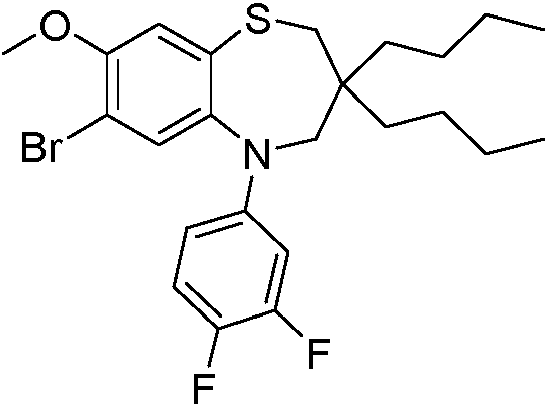
A una solución agitada de 7-bromo-3,3-dibutil-5-(3,4-difluorofenil)-8-metoxi-2,3-dihidro-1,5-benzotiazepin- 4(5H)-ona (Intermedio 36; 2.8 g, 0.0054 mmol) en THF (15 ml) a 0 °C, se agregó en forma de gotas dimetilsulfuro de borano (2M en THF; 8 ml, 0.016 mmol) y la mezcla de reacción se sometió a reflujo durante 3 horas a 60 °C. Después de la finalización de la reacción (monitorizada por UPLC), la mezcla de reacción se enfrió a 0 °C, se apagó con metanol (10 ml) y luego se calentó durante 2 horas a 60 °C. La mezcla de reacción resultante luego se enfrió a temperatura ambiente y se concentró bajo vacío para producir el crudo. El crudo resultante se envió como tal a la siguiente etapa sin ninguna purificación adicional. Rendimiento: 1.49 g (crudo, líquido incoloro).To a stirred solution of 7-bromo-3,3-dibutyl-5-(3,4-difluorophenyl)-8-methoxy-2,3-dihydro-1,5-benzothiazepin- 4(5H)-one (Intermediate 36 ; 2.8 g, 0.0054 mmol) in THF (15 mL) at 0 °C, borane dimethylsulfide (2M in THF; 8 mL, 0.016 mmol) was added dropwise and the reaction mixture was refluxed for 3 hours. at 60°C. After completion of the reaction (monitored by UPLC), the reaction mixture was cooled to 0 °C, quenched with methanol (10 mL), and then heated for 2 h at 60 °C. The resulting reaction mixture was then cooled to room temperature and concentrated under vacuum to produce crude oil. The resulting crude oil was sent as such to the next stage without any additional purification. Yield: 1.49 g (crude, colorless liquid).
Intermedio 38Intermediate 38
1,1 -dióxido de 7-bromo-3,3-dibutil-5-(3,4-difluorofenil)-8-metoxi-2,3,4,5-tetrahidro-1,5-benzotiazepina 7-bromo-3,3-dibutyl-5-(3,4-difluorophenyl)-8-methoxy-2,3,4,5-tetrahydro-1,5-benzothiazepine 1,1-dioxide

A una solución agitada de 7-bromo-3,3-dibutil-5-(3,4-difluorofenil)-8-metoxi-2,3,4,5-tetrahidro-1,5-benzotiazepina (Intermedio 37; 1.49 g, 0.01 mmol) en THF (75 ml) y se agregó agua (7.5 ml), oxona (38.3 g, 0.13 mmol) a temperatura ambiente y la mezcla de reacción luego se agitó durante 24 horas a esa temperatura. Después de la finalización de la reacción (monitorizada por TLC), la mezcla de reacción se filtró a través de un embudo Büchnery el filtrado se extrajo con EtOAc ( 2 x 25 ml). La capa orgánica combinada se lavó con agua (25 ml) y solución salina (25 ml) y se secó sobre Na2SO4 anhidro. La parte orgánica se concentró bajo vacío y el material crudo resultante se purificó mediante cromatografía en columna Isolera (eluyente: EtOAc/PE al 10-12 %; gel de sílice: 230-400 de malla) para producir el compuesto del título. Rendimiento: 62 % (1 g, sólido blancuzco).To a stirred solution of 7-bromo-3,3-dibutyl-5-(3,4-difluorophenyl)-8-methoxy-2,3,4,5-tetrahydro-1,5-benzothiazepine (Intermediate 37; 1.49 g , 0.01 mmol) in THF (75 ml) and water (7.5 ml), oxone (38.3 g, 0.13 mmol) was added at room temperature and the reaction mixture was then stirred for 24 hours at that temperature. After completion of the reaction (monitored by TLC), the reaction mixture was filtered through a Büchnery funnel, and the filtrate was extracted with EtOAc (2 x 25 ml). The combined organic layer was washed with water (25 mL) and brine (25 mL) and dried over anhydrous Na 2 SO 4 . The organic part was concentrated under vacuum and the resulting crude material was purified by Isolera column chromatography (eluent: 10-12% EtOAc/PE; silica gel: 230-400 mesh) to give the title compound. Yield: 62% (1 g, off-white solid).
LCMS: (Método A) 532.0 (M++2), Tr. 3.31 min, 93.84 % (Máx).LCMS: (Method A) 532.0 (M++2), Tr. 3.31 min, 93.84% (Max).
Intermedio 39Intermediate 39
1,1 -dióxido de 3,3-dibutil-S-(3,4-difluorofenil)-8-metoxi-7-(metiltio)-2,3,4,5-tetrahidro-1,5-benzotiazepina3,3-dibutyl-S-(3,4-difluorophenyl)-8-methoxy-7-(methylthio)-2,3,4,5-tetrahydro-1,5-benzothiazepine 1,1-dioxide

A una solución agitada de 1,1-dióxido de 7-bromo-3,3-dibutil-5-(3,4-difluorofenil)-8-metoxi-2,3,4,5-tetrahidro-1,5-benzotiazepina (Intermedio 38; 500 mg, 0.9757 mmol) en DMF (5 ml), se agregó tiometóxido de sodio (102 mg, 1.46 mmol) y la mezcla de reacción resultante se calentó durante 2 horas a 60 °C. Después de la finalización de la reacción (monitorizada por TLC), se agregó agua (10 ml) a la mezcla de reacción y la capa acuosa se extrajo con EtOAc (2x 20 ml). La capa orgánica combinada se lavó con solución salina (500 ml), se secó sobre Na2SO4 anhidro y se concentró bajo vacío. El material crudo resultante se purificó mediante cromatografía en columna Isolera (eluyente: 18 - EtOAc/PE al 20 %; gel de sílice: 230-400 de malla) para producir el compuesto del título. Rendimiento: 8 2 % (0.45 g, sólido blancuzco).To a stirred solution of 7-bromo-3,3-dibutyl-5-(3,4-difluorophenyl)-8-methoxy-2,3,4,5-tetrahydro-1,5-benzothiazepine 1,1-dioxide (Intermediate 38; 500 mg, 0.9757 mmol) in DMF (5 mL), sodium thiomethoxide (102 mg, 1.46 mmol) was added and the resulting reaction mixture was heated for 2 hours at 60 °C. After completion of the reaction (monitored by TLC), water (10 mL) was added to the reaction mixture and the aqueous layer was extracted with EtOAc (2x 20 mL). The combined organic layer was washed with brine (500 mL), dried over anhydrous Na 2 SO 4 and concentrated under vacuum. The resulting crude material was purified by Isolera column chromatography (eluent: 18-EtOAc/20% PE; silica gel: 230-400 mesh) to yield the title compound. Yield: 8 2 % (0.45 g, whitish solid).
LCMS: (Método E) 498.2 (M++H), Tr. 3.57 min, 90.72 % (Máx).LCMS: (Method E) 498.2 (M++H), Tr. 3.57 min, 90.72% (Max).
Intermedio 40Intermediate 40
1,1-dióxido de 3,3-dibutil-5-(3,4-difluorofenil)-8-hidroxi-7-(metiltio)-2,3,4,5-tetrahidro-1,5-benzotiazepina 3,3-dibutyl-5-(3,4-difluorophenyl)-8-hydroxy-7-(methylthio)-2,3,4,5-tetrahydro-1,5-benzothiazepine 1,1-dioxide

A una solución agitada de 1,1 -dióxido de 3,3-dibutil-5-(3,4-difluorofenil)-8-metoxi-7-(metiltio)-2,3,4,5-tetrahidro-1,5-benzotiazepina (Intermedio 39; 450 mg, 0.9042 mmol) en DCM (5 ml), se agregó BBr3 (1M en DCM; 3 ml, 2.712 mmol) a 0 °C y la mezcla de reacción se agitó durante 1 hora a temperatura ambiente. Después de la finalización de la reacción (monitorizada por TLC), se agregó en forma de gotas metanol (10 ml) a 0 °C hasta que cesó la efervescencia. La mezcla de reacción luego se diluyó con DCM (10 ml), y la capa de DCM se lavó con agua (2 x 10 ml) y solución salina (10 ml). La parte orgánica se secó sobre Na2SO4 anhidro y se concentró bajo vacío. El material crudo resultante se purificó mediante cromatografía en columna Isolera (eluyente: EtOAc al 100 %; gel de sílice: 230-400 de malla) para producir el compuesto del título. Rendimiento: 91 % (0.4 g, sólido blancuzco).To a stirred solution of 1,1-3,3-dibutyl-5-(3,4-difluorophenyl)-8-methoxy-7-(methylthio)-2,3,4,5-tetrahydro-1,5-dioxide -benzothiazepine (Intermediate 39; 450 mg, 0.9042 mmol) in DCM (5 ml), BBr 3 (1M in DCM; 3 ml, 2.712 mmol) was added at 0 °C and the reaction mixture was stirred for 1 hour at temperature atmosphere. After completion of the reaction (monitored by TLC), methanol (10 mL) was added dropwise at 0 °C until effervescence ceased. The reaction mixture was then diluted with DCM (10 mL), and the DCM layer was washed with water (2 × 10 mL) and saline (10 mL). The organic part was dried over anhydrous Na 2 SO 4 and concentrated under vacuum. The resulting crude material was purified by Isolera column chromatography (eluent: 100% EtOAc; silica gel: 230-400 mesh) to yield the title compound. Yield: 91% (0.4 g, off-white solid).
RMN 1H (400 MHz, DMSO-da): 8 10.63 (s, 1H), 7.29 (s, 1H), 7.28-7.19 (m, 1H), 7.03-6.98 (m, 1H), 6.72 (s, 1H), 6.64 6.59 (m, 1H), 3.62 (bs, 2H), 3.22 (s, 2H), 2.22 (s, 3H), 1.40-1.34 (m, 4H), 1.15-1.05 (m, 8 H), 0.79 (t, J = 6.80 Hz, 6 H). LCMS: (Método A) 484.2 (M++H), Tr. 2.97 min, 94 % (Máx).1H NMR (400 MHz, DMSO-da): 8 10.63 (s, 1H), 7.29 (s, 1H), 7.28-7.19 (m, 1H), 7.03-6.98 (m, 1H), 6.72 (s, 1H) , 6.64 6.59 (m, 1H), 3.62 (bs, 2H), 3.22 (s, 2H), 2.22 (s, 3H), 1.40-1.34 (m, 4H), 1.15-1.05 (m, 8 H), 0.79 (t, J = 6.80 Hz, 6H ). LCMS: (Method A) 484.2 (M++H), Tr. 2.97 min, 94% (Max).
Intermedio 41Intermediate 41
7-bromo-3,3-dibutil-5-(4-fluorofenil)-8-metoxi-2,3-dihidro-1,5-benzotiazepin-4(5H)-ona y 3,3-dibutil- 5-(4-fluorofenil)-7-yodo-8-metoxi-2,3-dihidro-1,5-benzotiazepin-4(5H)-ona7-bromo-3,3-dibutyl-5-(4-fluorophenyl)-8-methoxy-2,3-dihydro-1,5-benzothiazepin-4(5H)-one and 3,3-dibutyl- 5-( 4-fluorophenyl)-7-iodo-8-methoxy-2,3-dihydro-1,5-benzothiazepin-4(5H)-one

A una solución agitada de una mezcla de 7-bromo-3,3-dibutil-8-metoxi-2,3-dihidro-1,5-benzotiazepin-4(5H)-ona (3 g, 7.49 mmol) en 4-fluoroyodobenceno (30 ml), se agregaron yoduro de cobre (I) (0.14 g, 0.74 mmol) y K2CO3 (2.07 g, 14.9 mmol) y la mezcla de reacción se purgó con nitrógeno durante 20 minutos para desgasificación. Luego se agregó tris[2-(2-metoxietoxi) etil]amina (0.49 g, 1.49 mmol) bajo atmósfera de nitrógeno y la mezcla de reacción resultante se calentó durante 16 horas a 135 °C. Después de la finalización de la reacción (monitorizada por TLC), la mezcla de reacción se filtró a través de celita y la almohadilla de celita se lavó con EtOAc (25 ml). El filtrado se lavó con agua (15 ml) y solución salina (15 ml) y se secó sobre Na2SO4 anhidro. El material crudo resultante se purificó mediante cromatografía en columna Isolera (eluyente: EtOAc/PE al 20 %; gel de sílice: 230-400 de malla) para producir el compuesto del título. Rendimiento: 95 % (3.5 g, sólido amarillo pálido).To a stirred solution of a mixture of 7-bromo-3,3-dibutyl-8-methoxy-2,3-dihydro-1,5-benzothiazepin-4(5H)-one (3 g, 7.49 mmol) in 4- fluoroiodobenzene (30 mL), copper(I) iodide (0.14 g, 0.74 mmol) and K 2 CO 3 (2.07 g, 14.9 mmol) were added and the reaction mixture was purged with nitrogen for 20 minutes for degassing. Tris[2-(2-methoxyethoxy)ethyl]amine (0.49 g, 1.49 mmol) was then added under a nitrogen atmosphere and the resulting reaction mixture was heated for 16 h at 135 °C. After completion of the reaction (monitored by TLC), the reaction mixture was filtered through celite and the celite pad was washed with EtOAc (25 mL). The filtrate was washed with water (15 ml) and saline (15 ml) and dried over anhydrous Na 2 SO 4 . The resulting crude material was purified by Isolera column chromatography (eluent: 20% EtOAc/PE; silica gel: 230-400 mesh) to yield the title compound. Yield: 95% (3.5 g, pale yellow solid).
LCMS: (Método E) 494.0 (M+) para el compuesto sustituido con 7-bromo y 541.9 (M++H) para el compuesto sustituido con 7-yodo, Tr. 3.50 min, 96.61 % (Máx).LCMS: (Method E) 494.0 (M+) for the 7-bromo substituted compound and 541.9 (M++H) for the 7-iodo substituted compound, Tr. 3.50 min, 96.61% (Max).
Intermedio 42Intermediate 42
7-bromo-3,3-dibutil-5-(4-fluorofenil)-8-metoxi-2,3,4,5-tetrahidro-1,5-benzotiazepina y 3,3-dibutil-5-(4- fluorofenil)-7-yodo-8-metoxi-2,3,4,5-tetrahidro-1,5-benzotiazepina 7-bromo-3,3-dibutyl-5-(4-fluorophenyl)-8-methoxy-2,3,4,5-tetrahydro-1,5-benzothiazepine and 3,3-dibutyl-5-(4-fluorophenyl) )-7-iodo-8-methoxy-2,3,4,5-tetrahydro-1,5-benzothiazepine

A una solución agitada de una mezcla de 7-bromo-3,3-dibutil-5-(4-fluorofenil)-8-metoxi-2,3-dihidro-1,5-benzotiazepin-4(5H)-ona y 3,3-dibutil-5-(4-fluorofenil)-7-yodo-8-metoxi-2,3-dihidro-1,5-benzotiazepin-4(5H)-ona (Intermedio 41; 3.5 g, 7.07 mmol) en THF (35 ml) a 0 °C, se agregó en forma de gotas dimetilsulfuro de borano (2M en THF; 5.3 ml, 10.61 mmol) y la mezcla de reacción se sometió a reflujo durante 16 horas a 65 °C. Después de la finalización de la reacción (monitorizada por TLC), la mezcla de reacción se enfrió a 0 °C, se apagó con metanol (10 ml) y se calentó durante 2 horas a 65 °C. La mezcla de reacción resultante luego se enfrió a temperatura ambiente, se concentró bajo vacío y el residuo se sometió a partición entre agua (50 ml) y EtOAc (50 ml). La capa acuosa se extrajo con DCM (2 x 50 ml), y la capa orgánica combinada se lavó con agua (25 ml) y solución salina (25 ml). La parte orgánica se secó sobre Na2SO4 anhidro y se concentró bajo vacío para producir el crudo. El crudo resultante se envió como tal a la siguiente etapa sin ninguna purificación adicional. Rendimiento: 3.6 g (crudo, goma amarilla pálida).To a stirred solution of a mixture of 7-bromo-3,3-dibutyl-5-(4-fluorophenyl)-8-methoxy-2,3-dihydro-1,5-benzothiazepin-4(5H)-one and 3 ,3-dibutyl-5-(4-fluorophenyl)-7-iodo-8-methoxy-2,3-dihydro-1,5-benzothiazepin-4(5H)-one (Intermediate 41; 3.5 g, 7.07 mmol) in THF (35 mL) at 0 °C, borane dimethylsulfide (2M in THF; 5.3 mL, 10.61 mmol) was added dropwise and the reaction mixture was refluxed for 16 hours at 65 °C. After completion of the reaction (monitored by TLC), the reaction mixture was cooled to 0 °C, quenched with methanol (10 mL), and heated for 2 h at 65 °C. The resulting reaction mixture was then cooled to room temperature, concentrated under vacuum and the residue partitioned between water (50 ml) and EtOAc (50 ml). The aqueous layer was extracted with DCM (2 x 50 ml), and the combined organic layer was washed with water (25 ml) and saline (25 ml). The organic part was dried over anhydrous Na 2 SO 4 and concentrated under vacuum to yield the crude oil. The resulting crude oil was sent as such to the next stage without any additional purification. Yield: 3.6 g (raw, pale yellow gum).
LCMS: (Método E) 482.0 (M++2H) para el compuesto sustituido con 7-bromo y 527.9 (M++H) para el compuesto sustituido con 7-yodo, Tr. 3.86 min, 81.04 % (combinado para los compuestos sustituidos de bromo y yodo) (Máx). LCMS: (Method E) 482.0 (M++2H) for the 7-bromo substituted compound and 527.9 (M++H) for the 7-iodine substituted compound, Tr. 3.86 min, 81.04% (combined for substituted bromine and iodine compounds) (Max).
Intermedio 43Intermediate 43
1,1 -dióxido de 7-bromo-3,3-dibutil-5-(4-fluorofenil)-8-metoxi-2,3,4,5-tetrahidro-1,5-benzotiazepina y 1,1 -dióxido de 3,3-dibutil-5-(4-fluorofenil)-7-yodo-8-metoxi-2,3,4,5-tetrahidro-1,5-benzotiazepina7-bromo-3,3-dibutyl-5-(4-fluorophenyl)-8-methoxy-2,3,4,5-tetrahydro-1,5-benzothiazepine 1,1-dioxide and 1,1-dioxide 3,3-dibutyl-5-(4-fluorophenyl)-7-iodo-8-methoxy-2,3,4,5-tetrahydro-1,5-benzothiazepine

A una solución agitada de una mezcla de 7-bromo-3,3-dibutil-5-(4-fluorofenil)-8-metoxi-2,3,4,5-tetrahidro-1,5-benzotiazepina y 3,3-dibutil-5-(4-fluorofenil)-7-yodo-8-metoxi-2,3,4,5-tetrahidro-1,5-benzotiazepina (Intermedio 42; 3.6 g, 7.49 mmol) en ácido acético (36 ml), se agregaron tungstato de sodio (360 mg, 0.01 mmol) y peróxido de hidrógeno (30 % en H2O; 2.6 ml, 22.47 mmol) a 0 °C y la mezcla de reacción resultante se agitó durante 16 horas a temperatura ambiente. Después de la finalización de la reacción (monitorizada por TLC), la mezcla de reacción se filtró a través de un embudo Büchner y el filtrado se extrajo con EtOAc (2 x 50 ml). La capa orgánica combinada se lavó con agua (25 ml) y solución salina (25 ml) y se secó sobre Na2SO4 anhidro. La parte orgánica se concentró bajo vacío y el material crudo resultante se purificó mediante cromatografía en columna Isolera (eluyente: EtOAc/PE al 12%; gel de sílice: 230-400 de malla) para producir el compuesto del título. Rendimiento: 79% (3.4 g, sólido blancuzco).To a stirred solution of a mixture of 7-bromo-3,3-dibutyl-5-(4-fluorophenyl)-8-methoxy-2,3,4,5-tetrahydro-1,5-benzothiazepine and 3,3- dibutyl-5-(4-fluorophenyl)-7-iodo-8-methoxy-2,3,4,5-tetrahydro-1,5-benzothiazepine (Intermediate 42; 3.6 g, 7.49 mmol) in acetic acid (36 mL) , sodium tungstate (360 mg, 0.01 mmol) and hydrogen peroxide (30% in H 2 O; 2.6 mL, 22.47 mmol) were added at 0 °C and the resulting reaction mixture was stirred for 16 h at room temperature. After completion of the reaction (monitored by TLC), the reaction mixture was filtered through a Büchner funnel and the filtrate was extracted with EtOAc (2 x 50 ml). The combined organic layer was washed with water (25 mL) and brine (25 mL) and dried over anhydrous Na 2 SO 4 . The organic part was concentrated under vacuum and the resulting crude material was purified by Isolera column chromatography (eluent: 12% EtOAc/PE; silica gel: 230-400 mesh) to give the title compound. Yield: 79% (3.4 g, off-white solid).
LCMS: ((Método A) 512.2 (M++H) para el compuesto sustituido con 7-bromo y 560.2 (M++H) para el compuesto sustituido con 7-yodo; Tr. 3.40 min, 70.63 % (Máx).LCMS: ((Method A) 512.2 (M++H) for the 7-bromo substituted compound and 560.2 (M++H) for the 7-iodine substituted compound; Tr. 3.40 min, 70.63% (Max).
Intermedio 44Intermediate 44
1,1 -dióxido de 3,3-dibutil-5-(4-fluorofenil)-8-hidroxi-7-(metiltio)-2,3,4,5-tetrahidro-1,5-benzotiazepina 3,3-dibutyl-5-(4-fluorophenyl)-8-hydroxy-7-(methylthio)-2,3,4,5-tetrahydro-1,5-benzothiazepine 1,1-dioxide

A una solución agitada de una mezcla de 1,1 -dióxido de 7-bromo-3,3-dibutil-5-(4-fluorofenil)-8-metoxi-2,3,4,5-tetrahidro-1,5- benzotiazepina y 1,1 -dióxido de 3,3-dibutil-5-(4-fluorofenil)-7-yodo-8-metoxi-2,3,4,5-tetrahidro-1,5-benzotiazepina (Intermedio 43; 1.6 g, 3.12 mmol) en DMF (16 ml), se agregó tiometóxido de sodio (1.09 g, 15.6 mmol) a temperatura ambiente y la mezcla de reacción se agitó durante 16 horas a 65 °C. Después de la finalización de la reacción (monitorizada por TLC), la mezcla de reacción se enfrió a temperatura ambiente y se apagó con agua (15 ml). La capa acuosa se extrajo con EtOAc (2 x 25 ml) y la capa orgánica combinada se lavó con solución salina (10 ml). La parte orgánica se secó sobre Na2SO4 anhidro y se concentró bajo vacío. El material crudo resultante se purificó mediante cromatografía en columna Isolera (eluyente: EtOAc/PE al 30 %; gel de sílice: 230-400 de malla) para producir el compuesto del título. Rendimiento: 90 % (1.3 g, sólido blancuzco).To a stirred solution of a mixture of 1,1-7-bromo-3,3-dibutyl-5-(4-fluorophenyl)-8-methoxy-2,3,4,5-tetrahydro-1,5-dioxide benzothiazepine and 3,3-dibutyl-5-(4-fluorophenyl)-7-iodo-8-methoxy-2,3,4,5-tetrahydro-1,5-benzothiazepine 1,1-dioxide (Intermediate 43; 1.6 g, 3.12 mmol) in DMF (16 mL), sodium thiomethoxide (1.09 g, 15.6 mmol) was added at room temperature and the reaction mixture was stirred for 16 hours at 65 °C. After completion of the reaction (monitored by TLC), the reaction mixture was cooled to room temperature and quenched with water (15 mL). The aqueous layer was extracted with EtOAc (2 x 25 ml) and the combined organic layer was washed with saline (10 ml). The organic part was dried over anhydrous Na 2 SO 4 and concentrated under vacuum. The resulting crude material was purified by Isolera column chromatography (eluent: 30% EtOAc/PE; silica gel: 230-400 mesh) to yield the title compound. Yield: 90% (1.3 g, off-white solid).
RMN 1H (400 MHz, DMSO-d6): 8 10.48 (s, 1H), 7.28 (d, J = 4.4 Hz, 1H), 7.08-7.01 (m, 4H), 6.59 (s, 1H), 3.80-3.67 (m, 2H), 3.22 (s, 2H), 2.16 (s, 3H), 1.36-1.33 (m, 4H), 1.12-1.03 (m, 8 H), 0.79-0.77 (m, 6 H). LCMS: (Método E) 466.0 (M++H), Tr. 3.23 min, 8 8 .8 6 % (Máx).1H NMR (400 MHz, DMSO-d 6 ): 8 10.48 (s, 1H), 7.28 (d, J = 4.4 Hz, 1H), 7.08-7.01 (m, 4H), 6.59 (s, 1H), 3.80- 3.67 (m, 2H), 3.22 (s, 2H), 2.16 (s, 3H), 1.36-1.33 (m, 4H), 1.12-1.03 (m, 8 H), 0.79-0.77 (m, 6 H). LCMS: (Method E) 466.0 (M++H), Tr. 3.23 min, 8 8 .8 6 % (Max).
Intermedio 45Intermediate 45
Ácido 2-(((2-Amino-4-bromo-5-metoxifenil)tio)metil)-2-etilpentanoico2-(((2-Amino-4-bromo-5-methoxyphenyl)thio)methyl)-2-ethylpentanoic acid

A una solución de 5-bromo-6-metoxibenzo[d]tiazol-2-amina (20 g, 77.2 mmol) en agua (200 ml) se agregaron KOH (69.1 g, 123 mmol) y Na2SO3 (9.7 g, 77.2 mmol) y la mezcla de reacción se calentó durante 1 6 horas a 120 °C. La mezcla de reacción luego se enfrió a 10 °C. Una solución de ácido 2-(bromometil)-2-etilpentanoico (26 g, 115 mmol) en THF (30 ml) se agregó en forma de gotas y la mezcla de reacción se calentó durante 16 horas a 60 °C. Después de la finalización de la reacción (monitorizada por TLC), la mezcla de reacción se apagó con HCl conc., se acidificó y luego se extrajo con EtOAc (2 x 150 ml). La capa orgánica combinada se lavó con agua enfriada con hielo (150 ml) y solución salina (150 ml) y se secó sobre Na2SO4 anhidro. La parte orgánica se filtró y se concentró para producir el compuesto del título. Rendimiento: 30 g (crudo, líquido púrpura).To a solution of 5-bromo-6-methoxybenzo[d]thiazol-2-amine (20 g, 77.2 mmol) in water (200 mL) were added KOH (69.1 g, 123 mmol) and Na 2 SO 3 (9.7 g , 77.2 mmol) and the reaction mixture was heated for 1 6 hours at 120 °C. The reaction mixture was then cooled to 10 °C. A solution of 2-(bromomethyl)-2-ethylpentanoic acid (26 g, 115 mmol) in THF (30 mL) was added dropwise and the reaction mixture was heated for 16 hours at 60 °C. After completion of the reaction (monitored by TLC), the reaction mixture was quenched with conc. HCl, acidified, and then extracted with EtOAc (2 x 150 mL). The combined organic layer was washed with ice water (150 mL) and brine (150 mL) and dried over anhydrous Na 2 SO 4 . The organic part was filtered and concentrated to give the title compound. Yield: 30 g (raw, purple liquid).
LCMS: (Método E) 377.8 (M++2), Tr. 2.60 min, 77.37 % (Máx).LCMS: (Method E) 377.8 (M++2), Tr. 2.60 min, 77.37% (Max).
Intermedio 46Intermediate 46
7-Bromo-3-etil-8-metoxi-3-propil-2,3-dihidro-1,5-benzotiazepin-4(5H)-ona7-Bromo-3-ethyl-8-methoxy-3-propyl-2,3-dihydro-1,5-benzothiazepin-4(5H)-one

A una solución de ácido 2-(((2-Amino-4-bromo-5-metoxifenil)tio)metil)-2-etilpentanoico (Intermedio 45; 30 g, 80 mmol) en DCM (200 ml), se agregó trietilamina (21.5 ml, 159 mmol) y la mezcla de reacción se enfrió a 0 °C. solución de anhídrido 1-propanofosfónico (50 % en EtOAc; 50.8 g, 159 mmol) se agregó en forma de gotas y la mezcla de reacción se agitó durante 16 horas a temperatura ambiente. Después de la finalización de la reacción (monitorizada por TLC), la mezcla de reacción se apagó con agua enfriada con hielo (25 ml) y la capa acuosa se extrajo con EtOAc (2 x 100 ml). La capa orgánica combinada se lavó con agua enfriada con hielo (100 ml) y solución salina (100 ml) y se secó sobre Na2SO4 anhidro. La parte orgánica se filtró, se concentró bajo vacío y el residuo obtenido se trituró con metanol frío. El sólido precipitado se filtró y se secó bajo vacío para producir el compuesto del título. Rendimiento: 32 % (9 g, sólido gris).To a solution of 2-(((2-Amino-4-bromo-5-methoxyphenyl)thio)methyl)-2-ethylpentanoic acid (Intermediate 45; 30 g, 80 mmol) in DCM (200 mL), triethylamine was added. (21.5 ml, 159 mmol) and the reaction mixture was cooled to 0 °C. 1-propanephosphonic anhydride solution (50% in EtOAc; 50.8 g, 159 mmol) was added dropwise and the reaction mixture was stirred for 16 hours at room temperature. After completion of the reaction (monitored by TLC), the reaction mixture was quenched with ice-cold water (25 mL) and the aqueous layer was extracted with EtOAc (2 x 100 mL). The combined organic layer was washed with ice water (100 mL) and saline (100 mL) and dried over Na 2 SO 4 anhydrous. The organic part was filtered, concentrated under vacuum and the residue obtained was triturated with cold methanol. The precipitated solid was filtered and dried under vacuum to afford the title compound. Yield: 32% (9 g, gray solid).
RMN 1H (400 MHz, DMSO-da): 8 9.63 (s, 1H), 7.34 (s, 1H), 7.11 (s, 1H), 3.83 (s, 3H), 2.99 (s, 2H), 1.73-1.40 (m, 4H), 1.24-1.16 (m, 2H), 0.84-0.76 (m, 6 H). LCMS: (Método E) 357.8 (M+), Tr. 2.83 min, 99.18 % (Máx).1H NMR (400 MHz, DMSO-da): 8 9.63 (s, 1H), 7.34 (s, 1H), 7.11 (s, 1H), 3.83 (s, 3H), 2.99 (s, 2H), 1.73-1.40 (m, 4H), 1.24-1.16 (m, 2H), 0.84-0.76 (m, 6 H). LCMS: (Method E) 357.8 (M+), Tr. 2.83 min, 99.18% (Max).
Intermedio 47Intermediate 47
7-Bromo-3-etil-8-metoxi-5-fenil-3-propil-2,3-dihidro-1,5-benzotiazepin-4(5H)-ona y 3-etil-7-yodo-8-metoxi- 5-fenil-3-propil-2,3-dihidro-1,5-benzotiazepin-4(5H)-ona7-Bromo-3-ethyl-8-methoxy-5-phenyl-3-propyl-2,3-dihydro-1,5-benzothiazepin-4(5H)-one and 3-ethyl-7-iodo-8-methoxy - 5-phenyl-3-propyl-2,3-dihydro-1,5-benzothiazepin-4(5H)-one

A una solución de 7-bromo-3-etil-8-metoxi-3-propil-2,3-dihidro-1,5-benzotiazepin-4(5H)-ona (Intermedio 46; 9 g, 25.1 mmol) en yodobenceno (90 ml), se agregaron K2CO3 (3.81 g, 27.62 mmol), tris[2-(2-metoxietoxi)etil] amina (1.62 g, 5.02 mmol) y Cul (0.48 g, 2.51 mmol) y la mezcla de reacción se calentó durante 16 horas a 135 °C. Después de la finalización de la reacción (monitorizada por TLC), la mezcla de reacción se apagó con agua enfriada con hielo (25 ml) y la capa acuosa se extrajo con EtOAc (2 x 100 ml). La capa orgánica combinada se lavó con agua enfriada con hielo (100 ml) y solución salina (100 ml) y se secó sobre Na2SO4 anhidro. La parte orgánica se filtró y se concentró bajo vacío. El material crudo resultante se trituró con éter de petróleo para producir el compuesto del título. Rendimiento: 64 % (7 g, sólido amarillo pálido).To a solution of 7-bromo-3-ethyl-8-methoxy-3-propyl-2,3-dihydro-1,5-benzothiazepin-4(5H)-one (Intermediate 46; 9 g, 25.1 mmol) in iodobenzene (90 mL), K 2 CO 3 (3.81 g, 27.62 mmol), tris[2-(2-methoxyethoxy)ethyl]amine (1.62 g, 5.02 mmol) and Cul (0.48 g, 2.51 mmol) were added and the mixture The reaction mixture was heated for 16 hours at 135 °C. After completion of the reaction (monitored by TLC), the reaction mixture was quenched with ice-cold water (25 mL) and the aqueous layer was extracted with EtOAc (2 x 100 mL). The combined organic layer was washed with ice water (100 mL) and brine (100 mL) and dried over anhydrous Na 2 SO 4 . The organic part was filtered and concentrated under vacuum. The resulting crude material was triturated with petroleum ether to produce the title compound. Yield: 64% (7 g, pale yellow solid).
LCMS: (Método B) 434.0 (M++H), para el compuesto sustituido con 7-bromo Tr. 14.82 min, 37.52% (Máx) y 482.0 (M++H), para el compuesto sustituido con 7-yodo Tr. 15.04 min, 57.75 % (Máx).LCMS: (Method B) 434.0 (M++H), for the compound substituted with 7-bromo Tr. 14.82 min, 37.52% (Max) and 482.0 (M++H), for the compound substituted with 7-iodine Tr. 15.04 min, 57.75% (Max).
Intermedio 48Intermediate 48
7-Bromo-3-etil-8-metoxi-5-fenil-3-propil-2,3,4,5-tetrahidro-1,5-benzotiazepina y 3-etil-7-yodo-8-metoxi-5-fenil-3-propil-2,3,4,5-tetrahidro-1,5-benzotiazepina7-Bromo-3-ethyl-8-methoxy-5-phenyl-3-propyl-2,3,4,5-tetrahydro-1,5-benzothiazepine and 3-ethyl-7-iodo-8-methoxy-5- phenyl-3-propyl-2,3,4,5-tetrahydro-1,5-benzothiazepine

A una solución agitada de una mezcla de 7-bromo-3-etil-8-metoxi-5-fenil-3-propil-2,3-dihidro-1,5-benzotiazepin-4(5H)-ona y 3-etil-7-yodo-8-metoxi-5-fenil-3-propil-2,3-dihidro-1,5-benzotiazepin-4(5H)-ona (Intermedio 47; 7.0 g, 16.12 mmol) en THF (70 ml) a 0 °C, se agregó dimetilsulfuro de borano (1M en t Hf ; 48.38 ml, 48.38 mmol) y la mezcla de reacción se calentó durante 16 horas a 70 °C. Después de la finalización de la reacción (monitorizada por TLC), la mezcla de reacción se enfrió a 0 °C, se agregó metanol (150 ml) y la mezcla se calentó durante 2 horas a 60 °C. La mezcla de reacción luego se enfrió a temperatura ambiente y se concentró bajo vacío. El residuo obtenido se sometió a partición entre agua (50 ml) y EtOAc (50 ml), y la capa acuosa se extrajo con EtOAc (2 x 100 ml). La capa orgánica combinada se lavó con agua enfriada con hielo ( 1 0 0 ml) y solución salina ( 1 0 0 ml), se secó sobre Na2SO4 anhidro y se concentró bajo vacío. El material crudo resultante se envió como tal a la siguiente etapa sin ninguna purificación adicional. Rendimiento: 7.5 g (crudo, pale goma marrón).To a stirred solution of a mixture of 7-bromo-3-ethyl-8-methoxy-5-phenyl-3-propyl-2,3-dihydro-1,5-benzothiazepin-4(5H)-one and 3-ethyl -7-iodo-8-methoxy-5-phenyl-3-propyl-2,3-dihydro-1,5-benzothiazepin-4(5H)-one (Intermediate 47; 7.0 g, 16.12 mmol) in THF (70 mL ) at 0 °C, borane dimethyl sulfide (1M in t H f ; 48.38 ml, 48.38 mmol) was added and the reaction mixture was heated for 16 hours at 70 °C. After completion of the reaction (monitored by TLC), the reaction mixture was cooled to 0 °C, methanol (150 mL) was added, and the mixture was heated for 2 h at 60 °C. The reaction mixture was then cooled to room temperature and concentrated under vacuum. The residue obtained was partitioned between water (50 ml) and EtOAc (50 ml), and the aqueous layer was extracted with EtOAc (2 x 100 ml). The combined organic layer was washed with ice water (1 0 0 mL) and brine (1 0 0 mL), dried over anhydrous Na 2 SO 4 and concentrated under vacuum. The resulting crude material was sent as such to the next stage without any further purification. Yield: 7.5 g (raw, pale brown gum).
LCMS: (Método E) 419.8 (M++H) para el compuesto sustituido con 7-bromo & 467.8 (M++H) para el compuesto sustituido con 7-yodo; Tr. 3. 77 min, 80.10 % (Máx).LCMS: (Method E) 419.8 (M++H) for the 7-bromo substituted compound & 467.8 (M++H) for the 7-iodo substituted compound; Tr. 3. 77 min, 80.10% (Max).
Intermedio 49Intermediate 49
1,1 -dióxido de 7-Bromo-3-etil-8-metoxi-5-fenil-3-propil-2,3,4,5-tetrahidro-1,5-benzotiazepina y 1,1 -dióxido de 3-etil- 7-yodo-8-metoxi-5-fenil-3-propil-2,3,4,5-tetrahidro-1,5-benzotiazepina 7-Bromo-3-ethyl-8-methoxy-5-phenyl-3-propyl-2,3,4,5-tetrahydro-1,5-benzothiazepine 1,1-dioxide and 3-1,1-dioxide ethyl-7-iodo-8-methoxy-5-phenyl-3-propyl-2,3,4,5-tetrahydro-1,5-benzothiazepine

A una solución de una mezcla de 7-bromo-3-etil-8-metoxi-5-fenil-3-propil-2,3,4,5-tetrahidro-1,5-benzotiazepina y 3-etil-7-yodo-8-metoxi-5-fenil-3-propil-2,3,4,5-tetrahidro-1,5-benzotiazepina (Intermedio 48; 7.5 g, 17.83 mmol) en THF (60 ml) y agua (30 ml), se agregó oxona (27.4 g, 89.19 mmol) y la mezcla de reacción se agitó durante 16 horas a temperatura ambiente. Después de la finalización de la reacción (monitorizada por TLC), la capa acuosa se extrajo con EtOAc (2 x 100 ml). La capa orgánica combinada se lavó con agua enfriada con hielo (100 ml) y solución salina (100 ml), se secó sobre Na2SO4 anhidro y se concentró bajo vacío. El material crudo resultante se purificó mediante cromatografía en columna Isolera (eluyente: EtOAc/PE al 13 %; gel de sílice: 230-400 de malla) para producir el compuesto del título. Rendimiento: 62 % (5 g, sólido marrón pálido).To a solution of a mixture of 7-bromo-3-ethyl-8-methoxy-5-phenyl-3-propyl-2,3,4,5-tetrahydro-1,5-benzothiazepine and 3-ethyl-7-iodine -8-methoxy-5-phenyl-3-propyl-2,3,4,5-tetrahydro-1,5-benzothiazepine (Intermediate 48; 7.5 g, 17.83 mmol) in THF (60 mL) and water (30 mL) , oxone (27.4 g, 89.19 mmol) was added and the reaction mixture was stirred for 16 hours at room temperature. After completion of the reaction (monitored by TLC), the aqueous layer was extracted with EtOAc (2 x 100 ml). The combined organic layer was washed with ice water (100 mL) and brine (100 mL), dried over anhydrous Na 2 SO 4 and concentrated under vacuum. The resulting crude material was purified by Isolera column chromatography (eluent: 13% EtOAc/PE; silica gel: 230-400 mesh) to yield the title compound. Yield: 62% (5 g, pale brown solid).
LCMS: (Método E) 452.9 (M++H) para el compuesto sustituido con 7-bromo y 499.7 (M++H) para el compuesto sustituido con 7-yodo, Tr. 3.24 min, 96.49 % (Máx).LCMS: (Method E) 452.9 (M++H) for the 7-bromo substituted compound and 499.7 (M++H) for the 7-iodine substituted compound, Tr. 3.24 min, 96.49% (Max).
Intermedio 50Intermediate 50
1,1 -dióxido de 3-Etil-8-hidroxi-7-(metiltio)-5-fenil-3-propil-2,3,4,5-tetrahidro-1,5-benzotiazepina3-Ethyl-8-hydroxy-7-(methylthio)-5-phenyl-3-propyl-2,3,4,5-tetrahydro-1,5-benzothiazepine 1,1-dioxide

A una solución de una mezcla de 1,1-dióxido de 7-Bromo-3-etil-8-metoxi-5-fenil-3-propil-2,3,4,5-tetrahidro-1,5-benzotiazepina y 1,1-dióxido de 3-etil-7-yodo-8-metoxi-5-fenil-3-propil-2,3,4,5-tetrahidro-1,5-benzotiazepina (Intermedio 49; 1 g, 2.00 mmol) en DMF (5 ml), se agregó tiometóxido de sodio (0.78 g, 1.0 mmol) y la mezcla de reacción se agitó durante 12 horas a 100 °C. Después de la finalización de la reacción (monitorizada por TLC), la mezcla de reacción se apagó con agua enfriada con hielo (25 ml) y luego se extrajo con EtOAc (2 x 20 ml). La capa orgánica combinada se lavó con agua enfriada con hielo (10 ml) y luego solución salina (10 ml), se secó sobre Na2SO4 anhidro y se concentró bajo vacío. El material crudo resultante se purificó mediante cromatografía en columna Isolera (eluyente: EtOAc/PE al 30 %; gel de sílice: 230-400 de malla) para producir el compuesto del título. Rendimiento: 61 % (0.49 g, sólido blancuzco).To a solution of a mixture of 7-Bromo-3-ethyl-8-methoxy-5-phenyl-3-propyl-2,3,4,5-tetrahydro-1,5-benzothiazepine 1,1-dioxide and 1 3-ethyl-7-iodo-8-methoxy-5-phenyl-3-propyl-2,3,4,5-tetrahydro-1,5-benzothiazepine,1-dioxide (Intermediate 49; 1 g, 2.00 mmol) in DMF (5 mL), sodium thiomethoxide (0.78 g, 1.0 mmol) was added and the reaction mixture was stirred for 12 h at 100 °C. After completion of the reaction (monitored by TLC), the reaction mixture was quenched with ice water (25 mL) and then extracted with EtOAc (2 x 20 mL). The combined organic layer was washed with ice water (10 mL) and then saline (10 mL), dried over anhydrous Na 2 SO 4 and concentrated under vacuum. The resulting crude material was purified by Isolera column chromatography (eluent: 30% EtOAc/PE; silica gel: 230-400 mesh) to yield the title compound. Yield: 61% (0.49 g, off-white solid).
RMN 1H (400 MHz, DMSO-d6): 810.54 (s, 1H), 7.31 (s, 1H), 7.19 (t, J = 8.0 Hz, 2H), 6.91 (d, J = 7.6 Hz, 2H), 6.80 (t, J = 7.6 Hz, 1H), 6.69 (s, 1H),3.64 (bs, 2H), 3.21 (s, 2H), 2.18 (s, 3H), 1.57-1.55 (m, 1H), 1.45-1.33 (m, 3H), 1.31-1.18 (m, 2H), 0.78-0.74 (m, 6H). LCMS: (Método E) 406.2 (M++H), Tr. 2.93 min, 95.46 % (Máx).1H NMR (400 MHz, DMSO-d6): 810.54 (s, 1H), 7.31 (s, 1H), 7.19 (t, J = 8.0 Hz, 2H), 6.91 (d, J = 7.6 Hz, 2H), 6.80 (t, J = 7.6 Hz, 1H), 6.69 (s, 1H),3.64 (bs, 2H), 3.21 (s, 2H), 2.18 (s, 3H), 1.57-1.55 (m, 1H), 1.45- 1.33 (m, 3H), 1.31-1.18 (m, 2H), 0.78-0.74 (m, 6H). LCMS: (Method E) 406.2 (M++H), Tr. 2.93 min, 95.46% (Max).
Intermedio 51Intermediate 51
Tritilserinato de metiloMethyl tritylserinate

A una solución agitada de clorhidrato de metil serinato (0.65 g, 0.5 mmol) en DCM (10 ml), se agregó trietilamina (2 ml, 1.50 mmol) y la mezcla de reacción se enfrió a 0 °C. Luego se agregó cloruro de tritilo (1.67 g, 0.6 mmol) y la mezcla de reacción se agitó durante 16 horas a temperatura ambiente. Después de la finalización de la reacción (monitorizada por TLC), la mezcla de reacción se apagó con agua (10 ml) y la capa acuosa se extrajo con DCM (2x10 ml). La capa orgánica combinada se lavó con agua (10 ml) y solución salina (10 ml) y se secó sobre Na2SO4 anhidro. La parte orgánica se filtró y se concentró bajo vacío. El material crudo resultante se purificó mediante cromatografía en columna Isolera (eluyente: EtOAc /PE al 7 %; gel de sílice: 230-400 de malla) para producir el compuesto del título. Rendimiento: 33 % (0.7 g, sólido blanco).To a stirred solution of methyl serinate hydrochloride (0.65 g, 0.5 mmol) in DCM (10 mL), triethylamine (2 mL, 1.50 mmol) was added and the reaction mixture was cooled to 0 °C. Trityl chloride (1.67 g, 0.6 mmol) was then added and the mixture The reaction mixture was stirred for 16 hours at room temperature. After completion of the reaction (monitored by TLC), the reaction mixture was quenched with water (10 ml) and the aqueous layer was extracted with DCM (2x10 ml). The combined organic layer was washed with water (10 mL) and brine (10 mL) and dried over anhydrous Na 2 SO 4 . The organic part was filtered and concentrated under vacuum. The resulting crude material was purified by Isolera column chromatography (eluent: 7% EtOAc/PE; silica gel: 230-400 mesh) to yield the title compound. Yield: 33% (0.7 g, white solid).
RMN 1H (400 MHz, CDCla): 87.54-7.50 (m, 6H), 7.32-7.27 (m, 6H), 7.24-7.20 (m, 3H), 3.74-3.72 (m, 1H), 3.62-3.51 (m, 2H), 3.33 (s, 3H), 3.00 (bs, 1H), 2.33 (bs, 1H).1H NMR (400 MHz, CDCla): 87.54-7.50 (m, 6H), 7.32-7.27 (m, 6H), 7.24-7.20 (m, 3H), 3.74-3.72 (m, 1H), 3.62-3.51 (m , 2H), 3.33 (s, 3H), 3.00 (bs, 1H), 2.33 (bs, 1H).
Intermedio 52Intermediate 52
O-(3-butil-3-etil-7-(metiltio)-1,1-dióxido-5-fenil-2,3,4,5-tetrahidro-1,5-benzotiazepin-8-il)-N-tritilserinato de metiloO-(3-butyl-3-ethyl-7-(methylthio)-1,1-dioxide-5-phenyl-2,3,4,5-tetrahydro-1,5-benzothiazepin-8-yl)-N- methyl tritylserinate

A una solución agitada de 3-butil-3-etil-8-hidroxi-7-(metiltio)-5-fenil-2,3,4,5-tetrahidro-1,5-benzotiazepina 1,1 -dióxido (Intermedio 22; 470 mg, 1.12 mmol) en tolueno (10 ml) a 0 °C, se agregaron trifenilfosfina (653 mg, 2.24 mmol) y tritilserinato de metilo (Intermedio 51; 504 mg, 2.24 mmol) y la mezcla de reacción se agitó durante 5 minutos. Luego se agregó en forma de gotas azodicarboxilato de diisopropilo (452 mg, 2.24 mmol) y la mezcla de reacción se calentó durante 4 horas a 90 °C. Después de la finalización de la reacción (monitorizada por TLC), la mezcla de reacción se concentró bajo vacío y el residuo obtenido se diluyó con agua (10 ml). La capa acuosa se extrajo con EtOAc ( 2x10 ml) y la capa orgánica combinada se lavó con agua (10 ml) y solución salina (10 ml) y se secó sobre Na2SO4 anhidro. La parte orgánica se filtró, se concentró bajo vacío y el material crudo resultante se purificó mediante cromatografía en columna Isolera (eluyente: EtOAc/PE al 8 %; gel de sílice: 230-400 de malla) para producir el compuesto del título. Rendimiento: 41 % (350 mg, sólido amarillo pálido).To a stirred solution of 3-butyl-3-ethyl-8-hydroxy-7-(methylthio)-5-phenyl-2,3,4,5-tetrahydro-1,5-benzothiazepine 1,1-dioxide (Intermediate 22 ; 470 mg, 1.12 mmol) in toluene (10 mL) at 0 °C, triphenylphosphine (653 mg, 2.24 mmol) and methyl tritylserinate (Intermediate 51; 504 mg, 2.24 mmol) were added and the reaction mixture was stirred for 5 minutes. Diisopropyl azodicarboxylate (452 mg, 2.24 mmol) was then added dropwise and the reaction mixture was heated for 4 h at 90 °C. After completion of the reaction (monitored by TLC), the reaction mixture was concentrated under vacuum and the obtained residue was diluted with water (10 ml). The aqueous layer was extracted with EtOAc (2x10 mL) and the combined organic layer was washed with water (10 mL) and brine (10 mL) and dried over anhydrous Na 2 SO 4 . The organic part was filtered, concentrated under vacuum and the resulting crude material was purified by Isolera column chromatography (eluent: 8% EtOAc/PE; silica gel: 230-400 mesh) to give the title compound. Yield: 41% (350 mg, pale yellow solid).
RMN 1H (400 MHz, DMSO-d6): 87.48-7.45 (m, 6H), 7.33-7.29 (m, 7H), 7.23-7.20 (m, 5H), 6.98 (d, J = 8.0 Hz, 2H), 6.86 (t, J = 7.2 Hz, 1H), 6.69 (s, 1H), 4.26-4.22 (m, 1H), 4.09-4.05 (m, 1H), 3.81-3.55 (m, 3H), 3.27 (s, 2H), 3.21 (s, 3H), 2.14 (s, 3H), 1.62-1.53 (m, 1H), 1.52-1.41 (m, 1H), 1.41-1.36 (m, 2H), 1.23-0.95 (m, 4H), 0.84-0.73 (m, 6H). Intermedio 531H NMR (400 MHz, DMSO-d6): 87.48-7.45 (m, 6H), 7.33-7.29 (m, 7H), 7.23-7.20 (m, 5H), 6.98 (d, J = 8.0 Hz, 2H), 6.86 (t, J = 7.2 Hz, 1H), 6.69 (s, 1H), 4.26-4.22 (m, 1H), 4.09-4.05 (m, 1H), 3.81-3.55 (m, 3H), 3.27 (s, 2H), 3.21 (s, 3H), 2.14 (s, 3H), 1.62-1.53 (m, 1H), 1.52-1.41 (m, 1H), 1.41-1.36 (m, 2H), 1.23-0.95 (m, 4H), 0.84-0.73 (m, 6H). Intermediate 53
O-(3-butil-3-etil-7-(metiltio)-1,1-dióxido-5-fenil-2,3,4,5-tetrahidro-1,5-benzotiazepin-8-il)serinato de metiloMethyl O-(3-butyl-3-ethyl-7-(methylthio)-1,1-dioxide-5-phenyl-2,3,4,5-tetrahydro-1,5-benzothiazepin-8-yl)serinate

A una solución agitada de O-(3-butil-3-etil-7-(metiltio)-1,1-dióxido-5-fenil-2,3,4,5-tetrahidro-1,5- benzotiazepin-8-il)-N-tritilserinato de metilo (Intermedio 52; 340 mg, 0.44 mmol) en DCM (10 ml) a 0 °C, TFA (152 mg, 1.33 mmol) se agregó y la mezcla de reacción se agitó durante 1 hora a temperatura ambiente. Después de la finalización de la reacción (monitorizada por TLC), la mezcla de reacción se vertió en agua enfriada con hielo (10 ml) y la capa acuosa se extrajo con EtOAc ( 2x10 ml). La capa orgánica combinada se lavó con agua (10 ml) y solución salina (10 ml) y se secó sobre Na2SO4 anhidro. La parte orgánica se filtró y se concentró bajo vacío para producir el compuesto del título. El material crudo resultante se envió como tal a la siguiente etapa sin ninguna purificación adicional. Rendimiento: 170 mg (crudo, sólido blancuzco). To a stirred solution of O-(3-butyl-3-ethyl-7-(methylthio)-1,1-dioxide-5-phenyl-2,3,4,5-tetrahydro-1,5-benzothiazepin-8- Methyl yl)-N-tritylserinate (Intermediate 52; 340 mg, 0.44 mmol) in DCM (10 mL) at 0 °C, TFA (152 mg, 1.33 mmol) was added and the reaction mixture was stirred for 1 hour at room temperature. After completion of the reaction (monitored by TLC), the reaction mixture was poured into ice-cold water (10 ml) and the aqueous layer was extracted with EtOAc (2x10 ml). The combined organic layer was washed with water (10 mL) and brine (10 mL) and dried over anhydrous Na 2 SO 4 . The organic part was filtered and concentrated under vacuum to give the title compound. The resulting crude material was sent as such to the next stage without any further purification. Yield: 170 mg (crude, whitish solid).
LCMS: (Método E) 521.2 (M++H), Tr. 2.40 min, 37.79 % (Máx).LCMS: (Method E) 521.2 (M++H), Tr. 2.40 min, 37.79 % (Max).
Intermedio 54Intermediate 54
3-((3-butil-3-metil-7-(metiltio)-1,1-dióxido-5-fenil-2,3,4,5-tetrahidro-1,5-benzotiazepin-8-il)oxi)-2-hidroxipropanoato de metilo3-((3-butyl-3-methyl-7-(methylthio)-1,1-dioxide-5-phenyl-2,3,4,5-tetrahydro-1,5-benzothiazepin-8-yl)oxy) methyl -2-hydroxypropanoate

A una solución agitada de 1,1 -dióxido de 3-butil-8-hidroxi-3-metil-7-(metiltio)-5-fenil-2,3,4,5-tetrahidro-1,5-benzotiazepina (Intermedio 35; 300 mg, 0.74 mmol) en DMF (5 ml), se agregaron Cs2CO3 (482 mg, 1.47 mmol) y 2-metilglicidato de metilo (227 mg, 2.21 mmol) y la mezcla de reacción se agitó durante 72 horas a temperatura ambiente. Después de la conversión de ~70 % del material de partida (monitorizado por TLC), la mezcla de reacción se apagó con HCl diluido (1.5 N, 5 ml) y se diluyó con agua (5 ml). La capa acuosa se extrajo con EtOAc (2 x 10 ml) y la capa orgánica combinada se lavó con agua (10 ml) y solución salina (10 ml). La parte orgánica se secó sobre Na2SO4 anhidro, se filtró y se concentró bajo vacío. El material crudo resultante se purificó mediante cromatografía en columna Isolera (eluyente: EtOAc/PE al 40 %; gel de sílice: 230-400 de malla) para producir el compuesto del título. Rendimiento: 45 % (170 mg, goma amarilla pálida).To a stirred solution of 1,1-3-butyl-8-hydroxy-3-methyl-7-(methylthio)-5-phenyl-2,3,4,5-tetrahydro-1,5-benzothiazepine dioxide (Intermediate 35; 300 mg, 0.74 mmol) in DMF (5 ml), Cs 2 CO 3 (482 mg, 1.47 mmol) and methyl 2-methylglycidate (227 mg, 2.21 mmol) were added and the reaction mixture was stirred for 72 hours at room temperature. After conversion of ∼70% of the starting material (monitored by TLC), the reaction mixture was quenched with dilute HCl (1.5 N, 5 mL) and diluted with water (5 mL). The aqueous layer was extracted with EtOAc (2 x 10 mL) and the combined organic layer was washed with water (10 mL) and saline (10 mL). The organic part was dried over anhydrous Na 2 SO 4 , filtered and concentrated under vacuum. The resulting crude material was purified by Isolera column chromatography (eluent: 40% EtOAc/PE; silica gel: 230-400 mesh) to yield the title compound. Yield: 45% (170 mg, pale yellow gum).
LCMS: (Método E) 508.0 (M++H), Tr. 2.91 min, 97.36 % (Máx).LCMS: (Method E) 508.0 (M++H), Tr. 2.91 min, 97.36% (Max).
Intermedio 55Intermediate 55
3-((3-butil-3-metil-7-(metiltio)-1,1-dióxido-5-fenil-2,3,4,5-tetrahidro-1,5-benzotiazepin-8-il)oxi)-2-hidroxipropanoato de metilo3-((3-butyl-3-methyl-7-(methylthio)-1,1-dioxide-5-phenyl-2,3,4,5-tetrahydro-1,5-benzothiazepin-8-yl)oxy) methyl -2-hydroxypropanoate

A una solución agitada del enantiómero 1 de 1,1-dióxido de 3-butil-8-hidroxi-3-metil-7-(metiltio)-5-fenil-2,3,4,5-tetrahidro-1,5-benzotiazepina (Intermedio 35; 300 mg, 0.74 mmol) en DMF (5 ml), se agregaron Cs2CO3 (482 mg, 1.47 mmol) y glicidato de metil-2-metilo (227 mg, 2.21 mmol) y la mezcla de reacción se agitó durante 48 horas a temperatura ambiente. Después de la finalización de la reacción (monitorizada por TLC), la mezcla de reacción se apagó con HCl diluido (1.5 N, 5 ml) y se diluyó con agua (5 ml). La capa acuosa se extrajo con EtOAc (2 x 10 ml) y la capa orgánica combinada se lavó con agua (10 ml) y solución salina (10 ml). La parte orgánica se secó sobre Na2SO4 anhidro, se filtró y se concentró bajo vacío. El material crudo resultante se purificó mediante cromatografía en columna Isolera (eluyente: EtOAc PE al 40 %; gel de sílice: 230-400 de malla) para producir una mezcla de diastereómeros 1 y 2 del compuesto del título. Rendimiento: 53 % (200 mg, goma amarilla pálida).To a stirred solution of enantiomer 1 of 3-butyl-8-hydroxy-3-methyl-7-(methylthio)-5-phenyl-2,3,4,5-tetrahydro-1,5-1,1-dioxide benzothiazepine (Intermediate 35; 300 mg, 0.74 mmol) in DMF (5 ml), Cs 2 CO 3 (482 mg, 1.47 mmol) and methyl-2-methyl glycidate (227 mg, 2.21 mmol) were added and the mixture reaction was stirred for 48 hours at room temperature. After completion of the reaction (monitored by TLC), the reaction mixture was quenched with dilute HCl (1.5 N, 5 mL) and diluted with water (5 mL). The aqueous layer was extracted with EtOAc (2 x 10 mL) and the combined organic layer was washed with water (10 mL) and saline (10 mL). The organic part was dried over anhydrous Na 2 SO 4 , filtered and concentrated under vacuum. The resulting crude material was purified by Isolera column chromatography (eluent: 40% EtOAc PE; silica gel: 230-400 mesh) to produce a mixture of diastereomers 1 and 2 of the title compound. Yield: 53% (200 mg, pale yellow gum).
LCMS: (Método E) 508.2 (M++H), Tr. 2.92 min, 97.98 % (Máx).LCMS: (Method E) 508.2 (M++H), Tr. 2.92 min, 97.98% (Max).
Intermedio 56Intermediate 56
3-((3-butil-3-metil-7-(metiltio)-1,1-dióxido-5-fenil-2,3,4,5-tetrahidro-1,5-benzotiazepin-8-il)oxi)-2-hidroxi-2-metilpropanoato de metilo (diastereómeros individuales) 3-((3-butyl-3-methyl-7-(methylthio)-1,1-dioxide-5-phenyl-2,3,4,5-tetrahydro-1,5-benzothiazepin-8-yl)oxy) Methyl -2-hydroxy-2-methylpropanoate (individual diastereomers)

Diastereómeros 1 y 2Diastereomers 1 and 2
A una solución agitada del enantiómero 1 de 1,1 -dióxido de 3-butil-8-hidroxi-3-metil-7-(metiltio)-5-fenil-2,3,4,5-tetrahidro-1,5-benzotiazepina (Intermedio 35; 230 mg, 0.56 mmol) en DMF (2.5 ml), se agregó Cs2CO3 (0.37 g, 1.13 mmol) y la mezcla de reacción se agitó durante 15 minutos a temperatura ambiente. Luego se agregó 2-metiloxirano-2- carboxilato de metilo (0.19 g, 1.70 mmol) y la mezcla de reacción se agitó durante 48 horas a temperatura ambiente. Después de la finalización de la reacción (monitorizada por TLC), la mezcla de reacción se apagó con HCl diluido (1.5 N, 10 ml) y se diluyó con agua (10 ml). La capa acuosa se extrajo con EtOAc ( 2x15 ml), y la capa orgánica combinada se lavó con agua (15 ml) y solución salina (15 ml). La parte orgánica se secó sobre Na2SO4 anhidro, se filtró y se concentró bajo vacío. El material crudo resultante se purificó mediante cromatografía en columna Isolera (eluyente: EtOAc/PE al 25 %; gel de sílice: 230-400 de malla) para producir el compuesto del título. Rendimiento: 84 % (250 mg, goma rosada).To a stirred solution of 1,1-enantiomer 1 of 3-butyl-8-hydroxy-3-methyl-7-(methylthio)-5-phenyl-2,3,4,5-tetrahydro-1,5-dioxide benzothiazepine (Intermediate 35; 230 mg, 0.56 mmol) in DMF (2.5 mL), Cs 2 CO 3 (0.37 g, 1.13 mmol) was added and the reaction mixture was stirred for 15 minutes at room temperature. Methyl 2-methyloxirane-2-carboxylate (0.19 g, 1.70 mmol) was then added and the reaction mixture was stirred for 48 hours at room temperature. After completion of the reaction (monitored by TLC), the reaction mixture was quenched with dilute HCl (1.5 N, 10 mL) and diluted with water (10 mL). The aqueous layer was extracted with EtOAc (2x15 ml), and the combined organic layer was washed with water (15 ml) and saline (15 ml). The organic part was dried over anhydrous Na 2 SO 4 , filtered and concentrated under vacuum. The resulting crude material was purified by Isolera column chromatography (eluent: 25% EtOAc/PE; silica gel: 230-400 mesh) to yield the title compound. Yield: 84% (250 mg, pink gum).
LCMS: (Método E) 522.2 (M++H), Tr. 2.6 min, 95.83 % (Máx).LCMS: (Method E) 522.2 (M++H), Tr. 2.6 min, 95.83% (Max).
Diastereómeros 3 y 4Diastereomers 3 and 4
A una solución agitada del enantiómero 2 de 1,1 -dióxido de 3-butil-8-hidroxi-3-metil-7-(metiltio)-5-fenil-2,3,4,5-tetrahidro-1,5-benzotiazepina (Intermedio 35; 250 mg, 0.61 mmol) en DMF (2.5 ml), se agregó Cs2CO3 (0.4 g, 1.23 mmol) y la mezcla de reacción se agitó durante 15 minutos a temperatura ambiente. Luego se agregó 2-metiloxirano-2- carboxilato de metilo (0.21 g, 1.84 mmol) y la mezcla de reacción se agitó durante 48 horas a temperatura ambiente. Después de la finalización de la reacción (monitorizada por TLC), la mezcla de reacción se apagó con HCl diluido (1.5 N, 10 ml) y se diluyó con agua (10 ml). La capa acuosa se extrajo con EtOAc ( 2x15 ml), y la capa orgánica combinada se lavó con agua (15 ml) y solución salina (15 ml). La parte orgánica se secó sobre Na2SO4 anhidro, se filtró y se concentró bajo vacío. El material crudo resultante se purificó mediante cromatografía en columna Isolera (eluyente: EtOAc/PE al 25 %; gel de sílice: 230-400 de malla) para producir el compuesto del título. Rendimiento: 62 % (200 mg, goma rosada).To a stirred solution of 1,1-enantiomer 2 of 3-butyl-8-hydroxy-3-methyl-7-(methylthio)-5-phenyl-2,3,4,5-tetrahydro-1,5-dioxide benzothiazepine (Intermediate 35; 250 mg, 0.61 mmol) in DMF (2.5 mL), Cs 2 CO 3 (0.4 g, 1.23 mmol) was added and the reaction mixture was stirred for 15 minutes at room temperature. Methyl 2-methyloxirane-2-carboxylate (0.21 g, 1.84 mmol) was then added and the reaction mixture was stirred for 48 hours at room temperature. After completion of the reaction (monitored by TLC), the reaction mixture was quenched with dilute HCl (1.5 N, 10 mL) and diluted with water (10 mL). The aqueous layer was extracted with EtOAc (2x15 ml), and the combined organic layer was washed with water (15 ml) and saline (15 ml). The organic part was dried over anhydrous Na 2 SO 4 , filtered and concentrated under vacuum. The resulting crude material was purified by Isolera column chromatography (eluent: 25% EtOAc/PE; silica gel: 230-400 mesh) to yield the title compound. Yield: 62% (200 mg, pink gum).
LCMS: (Método E) 522.2 (M++H), Tr. 3.39 min, 97.06 % (Máx).LCMS: (Method E) 522.2 (M++H), Tr. 3.39 min, 97.06% (Max).
Los diastereómeros 3 y 4 del compuesto del título (200 mg, 0.38 mmol) se separaron mediante SFC quiral (método F). La primera fracción de elución correspondió al diastereómero 1 y la segunda fracción de elución correspondió al diastereómero 2. Cada una de las dos fracciones luego se trató individualmente para purificación adicional. El residuo obtenido se acidificó con HCl diluido (1.5 N, pH~4) y la capa acuosa se extrajo con EtOAc ( 3x 10 ml). La capa orgánica combinada se lavó con agua (10 ml) y solución salina (10 ml) y se secó sobre Na2SO4 anhidro. La parte orgánica se filtró y se concentró bajo vacío a 40 °C para producir un diastereómero purificado del compuesto del título.Diastereomers 3 and 4 of the title compound (200 mg, 0.38 mmol) were separated by chiral FCS (method F). The first elution fraction corresponded to diastereomer 1 and the second elution fraction corresponded to diastereomer 2. Each of the two fractions was then treated individually for further purification. The residue obtained was acidified with diluted HCl (1.5 N, pH~4) and the aqueous layer was extracted with EtOAc (3x 10 ml). The combined organic layer was washed with water (10 mL) and brine (10 mL) and dried over anhydrous Na 2 SO 4 . The organic part was filtered and concentrated under vacuum at 40 °C to produce a purified diastereomer of the title compound.
Diastereómero 3: Rendimiento: 25 % (50 mg, sólido blancuzco). RMN 1H (400 MHz, DMSO-d6): 87.33 (s, 1H), 7.19 (t, J = 8.4 Hz, 2H), 6.92 (d, J = 7.6 Hz, 2H), 6.80 (t, J = 7.2 Hz, 2H), 5.72 (s, 1H), 4.16-4.11 (m, 2H), 3.68 (s, 3H), 3.33 3.31 (m, 4H), 2.19 (s, 3H), 1.43 (s, 3H), 1.24-1.12 (m, 6H), 1.01 (s, 3H), 0.80 (t, J = 7.20 Hz, 3H). LCMS: (Método E) 522.2 (M++H), Tr. 2.61 min, 98.51 % (Máx). SFC quiral: (Método G) Tr. 3.27 min, 100 % (Máx).Diastereomer 3: Yield: 25% (50 mg, off-white solid). 1H NMR (400 MHz, DMSO-d6): 87.33 (s, 1H), 7.19 (t, J = 8.4 Hz, 2H), 6.92 (d, J = 7.6 Hz, 2H), 6.80 (t, J = 7.2 Hz , 2H), 5.72 (s, 1H), 4.16-4.11 (m, 2H), 3.68 (s, 3H), 3.33 3.31 (m, 4H), 2.19 (s, 3H), 1.43 (s, 3H), 1.24 -1.12 (m, 6H), 1.01 (s, 3H), 0.80 (t, J = 7.20 Hz, 3H). LCMS: (Method E) 522.2 (M++H), Tr. 2.61 min, 98.51% (Max). Chiral SFC: (Method G) Tr. 3.27 min, 100% (Max).
Diastereómero 4: Rendimiento: 30 % (60 mg, sólido blancuzco). RMN 1H (400 MHz, DMSO-d6): 87.32 (s, 1H), 7.19 (t, J = 8.4 Hz, 2H), 6.92 (d, J = 7.6 Hz, 2H), 6.80 (t, J = 7.2 Hz, 2H), 5.73 (s, 1H), 4.20-4.17 (m, 1H), 4.12-4.10 (m, 1H), 3.68 (s, 3H), 3.34-3.26 (m, 4H), 2.19 (s, 3H), 1.43 (s, 3H), 1.31-1.24 (m, 6H), 1.01 (s, 3H), 0.80 (t, J = 7.20 Hz, 3H). LCMS: (Método E) 522.2 (M++H), Tr. 2.61 min, 96.58 % (Máx). SFC quiral: (Método G) Tr. 5.59 min, 100 % (Máx). Diastereomer 4: Yield: 30% (60 mg, off-white solid). 1H NMR (400 MHz, DMSO-d6): 87.32 (s, 1H), 7.19 (t, J = 8.4 Hz, 2H), 6.92 (d, J = 7.6 Hz, 2H), 6.80 (t, J = 7.2 Hz , 2H), 5.73 (s, 1H), 4.20-4.17 (m, 1H), 4.12-4.10 (m, 1H), 3.68 (s, 3H), 3.34-3.26 (m, 4H), 2.19 (s, 3H ), 1.43 (s, 3H), 1.31-1.24 (m, 6H), 1.01 (s, 3H), 0.80 (t, J = 7.20 Hz, 3H). LCMS: (Method E) 522.2 (M++H), Tr. 2.61 min, 96.58% (Max). Chiral SFC: (Method G) Tr. 5.59 min, 100% (Max).
No se conoce La configuración absoluta de los cuatro diastereómeros. The absolute configuration of the four diastereomers is not known.
Intermedio 57Intermediate 57
3-((3-butil-3-etil-7-(metiltio)-1,1 -dióxido-5-fenil-2,3,4,5-tetrahidro-1,5-benzo-tiazepin-8-il)oxi)-2-hidroxi-2-metilpropanoato de metilo3-((3-butyl-3-ethyl-7-(methylthio)-1,1-dioxide-5-phenyl-2,3,4,5-tetrahydro-1,5-benzo-thiazepin-8-yl) methyl oxy)-2-hydroxy-2-methylpropanoate

A una solución agitada de 1,1-dióxido de 3-butil-3-etil-8-hidroxi-7-(metiltio)-5-feml-2,3,4,5-tetrahidro-1,5-benzotiazepina (Intermedio 22; 500 mg, 1.19 mmol) en DMF (5 ml), se agregó Cs2CO3 (0.77 g, 2.38 mmol) y la mezcla de reacción se agitó durante 15 minutos a temperatura ambiente. Luego se agregó 2-metil-glicidato de metilo (0.41 g, 3.57 mmol) y la mezcla de reacción se agitó durante 72 horas a temperatura ambiente. Después de la finalización de la reacción (monitorizada por TLC), la mezcla de reacción se apagó con HCl diluido (15 ml) y se diluyó con agua (10 ml). La capa acuosa se extrajo con EtOAc (2 x 15 ml) y la capa combinada de EtOAc se lavó con agua (15 ml) y solución salina (15 ml). La parte orgánica se secó sobre Na2SO4 anhidro, se filtró y se concentró bajo vacío. El material crudo resultante se purificó mediante cromatografía en columna Isolera (eluyente: EtOAc/PE al 10 %; gel de sílice: 230-400 de malla) para producir el compuesto del título. Rendimiento: 24 % (150 mg, goma incolora).To a stirred solution of 3-butyl-3-ethyl-8-hydroxy-7-(methylthio)-5-feml-2,3,4,5-tetrahydro-1,5-benzothiazepine 1,1-dioxide (Intermediate 22; 500 mg, 1.19 mmol) in DMF (5 ml), Cs 2 CO 3 (0.77 g, 2.38 mmol) was added and the reaction mixture was stirred for 15 minutes at room temperature. Methyl 2-methyl-glycidate (0.41 g, 3.57 mmol) was then added and the reaction mixture was stirred for 72 hours at room temperature. After completion of the reaction (monitored by TLC), the reaction mixture was quenched with dilute HCl (15 mL) and diluted with water (10 mL). The aqueous layer was extracted with EtOAc (2 x 15 ml) and the combined EtOAc layer was washed with water (15 ml) and saline (15 ml). The organic part was dried over anhydrous Na 2 SO 4 , filtered and concentrated under vacuum. The resulting crude material was purified by Isolera column chromatography (eluent: 10% EtOAc/PE; silica gel: 230-400 mesh) to yield the title compound. Yield: 24% (150 mg, colorless gum).
LCMS: (Método E) 536.2 (M++H), Tr. 2.93 min, 83.35 % (Máx).LCMS: (Method E) 536.2 (M++H), Tr. 2.93 min, 83.35% (Max).
Intermedio 58Intermediate 58
3-((3-butil-3-etil-7-(metiltio)-1,1-dióxido-5-fenil-2,3,4,5-tetrahidro-1,5-benzo-tiazepin-8-il)oxi)-2-hidroxi-2-metilpropanoato de metilo3-((3-butyl-3-ethyl-7-(methylthio)-1,1-dioxide-5-phenyl-2,3,4,5-tetrahydro-1,5-benzo-thiazepin-8-yl) methyl oxy)-2-hydroxy-2-methylpropanoate

A una solución agitada del enantiómero 2 de 1,1-dióxido de 3-butil-3-etil-8-hidroxi-7-(metiltio)-5-fenil-2,3,4,5-tetrahidro-1,5-benzotiazepina (Intermedio 23; 780 mg, 1.85 mmol) en DMF (5 ml), se agregó Cs2CO3 (0.1.21 g, 3.71 mmol) y la mezcla de reacción se agitó durante 15 minutos. Luego se agregó metil-2-metilglicidato (647 mg, 5.57 mmol) y la mezcla de reacción se agitó durante 72 horas a temperatura ambiente. Después de la finalización de la reacción (monitorizada por TLC), la mezcla de reacción se apagó con HCl diluido (1.5 N, 15 ml) y se diluyó con agua (10 ml). La capa acuosa se extrajo con EtOAc (2 x 20 ml), y la capa orgánica combinada se lavó con agua (25 ml) y solución salina (25 ml). La parte orgánica se secó sobre Na2SO4 anhidro, se filtró y se concentró bajo vacío. El material crudo resultante se purificó mediante cromatografía en columna Isolera (eluyente: 40-EtOAc/PE al 50 %; gel de sílice: 230 400 de malla) para producir el compuesto del título. Rendimiento: 65 % (650 mg, goma incolora).To a stirred solution of the 2-enantiomer of 3-butyl-3-ethyl-8-hydroxy-7-(methylthio)-5-phenyl-2,3,4,5-tetrahydro-1,5-1,1-dioxide benzothiazepine (Intermediate 23; 780 mg, 1.85 mmol) in DMF (5 mL), Cs 2 CO 3 (0.1.21 g, 3.71 mmol) was added and the reaction mixture was stirred for 15 minutes. Methyl-2-methylglycidate (647 mg, 5.57 mmol) was then added and the reaction mixture was stirred for 72 hours at room temperature. After completion of the reaction (monitored by TLC), the reaction mixture was quenched with dilute HCl (1.5 N, 15 mL) and diluted with water (10 mL). The aqueous layer was extracted with EtOAc (2 x 20 mL), and the combined organic layer was washed with water (25 mL) and saline (25 mL). The organic part was dried over anhydrous Na 2 SO 4 , filtered and concentrated under vacuum. The resulting crude material was purified by Isolera column chromatography (eluent: 40-EtOAc/50% PE; silica gel: 230,400 mesh) to yield the title compound. Yield: 65% (650 mg, colorless gum).
LCMS: (Método E) 536.1 (M++H), Tr. 3.07 min, 94.03 % (Máx).LCMS: (Method E) 536.1 (M++H), Tr. 3.07 min, 94.03% (Max).
Intermedio 59Intermediate 59
3-((3-butil-3-etil-7-(metiltio)-1,1-dióxido-5-fenil-2,3,4,5-tetrahidro-1,5-benzo-tiazepin-8-il)oxi)-2-fluoro-2-metilpropanoato de metilo 3-((3-butyl-3-ethyl-7-(methylthio)-1,1-dioxide-5-phenyl-2,3,4,5-tetrahydro-1,5-benzo-thiazepin-8-yl) methyl oxy)-2-fluoro-2-methylpropanoate

A una solución agitada de 3-((3-butil-3-etil-7-(metiltio)-1,1 -dióxido-5-fenil-2,3,4,5-tetrahidro-1,5-benzotiazepin-8-il)oxi)-2- hidroxi-2-metilpropanoato de metilo (Intermedio 57; 130 mg, 0.24 mmol) en DCM (5 ml) a -10 °C, se agregó trifluoruro de dietilaminoazufre (0.08 g, 0.48 mmol) y la mezcla de reacción se agitó durante 2 horas. Luego se agregó 2-metil-glicidato de metilo (0.41 g, 3.57 mmol) y la mezcla de reacción se agitó durante 2 horas a temperatura ambiente. Después de la finalización de la reacción (monitorizada por TLC), la mezcla de reacción se apagó con agua (5 ml) y la capa acuosa se extrajo con EtOAc ( 2 x 5 ml). La capa orgánica combinada se lavó con agua (5 ml) y solución salina (5 ml) y se secó sobre Na2SO4 anhidro. La parte orgánica se filtró y se concentró bajo vacío. El material crudo resultante se purificó mediante cromatografía en columna Isolera (eluyente: EtOAc/PE al 20 %; gel de sílice: 230-400 de malla) para producir el compuesto del título. Rendimiento: 30 % (40 mg, goma incolora).To a stirred solution of 3-((3-butyl-3-ethyl-7-(methylthio)-1,1-dioxide-5-phenyl-2,3,4,5-tetrahydro-1,5-benzothiazepin-8 Methyl -yl)oxy)-2-hydroxy-2-methylpropanoate (Intermediate 57; 130 mg, 0.24 mmol) in DCM (5 mL) at -10 °C, diethylaminosulfur trifluoride (0.08 g, 0.48 mmol) was added and The reaction mixture was stirred for 2 hours. Methyl 2-methyl-glycidate (0.41 g, 3.57 mmol) was then added and the reaction mixture was stirred for 2 hours at room temperature. After completion of the reaction (monitored by TLC), the reaction mixture was quenched with water (5 mL) and the aqueous layer was extracted with EtOAc (2 x 5 mL). The combined organic layer was washed with water (5 mL) and brine (5 mL) and dried over anhydrous Na 2 SO 4 . The organic part was filtered and concentrated under vacuum. The resulting crude material was purified by Isolera column chromatography (eluent: 20% EtOAc/PE; silica gel: 230-400 mesh) to yield the title compound. Yield: 30% (40 mg, colorless gum).
LCMS: (Método E) 538.2 (M++H), Tr. 3.10 min, 74.80 % (Máx).LCMS: (Method E) 538.2 (M++H), Tr. 3.10 min, 74.80% (Max).
Intermedio 60Intermediate 60
3- ((3-butil-3-etil-7-(metiltio)-1,1-dióxido-5-fenil-2,3,4,5-tetrahidro-1,5-benzo-tiazepin-8-il)oxi)-2-fluoro-2-metilpropanoato de metilo (diastereómeros individuales)3- ((3-butyl-3-ethyl-7-(methylthio)-1,1-dioxide-5-phenyl-2,3,4,5-tetrahydro-1,5-benzo-thiazepin-8-yl) methyl oxy)-2-fluoro-2-methylpropanoate (individual diastereomers)

A una solución agitada de 3-((3-butil-3-etil-7-(metiltio)-1,1-dióxido-5-fenil-2,3,4,5-tetrahidro-1,5- benzotiazepin-8 -il)oxi)-2-hidroxi-2-metilpropanoato de metilo (Intermedio 58; 650 mg, 1.21 mmol) en DCM (15 ml) a -10 °C, se agregó trifluoruro de dietilaminoazufre (235 mg, 1.45 mmol) y la mezcla de reacción se agitó durante 2 horas a 0 a 15 °C. Después de la finalización de la reacción (monitorizada por TLC), la mezcla de reacción se apagó con agua enfriada con hielo (5 ml) a 0 °C y la capa acuosa se extrajo con EtOAc (2 x 20 ml). La capa orgánica combinada se lavó con agua (20 ml) y solución salina (20 ml) y se secó sobre Na2SO4 anhidro. La parte orgánica se filtró y se concentró bajo vacío. El material crudo resultante se purificó mediante cromatografía en columna Isolera (eluyente: EtOAc/PE al 20 %; gel de sílice: 230-400 de malla) para producir el compuesto del título. Rendimiento: 40 % ( 1 6 0 mg, goma blanca). To a stirred solution of 3-((3-butyl-3-ethyl-7-(methylthio)-1,1-dioxide-5-phenyl-2,3,4,5-tetrahydro-1,5-benzothiazepin- 8 Methyl -yl)oxy)-2-hydroxy-2-methylpropanoate (Intermediate 58; 650 mg, 1.21 mmol) in DCM (15 mL) at -10 °C, diethylaminosulfur trifluoride (235 mg, 1.45 mmol) was added and The reaction mixture was stirred for 2 hours at 0 to 15 °C. After completion of the reaction (monitored by TLC), the reaction mixture was quenched with ice-cold water (5 mL) at 0 °C and the aqueous layer was extracted with EtOAc (2 x 20 mL). The combined organic layer was washed with water (20 mL) and brine (20 mL) and dried over anhydrous Na 2 SO 4 . The organic part was filtered and concentrated under vacuum. The resulting crude material was purified by Isolera column chromatography (eluent: 20% EtOAc/PE; silica gel: 230-400 mesh) to yield the title compound. Yield: 40% (1 6 0 mg, white gum).
RMN 1H (400 MHz, DMSO-da): 8 7.35 (s, 1H), 7.23 (t, J = 7.2 Hz, 2H), 7.00 (d, J = 8.0 Hz, 2H), 6 . 8 8 (t, J = 7.2 Hz, 1H), 6.69 (s, 1H), 4.50-4.39 (m, 2H), 3.74 (bs, 3H), 3.69 (s, 2H), 3.28 (s, 2H), 2.18 (s, 3H), 1.71-1.62 (m, 1H), 1.51-1.49 (m, 3H), 1.48-1.41 (m, 1H), 1.39-1.25 (m, 2H), 1.24-0.92 (m, 4H), 0.85-0.71 (m, 6 H). LCMS: (Método E) 537.9 (M++H), Tr.1H NMR (400 MHz, DMSO-da): 8 7.35 (s, 1H), 7.23 (t, J = 7.2 Hz, 2H), 7.00 (d, J = 8.0 Hz, 2H), 6 . 8 8 (t, J = 7.2 Hz, 1H), 6.69 (s, 1H), 4.50-4.39 (m, 2H), 3.74 (bs, 3H), 3.69 (s, 2H), 3.28 (s, 2H), 2.18 (s, 3H), 1.71-1.62 (m, 1H), 1.51-1.49 (m, 3H), 1.48-1.41 (m, 1H), 1.39-1.25 (m, 2H), 1.24-0.92 (m, 4H ), 0.85-0.71 (m, 6 H). LCMS: (Method E) 537.9 (M++H), Tr.
3.24 min, 99.74 % (Máx), HPLC: (Método B) Tr. 6.27 min, 98.45 % (Máx).3.24 min, 99.74% (Max), HPLC: (Method B) Tr. 6.27 min, 98.45% (Max).
Los diastereómeros 1 y 2 del compuesto del título (160 mg, 0.29 mmol) se separaron mediante SFC (método F). La primera fracción de elución correspondió al diastereómero 1 y la segunda fracción de elución correspondió al diastereómero 2. El material se concentró bajo vacío a 40 °C. Cada una de las dos fracciones luego se trató individualmente para purificación adicional. El residuo obtenido se acidificó con HCl diluido (1.5 N, pH~4) y la capa acuosa se extrajo con EtOAc ( 3 x 5 ml). La capa orgánica combinada se lavó con agua (10 ml) y solución salina (10 ml) y se secó sobre Na2SO4 anhidro. La parte orgánica se filtró y se concentró bajo vacío a 40 °C para producir un diastereómero purificado del compuesto del título.Diastereomers 1 and 2 of the title compound (160 mg, 0.29 mmol) were separated by SFC (method F). The first elution fraction corresponded to diastereomer 1 and the second elution fraction corresponded to diastereomer 2. The material was concentrated under vacuum at 40 °C. Each of the two fractions was then treated individually for further purification. The residue obtained was acidified with dilute HCl (1.5 N, pH~4) and the aqueous layer was extracted with EtOAc (3 x 5 ml). The combined organic layer was washed with water (10 mL) and brine (10 mL) and dried over anhydrous Na 2 SO 4 . The organic part was filtered and concentrated under vacuum at 40 °C to produce a purified diastereomer of the title compound.
Diastereómero 1: Rendimiento: 63% (51 mg, sólido amarillo pálido). RMN 1H (400 MHz, DMSO-d6): 8 7.35 (s, 1H), 7.23 (t, J = 7.2 Hz, 2H), 7.00 (d, J = 7.6 Hz, 2H), 6.87 (t, J = 7.2 Hz, 1H), 6.69 (s, 1H), 4.53-4.39 (m, 2H), 3.76 (bs, 3H), 3.69 (s, 2H), 3.28 (s, 2H), 2.15 (s, 3H), 1.69-1.57 (m, 3H), 1.56-1.51 (m, 1H), 1.50-1.39 (m, 1H), 1.37-1.25 (m, 2H), 1.21-0.98 (m, 4H), 0.78-0.69 (m, 6 H). LCMS: (Método E) 538.2 (M++H), Tr. 3.21 min, 99.68 % (Máx). SFC quiral: (Método H) Tr. 2.21 min, 99.40 % (Máx). Diastereomer 1: Yield: 63% (51 mg, pale yellow solid). 1H NMR (400 MHz, DMSO-d 6 ): 8 7.35 (s, 1H), 7.23 (t, J = 7.2 Hz, 2H), 7.00 (d, J = 7.6 Hz, 2H), 6.87 (t, J = 7.2 Hz, 1H), 6.69 (s, 1H), 4.53-4.39 (m, 2H), 3.76 (bs, 3H), 3.69 (s, 2H), 3.28 (s, 2H), 2.15 (s, 3H), 1.69-1.57 (m, 3H), 1.56-1.51 (m, 1H), 1.50-1.39 (m, 1H), 1.37-1.25 (m, 2H), 1.21-0.98 (m, 4H), 0.78-0.69 (m , 6H ). LCMS: (Method E) 538.2 (M++H), Tr. 3.21 min, 99.68% (Max). Chiral SFC: (Method H) Tr. 2.21 min, 99.40% (Max).
Diastereómero 2: Rendimiento: 68 % (55 mg, sólido amarillo pálido). RMN 1H (400 MHz, DMSO-d6): 87.35 (s, 1H), 7.23 (t, J = 7.2 Hz, 2H), 7.00 (d, J = 7.6 Hz, 2H), 6.87 (t, J = 7.2 Hz, 1H), 6.69 (s, 1H), 4.53-4.39 (m, 2H), 3.76 (bs, 3H), 3.69 (s, 2H), 3.28 (s, 2H), 2.15 (s, 3H), 1.69-1.57 (m, 3H), 1.56-1.51 (m, 1H), 1.50-1.39 (m, 1H), 1.37-1.25 (m, 2H), 1.21-0.98 (m, 4H), 0.78-0.69 (m, 6H). LCMS: (Método E) 537.8 (M++H), Tr. 3.24 min, 99.72 % (Máx). SFC quiral: (Método H) Tr. 2.78 min, 99.44 % (Máx).Diastereomer 2: Yield: 68 % (55 mg, pale yellow solid). 1H NMR (400 MHz, DMSO-d6): 87.35 (s, 1H), 7.23 (t, J = 7.2 Hz, 2H), 7.00 (d, J = 7.6 Hz, 2H), 6.87 (t, J = 7.2 Hz , 1H), 6.69 (s, 1H), 4.53-4.39 (m, 2H), 3.76 (bs, 3H), 3.69 (s, 2H), 3.28 (s, 2H), 2.15 (s, 3H), 1.69- 1.57 (m, 3H), 1.56-1.51 (m, 1H), 1.50-1.39 (m, 1H), 1.37-1.25 (m, 2H), 1.21-0.98 (m, 4H), 0.78-0.69 (m, 6H ). LCMS: (Method E) 537.8 (M++H), Tr. 3.24 min, 99.72% (Max). Chiral SFC: (Method H) Tr. 2.78 min, 99.44% (Max).
No se conoce la configuración absoluta de los dos diastereómeros.The absolute configuration of the two diastereomers is not known.
Intermedio 61Intermediate 61
Tritil-D-serinato de metiloMethyl trityl-D-serinate

A una solución agitada de clorhidrato de metil-D-serinato (2 g, 12.8 mmol) en DCM (10 ml) a 0 °C, se agregó trietilamina (6.1 ml, 45.9 mmol). Luego se agregó cloruro de tritilo (4.26 g, 15.3 mmol) y la mezcla de reacción se agitó durante 16 horas a temperatura ambiente. Después de la finalización de la reacción (monitorizada por TLC), la mezcla de reacción se apagó con agua (20 ml) y la capa acuosa se extrajo con DCM (2 x 30 ml). La capa orgánica combinada se lavó con agua (30 ml) y solución salina (30 ml) y se secó sobre Na2SO4 anhidro. La parte orgánica se filtró y se concentró bajo vacío. El material crudo resultante se purificó mediante cromatografía en columna Isolera (eluyente: EtOAc/PE al 27 %; gel de sílice: 230-400 de malla) para producir el compuesto del título. Rendimiento: 95 % (2.5 g, sólido blanco). RMN 1H (400 MHz, DMSO-d6): 87.43 (d, J = 8.0 Hz, 6H), 7.29 (t, J = 8.0 Hz, 6H), 7.20 (t, J = 7.2 Hz, 3H), 4.95-4.92 (m, 1H), 3.63-3.51 (m, 1H), 3.46-3.40 (m, 1H), 3.24-3.18 (m, 1H), 3.13 (s, 3H), 2.82-2.71 (m, 1H). To a stirred solution of methyl-D-serinate hydrochloride (2 g, 12.8 mmol) in DCM (10 mL) at 0 °C, triethylamine (6.1 mL, 45.9 mmol) was added. Trityl chloride (4.26 g, 15.3 mmol) was then added and the reaction mixture was stirred for 16 hours at room temperature. After completion of the reaction (monitored by TLC), the reaction mixture was quenched with water (20 mL) and the aqueous layer was extracted with DCM (2 x 30 mL). The combined organic layer was washed with water (30 mL) and brine (30 mL) and dried over anhydrous Na 2 SO 4 . The organic part was filtered and concentrated under vacuum. The resulting crude material was purified by Isolera column chromatography (eluent: 27% EtOAc/PE; silica gel: 230-400 mesh) to yield the title compound. Yield: 95% (2.5 g, white solid). 1H NMR (400 MHz, DMSO-d6): 87.43 (d, J = 8.0 Hz, 6H), 7.29 (t, J = 8.0 Hz, 6H), 7.20 (t, J = 7.2 Hz, 3H), 4.95-4.92 (m, 1H), 3.63-3.51 (m, 1H), 3.46-3.40 (m, 1H), 3.24-3.18 (m, 1H), 3.13 (s, 3H), 2.82-2.71 (m, 1H).
Intermedio 62Intermediate 62
O-((S)-3-butil-3-etil-7-(metiltio)-1,1-dióxido-5-fenil-2,3,4,5-tetrahidro-1,5-benzotiazepin-8-il)-N-tritil-D-serinato de metilo y O-((R)-3-butil-3-etil-7-(metiltio)-1,1-dióxido-5-fenil-2,3,4,5-tetrahidro-1,5- benzotiazepin-8-il)-N-tritil-D-serinato de metiloO-((S)-3-butyl-3-ethyl-7-(methylthio)-1,1-dioxide-5-phenyl-2,3,4,5-tetrahydro-1,5-benzothiazepin-8-yl Methyl )-N-trityl-D-serinate and O-((R)-3-butyl-3-ethyl-7-(methylthio)-1,1-dioxide-5-phenyl-2,3,4,5 Methyl -tetrahydro-1,5-benzothiazepin-8-yl)-N-trityl-D-serinate

Diastereómero 1Diastereomer 1
A una solución agitada del enantiómero 1 de 1,1-dióxido de 3-butil-3-etil-8-hidroxi-7-(metiltio)-5-fenil-2,3,4,5-tetrahidro-1,5-benzotiazepina (Intermedio 23; 400 mg, 0.95 mmol) en tolueno (10 ml) a 0 °C, se agregaron trifenilfosfina (533 mg, 1.90 mmol) y tritil-D-serinato de metilo (Intermedio 61; 460 mg, 1.14 mmol) y la mezcla de reacción se agitó durante 5 minutos. Luego se agregó DIAD (320 mg, 1.42 mmol) y la mezcla de reacción se calentó durante 4 horas a 90 °C. Después de la finalización de la reacción (monitorizada por TLC), la mezcla de reacción se concentró bajo vacío y el residuo obtenido se diluyó con agua (10 ml). La capa acuosa se extrajo con EtOAc (2 x 10 ml) La capa orgánica combinada se lavó con agua (10 ml) y solución salina (10 ml) y se secó sobre Na2SO4 anhidro. La parte orgánica se filtró y se concentró bajo vacío. El material crudo resultante se purificó mediante cromatografía en columna Isolera (eluyente: EtOAc/PE al 20 %; gel de sílice: 230-400 de malla) para producir el compuesto del título. Rendimiento: 98 % (740 mg, sólido blancuzco).To a stirred solution of 3-butyl-3-ethyl-8-hydroxy-7-(methylthio)-5-phenyl-2,3,4,5-tetrahydro-1,5-1,1-dioxide enantiomer 1 benzothiazepine (Intermediate 23; 400 mg, 0.95 mmol) in toluene (10 mL) at 0 °C, triphenylphosphine (533 mg, 1.90 mmol) and methyl trityl-D-serinate (Intermediate 61; 460 mg, 1.14 mmol) were added. and the reaction mixture was stirred for 5 minutes. DIAD (320 mg, 1.42 mmol) was then added and the reaction mixture was heated for 4 h at 90 °C. After completion of the reaction (monitored by TLC), the reaction mixture was concentrated under vacuum and the obtained residue was diluted with water (10 ml). The aqueous layer was extracted with EtOAc (2 x 10 mL). The combined organic layer was washed with water (10 mL) and brine (10 mL) and dried over anhydrous Na 2 SO 4 . The organic part was filtered and concentrated under vacuum. The resulting crude material was purified by Isolera column chromatography (eluent: 20% EtOAc/PE; silica gel: 230-400 mesh) to yield the title compound. Yield: 98% (740 mg, off-white solid).
RMN 1H (400 MHz, DMSO-d6): 7.47-7.42 (m, 6H), 7.33-7.27 (m, 7H), 7.24-7.20 (m, 6H), 6.98 (d, J = 8.0 Hz, 2H), 6.86 (t, J = 7.2 Hz, 1H), 6.69 (s, 1H), 4.33-4.19 (m, 1H), 4.01-4.07 (m, 1H), 3.74 (bs, 2H), 3.69-3.59 (m, 1H), 3.23 (s, 2H), 3.21 (s, 3H), 2.14 (s, 3H), 1.65-1.51 (m, 1H), 1.52-1.41 (m, 1H), 1.41-1.36 (m, 2H), 1.23-0.95 (m, 4H), 0.84-0.73 (m, 6H). 1H NMR (400 MHz, DMSO-d6): 7.47-7.42 (m, 6H), 7.33-7.27 (m, 7H), 7.24-7.20 (m, 6H), 6.98 (d, J = 8.0 Hz, 2H), 6.86 (t, J = 7.2 Hz, 1H), 6.69 (s, 1H), 4.33-4.19 (m, 1H), 4.01-4.07 (m, 1H), 3.74 (bs, 2H), 3.69-3.59 (m, 1H), 3.23 (s, 2H), 3.21 (s, 3H), 2.14 (s, 3H), 1.65-1.51 (m, 1H), 1.52-1.41 (m, 1H), 1.41-1.36 (m, 2H) , 1.23-0.95 (m, 4H), 0.84-0.73 (m, 6H).
Diastereómero 2Diastereomer 2
A una solución agitada del enantiómero 2 de 1,1 -dióxido de 3-butil-3-etil-8-hidroxi-7-(metiltio)-5-fenil-2,3,4,5-tetrahidro-1,5-benzotiazepina (Intermedio 23; 400 mg, 0.95 mmol) en tolueno (10 ml) a 0 °C, se agregaron trifenilfosfina (533 mg, 1.90 mmol) y tritil-D-serinato de metilo (Intermedio 61; 460 mg, 1.14 mmol) y la mezcla de reacción se agitó durante 5 minutos. Luego se agregó en forma de gotas DIAD (320 mg, 1.42 mmol) y la mezcla de reacción se calentó durante 4 horas a 90 °C. Después de la finalización de la reacción (monitorizada por TLC), la mezcla de reacción se concentró bajo vacío y el residuo obtenido se sometió a partición entre agua (10 ml) y EtOAc (10 ml). La capa acuosa se extrajo con EtOAc (2x 10 ml), y la capa orgánica combinada se lavó con agua (10 ml) y solución salina (10 ml). La parte orgánica se secó sobre Na2SO4 anhidro, se filtró y se concentró bajo vacío. El material crudo resultante se purificó mediante cromatografía en columna Isolera (eluyente: EtOAc/PE al 20 %; gel de sílice: 230-400 de malla) para producir el compuesto del título. Rendimiento: 82 % (600 mg, sólido blancuzco).To a stirred solution of 1,1-enantiomer 2 of 3-butyl-3-ethyl-8-hydroxy-7-(methylthio)-5-phenyl-2,3,4,5-tetrahydro-1,5-dioxide benzothiazepine (Intermediate 23; 400 mg, 0.95 mmol) in toluene (10 mL) at 0 °C, triphenylphosphine (533 mg, 1.90 mmol) and methyl trityl-D-serinate (Intermediate 61; 460 mg, 1.14 mmol) were added. and the reaction mixture was stirred for 5 minutes. DIAD (320 mg, 1.42 mmol) was then added dropwise and the reaction mixture was heated for 4 h at 90 °C. After completion of the reaction (monitored by TLC), the reaction mixture was concentrated under vacuum and the residue obtained was partitioned between water (10 ml) and EtOAc (10 ml). The aqueous layer was extracted with EtOAc (2x 10 mL), and the combined organic layer was washed with water (10 mL) and saline (10 mL). The organic part was dried over anhydrous Na 2 SO 4 , filtered and concentrated under vacuum. The resulting crude material was purified by Isolera column chromatography (eluent: 20% EtOAc/PE; silica gel: 230-400 mesh) to yield the title compound. Yield: 82% (600 mg, off-white solid).
RMN 1H (400 MHz, DIVISOR): 7.47-7.42 (m, 6H), 7.33-7.27 (m, 7H), 7.24-7.20 (m, 6H), 6.98 (d, J = 8.0 Hz, 2H), 6.86 (t, J = 7.2 Hz, 1H), 6.69 (s, 1H), 4.33-4.19 (m, 1H), 4.01-4.07 (m, 1H), 3.74 (bs, 2H), 3.69-3.59 (m, 1H), 3.23 (s, 2H), 3.21 (s, 3H), 2.14 (s, 3H), 1.65-1.51 (m, 1H), 1.52-1.41 (m, 1H), 1.41-1.36 (m, 2H), 1.23-0.95 (m, 4H), 0.84-0.73 (m, 6H).1H NMR (400 MHz, DIVIDER): 7.47-7.42 (m, 6H), 7.33-7.27 (m, 7H), 7.24-7.20 (m, 6H), 6.98 (d, J = 8.0 Hz, 2H), 6.86 ( t, J = 7.2 Hz, 1H), 6.69 (s, 1H), 4.33-4.19 (m, 1H), 4.01-4.07 (m, 1H), 3.74 (bs, 2H), 3.69-3.59 (m, 1H) , 3.23 (s, 2H), 3.21 (s, 3H), 2.14 (s, 3H), 1.65-1.51 (m, 1H), 1.52-1.41 (m, 1H), 1.41-1.36 (m, 2H), 1.23 -0.95 (m, 4H), 0.84-0.73 (m, 6H).
No se conoce la configuración absoluta de los dos diastereómeros.The absolute configuration of the two diastereomers is not known.
Intermedio 63Intermediate 63
O-((S)-3-butil-3-etil-7-(metiltio)-1,1-dióxido-5-fenil-2,3,4,5-tetrahidro-1,5-benzotiazepin-8-il)-D-serinato de metilo y O-((R)-3-butil-3-etil-7-(metiltio)-1,1-dióxido-5-fenil-2,3,4,5-tetrahidro-1,5-benzotiazepin-8-il)-D-serinato de metiloO-((S)-3-butyl-3-ethyl-7-(methylthio)-1,1-dioxide-5-phenyl-2,3,4,5-tetrahydro-1,5-benzothiazepin-8-yl )-methyl D-serinate and O-((R)-3-butyl-3-ethyl-7-(methylthio)-1,1-dioxide-5-phenyl-2,3,4,5-tetrahydro-1 Methyl ,5-benzothiazepin-8-yl)-D-serinate

Diastereómero 1Diastereomer 1
A una solución agitada del diastereómero 1 de O-(3-butil-3-etil-7-(metiltio)-1,1-dióxido-5-fenil-2,3,4,5-tetrahidro-1,5-benzotiazepin-8-il)-N-tritil-D-serinato de metilo (Intermedio 62; 740 mg, 0.98 mmol) en DCM (10 ml) a 0 °C, se agregó TFA (1 ml) y la mezcla de reacción se agitó durante 1 hora a temperatura ambiente. Después de la finalización de la reacción (monitorizada por TLC), la mezcla de reacción se vertió en agua enfriada con hielo (10 ml) y la capa acuosa se extrajo con EtOAc (2 x 15 ml). La capa orgánica combinada se lavó con agua (15 ml) y solución salina (15 ml) y se secó sobre Na2SO4 anhidro. La parte orgánica se filtró y se concentró bajo vacío. El material crudo resultante se purificó mediante cromatografía en columna Isolera (eluyente: MeOH/DCM de 5-10 %; gel de sílice: 230-400 de malla) para producir el compuesto del título. Rendimiento: 79 % (400 mg, sólido blancuzco).To a stirred solution of diastereomer 1 of O-(3-butyl-3-ethyl-7-(methylthio)-1,1-dioxide-5-phenyl-2,3,4,5-tetrahydro-1,5-benzothiazepine Methyl -8-yl)-N-trityl-D-serinate (Intermediate 62; 740 mg, 0.98 mmol) in DCM (10 mL) at 0 °C, TFA (1 mL) was added and the reaction mixture was stirred. for 1 hour at room temperature. After completion of the reaction (monitored by TLC), the reaction mixture was poured into ice-cold water (10 mL) and the aqueous layer was extracted with EtOAc (2 x 15 mL). The combined organic layer was washed with water (15 mL) and brine (15 mL) and dried over anhydrous Na 2 SO 4 . The organic part was filtered and concentrated under vacuum. The resulting crude material was purified by Isolera column chromatography (eluent: 5-10% MeOH/DCM; silica gel: 230-400 mesh) to yield the title compound. Yield: 79% (400 mg, off-white solid).
LCMS: (Método F) 521.2 (M++H), Tr. 0.21 min, 58.92 % (Máx).LCMS: (Method F) 521.2 (M++H), Tr. 0.21 min, 58.92% (Max).
Diastereómero 2Diastereomer 2
A una solución agitada del diastereómero 2 de O-(3-butil-3-etil-7-(metiltio)-1,1-dióxido-5-fenil-2,3,4,5-tetrahidro-1,5-benzotiazepin-8-il)-N-tritil-D-serinato de metilo (Intermedio 62; 600 mg, 0.78 mmol) en DCM (6 ml) a 0 °C, TFA (1 ml) se agregó y la mezcla de reacción se agitó durante 1 hora a temperatura ambiente. Después de la finalización de la reacción (monitorizada por TLC), la mezcla de reacción se vertió en agua enfriada con hielo (10 ml) y la capa acuosa se extrajo con EtOAc (2 x 15 ml). La capa orgánica combinada se lavó con agua (15 ml) y solución salina (15 ml) y se secó sobre Na2SO4 anhidro. La parte orgánica se filtró y se concentró bajo vacío. El material crudo resultante se purificó mediante cromatografía en columna Isolera (eluyente: MeOH/DCM de 5-10 %; gel de sílice: 230-400 de malla) para producir el compuesto del título. Rendimiento: 90 % (370 mg, sólido blancuzco).To a stirred solution of diastereomer 2 of O-(3-butyl-3-ethyl-7-(methylthio)-1,1-dioxide-5-phenyl-2,3,4,5-tetrahydro-1,5-benzothiazepine Methyl -8-yl)-N-trityl-D-serinate (Intermediate 62; 600 mg, 0.78 mmol) in DCM (6 mL) at 0 °C, TFA (1 mL) was added and the reaction mixture was stirred for 1 hour at room temperature. After completion of the reaction (monitored by TLC), the reaction mixture was poured into ice-cold water (10 mL) and the aqueous layer was extracted with EtOAc (2 x 15 mL). The combined organic layer was washed with water (15 mL) and brine (15 mL) and dried over anhydrous Na 2 SO 4 . The organic part was filtered and concentrated under vacuum. The resulting crude material was purified by Isolera column chromatography (eluent: 5-10% MeOH/DCM; silica gel: 230-400 mesh) to yield the title compound. Yield: 90% (370 mg, off-white solid).
LCMS: (Método E) 521.2 (M++H), Tr. 2.57 min, 59.57 % (Máx).LCMS: (Method E) 521.2 (M++H), Tr. 2.57 min, 59.57% (Max).
No se conoce la configuración absoluta de los dos diastereómeros.The absolute configuration of the two diastereomers is not known.
Intermedio 64Intermediate 64
Ácido 2-(((2-Amino-5-metoxifenil)tio)metil)-2-etilhexanoico 2-(((2-Amino-5-methoxyphenyl)thio)methyl)-2-ethylhexanoic acid

A una solución agitada de 6-metoxibenzo[d]tiazol-2-amina (270 g, 1.498 mol) en agua (2700 ml), se agregó KOH (1345 g, 23.96 mol) y la mezcla de reacción se agitó durante 16 horas a 120 °C. Después de la finalización de la reacción (monitorizada por LCMS), la mezcla de reacción se enfrió a temperatura ambiente. Una solución de ácido 2-(bromometil)-2-etilhexanoico (533 g, 2.25 mol) en THF (1000 ml) luego se agregó en forma de gotas y la mezcla de reacción resultante se agitó durante 16 horas a temperatura ambiente. Después de la finalización de la reacción (monitorizada por LCMS), la mezcla de reacción se enfrió a 0 °C y se acidificó con HCl concentrado (pH ~2). La mezcla de reacción se extrajo con EtOAc (2 x 4000 ml) y la capa orgánica combinada se lavó con agua (1000 ml) y solución salina (1000 ml). La parte orgánica luego se secó sobre Na2SO4 anhidro y se concentró bajo vacío para obtener el material crudo, que se envió como tal a la siguiente etapa sin ninguna purificación adicional. Rendimiento: 590 g (crudo, goma marrón).To a stirred solution of 6-methoxybenzo[d]thiazol-2-amine (270 g, 1.498 mol) in water (2700 mL), KOH (1345 g, 23.96 mol) was added and the reaction mixture was stirred for 16 hours. at 120°C. After completion of the reaction (monitored by LCMS), the reaction mixture was cooled to room temperature. A solution of 2-(bromomethyl)-2-ethylhexanoic acid (533 g, 2.25 mol) in THF (1000 mL) was then added dropwise and the resulting reaction mixture was stirred for 16 h at room temperature. After completion of the reaction (monitored by LCMS), the reaction mixture was cooled to 0 °C and acidified with concentrated HCl (pH ~2). The reaction mixture was extracted with EtOAc (2 x 4000 mL) and the combined organic layer was washed with water (1000 mL) and brine (1000 mL). The organic part was then dried over anhydrous Na 2 SO 4 and concentrated under vacuum to obtain the crude material, which was sent as such to the next step without any further purification. Yield: 590 g (raw, brown gum).
LCMS: (Método A) 312.1 (M++H), Tr. 2.24 min, 97.34 % (Máx).LCMS: (Method A) 312.1 (M++H), Tr. 2.24 min, 97.34% (Max).
Intermedio 65Intermediate 65
3-Butil-3-etil-8-metoxi-2,3-dihidro-1,5-benzotiazepin-4(5H)-ona3-Butyl-3-ethyl-8-methoxy-2,3-dihydro-1,5-benzothiazepin-4(5H)-one

A una solución agitada de ácido 2-(((2-amino-5-metoxifenil)tio)metil)-2-etilhexanoico (Intermedio 64; 590 g, 1.89 mol) en EtOAc (2500 ml) a 0 °C, se agregaron en forma de gotas trietil amina (530 ml, 3.78 mol) y solución de anhídrido 1 propanofosfónico (50 % en EtOAc; 785 g, 2.46 mol) y la mezcla de reacción se agitó durante 16 horas a temperatura ambiente. Después de la finalización de la reacción (monitorizada por LCMS), se agregó a agua (2000 ml) la mezcla de reacción y la capa acuosa se extrajo con EtOAc (2 x 2000 ml). La capa orgánica combinada se lavó con solución salina (800 ml), se secó sobre Na2SO4 anhidro y se concentró bajo vacío. El material crudo se purificó mediante lavado con metanol para producir el compuesto del título. Rendimiento: 48 % (265 g, sólido blancuzco).To a stirred solution of 2-(((2-amino-5-methoxyphenyl)thio)methyl)-2-ethylhexanoic acid (Intermediate 64; 590 g, 1.89 mol) in EtOAc (2500 mL) at 0 °C, was added in the form of drops triethyl amine (530 ml, 3.78 mol) and 1-propanephosphonic anhydride solution (50% in EtOAc; 785 g, 2.46 mol) and the reaction mixture was stirred for 16 hours at room temperature. After completion of the reaction (monitored by LCMS), the reaction mixture was added to water (2000 mL) and the aqueous layer was extracted with EtOAc (2 x 2000 mL). The combined organic layer was washed with brine (800 mL), dried over anhydrous Na 2 SO 4 and concentrated under vacuum. The crude material was purified by washing with methanol to give the title compound. Yield: 48% (265 g, off-white solid).
RMN 1H (300 MHz, DMSO-d6): 8 9.53 (s, 1H), 7.04-7.01 (m, 2H), 6.87-6.86 (m, 1H), 3.72 (s, 3H), 2.50 (s, 2H), 1.68 1.66 (m, 4H), 1.50-1.48 (m, 4H), 0.79-0.72 (m, 6 H). LCMS: (Método A) 294.3 (M++H), Tr. 2.68 min, 99.47 % (Máx). 1H NMR (300 MHz, DMSO-d 6 ): 8 9.53 (s, 1H), 7.04-7.01 (m, 2H), 6.87-6.86 (m, 1H), 3.72 (s, 3H), 2.50 (s, 2H ), 1.68 1.66 (m, 4H), 1.50-1.48 (m, 4H), 0.79-0.72 (m, 6 H). LCMS: (Method A) 294.3 (M++H), Tr. 2.68 min, 99.47% (Max).
Intermedio 6 6 Intermediate 6 6
7-Bromo-3-butil-3-etil-8-metoxi-2,3-dihidro-1,5-benzotiazepin-4(5H)-ona7-Bromo-3-butyl-3-ethyl-8-methoxy-2,3-dihydro-1,5-benzothiazepin-4(5H)-one

A una solución agitada de 3-butil-3-etil-8-metoxi-2,3-dihidro-1,5-benzotiazepin-4(5H)-ona (Intermedio 65; 265 g, 0.903 mol) en una mezcla 1:1 de DCM y acetonitrilo (2650 ml), se agregó en forma de porciones N-bromo succinimida (209 g, 1.17 mol) y la mezcla de reacción se agitó durante 16 horas a temperatura ambiente. Después de la finalización de la reacción (monitorizada por TLC), la mezcla de reacción se concentró. El material crudo obtenido se trató con acetonitrilo frío y se agitó durante 30 minutos. El precipitado obtenido se filtró y se lavó con acetonitrilo frío (2 x 100 ml) y se secó bajo vacío para producir el compuesto del título. Rendimiento: 179 g (79 %, crudo, sólido marrón).To a stirred solution of 3-butyl-3-ethyl-8-methoxy-2,3-dihydro-1,5-benzothiazepin-4(5H)-one (Intermediate 65; 265 g, 0.903 mol) in a mixture 1: 1 of DCM and acetonitrile (2650 ml), N-bromo succinimide (209 g, 1.17 mol) was added portionwise and the reaction mixture was stirred for 16 hours at room temperature. After completion of the reaction (monitored by TLC), the reaction mixture was concentrated. The crude material obtained was treated with cold acetonitrile and stirred for 30 minutes. The obtained precipitate was filtered and washed with cold acetonitrile (2 x 100 ml) and dried under vacuum to yield the title compound. Yield: 179 g (79%, raw, brown solid).
RMN 1H (300 MHz, DMSO-d6): 8 9.61 (s, 1H), 7.33 (s, 1H), 7.10 (s, 1H), 3.82 (s, 3H), 2.98 (s, 2H), 1.70-1.68 (m, 4H), 1.48-1.45 (m, 4H), 0.84-0.82 (m, 6 H). LCMS: (Método A) 372.0 (M++H), Tr. 2.83 min, 99.20 % (Máx). 1H NMR (300 MHz, DMSO-d 6 ): 8 9.61 (s, 1H), 7.33 (s, 1H), 7.10 (s, 1H), 3.82 (s, 3H), 2.98 (s, 2H), 1.70- 1.68 (m, 4H), 1.48-1.45 (m, 4H), 0.84-0.82 (m, 6H ). LCMS: (Method A) 372.0 (M++H), Tr. 2.83 min, 99.20% (Max).
Intermedio 67Intermediate 67
7-Bromo-3-butil-3-etil-5-(4-fluorofenil)-8-metoxi-2,3-dihidro-1,5-benzotiazepin-4(5H)-ona y 3-butil-3- etil-5-(4-fluorofenil)-7-yodo-8-metoxi-2,3-dihidro-1,5-benzotiazepin-4(5H)-ona7-Bromo-3-butyl-3-ethyl-5-(4-fluorophenyl)-8-methoxy-2,3-dihydro-1,5-benzothiazepin-4(5H)-one and 3-butyl-3-ethyl -5-(4-fluorophenyl)-7-iodo-8-methoxy-2,3-dihydro-1,5-benzothiazepin-4(5H)-one

A una solución agitada de 7-bromo-3-butil-3-etil-8-metoxi-2,3-dihidro-1,5-benzotiazepin-4(5H)-ona (Intermedio 6 6 ; 15 g, 40.2 mmol) en 1-fluoro-4-yodobenceno (50 ml), se agregaron yoduro de cobre (I) (1.58 g, 0.8 mmol) y K2CO3 (11 g, 80.5 mmol) y la mezcla de reacción se purgó con nitrógeno durante 20 minutos para desgasificación. Luego se agregó tris[2-(2-metoxietoxi)etil]amina (1.3 ml, 4.0 mmol) bajo atmósfera de nitrógeno y la mezcla de reacción resultante se calentó durante 16 horas a 135 °C. Después de la finalización de la reacción (monitorizada por TLC), la mezcla de reacción se filtró a través de celita y la almohadilla de celita se lavó con EtOAc (200 ml). El filtrado se lavó con agua (100 ml) y solución salina (75 ml) y se secó sobre Na2SO4 anhidro. El material crudo resultante se purificó mediante cromatografía en columna Isolera (eluyente: EtOAc/PE al 5 %; gel de sílice: 230-400 de malla) para producir el compuesto del título. Rendimiento: 64 % (12.2 g, sólido blancuzco).To a stirred solution of 7-bromo-3-butyl-3-ethyl-8-methoxy-2,3-dihydro-1,5-benzothiazepin-4(5H)-one (Intermediate 6 6 ; 15 g, 40.2 mmol) In 1-fluoro-4-iodobenzene (50 mL), copper(I) iodide (1.58 g, 0.8 mmol) and K 2 CO 3 (11 g, 80.5 mmol) were added and the reaction mixture was purged with nitrogen for 20 minutes for degassing. Tris[2-(2-methoxyethoxy)ethyl]amine (1.3 mL, 4.0 mmol) was then added under a nitrogen atmosphere and the resulting reaction mixture was heated for 16 h at 135 °C. After completion of the reaction (monitored by TLC), the reaction mixture was filtered through celite and the celite pad was washed with EtOAc (200 mL). The filtrate was washed with water (100 ml) and saline (75 ml) and dried over anhydrous Na 2 SO 4 . The resulting crude material was purified by Isolera column chromatography (eluent: 5% EtOAc/PE; silica gel: 230-400 mesh) to yield the title compound. Yield: 64% (12.2 g, off-white solid).
LCMS: (Método E) 467.1 (M++2) para el compuesto sustituido con 7-bromo y 514.1 (M++H) para el compuesto sustituido con 7-yodo), Tr. 3.33 min, 92.83 % (Máx).LCMS: (Method E) 467.1 (M++2) for the 7-bromo substituted compound and 514.1 (M++H) for the 7-iodo substituted compound), Tr. 3.33 min, 92.83% (Max).
Intermedio 68 Intermediate 68
7-Bromo-3-butil-3-etil-5-(4-fluorofenil)-8-metoxi-2,3,4,5-tetrahidro-1,5-benzotiazepina y 3-butil-3- etil-5-(4-fluorofenil)-7-yodo-8-metoxi-2,3,4,5-tetrahidro-1,5-benzotiazepina7-Bromo-3-butyl-3-ethyl-5-(4-fluorophenyl)-8-methoxy-2,3,4,5-tetrahydro-1,5-benzothiazepine and 3-butyl-3-ethyl-5- (4-fluorophenyl)-7-iodo-8-methoxy-2,3,4,5-tetrahydro-1,5-benzothiazepine

A una solución agitada de una mezcla de 7-bromo-3-butil-3-etil-5-(4-fluorofenil)-8-metoxi-2,3-dihidro-1,5-benzotiazepin- 4(5H)-ona y 3-butil-3-etil-5-(4-fluorofenil)-7-yodo-8-metoxi-2,3-dihidro-1,5-benzotiazepin- 4(5H)-ona (Intermedio 67; 12 g, 25.7 mmol) en THF (100 ml) a 0°C se agregó en forma de gotas dimetilsulfuro de borano (2M en THF; 38 ml, 77 mmol) y la mezcla de reacción se sometió a reflujo durante 16 horas a 65 °C. Después de la finalización de la reacción (monitorizada por TLC), la mezcla de reacción se enfrió a 0 °C, se apagó con metanol (20 ml) y se calentó durante 2 horas a 65 °C. La mezcla de reacción resultante luego se enfrió a temperatura ambiente y se concentró bajo vacío. El residuo se diluyó con agua (100 ml) y la capa acuosa se extrajo con DCM (2 x 100 ml). La capa orgánica combinada luego se lavó con agua (50 ml) y solución salina (50 ml) y se secó sobre Na2SO4 anhidro. La parte orgánica se concentró bajo vacío y el crudo resultante se envió como tal a la siguiente etapa sin ninguna purificación adicional. Rendimiento: 10 g (crudo, goma negra).To a stirred solution of a mixture of 7-bromo-3-butyl-3-ethyl-5-(4-fluorophenyl)-8-methoxy-2,3-dihydro-1,5-benzothiazepin- 4(5H)-one and 3-butyl-3-ethyl-5-(4-fluorophenyl)-7-iodo-8-methoxy-2,3-dihydro-1,5-benzothiazepin- 4(5H)-one (Intermediate 67; 12 g, 25.7 mmol) in THF (100 mL) at 0°C, borane dimethylsulfide (2M in THF; 38 mL, 77 mmol) was added dropwise and the reaction mixture was refluxed for 16 hours at 65°C. After completion of the reaction (monitored by TLC), the reaction mixture was cooled to 0 °C, quenched with methanol (20 mL), and heated for 2 h at 65 °C. The resulting reaction mixture was then cooled to room temperature and concentrated under vacuum. The residue was diluted with water (100 ml) and the aqueous layer was extracted with DCM (2 x 100 ml). The combined organic layer was then washed with water (50 mL) and brine (50 mL) and dried over anhydrous Na 2 SO 4 . The organic part was concentrated under vacuum and the resulting crude oil was sent as such to the next stage without any further purification. Yield: 10 g (raw, black gum).
LCMS: (Método E) 451.8 (M++H) para el compuesto sustituido con 7-bromo y 499.7 (M++H) para el compuesto sustituido con 7-yodo, Tr. 3.78 min, 75.13 % (Máx).LCMS: (Method E) 451.8 (M++H) for the 7-bromo-substituted compound and 499.7 (M++H) for the 7-iodo-substituted compound, Tr. 3.78 min, 75.13% (Max).
Intermedio 69Intermediate 69
7-Bromo-3-butil-3-etil-5-(4-fluorofenil)-8-metoxi-2,3,4,5-tetrahidro-1,5-benzotiazepina 1,1 -dióxido y 3-butil-3-etil-5-(4-fluorofenil)-7-yodo-8-metoxi-2,3,4,5-tetrahidro-1,5-benzotiazepina 1,1 -dióxido 7-Bromo-3-butyl-3-ethyl-5-(4-fluorophenyl)-8-methoxy-2,3,4,5-tetrahydro-1,5-benzothiazepine 1,1-dioxide and 3-butyl-3 -ethyl-5-(4-fluorophenyl)-7-iodo-8-methoxy-2,3,4,5-tetrahydro-1,5-benzothiazepine 1,1-dioxide

A una solución agitada de una mezcla de 7-bromo-3-butil-3-etil-5-(4-fluorofenil)-8-metoxi-2,3,4,5-tetrahidro-1,5-benzotiazepina y 3-butil-3-etil-5-(4-fluorofenil)-7-yodo-8-metoxi-2,3,4,5-tetrahidro-1,5-benzotiazepina (Intermedio 6 8 ; 10 g, 26.6 mmol) en THF (100 ml) y agua (60 ml), se agregó oxona (81 g, 26.6 mmol) a 0 °C. La mezcla de reacción resultante se agitó durante 16 horas a temperatura ambiente. Después de la finalización de la reacción (monitorizada por TLC), la mezcla de reacción se filtró a través de un embudo Büchner y el filtrado se extrajo con EtOAc (2 x 200 ml), La capa orgánica combinada se lavó con agua (100 ml) y solución salina (100 ml), se secó sobre Na2SO4 anhidro y se concentró bajo vacío. El crudo resultante se purificó mediante cromatografía en columna Isolera (eluyente: EtOAc/PE al 15 %; gel de sílice: 230-400 de malla) para producir el compuesto del título. Rendimiento: 54 % (7 g, sólido blanco).To a stirred solution of a mixture of 7-bromo-3-butyl-3-ethyl-5-(4-fluorophenyl)-8-methoxy-2,3,4,5-tetrahydro-1,5-benzothiazepine and 3- butyl-3-ethyl-5-(4-fluorophenyl)-7-iodo-8-methoxy-2,3,4,5-tetrahydro-1,5-benzothiazepine (Intermediate 6 8 ; 10 g, 26.6 mmol) in THF (100 mL) and water (60 mL), oxone (81 g, 26.6 mmol) was added at 0 °C. The resulting reaction mixture was stirred for 16 hours at room temperature. After completion of the reaction (monitored by TLC), the reaction mixture was filtered through a Büchner funnel and the filtrate was extracted with EtOAc (2 x 200 ml), The combined organic layer was washed with water (100 ml ) and saline (100 ml), dried over anhydrous Na 2 SO 4 and concentrated under vacuum. The resulting crude oil was purified by Isolera column chromatography (eluent: 15% EtOAc/PE; silica gel: 230-400 mesh) to yield the title compound. Yield: 54% (7 g, white solid).
LCMS: (Método E) 486.0 (M++2) para el compuesto sustituido con 7-bromo y 532.0 (M++H) para el compuesto sustituido con 7-yodo, Tr. 2.87 min, 91.53 % (Máx).LCMS: (Method E) 486.0 (M++2) for the 7-bromo substituted compound and 532.0 (M++H) for the 7-iodo substituted compound, Tr. 2.87 min, 91.53% (Max).
Intermedio 70Intermediate 70
1,1 -dióxido de 3-Butil-3-etil-5-(4-fluorofenil)-8-hidroxi-7-(metiltio)-2,3,4,5-tetrahidro-1,5-benzotiazepina3-Butyl-3-ethyl-5-(4-fluorophenyl)-8-hydroxy-7-(methylthio)-2,3,4,5-tetrahydro-1,5-benzothiazepine 1,1-dioxide

A una solución agitada de una mezcla de 1,1 -dióxido de 7-bromo-3-butil-3-etil-5-(4-fluorofenil)-8-metoxi-2,3,4,5-tetrahidro-1,5-benzotiazepina y 1,1 -dióxido de 3-butil-3-etil-5-(4-fluorofenil)-7-yodo-8-metoxi-2,3,4,5-tetrahidro-1,5-benzotiazepina (Intermedio 69; 3 g, 6.2 mmol) en DMF (16 ml), se agregó tiometóxido de sodio (2.1 g, 31 mmol) a temperatura ambiente y la mezcla de reacción se agitó durante 16 horas a 65 °C. Después de la finalización de la reacción (monitorizada por TLC), la mezcla de reacción se enfrió a temperatura ambiente y se apagó con agua (25 ml). La capa acuosa se extrajo con EtOAc (2 x 50 ml). La capa orgánica combinada se lavó con solución salina (20 ml), se secó sobre Na2SO4 anhidro y se concentró bajo vacío. El crudo resultante se purificó mediante cromatografía en columna Isolera (eluyente: EtOAc/PE al 10 %; gel de sílice: 230-400 de malla) para producir el compuesto del título. Rendimiento: 77 % (2.13 g, sólido marrón).To a stirred solution of a mixture of 1,1-7-bromo-3-butyl-3-ethyl-5-(4-fluorophenyl)-8-methoxy-2,3,4,5-tetrahydro-1 dioxide, 5-benzothiazepine and 3-butyl-3-ethyl-5-(4-fluorophenyl)-7-iodo-8-methoxy-2,3,4,5-tetrahydro-1,5-benzothiazepine 1,1-dioxide ( Intermediate 69; 3 g, 6.2 mmol) in DMF (16 mL), sodium thiomethoxide (2.1 g, 31 mmol) was added at room temperature and the reaction mixture was stirred for 16 hours at 65 °C. After completion of the reaction (monitored by TLC), the reaction mixture was cooled to room temperature and quenched with water (25 mL). The aqueous layer was extracted with EtOAc (2 x 50 ml). The combined organic layer was washed with brine (20 mL), dried over anhydrous Na 2 SO 4 and concentrated under vacuum. The resulting crude oil was purified by Isolera column chromatography (eluent: 10% EtOAc/PE; silica gel: 230-400 mesh) to yield the title compound. Yield: 77% (2.13 g, brown solid).
RMN 1H (400 MHz, DMSO-d6): 8 10.49 (s, 1H), 7.28 (s, 1H), 7.06-6.96 (m, 4H), 6.61 (s, 1H), 3.62 (bs, 2H), 3.21 (s, 2H), 2.17 (s, 3H), 1.61-1.25 (m, 4H), 1.20-1.01 (m, 4H), 0.81-0.74 (m, 6 H). LCMS: (Método A) 438.1 (M++H), Tr. 2.78 min, 87.79 % (Máx).1H NMR (400 MHz, DMSO-d 6 ): 8 10.49 (s, 1H), 7.28 (s, 1H), 7.06-6.96 (m, 4H), 6.61 (s, 1H), 3.62 (bs, 2H), 3.21 (s, 2H), 2.17 (s, 3H), 1.61-1.25 (m, 4H), 1.20-1.01 (m, 4H), 0.81-0.74 (m, 6 H). LCMS: (Method A) 438.1 (M++H), Tr. 2.78 min, 87.79% (Max).
Separación de enantiómeros:Separation of enantiomers:
1,1 -dióxido de (S)-3-butil-3-etil-5-(4-fluorofenil)-8-hidroxi-7-(metiltio)-2,3,4,5-tetrahidrobenzo-1,5-tiazepina y 1,1-dióxido de ®-3-butil-3-etil-5-(4-fluorofenil)-8-hidroxi-7-(metiltio)-2,3,4,5-tetrahidrobenzo-1,5-tiazepina (S)-3-butyl-3-ethyl-5-(4-fluorophenyl)-8-hydroxy-7-(methylthio)-2,3,4,5-tetrahydrobenzo-1,5-1,1-dioxide tiazepine and ®-3-butyl-3-ethyl-5-(4-fluorophenyl)-8-hydroxy-7-(methylthio)-2,3,4,5-tetrahydrobenzo-1,5-1,1-dioxide thiazepine

Los dos enantiómeros de 1,1 -dióxido de 3-butil-3-etil-5-(4-fluorofenil)-8-hidroxi-7-(metiltio)-2,3,4,5-tetrahidro-1,5-benzotiazepina racémico (2.8 g, 0.01 mol) se separaron mediante SFC quiral (Método H). El material se concentró bajo vacío a 40 °C. La primera fracción de elución corresponde al enantiómero 1 y la segunda fracción de elución corresponde al enantiómero 2. Se desconoce la configuración absoluta de los dos enantiómeros.The two enantiomers of 1,1-3-butyl-3-ethyl-5-(4-fluorophenyl)-8-hydroxy-7-(methylthio)-2,3,4,5-tetrahydro-1,5-dioxide Racemic benzothiazepine (2.8 g, 0.01 mol) were separated by chiral SFC (Method H). The material was concentrated under vacuum at 40 °C. The first elution fraction corresponds to enantiomer 1 and the second elution fraction corresponds to enantiomer 2. The absolute configuration of the two enantiomers is unknown.
Enantiómero 1: Rendimiento: 35.7 % (1.0 g, sólido blanco). RMN 1H (400 MHz, DMSO-da): 8 10.49 (s, 1H), 7.28 (s, 1H), 7.07-6.98 (m, 4H), 6.61 (s, 1H), 3.62 (s, 2H), 3.21 (s, 2H), 2.17 (s, 3H), 1.50-1.34 (m, 4H), 1.29-1.11 (m, 4H), 0.76 0.74 (m, 6 H). LCMS: (Método E) 438.1 (M++H), Tr. 3.01 min, 96.38 %. HPLC: (Método B) Tr. 5.80 min, 98.35 % (Máx). SFC quiral: (Método H) Tr. 2.46 min, 100 % (Máx).Enantiomer 1: Yield: 35.7% (1.0 g, white solid). 1H NMR (400 MHz, DMSO-da): 8 10.49 (s, 1H), 7.28 (s, 1H), 7.07-6.98 (m, 4H), 6.61 (s, 1H), 3.62 (s, 2H), 3.21 (s, 2H), 2.17 (s, 3H), 1.50-1.34 (m, 4H), 1.29-1.11 (m, 4H), 0.76 0.74 (m, 6 H). LCMS: (Method E) 438.1 (M++H), Tr. 3.01 min, 96.38%. HPLC: (Method B) Tr. 5.80 min, 98.35% (Max). Chiral SFC: (Method H) Tr. 2.46 min, 100% (Max).
Enantiómero 2: Rendimiento: 39.2 % (1.1 g, sólido blanco). LCMS: (Método E) 438.1 (M++H), Tr. 3.04 min, 96.52 % (Máx). SFC quiral: (Método H) Tr. 3.17 min, 99.68 % (Máx).Enantiomer 2: Yield: 39.2% (1.1 g, white solid). LCMS: (Method E) 438.1 (M++H), Tr. 3.04 min, 96.52% (Max). Chiral SFC: (Method H) Tr. 3.17 min, 99.68% (Max).
Intermedio 71Intermediate 71
3-((3-butil-3-etil-7-(metiltio)-1,1-dióxido-5-fenil-2,3,4,5-tetrahidro-1,5-benzotiazepin-8-il)oxi)-2-hidroxipropanoato de metilo3-((3-butyl-3-ethyl-7-(methylthio)-1,1-dioxide-5-phenyl-2,3,4,5-tetrahydro-1,5-benzothiazepin-8-yl)oxy) methyl -2-hydroxypropanoate
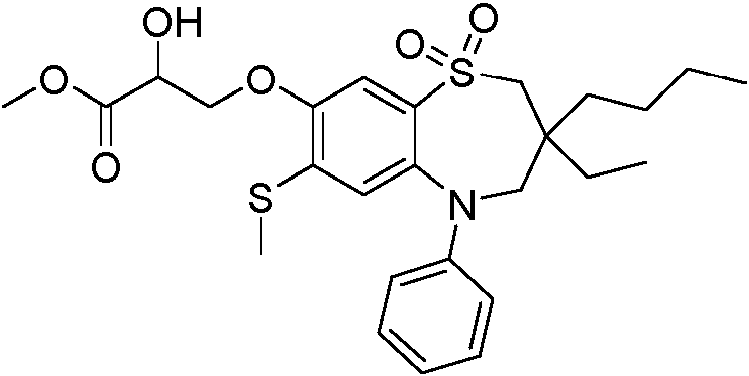
A una solución agitada de 1,1 -dióxido de 3-butil-3-etil-8-hidroxi-7-(metiltio)-5-fenil-2,3,4,5-tetrahidro-1,5-benzotiazepina (Intermedio 22; 400 mg, 0.95 mmol) en DMF (4 ml), se agregaron Cs2CO3 (621 mg, 1.90 mmol) y metiloxirano-2-carboxilato (291 mg, 2.85 mmol). La mezcla de reacción se agitó durante 16 horas a temperatura ambiente. Después de la conversión del 70-80 % del material de partida (monitorizada por TLC), la mezcla de reacción se apagó con HCl diluido (5 ml) y se diluyó con agua (5 ml). La capa acuosa se extrajo con EtOAc ( 2x10 ml), y la capa orgánica combinada se lavó con agua (10 ml) y solución salina (10 ml). La parte orgánica se secó sobre Na2SO4 anhidro, se filtró y se concentró bajo vacío. El material crudo resultante se purificó mediante cromatografía en columna Isolera (eluyente: EtOAc/PE al 30 %; gel de sílice: 230-400 de malla) para producir el compuesto del título. Rendimiento: 60 % (300 mg, goma amarilla).To a stirred solution of 1,1-3-butyl-3-ethyl-8-hydroxy-7-(methylthio)-5-phenyl-2,3,4,5-tetrahydro-1,5-benzothiazepine dioxide (Intermediate 22; 400 mg, 0.95 mmol) in DMF (4 ml), Cs 2 CO 3 (621 mg, 1.90 mmol) and methyloxirane-2-carboxylate (291 mg, 2.85 mmol) were added. The reaction mixture was stirred for 16 hours at room temperature. After 70-80% conversion of the starting material (monitored by TLC), the reaction mixture was quenched with dilute HCl (5 mL) and diluted with water (5 mL). The aqueous layer was extracted with EtOAc (2x10 ml), and the combined organic layer was washed with water (10 ml) and saline (10 ml). The organic part was dried over anhydrous Na 2 SO 4 , filtered and concentrated under vacuum. The resulting crude material was purified by Isolera column chromatography (eluent: 30% EtOAc/PE; silica gel: 230-400 mesh) to yield the title compound. Yield: 60% (300 mg, yellow gum).
RMN 1H (400 MHz, DMSO-d6): 8 7.34 (s, 1H), 7.22 (t, J = 10.0 Hz, 2H), 6.98 (d, J = 10.0 Hz, 2H), 6 . 8 6 (t, J = 9.6 Hz, 1H), 6.69 (s, 1H), 5.89 (d, J = 8.0 Hz, 1H), 4.47 (t, J = 6.0 Hz, 1H), 4.27 (d, J = 5.2 Hz, 2H), 3.68 (s, 3H), 3.60-3.55 (m, 2H), 3.27 (s, 2H), 2.15 (s, 3H), 1.81-1.70 (m, 1H), 1.60-1.25 (m, 3H), 1.22-0.95 (m, 4H), 0.85-0.65 (m, 6 H). LCMS: (Método F) 522.3 (M++H), Tr. 2.76 min, 98.34 % (Máx).1H NMR (400 MHz, DMSO-d 6 ): 8 7.34 (s, 1H), 7.22 (t, J = 10.0 Hz, 2H), 6.98 (d, J = 10.0 Hz, 2H), 6 . 8 6 (t, J = 9.6 Hz, 1H), 6.69 (s, 1H), 5.89 (d, J = 8.0 Hz, 1H), 4.47 (t, J = 6.0 Hz, 1H), 4.27 (d, J = 5.2 Hz, 2H), 3.68 (s, 3H), 3.60-3.55 (m, 2H), 3.27 (s, 2H), 2.15 (s, 3H), 1.81-1.70 (m, 1H), 1.60-1.25 (m , 3H), 1.22-0.95 (m, 4H), 0.85-0.65 (m, 6H ). LCMS: (Method F) 522.3 (M++H), Tr. 2.76 min, 98.34% (Max).
Intermedio 72Intermediate 72
3-((3-butil-3-etil-7-(metiltio)-1,1-dióxido-5-fenil-2,3,4,5-tetrahidro-1,5-benzotiazepin-8-il)oxi)-2-hidroxipropanoato de metilo (diastereómeros individuales) 3-((3-butyl-3-ethyl-7-(methylthio)-1,1-dioxide-5-phenyl-2,3,4,5-tetrahydro-1,5-benzothiazepin-8-yl)oxy) Methyl -2-hydroxypropanoate (individual diastereomers)

Diastereómeros 1 y 2Diastereomers 1 and 2
A una solución agitada del enantiómero 1 de 3-butil-3-etil-8-hidroxi-7-(metiltio)-5-fenil-2,3,4,5-tetrahidro-1,5-benzotiazepina 1,1 -dióxido (Intermedio 23; 400 mg, 0.95 mmol) en DMF (4 ml) se agregaron CS2CO3 (621 mg, 1.90 mmol) y metil-oxirano-2-carboxilato (291 mg, 2.85 mmol). La mezcla de reacción se agitó durante 48 horas a temperatura ambiente. Después de la conversión del 70-80 % de la reacción (monitorizada por TLC), la mezcla de reacción se apagó con HCl diluido (5 ml) y se diluyó con agua (5 ml). La capa acuosa se extrajo con EtOAc ( 2x 10 ml), luego la capa orgánica combinada se lavó con agua (10 ml) y solución salina (10 ml). La parte orgánica se secó sobre Na2SO4 anhidro, se filtró y se concentró bajo vacío. El material crudo resultante se purificó mediante cromatografía en columna Isolera (eluyente: EtOAc/PE al 30 %; gel de sílice: 230-400 de malla) para producir el compuesto del título. Rendimiento: 60 % (300 mg, goma marrón). LCMS: (Método E) 522.1 (M++H), Tr. 3.03 min, 98.51 % (Máx).To a stirred solution of 3-butyl-3-ethyl-8-hydroxy-7-(methylthio)-5-phenyl-2,3,4,5-tetrahydro-1,5-benzothiazepine 1,1-dioxide enantiomer 1 (Intermediate 23; 400 mg, 0.95 mmol) In DMF (4 ml) CS 2 CO 3 (621 mg, 1.90 mmol) and methyl-oxirane-2-carboxylate (291 mg, 2.85 mmol) were added. The reaction mixture was stirred for 48 hours at room temperature. After 70-80% conversion of the reaction (monitored by TLC), the reaction mixture was quenched with dilute HCl (5 mL) and diluted with water (5 mL). The aqueous layer was extracted with EtOAc (2x 10 ml), then the combined organic layer was washed with water (10 ml) and saline (10 ml). The organic part was dried over anhydrous Na 2 SO 4 , filtered and concentrated under vacuum. The resulting crude material was purified by Isolera column chromatography (eluent: 30% EtOAc/PE; silica gel: 230-400 mesh) to yield the title compound. Yield: 60% (300 mg, brown gum). LCMS: (Method E) 522.1 (M++H), Tr. 3.03 min, 98.51% (Max).
Los dos diastereómeros (290 mg, 0.55 mmol) se separaron mediante el Instrumento SFC quiral (método N). El material se concentró bajo vacío a 40 °C. La primera fracción de elución correspondió al diastereómero 1 y la segunda fracción de elución correspondió al diastereómero 2.The two diastereomers (290 mg, 0.55 mmol) were separated using the Chiral SFC Instrument (method N). The material was concentrated under vacuum at 40 °C. The first elution fraction corresponded to diastereomer 1 and the second elution fraction corresponded to diastereomer 2 .
Diastereómeros 3 y 4Diastereomers 3 and 4
Una mezcla de diastereómeros 3 y 4 del compuesto del título se obtuvo siguiendo el mismo procedimiento, a partir de 400 mg de enantiómero 2 del Intermedio 23. Rendimiento: 49 % (280 mg, goma marrón).A mixture of diastereomers 3 and 4 of the title compound was obtained following the same procedure, from 400 mg of enantiomer 2 of Intermediate 23. Yield: 49% (280 mg, brown gum).
LCMS: (Método F) 522.2 (M++H), Tr. 2.759 min, 99.04 % (Máx). HPLC: (Método B) Tr. 5.681 min, 98.07 % (Máx).LCMS: (Method F) 522.2 (M++H), Tr. 2,759 min, 99.04% (Max). HPLC: (Method B) Tr. 5.681 min, 98.07% (Max).
Los dos diastereómeros (270 mg, 0.52 mmol) se separaron mediante el Instrumento SFC quiral (método G). El material se concentró bajo vacío a 40 °C. La primera fracción de elución correspondió al diastereómero 3 y la segunda fracción de elución correspondió al diastereómero 4.The two diastereomers (270 mg, 0.52 mmol) were separated using the Chiral SFC Instrument (method G). The material was concentrated under vacuum at 40 °C. The first elution fraction corresponded to diastereomer 3 and the second elution fraction corresponded to diastereomer 4.
Diastereómero 1: Rendimiento: 37 % (110 mg, goma marrón claro). RMN 1 H (400 MHz, DMSO-d6): 87.34 (s, 1H), 7.22 (t, J = 8.4 Hz, 2H), 6.98 (d, J = 7.6 Hz, 2H), 6 . 8 6 (t, J = 7.2 Hz, 1H), 6.69 (s, 1H), 5.90 (d, J = 6.0 Hz, 1H), 4.50-4.47 (m, 1H), 4.27 (t, J = 2.4 Hz, 2H), 3.69 (s, 5H), 3.27 (s, 2H), 2.15 (s, 3H), 1.65-1.40 (m, 2H), 1.36-1.31 (m, 2H), 1.13 1.08 (m, 4H), 0.79-0.74 (m, 6 H). LCMS: (Método E) 522.1 (M++H), Tr. 3.03 min, 96.69 % (Máx). HPLC: (Método B) Tr. 5.604 min, 97.44 % (Máx). SFC quiral: (Método N) Tr. 2.93 min, 99.72 % (Máx).Diastereomer 1: Yield: 37% (110 mg, light brown gum). 1 H NMR (400 MHz, DMSO-d 6 ): 87.34 (s, 1H), 7.22 (t, J = 8.4 Hz, 2H), 6.98 (d, J = 7.6 Hz, 2H), 6 . 8 6 (t, J = 7.2 Hz, 1H), 6.69 (s, 1H), 5.90 (d, J = 6.0 Hz, 1H), 4.50-4.47 (m, 1H), 4.27 (t, J = 2.4 Hz, 2H), 3.69 (s, 5H), 3.27 (s, 2H), 2.15 (s, 3H), 1.65-1.40 (m, 2H), 1.36-1.31 (m, 2H), 1.13 1.08 (m, 4H), 0.79-0.74 (m, 6 H). LCMS: (Method E) 522.1 (M++H), Tr. 3.03 min, 96.69% (Max). HPLC: (Method B) Tr. 5,604 min, 97.44% (Max). Chiral SFC: (Method N) Tr. 2.93 min, 99.72% (Max).
Diastereómero 2: Rendimiento: 37 % (110 mg, goma marrón claro). RMN 1 H (400 MHz, DMSO-d6): 87.34 (s, 1H), 7.22 (t, J = 10.4 Hz, 2H), 6.98 (d, J = 10.4 Hz, 2H), 6.87 (d, J = 10.0 Hz, 1H), 6.69 (s, 1H), 5.89 (d, J = 8.0 Hz, 1H), 4.49 4.47 (m, 1H), 4.27-4.26 (m, 2H), 3.69 (s, 5H), 3.27 (s, 2H), 2.15 (s, 3H), 1.62-1.50 (m, 1H), 1.50-1.28 (m, 3H), 1.20 0.90 (m, 4H), 0.82-0.70 (m, 6 H). LCMS: (Método E) 522.1 (M++H), Tr. 3.039 min, 97.48 % (Máx). HPLC: (Método B) Tr. 5.604 min, 99.06 % (Máx). SFC quiral: (Método N) Tr. 3.76 min, 98.78 % (Máx).Diastereomer 2: Yield: 37% (110 mg, light brown gum). 1 H NMR (400 MHz, DMSO-d 6 ): 8 7.34 (s, 1H), 7.22 (t, J = 10.4 Hz, 2H), 6.98 (d, J = 10.4 Hz, 2H), 6.87 (d, J = 10.0 Hz, 1H), 6.69 (s, 1H), 5.89 (d, J = 8.0 Hz, 1H), 4.49 4.47 (m, 1H), 4.27-4.26 (m, 2H), 3.69 (s, 5H), 3.27 (s, 2H), 2.15 (s, 3H), 1.62-1.50 (m, 1H), 1.50-1.28 (m, 3H), 1.20 0.90 (m, 4H), 0.82-0.70 (m, 6 H). LCMS: (Method E) 522.1 (M++H), Tr. 3,039 min, 97.48% (Max). HPLC: (Method B) Tr. 5.604 min, 99.06% (Max). Chiral SFC: (Method N) Tr. 3.76 min, 98.78% (Max).
Diastereómero 3: Rendimiento: 37 % (100 mg, sólido blanco). RMN 1 H (400 MHz, DMSO-d6): 8 7.34 (s, 1H), 7.22 (t, J = 10.0 Hz, 2H), 6.98 (d, J = 10.8 Hz, 2H), 6 . 8 6 (t, J = 9.2 Hz, 1H), 6.69 (s, 1H), 5.89 (d, J = 7.6 Hz, 1H), 4.55-4.45 (m, 1H), 4.30-4.20 (m, 2H), 3.68 (s, 5H), 3.29-3.27 (m, 2H), 2.15 (s, 3H), 1.60-1.50 (m, 2H), 1.50-1.30 (m, 2H), 1.20-0.95 (m, 4H), 0.80-0.70 (m, 6 H). LCMS: (Método E) 522.0 (M++H), Tr. 3.05 min, 95.91 % (Máx). HPLC: (Método B) Tr. 5.74 min, 99.94 % (Máx). SFC quiral: (Método G) Tr. 3.09 min, 99.20 % (Máx).Diastereomer 3: Yield: 37% (100 mg, white solid). 1 H NMR (400 MHz, DMSO-d 6 ): 8 7.34 (s, 1H), 7.22 (t, J = 10.0 Hz, 2H), 6.98 (d, J = 10.8 Hz, 2H), 6 . 8 6 (t, J = 9.2 Hz, 1H), 6.69 (s, 1H), 5.89 (d, J = 7.6 Hz, 1H), 4.55-4.45 (m, 1H), 4.30-4.20 (m, 2H), 3.68 (s, 5H), 3.29-3.27 (m, 2H), 2.15 (s, 3H), 1.60-1.50 (m, 2H), 1.50-1.30 (m, 2H), 1.20-0.95 (m, 4H), 0.80-0.70 (m, 6 H). LCMS: (Method E) 522.0 (M++H), Tr. 3.05 min, 95.91% (Max). HPLC: (Method B) Tr. 5.74 min, 99.94% (Max). Chiral SFC: (Method G) Tr. 3.09 min, 99.20% (Max).
Diastereómero 4: Rendimiento: 37 % (100 mg, sólido blancuzco). RMN 1 H (400 MHz, DMSO-d6): 8 7.34 (s, 1H), 7.22 (t, J = 9.6 Hz, 2H), 6.99 (d, J = 9.6 Hz, 2H), 6.87 (s, 1H), 6.69 (s, 1H), 5.90 (d, J = 7.2 Hz, 1H), 4.48 (d, J = 6 . 8 Hz, 1H), 4.27 (s, 2H), 3.69-3.67 (m, 5H), 3.27 (s, 2H), 2.15 (s, 3H), 1.60-1.50 (m, 2H), 1.45-1.30 (m, 2H), 1.20-1.00 (m, 4H), 0.79-0.73 (m, 6 H). LCMS: (Método E) 522.0 (M++H), Tr. 3.06 min, 95.26 % (Máx). HPLC: (Método B) Tr. 5.74 min, 93.32 %(Máx). SFC quiral: (Método G) Tr. 5.13 min, 99.07 % (Máx).Diastereomer 4: Yield: 37% (100 mg, off-white solid). 1 H NMR (400 MHz, DMSO-d 6 ): 8 7.34 (s, 1H), 7.22 (t, J = 9.6 Hz, 2H), 6.99 (d, J = 9.6 Hz, 2H), 6.87 (s, 1H ), 6.69 (s, 1H), 5.90 (d, J = 7.2 Hz, 1H), 4.48 (d, J = 6 . 8 Hz, 1H), 4.27 (s, 2H), 3.69-3.67 (m, 5H) , 3.27 (s, 2H), 2.15 (s, 3H), 1.60-1.50 (m, 2H), 1.45-1.30 (m, 2H), 1.20-1.00 (m, 4H), 0.79-0.73 (m, 6 H). LCMS: (Method E) 522.0 (M++H), Tr. 3.06 min, 95.26 % (Max). HPLC: (Method B) Tr. 5.74 min, 93.32 %(Max). Chiral SFC: (Method G) Tr. 5.13 min, 99.07% (Max).
No se conoce La configuración absoluta de los cuatro diastereómeros.The absolute configuration of the four diastereomers is not known.
Intermedio 73Intermediate 73
3-((3-butil-3-etil-5-(4-fluorofenil)-7-(metiltio)-1,1-dióxido-2,3,4,5-tetrahidro-1,5-benzotiazepin-8-il)oxi)-2-hidroxipropanoato de metilo3-((3-butyl-3-ethyl-5-(4-fluorophenyl)-7-(methylthio)-1,1-dioxide-2,3,4,5-tetrahydro-1,5-benzothiazepin-8- methyl yl)oxy)-2-hydroxypropanoate

A una solución agitada de 1,1 -dióxido de 3-butil-3-etil-5-(4-fluorofenil)-8-hidroxi-7-(metiltio)-2,3,4,5-tetrahidro-1,5-benzotiazepina (Intermedio 70; 100 mg, 0.22 mmol) en DMF (3 ml) se agregaron Cs2CÜ3 (148 mg, 4.40 mmol) y metiloxirano-2-carboxilato (26 mg, 0.26 mmol). La mezcla de reacción luego se agitó durante 16 horas a temperatura ambiente. Después de la terminación de ~70 % de la reacción (monitorizada por TLC), la mezcla de reacción se apagó con HCl diluido (1.5 N, 5 ml) y se diluyó adicionalmente con agua (5 ml). La capa acuosa se extrajo con EtOAc (2 x 10 ml) y la capa orgánica combinada se lavó con agua (10 ml) y solución salina (10 ml). La parte orgánica se secó sobre Na2SO4 anhidro, se filtró y se concentró bajo vacío. El material crudo resultante se purificó mediante cromatografía en columna Isolera (eluyente: EtOAc/PE al 45 %; gel de sílice: 230-400 de malla) para producir el compuesto del título. Rendimiento: 82 % (60 mg, sólido marrón).To a stirred solution of 1,1-3-butyl-3-ethyl-5-(4-fluorophenyl)-8-hydroxy-7-(methylthio)-2,3,4,5-tetrahydro-1,5-dioxide -benzothiazepine (Intermediate 70; 100 mg, 0.22 mmol) in DMF (3 ml) Cs 2 CÜ 3 (148 mg, 4.40 mmol) and methyloxirane-2-carboxylate (26 mg, 0.26 mmol) were added. The reaction mixture was then stirred for 16 hours at room temperature. After completion of ~70% of the reaction (monitored by TLC), the reaction mixture was quenched with dilute HCl (1.5 N, 5 mL) and further diluted with water (5 mL). The aqueous layer was extracted with EtOAc (2 x 10 mL) and the combined organic layer was washed with water (10 mL) and saline (10 mL). The organic part was dried over anhydrous Na 2 SO 4 , filtered and concentrated under vacuum. The resulting crude material was purified by Isolera column chromatography (eluent: 45% EtOAc/PE; silica gel: 230-400 mesh) to yield the title compound. Yield: 82% (60 mg, brown solid).
RMN 1H (400 MHz, DMSO-d6): 8 7.33 (s, 1H), 7.11-7.07 (m, 4H), 6.61 (s, 1H), 5.87-5.84 (m, 1H), 4.48 (d, J = 5.6 Hz, 1H), 4.25 (t, J = 2.8 Hz, 2H), 3.76 (s, 3H), 3.69-3.68 (m, 2H), 3.33-3.29 (m, 2H), 2.15 (s, 3H), 1.52-1.51 (m, 2H), 1.38 1.33 (m, 2H), 1.18-1.10 (m, 4H), 0.78-0.76 (m, 6 H). LCMS: (Método E) 540.0 (M++H), Tr. 3.03 min, 76.03 % (Máx). Intermedio 741H NMR (400 MHz, DMSO-d 6 ): 8 7.33 (s, 1H), 7.11-7.07 (m, 4H), 6.61 (s, 1H), 5.87-5.84 (m, 1H), 4.48 (d, J = 5.6 Hz, 1H), 4.25 (t, J = 2.8 Hz, 2H), 3.76 (s, 3H), 3.69-3.68 (m, 2H), 3.33-3.29 (m, 2H), 2.15 (s, 3H) , 1.52-1.51 (m, 2H), 1.38 1.33 (m, 2H), 1.18-1.10 (m, 4H), 0.78-0.76 (m, 6 H). LCMS: (Method E) 540.0 (M++H), Tr. 3.03 min, 76.03% (Max). Intermediate 74
3-((3-butil-3-etil-5-(4-fluorofenil)-7-(metiltio)-1,1-dióxido-2,3,4,5-tetrahidro-1,5-benzotiazepin-8-il)oxi)-2-hidroxipropanoato de metilo (diastereómeros individuales)3-((3-butyl-3-ethyl-5-(4-fluorophenyl)-7-(methylthio)-1,1-dioxide-2,3,4,5-tetrahydro-1,5-benzothiazepin-8- methyl yl)oxy)-2-hydroxypropanoate (individual diastereomers)

Diastereómeros 1 y 2 Diastereomers 1 and 2
A una solución agitada del enantiómero 1 de 1,1-dióxido de 3-butil-3-etil-5-(4-fluorofenil)-8-hidroxi-7-(metiltio)-2,3,4,5-tetrahidro-1,5-benzotiazepina (Intermedio 70; 160 mg, 0.36 mmol) en DMF (3 ml) se agregaron CS2CO3 (230 mg, 0.73 mmol) y metil-oxirano-2-carboxilato (44 mg, 0.43 mmol). La mezcla de reacción luego se agitó durante 48 horas a temperatura ambiente. Después de la conversión del 70-80 % de la reacción (monitorizada por TLC), la mezcla de reacción se apagó con HCl diluido (1.5 N, 5 ml) y se diluyó con agua (5 ml). La capa acuosa se extrajo con EtOAc (2 x 10 ml) y la capa orgánica combinada se lavó con agua (10 ml) y solución salina (10 ml), La parte orgánica se secó sobre Na2¿O4 anhidro, se filtró y se concentró bajo vacío. El material crudo resultante se purificó mediante cromatografía en columna Isolera (eluyente: EtOAc/PE al 30-40 %; gel de sílice: 230-400 de malla) para producir el compuesto del título. Rendimiento: 40 % (80 mg, goma marrón).To a stirred solution of 3-butyl-3-ethyl-5-(4-fluorophenyl)-8-hydroxy-7-(methylthio)-2,3,4,5-tetrahydro-1,1-dioxide enantiomer 1 1,5-benzothiazepine (Intermediate 70; 160 mg, 0.36 mmol) in DMF (3 ml) CS 2 CO 3 (230 mg, 0.73 mmol) and methyl-oxirane-2-carboxylate (44 mg, 0.43 mmol) were added. The reaction mixture was then stirred for 48 hours at room temperature. After 70-80% conversion of the reaction (monitored by TLC), the reaction mixture was quenched with dilute HCl (1.5 N, 5 mL) and diluted with water (5 mL). The aqueous layer was extracted with EtOAc (2 x 10 ml) and the combined organic layer was washed with water (10 ml) and brine (10 ml). The organic part was dried over anhydrous Na 2 ¿O 4 , filtered and was concentrated under vacuum. The resulting crude material was purified by Isolera column chromatography (eluent: 30-40% EtOAc/PE; silica gel: 230-400 mesh) to yield the title compound. Yield: 40% (80 mg, brown gum).
RMN 1 H (400 MHz, CDCh): 8 7.41 (s, 1H), 7.08-7.04 (m, 2H), 7.03-7.06 (m, 2H), 6.55 (s, 1H), 4.57-4.56 (m, 1H), 4.46 (t, J = 5.6 Hz, 2H), 3.87 (s, 3H), 3.75-3.65 (m, 2H), 3.19-3.17 (m, 2H), 2.17 (s, 3H), 1.79-1.61 (m, 2H), 1.49-1.42 (m, 2H), 1.28-1.20 (m, 2H), 1.18-1.10 (m, 2H), 0.85-0.79 (m, 6 H). LCMS: (Método E) 540.1 (M++H), Tr. 3.03 min, 95.30 % (Máx). HPLC: (Método B) Tr. 5.70 min, 93.00 % (Máx). 1H NMR (400 MHz, CDCh): 8 7.41 (s, 1H), 7.08-7.04 (m, 2H), 7.03-7.06 (m, 2H), 6.55 (s, 1H), 4.57-4.56 (m, 1H ), 4.46 (t, J = 5.6 Hz, 2H), 3.87 (s, 3H), 3.75-3.65 (m, 2H), 3.19-3.17 (m, 2H), 2.17 (s, 3H), 1.79-1.61 ( m, 2H), 1.49-1.42 (m, 2H), 1.28-1.20 (m, 2H), 1.18-1.10 (m, 2H), 0.85-0.79 (m, 6 H). LCMS: (Method E) 540.1 (M++H), Tr. 3.03 min, 95.30% (Max). HPLC: (Method B) Tr. 5.70 min, 93.00% (Max).
Los dos diastereómeros se separaron mediante el Instrumento SFC quiral (Método G). El material se concentró bajo vacío a 40 °C. La primera fracción de elución correspondió al diastereómero 1 y la segunda fracción de elución correspondió al diastereómero 2.The two diastereomers were separated using the chiral SFC Instrument (Method G). The material was concentrated under vacuum at 40 °C. The first elution fraction corresponded to diastereomer 1 and the second elution fraction corresponded to diastereomer 2 .
Diastereómeros 3 y 4Diastereomers 3 and 4
Una mezcla de diastereómeros 3 y 4 del compuesto del título se obtuvo siguiendo el mismo procedimiento, a partir de 160 mg de enantiómero 2 del Intermedio 70. Rendimiento: 40 % (80 mg, goma marrón). RMN 1 H (400 MHz, CDCla): 8 7.41 (s, 1H), 7.29-6.97 (m, 4H), 6.55 (s, 1H), 4.57-4.55 (m, 1H), 4.39-4.38 (m, 2H), 3.80 (s, 3H), 3.78-3.60 (m, 2H), 3.19-3.15 (m, 2H), 2.17 (s, 3H), 1.49-1.40 (m, 4H), 1.27-1.20 (m, 2H), 1.18-1.10 (m, 2H), 0.80-0.78 (m, 6 H). LCMS: (Método E) 540.0 (M++H), Tr. 3.04 min, 95.89 % (Máx). HPLC: (Método B) Tr. 5.75 min, 93.07 % (Máx).A mixture of diastereomers 3 and 4 of the title compound was obtained following the same procedure, from 160 mg of enantiomer 2 of Intermediate 70. Yield: 40% (80 mg, brown gum). 1 H NMR (400 MHz, CDCla): 8 7.41 (s, 1H), 7.29-6.97 (m, 4H), 6.55 (s, 1H), 4.57-4.55 (m, 1H), 4.39-4.38 (m, 2H ), 3.80 (s, 3H), 3.78-3.60 (m, 2H), 3.19-3.15 (m, 2H), 2.17 (s, 3H), 1.49-1.40 (m, 4H), 1.27-1.20 (m, 2H ), 1.18-1.10 (m, 2H), 0.80-0.78 (m, 6 H). LCMS: (Method E) 540.0 (M++H), Tr. 3.04 min, 95.89% (Max). HPLC: (Method B) Tr. 5.75 min, 93.07% (Max).
Los dos diastereómeros se separaron mediante el Instrumento SFC quiral (método G). El material se concentró bajo vacío a 40 °C. La primera fracción de elución correspondió al diastereómero 3 y la segunda fracción de elución correspondió al diastereómero 4.The two diastereomers were separated using the Chiral SFC Instrument (method G). The material was concentrated under vacuum at 40 °C. The first elution fraction corresponded to diastereomer 3 and the second elution fraction corresponded to diastereomer 4.
Diastereómero 1: Rendimiento: 37 % (30 mg, sólido marrón). RMN 1 H (400 MHz, DMSO-d6): 8 7.33 (s, 1H), 7.09-7.07 (m, 4H), 6.61 (s, 1H), 5.89 (d, J = 6.0 Hz, 1H), 4.48-4.48 (m, 1H), 4.28-4.26 (m, 2H), 3.68-3.51 (m, 5H), 3.37-3.35 (m, 2H), 2.15 (s, 3H), 1.61-1.52 (m, 1H), 1.38-1.31 (m, 3H), 1.24-1.01 (m, 4H), 0.78-0.72 (m, 6 H). LCMS: (Método E) 540.0 (M++H), Tr. 3.05 min, 99.79 % (Máx). HPLC: (Método B) Tr. 5.75 min, 99.24 % (Máx). SFC quiral: (Método G ) Tr. 1.4 min, 99.58 % (Máx).Diastereomer 1: Yield: 37% (30 mg, brown solid). 1 H NMR (400 MHz, DMSO-d 6 ): 8 7.33 (s, 1H), 7.09-7.07 (m, 4H), 6.61 (s, 1H), 5.89 (d, J = 6.0 Hz, 1H), 4.48 -4.48 (m, 1H), 4.28-4.26 (m, 2H), 3.68-3.51 (m, 5H), 3.37-3.35 (m, 2H), 2.15 (s, 3H), 1.61-1.52 (m, 1H) , 1.38-1.31 (m, 3H), 1.24-1.01 (m, 4H), 0.78-0.72 (m, 6 H). LCMS: (Method E) 540.0 (M++H), Tr. 3.05 min, 99.79% (Max). HPLC: (Method B) Tr. 5.75 min, 99.24% (Max). Chiral SFC: (G Method) Tr. 1.4 min, 99.58% (Max).
Diastereómero 2: Rendimiento: 37 % (30 mg, sólido marrón). RMN 1 H (400 MHz, DMSO-d6): 7.33 (s, 1H), 7.09-7.07 (m, 4H), 6.61 (s, 1H), 5.89 (d, J = 6.0 Hz, 1H), 4.49-4.48 (m, 1H), 4.26-4.26 (m, 2H), 3.68-3.51 (m, 5H), 3.37-3.35 (m, 2H), 2.15 (s, 3H), 1.50-1.41 (m, 1H), 1.38-1.31 (m, 3H), 1.24-1.01 (m, 4H), 0.78-0.75 (m, 6 H). LCMS: (Método E) 540.0 (M++H), Tr. 3.05 min, 99.10 % (Máx). HPLC: (Método B) Tr. 5.76 min, 97.56 % (Máx). SFC quiral: (Método G ) Tr. 2.16 min, 99.40 % (Máx).Diastereomer 2: Yield: 37% (30 mg, brown solid). 1H NMR (400 MHz, DMSO-d 6 ): 7.33 (s, 1H), 7.09-7.07 (m, 4H), 6.61 (s, 1H), 5.89 (d, J = 6.0 Hz, 1H), 4.49- 4.48 (m, 1H), 4.26-4.26 (m, 2H), 3.68-3.51 (m, 5H), 3.37-3.35 (m, 2H), 2.15 (s, 3H), 1.50-1.41 (m, 1H), 1.38-1.31 (m, 3H), 1.24-1.01 (m, 4H), 0.78-0.75 (m, 6H ). LCMS: (Method E) 540.0 (M++H), Tr. 3.05 min, 99.10% (Max). HPLC: (Method B) Tr. 5.76 min, 97.56% (Max). Chiral SFC: (G Method) Tr. 2.16 min, 99.40% (Max).
Diastereómero 3: Rendimiento: 12 % (10 mg, sólido marrón). RMN 1 H (400 MHz, DMSO-d6): 8 7.33 (s, 1H), 7.09-7.07 (m, 4H), 6.61 (s, 1H), 5.88 (d, J = 6.0 Hz, 1H), 4.48-4.47 (m, 1H), 4.26-4.24 (m, 2H), 3.69-3.68 (m, 5H), 3.33-3.21 (m, 2H), 2.15 (s, 3H), 1.68-1.50 (m, 1H), 1.42-1.38 (m, 3H), 1.35-1.01 (m, 4H), 0.76-0.72 (m, 6 H).LCMS: (Método E) 540.0 (M++H), Tr. 2.39 min, 99.79 % (Máx). HPLC: (Método B) Tr. 5.72 min, 99.52 % (Máx). SFC quiral: (Método G) Tr. 2.01 min, 98.91 % (Máx).Diastereomer 3: Yield: 12% (10 mg, brown solid). 1 H NMR (400 MHz, DMSO-d 6 ): 8 7.33 (s, 1H), 7.09-7.07 (m, 4H), 6.61 (s, 1H), 5.88 (d, J = 6.0 Hz, 1H), 4.48 -4.47 (m, 1H), 4.26-4.24 (m, 2H), 3.69-3.68 (m, 5H), 3.33-3.21 (m, 2H), 2.15 (s, 3H), 1.68-1.50 (m, 1H) , 1.42-1.38 (m, 3H), 1.35-1.01 (m, 4H), 0.76-0.72 (m, 6 H).LCMS: (Method E) 540.0 (M++H), Tr. 2.39 min, 99.79% (Max). HPLC: (Method B) Tr. 5.72 min, 99.52% (Max). Chiral SFC: (Method G) Tr. 2.01 min, 98.91% (Max).
Diastereómero 4: Rendimiento: 12 % (10 mg, sólido marrón). RMN 1 H (400 MHz, DMSO-d6): 8 7.33 (s, 1H), 7.09-7.07 (m, 4H), 6.61 (s, 1H), 5.88 (d, J = 5.2 Hz, 1H), 4.49-4.45 (m, 1H), 4.27-4.24 (m, 2H), 3.69-3.68 (m, 5H), 3.33-3.21 (m, 2H), 2.15 (s, 3H), 1.68-1.50 (m, 1H), 1.42-1.38 (m, 3H), 1.34-1.01 (m, 4H), 0.78-0.74 (m, 6 H) .LCMS: (Método E) 540.0 (M+H), Tr. 3.04 min, 99.30 % (Máx). HPLC: (Método B) Tr. 5.72 min, 98.98 % (Máx). SFC quiral: (Método G) Tr. 3.78 min, 98.58 % (Máx).Diastereomer 4: Yield: 12% (10 mg, brown solid). 1 H NMR (400 MHz, DMSO-d 6 ): 8 7.33 (s, 1H), 7.09-7.07 (m, 4H), 6.61 (s, 1H), 5.88 (d, J = 5.2 Hz, 1H), 4.49 -4.45 (m, 1H), 4.27-4.24 (m, 2H), 3.69-3.68 (m, 5H), 3.33-3.21 (m, 2H), 2.15 (s, 3H), 1.68-1.50 (m, 1H) , 1.42-1.38 (m, 3H), 1.34-1.01 (m, 4H), 0.78-0.74 (m, 6 H).LCMS: (Method E) 540.0 (M+H), Tr. 3.04 min, 99.30% (Max). HPLC: (Method B) Tr. 5.72 min, 98.98% (Max). Chiral SFC: (Method G) Tr. 3.78 min, 98.58% (Max).
No se conoce La configuración absoluta de los cuatro diastereómeros.The absolute configuration of the four diastereomers is not known.
Intermedio 75Intermediate 75
1,1-dióxido de 3-Butil-3-etil-8-hidroxi-7-metoxi-5-fenil-2,3,4,5-tetrahidro-1,5-benzotiazepina 3-Butyl-3-ethyl-8-hydroxy-7-methoxy-5-phenyl-2,3,4,5-tetrahydro-1,5-benzothiazepine 1,1-dioxide

A una solución agitada de 1,1 -dióxido de 7-bromo-3-butil-3-etil-8-hidroxi-5-fenil-2,3,4,5-tetrahidro-1,5-benzotiazepina (1 g, 2.21 mmol) en metóxido de sodio (21 %, 4.42 ml, 4.42 mmol), se agregó CuBr (0.1 g, 0.31 mmol) a temperatura ambiente y la mezcla resultante se calentó durante 6 horas a 85 °C. Después de la finalización de la reacción (monitorizada por TLC), la mezcla de reacción se concentró bajo vacío y la masa cruda resultante se sometió a partición entre EtOAc (25 ml) y agua (25 ml). La capa acuosa se extrajo con EtOAc (2 x 25 ml) y la capa orgánica combinada luego se lavó con solución salina (25 ml) y se secó sobre Na2SO4 anhidro. La parte orgánica se concentró bajo vacío y el crudo resultante se purificó mediante cromatografía en columna Isolera (eluyente: 5 % MeOH/DCM; gel de sílice: 230-400 de malla) para producir el compuesto del título. Rendimiento: 41 % (0.36 g, sólido rosado pálido). To a stirred solution of 7-bromo-3-butyl-3-ethyl-8-hydroxy-5-phenyl-2,3,4,5-tetrahydro-1,5-benzothiazepine 1,1-dioxide (1 g, 2.21 mmol) in sodium methoxide (21%, 4.42 mL, 4.42 mmol), CuBr (0.1 g, 0.31 mmol) was added at room temperature and the resulting mixture was heated for 6 hours at 85 °C. After completion of the reaction (monitored by TLC), the reaction mixture was concentrated under vacuum and the resulting crude mass was partitioned between EtOAc (25 ml) and water (25 ml). The aqueous layer was extracted with EtOAc (2 x 25 mL) and the combined organic layer was then washed with brine (25 mL) and dried over anhydrous Na 2 SO 4 . The organic part was concentrated under vacuum and the resulting crude oil was purified by Isolera column chromatography (eluent: 5% MeOH/DCM; silica gel: 230-400 mesh) to yield the title compound. Yield: 41% (0.36 g, pale pink solid).
RMN 1H (400 MHz, DMSO-d6): 8 9.71 (s, 1H), 7.29 (s, 1H), 7.19 (t, J = 7.6 Hz, 2H), 6.92 (d, J = 8.0 Hz, 2H), 6.80 (t, J = 7.6 Hz, 1H), 6.54 (s, 1H), 3.63 (s, 3H), 3.16 (s, 2H), 2.45 (s, 2H), 1.62-1.51 (m, 2H), 1.40-1.31 (m, 2H), 1.28-1.18 (m, 4H), 0.78-0.74 (m, 6 H). LCMS: (Método A) 404.2 (M+H), Tr. 2.64 min, 94.56 % (Máx).1H NMR (400 MHz, DMSO-d 6 ): 8 9.71 (s, 1H), 7.29 (s, 1H), 7.19 (t, J = 7.6 Hz, 2H), 6.92 (d, J = 8.0 Hz, 2H) , 6.80 (t, J = 7.6 Hz, 1H), 6.54 (s, 1H), 3.63 (s, 3H), 3.16 (s, 2H), 2.45 (s, 2H), 1.62-1.51 (m, 2H), 1.40-1.31 (m, 2H), 1.28-1.18 (m, 4H), 0.78-0.74 (m, 6H ). LCMS: (Method A) 404.2 (M+H), Tr. 2.64 min, 94.56% (Max).
Intermedio 76Intermediate 76
1,1 -dióxido de 7-Bromo-3,3-dibutil-8-hidroxi-5-fenil-2,3,4,5-tetrahidro-1,5-benzotiazepina7-Bromo-3,3-dibutyl-8-hydroxy-5-phenyl-2,3,4,5-tetrahydro-1,5-benzothiazepine 1,1-dioxide

A una solución agitada de 1,1 -dióxido de 7-bromo-3,3-dibutil-8-metoxi-5-fenil-2,3,4,5-tetrahidro-1,5-benzotiazepina (0.8 g, 1.62 mmol) en DCM (20 ml) a 0 °C, BBr3 (0.78 ml, 8.1 mmol) se agregó en forma de gotas y la mezcla de reacción se agitó a temperatura ambiente durante 1 hora. Después de la finalización de la reacción (monitorizada por TLC), la mezcla de reacción se enfrió a 0 °C. Se agregaron en forma de gotas EtOAc (10 ml) y agua enfriada con hielo (5 ml) y la mezcla se agitó a temperatura ambiente durante 1 hora. La mezcla de reacción luego se sometió a partición entre agua (15 ml) y DCM (15 ml) y la capa acuosa se extrajo con DCM ( 3x15 ml). La parte orgánica combinada se lavó con solución salina (15 ml), se secó sobre Na2SO4 anhidro y se concentró bajo vacío. El material crudo resultante se envió a la siguiente etapa como tal sin ninguna purificación adicional. Rendimiento: 90 % (700 mg, crudo, sólido blancuzco).To a stirred solution of 7-bromo-3,3-dibutyl-8-methoxy-5-phenyl-2,3,4,5-tetrahydro-1,5-benzothiazepine 1,1-dioxide (0.8 g, 1.62 mmol ) in DCM (20 mL) at 0 °C, BBr 3 (0.78 mL, 8.1 mmol) was added dropwise and the reaction mixture was stirred at room temperature for 1 hour. After completion of the reaction (monitored by TLC), the reaction mixture was cooled to 0 °C. EtOAc (10 mL) and ice-cold water (5 mL) were added dropwise and the mixture was stirred at room temperature for 1 hour. The reaction mixture was then partitioned between water (15 ml) and DCM (15 ml) and the aqueous layer was extracted with DCM (3x15 ml). The combined organic part was washed with brine (15 mL), dried over anhydrous Na 2 SO 4 and concentrated under vacuum. The resulting crude material was sent to the next stage as such without any further purification. Yield: 90% (700 mg, crude, off-white solid).
RMN 1H (400 MHz, DMSO-d6): 8 10.83 (s, 1H), 7.46 (s, 1H), 7.23 (t, J = 8.0 Hz, 2H), 7.07 (s, 1H), 6.99 (d, J = 7.6 Hz, 2H), 6 . 8 8 (t, J = 7.2 Hz, 1H), 3.80-3.72 (m, 2H), 3.27 (s, 2H), 1.34-1.31 (m, 4H), 1.13-0.99 (m, 8 H), 0.75-0.72 (m, 6 H). LCMS: (Método A) 480.1 (M+), Tr. 3.19 min, 89.95 % (Máx).1H NMR (400 MHz, DMSO-d 6 ): 8 10.83 (s, 1H), 7.46 (s, 1H), 7.23 (t, J = 8.0 Hz, 2H), 7.07 (s, 1H), 6.99 (d, J = 7.6 Hz, 2H), 6 . 8 8 (t, J = 7.2 Hz, 1H), 3.80-3.72 (m, 2H), 3.27 (s, 2H), 1.34-1.31 (m, 4H), 1.13-0.99 (m, 8 H), 0.75- 0.72 (m, 6H ). LCMS: (Method A) 480.1 (M+), Tr. 3.19 min, 89.95% (Max).
Intermedio 77Intermediate 77
1,1 -dióxido de 3,3-Dibutil-8-hidroxi-7-metoxi-5-fenil-2,3,4,5-tetrahidro-1,5-benzotiazepina3,3-Dibutyl-8-hydroxy-7-methoxy-5-phenyl-2,3,4,5-tetrahydro-1,5-benzothiazepine 1,1-dioxide

A una solución agitada de 1,1-dióxido de 7-Bromo-3,3-dibutil-8-hidroxi-5-fenil-2,3,4,5-tetrahidro-1,5-benzotiazepina (Intermedio 76; 0.9 g, 1.87 mmol) en metóxido de sodio (21 %, 10 ml, 10.2 mmol), se agregó CuBr(0.15 g, 1.05 mmol) a temperatura ambiente y la mezcla resultante se calentó a 85 °C durante 6 horas. Después de la finalización de la reacción (monitorizada por TLC), la mezcla de reacción se concentró bajo vacío y la masa cruda resultante se sometió a partición entre EtOAc (25 ml) y agua (25 ml). La capa acuosa se extrajo con EtOAc (2 x 25 ml) y la capa orgánica combinada se lavó con solución salina (25 ml) y se secó sobre Na2SO4 anhidro. La parte orgánica se concentró bajo vacío y el crudo resultante se purificó mediante cromatografía en columna Isolera (eluyente: Me- OH/DCM al 5 %; gel de sílice: 230-400 de malla) para producir el compuesto del título. Rendimiento: 78 % (0.63 g, goma rosado claro). To a stirred solution of 7-Bromo-3,3-dibutyl-8-hydroxy-5-phenyl-2,3,4,5-tetrahydro-1,5-benzothiazepine 1,1-dioxide (Intermediate 76; 0.9 g , 1.87 mmol) in sodium methoxide (21%, 10 mL, 10.2 mmol), CuBr (0.15 g, 1.05 mmol) was added at room temperature and the resulting mixture was heated at 85 °C for 6 hours. After completion of the reaction (monitored by TLC), the reaction mixture was concentrated under vacuum and the resulting crude mass was partitioned between EtOAc (25 ml) and water (25 ml). The aqueous layer was extracted with EtOAc (2 x 25 mL) and the combined organic layer was washed with brine (25 mL) and dried over anhydrous Na 2 SO 4 . The organic part was concentrated under vacuum and the resulting crude oil was purified by Isolera column chromatography (eluent: 5% Me-OH/DCM; silica gel: 230-400 mesh) to give the title compound. Yield: 78% (0.63 g, light pink gum).
UPLC: (Método A) 432.5 (M+H), Tr. 1.93 min, 90.07 % (Máx).UPLC: (Method A) 432.5 (M+H), Tr. 1.93 min, 90.07% (Max).
Intermedio 78Intermediate 78
3-((3,3-dibutil-7-(metiltio)-1,1-dióxido-5-fenil-2,3,4,5-tetrahidro-1,5-benzotiazepin-8-il)oxi)-2-metoxipropanoato de metilo3-((3,3-dibutyl-7-(methylthio)-1,1-dioxide-5-phenyl-2,3,4,5-tetrahydro-1,5-benzothiazepin-8-yl)oxy)-2 -methyl methoxypropanoate

A una suspensión de hidruro de sodio (60 %, 7.2 mg, 0.18 mmol) en DMF (1 ml) a 0 °C se agregó una solución de 3-((3,3-dibutil-7-(metiltio)-1,1-dióxido-5-fenil-2,3,4,5-tetrahidro-1,5-benzotiazepin-8-il)oxi)-2-hidroxipropanoato de metilo (Intermedio 20; 200 mg, 0.36 mmol) en DMF (3 ml), y la mezcla de reacción se agitó durante 15 minutos a temperatura ambiente. Una solución de yoduro de metilo (0.12 ml, 2.3 mmol) en DMF (1 ml) luego se agregó en forma de gotas y la mezcla de reacción se agitó durante 16 horas a temperatura ambiente. Después de la finalización de la reacción (monitorizada por TLC), la mezcla de reacción se apagó con HCl diluido (1.5 N, 1 ml) y se diluyó adicionalmente con agua (1 ml). La capa acuosa se extrajo con EtOAc (2 x 10 ml) y la capa orgánica combinada se lavó con agua (10 ml) y solución salina (10 ml). La parte orgánica se secó sobre Na2SO4 anhidro, se filtró y se concentró bajo vacío. El material crudo resultante se purificó mediante cromatografía en columna Isolera (eluyente: EtOAc/PE al 20-30 %; gel de sílice: 230-400 de malla) para producir el compuesto del título. Rendimiento: 48 % (100 mg, sólido marrón). To a suspension of sodium hydride (60%, 7.2 mg, 0.18 mmol) in DMF (1 ml) at 0 °C was added a solution of 3-((3,3-dibutyl-7-(methylthio)-1, Methyl 1-dioxide-5-phenyl-2,3,4,5-tetrahydro-1,5-benzothiazepin-8-yl)oxy)-2-hydroxypropanoate (Intermediate 20; 200 mg, 0.36 mmol) in DMF (3 ml), and the reaction mixture was stirred for 15 minutes at room temperature. A solution of methyl iodide (0.12 mL, 2.3 mmol) in DMF (1 mL) was then added dropwise and the reaction mixture was stirred for 16 h at room temperature. After completion of the reaction (monitored by TLC), the reaction mixture was quenched with dilute HCl (1.5 N, 1 mL) and further diluted with water (1 mL). The aqueous layer was extracted with EtOAc (2 x 10 mL) and the combined organic layer was washed with water (10 mL) and saline (10 mL). The organic part was dried over anhydrous Na 2 SO 4 , filtered and concentrated under vacuum. The resulting crude material was purified by Isolera column chromatography (eluent: 20-30% EtOAc/PE; silica gel: 230-400 mesh) to yield the title compound. Yield: 48% (100 mg, brown solid).
RMN 1H (400 MHz, DMSO-d6): 8 7.32 (s, 1H), 7.25-7.20 (m, 2H), 7.01 (d, J = 8.0 Hz, 2H), 6 . 8 8 (t, J = 9.6 Hz, 1H), 6.65 (s, 1H), 4.39-4.26 (m, 2H), 4.04-4.01 (m, 1H), 3.77 (s, 3H), 3.47-3.45 (m, 5H), 3.33-3.20 (m, 2H), 2.13 (s, 3H), 1.40 1.26 (m, 4H), 1.20-1.03 (m, 8 H), 0.78-0.76 (m, 6 H). LCMS: (Método E) 564.1 (M+H), Tr. 3.35 min, 95.11 % (Máx). 1H NMR (400 MHz, DMSO-d 6 ): 8 7.32 (s, 1H), 7.25-7.20 (m, 2H), 7.01 (d, J = 8.0 Hz, 2H), 6 . 8 8 (t, J = 9.6 Hz, 1H), 6.65 (s, 1H), 4.39-4.26 (m, 2H), 4.04-4.01 (m, 1H), 3.77 (s, 3H), 3.47-3.45 (m , 5H), 3.33-3.20 (m, 2H), 2.13 (s, 3H), 1.40 1.26 (m, 4H), 1.20-1.03 (m, 8 H), 0.78-0.76 (m, 6 H). LCMS: (Method E) 564.1 (M+H), Tr. 3.35 min, 95.11% (Max).
Intermedio 79Intermediate 79
3-((3-butil-3-etil-7-(metiltio)-1,1-dióxido-5-fenil-2,3,4,5-tetrahidro-1,5-benzotiazepin-8-il)oxi)-2-hidroxi-2-metilpropanoato de metilo (diastereómeros individuales)3-((3-butyl-3-ethyl-7-(methylthio)-1,1-dioxide-5-phenyl-2,3,4,5-tetrahydro-1,5-benzothiazepin-8-yl)oxy) Methyl -2-hydroxy-2-methylpropanoate (individual diastereomers)

A una solución agitada del enantiómero 2 de 1,1-dióxido de 3-butil-3-etil-8-hidroxi-7-(metiltio)-5-fenil-2,3,4,5-tetrahidro-1,5- benzotiazepina (Intermedio 23, 250 mg, 0.59 mmol) en DMF (5 ml), se agregó Cs2CO3 (0.38 g, 1.19 mmol) y la mezcla de reacción se agitó durante 15 minutos a temperatura ambiente. Luego se agregó Metil-2-metilglicidato (0.2 g, 1.78 mmol) y la mezcla de reacción se agitó durante 72 horas a temperatura ambiente. Después de la finalización de la reacción (monitorizada por TLC), la mezcla de reacción se apagó con HCl diluido (1.5 N, 5 ml) y se diluyó con agua (5 ml). La capa acuosa se extrajo con EtOAc (2 x 10 ml) y la capa orgánica combinada se lavó con agua (10 ml) y solución salina (10 ml). La parte orgánica se secó sobre Na2SO4 anhidro, se filtró y se concentró bajo vacío. El material crudo resultante se purificó mediante cromatografía en columna Isolera (eluyente: EtOAc/PE al 15%; gel de sílice: 230-400 de malla) para producir el compuesto del título. Rendimiento: 60 % (150 mg, goma incolora).To a stirred solution of the 2-enantiomer of 3-butyl-3-ethyl-8-hydroxy-7-(methylthio)-5-phenyl-2,3,4,5-tetrahydro-1,5-1,1-dioxide benzothiazepine (Intermediate 23, 250 mg, 0.59 mmol) in DMF (5 mL), Cs 2 CO 3 (0.38 g, 1.19 mmol) was added and the reaction mixture was stirred for 15 minutes at room temperature. Methyl-2-methylglycidate (0.2 g, 1.78 mmol) was then added and the reaction mixture was stirred for 72 hours at room temperature. After completion of the reaction (monitored by TLC), the reaction mixture was quenched with dilute HCl (1.5 N, 5 mL) and diluted with water. (5 ml). The aqueous layer was extracted with EtOAc (2 x 10 mL) and the combined organic layer was washed with water (10 mL) and saline (10 mL). The organic part was dried over anhydrous Na 2 SO 4 , filtered and concentrated under vacuum. The resulting crude material was purified by Isolera column chromatography (eluent: 15% EtOAc/PE; silica gel: 230-400 mesh) to yield the title compound. Yield: 60% (150 mg, colorless gum).
RMN 1H (400 MHz, DIVISOR): 8 7.31 (s, 1H), 7.21-7.19 (m, 2H), 6.99-6.96 (m, 3H), 6 . 6 8 (s, 1H), 4.15-4.12 (m, 3H), 3.89-3.59 (m, 4H), 3.26 (s, 2H), 2.14 (s, 3H), 1.55-1.33 (m, 5H), 1.28-1.15 (m, 6 H), 0.85-0.71 (m, 6 H). LCMS: (Método E) 536.2 (M++H), Tr. 3.05 min, 99.11 % (Máx).1H NMR (400 MHz, DIVIDER): 8 7.31 (s, 1H), 7.21-7.19 (m, 2H), 6.99-6.96 (m, 3H), 6 . 6 8 (s, 1H), 4.15-4.12 (m, 3H), 3.89-3.59 (m, 4H), 3.26 (s, 2H), 2.14 (s, 3H), 1.55-1.33 (m, 5H), 1.28 -1.15 (m, 6 H), 0.85-0.71 (m, 6 H). LCMS: (Method E) 536.2 (M++H), Tr. 3.05 min, 99.11% (Max).
Los dos diastereómeros enantiómeros (150 mg, 0.28 mmol) se separaron mediante SFC (método H). La primera fracción de elución correspondió al diastereómero 1 y la segunda fracción de elución correspondió al diastereómero 2. El material se concentró bajo vacío a 40 °C. Cada una de las dos fracciones luego se trató individualmente para purificación adicional. El residuo obtenido se acidificó con HCl diluido (1.5 N, pH~4) y la capa acuosa se extrajo con EtOAc (3 x 5 ml). La capa orgánica combinada se lavó con agua (10 ml) y solución salina (10 ml) y se secó sobre Na2SO4 anhidro. La parte orgánica se filtró y se concentró bajo vacío a 40 °C para producir un diastereómero purificado del compuesto del título.The two enantiomeric diastereomers (150 mg, 0.28 mmol) were separated by SFC (method H). The first elution fraction corresponded to diastereomer 1 and the second elution fraction corresponded to diastereomer 2. The material was concentrated under vacuum at 40 °C. Each of the two fractions was then treated individually for further purification. The residue obtained was acidified with dilute HCl (1.5 N, pH~4) and the aqueous layer was extracted with EtOAc (3 x 5 ml). The combined organic layer was washed with water (10 mL) and brine (10 mL) and dried over anhydrous Na 2 SO 4 . The organic part was filtered and concentrated under vacuum at 40 °C to produce a purified diastereomer of the title compound.
Diastereómero 1: Rendimiento: 33% (50 mg, sólido blancuzco). LCMS: (Método E) 535.8 (M++H), Tr. 2.69 min, 97.06 % (Máx). SFC quiral: (Método F) Tr. 1.94 min, 100% (Máx).Diastereomer 1: Yield: 33% (50 mg, off-white solid). LCMS: (Method E) 535.8 (M++H), Tr. 2.69 min, 97.06% (Max). Chiral SFC: (Method F) Tr. 1.94 min, 100% (Max).
Diastereómero 2: Rendimiento: 33 % (50 mg, sólido blancuzco). LCMS: (Método E) 535.8 (M++H), Tr. 2.69 min, 96.50 % (Máx). SFC quiral: (Método F) Tr. 3.20 min, 100 % (Máx).Diastereomer 2: Yield: 33% (50 mg, off-white solid). LCMS: (Method E) 535.8 (M++H), Tr. 2.69 min, 96.50% (Max). Chiral SFC: (Method F) Tr. 3.20 min, 100% (Max).
No se conoce la configuración absoluta de los dos diastereómeros.The absolute configuration of the two diastereomers is not known.
Intermedio 80Intermediate 80
7-Bromo-3-butil-5-(4-fluorofenil)-8-metoxi-3-metil-2,3-dihidro-1,5-benzotiazepin-4(5H)-ona7-Bromo-3-butyl-5-(4-fluorophenyl)-8-methoxy-3-methyl-2,3-dihydro-1,5-benzothiazepin-4(5H)-one

A una solución de 7-bromo-3-butil-8-metoxi-3-metil-2,3-dihidro-1,5-benzotiazepin-4(5H)-ona (Intermedio 31; 5 g, 14 mmol) en 1-bromo-4-fluorobenceno (50 ml), se agregaron K2CO3 seco (3.9 g, 28 mmol), Cul (0.26 g, 1.4 mmol) y tris[2-(2-metoxietoxi)etil]amina (0.9 g, 2.8 mmol) y la mezcla de reacción se calentó durante 16 horas a 135 °C. Después de la finalización de la reacción (monitorizada por TLC), la mezcla de reacción se concentró bajo vacío. El residuo obtenido luego se sometió a partición entre agua (25 ml) y EtOAc (25 ml). La parte acuosa se extrajo con EtOAc (2x 100 ml), y la capa orgánica combinada se lavó con agua enfriada con hielo (100 ml) y solución salina (100 ml). La parte orgánica se secó sobre Na2SO4 anhidro, se filtró y se concentró bajo vacío. El residuo obtenido se trituró con éter de petróleo. El sólido obtenido luego se filtró y se secó para producir el compuesto del título. Rendimiento: 85 % (5.5 g, sólido marrón pálido).To a solution of 7-bromo-3-butyl-8-methoxy-3-methyl-2,3-dihydro-1,5-benzothiazepin-4(5H)-one (Intermediate 31; 5 g, 14 mmol) in 1 -bromo-4-fluorobenzene (50 ml), dry K 2 CO 3 (3.9 g, 28 mmol), Cul (0.26 g, 1.4 mmol) and tris[2-(2-methoxyethoxy)ethyl]amine (0.9 g) were added , 2.8 mmol) and the reaction mixture was heated for 16 hours at 135 °C. After completion of the reaction (monitored by TLC), the reaction mixture was concentrated under vacuum. The residue obtained was then partitioned between water (25 ml) and EtOAc (25 ml). The aqueous portion was extracted with EtOAc (2x 100 mL), and the combined organic layer was washed with ice water (100 mL) and saline (100 mL). The organic part was dried over anhydrous Na 2 SO 4 , filtered and concentrated under vacuum. The residue obtained was crushed with petroleum ether. The obtained solid was then filtered and dried to produce the title compound. Yield: 85% (5.5 g, pale brown solid).
LCMS: (Método E) 451.9 (M++H), Tr. 3.26 min, 81.86 % (Máx).LCMS: (Method E) 451.9 (M++H), Tr. 3.26 min, 81.86% (Max).
Intermedio 81Intermediate 81
7-Bromo-3-butil-5-(4-fluorofenil)-8-metoxi-3-metil-2,3,4,5-tetrahidro-1,5-benzotiazepina7-Bromo-3-butyl-5-(4-fluorophenyl)-8-methoxy-3-methyl-2,3,4,5-tetrahydro-1,5-benzothiazepine

A una solución de 7-bromo-3-butil-5-(4-fluorofenil)-8-metoxi-3-metil-2,3-dihidro-1,5-benzotiazepin-4(5H)-ona (Intermedio 80; 5.2 g, 11.5 mmol) en THF (50 ml) a 0 °C, se agregó dimetilsulfuro de borano (1M en THF, 58 ml, 58 mmol) y la mezcla de reacción se calentó durante 16 horas a 75 °C. Después de la finalización de la reacción (monitorizada por TLC), la mezcla de reacción se enfrió a 0 °C, se agregó metanol (60 ml) y la mezcla de reacción se calentó durante 2 horas a 60 °C. La mezcla de reacción luego se enfrió a temperatura ambiente, se concentró bajo vacío y el residuo obtenido se sometió a partición entre agua (50 ml) y EtOAc (50 ml). La capa acuosa se extrajo con EtOAc (2x 100 ml), y la capa orgánica combinada se lavó con agua enfriada con hielo (100 ml) y solución salina (100 ml). La parte orgánica se secó sobre Na2SO4 anhidro, se filtró y se concentró bajo vacío para producir el compuesto del título. Rendimiento: 5.3 g (crudo, goma incolora). LCMS: (Método E) 439.9 (M++H), Tr. 3.55 min, 87.61 %(Máx).To a solution of 7-bromo-3-butyl-5-(4-fluorophenyl)-8-methoxy-3-methyl-2,3-dihydro-1,5-benzothiazepin-4(5H)-one (Intermediate 80; 5.2 g, 11.5 mmol) in THF (50 mL) at 0 °C, borane dimethylsulfide (1M in THF, 58 mL, 58 mmol) was added and the reaction mixture was heated for 16 hours at 75 °C. After completion of the reaction (monitored by TLC), the reaction mixture was cooled to 0 °C, methanol (60 mL) was added, and the reaction mixture was heated for 2 h at 60 °C. The reaction mixture was then cooled to room temperature, concentrated under vacuum and the obtained residue was partitioned between water (50 ml) and EtOAc (50 ml). The aqueous layer was extracted with EtOAc (2x 100 mL), and the combined organic layer was washed with ice water (100 mL) and saline (100 mL). The organic part was dried over anhydrous Na 2 SO 4 , filtered and concentrated under vacuum to give the title compound. Yield: 5.3 g (raw, colorless gum). LCMS: (Method E) 439.9 (M++H), Tr. 3.55 min, 87.61 %(Max).
Intermedio 82Intermediate 82
1,1 -dióxido de 7-Bromo-3-butil-5-(4-fluorofenil)-8-metoxi-3-metil-2,3,4,5-tetrahidro-1,5-benzotiazepina7-Bromo-3-butyl-5-(4-fluorophenyl)-8-methoxy-3-methyl-2,3,4,5-tetrahydro-1,5-benzothiazepine 1,1-dioxide

A una solución de 7-bromo-3-butil-5-(4-fluorofenil)-8-metoxi-3-metil-2,3,4,5-tetrahidro-1,5-benzotiazepina (Intermedio 81; 5.3 g, 12.1 mmol) en una mezcla de THF y agua (8:2, 55 ml), se agregó oxona (37.16 g, 120.8 mmol) y la mezcla de reacción se agitó durante 16 horas a temperatura ambiente. Después de la finalización de la reacción (monitorizada por TLC), la capa acuosa se extrajo con EtOAc (2 x 100 ml), y la capa orgánica combinada se lavó con agua enfriada con hielo (100 ml) y solución salina (100 ml). La parte orgánica se secó sobre Na2SO4 anhidro y se concentró bajo vacío. El material crudo resultante se purificó mediante cromatografía en columna Isolera (eluyente: EtOAc/PE al 15 %; gel de sílice: 230-400 de malla) para producir el compuesto del título. Rendimiento: 75 % (4.3 g, sólido blanco). To a solution of 7-bromo-3-butyl-5-(4-fluorophenyl)-8-methoxy-3-methyl-2,3,4,5-tetrahydro-1,5-benzothiazepine (Intermediate 81; 5.3 g, 12.1 mmol) in a mixture of THF and water (8:2, 55 ml), oxone (37.16 g, 120.8 mmol) was added and the reaction mixture was stirred for 16 hours at room temperature. After completion of the reaction (monitored by TLC), the aqueous layer was extracted with EtOAc (2 x 100 mL), and the combined organic layer was washed with ice-cold water (100 mL) and saline (100 mL). . The organic part was dried over anhydrous Na 2 SO 4 and concentrated under vacuum. The resulting crude material was purified by Isolera column chromatography (eluent: 15% EtOAc/PE; silica gel: 230-400 mesh) to yield the title compound. Yield: 75% (4.3 g, white solid).
RMN 1H (400 MHz, DMSO-d6): 8 7.45 (s, 1H), 7.21 (s, 1H), 7.12-7.05 (m, 4H), 3.93 (s, 3H), 3.85-3.61 (m, 2H), 3.29 (s, 2H), 1.52-1.39 (m, 1H), 1.37-1.26 (m, 1H), 1.25-1.03 (m, 4H), 0.98 (s, 3H), 0.81-0.74 (m, 3H). LCMS: (Método E) 470.1 (M+), Tr. 3.21 min, 98.04 % (Máx).1H NMR (400 MHz, DMSO-d 6 ): 8 7.45 (s, 1H), 7.21 (s, 1H), 7.12-7.05 (m, 4H), 3.93 (s, 3H), 3.85-3.61 (m, 2H ), 3.29 (s, 2H), 1.52-1.39 (m, 1H), 1.37-1.26 (m, 1H), 1.25-1.03 (m, 4H), 0.98 (s, 3H), 0.81-0.74 (m, 3H ). LCMS: (Method E) 470.1 (M+), Tr. 3.21 min, 98.04% (Max).
Intermedio 83Intermediate 83
1,1 -dióxido de 3-Butil-5-(4-fluorofenil)-8-hidroxi-3-metil-7-(metiltio)-2,3,4,5-tetrahidro-1,5-benzotiazepina3-Butyl-5-(4-fluorophenyl)-8-hydroxy-3-methyl-7-(methylthio)-2,3,4,5-tetrahydro-1,5-benzothiazepine 1,1-dioxide

A una solución de 1,1-dióxido de 7-Bromo-3-butil-5-(4-fluorofenil)-8-metoxi-3-metil-2,3,4,5-tetrahidro-1,5-benzotiazepina (Intermedio 82; 4.3 g, 9.14 mmol) en DMF (43 ml), se agregó tiometóxido de sodio (3.2 g, 45.7 mmol) y la mezcla de reacción se agitó durante 12 horas a 80 °C. Después de la finalización de la reacción (monitorizada por TLC), la mezcla de reacción se apagó con agua enfriada con hielo (25 ml) y la capa acuosa se extrajo con EtOAc (2 x 50 ml). La capa orgánica combinada se lavó con agua enfriada con hielo (50 ml) y solución salina (50 ml) y se secó sobre Na2SO4 anhidro. La parte orgánica se concentró bajo vacío y el material crudo resultante se purificó mediante cromatografía en columna Isolera (eluyente: EtOAc/PE al 30 %; gel de sílice: 230-400 de malla) para producir el compuesto del título. Rendimiento: 90 % (3.5 g, sólido blancuzco). To a solution of 7-Bromo-3-butyl-5-(4-fluorophenyl)-8-methoxy-3-methyl-2,3,4,5-tetrahydro-1,5-benzothiazepine 1,1-dioxide ( Intermediate 82; 4.3 g, 9.14 mmol) in DMF (43 mL), sodium thiomethoxide (3.2 g, 45.7 mmol) was added and the reaction mixture was stirred for 12 hours at 80 °C. After completion of the reaction (monitored by TLC), the reaction mixture was quenched with ice water (25 mL) and the aqueous layer was extracted with EtOAc (2 x 50 mL). The combined organic layer was washed with ice water (50 mL) and brine (50 mL) and dried over anhydrous Na 2 SO 4 . The organic part was concentrated under vacuum and the resulting crude material was purified by Isolera column chromatography (eluent: 30% EtOAc/PE; silica gel: 230-400 mesh) to give the title compound. Yield: 90% (3.5 g, off-white solid).
RMN 1H (400 MHz, DMSO-da): 510.57 (s, 1H), 7.31 (s, 1H), 7.04-6.98 (m, 2H), 6.92-6.88 (m, 2H), 6.71 (s, 1H), 3.81 3.65 (m, 2H), 3.34-3.20 (m, 2H), 2.20 (s, 3H), 1.55-1.39 (m, 1H), 1.38-1.05 (m, 5H), 0.99 (s, 3H), 0.81-0.77 (m, 3H). LCMS: (Método E) 424.2 (M++H), Tr. 2.78 min, 98.08 % (Máx).1H NMR (400 MHz, DMSO-da): 510.57 (s, 1H), 7.31 (s, 1H), 7.04-6.98 (m, 2H), 6.92-6.88 (m, 2H), 6.71 (s, 1H), 3.81 3.65 (m, 2H), 3.34-3.20 (m, 2H), 2.20 (s, 3H), 1.55-1.39 (m, 1H), 1.38-1.05 (m, 5H), 0.99 (s, 3H), 0.81 -0.77 (m, 3H). LCMS: (Method E) 424.2 (M++H), Tr. 2.78 min, 98.08% (Max).
Intermedio 84Intermediate 84
3-((3-butil-5-(4-fluorofenil)-3-metil-7-(metiltio)-1,1-dióxido-2,3,4,5-tetrahidro-1,5-benzotiazepin-8-il)oxi)-2-hidroxipropanoato de metilo3-((3-butyl-5-(4-fluorophenyl)-3-methyl-7-(methylthio)-1,1-dioxide-2,3,4,5-tetrahydro-1,5-benzothiazepin-8- methyl yl)oxy)-2-hydroxypropanoate

A una solución agitada de 1,1 -dióxido de 3-butil-5-(4-fluorofenil)-8-hidroxi-3-metil-7-(metiltio)-2,3,4,5-tetrahidro-1,5-benzotiazepina (Intermedio 83; 200 mg, 0.47 mmol) en DMF (3 ml), se agregó Cs2CO3 (300 mg, 0.94 mmol) y la mezcla de reacción se agitó durante 15 minutos a 0 °C. Luego se agregó p-propiolactona (144 mg, 1.41 mmol) y la mezcla de reacción se agitó durante 16 horas a temperatura ambiente. Después de la finalización de la reacción (monitorizada por TLC), la mezcla de reacción se apagó con HCl diluido (1.5 N, 2 ml) y se diluyó con agua (2 ml). La capa acuosa se extrajo con EtOAc (2 x 10 ml) y la capa orgánica combinada se lavó con agua (10 ml) y solución salina (10 ml). La parte orgánica se secó sobre Na2SO4 anhidro, se filtró y se concentró bajo vacío. El material crudo resultante se purificó mediante cromatografía en columna Isolera (eluyente: EtOAc/PE al 25-30 %; gel de sílice: 230 400 de malla). Rendimiento: 64 % (160 mg, goma marrón).To a stirred solution of 1,1-3-butyl-5-(4-fluorophenyl)-8-hydroxy-3-methyl-7-(methylthio)-2,3,4,5-tetrahydro-1,5-dioxide -benzothiazepine (Intermediate 83; 200 mg, 0.47 mmol) in DMF (3 mL), Cs 2 CO 3 (300 mg, 0.94 mmol) was added and the reaction mixture was stirred for 15 minutes at 0 °C. p-propiolactone (144 mg, 1.41 mmol) was then added and the reaction mixture was stirred for 16 hours at room temperature. After completion of the reaction (monitored by TLC), the reaction mixture was quenched with dilute HCl (1.5 N, 2 mL) and diluted with water (2 mL). The aqueous layer was extracted with EtOAc (2 x 10 mL) and the combined organic layer was washed with water (10 mL) and saline (10 mL). The organic part was dried over anhydrous Na 2 SO 4 , filtered and concentrated under vacuum. The resulting crude material was purified by Isolera column chromatography (eluent: 25-30% EtOAc/PE; silica gel: 230,400 mesh). Yield: 64% (160 mg, brown gum).
LCMS: (Método E) 526.0 (M++H), Tr. 2.94 min, 99.11 % (Máx).LCMS: (Method E) 526.0 (M++H), Tr. 2.94 min, 99.11% (Max).
Intermedio 85Intermediate 85
1,1 -dióxido de 3-Butil-7-(dimetilamino)-8-metoxi-3-metil-5-fenil-2,3,4,5-tetrahidro-1,5-benzotiazepina3-Butyl-7-(dimethylamino)-8-methoxy-3-methyl-5-phenyl-2,3,4,5-tetrahydro-1,5-benzothiazepine 1,1-dioxide

A una solución desgasificada de 1,1 -dióxido de 7-bromo-3-butil-8-metoxi-3-metil-5-fenil-2,3,4,5-tetrahidro-1,5-benzotiazepina (Intermedio 34; 1 g, 2.2 mmol) en 1,4-dioxano ( 8 ml) en una autoclave, se agregaron tert-butóxido de sodio (570 mg, 4.4 mmol), xantphos (127 mg, 0.22 mmol) y dimetilamina (solución 2 M en THF, 10 ml, 10 vol), y la mezcla de reacción se desgasificó adicionalmente durante otros 15 minutos. Luego se agregó pd2(dba)3 (101 mg, 0.11 mmol) y la mezcla de reacción se calentó durante 16 horas a 100 °C. Después de la finalización de la reacción (monitorizada por TLC), la mezcla de reacción se filtró a través de celita y la almohadilla de celita se lavó con EtOAc (25 ml). La parte del filtrado se concentró bajo vacío y el crudo resultante se purificó mediante cromatografía en columna Isolera (eluyente: EtOAc/PE al 0-24 %; gel de sílice: 230-400 de malla) para producir el compuesto del título. Rendimiento: 76 % (0.7 g, sólido marrón).To a degassed solution of 7-bromo-3-butyl-8-methoxy-3-methyl-5-phenyl-2,3,4,5-tetrahydro-1,5-benzothiazepine 1,1-dioxide (Intermediate 34; 1 g, 2.2 mmol) in 1,4-dioxane (8 ml) in an autoclave, sodium tert-butoxide (570 mg, 4.4 mmol), xantphos (127 mg, 0.22 mmol) and dimethylamine (2 M solution in THF, 10 ml, 10 vol), and the reaction mixture was further degassed for another 15 minutes. Then pd 2 (dba )3 (101 mg, 0.11 mmol) was added and the reaction mixture was heated for 16 h at 100 °C. After completion of the reaction (monitored by TLC), the reaction mixture was filtered through celite and the celite pad was washed with EtOAc (25 mL). The filtrate portion was concentrated under vacuum and the resulting crude oil was purified by Isolera column chromatography (eluent: 0-24% EtOAc/PE; silica gel: 230-400 mesh) to yield the title compound. Yield: 76% (0.7 g, brown solid).
RMN 1H (400 MHz, DMSO-d6): 57.29 (s, 1H), 7.17 (t, J = 8.0 Hz, 2H), 6.91 (d, J = 8.0 Hz, 2H), 6.77 (s, 1H), 6.43 (s, 1H), 3.86 (s, 3H), 3.81-3.72 (m, 2H), 3.25-3.14 (m, 2H), 2.69 (s, 6 H), 1.55-1.43 (m, 1H), 1.33-1.11 (m, 5H), 1.00 (s, 3H), 0.82-0.78 (m, 3H). LCMS: (Método E) 417.2 (M++H), Tr. 2.21 min, 97.88 % (Máx).1H NMR (400 MHz, DMSO-d 6 ): 57.29 (s, 1H), 7.17 (t, J = 8.0 Hz, 2H), 6.91 (d, J = 8.0 Hz, 2H), 6.77 (s, 1H), 6.43 (s, 1H), 3.86 (s, 3H), 3.81-3.72 (m, 2H), 3.25-3.14 (m, 2H), 2.69 (s, 6 H), 1.55-1.43 (m, 1H), 1.33 -1.11 (m, 5H), 1.00 (s, 3H), 0.82-0.78 (m, 3H). LCMS: (Method E) 417.2 (M++H), Tr. 2.21 min, 97.88% (Max).
Intermedio 86 Intermediate 86
1,1 -dióxido de 3-Butil-7-(dimetilamino)-8-hidroxi-3-metil-5-fenil-2,3,4,5-tetrahidro-1,5-benzotiazepina 3-Butyl-7-(dimethylamino)-8-hydroxy-3-methyl-5-phenyl-2,3,4,5-tetrahydro-1,5-benzothiazepine 1,1-dioxide

A una solución de 1,1-dióxido de 3-Butil-7-(dimetilamino)-8-metoxi-3-metil-5-fenil-2,3,4,5-tetrahidro-1,5-benzotiazepina (Intermedio 85; 0.7 g, 1.68 mmol) en DMF (7 ml), tiometóxido de sodio (0.65 g, 8.40 mmol) se agregó y la mezcla de reacción se agitó durante 12 horas a 100 °C. Después de la finalización de la reacción (monitorizada por TLC), la mezcla de reacción se apagó con agua enfriada con hielo (15 ml) y la capa acuosa se extrajo con EtOAc ( 2x15 ml). La capa orgánica combinada se lavó con agua enfriada con hielo (15 ml) y solución salina (15 ml) y se secó sobre Na2SO4 anhidro. La parte orgánica se concentró bajo vacío para producir el compuesto del título. Rendimiento: 600 mg (crudo, goma marrón).To a solution of 1,1-dioxide of 3-Butyl-7-(dimethylamino)-8-methoxy-3-methyl-5-phenyl-2,3,4,5-tetrahydro-1,5-benzothiazepine (Intermediate 85 ; 0.7 g, 1.68 mmol) in DMF (7 ml), sodium thiomethoxide (0.65 g, 8.40 mmol) was added and the reaction mixture was stirred for 12 hours at 100 °C. After completion of the reaction (monitored by TLC), the reaction mixture was quenched with ice-cold water (15 mL) and the aqueous layer was extracted with EtOAc (2x15 mL). The combined organic layer was washed with ice water (15 mL) and brine (15 mL) and dried over anhydrous Na 2 SO 4 . The organic part was concentrated under vacuum to produce the title compound. Yield: 600 mg (crude, brown gum).
LCMS: (Método E) 403.2 (M++H), Tr. 2.01 min, 96.67 % (Máx).LCMS: (Method E) 403.2 (M++H), Tr. 2.01 min, 96.67% (Max).
Intermedio 87Intermediate 87
1,1-dióxido de 3-Butil-3-etil-8-hidroxi-7-(metilamino)-5-fenil-2,3,4,5-tetrahidro-1,5-benzotiazepina3-Butyl-3-ethyl-8-hydroxy-7-(methylamino)-5-phenyl-2,3,4,5-tetrahydro-1,5-benzothiazepine 1,1-dioxide

A una solución agitada de 1,1-dióxido de 3-butil-3-etil-8-metoxi-7-(metilamino)-5-fenil-2,3,4,5-tetrahidro-1,5-benzotiazepina (200 mg, 0.48 mmol) en DMF ( 6 ml), se agregó tiometóxido de sodio (52 mg, 0.96 mmol) y la mezcla de reacción se calentó durante 12 horas a 90 °C. Después de la finalización de la reacción (monitorizada por TLC), la mezcla de reacción se apagó con agua (10 ml) y la capa acuosa se extrajo con EtOAc ( 2x10 ml). La capa orgánica combinada se lavó con agua (2 x 10 ml) y solución salina (10 ml) y se secó sobre Na2SO4 anhidro. La parte orgánica se filtró y se concentró bajo vacío para producir el compuesto del título. Rendimiento: 95 % (180 mg, sólido rosado). RMN 1H (400 MHz, DMSO-d6): 8 9.88 (s, 1H), 7.17-7.13 (m, 3H), 6.89 (d, J = 7.6 Hz, 2H), 6.74 (t, J = 7.6 Hz, 1H), 5.96 (s, 1H), 5.71-5.68 (m, 1H), 3.65 (s, 2H), 3.06 (s, 2H), 2.54 (s, 3H), 1.63-1.49 (m, 2H), 1.47-1.28 (m, 2H), 1.17-1.01 (m, 4H), 0.80-0.71 (m, 6 H). LCMS: (Método A) 403.0 (M++H), Tr. 3.00 min, 99.35 % (Máx). HPLC: (Método B) Tr. 5.47 min, 97.83 % (Máx).To a stirred solution of 3-butyl-3-ethyl-8-methoxy-7-(methylamino)-5-phenyl-2,3,4,5-tetrahydro-1,5-benzothiazepine 1,1-dioxide (200 mg, 0.48 mmol) in DMF (6 mL), sodium thiomethoxide (52 mg, 0.96 mmol) was added and the reaction mixture was heated for 12 hours at 90 °C. After completion of the reaction (monitored by TLC), the reaction mixture was quenched with water (10 mL) and the aqueous layer was extracted with EtOAc (2x10 mL). The combined organic layer was washed with water (2 x 10 mL) and brine (10 mL) and dried over anhydrous Na 2 SO 4 . The organic part was filtered and concentrated under vacuum to give the title compound. Yield: 95% (180 mg, pink solid). 1H NMR (400 MHz, DMSO-d 6 ): 8 9.88 (s, 1H), 7.17-7.13 (m, 3H), 6.89 (d, J = 7.6 Hz, 2H), 6.74 (t, J = 7.6 Hz, 1H), 5.96 (s, 1H), 5.71-5.68 (m, 1H), 3.65 (s, 2H), 3.06 (s, 2H), 2.54 (s, 3H), 1.63-1.49 (m, 2H), 1.47 -1.28 (m, 2H), 1.17-1.01 (m, 4H), 0.80-0.71 (m, 6H ). LCMS: (Method A) 403.0 (M++H), Tr. 3.00 min, 99.35% (Max). HPLC: (Method B) Tr. 5.47 min, 97.83% (Max).
Ejemplo 1Example 1
Ácido 3-((7-bromo-3-butil-3-etil-1,1-dióxido-5-fenil-2,3,4,5-tetrahidro-1,5-benzotiazepin-8-il)oxi)propanoico3-((7-bromo-3-butyl-3-ethyl-1,1-dioxide-5-phenyl-2,3,4,5-tetrahydro-1,5-benzothiazepin-8-yl)oxy)propanoic acid

A una solución agitada de ácido (E)-3-((7-bromo-3-butil-3-etil-1,1-dióxido-5-fenil-2,3,4,5-tetrahidro-1,5-benzotiazepin-8-il)oxi)acrílico (Intermedio 2; 0.5 g, 0.95 mmol) en etanol (8 ml), se agregó PtO2 (0.021 g, 0.095 mmol) bajo atmósfera de nitrógeno y la mezcla de reacción se agitó bajo atmósfera de hidrógeno en una miniclave (bajo 2 kg de presión) durante 1 hora a temperatura ambiente. Después de la finalización de la reacción (monitorizada por LCMS), la mezcla de reacción se filtró a través de celita y la almohadilla de celita se lavó con EtOAc ( 2x15 ml). El filtrado combinado se concentró bajo vacío para producir el material crudo que se purificó mediante Prep-HPLC (Método A) para proporcionar el compuesto del título. Rendimiento: 16 % (80 mg, sólido blancuzco).To a stirred solution of acid (E)-3-((7-bromo-3-butyl-3-ethyl-1,1-dioxide-5-phenyl-2,3,4,5-tetrahydro-1,5- benzothiazepin-8-yl)oxy)acrylic (Intermediate 2; 0.5 g, 0.95 mmol) in ethanol (8 mL), PtO 2 (0.021 g, 0.095 mmol) was added under nitrogen atmosphere and the reaction mixture was stirred under nitrogen atmosphere. of hydrogen in a miniclave (under 2 kg pressure) for 1 hour at room temperature. After completion of the reaction (monitored by LCMS), the reaction mixture was filtered through celite and the celite pad was washed with EtOAc (2x15 ml). The combined filtrate was concentrated under vacuum to yield crude material which was purified by Prep-HPLC (Method A) to provide the title compound. Yield: 16% (80 mg, off-white solid).
RMN 1H (400 MHz, DMSO-d6): 8 12.46 (bs, 1H), 7.45 (s, 1H), 7.26 (t, J = 7.6 Hz, 2H), 7.13 (s, 1H), 7.05 (d, J = 7.6 Hz, 2H), 6.93 (t, J = 7.2 Hz, 1H), 4.29 (t, J = 5.6 Hz, 2H), 3.75 (bs, 2H), 3.47 (s, 2H), 2.75 (t, J = 6.0 Hz, 2H), 1.37-1.30 (m, 4H), 1.17-1.12 (m, 4H), 0.73 (t, J = 6.40 Hz, 6 H). LCMS: (Método D) 525.2 (M++H), Tr. 2.76 min, 99.55% (Máx). HPLC: (Método B) Tr. 10.41 min, 99.39 % (Máx).1H NMR (400 MHz, DMSO-d 6 ): 8 12.46 (bs, 1H), 7.45 (s, 1H), 7.26 (t, J = 7.6 Hz, 2H), 7.13 (s, 1H), 7.05 (d, J = 7.6 Hz, 2H), 6.93 (t, J = 7.2 Hz, 1H), 4.29 (t, J = 5.6 Hz, 2H), 3.75 (bs, 2H), 3.47 (s, 2H), 2.75 (t, J = 6.0 Hz, 2H), 1.37-1.30 (m, 4H), 1.17-1.12 (m, 4H), 0.73 (t, J = 6.40 Hz, 6 H). LCMS: (Method D) 525.2 (M++H), Tr. 2.76 min, 99.55% (Max). HPLC: (Method B) Tr. 10.41 min, 99.39% (Max).
Ejemplos 2 y 3Examples 2 and 3
Ácido (S)-3-((7-bromo-3-butil-3-etil-1,1-dióxido-5-fenil-2,3,4,5-tetrahidro-1,5-benzotiazepin-8-il)oxi)propanoico y ácido (R)-3-((7-bromo-3-butil-3-etil-1,1-dióxido-5-fenil-2,3,4,5-tetrahidro-1,5-benzotiazepin-8-il)oxi)propanoico(S)-3-((7-bromo-3-butyl-3-ethyl-1,1-dioxide-5-phenyl-2,3,4,5-tetrahydro-1,5-benzothiazepin-8-yl acid )oxy)propanoic acid and (R)-3-((7-bromo-3-butyl-3-ethyl-1,1-dioxide-5-phenyl-2,3,4,5-tetrahydro-1,5- benzothiazepin-8-yl)oxy)propanoic acid

Los dos enantiómeros del ácido 3-((7-bromo-3-butil-3-etil-1,1-dióxido-5-fenil-2,3,4,5-tetrahidro-1,5-benzotiazepin-8-il)oxi)propanoico racémico (Ejemplo 1; 80 mg, 0.15 mmol) se separaron mediante SFC preparativa quiral (Método E); fase móvil: CO2: MeOH (60:40); longitud de onda: 210 nm; tiempo de ciclo: 4 min; contrapresión: 100 bar. El material se concentró bajo vacío a 40 °C. La primera fracción de elución corresponde al enantiómero 1 y la segunda fracción de elución corresponde al enantiómero 2. Se desconoce la configuración absoluta de los dos enantiómeros.The two enantiomers of 3-((7-bromo-3-butyl-3-ethyl-1,1-dioxide-5-phenyl-2,3,4,5-tetrahydro-1,5-benzothiazepin-8-yl Racemic )oxy)propanoic acid (Example 1; 80 mg, 0.15 mmol) were separated by chiral preparative SFC (Method E); mobile phase: CO 2 : MeOH (60:40); wavelength: 210nm; cycle time: 4 min; back pressure: 100 bar. The material was concentrated under vacuum at 40 °C. The first elution fraction corresponds to enantiomer 1 and the second elution fraction corresponds to enantiomer 2. The absolute configuration of the two enantiomers is unknown.
Enantiómero 1: Rendimiento: 29 % (23 mg, sólido blanco). RMN 1H (400 MHz, DMSO-d6): 8 12.45 (bs, 1H), 8 7.45 (s, 1H), 7.26 (t, J = 8.0 Hz, 2H), 7.14 (s, 1H), 7.05 (d, J = 7.6 Hz, 2H), 6.92 (t, J = 7.2 Hz, 2H), 4.29 (t, J = 6.0 Hz, 2H), 3.69 (bs, 2H), 3.34 (s, 2H), 2.72 (t, J = 6.0 Hz, 2H), 1.51-1.32 (m, 4H), 1.16-1.12 (m, 4H), 0.74 (t, J = 8.00 Hz, 6 H). LCMS: (Método C) 525.1 (M++H), Tr. 2.82 min, 99.36 % (Máx). HPLC: (Método B) Tr. 5.91 min, 99.39 % (Máx). SFC quiral: (Método D) Tr. 2.46 min, 100 % (Máx).Enantiomer 1: Yield: 29% (23 mg, white solid). 1H NMR (400 MHz, DMSO-d 6 ): 8 12.45 (bs, 1H), 8 7.45 (s, 1H), 7.26 (t, J = 8.0 Hz, 2H), 7.14 (s, 1H), 7.05 (d , J = 7.6 Hz, 2H), 6.92 (t, J = 7.2 Hz, 2H), 4.29 (t, J = 6.0 Hz, 2H), 3.69 (bs, 2H), 3.34 (s, 2H), 2.72 (t , J = 6.0 Hz, 2H), 1.51-1.32 (m, 4H), 1.16-1.12 (m, 4H), 0.74 (t, J = 8.00 Hz, 6 H). LCMS: (Method C) 525.1 (M++H), Tr. 2.82 min, 99.36% (Max). HPLC: (Method B) Tr. 5.91 min, 99.39% (Max). Chiral SFC: (Method D) Tr. 2.46 min, 100% (Max).
Enantiómero 2: Rendimiento: 37 % (30 mg, sólido blanco). RMN 1H (400 MHz, DMSO-d6): 8 12.45 (bs, 1H), 7.45 (s, 1H), 7.26 (t, J = 8.0 Hz, 2H), 7.14 (s, 1H), 7.05 (d, J = 8.0 Hz, 2H), 6.92 (t, J = 7.2 Hz, 1H), 4.28 (t, J = 6.0 Hz, 2H), 3.69 (bs, 2H), 3.34 (s, 2H), 2.68 (t, J = 6.4 Hz, 2H), 1.50-1.32 (m, 4H), 1.23-0.99 (m, 4H), 0.74 (t, J = 4.00 Hz, 6 H). LCMS: (Método C) 526.1 (M++2), Tr. 2.61 min, 97.99 % (Máx). HPLC: (Método B) Tr. 5.91 min, 99.31 % (Máx). SFC quiral: (Método D) Tr. 3.89 min, 99.04 % (Máx).Enantiomer 2: Yield: 37% (30 mg, white solid). 1H NMR (400 MHz, DMSO-d 6 ): 8 12.45 (bs, 1H), 7.45 (s, 1H), 7.26 (t, J = 8.0 Hz, 2H), 7.14 (s, 1H), 7.05 (d, J = 8.0 Hz, 2H), 6.92 (t, J = 7.2 Hz, 1H), 4.28 (t, J = 6.0 Hz, 2H), 3.69 (bs, 2H), 3.34 (s, 2H), 2.68 (t, J = 6.4 Hz, 2H), 1.50-1.32 (m, 4H), 1.23-0.99 (m, 4H), 0.74 (t, J = 4.00 Hz, 6 H). LCMS: (Method C) 526.1 (M++2), Tr. 2.61 min, 97.99% (Max). HPLC: (Method B) Tr. 5.91 min, 99.31% (Max). Chiral SFC: (Method D) Tr. 3.89 min, 99.04% (Max).
Ejemplo 4Example 4
Ácido 3-((7-bromo-3,3-dibutil-1,1-dióxido-5-fenil-2,3,4,5-tetrahidro-1,5-benzotiazepin-8-il)oxi)propanoico3-((7-bromo-3,3-dibutyl-1,1-dioxide-5-phenyl-2,3,4,5-tetrahydro-1,5-benzothiazepin-8-yl)oxy)propanoic acid

A una solución agitada de 3-((3,3-dibutil-7-bromo-1,1-dióxido-5-fenil-2,3,4,5-tetrahidro-1,5-benzotiazepin-8-il)oxi)propanoato de etilo (Intermedio 4; 1.5 g, 2.58 mmol) en 1,4-dioxano (5 ml), se agregó en forma de gotas HCl (6 N, 20 ml) a T.Amb. y la mezcla de reacción se calentó 16 ha 100° C. Después de la finalización de la reacción (confirmada por LCMS), la mezcla de reacción se diluyó con agua enfriada con hielo (10 ml) y la capa acuosa se extrajo con EtOAc (2 x 20 ml). La parte orgánica se secó sobre Na2SO4 anhidro y se evaporó bajo vacío. El material crudo se purificó mediante cromatografía en columna Isolera (eluyente: EtOAc/ PE al 35-40 %; gel de sílice: 230-400 de malla) para producir el compuesto del título. Rendimiento: 59 % (150 mg, sólido blancuzco). RMN 1 H (400 MHz, DMSO-d6): 8 7.45 (s, 1H), 7.27 (t, J = 7.6 Hz, 2H), 7.11 (s, 1H), 7.08 (d, J = 8.0 Hz, 2H), 6.95 (t, J = 7.2 Hz, 1H), 4.29 (t, J = 5.6 Hz, 2H), 3.70 (bs, 2H), 3.36 (s, 2H), 2.74 (t, J = 5.6 Hz, 2H), 1.36-1.30 (m, 4H), 1.16-1.00 (m, 8 H), 0.75 (t, J = 6.40 Hz, 6 H). LCMS: (Método C) 554.2 (M++2), Tr. 3.08 min, 94.37 % (Máx). HPLC: (Método B)Tr. 6.43 min, 95.0 % (Máx).To a stirred solution of 3-((3,3-dibutyl-7-bromo-1,1-dioxide-5-phenyl-2,3,4,5-tetrahydro-1,5-benzothiazepin-8-yl)oxy )ethyl propanoate (Intermediate 4; 1.5 g, 2.58 mmol) in 1,4-dioxane (5 ml), HCl ( 6 N, 20 ml) was added dropwise to RT. and the reaction mixture was heated 16 h at 100°C. After completion of the reaction (confirmed by LCMS), the reaction mixture was diluted with ice-cold water (10 mL) and the aqueous layer was extracted with EtOAc ( 2 x 20ml). The organic part was dried over anhydrous Na 2 SO 4 and evaporated under vacuum. The crude material was purified by Isolera column chromatography (eluent: 35-40% EtOAc/PE; silica gel: 230-400 mesh) to yield the title compound. Yield: 59% (150 mg, off-white solid). 1 H NMR (400 MHz, DMSO-d 6 ): 8 7.45 (s, 1H), 7.27 (t, J = 7.6 Hz, 2H), 7.11 (s, 1H), 7.08 (d, J = 8.0 Hz, 2H ), 6.95 (t, J = 7.2 Hz, 1H), 4.29 (t, J = 5.6 Hz, 2H), 3.70 (bs, 2H), 3.36 (s, 2H), 2.74 (t, J = 5.6 Hz, 2H), 1.36-1.30 (m, 4H), 1.16-1.00 (m, 8 H), 0.75 (t, J = 6.40 Hz, 6H ). LCMS: (Method C) 554.2 (M++2), Tr. 3.08 min, 94.37% (Max). HPLC: (Method B)Tr. 6.43 min, 95.0% (Max).
Ejemplo 5Example 5
Ácido 3-((3-ButN-7-doro-3-etiM,1-dióxido-5-fenN-2,3,4,5-tetrahidro-1,5-benzotiazepin-8-N)oxi)propanoico3-((3-ButN-7-doro-3-etiM,1-dioxide-5-phenN-2,3,4,5-tetrahydro-1,5-benzothiazepin-8-N)oxy)propanoic acid

A una solución agitada de 3-((3-butil-7-cloro-3-etil-1,1-dióxido-5-fenil-2,3,4,5-tetrahidro-1,5-benzotiazepin-8-il)oxi)propanoato de etilo (Intermedio 12; 3.0 g 5.9 mmol) en 1,4-dioxano (200 ml) a temperatura ambiente, HCl (6 N, 30 ml) se agregó en forma de gotas y la mezcla de reacción se calentó durante 16 horas a 100 °C. Después de la finalización de la reacción (monitorizada por LCMS), la mezcla de reacción se diluyó con agua enfriada con hielo (30 ml) y la capa acuosa se extrajo con EtOAc (2 x 50 ml). La parte orgánica se secó sobre Na2SO4 anhidro y se evaporó bajo vacío. El material crudo se purificó mediante cromatografía en columna Isolera (eluyente: MeOH/DCM de 5-10 %; gel de sílice: 230-400 de malla) para producir el compuesto del título. Rendimiento: 73 % (205 mg, sólido blancuzco).To a stirred solution of 3-((3-butyl-7-chloro-3-ethyl-1,1-dioxide-5-phenyl-2,3,4,5-tetrahydro-1,5-benzothiazepin-8-yl ethyl oxy)propanoate (Intermediate 12; 3.0 g 5.9 mmol) in 1,4-dioxane (200 mL) at room temperature, HCl ( 6 N, 30 mL) was added dropwise and the reaction mixture was heated for 16 hours at 100 °C. After completion of the reaction (monitored by LCMS), the reaction mixture was diluted with ice-cold water (30 mL) and the aqueous layer was extracted with EtOAc (2 x 50 mL). The organic part was dried over anhydrous Na 2 SO 4 and evaporated under vacuum. The crude material was purified by Isolera column chromatography (eluent: 5-10% MeOH/DCM; silica gel: 230-400 mesh) to yield the title compound. Yield: 73% (205 mg, off-white solid).
RMN 1H (400 MHz, DMSO-d6): 8 12.46 (bs, 1H), 7.50 (d, J = 2.0 Hz, 1H), 7.26 (t, J = 8.4 Hz, 2H), 7.06 (d, J = 7.2 Hz, 2H), 7.00 (s, 1H), 6.94 (t, J = 6 . 8 Hz, 1H), 4.31 (t, J = 5.6 Hz, 2H), 3.67 (bs, 2H), 3.36 (s, 2H), 2.75 (t, J = 6.0 Hz, 2H), 1.51-1.32 (m, 4H), 1.24-0.99 (m, 4H), 0.75 (t, J = 6.80 Hz, 6 H). LCMS: (Método C) 482.2 (M++2), Tr. 2.78 min, 96.49 % (Máx). HPLC: (Método B) Tr. 5.83 min, 97.44 % (Máx).1H NMR (400 MHz, DMSO-d 6 ): 8 12.46 (bs, 1H), 7.50 (d, J = 2.0 Hz, 1H), 7.26 (t, J = 8.4 Hz, 2H), 7.06 (d, J = 7.2 Hz, 2H), 7.00 (s, 1H), 6.94 (t, J = 6 . 8 Hz, 1H), 4.31 (t, J = 5.6 Hz, 2H), 3.67 (bs, 2H), 3.36 (s, 2H), 2.75 (t, J = 6.0 Hz, 2H), 1.51-1.32 (m, 4H), 1.24-0.99 (m, 4H), 0.75 (t, J = 6.80 Hz, 6 H). LCMS: (Method C) 482.2 (M++2), Tr. 2.78 min, 96.49% (Max). HPLC: (Method B) Tr. 5.83 min, 97.44% (Max).
Ejemplos 6 y 7Examples 6 and 7
Ácido (S)-3-((3-Butil-7-cloro-3-etil-1,1-dióxido-5-fenil-2,3,4,5-tetrahidro-1,5-benzotiazepin-8-il)oxi)propanoico y ácido (R)-3-((3-butil-7-cloro-3-etil-1,1-dióxido-5-fenil-2,3,4,5-tetrahidro-1,5-benzotiazepin-8-il)oxi)propanoico(S)-3-((3-Butyl-7-chloro-3-ethyl-1,1-dioxide-5-phenyl-2,3,4,5-tetrahydro-1,5-benzothiazepin-8-yl acid )oxy)propanoic acid and (R)-3-((3-butyl-7-chloro-3-ethyl-1,1-dioxide-5-phenyl-2,3,4,5-tetrahydro-1,5- benzothiazepin-8-yl)oxy)propanoic acid

Los dos enantiómeros del ácido 3-((3-butil-7-cloro-3-etil-1,1-dióxido-5-fenil-2,3,4,5-tetrahidro-1,5-benzotiazepin-8-il)oxi)propanoico racémico (Ejemplo 5; 100 mg, 0.20 mmol) se separaron mediante SFC preparativa quiral (Método E); fase móvil: CO2: MeOH (60:40); longitud de onda: 210 nm; tiempo de ciclo: 5 min; contrapresión: 100 bar. El material se concentró bajo vacío a 40 °C. La primera fracción de elución corresponde al enantiómero 1 y la segunda fracción de elución corresponde al enantiómero 2. Se desconoce la configuración absoluta de los dos enantiómeros.The two enantiomers of 3-((3-butyl-7-chloro-3-ethyl-1,1-dioxide-5-phenyl-2,3,4,5-tetrahydro-1,5-benzothiazepin-8-yl Racemic )oxy)propanoic acid (Example 5; 100 mg, 0.20 mmol) were separated by chiral preparative SFC (Method E); mobile phase: CO 2 : MeOH (60:40); wavelength: 210nm; cycle time: 5 min; back pressure: 100 bar. The material was concentrated under vacuum at 40 °C. The first elution fraction corresponds to enantiomer 1 and the second elution fraction corresponds to enantiomer 2. The absolute configuration of the two enantiomers is unknown.
Enantiómero 1: Rendimiento: 25 % (25 mg, sólido blanco). RMN 1H (400 MHz, DMSO-d6): 8 12.49 (s, 1H), 7.50 (s, 1H), 7.26 (t, J = 8.0 Hz, 2H), 7.05 (d, J = 7.6 Hz, 2H), 6.99 (s, 1H), 6.93 (t, J = 7.2 Hz, 1H), 4.30 (t, J = 5.6 Hz, 2H), 3.70 (s, 2H), 3.40 (s, 2H), 2.74 (t, J = 5.6 Hz, 2H), 1.50-1.33 (m, 4H), 1.15-0.98 (m, 4H), 0.74 (t, J = 4.40 Hz, 6 H). LCMS: (Método C) 482.1 (M++2), Tr. 2.81 min, 95.89 % (Máx). HPLC: (Método B) Tr. 5.87 min, 98.01 % (Máx). SFC quiral: (Método D) Tr. 2.71 min, 98.45 % (Máx).Enantiomer 1: Yield: 25% (25 mg, white solid). 1H NMR (400 MHz, DMSO-d 6 ): 8 12.49 (s, 1H), 7.50 (s, 1H), 7.26 (t, J = 8.0 Hz, 2H), 7.05 (d, J = 7.6 Hz, 2H) , 6.99 (s, 1H), 6.93 (t, J = 7.2 Hz, 1H), 4.30 (t, J = 5.6 Hz, 2H), 3.70 (s, 2H), 3.40 (s, 2H), 2.74 (t, J = 5.6 Hz, 2H), 1.50-1.33 (m, 4H), 1.15-0.98 (m, 4H), 0.74 (t, J = 4.40 Hz, 6 H). LCMS: (Method C) 482.1 (M++2), Tr. 2.81 min, 95.89% (Max). HPLC: (Method B) Tr. 5.87 min, 98.01% (Max). Chiral SFC: (Method D) Tr. 2.71 min, 98.45% (Max).
Enantiómero 2: Rendimiento: 15 % (15 mg, sólido blanco). RMN 1H (400 MHz, DMSO-d6): 8 12.37 (bs, 1H), 7.50 (s, 1H), 7.26 (t, J = 8.0 Hz, 2H), 7.05 (d, J = 8.0 Hz, 2H), 6.99 (s, 1H), 6.93 (t, J = 7.2 Hz, 1H), 4.30 (t, J = 5.6 Hz, 2H), 3.70 b(s, 2H), 3.41 (s, 2H), 2.73 (t, J = 5.6 Hz, 2H), 1.50-1.30 (m, 4H), 1.15-0.99 (m, 4H), 0.74 (t, J = 4.40 Hz, 6 H). LCMS: (Método C) 482.1 (M++2), Tr. 2.81 min, 96.76 % (Máx). HPLC: (Método B) Tr. 5.87 min, 99.5 % (Máx). SFC quiral: (Método D) Tr. 4.33 min, 10 0 % (Máx). Enantiomer 2: Yield: 15% (15 mg, white solid). 1H NMR (400 MHz, DMSO-d 6 ): 8 12.37 (bs, 1H), 7.50 (s, 1H), 7.26 (t, J = 8.0 Hz, 2H), 7.05 (d, J = 8.0 Hz, 2H) , 6.99 (s, 1H), 6.93 (t, J = 7.2 Hz, 1H), 4.30 (t, J = 5.6 Hz, 2H), 3.70 b(s, 2H), 3.41 (s, 2H), 2.73 (t , J = 5.6 Hz, 2H), 1.50-1.30 (m, 4H), 1.15-0.99 (m, 4H), 0.74 (t, J = 4.40 Hz, 6 H). LCMS: (Method C) 482.1 (M++2), Tr. 2.81 min, 96.76% (Max). HPLC: (Method B) Tr. 5.87 min, 99.5% (Max). Chiral SFC: (Method D) Tr. 4.33 min, 10 0 % (Max).
Ejemplo 8Example 8
Ácido 3-((3,3-Dibutil-7-doro-1,1-dióxido-5-fenil-2,3,4,5-tetrahidro-1,5-benzotiazepin-8-il)oxi)propanoico3-((3,3-Dibutyl-7-doro-1,1-dioxide-5-phenyl-2,3,4,5-tetrahydro-1,5-benzothiazepin-8-yl)oxy)propanoic acid

A una solución agitada de 3-((3,3-dibutil-7-cloro-1,1-dióxido-5-fenil-2,3,4,5-tetrahidro-1,5-benzotiazepin-8-il)oxi)propanoato de etilo (Intermedio 19; 1.0 g, 1.86 mmol) en 1,4-dioxano (2 ml) a temperatura ambiente, HCl (6 N, 10 ml) se agregó en forma de gotas y la mezcla de reacción se calentó durante 12 horas a 100 °C. Después de la finalización de la reacción (monitorizada por TLC), la mezcla de reacción se diluyó con agua enfriada con hielo (10 ml) y la capa acuosa se extrajo con EtOAc (2 x 20 ml). La parte orgánica se secó sobre Na2SO4 anhidro y se evaporó bajo vacío. El material crudo resultante se purificó mediante cromatografía en columna Isolera (eluyente: EtOAc/PE al 35-40%; gel de sílice: 230-400 de malla) para producir el compuesto del título. Rendimiento: 89% (100 mg, sólido blancuzco).To a stirred solution of 3-((3,3-dibutyl-7-chloro-1,1-dioxide-5-phenyl-2,3,4,5-tetrahydro-1,5-benzothiazepin-8-yl)oxy )ethyl propanoate (Intermediate 19; 1.0 g, 1.86 mmol) in 1,4-dioxane (2 mL) at room temperature, HCl ( 6 N, 10 mL) was added dropwise and the reaction mixture was heated for 12 hours at 100 °C. After completion of the reaction (monitored by TLC), the reaction mixture was diluted with ice-cold water (10 mL) and the aqueous layer was extracted with EtOAc (2 x 20 mL). The organic part was dried over anhydrous Na 2 SO 4 and evaporated under vacuum. The resulting crude material was purified by Isolera column chromatography (eluent: 35-40% EtOAc/PE; silica gel: 230-400 mesh) to yield the title compound. Yield: 89% (100 mg, off-white solid).
RMN 1H (400 MHz, DIVISOR): 8 7.49 (s, 1H), 7.26 (t, J = 8.0 Hz, 2H), 7.08 (d, J = 7.6 Hz, 2H), 6.94 (t, J = 4.8 Hz, 2H), 4.29 (t, J = 5.6 Hz, 2H), 3.70 (bs, 2H), 3.32 (s, 2H), 2.71 (t, J = 4.4 Hz, 2H), 1.40-1.29 (m, 5H), 1.13-0.99 (m, 7H), 0.75 (t, J = 4.40 Hz, 6 H). LCMS: (Método E) 509.1 (M++H), Tr. 2.80 min, 91.44 % (Máx). HPLC: (Método B) Tr. 6.36 min, 96.12 %(Máx)1H NMR (400 MHz, DIVIDER): 8 7.49 (s, 1H), 7.26 (t, J = 8.0 Hz, 2H), 7.08 (d, J = 7.6 Hz, 2H), 6.94 (t, J = 4.8 Hz, 2H), 4.29 (t, J = 5.6 Hz, 2H), 3.70 (bs, 2H), 3.32 (s, 2H), 2.71 (t, J = 4.4 Hz, 2H), 1.40-1.29 (m, 5H), 1.13-0.99 (m, 7H), 0.75 (t, J = 4.40 Hz, 6H ). LCMS: (Method E) 509.1 (M++H), Tr. 2.80 min, 91.44% (Max). HPLC: (Method B) Tr. 6.36 min, 96.12 %(Max)
Ejemplo 9Example 9
Ácido 3-((3,3-Dibutil-7-(metiltio)-1,1-dióxido-5-fenil-2,3,4,5-tetrahidro-1,5-benzotiazepin-8-il)oxi)-2-hidroxipropanoico3-((3,3-Dibutyl-7-(methylthio)-1,1-dioxide-5-phenyl-2,3,4,5-tetrahydro-1,5-benzothiazepin-8-yl)oxy)- acid 2-hydroxypropanoic acid

A una solución agitada de 3-((3,3-dibutil-7-(metiltio)-1,1-dióxido-5-fenil-2,3,4,5-tetrahidro-1,5-benzotiazepin-8-il)oxi)-2-hidroxipropanoato de metilo (intermedio 20; 50 mg, 0.00009 mmol) en 1,4-dioxano (2 ml) a temperatura ambiente, se agregó en forma de gotas HCl (6 N, 1 ml) y la mezcla de reacción se agitó durante 1 hora a 80 °C. Después de la finalización de la reacción (monitorizada por TLC), la mezcla de reacción se diluyó con agua enfriada con hielo (5 ml) y la capa acuosa se extrajo con EtOAc (2 x 20 ml). La capa orgánica combinada se lavó con solución salina (10 ml), se secó sobre Na2SO4 anhidro y se concentró bajo vacío. El material crudo resultante se purificó mediante Prep-HPLC (Método A) para producir el compuesto del título. Rendimiento: 23 % (11 mg, sólido blanco).To a stirred solution of 3-((3,3-dibutyl-7-(methylthio)-1,1-dioxide-5-phenyl-2,3,4,5-tetrahydro-1,5-benzothiazepin-8-yl methyl oxy)-2-hydroxypropanoate (intermediate 20; 50 mg, 0.00009 mmol) in 1,4-dioxane (2 mL) at room temperature, HCl ( 6 N, 1 mL) was added dropwise and the mixture The reaction mixture was stirred for 1 hour at 80 °C. After completion of the reaction (monitored by TLC), the reaction mixture was diluted with ice-cold water (5 mL) and the aqueous layer was extracted with EtOAc (2 x 20 mL). The combined organic layer was washed with brine (10 mL), dried over anhydrous Na 2 SO 4 and concentrated under vacuum. The resulting crude material was purified by Prep-HPLC (Method A) to produce the title compound. Yield: 23% (11 mg, white solid).
RMN 1H(400 MHz, DMSO-d6): 8 7.33 (s, 1H), 7.21 (t, J = 8.0 Hz, 2H), 6.99 (d, J = 7.6 Hz, 2H), 6 .8 6 (t, J = 7.2 Hz, 1H), 6.67 (s, 1H), 4.31 (d, J = 5.6 Hz, 1H), 4.06 (s, 2H), 3.50 (bs, 2H), 3.26 (s, 2H), 2.15 (s, 3H), 1.51-1.29 (m, 4H), 1.23 1.02 (m, 8 H), 0.85-0.75 (m, 6 H). LCMS: (Método A) 536.2 (M++H), Tr. 2.84 min, 97.46 % (Máx). HPLC: (Método B) Tr.1H NMR(400 MHz, DMSO-d 6 ): 8 7.33 (s, 1H), 7.21 (t, J = 8.0 Hz, 2H), 6.99 (d, J = 7.6 Hz, 2H), 6 .8 6 (t , J = 7.2 Hz, 1H), 6.67 (s, 1H), 4.31 (d, J = 5.6 Hz, 1H), 4.06 (s, 2H), 3.50 (bs, 2H), 3.26 (s, 2H), 2.15 (s, 3H), 1.51-1.29 (m, 4H), 1.23 1.02 (m, 8 H), 0.85-0.75 (m, 6 H). LCMS: (Method A) 536.2 (M++H), Tr. 2.84 min, 97.46% (Max). HPLC: (Method B) Tr.
5.94 min, 98.00 % (Máx).5.94 min, 98.00% (Max).
Ejemplos 10 y 11Examples 10 and 11
Ácido (S)-3-((3,3-dibutil-7-(metiltio)-1,1-dióxido-5-fenil-2,3,4,5-tetrahidro-1,5-benzotiazepin-8-il)oxi)-2-hidroxipropanoico y ácido (R)-3-((3,3-dibutil-7-(metiltio)-1,1-dióxido-5-fenil-2,3,4,5-tetrahidro-1,5-benzotiazepin-8-il)oxi)-2-hidroxipropanoico (S)-3-((3,3-dibutyl-7-(methylthio)-1,1-dioxide-5-phenyl-2,3,4,5-tetrahydro-1,5-benzothiazepin-8-yl acid )oxy)-2-hydroxypropanoic acid and (R)-3-((3,3-dibutyl-7-(methylthio)-1,1-dioxide-5-phenyl-2,3,4,5-tetrahydro-1 ,5-benzothiazepin-8-yl)oxy)-2-hydroxypropanoic acid

Los dos enantiómeros del ácido 3-((3,3-dibutil-7-(metiltio)-1,1-dióxido-5-fenil-2,3,4,5-tetrahidro-1,5- benzotiazepin-8 -il)oxi)-2-hidroxipropanoico racémico (Ejemplo 9; 2.9 g, 5.41 mmol) se separaron mediante SFC quiral (método G). El material se concentró bajo vacío a 40 °C. La primera fracción de elución corresponde al enantiómero 1 y la segunda fracción de elución corresponde al enantiómero 2. Se desconoce la configuración absoluta de los dos enantiómeros. Enantiómero 1: Rendimiento: 7.8 % (7.3 mg, sólido blanco).RMN 1H (400 MHz, DMSO-da): 8 7.35 (s, 1H), 7.22 (t, J = 7.6 Hz, 2H), 7.01 (d, J = 7.6 Hz, 2H), 6.87 (t, J = 7.2 Hz, 1H), 6.67 (s, 1H), 4.33-4.15 (m, 3H), 3.78 (s, 2H), 3.27 (s, 2H), 2.15 (s, 3H), 1.51-1.25 (m, 4H), 1.24-0.93 (m, 8 H), 0.77 (t, J = 6.4 Hz, 6 H). LCMS: (Método A) 536.3 (M++H), Tr. 2.82 min, 95.59 % (Máx). HPLC: (Método B) Tr. 5.77 min, 99.06 % (Máx). SFC quiral: (Método G) Tr. 2.47 min, 99.16 % (Máx).The two enantiomers of 3-((3,3-dibutyl-7-(methylthio)-1,1-dioxide-5-phenyl-2,3,4,5-tetrahydro-1,5-benzothiazepin- 8 -yl acid Racemic )oxy)-2-hydroxypropanoic acid (Example 9; 2.9 g, 5.41 mmol) were separated by chiral FCS (method G). The material was concentrated under vacuum at 40 °C. The first elution fraction corresponds to enantiomer 1 and the second elution fraction corresponds to enantiomer 2. The absolute configuration of the two enantiomers is unknown. Enantiomer 1: Yield: 7.8 % (7.3 mg, white solid). 1H NMR (400 MHz, DMSO-da): 8 7.35 (s, 1H), 7.22 (t, J = 7.6 Hz, 2H), 7.01 (d, J = 7.6 Hz, 2H), 6.87 (t, J = 7.2 Hz, 1H), 6.67 (s, 1H), 4.33-4.15 (m, 3H), 3.78 (s, 2H), 3.27 (s, 2H), 2.15 (s, 3H), 1.51-1.25 (m, 4H), 1.24-0.93 (m, 8 H), 0.77 (t, J = 6.4 Hz, 6 H). LCMS: (Method A) 536.3 (M++H), Tr. 2.82 min, 95.59% (Max). HPLC: (Method B) Tr. 5.77 min, 99.06% (Max). Chiral SFC: (Method G) Tr. 2.47 min, 99.16% (Max).
Enantiómero 2: Rendimiento: 8 % (7.7 mg, sólido blanco). RMN 1H (400 MHz, DMSO-d6): 8 7.34 (s, 1H), 7.22 (t, J = 7.6 Hz, 2H), 7.01 (d, J = 7.2 Hz, 2H), 6.87 (t, J = 7.2 Hz, 1H), 6.67 (s, 1H), 4.33-4.15 (m, 3H), 3.78 (s, 2H), 3.27 (s, 2H), 2.15 (s, 3H), 1.49-1.25 (m, 4H), 1.24-0.93 (m, 8 H), 0.77 (t, J = 6.4 Hz, 6 H). LCMS: (Método A) 536.2 (M++H), Tr. 2.82 min, 94.18 % (Máx). HPLC: (Método B) Tr. 5.78 min, 96.55 % (Máx). SFC quiral: (Método G) Tr. 3.24 min, 91.11 % (Máx).Enantiomer 2: Yield: 8 % (7.7 mg, white solid). 1H NMR (400 MHz, DMSO-d 6 ): 8 7.34 (s, 1H), 7.22 (t, J = 7.6 Hz, 2H), 7.01 (d, J = 7.2 Hz, 2H), 6.87 (t, J = 7.2 Hz, 1H), 6.67 (s, 1H), 4.33-4.15 (m, 3H), 3.78 (s, 2H), 3.27 (s, 2H), 2.15 (s, 3H), 1.49-1.25 (m, 4H ), 1.24-0.93 (m, 8 H), 0.77 (t, J = 6.4 Hz, 6 H). LCMS: (Method A) 536.2 (M++H), Tr. 2.82 min, 94.18% (Max). HPLC: (Method B) Tr. 5.78 min, 96.55% (Max). Chiral SFC: (Method G) Tr. 3.24 min, 91.11% (Max).
Ejemplo 12Example 12
Ácido 3-((3-Butil-3-etil-7-(metiltio)-1,1-dióxido-5-fenil-2,3,4,5-tetrahidro-1,5-benzotiazepin-8-il)oxi)propanoico3-((3-Butyl-3-ethyl-7-(methylthio)-1,1-dioxide-5-phenyl-2,3,4,5-tetrahydro-1,5-benzothiazepin-8-yl)oxy acid )propanoic

A una solución agitada de 3-((3-butil-3-etil-7-(metiltio)-1,1-dióxido-5-fenil-2,3,4,5-tetrahidro-1,5-benzotiazepin-8-il)oxi)propanoato de etilo (Intermedio 24; 1.3 g 2.5 mmol) en 1,4-dioxano (3 ml) a temperatura ambiente, se agregó en forma de gotas HCl (6 N, 13 ml) y la mezcla de reacción se calentó durante 12 horas a 100 °C. Después de la finalización de la reacción (monitorizada por TLC), la mezcla de reacción se diluyó con agua enfriada con hielo (10 ml) y la capa acuosa se extrajo con EtOAc (2 x 20 ml). La parte orgánica se secó sobre Na2SO4 anhidro y se concentró bajo vacío. El material crudo resultante se purificó mediante Prep-HPLC (Método A) para producir el compuesto del título. Rendimiento: 83 % (235 mg, sólido blancuzco).To a stirred solution of 3-((3-butyl-3-ethyl-7-(methylthio)-1,1-dioxide-5-phenyl-2,3,4,5-tetrahydro-1,5-benzothiazepin-8 Ethyl -yl)oxy)propanoate (Intermediate 24; 1.3 g 2.5 mmol) in 1,4-dioxane (3 mL) at room temperature, HCl ( 6 N, 13 mL) was added dropwise and the reaction mixture It was heated for 12 hours at 100 °C. After completion of the reaction (monitored by TLC), the reaction mixture was diluted with ice-cold water (10 mL) and the aqueous layer was extracted with EtOAc (2 x 20 mL). The organic part was dried over anhydrous Na 2 SO 4 and concentrated under vacuum. The resulting crude material was purified by Prep-HPLC (Method A) to produce the title compound. Yield: 83% (235 mg, off-white solid).
RMN 1H (400 MHz, DMSO-d6): 8 7.32 (s, 1H), 7.22 (t, J = 8.0 Hz, 2H), 6.98 (d, J = 7.6 Hz, 2H), 6.85 (t, J = 7.6 Hz, 1H), 6.70 (s, 1H), 4.27 (t, J = 6.0 Hz, 2H), 3.68 (bs, 2H), 3.27 (s, 2H), 2.68 (t, J = 6.0 Hz, 2H), 2.15 (s, 3H), 1.56-1.31 (m, 4H), 1.20-1.10 (m, 4H), 0.76 (t, J = 5.20 Hz, 6 H). LCMS: (Método C) 492.1 (M++H), Tr. 2.82 min, 98.71 % (Máx). HPLC: (Método B) Tr. 5.76 min, 99.16 % (Máx).1H NMR (400 MHz, DMSO-d 6 ): 8 7.32 (s, 1H), 7.22 (t, J = 8.0 Hz, 2H), 6.98 (d, J = 7.6 Hz, 2H), 6.85 (t, J = 7.6 Hz, 1H), 6.70 (s, 1H), 4.27 (t, J = 6.0 Hz, 2H), 3.68 (bs, 2H), 3.27 (s, 2H), 2.68 (t, J = 6.0 Hz, 2H) , 2.15 (s, 3H), 1.56-1.31 (m, 4H), 1.20-1.10 (m, 4H), 0.76 (t, J = 5.20 Hz, 6 H). LCMS: (Method C) 492.1 (M++H), Tr. 2.82 min, 98.71% (Max). HPLC: (Method B) Tr. 5.76 min, 99.16% (Max).
Ejemplos 13 y 14Examples 13 and 14
Ácido (S)-3-((3-Butil-3-etil-7-(metiltio)-1,1-dióxido-5-fenil-2,3,4,5-tetrahidro-1,5-benzotiazepin-8-il)oxi)propanoico y ácido (R)-3-((3-butil-3-etil-7-(metiltio)-1,1-dióxido-5-fenil-2,3,4,5-tetrahidro-1,5-benzotiazepin-8-il)oxi)propanoico (S)-3-((3-Butyl-3-ethyl-7-(methylthio)-1,1-dioxide-5-phenyl-2,3,4,5-tetrahydro-1,5-benzothiazepin-8 acid -yl)oxy)propanoic acid and (R)-3-((3-butyl-3-ethyl-7-(methylthio)-1,1-dioxide-5-phenyl-2,3,4,5-tetrahydro- 1,5-benzothiazepin-8-yl)oxy)propanoic acid

Los dos enantiómeros del ácido 3-((3-butil-3-etil-7-(metiltio)-1,1-dióxido-5-fenil-2,3,4,5-tetrahidro-1,5- benzotiazepin-8 -il)oxi)propanoico racémico (Ejemplo 10; 140 mg, 0.28 mmol) se separaron mediante SFC preparativa quiral (Método D); fase móvil: CO2: MeOH (60:40); longitud de onda: 210 nm; tiempo de ciclo: 3 min; contrapresión: 100 bar. El material se concentró bajo vacío a 40 °C. La primera fracción de elución corresponde al enantiómero 1 y la segunda fracción de elución corresponde al enantiómero 2. Se desconoce la configuración absoluta de los dos enantiómeros.The two enantiomers of 3-((3-butyl-3-ethyl-7-(methylthio)-1,1-dioxide-5-phenyl-2,3,4,5-tetrahydro-1,5-benzothiazepin -8 Racemic -yl)oxy)propanoic acid (Example 10; 140 mg, 0.28 mmol) were separated by chiral preparative SFC (Method D); mobile phase: CO 2 : MeOH (60:40); wavelength: 210nm; cycle time: 3 min; back pressure: 100 bar. The material was concentrated under vacuum at 40 °C. The first elution fraction corresponds to enantiomer 1 and the second elution fraction corresponds to enantiomer 2. The absolute configuration of the two enantiomers is unknown.
Enantiómero 1: Rendimiento: 38 % (53 mg, sólido blanco). RMN 1H (400 MHz, DMSO-d6): 8 7.31 (s, 1H), 7.21 (t, J = 7.6 Hz, 2H), 6.97 (d, J = 7.6 Hz, 2H), 6.84 (t, J = 7.2 Hz, 1H), 6.70 (s, 1H), 4.24 (t, J = 6.4 Hz, 2H), 3.65 (bs, 2H), 3.17 (s, 2H), 2.58 (t, J = 5.6 Hz, 2H), 2.15 (s, 3H), 1.54-1.31 (m, 4H), 1.14-1.04 (m, 4H), 0.77 (t, J = 6.40 Hz, 6 H). LCMS: (Método C) 492.1 (M++H), Tr. 2.74 min, 98.94 % (Máx). HPLC: (Método B) Tr. 5.76 min, 97.76 % (Máx). SFC quiral: (Método B) Tr. 2.34 min, 100 % (Máx).Enantiomer 1: Yield: 38% (53 mg, white solid). 1H NMR (400 MHz, DMSO-d 6 ): 8 7.31 (s, 1H), 7.21 (t, J = 7.6 Hz, 2H), 6.97 (d, J = 7.6 Hz, 2H), 6.84 (t, J = 7.2 Hz, 1H), 6.70 (s, 1H), 4.24 (t, J = 6.4 Hz, 2H), 3.65 (bs, 2H), 3.17 (s, 2H), 2.58 (t, J = 5.6 Hz, 2H) , 2.15 (s, 3H), 1.54-1.31 (m, 4H), 1.14-1.04 (m, 4H), 0.77 (t, J = 6.40 Hz, 6 H). LCMS: (Method C) 492.1 (M++H), Tr. 2.74 min, 98.94% (Max). HPLC: (Method B) Tr. 5.76 min, 97.76% (Max). Chiral SFC: (Method B) Tr. 2.34 min, 100% (Max).
Enantiómero 2: Rendimiento: 10 % (14 mg, sólido blanco). RMN 1H (400 MHz, DMSO-d6): 8 7.31 (s, 1H), 7.21 (t, J = 7.6 Hz, 2H), 6.97 (d, J = 6 .8 Hz, 2H), 6.84 (t, J = 6 . 8 Hz, 1H), 6.70 (s, 1H), 4.24 (t, J = 5.6 Hz, 2H), 3.67 (bs, 2H), 3.17 (s, 2H), 2.55 (t, J = 5.6 Hz, 2H), 2.15 (s, 3H), 1.37-1.31 (m, 2H), 1.24-1.10 (m, 2H), 1.09-1.04 (m, 4H), 0.77 (t, J = 6.40 Hz, 6 H). LCMS: (Método C) 492.1 (M++H), Tr. 2.74 min, 99.69 %(Máx). HPLC: (Método B) Tr. 5.87 min, 99.5 % (Máx). SFC quiral: (Método B) Tr. 2.78 min, 99.24 % (Máx).Enantiomer 2: Yield: 10% (14 mg, white solid). 1H NMR (400 MHz, DMSO-d 6 ): 8 7.31 (s, 1H), 7.21 (t, J = 7.6 Hz, 2H), 6.97 (d, J = 6 .8 Hz, 2H), 6.84 (t, J = 6.8 Hz, 1H), 6.70 (s, 1H), 4.24 (t, J = 5.6 Hz, 2H), 3.67 (bs, 2H), 3.17 (s, 2H), 2.55 (t, J = 5.6 Hz, 2H), 2.15 (s, 3H), 1.37-1.31 (m, 2H), 1.24-1.10 (m, 2H), 1.09-1.04 (m, 4H), 0.77 (t, J = 6.40 Hz, 6 H ). LCMS: (Method C) 492.1 (M++H), Tr. 2.74 min, 99.69%(Max). HPLC: (Method B) Tr. 5.87 min, 99.5% (Max). Chiral SFC: (Method B) Tr. 2.78 min, 99.24% (Max).
Ejemplo 15Example 15
Ácido 3-((3,3-dibutil-7-(metiltio)-1,1-dióxido-5-fenil-2,3,4,5-tetrahidro-1,5-benzotiazepin-8-il)oxi)propanoico3-((3,3-dibutyl-7-(methylthio)-1,1-dioxide-5-phenyl-2,3,4,5-tetrahydro-1,5-benzothiazepin-8-yl)oxy)propanoic acid

A una solución agitada de 3-((3,3-dibutil-7-(metiltio)-1,1-dióxido-5-fenil-2,3,4,5-tetrahidro-1,5-benzotiazepin-8-il)oxi)propanoato de etilo (Intermedio 26; 200 mg, 0.37 mmol) en 1,4-dioxano (20 ml), se agregó en forma de gotas HCl (10 %, 20 ml) a temperatura ambiente y la mezcla de reacción se calentó durante 12 horas a 80 °C. Después de la finalización de la reacción (monitorizada por TLC), la mezcla de reacción se concentró bajo vacío para obtener la masa cruda. La masa cruda se extrajo con EtOAc (2 x 500 ml). La parte orgánica se secó sobre Na2SO4 anhidro y se evaporó bajo vacío. El material crudo resultante se purificó mediante cromatografía en columna flash para producir el compuesto del título. Rendimiento: 22 % (0.04 g, líquido incoloro).To a stirred solution of 3-((3,3-dibutyl-7-(methylthio)-1,1-dioxide-5-phenyl-2,3,4,5-tetrahydro-1,5-benzothiazepin-8-yl ethyl oxy)propanoate (Intermediate 26; 200 mg, 0.37 mmol) in 1,4-dioxane (20 mL), HCl (10%, 20 mL) was added dropwise at room temperature and the reaction mixture was heated for 12 hours at 80 °C. After completion of the reaction (monitored by TLC), the reaction mixture was concentrated under vacuum to obtain the crude mass. The crude mass was extracted with EtOAc (2 x 500 ml). The organic part was dried over anhydrous Na 2 SO 4 and evaporated under vacuum. The resulting crude material was purified by flash column chromatography to produce the title compound. Yield: 22% (0.04 g, colorless liquid).
RMN 1H (400 MHz, DMSO-d6): 8 12.46 (bs, 1H), 7.31 (s, 1H), 7.22 (t, J = 7.6 Hz, 2H), 7.01 (d, J = 7.6 Hz, 2H), 6.87 (t, J = 7.2 Hz, 1H), 6 . 6 8 (s, 1H), 4.27 (t, J = 6.0 Hz, 2H), 3.67 (bs, 2H), 3.36 (s, 2H), 2.73 (t, J = 5.6 Hz, 2H), 2.14 (s, 3H), 1.43-1.30 (m, 4H), 1.18-1.02 (m, 8 H), 0.77 (t, J = 8.00 Hz, 6 H). LCMS: (Método E) 520.2 (M++H), Tr. 3.00 min, 92.89 % (Máx). HPLC: (Método B) Tr. 6.24 min, 92.03 % (Máx).1H NMR (400 MHz, DMSO-d 6 ): 8 12.46 (bs, 1H), 7.31 (s, 1H), 7.22 (t, J = 7.6 Hz, 2H), 7.01 (d, J = 7.6 Hz, 2H) , 6.87 (t, J = 7.2 Hz, 1H), 6 . 6 8 (s, 1H), 4.27 (t, J = 6.0 Hz, 2H), 3.67 (bs, 2H), 3.36 (s, 2H), 2.73 (t, J = 5.6 Hz, 2H), 2.14 (s, 3H), 1.43-1.30 (m, 4H), 1.18-1.02 (m, 8 H), 0.77 (t, J = 8.00 Hz, 6 H). LCMS: (Method E) 520.2 (M++H), Tr. 3.00 min, 92.89% (Max). HPLC: (Method B) Tr. 6.24 min, 92.03% (Max).
Ejemplo 16Example 16
Ácido 3-((3-Butil-7-(dimetilamino)-3-etil-1,1-dióxido-5-fenil-2,3,4,5-tetrahidro-1,5-benzotiazepin-8-il)oxi)propanoico 3-((3-Butyl-7-(dimethylamino)-3-ethyl-1,1-dioxide-5-phenyl-2,3,4,5-tetrahydro-1,5-benzothiazepin-8-yl)oxy acid )propanoic

A una solución agitada de 1,1 -dióxido de 3-butil-7-(dimetilamino)-3-etil-8-hidroxi-5-fenil-2,3,4,5-tetrahidro-1,5-benzotiazepina (Intermedio 28; 100 mg, 0.24 mmol) en THF (3 ml) a 0 °C, se agregó tert-butóxido de potasio (27 mg, 0.24 mmol) y la mezcla de reacción se agitó durante 15 minutos. Luego se agregó en forma de gotas p-propiolactona (19 mg, 0.26 mmol) en THF (1 ml) y la mezcla de reacción se agitó durante 3 horas a temperatura ambiente. Después de la finalización de la reacción (monitorizada por TLC), la mezcla de reacción se apagó con HCl diluido (2 ml) y se diluyó con agua (2 ml). La capa acuosa se extrajo con EtOAc ( 2 x 5 ml), y la capa orgánica combinada se lavó con agua (5 ml) y solución salina (5 ml). La parte orgánica se secó sobre Na2SO4 anhidro, se filtró y se concentró bajo vacío. El material crudo resultante se purificó mediante cromatografía en columna Isolera (eluyente: MeOH/DCM al 3 %; gel de sílice: 230-400 de malla) para producir el compuesto del título. Rendimiento: 15 % (18 mg, sólido blanco). RMN 1H (400 MHz, DMSO-d6): 6 12.45 (s, 1H), 7.27 (s, 1H), 7.20 (t, J = 7.6 Hz, 2H), 6.97 (d, J = 8.0 Hz, 2H), 6.83 (t, J = 7.6 Hz, 1H), 6.33 (s, 1H), 4.20 (t, J = 5.6 Hz, 2H), 3.78 (s, 2H), 3.20 (s, 2H), 2.75 (t, J = 5.6 Hz, 2H), 2.65 (s, 6 H), 1.55-1.39 (m, 2H), 1.38-1.27 (m, 2H), 1.25-0.95 (m, 4H), 0.85-0.67 (m, 6 H). LCMS: (Método A) 489.3 (M++H), Tr. 2.70 min, 97.55 % (Máx). HPLC: (Método B) Tr. 4.65 min, 97.46 % (Máx).To a stirred solution of 1,1-3-butyl-7-(dimethylamino)-3-ethyl-8-hydroxy-5-phenyl-2,3,4,5-tetrahydro-1,5-benzothiazepine dioxide (Intermediate 28; 100 mg, 0.24 mmol) in THF (3 mL) at 0 °C, potassium tert-butoxide (27 mg, 0.24 mmol) was added and the reaction mixture was stirred for 15 minutes. p-propiolactone (19 mg, 0.26 mmol) in THF (1 mL) was then added dropwise and the reaction mixture was stirred for 3 h at room temperature. After completion of the reaction (monitored by TLC), the reaction mixture was quenched with dilute HCl (2 mL) and diluted with water (2 mL). The aqueous layer was extracted with EtOAc (2 x 5 ml), and the combined organic layer was washed with water (5 ml) and saline (5 ml). The organic part was dried over anhydrous Na 2 SO 4 , filtered and concentrated under vacuum. The resulting crude material was purified by Isolera column chromatography (eluent: 3% MeOH/DCM; silica gel: 230-400 mesh) to yield the title compound. Yield: 15% (18 mg, white solid). 1H NMR (400 MHz, DMSO-d 6 ): 6 12.45 (s, 1H), 7.27 (s, 1H), 7.20 (t, J = 7.6 Hz, 2H), 6.97 (d, J = 8.0 Hz, 2H) , 6.83 (t, J = 7.6 Hz, 1H), 6.33 (s, 1H), 4.20 (t, J = 5.6 Hz, 2H), 3.78 (s, 2H), 3.20 (s, 2H), 2.75 (t, J = 5.6 Hz, 2H), 2.65 (s, 6 H), 1.55-1.39 (m, 2H), 1.38-1.27 (m, 2H), 1.25-0.95 (m, 4H), 0.85-0.67 (m, 6 H). LCMS: (Method A) 489.3 (M++H), Tr. 2.70 min, 97.55% (Max). HPLC: (Method B) Tr. 4.65 min, 97.46% (Max).
Ejemplos 17 y 18Examples 17 and 18
Ácido (S)-3-((3-butil-7-(dimetilamino)-3-etil-1,1-dióxido-5-fenil-2,3,4,5-tetrahidro-1,5-benzotiazepin-8-il)oxi)propanoico y ácido (R)-3-((3-butil-7-(dimetilamino)-3-etil-1,1-dióxido-5-fenil-2,3,4,5-tetrahidro-1,5-benzotiazepin-8-il)oxi)propanoico(S)-3-((3-butyl-7-(dimethylamino)-3-ethyl-1,1-dioxide-5-phenyl-2,3,4,5-tetrahydro-1,5-benzothiazepin-8 acid -yl)oxy)propanoic acid and (R)-3-((3-butyl-7-(dimethylamino)-3-ethyl-1,1-dioxide-5-phenyl-2,3,4,5-tetrahydro- 1,5-benzothiazepin-8-yl)oxy)propanoic acid

Los dos enantiómeros del ácido 3-((3-butil-7-(dimetilamino)-3-etil-1,1-dióxido-5-fenil-2,3,4,5-tetrahidro-1,5-benzotiazepin-8 -il)oxi)propanoico racémico (Ejemplo 16; 8 6 mg, 0.17 mmol) se separaron mediante SFC quiral (método H). El material se concentró bajo vacío a 40 °C. La primera fracción de elución corresponde al enantiómero 1 y la segunda fracción de elución corresponde al enantiómero 2. Se desconoce la configuración absoluta de los dos enantiómeros.The two enantiomers of 3-((3-butyl-7-(dimethylamino)-3-ethyl-1,1-dioxide-5-phenyl-2,3,4,5-tetrahydro-1,5-benzothiazepin -8 Racemic -yl)oxy)propanoic acid (Example 16; 8 6 mg, 0.17 mmol) were separated by chiral SFC (method H). The material was concentrated under vacuum at 40 °C. The first elution fraction corresponds to enantiomer 1 and the second elution fraction corresponds to enantiomer 2. The absolute configuration of the two enantiomers is unknown.
Enantiómero 1: Rendimiento: 25% (22 mg, sólido blanco). RMN 1H (400 MHz, DMSO-d6): 6 12.41 (s, 1H), 7.27 (s, 1H), 7.20 (t, J = 8.0 Hz, 2H), 6.97 (d, J = 7.6 Hz, 2H), 6.82 (t, J = 7.2 Hz, 1H), 6.32 (s, 1H), 4.19 (t, J = 5.6 Hz, 2H), 3.78 (s, 2H), 3.20 (s, 2H), 2.76-2.73 (m, 2H), 2.65 (s, 6 H), 1.60-1.18 (m, 4H), 1.19-0.92 (m, 4H), 0.78-0.73 (m, 6 H). LCMS: (Método A) 489.1 (M++H), Tr. 2.75 min, 98.71 % (Máx). HPLC: (Método B) Tr. 4.63 min, 98.12 % (Máx). SFC quiral: (Método H) Tr. 2.37 min, 100 % (Máx).Enantiomer 1: Yield: 25% (22 mg, white solid). 1H NMR (400 MHz, DMSO-d 6 ): 6 12.41 (s, 1H), 7.27 (s, 1H), 7.20 (t, J = 8.0 Hz, 2H), 6.97 (d, J = 7.6 Hz, 2H) , 6.82 (t, J = 7.2 Hz, 1H), 6.32 (s, 1H), 4.19 (t, J = 5.6 Hz, 2H), 3.78 (s, 2H), 3.20 (s, 2H), 2.76-2.73 ( m, 2H), 2.65 (s, 6 H), 1.60-1.18 (m, 4H), 1.19-0.92 (m, 4H), 0.78-0.73 (m, 6 H). LCMS: (Method A) 489.1 (M++H), Tr. 2.75 min, 98.71% (Max). HPLC: (Method B) Tr. 4.63 min, 98.12% (Max). Chiral SFC: (Method H) Tr. 2.37 min, 100% (Max).
Enantiómero 2: Rendimiento: 21 % (18.5 mg, sólido blanco). RMN 1H (400 MHz, DMSO-d6): 6 12.41 (s, 1H), 7.26 (s, 1H), 7.20 (t, J = 7.6 Hz, 2H), 6.96 (d, J = 7.6 Hz, 2H), 6.82 (t, J = 7.2 Hz, 1H), 6.32 (s, 1H), 4.19 (t, J = 5.6 Hz, 2H), 3.65 (s, 2H), 3.19 (s, 2H), 2.76-2.73 (m, 2H), 2.65 (s, 6 H), 1.65-0.92 (m, 8 H), 0.78-0.73 (m, 6 H). LCMS: (Método A) 489.2 (M++H), Tr. 2.74 min, 99.41 % (Máx). HPLC: (Método B) Tr. 4.64 min, 98.06 % (Máx). HPLC quiral: (Método H) Tr. 3.06 min, 99.50 % (Máx).Enantiomer 2: Yield: 21% (18.5 mg, white solid). 1H NMR (400 MHz, DMSO-d 6 ): 6 12.41 (s, 1H), 7.26 (s, 1H), 7.20 (t, J = 7.6 Hz, 2H), 6.96 (d, J = 7.6 Hz, 2H) , 6.82 (t, J = 7.2 Hz, 1H), 6.32 (s, 1H), 4.19 (t, J = 5.6 Hz, 2H), 3.65 (s, 2H), 3.19 (s, 2H), 2.76-2.73 ( m, 2H), 2.65 (s, 6 H), 1.65-0.92 (m, 8 H), 0.78-0.73 (m, 6 H). LCMS: (Method A) 489.2 (M++H), Tr. 2.74 min, 99.41% (Max). HPLC: (Method B) Tr. 4.64 min, 98.06% (Max). Chiral HPLC: (Method H) Tr. 3.06 min, 99.50% (Max).
Ejemplo 19Example 19
Ácido 3-((3,3-Dibutil-7-(metiltio)-1,1-dióxido-5-fenil-2,3,4,5-tetrahidro-1,5-benzotiazepin-8-il)oxi)-2-hidroxi-2-metilpropanoico 3-((3,3-Dibutyl-7-(methylthio)-1,1-dioxide-5-phenyl-2,3,4,5-tetrahydro-1,5-benzothiazepin-8-yl)oxy)- acid 2-hydroxy-2-methylpropanoic acid

A una solución agitada de 3-((3,3-dibutil-7-(metiltio)-1,1-dióxido-5-fenil-2,3,4,5-tetrahidro-1,5-benzotiazepin-8-il)oxi)-2-hidroxi-2-metilpropanoato de metilo (Intermedio 29; 150 mg, 0.26 mmol) en una mezcla de 1,4-dioxano y agua (4:1, 5 ml), se agregó hidróxido de litio (33 mg, 0.76 mmol) y la mezcla de reacción se agitó durante 2 horas a temperatura ambiente. Después de la finalización de la reacción (monitorizada por TLC), la mezcla de reacción se acidificó con HCl diluido (1.5 N, pH~4) y luego se diluyó con agua enfriada con hielo (2 ml). La capa acuosa se extrajo con EtOAc ( 2x 10 ml), y la capa orgánica combinada se lavó con agua (10 ml) y solución salina (10 ml). La parte orgánica se secó sobre Na2SO4 anhidro, se filtró y se concentró bajo vacío. El material crudo resultante se purificó mediante cromatografía en columna Isolera (eluyente: MeOH/DCM al 8 %; gel de sílice: 230-400 de malla) para producir el compuesto del título. Rendimiento: 70 % (100 mg, sólido blanco).To a stirred solution of 3-((3,3-dibutyl-7-(methylthio)-1,1-dioxide-5-phenyl-2,3,4,5-tetrahydro-1,5-benzothiazepin-8-yl Methyl oxy)-2-hydroxy-2-methylpropanoate (Intermediate 29; 150 mg, 0.26 mmol) in a mixture of 1,4-dioxane and water (4:1, 5 ml), lithium hydroxide (33) was added mg, 0.76 mmol) and the reaction mixture was stirred for 2 hours at room temperature. After completion of the reaction (monitored by TLC), the reaction mixture was acidified with dilute HCl (1.5 N, pH~4) and then diluted with ice-cold water (2 mL). The aqueous layer was extracted with EtOAc (2x 10 ml), and the combined organic layer was washed with water (10 ml) and saline (10 ml). The organic part was dried over anhydrous Na 2 SO 4 , filtered and concentrated under vacuum. The resulting crude material was purified by Isolera column chromatography (eluent: 8 % MeOH/DCM; silica gel: 230-400 mesh) to yield the title compound. Yield: 70% (100 mg, white solid).
RMN 1H (400 MHz, DMSO-d6): 7.31 (s, 1H), 7.22 (t, J = 7.2 Hz, 2H), 7.00 (d, J = 7.6 Hz, 2H), 6.87 (t, J = 7.2 Hz, 1H), 6.67 (s, 1H), 4.11 (s, 2H), 3.69 (s, 2H), 3.27 (s, 2H), 2.15 (s, 3H), 1.44-1.27 (m, 7H), 1.20-1.02 (m, 8 H), 0.77 (t, J = 6 . 8 Hz, 6 H). LCMS: (Método E) 550.0 (M++H), Tr. 3.11 min, 98.54 %(Máx). HPLC: (Método B) Tr. 6.10 min, 99.14 % (Máx).1H NMR (400 MHz, DMSO-d 6 ): 7.31 (s, 1H), 7.22 (t, J = 7.2 Hz, 2H), 7.00 (d, J = 7.6 Hz, 2H), 6.87 (t, J = 7.2 Hz, 1H), 6.67 (s, 1H), 4.11 (s, 2H), 3.69 (s, 2H), 3.27 (s, 2H), 2.15 (s, 3H), 1.44-1.27 (m, 7H), 1.20 -1.02 (m, 8 H), 0.77 (t, J = 6 . 8 Hz, 6 H). LCMS: (Method E) 550.0 (M++H), Tr. 3.11 min, 98.54 %(Max). HPLC: (Method B) Tr. 6.10 min, 99.14% (Max).
Ejemplos 20 y 21Examples 20 and 21
Ácido (S)-3-((3,3-dibutil-7-(metiltio)-1,1-dióxido-5-fenil-2,3,4,5-tetrahidro-1,5-benzotiazepin-8-il)oxi)-2-hidroxi-2-metilpropanoico y ácido (R)-3-((3,3-dibutil-7-(metiltio)-1,1-dióxido-5-fenil-2,3,4,5-tetrahidro-1,5-benzotiazepin-8-il)oxi)-2 -hidroxi-2 -metilpropanoico(S)-3-((3,3-dibutyl-7-(methylthio)-1,1-dioxide-5-phenyl-2,3,4,5-tetrahydro-1,5-benzothiazepin-8-yl acid )oxy)-2-hydroxy-2-methylpropanoic acid and (R)-3-((3,3-dibutyl-7-(methylthio)-1,1-dioxide-5-phenyl-2,3,4,5 -tetrahydro-1,5-benzothiazepin-8-yl)oxy)- 2 -hydroxy- 2 -methylpropanoic acid

Los dos enantiómeros del ácido 3-((3,3-dibutil-7-(metiltio)-1,1-dióxido-5-fenil-2,3,4,5-tetrahidro-1,5- benzotiazepin-8 -il)oxi)-2-hidroxi-2-metilpropanoico racémico (Ejemplo 19; 75 mg, 0.13 mmol) se separaron mediante SFC quiral (método H). El material se concentró bajo vacío a 40 °C. La primera fracción de elución corresponde al enantiómero 1 y la segunda fracción de elución corresponde al enantiómero 2. Se desconoce la configuración absoluta de los dos enantiómeros.The two enantiomers of 3-((3,3-dibutyl-7-(methylthio)-1,1-dioxide-5-phenyl-2,3,4,5-tetrahydro-1,5-benzothiazepin- 8 -yl acid Racemic )oxy)-2-hydroxy-2-methylpropanoic acid (Example 19; 75 mg, 0.13 mmol) were separated by chiral FCS (method H). The material was concentrated under vacuum at 40 °C. The first elution fraction corresponds to enantiomer 1 and the second elution fraction corresponds to enantiomer 2. The absolute configuration of the two enantiomers is unknown.
Cada una de las dos fracciones luego se trató individualmente para purificación adicional. El residuo obtenido se acidificó con HCl diluido (1.5 N, pH~4) y la capa acuosa se extrajo con EtOAc ( 3 x 5 ml). La capa orgánica combinada se lavó con agua (5 ml) y solución salina (5 ml) y se secó sobre Na2SO4 anhidro. La parte orgánica se filtró y se concentró bajo vacío a 40 °C para producir un enantiómero del compuesto del título purificado.Each of the two fractions was then treated individually for further purification. The residue obtained was acidified with dilute HCl (1.5 N, pH~4) and the aqueous layer was extracted with EtOAc (3 x 5 ml). The combined organic layer was washed with water (5 mL) and brine (5 mL) and dried over anhydrous Na 2 SO 4 . The organic part was filtered and concentrated under vacuum at 40 °C to yield an enantiomer of the purified title compound.
Enantiómero 1: Rendimiento: 26 % (10 mg, sólido blancuzco). RMN 1H (400 MHz, DMSO-d6): 8 12.71 (s, 1H), 7.31 (s, 1H), 7.23 (t, J = 7.6 Hz, 2H), 7.01 (d, J = 7.6 Hz, 2H), 6.87 (t, J = 7.6 Hz, 1H), 6.67 (s, 1H), 4.11 (s, 2H), 3.69 (s, 2H), 3.27 (s, 2H), 2.15 (s, 3H), 1.51-1.25 (m, 8 H), 1.24-0.95 (m, 8 H), 0.77 (t, J = 6.4 Hz, 6 H). LCMS: (Método E) 550.1 (M++H), Tr. 3.15 min, 92.15% (Máx). HPLC: (Método B) Tr. 6.05 min, 96.01 % (Máx). SFC quiral: (Método H) Tr. 2.61 min, 95.05 % (Máx).Enantiomer 1: Yield: 26% (10 mg, off-white solid). 1H NMR (400 MHz, DMSO-d 6 ): 8 12.71 (s, 1H), 7.31 (s, 1H), 7.23 (t, J = 7.6 Hz, 2H), 7.01 (d, J = 7.6 Hz, 2H) , 6.87 (t, J = 7.6 Hz, 1H), 6.67 (s, 1H), 4.11 (s, 2H), 3.69 (s, 2H), 3.27 (s, 2H), 2.15 (s, 3H), 1.51- 1.25 (m, 8 H), 1.24-0.95 (m, 8 H), 0.77 (t, J = 6.4 Hz, 6 H). LCMS: (Method E) 550.1 (M++H), Tr. 3.15 min, 92.15% (Max). HPLC: (Method B) Tr. 6.05 min, 96.01% (Max). Chiral SFC: (Method H) Tr. 2.61 min, 95.05% (Max).
Enantiómero 2: Rendimiento: 26 % (10 mg, sólido blancuzco). RMN 1H (400 MHz, DMSO-d6): 8 12.66 (s, 1H), 7.31 (s, 1H), 7.23 (t, J = 7.6 Hz, 2H), 7.01 (d, J = 7.6 Hz, 2H), 6.87 (t, J = 7.2 Hz, 1H), 6.67 (s, 1H), 4.11 (s, 2H), 3.69 (s, 2H), 3.27 (s, 2H), 2.15 (s, 3H), 1.51-1.27 (m, 8 H), 1.24-0.95 (m, 8 H), 0.77 (t, J = 6.4 Hz, 6 H). LCMS: (Método E) 550.0 (M++H), Tr. 3.15 min, 94.83 % (Máx). HPLC: (Método B) Tr. 6.05 min, 96.40 % (Máx). SFC quiral: (Método H) Tr. 4.62 min, 97.50 % (Máx).Enantiomer 2: Yield: 26% (10 mg, off-white solid). 1H NMR (400 MHz, DMSO-d 6 ): 8 12.66 (s, 1H), 7.31 (s, 1H), 7.23 (t, J = 7.6 Hz, 2H), 7.01 (d, J = 7.6 Hz, 2H) , 6.87 (t, J = 7.2 Hz, 1H), 6.67 (s, 1H), 4.11 (s, 2H), 3.69 (s, 2H), 3.27 (s, 2H), 2.15 (s, 3H), 1.51- 1.27 (m, 8 H), 1.24-0.95 (m, 8 H), 0.77 (t, J = 6.4 Hz, 6 H). LCMS: (Method E) 550.0 (M++H), Tr. 3.15 min, 94.83% (Max). HPLC: (Method B) Tr. 6.05 min, 96.40% (Max). Chiral SFC: (Method H) Tr. 4.62 min, 97.50% (Max).
Ejemplo 22Example 22
Ácido 3-((3-butil-3-metil-7-(metiltio)-1,1-dióxido-5-fenil-2,3,4,5-tetrahidro-1,5-benzotiazepin-8-il)oxi)propanoico 3-((3-butyl-3-methyl-7-(methylthio)-1,1-dioxide-5-phenyl-2,3,4,5-tetrahydro-1,5-benzothiazepin-8-yl)oxy acid )propanoic

A una solución agitada de 1,1-dióxido de 3-butil-8-hidroxi-3-metil-7-(metiltio)-5-fenil-2,3,4,5-tetrahidro-1,5-benzotiazepina (Intermedio 35; 300 mg, 0.74 mmol) en THF (3 ml) a 0 °C, se agregó tert-butóxido de potasio (91 mg, 0.81 mmol) y la mezcla de reacción se agitó durante 15 minutos. Luego se agregó en forma de gotas una solución de p-propiolactona (58.6 mg, 0.81 mmol) en THF (1 ml) y la mezcla de reacción se agitó durante 16 horas a temperatura ambiente. Después de la finalización de la reacción (monitorizada por TLC), la mezcla de reacción se apagó con HCl diluido (1.5 N, 3 ml) y se diluyó con agua (2 ml). La capa acuosa se extrajo con EtOAc ( 2x10 ml), y la capa orgánica combinada se lavó con agua (10 ml) y solución salina (10 ml). La parte orgánica se secó sobre Na2SO4 anhidro, se filtró y se concentró bajo vacío. El material crudo resultante se purificó mediante cromatografía en columna Isolera (eluyente: MeOH/DCM al 3 %; gel de sílice: 230-400 de malla) para producir el compuesto del título. Rendimiento: 17 % (60 mg, sólido blancuzco).To a stirred solution of 3-butyl-8-hydroxy-3-methyl-7-(methylthio)-5-phenyl-2,3,4,5-tetrahydro-1,5-benzothiazepine 1,1-dioxide (Intermediate 35; 300 mg, 0.74 mmol) in THF (3 ml) at 0 °C, potassium tert-butoxide (91 mg, 0.81 mmol) was added and the reaction mixture was stirred for 15 minutes. A solution of p-propiolactone (58.6 mg, 0.81 mmol) in THF (1 mL) was then added dropwise and the reaction mixture was stirred for 16 hours at room temperature. After completion of the reaction (monitored by TLC), the reaction mixture was quenched with dilute HCl (1.5 N, 3 mL) and diluted with water (2 mL). The aqueous layer was extracted with EtOAc (2x10 ml), and the combined organic layer was washed with water (10 ml) and saline (10 ml). The organic part was dried over anhydrous Na 2 SO 4 , filtered and concentrated under vacuum. The resulting crude material was purified by Isolera column chromatography (eluent: 3% MeOH/DCM; silica gel: 230-400 mesh) to yield the title compound. Yield: 17% (60 mg, off-white solid).
RMN 1H (400 MHz, DMSO-d6): 8 12.44 (s, 1H), 7.33 (s, 1H), 7.18 (t, J = 7.6 Hz, 2H), 6.91 (d, J = 7.6 Hz, 2H), 6.81 6.77 (m, 2H), 4.29 (t, J = 6.0 Hz, 2H), 3.78 (m, 2H), 3.30-3.26 (m, 2H), 2.74 (t, J = 6.0 Hz, 2H), 2.19 (s, 3H), 1.58-1.45 (m, 1H), 1.35-1.10 (m, 5H), 1.01 (s, 3H), 0.80 (t, J = 7.2 Hz, 3H). LCMS: (Método E) 478.0 (M++H), Tr. 2.88 min, 97.42% (Máx). HPLC: (Método B) Tr. 5.50 min, 97.96 % (Máx).1H NMR (400 MHz, DMSO-d 6 ): 8 12.44 (s, 1H), 7.33 (s, 1H), 7.18 (t, J = 7.6 Hz, 2H), 6.91 (d, J = 7.6 Hz, 2H) , 6.81 6.77 (m, 2H), 4.29 (t, J = 6.0 Hz, 2H), 3.78 (m, 2H), 3.30-3.26 (m, 2H), 2.74 (t, J = 6.0 Hz, 2H), 2.19 (s, 3H), 1.58-1.45 (m, 1H), 1.35-1.10 (m, 5H), 1.01 (s, 3H), 0.80 (t, J = 7.2 Hz, 3H). LCMS: (Method E) 478.0 (M++H), Tr. 2.88 min, 97.42% (Max). HPLC: (Method B) Tr. 5.50 min, 97.96% (Max).
Ejemplos 23 y 24Examples 23 and 24
Ácido (S)-3-((3-butil-3-metil-7-(metiltio)-1,1-dióxido-5-fenil-2,3,4,5-tetrahidro-1,5-benzotiazepin-8-il)oxi)propanoico y ácido (R)-3-((3-butil-3-metil-7-(metiltio)-1,1-dióxido-5-fenil-2,3,4,5-tetrahidro-1,5- benzotiazepin-8 -il)oxi)propanoico(S)-3-((3-butyl-3-methyl-7-(methylthio)-1,1-dioxide-5-phenyl-2,3,4,5-tetrahydro-1,5-benzothiazepin-8 acid -yl)oxy)propanoic acid and (R)-3-((3-butyl-3-methyl-7-(methylthio)-1,1-dioxide-5-phenyl-2,3,4,5-tetrahydro- 1,5-benzothiazepin- 8 -yl)oxy)propanoic acid

Los dos enantiómeros del ácido 3-((3-butil-3-metil-7-(metiltio)-1,1-dióxido-5-fenil-2,3,4,5-tetrahidro-1,5-benzotiazepin-8 -il)oxi)propanoico racémico (Ejemplo 22; 60 mg, 0.12 mmol) se separaron mediante SFC quiral (método H). El material se concentró bajo vacío a 40 °C. La primera fracción de elución corresponde al enantiómero 1 y la segunda fracción de elución corresponde al enantiómero 2. Se desconoce la configuración absoluta de los dos enantiómeros. The two enantiomers of the acid 3-((3-butyl-3-methyl-7-(methylthio)-1,1-dioxide-5-phenyl-2,3,4,5-tetrahydro-1,5-benzothiazepin- 8 Racemic -yl)oxy)propanoic acid (Example 22; 60 mg, 0.12 mmol) were separated by chiral SFC (method H). The material was concentrated under vacuum at 40 °C. The first elution fraction corresponds to enantiomer 1 and the second elution fraction corresponds to enantiomer 2. The absolute configuration of the two enantiomers is unknown.
Cada una de las dos fracciones luego se trató individualmente para purificación adicional. El residuo obtenido se acidificó con HCl diluido (1.5 N, pH~4) y la capa acuosa se extrajo con EtOAc ( 3 x 5 ml). La capa orgánica combinada se lavó con agua (5 ml) y solución salina (5 ml) y se secó sobre Na2SO4 anhidro. La parte orgánica se filtró y se concentró bajo vacío a 40 °C para producir un enantiómero purificado del compuesto del título.Each of the two fractions was then treated individually for further purification. The residue obtained was acidified with dilute HCl (1.5 N, pH~4) and the aqueous layer was extracted with EtOAc (3 x 5 ml). The combined organic layer was washed with water (5 mL) and brine (5 mL) and dried over anhydrous Na 2 SO 4 . The organic part was filtered and concentrated under vacuum at 40 °C to produce a purified enantiomer of the title compound.
Enantiómero 1: Rendimiento: 30 % (18 mg, sólido blancuzco). RMN 1H (400 MHz, DMSO-d6): 8 7.33 (s, 1H), 7.18 (t, J = 7.6 Hz, 2H), 6.91 (d, J = 7.6 Hz, 2H), 6.81-6.77 (m, 2H), 4.28 (t, J = 6.0 Hz, 2H), 3.78-3.74 (m, 1H), 3.29-3.21 (m, 1H), 2.75-2.65 (m, 2H), 2.57-2.45 (m, 2H), 2.19 (s, 3H), 1.58-1.42 (m, 1H), 1.33-1.12 (m, 5H), 1.01 (s, 3H), 0.80 (t, J = 6 .8 Hz, 3H). LCMS: (Método E) 478.2 (M++H), Tr. 2.89 min, 98.93 % (Máx). HPLC: (Método B) Tr. 5.50 min, 98.36 % (Máx). SFC quiral: (Método K) Tr. 8.44 min, 99.61 % (Máx).Enantiomer 1: Yield: 30% (18 mg, off-white solid). 1H NMR (400 MHz, DMSO-d 6 ): 8 7.33 (s, 1H), 7.18 (t, J = 7.6 Hz, 2H), 6.91 (d, J = 7.6 Hz, 2H), 6.81-6.77 (m, 2H), 4.28 (t, J = 6.0 Hz, 2H), 3.78-3.74 (m, 1H), 3.29-3.21 (m, 1H), 2.75-2.65 (m, 2H), 2.57-2.45 (m, 2H) , 2.19 (s, 3H), 1.58-1.42 (m, 1H), 1.33-1.12 (m, 5H), 1.01 (s, 3H), 0.80 (t, J = 6 .8 Hz, 3H). LCMS: (Method E) 478.2 (M++H), Tr. 2.89 min, 98.93% (Max). HPLC: (Method B) Tr. 5.50 min, 98.36% (Max). Chiral SFC: (Method K) Tr. 8.44 min, 99.61% (Max).
Enantiómero 2: Rendimiento: 13 % (8.2 mg, sólido blancuzco). RMN 1H (400 MHz, DMSO-d6): 8 7.33 (s, 1H), 7.18 (t, J = 7.6 Hz, 2H), 6.91 (d, J = 7.6 Hz, 2H), 6.81-6.77 (m, 2H), 4.28 (t, J = 6.0 Hz, 2H), 3.75-3.78 (m, 1H), 3.29-3.21 (m, 1H), 2.75-2.65 (m, 2H), 2.57-2.45 (m, 2H), 2.19 (s, 3H), 1.58-1.42 (m, 1H), 1.33-1.12 (m, 5H), 1.01 (s, 3H), 0.80 (t, J = 6 .8 Hz, 3H). LCMS: (Método E) 478.2 (M++H), Tr. 2.89 min, 97.83 % (Máx). HPLC: (Método B) Tr. 5.50 min, 96.14 % (Máx). SFC quiral: (Método K) Tr. 9.49 min, 98.42 % (Máx). Enantiomer 2: Yield: 13% (8.2 mg, off-white solid). 1H NMR (400 MHz, DMSO-d 6 ): 8 7.33 (s, 1H), 7.18 (t, J = 7.6 Hz, 2H), 6.91 (d, J = 7.6 Hz, 2H), 6.81-6.77 (m, 2H), 4.28 (t, J = 6.0 Hz, 2H), 3.75-3.78 (m, 1H), 3.29-3.21 (m, 1H), 2.75-2.65 (m, 2H), 2.57-2.45 (m, 2H) , 2.19 (s, 3H), 1.58-1.42 (m, 1H), 1.33-1.12 (m, 5H), 1.01 (s, 3H), 0.80 (t, J = 6 .8 Hz, 3H). LCMS: (Method E) 478.2 (M++H), Tr. 2.89 min, 97.83% (Max). HPLC: (Method B) Tr. 5.50 min, 96.14% (Max). Chiral SFC: (Method K) Tr. 9.49 min, 98.42% (Max).
Ejemplo 25Example 25
Ácido 3-((3,3-dibutil-5-(3,4-difluorofenil)-7-(metiltio)-1,1-dióxido-2,3,4,5-tetrahidro-1,5-benzotiazepin-8-il)oxi)propanoico3-((3,3-dibutyl-5-(3,4-difluorophenyl)-7-(methylthio)-1,1-dioxide-2,3,4,5-tetrahydro-1,5-benzothiazepin-8 acid -yl)oxy)propanoic

A una solución agitada de 1,1 -dióxido de 3,3-dibutil-5-(3,4-difluorofenil)-8-hidroxi-7-(metiltio)-2,3,4,5-tetrahidro-1,5-benzotiazepina (Intermedio 40; 100 mg, 0.21 mmol) en THF (1 ml) a 0 °C, se agregó tert-butóxido de potasio (26 mg, 0.23 mmol) y la mezcla de reacción se agitó durante 15 minutos. Luego se agregó en forma de gotas una solución de p-propiolactona (15 mg, 0.21 mmol) en THF (1 ml) y la mezcla de reacción se agitó durante 2 horas a temperatura ambiente. Después de la finalización de la reacción (monitorizada por TLC), la mezcla de reacción se apagó con HCl diluido (1.5 N, 3 ml) y se diluyó con agua (2 ml). La capa acuosa se extrajo con EtOAc ( 2 x 4 ml), y la capa orgánica combinada se lavó con agua (5 ml) y solución salina (5 ml). La parte orgánica se secó sobre Na2SO4 anhidro, se filtró y se concentró bajo vacío. El material crudo resultante se purificó mediante HPLC Prep (Método A) para producir el compuesto del título. Rendimiento: 17 % (19.5 mg, sólido blancuzco). RMN 1H (400 MHz, DMSO-d6): 8 12.47 (s, 1H), 7.31 (s, 1H), 7.27-7.20 (m, 1H), 7.77-7.05 (m, 1H), 6.76 (s, 1H), 6.71-6.64 (m, 1H), 4.28 (t, J = 6.0 Hz, 2H), 3.69 (bs, 2H), 3.29 (s, 2H), 2.72-2.68 (m, 2H), 2.22 (s, 3H), 1.45-1.25 (m, 4H), 1.20-1.05 (m, 8 H), 0.86-0.81 (m, 6 H). LCMS: (Método E) 556.0 (M++H), Tr. 3.19 min, 97.95 % (Máx). HPLC: (Método B) Tr. 6.25 min, 97.84 % (Máx).To a stirred solution of 1,1-3,3-dibutyl-5-(3,4-difluorophenyl)-8-hydroxy-7-(methylthio)-2,3,4,5-tetrahydro-1,5-dioxide -benzothiazepine (Intermediate 40; 100 mg, 0.21 mmol) in THF (1 mL) at 0 °C, potassium tert-butoxide (26 mg, 0.23 mmol) was added and the reaction mixture was stirred for 15 minutes. A solution of p-propiolactone (15 mg, 0.21 mmol) in THF (1 mL) was then added dropwise and the reaction mixture was stirred for 2 h at room temperature. After completion of the reaction (monitored by TLC), the reaction mixture was quenched with dilute HCl (1.5 N, 3 mL) and diluted with water (2 mL). The aqueous layer was extracted with EtOAc (2 x 4 ml), and the combined organic layer was washed with water (5 ml) and saline (5 ml). The organic part was dried over anhydrous Na 2 SO 4 , filtered and concentrated under vacuum. The resulting crude material was purified by Prep HPLC (Method A) to produce the title compound. Yield: 17% (19.5 mg, off-white solid). 1H NMR (400 MHz, DMSO-d 6 ): 8 12.47 (s, 1H), 7.31 (s, 1H), 7.27-7.20 (m, 1H), 7.77-7.05 (m, 1H), 6.76 (s, 1H) ), 6.71-6.64 (m, 1H), 4.28 (t, J = 6.0 Hz, 2H), 3.69 (bs, 2H), 3.29 (s, 2H), 2.72-2.68 (m, 2H), 2.22 (s, 3H), 1.45-1.25 (m, 4H), 1.20-1.05 (m, 8 H), 0.86-0.81 (m, 6 H). LCMS: (Method E) 556.0 (M++H), Tr. 3.19 min, 97.95% (Max). HPLC: (Method B) Tr. 6.25 min, 97.84% (Max).
Ejemplo 26Example 26
Ácido 3-((3,3-dibutil-5-(4-fluorofenil)-7-(metiltio)-1,1-dióxido-2,3,4,5-tetrahidro-1,5-benzotiazepin-8-il)oxi)propanoico3-((3,3-dibutyl-5-(4-fluorophenyl)-7-(methylthio)-1,1-dioxide-2,3,4,5-tetrahydro-1,5-benzothiazepin-8-yl acid )oxy)propanoic

A una solución agitada de 1,1 -dióxido de 3,3-dibutil-5-(4-fluorofenil)-8-hidroxi-7-(metiltio)-2,3,4,5-tetrahidro-1,5-benzotiazepina (Intermedio 44; 100 mg, 0.21 mmol) en THF (1 ml) a 0 °C, se agregó tert-butóxido de potasio (26 mg, 0.23 mmol) y la mezcla de reacción se agitó durante 15 minutos. Luego se agregó en forma de gotas una solución de p-propiolactona (17 mg, 0.23 mmol) en THF (1 ml) y la mezcla de reacción se agitó durante 16 horas a temperatura ambiente. Después de la finalización de la reacción (monitorizada por TLC), la mezcla de reacción se apagó con HCl diluido (1.5 N, 3 ml) y se diluyó con agua (2 ml). La capa acuosa se extrajo con EtOAc ( 2 x 4 ml) y la capa orgánica combinada se lavó con agua (5 ml) y solución salina (5 ml). La parte orgánica se secó sobre Na2SO4 anhidro, se filtró y se concentró bajo vacío. El material crudo resultante se purificó mediante cromatografía en columna Isolera (eluyente: EtOAc/PE al 40 %; gel de sílice: 230-400 de malla) para producir el compuesto del título. Rendimiento: 60 % (70 mg, sólido blancuzco).To a stirred solution of 1,1-dioxide of 3,3-dibutyl-5-(4-fluorophenyl)-8-hydroxy-7-(methylthio)-2,3,4,5-tetrahydro-1,5-benzothiazepine (Intermediate 44; 100 mg, 0.21 mmol) in THF (1 mL) at 0 °C, potassium tert-butoxide (26 mg, 0.23 mmol) was added and the reaction mixture was stirred for 15 minutes. A solution of p-propiolactone (17 mg, 0.23 mmol) in THF (1 mL) was then added dropwise and the reaction mixture was stirred for 16 hours at room temperature. After completion of the reaction (monitored by TLC), the reaction mixture was quenched with dilute HCl (1.5 N, 3 mL) and diluted with water (2 mL). The aqueous layer was extracted with EtOAc (2 x 4 ml) and the combined organic layer was washed with water (5 ml) and saline (5 ml). The organic part was dried over anhydrous Na 2 SO 4 , filtered and concentrated under vacuum. The resulting crude material was purified by Isolera column chromatography (eluent: 40% EtOAc/PE; silica gel: 230-400 mesh) to yield the title compound. Yield: 60% (70 mg, off-white solid).
RMN 1H (400 MHz, DMSO-d6): 8 12.41 (s, 1H), 7.30 (s, 1H), 7.09 (d, J = 6.4 Hz, 4H), 6.60 (s, 1H), 4.26 (t, J = 5.6 Hz, 2H), 3.78 (s, 2H), 3.30 (s, 2H), 2.71 (t, J = 6.0 Hz, 2H), 2.14 (s, 3H), 1.49-1.37 (m, 4H), 1.20-0.97 (m, 8 H), 0.78-0.75 (m, 6 H). LCMS: (Método E) 537.8 (M++H), Tr. 3.19 min, 95.96 %(Máx). HPLC: (Método B) Tr. 6.22 min, 95.82 %(Máx).1H NMR (400 MHz, DMSO-d 6 ): 8 12.41 (s, 1H), 7.30 (s, 1H), 7.09 (d, J = 6.4 Hz, 4H), 6.60 (s, 1H), 4.26 (t, J = 5.6 Hz, 2H), 3.78 (s, 2H), 3.30 (s, 2H), 2.71 (t, J = 6.0 Hz, 2H), 2.14 (s, 3H), 1.49-1.37 (m, 4H), 1.20-0.97 (m, 8 H), 0.78-0.75 (m, 6 H). LCMS: (Method E) 537.8 (M++H), Tr. 3.19 min, 95.96%(Max). HPLC: (Method B) Tr. 6.22 min, 95.82 %(Max).
Ejemplo 27Example 27
Ácido 3-((3-etil-7-(metiltio)-1,1-dióxido-5-fenil-3-propil-2,3,4,5-tetrahidro-1,5-benzotiazepin-8-il)oxi)propanoico 3-((3-ethyl-7-(methylthio)-1,1-dioxide-5-phenyl-3-propyl-2,3,4,5-tetrahydro-1,5-benzothiazepin-8-yl)oxy acid )propanoic

A una solución agitada de 1,1-dióxido de 3-Etil-8-hidroxi-7-(metiltio)-5-fenil-3-propil-2,3,4,5-tetrahidro-1,5-benzotiazepina (Intermedio 50; 300 mg, 0.74 mmol) en THF (5 ml) a 0 °C, se agregó tert-butóxido de potasio (92 mg, 0.81 mmol) y la mezcla de reacción se agitó durante 5 minutos. Luego se agregó en forma de gotas una solución de p-propiolactona (53 mg, 0.74 mmol) en THF (2 ml) y la mezcla de reacción se agitó durante 4 horas a temperatura ambiente. Después de la finalización de la reacción (monitorizada por TLC), la mezcla de reacción se apagó con HCl diluido (1.5 N, 3 ml) y se diluyó con agua (5 ml). La capa acuosa se extrajo con EtOAc (2 x 10 ml) y la capa orgánica combinada se lavó con agua (10 ml) y solución salina (10 ml). La parte orgánica se secó sobre Na2SO4 anhidro, se filtró y se concentró bajo vacío. El material crudo resultante se purificó mediante cromatografía en columna Isolera (eluyente: MeOH/DCM al 6 %; gel de sílice: 230-400 de malla) para producir el compuesto del título. Rendimiento: 5 % ( 1 2 mg, sólido marrón pálido).To a stirred solution of 3-Ethyl-8-hydroxy-7-(methylthio)-5-phenyl-3-propyl-2,3,4,5-tetrahydro-1,5-benzothiazepine 1,1-dioxide (Intermediate 50; 300 mg, 0.74 mmol) in THF (5 mL) at 0 °C, potassium tert-butoxide (92 mg, 0.81 mmol) was added and the reaction mixture was stirred for 5 minutes. A solution of p-propiolactone (53 mg, 0.74 mmol) in THF (2 mL) was then added dropwise and the reaction mixture was stirred for 4 hours at room temperature. After completion of the reaction (monitored by TLC), the reaction mixture was quenched with dilute HCl (1.5 N, 3 mL) and diluted with water (5 mL). The aqueous layer was extracted with EtOAc (2 x 10 mL) and the combined organic layer was washed with water (10 mL) and saline (10 mL). The organic part was dried over anhydrous Na 2 SO 4 , filtered and concentrated under vacuum. The resulting crude material was purified by Isolera column chromatography (eluent: 6 % MeOH/DCM; silica gel: 230-400 mesh) to yield the title compound. Yield: 5% (1 2 mg, pale brown solid).
RMN 1H (400 MHz, DMSO-d6): 8 12.47 (s, 1H), 7.32 (s, 1H), 7.22 (t, J = 7.6 Hz, 2H), 6.97 (d, J = 7.6 Hz, 2H), 6.85 (t, J = 7.2 Hz, 1H), 6.71 (s, 1H), 4.28 (t, J = 6.0 Hz, 2H), 3.69 (s, 2H), 3.28 (s, 2H), 2.72 (t, J = 6.0 Hz, 2H), 2.16 (s, 3H), 1.65-1.50 (m, 1H), 1.43-1.30 (m, 3H), 1.24-1.19 (m, 2H), 0.81-0.55 (m, 6 H). LCMS: (Método E) 478.2 (M++H), Tr. 2.88 min, 94.89 % (Máx). HPLC: (Método B) Tr. 5.37 min, 95.20 % (Máx).1H NMR (400 MHz, DMSO-d 6 ): 8 12.47 (s, 1H), 7.32 (s, 1H), 7.22 (t, J = 7.6 Hz, 2H), 6.97 (d, J = 7.6 Hz, 2H) , 6.85 (t, J = 7.2 Hz, 1H), 6.71 (s, 1H), 4.28 (t, J = 6.0 Hz, 2H), 3.69 (s, 2H), 3.28 (s, 2H), 2.72 (t, J = 6.0 Hz, 2H), 2.16 (s, 3H), 1.65-1.50 (m, 1H), 1.43-1.30 (m, 3H), 1.24-1.19 (m, 2H), 0.81-0.55 (m, 6 H ). LCMS: (Method E) 478.2 (M++H), Tr. 2.88 min, 94.89% (Max). HPLC: (Method B) Tr. 5.37 min, 95.20% (Max).
Ejemplo 28Example 28
O-(3-butil-3-etil-7-(metiltio)-1,1-dióxido-5-fenil-2,3,4,5-tetrahidro-1,5-benzotiazepin-8-il)serinaO-(3-butyl-3-ethyl-7-(methylthio)-1,1-dioxide-5-phenyl-2,3,4,5-tetrahydro-1,5-benzothiazepin-8-yl)serine

A una solución agitada de O-(3-butil-3-etil-7-(metiltio)-1,1-dióxido-5-fenil-2,3,4,5-tetrahidro-1,5- benzotiazepin-8 -il)serinato de metilo (Intermedio 53; 170 mg, 0.33 mmol) en 1,4-dioxano (2 ml), se agregó hidróxido de litio (28 mg, 0.65 mmol) y la mezcla de reacción se agitó durante 2 horas a temperatura ambiente. Después de la finalización de la reacción (monitorizada por TLC), la mezcla de reacción se diluyó con agua (2 ml) y la capa acuosa se extrajo con EtOAc ( 2 x 5 ml). La capa orgánica combinada se lavó con agua (5 ml) y solución salina (5 ml) y se secó sobre Na2SO4 anhidro. La parte orgánica se filtró, se concentró bajo vacío y el material crudo resultante se purificó mediante cromatografía en columna Isolera (eluyente: MeOH/DCM al 24 %; gel de sílice: 230-400 de malla). El residuo obtenido se volvió a purificar mediante HPLC Prep (método A) para producir el compuesto del título. Rendimiento: 58 % (95 mg, sólido blanco).To a stirred solution of O-(3-butyl-3-ethyl-7-(methylthio)-1,1-dioxide-5-phenyl-2,3,4,5-tetrahydro-1,5-benzothiazepin- 8 - methylyl)serinate (Intermediate 53; 170 mg, 0.33 mmol) in 1,4-dioxane (2 mL), lithium hydroxide (28 mg, 0.65 mmol) was added and the reaction mixture was stirred for 2 hours at room temperature. atmosphere. After completion of the reaction (monitored by TLC), the reaction mixture was diluted with water (2 mL) and the aqueous layer was extracted with EtOAc (2 x 5 mL). The combined organic layer was washed with water (5 mL) and brine (5 mL) and dried over anhydrous Na 2 SO 4 . The organic part was filtered, concentrated under vacuum and the resulting crude material was purified by Isolera column chromatography (eluent: 24% MeOH/DCM; silica gel: 230-400 mesh). The obtained residue was further purified by Prep HPLC (method A) to produce the title compound. Yield: 58% (95 mg, white solid).
RMN 1H (400 MHz, DMSO-d6): 7.91-7.61 (m, 2H), 7.39 (s, 1H), 7.23 (t, J = 7.6 Hz, 2H), 7.01 (d, J = 8.0 Hz, 2H), 6 .8 8 (t, J = 7.2 Hz, 1H), 6.70 (s, 1H), 4.43-4.40 (m, 1H), 4.27-4.22 (m, 1H), 3.69 (s, 2H), 3.59-3.57 (m, 1H), 2.68 (s, 2H), 2.17 (s, 3H), 1.61-1.41 (m, 2H), 1.38-1.29 (m, 2H), 1.29-0.97 (m, 4H), 0.81-0.71 (m, 6 H). LCMS: (Método E) 507.2 (M++H), Tr. 2.26 min, 99.37 % (Máx). HPLC: (Método B) Tr. 4.46 min, 99.16 % (Máx).1H NMR (400 MHz, DMSO-d 6 ): 7.91-7.61 (m, 2H), 7.39 (s, 1H), 7.23 (t, J = 7.6 Hz, 2H), 7.01 (d, J = 8.0 Hz, 2H ), 6 .8 8 (t, J = 7.2 Hz, 1H), 6.70 (s, 1H), 4.43-4.40 (m, 1H), 4.27-4.22 (m, 1H), 3.69 (s, 2H), 3.59 -3.57 (m, 1H), 2.68 (s, 2H), 2.17 (s, 3H), 1.61-1.41 (m, 2H), 1.38-1.29 (m, 2H), 1.29-0.97 (m, 4H), 0.81 -0.71 (m, 6 H). LCMS: (Method E) 507.2 (M++H), Tr. 2.26 min, 99.37% (Max). HPLC: (Method B) Tr. 4.46 min, 99.16% (Max).
Ejemplo 29Example 29
Ácido 3-((3-butil-7-(dimetilamino)-3-metil-1,1-dióxido-5-fenil-2,3,4,5-tetrahidro-1,5-benzotiazepin-8-il)oxi)propanoico 3-((3-butyl-7-(dimethylamino)-3-methyl-1,1-dioxide-5-phenyl-2,3,4,5-tetrahydro-1,5-benzothiazepin-8-yl)oxy acid )propanoic

A una solución agitada de 1,1 -dióxido de 3-Butil-7-(dimetilamino)-8-hidroxi-3-metil-5-fenil-2,3,4,5-tetrahidro-1,5-benzotiazepina (Intermedio 8 6 ; 600 mg, 1.40 mmol) en THF (3 ml) a 0 °C, se agregó tert-butóxido de potasio (167 mg, 1.4 mmol) y la mezcla de reacción se agitó durante 15 minutos. Luego se agregó en forma de gotas una solución de p-propiolactona (118 mg, 1.6 mmol) en THF (1 ml) y la mezcla de reacción se agitó durante 4 horas a temperatura ambiente. Después de la finalización de la reacción (monitorizada por TLC), la mezcla de reacción se apagó con HCl diluido (1.5 N, 5 ml) y se diluyó con agua (5 ml). La capa acuosa se extrajo con EtOAc (2 x 15 ml) y la capa orgánica combinada se lavó con agua (15 ml) y solución salina (15 ml). La parte orgánica se secó sobre Na2SO4 anhidro, se filtró y se concentró bajo vacío. El material crudo resultante se purificó mediante cromatografía en columna Isolera (eluyente: MeOH/DCM al 3 %; gel de sílice: 230-400 de malla) y se purificó de nuevo mediante HPLC Prep (Método A) para producir el compuesto del título.To a stirred solution of 1,1-3-Butyl-7-(dimethylamino)-8-hydroxy-3-methyl-5-phenyl-2,3,4,5-tetrahydro-1,5-benzothiazepine dioxide (Intermediate 8 6 ; 600 mg, 1.40 mmol) in THF (3 mL) at 0 °C, potassium tert-butoxide (167 mg, 1.4 mmol) was added and the reaction mixture was stirred for 15 minutes. A solution of p-propiolactone (118 mg, 1.6 mmol) in THF (1 mL) was then added dropwise and the reaction mixture was stirred for 4 hours at room temperature. After completion of the reaction (monitored by TLC), the reaction mixture was quenched with dilute HCl (1.5 N, 5 mL) and diluted with water (5 mL). The aqueous layer was extracted with EtOAc (2 x 15 ml) and the combined organic layer was washed with water (15 ml) and saline (15 ml). The organic part was dried over anhydrous Na 2 SO 4 , filtered and concentrated under vacuum. The resulting crude material was purified by Isolera column chromatography (eluent: 3% MeOH/DCM; silica gel: 230-400 mesh) and further purified by Prep HPLC (Method A) to yield the title compound.
LCMS: (Método E) 474.8 (M++H), Tr. 2.12 min, 98.47 % (Máx). HPLC: (Método B)Tr. 4.43 min, 99.05 % (Máx).LCMS: (Method E) 474.8 (M++H), Tr. 2.12 min, 98.47% (Max). HPLC: (Method B)Tr. 4.43 min, 99.05% (Max).
Separación de enantiómeros:Separation of enantiomers:
Ácido (S)-3-((3-butil-7-(dimetilamino)-3-metil-1,1-dióxido-5-fenil-2,3,4,5-tetrahidro-1,5-benzo-tiazepin-8-il)oxi)propanoico y ácido (R)-3-((3-butil-7-(dimetilamino)-3-metil-1,1-dióxido-5-fenil-2,3,4,5-tetrahidro-1,5-benzotiazepin-8 -il)oxi)propanoico(S)-3-((3-butyl-7-(dimethylamino)-3-methyl-1,1-dioxide-5-phenyl-2,3,4,5-tetrahydro-1,5-benzo-thiazepine acid -8-yl)oxy)propanoic acid and (R)-3-((3-butyl-7-(dimethylamino)-3-methyl-1,1-dioxide-5-phenyl-2,3,4,5- tetrahydro-1,5-benzothiazepin- 8 -yl)oxy)propanoic acid

Los dos enantiómeros del ácido 3-((3-butil-7-(dimetilamino)-3-metil-1,1-dióxido-5-fenil-2,3,4,5-tetrahidro-1,5-benzotiazepin-8 -il)oxi)propanoico racémico (140 mg, 0.29 mmol) se separaron mediante SFC quiral (método F). El material se concentró bajo vacío a 40 °C. La primera fracción de elución corresponde al enantiómero 1 y la segunda fracción de elución corresponde al enantiómero 2. Se desconoce la configuración absoluta de los dos enantiómeros. The two enantiomers of 3-((3-butyl-7-(dimethylamino)-3-methyl-1,1-dioxide-5-phenyl-2,3,4,5-tetrahydro-1,5-benzothiazepin -8 Racemic -yl)oxy)propanoic acid (140 mg, 0.29 mmol) were separated by chiral SFC (method F). The material was concentrated under vacuum at 40 °C. The first elution fraction corresponds to enantiomer 1 and the second elution fraction corresponds to enantiomer 2. The absolute configuration of the two enantiomers is unknown.
Cada una de las dos fracciones luego se trató individualmente para purificación adicional. El residuo obtenido se acidificó con HCl diluido (1.5 N, pH~4) y la capa acuosa se extrajo con EtOAc ( 3 x 5 ml). La capa orgánica combinada se lavó con agua (5 ml) y solución salina (5 ml) y se secó sobre Na2SO4 anhidro. La parte orgánica se filtró y se concentró bajo vacío a 40 °C para producir un enantiómero purificado del compuesto del título.Each of the two fractions was then treated individually for further purification. The residue obtained was acidified with dilute HCl (1.5 N, pH~4) and the aqueous layer was extracted with EtOAc (3 x 5 ml). The combined organic layer was washed with water (5 mL) and brine (5 mL) and dried over anhydrous Na 2 SO 4 . The organic part was filtered and concentrated under vacuum at 40 °C to produce a purified enantiomer of the title compound.
Enantiómero 1: Rendimiento: 30 % (42 mg, sólido blancuzco). RMN 1H (400 MHz, DMSO-d6): 8 12.42 (s, 1H), 7.29 (s, 1H), 7.17 (t, J = 7.6 Hz, 2H), 6.91 (d, J = 7.6 Hz, 2H), 6.77 (t, J = 7.2 Hz, 1H), 6.42 (s, 1H), 4.21 (t, J = 6.0 Hz, 2H), 3.91-3.32 (m, 2H), 3.26-3.15 (m, 2H), 2.77 (t, J = 5.6 Hz, 2H), 2.68 (s, 6 H), 1.58-1.48 (m, 1H), 1.47-1.18 (m, 3H), 1.17 1.05 (m, 2H), 1.00 (s, 3H), 0.85-0.78 (m, 3H). LCMS: (Método E) 475.1 (M++H), Tr. 2.08 min, 99.82 % (Máx). HPLC: (Método B) Tr. 4.44 min, 99.39 % (Máx). SFC quiral: (Método H) Tr. 2.2 min, 100 % (Máx).Enantiomer 1: Yield: 30% (42 mg, off-white solid). 1H NMR (400 MHz, DMSO-d 6 ): 8 12.42 (s, 1H), 7.29 (s, 1H), 7.17 (t, J = 7.6 Hz, 2H), 6.91 (d, J = 7.6 Hz, 2H) , 6.77 (t, J = 7.2 Hz, 1H), 6.42 (s, 1H), 4.21 (t, J = 6.0 Hz, 2H), 3.91-3.32 (m, 2H), 3.26-3.15 (m, 2H), 2.77 (t, J = 5.6 Hz, 2H), 2.68 (s, 6 H), 1.58-1.48 (m, 1H), 1.47-1.18 (m, 3H), 1.17 1.05 (m, 2H), 1.00 (s, 3H), 0.85-0.78 (m, 3H). LCMS: (Method E) 475.1 (M++H), Tr. 2.08 min, 99.82% (Max). HPLC: (Method B) Tr. 4.44 min, 99.39% (Max). Chiral SFC: (Method H) Tr. 2.2 min, 100% (Max).
Enantiómero 2: Rendimiento: 35 % (50 mg, sólido blancuzco). RMN 1H (400 MHz, DMSO-d6): 8 12.41 (s, 1H), 7.29 (s, 1H), 7.17 (t, J = 7.6 Hz, 2H), 6.91 (d, J = 7.6 Hz, 2H), 6.77 (t, J = 7.2 Hz, 1H), 6.42 (s, 1H), 4.21 (t, J = 6.0 Hz, 2H), 3.89-3.31 (m, 2H), 3.26-3.15 (m, 2H), 2.77 (t, J = 5.6 Hz, 2H), 2.68 (s, 6 H), 1.55-1.44 (m, 1H), 1.47-1.18 (m, 3H), 1.17 1.05 (m, 2H), 1.02 (s, 3H), 0.85-0.78 (m, 3H). LCMS: (Método A) 475.2 (M++H), Tr. 2.60 min, 98.32 % (Máx). HPLC: (Método B) Tr. 4.43 min, 99.79 % (Máx). HPLC quiral: (Método H) Tr. 2.82 min, 93.27 % (Máx).Enantiomer 2: Yield: 35% (50 mg, off-white solid). 1H NMR (400 MHz, DMSO-d 6 ): 8 12.41 (s, 1H), 7.29 (s, 1H), 7.17 (t, J = 7.6 Hz, 2H), 6.91 (d, J = 7.6 Hz, 2H) , 6.77 (t, J = 7.2 Hz, 1H), 6.42 (s, 1H), 4.21 (t, J = 6.0 Hz, 2H), 3.89-3.31 (m, 2H), 3.26-3.15 (m, 2H), 2.77 (t, J = 5.6 Hz, 2H), 2.68 (s, 6 H), 1.55-1.44 (m, 1H), 1.47-1.18 (m, 3H), 1.17 1.05 (m, 2H), 1.02 (s, 3H), 0.85-0.78 (m, 3H). LCMS: (Method A) 475.2 (M++H), Tr. 2.60 min, 98.32% (Max). HPLC: (Method B) Tr. 4.43 min, 99.79% (Max). Chiral HPLC: (Method H) Tr. 2.82 min, 93.27% (Max).
Ejemplo 30Example 30
Ácido 3-((3-butil-7-cloro-3-etil-1,1-dióxido-5-fenil-2,3,4,5-tetrahidro-1,5-benzotiazepin-8-il)oxi)butanoico (diastereómeros individuales) 3-((3-butyl-7-chloro-3-ethyl-1,1-dioxide-5-phenyl-2,3,4,5-tetrahydro-1,5-benzothiazepin-8-yl)oxy)butanoic acid (individual diastereomers)

Diastereómeros 1 y 2Diastereomers 1 and 2
A una solución agitada del enantiómero 2 de 1,1 -dióxido de 3-butil-7-cloro-3-etil-8-hidroxi-5-fenil-2,3,4,5-tetrahidro-1,5-benzotiazepina (Intermedio 11; 0.22 g, 0.52 mmol) en THF seco (5 ml), se agregó tert-butóxido de potasio (0.06 g, 0.52 mmol) a 0 °C y la mezcla de reacción se agitó durante 15 minutos. Luego se agregó lentamente una solución de 4-metiloxetan-2-ona (0.05 g, 0.58 mmol) en THF (1 ml) a la mezcla de reacción a 0 °C y la mezcla de reacción se agitó durante 12 horas a 60 °C. Después de la finalización de la reacción (monitorizada por TLC), la mezcla de reacción se apagó con HCl diluido (1.5 N, 1 ml) y la capa acuosa se extrajo con EtOAc (2x 10 ml). La capa orgánica combinada se lavó con agua (10 ml) y solución salina (10 ml), se secó sobre Na2SO4 anhidro y se concentró bajo vacío a 50 °C. El material crudo resultante se purificó mediante cromatografía en columna Isolera (eluyente: EtOAc/PE al 30-40 %; gel de sílice: 230-400 de malla) para producir una mezcla de diastereómeros 1 y 2 del compuesto del título.To a stirred solution of the 2-enantiomer of 3-butyl-7-chloro-3-ethyl-8-hydroxy-5-phenyl-2,3,4,5-tetrahydro-1,5-benzothiazepine 1,1-dioxide ( Intermediate 11; 0.22 g, 0.52 mmol) in dry THF (5 mL), potassium tert-butoxide (0.06 g, 0.52 mmol) was added at 0 °C and the reaction mixture was stirred for 15 minutes. Then a solution of 4-methyloxetan-2-one (0.05 g, 0.58 mmol) in THF (1 mL) was slowly added to the reaction mixture at 0 °C and the reaction mixture was stirred for 12 hours at 60 °C . After completion of the reaction (monitored by TLC), the reaction mixture was quenched with dilute HCl (1.5 N, 1 mL) and the aqueous layer was extracted with EtOAc (2x 10 mL). The combined organic layer was washed with water (10 mL) and brine (10 mL), dried over anhydrous Na 2 SO 4 and concentrated under vacuum at 50 °C. The resulting crude material was purified by Isolera column chromatography (eluent: 30-40% EtOAc/PE; silica gel: 230-400 mesh) to produce a mixture of diastereomers 1 and 2 of the title compound.
Diastereómeros 1 y 2: Rendimiento: 27% (0.07 g, sólido blancuzco). RMN 1 H (400 MHz, DMSO-d6): 87.55 (s, 1H), 7.26 (t, J = 8.0 Hz, 2H), 7.07 (d, J = 7.6 Hz, 2H), 6.94 (t, J = 7.6 Hz, 2H), 4.81 (q, J = 6.4 Hz, 1H), 3.71 (bs, 2H), 3.36 3.33 (m, 2H), 2.67-2.62 (m, 2H), 1.51-1.48 (m, 1H), 1.37-1.31 (m, 6H), 1.23-1.09 (m, 4H), 0.72 (t, J = 5.6 Hz, 6H). LCMS: (Método E) 494.1 (M++H), Tr. 2.73 min, 98.62 % (Máx). HPLC: (Método B)Tr. 6.06 min, 98.06 % (Máx).Diastereomers 1 and 2: Yield: 27% (0.07 g, whitish solid). 1 H NMR (400 MHz, DMSO-d 6 ): 87.55 (s, 1H), 7.26 (t, J = 8.0 Hz, 2H), 7.07 (d, J = 7.6 Hz, 2H), 6.94 (t, J = 7.6 Hz, 2H), 4.81 (q, J = 6.4 Hz, 1H), 3.71 (bs, 2H), 3.36 3.33 (m, 2H), 2.67-2.62 (m, 2H), 1.51-1.48 (m, 1H) , 1.37-1.31 (m, 6H), 1.23-1.09 (m, 4H), 0.72 (t, J = 5.6 Hz, 6H). LCMS: (Method E) 494.1 (M++H), Tr. 2.73 min, 98.62% (Max). HPLC: (Method B)Tr. 6.06 min, 98.06% (Max).
Los dos diastereómeros (60 mg, 0.12 mmol) se separaron mediante SFC (método J). El material se concentró bajo vacío a 40 °C. La primera fracción de elución correspondió al diastereómero 1 y la segunda primera fracción de elución correspondió al diastereómero 2.The two diastereomers (60 mg, 0.12 mmol) were separated by SFC (method J). The material was concentrated under vacuum at 40 °C. The first elution fraction corresponded to diastereomer 1 and the second first elution fraction corresponded to diastereomer 2.
Diastereómero 1: Rendimiento: 23 % (14 mg, sólido blanco). RMN 1 H (400 MHz, DMSO-d6): 87.55 (s, 1H), 7.26 (t, J = 8.0 Hz, 2H), 7.07 (d, J = 7.6 Hz, 2H), 6.93 (t, J = 8.0 Hz, 2H), 4.81 (q, J = 6.0 Hz, 1H), 3.72 (bs, 2H), 3.31 (s, 2H), 2.61-2.59 (m, 2H), 1.49-1.35 (m, 1H), 1.33-1.23 (m, 6H), 1.09-1.06 (m, 4H), 0.73 (t, J = 7.20 Hz, 6H). LCMS: (Método E) 494.1 (M++H), Tr. 2.74 min, 99.57 % (Máx). HPLC: (Método B) Tr. 6.06 min, 99.49 % (Máx). SFC quiral: (Método L) Tr. 2.37 min, 99.7 % (Máx).Diastereomer 1: Yield: 23% (14 mg, white solid). 1 H NMR (400 MHz, DMSO-d 6 ): 87.55 (s, 1H), 7.26 (t, J = 8.0 Hz, 2H), 7.07 (d, J = 7.6 Hz, 2H), 6.93 (t, J = 8.0 Hz, 2H), 4.81 (q, J = 6.0 Hz, 1H), 3.72 (bs, 2H), 3.31 (s, 2H), 2.61-2.59 (m, 2H), 1.49-1.35 (m, 1H), 1.33-1.23 (m, 6H), 1.09-1.06 (m, 4H), 0.73 (t, J = 7.20 Hz, 6H). LCMS: (Method E) 494.1 (M++H), Tr. 2.74 min, 99.57% (Max). HPLC: (Method B) Tr. 6.06 min, 99.49% (Max). Chiral SFC: (Method L) Tr. 2.37 min, 99.7% (Max).
Diastereómero 2: Rendimiento: 24 % (14.5 mg, sólido blanco). RMN 1 H (400 MHz, DMSO-d6): 87.55 (s, 1H), 7.26 (t, J = 8.0 Hz, 2H), 7.07 (d, J = 7.2 Hz, 2H), 6.93 (t, J = 8.4 Hz, 2H), 4.82-4.80 (m, 1H), 3.72 (bs, 2H), 3.32 (s, 2H), 2.62 2.60 (m, 2H), 1.51-1.36 (m, 1H), 1.32-1.26 (m, 6H), 1.10-1.02 (m, 4H), 0.72 (t, J = 7.2 Hz, 6H). LCMS: (Método E) 494.1 (M++H), Tr. 2.73 min, 98.95 % (Máx). HPLC: (Método B) Tr. 6.05 min, 99.36 % (Máx). SFC quiral: (Método L) Tr.Diastereomer 2: Yield: 24% (14.5 mg, white solid). 1 H NMR (400 MHz, DMSO-d 6 ): 87.55 (s, 1H), 7.26 (t, J = 8.0 Hz, 2H), 7.07 (d, J = 7.2 Hz, 2H), 6.93 (t, J = 8.4 Hz, 2H), 4.82-4.80 (m, 1H), 3.72 (bs, 2H), 3.32 (s, 2H), 2.62 2.60 (m, 2H), 1.51-1.36 (m, 1H), 1.32-1.26 ( m, 6H), 1.10-1.02 (m, 4H), 0.72 (t, J = 7.2 Hz, 6H). LCMS: (Method E) 494.1 (M++H), Tr. 2.73 min, 98.95% (Max). HPLC: (Method B) Tr. 6.05 min, 99.36% (Max). Chiral SFC: (Method L) Tr.
2.97 min, 98.74 % (Máx).2.97 min, 98.74% (Max).
Diastereómeros 3 y 4Diastereomers 3 and 4
Una mezcla de diastereómeros 3 y 4 del compuesto del título se obtuvo siguiendo el mismo procedimiento como anteriormente, a partir de 0.20 g de enantiómero 1 del Intermedio 11. Después de la purificación mediante cromatografía en columna Isolera, el residuo obtenido se volvió a purificar mediante prep-HPLC (método A) para producir el compuesto del título. Los dos diastereómeros no se separaron adicionalmente.A mixture of diastereomers 3 and 4 of the title compound was obtained following the same procedure as above, from 0.20 g of enantiomer 1 of Intermediate 11. After purification by Isolera column chromatography, the obtained residue was further purified by prep-HPLC (method A) to produce the title compound. The two diastereomers were not further separated.
Diastereómeros 3 y 4: Rendimiento: 29 % (0.07 g, sólido blancuzco). RMN 1 H (400 MHz, DMSO-d6): 812.45 (s, 1H), 7.56 (s, 1H), 7.27 (t, J = 8.3 Hz, 2H), 7.08 (d, J = 7.8 Hz, 2H), 6.95 (t, J = 6.6 Hz, 2H), 4.83 (q, J = 6.2 Hz, 1H), 3.85 (bs, 2H), 3.31 (s, 2H), 2.72-2.70 (m, 2H), 1.51-1.47 (m, 1H), 1.48-1.32 (m, 6H), 1.18-0.98 (m, 4H), 0.76-0.70 (m, 6H). LCMS: (Método E) 493.1 (M+)Tr. 2.72 min, 99.30 % (Máx). HPLC: (Método B) Tr. 6.05 min, 97.83 % (Máx).Diastereomers 3 and 4: Yield: 29% (0.07 g, whitish solid). 1 H NMR (400 MHz, DMSO-d 6 ): 812.45 (s, 1H), 7.56 (s, 1H), 7.27 (t, J = 8.3 Hz, 2H), 7.08 (d, J = 7.8 Hz, 2H) , 6.95 (t, J = 6.6 Hz, 2H), 4.83 (q, J = 6.2 Hz, 1H), 3.85 (bs, 2H), 3.31 (s, 2H), 2.72-2.70 (m, 2H), 1.51- 1.47 (m, 1H), 1.48-1.32 (m, 6H), 1.18-0.98 (m, 4H), 0.76-0.70 (m, 6H). LCMS: (Method E) 493.1 (M+)Tr. 2.72 min, 99.30% (Max). HPLC: (Method B) Tr. 6.05 min, 97.83% (Max).
No se conoce La configuración absoluta de los cuatro diastereómeros. The absolute configuration of the four diastereomers is not known.
Ejemplo 31Example 31
Ácido 3-((3-butil-3-metil-7-(metiltio)-1,1-dióxido-5-fenil-2,3,4,5-tetrahidro-1,5-benzotiazepin-8-il)oxi)-2-hidroxipropanoico3-((3-butyl-3-methyl-7-(methylthio)-1,1-dioxide-5-phenyl-2,3,4,5-tetrahydro-1,5-benzothiazepin-8-yl)oxy acid )-2-hydroxypropanoic acid

A una solución agitada de 3-((3-butil-3-metil-7-(metiltio)-1,1 -dióxido-5-fenil-2,3,4,5-tetrahidro-1,5- benzotiazepin-8 -il)oxi)-2-hidroxipropanoato de metilo (Intermedio 54; 170 mg, 0.33 mmol) en 1,4-dioxano (2 ml), se agregó HCl diluido (7N, 1.7 ml) y la mezcla de reacción se calentó durante 3 horas a 65 °C. Después de la finalización de la reacción (monitorizada por TLC), la mezcla de reacción se apagó con agua enfriada con hielo (2 ml) y la capa acuosa se extrajo con EtOAc (2x10 ml). La capa orgánica combinada se lavó con agua (10 ml) y solución salina (10 ml) y se secó sobre Na2SO4 anhidro. La parte orgánica se filtró y se concentró bajo vacío. El material crudo resultante se purificó mediante cromatografía en columna Isolera (eluyente: MeOH/DCM al 8 %; gel de sílice: 230-400 de malla) para producir el compuesto del título. Rendimiento: 61 % (80 mg, sólido blancuzco).To a stirred solution of 3-((3-butyl-3-methyl-7-(methylthio)-1,1-dioxide-5-phenyl-2,3,4,5-tetrahydro-1,5-benzothiazepine- 8 Methyl -yl)oxy)-2-hydroxypropanoate (Intermediate 54; 170 mg, 0.33 mmol) in 1,4-dioxane (2 mL), dilute HCl (7N, 1.7 mL) was added and the reaction mixture was heated for 3 hours at 65 °C. After completion of the reaction (monitored by TLC), the reaction mixture was quenched with ice-cold water (2 mL) and the aqueous layer was extracted with EtOAc (2x10 mL). The combined organic layer was washed with water (10 mL) and brine (10 mL) and dried over anhydrous Na 2 SO 4 . The organic part was filtered and concentrated under vacuum. The resulting crude material was purified by Isolera column chromatography (eluent: 8 % MeOH/DCM; silica gel: 230-400 mesh) to yield the title compound. Yield: 61% (80 mg, off-white solid).
RMN 1H (400 MHz, CDCh): 7.47 (s, 1H), 7.27-7.24 (m, 2H), 7.02 (d, J = 4.8 Hz, 2H), 6.96-6.92 (m, 1H), 6.74-6.72 (m, 1H), 4.61-4.59 (m, 1H), 4.48-4.45 (m, 2H), 3.95-3.75 (m, 1H), 3.74-3.41 (m, 1H), 3.18-3.13 (m, 2H), 2.20 (s, 3H), 1.55 1.48 (m, 1H), (1.35-1.22 (m, 5H), 1.14-1.13 (m, 3H), 0.86-0.84 (m, 3H). LCMS: (Método E) 494.0 (M++H), Tr. 2.72 min, 98.87 % (Máx). HPLC: (Método B) Tr. 5.12 min, 99.06 % (Máx).1H NMR (400 MHz, CDCh): 7.47 (s, 1H), 7.27-7.24 (m, 2H), 7.02 (d, J = 4.8 Hz, 2H), 6.96-6.92 (m, 1H), 6.74-6.72 ( m, 1H), 4.61-4.59 (m, 1H), 4.48-4.45 (m, 2H), 3.95-3.75 (m, 1H), 3.74-3.41 (m, 1H), 3.18-3.13 (m, 2H), 2.20 (s, 3H), 1.55 1.48 (m, 1H), (1.35-1.22 (m, 5H), 1.14-1.13 (m, 3H), 0.86-0.84 (m, 3H). LCMS: (Method E) 494.0 (M++H), Tr. 2.72 min, 98.87% (Max). HPLC: (Method B) Tr. 5.12 min, 99.06% (Max).
Ejemplo 32Example 32
Ácido 3-((3-butil-3-metil-7-(metiltio)-1,1-dióxido-5-fenil-2,3,4,5-tetrahidro-1,5-benzotiazepin-8-il)oxi)-2-hidroxipropanoico (diastereómeros individuales)3-((3-butyl-3-methyl-7-(methylthio)-1,1-dioxide-5-phenyl-2,3,4,5-tetrahydro-1,5-benzothiazepin-8-yl)oxy acid )-2-hydroxypropanoic acid (individual diastereomers)

A una solución agitada de 3-((3-butil-3-metil-7-(metiltio)-1,1-dióxido-5-fenil-2,3,4,5-tetrahidro-1,5- benzotiazepin-8 -il)oxi)-2-hidroxipropanoato de metilo (Intermedio 55; 200 mg, 0.39 mmol) en 1,4-dioxano (2 ml), se agregó HCl diluido (7 N, 1 ml) y la mezcla de reacción se calentó durante 3 horas a 65 °C. Después de la finalización de la reacción (monitorizada por TLC), la mezcla de reacción se diluyó con agua enfriada con hielo (2 ml) y la capa acuosa se extrajo con EtOAc (2 x 10 ml). La capa combinada de EtOAc se lavó con agua (10 ml) y solución salina (10 ml) y se secó sobre Na2SO4 anhidro. La parte orgánica se filtró y se concentró bajo vacío. El material crudo resultante se purificó mediante cromatografía en columna Isolera (eluyente: MeOH/DCM al 8 %; gel de sílice: 230-400 de malla) para producir el compuesto del título. Rendimiento: 61 % (120 mg, sólido blancuzco).To a stirred solution of 3-((3-butyl-3-methyl-7-(methylthio)-1,1-dioxide-5-phenyl-2,3,4,5-tetrahydro-1,5-benzothiazepin- 8 Methyl -yl)oxy)-2-hydroxypropanoate (Intermediate 55; 200 mg, 0.39 mmol) in 1,4-dioxane (2 mL), dilute HCl (7 N, 1 mL) was added and the reaction mixture was heated for 3 hours at 65 °C. After completion of the reaction (monitored by TLC), the reaction mixture was diluted with ice-cold water (2 mL) and the aqueous layer was extracted with EtOAc (2 x 10 mL). The combined EtOAc layer was washed with water (10 mL) and brine (10 mL) and dried over anhydrous Na 2 SO 4 . The organic part was filtered and concentrated under vacuum. The resulting crude material was purified by Isolera column chromatography (eluent: 8 % MeOH/DCM; silica gel: 230-400 mesh) to yield the title compound. Yield: 61% (120 mg, off-white solid).
RMN 1H (400 MHz, DMSO-d6): 7.37 (s, 1H), 7.18 (t, J = 7.6 Hz, 2H), 6.91 (d, J = 7.2 Hz, 2H), 6.81-6.77 (m, 2H), 4.37 4.34 (m, 1H), 4.06-4.01 (m, 2H), 3.79-3.74 (m, 1H), 3.61-3.45 (m, 1H), 3.30-3.22 (m, 2H), 2.20 (s, 3H), 1.52-1.46 (m, 1H), 1.36-1.11 (m, 5H), 1.01 (s, 3H), 0.80 (t, J = 7.2 Hz, 3H). LCMS: (Método E) 493.9 (M++H), Tr. 2.40 min, 93.95 % (Máx). HPLC: (Método B) Tr. 5.08 min, 93.40 % (Máx). 1H NMR (400 MHz, DMSO-d 6 ): 7.37 (s, 1H), 7.18 (t, J = 7.6 Hz, 2H), 6.91 (d, J = 7.2 Hz, 2H), 6.81-6.77 (m, 2H ), 4.37 4.34 (m, 1H), 4.06-4.01 (m, 2H), 3.79-3.74 (m, 1H), 3.61-3.45 (m, 1H), 3.30-3.22 (m, 2H), 2.20 (s, 3H), 1.52-1.46 (m, 1H), 1.36-1.11 (m, 5H), 1.01 (s, 3H), 0.80 (t, J = 7.2 Hz, 3H). LCMS: (Method E) 493.9 (M++H), Tr. 2.40 min, 93.95% (Max). HPLC: (Method B) Tr. 5.08 min, 93.40% (Max).
Los dos diastereómeros se separaron mediante SFC (método H). El material se concentró bajo vacío a 40 °C. La primera fracción de elución correspondió al diastereómero 1 y la segunda fracción de elución correspondió al diastereómero 2. Cada una de las dos fracciones luego se trató individualmente para purificación adicional. El residuo obtenido se acidificó con HCl diluido (1.5 N, pH~4) y la capa acuosa se extrajo con EtOAc ( 3 x 5 ml). La capa orgánica combinada se lavó con agua (5 ml) y solución salina (5 ml) y se secó sobre Na2SO4 anhidro. La parte orgánica se filtró y se concentró bajo vacío a 40 °C para producir un diastereómero purificado del compuesto del título.The two diastereomers were separated by SFC (method H). The material was concentrated under vacuum at 40 °C. The first elution fraction corresponded to diastereomer 1 and the second elution fraction corresponded to diastereomer 2 . Each of the two fractions was then treated individually for further purification. The residue obtained was acidified with dilute HCl (1.5 N, pH~4) and the aqueous layer was extracted with EtOAc (3 x 5 ml). The combined organic layer was washed with water (5 mL) and brine (5 mL) and dried over anhydrous Na 2 SO 4 . The organic part was filtered and concentrated under vacuum at 40 °C to produce a purified diastereomer of the title compound.
Diastereómero 1: Rendimiento: 36 % (22 mg, sólido blancuzco). RMN 1H (400 MHz, DMSO-d6): 8 7.37 (s, 1H), 7.18 (t, J = 7.6 Hz, 2H), 6.91 (d, J = 8.0 Hz, 2H), 6.81-6.77 (m, 2H), 4.38-4.36 (m, 1H), 4.11-4.08 (m, 2H), 3.79-3.74 (m, 1H), 3.61- 3.45 (m, 1H), 3.30-3.19 (m, 2H), 2.21 (s, 3H), 1.56-1.39 (m, 1H), 1.36-1.11 (m, 5H), 1.01 (s, 3H), 0.80 (t, J = 7.2 Hz, 3H). LCMS: (Método E) 493.9 (M++H), Tr. 2.39 min, 98.39 %(Máx). HPLC: (Método B) Tr. 5.11 min, 99.74 %(Máx). SFC quiral: (Método H) Tr. 3.36 min, 100 % (Máx).Diastereomer 1: Yield: 36% (22 mg, off-white solid). 1H NMR (400 MHz, DMSO-d 6 ): 8 7.37 (s, 1H), 7.18 (t, J = 7.6 Hz, 2H), 6.91 (d, J = 8.0 Hz, 2H), 6.81-6.77 (m, 2H), 4.38-4.36 (m, 1H), 4.11-4.08 (m, 2H), 3.79-3.74 (m, 1H), 3.61- 3.45 (m, 1H), 3.30-3.19 (m, 2H), 2.21 ( s, 3H), 1.56-1.39 (m, 1H), 1.36-1.11 (m, 5H), 1.01 (s, 3H), 0.80 (t, J = 7.2 Hz, 3H). LCMS: (Method E) 493.9 (M++H), Tr. 2.39 min, 98.39 %(Max). HPLC: (Method B) Tr. 5.11 min, 99.74%(Max). Chiral SFC: (Method H) Tr. 3.36 min, 100% (Max).
Diastereómero 2: Rendimiento: 41 % (25 mg, sólido blancuzco). RMN 1H (400 MHz, DMSO-d6): 8 7.37 (s, 1H), 7.18 (t, J = 7.6 Hz, 2H), 6.91 (d, J = 6.4 Hz, 2H), 6.81-6.77 (m, 2H), 4.37-4.35 (m, 1H), 4.11-4.08 (m, 2H), 3.79-3.74 (m, 1H), 3.61- 3.45 (m, 1H), 3.30-3.19 (m, 2H), 2.21 (s, 3H), 1.56-1.39 (m, 1H), 1.36-1.11 (m, 5H), 1.01 (s, 3H), 0.80 (t, J = 7.2 Hz, 3H). LCMS: (Método E) 493.9 (M++H), Tr. 2.39 min, 97.50 %(Máx). HPLC: (Método B) Tr. 5.08 min, 98.48 %(Máx). SFC quiral: (Método H) Tr. 4.39 min, 98.97 % (Máx).Diastereomer 2: Yield: 41% (25 mg, off-white solid). 1H NMR (400 MHz, DMSO-d 6 ): 8 7.37 (s, 1H), 7.18 (t, J = 7.6 Hz, 2H), 6.91 (d, J = 6.4 Hz, 2H), 6.81-6.77 (m, 2H), 4.37-4.35 (m, 1H), 4.11-4.08 (m, 2H), 3.79-3.74 (m, 1H), 3.61- 3.45 (m, 1H), 3.30-3.19 (m, 2H), 2.21 ( s, 3H), 1.56-1.39 (m, 1H), 1.36-1.11 (m, 5H), 1.01 (s, 3H), 0.80 (t, J = 7.2 Hz, 3H). LCMS: (Method E) 493.9 (M++H), Tr. 2.39 min, 97.50 %(Max). HPLC: (Method B) Tr. 5.08 min, 98.48%(Max). Chiral SFC: (Method H) Tr. 4.39 min, 98.97% (Max).
No se conoce la configuración absoluta de los dos diastereómeros.The absolute configuration of the two diastereomers is not known.
Ejemplo 33Example 33
Ácido 3-((3-butil-3-metil-7-(metiltio)-1,1-dióxido-5-fenil-2,3,4,5-tetrahidro-1,5-benzotiazepin-8-il)oxi)-2-hidroxi-2-metilpropanoico (diastereómeros individuales)3-((3-butyl-3-methyl-7-(methylthio)-1,1-dioxide-5-phenyl-2,3,4,5-tetrahydro-1,5-benzothiazepin-8-yl)oxy acid )-2-hydroxy-2-methylpropanoic acid (individual diastereomers)

Diastereómeros 1 y 2Diastereomers 1 and 2
A una solución agitada de diastereómeros 1 y 2 de 3-((3-butil-3-metil-7-(metiltio)-1,1-dióxido-5-fenil- 2,3,4,5-tetrahidro-1,5-benzotiazepin-8-il)oxi)-2-hidroxi-2-metilpropanoato de metilo (Intermedio 56; 250 mg, 0.48 mmol) en 1,4-dioxano (2 ml), se agregó HCl diluido ( 6 N, 5 ml) y la mezcla de reacción se agitó durante 4 horas a 80 °C. Después de la finalización de la reacción (monitorizada por TLC), la mezcla de reacción se diluyó con agua enfriada con hielo (5 ml) y la capa acuosa se extrajo con EtOAc (2 X 20 ml). La capa orgánica combinada se lavó con agua (15 ml) y solución salina (15 ml) y se secó sobre Na2SO4 anhidro. La parte orgánica se filtró, se concentró bajo vacío y el material crudo resultante se purificó mediante cromatografía en columna Isolera (eluyente: EtOAc/PE al 50-60 %; gel de sílice: 230 400 de malla). El residuo obtenido se volvió a purificar mediante HPLc Prep (Método A) para producir el compuesto del título. Rendimiento: 25 % (60 mg, sólido blanco).To a stirred solution of diastereomers 1 and 2 of 3-((3-butyl-3-methyl-7-(methylthio)-1,1-dioxide-5-phenyl-2,3,4,5-tetrahydro-1, Methyl 5-benzothiazepin-8-yl)oxy)-2-hydroxy-2-methylpropanoate (Intermediate 56; 250 mg, 0.48 mmol) in 1,4-dioxane (2 ml), diluted HCl (6 N, 5 ml) and the reaction mixture was stirred for 4 hours at 80 °C. After completion of the reaction (monitored by TLC), the reaction mixture was diluted with ice-cold water (5 mL) and the aqueous layer was extracted with EtOAc (2 X 20 mL). The combined organic layer was washed with water (15 mL) and brine (15 mL) and dried over anhydrous Na 2 SO 4 . The organic part was filtered, concentrated under vacuum and the resulting crude material was purified by Isolera column chromatography (eluent: 50-60% EtOAc/PE; silica gel: 230,400 mesh). The obtained residue was further purified by HPL c Prep (Method A) to produce the title compound. Yield: 25% (60 mg, white solid).
LCMS: (Método E) 507.8 (M++H), Tr. 1.44 min, 99.07 % (Máx). HPLC: (Método B) Tr. 5.18 min, 99.82 % (Máx).LCMS: (Method E) 507.8 (M++H), Tr. 1.44 min, 99.07% (Max). HPLC: (Method B) Tr. 5.18 min, 99.82% (Max).
Los dos diastereómeros (60 mg, 0.11 mmol) se separaron mediante SFC quiral (método F). La primera fracción de elución correspondió al diastereómero 1 y la segunda fracción de elución correspondió al diastereómero 2. Cada una de las dos fracciones luego se trató individualmente para purificación adicional. El residuo obtenido se acidificó con HCl diluido (1.5 N, pH~4) y la capa acuosa se extrajo con EtOAc ( 3 X 5 ml). La capa orgánica combinada se lavó con agua (5 ml) y solución salina (5 ml) y se secó sobre Na2SO4 anhidro. La parte orgánica se filtró y se concentró bajo vacío a 40 °C para producir un diastereómero purificado del compuesto del título. The two diastereomers (60 mg, 0.11 mmol) were separated by chiral SFC (method F). The first elution fraction corresponded to diastereomer 1 and the second elution fraction corresponded to diastereomer 2. Each of the two fractions was then treated individually for further purification. The residue obtained was acidified with diluted HCl (1.5 N, pH~4) and the aqueous layer was extracted with EtOAc (3 X 5 ml). The combined organic layer was washed with water (5 mL) and brine (5 mL) and dried over anhydrous Na 2 SO 4 . The organic part was filtered and concentrated under vacuum at 40 °C to produce a purified diastereomer of the title compound.
Diastereómero 1: Rendimiento: 27 % (16 mg, sólido blancuzco). RMN 1 H (400 MHz, DMSO-d6): 8 12.75 (s, 1H), 7.33 (s, 1H), 7.18 (t, J = 7.6 Hz, 2H), 6.91 (d, J = 7.2 Hz, 2H), 6.79 (s, 2H), 5.65-5.11 (m, 1H), 4.12 (s, 2H), 3.78 (bs, 2H), 3.29- 3.24 (m, 2H), 2.20 (s, 3H), 1.40 (s, 3H), 1.39-1.15 (m, 6 H), 1.01 (s, 3H), 0.81-0.78 (m, 3H). LCMS: (Método E) 508.1 (M++H), Tr. 2.44 min, 98.51 % (Máx). HPLC: (Método B) Tr. 5.23 min, 97.95 % (Máx). SFC quiral: (Método H) Tr.Diastereomer 1: Yield: 27 % (16 mg, off-white solid). 1 H NMR (400 MHz, DMSO-d 6 ): 8 12.75 (s, 1H), 7.33 (s, 1H), 7.18 (t, J = 7.6 Hz, 2H), 6.91 (d, J = 7.2 Hz, 2H ), 6.79 (s, 2H), 5.65-5.11 (m, 1H), 4.12 (s, 2H), 3.78 (bs, 2H), 3.29- 3.24 (m, 2H), 2.20 (s, 3H), 1.40 ( s, 3H), 1.39-1.15 (m, 6 H), 1.01 (s, 3H), 0.81-0.78 (m, 3H). LCMS: (Method E) 508.1 (M++H), Tr. 2.44 min, 98.51% (Max). HPLC: (Method B) Tr. 5.23 min, 97.95% (Max). Chiral SFC: (Method H) Tr.
3.12 min, 100 % (Máx).3.12 min, 100% (Max).
Diastereómero 2: Rendimiento: 27 % (16 mg, sólido blancuzco). RMN 1 H (400 MHz, DMSO-d6): 8 12.77 (s, 1H), 7.33 (s, 1H), 7.19 (t, J = 8.0 Hz, 2H), 6.92 (d, J = 6.4 Hz, 2H), 6.79 (s, 2H), 5.65-5.11 (m, 1H), 4.13 (s, 2H), 3.78 (bs, 2H), 3.29- 3.24 (m, 2H), 2.20 (s, 3H), 1.40 (s, 3H), 1.39-1.15 (m, 6 H), 1.01 (s, 3H), 0.87-0.80 (m, 3H). LCMS: (Método E) 508.1 (M++H), Tr. 2.45 min, 98.38 % (Máx). HPLC: (Método B) Tr. 5.24 min, 98.70 % (Máx). SFC quiral: (Método H) Tr.Diastereomer 2: Yield: 27% (16 mg, off-white solid). 1 H NMR (400 MHz, DMSO-d 6 ): 8 12.77 (s, 1H), 7.33 (s, 1H), 7.19 (t, J = 8.0 Hz, 2H), 6.92 (d, J = 6.4 Hz, 2H ), 6.79 (s, 2H), 5.65-5.11 (m, 1H), 4.13 (s, 2H), 3.78 (bs, 2H), 3.29- 3.24 (m, 2H), 2.20 (s, 3H), 1.40 ( s, 3H), 1.39-1.15 (m, 6 H), 1.01 (s, 3H), 0.87-0.80 (m, 3H). LCMS: (Method E) 508.1 (M++H), Tr. 2.45 min, 98.38% (Max). HPLC: (Method B) Tr. 5.24 min, 98.70% (Max). Chiral SFC: (Method H) Tr.
3.99 min, 98.85 % (Máx).3.99 min, 98.85% (Max).
Diastereómero 3Diastereomer 3
A una solución agitada del diastereómero 3 de 3-((3-butil-3-metil-7-(metiltio)-1,1 -dióxido-5-fenil- 2,3,4,5-tetrahidro-1,5-benzotiazepin-8-il)oxi)-2-hidroxi-2-metilpropanoato de metilo (Intermedio 56; 50 mg, 0.09 mmol) en 1,4-dioxano(2 ml), se agregó HCl diluido ( 6 N, 3 ml) y la mezcla de reacción se agitó durante 4 horas a 80 °C. Después de la finalización de la reacción (monitorizada por TLC), la mezcla de reacción se diluyó con agua enfriada con hielo (5 ml), y la capa acuosa se extrajo con EtOAc ( 2x10 ml). La capa orgánica combinada se lavó con agua (10 ml) y solución salina ( 1 0 ml) y se secó sobre Na2SO4 anhidro. La parte orgánica se filtró y se concentró bajo vacío. El material crudo resultante se purificó mediante cromatografía en columna Isolera (eluyente: EtOAc/PE al 50-60 %; gel de sílice: 230 400 de malla) para producir el compuesto del título. Rendimiento: 54 % (26 mg, sólido blanco).To a stirred solution of diastereomer 3 of 3-((3-butyl-3-methyl-7-(methylthio)-1,1-dioxide-5-phenyl-2,3,4,5-tetrahydro-1,5- Methyl benzothiazepin-8-yl)oxy)-2-hydroxy-2-methylpropanoate (Intermediate 56; 50 mg, 0.09 mmol) in 1,4-dioxane (2 ml), dilute HCl (6 N, 3 ml) was added. and the reaction mixture was stirred for 4 hours at 80 °C. After completion of the reaction (monitored by TLC), the reaction mixture was diluted with ice-cold water (5 ml), and the aqueous layer was extracted with EtOAc (2x10 ml). The combined organic layer was washed with water (10 mL) and brine (10 mL) and dried over anhydrous Na 2 SO 4 . The organic part was filtered and concentrated under vacuum. The resulting crude material was purified by Isolera column chromatography (eluent: 50-60% EtOAc/PE; silica gel: 230,400 mesh) to yield the title compound. Yield: 54% (26 mg, white solid).
RMN 1 H (400 MHz, DMSO-d6): 8 12.77 (s, 1H), 7.34 (s, 1H), 7.19 (t, J = 8.0 Hz, 2H), 6.91 (d, J = 7.6 Hz, 2H), 6.80 (t, J = 8.0 Hz, 2H), 5.40 (s, 1H), 4.13 (s, 2H), 3.37 (bs, 2H), 3.33-3.21 (m, 2H), 2.20 (s, 3H), 1.48 (s, 3H), 1.40-1.20 (m, 6 H), 1.01 (s, 3H), 0.85-0.75 (m, 3H). LCMS: (Método A) 508.1 (M++H), Tr. 2.50 min, 96.08 % (Máx). HPLC: (Método B) Tr. 5.19 min, 97.64 % (Máx). SFC quiral: (Método G) Tr. 1.69 min, 100 % (Máx) 1 H NMR (400 MHz, DMSO-d 6 ): 8 12.77 (s, 1H), 7.34 (s, 1H), 7.19 (t, J = 8.0 Hz, 2H), 6.91 (d, J = 7.6 Hz, 2H ), 6.80 (t, J = 8.0 Hz, 2H), 5.40 (s, 1H), 4.13 (s, 2H), 3.37 (bs, 2H), 3.33-3.21 (m, 2H), 2.20 (s, 3H) , 1.48 (s, 3H), 1.40-1.20 (m, 6 H), 1.01 (s, 3H), 0.85-0.75 (m, 3H). LCMS: (Method A) 508.1 (M++H), Tr. 2.50 min, 96.08% (Max). HPLC: (Method B) Tr. 5.19 min, 97.64% (Max). Chiral SFC: (Method G) Tr. 1.69 min, 100% (Max)
Diastereómero 4Diastereomer 4
A una solución agitada del diastereómero 4 de 3-((3-butil-3-metil-7-(metiltio)-1,1 -dióxido-5-fenil- 2,3,4,5-tetrahidro-1,5-benzotiazepin-8-il)oxi)-2-hidroxi-2-metilpropanoato de metilo (Intermedio 56; 60 mg, 0.11 mmol) en 1,4-dioxano (2 ml), se agregó HCl diluido ( 6 N, 3 ml) y la mezcla de reacción se agitó durante 4 horas a 80 °C. Después de la finalización de la reacción (monitorizada por TLC), la mezcla de reacción se diluyó con agua enfriada con hielo (5 ml) y la capa acuosa se extrajo con EtOAc ( 2X10 ml). La capa orgánica combinada se lavó con agua (10 ml) y solución salina (10 ml) y se secó sobre Na2SO4 anhidro. La parte orgánica se filtró y se concentró bajo vacío. El material crudo resultante se purificó mediante cromatografía en columna Isolera (eluyente: EtOAc/PE al 50-60 %; gel de sílice: 230 400 de malla) para producir el compuesto del título. Rendimiento: 33 % (25 mg, sólido blanco).To a stirred solution of the diastereomer 4 of 3-((3-butyl-3-methyl-7-(methylthio)-1,1-dioxide-5-phenyl-2,3,4,5-tetrahydro-1,5- Methyl benzothiazepin-8-yl)oxy)-2-hydroxy-2-methylpropanoate (Intermediate 56; 60 mg, 0.11 mmol) in 1,4-dioxane (2 mL), dilute HCl (6 N, 3 mL) was added. and the reaction mixture was stirred for 4 hours at 80 °C. After completion of the reaction (monitored by TLC), the reaction mixture was diluted with ice-cold water (5 mL) and the aqueous layer was extracted with EtOAc (2X10 mL). The combined organic layer was washed with water (10 mL) and brine (10 mL) and dried over anhydrous Na 2 SO 4 . The organic part was filtered and concentrated under vacuum. The resulting crude material was purified by Isolera column chromatography (eluent: 50-60% EtOAc/PE; silica gel: 230,400 mesh) to yield the title compound. Yield: 33% (25 mg, white solid).
RMN 1 H (400 MHz, DMSO-d6): 8 12.80 (s, 1H), 7.34 (s, 1H), 7.19 (t, J = 7.6 Hz, 2H), 6.92 (d, J = 7.6 Hz, 2H), 6.80 (t, J = 7.6 Hz, 2H), 5.40 (s, 1H), 4.16-4.11 (m, 2H), 3.79 (bs, 2H), 3.34-3.18 (m, 2H), 2.20 (s, 3H), 1.48 (s, 3H), 1.43-1.25 (m, 6 H), 1.01 (s, 3H), 0.86-0.82 (m, 3H). LCMS: (Método A) 508.1 (M++H), Tr.2.49 min, 94.27 % (Máx). HPLC: (Método B) Tr. 5.18 min, 96.78 % (Máx). SFC quiral: (Método G) Tr. 2.75 min, 97.3 % (Máx). 1 H NMR (400 MHz, DMSO-d 6 ): 8 12.80 (s, 1H), 7.34 (s, 1H), 7.19 (t, J = 7.6 Hz, 2H), 6.92 (d, J = 7.6 Hz, 2H ), 6.80 (t, J = 7.6 Hz, 2H), 5.40 (s, 1H), 4.16-4.11 (m, 2H), 3.79 (bs, 2H), 3.34-3.18 (m, 2H), 2.20 (s, 3H), 1.48 (s, 3H), 1.43-1.25 (m, 6 H), 1.01 (s, 3H), 0.86-0.82 (m, 3H). LCMS: (Method A) 508.1 (M++H), Tr.2.49 min, 94.27% (Max). HPLC: (Method B) Tr. 5.18 min, 96.78% (Max). Chiral SFC: (Method G) Tr. 2.75 min, 97.3% (Max).
No se conoce La configuración absoluta de los cuatro diastereómeros.The absolute configuration of the four diastereomers is not known.
Ejemplo 34Example 34
Ácido 3-((3-butil-3-etil-7-(metiltio)-1,1-dióxido-5-fenil-2,3,4,5-tetrahidro-1,5-benzotiazepin-8-il)oxi)-2-fluoro-2-metilpropanoico3-((3-butyl-3-ethyl-7-(methylthio)-1,1-dioxide-5-phenyl-2,3,4,5-tetrahydro-1,5-benzothiazepin-8-yl)oxy acid )-2-fluoro-2-methylpropanoic acid

A una solución agitada de 3-((3-butil-3-etil-7-(metiltio)-1,1-dióxido-5-fenil-2,3,4,5-tetrahidro-1,5- benzotiazepin-8 -il)oxi)-2-fluoro-2-metilpropanoato de metilo (Intermedio 59; 40 mg, 0.07 mmol) en una mezcla de 1,4-dioxano y agua (7:3, 10 ml), se agregó hidróxido de litio (6.5 mg, 0.14 mmol) y la mezcla de reacción se agitó durante 1 hora a temperatura ambiente. Después de la finalización de la reacción (monitorizada por TLC), la mezcla de reacción se acidificó con HCl diluido (1.5 N, pH~4) y se diluyó con agua enfriada con hielo (2 ml). La capa acuosa se extrajo con EtOAc ( 2 X 5 ml) y la capa orgánica combinada se lavó con agua (5 ml) y solución salina (5 ml). La parte orgánica se secó sobre Na2SO4 anhidro, se filtró y se concentró bajo vacío. El material crudo resultante se purificó mediante cromatografía en columna Isolera (eluyente: MeOH/DCM al 9 %; gel de sílice: 230-400 de malla) y el residuo obtenido se volvió a purificar mediante HPLC Prep (Método A) para producir el compuesto del título. Rendimiento: 13 % (5 mg, sólido blanco). To a stirred solution of 3-((3-butyl-3-ethyl-7-(methylthio)-1,1-dioxide-5-phenyl-2,3,4,5-tetrahydro-1,5-benzothiazepin- 8 Methyl -yl)oxy)-2-fluoro-2-methylpropanoate (Intermediate 59; 40 mg, 0.07 mmol) in a mixture of 1,4-dioxane and water (7:3, 10 ml), lithium hydroxide was added (6.5 mg, 0.14 mmol) and the reaction mixture was stirred for 1 hour at room temperature. After completion of the reaction (monitored by TLC), the reaction mixture was acidified with dilute HCl (1.5 N, pH~4) and diluted with ice-cold water (2 mL). The aqueous layer was extracted with EtOAc (2 X 5 ml) and the combined organic layer was washed with water (5 ml) and saline (5 ml). The organic part was dried over anhydrous Na 2 SO 4 , filtered and concentrated under vacuum. The resulting crude material was purified by Isolera column chromatography (eluent: 9% MeOH/DCM; silica gel: 230-400 mesh) and the obtained residue was further purified by Prep HPLC (Method A) to produce the compound of the title. Yield: 13% (5 mg, white solid).
RMN 1H (400 MHz, DMSO-da): 7.35 (s, 1H), 7.22 (t, J = 8.4 Hz, 2H), 6.99 (d, J = 7.2 Hz, 2H), 6 . 8 6 (t, J = 7.6 Hz, 1H), 6.70 (s, 1H), 4.48-4.37 (m, 2H), 3.70 (s, 2H), 3.27 (s, 2H), 2.16 (s, 3H), 1.65-1.54 (m, 3H), 1.50-1.35 (m, 2H), 1.34-1.29 (m, 2H), 1.27-0.98 (m, 4H), 0.81-0.71 (m, 6 H). LCMS: (Método E) 524.2 (M++H), Tr. 2.85 min, 97.85 % (Máx). HPLC: (Método B) Tr. 5.77 min, 98.44 % (Máx).1H NMR (400 MHz, DMSO-da): 7.35 (s, 1H), 7.22 (t, J = 8.4 Hz, 2H), 6.99 (d, J = 7.2 Hz, 2H), 6. 8 6 (t, J = 7.6 Hz, 1H), 6.70 (s, 1H), 4.48-4.37 (m, 2H), 3.70 (s, 2H), 3.27 (s, 2H), 2.16 (s, 3H), 1.65-1.54 (m, 3H), 1.50-1.35 (m, 2H), 1.34-1.29 (m, 2H), 1.27-0.98 (m, 4H), 0.81-0.71 (m, 6H ). LCMS: (Method E) 524.2 (M++H), Tr. 2.85 min, 97.85% (Max). HPLC: (Method B) Tr. 5.77 min, 98.44% (Max).
Ejemplo 35Example 35
Ácido 3-((3-butil-3-etil-7-(metiltio)-1,1 -dióxido-5-fenil-2,3,4,5-tetrahidro-1,5-benzotiazepin-8-il)oxi)-2-fluoro-2-metilpropanoico (diastereómeros individuales)3-((3-butyl-3-ethyl-7-(methylthio)-1,1-dioxide-5-phenyl-2,3,4,5-tetrahydro-1,5-benzothiazepin-8-yl)oxy acid )-2-fluoro-2-methylpropanoic acid (individual diastereomers)

Diastereómero 1Diastereomer 1
A una solución agitada del diastereómero 1 de 3-((3-butil-3-etil-7-(metiltio)-1,1-dióxido-5-fenil-2,3,4,5-tetrahidro-1,5-benzotiazepin-8-il)oxi)-2-fluoro-2-metilpropanoato de metilo (Intermedio 60; 50 mg, 0.09 mmol) en una mezcla de 1,4-dioxano y agua (7:3, 10 ml), se agregó hidróxido de litio (7.8 mg, 0.18 mmol) y la mezcla de reacción se agitó durante 1 hora a temperatura ambiente. Después de la finalización de la reacción (monitorizada por TLC), la mezcla de reacción se apagó con HCl diluido (1.5 N, 1 ml) y se diluyó con agua (2 ml). La capa acuosa se extrajo con EtOAc ( 2 X 4 ml) y la capa orgánica combinada se lavó con agua (5 ml) y solución salina (5 ml). La parte orgánica se secó sobre Na2SO4 anhidro, se filtró y se concentró bajo vacío para producir el compuesto del título. Rendimiento: 6 8 % (33 mg, sólido blancuzco).To a stirred solution of diastereomer 1 of 3-((3-butyl-3-ethyl-7-(methylthio)-1,1-dioxide-5-phenyl-2,3,4,5-tetrahydro-1,5- Methyl benzothiazepin-8-yl)oxy)-2-fluoro-2-methylpropanoate (Intermediate 60; 50 mg, 0.09 mmol) in a mixture of 1,4-dioxane and water (7:3, 10 ml), was added lithium hydroxide (7.8 mg, 0.18 mmol) and the reaction mixture was stirred for 1 hour at room temperature. After completion of the reaction (monitored by TLC), the reaction mixture was quenched with dilute HCl (1.5 N, 1 mL) and diluted with water (2 mL). The aqueous layer was extracted with EtOAc (2 X 4 ml) and the combined organic layer was washed with water (5 ml) and saline (5 ml). The organic part was dried over anhydrous Na 2 SO 4 , filtered and concentrated under vacuum to give the title compound. Yield: 6-8 % (33 mg, off-white solid).
RMN 1 H (400 MHz, DMSO-d6): 6 13.51 (bs, 1H), 7.39 (s, 1H), 7.23 (t, J = 7.6 Hz, 2H), 6.99 (d, J = 7.6 Hz, 2H), 6.87 (t, J = 7.2 Hz, 1H), 6.70 (s, 1H), 4.49-4.37 (m, 2H), 3.69 (bs, 2H), 3.27 (s, 2H), 2.16 (s, 3H), 1.61-1.54 (m, 4H), 1.48-1.41 (m, 1H), 1.39-1.28 (m, 2H), 1.23-0.97 (m, 4H), 0.81-0.71 (m, 6 H). LCMS: (Método E) 523.8 (M++H), Tr. 3.02 min, 99.25 % (Máx). HPLC: (Método B) Tr. 5.80 min, 99.45 % (Máx). SFC quiral: (Método H) Tr. 4.84 min, 99.18 % (Máx). 1 H NMR (400 MHz, DMSO-d 6 ): 6 13.51 (bs, 1H), 7.39 (s, 1H), 7.23 (t, J = 7.6 Hz, 2H), 6.99 (d, J = 7.6 Hz, 2H ), 6.87 (t, J = 7.2 Hz, 1H), 6.70 (s, 1H), 4.49-4.37 (m, 2H), 3.69 (bs, 2H), 3.27 (s, 2H), 2.16 (s, 3H) , 1.61-1.54 (m, 4H), 1.48-1.41 (m, 1H), 1.39-1.28 (m, 2H), 1.23-0.97 (m, 4H), 0.81-0.71 (m, 6 H). LCMS: (Method E) 523.8 (M++H), Tr. 3.02 min, 99.25% (Max). HPLC: (Method B) Tr. 5.80 min, 99.45% (Max). Chiral SFC: (Method H) Tr. 4.84 min, 99.18% (Max).
Diastereómero 2Diastereomer 2
A una solución agitada del diastereómero 2, 3-((3-butil-3-etil-7-(metiltio)-1,1-dióxido-5-fenil-2,3,4,5-tetrahidro-1,5-benzotiazepin-8-il)oxi)-2-fluoro-2-metilpropanoato de metilo (Intermedio 60; 55 mg, 0.10 mmol) en una mezcla de 1,4 dioxano y agua (7:3, 10 ml), se agregó hidróxido de litio (8 .6 mg, 0.18 mmol) y la mezcla de reacción se agitó durante 1 hora a temperatura ambiente. Después de la finalización de la reacción (monitorizada por TLC), la mezcla de reacción se apagó con HCl diluido (1.5 N, 1 ml) y se diluyó con agua (2 ml). La capa acuosa se extrajo con EtOAc ( 2 X 4 ml). La capa orgánica combinada se lavó con agua (5 ml) y solución salina (5 ml) y se secó sobre Na2SO4 anhidro. La parte orgánica se filtró y se concentró bajo vacío para producir el compuesto del título. Rendimiento: 62 % (33 mg, sólido blancuzco). RMN 1 H (400 MHz, DMSO-d6): 6 13.52 (s, 1H), 7.35 (s, 1H), 7.22 (t, J = 8.0 Hz, 2H), 6.99 (d, J = 7.6 Hz, 2H), 6 . 8 8 (t, J = 7.2 Hz, 1H), 6.70 (s, 1H), 4.48-4.34 (m, 2H), 3.71 (bs, 2H), 3.27 (s, 2H), 2.16 (s, 3H), 1.62-1.57 (m, 4H), 1.37-1.24 (m, 3H), 1.18-0.95 (m, 4H), 0.79-0.72 (m, 6 H). LCMS: (Método E) 523.8 (M++H), Tr. 3.02 min, 99.47 % (Máx). HPLC: (Método B) Tr. 5.80 min, 99.60 % (Máx). SFC quiral: (Método H) Tr. 5.52 min, 98.89 % (Máx).To a stirred solution of the diastereomer 2, 3-((3-butyl-3-ethyl-7-(methylthio)-1,1-dioxide-5-phenyl-2,3,4,5-tetrahydro-1,5- Methyl benzothiazepin-8-yl)oxy)-2-fluoro-2-methylpropanoate (Intermediate 60; 55 mg, 0.10 mmol) in a mixture of 1,4 dioxane and water (7:3, 10 ml), hydroxide was added of lithium ( 8.6 mg, 0.18 mmol) and the reaction mixture was stirred for 1 hour at room temperature. After completion of the reaction (monitored by TLC), the reaction mixture was quenched with dilute HCl (1.5 N, 1 mL) and diluted with water (2 mL). The aqueous layer was extracted with EtOAc (2 X 4 ml). The combined organic layer was washed with water (5 mL) and brine (5 mL) and dried over anhydrous Na 2 SO 4 . The organic part was filtered and concentrated under vacuum to give the title compound. Yield: 62% (33 mg, off-white solid). 1 H NMR (400 MHz, DMSO-d 6 ): 6 13.52 (s, 1H), 7.35 (s, 1H), 7.22 (t, J = 8.0 Hz, 2H), 6.99 (d, J = 7.6 Hz, 2H ), 6. 8 8 (t, J = 7.2 Hz, 1H), 6.70 (s, 1H), 4.48-4.34 (m, 2H), 3.71 (bs, 2H), 3.27 (s, 2H), 2.16 (s, 3H), 1.62-1.57 (m, 4H), 1.37-1.24 (m, 3H), 1.18-0.95 (m, 4H), 0.79-0.72 (m, 6H ). LCMS: (Method E) 523.8 (M++H), Tr. 3.02 min, 99.47% (Max). HPLC: (Method B) Tr. 5.80 min, 99.60% (Max). Chiral SFC: (Method H) Tr. 5.52 min, 98.89% (Max).
No se conoce la configuración absoluta de los dos diastereómeros.The absolute configuration of the two diastereomers is not known.
Ejemplo 36Example 36
O-((S)-3-butil-3-etil-7-(metiltio)-1,1-dióxido-5-fenil-2,3,4,5-tetrahidro-1,5-benzotiazepin-8-il)-D-serina y O-((R)-3-butil-3-etil-7-(metiltio)-1,1-dióxido-5-fenil-2,3,4,5-tetrahidro-1,5-benzotiazepin-8-il)-D-serina O-((S)-3-butyl-3-ethyl-7-(methylthio)-1,1-dioxide-5-phenyl-2,3,4,5-tetrahydro-1,5-benzothiazepin-8-yl )-D-serine and O-((R)-3-butyl-3-ethyl-7-(methylthio)-1,1-dioxide-5-phenyl-2,3,4,5-tetrahydro-1,5 -benzothiazepin-8-yl)-D-serine

Diastereómero 1Diastereomer 1
A una solución agitada del diastereómero 1 de O-(3-butil-3-etil-7-(metiltio)-1,1-dióxido-5-fenil-2,3,4,5-tetrahidro-1,5-benzotiazepin-8 -il)-D-serinato de metilo (Intermedio 63; 400 mg, 0.77 mmol) en una mezcla de 1,4-dioxano y agua (7:3, 10 ml), se agregó hidróxido de litio (64 mg, 1.53 mmol) y la mezcla de reacción se agitó durante 2 horas a temperatura ambiente. Después de la finalización de la reacción (monitorizada por TLC), la mezcla de reacción se diluyó con agua (5 ml) y la capa acuosa se extrajo con DCM ( 2X15 ml). La capa orgánica combinada se lavó con agua (15 ml) y solución salina (15 ml) y se secó sobre Na2SO4 anhidro. La parte orgánica se filtró y se concentró bajo vacío. El material crudo resultante se purificó mediante cromatografía en columna Isolera (eluyente: MeOH/DCM al 24 %; gel de sílice: 230-400 de malla). El residuo obtenido se volvió a purificar mediante HPLC Prep (Método A) para producir el compuesto del título. Rendimiento: 10 % (38 mg, sólido blanco).To a stirred solution of diastereomer 1 of O-(3-butyl-3-ethyl-7-(methylthio)-1,1-dioxide-5-phenyl-2,3,4,5-tetrahydro-1,5-benzothiazepine - Methyl 8 -yl)-D-serinate (Intermediate 63; 400 mg, 0.77 mmol) in a mixture of 1,4-dioxane and water (7:3, 10 ml), lithium hydroxide (64 mg, 1.53 mmol) and the reaction mixture was stirred for 2 hours at room temperature. After completion of the reaction (monitored by TLC), the reaction mixture was diluted with water (5 ml) and the aqueous layer was extracted with DCM (2X15 ml). The combined organic layer was washed with water (15 mL) and brine (15 mL) and dried over anhydrous Na 2 SO 4 . The organic part was filtered and concentrated under vacuum. The resulting crude material was purified by Isolera column chromatography (eluent: 24% MeOH/DCM; silica gel: 230-400 mesh). The obtained residue was further purified by Prep HPLC (Method A) to produce the title compound. Yield: 10% (38 mg, white solid).
RMN 1H (400 MHz, DMSO-d6): 7.89-7.77 (m, 2H), 7.36 (s, 1H), 7.23 (t, J = 7.2 Hz, 2H), 7.00 (d, J = 7.2 Hz, 2H), 6.87 (t, J = 7.2 Hz, 1H), 6.70 (s, 1H), 4.44-4.41 (m, 1H), 4.27-4.22 (m, 1H), 3.76 (s, 2H), 3.61-3.51 (m, 1H), 3.28 (s, 2H), 2.17 (s, 3H), 1.64-1.31 (m, 4H), 1.21-0.95 (m, 4H), 0.88-0.68 (m, 6 H). LCMS: (Método F) 507.1 (M++H), Tr. 2.60 min, 93.95 % (Máx). HPLC: (Método B) Tr. 4.55 min, 96.16 % (Máx).1H NMR (400 MHz, DMSO-d 6 ): 7.89-7.77 (m, 2H), 7.36 (s, 1H), 7.23 (t, J = 7.2 Hz, 2H), 7.00 (d, J = 7.2 Hz, 2H ), 6.87 (t, J = 7.2 Hz, 1H), 6.70 (s, 1H), 4.44-4.41 (m, 1H), 4.27-4.22 (m, 1H), 3.76 (s, 2H), 3.61-3.51 ( m, 1H), 3.28 (s, 2H), 2.17 (s, 3H), 1.64-1.31 (m, 4H), 1.21-0.95 (m, 4H), 0.88-0.68 (m, 6 H). LCMS: (Method F) 507.1 (M++H), Tr. 2.60 min, 93.95% (Max). HPLC: (Method B) Tr. 4.55 min, 96.16% (Max).
Diastereómero 2Diastereomer 2
A una solución agitada del diastereómero 2 de O-(3-butil-3-etil-7-(metiltio)-1,1-dióxido-5-fenil-2,3,4,5-tetrahidro-1,5-benzotiazepin-8 -il)-D-serinato de metilo (Intermedio 63; 370 mg, 0.71 mmol) en una mezcla de 1,4-dioxano y agua (7:3, 10 ml), se agregó hidróxido de litio (59 mg, 1.42 mmol) y la mezcla de reacción se agitó durante 2 horas a temperatura ambiente. Después de la finalización de la reacción (monitorizada por TLC), la mezcla de reacción se diluyó con agua (5 ml) y la capa acuosa se extrajo con DCM ( 2X15 ml). La capa orgánica combinada se lavó con agua (15 ml) y solución salina (15 ml) y se secó sobre Na2SO4 anhidro. La parte orgánica se filtró y se concentró bajo vacío. El material crudo resultante se purificó mediante cromatografía en columna Isolera (eluyente: MeOH/DCM al 24 %; gel de sílice: 230-400 de malla) para producir el compuesto del título. Rendimiento: 14 % (53 mg, sólido blanco). To a stirred solution of diastereomer 2 of O-(3-butyl-3-ethyl-7-(methylthio)-1,1-dioxide-5-phenyl-2,3,4,5-tetrahydro-1,5-benzothiazepine - Methyl 8 -yl)-D-serinate (Intermediate 63; 370 mg, 0.71 mmol) in a mixture of 1,4-dioxane and water (7:3, 10 ml), lithium hydroxide (59 mg, 1.42 mmol) and the reaction mixture was stirred for 2 hours at room temperature. After completion of the reaction (monitored by TLC), the reaction mixture was diluted with water (5 ml) and the aqueous layer was extracted with DCM (2X15 ml). The combined organic layer was washed with water (15 mL) and brine (15 mL) and dried over anhydrous Na 2 SO 4 . The organic part was filtered and concentrated under vacuum. The resulting crude material was purified by Isolera column chromatography (eluent: 24% MeOH/DCM; silica gel: 230-400 mesh) to yield the title compound. Yield: 14% (53 mg, white solid).
RMN 1H (400 MHz, DMSO-d6): 7.35 (s, 1H), 7.22 (t, J = 7.6 Hz, 2H), 7.00 (d, J = 7.6 Hz, 2H), 6.87 (t, J = 7.2 Hz, 1H), 6.71 (s, 1H), 4.44-4.41 (m, 1H), 4.27-4.22 (m, 1H), 3.75 (s, 2H), 3.61-3.48 (m, 1H), 3.28 (s, 2H), 2.17 (s, 3H), 1.64-1.31 (m, 4H), 1.21-0.95 (m, 4H), 0.88-0.68 (m, 6 H). LCMS: (Método F) 507.2 (M++H), Tr. 2.34 min, 96.63 % (Máx). HPLC: (Método B) Tr. 4.55 min, 94.35 % (Máx).1H NMR (400 MHz, DMSO-d 6 ): 7.35 (s, 1H), 7.22 (t, J = 7.6 Hz, 2H), 7.00 (d, J = 7.6 Hz, 2H), 6.87 (t, J = 7.2 Hz, 1H), 6.71 (s, 1H), 4.44-4.41 (m, 1H), 4.27-4.22 (m, 1H), 3.75 (s, 2H), 3.61-3.48 (m, 1H), 3.28 (s, 2H), 2.17 (s, 3H), 1.64-1.31 (m, 4H), 1.21-0.95 (m, 4H), 0.88-0.68 (m, 6 H). LCMS: (Method F) 507.2 (M++H), Tr. 2.34 min, 96.63% (Max). HPLC: (Method B) Tr. 4.55 min, 94.35% (Max).
No se conoce la configuración absoluta de los dos diastereómeros.The absolute configuration of the two diastereomers is not known.
Ejemplo 37Example 37
Ácido 3-((3-butil-3-etil-5-(4-fluorofenil)-7-(metiltio)-1,1-dióxido-2,3,4,5-tetrahidro-1,5-benzotiazepin-8-il)oxi)propanoico3-((3-butyl-3-ethyl-5-(4-fluorophenyl)-7-(methylthio)-1,1-dioxide-2,3,4,5-tetrahydro-1,5-benzothiazepin-8 acid -yl)oxy)propanoic

A una solución agitada de 1,1 -dióxido de 3-butil-3-etil-5-(4-fluorofenil)-8-hidroxi-7-(metiltio)-2,3,4,5-tetrahidro-1,5-benzotiazepina (Intermedio 70; 100 mg, 0.22 mmol) en THF (3 ml) a 0 °C, se agregó tert-butóxido de potasio (25 mg, 0.22 mmol) y la mezcla de reacción se agitó durante 15 minutos. Luego se agregó en forma de gotas una solución de p-propiolactona (15 mg, 0.22 mmol) en THF (1 ml) y la mezcla de reacción se agitó durante 16 horas a temperatura ambiente. Después de la finalización de la reacción (monitorizada por TLC), la mezcla de reacción se apagó con HCl diluido (1.5 N, 1 ml) y se diluyó con agua (1 ml). La capa acuosa se extrajo con EtOAc ( 2 x 5 ml). La capa orgánica combinada se lavó con agua (5 ml) y solución salina (5 ml) y se secó sobre Na2SO4 anhidro. La parte orgánica se filtró, se concentró bajo vacío y el material crudo resultante se purificó mediante HPLC Prep (Método A). Las fracciones purificadas se concentraron bajo vacío y el residuo obtenido se disolvió en EtOAc (10 ml). La capa de EtOAc se lavó con agua (5 ml) y solución salina (5 ml) y se secó sobre Na2SO4 anhidro. La parte orgánica se filtró y se concentró bajo vacío para producir el compuesto del título. Rendimiento: 22 % (25 mg, sólido blanco).To a stirred solution of 1,1-3-butyl-3-ethyl-5-(4-fluorophenyl)-8-hydroxy-7-(methylthio)-2,3,4,5-tetrahydro-1,5-dioxide -benzothiazepine (Intermediate 70; 100 mg, 0.22 mmol) in THF (3 mL) at 0 °C, potassium tert-butoxide (25 mg, 0.22 mmol) was added and the reaction mixture was stirred for 15 minutes. A solution of p-propiolactone (15 mg, 0.22 mmol) in THF (1 mL) was then added dropwise and the reaction mixture was stirred for 16 hours at room temperature. After completion of the reaction (monitored by TLC), the reaction mixture was quenched with HCl diluted (1.5 N, 1 ml) and diluted with water (1 ml). The aqueous layer was extracted with EtOAc (2 x 5 ml). The combined organic layer was washed with water (5 mL) and brine (5 mL) and dried over anhydrous Na 2 SO 4 . The organic part was filtered, concentrated under vacuum and the resulting crude material was purified by Prep HPLC (Method A). The purified fractions were concentrated under vacuum and the residue obtained was dissolved in EtOAc (10 ml). The EtOAc layer was washed with water (5 mL) and brine (5 mL) and dried over anhydrous Na 2 SO 4 . The organic part was filtered and concentrated under vacuum to give the title compound. Yield: 22% (25 mg, white solid).
RMN 1H (400 MHz, DMSO-da): 8 12.42 (s, 1H), 7.30 (s, 1H), 7.08-7.05 (m, 4H), 6.62 (s, 1H), 4.26 (t, J = 5.6 Hz, 2H), 3.73-3.62 (m, 2H), 3.30-3.26 (m, 2H), 2.73-2.60 (m, 2H), 2.15 (s, 3H), 1.38-1.37 (m, 2H), 1.35-1.33 (m, 2H), 1.24-1.12 (m, 4H), 0.78-0.72 (m, 6 H).LCMS: (Método E) 510.0 (M++H), Tr. 3.00 min, 98.19 % (Máx). HPLC: (Método B) Tr. 5.66 min, 98.97 % (Máx).1H NMR (400 MHz, DMSO-da): 8 12.42 (s, 1H), 7.30 (s, 1H), 7.08-7.05 (m, 4H), 6.62 (s, 1H), 4.26 (t, J = 5.6 Hz , 2H), 3.73-3.62 (m, 2H), 3.30-3.26 (m, 2H), 2.73-2.60 (m, 2H), 2.15 (s, 3H), 1.38-1.37 (m, 2H), 1.35-1.33 (m, 2H), 1.24-1.12 (m, 4H), 0.78-0.72 (m, 6 H).LCMS: (Method E) 510.0 (M++H), Tr. 3.00 min, 98.19% (Max). HPLC: (Method B) Tr. 5.66 min, 98.97% (Max).
Ejemplo 38Example 38
Ácido (S)-3-((3-butil-3-etil-5-(4-fluorofenil)-7-(metiltio)-1,1-dióxido-2,3,4,5-tetrahidro-1,5-benzotiazepin-8-il)oxi)propanoico y ácido (R)-3-((3-butil-3-etil-5-(4-fluorofenil)-7-(metiltio)-1,1-dióxido-2,3,4,5-tetrahidro-1,5-benzotiazepin-8 -il)oxi)propanoicoAcid (S)-3-((3-butyl-3-ethyl-5-(4-fluorophenyl)-7-(methylthio)-1,1-dioxide-2,3,4,5-tetrahydro-1,5 -benzothiazepin-8-yl)oxy)propanoic acid and (R)-3-((3-butyl-3-ethyl-5-(4-fluorophenyl)-7-(methylthio)-1,1-dioxide-2, 3,4,5-tetrahydro-1,5-benzothiazepin- 8 -yl)oxy)propanoic acid

Enantiómero 1Enantiomer 1
A una solución agitada del enantiómero 1 de 1,1-dióxido de 3-butil-3-etil-5-(4-fluorofenil)-8-hidroxi-7-(metiltio)-2,3,4,5-tetrahidro-1,5-benzotiazepina (Intermedio 70; 100 mg, 0.22 mmol) en THF (3 ml) a 0 °C, se agregó tert-butóxido de potasio (25 mg, 0.22 mmol) y la mezcla de reacción se agitó durante 15 minutos. Luego se agregó en forma de gotas una solución de p-propiolactona (15 mg, 0.22 mmol) en THF (1 ml) y la mezcla de reacción se agitó durante 16 horas a temperatura ambiente. Después de la finalización de la reacción (monitorizada por TLC), la mezcla de reacción se apagó con HCl diluido (1.5 N, 1 ml) y se diluyó con agua (1 ml). La capa acuosa se extrajo con EtOAc ( 2 X 5 ml), y la capa orgánica combinada se lavó con agua (5 ml) y solución salina (5 ml). La parte orgánica se secó sobre Na2SO4 anhidro, se filtró y se concentró bajo vacío. El material crudo resultante se purificó mediante cromatografía en columna Isolera (eluyente: EtOAc/PE al 40 %; gel de sílice: 230-400 de malla) para producir el compuesto del título.To a stirred solution of 3-butyl-3-ethyl-5-(4-fluorophenyl)-8-hydroxy-7-(methylthio)-2,3,4,5-tetrahydro-1,1-dioxide enantiomer 1 1,5-benzothiazepine (Intermediate 70; 100 mg, 0.22 mmol) in THF (3 mL) at 0 °C, potassium tert-butoxide (25 mg, 0.22 mmol) was added and the reaction mixture was stirred for 15 minutes . A solution of p-propiolactone (15 mg, 0.22 mmol) in THF (1 mL) was then added dropwise and the reaction mixture was stirred for 16 hours at room temperature. After completion of the reaction (monitored by TLC), the reaction mixture was quenched with dilute HCl (1.5 N, 1 mL) and diluted with water (1 mL). The aqueous layer was extracted with EtOAc (2 X 5 ml), and the combined organic layer was washed with water (5 ml) and saline (5 ml). The organic part was dried over anhydrous Na 2 SO 4 , filtered and concentrated under vacuum. The resulting crude material was purified by Isolera column chromatography (eluent: 40% EtOAc/PE; silica gel: 230-400 mesh) to yield the title compound.
Rendimiento: 26 % (30 mg, sólido blancuzco).Yield: 26% (30 mg, off-white solid).
RMN 1H (400 MHz, DMSO-d6): 8 12.45 (s, 1H), 7.31 (s, 1H), 7.08-7.06 (m, 4H), 6.62 (s, 1H), 4.27 (t, J = 6.0 Hz, 2H), 3.82- 3.67 (m, 2H), 3.26-3.29 (m, 2H), 2.72 (t, J = 6.0 Hz, 2H), 2.15 (s, 3H), 1.60-1.50 (m, 2H), 1.38-1.31 (m, 2H), 1.16 1.16 (m, 4H), 0.78-0.76 (m, 6 H).LCMS: (Método E) 510.0 (M++H), Tr. 3.01 min, 95.68 % (Máx). HPLC: (Método B) Tr.1H NMR (400 MHz, DMSO-d 6 ): 8 12.45 (s, 1H), 7.31 (s, 1H), 7.08-7.06 (m, 4H), 6.62 (s, 1H), 4.27 (t, J = 6.0 Hz, 2H), 3.82- 3.67 (m, 2H), 3.26-3.29 (m, 2H), 2.72 (t, J = 6.0 Hz, 2H), 2.15 (s, 3H), 1.60-1.50 (m, 2H) , 1.38-1.31 (m, 2H), 1.16 1.16 (m, 4H), 0.78-0.76 (m, 6 H).LCMS: (Method E) 510.0 (M++H), Tr. 3.01 min, 95.68% (Max). HPLC: (Method B) Tr.
6.02 min, 97.25 % (Máx). HPLC quiral: (Método H) Tr. 2.98 min, 99.49 % (Máx).6.02 min, 97.25% (Max). Chiral HPLC: (Method H) Tr. 2.98 min, 99.49% (Max).
Enantiómero 2Enantiomer 2
A una solución agitada del enantiómero 2 de 1,1-dióxido de 3-butil-3-etil-5-(4-fluorofenil)-8-hidroxi-7-(metiltio)-2,3,4,5-tetrahidro-1,5-benzotiazepina (Intermedio 70; 100 mg, 0.22 mmol) en THF (3 ml) a 0 °C, se agregó tert-butóxido de potasio (25 mg, 0.22 mmol) y la mezcla de reacción se agitó durante 15 minutos. Una solución de p-propiolactona (15 mg, 0.22 mmol) en THF (1 ml) luego se agregó en forma de gotas y la mezcla de reacción se agitó durante 16 horas a temperatura ambiente. Después de la finalización de la reacción (monitorizada por TLC), la mezcla de reacción se apagó con HCl diluido (1.5 N, 1 ml) y se diluyó con agua (1 ml). La capa acuosa se extrajo con EtOAc ( 2 X 5 ml), y la capa orgánica combinada se lavó con agua (5 ml) y solución salina (5 ml). La parte orgánica se secó sobre Na2SO4 anhidro, se filtró y se concentró bajo vacío. El material crudo resultante se purificó mediante cromatografía en columna Isolera (eluyente: EtOAc/PE al 40 %; gel de sílice: 230-400 de malla) para producir el compuesto del título.To a stirred solution of the 2-enantiomer of 3-butyl-3-ethyl-5-(4-fluorophenyl)-8-hydroxy-7-(methylthio)-2,3,4,5-tetrahydro-1,1-dioxide 1,5-benzothiazepine (Intermediate 70; 100 mg, 0.22 mmol) in THF (3 mL) at 0 °C, potassium tert-butoxide (25 mg, 0.22 mmol) was added and the reaction mixture was stirred for 15 minutes . A solution of p-propiolactone (15 mg, 0.22 mmol) in THF (1 mL) was then added dropwise and the reaction mixture was stirred for 16 h at room temperature. After completion of the reaction (monitored by TLC), the reaction mixture was quenched with dilute HCl (1.5 N, 1 mL) and diluted with water (1 mL). The aqueous layer was extracted with EtOAc (2 X 5 ml), and the combined organic layer was washed with water (5 ml) and saline (5 ml). The organic part was dried over anhydrous Na 2 SO 4 , filtered and concentrated under vacuum. The resulting crude material was purified by Isolera column chromatography (eluent: 40% EtOAc/PE; silica gel: 230-400 mesh) to yield the title compound.
Rendimiento: 9 % (10 mg, sólido blancuzco).Yield: 9% (10 mg, off-white solid).
RMN 1H (400 MHz, DMSO-d6): 8 12.45 (s, 1H), 7.30 (s, 1H), 7.08-7.06 (m, 4H), 6.62 (s, 1H), 4.26 (t, J = 5.6 Hz, 2H), 3.82- 3.67 (m, 2H), 3.26-3.29 (m, 2H), 2.72 (t, J = 7.6 Hz, 2H), 2.15 (s, 3H), 1.52-1.51 (m, 2H), 1.38-1.31 (m, 2H), 1.24 1.11 (m, 4H), 0.78-0.76 (m, 6 H). LCMS: (Método E) 510.0 (M++H), Tr. 3.01 min, 91.43 % (Máx). HPLC: (Método B) Tr.1H NMR (400 MHz, DMSO-d 6 ): 8 12.45 (s, 1H), 7.30 (s, 1H), 7.08-7.06 (m, 4H), 6.62 (s, 1H), 4.26 (t, J = 5.6 Hz, 2H), 3.82- 3.67 (m, 2H), 3.26-3.29 (m, 2H), 2.72 (t, J = 7.6 Hz, 2H), 2.15 (s, 3H), 1.52-1.51 (m, 2H) , 1.38-1.31 (m, 2H), 1.24 1.11 (m, 4H), 0.78-0.76 (m, 6 H). LCMS: (Method E) 510.0 (M++H), Tr. 3.01 min, 91.43% (Max). HPLC: (Method B) Tr.
6.02 min, 93.54 % (Máx). HPLC quiral: (Método H) Tr. 3.32 min, 98.84 % (Máx). 6.02 min, 93.54% (Max). Chiral HPLC: (Method H) Tr. 3.32 min, 98.84% (Max).
Se desconoce la configuración absoluta de los dos enantiómeros.The absolute configuration of the two enantiomers is unknown.
Ejemplo 39Example 39
Ácido 3-((3-butil-3-etil-7-(metiltio)-1,1-dióxido-5-fenil-2,3,4,5-tetrahidro-1,5-benzotiazepin-8-il)oxi)-2-hidroxipropanoico3-((3-butyl-3-ethyl-7-(methylthio)-1,1-dioxide-5-phenyl-2,3,4,5-tetrahydro-1,5-benzothiazepin-8-yl)oxy acid )-2-hydroxypropanoic acid

A una solución de metil 3-((3-butil-3-etil-7-(metiltio)-1,1-dióxido-5-fenil-2,3,4,5-tetrahidro-1,5-benzotiazepin-8-il)oxi)-2-hidroxipropanoate (Intermedio 71; 300 mg, 0.57 mmol) en 1,4-dioxano (5 ml), HCl diluido (6 N, 9 ml) se agregó en forma de gotas y la mezcla de reacción se calentó durante 4 horas a 80 °C. Después de la finalización de la reacción (monitorizada por TLC), la mezcla de reacción se extrajo con EtOAc (2 X 10 ml) y la capa orgánica combinada se lavó con agua (10 ml) y solución salina (10 ml). La parte orgánica se secó sobre Na2SO4 anhidro, se filtró y se concentró bajo vacío. El material crudo resultante se purificó mediante cromatografía en columna Isolera (eluyente: 8-10% MeOH/DCM; gel de sílice: 230-400 de malla) y el material obtenido se volvió a purificar mediante HPLC Prep (Método A). Las fracciones purificadas se concentraron bajo vacío y el residuo obtenido se disolvió en EtOAc (10 ml). La capa orgánica se lavó con agua (5 ml) y solución salina (5 ml) y se secó sobre Na2SO4 anhidro. La parte orgánica se filtró y se concentró bajo vacío para producir el compuesto del título. Rendimiento: 37 % (110 mg, sólido blanco).To a solution of methyl 3-((3-butyl-3-ethyl-7-(methylthio)-1,1-dioxide-5-phenyl-2,3,4,5-tetrahydro-1,5-benzothiazepin-8 -yl)oxy)-2-hydroxypropanoate (Intermediate 71; 300 mg, 0.57 mmol) in 1,4-dioxane (5 mL), diluted HCl ( 6 N, 9 mL) was added dropwise and the reaction mixture It was heated for 4 hours at 80 °C. After completion of the reaction (monitored by TLC), the reaction mixture was extracted with EtOAc (2 X 10 mL) and the combined organic layer was washed with water (10 mL) and saline (10 mL). The organic part was dried over anhydrous Na 2 SO 4 , filtered and concentrated under vacuum. The resulting crude material was purified by Isolera column chromatography (eluent: 8-10% MeOH/DCM; silica gel: 230-400 mesh) and the obtained material was further purified by Prep HPLC (Method A). The purified fractions were concentrated under vacuum and the residue obtained was dissolved in EtOAc (10 ml). The organic layer was washed with water (5 mL) and brine (5 mL) and dried over anhydrous Na 2 SO 4 . The organic part was filtered and concentrated under vacuum to give the title compound. Yield: 37% (110 mg, white solid).
RMN 1H (400 MHz, DMSO-d6): 8 7.35 (s, 1H), 7.21 (t, J = 8.0 Hz, 2H), 6.97 (d, J = 7.2 Hz, 2H), 6.85 (t, J = 7.2 Hz, 1H), 6.70 (s, 1H), 4.31 (s, 1H), 4.12 (s, 2H), 3.95-3.55 (m, 2H), 3.26 (s, 2H), 2.16 (s, 3H), 1.65-1.45 (m, 1H), 1.50-1.35 (m, 1H), 1.40-1.30 (m, 2H), 1.22-1.03 (m, 4H), 0.79-0.74 (m, 6 H). LCMS: (Método F) 508.2 (M++H), Tr. 2.57 min, 98.77 % (Máx). HPLC: (Método B) Tr. 5.28 min, 98.17 % (Máx).1H NMR (400 MHz, DMSO-d 6 ): 8 7.35 (s, 1H), 7.21 (t, J = 8.0 Hz, 2H), 6.97 (d, J = 7.2 Hz, 2H), 6.85 (t, J = 7.2 Hz, 1H), 6.70 (s, 1H), 4.31 (s, 1H), 4.12 (s, 2H), 3.95-3.55 (m, 2H), 3.26 (s, 2H), 2.16 (s, 3H), 1.65-1.45 (m, 1H), 1.50-1.35 (m, 1H), 1.40-1.30 (m, 2H), 1.22-1.03 (m, 4H), 0.79-0.74 (m, 6H ). LCMS: (Method F) 508.2 (M++H), Tr. 2.57 min, 98.77% (Max). HPLC: (Method B) Tr. 5.28 min, 98.17% (Max).
Ejemplo 40Example 40
Ácido 3-((3-butil-3-etil-7-(metiltio)-1,1-dióxido-5-fenil-2,3,4,5-tetrahidro-1,5-benzotiazepin-8-il)oxi)-2-hidroxipropanoio (diastereómeros individuales)3-((3-butyl-3-ethyl-7-(methylthio)-1,1-dioxide-5-phenyl-2,3,4,5-tetrahydro-1,5-benzothiazepin-8-yl)oxy acid )-2-hydroxypropanoium (individual diastereomers)

Diastereómero 1Diastereomer 1
A una solución de diastereómero 1 de 3-((3-butil-3-etil-7-(metiltio)-1,1-dióxido-5-fenil-2,3,4,5-tetrahidro-1,5-benzotiazepin-8-il)oxi)-2-hidroxipropanoato de metilo (Intermedio 72; 100 mg, 0.19 mmol) en 1,4-dioxano (1 ml), HCl diluido (6 N, 2 ml) se agregó en forma de gotas y la mezcla de reacción se calentó durante 16 horas a 80 °C. Después de la finalización de la reacción (monitorizada por TLC), la mezcla de reacción se diluyó con agua (2 ml) y la capa acuosa se extrajo con EtOAc ( 2 X 5 ml). To a solution of diastereomer 1 of 3-((3-butyl-3-ethyl-7-(methylthio)-1,1-dioxide-5-phenyl-2,3,4,5-tetrahydro-1,5-benzothiazepine Methyl -8-yl)oxy)-2-hydroxypropanoate (Intermediate 72; 100 mg, 0.19 mmol) in 1,4-dioxane (1 mL), diluted HCl ( 6 N, 2 mL) was added dropwise and The reaction mixture was heated for 16 hours at 80 °C. After completion of the reaction (monitored by TLC), the reaction mixture was diluted with water (2 mL) and the aqueous layer was extracted with EtOAc (2 X 5 mL).
La capa orgánica combinada se lavó con agua (5 ml) y solución salina (5 ml) y se secó sobre Na2SO4 anhidro. La parte orgánica se filtró y se concentró bajo vacío. El material crudo resultante se purificó mediante cromatografía en columna Isolera (eluyente: MeOH/DCM de 5-10 %; gel de sílice: 230-400 de malla) para producir el compuesto del título. The combined organic layer was washed with water (5 mL) and brine (5 mL) and dried over anhydrous Na 2 SO 4 . The organic part was filtered and concentrated under vacuum. The resulting crude material was purified by Isolera column chromatography (eluent: 5-10% MeOH/DCM; silica gel: 230-400 mesh) to yield the title compound.
Los diastereómeros 2, 3 y 4 del compuesto del título se obtuvieron siguiendo el mismo procedimiento, a partir de 100 mg de diastereómeros 2, 3 y 4 del Intermedio 72, respectivamente.Diastereomers 2, 3 and 4 of the title compound were obtained following the same procedure, from 100 mg of diastereomers 2, 3 and 4 of Intermediate 72, respectively.
Diastereómero 1: Rendimiento: 56 % (55 mg, sólido blanco). RMN 1H (400 MHz, DMSO-d6): 87.36 (s, 1H), 7.22 (t, J = 8.4 Hz, 2H), 6.98 (d, J = 8.0 Hz, 2H), 6.85 (t, J = 7.2 Hz, 1H), 6.70 (s, 1H), 4.31 (t, J = 7.6 Hz, 1H), 4.22-4.14 (m, 2H), 3.68 (s, 2H), 3.26 (s, 2H), 2.16 (s, 3H), 1.62-1.50 (m, 2H), 1.40-1.25 (m, 2H), 1.18-1.03 (m, 4H), 0.85-0.65 (m, 6H). LCMS: (Método E) 508.0 (M++H), Tr. 2.89 min, 97.46 % (Máx). HPLC: (Método B) Tr. 5.34 min, 99.12 % (Máx). SFC quiral: (Método I) Tr. 1.67 min, 97.58 % (Máx).Diastereomer 1: Yield: 56% (55 mg, white solid). 1H NMR (400 MHz, DMSO-d6): 87.36 (s, 1H), 7.22 (t, J = 8.4 Hz, 2H), 6.98 (d, J = 8.0 Hz, 2H), 6.85 (t, J = 7.2 Hz , 1H), 6.70 (s, 1H), 4.31 (t, J = 7.6 Hz, 1H), 4.22-4.14 (m, 2H), 3.68 (s, 2H), 3.26 (s, 2H), 2.16 (s, 3H), 1.62-1.50 (m, 2H), 1.40-1.25 (m, 2H), 1.18-1.03 (m, 4H), 0.85-0.65 (m, 6H). LCMS: (Method E) 508.0 (M++H), Tr. 2.89 min, 97.46% (Max). HPLC: (Method B) Tr. 5.34 min, 99.12% (Max). Chiral SFC: (Method I) Tr. 1.67 min, 97.58% (Max).
Diastereómero 2: Rendimiento: 61 % (60 mg, sólido blanco). RMN 1H (400 MHz, DMSO-d6): 87.35 (s, 1H), 7.22 (t, J = 8.0 Hz, 2H), 6.98 (d, J = 8.0 Hz, 2H), 6.86 (t, J = 7.2 Hz, 1H), 6.70 (s, 1H), 4.33 (d, J = 8.0 Hz, 1H), 4.20-4.10 (m, 2H), 3.70 (s, 2H), 3.26 (s, 2H), 2.16 (s, 3H), 1.65-1.40 (m, 2H), 1.40-1.28 (m, 2H), 1.20-0.97 (m, 4H), 0.80-0.65 (m, 6H). LCMS: (Método E) 508.0 (M++H), Tr. 2.89 min, 97.42 % (Máx). HPLC: (Método B) Tr. 5.34 min, 99.94 % (Máx). SFC quiral: (Método I) Tr. 2.49 min, 99.18 % (Máx).Diastereomer 2: Yield: 61% (60 mg, white solid). 1H NMR (400 MHz, DMSO-d6): 87.35 (s, 1H), 7.22 (t, J = 8.0 Hz, 2H), 6.98 (d, J = 8.0 Hz, 2H), 6.86 (t, J = 7.2 Hz , 1H), 6.70 (s, 1H), 4.33 (d, J = 8.0 Hz, 1H), 4.20-4.10 (m, 2H), 3.70 (s, 2H), 3.26 (s, 2H), 2.16 (s, 3H), 1.65-1.40 (m, 2H), 1.40-1.28 (m, 2H), 1.20-0.97 (m, 4H), 0.80-0.65 (m, 6H). LCMS: (Method E) 508.0 (M++H), Tr. 2.89 min, 97.42% (Max). HPLC: (Method B) Tr. 5.34 min, 99.94% (Max). Chiral SFC: (Method I) Tr. 2.49 min, 99.18% (Max).
Diastereómero 3: Rendimiento: 56 % (55 mg, sólido blanco). RMN 1H (400 MHz, DMSO-d6): 87.36 (s, 1H), 7.22 (t, J = 8.4 Hz, 2H), 6.98 (d, J = 7.6 Hz, 2H), 6.85 (t, J = 7.2 Hz, 1H), 6.70 (s, 1H), 4.31 (t, J = 7.6 Hz, 1H), 4.21-4.13 (m, 2H), 3.68 (s, 2H), 3.27 (s, 2H), 2.16 (s, 3H), 1.65-1.40 (m, 2H), 1.39-1.28 (m, 2H), 1.20-1.03 (m, 4H), 0.79-0.74 (m, 6H). LCMS: (Método E) 508.1 (M++H), Tr. 2.88 min, 99.97 % (Máx). HPLC: (Método B) Tr. 5.34 min, 98.37 % (Máx). SFC quiral: (Método H) Tr. 2.05 min, 99.25 % (Máx).Diastereomer 3: Yield: 56% (55 mg, white solid). 1H NMR (400 MHz, DMSO-d6): 87.36 (s, 1H), 7.22 (t, J = 8.4 Hz, 2H), 6.98 (d, J = 7.6 Hz, 2H), 6.85 (t, J = 7.2 Hz , 1H), 6.70 (s, 1H), 4.31 (t, J = 7.6 Hz, 1H), 4.21-4.13 (m, 2H), 3.68 (s, 2H), 3.27 (s, 2H), 2.16 (s, 3H), 1.65-1.40 (m, 2H), 1.39-1.28 (m, 2H), 1.20-1.03 (m, 4H), 0.79-0.74 (m, 6H). LCMS: (Method E) 508.1 (M++H), Tr. 2.88 min, 99.97% (Max). HPLC: (Method B) Tr. 5.34 min, 98.37% (Max). Chiral SFC: (Method H) Tr. 2.05 min, 99.25% (Max).
Diastereómero 4: Rendimiento: 56 % (55 mg, sólido blanco). RMN 1H (400 MHz, DMSO-d6): 87.36 (s, 1H), 7.22 (t, J = 8.0 Hz, 2H), 6.98 (d, J = 8.0 Hz, 2H), 6.86 (t, J = 7.2 Hz, 1H), 6.70 (s, 1H), 4.31 (q, J = 2.4 Hz, 1H), 4.24-4.14 (m, 2H), 3.70 (s, 2H), 3.27 (s, 2H), 2.16 (s, 3H), 1.62-1.40 (m, 2H), 1.40-1.28 (m, 2H), 1.20-0.95 (m, 4H), 0.79-0.74 (m, 6H). LCMS: (Método E) 508.0 (M++H), Tr. 2.87 min, 96.68 % (Máx). HPLC: (Método B) Tr. 5.29 min, 98.11 % (Máx). SFC quiral: (Método H) Tr. 3.10 min, 99.51 % (Máx).Diastereomer 4: Yield: 56% (55 mg, white solid). 1H NMR (400 MHz, DMSO-d6): 87.36 (s, 1H), 7.22 (t, J = 8.0 Hz, 2H), 6.98 (d, J = 8.0 Hz, 2H), 6.86 (t, J = 7.2 Hz , 1H), 6.70 (s, 1H), 4.31 (q, J = 2.4 Hz, 1H), 4.24-4.14 (m, 2H), 3.70 (s, 2H), 3.27 (s, 2H), 2.16 (s, 3H), 1.62-1.40 (m, 2H), 1.40-1.28 (m, 2H), 1.20-0.95 (m, 4H), 0.79-0.74 (m, 6H). LCMS: (Method E) 508.0 (M++H), Tr. 2.87 min, 96.68% (Max). HPLC: (Method B) Tr. 5.29 min, 98.11% (Max). Chiral SFC: (Method H) Tr. 3.10 min, 99.51% (Max).
No se conoce la configuración absoluta de los cuatro diastereómeros.The absolute configuration of the four diastereomers is not known.
Ejemplo 41Example 41
Ácido 3-((3-Butil-3-etil-5-(4-fluorofenil)-7-(metiltio)-1,1-dióxido-2,3,4,5-tetrahidro-1,5-benzotiazepin-8-il)oxi)-2-hidroxipropanoico3-((3-Butyl-3-ethyl-5-(4-fluorophenyl)-7-(methylthio)-1,1-dioxide-2,3,4,5-tetrahydro-1,5-benzothiazepin-8 acid -yl)oxy)-2-hydroxypropanoic acid

A una solución de 3-((3-butil-3-etil-5-(4-fluorofenil)-7-(metiltio)-1,1-dióxido-2,3,4,5-tetrahidro-1,5- benzotiazepin-8-il)oxi)-2-hidroxipropanoato de metilo (Intermedio 73; 60 mg, 0.11 mmol) en 1,4-dioxano (1 ml), se agregó HCl diluido (6 N, 2 ml) y la mezcla de reacción se calentó durante 2 horas a 80 °C. Después de la finalización de la reacción (monitorizada por TLC), la mezcla de reacción se extrajo con EtOAc ( 2 X 4 ml) y la capa orgánica combinada se lavó con agua (4 ml) y solución salina (4 ml). La parte orgánica se secó sobre Na2SO4 anhidro, se filtró y se concentró bajo vacío. El material crudo resultante se trituró con hexano para producir el compuesto del título. Rendimiento: 86 % (30 mg, sólido marrón).To a solution of 3-((3-butyl-3-ethyl-5-(4-fluorophenyl)-7-(methylthio)-1,1-dioxide-2,3,4,5-tetrahydro-1,5- Methyl benzothiazepin-8-yl)oxy)-2-hydroxypropanoate (Intermediate 73; 60 mg, 0.11 mmol) in 1,4-dioxane (1 mL), dilute HCl (6 N, 2 mL) was added and the mixture reaction was heated for 2 hours at 80 °C. After completion of the reaction (monitored by TLC), the reaction mixture was extracted with EtOAc (2 X 4 ml) and the combined organic layer was washed with water (4 ml) and saline (4 ml). The organic part was dried over anhydrous Na 2 SO 4 , filtered and concentrated under vacuum. The resulting crude material was triturated with hexane to produce the title compound. Yield: 86% (30 mg, brown solid).
RMN 1H (400 MHz, DMSO-d6): 8 12.87 (s, 1H), 7.34 (s, 1H), 7.08-7.06 (m, 4H), 5.60 (s, 1H), 4.36-4.27 (m, 1H), 4.24 (t, J = 3.6 Hz, 2H), 3.75-3.68 (m, 2H), 3.33-3.29 (m, 2H), 2.16 (s, 3H), 1.58-1.51 (m, 2H), 1.36-1.35 (m, 2H), 1.10-1.08 (m, 4H), 0.78-0.76 (m, 6H).LCMS: (Método E) 526.0 (M++H), Tr. 2.88 min, 94.37 % (Máx). HPLC: (Método B) Tr. 5.31 min, 92.62 % (Máx).1H NMR (400 MHz, DMSO-d6): 8 12.87 (s, 1H), 7.34 (s, 1H), 7.08-7.06 (m, 4H), 5.60 (s, 1H), 4.36-4.27 (m, 1H) , 4.24 (t, J = 3.6 Hz, 2H), 3.75-3.68 (m, 2H), 3.33-3.29 (m, 2H), 2.16 (s, 3H), 1.58-1.51 (m, 2H), 1.36-1.35 (m, 2H), 1.10-1.08 (m, 4H), 0.78-0.76 (m, 6H).LCMS: (Method E) 526.0 (M++H), Tr. 2.88 min, 94.37% (Max). HPLC: (Method B) Tr. 5.31 min, 92.62% (Max).
Ejemplo 42Example 42
Ácido 3-((3-Butil-3-etil-5-(4-fluorofenil)-7-(metiltio)-1,1-dióxido-2,3,4,5-tetrahidro-1,5-benzotiazepin-8-il)oxi)-2-hidroxipropanoico (diastereómeros individuales) 3-((3-Butyl-3-ethyl-5-(4-fluorophenyl)-7-(methylthio)-1,1-dioxide-2,3,4,5-tetrahydro-1,5-benzothiazepin-8 acid -yl)oxy)-2-hydroxypropanoic acid (individual diastereomers)

A una solución de diastereómero 1 de 3-((3-butil-3-etil-5-(4-fluorofenil)-7-(metiltio)-1,1 -dióxido- 2,3,4,5-tetrahidro-1,5-benzotiazepin-8-il)oxi)-2-hidroxipropanoato de metilo (Intermedio 74; 30 mg, 0.05 mmol) en 1,4-dioxano (1 ml), se agregó HCl diluido (6 N, 2 ml) y la mezcla de reacción se calentó durante 2 horas a 60 °C. Después de la finalización de la reacción (monitorizada por TLC), la mezcla de reacción se extrajo con EtOAc ( 2 X 4 ml). La capa orgánica combinada se lavó con agua (4 ml) y solución salina (4 ml) y se secó sobre Na2SO4 anhidro. La parte orgánica se filtró y se concentró bajo vacío. El material crudo resultante se trituró con hexano, se filtró y se secó bajo vacío para producir el compuesto del título.To a solution of diastereomer 1 of 3-((3-butyl-3-ethyl-5-(4-fluorophenyl)-7-(methylthio)-1,1-dioxide-2,3,4,5-tetrahydro-1 Methyl,5-benzothiazepin-8-yl)oxy)-2-hydroxypropanoate (Intermediate 74; 30 mg, 0.05 mmol) in 1,4-dioxane (1 mL), dilute HCl (6 N, 2 mL) was added and The reaction mixture was heated for 2 hours at 60 °C. After completion of the reaction (monitored by TLC), the reaction mixture was extracted with EtOAc (2 X 4 ml). The combined organic layer was washed with water (4 mL) and brine (4 mL) and dried over anhydrous Na 2 SO 4 . The organic part was filtered and concentrated under vacuum. The resulting crude material was triturated with hexane, filtered and dried under vacuum to produce the title compound.
Los diastereómeros 2, 3 y 4 del compuesto del título se obtuvieron siguiendo el mismo procedimiento, a partir de 30, 10 y 10 mg de diastereómeros 2, 3 y 4 del Intermedio 74, respectivamente.Diastereomers 2, 3 and 4 of the title compound were obtained following the same procedure, from 30, 10 and 10 mg of diastereomers 2, 3 and 4 of Intermediate 74, respectively.
Diastereómero 1: Rendimiento: 10 % (3 mg, sólido blanco). RMN 1H (400 MHz, CDCh): 87.45 (s, 1H), 7.30-7.27 (m, 4H), 6.55 (s, 1H),4.69-4.58 (m, 1H), 4.51-4.40 (m, 2H), 3.70-3.65 (m, 2H), 3.21-3.17 (m, 2H), 2.17 (s, 3H), 1.61-1.44 (m, 4H), 1.36-1.31 (m, 2H), 1.30-1.21 (m, 2H), 0.85-0.79 (m, 6H). LCMS: (Método E) 526.0 (M++H), Tr. 2.88 min, 92.83 %(Máx). HPLC: (Método B) Tr. 5.37 min, 96.85 % (Máx), SFC quiral: (Método G) Tr. 11.85 min, 100 % (Máx). Diastereomer 1: Yield: 10% (3 mg, white solid). 1H NMR (400 MHz, CDCh): 87.45 (s, 1H), 7.30-7.27 (m, 4H), 6.55 (s, 1H), 4.69-4.58 (m, 1H), 4.51-4.40 (m, 2H), 3.70-3.65 (m, 2H), 3.21-3.17 (m, 2H), 2.17 (s, 3H), 1.61-1.44 (m, 4H), 1.36-1.31 (m, 2H), 1.30-1.21 (m, 2H ), 0.85-0.79 (m, 6H). LCMS: (Method E) 526.0 (M++H), Tr. 2.88 min, 92.83 %(Max). HPLC: (Method B) Tr. 5.37 min, 96.85% (Max), Chiral SFC: (Method G) Tr. 11.85 min, 100% (Max).
Diastereómero 2: Rendimiento: 17 % (5 mg, sólido blanco). RMN 1H (400 MHz, DMSO-d6): 87.34 (s, 1H), 7.08-7.06 (m, 4H), 6.62 (s, 1H), 4.28-4.27 (m, 3H), 3.68-3.50 (m, 2H), 3.33-3.28 (m, 2H), 2.15 (s, 3H), 1.50-1.38 (m, 2H), 1.36 1.31 (m, 2H), 1.23-1.02 (m, 4H), 0.77-0.74 (m, 6H). LCMS: (Método E) 526.0 (M++H), Tr. 2.87 min, 88.49 % (Máx). HPLC: (Método B) Tr. 5.37 min, 90.21 % (Máx), SFC quiral: (Método G) Tr. 14.73 min, 93.17 % (Máx).Diastereomer 2: Yield: 17% (5 mg, white solid). 1H NMR (400 MHz, DMSO-d6): 87.34 (s, 1H), 7.08-7.06 (m, 4H), 6.62 (s, 1H), 4.28-4.27 (m, 3H), 3.68-3.50 (m, 2H ), 3.33-3.28 (m, 2H), 2.15 (s, 3H), 1.50-1.38 (m, 2H), 1.36 1.31 (m, 2H), 1.23-1.02 (m, 4H), 0.77-0.74 (m, 6H). LCMS: (Method E) 526.0 (M++H), Tr. 2.87 min, 88.49% (Max). HPLC: (Method B) Tr. 5.37 min, 90.21% (Max), Chiral SFC: (Method G) Tr. 14.73 min, 93.17% (Max).
Diastereómero 3: Rendimiento: 42 % (4 mg, sólido blanco). RMN 1H (400 MHz, CDCla): 87.44 (s, 1H), 7.08-6.98 (m, 4H), 6.55 (s, 1H), 4.62-4.60 (m, 1H), 4.46-4.43 (m, 2H), 3.78-3.68 (m, 2H), 3.18-3.10 (m, 2H), 2.17 (s, 3H), 1.88-1.61 (m, 2H), 1.50-1.42 (m, 2H), 1.22-1.11 (m, 4H), 0.84-0.83 (m, 6H). LCMS: (Método E) 526.0 (M++H), Tr. 2.88 min, 95.50 % (Máx). HPLC: (Método B) Tr. 5.29 min, 93.24 % (Máx). SFC quiral: (Método G) Tr. 4.02 min, 76.11 % (Máx). Diastereomer 3: Yield: 42% (4 mg, white solid). 1H NMR (400 MHz, CDCla): 87.44 (s, 1H), 7.08-6.98 (m, 4H), 6.55 (s, 1H), 4.62-4.60 (m, 1H), 4.46-4.43 (m, 2H), 3.78-3.68 (m, 2H), 3.18-3.10 (m, 2H), 2.17 (s, 3H), 1.88-1.61 (m, 2H), 1.50-1.42 (m, 2H), 1.22-1.11 (m, 4H ), 0.84-0.83 (m, 6H). LCMS: (Method E) 526.0 (M++H), Tr. 2.88 min, 95.50% (Max). HPLC: (Method B) Tr. 5.29 min, 93.24% (Max). Chiral SFC: (Method G) Tr. 4.02 min, 76.11% (Max).
Diastereómero 4: Rendimiento: 40 % (5 mg, sólido blanco). RMN 1H (400 MHz, DMSO-d6): 87.34 (s, 1H), 7.08-7.06 (m, 4H), 6.62 (s, 1H), 4.34-4.30 (m, 1H), 4.28-4.21 (m, 2H), 3.68-3.50 (m, 2H), 3.33-3.31 (m, 2H), 2.15 (s, 3H), 1.60 1.51 (m, 2H), 1.38-1.32 (m, 2H), 1.14-1.01 (m, 4H), 0.77-0.72 (m, 6H). LCMS: (Método E) 526.2 (M++H), Tr. 5.05 min, 90.29 % (Máx). HPLC: (Método B) Tr. 5.37 min, 91.88 % (Máx), SFC quiral: (Método G) Tr. 5.31 min, 94.4 % (Máx). Diastereomer 4: Yield: 40% (5 mg, white solid). 1H NMR (400 MHz, DMSO-d6): 87.34 (s, 1H), 7.08-7.06 (m, 4H), 6.62 (s, 1H), 4.34-4.30 (m, 1H), 4.28-4.21 (m, 2H ), 3.68-3.50 (m, 2H), 3.33-3.31 (m, 2H), 2.15 (s, 3H), 1.60 1.51 (m, 2H), 1.38-1.32 (m, 2H), 1.14-1.01 (m, 4H), 0.77-0.72 (m, 6H). LCMS: (Method E) 526.2 (M++H), Tr. 5.05 min, 90.29% (Max). HPLC: (Method B) Tr. 5.37 min, 91.88% (Max), Chiral SFC: (Method G) Tr. 5.31 min, 94.4% (Max).
No se conoce la configuración absoluta de los cuatro diastereómeros.The absolute configuration of the four diastereomers is not known.
Ejemplo 43Example 43
Ácido 3-((3-butil-3-etil-7-metoxi-1,1-dióxido-5-fenil-2,3,4,5-tetrahidro-1,5-benzotiazepin-8-il)oxi)propanoico 3-((3-butyl-3-ethyl-7-methoxy-1,1-dioxide-5-phenyl-2,3,4,5-tetrahydro-1,5-benzothiazepin-8-yl)oxy)propanoic acid

A una solución agitada de 1,1 -dióxido de 3-Butil-3-etil-8-hidroxi-7-metoxi-5-fenil-2,3,4,5-tetrahidro-1,5-benzotiazepina (Intermedio 75; 200 mg, 0.49 mmol) en THF (3 ml) a 0 °C, se agregó tert-butóxido de potasio (62 mg, 0.54 mmol) y la mezcla de reacción se agitó durante 15 minutos. Luego se agregó en forma de gotas una solución de p-propiolactona (35 mg, 0.49 mmol) en THF (1 ml) y la mezcla de reacción se agitó durante 16 horas a temperatura ambiente. Después de la finalización de la reacción (monitorizada por TLC), la mezcla de reacción se apagó con HCl diluido (1.5 N, 1 ml) y se diluyó con agua (1 ml). La capa acuosa se extrajo con EtOAc ( 2 X 5 ml) y la capa orgánica combinada se lavó con agua (5 ml) y solución salina (5 ml). La parte orgánica se secó sobre Na2SO4 anhidro, se filtró y se concentró bajo vacío. El material crudo resultante se purificó mediante cromatografía en columna Isolera (eluyente: EtOAc/PE al 70 %; gel de sílice: 230-400 de malla) para producir el compuesto del título. Rendimiento: 8 % (12 mg, sólido blancuzco). RMN 1H (400 MHz, DIVISOR): 87.33 (s, 1H), 7.21 (t, J = 8.4 Hz, 2H), 6.98 (d, J = 7.6 Hz, 2H), 6.84 (t, J = 7.2 Hz, 1H), 6.54 (s, 1H), 4.17 (t, J = 6.4 Hz, 2H), 3.72-3.61 (m, 5H), 3.23 (s, 2H), 2.60 (s, 2H), 1.54-1.30 (m, 4H), 1.24-1.14 (m, 4H), 1.10-1.03 (m, 6H). LCMS: (Método E) 476.0 (M++H), Tr. 2.91 min, 95.24 % (Máx). HPLC: (Método B) Tr. 5.32 min, 94.80 %(Máx).To a stirred solution of 3-Butyl-3-ethyl-8-hydroxy-7-methoxy-5-phenyl-2,3,4,5-tetrahydro-1,5-benzothiazepine 1,1-dioxide (Intermediate 75; 200 mg, 0.49 mmol) in THF (3 mL) at 0 °C, potassium tert-butoxide (62 mg, 0.54 mmol) was added and the reaction mixture was stirred for 15 minutes. A solution of p-propiolactone (35 mg, 0.49 mmol) in THF (1 mL) was then added dropwise and the reaction mixture was stirred for 16 hours at room temperature. After completion of the reaction (monitored by TLC), the reaction mixture was quenched with dilute HCl (1.5 N, 1 mL) and diluted with water (1 mL). The aqueous layer was extracted with EtOAc (2 X 5 ml) and the combined organic layer was washed with water (5 ml) and saline (5 ml). The organic part was dried over anhydrous Na 2 SO 4 , filtered and concentrated under vacuum. The resulting crude material was purified by Isolera column chromatography (eluent: 70% EtOAc/PE; silica gel: 230-400 mesh) to yield the title compound. Yield: 8% (12 mg, off-white solid). 1H NMR (400 MHz, DIVIDER): 87.33 (s, 1H), 7.21 (t, J = 8.4 Hz, 2H), 6.98 (d, J = 7.6 Hz, 2H), 6.84 (t, J = 7.2 Hz, 1H ), 6.54 (s, 1H), 4.17 (t, J = 6.4 Hz, 2H), 3.72-3.61 (m, 5H), 3.23 (s, 2H), 2.60 (s, 2H), 1.54-1.30 (m, 4H), 1.24-1.14 (m, 4H), 1.10-1.03 (m, 6H). LCMS: (Method E) 476.0 (M++H), Tr. 2.91 min, 95.24% (Max). HPLC: (Method B) Tr. 5.32 min, 94.80 %(Max).
Ejemplo 44Example 44
Ácido (S)-3-((3-Butil-3-etil-7-metoxi-1,1-dióxido-5-fenil-2,3,4,5-tetrahidro-1,5-benzotiazepin-8-il)oxi)propanoico y ácido (R)-3-((3-butil-3-etil-7-metoxi-1,1-dióxido-5-fenil-2,3,4,5-tetrahidro-1,5-benzotiazepin-8-il)oxi)propanoico(S)-3-((3-Butyl-3-ethyl-7-methoxy-1,1-dioxide-5-phenyl-2,3,4,5-tetrahydro-1,5-benzothiazepin-8-yl acid )oxy)propanoic acid and (R)-3-((3-butyl-3-ethyl-7-methoxy-1,1-dioxide-5-phenyl-2,3,4,5-tetrahydro-1,5- benzothiazepin-8-yl)oxy)propanoic acid

Los dos enantiómeros del ácido 3-((3-butil-3-etil-7-metoxi-1,1-dióxido-5-fenil-2,3,4,5-tetrahidro-1,5- benzotiazepin-8-il)oxi)propanoico racémico (Ejemplo 43; 75 mg, 0.55 mmol) se separaron mediante el Instrumento SFC quiral (método I). El material se concentró bajo vacío a 40 °C. La primera fracción de elución corresponde al enantiómero 1 y la segunda fracción de elución corresponde al enantiómero 2. Se desconoce la configuración absoluta de los dos enantiómeros.The two enantiomers of 3-((3-butyl-3-ethyl-7-methoxy-1,1-dioxide-5-phenyl-2,3,4,5-tetrahydro-1,5-benzothiazepin-8-yl Racemic )oxy)propanoic acid (Example 43; 75 mg, 0.55 mmol) were separated by the Chiral SFC Instrument (method I). The material was concentrated under vacuum at 40 °C. The first elution fraction corresponds to enantiomer 1 and the second elution fraction corresponds to enantiomer 2. The absolute configuration of the two enantiomers is unknown.
Enantiómero 1: Rendimiento: 6 % (4 mg, sólido blancuzco). RMN 1H (400 MHz, DMSO-d6): 87.34 (s, 1H), 7.22 (t, J = 8.4 Hz, 2H), 6.99 (d, J = 8.0 Hz, 2H), 6.85 (t, J = 7.2 Hz, 1H), 6.54 (s, 1H), 4.28-4.20 (m, 2H), 3.89-3.58 (m, 5H), 3.22 (s, 2H), 2.52-2.51 (m, 2H), 1.55-1.41 (m, 3H), 1.36-1.24 (m, 2H), 1.15-1.14 (m, 3H), 0.79-0.74 (m, 6H). LCMS: (Método E) 476.0 (M++H), Tr. 2.89 min, 97.91 % (Máx). HPLC: (Método D) Tr. 5.15 min, 98.48 % (Máx). SFC quiral: (Método I) Tr. 3.85 min, 96.61 % (Máx).Enantiomer 1: Yield: 6% (4 mg, off-white solid). 1H NMR (400 MHz, DMSO-d6): 87.34 (s, 1H), 7.22 (t, J = 8.4 Hz, 2H), 6.99 (d, J = 8.0 Hz, 2H), 6.85 (t, J = 7.2 Hz , 1H), 6.54 (s, 1H), 4.28-4.20 (m, 2H), 3.89-3.58 (m, 5H), 3.22 (s, 2H), 2.52-2.51 (m, 2H), 1.55-1.41 (m , 3H), 1.36-1.24 (m, 2H), 1.15-1.14 (m, 3H), 0.79-0.74 (m, 6H). LCMS: (Method E) 476.0 (M++H), Tr. 2.89 min, 97.91% (Max). HPLC: (Method D) Tr. 5.15 min, 98.48% (Max). Chiral SFC: (Method I) Tr. 3.85 min, 96.61% (Max).
Enantiómero 2: Rendimiento: 4 % (3 mg, sólido blancuzco). RMN 1H (400 MHz, DMSO-d6): 87.34 (s, 1H), 7.21 (t, J = 8.0 Hz, 2H), 6.98 (d, J = 7.2 Hz, 2H), 6.84 (t, J = 7.6 Hz, 1H), 6.54 (s, 1H), 4.13-4.16 (m, 2H), 3.84-3.61 (m, 5H), 3.23 (s, 2H), 2.61-2.59 (m, 2H), 1.54-1.42 (m, 3H), 1.36-1.31 (m, 2H), 1.14-1.01 (m, 3H), 0.79-0.74 (m, 6H). LCMS: (Método E) 476.1 (M++H), Tr. 2.89 min, 93.86 % (Máx). HPLC: (Método B) Tr. 5.33 min, 99.15 % (Máx). SFC quiral: (Método I) Tr. 4.64 min, 92.11 % (Máx).Enantiomer 2: Yield: 4% (3 mg, off-white solid). 1H NMR (400 MHz, DMSO-d6): 87.34 (s, 1H), 7.21 (t, J = 8.0 Hz, 2H), 6.98 (d, J = 7.2 Hz, 2H), 6.84 (t, J = 7.6 Hz , 1H), 6.54 (s, 1H), 4.13-4.16 (m, 2H), 3.84-3.61 (m, 5H), 3.23 (s, 2H), 2.61-2.59 (m, 2H), 1.54-1.42 (m , 3H), 1.36-1.31 (m, 2H), 1.14-1.01 (m, 3H), 0.79-0.74 (m, 6H). LCMS: (Method E) 476.1 (M++H), Tr. 2.89 min, 93.86% (Max). HPLC: (Method B) Tr. 5.33 min, 99.15% (Max). Chiral SFC: (Method I) Tr. 4.64 min, 92.11% (Max).
Ejemplo 45Example 45
Ácido 3-((3,3-Dibutil-7-metoxi-1,1-dióxido-5-fenil-2,3,4,5-tetrahidro-1,5-benzotiazepin-8-il)oxi)propanoico 3-((3,3-Dibutyl-7-methoxy-1,1-dioxide-5-phenyl-2,3,4,5-tetrahydro-1,5-benzothiazepin-8-yl)oxy)propanoic acid

A una solución agitada de 1,1 -dióxido de 3,3-Dibutil-8-hidroxi-7-metoxi-5-fenil-2,3,4,5-tetrahidro-1,5-benzotiazepina (Intermedio 77; 230 mg, 0.53 mmol) en THF (3 ml) a 0 °C, se agregó tert-butóxido de potasio (65 mg, 0.58 mmol) y la mezcla de reacción se agitó durante 15 minutos. Luego se agregó en forma de gotas una solución de p-propiolactona (38 mg, 0.53 mmol) en THF (1 ml) y la mezcla de reacción se agitó durante 16 horas a temperatura ambiente. Después de la finalización de la reacción (monitorizada por TLC), la mezcla de reacción se apagó con HCl diluido (1.5 N, 1 ml) y luego se diluyó con agua (1 ml). La capa acuosa se extrajo con EtOAc ( 2 X 5 ml) y la capa orgánica combinada se lavó con agua (5 ml) y solución salina (5 ml). La parte orgánica se secó sobre Na2SO4 anhidro, se filtró y se concentró bajo vacío. El material crudo resultante se purificó mediante cromatografía en columna Isolera (eluyente: EtOAc/PE al 40 %; gel de sílice: 230-400 de malla) para producir el compuesto del título. Rendimiento: 2 % (5 mg, sólido blancuzco). RMN 1H (400 MHz, DIVISOR): 87.34 (s, 1H), 7.23 (t, J = 8.4 Hz, 2H), 7.01 (d, J = 7.6 Hz, 2H), 6.87 (t, J = 7.6 Hz, 1H), 6.52 (s, 1H), 4.20 (t, J = 6.0 Hz, 2H), 3.81-3.60 (m, 5H), 3.24 (s, 2H), 2.72 (t, J = 5.6 Hz, 2H), 1.42-1.30 (m, 4H), 1.14 1.03 (m, 8H), 0.79-0.75 (m, 6H). LCMS: (Método E) 504.3 (M++ H), Tr. 2.92 min, 96.63 % (Máx). HPLC: (Método D) Tr.To a stirred solution of 1,1-3,3-Dibutyl-8-hydroxy-7-methoxy-5-phenyl-2,3,4,5-tetrahydro-1,5-benzothiazepine dioxide (Intermediate 77; 230 mg , 0.53 mmol) in THF (3 mL) at 0 °C, potassium tert-butoxide (65 mg, 0.58 mmol) was added and the reaction mixture was stirred for 15 minutes. A solution of p-propiolactone (38 mg, 0.53 mmol) in THF (1 mL) was then added dropwise and the reaction mixture was stirred for 16 hours at room temperature. After completion of the reaction (monitored by TLC), the reaction mixture was quenched with dilute HCl (1.5 N, 1 mL) and then diluted with water (1 mL). The aqueous layer was extracted with EtOAc (2 X 5 ml) and the combined organic layer was washed with water (5 ml) and saline (5 ml). The organic part was dried over anhydrous Na 2 SO 4 , filtered and concentrated under vacuum. The resulting crude material was purified by Isolera column chromatography (eluent: 40% EtOAc/PE; silica gel: 230-400 mesh) to yield the title compound. Yield: 2% (5 mg, off-white solid). 1H NMR (400 MHz, DIVIDER): 87.34 (s, 1H), 7.23 (t, J = 8.4 Hz, 2H), 7.01 (d, J = 7.6 Hz, 2H), 6.87 (t, J = 7.6 Hz, 1H ), 6.52 (s, 1H), 4.20 (t, J = 6.0 Hz, 2H), 3.81-3.60 (m, 5H), 3.24 (s, 2H), 2.72 (t, J = 5.6 Hz, 2H), 1.42 -1.30 (m, 4H), 1.14 1.03 (m, 8H), 0.79-0.75 (m, 6H). LCMS: (Method E) 504.3 (M++ H), Tr. 2.92 min, 96.63% (Max). HPLC: (Method D) Tr.
5.66 min, 96.82 % (Máx).5.66 min, 96.82% (Max).
Ejemplo 46Example 46
Ácido 3-((3,3-Dibutil-7-(metiltio)-1,1-dióxido-5-fenil-2,3,4,5-tetrahidro-1,5-benzotiazepin-8-il)oxi)-2-metoxipropanoico3-((3,3-Dibutyl-7-(methylthio)-1,1-dioxide-5-phenyl-2,3,4,5-tetrahydro-1,5-benzothiazepin-8-yl)oxy)- acid 2-methoxypropanoic acid

A una solución agitada de 3-((3,3-dibutil-7-(metiltio)-1,1-dióxido-5-fenil-2,3,4,5-tetrahidro-1,5-benzotiazepin-8-il)oxi)-2-metoxipropanoato de metilo (Intermedio 78; 30 mg, 0.053 mmol) en una mezcla de 1,4-dioxano y agua (1:1, 2 ml), se agregó hidróxido de litio (3 mg, 0.08 mmol) y la mezcla de reacción se agitó durante 1 hora a temperatura ambiente. Después de la finalización de la reacción (monitorizada por TLC), la mezcla de reacción se apagó con HCl diluido (1.5 N, 1 ml) y se diluyó con agua (1 ml). La capa acuosa se extrajo con EtOAc ( 2 X 5 ml), y la capa orgánica combinada se lavó con agua (5 ml) y solución salina (5 ml). La capa orgánica luego se secó sobre Na2SO4 anhidro, se filtró y se concentró bajo vacío para producir el compuesto del título. Rendimiento: 69 % (20 mg, sólido blanco).To a stirred solution of 3-((3,3-dibutyl-7-(methylthio)-1,1-dioxide-5-phenyl-2,3,4,5-tetrahydro-1,5-benzothiazepin-8-yl methyl oxy)-2-methoxypropanoate (Intermediate 78; 30 mg, 0.053 mmol) in a mixture of 1,4-dioxane and water (1:1, 2 ml), lithium hydroxide (3 mg, 0.08 mmol) was added ) and the reaction mixture was stirred for 1 hour at room temperature. After completion of the reaction (monitored by TLC), the reaction mixture was quenched with dilute HCl (1.5 N, 1 mL) and diluted with water (1 mL). The aqueous layer was extracted with EtOAc (2 X 5 ml), and the combined organic layer was washed with water (5 ml) and saline (5 ml). The organic layer was then dried over anhydrous Na 2 SO 4 , filtered and concentrated under vacuum to yield the title compound. Yield: 69% (20 mg, white solid).
RMN 1H (400 MHz, DMSO-d6): 8 12.90 (s, 1H), 7.34-7.29 (m, 1H), 7.23 (t, J = 8.0 Hz, 2H), 7.01 (d, J = 8.0 Hz, 2H), 6.88 (t, J = 7.2 Hz, 1H), 6.67 (s, 1H), 4.37-4.35 (m, 1H), 4.30-4.26 (m, 1H), 4.18-4.16 (m, 1H), 3.78-3.60 (m, 2H), 3.41 (s, 3H), 3.33-3.27 (m, 2H), 2.15 (s, 3H), 1.50-1.43 (m, 2H), 1.35-1.32 (m, 2H), 1.17-1.02 (m, 8H), 0.78-0.75 (m, 6H). LCMS: (Método E) 550.1 (M++H), Tr. 3.17 min, 91.21 % (Máx). HPLC: (Método B) Tr. 6.13 min, 92.03% (Máx). Ejemplo 47 1H NMR (400 MHz, DMSO-d6): 8 12.90 (s, 1H), 7.34-7.29 (m, 1H), 7.23 (t, J = 8.0 Hz, 2H), 7.01 (d, J = 8.0 Hz, 2H ), 6.88 (t, J = 7.2 Hz, 1H), 6.67 (s, 1H), 4.37-4.35 (m, 1H), 4.30-4.26 (m, 1H), 4.18-4.16 (m, 1H), 3.78- 3.60 (m, 2H), 3.41 (s, 3H), 3.33-3.27 (m, 2H), 2.15 (s, 3H), 1.50-1.43 (m, 2H), 1.35-1.32 (m, 2H), 1.17- 1.02 (m, 8H), 0.78-0.75 (m, 6H). LCMS: (Method E) 550.1 (M++H), Tr. 3.17 min, 91.21% (Max). HPLC: (Method B) Tr. 6.13 min, 92.03% (Max). Example 47
Ácido (R)-3-((3,3-dibutil-7-(metiltio)-1,1-dióxido-5-fenil-2,3,4,5-tetrahidro-1,5-benzotiazepin-8-il)oxi)-2-metoxipropanoico y ácido (S)-3-((3,3-dibutil-7-(metiltio)-1,1-dióxido-5-fenil-2,3,4,5-tetrahidro-1,5-benzotiazepin-8-il)oxi)-2-metoxipropanoico (R)-3-((3,3-dibutyl-7-(methylthio)-1,1-dioxide-5-phenyl-2,3,4,5-tetrahydro-1,5-benzothiazepin-8-yl acid )oxy)-2-methoxypropanoic acid and (S)-3-((3,3-dibutyl-7-(methylthio)-1,1-dioxide-5-phenyl-2,3,4,5-tetrahydro-1 ,5-benzothiazepin-8-yl)oxy)-2-methoxypropanoic acid

Los dos enantiómeros del ácido 3-((3,3-dibutil-7-(metiltio)-1,1 -dióxido-5-fenil-2,3,4,5-tetrahidro-1,5- benzotiazepin-8 -il)oxi)-2-metoxipropanoico racémico (Ejemplo 46; 40 mg, 0.072 mmol) se separaron mediante SFC quiral (método H). El material se concentró bajo vacío a 40 °C. La primera fracción de elución corresponde al enantiómero 1 y la segunda fracción de elución corresponde al enantiómero 2. Se desconoce la configuración absoluta de los dos enantiómeros. The two enantiomers of 3-((3,3-dibutyl-7-(methylthio)-1,1-dioxide-5-phenyl-2,3,4,5-tetrahydro-1,5-benzothiazepin- 8 -yl acid Racemic )oxy)-2-methoxypropanoic acid (Example 46; 40 mg, 0.072 mmol) were separated by chiral SFC (method H). The material was concentrated under vacuum at 40 °C. The first elution fraction corresponds to enantiomer 1 and the second elution fraction corresponds to enantiomer 2. The absolute configuration of the two enantiomers is unknown.
Enantiómero 1: Rendimiento: 7.5 % (3 mg, sólido gris). RMN 1H (400 MHz, CDCI3) : 8 7.54 (s, 1H), 7.41 (s, 1H), 7.28 (s, 1H), 7.07-6.98 (m, 3H), 6.63 (s, 1H), 4.53 (d, J = 8.0 Hz, 1H), 4.38 (s, 1H), 4.26 (s, 1H), 3.68 (s, 1H), 3.61 (s, 3H), 3.59 (s, 1H), 3.18 (s, 2H), 2.16 (s, 3H), 1.54-1.40 (m, 4H), 1.35-1.30 (m, 2H), 1.27-1.15 (m, 4H), 1.12-1.11 (m, 2H), 0.83-0.81 (m, 6 H). LCMS: (Método G) 550.3 (M++H), Tr. 2.55 min, 96.05 % (Máx). HPLC: (Método B) Tr. 6.21 min, 93.44 % (Máx). SFC quiral: (Método H) Tr. 4.0 min, 98.66 % (Máx).Enantiomer 1: Yield: 7.5% (3 mg, gray solid). 1H NMR (400 MHz, CDCI 3 ): 8 7.54 (s, 1H), 7.41 (s, 1H), 7.28 (s, 1H), 7.07-6.98 (m, 3H), 6.63 (s, 1H), 4.53 ( d, J = 8.0 Hz, 1H), 4.38 (s, 1H), 4.26 (s, 1H), 3.68 (s, 1H), 3.61 (s, 3H), 3.59 (s, 1H), 3.18 (s, 2H ), 2.16 (s, 3H), 1.54-1.40 (m, 4H), 1.35-1.30 (m, 2H), 1.27-1.15 (m, 4H), 1.12-1.11 (m, 2H), 0.83-0.81 (m , 6H ). LCMS: (Method G) 550.3 (M++H), Tr. 2.55 min, 96.05% (Max). HPLC: (Method B) Tr. 6.21 min, 93.44% (Max). Chiral SFC: (Method H) Tr. 4.0 min, 98.66% (Max).
Enantiómero 2: Rendimiento: 20 % ( 8 mg, sólido marrón claro). RMN 1H (400 MHz, DMSO-d6): 8 7.33 (s, 1H), 7.22 (t, J = 8.4 Hz, 2H), 7.01 (d, J = 8.0 Hz, 2H), 6.87 (t, J = 7.2 Hz, 1H), 6.67 (s, 1H), 4.35 (s, 1H), 4.17 (d, J = 6.4 Hz, 1H), 3.94 (s, 1H), 3.67-3.64 (m, 2H), 3.45-3.41 (m, 2H), 3.29-3.25 (m, 3H), 2.19-2.13 (m, 3H), 1.42-1.30 (m, 4H), 1.14-1.04 (m, 8 H), 0.79-0.75 (m, 6 H). LCMS: (Método E) 550.3 (M++H), Tr. 3.21 min, 93.47 % (Máx). HPLC: (Método B) Tr. 6.21 min, 93.11 % (Máx). SFC quiral: (Método H) Tr. 4.95 min, 98.08 % (Máx).Enantiomer 2: Yield: 20% (8 mg, light brown solid). 1H NMR (400 MHz, DMSO-d 6 ): 8 7.33 (s, 1H), 7.22 (t, J = 8.4 Hz, 2H), 7.01 (d, J = 8.0 Hz, 2H), 6.87 (t, J = 7.2 Hz, 1H), 6.67 (s, 1H), 4.35 (s, 1H), 4.17 (d, J = 6.4 Hz, 1H), 3.94 (s, 1H), 3.67-3.64 (m, 2H), 3.45- 3.41 (m, 2H), 3.29-3.25 (m, 3H), 2.19-2.13 (m, 3H), 1.42-1.30 (m, 4H), 1.14-1.04 (m, 8 H), 0.79-0.75 (m, 6H ). LCMS: (Method E) 550.3 (M++H), Tr. 3.21 min, 93.47% (Max). HPLC: (Method B) Tr. 6.21 min, 93.11% (Max). Chiral SFC: (Method H) Tr. 4.95 min, 98.08% (Max).
Ejemplo 48Example 48
Ácido 3-((3-Butil-3-etil-7-(metiltio)-1,1-dióxido-5-fenil-2,3,4,5-tetrahidro-1,5-benzotiazepin-8-il)oxi)-2-hidroxi-2-metilpropanoio (diastereómeros individuales)3-((3-Butyl-3-ethyl-7-(methylthio)-1,1-dioxide-5-phenyl-2,3,4,5-tetrahydro-1,5-benzothiazepin-8-yl)oxy acid )-2-hydroxy-2-methylpropanoium (individual diastereomers)
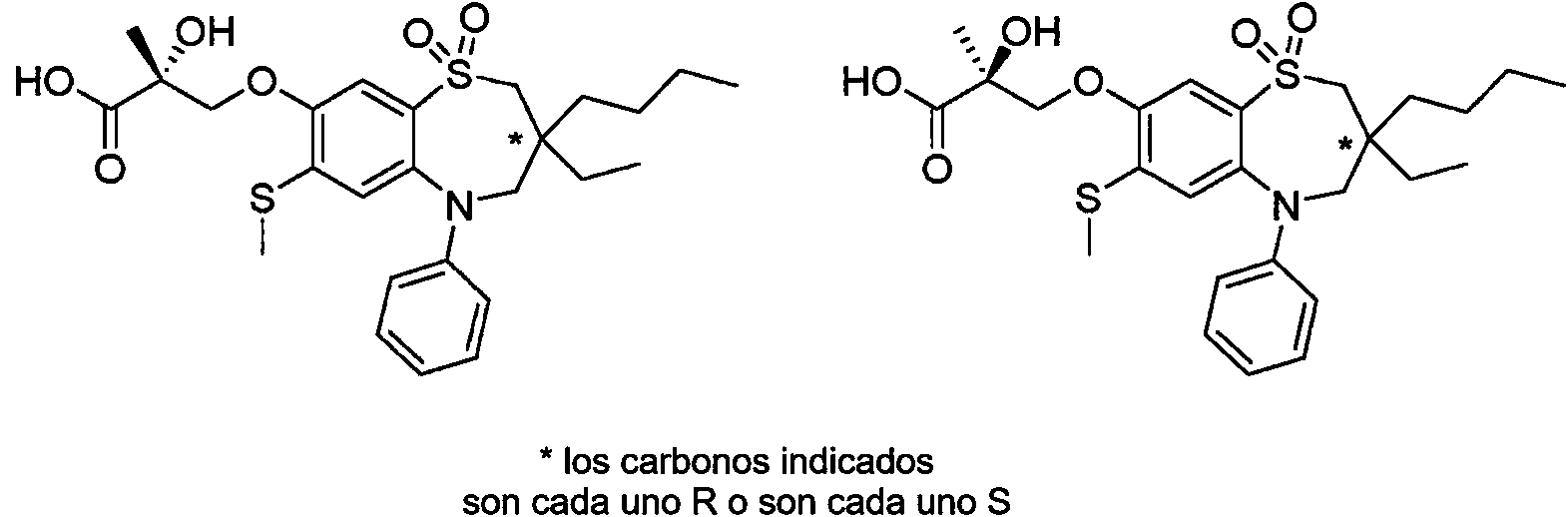
A una solución de diastereómero 1 de 3-((3-butil-3-etil-7-(metiltio)-1,1-dióxido-5-fenil-2,3,4,5-tetrahidro-1,5-benzotiazepin-8-il)oxi)-2-hidroxi-2-metilpropanoato de metilo (Intermedio 79; 50 mg, 0.09 mmol) en 1,4-dioxano (3 ml), se agregó Hcí diluido ( 6 N, 3 ml) y la mezcla de reacción se calentó durante 3 horas a 80 °C. Después de la finalización de la reacción (monitorizada por TLC), la mezcla de reacción se diluyó con agua enfriada con hielo (2 ml) y la capa acuosa se extrajo con EtOAc ( 2 X 5 ml). La capa orgánica combinada se lavó con agua (5 ml) y solución salina (5 ml) y se secó sobre Na2SO4 anhidro. La parte orgánica se filtró, se concentró bajo vacío y el material crudo resultante se purificó mediante cromatografía en columna Isolera (eluyente: MeOH/DCM al 8 %; gel de sílice: 230-400 de malla). El material obtenido se volvió a purificar mediante HPLC Prep (Método A) para producir el compuesto del título.To a solution of diastereomer 1 of 3-((3-butyl-3-ethyl-7-(methylthio)-1,1-dioxide-5-phenyl-2,3,4,5-tetrahydro-1,5-benzothiazepine Methyl -8-yl)oxy)-2-hydroxy-2-methylpropanoate (Intermediate 79; 50 mg, 0.09 mmol) in 1,4-dioxane (3 mL), dilute Hcy (6 N, 3 mL) was added and The reaction mixture was heated for 3 hours at 80 °C. After completion of the reaction (monitored by TLC), the reaction mixture was diluted with ice-cold water (2 mL) and the aqueous layer was extracted with EtOAc (2 X 5 mL). The combined organic layer was washed with water (5 mL) and brine (5 mL) and dried over anhydrous Na 2 SO 4 . The organic part was filtered, concentrated under vacuum and the resulting crude material was purified by Isolera column chromatography (eluent: 8 % MeOH/DCM; silica gel: 230-400 mesh). The obtained material was further purified by Prep HPLC (Method A) to produce the title compound.
Los diastereómeros 2 del compuesto del título se obtuvieron siguiendo el mismo procedimiento, a partir de 50 mg de diastereómeros 2 del Intermedio 79.Diastereomers 2 of the title compound were obtained following the same procedure, from 50 mg of diastereomers 2 of Intermediate 79.
Diastereómero 1: Rendimiento: 30 % (15 mg, sólido blancuzco). RMN 1H (400 MHz, DMSO-d6): 8 7.32 (s, 1H), 7.22 (t, J = 8.0 Hz, 2H), 6.98 (d, J = 7.6 Hz, 2H), 6 . 8 6 (t, J = 7.6 Hz, 1H), 6.70 (s, 1H), 4.12 (s, 2H), 3.78 (s, 2H), 3.27 (s, 2H), 2.16 (s, 3H), 1.62-1.54 (m, 1H), 1.42-1.38 (m, 3H), 1.35-1.32 (m, 3H), 1.16-0.93 (m, 4H), 0.81-0.71 (m, 6 H). LCMS: (Método E) 522.2 (M++H), Tr. 2.84 min, 99.07 % (Máx). HPLC: (Método B) Tr. 5.45 min, 99.39 % (Máx). SFC quiral: (Método H) Tr. 2.08 min, 100 % (Máx).Diastereomer 1: Yield: 30% (15 mg, off-white solid). 1H NMR (400 MHz, DMSO-d6): 8 7.32 (s, 1H), 7.22 (t, J = 8.0 Hz, 2H), 6.98 (d, J = 7.6 Hz, 2H), 6 . 8 6 (t, J = 7.6 Hz, 1H), 6.70 (s, 1H), 4.12 (s, 2H), 3.78 (s, 2H), 3.27 (s, 2H), 2.16 (s, 3H), 1.62- 1.54 (m, 1H), 1.42-1.38 (m, 3H), 1.35-1.32 (m, 3H), 1.16-0.93 (m, 4H), 0.81-0.71 (m, 6H ). LCMS: (Method E) 522.2 (M++H), Tr. 2.84 min, 99.07% (Max). HPLC: (Method B) Tr. 5.45 min, 99.39% (Max). Chiral SFC: (Method H) Tr. 2.08 min, 100% (Max).
Diastereómero 2: Rendimiento: 30 % (13 mg, sólido blancuzco). RMN 1H (400 MHz, DMSO-d6): 812.70 (bs, 1H), 7.32 (s, 1H), 7.22 (t, J = 8.0 Hz, 2H), 6.98 (d, J = 7.6 Hz, 2H), 6.86 (t, J = 7.6 Hz, 1H), 6.70 (s, 1H), 5.39 (bs, 1H), 4.12 (s, 2H), 3.78 (bs, 2H), 3.27 (s, 2H), 2.16 (s, 3H), 1.62-1.54 (m, 1H), 1.39 (s, 3H), 1.36-1.31 (m, 3H), 1.18-1.03 (m, 4H), 0.81-0.71 (m, 6H). LCMS: (Método E) 522.2 (M++H), Tr. 2.84 min, 99.52 % (Máx). HPLC: (Método B) Tr. 5.45 min, 99.03 % (Máx). SFC quiral: (Método H) Tr. 3.47 min, 99.81 % (Máx).Diastereomer 2: Yield: 30% (13 mg, off-white solid). 1H NMR (400 MHz, DMSO-d6): 812.70 (bs, 1H), 7.32 (s, 1H), 7.22 (t, J = 8.0 Hz, 2H), 6.98 (d, J = 7.6 Hz, 2H), 6.86 (t, J = 7.6 Hz, 1H), 6.70 (s, 1H), 5.39 (bs, 1H), 4.12 (s, 2H), 3.78 (bs, 2H), 3.27 (s, 2H), 2.16 (s, 3H), 1.62-1.54 (m, 1H), 1.39 (s, 3H), 1.36-1.31 (m, 3H), 1.18 -1.03 (m, 4H), 0.81-0.71 (m, 6H). LCMS: (Method E) 522.2 (M++H), Tr. 2.84 min, 99.52% (Max). HPLC: (Method B) Tr. 5.45 min, 99.03% (Max). Chiral SFC: (Method H) Tr. 3.47 min, 99.81% (Max).
No se conoce la configuración absoluta de los dos diastereómeros.The absolute configuration of the two diastereomers is not known.
Ejemplo 49Example 49
Ácido 3-((3-Butil-5-(4-fluorofenil)-3-metil-7-(metiltio)-1,1-dióxido-2,3,4,5-tetrahidro-1,5-benzotiazepin-8-il)oxi)propanoico3-((3-Butyl-5-(4-fluorophenyl)-3-methyl-7-(methylthio)-1,1-dioxide-2,3,4,5-tetrahydro-1,5-benzothiazepin-8 acid -yl)oxy)propanoic

A una solución agitada de 1,1 -dióxido de 3-butil-5-(4-fluorofenil)-8-hidroxi-3-metil-7-(metiltio)-2,3,4,5-tetrahidro-1,5-benzotiazepina (Intermedio 83; 150 mg, 0.35 mmol) en acetonitrilo (5 ml), se agregaron K2CO3 (219 mg, 1.5 mmol), ácido 3-cloropropionico (80 mg, 0.74 mmol) y yoduro de potasio (23 mg, 0.14 mmol). La mezcla de reacción se calentó durante 16 horas a 80 °C y el progreso de la reacción se monitorizó mediante TLC. Después de la finalización de la reacción, la mezcla de reacción se apagó con HCl diluido (1.5 N, 2 ml) y se diluyó con agua (2 ml). La capa acuosa se extrajo con EtOAc ( 2 X 5 ml) y la capa orgánica combinada se lavó con agua (5 ml) y solución salina (5 ml). La parte orgánica se secó sobre Na2SO4 anhidro, se filtró y se concentró bajo vacío. El material crudo resultante se purificó mediante cromatografía en columna Isolera (eluyente: 100°/EtOAc/PE; gel de sílice: 230-400 de malla). El compuesto obtenido se purificó mediante HPLC Prep (método B) para producir el compuesto del título. Rendimiento: 51 % (90 mg, sólido blanco).To a stirred solution of 1,1-3-butyl-5-(4-fluorophenyl)-8-hydroxy-3-methyl-7-(methylthio)-2,3,4,5-tetrahydro-1,5-dioxide -benzothiazepine (Intermediate 83; 150 mg, 0.35 mmol) in acetonitrile (5 ml), K 2 CO 3 (219 mg, 1.5 mmol), 3-chloropropionic acid (80 mg, 0.74 mmol) and potassium iodide (23) were added mg, 0.14 mmol). The reaction mixture was heated for 16 h at 80 °C and the reaction progress was monitored by TLC. After completion of the reaction, the reaction mixture was quenched with dilute HCl (1.5 N, 2 mL) and diluted with water (2 mL). The aqueous layer was extracted with EtOAc (2 X 5 ml) and the combined organic layer was washed with water (5 ml) and saline (5 ml). The organic part was dried over anhydrous Na 2 SO 4 , filtered and concentrated under vacuum. The resulting crude material was purified by Isolera column chromatography (eluent: 100°/EtOAc/PE; silica gel: 230-400 mesh). The obtained compound was purified by Prep HPLC (method B) to produce the title compound. Yield: 51% (90 mg, white solid).
RMN 1H (400 MHz, CDCla): 8 7.45 (s, 1H), 7.00-6.97 (m, 4H), 6.65 (s, 1H), 4.40 (t, J = 6.0 Hz, 2H), 3.75-3.72 (m, 1H), 3.55-3.51 (m, 1H), 3.18-3.09 (m, 2H), 2.94 (s, 2H), 2.20 (s, 3H), 1.59-1.47 (m, 1H), 1.35-1.28 (m, 5H), 1.12 (s, 3H), 0.86 (t, J = 6 . 8 Hz, 3H). LCMS: (Método E) 496.2 (M++H), Tr. 2.74 min, 98.94 % (Máx). HPLC: (Método B) Tr. 5.48 min, 99.70 % (Máx).1H NMR (400 MHz, CDCla): 8 7.45 (s, 1H), 7.00-6.97 (m, 4H), 6.65 (s, 1H), 4.40 (t, J = 6.0 Hz, 2H), 3.75-3.72 (m , 1H), 3.55-3.51 (m, 1H), 3.18-3.09 (m, 2H), 2.94 (s, 2H), 2.20 (s, 3H), 1.59-1.47 (m, 1H), 1.35-1.28 (m , 5H), 1.12 (s, 3H), 0.86 (t, J = 6 . 8 Hz, 3H). LCMS: (Method E) 496.2 (M++H), Tr. 2.74 min, 98.94% (Max). HPLC: (Method B) Tr. 5.48 min, 99.70% (Max).
Ejemplo 50Example 50
Ácido (S)-3-((3-butil-5-(4-fluorofenil)-3-metil-7-(metiltio)-l, l-dióxido-2,3,4,5-tetra hidro-1,5-benzotiazepin-8-il)oxi)propanoico y ácido (R)-3-((3-butil-5-(4-fluorofenil)-3-metil-7-(metiltio)-1,1-dióxido-2,3,4,5-tetrahidro-1,5-benzotiazepin-8 -il)oxi)propanoicoAcid (S)-3-((3-butyl-5-(4-fluorophenyl)-3-methyl-7-(methylthio)-l, l-dioxide-2,3,4,5-tetra hydro-1, 5-benzothiazepin-8-yl)oxy)propanoic acid and (R)-3-((3-butyl-5-(4-fluorophenyl)-3-methyl-7-(methylthio)-1,1-dioxide-2 ,3,4,5-tetrahydro-1,5-benzothiazepin- 8 -yl)oxy)propanoic acid

Los dos enantiómeros del ácido 3-((3-butil-5-(4-fluorofenil)-3-metil-7-(metiltio)-1,1-dióxido-2,3,4,5-tetrahidro-1,5-benzotiazepin-8 -il)oxi)propanoico racémico (Ejemplo 49; 78 mg, 0.15 mmol) se separaron mediante SFC quiral (método H). El material se concentró bajo vacío a 40 °C. La primera fracción de elución corresponde al enantiómero 1 y la segunda fracción de elución corresponde al enantiómero 2. Se desconoce la configuración absoluta de los dos enantiómeros. The two enantiomers of the acid 3-((3-butyl-5-(4-fluorophenyl)-3-methyl-7-(methylthio)-1,1-dioxide-2,3,4,5-tetrahydro-1,5 Racemic -benzothiazepin- 8 -yl)oxy)propanoic acid (Example 49; 78 mg, 0.15 mmol) were separated by chiral SFC (method H). The material was concentrated under vacuum at 40 °C. The first elution fraction corresponds to enantiomer 1 and the second elution fraction corresponds to enantiomer 2. The absolute configuration of the two enantiomers is unknown.
Enantiómero 1: Rendimiento: 25 % (20 mg, sólido blancuzco). RMN 1H (400 MHz, CDCI3 ): 87.45 (s, 1H), 6.99-6.97 (m, 4H), 6.65 (s, 1H), 4.40 (t, J = 6.4 Hz, 2H), 3.81-3.69 (m, 1H), 3.55-3.51 (m, 1H), 3.18-3.09 (m, 2H), 2.93 (t, J = 6.0 Hz, 2H), 2.20 (s, 3H), 1.60-1.45 (m, 1H), 1.36-1.22 (m, 5H), 1.12 (s, 3H), 0.9-0.84 (m, 3H). LCMS: (Método G) 496.2 (M++H), Tr. 2.30 min, 99.12 % (Máx). HPLC: (Método B) Tr. 5.45 min, 97.07 % (Máx). SFC quiral: (Método H) Tr. 4.85 min, 99.04 % (Máx).Enantiomer 1: Yield: 25 % (20 mg, off-white solid). 1H NMR (400 MHz, CDCI 3 ): 87.45 (s, 1H), 6.99-6.97 (m, 4H), 6.65 (s, 1H), 4.40 (t, J = 6.4 Hz, 2H), 3.81-3.69 (m , 1H), 3.55-3.51 (m, 1H), 3.18-3.09 (m, 2H), 2.93 (t, J = 6.0 Hz, 2H), 2.20 (s, 3H), 1.60-1.45 (m, 1H), 1.36-1.22 (m, 5H), 1.12 (s, 3H), 0.9-0.84 (m, 3H). LCMS: (Method G) 496.2 (M++H), Tr. 2.30 min, 99.12% (Max). HPLC: (Method B) Tr. 5.45 min, 97.07% (Max). Chiral SFC: (Method H) Tr. 4.85 min, 99.04% (Max).
Enantiómero 2: Rendimiento: 25 % (20 mg, sólido blancuzco). RMN 1H (400 MHz, CDCI3 ): 87.45 (s, 1H), 7.03-6.95 (m, 4H), 6.65 (s, 1H), 4.40 (t, J = 6.0 Hz, 2H), 3.81-3.68 (m, 1H), 3.59-3.53 (m, 1H), 3.22-3.05 (m, 2H), 2.93 (t, J = 6.4 Hz, 2H), 2.20 (s, 3H), 1.60-1.45 (m, 1H), 1.33-1.20 (m, 5H), 1.12 (s, 3H), 0.87-0.84 (m, 3H). LCMS: (Método G) 496.2 (M++H), Tr. 2.30 min, 96.29 % (Máx). HPLC: (Método B) Tr. 5.44 min, 93.92 % (Máx). SFC quiral: (Método H) Tr. 6.01 min, 98.11% (Máx).Enantiomer 2: Yield: 25% (20 mg, off-white solid). 1H NMR (400 MHz, CDCI 3 ): 87.45 (s, 1H), 7.03-6.95 (m, 4H), 6.65 (s, 1H), 4.40 (t, J = 6.0 Hz, 2H), 3.81-3.68 (m , 1H), 3.59-3.53 (m, 1H), 3.22-3.05 (m, 2H), 2.93 (t, J = 6.4 Hz, 2H), 2.20 (s, 3H), 1.60-1.45 (m, 1H), 1.33-1.20 (m, 5H), 1.12 (s, 3H), 0.87-0.84 (m, 3H). LCMS: (Method G) 496.2 (M++H), Tr. 2.30 min, 96.29% (Max). HPLC: (Method B) Tr. 5.44 min, 93.92% (Max). Chiral SFC: (Method H) Tr. 6.01 min, 98.11% (Max).
Ejemplo 51Example 51
Ácido 3-((3-Butil-5-(4-fluorofenil)-3-metil-7-(metiltio)-1,1-dióxido-2,3,4,5-tetrahidro-1,5-benzotiazepin-8-il)oxi)-2-hidroxipropanoico3-((3-Butyl-5-(4-fluorophenyl)-3-methyl-7-(methylthio)-1,1-dioxide-2,3,4,5-tetrahydro-1,5-benzothiazepin-8 acid -yl)oxy)-2-hydroxypropanoic acid

A una solución de 3-((3-butil-5-(4-fluorofenil)-3-metil-7-(metiltio)-1,1-dióxido-2,3,4,5-tetrahidro-1,5-benzotiazepin-8-il)oxi)-2-hidroxipropanoato de metilo (Intermedio 84; 160 mg, 0.3 mmol) en 1,4-dioxano (1 ml), se agregó HCl ac. (6 N, 2 ml) y la mezcla de reacción se calentó durante 16 horas a 80 °C. Después de la finalización de la reacción (monitorizada por TLC), la mezcla de reacción se extrajo con EtOAc ( 2 X 5 ml). La capa orgánica combinada se lavó con agua (5 ml) y solución salina (5 ml) y se secó sobre Na2SO4 anhidro. La parte orgánica se filtró y se concentró bajo vacío. El material crudo resultante se purificó mediante cromatografía en columna Isolera (eluyente: 4 % MeOH/DCM; gel de sílice: 230-400 de malla) para producir el compuesto del título. Rendimiento: 32 % (50 mg, sólido blanco). RMN 1H (400 MHz, CDCh): 87.46 (s, 1H), 7.00-6.96 (m, 4H), 6.63 (s, 1H), 4.63 (s, 1H), 4.46 (s, 2H), 3.76 3.73 (m, 1H), 3.60-3.41 (m, 1H), 3.16 (s, 2H), 2.19 (s, 3H), 1.61-1.45 (m, 1H), 1.35-1.25 (m, 5H), 1.11 (s, 3H), 0.88 0.82 (m, 3H). LCMS: (Método E) 512.0 (M++H), Tr. 2.80 min, 95.41 % (Máx). HPLC: (Método B) Tr. 5.09 min, 95.85 % (Máx).To a solution of 3-((3-butyl-5-(4-fluorophenyl)-3-methyl-7-(methylthio)-1,1-dioxide-2,3,4,5-tetrahydro-1,5- Methyl benzothiazepin-8-yl)oxy)-2-hydroxypropanoate (Intermediate 84; 160 mg, 0.3 mmol) in 1,4-dioxane (1 mL), aq. HCl was added. (6 N, 2 ml) and the reaction mixture was heated for 16 hours at 80 °C. After completion of the reaction (monitored by TLC), the reaction mixture was extracted with EtOAc (2 X 5 ml). The combined organic layer was washed with water (5 mL) and brine (5 mL) and dried over anhydrous Na 2 SO 4 . The organic part was filtered and concentrated under vacuum. The resulting crude material was purified by Isolera column chromatography (eluent: 4% MeOH/DCM; silica gel: 230-400 mesh) to yield the title compound. Yield: 32% (50 mg, white solid). 1H NMR (400 MHz, CDCh): 87.46 (s, 1H), 7.00-6.96 (m, 4H), 6.63 (s, 1H), 4.63 (s, 1H), 4.46 (s, 2H), 3.76 3.73 (m , 1H), 3.60-3.41 (m, 1H), 3.16 (s, 2H), 2.19 (s, 3H), 1.61-1.45 (m, 1H), 1.35-1.25 (m, 5H), 1.11 (s, 3H ), 0.88 0.82 (m, 3H). LCMS: (Method E) 512.0 (M++H), Tr. 2.80 min, 95.41% (Max). HPLC: (Method B) Tr. 5.09 min, 95.85% (Max).
Ejemplo 52Example 52
Ácido 3-((3-butil-3-etil-7-(metilamino)-1,1-dióxido-5-fenil-2,3,4,5-tetrahidro-1,5-benzotiazepin-8-il)oxi)propanoico3-((3-butyl-3-ethyl-7-(methylamino)-1,1-dioxide-5-phenyl-2,3,4,5-tetrahydro-1,5-benzothiazepin-8-yl)oxy acid )propanoic

A una solución agitada de 1,1 -dióxido de 3-Butil-3-etil-8-hidroxi-7-(metilamino)-5-fenil-2,3,4,5-tetrahidro-1,5-benzotiazepina (Intermedio 87; 100 mg, 0.24 mmol) en THF (3 ml), se agregó tert-butóxido de potasio (22.3 mg, 0.19 mmol) a 0 °C y la mezcla de reacción se agitó durante 15 minutos. Luego se agregó en forma de gotas una solución de p-propiolactona (10.6 mg, 0.15 mmol) en THF (1 ml) y la mezcla de reacción se agitó durante 8 horas a temperatura ambiente. Después de la finalización de la reacción (monitorizada por TLC), la mezcla de reacción se apagó con HCl diluido (1.5 N, 2 ml) y se diluyó con agua (2 ml). La capa acuosa se extrajo con EtOAc ( 2 X 5 ml) y la capa orgánica combinada se lavó con agua (5 ml) y solución salina (5 ml). La parte orgánica se secó sobre Na2SO4 anhidro, se filtró y se concentró bajo vacío. El material crudo resultante se purificó mediante cromatografía en columna Isolera (eluyente: MeOH/DCM al 8-15 %; gel de sílice: 230-400 de malla) y el material obtenido se volvió a purificar mediante HPLC Prep (método A) para producir el compuesto del título. Rendimiento: 5 % (6 mg, sólido marrón pálido). To a stirred solution of 3-Butyl-3-ethyl-8-hydroxy-7-(methylamino)-5-phenyl-2,3,4,5-tetrahydro-1,5-benzothiazepine 1,1-dioxide (Intermediate 87; 100 mg, 0.24 mmol) in THF (3 mL), potassium tert-butoxide (22.3 mg, 0.19 mmol) was added at 0 °C and the reaction mixture was stirred for 15 minutes. A solution of p-propiolactone (10.6 mg, 0.15 mmol) in THF (1 mL) was then added dropwise and the reaction mixture was stirred for 8 h at room temperature. After completion of the reaction (monitored by TLC), the reaction mixture was quenched with dilute HCl (1.5 N, 2 mL) and diluted with water (2 mL). The aqueous layer was extracted with EtOAc (2 X 5 ml) and the combined organic layer was washed with water (5 ml) and saline (5 ml). The organic part was dried over anhydrous Na 2 SO 4 , filtered and concentrated under vacuum. The resulting crude material was purified by column chromatography. Isolated (eluent: 8-15% MeOH/DCM; silica gel: 230-400 mesh) and the obtained material was further purified by Prep HPLC (method A) to produce the title compound. Yield: 5% (6 mg, pale brown solid).
RMN 1H (400 MHz, DMSO-da): 8 12.43 (s, 1H), 7.20-7.16 (m, 3H), 6.95 (d, J = 8.0 Hz, 2H), 6.79 (t, J = 7.2 Hz, 1H), 5.98 (s, 1H), 5.86 (q, J = 5.2 Hz, 1H), 4.18 (t, J = 6.0 Hz, 2H), 3.75 (bs, 2H), 3.13 (s, 2H), 2.77 (t, J = 6.0 Hz, 2H), 2.55 (s, 3H), 1.62-1.49 (m, 2H), 1.48-1.26 (m, 2H), 1.25-0.95 (m, 4H), 0.79-0.73 (m, 6H). LCMS: (Método A) 475.0 (M++H), Tr. 2.95 min, 98.63 % (Máx). HPLC: (Método B) Tr. 5.47 min, 97.83 % (Máx).1H NMR (400 MHz, DMSO-da): 8 12.43 (s, 1H), 7.20-7.16 (m, 3H), 6.95 (d, J = 8.0 Hz, 2H), 6.79 (t, J = 7.2 Hz, 1H ), 5.98 (s, 1H), 5.86 (q, J = 5.2 Hz, 1H), 4.18 (t, J = 6.0 Hz, 2H), 3.75 (bs, 2H), 3.13 (s, 2H), 2.77 (t , J = 6.0 Hz, 2H), 2.55 (s, 3H), 1.62-1.49 (m, 2H), 1.48-1.26 (m, 2H), 1.25-0.95 (m, 4H), 0.79-0.73 (m, 6H ). LCMS: (Method A) 475.0 (M++H), Tr. 2.95 min, 98.63% (Max). HPLC: (Method B) Tr. 5.47 min, 97.83% (Max).
Ensayos biológicosBiological assays
Protocolo de ensayo IBAT (h/m)IBAT test protocol (h/m)
Se sembraron 10,000 células (células que sobreexpresan IBAT Humano o de Ratón) en una placa de 96 pocillos (Corning CLS3809) en 200 μl de medio MEM-alfa (Gibco 12571-063) suplementado con FBS al 10% (Gibco 10438026) que contenía puromicina (Gibco A1113803) (10 μg/ml) y se incubaron a 37 °C en CO2 al 5 durante 48 horas. Después de la incubación, se decantó el medio de los pocillos y las células se lavaron dos veces con 300 μl de medio MEM-alfa basal (sin FBS). Después de decantar el medio basal MEM-alfa cada vez, las placas se golpearon contra una toalla de papel para asegurar la máxima eliminación del medio residual. Se agregaron diluciones del inhibidor de la prueba (la concentración de prueba más alta fue 10 μM, dilución en serie de 3 veces, 10 puntos) preparadas en DMSO (Sigma D2650) en una mezcla de incubación (manteniendo una concentración final de DMSO del 0.2 %) que contenía ácido 3H-taurocólico 0.25 μM (ARC ART-1368) y ácido taurocólico 5 μM frío (Sigma T4009). Luego se agregaron a los pocillos 50 μl de mezcla de incubación que contenía inhibidores de la prueba (por duplicado) y las placas se incubaron durante 20 minutos en una incubadora de CO2 a 37 °C. Después de la incubación, se detuvo la reacción al mantener las placas en una mezcla de agua con hielo durante 2-3 minutos y luego se aspiró completamente la mezcla de incubación de los pocillos. Los pocillos se lavaron dos veces con 250 μl de ácido taurocólico 1 μM sin marcar enfriado disuelto en HBSS tamponado con HEPES (Gibco 15630080) (10 mM) (Gibco 14175079) (pH 7.4). Las placas se golpearon contra una toalla de papel después de cada lavado para asegurar la máxima eliminación del tampón de bloqueo. Se agregaron 100 μl de MicroScint-20 (PerkinElmer 6013621) a los pocillos y se mantuvieron durante la noche a temperatura ambiente antes de leer las placas en el Contador de Luminiscencia y Centelleo de Microplacas TopCount NXT™ de PerkinElmer según el protocolo de Prueba 3H (establecido en un tiempo de lectura de 120 segundos por pocillo).10,000 cells (cells overexpressing Human or Mouse IBAT) were seeded in a 96-well plate (Corning CLS3809) in 200 μl of MEM-alpha medium (Gibco 12571-063) supplemented with 10% FBS (Gibco 10438026) containing Puromycin (Gibco A1113803) (10 μg/ml) and incubated at 37 °C in 5% CO 2 for 48 hours. After incubation, the medium was decanted from the wells and the cells were washed twice with 300 μl of MEM-alpha basal medium (without FBS). After decanting the MEM-alpha basal medium each time, the plates were tapped against a paper towel to ensure maximum removal of residual medium. Dilutions of the test inhibitor (highest test concentration was 10 μM, 3-fold serial dilution, 10 points) prepared in DMSO (Sigma D2650) were added to an incubation mixture (maintaining a final DMSO concentration of 0.2 %) containing 0.25 μM 3H-taurocholic acid (ARC ART-1368) and 5 μM cold taurocholic acid (Sigma T4009). Then, 50 μl of incubation mixture containing test inhibitors (in duplicate) was added to the wells and the plates were incubated for 20 minutes in a CO 2 incubator at 37 °C. After incubation, the reaction was stopped by keeping the plates in an ice water mixture for 2-3 minutes and then the incubation mixture was completely aspirated from the wells. The wells were washed twice with 250 μl of chilled 1 μM unlabeled taurocholic acid dissolved in HEPES-buffered HBSS (Gibco 15630080) (10 mM) (Gibco 14175079) (pH 7.4). Plates were tapped against a paper towel after each wash to ensure maximum removal of blocking buffer. 100 μl of MicroScint-20 (PerkinElmer 6013621) was added to the wells and kept overnight at room temperature before reading the plates on the PerkinElmer TopCount NXT™ Microplate Scintillation and Luminescence Counter according to the 3H Test protocol ( set to a reading time of 120 seconds per well).
Protocolo de ensayo LBAT (h/m)LBAT test protocol (h/m)
Se sembraron 20,000 células (células que sobreexpresan LBAT Humano o de Ratón) en placas de 96 pocillos (Corning CLS3809) en 100 μl de medio MEM-alfa (Gibco 12571-063) suplementado con FBS al 10 % (Gibco 10438026) que contenía geneticina (Gibco 10131-027) (1 mg/ml) y se incubaron a 37 °C en CO2 al 5 % durante 24 horas. Después de la incubación, se decantó el medio de los pocillos y las células se lavaron dos veces con 300 μl de medio MEM-alfa basal (libre de FBS). Después de decantar el medio basal MEM-alfa cada vez, las placas se golpearon contra una toalla de papel para asegurar la máxima eliminación del medio residual.20,000 cells (cells overexpressing Human or Mouse LBAT) were seeded in 96-well plates (Corning CLS3809) in 100 μl of MEM-alpha medium (Gibco 12571-063) supplemented with 10% FBS (Gibco 10438026) containing geneticin. (Gibco 10131-027) (1 mg/ml) and incubated at 37 °C in 5% CO 2 for 24 hours. After incubation, the medium was decanted from the wells and the cells were washed twice with 300 μl of MEM-alpha basal medium (free of FBS). After decanting the MEM-alpha basal medium each time, the plates were tapped against a paper towel to ensure maximum removal of residual medium.
Para LBAT humano, la mezcla de incubación se preparó al agregar diluciones de inhibidor de prueba (dilución en serie de 3 veces en DMSO (Sigma D2650), 10 puntos) en MEM-alfa (libre de FBS) que contenía ácido 3H-taurocólico 0.3 μM (ARC ART -1368) y ácido taurocólico frío 7.5 μM (Sigma T4009) (manteniendo una concentración final de DMSO del 0.2 %). Para LBAT de ratón, la mezcla de incubación se preparó al agregar diluciones del inhibidor de prueba (dilución en serie de 3 veces en DMSO, 10 puntos) en MEM-alfa (sin FBS) que contenía ácido 3H-taurocólico 0.3 μM y ácido taurocólico frío 25 μM manteniendo una concentración final de DMSO del 0.2 %).For human LBAT, the incubation mixture was prepared by adding dilutions of test inhibitor (3-fold serial dilution in DMSO (Sigma D2650), 10 points) into MEM-alpha (FBS-free) containing 3H-taurocholic acid 0.3 μM (ARC ART -1368) and 7.5 μM cold taurocholic acid (Sigma T4009) (maintaining a final DMSO concentration of 0.2%). For mouse LBAT, the incubation mixture was prepared by adding dilutions of the test inhibitor (3-fold serial dilution in DMSO, 10 points) into MEM-alpha (without FBS) containing 0.3 μM 3H-taurocholic acid and taurocholic acid. cold 25 μM maintaining a final DMSO concentration of 0.2%).
Luego se agregaron a los pocillos 50 μl de mezcla de incubación que contenía inhibidores de prueba (por duplicado) y las placas se incubaron durante 20 minutos en una incubadora de CO2 a 37 °C. Después de la incubación, se detuvo la reacción al mantener las placas en una mezcla de agua con hielo durante 2-3 minutos y luego se aspiró completamente la mezcla de incubación de los pocillos. Los pocillos se lavaron dos veces con 250 μl de ácido taurocólico 1 μM sin marcar enfriado disuelto en HBSS tamponado con HEPES (Gibco 15630080) (10 mM) (Gibco 14175079) (pH 7.4). Las placas se golpearon contra una toalla de papel después de cada lavado para asegurar la máxima eliminación del tampón de bloqueo.Then, 50 μl of incubation mixture containing test inhibitors (in duplicate) was added to the wells and the plates were incubated for 20 min in a CO 2 incubator at 37 °C. After incubation, the reaction was stopped by keeping the plates in an ice water mixture for 2-3 minutes and then the incubation mixture was completely aspirated from the wells. The wells were washed twice with 250 μl of chilled 1 μM unlabeled taurocholic acid dissolved in HEPES-buffered HBSS (Gibco 15630080) (10 mM) (Gibco 14175079) (pH 7.4). Plates were tapped against a paper towel after each wash to ensure maximum removal of blocking buffer.
Se agregaron 100 μl de MicroScint-20 (PerkinElmer 6013621) a los pocillos y se mantuvieron durante la noche a temperatura ambiente antes de leer las placas en el Contador de Centelleo y Luminiscencia de Microplacas TopCount NXT™ de PerkinElmer según el protocolo de Prueba 3H (establecido en un tiempo de lectura de 120 segundos por pocillo, con orientación normal de la placa).100 μl of MicroScint-20 (PerkinElmer 6013621) was added to the wells and kept overnight at room temperature before reading the plates on the PerkinElmer TopCount NXT™ Microplate Scintillation and Luminescence Counter according to the 3H Test protocol ( set to a reading time of 120 seconds per well, with normal plate orientation).
Ensayo de permeabilidad bidireccional (células Caco-2)Bidirectional permeability assay (Caco-2 cells)
Se sembraron células Caco-2 (Evotec) a una densidad de 70,000 células/pocillo en placas de inserción de cultivo celular de 24 pocillos Millicell® y se mantuvieron en una incubadora (37 °C, CO2 al 5 %, 95 % de RH) durante 21 días con cambio de medios en días alternos. Caco-2 cells (Evotec) were seeded at a density of 70,000 cells/well in Millicell® 24-well cell culture insert plates and maintained in an incubator (37°C, 5% CO 2 , 95% RH ) for 21 days with media change every other day.
Se prepararon soluciones de reserva (10 mM) de los compuestos de prueba, atenolol (marcador de baja permeabilidad), propranolol (marcador de alta permeabilidad) y digoxina (sustrato para la ruta de transporte de P-gp) en dimetilsulfóxido (DMSO). Se preparó una solución de reserva intermedia (1 mM) al diluir 10 j l de solución de reserva maestra 10 mM con 90 j l de DMSO puro. Se preparó una solución de reserva de trabajo (10 jM ) al diluir 50 j l de 1 mM con 4950 j l de tampón FaSSIF. Después de la adición de los compuestos al FaSSlF, las muestras se sometieron a sonicación durante 2 horas y se centrifugaron a 4000 RPM durante 30 minutos a 37 °C. Los 4 ml de sobrenadante resultante se utilizaron directamente en el ensayo. La concentración final de DMSO en los experimentos de transporte fue del 1 %.Stock solutions (10 mM) of the test compounds, atenolol (low permeability marker), propranolol (high permeability marker), and digoxin (substrate for the P-gp transport pathway) were prepared in dimethyl sulfoxide (DMSO). An intermediate stock solution (1 mM) was prepared by diluting 10 μl of 10 mM master stock solution with 90 μl of pure DMSO. A working stock solution (10 μM) was prepared by diluting 50 μl of 1 mM with 4950 μl of FaSSIF buffer. After addition of the compounds to the FaSSlF, the samples were sonicated for 2 hours and centrifuged at 4000 RPM for 30 minutes at 37 °C. The resulting 4 ml of supernatant was used directly in the assay. The final concentration of DMSO in the transport experiments was 1%.
El día del ensayo, las monocapas de Caco-2 se lavaron dos veces con tampón de transporte (HBSS, pH 7.4) y se preincubaron durante 30 min (37 °C, CO2 al 5 %, 95 % de RH) en una incubadora. La resistencia eléctrica de las monocapas se midió con un sistema Millicell®-ERS. Para el ensayo se seleccionaron monocapas con valores de resistencia eléctrica transepitelial (TEER) superiores a 350 ohm.cm2.On the day of assay, Caco-2 monolayers were washed twice with transport buffer (HBSS, pH 7.4) and preincubated for 30 min (37 °C, 5% CO 2 , 95% RH) in an incubator. . The electrical resistance of the monolayers was measured with a Millicell®-ERS system. Monolayers with transepithelial electrical resistance (TEER) values greater than 350 ohm.cm2 were selected for the test.
El ensayo se realizó en dirección de absorción (A2B) y direcciones secretoras (B2A). Los experimentos de transporte se iniciaron mediante la adición de tampón de ensayo de transporte (tampón FaSSIF preparado en HBSS) que consiste en compuestos al compartimento donante (cámara apical A-B; cámara basolateral B-A) en pocillos duplicados (n = 2). Se introdujo tampón HBSS libre de fármaco (pH 7.4) que contenía albúmina en suero bovina (BSA) al 1 % en los compartimentos receptores (A-B-basolateral; B-A-apical). Los volúmenes de los compartimentos apical y basolateral fueron 0.4 y 0.8 ml, respectivamente. Después de agregar la solución dosificada, las placas se incubaron en una incubadora durante 120 minutos a 37 °C. Después de 120 minutos, se recolectaron muestras del donante y del receptor y se comparó la matriz (1:1, 30 j l de muestra de estudio 30 j l de tampón en blanco) con el tampón opuesto. La matriz de muestras de dosificación coincidió (1:1, 30 j l de muestra de estudio 30 j l de tampón en blanco) con el tampón opuesto. Las muestras se procesaron al agregar acetonitrilo que contenía estándar interno (60 j l de muestra de estudio 200 j l de acetonitrilo que contenía estándar interno -Tolbutamida, 500 ng/ml). Las muestras se agitaron y se centrifugaron a 4000 rpm durante 10 minutos. El sobrenadante obtenido (100 j l) se diluyó con 100 j l de agua y se transfirió a placas nuevas de 96 pocillos. La concentración de compuestos en las muestras se analizó mediante el método de espectrometría de masas en tándem de cromatografía líquida (LC-MS/MS) utilizando el método bioanalítico de grado de descubrimiento, según corresponda.The test was performed in absorption direction (A2B) and secretory directions (B2A). Transport experiments were initiated by adding transport assay buffer (FaSSIF buffer prepared in HBSS) consisting of compounds to the donor compartment (apical chamber A-B; basolateral chamber B-A) in duplicate wells (n = 2). Drug-free HBSS buffer (pH 7.4) containing 1% bovine serum albumin (BSA) was introduced into the recipient compartments (A-B-basolateral; B-A-apical). The volumes of the apical and basolateral compartments were 0.4 and 0.8 ml, respectively. After adding the metered solution, the plates were incubated in an incubator for 120 minutes at 37 °C. After 120 minutes, samples were collected from the donor and recipient and the matrix (1:1, 30 μl study sample 30 μl blank buffer) was compared to the opposite buffer. The dosing sample matrix was matched (1:1, 30 μl study sample 30 μl blank buffer) with the opposite buffer. Samples were processed by adding acetonitrile containing internal standard (60 μl study sample 200 μl acetonitrile containing internal standard -Tolbutamide, 500 ng/ml). The samples were shaken and centrifuged at 4000 rpm for 10 minutes. The supernatant obtained (100 μl) was diluted with 100 μl of water and transferred to new 96-well plates. The concentration of compounds in the samples was analyzed by liquid chromatography tandem mass spectrometry (LC-MS/MS) method using the discovery grade bioanalytical method, as appropriate.
La permeabilidad aparente media (Papp, x-10'6 cm/seg) de los compuestos de prueba, atenolol, propranolol y digoxina se calcularon de la siguiente manera:The mean apparent permeability (Papp, x-10.6 cm/sec) of the test compounds, atenolol, propranolol and digoxin were calculated as follows:

donde dq/dt = tasa de transporte (tasa de transporte del compuesto en el compartimiento receptor), C0 = concentración inicial en el compartimiento donante, A = área de superficie de la membrana filtrante efectiva.where dq/dt = transport rate (transport rate of the compound in the recipient compartment), C 0 = initial concentration in the donor compartment, A = surface area of the effective filter membrane.
Protocolo de ensayo basado en HepaRGHepaRG-based assay protocol
Un vial criopreservado de células HepaRG diferenciadas (Biopredic International HPR116080) se descongela en Medio de Descongelación/Recubrimiento/Uso General HepaRG (Biopredic International ADD670C) suplementado con Glutamax 200 mM (Gibco 35050061) siguiendo el protocolo proporcionado por Biopredic International. Se siembran 70,000 células por pocillo en una placa de 96 pocillos (Corning CLS3809) en 100 j l de Medio de Descongelación/recubrimiento/Uso General HepaRG suplementado con Glutamax 200 mM y se incuban a 37 °C en CO2 al 5 % durante 24 horas. Después de la incubación, el medio de siembra se reemplaza por Medio de Mantenimiento/Metabolismo HepaRG (Biopredic International ADD620C) y se incuba durante 6 días, con una reposición nueva de Medio de Mantenimiento/Metabolismo HepaRG cada 48 horas. Después de 7 días de incubación después de la siembra, el medio de incubación se decanta de los pocillos y las células se lavan dos veces con 250 j l de Medio Basal E de William (Gibco 12551032). Después de decantar Medio Basal E de William cada vez, las placas se golpean contra una toalla de papel para garantizar la máxima eliminación de los medios residuales. La mezcla de incubación se prepara al agregar diluciones del inhibidor de prueba (dilución en serie triple en DMSO (Sigma D2650)) en medio E de William (basal) que contiene ácido 3H-taurocólico 0.3 jM (ARC ART-1368) y ácido taurocólico frío 7.5 jM (Sigma T4009) (manteniendo una concentración final de DMSO del 0.2 %). Luego se agregan a los pocillos 50 j l de mezcla de incubación que contiene inhibidores de la prueba (por duplicado) y las placas se incuban durante 30 minutos en una incubadora con CO2 al 5 % a 37 °C. Después de la incubación, se detiene la reacción al mantener las placas en una mezcla de agua con hielo durante 2-3 minutos y luego se aspira completamente la mezcla de incubación de los pocillos. Los pocillos se lavan dos veces con 250 j l de ácido taurocólico 1 mM sin marcar enfriado disuelto en HBSS (10 mM) tamponado con HEPES (Gibco 15630080) (Gibco 14175079) (pH 7.4). Las placas se golpean contra una toalla de papel después de cada lavado para garantizar la máxima eliminación del tampón de bloqueo.A cryopreserved vial of differentiated HepaRG cells (Biopredic International HPR116080) is thawed in HepaRG Thawing/Coating/General Purpose Medium (Biopredic International ADD670C) supplemented with 200 mM Glutamax (Gibco 35050061) following the protocol provided by Biopredic International. 70,000 cells per well are seeded in a 96-well plate (Corning CLS3809) in 100 μl of HepaRG Thawing/Coating/General Purpose Medium supplemented with 200 mM Glutamax and incubated at 37°C in 5% CO 2 for 24 hours. . After incubation, the seeding medium is replaced with HepaRG Maintenance/Metabolism Medium (Biopredic International ADD620C) and incubated for 6 days, with a fresh replenishment of HepaRG Maintenance/Metabolism Medium every 48 hours. After 7 days of incubation after plating, the incubation medium is decanted from the wells and the cells are washed twice with 250 μl of William's Basal Medium E (Gibco 12551032). After decanting William's Basal Medium E each time, the plates are tapped against a paper towel to ensure maximum removal of residual media. The incubation mixture is prepared by adding dilutions of the test inhibitor (3-fold serial dilution in DMSO (Sigma D2650)) into William's E medium (basal) containing 0.3 μM 3H-taurocholic acid (ARC ART-1368) and taurocholic acid. cold 7.5 μM (Sigma T4009) (maintaining a final DMSO concentration of 0.2%). Then 50 μl of incubation mixture containing test inhibitors (in duplicate) is added to the wells and the plates are incubated for 30 minutes in a 5% CO 2 incubator at 37 °C. After incubation, the reaction is stopped by holding the plates in an ice water mixture for 2-3 minutes and then the incubation mixture is completely aspirated from the wells. The wells are washed twice with 250 μl of cooled 1 mM unlabeled taurocholic acid dissolved in HBSS (10 mM) buffered with HEPES (Gibco 15630080) (Gibco 14175079) (pH 7.4). The plates are tapped against a paper towel after each wash to ensure maximum removal of the blocking buffer.
Se agregan 100 j l de MicroScint-20 (PerkinElmer 6013621) a los pocillos y se mantienen durante la noche a temperatura ambiente antes de leer las placas en el Contador de Centelleo y Luminiscencia de Microplacas TopCount NXT™ de PerkinElmer según el protocolo de Prueba 3H (establecido en un tiempo de lectura de 120 segundos por pocillo, con orientación normal de la placa). 100 μl of MicroScint-20 (PerkinElmer 6013621) is added to the wells and held overnight at room temperature before reading the plates on the PerkinElmer TopCount NXT™ Microplate Scintillation and Luminescence Counter according to the 3H Test protocol ( set to a reading time of 120 seconds per well, with normal plate orientation).
Preparación de diluciones de compuestos de prueba.Preparation of dilutions of test compounds.
Todos los compuestos de prueba se proporcionaron en forma de polvo a temperatura ambiente. Se prepararon reservas de DMSO 10 mM de los compuestos de prueba, se dividieron en alícuotas y se almacenaron a -20 °C. A partir de la reserva de DMSO 10 mM de los compuestos, se preparó una dilución en serie de 3 veces en DMSO para obtener un total de 10 diluciones de los compuestos de prueba. Se agregaron 0,5 j l de esta dilución en DMSO a 250 |jl de medio basal libre de FBS que contenía ácido 3H-taurocólico y ácido taurocólico frío para preparar la mezcla de incubación.All test compounds were provided in powder form at room temperature. 10 mM DMSO stocks of test compounds were prepared, aliquoted, and stored at −20 °C. From the 10 mM DMSO stock of the compounds, a 3-fold serial dilution in DMSO was prepared to obtain a total of 10 dilutions of the test compounds. 0.5 µl of this dilution in DMSO was added to 250 µl of FBS-free basal medium containing 3H-taurocholic acid and cold taurocholic acid to prepare the incubation mixture.
Estudios de biodisponibilidadBioavailability studies
Se utilizaron ratones macho (C57BL/6 o CD1) o ratas Wistar de 8-9 semanas de edad. Para cada compuesto de prueba, se utilizaron dos grupos de 3 animales cada uno. A un grupo se le administró una dosis intravenosa única de 1 mg/kg (vehículo DMSO al 100 %) a través de la vena de la cola y al otro grupo se le administró una dosis oral única de 10 mg/kg a través de una aguja de sonda. El grupo al que se le administró una dosis oral estuvo en ayunas durante la noche. Se recolectaron muestras de sangre después de 0.083, 0.25, 0.5, 1, 2, 4, 6, 8 y 24 horas después de la administración intravenosa, y después de 0.25, 0.5, 1, 2, 4, 6, 8 y 24 horas después de la administración oral. Se tomaron muestras de sangre de la vena safena. Se utilizó EDTA al 0.2% como anticoagulante. Las muestras se analizaron mediante un método bioanalítico de grado de descubrimiento desarrollado para la estimación del compuesto de prueba en plasma, utilizando un sistema LC-MS/MS.Male mice (C57BL/6 or CD1) or Wistar rats of 8-9 weeks of age were used. For each test compound, two groups of 3 animals each were used. One group was administered a single intravenous dose of 1 mg/kg (100% DMSO vehicle) via the tail vein and the other group was administered a single oral dose of 10 mg/kg via a probe needle. The group given an oral dose fasted overnight. Blood samples were collected after 0.083, 0.25, 0.5, 1, 2, 4, 6, 8 and 24 hours after intravenous administration, and after 0.25, 0.5, 1, 2, 4, 6, 8 and 24 hours after oral administration. Blood samples were taken from the saphenous vein. 0.2% EDTA was used as an anticoagulant. Samples were analyzed by a discovery-grade bioanalytical method developed for estimation of test compound in plasma, using an LC-MS/MS system.
ResultadosResults
Los datos biológicos para los compuestos de los ejemplos se muestran en la Tabla 8 a continuación.Biological data for the example compounds are shown in Table 8 below.


Se utilizan ratones C57BL/6N Tac de 8-9 semanas de edad para estudiar el efecto de los moduladores de ácidos biliares sobre los niveles de ácidos biliares. Después de completar el período de cuarentena y aclimatación, los animales se asignan al azar según el peso corporal en x grupos experimentales: (i) control de vehículo y (ii) compuesto de prueba y mg/kg por vía oral una vez al día. Los animales se tratan con el compuesto de prueba durante 7 días. El día 5 del estudio, los animales se alojan individualmente en jaulas frescas. El día 7, se recolectan las heces de cada jaula, seguido de la extracción de sangre de cada animal por ruta retroorbital. Los animales se sacrifican para recolectar el hígado y el íleon terminal de cada animal para análisis posterior. El peso corporal y el consumo de alimentos se miden dos veces por semana. Los perfiles de lípidos en suero se analizan en muestras de suero del día 7. Los ácidos biliares totales en suero se miden en las muestras de suero del día 7. La excreción de bilis fecal se mide en la muestra fecal del día 7. La expresión hepática de CYP7A1 y SHP se cuantifica en las muestras de hígado del día 7. Los triglicéridos y el colesterol total en el hígado se analizan en las muestras de hígado del día 7.8-9 week old C57BL/6N Tac mice are used to study the effect of bile acid modulators on bile acid levels. After completing the quarantine and acclimatization period, animals are randomized based on body weight into x experimental groups: (i) vehicle control and (ii) test compound y mg/kg orally once daily. The animals are treated with the test compound for 7 days. On day 5 of the study, animals are housed individually in cool cages. On day 7, feces are collected from each cage, followed by blood collection from each animal via the retro-orbital route. Animals are sacrificed to collect the liver and terminal ileum of each animal for further analysis. Body weight and food consumption are measured twice a week. Serum lipid profiles are analyzed in day 7 serum samples. Serum total bile acids are measured in day 7 serum samples. Fecal bile excretion is measured in day 7 fecal sample. Hepatic CYP7A1 and SHP are quantified in the day 7 liver samples. Triglycerides and total cholesterol in the liver are analyzed in the day 7 liver samples.
Modelo de ácidos biliares en orina: Evaluación de compuestos de prueba en niveles de ácidos biliares en orina en ratones macho C57BL/6.Urinary bile acid model: Evaluation of test compounds on urinary bile acid levels in male C57BL/6 mice.
Se utilizan ratones C57BL/6N Tac de 8-9 semanas de edad para estudiar el efecto de los moduladores de ácidos biliares sobre los niveles de ácidos biliares. Después de completar el período de cuarentena y aclimatación, los animales se asignan al azar según el peso corporal en x grupos experimentales: (i) control de vehículo y (ii) compuesto de prueba y mg/kg por vía oral una vez al día. Los animales se tratan con el compuesto de prueba durante 7 días. El día 6 del estudio, los animales se transfieren a una jaula metabólica. El día 7, se recolectan heces y orina de cada jaula metabólica, seguido de la extracción de sangre de cada animal por ruta retroorbitaria. Los animales se sacrifican para recolectar riñones de cada animal para análisis posterior. El peso corporal se mide dos veces por semana. Los ácidos biliares totales en suero se miden en muestras de suero del día 7. La excreción de ácidos biliares fecales se mide en la muestra fecal del día 7. La excreción de ácidos biliares en orina se mide en la muestra del día 7. La expresión renal de ASBT, OSTa, OSTAb y MRP2 se cuantifica en las muestras del día 7. 8-9 week old C57BL/6N Tac mice are used to study the effect of bile acid modulators on bile acid levels. After completing the quarantine and acclimatization period, the Animals are randomized based on body weight into x experimental groups: (i) vehicle control and (ii) test compound y mg/kg orally once daily. The animals are treated with the test compound for 7 days. On day 6 of the study, animals are transferred to a metabolic cage. On day 7, feces and urine are collected from each metabolic cage, followed by blood collection from each animal via the retro-orbital route. The animals are sacrificed to collect kidneys from each animal for later analysis. Body weight is measured twice a week. Total serum bile acids are measured in day 7 serum samples. Fecal bile acid excretion is measured in the day 7 fecal sample. Urinary bile acid excretion is measured in the day 7 sample. Renal ASBT, OSTa, OSTAb and MRP2 were quantified in the day 7 samples.
Claims (14)


Applications Claiming Priority (4)
| Application Number | Priority Date | Filing Date | Title |
|---|---|---|---|
| IN201911004690 | 2019-02-06 | ||
| SE1950463 | 2019-04-12 | ||
| IN201911049986 | 2019-12-04 | ||
| PCT/EP2020/052940 WO2020161216A1 (en) | 2019-02-06 | 2020-02-06 | Benzothiazepine compounds and their use as bile acid modulators |
Publications (1)
| Publication Number | Publication Date |
|---|---|
| ES2955799T3 true ES2955799T3 (en) | 2023-12-07 |
Family
ID=69591607
Family Applications (1)
| Application Number | Title | Priority Date | Filing Date |
|---|---|---|---|
| ES20705304T Active ES2955799T3 (en) | 2019-02-06 | 2020-02-06 | Benzothiazepine compounds and their use as bile acid modulators |
Country Status (7)
| Country | Link |
|---|---|
| EP (1) | EP3921027B1 (en) |
| JP (1) | JP7504110B2 (en) |
| CN (2) | CN113453753B (en) |
| CA (1) | CA3127408A1 (en) |
| ES (1) | ES2955799T3 (en) |
| TW (1) | TWI835997B (en) |
| WO (1) | WO2020161216A1 (en) |
Families Citing this family (36)
| Publication number | Priority date | Publication date | Assignee | Title |
|---|---|---|---|---|
| PL3400944T3 (en) | 2010-11-04 | 2020-11-16 | Albireo Ab | Ibat inhibitors for the treatment of liver diseases |
| CA2952406A1 (en) | 2014-06-25 | 2015-12-30 | Ea Pharma Co., Ltd. | Solid formulation and method for preventing or reducing coloration thereof |
| US10952978B2 (en) | 2017-08-28 | 2021-03-23 | Enanta Pharmaceuticals, Inc. | Hepatitis B antiviral agents |
| ES2942443T3 (en) | 2018-06-05 | 2023-06-01 | Albireo Ab | Benzothia(di)azepine compounds and their use as bile acid modulators |
| US11801226B2 (en) | 2018-06-20 | 2023-10-31 | Albireo Ab | Pharmaceutical formulation of odevixibat |
| BR112020024479A2 (en) | 2018-06-20 | 2021-03-02 | Albireo Ab | crystalline hydrate, odevixibat crystalline modifications, mixed odevixibat solvate, use of odevixibat crystalline modification, process for the preparation of odevixibat crystalline modification, and pharmaceutical composition |
| US11007142B2 (en) | 2018-08-09 | 2021-05-18 | Albireo Ab | Oral cholestyramine formulation and use thereof |
| US11198693B2 (en) | 2018-11-21 | 2021-12-14 | Enanta Pharmaceuticals, Inc. | Functionalized heterocycles as antiviral agents |
| HUE060905T2 (en) | 2019-02-06 | 2023-04-28 | Albireo Ab | Benzothiadiazepine compounds and their use as bile acid modulators |
| US10975045B2 (en) | 2019-02-06 | 2021-04-13 | Aibireo AB | Benzothiazepine compounds and their use as bile acid modulators |
| US10941127B2 (en) | 2019-02-06 | 2021-03-09 | Albireo Ab | Benzothiadiazepine compounds and their use as bile acid modulators |
| CA3158181A1 (en) | 2019-12-04 | 2021-06-10 | Albireo Ab | Benzothia(di)azepine compounds and their use as bile acid modulators |
| TWI877262B (en) | 2019-12-04 | 2025-03-21 | 瑞典商艾爾比瑞歐公司 | Benzothiazepine compounds and their use as bile acid modulators |
| CA3158184A1 (en) | 2019-12-04 | 2021-08-10 | Albireo Ab | Benzothiadiazepine compounds and their use as bile acid modulators |
| CN114786772B (en) | 2019-12-04 | 2024-04-09 | 阿尔比里奥公司 | Benzothia(di)azepine compounds and their use as bile acid regulators |
| AR120676A1 (en) | 2019-12-04 | 2022-03-09 | Albireo Ab | BENZOTHI(DI)AZEPINE COMPOUNDS AND THEIR USE AS BILIARY ACID |
| ES2973549T3 (en) | 2019-12-04 | 2024-06-20 | Albireo Ab | Benzothi(di)azepine compounds and their use as bile acid modulators |
| AR120679A1 (en) | 2019-12-04 | 2022-03-09 | Albireo Ab | BENZOTHI(DI)AZEPINE COMPOUNDS AND THEIR USE AS BILE ACID MODULATORS |
| TWI877263B (en) | 2019-12-04 | 2025-03-21 | 瑞典商艾爾比瑞歐公司 | Benzothiadiazepine compounds and their use as bile acid modulators |
| US11014898B1 (en) | 2020-12-04 | 2021-05-25 | Albireo Ab | Benzothiazepine compounds and their use as bile acid modulators |
| TWI867107B (en) | 2019-12-04 | 2024-12-21 | 瑞典商艾爾比瑞歐公司 | Benzothia(di)azepine compounds and their use as bile acid modulators |
| EP4188541B1 (en) | 2020-08-03 | 2024-12-25 | Albireo AB | Benzothia(di)azepine compounds and their use as bile acid modulators |
| JP2023549226A (en) | 2020-11-12 | 2023-11-22 | アルビレオ エービー | Odevixibat for the treatment of progressive familial intrahepatic cholestasis (PFIC) |
| JP2024500309A (en) | 2020-12-04 | 2024-01-09 | アルビレオ エービー | Benzothia(di)azepine compounds and their use as bile acid modulators |
| TW202313579A (en) | 2021-06-03 | 2023-04-01 | 瑞典商艾爾比瑞歐公司 | Benzothia(di)azepine compounds and their use as bile acid modulators |
| WO2023164181A1 (en) | 2022-02-25 | 2023-08-31 | Assembly Biosciences, Inc. | Benzothia(dia)zepine compounds for treatment of hbv and hdv |
| WO2023164186A1 (en) | 2022-02-25 | 2023-08-31 | Assembly Biosciences, Inc. | Benzothia(dia)zepine compounds for treatment of hbv and hdv |
| WO2023164179A1 (en) | 2022-02-25 | 2023-08-31 | Assembly Biosciences, Inc. | Benzothia(dia)zepine compounds for treatment of hbv and hdv |
| WO2023164183A1 (en) | 2022-02-25 | 2023-08-31 | Assembly Biosciences, Inc. | Benzothia(dia)zepine compounds for treatment of hbv and hdv |
| JP2025516153A (en) | 2022-04-22 | 2025-05-27 | アルビレオ・アクチボラグ | Subcutaneous administration of ASBT inhibitors |
| KR20250022025A (en) | 2022-06-09 | 2025-02-14 | 알비레오 에이비 | Hepatitis Treatment |
| CN119487013A (en) | 2022-07-05 | 2025-02-18 | 阿尔比里奥公司 | Benzothia(di)azepine compounds and their use as bile acid regulators |
| AU2023390975A1 (en) | 2022-12-09 | 2025-06-05 | Albireo Ab | Asbt inhibitors in the treatment of renal diseases |
| PE20252570A1 (en) * | 2023-02-20 | 2025-10-28 | Assembly Biosciences Inc | Benzotithia(dia)zepine compounds for the treatment of HBV and HDV |
| WO2025146508A1 (en) | 2024-01-05 | 2025-07-10 | Albireo Ab | Benzothia(di)azepine compounds and their use as bile acid modulators |
| WO2025146507A1 (en) | 2024-01-05 | 2025-07-10 | Albireo Ab | Benzothia(di)azepine compounds and their use as bile acid modulators |
Family Cites Families (56)
| Publication number | Priority date | Publication date | Assignee | Title |
|---|---|---|---|---|
| US5643567A (en) * | 1990-12-04 | 1997-07-01 | Board Of Regents, The University Of Texas System | Methods for the suppression of neu mediated tumors by adenoviral E1A and SV40 large T antigen |
| NZ240846A (en) | 1990-12-06 | 1994-04-27 | Hoechst Ag | Dimeric bile acid derivatives; preparatory processes and pharmaceutical compositions |
| ES2087422T3 (en) | 1991-12-20 | 1996-07-16 | Hoechst Ag | POLYMERS AND OLIGOMERS OF BILIAR ACID DERIVATIVES, PROCEDURE FOR THEIR PREPARATION AND USE AS A MEDICINE. |
| GB9203347D0 (en) | 1992-02-17 | 1992-04-01 | Wellcome Found | Hypolipidaemic compounds |
| ES2111092T3 (en) | 1992-06-12 | 1998-03-01 | Hoechst Ag | DERIVATIVES OF BILIAR ACIDS, PROCEDURE FOR THE PREPARATION AND USE OF THESE COMPOUNDS AS MEDICINES. |
| IL108633A (en) | 1993-02-15 | 1998-07-15 | Wellcome Found | Hypolipidaemic benzothiazepine derivatives their preparation and pharmaceutical compositions containing them |
| IL108634A0 (en) | 1993-02-15 | 1994-05-30 | Wellcome Found | Hypolipidaemic heterocyclic compounds, their prepatation and pharmaceutical compositions containing them |
| TW289020B (en) | 1993-05-08 | 1996-10-21 | Hoechst Sktiengesellschaft | |
| TW289021B (en) | 1993-05-08 | 1996-10-21 | Hoechst Ag | |
| TW289757B (en) | 1993-05-08 | 1996-11-01 | Hoechst Ag | |
| EP0624593A3 (en) | 1993-05-08 | 1995-06-07 | Hoechst Ag | Bile acid derivatives, a process for their production and use as medicaments. |
| ZA956647B (en) | 1994-08-10 | 1997-02-10 | Wellcome Found | Hypolipidaemic compounds. |
| DK0781278T3 (en) | 1994-09-13 | 2001-04-17 | Monsanto Co | New benzothiepines which have activity as inhibitors of ileal bile acid transport and taurocholate uptake |
| GB9423172D0 (en) * | 1994-11-17 | 1995-01-04 | Wellcom Foundation The Limited | Hypolipidemic benzothiazepines |
| NZ331813A (en) | 1996-03-11 | 2001-03-30 | G | Benzothiepine compounds having activity as inhibitors of ileal bile acid transport and taurocholate uptake |
| WO1998003818A1 (en) | 1996-07-24 | 1998-01-29 | Zumtobel Staff Gmbh | Adapter for a retaining means used to secure a built-in lamp in a mounting hole, or retaining means or built-in lamp provided with such an adapter |
| DE19633268A1 (en) | 1996-08-19 | 1998-02-26 | Hoechst Ag | Polymeric bile acid absorption inhibitors with simultaneous bile acid adsorber action |
| MXPA99008417A (en) | 1997-03-11 | 2005-02-03 | Searle & Co | COMBINATION THERAPY EMPLOYING ILEAL BILE ACID TRANSPORT INHIBITING BENZOTHIEPINES AND HMG Co-A REDUCTASE INHIBITORS. |
| DE69815180T2 (en) | 1997-03-14 | 2004-04-29 | Aventis Pharma Deutschland Gmbh | Hypolipidemic 1,4-benzothiazepine-1,1-dioxide |
| GB9800428D0 (en) | 1998-01-10 | 1998-03-04 | Glaxo Group Ltd | Chemical compounds |
| DE19825804C2 (en) | 1998-06-10 | 2000-08-24 | Aventis Pharma Gmbh | 1,4-Benzothiepin-1,1-dioxide derivatives, processes for their preparation and medicaments containing these compounds |
| JP2002533414A (en) | 1998-12-23 | 2002-10-08 | ジー.ディー.サール エルエルシー | Combination of ileal bile acid transport inhibitors and bile acid sequestrants for cardiovascular applications |
| PL348508A1 (en) | 1998-12-23 | 2002-05-20 | Searle Llc | Combinations of ileal bile acid transport inhibitors and cholesteryl ester transfer protein inhibitors for cardiovascular indications |
| DE69911058T2 (en) | 1998-12-23 | 2004-06-03 | G.D. Searle Llc, Chicago | COMBINATIONS OF AN IBAT INHIBITOR AND AN MTP INHIBITOR FOR CARDIOVASCULAR INDICATIONS |
| EP1140191B1 (en) | 1998-12-23 | 2002-10-23 | G.D. Searle LLC. | Combinations of ileal bile acid transport inhibitors and nicotinic acid derivatives for cardiovascular indications |
| CN1342090A (en) | 1998-12-23 | 2002-03-27 | G·D·瑟尔有限公司 | Combinations of ileal bile acid transport inhibitors and fibric acid derivatives for cardiovascular disease |
| CA2362147A1 (en) | 1999-02-12 | 2000-08-17 | Steve A. Kolodziej | 1,2-benzothiazepines for the treatment of hyperlipidemic diseases |
| DE19916108C1 (en) | 1999-04-09 | 2001-01-11 | Aventis Pharma Gmbh | 1,4-Benzothiazepine-1,1-dioxide derivatives substituted with sugar residues, process for their preparation and their use |
| SE9901387D0 (en) | 1999-04-19 | 1999-04-19 | Astra Ab | New pharmaceutical foromaulations |
| SE0000772D0 (en) * | 2000-03-08 | 2000-03-08 | Astrazeneca Ab | Chemical compounds |
| AU2001247331A1 (en) | 2000-03-10 | 2001-09-24 | Pharmacia Corporation | Combination therapy for the prophylaxis and treatment of hyperlipidemic conditions and disorders |
| SE0003766D0 (en) | 2000-10-18 | 2000-10-18 | Astrazeneca Ab | Novel formulation |
| EG26979A (en) * | 2000-12-21 | 2015-03-01 | Astrazeneca Ab | Chemical compounds |
| GB0121337D0 (en) * | 2001-09-04 | 2001-10-24 | Astrazeneca Ab | Chemical compounds |
| GB0121621D0 (en) | 2001-09-07 | 2001-10-31 | Astrazeneca Ab | Chemical compounds |
| GB0121622D0 (en) | 2001-09-07 | 2001-10-31 | Astrazeneca Ab | Chemical compounds |
| TWI331143B (en) | 2001-09-08 | 2010-10-01 | Astrazeneca Uk Ltd | Benzothiadiazepine derivatives, process for preparing them, and pharmaceutical composition comprising them |
| GB0201850D0 (en) | 2002-01-26 | 2002-03-13 | Astrazeneca Ab | Therapeutic treatment |
| GB0209467D0 (en) | 2002-04-25 | 2002-06-05 | Astrazeneca Ab | Chemical compounds |
| GB0213669D0 (en) | 2002-06-14 | 2002-07-24 | Astrazeneca Ab | Chemical compounds |
| GB0216321D0 (en) | 2002-07-13 | 2002-08-21 | Astrazeneca Ab | Therapeutic treatment |
| AU2003257578B2 (en) | 2002-08-28 | 2009-01-22 | Asahi Kasei Pharma Corporation | Novel quaternary ammonium compounds |
| GB0304194D0 (en) | 2003-02-25 | 2003-03-26 | Astrazeneca Ab | Chemical compounds |
| US20050215882A1 (en) | 2004-03-23 | 2005-09-29 | The Regents Of The University Of Michigan | Noninvasive method to determine fat content of tissues using MRI |
| DE102005033099A1 (en) | 2005-07-15 | 2007-01-18 | Sanofi-Aventis Deutschland Gmbh | Novel 1,4-benzothiazepine 1,1-dioxide derivative with improved properties, process for its preparation, medicines containing it and its use |
| DE102005033100B3 (en) | 2005-07-15 | 2007-01-25 | Sanofi-Aventis Deutschland Gmbh | Novel 1,4-benzothiazepine-1,1-dioxide derivative with improved properties, drugs containing this compound and methods for their preparation |
| US9295677B2 (en) | 2008-02-26 | 2016-03-29 | Qing Bile Therapeutics Inc. | Polyhydroxylated bile acids for treatment of biliary disorders |
| JO3131B1 (en) | 2010-04-27 | 2017-09-20 | Glaxosmithkline Llc | Chemical compounds |
| EP3110507B1 (en) | 2014-02-27 | 2020-11-18 | NuSirt Sciences, Inc. | Compositions and methods for the reduction or prevention of hepatic steatosis |
| KR20160061492A (en) | 2014-11-21 | 2016-06-01 | 삼성디스플레이 주식회사 | Portable dust senser and cellular phone using the same |
| RU2750937C2 (en) | 2016-02-09 | 2021-07-06 | Альбирео Аб | Oral cholestyramine composition and application thereof |
| EP3413877B1 (en) | 2016-02-09 | 2021-04-07 | Albireo AB | Oral cholestyramine formulation and use thereof |
| US11350844B2 (en) | 2016-11-23 | 2022-06-07 | Mayo Foundation For Medical Education And Research | System and method for generating nonalcoholic fatty liver disease activity score (NAS) using magnetic resonance elastography |
| CA3071182A1 (en) | 2017-08-09 | 2019-02-14 | Albireo Ab | Cholestyramine pellets, oral cholestyramine formulations and use thereof |
| JP2020530448A (en) | 2017-08-09 | 2020-10-22 | アルビレオ・アクチボラグ | Cholestyramine granules, oral cholestyramine preparations, and their use |
| ES2942443T3 (en) | 2018-06-05 | 2023-06-01 | Albireo Ab | Benzothia(di)azepine compounds and their use as bile acid modulators |
-
2020
- 2020-02-06 ES ES20705304T patent/ES2955799T3/en active Active
- 2020-02-06 CN CN202080012895.4A patent/CN113453753B/en active Active
- 2020-02-06 EP EP20705304.2A patent/EP3921027B1/en active Active
- 2020-02-06 JP JP2021545905A patent/JP7504110B2/en active Active
- 2020-02-06 WO PCT/EP2020/052940 patent/WO2020161216A1/en not_active Ceased
- 2020-02-06 CA CA3127408A patent/CA3127408A1/en active Pending
- 2020-02-06 CN CN202410837543.2A patent/CN118834175A/en active Pending
- 2020-02-06 TW TW109103726A patent/TWI835997B/en active
Also Published As
| Publication number | Publication date |
|---|---|
| EP3921027B1 (en) | 2023-07-19 |
| TW202045482A (en) | 2020-12-16 |
| EP3921027A1 (en) | 2021-12-15 |
| CA3127408A1 (en) | 2020-08-13 |
| CN113453753A (en) | 2021-09-28 |
| CN118834175A (en) | 2024-10-25 |
| CN113453753B (en) | 2024-07-23 |
| JP2022519664A (en) | 2022-03-24 |
| WO2020161216A1 (en) | 2020-08-13 |
| JP7504110B2 (en) | 2024-06-21 |
| TWI835997B (en) | 2024-03-21 |
Similar Documents
| Publication | Publication Date | Title |
|---|---|---|
| ES2955799T3 (en) | Benzothiazepine compounds and their use as bile acid modulators | |
| ES3002777T3 (en) | Benzothia(di)azepine compounds and their use as bile acid modulators | |
| ES3037404T3 (en) | Benzothia(di)azepine compounds and their use as bile acid modulators | |
| ES2937153T3 (en) | Benzothiadiazepine compounds and their use as bile acid modulators | |
| ES2973355T3 (en) | Benzothia(di)azepine compounds and their use as bile acid modulators | |
| ES2973549T3 (en) | Benzothi(di)azepine compounds and their use as bile acid modulators | |
| ES2972045T3 (en) | Benzothia(di)azepine compounds and their use as bile acid modulators | |
| US11773071B2 (en) | Benzothiazepine compounds and their use as bile acid modulators | |
| ES3029063T3 (en) | Benzothiadiazepine compounds and their use as bile acid modulators | |
| WO2022029101A1 (en) | Benzothia(di)azepine compounds and their use as bile acid modulators | |
| WO2021110883A1 (en) | Benzothia(di)azepine compounds and their use as bile acid modulators | |
| WO2022117778A1 (en) | Benzothia(di)azepine compounds and their use as bile acid modulators | |
| WO2021110886A1 (en) | Benzothia(di)azepine compounds and their use as bile acid modulators | |
| WO2021110884A1 (en) | Benzothia(di)azepine compounds and their use as bile acid modulators | |
| WO2024008766A1 (en) | Benzothia(di)azepine compounds and their use as bile acid modulators | |
| RU2817535C2 (en) | Benzothiazepine compounds and use thereof as bile acid modulators | |
| HK40109960A (en) | Benzothia(di)azepine compounds and their use as bile acid modulators | |
| HK40109960B (en) | Benzothia(di)azepine compounds and their use as bile acid modulators | |
| EA050593B1 (en) | BENZOTHIUM(DI)AZEPINE COMPOUNDS AND THEIR USE AS BILE ACIDS MODULATORS | |
| HK40095619A (en) | Benzothia(di)azepine compounds and their use as bile acid modulators | |
| HK40095619B (en) | Benzothia(di)azepine compounds and their use as bile acid modulators | |
| HK40082185B (en) | Benzothia(di)azepine compounds and their use as bile acid modulators |