JP2012255231A - Printing paper - Google Patents
Printing paper Download PDFInfo
- Publication number
- JP2012255231A JP2012255231A JP2011128733A JP2011128733A JP2012255231A JP 2012255231 A JP2012255231 A JP 2012255231A JP 2011128733 A JP2011128733 A JP 2011128733A JP 2011128733 A JP2011128733 A JP 2011128733A JP 2012255231 A JP2012255231 A JP 2012255231A
- Authority
- JP
- Japan
- Prior art keywords
- paper
- particles
- silica
- calcium carbonate
- opacity
- Prior art date
- Legal status (The legal status is an assumption and is not a legal conclusion. Google has not performed a legal analysis and makes no representation as to the accuracy of the status listed.)
- Withdrawn
Links
- 238000007639 printing Methods 0.000 title claims abstract description 86
- 239000002245 particle Substances 0.000 claims abstract description 215
- VYPSYNLAJGMNEJ-UHFFFAOYSA-N Silicium dioxide Chemical compound O=[Si]=O VYPSYNLAJGMNEJ-UHFFFAOYSA-N 0.000 claims abstract description 155
- VTYYLEPIZMXCLO-UHFFFAOYSA-L Calcium carbonate Chemical compound [Ca+2].[O-]C([O-])=O VTYYLEPIZMXCLO-UHFFFAOYSA-L 0.000 claims abstract description 138
- GWEVSGVZZGPLCZ-UHFFFAOYSA-N Titan oxide Chemical compound O=[Ti]=O GWEVSGVZZGPLCZ-UHFFFAOYSA-N 0.000 claims abstract description 118
- 239000000377 silicon dioxide Substances 0.000 claims abstract description 75
- 239000011246 composite particle Substances 0.000 claims abstract description 72
- 229910000019 calcium carbonate Inorganic materials 0.000 claims abstract description 69
- 239000004408 titanium dioxide Substances 0.000 claims abstract description 55
- 229920002472 Starch Polymers 0.000 claims abstract description 45
- 235000019698 starch Nutrition 0.000 claims abstract description 45
- 239000008107 starch Substances 0.000 claims abstract description 43
- 239000012756 surface treatment agent Substances 0.000 claims abstract description 36
- 239000003795 chemical substances by application Substances 0.000 claims abstract description 34
- 239000000945 filler Substances 0.000 claims abstract description 32
- 230000004931 aggregating effect Effects 0.000 claims abstract description 22
- 239000001254 oxidized starch Substances 0.000 claims abstract description 14
- 235000013808 oxidized starch Nutrition 0.000 claims abstract description 14
- 239000000123 paper Substances 0.000 description 154
- 235000010215 titanium dioxide Nutrition 0.000 description 53
- 229920001131 Pulp (paper) Polymers 0.000 description 30
- 239000010893 paper waste Substances 0.000 description 29
- 239000002002 slurry Substances 0.000 description 29
- 239000002253 acid Substances 0.000 description 28
- 229910052500 inorganic mineral Inorganic materials 0.000 description 27
- 238000000034 method Methods 0.000 description 27
- 239000011707 mineral Substances 0.000 description 27
- 238000010521 absorption reaction Methods 0.000 description 21
- 230000002776 aggregation Effects 0.000 description 21
- 239000003921 oil Substances 0.000 description 20
- 235000019198 oils Nutrition 0.000 description 20
- 238000004513 sizing Methods 0.000 description 20
- 239000002585 base Substances 0.000 description 19
- QAOWNCQODCNURD-UHFFFAOYSA-N Sulfuric acid Chemical compound OS(O)(=O)=O QAOWNCQODCNURD-UHFFFAOYSA-N 0.000 description 18
- 238000006243 chemical reaction Methods 0.000 description 18
- 238000004519 manufacturing process Methods 0.000 description 18
- 239000011248 coating agent Substances 0.000 description 17
- 238000000576 coating method Methods 0.000 description 17
- 230000002829 reductive effect Effects 0.000 description 17
- 238000004220 aggregation Methods 0.000 description 14
- PPBRXRYQALVLMV-UHFFFAOYSA-N Styrene Chemical compound C=CC1=CC=CC=C1 PPBRXRYQALVLMV-UHFFFAOYSA-N 0.000 description 12
- 125000002091 cationic group Chemical group 0.000 description 12
- 239000007787 solid Substances 0.000 description 12
- 229910052910 alkali metal silicate Inorganic materials 0.000 description 10
- 230000007423 decrease Effects 0.000 description 10
- 238000009826 distribution Methods 0.000 description 10
- 230000000694 effects Effects 0.000 description 10
- 239000007864 aqueous solution Substances 0.000 description 9
- 230000000052 comparative effect Effects 0.000 description 8
- 239000000243 solution Substances 0.000 description 8
- 238000005054 agglomeration Methods 0.000 description 7
- 238000000149 argon plasma sintering Methods 0.000 description 7
- 238000011156 evaluation Methods 0.000 description 7
- 239000002655 kraft paper Substances 0.000 description 7
- 229920001577 copolymer Polymers 0.000 description 6
- 238000000151 deposition Methods 0.000 description 6
- 239000000428 dust Substances 0.000 description 6
- 239000000835 fiber Substances 0.000 description 6
- 230000006872 improvement Effects 0.000 description 6
- 229920000642 polymer Polymers 0.000 description 6
- XLYOFNOQVPJJNP-UHFFFAOYSA-N water Substances O XLYOFNOQVPJJNP-UHFFFAOYSA-N 0.000 description 6
- -1 alkyl ketene dimer Chemical compound 0.000 description 5
- 239000002131 composite material Substances 0.000 description 5
- 230000008021 deposition Effects 0.000 description 5
- 239000013055 pulp slurry Substances 0.000 description 5
- 238000010298 pulverizing process Methods 0.000 description 5
- 238000010998 test method Methods 0.000 description 5
- CERQOIWHTDAKMF-UHFFFAOYSA-N Methacrylic acid Chemical compound CC(=C)C(O)=O CERQOIWHTDAKMF-UHFFFAOYSA-N 0.000 description 4
- 229920006317 cationic polymer Polymers 0.000 description 4
- 238000005886 esterification reaction Methods 0.000 description 4
- 238000005227 gel permeation chromatography Methods 0.000 description 4
- 239000011121 hardwood Substances 0.000 description 4
- 239000000203 mixture Substances 0.000 description 4
- 230000035515 penetration Effects 0.000 description 4
- 229920002401 polyacrylamide Polymers 0.000 description 4
- 239000011164 primary particle Substances 0.000 description 4
- 239000002994 raw material Substances 0.000 description 4
- NTHWMYGWWRZVTN-UHFFFAOYSA-N sodium silicate Chemical compound [Na+].[Na+].[O-][Si]([O-])=O NTHWMYGWWRZVTN-UHFFFAOYSA-N 0.000 description 4
- 239000011122 softwood Substances 0.000 description 4
- RSWGJHLUYNHPMX-UHFFFAOYSA-N Abietic-Saeure Natural products C12CCC(C(C)C)=CC2=CCC2C1(C)CCCC2(C)C(O)=O RSWGJHLUYNHPMX-UHFFFAOYSA-N 0.000 description 3
- OYPRJOBELJOOCE-UHFFFAOYSA-N Calcium Chemical compound [Ca] OYPRJOBELJOOCE-UHFFFAOYSA-N 0.000 description 3
- MUBZPKHOEPUJKR-UHFFFAOYSA-N Oxalic acid Chemical compound OC(=O)C(O)=O MUBZPKHOEPUJKR-UHFFFAOYSA-N 0.000 description 3
- KHPCPRHQVVSZAH-HUOMCSJISA-N Rosin Natural products O(C/C=C/c1ccccc1)[C@H]1[C@H](O)[C@@H](O)[C@@H](O)[C@@H](CO)O1 KHPCPRHQVVSZAH-HUOMCSJISA-N 0.000 description 3
- 229910004298 SiO 2 Inorganic materials 0.000 description 3
- 239000004115 Sodium Silicate Substances 0.000 description 3
- 238000009825 accumulation Methods 0.000 description 3
- 239000003513 alkali Substances 0.000 description 3
- 239000011230 binding agent Substances 0.000 description 3
- 230000015572 biosynthetic process Effects 0.000 description 3
- 239000011575 calcium Substances 0.000 description 3
- 229910052791 calcium Inorganic materials 0.000 description 3
- 230000003197 catalytic effect Effects 0.000 description 3
- 150000001768 cations Chemical class 0.000 description 3
- 239000000701 coagulant Substances 0.000 description 3
- 238000001035 drying Methods 0.000 description 3
- 235000021388 linseed oil Nutrition 0.000 description 3
- 239000000944 linseed oil Substances 0.000 description 3
- 239000000463 material Substances 0.000 description 3
- 238000000691 measurement method Methods 0.000 description 3
- 239000000178 monomer Substances 0.000 description 3
- 239000011087 paperboard Substances 0.000 description 3
- 239000000843 powder Substances 0.000 description 3
- 230000008569 process Effects 0.000 description 3
- 229910052911 sodium silicate Inorganic materials 0.000 description 3
- 238000003756 stirring Methods 0.000 description 3
- 229920001059 synthetic polymer Polymers 0.000 description 3
- KHPCPRHQVVSZAH-UHFFFAOYSA-N trans-cinnamyl beta-D-glucopyranoside Natural products OC1C(O)C(O)C(CO)OC1OCC=CC1=CC=CC=C1 KHPCPRHQVVSZAH-UHFFFAOYSA-N 0.000 description 3
- SMZOUWXMTYCWNB-UHFFFAOYSA-N 2-(2-methoxy-5-methylphenyl)ethanamine Chemical compound COC1=CC=C(C)C=C1CCN SMZOUWXMTYCWNB-UHFFFAOYSA-N 0.000 description 2
- NIXOWILDQLNWCW-UHFFFAOYSA-N 2-Propenoic acid Natural products OC(=O)C=C NIXOWILDQLNWCW-UHFFFAOYSA-N 0.000 description 2
- 239000005995 Aluminium silicate Substances 0.000 description 2
- CURLTUGMZLYLDI-UHFFFAOYSA-N Carbon dioxide Chemical compound O=C=O CURLTUGMZLYLDI-UHFFFAOYSA-N 0.000 description 2
- 229920002873 Polyethylenimine Polymers 0.000 description 2
- 239000004372 Polyvinyl alcohol Substances 0.000 description 2
- LSNNMFCWUKXFEE-UHFFFAOYSA-N Sulfurous acid Chemical compound OS(O)=O LSNNMFCWUKXFEE-UHFFFAOYSA-N 0.000 description 2
- 235000012211 aluminium silicate Nutrition 0.000 description 2
- 150000001450 anions Chemical class 0.000 description 2
- 238000009739 binding Methods 0.000 description 2
- 235000010216 calcium carbonate Nutrition 0.000 description 2
- AXCZMVOFGPJBDE-UHFFFAOYSA-L calcium dihydroxide Chemical compound [OH-].[OH-].[Ca+2] AXCZMVOFGPJBDE-UHFFFAOYSA-L 0.000 description 2
- 239000000920 calcium hydroxide Substances 0.000 description 2
- 229910001861 calcium hydroxide Inorganic materials 0.000 description 2
- 125000003178 carboxy group Chemical group [H]OC(*)=O 0.000 description 2
- 229920002678 cellulose Polymers 0.000 description 2
- 235000010980 cellulose Nutrition 0.000 description 2
- 238000013329 compounding Methods 0.000 description 2
- 239000013078 crystal Substances 0.000 description 2
- 238000010410 dusting Methods 0.000 description 2
- 238000000921 elemental analysis Methods 0.000 description 2
- 230000032050 esterification Effects 0.000 description 2
- 238000005286 illumination Methods 0.000 description 2
- 230000001788 irregular Effects 0.000 description 2
- NLYAJNPCOHFWQQ-UHFFFAOYSA-N kaolin Chemical compound O.O.O=[Al]O[Si](=O)O[Si](=O)O[Al]=O NLYAJNPCOHFWQQ-UHFFFAOYSA-N 0.000 description 2
- 239000010410 layer Substances 0.000 description 2
- 239000007788 liquid Substances 0.000 description 2
- 238000002156 mixing Methods 0.000 description 2
- 238000006386 neutralization reaction Methods 0.000 description 2
- 239000003960 organic solvent Substances 0.000 description 2
- 229920001281 polyalkylene Polymers 0.000 description 2
- 229920000768 polyamine Polymers 0.000 description 2
- 229920002451 polyvinyl alcohol Polymers 0.000 description 2
- 230000009467 reduction Effects 0.000 description 2
- RMAQACBXLXPBSY-UHFFFAOYSA-N silicic acid Chemical compound O[Si](O)(O)O RMAQACBXLXPBSY-UHFFFAOYSA-N 0.000 description 2
- 235000012239 silicon dioxide Nutrition 0.000 description 2
- 229940014800 succinic anhydride Drugs 0.000 description 2
- 239000000454 talc Substances 0.000 description 2
- 229910052623 talc Inorganic materials 0.000 description 2
- 235000012222 talc Nutrition 0.000 description 2
- 238000012360 testing method Methods 0.000 description 2
- OGIDPMRJRNCKJF-UHFFFAOYSA-N titanium oxide Inorganic materials [Ti]=O OGIDPMRJRNCKJF-UHFFFAOYSA-N 0.000 description 2
- 239000003981 vehicle Substances 0.000 description 2
- 239000013585 weight reducing agent Substances 0.000 description 2
- 229920003067 (meth)acrylic acid ester copolymer Polymers 0.000 description 1
- DTCCVIYSGXONHU-CJHDCQNGSA-N (z)-2-(2-phenylethenyl)but-2-enedioic acid Chemical compound OC(=O)\C=C(C(O)=O)\C=CC1=CC=CC=C1 DTCCVIYSGXONHU-CJHDCQNGSA-N 0.000 description 1
- NIXOWILDQLNWCW-UHFFFAOYSA-M Acrylate Chemical compound [O-]C(=O)C=C NIXOWILDQLNWCW-UHFFFAOYSA-M 0.000 description 1
- 229920002126 Acrylic acid copolymer Polymers 0.000 description 1
- 244000025254 Cannabis sativa Species 0.000 description 1
- 235000012766 Cannabis sativa ssp. sativa var. sativa Nutrition 0.000 description 1
- 235000012765 Cannabis sativa ssp. sativa var. spontanea Nutrition 0.000 description 1
- 229920001661 Chitosan Polymers 0.000 description 1
- BRLQWZUYTZBJKN-UHFFFAOYSA-N Epichlorohydrin Chemical compound ClCC1CO1 BRLQWZUYTZBJKN-UHFFFAOYSA-N 0.000 description 1
- 240000000797 Hibiscus cannabinus Species 0.000 description 1
- VEXZGXHMUGYJMC-UHFFFAOYSA-N Hydrochloric acid Chemical compound Cl VEXZGXHMUGYJMC-UHFFFAOYSA-N 0.000 description 1
- 235000019738 Limestone Nutrition 0.000 description 1
- 206010024769 Local reaction Diseases 0.000 description 1
- GRYLNZFGIOXLOG-UHFFFAOYSA-N Nitric acid Chemical compound O[N+]([O-])=O GRYLNZFGIOXLOG-UHFFFAOYSA-N 0.000 description 1
- 239000005708 Sodium hypochlorite Substances 0.000 description 1
- 239000004826 Synthetic adhesive Substances 0.000 description 1
- 244000269722 Thea sinensis Species 0.000 description 1
- 229920002522 Wood fibre Polymers 0.000 description 1
- 230000001133 acceleration Effects 0.000 description 1
- 150000007513 acids Chemical class 0.000 description 1
- 230000009471 action Effects 0.000 description 1
- 150000001336 alkenes Chemical class 0.000 description 1
- 125000002947 alkylene group Chemical group 0.000 description 1
- 229920006318 anionic polymer Polymers 0.000 description 1
- 239000002518 antifoaming agent Substances 0.000 description 1
- 239000007900 aqueous suspension Substances 0.000 description 1
- 208000003464 asthenopia Diseases 0.000 description 1
- 235000009120 camo Nutrition 0.000 description 1
- 239000001569 carbon dioxide Substances 0.000 description 1
- 229910002092 carbon dioxide Inorganic materials 0.000 description 1
- 239000001913 cellulose Substances 0.000 description 1
- 235000005607 chanvre indien Nutrition 0.000 description 1
- 238000009841 combustion method Methods 0.000 description 1
- 150000001875 compounds Chemical class 0.000 description 1
- 239000000470 constituent Substances 0.000 description 1
- 238000005260 corrosion Methods 0.000 description 1
- 230000007797 corrosion Effects 0.000 description 1
- 230000003247 decreasing effect Effects 0.000 description 1
- 230000007547 defect Effects 0.000 description 1
- 239000002761 deinking Substances 0.000 description 1
- 238000009792 diffusion process Methods 0.000 description 1
- 238000010790 dilution Methods 0.000 description 1
- 239000012895 dilution Substances 0.000 description 1
- GQOKIYDTHHZSCJ-UHFFFAOYSA-M dimethyl-bis(prop-2-enyl)azanium;chloride Chemical compound [Cl-].C=CC[N+](C)(C)CC=C GQOKIYDTHHZSCJ-UHFFFAOYSA-M 0.000 description 1
- 239000006185 dispersion Substances 0.000 description 1
- 239000003814 drug Substances 0.000 description 1
- 229940079593 drug Drugs 0.000 description 1
- 238000010332 dry classification Methods 0.000 description 1
- 238000010828 elution Methods 0.000 description 1
- 239000003623 enhancer Substances 0.000 description 1
- 230000007613 environmental effect Effects 0.000 description 1
- 150000002148 esters Chemical group 0.000 description 1
- 239000010419 fine particle Substances 0.000 description 1
- 239000008394 flocculating agent Substances 0.000 description 1
- 235000013305 food Nutrition 0.000 description 1
- 239000011521 glass Substances 0.000 description 1
- 238000010438 heat treatment Methods 0.000 description 1
- 239000011487 hemp Substances 0.000 description 1
- 229920001519 homopolymer Polymers 0.000 description 1
- 125000002887 hydroxy group Chemical group [H]O* 0.000 description 1
- 238000011835 investigation Methods 0.000 description 1
- 238000004898 kneading Methods 0.000 description 1
- 238000003475 lamination Methods 0.000 description 1
- 239000006028 limestone Substances 0.000 description 1
- 238000005259 measurement Methods 0.000 description 1
- 238000010907 mechanical stirring Methods 0.000 description 1
- 239000003595 mist Substances 0.000 description 1
- 230000004048 modification Effects 0.000 description 1
- 238000012986 modification Methods 0.000 description 1
- 238000003541 multi-stage reaction Methods 0.000 description 1
- 230000007935 neutral effect Effects 0.000 description 1
- 229910017604 nitric acid Inorganic materials 0.000 description 1
- 238000007645 offset printing Methods 0.000 description 1
- JRZJOMJEPLMPRA-UHFFFAOYSA-N olefin Natural products CCCCCCCC=C JRZJOMJEPLMPRA-UHFFFAOYSA-N 0.000 description 1
- 238000007254 oxidation reaction Methods 0.000 description 1
- SOQBVABWOPYFQZ-UHFFFAOYSA-N oxygen(2-);titanium(4+) Chemical class [O-2].[O-2].[Ti+4] SOQBVABWOPYFQZ-UHFFFAOYSA-N 0.000 description 1
- 230000036961 partial effect Effects 0.000 description 1
- 230000000149 penetrating effect Effects 0.000 description 1
- 230000002093 peripheral effect Effects 0.000 description 1
- 235000019353 potassium silicate Nutrition 0.000 description 1
- OTYBMLCTZGSZBG-UHFFFAOYSA-L potassium sulfate Chemical compound [K+].[K+].[O-]S([O-])(=O)=O OTYBMLCTZGSZBG-UHFFFAOYSA-L 0.000 description 1
- 239000002244 precipitate Substances 0.000 description 1
- 238000001556 precipitation Methods 0.000 description 1
- 238000002360 preparation method Methods 0.000 description 1
- 239000003755 preservative agent Substances 0.000 description 1
- 230000002335 preservative effect Effects 0.000 description 1
- 238000012545 processing Methods 0.000 description 1
- 239000000047 product Substances 0.000 description 1
- 238000011084 recovery Methods 0.000 description 1
- 230000002441 reversible effect Effects 0.000 description 1
- 238000000790 scattering method Methods 0.000 description 1
- 238000007790 scraping Methods 0.000 description 1
- 238000010517 secondary reaction Methods 0.000 description 1
- 238000010008 shearing Methods 0.000 description 1
- 238000007873 sieving Methods 0.000 description 1
- 229910052710 silicon Inorganic materials 0.000 description 1
- 239000010703 silicon Substances 0.000 description 1
- 230000005476 size effect Effects 0.000 description 1
- 239000011734 sodium Substances 0.000 description 1
- 229910052708 sodium Inorganic materials 0.000 description 1
- GCLGEJMYGQKIIW-UHFFFAOYSA-H sodium hexametaphosphate Chemical compound [Na]OP1(=O)OP(=O)(O[Na])OP(=O)(O[Na])OP(=O)(O[Na])OP(=O)(O[Na])OP(=O)(O[Na])O1 GCLGEJMYGQKIIW-UHFFFAOYSA-H 0.000 description 1
- 235000019982 sodium hexametaphosphate Nutrition 0.000 description 1
- SUKJFIGYRHOWBL-UHFFFAOYSA-N sodium hypochlorite Chemical compound [Na+].Cl[O-] SUKJFIGYRHOWBL-UHFFFAOYSA-N 0.000 description 1
- 239000010902 straw Substances 0.000 description 1
- 239000000126 substance Substances 0.000 description 1
- 230000001629 suppression Effects 0.000 description 1
- 239000002344 surface layer Substances 0.000 description 1
- 239000001577 tetrasodium phosphonato phosphate Substances 0.000 description 1
- FOZHTJJTSSSURD-UHFFFAOYSA-J titanium(4+);dicarbonate Chemical compound [Ti+4].[O-]C([O-])=O.[O-]C([O-])=O FOZHTJJTSSSURD-UHFFFAOYSA-J 0.000 description 1
- 238000004448 titration Methods 0.000 description 1
- 239000011800 void material Substances 0.000 description 1
- 239000013053 water resistant agent Substances 0.000 description 1
- 238000010333 wet classification Methods 0.000 description 1
- 239000002025 wood fiber Substances 0.000 description 1
Landscapes
- Paper (AREA)
Abstract
Description
本発明は、印刷用紙に関する。 The present invention relates to printing paper.
近年、資源問題及び経費削減の観点から、新聞用紙等の印刷用紙は軽量化される傾向にある。しかし、印刷用紙を軽量化した場合、白紙不透明度や印刷後不透明度(以下、これら両不透明度を単に「不透明度」ともいう。)が低下するという不都合を有する。この対策として、紙に種々の填料を内添し、不透明度を高めることが一般的に行われている。上記填料としては、二酸化チタン、炭酸カルシウム、カオリン、タルク、水和ケイ酸(ホワイトカーボン)、尿素−ホルマリンポリマー微粒子などが用いられている。これらの中でも、二酸化チタンは屈折率が高く、光散乱能に優れるため、不透明度の向上には有効ではある。しかし、この二酸化チタン粒子は、高価であり、吸油能が小さく、加えて粒子径が小さいことに起因して抄紙の際の歩留りが低いという不都合を有している。 In recent years, printing paper such as newsprint tends to be lightened from the viewpoint of resource problems and cost reduction. However, when the printing paper is reduced in weight, there is a disadvantage that blank paper opacity and opacity after printing (hereinafter, both opacity are also simply referred to as “opacity”) are reduced. As a countermeasure, it is a common practice to increase the opacity by internally adding various fillers to the paper. As the filler, titanium dioxide, calcium carbonate, kaolin, talc, hydrated silicic acid (white carbon), urea-formalin polymer fine particles and the like are used. Among these, titanium dioxide is effective in improving opacity because it has a high refractive index and excellent light scattering ability. However, the titanium dioxide particles are expensive, have a low oil absorption capacity, and have a disadvantage that the yield during papermaking is low due to the small particle diameter.
このような中、填料としての二酸化チタン粒子の歩留りを向上させるべく、各種方法が提案されている。この方法としては、(1)炭酸カルシウム粒子と酸化チタン粒子とを特定の凝集剤(カチオン性ポリマー、両性ポリマー、アクリル酸モノマー等)を用いて凝集させて凝集粒子を得る方法(特開2004−18336号公報及び特開平6−93204号公報参照)や、(2)水酸化カルシウムの水性懸濁液に二酸化炭素含有ガスを吹き込んで炭酸カルシウムを生成させる炭酸化反応を利用し、この炭酸化の過程で炭酸カルシウム粒子の表層に二酸化チタン粒子を含有させる方法(特開2002−201592号公報参照)が挙げられる。 Under such circumstances, various methods have been proposed in order to improve the yield of titanium dioxide particles as a filler. As this method, (1) a method of aggregating calcium carbonate particles and titanium oxide particles using a specific aggregating agent (cationic polymer, amphoteric polymer, acrylic acid monomer, etc.) to obtain agglomerated particles (Japanese Patent Application Laid-Open No. 2004-2005). 18336 and JP-A-6-93204) and (2) a carbonation reaction in which a carbon dioxide-containing gas is blown into an aqueous suspension of calcium hydroxide to generate calcium carbonate. A method of incorporating titanium dioxide particles into the surface layer of calcium carbonate particles in the process (see JP-A-2002-201592) can be mentioned.
しかし、上記(1)の特定の凝集剤を用いる方法によれば、凝集剤による炭酸カルシウム粒子と酸化チタン粒子との結合は強いものではないため、抄紙の際にこの凝集状態が維持されないこと等により、十分な歩留り向上効果を得ることができず、その結果、得られる紙の不透明度が十分ではない。また、上記(2)の炭酸化反応を利用する方法によれば、二種類の粒子はある程度の強度で結合されるものの、得られる粒子の吸油量が不十分であり、得られる印刷用紙の印刷適性を十分に高めるものではない。従って、従来の二酸化チタン含有複合粒子を填料として用いた印刷用紙は、不透明度及び印刷適性がともに満足されるものであるとは言い難く、改善の余地がある。 However, according to the method using the specific flocculant described in (1) above, since the binding between the calcium carbonate particles and the titanium oxide particles by the flocculant is not strong, this agglomeration state is not maintained during papermaking, etc. Therefore, a sufficient yield improvement effect cannot be obtained, and as a result, the opacity of the obtained paper is not sufficient. In addition, according to the method (2) using the carbonation reaction, the two types of particles are combined with a certain level of strength, but the oil absorption of the obtained particles is insufficient, and the resulting printing paper is printed. It does not enhance aptitude sufficiently. Therefore, it is difficult to say that the printing paper using conventional titanium dioxide-containing composite particles as a filler satisfies both opacity and printability, and there is room for improvement.
本発明は、上述の事情に基づいてなされたものであり、優れた不透明度及び印刷適性を有する印刷用紙を提供することを目的とする。 The present invention has been made based on the above-described circumstances, and an object thereof is to provide a printing paper having excellent opacity and printability.
上記課題を解決するためになされた発明は、
填料が内添され、両面に表面処理剤が塗工された印刷用紙であって、
上記填料として複合粒子を用い、
この複合粒子が、炭酸カルシウム粒子と二酸化チタン粒子とが凝集剤にて凝集されてなる凝集体及びこの凝集体の表面の少なくとも一部を被覆するシリカを有し、
灰分が5%以上13%以下であることを特徴とする。
The invention made to solve the above problems is
A printing paper with a filler added internally and a surface treatment agent applied on both sides,
Using composite particles as the filler,
The composite particle has an aggregate formed by aggregating calcium carbonate particles and titanium dioxide particles with an aggregating agent, and silica covering at least a part of the surface of the aggregate,
The ash content is 5% or more and 13% or less.
当該印刷用紙に内添される上記複合粒子は、炭酸カルシウム粒子と二酸化チタン粒子との凝集体を核として有するため、粒径が比較的大きく、優れた歩留り性及び不透明度向上能を発揮することができる。さらに、上記複合粒子は、表面の少なくとも一部がシリカで被覆されているため、上記二種類の粒子が強固に固定され、抄紙等の工程においても、この凝集状態を維持することができるため特に歩留り性に優れる。また、上記複合粒子は、表面の少なくとも一部を被覆するこの多孔質状のシリカの優れた吸油能により、高い吸油量を発揮することができる。従って、当該印刷用紙は、所定範囲の灰分量においても、優れた不透明度及び印刷適性を発揮することができる。 The composite particles internally added to the printing paper have an aggregate of calcium carbonate particles and titanium dioxide particles as a core, and therefore have a relatively large particle size and exhibit excellent yield and opacity improving ability. Can do. Furthermore, since at least a part of the surface of the composite particle is coated with silica, the two types of particles are firmly fixed, and this agglomerated state can be maintained even in the process of papermaking or the like. Excellent yield. Moreover, the composite particles can exhibit a high oil absorption amount due to the excellent oil absorption ability of the porous silica covering at least a part of the surface. Therefore, the printing paper can exhibit excellent opacity and printability even in a predetermined range of ash content.
上記表面処理剤が酸化澱粉及びヒドロキシエチル化澱粉を含有するとよい。このように表面処理剤として、酸化澱粉とヒドロキシエチル化澱粉とを含むものを用いていることで、この表面処理剤の塗布の際、上記2種の澱粉が原紙内部にまで浸透せず、表面で強固な被膜を形成する。従って当該印刷用紙は、表面強度が高く、紙粉の発生を抑制できるため、印刷適性をより高めることができる。また、当該印刷用紙によれば、印刷の際のネッパリトラブルの発生も抑制される。加えて、当該印刷用紙によれば、表面処理剤が内部まで浸透せず、表面で被膜を形成していることで、紙内部の空隙を残存させることができ、白紙不透明度及び印刷不透明度をさらに高めることができる。 The surface treatment agent may contain oxidized starch and hydroxyethylated starch. Thus, by using what contains oxidized starch and hydroxyethylated starch as a surface treatment agent, the above-mentioned two types of starch do not penetrate into the interior of the base paper when this surface treatment agent is applied. To form a strong film. Therefore, since the printing paper has high surface strength and can suppress the generation of paper dust, the printability can be further improved. In addition, according to the printing paper, occurrence of nappari trouble during printing is also suppressed. In addition, according to the printing paper, the surface treatment agent does not penetrate to the inside and a film is formed on the surface, so that voids inside the paper can be left, and blank paper opacity and printing opacity can be reduced. It can be further increased.
上記複合粒子におけるシリカの含有率が5質量%以上30質量%以下であるとよい。当該印刷用紙によれば、複合粒子のシリカ含有率を上記範囲とすることで、抄紙の際等においても二種類の粒子の凝集状態を十分に維持することができ、その結果、歩留り性をより高めることができる。加えて、当該印刷用紙によれば、上記複合粒子におけるシリカと他の粒子とのバランスにより優れた白紙不透明度と印刷不透明度との両立を図ることができる。 The content of silica in the composite particles is preferably 5% by mass or more and 30% by mass or less. According to the printing paper, by setting the silica content of the composite particles in the above range, the aggregation state of the two types of particles can be sufficiently maintained even during papermaking, and as a result, the yield is further improved. Can be increased. In addition, according to the printing paper, it is possible to achieve both excellent white paper opacity and printing opacity due to the balance between silica and other particles in the composite particles.
上記複合粒子の平均粒子径が2μm以上15μm以下であるとよい。上記複合粒子の平均粒子径を上記範囲とすることで、当該印刷用紙の紙力の低下を抑えつつ、より優れた歩留り性及び不透明度を発揮することができる。 The average particle diameter of the composite particles is preferably 2 μm or more and 15 μm or less. By setting the average particle diameter of the composite particles in the above range, it is possible to exhibit better yield and opacity while suppressing a decrease in paper strength of the printing paper.
上記炭酸カルシウム粒子の平均粒子径(一次粒子径)が0.5μm以上3μm以下であり、上記二酸化チタン粒子の平均粒子径(一次粒子径)が0.2μm以上1μm以下であるとよい。上記複合粒子の形成において、上記範囲の粒径を有する二種類の粒子を用いることで、比較的粒径の大きい炭酸カルシウム粒子を核として、この表面を覆うように粒径の小さい複数の二酸化チタン粒子が凝集した状態を形成しやすく、二酸化チタン粒子の優れた光散乱能を十分に発揮させることができる。従って、当該印刷用紙によれば、不透明度をより高めることができる。また、このような粒径の2種の粒子を用いることで、得られる複合粒子の粒度分布が狭くなり、歩留り性をより高めることができる。また、このように複合粒子の粒度分布が狭いことで、紙中に均一に分布することができ、高灰分としなくても軽量化に対応することができる。 The average particle diameter (primary particle diameter) of the calcium carbonate particles is preferably 0.5 μm or more and 3 μm or less, and the average particle diameter (primary particle diameter) of the titanium dioxide particles is preferably 0.2 μm or more and 1 μm or less. In the formation of the composite particles, by using two kinds of particles having a particle size in the above range, a plurality of titanium dioxides having a small particle size so as to cover the surface with calcium carbonate particles having a relatively large particle size as a core. It is easy to form a state in which the particles are aggregated, and the excellent light scattering ability of the titanium dioxide particles can be sufficiently exhibited. Therefore, according to the printing paper, the opacity can be further increased. Further, by using two kinds of particles having such a particle size, the particle size distribution of the obtained composite particles becomes narrow, and the yield can be further improved. In addition, since the particle size distribution of the composite particles is narrow as described above, the composite particles can be uniformly distributed in the paper, and the weight can be reduced even if the ash content is not high.
ここで、平均粒子径とは、レーザー回析散乱法により測定された粒度分布における体積平均粒径(D50)をいう。 Here, the average particle diameter refers to a volume average particle diameter in the measured particle size distribution by laser diffraction scattering method (D 50).
以上説明したように、本発明の印刷用紙によれば、優れた不透明度及び印刷適性を発揮することができ、新聞用紙等に好適に用いることができる。 As described above, according to the printing paper of the present invention, excellent opacity and printability can be exhibited, and it can be suitably used for newsprint paper and the like.
以下、本発明の印刷用紙の実施の形態を詳説する。 Hereinafter, embodiments of the printing paper of the present invention will be described in detail.
本発明の印刷用紙は、複合粒子を含む填料が原紙に内添され、この填料が内添された原紙の両面に表面処理剤が塗工されてなる。まず、複合粒子及び表面処理剤について説明し、次いで、他の構成要素について説明する。 In the printing paper of the present invention, a filler containing composite particles is internally added to a base paper, and a surface treatment agent is applied to both sides of the base paper to which the filler is internally added. First, the composite particles and the surface treatment agent will be described, and then other components will be described.
<複合粒子>
上記複合粒子は、炭酸カルシウム粒子と二酸化チタン粒子とが凝集剤にて凝集されてなる凝集体、及びこの凝集体の表面の少なくとも一部を被覆するシリカを有する。
<Composite particle>
The composite particles include an aggregate obtained by aggregating calcium carbonate particles and titanium dioxide particles with an aggregating agent, and silica that covers at least a part of the surface of the aggregate.
上記複合粒子は、炭酸カルシウム粒子と二酸化チタン粒子との凝集体を核として有するため、粒径が比較的大きく、優れた歩留り性及び不透明度向上能を発揮することができる。さらに、上記複合粒子は、表面の少なくとも一部がシリカで被覆されているため、上記二種類の粒子が強固に固定され、抄紙等の工程においても、この凝集状態を維持することができるため特に歩留り性に優れる。また、上記複合粒子は、表面の少なくとも一部を被覆するこの多孔質状のシリカの優れた吸油能により高い吸油量を発揮することができる。 Since the composite particles have aggregates of calcium carbonate particles and titanium dioxide particles as nuclei, the composite particles have a relatively large particle size and can exhibit excellent yield and opacity improving ability. Furthermore, since at least a part of the surface of the composite particle is coated with silica, the two types of particles are firmly fixed, and this agglomerated state can be maintained even in the process of papermaking or the like. Excellent yield. The composite particles can exhibit a high oil absorption amount due to the excellent oil absorption ability of the porous silica covering at least a part of the surface.
上記複合粒子の平均粒子径としては、2μm以上15μm以下が好ましく、4μm以上10μm以下がさらに好ましい。上記複合粒子は、上記範囲の平均粒子径を有することにより、填料として用いた際、紙力の低下を抑えつつ、より優れた歩留り性能を発揮することができ、不透明度等を効率的に高めることができる。 The average particle size of the composite particles is preferably 2 μm or more and 15 μm or less, and more preferably 4 μm or more and 10 μm or less. When the composite particles have an average particle diameter in the above range, when used as a filler, the composite particles can exhibit better yield performance while suppressing a decrease in paper strength, and efficiently increase opacity and the like. be able to.
上記複合粒子の平均粒径が上記下限未満の場合は、填料として用いたときに歩留り性が十分に向上しないおそれがあり、また、不透明度向上能も十分ではない。一方、この平均粒子径が上記上限を超えると填料として用いた場合、パルプ繊維間の強度を低下させる結果、紙力が低下する場合があり、また、粒径が大きいことで、スラリー中での均一分散性が低下し、不透明度及び印刷後不透明度が低下するおそれがある。 When the average particle diameter of the composite particles is less than the lower limit, the yield may not be sufficiently improved when used as a filler, and the opacity improving ability is not sufficient. On the other hand, when this average particle diameter exceeds the above upper limit, when used as a filler, as a result of reducing the strength between pulp fibers, paper strength may be reduced, and because the particle size is large, Uniform dispersibility may be reduced, and opacity and opacity after printing may be reduced.
上記炭酸カルシウム粒子と二酸化チタン粒子との含有比(質量比)としては、30:70〜90:10が好ましく、50:50〜90:10がさらに好ましい。両粒子の含有比をこのような範囲とすることで、凝集体を炭酸カルシウム粒子を核として、この表面に粒径の小さい二酸化チタン粒子を効率的に凝集した状態とすることができる。従って、上記複合粒子によれば、二酸化チタン粒子の優れた光散乱能を活かしつつ、凝集体として粒径を大きくすることで、より優れた歩留り性を発揮することができる。 The content ratio (mass ratio) of the calcium carbonate particles and titanium dioxide particles is preferably 30:70 to 90:10, and more preferably 50:50 to 90:10. By setting the content ratio of both particles in such a range, the aggregate can be made into a state where titanium carbonate particles having a small particle diameter are efficiently aggregated on the surface with calcium carbonate particles as nuclei. Therefore, according to the composite particle, it is possible to exhibit better yield by increasing the particle size as an aggregate while utilizing the excellent light scattering ability of the titanium dioxide particles.
<炭酸カルシウム粒子>
上記炭酸カルシウム粒子は、平均粒子径(一次粒子径)が0.5μm以上3μm以下のものが好ましく、0.8μm以上2.5μm以下がさらに好ましい。炭酸カルシウム粒子の平均粒子径をこのような範囲とすることで、二酸化チタン粒子との凝集及びシリカによる被覆と相まって、上記複合粒子を製紙における填料として用いた際の歩留り性や不透明度等を高めることができ、ワイヤー摩耗性を改善することができる。
<Calcium carbonate particles>
The calcium carbonate particles preferably have an average particle size (primary particle size) of 0.5 μm to 3 μm, and more preferably 0.8 μm to 2.5 μm. By making the average particle diameter of the calcium carbonate particles in such a range, combined with aggregation with the titanium dioxide particles and coating with silica, the yield and opacity when the composite particles are used as a filler in papermaking are increased. Can improve the wire wear resistance.
上記炭酸カルシウム粒子の平均粒子径が上記下限未満の場合は、個々の炭酸カルシウム粒子における光の散乱能が小さく不透明度が向上しにくいことに加え、粒径が小さいため凝集剤によっても十分に凝集が進行せず、抄紙の際の歩留りが向上しにくい。逆に、この平均粒子径が上記上限を超える場合は、凝集の際、所望するサイズの凝集体を得ることが困難になる場合があるとともに、摩耗性が高くなり抄紙用具を損傷させる場合がある。 When the average particle size of the calcium carbonate particles is less than the above lower limit, the light scattering ability of the individual calcium carbonate particles is small and the opacity is difficult to improve. In addition, the particle size is small so that the flocculant can sufficiently agglomerate. Does not progress, and the yield during papermaking is difficult to improve. On the contrary, when the average particle diameter exceeds the above upper limit, it may be difficult to obtain an aggregate having a desired size at the time of agglomeration, and the wear property may be increased and the papermaking tool may be damaged. .
この炭酸カルシウム粒子としては、軽質炭酸カルシウム又は重質炭酸カルシウムのいずれでもよいが、重質炭酸カルシウムを用いることが好ましい。重質炭酸カルシウムは、粒度分布が広く、不定形であり、かつ表面に多数のナイフエッジを有する。上記複合粒子の凝集体は、このような重質炭酸カルシウムの粒子を用いることにより、粒径の小さい炭酸カルシウム粒子の場合は、複数の炭酸カルシウム粒子と二酸化チタン粒子との凝集状態となり、粒径の大きい炭酸カルシウム粒子の場合は、粒径の小さい二酸化チタン粒子等が表面に凝集している状態となるため、粒度分布が狭くなり、歩留り性をより高めることができる。さらに上記複合粒子は、シリカの表面への析出により多孔質形状となっており、粒子密度が高い重質炭酸カルシウムを用いながら吸油量が高く、印刷後不透明度を高めることができる。 The calcium carbonate particles may be either light calcium carbonate or heavy calcium carbonate, but it is preferable to use heavy calcium carbonate. Heavy calcium carbonate has a wide particle size distribution, is irregular, and has a number of knife edges on its surface. By using such heavy calcium carbonate particles, the composite particle agglomerates are in the aggregated state of a plurality of calcium carbonate particles and titanium dioxide particles in the case of calcium carbonate particles having a small particle size. In the case of calcium carbonate particles having a large particle size, titanium dioxide particles having a small particle size are aggregated on the surface, so that the particle size distribution is narrowed and the yield can be further improved. Furthermore, the composite particles have a porous shape due to precipitation on the surface of silica, and the oil absorption is high while using heavy calcium carbonate having a high particle density, and the opacity after printing can be increased.
この重質炭酸カルシウムは、天然の石灰石を粉砕・分級する方法で調製することができるし、粉粒体として入手できる市販の重質炭酸カルシウムを必要に応じて粉砕・分級して用いることもできる。ここでいう粉砕には、例えば、ロールミル、ジェットミル、乾式ボールミル、衝撃式粉砕機等の乾式粉砕機による粉砕、湿式ボールミル、振動ミル、撹拌槽型ミル、流通管型ミル、コボールミル等の湿式粉砕機による粉砕が挙げられ、これらの粉砕機を適宜組み合わせて使用することもできる。 This heavy calcium carbonate can be prepared by a method of pulverizing and classifying natural limestone, and commercially available heavy calcium carbonate available as a powder can be pulverized and classified as necessary. . Examples of the pulverization here include pulverization using a dry pulverizer such as a roll mill, jet mill, dry ball mill, and impact pulverizer, wet pulverization such as a wet ball mill, a vibration mill, a stirring tank mill, a flow tube mill, and a coball mill. The pulverization by a mill can be mentioned, and these pulverizers can be used in appropriate combination.
また、分級方法としては、例えば、共振振動ふるい、ローヘッドスクリーン、電磁スクリーン等のふるい分け、ミクロンセパレーター、サイクロン等の乾式分級、デカンタ型遠心分離機、液体サイクロン、ドラッグ分級機等の湿式分級が挙げられ、これらの分級機を適宜組み合わせて使用することができる。 Examples of the classification method include, for example, sieving such as resonant vibration sieve, low head screen, electromagnetic screen, etc., dry classification such as micron separator, cyclone, etc., wet classification such as decanter type centrifuge, liquid cyclone, drug classifier, etc. These classifiers can be used in appropriate combination.
<二酸化チタン粒子>
上記二酸化チタン粒子は、平均粒子径(一次粒子径)が0.2μm以上1μm以下であることが好ましく、0.3μm以上0.8μm以下がさらに好ましい。また、上記炭酸カルシウムの平均粒子径に対する、上記二酸化チタン粒子の平均粒子径としては、0.1倍以上0.5倍以下であるとよい。
<Titanium dioxide particles>
The titanium dioxide particles preferably have an average particle size (primary particle size) of 0.2 μm to 1 μm, and more preferably 0.3 μm to 0.8 μm. The average particle diameter of the titanium dioxide particles relative to the average particle diameter of the calcium carbonate is preferably 0.1 to 0.5 times.
上記二酸化チタン粒子の平均粒子径をこのような範囲とすることで、上述した炭酸カルシウム粒子との凝集により、上記複合粒子が適度なサイズとなり、歩留り性や不透明度等に優れた複合粒子を効率的に得ることができる。すなわち、上記複合粒子によれば、好ましくは上記範囲の粒径を有する二種類の粒子を用いることで、比較的粒径の大きい炭酸カルシウム粒子を核として、この表面を覆うように粒径の小さい複数の二酸化チタン粒子が凝集する状態を形成しやすく、二酸化チタン粒子の優れた光散乱能を十分に発揮させることができるため、不透明度をより高めることができる。 By making the average particle diameter of the titanium dioxide particles in such a range, the composite particles have an appropriate size due to aggregation with the calcium carbonate particles described above, and the composite particles having excellent yield and opacity are efficiently obtained. Can be obtained. That is, according to the composite particle, preferably, by using two types of particles having a particle size in the above range, a calcium carbonate particle having a relatively large particle size is used as a nucleus, and the particle size is small so as to cover the surface. Since it is easy to form a state in which a plurality of titanium dioxide particles are aggregated, and the excellent light scattering ability of the titanium dioxide particles can be sufficiently exhibited, opacity can be further increased.
上記二酸化チタン粒子としては、特に限定されず、製紙用として公知のものを用いることができる。この二酸化チタン粒子の結晶形態としては、アナターゼ型、ルチル型、ブルカイト型等のいずれも使用することができるが、ルチル型又はアナターゼ型を用いることが好ましい。 The titanium dioxide particles are not particularly limited, and those known for papermaking can be used. As the crystal form of the titanium dioxide particles, any of anatase type, rutile type, brookite type and the like can be used, but it is preferable to use rutile type or anatase type.
<凝集剤>
上記凝集剤としては、その高分子鎖により複数の粒子を絡み取り凝集させることができるものであれば特に限定されず、カチオン性高分子、アニオン性高分子、非イオン性高分子等の高分子化合物を用いることができるが、本発明者等の知見によると、炭酸カルシウム粒子と二酸化チタン粒子とを含むスラリーを用い、炭酸カルシウム粒子を核とした凝集を生じさせるには、カチオン性高分子を用いることが好ましく、カチオン性合成高分子を用いることがさらに好ましい。凝集剤としてカチオン性高分子を用いることで、高分子鎖によって粒子を絡みとる作用のみならず、負に帯電している各粒子を電気的に凝集させることができるため好ましい。また、カチオン性合成高分子を用いることで、この凝集剤のカチオン電荷密度及び好適な分子量を容易に調整することができる。
<Flocculant>
The flocculant is not particularly limited as long as it can entangle and aggregate a plurality of particles with the polymer chain, and a polymer such as a cationic polymer, an anionic polymer, or a nonionic polymer. Although a compound can be used, according to the knowledge of the present inventors, a cationic polymer is used in order to cause aggregation using calcium carbonate particles as a core using a slurry containing calcium carbonate particles and titanium dioxide particles. It is preferable to use, and it is more preferable to use a cationic synthetic polymer. It is preferable to use a cationic polymer as the aggregating agent because not only the action of entanglement of the particles by the polymer chain but also each negatively charged particle can be electrically aggregated. Moreover, the cationic charge density and suitable molecular weight of this flocculant can be easily adjusted by using a cationic synthetic polymer.
この凝集剤の質量平均分子量の下限としては、400万が好ましく、600万がさらに好ましく、700万が特に好ましい。一方、この質量平均分子量の上限としては、2,000万が好ましく、1,200万がさらに好ましく、1,000万が特に好ましい。凝集剤の分子量を上記範囲とすることで、炭酸カルシウム粒子を核とする凝集を効果的に生じさせることができる。特に、上述のような平均粒子径を有する各粒子に対しては、このような範囲の分子量を有する凝集剤を用いることで、所望する粒子径を有する凝集体を効率的に得ることができる。なお、質量平均分子量は、ゲル浸透クロマトグラフィー法(GPC法)を用いて測定した数値である。 The lower limit of the mass average molecular weight of the flocculant is preferably 4 million, more preferably 6 million, and particularly preferably 7 million. On the other hand, the upper limit of the mass average molecular weight is preferably 20 million, more preferably 12 million, and particularly preferably 10 million. By setting the molecular weight of the flocculant within the above range, aggregation with calcium carbonate particles as nuclei can be effectively generated. In particular, for each particle having the average particle diameter as described above, an agglomerate having a desired particle diameter can be efficiently obtained by using an aggregating agent having a molecular weight in such a range. The mass average molecular weight is a numerical value measured using a gel permeation chromatography method (GPC method).
凝集剤の質量平均分子量が上記下限未満の場合は、十分な凝集能を発揮することができず、粒子の凝集が進まないため、歩留りの向上が発揮されないおそれがある。逆に、この平均分子量が上記上限を超える場合は、凝集能が強すぎて、偏凝集の発生や、スラリーの粘度が上昇して抄紙の作業性が低下したり、得られる紙の紙力が低下したりするおそれがある。 When the mass average molecular weight of the aggregating agent is less than the above lower limit, sufficient aggregating ability cannot be exhibited, and the agglomeration of the particles does not proceed, so that the yield may not be improved. Conversely, if this average molecular weight exceeds the above upper limit, the agglomeration ability is too strong, the occurrence of partial agglomeration, the viscosity of the slurry is increased, the paper workability is reduced, the paper strength of the resulting paper is It may decrease.
また、凝集剤のカチオン電荷密度の上限としては、10meq/gが好ましく、5meq/gがさらに好ましく、3meq/gが特に好ましい。一方、このカチオン電荷密度の下限としては、0.1meq/gが好ましく、0.5meq/gがさらに好ましく、1meq/gが特に好ましい。凝集剤のカチオン電荷密度を上記範囲とすることで、上述した好適な凝集性を発揮することができる。なお、凝集剤として複数の成分を用いる場合は、その凝集剤全体としてのカチオン電荷密度をいう。 Further, the upper limit of the cationic charge density of the flocculant is preferably 10 meq / g, more preferably 5 meq / g, and particularly preferably 3 meq / g. On the other hand, the lower limit of the cationic charge density is preferably 0.1 meq / g, more preferably 0.5 meq / g, and particularly preferably 1 meq / g. By setting the cation charge density of the flocculant within the above range, the above-described preferable aggregation property can be exhibited. In addition, when using a some component as an aggregating agent, the cation charge density as the whole aggregating agent is said.
なお、上記カチオン電荷密度は以下の方法で測定した値である。試料をpH4.0の水溶液に調整した後、流動電位法に基づく粒子荷電測定装置(Muteck PCD−03)にて、1/1000規定のポリビニル硫酸カリウム水溶液を用いた滴定によって、アニオン要求量を測定する。下記式(1)により試料1gあたりのカチオン電荷密度を計算する。
カチオン電荷密度=A/B ・・・ (1)
A:pH4.0に調整した凝集剤水溶液のアニオン要求量(μeq/L)
B:凝集剤水溶液の固形分濃度(g/L)
The cationic charge density is a value measured by the following method. After adjusting the sample to an aqueous solution of pH 4.0, the anion demand was measured by titration using a 1/1000 normal aqueous potassium potassium sulfate solution with a particle charge measuring device (Muteck PCD-03) based on the streaming potential method. To do. The cationic charge density per 1 g of sample is calculated by the following formula (1).
Cationic charge density = A / B (1)
A: Anion requirement (μeq / L) of the flocculant aqueous solution adjusted to pH 4.0
B: Solid content concentration (g / L) of flocculant aqueous solution
凝集剤のカチオン電荷密度が上記上限を超えると、各粒子表面全体がカチオン電荷を帯び、電荷による反発で凝集が生じにくくなる場合がある。逆に、凝集剤のカチオン電荷密度が上記下限未満の場合は、負に帯電している粒子を電気的に凝集させることができる効果を十分に発揮することができず、ブロードな粒度分布となる場合がある。 When the cationic charge density of the flocculant exceeds the above upper limit, the entire surface of each particle has a cationic charge, and aggregation may not easily occur due to repulsion due to the charge. Conversely, when the cation charge density of the flocculant is less than the above lower limit, the effect of being able to electrically agglomerate negatively charged particles cannot be sufficiently exhibited, resulting in a broad particle size distribution. There is a case.
凝集剤として好適に用いられることのできるカチオン性合成高分子としては、(メタ)アクリレート系カチオン性単量体の単独重合物又は非イオン性単量体との共重合物、ポリアクリルアミドのマンニッヒ変性物、ポリ(ジメチルジアリルアンモニウムクロライド)、ジアルキルアミン−エピクロルヒドリン縮合物、アルキレンジクロライド−ポリアルキレンポリアミン縮合物、ポリエチレンイミン、ジシアンジアミド−ホルマリン縮合物、ポリビニルアミジン、キトサン、ポリアルキレンポリアミンなどを挙げることができ、これらを1種又は2種以上を混合して用いることができる。 Cationic synthetic polymers that can be suitably used as flocculants include homopolymers of (meth) acrylate-based cationic monomers or copolymers with nonionic monomers, and Mannich modification of polyacrylamide. Products, poly (dimethyldiallylammonium chloride), dialkylamine-epichlorohydrin condensate, alkylene dichloride-polyalkylene polyamine condensate, polyethyleneimine, dicyandiamide-formalin condensate, polyvinylamidine, chitosan, polyalkylene polyamine, and the like. These can be used alone or in combination of two or more.
上記炭酸カルシウム粒子と二酸化チタンの凝集体は、凝集能は改善されているものの、そのまま填料として用いると抄紙の際の機械的撹拌等により凝集状態が維持されず十分な歩留り向上、不透明度向上が得られない場合があった。本発明者らは凝集体スラリー中で凝集体にシリカを複合させ炭酸カルシウム粒子と二酸化チタン粒子のバインダーとすることで力学的な強度を持たせ、吸油量も高く不透明性も優れた複合粒子とすることを見出し、本発明を完成させるに至った。 Although the aggregates of calcium carbonate particles and titanium dioxide have improved aggregating ability, if used as a filler as it is, the agglomeration state is not maintained by mechanical stirring at the time of papermaking and sufficient yield improvement and opacity improvement are achieved. In some cases, it could not be obtained. The inventors of the present invention have combined the silica with the aggregate in the aggregate slurry to give a mechanical strength by using the binder of calcium carbonate particles and titanium dioxide particles, and the composite particles having high oil absorption and excellent opacity. As a result, the present invention has been completed.
<シリカ>
上記炭酸カルシウム粒子と二酸化チタン粒子との凝集体を被覆するシリカとしては、特に限定されず公知のものを用いることができる。なお、後述するように水溶液中でシリカを析出し被覆させることで、効率的に凝集体に被覆させることができ、かつ、多孔質状に被覆させることができるため優れた吸油能を発揮することができる。
<Silica>
The silica for covering the aggregate of the calcium carbonate particles and the titanium dioxide particles is not particularly limited, and known ones can be used. As will be described later, by depositing and coating silica in an aqueous solution, it is possible to efficiently coat the aggregate and to exhibit a superior oil absorption ability because it can be coated in a porous state. Can do.
このシリカの含有率(以下、被覆率という場合もある)としては、5質量%以上30質量%以下が好ましく、10質量%以上25質量%以下がさらに好ましい。シリカ含有率をこのような範囲とすることで、抄紙の際等においても二種類の粒子の凝集状態を十分に維持することができ、その結果、歩留りをより高めることができることに加え、シリカと他の粒子とのバランスにより優れた白紙不透明度と印刷不透明度との両立を図ることができる。なお、このシリカ含有率とは、粒子の元素分析を行い、含有する構成成分から炭酸カルシウム、二酸化チタン、シリカ等の含有割合を推定し、シリカ被覆後のシリカ成分の含有率から算出することができる。また、シリカの含有率とは、複合粒子全体の質量に対するシリカの質量の割合をいう。 The silica content (hereinafter sometimes referred to as the coverage) is preferably 5% by mass or more and 30% by mass or less, and more preferably 10% by mass or more and 25% by mass or less. By making the silica content in such a range, it is possible to sufficiently maintain the aggregation state of the two types of particles even during papermaking, and as a result, in addition to being able to further increase the yield, silica and It is possible to achieve both excellent white paper opacity and printing opacity due to the balance with other particles. The silica content is calculated by performing elemental analysis of particles, estimating the content ratio of calcium carbonate, titanium dioxide, silica, and the like from the constituents contained, and calculating from the content of the silica component after silica coating. it can. Moreover, the content rate of a silica means the ratio of the mass of the silica with respect to the mass of the whole composite particle.
シリカ含有率が5質量%未満であると、このシリカが炭酸カルシウム粒子と二酸化チタン粒子とのバインダーとして十分に機能せず、抄紙の際に凝集体が分断し、歩留り及び白紙不透明度が十分に向上しないおそれがある。また、シリカによる十分な吸油量の向上効果が発揮されず、印刷不透明度が向上しない場合がある。他方、シリカ含有率が30質量%を超えると、微細なシリカ粒子の充填が過度となり、二酸化チタン粒子の光散乱機能が十分に発揮されず、白紙不透明度が低下するおそれがある。 When the silica content is less than 5% by mass, this silica does not function sufficiently as a binder between the calcium carbonate particles and the titanium dioxide particles, and aggregates are divided during paper making, and the yield and blank paper opacity are sufficient. May not improve. Moreover, the sufficient oil absorption improvement effect by silica is not exhibited, and the printing opacity may not be improved. On the other hand, when the silica content exceeds 30% by mass, the fine silica particles are excessively filled, the light scattering function of the titanium dioxide particles is not sufficiently exhibited, and the white paper opacity may be lowered.
上記複合粒子の吸油量は、30mL/100g以上100mL/100g以下、より好ましくは40mL/100g以上80mL/100g以下の範囲が好ましい。このような吸油量を有する複合粒子を内添填料として使用すると、紙層中においてこの複合粒子が紙層中に含浸されるインクのビヒクル分や有機溶剤等を吸収するため用紙の印刷不透明度が低下するのを抑制し、また、インクのビヒクル分や有機溶剤等を吸収することで、インク乾燥性やニジミの防止効果を顕著に発揮することができる。この吸油量が30mL/100g未満の場合には上記の効果が十分でなく、複合粒子がインクの吸収・乾燥性を阻害する傾向が生じる場合が有る。また吸油量が100mL/100gを超えると、インクの吸収性が高いためインクの沈みこみ、いわゆる発色性が劣る不都合が生じる場合がある。 The oil absorption amount of the composite particles is preferably 30 mL / 100 g or more and 100 mL / 100 g or less, more preferably 40 mL / 100 g or more and 80 mL / 100 g or less. When composite particles having such an oil absorption amount are used as an internal filler, the printing opacity of the paper is increased because the composite particles absorb the vehicle of the ink impregnated in the paper layer and the organic solvent in the paper layer. By suppressing the reduction and absorbing the ink vehicle, the organic solvent, and the like, the ink drying property and the effect of preventing blurring can be remarkably exhibited. When the oil absorption is less than 30 mL / 100 g, the above effect is not sufficient, and the composite particles may tend to inhibit the ink absorption and drying properties. On the other hand, if the oil absorption exceeds 100 mL / 100 g, there is a case where the ink sinks and the so-called color developability is inferior because the ink absorbability is high.
<複合粒子の製造方法>
上記複合粒子の製造方法としては特に限定されないが、例えば、
(1)炭酸カルシウム粒子と二酸化チタン粒子とを凝集剤により凝集させて凝集体を得る凝集工程、及び
(2)上記凝集体表面の少なくとも一部にシリカを被覆させるシリカ被覆工程
を有する方法を挙げることができる。以下、各工程について順に詳説する。
<Method for producing composite particles>
The method for producing the composite particles is not particularly limited.
(1) A method comprising an aggregation step of aggregating calcium carbonate particles and titanium dioxide particles with an aggregating agent to obtain an aggregate, and (2) a silica coating step of covering at least a part of the aggregate surface with silica. be able to. Hereinafter, each step will be described in detail.
<(1)凝集工程>
この凝集工程は、例えば炭酸カルシウム粒子と二酸化チタン粒子とを水中へ分散させた粒子スラリーへ、凝集剤を添加することによって行うことができる。両粒子の水中への分散は、この2種の粒子を同時に水中へ分散させてもよいし、炭酸カルシウム粒子を水中へ分散させた炭酸カルシウム粒子スラリー中に二酸化チタン粒子を分散させてもよく、その逆であってもよい。
<(1) Aggregation step>
This aggregating step can be performed, for example, by adding an aggregating agent to a particle slurry in which calcium carbonate particles and titanium dioxide particles are dispersed in water. The dispersion of both particles in water may be carried out by dispersing these two types of particles simultaneously in water, or by dispersing titanium dioxide particles in a calcium carbonate particle slurry in which calcium carbonate particles are dispersed in water. The reverse is also possible.
粒子スラリーにおける両粒子(炭酸カルシウム粒子と二酸化チタン粒子との合計)の固形分濃度としては、5質量%以上40%質量以下が好ましく、10質量%以上35質量%以下がさらに好ましく、15質量%以上25質量%以下が特に好ましい。粒子スラリーの濃度を上記範囲とすることで、粒子を効率良く凝集させることができる。 The solid content concentration of both particles (total of calcium carbonate particles and titanium dioxide particles) in the particle slurry is preferably 5% by mass to 40% by mass, more preferably 10% by mass to 35% by mass, and further preferably 15% by mass. The content is particularly preferably 25% by mass or less. By setting the concentration of the particle slurry within the above range, the particles can be efficiently aggregated.
粒子スラリーの濃度が上記下限未満の場合は、凝集剤の添加によっても、粒子が好適な粒径にまで凝集しないおそれがある。一方、粒子スラリーの濃度が上記上限を超える場合は、粘度が高すぎて作業性が低下したり、また、複合粒子の粒度分布が広がり、歩留りが低下するおそれがある。 When the concentration of the particle slurry is less than the lower limit, the particles may not aggregate to a suitable particle size even by the addition of a flocculant. On the other hand, when the concentration of the particle slurry exceeds the above upper limit, the viscosity is too high and workability may be deteriorated, or the particle size distribution of the composite particles may be widened to reduce the yield.
また、凝集剤の添加量としては、炭酸カルシウム粒子及び二酸化チタン粒子の合計固形分に対して、固形分換算で200ppm以上3,000ppm以下が好ましく、1,000ppm以上2,500ppm以下がさらに好ましく、1,500ppm以上2,000ppm以下が例えば重質炭酸カルシウム粒子がもつブロードな粒度分布において、粒径の小さい粒子同士は凝集が進み、一方、粒径の元々大きい粒子は凝集が進行しにくい効果を効果的に発揮するため特に好ましい。 Moreover, as the addition amount of the flocculant, the total solid content of the calcium carbonate particles and the titanium dioxide particles is preferably 200 ppm or more and 3000 ppm or less, more preferably 1,000 ppm or more and 2500 ppm or less in terms of solid content, In the broad particle size distribution of heavy calcium carbonate particles, for example, in the range of 1,500 ppm to 2,000 ppm, the aggregation of particles having a small particle size proceeds, while the particle having an originally large particle size is less likely to proceed with aggregation. This is particularly preferable because it is effective.
凝集剤の添加量が上記下限未満の場合は、十分な凝集を発揮させることができず、歩留りの向上効果が発揮されない場合がある。逆に、凝集剤の添加量が上記上限を超えると、スラリーの増粘が顕著に生じたり、三次、四次凝集が生じ、得られる紙の紙力が低下する場合がある。 When the addition amount of the flocculant is less than the above lower limit, sufficient aggregation cannot be exhibited, and the yield improvement effect may not be exhibited. On the contrary, if the addition amount of the flocculant exceeds the above upper limit, the viscosity of the slurry may be significantly increased, or tertiary and quaternary aggregation may occur, and the paper strength of the obtained paper may be reduced.
発明者らの知見によると、好適な凝集体スラリーの粘度は、500cpsを境に大きく変化し、500cpsを超える粘度だと作業性が悪化するとともに、抄紙系内の汚れが顕在化する不都合が生じるおそれがある。特に好ましくは、450cps以下、さらには350cps以下に調整することで、作業性の改善と得られる複合粒子の粒度分布をよりシャープにすることができる。 According to the knowledge of the inventors, the viscosity of the preferred aggregate slurry largely changes at the boundary of 500 cps. When the viscosity exceeds 500 cps, the workability is deteriorated and the inconvenience that the stain in the papermaking system becomes obvious arises. There is a fear. Particularly preferably, by adjusting to 450 cps or less, and further to 350 cps or less, the workability can be improved and the particle size distribution of the resulting composite particles can be made sharper.
<(2)シリカ被覆工程>
このシリカ被覆工程においては、上記工程で得られた凝集体の表面にシリカを被覆させる。このシリカの被覆方法としては、凝集体スラリーに珪酸アルカリ水溶液と鉱酸とをこの順に添加し、凝集体表面にシリカを被覆させる方法や、ケイ酸アルカリ水溶液に凝集体スラリーを加えて混合し、その後鉱酸を添加してシリカを被覆させる方法などを挙げることができる。鉱酸の添加は、少なくとも2段階に分けて添加し、シリカ複合の反応を行うことが好ましい。
<(2) Silica coating step>
In this silica coating step, silica is coated on the surface of the aggregate obtained in the above step. As a method for coating this silica, an alkali silicate aqueous solution and a mineral acid are added to the aggregate slurry in this order, and the surface of the aggregate is coated with silica, or the aggregate slurry is added to the alkali silicate aqueous solution and mixed. Then, a method of adding a mineral acid to coat silica can be exemplified. It is preferable that the mineral acid is added in at least two stages to carry out a silica composite reaction.
上記珪酸アルカリ水溶液は特に限定されないが、珪酸ナトリウム溶液(3号水ガラス)が入手に容易である点で望ましい。 Although the said alkali silicate aqueous solution is not specifically limited, A sodium silicate solution (No. 3 water glass) is desirable at the point which is easy to acquire.
上記鉱酸としては希硫酸、希塩酸、希硝酸などの鉱酸の希釈液等が挙げられるが、価格や、ハンドリングの点、炭酸カルシウム中のカルシウム分の溶出防止や設備・装置の腐食対策と言った理由で希硫酸が最も好ましい。この希硫酸の濃度は、4〜10N程度の濃度が好ましい。希硫酸の濃度が4N未満では反応が遅く、10Nを超えると局部的な反応が生じ、炭酸カルシウム粒子が変質するおそれがある。また、鉱酸を急激に添加すると短時間でシリカが析出してしまい均一に反応しない(均一に複合されない)可能性があるため、5分以内での添加は避けるのが好ましい。 Examples of the mineral acid include diluted solutions of mineral acids such as dilute sulfuric acid, dilute hydrochloric acid, dilute nitric acid, etc., but it is price, handling, calcium elution in calcium carbonate, and measures against corrosion of equipment and equipment. For this reason, dilute sulfuric acid is most preferable. The concentration of the diluted sulfuric acid is preferably about 4 to 10N. If the concentration of dilute sulfuric acid is less than 4N, the reaction is slow, and if it exceeds 10N, a local reaction occurs and the calcium carbonate particles may be altered. Moreover, when mineral acid is added rapidly, silica may precipitate in a short time and may not react uniformly (not uniformly combined), so it is preferable to avoid addition within 5 minutes.
本工程における反応温度に関しては、50〜100℃の範囲、特に50〜98℃が好ましい。本発明者らの鋭意検討の結果から、本発明に使用する炭酸カルシウム粒子及び二酸化チタン粒子の凝集体とシリカとの反応温度はシリカの生成、結晶成長速度及び形成されたシリカ被覆複合粒子の力学的強度に影響を及ぼす。反応温度が50℃未満ではシリカの生成・成長速度が遅く、形成されたシリカ被覆複合粒子の被覆性に劣り、複合したシリカの剥落や炭酸カルシウム粒子と二酸化チタン粒子のバインダーとして十分に機能せず剥離が生じやすく、填料内添紙の抄造時にかかる剪断力で凝集粒子が壊れやすいおそれがある。また、100℃を超えると、水系反応であるためオートクレーブを使用しなければならないため反応工程が複雑になってしまう。 Regarding the reaction temperature in this step, a range of 50 to 100 ° C, particularly 50 to 98 ° C is preferable. As a result of the diligent investigations by the present inventors, the reaction temperature between the aggregate of calcium carbonate particles and titanium dioxide particles used in the present invention and silica depends on the formation of silica, the crystal growth rate, and the dynamics of the formed silica-coated composite particles. Affects the strength of the machine. When the reaction temperature is less than 50 ° C, the silica formation / growth rate is slow, the coverage of the formed silica-coated composite particles is inferior, and the composite silica does not peel off and does not function sufficiently as a binder for calcium carbonate particles and titanium dioxide particles. Peeling is likely to occur, and the aggregated particles may be easily broken by the shearing force applied at the time of making the filler-added paper. Moreover, when it exceeds 100 degreeC, since it is a water-system reaction, since an autoclave must be used, a reaction process will become complicated.
本発明では、鉱酸の少なくとも2段の添加と、その際の温度管理を行うのが望ましい。すなわち、第1段階目の鉱酸添加時のスラリー温度が50〜75℃であり、第2段階目以降の鉱酸添加時のスラリー温度が少なくとも第1段階目よりも10℃以上昇温することが望ましい。具体的に望ましい温度条件としては、第1段階の液温を50〜75℃未満、第2段階を70以上〜100℃と鉱酸の添加段数に併せて昇温させること、反応の最終段階で90℃以上で98℃以下の温度状態にすることであり、これらの温度条件によって、より均質なシリカ複合粒子を得ることができる。 In the present invention, it is desirable to add at least two stages of mineral acid and to control the temperature at that time. That is, the slurry temperature when adding the mineral acid in the first stage is 50 to 75 ° C., and the slurry temperature when adding the mineral acid after the second stage is raised by 10 ° C. or more than at least the first stage. Is desirable. Specifically, the desirable temperature condition is that the liquid temperature in the first stage is 50 to less than 75 ° C., the second stage is heated to 70 to 100 ° C. in accordance with the number of mineral acid addition stages, and the final stage of the reaction. A temperature state of 90 ° C. or more and 98 ° C. or less is obtained, and more uniform silica composite particles can be obtained under these temperature conditions.
最終反応液のpHは8.0〜11.0が好ましく、8.3〜10.0がより好ましく、8.5〜9.0が最も好ましい。従来の珪酸アルカリと鉱酸を反応させて得られるシリカ粒子(ホワイトカーボン)の製造においては、珪酸アルカリと鉱酸の反応を完了させるため、pH5.5〜7.0になるまで硅酸アルカリ中に鉱酸を添加する方法が採用されているが、pHが7.0以下と酸性領域になるまで鉱酸を添加すると、炭酸カルシウムに含まれるカルシウム成分が水酸化カルシウムに化学反応しやすくなり、得られるシリカ複合粒子の体積平均粒子径が過度に低下したり、形状が不均質になり、紙への歩留り低下や紙粉の発生、充分な不透明性が得られにくくなるため好ましくない。pHが11.0を超えると、硅酸アルカリと鉱酸の反応が鈍り、炭酸カルシウム粒子と二酸化チタン粒子の凝集体の表面にシリカが複合しにくくなるため、充分な不透明性が得られにくい問題を生じるおそれがある。 The pH of the final reaction solution is preferably 8.0 to 11.0, more preferably 8.3 to 10.0, and most preferably 8.5 to 9.0. In the production of silica particles (white carbon) obtained by reacting a conventional alkali silicate and mineral acid, in order to complete the reaction of the alkali silicate and mineral acid, in the alkali oxalate until pH 5.5 to 7.0 is reached. Although a method of adding a mineral acid is employed, when a mineral acid is added until the pH is 7.0 or less, the calcium component contained in the calcium carbonate easily reacts with calcium hydroxide. The volume average particle diameter of the resulting silica composite particles is excessively decreased or the shape becomes inhomogeneous, so that it is difficult to obtain a decrease in yield on paper, generation of paper powder, and sufficient opacity, which is not preferable. When the pH exceeds 11.0, the reaction between alkali oxalate and mineral acid becomes dull and it becomes difficult for silica to be combined on the surface of the aggregate of calcium carbonate particles and titanium dioxide particles, so that it is difficult to obtain sufficient opacity. May occur.
鉱酸の添加を1段階で行う場合、鉱酸の添加時間を、40分以上添加時間がかかるように添加量を設定することが好ましい。本発明において前述のように鉱酸は2段階以上で添加するのが望ましい。この場合、各段階における鉱酸の添加量を均等に添加することが均質なシリカ複合を得るうえで好ましい。また、1段階の添加(硅酸アルカリ水溶液に対して鉱酸が20〜50%の中和率となるまでの添加)後に、5分〜20分程度の保留時間を作ることで、シリカ複合反応に保留状態を設け、炭酸カルシウム粒子と二酸化チタン粒子の凝集体に均質にシリカを複合させ、第2段階目の鉱酸添加により、さらにシリカを積層複合化を促進させることが可能になり、炭酸カルシウム粒子と二酸化チタン粒子の凝集体の表面に、より均一にシリカを複合することができる。 When adding the mineral acid in one stage, it is preferable to set the addition amount so that the addition time of the mineral acid takes 40 minutes or more. In the present invention, as described above, the mineral acid is preferably added in two or more stages. In this case, it is preferable to uniformly add the mineral acid in each stage in order to obtain a homogeneous silica composite. In addition, after one stage of addition (addition until the mineral acid reaches a neutralization rate of 20 to 50% with respect to the aqueous alkali oxalate solution), a holding time of about 5 minutes to 20 minutes is made, so that the silica complex reaction In addition, the silica is uniformly combined with the aggregate of the calcium carbonate particles and the titanium dioxide particles, and the addition of the mineral acid in the second stage can further promote the lamination and compounding of the silica. Silica can be more uniformly combined on the surface of the aggregate of calcium particles and titanium dioxide particles.
2段階以上で鉱酸を添加する場合は、1段階の鉱酸添加時間は、10分〜45分の時間がかかるように添加量を設定することが炭酸カルシウム粒子と二酸化チタン粒子との凝集体表面にシリカを均等に複合させるにおいて好ましい。2段階以上で鉱酸を添加する場合は、2段階以降の鉱酸の添加時間を10〜120分程度の時間がかかるように添加量を設定することが、均質なシリカ複合に好ましい。 When adding the mineral acid in two or more stages, it is possible to set the addition amount so that the mineral acid addition time in one stage takes 10 minutes to 45 minutes. Aggregates of calcium carbonate particles and titanium dioxide particles It is preferable for uniformly combining silica on the surface. When adding the mineral acid in two or more stages, it is preferable for the homogeneous silica composite to set the addition amount so that the addition time of the mineral acid after the second stage takes about 10 to 120 minutes.
得られる複合粒子の体積平均粒子径は2μm以上15μm以下が好ましく、4μm以上10μm以下がさらに好ましい。複合粒子の体積平均粒子径が2μm未満では、シリカ複合の効果が十分に発現できず、吸油量及び不透明度の向上効果が見られないおそれがあり、複合粒子の体積平均粒子径が15μmを超えると、紙中に内添する填料として用いた場合、パルプ繊維間の結合強度を低下させ紙力が低下するおそれがある。 The composite particles obtained have a volume average particle diameter of preferably 2 μm to 15 μm, more preferably 4 μm to 10 μm. If the volume average particle diameter of the composite particles is less than 2 μm, the effect of silica composite cannot be sufficiently exhibited, and the effect of improving the oil absorption and opacity may not be seen, and the volume average particle diameter of the composite particles exceeds 15 μm. When used as a filler internally added to the paper, the bond strength between the pulp fibers may be reduced and the paper strength may be reduced.
また、炭酸カルシウム粒子と二酸化チタン粒子との凝集体のシリカ被覆を行う場合、例えば凝集体スラリーを珪酸アルカリ水溶液に添加、分散しスラリーを調製するが、この凝集体と珪酸アルカリを混合したスラリー濃度は、8〜14質量%が好ましい。スラリー濃度を調整することにより、形成されるシリカ被覆複合粒子の粒径がコントロールされる。なお、炭酸カルシウム粒子と二酸化チタン粒子との凝集体に対する珪酸アルカリ(SiO2換算)の固形分比を調整することで形成されるシリカ複合粒子の粒径がコントロールされると同時に凝集体とシリカの組成比率を調整できる。 Further, when silica coating of aggregates of calcium carbonate particles and titanium dioxide particles is performed, for example, an aggregate slurry is added to and dispersed in an alkali silicate aqueous solution to prepare a slurry. The slurry concentration in which the aggregates and alkali silicate are mixed Is preferably 8 to 14% by mass. By adjusting the slurry concentration, the particle diameter of the silica-coated composite particles formed is controlled. In addition, the particle size of the silica composite particles formed by controlling the solid content ratio of alkali silicate (SiO 2 equivalent) to the aggregates of calcium carbonate particles and titanium dioxide particles is controlled and at the same time The composition ratio can be adjusted.
<表面処理剤>
上記表面処理剤としては、特に限定されず、澱粉類、セルロース類、水溶性合成接着剤等、公知のものを適宜用いることができるが、酸化澱粉及びヒドロキシエチル化澱粉(HES)を含有することが好ましい。
<Surface treatment agent>
The surface treatment agent is not particularly limited, and known materials such as starches, celluloses, water-soluble synthetic adhesives and the like can be used as appropriate, but contain oxidized starch and hydroxyethylated starch (HES). Is preferred.
当該印刷用紙において、両面に塗布する表面処理剤として、このように酸化澱粉とヒドロキシエチル化澱粉とを含むものを用いていると、この表面処理剤の塗布の際、上記2種の澱粉が原紙内部にまで浸透せず、表面で強固な被膜を形成する。従って、当該印刷用紙は、表面強度が高く、紙粉の発生を抑制できるため、印刷作業性に優れる。また、当該印刷用紙によれば、印刷の際のネッパリトラブルの発生も抑制される。 In the printing paper, when the surface treatment agent to be applied on both sides is such a material containing oxidized starch and hydroxyethylated starch, the above two kinds of starch are used for the base paper when the surface treatment agent is applied. It does not penetrate into the interior and forms a strong film on the surface. Therefore, the printing paper has high surface strength and can suppress the generation of paper dust, and thus has excellent printing workability. In addition, according to the printing paper, occurrence of nappari trouble during printing is also suppressed.
上記2種の澱粉を用いることで原紙内部までこの澱粉が浸透せず、表面で強固な被膜を形成する原因は定かではないが、酸化澱粉が有するカルボキシル基等と、ヒドロキシエチル化澱粉が有する水酸基とが結合(エステル化反応等)し架橋することで高分子化し内部まで浸透しにくくなることが考えられる。また、この2種の澱粉を混合することで、適度な粘度になること、上記エステル化によりこの澱粉とパルプ繊維を構成するセルロースとの親和性が低下し、浸透しにくくなることも原因と考えられる。なお、上記粘度の低下は、2種の澱粉の反応が原因とも考えられる。さらに、当該印刷用紙のネッパリトラブルの発生の抑制も上記エステル化等による澱粉の親水性低下が原因とも考えられる。 By using the above two types of starch, the starch does not penetrate to the inside of the base paper, and the cause of forming a strong film on the surface is not clear, but the carboxyl group etc. of oxidized starch and the hydroxyl group of hydroxyethylated starch It is conceivable that they are polymerized by being bonded (esterification reaction or the like) and cross-linked, making it difficult to penetrate into the inside. In addition, it is considered that the mixing of the two types of starch results in an appropriate viscosity, and the esterification reduces the affinity between the starch and cellulose constituting the pulp fiber, making it difficult to penetrate. It is done. In addition, it is thought that the fall of the said viscosity is a cause of reaction of 2 types of starch. Furthermore, suppression of the occurrence of Nepari trouble on the printing paper is also considered to be caused by a decrease in the hydrophilicity of starch due to the esterification.
特に、当該印刷用紙においては、炭酸カルシウム粒子と二酸化チタン粒子とが凝集剤にて凝集されてなる凝集体を更にシリカで表面の少なくとも一部を被覆した複合粒子が内添されているため、酸化澱粉とヒドロキシエチル化澱粉とを含む表面処理剤を塗布することで表面でより強固な被膜が形成され、印刷適性等をさらに高めることができる。なお、上記複合粒子を用いることで、表面強度が高まる理由は定かではないが、上記複合粒子が各種酸化物等から形成される混合物であることで、何らかの成分が、上記2種の澱粉のエステル化反応等の触媒的機能を果たし、表面処理剤を塗布した際に、この触媒作用により、表面の被膜形成性が向上することなどが考えられる。なお、この複合粒子は不定形かつ多孔質形状を有すため、この形状が上記触媒機能を高めていることも考えられる。 In particular, in the printing paper, composite particles in which calcium carbonate particles and titanium dioxide particles are aggregated by an aggregating agent and at least a part of the surface are further coated with silica are internally added. By applying a surface treatment agent containing starch and hydroxyethylated starch, a firmer film is formed on the surface, and printability and the like can be further improved. The reason why the surface strength is increased by using the composite particles is not clear, but since the composite particles are a mixture formed of various oxides, some component is an ester of the two types of starches. It is conceivable that, when a surface treatment agent is applied by performing a catalytic function such as a conversion reaction, the surface film-forming property is improved by this catalytic action. In addition, since this composite particle has an irregular shape and a porous shape, it is considered that this shape enhances the catalytic function.
加えて、当該印刷用紙によれば、このように表面処理剤が内部まで浸透せず、表面で被膜を形成していることで、紙内部に空隙を残存させることができる。当該印刷用紙によれば、この空隙のため紙内部での光の散乱度合いが高まり、その結果、白紙不透明度及び印刷不透明度を高めることができる。 In addition, according to the printing paper, the surface treatment agent does not penetrate into the inside as described above, and a void is left inside the paper by forming a film on the surface. According to the printing paper, because of this gap, the degree of light scattering inside the paper increases, and as a result, the blank paper opacity and the printing opacity can be increased.
上記酸化澱粉としては、例えば次亜塩素酸ナトリウム等による酸化反応によって、分子中へのカルボキシル基等の導入が行われたものがあげられる。この酸化澱粉の質量平均分子量としては50万以上100万以下であるとよい。また、上記ヒドロキシエチル化澱粉の質量平均分子量としては120万以上200万以下であるとよい。2種の澱粉の分子量を上記範囲とすることで表面処理剤の粘性を好適な範囲に制御でき、塗布性を高めるとともに、澱粉の紙内部への浸透をより低減させることができる。なお、質量平均分子量は、ゲル浸透クロマトグラフィー法(GPC法)を用いて測定した数値である。 Examples of the oxidized starch include those in which a carboxyl group or the like has been introduced into the molecule by an oxidation reaction with sodium hypochlorite or the like. The mass average molecular weight of the oxidized starch is preferably 500,000 to 1,000,000. The hydroxyethylated starch preferably has a mass average molecular weight of 1.2 million to 2,000,000. By setting the molecular weights of the two types of starch within the above range, the viscosity of the surface treatment agent can be controlled within a suitable range, the coating property can be improved, and the penetration of starch into the paper can be further reduced. The mass average molecular weight is a numerical value measured using a gel permeation chromatography method (GPC method).
酸化澱粉及びヒドロキシエチル化澱粉の質量平均分子量が上記下限未満の場合は、塗布の際に、原紙内部にまでこの澱粉が浸透しやすくなり、その結果、表面強度が十分に向上しない場合がある。逆に、これらの質量平均分子量が上記上限を超える場合は、粘性が高まり、塗布性が低下するおそれがある。 When the weight average molecular weight of the oxidized starch and hydroxyethylated starch is less than the lower limit, the starch easily penetrates into the base paper during coating, and as a result, the surface strength may not be sufficiently improved. On the other hand, when these mass average molecular weights exceed the above upper limit, the viscosity is increased and the applicability may be lowered.
上記酸化澱粉及びヒドロキシエチル化澱粉の含有比は、質量基準で1:9以上9:1以下が好ましく、5:5以上7:3以下がより好ましい。2種の澱粉の含有比を上記範囲とすることで、好適な粘度に調製することができ、また、上述のエステル化反応等が効率的に進行することができると考えられ、その結果、澱粉の原紙内部への浸透を抑え、表面に強固な被膜を形成することができる。 The content ratio of the oxidized starch and the hydroxyethylated starch is preferably from 1: 9 to 9: 1, more preferably from 5: 5 to 7: 3, on a mass basis. By setting the content ratio of the two types of starch within the above range, it can be prepared to have a suitable viscosity, and it is considered that the above esterification reaction and the like can proceed efficiently. Can be prevented from penetrating into the base paper, and a strong film can be formed on the surface.
上記表面処理剤には、上記2種の澱粉以外に適宜、他の澱粉、PVA(ポリビニールアルコール)、ポリアクリルアミド、消泡剤、耐水化剤、表面サイズ剤、防腐剤等を含有することができる。これらの中でも、サイズ性を向上させるため、表面サイズ剤が含有されるとよい。 The surface treatment agent may contain other starch, PVA (polyvinyl alcohol), polyacrylamide, antifoaming agent, water-resistant agent, surface sizing agent, preservative, etc., as appropriate, in addition to the two types of starch. it can. Among these, a surface sizing agent is preferably contained in order to improve sizing properties.
なお、表面サイズ剤として、上記2種の澱粉と表面サイズ剤を共に用いることで、表面サイズ剤が表面に留りやすくなり、表面サイズ剤の添加量を低減することができる。また、表面サイズ剤の過剰添加により発生するオフセット印刷機での紙面汚れを抑制することができる。 In addition, by using both said 2 types of starch and surface sizing agent as a surface sizing agent, a surface sizing agent becomes easy to stay on the surface, and the addition amount of a surface sizing agent can be reduced. In addition, it is possible to suppress paper stains on the offset printing press that are caused by excessive addition of the surface sizing agent.
上記表面サイズ剤としては、公知のものが用いられ、例えば、スチレン系サイズ剤、オレフィン系サイズ剤、アルキルケテンダイマー、アルケニル無水コハク酸、ロジン等を使用することができるが、高いサイズ性、オフセット輪転印刷におけるインクとの相性、及び填料の脱落防止効果の点から、スチレン系サイズ剤が好ましい。酸化澱粉及びヒドロキシエチル化澱粉の含有比が質量基準で1:9以上9:1以下の澱粉に表面サイズ剤として、スチレン系サイズ剤を用いると、より澱粉を均一に塗工でき、表面強度を向上させ、填料の脱落を防止できるとともにスチレン系サイズ剤が紙表面に留まり、サイズ効果が高くなり好ましい。 As the surface sizing agent, known ones can be used. For example, styrene-based sizing agent, olefin-based sizing agent, alkyl ketene dimer, alkenyl succinic anhydride, rosin and the like can be used. Styrenic sizing agents are preferred from the viewpoint of compatibility with ink in rotary printing and the effect of preventing the filler from falling off. By using a styrene-based sizing agent as a surface sizing agent for starch having a content ratio of oxidized starch and hydroxyethylated starch of from 1: 9 to 9: 1 on a mass basis, the starch can be applied more uniformly and the surface strength can be increased. The styrenic sizing agent stays on the surface of the paper and the size effect is enhanced.
酸化澱粉及びヒドロキシエチル化澱粉合計の澱粉に対するスチレン系サイズ剤の配合比は、固形分で澱粉100質量部に対し、スチレン系サイズ剤5〜30質量部が好ましい。スチレン系サイズが5質量部を下回ると、紙のサイズ性及び表面強度の向上が充分に得られにくく、30質量部を上回ると、コスト高となったり、不透明度やインク乾燥性の低下を招く恐れがある。 The blending ratio of the styrenic sizing agent to the total starch of the oxidized starch and the hydroxyethylated starch is preferably 5 to 30 parts by mass of the styrenic sizing agent with respect to 100 parts by mass of starch as a solid content. When the styrenic size is less than 5 parts by mass, it is difficult to sufficiently improve the size and surface strength of the paper, and when it exceeds 30 parts by mass, the cost is increased and the opacity and ink drying properties are reduced. There is a fear.
スチレン系サイズ剤としては、スチレンアクリル酸共重合体、スチレン(メタ)アクリル酸共重合体(なお、(メタ)アクリル酸は、「アクリル酸、及び/又はメタクリル酸」を意味する。)、スチレン(メタ)アクリル酸(メタ)アクリル酸エステル共重合体、スチレンマレイン酸共重合体、スチレンマレイン酸半エステル共重合体、スチレンマレイン酸エステル共重合体等を挙げることができる。 Examples of the styrene-based sizing agent include styrene acrylic acid copolymer, styrene (meth) acrylic acid copolymer (note that (meth) acrylic acid means “acrylic acid and / or methacrylic acid”), styrene. Examples include (meth) acrylic acid (meth) acrylic acid ester copolymers, styrene maleic acid copolymers, styrene maleic acid half ester copolymers, and styrene maleic acid ester copolymers.
上記表面処理剤のB型粘度としては、5cps以上80cps以下がよく、10cps以上40cps以下がさらに好ましい。当該印刷用紙によれば、塗布の際の表面処理剤の粘度を上記範囲とすることで、塗布性をさらに高めることができるとともに、澱粉の紙内部への浸透をより低減させることができる。表面処理剤の粘度が上記下限未満の場合は、塗布の際に澱粉等を含むこの表面処理剤が紙内部にまで浸透しやすく、その結果、表面強度の高い新聞用紙を得られにくくなる場合がある。逆に、この濃度が上記上限を超えると塗布時の作業性が低下したり、均一な塗布が困難になったりするおそれがある。 The B-type viscosity of the surface treatment agent is preferably 5 cps or more and 80 cps or less, and more preferably 10 cps or more and 40 cps or less. According to the printing paper, by setting the viscosity of the surface treatment agent at the time of application to the above range, the applicability can be further improved, and the penetration of starch into the paper can be further reduced. When the viscosity of the surface treatment agent is less than the above lower limit, this surface treatment agent containing starch or the like is likely to penetrate into the inside of the paper at the time of coating, and as a result, it may be difficult to obtain newspaper paper with high surface strength. is there. On the other hand, if this concentration exceeds the above upper limit, workability during application may be reduced, or uniform application may be difficult.
表面処理剤の塗布量としては、紙の表面強度を充分に向上させるためには、原紙の表裏面に片面あたり乾燥質量で0.1〜2.0g/m2、さらには0.3〜1.5g/m2の量で塗布されていることが好ましい。0.1g/m2を下回ると澱粉等による充分な被膜を得ることが困難となり、充分な紙の表面強度が得られない場合がある。一方2.0g/m2を上回ると、塗布設備周辺に澱粉など表面処理剤のミストが多量に発生し、周辺機器を汚損するとともに、汚れに起因する断紙、用紙の欠陥が生じるおそれがある。 As the coating amount of the surface treatment agent, in order to sufficiently improve the surface strength of the paper, 0.1 to 2.0 g / m 2 in dry mass per side on the front and back surfaces of the base paper, and further 0.3 to 1 It is preferably applied in an amount of 0.5 g / m 2 . If it is less than 0.1 g / m 2 , it may be difficult to obtain a sufficient film with starch or the like, and sufficient paper surface strength may not be obtained. On the other hand, if it exceeds 2.0 g / m 2 , a large amount of mist of a surface treatment agent such as starch is generated around the coating equipment, and the peripheral equipment is soiled, and there is a risk of paper breakage and paper defects due to the soiling. .
<原紙>
上記原紙は、通常、パルプ及び填料等を含むパルプスラリーを抄紙して得られる。
<Base paper>
The base paper is usually obtained by papermaking a pulp slurry containing pulp and filler.
上記パルプとしては、公知のものを用いることができ、古紙パルプ、バージンパルプ又はこれらの組み合わせたものを適宜用いることができる。なお、主成分として古紙パルプを用いることが、省資源化の観点からも好ましい。 As said pulp, a well-known thing can be used and used paper pulp, virgin pulp, or these combined things can be used suitably. In addition, it is preferable from a viewpoint of resource saving to use waste paper pulp as a main component.
古紙パルプとしては、例えば、茶古紙、クラフト封筒古紙、雑誌古紙、新聞古紙、チラシ古紙、オフィス古紙、段ボール古紙、上白古紙、ケント古紙、模造古紙、地券古紙等から製造される離解古紙パルプ、離解・脱墨古紙パルプ(DIP)又は離解・脱墨・漂白古紙パルプ等が挙げられる。 Waste paper pulp includes, for example, tea waste paper, craft envelope waste paper, magazine waste paper, newspaper waste paper, flyer waste paper, office waste paper, corrugated waste paper, Kamihiro waste paper, Kent waste paper, imitation waste paper, and old paper waste paper. Examples of such a paper include disaggregation / deinked waste paper pulp (DIP) and disaggregation / deinking / bleached waste paper pulp.
これらの古紙パルプの中でも、新聞古紙由来の新聞古紙パルプ、雑誌古紙由来の雑誌古紙パルプ等が好ましく、新聞古紙パルプ及び雑誌古紙パルプを混合して用いることが特に好ましい。かかる新聞古紙パルプ及び雑誌古紙パルプは、古紙の回収率が高く、各製紙メーカーで新聞用紙、雑誌用紙を構成する原料パルプ種や填料類が近似していることから、原料構成の変動を抑えることができる点で好適である。特に、新聞古紙パルプは、新聞用紙には一般的に古紙パルプが既に50%以上配合され、バージンの機械パルプやクラフトパルプの含有量が少ないため、また、バージンの各種パルプが用いられていても、一度抄紙され、古紙処理により古紙パルプ化されているため、その性状は均質化し、ほぼ一定の性状を有している点で特に好ましい。 Among these waste paper pulp, newspaper waste paper pulp derived from newspaper waste paper, magazine waste paper pulp derived from magazine waste paper, and the like are preferable, and it is particularly preferable to use a mixture of newspaper waste paper pulp and magazine waste paper pulp. Such waste paper pulp and magazine waste paper pulp has a high recovery rate of waste paper, and the paper pulp types and fillers that make up news paper and magazine paper are similar in each paper maker, thus suppressing fluctuations in the raw material composition. It is suitable at the point which can do. In particular, wastepaper pulp is generally used in newsprints because it is already 50% or more of wastepaper pulp and the content of virgin mechanical pulp and kraft pulp is low. Since it is once paper-made and used paper pulp by used paper processing, it is particularly preferable in that it has uniform properties and has almost constant properties.
バージンパルプとしては、例えば、広葉樹晒クラフトパルプ(LBKP)、針葉樹晒クラフトパルプ(NBKP)、広葉樹未晒クラフトパルプ(LUKP)、針葉樹未晒クラフトパルプ(NUKP)、広葉樹半晒クラフトパルプ(LSBKP)、針葉樹半晒クラフトパルプ(NSBKP)、広葉樹亜硫酸パルプ、針葉樹亜硫酸パルプ等の化学パルプ;ストーングランドパルプ(SGP)、加圧ストーングランドパルプ(TGP)、ケミグランドパルプ(CGP)、砕木パルプ(GP)、サーモメカニカルパルプ(TMP)等の機械パルプ;ケナフ、麻、葦等の非木材繊維から化学的又は機械的に製造されたパルプ等の公知の種々のパルプを使用することができる。 Examples of virgin pulp include hardwood bleached kraft pulp (LBKP), softwood bleached kraft pulp (NBKP), hardwood unbleached kraft pulp (LUKP), softwood unbleached kraft pulp (NUKP), hardwood semi-bleached kraft pulp (LSBKP), Chemical pulp such as softwood semi-bleached kraft pulp (NSBKP), hardwood sulfite pulp, softwood sulfite pulp, etc .; Stone Grand Pulp (SGP), Pressurized Stone Grand Pulp (TGP), Chemi Grand Pulp (CGP), Ground Pulp (GP), Various well-known pulps such as mechanical pulps such as thermomechanical pulp (TMP); pulps chemically or mechanically produced from non-wood fibers such as kenaf, hemp, and straw can be used.
これらのバージンパルプの中でも、印刷用紙の製造において、古紙パルプを用いることによる嵩の低下を補完する効果を有する機械パルプ(MP)が好ましく、古紙から得る古紙パルプの調整に好適なサーモメカニカルパルプ(TMP)が特に好ましい。 Among these virgin pulps, in the production of printing paper, mechanical pulp (MP) having an effect of complementing the decrease in bulk due to the use of used paper pulp is preferable, and thermomechanical pulp suitable for adjustment of used paper pulp obtained from used paper ( TMP) is particularly preferred.
原料パルプにおける古紙パルプの含有量としては、50質量%以上が好ましく、80質量%以上が特に好ましく、90質量%以上がさらに好ましい。原料パルプ中の古紙パルプの含有量を上記範囲とすることで、資源の有効利用等の環境性が向上し、さらにインキ着肉性等の印刷適性も向上する。逆に、原料パルプにおけるバージンパルプの含有量としては、10質量%以上が好ましく、20質量%以上が特に好ましい。バージンパルプの含有量が上記範囲未満では、嵩が出ず腰のない印刷用紙になり、搬送性や作業性が低下するおそれがある。 The content of waste paper pulp in the raw material pulp is preferably 50% by mass or more, particularly preferably 80% by mass or more, and further preferably 90% by mass or more. By setting the content of the used paper pulp in the raw material pulp within the above range, environmental properties such as effective use of resources are improved, and printability such as ink inking properties is also improved. Conversely, the content of virgin pulp in the raw material pulp is preferably 10% by mass or more, and particularly preferably 20% by mass or more. If the content of the virgin pulp is less than the above range, the printed paper does not become bulky and has no waist, and the transportability and workability may be reduced.
上記填料としては、上述した複合粒子を含み、その他の例えば二酸化チタン、炭酸カルシウム、カオリン、タルク、水和ケイ素、ホワイトカーボン、再生粒子、シリカ複合再生粒子等を含んでもよい。 The filler includes the composite particles described above, and may include other materials such as titanium dioxide, calcium carbonate, kaolin, talc, hydrated silicon, white carbon, regenerated particles, and silica composite regenerated particles.
<品質等>
当該印刷用紙の灰分は、5%以上13%以下であり、7%以上12%以下がより好ましい。当該印刷用紙は、灰分が上記範囲であるため高不透明度(白紙不透明度及び印刷不透明度)を有することに加え、多量に配合された填料が繊維の空隙を埋めていることで表面処理剤の浸透を抑えることができ、その結果、表面強度を高めている。
<Quality etc.>
The ash content of the printing paper is 5% to 13%, and more preferably 7% to 12%. The printing paper has high opacity (blank paper opacity and printing opacity) because the ash content is in the above range, and a large amount of filler fills the voids of the fiber, so that the surface treatment agent The penetration can be suppressed, and as a result, the surface strength is increased.
従って、当該印刷用紙によれば、填料の含有量が多い(灰分が高い)にもかかわらず、逆に言えば、この填料の高含有量を利用し、表面強度を高め、その結果、優れた印刷作業性を発揮することができる。 Therefore, according to the printing paper, despite the high filler content (high ash content), conversely, the high content of this filler is used to increase the surface strength, resulting in excellent Printing workability can be demonstrated.
当該印刷用紙の坪量は、軽量化、例えば高速輪転印刷における紙質強度の確保、印刷不透明度の確保という点から、JIS−P8124に記載の「坪量測定方法」に準拠して測定して、38g/m2以上、さらには40g/m2以上であることが好ましく、またその軽量化の点から、係る坪量は48g/m2以下、さらには46g/m2以下であることが好ましい。坪量が上記下限未満では、例えば高速オフセット輪転印刷機における強度確保が困難であり、上記上限を超えると、近年の軽量化、省資源に逆行することとなる。 The basis weight of the printing paper is measured in accordance with the “basis weight measurement method” described in JIS-P8124 from the viewpoint of weight reduction, for example, ensuring the paper quality strength in high-speed rotary printing, ensuring the printing opacity, It is preferably 38 g / m 2 or more, more preferably 40 g / m 2 or more, and from the viewpoint of weight reduction, the basis weight is preferably 48 g / m 2 or less, more preferably 46 g / m 2 or less. If the basis weight is less than the above lower limit, for example, it is difficult to ensure strength in a high-speed offset rotary printing press. If the basis weight exceeds the above upper limit, it will go against the recent weight saving and resource saving.
当該印刷用紙の白色度は、購読者の眼精疲労をきたさないように、JIS−P8148に記載の「紙、板紙及びパルプ−ISO白色度(拡散青色光反射率)の測定方法」に準拠して測定して、52%以上57%以下が好ましく、53%以上56%以下がさらに好ましい。 The whiteness of the printing paper conforms to “Method for measuring paper, paperboard and pulp-ISO whiteness (diffuse blue light reflectance)” described in JIS-P8148 so as not to cause eye strain of the subscriber. Measured to be 52% to 57%, more preferably 53% to 56%.
当該印刷用紙の白紙不透明度は、裏抜けが発生し難いという点から高いものが求められるが、JIS−P8149に記載の「紙及び板紙−不透明度試験方法(紙の裏当て)−拡散照明法」に準拠して測定した白紙不透明度の下限として90%が好ましく、92%が特に好ましい。また、白紙不透明度の上限としては、96%が好ましく、95%が特に好ましい。白紙不透明度が上記下限未満であると裏抜けが生じやすくなる。逆に、白紙不透明度が上記上限を超えると、必要な填料が増大し、その結果、パルプ繊維間の密着性が低下し、印刷用紙の強度が低下する。 The printing paper is required to have high white paper opacity because it is difficult to cause back-through. However, as described in JIS-P8149, “Paper and paperboard—Opacity test method (paper backing) —Diffusion illumination method” 90% is preferable as the lower limit of the white paper opacity measured in accordance with "", and 92% is particularly preferable. The upper limit of the white paper opacity is preferably 96% and particularly preferably 95%. If the blank paper opacity is less than the above lower limit, the back-through tends to occur. On the other hand, when the white paper opacity exceeds the above upper limit, the necessary filler increases, and as a result, the adhesion between the pulp fibers decreases and the strength of the printing paper decreases.
当該印刷用紙の印刷不透明度は、印刷時の裏抜けが発生し難いという点から高いものが求められるが、後述する印刷不透明度試験方法に準拠して測定した下限として90%が好ましく、91%が特に好ましい。また、印刷不透明度の上限としては、95%が好ましく、94%が特に好ましい。印刷不透明度が上記下限未満であると裏抜けが生じやすくなる。逆に、印刷不透明度が上記上限を超えると、必要な填料が増大し、その結果パルプ繊維間の密着性が低下し、印刷用紙の強度が低下したり、紙表面からの填料の脱落によって印刷時の紙紛が増加するだけでなく、製造工程におけるマシン系内の汚れが増大し操業性を悪化させる。 The printing opacity of the printing paper is required to be high from the viewpoint that it is difficult for the show-through during printing to occur, but 90% is preferable as a lower limit measured in accordance with a printing opacity test method described later, and 91%. Is particularly preferred. Further, the upper limit of the printing opacity is preferably 95%, particularly preferably 94%. If the printing opacity is less than the above lower limit, show-through tends to occur. Conversely, if the printing opacity exceeds the above upper limit, the necessary filler increases, resulting in a decrease in the adhesion between the pulp fibers, the strength of the printing paper decreases, or printing due to the loss of the filler from the paper surface. Not only the paper dust increases, but also dirt in the machine system in the manufacturing process increases and the operability deteriorates.
<印刷用紙の製造方法>
当該印刷用紙は、公知の製造方法によって製造することができる。
<Printing paper manufacturing method>
The printing paper can be manufactured by a known manufacturing method.
まず、上述のようにパルプスラリーを調整して抄紙して、原紙を得る。このパルプスラリーには、上記填料の他、例えば澱粉類、ポリアクリルアミド、エピクロルヒドリン等の紙力増強剤、ロジン、アルキルケテンダイマー、ASA(アルケニル無水コハク酸)、中性ロジン等の内添サイズ剤、硫酸バンド、ポリエチレンイミン等の凝結剤、ポリアクリルアミドやその共重合体等の凝集剤などを含有することができる。 First, a pulp slurry is prepared as described above to make a paper to obtain a base paper. In this pulp slurry, in addition to the above-mentioned fillers, for example, starch, polyacrylamide, paper strength enhancers such as epichlorohydrin, rosin, alkyl ketene dimer, ASA (alkenyl succinic anhydride), internal sizing agents such as neutral rosin, A coagulant such as a sulfuric acid band or polyethyleneimine, and a coagulant such as polyacrylamide or a copolymer thereof can be contained.
上記抄紙により得られた原紙の両面に、上記表面処理剤を塗布される。表面処理剤の塗布には、製紙分野で一般に使用されている塗布装置、例えばサイズプレス、ブレードメタリングサイズプレス、ロッドメタリングサイズプレス、ブレードコータ、バーコータ、ゲートロールコータ、ロッドコータ、エアナイフコータ等を用いることができる。 The surface treatment agent is applied to both sides of the base paper obtained by the paper making. For the application of the surface treatment agent, a coating device generally used in the papermaking field, such as a size press, a blade metalling size press, a rod metalling size press, a blade coater, a bar coater, a gate roll coater, a rod coater, an air knife coater, etc. Can be used.
上記表面処理剤の塗布の際の原紙の温度としては、35℃以上85℃以下が好ましく、40℃以上75℃以下がさらに好ましい。このような比較的高温の原紙の両面に表面処理剤を塗布することで、表面処理剤が原紙と接触した際に、2種の澱粉の結合反応等が生じることなどによって、紙内部の澱粉の浸透が抑えられ、表面に薄く高強度の被膜を形成することができる。原紙の温度が上記下限未満の場合は、澱粉が内部まで染み込みやすくなり、表面強度を十分に高めることができない場合がある。逆に、この温度が上記上限を超えると、塗布性が低下し、均一な被膜を形成できないおそれがある。 The temperature of the base paper during application of the surface treatment agent is preferably 35 ° C. or higher and 85 ° C. or lower, and more preferably 40 ° C. or higher and 75 ° C. or lower. By applying a surface treatment agent on both surfaces of such a relatively high temperature base paper, when the surface treatment agent comes into contact with the base paper, a binding reaction of two types of starch occurs, and so on. Penetration is suppressed, and a thin and high-strength film can be formed on the surface. When the temperature of the base paper is less than the above lower limit, the starch is likely to penetrate into the inside, and the surface strength may not be sufficiently increased. On the other hand, when this temperature exceeds the upper limit, applicability is lowered and a uniform film may not be formed.
表面処理剤を塗布し、乾燥した後には、一般に印刷適性(例えば、高平滑や高光沢)を付与する目的で、カレンダに通紙して加圧仕上げが施される。この場合のカレンダ装置としては、例えばスーパーカレンダ、グロスカレンダ、ソフトコンパクトカレンダなどの金属またはドラムと弾性ロールの組み合わせになる各種カレンダが、オンマシン又はオフマシン仕様で適宜使用できる。 After the surface treatment agent is applied and dried, generally, press finishing is performed by passing the paper through a calendar for the purpose of imparting printability (for example, high smoothness and high gloss). As the calendar device in this case, for example, various calenders such as a super calender, a gloss calender, a soft compact calender, or a combination of a drum and an elastic roll can be used as appropriate in an on-machine or off-machine specification.
以下、実施例によって本発明をさらに詳細に説明するが、本発明はこれらの実施例に限定されるものではない。 EXAMPLES Hereinafter, although an Example demonstrates this invention further in detail, this invention is not limited to these Examples.
なお、本実施例における各測定値は、以下の方法にて測定した値である。 In addition, each measured value in a present Example is a value measured with the following method.
[平均粒子径(単位:μm)]
レーザー回折粒度分布測定装置〔マイクロトラック/日機装社〕(型番:MT−3300)を使用し、(体積)平均粒子径(D50:μm)を測定した。測定試料の調製は、0.1%ヘキサメタ燐酸ソーダ水溶液に粒子を添加し、超音波で1分間分散した。
[Average particle size (unit: μm)]
Using a laser diffraction particle size distribution measuring apparatus [Microtrack / Nikkiso Co., Ltd.] (model number: MT-3300), (volume) average particle diameter (D 50 : μm) was measured. In the preparation of the measurement sample, particles were added to a 0.1% sodium hexametaphosphate aqueous solution and dispersed with an ultrasonic wave for 1 minute.
[シリカ含有率(質量%)]
堀場製作所製のX線マイクロアナライザー(型番:E−MAX・S−2150)を用い、加速電圧(15KV)にて元素分析を行い、含有する構成成分から炭酸カルシウム、二酸化チタン、シリカ等の含有割合を推定し、シリカ被覆後のシリカ成分の含有率からシリカ含有率(質量%)を算出した。
[Silica content (% by mass)]
Using an X-ray microanalyzer (model number: E-MAX · S-2150) manufactured by HORIBA, Ltd., elemental analysis is performed at an acceleration voltage (15 KV), and the content ratio of calcium carbonate, titanium dioxide, silica, etc. from the components contained The silica content (mass%) was calculated from the content of the silica component after silica coating.
[吸油量(mL/100g)]
JIS−K5101−13−1(2004)に準じて測定した。すなわち105℃〜110℃で2時間乾燥した試料2g〜5gをガラス板に取り、精製アマニ油(酸価4以下のもの)をビュレットから少量ずつ試料の中央に滴下しその都度ヘラで練り合わせ、滴下練り合わせの操作を繰り返し、全体が初めて1本の棒状にまとまったときを終点として、精製アマニ油の滴下量を求め、下記式(2)によって吸油量を算出した。
吸油量(mL/100g)
=[アマニ油量(mL)×100]/紙料(g) ・・・(2)
[Oil absorption (mL / 100g)]
It measured according to JIS-K5101-13-1 (2004). That is, 2 g to 5 g of a sample dried at 105 ° C. to 110 ° C. for 2 hours is taken on a glass plate, and refined linseed oil (having an acid value of 4 or less) is dropped from the burette to the center of the sample little by little and kneaded with a spatula each time. The kneading operation was repeated, and the dripping amount of refined linseed oil was determined with the end point when the whole was first assembled into one rod shape, and the oil absorption amount was calculated by the following formula (2).
Oil absorption (mL / 100g)
= [Look of Linseed Oil (mL) x 100] / Paper (g) (2)
[坪量(g/m2)]
JIS−P8124(1998)に記載の「紙及び板紙−坪量測定方法」に準拠して測定した。
[Basis weight (g / m 2 )]
It was measured according to “Paper and paperboard—basis weight measurement method” described in JIS-P8124 (1998).
[灰分(単位:%)]
JIS−P8251(2003)に記載の「紙、板紙及びパルプ−灰分試験方法−525℃燃焼法」に準拠して測定した。
[Ash content (unit:%)]
It was measured in accordance with “Paper, paperboard and pulp-ash content test method—525 ° C. combustion method” described in JIS-P8251 (2003).
[白紙不透明度(単位:%)]
JIS−P8149(2000)「紙及び板紙−不透明度試験方法(紙の裏当て)−拡散照明法」に準拠して測定した。
[Blank Opacity (Unit:%)]
Measured according to JIS-P8149 (2000) "Paper and paperboard-Opacity test method (backing of paper)-Diffuse illumination method".
[印刷不透明度(単位:%)]
JAPAN TAPPI No.45(2000)「新聞用紙−印刷後不透明度試験方法」に準拠し、測定機器ISO白色度計(スガ試験機社製)を用いて測定した。
[Printing opacity (unit:%)]
JAPAN TAPPI No. No. 45 (2000) “Newspaper—Post-printing opacity test method”, and measured using a measuring instrument ISO whiteness meter (manufactured by Suga Test Instruments Co., Ltd.).
[白色度(単位:%)]
JIS−P8148(2001)「紙、板紙及びパルプ−ISO白色度(拡散青色光反射率)の測定方法」に準拠して測定した。
[Whiteness (Unit:%)]
Measured according to JIS-P8148 (2001) “Paper, paperboard and pulp—Measurement method of ISO whiteness (diffuse blue light reflectance)”.
[引張強度(縦)(単位:kN/m)]
JIS−P8113(2006)に記載の「紙及び板紙−引張特性の試験方法−第2部:定速伸張法」に準拠して測定した。
[Tensile strength (longitudinal) (unit: kN / m)]
It was measured according to “Paper and paperboard—Test method for tensile properties—Part 2: Constant speed extension method” described in JIS-P8113 (2006).
[インキ着肉性]
オフセット印刷機(型番:小森SYSTEMC−20、小森コーポレーション社製)を使用し、新聞インキ(商品名:ニューズゼットナチュラリス(墨)、大日本インキ化学工業社製)にて連続10000部の印刷を行った。得られた印刷物について、画像の鮮明さ及び濃淡ムラを目視にて観察し、以下の評価基準に基づいて評価した。
(評価基準)
5:画像が鮮明で濃淡ムラが全くなく、インキ着肉性に優れる。
4:画像が鮮明で濃淡ムラが殆どなく、インキ着肉性が良好である。
3:一部に、画像が不鮮明な箇所及び濃淡ムラがややある。
2:一部に、画像が不鮮明な箇所及び濃淡ムラがあり、インキ着肉性が良好でない。
1:全体的に、画像が不鮮明で濃淡ムラが著しく、インキ着肉性に劣る。
[Ink fillability]
Using an offset printer (model number: Komori SYSTEMC-20, manufactured by Komori Corporation), continuous 10,000 copies can be printed with newspaper ink (trade name: Newsjet Naturalis (black), manufactured by Dainippon Ink & Chemicals, Inc.). went. About the obtained printed matter, the clearness and the shading unevenness of an image were observed visually, and it evaluated based on the following evaluation criteria.
(Evaluation criteria)
5: The image is clear and there is no unevenness in density, and the ink deposition property is excellent.
4: The image is clear, there is almost no unevenness in density, and the ink deposition property is good.
3: There are some portions where the image is unclear and some shading unevenness.
2: There are a portion where the image is unclear and uneven density, and ink deposition is not good.
1: Overall, the image is unclear, the density unevenness is remarkable, and the ink deposition property is inferior.
[ブランケット紙粉パイリング]
オフセット輪転印刷機(型番:LITHOPIA BTO−4、三菱重工業社製)を使用して50連巻きの印刷用紙にて両出し10万部の印刷を行い、印刷紙面のカスレとブランケット非画像部における紙粉の発生及び堆積の有無を目視にて観察し、以下の評価基準に基づいて評価した。
(評価基準)
5:紙面カスレと紙粉の発生が全く認められない。
4:紙面カスレがわずかに認められるがブランケット上での堆積は全く認められない。
3:紙面カスレがやや認められブランケット上での堆積が少し認められる。
2:紙面カスレの発生が認められ、ブランケット上に堆積している。
1:紙面カスレとブランケット上での紙粉の堆積が著しい。
[Blanket paper dust piling]
Using an offset rotary printing press (model number: LITHOPIA BTO-4, manufactured by Mitsubishi Heavy Industries, Ltd.), prints 100,000 copies on both sides of a 50-continuous printing paper, and the paper on the printing paper and blanket non-image area. The presence or absence of powder generation and accumulation was visually observed and evaluated based on the following evaluation criteria.
(Evaluation criteria)
5: Generation | occurrence | production of paper surface scraps and paper dust is not recognized at all.
4: Scratch on the paper surface is slightly observed, but no deposition on the blanket is observed.
3: Scratch on the paper surface is slightly recognized and a little accumulation on the blanket is recognized.
2: Generation | occurrence | production of the paper surface scraping was recognized and it has accumulated on the blanket.
1: Accumulation of paper dust on the paper surface and blanket is remarkable.
<製造例1>
平均粒子径2.2μmの炭酸カルシウム粒子(重質炭酸カルシウム)50質量部と、平均粒子径0.5μmの二酸化チタン粒子50質量部とを水に分散させ、17.4質量%(固形分濃度)の粒子スラリーを得た。この粒子スラリーに、凝集剤(ハイモ社製「ハイモロックFR−740」)を粒子固形分に対し固形分で1,750ppm添加し、凝集体スラリーを得た。
<Production Example 1>
50 parts by mass of calcium carbonate particles (heavy calcium carbonate) having an average particle size of 2.2 μm and 50 parts by mass of titanium dioxide particles having an average particle size of 0.5 μm are dispersed in water, and 17.4% by mass (solid content concentration) ) Particle slurry was obtained. To this particle slurry, a flocculant (“Himoloc FR-740” manufactured by Hymo Co., Ltd.) was added in a solid content of 1,750 ppm with respect to the solid content of the particles to obtain an aggregate slurry.
上記凝集体スラリー(濃度17.4質量%)10,000kgを撹拌機付タンクに入れ、撹拌しながら珪酸ナトリウム水溶液(3号珪酸ナトリウム:SiO2濃度29wt/wt%、Na2O濃度9wt/wt%)1,320kgと希釈水を添加して、表1に記載の凝集粒子と珪酸分(SiO2換算)の固形分比および珪酸アルカリと凝集粒子からなるスラリーの濃度(11質量%)に調製した。鉱酸として希硫酸(4規定)を添加撹拌し複合粒子スラリーを得た。スラリーの撹拌は公知のミキサーを使用し、スラリーのpHは、堀場製作所のpH計にて、反応温度は公知の温度計にて測定した。1次反応工程では、珪酸アルカリ水溶液と硫酸の中和率が33%になるように希硫酸を表1に示す時間で添加した。次に加熱撹拌してスラリーの液温を93℃に調製した。その後、2次反応工程では、希硫酸を表1の反応終了pHになるまで表1に示す鉱酸添加時間で添加してシリカを複合した複合粒子1を含む複合粒子スラリーを得た。得られた複合粒子1の平均粒子径は5.2μm、吸油量は63mL/100gであった。 10,000 kg of the agglomerate slurry (concentration 17.4% by mass) is placed in a tank equipped with a stirrer, and while stirring, an aqueous sodium silicate solution (No. 3 sodium silicate: SiO 2 concentration 29 wt / wt%, Na 2 O concentration 9 wt / wt) %) 1,320 kg and dilution water were added, and the solid content ratio of the aggregated particles and silicic acid content (SiO 2 equivalent) shown in Table 1 and the concentration of the slurry composed of alkali silicate and aggregated particles (11% by mass) were prepared. did. Diluted sulfuric acid (4 N) was added and stirred as a mineral acid to obtain a composite particle slurry. The slurry was stirred using a known mixer, the pH of the slurry was measured with a pH meter manufactured by Horiba, and the reaction temperature was measured with a known thermometer. In the primary reaction step, dilute sulfuric acid was added for the time shown in Table 1 so that the neutralization rate of the aqueous alkali silicate solution and sulfuric acid was 33%. Next, the temperature of the slurry was adjusted to 93 ° C. by heating and stirring. Thereafter, in the secondary reaction step, dilute sulfuric acid was added at the mineral acid addition time shown in Table 1 until the reaction end pH shown in Table 1 was obtained, thereby obtaining a composite particle slurry containing composite particles 1 composited with silica. The obtained composite particles 1 had an average particle size of 5.2 μm and an oil absorption of 63 mL / 100 g.
<製造例2〜12及び比較製造例1〜3>
表1に記載の炭酸カルシウム粒子、二酸化チタン粒子、これらの配合比(質量比)及びシリカ被覆における反応条件とした以外は、製造例1と同様にして、製造例2〜12及び比較製造例1〜3を行い、複合粒子1〜12及びi〜iiiを得た。なお、比較製造例1では、炭酸カルシウム粒子のみを凝集させた後、シリカ被覆し、比較製造例2では、二酸化チタン粒子のみを凝集させた後、シリカ被覆し、比較製造例3では、炭酸カルシウム粒子と二酸化チタン粒子とを凝集させ、シリカ被覆は行わなかった。
<Production Examples 2 to 12 and Comparative Production Examples 1 to 3>
Production Examples 2 to 12 and Comparative Production Example 1 were the same as Production Example 1 except that the calcium carbonate particles, titanium dioxide particles, the compounding ratio (mass ratio) thereof, and the reaction conditions in silica coating described in Table 1 were used. To 3 to obtain composite particles 1 to 12 and i to iii. In Comparative Production Example 1, only calcium carbonate particles are aggregated and then coated with silica. In Comparative Production Example 2, only titanium dioxide particles are aggregated and then coated with silica. In Comparative Production Example 3, calcium carbonate is produced. The particles and titanium dioxide particles were aggregated and silica coating was not performed.
得られた各複合粒子のシリカ含有率、平均粒子径及び吸油量を表1に示す。 Table 1 shows the silica content, average particle diameter, and oil absorption of each composite particle obtained.
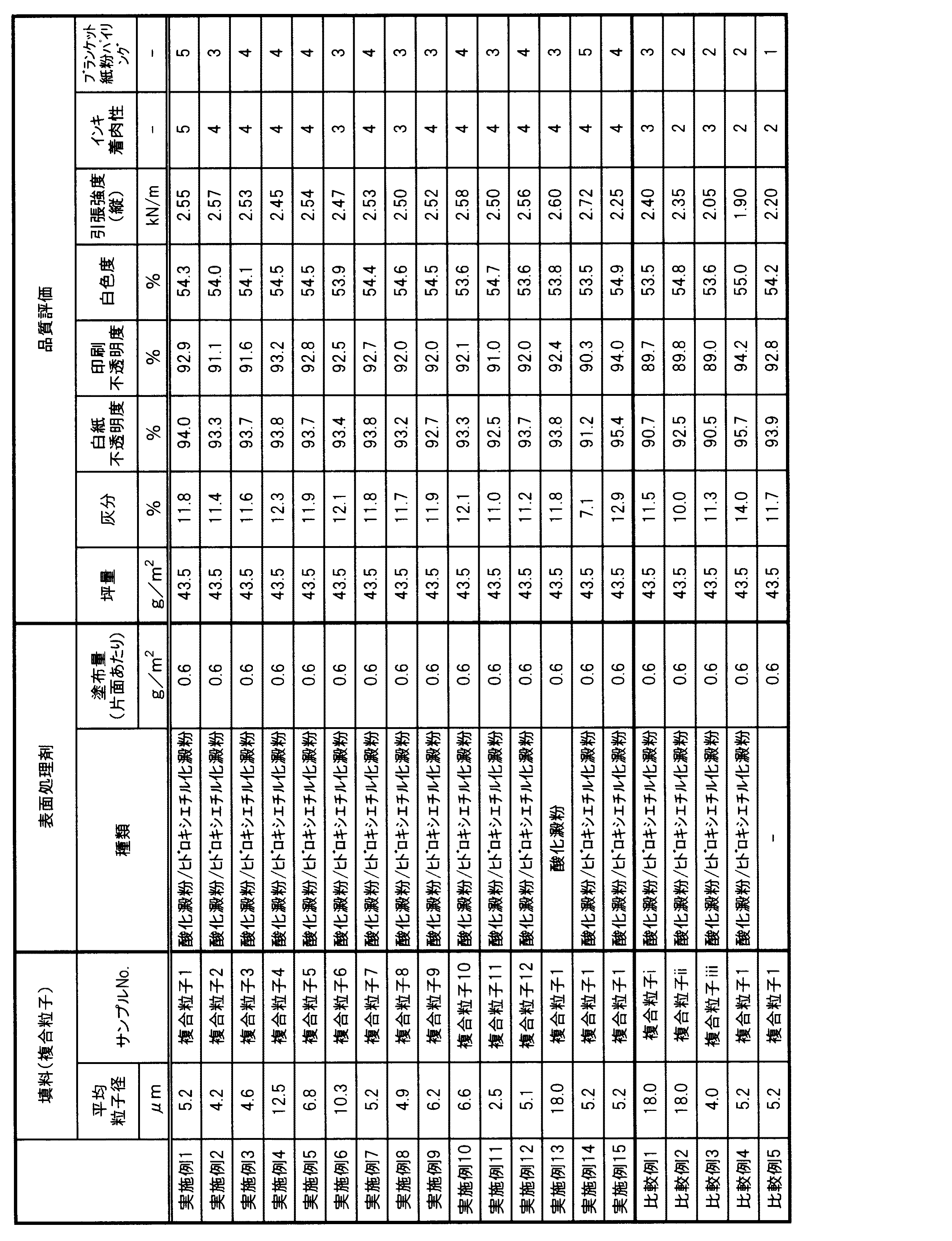
(実施例1)
離解・脱墨古紙パルプ(DIP)を80質量%、サーモメカニカルパルプ(TMP)を20質量%配合し、レファイナーでフリーネスを120mLC.S.F(JIS−P8121に準拠)に調整したパルプスラリーを得た。このパルプスラリーに対し、填料として、得られた複合粒子1を灰分が表1に示す値(11.8%)となるように添加し、絶乾パルプ100質量部あたり0.07質量部の凝集剤(ハイモ社製ハイモロックND270)及び0.05質量部の凝結剤(ハイモ社製ハイマックスSC924)を添加してツインワイヤー抄紙機で坪量42.3g/m2の原紙を抄造した。
Example 1
80% by mass of disaggregated / deinked waste paper pulp (DIP) and 20% by mass of thermomechanical pulp (TMP) were added, and the freeness was 120 mLC. S. A pulp slurry adjusted to F (based on JIS-P8121) was obtained. To this pulp slurry, the obtained composite particles 1 are added as a filler so that the ash content becomes the value shown in Table 1 (11.8%), and agglomeration of 0.07 parts by mass per 100 parts by mass of absolutely dry pulp A base paper having a basis weight of 42.3 g / m 2 was made with a twin wire paper machine by adding an agent (Himo Rock ND270 made by Hymo Co., Ltd.) and 0.05 part by weight of a coagulant (Himax SC 924 made by Hymo Co.).
更に、表面処理剤として酸化澱粉(日本食品加工社製 質量平均分子量70万)90質量部、ヒドロキシエチル化澱粉(HES:ペンフォード社製 質量平均分子量155万)10質量部を混合した澱粉液にスチレン系サイズ剤(星光PMC株式会社製「SS2712」)を固形分で澱粉100質量部に対しスチレン系サイズ剤を15質量部配合した(固形分濃度6%、B型粘度22cps)。この表面処理剤を表面温度50℃の上記原紙の両面に乾燥質量で1.2g/m2(片面あたりそれぞれ0.6g/m2)塗工して実施例1の印刷用紙を得た。 Furthermore, as a surface treatment agent, a starch solution in which 90 parts by mass of oxidized starch (mass average molecular weight of 700,000 manufactured by Nippon Food Processing Co., Ltd.) and 10 parts by mass of hydroxyethylated starch (HES: mass average molecular weight of 150,000 manufactured by Penford) was mixed. A styrene-based sizing agent (“SS2712” manufactured by Seiko PMC Co., Ltd.) was blended in 15 parts by mass with a solid content of 100 parts by mass of starch (solid content concentration 6%, B-type viscosity 22 cps). The surface treatment agent was applied to both surfaces of the base paper having a surface temperature of 50 ° C. in a dry mass of 1.2 g / m 2 (each 0.6 g / m 2 per side) to obtain a printing paper of Example 1.
(実施例2〜15、及び比較例1〜5)
填料の種類、表面処理剤、灰分量を表1に示すとおりに代えたこと以外は実施例1と同様の操作を行い、実施例2〜15及び比較例1〜5の印刷用紙を得た。なお、比較例5では坪量が43.5g/m2の原紙を用い、表面処理剤は塗布しなかった。
(Examples 2 to 15 and Comparative Examples 1 to 5)
Except having changed the kind of filler, surface treating agent, and the amount of ash as shown in Table 1, the same operation as Example 1 was performed, and the printing paper of Examples 2-15 and Comparative Examples 1-5 was obtained. In Comparative Example 5, a base paper having a basis weight of 43.5 g / m 2 was used, and no surface treatment agent was applied.
(評価)
得られた各印刷用紙について、上記方法にて坪量、灰分、白紙不透明度、印刷不透明度、白色度、引張強度、インキ着肉性及びブランケット紙粉パイリングについて評価した。評価結果について、表2に示す。
(Evaluation)
Each of the obtained printing papers was evaluated for basis weight, ash content, white paper opacity, printing opacity, whiteness, tensile strength, ink fillability, and blanket paper dusting by the above methods. The evaluation results are shown in Table 2.
上記表2に示されるように、本発明の印刷用紙は、不透明度(白紙不透明度及び印刷不透明度)が高く、また、インキ着肉性及びブランケット紙粉パイリングの評価も高く印刷適性が高いことがわかる。さらに、本発明の印刷用紙は、白色度及び引張強度も高い。 As shown in Table 2 above, the printing paper of the present invention has high opacity (blank paper opacity and printing opacity), and has high ink applicability and evaluation of blanket paper dusting and high printability. I understand. Furthermore, the printing paper of the present invention has high whiteness and tensile strength.
本発明の印刷用紙は、優れた不透明度及び印刷適性を有し、新聞用紙等に好適に用いることができる。 The printing paper of the present invention has excellent opacity and printability, and can be suitably used for newsprint.
Claims (5)
上記填料として複合粒子を用い、
この複合粒子が、炭酸カルシウム粒子と二酸化チタン粒子とが凝集剤にて凝集されてなる凝集体及びこの凝集体の表面の少なくとも一部を被覆するシリカを有し、
灰分が5%以上13%以下であることを特徴とする印刷用紙。 A printing paper with a filler added internally and a surface treatment agent applied on both sides,
Using composite particles as the filler,
The composite particle has an aggregate formed by aggregating calcium carbonate particles and titanium dioxide particles with an aggregating agent, and silica covering at least a part of the surface of the aggregate,
Printing paper characterized by having an ash content of 5% to 13%.
上記二酸化チタン粒子の平均粒子径が0.2μm以上1μm以下である請求項1から請求項4のいずれか1項に記載の印刷用紙。
The average particle diameter of the calcium carbonate particles is 0.5 μm or more and 3 μm or less,
The printing paper according to any one of claims 1 to 4, wherein an average particle diameter of the titanium dioxide particles is 0.2 µm or more and 1 µm or less.
Priority Applications (1)
| Application Number | Priority Date | Filing Date | Title |
|---|---|---|---|
| JP2011128733A JP2012255231A (en) | 2011-06-08 | 2011-06-08 | Printing paper |
Applications Claiming Priority (1)
| Application Number | Priority Date | Filing Date | Title |
|---|---|---|---|
| JP2011128733A JP2012255231A (en) | 2011-06-08 | 2011-06-08 | Printing paper |
Publications (1)
| Publication Number | Publication Date |
|---|---|
| JP2012255231A true JP2012255231A (en) | 2012-12-27 |
Family
ID=47527035
Family Applications (1)
| Application Number | Title | Priority Date | Filing Date |
|---|---|---|---|
| JP2011128733A Withdrawn JP2012255231A (en) | 2011-06-08 | 2011-06-08 | Printing paper |
Country Status (1)
| Country | Link |
|---|---|
| JP (1) | JP2012255231A (en) |
Cited By (1)
| Publication number | Priority date | Publication date | Assignee | Title |
|---|---|---|---|---|
| JP2016524912A (en) * | 2013-07-19 | 2016-08-22 | フィリップ・モーリス・プロダクツ・ソシエテ・アノニム | Smoking article with a wrapper containing particles |
-
2011
- 2011-06-08 JP JP2011128733A patent/JP2012255231A/en not_active Withdrawn
Cited By (1)
| Publication number | Priority date | Publication date | Assignee | Title |
|---|---|---|---|---|
| JP2016524912A (en) * | 2013-07-19 | 2016-08-22 | フィリップ・モーリス・プロダクツ・ソシエテ・アノニム | Smoking article with a wrapper containing particles |
Similar Documents
| Publication | Publication Date | Title |
|---|---|---|
| JP5114729B2 (en) | Calcium carbonate particles and news paper for cold offset printing | |
| JP4179167B2 (en) | Neutral newsprint for offset printing | |
| JP5243009B2 (en) | Newspaper and production method thereof | |
| JP4448544B2 (en) | Newspaper | |
| JP5319074B2 (en) | Printing paper | |
| JP2008266819A (en) | Low density book paper | |
| JP5762050B2 (en) | Printing paper | |
| JP5702590B2 (en) | Composite particles, composite particle internal paper and coated paper | |
| JP2000282392A (en) | Low-density paper | |
| JP2012255231A (en) | Printing paper | |
| JP4752805B2 (en) | Low density book paper | |
| JP4561258B2 (en) | Coated paper for printing | |
| JP6189026B2 (en) | Printing paper | |
| JP2013108195A (en) | Coated paper | |
| JP4802471B2 (en) | Coated paper for printing | |
| JP4324073B2 (en) | Filler pretreatment method, paper blended with the same, and paper production method | |
| JP5650393B2 (en) | Newspaper | |
| JP4802465B2 (en) | Coated paper for printing | |
| JP6018410B2 (en) | Coated paper | |
| JP4796409B2 (en) | Neutral newsprint for offset printing | |
| JP5661358B2 (en) | Newspaper | |
| JP5946672B2 (en) | Newspaper | |
| JP2000136497A (en) | Newsprint paper for web offset printing | |
| JP4053570B2 (en) | Crimp paper | |
| JP2012255230A (en) | Printing paper |
Legal Events
| Date | Code | Title | Description |
|---|---|---|---|
| A300 | Withdrawal of application because of no request for examination |
Free format text: JAPANESE INTERMEDIATE CODE: A300 Effective date: 20140902 |