TW202000470A - Method for manufacturing transparent resin film capable of obtaining a homogeneous transparent resin film - Google Patents
Method for manufacturing transparent resin film capable of obtaining a homogeneous transparent resin film Download PDFInfo
- Publication number
- TW202000470A TW202000470A TW108121547A TW108121547A TW202000470A TW 202000470 A TW202000470 A TW 202000470A TW 108121547 A TW108121547 A TW 108121547A TW 108121547 A TW108121547 A TW 108121547A TW 202000470 A TW202000470 A TW 202000470A
- Authority
- TW
- Taiwan
- Prior art keywords
- film
- resin film
- manufacturing
- transparent resin
- width
- Prior art date
Links
Images

Classifications
-
- B—PERFORMING OPERATIONS; TRANSPORTING
- B29—WORKING OF PLASTICS; WORKING OF SUBSTANCES IN A PLASTIC STATE IN GENERAL
- B29C—SHAPING OR JOINING OF PLASTICS; SHAPING OF MATERIAL IN A PLASTIC STATE, NOT OTHERWISE PROVIDED FOR; AFTER-TREATMENT OF THE SHAPED PRODUCTS, e.g. REPAIRING
- B29C55/00—Shaping by stretching, e.g. drawing through a die; Apparatus therefor
- B29C55/02—Shaping by stretching, e.g. drawing through a die; Apparatus therefor of plates or sheets
-
- B—PERFORMING OPERATIONS; TRANSPORTING
- B29—WORKING OF PLASTICS; WORKING OF SUBSTANCES IN A PLASTIC STATE IN GENERAL
- B29C—SHAPING OR JOINING OF PLASTICS; SHAPING OF MATERIAL IN A PLASTIC STATE, NOT OTHERWISE PROVIDED FOR; AFTER-TREATMENT OF THE SHAPED PRODUCTS, e.g. REPAIRING
- B29C71/00—After-treatment of articles without altering their shape; Apparatus therefor
- B29C71/02—Thermal after-treatment
-
- B—PERFORMING OPERATIONS; TRANSPORTING
- B29—WORKING OF PLASTICS; WORKING OF SUBSTANCES IN A PLASTIC STATE IN GENERAL
- B29D—PRODUCING PARTICULAR ARTICLES FROM PLASTICS OR FROM SUBSTANCES IN A PLASTIC STATE
- B29D7/00—Producing flat articles, e.g. films or sheets
- B29D7/01—Films or sheets
-
- C—CHEMISTRY; METALLURGY
- C08—ORGANIC MACROMOLECULAR COMPOUNDS; THEIR PREPARATION OR CHEMICAL WORKING-UP; COMPOSITIONS BASED THEREON
- C08G—MACROMOLECULAR COMPOUNDS OBTAINED OTHERWISE THAN BY REACTIONS ONLY INVOLVING UNSATURATED CARBON-TO-CARBON BONDS
- C08G73/00—Macromolecular compounds obtained by reactions forming a linkage containing nitrogen with or without oxygen or carbon in the main chain of the macromolecule, not provided for in groups C08G12/00 - C08G71/00
- C08G73/06—Polycondensates having nitrogen-containing heterocyclic rings in the main chain of the macromolecule
- C08G73/10—Polyimides; Polyester-imides; Polyamide-imides; Polyamide acids or similar polyimide precursors
- C08G73/1067—Wholly aromatic polyimides, i.e. having both tetracarboxylic and diamino moieties aromatically bound
-
- C—CHEMISTRY; METALLURGY
- C08—ORGANIC MACROMOLECULAR COMPOUNDS; THEIR PREPARATION OR CHEMICAL WORKING-UP; COMPOSITIONS BASED THEREON
- C08J—WORKING-UP; GENERAL PROCESSES OF COMPOUNDING; AFTER-TREATMENT NOT COVERED BY SUBCLASSES C08B, C08C, C08F, C08G or C08H
- C08J5/00—Manufacture of articles or shaped materials containing macromolecular substances
- C08J5/18—Manufacture of films or sheets
-
- B—PERFORMING OPERATIONS; TRANSPORTING
- B29—WORKING OF PLASTICS; WORKING OF SUBSTANCES IN A PLASTIC STATE IN GENERAL
- B29K—INDEXING SCHEME ASSOCIATED WITH SUBCLASSES B29B, B29C OR B29D, RELATING TO MOULDING MATERIALS OR TO MATERIALS FOR MOULDS, REINFORCEMENTS, FILLERS OR PREFORMED PARTS, e.g. INSERTS
- B29K2077/00—Use of PA, i.e. polyamides, e.g. polyesteramides or derivatives thereof, as moulding material
-
- B—PERFORMING OPERATIONS; TRANSPORTING
- B29—WORKING OF PLASTICS; WORKING OF SUBSTANCES IN A PLASTIC STATE IN GENERAL
- B29K—INDEXING SCHEME ASSOCIATED WITH SUBCLASSES B29B, B29C OR B29D, RELATING TO MOULDING MATERIALS OR TO MATERIALS FOR MOULDS, REINFORCEMENTS, FILLERS OR PREFORMED PARTS, e.g. INSERTS
- B29K2079/00—Use of polymers having nitrogen, with or without oxygen or carbon only, in the main chain, not provided for in groups B29K2061/00 - B29K2077/00, as moulding material
- B29K2079/08—PI, i.e. polyimides or derivatives thereof
-
- B—PERFORMING OPERATIONS; TRANSPORTING
- B29—WORKING OF PLASTICS; WORKING OF SUBSTANCES IN A PLASTIC STATE IN GENERAL
- B29L—INDEXING SCHEME ASSOCIATED WITH SUBCLASS B29C, RELATING TO PARTICULAR ARTICLES
- B29L2007/00—Flat articles, e.g. films or sheets
- B29L2007/002—Panels; Plates; Sheets
-
- C—CHEMISTRY; METALLURGY
- C08—ORGANIC MACROMOLECULAR COMPOUNDS; THEIR PREPARATION OR CHEMICAL WORKING-UP; COMPOSITIONS BASED THEREON
- C08J—WORKING-UP; GENERAL PROCESSES OF COMPOUNDING; AFTER-TREATMENT NOT COVERED BY SUBCLASSES C08B, C08C, C08F, C08G or C08H
- C08J2379/00—Characterised by the use of macromolecular compounds obtained by reactions forming in the main chain of the macromolecule a linkage containing nitrogen with or without oxygen, or carbon only, not provided for in groups C08J2361/00 - C08J2377/00
- C08J2379/04—Polycondensates having nitrogen-containing heterocyclic rings in the main chain; Polyhydrazides; Polyamide acids or similar polyimide precursors
- C08J2379/08—Polyimides; Polyester-imides; Polyamide-imides; Polyamide acids or similar polyimide precursors
Landscapes
- Chemical & Material Sciences (AREA)
- Engineering & Computer Science (AREA)
- Thermal Sciences (AREA)
- Physics & Mathematics (AREA)
- Mechanical Engineering (AREA)
- Medicinal Chemistry (AREA)
- Chemical Kinetics & Catalysis (AREA)
- Polymers & Plastics (AREA)
- Organic Chemistry (AREA)
- Health & Medical Sciences (AREA)
- Manufacturing & Machinery (AREA)
- Materials Engineering (AREA)
- Manufacture Of Macromolecular Shaped Articles (AREA)
- Advancing Webs (AREA)
- Shaping By String And By Release Of Stress In Plastics And The Like (AREA)
Abstract
Description
本發明係關於一種透明樹脂膜之製造方法。The invention relates to a method for manufacturing a transparent resin film.
於可撓性顯示元件中,正尋求代替玻璃之透明樹脂膜。作為此種透明樹脂膜之材料,已知有聚醯亞胺系樹脂或聚醯胺系樹脂等具有透明性及機械強度之材料。In flexible display devices, transparent resin films that are replacing glass are being sought. As a material of such a transparent resin film, a material having transparency and mechanical strength such as polyimide-based resin or polyamide-based resin is known.
此種透明樹脂膜之製造中,存在為了獲得所需品質而進行樹脂膜之熱處理之情況(例如參照專利文獻1)。In the manufacture of such a transparent resin film, a heat treatment of the resin film may be carried out in order to obtain a desired quality (for example, refer to Patent Document 1).
然而,若進行此種熱處理,則存在無法獲得所獲得之透明樹脂膜之均一性之情況。 [先前技術文獻] [專利文獻]However, if such heat treatment is performed, there may be cases where the uniformity of the obtained transparent resin film cannot be obtained. [Prior Technical Literature] [Patent Literature]
[專利文獻1]日本專利特開2010-36414號公報[Patent Document 1] Japanese Patent Laid-Open No. 2010-36414
[發明所欲解決之問題][Problems to be solved by the invention]
本發明係鑒於此種情況而提出者,目的在於提供一種透明樹脂膜之製造方法,該透明樹脂膜即便進行熱處理亦具有良好之均質性。 [解決問題之技術手段]The present invention was made in view of such circumstances, and an object thereof is to provide a method for manufacturing a transparent resin film that has good homogeneity even if heat treatment is performed. [Technical means to solve the problem]
即,本發明提供以下。 [1]一種透明樹脂膜之製造方法,其具有如下步驟:將包含選自由聚醯亞胺系樹脂及聚醯胺系樹脂所組成之群中之至少1種樹脂而成之長條帶狀之透明樹脂膜之兩端部分別固持;搬送被固持之膜;將被固持之膜之寬度設為特定之距離並於乾燥機內對上述樹脂膜進行熱處理,並將熱處理後之膜之寬度相對於熱處理前之膜之寬度的比設為1.1以下;及將自乾燥機離開之樹脂膜之固持解除。 [2]如[1]記載之製造方法,其中熱處理後之膜之寬度相對於熱處理前之膜之寬度的比為0.7~1.0。 [3]如[1]或[2]記載之製造方法,其中藉由複數個夾具進行固持。 [4]如[3]記載之製造方法,其中以與膜之搬送速度相同之速度使安裝有夾具之驅動裝置移動。 [5]如[4]記載之製造方法,其中藉由鏈條進行驅動裝置之驅動。 [6]如[3]~[5]中任一項記載之製造方法,其中鄰接之夾具之間之空間為1~20 mm。 [7]如[3]~[6]中任一項記載之製造方法,其中於使與膜搬送軸正交之直線與膜之一端之夾具之固持部中央對齊時,該直線與膜之另一端之交點和膜之另一端之夾具之固持部中央之距離為3 mm以下。 [8]如[1]~[7]中任一項記載之製造方法,其中熱處理後之樹脂膜所含之有機溶劑之含量相對於樹脂膜之質量為0.001~3質量%。 [9]如[1]~[8]中任一項記載之製造方法,其中於解除膜之固持之後具有將膜之兩端進行切割之步驟。 [10]如[9]記載之製造方法,其中於將膜進行切割之後具有於樹脂膜上貼合保護膜之步驟。 [11]如[10]記載之製造方法,其中於貼合保護膜之後具有將貼合有保護膜之樹脂膜進行切割之步驟。 [12]如[10]或[11]記載之製造方法,其中於貼合保護膜之後具有將樹脂膜捲取成卷筒之步驟。 [發明之效果]That is, the present invention provides the following. [1] A method for manufacturing a transparent resin film, comprising the steps of: forming a long strip containing at least one resin selected from the group consisting of polyimide-based resins and polyamide-based resins The two ends of the transparent resin film are held separately; the film to be held is transported; the width of the film to be held is set to a specific distance and the above resin film is heat-treated in a dryer, and the width of the heat-treated film is relative to The ratio of the width of the film before heat treatment is set to 1.1 or less; and the holding of the resin film leaving the dryer is released. [2] The production method described in [1], wherein the ratio of the width of the film after heat treatment to the width of the film before heat treatment is 0.7 to 1.0. [3] The manufacturing method according to [1] or [2], wherein the holding is performed by a plurality of jigs. [4] The manufacturing method as described in [3], wherein the driving device mounted with the jig is moved at the same speed as the transport speed of the film. [5] The manufacturing method according to [4], wherein the driving device is driven by a chain. [6] The manufacturing method described in any one of [3] to [5], wherein the space between adjacent jigs is 1 to 20 mm. [7] The manufacturing method according to any one of [3] to [6], wherein when the straight line orthogonal to the film conveying axis is aligned with the center of the holding portion of the jig at one end of the film, the straight line and the other of the film The distance between the intersection of one end and the center of the holding part of the jig at the other end of the membrane is 3 mm or less. [8] The production method according to any one of [1] to [7], wherein the content of the organic solvent contained in the resin film after heat treatment is 0.001 to 3% by mass relative to the mass of the resin film. [9] The production method according to any one of [1] to [8], wherein after releasing the holding of the film, there is a step of cutting both ends of the film. [10] The manufacturing method according to [9], wherein after the film is cut, there is a step of bonding a protective film on the resin film. [11] The manufacturing method according to [10], wherein after the protective film is attached, there is a step of cutting the resin film to which the protective film is attached. [12] The manufacturing method according to [10] or [11], wherein after the protective film is attached, there is a step of winding the resin film into a roll. [Effect of invention]
如上所述,本發明提供一種透明樹脂膜之製造方法,其能夠獲得均質之透明樹脂膜。As described above, the present invention provides a method for manufacturing a transparent resin film, which can obtain a homogeneous transparent resin film.
於以下之說明中所例示之材料、尺寸等為一例,本發明不一定限定於該等,可於不改變其主旨之範圍內適當變化地實施。The materials, dimensions, etc. illustrated in the following description are examples, and the present invention is not necessarily limited to these, and can be implemented with appropriate changes within the scope without changing the gist thereof.
本發明提供一種透明樹脂膜之製造方法,其包括如下步驟:將包含選自由聚醯亞胺系樹脂及聚醯胺系樹脂所組成之群中之至少1種樹脂而成之長條帶狀之透明樹脂膜之兩端部分別固持;搬送被固持之膜;將被固持之膜之寬度設為特定之距離並於乾燥機內對上述樹脂膜進行熱處理,並將熱處理後之膜之寬度相對於熱處理前之膜之寬度的比設為1.1以下;及將自乾燥機離開之樹脂膜之固持解除。The present invention provides a method for manufacturing a transparent resin film, which includes the steps of: forming a long strip containing at least one resin selected from the group consisting of polyimide-based resins and polyamide-based resins The two ends of the transparent resin film are held separately; the film to be held is transported; the width of the film to be held is set to a specific distance and the above resin film is heat-treated in a dryer, and the width of the heat-treated film is relative to The ratio of the width of the film before heat treatment is set to 1.1 or less; and the holding of the resin film leaving the dryer is released.
[聚醯亞胺系樹脂、聚醯胺系樹脂] 本發明之透明樹脂膜包含選自由聚醯亞胺系樹脂及聚醯胺系樹脂所組成之群中之至少1種樹脂。聚醯亞胺系樹脂係表示選自由含有包含醯亞胺基之重複結構單元的聚合物(以下,有時記載為聚醯亞胺)、以及含有包含醯亞胺基及醯胺基之兩者之重複結構單元的聚合物(以下,有時記載為聚醯胺醯亞胺)所組成之群中之至少1種聚合物。又,聚醯胺系樹脂係表示含有包含醯胺基之重複結構單元的聚合物。[Polyimide-based resin, Polyamide-based resin] The transparent resin film of the present invention contains at least one resin selected from the group consisting of polyimide-based resins and polyamide-based resins. The polyimide-based resin system means a polymer selected from the group consisting of a repeating structural unit containing an amide imide group (hereinafter, sometimes referred to as a polyimide), and both containing an amide imide group and an amide group. At least one polymer in the group consisting of polymers of repeating structural units (hereinafter, sometimes described as polyamidoamide). In addition, the polyamido-based resin system means a polymer containing a repeating structural unit containing an amide group.
聚醯亞胺系樹脂較佳為具有式(10)所表示之重複結構單元。此處,G為4價有機基,A為2價有機基。聚醯亞胺系樹脂亦可包含G及/或A不同之2種以上之式(10)所表示之重複結構單元。The polyimide-based resin preferably has a repeating structural unit represented by formula (10). Here, G is a tetravalent organic group, and A is a divalent organic group. The polyimide-based resin may contain two or more types of repeating structural units represented by formula (10) in which G and/or A are different.
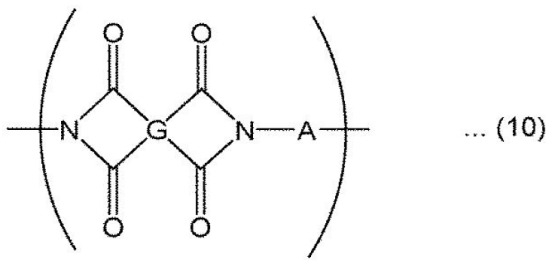
聚醯亞胺系樹脂亦可於無損透明樹脂膜之各種物性之範圍內包含選自由式(11)、式(12)及式(13)所表示之重複結構單元所組成之群中之1者以上。The polyimide-based resin may also include one selected from the group consisting of repeating structural units represented by formula (11), formula (12), and formula (13) within the range that does not damage various physical properties of the transparent resin film the above.

式(10)及式(11)中,G及G1 分別獨立為4價有機基,較佳為可經烴基或經氟取代之烴基取代之有機基。作為G及G1 ,可例示式(20)、式(21)、式(22)、式(23)、式(24)、式(25)、式(26)、式(27)、式(28)或式(29)所表示之基以及4價之碳數6以下之鏈式烴基。就容易抑制透明樹脂膜之黃度(YI值)之方面而言,尤佳為式(20)、式(21)、式(22)、式(23)、式(24)、式(25)、式(26)或式(27)所表示之基。In formula (10) and formula (11), G and G 1 are each independently a tetravalent organic group, preferably an organic group that may be substituted with a hydrocarbon group or a fluorine-substituted hydrocarbon group. Examples of G and G 1 include formula (20), formula (21), formula (22), formula (23), formula (24), formula (25), formula (26), formula (27), and formula ( 28) The group represented by the formula (29) and a 4-valent chain hydrocarbon group having a carbon number of 6 or less. In terms of easily suppressing the yellowness (YI value) of the transparent resin film, the formulas (20), (21), (22), (23), (24), and (25) are particularly preferred. , Formula (26) or Formula (27).
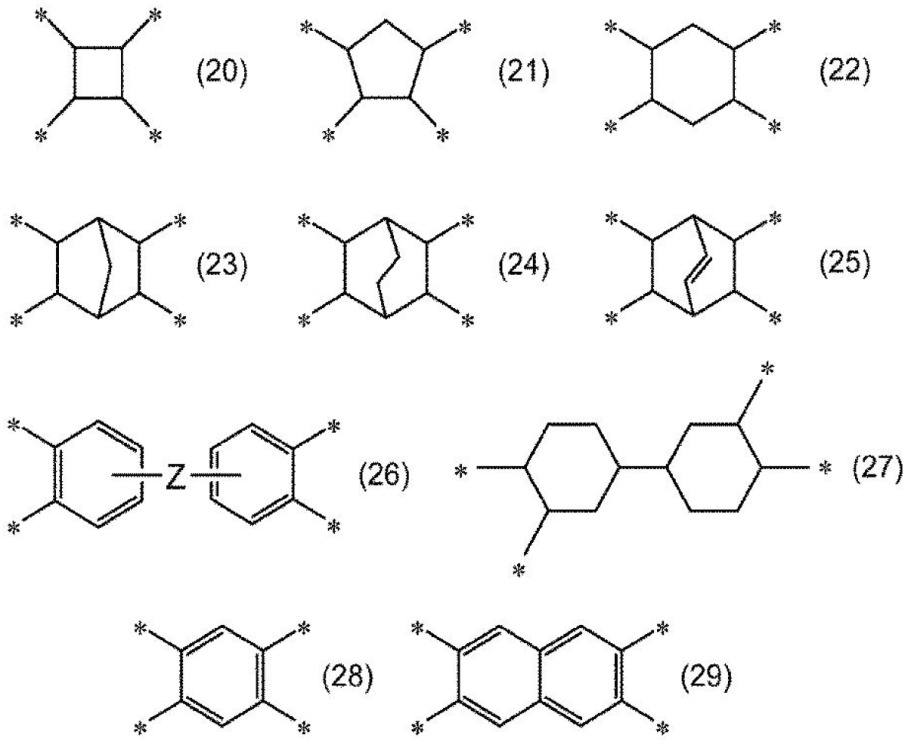
式(20)~式(29)中, *表示鍵結鍵, Z表示單鍵、-O-、-CH2 -、-CH2 -CH2 -、-CH(CH3 )-、-C(CH3 )2 -、-C(CF3 )2 -、-Ar-、-SO2 -、-CO-、-O-Ar-O-、-Ar-O-Ar-、-Ar-CH2 -Ar-、-Ar-C(CH3 )2 -Ar-或-Ar-SO2 -Ar-。Ar表示可經氟原子取代之碳數6~20之伸芳基,作為具體例,可列舉伸苯基。In formula (20) to formula (29), * represents a bonding bond, and Z represents a single bond, -O-, -CH 2 -, -CH 2 -CH 2 -, -CH(CH 3 )-, -C( CH 3 ) 2 -, -C(CF 3 ) 2 -, -Ar-, -SO 2 -, -CO-, -O-Ar-O-, -Ar-O-Ar-, -Ar-CH 2- Ar-, -Ar-C(CH 3 ) 2 -Ar- or -Ar-SO 2 -Ar-. Ar represents a C 6-20 arylene group which may be substituted by a fluorine atom, and specific examples include phenylene group.
式(12)中,G2 為3價有機基,較佳為可經烴基或經氟取代之烴基取代之有機基。作為G2 ,可例示式(20)、式(21)、式(22)、式(23)、式(24)、式(25)、式(26)、式(27)、式(28)或式(29)所表示之基之鍵結鍵之任一者被取代為氫原子的基以及3價之碳數6以下之鏈式烴基。In formula (12), G 2 is a trivalent organic group, preferably an organic group which may be substituted with a hydrocarbon group or a hydrocarbon group substituted with fluorine. As G 2 , formula (20), formula (21), formula (22), formula (23), formula (24), formula (25), formula (26), formula (27), formula (28) can be exemplified Or any one of the bonding bonds of the group represented by formula (29) is substituted with a hydrogen atom and a trivalent chain hydrocarbon group with a carbon number of 6 or less.
式(13)中,G3 為2價有機基,較佳為可經烴基或經氟取代之烴基取代之有機基。作為G3 ,可例示式(20)、式(21)、式(22)、式(23)、式(24)、式(25)、式(26)、式(27)、式(28)或式(29)所表示之基之鍵結鍵中不鄰接之兩者被取代為氫原子的基及碳數6以下之鏈式烴基。In formula (13), G 3 is a divalent organic group, preferably an organic group which may be substituted with a hydrocarbon group or a hydrocarbon group substituted with fluorine. As G 3 , formula (20), formula (21), formula (22), formula (23), formula (24), formula (25), formula (26), formula (27), formula (28) can be exemplified Or, in the bonding bond of the group represented by formula (29), two groups that are not adjacent to each other are substituted with a hydrogen atom and a chain hydrocarbon group having 6 or less carbon atoms.
式(10)~式(13)中,A、A1 、A2 及A3 分別獨立,為2價有機基,較佳為可經烴基或經氟取代之烴基取代之有機基。作為A、A1 、A2 及A3 ,可例示式(30)、式(31)、式(32)、式(33)、式(34)、式(35)、式(36)、式(37)或者式(38)所表示之基;該等經甲基、氟基、氯基或者三氟甲基取代而成之基;以及碳數6以下之鏈式烴基。In formula (10) to formula (13), A, A 1 , A 2 and A 3 are each independently a divalent organic group, preferably an organic group that may be substituted with a hydrocarbon group or a fluorine-substituted hydrocarbon group. As A, A 1 , A 2 and A 3 , formula (30), formula (31), formula (32), formula (33), formula (34), formula (35), formula (36), formula can be exemplified (37) or the group represented by formula (38); those substituted with methyl, fluoro, chloro, or trifluoromethyl; and chain hydrocarbon groups with a carbon number of 6 or less.

式(30)~式(38)中, *表示鍵結鍵, Z1 、Z2 及Z3 分別獨立,表示單鍵、-O-、-CH2 -、-CH2 -CH2 -、-CH(CH3 )-、-C(CH3 )2 -、-C(CF3 )2 -、-SO2 -或-CO-。 作為一例,Z1 及Z3 且-O-且Z2 為-CH2 -、-C(CH3 )2 -、-C(CF3 )2 -或-SO2 -。Z1 與Z2 相對於各環之鍵結位置、及Z2 與Z3 相對於各環之鍵結位置分別較佳為相對於各環為間位或對位。In formula (30) to formula (38), * represents a bonding bond, and Z 1 , Z 2 and Z 3 are each independently, and represent a single bond, -O-, -CH 2 -, -CH 2 -CH 2 -,- CH(CH 3 )-, -C(CH 3 ) 2 -, -C(CF 3 ) 2 -, -SO 2 -or -CO-. As an example, Z 1 and Z 3 are -O- and Z 2 is -CH 2 -, -C(CH 3 ) 2 -, -C(CF 3 ) 2 -, or -SO 2 -. The bonding positions of Z 1 and Z 2 with respect to each ring, and the bonding positions of Z 2 and Z 3 with respect to each ring are preferably meta or para with respect to each ring, respectively.
關於聚醯亞胺系樹脂,就容易提昇視認性之觀點而言,較佳為至少具有式(10)所表示之重複結構單元及式(13)所表示之重複結構單元之聚醯胺醯亞胺。又,聚醯胺系樹脂較佳為至少具有式(13)所表示之重複結構單元。Regarding the polyimide-based resin, from the viewpoint of easily improving visibility, a polyamidoamide having at least a repeating structural unit represented by formula (10) and a repeating structural unit represented by formula (13) is preferred amine. In addition, the polyamide resin preferably has at least a repeating structural unit represented by formula (13).
於本發明之一實施態樣中,聚醯亞胺系樹脂為使二胺及四羧酸化合物(醯氯化合物、四羧酸二酐等四羧酸化合物相關物)、以及視需要之二羧酸化合物(醯氯化合物等二羧酸化合物相關物)、三羧酸化合物(醯氯化合物、三羧酸酐等三羧酸化合物相關物)等反應(縮聚)而獲得之縮合型高分子。式(10)或式(11)所表示之重複結構單元通常由二胺及四羧酸化合物衍生。式(12)所表示之重複結構單元通常由二胺及三羧酸化合物衍生。式(13)所表示之重複結構單元通常由二胺及二羧酸化合物衍生。In one embodiment of the present invention, the polyimide-based resin is composed of a diamine and a tetracarboxylic acid compound (a related compound of a tetracarboxylic acid compound such as an acetyl chloride compound and a tetracarboxylic dianhydride), and a dicarboxylic acid if necessary Condensed polymer obtained by reaction (polycondensation) of acid compounds (dicarboxylic acid compounds such as acetyl chloride compounds) and tricarboxylic acid compounds (tricarboxylic acid compounds such as acetyl chloride compounds and tricarboxylic anhydrides). The repeating structural unit represented by formula (10) or formula (11) is usually derived from a diamine and a tetracarboxylic acid compound. The repeating structural unit represented by formula (12) is usually derived from a diamine and a tricarboxylic acid compound. The repeating structural unit represented by formula (13) is usually derived from a diamine and a dicarboxylic acid compound.
於本發明之一實施態樣中,聚醯胺系樹脂為使二胺與二羧酸化合物反應(縮聚)而獲得之縮合型高分子。即,式(13)所表示之重複結構單元通常由二胺及二羧酸化合物衍生。In one embodiment of the present invention, the polyamide resin is a condensation-type polymer obtained by reacting (condensing) a diamine and a dicarboxylic acid compound. That is, the repeating structural unit represented by formula (13) is usually derived from a diamine and a dicarboxylic acid compound.
作為四羧酸化合物,可列舉芳香族四羧酸二酐等芳香族四羧酸化合物;及脂肪族四羧酸二酐等脂肪族四羧酸化合物。四羧酸化合物可單獨使用,亦可將2種以上併用。關於四羧酸化合物,除二酐以外,還可為醯氯化合物等四羧酸化合物相關物。Examples of the tetracarboxylic acid compound include aromatic tetracarboxylic acid compounds such as aromatic tetracarboxylic dianhydride; and aliphatic tetracarboxylic acid compounds such as aliphatic tetracarboxylic dianhydride. The tetracarboxylic acid compound may be used alone, or two or more kinds may be used in combination. As for the tetracarboxylic acid compound, in addition to the dianhydride, it may also be a tetracarboxylic acid compound related substance such as an acetyl chloride compound.
作為芳香族四羧酸二酐之具體例,可列舉:4,4'-氧二鄰苯二甲酸二酐、3,3',4,4'-二苯甲酮四羧酸二酐、2,2',3,3'-二苯甲酮四羧酸二酐、3,3',4,4'-聯苯四羧酸二酐、2,2',3,3'-聯苯基四羧酸二酐、3,3',4,4'-二苯基碸四羧酸二酐、2,2-雙(3,4-二羧基苯基)丙烷二酐、2,2-雙(2,3-二羧基苯基)丙烷二酐、2,2-雙(3,4-二羧基苯氧基苯基)丙烷二酐、4,4'-(六氟亞異丙基)二鄰苯二甲酸二酐(6FDA)、1,2-雙(2,3-二羧基苯基)乙烷二酐、1,1-雙(2,3-二羧基苯基)乙烷二酐、1,2-雙(3,4-二羧基苯基)乙烷二酐、1,1-雙(3,4-二羧基苯基)乙烷二酐、雙(3,4-二羧基苯基)甲烷二酐、雙(2,3-二羧基苯基)甲烷二酐及4,4'-(對苯二氧基)二鄰苯二甲酸二酐及4,4'-(間伸苯基二氧基)二鄰苯二甲酸二酐。該等可單獨使用或將2種以上組合使用。Specific examples of the aromatic tetracarboxylic dianhydride include: 4,4'-oxydiphthalic dianhydride, 3,3',4,4'-benzophenone tetracarboxylic dianhydride, 2 ,2',3,3'-benzophenonetetracarboxylic dianhydride, 3,3',4,4'-biphenyltetracarboxylic dianhydride, 2,2',3,3'-biphenyl Tetracarboxylic dianhydride, 3,3',4,4'-diphenylbenzene tetracarboxylic dianhydride, 2,2-bis(3,4-dicarboxyphenyl)propane dianhydride, 2,2-bis (2,3-dicarboxyphenyl)propane dianhydride, 2,2-bis(3,4-dicarboxyphenoxyphenyl) propane dianhydride, 4,4'-(hexafluoroisopropylidene) di Phthalic dianhydride (6FDA), 1,2-bis(2,3-dicarboxyphenyl)ethane dianhydride, 1,1-bis(2,3-dicarboxyphenyl)ethane dianhydride, 1,2-bis(3,4-dicarboxyphenyl)ethane dianhydride, 1,1-bis(3,4-dicarboxyphenyl)ethane dianhydride, bis(3,4-dicarboxyphenyl )Methane dianhydride, bis(2,3-dicarboxyphenyl)methane dianhydride and 4,4'-(p-phenylenedioxy) diphthalic dianhydride and 4,4'-(m-extended phenyl Dioxy) diphthalic dianhydride. These can be used alone or in combination of two or more.
作為脂肪族四羧酸二酐,可列舉環式或非環式之脂肪族四羧酸二酐。作為環式脂肪族四羧酸二酐,為具有脂環式烴結構之四羧酸二酐,作為其具體例,可列舉:1,2,4,5-環己烷四羧酸二酐、1,2,3,4-環丁烷四羧酸二酐、1,2,3,4-環戊烷四羧酸二酐等環烷烴四羧酸二酐、二環[2.2.2]辛-7-烯-2,3,5,6-四羧酸二酐、二環己基-3,3',4,4'-四羧酸二酐及該等之位置異構物。該等可單獨使用或將2種以上組合使用。作為非環式脂肪族四羧酸二酐之具體例,可列舉1,2,3,4-丁烷四羧酸二酐、1,2,3,4-戊烷四羧酸二酐等,該等可單獨使用或將2種以上組合使用。又,亦可將環式脂肪族四羧酸二酐及非環式脂肪族四羧酸二酐組合使用。Examples of the aliphatic tetracarboxylic dianhydride include cyclic or acyclic aliphatic tetracarboxylic dianhydride. The cycloaliphatic tetracarboxylic dianhydride is tetracarboxylic dianhydride having an alicyclic hydrocarbon structure. Specific examples thereof include 1,2,4,5-cyclohexanetetracarboxylic dianhydride, Cycloalkane tetracarboxylic dianhydride such as 1,2,3,4-cyclobutane tetracarboxylic dianhydride, 1,2,3,4-cyclopentane tetracarboxylic dianhydride, bicyclo[2.2.2]octane -7-ene-2,3,5,6-tetracarboxylic dianhydride, dicyclohexyl-3,3',4,4'-tetracarboxylic dianhydride and positional isomers of these. These can be used alone or in combination of two or more. Specific examples of the non-cyclic aliphatic tetracarboxylic dianhydride include 1,2,3,4-butane tetracarboxylic dianhydride, 1,2,3,4-pentane tetracarboxylic dianhydride, etc., These can be used alone or in combination of two or more. In addition, cyclic aliphatic tetracarboxylic dianhydride and non-cyclic aliphatic tetracarboxylic dianhydride may be used in combination.
上述四羧酸二酐之中,就高透明性及低著色性之觀點而言,較佳為1,2,4,5-環己烷四羧酸二酐、二環[2.2.2]辛-7-烯-2,3,5,6-四羧酸二酐及4,4'-(六氟亞異丙基)二鄰苯二甲酸二酐、以及該等之混合物。又,作為四羧酸,亦可使用上述四羧酸化合物之酐之水加成物。Among the above-mentioned tetracarboxylic dianhydrides, from the viewpoint of high transparency and low colorability, 1,2,4,5-cyclohexanetetracarboxylic dianhydride and bicyclo[2.2.2]octane are preferred -7-ene-2,3,5,6-tetracarboxylic dianhydride and 4,4'-(hexafluoroisopropylidene) diphthalic dianhydride, and mixtures thereof. In addition, as the tetracarboxylic acid, an aqueous adduct of the anhydride of the above-mentioned tetracarboxylic acid compound can also be used.
作為三羧酸化合物,可列舉芳香族三羧酸、脂肪族三羧酸及該等之相關之醯氯化合物、酸酐等,亦可將2種以上併用。 作為具體例,可列舉:1,2,4-苯三羧酸之酐;2,3,6-萘三羧酸-2,3-酐;鄰苯二甲酸酐與苯甲酸利用單鍵、-CH2 -、-C(CH3 )2 -、-C(CF3 )2 -、-SO2 -或者伸苯基連結而成之化合物。Examples of the tricarboxylic acid compounds include aromatic tricarboxylic acids, aliphatic tricarboxylic acids, and related acetyl chloride compounds, acid anhydrides, and the like, and two or more types may be used in combination. Specific examples include: 1,2,4-benzenetricarboxylic acid anhydride; 2,3,6-naphthalenetricarboxylic acid-2,3-anhydride; phthalic anhydride and benzoic acid using a single bond,- A compound formed by connecting CH 2 -, -C(CH 3 ) 2 -, -C(CF 3 ) 2 -, -SO 2 -or phenylene.
作為二羧酸化合物,可列舉芳香族二羧酸、脂肪族二羧酸及該等之相關之醯氯化合物、酸酐等,亦可將該等2種以上併用。 作為該等之具體例,可列舉:對苯二甲酸二氯化物(對酞醯氯(TPC));間苯二甲酸二氯化物;萘二甲酸二氯化物;4,4'-聯苯基二羧酸二氯化物;3,3'-聯苯基二羧酸二氯化物;4,4'-氧雙(苯甲醯氯)(OBBC);碳數8以下之鏈式烴之二羧酸化合物及2個苯甲酸由單鍵-CH2 -、-C(CH3 )2 -、-C(CF3 )2 -、-SO2 -或者伸苯基連結而成之化合物。Examples of the dicarboxylic acid compounds include aromatic dicarboxylic acids, aliphatic dicarboxylic acids, and related acetyl chloride compounds, acid anhydrides, and the like, and two or more of these may be used in combination. As specific examples of these, terephthalic acid dichloride (terephthaloyl chloride (TPC)); isophthalic acid dichloride; naphthalene dicarboxylic acid dichloride; 4,4'-biphenyl Dicarboxylic acid dichloride; 3,3'-biphenyl dicarboxylic acid dichloride; 4,4'-oxybis(benzoyl chloride) (OBBC); dicarboxylic acid of chain hydrocarbons with carbon number below 8 The acid compound and the two benzoic acids are compounds in which single bonds -CH 2 -, -C(CH 3 ) 2 -, -C(CF 3 ) 2 -, -SO 2 -or phenylene are linked.
作為二胺,例如可列舉脂肪族二胺、芳香族二胺或該等之混合物。再者,於本實施形態中,「芳香族二胺」係表示胺基直接鍵結於芳香環之二胺,亦可於其結構之一部分包含脂肪族基或其他取代基。芳香環可為單環亦可為縮合環,可例示苯環、萘環、蒽環及茀環等,但並不限定於該等。該等之中,較佳為芳香環為苯環。又,「脂肪族二胺」係表示胺基直接鍵結於脂肪族基之二胺,亦可於其結構之一部分包含芳香環或其他取代基。Examples of the diamines include aliphatic diamines, aromatic diamines, and mixtures of these. In addition, in the present embodiment, "aromatic diamine" means a diamine in which an amine group is directly bonded to an aromatic ring, and an aliphatic group or other substituent may be included in a part of its structure. The aromatic ring may be a single ring or a condensed ring, and examples thereof include a benzene ring, a naphthalene ring, an anthracene ring, and a stilbene ring, but are not limited thereto. Among these, the aromatic ring is preferably a benzene ring. In addition, "aliphatic diamine" means a diamine in which an amine group is directly bonded to an aliphatic group, and an aromatic ring or other substituent may be included in a part of its structure.
作為脂肪族二胺,例如可列舉六亞甲基二胺等非環式脂肪族二胺及1,3-雙(胺基甲基)環己烷、1,4-雙(胺基甲基)環己烷、降𦯉烷二胺、4,4'-二胺基二環己基甲烷等環式脂肪族二胺等。該等可單獨使用或將2種以上組合使用。Examples of the aliphatic diamine include non-cyclic aliphatic diamines such as hexamethylene diamine, 1,3-bis(aminomethyl)cyclohexane, and 1,4-bis(aminomethyl). Cycloaliphatic diamines such as cyclohexane, noranediamine, 4,4'-diaminodicyclohexylmethane, etc. These can be used alone or in combination of two or more.
作為芳香族二胺,例如可列舉:對苯二胺、間苯二胺、2,4-甲苯二胺、間苯二甲胺、對苯二甲胺、1,5-二胺基萘、2,6-二胺基萘等具有1個芳香環之芳香族二胺;4,4'-二胺基二苯甲烷、4,4'-二胺基二苯丙烷、4,4'-二胺基二苯醚、3,4'-二胺基二苯醚、3,3'-二胺基二苯醚、4,4'-二胺基二苯基碸、3,4'-二胺基二苯基碸、3,3'-二胺基二苯基碸、1,4-雙(4-胺基苯氧基)苯、1,3-雙(4-胺基苯氧基)苯、4,4'-二胺基二苯基碸、雙[4-(4-胺基苯氧基)苯基]碸、雙[4-(3-胺基苯氧基)苯基]碸、2,2-雙[4-(4-胺基苯氧基)苯基]丙烷、2,2-雙[4-(3-胺基苯氧基)苯基]丙烷、2,2'-二甲基聯苯胺、2,2'-雙(三氟甲基)聯苯胺(2,2'-雙(三氟甲基)-4,4'-二胺基聯苯(TFMB))、4,4'-雙(4-胺基苯氧基)聯苯、9,9-雙(4-胺基苯基)茀、9,9-雙(4-胺基-3-甲基苯基)茀、9,9-雙(4-胺基-3-氯苯基)茀、9,9-雙(4-胺基-3-氟苯基)茀等具有2個以上芳香環之芳香族二胺。該等可單獨使用或將2種以上組合使用。Examples of aromatic diamines include p-phenylenediamine, m-phenylenediamine, 2,4-toluenediamine, m-xylylenediamine, p-xylylenediamine, 1,5-diaminonaphthalene, and 2 , 6-diaminonaphthalene and other aromatic diamines with one aromatic ring; 4,4'-diaminodiphenylmethane, 4,4'-diaminodiphenylpropane, 4,4'-diamine Diphenyl ether, 3,4'-diaminodiphenyl ether, 3,3'-diaminodiphenyl ether, 4,4'-diaminodiphenyl sulfone, 3,4'-diamine Diphenyl sulfone, 3,3'-diamino diphenyl sulfone, 1,4-bis(4-aminophenoxy)benzene, 1,3-bis(4-aminophenoxy)benzene, 4,4'-Diaminodiphenyl satin, bis[4-(4-aminophenoxy)phenyl] satin, bis[4-(3-aminophenoxy)phenyl] satin, 2 ,2-bis[4-(4-aminophenoxy)phenyl]propane, 2,2-bis[4-(3-aminophenoxy)phenyl]propane, 2,2'-dimethyl Benzidine, 2,2'-bis(trifluoromethyl) benzidine (2,2'-bis(trifluoromethyl)-4,4'-diaminobenzyl (TFMB)), 4,4 '-Bis(4-aminophenoxy)biphenyl, 9,9-bis(4-aminophenyl) stilbene, 9,9-bis(4-amino-3-methylphenyl) stilbene, Aromatic diamines with more than 2 aromatic rings such as 9,9-bis(4-amino-3-chlorophenyl) stilbene, 9,9-bis(4-amino-3-fluorophenyl) stilbene, etc. These can be used alone or in combination of two or more.
上述二胺之中,就高透明性及低著色性之觀點而言,較佳為使用選自由具有聯苯基結構之芳香族二胺所組成之群中之1種以上,更佳為使用選自由2,2'-二甲基聯苯胺、2,2'-雙(三氟甲基)聯苯胺、4,4'-雙(4-胺基苯氧基)聯苯及4,4'-二胺基二苯醚所組成之群中之1種以上,進而較佳為使用2,2'-雙(三氟甲基)聯苯胺。Among the above-mentioned diamines, from the viewpoint of high transparency and low colorability, it is preferable to use one or more kinds selected from the group consisting of aromatic diamines having a biphenyl structure, and it is more preferable to use Free 2,2'-dimethylbenzidine, 2,2'-bis(trifluoromethyl)benzidine, 4,4'-bis(4-aminophenoxy)biphenyl and 4,4'- One or more of the diamine diphenyl ether group is more preferably 2,2'-bis(trifluoromethyl) benzidine.
聚醯亞胺系樹脂可藉由如下方式而獲得:將上述二胺、四羧酸化合物、三羧酸化合物、二羧酸化合物等各原料利用慣用之方法例如攪拌等方法進行混合,其後,將所獲得之中間物於醯亞胺化觸媒及視需要之脫水劑之存在下進行醯亞胺化。聚醯胺系樹脂可藉由將上述二胺、二羧酸化合物等各原料利用慣用之方法例如攪拌等方法進行混合而獲得。The polyimide-based resin can be obtained by mixing the raw materials such as the above-mentioned diamine, tetracarboxylic acid compound, tricarboxylic acid compound, and dicarboxylic acid compound by a conventional method such as stirring, and thereafter, The obtained intermediate is imidate in the presence of an imidate catalyst and optionally a dehydrating agent. Polyamide-based resins can be obtained by mixing various raw materials such as the above-mentioned diamines and dicarboxylic acid compounds by a conventional method such as stirring.
作為醯亞胺化步驟中所使用之醯亞胺化觸媒,並無特別限定,例如可列舉:三丙基胺、二丁基丙基胺、乙基二丁基胺等脂肪族胺;N-乙基哌啶、N-丙基哌啶、N-丁基吡咯啶、N-丁基哌啶、及N-丙基六氫氮呯等脂環式胺(單環式);氮雜雙環[2.2.1]庚烷、氮雜雙環[3.2.1]辛烷、氮雜雙環[2.2.2]辛烷、及氮雜雙環[3.2.2]壬烷等脂環式胺(多環式);以及2-甲基吡啶、3-甲基吡啶、4-甲基吡啶、2-乙基吡啶、3-乙基吡啶、4-乙基吡啶、2,4-二甲基吡啶、2,4,6-三甲基吡啶、3,4-環戊烯吡啶、5,6,7,8-四氫異喹啉、及異喹啉等芳香族胺。The imidate catalyst used in the imidate step is not particularly limited, and examples thereof include aliphatic amines such as tripropylamine, dibutylpropylamine, and ethyldibutylamine; N -Alicyclic amines (monocyclic) such as ethyl piperidine, N-propyl piperidine, N-butyl pyrrolidine, N-butyl piperidine, and N-propyl hexahydropyridine; azabicyclic [2.2.1]Heptane, azabicyclo[3.2.1]octane, azabicyclo[2.2.2]octane, and azabicyclo[3.2.2]nonane and other alicyclic amines (polycyclic ); and 2-methylpyridine, 3-methylpyridine, 4-methylpyridine, 2-ethylpyridine, 3-ethylpyridine, 4-ethylpyridine, 2,4-lutidine, 2, Aromatic amines such as 4,6-trimethylpyridine, 3,4-cyclopentenepyridine, 5,6,7,8-tetrahydroisoquinoline, and isoquinoline.
作為醯亞胺化步驟中所使用之脫水劑,並無特別限定,例如可列舉乙酸酐、丙酸酐、異丁酸酐、特戊酸酐、丁酸酐、異戊酸酐等。The dehydrating agent used in the amide imidization step is not particularly limited, and examples thereof include acetic anhydride, propionic anhydride, isobutyric anhydride, pivalic anhydride, butyric anhydride, and isovaleric anhydride.
於各原料之混合及醯亞胺化步驟中,反應溫度並無特別限定,例如為15~350℃,較佳為20~100℃。反應時間亦無特別限定,例如為10分鐘~10小時左右。可視需要於惰性環境或減壓之條件下進行反應。又,反應於溶劑中進行即可,作為溶劑,例如可列舉作為製備清漆所使用之溶劑所例示者。反應後,將聚醯亞胺系樹脂或聚醯胺系樹脂進行精製。作為精製方法,例如可列舉如下方法:於反應液中加入不良溶劑,藉由再沈澱法使樹脂析出並進行乾燥將沈澱物取出,視需要將沈澱物利用甲醇等溶劑洗淨後使其乾燥等。 再者,聚醯亞胺系樹脂之製造例如可參照日本專利特開2006-199945號公報或日本專利特開2008-163107號公報中記載之製造方法。又,聚醯亞胺系樹脂亦可使用市售品,作為其具體例,可列舉Mitsubishi Gas Chemical(股)製造之Neopulim(註冊商標)、河村產業(股)製造之KPI-MX300F等。In the mixing of each raw material and the amide imidization step, the reaction temperature is not particularly limited, for example, 15 to 350°C, preferably 20 to 100°C. The reaction time is also not particularly limited, and is, for example, about 10 minutes to 10 hours. The reaction can be carried out under inert environment or under reduced pressure as required. In addition, the reaction may be carried out in a solvent. Examples of the solvent include those exemplified as solvents used for preparing varnishes. After the reaction, the polyimide-based resin or the polyamide-based resin is purified. As a purification method, for example, a method of adding a poor solvent to the reaction solution, precipitating the resin by reprecipitation method, and drying the precipitate is taken out, and if necessary, the precipitate is washed with a solvent such as methanol and then dried, etc. . In addition, for the production of the polyimide-based resin, for example, the production method described in Japanese Patent Laid-Open No. 2006-199945 or Japanese Patent Laid-Open No. 2008-163107 can be referred to. In addition, commercially available products may be used for the polyimide-based resin. Specific examples thereof include Neopulim (registered trademark) manufactured by Mitsubishi Gas Chemical Co., Ltd., and KPI-MX300F manufactured by Kawamura Industries Co., Ltd. and the like.
聚醯亞胺系樹脂或聚醯胺系樹脂之重量平均分子量(Mw)較佳為200,000以上,更佳為250,000以上,進而較佳為300,000以上,且較佳為600,000以下,更佳為500,000以下。存在如下傾向:聚醯亞胺系樹脂或聚醯胺系樹脂之重量平均分子量越大,於膜化時越容易表現出較高之耐彎曲性。因此,就提高透明樹脂膜之耐彎曲性之觀點而言,較佳為重量平均分子量為上述下限以上。另一方面,存在如下傾向:聚醯亞胺系樹脂或聚醯胺系樹脂之重量平均分子量越小,越容易降低清漆之黏度,越容易提昇加工性。又,存在聚醯亞胺系樹脂或聚醯胺系樹脂之延伸性越容易提之傾向。因此,就加工性及延伸性之觀點而言,較佳為重量平均分子量為上述上限以下。再者,於本申請案中,重量平均分子量可進行凝膠滲透層析法(GPC)測定並藉由標準聚苯乙烯換算而求出,例如可藉由實施例中記載之方法算出。The weight average molecular weight (Mw) of the polyimide-based resin or the polyamidoamine-based resin is preferably 200,000 or more, more preferably 250,000 or more, and further preferably 300,000 or more, and preferably 600,000 or less, more preferably 500,000 or less . There is a tendency that the greater the weight-average molecular weight of the polyimide-based resin or the polyamide-based resin, the easier it is to exhibit higher bending resistance during film formation. Therefore, from the viewpoint of improving the bending resistance of the transparent resin film, the weight average molecular weight is preferably at least the above lower limit. On the other hand, there is a tendency that the smaller the weight average molecular weight of the polyimide-based resin or the polyamide-based resin, the easier it is to reduce the viscosity of the varnish and the easier it is to improve the processability. In addition, there is a tendency that the stretchability of the polyimide-based resin or the polyamide-based resin is more easily improved. Therefore, from the viewpoint of workability and extensibility, it is preferable that the weight average molecular weight is equal to or less than the above upper limit. In addition, in this application, the weight average molecular weight can be measured by gel permeation chromatography (GPC) and converted by standard polystyrene conversion, for example, by the method described in the examples.
聚醯亞胺系樹脂之醯亞胺化率較佳為95~100%,更佳為97~100%,進而較佳為98~100%,尤佳為100%。就清漆之穩定性、所獲得之透明樹脂膜之機械物性之觀點而言,較佳為醯亞胺化率為上述下限以上。再者,醯亞胺化率可藉由IR(Infrared Radiation,紅外線)法、NMR(Nuclear Magnetic Resonance,核磁共振)法等而求出。就上述觀點而言,較佳為清漆中所包含之聚醯亞胺系樹脂之醯亞胺化率為上述範圍內。上述醯亞胺化率例如可藉由日本專利特願2018-007523號中記載之方法而求出。The imidate ratio of the polyimide-based resin is preferably 95 to 100%, more preferably 97 to 100%, still more preferably 98 to 100%, and particularly preferably 100%. From the viewpoint of the stability of the varnish and the mechanical properties of the obtained transparent resin film, it is preferable that the imidate ratio is equal to or higher than the above lower limit. In addition, the imidate ratio can be obtained by IR (Infrared Radiation, Infrared) method, NMR (Nuclear Magnetic Resonance) method, and the like. From the above viewpoint, it is preferable that the polyimide-based resin contained in the varnish has an imidate ratio within the above range. The above-mentioned imidate ratio can be obtained by the method described in Japanese Patent Application No. 2018-007523, for example.
於本發明之較佳之一實施形態中,本發明之透明樹脂膜所含之聚醯亞胺系樹脂或聚醯胺系樹脂例如包含可藉由上述含氟取代基等而導入之氟原子等鹵素原子即可。於聚醯亞胺系樹脂或聚醯胺系樹脂含有鹵素原子之情形時,容易提昇透明樹脂膜之彈性模數且減小黃度(YI值)。若透明樹脂膜之彈性模數較高,則容易抑制該膜產生傷痕及皺褶等,又,若透明樹脂膜之黃度較低,則容易提昇該膜之透明性。鹵素原子較佳為氟原子。作為用以使聚醯亞胺系樹脂或聚醯胺系樹脂含有氟原子而較佳之含氟取代基,例如可列舉氟基及三氟甲基。In a preferred embodiment of the present invention, the polyimide-based resin or polyamide-based resin contained in the transparent resin film of the present invention contains, for example, a halogen such as a fluorine atom that can be introduced through the above-mentioned fluorine-containing substituent or the like Just atoms. When the polyimide-based resin or the polyamido-based resin contains halogen atoms, it is easy to increase the elastic modulus of the transparent resin film and reduce the yellowness (YI value). If the elastic modulus of the transparent resin film is high, it is easy to suppress the film from scratches and wrinkles, and if the yellowness of the transparent resin film is low, the transparency of the film is easily improved. The halogen atom is preferably a fluorine atom. Examples of preferred fluorine-containing substituents for containing a polyimide-based resin or polyamidide-based resin with a fluorine atom include a fluorine group and a trifluoromethyl group.
關於聚醯亞胺系樹脂或聚醯胺系樹脂中之鹵素原子之含量,以聚醯亞胺系樹脂或聚醯胺系樹脂之質量為基準,較佳為1~40質量%,更佳為5~40質量%,進而較佳為5~30質量%。若鹵素原子之含量為1質量%以上,則會使膜化時之彈性模數進一步提昇,使吸水率降低,使黃度(YI值)進一步減小,從而容易使透明性進一步提昇。若鹵素原子之含量為40質量%以下,則存在容易合成之情況。The content of halogen atoms in the polyimide-based resin or polyamidide-based resin is preferably 1 to 40% by mass based on the mass of the polyimide-based resin or polyamidide-based resin, and more preferably 5 to 40% by mass, more preferably 5 to 30% by mass. If the content of halogen atoms is 1% by mass or more, the elastic modulus at the time of filming will be further increased, the water absorption rate will be lowered, and the yellowness (YI value) will be further reduced, so that the transparency will be further improved. If the content of halogen atoms is 40% by mass or less, synthesis may be easy.
於本發明之一實施形態中,關於透明樹脂膜中之聚醯亞胺系樹脂及/或聚醯胺系樹脂之含量,以透明樹脂膜之總質量為基準,較佳為40質量%以上,更佳為50質量%以上,進而較佳為70質量%以上。就容易提高耐彎曲性等之觀點而言,較佳為聚醯亞胺系樹脂及/或聚醯胺系樹脂之含量為上述下限以上。再者,關於透明樹脂膜中之聚醯亞胺系樹脂及/或聚醯胺系樹脂之含量,以透明樹脂膜之總質量為基準,通常為100質量%以下。In one embodiment of the present invention, the content of the polyimide-based resin and/or the polyamide-based resin in the transparent resin film is preferably 40% by mass or more based on the total mass of the transparent resin film. It is more preferably 50% by mass or more, and further preferably 70% by mass or more. From the viewpoint of easy improvement of bending resistance and the like, it is preferable that the content of the polyimide-based resin and/or the polyamide-based resin is at least the above lower limit. In addition, the content of the polyimide-based resin and/or the polyamide-based resin in the transparent resin film is generally 100% by mass or less based on the total mass of the transparent resin film.
[添加劑] 本發明之透明樹脂膜可進而包含填料等添加劑。作為此種添加劑,例如可列舉二氧化矽粒子、紫外線吸收劑、增白劑、二氧化矽分散劑、抗氧化劑、pH值調整劑、及調平劑。[additive] The transparent resin film of the present invention may further contain additives such as fillers. Examples of such additives include silicon dioxide particles, ultraviolet absorbers, whitening agents, silicon dioxide dispersants, antioxidants, pH adjusters, and leveling agents.
(二氧化矽粒子) 本發明之透明樹脂膜可進而包含二氧化矽粒子作為添加劑。關於二氧化矽粒子之含量,相對於該透明樹脂膜100質量份,較佳為1質量份以上,更佳為3質量份以上,進而較佳為5質量份以上,且較佳為60質量份以下,更佳為50質量份以下,進而較佳為45質量份以下。又,二氧化矽粒子之含量可選擇該等上限值及下限值中任意之下限值及上限值進行組合。若二氧化矽粒子之含量為上述上限值及/或下限值之數值範圍,則有如下傾向:於本發明之透明樹脂膜中,二氧化矽粒子不易凝集而以一次粒子之狀態均勻地分散,因此能夠抑制本發明之透明樹脂膜之視認性降低。(Silica particles) The transparent resin film of the present invention may further contain silica particles as additives. The content of silicon dioxide particles is preferably 1 part by mass or more, more preferably 3 parts by mass or more, further preferably 5 parts by mass or more, and preferably 60 parts by mass with respect to 100 parts by mass of the transparent resin film. Below, it is more preferably 50 parts by mass or less, and still more preferably 45 parts by mass or less. In addition, the content of silicon dioxide particles can be selected from any combination of any of the upper limit and the lower limit. If the content of silicon dioxide particles is within the numerical range of the upper limit and/or the lower limit, there is a tendency that in the transparent resin film of the present invention, the silicon dioxide particles are less likely to aggregate and are uniformly in the state of primary particles Because of dispersion, the visibility of the transparent resin film of the present invention can be suppressed from decreasing.
二氧化矽粒子之粒徑較佳為1 nm以上,更佳為3 nm以上,進而較佳為5 nm以上,尤佳為8 nm以上,且較佳為30 nm以下,更佳為28 nm以下,進而較佳為25 nm以下,尤佳為20 nm以下。二氧化矽粒子之粒徑可選擇該等上限值及下限值中任意之下限值及上限值進行組合。若二氧化矽粒子之含量為上述上限值及/或下限值之數值範圍,則於本發明之透明樹脂膜中,不易與白色光中之特定波長之光相互作用,因此能夠抑制該透明樹脂膜之視認性降低。於本說明書中,二氧化矽粒子之粒徑係表示平均一次粒徑。透明樹脂膜內之二氧化矽粒子之粒徑可根據使用穿透式電子顯微鏡(TEM)之拍攝圖像進行測定。製作透明樹脂膜之前(例如添加於清漆之前)之二氧化矽粒子之粒徑可藉由雷射繞射式粒度分佈計進行測定。The particle size of the silicon dioxide particles is preferably 1 nm or more, more preferably 3 nm or more, and further preferably 5 nm or more, particularly preferably 8 nm or more, and preferably 30 nm or less, more preferably 28 nm or less It is further preferably 25 nm or less, and particularly preferably 20 nm or less. The particle size of the silicon dioxide particles can be selected from any combination of the upper limit and the lower limit. If the content of silicon dioxide particles is in the numerical range of the upper limit and/or the lower limit, the transparent resin film of the present invention is less likely to interact with light of a specific wavelength in white light, so the transparency can be suppressed The visibility of the resin film is reduced. In this specification, the particle size of silica particles means the average primary particle size. The particle size of the silicon dioxide particles in the transparent resin film can be measured based on the captured image using a transmission electron microscope (TEM). The particle size of the silica particles before the transparent resin film is made (for example, before being added to the varnish) can be measured by a laser diffraction particle size distribution meter.
作為二氧化矽粒子之形態,例如可列舉二氧化矽粒子分散於有機溶劑等之二氧化矽溶膠、及利用氣相法所製備之二氧化矽粉末。該等之中,就作業性之觀點而言,較佳為二氧化矽溶膠。Examples of the form of silica particles include silica sol in which silica particles are dispersed in an organic solvent and the like, and silica powder prepared by a gas phase method. Among these, from the viewpoint of workability, silica sol is preferred.
關於二氧化矽粒子,亦可實施表面處理,例如亦可為由水溶性醇分散二氧化矽溶膠進行溶劑(更具體而言,γ-丁內酯等)置換而得之二氧化矽粒子。水溶性醇係於1個該水溶性醇分子中每1個羥基之碳數為3以下之醇,可列舉甲醇、乙醇、1-丙醇、及2-丙醇等。雖取決於二氧化矽粒子與聚醯亞胺系高分子之種類之配合性,但通常存在如下傾向:若對二氧化矽粒子進行表面處理,則與透明樹脂膜所含之聚醯亞胺系高分子之相溶性提昇、二氧化矽粒子之分散性提昇,因此能夠抑制本發明之視認性之降低。The silica particles may be subjected to surface treatment, for example, silica particles obtained by displacing a water-soluble alcohol-dispersed silica sol with a solvent (more specifically, γ-butyrolactone, etc.). The water-soluble alcohol is an alcohol having 3 or less carbon atoms per hydroxyl group in one molecule of the water-soluble alcohol, and examples thereof include methanol, ethanol, 1-propanol, and 2-propanol. Although it depends on the compatibility of the type of silicon dioxide particles and the polyimide-based polymer, there is usually the following tendency: if the surface of the silicon dioxide particles is treated, it will interact with the polyimide-based polymer contained in the transparent resin film The compatibility of the polymer is improved and the dispersibility of the silica particles is improved, so that the decrease in visibility of the present invention can be suppressed.
(紫外線吸收劑) 本發明之透明樹脂膜亦可進而包含紫外線吸收劑。例如可列舉三𠯤系紫外線吸收劑、二苯甲酮系紫外線吸收劑、苯并三唑系紫外線吸收劑、苯甲酸酯系紫外線吸收劑、及氰基丙烯酸酯系紫外線吸收劑等。該等可單獨使用,亦可將2種以上併用。作為較佳之市售之紫外線吸收劑,例如可列舉Sumika Chemtex(股)製造之Sumisorb(註冊商標)340、ADEKA(股)製造之Adekastab(註冊商標)LA-31、及BASF JAPAN(股)製造之TINUVIN(註冊商標)1577等。關於紫外線吸收劑之含量,以本發明之透明樹脂膜之質量為基準,較佳為1 phr以上10 phr以下,更佳為3 phr以上6 phr以下。(UV absorber) The transparent resin film of the present invention may further contain an ultraviolet absorber. For example, tri-based UV absorbers, benzophenone-based UV absorbers, benzotriazole-based UV absorbers, benzoate-based UV absorbers, cyanoacrylate-based UV absorbers, etc. may be mentioned. These can be used alone or in combination of two or more. Preferred commercially available ultraviolet absorbers include, for example, Sumika Chemtex (registered trademark) Sumisorb (registered trademark) 340, ADEKA (registered trademark) Adekastab (registered trademark) LA-31, and BASF JAPAN (produced) TINUVIN (registered trademark) 1577, etc. Regarding the content of the ultraviolet absorber, based on the mass of the transparent resin film of the present invention, it is preferably 1 phr or more and 10 phr or less, and more preferably 3 phr or more and 6 phr or less.
(增白劑) 本發明之透明樹脂膜亦可進而包含增白劑。關於增白劑,例如於添加除增白劑以外之添加劑之情形時,可為了調整色調而添加。作為增白劑,可列舉單偶氮系染料、三芳基甲烷系染料、酞菁系染料、及蒽醌系染料。該等之中,較佳為蒽醌系染料。作為較佳之市售之增白劑,例如可列舉Lanxess公司製造之Macrolex(註冊商標)Violet B、Sumika Chemtex(股)製造之Sumiplast(註冊商標)Violet B、及三菱化學(股)製造之Diaresin(註冊商標)Blue G等。該等可單獨使用,亦可將2種以上併用。於包含增白劑之情形時,其含量以本發明之透明樹脂膜之質量為基準,較佳為1~50 ppm,更佳為1~45 ppm,進而較佳為3~40 ppm,進而更佳為5~35 ppm。(Brightener) The transparent resin film of the present invention may further contain a whitening agent. Regarding the whitening agent, for example, when an additive other than the whitening agent is added, it may be added in order to adjust the color tone. Examples of the whitening agent include monoazo dyes, triarylmethane dyes, phthalocyanine dyes, and anthraquinone dyes. Among these, anthraquinone-based dyes are preferred. Examples of preferred commercially available brighteners include Macrolex (registered trademark) Violet B manufactured by Lanxess Corporation, Sumiplast (registered trademark) Violet B manufactured by Sumika Chemtex Co., Ltd., and Diaresin (registered trademark) manufactured by Mitsubishi Chemical Corporation. Registered trademark) Blue G, etc. These can be used alone or in combination of two or more. When the whitening agent is included, the content is based on the mass of the transparent resin film of the present invention, preferably 1 to 50 ppm, more preferably 1 to 45 ppm, further preferably 3 to 40 ppm, and more Preferably, it is 5 to 35 ppm.
本發明之透明樹脂膜之用途並無特別限定,可使用於各種用途。該透明樹脂膜可為如上所述之單層,亦可為積層體,可將該透明樹脂膜直接使用,亦可進而製成與其他膜之積層體而使用。該透明樹脂膜由於具有優異之面品質,故而有效用作圖像顯示裝置等之透明樹脂膜。The application of the transparent resin film of the present invention is not particularly limited, and can be used for various applications. The transparent resin film may be a single layer as described above, or may be a laminate. The transparent resin film may be used as it is, or it may be further used as a laminate with other films. Since this transparent resin film has excellent surface quality, it is effectively used as a transparent resin film for an image display device or the like.
本發明之透明樹脂膜有效用作圖像顯示裝置之前面板、尤其是可撓性顯示器之前面板(視窗膜)。可撓性顯示器例如具有可撓性功能層、及重疊於可撓性功能層而作為前面板發揮功能之上述聚醯亞胺系膜。即,可撓性顯示器之前面板配置於可撓性功能層上之視認側。該前面板具有保護可撓性功能層之功能。The transparent resin film of the present invention is effectively used as a front panel of an image display device, especially a front panel (window film) of a flexible display. The flexible display includes, for example, a flexible functional layer, and the above-mentioned polyimide-based film that functions as a front panel overlaid on the flexible functional layer. That is, the front panel of the flexible display is disposed on the viewing side of the flexible functional layer. The front panel has the function of protecting the flexible functional layer.
[透明樹脂膜之製造方法] 本發明之透明樹脂膜並無特別限定,例如可藉由包含以下步驟之方法而製造: (a)製備包含上述樹脂及上述填料之液體(以下,有時記載為清漆)之步驟(清漆製備步驟)、 (b)將清漆塗佈於基材上而形成塗膜之步驟(塗佈步驟)、及 (c)使所塗佈之液體(塗膜)乾燥而形成透明樹脂膜之步驟(透明樹脂膜形成步驟)。[Manufacturing method of transparent resin film] The transparent resin film of the present invention is not particularly limited, for example, it can be manufactured by a method including the following steps: (a) a step of preparing a liquid (hereinafter sometimes referred to as varnish) containing the above resin and the above filler (varnish preparation step), (b) The step of applying a varnish on the substrate to form a coating film (coating step), and (c) A step of drying the applied liquid (coating film) to form a transparent resin film (transparent resin film forming step).
於清漆製備步驟中,藉由如下方式製備清漆:將上述樹脂溶解於溶劑中,添加上述填料及視需要之其他添加劑進行攪拌混合。再者,於使用二氧化矽作為填料之情形時,亦可將矽溶膠添加於樹脂中,該矽溶膠係藉由能夠溶解上述樹脂之溶劑、例如下述清漆之製備中所使用之溶劑,對包含二氧化矽之矽溶膠之分散液進行置換而成者。In the varnish preparation step, the varnish is prepared by dissolving the above resin in a solvent, adding the above filler and other additives as needed, and stirring and mixing. In addition, in the case of using silica as a filler, silica sol can also be added to the resin. The silica sol is a solvent that can dissolve the above resin, for example, the solvent used in the preparation of the following varnish. Dispersed by a dispersion of silica sol containing silica.
製備清漆所使用之溶劑只要能夠溶解上述樹脂,則無特別限定。作為該溶劑,例如可列舉:N,N-二甲基乙醯胺(DMAc)、N,N-二甲基甲醯胺等醯胺系溶劑;γ-丁內酯(GBL)、γ-戊內酯等內酯系溶劑;二甲基碸、二甲基亞碸、環丁碸等含硫系溶劑;碳酸乙二酯、碳酸丙二酯等碳酸酯系溶劑;及該等之組合。該等之中,較佳為醯胺系溶劑或內酯系溶劑。該等溶劑可單獨使用或將兩種以上組合使用。又,清漆中亦可含有水、醇系溶劑、酮系溶劑、非環狀酯系溶劑、醚系溶劑等。清漆之固形物成分濃度較佳為1~25質量%,更佳為5~20質量%。The solvent used for preparing the varnish is not particularly limited as long as it can dissolve the above resin. Examples of the solvent include: amide-based solvents such as N,N-dimethylacetamide (DMAc) and N,N-dimethylformamide; γ-butyrolactone (GBL) and γ-pentane Lactone-based solvents such as lactones; sulfur-containing solvents such as dimethyl ash, dimethyl sulfoxide and cis-butane; carbonate-based solvents such as ethylene carbonate and propylene carbonate; and combinations of these. Among these, an amide-based solvent or a lactone-based solvent is preferred. These solvents can be used alone or in combination of two or more. In addition, the varnish may contain water, alcohol-based solvents, ketone-based solvents, acyclic ester-based solvents, ether-based solvents, and the like. The solid content concentration of the varnish is preferably 1 to 25% by mass, more preferably 5 to 20% by mass.
於塗佈步驟中,藉由公知之塗佈方法於基材上塗佈清漆而形成塗膜。作為公知之塗佈方法,例如可列舉:線棒塗佈法、反向塗佈、凹版塗佈等輥塗法、模嘴塗佈法、卡馬(comma)塗佈法、模唇塗佈(lip-coating)法、網版塗佈(screen coating)法、噴注式塗佈法、噴霧法、流延成形法等。In the coating step, a varnish is coated on the substrate by a known coating method to form a coating film. Known coating methods include, for example, roll coating methods such as wire bar coating, reverse coating, and gravure coating, die coating methods, comma coating methods, and die lip coating ( lip-coating method, screen coating method, spray coating method, spray method, casting method, etc.
於透明樹脂膜形成步驟中,可藉由使塗膜乾燥並自基材剝離而形成長條帶狀之透明樹脂膜。亦可於剝離後進而進行使透明樹脂膜乾燥之熱處理步驟。塗膜之熱處理通常可於50~350℃之溫度下進行。可視需要於惰性環境或減壓之條件下進行塗膜之乾燥。 於熱處理中,將長條帶狀之透明樹脂膜之兩端部分別固持,一面搬送被固持之膜,一面將被固持之膜之寬度設為特定之距離,例如一面於乾燥機內搬送一面進行熱處理。此時,可藉由如下方式進行透明樹脂膜之熱處理:將熱處理後之膜之寬度(除固持之部分以外)相對於熱處理前之膜之寬度(除固持之部分以外)之比設為1.1以下,並且將自乾燥機離開之樹脂膜之固持解除。 熱處理後之膜之寬度(除固持之部分以外)相對於熱處理前之膜之寬度(除固持之部分以外)之比(以下,有時稱為延伸倍率)較佳為0.7~1.0,更佳為0.7~0.98。再者,由於自膜被固持之部分至膜端部之間未被延伸,故而於計算延伸倍率時,自膜寬度中排除。 膜之固持係藉由例如使用複數個夾具於膜之兩端進行。 該複數個夾具可根據搬送裝置之大小而固定於特定長度之無端環鏈上,使該鏈條以與膜相同之速度移動,並於該鏈條之適當之位置設置夾具,於進入乾燥機之前將透明樹脂膜固持並於離開乾燥機之時間點解除固持。 設置於膜之一端之複數個夾具係以其鄰接之夾具間之空間即膜之搬送方向上之前側之夾具與後側之夾具之間之空間的距離例如成為1~50 mm、較佳為3~25 mm、更佳為5~10 mmm之方式進行設置。 又,使與膜搬送軸正交之直線A與膜之一端之任意夾具之固持部中央對齊,於將該直線A與膜之另一端之交點、及上述一端之夾具之固持部中央、與該交點最近之夾具之固持部中央連接之直線B而成的角度設為θ時,可使θ較佳為2°以下,更佳為1°以下,進而較佳為0.5°以下。藉由使θ處於上述範圍,能夠使膜之左右之例如相位差等光學性質均質。 若熱處理後之膜之寬度(其中不含固持部)相對於熱處理前之膜之寬度(其中不含固持部)之比處於上述範圍,則存在膜外觀變得良好之傾向。 又,亦可藉由銷子(pin)代替夾具將膜固定。 關於熱處理後之膜中之溶劑量,以膜之質量為基準,較佳為0.001~3質量%,更佳為0.001~2質量%,進而較佳為0.001~1.5質量%,尤佳為0.001~1.3質量%。若熱處理後之膜中之溶劑量處於上述範圍,則存在膜外觀變得良好之傾向。 於熱處理結束、膜自乾燥機離開時解除膜之固持,較佳為立即將膜端部進行切割。藉由進行切割,自膜中將膜端部之於固持部與未固持之部分之間容易產生之裂紋去除,藉此能夠預先防止其後膜被搬送因其溫度降低而引起之膜之裂紋之擴大。In the step of forming a transparent resin film, a long strip-shaped transparent resin film can be formed by drying the coating film and peeling it from the substrate. After peeling, a heat treatment step of drying the transparent resin film may be further performed. The heat treatment of the coating film can usually be performed at a temperature of 50 to 350°C. The coating film can be dried in an inert environment or under reduced pressure as required. In the heat treatment, the two ends of the long strip-shaped transparent resin film are held separately, while the film to be held is transported on one side, and the width of the film to be held is set to a specific distance on the one side, for example, while being transported in a dryer Heat treatment. At this time, the heat treatment of the transparent resin film can be performed by setting the ratio of the width of the film after heat treatment (except for the held portion) to the width of the film before heat treatment (except for the held portion) to 1.1 or less And release the holding of the resin film leaving the dryer. The ratio of the width of the film after heat treatment (except for the portion held) to the width of the film before heat treatment (except for the portion held) (hereinafter, sometimes referred to as the stretch magnification) is preferably 0.7 to 1.0, more preferably 0.7~0.98. Furthermore, since there is no extension from the portion where the film is held to the end of the film, it is excluded from the width of the film when calculating the stretch ratio. The holding of the membrane is performed by using a plurality of jigs at both ends of the membrane, for example. The plurality of clamps can be fixed on an endless chain of a specific length according to the size of the conveying device, so that the chain moves at the same speed as the film, and a clamp is set at an appropriate position of the chain, which will be transparent before entering the dryer The resin film is held and released at the time of leaving the dryer. The plurality of jigs provided at one end of the film is the space between the adjacent jigs, that is, the distance between the jig on the front side and the jig on the back side in the transport direction of the film is, for example, 1 to 50 mm, preferably 3 ~25 mm, more preferably 5~10 mmm. Also, align the straight line A orthogonal to the film transport axis with the center of the holding portion of any jig at one end of the film, at the intersection of the straight line A and the other end of the film, and the center of the holding portion of the jig at the above end, and the When the angle formed by the straight line B connected to the center of the holding portion of the jig closest to the intersection is θ, θ may be preferably 2° or less, more preferably 1° or less, and further preferably 0.5° or less. By setting θ to the above range, the optical properties such as the phase difference between the left and right of the film can be made uniform. If the ratio of the width of the film after heat treatment (which does not include a holding portion) to the width of the film before heat treatment (which does not include a holding portion) is within the above range, there is a tendency that the film appearance becomes good. In addition, the film may be fixed by a pin instead of a jig. The amount of solvent in the film after heat treatment is preferably 0.001 to 3% by mass, more preferably 0.001 to 2% by mass, further preferably 0.001 to 1.5% by mass, and particularly preferably 0.001 to, based on the mass of the film. 1.3% by mass. If the amount of solvent in the film after the heat treatment is within the above range, the appearance of the film tends to be good. At the end of the heat treatment, when the film leaves the dryer, the film is released from holding, preferably immediately cutting the film end. By cutting, the cracks that are easily generated between the end of the film between the holding portion and the unretained portion are removed from the film, thereby preventing the film from being transported afterwards. The film is cracked due to the temperature drop expand.
作為基材之例,若為金屬系,則可列舉SUS(Steel Use Stainless,日本不鏽鋼標準)製無端皮帶,若為樹脂系,則可列舉長條帶狀之PET(Polyethylene Terephthalate,聚對苯二甲酸乙二酯)膜、PEN(Polyethylene Naphthalate,聚萘二甲酸乙二醇酯)膜、其他聚醯亞胺系樹脂或聚醯胺系樹脂膜、環烯烴系聚合物(COP)膜、丙烯酸系膜等。其中,就平滑性、耐熱性優異之觀點而言,較佳為PET膜、COP膜等,進而就與透明樹脂膜之密接性及成本之觀點而言,更佳為PET膜。As an example of the base material, if it is a metal system, an endless belt made of SUS (Steel Use Stainless, Japan Stainless Steel Standard) can be cited; if it is a resin system, a long-strip PET (Polyethylene Terephthalate) Ethylene formate film, PEN (Polyethylene Naphthalate) film, other polyimide-based resin or polyamide resin film, cycloolefin polymer (COP) film, acrylic Membrane etc. Among them, from the viewpoint of excellent smoothness and heat resistance, PET films, COP films, and the like are preferable, and further, from the viewpoint of adhesion to a transparent resin film and cost, PET films are more preferable.
保護膜 於本發明中,透明樹脂膜亦可以積層體之形式包含貼合於該透明樹脂膜之保護膜。保護膜係貼合於透明樹脂膜之無支持體之面。於積層體捲取成卷狀時存在黏連等捲取性問題之情形時,可追加上述內容,於支持體之與透明樹脂膜相反之側之面貼合保護膜。貼合於透明樹脂膜之保護膜係用以暫時保護透明樹脂膜之表面之膜,只要為能夠保護透明樹脂膜之表面之可剝離之膜,則無特別限定。例如可列舉:聚對苯二甲酸乙二酯、聚對苯二甲酸丁二酯、聚萘二甲酸乙二酯等聚酯系樹脂膜;聚乙烯、聚丙烯膜等聚烯烴系樹脂膜、丙烯酸系樹脂膜等;較佳為選自由聚烯烴系樹脂膜、聚對苯二甲酸乙二酯系樹脂膜及丙烯酸系樹脂膜所組成之群。於積層體之兩面貼合有保護膜之情形時,各面之保護膜可相互相同,亦可不同。Protective film In the present invention, the transparent resin film may include a protective film attached to the transparent resin film in the form of a laminate. The protective film is attached to the unsupported surface of the transparent resin film. When there is a problem such as adhesion when the laminate is wound into a roll, the above content can be added, and a protective film can be attached to the surface of the support opposite to the transparent resin film. The protective film attached to the transparent resin film is a film for temporarily protecting the surface of the transparent resin film, and it is not particularly limited as long as it is a peelable film that can protect the surface of the transparent resin film. For example, polyester resin films such as polyethylene terephthalate, polybutylene terephthalate, and polyethylene naphthalate; polyolefin resin films such as polyethylene and polypropylene films; acrylic It is preferably selected from the group consisting of polyolefin resin film, polyethylene terephthalate resin film, and acrylic resin film. When protective films are attached to both sides of the laminate, the protective films on each side may be the same or different.
保護膜之厚度並無特別限定,通常為10~100 μm,較佳為10~80 μm。於積層體之兩面貼合有保護膜之情形時,各面之保護膜之厚度可相同,亦可不同。The thickness of the protective film is not particularly limited, but it is usually 10 to 100 μm, preferably 10 to 80 μm. When a protective film is attached to both sides of the laminate, the thickness of the protective film on each side may be the same or different.
積層體膜卷 本發明中,將上述積層體(支持體、透明樹脂膜及視需要之保護膜)卷狀地捲繞於卷芯而成者稱為積層體膜卷。積層體膜捲於連續製造中由於空間及其他制約,大多暫時以膜卷之形式保管,積層體膜卷亦為其一。Laminated film roll In the present invention, the layered product (support, transparent resin film, and optional protective film) wound around the core in a roll form is called a layered film roll. Due to space and other constraints in the continuous production of laminate film rolls, most of them are temporarily stored in the form of film rolls, and the laminate film roll is also one of them.
作為構成積層體膜卷之卷芯之材料,例如可列舉:聚乙烯樹脂、聚丙烯樹脂、聚氯乙烯樹脂、聚酯樹脂、環氧樹脂、酚樹脂、三聚氰胺樹脂、矽樹脂、聚胺基甲酸酯樹脂、聚碳酸酯樹脂、ABS(acrylonitrile-butadiene-styrene resin,丙烯腈-丁二烯-苯乙烯樹脂)樹脂等合成樹脂;鋁等金屬;纖維強化塑膠(FRP:使塑膠中含有玻璃纖維等纖維而使強度提昇之複合材料)等。卷芯係形成圓筒狀或圓柱狀等形狀,其直徑例如為80~170 mm。又,膜卷之直徑(捲取後之直徑)並無特別限定,通常為200~800 mm。Examples of the material constituting the core of the laminate film roll include polyethylene resin, polypropylene resin, polyvinyl chloride resin, polyester resin, epoxy resin, phenol resin, melamine resin, silicone resin, and polyurethane. Synthetic resins such as ester resins, polycarbonate resins, ABS (acrylonitrile-butadiene-styrene resin) resins; metals such as aluminum; fiber-reinforced plastics (FRP: plastics contain glass fibers Composite materials such as fibers to increase strength). The winding core is formed into a cylindrical shape or a cylindrical shape, and the diameter thereof is, for example, 80 to 170 mm. In addition, the diameter of the film roll (diameter after winding) is not particularly limited, but is usually 200 to 800 mm.
又,將保護膜貼合於透明樹脂膜之後,可進行切割成所需寬度。 [實施例]After the protective film is attached to the transparent resin film, it can be cut to a desired width. [Example]
以下,藉由實施例使本發明之效果更明瞭。再者,本發明並不限定於以下實施例,可於不改變其主旨之範圍內適當變更而實施。Hereinafter, the effects of the present invention will be made clearer by examples. Furthermore, the present invention is not limited to the following embodiments, and can be implemented with appropriate changes without changing the scope of the gist.
(重量平均分子量) 凝膠滲透層析法(GPC)測定 (1)預處理方法 使試樣溶解於γ-丁內酯(GBL)中製成20質量%溶液,其後利用DMF溶離液稀釋至100倍,以0.45 μm薄膜過濾器進行過濾,將所得者作為測定溶液。 (2)測定條件 管柱:TSKgel SuperAWM-H×2+SuperAW2500×1(6.0 mm I.D.×150 mm×3根) 溶離液:DMF(添加10 mmol/L之溴化鋰) 流量:0.6 mL/分 檢測器:RI(Refractive Index,折射率)檢測器 管柱溫度:40℃ 注入量:20 μL 分子量標準:標準聚苯乙烯(Weight average molecular weight) Determination by gel permeation chromatography (GPC) (1) Pretreatment method The sample was dissolved in γ-butyrolactone (GBL) to prepare a 20% by mass solution, which was then diluted to 100 times with a DMF eluent, filtered with a 0.45 μm membrane filter, and the obtained was used as a measurement solution. (2) Measurement conditions Column: TSKgel SuperAWM-H×2+SuperAW2500×1 (6.0 mm I.D.×150 mm×3 pieces) Dissolution solution: DMF (addition of 10 mmol/L lithium bromide) Flow rate: 0.6 mL/min Detector: RI (Refractive Index, refractive index) detector Column temperature: 40℃ Injection volume: 20 μL Molecular weight standard: standard polystyrene
<醯亞胺化率之測定> 實施例及比較例中所使用之聚醯亞胺樹脂及聚醯亞胺樹脂之醯亞胺化率係藉由1 H-NMR進行測定,使用源自式(化XXX)所表示之部分結構之訊號而算出。測定條件及根據所獲得之結果算出醯亞胺化率之方法如下。<Measurement of the imidate ratio> The imidate ratio of the polyimide resin and the polyimide resin used in the examples and comparative examples was measured by 1 H-NMR using the formula ( Calculate the signal of the partial structure represented by XXX). The measurement conditions and the method of calculating the imidate ratio based on the obtained results are as follows.

(NMR之測定條件) 測定裝置:Bruker製造之600 MHzNMR裝置AVANCE600 試樣溫度:303 K 測定方法:1 H-NMR,HSQC(Measurement conditions of NMR) Measuring device: 600 MHz NMR device AVANCE600 manufactured by Bruker Sample temperature: 303 K Measuring method: 1 H-NMR, HSQC
(聚醯亞胺樹脂之醯亞胺化率之算出方法) 於將包含聚醯亞胺樹脂之溶液作為測定試樣所獲得之1 H-NMR光譜中,將式(XXX)中之源自質子(A)之訊號之積分值設為IntA ,將源自質子(B)之訊號之積分值設為IntB 。根據該等值,藉由以下式(NMR-1)求出醯亞胺化率(%)。(Calculation method of polyimide resin's imidization ratio) In the 1 H-NMR spectrum obtained by using a solution containing polyimide resin as a measurement sample, the proton derived in formula (XXX) is derived The integral value of the signal of (A) is set to Int A , and the integral value of the signal derived from the proton (B) is set to Int B. Based on these values, the imidate ratio (%) was determined by the following formula (NMR-1).

<全光線透過率(Tt)之測定> 透明樹脂膜之全光線透過率係依據JIS K 7105:1981,藉由Suga Test Instruments(股)公司製造之全自動直讀Haze Computer HGM-2DP進行測定。將結果示於表3。<Measurement of total light transmittance (Tt)> The total light transmittance of the transparent resin film is measured in accordance with JIS K 7105:1981 by a fully automatic direct-read Haze Computer HGM-2DP manufactured by Suga Test Instruments Co., Ltd. The results are shown in Table 3.
<Haze之測定> 透明樹脂膜之霧度係依據JIS K 7105:1981,藉由Suga Test Instruments(股)公司製造之全自動直讀Haze Computer HGM-2DP進行測定。將結果示於表3。<Measurement of Haze> The haze of the transparent resin film was measured in accordance with JIS K 7105:1981 by a fully automatic direct-read Haze Computer HGM-2DP manufactured by Suga Test Instruments (Co., Ltd.). The results are shown in Table 3.
<黃度(YI)之測定> 對透明樹脂膜之黃色指數(黃度:YI值)藉由日本分光(股)公司製造之紫外可見近紅外分光光度計V-670進行測定。以無樣品之狀態進行背景測定,其後,將透明樹脂膜設置於樣品固持器,進行對於300~800 nm之光之透過率測定,求出三刺激值(X、Y、Z)。基於下述式算出YI值。 YI值=100×(1.2769X-1.0592Z)/Y 將結果示於表3。<Measurement of Yellowness (YI)> The yellow index (yellowness: YI value) of the transparent resin film was measured by an ultraviolet-visible near-infrared spectrophotometer V-670 manufactured by Japan Spectroscopy Corporation. The background measurement was carried out without a sample, and then, a transparent resin film was set in the sample holder, and the transmittance measurement for light of 300 to 800 nm was performed to obtain tristimulus values (X, Y, Z). The YI value is calculated based on the following formula. YI value=100×(1.2769X-1.0592Z)/Y The results are shown in Table 3.
<殘存溶劑量之測定> 使用TG-DTA(SII(股)製造 EXSTAR6000 TG/DTA6300),使實施例1及2以及比較例及2中所獲得之透明樹脂膜自30℃升溫至120℃,並以120℃保持5分鐘,其後以5℃/分之升溫速度升溫至400℃。算出自120℃至250℃之膜之質量減少相對於120℃下之膜之質量之比作為溶劑之含量(稱為殘存溶劑量)。將結果示於表3。<Measurement of the amount of residual solvent> Using TG-DTA (EXSTAR6000 TG/DTA6300 manufactured by SII), the transparent resin films obtained in Examples 1 and 2 and Comparative Examples and 2 were heated from 30°C to 120°C and kept at 120°C for 5 minutes. Thereafter, the temperature was raised to 400°C at a rate of 5°C/min. The ratio of the decrease in the mass of the film from 120°C to 250°C relative to the mass of the film at 120°C was calculated as the content of the solvent (referred to as the amount of residual solvent). The results are shown in Table 3.
<裂紋> 於膜自夾具離開之位置以目視對膜於50 m流動期間進行確認,確認有無裂紋。將結果示於表2。<Crack> At the position where the membrane is away from the jig, visually confirm that the membrane is flowing for 50 m, and check for cracks. The results are shown in Table 2.
<外觀> 於膜自夾具離開之位置以目視對膜於50 m流動期間進行確認,以目視確認膜是否斷裂、是否存在如鍍鋅鐵皮之表面波紋(視為鍍鋅鐵皮狀缺陷)。將結果示於表2。<Appearance> At the position where the film leaves from the jig, visually confirm the film during the 50 m flow period to visually confirm whether the film is broken and whether there are surface ripples (such as galvanized iron skin-like defects) such as galvanized iron skin. The results are shown in Table 2.
<製造例1:聚醯亞胺系樹脂(1)之製造>
準備於可分離式燒瓶中安裝有二氧化矽凝膠管、攪拌裝置及溫度計之燒瓶、及油浴。於該燒瓶內投入4,4'-(六氟亞異丙基)二鄰苯二甲酸酐(6FDA)75.6 g、及2,2'-雙(三氟甲基)-4,4'-二胺基聯苯(TFMB)54.5 g。一面將其以400 rpm進行攪拌一面加入N,N-二甲基乙醯胺(DMAc)530 g,持續攪拌直至燒瓶之內容物成為均勻之溶液。繼而,一面使用油浴進行調整以使容器內溫度成為20~30℃之範圍,一面進而持續攪拌20小時使之反應而生成聚醯胺酸。30分鐘後,將攪拌速度變更為100 rpm。攪拌20小時後,使反應系溫度恢復至室溫,加入DMAc 650 g進行調整以使聚合物濃度成為10質量%。進而,加入吡啶32.3 g、乙酸酐41.7 g,於室溫下攪拌10.5小時進行醯亞胺化。自反應容器取出聚醯亞胺清漆。將所獲得之聚醯亞胺清漆滴加至甲醇中進行再沈澱,使所獲得之粉體進行加熱乾燥而將溶劑去除,以固形物成分之形式獲得聚醯亞胺系樹脂(1)。針對所獲得之聚醯亞胺系樹脂(1)進行GPC測定,結果重量平均分子量(Mw)為365,000。又,聚醯亞胺之醯亞胺化率為99.0%。<Production Example 1: Production of Polyimide Resin (1)>
Prepare a flask equipped with a silica gel tube, a stirring device and a thermometer, and an oil bath in a separable flask.
<製造例2:聚醯亞胺系樹脂(2)之製造) 於氮氣氛圍下,於具備攪拌葉之1 L可分離式燒瓶中加入TFMB 45 g(140.52 mmol)及DMAc 768.55 g,於室溫下一面攪拌一面使TFMB溶解於DMAc中。繼而,於燒瓶中添加6FDA 18.92 g(42.58 mmol),並於室溫下攪拌3小時。其後,於燒瓶中加入4,4'-氧雙(苯甲醯氯)(OBBC)4.19 g(14.19 mmol),繼而,加入對酞醯氯(TPC)17.29 g(85.16 mmol),並於室溫下攪拌1小時。繼而,於燒瓶中加入4-甲基吡啶4.63 g(49.68 mmol)及乙酸酐13.04 g(127.75 mmol),並於室溫下攪拌30分鐘,其後使用油浴升溫至70℃,進而攪拌3.5小時,獲得反應液。 將所獲得之反應液冷卻至室溫,絲狀地投入至大量之甲醇中,將所析出之沈澱物取出,利用甲醇浸漬6小時,其後,利用甲醇進行洗淨。繼而,以100℃進行沈澱物之減壓乾燥,獲得聚醯亞胺系樹脂(2)。聚醯亞胺系樹脂(2)之重量平均分子量(Mw)為455,000。又,聚醯亞胺之醯亞胺化率為98.9%。<Production Example 2: Production of Polyimide Resin (2)) Under a nitrogen atmosphere, 45 g (140.52 mmol) of TFMB and 768.55 g of DMAc were added to a 1 L separable flask equipped with a stirring blade, and the TFMB was dissolved in DMAc while stirring at room temperature. Then, 6FDA 18.92 g (42.58 mmol) was added to the flask, and stirred at room temperature for 3 hours. After that, 4,4'-oxybis(benzyl chloride) (OBBC) 4.19 g (14.19 mmol) was added to the flask, followed by addition of terephthaloyl chloride (TPC) 17.29 g (85.16 mmol), and the mixture Stir at room temperature for 1 hour. Then, 4.63 g (49.68 mmol) of 4-methylpyridine and 13.04 g (127.75 mmol) of acetic anhydride were added to the flask, and stirred at room temperature for 30 minutes, after which the temperature was raised to 70°C using an oil bath, and the mixture was further stirred for 3.5 hours To obtain the reaction solution. The obtained reaction liquid was cooled to room temperature, put into a large amount of methanol in a filamentous form, and the deposited precipitate was taken out, immersed in methanol for 6 hours, and then washed with methanol. Then, the precipitate was dried under reduced pressure at 100°C to obtain a polyimide-based resin (2). The weight average molecular weight (Mw) of the polyimide-based resin (2) was 455,000. In addition, the imidate ratio of polyimide was 98.9%.
<製造例3:分散液1之製造>
將甲醇分散有機化處理二氧化矽(利用BET(Brunauer-Emmett-Teller,布厄特)法所測得之粒徑:27 nm)置換為γ-丁內酯(GBL),獲得GBL分散有機化處理二氧化矽(固形物成分30.3%)。將該分散液作為分散液1。<Production Example 3: Production of
<製造例4:清漆(1)之製造>
清漆1係以表1所示之組成使聚合物溶解於溶劑中,獲得根據添加量算出之固形物成分為15.5%、25℃下之黏度為36,500之清漆(1)。<Production Example 4: Production of varnish (1)>
<製造例5:清漆(2)之製造> 清漆2係於室溫下於GBL中以聚合物與填料之組成比成為60:40之方式進行混合,並以相對於聚合物與二氧化矽之合計質量成為5.7 phr或35 ppm之方式向其中添加Sumisorb 340(UVA)、Sumiplast Violet B(BA)並攪拌至變得均勻。獲得固形物成分10.3%、25℃下之黏度38,500之清漆(2)。<Production Example 5: Production of varnish (2)> Varnish 2 is mixed at room temperature in the GBL with a composition ratio of polymer to filler of 60:40, and to the total mass of polymer and silica of 5.7 phr or 35 ppm. Add Sumisorb 340 (UVA), Sumiplast Violet B (BA) and stir until it becomes homogeneous. A varnish (2) with a solid content of 10.3% and a viscosity of 38,500 at 25°C was obtained.
[表1]
<製造例6:原料膜(1)之製膜>
將清漆(1)於PET(聚對苯二甲酸乙二酯)膜(Toyobo(股)製造之「COSMOSHINE(註冊商標)A4100」,膜厚188 μm,膜厚分佈±2 μm)上藉由流延成形使塗膜成形。此時,以如下條件使塗膜乾燥:線速為0.4 m/min,以70℃加熱8分鐘之後以100℃加熱10分鐘,繼而,以90℃加熱8分鐘,最後以80℃加熱8分鐘。其後,自PET膜將塗膜剝離,而獲得厚度86 μm、寬度700 mm之原料膜1。原料膜1之質量減少率M為9.6%。<Production Example 6: Film formation of raw material film (1)>
Put the varnish (1) on a PET (polyethylene terephthalate) film ("COSMOSHINE (registered trademark) A4100" manufactured by Toyobo Co., Ltd., film thickness 188 μm, film thickness distribution ±2 μm) by flow Extending forming the coating film. At this time, the coating film was dried under the following conditions: linear speed of 0.4 m/min, heating at 70°C for 8 minutes, then heating at 100°C for 10 minutes, then heating at 90°C for 8 minutes, and finally heating at 80°C for 8 minutes. Thereafter, the coating film was peeled off from the PET film to obtain a
<製造例7:原料膜(2)之製膜> 將清漆(2)於PET(聚對苯二甲酸乙二酯)膜(Toyobo(股)「COSMOSHINE(註冊商標)A4100」,膜厚188 μm,膜厚分佈±2 μm)上藉由流延成形使塗膜成形。此時,線速為0.3 m/min。又,以如下條件使塗膜乾燥:以80℃加熱10分鐘之後以100℃加熱10分鐘,繼而,以90℃加熱10分鐘,最後以80℃加熱10分鐘。其後,自PET膜將塗膜剝離,而獲得厚度58 μm、寬度700 mm之原料膜2。原料膜2之質量減少率M為9.2%。<Production Example 7: Film formation of raw material film (2)> Cast varnish (2) on PET (polyethylene terephthalate) film (Toyobo (share) "COSMOSHINE (registered trademark) A4100", film thickness 188 μm, film thickness distribution ±2 μm) by casting Shape the coating film. At this time, the line speed is 0.3 m/min. The coating film was dried under the following conditions: heating at 80°C for 10 minutes, then heating at 100°C for 10 minutes, then heating at 90°C for 10 minutes, and finally heating at 80°C for 10 minutes. After that, the coating film was peeled from the PET film to obtain a raw material film 2 having a thickness of 58 μm and a width of 700 mm. The mass reduction rate M of the raw material film 2 is 9.2%.
<實施例1>
對製造例6中所獲得之原料膜1用使用夾具作為固持具之拉幅式乾燥機(1~6室構成)將溶劑去除,而獲得厚度79 μm之聚醯亞胺膜1。將乾燥機內之溫度設定為200℃,將夾具固持寬度設為25 mm,將膜之搬送速度設為1.0 m/min,並進行調整以使乾燥機出口之膜寬度相對於乾燥機入口之膜寬度(夾具間距離)之比成為1.0,並調整拉幅式乾燥機之各室中之風速,以使1室中成為13.5 m/s,使2室中成為13 m/s,使3~6室中成為11 m/s。膜自夾具離開之後,將夾具部切除,於該膜上貼合PET系保護膜,並捲取於ABS製6英吋芯(core)上而獲得卷膜。將所獲得之膜之光學特性及殘存溶劑量示於表3。<Example 1>
For the
<實施例2> 將原料膜變更為原料膜(2),將延伸倍率變更為0.98,除此以外,以與實施例1相同之方式獲得厚度49 μm之聚醯亞胺膜2。將所獲得之膜之光學特性及殘存溶劑量示於表3。<Example 2> A polyimide film 2 having a thickness of 49 μm was obtained in the same manner as in Example 1 except that the raw material film was changed to the raw material film (2) and the elongation ratio was changed to 0.98. Table 3 shows the optical properties of the obtained film and the amount of residual solvent.
<實施例3> 以乾燥機入口之膜寬度(夾具間距離)與乾燥機出口之膜寬度之比成為1.02之方式進行調整,除此以外,以與實施例1相同之方式獲得厚度78 μm之聚醯亞胺膜3。將所獲得之膜之光學特性及殘存溶劑量示於表3。<Example 3> A polyimide film with a thickness of 78 μm was obtained in the same manner as in Example 1 except that the ratio of the film width at the inlet of the dryer (distance between clamps) to the film width at the outlet of the dryer was adjusted to 1.02. 3. Table 3 shows the optical properties of the obtained film and the amount of residual solvent.
<實施例4> 以乾燥機入口之膜寬度(夾具間距離)與乾燥機出口之膜寬度之比成為0.96之方式進行調整,除此以外,以與實施例2相同之方式獲得厚度49 μm之聚醯亞胺膜4。將所獲得之膜之光學特性及殘存溶劑量示於表3。<Example 4> A polyimide film with a thickness of 49 μm was obtained in the same manner as in Example 2 except that the ratio of the film width at the inlet of the dryer (distance between clamps) to the film width at the outlet of the dryer was adjusted to 0.96. 4. Table 3 shows the optical properties of the obtained film and the amount of residual solvent.
<比較例1> 將延伸倍率變更為1.3,除此以外,以與實施例2相同之方式獲得厚度48 μm之聚醯亞胺膜5。將所獲得之膜之光學特性及殘存溶劑量示於表3。<Comparative Example 1> A polyimide film 5 with a thickness of 48 μm was obtained in the same manner as in Example 2 except that the stretch magnification was changed to 1.3. Table 3 shows the optical properties of the obtained film and the amount of residual solvent.
<比較例2>
將延伸倍率變更為0.8,除此以外,以與實施例2相同之方式獲得厚度50 μm之聚醯亞胺膜6。將所獲得之膜之光學特性及殘存溶劑量示於表3。<Comparative example 2>
A
[表2]
[表3]
(1)‧‧‧1室 (2)‧‧‧2室 (3)‧‧‧3室 (4)‧‧‧4室 (5)‧‧‧5室 (6)‧‧‧6室 (a)‧‧‧側視圖 (b)‧‧‧俯視圖(1)‧‧‧1 (2) Room ‧‧‧2 (3) Room ‧‧‧ (4) Room ‧‧‧‧ (5) Room ‧‧‧‧ (6) Room ‧‧‧ (a)‧‧‧Side view (b) ‧‧‧ top view
圖1係表示製造本發明之透明樹脂膜之乾燥機之例。其自紙面左側向右側搬送膜。(a)係表示乾燥機之側面透視圖,中央之線係表示搬送膜之狀況。(b)係表示乾燥機之上表面透視圖,中央之方形係表示搬送膜之狀況。Fig. 1 shows an example of a dryer for manufacturing the transparent resin film of the present invention. It transports the film from the left side to the right side of the paper. (a) is a side perspective view of the dryer, and the center line is the state of the transported film. (b) shows a perspective view of the upper surface of the dryer, and the square in the center shows the state of the film being transported.
(1)‧‧‧1室 (1)‧‧‧1
(2)‧‧‧2室 (2) Room ‧‧‧2
(3)‧‧‧3室 (3) Room ‧‧‧
(4)‧‧‧4室 (4) Room ‧‧‧‧
(5)‧‧‧5室 (5) Room ‧‧‧‧
(6)‧‧‧6室 (6) Room ‧‧‧
(a)‧‧‧側視圖 (a)‧‧‧Side view
(b)‧‧‧俯視圖 (b) ‧‧‧ top view
Claims (12)
Applications Claiming Priority (2)
| Application Number | Priority Date | Filing Date | Title |
|---|---|---|---|
| JP2018-118552 | 2018-06-22 | ||
| JP2018118552 | 2018-06-22 |
Publications (1)
| Publication Number | Publication Date |
|---|---|
| TW202000470A true TW202000470A (en) | 2020-01-01 |
Family
ID=68968768
Family Applications (1)
| Application Number | Title | Priority Date | Filing Date |
|---|---|---|---|
| TW108121547A TW202000470A (en) | 2018-06-22 | 2019-06-20 | Method for manufacturing transparent resin film capable of obtaining a homogeneous transparent resin film |
Country Status (4)
| Country | Link |
|---|---|
| JP (1) | JP2020001381A (en) |
| KR (2) | KR102103487B1 (en) |
| CN (1) | CN110625968A (en) |
| TW (1) | TW202000470A (en) |
Families Citing this family (2)
| Publication number | Priority date | Publication date | Assignee | Title |
|---|---|---|---|---|
| JP2021148936A (en) * | 2020-03-18 | 2021-09-27 | 住友化学株式会社 | Optical film and flexible display device |
| KR20240007114A (en) * | 2021-05-12 | 2024-01-16 | 도요보 가부시키가이샤 | Manufacturing method of resin film and film before cutting |
Family Cites Families (7)
| Publication number | Priority date | Publication date | Assignee | Title |
|---|---|---|---|---|
| CN102161771B (en) * | 2001-02-27 | 2013-01-23 | 钟渊化学工业株式会社 | Polyimide film and process for producing the same |
| JP2008230018A (en) * | 2007-03-20 | 2008-10-02 | Toyobo Co Ltd | Production method of transparent polyimide film |
| KR101419092B1 (en) * | 2007-03-22 | 2014-07-11 | 코니카 미놀타 어드밴스드 레이어즈 인코포레이티드 | OPTICAL FILM, PROCESS FOR PRODUCING THE SAME, POLARIZING PLATE USING OPTICAL FILM |
| WO2008146637A1 (en) * | 2007-05-24 | 2008-12-04 | Mitsubishi Gas Chemical Company, Inc. | Process and apparatus for production of colorless transparent resin film |
| JP2009013245A (en) * | 2007-07-03 | 2009-01-22 | Toyobo Co Ltd | Polyimide film |
| JP2010036414A (en) | 2008-08-04 | 2010-02-18 | Nippon Shokubai Co Ltd | Method of manufacturing optically stretched film |
| JP6937557B2 (en) * | 2015-09-30 | 2021-09-22 | 日鉄ケミカル&マテリアル株式会社 | Method of manufacturing polyimide film |
-
2019
- 2019-05-28 JP JP2019099150A patent/JP2020001381A/en active Pending
- 2019-06-20 TW TW108121547A patent/TW202000470A/en unknown
- 2019-06-20 CN CN201910535310.6A patent/CN110625968A/en active Pending
- 2019-06-20 KR KR1020190073567A patent/KR102103487B1/en not_active Expired - Fee Related
-
2020
- 2020-04-16 KR KR1020200046008A patent/KR20200044749A/en not_active Withdrawn
Also Published As
| Publication number | Publication date |
|---|---|
| KR20200044749A (en) | 2020-04-29 |
| CN110625968A (en) | 2019-12-31 |
| JP2020001381A (en) | 2020-01-09 |
| KR20200000362A (en) | 2020-01-02 |
| KR102103487B1 (en) | 2020-04-23 |
Similar Documents
| Publication | Publication Date | Title |
|---|---|---|
| JP7118651B2 (en) | Method for producing film, resin composition and polyamideimide resin | |
| KR102461806B1 (en) | Optical film and method of manufacturing optical film | |
| KR102023130B1 (en) | Optical film | |
| CN110199210A (en) | Optical film and method for producing optical film | |
| KR102025316B1 (en) | Laminate | |
| KR102127489B1 (en) | Optical film | |
| TWI791763B (en) | film reel | |
| KR20190053105A (en) | Optical film | |
| TW202000470A (en) | Method for manufacturing transparent resin film capable of obtaining a homogeneous transparent resin film | |
| KR102096323B1 (en) | Method for producing resin film roll | |
| KR102101852B1 (en) | Method for producing transparent resin film | |
| TW202000435A (en) | Method of manufacturing resin film manufacturing a resin film containing at least one of a polyimide-based resin or a polyamide-based resin | |
| TW202000735A (en) | Method for producing polyamide-imide wherein the molecular weight maintenance rate in the process of imidization is high | |
| JP2020196249A (en) | Method for producing transparent resin film | |
| JP2019085549A (en) | Optical film | |
| KR20210056258A (en) | Detection system of film defects | |
| TW202126466A (en) | Method for manufacturing dried film roll | |
| JP2023132813A (en) | Manufacturing method of polyimide film | |
| CN112782195A (en) | System for detecting defects in a film | |
| TW202012508A (en) | Method for producing polyamide-based resin powder and polyamide-based resin composition capable of facilitating efficient production of a polyamide-based resin powder |