US5195068A - Track-number computing equipment for CLV disk drives - Google Patents
Track-number computing equipment for CLV disk drives Download PDFInfo
- Publication number
- US5195068A US5195068A US07/403,827 US40382789A US5195068A US 5195068 A US5195068 A US 5195068A US 40382789 A US40382789 A US 40382789A US 5195068 A US5195068 A US 5195068A
- Authority
- US
- United States
- Prior art keywords
- time data
- track
- disc
- data
- tracks
- Prior art date
- Legal status (The legal status is an assumption and is not a legal conclusion. Google has not performed a legal analysis and makes no representation as to the accuracy of the status listed.)
- Expired - Lifetime
Links
- 238000000034 method Methods 0.000 claims description 3
- 230000004044 response Effects 0.000 claims 5
- 230000006870 function Effects 0.000 claims 2
- 230000007246 mechanism Effects 0.000 description 3
- 238000010586 diagram Methods 0.000 description 2
- 238000005070 sampling Methods 0.000 description 2
- 238000006073 displacement reaction Methods 0.000 description 1
- 238000012986 modification Methods 0.000 description 1
- 230000004048 modification Effects 0.000 description 1
Images


Classifications
-
- G—PHYSICS
- G11—INFORMATION STORAGE
- G11B—INFORMATION STORAGE BASED ON RELATIVE MOVEMENT BETWEEN RECORD CARRIER AND TRANSDUCER
- G11B27/00—Editing; Indexing; Addressing; Timing or synchronising; Monitoring; Measuring tape travel
- G11B27/10—Indexing; Addressing; Timing or synchronising; Measuring tape travel
- G11B27/102—Programmed access in sequence to addressed parts of tracks of operating record carriers
- G11B27/105—Programmed access in sequence to addressed parts of tracks of operating record carriers of operating discs
-
- G—PHYSICS
- G11—INFORMATION STORAGE
- G11B—INFORMATION STORAGE BASED ON RELATIVE MOVEMENT BETWEEN RECORD CARRIER AND TRANSDUCER
- G11B27/00—Editing; Indexing; Addressing; Timing or synchronising; Monitoring; Measuring tape travel
- G11B27/10—Indexing; Addressing; Timing or synchronising; Measuring tape travel
- G11B27/19—Indexing; Addressing; Timing or synchronising; Measuring tape travel by using information detectable on the record carrier
- G11B27/28—Indexing; Addressing; Timing or synchronising; Measuring tape travel by using information detectable on the record carrier by using information signals recorded by the same method as the main recording
- G11B27/30—Indexing; Addressing; Timing or synchronising; Measuring tape travel by using information detectable on the record carrier by using information signals recorded by the same method as the main recording on the same track as the main recording
- G11B27/3027—Indexing; Addressing; Timing or synchronising; Measuring tape travel by using information detectable on the record carrier by using information signals recorded by the same method as the main recording on the same track as the main recording used signal is digitally coded
- G11B27/3036—Time code signal
-
- G—PHYSICS
- G11—INFORMATION STORAGE
- G11B—INFORMATION STORAGE BASED ON RELATIVE MOVEMENT BETWEEN RECORD CARRIER AND TRANSDUCER
- G11B27/00—Editing; Indexing; Addressing; Timing or synchronising; Monitoring; Measuring tape travel
- G11B27/10—Indexing; Addressing; Timing or synchronising; Measuring tape travel
- G11B27/19—Indexing; Addressing; Timing or synchronising; Measuring tape travel by using information detectable on the record carrier
- G11B27/28—Indexing; Addressing; Timing or synchronising; Measuring tape travel by using information detectable on the record carrier by using information signals recorded by the same method as the main recording
- G11B27/30—Indexing; Addressing; Timing or synchronising; Measuring tape travel by using information detectable on the record carrier by using information signals recorded by the same method as the main recording on the same track as the main recording
- G11B27/3027—Indexing; Addressing; Timing or synchronising; Measuring tape travel by using information detectable on the record carrier by using information signals recorded by the same method as the main recording on the same track as the main recording used signal is digitally coded
- G11B27/3063—Subcodes
-
- G—PHYSICS
- G11—INFORMATION STORAGE
- G11B—INFORMATION STORAGE BASED ON RELATIVE MOVEMENT BETWEEN RECORD CARRIER AND TRANSDUCER
- G11B27/00—Editing; Indexing; Addressing; Timing or synchronising; Monitoring; Measuring tape travel
- G11B27/10—Indexing; Addressing; Timing or synchronising; Measuring tape travel
- G11B27/19—Indexing; Addressing; Timing or synchronising; Measuring tape travel by using information detectable on the record carrier
- G11B27/28—Indexing; Addressing; Timing or synchronising; Measuring tape travel by using information detectable on the record carrier by using information signals recorded by the same method as the main recording
- G11B27/32—Indexing; Addressing; Timing or synchronising; Measuring tape travel by using information detectable on the record carrier by using information signals recorded by the same method as the main recording on separate auxiliary tracks of the same or an auxiliary record carrier
- G11B27/327—Table of contents
- G11B27/329—Table of contents on a disc [VTOC]
-
- G—PHYSICS
- G11—INFORMATION STORAGE
- G11B—INFORMATION STORAGE BASED ON RELATIVE MOVEMENT BETWEEN RECORD CARRIER AND TRANSDUCER
- G11B2220/00—Record carriers by type
- G11B2220/20—Disc-shaped record carriers
- G11B2220/25—Disc-shaped record carriers characterised in that the disc is based on a specific recording technology
- G11B2220/2537—Optical discs
- G11B2220/2545—CDs
Definitions
- the present invention relates to track-number computing equipment for CLV (Constant Linear Velocity) disc drives.
- This equipment computes the number of tracks between a reference track and a target track in which a desired piece of music or data is recorded when a random access operation is carried out.
- Digital discs such as CDs (Compact Discs) use CLV in order to reduce the size of the discs.
- CLV is an acronym for "Constant Linear Velocity", in which the rotating rate of a disc varies according to the radial position of the pick-up so that a constant linear velocity is achieved.
- a random access operation such as searching the top of a desired piece of music, is performed by computing the radial displacement of a pick-up from a current position to a target position by using a microprocessor.
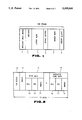
- FIG. 1 is a diagrammatical view of the data format in which data are recorded on a CD.
- a frame consists of frame-synchronization pattern 1, subcode 2, data words 3, and parity words 4.
- Frame-synchronization pattern 1 is used to identify the top position of each frame
- data words 3 are two channel data L and R (left and right) formed by sampling original signals at a sampling rate of 44.1 kHz, and parity words are used for detecting and correcting errors.
- Subcode 2 having 8 bits for each frame, consists of 98 eight-bit symbols from 98 frames which constitute 1 block. Each bit of the eight-bit subcoding symbol of one frame corresponds to 8 channels P to W, and so each channel P to W consists of 98 bits.
- Channel P indicates the beginning of a piece of music by maintaining at least two seconds of "1" level at the beginning, and maintaining "0" level afterwards.
- Channel Q has three modes: in Mode 1, channel Q records time data, and other data; in Mode 2 and 3, channel Q records a catalogue number of the disc. Channels R to W are not utilized at present.
- FIG. 2 is a diagrammatical view of the channel Q in Mode 1.
- Numeral 10 in FIG. 2 designates piece-number data of 8 bits for indicating the number of the piece.
- Numeral 11 designates index data of 8 bits
- numeral 15 designates time data of 24 bits for indicating the elapsed time from the beginning of the piece.
- Time data 15 consists of 3 types of eight-bit data: minute data 12 indicating minutes, second data 13 indicating seconds, and frame-number data 14 indicating the number of frames (one second contains 75 frames).
- Absolute time data 19 is composed in a manner similar to time data 15, that is, time data 19 consists of minute data 16, second data 17, and frame-number data 18 that indicate the total elapsed time.
- time data 19 consist of 72 bits, and each piece of data therein is stored in the form of 2 digit BCD (Binary Coded Decimal).
- the disc has a lead-in area inside the musical tracks, i.e., at the innermost part of the disc.
- FIG. 3 shows the format of a table of contents (TOC) provided in the lead-in area.
- the table of contents records the duration and start time of each piece recorded on the disc as in channel Q described above.
- the conventional CD player performs a random access operation as follows by using the data described above:
- the CD player When the number of a target piece of music is entered by manipulating the operation button, this number is converted into the target position data and is stored into a memory in the CD player.
- the C player recognizes the current position of the pick-up by reading absolute time data 19 of channel Q. This is achieved by rotating the disc for a certain distance. Then, the CD player compares the current position and the target position to compute the radial distance therebetween by means of a microprocessor, and moves the pick-up to the target position. When the pick-up seems to reach the target position, the CD player reads absolute time data 19 of channel Q again, compares the read data with the target data, and moves the pick-up by a computed distance, thus positioning the pick-up at the target position.
- the CD player as described above, repeats the operations of reading absolute time data 19 of channel Q, computing the difference between the current position and the target position, and moving and positioning the pick-up on the target position.
- the positioning of the pick-up is achieved.
- the data of channel Q are split up into 98 different frames, the CD player must read at least 98 frames to obtain the channel Q data, which takes a considerable length of time. To shorten the time required to reach the target position, the following method is adopted:
- absolute time data 29 indicating the starting time of a target piece is read from the table of contents shown in FIG. 3.
- the CD player using the read time data, computes the distance between the target position and the starting track (i.e., innermost track) of the musical area by using the microprocessor, and moves the pick-up by the distance obtained.
- fine adjustment of the positioning of the pick-up is required at the final stage of the positioning, because of the very narrow track pitch of about 1.6 ⁇ m.
- the target position of the pick-up is computed as a radial distance from the starting track of the musical area by using the absolute time data.
- the distance cannot be rapidly calculated to a high degree of accuracy in a short time, because the microprocessor is not powerful enough t achieve the high speed computation. As a result, a considerable length of time is required for the pick-up to reach the target position.
- track-number computing equipment for CLV disc drives used for positioning a pick-up on a target track of a disc, the track-number computing equipment reading time data written on the disc to indicate the position of a set of data recorded on the disc, and computing the number of tracks from a reference track to the target track by using the time data
- the track-number computing equipment for CLV disc drives comprising:
- separating means for splitting the time data read from the disc into high-order time data and low-order time data
- computing means for computing the number of tracks to the target track by using the low-order time data and the line segment specified by the coefficient and offset value produced from the storing means.
- FIG. 1 is a diagrammatical view of a frame format on CD
- FIG. 2 is a diagrammatical view of channel Q
- FIG. 3 is a diagrammatical view of the table of contents located in the lead-in area at the innermost part of a disc;
- FIG. 4 is a block diagram showing a configuration of an embodiment of the present invention.
- FIG. 5 is a diagrammatical view to explain the contents of ROMs 21 and 22.
- FIG. 4 is a block diagram showing a configuration of an embodiment of the present invention.
- absolute time data 29 read by the pick-up from the table of contents shown in FIG. 3 is separated into two parts: high-order time data TDH and low-order time data TDL.
- High-order time data TDH consists of a BCD code composed of the upper 4 bits of minute data 26.
- low-order time data TDL consists of BCD codes composed of the lower 4 bits of minute data 26, second data 27 and frame-number data 28.
- High-order time data TDH is supplied to the address buses of coefficient ROM 21 and offset ROM 22, and low-order time data TDL is supplied to digital-signal processor 20.
- Coefficient ROM 21 stores coefficients ⁇ and offset ROM 22 stores offset values C.
- FIG. 5 shows the relationship between coefficients ⁇ and offset values C, and absolute time data 29.
- the value 10(i-1) i.e., 0, 10, 20, 30, 40 minutes
- equations that define the line segments can be obtained from high-order time data TDH, offset values Ci and coefficients ⁇ i.
- the line composed of the line segments Li each of which has offset value Ci and slope ⁇ i indicates the relationship between the absolute time data 29 (i.e., the total elapsed time from the starting track of the musical area) and the number of tracks TN from the starting track.
- this line represents, in a linear approximation, the relationship between the absolute time data 29 and the number of tracks from a reference track (i.e., the starting track) to the track indicated by the time data.
- the stored data in coefficient ROM 21 and offset ROM 22 are used to interpolate and obtain the relationship between the absolute time data 29 and the number of tracks TN.
- Digital-signal processor 20 computes the number of tracks TN corresponding to absolute time data 29 by using the line segment Li and low-order time data TDL. This is performed by applying low-order time data TDL to the line segment Li specified by high-order time data TDH corresponding to the lower-time data TDL. For example, if absolute time data 29 is 23 minutes 45 seconds, high-order time data TDH is 2, and low-order time data TDL is 3 minutes 45 seconds. As a result, coefficient C3 and offset value C3 are produced from coefficient ROM 21 and offset ROM 22, respectively.
- Digital-signal processor 20 computes the equation of line segment L3 corresponding to 20 minutes specified by offset value C3 and coefficient ⁇ 3, and then computes the number of tracks by putting the low-order time data TDL (3 minutes 45 seconds in this case) into the equation. The resulting data is produced a track-number data TN.
- the target number of a piece of music is entered from the operation button, and is stored in the memory of the CD player.
- absolute time data 29, corresponding to the target number is read by the pick-up from the table of contents in the lead-in area of the disc, and is separated into high-order time data TDH and low-order time data TDL, which are supplied to the address terminal of coefficient ROM 21 and offset ROM 22.
- the addresses of ROMs 21 and 22 are designated.
- coefficient ROM 21 and offset ROM 22 produce coefficients ⁇ i and offset value Ci corresponding to high-order time data TDH, respectively, and these data are supplied to digital-signal processor 20 through the data buses.
- low-order time data TDL is directly supplied to digital-signal processor 20.
- Digital-signal processor 20 computes the number of tracks TN by using the line segment specified by coefficient ci and offset value Ci, and low-order time data TDL.
- the number of tracks TN thus obtained is sent to a system-control circuit of the CD player which controls the whole circuits and mechanisms of the CD player.
- the system-control circuit controls pick-up-servo mechanism and disc-motor-servo mechanism according to the number of tracks TN, and moves the pick-up to the target track.
- the computation of the number of tracks TN is easily achieved, because the computation is carried out by using a linear equation. Consequently, the quick and accurate computation of the number of tracks is achieved.
Landscapes
- Indexing, Searching, Synchronizing, And The Amount Of Synchronization Travel Of Record Carriers (AREA)
Applications Claiming Priority (2)
| Application Number | Priority Date | Filing Date | Title |
|---|---|---|---|
| JP63-238106 | 1988-09-22 | ||
| JP63238106A JPH0287384A (ja) | 1988-09-22 | 1988-09-22 | Clvディスクのトラック数演算装置 |
Publications (1)
| Publication Number | Publication Date |
|---|---|
| US5195068A true US5195068A (en) | 1993-03-16 |
Family
ID=17025266
Family Applications (1)
| Application Number | Title | Priority Date | Filing Date |
|---|---|---|---|
| US07/403,827 Expired - Lifetime US5195068A (en) | 1988-09-22 | 1989-09-07 | Track-number computing equipment for CLV disk drives |
Country Status (2)
| Country | Link |
|---|---|
| US (1) | US5195068A (ja) |
| JP (1) | JPH0287384A (ja) |
Cited By (8)
| Publication number | Priority date | Publication date | Assignee | Title |
|---|---|---|---|---|
| US5295124A (en) * | 1991-06-24 | 1994-03-15 | Sony Corporation | Optical recording apparatus |
| DE4315301A1 (de) * | 1993-05-07 | 1994-11-10 | Becker Gmbh | Verfahren zur Bedienung eines Abspielgeräts für optische Tonträger |
| US5371605A (en) * | 1990-11-22 | 1994-12-06 | Matsushita Electric Industrial Co., Ltd. | Method and apparatus for recording and reproducing a time-varying image using optical disk |
| US5581365A (en) * | 1992-10-01 | 1996-12-03 | Sony Corporation | Remote control system for controlling tape playback apparatus on the basis of time code data recorded on the recording tape with the information data to be reproduced |
| US6198705B1 (en) | 1998-09-16 | 2001-03-06 | Lsi Logic Corp. | Error-tolerant target-sector search using previous N sector ID for high-speed CD |
| US20020044760A1 (en) * | 1994-10-11 | 2002-04-18 | Mitsubishi Denki Kabushiki Kaisha | Disk media, and method of and device for recording and playing back information on or from a disk media |
| US20090245041A1 (en) * | 2008-03-31 | 2009-10-01 | International Business Machines Corporation | System for preventing excessive skipping on audio disks |
| CN1750627B (zh) * | 1994-10-11 | 2010-09-29 | 三菱电机株式会社 | 盘介质和在其上记录和重放信息的方法和设备 |
Citations (3)
| Publication number | Priority date | Publication date | Assignee | Title |
|---|---|---|---|---|
| US4694441A (en) * | 1983-10-14 | 1987-09-15 | Nippon Gakki Seizo Kabushiki Kaisha | Position control device for an optical reproduction system in an optical type disc reproduction device |
| US4796247A (en) * | 1986-06-07 | 1989-01-03 | Blaupunkt Werke Gmbh | Compact disc (CD) player and method of compensating for tracking jumps |
| US4949323A (en) * | 1987-08-07 | 1990-08-14 | Kabushiki Kaisha Toshiba | Disk reproduction apparatus and method for high speed accessing of desired information data by checking address data |
Family Cites Families (2)
| Publication number | Priority date | Publication date | Assignee | Title |
|---|---|---|---|---|
| JPS59217273A (ja) * | 1983-05-23 | 1984-12-07 | Mitsubishi Electric Corp | デイスク再生装置 |
| JPS6050760A (ja) * | 1983-08-31 | 1985-03-20 | Toshiba Corp | ディスクレコ−ド再生装置 |
-
1988
- 1988-09-22 JP JP63238106A patent/JPH0287384A/ja active Pending
-
1989
- 1989-09-07 US US07/403,827 patent/US5195068A/en not_active Expired - Lifetime
Patent Citations (3)
| Publication number | Priority date | Publication date | Assignee | Title |
|---|---|---|---|---|
| US4694441A (en) * | 1983-10-14 | 1987-09-15 | Nippon Gakki Seizo Kabushiki Kaisha | Position control device for an optical reproduction system in an optical type disc reproduction device |
| US4796247A (en) * | 1986-06-07 | 1989-01-03 | Blaupunkt Werke Gmbh | Compact disc (CD) player and method of compensating for tracking jumps |
| US4949323A (en) * | 1987-08-07 | 1990-08-14 | Kabushiki Kaisha Toshiba | Disk reproduction apparatus and method for high speed accessing of desired information data by checking address data |
Cited By (13)
| Publication number | Priority date | Publication date | Assignee | Title |
|---|---|---|---|---|
| US5371605A (en) * | 1990-11-22 | 1994-12-06 | Matsushita Electric Industrial Co., Ltd. | Method and apparatus for recording and reproducing a time-varying image using optical disk |
| US5295124A (en) * | 1991-06-24 | 1994-03-15 | Sony Corporation | Optical recording apparatus |
| US5581365A (en) * | 1992-10-01 | 1996-12-03 | Sony Corporation | Remote control system for controlling tape playback apparatus on the basis of time code data recorded on the recording tape with the information data to be reproduced |
| DE4315301A1 (de) * | 1993-05-07 | 1994-11-10 | Becker Gmbh | Verfahren zur Bedienung eines Abspielgeräts für optische Tonträger |
| US6539164B2 (en) | 1994-10-11 | 2003-03-25 | Mitsubishi Denki Kabushiki Kaisha | Disk media, and method of and device for playing back information on or from a disk media |
| US20020044760A1 (en) * | 1994-10-11 | 2002-04-18 | Mitsubishi Denki Kabushiki Kaisha | Disk media, and method of and device for recording and playing back information on or from a disk media |
| US20050089312A1 (en) * | 1994-10-11 | 2005-04-28 | Mitsubishi Denki Kabushiki Kaisha | Disk media, and method of and device for recording and playing back information on or from a disk media |
| US7212728B2 (en) | 1994-10-11 | 2007-05-01 | Mitsubishi Denki Kabushiki Kaisha | Disk media, and method of and device for recording and playing back information on or from a disk media |
| US7406249B2 (en) | 1994-10-11 | 2008-07-29 | Mitsubishi Denki Kabushiki Kaisha | Disk media, and method of and device for recording and playing back information on or from a disk media |
| CN1750627B (zh) * | 1994-10-11 | 2010-09-29 | 三菱电机株式会社 | 盘介质和在其上记录和重放信息的方法和设备 |
| US6198705B1 (en) | 1998-09-16 | 2001-03-06 | Lsi Logic Corp. | Error-tolerant target-sector search using previous N sector ID for high-speed CD |
| US20090245041A1 (en) * | 2008-03-31 | 2009-10-01 | International Business Machines Corporation | System for preventing excessive skipping on audio disks |
| US7957227B2 (en) * | 2008-03-31 | 2011-06-07 | International Business Machines Corporation | System for preventing excessive skipping on audio disks |
Also Published As
| Publication number | Publication date |
|---|---|
| JPH0287384A (ja) | 1990-03-28 |
Similar Documents
| Publication | Publication Date | Title |
|---|---|---|
| RU2199159C2 (ru) | Способ воспроизведения со среды для записи с первой управляющей областью для управления первым атрибутом и второй управляющей областью для управления вторым атрибутом программы, записанной в область записи, и устройство для его осуществления (варианты) | |
| KR100236888B1 (ko) | 정보기록 시스템과 이 정보기록 시스템에 사용되는 기록장치 및 기록캐리어 | |
| US4977550A (en) | Disc playback apparatus for playback of music and digital data | |
| US4996679A (en) | Subcode information and block identification system for a disc player | |
| EP0288571B1 (en) | Apparatus for recording and reproducing data using a disk | |
| US7274642B2 (en) | Data recording medium, data recording method and apparatus, data reproducing method and apparatus, data transmitting method, and data receiving method | |
| EP0347858A2 (en) | Optical disc and recording and reproducing apparatus employing the optical disc | |
| US6829211B2 (en) | Optical recording medium having first and second recording areas of different formats | |
| HU212062B (en) | Disc recording and reproducing apparatus | |
| US4731774A (en) | Disc playback apparatus | |
| US5195068A (en) | Track-number computing equipment for CLV disk drives | |
| US6707784B2 (en) | Optical storage medium having two recording areas of different formats | |
| EP1089271B1 (en) | BCD subcode time information | |
| EP0939406A2 (en) | Reproducing method and record medium | |
| KR0130474B1 (ko) | 정보 재생 장치 | |
| KR20040108529A (ko) | 데이터 기록 매체, 데이터 기록 방법 및 장치, 부호화방법 및 장치 | |
| EP1594133A1 (en) | Data recording method and device, data recording medium, data reproduction method and device | |
| JPH11134845A (ja) | 光ディスク再生装置 | |
| US5951710A (en) | Method and apparatus for checking compressed data errors | |
| JP3137407B2 (ja) | ディスク再生装置 | |
| KR920006640B1 (ko) | 콤팩트디스크 플래이어의 선곡 방법 | |
| UA66383C2 (en) | Method of registering running time on a data carrier (variants); data carrier (variants); device for recording and reading data | |
| KR0159291B1 (ko) | 광디스크 종류 판별 방법 | |
| JPH06202623A (ja) | 楽譜表示装置 | |
| US20030133006A1 (en) | Data recording medium,data recording method and data recording apparatus for data recording medium, and manufacturing apparatus |
Legal Events
| Date | Code | Title | Description |
|---|---|---|---|
| AS | Assignment |
Owner name: YAMAHA CORPORATION, JAPAN Free format text: ASSIGNMENT OF ASSIGNORS INTEREST.;ASSIGNOR:MORISHIMA, MORITO;REEL/FRAME:005119/0797 Effective date: 19890823 |
|
| FEPP | Fee payment procedure |
Free format text: PAYOR NUMBER ASSIGNED (ORIGINAL EVENT CODE: ASPN); ENTITY STATUS OF PATENT OWNER: LARGE ENTITY |
|
| STCF | Information on status: patent grant |
Free format text: PATENTED CASE |
|
| FPAY | Fee payment |
Year of fee payment: 4 |
|
| FPAY | Fee payment |
Year of fee payment: 8 |
|
| FPAY | Fee payment |
Year of fee payment: 12 |