WO1981003020A1 - Triazine synthesis - Google Patents
Triazine synthesis Download PDFInfo
- Publication number
- WO1981003020A1 WO1981003020A1 PCT/AU1981/000046 AU8100046W WO8103020A1 WO 1981003020 A1 WO1981003020 A1 WO 1981003020A1 AU 8100046 W AU8100046 W AU 8100046W WO 8103020 A1 WO8103020 A1 WO 8103020A1
- Authority
- WO
- WIPO (PCT)
- Prior art keywords
- substituted
- triazine
- alkyl
- process according
- general formula
- Prior art date
- Legal status (The legal status is an assumption and is not a legal conclusion. Google has not performed a legal analysis and makes no representation as to the accuracy of the status listed.)
- Ceased
Links
Classifications
-
- A—HUMAN NECESSITIES
- A01—AGRICULTURE; FORESTRY; ANIMAL HUSBANDRY; HUNTING; TRAPPING; FISHING
- A01N—PRESERVATION OF BODIES OF HUMANS OR ANIMALS OR PLANTS OR PARTS THEREOF; BIOCIDES, e.g. AS DISINFECTANTS, AS PESTICIDES OR AS HERBICIDES; PEST REPELLANTS OR ATTRACTANTS; PLANT GROWTH REGULATORS
- A01N43/00—Biocides, pest repellants or attractants, or plant growth regulators containing heterocyclic compounds
- A01N43/64—Biocides, pest repellants or attractants, or plant growth regulators containing heterocyclic compounds having rings with three nitrogen atoms as the only ring hetero atoms
- A01N43/66—1,3,5-Triazines, not hydrogenated and not substituted at the ring nitrogen atoms
-
- C—CHEMISTRY; METALLURGY
- C07—ORGANIC CHEMISTRY
- C07D—HETEROCYCLIC COMPOUNDS
- C07D251/00—Heterocyclic compounds containing 1,3,5-triazine rings
- C07D251/02—Heterocyclic compounds containing 1,3,5-triazine rings not condensed with other rings
- C07D251/12—Heterocyclic compounds containing 1,3,5-triazine rings not condensed with other rings having three double bonds between ring members or between ring members and non-ring members
- C07D251/14—Heterocyclic compounds containing 1,3,5-triazine rings not condensed with other rings having three double bonds between ring members or between ring members and non-ring members with hydrogen or carbon atoms directly attached to at least one ring carbon atom
- C07D251/16—Heterocyclic compounds containing 1,3,5-triazine rings not condensed with other rings having three double bonds between ring members or between ring members and non-ring members with hydrogen or carbon atoms directly attached to at least one ring carbon atom to only one ring carbon atom
-
- C—CHEMISTRY; METALLURGY
- C07—ORGANIC CHEMISTRY
- C07D—HETEROCYCLIC COMPOUNDS
- C07D251/00—Heterocyclic compounds containing 1,3,5-triazine rings
- C07D251/02—Heterocyclic compounds containing 1,3,5-triazine rings not condensed with other rings
- C07D251/12—Heterocyclic compounds containing 1,3,5-triazine rings not condensed with other rings having three double bonds between ring members or between ring members and non-ring members
- C07D251/14—Heterocyclic compounds containing 1,3,5-triazine rings not condensed with other rings having three double bonds between ring members or between ring members and non-ring members with hydrogen or carbon atoms directly attached to at least one ring carbon atom
- C07D251/16—Heterocyclic compounds containing 1,3,5-triazine rings not condensed with other rings having three double bonds between ring members or between ring members and non-ring members with hydrogen or carbon atoms directly attached to at least one ring carbon atom to only one ring carbon atom
- C07D251/20—Heterocyclic compounds containing 1,3,5-triazine rings not condensed with other rings having three double bonds between ring members or between ring members and non-ring members with hydrogen or carbon atoms directly attached to at least one ring carbon atom to only one ring carbon atom with no nitrogen atoms directly attached to a ring carbon atom
-
- C—CHEMISTRY; METALLURGY
- C07—ORGANIC CHEMISTRY
- C07D—HETEROCYCLIC COMPOUNDS
- C07D251/00—Heterocyclic compounds containing 1,3,5-triazine rings
- C07D251/02—Heterocyclic compounds containing 1,3,5-triazine rings not condensed with other rings
- C07D251/12—Heterocyclic compounds containing 1,3,5-triazine rings not condensed with other rings having three double bonds between ring members or between ring members and non-ring members
- C07D251/14—Heterocyclic compounds containing 1,3,5-triazine rings not condensed with other rings having three double bonds between ring members or between ring members and non-ring members with hydrogen or carbon atoms directly attached to at least one ring carbon atom
- C07D251/22—Heterocyclic compounds containing 1,3,5-triazine rings not condensed with other rings having three double bonds between ring members or between ring members and non-ring members with hydrogen or carbon atoms directly attached to at least one ring carbon atom to two ring carbon atoms
Definitions
- This invention relates to a process for the synthesis of 1, 3, 5-triazine compounds, including in particular mono- or di-alkyl or -aryl substituted 1,3,5-triazines.
- Triazines are a class of heterocyclic compounds finding widespread use in many areas of chemical industry - notably as intermediates in plastics manufacture and as herbicides, in agriculture. Other triazines are used in disinfectants, algaecides, pharmaceuticals and explosives.
- triazines In practice, much of the industrial significance of triazines is confined to the symmetrical triazines including 2, 4 , 6-trihydroxy-s-triazine (cyanuric acid), 2,4, 6-triamino-s-triazine (melamine), and 2,4,6-trichloro-s-triazine (cyanuric chloride) and their derivatives, and the chemistry of these compounds has been widely studied, in part because of their ease of synthesis. Despite their intrinsic interest, however, mono- and di-alkyl or -aryl triazines have received relatively little attention. The primary reason for this appears to be the lack of availability of suitable general synthetic methods for this class of triazine derivatives.
- N-Cyanoamidines potentially useful as starting materials for heterocyclic ring formation, have heretofore received scant attention, despite their ready availability from imidates or amidines (K.R.Huffman and F.C.Schaefer, J. Org. Chem. , 28, 1812, (1963).), (J.T.Shaw and R.Adams, J. Chem. Eng.
- triazines from N-cyanoamidines, N-cyanoguanidines, N-cyanocarbamimidate or N-cyanocarbamidothioates and halomethyleneiminium salts in accordance with the present invention is of particular value since it can be successfully applied to the preparation of a wide range of triazine derivatives in which one or two of the substituents is an alkyl or an aryl substituent.
- triazines bearing a hydrogen substituent are also easily available.
- the yields are generally high (up to 90%) and the starting materials readily available.
- the procedures are simple, and the conditions mild and readily amenable to large scale industrial synthesis. The method will, therefore, have wide application, and should open up the scope of triazine chemistry and further the application of triazines in chemical industry.
- R 1 and R 2 which may be the same or different, are selected from the group consisting of hydrogen, halogen, alkoxycarbonyl, alkyl, substituted alkyl, aryl, substituted aryl, heteroaryl, substituted heteroaryl, alkylamino, dialkylamjno, arylamino, alkyl-arylamino, alkylthio, arylthio, alkoxy and aryloxy (provided that R 1 and R 2 are not both halogen) ; and R 3 is selected from the group consisting of halogen, alkylamino, dialkylamino, arylamino, alkyl-arylamino and N-heteroaryi; which comprises reaction of a halomethyleneiminium salt of the general formula II:
- R 4 is selected from the group consisting of hydrogen, halogen, alkoxycarbonyl, alkyl, substituted alkyl, aryl, substituted aryl, heteroaryl, substituted heteroaryl, alkylthio, arylthio, alkoxy and aryloxy;
- R 5 and R 6 which may be the same or different, are selected from the group consisting of hydrogen, alkyl and aryl (provided that R 5 and R 6 are not both hydrogen), or R 5 and R 6 together with the nitrogen atom to which they are attached form a saturated heterocyclic ring;
- X is halogen; and Y is an anion; with a compound of the general formula III:
- R 1 is as defined above.
- R represents hydrogen, halogen, alkoxycarbonyl, alkyl, substituted alkyl, aryl, substituted aryl, heteroaryl, or substituted heteroaryl are N-cyanoamidines.
- R 1 represents alkylamino, dialkylamino, arylamino or alkyl-arylamino, the compounds III are N-cyanoguanidines.
- the compounds III are N-cyanocarbamimidates; and where R 1 represents alkylthio or arylthio, the compounds III are
- the alkyl groups preferably have 1 to 15 carbon atoms (including cycloalkyl groups of 4 to 8 carbon atoms), and suitable aryl groups include phenyl and naphthyl.
- Suitable heteroaryl groups include 5 or 6 membered heterocyclic groups having one or more hetero atoms (nitrogen, sulphur or oxygen) and include for example, indolyl and pyrazolyl groups.
- the substituents which may be present on the alkyl, aryl or heteroaryl groups include one or more substituents selected from the group consisting of halo (particularly chloro or bromo), alkyl (particularly lower alkyl having from 1 to 6 carbon atoms), alkoxy (particularly lower alkoxy having from 1 to 6 carbon atoms) , alkylthio (particularly lower alkylthio having from 1 to 6 carbon atoms), aryl (particularly phenyl), aryloxy (particularly phenoxy), arylthio (particularly phenylthio), cyano, nitro, alkoxycarbonyl (particularly lower alkoxycarbonyl), amino and dialkylamino (particularly di (lower alkyl) amino).
- Halogen groups in the general formulae include
- the preferred procedure for the synthesis of this invention is to bring together the compounds of formula II and formula III in a suitable inert organic solvent.
- the following solvents have been found to be suitable: benzene, chloroform, methylene chloride, acetonitrile; the preferred solvent in most reactions being acetonitrile.
- phosphorus oxy ⁇ hloride may be used in excess as an inorganic solvent.
- the reaction mixture is then maintained at a suitable temperature (preferably between 0oC and 100oC) for an appropriate length of time (for example, from 15 min. to 6 days), then the 1,3,5-triazine is isolated by precipitation with water or extraction into an organic solvent after addition of water to the reaction mixture. In some cases neutralisation with sodium hydroxide solution is desirable to liberate all the triazine products from their salts. In cases when a mixture of triazines results, separation and purification of the components of the mixture can be effected by chromatography.
- reaction of the chloromethyleneiminium salt N,N-dimethylbenzamide-POCl 3 complex
- N-cyanpbenzamidine in acetonitrile at room temperature
- 2-chloro-4, 6-diphenyl-1,3,5-triazine in 70% yield
- Extension of the reaction to other chloromethyleneiminium salts conveniently prepared in situ from N-substituted amides and POCl 3 or PCI 5 , gives the appropriately substituted 1,3,5-triazine in good yield.
- Other N-cyanoamidines react analogously, and examples of triazines. so prepared are given in Table 1.
- the choice of conditions for the triazine synthesis is governed principally by the reactivity of the amide precursor of the chloromethyleneiminium salt : reactive amides such as dimethylformamide and dimethyl acetamide can be reacted with POCl 3 in acetonitrile or other inert solvent at room temperature or below whereas unreactive amides such as benzanilide require PCI 5 as the acid chloride component . As previously described in many cases POCl 3 can be used in excess as solvent for the reaction .
- N-cyanoamidines used in this synthesis are available by known methods from nitrile precursors via amidine or udinoether intermediates (Huffman and Schaefer, supra, Shaw and Mams, supra) .
- the N-cyanoguanidines, N-cyanocarbamimidates and N-cyanccarbaitddiothioates may be prepared by known methods also (E.Grigat and R.Putter, post ; E.Allenstein, and R.Fuchs, Chem.Ber. , 100, 2604 (1967) ; D.W.Kaiser, and D.Holm-Hansen, U.S. Patent 2697727) .
- halomethyleneiminium salts may be prepared by known methods from amide and dithiocarbamate precursors
- Dichloromethyleneiminium salts may be generate from S,N,N-trialkyldithiocarbamates by reaction with chlorine. It is known that dichloromethyleneiminium salts may be reacted with activated aromatic or heterocyclic compounds, phenols or thiophenols to produce other reactive methyleneiminium salts in which one of the chlorines is displaced by an aryl, heteroaryl, aryloxy or arylthio group. This is shown schematically below, using dichloromethylenedimethyliminium chloride as example:
- the derived reagents VI are of course chloromethyleneiminium salts of the class II described earlier and may be generated in situ and used in the new triazine synthesis as described above.
- R P-dImethylaminophenyl.
- N-cyanobenzamidine and further reflux gives, after work-up, 2- (p-dimethylaminophenyl) -4-phenyl-6-chloro-1,3,5-triazine.
- reaction of the present invention therefore represents a facile route to diversely substituted 1,3,5-triazines, many of which are not otherwise readily accessible.
- novel synthesis enables access to certain compounds of the general formula I above which are themselves novel.
- Table 1 hereinafter illustrates the preparation of a number of different substituted 1, 3, 5-triazine compounds in accordance with this invention:
- 1,3,5-triazines which can be prepared in accordance with the present invention have been found to exhibit fungal germination inhibition properties as shown in Table 2.
- N,N-Dimethylbenzamide (1.49 g, 10 mmol) , is heated with POCl 3 (1 ml) on a steam bath at 100o for 5 min.
- the resulting complex is dissolved in acetonitrile (10 ml) and a solution of N-cyanobenzamidine (1.45 g, 10 mmol) in acetonitrile (20 ml) is added. After several minutes the triazine begins to separate; after 30 min water is added to complete the precipitation and the product is collected, washed with water and recrystallized from ethanol-water; yield: 1.8 g (70%); m.p. 139° (lit., 138-9°).
- N-Cyanobenzamidine (1.45 g, 10 mmol), acetanilide (1.35 g, 10 mmol) and POCl 3 (1 ml) are refluxed in acetonitrile (20 ml) for 1 h.
- the hydrochloride of (le) precipitates as a pale yellow crystalline solid, m.p. 198-204°, and is collected after the mixture has been allowed to stand at room temperature over night (yield 2.5 g, 84%).
- the free triazine is obtained as colorless flat needles, m.p.
- N-cyclohexyl dodecanamide (1.4g), phosphorous oxychloride (0.5 ml) and N-cyanobenzamidine (0.80g) were heated under reflux in acetonitrile (20 ml) for 1 ⁇ 2h . The mixture was poured into water and the solid collected. The product was purified by passage of its solution in methylene chloride through a short column of silica gel; removal of the solvent from the eluate gave a pale tan oil which crystallised. Yield 1.5 g 87%, m.p. 44-45o.
- N,N-dimethyl-p-toluamide (1.65 g) and phosphorous oxychloride (1 ml) were dissolved in acetonitrile (20 ml).
- N-cyano-O-ethyl carbamimidate (1.13 g) was added and the precipitated product collected after 1 h at 0 oC and recrystallised from aqueous ethanol to give the ethoxytriazine (Iu) as colorless needles (2 g, 80%) , m.p. 78 .
- N,N-Dimethylbenzamide (1.5 g) and phosphorous oxychloride (1 ml) were dissolved in methylene chloride (20 ml) and the mixture kept at room temperature for 15 min.
- N-Cyanochloroformamidine (1.1 g) (E. Allenstein, Z. Anorg. Allgem. Chem., 322, 265 (1963)) was added and the mixture stirred at room temperature overnight protected from moisture. The mixture was shaken with water (100 ml) and the organic phase separated, dried, concentrated in vacuo and applied to a column of silica gel (2 x 15 cm). Elution with benzene gave the dichloro triazine (1.3 g, 58%) which crystallised from ethanol as colorless needles, m.p. 118-119° (lit 120°).
- N,N-Dimethylbenzamide (1.5 g) was added to a stirred solution of phosphorous tribromide (2 ml) and bromine (1 ml) in methylene chloride (50 ml) and the mixture stirred protected from moisture at room temperature for 1 h. Cyclohexene (2 ml) was added to discharge the bromine colour, followed by N-cyanobenzamidine (1.45 g) . The mixture was protected from moisture and stirred overnight. Water (100 ml) was added and stirring continued for 5 min. The organic layer was separated, dried and the solvent removed in vacuo. The product was purified by passage of its solution in methylene chloride through a short column of silica gel. Evaporation of the eluate and recrystallisation of the residue from ethanol gave the bromotriazine (Iw) as colorless fine needles (1.75 g, 58%), m.p. 155°.
Landscapes
- Organic Chemistry (AREA)
- Chemical & Material Sciences (AREA)
- Life Sciences & Earth Sciences (AREA)
- Dentistry (AREA)
- Health & Medical Sciences (AREA)
- Engineering & Computer Science (AREA)
- Plant Pathology (AREA)
- General Health & Medical Sciences (AREA)
- Wood Science & Technology (AREA)
- Zoology (AREA)
- Environmental Sciences (AREA)
- Pest Control & Pesticides (AREA)
- Agronomy & Crop Science (AREA)
- Plural Heterocyclic Compounds (AREA)
- Pharmaceuticals Containing Other Organic And Inorganic Compounds (AREA)
Abstract
A process for the synthesis of substituted 1,3,5-triazine compounds of the general formula: (FORMULA) wherein R<s1>s and R<s2>s, which may be the same or different, are selected from the group consisting of hydrogen, halogen, alkoxycarbonyl, alkyl, substituted alkyl, aryl, substituted aryl, heteroaryl, substituted heteroaryl, alkylamino, dialkylamino, arylamino, alkyl-arylamino, alkylthio, arylthio, alkoxy and aryloxy (provided that R<s1>s and R<s2>s are not both halogen); and R<s3>s is selected from the group consisting of halogen, alkylamino, dialkylamino, arylamino, alkyl-arylamino and N-heteroaryl; comprises reaction of a substituted halomethyleneiminium salt with a substituted N-cyanoamidine, N-cyanoguanidine, N-cyanocarbamimidate or N-cyanocarbamidothioate. Substituted 1,3,5-triazine compounds having fungal germination inhibition properties are also disclosed. The following compounds 1) 2-chloro-4-phenyl-1,3,5-triazine, 2) 2-chloro-4-phenoxymethyl-6-phenyl-1,3,5-triazine, 3) 2-N-methylphenylamino-4-phenyl-1,3,5-triazin, 4) 2-chloro-4-cyanomethyl-6-phenyl-1,3,5-triazine are also disclosed and claimed.
Description
TRIAZIHE SYNTHESIS
This invention relates to a process for the synthesis of 1, 3, 5-triazine compounds, including in particular mono- or di-alkyl or -aryl substituted 1,3,5-triazines.
1, 3, 5-Triazines are a class of heterocyclic compounds finding widespread use in many areas of chemical industry - notably as intermediates in plastics manufacture and as herbicides, in agriculture. Other triazines are used in disinfectants, algaecides, pharmaceuticals and explosives.
In practice, much of the industrial significance of triazines is confined to the symmetrical triazines including 2, 4 , 6-trihydroxy-s-triazine (cyanuric acid), 2,4, 6-triamino-s-triazine (melamine), and 2,4,6-trichloro-s-triazine (cyanuric chloride) and their derivatives, and the chemistry of these compounds has been widely studied, in part because of their ease of synthesis. Despite their intrinsic interest, however, mono- and di-alkyl or -aryl triazines have received relatively little attention. The primary reason for this appears to be the lack of availability of suitable general synthetic methods for this class of triazine derivatives. For example, of the twelve or so methods presently available for the synthesis of this class of triazines few are of preparative value for triazines bearing two alkyl or aryl groups.
N-Cyanoamidines, potentially useful as starting materials for heterocyclic ring formation, have heretofore received scant attention, despite their ready availability from imidates or amidines (K.R.Huffman and F.C.Schaefer, J. Org. Chem. , 28, 1812, (1963).), (J.T.Shaw and R.Adams, J. Chem. Eng. Data, 13, 142, (1968).) Their conversion to 1, 3 , 5-triazines by condensation with amides, imidates, amidines and nitriles under a variety of conditions was described by Huffman and Schaefer (supra) , but yields were disappointing (15-50%). More recently, low yields of iminodihydrotriazines have been reported (W.Ried and N. Kothe, Chem. Ber., 109, 2706, (1976)) in the reaction of N-cyanoamidines with N-substituted chloroformamidines and imidoyl chlorides, and in one case a 1,3,5-triazine isolated. Attention has now been given to the reaction N-cyanoamidines, N-cyanoguanidines, N-cyanocarbamimidate or N-cyanocarbamidothioates with halomethyleneiminium salts, leading to the development of a novel synthesis of 1,3,5-triazines which is both versatile and convenient to carry out.
The novel synthesis of triazines from N-cyanoamidines, N-cyanoguanidines, N-cyanocarbamimidate or N-cyanocarbamidothioates and halomethyleneiminium salts in accordance with the present invention is of particular value since it can be successfully applied to the preparation of a wide range of triazine derivatives in which one or two of the substituents is an alkyl or an aryl substituent. Furthermore, by the appropriate choice of starting materials, triazines bearing a hydrogen substituent are also easily available.
The yields are generally high (up to 90%) and the starting materials readily available. The procedures are simple, and the conditions mild and readily amenable to large scale industrial synthesis. The method will, therefore, have wide application, and should open up the scope of triazine chemistry and further the application of triazines in chemical industry.
According to the present invention, there is provided a process for the synthesis of substituted 1,3,5-triazine compounds of the general formula I:


Compounds of the general formula III in which
R represents hydrogen, halogen, alkoxycarbonyl, alkyl, substituted alkyl, aryl, substituted aryl, heteroaryl, or substituted heteroaryl are N-cyanoamidines. Where R1 represents alkylamino, dialkylamino, arylamino or alkyl-arylamino, the compounds III are N-cyanoguanidines.
Similarly, where R1 represents alkoxy or aryloxy, the compounds III are N-cyanocarbamimidates; and where R1 represents alkylthio or arylthio, the compounds III are
N-cyanocarbamidothioates.
In the above general formulae, the alkyl groups preferably have 1 to 15 carbon atoms (including cycloalkyl groups of 4 to 8 carbon atoms), and suitable aryl groups include phenyl and naphthyl.
Suitable heteroaryl groups include 5 or 6 membered heterocyclic groups having one or more hetero atoms (nitrogen, sulphur or oxygen) and include for example, indolyl and pyrazolyl groups. The substituents which may be present on the alkyl, aryl or heteroaryl groups include one or more substituents selected from the group consisting of halo (particularly chloro or bromo), alkyl (particularly lower alkyl having from 1 to 6 carbon atoms), alkoxy (particularly lower alkoxy having from 1 to 6 carbon atoms) , alkylthio (particularly lower alkylthio having from 1 to 6 carbon atoms), aryl (particularly phenyl), aryloxy (particularly phenoxy), arylthio (particularly phenylthio), cyano, nitro, alkoxycarbonyl (particularly lower alkoxycarbonyl), amino and dialkylamino (particularly di (lower alkyl) amino). Halogen groups in the general formulae include bromo and, more preferably, chloro, whilst the anion represented by Y may be a bromide or chloride ion or an inorganic anion such as OPOCl2 .
The preferred procedure for the synthesis of this invention is to bring together the compounds of formula II and formula III in a suitable inert organic solvent. The following solvents have been found to be suitable: benzene, chloroform, methylene chloride, acetonitrile; the preferred solvent in most reactions being acetonitrile. Alternatively, phosphorus oxyσhloride may be used in excess as an inorganic solvent.
The reaction mixture is then maintained at a suitable temperature (preferably between 0ºC and 100ºC) for an appropriate length of time (for example, from 15 min. to 6 days), then the 1,3,5-triazine is isolated by precipitation with water or extraction into an organic solvent after addition of water to the reaction mixture. In some cases neutralisation with sodium hydroxide solution is desirable to liberate all the triazine products from their salts. In cases when a mixture of triazines results, separation and purification of the components of the mixture can be effected by chromatography.
As an illustrative example of the process of the present invention, reaction of the chloromethyleneiminium salt (N,N-dimethylbenzamide-POCl3 complex) with N-cyanpbenzamidine in acetonitrile at room temperature gives 2-chloro-4, 6-diphenyl-1,3,5-triazine in 70% yield Extension of the reaction to other chloromethyleneiminium salts, conveniently prepared in situ from N-substituted amides and POCl3 or PCI5, gives the appropriately substituted 1,3,5-triazine in good yield. Other N-cyanoamidines react analogously, and examples of triazines. so prepared are given in Table 1. It is found that in addition to chlorotriazines, small quantities of aminotriazines are sometimes formed, and that these become major products when N-arylamides are used as starting material (see Table 1). These aminotriazines may be formed in a secondary reaction between initially formed chlorotriazines and amines liberated during the cyclisation.
The choice of conditions for the triazine synthesis is governed principally by the reactivity of the amide precursor of the chloromethyleneiminium salt : reactive amides such as dimethylformamide and dimethyl acetamide can be reacted with POCl 3 in acetonitrile or other inert solvent at room temperature or below whereas unreactive amides such as benzanilide require PCI5 as the acid chloride component . As previously described in many cases POCl 3 can be used in excess as solvent for the reaction .
The N-cyanoamidines used in this synthesis are available by known methods from nitrile precursors via amidine or iriinoether intermediates (Huffman and Schaefer, supra, Shaw and Mams, supra) . The N-cyanoguanidines, N-cyanocarbamimidates and N-cyanccarbaitddiothioates may be prepared by known methods also (E.Grigat and R.Putter, post ; E.Allenstein, and R.Fuchs, Chem.Ber. , 100, 2604 (1967) ; D.W.Kaiser, and D.Holm-Hansen, U.S. Patent 2697727) .
The halomethyleneiminium salts may be prepared by known methods from amide and dithiocarbamate precursors
- for a discussion on their preparation , see "Advances in Organic Chemistry" , Vol . 9 , parts 1 and 2 (H. Bohme and H. G . Viehe, editors) , " Inter science" (John Wiley and Co . , N . Y. ) , 1976-1979 . These methods may be illustrated schematically as follows :

Alkylthiochloromethyleneiminium salts (II, R4 = alkylthio) may also be prepared in situ from the appropriate dithiocarbamate and phosgene (Eilingsfeld and Mobius, Chem. Ber. , 98, 1293, (1965)) and subsequently reacted with, a compound of the general formula III in acetonitrile or phosphorus oxychloride as solvent.
Dichloromethyleneiminium salts may be generate from S,N,N-trialkyldithiocarbamates by reaction with chlorine. It is known that dichloromethyleneiminium salts may be reacted with activated aromatic or heterocyclic compounds, phenols or thiophenols to produce other reactive methyleneiminium salts in which one of the chlorines is displaced by an aryl, heteroaryl, aryloxy or arylthio group. This is shown schematically below, using dichloromethylenedimethyliminium chloride as example:
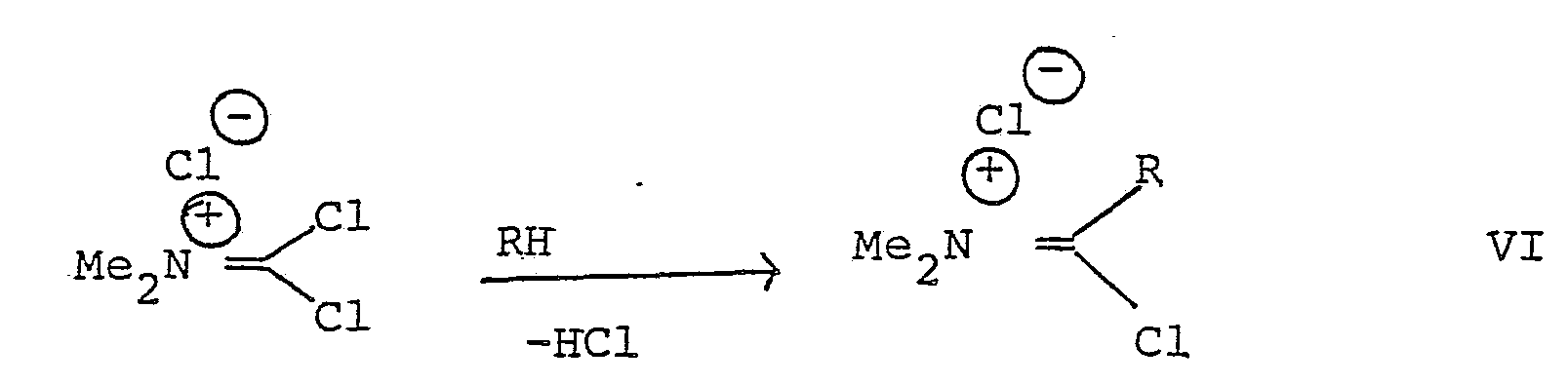
(see "Advances in Organic Chemistry" Vol.9 Pares 1 and 2 supra).
The derived reagents VI are of course chloromethyleneiminium salts of the class II described earlier and may be generated in situ and used in the new triazine synthesis as described above. By way of example, reaction of dichloromethylenedimethyliminium chloride with one equivalent of N,N-dimethylaniline for 15 min. in acetonitrile at reflux generates reagent VI where R = P-dImethylaminophenyl. Addition of N-cyanobenzamidine and further reflux gives, after work-up, 2- (p-dimethylaminophenyl) -4-phenyl-6-chloro-1,3,5-triazine.
Similarly, reaction of dichloromethylenedimethyliminium chloride with one equivalent of phenol in methylene chloride generates reagent VI where R = phenoxy, and further reaction with cyanobenzamidine gives 2-chloro-4-phenoxy-6-phenyl-1,3,5-triazine.
The reaction of the present invention therefore represents a facile route to diversely substituted 1,3,5-triazines, many of which are not otherwise readily accessible. In addition, the novel synthesis enables access to certain compounds of the general formula I above which are themselves novel.
Table 1 hereinafter illustrates the preparation of a number of different substituted 1, 3, 5-triazine compounds in accordance with this invention:


1,3,5-triazines which can be prepared in accordance with the present invention have been found to exhibit fungal germination inhibition properties as shown in Table 2.

The process of the present invention is further illustrated by the following specific examples:
EXAMPLE 1
2-Chloro-4, 6-diphenyl-1,3,5-triazine (la):
N,N-Dimethylbenzamide (1.49 g, 10 mmol) , is heated with POCl3 (1 ml) on a steam bath at 100º for 5 min. The resulting complex is dissolved in acetonitrile (10 ml) and a solution of N-cyanobenzamidine (1.45 g, 10 mmol) in acetonitrile (20 ml) is added. After several minutes the triazine begins to separate; after 30 min water is added to complete the precipitation and the product is collected, washed with water and recrystallized from ethanol-water; yield: 1.8 g (70%); m.p. 139° (lit., 138-9°).
EXAMPLE 2
2-Anilino-4-methyl-6-phenyl-1,3,5-triazine (le) :
N-Cyanobenzamidine (1.45 g, 10 mmol), acetanilide (1.35 g, 10 mmol) and POCl3 (1 ml) are refluxed in acetonitrile (20 ml) for 1 h. The hydrochloride of (le) precipitates as a pale yellow crystalline solid, m.p. 198-204°, and is collected after the mixture has been allowed to stand at room temperature over night (yield 2.5 g, 84%). The free triazine is obtained as colorless flat needles, m.p. 133 and is identical (m.p., mixed m.p., nmr, ir and mass spectrum) with samples prepared by reaction of (Ic) with aniline in acetonitrile (reflux, 30 min) and from the reaction of N-phenyl benzimidoyl chloride and N-cyanoacetamidine according to Ried and Kothe (Chem. Ber. , 109, 2706, (1976).) The benzene-soluble fraction from the reaction mixture is washed with dilute ammonia, dried (MgSO4) and chromatographed on silica gel (Merck 70-30 mesh ASTM) eluting with benzene. The first fractions from the column contain (Ic) (0.075 g, 3.7%), m.p. 75° (lit. 75-5-76.5°).
EXAMPLE 3
2-Chloro-4-phenyl-6-methylthio-1,3,5-triazine (li):
S,N,N-Trimethyldithiocarbamate (1.35 g, 10 mmol) is dissolved in toluene (10 ml) containing phosgene (20%, w/v) and the solution kept at room temperature protected from moisture for 1 hr. The solvent and excess phosgene are evaporated in vacuo and to the residue is added POCl3 (10 ml) and N-cyanobenzamidine (1.45 g). The mixture is refluxed for 30 min and poured into water. The product is extracted into benzene and purified by chromatography on silica gel eluting with benzene; the first fractions contain the methylthiotriazine (li) (1.3. g, 56%) , m.p. 89º.
EXAMPLE 4
2-chloro-4-phenyl-6-(p-dimethylaminophenyl)-1,3,5-triazine
(Iq) :
Dichloromethylene dimethyliminium chloride (1.9g) was suspended in acetonitrile (20 ml) and N,N-dimethyl-aniline (1.3 ml) added. The mixture was refluxed until all solids had dissolved (15 min.) then N-cyanobenzamidine (1.45g) added. The mixture was refluxed a further 1½h and poured into water. An orange solid precipitated and after adjusting the pH to 5 with solid sodium acetate the mixture was allowed to stand at room temperature overnight. The solid was collected and recrystallised from ethanol to give the dimethylaminophenyltriazine (1.1g 35%) as orange needles, m.p. 169-70º.
EXAMPLE 5
2-chloro-4-phenyl-6-undecyl-1,3,5-triazine (In) :
N-cyclohexyl dodecanamide (1.4g), phosphorous oxychloride (0.5 ml) and N-cyanobenzamidine (0.80g) were heated under reflux in acetonitrile (20 ml) for ½h . The mixture was poured into water and the solid collected. The product was purified by passage of its solution in methylene chloride through a short column of silica gel; removal of the solvent from the eluate gave a pale tan oil which crystallised. Yield 1.5 g 87%, m.p. 44-45º.
EXAMPLE 6
2-chloro-4-phenoxy-6-phenyl-1,3,5-triazine (ls);
METHOD A: Dichloromethylenedimethyliminium chloride (1.8g) was added to a stirred solution of phenol (1g) in dry dichloromethane (50 ml). After 15 min a clear solution had resulted, to which was added N-cyanobenzamidine (1.45g) .
The mixture was heated under reflux protected from moisture for 2 h, the solvent evaporated and the residue recrystallised from aqueous ethanol giving the phenoxytriazine (Is) as colorless plates (1.8g, 53%), m.p. 103º.
METHOD B: Phosphorous oxychloride (0.4 ml) was added to N,N-dimethylbenzamide (0.6 g) dissolved in acetonitrile (10 ml). After 15 min at room temperature, N-cyano-O-phenylcarbamimidate (E.Grigat and R.Putter Chem. Ber., 98, 2619, (1965)) (0.65 g) was added and the mixture heated under reflux protected from moisture for 1 h. Water (100 ml) was added and the precipitate collected after 1 h and recrystallised from aqueous ethanol. The phenoxytriazine (0.8 g, 71%) had m.p. 103 and was identical (nmr, mass spec, mixed m.p.) to that obtained by method A.
EXAMPLE 7
2-chloro-4(21-furyl)-6-methylthio-1,3,5-triazine (It) :
Phosphorous oxychloride (1 ml) was added to a solution of 2-furfuroylpyrrolidine (1.65 g) in acetonitrile (20 ml). After 15 min N-cyano-S-methylcarbamimidothioate (R.W.Turner, Synthesis, (1975) , 332) (1.2 g) was added and the mixture heated under reflux protected from moisture for 1 h and then poured into water (100 ml) . The precipitate was collected after 1 h and recrystallised from petroleum et (bp 60-80º) to give the methylthiotriazine (lt) as colorless needles (1.4 g, 62%), m.p. 92-93°.
EXAMPLE 8 2-chloro-4-ethoxy-6-p-tolyl-1,3,5-triazine (Iu):
N,N-dimethyl-p-toluamide (1.65 g) and phosphorous oxychloride (1 ml) were dissolved in acetonitrile (20 ml). To the solution was added N-cyano-O-ethyl carbamimidate (1.13 g) and the mixture heated under reflux protected from moisture for ½ h. Water (100 ml) was added and the precipitated product collected after 1 h at 0 ºC and recrystallised from aqueous ethanol to give the ethoxytriazine (Iu) as colorless needles (2 g, 80%) , m.p. 78 .
EXAMPLE 9
2,4-Dichloro-6-phenyl-1,3,5-triazine (Iv) :
N,N-Dimethylbenzamide (1.5 g) and phosphorous oxychloride (1 ml) were dissolved in methylene chloride (20 ml) and the mixture kept at room temperature for 15 min. N-Cyanochloroformamidine (1.1 g) (E. Allenstein, Z. Anorg. Allgem. Chem., 322, 265 (1963)) was added and the mixture stirred at room temperature overnight protected from moisture. The mixture was shaken with water (100 ml) and the organic phase separated, dried, concentrated in vacuo and applied to a column of silica gel (2 x 15 cm). Elution with benzene gave the dichloro triazine (1.3 g, 58%) which crystallised from ethanol as colorless needles, m.p. 118-119° (lit 120°).
EXAMPLE 10 2-Bromo-4,6-diphenyl-1,3,5-triazine (Iw) :
N,N-Dimethylbenzamide (1.5 g) was added to a stirred solution of phosphorous tribromide (2 ml) and bromine (1 ml) in methylene chloride (50 ml) and the mixture stirred protected from moisture at room temperature for 1 h. Cyclohexene (2 ml) was added to discharge the
bromine colour, followed by N-cyanobenzamidine (1.45 g) . The mixture was protected from moisture and stirred overnight. Water (100 ml) was added and stirring continued for 5 min. The organic layer was separated, dried and the solvent removed in vacuo. The product was purified by passage of its solution in methylene chloride through a short column of silica gel. Evaporation of the eluate and recrystallisation of the residue from ethanol gave the bromotriazine (Iw) as colorless fine needles (1.75 g, 58%), m.p. 155°.
It will be appreciated by those skilled in the art that modifications and variations may be made to the specific details included herein without departing from the broad teaching of the present invention and the invention thus encompasses all such modifications and variations.
Claims
1. A process for the synthesis of substituted 1,3,5-triazine compounds of the general formula I:


wherein R1 is as defined above.
2. A process according to claim 1, wherein said reaction is carried out in an inert organic solvent.
3. A process according to claim 2, wherein said inert organic solvent is selected from the group consisting of acetonitrile, benzene, chloroform and methylene chloride.
4. A process according to claim 1, wherein said reaction is carried out in an excess of phosphorus oxychloride as an inorganic solvent.
5. A process according to any one of claims 1 to 4, wherein said substituted 1, 3, 5-triazine compounds are isolated from the reaction mixture by precipitation with water or by extraction into an organic solvent after addition of water.
6. A process according to claim 5, wherein said reaction mixture is neutralised prior to extraction of said substituted 1,3,5-triazine compounds.
7. A process according to any one of claims 1 to 6, wherein said halomethyleneiminium salt of the general formula II is prepared by reaction of an amide of the general formula IV; or a dithiocarbamate of the general formula V;

wherein R4 , R5 and R6 are as defined in claim 1, with an acid halide.
8. A process according to claim 7 , wherein said acid halide is selected from POCl3, POCl5 or COCl2.
9. A process according to claim 8, wherein said halomethyleneiminium salt is prepared in situ by reaction of an amide of the general formula IV as defined in claim 7 with phosphorus oxychloride, said phosphorus oxychloride being used in excess as solvent for the reaction.
10. A process according to claim 1, substantially as herein described with reference to Table 1 or in any one of Examples 1 to 10.
11. Substituted 1,3,5-triazine compounds of the general formula I as defined in claim 1, whenever prepared by a process according to any one of claims 1 to 10.
12. A substituted 1,3,5-triazine compound selected from the group consisting of 2-chloro-4-phenyl-1,3,5-triazine, 2-chloro-4-phenoxymethyl-6-phenyl-1,3,5-triazine, 2-N-methylphenylamino-4-phenyl-1,3,5-traizine and 2-chloro-4-cyanomethyl-6-phenyl-1,3,5-triazine.
Applications Claiming Priority (2)
| Application Number | Priority Date | Filing Date | Title |
|---|---|---|---|
| AUPE324180 | 1980-04-22 | ||
| AU3241/80 | 1980-04-22 |
Publications (1)
| Publication Number | Publication Date |
|---|---|
| WO1981003020A1 true WO1981003020A1 (en) | 1981-10-29 |
Family
ID=3768500
Family Applications (1)
| Application Number | Title | Priority Date | Filing Date |
|---|---|---|---|
| PCT/AU1981/000046 Ceased WO1981003020A1 (en) | 1980-04-22 | 1981-04-22 | Triazine synthesis |
Country Status (2)
| Country | Link |
|---|---|
| EP (1) | EP0051067A1 (en) |
| WO (1) | WO1981003020A1 (en) |
Cited By (4)
| Publication number | Priority date | Publication date | Assignee | Title |
|---|---|---|---|---|
| JP2002193952A (en) * | 2000-12-25 | 2002-07-10 | Fuji Photo Film Co Ltd | New nitrogen-containing heterocyclic compound, material for light emitting element and light emitting elements using them |
| JP2006505514A (en) * | 2002-07-31 | 2006-02-16 | チバ スペシャルティ ケミカルズ ホールディング インコーポレーテッド | Pyridyltriazine derivatives as microbicidal active substances |
| US7015227B2 (en) | 2002-06-21 | 2006-03-21 | Cgi Pharmaceuticals, Inc. | Certain amino-substituted monocycles as kinase modulators |
| JP2021054856A (en) * | 2014-02-20 | 2021-04-08 | 日本たばこ産業株式会社 | Triazine compound and pharmaceutical use thereof |
Citations (3)
| Publication number | Priority date | Publication date | Assignee | Title |
|---|---|---|---|---|
| US3154547A (en) * | 1963-03-05 | 1964-10-27 | American Cyanamid Co | Process for preparing 2-amino-s-triazines |
| DE1178437B (en) * | 1962-12-23 | 1965-04-29 | Farbenfabriken Bayer Aktiengesellschaft, Leverkusen | Process for the preparation of substituted 2-chloro-s-triazines |
| US3203550A (en) * | 1965-08-31 | Method for the preparation of substi- tuted s-triazine compounds |
-
1981
- 1981-04-22 WO PCT/AU1981/000046 patent/WO1981003020A1/en not_active Ceased
- 1981-04-22 EP EP19810900961 patent/EP0051067A1/en not_active Withdrawn
Patent Citations (3)
| Publication number | Priority date | Publication date | Assignee | Title |
|---|---|---|---|---|
| US3203550A (en) * | 1965-08-31 | Method for the preparation of substi- tuted s-triazine compounds | ||
| DE1178437B (en) * | 1962-12-23 | 1965-04-29 | Farbenfabriken Bayer Aktiengesellschaft, Leverkusen | Process for the preparation of substituted 2-chloro-s-triazines |
| US3154547A (en) * | 1963-03-05 | 1964-10-27 | American Cyanamid Co | Process for preparing 2-amino-s-triazines |
Non-Patent Citations (3)
| Title |
|---|
| Australian Journal of Chemistry, Vol 34, No. 3, issued 1981, March (CSIRO, Melbourne), R. HARRIS, "The Synthesis of Alkyl- and Aryl-Substituted 1,3,5,-Triazines", see pages 623-34 * |
| Chemische Berichte, Vol.109, issued 1976, REID et al, Uber Umsetzungen von Chlorformamidinen und N-Phenyl-Benzimidoylchlorid mit N-Cyanamidinen und 1-Cyanguanidin", see pages 2706 to 2715. * |
| Journal of Heterocyclic Chemistry, Vol. 7, issued 1970, August, CRENSHAW et al. "A Synthesis of Isothiazoles and Pyrimidines via a Vilsmeier - Haack Reaction", see pages 871 to 873. * |
Cited By (4)
| Publication number | Priority date | Publication date | Assignee | Title |
|---|---|---|---|---|
| JP2002193952A (en) * | 2000-12-25 | 2002-07-10 | Fuji Photo Film Co Ltd | New nitrogen-containing heterocyclic compound, material for light emitting element and light emitting elements using them |
| US7015227B2 (en) | 2002-06-21 | 2006-03-21 | Cgi Pharmaceuticals, Inc. | Certain amino-substituted monocycles as kinase modulators |
| JP2006505514A (en) * | 2002-07-31 | 2006-02-16 | チバ スペシャルティ ケミカルズ ホールディング インコーポレーテッド | Pyridyltriazine derivatives as microbicidal active substances |
| JP2021054856A (en) * | 2014-02-20 | 2021-04-08 | 日本たばこ産業株式会社 | Triazine compound and pharmaceutical use thereof |
Also Published As
| Publication number | Publication date |
|---|---|
| EP0051067A1 (en) | 1982-05-12 |
Similar Documents
| Publication | Publication Date | Title |
|---|---|---|
| WO1981003020A1 (en) | Triazine synthesis | |
| Hyatt | Neber rearrangement of amidoxime sulfonates. Synthesis of 2-amino-1-azirines | |
| US4638075A (en) | Herbicidal sulfonamides | |
| Botta et al. | 6-Alkyl-and 5, 6-Dialkyl-2-methoxy-4 (3H)-pyrimidinones in the Transformations of Pyrimidines. Conversion into 2-Substituted Amino-and 4-Chloro-Pyrimidine-Derivatives | |
| Hou et al. | Reaction of 2, 3-dichloro-5, 6-dicyanopyrazine with amines | |
| IL31580A (en) | Process for the manufacture of isoindole derivatives | |
| Schroeder | Some Reactions of Monochloro-s-triazines1 | |
| Harris | The synthesis of alkyl-and aryl-substituted 1, 3, 5-triazines | |
| US5099017A (en) | N,n'-bis-1,3,5-triazin-6-ylpiperazines, and processes for their preparation | |
| US3436394A (en) | Process for the production of 2,4-alkylamino-6-chloro-s-triazines | |
| Kawamura et al. | A novel ring transformation of oxazinones and azetidinones into pyrimidinones | |
| Uher et al. | Reactions of carbonyl isothiocyanates with nucleophilic bifunctional reagents | |
| US4748245A (en) | Process for making phenylthiopyrimidines | |
| US3586679A (en) | Process for the production of 2,4-dichloro-6-amino-s-triazines | |
| US3022303A (en) | Halomethyl-5-triazines | |
| Basford et al. | 147. Synthetic antimalarials. Part VIII. Some 4-arylamino-6-aminoalkylamino-2-methylpyrimidines | |
| EP2407460B1 (en) | N-triazinylammonium salts, a method of preparation and uses thereof | |
| US5070199A (en) | Process for the preparation of 2-amino-4-methyl-6-methoxy-1,3,5-triazine | |
| Bossio et al. | Synthesis of 5H‐benzimidazo [1, 2‐a][1, 3, 4] thiadiazolo [2, 3‐d][1, 3, 5] triazin‐5‐one and 12H‐benzimidazo [1, 2‐a] pyrimido [6, 1‐d][1, 3, 5] triazin‐12‐one, two new heterocyclic ring systems | |
| US2963479A (en) | 2-aryl-4, 7-diamino-6-cyanopteridines | |
| Hirota et al. | Stable thioaldehydes: Synthesis, structure assignment, and stability of 6-amino-5-thioformyluracils | |
| Kadry et al. | Studies on 5‐arylidene‐3‐phenyl‐2‐methylmercaptohydantoins | |
| KR970011450B1 (en) | Process of preparation of n-alkyl-n-arylcarbamoyl chloride | |
| Fujinuma et al. | The reaction of azidotriazines with pyridines and triphenylphosphine. | |
| Aziz | The uses of 3‐α‐bromoacetylcoumarin in a novel syntheses of 3‐(coumarin‐3‐yl) pyridazine and 3‐(coumarin‐3‐yl) ketoximothiophene derivatives |
Legal Events
| Date | Code | Title | Description |
|---|---|---|---|
| AK | Designated states |
Designated state(s): AU JP US |
|
| AL | Designated countries for regional patents |
Designated state(s): CH DE FR GB |