WO1983000147A1 - 8-anilino naphthalene-1-sulphonic acid analogues - Google Patents

8-anilino naphthalene-1-sulphonic acid analogues Download PDF

Info

Publication number
WO1983000147A1
WO1983000147A1 PCT/AU1982/000097 AU8200097W WO8300147A1 WO 1983000147 A1 WO1983000147 A1 WO 1983000147A1 AU 8200097 W AU8200097 W AU 8200097W WO 8300147 A1 WO8300147 A1 WO 8300147A1
Authority
WO
WIPO (PCT)
Prior art keywords
compound
ans
carbon atoms
strong acid
anion
Prior art date
Legal status (The legal status is an assumption and is not a legal conclusion. Google has not performed a legal analysis and makes no representation as to the accuracy of the status listed.)
Ceased
Application number
PCT/AU1982/000097
Other languages
French (fr)
Inventor
Prince Charles Hospital Development Centre ... The
Current Assignee (The listed assignees may be inaccurate. Google has not performed a legal analysis and makes no representation or warranty as to the accuracy of the list.)
Individual
Original Assignee
Individual
Priority date (The priority date is an assumption and is not a legal conclusion. Google has not performed a legal analysis and makes no representation as to the accuracy of the date listed.)
Filing date
Publication date
Application filed by Individual filed Critical Individual
Publication of WO1983000147A1 publication Critical patent/WO1983000147A1/en
Anticipated expiration legal-status Critical
Ceased legal-status Critical Current

Links

Classifications

    • GPHYSICS
    • G01MEASURING; TESTING
    • G01NINVESTIGATING OR ANALYSING MATERIALS BY DETERMINING THEIR CHEMICAL OR PHYSICAL PROPERTIES
    • G01N33/00Investigating or analysing materials by specific methods not covered by groups G01N1/00 - G01N31/00
    • G01N33/48Biological material, e.g. blood, urine; Haemocytometers
    • G01N33/50Chemical analysis of biological material, e.g. blood, urine; Testing involving biospecific ligand binding methods; Immunological testing
    • G01N33/53Immunoassay; Biospecific binding assay; Materials therefor
    • G01N33/5306Improving reaction conditions, e.g. reduction of non-specific binding, promotion of specific binding

Definitions

  • THIS INVENTION relates to new analogues of 8-anilino naphthalene -1- sulphonic acid, processes for their preparation, and their use in enzyme i ⁇ munoassay techniques.
  • the known organic chemical 8-anilino naphthalene-1-sulphonic acid (ANS) has been widely used as an additive to reagents used in the technique known as radio-immuno assay to prevent interferences resulting from the binding of serum protein constituents to the drug or hor mone ligand/ligand-tracer which binding interferes with the specific binding of such ligand/ligand-tracer to the specific binding antibody used in the proceedure.
  • proceedures such as the radio-immuno assay for thyroid hormones such as thyroxine e.g. Chopra, I.J. 'A radioimmunoassay for the measurement of thyroxine in unextracted serum'. J. Clin.
  • the use of ANS provides a specific benefit to the assays in providing marked improvements in the speed of the assay as well as in the specificity of the assay. The reason for this improvement has been extensively studied as for example Cheng S. et al. Biochemistry 16 (1977) p3707 in which ANS binding to pre-albumin was studied; and Nilsson S.F. and Peterson P.A.
  • This invention relates to a chemical modification of the molecular structure of ANS to form an analogue such that the analogue retains the protein binding characteristics of ANS but does not possess the light absorbance or fluorescence properties, or the instability to light characteristic of ANS which inhibits its use with non-isotopic immunoassay techniques.
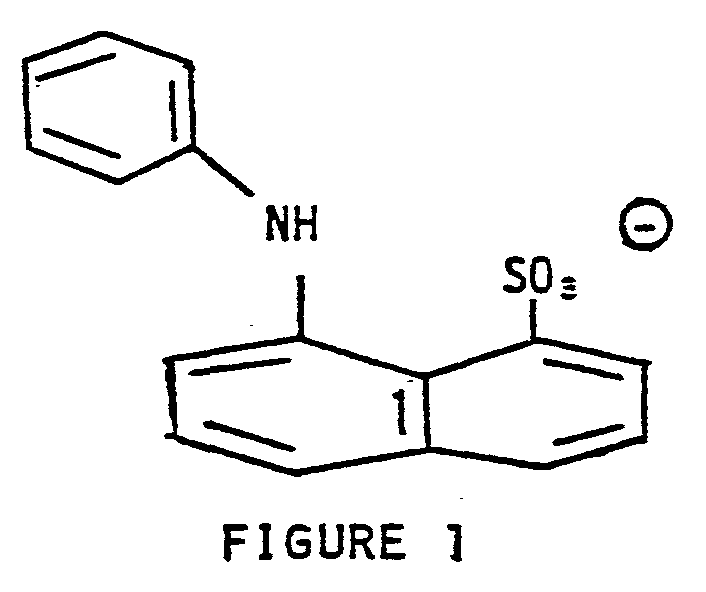
  • ANS The structure of ANS is as shown in figure 1 and it would appear to be the peculiar nature of the configuration of the three aromatic rings that confers on the molecule the ability to be tightly bound to thyroid binding globulin, pre-albumin, and also the binding to albumin.
  • the sulphonate group causes the molecule to be water soluble. From consideration of the structure it would appear that the lone pair of electrons present on the anilino nitrogen will allow electron conjugation to occur throughout the three aromatic rings. It is usual for such conjugation to be associated with shifts in light absorbance to wavelengths greater than 300 nm, and this conjugation would also appear to be associated with the known fluorescent characteristics of ANS,
  • the structure of the ANS analogues may have the following formula as shown in figure 2.
  • R 1 may be H or an alkyl group of from U8 carbon atoms
  • Y may be H or an aliphatic of from 1-8 carbon atoms
  • n is 1 or 2
  • m is 1 or 2
  • A is the anion of a strong acid.
  • R 1 is lower alkyl of 1-4 carbon atoms and is more preferably methyl or ethyl. Most preferably however R 1 is H.
  • Y is lower alkyl of 1-4 carbon atoms and is more preferably methyl or ethyl.
  • a preferred compound of the invention is where R 1 is H, R 2 is -COCH 3 and A is sulphate thereby providing the compound N-acetyl-8- anilinium-naphthalene 1-sulphonic acid sulphate, (hereinafter referred to as NA-ANS).
  • A is an anion of a strong acid and may include chloride or nitrate but is most preferably sulphate.
  • a compound of Figure 2 wherein R 2 is H and R 1 is H may be prepared by reaction of ANS with a strong acid under appropriate conditions. Host preferably the acid in sulphuric acid and the reaction occurs at room temperature.
  • acetic anhydride trifluoroacetic anhydride, acetyl chloride or a thioacylating agent of 1-8 carbon atoms (e.g.a sulphenyl chloride or thioanhydrides) in the presence of a strong acid which is most preferably anhydrous sulphuric acid at room temperature.
  • a strong acid which is most preferably anhydrous sulphuric acid at room temperature.
  • a suitable alkylating agent is alkyl halide (eg alkyl chloride).
  • the synthesis of such an analogue, N-acetyl-8-anilinium- naphthalene-1-sulphonic acid sulphate, (NA-ANS) will be detailed and this analogue will be shown to retain the protein binding characteristics of ANS while the above noted light and fluorescent detrimental properties of ANS are significantly altered.
  • NA-ANS is able to be successfully utilised in non-isotopic immunoassays in a manner analogous to the use of ANS itself in radio-irtnunoassays and such uses will be detailed. Synthesis of NA-ANS
  • NA-ANS in non-isotopic immunoassays was demonstrated by way of example by its use in non-homongenous enzyme immunoassays for thyroxine, triiodo-thyronine, digoxin and theophylline. It will be evident to those skilled in the art that such use and observed benefits are not exclusive to the particular non-isotopic immunoassay procedure described and utilised herein but are equally applicable to other enzyme and non-enzyme non-isotopic immunoassay procedures.
  • b-galactosidase thyroxine, serum thyroxine, and anti-thyroxine antibody framents were incubated in buffer for thirty minutes at room temperature, solid phase precipitating antibody added, and the mixture incubated for a further 30 minutes. The mixture is then centrifuged at 2000 rpm for 5 minutes on a bench centrifuge and the supernatant assayed for residual enzyme activity.
  • Reagents 1. b-galactosidase thyroxine solution containing 200 nM moles thyroxine and 130 nM moles protein. 2. Anti-thyroxine antibody.
  • Fab derivatives of anti thyroxine gamma globulin sufficient to give 60% binding of b-galactosidase thyroxine in assay. 3. Solid phase precipitating antibody. Sepharose-anti Fab antibody diluted in buffer to give 100% binding of Fab in the assay.
  • the procedure of the assay is as follows and all steps are carried out at room temperature. Duplicate assays were carried out on all samples.
  • (a) Make a dilution of enzyme thyroxine by taking 1 part of enzyme and 134 parts of buffer. Pipette in order into a '0.25' ml conical autoanalyser cup 200uL of the diluted enzyme-thyroxine, 20uL of sample or calibrator, and 50uL of the diluted Fab antibody. Also prepare a 'total* enzyme activity tube using 200uL of enzyme ligand in buffer, 20 uL of a calibrator, with 50 uL of buffer, and treat similarly to the other tubes.
  • Triiodothyronine Assay An assay for triiodothyronine was similarly established using methods similar to that described above with the exception that the buffer used was borate 0.05M pH 8.6 and the use of appropriate Fab fragments directed against triiodothyronine and a b-galactosidase triiodothyronine derivative. In an analogous manner to the above similar binding curves in the presence and absence of NA-ANS were observed.
  • the subject invention provides the benefits to non-istopic immunoassays similar to that observed with ANS in isotopic immunoassays and allows for improved, simple and rapid assays by its inclusion in the assay.
  • the previous limitations on such assays by the chemical and physical properties of ANS detrimental to such assays have been circumscribed by the altered properties observ ed with the alterations to the ANS molecule.
  • the invention also includes within its scope a process for the determination of a component of the reaction between a bindable substance selected from the group consisting of an antigen, a hapten, and a low molecular substance and a protein capable of binding said Tnndable substance specifically, said protein being selected from the group consisting of an antibody and a specific binding protein characterized in that said reaction additionally includes as a reaction component a compound as defined in Figure 1 wherein said compound binds to serum proteins present in the reaction system thereby inhibiting binding of said bindable substance to said serum proteins and thus improving the specificity of said process for determination of said component.
  • the abovementioned process is more applicable to non isotopic immunoassay procedures such as enzyme immunoassays which may be homogeneous or non-homogeneous.

Landscapes

  • Health & Medical Sciences (AREA)
  • Life Sciences & Earth Sciences (AREA)
  • Immunology (AREA)
  • Engineering & Computer Science (AREA)
  • Chemical & Material Sciences (AREA)
  • Hematology (AREA)
  • Urology & Nephrology (AREA)
  • Biomedical Technology (AREA)
  • Molecular Biology (AREA)
  • Microbiology (AREA)
  • Analytical Chemistry (AREA)
  • Biotechnology (AREA)
  • Chemical Kinetics & Catalysis (AREA)
  • Food Science & Technology (AREA)
  • Medicinal Chemistry (AREA)
  • Physics & Mathematics (AREA)
  • Cell Biology (AREA)
  • Biochemistry (AREA)
  • General Health & Medical Sciences (AREA)
  • General Physics & Mathematics (AREA)
  • Pathology (AREA)
  • Measuring Or Testing Involving Enzymes Or Micro-Organisms (AREA)
  • Peptides Or Proteins (AREA)

Abstract

Nouveaux analogues de l'acide 8-anylino naphtalène-1-sulfonique, leurs procédés de préparation et leur utilisation dans des techniques d'analyses immunologiques enzymatiques. L'invention se réfère notamment aux composés de la formule$(10,)$où R1 est H ou un groupe aliphatique composé de 1 à 8 atomes de carbone, R2 est H ou C (Y) = X où X est O ou S, Y est H ou un groupe aliphatique composé de 1 à 8 atomes de carbone, n est 1 ou 2, m est 1 ou 2 et A est un anion d'un acide fort.New analogs of 8-anylino naphthalene-1-sulfonic acid, methods for their preparation and their use in enzyme immunoassay techniques. The invention relates in particular to the compounds of the formula $ (10,) $ where R1 is H or an aliphatic group composed of 1 to 8 carbon atoms, R2 is H or C (Y) = X where X is O or S , Y is H or an aliphatic group composed of 1 to 8 carbon atoms, n is 1 or 2, m is 1 or 2 and A is an anion of a strong acid.

Description
"8-ANILINO NAPHTHALENE -1- SULPHONIC ACID ANALOGUES"
THIS INVENTION relates to new analogues of 8-anilino naphthalene -1- sulphonic acid, processes for their preparation, and their use in enzyme iπmunoassay techniques.
The known organic chemical 8-anilino naphthalene-1-sulphonic acid (ANS) has been widely used as an additive to reagents used in the technique known as radio-immuno assay to prevent interferences resulting from the binding of serum protein constituents to the drug or hor mone ligand/ligand-tracer which binding interferes with the specific binding of such ligand/ligand-tracer to the specific binding antibody used in the proceedure. Such use is exemplified in proceedures such as the radio-immuno assay for thyroid hormones such as thyroxine e.g. Chopra, I.J. 'A radioimmunoassay for the measurement of thyroxine in unextracted serum'. J. Clin. Endocrinol 34 (1972) p938; and also in the assay for triiodothyronine e.g. Sekadde CB. et al. 'Rapid Radioimmunoassay of Triiodothyronine'. Clin.Chem. 19 (1973) pl016. In such cases the use of ANS provides a specific benefit to the assays in providing marked improvements in the speed of the assay as well as in the specificity of the assay. The reason for this improvement has been extensively studied as for example Cheng S. et al. Biochemistry 16 (1977) p3707 in which ANS binding to pre-albumin was studied; and Nilsson S.F. and Peterson P.A. J.Biol.Chem. 250 (1975) 8543 in which ANS binding to thyroid binding globulin was studied. The binding of ANS to other proteins has also been extensively studied as for example Stryer L. J.Mol.Biol 13 (1965) p.482 and Steiner R.F. et al J.Biol.Chem. 241 (1966) p560., and in addition to its use with the assay of thyroid hormones ANS has been used as an assay constituent in radio-immuno assays for drugs such as for example with a commercial disoxin radio-immunoassay 'Disoxin I 125 IMUSAY' Abbott Laboratories North Chicago 111. USA. It is noted that by including ANS in the assay marked improvement in the specificity of the assay results. The improvement would appear to be due to binding of ANS to serum albumin wherein such binding prevents disoxin otherwise being so bound. Hore recently developed immunoassay techniques such as enzyme imrnunoassays both homogeneous and non-homogeneous, and fluorescent immunoassays would appear also to benefit from the use of ANS but its use in such assays is hampered by the physical properties of ANS which is unstable in the presence of light, absorbs light strongly in the region of 340-420 nm, and shows natural fluoresence which is further enhanced when combined with proteins. Thus instead of using the simplified and rapid techniques possible when ANS is used in a thyroxine assay for example, these techniques utilise more cumbersome procedures to allow such assays to function.
This invention relates to a chemical modification of the molecular structure of ANS to form an analogue such that the analogue retains the protein binding characteristics of ANS but does not possess the light absorbance or fluorescence properties, or the instability to light characteristic of ANS which inhibits its use with non-isotopic immunoassay techniques.
The structure of ANS is as shown in figure 1 and it would appear to be the peculiar nature of the configuration of the three aromatic rings that confers on the molecule the ability to be tightly bound to thyroid binding globulin, pre-albumin, and also the binding to albumin.
Figure imgf000004_0001
The sulphonate group causes the molecule to be water soluble. From consideration of the structure it would appear that the lone pair of electrons present on the anilino nitrogen will allow electron conjugation to occur throughout the three aromatic rings. It is usual for such conjugation to be associated with shifts in light absorbance to wavelengths greater than 300 nm, and this conjugation would also appear to be associated with the known fluorescent characteristics of ANS,
It is the object of this invention to create analogues of ANS by chemical substitution on the anilino nitrogen to involve the lone pair of electrons and thus block conjugation of the anilino aromatic ring to the naphthalene ring system. The structure of the ANS analogues may have the following formula as shown in figure 2.
Figure imgf000005_0001
In Figure 2, R1 may be H or an alkyl group of from U8 carbon atoms, R2 may be H or C(Y)=X where X may be 0 or S, Y may be H or an aliphatic of from 1-8 carbon atoms, n is 1 or 2, m is 1 or 2 and A is the anion of a strong acid.
Preferably R1 is lower alkyl of 1-4 carbon atoms and is more preferably methyl or ethyl. Most preferably however R1 is H.
Preferably Y is lower alkyl of 1-4 carbon atoms and is more preferably methyl or ethyl.
A preferred compound of the invention is where R1 is H, R2 is -COCH3 and A is sulphate thereby providing the compound N-acetyl-8- anilinium-naphthalene 1-sulphonic acid sulphate, (hereinafter referred to as NA-ANS).
A is an anion of a strong acid and may include chloride or nitrate but is most preferably sulphate. A compound of Figure 2 wherein R2 is H and R1 is H may be prepared by reaction of ANS with a strong acid under appropriate conditions. Host preferably the acid in sulphuric acid and the reaction occurs at room temperature. A compound of Figure 2 wherein R2 is H and R1 is C(Y)=X my be prepared by reaction of ANS with an acylating agent of 1-8 carbon atoms (e.g. acetic anhydride, trifluoroacetic anhydride, acetyl chloride or a thioacylating agent of 1-8 carbon atoms (e.g.a sulphenyl chloride or thioanhydrides) in the presence of a strong acid which is most preferably anhydrous sulphuric acid at room temperature.
A compound of Figure 2 wherein R2 is C1-8 alkyl and R1 is C(Y)=X may be prepared by reacting ANS with a suitable alkylating agent of 1 to 8 carbon atoms in the presence of a strong acid such as sulphuric acid at room temperature. A suitable alkylating agent is alkyl halide (eg alkyl chloride).
A compound of Figure 2 wherein R1 is C1-8 alkyl and R2 is C(Y)=X may be prepared by reacting the product of the process of the above paragraph initially with a base and then an acylating agent or thioacylating agent as described above. The synthesis of such an analogue, N-acetyl-8-anilinium- naphthalene-1-sulphonic acid sulphate, (NA-ANS), will be detailed and this analogue will be shown to retain the protein binding characteristics of ANS while the above noted light and fluorescent detrimental properties of ANS are significantly altered. Thus NA-ANS is able to be successfully utilised in non-isotopic immunoassays in a manner analogous to the use of ANS itself in radio-irtnunoassays and such uses will be detailed. Synthesis of NA-ANS
To a suspension of 6g. of ANS (ammonium salt, Sigma Chemical Co. practical grade) and 60 mls. of acetic anhydride was added dropwise with swirling 30 drops of concentrated sulphuric acid, An immediate change of colour frorc green to purple was evident. After 10 minutes 300 mls. of ethyl acetate was added to the fixture and after a further 30 minutes the NA-ANS product was filtered, washed with ethyl acetate and dried in vacuo to give 5g. of a purple powder of aelting point 172-176 degrees (decomposes). Physical Properties
Infrared spectrum -.KBr disc:- 3450,3150,1615,1595,1495,1270, 1170,1120,1050,1030,830,765,735,698,675,620,615,580,545 and 510 cm-1.
Mass spectrum - m/e 216 (100%), 281 (20%), 282 (4%).
UV-Visible spectrum - lambda max. 290 nm., extinction coeffnt. 7800 in 10 mM phosphate buffered saline.
Fluorescent spectrum - excitation 352 nm., emission 442 nm. in 10 mM phosphate buffered saline.
NMR spectrum - proton and 13C spectra observed were consistent with the NA-ANS structure. Verification of Structure.
Luts H.A. reported in J.Org.Chem. 33 (1968) p, 4528 the synthesis of pyridinium N-Acetyl-8-anilino-napthalene-1-sulphonate. This substance was synthesised following the method detailed and was converted into NA-ANS by treatment with both acetic anhydride - concentrated sulphuric acid as above and also by treatment with concentrated sulphuric acid in ethyl acetate as solvent. NA-ANS was also able to be converted into pyridinium N-acetyl-8-anil ino-naphtha!ene-1-sulphonate by treatment with pyridine at room temperature. Use of NA-ANS in non-isotopic immunoassays
The use of NA-ANS in non-isotopic immunoassays was demonstrated by way of example by its use in non-homongenous enzyme immunoassays for thyroxine, triiodo-thyronine, digoxin and theophylline. It will be evident to those skilled in the art that such use and observed benefits are not exclusive to the particular non-isotopic immunoassay procedure described and utilised herein but are equally applicable to other enzyme and non-enzyme non-isotopic immunoassay procedures. A. Total Serum Thyroxine enzyme immunoassay
Our patent application PCT/AU80/00065 and the references cited therein describe the manufacture of antibodies and antibody derivatives together with the manufacture of enzyme-ligand derivatives for a series of different non-homogeneous enzyme immunoassays and such procedures were followed for these experiments. b-Galactosidase-thyroxine was synthesised by using a thyroxine maleimide derivative using a method modified from those described by Ishikawa E. et al in 'Enzyme Labelled Immunoassay of Hormones and Drugs: Ed, Pal S,B, Walter de Gruyter Berlin New York (1978) page 43,
Principle; b-galactosidase thyroxine, serum thyroxine, and anti-thyroxine antibody framents (Fab) were incubated in buffer for thirty minutes at room temperature, solid phase precipitating antibody added, and the mixture incubated for a further 30 minutes. The mixture is then centrifuged at 2000 rpm for 5 minutes on a bench centrifuge and the supernatant assayed for residual enzyme activity. Reagents: 1. b-galactosidase thyroxine solution containing 200 nM moles thyroxine and 130 nM moles protein. 2. Anti-thyroxine antibody. Fab derivatives of anti thyroxine gamma globulin sufficient to give 60% binding of b-galactosidase thyroxine in assay. 3. Solid phase precipitating antibody. Sepharose-anti Fab antibody diluted in buffer to give 100% binding of Fab in the assay.
4. Enzyme substrate solution, on-nitro phenyl b-galactoside 1.2 mg/ml phoshate buffered saline. 5. Buffer solution. 0.01 M phosphate pH 7.40.15 M NaCl containing 4 mg/ml bovine serum albumin, bovine gamma glo bulin 4 rag/ml, gelatin fragments 7.5 mg/ml, 0.3 W oleic acid, and 0.79 mg/ml of NA-ANS. 6. Thyroxine standards. Human serum containing 10,40,80,130,180,240 nM of thyroxine. Method:
The procedure of the assay is as follows and all steps are carried out at room temperature. Duplicate assays were carried out on all samples. (a) Make a dilution of enzyme thyroxine by taking 1 part of enzyme and 134 parts of buffer. Pipette in order into a '0.25' ml conical autoanalyser cup 200uL of the diluted enzyme-thyroxine, 20uL of sample or calibrator, and 50uL of the diluted Fab antibody. Also prepare a 'total* enzyme activity tube using 200uL of enzyme ligand in buffer, 20 uL of a calibrator, with 50 uL of buffer, and treat similarly to the other tubes.
(b) Incubate for 30 minutes
(c) Add 50 uL of Sepharose anti Fab, cap the tubes, and then incubate for a further 30 minutes with gentle continuous inversion to keep the antibody in suspension.
(d) Centrifuge on a bench centrifuge for 5 minutes at 1000g. with the caps in place.
(e) Assay for enzyme content on a centrifugal analyser by sampling the supernatant directly from the sample cup.
Follow the gain in absorbance over 5 minutes at 405 nm.
(f) Calculate the mean of the duplicate enzyme rates of the unknown specimens and calculate the percent bound for each standard or unknown sample as follows: %bound = 100 - (100xobs.enz.rate/total enz.rate)
(g) Derive. a binding curve by plotting %bound Vs concentration of calibrator.
(h) Read the concentration of the test samples from the curve. A typical curve resulting from use of the assay is shown in figure 3, and also shown is a curve resulting from following the above method with the sole alteration of omitting NA-ANS from the buffer solution. It is to be seen that in the absence of NA-ANS a practical total serum thyroxine assay is not achieved. It is apparent however that the much reduced binding curve seen in the absence of NA-ANS corresponds to the calibration curve and it is probable that this curve is a measure of free thyroxine in serum as opposed to the total thyroxine assay resulting from use of NA-ANS. B. Total Triiodothyronine Assay An assay for triiodothyronine was similarly established using methods similar to that described above with the exception that the buffer used was borate 0.05M pH 8.6 and the use of appropriate Fab fragments directed against triiodothyronine and a b-galactosidase triiodothyronine derivative. In an analogous manner to the above similar binding curves in the presence and absence of NA-ANS were observed. C. Serum Digoxin Assay
An assay for serum digoxin was reported in our previous patent application PCT/AU80/00065. It has been found that the inclusion of NA-ANS in the assay results in an improvement in the accuracy and precision of the assay as compared to the results observed in the absence of NA-ANS.
D. Serum Theophylline Assay
In a similar manner it has been observed that an enzyme immunoassay for theophylline fashioned in a manner similar to that reported in the above patent application for dilantin was also aided with respect to accuracy and precision by the inclusion of NA-ANS in the buffer solution.
It is evident from the above results that the subject invention provides the benefits to non-istopic immunoassays similar to that observed with ANS in isotopic immunoassays and allows for improved, simple and rapid assays by its inclusion in the assay. The previous limitations on such assays by the chemical and physical properties of ANS detrimental to such assays have been circumscribed by the altered properties observ ed with the alterations to the ANS molecule.
Thus, the invention also includes within its scope a process for the determination of a component of the reaction between a bindable substance selected from the group consisting of an antigen, a hapten, and a low molecular substance and a protein capable of binding said Tnndable substance specifically, said protein being selected from the group consisting of an antibody and a specific binding protein characterized in that said reaction additionally includes as a reaction component a compound as defined in Figure 1 wherein said compound binds to serum proteins present in the reaction system thereby inhibiting binding of said bindable substance to said serum proteins and thus improving the specificity of said process for determination of said component. The abovementioned process is more applicable to non isotopic immunoassay procedures such as enzyme immunoassays which may be homogeneous or non-homogeneous.

Claims

THE CLAIMS DEFINING THE INVENTION ARE AS FOLLOWS: 1. A Compound of the formula
Figure imgf000011_0002
wherein R1 is H or aliphatic of 1-8 carbon atoms, R2 is H or C(Y)=X where X is 0 or S, Y is H or aliphatic of 1-8 carbon atoms, n is 1 or 2, m is 1 or 2 and A is an anion of a strong acid.
2. A compound of claim 1 where R1 is lower alkyl of 1-4 carbon atoms.
3. A compound of claim 2 where R1 is methyl or ethyl.
4. A compound of claim 1 where R1 is H.
5. A compound of any one of claims 1-4 wherein X is O and Y is lower alkyl of 1-4 carbon atoms.
6. A compound of claim 5 where Y is methyl or ethyl.
7. A compound of claim 1 where Y is H and X is O.
8. A compound of claim 1 where Y is methyl, X is O and R1 is H.
9. A compound of claim 1 where A is sulphate anion and n is 2.
10. N-acetyl-8-anilinium-naphthalene-1-sulphonic acid sulphate.
11. A process for the preparation of a compound having the formula
Figure imgf000011_0001
where R is C1-8 alkyl, A is the anion of a strong acid, n is
1 or 2 and m is 1 or 2 including the step of reacting ANS with an alkylating agent of 1-8 carbon atoms such as a C1-8 alkyl helide in the presence of a strong acid to form said compound.
12. A process for the preparation of a compound of the formula
Figure imgf000012_0002
where n is 1 or 2, m is 1 or 2 and A is the anion of a strong acid including the step of reacting ANS with a strong acid to form said compound.
13. A process for the preparation of a compound of formula
Figure imgf000012_0001
where R is C1-8 alkyl and R3 is C(Y)=X where Y is H or C1-8 alkyl, X is O or S, n is 1 or 2, m is 1 or 2, and A is the anion of a strong acid including the step of reacting the compound prepared by the process of claim 11 with an acylating agent or thioacylating agent having 1 to 8 carbon atoms after initial reaction with a base.
14, A process for the preparation of a compound of the formula
Figure imgf000013_0001
where R3, n, m and A are as defined in claim 12 including the step of reacting ANS with an acylating agent or thioacylating agent having 1 to 8 carbon atoms in the presence of a strong acid.
15. A process for the determination of a component of the reaction between a bindable substance selected from the group consisting of an antigen, a hapten, and a low molecular substance and a protein capable of binding said bindable substance specifically, said protein being selected from the group consisting of an antibody and a specific binding protein characterized in that said reaction additionally includes as a reaction component a compound as defined in claim 1 wherein said compound binds to serum proteins present in the reaction system thereby inhibiting binding of said bindable substance to said serum proteins and thus improving the specificity of said process for determination of said component.
16. A process as claimed in claim 15 wherein said component is as defined in claim 10.
17. A process as claimed in claim 15 or 16 which is utilized for radio immunoassays.
18. A process as claimed in claim 15 or 16 which is utilized for non- isotopic immunoassays both homogeneous and non-homogeneous.
19. A process as claimed in claim 15 or 16 which is utilized for enzyme immunoassays both homogeneous and non-homogeneous.
PCT/AU1982/000097 1981-06-26 1982-06-18 8-anilino naphthalene-1-sulphonic acid analogues Ceased WO1983000147A1 (en)

Applications Claiming Priority (2)

Application Number Priority Date Filing Date Title
AUPE9477810626 1981-06-26
AUPE947781 1981-06-26

Publications (1)

Publication Number Publication Date
WO1983000147A1 true WO1983000147A1 (en) 1983-01-20

Family

ID=3769112

Family Applications (1)

Application Number Title Priority Date Filing Date
PCT/AU1982/000097 Ceased WO1983000147A1 (en) 1981-06-26 1982-06-18 8-anilino naphthalene-1-sulphonic acid analogues

Country Status (3)

Country Link
EP (1) EP0082156A4 (en)
JP (1) JPS58501073A (en)
WO (1) WO1983000147A1 (en)

Cited By (4)

* Cited by examiner, † Cited by third party
Publication number Priority date Publication date Assignee Title
WO1988009505A1 (en) * 1987-05-21 1988-12-01 P B Diagnostic Systems, Inc. Biological diagnostic assay system
EP0674174A3 (en) * 1994-03-25 1996-02-28 Johnson & Johnson Clin Diag Multilayer analytical element for salicylate assay.
WO1998003877A1 (en) * 1996-07-18 1998-01-29 Behringwerke Aktiengesellschaft Reagents for assays for ligands
WO1998003876A1 (en) * 1996-07-18 1998-01-29 Behringwerke Aktiengesellschaft Reagents for assays for mycophenolic acid

Citations (2)

* Cited by examiner, † Cited by third party
Publication number Priority date Publication date Assignee Title
US4091013A (en) * 1975-08-07 1978-05-23 Bayer Aktiengesellschaft Process for preparing 1-amino-naphthalene-7-sulphonic acid
GB1521643A (en) * 1976-01-30 1978-08-16 Ciba Geigy Ag Process for the manufacture of naphthylaminosulphonic acids

Patent Citations (2)

* Cited by examiner, † Cited by third party
Publication number Priority date Publication date Assignee Title
US4091013A (en) * 1975-08-07 1978-05-23 Bayer Aktiengesellschaft Process for preparing 1-amino-naphthalene-7-sulphonic acid
GB1521643A (en) * 1976-01-30 1978-08-16 Ciba Geigy Ag Process for the manufacture of naphthylaminosulphonic acids

Non-Patent Citations (1)

* Cited by examiner, † Cited by third party
Title
See also references of EP0082156A4 *

Cited By (8)

* Cited by examiner, † Cited by third party
Publication number Priority date Publication date Assignee Title
WO1988009505A1 (en) * 1987-05-21 1988-12-01 P B Diagnostic Systems, Inc. Biological diagnostic assay system
EP0293971A1 (en) * 1987-05-21 1988-12-07 PB Diagnostic Systems, Inc. Biological diagnostic assay system
EP0674174A3 (en) * 1994-03-25 1996-02-28 Johnson & Johnson Clin Diag Multilayer analytical element for salicylate assay.
WO1998003877A1 (en) * 1996-07-18 1998-01-29 Behringwerke Aktiengesellschaft Reagents for assays for ligands
WO1998003876A1 (en) * 1996-07-18 1998-01-29 Behringwerke Aktiengesellschaft Reagents for assays for mycophenolic acid
US6159698A (en) * 1996-07-18 2000-12-12 Dade Behring Marburg Gmbh Reagents for assays for mycophenolic acid
US6171801B1 (en) 1996-07-18 2001-01-09 Dade Behring Marburg Gmbh Methods for releasing a ligand from a complex
US6887669B1 (en) 1996-07-18 2005-05-03 Dade Behring Marburg Gmbh Reagents for assays for ligands

Also Published As

Publication number Publication date
EP0082156A1 (en) 1983-06-29
JPS58501073A (en) 1983-07-07
EP0082156A4 (en) 1983-12-01

Similar Documents

Publication Publication Date Title
EP0361470A2 (en) Method for the chemiluminescence assay of the activity of peroxidase
US4104029A (en) Procedure for the assay of pharmacologically immunologically and biochemically active compounds in biological fluids
Otsuji et al. Turbidimetric immunoassay of serum C-reactive protein.
US6143510A (en) Measuring method using whole blood sample
US4489165A (en) Chromogenic tracers for use in an assay
CA1146852A (en) Reagent for latex agglutination
CN111781362A (en) Creatine kinase isoenzyme magnetic particle chemiluminescence detection kit and application thereof
US4180556A (en) Pretreatment method for carcinoembryonic antigen assay
JP3348250B2 (en) Free species analyte assay
EP0399464A2 (en) Assay method for a substance with a specific sugar chain
US5998156A (en) Color developing method, enzyme immunoassay using the color developing method, and immunochromatography incorporating the enzyme immunoassay
US4052504A (en) Assay for thyroxine binding globulin
US4081525A (en) Radioimmunoassay of plasma steroids
US4069305A (en) I125 Imidazole steroid derivatives
EP0088974A2 (en) Homogeneous immunoassay with labelled monoclonal anti-analyte
EP0082156A1 (en) 8-anilino naphthalene-1-sulphonic acid analogues
US5001072A (en) Compositions and methods for multiple simultaneous immunoradiometric assay (IRMA) of analytes using radioisotope chelate labels
AU552573B2 (en) 8-anilino naphthalene-1- sulphonic acid analogues
US5196349A (en) Immunoassays for thyroid hormones using thyroglobulin
US5342788A (en) Method and standard solution for the determination of thyroxine (T4) or triiodothyronine (T3)
CA2094397C (en) Homobifunctional agents for coupling enzymes and the like to antibodies and the like
JPH0718875B2 (en) Method for measuring trace substance content in blood or body fluids
EP0253270B1 (en) Method for diagnostic immunoassay by solid phase separation
JPS59176675A (en) Reagent for measuring enzyme immune
Eckert Radioimmunoassay

Legal Events

Date Code Title Description
AK Designated states

Kind code of ref document: A1

Designated state(s): AU JP US

Designated state(s): AU JP US

AL Designated countries for regional patents

Kind code of ref document: A1

Designated state(s): DE FR GB NL SE

Designated state(s): DE FR GB NL SE

WWE Wipo information: entry into national phase

Ref document number: 1982901830

Country of ref document: EP

WWP Wipo information: published in national office

Ref document number: 1982901830

Country of ref document: EP

WWW Wipo information: withdrawn in national office

Ref document number: 1982901830

Country of ref document: EP