TETRA-SUBSTITUTED AMMONIUM SALT OF
N-PHOSPHONOMETHYLGLYCINE AND THEIR
USES AS HERBICIDES AND PLANT GROWTH REGULANTS
Cross Reference to Related Application This application is a continuation-in-part of application Serial No. 255,923, filed April 20, 1981.
Background of the Invention This invention is directed to novel chemical compounds and their use in controlling weeds and regulating the natural growth or development of plants.
It is known that various features of plant growth can be modified or regulated to produce a variety of beneficial effects. For instance, plants can be defoliated and leaf growth inhibited while the productive plant parts remain unaffected. Such acticn often stimulates extra growth on the productive plant parts and facilitates harvesting operations. Chemical agents producing these effects are particularly useful in flax, cotton, and bean crops, and other crops of a similar nature. While defoliation results in the killing of leaves, it is not a herbicidal action since it does not harm the remainder of the plant. Indeed, killing of the treated plant is undesirable when defoliation is sought, since leaves will continue to adhere to a dead plant.
Another response demonstrated by plant growth regulants is the general retardation of vegetative growth. This response has a wide variety of beneficial features. In certain plants it causes a diminution or elimination of the normal apical dominance, leading to a shorter main stem and increased lateral branching. Smaller, bushier plants with increased resistance to drought and pest infestation are the result. Retardation of vegetative growth is also useful in turf grasses for lessening the vertical growth rate, enhancing root development, and producing a denser, sturdier turf. The retardation of turf grasses also serves to increase the interval between mowings of lawns, golf courses and similar grassy areas.
In many types of plants, such as silage crops, potatoes, sugar cane, beets, grapes, melons and fruit trees, the retardation of vegetative growth increases the carbohydrate content of the plants at harvest. It is believed that growth retardation or suppression at the appropriate stage of development decreases the amount of carbohydrate available for vegetative growth and thereby enhances starch and/or sucrose content. Retardation of vegetative growth in fruit trees produces shorter branches and greater fullness of shape, and often results in lesser vertical elongation. These factors contribute to the ease of access to the orchard and simplify the fruit harvesting procedure.
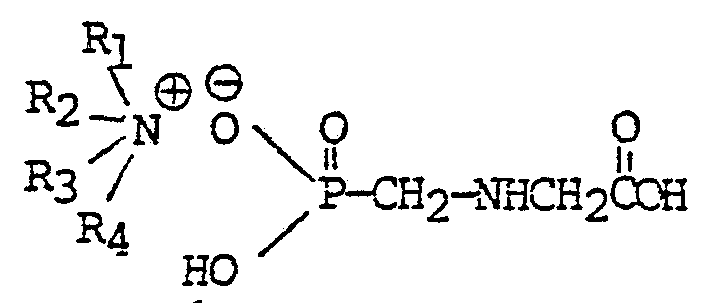
Brief Description of the Invention It has now been discovered that tetra-substituted raethylammonium salts of N-phosphonomethylglycine is useful in regulating the natural growth or development of plants. This salt has the following formula:
wherein R1, R
2, R3, and R
4 are individually selected from the group consisting of alkyl having 1 to 20 carbon atoms, inclusive, alkenyl having 2 to 6 carbon atoms, inclusive, hydroxyalkyl having 1 to 4 carbon atoms, inclusive, and phenyl, substituted phenyl wherein the substituent is alkyl having 1 to 4 carbon atom, inclusive, or halo.
In the above description, the following embodiments are intended for the various substituent groups:
Alkyl includes, unless otherwise provided for, those meirfcers containing from 1 to 20 carbon atoms, inclusive, as for example, methyl, ethyl, propyl, butyl, pentyl, hexyl, octyl, decyl, dodecyl, myristyl, stearyl, and the like, in both straight and branched-chain configurations and cyclic configurations; preferably alkyl includes, unless provided for, those members which contain from 1 to 15 carton atoms, inclusive.
Alkynyl includes, unless otherwise provided for, those members which contain at least one olefinic double bond and contain from 2 to 6 carbon atoms, inclusive, in both straight and branched-chain configurations and cyclic configurations, as for example, vinyl, allyl, butenyl, and hexenyl.
Hydroxyalkyl includes, unless otherwise provided for, those members which contain at least one hydroxy group and alkyl groups containing from 1 to 4 carbon atoms, inclusive, as for example, hydroxy methyl, hydroxyethyl, hydroxypropyl, and hydroxybutyl.
The terra "halo" includes chloro, fluoro, bromo, and icdo, preferably chloro.
By an agriculturally acceptable salt is meant a salt that is herbicidally active and contains substituents as described herein. Said salts are employed in such form inasmuch as such salts are usually more soluble and their formaticn and use are conducive to agricutural practice for application and effectiveness. Such herbicidally agriculturally acceptable salts can be, for example as described herein, tetra-substi tuted ammonium salts of N-phosphonomethyl glcyine in which the substitution in the tetrasubstituted ammonium cation portion contains a total of 4 to 20 carbon atoms, inclusive. Further, an agricuturally acceptable herbicidal composition may include an inert adjuvant as described hereinafter.
As employed herein, the term "natural growth or development" designates the normal life cycle of a plant in accordance with its genetics and environment, in the absence of artificial external influences. A preferred utility of the instant compounds is in increasing the sucrose yield of field grown sugarcane and sorghum. The term "regulating" is used herein to denote the bringing about through chemical means of any temporary or permanent modification or variation from the norrnal life cycle short of killing the plant. This invention further relates to a method of regulating the natural growth or development of plants, comprising applying to the plants an effective, plant-regulating, non-lethal amount of the above compound.
It has also been discovered that the compound of the present invention is useful in controlling undesirable vegetation. Accordingly, the invention further relates to a method of controlling undesirable vegetation, comprising applying to the vegetation in postemergent state a herbicidally effective amount of the compound. Herbicidal effects are generally achieved with a higher application rate than plant growth regulant effects. The compound is particularly effective in controlling grass weeds. The term "herbicidally effective amount" designates any amount which will kill a plant or any portion thereof. The term "plants" is intended to include germinant seeds, emerging seedlings, and established vegetation, including both roots and above-ground portions.
The present invention further entails the surprising discovery that the mono-tetramethylammonium salt of the present invention is superior to the mono-isopropylamine salt of N-phosphonomethylglycine, a commercial product widely sold and utilized in the agricultural industry. The common name of this product is "glyphosate" and its trade name is "ROONDUP®". It is sold as a herbicide by Monsanto Agricultural Products Comρany, St. Louis, Missouri. The superiority of the mono-tetramethylammonium salt is observed in both herbicide and plant growth regulant applications. Supporting comparative data is provided below.
Detailed Description of the Invention In accordance with the instant invention, regulation of the natural growth or development of plants is achieved by the direct application of the above compound to the plants or to any of their aboveground portions at approximately 4 to 10 weeks prior to harvest. With properly controlled application, a growth regulating effect can be achieved without herbicidal results. As understood by those skilled in the art, amounts effective for this purpose vary, not only with the particular material selected for treatment, but also with the regulatory effect to be achieved, the species of plant being treated and its stage of development, and whether a permanent or transient regulating effect is sought. Other factors which bear upon the determination of an appropriate growth regulating amount include the manner in which the treatment is to be applied and weather conditions such as temperature and rainfall. The resulting regulation may arise from the effect of the compound on the
physiological processes of the plants or on the morphology of the plant, or from both in combination or in sequence.
Morphological changes are generally noticeable by visual obser vation. Such changes occur in the size, shape, color or texture of the treated plant or any of its parts, as well as in the quantity of fruit or flowers the plant produces. Changes in the physiological processes, on the other hand, occur within the treated plant and are usually hidden from view. Changes of this type most often occur in the production, location, storage or use of chemicals naturally occurring in the plant, such as hoirmones. Physiological changes may be visually detectable when followed by a change in morphology. In addition, numerous analytical procedures for determining the nature and magnitude of changes in the various physiological processes are known to those skilled in the art.
The compounds of the instant invention serves to regulate the natural growth or development of treated plants in a number of diverse ways, and it should be understood that the regulatory effects will vary from one plant species to the next or from one application rate to the next.
Herbicidal effects are achieved in a similar manner, and the strength of the application can be varied to achieve the desired result.
The compounds are readily prepared from N-phosphonomethylglycine by reacting the latter with an appropriate tetra-substituted methylammonium halide in the presence of propylene oxide. N-Phosphonomethylglycine is a commercially available material known by the common name "glyphosate." It can be prepared by the phosphonomethylation of glycine, the reaction of ethyl glycinate with formaldehyde and diethylphosphite, or the oxidation of the N-phosphinorrethylglycine. Such methods are described in U.S. Patent No. 3,799,758 (Franz, March 26, 1974).
Examples 1-3 illustrates the preparation of the compound, Example 4 illustrates the herbicidal activity, and Examples 5 and 6 illustrate how the compound regulates the natural growth or development of plants. Although regulatory effects are often desirable in their own
right, it is most often the ultimate result of these effects upon the economics of the crop which is of primary significance. Thus, increases in the yield of individual plants, increases in the yield per unit area, and reductions in the cost of harvesting and/or subsequent processing are all to be considered in assessing the consequence of an individual regulatory effect during the growth or development of a plant.
These examples are merely illustrative, non-limiting demonstrations of the preparation of the compound of the present invention and of its effectiveness in controlling undesirable vegetation and in regulating the growth of plants. Following the preparation examples is a table of representative compounds.
EXAMPLE 1
Preparation of Mono-Tetramethylammonium Salt of N-Phosphonomethylglycine
A sample of mono-isoprcpylamine salt of N-phosphoncmethylglycine was obtained from Monsanto Agricultural Products Co., St. Louis, Missouri, in the form of an aqueous solution containing 41% active ingredient by weight. A 51.5 g (0.125 mole) portion of this solution was diluted with 75 ml of water and 10.4 ml of 12 N hydrochloric acid (0.125 mole) was added. The reaction mixture was stirred for an hour, and the solid product was filtered off. The product was washed successively with water, ethanol, and acetone, then dried in an oven. The yield was 15.8 g (75% of theoretical) of N-phosphonomethylglycine.
A 4.2 g (0.025 mole) portion of this material was combined with 3.9 g (0.025 mole) of tetramethylammonium bromide and 20 ml of propylene oxide in 100 ml of water. The resulting mixture was warmed gently at 50ºC for thirty minutes, then stripped of water and volatiles. The yield was 5.9 g of white powder (97.5% of theoretical), melting at 212°C with decomposition. The identity of the product was determined to be themono-tetaamethylammonium salt of N-phosphonomethylglycine by carbon-13 nuclear magnetic resonance and infrared spectroscopy.
EXAMPLE 2 Preparation of Phenyl Trimethylammonium Salt of N-Phosphonomethylglycine Using a similar procedure as Example 1, 4.2 g (0.025 mole) of N-phosphoncmethylglycine was combined with 6.6 g (0.025 mole) of phenyl trimethylammonium iodide and 20 ml of propylene oxide in 100 ml of water. The yield was 8.9 grams of a hydroscopic product. The identity of the product was confirmed to be the title compound by carbon-13 nuclear magnetic resonance and infrared spectroscopy.
EXAMPLE 3 Preparation of Tetra-(hydroxyethyl)ammonium Salt of N-Phosphonomethylglycine
N-Phosphonorrethylglycine, 3.4 g (0.02 mole), was combined with 4.22 g (0.02 mole) of tetra-(2-hydroxyethyl)ammonium hydroxide in water. The mixture was stirred until clear. The volatile products were stripped off. The product remaining (8.8 grams) was a liquid, nD30 = 1.4948, was confirmed to be the title compound by mass spectroscopy, carbon-13 nuclear magnetic resonsance and infrared spectroscopy.
EXAMPLE 4 Herbicidal Activity This example demonstrates the postemergence herbicidal activity of the compounds of the present invention in comparison with that of the known isopropylamine salt of N-phosphonomethylglycine.
Aluminum planting flats measuring 15.2 x 22.9 x 8.9 cm were filled to a depth of 7.6 cm with loamy sand soil, containing 50 parts per million (ppm) each of the commercial fungicide cis-N[(trichloromethyl)-thio]-4-cyclohexene-1,2-dicarboximide (Captan) and 17-17-17 fertilizer (percentages of N-P2O5-K2O) on a weight basis). Several rows were impressed across the width of each flat and a variety of seeds of both grass and broadleaf weed species were planted, one species per row. The weed species used are listed below:
Broadleaf weeds:
A. Annual morning glory Ipomoea purpurea
B. Cocklebur Xanthium sp.
C. Jimsonweed Datura stramonium
D. Velvetleaf Abutilon theophrasti E. Mustard Brassica sp.
F. Nightshade Solanum sp.
G. Pigweed Amaranthus sp.
Grasses:
H. Yellow nutsedge Cyperus esculentus
I. Downybrome Bromus tectorum
J. Foxtail Setaria sp.
K. Annual ryegrass Lolium multiflorum
L. Watergrass Echinochloa crusgalli
M. Rox-orange sorghum Sorghum bicolor
N. Wild oat Avena fatua
The broadleaf species were seeded first, and the grasses were seeded four days later. Ample seeds of each species were planted to produce 20 to 50 seedlings per row after emergence, depending on the size of each plant.
The broadleaf species were seeded first, and the grasses were seeded four days later. Ample seeds of each species were planted to produce 20 to 50 seedlings per row after emergence, depending on the size of each plant.
Ten days after the grasses were seeded, the emerged seedlings of all species were sprayed with aqueous solutions of the test compounds. The solutions were prepared to such dilutions that a spray rate of 80 gallons per acre (750 liters per hectare) gave from 0.25 to 4.0 pounds of test compound per acre (0.28 to 4.48 kilograms per hectare) as desired for each test. Additional flats not treated at all were used as standards for measuring the extent of weed control in the treated flats.
Nineteen days later, the test flats were compared to the stan dards and the weeds in each row were rated visually in terms of percent control ranging from 0% to 100%, with 0% representing the same degree of growth as the same row in the standard and 100% representing complete kill of all weeds in the row. All types of plant injury were taken into consideration. The results are shown in Tables I, II, and III, each showing a separate series of tests. The compounds presently claimed con tain a significant variance in substitution and chemical structure and more particularly the compound, mono-tetramethylammonium N-phosphoro methylglycine salt, demonstrates an improvement over the isopropylamine salt in its herbicidal activity on grass weeds at lew application rates.
EXAMPLE 3 Plant Growth Regulant Activity This example compares the utility of mono-tetramethylammonium salt of N-phosphonomethylglycine and the mono-isopropylamine salt of N-phosphonomethylglycine in regulating the growth of sweet sorghum (scientific name: Sorghum vulσare) .
The test procedure was as follows:
A series of fiber pots, each 5 inches (12.7 cm) square and 5 inches deep, were filled with approximately 3 pounds (1.36 kilograms) each of sandy loam soil containing 100 parts per million (ppm) of cis-N[(trichloromethyl)thio]-4-cyclohexene-1,2-dicarboximide (a commercially available fungicide) and sufficient 17-17-17 fertilizer to provide 150 ppm each of N, P2O5, and K2O. Eight sorghum seeds were placed in each pot and the pots were placed in a greenhouse in which the temperature was maintained at 27ºC during the day and 21°C at night. During the next five weeks, the emerging plants were thinned down to one per pot. The pots were fertilized periodically with 17-17-17 fertilizer.
Six weeks after seeding (when the plants had 8-9 fully developed leaves), the plants were sprayed with a solution consisting of the test compound dissolved in water. The spraying system was pressurized by carbon dioxide and mounted on a bicycle-type apparatus. The test solution was sprayed at a rate of 80 gallons per acre (750 liters per hectare). The concentration of the solution was predetermined to produce application rates ranging from 0.125 to 0.5 pounds of the test compound per acre when sprayed over the pots at a total solution volume of 80 gallons per acre.
Following treatment, the plants were placed in the greenhouse for an additional 25 days. The number of leaves and the plant height were then recorded. The plants were then cut off at the soil level and the leaves and leaf sheaths were removed and discarded. The stalk was then cut into pieces, squeezed in a press, and dried in a forced convection oven. The resulting dry weight was then recorded.
The data are listed in Table IV for one-eighth, one-quarter, and one-half pound per acre, where each entry is the average of two replications. Note that untreated plants are included for comparison. Again, the compound of the present invention (the tetramethylammonium salt) shews superiority (greater reduction in number of leaves, plant height, and dry weight) over the known compound (the isopropylamine salt).
EXAMPLE 6 Plant Growth Regulant Activity The experiments in this example were run according to a procedure similar to that of Example 5, except that the plants were allowed to mature more before application of the test compounds, and additional data was taken from each plant.
Circular fiber pots eight inches (20.3 cm) in diameter were used. The plants were seeded and raised in the greenhouse for about sixteen weeks, then sprayed with the test compounds and placed outdoors. They were harvested about three weeks later by cutting the stalks at soil level. The seedhead and peduncle were than removed. The seedhead was dried and weighed and the peduncle length was measured. The stalk was then stripped of side shoots and its length (height) and weight (fresh weight) recorded. The stalk was then dried as in Example 3 and its dry weight determined. The quantity of the expressed juice was also Treasured as well as its quality in terms of total dissolved solids. The latter was measured with a hand juice refractometer, and is expressed as weight percent of the juice.
Five replications each were performed on the mono-tetramethylammonium salt and the mono-isopropylamine salt. In addition, five untreated plants were included for comparison. The averages of thesemeasurements are listed in Table V, where the mono-tetramethylamine salt shows a distinct advantage in its effect en the sugar content of the expressed juice.
METHODS OF APPLICATION
Whether it is used as a plant growth regulator or as a herbicide, the coirgpound of the present invention is roost useful when applied directly to the plants subsequent to their emergence from the soil. For application at a field site, the compound is generally embodied in a suitable formulation containing additional ingredients and diluent carriers to aid in its dispersal. Examples of such ingredients or carriers are water, organic solvents, dusts, granules, surface active agents, water-in-oil and oil-in-water emulsions, wetting agents, dispersing agents, and emulsifiers. The formulation generally takes the form of a dust, solution, emulsifiable concentrate, or wettable powder.
A. DUSTS
Dusts are dense powder compositions which combine the active compounds with a dense, free-flowing solid carrier. They are intended for application in dry form and are designed to settle rapidly to avoid being windborne to areas where their presence is not desired.
The carrier may be of mineral or vegetable origin, and is preferably an organic or inorganic powder of high bulk density, lew surface area, and low liquid absorptivity. Suitable carriers include micaceous
talcs, pyrophyllite, dense kaolin clays, tobacco dust, and ground calcium phosphate rock.
The performance of a dust is sometimes aided by the inclusion of a liquid or solid wetting, agent, of ionic, anionic, or nonicnic char acter. Preferred wetting agents include alkylbenzene and alkylnaphtha lene sulfonates, sulfated fatty alcohols, amines or acid amides, long chain acid esters of sodium isothionate, esters of sodium sulfosuccinate, sulfated or sulfonated fatty acid esters, petroleum sulfonates, sulfon ated vegetable oils, and ditertiary acetylenic glycols. Dispersants are also useful in the same dust compositions. Typical dispersants include methyl cellulose, polyvinyl alcohol, lignin sulfonates, polymeric alkyl naphthalene sulfonates, sodium naphthalene sulfonate, polymethylene bis naphthalenesulfonate, and scdium-N-methyl-N-(long chain acid) taurates.
In addition, inert absorptive grinding aids are frequently included in dust compositions to aid in the manufacturing of the dust. Suitable grinding aids include attapulgite clay, diatomaceous silica, synthetic fine silica and synthetic calcium and magnesium silicates.
In typical dust compositions, carriers are usually present in concentrations of from about 30 to 90 weight percent of the total composition. The grinding aid usually constitutes about 5 to 50 weight percent, and the wetting agent up to about 1.0 weight percent. Dispersants, when present, constitute up to about 0.5 weight percent, and minor amounts of antleaking and antistatic agents may also be present. The particle size of the entire composition is usually about 30 to 50 microns.
B. SOLUTIONS
Aqueous solutions of the active compounds are prepared such that application at the rate of about 1 to about 200 gallons of solution per acre (about 9 to about 1875 liters per hectare) will provide the required amount of active ingredient. A small amount of non-ρhytotoxic surfactant typically between 0.05% and 0.5% by weight is usually included to improve the wetting ability of the solution and thus its distribution
over the plant surface. Anionic, cationic, nonicnic, ampholytic, and zwitterionic surfactants are all useful in this regard.
Suitable anionic surfactants include alkali metal, ammonium, and amine salts of fatty alcohol sulfates having from 8-18 carbon atoms in the fatty chain and sodium salts of alkyl benzene sulfonates having from 9 to 15 carbon atoms in the alkyl chain. Suitable cationic surfactants include dimethyl dialkyl quaternary ammonium halides with alkyl chains of 8 to 18 carbon atoms. Suitable nonionic surfactants include polyoxyethylene adducts of fatty alcohols having 10 to 18 carbon atoms, polyethylene oxide condensates of alkyl phenols with alkyl chains of 6 to 12 carbon atoms and 5 to 25 moles of ethylene oxide condensed onto each mole of alkyl phenol, and polyethylene oxide condensates of sorbitan esters with 10 to 40 moles of ethylene oxide condensed onto each mole of sorbitan ester. Suitable arapholytic surfactants include secondary and tertiary aliphatic amine derivatives with one aliphatic substituent containing 8 to 18 carbon atoms and another containing an anionic water-solubilizing group such as a sulfate or sulfonate. Sodium-3-dodecyl-aminopropionate and scdium-3-dodecyl amino propane sulfonate are examples. Suitable zwitterionic surfactants include derivatives of aliphatic quaternary ammonium compounds with one aliphatic substituent containing 8 to 18 carbon atoms and another containing an anionic water-solubilizing group. Examples of are 3-(N,N-dimethyl-N-hexadecylammcnio)proρane-1-sulfonate and 3-(N,N-diιrιethyl-N-hexadecylammonio)-2-hydroxy propane-1-sulfonate.
C. EMULSIFIABLE CCNCENERATES Emulsifiable concentrates are solutions in which the active materials and an emulsifying agent are dissolved in a non-watermiscible solvent. Prior to use, the concentrate is diluted with water to form a suspended emulsion of solvent droplets.
Typical solvents for use in emulsifiable concentrates include weed oils, chlorinated hydrocarbons, and non-water-raiscibie ethers, esters, and ketones.
Typical emulsifying agents are anionic or nonionic surfactants, or mixtures of the two. Examples include long-chain mercaptan polyethoxy alcohols, alkylaryl polyethoxy alcohols, sorbitan fatty acid esters, polyoxyethylene ethers with sorbitan fatty acid esters, polyoxyethylene glycol esters with fatty or rosin acids, fatty alkylol amide condensates, calcium and amine salts of fatty alcohol sulfates, oil-soluble petroleum sulfonates, or preferably mixtures of these emulsifying agents. Such emulsifying agents usually comprise about 1 to 10 weight percent of the total composition.
Typical emulsifiable concentrates contain about 15 to 50 weight percent active material, about 40 to 82 weight percent solvent, and about 1 to 10 weight percent emulsifier. Other additives such as spreading agents and stickers can also be included.
D. WETTABLE POWDERS
Wettable powders are water-dispersible compositions contain ing the active material, an inert solid extender, and one or more surfactants to provide rapid wetting and prevent flocculation when suspended in water.
Suitable solid extenders include both natural minerals and materials derived synthetically from such minerals. Examples include kaolinites, attapulgite clay, montmorillonite clays, synthetic silicas, synthetic magnesium silicate and calcium sulfate dihydrate.
Suitable surfactants include both nonionic and anionic types, and function as wetting agents and dispersants. Usually one of each is included. Preferred wetting agents are alkylbenzene and alkylnaphthalene sulfonates, sulfated fatty alcohols, amines or acid amides, long chain acid esters of sodium isothionate, esters of sodium sulfosuccinate, sulfated or sulfonated fatty acid esters, petroleum sulfonates, sulfonated vegetable oils, and ditertiary acetylenic glycols. Preferred dispersants are methyl cellulose, polyvinyl alcohol, lignin sulfonates, polymeric alkylnaphthalene sulfonates, sodium naphthalene sulfonate, polymethylene bisnaphthalenesulfonate, and sodium-N-methyl-N(long chain acid) taurates.
Typical wettable powders contain 25 to 90 percent active material, 0.5 to 2.0 percent wetting agent, 0.25 to 5.0 percent dispersant, and from 9.25 to 74.25 weight percent inert extender. Frequently, 0.1 to 1.0 percent of the extender is replaced by a corrosion inhibitor and/or an antifoaming agent.
E. IN GENERAL
In general, any conventional postemergence method of application can be used, including common dusting or spraying equipment. The amount of active ingredient which is effective in producing the desired result, be it herbicidal or growth-regulating, depends en the nature of the plant species to be controlled and the prevailing conditions. Herbicidal effects are usually achieved at 0.1 to 50 pounds active ingredient per acre, preferably 1 to 10, while plant growth regulation is usually achieved at 0.1 to 20 pounds active ingredient per acre, preferably 0.5 to 5. It will be readily apparent to one skilled in the art that compounds of lower activity will require a higher dosage than more active compounds for the same degree of control.