WO1986001815A1 - Improvements in or relating to organic compounds - Google Patents
Improvements in or relating to organic compounds Download PDFInfo
- Publication number
- WO1986001815A1 WO1986001815A1 PCT/EP1985/000491 EP8500491W WO8601815A1 WO 1986001815 A1 WO1986001815 A1 WO 1986001815A1 EP 8500491 W EP8500491 W EP 8500491W WO 8601815 A1 WO8601815 A1 WO 8601815A1
- Authority
- WO
- WIPO (PCT)
- Prior art keywords
- alkyl
- group
- phenyl
- hydrogen
- alkoxy
- Prior art date
- Legal status (The legal status is an assumption and is not a legal conclusion. Google has not performed a legal analysis and makes no representation as to the accuracy of the status listed.)
- Ceased
Links
- 0 CCC(C1)*1*(CC1)CC1C1C(C)CCCC1 Chemical compound CCC(C1)*1*(CC1)CC1C1C(C)CCCC1 0.000 description 4
Classifications
-
- C—CHEMISTRY; METALLURGY
- C09—DYES; PAINTS; POLISHES; NATURAL RESINS; ADHESIVES; COMPOSITIONS NOT OTHERWISE PROVIDED FOR; APPLICATIONS OF MATERIALS NOT OTHERWISE PROVIDED FOR
- C09B—ORGANIC DYES OR CLOSELY-RELATED COMPOUNDS FOR PRODUCING DYES, e.g. PIGMENTS; MORDANTS; LAKES
- C09B29/00—Monoazo dyes prepared by diazotising and coupling
- C09B29/34—Monoazo dyes prepared by diazotising and coupling from other coupling components
- C09B29/36—Monoazo dyes prepared by diazotising and coupling from other coupling components from heterocyclic compounds
- C09B29/3604—Monoazo dyes prepared by diazotising and coupling from other coupling components from heterocyclic compounds containing only a nitrogen as heteroatom
- C09B29/3617—Monoazo dyes prepared by diazotising and coupling from other coupling components from heterocyclic compounds containing only a nitrogen as heteroatom containing a six-membered heterocyclic with only one nitrogen as heteroatom
- C09B29/3621—Monoazo dyes prepared by diazotising and coupling from other coupling components from heterocyclic compounds containing only a nitrogen as heteroatom containing a six-membered heterocyclic with only one nitrogen as heteroatom from a pyridine ring
-
- C—CHEMISTRY; METALLURGY
- C09—DYES; PAINTS; POLISHES; NATURAL RESINS; ADHESIVES; COMPOSITIONS NOT OTHERWISE PROVIDED FOR; APPLICATIONS OF MATERIALS NOT OTHERWISE PROVIDED FOR
- C09B—ORGANIC DYES OR CLOSELY-RELATED COMPOUNDS FOR PRODUCING DYES, e.g. PIGMENTS; MORDANTS; LAKES
- C09B29/00—Monoazo dyes prepared by diazotising and coupling
- C09B29/0003—Monoazo dyes prepared by diazotising and coupling from diazotized anilines
- C09B29/0011—Monoazo dyes prepared by diazotising and coupling from diazotized anilines from diazotized anilines directly substituted by a heterocyclic ring (not condensed)
-
- C—CHEMISTRY; METALLURGY
- C09—DYES; PAINTS; POLISHES; NATURAL RESINS; ADHESIVES; COMPOSITIONS NOT OTHERWISE PROVIDED FOR; APPLICATIONS OF MATERIALS NOT OTHERWISE PROVIDED FOR
- C09B—ORGANIC DYES OR CLOSELY-RELATED COMPOUNDS FOR PRODUCING DYES, e.g. PIGMENTS; MORDANTS; LAKES
- C09B29/00—Monoazo dyes prepared by diazotising and coupling
- C09B29/34—Monoazo dyes prepared by diazotising and coupling from other coupling components
- C09B29/36—Monoazo dyes prepared by diazotising and coupling from other coupling components from heterocyclic compounds
- C09B29/3604—Monoazo dyes prepared by diazotising and coupling from other coupling components from heterocyclic compounds containing only a nitrogen as heteroatom
- C09B29/3665—Monoazo dyes prepared by diazotising and coupling from other coupling components from heterocyclic compounds containing only a nitrogen as heteroatom containing a six-membered heterocyclic ring with two nitrogen atoms
-
- C—CHEMISTRY; METALLURGY
- C09—DYES; PAINTS; POLISHES; NATURAL RESINS; ADHESIVES; COMPOSITIONS NOT OTHERWISE PROVIDED FOR; APPLICATIONS OF MATERIALS NOT OTHERWISE PROVIDED FOR
- C09B—ORGANIC DYES OR CLOSELY-RELATED COMPOUNDS FOR PRODUCING DYES, e.g. PIGMENTS; MORDANTS; LAKES
- C09B44/00—Azo dyes containing onium groups
- C09B44/02—Azo dyes containing onium groups containing ammonium groups not directly attached to an azo group
- C09B44/08—Azo dyes containing onium groups containing ammonium groups not directly attached to an azo group from coupling components containing heterocyclic rings
-
- Y—GENERAL TAGGING OF NEW TECHNOLOGICAL DEVELOPMENTS; GENERAL TAGGING OF CROSS-SECTIONAL TECHNOLOGIES SPANNING OVER SEVERAL SECTIONS OF THE IPC; TECHNICAL SUBJECTS COVERED BY FORMER USPC CROSS-REFERENCE ART COLLECTIONS [XRACs] AND DIGESTS
- Y10—TECHNICAL SUBJECTS COVERED BY FORMER USPC
- Y10S—TECHNICAL SUBJECTS COVERED BY FORMER USPC CROSS-REFERENCE ART COLLECTIONS [XRACs] AND DIGESTS
- Y10S8/00—Bleaching and dyeing; fluid treatment and chemical modification of textiles and fibers
- Y10S8/916—Natural fiber dyeing
- Y10S8/918—Cellulose textile
-
- Y—GENERAL TAGGING OF NEW TECHNOLOGICAL DEVELOPMENTS; GENERAL TAGGING OF CROSS-SECTIONAL TECHNOLOGIES SPANNING OVER SEVERAL SECTIONS OF THE IPC; TECHNICAL SUBJECTS COVERED BY FORMER USPC CROSS-REFERENCE ART COLLECTIONS [XRACs] AND DIGESTS
- Y10—TECHNICAL SUBJECTS COVERED BY FORMER USPC
- Y10S—TECHNICAL SUBJECTS COVERED BY FORMER USPC CROSS-REFERENCE ART COLLECTIONS [XRACs] AND DIGESTS
- Y10S8/00—Bleaching and dyeing; fluid treatment and chemical modification of textiles and fibers
- Y10S8/916—Natural fiber dyeing
- Y10S8/919—Paper
Definitions
- the invention relates to anionic heterocyclic compounds suitable for use as dyestuffs.
- each of R 1 and R 2 is independently hydrogen, C 1-4 alkyl, C 1-4 alkoxy or COOM, each of Q 1 and Q 2 is independently hydrogen or SO 3 M 1 , n is 0 or 1, each of M and M 1 is independently hydrogen or a non-chromophoric cation; K is one of the groups (a) and (b),
- R 3 is hydrogen, CN, NH 2 , OH, C 1-4 alkoxy, C 1-4 alkyl, C 2-4 alkyl monosubstituted by hydroxy or C 1-4 alkoxy, C 5-6 cycloalkyl; phenyl or phenyl -C 1-4 alkyl which phenyl group of the latter two groups is unsubstituted or substituted by one to three groups selected from C 1-4 alkyl, C 1-4 alkoxy, halogen, COOM and SO 3 M; a saturated or unsaturated 5- or 6-membered heterocyclic ring containing one to three hetero atoms which is unsubstituted or further substituted by one to three C 1-4 alky! groups and which is bound by a carbon or nitrogen atom directly or via a bridge member provided that any is bound via a bridge member; -COR 6 or -(CH 2 ) 1-3 -R 7 ,
- R 6 is OH, NH 2 or C 1-4 alkoxy
- R 7 is CN, halogen, SO 3 M, -OSO 3 M, -COR 8 or R 8 is OH, NH 2 , C 1-4 alkyl which is unsubstituted or monosubstituted by OH, halogen, CN or C 1-4 alkoxy; C 1-4 alkoxy, phenoxy, phenyl or phenyl -C 1-4 alkyl in which the phenyl groups of the latter three groups are unsubstituted or substituted by one to three groups selected from C 1-4 alkyl, C 1-4 alkoxy, halogen, COOM and SO 3 M;
- R 4 is hydrogen, CN, halogen, SO 3 M, NO, NO 2 , -NR 9 R 10 , C 1-4 alkyl which is unsubstituted or monosubstituted by OH, halogen, CN,
- V 1 is a group necessary to form a 5- or 6-membered ring to which ring a further 5- or 6-membered carbocyclic or heterocyclic ring containing one or two hetero atoms may be condensated,
- both R 3 and R 4 together form a C 3 - or C 4 -chain which may be part of a further 5- or 6-membered ring by two vicinal chain members,
- each of R 9 and R 10 is independently hydrogen, C 1-4 alkyl which is unsubstituted or monosubstituted by OH, halogen, CN, C 1-4 - alkoxy or phenyl; or -COR 12 E,
- R 11 i s OH, NH 2 , -NHC 1-4 alkyl , -N(C 1-4 al kyl ) 2 , C 1 -4 alkyl , C 1-4 - alkoxy, phenyl or phenoxy which phenyl group of the latter two groups is unsubstituted or substituted by one to three groups selected from C 1-4 alkyl, C 1-4 alkoxy, halogen, COOM and SO 3 M, R 12 is C 1-6 alkylene,
- E is hydrogen, halogen, a protonable amine group, a quaternary ammonium group or a hydrazinium group; SO 3 M or -OSO 3 M;
- R 5 is hydrogen, CN, NO 2 , -NR 14 R 15 , a saturated or unsaturated 5or 6-membered heterocyclic ring containing one or two hetero atoms which is bound by a carbon or nitrogen atom and which is further unsubstituted or substituted by up to three methyl groups or by NH 2 , -NHC 1-4 alkyl or -N(C 1-4 alkyl) 2 ; C 1-6 alkyl, C 2-4 alkenyl, C 2-4 alkinyl; C 1-6 alkyl monosubstituted by OH, CN, C 1-4 alkoxy, acetamido, -COR 16 , SO 3 M or -OSO 3 M; C 5-6 cydoalkyl, phenyl or phenyl -C 1-4 alkyl which phenyl group of the latter two groups is unsubstituted or substituted by one to three groups selected from C 1-4 alkyl, C 1-4 alkoxy,
- each of R 14 and R 15 is independently hydrogen, C 1-4 alkyl, C 1-4 alky! monosubstituted by OH, halogen, CN or C 1-4 alkoxy; phenyl or phenyl substituted by one or two groups selected from halogen, C 1-4 alkyl and C 1-4 alkoxy, R 16 is OH or C 1-4 alkoxy, R 17 is hydrogen or C 1-4 alkyl,
- E 1 is a protonable amine group, a quaternary ammonium group or a
- hydrazinium group or a group of the formula - R 18 is E 2 , -NHCOR 12 E 2 , -SO 2 NHR 12 E 2 or -CONHR 12 E 2 ; each R 19 is independently halogen, NH 2 or an aliphatic amine group,
- E 2 is a protonable amine group, a quaternary ammonium group or a hydrazinium group,
- X is 0 or NH
- Z is OH, NH 2 , methyl or ethyl, Y is 0, S or N-Y 1 ,
- Y 1 is hydrogen, CN, CONH 2 , C 1-4 alkyl, C 1-4 alkyl monosubstituted by OH, CN, halogen or C 1-4 alkoxy; phenyl or phenyl -C 1-4 alkyl which phenyl group of the latter two groups is unsubstituted or substituted by one or two groups selected from halogen, C 1-4 alkyl , C 1 -4 alkoxy, acetamido, COOM and SO 3 M; 1- or 2-naphthyl ; C 1-6 alkylene-SO 3 M, C 1-6 alkyl ene-OSO 3 M or C 1-6 alkyl ene-COOM, each of R 20 and R 21 i s independently hydrogen, C 1-4 alkyl , phenyl or phenyl -C 1 -4 alkyl which phenyl group of the l atter two groups is unsubstituted or substituted by one or two groups selected from hal
- R 2 is other than COOM
- the diazo component radical is defined as follows: R 1 is hydrogen, R 2 is methyl, Q 1 is SO 3 M 1 in the 7-position, n is 0 and Q 2 is hydrogen,
- Y is N-Y 1 in which Y 1 is hydrogen, and (1) to (4) occur simultaneously, then M 1 has a significance other than hydrogen or sodium;
- any halogen means fluorine, chlorine or bromine, especially chlorine.
- any alkyl or alkylene is linear or branched unless indicated to the contrary.
- any hydroxysubstituted alkyl group which is linked to a nitrogen atom the hydroxy group is bound to a carbon atom other than to the C 1 -atom.
- Q 1 is preferably SO 3 M 1 which is more preferably bound to the 7-position.
- n is preferably 0.
- Each R 1 is preferably R 1a , where each R 1a is independently hydrogen, C 1-4 alkyl, methoxy or ethoxy. More preferably it is R 1b , where each R 1b is independently hydrogen, methyl, ethyl, methoxy or ethoxy. Even more preferably it is R 1c , where each R 1c is independently hydrogen or methyl. Most preferably R 1 is hydrogen.
- R 2 is preferably R 2a , where R 2a is C 1-4 alkyl, C 1-4 alkoxy or COOM. More preferably it is R 2b , where R 2b is methyl, methoxy, ethoxy or COOM. Most preferably R 2 is methyl.
- Q 2 when defined as SO 3 M 1 is preferably bound to a carbon atom which is in ortho- position to the azo group.
- Any alkyl or alkoxy as R 3 preferably contains 1 or 2 carbon atoms and is most preferably methyl or methoxy.
- Any substituted alkyl is preferably a C 2-3 alkyl group monosubstituted by hydroxy or C 1-2 alkoxy.
- Any cycloalkyl is preferably cyclohexyl.
- the phenyl group contains one or two groups selected from methyl, methoxy, chlorine, COOM and SO 3 M.
- Any heterocyclic ring as R 3 is preferably morpholine, pyrrolidine, piperidine, piperazine or N-methylpiperazine (when saturated) which is bound by a carbon or nitrogen atom, or is pyridine, triazine, pyridazine, pyrimidine or pyrazine (when unsaturated) which is bound by a carbon or nitrogen atom where in the latter case (when bound by a nitrogen atom) a methylene bridge is present.
- R 6 is preferably R 6a , where R 6a is OH, NH 2 , methoxy or ethoxy. More preferably it is R 6b , where R 6b is OH or NH 2 .
- R 7 is preferably R 7a , where R 7a is CN, chlorine, SO 3 M, -OSO 3 M,- or -COR 8a , where R 8a is OH, NH 2 , methyl, ethyl, methoxy or ethoxy; more preferably it is R 7D , where R 7D is SO 3 M,
- R 3 is preferably R 3a , where R 3a is hydrogen, CN, NH 2 , OH, methyl, ethyl, hydroxyethyl, C 1-2 alkoxyethyl, methoxy, ethoxy, cyclohexyl; phenyl or phenyl -C 1-2 alkyl in which the phenyl group is unsubstituted or substituted by one or two groups selected from
- R 3 is R 3b , where R 3b is NH 2 , methyl, ethyl, hydroxyethyl, cyclohexyl, phenyl, phenyl -C 1-2 alkyl, -COR 6b or -CH 2 R 7b . Even more preferably R 3 is R 3C , where R 3C is NH 2 , methyl, hydroxyethyl, phenyl ethyl or -CH 2 SO 3 M. Most preferably R 3 is methyl.
- Any protonable amine or quaternary ammonium group as E, E 1 or E 2 is preferably a group B, where B is a primary amine group, a secondary or tertiary aliphatic, cycloaliphatic, aromatic or saturated, unsaturated or partially unsaturated heterocyclic aminegroup which latter group is attached by the N-atom or a carbon atom; or a quaternary ammonium group corresponding to the above.
- Any aliphatic amine group as B is preferably a mono-C 1-4 alkyl- or a di-(C 1-4 alkyl)-amine group.
- the alkyl group may be monosubstituted by halogen, hydroxy, cyano, C 1-4 al koxy or phenyl.
- Any cycloaliphatic amine group is preferably C 5-6 cycloalkylamino, the cycloalkyl group of which is unsubstituted or may be substituted by one or two C 1-2 alkyl groups.
- Any aromatic amine group is preferably phenyl amino, the phenyl ring of which is unsubstituted or substituted by one or two groups selected from halogen, C 1-4 alkyl, C 1-4 alkoxy, SO 3 M and COOM.
- Any heterocyclic amine group as B which is attached by the N-atom or a carbon atom is preferably a saturated, unsaturated or partially unsaturated 5- or 6-membered ring which contains one or two hetero atoms and may be further substituted by one or two C 1-4 alkyl groups.
- B is B 1 , where B 1 is a protonable amine group -NR 22 R 23 or a quaternary ammonium group -NR 24 R 25 R 26 , or B 1 forms a protonable or quaternary 5- or 6-membered saturated heterocyclic ring of the formula
- each of R 22 and R 23 independently, is hydrogen, C 1-4 alkyl, C 2-4 alkyl monosubstituted by hydroxy, C 1-4 alkoxy, halogen or cyano; phenyl-C 1-4 alkyl, the phenyl group of which is unsubstituted or substituted by one to three groups selected from chlorine, C 1-4 alkyl and C 1-4 alkoxy, or C 5-6 cycloalkyl, or R 22 and R 23 , together with the N-atom to which they are attached, attached, form a heterocyclic ring of the formula
- U 2 is the direct bond, -CH 2 -, -O-, -S-, -SO 2 -, -SO-, -NH-, -N(C 1-4 alkyl)- or - (C 1-4 alkyl) 2 -, each of R 24 and R 25 has independently one of the cyclic or noncyclic significances of R 22 and R 23 except hydrogen, and R 26 is C 1-4 alkyl or phenyl -C 1-4 alkyl, or R 24 , R 25 and R 26 , together with the N-atom to which they are attached, form a pyridinium group unsubstituted or substituted by one or two methyl groups, or a ring of the formula in which R 26 and U 2 are as defined above,
- R 27 is hydrogen or C 1-4 alkyl and each of R 28 , independently, is C 1-4 alkyl. Even more preferably B is B 2 , where B 2 is a group -NR 22a R 23a or
- NR 24a R 25a R 26a each of R 22a and R 23a, independently, is hydrogen, C 1-2 alkyl, unbranched hydroxy-C 2-3 alkyl or benzyl or both R 22a and R 23a, together with the N-atom to which they are attached, form a pyrrolidine, piperidine, morpholine, piperazine or
- each of R 24a and R 25a has independently one of the non-cyclic or cyclic significances of R 22a and R 23a except hydrogen, and R 26a is methyl, ethyl or benzyl, or R 24a, R 25a and R 26a , together with the N-atom to which they are attached, form a pyridinium group unsubstituted or substituted by one or two methyl groups.
- B is B 3 , where B 3 is a group -NR 22b R 23b or
- each of R 22b and R 23b is hydrogen, methyl or ethyl or both R 22b and R 23b, together with the N-atom to which they are attached, form a piperidine, morpholine, piperazine or N-methylpiperazine ring; each of R 24b and R 25b is methyl or ethyl or both R 24b and R 25b , together with the N-atom to which they are attached, has one of the cyclic significances of R 22b and R 23b ,
- R 26b is methyl or ethyl or
- R 24b , R 25b and R 26b together with the N-atom to which they are attached, form a pyridinium group unsubstituted or substituted by one or two methyl groups.
- R 9 and R 10 is preferably R 9a and R 10a , where each of R 9a and R 10a is independently hydrogen, C 1-2 alkyl, C 1-2 alkyl monosubstituted by OH, C 1-2 alkoxy or phenyl, or -COR 12a E a , in which R 12a is C 1-2 alkylene. More preferably each of R 9 and R 10 is R 9b and R 10b , where each of R 9b and R 10b is independently hydrogen, methyl or -COR 12a E b , R 11 is preferably R 11a , where R 11a is OH, NH 2 , -NHCH 3 ,
- R 11b is NH 2 , methyl, ethyl, methoxy or ethoxy.
- R 4 is preferably R 4a , where R 4a is hydrogen, CN, chlorine, bromine, SO 3 M, -NR 9a R 10a , C 1-2 alkyl, C 1-2 alkyl monosubstituted bv OH, phenyl, SO 3 M or -OSO 3 M; -COR 11a , -CH 2 NHCOR 12a B 2 or a group - forming a pyridine, pyrimidine or benzimidazole ring which is further unsubstituted or monosubstituted by methyl, NH 2 , -NHCH 3 or -N(CH 3 ) 2 . More preferably R 4 is R 4b , where R 4b is hydrogen, CN, -NHR 10b , -COR 11b , -CH 2 NHCOCH 2 B 3 or a group of the formulae
- R 4 is R 4C , where R 4C is hydrogen, CN, -NHCOCH 2 E b , -CONH 2 , Most preferably R 4 is R 4d , where R 4d is hydrogen or CN.
- R 3 and R 4 together with the carbon atoms to which they are attached form part of a further ring which corresponds to the formula
- R 14 and R 15 are preferably R 14a and R 15a , where each of R 14a and R 15a is independently hydrogen, methyl, ethyl or phenyl.
- R 16 is preferably R 16a , where R 16a is OH, methoxy or ethoxy.
- R 17 is preferably R 17a , where R 17a is hydrogen or methyl.
- Any aliphatic amine group as R 19 is preferably a mono-C 1-4 - alkyl- or di-(C 1-4 alkyl)-amine group, in which the alkyl groups may be monosubstituted by halogen, OH, CN, C 1-4 alkoxy or phenyl.
- Each R 19 is preferably R 19a , where each R 19a is independently fluorine, chlorine, NH 2 , -NHC 1-2 alkyl or -N(C 1-2 alkyl) 2 , in which the alkyl groups are unsubstituted or monosubstituted by OH, CN or C 1-2 alkoxy. More preferably each R 19 is R 19b , where each R 19b is independently chlorine, NH 2 , -NHCH 3 , -N(CH 3 ) 2 , -NHCH 2 CH 2 OH or -N(CH 2 CH 2 OH) 2 .
- E 1 is preferably E 1a , where E 1a is a group B 2 or a group of
- the formula 19a more preferably it is E 1b , where E 1b is a group B 3 or a group of
- E 2 is preferably E 2a , where E 2a is a group B 2 . More preferably it is E 2b , where E 2b is a group B 3 .
- R 18 is preferably R 18a , where R 18a is E 2a , -NHCOR 12a E 2a ,
- R 5 is preferably R 5a , where R 5a is hydrogen, -NR 14a R 15a , phenyl, phenyl -C 1-2 alkyl, cyclohexyl; C 1-4 alkyl, C 1-4 alkyl monosubstituted by OH, CN, C 1-2 alkoxy, -COR 16a , SO 3 M or -OSO 3 M; -C 1-3 alkylene-E 1a , -C 1-3 alkylene-
- R 5 is R 5b , where R 5b is hydrogen, -NHR 15a , phenyl, phenyl-C 1-2 alkyl, methyl, ethyl, Chalkyl monosubstituted by SO 3 M or -COR 16 a , -(CH 2 ) 1-3 -E 1b , -(CH 2 ) 1-3 -NHCO-
- R 5 is hydrogen
- X is preferably 0.
- Z is preferably Z a , where Z a is OH or NH 2 .
- the phenyl group of any phenyl or phenyl alkyl as Yl is substituted by one or two groups selected from chlorine, methyl, methoxy, COOM and SO 3 M.
- Y 1 is preferably Y 1a , where Y 1a is hydrogen, CN, CONH 2 , methyl, ethyl, C 2-4 alkyl monosubstituted by OH, CN, chlorine or C 1-2 alkoxy; phenyl or phenyl -C 1 -2 alkyl, the phenyl group of the latter two groups is unsubstituted or substituted by one or two groups selected from chlorine, methyl, methoxy, COOM and SO 3 M; C 2-4 alkylene-SO 3 M, C 2-4 alkylene-OSO 3 M or C 2-4 alkylene-COOM.
- Y 1b is hydrogen, CN, CONH 2 , methyl, ethyl, 2-hydroxyethyl, phenyl, phenyl -C 1-2 alkyl, C 2-4 alkylene-SO 3 M or C 2-4 alkylene-COOM.
- Y 1c is hydrogen, CN or CONH 2 .
- Y 1d is hydrogen or CN, of which hydrogen is most preferred.
- Y is preferably Y a , where Y a is 0 or N-Y 1a ; more preferably it is Y b , where Y b is O or N-Y 1b ; even more preferably it is Y c , where Y c is 0 or N-Y 1c ; most preferably it is Y d , where Y d is 0 or N-Y 1d .
- R 20 and R 21 is preferably R 20a and R 21a , where each of R 20a and R 21a is independently hydrogen, methyl, ethyl, phenyl-C 1-2 alkyl or phenyl, the phenyl groups of which are unsubstituted or substituted by one or two groups selected from chlorine, methyl, methoxy, COOM and SO 3 M, or in case where Y is N-Y 1 in which Y 1 is hydrogen, one of R 20a and R 21a has also a significance additionally given for Y 1a .
- each of R 20 and R 21 is R 20b and R 21b , where each of R 20b and R 21b is independently hydrogen, methyl, ethyl, phenyl or benzyl or in case where Y is N-Y 1 in which Y 1 is hydrogen, one of R 20b and R 21b has a significance additionally given for Y 1b .
- R 20 and R 21 are hydrogen.
- the group (a) is preferably (a1) of the formula
- K is preferably K 1 , where K 1 is one of the groups (a1) or (b1). More preferably it is K 2 , where K 2 is one of the groups (a2) or (b2). Even more preferably it is K 3 , where K 3 is one of the groups (a3) or (b3). Most preferably K is K 4 , where K 4 is a group (a3).
- a compound of formula I according to the invention is in free acid form, in alkali metal or unsubstituted or substituted ammonium salt form or in mixed salt form, or may form an internal salt.
- Any substituted ammonium cation present as M or M 1 may be derived from a primary, secondary or tertiary amine.
- the following amines are suitable:- mono-, di- or trimethyl-, -ethyl-, -propyl- or -butyl-amine; mono-, di- or triethanol-, -propanol- or isopropanol-amine; N-methyl-N-hydroxyethyl amine, N-methyl-N,N-di(hydroxyethyl)amine, N-ethyl-N-hydroxyethoxyethyl amine, morpholine, piperidine, piperazine, hydroxyethylmorpholine, hydroxyethylpiperazine, aminoethylpiperazine; ethylenediamine, hexamethylenediamine; dimethylaminopropyl amine, diethylaminopropylamine, diethylene glycol amine, diglycol amine and 3-methoxypropylamine.
- polyglycol amines are also suitable as amines. They can be prepared for example by reacting ammonia, alkyl- or hydroxyalkylamine with alkylene oxides.
- Any substituted ammonium ion may also be a quaternary ammonium ion (especially when M 1 ) derived from ammonium compounds which preferably contain one or two quaternary ammonium ions.
- Examples are tetramethyl-, tetraethyl-, trimethylethyl-, benzyldiethylmethyl-, trimethylphenyl-, trimethyl benzyl-, triethylcyclohexyl-, trimethylhydroxyethyl- and tetrahydroxyethyl - ammoniumhydroxide as well as N,N-dimethylpiperidinium hydroxide, or compounds corresponding to the formula
- each R 30 is independently methyl, ethyl, hydroxyethyl or 2- or 3-hydroxypropyl and A is C 1-4 alkylene or -CH 2 CH 2 N(CH 3 )CH 2 CH 2 -.
- K 1 is a group (b 1 ), in which Y a is 0,
- R 2b is other than COOM
- Q 2 is hydrogen or SO 3 M 1 , and (1) to (3) occur simultaneously, then at least one of M 1 is a quaternary ammonium cation as defined above;
- the diazo component radical is defined as follows: R 1b is hydrogen, R 2b is methyl and Q 2 is hydrogen,
- each of R 20a and R 21a is hydrogen
- Y a is N-Y 1a , in which Y 1a is hydrogen, and (1) to (3) occur simultaneously, then M 1 has a significance other than hydrogen or sodium.
- K 1 is K 2 ;
- K 1 is K 3 ;
- R 1b is R 1c ;
- R 1b is hydrogen
- R 2b is methyl
- R 3 , R 4 , R 5 ,-R 20 , R 21 , X, Y and Z are as defined above.
- Diazo components of formula II for example are as follows:- 2-(4'-aminophenyl)-6-methylbenzthiazole-7-sulphonic acid 2-(4'-aminophenyl)-6-methylbenzthiazole-5-sulphonic acid 2-(4'-aminophenyl)-6-methylbenzthiazole-3',7-disulphonic acid 2-(4'-aminophenyl)-6-carboxybenzthiazole-7-sulphonic acid 2-(4'-amino-3'-methyl-5'-sulphophenyl)-4,6-dimethyl-benzthiazole -7-sulphonic acid
- Illax in which R 5x i s C 1-6 alkyl ene-E 1 or the group ⁇ may be prepared for exampl e by reacti ng a compound of formul a Ill ay,
- W is C 1-6 alkylene or a group J wherein R 31 is -NHCOR 12 , -SO 2 NHR 12 - or -CONHR 12 , and X O is a functional group, preferably a group which can be split off as an anion, with the amino compound E 1 -H.
- the coupling components, compounds of formula IIlb are either known or may be prepared in accordance with known methods from known starting compounds. Such preparation processes for example are described in: The Chemistry of Heterocyclic Compounds. The Pyrimidines, Interscience Publishers 1962; furthermore in numerous patent references such as, US-PS 2,673,204 or DE-PS 134,984; 158,591; 165,692; 186,456, etc. Diazotisation and coupling reactions may be effected in accordance with known methods. For diazotisation, the amines or amine mixtures are advantageously dissolved in an aqueous alkali or made into a paste therein, and mixed with a 5-10% molar excess sodium nitrite.
- Diazotisation conveniently is carried out in a medium containing a mineral acid, preferably hydrochloric acid, at 0-20°C. Coupling conveniently is carried out at pH 3-10, preferably 4-8.
- a quaternary ammonium compound is added using at least an equimolar amount which is sufficient to neutrause one sulphonic acid group.
- the resultant compound of formula I may be used in form of the solution as obtained; however, this solution may also be converted into a solid by spray-drying. Furthermore, the conventional method of isolation used for dyestuffs, salting out of the solution, filtering off and drying, is also suitable.
- the type of cations present in a compound of formula I may be influenced in different ways depending on the preparation process.
- One possibility consists in filtering off the diazonium salt which is obtained in the above process, and washing it with water.
- the solid diazonium compound is then added to an aqueous slurry or solution of the coupling component, which contains a basic salt, lithium-, sodium-, potassium-, ammonium-hydroxide, one or more organic amines or a quaternary ammonium compound.
- Another method consists in converting the compound of formula I, which is obtained by diazotisation and coupling and is isolated in the sodium salt form, into the free acid by using a mineral acid, preferably hydrochloric acid, then filtering and washing with water; the compound is subsequently neutralised and thus converted into the desired alkali salt or ammonium salt.
- a mineral acid preferably hydrochloric acid
- Any type of mixed salt form may be obtained by effecting partial conversion into the free acid and/or by step-wise neutralisation.
- the salt-changing method, conversion of one salt form into another, can also be used.
- the compounds according to the invention in form of their water-soluble salts are useful for dyeing or printing hydroxy group or nitrogen containing organic substrates.
- they are suitable for dyeing or printing fibres, threads or textiles produced therefrom, which consist of or contain cellulose materials, such as cotton, in accordance with known methods; cotton is preferably dyed by the exhaust method, for example from a long or short liquor, at room temperature to boiling temperatures.
- Printing is effected by means of impregnation with a printing paste which is prepared by known methods.
- the compounds of formula I are especially suited for dyeing or printing paper in accordance with known methods, e.g. for the preparation of sized or unsized paper dyed in the stock. They may also be used for dyeing paper by the dipping process. Furthermore, the new dyestuffs can be used for dyeing or printing leather, preferably chrometanned types of leather, in accordance with known methods. The dyeings and prints obtained (especi al ly those on paper) have good fastness to usage.
- the compounds of formula I may be used as such or may also be used in the form of dyeing preparations, which are preferably used for dyeing paper.
- Suitable liquid, preferably aqueous, concentrated dyeing preparations may be made in accordance with known methods, advantageously by dissolving in suitable solvents, optionally adding an adjuvant, e.g. a hydrotropic compound or a stabiliser.
- an adjuvant e.g. a hydrotropic compound or a stabiliser.
- the possibility of producing such stable, aqueous-concentrated preparations in the course of dyestuff synthesis without intermediate isolation of the dyestuff is particularly advantageous.
- coupling takes place for example in the presence of appropriate amines and in particular in the presence of quaternary ammonium hydroxides which serve to introduce corres ponding cations as defined above, and optionally in the presence of further hydrotropic adjuvants.
- Suitable hydrotropic adjuvants are for example low molecular weight amides, lactones, alcohols, glycols or polyols, low molecular weight ethers or hydroxyalkyl ation products, as well as nitriles or esters; among these the following compounds are preferably used:- Methanol, ethanol, propanol; ethyl ene-, propylene-, diethylene-, thiodiethylene- and dipropylene-glycol; butanediol; ⁇ -hydroxypropionitrile, pentamethylene glycol, ethylene gycol monoethyl- and -propylether, ethylene diglycol monoethyl ether, triethyl ene glycol monobutylether, butyl polyglycol, formamide, dimethylformamide, pyrrol idone, N-methylpyrrolidone, glycol acetate, butyrolactone, urea and ⁇ -caprolactam.
- Hydrotropic compounds are described e.g. by H. Rath and S. M ⁇ ller, in Melliand Textilberichte 40, 707 (1959) or by E.H. Daruwalla in K. Venkataraman, The Chemistry of Synthetic Dyes, Vol. VIII, pages 86-92 (1974).
- the additional content of a hydrotropic compound further improves the stability on storage of the dyestuff preparation, and the solubility of the dyestuff employed.
- the liquid dye preparation may be a suspension or is preferably a true solution.
- the preparations are stable and can be stored for a long period of time.
- the compounds of formula I may be made into solid, preferably granulated dyeing preparations in accordance with known methods, advantageously by granulating as described in French Patent Specification No. 1.581.900.
- a suitable granulate preparation comprises (all parts are by weight):-
- a standardising agent preferably non-ionic, such as starch, dextrin, sugar, glucose and urea.
- the solid preparation may contain up to 10% residual moisture.
- the dyestuffs of formula I possess good solubility properties, particularly good solubility in cold water. Furthermore, when used in paper-making, they colour the waste water only to a slight extent or not at all. They do not mottle on paper and are substantially insensitive to filling material and pH over wide ranges. They are only slightly inclined to give two-sided dyeing on paper.
- the dyeings on paper have good light fastness properties, after a long-term exposure to light, the shade alters tone-in-tone.
- the dyed papers also have ⁇ /ery good wet fastness properties, they are fast not only to water, but also to milk, fruit juices, sweetened mineral water and tonic water, and in addition they show good alcohol fastness properties.
- the dyestuffs have good substantivity, i.e. they exhaust practically quantitatively, and show good build-up; they can be added to the paper pulp directly, i.e. without previously dissolving, as a dry powder or granulate, without reducing the brilliance or the yield of colour. It is advantageous to use the genuine solutions of the dyestuffs as given above, which are stable, of low viscosity and thus capable of being accurately measured out. Fibre materials which contain mechanical wood pulp are dyed in good, even quality with the dyestuffs of the present invention.
- the dyed paper is both oxidatively and reductively bleachable, which is important for the recycling of waste paper.
- the following examples further serve to illustrate the invention. In the examples, all parts are by weight or volume, and the percentages are by weight; the temperatures are given in degrees centigrade.
- Coupling commences immediately, whereby an orange suspension is obtained. After about one hour coupling is complete. 10 parts of 30% sodium hydroxide solution are added, and the dyestuff thus formed goes totally into solution. By sprinkling in 20% by volume of sodium chloride, the dyestuff can be completely salted out. After drying, the dyestuff corresponding to the formula
- the paper dyeings made with the dyestuffs in Tables 1 to 3 in conventional manner have good light and wet fastness properties.
- This dyestuff dyes paper a brilliant reddish-yellow shade.
- the paper dyeings obtained have good light and wet fastness properties.
- Examples 58-71 By a method analogous to that of Example 57 further compounds may be prepared using appropriate starting compounds. They correspond to formula (B),
- This dyestuff dyes paper a brilliant reddish-yellow shade.
- the obtained paper dyeings show notably good light and wet fastness properties.
- the compounds of Examples 1 to 89 are obtained in the sodium salt form provided that no internal salt is formed. They may, depending on the reaction and isolation conditions, or by reacting the sodium salts in accordance with known methods also be obtained in free acid form or in other salt forms containing one or more cations indicated in the description.
- Example 90 6.4 Parts 2-(4'-aminophenyl)-6-methylbenzthiazole-7-sulphonic acid are diazotised in accordance with the method described in Example 1. The mixture is stirred for three hours and then filtered. The well-pressed filter cake is made into a paste in ice water; this paste is adjusted to 40 parts with ice water. 3.3 Parts of 4-methyl-6-hydroxypyridone-(2) are added followed by 8 parts of triethanol amine. Coupling commences whereby an orange-red mixture is obtained. During coupling, a further 30 parts of ice are added portionwise. After one hour 8 parts of urea are added, then the mixture is heated to 50° whereby a solution is obtained. This solution is ready for use, it contains the dyestuff of Example 1 in the triethanol ammonium salt form.
- Example 91 The dyestuff prepared according to the method given in
- Example 1 is stirred into 200 parts of water prior to drying, and is mixed with 20 parts of 30% hydrochloric acid. After having stirred for a longer time, the dyestuff in the free acid form is filtered off and is added into a mixture consisting of 8 parts of diglycol amine and 5 parts ethylene glycol. The dyestuff dissolves whilst releasing heat. This solution is adjusted to 90 parts by adding water to give a dyestuff solution which is storage-stable and ready for use.
- Example 92 If in Example 91 2 parts of monoethanol amine and 15 parts of urea are used instead of a mixture of diglycol amine and ethylene glycol a liquid dyestuff preparation is obtained which is stable on storage and has good dyeing properties.
- Suitable amines instead of monoethanol amine are diethanolamine, monoisopropanol amine or diisopropanol amine.
- Example 905 If in Example 905 parts of tetramethyl ammonium hydroxide are used instead of triethanol amine a liquid dyestuff preparation is obtained which is ready for use. By employing tetramethylammonium hydroxide there is no need for adding a further solubilising agent.
- a liquid aqueous dye preparation which contains the dyestuff according to Example 1 in the lithium salt form.
- the dyestuffs of Examples 2 to 89 may also be converted into liquid aqueous dyeing preparations showing high stability on storage.
- a mixture consisting of 9.5 parts of primulin base, 1.4 parts of potassium hydroxide, 40 parts of water and 4.3 parts 5N sodium nitrite solution is added to a mixture of 5 parts of hydrochloric acid and 20 parts of ice whilst stirring. Stirring is effected for a further two hours at 20°.
- the diazonium salt which precipitates is filtered off and washed with water.
- the diazonium salt together with 3 parts of 4-methyl-6-hydroxypyridone-(2) is suspended in a small quantity of water.
- a 10% lithium hydroxide solution is added to adjust the pH at 8. After stirring for one hour, 20 parts of urea are added.
- the solution thus obtained is ready for use, it contains the dyestuff of the formula
- This dyestuff solution dyes paper a brilliant golden-yellow shade.
- This diazonium salt together with 2.7 parts of 2,4-diamino-6-hydroxypyrimidine is suspended in a small amount of water, then 20 parts of diethylene glycol amine are added. Coupling commences whereby an orange-coloured mass is produced. After coupling is complete, 10 parts of ethylene glycol and 20 parts of urea are added followed by the addition of water to adjust to a volume of 140 parts. The mixture is heated to 40o, and a clear dyestuff solution of low viscosity is formed. This dyeing preparation is ready for use and storage-stable for several months. It contains the dyestuff in the salt form corresponding to the formula
- This dyestuff dyes paper a brilliant neutral-yellow shade.
- the paper dyeings have very good wet fastness properties.
- the back water of these dyeings is approximately colourless.
- Example 97 6.4 Parts of 2-(4'-aminophenyl)-6-methylbenzthiazole-7-sulphonic acid are diazotised according to the method given in Example 96 and coupled with 2,4-diamino-6-hydroxypyrimidine in the presence of sodium carbonate. Then 15 parts of 30% hydrochloric acid are added. Stirring is effected for three hours at 40°. The precipitation is filtered off and washed with water until it is acid-free. The press cake thus obtained is added into a preparation consisting of 30 parts of water and 30 parts of dimethylaminopropyl amine. A clear dyestuff solution is obtained which is stable on storage for several months. It contains the dyestuff in the probable salt form corresponding to the formula
- Example 99 If in Example 994.5 parts of 2-cyanimino-4-amino-6-hydroxypyrimidine are employed instead of 2.7 parts of 2,4-diamino-6hydroxypyrimidine the lithium salt of the dyestuff corresponding to the formula
- Example 101 8 Parts of 2-(4'-aminophenyl)-6-methylbenzthiazole-3',7-disulphonic acid are dissolved in 100 parts of water whilst stirring and then 7 parts of 30% hydrochloric acid are added. To this solution which is cooled to 5o 6 parts of 4N sodium nitrite solution are added. Any excess nitrous acid in the diazo solution thus obtained is decomposed by the addition of sulphamic acid. Subsequently, 2.7 parts of 2,4-diamino-6-hydroxypyrimidine are added. Coupling commences when by the addition of sodium carbonate the pH is adjusted to an alkaline range. An orange-coloured suspension is obtained.
- This preparation dyes paper a billiant neutral-yellow shade; the back water is practically colourless.
- the paper dyeings thus obtained have notably good dyeing properties.
- Example 102 If in Example 102 13.2 parts of barbituric acid are employed instead of 13 parts of 2,4-diamino-6-hydroxypyrimidine, a storage-stable dyeing preparation is obtained containing the dyestuff in salt form which corresponds to the formula
- the paper dyeings show high general fastness properties.
- Example 102 or 103 instead of tetramethyl ammonium hydroxide equimolar amounts of one of the quaternary ammonium hydroxides given for Examples 93a to 93j or 93I to 93x are used, storage-stable dye preparations may be obtained which have good dyeing properties.
- Example 102 instead of the tetramethyl ammonium hydroxide solution 33 parts of the bisquaternary ammonium hydroxide of the formula CH 2 CH (OH )CH 3 CH 2 CH(OH ) CH 3
- the resultant solution is a liquid of low viscosity, it is therefore easily dosable.
- This dyeing preparation dyes paper a brilliant neutral-yellow shade.
- Paper which is produced from this material is of brilliant yellow shade (reddish-yellow shade, respectively) and has good waste water and wet fastness properties.
- the excess dyestuff solution is squeezed out through two rollers.
- the dried length of paper is dyed in a yellow (reddishyellow) shade.
- the dyestuffs or liquid dyestuff preparations of the remaining examples may also be used for dyeing paper according to Application Examples A to C.
- the dyestuffs of the remaining examples may be used for dyeing.
- the thus obtained substrates are dyed in a yellow tone and have good fastness properties.
Landscapes
- Chemical & Material Sciences (AREA)
- Organic Chemistry (AREA)
- Coloring (AREA)
- Plural Heterocyclic Compounds (AREA)
- Paper (AREA)
- Pyridine Compounds (AREA)
Abstract
Monoazo compounds which, in one of the possible tautomeric forms, correspond to formula (I), in free acid or salt form, in which K is one of the groups (II) or (III) and the symbols are as defined in the Specification, are suitable as dyestuffs. They are used as such or in form of solid or particularly liquid aqueous dyestuff preparations for dyeing or printing hydroxy group or nitrogen containing organic substrates, such as textiles consisting of or containing cellulose material, leather or especially paper.
Description
IMPROVEMENTS IN OR RELATING TO ORGANIC COMPOUNDS
The invention relates to anionic heterocyclic compounds suitable for use as dyestuffs.
Aecording to the invention there is provided a compound which, in one of the possible tautomeric forms, corresponds to formula I,


R3 is hydrogen, CN, NH2, OH, C1-4alkoxy, C1-4alkyl, C2-4alkyl monosubstituted by hydroxy or C1-4alkoxy, C5-6cycloalkyl; phenyl or phenyl -C1-4alkyl which phenyl group of the latter two groups is unsubstituted or substituted by one to three groups selected from C1-4alkyl, C1-4alkoxy, halogen, COOM and SO3M; a saturated or unsaturated 5- or 6-membered heterocyclic ring containing one to three hetero atoms which is unsubstituted or further substituted by one to three C1-4alky! groups and which is bound by a carbon or nitrogen atom directly or via a bridge member provided that any is
 bound via a bridge member; -COR6 or -(CH2)1-3-R7,
R6 is OH, NH2 or C1-4alkoxy,
R7 is CN, halogen, SO3M, -OSO3M, -COR8 or
 R8 is OH, NH2, C1-4alkyl which is unsubstituted or monosubstituted by OH, halogen, CN or C1-4alkoxy; C1-4alkoxy, phenoxy, phenyl or phenyl -C1-4alkyl in which the phenyl groups of the latter three groups are unsubstituted or substituted by one to three groups selected from C1-4alkyl, C1-4alkoxy, halogen, COOM and SO3M;
R4 is hydrogen, CN, halogen, SO3M, NO, NO2, -NR9R10, C1-4alkyl which is unsubstituted or monosubstituted by OH, halogen, CN,
C1-4alkoxy, phenyl, SO3M or -OSO3M;
-SO2NH2, -COR11, -CH2NHCOR12E, a group of the formulae
-
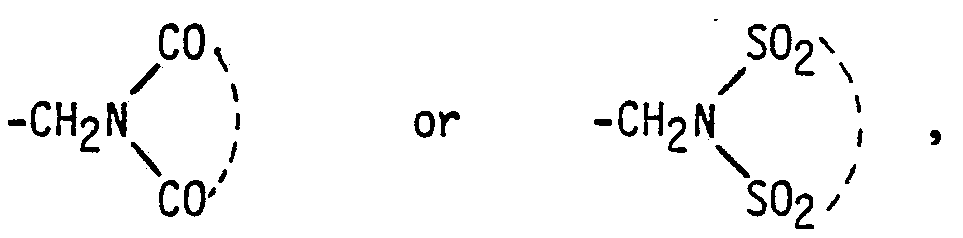 2 in which the carbonyl or sulphonyl groups are bound to two carbon atoms of an aromatic ring which are in ortho position to each other; Θ a group of the formula
 in which the
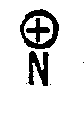 ion is part of a
5- or 6-membered ring containing one to three hetero atoms which is further unsubstituted or substituted by one or two methyl groups or by NH2, -NHC1-4alkyl or N(C1-4alkyl)2; or a group of the formula
 in which R13 is hydrogen or C1-4alkyl which is unsubstituted or monosubstituted by OH, halogen, CN, C1-4alkoxy or phenyl, U1 is S, -NH or -NC1-4alkyl, and
V1 is a group necessary to form a 5- or 6-membered ring to which ring a further 5- or 6-membered carbocyclic or heterocyclic ring containing one or two hetero atoms may be condensated,
or
both R3 and R4 together form a C3- or C4-chain which may be part of a further 5- or 6-membered ring by two vicinal chain members,
each of R9 and R10 is independently hydrogen, C1-4alkyl which is unsubstituted or monosubstituted by OH, halogen, CN, C1-4- alkoxy or phenyl; or -COR12E,
R11 i s OH, NH2 , -NHC1-4alkyl , -N(C1-4al kyl )2 , C1 -4alkyl , C1-4- alkoxy, phenyl or phenoxy which phenyl group of the latter two groups is unsubstituted or substituted by one to three groups selected from C1-4alkyl, C1-4alkoxy, halogen, COOM and SO3M, R12 is C1-6alkylene,
E is hydrogen, halogen, a protonable amine group, a quaternary ammonium group or a hydrazinium group; SO3M or -OSO3M;
R5 is hydrogen, CN, NO2, -NR14R15, a saturated or unsaturated 5or 6-membered heterocyclic ring containing one or two hetero atoms which is bound by a carbon or nitrogen atom and which is further unsubstituted or substituted by up to three methyl
groups or by NH2, -NHC1-4alkyl or -N(C1-4alkyl)2; C1-6alkyl, C2-4alkenyl, C2-4alkinyl; C1-6alkyl monosubstituted by OH, CN, C1-4alkoxy, acetamido, -COR16, SO3M or -OSO3M; C5-6cydoalkyl, phenyl or phenyl -C1-4alkyl which phenyl group of the latter two groups is unsubstituted or substituted by one to three groups selected from C1-4alkyl, C1-4alkoxy, halogen, NO2, NH2, COOM and SO3M; C1-6alkylene-E1, -C1-6alkylene- or a group of the formula

^

each of R14 and R15 is independently hydrogen, C1-4alkyl, C1-4alky! monosubstituted by OH, halogen, CN or C1-4alkoxy; phenyl or phenyl substituted by one or two groups selected from halogen, C1-4alkyl and C1-4alkoxy, R16 is OH or C1-4alkoxy, R17 is hydrogen or C1-4alkyl,
E1 is a protonable amine group, a quaternary ammonium group or a
hydrazinium group or a group of the formula -
 R18 is E2, -NHCOR12E2, -SO2NHR12E2 or -CONHR12E2; each R19 is independently halogen, NH2 or an aliphatic amine group,
E2 is a protonable amine group, a quaternary ammonium group or a hydrazinium group,
X is 0 or NH,
Z is OH, NH2, methyl or ethyl, Y is 0, S or N-Y1,
Y1 is hydrogen, CN, CONH2, C1-4alkyl, C1-4alkyl monosubstituted by OH, CN, halogen or C1-4alkoxy; phenyl or phenyl -C1-4alkyl which phenyl group of the latter two groups is unsubstituted or substituted by one or two groups selected from halogen,
C1-4alkyl , C1 -4alkoxy, acetamido, COOM and SO3M; 1- or 2-naphthyl ; C1-6alkylene-SO3M, C1-6alkyl ene-OSO3M or C1-6alkyl ene-COOM, each of R20 and R21 i s independently hydrogen, C1-4alkyl , phenyl or phenyl -C1 -4alkyl which phenyl group of the l atter two groups is unsubstituted or substituted by one or two groups selected from halogen, C1-4alkyl, C1-4alkoxy, COOM and SO3M; or, provided that Y is N-Y1 where Y1 is hydrogen, one of R20 and R21 may also have a significance additionally given for γ1;
with the provisos that
(i) in a compound of formula I at least one sulphonic acid group is present; (ii) when in a compound of formula I (1) K is a group (b), in which Y is 0 or S,
(2) R2 is other than COOM,
(3) one of Q1 and Q2 or both Q1 and Q2 are SO3M1, and (1) to (3) occur simultaneously, then at least one of M1 is a quaternary ammonium cation; (iii) when in a compound of formula I containing as K a group (b)
(1) the diazo component radical is defined as follows: R1 is hydrogen, R2 is methyl, Q1 is SO3M1 in the 7-position, n is 0 and Q2 is hydrogen,
(2) X is 0 or NH, (3) each of R20 and R21 is hydrogen,
(4) Y is N-Y1 in which Y1 is hydrogen, and (1) to (4) occur simultaneously, then M1 has a significance other than hydrogen or sodium;
which compound of formula I is in free acid or salt form with the proviso that each sulphonic acid group as well as each protonable amine group can be present in ionized form.
In the specification any halogen means fluorine, chlorine or bromine, especially chlorine.
Generally, any alkyl or alkylene is linear or branched unless indicated to the contrary.
In any hydroxysubstituted alkyl group which is linked to a nitrogen atom, the hydroxy group is bound to a carbon atom other than to the C1-atom.
Q1 is preferably SO3M1 which is more preferably bound to the 7-position. n is preferably 0.
Each R1 is preferably R1a, where each R1a is independently hydrogen, C1-4alkyl, methoxy or ethoxy. More preferably it is R1b, where each R1b is independently hydrogen, methyl, ethyl, methoxy or ethoxy. Even more preferably it is R1c, where each R1c is independently hydrogen or methyl. Most preferably R1 is hydrogen. R2 is preferably R2a, where R2a is C1-4alkyl, C1-4alkoxy or COOM. More preferably it is R2b, where R2b is methyl, methoxy, ethoxy or COOM. Most preferably R2 is methyl.
Q2 when defined as SO3M1 is preferably bound to a carbon atom which is in ortho- position to the azo group.
Any alkyl or alkoxy as R3 preferably contains 1 or 2 carbon atoms and is most preferably methyl or methoxy. Any substituted alkyl is preferably a C2-3alkyl group monosubstituted by hydroxy or C1-2alkoxy. Any cycloalkyl is preferably cyclohexyl.
Preferably, in any substituted phenyl or phenyl alkyl group the phenyl group contains one or two groups selected from methyl, methoxy, chlorine, COOM and SO3M.
Any heterocyclic ring as R3 is preferably morpholine, pyrrolidine, piperidine, piperazine or N-methylpiperazine (when saturated) which is bound by a carbon or nitrogen atom, or is pyridine, triazine, pyridazine, pyrimidine or pyrazine (when unsaturated) which is bound by a carbon or nitrogen atom where in the latter
case (when bound by a nitrogen atom) a methylene bridge is present.
R6 is preferably R6a, where R6a is OH, NH2, methoxy or ethoxy. More preferably it is R6b, where R6b is OH or NH2. R7 is preferably R7a, where R7a is CN, chlorine, SO3M, -OSO3M,- or -COR8a, where R8a is OH, NH2, methyl, ethyl,
 methoxy or ethoxy; more preferably it is R7D, where R7D is SO3M,
-OSO3M, or -COR8b, where R8b, is OH or NH2.

R3 is preferably R3a, where R3a is hydrogen, CN, NH2, OH, methyl, ethyl, hydroxyethyl, C1-2alkoxyethyl, methoxy, ethoxy, cyclohexyl; phenyl or phenyl -C1-2alkyl in which the phenyl group is unsubstituted or substituted by one or two groups selected from
methyl, methoxy, chlorine, COOM and SO3M; - , -COR6a or
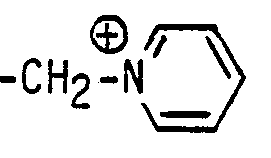
-(CH2)1-2R7a. More preferably R3 is R3b, where R3b is NH2, methyl, ethyl, hydroxyethyl, cyclohexyl, phenyl, phenyl -C1-2alkyl, -COR6b or -CH2R7b. Even more preferably R3 is R3C, where R3C is NH2, methyl, hydroxyethyl, phenyl ethyl or -CH2SO3M. Most preferably R3 is methyl.
Any protonable amine or quaternary ammonium group as E, E1 or E2 is preferably a group B, where B is a primary amine group, a secondary or tertiary aliphatic, cycloaliphatic, aromatic or saturated, unsaturated or partially unsaturated heterocyclic aminegroup which latter group is attached by the N-atom or a carbon atom; or a quaternary ammonium group corresponding to the above. Any aliphatic amine group as B is preferably a mono-C1-4alkyl- or a di-(C1-4alkyl)-amine group. The alkyl group may be monosubstituted by halogen, hydroxy, cyano, C1-4al koxy or phenyl. Any cycloaliphatic amine group is preferably C5-6cycloalkylamino, the cycloalkyl group of which is unsubstituted or may be substituted by one or two C1-2alkyl groups.
Any aromatic amine group is preferably phenyl amino, the phenyl ring of which is unsubstituted or substituted by one or two
groups selected from halogen, C1-4alkyl, C1-4alkoxy, SO3M and COOM.
Any heterocyclic amine group as B which is attached by the N-atom or a carbon atom is preferably a saturated, unsaturated or partially unsaturated 5- or 6-membered ring which contains one or two hetero atoms and may be further substituted by one or two C1-4alkyl groups.
More preferably B is B1, where B1 is a protonable amine
 group -NR22R23 or a quaternary ammonium group -NR24R25R26 , or B1 forms a protonable or quaternary 5- or 6-membered saturated heterocyclic ring of the formula


in which
U2 is the direct bond, -CH2-, -O-, -S-, -SO2-, -SO-, -NH-, -N(C1-4alkyl)- or -
 (C1-4alkyl)2-, each of R24 and R25 has independently one of the cyclic or noncyclic significances of R22 and R23 except hydrogen, and R26 is C1-4alkyl or phenyl -C1-4alkyl, or R24, R25 and R26, together with the N-atom to which they are attached, form a pyridinium group unsubstituted or substituted by one or two methyl groups, or a ring of the formula
 in which R26 and U2 are as defined above,
R27 is hydrogen or C1-4alkyl and each of R28, independently, is C1-4alkyl. Even more preferably B is B2, where B2 is a group -NR22aR23a or
"
 NR24aR25aR26a, each of R22a and R23a, independently, is hydrogen, C1-2alkyl, unbranched hydroxy-C2-3alkyl or benzyl or both R22a and R23a, together with the N-atom to which they are attached, form a pyrrolidine, piperidine, morpholine, piperazine or
N-methylpiperazine group, each of R24a and R25a has independently one of the non-cyclic or cyclic significances of R22a and R23a except hydrogen, and R26a is methyl, ethyl or benzyl, or R24a, R25a and R26a, together with the N-atom to which they are attached, form a pyridinium group unsubstituted or substituted by one or two methyl groups.
Most preferably B is B3, where B3 is a group -NR22bR23b or
-NR24bR25bR26b, each of R22b and R23b is hydrogen, methyl or ethyl or both R22b and R23b, together with the N-atom to which they are attached, form a piperidine, morpholine, piperazine or N-methylpiperazine ring; each of R24b and R25b is methyl or ethyl or both R24b and R25b, together with the N-atom to which they are attached, has one of the cyclic significances of R22b and R23b,
R26b is methyl or ethyl or
R24b, R25b and R26b, together with the N-atom to which they are attached, form a pyridinium group unsubstituted or substituted by one or two methyl groups.
E ist preferably Ea, where Ea is hydrogen, chlorine, a group B2 or SO3M; more preferably it is Eb, where Eb is hydrogen, chlorine, a group B3 or SO3M.
Each of R9 and R10 is preferably R9a and R10a, where each of R9a and R10a is independently hydrogen, C1-2alkyl, C1-2alkyl monosubstituted by OH, C1-2alkoxy or phenyl, or -COR12aEa, in which R12a is C1-2alkylene. More preferably each of R9 and R10 is R9b and R10b, where each of R9b and R10b is independently hydrogen, methyl or -COR12aEb, R11 is preferably R11a, where R11a is OH, NH2, -NHCH3,
-N(CH3)2, methyl, ethyl, methoxy or ethoxy. More preferably it is R11b, where R11b is NH2, methyl, ethyl, methoxy or ethoxy.
R4 is preferably R4a, where R4a is hydrogen, CN, chlorine, bromine, SO3M, -NR9aR10a, C1-2alkyl, C1-2alkyl monosubstituted bv OH, phenyl, SO3M or -OSO3M; -COR11a, -CH2NHCOR12aB2 or a group -
 forming a pyridine, pyrimidine or benzimidazole ring which is further unsubstituted or monosubstituted by methyl, NH2, -NHCH3 or -N(CH3)2. More preferably R4 is R4b, where R4b is hydrogen, CN, -NHR10b, -COR11b, -CH2NHCOCH2B3 or a group of the formulae
V 0 . Even more preferably R4 is R4C,
 where R4C is hydrogen, CN, -NHCOCH2Eb, -CONH2,
 Most preferably R4 is R4d, where R4d is hydrogen or CN.
It is also preferred that R3 and R4 together with the carbon atoms to which they are attached form part of a further ring which corresponds to the formula
V for example they form a ring of the formula


R16 is preferably R16a, where R16a is OH, methoxy or ethoxy.
R17 is preferably R17a, where R17a is hydrogen or methyl. Any aliphatic amine group as R19 is preferably a mono-C1-4- alkyl- or di-(C1-4alkyl)-amine group, in which the alkyl groups may be monosubstituted by halogen, OH, CN, C1-4alkoxy or phenyl.
Each R19 is preferably R19a, where each R19a is independently fluorine, chlorine, NH2, -NHC1-2alkyl or -N(C1-2alkyl)2, in which the alkyl groups are unsubstituted or monosubstituted by OH, CN or C1-2alkoxy. More preferably each R19 is R19b, where each R19b is independently chlorine, NH2, -NHCH3, -N(CH3)2, -NHCH2CH2OH or -N(CH2CH2OH)2.
E1 is preferably E1a, where E1a is a group B2 or a group of
the formula
 19a more preferably it is E1b, where E1b is a group B3 or a group of
the formula

E2 is preferably E2a, where E2a is a group B2. More preferably it is E2b, where E2b is a group B3. R18 is preferably R18a, where R18a is E2a, -NHCOR12aE2a,
-SO2NHR12aE2a or -CONHR12aE2a; more preferably it is R18b, where R18b is E2b, -NHCOR12aE2b or -CONHR12aE2b.
R5 is preferably R5a, where R5a is hydrogen, -NR14aR15a, phenyl, phenyl -C1-2 alkyl, cyclohexyl; C1-4alkyl, C1-4alkyl monosubstituted by OH, CN, C1-2alkoxy, -COR16a, SO3M or -OSO3M; -C1-3alkylene-E1a, -C1-3alkylene-

More preferably R5 is R5b, where R5b is hydrogen, -NHR15a, phenyl, phenyl-C1-2alkyl, methyl, ethyl, Chalkyl monosubstituted by SO3M
or -COR16 a, -(CH2 )1-3-E1b, -(CH2)1-3-NHCO-

Most preferably R5 is hydrogen.
X is preferably 0.
Z is preferably Za, where Za is OH or NH2.
Preferably, the phenyl group of any phenyl or phenyl alkyl as Yl (when substituted) is substituted by one or two groups selected from chlorine, methyl, methoxy, COOM and SO3M.
Y1 is preferably Y1a, where Y1a is hydrogen, CN, CONH2, methyl, ethyl, C2-4alkyl monosubstituted by OH, CN, chlorine or C1-2alkoxy; phenyl or phenyl -C1 -2alkyl, the phenyl group of the latter two groups is unsubstituted or substituted by one or two groups selected from chlorine, methyl, methoxy, COOM and SO3M; C2-4alkylene-SO3M, C2-4alkylene-OSO3M or C2-4alkylene-COOM. More preferably it is Y1b, where Y1b is hydrogen, CN, CONH2, methyl, ethyl, 2-hydroxyethyl, phenyl, phenyl -C1-2alkyl, C2-4alkylene-SO3M or C2-4alkylene-COOM. Even more preferably it is Y1c, where Y1c is hydrogen, CN or CONH2. Most preferably it is Y1d where Y1d is hydrogen or CN, of which hydrogen is most preferred.
Y is preferably Ya, where Ya is 0 or N-Y1a; more preferably it is Yb, where Yb is O or N-Y1b; even more preferably it is Yc, where Yc is 0 or N-Y1c; most preferably it is Yd, where Yd is 0 or N-Y1d.
Each of R20 and R21 is preferably R20a and R21a, where each of R20a and R21a is independently hydrogen, methyl, ethyl, phenyl-C1-2alkyl or phenyl, the phenyl groups of which are unsubstituted or substituted by one or two groups selected from chlorine, methyl, methoxy, COOM and SO3M, or in case where Y is N-Y1 in which Y1 is hydrogen, one of R20a and R21a has also a significance additionally given for Y1a. More preferably each of R20 and R21 is R20b and R21b, where each of R20b and R21b is
independently hydrogen, methyl, ethyl, phenyl or benzyl or in case where Y is N-Y1 in which Y1 is hydrogen, one of R20b and R21b has a significance additionally given for Y1b. Most preferably R20 and R21 are hydrogen.
The group (a) is preferably (a1) of the formula

A compound of formula I according to the invention is in free acid form, in alkali metal or unsubstituted or substituted ammonium salt form or in mixed salt form, or may form an internal salt. Any substituted ammonium cation present as M or M1 may be derived from a primary, secondary or tertiary amine. For example, the following amines are suitable:- mono-, di- or trimethyl-, -ethyl-, -propyl- or -butyl-amine; mono-, di- or triethanol-, -propanol- or isopropanol-amine; N-methyl-N-hydroxyethyl amine, N-methyl-N,N-di(hydroxyethyl)amine, N-ethyl-N-hydroxyethoxyethyl amine, morpholine, piperidine, piperazine, hydroxyethylmorpholine, hydroxyethylpiperazine, aminoethylpiperazine; ethylenediamine, hexamethylenediamine; dimethylaminopropyl amine, diethylaminopropylamine, diethylene glycol amine, diglycol amine and 3-methoxypropylamine.
Also suitable as amines are polyglycol amines. They can be prepared for example by reacting ammonia, alkyl- or hydroxyalkylamine with alkylene oxides.
Any substituted ammonium ion may also be a quaternary ammonium ion (especially when M1) derived from ammonium compounds which preferably contain one or two quaternary ammonium ions. Examples are tetramethyl-, tetraethyl-, trimethylethyl-, benzyldiethylmethyl-, trimethylphenyl-, trimethyl benzyl-, triethylcyclohexyl-, trimethylhydroxyethyl- and tetrahydroxyethyl - ammoniumhydroxide as well as N,N-dimethylpiperidinium hydroxide, or compounds corresponding to the formula
%
 in which each R30 is independently methyl, ethyl, hydroxyethyl or 2- or 3-hydroxypropyl and A is C1-4alkylene or -CH2CH2N(CH3)CH2CH2-.
Preferred compounds correspond to formula Ia
Ia
 lb in which R1b, R2b, Q2, M1 and K1 are as defined above with the provisos that (ii) when in a compound of formula I a
(1) K1 is a group (b1), in which Ya is 0,
(2) R2b is other than COOM,
(3) Q2 is hydrogen or SO3M1, and (1) to (3) occur simultaneously, then at least one of M1 is a quaternary ammonium cation as defined above;
(iii) when in a compound of formula Ia in which K1 is a group (b1)
(1) the diazo component radical is defined as follows: R1b is hydrogen, R2b is methyl and Q2 is hydrogen,
(2) each of R20a and R21a is hydrogen,
(3) Ya is N-Y1a, in which Y1a is hydrogen, and (1) to (3) occur simultaneously, then M1 has a significance other than hydrogen or sodium.
Even more preferred are compounds of formula Ia, in which
1) K1 is K2;
2) K1 is K3; 3) R1b is R1c;
4) R1b is hydrogen;
5) R2b is methyl;
6) those of 2) to 5), in which K1 is K4.
The compounds of formula I can be prepared in accordance with known methods reacting the diazonium salt of an amine of formula II,
II
 in which R1, R2, Q1, Q2 and n are as defined above, or a mixture thereof with a compound which in one of the possible tautomeric forms corresponds to formula IlIa or IlIb,

The starting compounds of formula II, diazo components of the 2-phenyl-benzthiazole series, are either known or may be prepared analogously to known processes, for example according to M. Schubert, Anna! en 558, 10 (1947).
Diazo components of formula II for example are as follows:- 2-(4'-aminophenyl)-6-methylbenzthiazole-7-sulphonic acid 2-(4'-aminophenyl)-6-methylbenzthiazole-5-sulphonic acid 2-(4'-aminophenyl)-6-methylbenzthiazole-3',7-disulphonic acid 2-(4'-aminophenyl)-6-carboxybenzthiazole-7-sulphonic acid 2-(4'-amino-3'-methyl-5'-sulphophenyl)-4,6-dimethyl-benzthiazole -7-sulphonic acid
2-(4'-amino-3'-methylphenyl)-4,6-dimethyl-benzthiazole-7-sulphonic acid
2-(4'-aminophenyl)-6-methylbenzthiazole primuline base.
The coupling components, compounds of formula IlIa, are either known or may be prepared in accordance with known methods. Such preparation processes for example are described in: The Chemistry of Heterocyclic Compounds, Pyridine and its Derivatives, Parts I-IV; Interscience Publishers Inc. 1960-1964; furthermore in: Berichte der Oeutschen Chemischen Gesellschaft 29, (1896), page 655; and in patent references, such as DE-OS 1964690;
20 22 817; 21 18945; 21 23061; 21 41 449; 21 50 598; 21 50 772;
21 50 817; 21 62 612; 23 49 709; 2705 562; etc.
Compounds of formula Illax,
Illax
 in which R5x i s C1-6alkyl ene-E1 or the group
 \ may be prepared for exampl e by reacti ng a compound of formul a Ill ay,
IIIay
 in which W is C1-6alkylene or a group J
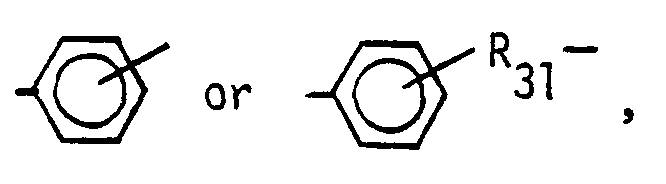 wherein R31 is -NHCOR12, -SO2NHR12- or -CONHR12, and XO is a functional group, preferably a group which can be split off as an anion, with the amino compound E1-H.
The coupling components, compounds of formula IIlb, are either known or may be prepared in accordance with known methods from known starting compounds. Such preparation processes for example are described in: The Chemistry of Heterocyclic Compounds. The Pyrimidines, Interscience Publishers 1962; furthermore in numerous patent references such as, US-PS 2,673,204 or DE-PS 134,984; 158,591; 165,692; 186,456, etc.
Diazotisation and coupling reactions may be effected in accordance with known methods. For diazotisation, the amines or amine mixtures are advantageously dissolved in an aqueous alkali or made into a paste therein, and mixed with a 5-10% molar excess sodium nitrite. Diazotisation conveniently is carried out in a medium containing a mineral acid, preferably hydrochloric acid, at 0-20°C. Coupling conveniently is carried out at pH 3-10, preferably 4-8. Optionally, a quaternary ammonium compound is added using at least an equimolar amount which is sufficient to neutrause one sulphonic acid group.
The resultant compound of formula I may be used in form of the solution as obtained; however, this solution may also be converted into a solid by spray-drying. Furthermore, the conventional method of isolation used for dyestuffs, salting out of the solution, filtering off and drying, is also suitable.
The type of cations present in a compound of formula I may be influenced in different ways depending on the preparation process. One possibility consists in filtering off the diazonium salt which is obtained in the above process, and washing it with water. The solid diazonium compound is then added to an aqueous slurry or solution of the coupling component, which contains a basic salt, lithium-, sodium-, potassium-, ammonium-hydroxide, one or more organic amines or a quaternary ammonium compound. Another method consists in converting the compound of formula I, which is obtained by diazotisation and coupling and is isolated in the sodium salt form, into the free acid by using a mineral acid, preferably hydrochloric acid, then filtering and washing with water; the compound is subsequently neutralised and thus converted into the desired alkali salt or ammonium salt. Any type of mixed salt form may be obtained by effecting partial conversion into the free acid and/or by step-wise neutralisation. The salt-changing method, conversion of one salt form into another, can also be used.
If diazotisation takes place using alkyl nitrites, dinitrogen trioxide or mixtures of nitric oxide and oxygen instead of alkali nitrite, it is possible to produce solutions of the end products which are free from metal ions. If desired, corresponding salts may be obtained by adding a base which yields cations or by adding an amine.
The compounds according to the invention in form of their water-soluble salts are useful for dyeing or printing hydroxy group or nitrogen containing organic substrates. For example, they are suitable for dyeing or printing fibres, threads or textiles produced therefrom, which consist of or contain cellulose materials, such as cotton, in accordance with known methods; cotton is preferably dyed by the exhaust method, for example from a long or short liquor, at room temperature to boiling temperatures. Printing is effected by means of impregnation with a printing paste which is prepared by known methods.
The compounds of formula I are especially suited for dyeing or printing paper in accordance with known methods, e.g. for the preparation of sized or unsized paper dyed in the stock. They may also be used for dyeing paper by the dipping process. Furthermore, the new dyestuffs can be used for dyeing or printing leather, preferably chrometanned types of leather, in accordance with known methods. The dyeings and prints obtained (especi al ly those on paper) have good fastness to usage. The compounds of formula I may be used as such or may also be used in the form of dyeing preparations, which are preferably used for dyeing paper. Suitable liquid, preferably aqueous, concentrated dyeing preparations may be made in accordance with known methods, advantageously by dissolving in suitable solvents, optionally adding an adjuvant, e.g. a hydrotropic compound or a stabiliser. The possibility of producing such stable, aqueous-concentrated preparations in the course of dyestuff synthesis without intermediate isolation of the dyestuff is particularly advantageous. In this process, coupling takes place for example in the presence of appropriate amines and in particular in the presence of quaternary ammonium hydroxides which serve to introduce corres
ponding cations as defined above, and optionally in the presence of further hydrotropic adjuvants.
Suitable hydrotropic adjuvants are for example low molecular weight amides, lactones, alcohols, glycols or polyols, low molecular weight ethers or hydroxyalkyl ation products, as well as nitriles or esters; among these the following compounds are preferably used:- Methanol, ethanol, propanol; ethyl ene-, propylene-, diethylene-, thiodiethylene- and dipropylene-glycol; butanediol; β-hydroxypropionitrile, pentamethylene glycol, ethylene gycol monoethyl- and -propylether, ethylene diglycol monoethyl ether, triethyl ene glycol monobutylether, butyl polyglycol, formamide, dimethylformamide, pyrrol idone, N-methylpyrrolidone, glycol acetate, butyrolactone, urea and ε-caprolactam.
Hydrotropic compounds are described e.g. by H. Rath and S. Mϋller, in Melliand Textilberichte 40, 707 (1959) or by E.H. Daruwalla in K. Venkataraman, The Chemistry of Synthetic Dyes, Vol. VIII, pages 86-92 (1974).
The additional content of a hydrotropic compound further improves the stability on storage of the dyestuff preparation, and the solubility of the dyestuff employed.
An example of a suitable liquid dye preparation is (all parts are by weight):-
100 parts of a compound of formula I in water-soluble salt form
1-100, preferably 1-10 parts of an inorganic salt, 100-800 parts of water,
0-500 parts of one of the hydrotropic compounds as defined above. Depending on the salt form used, the liquid dye preparation may be a suspension or is preferably a true solution. The preparations are stable and can be stored for a long period of time. Similarly, the compounds of formula I may be made into solid, preferably granulated dyeing preparations in accordance with known methods, advantageously by granulating as described in French Patent Specification No. 1.581.900.
A suitable granulate preparation comprises (all parts are by weight):-
100 parts of a compound of formula I in water-soluble salt form, 1-100, preferably 1-10 parts of an inorganic salt,
0-800 parts of a standardising agent (preferably non-ionic, such as starch, dextrin, sugar, glucose and urea).
The solid preparation may contain up to 10% residual moisture.
Depending on the cation mixture present, the dyestuffs of formula I possess good solubility properties, particularly good solubility in cold water. Furthermore, when used in paper-making, they colour the waste water only to a slight extent or not at all. They do not mottle on paper and are substantially insensitive to filling material and pH over wide ranges. They are only slightly inclined to give two-sided dyeing on paper. The dyeings on paper have good light fastness properties, after a long-term exposure to light, the shade alters tone-in-tone. The dyed papers also have \/ery good wet fastness properties, they are fast not only to water, but also to milk, fruit juices, sweetened mineral water and tonic water, and in addition they show good alcohol fastness properties.
The dyestuffs have good substantivity, i.e. they exhaust practically quantitatively, and show good build-up; they can be added to the paper pulp directly, i.e. without previously dissolving, as a dry powder or granulate, without reducing the brilliance or the yield of colour. It is advantageous to use the genuine solutions of the dyestuffs as given above, which are stable, of low viscosity and thus capable of being accurately measured out. Fibre materials which contain mechanical wood pulp are dyed in good, even quality with the dyestuffs of the present invention. The dyed paper is both oxidatively and reductively bleachable, which is important for the recycling of waste paper.
The following examples further serve to illustrate the invention. In the examples, all parts are by weight or volume, and the percentages are by weight; the temperatures are given in degrees centigrade.
Example 1
6.4 Parts of 2-(4'-aminophenyl)-6-methylbenzthiazole-7-sulphonic acid are stirred into 100 parts of water, and dissolved by adding 5.1 parts of 30% sodium hydroxide solution. 6 Parts of 4N sodium nitrite solution are added, and the solution is poured whilst stirring into a preparation of 200 parts of ice and 7 parts of 30% hydrochloric acid. A yellow diazo suspension is obtained. After stirring for three hours, whereby the temperature may increase to 20º, any excess nitrous acid is decomposed by adding a small amount of sulphamic acid. Then, 3.3 parts of 4-methyl-6hydroxypyridone-(2) are added to the diazo suspension, and 10 parts of sodium carbonate are subsequently sprinkled in. Coupling commences immediately, whereby an orange suspension is obtained. After about one hour coupling is complete. 10 parts of 30% sodium hydroxide solution are added, and the dyestuff thus formed goes totally into solution. By sprinkling in 20% by volume of sodium chloride, the dyestuff can be completely salted out. After drying, the dyestuff corresponding to the formula

(A)
 in which the symbols are defined in Table 1 below. In the last column of this Table 1 and also of the following Tables 2 and 3 the shade of the obtained paper dyeings is given whereby a is neutral-yeIIow b is reddish-yellow and c is orange.
The paper dyeings made with the dyestuffs in Tables 1 to 3 in conventional manner have good light and wet fastness properties.


Example 57
12 Parts of 2-(4'amino-3'-sulphophenyl)-6-methylbenzthiazole-7-sulphonic acid are dissolved in 200 parts of water. 100 Parts of ice are added, followed by 7.5 parts of 30% hydrochloric acid. Subsequently, at 0° 8 parts of 4N sodium nitrite solution are added dropwise. A yellow diazo solution is obtained which is stirred for two hours. 8 Parts of 6-hydroxy-4-methylpyridonyl-(3)-pyridinium chloride are then added. The pH is adjusted to 8 by adding 20 parts of sodium carbonate. Coupling commences immediately, and an orange suspension is formed. This suspension is stirred for four hours, afterwards the precipitated dyestuff is filtered off. After drying, a readily soluble dyestuff powder is obtained containing the dyestuff which, in the possible tautomeric forms, corresponds to one of the given formulae:

Examples 58-71 By a method analogous to that of Example 57 further compounds may be prepared using appropriate starting compounds. They correspond to formula (B),
(B)
 in which the symbols are defined in Table 2 below.


Example 72
7 Parts of 2-(4'-aminophenyl)-6-carboxybenzthiazole-7-sulphonic acid are stirred into 40 parts of water and dissolved with 4 parts of 30% sodium hydroxide solution. 5.5 Parts of 4N sodium nitrite solution are added, and this mixture is poured into a preparation consisting of 100 parts of ice and 10 parts of 30% hydrochloric acid whilst stirring. A light yellow diazo suspension is formed. After stirring for one hour, the excess nitrous acid is decomposed by adding sulphamic acid. 4 Parts of 4-amino-3-cyano-6-hydroxypyridone-(2) are added, and then 10 parts of sodium carbonate are sprinkled in. Coupling commences, and a brownish-orange suspension is obtained. After two hours coupling is complete. Subsequently, 20 parts of 30% sodium hydroxide solution are added dropwise, and the mixture is heated to 70º; the resultant dyestuff thus goes into solution. It is salted out by sprinkling in 40 parts of sodium chloride, filtered off and dried. An orange-red powder is obtained which contains the dyestuff having the formula

Examples 73-89 By a method analogous to that described in Example 72 further compounds can be prepared from appropriate starting compounds. They correspond to formula (C),
(C)
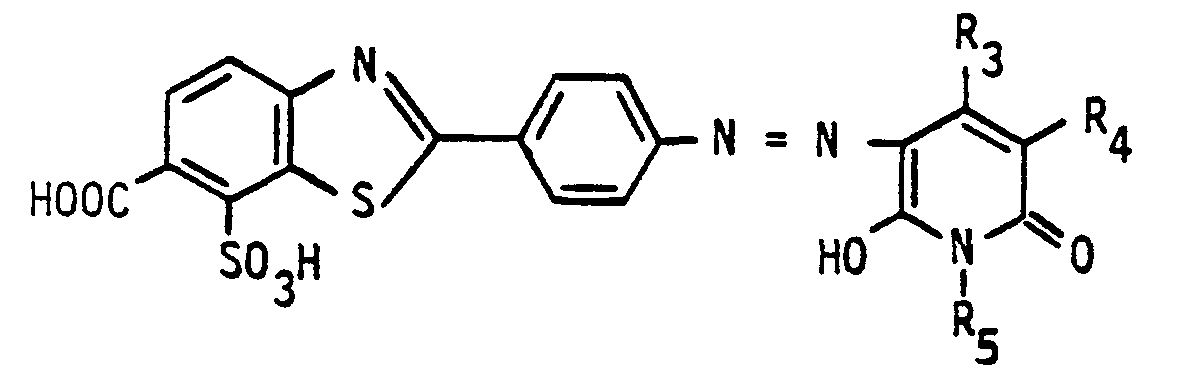 in which the symbols are defined in Table 3 below.


In accordance with the reaction and isolation conditions as described the compounds of Examples 1 to 89 are obtained in the sodium salt form provided that no internal salt is formed. They may, depending on the reaction and isolation conditions, or by reacting the sodium salts in accordance with known methods also be obtained in free acid form or in other salt forms containing one or more cations indicated in the description.
Example 90 6.4 Parts 2-(4'-aminophenyl)-6-methylbenzthiazole-7-sulphonic acid are diazotised in accordance with the method described in Example 1. The mixture is stirred for three hours and then filtered. The well-pressed filter cake is made into a paste in ice water; this paste is adjusted to 40 parts with ice water. 3.3 Parts of 4-methyl-6-hydroxypyridone-(2) are added followed by 8 parts of triethanol amine. Coupling commences whereby an orange-red mixture is obtained. During coupling, a further 30 parts of ice are added portionwise. After one hour 8 parts of urea are added,
then the mixture is heated to 50° whereby a solution is obtained. This solution is ready for use, it contains the dyestuff of Example 1 in the triethanol ammonium salt form.
Example 91 The dyestuff prepared according to the method given in
Example 1 is stirred into 200 parts of water prior to drying, and is mixed with 20 parts of 30% hydrochloric acid. After having stirred for a longer time, the dyestuff in the free acid form is filtered off and is added into a mixture consisting of 8 parts of diglycol amine and 5 parts ethylene glycol. The dyestuff dissolves whilst releasing heat. This solution is adjusted to 90 parts by adding water to give a dyestuff solution which is storage-stable and ready for use.
Example 92 If in Example 91 2 parts of monoethanol amine and 15 parts of urea are used instead of a mixture of diglycol amine and ethylene glycol a liquid dyestuff preparation is obtained which is stable on storage and has good dyeing properties.
Also suitable amines instead of monoethanol amine are diethanolamine, monoisopropanol amine or diisopropanol amine.
Example 93
If in Example 905 parts of tetramethyl ammonium hydroxide are used instead of triethanol amine a liquid dyestuff preparation is obtained which is ready for use. By employing tetramethylammonium hydroxide there is no need for adding a further solubilising agent.
Instead of tetramethyl ammonium hydroxide equimolar amounts of the following quaternary ammonium hydroxides may be used to produce liquid storage-stable preparations of the dyestuff of Example 1.

Example 94
If lithium hydroxide solution is used instead of the amine or amine mixture employed in one of Examples 90 to 93, a liquid aqueous dye preparation is obtained which contains the dyestuff according to Example 1 in the lithium salt form.
By a method analogous to that described in one of Examples 90 to 94 the dyestuffs of Examples 2 to 89 may also be converted into liquid aqueous dyeing preparations showing high stability on storage.
Example 95
A mixture consisting of 9.5 parts of primulin base, 1.4 parts of potassium hydroxide, 40 parts of water and 4.3 parts 5N sodium nitrite solution is added to a mixture of 5 parts of hydrochloric acid and 20 parts of ice whilst stirring. Stirring is effected for a further two hours at 20°. The diazonium salt which precipitates is filtered off and washed with water. The diazonium salt together with 3 parts of 4-methyl-6-hydroxypyridone-(2) is suspended in a small quantity of water. To this suspension a 10% lithium hydroxide solution is added to adjust the pH at 8. After stirring for one hour, 20 parts of urea are added. The solution thus obtained is ready for use, it contains the dyestuff of the formula
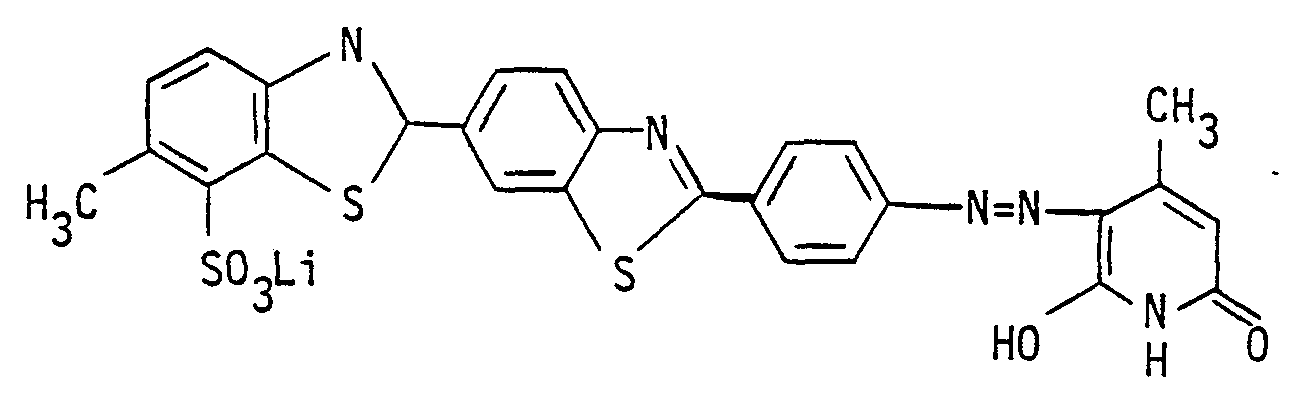
Example 96
6.4 Parts of 2-(4'-aminophenyl)-6-methylbenzthiazole-7-sulphonic acid are stirred into 100 parts of water; and dissolved by adding 5.1 parts of 30% sodium hydroxide solution. To this solution 6 parts of 4N sodium nitrite solution are added, and the resultant mixture is poured into a preparation consisting of 200 parts of ice and 7 parts of 30% hydrochloric acid. A yellow diazo suspension is obtained. After stirring for three hours any excess
nitrous acid is decomposed by the addition of a small quantitiy of sulphamic acid. The precipitation thus formed which contains the diazonium salt of the above mentional amino compound is filtered off and washed with water acid-free. This diazonium salt together with 2.7 parts of 2,4-diamino-6-hydroxypyrimidine is suspended in a small amount of water, then 20 parts of diethylene glycol amine are added. Coupling commences whereby an orange-coloured mass is produced. After coupling is complete, 10 parts of ethylene glycol and 20 parts of urea are added followed by the addition of water to adjust to a volume of 140 parts. The mixture is heated to 40º, and a clear dyestuff solution of low viscosity is formed. This dyeing preparation is ready for use and storage-stable for several months. It contains the dyestuff in the salt form corresponding to the formula

This dyestuff dyes paper a brilliant neutral-yellow shade. The paper dyeings have very good wet fastness properties. The back water of these dyeings is approximately colourless.
Example 97 6.4 Parts of 2-(4'-aminophenyl)-6-methylbenzthiazole-7-sulphonic acid are diazotised according to the method given in Example 96 and coupled with 2,4-diamino-6-hydroxypyrimidine in the presence of sodium carbonate. Then 15 parts of 30% hydrochloric acid are added. Stirring is effected for three hours at 40°. The precipitation is filtered off and washed with water until it is acid-free. The press cake thus obtained is added into a preparation consisting of 30 parts of water and 30 parts of dimethylaminopropyl amine. A clear dyestuff solution is obtained which is
stable on storage for several months. It contains the dyestuff in the probable salt form corresponding to the formula

Example 98
6.4 Parts of 2-(4'-aminophenyl)-6-methylbenzthiazole-7-sulphonic acid are diazotised according to the method described in Example 96 and coupled with 3.3 parts of 2-cyanimino-4-amino-6hydroxypyrimidine in the presence of sodium carbonate. The thus obtained suspension is filtered, and the residue is dried. The dyestuff corresponding to the formula

is obtained in form of a powder. It dyes paper a brilliant reddish-yellow shade. The paper dyeings have notably good wet fastness properties; the back water is colourless.
Example 99
7 Parts of 2-(4'-aminophenyl)-6-carboxybenzthiazole-7-sulphonic acid are diazotised according to the method described in Example 96. To the resultant diazonium salt 2.7 parts of 2,4-diamino-6-hydroxypyrimidine are added, and coupling is effected in the presence of lithium hydroxide. After coupling is complete, the dyestuff which precipitates is filtered off and dried. The dyestuff corresponding to the formula
 is obtained in the lithium salt form. It dyes paper a brilliant neutral-yellow shade. The wet fastness properties of these paper dyeings are notably good; the back water is colourless.
Example 100
If in Example 994.5 parts of 2-cyanimino-4-amino-6-hydroxypyrimidine are employed instead of 2.7 parts of 2,4-diamino-6hydroxypyrimidine the lithium salt of the dyestuff corresponding to the formula
°H H
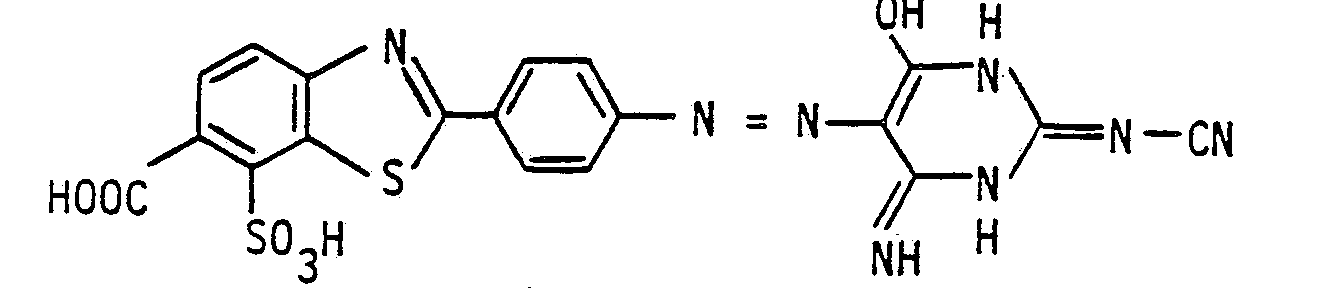
is obtained. It dyes paper a brilliant reddish-yellow shade. The wet fastness properties of these paper dyeings and their properties with respect to back water coloration are very good.
Example 101 8 Parts of 2-(4'-aminophenyl)-6-methylbenzthiazole-3',7-disulphonic acid are dissolved in 100 parts of water whilst stirring and then 7 parts of 30% hydrochloric acid are added. To this solution which is cooled to 5º 6 parts of 4N sodium nitrite solution are added. Any excess nitrous acid in the diazo solution thus obtained is decomposed by the addition of sulphamic acid. Subsequently, 2.7 parts of 2,4-diamino-6-hydroxypyrimidine are added. Coupling commences when by the addition of sodium carbonate the pH
is adjusted to an alkaline range. An orange-coloured suspension is obtained. After coupling is complete, 20 parts of 30% hydrochloric acid are added, and then the strongly acidic suspension is filtered off and washed with water. The obtained press cake is added into a preparation consisting of 200 parts of water and 15 parts of lithium hydroxide. The mixture is heated to 70° whereby a solution is obtained. After cooling down, the dyestuff corresponding to the formula H

cristallizes in form of the lithium salt. It dyes paper a neutral yellow shade. The resultant back water is colourless. These paper dyeings have notably good wet fastness properties.
Example 102
32 Parts 2-(4'-aminophenyl)-6-methylbenzthiazole-7-sulphonic acid are stirred into 300 parts of water followed by the addition of 11 parts of 30% hydrochloric acid. Then 27 parts of 4N sodium nitrite solution are slowly added dropwise, and the temperature is kept at 15-20°. After stirring for two hours, any excess nitrous acid is decomposed by adding a small amount of sulphamic acid. Subsequently, the obtained diazo suspension is added dropwise a preparation consisting of 13 parts of 2,4-diamino-6-hydroxypyrimidine and 125 parts of 24.5% tetramethyl ammonium hydroxide solution. Coupling commences immediately. After coupling is complete, the solution is filtered clear. A storage-stable dyeing preparation is obtained which is ready for use containing the dyestuff which corresponds to the formula
QH

This preparation dyes paper a billiant neutral-yellow shade; the back water is practically colourless. The paper dyeings thus obtained have notably good dyeing properties.
Example 103
If in Example 102 13.2 parts of barbituric acid are employed instead of 13 parts of 2,4-diamino-6-hydroxypyrimidine, a storage-stable dyeing preparation is obtained containing the dyestuff in salt form which corresponds to the formula

and dyes paper a yellow shade. The paper dyeings show high general fastness properties.
If in Example 102 or 103 instead of tetramethyl ammonium hydroxide equimolar amounts of one of the quaternary ammonium hydroxides given for Examples 93a to 93j or 93I to 93x are used, storage-stable dye preparations may be obtained which have good dyeing properties.
Example 104
If in Example 102 instead of the tetramethyl ammonium hydroxide solution 33 parts of the bisquaternary ammonium hydroxide of the formula
CH2CH (OH )CH3 CH2CH(OH ) CH3

H3CNCH2CH2NCH2CH2NCH3 20H
 ®
CH3 CH3 CH3 (prepared by the addition of propylene oxide to the compound of the formula
(CH3)2NCH2CH2N(CH3)CH2CH2N(CH3)2) are used, a yellow storage-stable dye preparation is obtained containing the dyestuff of the formula


The resultant solution is a liquid of low viscosity, it is therefore easily dosable. This dyeing preparation dyes paper a brilliant neutral-yellow shade.
In the following examples the application of the compounds of this invention as well as liquid aqueous dyeing preparations thereof is illustrated.
Application Example A 70 Parts of chemically bleached sulphite cellulose obtained from pinewood and 30 parts of chemically bleached sulphite cellulose obtained from birchwood are ground in a Hollander in 2000 parts of water. 0.2 Parts of the dyestuff of Example 1, 98 or 101 are sprinkled into this pulp or 1.0 parts of the liquid dyestuff preparation according to Example 92, 96 or 102 are added to this pulp. After mixing for 20 minutes, paper is produced from this pulp.
The absorbent paper obtained in this way is dyed a brilliant yellow shade (reddish-yellow shade, respectively). The waste water is practically colourless.
Application Example B 0.5 Parts of the dyestuff of Example 1, 98 or 101 are dissolved in 100 parts of hot water, and cooled to room temperature. This solution is added to 100 parts of chemically bleached sulphite cellulose which have been ground in a Hollander with 2000 parts of water. After thorough mixing for 15 minutes, sizing takes place in the usual way with rosin size and aluminium sulphate.
Paper which is produced from this material is of brilliant yellow shade (reddish-yellow shade, respectively) and has good waste water and wet fastness properties.
Application Example C An absorbent length of unsized paper is drawn at 40-50º through a dyestuff solution having the following composition:
0.5 parts of the dyestuff of Example 1, 98 or 101 or of the liquid dye preparation according to Example 92, 96 or 102 0.5 parts of starch, and 99.0 parts of water.
The excess dyestuff solution is squeezed out through two rollers. The dried length of paper is dyed in a yellow (reddishyellow) shade. The dyestuffs or liquid dyestuff preparations of the remaining examples may also be used for dyeing paper according to Application Examples A to C.
Application Example D (leather)
100 Parts of intermediately dried chrome velours leather are agitated for one hour at 50° in a vessel with a liquor consisting
of 400 parts of water, 2 parts of 25% ammonium hydroxide solution and 0.2 parts of a conventional wetting agent. Then the liquor is run off. To the agitated still wet chrome velours leather 400 parts of water of 60° and 1 part 25% ammonium hydroxide solution are added. After the addition of 5 parts of the dyestuff of Example 1 dissolved in 200 parts of water, dyeing is effected during 90 minutes at 60". Subsequently, 50 parts of 8% formic acid are slowly added to adjust to an acidic pH, and agitating is continued for a further 30 minutes. The leather is then rinsed, dried and prepared in the normal way giving a leather evenly dyed in a yellow tone with good light fastness properties.
Application Example E ( cotton)
To a dyebath consisting of 3000 parts of demineralized water, 2 parts of sodium carbonate and 1 part of the dyestuff of Example 1, 100 parts of pre-wetted cotton fabric are added at 30°. After the addition of 10 parts of sodium sulphate, the dyebath is heated to the boil within 30 minutes whereby, at a temperature of 50º and 70°, at each of these stages a further 10 parts of sodium sulphate are added. Dyeing is continued for a further 15 minutes at the boil followed by the addition of a further 10 parts of sodium sulphate. The dyebath is then cooled down. At 50° the dyed fabric is removed from the dye liquor, rinsed with water and dried at 60". A golden-yellow cotton dyeing is obtained having good light and wet fastness properties.
Application Example F (polyamide)
0.1 Parts of the dyestuff of Example 1 are dissolved in 300 parts of water, and 0.2 parts of ammonium sulphate are added to this solution. Then the pre-wetted textile fabric (5 parts wool gaberdine or 5 parts nylon satin) is entered into the bath which is heated to the boil during the course of 30 minutes. The water that evaporates during the dyeing process for 30 minutes is replaced, and dyeing at the boil is continued for a further 30 minutes. Finally, the dyed fabric is removed from the liquor and
rinsed with water. After drying a clear yellow polyamide dyeing is obtained having good light and wet fastness properties.
In analogous manner as described in Application Examples D to F the dyestuffs of the remaining examples may be used for dyeing. The thus obtained substrates are dyed in a yellow tone and have good fastness properties.
List of maximum absorption wavelenghts (in nanometer) for the exemplified compounds. These values were measured in 1% acetic acid solution with the exception that for the compounds of Examples 96, 97 and 102 demineralised water, and for the compounds of Examples 99-101 0.1% sodium carbonate solution was used.

Claims
1. A compound which, in one of the possible tautomeric forms, corresponds to formula I,


R3 is hydrogen, CN, NH2, OH, C1-4alkoxy, C1-4alkyl, C2-4alkyl monosubstituted by hydroxy or C1-4alkoxy, C5-6cycioalkyl; phenyl or phenyl-C1-4alkyl which phenyl group of the latter two groups is unsubstituted or substituted by one to three groups selected from Chalkyl, C1-4alkoxy, halogen, COOM and SO3M; a saturated or unsaturated 5- or 6-membered heterocyclic ring containing one to three hetero atoms which is unsubstituted or further substituted by one to three C1-4- alkyl groups and which is bound by a carbon or nitrogen atom directly or via a bridge member provided that any is  bound via a bridge member; -COR6 or -(CH2)1- 3-R7, R6 is OH, NH2 or C1-4alkoxy,
R7 is CN, halogen, SO3M, -OSO3M, -COR8 or  R8 is OH, NH2, C1-4alkyl which is unsubstituted or monosubstituted by OH, halogen, CN or C1-4alkoxy; C1-4alkoxy, phenoxy, phenyl or phenyl -C1-4alkyl in which the phenyl groups of the latter three groups are unsubstituted or substituted by one to three groups selected from C1-4alkyl, C1-4alkoxy, halogen, COOM and SO3M; R4 is hydrogen, CN, halogen, SO3M, NO, NO2, -NR9R10. C1-4alky! which is unsubstituted or monosubstituted by OH, halogen, CN, C1-4alkoxy, phenyl, SO3M or -OSO3M; -SO2NH2, -COR11, -CH2NHCOR12E, a group of the formulae


R13 i s hydrogen or C1-4alkyl which is unsubstituted or monosubstituted by OH, halogen, CN, C1-4al koxy or phenyl ,
U1 is S, -NH or -NC1-4alkyl , and
V1 is a group necessary to form a 5- or 6-membered ring to which ring a further 5- or 6-membered carbocyclic or heterocyclic ring containing one or two hetero atoms may be condensated, or
both R3 and R4 together form a C3- or C4-chain which may be part of a further 5- or 6-membered ring by two vicinal chain members,
each of R9 and R10 is independently hydrogen, Chalkyl which is unsubstituted or monosubstituted by OH, halogen, CN, C1-4- alkoxy or phenyl; or -COR12E,
R11 is OH, NH2, -NHC1-4alkyl, -N(C1-4alkyl)2, C1-4alkyl, C1-4- alkoxy, phenyl or phenoxy which phenyl group of the latter two groups is unsubstituted or substituted by one to three groups selected from Chalky!, C1-4alkoxy, halogen, COOM and SO3M, R12 is C1-6alkylene,
E is hydrogen, halogen, a protonable amine group, a quaternary ammonium group or a hydrazinium group; SO3M or -OSO3M;
R5 is hydrogen, CN, NO2, -NR14R15, a saturated or unsaturated 5or 6-membered heterocyclic ring containing one or two hetero atoms which is bound by a carbon or nitrogen atom and which is further unsubstituted .or substituted by up to three methyl groups or by NH2, -NHC1-4alkyl or -N(C1-4alkyl)2; C1-6alkyl, C2-4alkenyl, C2-4alkinyl; Chalkyl monosubstituted by OH, CN, C1-4alkoxy, acetamido, -COR15, SO3M or -OSO3M; C5 -6cycloalkyl, phenyl or phenyl -C1-4alkyl which phenyl group of the latter two groups is unsubstituted or substituted by one to three groups selected from C1-4lkyl, C1-4alkoxy, halogen, NO2, NH2, COOM and SO3M; C1-6alkylene-E1, -C1-6alkylene- or a group of the formula 
 each of R14 and R15 is independently hydrogen, C1-4alkyl, C1-4- alkyl monosubstituted by OH, halogen, CN or C1-4alkoxy; phenyl or phenyl substituted by one or two groups selected from halogen, C^alkyl and C1-4alkoxy, R16 is OH or C1-4alkoxy,
R17 is hydrogen or C1-4alkyl,
E1 is a protonable amine group, a quaternary ammonium group or a
hydrazinium group or a group of the formula —  R18 is E2, -NHCOR12E2, -SO2NHR12E2 or -CONHR12E2; each Rig is independently halogen, NH2 or an aliphatic amine group,
E2 is a protonable amine group, a quaternary ammonium group or a hydrazinium group,
X is 0 or NH, Z is OH, NH2, methyl or ethyl, Y is 0, S or N-Yχ,
Y1 is hydrogen, CN, CONH2, C1-4alkyl, Chalkyl monosubstituted by OH,-CN, halogen or C1-4alkoxy; phenyl or phenyl-C1-4alkyl which phenyl group of the latter two groups is unsubstituted or substituted by one or two groups selected from halogen, C1-4alkyl, C1-4alkoxy, acetamido, COOM and SO3M; 1- or 2-naphthyl; Cι_galkylene-SO3M, Chalky!ene-OSO3M or C1-6- alkylene-COOM, each of R20 and R21 is independently hydrogen, Chalkyl, phenyl or phenyl-C1-4alkyl which phenyl group of the latter two groups is unsubstituted or substituted by one or two groups selected from halogen, C1-4alkyl, C1-4alkoxy, COOM and SO3M; or, provided that Y is N-Y1 where Y1 is hydrogen, one of R20 and R21 may also have a significance additionally given for Y1; with the provisos that
(i) in a compound of formula I at least one sulphonic acid group is present; (ii) when in a compound of formula I (1) K is a group (b), in which Y is O or S,
(2) R2 is other than COOM,
(3) one of Q1 and Q2 or both Q1 and Q2 are SO3M1, and (1) to (3) occur simultaneously, then at least one of M1 is a quaternary ammonium cation; (iii) when in a compound of formula I containing as K a group (b)
(1) the diazo component radical is defined as follows: R1 is hydrogen, R2 is methyl, Q1 is SO3M1 in the 7-position, n is 0 and Q2 is hydrogen,
(2) X is 0 or NH, (3) each of R20 and R21 is hydrogen,
(4) Y is N-Y1 in which Y1 is hydrogen, and (1) to (4) occur simultaneously, then M1 has a significance other than hydrogen or sodium;
which compound of formula I is in free acid or salt form with the proviso that each sulphonic acid group as well as each protonable amine group can be present in ionized form.
2. A compound according to Claim 1, in which each R1 is R1b, where each R1b is independently hydrogen, methyl, ethyl, methoxy or ethoxy; R2 is R2b, where R2b is methyl, methoxy, ethoxy or COOM; n is 0, and Q1 is SO3M1 in the 7-position.
3. A compound according to Claim 1, in which K is K1, where K1 is a group (a1) or (b1)

R3a is hydrogen, CN, NH2, OH, methyl, ethyl, hydroxyethyl, C1-2alkoxyethyl, methoxy, ethoxy, cyclohexyl; phenyl or phenyl-C1-2alkyl in which the phenyl group is unsubstituted or substituted by one or two groups selected from methyl, methoxy,
chlorine, COOM and SO3M; -CH2- , -COR6a or -(CH2)1-2R7a, 
R6 a is OH, NH2, methoxy or ethoxy, R7a is CN, chlorine, SO3M, -OSO3M, or -COR8a,  R8a is OH, NH2, methyl, ethyl, methoxy or ethoxy; R4a is hydrogen, CN, chlorine, bromine, SO3M, -NR9aR10a, C1-2alkyl, C1-2alkyl monosubstituted by OH, phenyl, SO3M or -OSO3M; -COR11a, -CH2NHCOR12aB2 or a group -
 forming a pyridine, pyrimidine or benzimidazole ring which is further unsubstituted or monosubstituted by methyl, NH2, -NHCH3 or -N(CH3)2, each of R9a and R10a is independently hydrogen, C1-2- alkyl, C1-2alkyl monosubstituted by OH, C1-2alkoxy or phenyl, or
-COR12aEa,
R12a is C1-2alkylene,
Ea is hydrogen, chlorine, a group B2 or SO3M, B2 is a group R22aR23a or -NR24aR25aR26a, each of R22a and R23a, independently, is hydrogen, C1-2- alkyl, unbranched hydroxy-C2-3alkyl or benzyl or both R22a and R23a, together with the N-atom to which they are attached, form a pyrrol idine, piperidine, morpholine, piperazine or N-methylpiperazine group, each of R24a and R25a has independently one of the noncyclic or cyclic significances of R22a and R23a except hydrogen, and
R26a is methyl, ethyl or benzyl, or R24a, R25a and R26a, together with the N-atom to which they are attached, form a pyridinium group unsubstituted or substituted by one or two methyl groups
R11a is OH, NH2, -NHCH3, -N(CH3)2, methyl, ethyl, methoxy or ethoxy; R5a is hydrogen, -NR14aR15a, phenyl, phenyl -C1-2alkyl, cyclohexyl; C1_4alkyl, C1-4alkyl monosubstituted by OH, CN,
C1-2alkoxy, -COR16a, SO3M or -OSO3M;
-C1-3alkylene-E1a, -C1-3alkylene-N f^  2 18a each of R14a and R15a is independently hydrogen, methyl, ethyl or phenyl,
R16a is OH, methoxy or ethoxy,
E1a is B2 or a group of the formula

-NHC1-2alkyl or -N(C1-2alkyl)2, in which the alkyl groups are unsubstituted or monosubstituted by OH, CN or C1-2alkoxy,
R18a is E2a, -NHCOR12aE2a, -SO2NHR12aE2a or -CON R12aE2a, E2a is a group B2; Za is OH or NH2,
Ya is 0 or N-Y1a,
Y1a is hydrogen, CN, CONH2, methyl, ethyl, C2-4 alkyl monosubstituted by OH, CN, chlorine or C1-2alkoxy; phenyl or phenyl -C1-2 alkyl, the phenyl group of the latter two groups is unsubstituted or substituted by one or two groups selected from chlorine, methyl, methoxy, COOM and SO3M; C2-4alkylene-SO3M, C2-4alkylene-OSO3M or C2-4alkylene-COOM, each of R20a and 21a is independently hydrogen, methyl, ethyl, phenyl-C1-2alkyl or phenyl, the phenyl groups of which are unsubstituted or substituted by one or two groups selected from chlorine, methyl, methoxy, COOM and SO3M, or in case where Ya is N-Y1a in which Y1a is hydrogen, one of R20a and R21a also has a significance additionally given for Y1a.
4. A compound according to any one of Claims 1 to 3 which compound corresponds to formula I a,
Ia 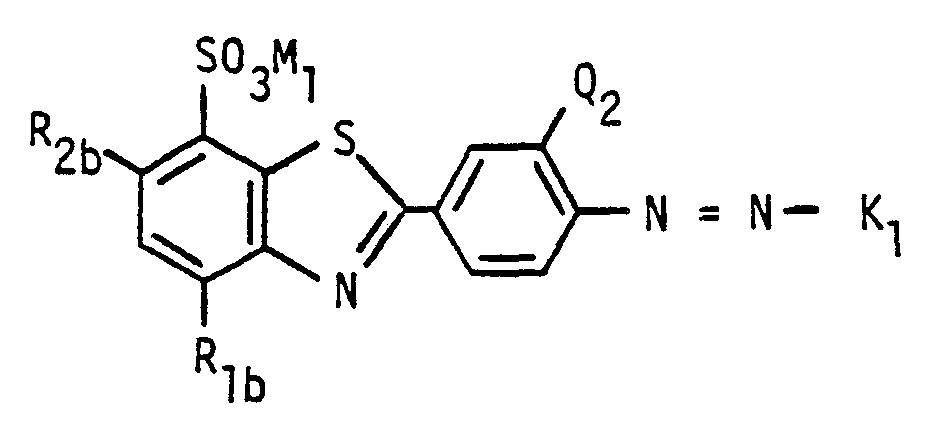 in which M1 and Q2 are as defined in Claim 1, R1b and R2b are as defined in Claim 2, and K1 is as defined in Claim 3, with the provisos that (ii) when in a compound of formula I a
(1) K1 is a group (b1), in which Ya is 0, (2) R2b is other than COOM,
(3) Q2 is hydrogen or SO3M1, and (1) to (3) occur simultaneously, then at least one of M1 is a quaternary ammonium cation asdefined above;
(iii) when in a compound of formula Ia in which K1 is a group (b1)
(1) the diazo component radical is defined as follows: R1b is hydrogen, R2b is methyl and Q2 is hydrogen,
(2) each of R20a and R21a is hydrogen, (3) Ya is N-Y1a, in which Y1a is hydrogen, and (1) to (3) occur simultaneously, then M1 has a significance other than hydrogen or sodium.
5. A compound according to Claim 4, in which K1 is a group of the formul

6. A process for the preparation of a compound of formula I as defined in Claim 1 comprising reacting the diazonium salt of an amine of formula II


7. A process according to Claim 6 comprising reacting the diazonium salt of an amine of formula II with a compound of formula Ilia or Illb in the presence of a basic salt, lithium-, sodium-, potasium-, ammonium-hydroxide, one or more organic amines or a quaternary ammonium compound.
8. A storage-stable, liquid aqueous dyeing preparation containing a compound of formula I defined in Claim 1 in watersoluble salt form.
9. A process for dyeing or printing comprising applying to a hydroxy group or nitrogen containing organic substrate a compound of formula I defined in Claim 1 in water-soluble salt form.
10. A process according to Claim 9 wherein said substrate is a textile consisting of or containing cellulose material, leather or paper.
Priority Applications (2)
| Application Number | Priority Date | Filing Date | Title |
|---|---|---|---|
| DE8585904811T DE3570450D1 (en) | 1984-09-22 | 1985-09-20 | Anionic monoazo compounds of the benzothiazole series |
| JP60504333A JPH0662867B2 (en) | 1984-09-22 | 1985-09-20 | Anionic heterocyclic compound |
Applications Claiming Priority (2)
| Application Number | Priority Date | Filing Date | Title |
|---|---|---|---|
| DE19843434921 DE3434921A1 (en) | 1984-09-22 | 1984-09-22 | HETEROCYCLIC MONOAZO COMPOUNDS |
| DEP3434921.9 | 1984-09-22 |
Publications (1)
| Publication Number | Publication Date |
|---|---|
| WO1986001815A1 true WO1986001815A1 (en) | 1986-03-27 |
Family
ID=6246144
Family Applications (1)
| Application Number | Title | Priority Date | Filing Date |
|---|---|---|---|
| PCT/EP1985/000491 Ceased WO1986001815A1 (en) | 1984-09-22 | 1985-09-20 | Improvements in or relating to organic compounds |
Country Status (5)
| Country | Link |
|---|---|
| US (1) | US4877412A (en) |
| EP (1) | EP0198848B1 (en) |
| JP (1) | JPH0662867B2 (en) |
| DE (2) | DE3434921A1 (en) |
| WO (1) | WO1986001815A1 (en) |
Cited By (10)
| Publication number | Priority date | Publication date | Assignee | Title |
|---|---|---|---|---|
| GB2220418A (en) * | 1988-06-30 | 1990-01-10 | Sandoz Ltd | New dyestuff salts for mass-dyeing of synthetic polyamides |
| GB2236536A (en) * | 1989-10-03 | 1991-04-10 | Sandoz Ltd | Pigmentary salts of anionic dye with sterically hindered amines |
| EP0341214A3 (en) * | 1988-05-06 | 1991-10-02 | Sandoz Ag | Basic 6-hydroxypyrid-2-one compounds |
| EP0451092A3 (en) * | 1990-04-03 | 1992-10-28 | Ciba-Geigy Ag | Concentrated dyestuff solutions |
| EP0585654A1 (en) * | 1992-08-20 | 1994-03-09 | BASF Aktiengesellschaft | Azo dyes with a coupling component of the N-(hydroxysulfonylphenylalkyl)-pyridone series |
| US5554737A (en) * | 1994-05-07 | 1996-09-10 | Basf Aktiengesellschaft | Doubled acid azo dyes with a hydroxypyridone coupling component |
| WO1999043754A1 (en) * | 1998-02-28 | 1999-09-02 | Avecia Limited | Monoazo dyestuffs, a composition and an ink for ink jet printing comprising them |
| US6399781B1 (en) | 2000-10-10 | 2002-06-04 | Boehringer Ingelheim Chemicals, Inc. | Process for making 3-amino-2-chloro-4-methylpyridine |
| WO2003068230A1 (en) * | 2002-02-14 | 2003-08-21 | Pharmacia Corporation | Substituted pyridinones as modulators of p38 map kinase |
| NL1026826C2 (en) * | 2003-08-13 | 2007-01-04 | Pharmacia Corp | Substituted pyridinones. |
Families Citing this family (11)
| Publication number | Priority date | Publication date | Assignee | Title |
|---|---|---|---|---|
| EP0369940B1 (en) * | 1988-11-15 | 1995-05-31 | Ciba-Geigy Ag | Concentrated dye solutions |
| US5510467A (en) * | 1989-01-03 | 1996-04-23 | Sandoz Ltd. | Salts of metal-free anionic phenylazopyrazolone dyes having cations containing sterically hindered amine groups |
| DE4030915A1 (en) * | 1990-09-29 | 1992-04-02 | Basf Ag | CONCENTRATED AQUEOUS SOLUTIONS OF 2-PHENYLBENZTHIAZOLAZO DYES |
| DE4240981A1 (en) * | 1992-12-05 | 1994-06-09 | Basf Ag | Doubled azo dyes |
| DE4329421A1 (en) * | 1993-09-01 | 1995-03-02 | Bayer Ag | Reactive dyes based on a substituted barbituric acid |
| US5986075A (en) * | 1999-01-20 | 1999-11-16 | Bayer Corporation | Process for the production of diazonium compounds with a low content of sodium ions |
| CN100335563C (en) * | 2002-01-28 | 2007-09-05 | 西巴特殊化学品控股有限公司 | Aqueous dye solutions |
| EP1888694B1 (en) * | 2005-05-18 | 2011-03-30 | Basf Se | Aqueous solutions of direct dyes |
| US8029611B2 (en) * | 2008-07-03 | 2011-10-04 | Silverbrook Research Pty Ltd | Inkjet dyes exhibiting reduced kogation |
| JP5634019B2 (en) * | 2008-10-14 | 2014-12-03 | キヤノン株式会社 | Dye compound and ink containing the dye compound |
| US9388313B2 (en) * | 2012-01-20 | 2016-07-12 | Canon Kabushiki Kaisha | Water-insoluble coloring compound, ink, thermal transfer recording sheet, and color filter resist composition |
Citations (5)
| Publication number | Priority date | Publication date | Assignee | Title |
|---|---|---|---|---|
| DE2033281A1 (en) * | 1970-07-04 | 1972-01-20 | Badische Anilin & Soda Fabrik AG, 6700 Ludwigshafen | Water-soluble azo dyes - from diazotised heterocyclic amines and pyridone-(6) coupling components |
| FR2111697A1 (en) * | 1970-10-19 | 1972-06-09 | Du Pont | |
| FR2373586A1 (en) * | 1976-12-09 | 1978-07-07 | Ciba Geigy Ag | PREPARATION OF LIQUID COLORANT AND IMPROVED PROCESS FOR THE PRODUCTION OF THE LATTER |
| EP0030337A2 (en) * | 1979-12-08 | 1981-06-17 | Bayer Ag | Monoazo dyestuffs, process for their preparation, and their concentrated solutions |
| EP0084372A2 (en) * | 1982-01-19 | 1983-07-27 | Ciba-Geigy Ag | Benzothiazole compounds, process for their preparation and their use as dyestuffs for textile materials, paper, leather and inks |
Family Cites Families (6)
| Publication number | Priority date | Publication date | Assignee | Title |
|---|---|---|---|---|
| US3726851A (en) * | 1970-09-23 | 1973-04-10 | Allied Chem | Water-soluble benzothiazolylphenylazo-barbituric acid dyestuffs |
| US3788802A (en) * | 1970-09-23 | 1974-01-29 | Allied Chem | Paper dyed with water soluble benzothi-azolylphenylazobarbituric acid dyestuffs |
| CA919659A (en) * | 1971-05-03 | 1973-01-23 | American Cyanamid Company | Azo dyes |
| US3862116A (en) * | 1972-01-03 | 1975-01-21 | Du Pont | Dehydrothio-p-toluidinesulfonic acid azo-hexahydro-4,6-dioxopyrimidineurea or cyanamide direct dyes for paper |
| DE2341293C3 (en) * | 1973-08-16 | 1981-10-08 | Bayer Ag, 5090 Leverkusen | Anionic dyes and concentrated solutions of these dyes |
| DE2526172A1 (en) * | 1975-06-12 | 1976-12-30 | Bayer Ag | HYDRO-SOLUBLE AZO DYES |
-
1984
- 1984-09-22 DE DE19843434921 patent/DE3434921A1/en not_active Withdrawn
-
1985
- 1985-09-20 WO PCT/EP1985/000491 patent/WO1986001815A1/en not_active Ceased
- 1985-09-20 DE DE8585904811T patent/DE3570450D1/en not_active Expired
- 1985-09-20 JP JP60504333A patent/JPH0662867B2/en not_active Expired - Lifetime
- 1985-09-20 EP EP85904811A patent/EP0198848B1/en not_active Expired
-
1988
- 1988-03-31 US US07/183,566 patent/US4877412A/en not_active Expired - Lifetime
Patent Citations (5)
| Publication number | Priority date | Publication date | Assignee | Title |
|---|---|---|---|---|
| DE2033281A1 (en) * | 1970-07-04 | 1972-01-20 | Badische Anilin & Soda Fabrik AG, 6700 Ludwigshafen | Water-soluble azo dyes - from diazotised heterocyclic amines and pyridone-(6) coupling components |
| FR2111697A1 (en) * | 1970-10-19 | 1972-06-09 | Du Pont | |
| FR2373586A1 (en) * | 1976-12-09 | 1978-07-07 | Ciba Geigy Ag | PREPARATION OF LIQUID COLORANT AND IMPROVED PROCESS FOR THE PRODUCTION OF THE LATTER |
| EP0030337A2 (en) * | 1979-12-08 | 1981-06-17 | Bayer Ag | Monoazo dyestuffs, process for their preparation, and their concentrated solutions |
| EP0084372A2 (en) * | 1982-01-19 | 1983-07-27 | Ciba-Geigy Ag | Benzothiazole compounds, process for their preparation and their use as dyestuffs for textile materials, paper, leather and inks |
Cited By (20)
| Publication number | Priority date | Publication date | Assignee | Title |
|---|---|---|---|---|
| EP0341214A3 (en) * | 1988-05-06 | 1991-10-02 | Sandoz Ag | Basic 6-hydroxypyrid-2-one compounds |
| GB2220418A (en) * | 1988-06-30 | 1990-01-10 | Sandoz Ltd | New dyestuff salts for mass-dyeing of synthetic polyamides |
| GB2220418B (en) * | 1988-06-30 | 1993-01-27 | Sandoz Ltd | Dyestuff for dyeing of plastics |
| US5316553A (en) * | 1988-06-30 | 1994-05-31 | Sandoz Ltd. | Dyestuffs for the dyeing of synthetic polyamides |
| GB2236536A (en) * | 1989-10-03 | 1991-04-10 | Sandoz Ltd | Pigmentary salts of anionic dye with sterically hindered amines |
| GB2236536B (en) * | 1989-10-03 | 1992-07-22 | Sandoz Ltd | New pigments |
| EP0451092A3 (en) * | 1990-04-03 | 1992-10-28 | Ciba-Geigy Ag | Concentrated dyestuff solutions |
| EP0585654A1 (en) * | 1992-08-20 | 1994-03-09 | BASF Aktiengesellschaft | Azo dyes with a coupling component of the N-(hydroxysulfonylphenylalkyl)-pyridone series |
| US5389110A (en) * | 1992-08-20 | 1995-02-14 | Basf Aktiengesellschaft | Azo dyes and process of dyeing with azo dyes which contain an N-(hydroxysulfonylphenylalkyl)pyridone coupling component |
| US5554737A (en) * | 1994-05-07 | 1996-09-10 | Basf Aktiengesellschaft | Doubled acid azo dyes with a hydroxypyridone coupling component |
| WO1999043754A1 (en) * | 1998-02-28 | 1999-09-02 | Avecia Limited | Monoazo dyestuffs, a composition and an ink for ink jet printing comprising them |
| US6488752B1 (en) | 1998-02-28 | 2002-12-03 | Avecia Limited | Monoazo dyestuffs, a composition and an ink for ink jet printing comprising them |
| US6399781B1 (en) | 2000-10-10 | 2002-06-04 | Boehringer Ingelheim Chemicals, Inc. | Process for making 3-amino-2-chloro-4-methylpyridine |
| WO2003068230A1 (en) * | 2002-02-14 | 2003-08-21 | Pharmacia Corporation | Substituted pyridinones as modulators of p38 map kinase |
| US7067540B2 (en) | 2002-02-14 | 2006-06-27 | Pharmacia Corporation | Substituted pyridinones |
| EA008008B1 (en) * | 2002-02-14 | 2007-02-27 | Фармация Корпорейшн | Substituted pyridinones as modulators of p38 map kinase |
| KR100705519B1 (en) * | 2002-02-14 | 2007-04-10 | 파마시아 코포레이션 | Substituted pyridinones as modulators of P3M-MAP kinase |
| US7629363B2 (en) | 2002-02-14 | 2009-12-08 | Pfizer Inc | Diaryl substituted pyridinones |
| HRP20040707B1 (en) * | 2002-02-14 | 2012-12-31 | Pharmacia Corporation | Supstituted pyridinones as modulators of p38 map kinase |
| NL1026826C2 (en) * | 2003-08-13 | 2007-01-04 | Pharmacia Corp | Substituted pyridinones. |
Also Published As
| Publication number | Publication date |
|---|---|
| JPH0662867B2 (en) | 1994-08-17 |
| US4877412A (en) | 1989-10-31 |
| DE3434921A1 (en) | 1986-05-07 |
| EP0198848B1 (en) | 1989-05-24 |
| EP0198848A1 (en) | 1986-10-29 |
| DE3570450D1 (en) | 1989-06-29 |
| JPS62500246A (en) | 1987-01-29 |
Similar Documents
| Publication | Publication Date | Title |
|---|---|---|
| EP0198848B1 (en) | Anionic monoazo compounds of the benzothiazole series | |
| CA1327967C (en) | Anionic triazinylamino-disazo dyestuffs | |
| EP0365486B1 (en) | Fibre-reactive azo dyes | |
| JPH07116368B2 (en) | Basic azo compound | |
| US5519121A (en) | Triazinyl-amino bridge-containing disazo dyestuffs | |
| JPS61111362A (en) | Methine azo compound | |
| GB2179361A (en) | Basic-s-triazinyl azo dyes | |
| US5498701A (en) | Basic disazo compounds containing sulphonic acid groups | |
| CA1068263A (en) | Disazo dyestuffs | |
| US5929215A (en) | Basic monoazo compounds | |
| JPH0673298A (en) | Cationic thiazolyldiphenylamine dye | |
| US4621136A (en) | Phenyl azo cyanothienyl azo anilino dyestuffs | |
| GB2104090A (en) | Triazine compounds | |
| US3454552A (en) | Disazo cationic dyestuffs containing a quaternary ammonium group | |
| US4618673A (en) | Salts of the 1:2 chromium complex of 4-(5'-chloro-2'-hydroxy-3'-sulfophenylazo)-3-methyl-1-phenylpyrazol-5-one and 4-(3', 5'-dichloro-2'-hydroxyphenylazo)-3-methyl-1-phenylpyrazol-5-one | |
| GB2174405A (en) | Disazo dyes | |
| US4466920A (en) | Disazo compounds having a further unsubstituted or substituted sulfophenyl diazo component radical and a 4-alkoxy- or arylsulfonyloxy benzene coupling component radical having an acylamina substituent | |
| US5527889A (en) | Disazo dyes containing an alkanoylamino group and a substituted alkoxy group | |
| US5378818A (en) | Doubled azo dyes | |
| EP0651027B1 (en) | Azodyestuffs of the stilbene series | |
| CA1292735C (en) | Organic compounds | |
| US5693765A (en) | Substituted 5- 5'- (5"- Chloro-2", 4"-difluoropyrimid-6"-ylamino) phenylcarbonylamino!-2'-sulfophenyl-azo!-6-hydroxy-4-methyl-3-sulfomethylpyrid-2-ones | |
| US4254026A (en) | Water-soluble monoazo dyestuffs | |
| JPH0826233B2 (en) | Monoazo dye | |
| EP0891394B1 (en) | Basic monoazo compounds |
Legal Events
| Date | Code | Title | Description |
|---|---|---|---|
| AK | Designated states |
Kind code of ref document: A1 Designated state(s): JP US |
|
| AL | Designated countries for regional patents |
Kind code of ref document: A1 Designated state(s): CH DE FR GB IT |
|
| WWE | Wipo information: entry into national phase |
Ref document number: 1985904811 Country of ref document: EP |
|
| WWP | Wipo information: published in national office |
Ref document number: 1985904811 Country of ref document: EP |
|
| WWG | Wipo information: grant in national office |
Ref document number: 1985904811 Country of ref document: EP |