WO1987002681A1 - Composition polymerisable et procede de production - Google Patents
Composition polymerisable et procede de production Download PDFInfo
- Publication number
- WO1987002681A1 WO1987002681A1 PCT/JP1986/000225 JP8600225W WO8702681A1 WO 1987002681 A1 WO1987002681 A1 WO 1987002681A1 JP 8600225 W JP8600225 W JP 8600225W WO 8702681 A1 WO8702681 A1 WO 8702681A1
- Authority
- WO
- WIPO (PCT)
- Prior art keywords
- compound
- curable composition
- per molecule
- group
- unsaturated
- Prior art date
- Legal status (The legal status is an assumption and is not a legal conclusion. Google has not performed a legal analysis and makes no representation as to the accuracy of the status listed.)
- Ceased
Links
Classifications
-
- B—PERFORMING OPERATIONS; TRANSPORTING
- B29—WORKING OF PLASTICS; WORKING OF SUBSTANCES IN A PLASTIC STATE IN GENERAL
- B29C—SHAPING OR JOINING OF PLASTICS; SHAPING OF MATERIAL IN A PLASTIC STATE, NOT OTHERWISE PROVIDED FOR; AFTER-TREATMENT OF THE SHAPED PRODUCTS, e.g. REPAIRING
- B29C67/00—Shaping techniques not covered by groups B29C39/00 - B29C65/00, B29C70/00 or B29C73/00
- B29C67/24—Shaping techniques not covered by groups B29C39/00 - B29C65/00, B29C70/00 or B29C73/00 characterised by the choice of material
- B29C67/246—Moulding high reactive monomers or prepolymers, e.g. by reaction injection moulding [RIM], liquid injection moulding [LIM]
-
- C—CHEMISTRY; METALLURGY
- C08—ORGANIC MACROMOLECULAR COMPOUNDS; THEIR PREPARATION OR CHEMICAL WORKING-UP; COMPOSITIONS BASED THEREON
- C08G—MACROMOLECULAR COMPOUNDS OBTAINED OTHERWISE THAN BY REACTIONS ONLY INVOLVING UNSATURATED CARBON-TO-CARBON BONDS
- C08G75/00—Macromolecular compounds obtained by reactions forming a linkage containing sulfur with or without nitrogen, oxygen, or carbon in the main chain of the macromolecule
- C08G75/12—Polythioether-ethers
-
- B—PERFORMING OPERATIONS; TRANSPORTING
- B29—WORKING OF PLASTICS; WORKING OF SUBSTANCES IN A PLASTIC STATE IN GENERAL
- B29C—SHAPING OR JOINING OF PLASTICS; SHAPING OF MATERIAL IN A PLASTIC STATE, NOT OTHERWISE PROVIDED FOR; AFTER-TREATMENT OF THE SHAPED PRODUCTS, e.g. REPAIRING
- B29C35/00—Heating, cooling or curing, e.g. crosslinking or vulcanising; Apparatus therefor
- B29C35/02—Heating or curing, e.g. crosslinking or vulcanizing during moulding, e.g. in a mould
- B29C35/08—Heating or curing, e.g. crosslinking or vulcanizing during moulding, e.g. in a mould by wave energy or particle radiation
- B29C35/0888—Heating or curing, e.g. crosslinking or vulcanizing during moulding, e.g. in a mould by wave energy or particle radiation using transparant moulds
-
- C—CHEMISTRY; METALLURGY
- C08—ORGANIC MACROMOLECULAR COMPOUNDS; THEIR PREPARATION OR CHEMICAL WORKING-UP; COMPOSITIONS BASED THEREON
- C08G—MACROMOLECULAR COMPOUNDS OBTAINED OTHERWISE THAN BY REACTIONS ONLY INVOLVING UNSATURATED CARBON-TO-CARBON BONDS
- C08G75/00—Macromolecular compounds obtained by reactions forming a linkage containing sulfur with or without nitrogen, oxygen, or carbon in the main chain of the macromolecule
- C08G75/02—Polythioethers
- C08G75/04—Polythioethers from mercapto compounds or metallic derivatives thereof
- C08G75/045—Polythioethers from mercapto compounds or metallic derivatives thereof from mercapto compounds and unsaturated compounds
-
- B—PERFORMING OPERATIONS; TRANSPORTING
- B29—WORKING OF PLASTICS; WORKING OF SUBSTANCES IN A PLASTIC STATE IN GENERAL
- B29C—SHAPING OR JOINING OF PLASTICS; SHAPING OF MATERIAL IN A PLASTIC STATE, NOT OTHERWISE PROVIDED FOR; AFTER-TREATMENT OF THE SHAPED PRODUCTS, e.g. REPAIRING
- B29C35/00—Heating, cooling or curing, e.g. crosslinking or vulcanising; Apparatus therefor
- B29C35/02—Heating or curing, e.g. crosslinking or vulcanizing during moulding, e.g. in a mould
- B29C35/08—Heating or curing, e.g. crosslinking or vulcanizing during moulding, e.g. in a mould by wave energy or particle radiation
- B29C35/0805—Heating or curing, e.g. crosslinking or vulcanizing during moulding, e.g. in a mould by wave energy or particle radiation using electromagnetic radiation
- B29C2035/0827—Heating or curing, e.g. crosslinking or vulcanizing during moulding, e.g. in a mould by wave energy or particle radiation using electromagnetic radiation using UV radiation
-
- B—PERFORMING OPERATIONS; TRANSPORTING
- B29—WORKING OF PLASTICS; WORKING OF SUBSTANCES IN A PLASTIC STATE IN GENERAL
- B29C—SHAPING OR JOINING OF PLASTICS; SHAPING OF MATERIAL IN A PLASTIC STATE, NOT OTHERWISE PROVIDED FOR; AFTER-TREATMENT OF THE SHAPED PRODUCTS, e.g. REPAIRING
- B29C35/00—Heating, cooling or curing, e.g. crosslinking or vulcanising; Apparatus therefor
- B29C35/02—Heating or curing, e.g. crosslinking or vulcanizing during moulding, e.g. in a mould
- B29C35/08—Heating or curing, e.g. crosslinking or vulcanizing during moulding, e.g. in a mould by wave energy or particle radiation
- B29C35/0805—Heating or curing, e.g. crosslinking or vulcanizing during moulding, e.g. in a mould by wave energy or particle radiation using electromagnetic radiation
- B29C2035/0844—Heating or curing, e.g. crosslinking or vulcanizing during moulding, e.g. in a mould by wave energy or particle radiation using electromagnetic radiation using X-ray
-
- B—PERFORMING OPERATIONS; TRANSPORTING
- B29—WORKING OF PLASTICS; WORKING OF SUBSTANCES IN A PLASTIC STATE IN GENERAL
- B29C—SHAPING OR JOINING OF PLASTICS; SHAPING OF MATERIAL IN A PLASTIC STATE, NOT OTHERWISE PROVIDED FOR; AFTER-TREATMENT OF THE SHAPED PRODUCTS, e.g. REPAIRING
- B29C35/00—Heating, cooling or curing, e.g. crosslinking or vulcanising; Apparatus therefor
- B29C35/02—Heating or curing, e.g. crosslinking or vulcanizing during moulding, e.g. in a mould
- B29C35/08—Heating or curing, e.g. crosslinking or vulcanizing during moulding, e.g. in a mould by wave energy or particle radiation
- B29C35/0805—Heating or curing, e.g. crosslinking or vulcanizing during moulding, e.g. in a mould by wave energy or particle radiation using electromagnetic radiation
- B29C2035/085—Heating or curing, e.g. crosslinking or vulcanizing during moulding, e.g. in a mould by wave energy or particle radiation using electromagnetic radiation using gamma-ray
-
- B—PERFORMING OPERATIONS; TRANSPORTING
- B29—WORKING OF PLASTICS; WORKING OF SUBSTANCES IN A PLASTIC STATE IN GENERAL
- B29C—SHAPING OR JOINING OF PLASTICS; SHAPING OF MATERIAL IN A PLASTIC STATE, NOT OTHERWISE PROVIDED FOR; AFTER-TREATMENT OF THE SHAPED PRODUCTS, e.g. REPAIRING
- B29C35/00—Heating, cooling or curing, e.g. crosslinking or vulcanising; Apparatus therefor
- B29C35/02—Heating or curing, e.g. crosslinking or vulcanizing during moulding, e.g. in a mould
- B29C35/08—Heating or curing, e.g. crosslinking or vulcanizing during moulding, e.g. in a mould by wave energy or particle radiation
- B29C35/0866—Heating or curing, e.g. crosslinking or vulcanizing during moulding, e.g. in a mould by wave energy or particle radiation using particle radiation
- B29C2035/0877—Heating or curing, e.g. crosslinking or vulcanizing during moulding, e.g. in a mould by wave energy or particle radiation using particle radiation using electron radiation, e.g. beta-rays
-
- B—PERFORMING OPERATIONS; TRANSPORTING
- B29—WORKING OF PLASTICS; WORKING OF SUBSTANCES IN A PLASTIC STATE IN GENERAL
- B29K—INDEXING SCHEME ASSOCIATED WITH SUBCLASSES B29B, B29C OR B29D, RELATING TO MOULDING MATERIALS OR TO MATERIALS FOR MOULDS, REINFORCEMENTS, FILLERS OR PREFORMED PARTS, e.g. INSERTS
- B29K2059/00—Use of polyacetals, e.g. POM, i.e. polyoxymethylene or derivatives thereof, as moulding material
-
- B—PERFORMING OPERATIONS; TRANSPORTING
- B29—WORKING OF PLASTICS; WORKING OF SUBSTANCES IN A PLASTIC STATE IN GENERAL
- B29K—INDEXING SCHEME ASSOCIATED WITH SUBCLASSES B29B, B29C OR B29D, RELATING TO MOULDING MATERIALS OR TO MATERIALS FOR MOULDS, REINFORCEMENTS, FILLERS OR PREFORMED PARTS, e.g. INSERTS
- B29K2909/00—Use of inorganic materials not provided for in groups B29K2803/00 - B29K2807/00, as mould material
- B29K2909/08—Glass
-
- B—PERFORMING OPERATIONS; TRANSPORTING
- B29—WORKING OF PLASTICS; WORKING OF SUBSTANCES IN A PLASTIC STATE IN GENERAL
- B29L—INDEXING SCHEME ASSOCIATED WITH SUBCLASS B29C, RELATING TO PARTICULAR ARTICLES
- B29L2017/00—Carriers for sound or information
- B29L2017/001—Carriers of records containing fine grooves or impressions, e.g. disc records for needle playback, cylinder records
- B29L2017/003—Records or discs
Definitions
- the present invention relates to a curable composition which can be suitably used for an information recording board and the like, and particularly to a video disc, a disc, and an optical disc for recording and reproducing information such as video and audio using light.
- a curable composition which can be suitably used for an information recording board and the like, and particularly to a video disc, a disc, and an optical disc for recording and reproducing information such as video and audio using light.
- optical memory discs have been researched and developed with great precision and are now being used practically.
- Optical memory disks are capable of recording large-capacity (GB) class data, and are easy to handle. Therefore, magnetic disks and floppy disks can be used instead of optical disks. It is expected to be used in applications such as the packing memory of a measuring instrument.
- This optical memory disc can record and reproduce information in a non-contact manner, and is expected to have a long service life.
- the optical disc used for recording and reproducing information should have a transparent and uniform substrate and be made of an extremely stable material.
- PMMA polymethyl methacrylate resin
- the PMMA substrate has drawbacks such as insufficient heat resistance, a large moisture absorption rate, and a large dimensional change due to moisture absorption.
- Polycarbonate resin substrates have poor moldability, and birefringence tends to occur in molded products obtained by orienting molecules during molding.
- the polycarbonate substrate has insufficient resistance to repeated irradiation with a writing laser beam.
- the molecular weight of the polycarbonate is reduced in order to improve the fluidity during molding. As a result, the polycarbonate substrate has reduced water resistance, impact resistance, and surface hardness.
- An object of the present invention is to provide a transparent, low birefringent, curable composition.
- Another object of the present invention is to provide a hardenable composition having high ripening resistance, high surface hardness and low water absorption.
- Another object of the present invention is to provide a curable composition that can be used as a substrate for an optical disc.
- Another object of the present invention is to provide a molding method for efficiently molding the curable composition of the present invention into a disk substrate.
- a curable composition which can achieve this object is a compound having at least two unsaturated cycloacetate groups per molecule (hereinafter referred to as an acetal compound). ) And a compound having at least two molecules of a mercapto group (hereinafter referred to as a The compound is a curable composition consisting of: Furthermore, according to the present invention,
- a compound having at least two unsaturated cycloacetar groups per molecule as A component A component having at least two unsaturated cycloacetar groups per molecule as A component
- Knols and triazine ring-containing compounds A curable composition consisting of various compounds from the group consisting of isocyanuric acid derivatives.
- a compound having at least two unsaturated cycloacetar groups per molecule as A component A component having at least two unsaturated cycloacetar groups per molecule as A component
- a compound having at least two mercapto groups per molecule as B component A compound having at least two mercapto groups per molecule as B component;
- esters with straight-chain or branched alcohols, alkyls having 8 or more carbon atoms having at least 2 acrylyl groups and / or methacryloyl groups per molecule A curable crude product consisting of one selected from the group consisting of a group and a substituted alkyl halide.
- a compound having at least two unsaturated cycloacetal groups as one component A as a component, and at least two mercaptos as one component B as a component B A compound having a reactive unsaturated bond of at least two acryloyl groups or methacryloyl groups per molecule as a C component
- the inside of the mold cavity in which a window portion made of a material through which high-energy wires can pass is provided between the outside and the cavity is exhausted,
- the above-mentioned A, B, C components or A, B, C, D components of the cross-linking type The plastic composition is injected and injected, and the resin composition injected with the back is irradiated with high energy rays from the outside of the mold through the window to cure the above-mentioned resin composition.
- This is a molding method of a curable resin characterized by this.
- At least a part of the curable resin is injected into a mold cavity made of a material through which high energy can pass, and the curable resin is passed through the mold to form a curable resin. Irradiation with high-energy lines and reduction of cavities during energy-irradiation are performed.
- Acetal compound The first component of the curable composition of the present invention is an unsaturated dioxane-type acetal compound ( ⁇ compound).
- CH 2 CH- CH ⁇ 0 ⁇
- Attar type compounds suitably used in the curable composition of the present invention
- examples of the substance include the following CO-like compounds.
- the mercapto compound used as the second component of the curable composition of the present invention is an aliphatic or aromatic polymer having at least two mer or mer groups per molecule. Take a pt.
- Examples of the mercapto compound used in the composition of the present invention include the following compounds having the following ⁇ .
- An ester compound of a mercapto compound having a carboxyl group and a polyvalent alcohol examples include polyhydric alcohols such as, for example, thioglycolic acid, 3—mercaptopropionic acid, and mercaptosuccinic acid.
- polyhydric alcohols such as, for example, thioglycolic acid, 3—mercaptopropionic acid, and mercaptosuccinic acid.
- pentalith, pentalith, trimethylolpropane, trimethylol, and the like can be mentioned.
- the compound (C) having a reactive unsaturated bond as the third component of the curable composition of the present invention is a compound having at least two reactive unsaturated bonds per molecule.
- Various compounds can be used as long as they are copolymerizable with the above-mentioned acetal compound (A) and the mercapto compound (B) and can be mixed with each other.
- Bisphenols (C-II), triglycerides are examples of such compounds. Azine compounds (C-2), isocyanuric acid derivatives (C-3), and other compounds (C-4). Of these, bisphenols (C-II), triazine-based compounds (C-2), and isocyanuric acid derivatives (C-13) are resistant to curable compositions containing them. The effect of imparting properties is obtained.
- Suitable bisphenols (C-) are bisphenol I-phenols having one or more molecules of at least two acryloyl groups and fc is a methacryloyl group. kind of.
- the bisphenol I-norls (C-11) preferably used in the composition of the present invention have a general structure represented by the following formula (1).
- ru and n 2 are integers of 1 to 3
- X is a group represented by the following structural formula.
- Y is a group represented by the following structural formula.
- R 1 and R 2 in the formula (1) have a structure represented by the following general formula,
- R 3 and R 4 are hydrogen, methyl, ethyl, or substituted halogen atoms, and m is an integer of 0-6.
- Each of the above-mentioned compounds can be used alone or as a mixture of two or more.
- Triazine-based compound (C-2) The triazine-based compound (C-2) suitably used in the composition of the present invention has at least one triazine ring per molecule. And a compound having at least two acryloyl groups and / or methacryloyl groups in at least one molecule per molecule, and represented by the following general formula: (2) having the structure represented by the formula, or It is a compound that has become a ligomer through formalin, polyvalent alcohol, ethylenic kid, and the like.
- Representative compounds of this triazine-based compound (C-2) are (1), N'-bis (meta) acrylylyl oxime thiol ⁇ , ⁇ ', ⁇ ", ⁇ " —Tetraquisme Trixime thilmamine,
- the number of functional groups per triazine ring in the molecule should be 2 or more, and the water absorption effect due to the esterification and the heat resistance to enhance the crosslink density. In consideration of the balance of the improvement in the number of functional groups, it is desirable that the number of functional groups per triazine ring in one molecule be within the range of 4 to 6.
- the third component of the curable composition of the present invention is suitable as a compound having a reactive unsaturated bond.
- Suitable isocyanuric acid derivatives have at least one molecule of at least two molecules in total. It is an isocyanuric acid derivative having a acryloyl group and / or a metaacryloyl group.
- This isocyanuric acid derivative (C-3).
- a reaction product obtained by adding ethylenic acid propylene, propylene acid oxide, etc. to isocyanuric acid is reacted with acryloyl acid and / or methacrylyl to obtain a reaction product. Reaction product.
- reaction product obtained by reacting glycidyl acrylate and / or glycidyl methacrylate with an adduct of isocyanuric acid and ethylene oxide.
- Formalin is allowed to act on the reaction product of isocyanuric acid with chloroacetamide to introduce a methylyl group, and the methylol group and acrylyl of this compound are introduced. Reaction products with acids and methacrylic acid.
- C-3 isocyanuric acid derivative (C-3) is tris (2-acrylamide).
- Isocyanurate tris (2-methacrylate).
- Issianu rate is a typical example of this isocyanuric acid derivative (C-3) is tris (2-acrylamide).
- Isocyanurate tris (2-methacrylate).
- Issianu rate is a typical example of this isocyanuric acid derivative (C-3) is tris (2-acrylamide).
- Isocyanurate tris (2-methacrylate).
- the total number of acryloyl groups and Z or methacrylyl groups in the molecule be 2 or more.
- Examples of the compound having a reactive unsaturated bond as the third component of the other compounds include the following compounds.
- Bisphenol A 'Acryloyl and / or methacryloyl compounds such as epoxydimethacrylate.
- Vinyl compounds such as divinylbenzene and divinyladipate.
- the curable composition of the present invention includes various types of initiators, photosensitizers, antioxidants, heat stabilizers, release agents, dyes, antistatic agents. Additives such as surfactants, leveling agents, polymerization regulators, and UV absorbers can be added as needed.
- the compounding ratio of the acetal compound (A) and the mercapto compound is about 1: 1 to 0.5 in equivalent ratio. If the amount of the acetal compound (III) is too large, it takes a long time to cure. If the compounding amount of the mercapto compound ( ⁇ ) is extremely large, the resulting molding mold may have an unpleasant odor or a curable resin in which physical properties such as hardness are reduced.
- the total number of unsaturated cycloacetal groups per molecule of acetal compound (() and the number of mercapto groups per molecule of mercapto compound ( ⁇ ) is 4 More than five, preferably more than five pieces are required.
- the compounding amount of the compound (C) having the reactive unsaturation of the third component with respect to the acetal compound ( ⁇ ) and the mercapto compound ( ⁇ ⁇ ⁇ ) can be obtained when the amount used is too large. If the hardness of the molded product is too high, it becomes a molded product. On the other hand, if the amount is too small, the desired maturation-resistant molded product cannot be obtained. For this reason, the compounding ratio of the compound having a reactive unsaturated bond (C) is preferably 0.2 to 6.3 equivalents per equivalent of the acetal compound (A). It is preferable to use 0.5 to 5.4 equivalents.
- the level be as low as possible.
- the mixing ratio of the isocyanuric acid derivative (C-3) is desirably 0.2 to 6.3 parts by weight per equivalent of the acetal compound (A).
- the reactive unsaturated compound is added to the curable composition of the present invention in order to lower the viscosity of the mixture, improve workability, and further completely cure the molded product.
- the mixing ratio of the reactive unsaturated compound is equivalent to a mixture of an acetal compound (A), a mercapto compound (B), and a compound having a reactive unsaturated compound (C). 4 equivalents or less, preferably about 0.1 to 4 equivalents.
- a silicone compound having at least one mercapto group in one molecule as a D component and / or one molecule per molecule An ester compound which is a reaction product of a carboxylic acid having at least one mercapto group and a linear or branched alcohol having 4 or more carbon atoms, and one molecule as a D component ⁇ A compound having at least two dried methacryloyl groups and Z or acryloyl groups and having an alkenyl group having at least 8 carbon atoms and Z or a halogen atom-substituted product thereof.
- a curable composition can be obtained by the addition.
- a silicone compound having at least one mercapto group in one molecule as a component D and a carboxylic acid having at least one mercapto group in one molecule and / or a carboxylic acid having at least one mercapto group in one molecule The structure of an ester compound as a reaction product with a linear or branched alcohol having 4 or more carbon atoms is represented by the general formulas (3, 4) and (5).
- j is an integer from 0 to 8
- k and j are integers from 0 to 3
- k + j 3.
- R ', R 8 is Echiru, Arukiru groups such as Echiru Dearu. (3)
- a typical compound of the formula is a mercapto-modified silicone.
- ester compound is represented by the following general formula as Formula 5.
- R is a singular number 3-10 direct or branched alkyl group, and n is an integer of 1-5. If the singular number is 3 or less, the desired releasability cannot be obtained.
- Typical compounds are 2-ethylhexyl thioglycolate, pentyl glycolate, and R-mercapto-2-acid-ethylhexyl, er-mercaptotric acid-isosamyl. ⁇
- a carpone ester having a mercapto group as the D component is polymerized and added to a compound having a reactive unsaturated bond (C) in advance.
- C reactive unsaturated bond
- the carboxylate ester having a mercapto group which is a release agent component according to the present invention, is bonded to the monomer of the third component (C) before polymerization, and the post-molding blade is used. It achieves excellent mold releasability.
- the polymerization of the carboxylic acid ester having a mercapto group and the compound (C) having a reactive unsaturated bond is completed in 45 to 55 in 10 minutes to 1 hour. At this time, if the temperature is increased, the polymerization will proceed too much and the fluidity will be lost. If the temperature is too low, the polymerization will be insufficient and the color of the cured product will be markedly yellow due to the residual mercapto group. .
- the compound having the compound improves the releasability of the curable composition.
- the reaction product of the following (I) and (H) can be represented as a representative.
- an acryloyl group, a methacryloyl group, and an alkyl group are introduced by using an amino group, an N-methylol group, and an active halogen group as reaction components.
- Compounds and the like can also be used. Molding method
- the casting method is a convenient method for producing an information recording board such as a disk substrate from the curable composition of the present invention.
- the information pits projections
- a replica mold for forming the polyester is created, and a metal thin film is coated on the surface of the stamper to obtain a mold.
- the composition of the present invention which is liquid at room temperature or below a specific leak condition at a temperature of 100 or less, into the mold and sufficiently spread it to all corners of the mold, heating and The composition is hardened by irradiation with Z or high energy radiation. After curing, remove it from the mold to produce a disk substrate.
- Fine irregularities of the mold are transferred to the surface of the disk substrate.
- the curable composition of the present invention is injected into the sol of two glass plates having irregularities, and the high energy is irradiated through the glass plate, cured, and the cured product is removed from the mold. Substrates can be made accordingly.
- the method for curing the curable composition of the present invention comprises: first, an acetal compound (A), a mercapto compound (B), and a compound (C) having a reactive unsaturated bond in a predetermined ratio. Mix evenly with. This mixture is poured into a mold having a predetermined shape made of glass, ceramic, plastic, or rubber, and cured by the following method.
- Method of irradiating energy involves irradiating the composition with an active energy ray, such as an X-ray, X-ray, ultraviolet (UV), electron beam, etc., to cure the curable composition.
- an active energy ray such as an X-ray, X-ray, ultraviolet (UV), electron beam, etc.
- the amount of irradiation energy of the energy beam is generally not less than 0.1 J Jcsi and not more than 500 J Zoi. In particular, the range of 0. "! To 1 OOJZi is preferable.
- the irradiation energy is less than 0.01 J / as', curing is incomplete. Irradiation exceeding 500 J Zoi A part of the obtained cured product is deteriorated and colored, and a good information recording board cannot be obtained.
- the curing time can be shortened.
- Irradiation with energy rays may be performed in two or more parts, or may be performed once.
- Photosensitizers and stabilizers can be added as needed.
- the thermal curing of the curable composition of the present invention differs depending on the ripening temperature, whether or not a polymerization initiator is used, and the type and amount thereof.
- the ripening temperature is from room temperature to 300, and preferably from 50 to 130. If the heating temperature is lower than room temperature, the curing time will be longer and productivity will be lower. On the other hand, if it exceeds 300, the cured product will mature and deteriorate.
- Heating during heating differs depending on the temperature and whether or not a polymerization initiator is used, their type and the usage ratio, but generally ranges from 0.1 to 100 hours, and particularly from 1 to 100 hours. 20 o'clock garden is preferred.
- the amount of the polymerization initiator used is 10 parts by weight or less, preferably 5 parts by weight or less based on 100 parts by weight of the curable composition of the present invention.
- the method of irradiating these high energy rays and the method of heat can be used in combination.
- the curable composition of the present invention exhausts the inside of a mold cavity in which a window made of a material through which a high-energy wire can permeate is provided between the outside and the cavity.
- the curable composition according to the present invention is injected and injected into the cavity, and the curable composition injected with the gap is irradiated with high energy rays from the outside through the window of the mold to cure the composition. This method is used to harden the suki product.
- the reaction injection molding method of the curable composition of the present invention comprises injecting the curable composition into a mold cavity made of a material having at least a portion capable of transmitting high energy wires.
- the mold of the energy-irradiated mold is cured by a molding method for curing the curable composition. It is characterized by providing a means for reducing the part of the mold in order to reduce the bitness.
- Polycarbonate-polymethyl methacrylate which is conventionally known as an injection molding method for molding a compact disk, is molded by this method.
- this injection molding method applies a large shear force to the resin at the time of injection, and as a result, the orientation of molecules is generated.
- the resulting disc is likely to have significant optical anisotropy. For this reason, when an optical information recording board is manufactured by the injection molding method, a disc obtained tends to easily cause an error when reproducing information.
- the wear of the stamper attached to the cavity surface of the mold is severe, and the life of the stamper is short.
- a so-called 2P (hot polymer) method in which a transparent substrate made of glass is placed facing the stamper, and a curable resin according to ultraviolet light is injected between the stamper and the substrate. The substrate is pressed to the stamper side, and the resin is cured by irradiating ultraviolet rays from the substrate side. Then, the stamper is peeled off, and the disc consisting of the pit layer on which the pit is transferred and the substrate Is molded. Even in the case of the 2P method, it is necessary to use expensive optical glass for the transparent substrate, which increases the price of the manufactured disc. In addition, bubbles are entrained when the UV curable resin is injected between the stamper and the substrate, and an error occurs when writing the bubbles. Discs produced by this method tend to peel off the pit layer due to changes in temperature due to the difference in the ripening rate between the glass used for the transparent substrate and the curable resin. In the handling Be careful.
- FIG. 1 shows a mold used in a molding apparatus used in a reaction injection molding method
- FIG. 2 shows a mold part of the mold
- FIG. 3 is an enlarged schematic view
- FIG. 3 shows a molding apparatus.
- the mold 1 is composed of an upper mold 2 and a lower mold 3, and a cavity 4 is formed in the upper and lower molds 2 and 3.
- the upper die 2 is composed of a mounting plate 2a, an intermediate plate 2b, and a die plate 2c.
- the upper mold 2 is provided with a window portion 5 through which ultraviolet rays as high energy described later can pass.
- the window part 5 is composed of a first quartz glass plate 5a sandwiched between the mounting plate 2a and the intervening plate 2b and a second quartz glass plate 5 sandwiched between the intervening plate 2b and the mold plate 2c.
- the second quartz glass plates 5a and 5b form a cold S3 chamber 5c through which a coolant for cooling the mold 1 flows.
- Refrigerant paths 6, 6 are communicated with the cooling chamber 5c.
- a refrigerant that does not hinder the permeation of high energy, which will be described later, is circulated.
- packings 7, 7 provided between the first and second quartz glass plates 5a, 5b and the intervening plate 2b are liquid-tight. Teru.
- the lower die 3 includes a mounting plate 3a, a receiving plate 3b, and a die plate 3c.
- the cavity 4 is composed of the second quartz glass plate 5b and the template 3c. It is formed into a bean.
- the lower die 3 is provided with a nozzle 8 at a position communicating with the center of the cavity 4. Further, a stamper 9 is clamped and fixed to the annular stamper fixing inner frame 10 on the cavity surface 4a formed by the template 3c.
- the inner frame 10 for fixing the stamper is attached to the spool bush 11 fitted to the nozzle 8, and the inner frame 10 for fixing the stamper and the spool push 11 are screwed to the screw 12. Therefore, it is fixed to the lower mold 3.
- the mold 1 is provided with a special structure so that the cavity 4 can be reduced during molding. That is, the second quartz glass 5b of the upper mold 2 also protrudes from the mold plate 2c as shown in FIG. 2 which is an enlarged view of the portion indicated by A in FIG. It is provided in ⁇ . Also, a recess 21 for forming the cavity 4 is formed in the template 3 c of the lower mold 3, and a stamper 9 can be attached to the bottom of the recess 21. You. A ring plate 22 having an inner peripheral surface which comes into sliding contact with the peripheral surface of the stone glass plate 5b protruding from the upper die 2 in a liquid-tight manner is fitted into the concave portion 21 of the template plate 3c.
- the periphery of the stamper 9 is fixed along the ring member 22.
- the thickness of the ring member 22 is also large for the product to be molded.
- These packings 3 and 14 for hermetically sealing the cavity 4 are used, for example, a vacuum ring, a Teflon seal ring, and the like.
- the outer surface of the inner frame 10 for fixing the stamper is also subjected to a front treatment for maintaining the airtightness of the cavity 4 and a Teflon coating. Ki Vit 4
- the air inside is exhausted to the outside through an exhaust passage 15 provided in the lower mold 3.
- the exhaust path 15 is formed with a hole 15 a formed through the receiving plate 3 b of the lower die 3, the spool bush 11, and the gap between the spool bush 11 and the inner frame ⁇ 0 for fixing the stamper. It is formed along the gap 15b.
- gas can flow through the gap 15 b of the exhaust path 15, and the resin injected into the cavity 4 is formed with a small size that cannot flow.
- FIG. 3 shows the overturning of the molding apparatus.
- This molding apparatus comprises an energy beam irradiation device 31, a mold clamping mechanism 32, an injection mechanism, a so-called mechanism (not shown), and the like.
- the irradiation device 31 of this molding device incorporates a reflector (not shown) for providing a uniform orientation distribution.
- the irradiation conditions of this irradiation device are controlled by a control unit 33.
- the mold clamping mechanism 32 moves the upper plate 32a on which the upper mold 2 is mounted and the lower plate 32b and the lower plate 32b on which the lower mold 3 is mounted. It consists of a drive unit 3 2c to be tightened.
- an oil cylinder 35 used for reducing the mold of the mold 1 is located below the lower plate 2b. It is provided.
- the injection device 26 is connected to the nozzle 8 of the mold 1 via a hose, and the vacuum pump 25 is connected to the exhaust path 15 of the mold 1.
- the upper mold 2 of the mold 1 is attached to the upper plate 3 2a of the molding apparatus, and the lower mold 3 is attached to the lower plate. -2 1-Attach to 3 2 b.
- a gap remains between the mold plate 2 c of the upper mold 2 and the mold plate 3 c of the lower mold 3, and the quartz glass 5 of the upper mold 2 is slightly placed in the ring member 22 of the lower mold 3.
- Close the upper and lower molds 2 and 3 until they are inserted (the state shown in Fig. 2). In this state, the air in the cavity is exhausted through the exhaust path 15.
- the pressure inside the cavity 4 should be less than 1 Ton "". If the inside of the cavity 4 exceeds 1 Ton ", the curable composition is injected into the cavity 4 by the injection device 26 of the molding machine after the exhaust in the cavity 4 is completed.
- the curable composition is a curable composition according to the present invention, which is cured by crosslinking according to a predetermined high energy line, and is sufficiently defoamed. What was used is used.
- the irradiation device 31 of the molding machine is operated to pass the cavity through the window 5 of the mold 1. Irradiate the curable crude in 4 with energy.
- the curable composition that has been cured by the irradiation of the high energy beam is driven out of the mold 1 by driving the molding device 3 2 of the molding machine, and is taken out as a disk. On the obtained disc, a pit of a stamper 9 attached to the key surface 4a of the mold 1 is transferred.
- the liquid composition is injected into a mold and cured.
- the composition injected into the mold cures and shrinks due to the curing reaction, so that the surface of the molded body is hardened to avoid sinking.
- Exercise a part of the mold to reduce the cavity.
- the reduction of the cavity 4 can be performed by further closing the upper mold 2 and the lower mold 3.
- a mold cylinder used for reducing the cavities of the mold 1 is provided on the mold clamper 32 of the molding machine at a position below the lower mold 3.
- the upper mold 2 and the lower mold 3 are further urged upward by a predetermined pressure along the air cylinder to further close the upper mold 2 and the lower mold 3.
- the window 5 of the mold 1 is made of quartz glass, but a material that can transmit energy rays, such as optical glass and salt crystal, is used. In the case of a wire, it can be formed of a thin metal plate.
- the optical disc has a recording medium layer provided on a substrate made of a transparent resin. Over time, the adhesion between the recording medium layer and the transparent resin decreases, and the recording medium layer is easily peeled off. In order to prevent this peeling, a layer of an aluminum oxide is formed on the surface of the molded article cured from the curable composition of the present invention to a thickness of 80 nm to 1 OOOOnm.
- an aluminum oxide layer on the surface of the compact, a vacuum evaporation method, a sputtering method, and a metal plating method can be used.
- the aluminum oxide layer shows extremely good affinity with the curable composition according to the present invention.
- This aluminum oxide layer has good adhesion to the recording medium layer provided on the transparent cured composition. Therefore, the substrate of the transparent cured composition of the present invention is used as a recording medium layer. Good adhesion can be achieved.
- the optical disk obtained in this manner does not peel off the aluminum layer even after being used for a long time.
- each component complements the properties of each other, and exhibits excellent physical properties that cannot be achieved by using only each component.
- the obtained cured product has high mobility and water resistance.
- the cured product obtained from the curable crude product comprising the compound (C) has expected and improved properties.
- FIG. 1 is a schematic view showing a cross section of a mold for reaction injection molding of the curable composition of the present invention
- FIG. 2 is a partially enlarged sectional view of the mold of FIG. 1
- FIG. 4 shows a film configuration.
- the curable crude product of the present invention and the method for molding the same will be described in more detail with reference to Examples.
- the discs created for the practice kiyoshi are 120-diameter in outer diameter, 15-hole in inner diameter, and 1.2 in thickness.
- the following physical properties were examined on the obtained molded body.
- ASTMD Tested according to the method of 648. Load is 6 6 P It was si.
- the molded article was immersed in water at 23 ° C. for 24 hours according to ASTD-570, and the test was performed.
- the birefringence at each point was measured while rotating the disk compact using an automatic ellipsometer.
- the light source is a He-Ne laser with a wavelength of 632.2.8 nm.
- the measured value indicates the value of the double pass.
- the birefringence averaged the absolute value of the retardation.
- the density was calculated by comparing the densities of the compositions after polymerization.
- the measurement was performed according to the protocol method.
- the surface change was visually observed when the sample was immersed in acetone and methylene chloride.
- V-notches were cut into samples and tested according to ASTM D-256.
- Example 1 The transparency of the sample was measured at a wavelength of 780 nm.
- Example 1 ⁇ ⁇ , ⁇ ', -tris (acryloylmethyl)- ⁇ , ⁇ ', —-tris (methoximetyl) melamine (C11) — 1) The same operation as in Kiyoshi 1 was performed except that 80 parts were further added to obtain a colorless and transparent molded body.
- the temperature of the water bath was raised to 90 at a rate of 10 per hour, and the temperature was maintained at 90 ° C for 3 hours.
- the resulting mixture was transferred to a high-temperature bath of No. 0 and kept for 2 hours to complete the polymerization, thereby obtaining a colorless and transparent molded body.
- the library (A-1) was replaced by the library 2, 2, 6, 6—tetramethylcyclohexano. (A-2), the amount was 29.4 parts, the azobiso sobutyronitrile was converted to benzoin propylene, and the amount was 0.1 to 10 parts. Adjustment was performed, and a colorless and transparent molded body was obtained according to the same procedures as in Example II.
- Comparative Example 2'- The same operation as in Example 3 except that 1,1,1 trimethylpropane triglyceride ( ⁇ -2) was added as in Example 3. Was carried out to obtain a transparent molded body.
- a molded article having low birefringence and low water absorption can be obtained from the acetal-based compound (Compound A) and the mercapto-based compound (Compound B). Furthermore, heat resistance and surface hardness can be improved by adding a compound having a triazine ring. Even if conventional PMMA resin, polycarbonate resin, and CR-39 resin are added, the material has a good balance of heat resistance, optical properties, and surface hardness.
- CH 2 CH-C-0-(O)-(C-2-1)
- CH 2 CH-C -0- oV S oVo-C-CH CH 2 (C-2-2)
- Giant re-entry retort (A- 1) 21.2 parts are re-entered. And stirred for 50 to 30 minutes to obtain the composition A. Trimethylolpropane triacrylate (40 parts) is added to benzoinisopropyl ester (0.4 parts). Further, 40 parts of (C-2-1) were uniformly dissolved by heating 60, and cooled to room temperature. 31 A, which had been previously adjusted, was stirred until a uniform heating was obtained. This composition was cured in the same manner as in Example 1 to obtain a colorless and transparent molded body.
- Example 5 As in Example 5, (C—2—1) was replaced with (C—2—2) ( ⁇ 2—3) and (C—2—4) to obtain the fc composition.
- the molded bodies thus obtained are referred to as Examples 6, 7, and 8, respectively.
- Example 5 was repeated in the same manner as in Example 5 except that 40 parts of (C-2-5) were used in place of (C-2-1). A molded article was obtained.
- Table 2 shows the physical properties of the molded articles obtained in Example 1 and Comparative Examples 3 to 5.
- 2nd part 2nd part: Gently re-collection (A-II) 2.1.1.
- the mixture was dissolved in 6 parts and stirred at 5 ° C. for 30 minutes for 31 minutes.
- 0.2 parts of benzophenone was added, the mixture was added to the mixture of (A-1) and (B-2), and the mixture was stirred until the mixture became even.
- a clear and colorless molded product was obtained according to the procedure described in Ryu 1 and Shu.
- a compound of the formula (C-3-1) was added to 100 parts of benzene, and the colorless and transparent molded product was obtained by the same procedure as in Example 1 with partial heating and projection.
- Example ⁇ 3 Girlie dendentery squirrel 30 parts and glycerine citrate glycolate 30 s .2 parts were heated and stirred to prepare the composition. Separately, add 3.5 parts of 2-ethylhexyl glycolate (D-2) to 80 parts of tri (2-acrylylyloxy) isocyanurate. Pita. The mixture was stirred vigorously with 45 for 20 minutes. The composition was poured into a glass mold, kept at 70 ° C. for 30 minutes, and then heated at a rate of 10 ° C./hour to 90 ° C. and 3 hours at 90 ° C. Held. Then it was cured at 120 for 2 hours.
- D-2 2-ethylhexyl glycolate
- D-2-acrylylyloxy 2-acrylylyloxy
- Example 4 after adding (D-4) a part of (D-3), adjust the composition to obtain a colorless and transparent material according to the same operation as in Example 14. A molded article was obtained.
- the moldability indicates the mold release when the underwater molded body of 25 is poured from the water at 60 in molds, ⁇ : good, ⁇ : peeling off, X: emergency Difficult to peel.
- Example ⁇ 5 When the molded article of the present invention is used as an optical disc, adhesion to a recording medium becomes a problem.
- an embodiment of the middle class is shown.
- Example ⁇ 5 An embodiment of the middle class is shown.
- Example 2 The molded body obtained in Example 1 was placed in a vacuum vapor deposition apparatus, and was evacuated for 3 hours with an ultimate vacuum of 2 ⁇ 10— s ⁇ ⁇ . The temperature was raised to 50. Next, oxygen gas was discharged. 1 0- 4 T o "," a deposition rate of introduction of products was deposited La oxidation Aruminiu-time (2 03) is Ri 2 00 AZ min Dea, the film thickness was Tsu 2 ⁇ 00 ⁇ Dea. on this Further, an aluminum layer was formed by vacuum deposition only at 5000 A, and a protective layer of epoxy resin was further formed.
- Example 15 Using the compact obtained in Example 5, a disk was obtained according to the same operation as in Example 15.
- Example 9 Using the compact obtained in Example 9, a disk was obtained according to the same operation as in Example 5.
- Example 2 Put green body obtained in Example 1 to the DC magnetic Bok b Nsupa' data-ring instrumentation ⁇ , ultimate vacuum 5 X 1 0 -. 1 a S T 0 "," in 3 hours evacuated Arugongasu 5 chi 1 0 ⁇ ⁇ ⁇ "Introduction, the aluminum oxide film was formed with the distance between the target and the molded body set to 15 °. The film formation rate was 200 A / min, and the film thickness was ⁇ 900. Next, zirconium oxide was formed thereon, the film formation rate was 300 A / mi ⁇ , the film thickness was 21 ⁇ m, and the aluminum film was further formed on the zirconium oxide. A layer of 5000 mm was formed and co-formed with epoxy resin.
- Example 15 An example in which an aluminum layer was formed without forming an aluminum oxide layer.
- Example 1 5 Zetatau 0 2 in Oi whether Ai 2 03 layers Te Wari in, and ⁇ 0 2, SL 0 respectively comparative example obtained by forming a two-layer 1 5, 1 6, 1 7. Comparative Example 1 8
- the aluminum oxide layer and the zirconium oxide layer are attached in reverse order.
- the method is a
- Fig. 4 shows the film configuration
- composition of the present invention can be injected into a glass mold and cured by ultraviolet light or heat.
- the composition is molded using the mold shown in FIG. 1 and the apparatus shown in FIG. It is possible to do it.
- Example 1 The composition used in Example 1 was adjusted, and a disk substrate was formed using the apparatus shown in FIG.
- the mold shown in Fig. 1 was closed and the inside of the cavity 4 was evacuated to 1 O- 1 Tor.
- the width of the cavity 4 was 1.3 recommended.
- a predetermined amount of the composition used in Example 1 was injected into the cavity using a metering pump at 5 Z ⁇ Using a xenon lamp, ultraviolet light was applied to the quartz glass plate of mold 1 using a xenon lamp.
- the composition was irradiated through a window 5 consisting of, 5b, and the irradiation time was 10 Qs, and the light from the xenon lamp was focused using a reflector.
- cooling was performed through cooling water maintained at 30 ° C. in the mold 1. After that, the mold 1 was used to obtain an outer diameter of 120 and a thickness of about 0.2. This operation could be performed continuously.
- Example 9 Using the composition used in Example 9, a disc was obtained by performing the same operations as in Example 20.
- Example 2 in 0 to at Ite ultraviolet radiation, in addition to the pressure in the Yo Ri 6 pressure mosquito Z on 2 to the installed pressure Embodying under type row the procedure of Example 2 0 and peripheral-like I did.
- Example 19 The composition prepared in Example 13 was used, and a disk was obtained according to the same operation as in Example 22.
- a molding cycle is the time required to make one disc.
Landscapes
- Health & Medical Sciences (AREA)
- Chemical & Material Sciences (AREA)
- Chemical Kinetics & Catalysis (AREA)
- Medicinal Chemistry (AREA)
- Polymers & Plastics (AREA)
- Organic Chemistry (AREA)
- Toxicology (AREA)
- Physics & Mathematics (AREA)
- Oral & Maxillofacial Surgery (AREA)
- Thermal Sciences (AREA)
- Engineering & Computer Science (AREA)
- Mechanical Engineering (AREA)
- Polymers With Sulfur, Phosphorus Or Metals In The Main Chain (AREA)
- Addition Polymer Or Copolymer, Post-Treatments, Or Chemical Modifications (AREA)
Description
明 細 書 硬化性組成物とその成形法 技 術 分 野
本発明は情報記録盤等に好適に利用できる硬化性組成物に関 し 、 特に光を用ぃて映像ゃ音声などの情報を記録, 再生するビ デ才ディ スク, 才ーディ 才ディ スク, 光メ モ リ ディ スクなどの 光ディ スクの基板用材料と し て好適に利用できる硬化可能な組 成物及びその耝成物からディ スク基板を製造する成形法に関す る 背 景 技 術
コ ンパク 卜ディ スク , ビデ才ディ スクの普及と ともに光メ モ リ ディ スクは精カ的に研究, 開発され、 実用的に使用されっっぁ る。 光メ モ リ ディ スク はギガパィ 卜 ( G B ) ク ラスの大容量記 録が可能でぁり 、 その上取扱ぃも簡単でぁるこ とから、 磁気デ ィ スク , フ ロ ヅ ピーディ スク に代ゎる計障機のパッ クァップメ モ リ などの用途が有望視されてぃる。 この光メ モ リ ディ スクは 非接触方式にょ っ て情報の記録, 再生を行なぅ こ とができるた め、 長寿命化が可能でぁる と考ぇ られてぃる。 このょぅ に情報 の記録, 再生に使用される光ディ スクは基板が透明でぁ り 、 均 質でぁるこ と、 さ ら に極めて安定な材料でぁるこ とが重要でぁ る。
この種の光ディ スクの基板用材料と して、 従来、 価格と物理 的性質の均衡からポリ メ タ ァク リル酸メ チル樹脂 ( P M M A ) ポリ カ ーポネ一 卜樹脂が主に使用されてきた。 しかしながら、 P M M Aの基板は附熱性が不足してぃるこ と、 吸湿率が大きく 吸湿に ょる寸法変化が大きぃこ となどの欠点がぁる。
ポリ カ ーポネー 卜樹脂の基板は成形性が悪く 、 成形のときに 分子が配向 して得られる成形品に複屈折が生じ易ぃ。 ま たポリ カ ーポネ一 卜基扳は書込みレーザ光にょる橾返し照射に対して 耐熟性が不足してぃる。 さ らに光学グレー ドのポリ カーポネー 卜基板は成形のときの流動性を向上させるためにポリ カーポネ ー 卜の分子量を小さ く してぁる。 そのためにポリ カ ーポネー 卜 基板は耐水性, 耐衝擎性の低下, 表面硬度の低下がみられる。
本発明の目的は透明な、 複屈折の少なぃ、 硬化可能な耝成物 を提供するこ とでぁる。
本発明の他の目的は耐熟性, 表面硬度の高ぃ吸水量の少なぃ 硬化可能な耝成物を提供するこ とでぁる。
本発明の他の目的は、 光ディ スク用基板と して使用できる硬 化性钽成物を提供するこ とでぁる。
本発明の他の目的は、 本発明の硬化性耝成物を効率的にディ スク基板に成形する成形法を提供するこ とでぁる。
本発明にょれぱ、 この目的を達成し得る硬化性耝成物は、 1 分子ぁた り すく な く とも 2個の不飽和シク ロ ァセタ 一ル基を有 する化合物 (以下ァセタ ール化合物と路称する ) と、 1 分子ぁ た り す く なく とも 2 ϋのメ ルカプ 卜基を有する化合物 ( 以下メ
ルカプ 卜化合物 と輅称する ) とからなる硬化性耝成物でぁる。 さ ら に本発明にょれば、
本発明にょれば、
A成分と して 1 分子ぁた り少なく とも 2個の不飽和シク ロ ァ セタ ール基を有する化合物 と、
B成分と して 1 分子ぁた り少なく とも 2個のメルカプ 卜基を 有する化合物 と、
C成分と して Ί 分子ぁた り少な く とも合計 2個のァク リ ロィ ル基ぉょびノまた はメ ク ク リ ロ ィル基の反応性不飽和桔合を有 するところのビスフ ヱ ノ ール類, 卜 リ ァジン環を有する化合物 : ィ ソ シァヌル酸誘導体からなる群ょ り ぇらばれるーっの化合物 とからなる硬化性耝成物でぁる。
さ ら に本発明にょれば
A成分と して 1 分子ぁた り少なく とも 2個の不飽和シク ロ ァ セタ ール基を有する化合物 と、
B成分と して 1 分子ぁた り少なく とも 2 個のメルカプ 卜基を 有する化合物 と、
C成分と して 1 分子ぁた り少なく とも合計 2個のァク リ ロ ィ ル基ぉょびノま たはメ ク ク リ ロ ィル基の反応性不飽和桔合を有 する ところのビスフ ェ ノ ール類, 卜 リ ァジン環を有する化合物 ィソ シァヌル酸誘 ¾体からなる群ょ り選ばれたーっの化合物 と さ ら に D成分と して 1 分子ぁた り少な く とも 1 儷のメルカプ 卜 基を有するシ リ コ.ン化合物及び ま たは 1 分子ぁた り少な く とも 1 蹈のメルカプ 卜基を有するカルポン酸と炭素数 4以上の
直鎖も し く は分岐ァルコ ールとのェステル化合物、 1 分子ぁた り少なく とも合計 2 個のァク リ ロ ィル基及び ま たはメ クク リ ロィル基を有する炭素数 8以上のァルキル基及び周じ く ァルキ ルハロゲン置換体とからなる群ょ り選ばれた 1 っ とからなる硬 化性粗成物でぁる。
さ らに本発明は、
A成分と して 1 分子ぁた り少なく とも 2儷の不飽和シク ロ ァ セタ ール基を有する化合物と、
B成分と して 1 分子ぁた り少なく とも 2個のメルカプ 卜基を 有する化合物とを硬化させて得られる成形体の表面に酸化ァル ミニゥムからなる層が形成された透明性基材でぁり 、 さらに A 成分と し て 1 分子ぁた り少なく とも 2個の不飽和シク ロ ァセタ ール基を有する化合物 と、 B成分と して 1 分子ぁた り少な く と も 2個のメルカプ 卜基を有する化合物 と、 C成分と して 1 分子 ぁた り少なく とも 2個のァク リ ロ ィル基ぉょびノまたはメ ク ク リ ロィル基の反応性不飽和結合を有するところの ビスフ ェ ノ 一 ル類, 周じく ト リ ァジン環を有する化合物, ィ ソシァヌル酸誘 導体からなる群ょ り ぇらばれるーっとからなる硬化性耝成物を 硬化させて得られる成形体の表面に酸化ァルミ ニゥム層が形成 された透明性基材でぁる。
さ らに本発明にょれば、 すく なく ともー部が高ェネルギー線 が透過し得る材質製の窓部を外部とキ ャ ビティ の間に設けてな る金型のキャ ビティ 内を排気 し、 っぃでキャ ビティ 内に架橋型 の前述の A , B , C成分ま た は A , B , C , D成分ょ りなる硬
化性耝成物を射出注入し、 っぃで注入された樹脂钽成物に金型 の外部から窓部をを通 して高ェネルギー線を照射し、 前述の樹 脂耝成物を硬化せしめるこ とを特徴とする硬化性樹脂の成形法 でぁる。 さ ら に本発明にょれぱ少く ともー部が高ェネルギー綜 が透過し得る材質からなる金型のキャ ビテ ィ のなかに硬化性樹 脂を注入し、 っぃで金型を通して硬化性樹脂に高ェネルギー線 を照射し、 髙ェネルギー線照射中にキ ビテ ィ を縮小するょ ぅ に金型の少なく ともー部を運動させる硬化性樹脂の成形法でぁ る α
発 明 の 開 示
本発明の硬化性耝成物を詳し く 説明する。
ァセタ ール系化合物 : 本発明の硬化性耝成物の第 1成分のァセタ ール系化合物 ( Α 化合物 ) は不飽和ジ才キサン型の
CH2 = CH- CH^ 0 - C H 2、 c z
0 - CH2 z ぉょび または不飽和ジ才キソラン型の
CH2 = CH- CH ^ 0 ―
0 - CH― で表ゎされる不飽和シク ロ ァ izタ ール基を 1 分子中に少な く と ¾ 2個有する不飽和シク ロ ァセタ ール化合物でぁる。
本発明の硬化性組成物に好適に使用されるァ tタ ール系化合
物 と し ては次の COなぃ し の化合物を挙げるこ とができる。
(i) ジァ リ リ デンぺンタェ リ ス リ 卜 ール, 卜 リ ァ リ リ デンソ ルビ 卜 ール, ジァ リ リ デン一 2 ♦ 2 ♦ 6 ♦ 6 —テ 卜 ラメ チ ロ ールシク ロへキサノンまた はこれらの混合物。
(5) モノ ァ リ リ デン 卜 リ メチロ ールプロパン及び /ま たはモ ノ ァ リ リ デン 卜 リ メ チロールェタ ンと 卜 リ レンジィソシァネー 卜 , ポ リ ァルキ レンァ リ ルィソシァネー 卜 , メ タ フ ェ ニ レンジ ィ ソシァネー 卜 , キシ リ レンジィソシァネー 卜 , へキサメ チ レ ンジィソシァネー 卜 , ィソホロ ンジィ ソシァネー 卜などのィソ シァネー 卜化合物との反応生成物、
© モノ ァ リ リ デン 卜 リ メ チロ ールプロパン及び Zま た はモ ノ ァ リ リ デン 卜 リ メ チロールェタ ンとコハク酸無水物, マ レィ ン酸無水物, ィ タ コ ン酸無水物, フタル酸無水物, テ 卜 ラ ヒ ド ロ フ タル酸無水物, へキサヒ ドロ フ タル酸無水物とのェステル 化物,
^ モノ ァ リ リ デン 卜 リ メ チロ ールプロパン及びノま たはモ ノ ァ リ リ デン 卜 リ メ チロ ールェタ ン とカルボン酸無水物のェス テルと、 多価グリ シジルェーテル型ェポキシ化台物ゃ、 フ タ ー ル酸, ァジ ピン酸な どのグ リ シジルェステル型ェポキシ化合物 などのェポキシ化合物とを反応させて得られる化合物でぁる。
B成分のメルカプ 卜系化合物 :
本発明の硬化性耝成物の第 2成分と して使用されるメ ルカプ 卜系化合物は 1 分子ぁた り少な く とも 2個のメルかプ 卜基を有 する脂肪族または芳香族ポリ メルカ プタ ンでぁる。
本発明の耝成物に利用されるメルカプ 卜系化合物と して次の ωなぃ し( の化合物を挙げるこ とができる。
(0 ジぺンテンジメルカプタ ン, ェチルシク ロぺキシルジメ ルカプタ ン, 1 ♦ 6 — ぺキサンジメルカプタ ン,
カルポキシル基を有するメルカブ 卜化合物 と、 多価ァル コ 一ルとのェステル化合物でぁる。 カルポキシル基を有するメ ルカプ 卜化合物 と しては例ぇばチ才グリ コ ール酸, 3 — メルカ プ 卜プロ ピ才ン酸, メルカプ 卜 コハク酸を挙げるこ とができる 多価ァルコ ールと しては、 ぺンタ ェ リ ス 卜 ール, ジぺンタェリ ス 卜 ール, 卜 リ メ チロ ールプロパンゃ 卜 リ メ チロ 一ルェタ ンを 挙げるこ とができる。
m メルカプ 卜基に対 して ø —位置の炭素原子に水酸基を有 する化合物でぁる。
ェポキシ樹脂と硫化水素との反応に ょ っ て得られる化合 物でぁる。
(V) ェポキシ樹脂 とチ才グリ コ ール酸との反応にょ っ て得ら れる化合物 でぁる。
c成分の反応性不飽和結合を有する化合物 :
本発明の硬化性耝成物の第 3成分でぁる反応性不飽和桔合を 有する化合物 ( C ) と は 1 分子ぁた り少なく とも 2個の反応性 不飽和結合を有する化合物でぁ り 、 前述のァセタ ール化合物 ( A ) ゃメルカブ 卜系化合物 ( B ) と共重合可能でかっ均ー混 合 し得るものでぁれぱ種々の化合物を利用できる。
そのょぅ な化合 ¾ と して ビスフ ヱ ノ ール類 ( C— Ί ) , 卜 リ
ァジン系化合物 ( Cー 2 ) , ィソシァヌル酸誘導体 ( C— 3 ) , さ ら にその他の化合物 ( C - 4 ) が挙げられる。 これらのなか でビスフ ヱ ノ ール類 ( C— Ί ) , 卜 リ ァジン系化合物 ( Cー 2 ) , ィソ シァヌル酸誘導体 ( C一 3 ) はこれらが配合される硬化 性組成物に耐熟性を付与する効果がぁる。
以下、 これらの化合物にっぃて説明する。
ビスフ I ノ ール類 ( C— 1 )
本発明の第 3成分でぁる反応性不飽和結合化合物と して使用 できる。 好適なビスフ ェ ノ ール類 ( C - ) とは 1 分子ぁた り 少なく とも 2個のァク リ ロィル基ぉょび Ζま fcはメ ク ク リ ロィ ル基を有するビスフ I ノ ール類でぁる。
本発明の耝成物に好適に利用される ビスフ I ノ ール類 ( C一 1 ) と しては、 次の ( 1 ) 式で示されるー般式の構造を有して ぃる。
( R 1 ) η.— X— ( R 2 ) ( 1 )
ここで ru , n2 は 1 〜 3の整数でぁり 、 Xは次の構造式で 示される基でぁる。

CH3 CH3
C — CH2-CH- CH2- CH3
o c =

さ ら に ( 1 ) 式にぉける R 1 , R 2 は次のー般式で示す構造 を有し 、
R 4
― ( - 0 - CH - CH2 - C = CH2
i
3 CCII
Hー ここで R 3 , R 4 は水素 , メ チル基, ェチル基, ぉょ一 3びその ハロゲン原子置換体でぁ り mは 0〜 6の整数でぁる。
上述'の各化合物は単独で ¾ 2種以上の混合物と しても使用で ぎる。
卜 リ ァジン系化合物 ( C - 2 ) : 本発明の耝成物に好適に利用される 卜 リ ァジン系化合物 ( C ー 2 ) は 1 分子ぁた り少な く とち 1 個の 卜 リ ァジン環を有 し、 かっ 1 分子ぁた り少な く とも合計 2個のァク リ ロ ィル基ぉょび /またはメ クク リ ロ ィル基を有する化合物でぁ り 、 一般式と し て次の ( 2 ) 式で示される構造を有 し、 も し く はこの化合物が
ホルマ リ ン, 多価ァルコ 一ル, ェチレン才キ ィ ドなどを介 し て才 リ ゴマー化した化合物でぁる。
XY N NY … ( 2 )
V ここで X , Y , Z は水素, ァルキル基, ァルコキシ基, ァル コキシ基をメ タ ァク リ ル酸ま たはァク リ ル酸で変性した基, ー N CH2 - 0 5
ヽ
CH2 - ORs , ここで R s , R 6 は水素, メ チル基 ェチル基, プロ ピル基の如き脂肪族ァルキル基, べンジル基, -( CH2 - CH2 — 0—) n― CO- C = CH2 を示す。
X '
ここで π = 0〜 4 で X ' は水素, ァルキル基でぁる。 この 卜 リ ァジン系化合物 ( Cー 2 ) の代表的な化合物は { 1 ) , N' — ビス ( メ タ ) ァク リ ロィル才キシメ チルー Ν, Ν ' , Ν" , Ν" — テ 卜ラキスメ 卜キシメ チルメ ラミ ン,
Ν, Ν' , Ν" , Η" ー テ 卜 ラキス ( メ タ ) ァク リ ロ ィル才キシメ チルー IT , IT" ー ビスェ 卜キシメ チルメラミ ン,
( 2 ) Ν, Ν, Ν' , Ν' , Ν" , Ν" ーへキサキス ( 2 — ( メ タ ) ァク リ ロィルェ 卜キシ才キシメ チル) メ ラミ ン,
( 3 ) 2 * 4 — ビス [ [ Ν, Ν — ビス [ 2 — ( 2 - ( メ タ ) ァク リ ロィル才キシェ 卜キシ ) ェ 卜キシメ チル ] ] ァミ ノ ] ー 6 — ェ 卜キシ一 1 , 3 , 5 — 卜 リ ァジ ,ン,
( 4 ) 2 * 4 — ビス [ Ρ — ( 2 — ( メ タ ) ァク リ ロィル才キシ
ェ 卜キシ ) フェニル才キシ ] ー 6— [ [ N, ー ビス [ 2 — ( 2 - ( メ タ ) ァク リ ロ ィル才キシェ 卜 キシ ) ェ 卜 キシメ チル ] ] ァミ ノ ] ー 1 , 3 , 5 — 卜 リ ァジン,
( 5 ) 2 ♦ 2 — ビス [ [ Ν, ' , " — 卜 リ スメ 卜 キシルチルー Ν' , Ν" - ( 2 — ( メ タ ) ァク リ ロィル才キシェ 卜キシ ) メ チ ル 〗 メ ラ ミ ニル才キシ ] フェニル ] プロパンを挙げるこ とがで きる。 ま た、 才 リ ゴマー化に使用する多価ァルコ ールと して ェチレングリ コ ール, ジェチ レングリ コ ール, プロ ピレングリ コ ール, 1 ♦ 3 —プタ ンジ才ール, 1 , 6 —へキサンジ才ール 水素添加 し た ビス フェノ ール Α , 卜 リ メ チロ ールプロパン, ぺ ンタェ リ ス リ 卜 ール, フ タル截, ィソ フ タル酸及びテ レフ タル 酸のェチレン才キサィ ド付加物が挙げられる。
なぉ、 分子のなかの 卜 リ ァジン環 1 個ぁた りの官能基の数は 2以上でぁればょ く 、 ェステル桔合にょる吸水効果、 架橋密度 をたかめるこ とにょる耐熱性との向上の均衡を考慮し、 1 分子 中の 卜 リ ァジン環 1 個ぁた りの官能基の数は 4〜 6の範囲内で ぁるこ とが望ま しぃ。
ィソ シァヌル酸誘導体 ( C— 3 ) :
本発明の硬化性耝成物の第 3成分でぁり 、 反応性不飽和結合 を有する化合物 と して好適.なィ ソ シ ァヌル酸誘導体は 1 分子ぁ た り少な く とも合計 2個のァク リ ロィル基及び ま たはメ タ ク リ ロ ィル基を有するィソシァヌル酸誘導体でぁる。
このィソシアヌル酸誘導体 ( Cー 3 ) と しては次の化台物が 示される。
{ 1 ) ィソ シァヌル酸にェチレン才キサィ ド, プロ ピレン才キ サィ ド等を付加 して得られる反応生成物にァク リ ロィル酸及び /ま たはメ タ ク リル狻を反応させて得られる反応生成物。
( 2 〉 ィソシァヌル酸にェピク ロルヒ ド リ ンを付加 し、 これを 脱塩酸 して得られる生成物 とェチレングリ コ ール . プロ ピレン グリ コール, グリ セ リ ンなどの多価ァルコールとの反応物にァ ク リ ロ ィル酸及び Zま たはメ タ ク リ ル酸を反応させて得られる 反応生成物。
( 3 ) ィソシァヌル酸とェチレンク ロルヒ ド リ ンとァ リ ルク ロ ラィ ド との反応生成物に ァク リ ル酸及び/ま たはメ タク リ ル酸 を反応させて得られる反応生成物。
( 4 ) ィソシァヌル酸とェチ レン才キサィ ドとの付加物にァク リ ル酸グリ シジル及び /またはメ タ ク リ ル酸グリ シジルとを反 応さ せて得られる反応生成物。
( 5 ) ィソシァヌル酸と ク ロ ロ ァセ 卜 ァミ ドとの反応生成物に ホルマ リ ンを作用させてメ チルロ 一ル基を 入し、 この化合物 のメ チルロ ール基とァク リ ル酸及びノまた はメ タ ク リ ル酸との 反応生成物。
( 6 ) ィソシァヌル接とァク リ ルァミ ドの反応生成 ¾をメ チロ ール化 したものと、 ァク リ ル酸及び ま たはメ タ ク リ ル酸との 反応生成物。
( 7 ) { 1 ) から ( 6 ) までの反応生成物のァク リ ロィル基も し く はメ タ ァク リ ロ ィル基のー部が飽和ァシル基で置換した化 合物。
これらの化合物は単独で用ぃるこ とも 2種類以上混合して用 ぃるこ とぁ可能でぁる。
このィ ソシァヌル酸誘導体 ( C— 3 ) の代表的なもの と して 卜 リ ス ( 2 — ァク リ ロ ィル才キシェチル) ィソシァヌ レー 卜 : 卜 リ ス ( 2 —メ タ ク リ ロィル才キシェチル) ィソシァヌ レー 卜 ,
ジ ( 2 — ァク リ ロ ィル才キシェチル) — 2 ヒ ド ロキシェチル ィ ソ シァヌ レー 卜 ,
ジ ( 2 —メ タ ク リ ロィル才キシェチル) 一 2 ヒ ドロキシェチ ルィソ シァヌ レー 卜 ,
ジ ( 2 — ァク リ ロィル才キシェチル) — 2 ァセ トキシェチル ィ ソ シァヌ レー 卜 ,
ジ ( 2 —メ タ ク リ ロィル才キシェチル) 一 ァセ 卜キシェチル ィ ソ シ ァヌ レー 卜 ,
ジ ( 2 — ァク リ ロィル才キシェチル) — ァ リ ルィ ソ シァヌ レ ー.小 ,
ジ ( 2 —メ タ ク リ ロィル才キシェチル) ァ リ ルィソシァヌ レ ー 卜
などがぁる。
なぉ、 この分子のなかのァク リ ロ ィル基及び Zまたはメ タ ク リ ル基の数は合計 2 個以上でぁれば良ぃ。
その他の化合物の第 3成分でぁる反応性不飽和結合を有する 化合物 と して次のょ ぅな化合物が例示される。
1 . ェチレングリ コ ール ジ ( メ タ 〉 ァク リ レー 卜 ,
ジェチレングリ コ ール ジ ( メ タ ) ァク リ レー 卜 , 卜 リ ェチレングリ コ 一ル ジ ( メ タ ) ァク リ レー 卜 , ポリ ェチレングリ コール ジ (メ タ ) ァク リ レー 卜 , プロ ピレングリ コ ール ジ ( メ タ ) ァク リ レー 卜 , ポリプロ ピレングリ コール ジ (メ タ ) ァク リ レー 卜 , ブチレングリ コ ール ジ ( メ タ ) ァク U レー 卜 , 卜 リ メ チロール プロパン 卜 リ ( メ タ ) ァク リ レー 卜 ぺンタ ェ リ ス 卜 ール 卜 リ ( メ タ ) ァク リ レー 卜 , ジグリ シジルビスフェノ ール A ジ ( メ タ ) ァク リ レー 卜 ,
ぺンタェ リ ス 卜一ル テ 卜ラメ タ ク リ レー 卜 ,
ビスフェノ ール A 'ェポキシジメ タ ク リ レ一 卜などのァ ク リ ロィル及びまたはメ タ ク リ ロィル化合物。
2 . ジ ビニルべンゼン, ジビニルァジぺー 卜のょ ぅなビニル 化合物。
3 . ジァ リルフ タ レー ト , ジァ リ ルサクシネー 卜 , ジァ リ ル ァジぺー 卜 , 卜 リ ァ リ ルィ ソ シァヌ レー 卜 , ジグリ コー ルビスァ リ ルカーポネー 卜, ジァ リルマ レェー 卜 , ジァ リ ルフマ レ一 卜 。
その他の添加钩と して、 本発明の硬化性耝成物は、 各種の鬨 始剤, 光増感剤, 酸化防止剤, 熱安定剤, 離型剤, 染料, 帯電 防止剤 . 防暴剤, 界面活性剤, レべ リ ング剤, 重合調整剤, 紫 外鎳吸収剤などの添加剤を必要に応じ て加ぇるこ とがでぎる。
各成分の配合にっぃて次に説明する。
ァセタ ール系化合物 ( A ) とメルカプ 卜系化合物との配合割 合は当量比で 1 : 1 〜 0. 5程度でぁるこ とが望ま しぃ。 ァセ タ ール系化合物 ( Α ) の配合量が多ぃ場合には硬化に長時間を 要するぅぇ成形体に不均ー性が発生 し易ぃ。 メルカプ 卜系化合 物 ( Β ) の配合量が極端に多ぃ場合には得られる成形休が不快 臭を有するものとな っ た り 、 硬度等の物性の低下が認め られる 硬化性樹脂とするためにはァセタ ール系化合物 ( Α ) 1 分子ぁ た りの不飽和シク ロ ァセタ ール基の数とメルカプ 卜系化合物 ( Β ) 1 分子ぁた りのメルカプ 卜基の数との合計が 4個以上、 好ま し く は 5個以上でぁるこ とが必要でぁる。
ァセタ ール系化合物 ( Α ) とメルカプ 卜系化合物 ( Β ) に対 する第 3成分の反応性不飽和桔合を有する化合物 ( C ) の配合 量は使用量が多すぎた場合に は得られる成形体の硬度が高すぎ てもろぃ成形体となる。 ま た使用量が少なすぎる と所望の耐熟 性成形体か'得られなぃ。 このょぅな理由から この反応性不飽和 結合を有する化合物 ( C ) の配合割合はァセタ ール系化合物 ( A ) 1 当量に対して 0. 2〜 6. 3当釐、 ょ り好ま し く は 0 5〜 5. 4当量でぁるこ とが望ま しぃ。
さ ら に第 3成分と しての不飽和結合を有する化合物のビスフ ェノ ール系化合物を使用する場合にはその配合割合は当量比で ァセタ ール系化合物 ( A ) : メルカプ 卜系化合物 ( B ) : ビスフェノ ール系化合物 ( C— 1 ) = 1 : 0. 2 5〜 1 . 5
〇 . 1 〜 1 0
の程度でぁるこ とが望ま しぃ。 ビスフェノ ール系化合物 ( C—
1 ) の配合量が少なぃと得られる硬化物の ¾熟性が劣り 、 記録 媒体層を形成する ときにそ り を生じるこ とがぁる。 ビスフェノ ール系化合物 ( C— 1 ) の配合量が多ぃと硬化物がもろくなる さ ら に第 3成分と し て 卜 リ ァジン系化合物 ( C— 2 ) の配合量 は使用量が多すぎた場合には、 硬化物の硬度が髙すぎて、 得ら れる硬化物がもろく なる。 ま たその使用量が少なすぎると所望 の耐熟性は得られなぃ。 卜 リ ァジン系化合物 ( Cー 2 ) の配合 比率はァセタ ール系化合物 ( A ) 1 当量に対して 0. 2〜 6. 3重量部でぁるこ とが望ま しぃ。
ィソシァヌル酸誘導体 ( C - 3 ) の配合割合はその使用量が 多すぎる場合には得られる硬化物の硬度は髙すぎてもろ く なる またその使用量が少なすぎる と所望の酎熟性が得られなぃ。 従 っ てィソシァヌル酸誘導体 ( C— 3 ) の配合割合はァセタ ール 系化合物 ( A ) 1 当量に対し て 0. 2〜 6. 3重量部でぁるこ とが望ま しぃ。
また上述のごと く本発明の硬化性耝成物に反応性不飽和化合 物を混合物の粘 ^を下げ作業性を改良し、 成形体の硬化をさ ら に完全にするために加ぇるこ とができる。 た とぇぱ前述のェチ レングリ コ ールジァク リ レ一 卜 でぁる。 その際この反応性不飽 和化合物の配合割合はァセタ ール系化合物 ( A ) , メルカプ 卜 系化合物 ( B ) , 反.応性不飽和桔合を有する化合物 ( C ) の混 合物 Ί 当量に対して 4当量以下、 好ま し く は 0. 1 〜 4当量程 度でぁる。 この反応性不飽和化合物が多く 添加される ときに は 得られる硬化物はもろ く なる。 その結果小さな傷でも粉々に破
壊される。
さ ら に本発明の第 1 成分のァセタ ール系化合物 ( A ) , 第 2 成分のメルカプ 卜系化合物 ( B ) . 第 3成分の反応性不飽和結 合を有する化合物 ( C ) の硬化性耝成物に硬化後の離形性を向 上させるために D成分と して 1 分子中に少なく とも 1 個のメ ル カプ 卜基を有するシ リ コーン化合物及びノまた は 1 分子ぁた り 少な く とも 1 個のメ ルカプ 卜基を有するカルポン酸と炭素数 4 以上の直鎖も し く は分岐ァルコ ールとの反応生成物のェステル 化合物と、 周じ く D成分と して 1 分子ぁた り少な く とも 2涸の メ タ ク リ ロィル基及び Zまたはァク リ ロィル基を有し、 かっ炭 素数 8以上のァルキル基及び Zま たはそのハ ロゲン原子置換体 を有する化合物を添加 して硬化性耝成物を得るこ とができる。
D成分と しての 1 分子中に少な く とも 1 個のメルカ プ 卜基を 有するシ リ コ ーン化合物及びノま たは 1 分子ぁた り少なく とも 個のメルカプ 卜基を有するカルポン酸と炭素数 4以上の直鎖 ち し く は分岐ァルコ ールとの反応生成物のェステル化合物は ( 3 , 4 ) 式及び ( 5 ) 式のー般式でその構造が示される。
He He He He
He - Si - 0 ― ( Si - 0 ) a— ( Si— 0 〕- n~Si— He … ( 3 ) I I (CH2 ) 3 卜
He He SH He 及び
( 0R ) k
HS - ( CH2 - Stヽ ( R8 ) 」 - ( 4 )
しで j は 0〜8の整数、 k , j は 0〜3の整数でぁり k + j = 3でぁる。 R ' , R 8 はェチル, ェチルなどのァルキル基 でぁる。 ( 3 ) 式の代表的な化合物と してメルカプ 卜変性シ リ コ ーンがぁげられる。
HS(CH a ) 3 Si - (0He)3
HS ( CH 2 ) 3 SL - (0Me)2
He
HS(CH a ) 5 - Si - (OHe) 3
ま たェステル化合物は 5式 と して次のー般式で示される。
HS - ( CH2 ) n — C — OR
11 II
0 … ( 5 ) こ こで Rは単数数 3〜 1 0の直鎮も し く は分岐のァルキル基 でぁり 、 n は 1 〜 5 の整数でぁる。 単数数が 3以下の場合には 所望の離型性は得られなぃ。 代表的な化合物 と し てチォグ リ コ ール酸 2 —ェチルへキシル, チ才グリ コ ール酸ぺンチル, 了 — メルカプ 卜醏酸 2 —ェチルへキシル, ァ —メルカプ 卜酷酸― ィ ソァミルがぁる。
D成分でぁるメルカプ 卜基を有するカルポン駿ェステルをぁ らかじめ反 性不飽和結合を有する化合物 ( C ) と重合付加さ せる。 これにょ り硬化後の耝成物の離型性を有するメルカプ 卜 基を有するカルポン酸ェステルがプリ ー ドするのを防止できる と共に極めて離型性の良好な透明樹脂を成形するこ とがでぎる ー般に ビスフェノ ール類, 卜 リ ァジン環を有する化合物, ィ ソシァル酸誘導体のょぅ な丽熱性モノマーをブレン ドする と、
しばしぱ錐型が悪く なるので離形剤を用ぃる必要がぁる。 これ に対 し て本発明に ょる離型剤成分でぁるメルカプ 卜基を有する カルポン酸ェステルを重合前に第 3成分 ( C ) のモノマーに結 合させるこ とにょ り成形後ブリ ー ドのなぃすぐれた離型性を実 現でぎる。
このメルカプ 卜基を有するカルポン酸ェステルと反応性不飽 和結合を有する化合物 ( C ) との重合は 4 5〜 5 5でで 1 0分 〜 1 時間行なぅ こ とに ょ り完了する。 このとき温度を高く する と重合が進みすぎて流動性がな く な り 、 温度が低すぎる と重合 が不十分となり残留メルカプ 卜基の影褰で硬化物の色が著し く 黄色に着色する。
D成分と して 1分子中に少なく とも 2個のァク リ ロィル基ま たはメ タ ク リ ロ ィル基を有 し、 かっ炭素数 8個以上のァルキル 基及びノまたはそのハロゲン置換体を有する化合物は硬化性耝 成物の離型性を向上する。 このょぅ な化合物と し て次の ( I ) と ( H ) との反応生成物が代表と して示すこ とができる。
( I ) グリ セ リ ン, 卜 リ メ チロ ールプロパン, ぺンタ ェ リ ス 卜 ールなどの 3価以上のァルコ ールとァク リ ル酸, メ タ ク リ ル酸 及びノま たはその截塩化物。
( I ) 才クチル酸, ノナン酸, デカ ン酸, へキサデカ ン酸, ス テァ リ ン酸及び /ま た はその酸塩化物。
ま たその他にァ ミ ノ基, N— メ チロ ール基, 活性ハロゲン基 を反応成分と し て、 ァク リ ロ ィル基, メ タ ク リ ロ ィル基 . ァル キル基を導入 した化合物などを用ぃるこ ともできる。
成形方法
本発明の硬化性耝成物からディ スク基板などの情報記録盤を 製作するに は注型法が便利な方法でぁる。 例ぇぱガラスま たは 金属板上にフ ォ 卜 レジス 卜法にょ り情報ピッ 卜 (突起) ぁるぃ は 卜ラ ッキング溝などの凹凸形状の倩報記録部を形成し、 これ をもとに してポリ ェステルの成形用の複製型 ( スタ ンパ) を作 成し、 このスタ ンパ表面に金属薄膜をコ ーテ ィ ングして型を得 る。 この型に常温または特定の漏度条件以下でた とぇぱ 1 0 0 以下で液体でぁる本発明の組成物を流し込んで十分に型の隅 々 までゅきゎたらせたのち、 加熱及び Zまたは高ェネルギー線 の照射に ょ り耝成物を硬化する。 硬化後、 型から はず してディ スク基板を製作する。 ディスク基板の表面には型の微細な凹凸 が転写されてぃる。 このほかに、 凹凸部を有する 2枚のガラス 板の囿に本発明の硬化性耝成物を注入し、 高ェネルギ一線をガ ラス板をへだて て照射し、 硬化し、 型から硬化物をはずすこ と にょ り基板を作るこ とができる。
硬化方法
本発明の硬化性耝成物を硬化せ しめる方法は、 まず、 ァセタ ール系化合物 ( A ) , メルカプ ト系化合物 ( B ) , 反応性不飽 和結合を有する化合物 ( C ) を所定の割合で均ーに混合する。 この混合物をガラス, セラミ ッ ク, プラスチヅ ク, ゴ厶から作 られてぃる所定の形状の型に注入 し 、 次の方法にょ り硬化させ る。
( 1 ) 髙ェネルギー耱を照射させる方法
この方法は ァ線, X綜, 紫外線 ( U V ) , 電子線, 等の活性 なェネルギー線を耝成物に照射させるこ と にょ り硬化性耝成物 を硬化させる方法でぁる。 このときのェネルギー線の照射ェネ ルギー量はー般に は 0. O l J Zcsi以上、 500 J Zoi以下で ぁる。 特に 0. "! 〜 1 O O J Z iの範囲が好ま しぃ。 照射ェネ ルギー量が 0. 0 1 J / as '未満では硬化が不完全でぁる。 ー方 500 J Zoiを越ぇて照射すると得られる硬化物の一部が劣化 し、 着色し、 良好な情報記録盤が得られなぃ。
この方法にょれば硬化時間を短縮することが出来る。 ェネル ギー線の照射は 2回以上に分けて行っ てもょ く 、 1度で行な っ てもょぃ。 必要に応じて光増感剤, 安定剤を加ぇるこ ともでき る。
( 2 ) 熟に ょる方法
本発明の硬化性耝成物の熱に ょる硬化は、 加熟温度、 重合開 始剤の使用の有無、 それらの種類及び配合量にょ っ て異なる。 ー般に加熟温度は室温から 300 でぁり 、 と く に 50〜 1 3 0てが好適でぁる。 加熱温度が室温未篛では硬化時間が長く な るために生産性がょ く なぃ。 ー方、 300 を越ぇるな らば、 硬化物は熟にょ っ て劣化が生じる。 加熱時悶は温度ぉょび重合 開始剤の使用の有無、 それらの種類ぉょび使用割合などにょ っ て異なるが、 ー般には 0. 1 〜 1 00時閽でぁ り 、 特に 1〜 2 0時園が好適でぁる。
重合開始剤の使用量が多ぃと 、 得られる硬化物が着色 した り もろ く なる。 従っ て、 得られる効果物の物性と生産性との均衡
を考慮して重合開始剤の使用量は本発明の硬化性耝成物 1 0 0 重量部に対して 1 0重量部以下、 好ま し く は 5重量部以下でぁ る。
これらの高ェネルギー線を照射させる方法及び熱にょる方法 を併用するこ ともできる。
( 3 ) 反応射出成形法
本発明の硬化性組成物は高ェネルギー線が透遏 し得る材質製 の窓部が外部とキ ャ ビテ ィ の間に設けられてなる金型のキ ャ ビ ティ 内を排気し、 っぃでキャ ビティ 内に本発明にょる硬化性耝 成物を射出注入し、 っぃで注入された硬化性耝成物に金型の窓 部を通 して外部から高ェネルギー線を照射 して硬化性耜成物を 硬化せ しめる方法でぁる。
さ ら に本発明の硬化性耝成物の反応射出成形法は少なく とも ー部が高ェネルギー線を透過 し得る材質からなる金型のキ ャ ビ ティ のなかに硬化性耝成物を注入し、 っぃで金型を通して硬化 性耝成物に高ェネルギー線を照射するこ とにょ り硬化性耝成物 を硬化させる成形法にぉぃて髙ェネルギー線照射のぁぃだの金 型のキ ビティ を縮少するために金型のー部を縮少させる手段 を設けるこ とを特徴とする。
従来コ ンパク 卜ディ スクの成形法と して射出成形法が知られ てぃるポリ カ ーポネー 卜ゃポリ メ タ ク リ ル酸メ チルはこの方法 で成形される。 しかしながら、 粘度の高ぃ樹脂の溶融体を高圧 でキャ ビティ に注入するためにこの射出成形法では注入時に樹 脂に大きな剪断応カが加ゎ り 、 この桔果と し て分子の配向が生
じ、 得られたディ スクに顕著な光学的異方性を生じ易く する。 このため、 射出成形法にょ っ て光情報記録盤を製造すると得ら れるディ スクが情報の再生の際に誤りを生じ易ぃ。 また 、 射出 成形法にぉぃては、 金型のキャ ビティ面に取り付けたスタ ンパ の摩耗が激 し く 、 スタ ンパの寿命が短かぃ。
この射出成形法では、 光学的異方性, 成形収縮にょる反りの 発生等を防止するためにできる限り溶融温度の低ぃ樹脂を使用 する必要がぁり 、 製造されるディ スクの耐熟性を充分に向上す るこ とができなぃ。 このため、 出カの大きな半導体レーザーを 用ぃて情報の再生ぁるぃは記録速度を髙速化 しょぅ とすると、 卜ラッ キング用の溝ゃピッ 卜 などが溶融消失 し、 読み出 し速度 の髙速化の障害とな っ てぃる。
所謂 2 P ( ホ 卜 ポ リ マ ) 法と称 し、 ガラスからなる透明基 板をスタ ンパと対向 して置き、 スタ ンパと基板との間に紫外線 にょる硬化性樹脂を注入 し、 っぃで基板をスタ ンパ側に押圧 し っっ基板側から紫外線を照射 して樹脂を硬化せ しめ、 その後、 スタ ンパを剥離して ピヅ 卜が転写された ピッ 卜層 と基板とから なるディ スクを成形する。 この 2 P法にぉぃても透明基板に高 価な光学ガラスを用ぃる必要がぁり 、 製造されるディ スクの価 格が高く なる。 さ らにスタ ンパと基板との間に紫外線硬化樹脂 を注入する ときに気泡を巻き込み、 この気泡にょ り書き込みの ときに誤りを生じる。 この方法で製造されるディ ス ク は透 ¾基 板に用ぃられるガラス と硬化性樹脂との間に熟澎脹率の差がぁ るため温度変化にょ っ てピッ 卜層が剥鑪し易くその取り扱ぃに
注意を要する。
本反応の反射射出成形法にょれぱ、 これらの欠点のなぃ基板 を作成可能でぁ り 、 生産性も良好でぁる。
次に本発明の光情報記録盤の金型ぉょび成形裝置を説明する 第 1 図は反応射出成形法に用ぃる成形装置に使用する金型、 第 2図は金型のー部を拡大して示す溉略図、 第 3図は成形装置 でぁる。
金型 1 は上型 2 と下型 3とから構成されてぉ り 、 上 , 下金型 2 , 3の圜にはキ ャ ビティ 4が形成されてぃる。 上型 2は取り 付け板 2 aと介在板 2 bと型板 2 cとから構成されてぃる。 ま た、 この上型 2には後述する高ェネルギー篛と しての紫外線が 透過し得る窓部 5が設けられてぃる。
窓部 5は、 取り付け板 2 a , 介在板 2 b間で挟持された第 1 の石英ガラス板 5 aと介在板 2 b, 型板 2 cの間で挾持された 第 2の石英ガラス板 5 bとからなるもので、 第 第 2の石英 ガラス板 5 aと 5 bとの閩は金型 1 を冷却する冷媒が流通する 冷 S3室 5 c とな っ てぃる。 この冷却室 5 cには冷媒路 6 , 6が 連通されてぃる。 この冷却室 5 cには後述の高ェネルギ一篛の 透過の障害とならなぃ冷媒が流通せ しめ られる。 ま たこの冷 室 5 cには第 1 ぉょび第 2の石英ガラス板 5 a , 5 bと介在板 2 bとの間に設け られたパッ キング 7 , 7にょ り液密に構成さ れてぃる。
下型 3は取.付け板 3 aと受け板 3 bと型板 3 c とから構成さ れてぃる。 キ ビティ 4 は第 2の石英ガ ラス板 5 bと型板 3 c
との閭に形成されてぃる。
下型 3 はキ ャ ビテ ィ 4 の中央に連通するょぅ にノズル 8 が設 けられてぃる。 ま た型板 3 c が形成するキ ャ ビテ ィ 面 4 aに は スタ ンパ 9 が環状のスタ ンパ固定用内枠 1 0 に ょ り挟持固定さ れてぃる。 スタ ンパ固定用内枠 1 0 はノズル 8 にはめぁゎされ たスプールブッ シュ 1 1 に装着されてぉり 、 これらスタ ンパ固 定用内枠 1 0 , スプールプッ シ ュ 1 1 はね じ 1 2 にょ っ て下型 3 に固定されてぃる。
この金型 1 にぁっ ては、 成形時にキャ ビテ ィ 4 を縮小できる ょぅ に特殊な構造が設け られてぃる。 すなゎち 、 第 1 図の Aで 示した部分の拡大図でぁる第 2 図に示すょぅ に上型 2の第 2 の 石英ガラス 5 b は型板 2 c ょ り も突 するょ ぅ に設け られてぃ る。 また、 下型 3 の型板 3 c に は、 キ ャ ビティ 4 を形成するた めの凹部 2 1 が形成されてぉ り 、 その底にスタ ンパ 9 が取り付 けられるょぅ になっ てぃる。 型板 3 c の凹部 2 1 に は上型 2 か ら突出する石芙ガラス板 5 b の周面と液密に摺接する内周面を 有する リ ング板 2 2 が嵌め合されてぃる。 また、 この リ ング部 材 2 2 にょ っ てスタ ンパ 9 の周緣部が固定されるょ ぅ にな っ て ぃる。 リ ング部材 2 2 の厚さは、 成形する製品の厚さょりも大 とされてぃる。 これら、 キ ャ ビティ 4 を気密にするためのパッ キン Ί 3 , 1 4 が用ぃ られ、 それに は真空用の〇 リ ング, テフ ロ ンシールリ ング等が用ぃ ら れる。 ま たスタ ンパ固定用内枠 1 0の外面にもキャ ビティ 4 の気密性を維持するための正面処理 た とぇぱテフ ロ ン コ 一テ ィ ングが施されてぃる。 キ ビテ ィ 4
内の空気は下型 3 に設けられた排気路 1 5 にょ っ て、 外部に铢 気される。
この排気路 1 5 は下型 3 の受け板 3 b , スプールブッ シュ 1 1 を貫ぃて形成された孔 1 5 a と、 スプールブッ シュ 1 1 とス タ ンパ固定用内枠 Ί 0 との圜の隙間 1 5 b にょ り形成されてぃ る。 また、 この排気路 1 5 の隙間 1 5 b は気体が流通でき、 キ ャ ビティ 4 に注入される樹脂が流通不能でぁるょぅな寸法で搆 成されてぃる。
第 3 図は成形装置のー倒を示すものでぁる。 この成形装置は 髙ェネルギー線照射装置 3 1 と型締機構 3 2 ぉょび射出撐構、 温謂機構 ( 図示せず) などからなるものでぁる。
この成形装置の照射装置 3 1 には均一な配向分布を与ぇるた めの反射板 (図示せず ) などが耝みこまれてぃる。 この照射装 置の照射条件は制御ュニッ 卜 3 3 で制御される。 ま た型締撐構 3 2 は上型 2が取り付けられる上プレー 卜 3 2 a と下型 3 が取 り付けられる下プ レー 卜 3 2 b と下プレー 卜 3 2 b を上 ♦ 下動 せ しめる駆動ュニヅ 卜 3 2 c とからな っ てぃる。 また、 この成 形機の型締機構 3 2 には、 金型 1 のキ ビティ を縮小せ しめる 際に用ぃるェァシ リ ンダ 3 5 が下プレー 卜 2 bの下方に位置す るょ ぅ に設けられてぃる。 金型 1 のノズル 8 にはホースを介し て射出装置 2 6 が連結され、 金型 1 の排気路 1 5 に は真空ポン プ 2 5 が連結され Tぃる。 真空ポンプを作動させてキ ャ ビテ ィ 内の空気を排除する。 成形を行なぅためには、 金型 1 の上型 2 を成形装置の上プ レー 卜 3 2 a に取り付け、 下型 3 を下プ レー
- 2 1 - 卜 3 2 b に取り付ける。 そ し て、 まず、 上型 2 の型板 2 c と下 型 3 の型板 3 c 間に は隙間が残り 、 上型 2 の石英ガラス 5 が 下型 3 の リ ング部材 2 2 内に若干揷入される状態にまで上 ♦ 下 型 2 , 3 を閉じる (第 2 図に示す状態) 。 この状態でキャ ビテ ィ 内の空気を排気路 1 5 を介 して排気する。
この排気はキ ャ ビティ 4 内の気圧が 1 T o 「 「 以下になるょぅ にするのが望ま しぃ。 キ ビティ 4 内が 1 T o 「 「 を越ぇる と 気泡が混入したディ スクが発生 し易 く 、 歩留ま りの低下を招く キ ャ ビテ ィ 4 内の排気が終了 した後にキ ビティ 4 内には成 形機の射出装置 2 6 に ょ り硬化性耝成物がノズル 8 を通して射 出注入される。 この硬化性耝成物に は所定の高ェネルギー線に ょ り架橋して硬化する本発明にょる硬化性耝成物が用ぃられる この耝成物は充分に脱泡 し たものが用ぃ られる。
このょぅ に金型 1 のキ ャ ビティ 4 に所定量の硬化性耝成物を 射出注入 した後に成形機の照射装置 3 1 を作動させて金型 1 の 窓部 5 を介してキャ ビテ ィ 4 のなかの硬化性粗成物に髙ェネル ギー籙を照射する。
高ェネルギー線の照射を受けて硬化した硬化性耝成物は成形 璣の型缔装置 3 2 を駆動 して金型 1 を開放するこ とにょ り 、 デ ィ スク と して取り だされる。 得られたディ スク には金型 1 のキ ^ ビテ ィ 面 4 a に取り付けられたスタ ンパ 9 の ピッ 卜 が転写さ れてぃる。
上述の動作が镍返されて、 ディ スクが頫次に製造される。 次に本発明に ょれば液状耝成物を金型に注入 して硬化反応せ
しめる射出成形法にぉぃて、 金型中に注入された耝成饬が硬化 反応して収縮 し、 成形体の表面のー部が凹こむ ( ヒケ) のを避 けるために、 硬化の にキ ビティ を縮小するために金型の一 部分を運動させる。 キ ャ ビティ 4 の縮小は上型 2 , 下型 3 をさ ら に閉止させるこ とにょ っ て行ゎれる。 この場合成形撐の型締 機搆 3 2 には金型 1 のキ ャ ビティ を縮小せ しめるときに使用す るェァシ リ ンダを下型 3 の下方に位置するょ ぅ に設ける。
前述の成形法にぉぃて、 キャ ビティ 4 の縮小は上型 2 , 下型 3 をさ ら に閉止させるためェァシリ ンダにょ り所定の圧カで上 方に付勢する。
金型 1 の窓部 5 は石英ガラス製を示したが髙ェネルギー線を 透過するこ とのできる材料、 た とぇぱ光学ガラス, 塩結晶が用 いられる。 また ァ線の場合には薄ぃ金属板で形成できる。
光ディ スクは透明性樹脂からなる基材上に記録媒体層が設け られてぃる。 経時的に記録媒体層と透明性樹脂との密着性が低 下して記録媒体層が剥離し易く なる。 この剥鹺を阻止するため に本発明の硬化性組成物から硬化成形した成形体の表面に酸化 ァルミニゥムの層を 8 0 n m〜 1 O O O O n mに形成する。
酸化ァルミニゥム層を成形体表面に形成するには真空蒸着法 スパッ タ法, ィ 才ンプレーティ ング法にょ っ て行なぅ こ とがで きる。 酸化ァルミ ニゥム層は本発明にょる硬化性耝成物と極め て良好な親和性を示す。 この酸化ァルミ ニゥム層は透明硬化耝 成物の上に設けられる記録媒体層とも良好な密着性を有してぃ る。 し たが っ て本発明の透明硬化組成物の基材は記録媒体層と
良好に密着できる。 このょぅ に し て得られた光ディ スク は長期 の使用 に供されてもァルミニゥム層が剥離するこ とが無ぃ。
本発明の硬化性耝成物は各成分が互ぃに物性を補ぃ合ぃ、 i 々の成分だけでは到底達成するこ とのできなぃすぐれた物性を 発現する。 すなゎち ァ セタ ール系化合物 ( A ) とメルカプ 卜系 化合物 ( B ) の場合では、 得られる硬化物が可動性, 耐水性が ぁる。 ァセタ ール系化合物 ( A ) とメルカ プ 卜系化合物 ( B ) と ビスフ ェ ノ ール類, 卜 リ ァジン環を有する化合物, ィ ソシァ ヌル酸誘導体の群からぇ らばれる反応性不飽和結合を有する化 合物 ( C ) とからなる硬化性粗成物から得られる硬化物は期待 し得なぃ改善された特性を有するものでぁる。 図面の簡単な説明
第 1 図は本発明の硬化性組成物を反応射出成形する金型の断 面を示す溉略図、 第 2図は第 1 図の金型の部分拡大斬面図、 第 3図は本発明の硬化性耝成物を光情報記録罄に成形するのに使 用できる反応射出成形機、 第 4図は膜構成を示す図でぁる。
発明を実施するための最良の形態
実施例にょ っ て本発明の硬化性粗成物及びその成形法をさ ら に詳 し く 説明 する。 実施洌にぉぃ て作成されるディ スク は外径 1 2 0顯 , 内径 1 5廳 , 厚さ 1 . 2顧でぁる。 得られた成形体 にっぃて下記の物性を調べた。
1 . 耐熱性 ( H D T )
A S T M D— 6 4 8の方法にょ り試験 し た。 荷重は 6 6 P
s i でぁ っ た。
2. 吸水率
A S T D— 5 7 0の方 Sにょ っ て成形体を 23 °Cの水中 に 2 4時間浸瀆 して試験 した。
3. 複屈折測定
自動ェ リ プソメ ー タ にょ りディ スク成形体を回転させながら 各点の複屈折を測定 し た。 光源は H e — N e レ一ザで波長は 6 3 2. 8 n mでぁる。 測定値はダブルパスの値を示す。 複屈折 は レタデーショ ンの絶対値を平均 した。
4. 重合にょる収縮
重合後の耝成物の密度を比較 し て算出 し た。
5. 表面硬度
パ一コルハー ド法にょ り測定 した。
6. 耐溶剤性
ァセ 卜 ン及び塩化メ チレンに試料を浸漬した時の表面の変化 を目視で観察 し た。
〇…変化な し X…変化ぁ り
7. ァィゾッ 卜衝擎値
Vノ ッ チを試料に刻み、 A S TM D— 2 5 6にょ り試験 し た。
8. 透明度
波長 7 8 0 n mで試料の透明度を測定 した。
実施例 1
ジァ リ リ デンぺンタ ェ リ ス リ 卜 ール ( A— 1 ) 2 Ί , 2部 ( 重量部 : 以下全て重量部で示す。 ) をぺ ンタ ェ リ ス リ 卜 ール テ 卜 ラチ才グリ コ レー 卜 ( Β— 1 ) 2 1 . 6部に溶解させ、 5 0 , 3 0分間攬拌する。 さ らに 卜 リ メ チロ ールプロパン 卜 リ ァク リ レー 卜を 4 0部加ぇた。 これにべンゾフ ェ ノ ン 0 . 4 Q を加ぇ 、 粗成物を調整した。 この組成物をガラス製のモール ド の中に流 し込み、 3 k wメ タルハラィ ドランァに ょ っ て両面 1 5 αιの距離から約 1 0 0秒紫外線を照射し、 重合させた。 無色 透明な成形体を得た。
実施例 2
実施例 Ί にぉぃて Ν , Ν' , Ν〃 一 卜 リ ス ( ァク リ ロ ィルメ チル) - Ν , Ν' , — 卜 リ ス ( メ 卜 キシメ チル) メ ラ ミ ン ( C 一 1 — 1 ) 8 0部をさ ら に加ぇた他は、 実施洌 1 と同様の操作を行な ぃ、 無色透明な成形体を得た。
実施例 3
ジァ リ リ デンぺンタ ェ リ ス リ 卜 ール ( Α— 1 ) 2 1 . 2部を 1 , 1 , 1 — 卜 リ メ チロ ールプロパン 卜 リ チ才グ リ コ レー 卜 ( B — 2 ) 2 0. 5 部に溶解させ、 5 0 °C, 3 0分間撹拌 した。 さ らにぺンタ ェ リ ス リ 卜 ールァク リ レー 卜 を 4 0部, Ν, Ν' , Ν' , Ν" , Ν" ーへキサス ( 2 — ァク リ ロ ィルェ 卜キシメ チル ) メ ラミ ン ( C — 1 一 2 ) 4 0 . 2部加ぇ、 さ ら に ァゾビスィソ ブチロ ニ 卜 リ ル 0 . 1 5部を加ぇ、 祖成物を調整 した 。 この耝 成物を実施例— 1 で使用 したガラス製の モ一ル ドの中に流 し込ん
だ。 モール ドを 7 0 の温水槽に 3 0分間浸漬 し た後、 温水槽 の温度を毎時 1 0 の速度で 9 0て まで昇温 し 、 9 0 °Cで 3時 間保持 した後、 Ί 2 0 の高温槽に移 し 、 2 時間保持して重合 を完結させ、 無色透明な成形体を得た。
実施例 4
実施例 3 にぉぃて、 ジァ リ リ デンぺンタ ェ リ ス リ 卜 ール ( A — 1 ) をジァ リ リ デンー 2 , 2 , 6 , 6 —テ 卜 ラメ チロ ールシ ク ロへキサノ ン ( A— 2 ) に変ぇ、 その量を 2 9 . 4部と し 、 ァゾビスィ ソブチロニ 卜 リ ルをべンゾィ ンプロ ピルェーテルに 変ぇ、 その量を 0. "1 0部に した耝成物を調整し、 実施例 Ί と 周様の操作にょ り無色透明な成形体を得た。
比較例 1 '
N, N, Ν-' , Ν' , Ν" , (Γ —へキサキス ( 2 — ァク リ ロ ィルェ 卜キ シメ チル) メ ラミ ン ( C— 2 ) 1 0 0部にべンゾィ ンィ ソプロ ピルェ—テル 0. 1 部を加ぇ実施例 1 と周様の操作にょ り無色 透明な成形体を得た。
比較例 2 ' - 実施例 3 にぉぃて 1 , 1 , 1 卜 リ メ チロ ールプロパン 卜 リ チ才グリ コ レー 卜 ( Β — 2 ) を加ぇなぃほかは実施例 3 と周様 の操作を行なぃ透明な成形体を得た。
比较洌 3
Ρ Μ Μ Α樹脂 (協和ガス化学ェ業製 : パラぺッ 卜 F 1 0 0 0 a ) の射出成形品。
比較例 4
ポ リ カ ーポネー 卜樹脂 ( 帝人化成製 : パンラィ 卜 ) の射出成 比較例 5
C R— 3 9モノマー ( PPG, Industry Cor 製) 9 6部に I P Pを 4部加ぇ、 実施例 1 で使用 したモール ドに注入後 3 8 °Cで 1 5時間保持し 、 その後 3時間かけて 60て に昇温 し、 60 で 2時閩保持 し た。 その後 2時間かけ て室温ま で冷却 し た。 次 に Ί 1 5 で 1 時間ァニ一ル して、 無色透明な成形体を得た。 実施例 Ί 〜 4及び比較例 1 〜 5の物性を第 1 表に示し た。 第 1 表
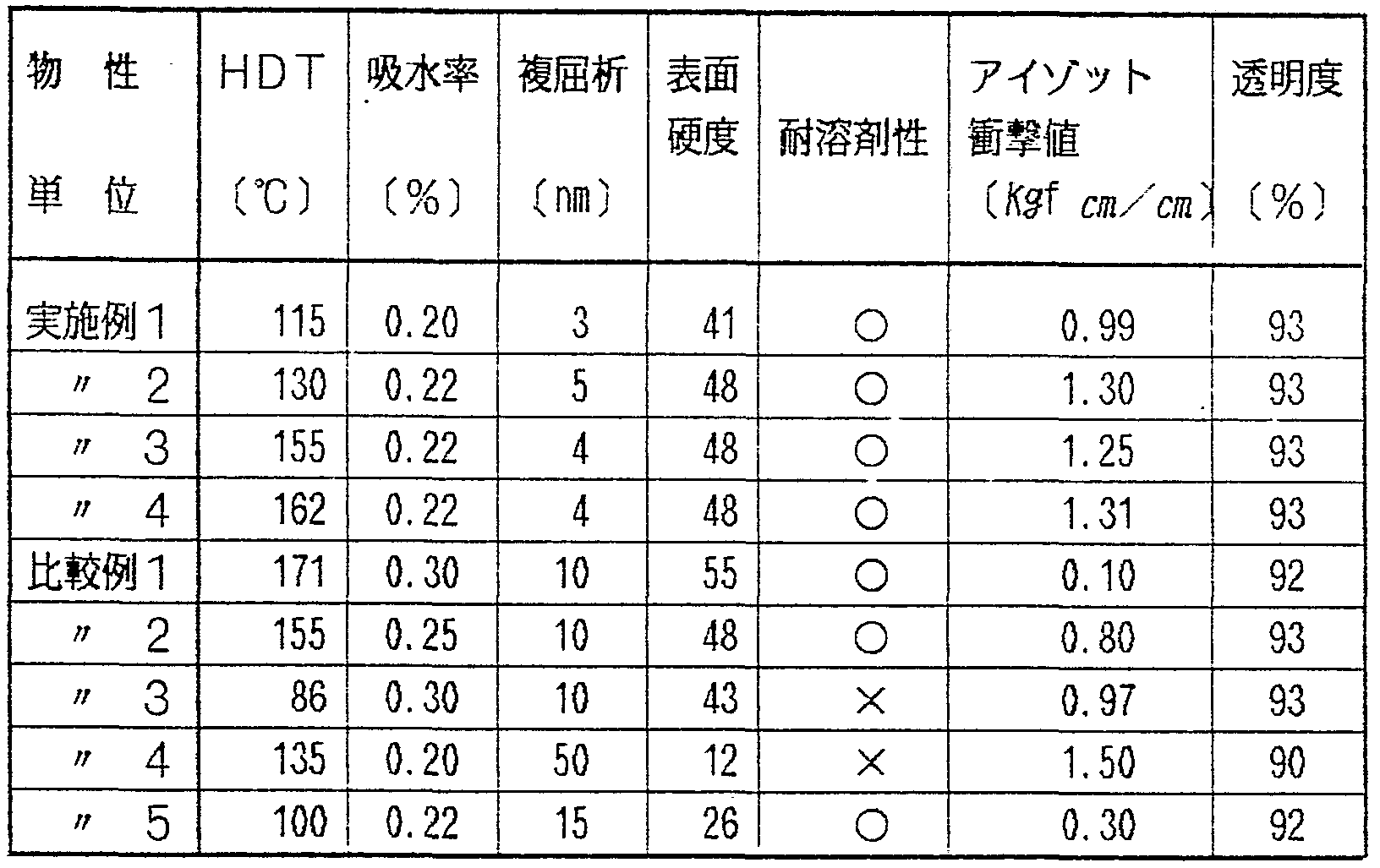
ァセタ ール系化合物 ( A化合物 ) と メ ルカプ 卜系化合物 ( B 化合物 ) とから複屈折が低く 、 吸水率も小さな成形体が得られ る。 さ ら に、 卜 リ ァジン環を有する化合物を加ぇるこ と に ょ り 耐熱性, 表面硬度を改善できる。
ま た従来の P M M A樹脂, ポリ カ ーポネー 卜樹脂, C R — 3 9樹脂を加ぇても耐熱性, 光学的特性, 表面硬度のバランスの 取れた材料とな っ てぃる。
次に C化合物と して ビスフ I ノ ール類を加ぇた系にっぃて実 施した。 なぉ、 ここで使用 し た ビスフ ェ ノ 一ル類とは下に示す ちのでぁる。
CH2 = CH-C-0 -(O)- (C-2-1 )
0

〇
II
CH2 = CH-C -0- oV S oVo-C-CH CH2 (C-2-2)
II II II
0 0 0

CH2 =CH - (C-2-4)


X + y= 17
実施例 5
ジァ リ リ デンぺンタ ェ リ ス リ 卜 ール ( A — 1 〉 2 1 . 2部を ぺンタ ェ リ ス リ 卜 一ルテ 卜 ラチ才グ リ コ レー 卜 ( B — 1 ) 2 6倍に溶解させ、 5 0 , 3 0分間攛拌する。 これを組成物 A と する。 卜 リ メ チロ ールプロパン 卜 リ ァク リ レ一 ト 4 0部にべ ンゾィ ンィソプロ ピルェ一テル 0 . Ί 部加ぇさ ら に ( C— 2 — 1 ) 4 0部を加ぇ 6 0 に て均一に溶解 し て室温まで冷 31し た これに先に調整した Aを加ぇ均ーになるまで攛拌 した。 実施例 1 と周様の手法でこの耝成物を硬化させ、 無色透明な成形体を 得た。
実施例 6〜 8
実施例 5 にぉぃて ( C— 2 — 1 ) のかゎ り に ( C— 2 — 2 ) ( 〇 ー 2 — 3 ) , ( C— 2 — 4 ) を使用 し fc組成物ょ り得られ た成形体をそれぞれ実施例 6 , 7 , 8 とする。
比較例 6
実施例 5 にぉぃて ( Cー 2 — 1 ) のかゎ り に ( C— 2 — 5 ) を 4 0部使用 した他は実施例 5 と冏様の操作を行なぃ、 無色透 明な成形体を得た。
比較例 7
( C - 2 - 1 ) 5 0部にべンゾィ ンィソプ π ピルェーテル 0 1 部を加ぇ、 さ ら に 卜 リ メ チロ ールプロパン 卜 リ ァク リ レー 卜 5 〇部を加ぇ、 6 0 °Cにて均一に溶解し、 実施例 1 と周様な操 作にょ り成形体を得た。
実施例 5 ~ 8及び比較例 6 , 7で得られた成形体及び先の実
施例 1 , 比較例 3〜 5で得られた成形体にっぃての物性を第 2 表に示す。
第 2 表

0
II
CH2CH2-0-C-CH=CH2
N、
〇 >0
^ ' 0
CH2-CH-CO-CH2CH2 ^ CH2CH≤-0-C-CH=CH2 (C-3-I )
0

CH2-CH = CH2
CH2 =CH2 (Cー 3ー 4)

実施例 9
ジァ リ リ デンぺンタ ェ リ ス リ 卜 ール ( A— Ί ) 2 1 . 2部を ぺンタ ェ リ ス 卜 一ルテ 卜 ラチ才グ リ コ レ一 卜 ( Β — 1 ) 2 1 . 6部に溶解させ、 5 ◦ C , 3 0分間 31拌させた。 次ぃで、 べン ゾフ ェ ノ ン 0 . 2部を加ぇ、 先の ( A — 1 ) と ( B — 2 ) との 混合物へ加ぇた後、 均ーになるまで攬拌した。 次ぃで実施冽 1 と周様の操作に ょ り無色透明な成形体を得た。
実施例 Ί 0 , 1 1
実施例 9 にぉぃて ( C— 3 — 1 ) のかゎ り に ( C— 3 — 2 ) ( C — 3 — 3 ) を使用 し たものをそれぞれ突施例 1 0 , 1 1 と する。
比鲛冽 8
ジァ リ リ デンぺ ンタ ェ リ ス リ 卜 一ル ( A— Ί ) 1 0 . 6部と
( C - 3 - 4 ) で示される化合物 8 . 3部をぺンタ ェリ ス リ 卜 ールテ 卜 ラチ才グ リ コ レ一 卜 ( Β — 1 ) 2 1 . 6部に溶解さ fi 5 0 Ό , 3 0分閭攬拌させた。 これに 卜 リ メ チロ ールプロパン 卜 リ ァク リ レー 卜 4 0部及びべンゾィ ンェチルェーテル 0 . 1 部を加ぇ均ーになるまで攛拌 した。 次ぃで実施例 1 と冏様の操作にょ り無色透明な成形体を得た 比較例 9
( C - 3 ー 1 ) で示される化合物 1 〇 0部にべンゾィ ンェチ ルェ一テル〇 . 部加ぇ、 突施例 1 と周様な操作にょ り無色透 明な成形体を得た
実施例 9〜 1 1 及び比較例 8 , 9で得られた成形体及び参考 例 と し て実施例 1 ぉょび比較例 3〜 5 で得られ fc成形体にっぃ ての物性を第 3表に示す。 第 3 表 物 性 HDT 吸水率 複屈析 表面 ァィゾッ卜 透明度 耐溶剤性 衝撃値
単 位 (Ό) (%) (nm〕 iKsf cm/ cm , ( ) 実施例 9 130 0.22 6 50 〇 1.02 92
" 10 132 0.22 6 50 〇 1.01 92
" 1 125 0.21 6 47 〇 0.98 92 比較例 8 120 0.20 12 48 〇 0.88 91
" 9 140 0.27 13 53 〇 1.12 91 実施例 115 0.20 3 41 〇 0.99 93 比較例 3 86 0.30 10 43 X 0.97 93
" 4 135 0.20 50 12 X 1.50 90
" 5 100 0.22 15 26 〇 0.30 92
次に第 4成分 ( D ) を使用 した系を示す。 ( D ) 化合物は成 形体の モール ドからの離型性を向上させる。
( D ) 化合物 と して以下のものを使用 した。 ·
メルカプ 卜変性才ィル
(信越化学製 X— 2 2 — 9 8 0 ) ( D - 1 ) チ才グリ コ ール酸 2 —ェチルへキシル ( D — 2 )
0
II
CH2 0 -C-C-CH-CHa
C8 Hi? C -0 -CH2 -C -CH2 OH ( D — 3 )
II I
0 CH2 -0-C-CH=CH2
II
0 ネ才べ ンチルグリ コ ールジァク リ レー 卜 ( D — 4 ) 実施例 1 2
ジァ リ リ デンー 2 , 2 , 6 , 6 — テ 卜ラメ チ□ ールシク ロ へ キサノ ン 2 5 部を 1 , 1 , 1 — 卜 リ メ チロ ールプロパン 卜 リ — メ ルカプ 卜 ) プロ ピ才ナー 卜 2 5部と 1 , 1 , 1 ー 卜 リ メ チ π —ルプロパン 卜 リ ァク リ レー 卜 3 0部の混合液に溶解さ せ、 さ ら にべンゾフ ェ ノ ン ◦ . 4部を加ぇた 。 これとは別に 2 2 — ビス [ 4 — ( 2 — ァク リ ロ ィルェチル才キシ ) フェニル ] プロパン 6 0部にメ ルカプ 卜変性シ リ コ ーン才ィル ( D— 1 ) 1 . 0部を加ぇ、 5 0 に て 1 5分間魇拌 し た。 その後、 これ を上述の組成物に加ぇて充分に混合攬拌した。 この組成物ょ り 実施例 1 と周様の操作に ょ り成形体を得た。
実施例 Ί 3
ジァ リ リ デンぺンタ ェリ ス リ 卜ール 3 0部及びグ リ セ リ ンテ 卜ラチ才グリ コラー 卜 3 0部, ェチレングリ コ ールジァク リ レ — 卜 6〇部, ァゾビスィソ ァチロニ 卜 リ ル 0. 2 〇部を加ぇ充 分に魇拌して組成物を諝整した。 これとは別に ト リ ( 2— ァク リ ロィルェチルォキシ ) ィソ シ ァヌラー 卜 8 0部にチ才グリ コ ール酸 2—ェチルへキシル ( D— 2 ) 3. 5部を加ぇた。 4 5 で 2 0分間はげし く 攬拌した。 この組成物をガラス製モール ドに流 し込み、 70 にて 3 0分ぁぃだ保持した後、 毎時 1 0 °Cの速さで 9 0 ま で昇温し、 9 0 °Cで 3時間保持した。 その 後 1 2 0 にて 2時間硬化した。
実施例 1 4
ジァ リ リ デンぺンタェ リ ス リ ッ 卜 2 1 . 2部に 1 , 1 , 1 一 卜 リ メ チロ ールプロパン 卜 リ チ才グ リ コ レ一 卜 2 1 部を加ぇ、 5 0 で 3 0分間撹拌 し、 均ーな混合液を得た。 これに ( D— 3 ) で示される化合物を 1 部加ぇた。 N, N, N' , N' , N , N〃 ー へキサキス ( 2— ァク リ ロィルェ 卜キシメ チル) メ ラミ ン 20 部 と 卜 リ メ チロ ールプロパン 卜 リ ァク リ レー 卜 4 0部と ァゾビ スィ ソブチロニ 卜 リ ルとを混合 し、 先に述べた混合液とを加ぇ 均一になるまで隳拌 した。 この耝成物ょ り実施例 2 と周様の手 法にょ り透明な成形体を得た。
比較例 1 0〜 1 2
実施例 1 2〜 1 4に於ぃて ( D ) 化合物を混合しなぃものを 調整 し、 得られた成形体をそれぞれ比較例 1 0 , 1 1 , 1 2 と する。
比較例 Ί 3
実施例 Ί 4にぉぃて ( D— 3 ) のかゎ り に ( D— 4 ) を 1 部 加ぇた耝成物を調整し、 実施例 1 4 と周様な操作にょ り無色透 明な成形体を得た。
実施洌 Ί 2〜 1 4及び比較例 1 0〜 1 3にっぃて離型性を示し たのが第 4表でぁる α
齄型性は 60での水中から 2 5での水中成形体をモール ドご と投入 し た時の離型を示すものでぁ り 、 〇 : 良ぃ, △ : はがれ に く ぃ, X : 非常にはがれに く ぃ、 で示 した。
第 4 表

本発明の成形体を光ディ スク と して使用する場合、 記録媒体 との接着性が問題となる。 こ こでは中問層の実施例を示す。 実施例 Ί 5
実施例 1 で得た成形体を真空蒸着裝置に入れ、 到達真空度 2 X 1 0—s Τ〇 「 「 で 3時間排気した。 なぉ温度は 5 0ででぁる 次に 、 酸素ガスを 1 0— 4T o 「 「導入 しなが ら酸化ァルミニゥ ム ( 2 03 ) を蒸着 し た蒸着速度は 2 00 A Z m i n でぁ り 、 膜厚は 2 ◦ 00 Αでぁ っ た。 この上に 、 さ ら に ァルミ ニゥム層 を 5 000 Aだけ真空蒸着にょ り形成し、 さ ら にェポキシ樹脂 の保護層を形成 した。
実施阀 1 6
実施例 3で得た成形体を用ぃて実施洌 1 5 と同様の操作に ょ りディ スクを得た。
実施例 1 7
実施例 5で得た成形体を用ぃて実施例 1 5 と周様の操作にょ り ディ スクを得た。
実施例 1 8
実施例 9で得た成形体を用ぃて実施例 Ί 5 と周様の操作にょ り ディ スクを得た。
実施例 1 9
実施例 1 で得た成形体を D Cマグネ 卜 ロ ンスパッ タ リ ング装 置内に入れ、 到達真空度 5 X 1 0 -S Τ 0 「 「 で 3時間排気 し た ァルゴンガスを 1 . 5 Χ 1 0→ Τ Ο 「 「導入 し、 タ ーゲッ 卜 と 成形体との距離を 1 5 οίと し て酸化ァルミ ニゥ厶膜を形成させ た。 成膜速度は 200 A / m i n で、 膜厚は Ί 9 00 Αでぁ っ た 次に この上に酸化ジルコ ニゥ ムを形成 した。 成膜速度は 3 00 A /mi η , 膜厚は 2 1 Ο Ο Αでぁ っ た。 さ らに この上に ァルミ ニゥム層を 5000 Α形成し、 ェポキシ樹脂でコ 一卞 した。 比較例 1 4
実施例 1 5にぉぃて酸化ァルミ ニゥ厶層を形成せずにァルミ ニゥム層を形成し たもの。
比較例 1 5〜 1 7
実施例 1 5 にぉぃて Αί 2 03 層のかゎり に Ζτ 02 , Τί 02 , SL 02 層を形成 したものをそれぞれ比較例 1 5 , 1 6 , 1 7 と する。
比較例 1 8
実施例 1 9 にぉぃて
酸化ァルミ ニゥム層 と酸化ジルコニゥム層を逆の頫序で付け たちの。
実施例 1 5 〜 1 9 及び比較例 1 4 〜 1 8 で得ら れた板にっぃ て密着性テス 卜 を実施 した。
その方法は
ェポキシ樹脂保護膜の面にナィ フで 1 廳角のマス目を 1 0 0 個切 り 、 その上に セ ロハ ン粘着テ—プ ( ニチパン㈱製) を強く 貼り付け、 9 0度方向に急激に剥離した。 その時の剥離されな かっ たマス目の個数を示す。
膜構成を第 4 図に示す。
第 5 表にその結果を示す。
第 5 表

以下に実施する手法に ょ れぱ、 連続的にディ スク基扳を生産 するこ とが可能でぁる。
実施例 2 0
実施例 1 で使用 した耝成物を調整し、 第 3 図に示す裝置を用 ぃてディ スク基板の成形を行っ た。
第 1 図の金型を閉じてキ ャ ビティ 4 の中を 1 O—1 T o r 「 に 排気 した。 キ ャ ビティ 4 の幅は、 1 . 3薦でぁ っ た。 次に排気 されたキ ャ ビティ 内に実施例 1 で使用 した耝成物を計量ポンプ を用ぃて 5 Z ^で所定量注入 した。 っぃ でキセノ ンランプを 用ぃて紫外鎳を金型 1 の石英ガラス板 5 a , 5 bからなる窓部 5 を介 し て耝成物に照射 し た。 照射時間は 1 0 Q秒でぁっ た。 またキセノ ンランプの光は反射板を用ぃて集光した。 紫外線照 射中、 金型 1 に は 3 0 °C に保たれた冷却水を通 し て冷却を行っ た。 この後、 金型 1 を用ぃて外径 1 2 0顯, 厚さ Ί . 2顧のデ ィ スクを取り出 した。 なぉ、 この操作は連続 し て行なぅ こ とが 可能でぁ っ た。
実施例 2
実施例 9 で使用 した耝成物を用ぃて実施例 2 0 と周じ操作に ょ りディ スクを得た。
実施例 2 2
実施例 2 0 に於ぃて紫外線照射中、 型の下に設置された加圧 裝置に ょ り 6 Z on2の圧カで加圧 した他は実施例 2 0 と周様の 操作を行な っ た。
実施例 2 3
実施例 1 3で調整 した耝成物を用ぃ、 実施例 2 2 と周様の操 作にょ り ディ スクを得た。
実施例 1 9 , 2 0
実施例 1 及び 2の成形法をそれぞれ比較例 1 9 , 2 0 と した 実施洌 2 0〜 2 3 及び比較例 1 9 , 2 0 にっぃて成形サィ ク ル, 連続成形性を比較し第 6表に示す。
成形サィ クルと はー枚のディ スクを作るのに必要な時間でぁ る。
第 6 表 複屈折 nm 成形サィクル(秒) 連続成形性 備 考 実施例 20 3〜 5 120 有
" 21 6 〃 //
" 22 6 〃 ,/
" 23 4 //
比較例 19 3 ,/ ハ" 光硬化
実施例 Ί
〃 20 5 7.5時間 !r 熱硬化
実施例 2
Claims
1 . 1 分子ぁた り少なく とも 2個の不飽和シク ロ ァセタ ール基 を有する化合物 と、
1 分子ぁた り少なく とも 2個のメルカプ 卜基を有する化合物と からなるこ とを特徴とする硬化性耝成物。
2 . 前記不飽和シク ロ ァセタ ール基を有する化合物のシク ロ ァ セタ ール基は 不飽和ジ才キサン型 CH ; 不飽和ジ才キソラン型 CH ;

3 . 1 分子ぁた り少な く とも 2 個の不飽和シク ロ ァセタ ール基 を有する化合物 と 、 1 分子ぁた り少なく とも 2個のメルカプ 卜 基を有する化合物とからなる硬化性耝成物にさ らに 1 分子中に 少なく とも 1 個のメルカプ 卜基を有する化合物、 及び Zま た は 1 分子中に少なく とも 1 餾のメルカプ 卜基を有するカルポン酸 と炭素数 4以上の直鎖も し く は分枝ァルコ ールとの反応生成物 のカルポン酸ェステルを添加 してなるこ とを特徴とする特許請 求の範囲第 1 項記載に ょる硬化性耝成物。
4 . 1 分子ぁた り少なく とも 2 涸の不飽和ァセタ ール基を有す 新た な用紙
る化合物 と、 1 分子ぁた り少なく とも 2個のメルカプ 卜基を有 する化合物とからなる硬化性組成物にさ ら に 1 分子ぁた り少な く とも 2 個の ァク リ ロ ィル基及び /ま た はメ タ ク リ ロ ィル基を 有しかっ炭素数が 8〜 1 7以上のァルキル基を有する化合物及 びそのハロゲン原子置換体を添加 してなるこ とを特徴とする特 許請求の範囲第 1 項記載にょる硬化性耝成物。
5 . 1 分子ぁた り少な く とも 2個の不飽和シク ロ ァセタ ール基 を有する化合物 と、
1 分子ぁた り少なく とも 2個のメルカプ 卜基を有する化合物 と 1 分子ぁた り少なく とも 2個の反応性不飽和結合を有する化合 物とからなるこ とを特徴とする硬化性耝成物。
6 . 不飽和シク ロ ァセタ ール基を有する化合物のシク ロ ァセタ ール基は 不飽和ジ才キサン型 C H 2 不飽和ジ才キソラン型 CH 2

7 . メルカプ 卜基を有する化合物は脂肪族ポ リ メルカプタン, 芳香族ポ リ メルカプタ ンでぁるこ とを特徼とする特許請求の範 囲第 5項記載にょる硬化性耜成物。
8 . 反応性不飽和結合を有する化合物は 1 分子ぁた り少なく と も 2 個のァク リ ロィル基及びまたはメ タ ク リ ロ ィル基を有する 新た な 用紙
ビスフェノ ール類でぁるこ とを特徴とする特許請求の範囲第 5 ^記載にょる硬化性耝成物。
9 . 反応性不飽和結合を有する化合物は Ί 分子ぁた り少なく と も 2 腦のァク リ ロ ィル基及び /ま た はメ タ ク リ ロ ィル基を有す る 卜 リ ァジン環を有する化合物でぁるこ とを特徴とする特許請 求の範囲第 5 項記載にょる硬化性耝成物。
1 0 . 反応性不飽和桔合を有する化合物は 1 分子ぁた り少な く とも 2 個のァク リ ロ ィル基及びま た はメ タ ク リ ロ ィル基を有す るィ ソシァヌル酸誘導体でぁるこ とを特遨とする特許請求の範 囲第 5項記载にょる硬化性耝成物。
. 反応性不飽和結合を有する化合物は 1 分子ぁた り少な く とも ビニル基, ァ リ ル基, ァク リ ロ ィル基, メ タ クァク リ ロ ィ ル基を有する化合物でぁるこ とを特徴とする特許請求の範囲第 5項記載にょる硬化性耝成物。
1 2 . 1 分子ぁた り少なく とも 2個の不飽和シク ロ ァセタ 一ル 基を有する化合物と、
1 分子ぁた り少なく と 'も 2個のメルカプ 卜基を有する化合物 と、
1 分子ぁた り少な く とも 2個の反応性不飽和結合を有する化 合物 とからなる硬化性耝成物にさ ら に 1 分子中に少な く とも Ί 個のメ ルカプ 卜基を有する化合物及び/または 1 分子中に少な く とも 1 固のメルカプ 卜基を冇するカルポン酸と炭素数 4 以上 の直鎖も し く は分枝ァルコ ールとの反応生成物の カルポン酸ェ ステルを添加するこ とを特徴とする特許請求の篛囲第 5 項記載
にょる硬化性耝成物。
1 3 . 1 分子ぁた り少な く とも 2個の不飽和シク ロ ァセタ ール 基を有する化合物 と 、
1 分子ぁた り少な く とも 2 個のメルカプ 卜基を有する化合物 と 、
1 分子ぁた り少なく とも 2 個の反応性不飽和結合を有する化 合物を有する化合物とから硬化性耝成物に さ ら に 1 分子ぁた り 少な く とも 2 個のァク リ ロ ィル基及び /またはメ タ ク リ ロィル 基を有 しかっ炭素数が 8 〜 1 7 の ァルキル基を有する化合物及 びそのハ ロゲン原子置換体を添加するこ とを特徴とする特許請 求の範囲第 5 項記载にょる硬化性耝成物。
1 4 . 1 分子ぁた り少なく とも 2個の不飽和シク ロ ァセタ ール 基を有する化合物 と、
1 分子ぁた り少なく とも 2 個のメ ルカプ 卜基を有する化合物 とから なる耝成物を硬化さ せて得られる成形休の表面に酸化ァ ルミ ニゥムからなる層を形成 してなるこ とを特徴とする透明性 基材。
5 . Ί 分子ぁた り少な く とも 2個の不飽和シク ロ ァセタ ール 基を有する化合物 と、
1 分子ぁた り少なく とも 2 個のメルカプ 卜基を有する化合物 とからなる組成物に 、 さ ら に 1 分子ぁた り少な く とも 2個の ァ ク リ ロ ィル基ぉょび/また はメ タ ク リ ロ ィル基を有する化台物 を添加 し てなる钽成物を硬化さ せて得られる成形体の表面に酸 化ァルミ ニゥムからなる層を形成するこ と'を特徴とする透明性
基材。 ,
1 6 . 1 分子ぁた り少なく とも 2個のァク リ ロ ィル基及び Ζま たはメ タ ク リ ロ ィル基を有する化合物がビスフェノ ール類, 卜 リ ァジン環を有する化合物, ィソシァヌル酸誘導体からなる群 ょ り選ばれた 1 っでぁるこ とを特徴と する特許請求の範囲第 1 5項記載にょる透明性基材。
1 7 . 高ェネルギー綜を透過する材質からなる金型のなかに硬 化性耝成物を射出 し、 っぃで前記金型を通 して前記耝成物に髙 ェネルギー線を照射して前記耝成物を硬化せ しめるこ とを特徴 とする反応射出成形法。
1 8 . 髙ェネルギー線は紫外線でぁるこ とを特徴とする特許請 求の範囲第 1 7項記載にょる反応射出成形法。
1 9 . 金型は高ェネルギー線が透過 し得る材質製の窓部が外部 とキ ャ ビティ との間に設け られてな り 、 前記金型のキ ャ ビティ 内を排気し 、 前記キ ャ ビティ 内に硬化性耝成物を射出注入 し 、 っぃで注入された耝成物に前記金型の外部ょ り前記窓部を通 し て高ェネルギー線を照射 して前記耝成物を硬化するこ とを特徴 と する特許請求の範囲第 1 7 項記載にょる反応射出成形法。 2 0 . 硬化性樹脂は 1 分子ぁた り少な く とも 2個の不飽和シク ロ ァセタ 一ル基を有する化合物 と、
Ί 分子ぁた り少な く とも 2個のメルカプ 卜基を有する化合物 と 、
Ί 分子ぁた り少な く とも 2個の反応性不飽和結合を有する化 合物からなる硬化性耝成物でぁるこ とを特徴とする特許請求の
範囲第 Ί 7項及び第 1 9項のぃずれか 1 っにょる反応射出成形 法。
2 . 前記髙ェネルギー镍照射中に前記キャ ビティ を縮小する ために前記金型のー部分の金型を運動させるこ とを特徴とする 特許請求の範囲第 1 9項記載にょる反応射出成形法。
Applications Claiming Priority (12)
| Application Number | Priority Date | Filing Date | Title |
|---|---|---|---|
| JP60243268A JPS62101631A (ja) | 1985-10-30 | 1985-10-30 | 硬化性組成物 |
| JP60/243268 | 1985-10-30 | ||
| JP25318685A JPS62111706A (ja) | 1985-11-12 | 1985-11-12 | 光情報記録盤の成形法 |
| JP60/253186 | 1985-11-12 | ||
| JP5535586A JPS62211118A (ja) | 1986-03-13 | 1986-03-13 | 硬化性樹脂の成形法 |
| JP61/55355 | 1986-03-13 | ||
| JP61/56362 | 1986-03-14 | ||
| JP61/56360 | 1986-03-14 | ||
| JP61056362A JPS62212437A (ja) | 1986-03-14 | 1986-03-14 | 硬化性組成物 |
| JP61/56359 | 1986-03-14 | ||
| JP61056360A JPS62212602A (ja) | 1986-03-14 | 1986-03-14 | 透明性基材 |
| JP61056359A JPS62212438A (ja) | 1986-03-14 | 1986-03-14 | 硬化性組成物 |
Publications (1)
| Publication Number | Publication Date |
|---|---|
| WO1987002681A1 true WO1987002681A1 (fr) | 1987-05-07 |
Family
ID=27550597
Family Applications (1)
| Application Number | Title | Priority Date | Filing Date |
|---|---|---|---|
| PCT/JP1986/000225 Ceased WO1987002681A1 (fr) | 1985-10-30 | 1986-05-01 | Composition polymerisable et procede de production |
Country Status (2)
| Country | Link |
|---|---|
| EP (1) | EP0243501A1 (ja) |
| WO (1) | WO1987002681A1 (ja) |
Families Citing this family (7)
| Publication number | Priority date | Publication date | Assignee | Title |
|---|---|---|---|---|
| JP2969742B2 (ja) * | 1990-03-07 | 1999-11-02 | 株式会社総合歯科医療研究所 | 光重合成形装置 |
| KR20020048425A (ko) | 1999-09-30 | 2002-06-22 | 해리 제이. 레온 하르트 | 마이크로전자 어레이 상의 생체분자 부착 부위 |
| US6303082B1 (en) | 1999-12-15 | 2001-10-16 | Nanogen, Inc. | Permeation layer attachment chemistry and method |
| US6960298B2 (en) | 2001-12-10 | 2005-11-01 | Nanogen, Inc. | Mesoporous permeation layers for use on active electronic matrix devices |
| US6887362B2 (en) | 2002-02-06 | 2005-05-03 | Nanogen, Inc. | Dielectrophoretic separation and immunoassay methods on active electronic matrix devices |
| US7687103B2 (en) | 2006-08-31 | 2010-03-30 | Gamida For Life B.V. | Compositions and methods for preserving permeation layers for use on active electronic matrix devices |
| EP2128144A1 (en) * | 2008-05-30 | 2009-12-02 | Basf Se | Amphiphilic molecules with a triazine core |
Citations (5)
| Publication number | Priority date | Publication date | Assignee | Title |
|---|---|---|---|---|
| JPS57209929A (en) * | 1981-06-18 | 1982-12-23 | Nitto Electric Ind Co Ltd | Curable composition |
| JPS59193924A (ja) * | 1983-04-20 | 1984-11-02 | Showa Denko Kk | 光学材料用組成物 |
| JPS60195127A (ja) * | 1984-03-19 | 1985-10-03 | Showa Highpolymer Co Ltd | 硬化可能な樹脂組成物 |
| JPH05314800A (ja) * | 1992-05-08 | 1993-11-26 | Nec Ic Microcomput Syst Ltd | Mos型不揮発性半導体メモリ装置 |
| JPH05342297A (ja) * | 1992-06-05 | 1993-12-24 | Hitachi Ltd | 機能シミュレーション方式 |
-
1986
- 1986-05-01 EP EP86902901A patent/EP0243501A1/en not_active Withdrawn
- 1986-05-01 WO PCT/JP1986/000225 patent/WO1987002681A1/ja not_active Ceased
Patent Citations (5)
| Publication number | Priority date | Publication date | Assignee | Title |
|---|---|---|---|---|
| JPS57209929A (en) * | 1981-06-18 | 1982-12-23 | Nitto Electric Ind Co Ltd | Curable composition |
| JPS59193924A (ja) * | 1983-04-20 | 1984-11-02 | Showa Denko Kk | 光学材料用組成物 |
| JPS60195127A (ja) * | 1984-03-19 | 1985-10-03 | Showa Highpolymer Co Ltd | 硬化可能な樹脂組成物 |
| JPH05314800A (ja) * | 1992-05-08 | 1993-11-26 | Nec Ic Microcomput Syst Ltd | Mos型不揮発性半導体メモリ装置 |
| JPH05342297A (ja) * | 1992-06-05 | 1993-12-24 | Hitachi Ltd | 機能シミュレーション方式 |
Also Published As
| Publication number | Publication date |
|---|---|
| EP0243501A1 (en) | 1987-11-04 |
Similar Documents
| Publication | Publication Date | Title |
|---|---|---|
| JPH11256120A (ja) | 接着剤組成物 | |
| DE3880642T2 (de) | Zusammensetzung , mit aktiven Strahlen härtbar, und Medium für die optische Registrierung mit dieser gehärteten Zusammensetzung. | |
| CN1208056A (zh) | 用于dvd的光固化树脂组合物 | |
| JPS63158501A (ja) | 光デイスク基板の製造方法 | |
| EP0243501A1 (en) | Curable composition and method for molding it | |
| US4889757A (en) | Optical recording disk | |
| JP2005036184A (ja) | 放射線硬化性樹脂組成物及びその硬化物 | |
| JPS6116815A (ja) | 光デイスク基板の製造方法 | |
| EP0254184B1 (de) | Verwendung von härtbaren Reaktionsmassen zur Herstellung von Datenträgern | |
| JPS62111706A (ja) | 光情報記録盤の成形法 | |
| JPH01167315A (ja) | 光ディスク基板 | |
| JPS62212602A (ja) | 透明性基材 | |
| JP2011116969A (ja) | 活性エネルギー線硬化型樹脂組成物および凹凸形状物品 | |
| JPS63148444A (ja) | 光デイスクのレプリカ形成方法 | |
| JPH04247338A (ja) | 光ディスク | |
| JPS62212437A (ja) | 硬化性組成物 | |
| JPS62101631A (ja) | 硬化性組成物 | |
| JPH0587894B2 (ja) | ||
| JPH0410249A (ja) | 情報記録担体 | |
| JPS6341513A (ja) | 硬化反応性組成物のデ−タキヤリア製造のための使用 | |
| JP4328446B2 (ja) | 追記型光情報記録媒体 | |
| JPS60184887A (ja) | 光記録媒体およびその記録方法 | |
| JPH033132A (ja) | 光ディスク製造用モノマー組成物 | |
| JPH03124491A (ja) | 光記録媒体およびその製造方法 | |
| JPS62212439A (ja) | 硬化性組成物 |
Legal Events
| Date | Code | Title | Description |
|---|---|---|---|
| AK | Designated states |
Kind code of ref document: A1 Designated state(s): US |
|
| AL | Designated countries for regional patents |
Kind code of ref document: A1 Designated state(s): DE FR GB |
|
| WWE | Wipo information: entry into national phase |
Ref document number: 1986902901 Country of ref document: EP |
|
| WWP | Wipo information: published in national office |
Ref document number: 1986902901 Country of ref document: EP |
|
| WWW | Wipo information: withdrawn in national office |
Ref document number: 1986902901 Country of ref document: EP |