WO1987003285A1 - De-(acetylglucosaminyl)-di(dehydro)-deoxy teicoplanin derivatives - Google Patents
De-(acetylglucosaminyl)-di(dehydro)-deoxy teicoplanin derivatives Download PDFInfo
- Publication number
- WO1987003285A1 WO1987003285A1 PCT/EP1986/000630 EP8600630W WO8703285A1 WO 1987003285 A1 WO1987003285 A1 WO 1987003285A1 EP 8600630 W EP8600630 W EP 8600630W WO 8703285 A1 WO8703285 A1 WO 8703285A1
- Authority
- WO
- WIPO (PCT)
- Prior art keywords
- compound
- process according
- hydrogen
- teicoplanin
- deoxy
- Prior art date
- Legal status (The legal status is an assumption and is not a legal conclusion. Google has not performed a legal analysis and makes no representation as to the accuracy of the status listed.)
- Ceased
Links
Classifications
-
- C—CHEMISTRY; METALLURGY
- C07—ORGANIC CHEMISTRY
- C07K—PEPTIDES
- C07K9/00—Peptides having up to 20 amino acids, containing saccharide radicals and having a fully defined sequence; Derivatives thereof
-
- C—CHEMISTRY; METALLURGY
- C07—ORGANIC CHEMISTRY
- C07K—PEPTIDES
- C07K9/00—Peptides having up to 20 amino acids, containing saccharide radicals and having a fully defined sequence; Derivatives thereof
- C07K9/006—Peptides having up to 20 amino acids, containing saccharide radicals and having a fully defined sequence; Derivatives thereof the peptide sequence being part of a ring structure
- C07K9/008—Peptides having up to 20 amino acids, containing saccharide radicals and having a fully defined sequence; Derivatives thereof the peptide sequence being part of a ring structure directly attached to a hetero atom of the saccharide radical, e.g. actaplanin, avoparcin, ristomycin, vancomycin
-
- Y—GENERAL TAGGING OF NEW TECHNOLOGICAL DEVELOPMENTS; GENERAL TAGGING OF CROSS-SECTIONAL TECHNOLOGIES SPANNING OVER SEVERAL SECTIONS OF THE IPC; TECHNICAL SUBJECTS COVERED BY FORMER USPC CROSS-REFERENCE ART COLLECTIONS [XRACs] AND DIGESTS
- Y10—TECHNICAL SUBJECTS COVERED BY FORMER USPC
- Y10S—TECHNICAL SUBJECTS COVERED BY FORMER USPC CROSS-REFERENCE ART COLLECTIONS [XRACs] AND DIGESTS
- Y10S930/00—Peptide or protein sequence
- Y10S930/01—Peptide or protein sequence
- Y10S930/19—Antibiotic
-
- Y—GENERAL TAGGING OF NEW TECHNOLOGICAL DEVELOPMENTS; GENERAL TAGGING OF CROSS-SECTIONAL TECHNOLOGIES SPANNING OVER SEVERAL SECTIONS OF THE IPC; TECHNICAL SUBJECTS COVERED BY FORMER USPC CROSS-REFERENCE ART COLLECTIONS [XRACs] AND DIGESTS
- Y10—TECHNICAL SUBJECTS COVERED BY FORMER USPC
- Y10S—TECHNICAL SUBJECTS COVERED BY FORMER USPC CROSS-REFERENCE ART COLLECTIONS [XRACs] AND DIGESTS
- Y10S930/00—Peptide or protein sequence
- Y10S930/01—Peptide or protein sequence
- Y10S930/27—Cyclic peptide or cyclic protein
Definitions
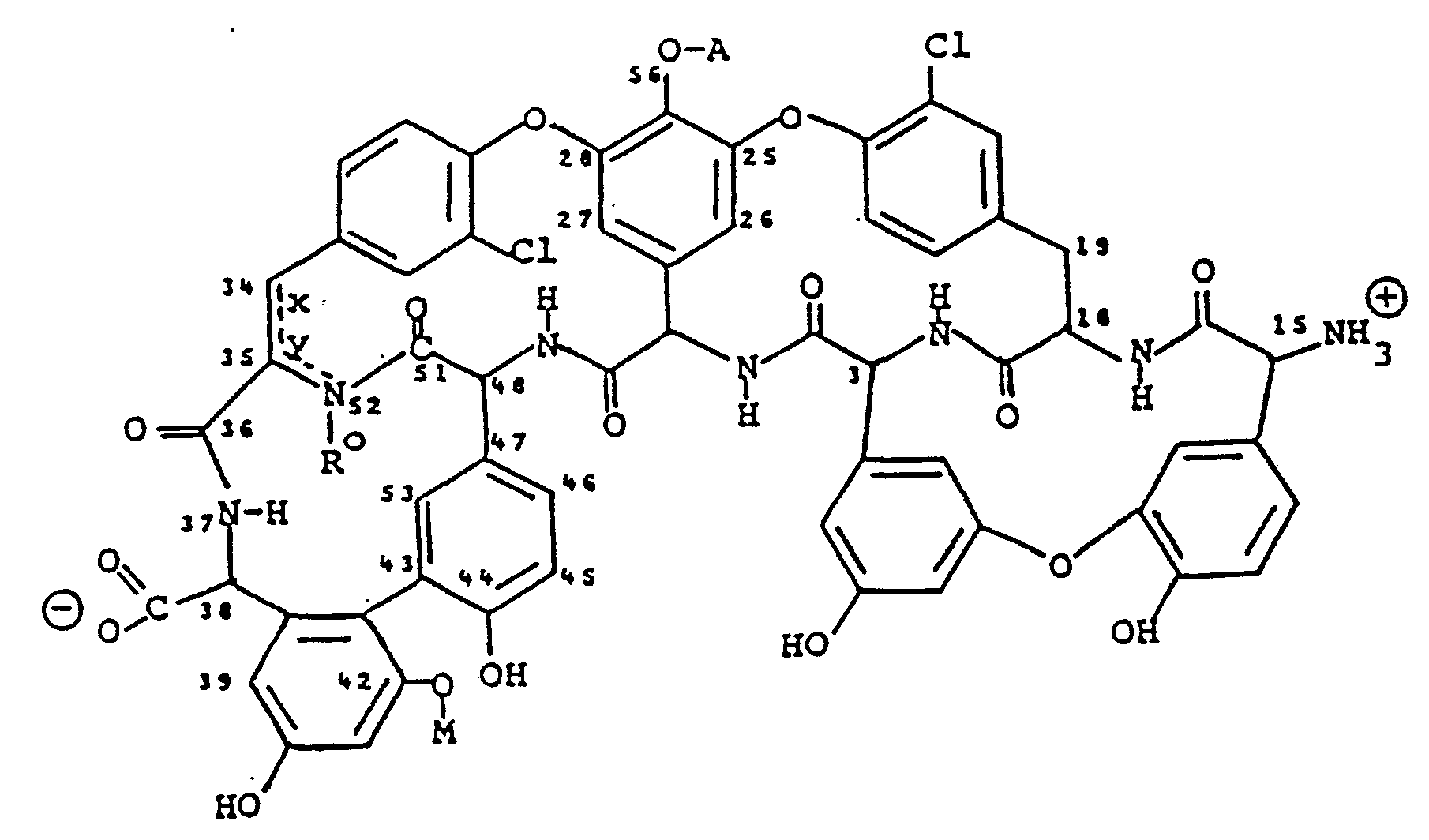
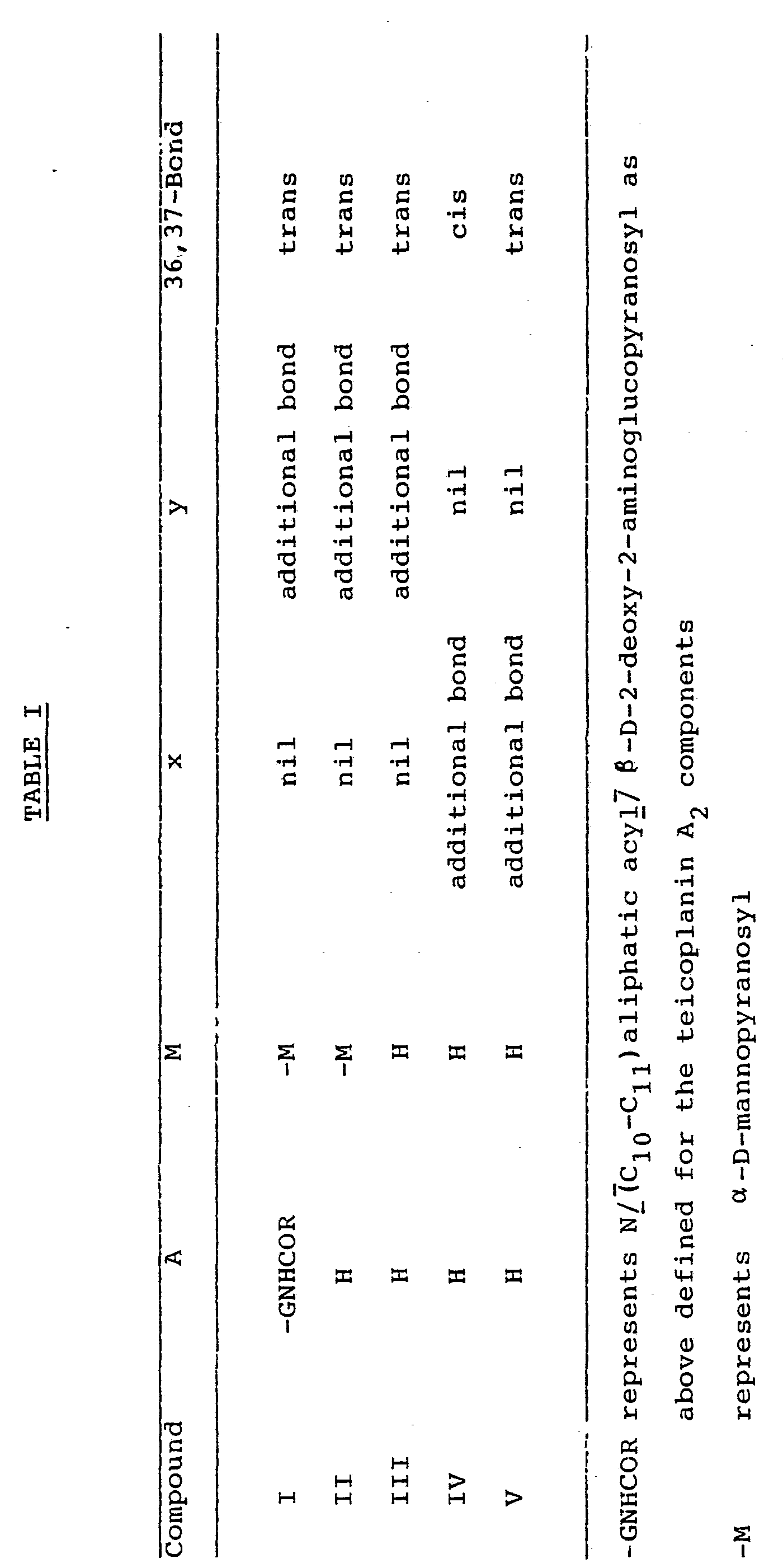
- the present invention is directed to new antibiotic substances which are de-(acetylglucosaminyl)-di(dehydro) deoxy teicoplanin derivatives of the following formula I
- x and y each independently represents nil or an additional bond
- A represents hydrogen or N[(C 10 -C 11 ) aliphatic acyl]- ⁇ -D-2-deoxy-2-aminoglucopyranosyl
- M represents hydrogen or ⁇ -D-mannopyranosyl
- Ro represents nil when y represents an additional bond and hydrogen when y represents nil, with the proviso that when x represent an additional bond y must represent nil, and when x represent nil y must represent an additional bond and when M represents hydrogen also A must represent hydrogen, and the addition salts thereof.
- (C 10 -C 11 ) aliphatic acyl represent a satured or unsatured aliphatic acyl group of 10 or 11 carbon atoms.
- Preferred examples of (C 10 -C 11 ) aliphatic acyl groups are: Z-4-decenoyl, 8-methylnonanoyl, decanoyl, 8-methyldecanoyl, and 9-methyldecanoy1.
- a and M represent sugar mojeties as above defined, they are linked to the core mojety through O-glycosidic bonds.
- a preferred group of compounds of the invention includes those compounds of formula I wherein x represents nil and y represents an additional bond. Another preferred group of compounds of the invention is represented by those compounds of formula I wherein the amidic bond 36,37 has a trans configuration. The most preferred group of compounds of the invention is represented by those compounds of formula I wherein x represents nil, y represents an additionl bond and the amidic bond 36,37 has a trans configuration
- the compounds of the invention possess antimicrobial activity, mainly against gram positive bacteria, some coagulase-negative staphylococci included. They are prepared by reacting teicoplanin, a teicoplanin factor, component or pseudoaglycon under controlled base conditions in the presence of polar organic solvents.
- Teicoplanin is the international non-proprietary name (INN) of the antibiotic substance formerly named teichomycin which is obtained by cultivating the strain Actinoplanes teichomyceticus nov. sp. ATCC 31121 in a culture medium containing assimilable sources of carbon, nitrogen and inorganic salts (see U.S. Patent No. 4,239,751). According to the procedure described in the above cited patent an antibiotic complex containing Teichomycin A 1 , A 2 and A 3 is recovered from the separated fermentation broth by extraction with a suitable water insoluble organic solvent and precipitation from the extracting solvent according to common procedures.
- Teichomycin A 2 which is the major factor of the isolated antibiotic complex, is then separated from the other factors by means of column chromatography on Sephadex ® .
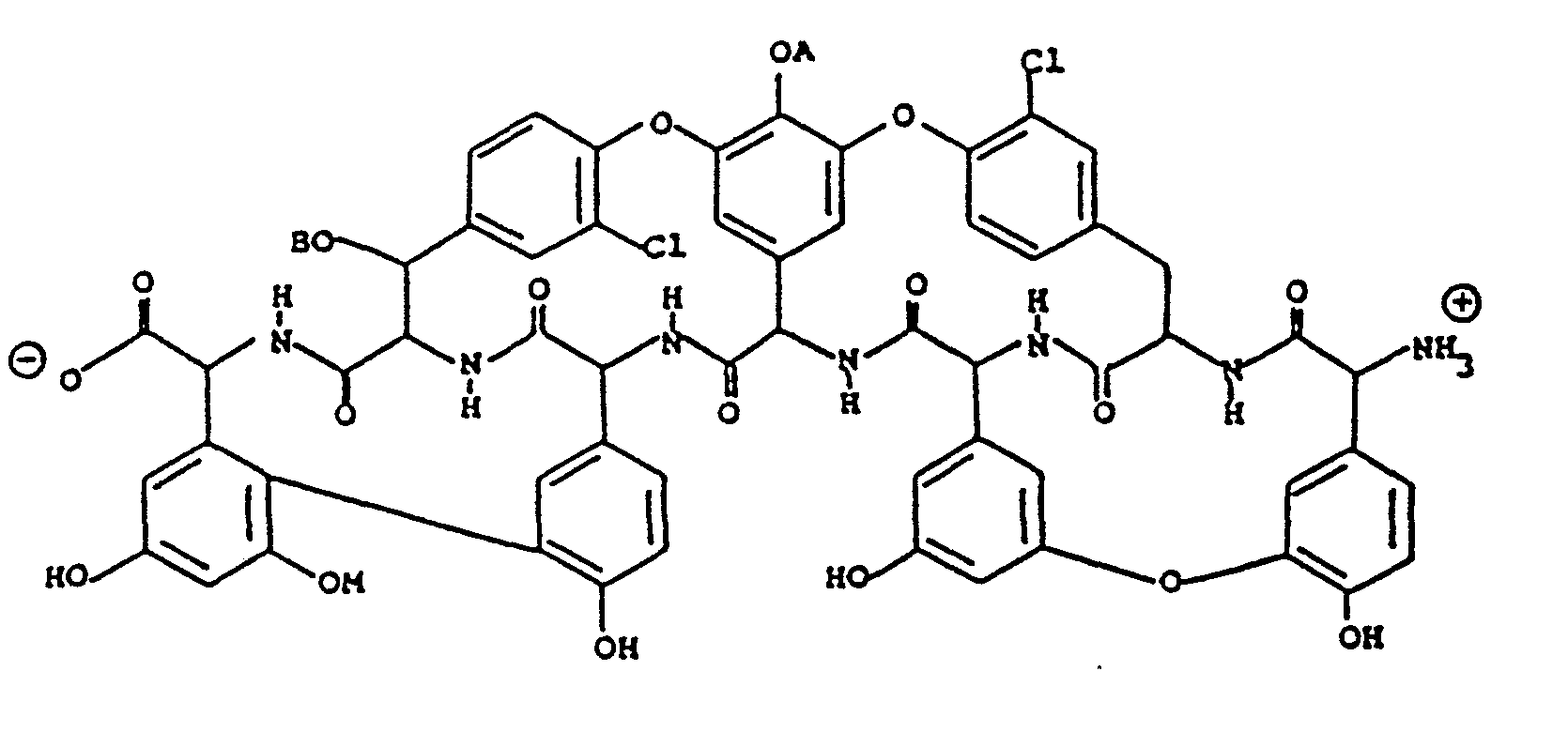
- A represents -N[(C 10 -C 11 )aliphatic acyl]- ⁇ -D-2-deoxy-2-aminoglucopyranosyl
- B represent N-acetyl- ⁇ -D-2-deoxy-2-amino-glucopyranosyl
- M represents -D-mannopyranosyl
- teicoplanin A 2 component 1 the [(C 10 -C 11 )-aliphatic acyl] substituent represents Z-4-decenoyl, in teicoplanin A 2 component 2 represents 8-methyl-nonanoyl, in teicoplanin A 2 component 3 represents decanoyl, in teicoplanin A 2 component 4 represents 8-methyldecanoyl, in teicoplanin A 2 component 5 represents 9-methyldecanoyl.
- antibiotic L 17054 and antibiotic L 17046 are named antibiotic L 17054 and antibiotic L 17046 and are described in European Patent Application Publication No. 119575 and European Patent Application Publication No. 119574, respectively.
- Preferred hydrolysis conditions for the production of antibiotic L 17054 are: 0.5 N hydrochloric acid at a temperature between 70°C and 90°C and for a time which is generally between 15 and 90 min.
- Antibiotic L 17054 is represented by the above formula I wherein A represents hydrogen, B represents
- M represents ⁇ -D-manno-pyranosyl wherein the sugar moieties are linked to the peptidic nucleus through an O-glycosidic bond.
- Preferred hydrolysis conditions for the preparation of antibiotic L 17046 are: 1-3 N hydrochloric acid, at a temperature between 50° and 90°C and for a time which is generally between 30 and 60 min.
- Antibiotic L 17046 is represented by the above formula II wherein A and M represent hydrogen atoms, and B is N-acetyl- ⁇ -D-2-deoxy-2-amino-glucopyranosyl wherein the sugar moiety is linked to the peptidic nucleus through an O-glycosidic bond.
- a substance having the same structural formula is disclosed in European Patent Application Publication No. 0090578 and is named antibiotic A 41030 factor B. This substance is obtained by means of a microbiological process which involves the fermentation of the strain
- Streptomyces virginiae NRRL 12525 or Streptomyces virginiae NRRL 15156 in a suitable medium the isolation, purification and separation into its components of antibiotic A 41030, an antibiotic complex of at least seven factors, antibiotic A 41030 factor B, included.
- teicoplanin starting material is used to indicate any one of the above starting materials, i.e. teicoplanin as obtained according to U.S.
- patent 4,239,751 any further purification thereof, teicoplanin A 2 complex, a compound of formula II wherein A, represents hydrogen or -N[(C 10 -C 11 )aliphatic acyl]- ⁇ -D-2-deoxy-2-amino- glucopyranosyl wherein (C 10 -C 11 ) aliphatic acyl has the above defined meanings, B represent hydrogen or N-acetyl- ⁇ -D-2-deoxy-2-amino-glucopyranosyl, M represents hydrogen or ct-D-mannopyranosyl, with the proviso that A, B and M may not simultaneously represent hydrogen and M represent hydrogen only when A represent hydrogen, and a salt thereof, or a mixture thereof in any proportion.
- the compounds of the invention are mainly obtained by treating the proper starting materials under controlled basic conditions which lead to the selective removal of N-acetyl- ⁇ -D-2-deoxy-2-glucosaminyl group from the teicoplanin starting molecule.
- the basic conditions of the present process for preparing the compounds of the invention are such that the removal of the N-acetyl- ⁇ -D-2-deoxy-2-amino-glucopyranosyl group from the teicoplanin starting material takes place without simultaneously affecting the other sugar mojeties. Since all the sugar mojeties in the teicoplanin starting material, when present, are linked through glycosidic bonds to the peptidic "core" of the molecule selective conditions are required to remove only one sugar mojety (namely the N-acetyl-D-2-deoxy- -2-amino glucopyranosyl mojety).
- suitable controlled basic conditions for preparing the compounds of the invention from the proper teicoplanin starting material include reacting the starting material in a polar organic solvent in the presence of a strong alkali at a temperature lower than about 60°C.
- polar organic solvents are lower alkanols, lower alkyl carboxamides, lower alkyl sulfoxamides, lower alkyl phosphoramides, lower alkyl sulfoxides and lower alkyl sulfones and the like and mixtures thereof.
- Lower alkanols as above described are alkanols of 1 to 4 carbon atoms including methanol, ethanol, propanol, 1-methylethanol, butanol and 2-methylpropanol.
- the term "lower alkyl” as used above represents alkyl groups of 1, 2, 3 or 4 carbon atoms.
- Examples of lower alkyl carboxamides are dimethylformamide, diethylformamide and the like.
- a preferred lower alkyl sulfoxide is dimethyl sulfoxide
- a preferred lower alkyl sulfone is dimethyl sulfone
- a preferred lower alkyl phosphoramide is hexamethyl phosphoramide.
- the polar organic solvent as above defined is a mixture of a polar aprotic organic solvent and a polar protic organic solvent.
- preferred polar aprotic solvents are tertiary alkyl amides, and dialkyl sulfoxides and sulfones, while preferred polar protic organic solvents are lower alkanols.
- the basic conditions required for the displacement of the N-acetyl-D-2-deoxy-2-amino-glucopyranosyl group from the starting material are obtained by means of strong alkali.
- Preferred examples of said strong alkali are concentrated aqueous alkali metal hydroxides, alkali metal oxides and alkali metal alkoxides of 1, 2, 3 or. 4 carbon atoms.
- the alkali metals are preferably sodium or potassium, and the preferred alkoxy groups are methoxy, ethoxy, propoxy, and butoxy.
- the polar organic solvent is preferably the corresponding alkanol possibly in a mixture with polar aprotic solvents as above defined.
- the reaction environment must contain a limited amount of water. In general, it is already present in the starting materials which in many instances are hydrates.
- the strong alkali is an alkali hydroxide or oxide
- reaction temperature needs to be controlled, and in general it should be kept below 60°C.
- reaction temperature is between 0°C and 50°C, and most preferably and conveniently is room temperature.
- the reaction time varies depending on the other reaction parameters. Since the reaction course may be followed by TLC or preferably HPLC procedures, the skilled man is capable of controlling the reaction conditions and deciding when the reaction is to be considered as completed.
- a preferred embodiment of process of the invention is represented by a process as above described wherein the polar organic solvent is a mixture of dimethylformamide and dimethylsulfoxide, the strong alkali is aqueous concentrated sodium or potassium hydroxide and the reaction temperature is room temperature.
- the proportion between dimethylformamide (DMF) and dimethylsulfoxide (DMSO) is from 4:1 to 3:2 (v/v), while the preferred concentration of the aqueous sodium or potassium hydroxide is between 85 and 90% (w/w).
- Another preferred embodiment of the process of the invention is represented by a process as above described wherein the strong alkali is an alkali metal alkoxide as above described and the polar organic solvent is the alkanol corresponding to said alkoxide optionally in the presence of a polar aprotic solvent as defined above which is preferably dimethylformamide.
- the preferred mixture strong alkali/polar organic solvent is in this case 1-10% methanolic sodium methoxide in dimethylformamide.
- NMR analysis also in comparison with known structures shows that no major changes in the configuration of the whole molecule has occured in these two new compounds relatively to the starting materials i.e. starting from a compound of the above formula II wherein M represents D-mannopyranosyl and the other substituents are as above defined, the corresponding compound wherein x represent nil and y represents an additional bond is obtained by treatment under strong alkali conditions.
- the starting material is antibiotic L 17046, i.e. a starting material of the above formula II wherein A and M represent hydrogen atoms and the other substituents are as above defined
- the corresponding de-glycosylated compound is obtained with a C-C double bond in position 34, 35.
- compound IV or compound V are obtained. More particularly, compound IV is obtained by treating antibiotic L 17046 under the basic conditions as described above either for a prolonged time or under the most drastic conditions.
- Compound V is, conversely, obtained under milder conditions such as for instance alkali metal alkoxide in a molar excess (50-100 times excess) in the presence of the corresponding alkanol at room temperature for about 24-72 h.
- Compound IV may also be transformed under mild acid conditions into compound III, i.e. the compound of formula I wherein A and M represent hydrogen, x represents nil and y represents a double bond (see Table I).
- a representative example of the mild acid conditions for the trasformation of compound V into compound III is represented by an aqueous solution of a mineral acid, typically 0.5-1N hydrochloric acid.
- Compound I or compound II may also be transformed into compound III by strong acid hydrolysis in the presence of a solvent selected from ethers, ketones, and mixture thereof, which are liquid at room temperature.
- a solvent selected from ethers, ketones, and mixture thereof, which are liquid at room temperature.
- ethers includes cyclic ethers and di-ethers. According to a preferred embodiment the term “ethers” is identified through the following general formulas
- R and R 1 may be each independently selected from alkyl of 1 to 8 carbon atoms, cycloalkyl of 5 to 8 carbon atoms, phenyl and phenyl (C 1 -C 4 ) alkyl or taken together with the oxygen atom form a fully hydrogenated heterocyclic ring of 5 to 10 members;
- n is the integer 2 or 3 and
- R 2 and R 3 are each independently selected from lower alkyl of 1 to 4 carbon atoms, phenyl and phenyl- (C 1 -C 4 ) alkyl or taken together with the group
- ketones refers to aliphatic ketones of 3 to 8 carbon atoms and includes cycloaliphatic ketones of 5 to 8 carbon atoms.
- the “ketones” are identified by the following formula
- R 4 and R 5 are each independently selected from lower alkyl of 1 to 6 carbon atoms, with the proviso that the total number of carbon atoms in the above formula can never be higher than 8, or R 4 and R 5 taken together form a polymethylene chain of 4 to 7 carbon atoms.
- solvents listed above the following are particularly preferred for the use in this acid hydrolysis reaction: tetrahydrofuran, tetrahydropyran, 1,2-dimethoxyethane, 1,2-diethoxyethane, dioxane and mixtures thereof.
- the solvent is usually employed in a large excess in comparison with the starting teicoplanin compound.
- the most suitable amount of solvent can be determined in each case depending on the specific solvent, solvent power and boiling point, in general it is preferred to carry out the acid hydrolysis in the presence of an amount of organic solvent corresponding to 10 to 50 milliliters of solvent per each gram of starting teicoplanin compound.
- the strong acid necessary to carry out the hydrolysis reaction is selected from strong mineral acids and strong organic acids.
- strong mineral acids hydrogen chloride, hydrogen bromide, concentrated sulfuric acid and concentrated phosphoric acid are preferred.
- strong organic acids the alphahalogenated lower aliphatic acids, the alkanesulfonic acids, the polyfluoroalkanesul-fonic acids, the cycloalkanesulfonic acids and the arylsulfonic acids are preferred with the following being the most preferred ones: trifluoroacetic acid, trichloroacetic acid, methanesulfonic acid, ethanesulfonic acid, trifluoromethanesulfonic acid and p-toluenesulfonic acid.
- 98% (w/w) ortofosforic acid yield satisfactory results.
- organic acids 98% (w/w) methanesulfonic acid and 98% (w/w) trifluoroacetic acid are preferably employed.
- Compound I may also be transformed into compound II by means of a controlled acid hydrolysis with a strong organic acid such as 75-95% aqueous trifluoroacetic acid at a temperature between 10 and 50°C.
- a strong organic acid such as 75-95% aqueous trifluoroacetic acid at a temperature between 10 and 50°C.
- a preferred acid is 90% trifluoroacetic acid and the reaction temperature is preferably room temperature.
- solvent it is not necessary that either the starting teicoplanin compound and/or the final antibiotic product of formula I be completely dissolved into the reaction solvent to form a homogeneous phase reaction solution. It is however necessary that the starting teicoplanin compound at the reaction temperature be sufficiently dissolved into the polar organic solvent/strong alkali mixture amount, that is, the concentration of the starting teicoplanin compound in the solution must not be so low that the reaction rate is very slow and/or a huge amount of solvent is required to perform the reaction on a pilot or industrial scale.
- Table II lists the analytical results, salt form, (M + H) peak in the fast atom bombardment (FAB) mass spectra, and potentiometric and HPLC analysis results.
- Analytical results for C, H, N, Cl were within ⁇ 0.4% of the theoretical values.
- the weight loss (solvent content), determined by thermogravimetric analysis (TGA), was always about 6-7%.
- the analytical results refer to the salt form reported in the table.
- FAB-MS positive ion spectra were recorded on a Kratos MS-50 instrument fitted with a standard FAB source and high field magnet. The sample was dispersed in a mixture thioglycerol:diglycerol 1:1 (v/v) and bombarded with a
- HPLC was run with a Varian Mod. 5000 LC pump equipped with a 20 ul injector Rheodyne Mod. 7125 and a UV detector at 254 nm.
- the antibacterial activity of the compounds of the invention can be demonstrated in vitro by means of standard agar-dilution tests.
- Isosensitest broth (Oxoid) and Todd-Hewitt broth (Difco) are used for growing staphylococci and streptococci, respectively. Broth cultures are
- MIC colony forming units/ml
- the compounds of the invention show also antibacterial activity in in vivo experiments.
- compounds I, II, and III showed an ED 50 value of 0.35, 5.8 and 5 mg/Kg, respectively.
- the compounds of the present invention can effectively be employed as the active ingredients of antimicrobial preparations used in human and veterinary medicine for the prevention and treatment of infectious diseases caused by pathogenic bacteria which are susceptible to said active ingredients. In such treatments, these compounds may be employed as such or in the form of mixtures in any proportion.
- the compounds of the present invention can be administered orally, topically or parenterally wherein however, the parenteral administration is preferred. Depending on the route of administration, these compounds can be formulated into various dosage forms. Preparations for oral administration may be in the form of capsules, tablets, liquid solutions or suspensions. As known in the art the capsules and tablets may contain in addition to the active ingredient, conventional excipients such as diluents, e.g.
- liquid preparations generally in the form of aqueous or oily solutions or suspensions, may contain conventional additives such as suspending agents.
- the compounds of the present invention may also be prepared in suitable forms for absorption through the mucous membranes of the nose and throat or bronchial tissues and may conveniently take the form of liquid sprays or inhalants, lozenges, or throat paints.
- the preparation may be presented in liquid or semi-liquid form. Topical applications may be formulated in hydrophobic or hydrophilic bases as ointments, creams, lotions, paints, or powders.
- the compounds of the invention are administered in the form of suppositories admixed with conventional vehicles, such as, for example, cocoa butter, wax, spermaceti or polyethylenglycols and their derivatives.
- conventional vehicles such as, for example, cocoa butter, wax, spermaceti or polyethylenglycols and their derivatives.
- compositions for injection may take such forms as suspensions, solutions, or emulsions in oily or aqueous vehicles, and may contain formulatory agents such as suspending, stabilizing and/or dispersing agents.
- the active ingredient may be in powder form for reconstitution at the time of delivery with a suitable vehicle, such as sterile water.
- a suitable vehicle such as sterile water.
- the amount of active principle to be administered depends on various factors such as the size and conditions of the subject to be treated, the route and frequency of administration, and the causative agent involved.
- the compound of the invention are generally effective at a dosage comprised between about 0.5 and about 30 mg of active ingredient per Kg of body weight, preferably divided in 2 to 4 administrations per day.
- Particularly desirable compositions are those prepared in the form of dosage units containing from about 20 to about 300 mg per unit.
- compositions are as follows:
- a parenteral solution is prepared with 100 mg of compound I dissolved in 2 ml of sterile water for injection.
- a parenteral solution is prepared with 250 mg of compound II dissolved in 3 ml of sterile water for injection.
- a topical ointment is prepared with 200 mg of compound III
- the compounds of the present invention can be used as animal growth promoters.
- one or more of the compounds of the invention is administered orally in a suitable feed.
- concentration employed is that which is required to provide for the active agent in a growth promotant effective amount when normal amounts of feed are consued.
- the addition of the active compounds of the invention to animal feed is preferably accomplished by preparing an appropriate feed premix containing the active compounds in an effective amount and incorporating the premix into the complete ration.
- an intermediate concentrate or feed supplement containing the active ingredient can be blended into the feed.
- Example 1 The following examples further illustrate the invention.
- Example 1 The following examples further illustrate the invention.
- Example 1 The following examples further illustrate the invention.
- Example 1 Example 1 :
- the column is first washed with 500 ml of the mixture H 2 O:CH 3 CN 85:15 (v/v) and then developed with a linear gradient from 15 to 30% of acetonitrile in 0.001N HCl in 24 h at the rate of 250 ml/h, while collecting 25 ml fractions. Those containing the pure compound of the title were pooled. Some crystalline product present is collected, washed with a mixture acetonitrile/ethyl ether 1:2 (v/v) and dried in vacuum at room temperature overnight (over P 2 O 5 ), yielding 0.85 g of pure compound of the title, as the internal salt.
- Dry HCl is slowly bubbled into a stirred suspension of 0.6 g of Compound I (see example 1 for its preparation) in 50 ml of dimethoxyethane (DME), while maintaining the internal temperature at 15-20°C. A clear solution forms in a few hours which is then evaporated to dryness under reduced pressure. The residue is dissolved in 100 ml of a mixture H 2 O:CH 3 CN 75:25 (v/v) and the resulting solution is loaded at the top of a column of 100 g of silanized silica gel in H 2 O. The column is developed with a linear gradient from 25 to 60% CH 3 CN in 0.001N HCl in 20 h at the rate of 150 ml/h, while collecting 15 ml fractions.
- DME dimethoxyethane
Landscapes
- Chemical & Material Sciences (AREA)
- Organic Chemistry (AREA)
- Genetics & Genomics (AREA)
- Biochemistry (AREA)
- Biophysics (AREA)
- General Health & Medical Sciences (AREA)
- Health & Medical Sciences (AREA)
- Medicinal Chemistry (AREA)
- Molecular Biology (AREA)
- Proteomics, Peptides & Aminoacids (AREA)
- Life Sciences & Earth Sciences (AREA)
- Pharmaceuticals Containing Other Organic And Inorganic Compounds (AREA)
- Saccharide Compounds (AREA)
- Medicines That Contain Protein Lipid Enzymes And Other Medicines (AREA)
- Peptides Or Proteins (AREA)
Abstract
Description


Claims


Priority Applications (7)
| Application Number | Priority Date | Filing Date | Title |
|---|---|---|---|
| DE8686906329T DE3665310D1 (en) | 1985-11-28 | 1986-11-01 | DE- (ACETYLGLUCOSAMINYL) -DI (DEHYDRO) -DEOXY TEICOPLANIN DERIVATIVES |
| AT86906329T ATE45960T1 (en) | 1985-11-28 | 1986-11-01 | DE-(ACETYLGLUCOSAMYL)-DI(DEHYDRO)DEOXYTEICOPLANIN DERIVATIVES. |
| HU865319A HU200193B (en) | 1985-11-28 | 1986-11-01 | Process for production of new derivatives of de-/acethil-glycoseaminil/-di-/dehydro/-dezoxi-theicoplanin and medical compositions containing them |
| KR1019870700649A KR930008098B1 (en) | 1985-11-28 | 1986-11-01 | De-(acetylglucosaminyl)-di(dehydro)-deoxyteicoplanin derivatives |
| NO872980A NO169170C (en) | 1985-11-28 | 1987-07-16 | PROCEDURE FOR THE PREPARATION OF DE- (ACETYLGLUCOSAMINYL) -DI (DEHYDRO) DEOXY-TEICOPLANINE DERIVATIVES |
| DK378787A DK378787A (en) | 1985-11-28 | 1987-07-21 | De- (acetylglucosaminyl) -di (dehydro) -DESOXYTEICOPLANINDERIVATER |
| FI873270A FI86862C (en) | 1985-11-28 | 1987-07-27 | PROCEDURE FOR THE FRAMEWORK OF PHARMACEUTICALS DEVA (ACETYLGLUCOSAMINYL) -DI (DEHYDRO) -DEOXI-TEIKOPLANIN DERIVATIVES |
Applications Claiming Priority (2)
| Application Number | Priority Date | Filing Date | Title |
|---|---|---|---|
| GB858529272A GB8529272D0 (en) | 1985-11-28 | 1985-11-28 | Teicoplanin derivatives |
| GB8529272 | 1985-11-28 |
Publications (1)
| Publication Number | Publication Date |
|---|---|
| WO1987003285A1 true WO1987003285A1 (en) | 1987-06-04 |
Family
ID=10588901
Family Applications (1)
| Application Number | Title | Priority Date | Filing Date |
|---|---|---|---|
| PCT/EP1986/000630 Ceased WO1987003285A1 (en) | 1985-11-28 | 1986-11-01 | De-(acetylglucosaminyl)-di(dehydro)-deoxy teicoplanin derivatives |
Country Status (18)
| Country | Link |
|---|---|
| US (1) | US4789661A (en) |
| EP (1) | EP0247074B1 (en) |
| JP (1) | JPS63501421A (en) |
| KR (1) | KR930008098B1 (en) |
| CN (1) | CN1020616C (en) |
| AR (1) | AR242836A1 (en) |
| AU (1) | AU599062B2 (en) |
| DE (1) | DE3665310D1 (en) |
| ES (1) | ES2002926A6 (en) |
| FI (1) | FI86862C (en) |
| GB (1) | GB8529272D0 (en) |
| HU (1) | HU200193B (en) |
| IL (1) | IL80749A0 (en) |
| NZ (1) | NZ218420A (en) |
| PH (1) | PH24004A (en) |
| PT (1) | PT83809B (en) |
| WO (1) | WO1987003285A1 (en) |
| ZA (1) | ZA868199B (en) |
Cited By (2)
| Publication number | Priority date | Publication date | Assignee | Title |
|---|---|---|---|---|
| EP0290922A3 (en) * | 1987-05-11 | 1990-01-17 | Gruppo Lepetit S.P.A. | Teicoplanin derivatives |
| EP0376041A3 (en) * | 1988-12-27 | 1991-11-13 | GRUPPO LEPETIT S.p.A. | C63-amide derivatives of 34-de(acetylglucosaminyl)-34-deoxy-teicoplanins |
Families Citing this family (2)
| Publication number | Priority date | Publication date | Assignee | Title |
|---|---|---|---|---|
| ATE134379T1 (en) * | 1990-12-05 | 1996-03-15 | Lepetit Spa | 38-DECARBOXY-38-HYDROXYMETHYL DERIVATIVES OF TEICOPLANIN ANTIBIOTICS, AND METHOD FOR THE PRODUCTION THEREOF |
| DK0912604T3 (en) | 1996-04-23 | 2002-03-25 | Biosearch Italia Spa | Improved chemical process for the preparation of amide derivatives of A 40926 antibiotic |
Family Cites Families (2)
| Publication number | Priority date | Publication date | Assignee | Title |
|---|---|---|---|---|
| GB1496386A (en) * | 1975-03-05 | 1977-12-30 | Lepetit Spa | Antibiotics |
| US4604239A (en) * | 1982-03-24 | 1986-08-05 | Eli Lilly And Company | Antibiotics |
-
1985
- 1985-11-28 GB GB858529272A patent/GB8529272D0/en active Pending
-
1986
- 1986-10-28 ZA ZA868199A patent/ZA868199B/en unknown
- 1986-11-01 WO PCT/EP1986/000630 patent/WO1987003285A1/en not_active Ceased
- 1986-11-01 EP EP86906329A patent/EP0247074B1/en not_active Expired
- 1986-11-01 DE DE8686906329T patent/DE3665310D1/en not_active Expired
- 1986-11-01 JP JP61505899A patent/JPS63501421A/en active Pending
- 1986-11-01 KR KR1019870700649A patent/KR930008098B1/en not_active Expired - Lifetime
- 1986-11-01 HU HU865319A patent/HU200193B/en unknown
- 1986-11-01 AU AU65978/86A patent/AU599062B2/en not_active Ceased
- 1986-11-14 AR AR86305903A patent/AR242836A1/en active
- 1986-11-24 IL IL80749A patent/IL80749A0/en not_active IP Right Cessation
- 1986-11-26 PH PH34529A patent/PH24004A/en unknown
- 1986-11-26 PT PT83809A patent/PT83809B/en not_active IP Right Cessation
- 1986-11-27 NZ NZ218420A patent/NZ218420A/en unknown
- 1986-11-27 ES ES8603206A patent/ES2002926A6/en not_active Expired
- 1986-11-28 CN CN86108016A patent/CN1020616C/en not_active Expired - Fee Related
-
1987
- 1987-07-17 US US07/102,198 patent/US4789661A/en not_active Expired - Fee Related
- 1987-07-27 FI FI873270A patent/FI86862C/en not_active IP Right Cessation
Non-Patent Citations (1)
| Title |
|---|
| The Journal of Antibiotics, Vol. 37, No. 10, October 1984, J.C.J. BARNA et al., "Structure and Conformation of Epimers Derived from the Antibiotic Teicoplanin", pages 1204-1208, see page 1204; Abstract; page 1207, line 23 - page 1208, line 20 cited in the application * |
Cited By (2)
| Publication number | Priority date | Publication date | Assignee | Title |
|---|---|---|---|---|
| EP0290922A3 (en) * | 1987-05-11 | 1990-01-17 | Gruppo Lepetit S.P.A. | Teicoplanin derivatives |
| EP0376041A3 (en) * | 1988-12-27 | 1991-11-13 | GRUPPO LEPETIT S.p.A. | C63-amide derivatives of 34-de(acetylglucosaminyl)-34-deoxy-teicoplanins |
Also Published As
| Publication number | Publication date |
|---|---|
| FI86862C (en) | 1992-10-26 |
| KR880700821A (en) | 1988-04-12 |
| CN1020616C (en) | 1993-05-12 |
| AU599062B2 (en) | 1990-07-12 |
| JPS63501421A (en) | 1988-06-02 |
| IL80749A0 (en) | 1987-02-27 |
| FI873270A0 (en) | 1987-07-27 |
| DE3665310D1 (en) | 1989-10-05 |
| PT83809B (en) | 1988-10-14 |
| CN86108016A (en) | 1987-11-11 |
| EP0247074B1 (en) | 1989-08-30 |
| KR930008098B1 (en) | 1993-08-25 |
| PT83809A (en) | 1986-12-01 |
| HU200193B (en) | 1990-04-28 |
| ES2002926A6 (en) | 1988-10-01 |
| ZA868199B (en) | 1987-08-26 |
| FI86862B (en) | 1992-07-15 |
| AR242836A1 (en) | 1993-05-31 |
| EP0247074A1 (en) | 1987-12-02 |
| US4789661A (en) | 1988-12-06 |
| HUT44795A (en) | 1988-04-28 |
| NZ218420A (en) | 1990-01-29 |
| FI873270L (en) | 1987-07-27 |
| GB8529272D0 (en) | 1986-01-02 |
| AU6597886A (en) | 1987-07-01 |
| PH24004A (en) | 1990-02-09 |
Similar Documents
| Publication | Publication Date | Title |
|---|---|---|
| EP0119574B1 (en) | Antibiotic l 17046 and process for preparing it | |
| KR100242682B1 (en) | Amide derivaties of antibiotic a 40926 | |
| EP0146053B1 (en) | Chemical process for preparing antibiotic l 17392 (deglucoteicoplanin) and its salts | |
| EP0465481B1 (en) | New substituted alkylamide derivatives of teicoplanin | |
| EP0216775B1 (en) | Carboxylic acid ester derivatives of deglucoteicoplanin | |
| EP0376041B1 (en) | C63-Amide derivatives of 34-de(acetylglucosaminyl)-34-deoxy-teicoplanins | |
| EP0276740A1 (en) | N15-alkyl and N15,N15-dialkyl derivates of teicoplanin compounds | |
| EP0247074B1 (en) | De-(acetylglucosaminyl)-di(dehydro)-deoxy teicoplanin derivatives | |
| EP0290922B1 (en) | Teicoplanin derivatives | |
| EP0316712A2 (en) | 22-Dechloroteicoplanins | |
| US5438117A (en) | Hexapeptides deriving from aglucoteicoplanin and a process for preparing them | |
| US5164484A (en) | De-(acetylglucosaminyl-di(dehydro)-deoxy teicoplanin derivatives | |
| US4908351A (en) | Antibiotic a 42867 derivative | |
| EP0560795B1 (en) | 38-decarboxy-38-hydroxymethyl derivatives of teicoplanin antibiotics, and a process for preparing them | |
| EP0351597A2 (en) | "N15-alkyl and N15,N15-di-alkyl derivatives of teicoplanin antibiotics carrying functional groups on the alkyl side chain | |
| EP0563062B1 (en) | Hexapeptides deriving from aglucoteicoplanin and a process for preparing them | |
| EP0326873A2 (en) | Teicoplanin hydrazides | |
| EP0460448A2 (en) | Use of C63-amide derivatives of 34-de(acetylglucosaminyl)-34-deoxy-teicoplanin against bacteria resistant to glycopeptide antibiotics |
Legal Events
| Date | Code | Title | Description |
|---|---|---|---|
| AK | Designated states |
Kind code of ref document: A1 Designated state(s): AU DK FI HU JP KR NO US |
|
| AL | Designated countries for regional patents |
Kind code of ref document: A1 Designated state(s): AT BE CH DE FR GB IT LU NL SE |
|
| WWE | Wipo information: entry into national phase |
Ref document number: 1986906329 Country of ref document: EP |
|
| WWE | Wipo information: entry into national phase |
Ref document number: 873270 Country of ref document: FI |
|
| WWP | Wipo information: published in national office |
Ref document number: 1986906329 Country of ref document: EP |
|
| WWG | Wipo information: grant in national office |
Ref document number: 1986906329 Country of ref document: EP |
|
| WWG | Wipo information: grant in national office |
Ref document number: 873270 Country of ref document: FI |