WO1987006602A1 - Phases smectiques de cristaux liquides - Google Patents
Phases smectiques de cristaux liquides Download PDFInfo
- Publication number
- WO1987006602A1 WO1987006602A1 PCT/EP1987/000218 EP8700218W WO8706602A1 WO 1987006602 A1 WO1987006602 A1 WO 1987006602A1 EP 8700218 W EP8700218 W EP 8700218W WO 8706602 A1 WO8706602 A1 WO 8706602A1
- Authority
- WO
- WIPO (PCT)
- Prior art keywords
- trans
- groups
- formula
- trifluorotoluene
- replaced
- Prior art date
- Legal status (The legal status is an assumption and is not a legal conclusion. Google has not performed a legal analysis and makes no representation as to the accuracy of the status listed.)
- Ceased
Links
- 0 CI(*)C1CC=C([*-])CC1 Chemical compound CI(*)C1CC=C([*-])CC1 0.000 description 1
- LRLRAYMYEXQKID-UHFFFAOYSA-N Cc1ccc(C(F)(F)F)cc1 Chemical compound Cc1ccc(C(F)(F)F)cc1 LRLRAYMYEXQKID-UHFFFAOYSA-N 0.000 description 1
- GETTZEONDQJALK-UHFFFAOYSA-N FC(c1ccccc1)(F)F Chemical compound FC(c1ccccc1)(F)F GETTZEONDQJALK-UHFFFAOYSA-N 0.000 description 1
Classifications
-
- C—CHEMISTRY; METALLURGY
- C09—DYES; PAINTS; POLISHES; NATURAL RESINS; ADHESIVES; COMPOSITIONS NOT OTHERWISE PROVIDED FOR; APPLICATIONS OF MATERIALS NOT OTHERWISE PROVIDED FOR
- C09K—MATERIALS FOR MISCELLANEOUS APPLICATIONS, NOT PROVIDED FOR ELSEWHERE
- C09K19/00—Liquid crystal materials
- C09K19/04—Liquid crystal materials characterised by the chemical structure of the liquid crystal components, e.g. by a specific unit
- C09K19/06—Non-steroidal liquid crystal compounds
- C09K19/34—Non-steroidal liquid crystal compounds containing at least one heterocyclic ring
- C09K19/3402—Non-steroidal liquid crystal compounds containing at least one heterocyclic ring having oxygen as hetero atom
-
- C—CHEMISTRY; METALLURGY
- C09—DYES; PAINTS; POLISHES; NATURAL RESINS; ADHESIVES; COMPOSITIONS NOT OTHERWISE PROVIDED FOR; APPLICATIONS OF MATERIALS NOT OTHERWISE PROVIDED FOR
- C09K—MATERIALS FOR MISCELLANEOUS APPLICATIONS, NOT PROVIDED FOR ELSEWHERE
- C09K19/00—Liquid crystal materials
- C09K19/04—Liquid crystal materials characterised by the chemical structure of the liquid crystal components, e.g. by a specific unit
- C09K19/06—Non-steroidal liquid crystal compounds
- C09K19/08—Non-steroidal liquid crystal compounds containing at least two non-condensed rings
- C09K19/10—Non-steroidal liquid crystal compounds containing at least two non-condensed rings containing at least two benzene rings
- C09K19/20—Non-steroidal liquid crystal compounds containing at least two non-condensed rings containing at least two benzene rings linked by a chain containing carbon and oxygen atoms as chain links, e.g. esters or ethers
- C09K19/2007—Non-steroidal liquid crystal compounds containing at least two non-condensed rings containing at least two benzene rings linked by a chain containing carbon and oxygen atoms as chain links, e.g. esters or ethers the chain containing -COO- or -OCO- groups
-
- C—CHEMISTRY; METALLURGY
- C09—DYES; PAINTS; POLISHES; NATURAL RESINS; ADHESIVES; COMPOSITIONS NOT OTHERWISE PROVIDED FOR; APPLICATIONS OF MATERIALS NOT OTHERWISE PROVIDED FOR
- C09K—MATERIALS FOR MISCELLANEOUS APPLICATIONS, NOT PROVIDED FOR ELSEWHERE
- C09K19/00—Liquid crystal materials
- C09K19/04—Liquid crystal materials characterised by the chemical structure of the liquid crystal components, e.g. by a specific unit
- C09K19/06—Non-steroidal liquid crystal compounds
- C09K19/08—Non-steroidal liquid crystal compounds containing at least two non-condensed rings
- C09K19/30—Non-steroidal liquid crystal compounds containing at least two non-condensed rings containing saturated or unsaturated non-aromatic rings, e.g. cyclohexane rings
- C09K19/3001—Cyclohexane rings
- C09K19/3003—Compounds containing at least two rings in which the different rings are directly linked (covalent bond)
-
- C—CHEMISTRY; METALLURGY
- C09—DYES; PAINTS; POLISHES; NATURAL RESINS; ADHESIVES; COMPOSITIONS NOT OTHERWISE PROVIDED FOR; APPLICATIONS OF MATERIALS NOT OTHERWISE PROVIDED FOR
- C09K—MATERIALS FOR MISCELLANEOUS APPLICATIONS, NOT PROVIDED FOR ELSEWHERE
- C09K19/00—Liquid crystal materials
- C09K19/04—Liquid crystal materials characterised by the chemical structure of the liquid crystal components, e.g. by a specific unit
- C09K19/06—Non-steroidal liquid crystal compounds
- C09K19/08—Non-steroidal liquid crystal compounds containing at least two non-condensed rings
- C09K19/30—Non-steroidal liquid crystal compounds containing at least two non-condensed rings containing saturated or unsaturated non-aromatic rings, e.g. cyclohexane rings
- C09K19/3001—Cyclohexane rings
- C09K19/3028—Cyclohexane rings in which at least two rings are linked by a carbon chain containing carbon to carbon single bonds
-
- C—CHEMISTRY; METALLURGY
- C09—DYES; PAINTS; POLISHES; NATURAL RESINS; ADHESIVES; COMPOSITIONS NOT OTHERWISE PROVIDED FOR; APPLICATIONS OF MATERIALS NOT OTHERWISE PROVIDED FOR
- C09K—MATERIALS FOR MISCELLANEOUS APPLICATIONS, NOT PROVIDED FOR ELSEWHERE
- C09K19/00—Liquid crystal materials
- C09K19/04—Liquid crystal materials characterised by the chemical structure of the liquid crystal components, e.g. by a specific unit
- C09K19/06—Non-steroidal liquid crystal compounds
- C09K19/08—Non-steroidal liquid crystal compounds containing at least two non-condensed rings
- C09K19/30—Non-steroidal liquid crystal compounds containing at least two non-condensed rings containing saturated or unsaturated non-aromatic rings, e.g. cyclohexane rings
- C09K19/3001—Cyclohexane rings
- C09K19/3066—Cyclohexane rings in which the rings are linked by a chain containing carbon and oxygen atoms, e.g. esters or ethers
- C09K19/3068—Cyclohexane rings in which the rings are linked by a chain containing carbon and oxygen atoms, e.g. esters or ethers chain containing -COO- or -OCO- groups
-
- C—CHEMISTRY; METALLURGY
- C09—DYES; PAINTS; POLISHES; NATURAL RESINS; ADHESIVES; COMPOSITIONS NOT OTHERWISE PROVIDED FOR; APPLICATIONS OF MATERIALS NOT OTHERWISE PROVIDED FOR
- C09K—MATERIALS FOR MISCELLANEOUS APPLICATIONS, NOT PROVIDED FOR ELSEWHERE
- C09K19/00—Liquid crystal materials
- C09K19/04—Liquid crystal materials characterised by the chemical structure of the liquid crystal components, e.g. by a specific unit
- C09K19/06—Non-steroidal liquid crystal compounds
- C09K19/32—Non-steroidal liquid crystal compounds containing condensed ring systems, i.e. fused, bridged or spiro ring systems
- C09K19/321—Compounds containing a bicyclo [2,2,2] octane ring
-
- C—CHEMISTRY; METALLURGY
- C09—DYES; PAINTS; POLISHES; NATURAL RESINS; ADHESIVES; COMPOSITIONS NOT OTHERWISE PROVIDED FOR; APPLICATIONS OF MATERIALS NOT OTHERWISE PROVIDED FOR
- C09K—MATERIALS FOR MISCELLANEOUS APPLICATIONS, NOT PROVIDED FOR ELSEWHERE
- C09K19/00—Liquid crystal materials
- C09K19/04—Liquid crystal materials characterised by the chemical structure of the liquid crystal components, e.g. by a specific unit
- C09K19/06—Non-steroidal liquid crystal compounds
- C09K19/34—Non-steroidal liquid crystal compounds containing at least one heterocyclic ring
- C09K19/3441—Non-steroidal liquid crystal compounds containing at least one heterocyclic ring having nitrogen as hetero atom
- C09K19/3444—Non-steroidal liquid crystal compounds containing at least one heterocyclic ring having nitrogen as hetero atom the heterocyclic ring being a six-membered aromatic ring containing one nitrogen atom, e.g. pyridine
-
- C—CHEMISTRY; METALLURGY
- C09—DYES; PAINTS; POLISHES; NATURAL RESINS; ADHESIVES; COMPOSITIONS NOT OTHERWISE PROVIDED FOR; APPLICATIONS OF MATERIALS NOT OTHERWISE PROVIDED FOR
- C09K—MATERIALS FOR MISCELLANEOUS APPLICATIONS, NOT PROVIDED FOR ELSEWHERE
- C09K19/00—Liquid crystal materials
- C09K19/04—Liquid crystal materials characterised by the chemical structure of the liquid crystal components, e.g. by a specific unit
- C09K19/06—Non-steroidal liquid crystal compounds
- C09K19/34—Non-steroidal liquid crystal compounds containing at least one heterocyclic ring
- C09K19/3441—Non-steroidal liquid crystal compounds containing at least one heterocyclic ring having nitrogen as hetero atom
- C09K19/345—Non-steroidal liquid crystal compounds containing at least one heterocyclic ring having nitrogen as hetero atom the heterocyclic ring being a six-membered aromatic ring containing two nitrogen atoms
- C09K19/3458—Uncondensed pyrimidines
- C09K19/3469—Pyrimidine with a specific end-group other than alkyl, alkoxy or -C*-
-
- C—CHEMISTRY; METALLURGY
- C09—DYES; PAINTS; POLISHES; NATURAL RESINS; ADHESIVES; COMPOSITIONS NOT OTHERWISE PROVIDED FOR; APPLICATIONS OF MATERIALS NOT OTHERWISE PROVIDED FOR
- C09K—MATERIALS FOR MISCELLANEOUS APPLICATIONS, NOT PROVIDED FOR ELSEWHERE
- C09K19/00—Liquid crystal materials
- C09K19/04—Liquid crystal materials characterised by the chemical structure of the liquid crystal components, e.g. by a specific unit
- C09K19/06—Non-steroidal liquid crystal compounds
- C09K19/34—Non-steroidal liquid crystal compounds containing at least one heterocyclic ring
- C09K19/3491—Non-steroidal liquid crystal compounds containing at least one heterocyclic ring having sulfur as hetero atom
-
- C—CHEMISTRY; METALLURGY
- C09—DYES; PAINTS; POLISHES; NATURAL RESINS; ADHESIVES; COMPOSITIONS NOT OTHERWISE PROVIDED FOR; APPLICATIONS OF MATERIALS NOT OTHERWISE PROVIDED FOR
- C09K—MATERIALS FOR MISCELLANEOUS APPLICATIONS, NOT PROVIDED FOR ELSEWHERE
- C09K19/00—Liquid crystal materials
- C09K19/04—Liquid crystal materials characterised by the chemical structure of the liquid crystal components, e.g. by a specific unit
- C09K19/06—Non-steroidal liquid crystal compounds
- C09K19/34—Non-steroidal liquid crystal compounds containing at least one heterocyclic ring
- C09K19/3402—Non-steroidal liquid crystal compounds containing at least one heterocyclic ring having oxygen as hetero atom
- C09K2019/3422—Non-steroidal liquid crystal compounds containing at least one heterocyclic ring having oxygen as hetero atom the heterocyclic ring being a six-membered ring
Definitions
- the invention relates to the use of trifluorotoluene derivatives of the formula I,
- a 1 and A 2 each independently of one another, 1,4-phenylene which is unsubstituted or substituted one or more times by halogen, nitrile and / or CH 3 , in which one or more CH groups can also be replaced by N, trans-1,4- Cyclohexylene, in which one or two non-adjacent CH 2 groups can also be replaced by -O- and / or -S-, or 1,4-bicyclo (2,2,2) octylene,
- Z 1 and Z 2 each independently of one another -CO-O-, -O-CO-,
- Chiral tilted smectic liquid crystalline phases with ferroelectric properties can be produced by adding a suitable chiral dopant to base mixtures with one or more tilted smectic phases (LA Beresnev et al., Mol. Cryst. Liq. Cryst. 89, 327 (1982 HR Brand et al., J.
- the smectic layers are arranged perpendicular to the plates of the cell.
- the helical arrangement of the tilt directions of the molecules is suppressed by a very small distance between the plates (approx. 1-2 ⁇ m). This forces the long axes of the molecules to line up in a plane parallel to the plates of the cell, creating two excellent tilt orientations.
- a suitable electrical alternating field it is possible to switch back and forth between these two states in the liquid-crystalline phase which has a spontaneous polarization. This switching process is much faster than with conventional twisted cells (TN-LCDs), which are based on nematic liquid crystals.
- the compounds of the formula I are therefore particularly suitable as components of chirally tilted smectic liquid-crystalline phases.
- chemically particularly stable chirally tilted smectic liquid-crystalline phases with favorable ferroelectric phase ranges, in particular with wide Sc * phase ranges, and favorable S A phases above the Sc phase for favorable orientation in the display, favorable pitch height and high values for such phases can be produced for spontaneous polarization.
- P is the spontaneous polarization in nC / cm 2 .
- the invention thus relates to the use of the compounds of the formula I as components (chirally tilted) smectic liquid-crystalline phases.
- the invention further relates to smectic liquid-crystalline phases, in particular chiral tilted smectic phases, containing at least one compound of the formula I and liquid-crystal display elements, in particular electro-optical display elements, which contain such phases.
- the invention further relates to new pyrimidine and pyridine compounds of the formula I, in which one of the groups A 1 and A 2 is pyrimide or pyridine-2, 5-diyl, and the cyclohexane derivatives of the formula II and the dioxane derivatives of the formula III.
- the compounds of the formula I can have straight-chain or branched wing groups R 1 .
- Compounds with branched wing groups can be used in the form of the racemate or as optically active compounds.
- Achiral base mixtures of compounds of the formula I and optionally further achiral components can be doped with chiral compounds of the formula I or else with other chiral compounds in order to obtain chirally tilted smectic phases.
- the compounds of the formula I particularly include compounds of the sub-formulas Ia to Id:
- sub-formula Ib are particularly preferred (Phe means 1,4-phenylene).
- R 1 is preferably R-, RO-, RO-CO-, RO-COO- or R-CO-O-.
- branched wing group R 1 can occasionally be of importance because of their better solubility in the customary liquid-crystalline base materials, but in particular as chiral dopants for chirally tilted smectic phases if they are optically active. However, such compounds are also suitable as components of nematic liquid-crystalline phases, in particular to avoid reverse twist.
- Branched groups of this type usually contain one or two chain branches.
- the asymmetrical carbon atom is preferably linked to two differently substituted carbon atoms, one hydrogen atom and one substituent selected from the group consisting of halogen (in particular F, Cl or Br), alkyl or alkoxy, each having 1 to 5 carbon atoms and CN.
- the optically active organic radical R 1 or R2 preferably has the formula
- Q is preferably -CH 2 -, -CH 2 CH 2 - or a single bond, particularly preferably a single bond.
- Y is preferably CH 3 , -CN or Cl, particularly preferably -CN.
- R is preferably straight-chain alkyl having 1 to 10, in particular having 1 to 7, carbon atoms, in which a CH 2 group can optionally be replaced by -O-, -O-CO- or -CO-O-.
- Preferred branched radicals are isopropyl, 2-butyl
- Z 1 and Z 2 are single bonds. A 1 and A 2 are preferred
- 1,4-phenylene trans-1,4-cyclohexylene or pyrimidine-2,5-diyl.
- the compounds of the formula I preferably contain no more than one 1,4-phenylene group in which one or more CH groups have been replaced by N.
- the compounds of the formula I are prepared by methods known per se, as described in the literature (for example in the standard works such as Houben-Weyl, Methods of Organic Chemistry, Georg-Thieme-Verlag, Stuttgart), namely under Reaction conditions which are known and suitable for the reactions mentioned. Use can also be made of variants which are known per se and are not mentioned here in detail.
- the starting materials can also be formed in situ in such a way that they are not isolated from the reaction mixture, but instead are immediately reacted further to give the compounds of the formula I.
- the new compounds of the sub-formulas Ib and Ic are particularly preferred
- Z 1 and Z 2 each represent -CH 2 O-, -OCH 2 -, -CH 2 CH 2 - or a single bond
- R 1 has the meaning given for formula I.
- one of the groups Z 1 and Z 2 is preferably -CH 2 O-, -OCH 2 - or -CH 2 CH 2 - and the other group is a single bond. Also preferred are pyridine and pyrimidine compounds in which Z 1 and Z 2 are single bonds.
- R 1 is preferably straight-chain alkyl having 2 to 12 carbon atoms, in particular having 3 to 10 carbon atoms.
- R 1 alkyl having 1 to 12 carbon atoms, in which also one or more non-adjacent CH 2 groups by -O-, -CO-, -O-CO-, -CO-O-, -O-CO-O- , -CH-halogen-, -CH-CN- and / or -CH CH- can be replaced, Z 1 and Z 2 each independently of one another -CO-O-, -O-CO-,
- Single bond Z 2 means -CO-O-, -CH 2 O-, -OCH 2 - or -CH 2 CH 2 .
- the compounds of partial formulas IIa to IIg are particularly preferred:
- R 1 here is preferably straight-chain alkyl having 2 to 7 carbon atoms.
- the compounds of the formulas II and III are not only suitable as dopants for ferroelectric liquid-crystalline phases, but are in particular also excellent components of nematic liquid-crystalline phases.
- the nematic liquid-crystalline phases according to the invention are likewise a subject of the invention and consist of 2 to 15, preferably 3 to 12 components, including at least one compound of the formula II and / or III.
- the other constituents are preferably selected from the nematic or nematogenic substances, in particular the known substances, from the classes of azoxybenzenes, benzylidenanilines, biphenyls, terphenyls, phenyl- or cyclohexylbenzoates, cyclohexanecarboxylic acid phenyl- or cyclohexyl esters, phenylcyclohexane, phenylbicyclohexane, cyclohexylbutyl, cyclohexylbutyl, cyclohexylbutyl, cyclohexylbutyl, cyclohexylbutyl, cyclohexylbutyl, cyclohexyl
- L and E each a carbo- or heterocyclic ring system from that of 1,4-disubstituted benzene and cyclohexane rings, 4,4'-disubstituted biphenyl, phenylcyclohexane and cyclohexylcyclohexane systems, 2,5-disubstituted pyrimidine and 1,3-dioxane rings , 2,6-disubstituted naphthalene, di- and tetrahydronaphthalene,
- Y halogen preferably chlorine, or CN
- R 'and R are different from one another, one of these radicals usually being an alkyl or alkoxy group.
- substituents usually being an alkyl or alkoxy group.
- Other variants of the substituents provided are also common. Many such substances or mixtures thereof are commercially available. All of these Substances can be produced by methods known from the literature.
- the phases according to the invention contain about 0.1 to 99, preferably 10 to 95%, of one or more compounds of the formula II and / or III.
- nematic phases are characterized by favorable phase ranges, low viscosity, low optical anisotropy and favorable threshold voltages.
- the chiral tutated smectic phases according to the invention preferably contain at least two, in particular at least three compounds.
- Chiral tilted smectic liquid-crystalline phases according to the invention are particularly preferred, the achiral base mixture of which contains, in addition to at least one compound of the formula I, at least one other component with negative or small positive dielectric anisotropy.
- These further component (s) of the chiral base mixture can make up 1 to 50%, preferably 10 to 25%, of the base mixture.
- Compounds of the sub-formulas Va to Vp are suitable as further components with small positive or negative dielectric anisotropy:
- R 4 and R 5 are each preferably straight-chain alkyl,
- X is preferably O.
- n is 0 or 1.
- R 4 and R 5 each represent straight-chain alkyl or alkoxy each having 5 to 10 carbon atoms.
- the compounds of the sub-formulas Vc, Vh and Vi are suitable as additives for lowering the melting point and are normally added to the base mixtures with not more than 5%, preferably 1 to 3%.
- R 4 and R 5 in the compounds of the sub-formulas Vc, Vh and Vi are preferably straight-chain alkyl having 2 to 7, preferably 3 to 5, carbon atoms.
- Another class of compounds suitable for lowering the melting point in the phases according to the invention is that of the formula wherein R 4 and R 5 have the preferred meaning given for Vc, Vh and Vi.
- R 'and R' 'each preferably represent straight-chain
- Q 1 and Q 2 each represent 1,4-phenylene, trans-1,4-cyclohexylene, 4,4'-biphenylyl, 4- (trans-4-cyclohexyl) phenyl, trans, trans-4,4'-bicyclohexyl or one of the groups Q 1 and Q 2 also a single formation.
- Q 3 and Q 4 each represent 1,4-phenylene, 4,4'-biphenylyl or trans-1,4-cyclohexylene.
- One of the groups Q 3 and Q 4 can also mean 1,4-phenylene, in which at least one
- R ''' is an optically active residue with an asymmetric carbon atom the structure -CH-, -CH- or -CH-.
- Particularly preferred compounds of the formula VIc are those of the formula VIc ':
- A is 1,4-phenylene or trans-1,4-cyclohexylene and n is 0 or 1.
- the phases according to the invention are produced in a conventional manner.
- the components are dissolved in one another, expediently at elevated temperature.
- the liquid-crystalline phases according to the invention can be modified so that they can be used in all types of liquid-crystal display elements which have hitherto become known.
- Percentages above and below mean percentages by weight; all temperatures are given in degrees Celsius. They also mean: K: crystalline-solid state, S: smectic phase (the index denotes the phase type), N: nematic state, Ch: cholesteric phase, I: isotropic phase. The number between two symbols indicates the transition temperature in degrees Celsius.
- "Conventional work-up” means: water is added, the mixture is extracted with methylene chloride, and the organic is dried
- a liquid crystalline phase consisting of
- a liquid crystalline phase consisting of
- a liquid crystalline phase consisting of
- a solution of 65 g of 4-n-pentylcyclohexanone in 200 ml of diethyl ether is added dropwise to a Grignard solution prepared from 115 g of p-bromotrifluorotoluene and 13 g of magnesium turnings in 400 ml of diethyl ether with stirring and cooling over the course of one hour.
- the reaction mixture is heated to boiling for a further hour and then poured into a solution of 50 ml of concentrated hydrochloric acid in 1 liter of ice water.
- the ether phase is separated off and the aqueous phase is extracted twice with 100 ml of diethyl ether.
- the combined ether phases are washed neutral with 5% aqueous sodium hydrogen carbonate solution, dried over sodium sulfate and evaporated.
- the residue is subjected to separation on a column filled with silica gel. That with petroleum ether (boiling range 40-60 °) eluted 4-n-pentyl-cyclohexanol is dissolved in 1 liter of ethanol and hydrogenated in the presence of 75 g of moist Raney nickel at room temperature and normal pressure for 72 hours. After filtering off the catalyst and distilling off the ethanol, the residue is worked up as usual and purified by chromatography. This gives p (trans-4-n-pentylcyclohexyl) trifluorotoluene, F. 10 °, K.-60 °.
- trans-4- trans-4-n-pentylcyclohexyl
- -cyclohexane carbon Acid chloride added dropwise in 120 ml of toluene.
- the reaction mixture is refluxed for a further 3 hours and then evaporated.
- the residue is worked up as usual.
- Trans-4- (trans-4-n-pentylcyclohexyl) cyclohexane carboxylic acid p-trifluoromethylphenyl ester is obtained.
- a nematic liquid crystalline phase consisting of
- trans-4-pentylcyclohexyl-trifluorotoluene 12% trans-1-p-methoxyphenyl-4-propylcyclohexane 12% trans-1-p-ethoxyphenyl-4-propylcyclohexane 10% trans-1-p-butoxyphenyl-4-propylcyclohexane 10% 4-ethyl-4 '- (trans-4-propylcyclohexyl) biphenyl 10% 4-ethyl-4' - (trans-4-pentylcyclohexyl) biphenyl
- a nematic liquid-crystalline phase is produced consisting of
- a nematic liquid crystalline phase consisting of
- trans-1-p-methoxyphenyl-4-propylcyclohexane 15% trans-1- (trans-4-propylcyclohexyl) -4-methoxycyclohexane 10% trans-1- (trans-4-propylcyclohexyl) -4-propoxycyclohexane 10% trans -1- (trans-4-pentylcyclohexyl) -4-methoxycyclohexane 10% trans-1- (trans-4-pentylcyclohexyl) -4-ethoxycyclohexane 10% trans-4- (trans-4-propylcyclohexyl) cyclohexane carboxylic acid p-trifluoromethylphenyl ester 10% trans-4- (trans-4-butylcyclohexyl) cyclohexane carboxylic acid p-trifluoromethylphenyl ester 10% trans-4- (trans-4-pentylcyclohexyl) cyclohexane
- a nematic liquid crystalline phase consisting of
- a ferroelectric liquid crystalline phase consisting of
- Example 18 A nematic liquid crystalline phase is established
Landscapes
- Chemical & Material Sciences (AREA)
- Crystallography & Structural Chemistry (AREA)
- Engineering & Computer Science (AREA)
- Materials Engineering (AREA)
- Organic Chemistry (AREA)
- Liquid Crystal Substances (AREA)
- Heterocyclic Compounds That Contain Two Or More Ring Oxygen Atoms (AREA)
- Pyridine Compounds (AREA)
- Organic Low-Molecular-Weight Compounds And Preparation Thereof (AREA)
- Liquid Crystal (AREA)
Description
Smektische flüssigkristalline Phasen
Die Erfindung betrifft die Verwendung von Trifluortoluol- derivaten der Formel I,

A 1 und A2 jeweils unabhängig voneinander unsubstituiertes oder ein- oder mehrfach durch Halogen, Nitril und/oder CH3 substituiertes 1,4-Phenylen, worin auch eine oder mehrere CH-Gruppen durch N ersetzt sein können, trans-1,4-Cyclohexylen, worin auch eine oder zwei nicht benachbarte CH2-Gruppen durch -O- und/oder -S- ersetzt sein können, oder 1,4-Bicyclo(2,2,2)octylen,
Z 1 und Z2 jeweils unabhängig voneinander -CO-O-, -O-CO-,
-CH2O-, -OCH2-, -CH2CH2- oder eine Einfach- bindung und
n 0 oder 1
bedeutet, als Komponenten chiral getilteter smektischer Phasen, sowie smektische flüssigkristalline Phasen, insbesondere chirale getiltete smektische Phasen, enthaltend Verbindungen der Formel I. Die Erfindung betrifft ferner neue Pyrimidin- und Pyridin-Verbindungen, neue Cyclohexanderivate und neue Dioxanderivate der Formel I.
Chirale getiltete smektische flüssigkristalline Phasen mit ferroelektrischen Eigenschaften können hergestellt werden, indem man Basis-Mischungen mit einer oder mehreren getilteten smektischen Phasen mit einem geeigneten chiralen Dotierstoff versetzt (L.A. Beresnev et al., Mol. Cryst. Liq. Cryst. 89, 327 (1982); H.R. Brand et al., J. Physique 44, (lett.), L-771 (1983). Solche Phasen können als Dielektrika für schnell schaltende Displays verwendet werden, die auf dem von Clark und Lagerwall beschriebenen Prinzip der SSFLC-Technologie (N.A. Clark und S.T. Lagerwall, Appl. Phys. Lett. 36, 899 (1980); USP 4,367,924) auf der Basis der ferroelektrischen Eigenschaften der chiral getilteten Phase beruhen. In dieser Phase sind die langgestreckten Moleküle in Schichten angeordnet, wobei die Moleküle einen Tiltwinkel zur Schichtennormalen aufweisen. Beim Fortschreiten von Schicht zu Schicht ändert sich die Tiltrichtung um einen kleinen Winkel bezüglich einer senkrecht zu den Schichten stehenden Achse, so daß eine Helixstruktur ausgebildet wird. In Displays, die auf dem Prinzip der SSFLC-Technologie beruhen, sind die smektischen Schichten senkrecht zu den Platten der Zelle angeordnet. Die helixartige Anordnung der Tilt- richtungen der Moleküle wird durch einen sehr geringen Abstand der Platten (ca. 1-2 μm) unterdrückt. Dadurch werden die Längsachsen der Moleküle gezwungen, sich in einer Ebene parallel zu den Platten der Zelle anzuordnen, wodurch zwei ausgezeichnete Tiltorientierungen entstehen. Durch Anlegen eines geeigneten elektrischen Wechselfeldes kann in der eine spontane Polarisation aufweisenden flüssigkristallinen Phase zwischen diesen beiden Zuständen hin- und hergeschaltet werden. Dieser Schaltvorgang ist wesentlich schneller als bei herkömmlichen verdrillten Zellen (TN-LCD's), die auf nema- tischen Flüssigkristallen basieren.
Ein großer Nachteil für viele Anwendungen der derzeit verfügbaren Materialien mit chiral getilteten smektischen Phasen (wie z.B. Sc*) ist, daß die für die gute Orientierbarkeit im Display erforderliche SA-Phase oberhalb der Sc*-Phase oft nicht oder nicht im gewünschten Temperaturbereich auftritt.
Es wurde nun gefunden, daß die Verwendung von Verbindungen der Formel I als Komponenten chiral getilteter smektischer Mischungen die erwähnten Nachteile wesentlieh vermindern kann. Die Verbindungen der Formel I sind somit als Komponenten chiral getilteter smektischer flüssigkristalliner Phasen vorzüglich geeignet. Insbesondere sind mit ihrer Hilfe chemisch besonders stabile chiral getilteten smektische flüssigkristalline Phasen mit günstigen ferroelektrischen Phasenbereichen, insbesondere mit breiten Sc* Phasenbereichen, und für die Orientierung im Display günstigen SA-Phasen oberhalb der Sc-Phase, günstiger Pitchhöhe und für derartige Phasen hohen Werten für die spontane Polarisation herstellbar. P ist die spontane Polarisation in nC/cm2.
Gegenstand der Erfindung ist somit die Verwendung der Verbindungen der Formel I als Komponenten (chiral getilteter) smektischer flüssigkristalliner Phasen. Gegenstand der Erfindung sind ferner smektische flüssigkristalline Phasen, insbesondere chirale getilteten smektische Phasen, mit einem Gehalt an mindestens einer Verbindung der Formel I sowie Flüssigkristallanzeigeelemente, insbesondere elektrooptische Anzeigeelemente, die derartige Phasen enthalten. Gegenstand der Erfindung sind ferner neue Pyrimidin- und Pyridinverbindungen der Formel I, worin eine der Gruppen A1 und A2 Pyrimidmoder Pyridin-2, 5-diyl ist, sowie die Cyclohexanderivate der Formel II und die Dioxanderivate der Formel III.
Die Verbindungen der Formel I können geradkettige oder verzweigte Flügelgruppen R1 haben. Verbindungen mit verzweigten Flügelgruppen können in Form des Racemates oder als optisch aktive Verbindungen eingesetzt werden. Achirale Basismischungen aus Verbindungen der Formel I und gegebenenfalls weiteren achiralen Komponenten können mit chiralen Verbindungen der Formel I oder auch mit anderen chiralen Verbindungen dotiert werden, um chiral getiltete smektische Phasen zu erhalten.
Die Verbindungen der Formel I umfassen insbesondere Verbindungen der Teilformeln Ia bis Id:
R1-A1-Phe-CF3 Ia
R1-A1-Z1-Phe-CF3 Ib R1-A1 -A2-Z2-Phe-CF3 Ic R1-A1-A2-Phe-CF3 Id
Darunter sind diejenigen der Teilformel Ib und besonders bevorzugt (Phe bedeutet 1,4-Phenylen).
In den Verbindungen der vor- und nachstehenden Formeln bedeutet R1 vorzugsweise R-, R-O-, R-O-CO-, R-O-COO- oder R-CO-O-. R ist vorzugsweise eine geradkettige Alkylgruppe mit vorzugsweise 5 bis 12 C-Atomen, worin auch eine oder zwei nicht endständige CH2-Gruppen durch -O-, -O-CO-, -CHCH3-, -CHCN-, -CH-Halogen -CHCH3-O- und/oder -CH=CH- ersetzt sein können. R bedeutet beispielsweise bevorzugt Pentyl, Hexyl, Heptyl, Octyl, Nonyl, Decyl, Undecyl oder Dodecyl, ferner Methyl, Ethyl, Propyl, Butyl, 2-, 3- oder 4-Oxapentyl, 2-, 3-, 4- oder 5-Oxahexyl, 2-, 3-, 4-, 5- oder 6-Oxaheptyl, 2-, 3-, 4-, 5-, 6- oder 7-Oxaoctyl, 2-, 3-, 4-, 5-, 6-, 7- oder 8-Oxanonyl, 2-, 3-, 4-, 5-, 6-, 7-, 8- oder 9-Oxadecyl, 1,3-Dioxabutyl (= Methoxymethoxy), 1,3-, 1,4- oder 2,4-Dioxapentyl, 1,3-, 1,4-, 1,5-, 2,4-, 2,5- oder 3,5-Dioxahexyl, 1,3-, 1,4-, 1,5-, 1,6-, 2,4-, 2,5-, 2,6-, 3,5-, 3,6- oder 4,6-Dioxaheptyl, 1,4-Dioxaoctyl, 1,4,7-Trioxaoctyl, 1,4-Dioxanonyl, 1,4-Dioxadecyl .
Verbindungen der Formel I sowie der vor- und nachstehenden Teilformein mit verzweigter Flügelgruppe R1 können gelegentlich wegen einer besseren Löslichkeit in den üblichen flüssigkristallinen Basismaterialien von Bedeutung sein, insbesondere aber als chirale Dotierstoffe für chiral getiltete smektische Phasen, wenn sie optisch aktiv sind. Solche Verbindungen eignen sich jedoch auch als Komponenten nematischer flüssigkristalliner Phasen, insbesondere zur Vermeidung von reverse twist. Verzweigte Gruppen dieser Art enthalten in der Regel eine oder zwei Kettenverzweigungen. Vorzugsweise ist das asymmetrische Kohlenstoffatom mit zwei unterschiedlich substituierten C-Atomen, einem H-Atom und einem Substituenten ausgewählt aus der Gruppe Halogen (insbesondere F, Cl oder Br), Alkyl oder Alkoxy mit jeweils 1 bis 5 C-Atomen und CN verknüpft. Der optisch aktive organische Rest R 1 bzw. R2 hat vorzugsweise die Formel,

X -CO-O-, -O-CO-, -O-CO-O-, -CO-, -O-, -S-, -CH=CH-, -CH=CH-COO- oder eine Einfachbindung,
Q Alkylen mit 1 bis 5 C-Atomen, worin auch eine nicht mit X verknüpfte CH2-Gruppe durch -O-, -CO-, -O-CO-, -CO-O- oder -CH=CH- ersetzt sein kann, oder eine Einfachbindung,
Y CN, Halogen, Methyl oder Methoxy, und
R eine von Y verschiedene Alkylgruppe mit 1 bis 18 C-Atomen, worin auch eine oder zwei nicht benachbarte CH2-Gruppen durch -O-, -CO-, -O-CO-, -CO-O- und/oder -CH=CH- ersetzt sein können,
bedeutet.
X ist vorzugsweise -O-, -CO-O-, -O-CO-, -CH=CH-COO-
(trans) oder eine Einfachbindung. Besonders bevorzugt sind -O-, -CO-O- und -O-CO-.
Q ist vorzugsweise -CH2-, -CH2CH2- oder eine Einfachbindung, insbesondere bevorzugt eine Einfachbindung.
Y ist vorzugsweise CH3, -CN oder Cl, insbesondere bevorzugt -CN.
R ist vorzugsweise geradkettiges Alkyl mit 1 bis 10, insbesondere mit 1 bis 7, C-Atomen, worin gegebenenfalls eine CH2-Gruppe durch -O-, -O-CO- oder -CO-O- ersetzt sein kann.
Bevorzugte verzweigte Reste sind Isopropyl, 2-Butyl
(= 1-Methylpropyl), Isobutyl (= 2-Methylpropyl, Isobutyl (= 2-Methylpropyl), 2-Methylbutyl, Isopentyl (= 3-Methyl- butyl), 2-Methylpentyl, 3-Methylpentyl, 2-Ethylhexyl, 2-Propylpentyl, 2-Octyl, 3,7-Dimethyloctyl, Isopropoxy, 2-Methylpropoxy, 2-Methylbutoxy, 3-Methylbutoxy, 2-Methylpentoxy, 3-Methylpentoxy, 2-Ethylhexoxy, 1-Methylhexoxy, 1-Methylheptoxy, 2-Oxa-3-methylbutyl,
3-Oxa-4-methylpentyl, 2-Octyloxy, 3,7-Dimethyloctyloxy, 2-Chlorpropionyloxy, 2-Chlor-3-methylbutyryloxy, 2-Chlor-4-methylvaleryloxy, 2-Chlor-3-methylvaleryloxy, 2-Methyl-3-oxa-pentyl, 2-Methyl-3-oxa-hexyl .
Im Falle n = 1 bedeutet vorzugsweise eine der Gruppen
Z 1 und Z2 eine Einfachbindung. A1 und A2 sind vorzugsweise
1,4-Phenylen, trans-1,4-Cyclohexylen oder Pyrimidin-2,5- diyl. Die Verbindungen der Formel I enthalten vorzugsweise nicht mehr als eine 1,4-Phenylengruppe, worin eine oder mehrere CH-Gruppen durch N ersetzt sind.
Unter den Verbindungen der Formel I sowie der vor- und nachstehenden Teilformein sind diejenigen bevorzugt, in denen mindestens einer der darin enthaltenen Reste eine der angegebenen bevorzugten Bedeutungen hat.
Die Verbindungen der Formel I werden nach an sich bekannten Methoden hergestellt, wie sie in der Literatur (z. B. in den Standardwerken wie Houben-Weyl, Methoden der Organischen Chemie, Georg-Thieme-Verlag, Stuttgart) beschrieben sind, und zwar unter Reaktionsbedingungen, die für die genannten Umsetzungen bekannt und geeignet sind. Dabei kann man auch von an sich bekannten, hier nicht näher erwähnten Varianten Gebrauch machen.
Die AusgangsStoffe können gewünschtenfalls auch in situ gebildet werden, derart, daß man sie aus dem Reaktionsgemisch nicht isoliert, sondern sofort weiter zu den Verbindungen der Formel I umsetzt.
Die Verbindungen der Formel I sind teilweise bekannt (z. B. DE-OS 29 37 911, DD 144409) und teilweise neu.
Besonders bevorzugt sind die neuen Verbindungen der Formel I, worin eine der Gruppen A1 und A2 Pyrimidin- 2,5-diyl oder Pyridin-2,5-diyl ist und im Falle n = 1 und A1 = Pyrimidin-2,5-diyl Z2-CH2O-, -OCH2-, -CH2CH2- oder eine Einfachbindung bedeutet. Besonders bevorzugt sind die neuen Verbindungen der Teilformeln Ib und Ic
R1-A1-Z1-Phe-CF3 Ib R1-A1-A2-Z2-Phe-CF3 Ic
worin
A1 Pyrimidin -diyl oder Pyridin-2,5-diyl
A2 1,4-Phenylen,
Phe 1,4-Phenylen,
Z1 und Z2 jeweils -CH2O-, -OCH2-, -CH2CH2- oder eine Einfachbindung bedeuten, und
R1 die bei Formel I angegebenen Bedeutung hat.
In diesen bevorzugten Pyridin- und Pyrimidinverbindungen bedeutet eine der Gruppen Z1 und Z2 vorzugsweise -CH2O-, -OCH2- oder -CH2CH2- und die andere Gruppe eine Einfachbindung. Ebenfalls bevorzugt sind Pyridin- und Pyrimidin- verbindungen, worin Z1 und Z2 Einfachbindungen sind. R1 ist vorzugsweise geradkettiges Alkyl mit 2 bis 12 C- Atomen, insbesondere mit 3 bis 10 C-Atomen.
Ferner bevorzugt sind die neuen Cyclohexanderivate der Formel II

R1 Alkyl mit 1 bis 12 C-Atomen, worin auch eine oder mehrere nicht benachbarte CH2-Gruppen durch -O-, -CO-, -O-CO-, -CO-O-, -O-CO-O-, -CH-Halogen-, -CH-CN- und/oder -CH=CH- ersetzt sein können,
Z1 und Z2 jeweils unabhängig voneinander -CO-O-, -O-CO-,
-CH2O-, -OCH2- oder -CH2CH2, eine der Gruppen
Z1 und Z2 auch eine Einfachbindung,
n 0 oder 1
bedeutet, mit der Maßgabe, daß im Falle n = 1 und Z1 =
Einfachbindung Z2 -CO-O-, -CH2O-, -OCH2- oder -CH2CH2 bedeutet.
R1 ist hier vorzugsweise geradkettiges Alkyl mit 2 bis 7 C-Atomen. Im Falle n = 0 ist Z1 vorzugsweise -COO-, -CH2CH2- oder eine Einfachbindung. In Falle n = 1 ist vorzugsweise eine der Gruppen Z1 und Z2 eine Einfachbmdung und die andere Gruppe Z1 oder Z2 ist -CH2CH2- oder -COO-, vorzugsweise -CH2CH2-. Besonders bevorzugt sind die Verbindungen der Teilformeln IIa bis IIg:



Weiterhin bevorzugt sind die neuen Dioxanderivate der Formel III

R1 Alkyl mit 1 bis 12 C-Atomen bedeutet, worin auch eine oder mehrere nicht benachbarte CH2-Gruppen durch -O-, -CO-, -O-CO-, -CO-O-, -O-CO-O-, -CH-Halogen-, -CH-CN- und/oder -CH=CH- ersetzt sein können.
Vorzugsweise ist hier R1 geradkettiges Alkyl mit 2 bis 7 C-Atomen.
Die Verbindungen der Formeln II und III eignen sich nicht nur als Dotierstoffe für ferroelektrische flüssigkristalline Phasen, sondern sind insbesondere auch vorzügliche Konponenten nematischer flüssigkristalliner Phasen.
Die erfindungsgemäßen nematischen flüssigkristallinen Phasen sind ebenfalls Gegenstand der Erfindung und bestehen aus 2 bis 15, vorzugsweise 3 bis 12 Komponenten, darunter mindestens einer Verbindung der Formel II und/ oder III. Die anderen Bestandteile werden vorzugsweise ausgewählt aus den nematischen oder nematogenen Substanzen, insbesondere den bekannten Substanzen, aus den Klassen der Azoxybenzole, Benzylidenaniline, Biphenyle, Terphenyle, Phenyl- oder Cyclohexylbenzoate, Cyclohexancarbonsäurephenyl- oder cyclohexylester, Phenylcyclohexane, Phenylbicyclohexane, Cyclohexylbiphenyle, Cyclohexylcyclohexane, Cyclohexylnaphthaline, 1,4-Bis-cyclohexylbenzole, 4,4'-Bis-cyclohexylbiphenyle, Phenyl- oder Cyclohexylpyrimidine, Phenyl- oder Cyclohexyldioxane, Phenyl- oder Cyclohexyl-1,3-dithiane, 1-Phenyl-2-cyclohexylethane, gegebenenfalls hologenierten Stilbene, Benzylphenylether, Tolane und substituierten Zimtsäuren.
Die wichtigsten als Bestandteile derartiger flüssigkristalliner Phasen in Frage kommenden Verbindungen lassen sich durch die Formel II' charakterisieren,
R'-L-G-E-R" II'
worin L und E je ein carbo- oder heterocyclisches Ringsystem aus der aus 1,4-disubstituierten Benzol und Cyclohexanringen, 4,4'-disubstituierten Biphenyl-, Phenylcyclohexan- und Cyclohexylcyclohexansystemen, 2,5-disubstituierten Pyrimidin- und 1,3-Dioxanringen, 2,6-disubstituiertem Naphthalin, Di- und Tetrahydronaphthalin,
Chinazolin und Tetrahydrochinazolin gebildeten Gruppe,
-CH=CH- -N(O )=N- -CH=CY- -CH=N( O ) - -C≡C- -CH2-CH2- -CO-O- -CH2-O- -CO-S- -CH2-S- -CH=N- -COO-Phe-COO
oder eine C-C-Einfachbindung, Y Halogen, vorzugsweise Chlor, oder CN, und R' und R" Alkyl, Alkenyl, Alkoxy, Oxaalkyl, Alkanoyloxy oder Alkoxycarbonyloxy mit bis zu 18, vorzugsweise bis zu 8 Kohlenstoffatomen, oder einer dieser Reste auch CN, NC, NCS, NO2, CH3, F, Cl oder Br bedeuten.
Bei den meisten dieser Verbindungen sind R' und R" voneinander verschieden, wobei einer dieser Reste meist eine Alkyl- oder Alkoxygruppe ist. Aber auch andere Varianten der vorgesehenen Substituenten sind gebräuchlich. Viele solcher Substanzen oder auch Gemische davon sind im Handel erhältlich. Alle diese Substanzen sind nach literaturbe¬kannten Methoden herstellbar.
Die erfindungsgemäßen Phasen enthalten etwa 0,1 bis 99, vorzugsweise 10 bis 95 %, einer oder mehrerer Verbindungen der Formel II und/oder III.
Diese nematischen Phasen zeichnen sich durch günstige Phasenbereiche, niedrige Viskosität, niedrige optische Anisotropie und günstige Schwellenspannungen aus.
Die erfindungsgemäßen chiralen getuteten smektischen Phasen enthalten vorzugsweise mindestens zwei, insbesondere mindestens drei Verbindungen. Besonders bevorzugt sind erfindungsgemäße chiral getiltete smektische flüssigkristalline Phasen, deren achirale Basismischung neben mindestens einer Verbindung der Formel I mindestens eine andere Komponente mit negativer oder betragsmäßig kleiner positiver dielektrischer Anisotropie enthält. Diese weiteren Komponente(n) der chiralen Basismischung können 1 bis 50 %, vorzugsweise 10 bis 25 %, der Basismischung ausmachen. Als weitere Komponenten mit betragsmäßig kleiner positiver oder negativer dielektrischer Anisotropie eignen sich Verbindungen der Teilformeln Va bis Vp:


 R4 und R5 sind jeweils vorzugsweise geradkettiges Alkyl,
Alkoxy, Alkanoyloxy oder Alkoxycarbonyl mit jeweils 3 bis 12 C-Atomen. X ist vorzugsweise O. n ist 0 oder 1.
Besonders bevorzugt sind die Verbindungen der Teilformein Va, Vb, Vd und Vf, worin R4 und R5 jeweils geradkettiges Alkyl oder Alkoxy mit jeweils 5 bis 10 C-Atomen bedeutet.
Die Verbindungen der Teilformeln Vc, Vh und Vi eignen sich als Zusätze zur Schmelzpunkterniedrigung und werden normalerweise den Basismischungen mit nicht mehr als 5 %, vorzugsweise 1 bis 3 %, zugesetzt. R4 und R5 bedeuten in den Verbindungen der Teilformeln Vc, Vh und Vi vorzugsweise geradkettiges Alkyl mit 2 bis 7, vorzugsweise 3 bis 5, C-Atomen. Eine weitere zur Schmelzpunktserniedrigung in den erfindungsgemäßen Phasen geeignete Verbindungsklasse ist diejenige der Formel
 worin R4 und R5 die für Vc, Vh und Vi angegebene bevorzugte Bedeutung haben.
Als weitere Komponenten mit negativer dielektrischer Anisotropie eignen sich weiterhin Verbindungen enthaltend das Strukturelement B oder C.


R' und R'' bedeuten jeweils vorzugsweise geradkettige
Alkyl- oder Alkoxy-Gruppen mit jeweils 2 bis 10 C- Atomen. Q1 und Q2 bedeuten jeweils 1,4-Phenylen, trans- 1,4-Cyclohexylen, 4,4'-Biphenylyl, 4-(trans-4-Cyclohexyl)-phenyl, trans,trans-4,4'-Bicyclohexyl oder eine der Gruppen Q1 und Q2 auch eine Einfachbmdung.
Q3 und Q4 bedeuten jeweils 1,4-Phenylen, 4,4'-Biphenylyl oder trans-1,4-Cyclohexylen. Eine der Gruppen Q3 und Q4 kann auch 1,4-Phenylen bedeuten, worin mindestens eine
CH-Gruppe durch N ersetzt ist. R''' ist ein optisch aktiver Rest mit einem asymmetrischen Kohlenstoffatom
 der Struktur -CH-, -CH- oder -CH-. Besonders bevorzugte Verbindungen der Formel VIc sind diejenigen der Formel VIc':

worin A 1,4-Phenylen oder trans-1,4-Cyclohexylen und n 0 oder 1 bedeutet.
Die Herstellung der erfindungsgemäßen Phasen erfolgt in an sich üblicher Weise. In der Regel werden die Komponenten ineinander gelöst, zweckmäßig bei erhöhter Temperatur.
Durch geeignete Zusätze können die flüssigkristallinen Phasen nach der Erfindung so modifiziert werden, daß sie in allen bisher bekannt gewordenen Arten von Flüssigkristallanzeigeelementen verwendet werden können.
Die folgenden Beispiele sollen die Erfindung erläutern, ohne sie zu begrenzen. Vor- und nachstehend bedeuten Prozentangaben Gewichtsprozent; alle Temperaturen sind in Grad Celsius angegeben. Es bedeuten ferner: K: Kristallin-fester Zustand, S: smektische Phase (der Index kennzeichnet den Phasentyp), N: nematischer Zustand, Ch: cholesterische Phase, I: isotrope Phase. Die zwischen zwei Symbolen stehende Zahl gibt die Umwandlungstemperatur in Grad Celsius an. "Übliche Aufarbeitung" bedeutet: man gibt Wasser hinzu, extrahiert mit Methylenchlorid, trennt ab, trocknet die organische
Phase, dampft ein und reinigt das Produkt durch Kristallisation und/oder Chromatographie.
Beispiel 1
Eine flüssigkristalline Phase bestehend aus
7 % p-(5-Heptylpyrimidin-2-yl)-phenyl-(p-pentylbenzyl- ether), 9 % p-(5-Heptylpyrimidin-2-yl)-phenyl-(p-hexylbenzyl- ether), 3 % p-(5-Nonylpyrimidin-2-yl)-phenyl-(p-pentylbenzyl- ether),
5 % p-(5-Nonylpyrimidin-2-yl)-phenyl-(p-heptylbenzyl- ether), 25 % 2-p-Nonyloxyphenyl-5-nonylpyrimidin, 30 % r-1-Cyan-cis-4-(4'-Octyloxybiphenyl-4-yl)-1-butyl- cyclohexan,
3 % optisch aktives p-[5-Nonylpyrimidin-2-yl)-phenoxymethyl]-benzoesäure-(2-octylester)
12 % optisch aktives R-4-(5-Hexylpyrimidin-2-yl)-phenyl- 2-chlorpropionat und 6 % p-[5-Nonylpyrimidin-2-yl)-phenoxymethyl]-trifluortoluol
zeigt K 15° Sc* 83° SA* 87° Ch 98° I, eine spontane Polarisation von 12,4 nC/cm2 und einen Tiltwinkel von 26° bei jeweils 20 °C.
Beispiel 2
Eine flüssigkristalline Phase bestehend aus
7 % p-(5-Heptylpyrimidin-2-yl)-phenyl-(p-pentylbenzyl- ether), 9 % p-(5-Heptylpyrimidin-2-yl)-phenyl-(p-hexylbenzyl- ether), 3 % p-(5-Nonylpyrimidin-2-yl)-phenyl-(p-pentylbenzyl- ether),
5 % p-(5-Nonylpyrimidin-2-yl)-phenyl-(p-heptylbenzyl- ether), 20 % 2-p-Nonyloxyphenyl-5-nonylpyrimidin,
5 % 2-p-Octyloxyphenyl-5-heptylpyrimidin, 15 % r-1-Cyan-cis-4-(4'-octyloxybiphenyl-4-yl)-1-butyl- cyclohexan, 15 % r-1-Cyan-cis-4-(4'-octylbiphenyl-4-yl)-1-pentylcyclohexan, 3 % optisch aktives p-[5-Nonylpyrimidin-2-yl)-phenoxymethyl]-benzoesäure-(2-octylester)
12 % optisch aktives R-4-(5-Hexylpyrimidin-2-yl)-phenyl- 2-chlorpropionat und
6 % p-[5-Nonylpyrimidin-2-yl)-phenoxymethyl]-trifluortoluol
zeigt K 0° Sc* 72° SA* 83° Ch 92° I und eine spontane Polarisation von 10,5 nC/cm2 bei 20 °C.
Beispiel 3
Eine flüssigkristalline Phase bestehend aus
7 % p-(5-Heptylpyrimidin-2-yl)-phenyl-(p-pentylbenzyl- ether), 9 % p-(5-Heptylpyrimidin-2-yl)-phenyl-(p-hexylbenzyl- ether), 3 % p-(5-Nonylpyrimidin-2-yl)-phenyl-(p-pentylbenzyl- ether), 5 % P-(5-Nonylpyrimidin-2-yl)-phenyl-(p-heptylbenzyl- ether),
20 % 2-p-Nonyloxyphenyl-5-nonylpyrimidin,
5 % 2-p-Octyloxyphenyl-5-heptylpyrimidin,
15 % r-l-Cyan-cis-4-(4'-octyloxybiphenyl-4-yl)-1-butyl- cyclohexan, 15 % r-1-Cyan-cis-4-(4'-heptylbiphenyl-4-yl)-1-hexyl- cyclohexan, 15 % optisch aktives R-4-(5-Hexylpyrimidin-2-yl)-phenyl- 2-chlorpropionat und
6 % p-[5-Nonylpyrimidin-2-yl)-phenoxymethyl]-trifluortoluol
zeigt K 0° Sc* 73° SA* 78° Ch 92° I, eine spontane Polarisation von 12,3 nC/cm2 und einen Tiltwinkel von 30° jeweils bei 20 °C.
Beispiel 4
Zu einer Lösung von 0,03 m p-(Trifluormethyl)-phenol in 50 ml Pyridin tropft man bei 0-5° unter Rühren 0,03 m 4-(4-Propylphenyl)-benzoesäurechlorid, rührt noch 20 h bei Raumtemperatur und arbeitet wie üblich auf. Man erhält 4-(4-Propylphenyl)-benzoesäure-(p-trifluormethylester) .
Analog werden hergestellt:
p-(trans-4-Propylcyclohexyl)-benzoesäure-(p-trifluormethylester) p-(trans-4-Butylcyclohexyl)-benzoesäure-(p-trifluormethylester) p-(trans-4-Pentylcyclohexyl)-benzoesäure-(p-trifluormethylester) p-(trans-4-Hexylcyclohexyl)-benzoesäure-(p-trifluormethylester) p-(trans-4-Heptylcyclohexyl)-benzoesäure-(p-trifluormethylester) p-(trans-4-Nonylcyclohexyl)-benzoesäure-(p-trifluormethylester)
p-Propylbenzoesäure-(p-trifluormethylester) p-Butylbenzoesäure-(p-trifluormethylester) p-Pentylbenzoesäure-(p-trifluormethylester) p-Hexylbenzoesäure-(p-trifluormethylester) p-Heptylbenzoesäure-(p-trifluormethylester) p-Nonylbenzoesäure-(p-trifluormethylester)
Beispiel 5
Zu einer Lösung von 0,01 m 2-p-Hydroxyphenyl-5-nonylpyrimidin in 20 ml Pyridin tropft man bei 0-5° unter Rühren 0,01 m p-(Trifluormethyl)-benzoesäurechlorid, rührt 20 h bei Raumtemperatur und arbeitet wie üblich auf. Man erhält p-(Trifluormethyl)-benzoesäure-p-(5-nonylpyrimidin-2-yl)-phenylester.
Analog werden hergestellt:
p-(Trifluormethyl)-benzoesäure-p-(5-octylpyrimidin-2-yl)-phenylester p-(Trifluormethyl)-benzoesäure-p-(5-heptylpyrimidin-2-yl)-phenylester p-(Trifluormethyl)-benzoesäure-p-(5-hexylpyrimidin-2-yl)-phenylester p-(Trifluormethyl)-benzoesäure-p-(5-pentylpyrimidin-2-yl)-phenylester
Beispiel 6
Ein Gemisch von 0,03 m p-(trans-4-Pentylcyclohexyl)-benzylbromid (erhältlich aus p-(trans-4-Pentylcyclohexyl)-benzoesäure), 0,03 m p-(Trifluormethyl)-phenol, 0,03 m Kalium¬carbonat und 40 ml DMF werden unter Luftausschluß und unter Rühren auf 120° erwärmt und nach dem Abkühlen wie üblich aufgearbeitet. Man erhält p-(Trifluormethyl)-phenyl-p-(trans-4-pentylcyclohexyl)-benzylether.
Analog werden hergestellt:
p-(Trifluormethyl)-phenyl-p-(trans-4-hexylcyclohexyl)-benzylether p-(Trifluormethyl)-phenyl-p-(trans-4-heptylcyclohexyl)-benzylether p-(Trifluormethyl)-phenyl-p-(trans-4-octylcyclohexyl)-benzylether p-(Trifluormethyl)-phenyl-p-(trans-4-nonylcyclohexyl)-benzylether
Beispiel 7
Analog Beispiel 6 erhält man aus p-(Trifluormethyl)- benzylbromid (erhältlich aus p-(Trifluormethyl)-benzyl-alkohol und HBr), 2-p-Hydroxyphenyl-5-nonylpyrimidin, K2CO3 und DMF p-(5-Nonylpyrimidin-2-yl)-phenyl-p-(trifluormethyl)-benzylether.
Analog werden hergestellt:
p-(5-Octylpyrimidin-2-yl)-phenyl-p-(trifluormethyl)-benzylether p- (5-Heptylpyrimidin-2-yl)-phenyl-p-(trifluormethyl)-benzylether p-(5-Hexylpyrimidin-2-yl)-phenyl-p-(trifluormethyl)-benzylether
(S)-p-[5-(6-methyloctyl)-pyrimidin-2-yl]-phenyl-p-(trifluormethyl)-benzylether
p-(5-Octylpyridin-2-yl)-phenyl-p-(trifluormethyl)-benzylether p-(5-Heptylpyridin-2-yl)-phenyl-p-(trifluormethyl)-benzylether p-(5-Hexylpyridin-2-yl)-phenyl-p-(trifluormethyl)-benzylether p-(5-Pentylpyridin-2-yl)-phenyl-p-(trifluormethyl)-benzylether p-(5-Butylpyridin-2-yl)-phenyl-p-(trifluormethyl)-benzylether p-(5-Propylpyridin-2-yl)-phenyl-p-(trifluormethyl)-benzylether
Beispiel 8
In einem Autoklaven werden 0,1 m p-[2-(p-Pentylphenyl)-ethyl]-benzoesäure (erhältlich durch Hydrolyse des entsprechenden Benzonitrils) und 0,4 m SF4 7 h bei 130° geschüttelt. Das Reaktionsgemisch wird über Kieselgel chromatographiert. Man erhält p-[2-(p-Pentylphenyl)-ethyl]-trifluormethylbenzol.
Analog werden hergestellt:
p-[2-(p-Hexylphenyl)-ethyl]-trifluormethylbenzol p-[2-(p-Heptylphenyl)-ethyl]-trifluormethylbenzol p-[2-(p-Octylphenyl)-ethyl]-trifluormethylbenzol p-[2-(p-Nonylphenyl)-ethyl]-trifluormethylbenzol p-(5-Propylpyrimidin-2-yl)-trifluormethylbenzol, F. 87° p-(5-Pentylpyrimidin-2-yl)-trifluormethylbenzol, F. 50° p-[p-(5-Propylpyrimidin-2-yl)-phenyl]-trifluormethylbenzol, F. 172° p-(5-Propylpyridin-2-yl)-trifluormethylbenzol p-(5-Pentylpyridin-2-yl)-trifluormethylbenzol p- (5-Heptylpyridin-2-yl)-trifluormethylbenzol
Beispiel 9
Eine Lösung von 1,9 g 1-[trans-4-(trans-4-Propylcyclohexyl)-cyclohexyl]-2-(p-trifluortolyl)-ethen (erhältlich durch Heck-Kopplung von trans-4-(trans-4-Propylcyclohexyl)-1-vinylcyclohexan mit p-Bromtrifluortoluol) in 50 ml Tetrahydrofuran wird an 1 g Pd/C (5 %) bei Raumtemperatur hydriert. Nach üblicher Aufarbeitung erhält man 1-[trans-4-(trans-4-Propylcyclohexyl)-cyclohexyl]-2-(p-trifluortolyl)-ethan, F. 50°, K. 117°.
Analog werden hergestellt:
1-[trans-4-(trans-4-Ethylcyclohexyl)-cyclohexyl]-2¬(p-trifluortolyl)ethan
1-[trans-4-(trans-4-Butylcyclohexyl)-cyclohexyl]-2¬(p-trifluortolyl)ethan
1-[trans-4-(trans-4-Pentylcyclohexyl)-cyclohexyl]-2¬(p-trifluortolyl)ethan
1-[trans-4-(trans-4-Hexylcyclohexyl)-cyclohexyl]-2¬(p-trifluortolyl)ethan 1-[trans-4-(trans-4-Heptylcyclohexyl)-cyclohexyl]-2¬(p-trifluortolyl)ethan
1-(trans-4-Ethylcyclohexyl)-2-(p-trifluortolyl)-ethan 1-(trans-4-Propylcyclohexyl)-2-(p-trifluortolyl)-ethan 1-(trans-4-Butylcyclohexyl)-2-(p-trifluortolyl)-ettιan 1- (trans-4-Pentylcyclohexyl)-2-(p-trifluortolyl)-ethan 1-(trans-4-Hexylcyclohexyl)-2-(p-trifluortolyl)-ethan 1-(trans-4-Heptylcyclohexyl)-2-(p-trifluortolyl)-ethan
Beispiel 10
Zu einer aus 115 g p-Bromtrifluortoluol und 13 g Magnesiumspänen in 400 ml Diethylether bereiteten GrignardLösung wird unter Rühren und Kühlen im Lauf einer Stunde eine Lösung von 65 g 4-n-Pentylcyclohexanon in 200 ml Diethylether getropft. Das Reaktionsgemisch wird noch eine Stunde zum Sieden erhitzt und dann in eine Lösung von 50 ml konzentrierter Salzsäure in 1 1 Eiswasser gegossen. Die Etherphase wird abgetrennt und die wäßrige Phase noch zweimal mit je 100 ml Diethylether ausgeschüttelt. Die vereinigten Etherphasen werden mit 5%iger wäßriger Natriumhydrogencarbonatlosung neutral gewaschen, über Natriumsulfat getrocknet und eingedampft. Der Rückstand wird einer Trennung über eine mit Kieselgel gefüllten Säule unterzogen. Das mit Petroläther (Siede
bereich 40-60°) eluierte 4-n-Pentyl-cyclohexanol wird in 1 1 Ethanol gelöst und in Gegenwart von 75 g feuchtem Raney-Nickel bei Raumtemperatur und Normaldruck 72 Stunden hydriert. Nach Abfiltrieren des Katalysators und Abdestillieren des Ethanols wird der Rückstand wie üblich aufgearbeitet und chromatographisch aufgereinigt. Man erhält p(trans-4-n-Pentylcyclohexyl)-trifluortoluol,F. 10°, K.-60°.
Analog werden hergestellt:
p-(-trans-4-Ethylcyclohexyl)-trifluortoluol p-(-trans-4-Propylcyclohexyl)-trifluortoluol p-(-trans-4-Butylcyclohexyl)-trifluortoluol p-(-trans-4-Hexylcyclohexyl)-trifluortoluol p-(-trans-4-Heptylcyclohexyl)-trifluortoluol
p-(trans-4-[2-(trans-4-Ethylcyclohexyl)-ethyl]-cyclohexyl)-trifluotoluol p-(trans-4-[2-(trans-4-Propylcyclohexyl)-ethyl]-cyclohexyl)-trifluotoluol p-(trans-4-[2-(trans-4-Butylcyclohexyl)-ethyl]-cyclohexyl)-trifluotoluol p-(trans-4-[2-(trans-4-Pentylcyclohexyl)-ethyl]-cyclohexyl)-trifluotoluol p-(trans-4-[2-(trans-4-Hexylcyclohexyl)-ethyl]-cyclohexyl)-trifluotoluol p-(trans-4-[2-(trans-4-Heptylcyclohexyl)-ethyl]-cyclohexyl)-trifluotoluol
Beispiel 11
Zu einer siedender Lösung von 16,2 g p-Trifluormethyl-phenol und 10 ml Pyridin in 120 ml Toluol wird im Lauf von zwei Stunden unter Rühren eine Lösung von 29,3 g trans-4-(trans-4-n-Pentylcyclohexyl)-cyclohexancarbon
säurechlorid in 120 ml Toluol zugetropft. Das Reaktionsgemisch wird weitere 3 Stunden unter Rückfluß gekocht und dann eingedampft. Der Rückstand wird wie üblich aufgearbeitet. Man erhält trans-4-(trans-4-n-Pentylcyclohexyl)-cyclohexancarbonsäure-p-trifluormethylphenylester.
Analog werden hergestellt:
trans-4-(trans-4-Ethylcyclohexyl)-cyclohexancarbonsäure-p-trifluormethylphenylester trans-4-(trans-4-Propylcyclohexyl)-cyclohexancarbonsäure-p-trifluormethylphenylester trans-4-(trans-4-Butylcyclohexyl)-cyclohexancarbonsäure-p-trifluormethylphenylester trans-4-(trans-4-Hexylcyclohexyl)-cyclohexancarbonsäure-p-trifluormethylphenylester trans-4-(trans-4-Heptylcyclohexyl)-cyclohexancarbonsäure-p-trifluormethylphenylester
trans-4-Ethylcyclohexancarbonsäure-p-trifluormethylphenylester trans-4-Propylcyclohexancarbonsäure-p-trifluormethylphenylester trans-4-Butylcyclohexancarbonsäure-p-trifluormethylphenylester trans-4-Pentylcyclohexancarbonsäure-p-trifluormethylphenylester trans-4-Hexylcyclohexancarbonsäure-p-trifluormethylphenylester trans-4-Heptylcyclohexancarbonsäure-p-trifluormethylphenylester
Beispiel 12
Eine nematische flüssigkristalline Phase bestehend aus
30 % trans-4-Pentylcyclohexyl-trifluortoluol 12 % trans-1-p-Methoxyphenyl-4-propylcyclohexan 12 % trans-1-p-Ethoxyphenyl-4-propylcyclohexan 10 % trans-1-p-Butoxyphenyl-4-propylcyclohexan 10 % 4-Ethyl-4'-(trans-4-propylcyclohexyl)-biphenyl 10 % 4-Ethyl-4'-(trans-4-pentylcyclohexyl)-biphenyl
5 % 4,4'-Bis-(trans-4-propylcyclohexyl)-biphenyl, 5 % 4,4'-Bis-(trans-4-pentylcyclohexyl)-biphenyl und
6 % 4-(trans-4-Pentylcyclohexyl)-4'-(trans-4-propylcyclohexyl)-biphenyl
zeigt einen Klärpunkt von 70°, eine optische Anisotropie von 0,098 und eine Viskosität von 14 m Pa.s bei 20°.
Beispiel 13
Man stellt eine nematische flüssigkristalline Phase her bestehend aus
30 % 1-[trans-4-(trans-4-Propylcyclohexyl)-cyclohexyl]- 2-(p-trifluortolyl)-ethan 12 % trans-1-p-Methoxyphenyl-4-propylcyclohexan 12 % trans-1-p-Ethoxyphenyl-4-propylcyclohexan 10 % trans-1-p-Butoxyphenyl-4-propylcyclohexan 10 % 4-Ethyl-4'-(trans-4-propylcyclohexyl)-biphenyl 10 % 4-Ethyl-4'-(trans-4-pentylcyclohexyl)-biphenyl 5 % 4,4'-Bis-(trans-4-propylcyclohexyl)-biphenyl,
5 % 4,4'-Bis-(trans-4-pentylcyclohexyl)-biphenyl und
6 % 4-(trans-4-Pentylcyclohexyl)-4'-(trans-4-propylcyclohexyl)-biphenyl.
Beispiel 14
Eine nematische flüssigkristalline Phase bestehend aus
15 % trans-1-p-Methoxyphenyl-4-propylcyclohexan 15 % trans-1-(trans-4-Propylcyclohexyl)-4-methoxycyclohexan 10 % trans-1-(trans-4-Propylcyclohexyl)-4-propoxycyclohexan 10 % trans-1-(trans-4-Pentylcyclohexyl)-4-methoxycyclohexan 10 % trans-1-(trans-4-Pentylcyclohexyl)-4-ethoxycyclohexan 10 % trans-4-(trans-4-Propylcyclohexyl)-cyclohexancarbonsäure-p-trifluormethylphenylester 10 % trans-4-(trans-4-Butylcyclohexyl)-cyclohexancarbonsäure-p-trifluormethylphenylester 10 % trans-4-(trans-4-Pentylcyclohexyl)-cyclohexancarbonsäure-p-trifluormethylphenylester und 10 % trans-4-(trans-4-Heptylcyclohexyl)-cyclohexancarbonsäure-p-trifluormethylphenylester
zeigt einen Klärpunkt von 72°, eine optische Anisotropie von 0,086 und eine Viskosität von 18 mPa.s bei 20°.
Beispiel 15
Eine nematische flüssigkristalline Phase bestehend aus
20 % trans-4-Pentylcyclohexancarbonsäure-p-trifluormethylphenylester 10 % trans-4-Propylcyclohexancarbonsäure-p-methoxyphenylester 10 % trans-4-Propylcyclohexancarbonsäure-p-ethoxyphenylester
10 % trans-4-Butylcyclohexancarbonsäure-p-methoxyphenylester 10 % trans-4-Butylcyclohexancarbonsäure-p-ethoxyphenylester
10 % trans-4-(trans-4-Propylcyclohexyl)-cyclohexancarbonsäure-p-propylphenylester
10 % trans-4-(trans-4-Propylcyclohexyl)-cyclohexancarbonsäure-p-pentylphenylester 10 % trans-4-(trans-4-Butylcyclohexyl)-cyclohexancarbonsäure-p-pentylphenylester und
10 % trans-4-(trans-4-Butylcyclohexyl)-cyclohexancarbonsäure-p-propylphenylester
zeigt einen Klärpunkt von 85°, eine optische Anisotropie von 0,094 und eine Viskosität von 14 mPa.s bei 20°.
Beispiel 16
Eine ferroelektrische flüssigkristalline Phase bestehend aus
7 % p-{5-Heptylpyrimidin-2-yl)-phenyl-(p-pentylbenzylether),
9 % p-(5-Heptylpyrimidin-2-yl)-phenyl-(p-hexylbenzylether), 3 % p-(5-Nonylpyrimidin-2-yl)-phenyl-(p-pentylbenzylether), 5 % p-(5-Nonylpyrimidin-2-yl)-phenyl-(p-heptylbenzylether), 28 % 2-p-Nonyloxyphenyl-5-nonylpyrimidin, 30 % r-1-Cyan-cis-4-(4'-Octyloxybiphenyl-4-yl)-1-butylcyclohexan, 3 % optisch aktives p-[5-Nonylpyrimidin-2-yl)-phenoxymethyl]-benzoesäure-(2-octylester) 12 % optisch aktives R-4-(5-Hexylpyrimidin-2-yl)-phenyl- 2-chlorpropionat und 3 % p-(trans-4-n-Pentylcyclohexyl)-trifluortoluol
zeigt eine breite SA-Phase.
Beispiel 17
Ein äquimolares Gemischvon p-Trifluormethylbenzaldehydund 2-Pentylpropan-1,3-diol in Toluol wird unter Katalysevonp-Toluolsulfonsäure an Wasserabscheider gekocht. Nachbeendeter Wasserabscheidung und üblicher Aufarbeitungerhältmanp-(trans-5-n-Pentyl-1,3-dioxan-2-yl)-trifluor¬toluol, F. 44,3°, Δε = +12,9
Analog werden hergestellt: p-(trans-5-Ethyl-1,3-dioxan-2-yl)-trifluortoluol p-(trans-5-Propyl-1,3-dioxan-2-yl)-trifluortoluol, F.57,0°, Δε = +15,8 p-(trans-5-Butyl-1,3-dioxan-2-yl)-trifluortoluol p-(trans-5-Heptyl-1,3-dioxan-2-yl)-trifluortoluol
Beispiel 18 Man stellt eine nematische flüssigkristalline Phase herbestehend aus
30 % p-(trans-5-n-Pentyl-1,3-dioxan-2-yl)-trifluortoluol,12 % trans-1-p-Methoxyphenyl-4-propylcyclohexan 12 % trans-1-p-Ethoxyphenyl-4-propylcyclohexan 10 % trans-1-p-Butoxyphenyl-4-propylcyclohexan 10 % 4-Ethyl-4'-(trans-4-propylcyclohexyl)-biphenyl 10 % 4-Ethyl-4'-(trans-4-pentylcyclohexyl)-biphenyl 5 % 4,4'-Bis-(trans-4-propylcyclohexyl)-biphenyl, 5 % 4,4'-Bis-(trans-4-pentylcyclohexyl)-biphenyl und 6 % 4-(trans-4-Pentylcyclohexyl)-4'-(trans-4-propylcyclohexyl)-biphenyl.
Claims
Patentansprüche:
1. Verwendung von Trifluortoluolderivaten der Formel I,
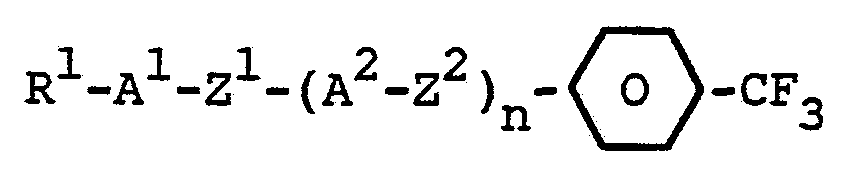
A 1 und A2 jeweils unabhängig voneinander unsubstituiertes oder ein- oder mehrfach durch Halogen,
Nitril und/oder CH3, substituiertes 1,4-Phenylen, worin auch eine oder mehrere CH-Gruppen durch N ersetzt sein können, trans-1,4-Cyclohexylen, worin auch eine oder zwei nicht benachbarte CH2-Gruppen durch -O- und/oder -S- ersetzt sein können, oder 1,4-Bicyclo(2,2,2)- octylen,
Z 1 und Z2 jeweils unabhängig voneinander -CO-O-,
-O-CO-, -CH2O-, -OCH2-, -CH2CH2- oder eine Einfachbindung und
n 0 oder 1
bedeutet, als Komponenten chiral getilteter smektischer Phasen.
2. Trifluortoluolderivate der Formel I,

R1 Alkyl mit 1 bis 12 C-Atomen, worin auch eine oder mehrere nicht benachbarte CH2- Gruppen durch -O-, -CO-, -O-CO-, -CO-O-, -O-CO-O-, -CH-Halogen-, -CH-CN- und/oder
-CH=CH- ersetzt sein können,
A 1 und A2 jeweils unabhängig voneinander unsubstituiertes oder ein- oder mehrfach durch Halogen, Nitril und/oder CH3, substituiertes 1,4-Phenylen, worin auch eine oder mehrere
CH-Gruppen durch N ersetzt sein können, trans-1,4-Cyclohexylen, worin auch eine oder zwei nicht benachbarte CH2-Gruppen durch -O- und/oder -S- ersetzt sein können, oder 1,4-Bicyclo(2,2,2)octylen,
Z 1 und Z2 jeweils unabhängig voneinander -CO-O-,
-O-CO-, -CΕLO-, -OCH2-, -CH2CH2- oder eine Einfachbindung und
n 0 oder 1
bedeutet, mit der Maßgabe, daß eine der Gruppen A1 und A 2 Pyrimidin-2 , 5-diyl oder Pyridin-2 , 5-diyl ist, und im Falle n = 1 und A1 = Pyrimidin-2 , 5-diyl Z2
-CH2O- , -OCH2- , -CH2CH2- oder eine Einfachbindung bedeutet.
3. Trifluortoluolderivate nach Anspruch 2, dadurch gekennzeichnet, daß sie den Teilformeln Ib oder Ic entsprechen,
R1-A1-Z1-Phe-CF3 Ib
R1-A1-A2-Z2-Phe-CF3 Ic
worin
Pyrimidin-2, 5-diyl oder Pyridin-2, 5-diyl,
A2 1,4-Phenylen,
Phe 1,4-Phenylen,
Z1 und Z2 jeweils -CH2O-, -OCH2-, -CH2CH2- oder eine Einfachbindung bedeuten, und
R1 die in Anspruch 2 angegebene Bedeutung hat.
4. Trifluortoluolderivate der Formel I nach Anspruch 1, dadurch gekennzeichnet, daß sie der Formel II entsprechen,

worin
R1 Alkyl mit 1 bis 12 C-Atomen, worin auch eine oder mehrere nicht benachbarte CH2- Gruppen durch -O-, -CO-, -O-CO-, -CO-O-, -O-CO-O-, -CH-Halogen-, -CH-CN- und/oder -CH=CH- ersetzt sein können,
Z 1 und Z2 jeweils unabhängig voneinander -CO-O-,
-O-CO-, -CH2O-, -OCH2- oder -CH2CH2, eine der Gruppen Z1 und Z2 auch eine
Einfachbindung,
n 0 oder 1
bedeutet, mit der Maßgabe, daß im Falle n = 1 und Z1 = Einfachbindung Z2 -CO-O-, -CH2O-, -OCH2- oder -CH2CH2- bedeutet.
5. Trifluortoluolderivate nach Anspruch 4, dadurch gekennzeichnet, daß sie den Teilformeln IIa, IIb, IIc, IId, IIe oder IIf entsprechen:


6. Trifluortoluolderivate der Formel I nach Anspruch 1, dadurch gekennzeichnet, daß sie der Formel III entsprechen,

worin
R1 Alkyl mit 1 bis 12 C-Atomen bedeutet, worin auch eine oder mehrere nicht benachbarte CH2-Gruppen durch -O-, -CO-, -O-CO-, -CO-O-, -O-CO-O-, -CH-Halogen-, -CH-CN- und/oder -CH=CH- ersetzt sein können.
Trifluortoluolderivate der Formel III nach Anspruch 6, dadurch gekennzeichnet, daß R1 geradkettiges Alkyl mit 2 bis 7 C-Atomen ist.
8. Chirale getiltete smektische Phase mit mindestens zwei flüssigkristallinen Komponenten, dadurch gekennzeichnet, daß sie mindestens ein Trifluortoluolderivat der Formel I nach Anspruch 1 enthält.
9. Elektrooptisches Anzeigeelement, dadurch gekennzeichnet, daß es als Dielektrikum eine Phase nach Anspruch 8 enthält.
Applications Claiming Priority (2)
| Application Number | Priority Date | Filing Date | Title |
|---|---|---|---|
| DEP3614778.8 | 1986-05-02 | ||
| DE19863614778 DE3614778A1 (de) | 1986-05-02 | 1986-05-02 | Smektische fluessigkristalline phasen |
Publications (1)
| Publication Number | Publication Date |
|---|---|
| WO1987006602A1 true WO1987006602A1 (fr) | 1987-11-05 |
Family
ID=6299957
Family Applications (1)
| Application Number | Title | Priority Date | Filing Date |
|---|---|---|---|
| PCT/EP1987/000218 Ceased WO1987006602A1 (fr) | 1986-05-02 | 1987-04-22 | Phases smectiques de cristaux liquides |
Country Status (5)
| Country | Link |
|---|---|
| US (1) | US4871469A (de) |
| EP (1) | EP0264435B1 (de) |
| JP (1) | JP2722195B2 (de) |
| DE (2) | DE3614778A1 (de) |
| WO (1) | WO1987006602A1 (de) |
Cited By (15)
| Publication number | Priority date | Publication date | Assignee | Title |
|---|---|---|---|---|
| WO1988005803A1 (en) * | 1987-01-30 | 1988-08-11 | MERCK Patent Gesellschaft mit beschränkter Haftung | Liquid crystalline mixture |
| WO1988008441A1 (fr) * | 1987-04-28 | 1988-11-03 | MERCK Patent Gesellschaft mit beschränkter Haftung | Element d'affichage electro-optique a cristaux liquides |
| WO1990012073A1 (de) * | 1989-04-08 | 1990-10-18 | MERCK Patent Gesellschaft mit beschränkter Haftung | Trifluormethylcyclohexan-derivate |
| WO1990014404A1 (de) * | 1989-05-26 | 1990-11-29 | MERCK Patent Gesellschaft mit beschränkter Haftung | Trifluortoluolverbindungen und flüssigkristallines medium |
| WO1990014406A1 (en) * | 1989-05-16 | 1990-11-29 | MERCK Patent Gesellschaft mit beschränkter Haftung | Fluorinated cyclohexyl derivatives |
| DE3928783A1 (de) * | 1989-05-26 | 1990-12-13 | Merck Patent Gmbh | Trifluortoluolverbindungen und fluessigkristallines medium |
| EP0360521A3 (de) * | 1988-09-23 | 1991-04-10 | Minnesota Mining And Manufacturing Company | Fluorhaltige Achiralflüssigkristalle |
| WO1991010716A1 (en) * | 1990-01-10 | 1991-07-25 | MERCK Patent Gesellschaft mit beschränkter Haftung | Matrix liquid crystal display |
| WO1991011497A1 (de) * | 1990-01-23 | 1991-08-08 | MERCK Patent Gesellschaft mit beschränkter Haftung | Flüssigkristallines medium |
| EP0431402A3 (en) * | 1989-12-05 | 1991-08-14 | Merck Patent Gesellschaft Mit Beschraenkter Haftung | Di- and trifluormethoxy compounds and their use as components of a liquid crystal medium |
| EP0449015A3 (en) * | 1990-03-24 | 1991-11-06 | Merck Patent Gesellschaft Mit Beschraenkter Haftung | Difluoromethyl compounds and liquid criystal medium |
| WO1992006148A1 (en) * | 1990-10-02 | 1992-04-16 | MERCK Patent Gesellschaft mit beschränkter Haftung | Liquid crystalline medium |
| WO1995011214A1 (de) * | 1993-10-19 | 1995-04-27 | Merck Patent Gmbh | 4-trifluoromethylbenzole udn ihre verwendung in flüssigkristallmischungen |
| US5496499A (en) * | 1989-01-27 | 1996-03-05 | Merck Patent Gesellschaft Mit Beschrankter Haftung | Biphenylethanes and liquid-crystalline phase |
| EP0482157B1 (de) * | 1990-04-26 | 1999-11-17 | MERCK PATENT GmbH | 1,3-dioxanderivate und flüssigkristallines medium |
Families Citing this family (28)
| Publication number | Priority date | Publication date | Assignee | Title |
|---|---|---|---|---|
| US5318721A (en) * | 1986-05-02 | 1994-06-07 | Merck Patent Gesellschaft Mit Beschrankter Haftung | Nematic liquid-crystalline phases |
| US5384071A (en) * | 1986-06-23 | 1995-01-24 | Secretary Of State For Defence In Her Britannic Majesty's Government Of The U.K. Of Gt. Britian And Northern Ireland | Chiral liquid crystal compounds |
| DE3721268A1 (de) * | 1987-06-27 | 1989-01-12 | Merck Patent Gmbh | Arylschwefelpentafluoride |
| GB8724458D0 (en) * | 1987-10-19 | 1987-11-25 | Secr Defence | Lateral cyano terphenyls |
| GB8809647D0 (en) * | 1988-04-23 | 1988-05-25 | Apsley Metals Ltd | Method of manufacture of tyre & apparatus therefor |
| US6004479A (en) * | 1988-07-13 | 1999-12-21 | Merck Kgaa | Matrix liquid crystal display |
| ES2058433T3 (es) * | 1988-10-20 | 1994-11-01 | Merck Patent Gmbh | Indicador matriz de cristal liquido. |
| DE3901266A1 (de) * | 1989-01-18 | 1990-07-19 | Merck Patent Gmbh | Fluorhaltige aromaten |
| JP2547857B2 (ja) * | 1989-04-10 | 1996-10-23 | シャープ株式会社 | 強誘電性液晶組成物 |
| GB8909766D0 (en) * | 1989-04-28 | 1989-06-14 | Merck Patent Gmbh | Mesogenic compounds with a trifluoroalkyl terminal group |
| US5026879A (en) * | 1989-04-28 | 1991-06-25 | Seiko Epson Corporation | 1,3-dioxane derivatives and composition including same |
| US5292454A (en) * | 1989-05-26 | 1994-03-08 | Merck Patent Gesellschaft Mit Beschrankter Haftung | Trifluorotoluene compounds, and a liquid crystalline medium |
| DE59007561D1 (de) * | 1989-08-12 | 1994-12-01 | Merck Patent Gmbh | Benzolderivate und flüssigkristallines medium. |
| DE4025550B4 (de) | 1989-08-16 | 2007-05-03 | Merck Patent Gmbh | Phenylcyclohexane und flüssigkristallines Medium |
| DE4027315A1 (de) * | 1989-08-30 | 1991-03-07 | Merck Patent Gmbh | Halogenierte benzolderivate und fluessigkristallines medium |
| KR920701195A (ko) * | 1989-12-08 | 1992-08-11 | 위르겐 호이만·라인하르트 슈틀러 | 페닐디옥산 |
| US5456860A (en) * | 1990-03-31 | 1995-10-10 | Merck Patent Gesellschaft Mit Beschrankter Haftung | Matrix liquid-crystal display |
| WO1991016400A1 (de) * | 1990-04-13 | 1991-10-31 | MERCK Patent Gesellschaft mit beschränkter Haftung | Flüssigkristallines medium |
| EP0477335B1 (de) * | 1990-04-13 | 1995-07-05 | MERCK PATENT GmbH | Flüssigkristallines medium |
| US5494606A (en) * | 1990-04-26 | 1996-02-27 | Merck Patent Gesellscaft Mit Beschrankter Haftung | 1,3-dioxane derivatives, and liquid-crystalline medium |
| JP2796753B2 (ja) * | 1990-05-09 | 1998-09-10 | キヤノン株式会社 | カイラルスメクチック液晶組成物およびそれを使用した液晶素子 |
| US5409637A (en) * | 1991-02-20 | 1995-04-25 | Merck Patent Gesellschaft Mit Beschrankter Haftung | Nematic liquid-crystal composition |
| DE69228733T2 (de) | 1991-07-04 | 1999-11-11 | Herbert Plach | Flüssigkristallines Medium |
| JP3049681B2 (ja) * | 1993-09-17 | 2000-06-05 | キヤノン株式会社 | 液晶性化合物、それを含有する液晶組成物、それを有する液晶素子及びそれらを用いた表示方法、表示装置 |
| GB9325438D0 (en) | 1993-12-13 | 1994-02-16 | Secr Defence | Ferroelectric liquid crystal devices |
| JP3579728B2 (ja) | 1994-06-23 | 2004-10-20 | チッソ株式会社 | 液晶組成物および液晶表示素子 |
| US6013198A (en) * | 1995-09-11 | 2000-01-11 | Chisso Corporation | Liquid crystalline compound replaced by fluorine containing group, liquid crystal composition, and liquid crystal display device |
| CN113736478B (zh) * | 2020-05-27 | 2023-04-07 | 江苏和成显示科技有限公司 | 一种液晶组合物及液晶显示元器件 |
Citations (3)
| Publication number | Priority date | Publication date | Assignee | Title |
|---|---|---|---|---|
| GB2044767A (en) * | 1979-03-05 | 1980-10-22 | Timex Corp | 5-Alkyl-2-(4-cyanophenyl)- 1,3-dioxanes |
| EP0022183A2 (de) * | 1979-07-06 | 1981-01-14 | MERCK PATENT GmbH | Cyclohexylbiphenyle, Verfahren zu ihrer Herstellung, diese enthaltende Dielektrika und elektrooptisches Anzeigeelement |
| GB2162515A (en) * | 1984-07-04 | 1986-02-05 | Secr Defence | Liquid crystal esters |
Family Cites Families (15)
| Publication number | Priority date | Publication date | Assignee | Title |
|---|---|---|---|---|
| DE3063497D1 (en) * | 1979-08-20 | 1983-07-07 | Werk Fernsehelektronik Veb | Nematic crystalline-liquid 5-alkyl-2-(4-acyloxyphenyl)-pyrimidines for opto-electronic arrangements and process for their preparation |
| DE3006666A1 (de) * | 1980-02-22 | 1981-09-17 | Merck Patent Gmbh, 6100 Darmstadt | Phenylcyclohexenderivate, verfahren zu ihrer herstellung, diese enthaltende fluessigkristalline dielektrika und elektrooptisches anzeieelement |
| DE3022818C2 (de) * | 1980-06-19 | 1986-11-27 | Merck Patent Gmbh, 6100 Darmstadt | Flüssigkristall-Anzeigeelement |
| EP0058981B1 (de) * | 1981-02-25 | 1986-01-22 | Hitachi, Ltd. | Farblose Flüssigkristallinverbindungen |
| DE3206269A1 (de) * | 1982-02-20 | 1983-09-01 | Merck Patent Gmbh, 6100 Darmstadt | Bicyclohexylderivate |
| DE3207114A1 (de) * | 1982-02-27 | 1983-09-08 | Merck Patent Gmbh, 6100 Darmstadt | 1,3-dioxane |
| JPS58177939A (ja) * | 1982-04-13 | 1983-10-18 | Chisso Corp | 4−α,α,α−トリフルオロメチル安息香酸トランス−4−(トランス−4′−アルキルシクロヘキシル)シクロヘキシルエステル |
| JPH0247982B2 (ja) * | 1982-10-26 | 1990-10-23 | Chisso Corp | Torifuruoromechirukiojusurutakanesuterukagobutsu |
| GB8415039D0 (en) * | 1984-06-13 | 1984-07-18 | Secr Defence | Pyrimidines |
| JPS61197563A (ja) * | 1985-02-27 | 1986-09-01 | Chisso Corp | トリフルオロメチルフエニル基をもつピリミジン誘導体 |
| DE3515374C2 (de) * | 1985-04-27 | 1998-02-26 | Hoechst Ag | Chirale getilte smektische flüssigkristalline Phasen und deren Verwendung in elektrooptischen Anzeigeelementen |
| DE3533333A1 (de) * | 1985-09-18 | 1987-03-26 | Merck Patent Gmbh | Smektische fluessigkristalline phasen |
| DE3650014D1 (de) * | 1985-09-18 | 1994-09-08 | Merck Patent Gmbh | Smektische flüssigkristalline phasen. |
| DE3608500A1 (de) * | 1986-03-14 | 1987-09-24 | Merck Patent Gmbh | Smektische fluessigkristalline phasen |
| DE3689329T2 (de) * | 1985-12-04 | 1994-07-07 | Ajinomoto Kk | Verbindungen auf der Basis der Phenylpyrimidine und sie enthaltende flüssigkristalline Zusammensetzungen. |
-
1986
- 1986-05-02 DE DE19863614778 patent/DE3614778A1/de not_active Withdrawn
-
1987
- 1987-04-22 JP JP62503243A patent/JP2722195B2/ja not_active Expired - Fee Related
- 1987-04-22 WO PCT/EP1987/000218 patent/WO1987006602A1/de not_active Ceased
- 1987-04-22 EP EP87903284A patent/EP0264435B1/de not_active Expired - Lifetime
- 1987-04-22 DE DE87903284T patent/DE3777060D1/de not_active Expired - Fee Related
- 1987-04-22 US US07/154,254 patent/US4871469A/en not_active Expired - Lifetime
Patent Citations (3)
| Publication number | Priority date | Publication date | Assignee | Title |
|---|---|---|---|---|
| GB2044767A (en) * | 1979-03-05 | 1980-10-22 | Timex Corp | 5-Alkyl-2-(4-cyanophenyl)- 1,3-dioxanes |
| EP0022183A2 (de) * | 1979-07-06 | 1981-01-14 | MERCK PATENT GmbH | Cyclohexylbiphenyle, Verfahren zu ihrer Herstellung, diese enthaltende Dielektrika und elektrooptisches Anzeigeelement |
| GB2162515A (en) * | 1984-07-04 | 1986-02-05 | Secr Defence | Liquid crystal esters |
Cited By (16)
| Publication number | Priority date | Publication date | Assignee | Title |
|---|---|---|---|---|
| WO1988005803A1 (en) * | 1987-01-30 | 1988-08-11 | MERCK Patent Gesellschaft mit beschränkter Haftung | Liquid crystalline mixture |
| WO1988008441A1 (fr) * | 1987-04-28 | 1988-11-03 | MERCK Patent Gesellschaft mit beschränkter Haftung | Element d'affichage electro-optique a cristaux liquides |
| EP0360521A3 (de) * | 1988-09-23 | 1991-04-10 | Minnesota Mining And Manufacturing Company | Fluorhaltige Achiralflüssigkristalle |
| US5496499A (en) * | 1989-01-27 | 1996-03-05 | Merck Patent Gesellschaft Mit Beschrankter Haftung | Biphenylethanes and liquid-crystalline phase |
| WO1990012073A1 (de) * | 1989-04-08 | 1990-10-18 | MERCK Patent Gesellschaft mit beschränkter Haftung | Trifluormethylcyclohexan-derivate |
| WO1990014406A1 (en) * | 1989-05-16 | 1990-11-29 | MERCK Patent Gesellschaft mit beschränkter Haftung | Fluorinated cyclohexyl derivatives |
| WO1990014404A1 (de) * | 1989-05-26 | 1990-11-29 | MERCK Patent Gesellschaft mit beschränkter Haftung | Trifluortoluolverbindungen und flüssigkristallines medium |
| DE3928783A1 (de) * | 1989-05-26 | 1990-12-13 | Merck Patent Gmbh | Trifluortoluolverbindungen und fluessigkristallines medium |
| DE3928783C2 (de) * | 1989-05-26 | 1999-01-14 | Merck Patent Gmbh | Trifluortoluolverbindungen und flüssigkristallines Medium |
| EP0431402A3 (en) * | 1989-12-05 | 1991-08-14 | Merck Patent Gesellschaft Mit Beschraenkter Haftung | Di- and trifluormethoxy compounds and their use as components of a liquid crystal medium |
| WO1991010716A1 (en) * | 1990-01-10 | 1991-07-25 | MERCK Patent Gesellschaft mit beschränkter Haftung | Matrix liquid crystal display |
| WO1991011497A1 (de) * | 1990-01-23 | 1991-08-08 | MERCK Patent Gesellschaft mit beschränkter Haftung | Flüssigkristallines medium |
| EP0449015A3 (en) * | 1990-03-24 | 1991-11-06 | Merck Patent Gesellschaft Mit Beschraenkter Haftung | Difluoromethyl compounds and liquid criystal medium |
| EP0482157B1 (de) * | 1990-04-26 | 1999-11-17 | MERCK PATENT GmbH | 1,3-dioxanderivate und flüssigkristallines medium |
| WO1992006148A1 (en) * | 1990-10-02 | 1992-04-16 | MERCK Patent Gesellschaft mit beschränkter Haftung | Liquid crystalline medium |
| WO1995011214A1 (de) * | 1993-10-19 | 1995-04-27 | Merck Patent Gmbh | 4-trifluoromethylbenzole udn ihre verwendung in flüssigkristallmischungen |
Also Published As
| Publication number | Publication date |
|---|---|
| EP0264435A1 (de) | 1988-04-27 |
| JP2722195B2 (ja) | 1998-03-04 |
| DE3614778A1 (de) | 1987-11-05 |
| EP0264435B1 (de) | 1992-03-04 |
| JPS63503226A (ja) | 1988-11-24 |
| US4871469A (en) | 1989-10-03 |
| DE3777060D1 (de) | 1992-04-09 |
Similar Documents
| Publication | Publication Date | Title |
|---|---|---|
| EP0264435B1 (de) | Smektische flüssigkristalline phasen | |
| EP0149208B1 (de) | Ethanderivate | |
| EP0306505B1 (de) | Ethinderivate als komponente flüssigkristalliner phasen | |
| EP0233267B1 (de) | Smektische flüssigkristalline phasen | |
| EP0256097B1 (de) | Vinylen-Verbindungen und flüssigkristalline Phase | |
| EP0257048A1 (de) | Optisch aktive verbindungen. | |
| EP0308438B1 (de) | Flüssigkristalline Phase, Tolane enthaltend | |
| DE3333677A1 (de) | Fluessigkristall-phase | |
| EP0334911A1 (de) | Substituierte phenyltrifluormethylether | |
| DE3510432A1 (de) | Cyclohexanderivate | |
| EP0362318B1 (de) | 2,3-difluorbiphenyle | |
| WO1991013850A1 (de) | 4,4'-disubstituierte 2',3-difluorbiphenyle und flüssigkristallines medium | |
| DD241423A5 (de) | Fluessigkristalline phase enthaltend pyrimidine | |
| EP0151446A2 (de) | Flüssigkristalline Phase | |
| DE4218614B4 (de) | Benzolderivate | |
| DD254589A5 (de) | Chirale getiltete smektische fluessigkristalline phase | |
| DE4409431B4 (de) | Cyanophenylpyri(mi)din-Derivate und flüssigkristallines Medium | |
| DE3509170C2 (de) | trans-Ethenylenverbindungen | |
| WO1988009322A1 (fr) | Derives de cyclobutane | |
| DE3814346A1 (de) | Pyridinderivate, ihre verwendung als komponenten fluessigkristalliner phasen, entsprechende fluessigkristallphasen und sie enthaltende fluessigkristallanzeigeelemente | |
| US5318721A (en) | Nematic liquid-crystalline phases | |
| DE69028985T2 (de) | Halophenyl-substituierte heterozyklische derivate | |
| EP0440771A1 (de) | 5-oxy-2-phenylazine und flüssigkristallines medium | |
| DE3608500A1 (de) | Smektische fluessigkristalline phasen | |
| DE3710890A1 (de) | Bicyclooctanderivate |
Legal Events
| Date | Code | Title | Description |
|---|---|---|---|
| AK | Designated states |
Kind code of ref document: A1 Designated state(s): JP US |
|
| AL | Designated countries for regional patents |
Kind code of ref document: A1 Designated state(s): AT BE CH DE FR GB IT LU NL SE |
|
| WWE | Wipo information: entry into national phase |
Ref document number: 1987903284 Country of ref document: EP |
|
| WWP | Wipo information: published in national office |
Ref document number: 1987903284 Country of ref document: EP |
|
| WWG | Wipo information: grant in national office |
Ref document number: 1987903284 Country of ref document: EP |