WO1988006604A1 - Condensation copolymers containing copolymerized isoquinoline derivative colorants and products therefrom - Google Patents
Condensation copolymers containing copolymerized isoquinoline derivative colorants and products therefrom Download PDFInfo
- Publication number
- WO1988006604A1 WO1988006604A1 PCT/US1988/000442 US8800442W WO8806604A1 WO 1988006604 A1 WO1988006604 A1 WO 1988006604A1 US 8800442 W US8800442 W US 8800442W WO 8806604 A1 WO8806604 A1 WO 8806604A1
- Authority
- WO
- WIPO (PCT)
- Prior art keywords
- alkyl
- hydrogen
- cycloalkyl
- aryl
- composition
- Prior art date
- Legal status (The legal status is an assumption and is not a legal conclusion. Google has not performed a legal analysis and makes no representation as to the accuracy of the status listed.)
- Ceased
Links
Classifications
-
- C—CHEMISTRY; METALLURGY
- C08—ORGANIC MACROMOLECULAR COMPOUNDS; THEIR PREPARATION OR CHEMICAL WORKING-UP; COMPOSITIONS BASED THEREON
- C08G—MACROMOLECULAR COMPOUNDS OBTAINED OTHERWISE THAN BY REACTIONS ONLY INVOLVING UNSATURATED CARBON-TO-CARBON BONDS
- C08G63/00—Macromolecular compounds obtained by reactions forming a carboxylic ester link in the main chain of the macromolecule
- C08G63/68—Polyesters containing atoms other than carbon, hydrogen and oxygen
- C08G63/685—Polyesters containing atoms other than carbon, hydrogen and oxygen containing nitrogen
- C08G63/6854—Polyesters containing atoms other than carbon, hydrogen and oxygen containing nitrogen derived from polycarboxylic acids and polyhydroxy compounds
- C08G63/6856—Dicarboxylic acids and dihydroxy compounds
-
- C—CHEMISTRY; METALLURGY
- C09—DYES; PAINTS; POLISHES; NATURAL RESINS; ADHESIVES; COMPOSITIONS NOT OTHERWISE PROVIDED FOR; APPLICATIONS OF MATERIALS NOT OTHERWISE PROVIDED FOR
- C09B—ORGANIC DYES OR CLOSELY-RELATED COMPOUNDS FOR PRODUCING DYES, e.g. PIGMENTS; MORDANTS; LAKES
- C09B5/00—Dyes with an anthracene nucleus condensed with one or more heterocyclic rings with or without carbocyclic rings
- C09B5/02—Dyes with an anthracene nucleus condensed with one or more heterocyclic rings with or without carbocyclic rings the heterocyclic ring being only condensed in peri position
- C09B5/14—Benz-azabenzanthrones (anthrapyridones)
Definitions
- This invention concerns condensation polymers including linear polyester, unsaturated polyester, and polycarbonate types, wherein certain 3H-dibenzo—[f,ij] isoquinoline-2,7-dione colorants defined below are copolymerized (condensed) into the polymer to impart a wide range of colors from yellow to blue thereto.
- These colorants are fast to ultraviolet and visible light, are thermally stable and nonsublimable at the polymer processing (includes preparation) temperatures, and are nonextractable therefrom, rendering the polymers particularly suitable for use as beverage bottles and food, pharmaceutical and cosmetic containers, as well as in producer colored fibers.
- the present colorants in terms of their condensed moieties are useful in total weight concentrations (of single moiety or mixtures thereof), given herein in parts per million (ppm), ranging from about 10 to about 20,000, preferably from about 20 to about 5,000 ppm, i.e., parts by weight of moiety per million parts by weight of final polymer.
- ppm parts per million
- Other colorants such as pigments, disperse dyes and the like may also be used admixed with the polymer, or dyed onto fiber thereof to vary the color shade as desired.
- the present linear polymers are thermoplastic molding or fiber grade having an I.V. of from about 0.4 to about 1.2, and preferably are polyesters wherein the acid moiety is comprised of at least about 50 mol % terephthalic acid residue, and the glycol moiety at least about 50 mol % ethylene glycol or 1,4-cyclohexanedimethanol residue, and containing a total of from about 10 to about 20,000 ppm of one or a mixture of the present isoquinoline derivative colorants defined below.
- the term "acid” as used herein with respect to both the linear and unsaturated polyesters includes their various reactive derivatives such as dimethylterephthalate, anhydrides and the like.
- a highly preferred polyester within this preferred group is comprised of from about 75 to 100 mol % terephthalic acid residue and from about 75 to 100 mol % ethylene glycol residue.
- the present colorants preferably have molecular weights of from about 400 to about 800 although higher molecular weights are also operable, and contain one or more groups which condense during condensation or polycondensation to enter the moiety into the polymer chain. These groups include hydroxyl, carboxyl, carboxylic ester, acid halide and the like. As aforesaid, these moieties are thermally stable at polymer processing conditions, which includes polycondensation temperatures of up to about 300°C which are used, for example, in the preparation of polyesters such as poly(ethylene terephthalate) and copolymers of terephthalic acid, ethylene glycol, and 1,4-cyclohexanedimethanol.
- the present invention is defined in its broad embodiment as a composition comprising molding or fiber grade condensation polymer having copolymerized therein a total of from 10 to about 20,000 ppm, of the reactant residue moieties of one or a mixture of isoquinoline derivative reactants of the formula
- R is hydrogen, cycloalkyl or alkyl;
- X is -O-, -S- or -NH-;
- -X-R 1 -Z in combination is hydrogen or halogen;
- R 1 is selected from -alkylene-Z, -arylene-Z, -cycloalkylene-Z, -aralkylene-Z, -cycloalkylenealkylene-Z, -alkarylene-Z, -alkylenecycloalkylenealkylene-Z, -alkylenearalkylene-Z, or alkylenecycloalkylene-Z, wherein -Z is selected from hydrogen, -SO 2 R 5 ,
- R 5 is hydrogen, alkyl, allyl, aryl, cycloalkyl, hydroxyalkyl, alkoxyalkoxy- alkyl, alkoxyalkyl, hydroxyalkoxy, hydroxyalkoxy- alkoxy, alkoxycarbonylalkyl or carboxyaryl, and when x is -O- or -NH- , -R 1 -Z in combination also can be hydrogen;
- R 2 is hydrogen, alkyl, aryl, cyano, alkoxycarbonyl, aryloxycarbonyl, aralkoxycarbonyl, cycloalkylalkoxycarbonyl, COCl, carboxy, carbamyl, N-alkylcarbamyl, N,N-dialkylcarbamyl, N-alkyl-N-arylcarbamyl, N-arylcarbamyl,
- X is -NH- and -R 1 -Z in combination is aryl, aryl substituted with 1-3 of alkyl, alkoxy, halogen, hydroxyalkyl, hydroxyalkoxy or acylamido, alkyl or alkyl substituted with 1-3 of hydroxyl or acyloxy, cycloalkyl or cycloalkyl substituted with
- alkyl 1-3 of alkyl; -X-R 1 -Z in combination is H; R is alkyl; R 2 is alkoxycarbonyl, hydroxyalkylamino, or cyano; and R 3 and R 4 are each hydrogen.
- the alkyl or alkylene moieties or portions of the various groups contain from 1-8 carbons, straight or branched chain, the aryl or arylene nuclei contain from 4-10 carbons, and the cycloalkyl or cycloalkylene nuclei contain from 4-6 carbons.
- the suffix "ene”, is used herein to designate a divalent radical or group, and the term “cycloalkyl” may be used interchangeably with "cycloaliphatic".
- the compounds of this invention are suitable for coloring condensation polymers in a wide range of colors from yellow to blue.
- the colorants have excellent heat stability, do not decompose or sublime under polymerization conditions of high temperature, and are not extractable from the polymers containing them.
- Polymers of almost any color can be obtained by the combination of the yellow, red, and blue colorants described above and can be formed by blow molding or the like into bottles and/or molded into many useful articles.
- the nonextractabilities of the present bis-methine moieties are determined as follows:
- Solvent blanks are run under the same extraction conditions without polymer. In most cases samples were extracted, spiked, with a known amount of additive as a control, and analyzed in duplicates.
- Any suitable analytical technique and apparatus may be employed to determine the amount of bis-methine moiety extracted from the polymer.
- the extractability of the present isoquinoline derivative moieties from the present polymers was found to be essentially nonexistent.
- Polyesters useful in this invention include linear, thermoplastic, crystalline, or amorphous materials, produced by conventional techniques using one or more diols and one or more dicarboxylic acids, copolymerized with the present colorants.
- polyesters which are the polyesterification products of one or more dihydric alcohols and one or more unsaturated dicarboxylic acids or their anhydrides, and the term "polyester resin" is used herein to define the unsaturated polyester dissolved in or admixed with an ethylenically unsaturated monomer.
- Typical of the unsaturated polyesters is the polyesterification product of (a) 1,4-cyclohexane- dimethanol and/or 2,2-dimethyl-1,3-propanediol and optionally an additional dihydric alcohol, such as ethylene glycol , and (b ) maleic acid or fumaric acid and an unsaturated hydrogenated aromatic dicarboxylic acid, which when crosslinked with an ethylenically- unsaturated monomer, e.g., styrene, produces a cured polyester resin which has, for example, high thermal resistance, high heat distortion values, excellent electrical and mechanical properties, and excellent resistance to chemicals.
- an ethylenically- unsaturated monomer e.g., styrene
- the unsaturated polyester resins may be prepared in the presence of gelation inhibitors such as hydro-quinone or the like, which are well known in the art of polyesterification.
- the esterification may be carried out for example under an inert blanket of gas such as nitrogen in a temperature range of 118°-220°C for a period of about 6-20 hours until an acid number below 100 and preferably below 50 is obtained, based on milliequivalents of KOH necessary to neutralize 1 gram of the unsaturated polyester.
- the resulting polyester may be subsequently copolymerized, cross-linked, or cured with "curing amounts" of any of the well-known ethylenically unsaturated monomers used as solvents for the polyester.
- Such monomers include styrene, alpha-methyl styrene, vinyl toluene, divinyl benzene, chlorostyrene, and the like as well as mixtures thereof.
- the mole ratio of such unsaturated monomer to the unsaturated moiety (e.g., maleic acid residue) in the polyester is from about 0.5 to about 3.0, although the "curing amounts" of such monomer can be varied from these ratios.
- the unsaturated polyester be prepared from one or more dihydric alcohols, fumaric or maleic acid or mixtures thereof, and up to about 60 mole percent of total acid component of o-phthalic, isophthalic or terephthalic acids or mixtures thereof.
- the dihydric alcohol component is one or a mixture of propylene glycol, neopentyl glycol, 2,2,4-trimethyl-1,3-pentanediol, ethylene glycol, or diethylene glycol.
- a specific preferred unsaturated polyester is prepared from about 75 to 100 mol % propylene glycol, and as the acid component, from about 75 to 100 mol % o-phthalic and maleic acids in a mole ratio of from about 1/2 to about 2/1.
- Typical of these unsaturated polyesters are those disclosed, for example, in U.S. Patent 4,359,570, to which disclosure those of skill in the art are directed for further detail.
- the diol components of the linear polyesters are selected, for example, from ethylene glycol, 1,4-cyclohexanedimethanol, 1,2-propanediol, 1,3-propanediol, 1,4-butanediol, 2,2-dimethyl-1,3-propanediol, 1,6-hexanediol, 1,2-cyclohexanediol, 1,4-cyclohexanediol, 1,2-cyclohexanedimethanol,
- 1,3-cyclohexanedimethanol X,8-bis(hydroxymethyl)tricyclo-[5.2.1.0]-decane wherein X represents 3, 4, or 5; and diols containing one or more oxygen atoms in the chain, e.g., diethylene glycol, triethylene glycol, dipropylene glycol, tripropylene glycol and the like. In general, these diols contain 2 to 18, preferably 2 to 12 carbon atoms. Cycloaliphatic diols can be employed in their cis or trans configuration or as mixtures of both forms.
- the acid components (aliphatic, alicyclic, or aromatic dicarboxylic acids) of the linear polyester are selected, for example, from terephthalic acid, isophthalic acid, 1,4-cyclohexanedicarboxylic acid, 1,3-cyclohexanedicarboxylic acid, succinic acid, glutaric acid, adipic acid, sebacic acid, 1,12- dodecanedioic acid, 2,6-naphthalene-dicarboxylic acid and the like.
- a functional acid derivative thereof such as the dimethyl, diethyl, or dipropyl ester of the dicarboxylic acid.
- the anhydrides of these acids also can be employed where practical.
- the preferred linear copolyesters are especially useful for making blow molded bottles or containers for beverages, and for molded food packages and the like.
- certain of these copolyesters are color, I.V., and heat distortion or "hot fill" stable at temperatures of up to about 100°C, when properly heat set and molded articles therefrom exhibit good thin wall rigidity, excellent clarity and good barrier properties with respect to water and atmospheric gases, particularly carbon dioxide and oxygen.
- the most preferred linear polyesters therefor comprise ⁇ oly(ethylene terephthalate) and this polymer modified with up to about 5 mole % of 1,4-cyclohexanedimethanol, wherein the polymers have been sufficiently heat set and oriented by methods well known in the art to give a desired degree of crystallinity.
- a polymer is "hot fill” stable at a prescribed temperature when less than 2% change in volume of a container manufactured therefrom occurs upon filling the same with a liquid at that temperature.
- the most preferred polyesters have an I . V. of 0.65 to 0. 85 , and a Tg of
- the Tg is determined by Differential Scanning Calorimetry at a scan rate of 20 Centigrade Degrees/min., the O Permeability by the standard operating procedure of a MOCON OXTRAN 100 instrument of Modern Controls, .Inc., of Elk River, Minnesota, and the CO 2 Permeability by the standard operating procedure of a MOCON PERMATRAN C II, also of Modern Controls.
- the product Upon further cooling the product crystallized in the form of yellow solid. After being isolated by filtration and recrystallized from methyl Cellosolve, the product melted at 203-206°C and had an absorption maxium at 441 nm in the visible spectrum in acetone solution, thus imparting a greenish-yellow color thereto.
- the structure is as follows:
- the flask and contents are heated at 200°C in a Belmont metal bath for 60 minutes, at 210°C for 75 minutes, and at 230°C for 50 minutes with a nitrogen sweep over the reaction mixture while the ester interchange takes place.
- the metal bath temperature is increased to 270°C.
- Vacuum with a stream of nitrogen bleeding into the system is applied slowly over a 10 minute period until the vacuum is reduced to 100 mm Hg.
- the flask and contents are heated at 270°C under a vacuum of 100 mm Hg for 30 minutes.
- the metal bath temperature is increased to 285°C. At 285°C, the vacuum is reduced slowly over a 10 minute period to 4 to 5 mm Hg.
- the flask and contents are heated at 285°C under a vacuum of 4 to 5 mm Hg for 25 minutes. Then the vacuum is reduced to 0.3 to 0.5 mm Hg and polycondensation is continued at 285°C for 16 minutes.
- the flask is removed from the metal bath and is allowed to cool in nitrogen atmosphere while the polyester crystallizes.
- the resulting polymer is bluish-red and has an inherent viscosity of 0.64 measured in a 60/40 ratio by weight of phenol/tetrachloroethane at a concentration of 0.5 g per ml.
- a UV-visible spectrum on amorphous film of the polymer shows a strong absorption peak at 535 nm.
- Example 4 The ester interchange and polymerization of this polymer are carried out as in Example 4.
- the resulting polymer is yellow colored and has an inherent viscosity of 0.61.
- a UV-visible spectrum on amorphous film of the polymer shows a strong absorption peak at 440 nm.
- the inherent viscosities (I.V.) of each of the copolyesters herein are determined according to ASTM D2857-70 procedure in a Wagner Viscometer of Lab Glass Inc. of Vineland, N.J. having a 1/2 ml capillary bulb, using a polymer concentration of 0.5% by weight in 60/40 by weight, phenol/ tetrachloroethane solvent.
- the procedure comprises heating the polymer/solvent system at 120°C for 15 minutes to enhance dissolution of the polymer, cooling the solution to 25°C and measuring the time of flow at 25°C.
Landscapes
- Chemical & Material Sciences (AREA)
- Organic Chemistry (AREA)
- Health & Medical Sciences (AREA)
- Chemical Kinetics & Catalysis (AREA)
- Medicinal Chemistry (AREA)
- Polymers & Plastics (AREA)
- Compositions Of Macromolecular Compounds (AREA)
- Polyesters Or Polycarbonates (AREA)
- Macromonomer-Based Addition Polymer (AREA)
Abstract
Condensation polymers including linear polyester, unsaturated polyester, and polycarbonate types, wherein certain 3H-dibenzo-[f,ij] isoquinoline-2,7-dione colorants are copolymerized (condensed) into the polymer to impart a wide range of colors from yellow to blue thereto. These colorants are fast to ultraviolet and visible light, are thermally stable and nonsublimable at the polymer processing (includes preparation) temperatures, and are nonextractable therefrom, rendering the polymers particularly suitable for use as beverage bottles and food, pharmaceutical and cosmetic containers, as well as in producer colored fibers. The colorants have the formula (I), wherein: X is -O-, -S- or -NH-; -X-R1?-Z in combination is hydrogen or halogen; R1? is selected from alkyl, aryl, cycloalkyl or the like, and when X is -O- or -NH-, -R1?-Z also can be hydrogen; each of R1?, R2?, R3? and R4? is hydrogen or an organic substituent; and wherein the molecule carries at least one condensable group.
Description
Description
Condensation Copolymers Containing Copolymerized
Isoquinoline Derivative Colorants And
Products Therefrom
This invention concerns condensation polymers including linear polyester, unsaturated polyester, and polycarbonate types, wherein certain 3H-dibenzo—[f,ij] isoquinoline-2,7-dione colorants defined below are copolymerized (condensed) into the polymer to impart a wide range of colors from yellow to blue thereto. These colorants are fast to ultraviolet and visible light, are thermally stable and nonsublimable at the polymer processing (includes preparation) temperatures, and are nonextractable therefrom, rendering the polymers particularly suitable for use as beverage bottles and food, pharmaceutical and cosmetic containers, as well as in producer colored fibers. The present colorants in terms of their condensed moieties are useful in total weight concentrations (of single moiety or mixtures thereof), given herein in parts per million (ppm), ranging from about 10 to about 20,000, preferably from about 20 to about 5,000 ppm, i.e., parts by weight of moiety per million parts by weight of final polymer. Other colorants such as pigments, disperse dyes and the like may also be used admixed with the polymer, or dyed onto fiber thereof to vary the color shade as desired.
Heretofore, many copolymerizable colorant compounds have been disclosed in the prior art such as shown in U.S. Patent 3,372,138 wherein in Example 50 a compound similar to applicants is shown but
which carries a carboxy group ortho to the -NH-moiety. Such a compound is not commercially feasible since it is extremely difficult to prepare.
The present linear polymers are thermoplastic molding or fiber grade having an I.V. of from about 0.4 to about 1.2, and preferably are polyesters wherein the acid moiety is comprised of at least about 50 mol % terephthalic acid residue, and the glycol moiety at least about 50 mol % ethylene glycol or 1,4-cyclohexanedimethanol residue, and containing a total of from about 10 to about 20,000 ppm of one or a mixture of the present isoquinoline derivative colorants defined below. The term "acid" as used herein with respect to both the linear and unsaturated polyesters includes their various reactive derivatives such as dimethylterephthalate, anhydrides and the like. A highly preferred polyester within this preferred group is comprised of from about 75 to 100 mol % terephthalic acid residue and from about 75 to 100 mol % ethylene glycol residue.
In accordance with the present invention, the present colorants preferably have molecular weights of from about 400 to about 800 although higher molecular weights are also operable, and contain one or more groups which condense during condensation or polycondensation to enter the moiety into the polymer chain. These groups include hydroxyl, carboxyl, carboxylic ester, acid halide and the like. As aforesaid, these moieties are thermally stable at polymer processing conditions, which includes polycondensation temperatures of up to about 300°C which are used, for example, in the preparation of polyesters such as poly(ethylene terephthalate) and copolymers of terephthalic acid, ethylene glycol, and 1,4-cyclohexanedimethanol.
The present invention is defined in its broad embodiment as a composition comprising molding or fiber grade condensation polymer having copolymerized therein a total of from 10 to about 20,000 ppm, of the reactant residue moieties of one or a mixture of isoquinoline derivative reactants of the formula

-SO2NR5R5, -NHSO2R5, -N(R5)SO2R5, -N(R5)COR5,
-NHCOR5, -OH, -SR5, -OR5, -NHR5, -NR5R5, -SO2NHR5,
-CONHR5, -CONR5R5, -OCOR5 , -OCO2R5,

wherein R5 is hydrogen, alkyl,
 allyl, aryl, cycloalkyl, hydroxyalkyl, alkoxyalkoxy- alkyl, alkoxyalkyl, hydroxyalkoxy, hydroxyalkoxy- alkoxy, alkoxycarbonylalkyl or carboxyaryl, and when x is -O- or -NH- , -R1-Z in combination also can be
hydrogen; R2 is hydrogen, alkyl, aryl, cyano, alkoxycarbonyl, aryloxycarbonyl, aralkoxycarbonyl, cycloalkylalkoxycarbonyl, COCl, carboxy, carbamyl, N-alkylcarbamyl, N,N-dialkylcarbamyl, N-alkyl-N-arylcarbamyl, N-arylcarbamyl,
allyl, aryl, cycloalkyl, hydroxyalkyl, alkoxyalkoxy- alkyl, alkoxyalkyl, hydroxyalkoxy, hydroxyalkoxy- alkoxy, alkoxycarbonylalkyl or carboxyaryl, and when x is -O- or -NH- , -R1-Z in combination also can be
hydrogen; R2 is hydrogen, alkyl, aryl, cyano, alkoxycarbonyl, aryloxycarbonyl, aralkoxycarbonyl, cycloalkylalkoxycarbonyl, COCl, carboxy, carbamyl, N-alkylcarbamyl, N,N-dialkylcarbamyl, N-alkyl-N-arylcarbamyl, N-arylcarbamyl,
N-cycloalkylcarbamyl, acyl, aroyl, amino, alkylamino, dialkylamino, arylamino, cycloalkylamino, alkoxy, hydroxy, alkylthio or arylthio; each of R3 and R4 is hydrogen, alkyl, halogen or alkoxy; wherein each of the above alkyl, alkylene, aryl, arylene, cycloalkyl or cycloalkylene moieties or portions of a group or radical may be substituted where appropriate with 1-3 substituents selected from hydroxyl, acyloxy, alkyl, cyano, alkoxycarbonyl, alkoxycarbonyloxy, halogen, alkoxy, hydroxyalkoxy, hydroxyalkyl, aryl, aryloxy, or cycloalkyl; and wherein, when the above hydroxyl substituent is absent or multicondensable groups are desired, at least one of R, R2, R3 or R4 carries one or more condensable groups.
In particularly preferred embodiments of the invention: X is -NH- and -R1-Z in combination is aryl, aryl substituted with 1-3 of alkyl, alkoxy, halogen, hydroxyalkyl, hydroxyalkoxy or acylamido, alkyl or alkyl substituted with 1-3 of hydroxyl or acyloxy, cycloalkyl or cycloalkyl substituted with
1-3 of alkyl; -X-R1-Z in combination is H; R is alkyl; R2 is alkoxycarbonyl, hydroxyalkylamino, or cyano; and R3 and R4 are each hydrogen. In all of the above definitions the alkyl or alkylene moieties or portions of the various groups contain from 1-8 carbons, straight or branched chain, the aryl or arylene nuclei contain from 4-10 carbons, and the cycloalkyl or cycloalkylene nuclei contain from 4-6 carbons. The suffix "ene", is used herein
to designate a divalent radical or group, and the term "cycloalkyl" may be used interchangeably with "cycloaliphatic".
The compounds of this invention are suitable for coloring condensation polymers in a wide range of colors from yellow to blue. The colorants have excellent heat stability, do not decompose or sublime under polymerization conditions of high temperature, and are not extractable from the polymers containing them. Polymers of almost any color can be obtained by the combination of the yellow, red, and blue colorants described above and can be formed by blow molding or the like into bottles and/or molded into many useful articles. The nonextractabilities of the present bis-methine moieties are determined as follows:
All extractions are done in glass containers with distilled solvents under the time and temperature conditions described below. The sample form is 1/2 inch x 2-1/2 inch segments cut from the cylindrical side wall portion of 2-liter bottles. All samples are washed with cold solvent to remove surface contaminants and are exposed using 200 ml. solvent/100 in. 2 surface area (2 ml/in.2).
Solvent blanks are run under the same extraction conditions without polymer. In most cases samples were extracted, spiked, with a known amount of additive as a control, and analyzed in duplicates.
Extraction Conditions
1. Water. The samples at room temperature are added to solvent and heated at 250°F for two hours. Half of the samples are then analyzed and the remainder are placed in a 120°F oven for 30 days.
2. 50% Ethanol/Water. The samples at room temperature are added to the solvent at room temperature, placed in an oven at 120°F and analyzed after 24 hours and 30 days. 3. Heptane. The samples at room temperature are added to solvent at room temperature and heated at 150°F for two hours. Part of the samples are cooled to room temperature and analyzed spectrophotometrically and the remainder are allowed to age at 120°F for 30 days before analysis.
4. Any suitable analytical technique and apparatus may be employed to determine the amount of bis-methine moiety extracted from the polymer. The extractability of the present isoquinoline derivative moieties from the present polymers was found to be essentially nonexistent.
Polyesters useful in this invention include linear, thermoplastic, crystalline, or amorphous materials, produced by conventional techniques using one or more diols and one or more dicarboxylic acids, copolymerized with the present colorants.
Also useful are the unsaturated, curable polyesters which are the polyesterification products of one or more dihydric alcohols and one or more unsaturated dicarboxylic acids or their anhydrides, and the term "polyester resin" is used herein to define the unsaturated polyester dissolved in or admixed with an ethylenically unsaturated monomer. Typical of the unsaturated polyesters is the polyesterification product of (a) 1,4-cyclohexane- dimethanol and/or 2,2-dimethyl-1,3-propanediol and optionally an additional dihydric alcohol, such as ethylene glycol , and (b ) maleic acid or fumaric acid and an unsaturated hydrogenated aromatic dicarboxylic acid, which when crosslinked with an ethylenically-
unsaturated monomer, e.g., styrene, produces a cured polyester resin which has, for example, high thermal resistance, high heat distortion values, excellent electrical and mechanical properties, and excellent resistance to chemicals.
The unsaturated polyester resins may be prepared in the presence of gelation inhibitors such as hydro-quinone or the like, which are well known in the art of polyesterification. The esterification may be carried out for example under an inert blanket of gas such as nitrogen in a temperature range of 118°-220°C for a period of about 6-20 hours until an acid number below 100 and preferably below 50 is obtained, based on milliequivalents of KOH necessary to neutralize 1 gram of the unsaturated polyester. The resulting polyester may be subsequently copolymerized, cross-linked, or cured with "curing amounts" of any of the well-known ethylenically unsaturated monomers used as solvents for the polyester. Examples of such monomers include styrene, alpha-methyl styrene, vinyl toluene, divinyl benzene, chlorostyrene, and the like as well as mixtures thereof. Typically, the mole ratio of such unsaturated monomer to the unsaturated moiety (e.g., maleic acid residue) in the polyester is from about 0.5 to about 3.0, although the "curing amounts" of such monomer can be varied from these ratios.
It is preferred that the unsaturated polyester be prepared from one or more dihydric alcohols, fumaric or maleic acid or mixtures thereof, and up to about 60 mole percent of total acid component of o-phthalic, isophthalic or terephthalic acids or mixtures thereof. Preferred for the dihydric alcohol component is one or a mixture of propylene glycol, neopentyl glycol, 2,2,4-trimethyl-1,3-pentanediol,
ethylene glycol, or diethylene glycol. A specific preferred unsaturated polyester is prepared from about 75 to 100 mol % propylene glycol, and as the acid component, from about 75 to 100 mol % o-phthalic and maleic acids in a mole ratio of from about 1/2 to about 2/1. Typical of these unsaturated polyesters are those disclosed, for example, in U.S. Patent 4,359,570, to which disclosure those of skill in the art are directed for further detail. The diol components of the linear polyesters are selected, for example, from ethylene glycol, 1,4-cyclohexanedimethanol, 1,2-propanediol, 1,3-propanediol, 1,4-butanediol, 2,2-dimethyl-1,3-propanediol, 1,6-hexanediol, 1,2-cyclohexanediol, 1,4-cyclohexanediol, 1,2-cyclohexanedimethanol,
1,3-cyclohexanedimethanol, X,8-bis(hydroxymethyl)tricyclo-[5.2.1.0]-decane wherein X represents 3, 4, or 5; and diols containing one or more oxygen atoms in the chain, e.g., diethylene glycol, triethylene glycol, dipropylene glycol, tripropylene glycol and the like. In general, these diols contain 2 to 18, preferably 2 to 12 carbon atoms. Cycloaliphatic diols can be employed in their cis or trans configuration or as mixtures of both forms. The acid components (aliphatic, alicyclic, or aromatic dicarboxylic acids) of the linear polyester are selected, for example, from terephthalic acid, isophthalic acid, 1,4-cyclohexanedicarboxylic acid, 1,3-cyclohexanedicarboxylic acid, succinic acid, glutaric acid, adipic acid, sebacic acid, 1,12- dodecanedioic acid, 2,6-naphthalene-dicarboxylic acid and the like. In the polymer preparation, it is often preferable to use a functional acid derivative thereof such as the dimethyl, diethyl, or dipropyl ester of the dicarboxylic acid. The anhydrides of these acids also can be employed where practical.
The preferred linear copolyesters are especially useful for making blow molded bottles or containers for beverages, and for molded food packages and the like. In this regard, certain of these copolyesters are color, I.V., and heat distortion or "hot fill" stable at temperatures of up to about 100°C, when properly heat set and molded articles therefrom exhibit good thin wall rigidity, excellent clarity and good barrier properties with respect to water and atmospheric gases, particularly carbon dioxide and oxygen.
In regard to products having the "hot fill" stability, the most preferred linear polyesters therefor comprise ρoly(ethylene terephthalate) and this polymer modified with up to about 5 mole % of 1,4-cyclohexanedimethanol, wherein the polymers have been sufficiently heat set and oriented by methods well known in the art to give a desired degree of crystallinity. By definition, a polymer is "hot fill" stable at a prescribed temperature when less than 2% change in volume of a container manufactured therefrom occurs upon filling the same with a liquid at that temperature. For the particular application of blow-molded beverage bottles, the most preferred polyesters have an I . V. of 0.65 to 0. 85 , and a Tg of
>70°C , and film sections cut from the bottle have a
Water Vapor Transmission Rate of 1.5 to.2.5 g. mils/100 in.2-24 hrs., a CO2 Permeability of
20-30 cc . mils/100 in. 2-24 hrs.-atm., and an O2 Permeability of 4-8 cc. mils/100 in.2-24 hrs.-atm. The Tg is determined by Differential Scanning Calorimetry at a scan rate of 20 Centigrade Degrees/min., the O Permeability by the standard operating procedure of a MOCON OXTRAN 100 instrument of Modern Controls, .Inc., of Elk River, Minnesota,
and the CO2 Permeability by the standard operating procedure of a MOCON PERMATRAN C II, also of Modern Controls.
Typical polycarbonates useful herein are dis-closed in Kirk-Othmer Encyclopedia of Chemical
Technology, third edition, Volume 18, pages 479-494, to which disclosure those of skill in the art are directed for further detail.
The procedures used in preparing the colorants of this invention are largely disclosed in the following literature: C. F. Allen, et al , J.A.C.S., 72, 585 (1950); C. F. Allen and C. V. Wilson, J. Org. Chem., 10, 594 (1945); M. S. Simon and J. B. Rogers, J. Org. Chem., 26, 4353 (1961); Paul Kienzle, French Patent 1,015,963 (1952); CA. , 51, 18632; M. V.
Kazankov, et al, Zh. Obshch. Khim. (USSR) 34(12), 4124-5 (1964); CA. , 62, 9103; L. S. Sadchenko, Zh. Org. Khim. (USSR), 12(5), 1106-9 (1976); CA. , 85, 46353a; T. Kanda, et al, Japanese Patent 7100,832 (1971); CA. 74, 11328e; M. V. Kazankov, et al, Khim. Geterotsikl. Soedin. (USSR), 1972, (3), 373; and K. Sivsankaron, et al, J. Sci. Ind. Research (India) 200,265-8 (1961); to which disclosures those of skill in the art are directed for further detail. The examples below will illustrate the procedures involved in the synthesis of the present colorants.
EXAMPLE 1 - Preparation of 1-Carbethoxy-3-Methyl-6- (p-Toluidine)-3-H-Dibenzo[f,ij] Isoquinoline-2,7-Dione
A mixture of 1-methylamino-4-(p-toluidino) anthraquinone (10.0 g, .0292 m), diethyl malonate (25 ml) was heated, In a flask equipped with a stirrer and distillation head, at about 195-200°C for 10
hrs., allowing distillate to be removed to maintain a reflux temperature. The mixture was allowed to cool and the product filtered off, washed well with iso-propanol, recrystallized from toluene, filtered, and finally washed with isopropanol and hexane. A yield of 6.3 g (49.2% of the theoretical yield) was obtained of dark shiny crystals which imparted a bluish-red color to acetone when dissolved. The product had the following structure:

EXAMPLE 2 - Preparation of 1-(2-Hydroxyethylamino)-3- Methyl-3H-Dibenz [f,ij] Isoquinoline-2,7- Dione A mixture of 1-chloro-3H-dibenz [f,ij] isoquinoline-2,7-dione (1.8 g), ethanolamine (14 ml), sodium acetate (1 g), and a trace of cupric acetate was heated at 100-110°C until reaction appeared to be complete (~ 1 hr). After cooling, methanol (10 ml) was added to the reaction mixture at about 80°C.
Upon further cooling the product crystallized in the form of yellow solid. After being isolated by filtration and recrystallized from methyl Cellosolve, the product melted at 203-206°C and had an absorption maxium at 441 nm in the visible spectrum in acetone solution, thus imparting a greenish-yellow color thereto. The structure is as follows:

EXAMPLE 3 - Preparation of 1-Cyano-6-[4-(2-Hydroxyethyl) Anilino]-3-Methyl-3H-Dibenzo [f,ij] Isoquinoline-2,7-Dione
A mixture of 6-bromo-1-cyano-3-methyl-3H-dibenz [f,ij] isoquinoline-2,7-dione (2.0 g), p-aminophenylethanol (15 g), potassium acetate (2.0 g), a trace of cupric acetate, and butanol (10 ml) was heated gradually to about 80°C, held for 5-10 minutes, and then drained into 250 ml of 10% HCl. The solid product was collected by filtration, washed with water, dried in air, and recrystallized twice from nitrobenzene to remove a red impurity and traces of starting material. A yield of 0.65 g of product, which had a visible absorption maximum at 587 nm in acetone, was obtained, thus imparting a reddish-blue color to acetone. The structure is as follows:

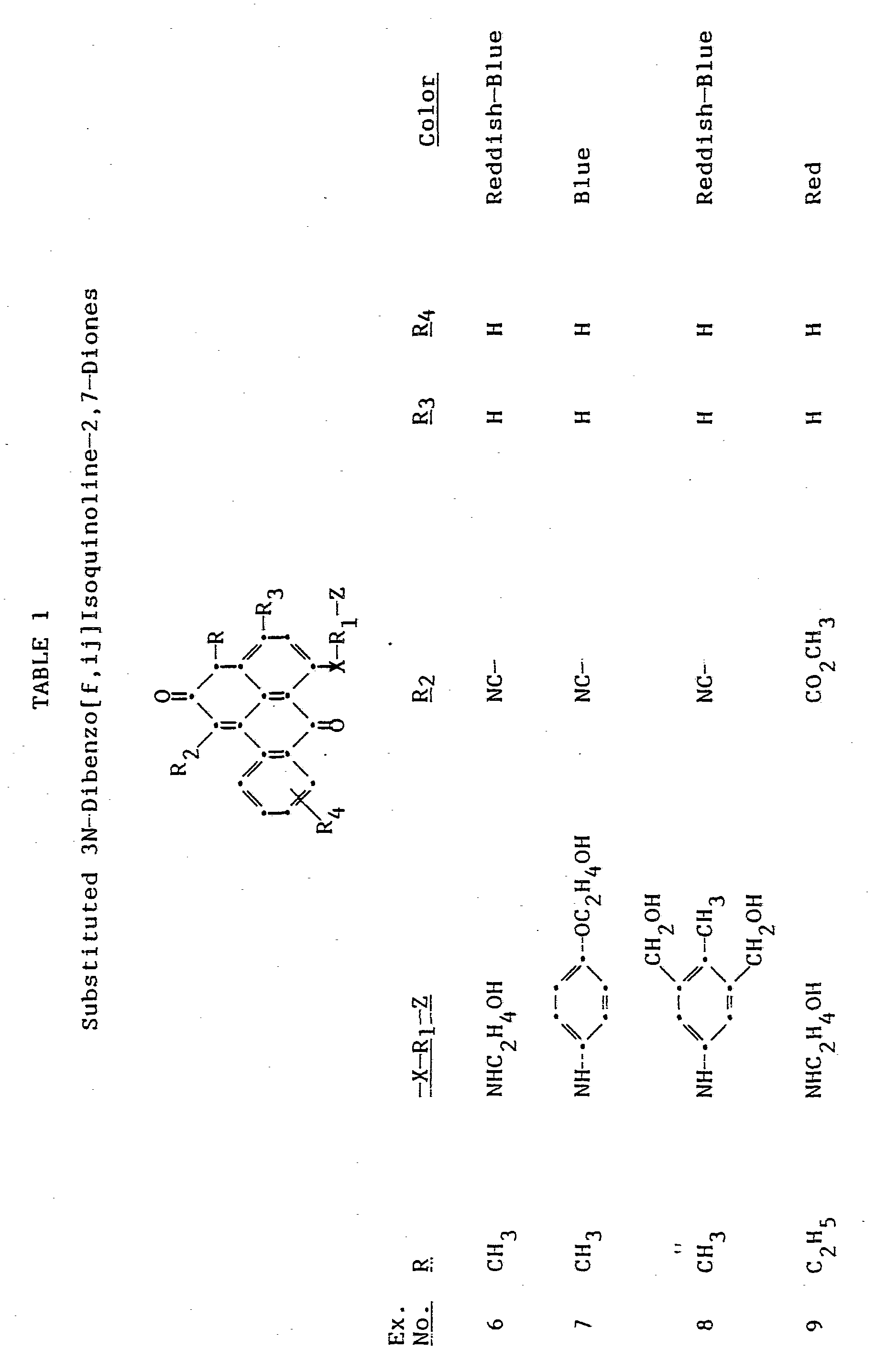
Additional examples of colorants within the present invention are given in Table 1.
EXAMPLE 4 - Preparation of Poly(Ethylene Terephthalate) Copolymerized With 1-Carbethoxy-3-Methyl-6- (m-Toluidino)-3H-Dibenzo [f,ij] Isoquinoline-2,7-Dione A total of 97 g (0.5 mol) dimethyl terephthalate, 62 g (1.0 mol) ethylene glycol, 0.0192 g of 1-carbethoxy-3-methyl-6-(m-toluidino)-3H-dibenzo [f, ij] isoquinoline-2,7-dione, and 0.29 ml of a n-butanol solution of acetyl triisopropyl titanate which contains 0.03 g titanium per ml are weighed into a 500 ml, single-necked, round-bottom flask equipped with a nitrogen inlet, stirrer, vacuum outlet, and condensing flask. The flask and contents are heated at 200°C in a Belmont metal bath for 60 minutes, at 210°C for 75 minutes, and at 230°C for 50 minutes with a nitrogen sweep over the reaction mixture while the ester interchange takes place. The metal bath temperature is increased to 270°C. Vacuum with a stream of nitrogen bleeding into the system is applied slowly over a 10 minute period until the vacuum is reduced to 100 mm Hg. The flask and contents are heated at 270°C under a vacuum of 100 mm Hg for 30 minutes. The metal bath temperature is increased to 285°C. At 285°C, the vacuum is reduced slowly over a 10 minute period to 4 to 5 mm Hg. The flask and contents are heated at 285°C under a vacuum of 4 to 5 mm Hg for 25 minutes. Then the vacuum is reduced to 0.3 to 0.5 mm Hg and polycondensation is continued at 285°C for 16 minutes. The flask is removed from the metal bath and is allowed to cool in nitrogen atmosphere while the polyester crystallizes. The resulting polymer is bluish-red and has an inherent viscosity of 0.64 measured in a 60/40 ratio by weight of phenol/tetrachloroethane at
a concentration of 0.5 g per ml. A UV-visible spectrum on amorphous film of the polymer shows a strong absorption peak at 535 nm.
EXAMPLE 5 - Preparation of Poly(Ethylene Terephthalate) Copolymerized With 1-(2-Hydroxyethyl Amino)-3-Mrthyl-3H-Dibenzo [f, ij] Isoquinolin-2,7-Dione
The below compounds are placed in a 500 ml, single-necked, round-bottom flask:
97 g (0.5 mol) dimethyl terephthalate;
62 g (1.0 mol) ethylene glycol;
0.0192 g 1-(2-hydroxyethylamino)-3-methyl-3H- dibenzo [f,ij] isoquinoline-2,7-dione; and
0.29 ml of a n-butanol solution of acetyl triisopropyl titanate containing 0.03 g titanium per ml.
The ester interchange and polymerization of this polymer are carried out as in Example 4. The resulting polymer is yellow colored and has an inherent viscosity of 0.61. A UV-visible spectrum on amorphous film of the polymer shows a strong absorption peak at 440 nm.
The inherent viscosities (I.V.) of each of the copolyesters herein are determined according to ASTM D2857-70 procedure in a Wagner Viscometer of Lab Glass Inc. of Vineland, N.J. having a 1/2 ml capillary bulb, using a polymer concentration of 0.5% by weight in 60/40 by weight, phenol/ tetrachloroethane solvent. The procedure comprises heating the polymer/solvent system at 120°C for 15 minutes to enhance dissolution of the polymer, cooling the solution to 25°C and measuring the time of flow at 25°C. The I.V. is calculated from the equation
 where: {η} = Inherent viscosity at 25°C at a polymer concentration of 0.5 g./100 ml. of solvent; ln = Natural logarithm; ts = Sample flow time; to = Solvent-blank flow time; and
C = Concentration of polymer in grams per 100 ml. of solvent = 0.50.
The following table gives specific examples of colorants useful in the present invention.


The invention has been described in detail with particular reference to preferred embodiments thereof, but it will be understood that variations and modifications can be effected within the spirit and scope of the invention.
Claims
1. A composition comprising molding or fiber grade condensation polymer having copolymerized therein a total of from 10 to about 20,000 ppm, of a colorant comprising the reactant residue moieties of one or a mixture of isoquinoline derivative reactants of the formula

wherein -Z is selected from hydrogen, -SO2R5,
-SO2NR5R5, -NHSO2R5, -N(R5)SO2R5,
-N(R5)COR5, -NHCOR5, -OH, -SR5, -OR5, -NHR5,
-NR5R5, -SO2NHR5, -CONHR5, -CONR5R5,
-OCOR5 , -OCO2R5 , -OOCNHR5 ,


R3 or R4 carries one or more condensable groups; and wherein in all of the above definitions the alkyl or alkylene moieties or portions of the various groups contain from 1-8 carbons, straight or branched chain, the aryl or arylene nuclei contain from 4-10 carbons, and the cycloalkyl or cycloalkylene nuclei contain from 4-6 carbons.
2. A composition according to Claim 1 wherein: X is -NH- and -R1-Z in combination is aryl, aryl substituted with 1-3 of alkyl, alkoxy, halogen, hydroxyalkyl, hydroxyalkoxy or acylamido, alkyl or alkyl substituted with 1-3 of hydroxyl or acyloxy, cycloalkyl or cycloalkyl substituted with 1-3 of alkyl; X-R1-Z in combination is H; R is alkyl; R2 is alkoxycarbonyl, hydroxy- alkylamino, or cyano; and R3 and R4 are each hydrogen.
3. A composition according to Claim 1 wherein: X is -NH-; -R1-Z in combination is aryl, aryl substituted with 1-3 of alkyl, alkoxy, halogen, hydroxyalkyl, hydroxyalkoxy or acylamido, alkyl or alkyl substituted with 1-3 of hydroxyl or acyloxy, cycloalkyl or cycloalkyl substituted with 1-3 of alkyl; R is alkyl; R2 is hydrogen, cyano, acyl, aroyl, alkoxy, alkylthio or arylthio; and R3 and R4 are each hydrogen.
4. A composition according to Claim 1 wherein the colorant has the formula

5. A composition according to Claim 1 wherein the colorant has the formula 
6. A composition according to Claim 1 wherein the colorant has the formula

7. A composition of any of Claims 1-6 wherein the colorant is present in concentrations between about 20 to about 5,000 ppm.
8. A formed article of a composition of any of Claims 1-6.
9. A composition of any of Claims 1-6 wherein the polymer is linear polyester wherein the acid moiety is comprised of at least about 50 mol % terephthalic acid residue, and the glycol moiety at least about 50 mol % ethylene glycol or 1,4- cyclohexanedimethanol residue, and containing a total of from about 20 to about 5,000 ppm of one or a mixture of the colorant.
10. A composition of any of Claims 1-6 wherein the polymer is linear polyester comprised of from about 75 to 100 mol % terephthalic acid residue and from about 75 to 100 mol % ethylene glycol residue.
11. A formed article of a composition of Claim 9.
12. A formed article of a composition of Claim 10.
Applications Claiming Priority (2)
| Application Number | Priority Date | Filing Date | Title |
|---|---|---|---|
| US07/017,950 US4740581A (en) | 1987-02-24 | 1987-02-24 | Condensation copolymers containing copolymerized isoquinoline derivative colorants and products therefrom |
| US017,950 | 1987-02-24 |
Publications (1)
| Publication Number | Publication Date |
|---|---|
| WO1988006604A1 true WO1988006604A1 (en) | 1988-09-07 |
Family
ID=21785442
Family Applications (1)
| Application Number | Title | Priority Date | Filing Date |
|---|---|---|---|
| PCT/US1988/000442 Ceased WO1988006604A1 (en) | 1987-02-24 | 1988-02-16 | Condensation copolymers containing copolymerized isoquinoline derivative colorants and products therefrom |
Country Status (5)
| Country | Link |
|---|---|
| US (1) | US4740581A (en) |
| EP (1) | EP0350489A1 (en) |
| JP (1) | JPH02502383A (en) |
| CA (1) | CA1298426C (en) |
| WO (1) | WO1988006604A1 (en) |
Cited By (2)
| Publication number | Priority date | Publication date | Assignee | Title |
|---|---|---|---|---|
| EP0288399A3 (en) * | 1987-04-23 | 1990-03-07 | EASTMAN KODAK COMPANY (a New Jersey corporation) | Polyesters having improved whiteness |
| EP2764056A4 (en) * | 2011-10-04 | 2015-06-03 | Canon Kk | Water-insoluble coloring matter compound, ink using the water-insoluble coloring matter compound, thermal transfer recording sheet and resist composition for color filter |
Families Citing this family (44)
| Publication number | Priority date | Publication date | Assignee | Title |
|---|---|---|---|---|
| US6495656B1 (en) | 1990-11-30 | 2002-12-17 | Eastman Chemical Company | Copolyesters and fibrous materials formed therefrom |
| US5030708A (en) * | 1990-12-17 | 1991-07-09 | Eastman Kodak Company | Colored polyester compositions |
| US5453482A (en) * | 1993-09-03 | 1995-09-26 | Eastman Chemical Company | Process for preparing arylsulfonyl halides |
| US5372864A (en) * | 1993-09-03 | 1994-12-13 | Eastman Chemical Company | Toners for polyesters |
| EP0927747B1 (en) * | 1996-09-11 | 2006-07-19 | Nippon Kayaku Kabushiki Kaisha | Anthrapyridone compounds, water-base ink composition, and articles colored therewith |
| WO1998023690A1 (en) | 1996-11-27 | 1998-06-04 | Eastman Chemical Company | Method for preparing light-absorbing polymeric compositions |
| FR2757049B1 (en) * | 1996-12-16 | 1999-01-22 | Oreal | COSMETIC COMPOSITION IN EMULSION FORM COMPRISING A POLYMERIC DYE |
| FR2757050B1 (en) * | 1996-12-16 | 1999-01-22 | Oreal | COSMETIC COMPOSITION IN THE FORM OF AN AQUEOUS GEL COMPRISING A POLYMERIC DYE |
| CN1146679C (en) * | 1997-08-28 | 2004-04-21 | 伊斯曼化学公司 | Modified Copolymer Binder Fiber |
| US6231976B1 (en) | 1997-08-28 | 2001-05-15 | Eastman Chemical Company | Copolyester binder fibers |
| US6346536B1 (en) | 1997-09-03 | 2002-02-12 | Guilford Pharmaceuticals Inc. | Poly(ADP-ribose) polymerase inhibitors and method for treating neural or cardiovascular tissue damage using the same |
| US6197785B1 (en) | 1997-09-03 | 2001-03-06 | Guilford Pharmaceuticals Inc. | Alkoxy-substituted compounds, methods, and compositions for inhibiting PARP activity |
| US6635642B1 (en) | 1997-09-03 | 2003-10-21 | Guilford Pharmaceuticals Inc. | PARP inhibitors, pharmaceutical compositions comprising same, and methods of using same |
| US6291425B1 (en) | 1999-09-01 | 2001-09-18 | Guilford Pharmaceuticals Inc. | Compounds, methods and pharmaceutical compositions for treating cellular damage, such as neural or cardiovascular tissue damage |
| US6514983B1 (en) | 1997-09-03 | 2003-02-04 | Guilford Pharmaceuticals Inc. | Compounds, methods and pharmaceutical compositions for treating neural or cardiovascular tissue damage |
| US6426415B1 (en) | 1997-09-03 | 2002-07-30 | Guilford Pharmaceuticals Inc. | Alkoxy-substituted compounds, methods and compositions for inhibiting parp activity |
| CN1161505C (en) * | 1997-11-06 | 2004-08-11 | 伊斯曼化学公司 | copolyester binder fiber |
| WO1999048981A1 (en) * | 1998-03-25 | 1999-09-30 | Nippon Kayaku Kabushiki Kaisha | Novel anthrapyridone compounds, water-based magenta ink composition, and method of ink-jet recording |
| US6395749B1 (en) | 1998-05-15 | 2002-05-28 | Guilford Pharmaceuticals Inc. | Carboxamide compounds, methods, and compositions for inhibiting PARP activity |
| US6387902B1 (en) | 1998-12-31 | 2002-05-14 | Guilford Pharmaceuticals, Inc. | Phenazine compounds, methods and pharmaceutical compositions for inhibiting PARP |
| CN1377380A (en) | 1999-08-06 | 2002-10-30 | 伊斯曼化学公司 | Polyesters having a controlled melting point and fibers formed therefrom |
| WO2001090077A1 (en) | 2000-05-19 | 2001-11-29 | Guilford Pharmaceuticals, Inc. | Sulfonamide and carbamide derivatives of 6(5h)phenanthridinones and their uses |
| WO2001091796A2 (en) | 2000-06-01 | 2001-12-06 | Guilford Pharmaceuticals Inc. | Methods, compounds and compositions for treating gout |
| US6545011B2 (en) | 2000-07-13 | 2003-04-08 | Guilford Pharmaceuticals Inc. | Substituted 4,9-dihydrocyclopenta[imn]phenanthridine-5-ones, derivatives thereof and their uses |
| US6727372B2 (en) * | 2000-08-07 | 2004-04-27 | Eastman Chemical Company | Colorant compounds containing copolymerizable vinyl groups |
| US20020082360A1 (en) * | 2000-11-03 | 2002-06-27 | Conn Roy Lee | Films and articles formed from blends of polycarbonate and polyester |
| US6569957B2 (en) | 2000-11-03 | 2003-05-27 | Eastman Chemical Company | Blends of polycarbonate and polyester and sheets and films formed therefrom |
| US6429278B1 (en) | 2001-01-22 | 2002-08-06 | Eastman Chemical Company | Process for manufacture of polyesters based on 1,4-cyclohexanedimethanol and isophthalic acid |
| FR2829022B1 (en) * | 2001-09-03 | 2004-09-24 | Oreal | FOUNDATION COMPOSITION COMPRISING INTERFERENTIAL PIGMENTS |
| US6641920B2 (en) | 2002-02-08 | 2003-11-04 | Eastman Chemical Company | Ultraviolet protected multi-layer structures of copolyester/polycarbonate blends |
| US6723768B2 (en) | 2002-03-27 | 2004-04-20 | Eastman Chemical Company | Polyester/polycarbonate blends with reduced yellowness |
| US6914120B2 (en) * | 2002-11-13 | 2005-07-05 | Eastman Chemical Company | Method for making isosorbide containing polyesters |
| JP4374917B2 (en) * | 2003-06-12 | 2009-12-02 | コニカミノルタホールディングス株式会社 | Inkjet recording liquid |
| US20050054757A1 (en) * | 2003-09-10 | 2005-03-10 | Pearson Jason Clay | Method for reducing the acetaldehyde level in polyesters |
| US7622580B2 (en) * | 2004-08-13 | 2009-11-24 | Xerox Corporation | Colorant compounds |
| US7691191B2 (en) * | 2006-11-29 | 2010-04-06 | Nippon Kayaku Kabushiki Kaisha | Anthrapyridone compound, salt thereof, magenta ink composition and colored product |
| BRPI0801751B1 (en) | 2007-05-30 | 2016-03-29 | Oreal | cosmetic composition of functionalized metal oxide pigments and with color shifting and handling effects |
| EP2067467A3 (en) | 2007-09-14 | 2012-12-12 | L'Oréal | Compositions and methods for treating keratinous substrates |
| WO2009124184A2 (en) * | 2008-04-04 | 2009-10-08 | The Cleveland Clinic Foundation | Methods of activating rnase l |
| EP2169009B1 (en) * | 2008-09-24 | 2011-05-25 | ILFORD Imaging Switzerland GmbH | Anthrapyridone dyes, their preparation and their use |
| EP2546309B1 (en) * | 2011-01-14 | 2016-06-01 | Dalian University Of Technology | Anthrapyridone sulphonic acid compounds, preparation and use thereof |
| US8906587B2 (en) * | 2011-11-02 | 2014-12-09 | Canon Kabushiki Kaisha | Colored resin powder and toner using the colored resin powder |
| CN102634223B (en) * | 2012-03-20 | 2016-06-29 | 大连理工大学 | Rosaniline dyes and its production and use |
| US9517584B2 (en) | 2013-12-18 | 2016-12-13 | Eastman Chemical Company | Articles comprising isosorbide and processes for their manufacture |
Citations (4)
| Publication number | Priority date | Publication date | Assignee | Title |
|---|---|---|---|---|
| US3324132A (en) * | 1964-05-15 | 1967-06-06 | Ici Ltd | Anthrapyridone pigments containing a fused quinoline group |
| FR2346385A1 (en) * | 1976-03-30 | 1977-10-28 | Hoechst Ag | DYED POLYESTERS, THEIR PREPARATION AND THEIR USE FOR COLORING PLASTIC MATERIALS |
| DE3005223A1 (en) * | 1979-02-15 | 1980-09-04 | Eastman Kodak Co | COLORED POLYESTER |
| CH636633A5 (en) * | 1978-01-01 | 1983-06-15 | Dynapol Corp | Polymeric dye |
Family Cites Families (6)
| Publication number | Priority date | Publication date | Assignee | Title |
|---|---|---|---|---|
| DE2962938D1 (en) * | 1978-02-08 | 1982-07-15 | Ciba Geigy Ag | Polymers with lateral tricyclic imidyl groups, cross-linkable by the action of light, their preparation and their use |
| US4371690A (en) * | 1979-07-12 | 1983-02-01 | E. I. Du Pont De Nemours And Company | Heat-resistant rigid polymers from difunctional 9,10-dihydro-9,10-ethanoanthracenes |
| US4284729A (en) * | 1980-03-31 | 1981-08-18 | Milliken Research Corporation | Process for coloring thermosetting resins |
| US4359570A (en) * | 1980-05-08 | 1982-11-16 | Eastman Kodak Company | Colored polyester containing copolymerized dyes as colorants |
| DE3278504D1 (en) * | 1981-10-02 | 1988-06-23 | Ici Plc | New polyester compositions; shaped articles obtained from them and processes for preparing them |
| US4523008A (en) * | 1984-06-06 | 1985-06-11 | The United States Of America As Represented By The Administrator Of The National Aeronautics And Space Administration | Stabilized unsaturated polyesters |
-
1987
- 1987-02-24 US US07/017,950 patent/US4740581A/en not_active Expired - Fee Related
-
1988
- 1988-02-01 CA CA000557851A patent/CA1298426C/en not_active Expired - Fee Related
- 1988-02-16 WO PCT/US1988/000442 patent/WO1988006604A1/en not_active Ceased
- 1988-02-16 JP JP63502291A patent/JPH02502383A/en active Pending
- 1988-02-16 EP EP88902318A patent/EP0350489A1/en not_active Withdrawn
Patent Citations (4)
| Publication number | Priority date | Publication date | Assignee | Title |
|---|---|---|---|---|
| US3324132A (en) * | 1964-05-15 | 1967-06-06 | Ici Ltd | Anthrapyridone pigments containing a fused quinoline group |
| FR2346385A1 (en) * | 1976-03-30 | 1977-10-28 | Hoechst Ag | DYED POLYESTERS, THEIR PREPARATION AND THEIR USE FOR COLORING PLASTIC MATERIALS |
| CH636633A5 (en) * | 1978-01-01 | 1983-06-15 | Dynapol Corp | Polymeric dye |
| DE3005223A1 (en) * | 1979-02-15 | 1980-09-04 | Eastman Kodak Co | COLORED POLYESTER |
Cited By (2)
| Publication number | Priority date | Publication date | Assignee | Title |
|---|---|---|---|---|
| EP0288399A3 (en) * | 1987-04-23 | 1990-03-07 | EASTMAN KODAK COMPANY (a New Jersey corporation) | Polyesters having improved whiteness |
| EP2764056A4 (en) * | 2011-10-04 | 2015-06-03 | Canon Kk | Water-insoluble coloring matter compound, ink using the water-insoluble coloring matter compound, thermal transfer recording sheet and resist composition for color filter |
Also Published As
| Publication number | Publication date |
|---|---|
| JPH02502383A (en) | 1990-08-02 |
| US4740581A (en) | 1988-04-26 |
| CA1298426C (en) | 1992-03-31 |
| EP0350489A1 (en) | 1990-01-17 |
Similar Documents
| Publication | Publication Date | Title |
|---|---|---|
| CA1298426C (en) | Condensation copolymers containing copolymerized isoquinoline derivative colorants and products therefrom | |
| AU579923B2 (en) | Polymers containing methine moieties | |
| AU579233B2 (en) | Uv absorbing polyester composition | |
| US4749773A (en) | Condensation polymers containing methine ultraviolet radiation-absorbing residues and shaped articles produced therefrom | |
| EP0280856B1 (en) | Condensation copolymers containing 2,5-diarylaminoterephthalic acid type colorants and products therefrom | |
| AU620150B2 (en) | Condensation polymers containing methine ultraviolet radiation-absorbing residues and shaped articles produced therefrom | |
| US4707537A (en) | UV-absorbing condensation polymeric compositions and products therefrom | |
| US4749774A (en) | Condensation polymer containing the residue of a poly-methine compound and shaped articles produced therefrom | |
| US4950732A (en) | Condensation copolymers containing bis-methine moieties and products therefrom | |
| US4661566A (en) | UV-absorbing condensation polymeric composition | |
| US4845187A (en) | Condensation polymers containing methine ultraviolet radiation-absorbing residues and shaped articles produced therefrom | |
| EP0412101B1 (en) | Novel methine compounds, polymers containing them and formed articles therefrom | |
| US4808677A (en) | Condensation polymer containing copolymerized colorants derived from indigo and articles produced therefrom | |
| US4791188A (en) | Condensation polymer containing the residue of a benzodioxylmethine compound and shaped articles produced therefrom | |
| AU606641B2 (en) | Condensation copolymers containing bis-methine moieties and products therefrom |
Legal Events
| Date | Code | Title | Description |
|---|---|---|---|
| AK | Designated states |
Kind code of ref document: A1 Designated state(s): JP |
|
| AL | Designated countries for regional patents |
Kind code of ref document: A1 Designated state(s): DE GB |
|
| WWE | Wipo information: entry into national phase |
Ref document number: 1988902318 Country of ref document: EP |
|
| WWP | Wipo information: published in national office |
Ref document number: 1988902318 Country of ref document: EP |
|
| WWW | Wipo information: withdrawn in national office |
Ref document number: 1988902318 Country of ref document: EP |