WO1989000452A1 - Catalyst composition and method for selective dehydrogenation - Google Patents
Catalyst composition and method for selective dehydrogenation Download PDFInfo
- Publication number
- WO1989000452A1 WO1989000452A1 PCT/US1988/002426 US8802426W WO8900452A1 WO 1989000452 A1 WO1989000452 A1 WO 1989000452A1 US 8802426 W US8802426 W US 8802426W WO 8900452 A1 WO8900452 A1 WO 8900452A1
- Authority
- WO
- WIPO (PCT)
- Prior art keywords
- alkyl
- cycloalkyl
- compound
- catalyst
- group
- Prior art date
- Legal status (The legal status is an assumption and is not a legal conclusion. Google has not performed a legal analysis and makes no representation as to the accuracy of the status listed.)
- Ceased
Links
Classifications
-
- C—CHEMISTRY; METALLURGY
- C07—ORGANIC CHEMISTRY
- C07C—ACYCLIC OR CARBOCYCLIC COMPOUNDS
- C07C41/00—Preparation of ethers; Preparation of compounds having groups, groups or groups
- C07C41/01—Preparation of ethers
- C07C41/18—Preparation of ethers by reactions not forming ether-oxygen bonds
-
- B—PERFORMING OPERATIONS; TRANSPORTING
- B01—PHYSICAL OR CHEMICAL PROCESSES OR APPARATUS IN GENERAL
- B01J—CHEMICAL OR PHYSICAL PROCESSES, e.g. CATALYSIS OR COLLOID CHEMISTRY; THEIR RELEVANT APPARATUS
- B01J23/00—Catalysts comprising metals or metal oxides or hydroxides, not provided for in group B01J21/00
- B01J23/70—Catalysts comprising metals or metal oxides or hydroxides, not provided for in group B01J21/00 of the iron group metals or copper
- B01J23/89—Catalysts comprising metals or metal oxides or hydroxides, not provided for in group B01J21/00 of the iron group metals or copper combined with noble metals
- B01J23/8926—Copper and noble metals
-
- C—CHEMISTRY; METALLURGY
- C07—ORGANIC CHEMISTRY
- C07C—ACYCLIC OR CARBOCYCLIC COMPOUNDS
- C07C37/00—Preparation of compounds having hydroxy or O-metal groups bound to a carbon atom of a six-membered aromatic ring
- C07C37/001—Preparation of compounds having hydroxy or O-metal groups bound to a carbon atom of a six-membered aromatic ring by modification in a side chain
-
- C—CHEMISTRY; METALLURGY
- C07—ORGANIC CHEMISTRY
- C07C—ACYCLIC OR CARBOCYCLIC COMPOUNDS
- C07C37/00—Preparation of compounds having hydroxy or O-metal groups bound to a carbon atom of a six-membered aromatic ring
- C07C37/06—Preparation of compounds having hydroxy or O-metal groups bound to a carbon atom of a six-membered aromatic ring by conversion of non-aromatic six-membered rings or of such rings formed in situ into aromatic six-membered rings, e.g. by dehydrogenation
-
- C—CHEMISTRY; METALLURGY
- C07—ORGANIC CHEMISTRY
- C07C—ACYCLIC OR CARBOCYCLIC COMPOUNDS
- C07C5/00—Preparation of hydrocarbons from hydrocarbons containing the same number of carbon atoms
- C07C5/32—Preparation of hydrocarbons from hydrocarbons containing the same number of carbon atoms by dehydrogenation with formation of free hydrogen
- C07C5/321—Catalytic processes
- C07C5/324—Catalytic processes with metals
- C07C5/325—Catalytic processes with metals of the platinum group
-
- C—CHEMISTRY; METALLURGY
- C07—ORGANIC CHEMISTRY
- C07C—ACYCLIC OR CARBOCYCLIC COMPOUNDS
- C07C5/00—Preparation of hydrocarbons from hydrocarbons containing the same number of carbon atoms
- C07C5/32—Preparation of hydrocarbons from hydrocarbons containing the same number of carbon atoms by dehydrogenation with formation of free hydrogen
- C07C5/327—Formation of non-aromatic carbon-to-carbon double bonds only
- C07C5/333—Catalytic processes
- C07C5/3335—Catalytic processes with metals
- C07C5/3337—Catalytic processes with metals of the platinum group
-
- C—CHEMISTRY; METALLURGY
- C07—ORGANIC CHEMISTRY
- C07C—ACYCLIC OR CARBOCYCLIC COMPOUNDS
- C07C67/00—Preparation of carboxylic acid esters
- C07C67/28—Preparation of carboxylic acid esters by modifying the hydroxylic moiety of the ester, such modification not being an introduction of an ester group
- C07C67/297—Preparation of carboxylic acid esters by modifying the hydroxylic moiety of the ester, such modification not being an introduction of an ester group by splitting-off hydrogen or functional groups; by hydrogenolysis of functional groups
-
- C—CHEMISTRY; METALLURGY
- C07—ORGANIC CHEMISTRY
- C07C—ACYCLIC OR CARBOCYCLIC COMPOUNDS
- C07C67/00—Preparation of carboxylic acid esters
- C07C67/30—Preparation of carboxylic acid esters by modifying the acid moiety of the ester, such modification not being an introduction of an ester group
- C07C67/317—Preparation of carboxylic acid esters by modifying the acid moiety of the ester, such modification not being an introduction of an ester group by splitting-off hydrogen or functional groups; by hydrogenolysis of functional groups
-
- C—CHEMISTRY; METALLURGY
- C07—ORGANIC CHEMISTRY
- C07C—ACYCLIC OR CARBOCYCLIC COMPOUNDS
- C07C2521/00—Catalysts comprising the elements, oxides or hydroxides of magnesium, boron, aluminium, carbon, silicon, titanium, zirconium or hafnium
- C07C2521/18—Carbon
-
- C—CHEMISTRY; METALLURGY
- C07—ORGANIC CHEMISTRY
- C07C—ACYCLIC OR CARBOCYCLIC COMPOUNDS
- C07C2523/00—Catalysts comprising metals or metal oxides or hydroxides, not provided for in group C07C2521/00
- C07C2523/38—Catalysts comprising metals or metal oxides or hydroxides, not provided for in group C07C2521/00 of noble metals
- C07C2523/40—Catalysts comprising metals or metal oxides or hydroxides, not provided for in group C07C2521/00 of noble metals of the platinum group metals
- C07C2523/44—Palladium
-
- C—CHEMISTRY; METALLURGY
- C07—ORGANIC CHEMISTRY
- C07C—ACYCLIC OR CARBOCYCLIC COMPOUNDS
- C07C2523/00—Catalysts comprising metals or metal oxides or hydroxides, not provided for in group C07C2521/00
- C07C2523/70—Catalysts comprising metals or metal oxides or hydroxides, not provided for in group C07C2521/00 of the iron group metals or copper
- C07C2523/72—Copper
-
- C—CHEMISTRY; METALLURGY
- C07—ORGANIC CHEMISTRY
- C07C—ACYCLIC OR CARBOCYCLIC COMPOUNDS
- C07C2523/00—Catalysts comprising metals or metal oxides or hydroxides, not provided for in group C07C2521/00
- C07C2523/70—Catalysts comprising metals or metal oxides or hydroxides, not provided for in group C07C2521/00 of the iron group metals or copper
- C07C2523/89—Catalysts comprising metals or metal oxides or hydroxides, not provided for in group C07C2521/00 of the iron group metals or copper combined with noble metals
-
- C—CHEMISTRY; METALLURGY
- C07—ORGANIC CHEMISTRY
- C07C—ACYCLIC OR CARBOCYCLIC COMPOUNDS
- C07C2601/00—Systems containing only non-condensed rings
- C07C2601/12—Systems containing only non-condensed rings with a six-membered ring
- C07C2601/14—The ring being saturated
Definitions
- This invention relates to a catalyst composition which has been shown to be useful for the selective catalytic dehydrogenation of a variety of organic substrates.
- a catalyst composition has now been discovered that can be used for the selective dehydrogenation of a variety of substrates.
- a unique feature of this catalyst is the high degree of selectivity obtained thus avoiding the formation of unwanted reaction byproducts.
- the catalyst composition of the invention comprises
- the + Cu) on the support is about 0.02 wt % to 20 wt %, the weight ratio of Pd:Cu is about 1:1 to 10:1 and the carbon support has a surface area of at least about 100 m 2 /g and is essentially free of reactive sulfur.
- the catalyst of the invention is prepared by a method comprising heat-treating a carbon support having a surface area of at least about 100 m 2 /g at a temperature and for a time sufficient to remove essentially all volatile sulfur therefrom; contacting the heat-treated carbon support with at least one Pd- source selected from the group consisting of palladium and anion-containing compounds of palladium and at least one Cu- source selected from the group consisting of copper and anion-containing compounds of copper in amounts effective to attain on the support a final amount of 0.01 - 19.9 wt % Pd and 0.01 - 19.9 wt % Cu, a total amount of (Pd + Cu) of about 0.02 wt % to 20 wt % , and a weight ratio of Pd:Cu of about 1:1 to 10:1.
- the catalyst is calcined prior to use under conditions effective to decompose the Pd- and Cu-contain- ing compounds employed for catalyst preparation.
- calcination will Jbe carried out under conditions effective to remove substantially all the anions of the Pd- and Cu-containing compounds but not sufficient to cause excessive combustion of the carbon support.
- This invention also relates to a method of dehydrogenating a compound, comprising contacting a compound of the formula
- each R 1 , R 2 , R 3 and R 4 is independently selected from the group consisting of
- a catalyst comprising about 0.01 wt % - 19.9 wt %.
- the dehydrogenation method of the present invention is conducted with the aid of a mixed metal catalyst composition comprising palladium and copper supported on a carbon support.
- the catalyst composition of the invention comprises
- a preferred catalyst composition comprises about 5 wt % to 8 wt % of palladium and about 0.5 wt % to 2.5 wt % of copper on carbon.
- the catalyst composition of the invention is prepared by the method described supra.
- the contacting of the carbon support with the Pd- and Cu- containing compounds may be conducted by techniques which are standard in the art, such as for example, aggregation, precipitation onto a support, evaporation of a metal-containing solution onto a support and the like.
- the catalyst of the invention is prepared by dissolving appropriate amounts of at least one palladium- and anion- containing compound and at least one Cu— and anion- containing compound in a solvent, the amounts being sufficient to attain a desired metal loading on a carbon support and the solution is added to the carbon support material which has been heated to remove any volatile sulfur content at, e.g., about 700°C - 900°C.
- the solvent may be water, although the use of other solvents is also contemplated. Any excess solvent may be removed by methods known in the art , and the sample is then dried .
- the catalyst is then calcined prior to use to remove any anions present.
- the Pd- and Cu-containing compounds employed for catalyst preparation are compounds where the metals are associated with an anion. Any anion which may be removed by calcination or does not detract from the activity of the finished catalyst is suitable for the preparation of the present catalyst.
- each R 1 , R 2 , R 3 and R 4 is independently selected from the group consisting of H, (C 1 -C 20 ) alkyl, (C 3 -C 20) ) cycloalkyl, (C 6 -C 20) ) aryl, (C 7 -C 20 ) alkylaryl, and (C 7 -C 20 ) arylalkyl groups, as well as substituted (C 1 -C 20 ) alkyl' (C 3 -C 20 ) cycloalkyl, (C 6 -C 20 ) aryl, (C 7 -C 20 ) alkylaryl and (C 6 -C 20 ) arylalkyl groups; each such group optionally substituted with -OR, wherein R is R 1 , R 2 , R 3 or R 4 ; and wherein R 1 and R 2 or R 3 and R 4 may be joined as part of a ring structure.
- R' C 1 -C 20 alkyl
- each R' is independently H, C 1 -C 20 alkyl,
- Ar is an aromatic moiety having 6 up to 14 carbon atoms
- x is 4 when Ar has 6 carbons, x is 6 when Ar has 10 carbons and x is 8 when Ar is 14;
- each R' is independently H, C 1 -C 20 alkyl,
- Ar is an aromatic moiety having 6 up to 14 carbon atoms
- x is 4 when Ar has 6 carbons, x is 6 when Ar has 10 carbons and x is 8 when Ar is 14; as well as phenols, hydroquinones of the structure:
- each R" is independently C 1 -C 20 alkyl, C 3 -C 20 cycloalkyl, C 4 -C 20 aromatic or heteroaromatic moiety; and wherein each R''' is independently
- Y is as defined above, -SO y Z', wherein Z is C 1 -C 20 alkyl, or
- Exemplary compounds which are included in the scope of dehydrogenatable compounds include cyclohexylhydroquinone and substituted derivatives thereof, 1,2-diphenylethane and substituted derivatives thereof, ethylbenzene and substituted derivatives thereof, alkanes such as propane, butane, pentane, hexane, heptane, octane, nonane and decane.
- the dehydrogenation reaction according to the present method is preferably conducted at a temperature ranging from between about 100°C to 400°C. A still more preferred range of temperatures is between about 150°C and 300°C.
- the reaction is preferably conducted at atmospheric pressure, although other pressures are also contemplated herein.
- the dehydrogenation reaction of the present method may be conducted in either a fixed bed or a slurry reactor.
- the catalyst utilized in the present method may be recycled from the slurry by filtering the hot reaction mixture.
- the filtration may be conducted at the reaction temperature, above the melting point of the reaction mixture or at a temperature between 100°C and 200°C.
- a preferred range of temperatures for recovering the catalyst by filtration is between about 125°C and 150°C.
- hydrogen gas produced as a result of the reaction is removed from the reaction atmosphere as the reaction proceeds.
- This can be accomplished by a variety of techniques as are well known by those of skill in the art.
- the removal of hydrogen gas can be attained by circulating an inert gas through the atmosphere immediately above, or directly into, the reaction mixture.
- the inert gas may be nitrogen.
- other unreactive gases may also be utilized for the removal of the hydrogen gas.
- hydrogen gas can be removed by careful addition of a purge gas containing small amounts of oxygen, which enables the removal of hydrogen as water.
- the net result of hydrogen gas removal is to shift the equilibrium concentration from the starting material or substrate to the product of the reaction by removing from the system any amount of hydrogen produced.
- the selective dehydrogenation reaction of this invention may be conducted for a period of time which varies with the substrate, desired percent conversion to product, mode of operation, etc.
- the time may vary in the range of about 1 minute up to 32 hours.
- reaction times of one minute or less may be suitable to achieve acceptable conversion levels
- reaction times of several hours or more may be required to achieve acceptable conversion levels. It is recognized, of course, that an artisan may, without undue experimentation, adjust the period of time for the reaction to proceed by following the progress of the reaction under specific conditions.
- the progress of the reaction may be monitored by appropriate known analytical techniques, e.g., by extracting aliquots from the reaction mixture at different times for analysis by gas chromatography.
- the selective hydrogenation reaction of this invention may be optionally conducted in the presence of a solvent.
- Suitable solvents for use with the present method are solvents which are stable under reaction conditions. Examples of suitable solvents are biphenyl, naphthalene, diphenylether, tetralin, durene, prehnitene or 1,2,3,4-tetramethylbenzene, and the like.
- the dehydrogenated product may be isolated from the reaction mixture (including the catalyst), and then further purified, by employing any of a variety of techniques readily available to those of skill in the art, e.g., by filtration, distillation, and the like.
- a carbon support material is heated to remove any residual volatile sulfur content. This is done at 700°-900°C (in a hydrogen flow) for eight hours prior to metal addition. Appropriate amounts of palladium and copper nitrates necessary to achieve the desired metal loading are dissolved in water and the resulting solution added to the carbon support. Excess solvent is then removed by heating at 90°C in air for several hours. Once the sample is dry, the materials are calcined in flowing air (i.e., a gas hourly space velocity (GHSV) in excess of about 1000/hr.) at 350°C for four hours prior to use.
- GHSV gas hourly space velocity
- a sample for Test I was prepared by adding to the flask 100 g biphenyl, 20 g cyclohexylhydroquinone and 2.0 g of a catalyst containing 5 wt X Pd, 1.5 wt % Cu on carbon; then the flask was heated to 250°C. During the course of the reaction, nitrogen gas was incorporated into the reaction atmosphere by subsurface addition thereof. After stirring the mixture for 24 hours at 250°C, an aliquot of the reaction mixture was analyzed by gas chromatography and found to contain 85% phenylhydroquinone and 10% cyclohexylhydroquinone as well as 3.2% hydrogenolysis byproducts. This experiment is representative of the invention method.
- the phenylhydroquinone can be isolated in high yield and in pure form by vacuum distillation (the boiling point of phenylhydroquinone at 2.0 mm is 187°C).
- Example 3 Dehydrogenation of Subscitutsd Cyclohexyihydroquinones With the Catalyst of the Invention
- R is -H, -CH 3 , -C 6 H 5 , -OCH 3 and
- n-butane was conducted in the gas phase at 180°C and 280°C using a 8 wt % Pd, 2.5 wt % Cu on carbon catalyst.
- 3.8 g of the catalyst in powder form were placed in a plug flow microreactor and heated to reaction temperature in a flow of nitrogen gas. Once the reaction temperature was achieved, n-butane was fed to the catalyst bed at 170 SCCM and the amount of the products obtained at the two temperatures were monitored by gas chromatography.
- Table 6 The results of these experiments are set forth in Table 6.
Landscapes
- Chemical & Material Sciences (AREA)
- Organic Chemistry (AREA)
- Chemical Kinetics & Catalysis (AREA)
- Engineering & Computer Science (AREA)
- Materials Engineering (AREA)
- Organic Low-Molecular-Weight Compounds And Preparation Thereof (AREA)
- Low-Molecular Organic Synthesis Reactions Using Catalysts (AREA)
Abstract
A method for selective dehydrogenation of a compound, comprising contacting a compound of formula (I), wherein each R1, R2, R3 and R4 is independently selected from the group consisting of H, (C1-C20) alkyl, (C3-C20) cycloalkyl, (C6-C20) aryl, (C7-C20) alkylaryl, (C7-C20) aralkyl groups, as well as substituted (C1-C20) alkyl, (C3-C20) cycloalkyl, (C6-C20) aryl, (C7-C20) aralkyl and (C7-C20) arylalkyl moieties, optionally further substituted with -OR, wherein R is R1, R2, R3 or R4; and wherein R1 and R2 or R3 and R4 may be joined as part of a ring structure, at a dehydrogenation temperature in the presence of a catalyst comprising about 0.01 wt % - 19.9 wt % Pd and about 0.01 wt % - 19.9 wt % Cu on a carbon support, wherein the total amount of (Pd + Cu) on the support is about 0.02 wt % to 20 wt %, the weight ratio of Pd:Cu is about 1:1 to 10:1, and the carbon support has a surface area of at least about 100 m2/g and is essentially free of reactive sulfur. A selective dehydrogenation catalyst having the composition described supra is disclosed as is a method of preparing the same. This catalyst is highly selective for dehydrogenating a variety of substrates while minimizing the formation of unwanted hydrogenolysis by-products.
Description
Description
CATALYST COMPOSITION AND
METHOD FOR SELECTIVE DEHYDROGENATION
This invention relates to a catalyst composition which has been shown to be useful for the selective catalytic dehydrogenation of a variety of organic substrates.
BACKGROUND OF THE INVENTION Dehydrogenation reactions have been used to effect aromatization as well as to place an olefinic linkage in an open chain system (see, P. A. Plattner, in "Newer Methods of Preparative Organic Chemistry", Wiley Intersciences, New York, pp. 21-59 (1948); Chem. Rev. 78: 317-361 (1978)). Two types of reagents are most frequently used to effect aromatization: (a) hydrogenation catalysts such as platinum, palladium, nickel, etc., and (b) sulfur or selenium which combine with the hydrogen evolved to give H2S or H2Se. Other reagents have also been used for dehydrogenation, e.g., atmospheric oxygen, selenium dioxide, quinones (see, Jackman, L.M., Org. Chem. 2: 329-366 (I960)) and activated charcoal (see, Shuikin and Narvschkina. J. Prakt. Chem. [4] 13: 183 (1961). Dehydrogenation of open-chain systems to give a double bond in a specific location is not usually a feasible process, though industrially mixtures of olefins are obtained in this way from alkanes. There are few highly selective methods for catalytic dehydrogenation. Competing secondary reactions such as hydrogenolysis of carbon-oxygen
bonds may occur detracting from the synthetic utility of this approach. For example, during the catalytic dehydrogenation of cyclohexylhydroquinone to phenylhydroquinone using a supported palladium catalyst, large amounts of hydrogenolysis by-products such as 2- and 3-phenyl phenols are produced.
Thus, it is apparent there is still a need for a catalyst that will effect a selective dehydrogenation of substrates that are susceptible to hydrogenolysis.
SUMMARY OF THE INVENTION
A catalyst composition has now been discovered that can be used for the selective dehydrogenation of a variety of substrates. A unique feature of this catalyst is the high degree of selectivity obtained thus avoiding the formation of unwanted reaction byproducts.
The catalyst composition of the invention comprises
about 0.01 - 19.9 wt % Pd, and about 0.01 - 19.9 wt % Cu,
on a carbon support, wherein the total amount of (Pd
+ Cu) on the support is about 0.02 wt % to 20 wt %, the weight ratio of Pd:Cu is about 1:1 to 10:1 and the carbon support has a surface area of at least about 100 m2/g and is essentially free of reactive sulfur.
The catalyst of the invention is prepared by a method comprising heat-treating a carbon support having a surface area of at least about 100 m2/g at a
temperature and for a time sufficient to remove essentially all volatile sulfur therefrom; contacting the heat-treated carbon support with at least one Pd- source selected from the group consisting of palladium and anion-containing compounds of palladium and at least one Cu- source selected from the group consisting of copper and anion-containing compounds of copper in amounts effective to attain on the support a final amount of 0.01 - 19.9 wt % Pd and 0.01 - 19.9 wt % Cu, a total amount of (Pd + Cu) of about 0.02 wt % to 20 wt % , and a weight ratio of Pd:Cu of about 1:1 to 10:1. The catalyst is calcined prior to use under conditions effective to decompose the Pd- and Cu-contain- ing compounds employed for catalyst preparation. Preferably, calcination will Jbe carried out under conditions effective to remove substantially all the anions of the Pd- and Cu-containing compounds but not sufficient to cause excessive combustion of the carbon support.
This invention also relates to a method of dehydrogenating a compound, comprising contacting a compound of the formula

H, (C1-C20) alkyl' (C3-C20) cycloalkyl, (C6-C20) aryl, (C7-C20) alkylaryl, and
(C6-C20) arylalkyl groups, as well as substituted (C1-C20) alkyl, (C3-C20) cycloalkyl, (C6-C20) aryl, (C7-C20) alkylaryl and (C6-C20) arylalkyl groups; each such group optionally further substituted with -OR, wherein R is R1, R2, R3 or R4; and wherein R1 and R2 or R3 and R4 may be joined as part of a ring structure,
under dehydrogenation conditions in the presence of a catalyst comprising about 0.01 wt % - 19.9 wt %. Pd, and about 0.01 wt % - 19.9 wt % Cu on a carbon support, wherein the total amount of (Pd + Cu) on the support is about 0.02 wt % to 20 wt %, the weight ratio of Pd:Cu is about 1:1 to 10:1 and the carbon support has a surface area of at least about 100 m2/g and is essentially free of reactive sulfur.
When palladium supported on an inert support in the absence of any amounts of copper is utilized as a dehydrogenation catalyst, large amounts of hydrogenolysis by-products are obtained. One such example is the dehydrogenation of cyclohexylhydroquinone in which by-products such as 2- and 3- hydroxybiphenyls are evolved.
On the other hand, when the dehydrogenation reaction is conducted utilizing the catalyst of this invention a selective dehydrogenation occurs and substantially no by-products are produced. Thus, when cyclohexylhydroquinone is dehydrogenated according to the inventive method it yields phenylhydroquinone substantially in the absence of hydrogenolysis biphenyl by-products (see Example 1).
Other objects, advantages and features of the present invention will become apparent to those skilled in the art from the following discussion and appended claims.
DETAILED DESCRIPTION OF THE INVENTION
The dehydrogenation method of the present invention is conducted with the aid of a mixed metal catalyst composition comprising palladium and copper supported on a carbon support. The catalyst composition of the invention comprises
about 0.01 - 19.9 wt % Pd, and about 0.01 - 19.9 wt % Cu,
on a carbon support, wherein the total amount of (Pd + Cu) on the support is about 0.02 wt % to 20 wt % , the weight ratio of Pd:Cu is about 1:1 to 10:1 and the carbon support has a surface area of at least about 100 m2/g and is essentially free of reactive sulfur. A preferred catalyst composition comprises about 5 wt % to 8 wt % of palladium and about 0.5 wt % to 2.5 wt % of copper on carbon. An extremely efficient, and thus a most preferred, catalyst is attained when a palladium: copper ratio is utilized which is between about 3.0:1 and 4.0:1.
The catalyst composition of the invention is prepared by the method described supra. The contacting of the carbon support with the Pd- and Cu- containing compounds may be conducted by techniques which are standard in the art, such as for example,
aggregation, precipitation onto a support, evaporation of a metal-containing solution onto a support and the like. By means of example, the catalyst of the invention is prepared by dissolving appropriate amounts of at least one palladium- and anion- containing compound and at least one Cu— and anion- containing compound in a solvent, the amounts being sufficient to attain a desired metal loading on a carbon support and the solution is added to the carbon support material which has been heated to remove any volatile sulfur content at, e.g., about 700°C - 900°C. The solvent may be water, although the use of other solvents is also contemplated. Any excess solvent may be removed by methods known in the art , and the sample is then dried . The catalyst is then calcined prior to use to remove any anions present.
The Pd- and Cu-containing compounds employed for catalyst preparation are compounds where the metals are associated with an anion. Any anion which may be removed by calcination or does not detract from the activity of the finished catalyst is suitable for the preparation of the present catalyst.
In accordance with another embodiment of the present invention, a method is provided for dehydrogenation compounds of the formula

A number of classes of compounds fall within this broad definition, e.g., straight chain alkanes having 2 up to 20 carbon atoms, branched chain alkanes having 4 up to 20 carbon atoms, alkaryl compounds such as , for example, compounds of the formula: r-CHR' CHR'2
 o-x wherein each R is independently selected from the group consisting of -OZ, wherein Z=H,
C1-C20 alkyl,
C3-C20 cycloalkyl ,
C4-C20 aromatic or heteroaromatic moiety,
- wherein R' = C1-C20 alkyl, or
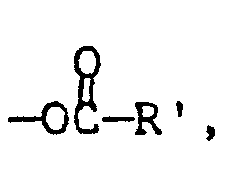
C3-C20 cyclo alkyl;
wherein Y=H

C1-C20 alkyl' or
C3-C20 cycloalkyl;
i wherein Y is as defined above,
 -SOyZ', wherein Z' is C1-C20 alkyl or
C2-C20 cycloalkyl; and y=1 or 2; wherein each R' is independently H, C1-C20 alkyl,
C3-C20 cycloalkyl, C4-C20 aromatic or heteroaromatic moiety,
wherein Ar is an aromatic moiety having 6 up to 14 carbon atoms;
wherein x is 4 when Ar has 6 carbons, x is 6 when Ar has 10 carbons and x is 8 when Ar is 14;
and diaryl ethanes of the formula: r-CHR'-CHR'- r
 o-x
o-x
 o-x wherein each R is independently selected from the group consisting of
-OZ, wherein Z=H,
C1-C20 alkyl,
C3-C20 cycloalkyl, or
C4-C20 aromatic or heteroaromatic moiety;
 L wherein R' = C1-C20 alkyl, or
C3-C20 cycloal kyl ;
4 wherein Y=H,

C1-C20 alkyl, or
C3-C20 cycloalkyl;
X wherein Y is as defined above,
 -SOyZ', wherein Z' is C1-C20 alkyl or
C2-C20 cycloalkyl; and y=1 or 2; wherein each R' is independently H, C1-C20 alkyl,
C3-C20 cycloalkyl, C4-C20 aromatic or heteroaromatic moiety;
wherein Ar is an aromatic moiety having 6 up to 14 carbon atoms;
wherein x is 4 when Ar has 6 carbons, x is 6 when Ar has 10 carbons and x is 8 when Ar is 14; as well as phenols, hydroquinones of the structure:

C1C20 alkyl,
C3-C20 cycloalkyl,
C6-C20 aryl, C7-C20 aralkyl or alkaryl,
-OZ, wherein Z=H,
C1-C20 alkyl,
C3-C20 cycloalkyl,
C4-C20 aromatic or heteroaromatic moiety,
wherein R ' = C1-C20 alkyl, or

C3-C20 cycloalky l;
wherein Y=H

C1-C20 alkyl, or
C3-C20 cycloalkyl;
wherein Y is as defined above,
 -SOyZ', wherein Z is C1-C20 alkyl, or
C3-C20 cycloalkyl ; and y=1 or 2. and the like.
Exemplary compounds which are included in the scope of dehydrogenatable compounds include cyclohexylhydroquinone and substituted derivatives thereof, 1,2-diphenylethane and substituted derivatives thereof, ethylbenzene and substituted derivatives thereof, alkanes such as propane, butane, pentane, hexane, heptane, octane, nonane and decane. The dehydrogenation reaction according to the present method is preferably conducted at a temperature ranging from between about 100°C to 400°C. A still more preferred range of temperatures is between about 150°C and 300°C. The reaction is preferably conducted at atmospheric pressure, although other pressures are also contemplated herein.
The dehydrogenation reaction of the present method may be conducted in either a fixed bed or a slurry reactor. When the reaction is conducted in a slurry reactor, the catalyst utilized in the present method may be recycled from the slurry by filtering the hot reaction mixture. The filtration may be conducted at the reaction temperature, above the melting point of the reaction mixture or at a temperature between 100°C and 200°C. A preferred range of temperatures for recovering the catalyst by filtration is between about 125°C and 150°C.
In a preferred embodiment of the invention, hydrogen gas produced as a result of the reaction is removed from the reaction atmosphere as the reaction proceeds. This can be accomplished by a variety of techniques as are well known by those of skill in the art. For example, the removal of hydrogen gas can be attained by circulating an inert gas through the atmosphere immediately above, or directly into, the reaction mixture. By means of example, the inert gas may be nitrogen. However, other unreactive gases may also be utilized for the removal of the hydrogen gas. As one alternative, hydrogen gas can be removed by careful addition of a purge gas containing small amounts of oxygen, which enables the removal of hydrogen as water.
The net result of hydrogen gas removal is to shift the equilibrium concentration from the starting material or substrate to the product of the reaction by removing from the system any amount of hydrogen produced.
The selective dehydrogenation reaction of this invention may be conducted for a period of time which varies with the substrate, desired percent conversion to product, mode of operation, etc. The time may
vary in the range of about 1 minute up to 32 hours. In a fixed bed reactor, for example, reaction times of one minute or less may be suitable to achieve acceptable conversion levels, while in slurry or stirred tank reactors, reaction times of several hours or more may be required to achieve acceptable conversion levels. It is recognized, of course, that an artisan may, without undue experimentation, adjust the period of time for the reaction to proceed by following the progress of the reaction under specific conditions. The progress of the reaction may be monitored by appropriate known analytical techniques, e.g., by extracting aliquots from the reaction mixture at different times for analysis by gas chromatography.
The selective hydrogenation reaction of this invention may be optionally conducted in the presence of a solvent. Suitable solvents for use with the present method are solvents which are stable under reaction conditions. Examples of suitable solvents are biphenyl, naphthalene, diphenylether, tetralin, durene, prehnitene or 1,2,3,4-tetramethylbenzene, and the like.
When the dehydrogenation reaction is completed, the dehydrogenated product may be isolated from the reaction mixture (including the catalyst), and then further purified, by employing any of a variety of techniques readily available to those of skill in the art, e.g., by filtration, distillation, and the like.
Having now generally described this invention, the same will be better understood by reference to the following examples, which are included herein for purposes of illustration only, and are not intended
to be limiting of the invention or any embodiment thereof.
EXAMPLES Catalyst employed in the examples which follow was prepared according to the general procedure set forth below:
A carbon support material is heated to remove any residual volatile sulfur content. This is done at 700°-900°C (in a hydrogen flow) for eight hours prior to metal addition. Appropriate amounts of palladium and copper nitrates necessary to achieve the desired metal loading are dissolved in water and the resulting solution added to the carbon support. Excess solvent is then removed by heating at 90°C in air for several hours. Once the sample is dry, the materials are calcined in flowing air (i.e., a gas hourly space velocity (GHSV) in excess of about 1000/hr.) at 350°C for four hours prior to use.
Example 1 - Dehydrogenation of Cyclohexylhydroquinone According to the Prior Art and the
Invention Method
The following is a small scale reaction which is representative of the invention method, which can also be successfully conducted on a large scale. A 250-ml 3-neck flask was fitted with a tube for the subsurface addition of gas, a mechanical stirrer, a thermometer and a condenser.
A sample for Test I was prepared by adding to the flask 100 g biphenyl, 20 g cyclohexylhydroquinone and 2.0 g of a catalyst containing 5 wt X Pd, 1.5 wt % Cu on carbon; then the flask was heated to 250°C. During the course of the reaction, nitrogen gas was
incorporated into the reaction atmosphere by subsurface addition thereof. After stirring the mixture for 24 hours at 250°C, an aliquot of the reaction mixture was analyzed by gas chromatography and found to contain 85% phenylhydroquinone and 10% cyclohexylhydroquinone as well as 3.2% hydrogenolysis byproducts. This experiment is representative of the invention method.
The same procedure was conducted in the presence of 5% Pd on carbon but without copper (Test II). The reaction mixture was found to contain 90% hydrogenolysis by-products and only 10% phenylhydroquinone. This experiment is representative of the prior art.
The results of these tests are summarized in Table 1.

The above results indicate the superiority (high selectivity for dehydrogenation) of the invention method conducted with a catalyst containing palladium and copper on a carbon support (Test I) when compared
with the prior art method conducted with a catalyst containing only palladium on a carbon support (Test II).
Example 2 - Preparation of Phenylhydroquinone in a Slurry Reactor
The previous example was repeated with invention catalyst employing the following procedure:
To a four-neck round bottom flask fitted with a mechanical stirrer, condenser, thermometer and tube for subsurface nitrogen addition were added 100 g biphenyl, 20.0 g cyclohexylhydroquinone and 2.0 g of a catalyst containing 5 wt % palladium and 1.5 wt % copper on carbon. The reaction mixture was heated to 250°C with 0.5 SCFH subsurface addition of nitrogen and was stirred at 250°C for 24 hours. The reaction mixture was then cooled to 150°C and the catalyst removed by filtration through a sintered glass funnel. The catalyst can be recycled back for another run without further purification or treatment. The product filtrate analyzed by gas chromatography contained the following:
82.4 wt % phenyl hydroquinone,
8.3 wt % cyclohexyl hydroquinone, 0.7 wt % 2-phenylphenol, 2.0 wt % 3-phenylphenol, and
2.4 wt % hydroxydibenzofuran.
The phenylhydroquinone can be isolated in high yield and in pure form by vacuum distillation (the boiling point of phenylhydroquinone at 2.0 mm is 187°C).
Example 3 - Dehydrogenation of Subscitutsd Cyclohexyihydroquinones With the Catalyst of the Invention
A variety of substituted cyclohexylhydroquinones of the formula
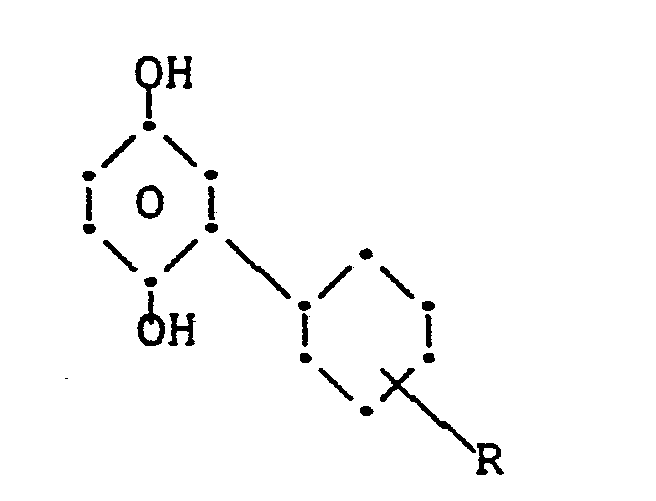
-OCO-CH3 (-OAc) were dehydrogenated to the corresponding substituted phenylhydroquinones employing the procedure set forth in Example I. The catalyst employed was 5 wt % Pd and 1.5 wt % Cu on carbon. The reaction was conducted at 250°C with biphenyl as a solvent. The results of the experiments are set forth in Table 2.

Example 4 - Comparison of Invention Catalyst with Other Catalysts
A series of experiments were carried out to compare the conversion of cyclohexylhydroquinone to phenylhydroquinone employing the palladium-copper on carbon catalyst of this invention, and employing prior art dehydrogenation catalysts. The experiments were all run at 250°C in biphenyl as a solvent employing the procedure set forth in Example I. The results of the experiments are set forth in Table 3.

Several prior art catalysts (e.g., Pd/C, Pt/C and Pd-Pt/C) give high levels of cyclohexylhydroquinone conversion, but selectivities to the desired product, phenylhydroquinone, are quite poor. Similarly, other prior art catalyst systems suffer from either low conversion levels, or poor selectivity, or both. Only invention catalyst containing Pd and Cu on carbon support are capable of giving yields of desired product.
Example 5 - Selective Dehydrogenation of Substituted
Ethyl Benzenes to the Corresponding Styrenes with the Catalyst of the Invention
A series of substituted ethyl benzenes was dehydrogenated to the corresponding styrenes according to the following chemical reaction:
 wherein R is -H, p-OH, p-OCH and m-OCH3. These reactions were all carried out at 200°C in 100 g biphenyl solvent in the apparatus described in Example I with 2 g of 5 wt % Pd and 2.5 wt % Cu on carbon as the catalyst and 20 g of ethyl benzene substrate. The results of these experiments are set forth in Table 4.

In all cases, good yields (greater than 90% conversion and 90% selectivity) were obtained with a variety of substituted ethyl benzenes, thereby selectively producing a variety of substituted styrenes in high yield.
Example 6 - Selective Dehydrogenation of Substituted
1,2-diphenylethanes to the Corresponding Stilbenes
A series of substituted 1,2-diphenylethanes were dehydrogenated to the corresponding stilbenes according to the following reaction.
 wherein each of R or R' is independently -H, p-OH, p-OCH3 and p-COOCH3.
These reactions were all conducted at 250°C in the presence of 2 g of a 5 wt % Pd, 2.5 wt % Cu on carbon catalyst and 100 g biphenyl as a solvent, with 20 g of 1,2-diphenyl ethane substrate. The results of the experiments are set forth in Table 5.

The results demonstrate that the invention Pd-Cu on carbon catalyst is effective for the selective dehydrogenation of diphenylethanes to produce stilbenes.
Example 7 - Dehydrogenation of n-Butane
The dehydrogenation of n-butane was conducted in the gas phase at 180°C and 280°C using a 8 wt % Pd, 2.5 wt % Cu on carbon catalyst. 3.8 g of the catalyst in powder form were placed in a plug flow microreactor and heated to reaction temperature in a flow of nitrogen gas. Once the reaction temperature was achieved, n-butane was fed to the catalyst bed at 170 SCCM and the amount of the products obtained at the two temperatures were monitored by gas chromatography. The results of these experiments are set forth in Table 6.

The invention now being fully described, it will be apparent to one of ordinary skill in the art that
many changes and modifications can be made thereto without departing from the spirit or scope of the invention as set forth herein.
Claims
1. A method for the selective dehydrogenation of a compound, comprising dehydrogenating a compound of the formula

wherein each of R1, R2, R3 and R4 is independently selected from the group consisting of H, (C1-C20) alkyl, (C3-C20) cycloalkyl, (C6-C20) aryl, (C7-C20) alkylaryl, and (C7-C20) aralkyl groups, and substituted (C1-C20) alkyl, (C3-C20) cycloalkyl and (C6-C20) aryl , (C7-C20) alkylaryl and (C7-C20) aralkyl; each such group optionally substituted with -OR, wherein R is R1, R2, R3 or R4; and wherein R1 and R2 or R3 and R4 may be joined as part of a ring structure, at a dehydrogenation temperature in the presence of a catalyst comprising about 0.01 wt % - 19.9 wt % Pd, and about 0.01 wt % - 19.9 wt % Cu on a carbon support, wherein the total amount of (Pd + Cu) on the support is about 0.02 wt % to 20 wt %, the weight ratio of Pd:Cu is about 1:1 to 10:1, and the carbon support has a surfacs area of at least about 100 m2/g and is essentially free of reactive sulfur.
2. The method of Claim 1, wherein the dehydrogenating step is conducted in the presence of a catalyst consisting essentially of about 0.01 wt % - 19.9 wt % Pd and about 0.01 wt % - 19..9 wt % Cu on a carbon support, wherein the total amount of (Pd + Cu) on the support is about 0.02 wt % to 20 wt %, the weight ratio of Pd:Cu is about 1:1 to 10:1 and the carbon support has a surface area of at least about 100 m2/g and is essentially free of reactive sulfur.
3. The method according to Claim 1, wherein the palladium:copper ratio is about 3.0:1 to 4.0:1.
4. The method according to Claim 1, wherein the dehydrogenating temperature is about 100°C to 400°C.
5. The method according to Claim 1, wherein the dehydrogenation is conducted in the presence of a reaction solvent.
6. The method according to Claim 5, wherein the reaction solvent is selected from the group consisting of biphenyl, naphthalene, diphenyl ether, tetralin, durene and prehnitene.
7. The method according to Claim 6, wherein the solvent is biphenyl.
8. The method according to Claim 1, further comprising constantly removing hydrogen gas produced in the dehydrogenation step.
9. The method according to Claim 8, wherein the hydrogen gas is removed by circulating an inert gas.
10. The method according to Claim 8 wherein the hydrogen is removed by reaction with controlled levels of oxygen added to the dehydrogenation reaction zone.
11. The method according to Claim 1 wherein the compound to be dehydrogenated is a straight chain alkane having 2 up to 20 carbon atoms.
12. The method according to Claim 11 wherein the compound to be dehydrogenated is selected from the group consisting of:
propane, butane, pentane, hexane, heptane, octane, nonane, and decane.
13. The method according to Claim 11 wherein the compound to be dehydrogenated is selected from the group consisting of propane and butane.
14. The method according to Claim 1 wherein the compound to be dehydrogenated is a branched chain alkane having 4 up to 20 carbon atoms.
15. The method according to Claim 14 wherein the compound to be dehydrogenated is selected from the group consisting of branched chain alkanes having 4 up to 12 carbon atoms.
16. The method according to Claim 1 wherein the compound to be dehydrogenated is an alkyl aromatic compound of the formula Ar-CHR'CHR'2  wherein each R is independently selected from the group consisting of
-OZ, wherein Z=H,
C1-C20 alkyl ,
C3-C20 cycloalkyl ,
C4-C20 aromatic or hetero aromatic moiety,
wherein R' = C1-C20 alkyl, or 
C3-C20 cycloalkyl;  wherein Y=H
C1-C20 alkyl, or
C3-C20 cycloalkyl;  wherein Y is as defined above,
-SOy Z ' , wherein Z' is C1-C20 alkyl or
C2-C20 cycloalkyl; and y=1 or 2; wherein each R' is independently H, C1-C20 alkyl, C3-C20 cycloalkyl, C4-C20 aromatic or heteroaromatic moiety;
wherein Ar is an aromatic moiety having 6 up to 14 carbon atoms;
wherein x is 4 when Ar has 6 carbons, x is 6 when Ar has 10 carbons and x is 8 when Ar is 14.
17. The method according to Claim 16 wherein the compound to be dehydrogenated is selected from the group consisting of:
ethylbenzene, p-hydroxy ethylbenzene, p-methoxy ethylbenzene, and m-methoxy ethylbenzene.
18. The method according to Claim 1 wherein the compound to be dehydrogenated is a 1,2-diaryl ethane of the formula:
Ar-CHR'-CHR'-Ar 
 wherein each R is independently selected from the group consisting of -OZ, wherein Z=H,
C1-C20 alkyl,
C3-C20 cycloalkyl,
C4-C20 aromatic or hetero aromatic moiety,
wherein R' = C1-C20 alkyl, or 
C3-C20 cycloalkyl ;
wherein Y=H 
C1-C20 alkyl, or
C3-C20 cycloalkyl;
Y wherein Y is as defined above, 
-SOyZ', wherein Z' is C1-C20 alkyl or
C2-C20 cycloal kyl ; and y=1 or 2; wherein each R' is independently H, C1-C20 alkyl, C3-C20 cycloalkyl, C4-C20 aromatic or heteroaromatic moiety;
wherein Ar is an aromatic moiety having 6 up to 14 carbon atoms;
wherein x is 4 when Ar has 6 carbons, x is 6 when Ar has 10 carbons and x is 8 when Ar is 14.
19. The method according to Claim 18 wherein the compound to be dehydrogenated is selected from the group consisting of:
1,2-diphenylethane, 1-phenyl-2-p-hydroxyphenylethane, 1,2-bis(p-hydroxyphenyl)ethane, 1,2-bis(methyl-p-benzoate)ethane, and 1-p-hydroxyphenyl-2-p-methoxyphenyl ethane.
20. The method according to Claim 1 wherein the compound to be dehydrogenated is a cyclohexyl hydroquinone compound of the formula:

wherein each R" is independently C1-C20 alkyl, C3-C20 cycloalkyl, C4-C20 aromatic or heteroaromatic moiety; and wherein each R''' is independently C1C20 alkyl,
C3-C20 cycloalkyl,
C6-C12 aryl,
C7-C20 aralkyl or alkaryl, -OZ, wherein Z=H,
C1-C20 alkyl'
C3-C20 cycloalkyl ,
C4-C20 aromatic or heteroaromatic moiety,
wherein R' = C1- C20 alkyl, or 
C3-C20 cycloalkyl;
wherein Y=H, 
C1-C20 alkyl, or
C3-C20 cycloalkyl
wherein Y is as defined above, 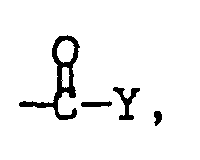
-SOyZ', wherein Z' is C1-C20 alkyl, or
C3-C20 cycloalkyl;
and y=1 or 2.
21. The method according to Claim 1 wherein the compound to be dehydrogenated is selected from the group consisting of:
cyclohexylhydroquinone, 4-methylcyclohexyl hydroquinone, 4-phenylcyclohexyl hydroquinone,
4-methoxycyclohexyl hydroquinone, and 4-acetoxycyclohexy1 hydroquinone,
22. The method according to Claim 20, wherein the compound to be dehydrogenated is cyclohexylhydroquinone.
23. The method according to Claim 22 wherein the phenylhydroquinone obtained in the dehydrogenation step is substantially free of hydrogenolysis by-products.
24. A dehydrogenation catalyst composition consisting essentially of
about 0.01 wt % to 19.9 wt % Pd, and about 0.01 wt % to 19.9 wt % Cu
on carbon support, wherein the total amount of (Pd + Cu) on the support is about 0.02 wt % to 20 wt%, the weight ratio of Pd:Cu is about 1:1 to 10:1, and the carbon support has a surface area of at least about 100 m2/g and is essentially free of reactive sulfur.
25. A selective dehydrogenation catalyst comprising the composition of Claim 24.
26. A catalyst according to Claim 24 wherein the quantity of Pd varies in the range of about 5 up to 8 wt % and the quantity of Cu varies in the range of about 0.5 up to 2.5 wt %, and the weight ratio of Pd:Cu varies in the range of about 3.0:1 up to 4.0:1.
27. A method of preparing a selective dehydrogenation catalyst, said method comprising heat-treating a carbon support having a surface area of at least about 100 m2/g at a temperature and for a time sufficient to remove substantially all volatile sulfur therefrom;
contacting the heat-treated carbon support with at least one Pd- source selected from the group consisting of palladium and anion-containing compounds of palladium and at least one Cu- source selected from the group consistng of copper and anion-containing compounds of copper in amounts effective to attain a final amount on the support of 0.01 wt % to 19.9 wt % Pd and 0.01 wt % to 19.9 wt % Cu, a total amount of (Pd+Cu) of about 0.02 wt % to 20 wt % and a weight ratio of Pd:Cu of about 1.1 to 10.1.
28. The method of Claim 27, further comprising calcining the Pd-Cu-contacted support under conditions effective to decompose the Pd- and Cu-containing compounds employed for catalyst preparation, but not sufficient to cause excessive combustion of the sopport.
Priority Applications (1)
| Application Number | Priority Date | Filing Date | Title |
|---|---|---|---|
| DE8888906797T DE3867845D1 (en) | 1987-07-20 | 1988-07-18 | CATALYST AND SELECTIVE DEHYDRATION METHOD. |
Applications Claiming Priority (2)
| Application Number | Priority Date | Filing Date | Title |
|---|---|---|---|
| US075,375 | 1987-07-20 | ||
| US07/075,375 US4798911A (en) | 1987-07-20 | 1987-07-20 | Catalyst composition and method for selective dehydrogenation |
Publications (1)
| Publication Number | Publication Date |
|---|---|
| WO1989000452A1 true WO1989000452A1 (en) | 1989-01-26 |
Family
ID=22125304
Family Applications (1)
| Application Number | Title | Priority Date | Filing Date |
|---|---|---|---|
| PCT/US1988/002426 Ceased WO1989000452A1 (en) | 1987-07-20 | 1988-07-18 | Catalyst composition and method for selective dehydrogenation |
Country Status (5)
| Country | Link |
|---|---|
| US (1) | US4798911A (en) |
| EP (1) | EP0370054B1 (en) |
| JP (1) | JPH02504278A (en) |
| DE (1) | DE3867845D1 (en) |
| WO (1) | WO1989000452A1 (en) |
Cited By (2)
| Publication number | Priority date | Publication date | Assignee | Title |
|---|---|---|---|---|
| EP0496446A1 (en) * | 1991-01-25 | 1992-07-29 | SOLVAY (Société Anonyme) | Process for the preparation of chlorotrifluoroethylene and of trifluoroethylene from 1,1,2-trichloro-1,2,2-trifluoroethane and catalytic composition used in this process |
| EP0747337A1 (en) * | 1995-06-06 | 1996-12-11 | SOLVAY (Société Anonyme) | Process for the preparation of chlorotrifluoroethylene and of trifluoroethylene from 1,1,2-trichloro-1,2,2-trifluoroethane and catalytic composition used in this process |
Families Citing this family (7)
| Publication number | Priority date | Publication date | Assignee | Title |
|---|---|---|---|---|
| IT1218081B (en) * | 1988-06-16 | 1990-04-12 | Donegani Guido Ist | PROCEDURE FOR THE SYNTHESIS OF REPLACED FENIL AROMATIC DIOLS |
| US5113010A (en) * | 1990-12-11 | 1992-05-12 | Lever Brothers Company, Division Of Conopco, Inc. | Process for synthesizing 4,4'-bis(carboalkoxystilbene) derivatives |
| US5210330A (en) * | 1991-08-22 | 1993-05-11 | Eastman Kodak Company | Process for the preparation of phenylhydroquinone |
| US5453557A (en) * | 1992-10-01 | 1995-09-26 | The Dow Chemical Company | Processes for converting chlorinated byproducts and waste products to useful materials |
| US5583268A (en) * | 1995-12-15 | 1996-12-10 | The Dow Chemical Company | Method to prepare ortho substituted phenol |
| US6392109B1 (en) | 2000-02-29 | 2002-05-21 | Chevron U.S.A. Inc. | Synthesis of alkybenzenes and synlubes from Fischer-Tropsch products |
| EP1276829A2 (en) | 2000-04-03 | 2003-01-22 | Chevron U.S.A. Inc. | Improved conversion of syngas to distillate fuels |
Citations (1)
| Publication number | Priority date | Publication date | Assignee | Title |
|---|---|---|---|---|
| DE2602894C2 (en) * | 1975-04-18 | 1986-04-10 | GAF Corp., New York, N.Y. | Hydrogenation catalyst |
Family Cites Families (11)
| Publication number | Priority date | Publication date | Assignee | Title |
|---|---|---|---|---|
| US3592867A (en) * | 1969-09-08 | 1971-07-13 | Universal Oil Prod Co | Ethylene-producing process |
| DE2064097A1 (en) * | 1970-12-28 | 1972-07-06 | Farbenfabriken Bayer Ag, 5090 Leverkusen | Process for the production of catechol and its monoethers |
| US3953526A (en) * | 1972-09-22 | 1976-04-27 | Atlantic Richfield Company | Synthesis of hydroquinone |
| US4160113A (en) * | 1974-08-07 | 1979-07-03 | Hoechst Aktiengesellschaft | Process for the manufacture of resorcinol |
| DE2437929A1 (en) * | 1974-08-07 | 1976-02-19 | Hoechst Ag | METHOD FOR PRODUCING HYDROQUINONE |
| US4060559A (en) * | 1975-05-12 | 1977-11-29 | Sugai Chemical Industry Co., Ltd. | Process for preparing O-phenylphenol |
| US4088702A (en) * | 1975-05-14 | 1978-05-09 | Sugai Chemical Industry Company Limited | Process for preparing o-phenylphenol |
| NL7612281A (en) * | 1976-11-05 | 1978-05-09 | Stamicarbon | PROCESS FOR THE PREPARATION OF RESORCINOL AND ALKYL-SUBSTITUTED DERIVATIVES THEREOF. |
| US4319054A (en) * | 1979-12-12 | 1982-03-09 | Mitsubishi Chemical Industries Limited | Process for producing pyrogallol |
| DE3108265A1 (en) * | 1981-03-05 | 1982-09-16 | Riedel-De Haen Ag, 3016 Seelze | "METHOD FOR PRODUCING A 2-ALKYLPHENOL" |
| US4431848A (en) * | 1982-04-26 | 1984-02-14 | Koppers Company, Inc. | Preparation of resorcinol and substituted resorcinols by liquid-phase dehydrogenation of 1,3-cyclic diones derived by vapor-phase cyclization of delta-keto carboxylic acid esters |
-
1987
- 1987-07-20 US US07/075,375 patent/US4798911A/en not_active Expired - Fee Related
-
1988
- 1988-07-18 EP EP88906797A patent/EP0370054B1/en not_active Expired - Lifetime
- 1988-07-18 WO PCT/US1988/002426 patent/WO1989000452A1/en not_active Ceased
- 1988-07-18 DE DE8888906797T patent/DE3867845D1/en not_active Expired - Fee Related
- 1988-07-18 JP JP63506839A patent/JPH02504278A/en active Pending
Patent Citations (1)
| Publication number | Priority date | Publication date | Assignee | Title |
|---|---|---|---|---|
| DE2602894C2 (en) * | 1975-04-18 | 1986-04-10 | GAF Corp., New York, N.Y. | Hydrogenation catalyst |
Non-Patent Citations (1)
| Title |
|---|
| CHEMICAL REVIEWS, Volume 78, Number 4, August 1978, PETER P. FU et al., "Dehydrogenation of Polycyclic Hydroaromatic Compounds", pages 318-333. * |
Cited By (2)
| Publication number | Priority date | Publication date | Assignee | Title |
|---|---|---|---|---|
| EP0496446A1 (en) * | 1991-01-25 | 1992-07-29 | SOLVAY (Société Anonyme) | Process for the preparation of chlorotrifluoroethylene and of trifluoroethylene from 1,1,2-trichloro-1,2,2-trifluoroethane and catalytic composition used in this process |
| EP0747337A1 (en) * | 1995-06-06 | 1996-12-11 | SOLVAY (Société Anonyme) | Process for the preparation of chlorotrifluoroethylene and of trifluoroethylene from 1,1,2-trichloro-1,2,2-trifluoroethane and catalytic composition used in this process |
Also Published As
| Publication number | Publication date |
|---|---|
| US4798911A (en) | 1989-01-17 |
| EP0370054A1 (en) | 1990-05-30 |
| DE3867845D1 (en) | 1992-02-27 |
| EP0370054B1 (en) | 1992-01-15 |
| JPH02504278A (en) | 1990-12-06 |
Similar Documents
| Publication | Publication Date | Title |
|---|---|---|
| EP0328507B1 (en) | Process for preparing catalysts containing a metal of the platinum group, and uses thereof | |
| US3966833A (en) | Process for hydrodealkylating alkylaromatic hydrocarbons | |
| JPH0465818B2 (en) | ||
| US3692701A (en) | Group viii metals on tin-containing supports dehydrogenation catalysts | |
| JPH0623269A (en) | Catalyst comprising a Group VIII metal and a Group IIIA metal supported on a support | |
| JP2772046B2 (en) | Chemical processes and catalysts | |
| US4219687A (en) | Hydroalkylation of benzene and analogs | |
| EP0101645B1 (en) | Catalytic process for the production of methanol | |
| EP0370054B1 (en) | Catalyst composition and method for selective dehydrogenation | |
| US4510267A (en) | Preparation of olefins from synthesis gas using ruthenium supported on ceric oxide | |
| US4206147A (en) | Process for the dehalogenation of halogen-containing aromatic compounds | |
| US5084259A (en) | Crystalline nickel aluminum borates | |
| EP0336622B1 (en) | Hydrocarbon dehydrogenation reactions | |
| US4229320A (en) | Catalyst for making para-xylene | |
| US4380683A (en) | Hydroalkylation of benzene and analogs | |
| US4740647A (en) | Cyclization catalyst | |
| EP0211545B1 (en) | Catalytic reduction process for the production of aromatic amino compounds | |
| US5093540A (en) | Process for selectively converting linear paraffins to linear alpha olefins | |
| US4035428A (en) | Process for production of orthophenylphenol | |
| US5264407A (en) | Crystalline metalloaluminum borates | |
| EP1135352B1 (en) | Process for preparing 2,6-dimethylnaphthalene | |
| US4523016A (en) | Process for the catalytic dehydrogenation of piperidine | |
| JP3171877B2 (en) | Process for producing liquid hydrocarbon mixtures from ethane | |
| GB1572550A (en) | Hydroalkylation of benzene and analogues | |
| US4845295A (en) | Alkylation of amine compounds |
Legal Events
| Date | Code | Title | Description |
|---|---|---|---|
| AK | Designated states |
Kind code of ref document: A1 Designated state(s): JP |
|
| AL | Designated countries for regional patents |
Kind code of ref document: A1 Designated state(s): DE FR GB IT NL |
|
| WWE | Wipo information: entry into national phase |
Ref document number: 1988906797 Country of ref document: EP |
|
| WWP | Wipo information: published in national office |
Ref document number: 1988906797 Country of ref document: EP |
|
| WWG | Wipo information: grant in national office |
Ref document number: 1988906797 Country of ref document: EP |