WO1989007786A1 - Photoresist composition - Google Patents
Photoresist composition Download PDFInfo
- Publication number
- WO1989007786A1 WO1989007786A1 PCT/JP1989/000159 JP8900159W WO8907786A1 WO 1989007786 A1 WO1989007786 A1 WO 1989007786A1 JP 8900159 W JP8900159 W JP 8900159W WO 8907786 A1 WO8907786 A1 WO 8907786A1
- Authority
- WO
- WIPO (PCT)
- Prior art keywords
- photoresist composition
- composition according
- group
- compound
- maleic anhydride
- Prior art date
- Legal status (The legal status is an assumption and is not a legal conclusion. Google has not performed a legal analysis and makes no representation as to the accuracy of the status listed.)
- Ceased
Links
Classifications
-
- G—PHYSICS
- G03—PHOTOGRAPHY; CINEMATOGRAPHY; ANALOGOUS TECHNIQUES USING WAVES OTHER THAN OPTICAL WAVES; ELECTROGRAPHY; HOLOGRAPHY
- G03C—PHOTOSENSITIVE MATERIALS FOR PHOTOGRAPHIC PURPOSES; PHOTOGRAPHIC PROCESSES, e.g. CINE, X-RAY, COLOUR, STEREO-PHOTOGRAPHIC PROCESSES; AUXILIARY PROCESSES IN PHOTOGRAPHY
- G03C7/00—Multicolour photographic processes or agents therefor; Regeneration of such processing agents; Photosensitive materials for multicolour processes
- G03C7/04—Additive processes using colour screens; Materials therefor; Preparing or processing such materials
- G03C7/06—Manufacture of colour screens
- G03C7/10—Manufacture of colour screens with regular areas of colour, e.g. bands, lines, dots
- G03C7/12—Manufacture of colour screens with regular areas of colour, e.g. bands, lines, dots by photo-exposure
-
- G—PHYSICS
- G03—PHOTOGRAPHY; CINEMATOGRAPHY; ANALOGOUS TECHNIQUES USING WAVES OTHER THAN OPTICAL WAVES; ELECTROGRAPHY; HOLOGRAPHY
- G03F—PHOTOMECHANICAL PRODUCTION OF TEXTURED OR PATTERNED SURFACES, e.g. FOR PRINTING, FOR PROCESSING OF SEMICONDUCTOR DEVICES; MATERIALS THEREFOR; ORIGINALS THEREFOR; APPARATUS SPECIALLY ADAPTED THEREFOR
- G03F7/00—Photomechanical, e.g. photolithographic, production of textured or patterned surfaces, e.g. printing surfaces; Materials therefor, e.g. comprising photoresists; Apparatus specially adapted therefor
- G03F7/004—Photosensitive materials
- G03F7/008—Azides
- G03F7/012—Macromolecular azides; Macromolecular additives, e.g. binders
-
- G—PHYSICS
- G03—PHOTOGRAPHY; CINEMATOGRAPHY; ANALOGOUS TECHNIQUES USING WAVES OTHER THAN OPTICAL WAVES; ELECTROGRAPHY; HOLOGRAPHY
- G03F—PHOTOMECHANICAL PRODUCTION OF TEXTURED OR PATTERNED SURFACES, e.g. FOR PRINTING, FOR PROCESSING OF SEMICONDUCTOR DEVICES; MATERIALS THEREFOR; ORIGINALS THEREFOR; APPARATUS SPECIALLY ADAPTED THEREFOR
- G03F7/00—Photomechanical, e.g. photolithographic, production of textured or patterned surfaces, e.g. printing surfaces; Materials therefor, e.g. comprising photoresists; Apparatus specially adapted therefor
- G03F7/004—Photosensitive materials
- G03F7/008—Azides
- G03F7/012—Macromolecular azides; Macromolecular additives, e.g. binders
- G03F7/0125—Macromolecular azides; Macromolecular additives, e.g. binders characterised by the polymeric binder or the macromolecular additives other than the macromolecular azides
-
- G—PHYSICS
- G03—PHOTOGRAPHY; CINEMATOGRAPHY; ANALOGOUS TECHNIQUES USING WAVES OTHER THAN OPTICAL WAVES; ELECTROGRAPHY; HOLOGRAPHY
- G03F—PHOTOMECHANICAL PRODUCTION OF TEXTURED OR PATTERNED SURFACES, e.g. FOR PRINTING, FOR PROCESSING OF SEMICONDUCTOR DEVICES; MATERIALS THEREFOR; ORIGINALS THEREFOR; APPARATUS SPECIALLY ADAPTED THEREFOR
- G03F7/00—Photomechanical, e.g. photolithographic, production of textured or patterned surfaces, e.g. printing surfaces; Materials therefor, e.g. comprising photoresists; Apparatus specially adapted therefor
- G03F7/004—Photosensitive materials
- G03F7/022—Quinonediazides
- G03F7/023—Macromolecular quinonediazides; Macromolecular additives, e.g. binders
- G03F7/0233—Macromolecular quinonediazides; Macromolecular additives, e.g. binders characterised by the polymeric binders or the macromolecular additives other than the macromolecular quinonediazides
-
- Y—GENERAL TAGGING OF NEW TECHNOLOGICAL DEVELOPMENTS; GENERAL TAGGING OF CROSS-SECTIONAL TECHNOLOGIES SPANNING OVER SEVERAL SECTIONS OF THE IPC; TECHNICAL SUBJECTS COVERED BY FORMER USPC CROSS-REFERENCE ART COLLECTIONS [XRACs] AND DIGESTS
- Y10—TECHNICAL SUBJECTS COVERED BY FORMER USPC
- Y10S—TECHNICAL SUBJECTS COVERED BY FORMER USPC CROSS-REFERENCE ART COLLECTIONS [XRACs] AND DIGESTS
- Y10S430/00—Radiation imagery chemistry: process, composition, or product thereof
- Y10S430/1053—Imaging affecting physical property or radiation sensitive material, or producing nonplanar or printing surface - process, composition, or product: radiation sensitive composition or product or process of making binder containing
- Y10S430/1055—Radiation sensitive composition or product or process of making
- Y10S430/106—Binder containing
- Y10S430/108—Polyolefin or halogen containing
-
- Y—GENERAL TAGGING OF NEW TECHNOLOGICAL DEVELOPMENTS; GENERAL TAGGING OF CROSS-SECTIONAL TECHNOLOGIES SPANNING OVER SEVERAL SECTIONS OF THE IPC; TECHNICAL SUBJECTS COVERED BY FORMER USPC CROSS-REFERENCE ART COLLECTIONS [XRACs] AND DIGESTS
- Y10—TECHNICAL SUBJECTS COVERED BY FORMER USPC
- Y10S—TECHNICAL SUBJECTS COVERED BY FORMER USPC CROSS-REFERENCE ART COLLECTIONS [XRACs] AND DIGESTS
- Y10S430/00—Radiation imagery chemistry: process, composition, or product thereof
- Y10S430/1053—Imaging affecting physical property or radiation sensitive material, or producing nonplanar or printing surface - process, composition, or product: radiation sensitive composition or product or process of making binder containing
- Y10S430/1055—Radiation sensitive composition or product or process of making
- Y10S430/106—Binder containing
- Y10S430/111—Polymer of unsaturated acid or ester
Definitions
- the present invention relates to a photoresist composition. More particularly, the present invention relates to a photoresist composition suitable for far ultraviolet or excimer laser lithography, wherein a resin soluble in an aqueous alkaline solution having units of an aliphatic cyclic hydrocarbon main frame and units derived from maleic anhydride and/or units derived from a maleimide, is used as a base resin.
- a resin soluble in an aqueous alkaline solution having units of an aliphatic cyclic hydrocarbon main frame and units derived from maleic anhydride and/or units derived from a maleimide.
- Such a composition is useful particularly as a resist for fine working in the field for the production of semiconductor elements.
- the attempt for a higher NA of lens has already reached a level close to the limit.
- the resist will also be required to meet the requirements for a short wave light source such as far ultraviolet rays or excimer laser.
- a resist is usually a composition comprising a base resin, a photosensitive agent and a solvent.
- a base resin a resin soluble in an aqueous alkaline solution is commonly employed for a resist required to have a high resolution so that both positive and negative resists can be developed with an aqueous alkaline solution to avoid a problem of swelling during the development.
- a resin soluble in an aqueous alkaline solution a phenol resin such as a novolak resin or a polyvinylphenol is most commonly used at present.
- a phenol resin is relatively transparent in the wavelength region of g-line or i-line.
- the width of the resist pattern is likely to be changed in the subsequent step for etching a part of the resist (such as reactive ion etching), whereby an adverse effect is likely to be given to the circuit thereby produced.
- a part of the resist such as reactive ion etching
- the present inventors have conducted extensive researches, and as a result, have found that a resin having units of an aliphatic cyclic hydrocarbon main frame and units derived from maleic anhydride and/or units derived from a maleimide has both solubility in an aqueous alkaine solution and transparency to a short wavelength light such as far ultraviolet or excimer laser, and that a composition comprising such a resin and a photosensitive agent can be a photoresist composition satisfying the above object.
- the present invention has been accomplished on the basis of these discoveries.
- the present invention provides a photoresist composition
- a photoresist composition comprising: a resin soluble in an aqueous alkaline solution, having units of an aliphatic cyclic hydrocarbon main frame and units derived from maleic anhydride and/or units derived from a maleimide; and a photosensitive agent in a sufficient amount to promote or hinder the solubility of said resin in an aqueous alkaline solution upon exposure to active radiation so as to create a substantial difference in the solubility as between an exposed portion and a non- exposed portion and to form a positive or negative image by subsequent development with an aqueous alkaline solution.
- the resin soluble in an aqueous alkaline solution having units of an aliphatic cyclic hydrocarbon main frame and units derived from maleic anhydride and/or units derived from a maleimide, to be used for the photoresist composition of the present invention is a copolymer of an aliphatic cyclic hydrocarbon having at least one unsaturated double bond with maleic anhydride or a maleimide, or a resin obtained by hydrolyzing acid anhydride rings in maleic anhydride units of the above-mentioned copolymer of an aliphatic cyclic hydrocarbon with maleic anhydride, or by ring-opening such acid anhydride rings by a compound having a hydroxyl group or by a compound having an amino group, or a resin obtained by ring-opening acid anhydride rings in maleic anhydride units of the above-mentioned copolymer of an aliphatic cyclic hydrocarbon with maleic anhydride, by a compound having an amino group, followed
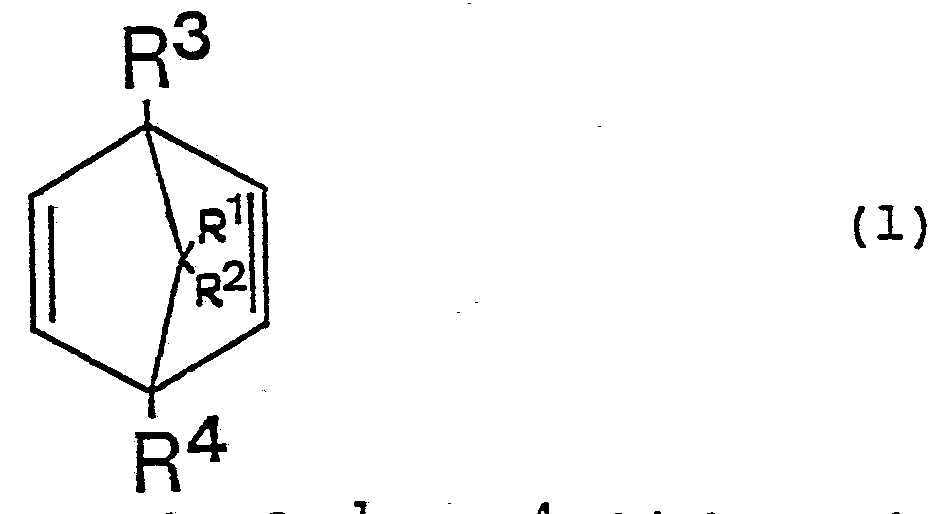
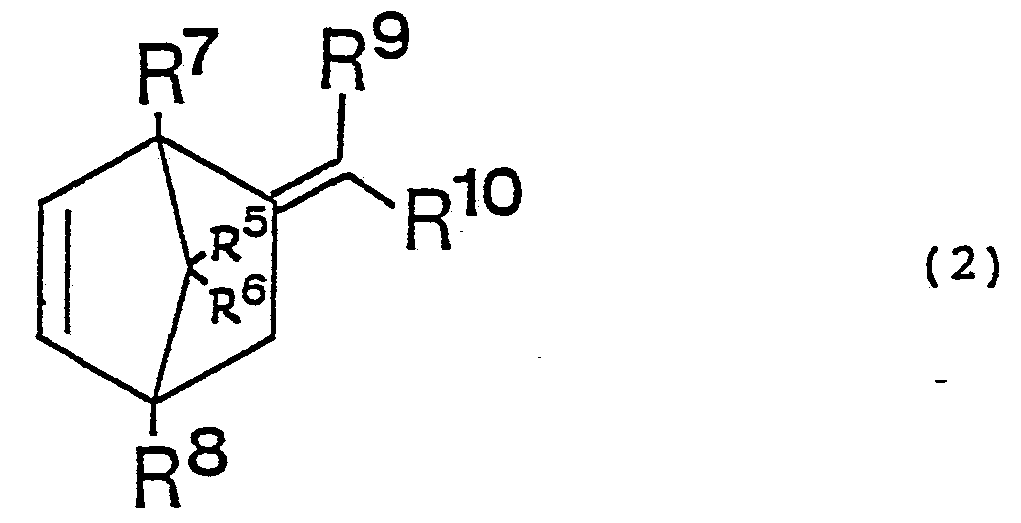
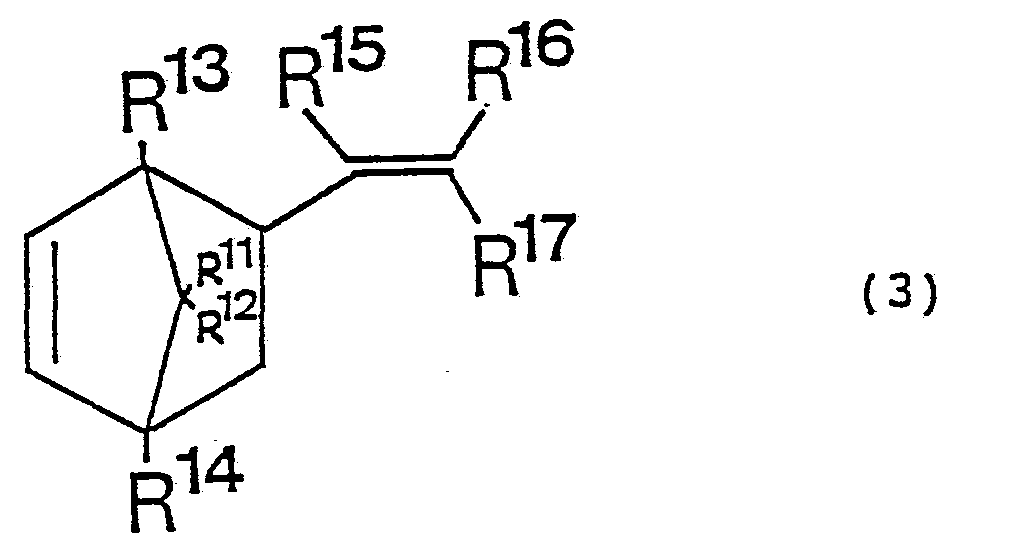
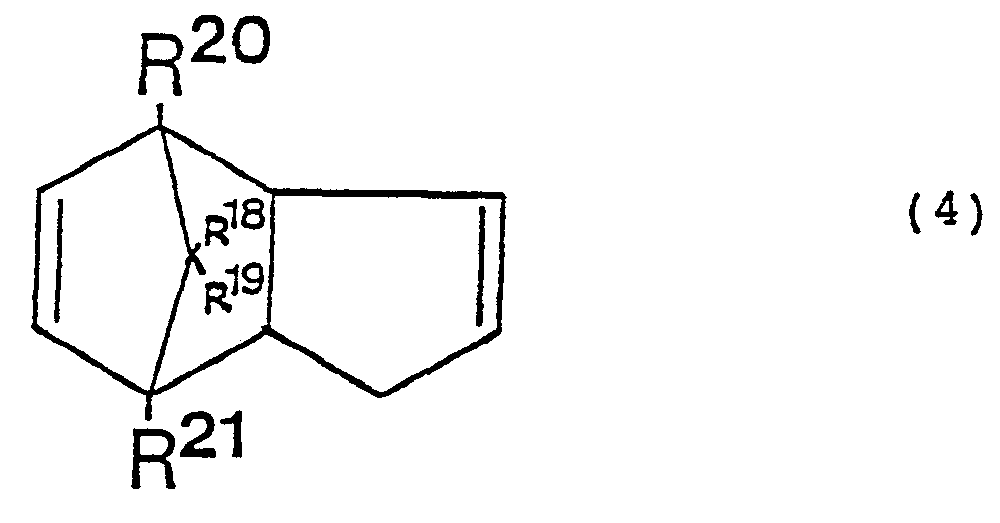
- the aliphatic cyclic hydrocarbon having at least one unsaturated double bond useful for the synthesis of the resin includes compounds of the following formulas (1) to (8):
- each of R 1 to R 4 which may be the same or different, is a hydrogen atom or an alkyl group having from 1 to 3 carbon atoms.
- each of R 5 to R 10 which may be the same or different, is a hydrogen atom or an alkyl group having from 1 to 3 carbon atoms.
- each of R 11 to R 17 which may be the same or different is a hydrogen atom or an alkyl group having from 1 to 3 carbon atoms.
- each of R 18 to R 21 which may be the same or different is a hydrogen atom or an alkyl group having from 1 to 3 carbon atoms.
- each of R 22 to R 25 is a hydrogen atom or an alkyl group having from 1 to 3 carbon atoms.
- each of R 26 to R 37 which may be the same or different, is a hydrogen atom or an alkyl group having from 1 to 3 carbon atoms, provided that R 34 or R 35 may together with R 36 or R 37 form a ring, n is an integer of 0 or at least 1, and when R 30 to R 33 are repeated, they may be the same or different.
- each of R 38 to R 44 which may be the same or different , is a hydrogen atom or an alkyl group having from 1 to 3 carbon atoms .
- each of R 45 to R 52 which may be the same or different, is a hydrogen atom or an alkyl group having from 1 to 3 carbon atoms.
- Specifc examples of the compound of the formula (3) include the following compounds:
- the compound of the formula (8) include the following compounds: Copolymers of these aliphatic cyclic hydrocarbons with maleic anhydride or maleimides are formed usually as 1:1 alternating copolymers by e.g. radical copolymerization. These copolymers may be prepared by the processes disclosed, for example, by H. Pledger, Jr. et al in J. Macromol. Sci. - Chem., A5(3), pp491 (1971) and A5(8), ppl339 (1971), by Rostyslaw Doubenko et al in Polymer Letters, Vol. 2, pp469 (1964) or in U.S.
- the resin obtained by hydrolyzing acid anhydride rings in maleic anhydride units of the above-mentioned copolymer of an aliphatic cyclic hydrocarbon having at least one unsaturated double bond, with maleic anhydride, or by ring-opening such acid anhydride rings by a compound having a hydroxyl group or by a compound having an amino group will be described.
- Such a resin is obtainable by using the above-mentioned copolymer of an aliphatic cyclic hydrocarbon having at least one unsaturated double bond, with maleic anhydride, as a starting material for the synthesis.
- the compound having a 'hydroxyl group is a compound of the formula (9): HO - R 53 ( 9 ) wherein R 53 is an alkyl group, a cycloalkyl group or a group of the formula (10), (11) or (12) :
- R 54 and R 55 is an alkylene group
- R 56 is a hydrogen atom, an alkyl group or a cycloalkyl group
- R 57 is a hydrogen atom, an alkyl group, a carboxyl group, an alkoxy group, a nitro group or an amino group.
- it includes methyl alcohol, ethyl alcohol, n-propyl alochol, isopropyl alcohol, n-butyl alcohol, sec.-butyl alcohol, tert.-butyl alcohol, cyclopentyl alcohol, cyclohexyl alcohol, cycloheptyl alcohol, ethylene glycol, methyl glycolate, ethyl glycolate, hydroxydicyclopentadiene, phenol, o-nitrophenol, m-nitrophenol and p-nitrophenol.
- the compound having an amino group is a compound of the formula (13) :
- R 58 is an alkyl group, a cycloalkyl group or a group of the formula (14), (15) or (16): —R 59 -OH (14)
- R 59 and R 60 is an alkylene group
- R 61 is a hydrogen atom, an alkyl group or a cycloalkyl group
- R 62 is a hydrogen atom, an alkyl group, a carboxyl group, an alkoxy group, a nitro group or an amino group.
- (13) can be conducted by mixing the copolymer with water or with the compound of the formula (9) or (13), followed by the reaction at a temperature of from 70 to 140°C for from 2 to 24 hours, by using an inorgnaic alkali such as sodium hydroxide as a catalyst in the case of the hydrolysis, by using sulfuric acid as a catalyst in the case of the ring-opening of the acid anhydride rings by means of the compound of the formula (9), and without using any catalyst in the case of the ring-opening of the acid anhydride rings by means of the compound of the formula (13).
- an inorgnaic alkali such as sodium hydroxide
- sulfuric acid as a catalyst in the case of the ring-opening of the acid anhydride rings by means of the compound of the formula (9)
- the ring-opening rate of the acid anhydride rings in the above ring-opening reaction can be calculated from the results of the elemental analysis by the IR analysis of the resin thus obtained. Namely, with respect to the resin ring-opened by the compound of the formula (13), the ring-opening rate was obtained directly from the quantitative analysis of the nitrogen atom in the resin by the elemental analysis.
- the resin obtained by ring-opening acid anhydride rings in maleic anhydride units of the copolymer of an aliphatic cyclic hydrocarbon having at least one unsaturated double bond, with maleic anhydride, by the above-mentioned compound having an amino group, followed by imido ring-closure of a part or whole of maleamic acid units formed by the ring-opening in the copolymer, will be described.
- Such a resin is obtainable by using as a starting material the resin obtained by ring-opening acid anhydride rings in maleic anhydride units of the copolymer of an aliphatic cyclic hydrocarbon having at least one unsaturated double bond, with maleic anhydride, by the compound of the formula (13).
- the imido ring-closure of such a resin may be carried out, for example, by reacting it in an organic solvent having a high boiling point such as DMF in the presence of a tertiary amine such as tri-n-butylamine as a catalyst at a temperature of from 120 to 180°C for from 2 to 8 hours. From the viewpoint of the solubility in an aqueous alkaline solution, it is preferred that either one or both of the units having acid anhydride rings and the maleamic acid units remain in an amount of at least 10% based on the total constituting units in the resin thus obtained by the imido ring-closure of the above-mentioned resin.
- the imido ring-closure is conducted completely, it is necessary to employ as the starting material a resin containing at least 10% of the units having acid anhydride rings. If a resin containing less than 10% of the units having acid anhydride rings, based on the total constituting units, is used as the starting material, it is necessary to control the reaction condition so that the sum of the units having acid anhydride rings and the maleamic acid units in the resin resulting from the imido ring-closure will be not less than 10%. This can be done, for example, by lowering the reaction temperature or by shortening the reaction time.
- the starting material is a resin obtained by ring-opening acid anhydride rings of maleic anhydride units of the copolymer of an aliphatic cyclic hydrocarbon having at least one unsaturated double bond, with maleic anhydride, by the compound of the formula (13), wherein the compound of the formula (13) is one of the following compounds:
- the resin soluble in an aqueous alkaline solution to be used for the photoresist composition of the present invention will be described in further detail with reference to specific examples.
- the copolymer of an aliphatic cyclic hydrocarbon having at least one unsaturated double bond, with maleic anhydride is a resin having, for instance, the following repeating units:
- the resin obtained by hydrolyzing acid anhydride rings in maleic anhydride units of the copolymer of an aliphatic cyclic hydrocarbon having at least one. unsaturated double bond, with maleic anhydride is a resin containing, for example, the following repeating units:
- the resin obtained by ring-opening acid anhydride rings in maleic anhydride units of the copolymer of an aliphatic cyclic hydrocarbon having at least one unsaturated double bond, with maleic anhydride, by the compound having a hydroxyl group is a resin having, for example, the following repeating units:
- the resin obtained by ring-opening acid anhydride rings in maleic anhydride units of the copolymer of an aliphatic cyclic hydrocarbon having at least one unsaturated double bond, with maleic anhydride, by the compound having an amino group is a resin having, for example, the following repeating units:
- the resin obtained by ring-opening acid anhydride rings in maleic anhydride units of the copolymer of an aliphatic cyclic hydrocarbon having at least one unsaturated double bond, with maleic anhydride, by the compound having an amino group, followed by the imido ring-closure of a part or whole of maleamic acid units formed by the ring-opening in the above copolymer, is a resin having, for example, the following repeating units:
- R is an alkylene group having from 1 to 3 carbon atoms, which may have a side chain
- n and m are positive numbers which satisfy n/(n + m) being from 0.1 to 0.9, preferably from 0.3 to 0.7
- p and q are positive numbers, the sum of which is 1.
- the resin soluble in an aqueous alkaline solution is a resin having a weight average molecular weight (Mw) of from 1,000 to 20,000, preferably from 2,000 to 15,000, as measured by gel permeation chromatography using monodisperse polystyrene as the standard. If the molecular weight is outside the above range, there will be adverse effects to the sensitivity, the resolution, the heat resistance, the coating film properties or the adhesion to the substrate.
- Mw weight average molecular weight
- the photosensitive agent to be used for the photoresist composition of the present invention may be any photosensitive agent so long as it is capable of hindering or promoting the solubility of the resin in an aqueous alkaline solution, when incorporated in such a resin and irradiated with active radiation, particularly with ultraviolet rays or excimer laser so as to create a substantial difference in the solubility as between an exposed portion and a non-expose'd portion (i.e. creation of a latent image) and to form a positive or negative image by subsequent development with an aqueous alkaline solution.
- a positive photosensitive agent a naphthoquinone diazide sulfonate type photosensitive agent is preferred.
- a bisazide type photosensitive agent is preferred.
- Naphthoquinone diazide sulfonate photosensitive agents are commonly known.
- compounds disclosed in U.S. Patent 2,766,118, 2,767,09, 2,772,972, 2,859,112, 2,907,665, 3,946,110, 3,046,111, 3,046,115, 3,046,118, 3,046,119, 3,046,120, 3,046,121, 3,046,122, 3,046,123, 3,061,430, 3,102,809, 3,106,465, 3,635,709 and 3,647,443, may be employed as photosensitive agents useful for the photoresist composition of the present invention.
- the following compounds may be mentioned.
- bisazide type photosensitive agents bisazide compounds disclosed in e.g. Japanese Unexamined Patent Publications No. 167351/1988 and No. 191142/1988,. may be employed as photosensitive agents useful for the photoresist compositions of the present invention.
- 3,3'-diazidobenzophenone, 3,3'- diazidodiphenylsulfone, 4,4'-diazidodiphenylsulfide, 3,3'-dimethoxy-4,4'-diazidobiphenyl and 2,7- diazidofluorene may be mentioned.
- 2-diazo-1,3-dione compounds disclosed in e.g. Japanese Examined Patent Publications No. 47296/1987 and No. 47297/1987 and Japanese Unexamined Patent Publications No. 14235/1985, No. 22387/1986, No. 163340/1988 and No. 170639/1988, may be mentioned.
- These positive or negative photosensitive agents may respectively be used alone or in combination as a mixture of two or more.
- the photosensitive agent is used in an amount of from 1 to 100 parts by weight, preferably from 10 to 70 parts by weight, per 100 parts by weight of the resin soluble in an aqueous alkaline solution. If the amount is outside the above range, there will be adverse effects to the sensitivity of the resist, the difference in the solubility between the exposed portion and the non-exposed portion, the pattern precision and the properties of the coating film.
- the photoresist composition of the present invention is soluble in an organic solvent. When it is used for the preparation of integrated circuits, it is employed usually in the form of a solution (a resist solution).
- the above composition is dissolved usually in an amount of from 1 to 50% by weight, preferably from 5 to 30% by weight, in an organic solvent and adjusted.
- the solvent to be used for this purpose is preferably the one which is capable of uniformly dissolving the respective components of the positive photoresist composition of the present invention and capable of providing a uniform smooth coating layer when the solution is applied to the surface of a substrate such as silicon or aluminum, followed by evaporation of the organic solvent.
- ketone solvent such as acetone, methyl ethyl ketone, cyclopentanone or cyclohexanone
- cellosolve solvent such as methyl cellosolve, ethyl cellosolve, butyl cellosolve, methyl cellosolve acetate or ethyl cellosolve acetate
- ether solvent such as tetrahydrofuran or diethylene glycol dimethyl ether
- ester solvent such as ethyl acetate or butyl acetate.
- the solvent is not limited to such specific examples.
- the above organic solvents may be used alone or in combination as a mixture of two or more.
- plasticizers, sensitizers, dyes, other resins, inhibitors such as thermal reaction inhibitors and adhesion promotors may be added to the photoresist compositions of the present invention, as the case requires.
- the positive photoresist composition of the present invention may be prepared into a resist solution, and a relief pattern may be formed with it by means of lithography technique.
- the resist solution prepared as described above is coated to a substrate.
- the coating to the substrate may be conducted by e.g. a spinner.
- the coated solution is subjected to baking at a temperature of from 60 to 120°C, preferably from 80 to 100°C, for from 20 to 60 minutes.
- far ultraviolet rays or excimer laser is irradiated to this coating film through a photomask chart. Middle ultraviolet rays may also be employed.
- the exposed portions will be washed away with a developing solution to obtain a relief pattern.
- a weakly alkaline aqueous solution having a concentration of e.g. not higher than 5% by weight of e.g. sodium hydroxide, potassium hydroxide, sodium metasilicate of tetramethylammonium hydroxide, may be employed.
- the relief pattern thus formed is excellent in the sharpness and contrast.
- the photoresist composition of the present invention exhibits a high resolution, high contrast and high sensitivity to far ultraviolet rays (wavelength: 250 - 300 nm) and excimer laser (wavelength: 248, 308 nm), and it is also suitable for exposure to middle ultraviolet rays (wavelength: 300 - 350 nm).
- Such a composition is useful particularly as a resist for fine working in the field for the production of semiconductor elements.
- the photoresist composition of the present invention has high transparency within the wavelength regions of far ultraviolet rays and excimer laser. Therefore, the sensitivity, resolution and contrast can remarkably be improved even when such active radiation required for a high resolution for lithography is used as the light source. Yet, it can be developed with an aqueous alkaline solution without swelling, whereby a fine photoresist pattern can be formed with high precision. Accordingly, such a composition is useful as a resist for the preparation of integrated circuits such as LSI and VLSI, for which the requirements for sensitivity and resolution will be increasely severe. Further, it can be widely used in the field for the production of semiconductor elements.
- this colorless solid was confirmed to be the desired 1/1 alternating copolymer of bicyclo[2,2,1]hepta-2,5-diene with maleic anhydride.
- the weight average molecular weight of this copolymer was 6,800 as measured by gel permeation chromatography (GPC) using polystyrene as the standard. Further, the ratio of the weight average molecular weight to the number average molecular weight was 1.59. Evaluation of the transparency of the resin
- the transparency of the above resin at 248 nm was evaluated.
- the evaluation was conducted in such a manner that the resin obtained was formed into a film having a thickness of 1.0 ⁇ m, and the transmittance of the film thus obtained for a monochromatic light having a wavelength of 248 nm was measured. Namely, 1.0 g of the above bicyclo[2,2,1]hepta-2,5-diene/maleic anhydride copolymer was dissovled in 4 ml of cyclohexanone to obtain a solution.
- this colorless solid was confirmed to be the desired 1/1 alternating copolymer of 5-vinylbicyclo[2,2,1]hept-2-ene with maleic anhydride.
- the weight average molecular weight (Mw) of this copolymer was 6,800 as measured by gel permeation chromatography (GPC) using polystyrene as the standard.
- the ratio of the weight average molecular weight to the number average molecular weight was 1.59.
- the weight average molecular weight of this copolymer was 7,100 as measured by gel permeation chromatography using polystyrene as the standard.
- the ratio of the weight average molecular weight to the number average molecular weight was 1.63.
- the ratio of the weight average molecular weight to the number average molecular weight was 1.78.
- this colorless solid was confirmed to be a product obtained by esterification ring-opening of a part of acid anhydride rings in the bicyclo[2,2,1]hepta-2,5-diene/maleic anhydride copolymer as the starting material resin by isopropyl alcohol.
- the esterification rate of the acid anhydride rings of this resin was 68% as calculated from the changes in the absorptions at 1,770 cm -1 and 1850 cm- 1 by the IR analysis.
- this colorless solid was found to be a product obtained by amido ring-opening of a part of acid anhydride rings in the bicyclo[2,2,1]hepta-2,5-diene/maleic anhydride copolymer as the starting material resin by isopropylamine. Further, the amido-conversion of the acid anhydride rings of this resin was 68% as calculated from the content of the nitrogen atom by the elemental analysis of this resin.
- a positive photoresist composition of the present invention comprising 8.0 g of the resin obtained in
- the above resist solution was spin-coated at 2,300 rpm by a spin coater on a silicon wafer treated by hydrophobic treatment with HMDS (hexamethyl disilazane).
- this wafer was heated (prebaked) at 90°C for 20 minutes in a hot air circulating oven to form a resist film having a thickness of 1.0 ⁇ m.
- the resist film was irradiated by changing the position and the dose of exposure. After the irradiation, the resist film was immersed in an aqueous solution containing 1.0% of tetramethylammonium hydroxide for development. Then, the resist film was rinsed with deionized water for 40 seconds and heated (post baked) at 90°C for 30 minutes in a hot air circulating oven. The thickness of the film thus obtained was measured by means of a contact type film thickness meter. The relation between the exposed dose and the film remaining rate was plotted, and the exposed dose at which the film remaining rate became 0%, was taken as the sensitivity. As a result, the sensitivity of the above resist was 74 mj/cm 2 . Formation of a fine image
- the non-exposed resist film obtained in the same manner was subjected to exposure to a KrF excimer laser at a proper dose by means of a 5:1 reduced projection exposure apparatus with a KrF excimer laser as the light source by using a chromium photomask having a fine pattern. After the exposure, this resist film was immersed in an aqueous solution containing 1.0% of tetramethylammonium hydroxide for one minute for development. Then, it was rinsed with deionized water for 40 seconds and heated (post baked) at 90°C for 30 minutes in a hot air circulating oven to obtain a positive image of the photomask pattern.
- a negative photoresist composition of the present invention comprising 8.0 g of the resin obtained in Preparation Example 1 and 1.1 g of 3,3'- diazidodiphenylsulfone as a photosensitive agent, was dissolved in 22 ml of cyclohexanone. This solution was filtered through a 0.2 ⁇ m filter to obtain a resist solution. Coating of a photoresist The above resist solution was spin coated in the same manner as in Example 1 on a silicon wafer treated by hydrophobic treatment with HMDS (hexamethyldisilazane) to form a resist film having a thickness of 1.0 ⁇ m.
- HMDS hexamethyldisilazane
- a KrF excimer laser (wavelength: 248 nm) was irradiated by changing the position and dose of exposure. After the irradiation, this resist film was immersed in an aqueous solution containing 1.0% of tetramethylammonium hydroxide for one minute for development. Then, it was rinsed with deionized water for 40 seconds and heated (post baked) at 90°C for 30 minutes in a hot air circulating oven. The thickness of the film thus obtained was measured by a contact type film thickness meter. The relation between the exposed dose and the film remaining rate was plotted, and the exposed dose at which the film remaining rate became 80%, was taken as the sensitivity. As a result, the sensitivity of the above resist was 128 mj/cm 2 . Formation of a fine image
- the non-exposed resist film obtained in the same manner was subjected to exposure to a KrF excimer laser at a proper dose by means of a 5:1 reduced projection exposure apparatus with a KrF excimer laser as the light source by using a chromium photomask having a fine pattern. After the exposure, this resist film was immersed in an aqueous solution containing 1.0% of tetramethylammonium hydroxide for one minute for development. Then, it was rinsed with deionized water for 40 seconds and heated (post baked) at 90°C for 30 minutes in a hot air circulating oven to obtain a negative image of the photomask pattern.
Landscapes
- Physics & Mathematics (AREA)
- Spectroscopy & Molecular Physics (AREA)
- General Physics & Mathematics (AREA)
- Engineering & Computer Science (AREA)
- Manufacturing & Machinery (AREA)
- Materials For Photolithography (AREA)
- Addition Polymer Or Copolymer, Post-Treatments, Or Chemical Modifications (AREA)
- Exposure And Positioning Against Photoresist Photosensitive Materials (AREA)
Abstract
A photoresist composition comprising: a resin soluble in an aqueous alkaline solution, having units of an aliphatic cyclic hydrocarbon main frame and units derived from maleic anhydride and/or units derived from a maleimide; and a photosensitive agent in a sufficient amount to promote or hinder the solubility of said resin in an aqueous alkaline solution upon exposure to active radiation so as to create a substantial difference in the solubility as between an exposed portion and a non-exposed portion and to form a positive or negative image by subsequent development with an aqueous alkaline solution.
Description
DESCRIPTION
TITLE OF THE INVENTION
PHOTORESIST COMPOSITION
The present invention relates to a photoresist composition. More particularly, the present invention relates to a photoresist composition suitable for far ultraviolet or excimer laser lithography, wherein a resin soluble in an aqueous alkaline solution having units of an aliphatic cyclic hydrocarbon main frame and units derived from maleic anhydride and/or units derived from a maleimide, is used as a base resin. Such a composition is useful particularly as a resist for fine working in the field for the production of semiconductor elements.
With respect to semiconductor elements such as LSI or VLSI, the degree of their working tends to be finer year by year for the purpose of improving their performance. At present, lithography using g-line (436 nm) as the light source is widely used as a fine working technique for the production of such semiconductor elements. Even in such lithography, efforts for a higher resolution are being made to meet the need for fine working of such elements. As the main techniques presently available for
a high resolution, there may be mentioned an attempt for a higher NA (numerical aperture) of a lens for reduced projection in an exposure apparatus and an attempt for a shorter wavelength of the light source for exposure from g-line to i-line (365 nm). Among them, the attempt for a higher NA of lens has already reached a level close to the limit. For the future, it will be necessary to further the attempt for a shorter wavelength of the light source for exposure and thereby to accomplish a higher resolution for lithography. With such a background, the resist will also be required to meet the requirements for a short wave light source such as far ultraviolet rays or excimer laser. Now, the applicability and problems of resists for application to lithography using such a short wave light source, will be described.
A resist is usually a composition comprising a base resin, a photosensitive agent and a solvent. Among them, as the base resin, a resin soluble in an aqueous alkaline solution is commonly employed for a resist required to have a high resolution so that both positive and negative resists can be developed with an aqueous alkaline solution to avoid a problem of swelling during the development. As such a resin soluble in an aqueous alkaline solution, a phenol resin such as a novolak resin or a polyvinylphenol is most commonly used at present. Such a phenol resin is relatively transparent in the
wavelength region of g-line or i-line. However, in the wavelength region of far ultraviolet or excimer laser, such a phenol resin tends to be extremely poor in transparency, since it has aromatic rings in its structure. Therefore, if a conventional photoresist composition using a phenol resin as the base resin, is used for lithography using a short wavelength light as the light source, the incident light entered from above the resist can not reach the bottom of the resist layer, whereby the resist reaction can not uniformly be conducted in the direction perpendicular to the resist layer. As a result, with a positive resist, the development tends to be inadequate or the resist pattern tends to be trapezoid if the development is strongly conducted. On the other hand, with a negative resist, the pattern after the development tends to be reversed-trapezoid. If the wall of the resist is not vertical, the width of the resist pattern is likely to be changed in the subsequent step for etching a part of the resist (such as reactive ion etching), whereby an adverse effect is likely to be given to the circuit thereby produced. Further, with either type of resist, in order to let the light reach the bottom of the resist layer, a large quantity of exposure is required. Consequently, such a resist is not necessarily satisfactory with respect to the sensitivity.
It is an object of the present invention to provide a
photoresist composition which is capable of providing excellent transparency in the wavelength regions of far ultraviolet rays and excimer laser and which has a high resolution and high sensitivity. under these circumstances, the present inventors have conducted extensive researches, and as a result, have found that a resin having units of an aliphatic cyclic hydrocarbon main frame and units derived from maleic anhydride and/or units derived from a maleimide has both solubility in an aqueous alkaine solution and transparency to a short wavelength light such as far ultraviolet or excimer laser, and that a composition comprising such a resin and a photosensitive agent can be a photoresist composition satisfying the above object. The present invention has been accomplished on the basis of these discoveries.
The present invention provides a photoresist composition comprising: a resin soluble in an aqueous alkaline solution, having units of an aliphatic cyclic hydrocarbon main frame and units derived from maleic anhydride and/or units derived from a maleimide; and a photosensitive agent in a sufficient amount to promote or hinder the solubility of said resin in an aqueous alkaline solution upon exposure to active radiation so as to create a substantial difference in the solubility as between an exposed portion and a non-
exposed portion and to form a positive or negative image by subsequent development with an aqueous alkaline solution.
Now, the present invention will be described in detail with reference to the preferred embodiments.
The resin soluble in an aqueous alkaline solution having units of an aliphatic cyclic hydrocarbon main frame and units derived from maleic anhydride and/or units derived from a maleimide, to be used for the photoresist composition of the present invention, is a copolymer of an aliphatic cyclic hydrocarbon having at least one unsaturated double bond with maleic anhydride or a maleimide, or a resin obtained by hydrolyzing acid anhydride rings in maleic anhydride units of the above-mentioned copolymer of an aliphatic cyclic hydrocarbon with maleic anhydride, or by ring-opening such acid anhydride rings by a compound having a hydroxyl group or by a compound having an amino group, or a resin obtained by ring-opening acid anhydride rings in maleic anhydride units of the above-mentioned copolymer of an aliphatic cyclic hydrocarbon with maleic anhydride, by a compound having an amino group, followed by imido-ring closure of a part or whole of the maleamic acid units formed by the ring-opening. Firstly, the above-mentioned copolymer of an aliphatic cyclic hydrocarbon with maleic anhydride or a maleimide will be described.
The aliphatic cyclic hydrocarbon having at least one unsaturated double bond useful for the synthesis of the resin includes compounds of the following formulas (1) to (8):


)

Specific examples of the compound of the formula (1) include the following compounds:


Specific examples of the compound of the formula (2) include the following compounds:


Specifc examples of the compound of the formula (3)
include the following compounds:


Specific examples of the compound of the formula (4) include the following compounds:


Specific examples of the compound of the formula (5) include the following compounds:


Specific examples of the compound of the formula (6) include the following compounds:


Specific examples of the compound of the formula (7) include the following compounds:
:


Specific examples of the compound of the formula (8) include the following compounds:


 Copolymers of these aliphatic cyclic hydrocarbons with maleic anhydride or maleimides are formed usually as 1:1 alternating copolymers by e.g. radical copolymerization. These copolymers may be prepared by the processes disclosed, for example, by H. Pledger, Jr. et al in J. Macromol. Sci. - Chem., A5(3), pp491 (1971) and A5(8), ppl339 (1971), by Rostyslaw Doubenko et al in Polymer Letters, Vol. 2, pp469 (1964) or in U.S. Patents, 3,143,533, 3,261,815, 3,510,461 and 3,703,501 and U.K. Patents, 1,015,215 and 1,255,838. Now, the resin obtained by hydrolyzing acid anhydride rings in maleic anhydride units of the above-mentioned copolymer of an aliphatic cyclic hydrocarbon having at least one unsaturated double bond, with maleic anhydride, or by ring-opening such acid anhydride rings by a compound having a hydroxyl group or by a compound having an amino group, will be described.
Such a resin is obtainable by using the above-mentioned copolymer of an aliphatic cyclic hydrocarbon having at least one unsaturated double bond, with maleic anhydride, as a starting material for the synthesis. Here, the compound having a 'hydroxyl group is a compound of the formula (9):
HO - R53 ( 9 ) wherein R53 is an alkyl group, a cycloalkyl group or a group of the formula (10), (11) or (12) :
—R54-OH
(10)


Specifically, it includes methyl alcohol, ethyl alcohol, n-propyl alochol, isopropyl alcohol, n-butyl alcohol, sec.-butyl alcohol, tert.-butyl alcohol, cyclopentyl alcohol, cyclohexyl alcohol, cycloheptyl alcohol, ethylene glycol, methyl glycolate, ethyl glycolate, hydroxydicyclopentadiene, phenol, o-nitrophenol, m-nitrophenol and p-nitrophenol.
The compound having an amino group is a compound of the formula (13) :
H2N-R58 (13) wherein R58 is an alkyl group, a cycloalkyl group or a group of the formula (14), (15) or (16):
—R59-OH (14)


Specifically, it includes n-propylamine, iropropylamine, n-butylamine, tert.-butylamine, sec.-butylamine, isobutylamine, ethanolamine, 4-aminobutyric acid, cyclohexylamine, cyclopentylamine, cycloheptylamine, o-aminophenol, m-aminophenol, p-aminophenol, m-aminobenzoic acid, p-aminobenzoic acid, o-aminobenzoic acid, 4-aminocyclohexanol, 2-amino-1-butanol, 2-aminonorbornane, 3-amino-1-propanol, 6-amino-1-hexanol and 12-aminododecanoic acid.
The hydrolysis of acid anhydride rings in the copolymer of the above-mentioned aliphatic cyclic hydrocarbon having at least one unsaturated double bond, with maleic anhydride, or the ring-opening of such acid anhydride rings by the compound of the formula (9) or
(13), can be conducted by mixing the copolymer with water
or with the compound of the formula (9) or (13), followed by the reaction at a temperature of from 70 to 140°C for from 2 to 24 hours, by using an inorgnaic alkali such as sodium hydroxide as a catalyst in the case of the hydrolysis, by using sulfuric acid as a catalyst in the case of the ring-opening of the acid anhydride rings by means of the compound of the formula (9), and without using any catalyst in the case of the ring-opening of the acid anhydride rings by means of the compound of the formula (13).
The ring-opening rate of the acid anhydride rings in the above ring-opening reaction can be calculated from the results of the elemental analysis by the IR analysis of the resin thus obtained. Namely, with respect to the resin ring-opened by the compound of the formula (13), the ring-opening rate was obtained directly from the quantitative analysis of the nitrogen atom in the resin by the elemental analysis. With respect to the resin obtained by the hydrolysis of by the ring-opening by means of the compound of the formula (9), the ring-opening rate was indirectly obtained based on a calibration curve prepared on the basis of the interrelation between the peak intensities at 1,770 cm-1 and 1,850 cm-1 (absorptions attributable to C=0 of an acid anhydride ring) in the IR analysis and the ratio of the units having acid anhydride' rings to the total constituting units, from the results of the resin ring-
opened by means of the compound of the formula (13).
Now, the resin obtained by ring-opening acid anhydride rings in maleic anhydride units of the copolymer of an aliphatic cyclic hydrocarbon having at least one unsaturated double bond, with maleic anhydride, by the above-mentioned compound having an amino group, followed by imido ring-closure of a part or whole of maleamic acid units formed by the ring-opening in the copolymer, will be described. Such a resin is obtainable by using as a starting material the resin obtained by ring-opening acid anhydride rings in maleic anhydride units of the copolymer of an aliphatic cyclic hydrocarbon having at least one unsaturated double bond, with maleic anhydride, by the compound of the formula (13). The imido ring-closure of such a resin may be carried out, for example, by reacting it in an organic solvent having a high boiling point such as DMF in the presence of a tertiary amine such as tri-n-butylamine as a catalyst at a temperature of from 120 to 180°C for from 2 to 8 hours. From the viewpoint of the solubility in an aqueous alkaline solution, it is preferred that either one or both of the units having acid anhydride rings and the maleamic acid units remain in an amount of at least 10% based on the total constituting units in the resin thus obtained by the imido ring-closure of the above-mentioned resin. For this purpose, if the imido ring-closure is
conducted completely, it is necessary to employ as the starting material a resin containing at least 10% of the units having acid anhydride rings. If a resin containing less than 10% of the units having acid anhydride rings, based on the total constituting units, is used as the starting material, it is necessary to control the reaction condition so that the sum of the units having acid anhydride rings and the maleamic acid units in the resin resulting from the imido ring-closure will be not less than 10%. This can be done, for example, by lowering the reaction temperature or by shortening the reaction time.
However, this does not apply to a case where the starting material is a resin obtained by ring-opening acid anhydride rings of maleic anhydride units of the copolymer of an aliphatic cyclic hydrocarbon having at least one unsaturated double bond, with maleic anhydride, by the compound of the formula (13), wherein the compound of the formula (13) is one of the following compounds:


Now, the resin soluble in an aqueous alkaline solution to be used for the photoresist composition of
the present invention thus obtained, will be described in further detail with reference to specific examples. Among the above resins soluble in an aqueous alkaline solution, the copolymer of an aliphatic cyclic hydrocarbon having at least one unsaturated double bond, with maleic anhydride, is a resin having, for instance, the following repeating units:


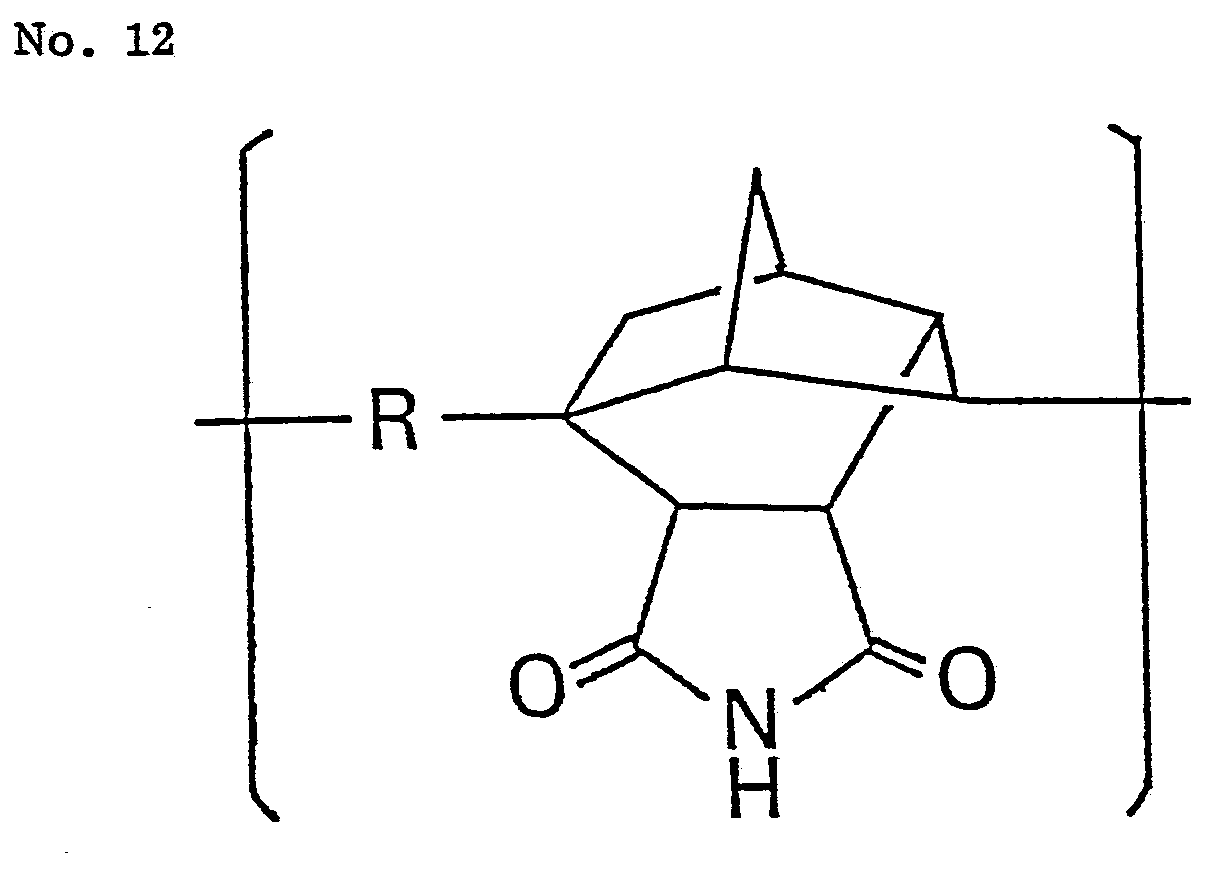

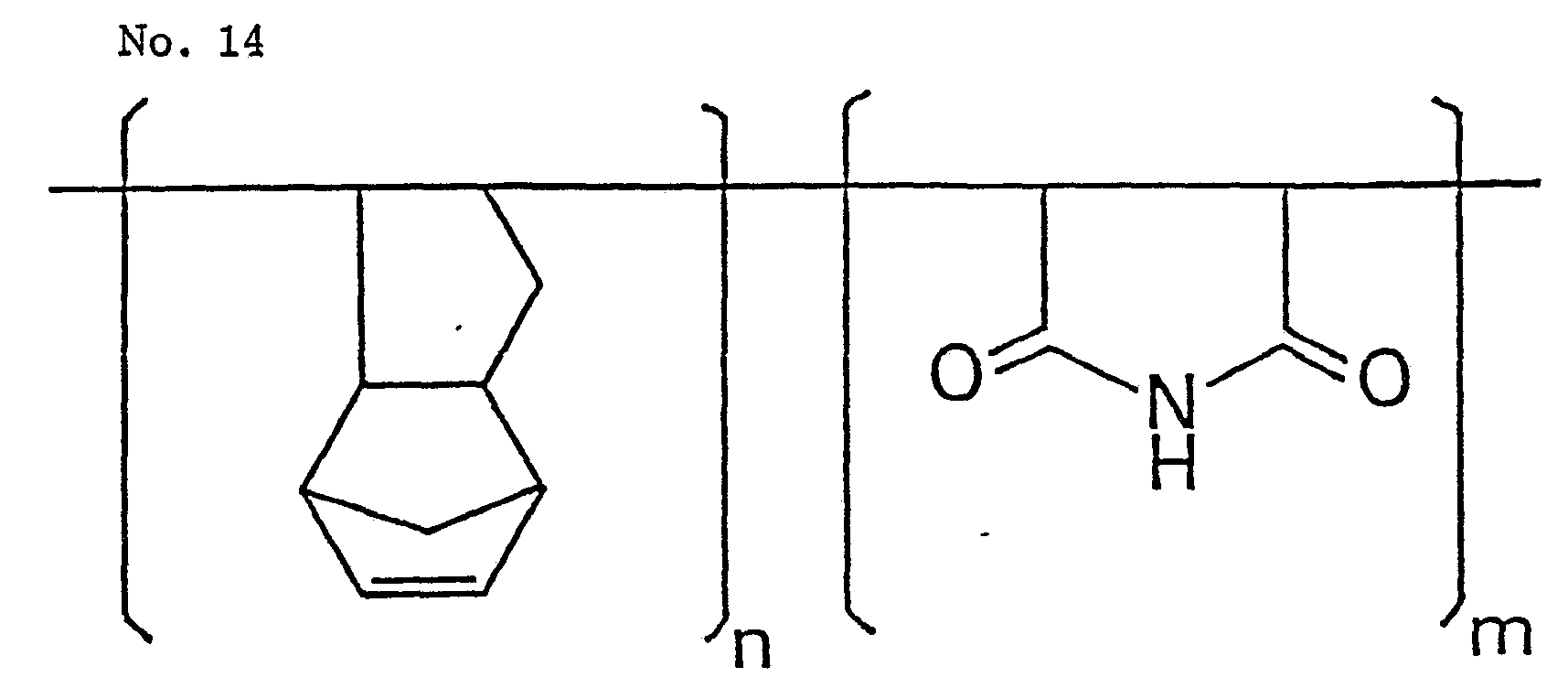
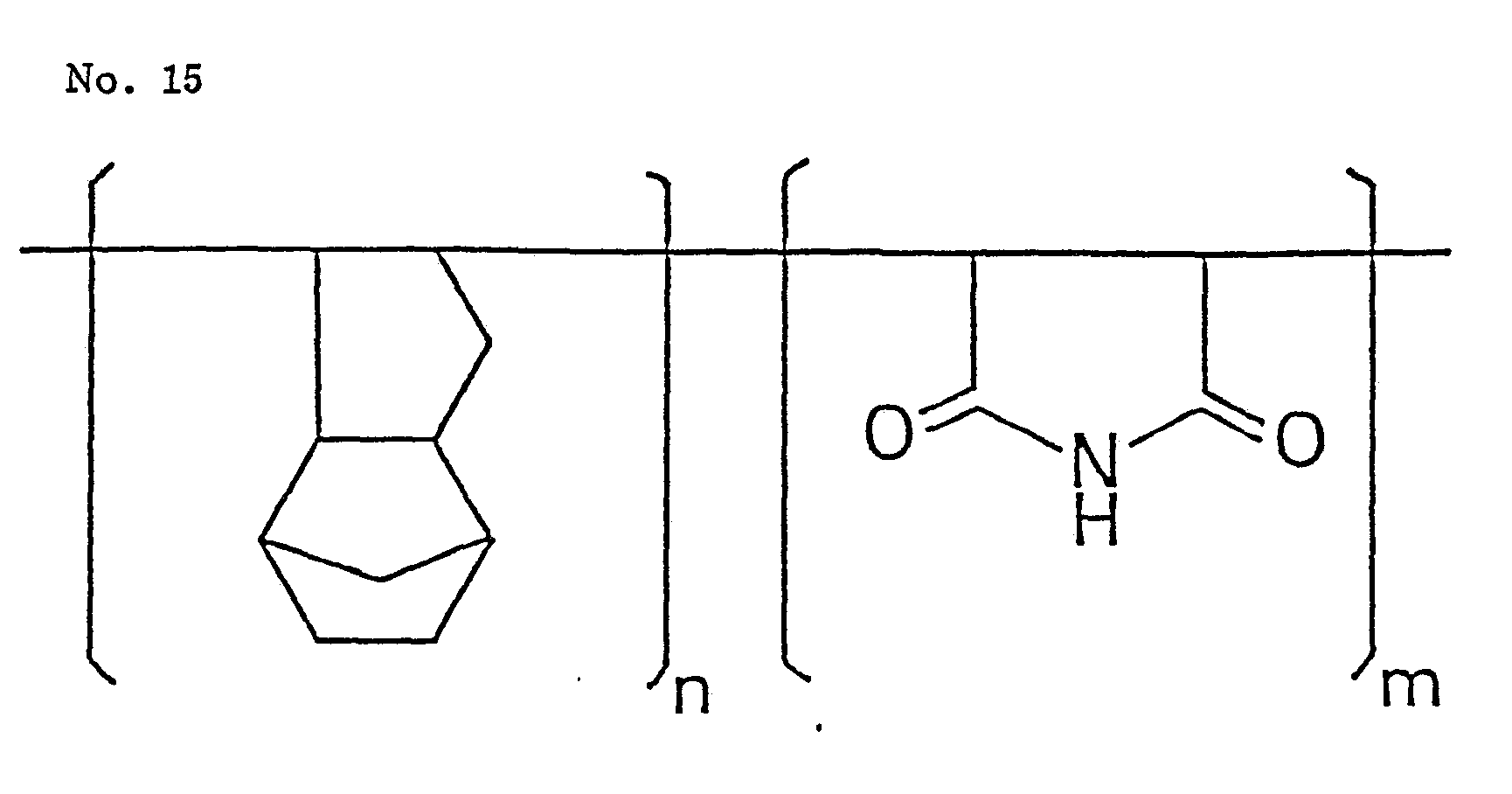


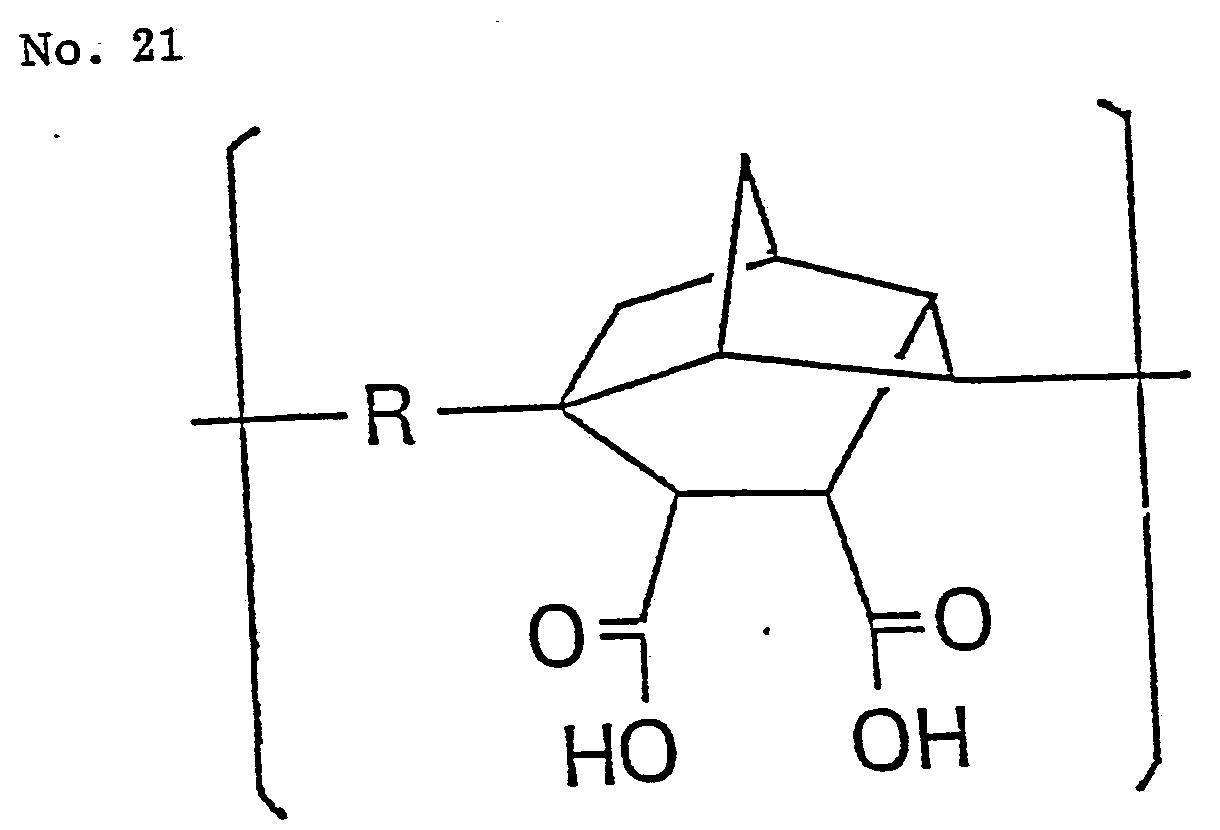


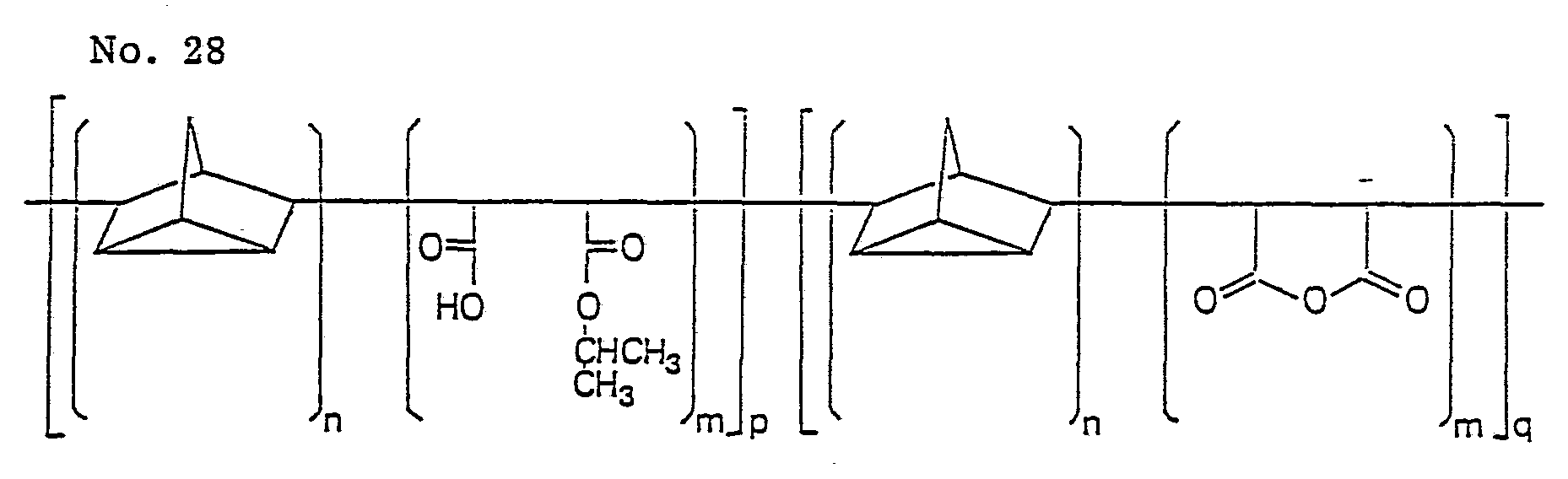


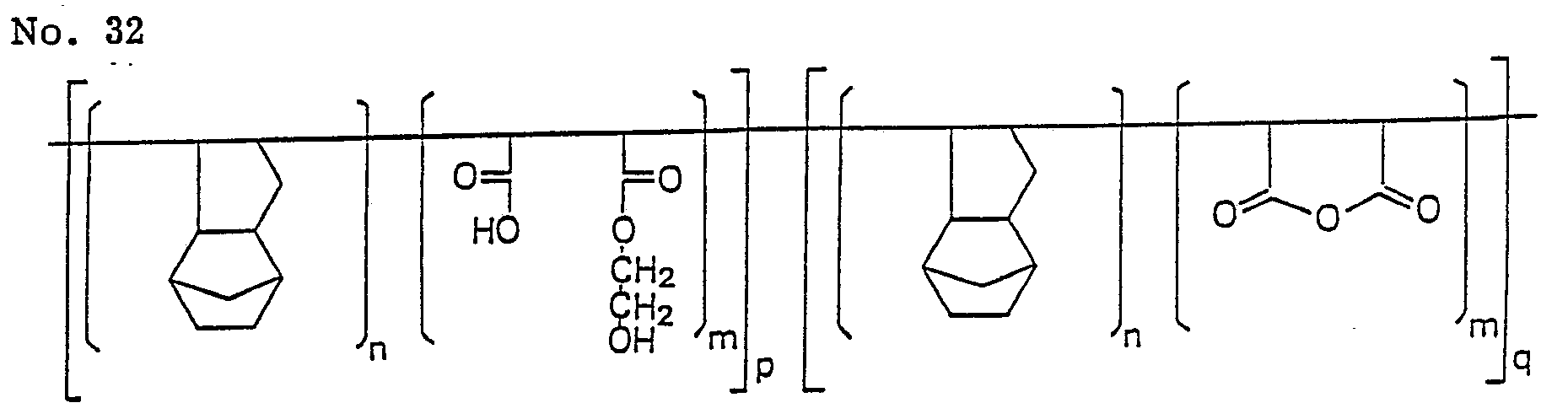


The resin soluble in an aqueous alkaline solution is a resin having a weight average molecular weight (Mw) of from 1,000 to 20,000, preferably from 2,000 to 15,000, as measured by gel permeation chromatography using monodisperse polystyrene as the standard. If the molecular weight is outside the above range, there will be adverse effects to the sensitivity, the resolution, the heat resistance, the coating film properties or the adhesion to the substrate. Now, the photosensitive agent to be used for the photoresist composition of the present invention will be described in detail.
As the photosensitive agent to be used for the photoresist composition of the present invention, may be any photosensitive agent so long as it is capable of hindering or promoting the solubility of the resin in an aqueous alkaline solution, when incorporated in such a resin and irradiated with active radiation, particularly with ultraviolet rays or excimer laser so as to create a substantial difference in the solubility as between an exposed portion and a non-expose'd portion (i.e. creation of a latent image) and to form a positive or negative
image by subsequent development with an aqueous alkaline solution. However, as a positive photosensitive agent, a naphthoquinone diazide sulfonate type photosensitive agent is preferred. Likewise, as a negative photosensitive agent, a bisazide type photosensitive agent is preferred.
Naphthoquinone diazide sulfonate photosensitive agents are commonly known. For example, compounds disclosed in U.S. Patent 2,766,118, 2,767,09, 2,772,972, 2,859,112, 2,907,665, 3,946,110, 3,046,111, 3,046,115, 3,046,118, 3,046,119, 3,046,120, 3,046,121, 3,046,122, 3,046,123, 3,061,430, 3,102,809, 3,106,465, 3,635,709 and 3,647,443, may be employed as photosensitive agents useful for the photoresist composition of the present invention. Specifically, the following compounds may be mentioned.


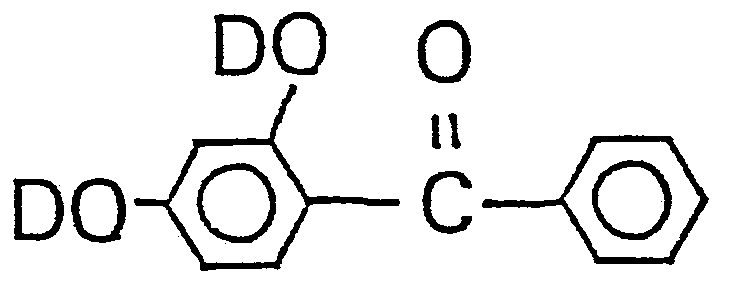

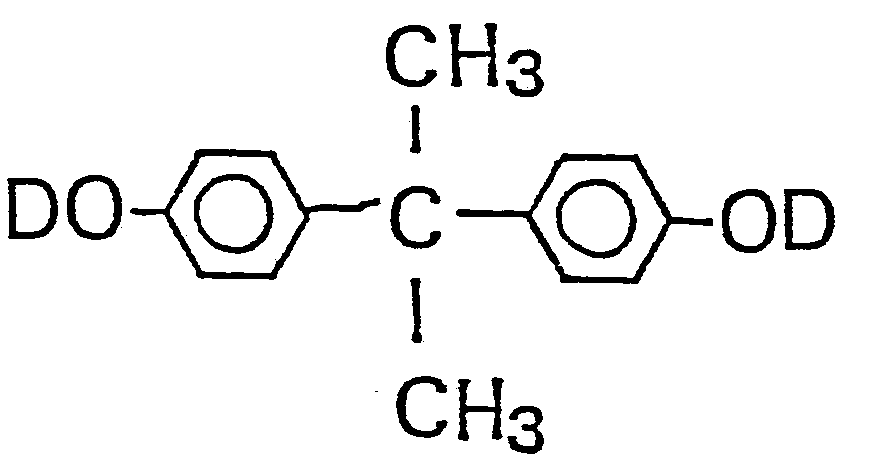
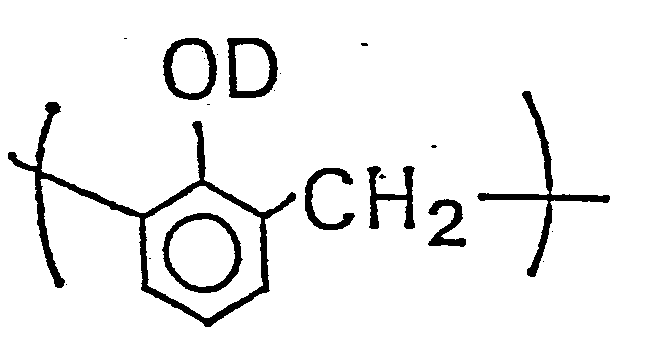


These positive or negative photosensitive agents may respectively be used alone or in combination as a mixture of two or more.
With respect to the proportions of the resin soluble in an aqueous alkaline solution and the photosensitive agent, the photosensitive agent is used in an amount of from 1 to 100 parts by weight, preferably from 10 to 70 parts by weight, per 100 parts by weight of the resin soluble in an aqueous alkaline solution. If the amount is outside the above range, there will be adverse effects
to the sensitivity of the resist, the difference in the solubility between the exposed portion and the non-exposed portion, the pattern precision and the properties of the coating film. The photoresist composition of the present invention is soluble in an organic solvent. When it is used for the preparation of integrated circuits, it is employed usually in the form of a solution (a resist solution). In such a case, the above composition is dissolved usually in an amount of from 1 to 50% by weight, preferably from 5 to 30% by weight, in an organic solvent and adjusted. As the solvent to be used for this purpose is preferably the one which is capable of uniformly dissolving the respective components of the positive photoresist composition of the present invention and capable of providing a uniform smooth coating layer when the solution is applied to the surface of a substrate such as silicon or aluminum, followed by evaporation of the organic solvent. Specifically, it includes a ketone solvent such as acetone, methyl ethyl ketone, cyclopentanone or cyclohexanone, a cellosolve solvent such as methyl cellosolve, ethyl cellosolve, butyl cellosolve, methyl cellosolve acetate or ethyl cellosolve acetate, an ether solvent such as tetrahydrofuran or diethylene glycol dimethyl ether, and an ester solvent such as ethyl acetate or butyl acetate.
However, the solvent is not limited to such specific examples.
The above organic solvents may be used alone or in combination as a mixture of two or more. In addition to the above components, plasticizers, sensitizers, dyes, other resins, inhibitors such as thermal reaction inhibitors and adhesion promotors, may be added to the photoresist compositions of the present invention, as the case requires. As mentioned above, the positive photoresist composition of the present invention may be prepared into a resist solution, and a relief pattern may be formed with it by means of lithography technique.
Now, the method of forming such a relief pattern will be described.
Firstly, the resist solution prepared as described above, is coated to a substrate. The coating to the substrate may be conducted by e.g. a spinner. Then, the coated solution is subjected to baking at a temperature of from 60 to 120°C, preferably from 80 to 100°C, for from 20 to 60 minutes. After baking, far ultraviolet rays or excimer laser is irradiated to this coating film through a photomask chart. Middle ultraviolet rays may also be employed. Then, the exposed portions will be washed away with a developing solution to obtain a relief pattern. As the developing solution, a weakly alkaline aqueous solution
having a concentration of e.g. not higher than 5% by weight of e.g. sodium hydroxide, potassium hydroxide, sodium metasilicate of tetramethylammonium hydroxide, may be employed. The relief pattern thus formed is excellent in the sharpness and contrast.
Further, by using the pattern formed by using the photoresist composition of the present invention as described above, as a mask, it is possible to conduct etching of a substrate. The photoresist composition of the present invention exhibits a high resolution, high contrast and high sensitivity to far ultraviolet rays (wavelength: 250 - 300 nm) and excimer laser (wavelength: 248, 308 nm), and it is also suitable for exposure to middle ultraviolet rays (wavelength: 300 - 350 nm).
Such a composition is useful particularly as a resist for fine working in the field for the production of semiconductor elements.
As described in the foregoing, the photoresist composition of the present invention has high transparency within the wavelength regions of far ultraviolet rays and excimer laser. Therefore, the sensitivity, resolution and contrast can remarkably be improved even when such active radiation required for a high resolution for lithography is used as the light source. Yet, it can be developed with an aqueous alkaline solution without swelling, whereby a fine
photoresist pattern can be formed with high precision. Accordingly, such a composition is useful as a resist for the preparation of integrated circuits such as LSI and VLSI, for which the requirements for sensitivity and resolution will be increasely severe. Further, it can be widely used in the field for the production of semiconductor elements.
Now, the present invention will be described in further detail with reference to Examples. However, it should be understood that the present invention is by no means restricted by such specific Examples. PREPARATION EXAMPLE 1
Preparation of a bicyclo[2,2,l]hepta-2,5-diene/maleic anhydride copolymer 9.8 g of maleic anhydride and 250 mℓ of dry xylene as a solvent are mixed and thoroughly stirred under a nitrogen stream at 50°C until the system became uniform. Then, to this solution, 9.2 g of bicyclo[2,2,1]hepta-2,5-diene was added, and 0.48 g of benzoyl peroxide was added as a radical polymerization initiator thereto. The reaction was conducted under a nitrogen stream at 90°C for 4 hours. Then, to this reaction mixture, a dry xylene solution containing 0.56 g of N-phenyl-2-naphthylamine was added, and the system was cooled to room temperature. The precipitated solid substance was collected by filtration and repeatedly purified by precipitation from ethyl ether after dissolving in
tetrahydrofuran. Then, the product was vacuum-dried at 70°C for 24 hours to obtain 11 g of colorless solid.
From the elemental analysis, the NMR analysis and the IR analysis, this colorless solid was confirmed to be the desired 1/1 alternating copolymer of bicyclo[2,2,1]hepta-2,5-diene with maleic anhydride. The weight average molecular weight
 of this copolymer was 6,800 as measured by gel permeation chromatography (GPC) using polystyrene as the standard. Further, the ratio of the weight average molecular weight to the number average molecular weight
 was 1.59. Evaluation of the transparency of the resin
Then, the transparency of the above resin at 248 nm was evaluated. The evaluation was conducted in such a manner that the resin obtained was formed into a film having a thickness of 1.0 μm, and the transmittance of the film thus obtained for a monochromatic light having a wavelength of 248 nm was measured. Namely, 1.0 g of the above bicyclo[2,2,1]hepta-2,5-diene/maleic anhydride copolymer was dissovled in 4 mℓ of cyclohexanone to obtain a solution. This solution was spin-coated on a quartz glass substrate at 2,200 rpm by means of a spin coater and then heated (prebaked) at 90°C for 20 minutes in a hot air circulating oven to form a coating film having a thickness of 1.0 μm. The light transmittance of the film thus obtained to a light of 248 nm was measured by means of a spectrophotometer. As a result, the above-
mentioned bicyclo[2,2,1]hepta-2,5-diene/maleic anhydride copolymer was found to have a transmittance of 82% T/μm. PREPARATION EXAMPLE 2
Preparation of a 5-vinylbicyclo[2,2,1]hept-2-ene/maleic anhydride copolymer
9.8 g of maleic anhydride and 12.0 g of 5- vinylbicyclo[2,2,1]hept-2-ene were mixed, and 1.4 g of n- butyl mercaptan was added as a polymerization initiator thereto. Then, while blowing dry air into this mixture solution at a rate of 20 mℓ/min, the reaction was conducted at 90°C for 4.5 hours. During this period, 10 mℓ of methyl isobutyl ketone was added every 1.5 hours for 3 times for the purpose of controlling the viscosity of the solution. Then, 1.4 g of n-butyl mercaptan was added anew, and the reaction was further continued for 9.5 hours. After completion of the reaction, volatile components were distilled off under reduced pressure, and the resulting solid product was repeatedly purified by precipitation from ethyl ether after dissolving in tetrahydrofuran. Then, the product was vacuum-dried at 70°C for 24 hours to obtain 11 g of colorless solid.
From the elemental analysis, the NMR analysis and the IR analysis, this colorless solid was confirmed to be the desired 1/1 alternating copolymer of 5-vinylbicyclo[2,2,1]hept-2-ene with maleic anhydride. The weight average molecular weight (Mw) of this copolymer was 6,800 as measured by gel permeation chromatography
(GPC) using polystyrene as the standard. The ratio of the weight average molecular weight to the number average molecular weight
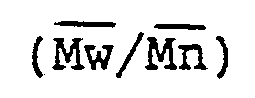 was 1.59.
Further, the transparency of this resin was evaluated in the same manner as in Preparation Example 1, whereby the resin was found to have a transmittance of 78% T/μm to a light having a wavelength of 248 nm. PREPARATION EXAMPLES 3 to 9
Preparation of copolymers of other cycloolefins with maleic anhydride
Preparation Examples of copolymers of other cycloolefins with maleic anhydride, soluble in an aqueous alkaline solution, to be used for the photoresist compositions of the present invention, will be given in Table 1.

PREPARATION EXAMPLE 10
Preparation of a bicyclo[2,2,1]hepta-2,5-diene/maleimide copolymer
6.8 g of a bicyclo[2,2,1]hepta-2,5-diene/maleimide copolymer was prepared in the same manner as in
Preparation Example 1 from 9.2 g of bicyclo[2,2,1]hepta- 2,5-diene and 9.7 g of maleimide.
The weight average molecular weight
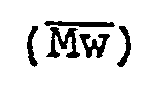 of this copolymer was 7,100 as measured by gel permeation chromatography using polystyrene as the standard. The ratio of the weight average molecular weight to the number average molecular weight
 was 1.63.
The transparency of this resin was evaluated in the same manner as in Preparation Example 1, whereby this resin was found to have a transmittance of 75% T/μm to a light having a wavelength of 248 nm.
PREPARATION EXAMPLE 11
Preparation of a 5-vinylbicyclo[2,2,1]hept-2-ene/maleic anhydride copolymer 6.8 g of a 5-vinylbicyclo[2,2,1]hept-2-ene/maleimide copolymer was prepared in the same manner as in
Preparation Example 1 from 12.0 g of 5-vinylbicyclo[2,2,1]hept-2-ene and 9.7 g of maleimide. The weight average molecular weight of this
 copolymer was 5,600 as measured by gel permeation chromatography (GPC) using polystyrene as the standar.d.
The ratio of the weight average molecular weight to the
number average molecular weight
 was 1.78.
The transparency of this resin was evaluated in the same manner as in Preparation Example 1, whereby this resin was found to have a transmittance of 73% T/μm to a light having a wavelength of 248 nm. PREPARATION EXAMPLES 12 to 18
Preparation of copolymers of other cycloolefins with maleimide
Preparation Examples of copolymers of other cycloolefins with maleimide, soluble in an aqueous alkaline solution, to be used for the photoresist compositions of the present invention, are shown in Table 2.

PREPARATION EXAMPLE 19
Hydrolysis of a bicyclo[2,2,1]hepta-2,5-diene/maleic anhydride copolymer
5 g of the bicyclo[2,2,1]hepta-2,5-diene/maleic anhydride copolymer obtained in Preparation Example 1 and 100 mℓ of a 5% NaOH aqueous solution were mixed and reacted at 70°C for 12 hours. After completion of the reaction, the system was acidified with hydrochloric acid. The precipitated solid substance was collected by filtration and washed repeatedly with water. Then, the substance was vacuum-dried at 70°C for 24 hours to obtain 4.2 g of colorless solid.
From the IR analysis, this colorless solid was confirmed to be a product wherein acid anhydride rings in the starting resin were almost completely hydrolyzed, since absorptions at 1,770 cm-1 and 1,850 cm-1 (absorptions attributable to C=0 of an acid anhydride ring) of the bicyclo[2,2,1]hepta-2,5-diene/maleic anhydride copolymer as the starting material resin, were found to have disappeared.
Further, the transparency of this resin was evaluated in the same manner as in Preparation Example 1, whereby this resin was found to have a transmittance of 78% T/μm to a light having a wavelength of 248 nm. PREPARATION EXAMPLES 20 to 27
Hydrolysis of copolymers of other cycloolefins with maleic anhydride
Preparation Examples for the hydrolysis of copolymers of other cycloolefins with maleic anhydride, soluble in an aqueous alkaline solution, to be used for the photoresist composition of the present invention, are shown in Table 3.

PREPARATION EXAMPLE 28
Esterification of a bicyclo[2,2,1]hepta-2,5-diene/maleic anhydride copolymer
5g of the bicyclo[2,2,1]hepta-2,5-diene/maleic anhydride copolymer obtained in Preparation Example 1 and 150 mℓ of dry THF were mixed and thoroughly stirred at 40°C until the system became uniform. Then, to this solution, 15.8 g of isopropyl alcohol was added, and 0.5 mℓ of concentrated sulfuric acid was added as a catalyst thereto. The mixture was refluxed for 8 hours under heating. After completion of the reaction, the reaction solution was poured into a large amount of water, and the precipitated solid substance was collected by filtration. The substance was repeatedly purified by precipitation from water after dissolving in tetrahydrofuran, and then vacuum-dried at 70°C for 24 hours to obtain 5.1 g of colorless solid.
From the NMR analysis and the IR analysis, this colorless solid was confirmed to be a product obtained by esterification ring-opening of a part of acid anhydride rings in the bicyclo[2,2,1]hepta-2,5-diene/maleic anhydride copolymer as the starting material resin by isopropyl alcohol. The esterification rate of the acid anhydride rings of this resin was 68% as calculated from the changes in the absorptions at 1,770 cm-1 and 1850 cm- 1 by the IR analysis.
Further, the transparency of this resin was evaluated
in the same manner as in Preparation Example 1, whereby this resin was found to have a transmittance of 78% T/μm to a light having a wavelength of 248 nm. PREPARATION EXAMPLES 29 to 34 Esterification of copolymers of other cycloolefins with maleic anhydride
Preparation Examples for esterification of copolymers of other cycloolefins with maleic anhydride, soluble in an aqueous alkaline solution, to be used for the photoresist compositions of the present invention, are shown in Table 4.

PREPARATION EXAMPLE 35
Amido-conversion of a bicyclo[2,2,1]hepta-2,5- diene/maleic anhydride copolymer
5 g of the bicyclo[2,2,1]hepta-2,5-diene/maleic anhydride copolymer obtained in Preparation Example 1 and 100 mℓ of dry dimethylformamide were mixed and thoroughly stirred at 50°C until the system became uniform. Then, to this solution, 15.0 g of isopropylamine was added, and the reaction was conducted at 80°C for 8 hours. After completion of the reaction, the reaction solution was poured into a large amount of ethyl ether, and the precipitated solid substance was collected by filtration. The substance was repeatedly purified by precipitation from ethyl ether after dissolving in tetrahydrofuran and then vacuum-dried at 70°C for 24 hours to obtain 5.1 g of colorless solid.
From the NMR analysis and the IR analysis, this colorless solid was found to be a product obtained by amido ring-opening of a part of acid anhydride rings in the bicyclo[2,2,1]hepta-2,5-diene/maleic anhydride copolymer as the starting material resin by isopropylamine. Further, the amido-conversion of the acid anhydride rings of this resin was 68% as calculated from the content of the nitrogen atom by the elemental analysis of this resin.
Further, the transparency of this resin was evaluated in the same manner as in Preparation Example 1, whereby
this resin was found to have a transmittance of 78% T/μm to a light having a wavelength of 248 nm. PREPARATION EXAMPLES 36 to 41
Amido-conversion of copolymers of other cycloolefins with maleic anhydride
Preparation Examples for amido-conversion of the copolymers of other cycloolefins with maleic anhydride, soluble in an aqueous alkaline solution, to be used for the photoresist compositions of the present invention, are shown in Table 5.

PREPARATION EXAMPLE 42
Imido rinσ-closure of the amido-conversion product of a bicyclo[2,2,1]hepta-2,5-diene/maleic anhydride copolymer 5 g of the amido-conversion product of the bicyclo[2,2,1]hepta-2,5-diene/maleic anhydride copolymer obtained in Preparation Example 35 and 100 mℓ of dry dimethylformamide were mixed and thoroughly stirred at 50°C until the system became uniform. Then, to this solution, 3.5 g of tri-n-butylamine as a catalyst and 12 mℓ of toluene as an azeotropic solvent were added, and the mixture was heated at 140°C. Water formed was azeotropically gradually removed from the reaction system, and the reaction was conducted for 4 hours until water no longer formed. After completion of the reaction, the reaction solution was poured into a large amount of ethyl ether, and the precipitated solid substance was collected by filtration. The substance was repeatedly purified by precipitation from ethyl ether after dissolving in tetrahydrofuran and then vacuum-dried at 70°C for 24 hours to obtain 5.1 g of colorless solid. From the IR analysis, this colorless solid was confirmed to be a product obtained by imido ring-closure of the amido ring-opened moiety of the acid anhydride rings in the amido-conversion product of the bicyclo[2,2,1]hepta-2,5-diene/maleic anhydride copolymer as the starting material resin, since the absorption at 1,720 cm-1 (absorption attributable to C=0 of a carboxyl
group) of the amido-conversion product of the bicyclo[2,2,1]hepta-2,5-diene/maleic anhydride copolymer as the starting material resin, was found to have disappeared in this colorless solid. Further, the transparency of this resin was evaluated in the same manner as in Preparation Example 1, whereby this resin was found to have a transmittance of 78% T/μm to a light having a wavelength of 248 nm.
PREPARATION EXAMPLES 43 to 47 Imido ring-closure of the amido-conversion products of the copolymers of other cycloolefins with maleic anhydride
Preparation Examples for imido ring-closure of the amido-conversion products of the copolymers of other cycloolefins with maleic anhydride, soluble in an aqueous alkaline solution, to be used for the photoresist compositions of the present invention, are shown in Table
6.

EXAMPLE 1
Formation of a positive image
Preparation of a σuinone diazide type positive photoresist composition A positive photoresist composition of the present invention comprising 8.0 g of the resin obtained in
Preparation Example 1 and 1.3 g of 2,3,4- trihydroxybenzophenone-2,3,4-tris[naphthoquinone-1,2- diazido-5-sulfonate] was dissolved in 22 mℓ of cyclohexanone. This solution was filtered through a 0.2 μm filter to obtain a resist solution.
Coating of a photoresist
The above resist solution was spin-coated at 2,300 rpm by a spin coater on a silicon wafer treated by hydrophobic treatment with HMDS (hexamethyl disilazane).
Then, this wafer was heated (prebaked) at 90°C for 20 minutes in a hot air circulating oven to form a resist film having a thickness of 1.0 μm.
Measurement of the sensitivity of the resist To the above resist film, a KrF excimer laser
(wavelength: 248 nm) was irradiated by changing the position and the dose of exposure. After the irradiation, the resist film was immersed in an aqueous solution containing 1.0% of tetramethylammonium hydroxide for development. Then, the resist film was rinsed with deionized water for 40 seconds and heated (post baked) at 90°C for 30 minutes in a hot air circulating oven. The
thickness of the film thus obtained was measured by means of a contact type film thickness meter. The relation between the exposed dose and the film remaining rate was plotted, and the exposed dose at which the film remaining rate became 0%, was taken as the sensitivity. As a result, the sensitivity of the above resist was 74 mj/cm2. Formation of a fine image
The non-exposed resist film obtained in the same manner, was subjected to exposure to a KrF excimer laser at a proper dose by means of a 5:1 reduced projection exposure apparatus with a KrF excimer laser as the light source by using a chromium photomask having a fine pattern. After the exposure, this resist film was immersed in an aqueous solution containing 1.0% of tetramethylammonium hydroxide for one minute for development. Then, it was rinsed with deionized water for 40 seconds and heated (post baked) at 90°C for 30 minutes in a hot air circulating oven to obtain a positive image of the photomask pattern.
The positive image thus obtained was inspected by a scanning type electron microscope, whereby it was found that an image having an excellent rectangular pattern profile with 0.5 μmL/S (line and space) was formed. EXAMPLE 2
Formation of a negative image
Preparation of a bisazide type negative photoresist
composition
A negative photoresist composition of the present invention comprising 8.0 g of the resin obtained in Preparation Example 1 and 1.1 g of 3,3'- diazidodiphenylsulfone as a photosensitive agent, was dissolved in 22 mℓ of cyclohexanone. This solution was filtered through a 0.2 μm filter to obtain a resist solution. Coating of a photoresist The above resist solution was spin coated in the same manner as in Example 1 on a silicon wafer treated by hydrophobic treatment with HMDS (hexamethyldisilazane) to form a resist film having a thickness of 1.0 μm. Measurement of the sensitivity of the resist To the above resist film, a KrF excimer laser (wavelength: 248 nm) was irradiated by changing the position and dose of exposure. After the irradiation, this resist film was immersed in an aqueous solution containing 1.0% of tetramethylammonium hydroxide for one minute for development. Then, it was rinsed with deionized water for 40 seconds and heated (post baked) at 90°C for 30 minutes in a hot air circulating oven. The thickness of the film thus obtained was measured by a contact type film thickness meter. The relation between the exposed dose and the film remaining rate was plotted, and the exposed dose at which the film remaining rate became 80%, was taken as the sensitivity. As a result,
the sensitivity of the above resist was 128 mj/cm2. Formation of a fine image
The non-exposed resist film obtained in the same manner, was subjected to exposure to a KrF excimer laser at a proper dose by means of a 5:1 reduced projection exposure apparatus with a KrF excimer laser as the light source by using a chromium photomask having a fine pattern. After the exposure, this resist film was immersed in an aqueous solution containing 1.0% of tetramethylammonium hydroxide for one minute for development. Then, it was rinsed with deionized water for 40 seconds and heated (post baked) at 90°C for 30 minutes in a hot air circulating oven to obtain a negative image of the photomask pattern. The negative image thus obtained was inspected by a scanning type electron microscope, whereby it was found that an image having an excellent rectangular pattern profile with 0.5 μmL/S (line and space) was formed. EXAMPLES 3 TO 94 By using other photoresist compositions of the present invention prepared in a similar manner, positive or negative images were formed in the same manner as in Example 1 or Example 2. The results are shown in Table 7.


Claims
1. A photoresist composition comprising: a resin soluble in an aqueous alkaline solution, having units of an aliphatic cyclic hydrocarbon main frame and units derived from maleic anhydride and/or units derived from a maleimide; and a photosensitive agent in a sufficient amount to promote or hinder the solubility of said resin in an aqueous alkaline solution upon exposure to active radiation so as to create a substantial difference in the solubility as between an exposed portion and a non-exposed portion and to form a positive or negative image by subsequent development with an aqueous alkaline solution.
2. The photoresist composition according to Claim 1, wherein said resin soluble in an aqueous alkaline solution is a copolymer of an aliphatic cyclic hydrocarbon having at least one unsaturated double bond, with maleic anhydride.
3. The photoresist composition according to Claim 1, wherein said resin soluble in an aqueous alkaline solution is a copolymer of an aliphatic cyclic hydrocarbon having at least one unsaturated double bond, with a maleimide.
4. The photoresist composition according to Claim 1, wherein said resin soluble in an aqueous alkaline solution is a resin obtained by hydrolyzing acid anhydride rings in maleic anhydride units of a copolymer of an aliphatic cyclic hydrocarbon having at least one unsaturated double bond, with maleic anhydride.
5. The photoresist composition according to Claim 1, wherein said resin soluble in an aqueous alkaline solution is a resin obtained by ring-opening acid anhydride rings in maleic anhydride units of a copolymer of an aliphatic cyclic hydrocarbon having at least one unsaturated double bond, with maleic anhydride, by a compound having a hydroxyl group.
6. The photoresist composition according to Claim 1, wherein said resin soluble in an aqueous alkaline solution is a resin obtained by ring-opening an acid anhydride rings in maleic anhydride units of a copolymer of an aliphatic cyclic hydrocarbon having at least one unsaturated double bond, with maleic anhydride, by a compound having an amino group.
7. The photoresist composition according to Claim 1, wherein said resin soluble in an aqueous alkaline solution is a resin obtained by ring-opening acid anhydride rings in maleic anhydride units of a copolymer of an aliphatic cyclic hydrocarbon having at least one unsaturated double bond, with maleic anhydride, by a compound having an amino group, followed by imido-ring closure of a part or whole of maleic acid units formed by the ring-opening in the copolymer.
8. The photoresist composition according to any one of Claims 2 to 7, wherein said aliphatic cyclic hydrocarbon is a compound of the formula (1):

9. The photoresist composition according to any one of Claims 2 to 7, wherein said aliphatic cyclic hydrocanbon is a compound of the formula (2):

10. The photoresist composition according to any one of Claims 2 to 7, wherein said aliphatic cyclic hydrocarbon is a compound of the formula (3):  wherein each of R11 to R17 which may be the same or different, is a hydrogen atom or an alkyl group having from 1 to 3 carbon atoms.
11. The photoresist composition according to any one of Claims 2 to 7, wherein said aliphatic cyclic hydrocarbon is a compound of the formula (4):

12. The photoresist composition according to any one of Claims 2 to 7, wherein said aliphatic cyclic hydrocarbon is a compound of the formula (5):  wherein each of R22 to R25 is a hydrogen atom or an alkyl group having from 1 to 3 carbon atoms.
13. The photoresist composition according to any one of Claims 2 to 7, wherein said aliphatic cyclic hydrocarbon is a compound of the formula (6):

14. The photoresist composition according to any one of Claims 2 to 7, wherein said aliphatic cyclic hydrocarbon is a compound of the formula (7):  wherein each of R38 to R44 which may be the same or different, is a hydrogen atom or an alkyl group having from 1 to 3 carbon atoms.
15. The photoresist composition according to any one of
Claims 2 to 7, wherein said aliphatic cyclic hydrocarbon is a compound of the formula (8):

16. The photoresist composition according to Claim 5, wherein said compound having a hydroxyl group is a compound of the formula (9):
HO - R53 (9) wherein R53 is an alkyl group, a cycloalkyl group or a group of the formula (10), (11) or (12): —R54-OH
(10)


17. The photoresist composition according to Claim 6 or
7, wherein said compound having an amino group is a compound of the formula (13): H2N-R58 (13) wherein R58 is an alkyl group, a cycloalkyl group or a group of the formula (14), (15) or (16):
—R59-OH (14)


18. The photoresist composition according to any one of Claims 1 to 17, wherein said photosensitive agent is a naphthoquinone type positive photosensitive agent.
19. The photoresist composition according to any one of Claims 1 to 17, wherein said photosensitive agent is a bis-azide type negative photosensitive agent.
20. The photoresist composition according to any one of Claims 1 to 19, wherein said photosensitive agent is in an amount of from 1 to 100 parts by weight per 100 parts by weight of said resin soluble in an aqueous alkaline solution.
21. The photoresist composition according to any one of Claims 1 to 20, wherein said resin soluble in an aqueous alkaline solution has a molecular weight of from 1,000 to 20,000.
22. A method for forming a resist pattern, which comprises forming a layer of a photoresist composition of Claim 1 on a substrate, irradiating the layer with a ultraviolet or excimer laser radiation to form a latent image, and developing the latent image.
Priority Applications (4)
| Application Number | Priority Date | Filing Date | Title |
|---|---|---|---|
| US07/425,191 US5212043A (en) | 1988-02-17 | 1989-02-17 | Photoresist composition comprising a non-aromatic resin having no aromatic structures derived from units of an aliphatic cyclic hydrocarbon and units of maleic anhydride and/or maleimide and a photosensitive agent |
| KR1019890701900A KR900700923A (en) | 1988-02-17 | 1989-02-17 | Photoresist composition |
| EP89902538A EP0380676B1 (en) | 1988-02-17 | 1989-02-17 | Photoresist composition |
| DE68915148T DE68915148T2 (en) | 1988-02-17 | 1989-02-17 | PHOTORESIST COMPOSITION. |
Applications Claiming Priority (24)
| Application Number | Priority Date | Filing Date | Title |
|---|---|---|---|
| JP63/32806 | 1988-02-17 | ||
| JP3280688 | 1988-02-17 | ||
| JP3387888 | 1988-02-18 | ||
| JP63/33880 | 1988-02-18 | ||
| JP3387988 | 1988-02-18 | ||
| JP63/33879 | 1988-02-18 | ||
| JP63/33878 | 1988-02-18 | ||
| JP3388088 | 1988-02-18 | ||
| JP3387788 | 1988-02-18 | ||
| JP63/33877 | 1988-02-18 | ||
| JP63/40647 | 1988-02-25 | ||
| JP4064788 | 1988-02-25 | ||
| JP63/123926 | 1988-05-23 | ||
| JP12392688 | 1988-05-23 | ||
| JP63/123925 | 1988-05-23 | ||
| JP12392588 | 1988-05-23 | ||
| JP16512588 | 1988-07-04 | ||
| JP16512888 | 1988-07-04 | ||
| JP16512488 | 1988-07-04 | ||
| JP16512688 | 1988-07-04 | ||
| JP63/165125 | 1988-07-04 | ||
| JP63/165124 | 1988-07-04 | ||
| JP63/165128 | 1988-07-04 | ||
| JP63/165126 | 1988-07-04 |
Publications (1)
| Publication Number | Publication Date |
|---|---|
| WO1989007786A1 true WO1989007786A1 (en) | 1989-08-24 |
Family
ID=27583268
Family Applications (1)
| Application Number | Title | Priority Date | Filing Date |
|---|---|---|---|
| PCT/JP1989/000159 Ceased WO1989007786A1 (en) | 1988-02-17 | 1989-02-17 | Photoresist composition |
Country Status (5)
| Country | Link |
|---|---|
| US (1) | US5212043A (en) |
| EP (1) | EP0380676B1 (en) |
| KR (1) | KR900700923A (en) |
| DE (1) | DE68915148T2 (en) |
| WO (1) | WO1989007786A1 (en) |
Cited By (3)
| Publication number | Priority date | Publication date | Assignee | Title |
|---|---|---|---|---|
| EP0388484B1 (en) * | 1989-03-20 | 1994-09-21 | Siemens Aktiengesellschaft | High resolution photoresist |
| EP0388483B1 (en) * | 1989-03-20 | 1994-11-30 | Siemens Aktiengesellschaft | Process for producing a photoresist structure |
| WO1996024621A1 (en) * | 1995-02-06 | 1996-08-15 | Siemens Aktiengesellschaft | Polymers for radiation-sensitive varnishes |
Families Citing this family (73)
| Publication number | Priority date | Publication date | Assignee | Title |
|---|---|---|---|---|
| JP2847321B2 (en) * | 1990-08-14 | 1999-01-20 | 日本石油株式会社 | Positive photoresist composition |
| JP3000745B2 (en) * | 1991-09-19 | 2000-01-17 | 富士通株式会社 | Resist composition and method of forming resist pattern |
| JPH0659453A (en) * | 1992-08-07 | 1994-03-04 | Nippon Oil Co Ltd | Positive photosensitive resin composition |
| US5410004A (en) * | 1994-01-24 | 1995-04-25 | Arizona Chemical Company | Thermal polymerization of dicyclopentadiene |
| EP0671662B1 (en) * | 1994-02-24 | 1999-01-20 | Nec Corporation | Method for developing a resist pattern |
| GB9520950D0 (en) * | 1995-10-13 | 1995-12-13 | Martinex R & D Inc | Water-processable chemically amplified resist |
| US5807937A (en) * | 1995-11-15 | 1998-09-15 | Carnegie Mellon University | Processes based on atom (or group) transfer radical polymerization and novel (co) polymers having useful structures and properties |
| JP2845225B2 (en) * | 1995-12-11 | 1999-01-13 | 日本電気株式会社 | Polymer compound, photosensitive resin composition and pattern forming method using the same |
| US6103845A (en) * | 1996-10-11 | 2000-08-15 | Samsung Electronics Co., Ltd. | Chemically amplified resist polymers |
| US5962184A (en) * | 1996-12-13 | 1999-10-05 | International Business Machines Corporation | Photoresist composition comprising a copolymer of a hydroxystyrene and a (meth)acrylate substituted with an alicyclic ester substituent |
| KR100211548B1 (en) * | 1996-12-20 | 1999-08-02 | 김영환 | Ultraviolet photosensitive film copolymer and its manufacturing method |
| KR100265597B1 (en) * | 1996-12-30 | 2000-09-15 | 김영환 | Arf photosensitive resin and manufacturing method thereof |
| KR100220953B1 (en) * | 1996-12-31 | 1999-10-01 | 김영환 | Arf photoresist substituted with amide or imide |
| US6808859B1 (en) * | 1996-12-31 | 2004-10-26 | Hyundai Electronics Industries Co., Ltd. | ArF photoresist copolymers |
| KR100225956B1 (en) * | 1997-01-10 | 1999-10-15 | 김영환 | AF photosensitive film resin which introduced amine |
| US6114084A (en) | 1997-02-27 | 2000-09-05 | Samsung Electronics Co. Ltd. | Chemically amplified resist composition |
| KR100252546B1 (en) * | 1997-11-01 | 2000-04-15 | 김영환 | Copolymer Resin, Photoresist and Manufacturing Method Thereof |
| KR100254472B1 (en) * | 1997-11-01 | 2000-05-01 | 김영환 | New maleimide and alicyclic olefin monomer |
| KR100321080B1 (en) | 1997-12-29 | 2002-11-22 | 주식회사 하이닉스반도체 | Copolymer resin, method for preparing the same, and photoresist using the same |
| KR100313150B1 (en) * | 1997-12-31 | 2001-12-28 | 박종섭 | Lysocolyl ecidyl (meth) acrylate monomer, copolymer resin which introduce | transduced it, and photoresist using this resin |
| KR100520148B1 (en) | 1997-12-31 | 2006-05-12 | 주식회사 하이닉스반도체 | Novel bicycloalkene derivatives and photoresist polymers using the same and photoresist compositions containing the polymers |
| KR100334387B1 (en) * | 1997-12-31 | 2002-11-22 | 주식회사 하이닉스반도체 | Copolymer and manufacturing method thereof and photoresist using the copolymer |
| KR100354871B1 (en) | 1997-12-31 | 2003-03-10 | 주식회사 하이닉스반도체 | Copolymer resin, method for producing the same, and photoresist using the same |
| KR100564535B1 (en) * | 1998-03-16 | 2006-05-25 | 삼성전자주식회사 | Photoresist, preparation method therefor, and photolithographic method using thereof |
| KR19990081722A (en) | 1998-04-30 | 1999-11-15 | 김영환 | Carboxyl group-containing alicyclic derivatives and preparation method thereof |
| KR100376983B1 (en) | 1998-04-30 | 2003-08-02 | 주식회사 하이닉스반도체 | Photoresist polymer and method for forming micropattern by using the same |
| KR100403325B1 (en) | 1998-07-27 | 2004-03-24 | 주식회사 하이닉스반도체 | Photoresist Polymers and Photoresist Compositions Using the Same |
| KR20000015014A (en) | 1998-08-26 | 2000-03-15 | 김영환 | New photoresist monomer, polymer, and photoresist compound |
| JP3587743B2 (en) | 1998-08-26 | 2004-11-10 | 株式会社ハイニックスセミコンダクター | A photoresist monomer and a method for producing the same, a photoresist copolymer and a method for producing the same, a photoresist composition, a method for forming a photoresist pattern, and a semiconductor device. |
| US6569971B2 (en) * | 1998-08-27 | 2003-05-27 | Hyundai Electronics Industries Co., Ltd. | Polymers for photoresist and photoresist compositions using the same |
| KR100274119B1 (en) * | 1998-10-08 | 2001-03-02 | 박찬구 | Polymer for preparing radiation-sensitive resist and resist composition containing same |
| JP3680920B2 (en) | 1999-02-25 | 2005-08-10 | 信越化学工業株式会社 | Novel ester compound, polymer compound, resist material, and pattern forming method |
| KR100557620B1 (en) * | 1999-07-30 | 2006-03-10 | 주식회사 하이닉스반도체 | Novel photoresist monomers, copolymers thereof and photoresist compositions using the same |
| TW554254B (en) * | 1999-08-06 | 2003-09-21 | Hyundai Electronics Ind | Novel photoresist monomers, polymers thereof and photoresist compositions using the same |
| KR100425442B1 (en) * | 1999-08-24 | 2004-03-30 | 삼성전자주식회사 | Photosensitive polymer and chemically amplified photoresist composition containing the same |
| US6692888B1 (en) * | 1999-10-07 | 2004-02-17 | Shipley Company, L.L.C. | Copolymers having nitrile and alicyclic leaving groups and photoresist compositions comprising same |
| US6423780B1 (en) * | 2001-02-07 | 2002-07-23 | Loctite | Heterobifunctional monomers and uses therefor |
| US6521731B2 (en) * | 2001-02-07 | 2003-02-18 | Henkel Loctite Corporation | Radical polymerizable compositions containing polycyclic olefins |
| US6946523B2 (en) * | 2001-02-07 | 2005-09-20 | Henkel Corporation | Heterobifunctional monomers and uses therefor |
| US7138218B2 (en) * | 2001-12-18 | 2006-11-21 | Hynix Semiconductor Inc. | Process for forming an ultra fine pattern using a bottom anti-reflective coating film containing an acid generator |
| US7338742B2 (en) * | 2003-10-08 | 2008-03-04 | Hynix Semiconductor Inc. | Photoresist polymer and photoresist composition containing the same |
| US7270937B2 (en) * | 2003-10-17 | 2007-09-18 | Hynix Semiconductor Inc. | Over-coating composition for photoresist and process for forming photoresist pattern using the same |
| KR100680405B1 (en) * | 2003-11-19 | 2007-02-08 | 주식회사 하이닉스반도체 | Photoresist composition for EV and photoresist pattern forming method using same |
| EP1725590A4 (en) * | 2004-03-05 | 2013-08-07 | Univ Carnegie Mellon | METHOD FOR RADICAL POLYMERIZATION BY ATOM TRANSFER |
| WO2007025086A2 (en) | 2005-08-23 | 2007-03-01 | Carnegie Mellon University | Atom transfer radical polymerization in microemulsion and true emulsion polymerization |
| CN101379091B (en) * | 2005-08-26 | 2012-05-30 | 卡内基梅隆大学 | Polymerization process under catalyst regeneration |
| KR100731326B1 (en) * | 2005-12-16 | 2007-06-25 | 주식회사 삼양이엠에스 | Positive photoresist composition |
| KR100694412B1 (en) * | 2006-02-24 | 2007-03-12 | 주식회사 하이닉스반도체 | Micro pattern formation method of semiconductor device |
| US7745339B2 (en) * | 2006-02-24 | 2010-06-29 | Hynix Semiconductor Inc. | Method for forming fine pattern of semiconductor device |
| US7579403B2 (en) * | 2006-04-04 | 2009-08-25 | E. I. Du Pont De Nemours And Company | Stain resist comprising hyperbranched maleic anhydride-diene polymers |
| US7579420B2 (en) | 2006-04-04 | 2009-08-25 | E. I. Du Pont De Nemours And Company | Hyperbranched maleic anhydride-diene polymers |
| US8313876B2 (en) * | 2006-07-20 | 2012-11-20 | Hynix Semiconductor Inc. | Exposure mask and method for manufacturing semiconductor device using the same |
| KR100849800B1 (en) * | 2006-07-20 | 2008-07-31 | 주식회사 하이닉스반도체 | Exposure mask and method of manufacturing semiconductor device using same |
| US8367051B2 (en) * | 2006-10-09 | 2013-02-05 | Carnegie Mellon University | Preparation of functional gel particles with a dual crosslink network |
| KR100861173B1 (en) * | 2006-12-01 | 2008-09-30 | 주식회사 하이닉스반도체 | Pattern Forming Method of Semiconductor Device Using Immersion Exposure Process |
| US20080274424A1 (en) * | 2007-05-05 | 2008-11-06 | Yisong Yu | Positive photosensitive element comprising vinyl polymers |
| US8252880B2 (en) * | 2007-05-23 | 2012-08-28 | Carnegie Mellon University | Atom transfer dispersion polymerization |
| US8865797B2 (en) * | 2007-05-23 | 2014-10-21 | Carnegie Mellon University | Hybrid particle composite structures with reduced scattering |
| GB2481561B (en) | 2009-03-27 | 2013-12-11 | Univ Carnegie Mellon | Preparation of functional star macromolecules |
| US8853856B2 (en) | 2010-06-22 | 2014-10-07 | International Business Machines Corporation | Methodology for evaluation of electrical characteristics of carbon nanotubes |
| US8449781B2 (en) | 2010-06-22 | 2013-05-28 | International Business Machines Corporation | Selective etch back process for carbon nanotubes intergration |
| US8475667B2 (en) | 2010-06-22 | 2013-07-02 | International Business Machines Corporation | Method of patterning photosensitive material on a substrate containing a latent acid generator |
| US9644042B2 (en) | 2010-12-17 | 2017-05-09 | Carnegie Mellon University | Electrochemically mediated atom transfer radical polymerization |
| JP5728790B2 (en) | 2011-07-14 | 2015-06-03 | 住友ベークライト株式会社 | Self-developing layer-forming polymer and composition thereof |
| WO2013028756A1 (en) | 2011-08-22 | 2013-02-28 | Carnegie Mellon University | Atom transfer radical polymerization under biologically compatible conditions |
| US9533297B2 (en) | 2012-02-23 | 2017-01-03 | Carnegie Mellon University | Ligands designed to provide highly active catalyst complexes |
| WO2015038411A2 (en) * | 2013-09-16 | 2015-03-19 | Promerus, Llc | Amine treated maleic anhydride polymers, compositions and applications thereof |
| CN106068288B (en) * | 2014-03-06 | 2018-05-01 | 住友电木株式会社 | Polymer, photosensitive resin composition and electronic device |
| US9982070B2 (en) | 2015-01-12 | 2018-05-29 | Carnegie Mellon University | Aqueous ATRP in the presence of an activator regenerator |
| TWI659046B (en) * | 2015-05-06 | 2019-05-11 | Sumitomo Bakelite Co., Ltd. | a polymer of maleimide and a cyclic olefin monomer as a permanent dielectric material |
| TWI692674B (en) | 2015-12-31 | 2020-05-01 | 日商住友電木股份有限公司 | Polymers derived from norbornadiene and maleic anhydride and use thereof |
| WO2018132582A1 (en) | 2017-01-12 | 2018-07-19 | Carnegie Mellon University | Surfactant assisted formation of a catalyst complex for emulsion atom transfer radical polymerization processes |
| US10738241B2 (en) * | 2018-01-23 | 2020-08-11 | Shenzhen China Star Optoelectronics Technology Co., Ltd. | Resin composition, cured photoresist and display panel |
Citations (7)
| Publication number | Priority date | Publication date | Assignee | Title |
|---|---|---|---|---|
| GB1243963A (en) * | 1967-08-15 | 1971-08-25 | Howson Algraphy Ltd | Improvements in or relating to light sensitive lithographic plates |
| US4106943A (en) * | 1973-09-27 | 1978-08-15 | Japan Synthetic Rubber Co., Ltd. | Photosensitive cross-linkable azide containing polymeric composition |
| FR2477294A1 (en) * | 1980-03-01 | 1981-09-04 | Japan Synthetic Rubber Co Ltd | PHOTOSENSITIVE RESIN COMPOSITION OF THE POSITIVE TYPE |
| EP0099949A1 (en) * | 1982-07-27 | 1984-02-08 | E.I. Du Pont De Nemours And Company | Improved aqueous processable, positive-working photopolymer compositions |
| EP0140319A2 (en) * | 1983-10-24 | 1985-05-08 | The B.F. GOODRICH Company | Polynorbornene Negative Photoresist |
| US4525523A (en) * | 1982-08-31 | 1985-06-25 | Kanto Chemical Co., Inc. | Negative-working photoresist coating composition |
| US4720445A (en) * | 1986-02-18 | 1988-01-19 | Allied Corporation | Copolymers from maleimide and aliphatic vinyl ethers and esters used in positive photoresist |
Family Cites Families (15)
| Publication number | Priority date | Publication date | Assignee | Title |
|---|---|---|---|---|
| US3188303A (en) * | 1961-03-17 | 1965-06-08 | Velsicol Chemical Corp | Process and product relating to the reaction of dicyclopentadiene and alpha, beta di-and tri-carboxylic acids |
| BR7310283D0 (en) * | 1972-12-29 | 1974-09-24 | Nippon Oil Co Ltd | PROCESS FOR THE PRODUCTION OF A RESIN FOR PRINTING INK |
| JPS5421089B2 (en) * | 1973-05-29 | 1979-07-27 | ||
| US4126738A (en) * | 1976-02-17 | 1978-11-21 | Borg-Warner Corporation | Copolymers of 5-norbornene 2,3-dicarboxylic anhydride and maleic anhydride |
| JPS5640220A (en) * | 1979-09-10 | 1981-04-16 | Hitachi Chem Co Ltd | Manufacturing of flyback transformer |
| DE3043967A1 (en) * | 1980-11-21 | 1982-06-24 | Hoechst Ag, 6000 Frankfurt | LIGHT SENSITIVE MIXTURE BASED ON O-NAPHTHOCHINONDIAZIDES AND LIGHT SENSITIVE COPY MATERIAL MADE THEREOF |
| JPS57151396A (en) * | 1981-03-14 | 1982-09-18 | Ricoh Co Ltd | Diazo system heat-sensitive recording material |
| JPS59170836A (en) * | 1983-03-16 | 1984-09-27 | Sumitomo Chem Co Ltd | Positive type photoresist composition |
| US5059513A (en) * | 1983-11-01 | 1991-10-22 | Hoechst Celanese Corporation | Photochemical image process of positive photoresist element with maleimide copolymer |
| DE3468542D1 (en) * | 1983-11-03 | 1988-02-11 | Basf Ag | Photopolymerisable registration material for the preparation of printing forms and process for the production of printing forms with this materials |
| JPH064832B2 (en) * | 1984-10-05 | 1994-01-19 | 三井石油化学工業株式会社 | Polymer adhesive |
| US4663268A (en) * | 1984-12-28 | 1987-05-05 | Eastman Kodak Company | High-temperature resistant photoresists featuring maleimide binders |
| US4980264A (en) * | 1985-12-17 | 1990-12-25 | International Business Machines Corporation | Photoresist compositions of controlled dissolution rate in alkaline developers |
| DE3606155A1 (en) * | 1986-02-26 | 1987-08-27 | Basf Ag | PHOTOPOLYMERIZABLE MIXTURE, THIS CONTAINING LIGHT-SENSITIVE RECORDING ELEMENT, AND METHOD FOR PRODUCING A FLAT PRINT MOLD BY THIS LIGHT-SENSITIVE RECORDING ELEMENT |
| DE58908012D1 (en) * | 1989-03-20 | 1994-08-11 | Siemens Ag | Photosensitive mixture. |
-
1989
- 1989-02-17 KR KR1019890701900A patent/KR900700923A/en not_active Withdrawn
- 1989-02-17 EP EP89902538A patent/EP0380676B1/en not_active Expired - Lifetime
- 1989-02-17 US US07/425,191 patent/US5212043A/en not_active Expired - Lifetime
- 1989-02-17 DE DE68915148T patent/DE68915148T2/en not_active Expired - Fee Related
- 1989-02-17 WO PCT/JP1989/000159 patent/WO1989007786A1/en not_active Ceased
Patent Citations (7)
| Publication number | Priority date | Publication date | Assignee | Title |
|---|---|---|---|---|
| GB1243963A (en) * | 1967-08-15 | 1971-08-25 | Howson Algraphy Ltd | Improvements in or relating to light sensitive lithographic plates |
| US4106943A (en) * | 1973-09-27 | 1978-08-15 | Japan Synthetic Rubber Co., Ltd. | Photosensitive cross-linkable azide containing polymeric composition |
| FR2477294A1 (en) * | 1980-03-01 | 1981-09-04 | Japan Synthetic Rubber Co Ltd | PHOTOSENSITIVE RESIN COMPOSITION OF THE POSITIVE TYPE |
| EP0099949A1 (en) * | 1982-07-27 | 1984-02-08 | E.I. Du Pont De Nemours And Company | Improved aqueous processable, positive-working photopolymer compositions |
| US4525523A (en) * | 1982-08-31 | 1985-06-25 | Kanto Chemical Co., Inc. | Negative-working photoresist coating composition |
| EP0140319A2 (en) * | 1983-10-24 | 1985-05-08 | The B.F. GOODRICH Company | Polynorbornene Negative Photoresist |
| US4720445A (en) * | 1986-02-18 | 1988-01-19 | Allied Corporation | Copolymers from maleimide and aliphatic vinyl ethers and esters used in positive photoresist |
Non-Patent Citations (1)
| Title |
|---|
| Patent Abstracts of Japan, volume 9, no. 26 (P-332)(1749), 5 February 1985; & JP-A-59170836 (SUMITOMO KAGAKU KOGYO K.K.) 27 September 1984 * |
Cited By (3)
| Publication number | Priority date | Publication date | Assignee | Title |
|---|---|---|---|---|
| EP0388484B1 (en) * | 1989-03-20 | 1994-09-21 | Siemens Aktiengesellschaft | High resolution photoresist |
| EP0388483B1 (en) * | 1989-03-20 | 1994-11-30 | Siemens Aktiengesellschaft | Process for producing a photoresist structure |
| WO1996024621A1 (en) * | 1995-02-06 | 1996-08-15 | Siemens Aktiengesellschaft | Polymers for radiation-sensitive varnishes |
Also Published As
| Publication number | Publication date |
|---|---|
| US5212043A (en) | 1993-05-18 |
| EP0380676A1 (en) | 1990-08-08 |
| DE68915148T2 (en) | 1994-08-18 |
| DE68915148D1 (en) | 1994-06-09 |
| KR900700923A (en) | 1990-08-17 |
| EP0380676B1 (en) | 1994-05-04 |
Similar Documents
| Publication | Publication Date | Title |
|---|---|---|
| EP0380676B1 (en) | Photoresist composition | |
| US4939070A (en) | Thermally stable photoresists with high sensitivity | |
| JP2715881B2 (en) | Photosensitive resin composition and pattern forming method | |
| JPH02146045A (en) | Photoresist composition | |
| CA1308594C (en) | Thermally stable photoresists with high sensitivity | |
| US6737215B2 (en) | Photoresist composition for deep ultraviolet lithography | |
| JP3545903B2 (en) | Chemically amplified resist composition | |
| US6187506B1 (en) | Antireflective coating for photoresist compositions | |
| JPS62229242A (en) | High resolution photoresist made of polymer containing imide | |
| JPH02209977A (en) | Positive photoresist composition having high sensitivity | |
| JPH08250416A (en) | Method for preparing negative tone resist image | |
| US6686429B2 (en) | Polymer suitable for photoresist compositions | |
| KR19980065458A (en) | ArF photosensitive film resin which introduced amine | |
| JP3495503B2 (en) | Crosslinked polymer | |
| JP3228193B2 (en) | Negative photoresist composition and pattern forming method using the same | |
| JPH07312331A (en) | Photoresist image forming process and integrated circuit | |
| KR100272115B1 (en) | How to manufacture semiconductor devices by plate printing | |
| JPH11228536A (en) | Maleimide-based monomer and its production, aliphatic cyclic olefin-based monomer and its production, copolymer resin and its production, photoresist and its production, and semiconductor device | |
| JPH0262544A (en) | Photoresist composition | |
| KR19990076735A (en) | Resist composition | |
| JP2638887B2 (en) | Photosensitive composition | |
| US20010049071A1 (en) | Highly sensitive positive photoresist compositions | |
| JP2000063433A (en) | Polymer, chemically amplified type negative resist containing the same and formation of resist pattern | |
| KR19980060890A (en) | ArF photoresist resin with excellent adhesion | |
| KR100362935B1 (en) | Novel Photoresist Polymers and Photoresist Compositions Using Them |
Legal Events
| Date | Code | Title | Description |
|---|---|---|---|
| AK | Designated states |
Kind code of ref document: A1 Designated state(s): KR US |
|
| AL | Designated countries for regional patents |
Kind code of ref document: A1 Designated state(s): AT BE CH DE FR GB IT LU NL SE |
|
| WWE | Wipo information: entry into national phase |
Ref document number: 1989902538 Country of ref document: EP |
|
| WWP | Wipo information: published in national office |
Ref document number: 1989902538 Country of ref document: EP |
|
| WWG | Wipo information: grant in national office |
Ref document number: 1989902538 Country of ref document: EP |