HERBICIDAL TRIAZOLINONES
This invention relates to herbicidal 1-aryl-4,5-dihydro-1,2,4-triazol-5(1H)-ones.
The herbicidal activity of certain 1-aryl-4,5-dihydro-1,2,4-triazol-5(1H)-ones (also known as 1-aryl-Δ2-1,2,4-triazolin-5-ones) has been described in the patent literature, as discussed below.
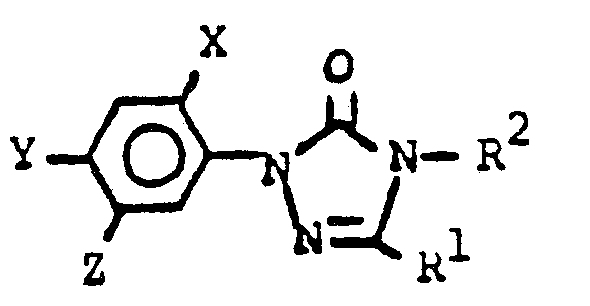
British published patent application 2,090,250 discloses herbicidal compounds of the formula
wherein R1 is an alkyl group, R2 is an alkynyl group, halomethyl group, or a haloethyl group and X is an alkoxy group, an alkenyloxy group, an alkoxyalkoxy group, an alkynyloxy group, a hydroxy group, a
halomethyloxy group, or a haloethyloxy group.
Japanese Kokai 58-225,070 discloses herbicidal compounds of the formula
wherein R
1 is 1-4C alkyl; R
2 is H, 1-4C alkyl,
halomethyl cr 3-4C alkynyl; X is Cl or F; Y is Cl, Br, OH or OR3; R3 is 1-4C alkyl or benzyl; Z is H, carboxy, cyanomethoxy, COOR4, COSR5 or C0N(R6) (R7); R4 is 1-4C alkyl or 3-4C alkoxyalkyl; R5 is 1-4C alkyl; and R6 and R7 are H, 1-4C alkyl or alkoxy.
U.S. patent 4,318,731 discloses herbicidal compounds of the formula
wherein R
1 is C
1-C
4 alkyl; R
2 is hydrogen, C
1-C
6 alkyl or C
1-C
4 alkenyl; and X is hydroxy, C
1-C
4 alkyl, C
1-C
6 alkyloxy, an alkyloxyalkyioxy of which two alkyls may be the same or different and each alkyl is C
1-C
4, a C
2-C
4 alkenyloxy, or an alkyloxycarbonylalkyloxy of which two alkyls may be the same or different and each alkyl is C
1-C
4.
U.S. patent 4,404,019 discloses herbicidal compounds of the formula
wherein R is a C
1-C
4 alkyl group, a C
3-C
4 alkenyl group or a C
3-C
4 cycloalkyl group, X is a chlorine or bromine atom and Y is a hydrogen atom or a C
1-C
4 alkoxy group.
U.S. patent 4,213,773 discloses fused-ring 1,2,4- triazolin-5-ones of the formula
in which V may be alkyl, X is F, Cl, Br, CN, CH
3 , CH
3O or NO
2, Y is H, F, Cl, Br or CH
3, Z is H, F, Cl or Br, n is 3 to 5, m is 0-2 and Q is O or S.
PCT International Applications WO 85/01637 publish- ed April 25, 1985, WO 85/04307 published October 10,
1985, WO 86/04481 published August 14, 1986, WO 86/02642 published May 9, 1986, and WO 87/00730 published
February 12, 1987 disclose various other substituted aryl-1,2,4-triazolin-5-ones in which the substituents at the 5-position of the benzene ring of the aryl group are, for instance, alkoxy, alkynyloxy, alkenyloxy, tetrahydrofuranyloxy or similar heterocycle-oxy, a group of the formula OR3COOR4 (where R3 may be alkylene or haloalkylene and R4 may be substituted alkyl, alkenyl, etc.), alkyl, cyanoalkyl, COR6, CH2COR6 or CH(CH3)COR6 (where R6 is, for instance, alkoxy or alkyl-substituted amino).
The compounds of this invention are herbicidal 1- aryl-4,5-dihydro-1,2,4-triazol-5(1H)-ones such as those in the prior art (e.g. the references mentioned above) in which, however, the carbon atom at the 5-position of the benzene ring carries a substituent (Q) as described below:
Q is a group of the formula:
-CH(R2)C(R3)(R4)Q' or -CH=C(R4)Q' in which Q' is a carboxylic acid group (i.e. COOH) or a salt, ester, amide, or nitrile of such carboxylic acid group. Thus Q' may be:
CO2H,
CO2Z,
CO2R5,
CON(R6) (R7), or
CN.
In another aspect of this invention Q' may be an aldehydic or ketonic group, e.g. -CHO or -COR5.
Z may be a salt-forming group, such as one which forms a base addition salt with a carboxylic acid, e.g. a sodium, potassium, calcium, ammonium, magnesium, or mono-, di- or tri(C1 to C4 alkyl) ammonium or sulfonium or sulfoxonium ion.
R5 may be alkyl, alkoxycarbonylalkyl, cycloalkyl (e.g. of 3 to 6 carbon atoms such as cyclopropyl or cyclopentyl), aralkyl such as benzyl or substituted benzyl (e.g.chlorobenzyl, alkylbenzyl, or haloalkylbenzyl, such as 4-chlorobenzyl or 4-trifluoromethylbenzyl).
R6 and R7 may each, independently, be H, OH, alkyl, cycloalkyl, alkenyl, alkynyl (e.g. propynyl), alkoxy, phenyl, benzyl, or SO2R6 (in which R6 is other than H), or any of the foregoing carrying additional
substituents; such additional substituents may be halogen (e.g. in haloalkyl such as chloroethyl,
halophenyl such as chlorophenyl, halobenzyl such as chlorobenzyl), alkyl, or cyano.
In the foregoing formula for Q, R2 and R3 may each, independently, be hydrogen or halogen (such as chlorine, bromine, or fluorine), while R4 may be H or lower alkyl.
The other substituents on the herbicidal 1-aryl- 4,5-dihydro-1,2,4-triazol-5(1H)-ones of this invention may, for instance, be any of those present in the herbicidal aryl triazolinones of the prior art mentioned above. For instance those other substituents are so chosen that the 5-Methoxy and 5-Propargyloxy Analogs of the compounds of this invention are herbicides; the 5- Methoxy Analog of a compound of this invention has a formula which is identical with that of the compound of this invention in all respects except that the ring- carbon atom at the 5-position of the benzene ring carries a methoxy substituent instead of a substituent Q as defined above. Similarly, the 5-Propargyloxy Analog
is otherwise identical except that the carbon at the 5- position of its benzene ring carries a propargyloxy substituent instead of a substituent Q as defined above. Thus the 5-Methoxy Analog of compound no. 3 of Table 1 below is 1-(2,4-dichloro-5-methoxyphenyl)-4-difluoromethyl-4,5-dihydro-3-methyl-1,2,4-triazol-5(H)-one and the 5-Propargyloxy Analog of compound no. 3 is 1-(2,4- dichloro-5-propargyloxyphenyl)-4-difluoromethyl-4,5- dihydro-3-methyl-1,2,4-triazol-5(H)-one.
The compounds of this invention preferably have 5- Methoxy Analogs and 5-Propargyloxy Analogs of marked herbicidal properties. For instance, said Analogs of the preferred compounds show at least 50% kill of at least one of the following species of plants when applied under at least one of the following modes at the rate of 0.5 kg/ha, and more preferably show such kill of at least 50% when applied at the rate of 0.1 kg/ha:
Species; velvetleaf (Abutilon theophrasti) green foxtail (Setaria viridis); Modes: preemergent, postemergent. Testing for such herbicidal activity may be carried out in the manner described below under the heading
"Herbicidal Activity".
Representative compounds of this invention are listed in Table 1 below.
One may describe many of the compounds of this invention by the formulas
in which Q' , R
2 , R
3 and R
4 have the meanings set forth above and the substituents R and R
1 on the triazolinone ring may be any of those known in the literature
discussed above. For instance, each of R and R1 may, independently, be lower alkyl (preferably methyl) or halo lower alkyl such as fluoro lower alkyl (e.g.
CF2CHF2 or CHF2). R may also be a halogen atom such as chlorine. Preferably R is methyl and R1 is CHF2. The substituent X may be hydrogen; halogen such as chlorine, bromine, or fluorine (preferably fluorine); alkyl such as lower alkyl (e.g. methyl); haloalkyl such as halo lower alkyl (e.g. CF3, CH2F or CHF2); alkoxy such as lower alkoxy (e.g. methoxy); or nitro; and Y may be hydrogen; halogen such as chlorine, bromine, or fluorine (preferably bromine or chlorine); alkyl such as lower alkyl (e.g. methyl); alkoxy such as lower alkoxy (e.g. methoxy); haloalkyl such as halo lower alkyl (e.g.
fluoroalkyl); halo lower alkylsulfinyl (e.g. -SOCF3); or halo lower alkoxy (e.g. -OCHF2). Presently preferred X, Y substituents are: 2-F, 4-C1; 2-F, 4-Br; 2,4-diCl; 2- Br, 4-Cl; and 2-F, 4-CF3.
In each aspect of the invention it is often preferable that any alkyl, alkenyl, alkynyl or alkylene moiety (such as the hydrocarbon moiety of an alkoxy or haloalkoxy group) have less than 6 carbon atoms, e.g. 1 to 3 or 4 carbon atoms, and that any cycloalkyl moiety have 3 to 7 ring carbon atoms, preferably 3-6 carbon atoms.
Any acidic compound of this invention, including sulfonamides in which NR6R7 is NHSO2R6, may be converted to the corresponding base addition salt, such as a salt in which the salt-forming cation is Z (Z being as described above).
The present compounds may be prepared by methods described in the literature or in the following Examples
or by methods analogous and similar thereto and within the skill of the art.
In Step A of Examples 1 and 3 below an amino compound of the formula
(such as the compound shown in Example 1 of
International patent publication WO 87/03782, published July 2, 1987) is reacted (according to the Meerwein arylation reaction or a modification thereof) with an olefinic compound having the formula CHR2=CR4Q' to form a compound of Formula I above in which Q is
-CH(R2)C(R3)(R4)Q' and in which R3 is halogen. In this type of reaction the amino compound is converted to a diazonium salt which then reacts with the olefinic compound through a radical mechanism. The Meerwein arylation reaction is discussed in an article by Doyle et al in J. Org. Chem., 42, 2431 (1977) which also describes a modification of that reaction in which an alkyl nitrite and a copper (II) halide are employed. Step A of Examples 1 and 3 employs the Doyle et al modification. Instead one may employ the unmodified reaction, in which the arenediazonium halide is
initially prepared in an aqueous halogen acid solution and then mixed with the olefinic compound in the presence of an appropriate solvent (e.g. acetone) followed by the copper salt, such as copper (I)
chloride.
Examples of olefinic compounds having the formula CHR2=CR4Q' are methyl acrylate, ethyl acrylate, methyl
methacrylate, methyl crotonate, methyl 3-chloroacrylate, methacrolein, vinyl methyl ketone, methacrylonitrile and acrylamide.
The product made by the reactions described above, i.e. a compound of Formula I in which Q is
-CH(R2)C(R3)(R4)Q' and in which R3 is halogen, may be treated to form other compounds of this invention.
Dehydrohalogenation of that compound (e.g. with sodium hydride or other suitable base), when R2 is H, yields a compound of formula II above in which Q is -CH=C(R4)Q' (as in Example 1B). That compound may be hydrogenated or halogenated to form a compound in which Q is
-CH(R2)C(R3)(R4)Q' and R3 is H (from hydrogenation, as in Example 1C) or R2 and R3 are halogen (from
halogenation as in Example 2). When Q' is -CO2H (as produced in Example 3A), acidic compound of formula I may be (as in Examples 4 and 5) converted to the
corresponding amide, as by first treating with a reagent such as thionyl chloride to form the acid halide
(wherein Q' is, for example, -COCl) and then reacting with ammonia or an amine. Alternative methods of amide formation, involving carbodiimide-mediated coupling, are illustrated in Examples 3B, 6, and 7. In Examples 3B and 6, the amide is formed from the carboxylic acid (of e.g. formula I) and the amine, in the presence of dicyclohexylcarbodiimide, 1-hydroxybenzotriazole and a base such as a tertiary amine, e.g. N,N-diisopropyl- ethylamine or triethylamine, in a solvent such as tetrahydrofuran. In Example 7 the amide is formed from the carboxylic acid and a sulfonamide in the presence of 1,1'-carboxyldiimidazole and a strong base such as 1,8- diazabicyclo [5.4.0]undec-7-ene in a solvent.
Instead of starting with an amino compound (of, e.g.. Formula III) one may start with an otherwise identical compound having a CHO group in place of the
NH2 group and react it with a Wittig reagent (which may be a standard type of Wittig reagent or a modified type such as a Wadsworth-Emmons reagent) to form a compound of Formula II. Thus, the reagent may be an alkylidene phosphorane whose alkylidene group has the formula =C(R4)Q' such as (C6H5)3P=CHCO2R5 or it may be a phosphonate ylide comprising a phosphonate diester in which the group directly attached to the P atom has the formula -CH(R4)Q' such as (C2H5O) 2P(O) CH2CO2R5, used together with, say, NaH in known manner. R5 is
preferably lower alkyl such as methyl or ethyl. The compound of Formula II may be hydrogenated to produce a compound of Formula I in which R2 and R3 are each hydrogen, or it may be halogenated (e.g. with chlorine) to form a compound of Formula I in which R2 and R3 are each halogen. The latter compound may in turn be dehydrohalogenated to form a compound of Formula II in which R4 is halogen and then hydrogenated to form a compound of Formula I in which R4 is halogen and R3 and R2 are H.
An illustration of the production of a compound having a CHO group in place of the NH2 group of Formula III is given in Example 8 below.
Instead of starting with a compound containing the triazolinone ring and adding thereto the Q substituent, one may start with a compound of the formula
and then form the triazolinone ring. Compounds of
Formula IV are shown, for instance, in published
European patent applications 300387 and 300398. The NH2 group may be converted to a triazolinone ring in known manner. For instance it may be converted to an NHNH2 (i.e. hydrazine) group in the conventional fashion, by diazotisation followed by reduction with sodium sulfite, and the hydrazine group may be converted to a
triazolinone ring. Examples of processes for doing that are given, for instance, in U.S. Patent 4,818,275, as at column 3 line 49 to column 5 line 8 of that patent;
another process for converting the hydrazine group to a triazolinone ring is shown in published Japanese patent applications 60-136572 and 60-136573, published July 20, 1985.
When X and Y are substituents other than H, such substituents may be introduced at various stages of the process. In Examples 1 to 8 below, such substituents are introduced prior to the formation of a compound containing the Q substituent. One or both of these substituents may be introduced after the introduction of the Q substituent; for instance, a chlorine substituent on the benzene ring may be introduced during one of the halogenation steps which modify the Q substituent, as described above.
The invention is illustrated further in the following Examples. In.this application, all parts are by weight and all temperatures are in °C unless otherwise indicated. EXAMPLE 1
METHYL 3-[2,4-DICHLORO-5-(4-DIFLUOROMETHYL-4,5-DIHYDRO 3-METHYL-5-OXO-1H-1,2,4-TRIAZOL-1-YL)PHENYL]PROPIONATE
Step A Methyl 2-Chloro-3-[2,4-dichloro-5-(4-difluoromethyl-4,5-dihydro-3-methyl-5-oxo-1H-1,2,4- triazol-1-yl)phenyl]propionate
To a cold (0°C), stirred mixture of 28.7 g (0.333 mole) of methyl acrylate, 2.51 g (0.0244 mole) of tert-butyl nitrite, and 2.6 g (0.019 mole) of copper (II) chloride in 50 mL of acetonitrile was added dropwise a solution of 5.0 g (0.016 mole) of 1-(5-amino-2,4-dichlorophenyl)-4-difluoromethyl-4,5-dihydro-3-methyl-1,2,4-triazol-5(1H)-one in 15 mL of acetonitrile. After complete addition the reaction mixture was allowed to warm to room temperature and was stirred for
approximately 18 hours. The reaction mixture was diluted with 15 mL of 2N hydrochloric acid solution. The mixture was extracted with four portions of diethyl ether. The combined extracts were dried over anhydrous magnesium sulfate, filtered, and the filtrate evaporated under reduced pressure to give an oil. The oil was purified by column chromatography on silica gel, eluting with n-heptane:ethyl acetate (4:1) to give 5.0 g of methyl 2-chloro-3-[2,4-dichloro-5-(4-difluoromethyl-4,5-dihydro-3-methyl-5-oxo-1H-1,2,4-triazol-1-yl)phenyl]propionate as an oil. Compound 3 of Table 1.
Step B Methyl 3-[2,4-dichloro-5-(4-difluoromethyl- 4,5-dihydro-3-methyl-5-oxo-1H-1,2,4-triazol- 1-yl)phenyl]-2-propenoate
To a stirred, cold (0°C) solution of 4.16 g (0.0100 mole) of methyl 2-chloro-3-[2,4-dichloro-5-(4-difluoromethyl-4,5-dihydro-3-methyl-5-oxo-1H-1,2,4-triazol-1-yl)phenyl]propionate in 15 mL of N,N-dimethylformamide was added portionwise 0.29 g (0.012 mole) of sodium hydride. After complete addition the reaction mixture was allowed to warm to room temperature and was stirred for 30 minutes. The reaction mixture was heated at 60°C for six hours, then was stirred at room temperature for approximately 18 hours. The
reaction mixture was poured into ice water, and the resultant aqueous mixture was extracted with four portions of diethyl ether. The extracts were combined and washed successively with water and an aqueous, saturated sodium chloride solution. The washed organic phase was dried over anhydrous magnesium sulfate and was filtered. The filtrate was evaporated under reduced pressure to give a white foam. The foam was purified by column chromatography on silica gel, eluting with n-heptane: ethyl acetate (4:1), to give 1.63 g of methyl 3- [2,4-dichloro-5-(4-difluoromethyl-4,5-dihydro-3-methyl-5-oxo-1H-1,2,4-triazol-1-yl)phenyl]-2-propenoate as a solid, m.p. 148-151°C, Compound 39 of Table 1. Step C Methyl 3-[2,4-dichloro-5-(4-difluoromethyl- 4,5-dihydro-3-methyl-5-oxo-1H-1,2,4-triazol- 1-yl)phenyl]propionate
Hydrogenation of 0.59 g (0.0016 mole) of methyl 3- [2,4-dichloro-5-(4-difluoromethyl-4,5-dihydro-3-methyl- 5-oxo-1H-1,2,4-triazol-1-yl)phenyl]-2-propenoate
(Compound 39) over approximately 0.2 g (0.0009 mole) of platinum (IV) oxide in approximately 15 mL of ethyl acetate gave 0.59 g of methyl 3-[2,4-dichloro-5-(4- dif luoromethyl-4 , 5-dihydro-3-methyl-5-oxo-1H-1, 2 , 4- triazol-1-yl)phenyl]propionate as a clear oil, which crystallized upon standing. The crystals were
triturated with petroleum ether and recovered by filtration, m.p. 70-73°C, Compound 1 of Table 1.
EXAMPLE 2
METHYL 2,3-DIBROMO-3-[2,4-DICHLORO-5-(4-DIFLUOROMETHYL- 4,5-DIHYDRO-3-METHYL-5-OXO-1H-1,2,4-TRIAZOL-1-YL)- PHENYL]PROPIONATE
In a manner similar to that of Abbott and
Althoresen, Org. Syn., Coll. Vol. 2, pg 270, 0.24 g (0.00063 mole) of methyl 3-[2,4-dichloro-5-(4-difluoromethyl-4,5-dihydro-3-methyl-5-oxo-1H-1,2,4-triazol-1-yl)phenyl]-2-propenoate (Compound 39) was treated with six drops of bromine in 15 mL of carbon tetrachloride to give 0.40 g of methyl 2,3-dibromo-3-[2,4-dichloro-5-(4-difluoromethyl-4,5-dihydro-3-methyl-5-oxo-1H-1,2,4-triazol-1-yl)phenyl]propionate as a solid, Compound 10 of Table 1.
The nmr spectrum was consistent with the proposed structure.
EXAMPLE 3
N-CYCLOPROPYL-2-CHLORO-3-[2,4-DICHLORO-5- (4-DIFLUOROMETHYL-4,5-DIHYDRO-3-METHYL-5-OXO-1H- 1,2,4-TRIAZOL-1-YL)PHENYL]PROPIONAMIDE
Step A 2-Chloro-3-[2,4-dichloro-5-(4-difluoromethyl- 4,5-dihydro-3-methyl-5-oxo-1H-1,2,4-triazol-
1-yl)phenyl]propionic acid
To a stirred mixture of 26.3 g (0.366 mole) of acrylic acid, 2.83 g (0.275 mole) of tert-butyl nitrite, and 2.94 g (0.0220 mole) of copper (II) chloride in 75 mL of acetonitrile was added slowly 5.65 g (0.0183 mole) of 1-(5-amino-2,4-dichlorophenyl)-4-difluoromethyl-4,5-dihydro-3-methyl-1,2,4-triazol-5(1H)-one. The reaction mixture was stirred at room temperature for three hours. The reaction mixture was poured into 2N hydrochloric acid solution, and the whole was extracted with diethyl ether. The organic phase was dried over anhydrous magnesium sulfate, filtered, and the filtrate evaporated under reduced pressure to give a yellow solid. The solid was triturated with water and was filtered. The filter cake was dried to give 5.9 g of 2-chloro-3-[2,4-
dichloro-5-(4-difluoromethyl-4,5-dihydro-3-methyl-5-oxo-1H-1,2,4-triazol-2-yl)phenyl]propionic acid. Compound 2 of Table 1.
The nmr spectrum was consistent with the proposed structure. A similarly prepared sample of Compound 2 had a melting point of 138-141°C.
Step B N-Cyclopropyl-2-chloro-3-[2,4-dichloro-5-(4-difluoromethyl-4,5-dihydro-3-methyl-5-oxo-1H- 1,2,4-triazol-1-yl)phenyl]propionamide
A stirred solution of 0.50 g (0.0013 mole) of 2-chloro-3-[2,4-dichloro-5-(4-difluoromethyl-4,5-dihydro-3-methyl-5-oxo-1H-1,2,4-triazol-1-yl)phenyl]propionic acid (Compound 2), 0.071 g (0.0013 mole) of
cyclopropylamine, 0.17 g (0.0013 mole) of 1-hydroxybenzotriazole hydrate, and 0.18 g (0.0014 mole) of N,N-diisopropylethylamine in approximately 15 mL of tetrahydrofuran was cooled to 0°C. To this cold mixture was added 0.26 g (0.0013 mole) of 1,3-dicyclohexylcarbodiimide. After complete addition, the reaction mixture was allowed to warm to room temperature and was stirred for approximately 18 hours. The
reaction mixture was filtered. The filtrate was diluted with carbon tetrachloride and was washed in succession with a 1N hydrochloric acid solution, an aqueous 10% sodium hydroxide solution, water, and an aqueous
saturated sodium chloride solution. The organic phase was dried over anhydrous magnesium sulfate, filtered, and the filtrate was evaporated under reduced pressure to give 0.43 g of N-cyclopropyl-2-chloro-3-[2,4- dichloro-5-(4-difluoromethyl-4,5-dihydro-3-methyl-5-oxo- 1H-1,2,4-triazol-1-yl)phenyl]propionamide as a solid, m.p. 139-143°C, Compound 17 of Table 1.
The nmr and ir spectra were consistent with the proposed structure.
EXAMPLE 4
N-METHYL-N-METHOXY-2-CHLORO-3-[2,4-DICHLORO- 5-(4-DIFLUOROMETHYL-4,5-DIHYDRO-3-METHYL-5-OXO-1H- 1,2,4-TRIAZOL-1-YL)PHENYL]PROPIONAMIDE
A mixture of 0.50 g (0.0013 mole) of 2-chloro-3-[2,4-dichloro-5-(4-difluoromethyl-4,5-dihydro-3-methyl-5-oxo-1H-1,2,4-triazol-1-yl)phenyl]propionic acid
(Compound 2) and 5 mL of thionyl chloride was stirred at reflux for three hours. The mixture was cooled, and excess thionyl chloride was removed by distillation under reduced pressure leaving a residue. The residue was added to a cold solution of 0.13 g (0.0014 mole) of N,O-dimethylhydroxylamine hydrochloride and 0.11 g
(0.0014 mole) of pyridine in 20 mL of tetrahydrofuran. The resultant mixture was stirred at room temperature for approximately 18 hours. The reaction mixture was diluted with diethyl ether and was washed in succession with a 1N hydrochloric acid solution, an aqueous 10% sodium hydroxide solution, water, and an aqueous
saturated sodium chloride solution. The washed organic phase was dried over anhydrous magnesium sulfate and was filtered. The filtrate was evaporated under reduced pressure to give 0.37 g of N-methyl-N-methoxy-2-chloro-3-[2,4-dichloro-5-(4-difluoromethyl-4,5-dihydro-3-methyl-5-oxo-1H-1,2,4-triazol-1-yl)phenyl]propionamide as an oil. Compound 22 of Table 1.
The nmr and ir spectra were consistent with the proposed structure.
EXAMPLE 5
N-METHYLSULFONYL-2-CHLORO-3-[2,4-DICHLORO- 5-(4-DIFLUOROMETHYL-4,5-DIHYDRO-3-METHYL-5-OXO- 1H-1,2,4-TRIAZOL-1-YL)PHENYL]PROPIONAMIDE
In a manner similar to Example 4, the reaction of
0.50 g (0.0013 mole) of 2-chloro-3-[2,4-dichloro-5-(4-difluoromethyl-4,5-dihydro-3-methyl-5-oxo-1H-1,2,4- triazol-1-yl)phenyl]propionic acid (Compound 2) with 5 mL of thionyl chloride produced a residue. To this residue was added 0.50 g (0.0052 mole) of methanesulfonamide. The mixture was stirred and heated at 120°C for two hours. The mixture was cooled, diluted with methylene chloride, and a resultant precipitate was removed by filtration. The filtrate was washed with water. The organic phase was dried over anhydrous magnesium sulfate, filtered,and the filtrate evaporated under reduced pressure to give 0.21 g of N-methylsulfonyl-2-chloro-3-[2,4-dichloro-5-(4-difluoromethyl-4,5-dihydro-3-methyl-5-oxo-1H-1,2,4-triazol-1-yl)phenyl]propionamide as a foam. Compound 25 of Table 1.
The nmr and ir spectra were consistent with the proposed structure. EXAMPLE 6
2-CHLORO-3-[2,4-DICHLORO-5-
(4-DIFLUOROMETHYL)-4,5-DIHYDRO-3-METHYL-5-OXO-1H- 1,2,4-TRIAZOL-1-YL)PHENYL]-N-
(4-CHLOROPHENYL)PROPIONAMIDE
A stirred solution of 0.50 g (0.0013 mole) of 2- chloro-3-[2,4-dichloro-5-(4-difluoromethyl-4,5-dihydro- 3-methyl-5-oxo-1H-1,2,4-triazol-1-yl)phenyl]propionic acid (Compound 2), 0.16 g (0.0013 mole) of 4-chloroaniline, 0.17 g (0.0013 mole) of 1-hydroxybenzotriazole hydrate, and 0.18 g (0.0014 mole) of N,N-diisopropylethylamine in approximately 15 mL of tetrahydrofuran was cooled to 0°C. To this cold reaction mixture was added 0.26 g (0.0013 mole) of 1,3-dicyclohexylcarbodiimide. After complete addition, the reaction mixture was allowed to warm to room temperature and was stirred for
approximately 18 hours. The reaction mixture was filtered. The filtrate was diluted with carbon
tetrachloride and was washed in succession with a 1N hydrochloric acid solution, an aqueous 10% sodium hydroxide solution, water, and an aqueous saturated sodium chloride solution. The organic phase was dried over anhydrous magnesium sulfate, filtered, and the filtrate evaporated under reduced pressure to give 0.28 g of 2-chloro-3-[2,4-dichloro-5-(4-difluoromethyl)-4,5-dihydro-3-methyl-5-oxo-1H-1, 2 , 4-triazol-1-yl) phenyl] -N-(4-chlorophenyl)propionamide as an oil, Compound 23 of Table 1.
The nmr and ir spectra were consistent with the proposed structure.
EXAMPLE 7
2-CHLORO-3-[2-CHLORO-4-FLUORO-5- (4-DIFLUOROMETHYL-4,5-DIHYDRO-3-METHYL- 5-OXO-1H-1,2,4-TRIZOL-1-YL)PHENYL]-N-(4- - METHYLPHENYLSULFONYL)PROPIONAMIDE
To a stirred solution of 0.19 g (0.0012 mole) of 1,1'-carbonyldiimidazole in 3 mL of tetrahydrofuran was added a solution of 0.45 g (0.0012 mole) of 2-chloro-3-[2-chloro-4-fluoro-5-(4-difluoromethyl-4,5-dihydro-3-methyl-5-oxo-1H-1,2,4-triazol-1-yl)phenyl]propionic acid (prepared by the method of Example 3, Step A, from 1-(5-amino-4-chloro-2-fluorophenyl)-4-difluoromethyl-4,5-dihydro-3-methyl-1,2,4-triazol-5(1H)-one) in 5 mL of tetrahydrofuran.
The reaction mixture was diluted with 5 mL of tetrahydrofuran. The mixture was stirred at room temperatures for 30 minutes, then was heated at reflux for 30 minutes. The reaction mixture was cooled to room temperature, and 0.20 g (0.0012 mole) of para-toluene¬sulfonamide was added. The mixture was stirred for
approximately 10 minutes, and 0.17 g (0.0012 mole) of 1,8-diazabicyclo [5.4.0]undec-7-ene was added. The resultant mixture was stirred at room temperature for approximately 18 hours. The reaction mixture was partitioned between diethyl ether and 1N hydrochloric acid solution. The organic phase was washed in succession with water and an aqueous saturated sodium chloride solution. The washed organic phase was dried over anhydrous magnesium sulfate, filtered, and the filtrate evaporated under reduced pressure leaving a residue.
This residue was purified by column chromatography on silica gel, eluting with n-heptane:ethanol:chloroform (1:1:1), to yield 0.23 g of 2-chloro-3-[2-chloro-4-fluoro-5-(4-difluoromethyl)-4,5-dihydro-3-methyl-5-oxo-1H-1,2,4-triazol-1-yl)phenyl]-N-(4- methyIphenylsulfonyl)propionamide as a solid, m.p. 267-269°C, Compound 38 of Table 1.
The nmr spectrum was consistent with the proposed structure.
EXAMPLE 8
ETHYL 3-[2,-CHLORO-4-FLUORO-5-(4-DIFLUOROMETHYL- 4,5-DIHYDRO-3-METHYL-5-OXO-1H-1,2,4-TRIAZOL- 1-YL)PHENYL]PROPENOATE
Step A 2-(2-Chloro-4-fluoro-5-nitrophenyl)- 1,3-dithiane
To a solution of 53.2 g (0.261 mole) of 2-chloro-4- fluoro-5-nitrobenzaldehyde in 800 mL of methylene chloride was added 42.2 g (0.390 mole) of 1,3- propanedithiol. Boron trifluoride etherate (6.4 mL, 0.052 mole) was added to the mixture. The resulting mixture was stirred under a dry nitrogen atmosphere at room temperature for approximately 48 hours. Additional boron trifluoride etherate and 1,3-propanedithiol were
added since analysis of the reaction mixture by thin layer chromatography indicated 2-chloro-4-fluoro-5-nitrobenzaldehyde was still present. The resultant mixture was stirred for an additional five hours. The reaction mixture was diluted with 300 mL of an aqueous, 5% sodium hydroxide solution. The organic phase was dried over anhydrous magnesium sulfate and was filtered. The filtrate was evaporated under reduced pressure leaving a solid residue. This solid was dissolved in a mixture of methylene chloride and n-heptane from which a solid was allowed to crystallize. This solid was removed by filtration, and the filtrate was evaporated under reduced pressure leaving 56.9 g of a solid.
Analysis of this solid by nmr spectroscopy indicated that it consisted of 90% 2-(2-chloro-4-fluoro-5-nitrophenyl)-1,3-dithiane and 10% 1,3-propanedithiol.
Step B 2-(5-Amino-2-chloro-4-fluorophenyl)- 1,3-dithiane
To a stirred mixture of 20.0 g (0.0681 mole) of 2-(2-chloro-4-fluoro-5-nitrophenyl)-1,3-dithiane in 150 mL of acetic acid was added 75 mL of tetrahydrofuran. Iron powder (15.8 g, 0.269 mole) was added portionwise. Upon complete addition, the reaction mixture was heated to about 50°C for approximately 30 minutes. The reaction mixture was cooled in an ice bath and was diluted with diethyl ether. The resultant mixture was filtered through a pad of Celite® filter aid. Water was added to the filtrate, and the organic phase was removed. An aqueous, sodium bicarbonate solution was added to the organic phase with vigorous stirring until the mixture was slightly basic. The aqueous phase was allowed to separate from the organic phase and was removed. The aqueous phase was extracted with diethyl ether, and the
extracts were added to the organic phase. This organic solution was dried over anhydrous magnesium sulfate and was filtered. The filtrate was evaporated under reduced pressure to yield 13.5 g of 2-(5-amino-2-chloro-4-fluorophenyl)-1,3-dithiane as a solid, m.p. 112-115°C.
The nmr spectrum was consistent with the proposed structure.
Step C Acetaldehyde 4-chloro-2-fluoro-5- (1,3-dithian-2-yl)phenylhydrazone
To a stirred, cold (-5°C) mixture of 10.0 g (0.0379 mole) of 2-(5-amino-2-chloro-4-fluorophenyl)-1,3-dithiane in 100 mL of concentrated hydrochloric acid is added dropwise a solution of 2.55 g (0.0379 mole) of sodium nitrite in 20 mL of water. This mixture is stirred at -5°C for approximately 45 minutes. A
solution of 17.1 g (0.0758 mole) of tin (II) chloride dihydrate in 30 mL of concentrated hydrochloric acid is added dropwise. This mixture is allowed to stir for one hour. A solution of 5.16 g (0.117 mole) of acetaldehyde in 200 mL of water is added slowly. The resultant mixture is stirred for one hour during which a
precipitate forms. This solid is collected by
filtration and is washed with water and dried to yield acetaldehyde 4-chloro-2-fluoro-5-(1,3-dithian-2-yl)- phenylhydrazone.
Step D 1-[4-Chloro-2-fluoro-5-(1,3-dithian-2-yl)- phenyl]-4,5-dihydro-3-methyl-1,2,4-triazol- 5(1H)-one
To a stirred mixture of 5.00 g (0.0145 mole) of acetaldehyde 4-chloro-2-fluoro-5-(1,3-dithian-2-yl)- phenylhydrazone in 50 mL of acetic acid is added dropwise a solution of 1.38 g (0.017 mole) of potassium
cyanate in 5 mL of water. This mixture is stirred at 15°C for approximately 1.5 hour. Additional aqueous potassium cyanate solution may be added if analysis of the reaction mixture by thin layer chromatography indicates the presence of acetaldehyde 4-chloro-2-fluoro-5-(1,3-dithian-2-yl)phenylhydrazone. While maintaining a temperature of 15°C, 30 mL of an aqueous, 5% sodium hypochlorite solution is added. This mixture is stirred at 15°C for approximately one hour. The solvents are removed by distillation under reduced pressure to leave a residue. This residue is dissolved in ethyl acetate and is washed in succession with an aqueous, saturated sodium bicarbonate solution, water, and an aqueous, saturated sodium chloride solution. The washed organic solution is dried over anhydrous
magnesium sulfate and is filtered. The filtrate is evaporated under reduced pressure to yield 1-[4-chloro-2-fluoro-5-(1,3-dithian-2-yl)phenyl]-4,5-dihydro-3-methyl-1,2,4-triazol-5(1H)-one.
Step E 1-[4-Chloro-2-fluoro-5-(1,3-dithian-2-yl)- phenyl]-4-difluoromethyl-4,5-dihydro- 3-methyl-1,2,4-triazol-5(1H)-one A stirred mixture of 2.5 g (0.0072 mole) of 1-[4-chloro-2-fluoro-5-(1,3-dithian-2-yl)phenyl]-4,5-dihydro-3-methyl-1,2,4-triazol-5(1H)-one and 3.0 g (0.022 mole) of anhydrous potassium carbonate in 30 mL of anhydrous N,N-dimethylformamide is heated at 90°C under a dry nitrogen atmosphere. Chlorodifluoromethane gas is bubbled into the mixture until a reflux of the gas is seen in a dry ice/acetone condenser which is fitted on the reaction flask. After approximately one hour, the reaction mixture is allowed to cool and is poured into about 300 mL of cold water forming a precipitate. This solid is collected by filtration, washed with water, and
is dried to yield 1-[4-chloro-2-fluoro-5-(l,3-dithian-2-yl)phenyl]-4-difluoromethyl-4,5-dihydro-3-methyl-1,2,4-triazol-5(1H)-one. Step F 1-[4-Chloro-2-fluoro-5-formylphenyl)- 4-difluoromethyl-4,5-dihydro-3-methyl- 1,2,4-triazol-5(1H)-one
A mixture of 2.0 g (0.0051 mole) of 1-[4-chloro-2-fluoro-5-(1,3-dithian-2-yl)phenyl]-4-difluoromethyl-4,5-dihydro-3-methyl-1,2,4-triazol-5(1H)-one in 25 mL of acetone and 25 mL of acetonitrile is added slowly to a stirred, cold (0°C) solution of 5.5 g (0.031 mole) of N-bromosuccinimide in 80 mL of acetonitrile and 20 mL of water. The reaction mixture is stirred at 0°C for about one hour. Approximately 15 mL of an aqueous, saturated sodium bisulfite solution is added. A mixture of 25 mL of methylene chloride and 25 mL of n-heptane is added, and* the mixture is shaken in a separatory funnel. The organic phase is removed and is washed in succession with an aqueous, saturated sodium bicarbonate solution, water, and an aqueous, saturated sodium chloride
solution. The washed organic phase is dried over anhydrous magnesium sulfate and is filtered. The filtrate is evaporated under reduced pressure to leave a residue. This residue is purified by column
chromatography on silica gel to yield 1-(4-chloro-2- fluoro-5-formylphenyl)-4-difluoromethyl-4,5-dihydro-3- methyl-1,2,4-triazol-5(1H)-one.
Step G Ethyl 3-[2-chloro-4-fluoro-5-(4-difluoromethyl-4,5-dihydro-3-methyl-5-oxo-1H-1,2,4- triazol-1-yl)phenyl]propenoate To a stirred solution of 1.0 g (0.0034 mole) of 1-
(4-chloro-2-fluoro-5-formylphenyl)-4-difluoromethyl-4,5-dihydro-3-methyl-1,2,4-triazol-5(1H)-one in 15 mL of toluene is added 1.2 g (0.0034 mole) of (carbethoxymethylene)triphenylphosphorane. The reaction mixture is stirred at room temperature for about three hours and then is heated at reflux for about five hours. The reaction mixture is cooled and is diluted with diethyl ether. This mixture is washed in succession with water, 1N hydrochloric acid, an aqueous, saturated sodium bicarbonate solution, and an aqueous, saturated sodium chloride solution. The washed organic phase is dried over anhydrous magnesium sulfate and is filtered. The filtrate is evaporated under reduced pressure to leave a residue. This residue is purified by column
chromatography on silica gel to yield ethyl 3-[2-chloro-4-fluoro-5-(4-difluoromethyl)-4,5-dihydro-3-methyl-5-oxo-1H-1,2,4-triazol-1-yl)phenyl]propenoate.
HERBICIDAL ACTIVITY
The plant test species used in demonstrating the herbicidal activity of compounds of this invention include cotton (Gossvpium hirsutum var. DPLGI), soybean (Glycine max var. Williams), field corn (Zea mays var. Pioneer 3732), wheat (Triticum aestivium var. Wheaton), rice (Orvza sativa var. Labelle), morningglory (Ipomea lacumosa or Ipomea hederacea), wild mustard (Brassica kaber), velvetleaf (Abutilon theophrasti), barnyardgrass (Echinochloa crus-galli), green foxtail (Setaria viridis), and johnsongrass (Sorghum halepense).
Preparation of Flats
Preemergence:
Two disposable fiber flats (8 cm x 15 cm x 25 cm) for each rate of application for each candidate herbicide for preemergence testing are filled to an approximate depth of 6.5 cm with steam sterilized sandy loam soil. The soil is leveled and impressed with a template
to provide six evenly spaced furrows 13 cm long and 0.5 cm deep in each flat. Seeds of cotton, soybean, corn, rice and wheat are planted in five of the furrows of the first flat (the sixth furrow is left unplanted), and seeds of wild mustard, morningglory, velvetleaf, barnyardgrass, green foxtail, and johnsongrass are planted in the six furrows of the second flat. The template is again employed to firmly press the seeds into place. A topping soil of equal portions of sand and sandy loam soil is placed uniformly on top of each flat to a depth of approximately 0.5 cm. The flats are first watered, then sprayed with a solution of test compound as
described below.
Postemergence:
Two flats for each rate of application for each herbicide candidate are also prepared for postemergence application. The postemergence flats are prepared in the same manner as discussed above for the preemergence flats. The prepared flats are watered for 8-11 days, then the foliage of the emerged tests plants is sprayed with a solution of test compound as described below. Application of Herbicides
In both the preemergence and postemergence tests, the candidate herbicides are applied as aqueous acetone solutions, usually at rates equivalent to 8.0 kilograms/hectare (kg/ha) and/or submultiples thereof, i.e., 4.0 kg/ha, 2.0 kg/ha, and so on.
The four flats (2 preemergence, 2 postemergence) are placed together and sprayed with 30 mL of test solution containing an appropriate amount of the test compound, i.e., approximately 7.5 mL of the test
solution is sprayed on each of the four flats.
Preemergence applications are made as sprays to the soil surface. Postemergence applications are made as sprays to the foliage. After treatment, the two preemergence
flats are watered regularly at the soil surface for approximately 2 weeks, at which time phytotoxicity data are recorded. In the postemergence test the foliage is kept dry for 24 hours after treatment, then watered regularly for approximately 2 weeks, and phytotoxicity data recorded.
Preparation of Test Solutions
For flats of the size described above, an application rate of 8.0 kg/ha of active ingredient is equivalent to 0.06 g of active ingredient/flat (0.24 g/4 flats). A stock solution of 0.48 g of the candidate herbicide in 60 mL of a 50:50 mixture of water and acetone containing 0.5% (v/v) of sorbitan monolaurate emulsifier/solubilizer is divided into two 30 mL portions, each containing 0.24 g of the candidate herbicide. For the 8.0 kg/ha application, one of the 30 mL portions is sprayed undiluted onto the four flats (7.5 mL/flat). The remaining 30 mL portion of the stock solution is diluted with an additional 30 mL of the aqueous acetone/emulsifier mixture to provide 60 mL of a solution containing 0.24 g of candidate herbicide. As above, this solution is divided into two 30 mL portions, each containing 0.12 g of candidate herbicide. One of the 30 mL portions is applied, without further dilution, to the four flats for the 4.0 kg/ha rate. The remaining 30 mL portion is further diluted with an equal amount of aqueous acetone/emulsifier mixture, and the resulting 60 mL solution of 0.12 g candidate herbicide is divided into two 30 mL portions each containing 0.06 g of candidate herbicide. One of the 30 mL (0.06 g active) portions is used for the 2.0 kg/ha application rate and the other is used in the preparation of lower rate test solutions by the same serial dilution technique.
Phytotoxicity data are taken as percent control. Percent control is determined by a method similar to the
0 to 100 rating system disclosed in "Research Methods in Weed Science," 2nd ed., B. Truelove, Ed.; Southern Weed Science Society; Auburn University, Auburn, Alabama, 1977. The rating system is as follows:
Herbicide Rating System
Rating Description
Percent of Main Crop Weed
Control Categories Description Description
0 No effect No crop No weed
reduction control or injury
10 Slight disVery poor weed coloration control or stunting
20 Slight Some disPoor weed
effect coloration, control
stunting or
stand loss
30 Crop injury Poor to defimore pronounced cient weed but not lasting control
40 Moderate injury, Deficient weed crop usually control recovers
50 Moderate Crop injury Deficient to effect more lasting, moderate weed recovery doubtcontrol ful
60 Lasting crop Moderate weed injury, no control recovery
70 Heavy injury and Control somestand loss what less than satisfactory
80 Severe Crop nearly desSatisfactory troyed, a few to good weed survivors control
90 Only occasional Very good to live plants left excellent
control
100 Complete Complete crop Complete weed effect destruction destruction
Herbicidal data at selected application rates are given for various compounds of the invention in Tables 3 and 4 below. The test compounds are identified in the tables by numbers which correspond to those in Table 1. The abbreviation "kg/ha" in Tables 3 and 4 means
kilograms per hectare.
For herbicidal application, the active compounds are formulated into herbicidal compositions by admixture in herbicidally effective amounts with adjuvants and carriers normally employed in the art for facilitating the dispersion of active ingredients for the particular utility desired, recognizing the fact that the formulation and mode of application of a toxicant may affect the activity of the material in a given application. Thus, for agricultural use the present herbicidal compounds may be formulated as granules of relatively large particle size, as water-soluble or water-dispersible granules, as powdery dusts, as wettable powders, as emulsifiable concentrates, as solutions, or as any of several other known types of formulations, depending on the desired mode of application.
These herbicidal compositions may be applied either as water-diluted sprays, or dusts, or granules to the areas in which suppression of vegetation is desired. These formulations may contain as little as 0.1%, 0.2% or 0.5% to as much as 95% or more by weight of active ingredient.
Dusts are free flowing admixtures of the active ingredient with finely divided solids such as talc, natural clays, kieselguhr, flours such as walnut shell and cottonseed flours, and other organic and inorganio solids which act as dispersants and carriers for the toxicant; these finely divided solids have an average particle size of less than about 50 microns. A typical dust formulation useful herein is one containing 1.0. part or less of the herbicidal compound and 99.0 parts
of talc.
Wettable powders, also useful formulations for both pre- and postemergence herbicides, are in the form of finely divided particles which disperse readily in water or other dispersant. The wettable powder is ultimately applied to the soil either as a dry dust or as an emulsion in water or other liquid. Typical carriers for wettable powders include Fuller's earth, kaolin clays, silicas, and other highly absorbent, readily wet inorganic diluents. Wettable powders normally are prepared to contain about 5-80% of active ingredient, depending on the absorbency of the carrier, and usually also contain a small amount of a wetting, dispersing or emulsifying agent to facilitate dispersion. For example, a useful wettable powder formulation contains 80.8 parts of the herbicidal compound 17.9 parts of Palmetto clay,, and 1.0 part of sodium lignosulfonate and 0.3 part of sulfonated aliphatic polyester as wetting agents. Other wettable powder formulations are:
Component: % by Wt.
Active ingredient 40. 00
Sodium lignosulfonate 20. 00
Attapulgite clay 40. 00
Total 100. 00
Component: % by Wt. Active ingredient 90. 00
Dioctyl sodium sulfosuccinate 0. 10
Synthetic fine silica 9. 90
Total 100. 00
Component: % by Wt.
Active ingredient 20.00
Sodium alkylnaphthalenesulfonate 4.00
Sodium lignosulfonate 4.00
Low viscosity methyl cellulose 3.00
Attapulgite clay 69.00
Total 100.00
Component: % by Wt.
Active ingredient 25.00
Base: 75.00
96% hydrated aluminum magnesium silicate
2% powdered sodium lignosulfonate
2% powdered anionic sodium alkylnaphthalenesulfonate
Total 100.00 Frequently, additional wetting agent and/or oil will be added to the tank-mix for postemergence application to facilitate dispersion on the foliage and absorption by the plant.
Other useful formulations for herbicidal applications are emulsifiable concentrates (ECs) which are homogeneous liquid or paste compositions dispersible in water or other dispersant, and may consist entirely of the herbicidal compound and a liquid or solid emulsifying agent, or may also contain a liquid carrier, such as xylene, heavy aromatic naphthas, isophorone, or other non-volatile organic solvent. For herbicidal application these concentrates are dispersed in water or other liquid carrier, and normally applied as a spray to the area to be treated. The percentage by weight of the essential active ingredient may vary according to the manner in which the composition is to be applied, but in general comprises 0.5 to 95% of active ingredient by weight of the herbicidal composition.
The following are specific examples of emulsifiable concentrate formulations:
Component : % by Wt.
Active ingredient 53.01
Blend of alkylnaphthalenesulfonate
and polyoxyethylene ethers 6.00
Epoxidized soybean oil 1.00
Xylene 39.99
Total 100.00
Component: % by Wt. Active ingredient 10.00
Blend of alkylnaphthalenesulfonate
and polyoxyethylene ethers 4.00
Xylene 86.00
Total 100.00 Flowable formulations are similar to ECs except that the active ingredient is suspended in a liquid carrier, generally water. Flowables, like ECs, may include a small amount of a surfactant, and contain active ingredient in the range of 0.5 to 95%, frequently from 10 to 50%, by weight of the composition. For application, flowables may be diluted in water or other liquid vehicle, and are normally applied as a spray to the area to be treated.
The following are specific examples of flowable formulations:
Component: % by Wt.
Active ingredient 46.00
Colloidal magnesium aluminum silicate 0.40
Sodium alkylnaphthalenesulfonate 2.00
Paraformaldehyde 0.10
Water 40.70
Propylene glycol 7.50
Acetylenic alcohols 2.50
Xanthan gum 0.80
Total 100.00
Component: % by Wt.
Active ingredient 45 . 00
Water 48 . 50
Purified smectite clay 2 . 00
Xanthan gum 0 . 50
Sodium alkylnaphthalenesulfonate 1. 00
Acetylenic alcohols 3 . 00
Total 100 . 00 Typical wetting, dispersing or emulsifying agents used in agricultural formulations include, but are not limited to, the alkyl and alkylaryl sulfonates and sulfates and their sodium salts; alkylaryl polyether alcohols; sulfated higher alcohols; polyethylene oxides; sulfonated animal and vegetable oils; sulfonated petroleum oils; fatty acid esters of polyhydric alcohols and the ethylene oxide addition products of such esters; and the addition product of long-chain mercaptans and ethylene oxide. Many other types of useful surfaceactive agents are available in commerce. The surfaceactive agent, when used, normally comprises from 1 to 15% by weight of the composition.
Other useful formulations include simple solutions or suspensions of the active ingredient in a relatively non-volatile solvent such as water, corn oil, kerosene, propylene glycol, or other suitable solvents. The following illustrate specific suspensions:
Oil Suspension: % by Wt. Active ingredient 25.00
Polyoxyethylene sorbitol hexaoleate 5.00 Highly aliphatic hydrocarbon oil 70.00
Total 100.00
Aqueous Suspension: % by Wt.
Active ingredient 40.00
Polyacrylic acid thickener 0.30
Dodecylphenol polyethylene glycol ether 0.50
Disodium phosphate 1.00
Monosodium phosphate 0.50
Polyvinyl alcohol 1.00
Water 56.70
Total 100.00
Other useful formulations for herbicidal applications include simple solutions of the active ingredient in a solvent in which it is completely soluble at the desired concentration, such as acetone, alkylated naphthalenes, xylene, or other organic solvents. Granular formulations, wherein the toxicant is carried on relatively coarse particles, are of particular utility for aerial distribution or for penetration of cover crop canopy. Pressurized sprays, typically aerosols wherein the active ingredient is dispersed in finely divided form as a result of vaporization of a low boiling dispersant solvent carrier, such as the Freon fluorinated hydrocarbons, may also be used. Water-soluble or waterdispersible granules are also useful formulations for herbicidal application of the present compounds. Such granular formulations are free-flowing, non-dusty, and readily water-soluble or water-miscible. The soluble or dispersible granular formulations described in U.S.
patent No. 3,920,442 are useful herein with the present herbicidal compounds. In use by the farmer on the field, the granular formulations, tmulsifiable concentrates, flowable concentrates, solutions, etc., may be diluted with water to give a concentration of active ingredient in the range of say 0.1% or 0.2% to 1.5% or 2%.
The active herbicidal compounds of this invention may be formulated and/or applied with insecticides, fungicides, nematicides, plant growth regulators, fertilizers, or other agricultural chemicals and may be used as effective soil sterilants as well as selective herbicides in agriculture. In applying an active compound of this invention, whether formulated alone or with other agricultural chemicals, an effective amount and concentration of the active compound is of course employed; for example, with Compound 5 (Table 1) applied postemergently, amounts as low as 7 g/ha or less, e.g. 7-125 g/ha, may be employed for control of broad leafed weeds (e.g. cocklebur, velvetleaf, morningglory, or nightshade) with little or no injury to crops such as maize. For field use, where there are losses of
herbicide, higher application rates (e.g. four times the rates mentioned above) may be employed.
The active herbicidal compounds of this invention may be used in combination with other herbicides, e.g. they may be mixed with, say, an equal or larger amount of a known herbicide such as chloroacetanilide herbicides such as 2-chloro-N-(2,6-diethylphenyl)-N-(methoxymethyl)acetamide (alachlor), 2-chloro-N-(2-ethyl-6- methylphenyl-N-(2-methoxy-1-methylethyl)acetamide
(metolachlor), and N-chloroacetyl-N-(2,6-diethylphenyl)- glycine (diethatyl-ethyl); benzothiadiazinone herbicides such as 3-(1-methylethyl)-(1H)-2,1,3-benzothiadiazin-4- (3H)-one-2,2-dioxide (bentazon); triazine herbicides such as 6-chloro-N-ethyl-N-(1-methylethyl)-1,3,5-triazine-2,4-diamine (atrazine), and 2-[4-chloro-6-(ethylamino)-1,3,5-triazin-2-yl]amino-2-methylpropanenitrile (cyanazine); dinitroaniline herbicides such as 2,6- dinitro-N,N-dipropyl-4-(trifluoromethyl)benzeneamine (trifluralin); aryl urea herbicides such as N'-(3,4- dichlorophenyl)-N,N-dimethylurea (diuron) and N,N-
dimethyl-N'-[3-(trifluoromethyl)phenyl]urea (fluometuron); and 2-[(2-chlorophenyl)methyl]-4,4-dimethyl-3-isoxazolidinone.
19 Cl Cl CH2CH(Cl)C(O)NHCH2CN CHF2
20 Cl Cl CH2CH(Cl)C(O)NHOH CHF2
21 Cl Cl CH2CH(Cl)C(O)NHOCH3 CHF2
22 Cl Cl CH2CH(Cl)C(O)N(CH3)OCH3 CHF2
23 Cl Cl CH2CH(Cl)C(O)NHC6H4-4-Cl CHF2
24 Cl Cl CH2CH(Cl)C(O)NHCH2C6H4-4-Cl CHF2
25 Cl Cl CH2CH(Cl)C(O)NHSO2CH3 CHF2
26 Cl Cl CH2CH(Cl)C(O)NHSO2C6H4-4-Cl CHF2
27 Cl Cl CH2CH(Cl)C(O)NHSO2C6H4-4-CH3 CHF2
28 F Cl CH2CH(CH3)CO2CH3 CHF2
29 F Cl CH2CH(Cl)C(O)NH-cyclopropyl CHF2
30 F Cl CH2CH(Cl)C(O)NHCH2CN CHF2
31 F Cl CH2CH(Cl)C(O)N(CH3)OCH3 CHF2
32 F Cl CH2CH(Cl)C(O)NHSO2CH3 CHF2
33 F Cl CH2CH(Cl)C(O)NHSO2CF3 CHF2
34 F Cl CH2CH(Cl)C(O)NHSO2C6H4-2-Cl CHF2
35 F Cl CH2CH(Cl)C(O)NHSO2C6H4-3-Cl CHF2
36 F Cl CH2CH(Cl)C(O)NHSO2C6H4-4-Cl CHF2
37 F Cl CH2CH(Cl)C(O)NHSO2CH(CH3)2 CHF2
38 F Cl CH2CH(Cl)C(O)NHSO2C6H4-4-CH3 CHF2
39 Cl Cl CH-CHCO2CH3 (trans) CHF2
40 Cl Cl CH-CHCO2C2H5 (trans) CHF2
41 F Cl CH-CHCO2C2H5 (trans) CHF2
42 Cl Cl CH-CHCO2CH2C6H5 (trans) CHF2
43 F Cl CH=C(CH3)CO2CH3 (trans) CHF2
Cmpd No . X Y Q R1
44 Cl Cl CH2CH(Cl)CN CHF2
45 F Cl CH2CH(Cl)CO2CH3 CHF2
46 F Cl CH2CH(Cl)CO0H CHF2
47 Cl Cl CH2CH(Cl)COCH3 CHF2
48 Cl Cl CH2CH(Cl)CONHCH2CH2CH3 CHF2
49 Cl Cl CH2CH(Cl)CONHCH2CH2CH2CH3 CHF2
50 Cl Cl CH2CH(Cl)CONHCH(CH3)CH2CH3 CHF2
51 Cl Cl CH2CH(Cl)CONH-cyclopentyl CHF2
52 Cl Cl CH=CHCONH-cyclopentyl (trans) CHF2
53 Cl Cl CH=CHCONHCH2CH2CH2CH3 (trans) CHF2
54 Cl Cl CH=CHCONHCH(CH3)CH2CH3 (trans) CHF2
55 F Cl CH=CHCO2CH3 (cis/trans mix) CHF2
56 F Cl CH2CH(Cl)CO2CH(CH3)2 CHF2
57 Cl Cl CH2CH(Cl)CONHCH(CH3)2 CHF2
58 Cl Cl CH=CHCONHCH(CH3)2 (trans) CHF2
59 Cl Cl CH2CH(Cl)CONHC2H5 CHF2
60 Cl Cl CH=CHCONHC2H5 (trans) CHF2
61 F Cl CH2CH(Cl)CHO CHF2
62 F Cl CH2CH(Cl)CO2Ca 1/2* CHF2
63 F Cl CH2CH(Cl)CO2K CHF2
64 F Cl CH2CH(Cl)CO2NH(C2H5)3 CHF2
65 Cl Cl CH2CH(Cl)CO2CH3 CF2CHF2
66 F Cl CH2CH(Cl)CO2CH3 CF2CHF2
* Calcium salt containing 2 equivalents of the acid moiety.
Cmpd No . X Y Q R1
67 F Cl CH2CH(Cl)CO2C2H5 CF2CHF2
68 F Cl CH2C(Cl)(CH3)CO2CH3 CF2CHF2
69 Cl Cl CH2CH(Cl)CO2CH2CO2CH3 CHF2
70 Cl Cl CH2CH(Br)CO2CH3 CHF2
71 F Cl CH2CH(Cl)CO2Na CHF2
72 Cl Cl CH2CH(Cl)C(O)NHSO2CH2C6H5 CHF2
73 Cl Cl CH=CHCO2H (trans) CHF2
74 Cl Cl CH=CHC(O)NH2 (trans) CHF2
TABLE 2
Measured Melting Points
Cmpd No. m.p. ( °C) Cmpd No. m.p. (°C)
1 70-73 30 158-160
2 138-141 31 125-127
3 oil 34 foam*
4 oil 35 oil
5 oil 36 foam*
6 oil 37 foam*
7 oil 38 267-269 dec
8 oil 39 148-151
9 oil 40 140-141
10 solid 41 119-122
11 58-60 42 101-105
12 oil 43 96-98
13 oil 44 Oil
14 164-167 45 Oil
15 foam* 46 >280
16 oil 47 oil
17 139-143 48 oil
18 oil 49 oil
19 155-157 50 oil
20 foam* 51 153.5-155
21 foam* 52 162-164
22 oil 53 74-76
23 oil 54 85-88
24 oil 55 oily solid
25 foam* 57 foam*
26 foam* 58 188-191
27 foam* 59 141-142
28 oil 60 81-83
29 foam* 62 >280
*Materials designated as "foam" were recovered as amorphous solids with no definite melting point.
Table 2 (Continued)
Cmpd No. m.P. (°C) Cmpd No. m.p. (°C)
63 195 dec 69 oil
64 oil 70 oil
65 oil 71 173-174
66 oil 72 oil
67 oil 73 210-212
68 oil 74 180-184
TABLE 3
PREEMERGENCE HERBICIDAL ACTIVITY (% CONTROL)
Compound No. 1 2 3 Rate (kg/ha) 0 . 5 0 . 5 0 . 5 Species
Cotton 0 90 50
Soybean 0 0 5
Field Corn 30 10 10
Rice 60 10 5
Wheat 5 0 5
Morningglory 50 100 95
Wild Mustard 70 90 100
Velvetleaf 95 100 100
Barnyardgrass 30 5 70
Green Foxtail 50 10 85
Johnsongrass 50 30 50
Compound No. 4 5 6
Rate (kg/ha) 0.5 0.5 0.5
Species
Cotton 70 90 30
Soybean 5 0 5
Field Corn 10 5 10
Rice 15 10 5
Wheat 10 20 0
Morningglory 100 100 50
Wild Mustard 100 100 60
Velvetleaf 100 100 100
Barnyardgrass 40 20 0
Green Foxtail 5 5 0
Johnsongrass 70 40 5
Compound No. 7 8 9
Rate (kg/ha) 0.5 0.5 0.5
Species
Cotton 90 80 80
Soybean 0 0 0
Field Corn 15 10 10
Rice 15 5 30
Wheat 0 0 5
Morningglory 90 40 100
Wild Mustard 100 90 95
Velvetleaf 95 100 100
Barnyardgrass 50 5 70
Green Foxtail 50 10 30
Johnsongrass 20 60 85
TABLE 3 (Continued)
Compound No. 10 11 12 Rate (kg/ha) 0.5 0.5 0.5 Species
Cotton 5 10 50
Soybean 10 0 0
Field Corn 0 20 40
Rice 15 40 30
Wheat 0 5 60
Morningglory 30 50 100
Wild Mustard 100 100 95
Velvetleaf 100 100 100
Barnyardgrass 85 100 95
Green Foxtail 100 95 100
Johnsongrass 50 90 85
Compound No. 13 14 15 Rate (kg/ha) 0.5 0.5 0.5 Species
Cotton 30 90 80
Soybean 0 95 95
Field Corn 10 95 95
Rice 5 95 95
Wheat 20 95 95
Morningglory 100 100 95
Wild Mustard 100 100 100
Velvetleaf 100 100 100
Barnyardgrass 60 100 95
Green Foxtail 5 100 100
Johnsongrass 30 100 100
Compound No. 16 17 18 Rate (kg/ha) 0.5 0.5 0.5 Species
Cotton 80 60 70
Soybean 90 100 90
Field Corn 95 95 90
Rice 95 90 90
Wheat 95 100 95
Morningglory 70 100 95
Wild Mustard 100 100 100
Velvetleaf 100 100 100
Barnyardgrass 95 100 90
Green Foxtail 100 100 100
Johnsongrass 95 100 95
TABLE 3 (Continued)
Compound No. 19 22 23 Rate (kg/ha) 0.5 0.5 0.5 Species
Cotton 20 40 15
Soybean 50 5 5
Field Corn 80 85 0
Rice 60 30 5
Wheat 95 90 0
Morningglory 100 95 15
Wild Mustard 100 100 95
Velvetleaf 100 100 100
Barnyardgrass 95 100 5
Green Foxtail 95 100 95
Johnsongrass 100 95 20
Compound No. 24 25 26 Rate (kg/ha) 0.5 0.5 0.5 Species
Cotton 30 80 85
Soybean 10 5 5
Field Corn 5 80 50
Rice 5 40 40
Wheat 5 85 50
Morningglory 50 100 80
Wild Mustard 100 100 100
Velvetleaf 100 100 100
Barnyardgrass 70 70 15
Green Foxtail 100 95 60
Johnsongrass 50 80 50
Compound No. 27 28 29 Rate (kg/ha) 0.5 0.25 0.5 Species
Cotton 10 0 100
Soybean 5 0 100
Field Corn 70 5 100
Rice 40 5 100
Wheat 70 15 100
Morningglory 85 20 100
Wild Mustard 100 50 100
Velvetleaf 100 100 100
Barnyardgrass 80 40 100
Green Foxtail 95 0 100
Johnsongrass 70 20 100
TABLE 3 (Continued)
Compound No. 30 31 33 Rate (kg/ha) 0.25 0.5 0.25 Species
Cotton 80 70 10
Soybean 80 100 0
Field Corn 85 95 15
Rice 95 85 0
Wheat 95 95 5
Morningglory 100 100 85
Wild Mustard 100 100 90
Velvetleaf 100 100 95
Barnyardgrass 80 100 5
Green Foxtail 100 100 5
Johnsongrass 85 95 15
Compound No. 34 36 37 Rate (kg/ha) 0.25 0.25 0.25 Species
Cotton 95 30 70
Soybean 0 0 5
Field Corn 5 15 30
Rice 5 5 40
Wheat 5 10 15
Morningglory 100 100 100
Wild Mustard 95 100 100
Velvetleaf 100 100 100
Barnyardgrass 5 90 30
Green Foxtail 0 85 0
Johnsongrass 10 10 30
Compound No. 39 40 41 Rate (kg/ha) 0.5 0.5 0.5 Species
Cotton 30 10 20
Soybean 10 15 0
Field Corn 30 30 10
Rice 60 40 10
Wheat 10 5 30
Morningglory 5 20 95
Wild Mustard 95 100 100
Velvetleaf 95 100 100
Barnyardgrass 80 90 10
Green Foxtail 100 100 70
Johnsongrass 95 30 20
TABLE 3 (Continued)
Compound No. 42 43 48 Rate (kg/ha) 0.5 0.5 0.25 Species
Cotton 90 5 20
Soybean 5 5 70
Field Corn 5 10 80
Rice 15 10 40
Wheat 5 10 80
Morningglory 20 80 50
Wild Mustard 80 100 100
Velvetleaf 10 100 100
Barnyardgrass 20 50 95
Green Foxtail 50 100 100
Johnsongrass 20 40 95
Compound No. 49 50 51 Rate (kg/ha) 0.25 0.25 0.25 Species
Cotton 15 10 20
Soybean 20 50 30
Field Corn 40 70 80
Rice 15 10 15
Wheat 20 50 40
Morningglory 20 70 60
Wild Mustard 50 100 80
Velvetleaf 100 100 100
Barnyardgrass 85 95 95
Green Foxtail 100 100 100
Johnsongrass 70 80 95
Compound No. 52 53 54 Rate (kg/ha) 0.25 0.25 0.25 Species
Cotton 20 40 15
Soybean 10 10 40
Field Corn 30 30 20
Rice 0 5 5
Wheat 5 10 20
Morningglory 30 30 60
Wild Mustard 100 95 100
Velvetleaf 100 100 100
Barnyardgrass 5 15 20
Green Foxtail 80 95 95
Johnsongrass 15 60 70
TABLE 3 (Continued)
Compound No. 57 58 59 Rate (kg/ha) 0.25 0.25 0.25 Species
Cotton 80 15 70
Soybean 90 80 90
Field Corn 95 50 90
Rice 70 60 90
Wheat 95 70 90
Morningglory 80 70 85
Wild Mustard 100 100 100
Velvetleaf 100 100 100
Barnyardgrass 95 40 100
Green Foxtail 100 100 100
Johnsongrass 95 70 100
Compound No. 60 62 63 Rate (kg/ha) 0.25 0.125 0.125 Species
Cotton 5 80 50
Soybean 15 0 30
Field Corn 30 0 0
Rice 50 30 50
Wheat 30 5 5
Morningglory 50 100 90
Wild Mustard 60 100 100
Velvetleaf 100 100 100
Barnyardgrass 80 70 50
Green Foxtail 100 40 80
Johnsongrass 95 30 30
Compound No. 64 65 66 Rate (kg/ha) 0.125 0.125 0.0625 Species
Cotton 70 15 0
Soybean 0 10 0
Field Corn 0 5 5
Rice 30 20 5
Wheat 5 0 0
Morningglory 100 80 100
Wild Mustard 100 70 0
Velvetleaf 100 100 95
Barnyardgrass 60 10 10
Green Foxtail 70 50 0
Johnsongrass 60 40 5
TABLE 3 (Continued)
Compound No. 67 68 69 Rate (kg/ha) 0.0625 0.0625 0.25 Species
Cotton 10 0 20
Soybean 0 0 15
Field Corn 0 0 15
Rice 10 0 5
Wheat 5 0 5
Morningglory 50 5 95
Wild Mustard 50 10 30
Velvetleaf 50 0 100
Barnyardgrass 5 0 15
Green Foxtail 0 5 0
Johnsongrass 0 0 15
Compound No. 70 72 73 74 Rate (kg/ha) 0.25 0.25 0.25 0.5 Species
Cotton 5 5 0 5
Soybean 0 5 0 10
Field Corn 100 10 0 50
Rice 0 10 0 70
Wheat 0 5 0 40
Morningglory 20 40 5 20
Wild Mustard 0 95 0 100
Velvetleaf 90 100 0 95
Barnyardgrass 0 30 5 70
Green Foxtail 0 60 0 95
Johnsongrass 0 30 0 95
TABLE 4
POSTEMERGENCE HERBICIDAL ACTIVITY (% CONTROL)
Compound No. 1 2 3 Rate (kg/ha) 0.5 0.5 0.5 Species
Cotton 95 100 100
Soybean 50 40 60
Field Corn 50 30 60
Rice 20 30 40
Wheat 30 40 20
Morningglory 90 95 100
Wild Mustard 80 95 100
Velvetleaf 100 100 100
Barnyardgrass 50 30 70
Green Foxtail 50 15 95
Johnsongrass 30 ND 80
Compound No. 4 5 6
Rate (kg/ha) 0.5 0.5 0.5
Species
Cotton 90 100 100
Soybean 80 80 40
Field Corn 50 50 40
Rice 50 60 15
Wheat 50 80 30
Morningglory 100 100 90
Wild Mustard 100 100 95
Velvetleaf 100 100 100
Barnyardgrass 85 90 20
Green Foxtail 50 100 15
Johnsongrass ND 70 10
Compound No. 7 8 9
Rate (kg/ha) 0.5 0.5 0.5
Species
Cotton 100 100 100
Soybean 80 50 95
Field Corn 40 40 50
Rice 40 20 20
Wheat 40 40 20
Morningglory 100 100 100
Wild Mustard 100 100 100
Velvetleaf 100 100 100
Barnyardgrass 60 40 20
Green Foxtail 30 40 15
Johnsongrass 40 30 40
TABLE 4 (Continued)
Compound No. 10 11 12 Rate (kg/ha) 0.5 0.5 0.5 Species
Cotton 100 95 100
Soybean 60 40 60
Field Corn 50 50 70
Rice 20 15 50
Wheat 40 30 95
Morningglory 90 90 100
Wild Mustard 95 70 95
Velvetleaf 100 100 100
Barnyardgrass 70 90 95
Green Foxtail 40 50 85
Johnsongrass ND ND 95
Compound No. 13 14 15 Rate (kg/ha) 0.5 0.5 0.5 Species
Cotton 100 100 100
Soybean 70 85 95
Field Corn 50 70 90
Rice 50 30 90
Wheat 90 90 90
Morningglory 100 100 100
Wild Mustard 100 100 95
Velvetleaf 100 100 100
Barnyardgrass 95 95 100
Green Foxtail 100 95 100
Johnsongrass 70 ND 90
Compound No. 16 17 18 Rate (kg/ha) 0.5 0.5 0.5 Species
Cotton 95 100 100
Soybean 80 100 80
Field Corn 80 100 70
Rice 70 95 80
Wheat 80 100 90
Morningglory 100 100 95
Wild Mustard 85 100 85
Velvetleaf 100 100 100
Barnyardgrass 100 95 70
Green Foxtail 95 100 100
Johnsongrass 85 95 80
TABLE 4 (Continued)
Compound No. 19 22 23
Rate (kg/ha) 0.5 0.5 0.5
Species
Cotton 100 100 70
Soybean 90 50 40
Field Corn 95 85 60
Rice 80 40 25
Wheat 100 80 30
Morningglory 100 100 90
Wild Mustard 80 80 80
Velvetleaf 100 100 90
Barnyardgrass 60 85 20
Green Foxtail 90 90 40
Johnsongrass 95 95 40
Compound No. 24 25 26
Rate (kg/ha) 0.5 0.5 0.5
Species
Cotton 100 100 100
Soybean 80 70 90
Field Corn 60 85 60
Rice 10 60 40
Wheat 20 60 40
Morningglory 100 100 100
Wild Mustard 80 100 95
Velvetleaf 100 100 100
Barnyardgrass 40 30 70
Green Foxtail 80 70 95
Johnsongrass 60 100 60
Compound No. 27 28 29
Rate (kg/ha) 0.5 0.25 0.5
Species
Cotton 100 80 100
Soybean 80 60 95
Field Corn 85 80 100
Rice 60 50 95
Wheat 80 60 100
Morningglory 100 85 100
Wild Mustard 100 90 100
Velvetleaf 100 100 100
Barnyardgrass 30 30 100
Green Foxtail 60 95 100
Johnsongrass 80 60 100
TABLE 4 (Continued)
Compound No. 30 31 33 Rate (kg/ha) 0.25 0.5 0.25 Species
Cotton 100 100 100
Soybean 85 85 80
Field Corn 80 70 50
Rice 70 60 15
Wheat 100 100 20
Morningglory 100 100 100
Wild Mustard 100 100 100
Velvetleaf 100 100 100
Barnyardgrass 50 95 30
Green Foxtail 100 95 15
Johnsongrass 95 95 20
Compound No. 34 36 37 Rate (kg/ha) 0.25 0.25 0.25 Species
Cotton 100 100 100
Soybean 60 40 70
Field Corn 30 60 70
Rice 20 10 40
Wheat 50 20 20
Morningglory 100 100 100
Wild Mustard 100 100 100
Velvetleaf 100 100 100
Barnyardgrass 60 90 50
Green Foxtail 70 100 5
Johnsongrass 50 30 30
Compound No. 39 40 41 Rate (kg/ha) 0.5 0.5 0.5 Species
Cotton 70 90 100
Soybean 40 40 95
Field Corn 70 50 70
Rice 40 15 70
Wheat 30 40 70
Morningglory 70 90 100
Wild Mustard 100 80 100
Velvetleaf 100 95 100
Barnyardgrass 70 80 95
Green Foxtail 80 40 100
Johnsongrass 85 ND 80
TABLE 4 (Continued)
Compound No. 42 43 48 Rate (kg/ha) 0.5 0.5 0.25
Species
Cotton 100 100 100
Soybean 40 100 80 Field Corn 70 100 80
Rice 15 60 40
Wheat 15 95 40
Morningglory 100 100 100 Wild Mustard 90 100 90
Velvetleaf 100 100 100
Barnyardgrass 5 95 95 Green Foxtail 10 100 100
Johnsongrass 60 70 90
Compound No. 49 50 51 Rate (kg/ha) 0.25 0.25 0.25
Species
Cotton 100 100 100
Soybean 70 80 95 Field Corn 30 80 40
Rice 20 40 15
Wheat 15 20 15
Morningglory 95 100 70 Wild Mustard 70 80 70
Velvetleaf 100 100 100
Barnyardgrass 50 70 15 Green Foxtail 85 100 60
Johnsongrass 80 85 20
Compound No. 52 53 54 Rate (kg/ha) 0.25 0.25 0.25
Species
Cotton 95 100 95
Soybean 50 50 70 Field Corn 60 40 50
Rice 15 30 30
Wheat 10 15 30
Morningglory 50 50 70 Wild Mustard 95 80 100
Velvetleaf 100 100 100
Barnyardgrass 15 10 15 Green Foxtail 100 50 95
Johnsongrass 5 10 50
TABLE 4 (Continued)
Compound No. 57 58 59 Rate (kg/ha) 0.25 0.25 0.25 Species
Cotton 90 90 100
Soybean 90 90 90
Field Corn 90 50 100
Rice 80 40 95
Wheat 95 60 95
Morningglory 100 90 100
Wild Mustard 95 100 100
Velvetleaf 100 100 100
Barnyardgrass 95 60 100
Green Foxtail 100 90 100
Johnsongrass 95 95 100
Compound No. 60 62 63 Rate (kg/ha) 0.25 0.0313 0.0313 Species
Cotton 90 90 95
Soybean 95 70 50
Field Corn 50 70 60
Rice 60 5 10
Wheat 40 10 10
Morningglory 90 100 100
Wild Mustard 100 80 70
Velvetleaf 100 100 100
Barnyardgrass 20 50 40
Green Foxtail 40 20 0
Johnsongrass 100 20 40
Compound No. 64 65 66 Rate (kg/ha) 0.0313 0.125 0.0625 Species
Cotton 80 95 90
Soybean 50 90 40
Field Corn 90 40 70
Rice 10 30 30
Wheat 10 40 20
Morningglory 100 100 100
Wild Mustard 85 60 70
Velvetleaf 100 100 100
Barnyardgrass 60 70 30
Green Foxtail 15 20 15
Johnsongrass 20 60 10
TABLE 4 (Continued)
Compound No. 67 68 69 Rate (kg/ha) 0.0625 0.0625 0.25 Species
Cotton 95 40 90
Soybean 40 50 80
Field Corn 70 60 70
Rice 50 5 20
Wheat 40 10 15
Morningglory 100 70 100
Wild Mustard 100 10 20
Velvetleaf 100 95 100
Barnyardgrass 70 15 30
Green Foxtail 70 15 50
Johnsongrass 40 10 30
Compound No. 70 72 73 74 Rate (kg/ha) 0.25 0.25 0.25 0.5 Species
Cotton 80 100 60 85
Soybean 50 80 30 50
Field Corn 20 70 60 60
Rice 5 15 10 30
Wheat 10 30 10 50
Morningglory 90 100 30 80
Wild Mustard 50 90 40 95
Velvetleaf 100 100 10 100
Barnyardgrass 30 10 30 90
Green Foxtail 30 70 70 80
Johnsongrass 20 20 15 - -