WO1990005308A1 - Fingerprint reagent - Google Patents
Fingerprint reagent Download PDFInfo
- Publication number
- WO1990005308A1 WO1990005308A1 PCT/GB1989/001329 GB8901329W WO9005308A1 WO 1990005308 A1 WO1990005308 A1 WO 1990005308A1 GB 8901329 W GB8901329 W GB 8901329W WO 9005308 A1 WO9005308 A1 WO 9005308A1
- Authority
- WO
- WIPO (PCT)
- Prior art keywords
- amino acids
- detection
- benzene ring
- nitrogen
- tested
- Prior art date
- Legal status (The legal status is an assumption and is not a legal conclusion. Google has not performed a legal analysis and makes no representation as to the accuracy of the status listed.)
- Ceased
Links
- QURRRWYKFMAMCF-UHFFFAOYSA-N O=C1C(NCC=C2)=C2c2c1nccc2 Chemical compound O=C1C(NCC=C2)=C2c2c1nccc2 QURRRWYKFMAMCF-UHFFFAOYSA-N 0.000 description 1
- XCNNXMKPXRCGJQ-UHFFFAOYSA-N O=C1c2cc3ccccc3nc2-c2c1cccc2 Chemical compound O=C1c2cc3ccccc3nc2-c2c1cccc2 XCNNXMKPXRCGJQ-UHFFFAOYSA-N 0.000 description 1
Classifications
-
- G—PHYSICS
- G01—MEASURING; TESTING
- G01N—INVESTIGATING OR ANALYSING MATERIALS BY DETERMINING THEIR CHEMICAL OR PHYSICAL PROPERTIES
- G01N33/00—Investigating or analysing materials by specific methods not covered by groups G01N1/00 - G01N31/00
- G01N33/48—Biological material, e.g. blood, urine; Haemocytometers
- G01N33/50—Chemical analysis of biological material, e.g. blood, urine; Testing involving biospecific ligand binding methods; Immunological testing
- G01N33/68—Chemical analysis of biological material, e.g. blood, urine; Testing involving biospecific ligand binding methods; Immunological testing involving proteins, peptides or amino acids
- G01N33/6803—General methods of protein analysis not limited to specific proteins or families of proteins
- G01N33/6806—Determination of free amino acids
- G01N33/6809—Determination of free amino acids involving fluorescent derivatizing reagents reacting non-specifically with all amino acids
-
- Y—GENERAL TAGGING OF NEW TECHNOLOGICAL DEVELOPMENTS; GENERAL TAGGING OF CROSS-SECTIONAL TECHNOLOGIES SPANNING OVER SEVERAL SECTIONS OF THE IPC; TECHNICAL SUBJECTS COVERED BY FORMER USPC CROSS-REFERENCE ART COLLECTIONS [XRACs] AND DIGESTS
- Y10—TECHNICAL SUBJECTS COVERED BY FORMER USPC
- Y10T—TECHNICAL SUBJECTS COVERED BY FORMER US CLASSIFICATION
- Y10T436/00—Chemistry: analytical and immunological testing
- Y10T436/17—Nitrogen containing
- Y10T436/173845—Amine and quaternary ammonium
- Y10T436/174614—Tertiary amine
-
- Y—GENERAL TAGGING OF NEW TECHNOLOGICAL DEVELOPMENTS; GENERAL TAGGING OF CROSS-SECTIONAL TECHNOLOGIES SPANNING OVER SEVERAL SECTIONS OF THE IPC; TECHNICAL SUBJECTS COVERED BY FORMER USPC CROSS-REFERENCE ART COLLECTIONS [XRACs] AND DIGESTS
- Y10—TECHNICAL SUBJECTS COVERED BY FORMER USPC
- Y10T—TECHNICAL SUBJECTS COVERED BY FORMER US CLASSIFICATION
- Y10T436/00—Chemistry: analytical and immunological testing
- Y10T436/17—Nitrogen containing
- Y10T436/173845—Amine and quaternary ammonium
- Y10T436/175383—Ammonia
Definitions
- This invention relates to a method for the detection and or quantitation of ⁇ -amino acids in chemical and biochemical analyses and particularly but not exclusively to a method for the detection of latent fingerprints .
- a common method of detection of amino acids comprises applying ninhydrin (1 , 2,3-triketohydrindene hydrate) to the amino acid .
- the ninhydrin reacts with the amino acid on heating yielding a purple colouration .
- ninhydrin is often used in the detection of latent fingerprints , in , for example , criminal investigation .
- a method of detection of amino acids comprising the application , to the material being tested , of a reagent comprising the following basic formula;
- X, Y and/or Z may be nitrogen C-H, C-alkyl or C-aryl and wherein A, B, C and/or D may be an alkyl or aryl
- A, B, C and D are hydrogen
- ⁇ and Z are C-H
- a and B together are part of a benzene ring
- A, B, C and D are hydrogen
- a and B together are part of a benzene ring
- a and B together are part of a benzene ring
- a and B together form part of a benzene ring
- a method of detecting amino acids comprises the addition to the material being tested of a compound comprising the following basic structure
- X , Y and Z may be nitrogen , C-H , C-alkyl or C-aryl and A , B , C and D may be alkyl , aryl alkyl or aryl substituent either alone or in combination .
- Each ring could be variously substituted, for example, with alkyl and aryl substituents.
- the compounds of the method of the invention may be synthesised by a variety of methods.
- One such method of producing such a compound is disclosed in Helv.Chim.Acta., 1950, 50, 1080, which reveals a
- the compound (1) is dissolved in a suitable solvent system such as methanol/acetic acid/ trichlorotrifluorethane so as the concentration of the reagent (1) solution is in the range from substantially 0.05 to 2%.
- the document or sample containing or supporting the amino acid such as a latent fingerprint is
- the amino acid sample may subsequently be removed from the reagent (1) solution after a suitable time period has elapsed, for example approximately five seconds. The sample is then allowed to dry. Drying should be complete after approximately thirty seconds. The sample is then
- the sample is subsequently removed from the reagent (1) solution and the amino acids may then be developed by, for example, heating the sample at 110°C for ten minutes.
- the reagent (1) in combination with the amino acid produces coloured fluorescent species with ⁇
- the fluorescent fingerprints can be made visible by using blue/green light for excitation and observing the light emission through a filter such as a 610 nm filter.
- 1,8-Diazafluoren-9-one (1) (0.05g) was dissolved in a mixture of methanol (4ml) and acetic acid (2ml) and was then diluted up to 100ml with trichlorotrifluoroethane (Fluorosil) so as to form a reagent (1) solution.
- a sheet of paper on which a latent fingerprint was situated was immersed in the reagent (1) solution for 5 seconds. The paper was removed from the reagent (1) solution and allowed to dry for 30 seconds. The paper was then immersed for a further five seconds and was subsequently removed from the reagent (1)
- the fluorescent fingerprints were made visible by illumination with blue/green light (excitation) and were observed through a 610 nm filter.
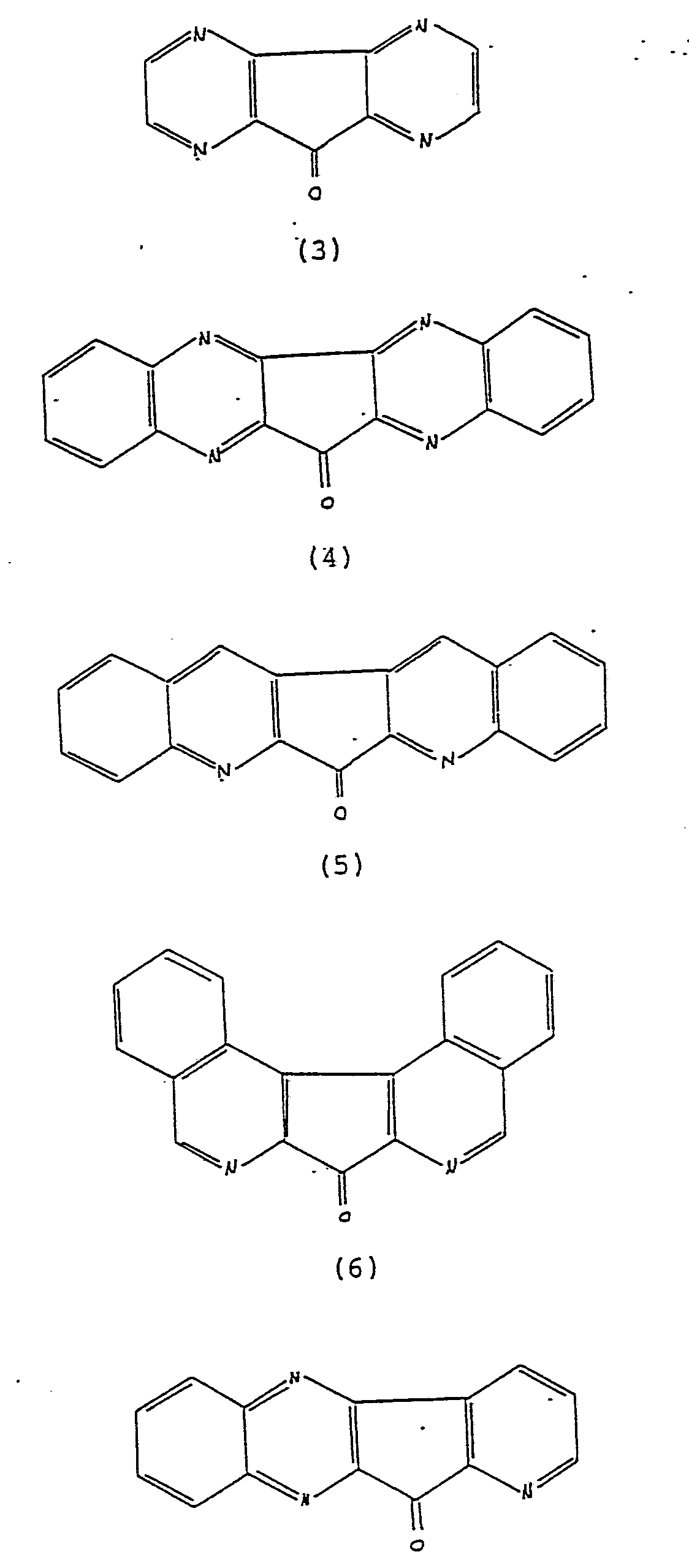
- Example 1 The method of Example 1 was repeated substituting reagent (1) for reagents (2) to (7).
- Reagents (2) to (7) also produced fluorescent fingerprints which could be visualised by illumination with blue/green light (excitation) and observed through a 610 nm filter.
Landscapes
- Life Sciences & Earth Sciences (AREA)
- Health & Medical Sciences (AREA)
- Engineering & Computer Science (AREA)
- Molecular Biology (AREA)
- Hematology (AREA)
- Chemical & Material Sciences (AREA)
- Urology & Nephrology (AREA)
- Physics & Mathematics (AREA)
- Immunology (AREA)
- Biomedical Technology (AREA)
- Microbiology (AREA)
- General Health & Medical Sciences (AREA)
- Biotechnology (AREA)
- Proteomics, Peptides & Aminoacids (AREA)
- Biophysics (AREA)
- Bioinformatics & Computational Biology (AREA)
- Bioinformatics & Cheminformatics (AREA)
- Food Science & Technology (AREA)
- Medicinal Chemistry (AREA)
- Analytical Chemistry (AREA)
- Biochemistry (AREA)
- Cell Biology (AREA)
- General Physics & Mathematics (AREA)
- Pathology (AREA)
- Measurement Of The Respiration, Hearing Ability, Form, And Blood Characteristics Of Living Organisms (AREA)
- Investigating Or Analysing Biological Materials (AREA)
- Holo Graphy (AREA)
- Electrochromic Elements, Electrophoresis, Or Variable Reflection Or Absorption Elements (AREA)
- Sampling And Sample Adjustment (AREA)
- Organic Low-Molecular-Weight Compounds And Preparation Thereof (AREA)
- Measuring Or Testing Involving Enzymes Or Micro-Organisms (AREA)
Abstract
Description


Claims

Priority Applications (2)
| Application Number | Priority Date | Filing Date | Title |
|---|---|---|---|
| EP89913229A EP0442959B1 (en) | 1988-11-09 | 1989-11-09 | Fingerprint reagent |
| DE68917934T DE68917934T2 (en) | 1988-11-09 | 1989-11-09 | FINGERPRINT REAGENT. |
Applications Claiming Priority (2)
| Application Number | Priority Date | Filing Date | Title |
|---|---|---|---|
| GB888826237A GB8826237D0 (en) | 1988-11-09 | 1988-11-09 | Fingerprint reagent |
| GB8826237.3 | 1988-11-09 |
Publications (1)
| Publication Number | Publication Date |
|---|---|
| WO1990005308A1 true WO1990005308A1 (en) | 1990-05-17 |
Family
ID=10646574
Family Applications (1)
| Application Number | Title | Priority Date | Filing Date |
|---|---|---|---|
| PCT/GB1989/001329 Ceased WO1990005308A1 (en) | 1988-11-09 | 1989-11-09 | Fingerprint reagent |
Country Status (8)
| Country | Link |
|---|---|
| US (1) | US5221627A (en) |
| EP (1) | EP0442959B1 (en) |
| AT (1) | ATE110855T1 (en) |
| AU (1) | AU638221B2 (en) |
| CA (1) | CA2002620C (en) |
| DE (1) | DE68917934T2 (en) |
| GB (1) | GB8826237D0 (en) |
| WO (1) | WO1990005308A1 (en) |
Cited By (3)
| Publication number | Priority date | Publication date | Assignee | Title |
|---|---|---|---|---|
| DE19830040B4 (en) * | 1998-06-26 | 2009-02-05 | Sensient Imaging Technologies Gmbh | New cyclopentadiquinoxaline derivatives |
| EP2520572A1 (en) * | 2007-11-30 | 2012-11-07 | Sumitomo Chemical Co., Ltd. | Nitrogen-containing fused-ring compound, polymer comprising a nitrogen-containing fused-ring repeating unit, organic thin film, and organic thin film element |
| CN113512027A (en) * | 2021-07-20 | 2021-10-19 | 华南理工大学 | A kind of indanone quinoxaline derivative and its preparation method and application |
Families Citing this family (13)
| Publication number | Priority date | Publication date | Assignee | Title |
|---|---|---|---|---|
| US6352863B1 (en) * | 1990-01-19 | 2002-03-05 | La Mina, Inc. | Assay device |
| TW387805B (en) | 1997-05-12 | 2000-04-21 | Taiho Ind Co | A fingerprint indicator and the method of detection |
| US6485981B1 (en) * | 1998-07-29 | 2002-11-26 | Ciencia, Inc. | Method and apparatus for imaging and documenting fingerprints |
| EP1296985B1 (en) * | 2000-07-06 | 2005-06-01 | QLT Inc. | Heteropolycyclic inhibitors |
| KR20010025234A (en) * | 2000-11-09 | 2001-04-06 | 김진삼 | A certification method of credit of a financing card based on fingerprint and a certification system thereof |
| US7879623B2 (en) * | 2006-03-31 | 2011-02-01 | Guirguis Raouf A | Integrated device for analyte, testing, confirmation, and donor identity verification |
| US7741103B2 (en) * | 2006-03-31 | 2010-06-22 | Guirguis Raouf A | Integrated screening and confirmation device |
| US8940527B2 (en) * | 2006-03-31 | 2015-01-27 | Lamina Equities Corp. | Integrated device for analyte testing, confirmation, and donor identity verification |
| US11906512B2 (en) | 2006-03-31 | 2024-02-20 | Zeus Diagnostics, LLC | Integrated device for analyte testing, confirmation, and donor identity verification |
| US20080022888A1 (en) * | 2006-07-27 | 2008-01-31 | Armor Holdings Forensics, Inc. | Ready to use combined skin marking stain compound and applicator requiring only the addition of water |
| WO2009067761A1 (en) * | 2007-11-29 | 2009-06-04 | University Of Technology, Sydney | A method of developing latent fingerprints |
| US10564155B2 (en) | 2017-01-27 | 2020-02-18 | Raouf A Guirguis | Dual swab fluid sample collection for split sample testing and fingerprint identification device |
| PL246269B1 (en) * | 2022-12-31 | 2024-12-23 | Univ Gdanski | Method of visualizing fingerprint traces on an absorbent substrate and final solution for visualizing fingerprint traces on an absorbent substrate |
Citations (1)
| Publication number | Priority date | Publication date | Assignee | Title |
|---|---|---|---|---|
| BE621677A (en) * |
-
1988
- 1988-11-09 GB GB888826237A patent/GB8826237D0/en active Pending
-
1989
- 1989-11-09 AT AT89913229T patent/ATE110855T1/en not_active IP Right Cessation
- 1989-11-09 CA CA002002620A patent/CA2002620C/en not_active Expired - Fee Related
- 1989-11-09 US US07/689,750 patent/US5221627A/en not_active Expired - Lifetime
- 1989-11-09 WO PCT/GB1989/001329 patent/WO1990005308A1/en not_active Ceased
- 1989-11-09 AU AU46397/89A patent/AU638221B2/en not_active Ceased
- 1989-11-09 EP EP89913229A patent/EP0442959B1/en not_active Expired - Lifetime
- 1989-11-09 DE DE68917934T patent/DE68917934T2/en not_active Expired - Fee Related
Patent Citations (1)
| Publication number | Priority date | Publication date | Assignee | Title |
|---|---|---|---|---|
| BE621677A (en) * |
Cited By (4)
| Publication number | Priority date | Publication date | Assignee | Title |
|---|---|---|---|---|
| DE19830040B4 (en) * | 1998-06-26 | 2009-02-05 | Sensient Imaging Technologies Gmbh | New cyclopentadiquinoxaline derivatives |
| EP2520572A1 (en) * | 2007-11-30 | 2012-11-07 | Sumitomo Chemical Co., Ltd. | Nitrogen-containing fused-ring compound, polymer comprising a nitrogen-containing fused-ring repeating unit, organic thin film, and organic thin film element |
| US8378338B2 (en) | 2007-11-30 | 2013-02-19 | Sumitomo Chemical Company, Limited | Conjugated compound, nitrogenated condensed-ring compound, nitrogenated condensed-ring polymer, organic thin film, and organic thin film element |
| CN113512027A (en) * | 2021-07-20 | 2021-10-19 | 华南理工大学 | A kind of indanone quinoxaline derivative and its preparation method and application |
Also Published As
| Publication number | Publication date |
|---|---|
| AU638221B2 (en) | 1993-06-24 |
| EP0442959A1 (en) | 1991-08-28 |
| ATE110855T1 (en) | 1994-09-15 |
| DE68917934T2 (en) | 1995-02-09 |
| CA2002620A1 (en) | 1990-05-09 |
| CA2002620C (en) | 2000-08-08 |
| EP0442959B1 (en) | 1994-08-31 |
| US5221627A (en) | 1993-06-22 |
| AU4639789A (en) | 1990-05-28 |
| DE68917934D1 (en) | 1994-10-06 |
| GB8826237D0 (en) | 1988-12-14 |
Similar Documents
| Publication | Publication Date | Title |
|---|---|---|
| EP0442959B1 (en) | Fingerprint reagent | |
| Roth | Fluorescence reaction for amino acids | |
| AU709592B2 (en) | Electrogenerated chemiluminescence labels for analysis and/or referencing | |
| Rosenthal et al. | Critical micelle concentration determination of nonionic detergents with Coomassie Brilliant Blue G-250 | |
| JPH03505667A (en) | Improved uses of chemiluminescent 1,2-dioxetanes | |
| JPH0137694B2 (en) | ||
| ATE142018T1 (en) | METHOD FOR MONITORING REAGENT DELIVERY IN A SCANNING SPECTROPHOTOMETER | |
| van der Sluis et al. | Identification and tentative removal of collagen glue in Palaeolithic worked bone objects: implications for ZooMS and radiocarbon dating | |
| ATE208502T1 (en) | REAGENTS AND METHODS FOR THE DETECTION AND QUANTITATIVE DETERMINATION OF TESTOSTERONE IN LIQUID SAMPLES | |
| US5270164A (en) | Process for enhancing the chemiluminescence of enzyme-triggered 1,2-dioxetanes and uses therefor | |
| Monforte et al. | Fluorometric determination of primary and secondary amines in blood and urine after thin-layer chromatography | |
| STOWARD | Studies in fluorescence histochemistry: II. The demonstration of periodate‐reactive mucosubstances with pseudo‐Schiff reagents | |
| Xing et al. | Comprehensive insight on protein modification by V‐type agent: A chemical proteomic approach employing bioorthogonal reaction | |
| CN115449366A (en) | Application of semicyanine compounds in the identification of dimethyl sulfoxide | |
| CN112142753B (en) | Preparation method of fluorescein isothiocyanate derivative | |
| Gutierrez et al. | Reaction in vitro of synthetic oxytocin and lysine-vasopressin with the pseudoisocyaninchloride technique used for the demonstration of neurohypophysial neurosecretory material | |
| DK0570363T3 (en) | Procedure for testing an oil | |
| CN113416540A (en) | Carbon dots applied to reagent for detecting drug-induced deafness and preparation method thereof | |
| Ash et al. | CHEMOSENSING: SELECTIVITY, SENSITIVITY AND ADDITIVE EFFECTS ON A STIMULANT‐INDUCED ACTIVITY OF OLFACTORY PREPARATIONS | |
| Inglis et al. | Rapid identification of amino acid derivatives from the sequenator | |
| CN117964568A (en) | A trace-revealing oxazine fluorescent dye and its preparation method and application | |
| Lorenz et al. | o-Phthaldialdehyde reactive substances in dog's plasma and gelatin (Haemaccel®) complicating the determination of histamine | |
| RU1831676C (en) | Determination of | |
| DE4403780A1 (en) | Non-radioactive assay for bio-molecules, esp. nucleic acids | |
| CN121342812A (en) | A method for preparing a long-wavelength emission rapid detection fluorescent probe for bisulfite ions. |
Legal Events
| Date | Code | Title | Description |
|---|---|---|---|
| AK | Designated states |
Kind code of ref document: A1 Designated state(s): AT AU BB BG BR CH DE DK FI GB HU JP KP KR LK LU MC MG MW NL NO RO SD SE SU US |
|
| AL | Designated countries for regional patents |
Kind code of ref document: A1 Designated state(s): AT BE BF BJ CF CG CH CM DE FR GA GB IT LU ML MR NL SE SN TD TG |
|
| WWE | Wipo information: entry into national phase |
Ref document number: 1989913229 Country of ref document: EP |
|
| REG | Reference to national code |
Ref country code: DE Ref legal event code: 8642 |
|
| WWP | Wipo information: published in national office |
Ref document number: 1989913229 Country of ref document: EP |
|
| WWG | Wipo information: grant in national office |
Ref document number: 1989913229 Country of ref document: EP |