WO1991009002A1 - Process for the preparation of vinyl ethers - Google Patents
Process for the preparation of vinyl ethers Download PDFInfo
- Publication number
- WO1991009002A1 WO1991009002A1 PCT/US1990/007372 US9007372W WO9109002A1 WO 1991009002 A1 WO1991009002 A1 WO 1991009002A1 US 9007372 W US9007372 W US 9007372W WO 9109002 A1 WO9109002 A1 WO 9109002A1
- Authority
- WO
- WIPO (PCT)
- Prior art keywords
- group
- titanium
- formula
- reducing agent
- aryl
- Prior art date
- Legal status (The legal status is an assumption and is not a legal conclusion. Google has not performed a legal analysis and makes no representation as to the accuracy of the status listed.)
- Ceased
Links
- 0 *c1cccc(*)c1 Chemical compound *c1cccc(*)c1 0.000 description 4
- IYKFYARMMIESOX-UHFFFAOYSA-N O=C1C2CC(C3)CC1CC3C2 Chemical compound O=C1C2CC(C3)CC1CC3C2 IYKFYARMMIESOX-UHFFFAOYSA-N 0.000 description 2
Classifications
-
- A—HUMAN NECESSITIES
- A61—MEDICAL OR VETERINARY SCIENCE; HYGIENE
- A61K—PREPARATIONS FOR MEDICAL, DENTAL OR TOILETRY PURPOSES
- A61K31/00—Medicinal preparations containing organic active ingredients
- A61K31/12—Ketones
-
- C—CHEMISTRY; METALLURGY
- C07—ORGANIC CHEMISTRY
- C07C—ACYCLIC OR CARBOCYCLIC COMPOUNDS
- C07C41/00—Preparation of ethers; Preparation of compounds having groups, groups or groups
- C07C41/01—Preparation of ethers
- C07C41/05—Preparation of ethers by addition of compounds to unsaturated compounds
- C07C41/06—Preparation of ethers by addition of compounds to unsaturated compounds by addition of organic compounds only
- C07C41/08—Preparation of ethers by addition of compounds to unsaturated compounds by addition of organic compounds only to carbon-to-carbon triple bonds
-
- A—HUMAN NECESSITIES
- A61—MEDICAL OR VETERINARY SCIENCE; HYGIENE
- A61L—METHODS OR APPARATUS FOR STERILISING MATERIALS OR OBJECTS IN GENERAL; DISINFECTION, STERILISATION OR DEODORISATION OF AIR; CHEMICAL ASPECTS OF BANDAGES, DRESSINGS, ABSORBENT PADS OR SURGICAL ARTICLES; MATERIALS FOR BANDAGES, DRESSINGS, ABSORBENT PADS OR SURGICAL ARTICLES
- A61L2/00—Disinfection or sterilisation of materials or objects, in general; Accessories therefor
- A61L2/16—Disinfection or sterilisation of materials or objects, in general; Accessories therefor using chemical substances
- A61L2/18—Liquid substances
-
- A—HUMAN NECESSITIES
- A61—MEDICAL OR VETERINARY SCIENCE; HYGIENE
- A61P—SPECIFIC THERAPEUTIC ACTIVITY OF CHEMICAL COMPOUNDS OR MEDICINAL PREPARATIONS
- A61P31/00—Antiinfectives, i.e. antibiotics, antiseptics, chemotherapeutics
- A61P31/12—Antivirals
-
- A—HUMAN NECESSITIES
- A61—MEDICAL OR VETERINARY SCIENCE; HYGIENE
- A61P—SPECIFIC THERAPEUTIC ACTIVITY OF CHEMICAL COMPOUNDS OR MEDICINAL PREPARATIONS
- A61P37/00—Drugs for immunological or allergic disorders
- A61P37/02—Immunomodulators
- A61P37/04—Immunostimulants
-
- C—CHEMISTRY; METALLURGY
- C07—ORGANIC CHEMISTRY
- C07C—ACYCLIC OR CARBOCYCLIC COMPOUNDS
- C07C41/00—Preparation of ethers; Preparation of compounds having groups, groups or groups
- C07C41/01—Preparation of ethers
-
- C—CHEMISTRY; METALLURGY
- C07—ORGANIC CHEMISTRY
- C07C—ACYCLIC OR CARBOCYCLIC COMPOUNDS
- C07C51/00—Preparation of carboxylic acids or their salts, halides or anhydrides
- C07C51/15—Preparation of carboxylic acids or their salts, halides or anhydrides by reaction of organic compounds with carbon dioxide, e.g. Kolbe-Schmitt synthesis
-
- C—CHEMISTRY; METALLURGY
- C07—ORGANIC CHEMISTRY
- C07D—HETEROCYCLIC COMPOUNDS
- C07D207/00—Heterocyclic compounds containing five-membered rings not condensed with other rings, with one nitrogen atom as the only ring hetero atom
- C07D207/46—Heterocyclic compounds containing five-membered rings not condensed with other rings, with one nitrogen atom as the only ring hetero atom with hetero atoms directly attached to the ring nitrogen atom
-
- C—CHEMISTRY; METALLURGY
- C07—ORGANIC CHEMISTRY
- C07D—HETEROCYCLIC COMPOUNDS
- C07D311/00—Heterocyclic compounds containing six-membered rings having one oxygen atom as the only hetero atom, condensed with other rings
- C07D311/02—Heterocyclic compounds containing six-membered rings having one oxygen atom as the only hetero atom, condensed with other rings ortho- or peri-condensed with carbocyclic rings or ring systems
- C07D311/78—Ring systems having three or more relevant rings
- C07D311/80—Dibenzopyrans; Hydrogenated dibenzopyrans
- C07D311/82—Xanthenes
-
- C—CHEMISTRY; METALLURGY
- C07—ORGANIC CHEMISTRY
- C07D—HETEROCYCLIC COMPOUNDS
- C07D321/00—Heterocyclic compounds containing rings having two oxygen atoms as the only ring hetero atoms, not provided for by groups C07D317/00 - C07D319/00
-
- C—CHEMISTRY; METALLURGY
- C07—ORGANIC CHEMISTRY
- C07D—HETEROCYCLIC COMPOUNDS
- C07D405/00—Heterocyclic compounds containing both one or more hetero rings having oxygen atoms as the only ring hetero atoms, and one or more rings having nitrogen as the only ring hetero atom
- C07D405/02—Heterocyclic compounds containing both one or more hetero rings having oxygen atoms as the only ring hetero atoms, and one or more rings having nitrogen as the only ring hetero atom containing two hetero rings
- C07D405/12—Heterocyclic compounds containing both one or more hetero rings having oxygen atoms as the only ring hetero atoms, and one or more rings having nitrogen as the only ring hetero atom containing two hetero rings linked by a chain containing hetero atoms as chain links
-
- C—CHEMISTRY; METALLURGY
- C07—ORGANIC CHEMISTRY
- C07D—HETEROCYCLIC COMPOUNDS
- C07D407/00—Heterocyclic compounds containing two or more hetero rings, at least one ring having oxygen atoms as the only ring hetero atoms, not provided for by group C07D405/00
- C07D407/02—Heterocyclic compounds containing two or more hetero rings, at least one ring having oxygen atoms as the only ring hetero atoms, not provided for by group C07D405/00 containing two hetero rings
- C07D407/10—Heterocyclic compounds containing two or more hetero rings, at least one ring having oxygen atoms as the only ring hetero atoms, not provided for by group C07D405/00 containing two hetero rings linked by a carbon chain containing aromatic rings
-
- C—CHEMISTRY; METALLURGY
- C07—ORGANIC CHEMISTRY
- C07D—HETEROCYCLIC COMPOUNDS
- C07D407/00—Heterocyclic compounds containing two or more hetero rings, at least one ring having oxygen atoms as the only ring hetero atoms, not provided for by group C07D405/00
- C07D407/02—Heterocyclic compounds containing two or more hetero rings, at least one ring having oxygen atoms as the only ring hetero atoms, not provided for by group C07D405/00 containing two hetero rings
- C07D407/12—Heterocyclic compounds containing two or more hetero rings, at least one ring having oxygen atoms as the only ring hetero atoms, not provided for by group C07D405/00 containing two hetero rings linked by a chain containing hetero atoms as chain links
-
- C—CHEMISTRY; METALLURGY
- C07—ORGANIC CHEMISTRY
- C07D—HETEROCYCLIC COMPOUNDS
- C07D417/00—Heterocyclic compounds containing two or more hetero rings, at least one ring having nitrogen and sulfur atoms as the only ring hetero atoms, not provided for by group C07D415/00
- C07D417/02—Heterocyclic compounds containing two or more hetero rings, at least one ring having nitrogen and sulfur atoms as the only ring hetero atoms, not provided for by group C07D415/00 containing two hetero rings
- C07D417/12—Heterocyclic compounds containing two or more hetero rings, at least one ring having nitrogen and sulfur atoms as the only ring hetero atoms, not provided for by group C07D415/00 containing two hetero rings linked by a chain containing hetero atoms as chain links
-
- C—CHEMISTRY; METALLURGY
- C07—ORGANIC CHEMISTRY
- C07D—HETEROCYCLIC COMPOUNDS
- C07D493/00—Heterocyclic compounds containing oxygen atoms as the only ring hetero atoms in the condensed system
- C07D493/02—Heterocyclic compounds containing oxygen atoms as the only ring hetero atoms in the condensed system in which the condensed system contains two hetero rings
- C07D493/10—Spiro-condensed systems
-
- C—CHEMISTRY; METALLURGY
- C07—ORGANIC CHEMISTRY
- C07D—HETEROCYCLIC COMPOUNDS
- C07D495/00—Heterocyclic compounds containing in the condensed system at least one hetero ring having sulfur atoms as the only ring hetero atoms
- C07D495/02—Heterocyclic compounds containing in the condensed system at least one hetero ring having sulfur atoms as the only ring hetero atoms in which the condensed system contains two hetero rings
- C07D495/04—Ortho-condensed systems
-
- C—CHEMISTRY; METALLURGY
- C07—ORGANIC CHEMISTRY
- C07F—ACYCLIC, CARBOCYCLIC OR HETEROCYCLIC COMPOUNDS CONTAINING ELEMENTS OTHER THAN CARBON, HYDROGEN, HALOGEN, OXYGEN, NITROGEN, SULFUR, SELENIUM OR TELLURIUM
- C07F7/00—Compounds containing elements of Groups 4 or 14 of the Periodic Table
- C07F7/02—Silicon compounds
- C07F7/08—Compounds having one or more C—Si linkages
- C07F7/18—Compounds having one or more C—Si linkages as well as one or more C—O—Si linkages
- C07F7/1804—Compounds having Si-O-C linkages
-
- C—CHEMISTRY; METALLURGY
- C07—ORGANIC CHEMISTRY
- C07F—ACYCLIC, CARBOCYCLIC OR HETEROCYCLIC COMPOUNDS CONTAINING ELEMENTS OTHER THAN CARBON, HYDROGEN, HALOGEN, OXYGEN, NITROGEN, SULFUR, SELENIUM OR TELLURIUM
- C07F9/00—Compounds containing elements of Groups 5 or 15 of the Periodic Table
- C07F9/02—Phosphorus compounds
- C07F9/547—Heterocyclic compounds, e.g. containing phosphorus as a ring hetero atom
- C07F9/6536—Heterocyclic compounds, e.g. containing phosphorus as a ring hetero atom having nitrogen and sulfur atoms with or without oxygen atoms, as the only ring hetero atoms
- C07F9/6539—Five-membered rings
- C07F9/6541—Five-membered rings condensed with carbocyclic rings or carbocyclic ring systems
-
- C—CHEMISTRY; METALLURGY
- C07—ORGANIC CHEMISTRY
- C07F—ACYCLIC, CARBOCYCLIC OR HETEROCYCLIC COMPOUNDS CONTAINING ELEMENTS OTHER THAN CARBON, HYDROGEN, HALOGEN, OXYGEN, NITROGEN, SULFUR, SELENIUM OR TELLURIUM
- C07F9/00—Compounds containing elements of Groups 5 or 15 of the Periodic Table
- C07F9/02—Phosphorus compounds
- C07F9/547—Heterocyclic compounds, e.g. containing phosphorus as a ring hetero atom
- C07F9/655—Heterocyclic compounds, e.g. containing phosphorus as a ring hetero atom having oxygen atoms, with or without sulfur, selenium, or tellurium atoms, as the only ring hetero atoms
- C07F9/6551—Heterocyclic compounds, e.g. containing phosphorus as a ring hetero atom having oxygen atoms, with or without sulfur, selenium, or tellurium atoms, as the only ring hetero atoms the oxygen atom being part of a four-membered ring
- C07F9/65512—Heterocyclic compounds, e.g. containing phosphorus as a ring hetero atom having oxygen atoms, with or without sulfur, selenium, or tellurium atoms, as the only ring hetero atoms the oxygen atom being part of a four-membered ring condensed with carbocyclic rings or carbocyclic ring systems
-
- C—CHEMISTRY; METALLURGY
- C07—ORGANIC CHEMISTRY
- C07F—ACYCLIC, CARBOCYCLIC OR HETEROCYCLIC COMPOUNDS CONTAINING ELEMENTS OTHER THAN CARBON, HYDROGEN, HALOGEN, OXYGEN, NITROGEN, SULFUR, SELENIUM OR TELLURIUM
- C07F9/00—Compounds containing elements of Groups 5 or 15 of the Periodic Table
- C07F9/02—Phosphorus compounds
- C07F9/547—Heterocyclic compounds, e.g. containing phosphorus as a ring hetero atom
- C07F9/655—Heterocyclic compounds, e.g. containing phosphorus as a ring hetero atom having oxygen atoms, with or without sulfur, selenium, or tellurium atoms, as the only ring hetero atoms
- C07F9/6552—Heterocyclic compounds, e.g. containing phosphorus as a ring hetero atom having oxygen atoms, with or without sulfur, selenium, or tellurium atoms, as the only ring hetero atoms the oxygen atom being part of a six-membered ring
- C07F9/65522—Heterocyclic compounds, e.g. containing phosphorus as a ring hetero atom having oxygen atoms, with or without sulfur, selenium, or tellurium atoms, as the only ring hetero atoms the oxygen atom being part of a six-membered ring condensed with carbocyclic rings or carbocyclic ring systems
-
- C—CHEMISTRY; METALLURGY
- C07—ORGANIC CHEMISTRY
- C07F—ACYCLIC, CARBOCYCLIC OR HETEROCYCLIC COMPOUNDS CONTAINING ELEMENTS OTHER THAN CARBON, HYDROGEN, HALOGEN, OXYGEN, NITROGEN, SULFUR, SELENIUM OR TELLURIUM
- C07F9/00—Compounds containing elements of Groups 5 or 15 of the Periodic Table
- C07F9/02—Phosphorus compounds
- C07F9/547—Heterocyclic compounds, e.g. containing phosphorus as a ring hetero atom
- C07F9/6558—Heterocyclic compounds, e.g. containing phosphorus as a ring hetero atom containing at least two different or differently substituted hetero rings neither condensed among themselves nor condensed with a common carbocyclic ring or ring system
- C07F9/65586—Heterocyclic compounds, e.g. containing phosphorus as a ring hetero atom containing at least two different or differently substituted hetero rings neither condensed among themselves nor condensed with a common carbocyclic ring or ring system at least one of the hetero rings does not contain nitrogen as ring hetero atom
-
- C—CHEMISTRY; METALLURGY
- C07—ORGANIC CHEMISTRY
- C07F—ACYCLIC, CARBOCYCLIC OR HETEROCYCLIC COMPOUNDS CONTAINING ELEMENTS OTHER THAN CARBON, HYDROGEN, HALOGEN, OXYGEN, NITROGEN, SULFUR, SELENIUM OR TELLURIUM
- C07F9/00—Compounds containing elements of Groups 5 or 15 of the Periodic Table
- C07F9/02—Phosphorus compounds
- C07F9/547—Heterocyclic compounds, e.g. containing phosphorus as a ring hetero atom
- C07F9/6561—Heterocyclic compounds, e.g. containing phosphorus as a ring hetero atom containing systems of two or more relevant hetero rings condensed among themselves or condensed with a common carbocyclic ring or ring system, with or without other non-condensed hetero rings
-
- C—CHEMISTRY; METALLURGY
- C07—ORGANIC CHEMISTRY
- C07H—SUGARS; DERIVATIVES THEREOF; NUCLEOSIDES; NUCLEOTIDES; NUCLEIC ACIDS
- C07H15/00—Compounds containing hydrocarbon or substituted hydrocarbon radicals directly attached to hetero atoms of saccharide radicals
- C07H15/20—Carbocyclic rings
- C07H15/203—Monocyclic carbocyclic rings other than cyclohexane rings; Bicyclic carbocyclic ring systems
-
- A—HUMAN NECESSITIES
- A61—MEDICAL OR VETERINARY SCIENCE; HYGIENE
- A61L—METHODS OR APPARATUS FOR STERILISING MATERIALS OR OBJECTS IN GENERAL; DISINFECTION, STERILISATION OR DEODORISATION OF AIR; CHEMICAL ASPECTS OF BANDAGES, DRESSINGS, ABSORBENT PADS OR SURGICAL ARTICLES; MATERIALS FOR BANDAGES, DRESSINGS, ABSORBENT PADS OR SURGICAL ARTICLES
- A61L2103/00—Materials or objects being the target of disinfection or sterilisation
- A61L2103/05—Living organisms or biological materials
-
- C—CHEMISTRY; METALLURGY
- C07—ORGANIC CHEMISTRY
- C07C—ACYCLIC OR CARBOCYCLIC COMPOUNDS
- C07C2603/00—Systems containing at least three condensed rings
- C07C2603/02—Ortho- or ortho- and peri-condensed systems
- C07C2603/04—Ortho- or ortho- and peri-condensed systems containing three rings
- C07C2603/06—Ortho- or ortho- and peri-condensed systems containing three rings containing at least one ring with less than six ring members
- C07C2603/10—Ortho- or ortho- and peri-condensed systems containing three rings containing at least one ring with less than six ring members containing five-membered rings
- C07C2603/12—Ortho- or ortho- and peri-condensed systems containing three rings containing at least one ring with less than six ring members containing five-membered rings only one five-membered ring
- C07C2603/18—Fluorenes; Hydrogenated fluorenes
-
- C—CHEMISTRY; METALLURGY
- C07—ORGANIC CHEMISTRY
- C07C—ACYCLIC OR CARBOCYCLIC COMPOUNDS
- C07C2603/00—Systems containing at least three condensed rings
- C07C2603/56—Ring systems containing bridged rings
- C07C2603/58—Ring systems containing bridged rings containing three rings
- C07C2603/70—Ring systems containing bridged rings containing three rings containing only six-membered rings
- C07C2603/74—Adamantanes
-
- Y—GENERAL TAGGING OF NEW TECHNOLOGICAL DEVELOPMENTS; GENERAL TAGGING OF CROSS-SECTIONAL TECHNOLOGIES SPANNING OVER SEVERAL SECTIONS OF THE IPC; TECHNICAL SUBJECTS COVERED BY FORMER USPC CROSS-REFERENCE ART COLLECTIONS [XRACs] AND DIGESTS
- Y02—TECHNOLOGIES OR APPLICATIONS FOR MITIGATION OR ADAPTATION AGAINST CLIMATE CHANGE
- Y02P—CLIMATE CHANGE MITIGATION TECHNOLOGIES IN THE PRODUCTION OR PROCESSING OF GOODS
- Y02P20/00—Technologies relating to chemical industry
- Y02P20/50—Improvements relating to the production of bulk chemicals
- Y02P20/55—Design of synthesis routes, e.g. reducing the use of auxiliary or protecting groups
Definitions
- the present invention relates to an improved process for the preparation of vinyl ethers by coupling of a ketone with an aryl ester bearing a hydroxyl (OH) group or an OP group wherein P is a typical protecting group for an OH group.
- the present invention relates to a coupling reaction which is conducted in an organic solvent, preferably an ether, using a titanium salt, preferably TiCl3 or iCl4, and a metallic reducing agent, preferably zinc metal, in the presence of an amine, preferably triethylamine.
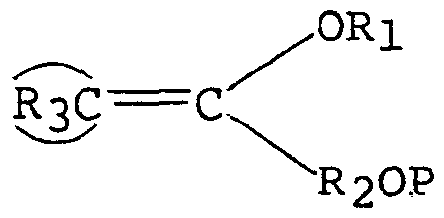
- the present invention relates to a process for producing a vinyl ether of the formula
- a and R are passive organic groups, wherein ArOY is an aryl group having an aryl ring substituted with OY as a substituent selected from the group consisting of hydroxyl and OP, wherein P is a protecting group which comprises: reacting a carbonyl containing compound of the formula:
- a and R can be any essentially passive organic group such as for instance alkyl, aryl, or polycyclic alkyl.
- the present invention relates to a process for producing a vinyl ether of the formula
- R * L is selected from alJcyl, aryl, and aralkyl containing 1 to 20 carbon atoms and optionally including oxygen, sulfur, nitrogen, phosphorus and halogens
- R 2 is selected from aryl, biaryl and fused ring polycyclic aryl groups which can be substituted or unsubstituted, wherein R ⁇ _ and R 2 can be linked together by a member selected from carbon, oxygen and nitrogen containing groups and R3C- is selected from polycyclic alkyl groups containing 6 to 30 carbon atoms, wherein OY is a substituent selected from, hydroxyl and OP and wherein P is a protecting group which comprises: reacting a carbonyl containing compound of the formula:
- R 3 C 0 with an ester compound of the formula:
- a metallic reducing agent such as zinc metal, a titanium salt, and an amine base to produce the vinyl ether.
- the metallic reducing agent and titanium salt are provided with the amine base at temperatures between about -25 and +25°C.
- the amine is added slowly to the reducing agent and titanium salt in a reaction mixture to prevent the exothermic reaction from becoming uncontrollable.
- the ketone and ester are added in a solvent and the reaction conducted between about 25 and 150°C.
- the vinyl ether is then separated from the 5 reaction mixture using conventional techniques.
- the metallic reducing agent is preferably essentially pure zinc.
- Zinc can be used as the metal alone or in admixture with other metals such as copper. Other pure metals such as Li, K, and Mg can be used. Zinc alone 0 is preferred.
- the metallic reducing agent is preferably finely divided.
- the titanium salt is preferably in the form of a chloride. Either titanium trichloride or titanium tetrachloride can be used. 5
- the amine can be triethylamine which is preferred. Other amine acid acceptors which do not interfere with the reaction to form the vinyl ether, can be used. Such amine bases are well known to those skilled in the art.
- the organic solvent is preferably an ether. The most preferred solvent is tetrahyrofuran. Other solvents are, for instance, dimethoxyethane or dioxane.
- the preferred vinyl ethers for instance are made from 2-adamantanone and esters as shown below,
- R is, for instance, CH3(Me)CH2CH3, CH2CH2CI, CH 2 CH 2 CH 2 C1, (CH 2 >15CH 3 , CH2PI , or Ph. '
- Additional preferred vinyl ethers are made from 2-adamantanone and esters of 3-hydroxybenzoate as shown 35 below, where R is, for instance, CH3(Me)CH CH3, CH 2 CH C1, CH 2 CH 2 CH2C1, (CH2>15CH3, CH2Ph, or Ph.
- Other protecting groups well known in the literature can also be used.
- vinyl ethers are made by this general process from 2-adamantanone and the corresponding esters including lactones, where Y is hydrogen or a protecting group.
- the following vinyl ether is made by this general process from the ketone, bicyclo[3.3.1]nonan-9-one. and methyl 3-tert-butyldimethylsi lyloxybenzoate .
- the hydroxyl vinyl ether is prepared either by direct reaction of a ketone and a hydroxy ester or by reaction of a ketone and ester bearing an OY group with subsequent conversion of OY to OH by removal of the protecting group P in a known manner.
- the hydroxyl-substituted vinyl ethers such as the preferred example, [(3-hydroxyphenyl)methoxyme hyleneladamantane (1) shown below, are converted to other derivatives by standard chemical processes well known to those skilled in the art of organic synthesis.
- Such derivatives are, for instance, esters of inorganic oxy acids or their salts (e.g.
- phosphates, sulfates) oxygen-pyranosides e.g., beta-D-galactosides
- aryl or alkyl carboxyl esters e.g., phosphates, sulfates
- the vinyl ethers are then converted to dioxetanes, as shown below, which are triggerable by corresponding enzymes, (phosphatase, sulfatase, beta-D-galactosidase, esterase and the like) to produce light in biological assays.
- the dioxetanes can also be chemically triggered.
- the vinyl ether can be directly photooxidized in the presence of a sensitizer, light and oxygen to yield the desired dioxetane.
- the hydroxy vinyl ether such as 1 shown below, is photooxidized to give the hydroxy substituted dioxetane and it is subsequently treated with chemical reagents to form the X-substituted dioxetane as described in U.S. application Serial No. 887,139
- Triethylamine (2.0 mL) was added to the suspension with caution (the reaction is extremely exothermic). The reaction started in approximately 5 to 10 minutes. After the reaction subsided, an additional amount of triethylamine (200 mL) was added and the mixture heated under reflux for 3 hours. After this period, a solution of methyl 3-hydroxybenzoate (100 g, 0.66 mol) and 2-adamantanone (60.0 g, 0.40 mol) in 400 mL of dry THF was added dropwise to the refluxing mixture over 5 hours. The reaction mixture was then cooled to room temperature and was diluted with hexane (4 L) and the stirring continued. The suspended solids were then allowed to settle and the organic layer decanted.
- Triethylamine (2.0 mL) was added to the suspension with caution (the reaction is extremely exothermic). The reaction started in approximately 5 to 10 minutes. After the reaction subsided, an additional amount of triethylamine (200 mL) was added and the mixture heated under reflux for 3 hours. After this period, a solution o methyl 3-tert-butyldimethylsiloxybenzoate (100 g, 0.37 mol) and 2-adamantanone (85.0 g, 0.57 mol) in 400 mL of dry THF was added dropwise to the refluxing mixture over 5 hours. The reaction mixture was then cooled to room temperature and was diluted with hexane (4 L) and the stirring continued.
Landscapes
- Chemical & Material Sciences (AREA)
- Organic Chemistry (AREA)
- Health & Medical Sciences (AREA)
- Life Sciences & Earth Sciences (AREA)
- General Health & Medical Sciences (AREA)
- Biochemistry (AREA)
- Molecular Biology (AREA)
- Chemical Kinetics & Catalysis (AREA)
- Animal Behavior & Ethology (AREA)
- Veterinary Medicine (AREA)
- Public Health (AREA)
- Engineering & Computer Science (AREA)
- General Chemical & Material Sciences (AREA)
- Pharmacology & Pharmacy (AREA)
- Medicinal Chemistry (AREA)
- Epidemiology (AREA)
- Immunology (AREA)
- Nuclear Medicine, Radiotherapy & Molecular Imaging (AREA)
- Oil, Petroleum & Natural Gas (AREA)
- Biotechnology (AREA)
- Genetics & Genomics (AREA)
- Oncology (AREA)
- Bioinformatics & Cheminformatics (AREA)
- Communicable Diseases (AREA)
- Virology (AREA)
- Organic Low-Molecular-Weight Compounds And Preparation Thereof (AREA)
- Agricultural Chemicals And Associated Chemicals (AREA)
- Acyclic And Carbocyclic Compounds In Medicinal Compositions (AREA)
- Measurement Of The Respiration, Hearing Ability, Form, And Blood Characteristics Of Living Organisms (AREA)
- Medical Preparation Storing Or Oral Administration Devices (AREA)
- Materials For Medical Uses (AREA)
- Pharmaceuticals Containing Other Organic And Inorganic Compounds (AREA)
- Orthopedics, Nursing, And Contraception (AREA)
- Apparatus For Disinfection Or Sterilisation (AREA)
- External Artificial Organs (AREA)
- Medicines That Contain Protein Lipid Enzymes And Other Medicines (AREA)
- Medicines Containing Material From Animals Or Micro-Organisms (AREA)
- Pyrane Compounds (AREA)
- Low-Molecular Organic Synthesis Reactions Using Catalysts (AREA)
Abstract
Description


Claims


Priority Applications (6)
| Application Number | Priority Date | Filing Date | Title |
|---|---|---|---|
| EP91903105A EP0458965B1 (en) | 1989-12-14 | 1990-12-12 | Process for the preparation of vinyl ethers |
| JP91503256A JPH04505458A (en) | 1989-12-14 | 1990-12-12 | Vinyl ether manufacturing method |
| KR1019910700729A KR950001678B1 (en) | 1989-12-14 | 1990-12-12 | Process for the preparation of vinyl ethers |
| DE69022582T DE69022582T2 (en) | 1989-12-14 | 1990-12-12 | METHOD FOR THE PRODUCTION OF VINYL ETHERS. |
| JP3503256A JPH0825941B2 (en) | 1989-12-14 | 1990-12-12 | Method for producing vinyl ether |
| GR950403293T GR3018174T3 (en) | 1989-12-14 | 1995-11-22 | Process for the preparation of vinyl ethers. |
Applications Claiming Priority (2)
| Application Number | Priority Date | Filing Date | Title |
|---|---|---|---|
| US07/450,459 US4983779A (en) | 1986-07-17 | 1989-12-14 | Process for the preparation of vinyl ethers |
| US450,459 | 1995-05-25 |
Publications (1)
| Publication Number | Publication Date |
|---|---|
| WO1991009002A1 true WO1991009002A1 (en) | 1991-06-27 |
Family
ID=23788187
Family Applications (1)
| Application Number | Title | Priority Date | Filing Date |
|---|---|---|---|
| PCT/US1990/007372 Ceased WO1991009002A1 (en) | 1989-12-14 | 1990-12-12 | Process for the preparation of vinyl ethers |
Country Status (13)
| Country | Link |
|---|---|
| US (1) | US4983779A (en) |
| EP (1) | EP0458965B1 (en) |
| JP (2) | JPH0825941B2 (en) |
| KR (1) | KR950001678B1 (en) |
| CN (1) | CN1020893C (en) |
| AT (1) | ATE128110T1 (en) |
| AU (1) | AU637194B2 (en) |
| CA (1) | CA2045553C (en) |
| DE (1) | DE69022582T2 (en) |
| DK (1) | DK0458965T3 (en) |
| ES (1) | ES2080296T3 (en) |
| GR (1) | GR3018174T3 (en) |
| WO (1) | WO1991009002A1 (en) |
Families Citing this family (15)
| Publication number | Priority date | Publication date | Assignee | Title |
|---|---|---|---|---|
| US5582980A (en) * | 1989-07-17 | 1996-12-10 | Tropix, Inc. | Chemiluminescent 1,2-dioxetanes |
| JPH0731201B2 (en) | 1987-12-31 | 1995-04-10 | トロピックス・インコーポレーテッド | Chemiluminescence measurement method |
| US6022964A (en) | 1989-07-17 | 2000-02-08 | Tropix, Inc. | Chemiluminescent 1,2-dioxetanes |
| US5326882A (en) * | 1989-07-17 | 1994-07-05 | Tropix, Inc. | Chemiluminescent 3-(substituted Adamant-2'-Ylidene) 1,2-dioxetanes |
| JP2552413B2 (en) * | 1990-08-30 | 1996-11-13 | トロピックス・インコーポレーテッド | Chemiluminescent 3- (substituted adamanto 2'-ylidene) 1,2-dioxetane |
| DE4210759A1 (en) * | 1992-04-01 | 1993-10-07 | Boehringer Mannheim Gmbh | Substituted thiazoline dioxetane substrates, process for their preparation and use |
| CA2179726A1 (en) * | 1993-12-23 | 1995-06-29 | Brooks Edwards | Chemiluminescent energy transfer assays |
| US5773628A (en) * | 1994-11-14 | 1998-06-30 | Tropix, Inc. | 1,2-dioxetane compounds with haloalkoxy groups, methods preparation and use |
| US5721370A (en) * | 1995-07-31 | 1998-02-24 | Lumigen Inc. | Water soluble tri-substituted 1,2-dioxetane compounds and assay compositions having increased storage stability |
| JP4752504B2 (en) | 2003-05-21 | 2011-08-17 | 株式会社ジェイ・エム・エス | Blood component separation container |
| CN100525906C (en) * | 2007-02-09 | 2009-08-12 | 上海华谊丙烯酸有限公司 | Acetal gas-phase decomposition catalyst and preparing method |
| CN102030779A (en) * | 2010-11-17 | 2011-04-27 | 云南瑞亘生物科技有限公司 | Preparation method of chemiluminescence material AMPPD (4-methoxy-4-(3-phenylphosphonic)spiro[1,2-dioxetane-3,2'-adamantane]disodium salt) for immunoassay |
| CN108884386B (en) * | 2016-01-26 | 2022-03-15 | 特拉维夫大学拉玛特有限公司 | Chemiluminescent probe for diagnosis and in vivo imaging |
| US11857674B2 (en) | 2016-05-18 | 2024-01-02 | Reoxcyn, Llc | Lubricant formulations |
| US9474768B1 (en) * | 2016-05-18 | 2016-10-25 | Reoxcyn Discoveries Group, Inc. | Lubricant formulations |
Citations (1)
| Publication number | Priority date | Publication date | Assignee | Title |
|---|---|---|---|---|
| US4857652A (en) * | 1986-07-17 | 1989-08-15 | Board Of Governors Of Wayne State University | Chemiluminescent 1,2-dioxetane compounds |
-
1989
- 1989-12-14 US US07/450,459 patent/US4983779A/en not_active Expired - Lifetime
-
1990
- 1990-12-12 JP JP3503256A patent/JPH0825941B2/en not_active Expired - Lifetime
- 1990-12-12 DE DE69022582T patent/DE69022582T2/en not_active Expired - Fee Related
- 1990-12-12 DK DK91903105.4T patent/DK0458965T3/en active
- 1990-12-12 EP EP91903105A patent/EP0458965B1/en not_active Expired - Lifetime
- 1990-12-12 CA CA002045553A patent/CA2045553C/en not_active Expired - Fee Related
- 1990-12-12 ES ES91903105T patent/ES2080296T3/en not_active Expired - Lifetime
- 1990-12-12 KR KR1019910700729A patent/KR950001678B1/en not_active Expired - Fee Related
- 1990-12-12 WO PCT/US1990/007372 patent/WO1991009002A1/en not_active Ceased
- 1990-12-12 JP JP91503256A patent/JPH04505458A/en not_active Withdrawn
- 1990-12-12 AT AT91903105T patent/ATE128110T1/en not_active IP Right Cessation
- 1990-12-12 AU AU71833/91A patent/AU637194B2/en not_active Ceased
- 1990-12-14 CN CN90106055A patent/CN1020893C/en not_active Expired - Fee Related
-
1995
- 1995-11-22 GR GR950403293T patent/GR3018174T3/en unknown
Patent Citations (1)
| Publication number | Priority date | Publication date | Assignee | Title |
|---|---|---|---|---|
| US4857652A (en) * | 1986-07-17 | 1989-08-15 | Board Of Governors Of Wayne State University | Chemiluminescent 1,2-dioxetane compounds |
Also Published As
| Publication number | Publication date |
|---|---|
| ATE128110T1 (en) | 1995-10-15 |
| EP0458965A4 (en) | 1993-07-28 |
| US4983779A (en) | 1991-01-08 |
| CA2045553A1 (en) | 1991-06-15 |
| CA2045553C (en) | 1999-04-13 |
| KR950001678B1 (en) | 1995-02-28 |
| JPH04505458A (en) | 1992-09-24 |
| EP0458965B1 (en) | 1995-09-20 |
| ES2080296T3 (en) | 1996-02-01 |
| AU637194B2 (en) | 1993-05-20 |
| CN1052478A (en) | 1991-06-26 |
| KR920701103A (en) | 1992-08-11 |
| JPH0825941B2 (en) | 1996-03-13 |
| DE69022582T2 (en) | 1996-03-07 |
| EP0458965A1 (en) | 1991-12-04 |
| DK0458965T3 (en) | 1996-01-15 |
| CN1020893C (en) | 1993-05-26 |
| AU7183391A (en) | 1991-07-18 |
| DE69022582D1 (en) | 1995-10-26 |
| GR3018174T3 (en) | 1996-02-29 |
| JPH03504815A (en) | 1991-10-24 |
Similar Documents
| Publication | Publication Date | Title |
|---|---|---|
| AU637194B2 (en) | Process for the preparation of vinyl ethers | |
| CA2006222C (en) | Enhanced chemiluminescence from 1,2-dioxetanes through energy transfer to tethered fluorescers | |
| DE68909345T2 (en) | Processes and compositions for producing enhanced chemiluminescence from 1,2-dioxetanes. | |
| DE69909611T2 (en) | REAGENT FOR DETECTING SINGULET OXYGEN | |
| EP1112274B1 (en) | Chemiluminescent 1,2-dioxetanes | |
| CA1340430C (en) | Preparation of antihypercholesterolemic tetrazole compounds and intermediates thereof | |
| US20040077018A1 (en) | Chemiluminescent 1,2-dioxetanes | |
| Alonso et al. | Synthesis and Diels-Alder reactions of homochiral 2-sulfinylmaleates with cyclopentadiene | |
| Szabó et al. | Stereospecific synthesis and absolute configuration of optically active diaryl (acyloxy)(alkoxy) spiro-λ4-sulfanes | |
| EP0010799B1 (en) | A process for the preparation of 3-azabicyclo(3.1.0)hexane derivatives and modifications thereof | |
| EP0353053B1 (en) | Catalytic process for producing optically active alpha-hydroxycarboxylates | |
| RU2036196C1 (en) | Method of synthesis of (±) -6- cyano- 3,4- dihydro -2,2-dimethyl -trans -4- (2-hydroxo -1-pyrrolidinyl) -2h-1- benzopyran -3-ol | |
| Xu et al. | Synthesis of 1‐(N‐perfluoroalkanesulfonylamino)‐2, 2, 2‐(trichloroethyl) dialkylphosphonates and phosphonic Acids | |
| Zhang et al. | Studies of the cation complexing ability of crowns Part I. Synthesis, characterization and crystal structure of diazacrowns and their barium complexes | |
| Erchak et al. | Synthesis of pentacoordinated Si-(morpholiniomethyl) silanates | |
| Schweizer et al. | Reactions of azines. 14. Preparation of 5H, 7H-pyrazolo [1, 5-d][2, 4] benzoxazepin-7-ones | |
| Rao et al. | 3, 8-Bis (trimethylsiloxy)-6-bromo-6, 7-dihydro-1-phenyl-1H-phosphonin 1-oxide and its conversion to a phosphonin oxide and a cyclopenta-. lambda. 5-phosphorin | |
| Christov et al. | Synthesis and halogenation of 2-chloro-1, 3-alkadienylphosphonic acids | |
| SU1074878A1 (en) | Methylenebis(alpha-hydroxyalkyl)phosphonic acids | |
| US3813415A (en) | Process for the preparation of 3-(beta dialkylamino-ethyl)-4-alkyl-7-carboethoxymethoxycoumarins | |
| SU547450A1 (en) | Method for producing benzyl-2-phenylethylphosphinic acid or its alkyl ethers | |
| JP2023155015A (en) | Method for producing piperidine compound | |
| EP1740592A4 (en) | METHYL 2,4,9-TRITHIAADAMANTANE-7-CARBOXYLATE | |
| Baccolini et al. | Reactivity of fused 1, 3‐benzothiaphospholes: Formation of pentacoordinated derivatives | |
| Kumara Swamy et al. | SYNTHESIS, REACTIVITY AND STRUCTURES OF CYCLIC ARSENITES WITH AN N→ AS BOND |
Legal Events
| Date | Code | Title | Description |
|---|---|---|---|
| AK | Designated states |
Kind code of ref document: A1 Designated state(s): AU CA JP KR |
|
| AL | Designated countries for regional patents |
Kind code of ref document: A1 Designated state(s): AT BE CH DE DK ES FR GB GR IT LU NL SE |
|
| WWE | Wipo information: entry into national phase |
Ref document number: 2045553 Country of ref document: CA |
|
| WWE | Wipo information: entry into national phase |
Ref document number: 1991903105 Country of ref document: EP |
|
| WWP | Wipo information: published in national office |
Ref document number: 1991903105 Country of ref document: EP |
|
| WWG | Wipo information: grant in national office |
Ref document number: 1991903105 Country of ref document: EP |