WO1991014687A1 - 2-(substituted pyrrolidinylthio)carbapenem derivatives - Google Patents
2-(substituted pyrrolidinylthio)carbapenem derivatives Download PDFInfo
- Publication number
- WO1991014687A1 WO1991014687A1 PCT/JP1991/000394 JP9100394W WO9114687A1 WO 1991014687 A1 WO1991014687 A1 WO 1991014687A1 JP 9100394 W JP9100394 W JP 9100394W WO 9114687 A1 WO9114687 A1 WO 9114687A1
- Authority
- WO
- WIPO (PCT)
- Prior art keywords
- group
- pyrrolidin
- hydroxyethyl
- carbapen
- con
- Prior art date
- Legal status (The legal status is an assumption and is not a legal conclusion. Google has not performed a legal analysis and makes no representation as to the accuracy of the status listed.)
- Ceased
Links
- 0 CC(C(C(C1*)N2C(C(O)=O)=C1SC(C1)CNC1C1(C*)NC(*)C1)C2=O)O Chemical compound CC(C(C(C1*)N2C(C(O)=O)=C1SC(C1)CNC1C1(C*)NC(*)C1)C2=O)O 0.000 description 20
- HXOYNRUHHBGECH-BLWRXUPRSA-N CC(C([C@@H]([C@H]1C)N2C(C(O)=O)=C1S[C@@H](C1)CN[C@@H]1C(C(N1)=O)NC1=O)C2=O)O Chemical compound CC(C([C@@H]([C@H]1C)N2C(C(O)=O)=C1S[C@@H](C1)CN[C@@H]1C(C(N1)=O)NC1=O)C2=O)O HXOYNRUHHBGECH-BLWRXUPRSA-N 0.000 description 1
- DWZGILMJHMLSRB-YTOLMFACSA-N CC(C([C@@H]([C@H]1C)N2C(C(O)=O)=C1S[C@@H]1CN[C@H](CC(CCN3)C3=O)C1)C2=O)O Chemical compound CC(C([C@@H]([C@H]1C)N2C(C(O)=O)=C1S[C@@H]1CN[C@H](CC(CCN3)C3=O)C1)C2=O)O DWZGILMJHMLSRB-YTOLMFACSA-N 0.000 description 1
- BFYSRBLSGHIKPC-WMTYASPPSA-N CC(C([C@@H]([C@H]1C)N2C(C(O)=O)=C1S[C@@H]1CN[C@H](CC3CNCC3)C1)C2=O)O Chemical compound CC(C([C@@H]([C@H]1C)N2C(C(O)=O)=C1S[C@@H]1CN[C@H](CC3CNCC3)C1)C2=O)O BFYSRBLSGHIKPC-WMTYASPPSA-N 0.000 description 1
- NRXSHIJBJYDDCR-XRTBRJKUSA-N CC(C([C@@H]([C@H]1C)N2C(C(O)=O)=CC1S[C@@H](CC1)CNC1C(C1)CNC1O)C2=O)O Chemical compound CC(C([C@@H]([C@H]1C)N2C(C(O)=O)=CC1S[C@@H](CC1)CNC1C(C1)CNC1O)C2=O)O NRXSHIJBJYDDCR-XRTBRJKUSA-N 0.000 description 1
- TZSKDQWEDYREJR-VYIIXAMBSA-N CCCC(CC)[C@](CCC1)(N1C(OC(C)(C)C)=O)N=C Chemical compound CCCC(CC)[C@](CCC1)(N1C(OC(C)(C)C)=O)N=C TZSKDQWEDYREJR-VYIIXAMBSA-N 0.000 description 1
- SNHAMWVEDWFNQA-ZQNKNKHWSA-N C[C@@H](C([C@@H](C1)N2C(C(O)=O)=C1S[C@@H](C1)CN[C@@H]1C1CCNCC1)C2=O)O Chemical compound C[C@@H](C([C@@H](C1)N2C(C(O)=O)=C1S[C@@H](C1)CN[C@@H]1C1CCNCC1)C2=O)O SNHAMWVEDWFNQA-ZQNKNKHWSA-N 0.000 description 1
- LRZZABNKCGYXAZ-YSYJMYLMSA-N C[C@H]([C@H]([C@@H]([C@H]1C)N2C(C(O)=O)=C1S[C@@H](C1)CN[C@@H]1C(C1)CNC1C(N)=O)C2=O)O Chemical compound C[C@H]([C@H]([C@@H]([C@H]1C)N2C(C(O)=O)=C1S[C@@H](C1)CN[C@@H]1C(C1)CNC1C(N)=O)C2=O)O LRZZABNKCGYXAZ-YSYJMYLMSA-N 0.000 description 1
Classifications
-
- C—CHEMISTRY; METALLURGY
- C07—ORGANIC CHEMISTRY
- C07D—HETEROCYCLIC COMPOUNDS
- C07D487/00—Heterocyclic compounds containing nitrogen atoms as the only ring hetero atoms in the condensed system, not provided for by groups C07D451/00 - C07D477/00
- C07D487/02—Heterocyclic compounds containing nitrogen atoms as the only ring hetero atoms in the condensed system, not provided for by groups C07D451/00 - C07D477/00 in which the condensed system contains two hetero rings
- C07D487/04—Ortho-condensed systems
-
- C—CHEMISTRY; METALLURGY
- C07—ORGANIC CHEMISTRY
- C07D—HETEROCYCLIC COMPOUNDS
- C07D477/00—Heterocyclic compounds containing 1-azabicyclo [3.2.0] heptane ring systems, i.e. compounds containing a ring system of the formula:, e.g. carbapenicillins, thienamycins; Such ring systems being further condensed, e.g. 2,3-condensed with an oxygen-, nitrogen- or sulphur-containing hetero ring
- C07D477/10—Heterocyclic compounds containing 1-azabicyclo [3.2.0] heptane ring systems, i.e. compounds containing a ring system of the formula:, e.g. carbapenicillins, thienamycins; Such ring systems being further condensed, e.g. 2,3-condensed with an oxygen-, nitrogen- or sulphur-containing hetero ring with hydrogen atoms, hydrocarbon or substituted hydrocarbon radicals, directly attached in position 4, and with a carbon atom having three bonds to hetero atoms with at the most one bond to halogen, e.g. an ester or nitrile radical, directly attached in position 2
- C07D477/12—Heterocyclic compounds containing 1-azabicyclo [3.2.0] heptane ring systems, i.e. compounds containing a ring system of the formula:, e.g. carbapenicillins, thienamycins; Such ring systems being further condensed, e.g. 2,3-condensed with an oxygen-, nitrogen- or sulphur-containing hetero ring with hydrogen atoms, hydrocarbon or substituted hydrocarbon radicals, directly attached in position 4, and with a carbon atom having three bonds to hetero atoms with at the most one bond to halogen, e.g. an ester or nitrile radical, directly attached in position 2 with hydrogen atoms, hydrocarbon or substituted hydrocarbon radicals, attached in position 6
- C07D477/16—Heterocyclic compounds containing 1-azabicyclo [3.2.0] heptane ring systems, i.e. compounds containing a ring system of the formula:, e.g. carbapenicillins, thienamycins; Such ring systems being further condensed, e.g. 2,3-condensed with an oxygen-, nitrogen- or sulphur-containing hetero ring with hydrogen atoms, hydrocarbon or substituted hydrocarbon radicals, directly attached in position 4, and with a carbon atom having three bonds to hetero atoms with at the most one bond to halogen, e.g. an ester or nitrile radical, directly attached in position 2 with hydrogen atoms, hydrocarbon or substituted hydrocarbon radicals, attached in position 6 with hetero atoms or carbon atoms having three bonds to hetero atoms with at the most one bond to halogen, e.g. an ester or nitrile radical, directly attached in position 3
- C07D477/20—Sulfur atoms
Definitions
- the present invention relates to novel carbapenem (7- oxo-1-azabicyclo[3.2.0]hept-2-en-2-carboxylic acid) compounds, and antibacterial agents containing such compounds as active ingredients, and a process for producing such compounds.
- carbapenem compounds such as thienamycin isolated from the fermentation of
- thienamycin has an excellent antibacterial spectrum and strong antibacterial activities over a wide range against gram positive bacteria and gram negative bacteria. Therefore, its development as a highly useful ⁇ -lactam agent has been expected.
- thienamycin itself is chemically unstable, and it has been reported that it is likely to be decomposed by a certain enzyme in vivo such as renal dehydropeptidase I (hereinafter referred to simply as DHP-I), whereby the antibacterial activities tend to decrease, and the recovery rate in the urine is low (Antimicrob. Agents Chemother., vol. 22, p.62 (1982); ditto, vol. 23, p.300 (1983)).
- DHP-I renal dehydropeptidase I
- Imipenem has antibacterial activities of an equal or higher level than thienamycin against various types of bacteria and has ⁇ -lactamase resistance.
- antibacterial activities are superior to thienamycin by from 2 to 4 times. Further, the stability of imipenem in the solid form or in an aqueous solution is remarkably improved over thienamycin.
- imipenem is likely to be decomposed by DHP-I in the human kidney. Therefore, it can not be used for treatment of the urinary-tract infection. Further, it presents toxicity against the kidney due to the decomposition products. Therefore, imipenem can not be administered alone and is required to be used in combination with a DHP-I inhibitor like cilastatin (Antimicrob. Agents Chemother., vol. 12
- ⁇ -Lactam antibiotics exhibit selective toxicity against bacteria and show no substantial effects against animal cells. Therefore, they are widely used for treatment of infectious diseases caused by bacteria, as rare antibiotics having little side effects, and thus are highly useful drugs.
- carbapenem compounds of the present invention having, at the 2-position of the carbapenem structure, a group of the formula:
- each of R 2 and R 3 which may be the same or different, is a hydrogen atom, a lower alkyl group, a hydroxy lower alkyl group, a formimidoyl group, an acetoimidoyl group, -COOR 4 , -CON(R 5 )R 6 , -N(R 5 )R 6 ,
- R 4 is a hydrogen atom or a lower alkyl group, each of R 5 and R 6 which may be the same or different, is a hydrogen atom or a lower alkyl group, or R 5 and R 6 form together with the adjacent nitrogen atom a heterocyclic group selected from the group consisting of an aziridinyl group, an
- A NR 7 , (R 7 )R 8 , -CON(R 7 )-,
- R 7 and R 8 which may be the same or different, is a hydrogen atom, a lower alkyl group, a hydroxy lower alkyl group, a formimidoyl group, an acetoimidoyl group, -COOR 4 , -CON(R 5 )R 6 , -N(R 5 )R 6 , -CH 2 COOR 4 , -CH 2 N(R 5 )R 6 or -CH 2 CON(R 5 )R 6 (wherein R 4 , R 5 and R 6 are as defined above), s is an integer of from 1 to 3 ⁇ , p is an integer of from 0 to 3, and each of q and r which may be the same or different, is an integer of from 0 to 5, provided that q and r are not simultaneously 0 and q + r ⁇ 6, are novel compounds not disclosed any literatures, and that such compounds have strong
- the present invention provides a compound of the formula:
- R is a hydrogen atom or a methyl group
- R 1 is a hydrogen atom or a negative charge
- each of R 2 and R 3 which may be the same or different, is a hydrogen atom, a lower alkyl group, a hydroxy lower alkyl group, a
- R 4 is a hydrogen atom or a lower alkyl group, each of R 5 and R 6 which may be the same or different, is a hydrogen atom or a lower alkyl group, or R 5 and R 5 form together with the adjacent nitrogen atom a heterocyclic group selected from the group consisting of an aziridinyl group, an azetidinyl group, a pyrrolidinyl group and a piperidyl group),
- R 7 and R 8 which may be the same or different, is a hydrogen atom, a lower alkyl group, a hydroxy lower alkyl group, a formimidoyl group, an acetoimidoyl group, -COOR 4 ,
- s is an integer of from 1 to 3 ⁇
- p is an integer of from 0 to 3
- each of q and r which may be the same or different is an integer of from 0 to 5, provided that q and r are not simultaneously 0 and q + r ⁇ 6; or a pharmaceutically acceptable salt or ester thereof.
- the present invention also provides a process for producing the compound of the formula (I) or a
- R 13 is a hydrogen atom or a hydroxyl-protecting group
- R 14 is a hydrogen atom or a carboxyl-protecting group, or a reactive derivative thereof, with a compound of the formula:
- R 15 is a hydrogen atom or an imino-protecting group
- each of R 20 and R 30 which may be the same or different, is a hydrogen atom, a lower alkyl group, a hydroxy lower alkyl group which may be protected, a formimidoyl group which may be protected, an acetoimidoyl group which may be protected, -COOR 40 , -CON(R 50 )R 60 , -N(R 50 )R 60 , -CH 2 COOR 40 , -CH 2 N(R 50 )R 60 or -CH 2 CON(R 50 )R 60 (wherein R 40 is a hydrogen atom, a lower alkyl group or a carboxyl-protecting group, and each of R 50 and R 60 which may be the same or different, is a hydrogen atom, a lower alkyl group, an amino-protecting group or an iminoprotecting group, or R 50 and R 60 form together with the adjacent nitrogen atom a heterocyclic group selected
- R 70 and R 80 which may be the same or different is a hydrogen atom, a lower alkyl group, a hydroxy lower alkyl group which may be protected, a formimidoyl group which may be protected, an acetoimidoyl group which may be protected, an imino- protecting group, -COOR 40 ', -CON(R 50 )R 60 , -N(R 50 )R 60 , -CH 2 COOR 40 , -CH 2 N(R 50 )R 60 or -CH 2 CON(R 50 )R 60 (wherein R 40 , R 50 and R 60 are as defined above), and s is an integer of from 1 to 3 ⁇ , and p, q and r are as defined above, to obtain a compound of the formula:
- R, R 13 , R 14 , R 15 , R 20 , R 30 , B, p, q and r are as defined above, and if necessary, removing any protecting group of the compound of the formula (IV).
- the present invention provides an
- antibacterial agent comprising an antibacterially
- the compound of the present invention has a basic structure of the formula:
- the present invention includes optical isomers based on the asymmetrical carbon atoms at the 1-position, 5- position, 6-position and 8-position of the carbapenem structure and stereoisomers.
- optical isomers based on the asymmetrical carbon atoms at the 1-position, 5- position, 6-position and 8-position of the carbapenem structure and stereoisomers.
- preferred is a compound of a (5R,6S,8R) configuration i.e. a compound having a steric configuration of (5R,6S) (5,6-trans) like thienamycin and in which the carbon atom at the 8-position takes a R-configuration, or a compound of a (1R,5S,6S,8R) configuration in a case where a methyl group is present at the 1-pdsition.
- the present invention includes isomers based on the asymmetrical carbon atoms at the 2-position and 4-position of the pyrrolidine structure and in the side chain at the 2-position.
- isomers preferred are compounds of (2'S,4'S) configuration and (2'R,4'R) configuration when p is 0, and compounds of (2'R,4'S) configuration and (2'S,4'R) configuration when p is an integer of from 1 to 3.
- the lower alkyl group means a linear or branched alkyl group having from 1 to 6 carbon atoms, such as a methyl group, an ethyl group, a propyl group, an
- the hydroxy lower alkyl group means a hydroxyalkyl group having the above mentioned lower alkyl group substituted with a hydroxyl group, such as a
- hydroxypropyl group or a hydroxybutyl group preferably a hydroxymethyl group or a hydroxyethyl group.
- the lower alkyl carbamoyl group means a carbamoyl group substituted by the above mentioned lower alkyl group, such as an N-methylcarbamoyl group, an N- ethylcarbamoyl group or an N-propylcarbamoyl group, preferably an N-methylcarbamoyl group.
- the di-lower alkyl carbamoyl group means a carbamoyl group di-substituted by the above mentioned lower alkyl group, such as an N,N-dimethyl carbamoyl group, an N,N- diethyl carbamoyl group or an N-ethyl-N-methylcarbamoyl group, preferably an N,N-dimethylcarbamoyl group.
- the carboxyl-protecting group may, for example, be a lower alkyl group such as a methyl group, an ethyl group, a propyl group, an isopropyl group or a tert-butyl group; a halogenated lower alkyl group such as a 2,2,2- trichloroethyl group or a 2,2,2-trifluoroethyl group; a lower alkanoyloxyalkyl group such as an acetoxymethyl group, a propionyloxymethyl group, a pivaloyloxymethyl group, a 1-acetoxyethyl group or a 1-propionyloxyethyl group; a lower alkoxycarbonyloxyalkyl group such as a 1- (methoxycarbonyloxy)ethyl group, a 1- (ethoxycarbonyloxy) ethyl group or a 1-
- (isopropoxycarbonyloxy)ethyl group a lower alkenyl group such as a 2-propenyl group, a 2-chloro-2-propenyl group, a 3-methoxycarbonyl-2-propenyl group, a 2-methyl-2- propenyl group, a 2-butenyl group or a cinnamyl group; an aralkyl group such as a benzyl group, a p-methoxybenzyl group, a 3,4-dimethoxybenzyl group, an o-nitrobenzyl group, a p-nitrobenzyl group, a benzhydryl group or a bis(p-methoxyphenyl)methyl group; a (5-substituted 2-oxo- 1,3-dioxol-4-yl)methyl group such as a (5-methyl-2-oxo- 1,3-dioxol-4-yl)methyl group; a lower alkylsily
- the hydroxyl-protecting group may, for example, be a lower alkylsilyl group such as a trimethylsilyl group or a tert-butyldimethylsilyl group; a lower alkoxymethyl group such as a methoxymethyl group or a 2- methoxyethoxymethyl group; a tetrahydropyranyl group; an aralkyl group such as a benzyl group, a p-methoxybenzyl group, a 2,4-dimethoxybenzyl group, an o-nitrobenzyl group, a p-nitrobenzyl group or a trityl group; an acyl group such as a formyl group or an acetyl group; a lower alkoxycarbonyl group such as a tert-butoxycarbonyl group, a 2-iodoethoxycarbonyl group or a 2 , 2 , 2- trichloroethoxycarbonyl group; an
- the amino- or imino-protecting group may, for example, be an aralkylidene group such as a benzylidene group, a p-chlorobenzylidene group, a p-nitrobenzylidene group, a salicylidene group, an cr-naphthylidene group or a ⁇ -naphthylidene group; ah aralkyl group such as a benzyl group, a p-methoxybenzyl group, a 3,4- dimethoxybenzyl group, an o-nitrobenzyl group, a p- nitrobenzyl group, a benzhydryl group, a bis(p- methoxyphenyl)methyl group or a trityl group; a lower alkanoyl group such as a formyl group, an acetyl group, a propionyl group, a butyryl group, an oxaly
- dichloroacetyl group a trichloroacetyl group or a trifluoroacetyl group
- an arylalkanoyl group such as a phenylacetyl group or a phenoxyacetyl group
- a lower alkoxycarbonyl group such as a methoxycarbonyl group, an ethoxycarbonyl group, a propoxycarbonyl group or a tert- butoxycarbonyl group
- a halogenated lower alkoxycarbonyl group such as a 2-iodoethoxycarbonyl group or a
- alkenyloxycarbonyl group such as a 2-propenyloxycarbonyl group, a 2-chloro-2-propenyloxycarbonyl group, a 3- methoxycarbonyl-2-propenyloxycarbonyl group, a 2-methyl- 2-propenyloxycarbonyl group, a 2-butenyloxycarbonyl group or a cinnamyloxycarbonyl group; an aralkyloxycarbonyl group such as a benzyloxycarbonyl group, an o- nitrobenzyloxycarbonyl group, a p-nitrobenzyloxycarbonyl group or a phenethyloxycarbonyl group; or a lower alkylsilyl group such as a trimethylsilyl group or a tert-butyldimethylsilyl group. Particularly preferred are a 2-propenyloxycarbonyl group, a tert-butoxycarbonyl group and a p-nitrobenzyloxy
- the alicyclic heterocyclic group on the pyrrolidin-4- ylthio group as the side chain at the 2-position of the carbapenem structure is substituted at the 2-position of the pyrrolidine ring and has a structure of the formula:
- each of R 2 and R 3 which may be the same or different, is a hydrogen atom, a lower alkyl group, a hydroxy lower alkyl group, a formimidoyl group, an acetoimidoyl group, -COOR 4 , -CON(R 5 )R 6 , -N(R 5 )R 6 ,
- R 4 is a hydrogen atom or a lower alkyl group, each of R 5 and R 6 which may be the same or different, is a hydrogen atom or a lower alkyl group, or R 5 and R 6 form together with the adjacent nitrogen atom a heterocyclic group selected from the group consisting of an aziridinyl group, an azetidinyl group, a pyrrolidinyl
- R 7 and R 8 which may be the same or different, is a hydrogen atom, a lower alkyl group, a hydroxy lower alkyl group, a formimidoyl group, an acetoimidoyl group, -COOR 4 ,
- R 2 (or R 20 ) and R 3 (or R 30 ) may be the same or different and may be substituted at any optional positions on carbon atoms constituting said alicyclic heteroring.
- Each of R 2 and R 3 is preferably a hydrogen atom, a lower alkyl group, a hydroxy lower alkyl group, -CON(R 5 )R 6 or -N(R 5 )R 6
- R 5 and R 6 are as defined above. Particularly preferred among them is a hydrogen atom, a carbamoyl group, a lower alkyl carbamoyl group, a di-lower alkyl carbamoyl group or an amino group.
- A represents a partial structure of said alicyclic heterocyclic group.
- p is an integer of from 0 to 3, preferably 0 or 1, more preferably 0.
- said alicyclic heterocyclic group may be a substituent selected from the group consisting of an aziridinyl group, an azetidinyl group, a 2- carbamoylazetidinyl group, a 2-oxoazetidinyl group, an N- methyl-2-oxoazetidinyl group, a pyrrolidinyl group, an N- methylpyrrolidinyl group, an N,N-dimethylpyrrolidinio group, a 2-oxopyrrolidinyl group, a 2,5-dioxopyrrolidinyl group, an N-(2-hydroxyethyl)pyrrolidinyl group, a 2,5- dioxo-N-methylpyrrolidinyl group, a 2- carbamoylpyrrolidinyl group, a 2-(N- methylcarbamoyl)pyrrolidinyl group, a 2-(N,N-
- a substituent selected from the group consisting of a 2-oxoazetidinyl group, a pyrrolidinyl group, an N,N-dimethylpyrrolidinio group, a 2- carbamoylpyrrolidinyl group, a 3-amino-2-oxopyrrolidinyl group, a 2-oxopyrrolidinyl group, a piperidyl group and a 2-oxopiperidyl group.
- p When p is 1, it may be a substituent selected from the group consisting of an aziridinylmethyl group, an azetidinylmethyl group, a 2-carbamoylazetidinylmethyl group, a 2-oxoazetidinylmethyl group, an N-methyl-2- oxoazetidinylmethyl group, a pyrrolidinylmethyl group, an N-methylpyrrolidinylmethyl group, an N,N- dimethylpyrrolidiniomethyl group, a 2- oxopyrrolidinylmethyl group, a 2,5- dioxopyrrolidinylmethyl group, an N-(2- hydroxyethyl)pyrrolidinylmethyl group, a 2,5-dioxo-N- methylpyrrolidinylmethyl group, a 2- carbamoylpyrrolidinylmethyl group, a 2-(N- methylcarbamoyl)pyrrolidinyl
- piperazinylmethyl group a 2-oxopiperazinylmethyl group, a piperidylmethyl group, an N-methylpiperidylmethyl group, an N,N-dimethylpiperidiniomethyl group, a 2- oxopiperidylmethyl group, a 2,6-dioxopiperidylmethyl group, a 2-carbamoylpiperidylmethyl group, a
- hexahydroazepinylmethyl group an N- methylhexahydroazepinylmethyl group, an N,N- dimethylhexahydroazepiniomethyl group, a hexahydro-2- oxoazepinylmethyl group, a 2,7- dioxohexahydroazepinylmethyl group, a 2- carbamoylhexahydroazepinylmethyl group, a hexahydro-1H- 1,4-diazepinylmethyl group, a hexahydro-2-oxo-1H-1,4- diazepinylmethyl group, an octahydroazocinylmethyl group, an N-methyloctahydroazocinylmethyl group and an N,N- dimethyloctahydroazociniomethyl group.
- R 1 is a hydrogen atom or a negative charge.
- R 1 represents a negative charge forming a pair with the ammonium ion, whereby the
- the salt of the compound of the formula (I) is a common pharmaceutically acceptable salt and may, for example, be a salt at the carboxyl group at the 3- position of the carbapenem structure, or at the
- heterocyclic group in the side chain at the 2-position of the carbapenem structure is heterocyclic group in the side chain at the 2-position of the carbapenem structure.
- the basic addition salt at said carboxyl group includes, for example, an alkali metal salt such as a sodium salt or a potassium salt; an alkaline earth metal salt such as a calcium salt or a magnesium salt; an ammonium salt; an aliphatic amine salt such as a
- diethanolamine salt a triethanolamine salt or a procaine salt
- an aralkylamine salt such as an N,N'- dibenzylethylenediamine salt
- an aromatic heterocyclic amine salt such as a pyridine salt, a picoline salt, a quinoline salt or an isoquinoline salt
- a quaternary ammonium salt such as a tetramethylammonium salt, a tetraethylammonium salt, a benzyltrimethylammonium salt, a benzyltriethylammonium salt, a benzyltributylammonium salt, a methyltrioctylammonium salt or a
- tetrabutylammonium salt tetrabutylammonium salt
- a basic amino acid salt such as an arginine salt or a lysine salt.
- the acid addition salt at the pyrrolidine base or at the base of the alicyclic heterocyclic group includes, for example, an inorganic salt such as a hydrochloride, a sulfate, a nitrate, a phosphate, a carbonate, a
- an organic salt such as an acetate, a propionate, a lactate, a maleate, a fumarate, a tartrate, a malate, a succinate or an
- a sulfonate such as a methanesulfonate, an isethionate, a benzenesulfonate or a p-toluenesulfonate
- an acidic amino acid salt such as an aspartate or a glutamate.
- the non-toxic ester of the compound of the formula (I) means a common pharmaceutically acceptable ester at the carboxyl group at the 3-position of the carbapenem structure.
- it includes an ester with an alkanoyloxymethyl group such as an acetoxymethyl group or a pivaloyloxymethyl group, an ester with an alkanoyloxymethyl group such as an acetoxymethyl group or a pivaloyloxymethyl group, an ester with an
- alkoxycarbonyloxyalkyl group such as a 1- (ethoxycarbonyloxy)ethyl group, an ester with a
- phthaiidyl group and an ester with a (5-substituted-2- oxo-1,3-dioxol-4-yl)methyl group such as a (5-methyl-2- oxo-1,3-dioxol-4-yl)methyl group.
- the compound of the formula (I) of the present invention includes a compound of the formula:
- R is a hydrogen atom or a methyl group
- R is a hydrogen atom or a methyl group
- R 9 is a hydrogen atom, a lower alkyl group, a formimidoyl group or an acetoimidoyl group
- R 10 is a hydrogen atom or a lower alkyl group
- R 11 (R 11 )R 12 , -CON(R 10 )- or -CON(R 10 )CO- (wherein R 9 is a hydrogen atom, a lower alkyl group, a formimidoyl group or an acetoimidoyl group, R 10 is a hydrogen atom or a lower alkyl group, and each of R 11 and R 12 which may be the same or different, is a lower alkyl group), and each of m, n and p which may be the same or different, is an integer of from 0 to 3, provided that m and n are not simultaneously 0.
- R is a hydrogen atom or a methyl group
- R 13 is a hydrogen atom or a hydroxyl-protecting group
- R 14 is a hydrogen atom or a carboxyl-protecting group in an inert organic solvent in the presence of a base to form a reactive derivative of the formula (II'): wherein R, R 13 and R 14 are as defined above, and Y is a leaving group.
- the inert organic solvent to be used for the reaction may, for example, be diethyl ether, tetrahydrofuran, dioxane, benzene, toluene, chlorobenzene, methylene chloride, chloroform, carbon tetrachloride,
- hexamethylphosphoric triamide or a mixture of such solvents.
- Particularly preferred are acetonitrile and benzene.
- the base to be used for the reaction may, for example, be a tertiary aliphatic amine such as
- N,N-diisopropylethylamine trimethylamme, triethylamine, N,N-diisopropylethylamine, N-methylmorpholine, N-methylpyrrolidine, N- methylpiperidine, N,N-dimethylaniline, 1,8- diazabicyclo[5.4.0]undec-7-ene (DBU) or 1,5- diazabicyclo[4.3.0]non-5-ene (DBN); or an aromatic amine such as pyridine, 4-dimethylaminopyridine, picoline, lutidine, guinoline or isoquinoline. Particularly preferred are N,N-diisopropylethylamine and
- the activating reagent to be used for the reaction may, for example, be an acid anhydride such as
- trifluoroacetic anhydride methanesulfonic anhydride, trifluoromethanesulfonic anhydride or p-toluenesulfonic anhydride; or an acid chloride such as methanesulfonyl chloride, p-toluenesulfonyl chloride or diphenyl
- chlorophosphate Particularly preferred is diphenyl chlorophosphate.
- Y is a leaving group such as a trifluoroacetoxy group, a methanesulfonyloxy group, a trifluoromethanesulfonyloxy group, a p-toluenesulfonyloxy group or a diphenoxyphosphoryloxy group. Particularly preferred is a diphenoxyphosphoryloxy group.
- the reaction is conducted usually within a
- reaction product is treated in accordance with a usual method to obtain the reactive derivative (II') of the compound of the formula (II) quantitatively.
- R 15 is a hydrogen atom or an imino-protecting group
- each of R 20 and R 30 which may be the same or different, is a hydrogen atom, a lower alkyl group, a hydroxy lower alkyl group which may be protected, a formimidoyl group which may be protected, an acetoimidoyl group which may be protected, -COOR 40 , -CON(R 50 )R 60 , -N(R 50 )R 60 , -CH 2 COOR 40 , -CH 2 N(R 50 )R 60 or -CH 2 CON(R 50 )R 50 (wherein R 40 is a hydrogen atom, a lower alkyl group or a carboxyl-protecting group, and each of R 50 and R 60 which may be the same or different, is a hydrogen atom, a lower alkyl group, an amino-protecting group or an imino- protecting group
- R 70 and R 80 which may be the same or different is a hydrogen atom, a lower alkyl group, a hydroxy lower alkyl group which may be protected, a formimidoyl group which may be protected, an acetoimidoyl group which may be protected, an iminoprotecting group, -COOR 40 , -CON(R 50 )R 60 , -N(R 50 )R 60 ,
- R, R 13 , R 14 , R 15 , R 20 , R 30 , B, p, q and r are as defined above.
- the reaction is conducted using from 1 to 2 mols, preferably from 1 to 1.5 mols, of the base and from 1 to 1.2 mol. of the compound of the formula (III), per mol of the reactive derivative of the formula (II').
- the reaction is conducted usually within a temperature range of from -40 to 50°C, preferably from -20 to 20°C, and the reaction is completed usually in from 0.5 to 3 hours.
- the compound of the formula (IV) can be prepared in one step from the compound of the formula (II). Namely, without isolating the reactive derivative of the formula (II') prepared from the compound of the formula (II), the compound of the formula (III) is reacted thereto in the same reaction system to prepare the compound of the formula (IV) efficiently.
- To conduct the production in one step from 2 to 4 mols, preferably from 2.5 to 3.5 mols, of the base is employed per mol of the compound of the formula (II).
- the method varies depending upon the type of the protecting groups.
- the removal can be conducted in accordance with conventional methods, for example, by solvolysis, by chemical reduction or by hydrogenation.
- the protecting group for the hydroxyl group and/or for the amino or imino group is an aralkyloxycarbonyl group such as a benzyloxycarbonyl group or a p- nitrobenzyloxycarbonyl group
- the protecting group for the carboxyl group is an aralkyl group such as a benzyl group, a p-nitrobenzyl group or a benzhydryl group
- such protecting groups can be removed by catalytic hydrogenation by means of a platinum catalyst such as platinum oxide, platinum wire or platinum black, or a palladium catalyst such as palladium black, palladium oxide, palladium-carbon or palladium hydroxide-carbon.
- tetrahydrofuran, dioxane, acetic acid or a solvent mixture of such an organic solvent with water or with a buffer solution of e.g. a phosphate, may be used.
- the reaction can be completed in from 0.5 to 4 hours at a temperature within a range of from 0 to 50°C under hydrogen gas stream of from 1 to 4 atm.
- the protecting group for the hydroxyl group and/or the amino or imino group is an allyloxycarbonyl group
- the protecting group for the carboxyl group is an allyl group
- such protecting groups can be removed by reacting an organo-soluble palladium complex catalyst in an inert organic solvent containing an allyl .group-capturing agent (method by W. McCombie et al., J. Org. Chem., vol. 47, p. 587-590
- the solvent useful for the reaction includes, for example, water, acetone, diethyl ether, tetrahydrofuran, dioxane, ethyl acetate, acetonitrile, methylene chloride, chloroform and a solvent mixture thereof.
- the palladium compound complex useful for this reaction includes, for example, palladium-carbon, palladium hydroxide-carbon, palladium(II) chloride, palladium(II) acetate,
- the allyl group-capturing agent may, for example, be dimedone, formic acid, acetic acid, ammonium formate, sodium formate, sodium 2-ethylhexanoate, potassium 2- ethylhexanoate, pyrrolidine, piperidine and tributyltin hydride.
- the reaction is conducted usually within a
- protecting group for the hydroxyl group and/or the amino or imino group is an o-nitrobenzyloxycarbonyl group, and the protecting group for the carboxyl group is an o- nitrobenzyl group, such protecting groups can be removed by a photo reaction (method by Amit et al., J. Org.
- the compound of the formula (I) can be isolated by usual treatment such as column chromatography using silica gel or adsorptive resin, freeze-drying or crystallization.
- the protecting group for the carboxyl group at the 3-position of the compound of the formula (IV) is a lower alkanoyloxyalkyl group such as an
- acetoxymethyl group or a pivaloyloxymethyl group, a methoxymethyl group, an indanyl group, or a phthalidyl group, such an ester will be physiologically hydrolyzed in vivo. Therefore, such a compound can directly be administered to a human being or to an animal without preliminarily removing the protecting group.
- the compound of the formula (I) can be converted to a pharmaceutically acceptable salt or ester by a
- the starting material of the formula (II) can be prepared, for example, by a method by Salzmann et al.
- R 1 is a hydrogen atom (J. Am. Chem. Soc, vol. 102, p.6161-6163 (1981)) or by a method by Shih et al. when R 1 is a methyl group (Heterocycles, vol. 21, p.29-40
- the starting material of the formula (III) can be synthesized by the following method.
- the hydroxyl group of the compound 1 is activated by a usual method, and a thioacetate such as potassium thioacetate is reacted thereto to convert it to an acetylthio derivative 3, followed by alkali or acid hydrolysis to obtain a thiol derivative of the formula (III).
- a thioacetate such as potassium thioacetate
- R 16 is a hydrogen atom or a hydroxyl-protecting group
- X is a leaving group selected from the group consisting of a chlorine atom, a bromine atom, an iodine atom, a trifluoroacetoxy group, a
- R 15 , R 20 , R 30 , B, p, q and r are as defined above.
- a group of compounds having the formula 1 can be prepared in accordance with the methods described in the Reference Examples.
- the compounds of the present invention exhibit strong antibacterial activities against various gram positive bacteria and gram negative bacteria.
- MIC of each test compound was calculated from the diameter of the inhibition ring formed by the disc containing the test compound by using the calculation formula reported by Humphrey and Lightbown (J. Gen.
- the DHP-I susceptibility was quantitatively analyzed by the method by Kropp et al., Antimicrob. Agents
- the compounds of the present invention have excellent antibacterial activities against various gram positive bacteria and gram negative bacteria and are useful as antibacterial agents for the treatment and prevention of the human infectious diseases caused by such bacteria.
- Typical pathogens sensitive to the antibacterial agents of the present invention include, for example, species of genus Staphylococcus, genus Enterococcus, genus
- the compounds of the present invention exhibit excellent antibacterial activities particularly against Methicillin resistant Staphylococcus aureus and against thienamycin resistant Pseudomonas aeruginosa.
- the compounds of the present invention are very stable against DHP-I although the stability varies depending upon the individual compounds, and they are excellent also in the physicochemical stability and in the solubility in water.
- the compounds of the present invention may be used in the form of drug formulations suitable for non-oral administration, oral administration or external
- administration route is non-oral (intravenous or
- Drug formulations include liquid formulations such as injection solutions, syrups or emulsions, solid formulations such as tablets, capsules or granules, and external application formulations such as ointments or suppositories. These formulations may contain additives such as a base, an assisting agent, a stabilizer, a wetting agent, an emulsifier, an
- the additives include, for example, distilled water for injection, Ringer's solution, glucose, sucrose syrup, gelatin, edible oil, cacao butter, ethylene glycol, sucrose, corn starch, magnesium stearate and talc.
- the dose varies depending upon the condition of the patient, the weight, the age, the sex, the type of formulation, the number of administration times, etc.
- a preferred daily dose of the active ingredient to an adult is from about 5 to 50 mg/kg, and a preferred daily dose to a child is within a range of from about 5 to 25 mg/kg, which is preferably administered once a day or in a few times a day.
- the compound of the present invention may be any organic compound of the present invention.
- a DHP-I inhibiting agent such as cilastatin [sodium (Z)-7-(L-amino-2- carboxyethylthio)-2-(2,2- dimethylcyclopropanecarboxamide)-2-heptenoate] (Japanese Unexamined Patent Publication No. 81518/1981; European Patent No. 28,778; J. Med. Chem., vol. 30, p. 1074 ( 1987 ) ) .
- silica gel 60F 245 (Merck) was used as the plate, and an ultraviolet detector was used as a detecting device.
- silica gel for the column Wakogel TM C-300 (Wako Junyaku) was used, and as the silica gel for reversed phase column, LC-SORB TM SP-B-ODS (Chemco) or YMC-GEL TM ODS-AQ 120-550 (Yamamura Chemical Laboratories) was used.
- LC-SORB TM SP-B-ODS Cyhemco
- YMC-GEL TM ODS-AQ 120-550 Yamamura Chemical Laboratories
- high pressure liquid chromatograph JASCO 800 series (Nippon Bunko) was used.
- TMS tetramethylsilane
- DSS 2,2-dimethyl- 2-silapentane-5-sulfonate
- Boc tert-butoxycarbonyl group
- 10% palladium-carbon catalyst (150 mg preliminarily stirred and activated with a 0.1 M sodium 3- morpholinopropanesulfonate buffer solution in a hydrogen stream for one hour) was added to a solution of the compound obtained by the above reaction (300 mg, 0.45 mmol) in a mixture of tetrahydrofuran (10 ml) and a 0.1M sodium 3-morpholinopropanesulfonate buffer solution (10 ml) .
- This mixture was stirred in a hydrogen stream at room temperature for two hours.
- the catalyst was filtered off from the reaction mixture, and the filtrate was washed with ethyl acetate (20 ml), and insoluble matters in the aqueous layer were filtered off.
- the obtained filtrate was concentrated to a volume of about 15 ml.
- the residue was subjected to reversed phase column chromatography (LC-SORB TM SP-B-ODS, 10% methanol aqueous solution).
- the desired fraction was concentrated and freeze-dried to obtain the above identified compound (70 mg, yield: 38.4%).
- Example 1-1 The same procedure as in Example 1-1 was carried out by using p-nitrobenzyl (5R,6S)-2-diphenoxyphosphoryloxy- 6-[(R)-1-hydroxyethyl]-1-carbapen-2-em-3-carboxylate (300 mg, 0.55 mmol) and (2R,4S)-4-mercapto-N-(p- nitrobenzyloxycarbonyl)-2-(2-pyrrolidon-4-yl)pyrrolidine (200 mg, 0.55 mmol, compound of Reference Example 2) to obtain p-nitrobenzyl (5R,6S)-6-[(R)-1-hydroxyethyl]-2- [(2R,4S)-N-(p-nitrobenzyloxycarbonyl)-2-(2-pyrrolidon-4- yl)pyrrolidin-4-ylthio]-1-carbapen-2-em-3-carboxylate (127 mg, yield: 35%).
- Example 1-1 The same procedure as in Example 1-1 was conducted by using p-nitrobenzyl (1R,5S,6S)-2-diphenoxyphosphoryloxy- 6-[(R)-1-hydroxyethyl]-1-methyl-1-carbapen-2-em-3- carboxylate (230 mg, 0.41 mmol) and (2S,4S)-4-mercapto-N- (p-nitrobenzyloxycarbonyl)-2-(2-pyrrolidon-4- yl)pyrrolidine (140 mg, 0.38 mmol, Compound of Reference Example 1-9) to obtain p-nitrobenzyl (1R,5S,6S)-6-[(R)-1- hydroxyethyl]-1-methyl-2-[(2S,4S)-N-(p- nitrobenzyloxycarbonyl)-2-(2-pyrrolidon-4-yl)pyrrolidin- 4-ylthio]-1-carbapen-2-em-3-carboxylate (223 mg, yield: 80.6%).
- Example 1-2 The same procedure as in Example 1-2 was carried out by using the compound obtained by the above reaction (223 mg, 0.33 mmol) to obtain the above identified compound (73 mg, yield: 53.2%, diastereomers A and B 44:56).
- 1R(KBr)cm -1 1760, 1680, 1590, 1390
- Example 1-1 The same procedure as in Example 1-1 was carried out by using p-nitrobenzyl (1R,5S,6S)-2- diphenoxyphosphoryloxy-6-[(R)-1-hydroxyethyl]-1-methyl-1- carbapen-2-em-3-carboxylate (230 mg, 0.41 mmol) and (2R,4S)-4-mercapto-N-(p-nitrobenzyloxycarbonyl)-2-(2- pyrrolidon-4-yl)pyrrolidine (140 mg, 0.38 mmol, compound of Reference Example 2 ) to obtain p-nitrobenzyl
- Example 1-2 The same procedure as in Example 1-2 was carried out by using the compound obtained by the above reaction (174 mg, 0.26 mmol) to obtain the above identified compound ( 22 mg , yield : 20 .6% ) .
- Example 1-2 The same procedure as in Example 1-2 was carried out by using the compound obtained by the above reaction (88 mg, 0.13 mmol) to obtain the above identified compound (18 mg, yield: 33.7%).
- Example 1-1 The same procedure as in Example 1-1 was carried out by using p-nitrobenzyl (1R,5S,6S)-2- diphenoxyphosphoryloxy-6-[(R)-1-hydroxyethyl]-1-methyl-1- carbapen-2-em-3-carboxylate (153 mg, 0.27 mmol) and
- Example 1-2 The same procedure as in Example 1-2 was carried out by using the compound obtained by the above reaction (128 mg, 0.19 mmol) to obtain the above identified compound 28.5 mg, yield: 36.7%).
- N,N-diisopropylethylamine (0.13 ml, 0.76 mmol) was dropwise added to a solution of allyl (5R,6S)-2- diphenoxyphosphoryloxy-6-[(R)-1-hydroxyethyl]-1-carbapen- 2-em-3-carboxylate (369 mg, 0.76 mmol) and (2R,4S)-N- allyloxycarbonyl-4-mercapto-2-(2-pyrrolidon-3- ylmethyl)pyrrolidine (216 mg, 0.76 mmol) in acetonitrile (5.6 ml) under cooling with ice.
- the reaction mixture solution was stirred at the same temperature for one hour and further stirred at 5°C for 16 hours.
- Ethyl acetate 60 ml was added to the reaction solution. The mixture was washed sequentially with a saturated sodium hydrogen carbonate aqueous solution and a saturated sodium
- N,N-diisopropylethylamine (0.26 ml, 1.52 mmol) was dropwise added to a solution of allyl (1R,5S,6S)-2- diphenoxyphosphoryloxy-6-[(R)-1-hydroxyethyl]-1-methyl-1- carbapen-2-em-3-carboxylate (759 mg, 1.52 mmol) and
- Example 8-1 The same procedure as in Example 8-1 was carried out by using allyl (1R,5S,6S)-2-diphenoxyphosphoryloxy-6- [(R)-1-hydroxyethyl]-1-methyl-1-carbapen-2-em-3- carboxylate (331 mg, 0.66 mmol), (2R,4S)-N- allyloxycarbonyl-2-(2-azetidinon-3-ylmethyl)-4- mercaptopyrrolidine (180 mg, 0.66 mmol) and N,N- diisopropylethylamine (0.12 ml, 0.66 mmol) to obtain allyl (1R,5S,6S)-2-[(2R,4S)-N-allyloxycarbonyl-2-(2- azetidinon-3-ylmethyl)pyrrolidin-4-ylthio]-6-[(R)-1- hydroxyethyl]-1-methyl-1-carbapen-2-em-3-carboxylate (125 mg,
- Example 8-2 The same protecting group removal reaction and post treatment as in Example 8-2 were carried out by using the compound obtained by the above reaction (125 mg, 0.24 mmol), bis(triphenylphosphine)palladium(II) chloride (3.4 mg, 0.0048 mmol), tributyltin hydride (0.194 ml, 0.722 mmol) and water (22 ⁇ l).
- the obtained aqueous layer was purified by reversed phase column chromatography
- Example 3 The compound of Example 3 (100 mg) was subjected to Waters 600E (column: YMC TM -Pack SH-365-5 S-5 120A ODS, eluent: 0.01 M potassium phosphate buffer (pH 7.0)- methanol 85:15, flow rate: 14 ml/min, detector: 290 nm, temperature: 26°C) to obtain fractions of diastereomer A (retention time: 25.5 min) and diastereomer B (retention time: 30.2 min), respectively.
- the fraction containing diastereomer A was concentrated to about 15 ml, and the concentrated solution was subjected to reversed phase column chromatography (YMCTM-GEL ODS-AQ 120-S50,
- diastereomer A (16 mg) of the above identified compound.
- diastereomer B (14.8 mg) was obtained.
- Example 1-1 The same procedure as in Example 1-1 was carried out by using p-nitrobenzyl (1R,5S,6S)-2- diphenoxyphosphoryloxy-6-[(R)-1-hydroxyethyl]-1-methyl-1- carbapen-2-em-3-carboxylate (1.39 g, 2.34 mmol) and
- aqueous layer thus obtained was subjected to reversed phase column chromatography (LC- SORB TM SP-B-ODS, 15% methanol aqueous solution ⁇ 20% methanol aqueous solution), then concentrated and freeze- dried to obtain diastereomer A (97 mg, yield: 14.6%) and diastereomer B (110 mg, yield: 16.6%) of the above identified compound, respectively.
- LC- SORB TM SP-B-ODS 15% methanol aqueous solution ⁇ 20% methanol aqueous solution
- Example 1-1 The same procedure as in Example 1-1 was carried out by using p-nitrobenzyl (1R,5S,6S)-2- diphenoxyphosphoryloxy-6-[(R)-1-hydroxyethyl]-1-methyl-1- carbapen-2-em-3-carboxylate (680 mg, 1.14 mmol) and
- Example 1-2 The same procedure as in Example 1-2 was carried out by using the compound obtained by the above reaction (290 mg, 0.41 mmol) to obtain diastereomer A (27 mg, yield: 16.7%) and diastereomer B (27 mg, yield: 16.7%) of the above identified compound, respectively.
- Example 1-1 The same procedure as in Example 1-1 was carried out by using p-nitrobenzyl (5R,6S)-2-diphenoxyphosphoryloxy- 6-[(R)-1-hydroxyethyl]-1-cafbapen-2-em-3-carboxylate (235 mg, 0.40 mmol) and (2S,4S)-4-mercapto-2-(N-methyl-2- azetidinon-4-yl)-N-(p-nitrobenzyloxycarbonyl)pyrrolidine (149 mg, 0.41 mmol, compound of Reference Example 7) to obtain p-nitrobenzyl (5R,6S)-6-[(R)-1-hydroxyethyl]-2- [(2S,4S)-2-(N-methyl-2-azetidinon-4-yl)-N-(p- nitrobenzyloxycarbonyl)pyrrolidin-4-ylthio]-1-carbapen-2- em-3-carboxylate (265 mg, yield: 94.
- Example 1-1 The same procedure as in Example 1-1 was carried out by using p-nitrobenzyl (1R,5S,6S)-2- diphenoxyphosphoryloxy-6-[(R)-1-hydroxyethyl]-1-methyl-1- carbapen-2-em-3-carboxylate (240 mg, 0.40 mmol) and
- Example 1-2 The same procedure as in Example 1-2 was carried out by using the compound obtained by the above reaction (236 mg, 0.33 mmol) to obtain diastereomer A (25 mg, yield: 18.1%) and diastereomer B (39 mg, yield: 28.2%) of the above identified compound.
- Example 1-1 The same procedure as in Example 1-1 was carried out by using p-nitrobenzyl (1R,5S,6S)-2- diphenoxyphosphoryloxy-6-[(R)-1-hydroxyethyl]-1-methyl-1- carbapen-2-em-3-carboxylate (500 mg, 0.84 mmol) and
- Example 1-2 The same procedure as in Example 1-2 was carried out by using the compound obtained in the above reaction (311 mg, 0.42 mmol) to obtain the above identified compound (76.8 mg, yield: 40.9%).
- Example 1-1 The same procedure as in Example 1-1 was carried out by using p-nitrobenzyl (1R,5S,6S)-2- diphenoxyphosphoryloxy-6-[(R)-1-hydroxyethyl]-1-methyl-1- carbapen-2-em-3-carboxylate (220 mg, 0.37 mmol) and
- Example 1-2 The same procedure as in Example 1-2 was carried out by using the compound obtained by the above reaction (244 mg, 0.322 mmol) to obtain the above identified compound
- Example 8-1 The same procedure as in Example 8-1 was carried out by using allyl (1R,5S,6S)-2-diphenoxyphosphoryloxy-6- [(R)-1-hydroxyethyl]-1-methyl-1-carbapen-2-em-3- carboxylate (230 mg, 0.46 mmol) and (2S,4S)-N- allyloxycarbonyl-2-(2,5-dioxopyrrolidin-3-yl)-4- mercaptopyrrolidine (130 mg, 0.46 mmol, compound of Reference Example 9) to obtain allyl (1R,5S,6S)-2- [(2S,4S)-N-allyloxycarbonyl-2-(2,5-dioxopyrrolidin-3- yl)pyrrolidin-4-ylthio]-6-[(R)-1-hydroxyethyl]-1-methyl- 1-carbapen-2-em-3-carboxylate (125 mg, yield: 50.9%).
- Example 8-2 The same procedure as in Example 8-2 was carried out by using the compound obtained by the above reaction (120 mg, 0.23 mmol) to obtain the above identified compound (28.5 mg, yield: 30.9%).
- Example 8-1 The same procedure as in Example 8-1 was carried out by using allyl (5R,6S)-2-diphenoxyphosphoryloxy-6-[(R)-1- hydroxyethyl]-1-carbapen-2-em-3-carboxylate (195 mg, 0.40 mmol) and (2S,4S)-N-allyloxycarbonyl-2-(1- allyloxycarbonyl-3-pyrazolidinon-5-yl)-4- mercaptopyrrolidine (162 mg, 0.40 mmol) to obtain allyl ( 5R,6S)-2-[(2S,4S)-N-allyloxycarbonyl-2-(1- allyloxycarbonyl-3-pyrazolidinon-5-yl)pyrrolidin-4- ylthio]-6-[(R)-1-hydroxyethyl]-1-carbapen-2-em-3- carboxylate (155 mg, yield: 65.4%).
- IR(KBr)cm -1 1780, 1700, 1550, 1410, 1330
- Example 8-2 The same procedure as in Example 8-2 was carried out by using the compound obtained by the above reaction (155 mg, 0.26 mmol) to obtain the above identified compound (39 mg, yield: 38.8%).
- Example 8-1 The same procedure as in Example 8-1 was carried out by using allyl (1R,5S,6S)-2-diphenoxyphosphoryloxy-6- [(R)-1-hydroxyethyl]-1-methyl-1-carbapen-2-em-3- carboxylate (330 mg, 0.66 mmol) and (2S,4S)-N- allyloxycarbonyl-2-(1-allyloxycarbonyl-3-pyrazolidinon-5- yl)-4-mercaptopyrrolidine (234 mg, 0.66 mmol) to obtain allyl (1R,5S,6S)-2-[(2S,4S)-N-allyloxycarbonyl-2-(1- allyloxycarbonyl-3-pyrazolidinon-5-yl)pyrrolidin-4- ylthio]-6-[(R)-1-hydroxyethyl]-1-methyl-1-carbapen-2-em- 3-carboxylate (172 mg, yield: 43.1%).
- Example 8-2 The same procedure as in Example 8-2 was carried out by using the compound obtained by the above reaction (172 mg, 0.285 mmol) to obtain the above identified compound
- Example 1-1 The same procedure as in Example 1-1 was carried out by using p-nitrobenzyl (5R,6S)-2-diphenoxyphosphoryloxy- 6-[(R)-1-hydroxyethyl]-1-carbapen-2-em-3-carboxylate (180 mg, 0.31 mmol) and (2S,4S)-4-mercapto-N-(p- nitrobenzyloxycarbonyl)-2-(2-pyrrolidon-3-yl)pyrrolidine (110 mg, 0.30 mmol, compound of Reference Example 11) to obtain p-nitrobenzyl (5R,6S)-6-[(R)-1-hydroxyethyl]-2- [(2S,4S)-N-(p-nitrobenzyloxycarbonyl)-2-(2-pyrrolidon-3- yl)pyrrolidin-4-ylthio]-1-carbapen-2-em-3-carboxylate (151 mg, yield: 70%).
- Example 1-2 The same procedure as in Example 1-2 was carried out by using the compound obtained by the above reaction (150 mg, 0.22 mmol) to obtain the above identified compound (35 mg, yield: 38.1%).
- Example 1-1 The same procedure as in Example 1-1 was carried out by using p-nitrobenzyl (1R,5S,6S)-2- diphenoxyphosphoryloxy-6-[(R)-1-hydroxyethyl]-1-methyl-1- carbapen-2-em-3-carboxylate (180 mg, 0.30 mmol) and
- Example 1-2 The same procedure as in Example 1-2 was carried out by using the compound obtained by the above reaction (160 mg, 0.23 mmol) to obtain the above identified compound (37 mg, yield: 37.5%).
- Example 1-1 The same procedure as in Example 1-1 was carried out by using p-nitrobenzyl (1R,5S,6S)-2- diphenoxyphosphoryloxy-6-[(R)-1-hydroxyethyl]-1-methyl-1- carbapen-2-em-3-carboxylate (174 mg, 0.29 mmol) and
- Example 1-2 The same procedure as in Example 1-2 was carried out by using the compound obtained by the above reaction (223 mg, 0.24 mmol) to obtain the above identified compound (50.7 mg, yield: 49.8%).
- Example 1-1 The same procedure as in Example 1-1 was carried out by using p-nitrobenzyl (1R,5S,6S)-2- diphenoxyphosphoryloxy-6-[(R)-1-hydroxyethyl]-1-methyl-1- carbapen-2-em-3-carboxylate (290 mg, 0.49 mmol) and
- Example 1-2 The same procedure as in Example 1-2 was carried out by using the compound obtained by the above reaction (419 mg, 0.46 mmol) to obtain the above identified compound (93 mg, yield: 48%).
- Example 1-1 The same procedure as in Example 1-1 was carried out by using p-nitrobenzyl (5R,6S)-2-diphenoxyphosphoryloxy- 6-[(R)-1-hydroxyethyl]-1-carbapen-2-em-3-carboxylate (255 mg, 0.45 mmol) and (2S,4S)-4-mercapto-N-(p- nitrobenzyloxycarbonyl)-2-[N-(p- nitrobenzyloxycarbonyl)pyrrolidin-3-yl]pyrrolidine (240 mg, 0.45 mmol, compound of Reference Example 5) to obtain p-nitrobenzyl (5R,6S)-6-[(R)-1-hydroxyethyl]-2-[(2S,4S)- N-(p-nitrobenzyloxycarbonyl)-2-[N-(p- nitrobenzyloxycarbonyl)pyrrolidin-3-yl]pyrrolidin-4- ylthio]-1-carbapen-2-em-3-
- Example 1-2 The same procedure as in Example 1-2 was carried out by using the compound obtained by the above reaction (297 mg, 0.345 mmol) to obtain diastereomer A (13.6 mg, yield: 10.7%) of the above identified compound.
- Example 1-1 The same procedure as in Example 1-1 was carried out by using p-nitrobenzyl (1R,5S,6S)-2- diphenoxyphosphoryloxy-6-[(R)-1-hydroxyethyl]-1-methyl-1- carbapen-2-em-3-carboxylate (1.75 g, 2.94 mmol) and (2S,4S)-4-mercapto-N-(p-nitrobenzyloxycarbonyl)-2-[N-(p- nitrobenzyloxycarbonyl)pyrrolidin-3-yl]pyrrolidine diastereomer A (1.56 g, 2.94 mmol, compound of Reference Example 15-7) to obtain p-nitrobenzyl (1R,5S,6S)-6-[(R)- 1-hydroxyethyl]-1-methyl-2-[(2S,4S)-N-(p- nitrobenzyloxycarbonyl)-2-[N-(p- nitrobenzyloxycarbonyl)pyrrolidin-3-yl]
- Example 11-2 The same procedure as in Example 11-2 was carried out by using the compound obtained by the above reaction (2.37 g, 2.71 mmol) to obtain the above identified compound (298 mg, yield: 28.8%). Various spectra data of this compound agreed to the data of the diastereomer A obtained in Example 11-2.
- Example 1-1 The same procedure as in Example 1-1 was carried out by using p-nitrobenzyl (1R,5S,6S)-2- diphenoxyphosphoryloxy-6-[(R)-1-hydroxyethyl]-1-methyl-1- carbapen-2-em-3-carboxylate (1.27 g, 2.14 mmol) and
- Example 1-2 The same procedure as in Example 1-2 was carried out by using the compound obtained by the above reaction (1.65 g, 1.89 mmol) to obtain the above identified compound (220 mg, yield: 30.6%). Various spectra data of this compound agreed to those of the diastereomer B obtained in Example 11-2.
- Example 1-1 The same procedure as in Example 1-1 was carried out by using p-nitrobenzyl (1R,5S,6S)-2- diphenoxyphosphoryloxy-6-[(R)-1-hydroxyethyl]-1-methyl-1- carbapen-2-em-3-carboxylate (6.67 g, 11.2 mmol) and (2S,4S)-4-mercapto-N-(p-nitrobenzyloxycarbonyl)-2-(2- pyrrolidon-4-yl)pyrrolidine diastereomer A (3.9 g, 10.7 mmol, compound of Reference Example 18-4) to obtain p- nitrobenzyl (1R,5S,6S)-6-[(R)-1-hydroxyethyl]-1-methyl-2- [(2S,4S)-N-(p-nitrobenzyloxycarbonyl)-2-(2-pyrrolidon-4- yl)pyrrolidin-4-ylthio]-1-carbapen-2-em-3-carboxylate di
- IR(KBr)cm -1 1770, 1700, 1520, 1340, 1250
- Example 1-2 The same procedure as in Example 1-2 was carried out by using compound obtained by the above reaction (6 g, 8.62 mmol) to obtain the above identified compound (1.68 g, yield: 49.4%).
- IR(KBr)cm -1 1755, 1680, 1595, 1385, 1280
- Example 1-1 The same procedure as in Example 1-1 was carried out by using p-nitrobenzyl (1R,5S,6S)-2- diphenoxyphosphoryloxy-6-[(R)-1-hydroxyethyl]-1-methyl-1- carbapen-2-em-3-carboxylate (10.61 g, 17 mmol) and
- IR(KBr)cm -1 1770, 1705, 1695, 1605, 1345, 1205
- Example 1-2 The same procedure as in Example 1-2 was carried out by using the compound obtained by the above reaction (9.8 g, 14.1 mmol) to obtain the above identified compound (1.42 g, yield: 25.5%).
- IR(KBr)cm -1 1755, 1680, 1590, 1390, 1280
- Example 1-1 The same procedure as in Example 1-1 was carried out by using p-nitrobenzyl (1R,5S,6S)-2- diphenoxyphosphoryloxy-6-[(R)-1-hydroxyethyl]-1-methyl-1- carbapen-2-em-3-carboxylate (155.4 mg, 0.26 mmol) and
- IR(KBr)cm -1 1775, 1710, 1605, 1525, 1350, 735
- Example 1-2 The same procedure as in Example 1-2 was carried out by using the compound obtained by the above reaction (87 mg, 0.096 mmol).
- the obtained reaction solution was subjected to column chromatography (HP-20 SS, 5-10% methanol aqueous solution), and the desired fraction was concentrated and freeze-dried to obtain the above identified compound (25.72 mg, yield: 65.1%).
- Example 8-1 The same procedure as in Example 8-1 was carried out by using allyl (1R,5S,6S)-6-[(R)-1-hydroxyethyl]-1- methyl-2-diphenoxyphosphoryloxy-1-carbapen-2-em-3- carboxylate (790 mg, 1.6 mmol), (2R,4S)-N- allyloxycarbonyl-2-(N-allyloxycarbonylpyrrolidin-3- ylmethyl)-4-mercaptopyrrolidine (560 mg, 1.6 mmol) and N,N-diisopropylethylamine (0.28 ml , 1.6 mmol) to obtain allyl (1R,5S,6S)-2-[(2R,4S)-N-allyloxycarbonyl-2-(N- allyloxycarbonylpyrrolidin-3-ylmethyl)pyrrolidin-4- ylthio]-6-[(R)-1-hydroxyethyl]-1-methyl-1-carbapen-2
- Example 8-2 The same procedure as in Example 8-2 was carried out by using the compound obtained by the above reaction (480 mg, 0.8 mmol), bis(triphenylphosphine)palladium(II) chloride (11 mg, 0.016 mmol), tributyltin hydride (1.28 ml , A .11 mmol) and water (107 ⁇ l, 5.96 mmol).
- the obtained aqueous layer was purified by reversed phase column chromatography (YMC-GEL TM ODS-AQ 120-S50, 50 ml, eluted with methanol-water (1:4)) and freeze-dried to obtain the above identified compound (128 mg, yield:
- Example 8-1 The same procedure as in Example 8-1 was carried out by using allyl (1R,5S,6S)-6-[(R)-1-hydroxyethyl]-1- methyl-2-diphenoxyphosphoryloxy-1-carbapen-2-em-3- carboxylate (264 mg, 0.49 mmol), (2R,4S)-N- allyloxycarbonyl-2-[(2S)-N-allyloxycarbonyl-2- carbamoylpyrrolidin-4-ylmethyl]-4-mercaptopyrrolidine (210 mg, 0.49 mmol) and N,N-diisopropylethylamine (92 ⁇ l, 0.49 mmol) to obtain allyl (1R,5S,6S)-2-[(2R,4S)-N- allyloxycarbonyl-2-[(2S)-N-allyloxycarbonyl-2- carbamoylpyrrolidin-4-ylmethyl]pyrrolidin-4-ylthio]-6- [
- Example 8-2 The same procedure as in Example 8-2 was carried out by using the compound obtained by the above reaction (250 mg, 0.387 mmol), bis(triphenylphosphine)palladium(II) chloride (5.4 mg, 0.008 mmol), tributyltin hydride (0.62 ml, 2.3 mmol) and water (52 ⁇ l, 2.9 mmol).
- the obtained aqueous layer was purified by reversed phase column chromatography (LC-SORB TM SP-B-ODS, 14 ml, eluted with methanol-water (3:7)) and freeze-dried to obtain the above identified compound (107 mg, yield: 63%).
- Example 8-1 The same procedure as in Example 8-1 was carried out by using allyl (1R,5S,6S)-6-[(R)-1-hydroxyethyl]-1- methyl-2-diphenoxyphosphoryloxy-1-carbapen-2-em-3- carboxylate (204 mg, 0.41 mmol), (2R,4S)-N- allyloxycarbonyl-2-[(2S)-N-allyloxycarbonyl-2- (methylcarbamoyl)pyrrolidin-4-ylmethyl]-4- mercaptopyrrolidine (168 mg, 0.41 mmol) and N,N- diisopropylethylamme (71 ⁇ l, 0.41 mmol) to obtain allyl (1R,5S,6S)-2-[(2R,4S)-N-allyloxycarbonyl-2-[(2S)-N- allyloxycarbonyl-2-(methylcarbamoyl)pyrrolidin-4- ylmethyl]pyrrolidin
- Example 8-2 The same procedure as in Example 8-2 was carried out by using the compound obtained by the above reaction (180 mg, 0.27 mmol), bis(triphenylphosphine)palladium(II) chloride (4 mg, 0.005 mmol), tributyltin hydride (0.44 ml, 1.6 mmol) and water (37 ⁇ l, 2 mmol).
- the obtained aqueous layer was purified by reversed phase column chromatography (LC-SORB TM SP-B-ODS, 14 ml, eluted with methanol-water (3:7)) and feeze-dried to obtain the above identified compound (60 mg, yield: 49%).
- Example 8-1 The same procedure as in Example 8-1 was carried out by using allyl (1R,5S,6S)-6-[(R)-1-hydroxyethyl]-1- methyl-2-diphenoxyphosphoryloxy-1-carbapen-2-em-3- carboxylate (129 mg, 0.26 mmol), (2R,4S)-N- allyloxycarbonyl-2-[(2S)-N-allyloxycarbonyl-2- (dimethylcarbamoyl)pyrrolidin-4-ylmethyl]-4- mercaptopyrrolidine (110 mg, 0.26 mmol) and N,N- diisopropylethylamme (45 ⁇ l, 0.26 mmol) to obtain allyl (1R,5S,6S)-2-[(2R,4S)-N-allyloxycarbonyl-2-[(2S)-N- allyloxycarbonyl-2-(dimethylcarbamoyl)pyrrolidin-4- ylmethyl]
- Example 8-2 The same procedure as in Example 8-2 was carried out by using the compound obtained by the above reaction (78 mg, 0.12 mmol), bis (triphenylphosphine)palladium(II) chloride (2 mg, 0.002 mmol), tributyltin hydride (0.186 ml, 0.69 mmol) and water (16 ⁇ l, 0.87 mmol).
- the obtained aqueous layer was purified by reversed phase column chromatography (LC-SORB TM SP-B-ODS, 14 ml, eluted with methanol-water (2:3)) and freeze-dried to obtain the above identified compound (11 mg, yield: 20%).
- Example 1-1 The same procedure as in Example 1-1 was carried out by using p-nitrobenzyl (1R,5S,6S)-2- diphenoxyphosphoryloxy-6-[(R)-1-hydroxyethyl]-1-methyl-1- carbapen-2-em-3-carboxylate (300 mg, 0.505 mmol) and the thiol obtained by the above reaction to obtain p- nitrobenzyl (1R,5S,6S)-2-[(2S,4S)-2-(2,4- dioxoimidazolidin-5-yl)-N-(p- nitrobenzyloxycarbonyl)pyrrolidin-4-ylthio]-6-[(R)-1- hydroxyethyl]-1-methyl-1-carbapen-2-em-3-carboxylate (100 mg, yield: 28%).
- IR(KBr)cm -1 3430, 1775, 1725, 1610, 1520, 1350, 1285,
- Example 1-2 The same procedure as in Example 1-2 was carried out by using the compound obtained by the above reaction (100 mg, 0.138 mmol) to obtain the above identified compound (23 mg, yield: 41%).
- IR(KBr)cm -1 3440, 1760, 1730, 1600, 1400
- Example 1-1 The same procedure as in Example 1-1 was carried out by using p-nitrobenzyl (5R,6S)-2-diphenoxyphosphoryloxy- 6-[(R)-1-hydroxyethyl]-1-carbapen-2-em-3-carboxylate (150 mg, 0.258 mmol) and (2S,4S)-2-(2,4-dioxoimidazolidin-5- yl)-4-(p-methoxybenzylthio)-N-(p- nitrobenzyloxycarbonyl)pyrrolidine (120 mg, 0.240 mmol, compound of Reference Example 28) to obtain p-nitrobenzyl (5R,6S)-2-[(2S,4S)-2-(2,4-dioxoimidazolidin-5-yl)-N-(p- nitrobenzyloxycarbonyl)pyrrolidin-4-ylthio]-6-[(R)-1- hydroxyethyl]-1-carbapen-2-em-3-
- IR(KBr)cm -1 3400, 1780, 1730, 1610, 1520, 1350
- Example 1-2 The same procedure as in Example 1-2 was carried out by using the compound obtained by the above reaction (30 mg, 0.042 mmol) to obtain the above identified compound (11 mg, yield: 66% ) .
- Example 8-1 The same procedure as in Example 8-1 was carried out by using allyl (1R,5S,6S)-2-diphenoxyphosphoryloxy-6- [(R)-1-hydroxyethyl]-1-methyl-1-carbapen-2-em-3- carboxylate (220 mg, 0.440 mmol) and (2R,4S)-N- allyloxycarbonyl-2-(2,4-dioxoimidazolidin-5-ylmethyl)-4- tritylthiopyrrolidine diastereomer A (270 mg, 0.498 mmol, compound of Reference Example 29) to obtain allyl
- IR(KBr)cm -1 3550, 3480, 3420, 3200, 1780, 1730, 1550,
- Example 8-2 The same procedure as in Example 8-2 was carried out by using the compound obtained by the above reaction (70 mg, 0.128 mmol) to obtain the above identified compound 19 mg, yield: 35%).
- IR(KBr)cm -1 3400, 3250, 1760, 1720, 1590, 1390
- Example 8-1 The same procedure as in Example 8-1 was carried out by using allyl (1R,5S,6S)-2-diphenoxyphosphoryloxy-6- [(R)-1-hydroxyethyl]-1-methyl-1-carbapen-2-em-3- carboxylate (220 mg, 0.440 mmol) and (2R,4S)-N- allyloxycarbonyl-2-(2,4-dioxoimidazolidin-5-ylmethyl)-4- tritylthiopyrrolidine diastereomer B (220 mg, 0.406 mmol, compound of Reference Example 29) to obtain allyl (1R,5S,6S)-2-[(2R,4S)-N-allyloxycarbonyl-2-(2,4- dioxoimidazolidin-5-ylmethyl)pyrrolidin-4-ylthio]-6-[(R)- 1-hydroxyethyl]-1-methyl-1-carbapen-2-em-3-carboxylate diastereomer B
- Example 8-2 The same procedure as in Example 8-2 was carried out by using the compound obtained by the above reaction (70 mg, 0.128 mmol) to obtain the above identified compound (18 mg, yield: 33%).
- Example 1-1 The same procedure as in Example 1-1 was carried out by using the thiol obtained by the above reaction and p- nitrobenzyl (1R,5S,6S)-2-diphenoxyphosphoryloxy-6-[(R)-1- hydroxyethyl]-1-methyl-1-carbapen-2-em-3-carboxylate (273 mg, 0.46 mmol) to obtain p-nitrobenzyl (1R,5S,6S)-2- [(2R,4S)-2-(2,5-dioxopyrrolidin-3-ylmethyl)-N-(p- nitrobenzyloxycarbonyl)pyrrolidin-4-ylthio]-6-[(R)-1- hydroxyethyl]-1-methyl-1-carbapen-2-em-3-carboxylate (229 mg, yield: 67%).
Landscapes
- Chemical & Material Sciences (AREA)
- Organic Chemistry (AREA)
- Pharmaceuticals Containing Other Organic And Inorganic Compounds (AREA)
- Nitrogen Condensed Heterocyclic Rings (AREA)
- Pyrrole Compounds (AREA)
- Hydrogenated Pyridines (AREA)
Abstract
A compound of formula (I) wherein R is a hydrogen atom or a methyl group, R?1 is a hydrogen atom or a negative charge, each of R?2 and R?3 which may be the same or different, is a hydrogen atom, a lower alkyl group, a formimidoyl group, a hydroxy lower alkyl group, a formimidoyl group, an acetoimidoyl group, -COOR?4, -CON(R?5)R?6, -N(R?5)R?6, -CH2?COOR?4, -CH2?N(R?5)R?6 or -CH2?CON(R?5)R?6 (wherein R?4 is a hydrogen atom or a lower alkyl group, each of R?5 and R?6 which may be the same or different, is a hydrogen atom or a lower alkyl group, or R?5 and R?6 form together with the adjacent nitrogen atom a heterocyclic group selected from the group consisting of an aziridinyl group, an azetidinyl group, a pyrrolidinyl group and a piperidyl group), A is =NR?7, =N(R?7)R?8, -CON(R?7)-, -CON(R?7)CO-, -CON(R?7)CON(R?8)-, -N(R?7)CO(CH2?)s?N(R?8)-, -N(R?7)CO(CH2?)s?CON(R?8)-, -CON(R?7)N(R?8)- or -N(R?7)(CH2?)s?N(R?8)- {wherein each of R?7 and R?8 which may be the same or different, is a hydrogen atom, a lower alkyl group, a hydroxy lower alkyl group, a formimidoyl group, an acetoimidoyl group, -COOR?4, -CON(R?5)R?6, -N(R?5)R?6, -CH2?COOR?4, -CH2?N(R?5)R?6 or -CH2?CON(R?5)R?6 (wherein R?4, R?5 and R?6 are as defined above), s is an integer of from 1 to 3}, p is an integer of from 0 to 3, and each of q and r which may be the same or different, is an integer of from 0 to 5, provided that q and r are not simultaneously 0 and q + r 6; or a pharmaceutically acceptable salt or ester thereof.
Description
DESCRIPTION
TITLE OF THE INVENTION
2-(SUBSTITUTED PYRROLIDINYLTHIO) CARBAPENEM DERIVATIVES
The present invention relates to novel carbapenem (7- oxo-1-azabicyclo[3.2.0]hept-2-en-2-carboxylic acid) compounds, and antibacterial agents containing such compounds as active ingredients, and a process for producing such compounds.
In recent years, new β-lactam antibiotic substances have been found in nature which have the same β-lactam rings as penicillin derivatives and as cephalosporin derivatives, but which have different basic structures.
For example, naturally derived carbapenem compounds such as thienamycin isolated from the fermentation of
Streptomyces cattleya (J. Am. Chem. Soc, vol. 100, p.6491 (1978)), may be mentioned. Thienamycin has an excellent antibacterial spectrum and strong antibacterial activities over a wide range against gram positive bacteria and gram negative bacteria. Therefore, its development as a highly useful β-lactam agent has been expected. However, thienamycin itself is chemically unstable, and it has been reported that it is likely to
be decomposed by a certain enzyme in vivo such as renal dehydropeptidase I (hereinafter referred to simply as DHP-I), whereby the antibacterial activities tend to decrease, and the recovery rate in the urine is low (Antimicrob. Agents Chemother., vol. 22, p.62 (1982); ditto, vol. 23, p.300 (1983)).
Merck & Co., Inc. have synthesized many thienamycin analogues with an aim to maintain the excellent
antibacterial activities of thienamycin and to secure chemical stability. As a result, imipenem, (5R,6S,8R)-3- [[2-(formimidoylamino)ethyl]thio]-6-(1-hydroxyethyl)-7- oxo-1-azabicyclo [ 3.2. 0 ] hept-2-en-2-carboxylic acid monohydrate, obtained by formimidation of the amino group of thienamycin, has been practically developed as a pharmaceutical product (J. Med. Chem., vol. 22, p. 1435 (1979)). Imipenem has antibacterial activities of an equal or higher level than thienamycin against various types of bacteria and has β-lactamase resistance.
Especially against Pseudomonas aeruginosa, its
antibacterial activities are superior to thienamycin by from 2 to 4 times. Further, the stability of imipenem in the solid form or in an aqueous solution is remarkably improved over thienamycin.
However, like thienamycin, imipenem is likely to be decomposed by DHP-I in the human kidney. Therefore, it can not be used for treatment of the urinary-tract infection. Further, it presents toxicity against the
kidney due to the decomposition products. Therefore, imipenem can not be administered alone and is required to be used in combination with a DHP-I inhibitor like cilastatin (Antimicrob. Agents Chemother., vol. 12
(Suppl. D), p. l (1983)). In recent years, imipenem has been frequently used for the treatment and prevention of infectious diseases. Consequently, highly methicillin resistant Staphylococcus aureus which is resistant to imipenem and imipenem resistant Pseudomonas aeruginosa are increasing in the clinical field. Imipenem does not show adequate treating effects against these resistant bacteria.
As the prior art closest to the present invention, U.S. Patent 4,933,333 may be mentioned. This publication discloses carbapenem compounds having a 2-(aminocarbonyl or N-mono- or N,N-di-lower alkylaminocarbonyl)pyrrolidin- 4-ylthio group at the 2-position of the carbapenem structure, represented by meropenem, SM-7338:
(4R,5S,6S,8R,2'S,4'S)-6-(1-hydroxyethyl)-4-methyl-3-[2- (N,N-dimethylaminocarbonyl)-pyrrolidin-4-ylthio]-7-oxo-1- azabicyclo[3.2.0]hept-2-en-2-carboxylic acid, as a typical compound.
β-Lactam antibiotics exhibit selective toxicity against bacteria and show no substantial effects against animal cells. Therefore, they are widely used for treatment of infectious diseases caused by bacteria, as rare antibiotics having little side effects, and thus are
highly useful drugs.
However, in recent years, highly methicillin
resistant Staphylococcus aureus and resistant Pseudomonas aeruginosa have been isolated frequently from patients with the immunity decreased, as bacteria causing hardly curable infectious diseases. This is regarded as a clinically serious problem. Accordingly, it is strongly desired to develop an antibacterial agent having improved antibacterial activities against such resistant bacteria. Especially with respect to carbapenem compounds, it is desired to improve the antibacterial activities, to improve the stability against DHP-I, to reduce the toxicity against the kidney and to reduce side effects against the central nervous system.
The compounds disclosed in U.S. Patent 4,933,333, particularly meropenem, have the stability against DHP-I substantially improved. However, the antibacterial activities against the above-mentioned highly methicillin resistant Staphylococcus aureus are not adequate, and a carbapenem compound having superior antibacterial
activities, is desired.
The present inventors have made extensive researches with an aim to provide novel carbapenem compounds which have excellent antibacterial activities and which are resistant against DHP-I. As a result, they have found that carbapenem compounds of the present invention having, at the 2-position of the carbapenem structure, a
group of the formula:

-CH2COOR4, -CH2N(R5)R6 or -CH2CON(R5)R6 (wherein R4 is a hydrogen atom or a lower alkyl group, each of R5 and R6 which may be the same or different, is a hydrogen atom or a lower alkyl group, or R5 and R6 form together with the adjacent nitrogen atom a heterocyclic group selected from the group consisting of an aziridinyl group, an
azetidinyl group, a pyrrolidinyl group and a
piperidyl group), A is =NR7,
 (R7)R8, -CON(R7)-,
-CON(R7)CO-, -CON(R7)CON(R8)-, -N(R7)CO(CH2)sN(R8)-, -N(R7)CO(CH2)sCON(R8)-, -CON(R7)N(R8)- or
-N(R7)(CH2)sN(R8)- {wherein each of R7 and R8 which may be the same or different, is a hydrogen atom, a lower alkyl group, a hydroxy lower alkyl group, a formimidoyl group, an acetoimidoyl group, -COOR4, -CON(R5)R6, -N(R5)R6, -CH2COOR4, -CH2N(R5)R6 or -CH2CON(R5)R6 (wherein R4, R5 and R6 are as defined above), s is an integer of from 1 to 3}, p is an integer of from 0 to 3, and each of q and
r which may be the same or different, is an integer of from 0 to 5, provided that q and r are not simultaneously 0 and q + r ≤ 6, are novel compounds not disclosed any literatures, and that such compounds have strong
antibacterial activities against gram positive bacteria such as Staphylococcus aureus and against gram negative bacteria including Pseudomonas aeruqinosa and further exhibit excellent stability against DHP-I. The present invention has been accomplished on the basis of this discovery.
The present invention provides a compound of the formula:

wherein R is a hydrogen atom or a methyl group, R1 is a hydrogen atom or a negative charge, each of R2 and R3 which may be the same or different, is a hydrogen atom, a lower alkyl group, a hydroxy lower alkyl group, a
formimidoyl group, an acetoimidoyl group, -COOR4,
-CON(R5)R6, -N(R5)R6, -CH2COOR4, -CH2N(R5)R6 or
-CH2CON(R5)R5 (wherein R4 is a hydrogen atom or a lower alkyl group, each of R5 and R6 which may be the same or different, is a hydrogen atom or a lower alkyl group, or R5 and R5 form together with the adjacent nitrogen atom a
heterocyclic group selected from the group consisting of an aziridinyl group, an azetidinyl group, a pyrrolidinyl group and a piperidyl group), A is =NR7,
 =N(R7)R8,
-CON(R7)-, -CON(R7)CO-, -CON(R7)CON(R8)-,
-N(R7)CO(CH2)sN(R8)-, -N(R7)CO(CH2)sCON(R8)-,
-CON(R7)N(R8)- or -N(R7)(CH2)sN(R8)- {wherein each of R7 and R8 which may be the same or different, is a hydrogen atom, a lower alkyl group, a hydroxy lower alkyl group, a formimidoyl group, an acetoimidoyl group, -COOR4,
-CON(R5)R6, -N(R5)R6, -CH2COOR4, -CH2N(R5)R5 or
-CH2CON(R5)R6 (wherein R4, R5 and R6 are as defined above), s is an integer of from 1 to 3}, p is an integer of from 0 to 3, and each of q and r which may be the same or different, is an integer of from 0 to 5, provided that q and r are not simultaneously 0 and q + r ≤ 6; or a pharmaceutically acceptable salt or ester thereof.
The present invention also provides a process for producing the compound of the formula (I) or a
pharmaceutically acceptable salt or ester thereof, which comprises reacting a compound of the formula:
(II)
 wherein R is as defined above, R13 is a hydrogen atom or a hydroxyl-protecting group, and R14 is a hydrogen atom
or a carboxyl-protecting group, or a reactive derivative thereof, with a compound of the formula:
wherein R is as defined above, R13 is a hydrogen atom or a hydroxyl-protecting group, and R14 is a hydrogen atom
or a carboxyl-protecting group, or a reactive derivative thereof, with a compound of the formula:

azetidinyl group, a pyrrolidinyl group and a piperidyl group), B is =NR70, =N(R70)R80, -CON(R70)-, -CON(R70)CO-, -CON(R70)CON(R80)-, -N(R70)CO(CH2)sN(R80)-,
-N(R70)CO(CH2)sCON(R80)-, -CON(R70)N(R80)- or
-N(R70)(CH2)sN(R80)- {wherein each of R70 and R80 which may be the same or different is a hydrogen atom, a lower
alkyl group, a hydroxy lower alkyl group which may be protected, a formimidoyl group which may be protected, an acetoimidoyl group which may be protected, an imino- protecting group, -COOR40', -CON(R50)R60, -N(R50)R60, -CH2COOR40, -CH2N(R50)R60 or -CH2CON(R50)R60 (wherein R40, R50 and R60 are as defined above), and s is an integer of from 1 to 3}, and p, q and r are as defined above, to obtain a compound of the formula:

wherein R, R13, R14, R15, R20, R30, B, p, q and r are as defined above, and if necessary, removing any protecting group of the compound of the formula (IV).
Further, the present invention provides an
antibacterial agent comprising an antibacterially
effective amount of the compound of the formula (I) or a pharmaceutically acceptable salt or ester thereof, and a pharmaceutically acceptable carrier or diluent.
Now, the present invention will be described in detail with reference to the preferred embodiments.
Firstly, the symbols and terms used in this specification will be explained.
The compound of the present invention has a basic structure of the formula:

which is systematically referred to as a 7-oxo-1- azabicyclo[3.2.0]hept-2-en-2-carboxylic acid. For the convenience sake, in this specification, this basic structure will be referred to as a 1-carbapen-2-em-3- carboxylic acid by putting the numbers based on a commonly widely used carbapenem of the formula:

The present invention includes optical isomers based on the asymmetrical carbon atoms at the 1-position, 5- position, 6-position and 8-position of the carbapenem structure and stereoisomers. Among these isomers, preferred is a compound of a (5R,6S,8R) configuration i.e. a compound having a steric configuration of (5R,6S) (5,6-trans) like thienamycin and in which the carbon atom at the 8-position takes a R-configuration, or a compound of a (1R,5S,6S,8R) configuration in a case where a methyl group is present at the 1-pdsition.
Also with respect to the 2-(alicyclic heteroring- substituted or alicyclic heteroring lower
alkyl)pyrrolidin-4-ylthio group, the present invention includes isomers based on the asymmetrical carbon atoms
at the 2-position and 4-position of the pyrrolidine structure and in the side chain at the 2-position. Among these isomers, preferred are compounds of (2'S,4'S) configuration and (2'R,4'R) configuration when p is 0, and compounds of (2'R,4'S) configuration and (2'S,4'R) configuration when p is an integer of from 1 to 3.
Further, with respect to the alicyclic heterocyclic group at the 2-position of the pyrrolidine structure, there exist isomers based on asymmetrical carbons, and the present invention includes such isomers as well.
The lower alkyl group means a linear or branched alkyl group having from 1 to 6 carbon atoms, such as a methyl group, an ethyl group, a propyl group, an
isopropyl group, a butyl group, a sec-butyl group, a tert-butyl group, a pentyl group or a hexyl group, preferably a methyl group, an ethyl group or a tert-butyl group.
The hydroxy lower alkyl group means a hydroxyalkyl group having the above mentioned lower alkyl group substituted with a hydroxyl group, such as a
hydroxymethyl group, a hydroxyethyl group, a
hydroxypropyl group or a hydroxybutyl group, preferably a hydroxymethyl group or a hydroxyethyl group.
The lower alkyl carbamoyl group means a carbamoyl group substituted by the above mentioned lower alkyl group, such as an N-methylcarbamoyl group, an N- ethylcarbamoyl group or an N-propylcarbamoyl group,
preferably an N-methylcarbamoyl group.
The di-lower alkyl carbamoyl group means a carbamoyl group di-substituted by the above mentioned lower alkyl group, such as an N,N-dimethyl carbamoyl group, an N,N- diethyl carbamoyl group or an N-ethyl-N-methylcarbamoyl group, preferably an N,N-dimethylcarbamoyl group.
The carboxyl-protecting group may, for example, be a lower alkyl group such as a methyl group, an ethyl group, a propyl group, an isopropyl group or a tert-butyl group; a halogenated lower alkyl group such as a 2,2,2- trichloroethyl group or a 2,2,2-trifluoroethyl group; a lower alkanoyloxyalkyl group such as an acetoxymethyl group, a propionyloxymethyl group, a pivaloyloxymethyl group, a 1-acetoxyethyl group or a 1-propionyloxyethyl group; a lower alkoxycarbonyloxyalkyl group such as a 1- (methoxycarbonyloxy)ethyl group, a 1- (ethoxycarbonyloxy) ethyl group or a 1-
(isopropoxycarbonyloxy)ethyl group; a lower alkenyl group such as a 2-propenyl group, a 2-chloro-2-propenyl group, a 3-methoxycarbonyl-2-propenyl group, a 2-methyl-2- propenyl group, a 2-butenyl group or a cinnamyl group; an aralkyl group such as a benzyl group, a p-methoxybenzyl group, a 3,4-dimethoxybenzyl group, an o-nitrobenzyl group, a p-nitrobenzyl group, a benzhydryl group or a bis(p-methoxyphenyl)methyl group; a (5-substituted 2-oxo- 1,3-dioxol-4-yl)methyl group such as a (5-methyl-2-oxo- 1,3-dioxol-4-yl)methyl group; a lower alkylsilyl group
such as a trimethylsilyl group or a tert- butyldimethylsilyl group; an indanyl group, a phthalidyl group or a methoxymethyl group. Particularly preferred are a 2-propenyl group, a p-nitrobenzyl group, a p- methoxybenzyl group, a benzhydryl group and a tert- butyldimethylsilyl group.
The hydroxyl-protecting group may, for example, be a lower alkylsilyl group such as a trimethylsilyl group or a tert-butyldimethylsilyl group; a lower alkoxymethyl group such as a methoxymethyl group or a 2- methoxyethoxymethyl group; a tetrahydropyranyl group; an aralkyl group such as a benzyl group, a p-methoxybenzyl group, a 2,4-dimethoxybenzyl group, an o-nitrobenzyl group, a p-nitrobenzyl group or a trityl group; an acyl group such as a formyl group or an acetyl group; a lower alkoxycarbonyl group such as a tert-butoxycarbonyl group, a 2-iodoethoxycarbonyl group or a 2 , 2 , 2- trichloroethoxycarbonyl group; an alkenyloxycarbonyl group such as a 2-propenyloxycarbonyl group, a 2-chloro- 2-propenyloxycarbonyl group, a 3-methoxycarbonyl-2- propenyloxycarbonyl group, a 2-methyl-2- propenyloxycarbonyl group, a 2-butenyloxycarbonyl group or a cinnamyloxycarbonyl group; or an aralkyloxycarbonyl group such as a benzyloxycarbonyl group, a p- methoxybenzyloxycarbonyl group, an o- nitrobenzyloxycarbonyl group or a p- nitrobenzyloxycarbonyl group. Particularly preferred are
a 2-propenyloxycarbonyl group, a p-nitrobenzyloxycarbonyl group and a tert-butyldimethylsilyl group.
The amino- or imino-protecting group may, for example, be an aralkylidene group such as a benzylidene group, a p-chlorobenzylidene group, a p-nitrobenzylidene group, a salicylidene group, an cr-naphthylidene group or a β-naphthylidene group; ah aralkyl group such as a benzyl group, a p-methoxybenzyl group, a 3,4- dimethoxybenzyl group, an o-nitrobenzyl group, a p- nitrobenzyl group, a benzhydryl group, a bis(p- methoxyphenyl)methyl group or a trityl group; a lower alkanoyl group such as a formyl group, an acetyl group, a propionyl group, a butyryl group, an oxalyl group, a succinyl group, or a pivaloyl group; a halogenated lower alkanoyl group such as a chloroacetyl group, a
dichloroacetyl group, a trichloroacetyl group or a trifluoroacetyl group; an arylalkanoyl group such as a phenylacetyl group or a phenoxyacetyl group; a lower alkoxycarbonyl group such as a methoxycarbonyl group, an ethoxycarbonyl group, a propoxycarbonyl group or a tert- butoxycarbonyl group; a halogenated lower alkoxycarbonyl group such as a 2-iodoethoxycarbonyl group or a
2,2,2-trichloroethoxycarbonyl group; an
alkenyloxycarbonyl group such as a 2-propenyloxycarbonyl group, a 2-chloro-2-propenyloxycarbonyl group, a 3- methoxycarbonyl-2-propenyloxycarbonyl group, a 2-methyl- 2-propenyloxycarbonyl group, a 2-butenyloxycarbonyl group
or a cinnamyloxycarbonyl group; an aralkyloxycarbonyl group such as a benzyloxycarbonyl group, an o- nitrobenzyloxycarbonyl group, a p-nitrobenzyloxycarbonyl group or a phenethyloxycarbonyl group; or a lower alkylsilyl group such as a trimethylsilyl group or a tert-butyldimethylsilyl group. Particularly preferred are a 2-propenyloxycarbonyl group, a tert-butoxycarbonyl group and a p-nitrobenzyloxycarbonyl group.
The alicyclic heterocyclic group on the pyrrolidin-4- ylthio group as the side chain at the 2-position of the carbapenem structure, is substituted at the 2-position of the pyrrolidine ring and has a structure of the formula:

wherein each of R2 and R3 which may be the same or different, is a hydrogen atom, a lower alkyl group, a hydroxy lower alkyl group, a formimidoyl group, an acetoimidoyl group, -COOR4, -CON(R5)R6, -N(R5)R6,
-CH2COOR4, -CH2N(R5)R6 or -CH2CON(R5)R6 (wherein R4 is a hydrogen atom or a lower alkyl group, each of R5 and R6 which may be the same or different, is a hydrogen atom or a lower alkyl group, or R5 and R6 form together with the adjacent nitrogen atom a heterocyclic group selected from the group consisting of an aziridinyl group, an
azetidinyl group, a pyrrolidinyl
group and a piperidyl group), A is =NR7, =N(R7)R8,
-CON(R7)-, -CON(R7)CO-, -CON(R7)CON(R8)-,
-N(R7)CO(CH2)sN(R8)-, -N(R7)CO(CH2)sCON(R8)-,
-CON(R7)N(R8)- or -N(R7) (CH2)sN(R8)- {wherein each of R7 and R8 which may be the same or different, is a hydrogen atom, a lower alkyl group, a hydroxy lower alkyl group, a formimidoyl group, an acetoimidoyl group, -COOR4,
-CON(R5)R6, -N(R5)R6, -CH2COOR4, -CH2N(R5)R6 or
-CH2CON(R5)R6 (wherein R4, R5 and R6 are as defined above), s is an integer of from 1 to 3}, p is an integer of from 0 to 3, and each of q and r which may be the same or different, is an integer of from 0 to 5, provided that q and r are not simultaneously 0 and q + r ≤ 6. R2 (or R20) and R3 (or R30) may be the same or different and may be substituted at any optional positions on carbon atoms constituting said alicyclic heteroring. Each of R2 and R3 is preferably a hydrogen atom, a lower alkyl group, a hydroxy lower alkyl group, -CON(R5)R6 or -N(R5)R6
(wherein R5 and R6 are as defined above). Particularly preferred among them is a hydrogen atom, a carbamoyl group, a lower alkyl carbamoyl group, a di-lower alkyl carbamoyl group or an amino group.
A represents a partial structure of said alicyclic heterocyclic group.
A is preferably =NR7, =N(R7)R8, -CON(R7)-,
-CON(R7)CO-, -CON(R7)CON(R8)-, -N(R7)COCH2N(R8)-,
-CON(R7)N(R8)- or -N(R7)(CH2)2N(R8)- (wherein R7 and R8 are as defined above). Among them, =NR7, =N(R7)R8 or -CON(R7)- (wherein R7 and R8 are as defined above) is preferable. Particularly preferred among them is =NH, =NMe,
 or -CONH-.
p is an integer of from 0 to 3, preferably 0 or 1, more preferably 0.
When p is 0, said alicyclic heterocyclic group may be a substituent selected from the group consisting of an aziridinyl group, an azetidinyl group, a 2- carbamoylazetidinyl group, a 2-oxoazetidinyl group, an N- methyl-2-oxoazetidinyl group, a pyrrolidinyl group, an N- methylpyrrolidinyl group, an N,N-dimethylpyrrolidinio group, a 2-oxopyrrolidinyl group, a 2,5-dioxopyrrolidinyl group, an N-(2-hydroxyethyl)pyrrolidinyl group, a 2,5- dioxo-N-methylpyrrolidinyl group, a 2- carbamoylpyrrolidinyl group, a 2-(N- methylcarbamoyl)pyrrolidinyl group, a 2-(N,N- dimethylcarbamoyl)pyrrolidinyl group, a 3-amino-2- oxopyrrolidinyl group, a pyrazolidinyl group, a 3- oxopyrazolidinyl group, an imidazolidinyl group, a 2,4- dioxoimidazolidinyl group, a piperazinyl group, a 2- oxopiperazinyl group, a piperidyl group, an N- methylpiperidyl group, an N,N-dimethylpiperidinio group, a 2-oxopiperidyl group, a 2,6-dioxopiperidyl group, a 2- carbamoyl piperidyl group, a hexahydroazepinyl group, an
N-methylhexahydroazepinyl group, an N,N- dimethylhexahydroazepinio group, a hexahydro-2- oxoazepinyl group, a 2,7-dioxohexahydroazepinyl group, a 2-carbamoylhexahydroazepinyl group, a hexahydro-1H-1,4- diazepinyl group, a hexahydro-2-oxo-1H-1,4-diazepinyl group, an octahydroazocinyl group, an N- methyloctahydroazocinyl group and an N,N- dimethyloctahydroazocinio group. Particularly preferred among them is a substituent selected from the group consisting of a 2-oxoazetidinyl group, a pyrrolidinyl group, an N,N-dimethylpyrrolidinio group, a 2- carbamoylpyrrolidinyl group, a 3-amino-2-oxopyrrolidinyl group, a 2-oxopyrrolidinyl group, a piperidyl group and a 2-oxopiperidyl group.
When p is 1, it may be a substituent selected from the group consisting of an aziridinylmethyl group, an azetidinylmethyl group, a 2-carbamoylazetidinylmethyl group, a 2-oxoazetidinylmethyl group, an N-methyl-2- oxoazetidinylmethyl group, a pyrrolidinylmethyl group, an N-methylpyrrolidinylmethyl group, an N,N- dimethylpyrrolidiniomethyl group, a 2- oxopyrrolidinylmethyl group, a 2,5- dioxopyrrolidinylmethyl group, an N-(2- hydroxyethyl)pyrrolidinylmethyl group, a 2,5-dioxo-N- methylpyrrolidinylmethyl group, a 2- carbamoylpyrrolidinylmethyl group, a 2-(N- methylcarbamoyl)pyrrolidinylmethyl group, a 2-(N,N-
dimethylcarbamoyl)pyrrolidinylmethyl group, a 3-amino-2- oxopyrrolidinylmethyl group, a pyrazolidinylmethyl group, a 3-oxopyrazolidinylmethyl group, an imidazolidinylmethyl group, a 2,4-dioxoimidazolidinylmethyl group, a
piperazinylmethyl group, a 2-oxopiperazinylmethyl group, a piperidylmethyl group, an N-methylpiperidylmethyl group, an N,N-dimethylpiperidiniomethyl group, a 2- oxopiperidylmethyl group, a 2,6-dioxopiperidylmethyl group, a 2-carbamoylpiperidylmethyl group, a
hexahydroazepinylmethyl group, an N- methylhexahydroazepinylmethyl group, an N,N- dimethylhexahydroazepiniomethyl group, a hexahydro-2- oxoazepinylmethyl group, a 2,7- dioxohexahydroazepinylmethyl group, a 2- carbamoylhexahydroazepinylmethyl group, a hexahydro-1H- 1,4-diazepinylmethyl group, a hexahydro-2-oxo-1H-1,4- diazepinylmethyl group, an octahydroazocinylmethyl group, an N-methyloctahydroazocinylmethyl group and an N,N- dimethyloctahydroazociniomethyl group. Particularly preferred among them is a substituent selected from the group consisting of a 2-oxoazetidinylmethyl group, a pyrrolidinylmethyl group, an N,N- dimethylpyrrolidiniomethyl group, a 2- carbamoylpyrrolidinylmethyl group, a 3-amino-2- oxopyrrolidinylmethyl group, a 2-oxopyrrolidinylmethyl group, a piperidylmethyl group and a 2-oxopiperidylmethyl group.
R1 is a hydrogen atom or a negative charge. When the alicyclic heterocyclic group substituted at the 2- position of the pyrrolidine ring has a quaternary
ammonium structure, R1 represents a negative charge forming a pair with the ammonium ion, whereby the
compound of the formula (I) forms an intramolecular salt.
The salt of the compound of the formula (I) is a common pharmaceutically acceptable salt and may, for example, be a salt at the carboxyl group at the 3- position of the carbapenem structure, or at the
pyrrolidine base or the base of the alicyclic
heterocyclic group in the side chain at the 2-position of the carbapenem structure.
The basic addition salt at said carboxyl group includes, for example, an alkali metal salt such as a sodium salt or a potassium salt; an alkaline earth metal salt such as a calcium salt or a magnesium salt; an ammonium salt; an aliphatic amine salt such as a
trimethylamine salt, a triethylamine salt, a
dicyclohexylamine salt, an ethanolamine salt, a
diethanolamine salt, a triethanolamine salt or a procaine salt; an aralkylamine salt such as an N,N'- dibenzylethylenediamine salt; an aromatic heterocyclic amine salt such as a pyridine salt, a picoline salt, a quinoline salt or an isoquinoline salt; a quaternary ammonium salt such as a tetramethylammonium salt, a tetraethylammonium salt, a benzyltrimethylammonium salt,
a benzyltriethylammonium salt, a benzyltributylammonium salt, a methyltrioctylammonium salt or a
tetrabutylammonium salt; and a basic amino acid salt such as an arginine salt or a lysine salt.
The acid addition salt at the pyrrolidine base or at the base of the alicyclic heterocyclic group includes, for example, an inorganic salt such as a hydrochloride, a sulfate, a nitrate, a phosphate, a carbonate, a
hydrogencarbonate or a perchlorate; an organic salt such as an acetate, a propionate, a lactate, a maleate, a fumarate, a tartrate, a malate, a succinate or an
ascorbate; a sulfonate such as a methanesulfonate, an isethionate, a benzenesulfonate or a p-toluenesulfonate; and an acidic amino acid salt such as an aspartate or a glutamate.
The non-toxic ester of the compound of the formula (I) means a common pharmaceutically acceptable ester at the carboxyl group at the 3-position of the carbapenem structure. For example, it includes an ester with an alkanoyloxymethyl group such as an acetoxymethyl group or a pivaloyloxymethyl group, an ester with an
alkoxycarbonyloxyalkyl group such as a 1- (ethoxycarbonyloxy)ethyl group, an ester with a
phthaiidyl group and an ester with a (5-substituted-2- oxo-1,3-dioxol-4-yl)methyl group such as a (5-methyl-2- oxo-1,3-dioxol-4-yl)methyl group.
The compound of the formula (I) of the present
invention includes a compound of the formula:

wherein R is a hydrogen atom or a methyl group, A1 is =NR9, -CON(R10)- or -CON(R10)CO- (wherein R9 is a hydrogen atom, a lower alkyl group, a formimidoyl group or an acetoimidoyl group, and R10 is a hydrogen atom or a lower alkyl group), and each of m and n which may be the same or different, is an integer of from 0 to 3, provided that m and n are not simultaneously 0, a compound of the formula:

wherein R is a hydrogen atom or a methyl group, A is
=NR9, -CON(R10)- or -CON(R10)CO- (wherein R9 is a hydrogen atom, a lower alkyl group, a formimidoyl group or an acetoimidoyl group, R10 is a hydrogen atom or a lower alkyl group), and each of m, n and p which may be the same or different, is an integer of from 0 to 3, provided that m and n are not simultaneously 0, and a compound of the formula:
 wherein R is a hydrogen atom or a methyl group, R1 is a hydrogen atom or a negative charge, A2 is =NR9,
(R11)R12, -CON(R10)- or -CON(R10)CO- (wherein R9 is a hydrogen atom, a lower alkyl group, a formimidoyl group or an acetoimidoyl group, R10 is a hydrogen atom or a lower alkyl group, and each of R11 and R12 which may be the same or different, is a lower alkyl group), and each of m, n and p which may be the same or different, is an integer of from 0 to 3, provided that m and n are not simultaneously 0.
Among the compounds of the formulas (I-a) and (I-b), those wherein A1 is -CON(R10)- or =NR9, are preferred.
Among the compounds of the formula (I-c), those therein A2 is =NR9, =
 N(R11)R12 or -CON(R10)-, are
preferred.
Specific examples of the compound of the formula (I) include, for example, the following compounds.


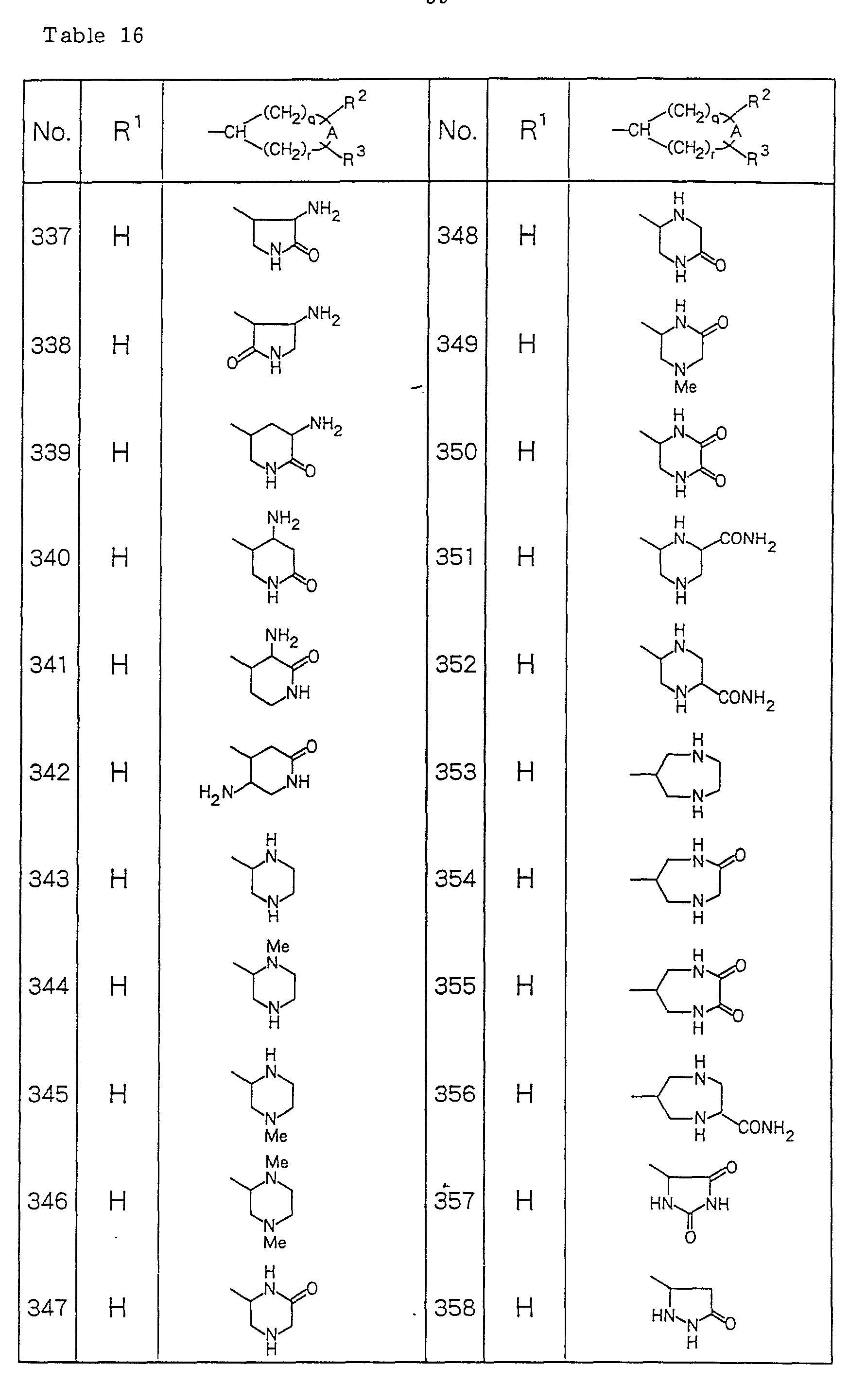


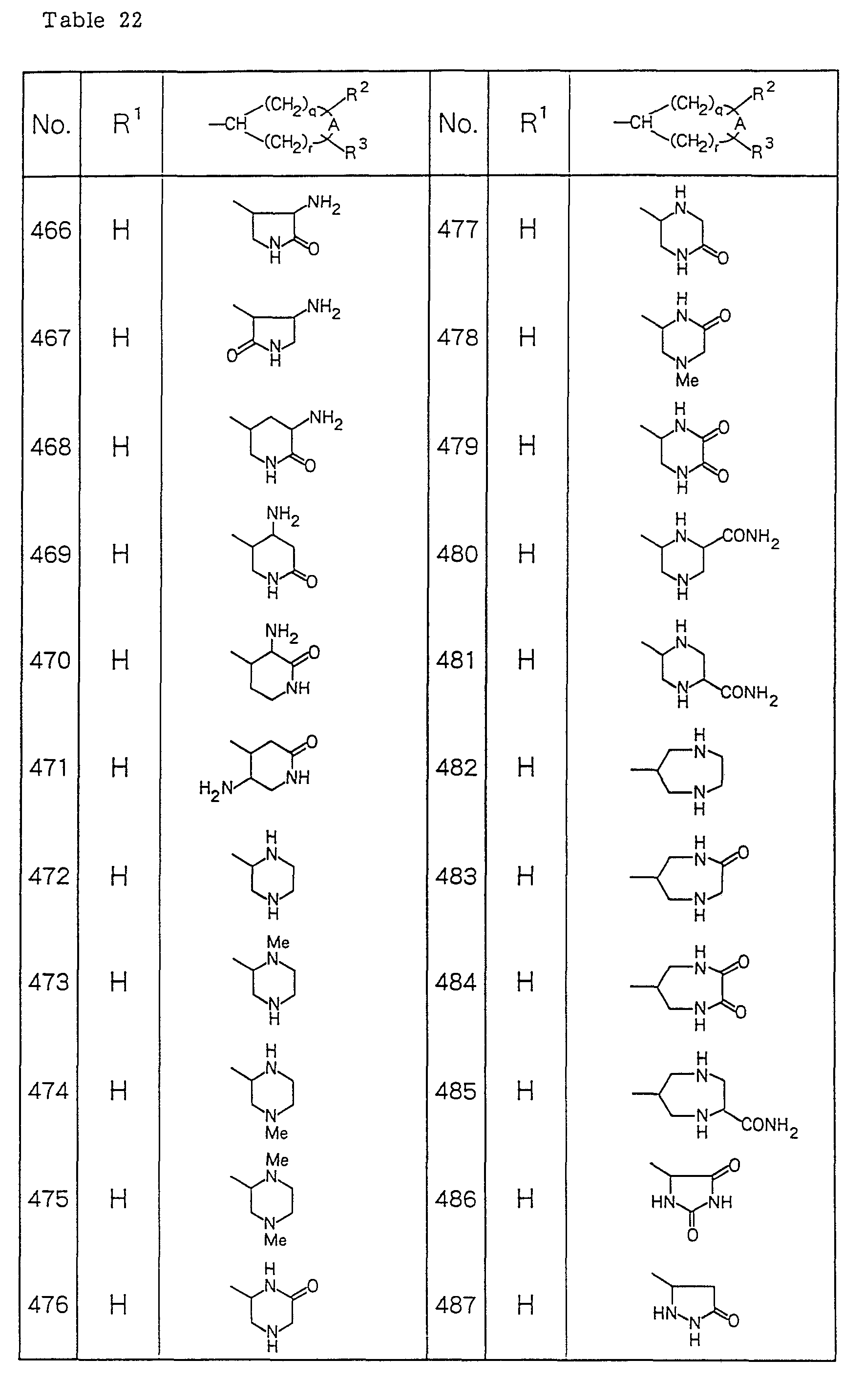


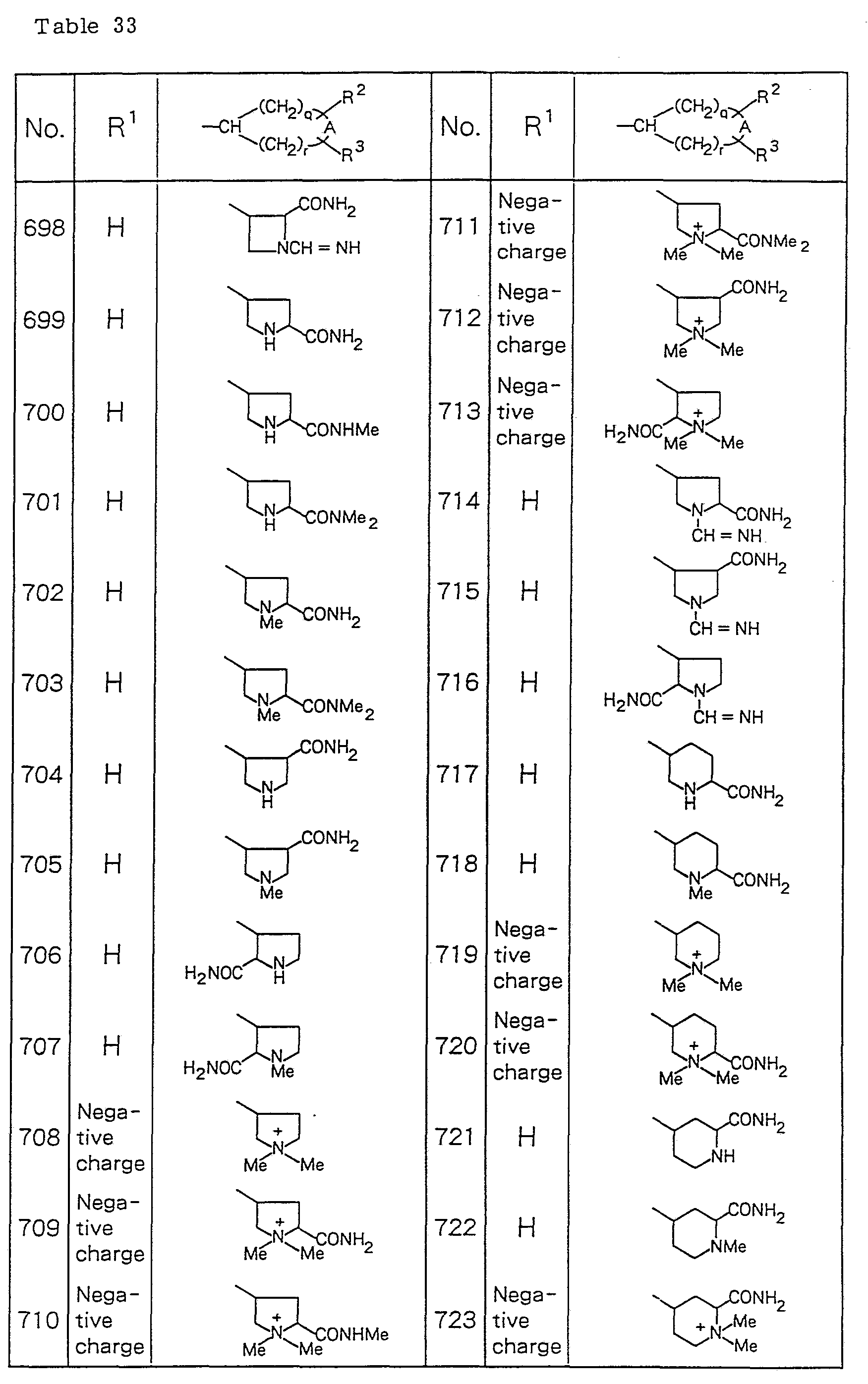


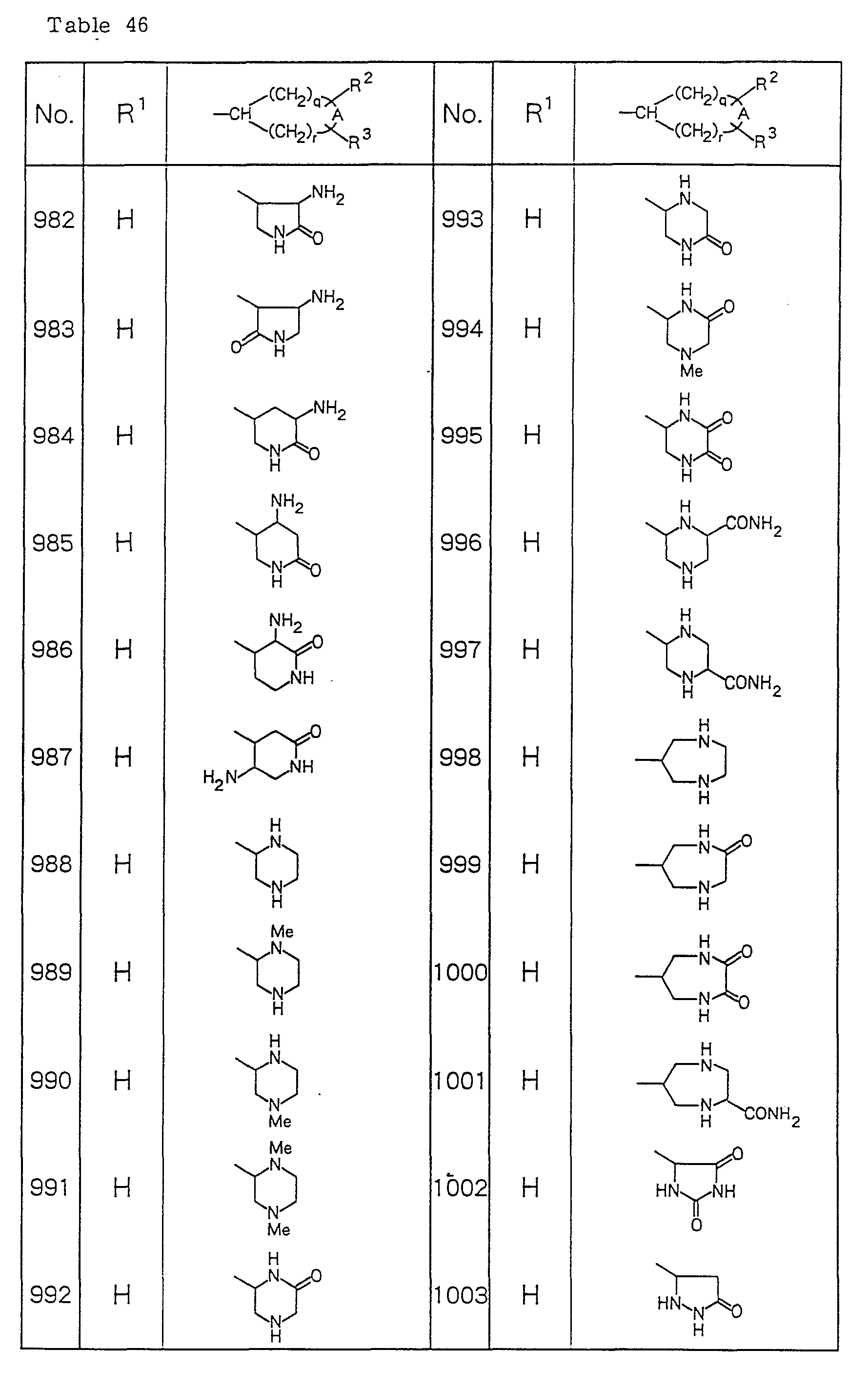


Among the above compounds, preferred are compounds identified by compound Nos. 5, 7, 9, 13, 14, 20, 23, 24, 26, 27, 28, 32, 34, 44, 45, 54, 63, 79, 85, 89, 90, 95, 96, 99, 100, 114, 115, 117, 119, 121, 122, 124, 125, 127, 128, 130, 132, 134, 136, 138, 140, 142, 143, 144, 149, 152, 153, 155, 156, 157, 159, 161, 163, 167, 171, 173, 174, 180, 183, 192, 201, 205, 208, 214, 218, 224, 225, 227, 228, 229, 233, 237, 239, 240, 242, 243, 244, 245, 246, 247, 248, 249, 250, 251, 252, 253, 254, 255, 256, 257, 258, 263, 265, 267, 271, 273, 278, 281, 282, 284, 286, 290, 292, 302, 312, 313, 314, 343, 353, 354, 357, 372, 373, 375, 377, 379, 380, 382, 383, 385, 386, 388, 389, 390, 392, 393, 394, 396, 398, 400, 401, 402, 407, 410, 411, 413, 415, 417, 419, 421, 431, 438, 441, 450, 459, 463, 466, 472, 476, 482, 483, 485, 486, 495, 497, 498, 500, 501, 502, 503, 504, 505, 506, 507, 508, 509, 510, 511, 512, 513, 514, 515 and 516.
Among them, particularly preferred are as follows:
34 (5R,6S)-6-[(R)-1-hydroxyethyl]-2-[(2S,4S)-2-(2- pyrrolidon-4-yl)pyrrolidin-4-ylthio]-1-carbapen-2-em-3- carboxylic acid,
134 (1R,5S,6S)-2-[(2S,4S)-2-(azetidin-3- yl)pyrrolidin-4-ylthio]-6-[(R)-1-hydroxyethyl]-1-methyl- 1-carbapen-2-em-3-carboxylic acid,
136 (1R,5S,6S)-2-[(2S,4S)-2-(N-formimidoylazetidin- 3-yl)pyrrolidin-4-ylthio]-6-[(R)-1-hydroxyethyl]-1- methyl-1-carbapen-2-em-3-carboxylic acid,
138 (1R,5S,6S)-6-[(R)-1-hydroxyethyl]-1-methyl-2- [(2S,4S)-2-(pyrrolidin-2-yl)pyrrolidin-4-ylthio]-1- carbapen-2-em-3-carboxylic acid,
142 (1R,5S,6S)-6-[(R)-1-hydroxyethyl]-1-methyl-2- [(2S,4S)-2-(pyrrolidin-3-yl)pyrrolidin-4-ylthio]-1- carbapen-2-em-3-carboxylic acid,
143 (1R,5S,6S)-6-[(R)-1-hydroxyethyl]-1-methyl-2-
[(2S,4S)-2-(N-methylpyrrolidin-3-yl)pyrrolidin-4-ylthio]-
1-carbapen-2-em-3-carboxylic acid,
144 (1R,5S,6S)-2-[(2S,4S)-2-(N- formimidoylpyrrolidin-3-yl)pyrrolidin-4-ylthio]-6-[(R)-1- hydroxyethyl]-1-methyl-1-carbapen-2-em-3-carboxylic acid, 149 (1R,5S,6S)-6-[(R)-1-hydroxyethyl]-1-methyl-2-
[(2S,4S)-2-(piperidin-3-yl)pyrrolidin-4-ylthio]-1- carbapen-2-em-3-carboxylic acid,
152 (1R,5S,6S)-6-[(R)-1-hydroxyethyl]-1-methyl-2- [(2S,4S)-2-(piperidin-4-yl)pyrrolidin-4-ylthio]-1- carbapen-2-em-3-carboxylic acid,
153 (1R,5S,6S)-6-[(R)-1-hydroxyethyl]-1-methyl-2- [(2S,4S)-2-(N-methylpiperidin-4-yl)pyrrolidin-4-ylthio]- l-carbapen-2-em-3-carboxylic acid,
155 (1R,5S,6S)-2-[(2S,4S)-2-(2-azetidinon-4- yl)Pyrrolidin-4-ylthio]-6-[(R)-1-hydroxyethyl]-1-methyl- 1-carbapen-2-em-3-carboxylic acid,
157 (1R,5S,6S)-2-[(2S,4S)-2-(2-azetidinon-3- yl)pyrrolidin-4-ylthio]-6-[(R)-1-hydroxyethyl]-1-methyl- 1-carbapen-2-em-3-carboxylic acid,
159 (1R,5S,6S)-6-[(R)-1-hydroxyethyl]-1-methyl-2- [(2S,4S)-2-(2-pyrrolidon-5-yl)pyrrolidin-4-ylthio]-1- carbapen-2-em-3-carboxylic acid,
161 (1R,5S,6S)-6-[(R)-1-hydroxyethyl]-1-methyl-2- [(2S,4S)-2-(2-pyrrolidon-3-yl)pyrrolidin-4-ylthio]-1- carbapen-2-em-3-carboxylic acid,
163 (1R,5S,6S)-6-[(R)-1-hydroxyethyl]-1-methyl-2- [(2S,4S)-2-(2-pyrrolidon-4-yl)pyrrolidin-4-ylthio]-1- carbapen-2-em-3-carboxylic acid,
183 (1R,5S,6S)-2-[(2S,4S)-2-(2-carbamoylpyrrolidin- 4-yl)pyrrolidin-4-ylthio]-6-[(R)-1-hydroxyethyl]-1- methyl-1-carbapen-2-em-3-carboxylic acid,
192 (1R,5S,6S)-2-[(2S,4S)-2-(N,N-dimethyl-3- pyrrolidinio)pyrrolidin-4-ylthio]-6-[(R)-1-hydroxyethyl]- 1-methyl-1-carbapen-2-em-3-carboxylic acid,
208 (1R,5S,6S)-2-[(2S,4S)-2-(3-amino-2-pyrrolidon-4- yl)pyrrolidin-4-ylthio]-6-[(R)-1-hydroxyethyl]-1-methyl- 1-carbapen-2-em-3-carboxylic acid,
214 (1R,5S,6S)-6-[(R)-1-hydroxyethyl]-1-methyl-2- [(2S,4S)-2-(2-piperazinyl)pyrrolidin-4-ylthio]-1- carbapen-2-em-3-carboxylic acid,
218 (1R,5S,6S)-6-[(R)-1-hydroxyethyl]-1-methyl-2-
[(2S,4S)-2-(3-oxopiperazin-5-yl)pyrrolidin-4-ylthio]-1- carbapen-2-em-3-carboxylic acid,
224 (1R,5S,6S)-2-[(2S,4S)-2-(hexahydro-1H-1,4- diazepin-6-yl)pyrrolidin-4-ylthio]-6-[(R)-1- hydroxyethyl]-1-methyl-1-carbapen-2-em-3-carboxylic acid,
225 (1R,5S,6S)-2-[(2S,4S)-2-(hexahydro-2-oxo-1H-1,4- diazepin-6-yl)pyrrolidin-4-ylthio]-6-[(R)-1- hydroxyethyl]-1-methyl-1-carbapen-2-em-3-carboxylic acid,
240 (1R,5S,6S)-6-[(R)-1-hydroxyethyl]-2-[(2S,4S)-2- [N-(2-hydroxyethyl)pyrrolidin-3-yl]pyrrolidin-4-ylthio]-
1-methyl-1-carbapen-2-em-3-carboxylic acid,
243 (1R,5S,6S)-2-[(2S,4S)-2-(N,N-dimethyl-4- piperidinio)pyrrolidin-4-ylthio]-1-carbapen-2-em-3- carboxylate,
244 (1R,5S,6S)-2-[(2S,4S)-2-(hexahydroazepin-4- yl)pyrrolidin-4-ylthio]-6-[(R)-1-hydroxyethyl]-1-methyl-
1-carbapen-2-em-3-carboxylic acid,
246 (1R,5S,6S)-6-[(R)-1-hydroxyethyl]-1-methyl-2-
[(2S,4S)-2-(N-methylhexahydroazepin-4-yl)pyrrolidin-4- ylthio]-1-carbapen-2-em-3-carboxylic acid,
248 (1R,5S,6S)-2-[(2S,4S)-2-(N,N-dimethylhexahydro-
4-azepinio)pyrrolidin-4-ylthio]-6-[(R)-1-hydroxyethyl]-1- methyl-1-carbapen-2-em-3-carboxylate,
250 (1R,5S,6S)-6-[(R)-1-hydroxyethyl]-1-methyl-2- [(2S,4S)-2-(octahydroazocin-5-yl)pyrrolidin-4-ylthio]-1- carbapen-2-em-3-carboxylic acid,
251 (1R,5S,6S)-6-[(R)-1-hydroxyethyl]-1-methyl-2-
[(2S,4S)-2-(octahydroazocin-4-yl)pyrrolidin-4-ylthio]-1- carbapen-2-em-3-carboxylic acid,
253 (1R,5S,6S)-6-[(R)-1-hydroxyethyl]-1-methyl-2- [(2S,4S)-2-(N-methyloctahydroazocin-5-yl)pyrrolidin-4- ylthio]-1-carbapan-2-em-3-carboxylic acid,
254 (1R,5S,6S)-6-[(R)-1-hydroxyethyl]-1-methyl-2- [(2S,4S)-2-(N-methyloctahydroazocin-4-yl)pyrrolidin-4- ylthio]-1-carbapen-2-em-3-carboxylic acid,
256 (1R,5S,6S)-2-[(2S,4S)-2-(N,N-dimethyloctahydro- 5-azocinio)pyrrolidin-4-ylthio]-6-[(R)-1-hydroxyethyl]-1- methyl-1-carbapen-2-em-3-carboxylate,
257 (1R,5S,6S)-2-[(2S,4S)-2-(N,N-dimethyloctahydro- 4-azocinio)pyrrolidin-4-ylthio]-6-[(R)-1-hydroxyethyl]-1- methyl-1-carbapen-2-em-3-carboxylate,
290 (5R,6S)-6-[(R)-1-hydroxyethyl]-2-[(2R,4S)-2-(2- pyrrolidon-3-ylmethyl)pyrrolidin-4-ylthio]-1-carbapen-2- em-3-carboxylic acid,
392 (1R,5S,6S)-2-[(2R,4S)-2-(azetidin-3- ylmethyl)pyrrolidin-4-ylthio]-6-[(R)-1-hydroxyethyl]-1- methyl-1-carbapen-2-em-3-carboxylic acid,
394 (1R,5S,6S)-2-[(2R,4S)-2-(N-formimidoylazetidin- 3-ylmethyl)pyrrolidin-4-ylthio]-6-[(R)-1-hydroxyethyl]-1- methyl-1-carbapen-2-em-3-carboxylic acid,
400 (1R,5S,6S)-6-[(R)-1-hydroxyethyl]-1-methyl-2- [(2R,4S)-2-(pyrrolidin-3-ylmethyl)pyrrolidin-4-ylthio]-1- carbapen-2-em-3-carboxylic acid,
401 (1R,5S,6S)-6-[(R)-1-hydroxyethyl]-1-methyl-2-
[(2R,4S)-2-(N-methylpyrrolidin-3-ylmethyl)pyrrolidin-4- ylthio]-1-carbapen-2-em-3-carboxylic acid,
402 (1R,5S,6S)-2-[(2R,4S)-2-(N- formimidoylpyrrolidin-3-ylmethyl)pyrrolidin-4-ylthio]-6- [(R)-1-hydroxyethyl]-1-methyl-1-carbapen-2-em-3-
carboxylic acid,
413 (1R,5S,6S)-2-[(2R,4S)-2-(2-azetidinon-4- ylmethyl)pyrrolidin-4-ylthio]-6-[(R)-1-hydroxyethyl]-1- methyl-1-carbapen-2-em-3-carboxylic acid,
415 (1R,5S,6S)-2-[(2R,4S)-2-(2-azetidinon-3- ylmethyl)pyrrolidin-4-ylthio]-6-[(R)-1-hydroxyethyl]-1- methyl-1-carbapen-2-em-3-carboxylic acid,
417 (1R,5S,6S)-6-[(R)-1-hydroxyethyl]-1-methyl-2- [(2R,4S)-2-(2-pyrrolidon-5-ylmethyl)pyrrolidin-4-ylthio]- 1-carbapen-2-em-3-carboxylic acid,
419 (1R,5S,6S)-6-[(R)-1-hydroxyethyl]-1-methyl-2- [(2R,4S)-2-(2-pyrrolidon-3-ylmethyl)pyrrolidin-4-ylthio]- 1-carbapen-2-em-3-carboxylic acid,
421 (1R,5S,6S)-6-[(R)-1-hydroxyethyl]-1-methyl-2- [(2R,4S)-2-(2-pyrrolidon-4-ylmethyl)pyrrolidin-4-ylthio]- 1-carbapen-2-em-3-carboxylic acid,
441 (1R,5S,6S)-2-[(2R,4S)-2-(2-carbamoylpyrrolidin- 4-ylmethyl)pyrrolidin-4-ylthio]-6-[(R)-1-hydroxyethyl]-1- methyl-1-carbapen-2-em-3-carboxylic acid,
450 (1R,5S,6S)-2-[(2R,4S)-2-(N,N-dimethyl-3- pyrrolidiniomethyl)pyrrolidin-4-ylthio]-6-[(R)-1- hydroxyethyl]-1-methyl-1-carbapen-2-em-3-carboxylic acid,
466 (1R,5S,6S)-2-[(2R,4S)-2-(3-amino-2-pyrrolidon-4- ylmethyl)pyrrolidin-4-ylthio]-6-[(R)-1-hydroxyethyl]-1- methyl-1-carbapen-2-em-3-carboxylic acid,
476 (1R,5S,6S)-6-[(R)-1-hydroxyethyl]-1-methyl-2- [(2R,4S)-2-(3-oxopiperazin-5-ylmethyl)pyrrolidin-4-
ylthio]-1-carbapen-2-em-3-carboxylic acid, and
498 (1R,5S,6S)-6-[(R)-1-hydroxyethyl]-2-[(2R,4S)-2- [N-(2-hydroxyethyl)pyrrolidin-3-ylmethyl]pyrrolidin-4- ylthio]-1-methyl-1-carbapen-2-em-3-carboxylic acid.
Especially preferred are compounds No. 142 i.e.
(1R,5S,6S)-6-[(R)-1-hydroxyethyl]-1-methyl-2-[(2S,4S)-2- (pyrrolidin-3-yl)pyrrolidin-4-ylthio]-1-carbapen-2-em-3- carboxylic acid and No. 152 i.e. (1R,5S,6S)-6-[(R)-1- hydroxyethyl]-1-methyl-2-[(2S,4S)-2-(piperidin-4- yl)pyrrolidin-4-ylthio]-1-carbapen-2-em-3-carboxylic acid.
Now, the process for producing the compound of the present invention will be described.
An activating reagent is reacted to a compound of the formula:

wherein R is a hydrogen atom or a methyl group, R13 is a hydrogen atom or a hydroxyl-protecting group, and R14 is a hydrogen atom or a carboxyl-protecting group in an inert organic solvent in the presence of a base to form a reactive derivative of the formula (II'):
 wherein R, R13 and R14 are as defined above, and Y is a leaving group.
The inert organic solvent to be used for the reaction may, for example, be diethyl ether, tetrahydrofuran, dioxane, benzene, toluene, chlorobenzene, methylene chloride, chloroform, carbon tetrachloride,
dichloroethane, trichloroethylene, acetone, ethyl
acetate, acetonitrile, N,N-dimethylformamide,
hexamethylphosphoric triamide or a mixture of such solvents. Particularly preferred are acetonitrile and benzene.
The base to be used for the reaction may, for example, be a tertiary aliphatic amine such as
trimethylamme, triethylamine, N,N-diisopropylethylamine, N-methylmorpholine, N-methylpyrrolidine, N- methylpiperidine, N,N-dimethylaniline, 1,8- diazabicyclo[5.4.0]undec-7-ene (DBU) or 1,5- diazabicyclo[4.3.0]non-5-ene (DBN); or an aromatic amine such as pyridine, 4-dimethylaminopyridine, picoline, lutidine, guinoline or isoquinoline. Particularly preferred are N,N-diisopropylethylamine and
triethylamine.
The activating reagent to be used for the reaction may, for example, be an acid anhydride such as
trifluoroacetic anhydride, methanesulfonic anhydride, trifluoromethanesulfonic anhydride or p-toluenesulfonic anhydride; or an acid chloride such as methanesulfonyl chloride, p-toluenesulfonyl chloride or diphenyl
chlorophosphate. Particularly preferred is diphenyl chlorophosphate.
In the formula (II'), Y is a leaving group such as a trifluoroacetoxy group, a methanesulfonyloxy group, a trifluoromethanesulfonyloxy group, a p-toluenesulfonyloxy group or a diphenoxyphosphoryloxy group. Particularly preferred is a diphenoxyphosphoryloxy group.
For the reaction, from 1 to 3 mols, preferably from 1 to 1.5 mols, of the base and from 1 to 1.2 mols of the activating reagent are used per mol of the compound of the formula (II).
The reaction is conducted usually within a
temperature range of from -40 to 50°C, preferably from -20 to 20°C, and usually completed quantitatively in from 0.5 to 3 hours.
After completion of the reaction, the reaction product is treated in accordance with a usual method to obtain the reactive derivative (II') of the compound of the formula (II) quantitatively.
The reaction of the reactive derivative of the formula (II') with a compound of the formula:
 wherein R15 is a hydrogen atom or an imino-protecting group, each of R20 and R30 which may be the same or different, is a hydrogen atom, a lower alkyl group, a hydroxy lower alkyl group which may be protected, a formimidoyl group which may be protected, an acetoimidoyl group which may be protected, -COOR40, -CON(R50)R60, -N(R50)R60, -CH2COOR40, -CH2N(R50)R60 or -CH2CON(R50)R50 (wherein R40 is a hydrogen atom, a lower alkyl group or a carboxyl-protecting group, and each of R50 and R60 which may be the same or different, is a hydrogen atom, a lower alkyl group, an amino-protecting group or an imino- protecting group, or R50 and R60 form together with the adjacent nitrogen atom a heterocyclic group selected from the group consisting of an aziridinyl group, an
azetidinyl group, a pyrrolidinyl group and a piperidyl group), B is =NR70,
 =N(R70)R80, -CON(R70)-, -CON(R70)CO-,
CON(R70)CON(R80)-, -N(R 70)CO(CH2)sN(R80)-,
-N(R70)CO(CH2)sCON(R80)-, -CON(R70)N(R80)- or
-N(R70) (CH2)sN(R80)- {wherein each of R70 and R80 which may be the same or different is a hydrogen atom, a lower alkyl group, a hydroxy lower alkyl group which may be protected, a formimidoyl group which may be protected, an
acetoimidoyl group which may be protected, an iminoprotecting group, -COOR40, -CON(R50)R60, -N(R50)R60,
-CH2COOR40, -CH2N(R50)R60 or -CH2CON(R50)R60 (wherein R40, R50 and R60 are as defined above), and s is an integer of from 1 to 3}, and p, q and r are as defined above, is conducted using the above mentioned inert organic solvent and base to form a compound of the formula:

wherein R, R13, R14, R15, R20, R30, B, p, q and r are as defined above.
The reaction is conducted using from 1 to 2 mols, preferably from 1 to 1.5 mols, of the base and from 1 to 1.2 mol. of the compound of the formula (III), per mol of the reactive derivative of the formula (II'). The reaction is conducted usually within a temperature range of from -40 to 50°C, preferably from -20 to 20°C, and the reaction is completed usually in from 0.5 to 3 hours.
Further, the compound of the formula (IV) can be prepared in one step from the compound of the formula (II). Namely, without isolating the reactive derivative of the formula (II') prepared from the compound of the formula (II), the compound of the formula (III) is reacted thereto in the same reaction system to prepare
the compound of the formula (IV) efficiently. To conduct the production in one step, from 2 to 4 mols, preferably from 2.5 to 3.5 mols, of the base is employed per mol of the compound of the formula (II).
After completion of the reaction, usual treatment is conducted to obtain a crude product of the formula (IV), which may be subjected to a reaction for removing a protecting group without purification. However, it is preferred to purify the crude product (IV) by
crystallization or by column chromatography by means of e.g. silica gel.
From the compound of the formula (IV) thus obtained, a compound of the formula (I) can be obtained, if
necessary, by conducting a reaction for removing a protecting group for a hydroxyl group, an amino or imino group and a carboxyl group.
For the removal of the protecting groups, the method varies depending upon the type of the protecting groups. However, the removal can be conducted in accordance with conventional methods, for example, by solvolysis, by chemical reduction or by hydrogenation.
For example, when in the above formula (IV), the protecting group for the hydroxyl group and/or for the amino or imino group is an aralkyloxycarbonyl group such as a benzyloxycarbonyl group or a p- nitrobenzyloxycarbonyl group, and the protecting group for the carboxyl group is an aralkyl group such as a
benzyl group, a p-nitrobenzyl group or a benzhydryl group, such protecting groups can be removed by catalytic hydrogenation by means of a platinum catalyst such as platinum oxide, platinum wire or platinum black, or a palladium catalyst such as palladium black, palladium oxide, palladium-carbon or palladium hydroxide-carbon.
As a solvent to be used for such a catalytic, hydrogenation reaction, methanol, ethanol,
tetrahydrofuran, dioxane, acetic acid or a solvent mixture of such an organic solvent with water or with a buffer solution of e.g. a phosphate, may be used.
The reaction can be completed in from 0.5 to 4 hours at a temperature within a range of from 0 to 50°C under hydrogen gas stream of from 1 to 4 atm.
When in the above formula (IV), the protecting group for the hydroxyl group and/or the amino or imino group is an allyloxycarbonyl group, and the protecting group for the carboxyl group is an allyl group, such protecting groups can be removed by reacting an organo-soluble palladium complex catalyst in an inert organic solvent containing an allyl .group-capturing agent (method by W. McCombie et al., J. Org. Chem., vol. 47, p. 587-590
(1982) and method by F. Guibé, the same literature, vol. 52, p. 4,984-4,993 (1987)).
The solvent useful for the reaction includes, for example, water, acetone, diethyl ether, tetrahydrofuran, dioxane, ethyl acetate, acetonitrile, methylene chloride,
chloroform and a solvent mixture thereof.
The palladium compound complex useful for this reaction includes, for example, palladium-carbon, palladium hydroxide-carbon, palladium(II) chloride, palladium(II) acetate,
tetrakis(triphenylphosphine)palladium (O),
tetrakis(triphenoxyphosphine)palladium (O),
tetrakis(triethoxyphosphine)palladium (O),
bis[ethylenebis(diphenylphosphine)]palladium (O), tetrakis[tri(2-furyl)phosphine]palladium (O),
bis(triphenylphosphine)palladium(II) chloride and bis(triphenylphosphine)palladium(II) acetate.
The allyl group-capturing agent may, for example, be dimedone, formic acid, acetic acid, ammonium formate, sodium formate, sodium 2-ethylhexanoate, potassium 2- ethylhexanoate, pyrrolidine, piperidine and tributyltin hydride.
The reaction is conducted usually within a
temperature range of from -10 to 50°C, preferably from 0 to 30°C using from 0.01 to 0.5 mol of the catalyst and from 1 to 6 mols of the nucleophilic agent relative to 1 mol of the compound of the formula (IV), and the reaction is completed usually in from 0.5 to 3 hours.
Further, when in the above formula (IV), the
protecting group for the hydroxyl group and/or the amino or imino group is an o-nitrobenzyloxycarbonyl group, and the protecting group for the carboxyl group is an o-
nitrobenzyl group, such protecting groups can be removed by a photo reaction (method by Amit et al., J. Org.
Chem., vol. 39, p. 192-196 (1974)).
After completion of the reactions for removing the protecting groups, the compound of the formula (I) can be isolated by usual treatment such as column chromatography using silica gel or adsorptive resin, freeze-drying or crystallization.
Further, when the protecting group for the carboxyl group at the 3-position of the compound of the formula (IV) is a lower alkanoyloxyalkyl group such as an
acetoxymethyl group or a pivaloyloxymethyl group, a methoxymethyl group, an indanyl group, or a phthalidyl group, such an ester will be physiologically hydrolyzed in vivo. Therefore, such a compound can directly be administered to a human being or to an animal without preliminarily removing the protecting group.
The compound of the formula (I) can be converted to a pharmaceutically acceptable salt or ester by a
conventional method.
The starting material of the formula (II) can be prepared, for example, by a method by Salzmann et al.
when R1 is a hydrogen atom (J. Am. Chem. Soc, vol. 102, p.6161-6163 (1981)) or by a method by Shih et al. when R1 is a methyl group (Heterocycles, vol. 21, p.29-40
(1984)).
The starting material of the formula (III) can be
synthesized by the following method.
The hydroxyl group of the compound 1 is activated by a usual method, and a thioacetate such as potassium thioacetate is reacted thereto to convert it to an acetylthio derivative 3, followed by alkali or acid hydrolysis to obtain a thiol derivative of the formula (III).

In the above formulas, R16 is a hydrogen atom or a hydroxyl-protecting group, X is a leaving group selected
from the group consisting of a chlorine atom, a bromine atom, an iodine atom, a trifluoroacetoxy group, a
methanesulfonyloxy group, a trifluoromethanesulfonyloxy group and a p-toluenesulfonyloxy group, Ac is an acetyl group, and R15, R20, R30, B, p, q and r are as defined above.
A group of compounds having the formula 1 can be prepared in accordance with the methods described in the Reference Examples.
The compounds of the present invention exhibit strong antibacterial activities against various gram positive bacteria and gram negative bacteria.
To demonstrate the usefulness of the compounds of the present invention, the in vitro antibacterial activities against bacteria were measured by the following agar plate dilution method (standard method by Japan
Chemotherapy Society, Chemotherapy, vol. 29, p. 76-79 (1981)). One platinum loopful of each test microorganism incubated overnight in Mueller Hinton broth, was
inoculated to Mueller Hinton agar (inoculum size: 106 CFU/mℓ). Such culture media contained antibacterial agents in various concentrations. After incubation at 37°C for 16 hours, the minimum inhibitory concentrations (MIC: μq/mℓ) were measured.
The results of the antibacterial activities of the compounds of the present invention are shown in Table 1.

The antibacterial activities of the compounds of the present invention described in the Examples, as
representative examples of the compound of the present invention, were measured by a disc diffusion test by the method of Bauer et al. (Amer. J. Clin. Pathol., vol. 45, p. 493 (1966)). Thienamycin or imipenem was used as the internal standard.
MIC of each test compound was calculated from the diameter of the inhibition ring formed by the disc containing the test compound by using the calculation formula reported by Humphrey and Lightbown (J. Gen.
Microbiol., vol. 7, p. 129 (1952)). For each
microorganism, a geometrical average of MIC was obtained, and the activity ratio to thienamycin was calculated.
The antibacterial activities are represented by the ratio to thienamycin (= 1.0), whereby the larger the numerical value, the higher the activities.
The DHP-I susceptibility was quantitatively analyzed by the method by Kropp et al., Antimicrob. Agents
Chemother., vol. 22, p. 62-70 (1982), whereby the smaller the numerical value representing. the ratio to imipenem (=1.0), the higher the stability. The antibacterial potency and the DHP-I susceptibility of the compounds of the present invention were compared with imipenem and meropenem. The results are shown in Table 2.

The compounds of the present invention have excellent antibacterial activities against various gram positive bacteria and gram negative bacteria and are useful as antibacterial agents for the treatment and prevention of the human infectious diseases caused by such bacteria. Typical pathogens sensitive to the antibacterial agents of the present invention include, for example, species of genus Staphylococcus, genus Enterococcus, genus
Escherichia, genus Enterobacter, genus Klebsiella, genus Serratia, genus Proteus and genus Pseudomonas. The compounds of the present invention exhibit excellent antibacterial activities particularly against Methicillin resistant Staphylococcus aureus and against thienamycin resistant Pseudomonas aeruginosa.
The compounds of the present invention are very stable against DHP-I although the stability varies depending upon the individual compounds, and they are excellent also in the physicochemical stability and in the solubility in water.
The compounds of the present invention may be used in the form of drug formulations suitable for non-oral administration, oral administration or external
administration, by mixing them with carriers of solid or liquid excipients known in this field. The main
administration route is non-oral (intravenous or
intramuscular injection) administration by injection or local administration. Drug formulations include liquid
formulations such as injection solutions, syrups or emulsions, solid formulations such as tablets, capsules or granules, and external application formulations such as ointments or suppositories. These formulations may contain additives such as a base, an assisting agent, a stabilizer, a wetting agent, an emulsifier, an
absorption-promoting agent, a surfactant, etc. which are commonly employed, as the case requires.
The additives include, for example, distilled water for injection, Ringer's solution, glucose, sucrose syrup, gelatin, edible oil, cacao butter, ethylene glycol, sucrose, corn starch, magnesium stearate and talc.
The dose varies depending upon the condition of the patient, the weight, the age, the sex, the type of formulation, the number of administration times, etc.
Usually, however, a preferred daily dose of the active ingredient to an adult is from about 5 to 50 mg/kg, and a preferred daily dose to a child is within a range of from about 5 to 25 mg/kg, which is preferably administered once a day or in a few times a day.
The compound of the present invention may be
administered in combination with a DHP-I inhibiting agent such as cilastatin [sodium (Z)-7-(L-amino-2- carboxyethylthio)-2-(2,2- dimethylcyclopropanecarboxamide)-2-heptenoate] (Japanese Unexamined Patent Publication No. 81518/1981; European Patent No. 28,778; J. Med. Chem., vol. 30, p. 1074
( 1987 ) ) .
Now, the present invention will be described in further detail with reference to Examples and Reference Examples. However, it should be understood that the present invention is by no means restricted by such specific Examples.
In the thin layer chromatography in the Examples and Reference Examples, silica gel 60F245 (Merck) was used as the plate, and an ultraviolet detector was used as a detecting device. As the silica gel for the column, Wakogel™ C-300 (Wako Junyaku) was used, and as the silica gel for reversed phase column, LC-SORB™ SP-B-ODS (Chemco) or YMC-GEL™ ODS-AQ 120-550 (Yamamura Chemical Laboratories) was used. As the high pressure liquid chromatograph, JASCO 800 series (Nippon Bunko) was used. When the NMR spectrum was measured using a dimethyl sulfoxide-d6 or chloroform-d solution, tetramethylsilane (TMS) was used as the internal standard, and when measured using a deuterium oxide solution, 2,2-dimethyl- 2-silapentane-5-sulfonate (DSS) was used as the internal standard, and the measurement was conducted by means of
XL-200 (200 MHz;Varian) model spectrometer. All δ values are shown by ppm.
The meanings of the abbreviations used for the NMR measurement are as follows:
s: singlet
d: doublet
t: triplet
q: quartet
ABq: AB-type quartet
dd: double doublet
m: multiplet
br: broad
J: coupling constant
Hz: hertz
DMSO-d6: dimethyl sulfoxide-d6
CDCl3: chloroform-d
CD3OD: methanol-d4
D2O: deuterium oxide
The meanings of the abbreviations used in the reaction formulas are as follows:
Ac: acetyl group
All: allyl group
Alloc: allyloxycarbonyl group
Boc: tert-butoxycarbonyl group
Bzl: benzyl group
Ft: ethyl group
Me: methyl group
Ms: methanesulfonyl group
PNB: p-nitrobenzyl group
PNZ: p-nitrobenzyloxycarbonyl group
TBDMS: tert-butyldimethylsilyl group
Tr: trityl group
EXAMPLE 1
Sodium (5R,6S)-6-[(R)-1-hydroxyethyl]-2-[(2S,4S)-2-(2- pyrrolidon-4-yl)pyrrolidin-4-ylthio]-1-carbapen-2-em-3- carboxylate
1)

To a solution of p-nitrobenzyl (5R,6S)-2-diphenoxy phosphoryloxy-6-[(R)-1-hydroxyethyl]-1-carbapen-2-em-3- carboxylate (300 mg, 0.55 mmol) in acetonitrile (15 mℓ) were dropwise added in a nitrogen stream under cooling with ice a solution of (2S,4S)-4-mercapto-N-(p- nitrobenzyloxycarbonyl)-2-(2-pyrrolidon-4-yl)pyrrolidine (205 mg, 0.56 mmol, Compound of Reference Example 1-9) in acetonitrile (6 mℓ)Rand then N,N-diisopropylethylamine (0.10 mℓ, 0.57 mmol). The mixture was stirred at 0°C for 7 hours. Then, ethyl acetate (70 mℓ) was added to the reaction solution. The organic layer was washed with water and a saturated sodium chloride aqueous solution, then dried over anhydrous magnesium sulfate and
concentrated under reduced pressure. The residue was subjected to silica gel column chromatography (Wakogel™ C-300, ethyl acetate) to obtain p-nitrobenzyl (5R,6S)-6-
[(R)-1-hydroxyethyl]-2-[(2S,4S)-N-(p- nitrobenzyloxycarbonyl)-2-(2-pyrrolidon-4-yl)pyrrolidin-
4-ylthio]-1-carbapen-2-em-3-carboxylate (313 mg, yield:
86.2%).
1R(KBr)cm-1: 1780, 1700, 1520, 1350
NMR(CDCl3) δ:
1.37(3H,d,J=6Hz),5.24(3H,m),5.52(1H,d,J=14Hz),7.33
(2H,d,J=9Hz),7.46(2H,d,J=9Hz),8.24(2H,d,J=9Hz),8.26
(2H,d,J=9Hz)
2)
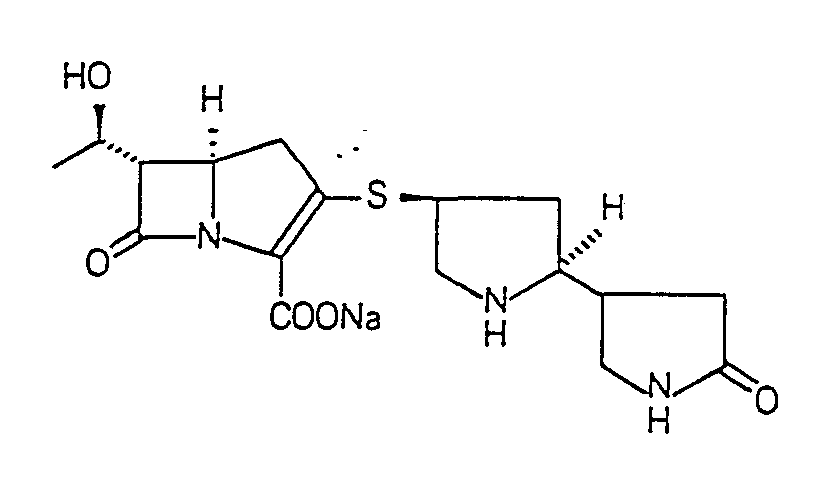
10% palladium-carbon catalyst (150 mg preliminarily stirred and activated with a 0.1 M sodium 3- morpholinopropanesulfonate buffer solution in a hydrogen stream for one hour) was added to a solution of the compound obtained by the above reaction (300 mg, 0.45 mmol) in a mixture of tetrahydrofuran (10 mℓ) and a 0.1M sodium 3-morpholinopropanesulfonate buffer solution (10 mℓ) . This mixture was stirred in a hydrogen stream at room temperature for two hours. The catalyst was filtered off from the reaction mixture, and the filtrate was washed with ethyl acetate (20 mℓ), and insoluble
matters in the aqueous layer were filtered off. The obtained filtrate was concentrated to a volume of about 15 mℓ. The residue was subjected to reversed phase column chromatography (LC-SORB™ SP-B-ODS, 10% methanol aqueous solution). The desired fraction was concentrated and freeze-dried to obtain the above identified compound (70 mg, yield: 38.4%).
1R(KBr)cm-1: 1760, 1680, 1590, 1390
NMR(D2O) δ:
1.26(3H,d,J=7Hz),1.54(1H,m),2.28(1H,m),3.86(1H,m),
4.21(2H,m)
HPLC:
Column: YMC™-Pack ODS-AQ, 5μ, 4.6∅ x 150 mm
Eluent: 0.01M Phosphate buffer (pH 6.5)-Methanol
(80:20)
Flow rate: 1.0 mℓ/min
Temperature: 40°C
Detector: 290 nm
Retention time: 2.23 min
EXAMPLE 2
Sodium (5R,6S)-6-[(R)-1-hydroxyethyl]-2-[(2R,4S)-2-(2- pyrrolidon-4-yl)pyrrolidin-4-ylthio]-1-carbapen-2-em-3- carboxylate
1)

The same procedure as in Example 1-1 was carried out by using p-nitrobenzyl (5R,6S)-2-diphenoxyphosphoryloxy- 6-[(R)-1-hydroxyethyl]-1-carbapen-2-em-3-carboxylate (300 mg, 0.55 mmol) and (2R,4S)-4-mercapto-N-(p- nitrobenzyloxycarbonyl)-2-(2-pyrrolidon-4-yl)pyrrolidine (200 mg, 0.55 mmol, compound of Reference Example 2) to obtain p-nitrobenzyl (5R,6S)-6-[(R)-1-hydroxyethyl]-2- [(2R,4S)-N-(p-nitrobenzyloxycarbonyl)-2-(2-pyrrolidon-4- yl)pyrrolidin-4-ylthio]-1-carbapen-2-em-3-carboxylate (127 mg, yield: 35%).
lR(KBr)cm-1: 1790, 1710, 1520, 1350
NMR(CDCl3) δ:
1.36(3H,d,J=6Hz),5.25(3H,m),5.52(1H,d,J=14Hz),7.54
(2H,d,J=9Hz),7.66(2H,d,J=9Hz),8.23(2H,d,J=9Hz),
8.26(2H,d,J=9Hz)
2)

7.1%).
1R(KBr)cm-1: 1780, 1600, 1270
NMR(D2O) δ:
1.28(3H,d,J=8Hz),2.54(3H,m)
HPLC (the same condition as in Example 1)
Retention time: 5.54 min
EXAMPLE 3
Sodium (1R,5S,6S)-6-[(R)-1-hydroxyethyl]-1-methyl-2- [(2S,4S)-2-(2-pyrrolidon-4-yl)pyrrolidin-4-ylthio]-1- carbapen-2-em-3-carboxylate
1)

1R(KBr)cm-1: 1770, 1700, 1520, 1340
NMR(CDCl3) δ:
1.28(3H,d,J=8Hz),1.33(3H,d,J=7Hz),5.24(2H,m),5.31 and 5.52(2H,ABq,J=14Hz),7.53(2H,d,J=8Hz),7.66(2H,d,
J=8Hz),8.20(2H,d,J=8Hz),8.22(2H,d,J=8Hz)
2)

The same procedure as in Example 1-2 was carried out by using the compound obtained by the above reaction (223 mg, 0.33 mmol) to obtain the above identified compound (73 mg, yield: 53.2%, diastereomers A and B 44:56).
1R(KBr)cm-1: 1760, 1680, 1590, 1390
NMR(D2O) δ:
1.23(3H,d,J=8Hz),1.30(3H,d,J=7Hz),1.77(1H,m),
2.27-2.42(1H,m),4.06(1H,m),4.26(2H,m)
HPLC:
Column: INERTSIL™ ODS-2, 5μ, 4.6∅ x 250 mm
Eluent: 0.01M Phosphate buffer (pH7.0)-Methanol
(90:10)
Flow rate: 1.0 mℓ/min
Temperature: 40°C
Detector: 254 nm
Retention time: 13.2 min, 14.6 min (44:56)
EXAMPLE 4
Sodium (1R,5S,6S)-6-[(R)-1-hydroxyethyl]-1-methyl-2- [(2R,4S)-2-(2-pyrrolidon-4-yl)pyrrolidin-4-ylthio]-1- carbapen-2-em-3-carboxylate
1)

The same procedure as in Example 1-1 was carried out by using p-nitrobenzyl (1R,5S,6S)-2- diphenoxyphosphoryloxy-6-[(R)-1-hydroxyethyl]-1-methyl-1- carbapen-2-em-3-carboxylate (230 mg, 0.41 mmol) and
(2R,4S)-4-mercapto-N-(p-nitrobenzyloxycarbonyl)-2-(2- pyrrolidon-4-yl)pyrrolidine (140 mg, 0.38 mmol, compound of Reference Example 2 ) to obtain p-nitrobenzyl
(1R,5S,6S)-6-[(R)-1-hydroxyethyl]-1-methyl-2-[(2R,4S)-N- (p-nitrobenzyloxycarbonyl)-2-(2-pyrrolidon-4- yl)pyrrolidin-4-ylthio]-1-carbapen-2-em-3-carboxylate (174 mg, yield: 62.9%).
1R(KBr)cm-1: 1780, 1700, 1520, 1340
NMR(CDCl3) δ:
1.27(3H,d,J=8Hz),1.36(3H,d,J=6Hz),5.25(3H,m),5.53(1H, d,J=14Hz),7.54(2H,d,J=9Hz),7.67(2H,d,J=9Hz),8.24(2H, d,J=9Hz),8.26(2H,d,J=9Hz)
2)

1R(KBr)cm-1: 1780, 1600, 1380, 1300
NMR(D2O) δ :
1.24(3H,d,J=8Hz),1.31(3H,d,J=7Hz),1.98-2.98
(3H,m),3.44(3H,m),3.74(3H,m)
HPLC (the same condition as in Example 1)
Retention time: 7.46 min
EXAMPLE 5
Sodium (1R,5S,6S)-2-[(2S,4S)-2-azetidinon-4- yl)pyrrolidin-4-ylthio)-6-[(R)-1-hydroxyethyl]-1-methyl- 1-carbapen-2-em-3-carboxylate diastereomer B
1)

To a solution of p-nitrobenzyl (1R,5S,6S)-2- diphenoxyphosphoryloxy-6-[(R)-1-hydroxyethyl]-1-methyl-1- carbapen-2-em-3-carboxylate (110 mg, 0.195 mmol) in acetonitrile (5 mℓ) was added in a nitrogen stream at -10°C a solution of (2S,4S)-2-(2-azetidinon-4-yl)-4- mercapto-N-(p-nitrobenzyloxycarbonyl)pyrrolidine
diastereomer B (67 mg, 0.191 mmol, compound of Reference Example 3) in acetonitrile (5 mℓ), and then N,N- diisopropylamine (34 μℓ, 0.21 mmol) was dropwise added thereto. The mixture was stirred overnight at 4°C.
Then, ethyl acetate (50 mℓ) was added to the reaction solution. This mixture was washed with water and a saturated sodium chloride aqueous solution. The organic layer was dried over anhydrous magnesium sulfate and
concentrated under reduced pressure. The residue was subjected to silica gel column chromatography (Wakogel™ C-300, 3% methanol-chloroform) to obtain p-nitrobenzyl (1R,5S,6S)-2-[(2S,4S)-2-(2-azetidinon-4-yl)-N-(p- nitrobenzyloxycarbonyl)pyrrolidin-4-ylthio]-6-[(R)-1- hydroxyethyl]-1-methyl-1-carbapen-2-em-3-carboxylate diastereomer B (88.5 mg, yield: 68.2%).
1R(KBr)cm-1: 1760, 1700, 1520, 1340
NMR(CDCl3) δ:
1.28(3H,d,J=7Hz),1.35(3H,d,J=6Hz),1.67(1H,m),
2.50-2.74(3H,m),3.08(1H,dd,J=15,5Hz),3.24-3.45
(3H,m),3.70(2H,m),3.96-4.33(4H,m),5.23(3H,m),
5.52(1H,d,J=13Hz),7.52(2H,d,J=8Hz),7.65
(2H,d,J=8Hz),8.22(2H,d,J=8Hz),8.24(2H,d,J=8Hz)
2)

The same procedure as in Example 1-2 was carried out by using the compound obtained by the above reaction (88 mg, 0.13 mmol) to obtain the above identified compound (18 mg, yield: 33.7%).
1R(KBr)cm-1: 1750, 1590, 1390
NMR ( D2O ) δ :
1.26(3H,d,J=7Hz),1.31(3H,d,J=6Hz),1.65(1H,m),2.69(1H, dd,J=16,8Hz),2.73(1H,br d,J=16Hz),3.20-3.53(4H,m), 3.61(1H,dd,J=12,6Hz),3.75(1H,q,J=8Hz),3.85-4.40(4H,m) HPLC (the same condition as in Example 1)
Retention time: 3.8 min
EXAMPLE 6
Sodium (1R,5S,6S)-2-[(2S,4S)-2-(2-azetidinon-4- yl)pyrrolidin-4-ylthio)-6-[(R)-1-hydroxyethyl]-1-methyl- 1-carbapen-2-em-3-carboxylate diastereomer A
1)

The same procedure as in Example 1-1 was carried out by using p-nitrobenzyl (1R,5S,6S)-2- diphenoxyphosphoryloxy-6-[(R)-1-hydroxyethyl]-1-methyl-1- carbapen-2-em-3-carboxylate (153 mg, 0.27 mmol) and
(2S,4S)-2-(2-azetidinon-4-yl)-4-mercapto-N-(p- nitrobenzyloxycarbonyl)pyrrolidine diastereomer A (90 mg, 0.26 mmol, compound of Reference Example 4) to obtain p- nitrobenzyl (1R,5S,6S)-2-[(2S,4S)-2-(2-azetidinon-4-yl)- N-(p-nitrobenzyloxycarbonyl)pyrrolidin-4-ylthio]-6-[(R)-
1-hydroxyethyl]-1-methyl-1-carbapen-2-em-3-carboxylate diastereomer A (128 mg, yield: 70.9%).
1R(KBr)cm-1: 1760, 1700, 1520, 1340
NMR(CDCl3) δ:
1.28(3H,d,J=7Hz),1.34(3H,d,J=6Hz),1.91(2H,m),
2.44-3.10(3H,m),3.17-3.46(2H,m),3.66(1H,m),
4.00-4.36(5H,m),5.24(3H,m),5.50(1H,d,J=14Hz),
7.52(2H,d,J=8Hz),7.65(2H,d,J=8Hz),8.21(2H,d,J=8Hz),
8.23(2H,d,J=8Hz)
2)

1R(KBr)cm-1: 1750, 1590, 1390
NMR(D2O) δ:
1.25(3H,d,J=7Hz),1.32(3H,d,J=6Hz),1.83(1H,m),2.75(1H, dd,J=15,8Hz),2.88(1H,dd,J=15,2Hz),3.18-3.55(4H,m), 3.68(1H,dd,J=12,6Hz),3.86-4.40(5H,m)
HPLC (the same condition as in Example 1)
Retention time: 3.46 min
EXAMPLE 7
(5R,6S)-6-[(R)-1-hydroxyethyl]-2-[(2R,4S)-2-(z- pyrrolidon-3-ylmethyl)pyrrolidin-4-ylthio]-1-carbapen-2- em-3-carboxylic acid
1)

N,N-diisopropylethylamine (0.13 mℓ, 0.76 mmol) was dropwise added to a solution of allyl (5R,6S)-2- diphenoxyphosphoryloxy-6-[(R)-1-hydroxyethyl]-1-carbapen- 2-em-3-carboxylate (369 mg, 0.76 mmol) and (2R,4S)-N- allyloxycarbonyl-4-mercapto-2-(2-pyrrolidon-3- ylmethyl)pyrrolidine (216 mg, 0.76 mmol) in acetonitrile (5.6 mℓ) under cooling with ice. The reaction mixture solution was stirred at the same temperature for one hour and further stirred at 5°C for 16 hours. Ethyl acetate (60 mℓ) was added to the reaction solution. The mixture was washed sequentially with a saturated sodium hydrogen carbonate aqueous solution and a saturated sodium
chloride aqueous solution, then dried over anhydrous sodium sulfate and concentrated. The residue was
purified by silica gel flash column chromatography
(Wakogel™ C-300, 40 mℓ, acetone-ethyl acetate 2:3). The
fraction containing the desired product was concentrated to obtain allyl (5R,6S)-2-[(2R,4S)-N-allyloxycarbonyl-2- (2-pyrrolidon-3-ylmethyl)pyrrolidin-4-ylthio]-6-[(R)-1- hydroxyethyl]-1-carbapen-2-em-3-carboxylate (303 mg, yield: 76.7%) in the form of foam.
NMR(CDCl3) δ:
1.35(3H,d,J=6Hz),1.7-2.2(4H,m),2.34(2H,m),2.61(1H,m), 3.1-3.4(6H,m),3.55(1H,m),4.0-4.3(4H,m),4.6-4.9(4H,m), 5.2-5.5(4H,m),5.78(1H,br s),6.0(2H,m)
2)

Water (52 μℓ) was added to a solution of the compound obtained by the above reaction (300 mg, 0.58 mmol) in methylene chloride (6 mℓ) . This mixture was deaerated. Bis(triphenylphosphine)palladium(II) chloride (8 mg,
0.011 mmol) and tributyltin hydride (0.466 mℓ, 1.73 mmol) were added to this solution mixture under cooling with ice. This solution mixture was stirred at the same temperature for 5 minutes and further at room temperature for 30 minutes. Water (40 mℓ) was added to the reaction solution. The aqueous layer was washed with chloroform (20 mℓ, twice), and then the remaining organic solvent
was removed under reduced pressure. Active carbon (50 mg) was added thereto. This mixture was stirred for 30 minutes and then filtered. The filtrate was concentrated to 700 mg, and ethanol (1.4 mℓ) was added thereto at room temperature. This solution mixture was left to stand at the same temperature for 30 minutes to form precipitate. To this suspension, ethanol (1.4 mℓ) was dropwise added under stirring over a period of one hour. Then, the suspension was stirred at room temperature for 30 minutes and further at 5°C for 16 hours. The precipitate was collected by filtration and washed sequentially with a water-ethanol (1:4) mixture (1.3 mℓ, twice) and acetone (2 mℓ) and then dried under reduced pressure for two hours to obtain the above identified compound (159 mg, yield: 69.6%).
IR(KBr)cm-1: 1740, 1690, 1600, 1380
NMR(D2O) δ:
1.26(3H,d,J=8Hz),1.7-2.0(3H,m),1.18(1H,m),1.38(1H,m), 2.6-2.8(2H,m),3.2(2H,d,J=9Hz),3.3-3.4(4H,m),3.7-3.9 (2H,m),4.0(1H,m),4.1-4.3(2H,m)
EXAMPLE 8
(1R,5S,6S)-6-[(R)-1-hydroxyethyl]-1-methyl-2-[(2R,4S)-2- (2-pyrrolidon-3-ylmethyl)pyrrolidin-4-ylthio]-1-carbapen- 2-em-3-carboxylic acid

N,N-diisopropylethylamine (0.26 mℓ, 1.52 mmol) was dropwise added to a solution of allyl (1R,5S,6S)-2- diphenoxyphosphoryloxy-6-[(R)-1-hydroxyethyl]-1-methyl-1- carbapen-2-em-3-carboxylate (759 mg, 1.52 mmol) and
(2R,4S)-N-allyloxycarbonyl-4-mercapto-2-(2-pyrrolidon-3- ylmethyl)pyrrolidine (432 mg, 1.52 mmol) in acetonitrile (11 mℓ) at -40°C. The reaction solution mixture was stirred at the same temperature for 3 hours and further at 5°C for 16 hours. Ethyl acetate (60 mℓ) was added to the reaction solution. This solution mixture was washed sequentially with a saturated sodium hydrogen carbonate aqueous solution and a saturated sodium chloride aqueous solution, then dried over anhydrous sodium sulfate and concentrated. The residue was purified by silica gel flash column chromatography (Wakogel™ C-300, 40 mℓ, acetone-ethyl acetate 2:3), and the fraction containing the desired product was concentrated to obtain allyl (1R,5S,6S)-2-[(2R,4S)-N-allyloxycarbonyl-2-(2-pyrrolidon- 3-ylmethyl)pyrrolidin-4-ylthio]-6-[(R)-1-hydroxyethyl]-1- methyl-1-carbapen-2-em-3-carboxylate (420 mg, yield:
51.8%) in the form of foam.
NMR(CDCl3) δ:
1.26(3H,d,J=8Hz),1.35(3H,d,J=6Hz),1.7(1H,m),1.9-2.4 (5H,m),2.60(1H,m),3.2-3.4(5H,m),3.58(1H,m),3.9-4.3 (4H,m),4.5-4.9(4H,m),5.2-5.5(4H,m),5.8-6.1(3H,m) 2)

Water (71 μℓ) was added to a solution of the compound obtained by the above reaction (420 mg, 0.79 mmol) in methylene chloride (8.4 mℓ) . This solution was
deaerated. Bis(triphenylphosphine)palladium(II) chloride (11 mg, 0.016 mmol) and tributyltin hydride (0.635 mℓ, 2.36 mmol) were added to this solution mixture under cooling with ice. This solution mixture was stirred at the same temperature for 3 minutes and further at room temperature for 30 minutes. Water (40 mℓ) was added to the reaction solution, and the aqueous layer was washed with chloroform (20 mℓ, twice). Then, the remaining organic solvent was removed under reduced pressure.
Active carbon (50 mg) was added thereto. This mixture was stirred for 30 minutes and then filtered. The filtrate was concentrated to 500 mg, and ethanol (1 mℓ)
was added thereto at room temperature. This solution mixture was left to stand at the same temperature for one hour to form precipitate. To this suspension, ethanol (3.5 mℓ) was dropwise added under stirring over a period of one hour. This suspension was stirred at room
temperature for 30 minutes and further at 5°C for 16 hours. The precipitate was collected by filtration, then washed sequentially with a water-ethanol (1:9) mixture ( 1 mℓ, three times ) and acetone ( 3 mℓ) and dried for two hours under reduced pressure to obtain the above
identified compound (232 mg, yield: 72.0%).
IR(KBr)cm-1: 1760, 1700, 1640, 1590, 1390
NMR(D2O) δ:
1.21(3H,d,J=8Hz),1.28(3H,d,J=6Hz),1.7-2.0(3H,m),2.20 (1H,m),2.40(1H,m),2.6-2.9(2H,m),3.3-3.5(5H,m),3.70 (1H,m),3.86(1H,m),4.0(1H,m),4.24(2H,m)
EXAMPLE 9
(1R,5S,6S)-2-[(2R,4S)-2-(2-azetidinon-3-ylmethyl)- pyrrolidin-4-ylthio]-6-[(R)-1-hydroxyethyl]-1-methyl-1- carbapen-2-em-3-carboxylic acid
1)

NMR(CDCl3) δ:
1.29(3H,d,J=7Hz),1.36(3H,d,J=6Hz),1.8(1H,m),2.0 (1H,m),2.65(2H,m),3.1(1H,m),3.3(3H,m),3.48(1H,t, J=6Hz),3.6(1H,m),4.0(2H,m),4.25(2H,m),4.62(2H, br d, J=6Hz),4.8(2H,m),5.2-5.5(4H,m),5.66(1H, br s),5.98(2H,m)
2)

The same protecting group removal reaction and post treatment as in Example 8-2 were carried out by using the compound obtained by the above reaction (125 mg, 0.24
mmol), bis(triphenylphosphine)palladium(II) chloride (3.4 mg, 0.0048 mmol), tributyltin hydride (0.194 mℓ, 0.722 mmol) and water (22 μℓ). The obtained aqueous layer was purified by reversed phase column chromatography
(YMC-GEL™ ODS-AQ 120-S50, 50 mℓ, methanol-water 15:85), and the fraction containing the desired product was concentrated and freeze-dried to obtain the above
identified compound (20 mg, yield: 21.0%).
IR(KBr)cm-1: 1740, 1600, 1390
NMR(D2O) δ:
1.18(3H,d,J=7Hz),1.26(3H,d,J=6Hz),1.3(1H,m),2.2 (3H,m),2.7(1H,m),3.1-3.7(7H,m),3.92(1H,m),4.1-4.3 (2H,m)
EXAMPLE 10
Potassium (1R,5S,6S)-6-[(R)-1-hydroxyethyl]-1-methyl-2- [(2S,4S)-2-(2-pyrrolidon-4-yl)pyrrolidin-4-ylthio]-1- carbapen-2-em-3-carboxylate diastereomers A and B

distilled water was passed to remove salts and then the desired product was eluted by a 20% methanol aqueous solution). The desired fraction was concentrated and freeze-dried to obtain diastereomer A (16 mg) of the above identified compound. In the same manner as above, diastereomer B (14.8 mg) was obtained.
Diastereomer A
1R(KBr)cm-1: 1760, 1680, 1590, 1390
NMR(D2O) δ:
1.22(3H,d,J=8Hz),1.30(3H,d,J=7Hz),1.67(1H,m),2.35 (1H,dd,J=8,17Hz),4.02(1H,m),4.25(2H,m)
Diastereomer B
1R(KBr)cm-1: 1760, 1680, 1590, 1390
NMR(D2O) δ:
1.22(3H,d,J=8Hz),1.30(3H,d,J=7Hz),1.72(1H,m),2.28 (1H,dd,J=8,17Hz),4.02(1H,m),4.26(2H,m)
EXAMPLE 11
(1R,5S,6S)-6-[(R)-1-hydroxyethyl]-1-methyl-2-[(2S,4S)-2- (pyrrolidin-3-yl)pyrrolidin-4-ylthio]-1-carbapen-2-em-3- carboxylic acid diastereomers A and B
1 )

The same procedure as in Example 1-1 was carried out by using p-nitrobenzyl (1R,5S,6S)-2- diphenoxyphosphoryloxy-6-[(R)-1-hydroxyethyl]-1-methyl-1- carbapen-2-em-3-carboxylate (1.39 g, 2.34 mmol) and
(2S,4S)-4-mercapto-N-(p-nitrobenzyloxycarbonyl)-2-[N-(p- nitrobenzyloxycarbonyl)pyrrolidin-3-yl]pyrrolidine (1.24 g, 2.34 mmol, compound of Reference Example 5-6) to obtain p-nitrobenzyl (1R,5S,6S)-6-[(R)-1-hydroxyethyl]-1- methyl-2-[(2S,4S)-N-(p-nitrobenzyloxycarbonyl)-2-[N-(p- nitrobenzyloxycarbonyl)pyrrolidin-3-yl]pyrrolidin-4- ylthio]-1-carbapen-2-em-3-carboxylate (1.59 g, yield: 77.7%).
1R(KBr)cm-1: 1770, 1700, 1610, 1520, 1400, 1350
NMR(CDCl3) δ:
1.28(3H,d,J=7Hz),1.34(3H,d,J=6Hz),5.14-5.58
(6H,m),7.52(4H,br d,J=8Hz),7.65(2H,d,J=8Hz),
8.20(6H,br d,J=8Hz)
2)

1.74 mmol) was dissolved in a solution mixture comprising tetrahydrofuran (40 mℓ) , ethanol (2 mℓ) and a 0.25M sodium 3-morpholinopropanesulfonate buffer solution (pH 7.0, 18 mℓ) . Then, 10% palladium-carbon catalyst (750 mg) was added thereto. This mixture was stirred in a hydrogen stream of 3 atm at room temperature for two hours. The catalyst was filtered off from the reaction mixture, and the filtrate was washed with ethyl acetate (50 mℓ) . Then, insoluble matters in the aqueous solution were filtered off. The aqueous layer thus obtained was subjected to reversed phase column chromatography (LC- SORB™ SP-B-ODS, 15% methanol aqueous solution → 20% methanol aqueous solution), then concentrated and freeze- dried to obtain diastereomer A (97 mg, yield: 14.6%) and diastereomer B (110 mg, yield: 16.6%) of the above identified compound, respectively.
Diastereomer A
1R(KBr)cm-1: 1760, 1580, 1540, 1380
NMR(D2O) δ:
1.16(3H,d,J=8Hz),1.24(3H,d,J=7Hz),1.74(1H,m),2.20
(1H,m),2.44(2H,m),3.73(1H,m),4.17(2H,m)
HPLC (the same condition as in Example 1)
Retention time: 2.6 min
Diastereomer B
1R(KBr)cm-1: 1750, 1590, 1390
NMR(D2O) δ:
1.23(3H,d,J=8Hz),1.30(3H,d,J=7Hz),1.74(1H,m),2.23 (1H,m),2.50(2H,m),3.78(1H,m),4.24(2H,m)
HPLC (the same condition as in Example 1)
Retention time: 3.6 min
EXAMPLE 12
(1R,5S,6S)-6-[(R)-1-hydroxyethyl]-1-methyl-2-[(2S,4S)-2- (N-methylpyrrolidin-3-yl)pyrrolidin-4-ylthio]-1-carbapen- 2-em-3-carboxylic acid diastereomers A and B
1)

The same procedure as in Example 1-1 was carried out by using p-nitrobenzyl (1R,5S,6S)-2- diphenoxyphosphoryloxy-6-[(R)-1-hydroxyethyl]-1-methyl-1- carbapen-2-em-3-carboxylate (680 mg, 1.14 mmol) and
(2S,4S)-4-mercapto-2-(N-methylpyrrolidin-3-yl)-N-(p- nitrobenzyloxycarbonyl)pyrrolidine trifluoromethane sulfonate (650 mg, 1.26 mmol, compound of Reference
Examples 6-9) to obtain p-nitrobenzyl (1R,5S,6S)-6-[(R)- 1-hydroxyethyl]-1-methyl-2-[(2S,4S)-N-(p- nitrobenzyloxycarbonyl)-2-(N-methylpyrrolidin-3- yl)pyrrolidin-4-ylthio]-1-carbapen-2-em-3-carboxylate (603 mg, yield: 74.3%).
1R(KBr)cm-1: 1770, 1700, 1610, 1520
NMR(CDCl3) δ:
1.37 (3H,d,J=6Hz),1.42(3H,d,J=7Hz),5.24(4H,m),7.54
(2H,d,J=8Hz),7.68(2H,d,J=8Hz),8.25(2H,d,J=8Hz),8.27
(2H,d,J=8Hz)
2)

The same procedure as in Example 1-2 was carried out by using the compound obtained by the above reaction (290 mg, 0.41 mmol) to obtain diastereomer A (27 mg, yield: 16.7%) and diastereomer B (27 mg, yield: 16.7%) of the above identified compound, respectively.
Diastereomer A
1R(KBr)cm-1: 1760, 1590, 1380
NMR(D2O) δ :
1.21(3H,d,J=8Hz),1.30(3H,d,J=7Hz),1.53(1H,m),1.92 (1H,m),2.94(3H,s),3.91(1H,m),4.23(2H,m)
HPLC (the same condition as in Example 1)
Retention time: 3.5 min
Diastereomer B
1R(KBr)cm-1: 1750, 1590, 1380
NMR (D2O) δ :
1.18(3H,d,J=8Hz),1.27(3H,d,J=7Hz),1.80(1H,m),2.24 (1H,m),2.88(3H,s),3.52(1H,m),3.74(1H,m),4.20(2H,m) HPLC (the same condition as in Example 1)
Retention time: 4.3 min
EXAMPLE 13
(1R,5S,6S)-6-[(R)-1-hydroxyethyl]-1-methyl-2-[(2S,4S)- 2-(N,N-dimethyl-3-pyrrolidinio)pyrrolidin-4-ylthio]-1- carbapen-2-em-3-carboxylate diastereomers A and B

Methyl iodide (0.13 mℓ , 2.09 mmol) was added to a solution of the compound obtained in Example 12-1 (300 mg, 0.42 mmol) in acetone (5 mℓ) , and the mixture was stirred overnight at room temperature. The reaction solution was concentrated under reduced pressure, and the obtained residue was treated in the same manner as in Example 1-2 to obtain diastereomer A (17 mg, yield: 9.8%) and diastereomer B (29 mg, yield: 16.7%) of the above identified compound, respectively.
Diastereomer A
1R(KBr)cm-1: 1750, 1590, 1380
NMR (D2O) δ:
1.20(3H,d,J=8Hz),1.29(3H,d,J=7Hz),2.12(1H,m),2.44 (2H,m),3.17(3H,s),3.24(3H,s),3.77(2H,m),4.22(2H,m) HPLC ( the same condition as in Example 1)
Retention time: 2.7 min
Diastereomer B
1R(KBr)cm-1: 1750, 1590, 1380
NMR(D2O) δ:
1.22(3H,d,J=8Hz),1.30(3H,d,J=7Hz),2.02(1H,m),2.52 (2H,m),3.17(3H,s),3.25(3H,s),3.78(2H,m),4.22(2H,m) HPLC (the same condition as in Example 1)
Retention time: 3.5 min
EXAMPLE 14
Sodium (5R,6S)-6-[(R)-1-hydroxyethyl]-2-[(2S,4S)-2-(N- methyl-2-azetidinon-4-yl)pyrrolidin-4-ylthio]-1-carbapen- 2-em-3-carboxylate
1)

The same procedure as in Example 1-1 was carried out by using p-nitrobenzyl (5R,6S)-2-diphenoxyphosphoryloxy- 6-[(R)-1-hydroxyethyl]-1-cafbapen-2-em-3-carboxylate (235 mg, 0.40 mmol) and (2S,4S)-4-mercapto-2-(N-methyl-2- azetidinon-4-yl)-N-(p-nitrobenzyloxycarbonyl)pyrrolidine (149 mg, 0.41 mmol, compound of Reference Example 7) to
obtain p-nitrobenzyl (5R,6S)-6-[(R)-1-hydroxyethyl]-2- [(2S,4S)-2-(N-methyl-2-azetidinon-4-yl)-N-(p- nitrobenzyloxycarbonyl)pyrrolidin-4-ylthio]-1-carbapen-2- em-3-carboxylate (265 mg, yield: 94.5%).
IR(KBr)cm-1: 1780, 1740, 1700, 1520, 1340
NMR(CDCl3) δ:
1.36(3H,d,J=6Hz),2.78(3H,s),5.26(3H,m),5.52
(1H,d,J=14Hz),7.54(2H,d,J=8Hz),7.66(2H,d,J=8Hz), 8.22(2H,d,J=8Hz),8.24(2H,d,J=8Hz)
2)

The same procedure as in Example 1-2 was carried out by using the compound obtained by the above reaction (265 mg, 0.37 mmol) to obtain diastereomer A (4 mg, yield:
2.7%), diastereomer B (25 mg, yield: 16.7%) and a mixture of diastereomers A and B (25 mg, yield: 16.7%) of the above identified compound.
Diastereomer A
IR(KBr)cm-1: 1750, 1590, 1390
NMR(D2O) δ:
1.27(3H,d,J=6Hz),1.66(1H,m),2.74(2H,m),2.90(3H,s),
3.10-3.47(5H,m),3.67(2H,m),4.22(2H,m)
HPLC (the same condition as in Example 1)
Retention time: 2.68 min
Diastereomer B
IR(KBr)cm-1: 1750, 1590, 1390
NMR(D2O) δ:
1.28(3H,d,J=6Hz),1.89(1H,m),2.88(3H,s),2.92
(2H,m),3.16-3.48(5H,m),3.75(1H,dd,J=12,6Hz),
4.24(2H,m)
HPLC (the same condition as in Example 1)
Retention time: 2.85 min
EXAMPLE 15
Sodium (1R,5S,6S)-6-[(R)-1-hydroxyethyl]-1-methyl-2- [(2S,4S)-2-(N-methyl-2-azetidinon-4-yl)pyrrolidin-4- ylthio]-1-carbapen-2-em-3-carboxylate
1)

The same procedure as in Example 1-1 was carried out by using p-nitrobenzyl (1R,5S,6S)-2- diphenoxyphosphoryloxy-6-[(R)-1-hydroxyethyl]-1-methyl-1- carbapen-2-em-3-carboxylate (240 mg, 0.40 mmol) and
(2S,4S)-4-mercapto-2-(N-methyl-2-azetidinon-4-yl)-N-(p- nitrobenzyloxycarbonyl)pyrrolidine (149 mg, 0.41 mmol) to
obtain p-nitrobenzyl (1R,5S,6S)-6-[(R)-1-hydroxyethyl]-1- methyl-2-[(2S,4S)-2-(N-methyl-2-azetidinon-4-yl)-N-(p- nitrobenzyloxycarbonyl)pyrrolidin-4-ylthio]-1-carbapen-2- em-3-carboxylate (236 mg, yield: 82.7%).
IR(KBr)cm-1: 1750, 1700, 1520, 1350
NMR(CDCl3) δ:
1.28(3H,d,J=7Hz),1.36(3H,d,J=6Hz),2.78(3H,s),
5.26(3H,m),5.50(1H,d,J=14Hz),7.54(2H,d,J=8Hz),
7.67(2H,d,J=8Hz),8.22(2H,d,J=8Hz),8.24(2H,d,J=8Hz) 2)

The same procedure as in Example 1-2 was carried out by using the compound obtained by the above reaction (236 mg, 0.33 mmol) to obtain diastereomer A (25 mg, yield: 18.1%) and diastereomer B (39 mg, yield: 28.2%) of the above identified compound.
Diastereomer A
IR(KBr)cm-1: 1750, 1600, 1390
NMR(D2O) δ:
1.22(3H,d,J=7Hz),1.30(3H,d,J=6Hz),1.78(1H,m),2.81 (2H,m),2.94(3H,s),3.20-3.55(5H,m),3.74
(1H,dd,J=12,6Hz),4.26(2H,m)HPLC (the same condition
as in Example 1)
Retention time: 4.86 min
Diastereomer B
IR(KBr)cm-1: 1750, 1600, 1390
NMR(D2O) δ:
1.24(3H,d,J=7Hz),1.30(3H,d,J=6Hz),1.88(1H,m),2.90
(3H,s),2.95(2H,m),3.18-3.34(5H,m),3.70
(1H,dd,J=12,6Hz),4.26(2H,m)
HPLC (the same condition as in Example 1)
Retention time: 5.43 min
EXAMPLE 16
Sodium (1R,5S,6S)-6-[(R)-1-hydroxyethyl]-1-methyl-2- [(2S,4S)-2-(N-methyl-2,5-dioxopyrrolidin-3-yl)pyrrolidin- 4-ylthio]-1-carbapen-2-em-3-carboxylate diastereomer A
1)

The same procedure as in Example 1-1 was carried out by using p-nitrobenzyl (1R,5S,6S)-2- diphenoxyphosphoryloxy-6-[(R)-1-hydroxyethyl]-1-methyl-1- carbapen-2-em-3-carboxylate (500 mg, 0.84 mmol) and
(2S,4S)-4-mercapto-2-(N-methyl-2,5-dioxopyrrolidin-3-yl)- N-(p-nitrobenzyloxycarbonyl)pyrrolidine diastereomer A
(330 mg, 0.84 mmol, compound of Reference Example 8) to obtain p-nitrobenzyl (1R,5S,6S)-6-[(R)-1-hydroxyethyl]-1- methyl-2-[(2S,4S)-2-(N-methyl-2,5-dioxopyrrolidin-3-yl)- N-(p-nitrobenzyloxycarbonyl)pyrrolidin-4-ylthio]-1- carbapen-2-em-3-carboxylate diastereomer A (311 mg, yield: 50.1%).
IR(KBr)cm-1: 1770, 1700, 1520, 1350
NMR(CDCl3) δ:
1.28(3H,d,J=8Hz),1.34(3H,d,J=7Hz),2.95(3H,br s),3.68 (1H,m),4.57(1H,m),5.20(3H,m),5.52(1H,d,J=14Hz),7.48 (2H,d,J=8Hz),7.66(2H,d,J=8Hz),8.22(4H,d,J=8Hz)
2)

The same procedure as in Example 1-2 was carried out by using the compound obtained in the above reaction (311 mg, 0.42 mmol) to obtain the above identified compound (76.8 mg, yield: 40.9%).
IR(KBr)cm-1: 1750, 1700, 1610, 1590
NMR(D2O) δ:
1.20(3H,d,J=7Hz),1.26(3H,d,J=6Hz),1.95(1H,m),
2.96(3H,s),3.25-3.74(5H,m),4.00(2H,m),4.20(2H,m) HPLC (the same condition as in Example 1)
Retention time: 4.60 min
EXAMPLE 17
Sodium (1R,5S,6S)-6-[(R)-1-hydroxyethyl]-1-methyl-2- [(2S,4S)-2-(N-methyl-2,5-dioxopyrrolidin-3-yl)pyrrolidin- 4-ylthio]-1-carbapen-2-em-3-carboxylate diastereomer B
1)

The same procedure as in Example 1-1 was carried out by using p-nitrobenzyl (1R,5S,6S)-2- diphenoxyphosphoryloxy-6-[(R)-1-hydroxyethyl]-1-methyl-1- carbapen-2-em-3-carboxylate (220 mg, 0.37 mmol) and
(2S,4S)-4-mercapto-2-(N-methyl-2,5-dioxopyrrolidin-3-yl)- N-(p-nitrobenzyloxycarbonyl)pyrrolidine diastereomer B (140 mg, 0.36 mmol) to obtain p-nitrobenzyl (1R,5S,6S)-6- [(R)-1-hydroxyethyl]-1-methyl-2-[(2S,4S)-2-(N-methyl-2,5- dioxopyrrolidin-3-yl)-N-(p- nitrobenzyloxycarbonyl)pyrrolidin-4-ylthio]-1-carbapen-2- em-3-carboxylate diastereomer B (244 mg, yield: 89.4%). IR(KBr)cm-1: 1780, 1700, 1520, 1350
NMR(CDCl3) δ:
1.28(3H,d,J=7Hz),1.34(3H,d,J=6Hz),1.62(1H,m),2.96 (3H,s),5.26(3H,m),5.50(1H,d,J=14Hz),7.54
(2H,d,J=8Hz),7.67(2H,d,J=8Hz),8.22(4H,d,J=8Hz)
2)

The same procedure as in Example 1-2 was carried out by using the compound obtained by the above reaction (244 mg, 0.322 mmol) to obtain the above identified compound
(35 mg, yield: 23.7%).
IR(KBr)cm-1: 1750, 1700, 1610, 1590
NMR(D2O) δ:
1.22(3H,d,J=7Hz),1.30(3H,d,J=6Hz),1.84(1H,m),2.66 (1H,dd,J=18,6Hz),2.84(1H,m),2.98(3H,s),3.12
(1H,dd,J=18Hz,9Hz),3.30-3.58(4H,m),3.72
(1H,dd,J=12,6Hz),3.97(2H,m),4.25(2H,m)
HPLC (the same condition as in Example 1)
Retention time: 6.99 min
EXAMPLE 18
(1R,5S,6S)-2-[(2S,4S)-2-(2,5-dioxopyrrolidin-3- yl)pyrrolidin-4-ylthio]-6-[(R)-1-hydroxyethyl]-1-methyl-
1-carbapen-2-em-3-carboxylic acid
1)
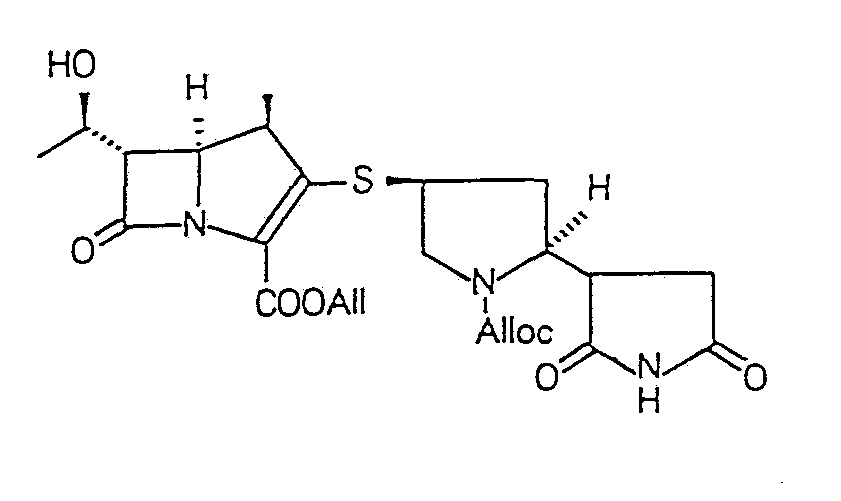
The same procedure as in Example 8-1 was carried out by using allyl (1R,5S,6S)-2-diphenoxyphosphoryloxy-6- [(R)-1-hydroxyethyl]-1-methyl-1-carbapen-2-em-3- carboxylate (230 mg, 0.46 mmol) and (2S,4S)-N- allyloxycarbonyl-2-(2,5-dioxopyrrolidin-3-yl)-4- mercaptopyrrolidine (130 mg, 0.46 mmol, compound of Reference Example 9) to obtain allyl (1R,5S,6S)-2- [(2S,4S)-N-allyloxycarbonyl-2-(2,5-dioxopyrrolidin-3- yl)pyrrolidin-4-ylthio]-6-[(R)-1-hydroxyethyl]-1-methyl- 1-carbapen-2-em-3-carboxylate (125 mg, yield: 50.9%). IR(KBr)cm-1: 1780, 1720, 1410, 1330
NMR(CDCl3) δ:
1.24(3H,d,J=7Hz),1.33(3H,d,J=6Hz),1.63(1H,m),
5.13-5.54(4H,m),5.78-6.08(2H,m)
2)

IR(KBr)cm-1: 1760, 1720, 1600, 1380
NMR(D2O) δ:
1.18(3H,d,J=7Hz),1.25(3H,d,J=6Hz),1.70(1H,m),
2.53-2.80(2H,m),3.03(1H,m),3.25-3.50(4H,m),
3.60(1H,m),3.80-4.00(2H,m),4.20(2H,m)
HPLC (the same condition as in Example 1)
Retention time: 2.46 min
EXAMPLE 19
(5R,6S)-6-[(R)-1-hydroxyethyl]-2-[(2S,4S)-2-(3- pyrazolidinon-5-yl)pyrrolidin-4-ylthio]-1-carbapen-2-em- 3-carboxylic acid
1 )

IR(KBr)cm-1: 1780, 1700, 1550, 1410, 1330
NMR(CDCl3) δ:
1.32(3H,d,J=6Hz),4.52-4.90(6H,m),5.18-5.56
(6H,m),5.78-6.10(3H,m)
2)

The same procedure as in Example 8-2 was carried out by using the compound obtained by the above reaction (155 mg, 0.26 mmol) to obtain the above identified compound (39 mg, yield: 38.8%).
IR(KBr)cm-1: 1760, 1680, 1590, 1390
NMR(CDCl3) δ:
1.26(3H,d,J=6Hz),1.88(1H,m),2.35(1H,m),2.70(1H,m), 3.06-3.27(2H,m),3.42(2H,m),3.70-3.90(2H,m)
HPLC (the same condition as in Example 1)
Retention time: 1.53 min
EXAMPLE 20
(1R,5S,6S)-6-[(R)-1-hydroxyethyl]-1-methyl-2-[(2S,4S)-2-
(3-pyrazolidinon-5-yl)pyrrolidin-4-ylthio]-l-carbapen-2- em-3-carboxylic acid
1)

The same procedure as in Example 8-1 was carried out by using allyl (1R,5S,6S)-2-diphenoxyphosphoryloxy-6- [(R)-1-hydroxyethyl]-1-methyl-1-carbapen-2-em-3- carboxylate (330 mg, 0.66 mmol) and (2S,4S)-N- allyloxycarbonyl-2-(1-allyloxycarbonyl-3-pyrazolidinon-5- yl)-4-mercaptopyrrolidine (234 mg, 0.66 mmol) to obtain allyl (1R,5S,6S)-2-[(2S,4S)-N-allyloxycarbonyl-2-(1- allyloxycarbonyl-3-pyrazolidinon-5-yl)pyrrolidin-4- ylthio]-6-[(R)-1-hydroxyethyl]-1-methyl-1-carbapen-2-em- 3-carboxylate (172 mg, yield: 43.1%).
IR(KBr)cm-1: 1770, 1700, 1410, 1320
NMR(CDCl3) δ:
1.24(3H,d,J=7Hz),1.35(3H,d,J=6Hz),4.50-4.90
(6H,m),5.20-5.56(6H,m),5.80-6.10(3H,m)
2)

The same procedure as in Example 8-2 was carried out by using the compound obtained by the above reaction (172 mg, 0.285 mmol) to obtain the above identified compound
(42 mg, yield: 37.2%).
IR(KBr)cm-1: 1760, 1680, 1590, 1390
NMR(D2O) δ:
1.20(3H,d,J=7Hz),1.26(3H,d,J=6Hz),1.85(1H,m),2.35
(1H,br d,J=18Hz),2.70(1H,m),3.10(1H,dd,J=18,9Hz),
3.15-3.52(3H,m),3.62-3.90(2H,m),3.93-4.32(4H,m) HPLC (the same condition as in Example 1)
Retention time: 2.23 min
EXAMPLE 21
Sodium (5R,6S)-6-[(R)-1-hydroxyethyl]-2-[(2S,4S)-2-(2- pyrrolidon-3-yl)pyrrolidin-4-ylthio]-1-carbapen-2-em-3- carboxylate
1)

The same procedure as in Example 1-1 was carried out by using p-nitrobenzyl (5R,6S)-2-diphenoxyphosphoryloxy- 6-[(R)-1-hydroxyethyl]-1-carbapen-2-em-3-carboxylate (180 mg, 0.31 mmol) and (2S,4S)-4-mercapto-N-(p- nitrobenzyloxycarbonyl)-2-(2-pyrrolidon-3-yl)pyrrolidine (110 mg, 0.30 mmol, compound of Reference Example 11) to obtain p-nitrobenzyl (5R,6S)-6-[(R)-1-hydroxyethyl]-2- [(2S,4S)-N-(p-nitrobenzyloxycarbonyl)-2-(2-pyrrolidon-3- yl)pyrrolidin-4-ylthio]-1-carbapen-2-em-3-carboxylate (151 mg, yield: 70%).
IR(KBr)cm-1: 1780, 1700, 1520, 1350
NMR(CDCl3) δ:
1.38(3H,d,J=6Hz),5.30(3H,m),5.56(1H,d,J=14Hz),7.57
(2H,d,J=8Hz),7.70(2H,d,J=8Hz),8.25(2H,d,J=8Hz),
8.28(2H,d,J=8Hz)
2)

IR(KBr)cm-1: 1760, 1690, 1590, 1380
NMR(D2O) δ:
1.29(3H,d,J=6Hz),1.12-2.07(3H,m),2.39(1H,m),
2.80(1H,m),3.00(1H,m),3.20(2H,m),3.44(3H,m),
3.78(2H,m),3.99(1H,m),4.24(2H,m)
HPLC (the same condition as in Example 1)
Retention time: 1.93 min
EXAMPLE 22
Sodium (1R,5S,6S)-6-[(R)-1-hydroxyethyl]-1-methyl-2- [(2S,4S)-2-(2-pyrrolidon-3-yl)pyrrolidin-4-ylthio]-1- carbapen-2-em-3-carboxylate
1)

The same procedure as in Example 1-1 was carried out by using p-nitrobenzyl (1R,5S,6S)-2- diphenoxyphosphoryloxy-6-[(R)-1-hydroxyethyl]-1-methyl-1- carbapen-2-em-3-carboxylate (180 mg, 0.30 mmol) and
(2S,4S)-4-mercapto-N-(p-nitrobenzyloxycarbonyl)-2-(2-
pyrrolidon-3-yl)pyrrolidine (110 mg, 0.30 mmol) to obtain p-nitrobenzyl (1R,5S,6S)-6-[(R)-1-hydroxyethyl]-1-methyl- [(2S,4S)-N-(p-nitrobenzyloxycarbonyl)-2-(2-pyrrolidon-3- yl)pyrrolidin-4-ylthio]-1-carbapen-2-em-3-carboxylate (161 mg, yield: 74.9%).
IR(KBr)cm-1: 1780, 1700, 1520, 1350
NMR(CDCl3) δ:
1.32(3H,d,J=7Hz),1.40(3H,d,J=6Hz),5.32(3H,m),5.56 (1H,d,J=14Hz),7.58(2H,d,J=8Hz),7.70(2H,d,J=8Hz), 8.27(2H,d,J=8Hz),8.29(2H,d,J=8Hz)
2)

The same procedure as in Example 1-2 was carried out by using the compound obtained by the above reaction (160 mg, 0.23 mmol) to obtain the above identified compound (37 mg, yield: 37.5%).
IR(KBr)cm-1: 1760, 1690, 1600, 1380
NMR(D2O) δ :
1.18(3H,d,J=7Hz),1.25(3H,d,J=6Hz),1.63-2.07
(3H,m),2.36(1H,m),2.74(1H,m),2.98(1H,m),
3.30-3.50(4H,m),3.72(2H,m),3.95(1H,m),4.22(2H,m) HPLC (the same condition as in Example 1)
Retention time: 3.23 min
EXAMPLE 23
(1R,5S,6S)-2-[(2S,4S)-2-(2-carbamoylpyrrolidin-4- yl)pyrrolidin-4-ylthio]-6-[(R)-1-hydroxyethyl]-1-methyl-
1-carbapen-2-em-3-carboxylic acid diastereomer I
1)

The same procedure as in Example 1-1 was carried out by using p-nitrobenzyl (1R,5S,6S)-2- diphenoxyphosphoryloxy-6-[(R)-1-hydroxyethyl]-1-methyl-1- carbapen-2-em-3-carboxylate (174 mg, 0.29 mmol) and
(2S,4S)-2- [2-carbamoyl-N-(p- nitrobenzyloxycarbonyl)pyrrolidin-4-yl]-4-mercapto-N-(p- nitrobenzyloxycarbonyl)pyrrolidine diastereomer I (160 mg, 0.28 mmol, compound of Reference Example 13) to obtain p-nitrobenzyl (1R,5S,6S)-2-[(2S,4S)-2-[2- carbamoyl-N-(p-nitrobenzyloxycarbonyl)pyrrolidin-4-yl]-N- (p-nitrobenzyloxycarbonyl)pyrrolidin-4-ylthio]-6-[(R)-1- hydroxyethyl]-1-methyl-1-carbapen-2-em-3-carboxylate diastereomer I (223 mg, yield: 82.9%).
IR(KBr)cm-1: 1770, 1700, 1520, 1400, 1350
NMR(CDCl3) δ:
1.28(3H,d,J=7Hz),1.37(3H,d,J=6Hz),5.25(5H,m),5.52
(1H,d,J=14Hz),7.53(4H,d,J=8Hz),7.67(2H,d,J=8Hz),
8.23(6H,d,J=8Hz)
2)

The same procedure as in Example 1-2 was carried out by using the compound obtained by the above reaction (223 mg, 0.24 mmol) to obtain the above identified compound (50.7 mg, yield: 49.8%).
IR(KBr)cm-1: 1750, 1700, 1390
NMR(D2O) δ :
1.19(3H,d,J=7Hz),1.27(3H,d,J=6Hz),1.58(2H,m),
2.00-2.32(2H,m),2.42-2.74(2H,m),2.82
(1H,dd,J=12,8Hz),3.22(1H,dd,J=12,4Hz),
3.30-3.54(4H,m),3.92(1H,m),4.10(1H,dd,J=9,4Hz), 4.20(2H,m)
EXAMPLE 24
(1R,5S,6S)-2-[(2S,4S)-2-(2-carbamoylpyrrolidin-4- yl)pyrrolidin-4-ylthio]-6-[(R)-1-hydroxyethyl]-1-methyl-
1-carbapen-2-em-3-carboxylic acid diastereomer II
1 )

The same procedure as in Example 1-1 was carried out by using p-nitrobenzyl (1R,5S,6S)-2- diphenoxyphosphoryloxy-6-[(R)-1-hydroxyethyl]-1-methyl-1- carbapen-2-em-3-carboxylate (290 mg, 0.49 mmol) and
(2S,4S)-2-[2-carbamoyl-N-(p- nitrobenzyloxycarbonyl)pyrrolidin-4-yl]-4-mercapto-N-(p- nitrobenzyloxycarbonyl)pyrrolidine diastereomer II (280 mg, 0.49 mmol, compound of Reference Example 14) to obtain p-nitrobenzyl (1R,5S,6S)-2-[(2S,4S)-2-[2- carbamoyl-N-(p-nitrobenzyloxycarbonyl)pyrrolidin-4-yl]-N- (p-nitrobenzyloxycarbonyl)pyrrolidin-4-ylthio]-6-[(R)-1- hydroxyethyl]-1-methyl-1-carbapen-2-em-3-carboxylate diastereomer II (419 mg, yield: 93.4%).
IR(KBr)cm-1: 1770, 1700, 1520, 1350
NMR(CDCl3) δ:
1.28(3H,d,J=7Hz),1.37(3H,d,J=6Hz),5.26(5H,m),5.52 (1H,d,J=14Hz),7.53(4H,d,J=8Hz),7.68(2H,d,J=8Hz), 8.24(6H,d,J=8Hz)
2 )

The same procedure as in Example 1-2 was carried out by using the compound obtained by the above reaction (419 mg, 0.46 mmol) to obtain the above identified compound (93 mg, yield: 48%).
IR(KBr)cm-1: 1760, 1700, 1390
NMR(D2O) δ :
1.20(3H,d,J=7Hz),1.28(3H,d,J=6Hz),1.62(2H,m),
2.44-2.75(3H,m),2.83(1H,dd,J=10,8Hz),
3.16-3.57(6H,m),3.94(1H,m),4.08(1H,m),4.23(2H,m) HPLC (the same condition as in Example 1)
Retention time: 2.84 min
EXAMPLE 25
(5R,6S)-6-[(R)-1-hydroxyethyl]-2-[(2S,4S)-2-(pyrrolidin- 3-yl)pyrrolidin-4-ylthio]-1-carbapen-2-em-3-carboxylie acid diastereomer A
1)

78.6%).
IR(KBr)cm-1: 1780, 1700, 1520, 1350
NMR(CDCl3) δ:
1.25 (3H,d,J=6Hz),4.00-4.40(4H,m),5.16-5.35(5H,m),
5.52(1H,d,J=14Hz),7.52(4H,d,J=8Hz),7.65(2H,d,J=8Hz),
8.21(6H,m)
2)

IR(KBr)cm-1: 1760, 1690, 1390
NMR(D2O) δ:
1.27(3H,d,J=6Hz),1.46(1H,m),1.68-2.10(2H,m),
2.14-2.80(3H,m),3.80(2H,m),4.22(2H,m)
HPLC (the same condition as in Example 1)
Retention time: 2.03 min
EXAMPLE 26
(1R,5S,6S)-6-[(R)-1-hydroxyethyl]-1-methyl-2-[(2S,4S)-2- (pyrrolidin-3-yl)pyrrolidin-4-ylthio]-1-carbapen-2-em-3- carboxylic acid diastereomer A
1)

The same procedure as in Example 1-1 was carried out by using p-nitrobenzyl (1R,5S,6S)-2- diphenoxyphosphoryloxy-6-[(R)-1-hydroxyethyl]-1-methyl-1- carbapen-2-em-3-carboxylate (1.75 g, 2.94 mmol) and (2S,4S)-4-mercapto-N-(p-nitrobenzyloxycarbonyl)-2-[N-(p- nitrobenzyloxycarbonyl)pyrrolidin-3-yl]pyrrolidine diastereomer A (1.56 g, 2.94 mmol, compound of Reference Example 15-7) to obtain p-nitrobenzyl (1R,5S,6S)-6-[(R)- 1-hydroxyethyl]-1-methyl-2-[(2S,4S)-N-(p-
nitrobenzyloxycarbonyl)-2-[N-(p- nitrobenzyloxycarbonyl)pyrrolidin-3-yl]pyrrolidin-4- ylthio]-1-carbapen-2-em-3-carboxylate diastereomer A
(2.37 g, yield: 92%).
IR(KBr)cm-1: 1780, 1700, 1520, 1350
NMR(CDCl3) δ:
1.28(3H,t,J=7Hz),1.37(3H,d,J=6Hz),1.60-2.15(4H,m), 2.55(1H,m),2.78(1H,m),4.04-4.35(3H,m),5.24(5H,m), 5.53(1H,br d,J=14Hz),7.54(4H,br d,J=8Hz),
7.67(2H,d,J=8Hz),8.24(6H,br d,J=8Hz)
2)

The same procedure as in Example 11-2 was carried out by using the compound obtained by the above reaction (2.37 g, 2.71 mmol) to obtain the above identified compound (298 mg, yield: 28.8%). Various spectra data of this compound agreed to the data of the diastereomer A obtained in Example 11-2.
EXAMPLE 27
(1R,5S,6S)-6-[(R)-1-hydroxyethyl]-1-methyl-2-[(2S,4S)-2-
(pyrrolidin-3-yl)pyrrolidin-4-ylthio]-1-carbapen-2-em-3- carboxylic acid diastereomer B
1)

The same procedure as in Example 1-1 was carried out by using p-nitrobenzyl (1R,5S,6S)-2- diphenoxyphosphoryloxy-6-[(R)-1-hydroxyethyl]-1-methyl-1- carbapen-2-em-3-carboxylate (1.27 g, 2.14 mmol) and
(2S,4S)-4-mercapto-N-(p-nitrobenzyloxycarbonyl)-2-[N-(p- nitrobenzyloxycarbonyl)pyrrolidin-3-yl]pyrrolidine diastereomer B (1.14 g, 2.15 mmol, compound of Reference Example 16) to obtain p-nitrobenzyl (1R,5S,6S)-6-[(R)-1- hydroxyethyl]-1-methyl-2-[(2S,4S)-N-(p- nitrobenzyloxycarbonyl)-2-[N-(p- nitrobenzyloxycarbonyl)pyrrolidin-3-yl]pyrrolidin-4- ylthio]-1-carbapen-2-em-3-carboxylate diastereomer B (1.65 g, yield: 88.3%).
IR(KBr)cm-1: 1780, 1700, 1520, 1350
NMR(CDCl3) δ:
1.28(3H,t,J=7Hz),1.37(3H,t,J=6Hz),1.50-2.08(4H,m), 2.42-2.70(2H,m),3.48-3.70(3H,m),4.01-4.76(3H,m), 5.24(5H,m),5.54(1H,d,J=14Hz),7.54(4H,br d,J=8Hz), 7.67(2H,d,J=8Hz),8.24(6H,br d,J=8Hz)
2 )

The same procedure as in Example 1-2 was carried out by using the compound obtained by the above reaction (1.65 g, 1.89 mmol) to obtain the above identified compound (220 mg, yield: 30.6%). Various spectra data of this compound agreed to those of the diastereomer B obtained in Example 11-2.
EXAMPLE 28
(1R,5S,6S)-6-[(R)-1-hydroxyethyl]-1-methyl-2-[(2S,4S)-2-
(2-pyrrolidon-4-yl)pyrrolidin-4-ylthio]-1-carbapen-2-em-
3-carboxylic acid diastereomer A
1)

IR(KBr)cm-1: 1770, 1700, 1520, 1340, 1250
NMR(CDCl3) δ:
1.28(3H,d,J=8Hz),1.33(3H,d,J=7Hz),1.72(2H,m),
2.06-2.68(3H,m),2.96-3.7(5H,m),4.04-4.36(2H,m), 5.24(2H,m),5.31 and 5.52(2H,ABq,J=14Hz),5.8(1H,br), 7.53(2H,d,J=8Hz),7.64(2H,d,J=8Hz),8.20(2H,d,J=8Hz), 8.22(2H,d,J=8Hz)
2)

The same procedure as in Example 1-2 was carried out by using compound obtained by the above reaction (6 g, 8.62 mmol) to obtain the above identified compound (1.68 g, yield: 49.4%).
IR(KBr)cm-1: 1755, 1680, 1595, 1385, 1280
NMR(D2O) δ :
1.15(3H,d,J=8Hz),1.23(3H,d,J=7Hz),1.7(1H,m),
2.3(1H,m),2.54-3.1(3H,m),3.1-3.5(3H,m),
3.55-3.94(3H,m),4.0(1H,m),4.19(2H,m)
HPLC:
Column: YMC AQ-304
Eluent: 0.01M Phosphate buffer (pH 7.0)-acetonitrile
(96:4)
Flow rate: 1.0 mℓ/min
Temperature: 40°C
Detector: 254 nm
Retention time: 14.83 min
EXAMPLE 29
(1R,5S,6S)-6-[(R)-1-hydroxyethyl]-1-methyl-2-[(2S,4S)-2- (2-pyrrolidon-4-yl)pyrrolidin-4-ylthio]-1-carbapen-2-em- 3-carboxylic acid diastereomer B
1)

(2S,4S)-4-mercapto-N-(p-nitrobenzyloxycarbonyl)-2-(2- pyrrolidon-4-yl)pyrrolidine diastereomer B (5.92 g, 16.2 mmol, compound of Reference Example 19-4) to obtain p- nitrobenzyl (1R,5S,6S)-6-[(R)-1-hydroxyethyl]-1-methyl-2- [(2S,4S)-N-(p-nitrobenzyloxycarbonyl)-2-(2-pyrrolidon-4- yl)pyrrolidin-4-ylthio]-1-carbapen-2-em-3-carboxylate diastereomer B (9.9 g, yield: 83.7%).
IR(KBr)cm-1: 1770, 1705, 1695, 1605, 1345, 1205
NMR(D2O) δ:
1.27(3H,d,J=8Hz),1.36(3H,d,J=7Hz),1.72-2.06(2H,m),
2.1-2.68(3H,m),3.02-3.7(5H,m),4.06-4.16(2H,m),
5.31 and 5.52(2H,ABq,J=14Hz),6.04(1H,br),7.53
(2H,d,J=8Hz),7.66(2H,d,J=8Hz),8.20(2H,d,J=8Hz),
8.22(2H,d,J=8Hz)
2)

The same procedure as in Example 1-2 was carried out by using the compound obtained by the above reaction (9.8 g, 14.1 mmol) to obtain the above identified compound (1.42 g, yield: 25.5%).
IR(KBr)cm-1: 1755, 1680, 1590, 1390, 1280
NMR(D2O) δ:
1.19(3H,d,J=8Hz),1.26(3H,d,J=7Hz),1.72(1H,m),
2.28(1H,m),2.52-3.10(3H,m),3.26-3.50(3H,m),
3.60-3.90(3H,m),4.02(1H,m),4.22(2H,m)
HPLC:
Column: YMC AQ-304
Eluent: 0.01M Phosphate buffer (pH 7.0)-acetonitrile
(96:4)
Flow rate: 1.0 mℓ/min
Temperature: 40°C
Detector: 254 nm
Retention time: 15.18 min
EXAMPLE 30
(1R,5S,6S)-2-[(2S,4S)-2-(3-amino-2-pyrrolidon-4- yl)pyrrolidin-4-ylthio]-6-[(R)-1-hydroxyethyl]-1-methyl- 1-carbapen-2-em-3-carboxylic acid
1)

(2S,4S)-4-mercapto-N-(p-nitrobenzyloxycarbonyl)-2-[3-[(p- nitrobenzyloxycarbonyl)amino]-2-pyrrolidon-4- yl]pyrrolidine (110 mg, 0.197 mmol, compound of Reference
Example 20-6) to obtain p-nitrobenzyl (1R,5S,6S)-6-[(R)-
1-hydroxyethyl]-1-methyl-2-[(2S,4S)-N-(p- nitrobenzyloxycarbonyl)-2-[3-[(p- nitrobenzyloxycarbonyl)amino]-2-pyrrolidon-4- yl]pyrrolidin-4-ylthio]-1-carbapen-2-em-3-carboxylate (87 mg, yield: 48.9%).
IR(KBr)cm-1: 1775, 1710, 1605, 1525, 1350, 735
NMR(CDCl3) δ:
1.27(3H,d,J=8Hz),1.35(3H,d,J=8Hz),1.6-1.8(2H,m), 2.78(1H,m),3.1-3.5(6H,m),3.65(1H,m),4.0-4.4(5H,m), 5.2(4H,s),5.28(1H,d,J=16Hz),5.5(1H,d,J=16Hz),6.32 (1H,br),7.52(4H,d,J=9Hz),7.65(2H,d,J=8Hz),8.2(6H,m) 2)

The same procedure as in Example 1-2 was carried out by using the compound obtained by the above reaction (87 mg, 0.096 mmol). The obtained reaction solution was subjected to column chromatography (HP-20 SS, 5-10%
methanol aqueous solution), and the desired fraction was concentrated and freeze-dried to obtain the above identified compound (25.72 mg, yield: 65.1%).
IR(KBr)cm-1: 1755, 1700, 1605, 1595, 1385
NMR(D2O) δ:
1.17(3H,d,J=8Hz),1.24(3H,d,J=8Hz),2.5-2.8(2H,m), 2.6-2.8(2H,m),3.1-3.6f5H,m),3.9-4.4(5H,m)
EXAMPLE 31
(1R,5S,6S)-6-[(R)-1-hydroxyethyl]-1-methyl-2-[(2R,4S)-2- (pyrrolidin-3-ylmethyl)pyrrolidin-4-ylthio]-1-carbapen-2- em-3-carboxylic acid

The same procedure as in Example 8-1 was carried out by using allyl (1R,5S,6S)-6-[(R)-1-hydroxyethyl]-1- methyl-2-diphenoxyphosphoryloxy-1-carbapen-2-em-3- carboxylate (790 mg, 1.6 mmol), (2R,4S)-N- allyloxycarbonyl-2-(N-allyloxycarbonylpyrrolidin-3- ylmethyl)-4-mercaptopyrrolidine (560 mg, 1.6 mmol) and N,N-diisopropylethylamine (0.28 mℓ , 1.6 mmol) to obtain allyl (1R,5S,6S)-2-[(2R,4S)-N-allyloxycarbonyl-2-(N- allyloxycarbonylpyrrolidin-3-ylmethyl)pyrrolidin-4- ylthio]-6-[(R)-1-hydroxyethyl]-1-methyl-1-carbapen-2-em- 3-carboxylate (480 mg, yield: 50%).
NMR(CDCl3) δ:
1.28(3H,d,J=6Hz),1.36(3H,d,J=6Hz),1.5-1.8(3H,m),
1.9-2.2(4H,m),2.62(1H,m),3.02(1H,m),3.2-3.4(4H,m),
3.5-3.7(3H,m),4.0-4.3(3H,m),4.6-4.9(6H,m),
5.2-5.56(6H,m),5.9-6.1(3H,m)
2)

The same procedure as in Example 8-2 was carried out by using the compound obtained by the above reaction (480 mg, 0.8 mmol), bis(triphenylphosphine)palladium(II) chloride (11 mg, 0.016 mmol), tributyltin hydride (1.28 mℓ , A .11 mmol) and water (107 μℓ, 5.96 mmol). The obtained aqueous layer was purified by reversed phase column chromatography (YMC-GEL™ ODS-AQ 120-S50, 50 mℓ, eluted with methanol-water (1:4)) and freeze-dried to obtain the above identified compound (128 mg, yield:
41%).
IR(KBr)cm-1: 1760, 1600, 1390
NMR(D2O) δ:
1.2(3H,d,J=6Hz),1.28(3H,d,J=7Hz),1.6-1.9(3H,m),
2.2-2.7(3H,m),2.9-3.6(10H,m),3.8(1H,m),4.2-4.4(2H,m)
EXAMPLE 32
(1R,5S,6S)-2-[(2R,4S)-2-[(2S)-2-carbamoylpyrrolidin-4- ylmethyl]pyrrolidin-4-ylthio]-6-[(R)-1-hydroxyethyl]-1- methyl-1-carbapen-2-em-3-carboxylic acid
1 )

The same procedure as in Example 8-1 was carried out by using allyl (1R,5S,6S)-6-[(R)-1-hydroxyethyl]-1- methyl-2-diphenoxyphosphoryloxy-1-carbapen-2-em-3- carboxylate (264 mg, 0.49 mmol), (2R,4S)-N- allyloxycarbonyl-2-[(2S)-N-allyloxycarbonyl-2- carbamoylpyrrolidin-4-ylmethyl]-4-mercaptopyrrolidine (210 mg, 0.49 mmol) and N,N-diisopropylethylamine (92 μℓ, 0.49 mmol) to obtain allyl (1R,5S,6S)-2-[(2R,4S)-N- allyloxycarbonyl-2-[(2S)-N-allyloxycarbonyl-2- carbamoylpyrrolidin-4-ylmethyl]pyrrolidin-4-ylthio]-6- [(R)-1-hydroxyethyl]-1-methyl-1-carbapen-2-em-3- carboxylate (250 mg, yield: 73%).
NMR(CDCl3) δ:
1.25(3H,d,J=6Hz),1.34(3H,d,J=7Hz),1.5-1.8(3H,m), 1.8-2.7(4H,m),3.0-3.4(4H,m),3.5-4.4(7H,m),
4.5-4.9(6H,m),5.2-5.5(7H,m),5.8-6.1(3H,m),6.9
(0.5H,br s),7.3(0.5H,br s)
2)

The same procedure as in Example 8-2 was carried out by using the compound obtained by the above reaction (250 mg, 0.387 mmol), bis(triphenylphosphine)palladium(II) chloride (5.4 mg, 0.008 mmol), tributyltin hydride (0.62 mℓ, 2.3 mmol) and water (52 μℓ, 2.9 mmol). The obtained aqueous layer was purified by reversed phase column chromatography (LC-SORB™ SP-B-ODS, 14 mℓ, eluted with methanol-water (3:7)) and freeze-dried to obtain the above identified compound (107 mg, yield: 63%).
IR(KBr)cm-1: 1750, 1680, 1590, 1390
NMR(D2O) δ:
1.22(3H,d,J=7Hz),1.28(3H,d,J=6Hz),1.58(1H,m),
1.8-2.4(5H,m),2.6-2.84(2H,m),3.2-3.7(6H,m),
3.95(1H,m),4.1(1H,dd,J=10,4Hz),4.2-4.3(2H,m)
EXAMPLE 33
(1R,5S,6S)-6-[(R)-1-hydroxyet-hyl]-1-methyl-2-[(2R,4S)-2- [(2S)-2-(methylcarbamoyl)pyrrolidin-4- ylmethyl]pyrrolidin-4-ylthio]-1-carbapen-2-em-3- carboxylic acid
1)

The same procedure as in Example 8-1 was carried out by using allyl (1R,5S,6S)-6-[(R)-1-hydroxyethyl]-1- methyl-2-diphenoxyphosphoryloxy-1-carbapen-2-em-3- carboxylate (204 mg, 0.41 mmol), (2R,4S)-N- allyloxycarbonyl-2-[(2S)-N-allyloxycarbonyl-2- (methylcarbamoyl)pyrrolidin-4-ylmethyl]-4- mercaptopyrrolidine (168 mg, 0.41 mmol) and N,N- diisopropylethylamme (71 μℓ, 0.41 mmol) to obtain allyl (1R,5S,6S)-2-[(2R,4S)-N-allyloxycarbonyl-2-[(2S)-N- allyloxycarbonyl-2-(methylcarbamoyl)pyrrolidin-4- ylmethyl]pyrrolidin-4-ylthio]-6-[(R)-1-hydroxyethyl]-1- methyl-1-carbapen-2-em-3-carboxylate (180 mg, yield:
67%).
NMR(CDCl3) δ:
1.26(3H,d,J=6Hz),1.36(3H,d,J=6Hz),1.5-1.8(3H,m), 1.8-2.6(4H,m),2.8(3H,d,J=4Hz),3.0(1H,m),
3.1-3.4(3H,m),3.8(2H,m),3.9-4.4(5H,m),
4.5-4.9(6H,m),5.1-5.5(6H,m),5.8-6.0(3H,m),
6.9(0.5H,br s),7.3(0.5H,br s)
2)

The same procedure as in Example 8-2 was carried out by using the compound obtained by the above reaction (180 mg, 0.27 mmol), bis(triphenylphosphine)palladium(II) chloride (4 mg, 0.005 mmol), tributyltin hydride (0.44 mℓ, 1.6 mmol) and water (37 μℓ, 2 mmol). The obtained aqueous layer was purified by reversed phase column chromatography (LC-SORB™ SP-B-ODS, 14 mℓ, eluted with methanol-water (3:7)) and feeze-dried to obtain the above identified compound (60 mg, yield: 49%).
IR(KBr)cm-1: 1750, 1600, 1390
NMR(D2O) δ:
1.2(3H,d,J=6Hz),1.28(3H,d,J=7Hz),1.56(1H,m),
1.8-2.3(5H,m),2.6-2.8(2H,m),2.76(3H,s),
3.2-3.7(6H,m),3.95(1H,m),4.04(1H,dd,J=10,4Hz),
4.2-4.3(2H,m)
EXAMPLE 34
(1R,5S,6S)-6-[(R)-1-hydroxyethyl]-1-methyl-2-[(2R,4S)-2- [(2S)-2-(dimethylcarbamoyl)pyrrolidin-4- ylmethyl]pyrrolidin-4-ylthio]-1-carbapen-2-em-3- carboxylic acid
1 )

The same procedure as in Example 8-1 was carried out by using allyl (1R,5S,6S)-6-[(R)-1-hydroxyethyl]-1- methyl-2-diphenoxyphosphoryloxy-1-carbapen-2-em-3- carboxylate (129 mg, 0.26 mmol), (2R,4S)-N- allyloxycarbonyl-2-[(2S)-N-allyloxycarbonyl-2- (dimethylcarbamoyl)pyrrolidin-4-ylmethyl]-4- mercaptopyrrolidine (110 mg, 0.26 mmol) and N,N- diisopropylethylamme (45 μℓ, 0.26 mmol) to obtain allyl (1R,5S,6S)-2-[(2R,4S)-N-allyloxycarbonyl-2-[(2S)-N- allyloxycarbonyl-2-(dimethylcarbamoyl)pyrrolidin-4- ylmethyl]pyrrolidin-4-ylthio]-6-[(R)-1-hydroxyethyl]-1- methyl-1-carbapen-2-em-3-carboxylate (78 mg, yield: 45%). NMR(CDCl3) δ:
1.26(3H,d,J=6Hz),1.37(3H,d,J=6Hz),1.4-2.6(7H,m), 2.9-3.3(4H,m),2.98(3H,s),3.12(3H,s),3.5-4.3
(7H,m),4.5-4.9(6H,m),5.1-5.5(6H,m),5.9(3H,m)
2 )

The same procedure as in Example 8-2 was carried out by using the compound obtained by the above reaction (78 mg, 0.12 mmol), bis (triphenylphosphine)palladium(II) chloride (2 mg, 0.002 mmol), tributyltin hydride (0.186 mℓ, 0.69 mmol) and water (16 μℓ, 0.87 mmol). The obtained aqueous layer was purified by reversed phase column chromatography (LC-SORB™ SP-B-ODS, 14 mℓ, eluted with methanol-water (2:3)) and freeze-dried to obtain the above identified compound (11 mg, yield: 20%).
IR(KBr)cm-1: 1750, 1640, 1600, 1390
NMR(D2O) δ:
1.2(3H,d,J=6Hz),1.28(3H,d,J=7Hz),1.5(1H,m),1.8-2.4 (5H,m),2.6-2.9(2H,m),2.96(3H,s),3.06(3H,s),3.1-3.6 (6H,m),3.8-4.0(2H,m),4.1-4.3(2H,m)
EXAMPLE 35
(1R,5S,6S)-2-[(2S,4S)-2-(2,4-dioxoimidazolidin-5- yl)pyrrolidin-4-ylthio]-6-[(R)-1-hydroxyethyl]-1-methyl- 1-carbapen-2-em-3-carboxylie acid
1)

(2S,4S)-2-(2,4-dioxoimidazolidin-5-yl)-4-(p- methoxybenzylthio)-N-(p-nitrobenzyloxycarbonyl)- pyrrolidine (250 mg, 0.499 mmol, compound of Reference Example 28) and anisole (0.27 πℓ, 2.48 mmol) were
dissolved in trifluoroacetic acid (5 mℓ), and the
solution was cooled with ice under a nitrogen stream. Then, trifluoromethanesulfonic acid (0.07 mℓ, 0.791 mmol) was dropwise added thereto, and the mixture was stirred for 50 minutes under cooling with ice. The solvent was distilled off, and the residue was washed with diethyl ether to obtain a crude thiol.
The same procedure as in Example 1-1 was carried out by using p-nitrobenzyl (1R,5S,6S)-2- diphenoxyphosphoryloxy-6-[(R)-1-hydroxyethyl]-1-methyl-1- carbapen-2-em-3-carboxylate (300 mg, 0.505 mmol) and the thiol obtained by the above reaction to obtain p- nitrobenzyl (1R,5S,6S)-2-[(2S,4S)-2-(2,4- dioxoimidazolidin-5-yl)-N-(p- nitrobenzyloxycarbonyl)pyrrolidin-4-ylthio]-6-[(R)-1- hydroxyethyl]-1-methyl-1-carbapen-2-em-3-carboxylate (100 mg, yield: 28%).
IR(KBr)cm-1: 3430, 1775, 1725, 1610, 1520, 1350, 1285,
1250
NMR(CDCl3) δ:
1.27(3H,d,J=6Hz),1.33(3H,d,J=6Hz),4.4(1H,m),
4.7 and 5.05(1H,s),5.25(2H,s),5.3 and 5.5
(2H,ABq,J=14Hz),7.58(2H,d,J=8Hz),7.69(2H,d,J=8Hz),
8.2-8.3(4H,m)
2)

IR(KBr)cm-1: 3440, 1760, 1730, 1600, 1400
NMR(D2O) δ:
1.20(3H,d,J=7Hz),1.27(3H,d,J.=7Hz),1.75(1H,m),
2.6(1H,m),3.0-3.6(4H,m),3.7-4.0(2H,m),4.1-4.3
(2H,m),4.57(1H,d,J=8Hz)
UV λmax (0.1M 3-morpholinopropanesulfonic acid buffer
pH 7.0):300 nm (ε=9400)
EXAMPLE 36
(5R,6S)-2-[(2S,4S)-2-(2,4-dioxoimidazolidin-5- yl)pyrrolidin-4-ylthio]-6-[(R)-1-hydroxyethyl]-1- carbapen-2-em-3-carboxylic acid
1)
The same procedure as in Example 1-1 was carried out by using p-nitrobenzyl (5R,6S)-2-diphenoxyphosphoryloxy- 6-[(R)-1-hydroxyethyl]-1-carbapen-2-em-3-carboxylate (150 mg, 0.258 mmol) and (2S,4S)-2-(2,4-dioxoimidazolidin-5- yl)-4-(p-methoxybenzylthio)-N-(p- nitrobenzyloxycarbonyl)pyrrolidine (120 mg, 0.240 mmol, compound of Reference Example 28) to obtain p-nitrobenzyl (5R,6S)-2-[(2S,4S)-2-(2,4-dioxoimidazolidin-5-yl)-N-(p- nitrobenzyloxycarbonyl)pyrrolidin-4-ylthio]-6-[(R)-1- hydroxyethyl]-1-carbapen-2-em-3-carboxylate (30 mg, yield: 18%).
IR(KBr)cm-1: 3400, 1780, 1730, 1610, 1520, 1350
NMR(CDCl3 + CD3OD) δ:
1.32(3H,d,J=6Hz),1.78(1H,m),2.40(1H,m),3.0-3.5(4H,m), 4.0-4.5(4H,m),4.73 and 5.04(1H,s),5.28(2H,s),
5.28 and 5.49 (2H,ABq,J=13Hz),7.57(2H,d,J=9Hz),7.67
(2H,d,J=9Hz),8.1-8.3(4H,m)
2)

The same procedure as in Example 1-2 was carried out by using the compound obtained by the above reaction (30 mg, 0.042 mmol) to obtain the above identified compound (11 mg, yield: 66% ) .
IR(KBr)cm-1: 3430, 1760, 1720, 1600, 1400
NMR(D2O) δ:
1.26(3H,d,J=7Hz),1.55(1H,m),2.5(1H,m),3.1-3.6(4H,m),
4.1-4.3(2H,m),4.38(1H,d,J=5Hz)
UV λmax (0.1M 3-morpholinopropanesulfonic acid buffer pH 7.0):301 nm (ε=4600)
EXAMPLE 37
(1R,5S,6S)-2-[(2R,4S)-2-(2,4-dioxoimidazolidin-5- ylmethyl)pyrrolidin-4-ylthio]-6-[(R)-1-hydroxyethyl]-1- methyl-1-carbapen-2-em-3-carboxylic acid diastereomer A
1)

(1R,5S,6S)-2-[(2R,4S)-N-allyloxycarbonyl-2-(2,4- dioxoimidazolidin-5-ylmethyl)pyrrolidin-4-ylthio]-6-[(R)- 1-hydroxyethyl]-1-methyl-1-carbapen-2-em-3-carboxylate diastereomer A (70 mg, yield: 26%).
IR(KBr)cm-1: 3550, 3480, 3420, 3200, 1780, 1730, 1550,
1420
NMR(CDCl3) δ:
1.26(3H,d,J=7Hz),1.36(3H,d,J=7Hz),1.5-2.5(4H,m), 2.7(2H,m),3.1-3.6(3H,m),3.7(1H,m),3.8-4.4(4H,m), 4.4-4.9(4H,m),5.0-5.5(4H,m),5.6-6.05(2H,m),
6.89(1H,s),8.78(1H,s)
2)

The same procedure as in Example 8-2 was carried out by using the compound obtained by the above reaction (70
mg, 0.128 mmol) to obtain the above identified compound 19 mg, yield: 35%).
IR(KBr)cm-1: 3400, 3250, 1760, 1720, 1590, 1390
NMR(D2O) δ:
1.15(3H,d,J=6Hz),1.22(3H,d,J=7Hz),1.7(1H,m),2.3
(2H,m),2.75(1H,m),3.2-3.5(3H,m),3.5-3.9(2H,m),
3.95(1H,m),4.2(2H,m),4.34(1H,t,J=6Hz)
UV λmax (0.1M 3-morpholinopropanesulfonic acid buffer
pH 7.0):298 nm (ε=9300)
EXAMPLE 38
(1R,5S,6S)-2-[(2R,4S)-2-(2,4-dioxoimidazolidin-5- ylmethyl)pyrrolidin-4-ylthio]-6-[(R)-1-hydroxyethyl]-1- methyl-1-carbapen-2-em-3-carboxylic acid diastereomer B
1)

The same procedure as in Example 8-1 was carried out by using allyl (1R,5S,6S)-2-diphenoxyphosphoryloxy-6- [(R)-1-hydroxyethyl]-1-methyl-1-carbapen-2-em-3- carboxylate (220 mg, 0.440 mmol) and (2R,4S)-N- allyloxycarbonyl-2-(2,4-dioxoimidazolidin-5-ylmethyl)-4- tritylthiopyrrolidine diastereomer B (220 mg, 0.406 mmol, compound of Reference Example 29) to obtain allyl
(1R,5S,6S)-2-[(2R,4S)-N-allyloxycarbonyl-2-(2,4- dioxoimidazolidin-5-ylmethyl)pyrrolidin-4-ylthio]-6-[(R)- 1-hydroxyethyl]-1-methyl-1-carbapen-2-em-3-carboxylate diastereomer B (70 mg, yield: 31%).
IR(KBr)cm-1: 3420, 3270, 1775, 1730, 1550, 1415
NMR(CDCl3) δ:
1.27(3H,d,J=7Hz),1.36(3H,d,J=7Hz),1.5-2.1(4H,m),
2.3(1H,m),2.7(1H,m),3.1-3.45(3H,m),3.65(1H,m),
3.9-4.4(4H,m),4.4-4.9(4H,m),5.1-5.6(4H,m),5.7-6.1
(2H,m),6.73(1H,s),8.34(1H,s)
2)

The same procedure as in Example 8-2 was carried out by using the compound obtained by the above reaction (70 mg, 0.128 mmol) to obtain the above identified compound (18 mg, yield: 33%).
IR(KBr)cm-1: 3420, 3230, 1760, 1720, 1590, 1395
NMR(D2O) δ :
1.12(3H,d,J=7Hz),1.19(3H,d,J=7Hz),1.65(1H,m),
2.3(2H,m),2.73(1H,m),3.2-3.5(3H,m),3.61(1H,m),
3.8(1H,m),3.94(1H,m),4.15(2H,m),4.34(1H,t,J=6Hz)
UV λmax (0.1M 3-morpholinopropanesulfonic acid buffer pH 7.0) :298 nm (ε=9400)
EXAMPLE 39
Sodium (1R,5S,6S)-2-[(2R,4S)-2-(2,5-dioxopyrrolidin-3- ylmethyl)pyrrolidin-4-ylthio]-6-[(R)-1-hydroxyethyl]-1- methyl-1-carbapen-2-em-3-carboxylate
1)

A 2N sodium hydroxide aqueous solution (0.34 mℓ, 0.68 mmol) was added to a solution of (2R,4S)-4-acetylthio-N- (p-nitrobenzyloxycarbonyl)-2-(2,5-dioxopyrrolidin-3- ylmethyl)pyrrolidine (250 mg, 0.57 mmol, compound of Reference Example 30) in methanol (5.0 mℓ) under cooling with ice, and the mixture was stirred for 30 minutes. Then, 6N hydrochloric acid (0.11 mℓ, 0.66 mmol) was added thereto, and the mixture was extracted with methylene chloride. The extract was dried over anhydrous magnesium sulfate and concentrated to obtain (2R,4S)-4-mercapto-N- (p-nitrobenzyloxycarbonyl)-2-(2,5-dioxopyrrolidin-3- ylmethyl)pyrrolidine.
The same procedure as in Example 1-1 was carried out by using the thiol obtained by the above reaction and p-
nitrobenzyl (1R,5S,6S)-2-diphenoxyphosphoryloxy-6-[(R)-1- hydroxyethyl]-1-methyl-1-carbapen-2-em-3-carboxylate (273 mg, 0.46 mmol) to obtain p-nitrobenzyl (1R,5S,6S)-2- [(2R,4S)-2-(2,5-dioxopyrrolidin-3-ylmethyl)-N-(p- nitrobenzyloxycarbonyl)pyrrolidin-4-ylthio]-6-[(R)-1- hydroxyethyl]-1-methyl-1-carbapen-2-em-3-carboxylate (229 mg, yield: 67%).
NMR(CDCl3) δ:
1.28(3H,d,J=8Hz),1.38(3H,d,J=8Hz),5.24(4H,br s),
7.54(4H,d,J=8Hz),8.25(4H,d,J=8Hz)
2)

The same procedure as in Example 1-2 was conducted by using the compound obtained by the above reaction (210 mg, 0.28 mmol) to obtain the above identified compound (26 mg, yield: 21%).
IR(KBr)cm-1: 3400, 2950, 1760, 1720, 1600, 1380, 1180 NMR(D2O) δ:
1.10(3H,d,J=6Hz),1.16(3H,d,J=6Hz),1.58(1H,m),2.00 (1H,m),2.46(1H,m),2.66(1H,m),2.94(2H,m),3.28(2H,m), 3.54(1H,m),3.74(1H,m),4.12(2H,m)
HPLC:
Eluent: 0.01M Phosphate buffer (pH 6.5)-methanol
(85:15)
Flow rate: 0.8 mℓ/min
Other conditions are the same as in Example 1
Retention time: 4.28 min
EXAMPLE 40
(1R,5S,6S)-2-[(2S,4S)-2-(5-oxopiperazin-2-yl)pyrrolidin- 4-ylthio]-6-[(R)-1-hydroxyethyl]-1-methyl-1-carbapen-2- em-3-carboxylic acid diastereomer A
1)

The same procedure as in Example 39-1 was carried out by using (2S,4S)-N-allyloxycarbonyl-4-acetylthio-2-(1- allyloxycarbonyl-5-oxopiperazin-2-yl)pyrrolidine
diastereomer A (250 mg, 0.60 mmol, compound of Reference Example 31) to obtain (2S,4S)-N-allyloxycarbonyl-2-(1- allyloxycarbonyl-5-oxopiperazin-2-yl)-4- mercaptopyrrolidine diastereomer A.
The same procedure as in Example 1-1 was carried out by using the thiol obtained by the above reaction and allyl (1R,5S,6S)-2-diphenoxyphosphoryloxy-6-[(R)-1-
hydroxyethyl]-1-methyl-1-carbapen-2-em-3-carboxylate (242 mg, 0.48 mmol) to obtain allyl (1R,5S,6S)-2-[(2S,4S)-N- allyloxycarbonyl-2-(1-allyloxycarbonyl-5-oxopiperazin-2- yl)pyrrolidin-4-ylthio]-6-[(R)-1-hydroxyethyl]-1-methyl- 1-carbapen-2-em-3-carboxylate diastereomer A (222 mg, yield: 74%).
NMR(CDCl3) δ:
1.26(3H,d,J=6Hz),1.38(3H,d,J=6Hz),1.80(1H,m),
2.50(1H,m),3.0-5.0(19H,m),5.20-5.60(6H,m),5.96(3H,m)
2)

The same procedure as in Example 9-2 was conducted by using the compound obtained by the above reaction
(diastereomer A, 220 mg, 0.35 mmol) to obtain the above identified compound (diastereomer A, 88 mg, yield: 60%). IR(KBr)cm-1: 3400, 2950, 1760, 1660, 1600, 1380
NMR(D2O) δ:
1.20(3H,d,J=6Hz),1.26(3H,d,J=6Hz),1.78(1H,m),
2.64(1H,m),3.10-3.80(10H,m),4.00(1H,m),4.22(2H,m) HPLC:
Flow rate: 0.8 mℓ/min
Other conditions are the same as in Example 1
Retention time: 3.02 min
EXAMPLE 41
(1R,5S,6S)-2-[(2S,4S)-2-(5-oxoρiperazin-2-yl)pyrrolidin- 4-ylthio]-6-[(R)-1-hydroxyethyl]-1-methyl-1-carbapen-2- em-3-carboxylic acid diastereomer B
1)

The same procedure as in Example 39-1 was carried out by using (2S,4S)-4-acetylthio-N-allyloxycarbonyl-2-(1- allyloxycarbonyl-5-oxopiperazin-2-yl)pyrrolidine
diastereomer B (200 mg, 0.48 mmol, compound of Reference Example 31) to obtain (2S,4S)-N-allyloxycarbonyl-2-(1- allyloxycarbonyl-5-oxopiperazin-2-yl)-4- mercaptopyrrolidine diastereomer B.
The same procedure as in Example 1-1 was carried out by using the thiol obtained by the above reaction and allyl (1R,5S,6S)-2-diphenoxyphosphoryloxy-6-[(R)-1- hydroxyethyl]-1-methyl-1-carbapen-2-em-3-carboxylate (243 mg, 0.48 mmol) to obtain allyl (1R,5S,6S)-2-[(2S,4S)-N- allyloxycarbonyl-2-(1-allyloxycarbonyl-5-oxopiperazin-2- yl)pyrrolidin-4-ylthio]-6-[(R)-1-hydroxyethyl]-1-methyl- 1-carbapen-2-em-3-carboxylate diastereomer B (246 mg,
yield: 65%).
NMR(CDCl3) δ:
1.24(3H,d,J=6Hz),1.38(3H,d,J=6Hz),1.80(1H,m),
2.60(1H,m),3.10-3.80(10H,m),4.0-5.0(9H,m),
5.20-5.60(6H,m),5.96(3H,m)
2)
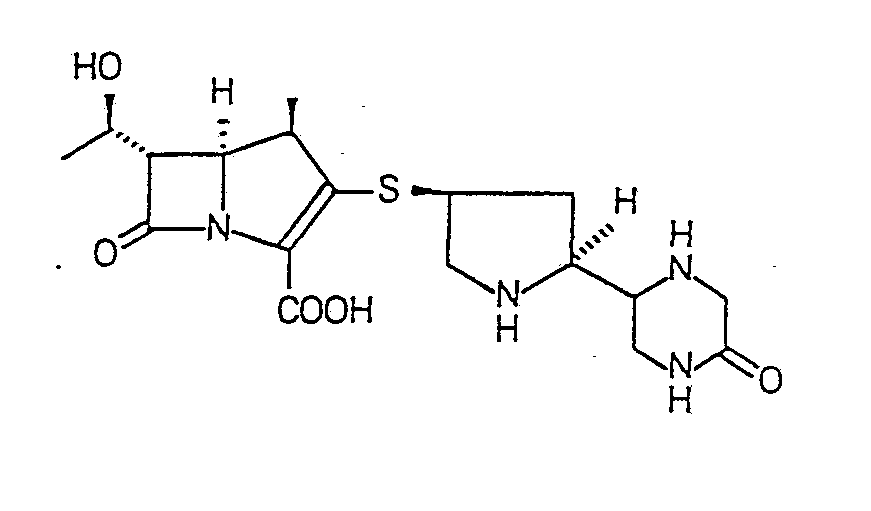
The same procedure as in Example 9-2 was carried out by using the compound obtained by the above reaction (diastereomer B, 240 mg, 0.39 mmol) to obtain the above identified compound (diastereomer B, 53 mg, yield: 33%). IR(KBr)cm-1: 3400, 1760, 1660, 1600, 1380
NMR(D2O) δ:
1.18(3H,d,J=6Hz),1.20(3H,d,J=6Hz),1.76(1H,m),
2.64(1H,m),3.10-3.80(10H,m),3.94(1H,m),4.18(2H,m) HPLC:
Eluent: 0.1M Phosphate buffer (pH 6.5)-methanol
(85:15)
Flow rate: 0.8 mℓ/min
Other conditions are the same as in Example 1
Retention time: 3.92 min
EXAMPLE 42
(5R,6S)-6-[(R)-1-hydroxyethyl]-2-[(2S,4S)-2-(piρeridin-4- yl)pyrrolidin-4-ylthio]-1-carbapen-2-em-3-carboxylic acid
1)

The same procedure as in Example 1-1 was carried out by using p-nitrobenzyl (5R,6S)-2-diphenoxyphosphoryloxy- 6-[(R)-1-hydroxyethyl]-1-carbapen-2-em-3-carboxylate (270 mg, 0.46 mmol) and (2S,4S)-4-mercapto-N-(p- nitrobenzyloxycarbonyl)-2-[N-(p- nitrobenzyloxycarbonyl)piperidin-4-yl]pyrrolidine (216 mg, 0.40 mmol, compound of Reference Example 32) to obtain p-nitrobenzyl (5R,6S)-6-[(R)-1-hydroxyethyl]-2- [(2S,4S)-N-(p-nitrobenzyloxycarbonyl)-2-[N-(p- nitrobenzyloxycarbonyl)piperidin-4-yl]pyrrolidin-4- ylthio]-1-carbapen-2-em-3-carboxylate (267 mg, yield:
65.6%).
IR(KBr)cm-1: 1780, 1700, 1520, 1340
NMR(CDCl3) δ:
1.35(3H,d,J=6Hz),2.76(2H,m),3.54(1H,m),4.00(1H,m), 5.24(5H,m),5.52(1H,d,J=14Hz),7.52(4H,d,J=8Hz),7.66 (2H,d,J=8Hz),8.22(6H,m)
2)
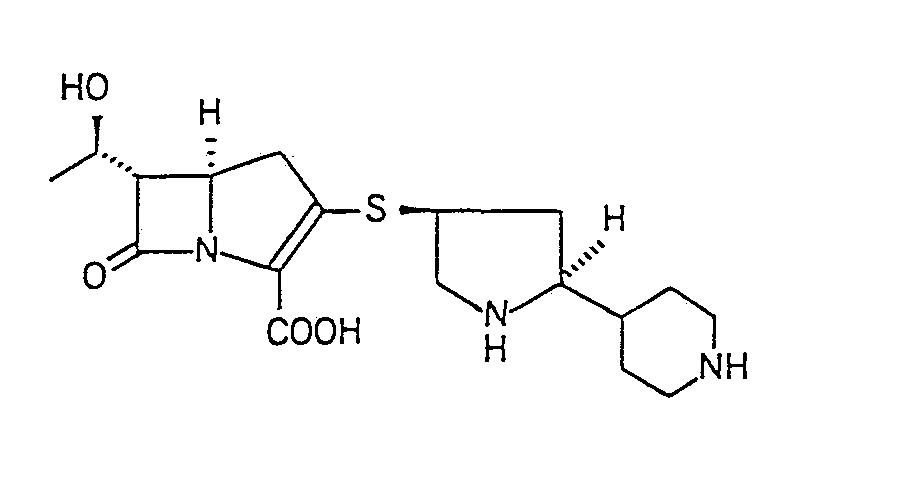
The same procedure as in Example 1-2 was carried out by using the compound obtained by the above reaction (265 mg, 0.30 mmol) to obtain the above identified compound
(33 mg, yield: 28.5%).
IR(KBr)cm-1: 1760, 1590, 1390
NMR(D2O) δ:
1.26 (3H,d,J=6Hz),1.31-1.56(3H,m),1.69(1H,m),
1.85-2.14(2H,m),2.50(1H,m),2.81-3.06(4H,m),
3.10(3H,m),3.40(3H,m),3.74(1H,m),4.20(2H,m)
HPLC (the same condition as in Example 1)
Retention time: 3.06 min
EXAMPLE 43
(1R,5S,6S)-6-[(R)-1-hydroxyethyl]-1-methyl-2-[(2S,4S)-2-
(piperidin-4-yl)pyrrolidin-4-ylthio]-1-carbapen-2-em-3- carboxylic acid
1)

(2S,4S)-4-mercapto-N-(p-nitrobenzyloxycarbonyl)-2-[N-(p- nitrobenzyloxycarbonyl)piperidin-4-yl]pyrrolidine (216 mg, 0.40 mmol, compound of Reference Example 32) to obtain p-nitrobenzyl (1R,5S,6S)-6-[(R)-1-hydroxyethyl]-1- methyl-2-[(2S,4S)-N-(p-nitrobenzyloxycarbonyl)-2-[N-(p- nitrobenzyloxycarbonyl)piperidin-4-yl]pyrrolidin-4- ylthio]-1-carbapen-2-em-3-carboxylate (279 mg, yield: 76.2%).
IR(KBr)cm-1: 1770, 1700, 1520, 1340
NMR(CDCl3) δ:
1.28(3H,t,J=7Hz),1.36(3H,t,J=6Hz),1.44-1.84(3H,m) ,
5.15 ( 5H,m) , 5.53 ( 1H, d,J=14Hz ) , 7.56 ( 4H, d,J=8Hz ) ,
7.68(2H,d,J=8Hz),8.24(6H,m)
2)

The same procedure as in Example 1-2 was carried out by using the compound obtained by the above reaction (275 mg, 0.31 mmol) to obtain the above identified compound (57 mg, yield: 46.6%).
IR(KBr)cm-1: 1750, 1590, 1390
NMR(D2O) δ:
1.19(3H,d,J=7Hz),1.27(3H,d,J=6Hz),1.28-1.58(3H,m),
1.70(1H,m),1.85-2.15(2H,m),2.46(1H,m),2.78-3.18 (5H,m),3.40(4H,m),3.76(1H,m),4.22(2H,m)
HPLC (the same condition as in Example 1)
Retention time: 3.28 min
EXAMPLE 44
(1R,5S,6S)-2-[(2S,4S)-2-(2-carbamoyipyrrolidin-4- yl)pyrrolidin-4-ylthio]-6-[(R)-1-hydroxyethyl]-1-methyl- 1-carbapen-2-em-3-carboxylic acid diastereomer III
1)

The same procedure as in Example 1-1 was carried out by using p-nitrobenzyl (1R,5S,6S)-2- diphenoxyphosphoryloxy-6-[(R)-1-hydroxyethyl]-1-methyl-1- carbapen-2-em-3-carboxylate (185 mg, 0.31 mmol) and
(2S,4S)-2-[2-carbamoyl-N-(p- nitrobenzyloxycarbonyl)pyrrolidin-4-yl]-4-mercapto-N-(p- nitrobenzyloxycarbonyl)pyrrolidine diastereomer III (175 mg, 0.31 mmol, compound of Reference Example 33) to obtain p-nitrobenzyl (1R,5S,6S)-2-[(2S,4S)-2-[2-
carbamoyl-N-(p-nitrobenzyloxycarbonyl)pyrrolidin-4-yl]-N-
(p-nitrobenzyloxycarbonyl)pyrrolidin-4-ylthio]-6-[(R)-1- hydroxyethyl]-1-methyl-1-carbapen-2-em-3-carboxylate (218 mg, yield: 76.3%).
IR(KBr)cm-1: 1770, 1700, 1600, 1520, 1340
NMR(CDCl3) δ :
1.27(3H,d,J=7Hz),1.36(3H,d,J=6Hz),4.02-4.40(5H,m), 5.22(5H,m),5.52(1H,d,J=14Hz),7.50(4H,d,J=8Hz),7.66 (2H,d,J=8Hz),8.22(6H,m)
2)

The same procedure as in Example 1-2 was carried out by using the compound obtained by the above reaction (218 mg, 0.24 mmol) to obtain the above identified compound (46 mg, yield: 45.6%).
IR(KBr)cm-1: 1760, 1680, 1600, 1390
NMR(D2O) δ:
1.19(3H,d,J=7Hz),1.27(3H,d,J=6Hz),1.40-1.68(2H,m),
2.45(2H,m),2.60(1H,m),2.82(1H,m),3.04-3.47(6H,m), 3.85(1H,m),3.98(1H,t,J=8Hz),4.21(2H,m)
HPLC (the same condition as in Example 1)
Retention time: 2.15 min
REFERENCE EXAMPLE 1
(2S,4S)-4-mercapto-N-(p-nitrobenzyloxycarbonyl)-2-(2- pyrrolidon-4-yl)pyrrolidine
1)

To an aqueous solution (40 mℓ) of L-hydroxyproline methyl ester hydrochloride (8.2 g, 45.2 mmol),
triethylamine (7.54 mℓ, 54.2 mmol) was added at room temperature, and then a solution of 2-(tert- butoxycarbonylthio)-4,6-dimethylpyrimidine (10.8g, 45 mmol) in dioxane (80 mℓ) was added thereto. The reaction solution was stirred at room temperature for 1.5 hours, and then dioxane was distilled off under reduced
pressure. The residue was extracted with ethyl acetate (250 mℓ) . The organic layer was washed sequentially with a 0.1 N sodium hydroxide aqueous solution, dilute
hydrochloric acid, water and a saturated sodium chloride aqueous solution and then dried over anhydrous magnesium sulfate and concentrated under reduced pressure. The residue was subjected to silica gel column chromatography (Wakogel™ C-300, 5% methanol-methylene chloride) to obtain N-tert-butoxycarbonyl-L-hydroxyproline methyl
ester (9.3 g, yield: 84%).
NMR(CDCl3) δ:
1.38-1.48(9H,m),1.98-2.38(2H,m),3.40-3.72(2H,m),3.86
(3H,s),4.35-4.58(2H,m)
2)

Imidazole (4.95 g, 72.7 mmol) and tert- butyldimethylsilyl chloride (10.7 g, 71.0 mmol) were added to a solution of the compound obtained by the above reaction (14.0 g, 57.1 mmol) in N,N-dimethylformamide
(150 mℓ) in a nitrogen stream at room temperature. This solution was stirred overnight at room temperature.
Ethyl acetate (500 mℓ) was added to the reaction
solution, and the organic layer was washed twice with water and once with a saturated sodium chloride aqueous solution, then dried over anhydrous magnesium sulfate and concentrated under reduced pressure to obtain (2S,4R)-N- tert-butoxycarbonyl-4-tert-butyldimethylsiloxy-L-proline methyl ester (19 g, yield: 92.6%).
3 )

To a solution of the compound obtained by the above reaction (19.0 g, 52.9 mmol) in tetrahydrofuran (180 mℓ), lithium chloride (4.49 g, 106 mmol) and then sodium borohydride (4.0 g, 106 mmol) were added in a nitrogen stream. To this mixture, ethanol (180 mℓ) was dropwise added, and the reaction solution was stirred overnight at room temperature. A saturated ammonium chloride aqueous solution (100 mℓ) was added to this reaction mixture to decompose an excess reducing agent. Then, this mixture was concentrated under reduced pressure. The residue was extracted with ethyl acetate (500 mℓ), and the organic layer was washed sequentially with water and a saturated sodium chloride aqueous solution, then dried over
anhydrous magnesium sulfate and concentrated under reduced pressure. The residue was subjected to silica gel column chromatography (Wakogel™ C-300, hexane-ethyl acetate 5:1) to obtain (2S,4R)-N-tert-butoxycarbonyl-4- tert-butyldimethylsiloxy-2-hydroxymethylpyrrolidine
(14.88 g, yield: 84.9%).
4)

A solution of dimethyl sulfoxide (3.6 mℓ, 50.7 mmol) in methylene chloride (15 mℓ) was dropwise added to a solution of oxalyl chloride (2.89 mℓ , 33.9 mmol) in methylene chloride (100 mℓ) in a nitrogen stream at
-78°C. The reaction solution was stirred at the same temperature for 30 minutes. To this mixture, a solution of (2S,4R)-N-tert-butoxycarbonyl-4-tert- butyldimethylsiloxy-2-hydroxymethylpyrrolidine (8.0 g, 24.2 mmol) in methylene chloride (50 mℓ) was dropwise added at -78°C. This mixture was stirred at the same temperature for 30 minutes, and then triethylamine (11.1 mℓ, 79.8 mmol) was added thereto. The mixture was stirred further for 30 minutes. The reaction mixture was poured into methylene chloride (200 mℓ) , and the organic layer was washed sequentially with dilute hyrochloric acid, water and a saturated sodium chloride aqueous solution, then dried over anhydrous magnesium sulfate and concentrated under reduced pressure to obtain an oily residue of (2S,4R)-N-tert-butoxycarbonyl-4-tert- butyldimethylsiloxy-2-formylpyrrolidine.
Ethyl diethoxyphosphorylacetate (6.0 g, 26.8 mmol) was added to a suspension of 60% sodium hydride (1.0 g, 25.0 mmol) in tetrahydrofuran (100 mℓ) in a nitrogen stream under cooling with ice. This solution was stirred at the same temperature for 30 minutes. To this reaction solution, a tetrahydrofuran solution (20 mℓ) of (2S,4R)- N-tert-butoxycarbonyl-4-tert-butyldimethylsiloxy-2- formylpyrrolidine obtained by the above reaction, was dropwise added, and the mixture was stirred further at the same temperature for 30 minutes. The reaction solution was extracted with ethyl acetate (150 mℓ). The organic layer was washed sequentially with water and a saturated sodium chloride aqueous solution, then dried over anhydrous magnesium sulfate and concentrated under reduced pressure. The residjue was subjected to silica gel column chromatography (Wakogel™ C-300, hexane-ethyl acetate 10:1) to obtain (E)-3-[(2S,4R)-N-tert- butoxycarbonyl-4-tert-butyldimethylsiloxypyrrolidin-2- yl]-acrylic acid ethyl ester (9.4 g, yield: 97.5%).
NMR(CDCl3) δ:
0.06(6H,s),0.88(9H,s),1.30(3H,d,J=7Hz),1.44
(9H,br s),1.84(1H,m),2.10(1H,m),3.48(2H,m),4.12(2H,q,
J=7Hz),4.35(1H,m),5.88(1H,br d,J=16Hz),6.86(1H,m)
5 )

1,1,3,3-tetramethylguanidine (5.8 mℓ, 46.2 mmol) was dropwise added to a solution of the compound obtained by the above reaction (9.0 g, 22.6 mmol) in nitromethane (33 mℓ) in a nitrogen stream at room temperature. The mixture was stirred overnight at the same temperature. Ethyl acetate (200 mℓ) was added to the reaction
solution , and the organic layer was washed sequentially with dilute hydrochloric acid, water and a saturated sodium chloride aqueous solution, then dried over
anhydrous magnesium sulfate and concentrated under reduced pressure. The residue was subjected to silica gel column chromatography (Wakogel™ C-300, hexane-ethyl acetate 10:1) to obtain 3-[(2S,4R)-N-tert-butoxycarbonyl- 4-tert-buthyldimethylsiloxypyrrolidin-2-yl]-4- nitrobutyric acid ethyl ester (10.1 g, yield: 97.3%). NMR(CDCl3) δ:
0.06(6H,s),0.86(9H,s),1.-27(3H,d,J=7Hz),1.48
(9H,br s),1.73(1H,m),2.00(1H,m),2.44(2H,m),3.16
(1H,m),4.16(4H,m),4.33(1H,m)4.53(1H,m)
6 )

Raney nickel (W-2 type, 3.0 mℓ) was added to a solution of the compound obtained by the above reaction (3.6 g, 7.8 mmol) in ethanol (50 mℓ) . The mixture was stirred overnight at room temperature in a hydrogen atmosphere. The catalyst was filtered off from the reaction solution. The filtrate was concentrated under reduced pressure. The residue was dissolved in benzene (50 mℓ) and the mixture was jrefluxed overnight. The reaction solution was concentrated under reduced
pressure, and the residue was subjected to silica gel column chromatography (Wakogel™ C-300, 1% methanol- chloroform) to obtain (2S,4R)-N-tert-butoxycarbonyl-4- tert-butyldimethylsiloxy-2-(2-pyrrolidon-4-yl)pyrrolidine (1.87 g, yield: 62.2%).
NMR(CDCl3) δ:
0.06(6H,s),0.86(9H,s),1.47(9H,s),1.72(1H,m),1.88-2.48 (3H,m),2.95-3.75(5H,m),4.13(1H,m),4.30(1H,m)
7 )

The compound obtained by the above reaction (1.87 g, 4.87 mmol) was dissolved in a 80% trifluoroacetic acid aqueous solution (20 mℓ) , and the solution was stirred overnight at room temperature. The reaction solution was concentrated under reduced pressure, and the residue was dissolved in a mixture comprising dioxane (10 mℓ) and water (10 mℓ). The pH was adjusted to 8 with a 1N sodium hydroxide aqueous solution. Then, 4,6-dimethyl-2-(p- nitrobenzyloxycarbonylthio)pyrimidine (1.55 g, 4.86 mmol) was added thereto. This solution was stirred at room temperature for 3 hours. The reaction solution was concentrated under reduced pressure, and the residue was extracted with ethyl acetate (100 mℓ) . The organic layer was washed with water and a saturated sodium chloride aqueous solution, then dried over anhydrous magnesium sulfate and concentrated under reduced pressure. The residue was subjected to silica gel column chromatography (Wakogel™ C-300, 3% methanol-chloroform) to obtain
( 2S, 4R)-4-hydroxy-N-(p-nitrobenzyloxycarbonyl)-2-(2- pyrrolidon-4-yl)pyrrolidine (769 mg, yield: 45.2%).
NMR(CDCl3) δ:
1.72-2.52(5H,m),2.98-3.58(3H,m),3.78(1H,m),
4.24(1H,m),4.48(1H,m),5.25(2H,br s),7.54
(2H,d,J=9Hz),8.24(2H,d,J=9Hz)
8)

Triphenylphosphine (567 mg, 2.16 mmol) was added to a solution of the compound obtained by the above reaction (302 mg, 0.87 mmol) in tetrahydrofuran (10 mℓ) under a nitrogen stream, and then diethyl azodicarboxylate (0.341 mℓ, 2.17 mmol) was dropwise added thereto under cooling with ice. The reaction solution was stirred for 30 minutes under cooling with ice. Then, thioacetic acid (0.155 mℓ, 2.17 mmol) was dropwise added thereto. The mixture was stirred at room temperature for two hours. Then, the reaction solution was extracted with ethyl acetate (100 mℓ) . The organic layer was washed with water and a saturated sodium chloride aqueous solution, then dried over anhydrous magnesium sulfate and
concentrated under reduced pressure. The residue was subjected to silica gel column chromatography (Wakogel™ C-300) to obtain (2S,4S)-4-acetylthio-N-(p-
nitrobenzyloxycarbonyl)-2-(2-pyrrolidon-4-yl)pyrrolidine
(166 mg, yield: 47.1%) by the elution with hexane-ethyl acetate (1:1) and (2R,4S)-4-acetylthio-N-(p- nitrobenzyloxycarbonyl)-2-(2-pyrrolidon-4-yl)pyrrolidine (166 mg, yield: 47.1%) by the elution with 3% methanol- chloroform.
(2S,4S) isomer
1R(KBr)cm-1: 1700, 1520, 1340, 1110
NMR(CDCl3) δ:
1.70(1H,m),1.98-2.62(4H,m),2.37(3H,s),3.17(2H,m),3.42 (1H,m),3.87(1H,m),4.05-4.35(2H,m),5.24
(2H,br s),7.55(2H,d,J=9Hz),8.26(2H,d,J=9Hz)
(2R,4S) isomer
lR(KBr)cm-1: 1700, 1520, 1350, 1120
NMR(CDCl3) δ:
1.68(1H,m),2.30-2.95(4H,m),2.38(3H,s),3.20(1H,m),3.55 (1H,m),3.88(2H,m),4.06-4.30(2H,m),5.26(2H,br s), 7.56(2H,d,J=9Hz),8.26(2H,d,J=9Hz)
9)

A 1N sodium hydroxide aqueous solution (0.42 mℓ) was dropwise added to a solution of the (2S,4S) isomer
obtained by the above reaction (166 mg, 0.41 mmol) in methanol (10 mℓ) in a nitrogen stream under cooling with ice. This solution was stirred at the same temperature for 15 minutes. To the reaction solution, 1N
hydrochloric acid (0.45 mℓ) was dropwise added. Then, the reaction solution was concentrated under reduced pressure. The residue was extracted with ethyl acetate (70 mℓ) . The organic layer was washed with water and a saturated sodium chloride aqueous solution, then dried over anhydrous magnesium sulfate and concentrated under reduced pressure to obtain (2S,4S)-4-mercapto-N-(p- nitrobenzyloxycarbonyl)-2-(2-pyrrolidon-4-yl)pyrrolidine (140 mg, yield: 94%).
REFERENCE EXAMPLE 2
(2R,4S)-4-mercapto-N-(p-nitrobenzyloxycarbonyl)-2-(2- pyrrolidon-4-yl)pyrrolidine

The same procedure as in Reference Example 1-9 was carried out by using (2R,4S)-4-acetylthio-N-(p- nitrobenzyloxycarbonyl)-2-(2-pyrrolidon-4-yl)pyrrolidine (166 mg, 0.41 mmol, compound of Reference Example 1-8) to
obtain the above identified compound (140 mg, yield: 94%).
REFERENCE EXAMPLE 3
(2S,4S)-2-(2-azetidinon-4-yl)-4-mercapto-N-(p- nitrobenzyloxycarbonyl)pyrrolidine diastereomer B
1)

Benzylamine (1.2 mℓ, 11 mmol) was added to [(2S,4R)- N-tert-butoxycarbonyl-4-tert- butyldimethylsiloxypyrrolidin-2-yl]acrylic acid ethyl ester (2.18 g, 5.46 mmol, compound of Reference Example 1-4). The mixture was stirred at room temperature for five days. Then, this mixture was subjected to silica gel column chromatography (Wakogel™ C-300, hexane-ethyl acetate 3:1) to obtain 3-benzylamino-3-[(2S,4R)-N-tert- butoxycarbonyl-4-tert-butyldimethylsiloxypyrrolidin-2- yl ]propionic acid ethyl ester ( 1.95 g, yield: 70.5%). NMR(CDCl3) δ:
0.05(6H,s),0.86(9H,s),1.24(3H,t,J=8Hz),1.44(9H,s), 1.90(1H,m),2.35(2H,m),3.26(1H,m),3.89 and 3.96
(2H,ABq,J=8Hz),4.14(2H,q,J=8Hz),4.39(1H,m),
7.31(5H,m)
2 )

A 1N sodium hydroxide aqueous solution (4.3 mℓ) was dropwise added to a solution of the compound obtained by the above reaction (1.98 g, 3.9 mmol) in ethanol (30 mℓ) at room temperature. This solution was stirred overnight at the same temperature. 1N hydrochloric acid (4.3 mℓ) was added to this reaction solution. This solution was concentrated under reduced pressure. Tetrahydrofuran (50 mℓ) was added to the residue, and insoluble matters were filtered off. The organic layer was dried over anhydrous magnesium sulfate and concentrated under reduced
pressure. The obtained oily substance (1.83 g) was dissolved in acetonitrile (380 mℓ) . Triphenylphosphine (1.2 g, 4.58 mmol) and 2,2'-dipyridyl disulfide (1.01 g, 4.58 mmol) were added thereto in a nitrogen stream. This solution was stirred at 80°C for 4.5 hours. The reaction solution was concentrated under reduced pressure and extracted with ethyl acetate (150 mℓ) . The organic layer was washed sequentially with a 0.1N sodium hydroxide aqueous solution, water and a saturated sodium chloride aqueous solution, then dried over anhydrous magnesium
sulfate and concentrated under reduced pressure. The residue was subjected to silica gel column chromatography (Wakogel™ C-300, hexane-ethyl acetate 10:1 → 3:1) to obtain (2S,4R)-2-(N-benzyl-2-azetidinon-4-yl)-N-tert- butoxycarbonyl-4-tert-butyldimethylsiloxypyrrolidine diastereomer B (1.07 g, yield: 60.7%, highly polar compound) and diastereomer A (0.47 g, yield: 26.8%).
Diastereomer B
1R(KBr)cm-1: 1730, 1690, 1390, 1170
NMR(CDCl3) δ:
0.06(6H,s),0.88(9H,s),1.50(9H,br s),2.54(1H,br d, J=14Hz),2.93(1H,dd,J=14,4Hz),3.16(1H,dd,J=12,4Hz), 7.35(5H,m)
Diastereomer A
1R(KBr)cm-1: 1760, 1700, 1400, 1260
NMR(CDCl3) δ:
0.04(6H,s),0.85(9H,s),1.45(9H,br s),1.84(2H,m), 2.58(1H,br d,J=16Hz),2.92(2H,m),3.44(1H,m),3.95-4.30 (4H,m),4.60(1H,m),7.30(5H,m)
3)

1R(KBr)cm-1: 1750, 1700, 1380, 1260
NMR(CDCl3) δ:
0.06(6H,s),0.87(9H,s),1.47(9H,s),1.61(1H,m),2.02 (1H,m),2.62(1H,br d,J=16Hz),3.02(1H,dd,J=16,6Hz), 3.33(1H,m),3.50(2H,m),4.05(1H,m),4.30(1H,m)
4 )

Anisole (one drop) and trifluoroacetic acid (3 mℓ) were dropwise added to a solution of the compound
obtained by the above reaction (340 mg, 0.88 mmol) in methylene chloride (3 mℓ) in a nitrogen stream under cooling with ice. The reaction solution was stirred for one hour under cooling with ice and concentrated under reduced pressure. The residue was dissolved in
tetrahydrofuran (5 mℓ). Triethylamine (1.2 mℓ, 8.6 mmol) and 4,5-dimethyl-2-(p-nitrobenzyloxycarbonylthio)- pyrimidine (280 mg, 0.88 mmol) were added thereto under cooling with ice, and the mixture was stirred at room temperature for 1.5 hours. The reaction solution was extracted with ethyl acetate (70 mℓ) . The organic layer was washed sequentially with a 0.1N sodium hydroxide aqueous solution, water and a saturated sodium chloride aqueous solution, then dried over anhydrous magnesium sulfate and concentrated under reduced pressure. The residue was dissolved in acetonitrile (5 mℓ) , and 46% hydrofluoric acid (0.5 mℓ) was dropwise added thereto at room temperature. The mixture was stirred at room
temperature for 1.5 hours. Then, the reaction solution was extracted with ethyl acetate (70 mℓ) . The organic layer was washed sequentially with a 5% sodium hydrogen carbonate solution, water and a saturated sodium chloride aqueous solution, then dried over anhydrous magnesium sulfate and concentrated under reduced pressure. The residue was subjected to silica gel column chromatography (Wakogel™ C-300, 3% methanol-chloroform) to obtain
(2S,4R)-2-(2-azetidinon-4-yl)-4-hydroxy-N-(p- nitrobenzyloxycarbonyl)pyrrolidine diastereomer B (177 mg, yield: 60.3%).
IR(KBr)cm-1: 1750, 1700, 1520, 1340
NMR(CDCl3) δ:
1.72(1H,m),2.14(1H,m),2.64(1H,d,J=14Hz),3.06(2H,m), 3.57(1H,m),3.74(1H,m),4.12(1H,m),4.44(1H,m),
5.22(2H,br s),7.52(2H,d,J=8Hz),8.22(2H,d,J=8Hz)
5)

Triphenylphosphine (347 mg, 1.32 mmol) was added to a solution of the compound obtained by the above reaction (177 mg, 0.53 mmol) in tetrahydrofuran (10 mℓ) in a nitrogen stream under cooling with ice, and then diethyl
azodicarboxylate (0.208 mℓ, 0.132 mmol) was dropwise added thereto. The reaction solution was stirred for 30 minutes under cooling with ice, and then thioacetic acid (95 μℓ, 0.132 mmol) was dropwise added thereto. This reaction mixture was stirred at the same temperature for 3 hours. Then, the reaction solution was extracted with ethyl acetate (50 mℓ) . The organic layer was washed sequentially with water and a saturated sodium chloride aqueous solution, then dried over anhydrous magnesium sulfate and concentrated under reduced pressure. The residue was subjected to silica gel column chromatography (Wakogel™ C-300, ethyl acetate) to obtain (2S,4S)-4- acetylthio-2-(2-azetidinon-4-yl)-N-(p- nitrobenzyloxycarbonyl)pyrrolidine diastereomer B (77 mg, yield: 37.1%).
NMR(CDCl3) δ:
1.65(1H,m),2.38(3H,s),3.08(1H,dd,J=16,4Hz),3.30(1H,t, J=9Hz),3.64-4.28(4H,m),5.25(2H,br s),7.55
(2H,d,J=8Hz),8.26(2H,d,J=8Hz)
6)

A 0.1N sodium hydroxide aqueous solution (0.196 mℓ)
was dropwise added to a solution of the compound obtained by the above reaction (77 mg, 0.22 mmol) in methanol (10 mℓ) in a nitrogen stream under cooling with ice. The reaction solution was stirred for 15 minutes under cooling with ice, and then 1N hydrochloric acid (0.21 mℓ) was added thereto. This reaction mixture was
concentrated under reduced pressure. The residue was extracted with ethyl acetate (50 mℓ) . The organic layer was washed with water and a saturated sodium chloride aqueous solution, then dried over anhydrous magnesium sulfate and concentrated under reduced pressure to obtain (2S,4S)-2-(2-azetidinon-4-yl)-4-mercapto-N-(p- nitrobenzyloxycarbonyl)pyrrolidine diastereomer B (67 mg, yield: 97%).
REFERENCE EXAMPLE 4
(2S,4S)-2-(2-azetidinon-4-yl)-4-mercapto-N-(p- nitrobenzyloxycarbonyl)pyrrolidine diastereomer A
1)

1R(KBr)cm-1: 1760, 1740, 1690, 1390, 1260
NMR(CDCl3) δ:
0.06(6H,s),0.86(9H,s),1.47(9H,s),1.93(2H,m),2.66 (1H,d,J=16Hz),2.97(1H,ddd,J=16,5,2Hz),3.26
(1H,dd,J=12,5Hz),3.55(1H,m),4.00-4.44(3H,m)
2)

The same procedure as in Reference Example 3-4 was carried out by using the compound obtained by the above reaction (350 mg, 0.90 mmol) to obtain (2S,4R)-2-(2- azetidinon-4-yl)-4-hydroxy-N-(p- nitrobenzyloxycarbonyl)pyrrolidine diastereomer A (185 mg, yield: 61%).
1R(KBr)cm-1: 1740, 1670, 152.0, 1440, 1340
NMR(CDCl3) δ:
2.06(2H,m),2.70(1H,d,J=16Hz),3.02(1H,br d,J=16Hz), 3.47(1H,m),3.76(1H,m),4.16(1H,m),4.34(1H,m),4.50
(1H,m),5.26(2H,br s),7.54(2H,d,J=8Hz),8.24
(2H,d,J=8Hz)
3)

The same procedure as in Reference Example 3-5 was carried out by using the compound obtained by the above reaction (185 mg, 0.55 mmol), diethyl azodicarboxylate (0.218 mℓ, 0.138 mmol), triphenylphosphine (365 mg, 0.138 mmol) and thioacetic acid (99 μℓ, 0.138 mmol) to obtain (2S,4S)-4-acetylthio-2-(2-azetidinon-4-yl)-N-(p- nitrobenzyloxycarbonyl)pyrrolidine diastereomer A (107 mg, yield: 49.3%).
NMR(CDCl3) δ:
1.87 (1H,m),2.36(3H,s),2.52(1H,m),2.78(1H,m),
3.04(1H,br d,J=12Hz),3.18(1H,t,J=10Hz),3.80- 4.32(4H,m),5.24(2H,br s),7.54(2H,d,J=8Hz),
8.23(2H,d,J=8Hz)
4)

REFERENCE EXAMPLE 5
(2S,4S)-4-mercapto-N-(p-nitrobenzyloxycarbonyl)-2-[N-(p- nitrobenzyloxycarbonyl)pyrrolidin-3-yl]pyrrolidine
1 )

Triethylamine (0.53 mℓ, 3.81 mmol), 4- dimethylaminopyridine (465 mg, 3.81 mmol) and di-tert- butyl dicarbonate (1.66 g, 760 mmol) were added to a solution of the compound obtained in Reference Example 1-6 (1.46 g, 3.80 mmol) in methylene chloride (15 mℓ) in a nitrogen stream at room temperature. The mixture was stirred at the same temperature for 4.5 hours. The reaction solution was concentrated under reduced
pressure, and the residue was extracted with ethyl acetate (50 mℓ). The organic layer was washed with
dilute hydrochloric acid, water and a saturated sodium chloride aqueous solution, then dried over anhydrous magnesium sulfate and concentrated under reduced
pressure. The residue was subjected to silica gel column chromatography (Wakogel™ C-300, hexane-ethyl acetate 5:1) to obtain (2S,4R)-N-tert-butoxycarbonyl-4-tert- butyldimethylsiloxy-2-(N-tert-butoxycarbonyl-2- pyrrolidon-4-yl)pyrrolidine (1.76 g, yield 96%).
NMR(CDCl3) δ:
0.06(6H,s),0.86(9H,s),1.48(9H,s),1.54(9H,s),1.68
(1H,m),2.00(1H,m),3.25(1H,m),4.10(1H,m),4.34(1H,m) 2)

A borane-dimethyl sulfide complex (1.09 mℓ, 10.9 mmol) was dropwise added to a solution of the comound obtained by the above reaction (1.76 g, 3.64 mmol) in tetrahydrofuran (18 mℓ) in a nitrogen stream at room temperature, and the mixture was then refluxed for 1.5 hours. Methanol (5 mℓ) was added to the reaction
solution under cooling with ice and concentrated under reduced pressure. The residue was subjected to silica gel column chromatography (Wakogel™ C-300, hexane-ethyl
acetate 10:1) to obtain (2S,4R)-N-tert-butoxycarbonyl-4- tert-butyldimethylsiloxy-2-(N-tert- butoxycarbonylpyrrolidin-3-yl)pyrrolidine (1.62 g, yield: 94.8%).
NMR(CDCl3) δ:
0.05(6H,s),0.86(9H,s),1.46(18H,s),1.60-2.04(4H,m),
4.07(1H,m),4.34(1H,m)
3)

triethylamine. Then, 4,6-dimethyl-2-(p- nitrobenzyloxycarbonylthio)pyrimidine (2.17 g, 6.80 mmol) was added thereto. This reaction solution was stirred at room temperature for 1.5 hours. The reaction solution was concentrated under reduced pressure, and the residue was extracted with ethyl acetate (50 mℓ) . The organic
layer was washed with a 1N sodium hydroxide aqueous solution, water and a saturated sodium chloride aqueous solution, then dried over anhydrous magnesium sulfate and concentrated under reduced pressure. The residue was subjected to silica gel column chromatography (Wakogel™ C-300, 2% methanol-chloroform) to obtain (2S,4R)-4- hydroxy-N-(p-nitrobenzyloxycarbonyl)-2-[N-(p- nitrobenzyloxycarbonyl)pyrrolidin-3-yl]pyrrolidine (1.55 g, yield: 88.6%).
NMR(CDCl3) δ:
1.52-2.20(4H,m),3.76(1H,m),4.23(1H,m),4.48(1H,m),5.22
(4H,s),7.52(4H,d,J=8Hz),8.20(4H,d,J=8Hz)
4)

methanesulfonyl chloride (0.28 mℓ, 3.62 mmol) were added to a solution of the compound obtained by the above reaction (1.55 g, 3.02 mmol) in tetrahydrofuran (15 mℓ) in a nitrogen stream under cooling with ice, and the mixture was stirred at the same temperature for 30 minutes. The reaction solution was extracted with ethyl acetate (50 mℓ) . The organic layer was washed with water
and a saturated sodium chloride aqueous solution, then dried over anhydrous magnesium sulfate and concentrated under reduced pressure. The residue was subjected to silica gel column chromatography (Wakogel™ C-300, ethyl acetate) to obtain (2S,4R)-4-methanesulfonyloxy-N-(p- nitrobenzyloxycarbonyl)-2-[N-(p- nitrobenzyloxycarbonyl)pyrrolidin-3-yl]pyrrolidine (1.76 g, yield 98.6%).
NMR(CDCl3) δ:
3.04(3H,s),4.18(2H,m),5.24(4H,br s),7.53(4H,d,J=8Hz), 8.24(4H,d,J=8Hz)
5)
Thioacetic acid (0.31 mℓ, 4.50 mmol) was dropwise added to a solution of anhydrous potassium carbonate ( 616 mg , 4.46 mmol ) in N ,N-dimethylformamide ( 30 mℓ) in a nitrogen stream at 0°C, and the mixture was stirred at the same temperature for 20 minutes. To this mixture, a solution of the compound obtained by the above reaction (1.76 g, 2.97mmol) in N,N-dimethylformamide (5 mℓ) and sodium iodide (450 mg, 30 mmol) were added at 0°C. This reaction mixture was stirred overnight at a temperature
of from 60 to 70°. The reaction mixture was extracted with ethyl acetate (100 mℓ) . The organic layer was washed with water and a saturated sodium chloride aqueous solution, then dried over anhydrous magnesium sulfate and concentrated under reduced pressure. The residue was subjected to silica gel column chromatography (Wakogel™ C-300, hexane-ethyl acetate 1:1) to obtain (2S,4S)-4- acetylthio-N-(p-nitrobenzyloxycarbonyl)-2-[N-(p- nitrobenzyloxycarbonyl)pyrrolidin-3-yl]pyrrolidine (1.34 g. yield: 78.8%).
NMR(CDCl3) δ:
1.54-2.10(4H,m),2.36(3H,s),3.90(1H,m),4.12(1H,m),4.26
(1H,m),5.24(4H,s),7.52(4H,d,J=8Hz),8.24(4H,d,J=8Hz)
6)

The compound obtained by the above reaction (1.34 g, 2.34 mmol) was dissolved in a mixture of methanol (25 mℓ) and tetrahydrofuran (10 mℓ) . A 1N sodium hydroxide aqueous solution (2.46 mℓ) was dropwise added thereto in a nitrogen stream under cooling with ice, and the mixture was stirred at the same temperature for 15 minutes. 1N hydrochloric acid (2.53 mℓ) was dropwise added to the
reaction solution, and the mixture was concentrated under reduced pressure. The residue was extracted with ethyl acetate (50 mℓ) . The organic layer was washed with water and a saturated sodium chloride aqueous solution, then dried over anhydrous magnesium sulfate and concentrated under reduced pressure to obtain the above identified compound (1.24 g, yield: 100%).
REFERENCE EXAMPLE 6
(2S,4S)-4-mercapto-2-(N-methylpyrrolidin-3-yl)-N-(p- nitrobenzyloxycarbonyl)pyrrolidine trifluoromethanesulfonate
1)

2,6-lutidine (1.04 mℓ, 8.93 mmol) and trimethylsilyl trifluoromethanesulfonate (1.34 mℓ, 6.70 mmol) were added to a solution of the compound obtained in Reference
Example 1-6 (1.72 g, 4.48 mmol) in methylene chloride (17 mℓ) in a nitrogen stream at room temperature, and the mixture was stirred at the same temperature for 30 minutes. Methanol (5 ml) was dropwise added to the reaction solution, and then the solution was
concentrated. Dioxane (15 mℓ) was added to the residue.
Triethylamine (0.94 mℓ, 6.72 mmol) and 4,6-dimethyl-2-(p- nitrobenzyloxycarbonylthio)pyrimidine (1.43 g, 4.48 mmol) were added to this reaction solution, and the mixture was stirred at room temperature for 2 hours. The reaction solution was concentrated under reduced pressure, and the residue was extracted with ethyl acetate (50 mℓ) . The organic layer was washed with dilute hydrochloric acid, water and a saturated sodium chloride aqueous solution, then dried over anhydrous magnesium sulfate and
concentrated under reduced pressure. The residue was subjected to silica gel column chromatography (Wakogel™ C-300, ethyl acetate) to obtain (2S,4R)-4-tert- butyldimethylsiloxy-N-(p-nitrobenzyloxycarbonyl)-2-(2- pyrrolidon-4-yl)pyrrolidine (813 mg, yield: 39.2%).
NMR(CDCl3) δ:
0.03 (3H,s),0.06(3H,s),0.84(9H,s),1.78(1H,m),
1.92-2.50 ( 3H,m) , 2.93-3.54 ( 4H,m) , 3.66 ( 1H ,m) , 4.10
(1H,m),4.38(1H,m),5.23(2H,ABq,J=14Hz),7.52
(2H,d,J=8Hz),8.23(2H,d,J=8Hz)
2)

dicarbonate (766 mg, 3.51 mmol) to obtain (2S,4R)-4-tert- butyldimethylsiloxy-2-(N-tert-butoxycarbonyl-2- pyrrolidon-4-yl)-N-(p-nitrobenzyloxycarbonyl)pyrrolidine (944 mg, yield: 95.5%).
NMR(CDCl3) δ:
0.04(3H,s),0.06(3H,s),0.84(9H,s),1.52(9H,s),
1.74(1H,m),2.00(1H,m),2.20-2.96(3H,m),4.19(1H,m),
4.39(1H,br s),5.24(2H,ABq,J=14Hz),7.53(2H,d,J=8Hz),
8.24(2H,d,J=8Hz)
3)

79.3%).
NMR(CDCl3) δ:
0.05(3H,s),0.07(3H,s),0.85(9H,s),1.45(9H,s),
1.52-2.08(4H,m),2.82(1H,m),2.90-3.80(6H,m),
4.15(1H,m),4.40(1H,br s),5.24(2H,m),
7.54(2H,d,J=8Hz),8.23(2H,d,J=8Hz)
4)

A solution of 1M tetrabutylammonium fluoride in tetrahydrofuran (13.7 mℓ) was added to a solution of the compound obtained by the above reaction (6.98 g, 12.7 mmol) in tetrahydrofuran (100 mℓ) in a nitrogen stream under cooling with ice, and the mixture was stirred at the same temperature for 40 minutes. A saturated
ammonium chloride aqueous solution (20 mℓ) was added to the reaction solution, and the mixture was extracted with ethyl acetate (150 mℓ). The organic layer was washed with water and a saturated sodium chloride aqueous solution, then dried over anhydrous magnesium sulfate and concentrated under reduced pressure. The residue was dissolved in tetrahydrofuran (100 mℓ). Then,
triethylamine (1.77 mℓ, 12.7 mmol) and methanesulfonyl chloride (0.99 mℓ, 12.8 mmol) were added thereto under
cooling with ice, and the mixture was stirred at the same temperature for 1 hour. The reaction solution was extracted with ethyl acetate (150 mℓ). The organic layer was washed with water and a saturated sodium chloride aqueous solution, then dried over anhydrous magnesium sulfate and concentrated under reduced pressure. The residue was subjected to silica gel column chromatography (Wakogel™ C-300, hexane-ethyl acetate 1:1) to obtain (2S,4R)-2-(N-tert-butoxycarbonylpyrrolidin-3-yl)-4- methanesulfonyloxy-N-(p- nitrobenzyloxycarbonyl)pyrrolidine (6.64 g, yield: 100%). NMR(CDCl3) δ:
1.36(9H,s),2.96(3H,s),3.98-4.24(2H,m),5.18(2H,m),7.46 (2H,d,J=8Hz),8.16(2H,d,J=8Hz)
5)

The same procedure as in Reference Example 5-5 was carried out by using the compound obtained by the above reaction (6.6 g, 12.9 mmol) and thioacetic acid (1.33 mℓ, 19.3 mmol) to obtain (2S,4S)-4-acetylthio-2-(N-tert- butoxycarbonylpyrrolidin-3-yl)-N-(p- nitrobenzyloxycarbonyl)pyrrolidine (4.57 g, yield:
72.1%).
NMR(CDCl3) δ:
1.44(9H,s),2.35(3H,s),3.86(1H,m),4.08(1H,m),
4.24(1H,m),5.23(2H,br s),7.53(2H,d,J=8Hz),
8.24(2H,d,J=8Hz)
6)

A 1N sodium hydroxide aqueous solution (9.7 mℓ) was added to a solution of the compound obtained by the above reaction (4.56 g, 9.25 mmol) in methanol (100 mℓ) in a nitrogen stream under cooling with ice. The mixture was stirred at the same temperature for 15 minutes.
Triethylamine (2.0 mℓ, 14.4 mmol) and p-methoxybenzyl chloride (1.82 mℓ, 13.4 mmol) were added to this reaction solution, and the mixture was stirred at the same
temperature for 2 hours. The reaction solution was concentrated under reduced pressure, and the residue was extracted with ethyl acetate (300 mℓ). The organic layer was washed with water and a saturated sodium chloride aqueous solution, then dried over anhydrous magnesium sulfate and concentrated under reduced pressure. The residue was subjected to silica gel column chromatography
(Wakogel™ C-300, hexane-ethyl acetate 3:1) to obtain
(2S,4S)-2-(N-tert-butoxycarbonylpyrrolidin-3-yl)-4-(p- methoxybenzylthio)-N-(p- nitrobenzyloxycarbonyl)pyrrolidine (4.97 g, yield:
94.1%).
NMR(CDCl3) δ:
1.44(9H,s),1.50-1.98(3H,m),2.33(1H,m),2.70(1H,m),3.74 (2H,s),3.80(3H,s),3.96(1H,m),5.20(2H,br s),6.86
(2H,d,J=8Hz),7.24(2H,d,J=8Hz),7.50(2H,d,J=8Hz), 8.24(2H,d,J=8Hz)
7)

Trifluoroacetic acid (6.7 mℓ, 10.0 mmol) was added to a solution of the compound obtained by the above reaction (4.97 g, 8.70 mmol) in methylene chloride (50 mℓ) under cooling with ice, and the mixture was stirred at room temperature for 2 hours. The reaction solution was concentrated under reduced pressure, and the residue was extracted with ethyl acetate. (150 mℓ). The organic layer was washed with a saturated sodium hydrogen carbonate aqueous solution and a saturated sodium chloride aqueous solution, then dried over anhydrous magnesium sulfate and
concentrated under reduced pressure to obtain (2S,4S)-4- (p-methoxybenzylthio)-N-(p-nitrobenzyloxycarbonyl)-2-(3- pyrrolidinyl)pyrrolidine (4.0 g, yield: 97.6%).
NMR(CDCl3) δ:
1.62(1H,m),1.75-2.18(2H,m),2.42(1H,m),2.82(1H,m), 3.75(2H,s),3.82(3H,s),4.09(1H,m),5.20
(2H,br s),6.86(2H,d,J=8Hz),7.24(2H,d,J=8Hz),7.50 (2H,d,J=8Hz),8.27(2H,d,J=8Hz)
8)

A 37% formaldehyde aqueous solution (0.6 mℓ, 7.5 mmol) and sodium cyanoborohydride (300 mg, 4.77 mmol) were added to a solution of the compound obtained by the above reaction (1.4 g, 2.97 mmol) in acetonitrile (15 mℓ) at room temperature, and the mixture was stirred at the same temperature for 15 minutes. This reaction mixture was neutralized with acetic acid and then further stirred at room temperature for 1 hour. The reaction mixture was extracted with ethyl acetate. (50 mℓ). The organic layer was washed with a 1N sodium hydroxide aqueous solution, water and a saturated sodium chloride aqueous solution, then dried over anhydrous magnesium sulfate and
concentrated under reduced pressure. The residue was subjected to silica gel column chromatography (Wakogel™ C-300, ethyl acetate-methanol 1:1) to obtain (2S,4S)-4- (p-methoxybenzylthio)-2-(N-methylpyrrolidin-3-yl)-N-(p- nitrobenzyloxycarbonyl)pyrrolidine (617 mg, yield:
42.8%).
NMR(CDCl3) δ:
1.42-2.04(3H,m),3.74(2H,s),3.82(3H,s),3.98(1H,m), 5.20(2H,br s),6.86(2H,d,J=8Hz),7.24(2H,d,J=8Hz), 7.47(2H,br d,J=8Hz),8.25(2H,d,J=8Hz)
9)

Anisole (0.34 mℓ, 3.13 mmol) and trifluoromethanesulfonic acid (0.27 mℓ, 3.05 mmol) were added to a solution of the compound obtained by the above reaction (617 mg, 1.27 mmol) in trifluoroacetic acid (2.26 mℓ) at 0°C, and the mixture was stirred at the same temperature for 1 hour. The reaction solution was concentrated under reduced pressure, and the residue was repeatedly
subjected to decantation with dry diethyl ether to obtain the above identified compound (650 mg, yield: 99%).
REFERENCE EXAMPLE 7
(2S,4S)-4-mercapto-2-(N-methyl-2-azetidinon-4-yl)-N-(p- nitrobenzyloxycarbonyl)pyrrolidine
1 )

A 5.3M methylamine-ethanol solution (5 mℓ, 26.6 mmol) was added to 3-[(2S,4R)-4-tert-butyldimethylsiloxy-N-(p- nitrobenzyloxycarbonyl)pyrrolidin-2-yl]acrylic acid ethyl ester (2.94 g, 6.15 mmol, compound of Reference Example 1-6 of Japanese Patent Application No. 342,948/1989) at room temperature, and the mixture was left to stand at the same temperature for 2 days. The reaction mixture was concentrated under reduced pressure, and the residue was subjected to silica gel column chromatography
(Wakogel™ C-300, ethyl acetate) to obtain 3-methylamino- 3-[(2S,4R)-4-tert-butyldimethylsiloxy-N-(p- nitrobenzyloxycarbonyl)pyrrolidin-2-yl]propionic acid ethyl ester (1.67 g, yield: 53.3%).
NMR(CDCl3) δ:
0.04(3H,s),0.06(3H,s),0.84(9H,s),1.26(3H,t,J=7Hz), 1.80-2.16(2H,m),2.24-2.50(6H,m),3.40(2H,m),
3.65(1H,m),4.16(2H,m),4.40(1H,m),5.30(2H,m),
7.56(2H,m),8.24(2H,d,J=8Hz)
2)

The same procedure as in Reference Example 3-2 was carried out by using the compound obtained by the above reaction (1.67 g, 3.28 mmol) to obtain (2S,4R)-4-tert- butyldimethylsiloxy-2-(N-methyl-2-azetidinon-4-yl)-N-(p- nitrobenzyloxycarbonyl)pyrrolidine (700 mg, yield:
46.1%).
NMR(CDCl3) δ:
0.04(3H,s),0.06(3H,s),0.84(9H,s),1.72-2.00(2H,m), 2.55(1H,m),2.80(3H,s),2.94(1H,m),3.36(1H,m),
3.70(1H,m),4.10(1H,m),4.40(2H,m),5.16-5.22(2H,m), 7.67(2H,d,J=8Hz),8.24(2H,d,J=8Hz)
3)

59.9%).
NMR(CDCl3) δ:
1.70-2.18(2H,m),2.52( 1H,m),2.74(3H,s),2.88(1H,m), 3.60-3.88(2H,m),4.08(1H,m),4.40(2H,m),5.22(2H, br s), 7.50(2H,d,J=8Hz),8.16(2H,d,J=8Hz)
4)

94.7%).
IR(KBr)cm-1: 1760, 1700, 1520, 1340
NMR(CDCl3) δ:
1.75(1H,m),2.37(3H,s),2.79(3H,s),3.88(1H,m),
3.98-4.20(3H,m),5.28(2H,br s),7.55(2H,d,J=8Hz),
8.25(2H,d,J=8Hz)
5)

The same procedure as in Reference Example 1-9 was carried out by using the compound obtained by the above reaction (348 mg, 0.86 mmol) to. obtain the above
identified compound (298 mg, yield: 95.5%).
REFERENCE EXAMPLE 8
(2S,4S)-4-mercapto-2-(N-meth-yl-2,5-dioxopyrrolidin-3-yl)- N-(p-nitrobenzyloxycarbonyl)pyrrolidine diastereomers A and B
1 )

The same procedure as in Reference Example 1-5 was carried out by using 3-[(2S,4R)-4-tert- buthyldimethylsiloxy-N-(p-nitrobenzyloxycarbonyl)- pyrrolidin-2-yl]acrylic acid ethyl ester (3.8 g, 7.95 mmol, compound of Reference Example 1-6 of Japanese Patent Application No. 342,948/1989) to obtain 3- [(2S,4R)-4-tert-butyldimethylsiloxy-N-(p- nitrobenzyloxycarbonyl)pyrrolidin-2-yl]-4-nitrobutyric acid ethyl ester (4.0 g, yield: 93.3%).
NMR(CDCl3) δ:
0.04(3H,s),0.06(3H,s),0.82(9H,s),1.26(3H,m),
1.80(1H,m),2.03(1H,m),2.22-2.54(3H,m),3.27(2H,m), 4.15(3H,m),4.32-4.70(2H,m),5.24(2H,br s),7.54(2H,m), 8.25(2H,d,J=8Hz)
2)

triethylamine (0.97 mℓ, 6.95 mmol) and isobutyl
chloroformate (0.90 mℓ, 6.94 mmol) were dropwise added thereto in a nitrogen stream at -20°C, and the mixture was stirred at the same temperature for 30 minutes.
Then, 40% methylamine (1 mℓ) was added thereto. The reaction mixture was stirred for 30 minutes under cooling with ice and then extracted with ethyl acetate (100 mℓ). The organic layer was washed seqnentially with water and a saturated sodium chloride aqueous solution, then dried over anhydrous magnesium sulfate and concentrated under reduced pressure . The residue was subjected to silica gel column chromatography (Wakogel™ C-300, ethyl
acetate) to obtain (2S,4R)-4-tert-butyldimethylsiloxy-2- (2-ethoxycarbonyl-1-methylcarbamoylethyl)-N-(p-
nitrobenzyloxycarbonyl)pyrrolidine (1.8 g, yield: 45.6%). NMR(CDCl3) δ:
0.04(3H,s),0.05(3H,s),0.83(9H,s),1.24(3H,t,J=7Hz), 3.34(1H,m),3.56(1H,m),4.12(2H,m),4.32(1H,m),
5.28(2H,m),7.52(2H,m),8.25(2H,m)
3)

A 1N sodium hydroxide aqueous solution (3.7 mℓ) was dropwise added to a solution of the compound obtained by the above reaction (1.8 g, 3.35 mmol) in ethanol (30 mℓ) at room temperature, and the mixture was stirred
overnight at the same temperature. 1N hydrochloric acid (3.7 mℓ) was added to the reaction solution, and the mixture was concentrated under reduced pressure. Then, the residue was extracted with ethyl acetate (70 mℓ).
The organic layer was washed with water and a saturated sodium chloride aqueous solution, then dried over
anhydrous magnesium sulfate and concentrated under reduced pressure. The residue was dissolved in acetic anhydride (15 mℓ), and sodium acetate (1.38 g, 16.8 mmol) was added thereto. The mixture was stirred at 100°C for 1.5 hours. The reaction mixture was concentrated under
reduced pressure, and then the residue was extracted with ethyl acetate (70 mℓ). The organic layer was washed with water and a saturated sodium chloride aqueous solution, then dried over anhydrous magnesium sulfate and
concentrated under reduced pressure. The residue was subjected to silica gel column chromatography (Wakogel™ C-300, hexane-ethyl acetate 3:1) to obtain (2S,4R)-4- tert-butyldimethylsiloxy-2-(N-methyl-2,5-dioxopyrrolidin- 3-yl)-N-(p-nitrobenzyloxycarbonyl )pyrrolidine (1.28 g, yield: 77.8%).
NMR(CDCl3) δ:
0.04(3H,s),0.06(3H,s),0.84(9H,s),1.71(1H,m),
2.96(3H,s),3.16-3.87(3H,m),4.37(1H,m),4.54(1H,m), 5.22(2H,m),7.50(2H,m),8.20(2H,m)
4)

The same procedures as in Reference Example 7-3 and 7-4 were carried out by using the compound obtained by the above reaction (1.28 g, 2.61 mmol) to obtain (2S,4S)- 4-acetylthio-2-(N-methyl-2,5-dioxopyrrolidin-3-yl)-N-(p- nitrobenzyloxycarbonyl)pyrrolidine diastereomer A (406 mg, yield: 35.8%) and diastereomer B (170 mg, yield:
15%), respectively.
Diastereomer A
NMR(CDCl3) δ:
1.60(1H,m),2.34(3H,s),2.97(3H,s),3.60-3.98(2H,m), 4.22(1H,m),4.47(1H,m),5.24(2H,br s),7.56(2H,d,J=8Hz),
8.24(2H,d,J=8Hz)
Diastereomer B
IR(KBr)cm-1: 1700, 1520, 1440, 1350
NMR(CDCl3) δ:
1.72(1H,m),2.36(3H,s),2.97(3H,br s),3.25(2H,m),
3.88(1H,m),4.18(1H,m),4.42(1H,m),5.07-5.30(2H,m),
7.51(2H,d,J=8Hz),8.24(2H,d,J=8Hz)
5)


The same procedure as in Reference Example 1-9 was carried out by using the diastereomer B obtained in Reference Example 8-4 (170 mg, 0.39 mmol) to obtain diastereomer B of the above identified compound (145 mg, yield: 94.6%).
REFERENCE EXAMPLE 9
(2S,4S)-N-allyloxycarbonyl-2-(2,5-dioxopyrrolidin-3-yl)- 4-mercaptopyrrolidine
1)

The same procedure as in Reference Exmample 1-5 was carried out by using 3-[(2S,4S)-N-allyloxycarbonyl-4- tritylthiopyrrolidin-2-yl]acrylic acid ethyl ester (5.23 g, 9.9 mmol) which was obtained by a reaction similar to Reference Example 1-4, to obtain 3-[(2S,4S)-N-
allyloxycarbonyl-4-tritylthiopyrrolidin-2-yl]-4- nitrobutyric acid ethyl ester (4.74 g, yield: 81.2%). NMR(CDCl3) δ:
1.24(3H,t,J=8Hz),3.92(1H,m),4.12(2H,q,J=8Hz),
4.47(3H,m),5.26(2H,m),5.86(1H,m),7.16-7.74(15H,m)
2)

Sodium nitrite (2.76 g, 40 mmol) was added to a solution of the compound obtained by the above reaction (4.7 g, 8.0 mmol) in dimethyl sulfoxide (35 mℓ) in a nitrogen stream at room temperature. Then, butyl nitrite (1.87 mℓ, 16 mmol) was dropwise added thereto, and the mixture was stirred overnight at the same temperature. The reaction solution was extracted with ethyl acetate (150 mℓ). The organic layer was washed three times with water and once with a saturated sodium chloride aqueous solution, then dried over anhydrous magnesium sulfate and concentrated under reduced pressure. The residue was subjected to silica gel column chromatography (Wakogel™ C-300, 1% methanol-chloroform) to obtain (2S,4S)-N- allyloxycarbonyl-2-(1-carboxy-2-ethoxycarbonylethyl)-4- tritylthiopyrrolidine (1.9 g, yield: 41.5%).
NMR(CDCl3) δ:
1.23(3H,m),3.90-4.24(3H,m),4.48(2H,m),
5.18-5.32(2H,m),5.86(1H,m),7.16-7.60(15H,m)
3)

Triethylamine (0.56 mℓ, 4.0 mmol) and isobutyl chloroformate (0.52 mℓ, 4.0 mmol) were dropwise added to a solution of the compound obtained by the above reaction (1.9 g, 3.3 mmol) in tetrahydrofuran (30 mℓ) in a
nitrogen stream at -20°C, and the mixture was stirred at the same temperature for 30.minutes. Then, concentrated aqueous ammonia (0.7 mℓ, 10.5 mmol) was added thereto, and the mixture was stirred further for 30 minutes under cooling with ice. The reaction solution was extracted with ethyl acetate (100 mℓ). The organic layer was washed sequentially with water and a saturated sodium chloride aqueous solution, then dried over anhydrous magnesium sulfate and concentrated under reduced
pressure. The residue was subjected to silica gel column chromatography (Wakogel™ C-300, hexane-ethyl acetate 5:1) to obtain a polar compound (744 mg, yield: 39.2%) and a less polar compound (711 mg, yield: 37.5%) of
(2S,4S)-N-allyloxycarbonyl-2-(1-carbamoyl-2- ethoxycarbonylethyl)-4-tritylthiopyrrolidine.
Polar compound
NMR(CDCl3) δ:
1.23(3H,t,J=7Hz),1.98(2H,m),3.85(1H,m),4.15
(2H,q,J=7Hz),4.50(2H,m),5.24(2H,m),5.85(1H,m),
7.15-7.60(15H,m)
Less polar compound
NMR(CDCl3) δ:
1.23(3H,t,J=7Hz),1.95(2H,m),2.26(1H,m),3.76(1H,m),
4.12(2H,q,J=7Hz),4.50(2H,m),5.24(2H,m),5.84(1H,m),
7.14-7.57(15H,m)
4)

Sodium hydride (57 mg, 1.43 mmol) was added to a solution of the polar compound obtained by the above reaction (744 mg, 1.3 mmol) in tetrahydrofuran (37 mℓ) under cooling with ice, and the mixture was stirred at the same temperature for 15 minutes. To the reaction solution, water (1 mℓ) and then 1N hydrochloric acid
(1.43 mℓ) were added, and the mixture was extracted with ethyl acetate (70 mℓ). The organic layer was washed with
water and a saturated sodium chloride aqueous solution, then dried over anhydrous magnesium sulfate and
concentrated under reduced pressure. The residue was subjected to silica gel column chromatography (Wakogel™ C-300, hexane-ethyl acetate 3:1) to obtain (2S,4S)-N- allyloxycarbonyl-2-(2,5-dioxopyrrolidin-3-yl)-4- tritylthiopyrrolidine (630 mg, yield: 92.1%).
NMR(CDCl3) δ:
1.40(1H,m),2.14(1H,m),2.15-2.95(4H,m),3.88(1H,m), 4.10(1H,m),4.47(2H,m),5.13-5.36(2H,m),5.84(1H,m),
7.10-7.60(15H,m)
5)

The same procedure as in Reference Example 22-2 was carried out by using the compound obtained by the above reaction (630 mg, 1.2 mmol) to obtain the above
identified compound (219 mg, yield: 64.4%).
NMR(CDCl3-CD3OD) δ:
2.38-2.78(4H,m),2.95-3.26(2H,m),3.80-4.22(1H,m), 4.34(1H,m),4.56(2H,m),5.16-5.38(2H,m),5.90(1H,m)
REFERENCE EXAMPLE 10
(2S,4S)-N-allyloxycarbonyl-4-mercapto-2-(1- allyloxycarbonyl-3-pyrazolidinon-5-yl)pyrrolidine
1)

Hydrazine monohydrate (0.61 mℓ, 12.6 mmol) was dropwise added to a solution of 3-[(2S,4S)-N- allyloxycarbonyl-4-tritylthiopyrrolidin-2-yl]acrylic acid ethyl ester (1.53 g, 2.9 mmol) in ethanol (7.5 mℓ) under cooling with ice, and the mixture was stirred at the same temperature for 1.5 hours. The reaction solution was concentrated under reduced pressure. The residue was subjected to silica gel column chromatography (Wakogel™ C-300, 2% methanol-chloroform) to obtain (2S,4S)-N- allyloxycarbonyl-2-(3-pyrazolidinon-5-yl)-4- tritylthiopyrrolidine (830 mg, yield: 51.1%). This compound was immediately dissolved in methylene chloride (10 mℓ). Then, triethylamine (0.24 mℓ, 1.7 mmol) and allyl chloroformate (0.18 mℓ, 1.7 mmol) were dropwise added thereto under cooling with ice, and the mixture was stirred at the same temperature for 1 hour. The reaction solution was concentrated under reduced pressure, and the
residue was extracted with ethyl acetate (50 mℓ). The organic layer was washed with water and a saturated sodium chloride aqueous solution, then dried over anhydrous magnesium sulfate and concentrated under reduced pressure. The residue was subjected to silica gel column chromatography (Wakogel™ C-300, 1% methanol- chloroform) to obtain (2S,4S)-N-allyloxycarbonyl-2-(1- allyloxycarbonyl-3-pyrazolidinon-5-yl)-4- tritylthiopyrrolidine (592 mg, yield: 62%).
NMR(CDCl3) δ:
1.46-1.88(2H,m),1.94-2.24(2H,m),2.56-3.00(4H,m),
3.70(1H,m),4.34-4.50(4H,m),5.12-5.40(4H,m),5.75-6.00
(2H,m),7.15-8.60(15H,m)
2)
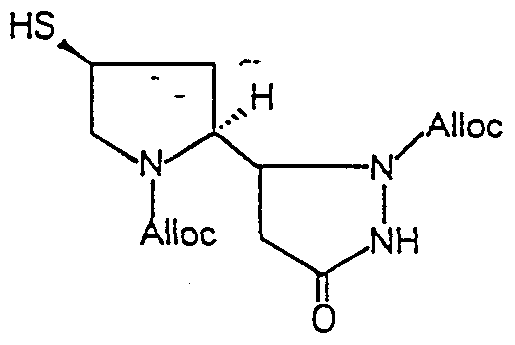
The same procedure as in Reference Example 22-2 was carried out by using the compound obtained by the above reaction (592 mg, 0.92 mmol) to obtain (2S,4S)-N- allyloxycarbonyl-4-mercapto-2-(1-allyloxycarbonyl-3- pyrazolidinon-5-yl)pyrrolidine (324 mg, yield: 87.8%).
NMR(CDCl3) δ:
1.60-1.95(2H,m),2.30(1H,dd,J=17,3Hz),2.56(1H,m),
2.88-3.30(3H,m),3.88-4.24(2H,m),4.52-4.98(4H,m),
5.00-5.45(4H,m),5.82-6.08(2H,m)
REFERENCE EXAMPLE 11
(2S,4S)-4-mercapto-N-(p-nitrobenzyloxycarbonyl)-2-(2- pyrrolidon-3-yl)pyrrolidine
1 )

The same procedure as in Reference Example 9-2 was carried out by using 3-[(2S,4R)-N-tert-butoxycarbonyl-4- tert-butyldimethylsiloxypyrrolidin-2-yl]-4-nitrobutyric acid ethyl ester obtained in Reference Example 1-5 (5.9 g, 12.8 mmol) to obtain (2S,4R)-2-(2-ethoxycarbonyl-1- carboxyethyl)-4-tert-butyldimethylsiloxy-N-tert- butoxycarbonylpyrrolidine (3.57 g, yield: 62.5%).
NMR(CDCl3) δ:
0.05(6H,s),0.86(9H,s),1.26(3H,t,J=8Hz),1.48(9H,s), 2.01(1H,m),2.34(1H,m),2.38(1H,m),3.25
(1H,dd,J=12,4Hz),3.38-3.90(3H,m),4.16(2H,q,J=8Hz), 4.25-4.55(2H,m)
2)
r

The same procedure as in Reference Example 9-3 was carried out by using the compound obtained by the above reaction (3.57 g, 8.0 mmol) and benzylamine (1.55 ml, 14.2 mmol) to obtain (2S,4R)-2-(1-benzylcarbamoyl-2- ethoxycarbonylethyl)-4-tert-butyldimethylsiloxy-N-tert- butoxycarbonylpyrrolidine (3.7 g, yield: 86.3%).
NMR(CDCl3) δ:
0.04(6H,s),0.85(9H,s),1.24(3H,t,J=8Hz),1.33-1.55
(9H,m),1.90(1H,m),2.30(1H,m),2.82(1H,m),3.22(1H,m),
3.35-3.82(2H,m),4.00-4.65(5H,m),7.30(5H,m)
3)

A 1N sodium hydroxide aqueous solution (3.9 mℓ) was added to a solution of the compound obtained by the above reaction (1.89 g, 3.5 mmol) in ethanol (30 mℓ) at room
temperature, and the mixture was stirred overnight at the same temperature. 1N hydrochloric acid (3.9 mℓ) was added to the reaction solution, and the mixture was concentrated under reduced pressure to obtain (2S,4R)-2- (1-benzylcarbamoyl-2-carboxyethyl)-N-tert-butoxycarbonyl- 4-tert-butyldimethylsiloxypyrrolidine (1.79 g, yield: 100%). A borane-dimethyl sulfide complex (0.72 mℓ, 7.2 mmol) was dropwise added to a solution of this compound in tetrahydrofuran (35 mℓ) in a nitrogen stream at room temperature, and the mixture was stirred at the same temperature for 1 hour. Methanol (5 mℓ) was added to the reaction solution, and the mixture was concentrated under reduced pressure. The residue was subjected to silica gel column chromatography (Wakogel™ C-300, hexane-ethyl acetate 1:1) to obtain 3-benzylcarbamoyl-3-[(2S,4R)-N- tert-butoxycarbonyl-4-tert-butyldimethylsiloxypyrrolidin- 2-yl]-1-propanol (1.27 g, yield: 72.9%).
NMR(CDCl3) δ:
0.04(6H,s),0.86(9H,s),1.24-1.60(11H,m),1.73-2.32 (2H,m),3.32-3.73(3H,m),4.12-4.34(2H,m),4.40(1H,m), 7.30(5H,m)
4)

tetrahydrofuran (17 mℓ) in a nitrogen stream at 0°C, and the mixture was stirred at the same temperature for 1 hour. A solution of p-toluenesulfonyl chloride (520 mg, 2.7 mmol) in tetrahydrofuran (3 mℓ) was dropwise added to the reaction solution, and the mixture was stirred at 0°C for 1 hour and at 50°C for 2 hours. The reaction mixture was cooled with ice, and a saturated ammonium chloride aqueous solution (5 mℓ) was added thereto. The mixture was extracted with ethyl acetate (100 mℓ). The organic layer was washed three times with water and once with a saturated sodium chloride aqueous solution, then dried over anhydrous magnesium sulfate and concentrated under reduced pressure. The residue was subjected to silica gel column chromatography (Wakogel™ C-300, hexane-ethyl acetate 10:1) to obtain (2S,4R)-2-(N-benzyl-2-pyrrolidon- 3-yl)-N-tert-butoxycarbonyl-4-tert- butyldimethylsiloxypyrrolidine (343 mg, yield: 39.8%). NMR(CDCl3) δ:
0.06(6H,s),0.87(9H,s),1.46(9H,s),1.90-2.30(3H,m), 3.00-3.60(5H,m),4.18-4.6.4(5H,m),7.18-7.42(5H,m)
5 )

The same procedure as in Reference Example 3-3 was carried out by using the compound obtained by the above reaction (760 mg, 1.6 mmol) to obtain (2S,4R)-N-tert- butoxycarbonyl-4-tert-butyldimethylsiloxy-2- (2- pyrrolidon-3-yl)pyrrolidine (476 mg, yield: 77.2%).
NMR(CDCl3) δ:
0.05(6H,s),0.86(9H,s),1.46(9H,s),1.82(1H,m),2.04 (2H,m),3.20-3.70(5H,m),4.32(1H,m),4.42(1H,m)
6)

The same procedure as in. Reference Example 3-4 was carried out by using the compound obtained by the above reaction (476 mg, 1.24 mmol) to obtain (2S,4R)-4-hydroxy- N-(p-nitrobenzyloxycarbonyl)-2-(2-pyrrolidon-3-
yl)pyrrolidine (342 mg, yield: 79.1%).
IR(KBr)cm-1: 1700, 1520, 1350
NMR(CDCl3) δ:
1.70-2.28(4H,m),3.18-3.50(3H,m),3.52-3.88(2H,m),
4.28-4.68(2H,m),5.22(2H,m),7.53(2H,d,J=8Hz),
8.20(2H,d,J=8Hz)
7)

The same procedure as in Reference Example 3-5 was carried out by using the compound obtained by the above reaction (342 mg, 0.98 mmol) to obtain (2S,4S)-4- acetylthio-N-(p-nitrobenzyloxycarbonyl)-2-(2-pyrrolidon- 3-yl)pyrrolidine (271 mg, yield: 68.2%).
IR(KBr)cm-1: 1700, 1530, 1520
NMR(CDCl3) δ:
1.62-2.18(3H,m),2.35(3H,s),3.02-3.70(5H,m),
3.83(1H,m),4.25(1H,m),4.44(1H,m),5.28(2H,br s),
7.56(2H,d,J=8Hz),8.25(2H,d,J=8Hz)
8)

identified compound (220 mg, yield: 90.5%).
REFERENCE EXAMPLE 12
(2S,4R)-N-tert-butoxycarbonyl-4-tert-butyldimethylsiloxy- 2-(2-pyrrolidon-4-yl)pyrrolidine diastereomers A and B

To the compound of Reference Example 1-6 (10.82 g, 22.32 mmol), n-hexane (75 mℓ) was added, and the mixture was heated to 40°C for dissolution and then filtered.
The filtrate was left to stand overnight at room
temperature. The precipitate was collected by filtration and dried to obtain a polar compound (diastereomer A;
3.74 g, yield: 34.6%) of the above identified compound. The filtrate was concentrated, and n-hexane (70 mℓ) was added to the residue. Then, the above operation was repeated to obtain a low polar compound (diastereomer B; 1.87 g, yield: 17.3%) of the above identified compound. Diastereomer A (Polar compound)
mp: 92-95°C
[α]D 20: -50.8° (C=1.031, MeOH)
IR(KBr)cm-1: 1685, 1395, 1250, 1175
NMR(CDCl3) δ:
0.06(6H,s), 0.86(9H,s),1.46(9H,s),1.72-1.97(2H,m), 2.2(1H,dd,J=18,8Hz),2.41(1H,dd,J=18,8Hz),2.9-3.8 (5H,m),4.15(1H,br),4.32(1H,br),6.06(1H,br)
Diastereomer B (Less polar compound)
mp: 97-100°C
[α]D 20: -53.9° (C=0.978, MeOH)
IR(KBr)cm-1: 1685, 1665, 1385, 1255, 1160
NMR(CDCl3) δ:
0.06(6H,s),0.86(9H,s),1.46(9H,s),1.7-1.95(2H,m),2.04 (1H,dd,J=16,8Hz),2.32(1H,dd,J=16,8Hz),2.9-3.6
(5H,m),4.1(1H,br),4.32(1H,br),6.0(1H,br)
HPLC:
Column: Daicel CHIRALCEL OD
Eluent: Hexane:isopropanol = 9:1
Flow rate: 0.5 mℓ/min
Temperature: 38°C
Detector: 210 nm
Retention time: Diastereomer A: 19.8 min
Diastereomer B: 16.3 min
REFERENCE EXAMPLE 13
(2S,4S)-2-[2-carbamoyl-N-(p- nitrobenzyloxycarbonyl)pyrrolidin-4-yl]-4-mercapto-N-(p- nitrobenzyloxycarbonyl)pyrrolidine diastereomer I
1)

The same procedure as in Reference Example 6-2 was carried out by using the (2S,4R)-N-tert-butoxycarbonyl-4- tert-butyldimethylsiloxy-2-(2-pyrrolidon-4-yl)pyrrolidine diastereomer A (polar compound; 8.0 g, 20.8 mmol) obtained in Reference Example 12 to obtain (2S,4R)-N- tert-butoxycarbonyl-4-tert-butyldimethylsiloxy-2-(N-tert- butoxycarbonyl-2-pyrrolidon-4-yl)pyrrolidine diastereomer A (9.5 g, yield: 94.2%).
NMR(CDCl3) δ:
0.05(6H,s),0.86(9H,s),1.46(9H,s),1.53(9H,s),1.70 (1H,m),1.97(1H,m),2.16-2.90(3H,m),3.24
(1H,dd,J=12,4Hz),3.36-3.70(2H,m),3.76
(1H,dd,J=10,8Hz),4.12(1H,m),4.33(1H,m)
2)

A 1M vinyl magnesium bromide-tetrahydrofuran solution
(23 mℓ) was dropwise added to a solution of the compound obtained by the above reaction (9.3 g, 19.2 mmol) in tetrahydrofuran (120 mℓ) in a nitrogen stream at -40°C, and the mixture was stirred at the same temperature for 2 hours. A 50% acetic acid-methanol solution (10 mℓ) was dropwise added to the reaction solution, and the mixture was extracted with ethyl acetate (200 mℓ). The organic layer was washed sequantially with a saturated sodium hydrogen carbonate aqueous solution, water and a
saturated sodium chloride aqueous solution, then dried over anhydrous magnesium sulfate and concentrated under reduced pressure. The residue was subjected to silica gel column chromatography (Wakogel™ C-300, hexane-ethyl acetate 10:1) to obtain 5-[(2S,4R)-N-tert-butoxycarbonyl- 4-tert-butyldimethylsiloxypyrrolidin-2-yl]-6-tert- butoxycarbonylamino-1-hexen-3-one diastereomer A (4.1 g, yield: 41.7%).
NMR(CDCl3) δ:
0.05(6H,s),0.86(9H,s),1.42(9H,s),1.46(9H,s),
4.04(1H,m),4.24(1H,m),5.80(1H,br d,J=10Hz),6.22
(1H,d,J=17Hz),6.38(1H,dd,J=17,10Hz)
3)

0.04(6H,s),0.86(9H,s),1.43(9H,s),1.46(9H,s),4.30 (2H,m),5.12(1H,br d,J=10Hz),5.28(1H,br d,J=16Hz),
5.90(1H,m)
4)

NMR(CDCl3) δ:
0.04(6H,s),0.86(9H,s),1.42(9H,s),1.45(9H,s),2.98
(1H,m),3.14(1H,dd,J=12,4Hz),3.32-3.72(2H,m),3.92-4.20
(2H,m),4.34(1H,m),4.96-5-.20(2H,m),5.74(1H,m)
5 )

Water (13 mℓ) and sodium periodate (3.70 g, 17.3 mmol) were added to a solution of the compound obtained by the above reaction (2.09 g, 4.2 mmol) in a mixture of carbon tetrachloride (10 mℓ) and acetonitrile (10 mℓ), and the mixture was vigorously stirred. Ruthenium chloride hydrate (20 mg, 0.096 mmol) was added to this reaction mixture, and the mixture was vigorously stirred at room temperature for 2 hours. The reaction mixture was concentrated under reduced pressure, and the residue was extracted with ethyl acetate (100 mℓ). The organic layer was washed sequentially with water and a saturated sodium chloride aqueous solution, then dried over anhydrous magnesium sulfate and concentrated under reduced pressure. The residue was subjected to silica gel column chromatography (Wakogel™ C-300, 1% methanol- chloroform) to obtain (2S,4R)-N-tert-butoxycarbonyl-4- tert-butyldimethylsiloxy-2-(N-tert-butoxycarbonyl-2- carboxypyrrolidin-4-yl)pyrrolidine (1.07 g, yield:
50.7%).
NMR(CDCl3) δ:
0.05(6H,s),0.86(9H,s),1.46(18H,br s),3.10(1H,m),
3.24(1H,m),3.40-3.74(2H,m),3.96-4.40(3H,m)
6)

The same procedure as in Reference Example 9-3 was conducted by using the compound obtained by the above reaction (1.07 g, 2.1 mmol) to obtain (2S,4R)-N-tert- butoxycarbonyl-4-tert-butyldimethylsiloxy-2-(N-tert- butoxycarbonyl-2-carbamoylpyrrolidin-4-yl)pyrrolidine (867 mg, yield: 81.2%).
NMR(CDCl3) δ:
0.05(6H,s),0.86(9H,s),1.46(18H,s),
3.06(1H,br t,J=12Hz),3.23(1H,dd,J=12,4Hz),
3.36-3.82(2H,m),3.98-4.40(3H,m)
7)

The same procedure as in Reference Example 5-3 was
carried out by using the compound obtained by the above reaction (861 mg, 1.68 mmol) to obtain (2S,4R)-2-[2- carbamoyl-N-(p-nitrobenzyloxycarbonyl)pyrrolidin-4-yl]-4- hydroxy-N-(p-nitrobenzyloxycarbonyl)pyrrolidine
diastereomer I (polar compound, 621 mg, yield: 66.4%) and diastereomer II (less polar compound, 216 mg, yield:
23.1%).
Polar compound
NMR(CDCl3) δ:
3.78(2H,m),4.26(2H,m),4.50(1H,m),5.26(4H,br s),7.54
(4H,d,J=8Hz),8.25(4H,d,J=8Hz)
Less polar compound
NMR(CDCl3) δ:
3.70(2H,m),4.00-4.53(3H,m),5.24(4H,br s),7.51
(4H,d,J=8Hz),8.20(4H,d,J=8Hz)
8)

The same procedure as in Reference Example 5-4 was carried out by using the polar compound obtained by the above reaction (621 mg, 1.1 mmol) to obtain (2S,4R)-2-[2- carbamoyl-N-(p-nitrobenzyloxycarbonyl)pyrrolidin-4-yl]-4- methanesulfonyloxy-N-(p-
nitrobenzyloxycarbonyl)pyrrolidine diastereomer I (670 mg, yield: 94.6%).
NMR(DMSO-d6) δ:
3.25(3H,s),3.48-3.70(2H,m),3.92-4.22(3H,m),5.04-5.34 (5H,m),7.64(4H,d,J=8Hz),8.24(4H,m)
9)

Sodium iodide (174 mg, 1.16 mmol) and potassium thioacetate (240 mg, 2.1 mmol) were added to a solution of the compound obtained by the above reaction (670 mg, 1.06 mmol) in N,N-dimethylfprmamide (10 mℓ) in a nitrogen stream, and the mixture was stirred overnight at a temperature of from 60 to 70°C. The reaction solution was extracted with ethyl acetate (70 mℓ). The organic layer was washed three times with water and once with a saturated sodium chloride aqueous solution, then dried over anhydrous magnesium sulfate and concentrated under reduced pressure. The residue was subjected to silica gel column chromatography (Wakogel™ C-300, 1% methanol- chloroform) to obtain (2S,4S)-4-acetylthio-2-[2- carbamoyl-N-(p-nitrobenzyloxycarbonyl)pyrrolidin-4-yl]-N- (p-nitrobenzyloxycarbonyl)pyrrolidine diastereomer I (479
mg, yield: 73.8%).
NMR(CDCl3) δ:
1.74(1H,m),2.00(1H,m),2.35(3H,s),2.40-2.90(3H,m), 5.24(4H,br s),7.54(4H,br d,J=8Hz),8.22(4H,br d,J=8Hz) 10)
H
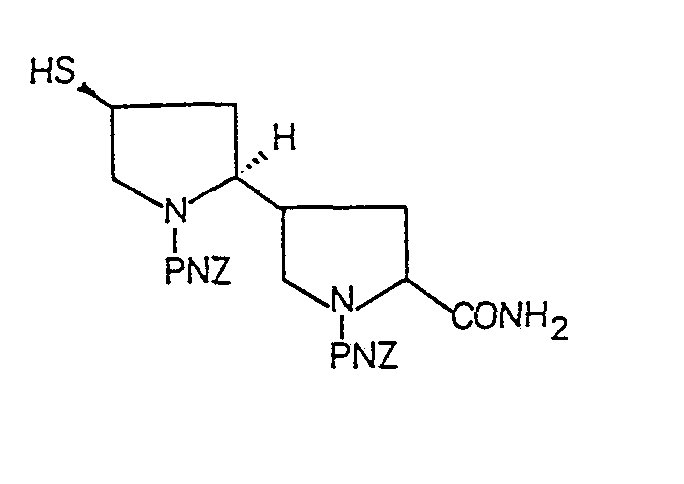
The same procedure as in Reference Example 1-9 was carried out by using the compound obtained by the above reaction (479 mg, 0.78 mmol) to obtain (2S,4S)-2-[2- carbamoyl-N-(p-nitrobenzyloxycarbonyl)pyrrolidin-4-yl]-4- mercapto-N-(p-nitrobenzyloxycarbonyl)pyrrolidine
diastereomer I (280 mg, yield: 62.7%).
REFERENCE EXAMPLE 14
(2S,4S)-2-[2-carbamoyl-N-(p- nitrobenzyloxycarbonyl)pyrrolidin-4-yl]-4-mercapto-N-(p- nitrobenzyloxycarbonyl)pyrrolidine diastereomer II
1)

NMR(CDCl3) δ:
3.04(3H,s),3.58(2H,m),4.08-4.32(2H,m),
4.42(1H,m),5.10-5.38(5H,m),5.50-5.68(1H,m)
2)

The same procedure as in Reference Example 13-9 was carried out by using the compound obtained by the above reaction (221 mg, 0.35 mmol) to obtain (2S,4S)-4- acetylthio-2-[2-carbamoyl-N-(p- nitrobenzyloxycarbonyl)pyrrolidin-4-yl]-N-(p- nitrobenzyloxycarbonyl)pyrrolidine diastereomer II (180 mg, yield: 84.0%).
NMR(CDCl3) δ:
1.66(1H,m),1.88-2.28(2H,m),2.36(3H,s),2.54(1H,m), 2.82(1H,m),3.06-3.35(2H,m),3.63(1H,m),3.86(1H,m), 4.08(1H,m),4.27(1H,m),4.47(1H,m),5.62(4H,m),
7.54(4H,d,J=8Hz),8.24(4H,d,J=8Hz)
3)

The same procedure as in Reference Example 1-9 was carried out by using the compound obtained by the above reaction (180 mg, 0.29 mmol) to obtain (2S,4S)-2-[2- carbamoyl-N-(p-nitrobenzyloxycarbonyl)pyrrolidin-4-yl]-4- mercapto-N-(p-nitrobenzyloxycarbonyl)pyrrolidine
diastereomer II (160 mg, yield: 95%).
REFERENCE EXAMPLE 15
(2S,4S)-4-mercapto-N-(p-nitrobenzyloxycarbonyl)-2-[N-(p- nitrobenzyloxycarbonyl)pyrrolidin-4-yl]pyrrolidine diastereomer A
1)

NMR(CDCl3) δ:
0.06(6H,s),0.86(9H,s),1.48(9H,s),1.52(9H,s),1.60
(1H,m),1.90(1H,m),2.10-2.58(2H,m),3.22(1H,m),
3.42-3.88(3H,m),4.08(1H,m),4.30(1H,m)
2)

0.05(6H,s),0.86(9H,s),1.44(18H,s),1.56-2.04(4H,m),
3.02-3.70(6H,m),4.00(1H,m),4.34(1H,m)
3)
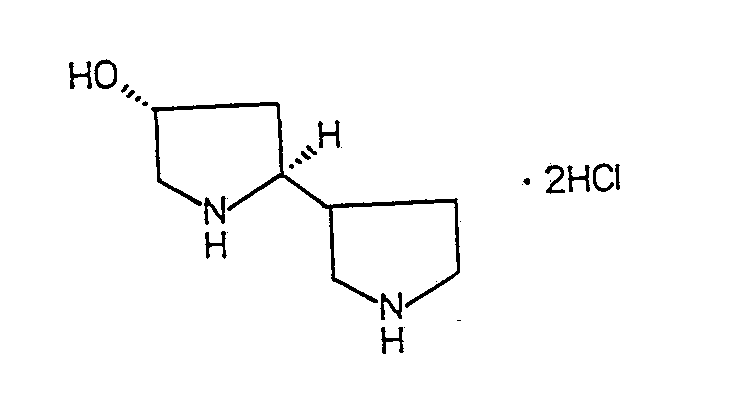
dihydrochloride (2.4 g).
IR(KBr)cm-1: 3300, 2900, 2700, 1430, 1410, 1060
NMR(D2O) δ:
1.92(2H,m),2.16-2.46(2H,m),2.68(1H,m),
3.06(1H,dd,J=12,10Hz),3.34(2H,br d,J=12Hz),
3.42-3.66(3H,m),3.82(1H,m),4.67(1H,m)
4)

5)

NMR(CDCl3) δ:
2.02(2H,m),2.50(2H,m),3.04(3H,s),3.14-3.82(6H,m), 4.20(2H,m),5.24(4H,br s),7.53(4H,d,J=8Hz),
8.24(4H,d,J=8Hz)
6)
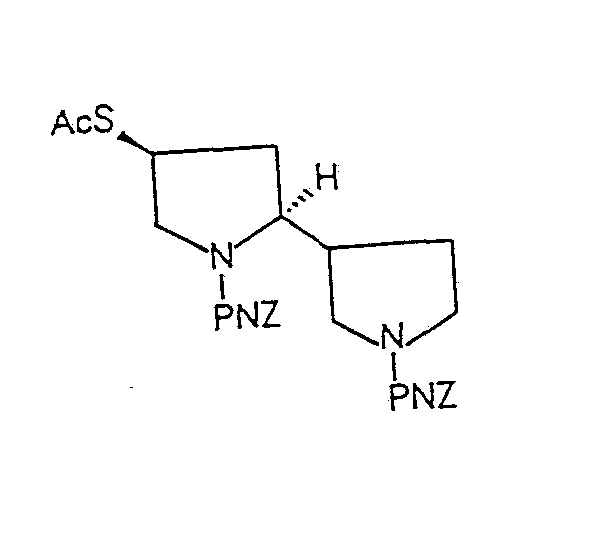
The same procedure as in Reference Example 5-5 was carried out by using the compound obtained by the above reaction (2.6 g) to obtain (2S,4S)-4-acetylthio-N-(p- nitrobenzyloxycarbonyl)-2-[N-(p- nitrobenzyloxycarbonyl)pyrrolidin-4-yl]pyrrolidine (1.7 g, yield from the first step: 73%).
NMR(CDCl3) δ:
1.54-2.10(4H,m),2.36(3H,s),2.40-2.82(2H,m),
3.02-3.70(6H,m),3.88(1H,m),4.00-4.32(2H,m),
5.24(4H,br s),7.52(4H,d,J=8Hz),8.24(4H,d,J=8Hz) 7)

REFERENCE EXAMPLE 16
(2S,4S)-4-mercapto-N-(p-nitrobenzyloxycarbonyl)-2-[N-(p- nitrobenzyloxycarbonyl)pyrrolidin-4-yl]pyrrolidine diastereomer B
1 )

The same procedure as in Reference Example 5-1 was carried out by using the (2S,4R)-4-tert- butyldimethylsiloxy-N-tert-butoxycarbonyl-2-(2- pyrrolidon-4-yl)pyrrolidine diastereomer B (5.1 g, 13.3 mmol) obtained in Reference Example 12, to obtain crude (2S,4R)-4-tert-butyldimethylsiloxycarbonyl-2-(N-tert- butoxycarbonyl-2-pyrrolidon-4-yl)pyrrolidine diastereomer B (7.5 g).
2 )

The same procedure as in Reference Example 5-2 was
carried out by using the compound obtained by the above reaction (7.5 g) to obtain a yellow oily substance (6.9 g) of (2S,4R)-4-tert-butyldimethylsiloxy-N-tert- butoxycarbonyl-2-(N-tert-butyloxycarbonylpyrrolidin-4- yl)pyrrolidine diastereomer B, which was used for the subsequent reaction without purification.
3)

dihydrochloride (3.0 g).
4)

5)

6)

NMR(CDCl3) δ:
1.54-2.10(4H,m),2.36(3H,s),2.40-2.82(2H,m),3.02-3.70
(6H,m),3.88(1H,m),4.00-4.32(2H,m),5.24(4H,br s),7.52 (4H,d,J=8Hz),8.24(4H,d,J=8Hz)
7)

The same procedure as in Reference Example 1-9 was carried out by using the compound obtained by the above reaction (1.7 g) to obtain the above identified compound (1-6 g).
REFERENCE EXAMPLE 17
(2S,4R)-4-hydroxy-2-(3-pyrrolidinyl)pyrrolidine
dihydrochloride

The same procedure as in Reference Example 15-3 was carried out by using (2S,4R)-N-tert-butoxycarbonyl-4- tert-butyldimethylsiloxy-2-(N-tert- butoxycarbonylpyrrolidin-3-yl)pyrrolidine (308 g, 0.654 mol, compound of Reference Example 5-2) to obtain the above identified compound (133 g, yield: 88%).
IR(KBr)cm-1: 3390, 3000-2400, 1600, 1420, 1270, 1065, 980 NMR(D2O) δ:
1.76-2.18(2H,m),2.20-2.48(2H,m),2.58-2.98(2H,m),
3.10-3.28(1H,m),3.30-3.50(2H,m),3.50-3.82(3H,m),
3.82-4.04(1H,m),4.70(1H,m)
REFERENCE EXAMPLE 18
(2S,4S)-4-mercapto-N-(p-nitrobenzyloxycarbonyl)-2-(2- pyrrolidon-4-yl ) pyrrolidine diastereomer A
1)

IR(KBr)cm-1: 1695, 1605, 1520, 1430, 1345, 1110
NMR(CDCl3) δ:
1.6-2.0(2H,m),2.0-2.54(2H,m),3.0-3.56(4H,m),
3.8(1H,m),4.26(1H,m),4.5(1H,m),5.25(2H,s),
5.83(1H,br),7.54(2H,d,J=9Hz),8.22(2H,d,J=9Hz)
2)

IR(KBr)cm-1: 1710, 1695, 1605, 1525, 1345, 1170
NMR(CDCl3) δ:
1.5-2.1(4H,m),2.4-2.8(2H,m),3.04(3H,s),3.1-3.64
(3H,m),4.0-4.5(2H,m),5.2(2H,s),6.32(1H,br),
7.52(2H,d,J=9Hz),8.22(2H,d,J=9Hz)
3)

The same procedure as in Reference Example 5-5 was carried out by using the compound obtained by the above reaction (13 g, 30 mmol) to obtain (2S,4S)-4-acetylthio- N-(p-nitrobenzyloxycarbonyl)-2-(2-pyrrolidon-4- yl)pyrrolidine diastereomer.A (4.61 g, yield: 37.7%). IR(KBr)cm-1: 1705, 1695, 1515, 1405, 1345, 1110
NMR(CDCl3) δ:
1.68(2H,m),2.04-2.64(4H,m),2.35(3H,s),3.18(2H,m), 3.42(1H,m),3.84(1H,m),4.04-4.34(2H,m),5.23(2H,s), 5.97(1H,br),7.53(2H,d,J=9Hz),8.25(2H,d,J=9Hz)
4)

IR(KBr)cm-1: 1695, 1525, 1400, 1345, 1110
NMR(CDCl3) δ:
1.42-1.8(2H,m),1.73(1H,d,J=8Hz),2.04-2.6(3H,m),
2.98-3.48(5H,m),4.10(2H,m),5.24(2H,s),6.0(1H,br),
7.52(2H,d,J=9Hz),8.24(2H,d,J=9Hz)
REFERENCE EXAMPLE 19
(2S,4S)-4-mercapto-N-(p-nitrobenzyloxycarbonyl)-2-(2- pyrrolidon-4-yl)pyrrolidine diastereomer B
1)

(2S,4R)-N-tert-butoxycarbonyl-4-tert- butyldimethylsiloxy-2-(2-pyrrolidon-4-yl)pyrrolidine diastereomer B (62.48 g, 163 mmol, compound of Reference Example 12) was dissolved in methanol (600 mℓ), and the solution was cooled to 0°C. Then, a 2.5N hydrochloric acid/methanol solution (230 mℓ, 570 mmol) was added thereto, and the mixture was stirred at room temperature for 3 hours. The precipitate was collected by filtration
and dried to obtain white powder (30.01 g, yield: 89.1%) of (2S,4R)-4-hydroxy-2-(2-pyrrolidon-4-yl)pyrrolidine hydrochloride. This white powder (10.53 g, 50 mmol) was dissolved in a solvent mixture of dioxane (50 mℓ) and water (50 mℓ), and the pH was adjusted to 8 with triethyl amine. Then, 4,6-dimethyl-2-(p- nitrobenzyloxycarbonylthio)pyrimidine (17.55 g, 55 mmol) was added thereto, and the mixture was reacted for 6 hours while maintaining the pH at a level of 8. The reaction solution was concentrated, and tetrahydrofuran (100 mℓ) was added thereto. Insoluble matters were filtered off, and the filtrate was concentrated. The residue was subjected to column chromatography (Wakogel™ C-300, chloroform-methanol 40:1) to obtain (2S,4R)-4- hydroxy-N-(p-nitrobenzyloxycarbonyl)-2-(2-pyrrolidon-4- yl)pyrrolidine diastereomer. B (17.48 g, yield: 98.2%. IR(KBr)cm-1: 1690, 1680, 1525, 1345, 1110, 1095
NMR(CDCl3) δ:
1.5-1.96(2H,m),1.98-2.46(2H,m),3.0-3.56(4H,m),
3.7-3.9(1H,m),4.25(1H,m),4.5(1H,br),5.26(2H,s), 6.02(1H,br),7.5.4(2H,d,J=9Hz),8.25(2H,d,J=9Hz)
2)

IR(KBr)cm-1: 1705, 1690, 1520, 1345, 1170, 905
NMR(CDCl3) δ:
1.74(2H,br),1.9-2.6(4H,m),3.04(3H,s),3.2-3.64(3H,m), 4.1-4.36(2H,m),5.28(2H,s),5.92(1H,br),7.54
(2H,d,J=9Hz),8.24(2H,d,J=9Hz)
3)

The same procedure as in Reference Example 5-5 was carried out by using the compound obtained by the above reaction (17.4 g, 41 mmol) to obtain (2S,4S)-4- acetylthio-N-(p-nitrobenzyloxycarbonyl)-2-(2-pyrrolidon- 4-yl)pyrrolidine diastereomer B (14.29 g, yield: 85.6%). IR(KBr)cm-1: 1705, 1695, 1520, 1400, 1345, 1110
NMR(CDCl3) δ:
1.74(2H,m),2.0-2.60(4H,m),2.34(3H,s),3.0-3.5(3H,m), 3.84(1H,m),4.0-4.3(2H,m),5.22(2H,s),6.02(1H,br),
7.52(2H,d,J=9Hz),8.24(2H,d,J=9Hz)
4)

The same procedure as in Reference Example 5-6 was carried out by using the compound obtained by the above reaction (7 g, 17 mmol) to obtain the above identified compound (5.94 g, yield: 95.6%).
IR(KBr)cm-1: 1695, 1520, 1400, 1345, 1105
NMR(CDCl3) δ:
1.5-1.88(2H,m),1.75(1H,d,J=8Hz),2.12(1H,dd,J=18,8Hz), 2.37(1H,dd,J=18,8Hz),2.44(1H,m),3.0-3.56(5H,m), 4.0-4.22(2H,m),5.22(2H,s),6.14(1H,br),7.52
(2H,d,J=9Hz),8.23(2H,d,J=9Hz)
REFERENCE EXAMPLE 20
(2S,4S)-4-mercapto-N-(p-nitrobenzyloxycarbonyl)-2-[3-[(p- nitrobenzyloxycarbonyl)amino]-2-pyrrolidon-4- yl]pyrrolidine
1)

concentrated under reduced pressure. The residue was subjected to silica gel column chromatography (Wakogel™ C-300, chloroform) to obtain. (2S,4R)-2-(3-azido-N-tert- butoxycarbonyl-2-pyrrolidon-4-yl)-N-tert-butoxycarbonyl- 4-(tert-butyldimethylsiloxy)pyrrolidine (720 mg, yield: 68.5%).
IR(KBr)cm-1: 2110, 1790, 1760, 1695, 1315, 1155
NMR(CDCl3) δ:
0.06(6H,s),0.86(9H,s),1.48(9H,s),1.6-2.2(2H,m), 3.1-3.85(5H,m),4.10(1H,br),4.26(1H,br),4.5(1H,br) 2)

The compound obtained by the above reaction (720 mg, 1.37 mmol) was dissolved in methanol (50 mℓ), and a 10% palladium-carbon catalyst (200 mg) was added thereto. The mixture was vigorously stirred under a hydrogen stream for 2 hours. The mixture was filtered, and the obtained filtrate was concentrated to obtain crude oil (730 mg). This oil was dissolved in a mixture of dioxane (20 mℓ) and water (20 mℓ). The pH was adjusted to 8 with triethylamine, and then 4,6-dimethyl-2-(p- nitrobenzyloxycarbonylthio)pyrimidine (504 mg, 1.6 mmol) was added thereto. This solution was stirred for 6 hours, while maintaining the pH at a level of 8. The reaction solution was concentrated under reduced
pressure. The residue was extracted with ethyl acetate (50 mℓ). The extract was washed sequentially with a saturated sodium hydrogen carbonate aqueous solution and
a saturated sodium chloride aqueous solution. The organic layer was dried over anhydrous magnesium sulfate and concentrated under reduced pressure. The residue was subjected to silica gel column chromatography (Wakogel™ C-300, chloroform-methanol 100:1) to obtain (2S,4R)-N- tert-butoxycarbonyl-4-tert-butyldimethylsiloxy-2-[N-tert- butoxycarbonyl-3-[(p-nitrobenzyloxycarbonyl)amino]-2- pyrrolidon-4-yl]pyrrolidine (840 mg, yield: 90.6%).
IR(KBr)cm-1: 1795, 1695, 1525, 1350, 1255, 1155
NMR(CDCl3) δ:
0.06(6H,s),0.86(9H,s),1.48(9H,s),1.54(9H,s),
1.72-2.1(2H,m),3.08-3.78(5H,m),4.1-4.3(3H,m),
5.2(2H,br),7.5(2H,d,J=9Hz),8.24(2H,d,J=9Hz)
3)

The compound obtained by the above reaction (840 mg, 1.2 mmol) was dissolved in dry methylene chloride (20 mℓ), and the solution was cooled to 0°C. Then,
trifluoroacetic acid (1 mℓ, 13 mmol) was added thereto, and the mixture was stirred at room temperature for 16 hours. The reaction solution was concentrated, and
trifluoroacetic acid was removed. Then, the residue was dissolved in methanol (30 mℓ), and a 2.5N hydrochloric acid-methanol solution (0.63 mℓ, 1.6 mmol) was added thereto, and the mixture was stirred at room temperature for 16 hours. The reaction solution was concentrated. Then, the obtained residue was dissolved in a mixture of dioxane (20 mℓ) and water (20 mℓ). While adjusting the pH to a level of 8 with triethylamine, 4,6-dimethyl-2-(p- nitrobenzyloxycarbonylthio)pyrimidine (850 mg, 2.6 mmol) was added thereto, and the mixture was stirred at room temperature for 16 hours. The reaction solution was concentrated, and the residue was extracted with ethyl acetate (100 mℓ). The organic layer was washed with a saturated sodium chloride aqueous solution. The organic layer was dried over anhydrous magnesium sulfate and concentrated under reduced pressure. The residue was subjected to silica gel column chromatography (Wakogel™ C-300, chloroform-methanol 50:1) to obtain (2S,4R)-4- hydroxy-N-(p-nitrobenzyloxycarbonyl)-2-[3-[(p- nitrobenzyloxycarbonyl)amino]-2-pyrrolidon-4- yl]pyrrolidine (450 mg, yield: 69%).
IR(KBr)cm-1: 1700, 1520, 1345
NMR(CDCl3 + CD3OD) δ:
1.96-2.24(2H,m),3.06-3.a4(5H,m),4.08-4.5(3H,m),5.22 (2H,s),5.24(2H,s),7.54(4H,d,J=9Hz),8.22(4H,d,J=9Hz)
4)

The same procedure as in Reference Example 5-4 was carried out by using the compound obtained by the above reaction (450 mg, 0.83 mmol) to obtain crude (2S,4R)-4- methanesulfonyloxy-N-(p-nitrobenzyloxycarbonyl)-2-[3-[(p- nitrobenzyloxycarbonyl)amino]-2-pyrrolidon-4- yl]pyrrolidine (620 mg).
IR(KBr)cm-1: 1710, 1610, 1525, 1350, 1175
5)

IR(KBr)cm-1: 1710, 1700, 1610, 1525, 1350, 1110
NMR(CDCl3) δ:
1.86-1.96(2H,m),2.34(3H,s),2.68(1H,br),3.0-3.4(4H,m), 4.84(1H,m),4.1-4.4(2H,m),5.2(4H,br),5.92(1H,br), 6.84(1H,br),7.54(4H,d,J=9Hz),8.22(4H,d,J=9Hz)
6)

The same procedure as in Reference Example 5-6 was carried out by using the compound obtained by the above reaction (130 mg, 0.21 mmol) to obtain the above
identified compound i.e. (2S,4S)-4-mercapto-N-(p- nitrobenzyloxycarbonyl)-2-[3-[(p- nitrobenzyloxycarbonyl)amino]-2-pyrrolidon-4- yl]pyrrolidine (110 mg, yield: 91%).
IR(KBr)cm-1: 1710, 1610, 1515, 1350
NMR(CDCl3) δ:
1.6-1.9(2H,br),1.77(1H,d,J=8Hz),2.77(1H,br),
3.95-4.42(4H,m),4.05-4.2(3H,br),5.19(2H,s),
5.21(2H,s),5.9(1H,br),6.92(1H,br),7.54(4H,d,J=9Hz), 8.2(4H,d,J=9Hz)
REFERENCE EXAMPLE 21
(2S,4S)-N-allyloxycarbonyl-2-iodomethyl-4- tritylthiopyrrolidine
1 )

A solution of methanesulfonyl chloride (20.5 mℓ, 265 mmol) in methylene chloride (20 mℓ) was dropwise added to a solution of (2S,4S)-N-allyloxycarbonyl-2-hydroxymethyl- 4-tritylthiopyrrolidine (119 g, 259 mmol, compound of Reference Example 3-1 of Japanese Patent Application No. 192,093/1990) and triethylamine (40.3 mℓ, 289 mmol) in methylene chloride (1 ℓ) under cooling with ice, and the mixture was stirred at the same temperature for 30 minutes. The reaction solution was washed sequentially with water (500 mℓ), a saturated sodium hydrogen
carbonate aqueous solution (250 mℓ) and a saturated sodium chloride aqueous solution (250 mℓ), then dried over anhydrous sodium sulfate and concentrated. To the residue, ethyl acetate (30 mℓ) and diisopropyl ether (270 mℓ) were added, and the precipitated crystals were collected by filtration to obtain (2S,4S)-N- allyloxycarbonyl-2-methanesulfonyloxymethyl-4- tritylthiopyrrolidine (130.8. g, yield: 94%).
NMR(CDCl3) δ:
1.8(1H,m),2.1(1H,m),1.7-2.4(3H,m),3.0(3H,s),
3.9(1H,m),4.1-4.6(4H,m),5.2-5.4(2H,m),5.9(1H,m),
7.2-7.6(15H,m)
2)

A solution comprising the compound obtained by the above reaction (130.8 g, 243 mmol), sodium iodide (180 g, 1.2 mol) and 2-butanone (1.3 ℓ), was heated and stirred for 3 hours. The reaction solution was washed
sequentially with water (300 mℓ), a 10% sodium
thiosulfate aqueous solution (200 mℓ) and a saturated sodium chloride aqueous solution (500 mℓ), then dried over anhydrous sodium sulfate and concentrated. To the residue, diisopropyl ether (120 mℓ) and n-hexane (300 mℓ) were added, and the precipitated crystals were collected by filtration to obtain the above identified compound (123.7 g, yield: 89%).
NMR(CDCl3) δ:
1.6(1H,m),2.1(1H,m),2.7-3.1(3H,m),3.3-3.6(3H,m), 4.5(2H,br s),5.25(2H,m),5.9(1H,m),7.2-7.6(15H,m) REFERENCE EXAMPLE 22
(2R,4S)-N-allyloxycarbonyl-4-mercapto-2-(2-oxopyrrolidin- 3-ylmethyl)pyrrolidine
1 )

Lithium diisopropylamide (2.1M tetrahydrofuran solution, 6.45 mℓ, 13.5 mmol) was dropwise added to a solution of N-tert-butyldimethylsilyl-2-oxopyrrolidine
(1.80 g, 9.03 mmol) in tetrahydrofuran (150 mℓ) at -78°C, and the mixture was stirred at the same temperature for 15 minutes. Then, a solution of (2S,4S)-N- allyloxycarbonyl-2-iodomethyl-4-tritylthiopyrrolidine (2.57 g, 4.5 mmol) in tetrahydrofuran (18 mℓ) was
dropwise added thereto, and the mixture was stirred at the same temperature for 1 hour. The reaction solution was poured into a mixture of ethyl acetate (150 mℓ) and a 10% ammonium chloride aqueous solution (50 mℓ) for liquid separation. The organic layer was washed sequentially with a 10% sodium dihydrogen phosphate aqueous solution (100 mℓ) and a saturated sodium chloride aqueous solution (100 mℓ), then dried over anhydrous sodium sulfate and concentrated. The residue was dissolved in
tetrahydrofuran (12 mℓ) and methanol (3 mℓ), and 6N hydrochloric acid (3 mℓ) was added thereto under cooling with ice. The mixture was stirred for 1 hour. Ethyl
acetate (50 mℓ) was added to the reaction solution, and the organic layer was washed sequentially with a
saturated sodium hydrogen carbonate aqueous solution (30 mℓ) and a saturated sodium chloride aqueous solution (30 mℓ), then dried over anhydrous sodium sulfate and concentrated. The residue was subjected to silica gel flash column chromatography (Wakogel™ C-300, 40 mℓ, ethyl acetate-n-hexane 3:1) to obtain (2R,4S)-N- allyloxycarbonyl-2-(2-oxopyrrolidin-3-ylmethyl)-4- tritylthiopyrrolidine (880 mg, yield: 37%).
NMR(CDCl3) δ:
1.5(1H,m),1.7-2.3(6H,m),2.6-3.0(3H,m),3.34(2H,m), 3.66(1H,m),4.5(2H,br s),5.3(2H,m),5.9(2H,m),
7.2-7.6(15H,m)
2)

Trifluoroacetic acid (1.3 mℓ) and triethylsilane (0.42 mℓ, 2.63 mmol) were added to a solution of the compound obtained by the abo.ve reaction (1.32 g, 2.51 mmol) in methylene chloride (1.3 mℓ) under cooling with ice, and the mixture was stirred at room temperature for 30 minutes. The organic solvent was removed under
reduced pressure, and ethyl acetate (50 mℓ) was added to the residue. The mixture was washed sequentially with a 1M phosphate buffer solution (pH 5.5, 30 mℓ x 2) and a saturated sodium chloride aqueous solution (30 mℓ), then dried over anhydrous sodium sulfate and concentrated. The residue was purified by silica gel flash column chromatography (Wakogel™ C-300, 40 mℓ, acetone-ethyl acetate 3:7) to obtain the above identified compound (650 mg, yield: 91%).
NMR(CDCl3) δ:
1.5-1.7(2H,m),1.9-2.4(5H,m),2.65(1H,m),3.1-3.4
(4H,m),3.92(1H,m),4.1(1H,m),4.6(2H,br d,J=6Hz),
5.2-5.4(2H,m),5.95(2H,m)
REFERENCE EXAMPLE 23
(2R,4S)-N-allyloxycarbonyl-4-mercapto-2-(2-oxoazetidin-3- ylmethyl)pyrrolidine
1)

The same procedure as in. Reference Example 22-1 was carried out by using N-tert-butyldimethylsilyl-2- oxoazetidine (650 mg, 3.5 mmol), lithium diisopropylamide (2.1M tetrahydrofuran solution, 3.34 mℓ, 7.0 mmol), and
(2S,4S)-N-allyloxycarbonyl-2-iodomethyl-4- tritylthiopyrrolidine (1 g, 1.75 mmol) to obtain (2R,4S)- N-allyloxycarbonyl-2-(2-oxoazetidin-3-ylmethyl)-4- tritylthiopyrrolidine (220 mg, yield: 24%).
NMR(CDCl3) δ:
1.5(1H,m),1.9-2.3(2H,m),2.7-3.1(4H,m),3.2(1H,m),
3.4(1H,t,J=5Hz),3.7(1H,m),4.5(2H,br s),5.3(2H,m),
5.62(1H,br s),5.9(1H,m),7.2-7.6(15H,m)
2)

The same procedure as in Reference Example 22-2 was carried out by using the compound obtained by the above reaction (510 mg, 0.99 mmol) and triethylsilane (0.17 mℓ, 1. 05 mmol ) to obtain the above identified compound, which was used for the subsequent reaction without
purification.
REFERENCE EXAMPLE 24
(2R,4S)-N-allyloxycarbonyl-2-(N-allyloxycarbonyl- pyrrolidin-3-ylmethyl)-4-mercaptopyrrolidine
1 )

Di-tert-butyl dicarbonate (1.97 mℓ, 8.6 mmol) was added to a solution comprising (2S,4S)-N- allyloxycarbonyl-2-[(Z)-2-oxopyrrolidin-3-ylidenemethyl]- 4-tritylthiopyrrolidine (3 g, 5.7 mmol, compound of
Reference Example 7-1 of Japanese Patent Application No . 192 , 093/1990 ) , triethylamine ( 0 .8 mℓ, 5.7 mmol ) , 4- (dimethylamino)pyridine (699 mg, 5.7 mmol) and
tetrahydrofuran (30 mℓ). The mixture was stirred at room temperature for 5 hours, and then the solvent was removed under reduced pressure. Ethyl acetate (50 mℓ) was added to the residue, and the mixture was washed sequentially with a 10% sodium dihydrogen phosphate aqueous solution (20 mℓ) and a saturated sodium chloride aqueous solution (20 mℓ), then dried over anhydrous sodium sulfate and concentrated. The residue was purified by silica gel flash column chromatography (Wakogel™ C-300, 40 mℓ, ethyl acetate-n-hexane 1:2) to obtain (2S,4S)-N- allyloxycarbonyl-2-[(Z)-N-tert-butoxycarbonyl-2- oxopyrrolidin-3-ylidenemethyl]-4-tritylthiopyrrolidine (3.24 g, yield: 91%).
NMR(CDCl3) δ:
1.5(1H,m),1.56(9H,s),2.4-3.2(6H,m),3.7(2H,m),
4.3-4.6(2H,m),5.1-5.5(3H,m),5.7-6.0(2H,m),
7.2-7.6(15H,m)
2)

Lithium chloride (68 mg, 1.6 mmol), sodium
borohydride (61 mg, 1.6 mmol) and ethanol (5 mℓ) were sequentially added to a solution comprising the compound obtained by the above reaction (500 mg, 0.8 mmol) and tetrahydrofuran (2.5 mℓ), and the mixture was stirred at room temperature for 16 hours. Ethyl acetate (30 mℓ) was added to the reaction solution, and the mixture was washed sequentially with water (15 mℓ x 2) and a
saturated sodium chloride aqueous solution (15 mℓ), then dried over anhydrous sodium sulfate and concentrated. The residue was purified by silica gel flash column chromatography (Wakogel™ C-300, 40 mℓ, ethyl acetate-n- hexane 1:1) to obtain (2R,4S)-N-allyloxycarbonyl-2-[4- tert-butoxycarbonylamino-2-(hydroxymethyl)butyl]-4- tritylthiopyrrolidine (270 mg, yield: 54%).
NMR(CDCl3) δ:
1.2-1.5(4H,m),1.44(9H,s),1.7-2.1(2H,m),2.22(1H,m), 2.6-3.0(3H,m),3.16(2H,m),3.4-3.8(3H,m),4.5(2H,br s), 4.7(0.5H,br s),4.9(0.5H,br s),5.2-5.4(2H,m),
5.9(1H,m),7.2-7.6(15H,m)
3)

Methanesulfonyl chloride (35 μℓ, 0.45 mmol) was dropwise added to a solution comprising the compound obtained by the above reaction (270 mg, 0.43 mmol), triethylamine (66 μℓ, 0.47 mmol) and methylene chloride (3 mℓ) under cooling with ice, and the mixture was stirred at the same temperature for 30 minutes.
Methylene chloride (30 mℓ) was added to the reaction solution, and the mixture was washed sequantially with water (15 mℓ), a saturated sodium hydrogen carbonate aqueous solution (15 mℓ) and a saturated sodium chloride aqueous solution (15 mℓ), then dried over anhydrous sodium sulfate and concentrated. The residue was
purified by silica gel flash column chromatography
(Wakogel™ C-300, 40 mℓ, ethyl acetate-n-hexane 1:1) to obtain (2R,4S)-N-allyloxycarbonyl-2-[4-tert- butoxycarbonylamino-2-(methanesulfonyloxymethyl)butyl]-4- tritylthiopyrrolidine (270 mg, yield: 89%).
NMR(CDCl3) δ:
1.3-2.0(6H,m),1.44(9H,s),2.2(1H,m),2.6-3.3(5H,m), 3.0(1.5H,s),3.02(1.5H,s),3.8(1H,m),4.14(2H,m),
4.4-4.7(2.5H,m),5.02(0.5H,br s),5.2-5.4(2H,m),
5.9(1H,m),7.2-7.6(15H,m)
4)

The compound obtained by the above reaction (260 mg, 0.367 mmol) was dissolved in a 1.55N hydrogen chloride- methanol solution (0.7 mℓ), and the mixture was stirred at room temperature for 4 hours. The solvent was removed under reduced pressure, and then tetrahydrofuran (5 mℓ) and triethylamine (0.11 mℓ, 0.81 mmol) were added
thereto, and the mixture was stirred at room temperature for 1 hour. Triethylamine (0.11 mℓ, 0.81 mmol) was added to the reaction solution, and then allyl chloroformate (43 μℓ, 0.4 mmol) was dropwise added thereto under cooling with ice. The mixture was stirred at the same temperature for 30 minutes. Ethyl acetate (30 mℓ) was added to the reaction solution, and the mixture was washed sequentially with water (15 mℓ), a saturated sodium hydrogen carbonate aqueous solution (15 mℓ) and a
saturated sodium chloride aqueous solution (15 mℓ), then dried over anhydrous sodium sulfate and concentrated. The residue was purified by silica gel flash column chromatography (Wakogel™ C-300, 40 mℓ, ethyl acetate-n- hexane 1 : 1 ) to obtain ( 2R, 4S ) -N-allyloxycarbonyl-2-(N- allyloxycarbonylpyrrolidin-3-ylmethyl)-4- tritylthiopyrrolidine (180 mg, yield: 82%).
NMR(CDCl3) δ:
1.3-1.5(3H,m),1.8-2.2(4H,m),2.6-3.0(4H,m),3.3(1H,m), 3.4-3.7(3H,m),4.5(2H,br s),4.6(2H,br d,J=5Hz),5.2-5.4
(4H,m),5.8-6.1(2H,m),7.2-7.6(15H,m)
5)

The same procedure as in Reference Example 22-2 was carried out by using the compound obtained by the above reaction (1.03 g, 1.73 mmol) and triethylsilane (0.29 mℓ,
1.81 mmol) to obtain the above identified compound (560 mg, yield: 92%).
NMR(CDCl3) δ:
1.5-1.8(4H,m),1.9-2.3(4H,m),2.62(1H,m),2.9-4.2
(7H,m),4.6(4H,m),5.2-5.4(4H,m),5.9-6.1(2H,m)
REFERENCE EXAMPLE 25
(2R,4S)-N-allyloxycarbonyl-2-[(2S)-N-allyloxycarbonyl-2- carbamoylpyrrolidin-4-ylmethyl]-4-mercaptopyrrolidine
1)

The same procedure as in Reference Example 22-1 was carried out by using N-tert-butyldimethylsilyl-5-tert- butyldimethylsiloxymethyl-2-oxopyrrolidine (10.67 g, 31.6 mmol), lithium diisopropylamide (2.1M tetrahydrofuran solution, 15.1 mℓ, 31.6 mmol) and (2S,4S)-N- allyloxycarbonyl-2-iodomethyl-4-tritylthiopyrrolidine (10 g, 17.6 mmol) to obtain (2R,4S)-N-allyloxycarbonyl-2- [(5S)-5-hydroxymethyl-2-oxopyrrolidin-3-ylmethyl]-4- tritylthiopyrrolidine (2 g, yield: 21%).
NMR(CDCl3) δ:
1.3-2.4(8H,m),2.7-3.0(2H,m),3.5(1H,m),3.6-3.8(3H,m),
4.5(2H,br s),5.2-5.4(2H,m),5.9(1H,m),6.3(1H,br s),
7.2-7.6(15H,m)
2 )

4-(dimethylamino)pyridine (88 mg, 0.72 mmol) and triethylamine (1.2 mℓ, 8.6 mmol) were sequentially added to a solution comprising the compound obtained by the above reaction (4 g, 7.18 mmol), tert-butyldimethylsilyl chloride (1.19 g, 7.9 mmol) and N,N-dimethylformamide (20 mℓ) under cooling with ice, and the mixture was stirred at room temperature for 3 hours. Ethyl acetate (80 mℓ) was added to the reaction solution, and the mixture was washed sequentially with water
(40 mℓ x 2), a saturated sodium hydrogen carbonate aqueous solution (40 mℓ) and a saturated sodium chloride aqueous solution (40 mℓ), then dried over anhydrous sodium sulfate and concentrated. The residue was
purified by silica gel flash column chromatography
(Wakogel™ C-300, 40 mℓ, ethyl acetate-n-hexane 2:1) to obtain (2R,4S)-N-allyloxycarbonyl-2-[(5S)-5-tert- butyldimethylsiloxymethyl-2-oxopyrrolidin-3-ylmethyl]-4- tritylthiopyrrolidine (4.1 g, yield: 85%).
NMR(CDCl3) δ:
0.05(6H,s),0.9(9H,s),1.3-2.4(8H,m),2.8-3.0(2H,m), 3.3-3.7(4H,m),4.5(2H,br s),5.2-5.4(2H,m),5.9(2H,m), 7.2-7.6(15H,m)
3)

The same procedure as in Reference Example 24-1 was carried out by using the compound obtained by the above reaction (4.1 g, 6.1 mmol), di-tert-butyl dicarbonate (2.53 ml, 11 mmol), 4-(dimethylamino)pyridine (746 mg,
6.1 mmol) and triethylamine (0.94 ml, 6.7 mmol) to obtain (2R,4S)-N-allyloxycarbonyl-2-[(5S)-N-tert-butoxycarbonyl- 5-tert-butyldimethylsiloxymethyl-2-oxopyrrolidin-3- ylmethyl]-4-tritylthiopyr rolidine (4.7 g, yield: 100%). NMR(CDCl3) δ:
0.04(3H,s),0.06(3H,s),0.9(9H,s),1.5(2H,m),1.52
(9H,s),1.9(2H,m),2.15(2H,m),2.8-3.0(4H,m),3.62(1H,m), 3.7(1H,dd,J=10,2Hz),3.9(1H,dd,J=10,4Hz),4.1(1H,m), 4.5(2H,br s),5.1-5.3(2H,m),5.9(1H,m),7.2-7.6(15H,m)
4)

The same procedure as in Reference Example 24-2 was carried out by using the compound obtained by the above reaction (4.7 g, 6.1 mmol), lithium chloride (518 mg,
12.2 mmol) and sodium borohydride (463 mg, 12.2 mmol) to obtain (2R,4S)-N-allyloxycarbonyl-2-[(4S)-4-tert- butoxycarbonylamino-5-tert-butyldimethylsiloxy-2- hydroxymethylpentyl]-4-tritylthiopyrrolidine (2.18 g, yield: 46%).
NMR(CDCl3) δ:
0.04(6H,s),0.9(9H,s),1.4-1.8(6H,m),1.48(9H,s), 2.2(1H,m),2.6-3.0(3H,m),3.5-3.9(6H,m),4.5(2H,br s), 4.7(1H,br s),5.2-5.4(2H,m),5.9(1H,m),7.2-7.6(15H,m) 5)

The same procedure as in Reference Example 24-3 was
carried out by using the compound obtained by the above reaction (2.18 g, 2.8 mmol), methanesulfonyl chloride (0.24 mℓ, 3 mmol) and triethylamine (0.47 mℓ, 3.4 mmol) to obtain (2R,4S)-N-allyloxycarbonyl-2-[(4S)-4-tert- butoxycarbonylamino-5-tert-butyldimethylsiloxy-2- methanesulfonyloxymethylpentyl]-4-tritylthiopyrrolidine (2.15 g, yield: 90%).
NMR(CDCl3) δ:
0.04(6H,s),0.9(9H,s),1.3-1.9(6H,m),1.45(9H,s),
2.2(1H,m),2.6-3.0(3H,m),3.0(3H,s),3.4-3.8(4H,m), 4.1-4.7(5H,m),5.1-5.3(2H,m),5.9(1H,m),7.2-7.6(15H,m) 6)

The same procedure as in Reference Example 24-4 was carried out by using the compound obtained by the above reaction (2.15 g, 2.52 mmol), a 1N hydrogen chloride- methanol solution (25 mℓ), allyl chloroformate (0.35 mℓ, 3.28 mmol) and triethylamine (1.76 mℓ, 12.6 mℓ) to obtain (2R,4S)-N-allyloxycarbonyl-2-[(2S)-N-allyloxycarbonyl-2- hydroxymethylpyrrolidin-4-ylmethyl]-4- tritylthiopyrrolidine (1.21 g, yield: 77%).
NMR(CDCl3) δ:
1.3-2.2(7H,m),2.6-3.05(4H,m),3.5-3.7(4H,m),4.05 (1H,m),4.45(2H,br d,J=4Hz),4.6(2H,m),5.1-5.3(4H,m), 5.8-6.0(2H,m),7.2-7.6(15H,m)
7)

A solution comprising the compound obtained by the above reaction (1.21 g, 1.93 mmol), pyridinium dichromate (3.63 g, 9.65 mmol) and N,N-dimethylformamide (7.2 mℓ), was stirred at room temperature for 16 hours. Ethyl acetate (50 mℓ) was added to the reaction solution, and the mixture was washed with water (20 mℓ x 2). To the organic layer, water (30 mℓ) containing potassium
carbonate (270 mg, 1.93 mmol) was added for liquid separation. The aqueous layer was acidified with 6N hydrochloric acid, and ethyl acetate (50 mℓ) was added for liquid separation. The organic layer was washed with a saturated sodium chloride aqueous solution (20 mℓ), then dried over anhydrous sodium sulfate and concentrated to obtain (2R,4S)-N-allyloxycarbonyl-2-[(2S)-N- allyloxycarbonyl-2-carboxypyrrolidin-4-ylmethyl]-4- tritylthiopyrrolidine (1 g, yield: 81%).
NMR(CDCl3) δ:
1.3-1.5(2H,m),1.8-2.4(5H,m),2.7-3.1(4H,m),3.5-3.9 (2H,m),4.3-4.8(5H,m),5.1-5.5(4H,m),5.8-6.0(2H,m), 7.2-7.6(15H,m)
8)

Isobutyl chloroformate (90 μℓ, 0.69 mmol) was dropwise added to a solution comprising the compound obtained by the above reaction (400 mg, 0.62 mmol), triethylamine (96 μℓ, 0.69 mmol) and tetrahydrofuran (6 mℓ) at -15°C, and the mixture was stirred at the same temperature for 20 minutes. Then, concentrated aqueous ammonia (0.18 mℓ) was added thereto, and the mixture was stirred at 0°C for 1 hour. Ethyl acetate (30 mℓ) was added to the reaction solution, and the mixture was washed sequentially with a saturated sodium hydrogen carbonate aqueous solution (15 mℓ) and a saturated sodium chloride aqueous solution (15 mℓ), then dried over anhydrous sodium sulfate and. concentrated to obtain (2R,4S)-N-allyloxycarbonyl-2-[(2S)-N-allyloxycarbonyl-2- carbamoylpyrrolidin-4-ylmethyl]-4-tritylthiopyrrolidine (310 mg, yield: 78%).
NMR(CDCl3) δ:
1.3-2.5(7H,m),2.7-3.1(4H,m),3.72(2H,m),4.3-4.7(5H,m), 5.1-5.5(5H,m),5.9-6.1(2.5H,m)6.8(0.5H,br s),
7.2-7.6(15H,m)
9)

The same procedure as in Reference Example 22-2 was carried out by using the compound obtained by the above reaction (310 mg, 0.48 mmol) and triethylsilane (81 μℓ, 0.51 mmol) to obtain the above identified compound (190 mg, yield: 100%).
NMR(CDCl3) δ:
1.5-2.7(8H,m),3.0-3.3(3H,m),3.7(1H,m),3.86(1H,m), 4.06(1H,m),4.4(1H,d,J=8Hz),4.6(4H,m),5.2-5.5(5H,m), 5.8-6.0(2.5H,m),6.8(0.5H,br s)
REFERENCE EXAMPLE 26
(2R,4S)-N-allyloxycarbonyl-2-[(2S)-N-allyloxycarbonyl-2-
(methylcarbamoyl)pyrrolidm-4-ylmethyl]-4- mercaptopyrrolidine
1 )

The same procedure as in Reference Example 25-8 was carried out by using (2R,4S)-N-allyloxycarbonyl-2-[(2S)- N-allyloxycarbonyl-2-carboxypyrrolidin-4-ylmethyl]-4- tritylthiopyrrolidine (300 mg, 0.47 mmol), isobutyl chloroformate (74 μℓ, 0.56 mmol), triethylamine (78 μℓ, 0.56 mmol) and a 40% methylamine aqueous solution (0.19 mℓ) to obtain (2R,4S)-N-allyloxycarbonyl-2-[(2S)-N- allyloxycarbonyl-2-(methylcarbamoyl)pyrrolidin-4- ylmethyl]-4-tritylthiopyrrolidine (300 mg, yield: 98%). NMR(CDCl3) δ:
1.3-2.5(7H,m),2.6-3.0(3H,m),2.8(3H,d,J=5Hz),
3.6(2H,m),4.3(1H,d,J=8Hz),4.4-4.6(4H,m),5.1-5.4 (4H,m),5.8-6.0(2.5H,m),6.7(0.5H,br s),7.2-7.6 (15H,m) 2)

NMR(CDCl3) δ:
1.5-2.7 (8H,m),2,82(3H,d,J=5Hz),3.0-3.3(3H,m),3.7 (1H,m),3.9(1H,m),4.1(1H,m),4.4(1H,d,J=8Hz),4.6(4H,m), 5.2-5.4(4H,m),5.8-6.1(2.5H,m),6.9(0.5H,br s)
REFERENCE EXAMPLE 27
(2R,4S)-N-allyloxycarbonyl-2-[(2S)-N-allyloxycarbonyl-2- (dimethylcarbamoyl)pyrrolidin-4-ylmethyl]-4- mercaptopyrrolidine
1)

The same procedure as in Reference Example 25-8 was carried out by using (2R,4S)-N-allyloxycarbonyl-2-[(2S)- N-allyloxycarbonyl-2-carboxypyrrolidin-4-ylmethyl]-4- tritylthiopyrrolidine (300 mg, 0.47 mmol), isobutyl chloroformate (74 μℓ, 0.56 mmol), triethylamine (78 μℓ,
0.56 mmol) and a 50% dimethylamine aqueous solution (0.27 mℓ) to obtain (2R,4S)-N-allyloxycarbonyl-2-[(2S)-N-
allyloxycarbonyl-2-(dimethylcarbamoyl)pyrrolidin-4- ylmethyl]-4-tritylthiopyrrolidine (290 mg, yield: 93%). NMR(CDCl3) δ:
1.3-2.3(7H,m),2.6-3.0(4H,m),2.9(6H,s),3.5(2H,m), 4.1-4.7(5H,m),5.1-5.3(4H,m),5.7-5.9(2H,m),
7.2-7.6(15H,m)
2)

The same procedure as in Reference Example 22-2 was carried out by using the compound obtained by the above reaction (290 mg, 0.43 mmol) and triethylsilane (76 μℓ,
0.48 mmol) to obtain the above identified compound (110 mg, yield: 60%).
NMR(CDCl3) δ:
1.5-2.7(8H,m),2.9-3.3(3H,m),2.98(3H,s),3.1(3H,s),
3.7-4.2(3H,m),4.4-4.8(5H,m),5.2-5.4(4H,m),5.9(2H,m)
REFERENCE EXAMPLE 28
(2S,4S)-2-(2,4-dioxoimidazolidin-5-yl)-4-(p- methoxybenzylthio)-N-(p-nitrobenzyloxycarbonyl)- pyrrolidine

Oxalyl chloride (1.3 mℓ, 14.9 mmol) was dropwise added to a solution of dimethyl sulfoxide (2.2 mℓ, 3.10 mmol) in methylene chloride (30 mℓ) under a nitrogen stream at -78°C, and the reaction solution was stirred at the same temperature for 30 minutes. A solution of
(2S,4S)-2-hydroxymethyl-4-(p-methoxybenzylthio)-N-(p- nitrobenzyloxycarbonyl)pyrrolidine (4.32 g, 9.99 mmol) in methylene chloride (20 mℓ) cooled to -78°C, was dropwise added to this mixture. This mixture was stirred at the same temperature for 30 minutes, and then triethylamine (7.0 mℓ, 50.2 mmol) was dropwise added thereto. This mixture was stirred at the same temperature for 10 minutes and further at room temperature for 1 hour.
Then, methylene chloride (400 mℓ) was added thereto, and the mixture was washed with a 1N potassium hydrogen sulfate aqueous solution and water. The organic layer was dried over anhydrous sodium sulfate. Then, solvent was distilled off to obtain -a crude aldehyde.
The crude aldehyde obtained by the above reaction was dissolved in a solvent mixture comprising ethanol (15
mℓ), water (15 mℓ) and N,N-dimethylformamide (6 mℓ).
Then, ammonium carbonate (4.50 g, 46.8 mmol) and then sodium cyanide (0.98 g, 20.0 mmol) were added thereto, and the mixture was stirred at 60°C for 6 hours. The mixture was cooled to room temperature. Then, the organic solvent was distilled off, and water (100 mℓ) and chloroform (100 mℓ) were added to the residue. The organic layer was separated, and then the aqueous layer was extracted with chloroform (100 mℓ x 2). The organic layers were put together, then washed sequentially with water and a saturated sodium chloride aqueous solution and dried over anhydrous sodium sulfate. The solvent was distilled off under reduced pressure, and the residue was subjected to silica gel column chromatography (Wakogel™ C-300, methanol-chloroform) to obtain the above
identified compound (1.82 g, yield: 36%).
IR(KBr)cm-1: 3250, 1770, 1730, 1710, 1610, 1510, 1350 NMR(CDCl3 + CD3OD) δ:
1.9-2.3(2H,m),3.7-4.1(1H,m),4.26(1H,m),4.72 and 5.04 (1H,s),5.22(2H,s),6.86(2H,d,J=8Hz),7.24(2H,d,J=8Hz), 7.51(2H,d,J=8Hz),8.26(2H,d,J=8Hz)
REFERENCE EXAMPLE 29
(2R,4S)-N-allyloxycarbonyl-2-(2,4-dioxoimidazolidin-5- ylmethyl)-4-tritylthiopyrrolidine diastereomers A and B
1)

A 1.6M n-butyllithium-hexane solution (4.1 mℓ, 6.56 mmol) was dropwise added to a solution of
diisopropylamine (1 mℓ, 7.14 mmol) in tetrahydrofuran (5 mℓ) under a nitrogen stream at -78°C, and the reaction solution was stirred at the same temperature for 10 minutes and under cooling with ice for 30 minutes. A solution of N,N'-bis(tert-butyldimethylsilyl)hydantoin (1.65 g, 5.02 mmol) in tetrahydrofuran (2 mℓ) was
dropwise added to this reaction solution at -78°C. This solution was stirred at the same temperature for 1 hour. Then, hexamethylphosphoric triamide (1.75 mℓ, 10 mmol) was added to this reaction solution, and the mixture was stirred for 10 minutes. Then, a solution of (2S,4S)-N- allyloxycarbonyl-2-iodomethyl-4-tritylthiopyrrolidine (2.28 g, 4.00 mmol, compound of Reference Example 21-2) in tetrahydrofuran (3 mℓ) was dropwise added thereto. The reaction solution was stirred at the same temperature for 2 hours. To the reaction solution, a saturated ammonium chloride aqueous solution (10 mℓ) and ethyl acetate (300 mℓ) were added. The organic layer was
washed sequentially with a 1N potassium hydrogen sulfate aqueous solution, water and a saturated sodium chloride aqueous solution and then dried over anhydrous sodium sulfate. The solvent was distilled off under reduced pressure, and the residue was subjected to silica gel column chromatography (Wakogel™ C-300, hexane-ethyl acetate) to obtain (2R,4S)-N-allyloxycarbonyl-2-(1-tert- butyldimethylsilyl-2,4-dioxoimidazolidin-5-ylmethyl)-4- tritylthiopyrrolidine (1.19 g, yield: 45%).
IR(KBr)cm-1: 3420, 3250, 1765, 1700, 1400, 1200
NMR(CDCl3) δ:
0.27 and 0.35 (6H,s), 0.94 and 0.97 (9H,s),1.5 (1H,m), 1.7(1H,m),2.25(1H,m),2.6-3.0(3H,m),4.2(1H,m),
4.3-4.6(3H,m),5.25(2H,m),6.85(1H,m),7.1-7.7(15H,m), 8.06 and 8.11(1H,s)
2)

A mixture of a 49% hydrofluoric acid (1.5 mℓ) and acetonitrile (13.5 mℓ) was added to a solution of the compound obtained by the above reaction (1.10 g, 1.68 mmol) in acetonitrile (15 mℓ). This solution was stirred overnight at room temperature. Ethyl acetate (300 mℓ)
was added to this reaction solution. This solution was washed sequentially with water, a saturated sodium hydrogen carbonate aqueous solution, water and a
saturated sodium chloride aqueous solution and then dried over anhydrous sodium sulfate. The solvent was distilled off under reduced pressure, and the residue was subjected to silica gel column chromatography (Wakogel™ C-300, methanol-chloroform) to obtain diastereomer A (550 mg, yield: 61%, polar compound) and diastereomer B (220 mg, yield: 24%, low polar compound) of the above identified compound.
Diastereomer A
IR(KBr)cm-1: 3550, 3480, 3420, 1770, 1730, 1680, 1445,
1410
NMR(CDCl3) δ:
1.2-2.4(4H,m),2.75(2H,m),3.05(1H,m),3.8(1H,m),4.10 (1H,d,J=8Hz),4.49(2H,d,J=6Hz),5.26(2H,m),5.9(1H,m), 6.54(1H,s),7.0-7.7(15H,m),8.41(1H,s)
Diastereomer B
IR(KBr)cm-1: 3420, 3230, 1775, 1730, 1700, 1445, 1410 NMR(CDCl3) δ:
1.2-1.9(2H,m),1.95-2.45(2H,m),2.7(2H,m),3.05(1H,m), 3.8-4.05(2H,m),4.46(2H,d,J=5Hz),5.26(2H,m),
5.85(1H,m),6.59(1H,s),7.1-7.6(15H,m),8.12(1H,s)
REFERENCE EXAMPLE 30
(2R,4S)-4-acetylthio-N-(p-nitrobenzyloxycarbonyl)-2-(2,5- dioxopyrrolidin-3-ylmethyl)pyrrolidine
1)

Ethyl 3-[(2S,4R)-4-tert-butyldimethylsiloxy-N-tert- butoxycarbonylpyrrolidin-2-yl]acrylate (10 g, 26.8 mmol) was subjected to catalytic hydrogenation in ethanol (200 mℓ) by means of 10% palladium carbon (500 mg) at 60°C for 3 hours. The reaction solution was left to cool, and the catalyst was filtered off. The filtrate was concentrated under reduced pressure, and the residue was subjected to silica gel column chromatography (Wakogel™ C-300, 300 mℓ, ethyl acetate-hexane 1:10) to obtain ethyl 3- [(2R,4R)-4-tert-butyldimethylsiloxy-N-tert- butoxycarbonylpyrrolidin-2-yl]propionate (9.91 g, yield: 98%).
NMR(CDCl3) δ:
0.04(6H,s),0.90(9H,s),1.28(3H,t,J=8Hz),1.48(9H,s),
1.78(2H,m),2.00(2H,m),2.30(2H,m),3.38(2H,m),
3.96(1H,m),4.14(2H,q,J=8Hz),4.32(1H,m)
2 )

2.1M lithium diisopropylamide (7.6 mℓ, 16.0 mmol) was dropwise added to a solution of the compound obtained by the above reaction (5.0 g, 13.3 mmol) in tetrahydrofuran (250 mℓ) in a nitrogen stream at -78°C, and the mixture was stirred for 10 minutes. Then, allyl bromide (3.46 mℓ, 40 mmol) was dropwise added thereto, and the mixture was stirred at the same temperature for 30 minutes.
After removing the cooling medium, the mixture was stirred for 30 minutes. Then, a saturated ammonium chloride aqueous solution was added thereto, and the mixture was extracted with ethyl acetate. The organic layer was dried over anhydrous magnesium sulfate and then concentrated. The residue was subjected to silica gel column chromatography (Wakogel™ C-300, ethyl acetate- hexane 1:6) to obtain 2-ethoxycarbonyl-1-[(2R,4R)-4-tert- butyldimethylsiloxy-N-tert-butoxycarbonylpyrrolidin-2- yl]-4-pentene (6.09 g, yield.: 110%).
NMR(CDCl3) δ:
0.08(6H,s),0.86(9H,s),1.26(3H,t,J=8Hz),1.48(9H,s), 1.50-2.20(3H,m),2.16-2.74(2H,m),3.34(2H,m),
3.90(1H,m),4.14(2H,m),4.32(1H,m),5.04(2H,m),
5.70(1H,m)
3)

Ruthenium trichloride (6.25 mg, 30 μmol) was added to a mixture comprising the compound obtained by the above reaction (507 mg, 1.22 mmol), carbon tetrachloride (2.5 mℓ), acetonitrile (2.5 mℓ), sodium periodate (1.1 g, 5.14 mmol) and water (3.75 mℓ). The reaction solution was stirred for 2 hours and then. extracted with methylene chloride. The organic layer was dried over anhydrous magnesium sulfate and concentrated. The residue was subjected to silica gel column chromatography (Wakogel™ C-300, ethyl acetate-hexane 1:1) to obtain 3- ethoxycarbonyl-4-[(2R,4R)-4-tert-butyldimethylsiloxy-N- tert-butoxycarbonylpyrrolidin-2-yl] butyric acid (480 mg, yield: 90%).
NMR(CDCl3) δ:
0.08(6H,s),0.88(9H,s),1,28(3H,t,J=8Hz),1.48(9H,s), 1.78(2H,m),2.04(2H,m),2.80(3H,m),3.38(2H,m),
3.90(1H,m),4.20(2H,m),4.36(1H,m)
4 )

Carbonyldiimidazole (475 mg, 2.93 mmol) was added to a solution of the compound obtained by the above reaction (847 mg, 1.95 mmol) in tetrahydrofuran (17 mℓ) at room temperature, and the reaction solution was stirred for 1 hour. Then, concentrated aqueous ammonia (3.4 mℓ) was added thereto. The reaction solution was stirred further for 30 minutes and then diluted with ethyl acetate. The organic layer was washed with a saturated ammonium chloride aqueous solution, then dried over anhydrous magnesium sulfate and concentrated. The residue was dissolved in tetrahydrofuran (15 mℓ). Then, 60% sodium hydride (94 mg, 2.3 mmol) was added thereto under cooling with ice, and the mixture was stirred for 20 minutes. Then, the mixture was subjected to liquid separation treatment as described above, and the organic. layer was dried and concentrated. The residue was subjected to silica gel column chromatography (Wakogel™ C-300, ethyl acetate-hexane 1:1) to obtain (2R,4R)-4-tert- butyldimethylsiloxy-N-tert-butoxycarbonyl-2-(2,5- dioxopyrrolidin-3-ylmethyl)pyrrolidine (576 mg, yield:
76%).
NMR(CDCl3) δ:
0.08(6H,s),0.90(9H,s),1.48(6H,s),1.70(2H,m),
2.00(2H,m),2.58(1H,m),2.90(3H,m),3.38(2H,m),
4.12(1H,m),4.40(1H,m)
5)

The compound obtained by the above reaction (570 mg, 1.47 mmol) was dissolved in.a mixture of methanol (11 mℓ) and thionyl chloride (0.32 mℓ, 4.4 mmol) under cooling with ice. The reaction solution was returned to room temperature and stirred for 30 minutes, and it was then concentrated under reduced pressure. The residue was dissolved in chloroform (10 mℓ). Then, triethylamine (0.61 mℓ, 5.86 mmol) and 4,6-dimethyl-2-(p- nitrobenzyloxycarbonylthio)pyrimidine (470 mg, 1.47 mmol) were added thereto, and the mixture was stirred
overnight. The reaction solution was washed with 1N hydrochloric acid, then dried over anhydrous magnesium sulfate and concentrated. The residue was dissolved in methylene chloride (10 mℓ). Then, methanesulfonyl chloride (0.14 mℓ, 1.77 mmol) and triethylamine (0.31 mℓ,
2.2 mmol) were added thereto, and the mixture was stirred at room temperature for 30 minutes. The reaction
solution was poured into a saturated sodium hydrogen carbonate aqueous solution and extracted with methylene chloride. The organic layer was dried over anhydrous magnesium sulfate and concentrated. The residue was subjected to silica gel column chromatography (Wakogel™ C-300, ethyl acetate) to obtain (2R,4R)-4- methanesulfonyloxy-N-(p-nitrobenzyloxycarbonyl)-2-(2,5- dioxopyrrolidin-3-ylmethyl)pyrrolidine (420 mg, yield: 62%).
NMR(CDCl3) δ:
1.80-2.40(4H,m),2.45-3.30(5H,m),3.06(3H,s),
4.00-4.40(2H,m),5.26(2H,m),7.54(2H,d,J=8Hz),
8.28(2H,d,J=8Hz)
6)

A mixture comprising the compound obtained by the above reaction (410 mg, 0.90. mmol), N,N-dimethylformamide (4.1 mℓ) and potassium thioacetate (308 mg, 2.70 mmol) was stirred at 70°C for 1 hour. The reaction solution was poured into water and extracted with ethyl acetate.
The organic layer was dried and concentrated. The residue was subjected to silica gel column chromatography
(Wakogel™ C-300, ethyl acetate-hexane 1:1) to obtain
(2R,4S)-4-acetylthio-N-(p-nitrobenzyloxycarbonyl)-2-(2,5- dioxopyrrolidin-3-ylmethyl)pyrrolidine (251 mg, yield:
64%).
NMR(CDCl3) δ:
1.70 (2H,m),2.16(2H,m),2.38(3H,s),2.40-3.40(5H,m),
3.80-4.30(2H,m),5.22(2H,m),7.56(2H,d,J=8Hz),
8.24(2H,d,J=8Hz)
REFERENCE EXAMPLE 31
(2S,4S)-4-acetylthio-N-allyloxycarbonyl-2-(1- allyloxycarbonyl-5-oxopiperazin-2-yl)pyrrolidine
1 )

Triethylamine (1.27 mℓ, 9.55 mmol) was added to a solution of (2S,4R)-4-tert-butyldimethylsiloxy-N-tert- butoxycarbonylprolinal (19.1 g, 57.87 mmol) in
nitromethane (95 mℓ) under stirring and cooling with ice. This solution was left to stand at room temperature for 15 hours. The solvent was distilled off under reduced pressure, and the residue was subjected to silica gel
column chromatography (Wakogel™ C-300, 350 g, hexane- ethyl acetate 9:1) to obtain oily (2S,4R)-4-tert- butyldimethylsiloxy-N-tert-butoxycarbonyl-2-(1-hydroxy-2- nitroethyl)pyrrolidine (14.81 g, yield: 65.5%).
IR(KBr)cm-1: 3420, 1675-1700, 1560, 1415, 1255, 1165,
840, 780
NMR(CDCl3) δ:
0.07(6H,s),0.87(9H,s),1.49(9H,s),1.7-2.1(2H,m),
3.2-3.6(2H,m),4.12-4.56(5H,m)
2)

Thionyl chloride (3.58 mℓ, 49.33 mmol) was dropwise added to a solution of the compound obtained by the above reaction (14.8 g, 37.89 mmol) in methylene chloride (150 mℓ) at -50°C. The reaction solution was stirred at -50°C for 5 minutes, and then triethylamine (16.5 mℓ, 118.39 mmol) was dropwise added thereto. The cooling bath was removed, and the reaction solution was stirred at room temperature for 3 hours, then poured into ice water (100 mℓ) and extracted with methylene chloride. The organic layer was washed with water and a 10% sodium hydrogen carbonate aqueous solution, then dried over anhydrous
sodium sulfate and concentrated. The residue was subjected to silica gel column chromatography (Wakogel™ C-300, hexane-ethyl acetate 95:5) to obtain (2S,4R)-4- tert-butyldimethylsiloxy-N-tert-butoxycarbonyl-2-(2- nitrovinyl)pyrrolidine (11.48 g, yield: 81.3%) as solid. IR(KBr)cm-1: 1685, 1520, 1400, 1350, 1250, 1160, 835, 770 NMR(CDCl3) δ:
0.09(6H,s),0.80(9H,s),1.46(9H,br s),1.80-2.28(2H,m),
3.40-3.71(2H,m),4.36-4.76(2H,m),7.02-7.24(2H,m)
3)

Triethylamine (0.74 mℓ, 5.58 mmol) was added to a mixture comprising the compound obtained by the above reaction (2.0 g, 5.37 mmol), methylene chloride (40 mℓ), tetrahydrofuran (10 mℓ) and glycine ethyl ester
hydrochloride (750 mg, 5.37 mmol) at room temperature, and the mixture was stirred for 30 minutes, then poured into a saturated sodium hydrogen carbonate aqueous solution and extracted with methylene chloride. The organic layer was dried over, anhydrous magnesium sulfate and concentrated. The residue was subjected to silica gel column chromatography (Wakogel™ C-300, ethyl
acetate-hexane 1:3) to obtain (2S,4R)-N-tert- butoxycarbonyl-4-tert-butyldimethylsiloxy-2-[1- (ethoxycarbonylmethyl)amino-2-nitroethyl]pyrrolidine (2.32 g, yield: 91%).
NMR(CDCl3) δ:
0.08(6H,s),0.88(9H,s),1.28(3H,t,J=6Hz),1.50
(9H,br s),1.98(2H,m),3.24(1H,m),3.50(2H,m),
3.80(1H,m),4.08(1H,m),4.18(1H,m),4.20(2H,q,J=6Hz), 4.40(3H,m)
4)

A mixture of the compound obtained by the above reaction (1.26 g, 2.65 mmol), ammonium formate (1.67 g, 26.6 mmol) and methanol (25 mℓ) was treated with 10% palladium carbon (300 mg) at room temperature for 1 hour, then at 60°C for 1 hour. The reaction mixture was filtrated to remove palladium carbon and concentrated. The residue was dissolved in methylene chloride and washed with water. The organic layer was dried over anhydrous magnesium sulfate and concentrated to obtain an oily substance containing (2S,4R)-N-tert-butoxycarbonyl- 4-tert-butyldimethylsiloxy-2-(5-oxopiperazin-2- yl)pyrrolidine.
NMR(CDCl3) δ:
0.06(6H,s),0.86(9H,s),1.48(9H,br s),1.96(2H,m),
3.22(3H,m),3.52(3H,m),4.10(1H,m),4.32(1H,m),
4.38(1H,m)
5)

Allyl chlorocarbonate (0.33mℓ, 3.18 mmol) and triethylamine (0.55 mℓ, 3.98 mmol) were added to a solution of the compound obtained by the above reaction in methylene chloride (25 mℓ) under cooling with ice, and the mixture was stirred for 1 hour. The reaction
solution was poured into a saturated sodium hydrogen carbonate aqueous solution, then extracted with methylene chloride, dried over anhydrous magnesium sulfate and concentrated. The residue was subjected to silica gel column chromatography (Wakogel™ C-300, ethyl acetate- hexane 3:1) to obtain (2S,4R)-N-tert-butoxycarbonyl-4- tert-butyldimethylsiloxy-2-(1-allyloxycarbonyl-5- oxopiperazin-2-yl)pyrrolidine diastereomer A (low polar compound, 710 mg, yield (2 steps): 59%) and diastereomer B (highly polar compound, 290 mg, yield (2 steps): 24%).
Diastereomer A
NMR(CDCl3) δ:
0.06(6H,s),0.86(9H,s),1.46(9H,br s),1.86(2H,m), 3.20-3.90(5H,m),4.10(1H,m),4.38(1H,m),4.48(2H,m), 4.64(2H,m),5.30(2H,m),5.90(1H,m)
Diastereomer B
NMR(CDCl3) δ:
0.06(6H,s),0.86(9H,s),1.44(9H,br s),1.82(1H,m), 2.00(1H,m),3.10-3.80(4H,m),4.00-4.50(5H,m),
4.60(2H,m),5.30(2H,m),5.90(1H,m)
6)

Methylene chloride (4.5 mℓ) and trifluoroacetic acid (4.5 mℓ) were added to the compound obtained by the above reaction (diastereomer A, 993 mg, 2.05 mmol) under cooling with ice, and the mixture was returned to room temperature, then stirred for 10 minutes and concentrated under reduced pressure. Then, methylene chloride (18 mℓ) and triethylamine (1.51 mℓ, 10.3 mmol) were added
thereto, and a solution of allyl chlorocarbonate (0.69 mℓ, 6.16 mmol) in methylene chloride (2.8 mℓ) was
dropwise added thereto under cooling with ice. The
mixture was stirred for 1 hour, then poured into a saturated sodium hydrogen carbonate aqueous solution and extracted with methylene chloride. The organic layer was dried over anhydrous magnesium sulfate and concentrated. The residue was subjected to silica gel column
chromatography (Wakogel™ C-300, ethyl acetate) to obtain (2S,4R)-N-allyloxycarbonyl-4-tert-butyldimethylsiloxy-2- (1-allyloxycarbonyl-5-oxopiperazin-2-yl)pyrrolidine diastereomer A (698 mg, yield: 73%).
The same operation was carried out by using the diastereomer B obtained by the above reaction (726 mg, 1.50 mmol) to obtain (2S,4R)-N-allyloxycarbonyl-4-tert- butyldimethylsiloxy-2-(1-allyloxycarbonyl-5-oxopiperazin- 2-yl)pyrrolidine diastereomer B (451 mg, yield: 64%). Diastereomer A
NMR(CDCl3) δ:
0.04(6H,s),0.86(9H,s),1.86(2H,m),3.50(4H,m),
3.80(1H,m),4.16(1H,m),4.44(3H,m),4.58(2H,m),
4.66(2H,m),5.32(4H,m),5.96(2H,m)
Diastereomer B
NMR(CDCl3) δ:
0.04(6H,s),0.86(9H,s),1.86(1H,m),2.02(1H,m),
3.20-3.80(4H,m),4.20(3H,m),4.44(2H,m),4.60(4H,m), 5.30(4H,m),5.92(2H,m)
7 )

A 1M tetrabutylammonium fluoride solution (2.28 mℓ, 2.28 mmol) was added to a solution of the compound obtained by the above reaction (diastereomer A, 698 mg,
1.49 mmol) in tetrahydrofuran (7.0 mℓ) under cooling with ice, and the mixture was stirred at room temperature for 2 hours. The reaction solution was diluted with ethyl acetate, then washed with a .saturated sodium hydrogen carbonate aqueous solution, dried over anhydrous
magnesium sulfate and concentrated. The residue was dissolved in methylene chloride (14 mℓ), and
triethylamine (0.88 mℓ, 5.98 mmol) and methanesulfonyl chloride (0.24 mℓ, 2.99 mmol) were added thereto under cooling with ice. The mixture was stirred for 40
minutes. The reaction solution was poured into a sodium hydrogen carbonate aqueous solution, then extracted with methylene chloride, dried over anhydrous magnesium sulfate and concentrated. The residue was subjected to silica gel column chromatography (Wakogel™ C-300, ethyl acetate) to obtain (2S,4R)-N-allyloxycarbonyl-4- methanesulfonyloxy-2-(1-allyloxycarbonyl-5-oxopiperazin-
2-yl)pyrrolidine diastereomer A (487 mg, yield: 75%).
The same operation was carried out by using the diastereomer B obtained by the above reaction (451 mg, 0.96 mmol) to obtain (2S,4R)-N-allyloxycarbonyl-4- methanesulfonyloxy-2-(1-allyloxycarbonyl-5-oxopiperazin- 2-yl)pyrrolidine diastereomer B (285 mg, yield: 68%). Diastereomer A
NMR(CDCl3) δ:
2.24(2H,m),3.08(3H,s),3.56(2H,m),3.58(1H,m),
3.72(2H,m),4.18(2H,m),4.50(2H,m),4.64(4H,m),
5.36(4H,m),5.86(2H,m)
Diastereomer B
NMR(CDCl3) δ:
2.18(1H,m),2,48(1H,m),3.04(3H,s),3.20-3.80(4H,m), 3.90-4.30(4H,m),4.62(5H,m),5.30(4H,m),5.92(2H,m)
8)

A mixture comprising the compound obtained by the above reaction (diastereomer. A, 487 mg, 1.12 mmol), potassium thioacetate (386 mg, 3.38 mmol) and N,N- dimethylformamide (9.7 mℓ), was stirred at 70°C for 1.5 hours. The mixture was left to cool, then diluted with
ethyl acetate, washed with a saturated sodium chloride aqueous solution, dried over anhydrous magnesium sulfate and concentrated. The residue was subjected to silica gel column chromatogtaphy (Wakogel™ C-300, ethyl acetate) to obtain (2S,4S)-N-allyloxycarbonyl-4- acetylthio-2-(1-allyloxycarbonyl-5-oxopiperazin-2- yl)pyrrolidine diastereomer A (508 mg, yield: 109%).
The operation was conducted in the same manner as above by using the diastereomer B obtained by the above reaction, to obtain (2S,4S)-N-allyloxycarbonyl-4- acetylthio-2-(1-allyloxycarbonyl-5-oxopiperazin-2- yl)pyrrolidine diastereomer B (200 mg, yield: 73 %).
Diastereomer A
NMR(CDCl3) δ:
1.78(1H,m),2.36(3H,s),2.44(1H,m),3.10(1H,m),
3.52(2H,m),3.82(2H,m),4.36(4H,m),4.66(4H,m),
5.34(4H,m),5.98(2H,m)
Diastereomer B
NMR(CDCl3) δ:
1.80(1H,m),2.64(1H,m),2.38(3H,s),3.30(1H,m),
3.68(2H,m),3.96(1H,m),4.10-4.60(5H,m),4.62(4H,m), 5.28(4H,m),5.98(2H,m)
REFERENCE EXAMPLE 32
(2S,4S)-4-mercapto-N-(p-nitrobenzyloxycarbonyl)-2-[N-(p- nitrobenzyloxycarbonyl)piperidin-4-yl]pyrrolidine
1)

To a mixture of cuprous iodide (50 mg, 0.26 mmol) and a 1M vinylmagnesium bromide tetrahydrofuran solution (15 mℓ) in tetrahydrofuran (100 mℓ), a mixture of
trimethylsilyl chloride (3.18 mℓ, 25.0 mmol) and (E)-3- [(2S,4R)-N-tert-butoxycarbonyl-4-tert- butyldimethylsiloxypyrrolidin-2-yl]acrylic acid ethyl ester (2.0 g, 5.0 mmol) in tetrahydrofuran (30 mℓ) was dropwise added over 30 minutes in a nitrogen stream at -78°C. The reaction mixture was stirred for 2 hours at the same temperature, then quenched with a saturated ammonium chloride aqueous solution (15 mℓ) and extracted with ethyl acetate (100 mℓ). The organic layer was washed sequentially with water and a saturated sodium chloride aqueous solution, then dried over anhydrous sodium sulfate and concentrated under reduced pressure. The residue was subjected to silica gel column
chromatography (Wakogel™ C-300, hexane-ethyl acetate 15:1) to obtain 3-[(2S,4R)-N-tert-butoxycarbonyl-4-tert- butyldimethylsiloxypyrrolidin-2-yl]-5-pentenoic acid ethyl ester (1.7 g, yield: 79.4%).
NMR(CDCl3) δ:
0.05(6H,s),0.86(9H,s),1.24(3H,t,J=8Hz),1.48(9H,s), 1.66-1.97(2H,m),2.12-2.59(2H,m),3.10-3.30(2H,m), 3.33-3.70(1H,m),3.93-4.24(3H,m),4.30(1H,m),
5.08(1H,d,J=10Hz),5.11(1H,d,J=18Hz),5.64(1H,m)
2)

To a solution of lithium aluminum hydride (113 mg, 2.98 mmol) in tetrahydrofuran (30 mℓ), the compound obtained by the above reaction (1.7 g, 3.98 mmol) in tetrahydrofuran (10 mℓ) was.added in a nitrogen stream at 0°C, and the reaction mixture stirred for 1 hour at the same temperature. The reaction mixture was quenched with a saturated ammonium chloride aqueous solution (5 mℓ) and extracted with ethyl acetate (100 mℓ). The organic layer was successively washed with a 1N sodium hydroxide aqueous solution, water and a saturated sodium chloride aqueous solution, dried over sodium sulfate and
concentrated under reduced pressure. The residue was subjected to silica gel column chromatography (Wakogel™ C-300, hexane-ethyl acetate 5:1) to obtain 3-[(2S,4R)-N- tert-butoxycarbonyl-4-tert-butyldimethylsiloxypyrrolidin-
2-yl]pent-4-en-1-ol (1.09g, yield: 59.9%).
NMR(CDCl3) δ:
0.04(6H,s),0.86(3H,s),1.46(9H,s),1.50-1.95(4H,m), 2.73(1H,m),3.12(1H,dd,J=12,4Hz),3.32-3.77(3H,m), 3.88-4.20(1H,m),4.32(1H,m),5.12(2H,m),5.64(1H,m) 3)

Triphenylphosphine (1.0 g, 3.81 mmol) and phthalimide (0.63 g, 4.28 mmol) were added to a stirred solution of the compound obtained by the above reaction (1.09 g, 2.83 mmol) in tetrahydrofuran (30 mℓ) under a nitrogen stream, and then diethyl azodicarboxylate (0.58 mℓ, 3.68 mmol) added thereto under cooling with ice. The reaction mixture was stirred for 2 hours at the same temperature, then extracted with ethyl acetate (70 mℓ). The organic layer was washed with water and a saturated sodium chloride aqueous solution, then dried over anhydrous sodium sulfate and concentrated under reduced pressure. The residue was subjected to. silica gel column
chromatography (Wakogel™ C-300, hexane-ethyl acetate 6:1) to obtain 3-[(2S,4R)-N-tert-butoxycarbonyl-4-tert- butyldimethylsiloxypyrrolidin-2-yl]-5-phthalimido-1-
pentene (1.31 g, yield: 90.0%).
NMR(CDCl3) δ:
0.03(6H,s),0.84(9H,s),1.42(9H,s),1.50-1.93(4H,m),
2.73(1H,m),3.20(1H,dd,J=12,4Hz),3.28-3.80(3H,m),
3.84-4.17(1H,m),4.28(1H,m),5.04-5.30(2H,m),
5.62(1H,m),7.71(2H,m),7.84(2H,m)
4)

To a solution of the compound obtained by the above reaction (1.31 g, 2.55 mmol) in ethanol (15 mℓ) was added hydrazine monohydrate (0.37 mℓ, 7.63 mmol) at room temperature. The reaction mixture was stirred overnight at the same temperature, then concentrated under reduced pressure. The residue was taken up in water and ethyl acetate. The organic layer was successively washed with a 2N ammonium hydroxide aqueous solution, water and a saturated sodium chloride aqueous solution, then dried over anhydrous sodium sulfate and concentrated under reduced pressure. The residue was dissolved in
tetrahydrofuran (30 mℓ) and then di-tert-butyl
dicarbonate (640 mg, 2.93 mmol) added thereto at room temperature. After being stirred for 1 hour, the
reaction mixture was concentrated under reduced pressure and the residue subjected to silica gel column
chromatography (Wakogel™ C-300, hexane-ethyl acetate
5:1) to obtain 3-[(2S,4R)-N-tert-butoxycarbonyl-4-tert- butyldimethylsiloxypyrrolidin-2-yl]-5-tert- butoxycarbonylamino-1-pentene (983 mg, yield: 79.3%). NMR(CDCl3) δ:
0.04(6H,s),0.86(9H,s),1.42(9H,s),1.46(9H,s),
1.82(2H,m),2.48-2.82(1H,m),3.00(1H,m),3.22(2H,m), 3.37-3.73(1H,m),4.01(1H,m),4.30(1H,m),4.42-4.75 (1H,m),5.02-5.22(2H,m),5.58(1H,m)
5)

To a solution of 9-borabicyclo[3.3.1]nonane (545 mg, 2.23 mmol) in tetrahydrofurane (10 mℓ) was added a solution of the compound obtained by the above reaction (980 mg, 2.02 mmol) in tetrahydrofuran (5 mℓ) in a nitrogen stream at room temperature and the reaction mixture stirred for 2.5 hours, at the same temperature. Water (6 mℓ) and sodium perhorate tetrahydrate (1.23 g,
7.99 mmol) were added thereto. The resulting mixture was stirred vigorously overnight at room temperature, and
then extracted with ethyl acetate (50 mℓ). The organic layer was washed with water and a saturated sodium chloride aqueous solution, then dried over anhydrous sodium sulfate, and concentrated under reduced pressure. The residue was subjected to silica gel column
chromatography (Wakogel™ C-300, hexane-ethyl acetate 2:1) to obtain 3-[(2S,4R)-N-tert-butoxycarbonyl-4-tert- butyldimethylsiloxypyrrolidin-2-yl]-5-tert- butoxycarbonylamino-1-propanol (753 mg, yield: 71.5%). NMR(CDCl3) δ:
0.06(6H,s),0.87(9H,s),1.44(9H,s),1.48(9H,s),
2.30(1H,m),3.00-3.40(4H,m),3.54(1H,m),3.74(2H,m),
4.08(1H,m),4.30(1H,m)
6)

0.05(6H,s),0.87(9H,s),1.00-1.28(2H,m),1.45(18H,s), 1.78(2H,m),2.64(2H,m),3.22(1H,dd,J=12,4Hz),3.38-3.66 (1H,m),3.96(1H,m),4.14(2H,m),4.29(1H,m)
7)

The same procedure as in Reference Example 5-3 was carried out by using the compound obtained by the above reaction (494 mg, 1.02 mmol) and 4,6-dimethyl-2-(p- nitrobenzyloxycarbonylthio)pyrimidine (684 mg, 2.14 mmol) to obtain (2S,4R)-4-hydroxy-N-(p-nitrobenzyloxycarbonyl)- 2-[N-(p-nitrobenzyloxycarbonyl)piperidin-4-yl]pyrrolidine (485 mg, yield: 89.8%).
NMR(CDCl3) δ:
1.05-1.34(2H,m),1.42-1.70(2H,m),1.94(2H,m),
2.13-2.46(2H,m),2.58-2.94(2H,m),3.38(1H,m),3.76
(1H,m),4.03-4.36(3H,m),4.45(1H,m),5.12-5.37(4H,m), 7.54(4H,d,J=8Hz),8.23(2H,d,J=8Hz),8.24(2H,d,J=8Hz) 8)

NMR(CDCl3) δ:
1.04-1.32(2H,m),1.44-1.75(2H,m),1.93-2.38(3H,m), 2.78(2H,m),3.05(3H,s),3.48(1H,m),4.04-4.35(4H,m),
5.12-5.38(5H,m),7.53(2H,d,J=8Hz),7.55(2H,d,J=8Hz),
8.25(2H,d,J=8Hz),8.26(2H,d,J=8Hz)
9)

1.07-1.35(2H,m),1.45-1.84(3H,m),2.10-2.46(5H,m), 2.76(2H,m),3.00(1H,t,J=10Hz),3.80(1H,m),3.98(1H,m), 4.26(3H,m),5.23(4H,s),7.52(2H,d,J=8Hz),7.54
(2H,d,J=8Hz),8.23(2H,d,J=8Hz),8.24(2H,d,J=8Hz)
10)

The same procedure as in Reference Example 1-9 was carried out by using the compound obtained by the above reaction to obtain the above identified compound (433 mg, yield: 98%).
REFERENCE EXAMPLE 33
(2S,4S)-2-[2-carbamoyl-N-(p-nitrobenzyloxycarbonyl)- pyrrolidin-4-yl]-4-mercapto-N-(p-nitrobenzyloxycarbonyl)- pyrrolidine diastereomer III
1)

NMR(CDCl3) δ:
0.06(6H,s),0.86(9H,s),1.46(9H,s),1.52(9H,s),
1.66(1H,m),1.96(1H,m),2.27(1H,dd,J=18,10Hz),
2.50(1H,dd,J=18,8Hz),3.24(1H,dd,J=13,4Hz),
3.62(1H,dd,J=13,8Hz),3.82(1H,dd,J=10,8Hz),
4.09(1H,m),4.32(1H,m)
2)

The same procedure as in Reference Example 13-2 was carried out by using the compound obtained by the above reaction (12.3 g, 25.4 mmol). to obtain 5-[(2S,4R)-N-tert- butoxycarbonyl-4-tert-butyldimethylsiloxypyrrolidin-2- yl]-6-tert-butoxycarbonylamino-1-hexen-3-one diastereomer B (10.39 g, yield: 79.8%).
NMR(CDCl3) δ:
0.04(6H,s),0.85(9H,s),1.42(9H,s),1.47(9H,s),
1.68(1H,m),1.92(1H,m),2.24-2.57(2H,m),3.16
(1H,dd,J=12,4Hz),3.23-3.68(2H,m),4.03(1H,m),
4.33(1H,m),5.82(1H,br d,J=10Hz),6.20(1H,br d,J=18Hz), 6.38(1H,dd,J=18,10Hz)
3)

The same procedure as in Reference Example 13-3 was carried out by using the compound obtained by the above reaction (10.3 g, 20.1 mmol) to obtain 5-[(2S,4R)-N-tert- butoxycarbonyl-4-tert-butyldimethylsiloxypyrrolidin-2- yl]-6-tert-butoxycarbonylamino-l-hexen-3-ol (2.84 g, yield: 27.5%).
NMR(CDCl3) δ:
0.04(6H,s),0.86(9H,s),1.44(9.H,s),1.46(9H,s),1.73 (1H,m),1.95(1H,m),2.95(1H,m),3.18(1H,dd,J=12,4Hz), 3.56(2H,m),3.94(1H,m),4.30(1H,m),5.10(1H,d,J=10Hz), 5.30(1H,d,J=18Hz),5.86(1H,m)
4 )

The same procedure as in Reference Example 13-4 was carried out by using the compound obtained by the above reaction (2.84 g, 5.52 mmol) to obtain (2S,4R)-N-tert- butoxycarbonyl-4-tert-butyldimethylsiloxy-2-(N-tert- butoxycarbonyl-2-vinylpyrrolidin-4-yl)pyrrolidine (1.04 g, yield: 37.9%).
NMR(CDCl3) δ:
0.05(6H,s),0.86(9H,s),1.42(9H,s),1.46(9H,s),
1.66-2.34(4H,m),3.02-3.34(2H,m),3.30-3.84(2H,m), 3.86-4.28(2H,m),4.34(1H,m),5.08(2H,m),5.76(1H,m)
5)

NMR(CDCl3) δ:
0.06(6H,s),0.86(9H,s),1.46(18H,s),1.68-2.50(5H,m), 3.26(2H,m),3.38-3.80(2H,m),3.90-4.40(3H,m)
6)

The same procedure as in Reference Example 9-3 was carried out by using the compound obtained by the above reaction (500 mg, 0.97 mmol) .to obtain (2S,4R)-N-tert- butoxycarbonyl-4-tert-butyldimethylsiloxy-2-(N-tert- butoxycarbonyl-2-carbamoylpyrrolidin-4-yl)pyrrolidine (388 mg, yield: 77.7%).
NMR(CDCl3) δ:
0.02(6H,s),0.84(9H,s),1.42(18H,s),1.64-2.42(5H,m), 3.25(2H,m),3.36-3.80(2H,m),3.88-4.35(3H,m)
7)

NMR(CDCl3) δ:
1.72-2.50(5H,m),3.22-3.55(2H,m),3.62-3.92(2H,m), 4.04-4.35(2H,m),4.46(1H,m),5.24(4H,m),7.52(4H,m), 8.20(4H,m)
8)

The same procedure as in Reference Example 5-4 was carried out by using the compound obtained by the above reaction (360 mg, 0.65 mmol) to obtain (2S,4R)-2-[2- carbamoyl-N-(p-nitrobenzyloxycarbonyl)pyrrolidin-4-yl]-4- methanesulfonyloxy-N-(p- nitrobenzyloxycarbonyl)pyrrolidine (229 mg, yield:
55.8%).
NMR(CDCl3) δ:
1.72-2.64(5H,m),3.07(3H,s),3.26-3.65(2H,m),
3.84(1H,m),4.08-4.36(3H,m),5.26(5H,m),7.52(4H,m),
8.18(4H,m)
9)

The same procedure as in Reference Example 13-9 was carried out by using the compound obtained by the above reaction (229 mg, 0.36 mmol) to obtain (2S,4S)-4- acetylthio-2-[2-carbamoyl-N-(p- nitrobenzyloxycarbonyl)pyrrolidin-4-yl]-N-(p- nitrobenzyloxycarbonyl)pyrrolidine (191 mg, yield:
86.5%).
NMR(CDCl3-CD3OD) δ:
1.58-1.88(2H,m),2.28(3H,s),2.48(3H,m),3.10(1H,m), 3.38(1H,m),3.78(2H,m),4.00(1H,m),4.09(2H,m),5.15 (4H,br s),7.46(4H,m),8.10(4H,br d,J=8Hz)
10)

The same procedure as in Reference Example 1-9 was carried out by using the compound obtained by the above
reaction (191 mg, 0.31 mmol) to obtain the above identified compound (175 mg, 98.3%).
Claims
1. A compound of the formula:

formimidoyl group, an acetoimidoyl group, -COOR4,
-CON(R5)R6, -N(R5)R6, -CH2COOR4, -CH2N(R5)R6 or
-CH2CON(R5)R6 (wherein R4 is a hydrogen atom or a lower alkyl group, each of R5 and R6 which may be the same or different, is a hydrogen atom or a lower alkyl group, or R5 and R6 form together with the adjacent nitrogen atom a heterocyclic group selected from the group consisting of an aziridinyl group, an azetidinyl group, a pyrrolidinyl group and a piperidyl group), A is =NR7, =N(R7)R8,
-CON(R7)-, -CON(R7)CO-, -CON(R7)CON(R8)-,
-N(R7)CO(CH2)sN(R8)-, -N(R7)CO(CH2)sCON(R8)-,
-CON(R7)N(R8)- or -N(R7)(CH2)sN(R8)- {wherein each of R7 and R8 which may be the same or different, is a hydrogen atom, a lower alkyl group, a hydroxy lower alkyl group, a formimidoyl group, an acetoimidoyl group, -COOR4,
-CON(R5)R6, -N(R5)R6, -CH2COOR4, -CH2N(R5)R6 or -CH2CON(R5)R6 (wherein R4, R5 and R6 are as defined above), s is an integer of from 1 to 3}, p is an integer of from 0 to 3, and each of q and r which may be the same or different , is an integer of from 0 to 5 , provided that q and r are not simultaneously 0 and q + r ≤ 6; or a pharmaceutically acceptable salt or ester thereof.
2. The compound according to Claim 1, which is
represented by the formula:

wherein R is a hydrogen atom, or a methyl group, A1 is =NR9, -CON(R10)- or -CON(R10)CO- (wherein R9 is a hydrogen atom, a lower alkyl group, a formimidoyl group or an acetoimidoyl group, and R10 is a hydrogen atom or a lower alkyl group), and each of m and n which may be the same or different, is an integer of from 0 to 3, provided that m and n are not simultaneously 0.
3. The compound according to Claim 1 which is
represented by the formula:

wherein R is a hydrogen atom or a methyl group, A is =NR9, -CON(R10)- or -CON(R10)CO- (wherein R9 is a hydrogen atom, a lower alkyl group, a formimidoyl group or an acetoimidoyl group, R10 is a hydrogen atom or a lower alkyl group), and each of m, n and p which may be the same or different, is an integer of from 0 to 3, provided that m and n are not simultaneously 0.
4. The compound according to Claim 1, which is
represented by the formula:

N(R11)R12, -CON(R10)- or -CON(R10)CO- (wherein R9 is a hydrogen atom, a lower alkyl group, a formimidoyl group or an acetoimidoyl group, R10 is a hydrogen atom or a lower alkyl group, and each of R11 and R12 which may be the same or different, is a lower alkyl group), and each of m, n and p which may be the same or different, is an integer of from 0 to 3, provided that m and n are not simultaneously 0.
5. The compound according to Claim 1, wherein A is =NR7, N(R7)R8, -CON(R7)-, -CON(R7)CO-, -CON(R7)CON(R8)-,
-N(R7)COCH2N(R8)-, -CON(R7)N(R8)- or -N(R7)(CH2)2N(R8)- {wherein each of R7 and R8 which may be the same or different, is a hydrogen atom, a lower alkyl group, a hydroxy lower alkyl group, a formimidoyl group, an acetoimidoyl group, -COOR4, -CON(R5)R6, -N(R5)R6,
-CH2COOR4, -CH2N(R5)R6 or -CH2CON(R5)R6 (wherein R4 is a hydrogen atom or a lower alkyl group, each of R5 and R6 which may be the same or different, is a hydrogen atom or a lower alkyl group, or R5 and R6 form together with the adjacent nitrogen atom a heterocyclic group selected from the group consisting of an aziridinyl group, an
azetidinyl group, a pyrrolidinyl group and a piperidyl group)}.
6. The compound according to Claim 1, wherein A is =NR7,
=N(R7)R8 or -CON(R7)- {wherein each of R7 and R8 which may be the same or different, is- a hydrogen atom, a lower alkyl group, a hydroxy lower .alkyl group, a formimidoyl group, an acetoimidoyl group, -COOR4, -CON(R5)R6,
-N(R5)R6, -CH2COOR4, -CH2N(R5)R6 or -CH2CON(R5)R6 (wherein R4 is a hydrogen atom or a lower alkyl group, each of R5 and R6 which may be the same or different, is a hydrogen atom or a lower alkyl group, or R5 and R6 form together with the adjacent nitrogen atom a heterocyclic group selected from the group consisting of an aziridinyl group, an azetidinyl group, a pyrrolidinyl group and a piperidyl group)}.
7. The compound according to Claim 2 or 3, wherein A1 is =NR9 or -CON(R10)-.
8. The compound according to Claim 4, wherein A2 is =NR9 , =N (R11 ) R12 or -CON (R10 ) - .
9. The compound according to Claim 1, wherein each of R2 and R3 which may be the same or different, is a hydrogen atom, a carbamoyl group, a lower alkyl carbamoyl group, a di-lower alkyl carbamoyl group or an amino group.
10. The compound according to Claim 1, wherein p is 0.
11. The compound according to Claim 1, wherein p is 1 or 2.
12. The compound according to Claim 1, wherein the group of the formula:

13. The compound according to Claim 1, wherein the group of the formula:

14. The compound according to Claim 1, wherein the group of the formula:

is a substituent selected from the group consisting of an aziridinylmethyl group, an azetidinylmethyl group, a 2- carbamoylazetidinylmethyl group, a 2-oxoazetidinylmethyl group, an N-methyl-2-oxoazetidinylmethyl group, a
pyrrolidinylmethyl group, an N-methylpyrrolidinylmethyl group, an N,N-dimethylpyrrolidiniomethyl group, a 2- oxopyrrolidinylmethyl group, a 2,5- dioxopyrrolidinylmethyl group, an N-(2- hydroxyethyl)pyrrolidinylmethyl group, a 2,5-dioxo-N- methylpyrrolidinylmethyl group, a 2- carbamoylpyrrolidinylmethyl group, a 2-(N- methylcarbamoyl)pyrrolidinylmethyl group, a 2-(N,N- dimethylcarbamoyl)pyrrolidinylmethyl group, a 3-amino-2- oxopyrrolidinylmethyl group, a pyrazolidinylmethyl group, a 3-oxopyrazolidinylmethyl group, an imidazolidinylmethyl group, a 2,4-dioxoimidazolidinylmethyl group, a
piperazinylmethyl group, a 2-oxopiperazinylmethyl group, a piperidylmethyl group, an N-methylpiperidylmethyl group, an N,N-dimethylpiperidiniomethyl group, a 2- oxopiperidylmethyl group, a 2,6-dioxopiperidylmethyl group, a 2-carbamoylpiperidylmethyl group, a hexahydroazepinylmethyl group, an N- methylhexahydroazepinylmethyl group, an N,N- dimethylhexahydroazepiniomethyl group, a hexahydro-2- oxoazepinylmethyl group, a 2,7- dioxohexahydroazepinylmethyl group, a 2- carbamoylhexahydroazepinylmethyl group, a hexahydro-1H- 1,4-diazepinylmethyl group, a hexahydro-2-oxo-1H,l,4- diazepinylmethyl group, an octahydroazocinylmethyl group, an N-methyloctahydroazocinylmethyl group and an N,N- dimethyloctahydroazociniomethyl group.
15. The compound according to Claim 1, wherein the group of the formula:

16. The compound according to Claim 1, which is:
(5R,6S)-6-[(R)-1-hydroxyethyl]-2-[(2S,4S)-2-(2- pyrrolidon-4-yl)pyrrolidin-4-ylthio]-1-carbapen-2-em-3- carboxylic acid,
(1R,5S,6S)-6-[(R)-1-hydroxyethyl]-1-methyl-2-[(2S,4S)-2-
(2-pyrrolidon-4-yl)pyrrolidin-4-ylthio]-1-carbapen-2-em-
3-carboxylic acid,
(5R,6S)-6-[(R)-1-hydroxyethyl]-2-[(2R,4S)-2-(2- pyrrolidon-4-yl)pyrrolidin-4-ylthio]-1-carbapen-2-em-3- carboxylic acid,
(1R,5S,6S)-6-[(R)-1-hydroxyethyl]-1-methyl-2-[(2R,4S)-2-
(2-pyrrolidon-4-yl)pyrrolidin-4-ylthio]-1-carbapen-2-em- 3-carboxylic acid,
(5R,6S)-2-[(2S,4S)-2-(2-azetidinon-4-yl)pyrrolidin-4- ylthio]-6-[(R)-1-hydroxyethyl]-1-carbapen-2-em-3- carboxylic acid ,
(1R,5S,6S)-2-[(2S,4S)-2-(2-azetidinon-4-yl)pyrrolidin-4- ylthio]-6-[(R)-1-hydroxyethyl]-1-methyl-1-carbapen-2-em-
3-carboxylic acid,
(5R,6S)-6-[(R)-1-hydroxyethyl]-2-[(2R,4S)-2-(2- pyrrolidon-3-ylmethyl)pyrrolidin-4-ylthio]-1-carbapen-2- em-3-carboxylic acid,
(1R,5S,6S)-6-[(R)-1-hydroxyethyl]-1-methyl-2-[(2R,4S)-2-
(2-pyrrolidon-3-ylmethyl)pyrrolidin-4-ylthio]-1-carbapen-
2-em-3-carboxylic acid,
(5R,6S)-2-[(2R,4S)-2-(2-azetridinon-3-ylmethyl)pyrrolidin-
4-ylthio]-6-[(R)-1-hydroxyethyl]-1-carbapen-2-em-3- carboxylic acid,
(1R,5S,6S)-2-[(2R,4S)-2-(2-azetidinon-3- ylmethyl)pyrrolidin-4-ylthio]-6-[(R)-1-hydroxyethyl]-1- methyl-1-carbapen-2-em-3-carboxylic acid,
(5R,6S)-6-((R)-1-hydroxyethyl]-2-[(2S,4S)-2-(pyrrolidin-
3-yl)pyrrolidin-4-ylthio]-1-carbapen-2-em-3-carboxylic acid,
(1R,5S,6S)-6-[(R)-1-hydroxyethyl]-1-methyl-2-[(2S,4S)-2-
(pyrrolidin-3-yl)pyrrolidin-4-ylthio]-1-carbapen-2-em-3- carboxylic acid,
(5R,6S)-6-[(R)-1-hydroxyethyl]-2-[(2S,4S)-2-(N- methylpyrrolidin-3-yl)pyrrolidin-4-ylthio]-1-carbapen-2- em-3-carboxylic acid,
(1R,5S,6S)-6-[(R)-1-hydroxyethyl]-1-methyl-2-[(2S,4S)-2-
(N-methylpyrrolidin-3-yl)pyrrolidin-4-ylthio]-1-carbapen-
2-em-3-carboxylic acid,
(5R,6S)-2-[(2S,4S)-2-(N,N-dimethyl-3- pyrrolidinio)pyrrolidin-4-ylthio]-6-[(R)-1-hydroxyethyl]-
1-carbapen-2-em-3-carboxylate,
(1R,5S,6S)-2-[(2S,4S)-2-(N,N-dimethyl-3- pyrrolidinio)pyrrolidin-4-ylthio]-6-[(R)-1-hydroxyethyl]-
1-methyl-1-carbapen-2-em-3-carboxylate,
(5R,6S)-6-[(R)-1-hydroxyethyl]-2-[(2S,4S)-2-(N-methyl-2- azetidinon-4-yl)pyrrolidin-4-ylthio]-1-carbapen-2-em-3- carboxylic acid,
(1R,5S,6S)-6-[(R)-1-hydroxyethyl]-1-methyl-2-[(2S,4S)-2-
(N-methyl-2-azetidinon-4-yl)pyrrolidin-4-ylthio]-1- carbapen-2-em-3-carboxylic acid,
(5R,6S)-6-[(R)-1-hydroxyethyl]-2-[(2S,4S)-2-(N-methyl-
2,5-dioxopyrrolidin-3-yl)pyrrolidin-4-ylthio]-1-carbapen- 2-em-3-carboxylic acid,
(1R,5S,6S)-6-[(R)-1-hydroxyethyl]-1-methyl-2-[(2S,4S)-2-
(N-methyl-2,5-dioxopyrrolidin-3-yl)pyrrolidin-4-ylthio]-
1-carbapen-2-em-3-carboxylie acid,
(5R,6S)-2-[(2S,4S)-2-(2,5-dioxopyrrolidin-3- yl)pyrrolidin-4-ylthio]-6-[(R)-1-hydroxyethyl]-1- carbapen-2-em-3-carboxylic acid,
(1R,5S,6S)-2-[(2S,4S)-2-(2,5-dioxopyrrolidin-3- yl)pyrrolidin-4-ylthio]-6-[(R)-1-hydroxyethyl]-1-methyl- 1-carbapen-2-em-3-carboxylic acid,
(5R,6S)-6-[(R)-1-hydroxyethyl]-2-[(2S,4S)-2-(3- pyrazolidinon-5-yl)pyrrolidin-4-ylthio]-1-carbapen-2-em-
3-carboxylic acid,
(1R,5S,6S)-6-[(R)-1-hydroxyethyl]-1-methyl-2-[(2S,4S)-2- (3-pyrazolidinon-5-yl)pyrrolidin-4-ylthio]-1-carbapen-2- em-3-carboxylic acid,
(5R,6S)-6-[(R)-1-hydroxyethyl]-2-[(2S,4S)-2-(2- pyrrolidon-3-yl)pyrrolidin-4-ylthio]-1-carbapen-2-em-3- carboxylic acid,
(1R,5S,6S)-6-[(R)-1-hydroxyethyl]-1-methyl-2-[(2S,4S)-2-
(2-pyrrolidon-3-yl)pyrrolidin-4-ylthio]-1-carbapen-2-em-
3-carboxylic acid,
(5R,6S)-2-[(2S,4S)-2-(2-carbamoylpyrrolidin-4- yl)pyrrolidin-4-ylthio]-6-[(R)-1-hydroxyethyl]-1- carbapen-2-em-3-carboxylic acid,
(1R,5S,6S)-2-[(2S,4S)-2-(2-carbamoylpyrrolidin-4- yl)pyrrolidin-4-ylthio]-6-[(R)-1-hydroxyethyl]-1-methyl- 1-carbapen-2-em-3-carboxylie acid,
(5R,6S)-2-[(2S,4S)-2-(3-amino-2-pyrrolidon-4- yl)pyrrolidin-4-ylthio]-6-[(R)-1-hydroxyethyl]-1- carbapen-2-em-3-carboxylic acid,
(1R,5S,6S)-2-[(2S,4S)-2-(3-amino-2-pyrrolidon-4- yl)pyrrolidin-4-ylthio]-6-[(R)-1-hydroxyethyl]-1-methyl-
1-carbapen-2-em-3-carboxylie acid,
(5R,6S)-6-[(R)-1-hydroxyethyl]-2-[(2R,4S)-2-(pyrrolidin-
3-ylmethyl)pyrrolidin-4-ylthio]-1-carbapen-2-em-3- carboxylic acid,
(1R,5S,6S)-6-[(R)-1-hydroxyethyl]-1-methyl-2-[(2R,4S)-2-
(pyrrolidin-3-ylmethyl)pyrrolidin-4-ylthio]-1-carbapen-2- em-3-carboxylic acid,
(5R,6S)-2-[(2R,4S)-2-[(2S)-2-carbamoylpyrrolidin-4- ylmethyl]pyrrolidin-4-ylthio]-6-[(R)-1-hydroxyethyl]-1- carbapen-2-em-3-carboxylic acid,
(1R,5S,6S)-2-[(2R,4S)-2-[(2S)-2-carbamoylpyrrolidin-4- ylmethyl]pyrrolidin-4-ylthio]-6-[(R)-1-hydroxyethyl]-1- methyl-1-carbapen-2-em-3-carboxylic acid,
(5R,6S)-6-[(R)-1-hydroxyethyl]-2-[(2R,4S)-2-[(2S)-2-(N- methylcarbamoyl)pyrrolidin-4-ylmethyl]pyrrolidin-4- ylthio]-1-carbapen-2-em-3-carboxylic acid,
(1R,5S,6S)-6-[(R)-1-hydroxyethyl]-1-methyl-2-[(2R,4S)-2- [(2S)-2-(N-methylcarbamoyl)pyrrolidin-4- ylmethyl]pyrrolidin-4-ylthio]-1-carbapen-2-em-3- carboxylic acid,
(5R,6S)-6-[(R)-1-hydroxyethyl]-2-[(2R,4S)-2-[(2S)-2-(N,N- dimethylcarbamoyl)pyrrolidin-4-ylmethyl]pyrrolidin-4- ylthio]-1-carbapen-2-em-3-carboxylic acid,
(1R,5S,6S)-6-[(R)-1-hydroxyethyl]-1-methyl-2-[(2R,4S)-2- [(2S)-2-(N,N-dimethylcarbamoyl)pyrrolidin-4- ylmethyl]pyrrolidin-4-ylthio]-1-carbapen-2-em-3- carboxylic acid,
(5R,6S)-2-[(2S,4S)-2-(2,4-dioxoimidazolidin-5- yl)pyrrolidin-4-ylthio]-6-[(R)-1-hydroxyethyl]-1- carbapen-2-em-3-carboxylic acid,
(1R,5S,6S)-2-[(2S,4S)-2-(2,4-dioxoimidazolidin-5- yl)pyrrolidin-4-ylthio]-6-[(R)-1-hydroxyethyl]-1-methyl-
1-carbapen-2-em-3-carboxylie acid,
(5R,6S)-2-[(2R,4S)-2-(2,4-dioxoimidazolidin-5- ylmethyl)pyrrolidin-4-ylthio]-6-[(R)-1-hydroxyethyl]-1- carbapen-2-em-3-carboxylic acid,
(1R,5S,6S)-2-[(2R,4S)-2-(2,4-dioxoimidazolidin-5- ylmethyl)pyrrolidin-4-ylthio]-6-[(R)-1-hydroxyethyl]-1- methyl-1-carbapen-2-em-3-carboxylic acid,
(5R,6S)-2-[(2R,4S)-2-(2,5-dioxopyrrolidin-3- ylmethyl)pyrrolidin-4-ylthio]-6-[(R)-1-hydroxyethyl]-1- carbapen-2-em-3-carboxylic acid,
(1R,5S,6S)-2-[(2R,4S)-2-(2,5-dioxopyrrolidin-3- ylmethyl)pyrrolidin-4-ylthio]-6-[(R)-1-hydroxyethyl]-1- methyl-1-carbapen-2-em-3-carboxylic acid,
(5R,6S)-2-[(2S,4S)-2-(2-oxopiperazin-5-yl)pyrrolidin-4- ylthio]-6-[(R)-1-hydroxyethyl]-1-carbapen-2-em-3- carboxylic acid, (1R,5S,6S)-2-[(2S,4S)-2-(2-oxopiperazin-5-yl)pyrrolidin- 4-ylthio]-6-[(R)-1-hydroxyethyl]-1-methyl-1-carbapen-2- em-3-carboxylic acid,
(5R,6S)-6-[(R)-1-hydroxyethyl]-2-[(2S,4S)-2-(piperidin-4- yl)pyrrolidin-4-ylthio]-1-carbapen-2-em-3-carboxylic acid, or
(1R,5S,6S)-6-[(R)-1-hydroxyethyl]-1-methyl-2-[(2S,4S)-2- (piperidin-4-yl)pyrrolidin-4-ylthio]-1-carbapen-2-em-3- carboxylic acid.
17. The compound according to Claim 1, which is
(1R,5S,6S)-6-[(R)-1-hydroxyethyl]-1-methyl-2-[(2S,4S)-2- (pyrrolidin-3-yl)pyrrolidin-4-ylthio]-1-carbapen-2-em-3- carboxylic acid.
18. The compound according to Claim 1, which is
(1R,5S,6S)-6-[(R)-1-hydroxyethyl]-1-methyl-2-[(2S,4S)-2- piperidin-4-yl)pyrrolidin-4-ylthio]-1-carbapen-2-em-3- carboxylic acid.
19. A process for producing a compound of the formula:

wherein R is a hydrogen atom or a methyl group, R1 is a hydrogen atom or a negative charge, each of R2 and R3 which may be the same or different, is a hydrogen atom, a lower alkyl group, a hydroxy lower alkyl group, a
formimidoyl group, an acetoimidoyl group, -COOR4, -CON(R5)R6, -N(R5)R6, -CH2COOR4, -CH2N(R5)R6 or
-CH2CON(R5)R6 (wherein R4 is a hydrogen atom or a lower alkyl group, each of R5 and R6 which may be the same or different, is a hydrogen atom or a lower alkyl group, or R5 and R6 form together with the adjacent nitrogen atom a heterocyclic group selected from the group consisting of an aziridinyl group, an azetidinyl group, a pyrrolidinyl group and a piperidyl group), A is =NR7, =N(R7)R8,
-CON(R7)-, -CON(R7)CO-, -CON(R7)CON(R8)-,
-N(R7)CO(CH2)sN(R8)-, -N(R7)CO(CH2)sCON(R8)-,
-CON(R7)N(R8)- or -N(R7) (CH2)sN(R8)- {wherein each of R7 and R8 which may be the same or different, is a hydrogen atom, a lower alkyl group, a hydroxy lower alkyl group, a formimidoyl group, an acetoimidoyl group, -COOR4,
-CON(R5)R6, -N(R5)R6, -CH2COOR4, -CH2N(R5)R6 or
-CH2CON(R5)R6 (wherein R4, R5 and R6 are as defined above), s is an integer of from 1 to 3}, p is an integer of from 0 to 3, and each of q and r which may be the same or different, is an integer of from 0 to 5, provided that q and r are not simultaneously 0 and q + r ≤ 6; or a pharmaceutically acceptable salt or ester thereof, which comprises reacting a compound of the formula:
(II)  wherein R is as defined above, R13 is a hydrogen atom or a hydroxyl-protecting group, and R14 is a hydrogen atom or a carboxyl-protecting group, or a reactive derivative thereof, with a compound of the formula:

-N(R50)R60, -CH2COOR40, -CH2N(R50)R60 or -CH2CON(R50)R60 (wherein R40 is a hydrogen atom, a lower alkyl group or a carboxyl-protecting group, and each of R50 and R60 which may be the same or different, is a hydrogen atom, a lower alkyl group, an amino-protecting group or an imino- protecting group, or R50 and R60 form together with the adjacent nitrogen atom a heterocyclic group selected from the group consisting of an aziridinyl group, an
azetidinyl group, a pyrrolidinyl group and a piperidyl group), B is =NR70, =N(R70)R80, -CON(R70)-, -CON(R70)CO-, -CON(R70)CON(R80)-, -N(R70)CO(CH2)sN(R80)-,
-N(R70)CO(CH2)sCON(R80)-, -CON(R70)N(R80)- or -N(R70)(CH2)sN(R80)- (wherein each of R70 and R80 which may be the same or different, is a hydrogen atom, a lower alkyl group, a hydroxy lower alkyl group which may be protected, a formimidoyl group which may be protected, an acetoimidoyl group which may be protected, an imino- protecting group, -COOR40, -CON(R50)R60, -N(R50)R60,
-CH2COOR40, -CH2N(R50)R60 or -CH2CON(R50)R60 (wherein R40, R50 and R60 are as defined above), and s is an integer of from 1 to 3}, and p, q and r are as defined above, to obtain a compound of the formula:

wherein R, R13, R14, R15, R20, R30, B, p, q and r are as defined above, and if necessary, removing any protecting group of the compound of the formula (IV).
20. An antibacterial agent comprising an antibacterially effective amount of the compound of the formula:

wherein R is a hydrogen atom or a methyl group, R1 is a hydrogen atom or a negative charge, each of R2 and R3 which may be the same or different, is a hydrogen atom, a lower alkyl group, a hydroxy lower alkyl group, a
formimidoyl group, an acetoimidoyl group, -COOR4,
-CON(R5)R6, -N(R5)R6, -CH2COOR4, -CH2N(R5)R6 or
-CH2CON(R5)R6 (wherein R4 is a hydrogen atom or a lower alkyl group, each of R5 and R6 which may be the same or different, is a hydrogen .atom or a lower alkyl group, or R5 and R6 form together with the adjacent nitrogen atom a heterocyclic group selected from the group consisting of an aziridinyl group, an azetidinyl group, a pyrrolidyl group and a piperidyl group), A is =NR7, =N(R7)R8,
-CON(R7)-, -CON(R7)CO-, -CON(R7)CON(R8)-,
-N(R7)CO(CH2)sN(R8)-, -N(R7)CO(CH2)sCON(R8)-,
-CON(R7)N(R8)- or -N(R7)(CH2)sN(R8)- {wherein each of R7 and R8 which may be the same or different, is a hydrogen atom, a lower alkyl group, a hydroxy lower alkyl group, a formimidoyl group, an acetoimidoyl group, -COOR4,
-CON(R5)R6, -N(R5)R6, -CH2COOR4, -CH2N(R5)R6 or
-CH2CON(R5)R6 (wherein R4, R5 and R6 are as defined above), s is an integer of from 1 to 3}, p is an integer of from 0 to 3, and each of q and r which may be the same or different, is an integer of from 0 to 5, provided that q and r are not simultaneously 0 and q + r ≤ 6; or a pharmaceutically acceptable salt or ester thereof, and a pharmaceutically acceptable carrier or diluent.
Priority Applications (2)
| Application Number | Priority Date | Filing Date | Title |
|---|---|---|---|
| FI915026A FI915026A0 (en) | 1990-03-27 | 1991-03-27 | 2- (SUBSTITUERAD PYRROLIDINYLTIO) CARBAPENEM DERIVAT. |
| NO91914640A NO914640L (en) | 1990-03-27 | 1991-11-26 | 2- (SUBSTITUTED PYRROLIDINYLTIO) |
Applications Claiming Priority (6)
| Application Number | Priority Date | Filing Date | Title |
|---|---|---|---|
| JP7743190 | 1990-03-27 | ||
| JP2/77431 | 1990-03-27 | ||
| JP9665490 | 1990-04-12 | ||
| JP2/96654 | 1990-04-12 | ||
| JP41463790 | 1990-12-27 | ||
| JP2/414637 | 1990-12-27 |
Publications (1)
| Publication Number | Publication Date |
|---|---|
| WO1991014687A1 true WO1991014687A1 (en) | 1991-10-03 |
Family
ID=27302418
Family Applications (1)
| Application Number | Title | Priority Date | Filing Date |
|---|---|---|---|
| PCT/JP1991/000394 Ceased WO1991014687A1 (en) | 1990-03-27 | 1991-03-27 | 2-(substituted pyrrolidinylthio)carbapenem derivatives |
Country Status (17)
| Country | Link |
|---|---|
| US (1) | US5438054A (en) |
| EP (1) | EP0449191B1 (en) |
| KR (1) | KR0175946B1 (en) |
| AT (1) | ATE140005T1 (en) |
| AU (1) | AU635118B2 (en) |
| CA (1) | CA2038828C (en) |
| CS (1) | CS83991A2 (en) |
| DE (1) | DE69120572T2 (en) |
| FI (1) | FI915026A0 (en) |
| HU (2) | HUT60498A (en) |
| IE (1) | IE910978A1 (en) |
| IL (1) | IL97685A (en) |
| NZ (1) | NZ237558A (en) |
| PT (1) | PT97152A (en) |
| TW (1) | TW198034B (en) |
| WO (1) | WO1991014687A1 (en) |
| YU (1) | YU54891A (en) |
Cited By (1)
| Publication number | Priority date | Publication date | Assignee | Title |
|---|---|---|---|---|
| EP0722945A1 (en) | 1995-01-18 | 1996-07-24 | Zeneca Limited | 9-oxo-1-azabicyclo(5.2.0)non-2,3-diene-2-carboxylic acid derivatives as antibiotics |
Families Citing this family (8)
| Publication number | Priority date | Publication date | Assignee | Title |
|---|---|---|---|---|
| AU631671B2 (en) * | 1989-08-04 | 1992-12-03 | Banyu Pharmaceutical Co., Ltd. | 2-(2-vinylpyrrolidinylthio)carbapenem derivatives |
| JP2559949B2 (en) * | 1991-06-04 | 1996-12-04 | 三共株式会社 | 1-methylcarbapenem derivative |
| JP3848693B2 (en) * | 1994-07-06 | 2006-11-22 | エーザイ・アール・アンド・ディー・マネジメント株式会社 | New carbapenem derivatives |
| ATE201197T1 (en) * | 1994-07-07 | 2001-06-15 | Pharmeco Lab Inc | DIARINOPROPANOLS DERIVED FROM AMINO ACIDS |
| US5475138A (en) * | 1994-07-07 | 1995-12-12 | Pharm-Eco Laboratories Incorporated | Method preparing amino acid-derived diaminopropanols |
| US6063963A (en) * | 1995-07-05 | 2000-05-16 | Pharm-Eco Laboratories, Inc. | Amino acid-derived diaminopropanols |
| EP0882728B1 (en) * | 1995-12-21 | 2002-09-04 | Sankyo Company Limited | 1-methylcarbapenem derivatives |
| US7932381B2 (en) * | 2005-02-15 | 2011-04-26 | Shionogi & Co., Ltd. | Process for producing carbapenem derivative and intermediate crystal therefor |
Citations (4)
| Publication number | Priority date | Publication date | Assignee | Title |
|---|---|---|---|---|
| EP0126587A1 (en) * | 1983-05-09 | 1984-11-28 | Sumitomo Pharmaceuticals Company, Limited | Carboxylic thio-pyrrolidinyl beta-lactam compounds and production thereof |
| EP0272455A1 (en) * | 1986-11-24 | 1988-06-29 | Fujisawa Pharmaceutical Co., Ltd. | 3-Pyrrolidinylthio-1-azabicyclo [3.2.0] hept-2-ene-2-carboxylic acid compounds |
| EP0280771A1 (en) * | 1986-11-24 | 1988-09-07 | Fujisawa Pharmaceutical Co., Ltd. | 3-Pyrrolidinylthio-1-azabicyclo[3.2.0]hept-2-ene-2-carboxylic acid derivatives and processes for the preparation thereof |
| EP0333175A1 (en) * | 1988-03-18 | 1989-09-20 | Fujisawa Pharmaceutical Co., Ltd. | 3-Pyrrolidinylthio-1-azabicyclo (3.2.0)hept-2-ene-2-carboxylic acid compounds |
-
1991
- 1991-03-04 TW TW080101711A patent/TW198034B/zh active
- 1991-03-22 CA CA002038828A patent/CA2038828C/en not_active Expired - Fee Related
- 1991-03-25 AU AU73725/91A patent/AU635118B2/en not_active Ceased
- 1991-03-25 NZ NZ237558A patent/NZ237558A/en unknown
- 1991-03-25 IE IE097891A patent/IE910978A1/en not_active Application Discontinuation
- 1991-03-26 PT PT199197152A patent/PT97152A/en not_active Application Discontinuation
- 1991-03-26 EP EP91104735A patent/EP0449191B1/en not_active Expired - Lifetime
- 1991-03-26 DE DE69120572T patent/DE69120572T2/en not_active Expired - Fee Related
- 1991-03-26 IL IL9768591A patent/IL97685A/en not_active IP Right Cessation
- 1991-03-26 AT AT91104735T patent/ATE140005T1/en not_active IP Right Cessation
- 1991-03-27 FI FI915026A patent/FI915026A0/en not_active Application Discontinuation
- 1991-03-27 YU YU54891A patent/YU54891A/en unknown
- 1991-03-27 CS CS91839A patent/CS83991A2/en unknown
- 1991-03-27 HU HU913685A patent/HUT60498A/en unknown
- 1991-03-27 WO PCT/JP1991/000394 patent/WO1991014687A1/en not_active Ceased
- 1991-03-27 KR KR1019910004826A patent/KR0175946B1/en not_active Expired - Fee Related
-
1994
- 1994-03-09 US US08/208,046 patent/US5438054A/en not_active Expired - Lifetime
-
1995
- 1995-02-17 HU HU95P/P00081P patent/HU210823A9/en unknown
Patent Citations (4)
| Publication number | Priority date | Publication date | Assignee | Title |
|---|---|---|---|---|
| EP0126587A1 (en) * | 1983-05-09 | 1984-11-28 | Sumitomo Pharmaceuticals Company, Limited | Carboxylic thio-pyrrolidinyl beta-lactam compounds and production thereof |
| EP0272455A1 (en) * | 1986-11-24 | 1988-06-29 | Fujisawa Pharmaceutical Co., Ltd. | 3-Pyrrolidinylthio-1-azabicyclo [3.2.0] hept-2-ene-2-carboxylic acid compounds |
| EP0280771A1 (en) * | 1986-11-24 | 1988-09-07 | Fujisawa Pharmaceutical Co., Ltd. | 3-Pyrrolidinylthio-1-azabicyclo[3.2.0]hept-2-ene-2-carboxylic acid derivatives and processes for the preparation thereof |
| EP0333175A1 (en) * | 1988-03-18 | 1989-09-20 | Fujisawa Pharmaceutical Co., Ltd. | 3-Pyrrolidinylthio-1-azabicyclo (3.2.0)hept-2-ene-2-carboxylic acid compounds |
Cited By (1)
| Publication number | Priority date | Publication date | Assignee | Title |
|---|---|---|---|---|
| EP0722945A1 (en) | 1995-01-18 | 1996-07-24 | Zeneca Limited | 9-oxo-1-azabicyclo(5.2.0)non-2,3-diene-2-carboxylic acid derivatives as antibiotics |
Also Published As
| Publication number | Publication date |
|---|---|
| US5438054A (en) | 1995-08-01 |
| KR0175946B1 (en) | 1999-03-20 |
| CA2038828C (en) | 1996-09-24 |
| CS83991A2 (en) | 1991-11-12 |
| PT97152A (en) | 1991-11-29 |
| YU54891A (en) | 1994-01-20 |
| FI915026A7 (en) | 1991-10-24 |
| AU7372591A (en) | 1992-01-23 |
| EP0449191A1 (en) | 1991-10-02 |
| HU210823A9 (en) | 1995-08-28 |
| IE910978A1 (en) | 1991-10-09 |
| NZ237558A (en) | 1993-04-28 |
| ATE140005T1 (en) | 1996-07-15 |
| HUT60498A (en) | 1992-09-28 |
| DE69120572T2 (en) | 1997-01-09 |
| HU913685D0 (en) | 1992-07-28 |
| KR910016755A (en) | 1991-11-05 |
| IL97685A (en) | 1995-11-27 |
| FI915026A0 (en) | 1991-10-24 |
| TW198034B (en) | 1993-01-11 |
| AU635118B2 (en) | 1993-03-11 |
| IL97685A0 (en) | 1992-06-21 |
| EP0449191B1 (en) | 1996-07-03 |
| DE69120572D1 (en) | 1996-08-08 |
| CA2038828A1 (en) | 1991-09-28 |
Similar Documents
| Publication | Publication Date | Title |
|---|---|---|
| KR910010049B1 (en) | Process for the preparation of carbaphenem derivatives | |
| EP0747381B1 (en) | Carbapenem derivative | |
| EP0443883A1 (en) | Carbapenem derivatives having antibiotic activity, their preparation and their use | |
| EP0449191B1 (en) | 2-(Substituted pyrrolidinylthio)carbapenem derivatives | |
| AU710881B2 (en) | 1-methylcarbapenem derivatives | |
| EP0202048B1 (en) | Carbapenem derivatives, their preparation, and pharmaceutical compositions containing them | |
| EP0773222B1 (en) | Carbapenem derivative | |
| EP0411664B1 (en) | 2-(2-Vinylpyrrolidinylthio)carbapenem derivatives | |
| AU651505B2 (en) | Aminoalkylpyrrolidinylthiocarbapenem derivatives | |
| US5373002A (en) | 2-(substituted pyrrolidinylthio) carbapenem derivatives | |
| EP0544307A1 (en) | Alkylaminoakylpyrrolidinylthiocarbapenem derivatives | |
| JP2910356B2 (en) | 2- (substituted pyrrolidinylthio) carbapenem derivatives | |
| EP0522504A1 (en) | 2-(2-substituted pyrrolidinylthio)-carbapenem derivatives | |
| JPH04321688A (en) | 2-(substituted pyrrolidinylthio)carbapenem derivative | |
| JPH05255330A (en) | 2-@(3754/24)substituted pyrrolidinylthio)carbapenem derivative | |
| JPH06199860A (en) | Carbapenem derivative | |
| JP2003183280A (en) | Carbapenem compounds | |
| NZ243468A (en) | 2-(2-substituted pyrrolidylthio)carbapenem derivatives; medicaments, | |
| JPWO1991009860A1 (en) | Novel carbapenem derivatives | |
| HK1122800A (en) | Novel beta-lactam compounds and process for producing the same | |
| HK1013986B (en) | Carbapenem derivative |
Legal Events
| Date | Code | Title | Description |
|---|---|---|---|
| AK | Designated states |
Kind code of ref document: A1 Designated state(s): FI HU NO |
|
| WWE | Wipo information: entry into national phase |
Ref document number: 915026 Country of ref document: FI |