WO1991017750A1 - Nicotinylalanine as a therapeutic agent acting on the central nervous system - Google Patents
Nicotinylalanine as a therapeutic agent acting on the central nervous system Download PDFInfo
- Publication number
- WO1991017750A1 WO1991017750A1 PCT/EP1991/000950 EP9100950W WO9117750A1 WO 1991017750 A1 WO1991017750 A1 WO 1991017750A1 EP 9100950 W EP9100950 W EP 9100950W WO 9117750 A1 WO9117750 A1 WO 9117750A1
- Authority
- WO
- WIPO (PCT)
- Prior art keywords
- nicotinylalanine
- nervous system
- central nervous
- therapeutic agent
- tryptophan
- Prior art date
- Legal status (The legal status is an assumption and is not a legal conclusion. Google has not performed a legal analysis and makes no representation as to the accuracy of the status listed.)
- Ceased
Links
- 0 *C(*)CC(F)(F)F Chemical compound *C(*)CC(F)(F)F 0.000 description 2
Classifications
-
- A—HUMAN NECESSITIES
- A61—MEDICAL OR VETERINARY SCIENCE; HYGIENE
- A61K—PREPARATIONS FOR MEDICAL, DENTAL OR TOILETRY PURPOSES
- A61K31/00—Medicinal preparations containing organic active ingredients
- A61K31/33—Heterocyclic compounds
- A61K31/395—Heterocyclic compounds having nitrogen as a ring hetero atom, e.g. guanethidine or rifamycins
- A61K31/435—Heterocyclic compounds having nitrogen as a ring hetero atom, e.g. guanethidine or rifamycins having six-membered rings with one nitrogen as the only ring hetero atom
- A61K31/44—Non condensed pyridines; Hydrogenated derivatives thereof
- A61K31/455—Nicotinic acids, e.g. niacin; Derivatives thereof, e.g. esters, amides
-
- A—HUMAN NECESSITIES
- A61—MEDICAL OR VETERINARY SCIENCE; HYGIENE
- A61P—SPECIFIC THERAPEUTIC ACTIVITY OF CHEMICAL COMPOUNDS OR MEDICINAL PREPARATIONS
- A61P25/00—Drugs for disorders of the nervous system
Definitions
- NICOTINYLALANINE AS A THERAPEUTIC AGENT ACTING ON THE CENTRAL NERVOUS SYSTEM
- the present invention relates to the use of nico- tinylalanine as a therapeutic agent in the treatment of diseases of the central nervous system.
- Nicotinylalanine which has the following structu ⁇ ral formula:
- the invention relates either to the use of one of the two enantiomers or to the use of the racemic mixture.
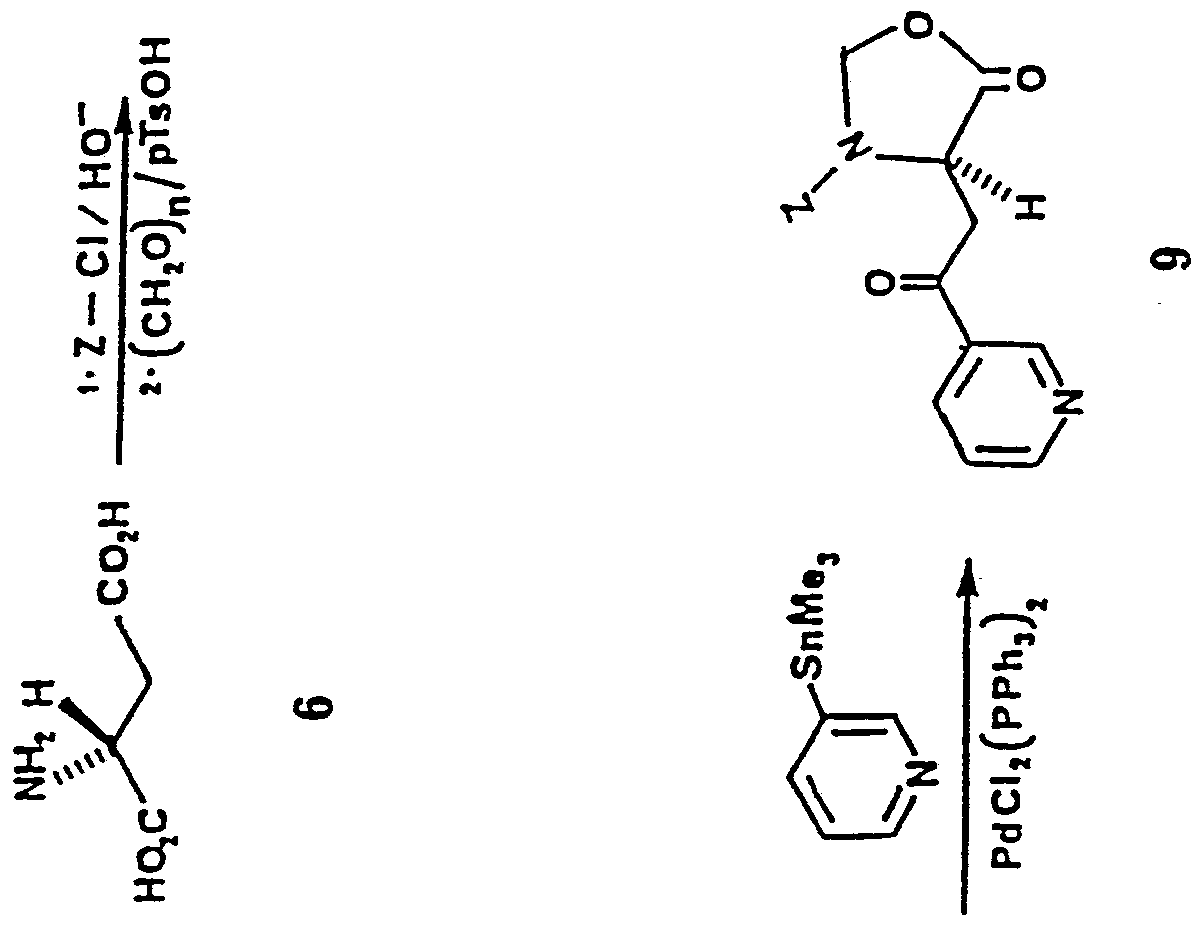
- the single enantiomers of nicotinylalanine can be obtained by conventional methods of optical resolution, starting from the racemic compound. Alternatively, they can be obtained by the stereoselective synthesis herei ⁇ nafter disclosed.
- Nicotinylalanine has been known for some time: about 30 years ago, it was believed to be a metabolic product of tryptophan and an intermediate metabolite of the so-called kynurenine pathway, which is the sequence of metabolic events leading to the opening of the indole ring of tryptophan and hence the formation of NAD.
- 3-hydroxyky ⁇ nurenine can be toxic for neuronal cells in culture and that quinolinic acid is a toxin capable of stimulating neurones and possibly causing their death, both in in vitro preparations and in vivo (Stone and Connick; Neu- roscience, 1985; 15; 597-618).
- the mechanism responsible for this neuronal death is one of competitive inhibition of kynurenine hy ⁇ droxylase and kynureninease.
- kynurenine hy ⁇ droxylase and kynureninease.
- kynurenic acid forms by a simple en ⁇ zymatic process that provides for the intervention of a transaminase.
- This acid is capable of inhibiting the toxic sti ⁇ mulant effect of quinolinic acid by acting as antagonist of the effects of the latter on the NMDA receptors by a modulating mechanism that has now been adequately clarified (Moroni et al. , Eur. J. Pharmac, 1989; 163; 123-126).
- Rats or mice treated with lipopolysaccharides ex ⁇ tracted from bacteria have concentrations of quinolinic acid and kynurenic acid in their biological fluids and brain that are three times higher than those in con- trols for approximately 70 hours. This is due to the induction of the enzyme indoleamino-2,3-dioxygenase and the resultant increased formation of all the substances originating from the kynurenine pathway.
- nico ⁇ tinylalanine 50-1000 mg/kg i.p.
- the in ⁇ crease in the concentrations of quinolinic acid is si ⁇ gnificantly reduced while that in the concentration of kynurenic acid is markedly enhanced.
- nicotinylalanine facilitates the formation of a metabo- lie product of tryptophan that has antagonistic pro ⁇ perties on the receptors for the stimulant amino acids and reduces the formation of a toxic stimulating sub ⁇ stance. Similar results were obtained when appropriate doses of nicotinylalanine were administered together with tryptophan.
- mice weighing 25-35 g were given ni ⁇ cotinylalanine and then leptazol administered (85 mg/kg subcutaneously) 1 hour later.
- leptazol administered (85 mg/kg subcutaneously) 1 hour later.
- nicotinylalanine protected against leptazol seizures, increasing the latency to convulsion from 270 to 588 seconds.
- the leptazol test is widely used as a test system for drugs useful in petit mal epilepsy.
- mice were used to determine the threshold electric current needed to induce convulsions from ear electrodes. After treat ⁇ ment with nicotinylalanine 370 mg/kg, intraperitone ⁇ ally, 40% of the test animals were protected against convulsions. This test is a frequent indicator of drug efficacy in grand mal epilepsy.
- Nicotinylalanine administration 200-350 mg/kg i.p.
- nicotinyl administration 150-400 mg/kg
- ethanol dependent C57 mice prevented withdrawal induced seizures, tremors and changes of body temperature (Ritzmann and Tabakoff 193, 158-170; 1976).
- nicotinylalanine increases the neosynthesis of kynurenic acid. It has been also observed that nicotinylalanine displaces radioactive glycine from its binding sites in cortical membranes.
- nicotinylalanine can be used to advantage in various diseases effecting the central nervous system that are characterised by an abnormal increase in the metabolism of tryptophan.
- Examples of such conditions in which there is an imbalance between toxic stimulant substances and their modulators or antagonists include:
- Neoplastic diseases particularly those affecting the immune system (lymphomas);
- nico- tinylalanine or physiologically equivalent derivatives thereof will gene ⁇ rally be administered in doses of between 10 and 100 mg/kg/day.
- the exact dosage will depend on various factors, such as the patient's condition and the nature and severity of the disease.
- the substance should be administered by mouth, rectally or parenterally, using conventional pharmaceu ⁇ tical formulations such as those described in Remington's Pharmaceutical Sciences Handbook, Mack Pub. Co. , N.Y. , USA, 17th Ed., 1985.
- Nicotinylalanine can be prepared by the methods described in J. Biol. Chem. 238, 1049 (1963) and J. Org. Chem. 28 ./ 383 (1953). Although the use of the sub ⁇ stance in the natural L steric configuration is prefer ⁇ red, the invention also relates to the use of the race ⁇ mic form and the D form of nicotinylalanine.
- the enan ⁇ tiomers can be prepared according to the following scheme and Examples.
Landscapes
- Health & Medical Sciences (AREA)
- Pharmacology & Pharmacy (AREA)
- Animal Behavior & Ethology (AREA)
- Veterinary Medicine (AREA)
- Public Health (AREA)
- Life Sciences & Earth Sciences (AREA)
- Chemical & Material Sciences (AREA)
- General Health & Medical Sciences (AREA)
- Medicinal Chemistry (AREA)
- General Chemical & Material Sciences (AREA)
- Nuclear Medicine, Radiotherapy & Molecular Imaging (AREA)
- Organic Chemistry (AREA)
- Engineering & Computer Science (AREA)
- Bioinformatics & Cheminformatics (AREA)
- Chemical Kinetics & Catalysis (AREA)
- Neurosurgery (AREA)
- Neurology (AREA)
- Biomedical Technology (AREA)
- Epidemiology (AREA)
- Peptides Or Proteins (AREA)
- Pharmaceuticals Containing Other Organic And Inorganic Compounds (AREA)
- Heterocyclic Carbon Compounds Containing A Hetero Ring Having Nitrogen And Oxygen As The Only Ring Hetero Atoms (AREA)
- Plural Heterocyclic Compounds (AREA)
- Steroid Compounds (AREA)
- Pyridine Compounds (AREA)
- Acyclic And Carbocyclic Compounds In Medicinal Compositions (AREA)
Abstract
Description


Claims
Priority Applications (3)
| Application Number | Priority Date | Filing Date | Title |
|---|---|---|---|
| JP91509723A JPH05507086A (en) | 1990-05-24 | 1991-05-21 | Nicotinylalanine as a therapeutic agent acting on the central nervous system |
| BR919106500A BR9106500A (en) | 1990-05-24 | 1991-05-21 | NICOTINYLALANINE AS A THERAPEUTIC AGENT ACTING ON THE CENTRAL NERVOUS SYSTEM |
| NO924472A NO924472D0 (en) | 1990-05-24 | 1992-11-20 | NICOTINYLALANINE AS A THERAPEUTIC MEDICINAL EFFECT ON THE CENTRAL NERVOUS SYSTEM |
Applications Claiming Priority (2)
| Application Number | Priority Date | Filing Date | Title |
|---|---|---|---|
| IT20418A/90 | 1990-05-24 | ||
| IT02041890A IT1248486B (en) | 1990-05-24 | 1990-05-24 | THERAPEUTIC AGENT ACTIVITIES ON THE CENTRAL NERVOUS SYSTEM |
Publications (1)
| Publication Number | Publication Date |
|---|---|
| WO1991017750A1 true WO1991017750A1 (en) | 1991-11-28 |
Family
ID=11166634
Family Applications (1)
| Application Number | Title | Priority Date | Filing Date |
|---|---|---|---|
| PCT/EP1991/000950 Ceased WO1991017750A1 (en) | 1990-05-24 | 1991-05-21 | Nicotinylalanine as a therapeutic agent acting on the central nervous system |
Country Status (8)
| Country | Link |
|---|---|
| EP (1) | EP0532545A1 (en) |
| JP (1) | JPH05507086A (en) |
| AU (1) | AU7883291A (en) |
| BR (1) | BR9106500A (en) |
| CA (1) | CA2083507A1 (en) |
| HU (1) | HUT64695A (en) |
| IT (1) | IT1248486B (en) |
| WO (1) | WO1991017750A1 (en) |
Cited By (4)
| Publication number | Priority date | Publication date | Assignee | Title |
|---|---|---|---|---|
| WO1996028167A1 (en) * | 1995-03-14 | 1996-09-19 | Shaskan Edward G | Compositions comprising nicotynylalanine and an inhibitor of glycine conjugation or vitamin b6 |
| EP0684238A3 (en) * | 1994-04-27 | 1997-01-15 | Hoffmann La Roche | Process for the preparation of dicarboxamides. |
| US5856505A (en) * | 1994-04-27 | 1999-01-05 | Hoffmann-La Roche Inc. | Intermediates for the manufacture of dicarboxamides having thrombin inhibiting activity |
| CN111164071A (en) * | 2017-09-28 | 2020-05-15 | 株式会社Lg化学 | Preparation method of intermediate compound for synthesizing medicine |
Citations (3)
| Publication number | Priority date | Publication date | Assignee | Title |
|---|---|---|---|---|
| FR1596106A (en) * | 1968-12-13 | 1970-06-15 | ||
| GB1221393A (en) * | 1967-07-10 | 1971-02-03 | Choay Lab | Improvements in or relating to hepato-protective drugs |
| US4065566A (en) * | 1975-04-17 | 1977-12-27 | Interx Research Corporation | N-Nicotinoyl-3,4-dinicotinoyloxy-L-phenylalanine and derivatives pharmaceutical compositions and methods containing same |
-
1990
- 1990-05-24 IT IT02041890A patent/IT1248486B/en active IP Right Grant
-
1991
- 1991-05-21 EP EP91909910A patent/EP0532545A1/en not_active Withdrawn
- 1991-05-21 CA CA002083507A patent/CA2083507A1/en not_active Abandoned
- 1991-05-21 BR BR919106500A patent/BR9106500A/en unknown
- 1991-05-21 JP JP91509723A patent/JPH05507086A/en active Pending
- 1991-05-21 WO PCT/EP1991/000950 patent/WO1991017750A1/en not_active Ceased
- 1991-05-21 HU HU9203634A patent/HUT64695A/en unknown
- 1991-05-21 AU AU78832/91A patent/AU7883291A/en not_active Abandoned
Patent Citations (3)
| Publication number | Priority date | Publication date | Assignee | Title |
|---|---|---|---|---|
| GB1221393A (en) * | 1967-07-10 | 1971-02-03 | Choay Lab | Improvements in or relating to hepato-protective drugs |
| FR1596106A (en) * | 1968-12-13 | 1970-06-15 | ||
| US4065566A (en) * | 1975-04-17 | 1977-12-27 | Interx Research Corporation | N-Nicotinoyl-3,4-dinicotinoyloxy-L-phenylalanine and derivatives pharmaceutical compositions and methods containing same |
Non-Patent Citations (8)
| Title |
|---|
| Cancer Research, vol. 49, 1989, R.R. Brown et al.: "Altered tryptophan and neopterin metabolism in cancer patients treated with recombinant interleukin 2", pages 4941-4945 * |
| Current Therapeutic Research, vol. 41, no. 6, June 1987, (US), P.P. Vescovi et al.: "Nicotinic acid effectiveness in the treatment of benzodiazepine withdrawal", pages 1017-1021 * |
| Journal of Neurochemistry, vol. 46, 1986, Raven Press, (New York, US), F. Moroni et al.: "Content of quino-linic acid and of other tryptophan metabolites increases in brain regions of rats used as experimental models of hepatic encephalopathy", pages 869-874 * |
| Life Sciences, vol. 35, 1984, Pergamon Press, (US), R. Schwarcz et al.: "Excitotoxic models for neurodegenerative disorders", pages 19-32 * |
| Neuroscience, vol. 15, no. 3, 1985, Pergamon Press Ltd, (GB), T.W. Stone et al.: "Quinolinic acid and other kynurenines in the central nervous system", pages 597-617 * |
| Rev. Bras. Med., vol. 26, no. 6, 1969, A. Ribeiro Silva et al.: "Experiência clinica com um derivado do acido nicotinico na esquizofrenia", pages 366-370 * |
| The Journal of biological Chemistry, vol. 238, no. 3, March 1963, (US), R.H. Decker et al.: "Studies on the biological activity of nicotinyl-alanine, an analogue of kynurenine", pages 1049-1053 * |
| The Merck Manual, 15 th edition, 1987, Merck Sharp & Dohme Research Laboratories, (Rahway, N.J., US), pages 934-935 * |
Cited By (4)
| Publication number | Priority date | Publication date | Assignee | Title |
|---|---|---|---|---|
| EP0684238A3 (en) * | 1994-04-27 | 1997-01-15 | Hoffmann La Roche | Process for the preparation of dicarboxamides. |
| US5856505A (en) * | 1994-04-27 | 1999-01-05 | Hoffmann-La Roche Inc. | Intermediates for the manufacture of dicarboxamides having thrombin inhibiting activity |
| WO1996028167A1 (en) * | 1995-03-14 | 1996-09-19 | Shaskan Edward G | Compositions comprising nicotynylalanine and an inhibitor of glycine conjugation or vitamin b6 |
| CN111164071A (en) * | 2017-09-28 | 2020-05-15 | 株式会社Lg化学 | Preparation method of intermediate compound for synthesizing medicine |
Also Published As
| Publication number | Publication date |
|---|---|
| IT1248486B (en) | 1995-01-19 |
| JPH05507086A (en) | 1993-10-14 |
| HU9203634D0 (en) | 1993-03-29 |
| EP0532545A1 (en) | 1993-03-24 |
| CA2083507A1 (en) | 1991-11-25 |
| HUT64695A (en) | 1994-02-28 |
| BR9106500A (en) | 1993-05-25 |
| AU7883291A (en) | 1991-12-10 |
| IT9020418A0 (en) | 1990-05-24 |
| IT9020418A1 (en) | 1991-11-24 |
Similar Documents
| Publication | Publication Date | Title |
|---|---|---|
| CA1328658C (en) | 3-indolepyruvic acid derivatives and pharmaceutical use thereof | |
| US4105789A (en) | Carboxyalkylacylamino acids | |
| EP0662948B1 (en) | 2-amino-4-phenyl-4-oxo-butyric acid derivatives with kynureninase and/or kynurenine-3-hydroxylase inhibiting activity | |
| EP0447285A1 (en) | Naphthalene derivatives, procedure for their preparation and pharmaceutical compositions containing them | |
| EP2030615A2 (en) | Ribonucleotide reductase inhibitors for use in the treatment or prevention of neuroinflammatory or autoimmune diseases | |
| JP2001511172A (en) | A compound constituting an effector of a central nervous system receptor particularly sensitive to a neurostimulant amino acid, its production and its biological use | |
| US4206232A (en) | Relieving hypertension with carboxyalkylacylamino acids | |
| AU2009269842B2 (en) | Use of indole derivatives as NURR-1 activators for treating Parkinson's disease | |
| EP0888289A1 (en) | Anticonvulsant enantiomeric amino acid derivatives | |
| JP2009545549A (en) | 4-Trimethylammonium-3-aminobutyrate and 4-trimethylphosphonium-3-aminobutyrate derivatives as CPT inhibitors | |
| Borisova et al. | Synthesis of new fluorinated analogs of GABA, Pregabalin bioisosteres, and their effects on [3H] GABA uptake by rat brain nerve terminals | |
| WO1991017750A1 (en) | Nicotinylalanine as a therapeutic agent acting on the central nervous system | |
| EP0110224A2 (en) | Benzoylthio compounds, their manufacture and use as medicines | |
| CN113402414A (en) | Benzoic acid derivative and preparation method and pharmaceutical application thereof | |
| EP0749957B1 (en) | Aromatic hydroxamic acid compounds, their production and use | |
| DE69829654T2 (en) | PROCESS FOR THE PRODUCTION OF RHIZOFERRIN | |
| US4288441A (en) | Nicotinoyl pantetheine derivatives | |
| JP7659634B2 (en) | Drug conjugates, methods for their preparation, and uses thereof | |
| DE69929802T2 (en) | LTA4 HYDROLASE HEMMER | |
| US3853954A (en) | Tyrosine derivatives | |
| KR810001274B1 (en) | Process for preparing phenylglycine derivatives | |
| Gong et al. | Synthesis of carnitine benzyl esters as prodrugs | |
| JPH0353296B2 (en) | ||
| US4207337A (en) | Relieving hypertension with carboxyalkylacylamino acids | |
| US4207342A (en) | Relieving hypertension with carboxyalkylacylamino acids |
Legal Events
| Date | Code | Title | Description |
|---|---|---|---|
| AK | Designated states |
Kind code of ref document: A1 Designated state(s): AU BB BG BR CA FI HU JP KP KR LK MC MG MW NO PL RO SD SU US |
|
| AL | Designated countries for regional patents |
Kind code of ref document: A1 Designated state(s): AT BE BF BJ CF CG CH CI CM DE DK ES FR GA GB GR IT LU ML MR NL SE SN TD TG |
|
| WWE | Wipo information: entry into national phase |
Ref document number: 2083507 Country of ref document: CA Ref document number: 92-01449 Country of ref document: RO |
|
| WWE | Wipo information: entry into national phase |
Ref document number: 1991909910 Country of ref document: EP |
|
| WWP | Wipo information: published in national office |
Ref document number: 1991909910 Country of ref document: EP |
|
| WWW | Wipo information: withdrawn in national office |
Ref document number: 1991909910 Country of ref document: EP |