WO1991019480A1 - Pharmaceutical preparation - Google Patents

Pharmaceutical preparation Download PDF

Info

Publication number
WO1991019480A1
WO1991019480A1 PCT/DK1991/000156 DK9100156W WO9119480A1 WO 1991019480 A1 WO1991019480 A1 WO 1991019480A1 DK 9100156 W DK9100156 W DK 9100156W WO 9119480 A1 WO9119480 A1 WO 9119480A1
Authority
WO
WIPO (PCT)
Prior art keywords
material according
hgh
medicament
weight
wound
Prior art date
Legal status (The legal status is an assumption and is not a legal conclusion. Google has not performed a legal analysis and makes no representation as to the accuracy of the status listed.)
Ceased
Application number
PCT/DK1991/000156
Other languages
French (fr)
Inventor
Annie Hoelgaard
Current Assignee (The listed assignees may be inaccurate. Google has not performed a legal analysis and makes no representation or warranty as to the accuracy of the list.)
Novo Nordisk AS
Original Assignee
Novo Nordisk AS
Priority date (The priority date is an assumption and is not a legal conclusion. Google has not performed a legal analysis and makes no representation as to the accuracy of the date listed.)
Filing date
Publication date
Application filed by Novo Nordisk AS filed Critical Novo Nordisk AS
Priority to DE69105134T priority Critical patent/DE69105134T2/en
Priority to EP91912105A priority patent/EP0533820B1/en
Publication of WO1991019480A1 publication Critical patent/WO1991019480A1/en
Anticipated expiration legal-status Critical
Ceased legal-status Critical Current

Links

Classifications

    • AHUMAN NECESSITIES
    • A61MEDICAL OR VETERINARY SCIENCE; HYGIENE
    • A61LMETHODS OR APPARATUS FOR STERILISING MATERIALS OR OBJECTS IN GENERAL; DISINFECTION, STERILISATION OR DEODORISATION OF AIR; CHEMICAL ASPECTS OF BANDAGES, DRESSINGS, ABSORBENT PADS OR SURGICAL ARTICLES; MATERIALS FOR BANDAGES, DRESSINGS, ABSORBENT PADS OR SURGICAL ARTICLES
    • A61L15/00Chemical aspects of, or use of materials for, bandages, dressings or absorbent pads
    • A61L15/16Bandages, dressings or absorbent pads for physiological fluids such as urine or blood, e.g. sanitary towels, tampons
    • A61L15/22Bandages, dressings or absorbent pads for physiological fluids such as urine or blood, e.g. sanitary towels, tampons containing macromolecular materials
    • A61L15/32Proteins, polypeptides; Degradation products or derivatives thereof, e.g. albumin, collagen, fibrin, gelatin
    • AHUMAN NECESSITIES
    • A61MEDICAL OR VETERINARY SCIENCE; HYGIENE
    • A61KPREPARATIONS FOR MEDICAL, DENTAL OR TOILETRY PURPOSES
    • A61K38/00Medicinal preparations containing peptides
    • A61K38/16Peptides having more than 20 amino acids; Gastrins; Somatostatins; Melanotropins; Derivatives thereof
    • A61K38/17Peptides having more than 20 amino acids; Gastrins; Somatostatins; Melanotropins; Derivatives thereof from animals; from humans
    • A61K38/22Hormones
    • A61K38/27Growth hormone [GH], i.e. somatotropin
    • AHUMAN NECESSITIES
    • A61MEDICAL OR VETERINARY SCIENCE; HYGIENE
    • A61KPREPARATIONS FOR MEDICAL, DENTAL OR TOILETRY PURPOSES
    • A61K9/00Medicinal preparations characterised by special physical form
    • A61K9/14Particulate form, e.g. powders, Processes for size reducing of pure drugs or the resulting products, Pure drug nanoparticles
    • A61K9/19Particulate form, e.g. powders, Processes for size reducing of pure drugs or the resulting products, Pure drug nanoparticles lyophilised, i.e. freeze-dried, solutions or dispersions
    • AHUMAN NECESSITIES
    • A61MEDICAL OR VETERINARY SCIENCE; HYGIENE
    • A61KPREPARATIONS FOR MEDICAL, DENTAL OR TOILETRY PURPOSES
    • A61K9/00Medicinal preparations characterised by special physical form
    • A61K9/70Web, sheet or filament bases ; Films; Fibres of the matrix type containing drug
    • A61K9/7007Drug-containing films, membranes or sheets
    • AHUMAN NECESSITIES
    • A61MEDICAL OR VETERINARY SCIENCE; HYGIENE
    • A61LMETHODS OR APPARATUS FOR STERILISING MATERIALS OR OBJECTS IN GENERAL; DISINFECTION, STERILISATION OR DEODORISATION OF AIR; CHEMICAL ASPECTS OF BANDAGES, DRESSINGS, ABSORBENT PADS OR SURGICAL ARTICLES; MATERIALS FOR BANDAGES, DRESSINGS, ABSORBENT PADS OR SURGICAL ARTICLES
    • A61L15/00Chemical aspects of, or use of materials for, bandages, dressings or absorbent pads
    • A61L15/16Bandages, dressings or absorbent pads for physiological fluids such as urine or blood, e.g. sanitary towels, tampons
    • A61L15/22Bandages, dressings or absorbent pads for physiological fluids such as urine or blood, e.g. sanitary towels, tampons containing macromolecular materials
    • A61L15/28Polysaccharides or their derivatives
    • AHUMAN NECESSITIES
    • A61MEDICAL OR VETERINARY SCIENCE; HYGIENE
    • A61PSPECIFIC THERAPEUTIC ACTIVITY OF CHEMICAL COMPOUNDS OR MEDICINAL PREPARATIONS
    • A61P17/00Drugs for dermatological disorders
    • AHUMAN NECESSITIES
    • A61MEDICAL OR VETERINARY SCIENCE; HYGIENE
    • A61PSPECIFIC THERAPEUTIC ACTIVITY OF CHEMICAL COMPOUNDS OR MEDICINAL PREPARATIONS
    • A61P43/00Drugs for specific purposes, not provided for in groups A61P1/00-A61P41/00

Definitions

  • This invention relates to water soluble compressed freeze-dried preparations containing a wound-healing medica- ment and a base material.
  • this invention is directed to a pharmaceutical formulation designed for topical administra ⁇ tion.
  • Freeze drying (also designated lyophilisation) is a well known process of drying. Lyophilisation of mixtures con ⁇ taining a medicament is known. The reasons for lyophilizing such mixtures are to obtain a stable preparation and to pro- vide a long shelf life. The resulting product can be desig ⁇ nated a lyophilisate.
  • the normal way of using such lyophilisates is to dissolve it in a solvent, normally water, prior to use. This procedure is called a reconstitution.
  • the solution obtained constitutes the medicament which the patient is using like any other similar medicament.
  • Example 7 describes a lyophilisate containing hydroxypropylmethyl cellulose and epidermal growth factor.
  • hGH human growth hormone
  • hGH human growth hormone
  • PDGF PDGF
  • EGF EGF
  • TGF- ⁇ TGF- ⁇
  • bFGF bFGF
  • the object of this invention is to make available a medical formulation which conveniently can be used as a wound healing preparation.
  • the lyophilisate is obtained by freeze drying a solution or suspension of a base material and a medicament having a wound healing effect.
  • the content of medicament in the lyophilisate is conveniently in the range from about 0.1 - 10 percentage (weight/weight).
  • the lyophi ⁇ lisate is compressed so as to obtain a soft and flexible pro ⁇ duct which, when placed on the wound, does not or only to a minor degree annoy the patient.
  • the lyophili- sate is compressed to from about 1/2 to about 1/10 of its original volume, preferably, to from about 1/3 to about 1/6.
  • the density of the compressed lyophilisates according to this invention is, preferably, in the range from about 50 to about 200 mg/cm 3 , more preferred in the range from about 60 to about 120 mg/cm 3 .
  • the thickness of the compressed lyophilisa- tes according to the invention is preferably in the range from 0.2 to 1.5 mm.
  • the base material present in the compressed lyophi ⁇ lisates according to this invention is conveniently a gelling agent.
  • An important aspect of the present invention is the use of an appropriate gelling agent in the dermatologically acceptable vehicle.
  • the gelling agent used must be chemical inert in compositions with the medicament. Therefore, it must be non-ionic. Additionally, since the gel is to be prepared prior to lyophilization, the gelling agent must dissolve com ⁇ pletely to produce a transparent gel. Additionally, the gel ⁇ ling agent used must allow for the hydrogel to release a suf ⁇ ficient amount of medicament within a few hours. Additional ⁇ ly, the gelling agent must form a hydrogel which allows for the generation of a coherent porous freeze-dried matrix by lyophilization.
  • Gelling agents possessing these qualities are spe ⁇ cific cellulose ether compounds, preferably hydroxyethylcel ⁇ lulose, hydroxypropylcellulose hydroxypropylmethylcellulose, hydroxyethylmethylcellulose and methylcellulose, most pre ⁇ ferred hydroxyethylcellulose (hereinafter designated HEC) .
  • the material of this invention may be prepared by: a) forming a liquid hydrogel containing the medica ⁇ ment dissolved therein, the viscosity of the hydrogel pref- erably being in the range from about 500 to about 10,000 cps, most preferred in the range from 1000 to about 4000 cps, b) freeze drying the solution in a layer to form a freeze-dried matrix containing the medicament homogenously dispersed therein, and c) applying pressure to the matrix to form a flex ⁇ ible sheet, where the medicament is in an effective dosage concentration per cm 2 .
  • the wound healing materials of this invention are soft flexible sheets having a porous structure.
  • the com ⁇ pressed lyophilisates can be placed directly on the wound. Hence, the patient does not have to make a reconstitution of the lyophilisate.
  • This invention provides means for preventing loss of activity by providing stable lyophi- lized formulations containing the medicament means.
  • This in ⁇ vention also provides means for preparing a composition com ⁇ prising a gelling agent which is biological, chemical and physical compatible with the medicament.
  • hGH has not been lyophilized with a gelling agent and an extender to prepare a product suitable for use in wound healing application.
  • PEG polyethylene glycols
  • PEG acts as a bulk agent which imposes softness and smoothness to the freeze-dried sheet.
  • PEG is dermatologically acceptable and chemically inert in composi ⁇ tions comprising various medicaments, for example human growth hormone. Additionally, PEG has only a minor effect on the viscosity of the hydrogel. PEG imposes softness to the freeze- dried matrix and prevents its surface from becoming icy and hard.
  • buffer agents for example hGH, buffer agents, cryoprotectants and a non-ionic surface active component are included in the hydrogel.
  • phosphate buffer (pH 7.0 - 7.5) Tween 80, annitol and glycin are used.
  • the present invention describes a method to prepare soft and flexible sheets where both surfaces are smooth. Another advantage of sheets prepared from the de ⁇ scribed method is their fast release of some medicaments, for example hGH.
  • the sheet forms a hydrogel initially after con ⁇ tact with the aqueous medium and releases up to 100% of some 5 medicaments, for example hGH, into the surrounding aqueous medium.
  • the flexible sheet of the invention can be combined with a backing material being a wound dressing or bandage which also forms an aspect of the invention.
  • the medicated sheet sticks to an adhesive dressing producing an integrated medicated wound cover.
  • the sheet may be com ⁇ bined with a hydrocolloid dressing comprising the same hydro- colloid as the material in the sheet.
  • the hydrocolloid in the dressing as well as in the sheet swells locally in a linear 15 fashion and expands into the wound cavity where it applies both osmotic and physical pressure to the wound bed.
  • the freeze-dried sheet offers a potential for com ⁇ bined products with hydrocolloid dressings or films where the sheet sticks to the dressing or film.
  • Wound dressing is here 20 used to embrace a wide spectrum of materials and includes absorbents, surgical adhesive tapes and bandages.
  • Fig. 1 shows a Scanning Electron Microscopy of a lyophili- 25 zed product according to the invention
  • Fig. 2 shows a Scanning Electron Microscopy as in Fig. 1 but in a greater scale.
  • a preferred method to prepare a smooth, soft and flexible dry sheet is as follows: A solution containing 1.0% PEG 6000 and
  • hydroxyethylcellulose 351.5% hydroxyethylcellulose (Natrosol Hx Pharm 250 TM) was prepared in water.
  • B-hGH biosynthetic hGH was added result- ing in a final concentration of 200 ⁇ g of per gram gel. The gel was placed in 5 cm diameter petri-dishes in a layer of 3 mm.
  • the gel was lyophilized.
  • the dry gel was soft and 5 homogenous. It was pressed into thin (l mm) soft sheets and cut into pieces of appropriate sizes.
  • the sheet was found to dissol ⁇ ve and release 100% of its hGH during 0.5 hours (37°C).
  • the hydrogel prepared above was placed in 7.5 ml vials in a 10 layer of 3 mm.
  • the vials were placed in a lyophilization chamber and the following freeze-drying cyclus was used:
  • Step 1) -40°C for 4 hours at 1 at .
  • Step 2) -40°C for 1 hour at full vacuum.
  • Step 3) -30"C for 3/4 hour at full vacuum.
  • Step 4) -20°C for 4 hours at full vacuum.
  • Step 5 0°C for 15 hours at full vacuum.
  • Step 6 30°C for 11 hours at full vacuum.
  • a hydrogel consisting of the following components was prepared:
  • hGH (NorditropinTM) , 4 IU/ml: 1000 ⁇ l and 500 ⁇ l. sodium chloride solution (0.9%): 9.00 ml. hydroxyethylcellulose
  • An in vitro hGH-receptor assay was performed by comparing an aqueous composition containing 1.2% hydroxyet ⁇ hylcellulose with a control composition without the gelling agent.
  • the cell used was IM-9 human cell line.
  • the assay is based on competition between a known labelled hGH ( 125 I-hGH) and the unknown hGH sample. The measured radioactivity is then related to a constructed standard curve.
  • hGH 12 IU/ml in water (control) .
  • hGH 12 IU/ml in 1.2% Natrosol Hx Pharm in water.
  • Dry gels were prepared by freeze drying hydrogel solutions of the following compositions:
  • the derived dry gels had a hight of 4 mm. They were punsched into dies of 10 mm diameter. Test of tensile strength was performed according to

Landscapes

  • Health & Medical Sciences (AREA)
  • Life Sciences & Earth Sciences (AREA)
  • Engineering & Computer Science (AREA)
  • General Health & Medical Sciences (AREA)
  • Chemical & Material Sciences (AREA)
  • Veterinary Medicine (AREA)
  • Public Health (AREA)
  • Animal Behavior & Ethology (AREA)
  • Bioinformatics & Cheminformatics (AREA)
  • Epidemiology (AREA)
  • Medicinal Chemistry (AREA)
  • Pharmacology & Pharmacy (AREA)
  • Nuclear Medicine, Radiotherapy & Molecular Imaging (AREA)
  • Endocrinology (AREA)
  • General Chemical & Material Sciences (AREA)
  • Organic Chemistry (AREA)
  • Chemical Kinetics & Catalysis (AREA)
  • Hematology (AREA)
  • Materials Engineering (AREA)
  • Gastroenterology & Hepatology (AREA)
  • Zoology (AREA)
  • Dermatology (AREA)
  • Immunology (AREA)
  • Proteomics, Peptides & Aminoacids (AREA)
  • Medicinal Preparation (AREA)
  • Pharmaceuticals Containing Other Organic And Inorganic Compounds (AREA)
  • Medicines That Contain Protein Lipid Enzymes And Other Medicines (AREA)
  • Acyclic And Carbocyclic Compounds In Medicinal Compositions (AREA)
  • Medicines Containing Material From Animals Or Micro-Organisms (AREA)

Abstract

A wound healing material comprising a water soluble compressed freeze-dried product containing a wound healing medicament and a base material can be placed directly on or into the wound. The material preferably contains human growth hormone as the medicament.

Description

PHARMACEUTICAL PREPARATION
DETAILED DESCRIPTION OF THIS INVENTION
This invention relates to water soluble compressed freeze-dried preparations containing a wound-healing medica- ment and a base material. Thus, this invention is directed to a pharmaceutical formulation designed for topical administra¬ tion.
BACKGROUND OF THIS INVENTION
There are a variety of formulation types available for medicated topical therapy in wound management. There are solutions, powders, fluid suspensions or emulsions and semi- solids. Semisolids such as creams, ointments, pasts and gels fulfil a special topical need in that they are able to cling to the application surface for an extended period, generally until they are washed out by the wound exudate or washed off by cleaning the wound area. Likewise, solutions have poor staying properties. Drugs or medicaments can be applied onto the wound by impregnation of or incorporation into dressings, swabs, films or gauze which are in contact with the wound tissue.
Freeze drying (also designated lyophilisation) is a well known process of drying. Lyophilisation of mixtures con¬ taining a medicament is known. The reasons for lyophilizing such mixtures are to obtain a stable preparation and to pro- vide a long shelf life. The resulting product can be desig¬ nated a lyophilisate.
The normal way of using such lyophilisates is to dissolve it in a solvent, normally water, prior to use. This procedure is called a reconstitution. The solution obtained constitutes the medicament which the patient is using like any other similar medicament.
An example of such a lyophilized formulation is described in European patent application having the publica¬ tion No. 308,238. Example 7 therein describes a lyophilisate containing hydroxypropylmethyl cellulose and epidermal growth factor.
It has for some time been recognized that a number of tropic factors, due to their stimulation of cell growth and differentiation, may have an enhancing effect on wound healing.
Several medicaments are known as having a wound healing effect. For example, human growth hormone (herein¬ after designated hGH) being a superior pituitary gland hor- mone is known to have a wound healing effect. hGH can be ad¬ ministered topically. The effect of hGH on wound healing is thought to be mediated through growth factors. Specific growth hormone receptors on monocytes have been found. hGH may affect the monocytes to paracrine delivery of the well- known growth factors, i.e., PDGF, EGF, TGF-α and bFGF. An¬ other explanation could be that hGH affects the fibroblasts to autocrine delivery of IGF-I. IGF-I has been shown to ex¬ hibit mitrogen effect on fibroblasts.
The object of this invention is to make available a medical formulation which conveniently can be used as a wound healing preparation.
DETAILED EXPLANATION OF THIS INVENTION
It has, surprisingly, been found that if a lyophi¬ lisate containing a wound healing medicament is compressed to a certain degree, a preparation which conveniently can be placed directly on or into the wound is obtained.
The lyophilisate is obtained by freeze drying a solution or suspension of a base material and a medicament having a wound healing effect. The content of medicament in the lyophilisate is conveniently in the range from about 0.1 - 10 percentage (weight/weight). Thereafter, the lyophi¬ lisate is compressed so as to obtain a soft and flexible pro¬ duct which, when placed on the wound, does not or only to a minor degree annoy the patient. Conveniently, the lyophili- sate is compressed to from about 1/2 to about 1/10 of its original volume, preferably, to from about 1/3 to about 1/6. The density of the compressed lyophilisates according to this invention is, preferably, in the range from about 50 to about 200 mg/cm3, more preferred in the range from about 60 to about 120 mg/cm3. The thickness of the compressed lyophilisa- tes according to the invention is preferably in the range from 0.2 to 1.5 mm.
The base material present in the compressed lyophi¬ lisates according to this invention is conveniently a gelling agent. An important aspect of the present invention is the use of an appropriate gelling agent in the dermatologically acceptable vehicle. The gelling agent used must be chemical inert in compositions with the medicament. Therefore, it must be non-ionic. Additionally, since the gel is to be prepared prior to lyophilization, the gelling agent must dissolve com¬ pletely to produce a transparent gel. Additionally, the gel¬ ling agent used must allow for the hydrogel to release a suf¬ ficient amount of medicament within a few hours. Additional¬ ly, the gelling agent must form a hydrogel which allows for the generation of a coherent porous freeze-dried matrix by lyophilization.
Gelling agents possessing these qualities are spe¬ cific cellulose ether compounds, preferably hydroxyethylcel¬ lulose, hydroxypropylcellulose hydroxypropylmethylcellulose, hydroxyethylmethylcellulose and methylcellulose, most pre¬ ferred hydroxyethylcellulose (hereinafter designated HEC) .
The material of this invention may be prepared by: a) forming a liquid hydrogel containing the medica¬ ment dissolved therein, the viscosity of the hydrogel pref- erably being in the range from about 500 to about 10,000 cps, most preferred in the range from 1000 to about 4000 cps, b) freeze drying the solution in a layer to form a freeze-dried matrix containing the medicament homogenously dispersed therein, and c) applying pressure to the matrix to form a flex¬ ible sheet, where the medicament is in an effective dosage concentration per cm2. The wound healing materials of this invention are soft flexible sheets having a porous structure.
It is very convenient for the patient that the com¬ pressed lyophilisates can be placed directly on the wound. Hence, the patient does not have to make a reconstitution of the lyophilisate. In addition, it is possible to prepare com¬ pressed lyophilisates fron which pieces of a desired size can be cut or punched out to be placed on the wound.
It has been found that in the presence of moisture, some medicaments, for example hGH, looses biological activity during storage. Such loss of activity makes it impractical to store aqueous dermatological preparations containing such medicaments, for example hGH. This invention provides means for preventing loss of activity by providing stable lyophi- lized formulations containing the medicament means. This in¬ vention also provides means for preparing a composition com¬ prising a gelling agent which is biological, chemical and physical compatible with the medicament.
Heretofore, hGH has not been lyophilized with a gelling agent and an extender to prepare a product suitable for use in wound healing application.
Another important aspect of the present invention is the use of polyethylene glycols (hereinafter designated PEG) in the vehicle. PEG acts as a bulk agent which imposes softness and smoothness to the freeze-dried sheet. PEG is dermatologically acceptable and chemically inert in composi¬ tions comprising various medicaments, for example human growth hormone. Additionally, PEG has only a minor effect on the viscosity of the hydrogel. PEG imposes softness to the freeze- dried matrix and prevents its surface from becoming icy and hard.
In order to stabilize some medicaments, for example hGH, buffer agents, cryoprotectants and a non-ionic surface active component are included in the hydrogel. Preferably, phosphate buffer (pH 7.0 - 7.5) Tween 80, annitol and glycin are used.
The present invention describes a method to prepare soft and flexible sheets where both surfaces are smooth. Another advantage of sheets prepared from the de¬ scribed method is their fast release of some medicaments, for example hGH. The sheet forms a hydrogel initially after con¬ tact with the aqueous medium and releases up to 100% of some 5 medicaments, for example hGH, into the surrounding aqueous medium.
The flexible sheet of the invention can be combined with a backing material being a wound dressing or bandage which also forms an aspect of the invention. Most preferred, 10 the medicated sheet sticks to an adhesive dressing producing an integrated medicated wound cover. The sheet may be com¬ bined with a hydrocolloid dressing comprising the same hydro- colloid as the material in the sheet. The hydrocolloid in the dressing as well as in the sheet swells locally in a linear 15 fashion and expands into the wound cavity where it applies both osmotic and physical pressure to the wound bed.
The freeze-dried sheet offers a potential for com¬ bined products with hydrocolloid dressings or films where the sheet sticks to the dressing or film. Wound dressing is here 20 used to embrace a wide spectrum of materials and includes absorbents, surgical adhesive tapes and bandages.
The invention is explained with reference to the drawings on which
Fig. 1 shows a Scanning Electron Microscopy of a lyophili- 25 zed product according to the invention, and
Fig. 2 shows a Scanning Electron Microscopy as in Fig. 1 but in a greater scale.
The invention is further explained in the below examples which are presented to illustrate this invention. 30 This invention is not to be considered limited by these examples.
EXAMPLE 1
A preferred method to prepare a smooth, soft and flexible dry sheet is as follows: A solution containing 1.0% PEG 6000 and
351.5% hydroxyethylcellulose (Natrosol Hx Pharm 250 TM) was prepared in water. B-hGH (biosynthetic hGH) was added result- ing in a final concentration of 200 μg of per gram gel. The gel was placed in 5 cm diameter petri-dishes in a layer of 3 mm.
The gel was lyophilized. The dry gel was soft and 5 homogenous. It was pressed into thin (l mm) soft sheets and cut into pieces of appropriate sizes. In an in vitro kinetic study in tris-buffer (pH=7.4), the sheet was found to dissol¬ ve and release 100% of its hGH during 0.5 hours (37°C).
The hydrogel prepared above was placed in 7.5 ml vials in a 10 layer of 3 mm. The vials were placed in a lyophilization chamber and the following freeze-drying cyclus was used:
Step 1) -40°C for 4 hours at 1 at .
Step 2) -40°C for 1 hour at full vacuum.
Step 3) -30"C for 3/4 hour at full vacuum. 15 Step 4) -20°C for 4 hours at full vacuum.
Step 5) 0°C for 15 hours at full vacuum.
Step 6) 30°C for 11 hours at full vacuum.
The vials were closed in the freeze-dryer at the end of the cyclus. Samples were analyzed for hGH and its po- 20 ly er and di er forms and for content of moisture.
Batch hGH, polymer, dimer, H X250, ma/a
91120 t = 1 month (4°C) 18 0.7 4.2
25909-18 t = 0 18 0.7 6.0 2.0
EXAMPLE 2
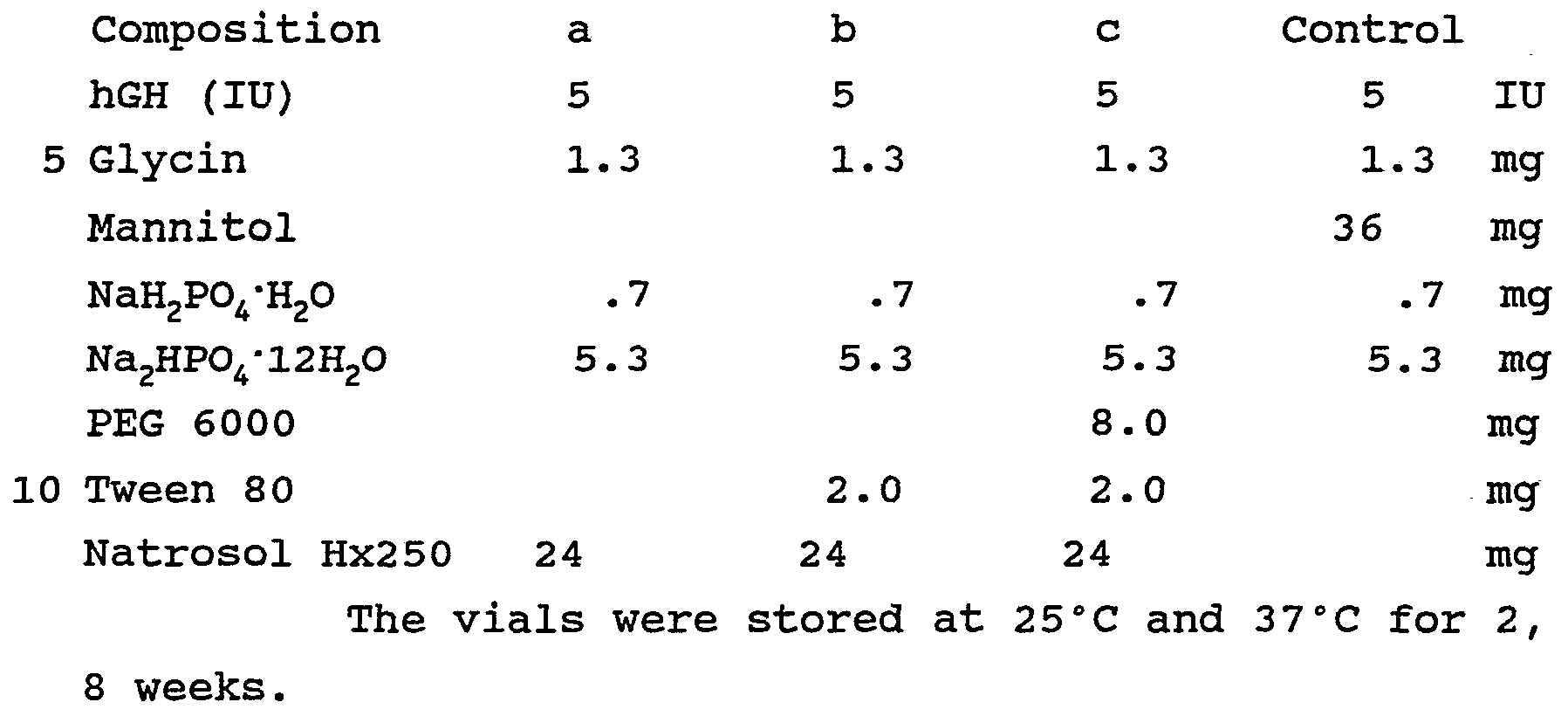
In order to study the stability of dry gels contai- 30 ning hGH, gels were freeze-dried in 7.5 ml glass vials in a layer of 3 mm as described in Example 1. The following compositions were prepared for acce¬ lerated stability study:
4 and
Figure imgf000009_0001
The results are shown in the below Table.
Figure imgf000010_0001
Figure imgf000010_0002
The data show that the dry gels containing hGH are stable and that hGH in the freeze-dried gels has a stability similar to that of the control which is a conventional compo¬ sition for parenteral use.
EXAMPLE 3
This example illustrates that hydroxyethyl cellulose is com¬ patible with hGH for the purpose of the present invention.
The below preparation containing hGH and 0.6% hy¬ droxyethylcellulose in water was tested for biological acti- vity by the Tibia test in rats.
A hydrogel consisting of the following components was prepared:
hGH (Norditropin™) , 4 IU/ml: 1000 μl and 500 μl. sodium chloride solution (0.9%): 9.00 ml. hydroxyethylcellulose
(Natrosol Hx Pharm 250), 1.2%: 10.00 ml.
According to the result from the tibia test, the biological activity of hGH in this hydrogel was maintained.
An in vitro hGH-receptor assay was performed by comparing an aqueous composition containing 1.2% hydroxyet¬ hylcellulose with a control composition without the gelling agent. The cell used was IM-9 human cell line. The assay is based on competition between a known labelled hGH (125I-hGH) and the unknown hGH sample. The measured radioactivity is then related to a constructed standard curve.
1. hGH: 12 IU/ml in water (control) .
2. hGH: 12 IU/ml in 1.2% Natrosol Hx Pharm in water.
There was no significant difference in activity between the two compositions. EXAMPLE 4
In this example physical properties of two compres¬ sed dry gel products are characterized.
Dry gels were prepared by freeze drying hydrogel solutions of the following compositions:
Figure imgf000012_0001
27 g hydrogel solution were filled into 9 cm petri dishes and lyophilized.
The derived dry gels had a hight of 4 mm. They were punsched into dies of 10 mm diameter. Test of tensile strength was performed according to
DIN 53455:
Gel type A: 0.093 N/mm* B: 0.095 N/mm2
Test of pressure resistance was performed according to DIN 534553: Gel type A Gel type B force applied reduction of hight reduction of hight (N/mm2 )
(%) (%)
5 7.5 .005
8.8 18 .01 20 49 .02
43 65 .03
58 71 .04 Scanning Electron Microscopy of the compressed freeze-dried product prepared from gel type A was performed. A cross-section of a disc was examined and the porous struc¬ ture of the sheet is clearly shown by ESM-pictures in Figures 1 and 2.
Claims

1. Wound healing material, characterized in that it comprises a water soluble compressed freeze-dried product containing a wound healing medicament and a base material.
2. Material according to claim 1 characterized in that the medicament is human growth hormone.
3. Material according to claim 1 or 2 characterized in that the base material is a hydroxycellulose ether, pref¬ erably hydroxyethylcellulose, hydroxymethylpropylcellulose hydroxypropylcellulose, methylcellulose or hydroxyethyl¬ methylcellulose, preferably hydroxyethylcellulose.
4. Material according to any one of the preceding claims characterized in that it contains PEG having a mole¬ cular weight in the range from about 3000 to about 20,000, preferably from about 6000 to about 8000.
5. Material according to any one of the preceding claims characterized in that it contains a buffer agent.
6. Material according to any one of the preceding claims characterized in that it contains a non-ionic surface active component and optionally a water soluble extender for lyophilization.
7. Material according to any one of the preceding claims, characterized in that the concentration of human growth hormone is in the range from about 0.1 to about 2.0 IU/cm2.
8. Material according to any one of the preceding claims, characterized in that the concentration of hydroxy¬ cellulose ether is in the range from about 20 to about 90%, preferably from about 30 to about 75% (weight/weight) .
9. Material according to any one of the preceding claims, characterized in that the concentration of PEG is in the range from about 0 to about 70%, preferably from about 15 to about 50% (weight/weight) .
10. Material according to any one of the preceding claims, characterized in that the flexible sheet is porous and has a density larger than about 0.05 g/cm3.
PCT/DK1991/000156 1990-06-19 1991-06-12 Pharmaceutical preparation Ceased WO1991019480A1 (en)

Priority Applications (2)

Application Number Priority Date Filing Date Title
DE69105134T DE69105134T2 (en) 1990-06-19 1991-06-12 PHARMACEUTICAL COMPOSITION.
EP91912105A EP0533820B1 (en) 1990-06-19 1991-06-12 Pharmaceutical preparation

Applications Claiming Priority (2)

Application Number Priority Date Filing Date Title
DK148790A DK148790D0 (en) 1990-06-19 1990-06-19 PHARMACEUTICAL PREPARATION
DK1487/90 1990-06-19

Publications (1)

Publication Number Publication Date
WO1991019480A1 true WO1991019480A1 (en) 1991-12-26

Family

ID=8105355

Family Applications (1)

Application Number Title Priority Date Filing Date
PCT/DK1991/000156 Ceased WO1991019480A1 (en) 1990-06-19 1991-06-12 Pharmaceutical preparation

Country Status (9)

Country Link
EP (1) EP0533820B1 (en)
JP (1) JPH06500767A (en)
AT (1) ATE113829T1 (en)
AU (1) AU8064091A (en)
CA (1) CA2085100A1 (en)
DE (1) DE69105134T2 (en)
DK (2) DK148790D0 (en)
ES (1) ES2065696T3 (en)
WO (1) WO1991019480A1 (en)

Cited By (9)

* Cited by examiner, † Cited by third party
Publication number Priority date Publication date Assignee Title
EP0568368A1 (en) * 1992-04-30 1993-11-03 JOHNSON & JOHNSON MEDICAL, INC. Freeze-dried pad
WO1994005341A1 (en) * 1992-09-10 1994-03-17 Mcneil-Ppc, Inc. Lyophilized foam wound dressing
WO1996027350A1 (en) * 1995-03-07 1996-09-12 Sueverkruep Richard Form of administration for applying pharmaceutical substances and auxiliary substances, and process for the preparation thereof
US5633010A (en) * 1992-10-05 1997-05-27 Minnesota Mining And Manufacturing Company Adhesive compositions, wound dressings and methods
US5681561A (en) * 1995-06-07 1997-10-28 Life Medical Sciences, Inc. Compositions and methods for improving autologous fat grafting
WO2005084650A1 (en) * 2004-03-03 2005-09-15 Switch Biotech Ag Pharmaceutical composition for topical use in form of xerogels or films and methods for production
WO2006037606A2 (en) 2004-10-04 2006-04-13 Switch Biotech Aktiengesellschaft Wound dressing compositions, especially for delivery of protease inhibitors
FR2916635A1 (en) * 2007-05-30 2008-12-05 Backert Marie Elisabeth Cuine Solid formulations of active ingredients, useful as a drug for pharmaceutical industry, nutritional supplements and/or designated substances, comprises a film to be dissolved and/or dispersed in a liquid product
EP2755686A4 (en) * 2011-09-12 2015-07-22 On Demand Therapeutics Inc Methods and systems for making microtablets for drug delivery

Citations (3)

* Cited by examiner, † Cited by third party
Publication number Priority date Publication date Assignee Title
EP0261599A2 (en) * 1986-09-26 1988-03-30 Exovir, Inc. Compositions suitable for human topical application including a growth factor and/or related materials
EP0308238A1 (en) * 1987-09-18 1989-03-22 Ethicon, Inc. Stable lyophilized formulations containing growth factors
EP0339905A2 (en) * 1988-04-25 1989-11-02 Ethicon, Inc. Wound healing compositions containing growth factors and retinoids

Family Cites Families (1)

* Cited by examiner, † Cited by third party
Publication number Priority date Publication date Assignee Title
DE3807102C1 (en) * 1988-03-04 1989-04-13 Hermann 7835 Teningen De Hauser

Patent Citations (3)

* Cited by examiner, † Cited by third party
Publication number Priority date Publication date Assignee Title
EP0261599A2 (en) * 1986-09-26 1988-03-30 Exovir, Inc. Compositions suitable for human topical application including a growth factor and/or related materials
EP0308238A1 (en) * 1987-09-18 1989-03-22 Ethicon, Inc. Stable lyophilized formulations containing growth factors
EP0339905A2 (en) * 1988-04-25 1989-11-02 Ethicon, Inc. Wound healing compositions containing growth factors and retinoids

Cited By (16)

* Cited by examiner, † Cited by third party
Publication number Priority date Publication date Assignee Title
EP0568368A1 (en) * 1992-04-30 1993-11-03 JOHNSON & JOHNSON MEDICAL, INC. Freeze-dried pad
US5441741A (en) * 1992-04-30 1995-08-15 Johnson & Johnson Medical, Inc. Freeze-dried pad
WO1994005341A1 (en) * 1992-09-10 1994-03-17 Mcneil-Ppc, Inc. Lyophilized foam wound dressing
US5633010A (en) * 1992-10-05 1997-05-27 Minnesota Mining And Manufacturing Company Adhesive compositions, wound dressings and methods
WO1996027350A1 (en) * 1995-03-07 1996-09-12 Sueverkruep Richard Form of administration for applying pharmaceutical substances and auxiliary substances, and process for the preparation thereof
US6228381B1 (en) * 1995-03-07 2001-05-08 Richard Suverkrup Form of administration for applying pharmaceutical substances and auxiliary substances, and process for the preparation thereof
US5681561A (en) * 1995-06-07 1997-10-28 Life Medical Sciences, Inc. Compositions and methods for improving autologous fat grafting
EP1602365A1 (en) * 2004-03-03 2005-12-07 Switch Biotech Aktiengesellschaft Pharmaceutical composition for topical use in form of xerogels or films and methods for production
WO2005084650A1 (en) * 2004-03-03 2005-09-15 Switch Biotech Ag Pharmaceutical composition for topical use in form of xerogels or films and methods for production
RU2357725C2 (en) * 2004-03-03 2009-06-10 Свитч Биотек Аг Pharmaceutical composition for topical application in xerogel or film form, and production methods
AU2005218925B2 (en) * 2004-03-03 2010-11-11 Bayer Innovation Gmbh Pharmaceutical composition for topical use in form of xerogels or films and methods for production
CN1929826B (en) * 2004-03-03 2011-05-18 斯维奇生物技术股份公司 Pharmaceutical composition for topical use in form of xerogels or films and methods for production
WO2006037606A2 (en) 2004-10-04 2006-04-13 Switch Biotech Aktiengesellschaft Wound dressing compositions, especially for delivery of protease inhibitors
WO2006037606A3 (en) * 2004-10-04 2006-07-13 Switch Biotech Ag Wound dressing compositions, especially for delivery of protease inhibitors
FR2916635A1 (en) * 2007-05-30 2008-12-05 Backert Marie Elisabeth Cuine Solid formulations of active ingredients, useful as a drug for pharmaceutical industry, nutritional supplements and/or designated substances, comprises a film to be dissolved and/or dispersed in a liquid product
EP2755686A4 (en) * 2011-09-12 2015-07-22 On Demand Therapeutics Inc Methods and systems for making microtablets for drug delivery

Also Published As

Publication number Publication date
DK148790D0 (en) 1990-06-19
EP0533820B1 (en) 1994-11-09
DK0533820T3 (en) 1995-04-24
AU8064091A (en) 1992-01-07
JPH06500767A (en) 1994-01-27
ES2065696T3 (en) 1995-02-16
CA2085100A1 (en) 1991-12-20
DE69105134T2 (en) 1995-03-23
ATE113829T1 (en) 1994-11-15
EP0533820A1 (en) 1993-03-31
DE69105134D1 (en) 1994-12-15

Similar Documents

Publication Publication Date Title
US6132759A (en) Medicaments containing gelatin cross-linked with oxidized polysaccharides
US9327033B2 (en) Degradation-stabilised, biocompatible collagen matrices
US5512301A (en) Collagen-containing sponges as drug delivery compositions for proteins
JP4526602B2 (en) Drug form for administration of active substance to wound
US4659696A (en) Pharmaceutical composition and its nasal or vaginal use
US5503848A (en) Spongy material consisting essentially of hyaluronic acid or its derivatives, and its use in microsurgery
Maeda et al. Sustained release of human growth hormone (hGH) from collagen film and evaluation of effect on wound healing in db/db mice
EP1494728B1 (en) Tissue defect dressings comprising a keratin network
JP3046623B2 (en) Polyurethane-biopolymer composite
US9101586B2 (en) Topical application and formulation of erythropoietin for skin wound healing
HU223880B1 (en) Gel formulations containing growth factors
NZ226170A (en) Stable freeze-dried pharmaceutical composition containing epidermal growth factor
EP0094157A1 (en) Pharmaceutical composition and its use
JPH05213766A (en) Composition containing growth factor and high polymer electrolyte
EP0533820B1 (en) Pharmaceutical preparation
EP1666075A1 (en) Wound dressing compositions, especially for delivery of protease inhibitors
EP4401801B1 (en) Kit for composition for tissue tract sealing
EP0750515B1 (en) Low molecular weight hyaluronic acid with peptide or protein
US5693625A (en) Method of regenerating cells and tissues using functionalized dextrans
JPH04279530A (en) Drug delivery system for administering growth factors
AU747209B2 (en) Wound healing formulations containing human plasma fibronectin
JPH0782171A (en) Film preparation containing fibroblast growth factor
KR20000057371A (en) Topical preparation for introducing peptidaceous pharmacons in living organisms
Akram et al. Healing Potential of Chitosan PVA Hydrogels on Excised Wound in Diabetic Albino Mice
CN116726264A (en) Tissue repair membrane and preparation method and application thereof

Legal Events

Date Code Title Description
AK Designated states

Kind code of ref document: A1

Designated state(s): AU BG BR CA FI HU JP KP KR NO PL RO SU

AL Designated countries for regional patents

Kind code of ref document: A1

Designated state(s): AT BE CH DE DK ES FR GB GR IT LU NL SE

WWE Wipo information: entry into national phase

Ref document number: 1991912105

Country of ref document: EP

WWE Wipo information: entry into national phase

Ref document number: 2085100

Country of ref document: CA

WWP Wipo information: published in national office

Ref document number: 1991912105

Country of ref document: EP

WWG Wipo information: grant in national office

Ref document number: 1991912105

Country of ref document: EP