High molecular weight copolyester resinshaving low melting points
The present invention relates to high molecular weight copolyester resins having low melting points and peculiar crystallization behaviour and the process for preparing the resins.
It is well known that the molecular weight of the polyester resins can be increased by solid state polycondensation reaction.
The possibility however to upgrade polyester resins having low melting points, e.g. lower than 220°C presents serious process difficulties due to the sticking problems on the walls of the reactor caused by the high upgrading temperatures used.
The known solid state polycondensation processes need high upgrading temperature due to the low kinetic of the upgrading reactions. Usually, the solid state polycondensation reactions of polyester resins are per¬ formed by temperatures higher than 180°C; mainly higher than 195βC (see page 3295 of Journal of Applied Polym. Cs. 28 3289 - 3300, 1989) .
The possibility of preparing polyster resins with low melting points and having sufficiently high values of the intrinsic viscosity, which are particularly suitable for extrusion blow applications, is a not yet solved problem.
In Applicant's previous pending European application No. 89119049.8 a solid state upgrading process is described in which the resin is upgraded at temperatures higher than 170°C and in general in the range of 170°C 220°C, using a dianhydride of an aromatic tetracarboxylic acid.
The resins subjected to upgrading comprise copolyethylenterephtalates (COPETs) . A ongs the COPETs use is exemplified of copolimers containing at most 10% in
mols of units deriving from isophtalic acid on the total of the acid units. Except the melting point of the resin after upgrading and intrinsic viscosity values no other indications are given regarding the upgraded polymer.
It has now been found that it is possible to upgrade polyester resins having melting points lower than 220°C without having sticking problems and that the upgraded resin presents valuable properties particularly from the viewpoint of the crystallization behaviour.
The resins subjected to upgrading are the copolyethylenterephtalates containing from 10 to 25% by weight on the total resin weight of units deriving from isophtalic acid (COPETs).
According to the process of the present invention, the COPET is upgraded at temperature lower than 170°C and higher than the TG of the resin, preferably comprised between 130° and 160°C using an upgrading additive select¬ ed from the group consisting of the dianhydrides of aromatic, aliphatic cycloaliphatic tetracarboxy1ic acids.
Unexpectedly, the upgraded COPETs present, besides the high IV values (higher than 0.85 dl/g) and molding points lower than 220°C, other valuable properties.
In particular the crystall zation behaviour of the resins is remarkable from the view point of the moiding applications, because the resin does not show any cristallinity also by slow cooling from the melt; the COPETs give clear, transparent amorphous solids also by very slow cooling rate, e.g. lαC/min.
It is worthwhile to note that the resin crystallizes when heated in the solid state for instance at 150°C for 40 mins.
Another interesting property of the resin is its gel-free characteristic.
Particularly interesting is the COPET containing about 15% weight of the resin of isophtalic acid units,
melting point of 212°C. This COPET gives clear highly transparent amorphous solid by cooling its melt also at very slow cooling rate (l°C/min). Pyromellitic dianhydπde is the preferred upgrading compound.
Other suitable dianhydrides are the dianhydrides of 1, 2, 3, 4-cyclobutanetetracarboxyl icacid, 3 , 4-dicarboxy-l ,2,3, 4-tetrahydro-l-naphthalenesuccιnιc acid and 3, 3' , 4' benzophenone tetracarboxylic acid.
The preferred dianhydride from the cycloaliphatic acids is 1,2,3,4 cyclobutantetracarboxylic acid dianhydride.
Interesting results are also obtainable with the dianhydride of 3,4 dicarboxy - 1,2,3,4 tetrahydro-1-naphtalenesuccιnιc acid and bicyclo (2,2,2) oct-7-ene 2,3,5,6 - tetracarboxylic acid.
The preferred concentration of the additive with respect to the polyester resin is 0,05-1% by weight.
The solid state upgrading process comprises the steps of blending the COPET resin in a molten state with the upgrading additive, converting the melt into granules, crystallizing the granulate at temperatures higher than the TG of the resin but lower than 180°C and then upgrad¬ ing the crystallized resin at a temperature comprised in the range from the TG of the resin and 180°C, particularly from 130° and 170 "C.
The process is preferably carried out in continuous way using continuous crystallizers and upgrading reactors where the chips can move counter currently with a stream of a heated gas, e.g. air, nitrogen and carbon dioxide.
Apparatus suitable for the crystallization and upgrading steps can be those described in USP 4,064,112 and 4,161,578 whose description is herewith enclosed for reference.
The recycling of the inert gas streams can be carried out according to European application 86830340.5 whose
description is herewith enclosed for reference.
The blending of the polyester resin with the additive is carried out in an equipment capable to perform reactive extrusion such as corotating or counter rotating inter- meshing or not intermeshing twin screw extruder with or without venting capability at a temperature between 200° and 350°C, depending on the melting point of the polyester .
A counter rotating non intermeshing twin screw extruder vented or not vented is preferred.
The use of such kind of extruder allows to perform a good distribution of the additive in the melt and to avoid problems of local high concentrations of the additive due to its high reactivity.
The extruder may be directly fed with molten COPET from a plant in which the COPET is produced by polycondensation in the molten state.
The extruder may also be fed with solid COPET granu¬ lates produced in another plant.
The extruder is preferably connected to a high vacuum oil seal pump to maintain a vacuum higher than 2 torr for the devolatilization of the reactive blend and for obtain¬ ing a resin with a low content of acetaldehyde. However, the blending could be also performed without the use of vacuum.
The residence time in the extruder could be comprised between 10 and 120 sec, preferably 15-30 sec.
To avoid random local concentration of additive in the melt it is advisable to dilute the additive with crystallised PET powder (1 part of additive to 5 parts of PET powder). This procedure will ensure a homogeneous distribution of PMDA in the melt leading to a better reproducibility of the end product intrinsic viscosity and inhibiting the gel formation.
The dianhydride could be also diluted using blends of
the dianhydride and crystallized PET-chips (1 part addi¬ tive to 10 parts PET chips) . The dilution could be per¬ formed in a fanned blender using about 0,1% of polyethylenglycol or polycaprolactone , as adhesives, and using blending temperature at about 150°C.
The reactive melt coming out of the twin screw extruder is continuously pallettized using an underwater pelletizer or a strand pelletizer system.
According to another aspect of this invention, the new COPETs may be modified by blending with polymers like polybutylenterephtalate , polycarbonate, polycaprolactone, polyester elastomers, phenoxy resins in amount up to about 20% by weight of the total resins, directly before the extrusion processing. The addition has the effect of improving the mechanical properties of the composition as well as the processing conditions without sacrifymg the transparency of the end product. Analytical Procedures
The intrinsic viscosity was determined on a solution of 0.5 g of COPET in 100 ml of 60/40 mixture by weight of phenol and tetrachloroethane at 25°C according to ASTM D 4603 - 86.
The acetaldehyde content was determined with a gas chromatographic method according to ASTM D 4526-85, using a Perkm Elmer 8700 gas chromatograph. (Perkin Elmer model HS 101) .
The extraction conditions were 150°C for 90 mm. Example 1
30 Kg/h random COPET melt (15% isophtalic acid in weight, melting point 212°C, IV = 0.75 dl/g) having a content of 110 ppm acetaldehyde were fed continuously from the finisher of PET melt polycondensation pilot plant to a counter rotating not intermeshing 30 mm twin screw extrud¬ er with venting capability
220 g/h of a mixture of 20% weight of pyromellitic
acid dianhydride in crystallized COPET powder (IV: 0.75 dl/g, 15% weight isophtalic acid) were fed to the extruder using a gravimetric feeder.
The test conditions were as follows: pyromellitic acid dianhydride in the COPET melt 0.15% by weight screw speed: 415 PM ratio length/diameter (L/D): 24 average residence time: 18 - 25 sec. barrel temperature: 235°C product melt temperature: 290°C vacuum: 1 - 5 torr A die with double holes was used as extruder die (Diame¬ ter: 7 mm) .
A strand pelletizer was used to obtain the COPET- chips which had a cylindrical shape with a diameter of 3 mm and a length of 5 mm, and with an intrinsic viscosity IV = 0.85 ± 0.01 dl/g.
The COPET chips had an acetaldehyde content of 5 - 8 ppm. During the test period, the IV of the product was constant over the period of 2 weeks.
The melting point of the product was 212°C.
The COPET-chips were then fed continuously to a solid state upgrading pilot . plant using the apparatus and the inert gas ricycling conditions set forth in European application EP 86830340.5.
The crystallization temperature was 150°C and the residence time was 40 min.
The temperature of the solid state upgrading reactor was 150°C and the residence time was 12 h.
The IV of the upgraded products was 0,94 + 0,02 dl/g.
The product was free from gel, with acetaldehyde content of 0.60 ppm.
In comparison, there was no upgrading of COPET not containing pyromellitic dianhydride (starting IV = 0.75
1/g) using the same conditions for crystallization and upgrading as in this example.
The crystallization behaviour of the COPET in compar¬ ison with standard PET is shown in figure 1.
Fig. 1 shows the crystallization kinetic of COPET prepared according to this example in comparison with standard bottle grade polyethyleneterephthalate . The crystallization kinetic was determined under isothermal conditions at 120°C.
It is interesting that although this COPET is crystallizing in the solid state (150°C/40 min) , its melt does not bring about any crystallization by cooling, and gives a clear transparent amorphous solid also by very slow cooling rate.
Table 1 shows the data relating to crystallization by cooling of COPET of example 1 in comparison to standard PET.
All the crystallization data are obtained by DSC measurements performed with Mettler Thermal Analyzer YC 11.
Fig. 2 reports the DSC curves of COPET versus the cooling rate of the melt, starting from a rate of 10°C/min changing then to 5 and 3°C/min = curves A, B, and C respectively. Curve 1 refers to standard PET cooled to a rate of 10°C/min wherein the increase of the heat of crystallization is 11.8 J/g.
TABLE 1
Heat of melting of PET samples crystallized with different cooling rates.
Heats are in joule/gram.
SAMPLE QUENCHING COOLING RATE ( deg/min ) 10 5 3
COPET I 2 . 1 ( a ) N N N
STANDARD PET | 30 . 0 ( b ) 34.1 (c)
N = no crystallization a) crystallization during melting 1.6 J/g b) crystallization during melting 29.1 J/g c) crystallization during melting 12.2 J/g Example 2
30 Kg/h random COPET melt (15% isophthalic acid in weight, melting point 212°C, IV = 0.75 dl/g) having a content of 110 ppm acetaldehyde were fed continuously from the finisher of a PET melt polycondensation pilot plant to a counter rotating not intermeshing 30 mm twin screw extruder with venting capability.
220 g/h of a mixture of 20% weight of 1, 2, 3, 4-cyclobutanetetracarboxylic acid- dianhydride in crystallized COPET powder (IV: 0.75 dl/g, 15% weight isophthalic acid) were fed into the extruder using a gravimetric feeder. The test conditions were as follows:
Cyclobutane tetracarboxylic acid dianhydride in the
COPET melt - 0.15% by weight
Screw speed: 415 RPM
Ratio length-diameter (L/D): 24
Average residence time: 18 - 25 sec.
Barrel temperature: 235°C
Produst melt temperature: 290°C
Vacuum: 1 - 5 torr.
A die with double holes was used as extruder die (Diameter: 7 mm) .
A strand pelletizer was used to obtain the COPET- chips which had a cylindrical shape with a diameter of 3
mm and a length of 5 mm, and with an intrinsic viscosity IV = 0.865 + 0.01 dl/g.
The COPET chips had an acetaldehyde content of 6 - 9 ppm. During the test period, the IV of the product was constant over a period of 2 weeks.
The melting point of the product was 212°C.
The modified COPET-chips were then fed continuously into a solid state polycondensation pilot plant using the apparatus and the inert gas recycling conditions described in European application EP 86830340.5.
The crystallization temperature was 150°C and the residence time in the crystallizer was 40 min. The solid state temperature in the reactor was 150°C and the resi¬ dence time was 10 h. The IV of the upgraded product was 0,965 dl/g. The product was free from gel, with an acetaldehyde content of 0.60 ppm.
In comparison, there was no upgrading of COPET not containing the dianhydride (starting IV = 0.75 dl/g), using the same conditions for crystallization and upgrad¬ ing as in this example. Example 3
The same COPET was used as in Example 1, but in the form of crystallized COPET granules of IV = 0.75 dl/g.
The crystallized COPET chips were dried and fed into the twin screw.
The IV of the product was 0.845 + 0.02 dl/g.
The same conditions were used as in Example 1; only the average residence time was about 25 sec.
The solid state conditions were 130° - 140°C in the crystallizer and 140°C in the polyaddition reactor. The residence time in the reactor was 10 hours. The chips intrinsic viscosity was 0.92 + 0,015 dl/g. The acetaldehyde content was 0.67 ppm. Example 4
The following table reports the extrusion blow
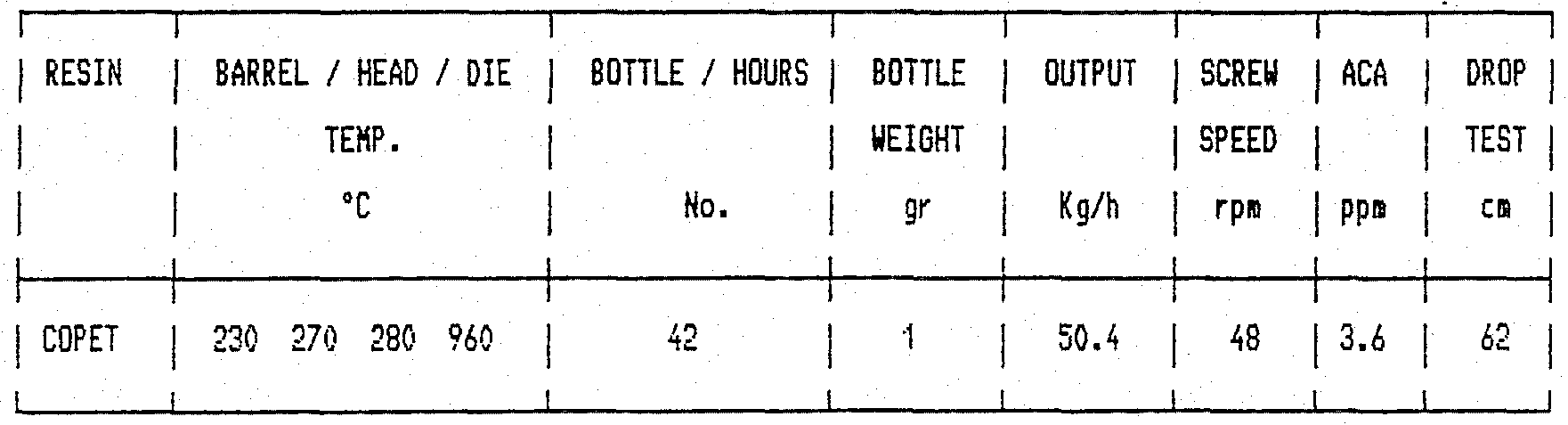
moulding conditions and the apparatus used for the produc¬ tion of the bottles up to 1500 ml: mould: rotative distributor / 2 moulds head: PET covered mono parison screw length: 24 L/D screw size: 65 mm screw type: standard PVC article: round bottle volume : up to 1500 ml output: 50.4 Kg/h (depends on the bottle volume) parison length: up to 40 cm production: 960 bottles/hour cycle: 8.0 seconds temperature barrel : 250°C profile head: 280βC die: 290°C
The COPET was dried to a content of water less than 0.005% using dried air with Dew point between - 30°C and - 40βC.
The following table gives the blowing conditions and the results obtained using the COPET of example 1.
ACA = acetaldehyde Example 5
This example describes the extrusion blowing of COPET produced 'according to example and mixed before blowing with polybutylenterephthalate (General Electric) (PBT); IV
= 1.220 dl/g in amount of 3,5% by weight.
This mixture was dried and blowed according to the general description of example 4.
The following table gives the blowing conditions and the results obtained.
This example describes the extrusion blowing of COPET of example 1 and mixed before blowing with 5% by weight of polycarbonate (Dow Chem. ) .
This mixture was then dried and blowed according to the general description of example 4.
The following table reports the conditions and the obtained results.
Example 7
This example describes the extrusion blowing of COPET of example 1 mixed before blowing with 5% by weight of phenoxy resin (Union Carbide).
This mixture was dried and blowed according to the general description of example 4.
The following table reports the conditions and the results obtained.