WO1993006142A1 - Copolymerisate von hydroxyalkylvinylethern und verwendung von homo- und copolymerisaten von hydroxyalkylvinylethern in wasch- und reinigungsmitteln - Google Patents

Copolymerisate von hydroxyalkylvinylethern und verwendung von homo- und copolymerisaten von hydroxyalkylvinylethern in wasch- und reinigungsmitteln Download PDF

Info

Publication number
WO1993006142A1
WO1993006142A1 PCT/EP1992/002041 EP9202041W WO9306142A1 WO 1993006142 A1 WO1993006142 A1 WO 1993006142A1 EP 9202041 W EP9202041 W EP 9202041W WO 9306142 A1 WO9306142 A1 WO 9306142A1
Authority
WO
WIPO (PCT)
Prior art keywords
copolymers
monomers
vinyl ether
weight
ether
Prior art date
Legal status (The legal status is an assumption and is not a legal conclusion. Google has not performed a legal analysis and makes no representation as to the accuracy of the status listed.)
Ceased
Application number
PCT/EP1992/002041
Other languages
English (en)
French (fr)
Inventor
Matthias Kroner
Heinrich Hartmann
Gerhard Wolf
Richard Baur
Paul Diessel
Hans-Ulrich Jaeger
Volker Schwendemann
Johannes Perner
Current Assignee (The listed assignees may be inaccurate. Google has not performed a legal analysis and makes no representation or warranty as to the accuracy of the list.)
BASF SE
Original Assignee
BASF SE
Priority date (The priority date is an assumption and is not a legal conclusion. Google has not performed a legal analysis and makes no representation as to the accuracy of the date listed.)
Filing date
Publication date
Application filed by BASF SE filed Critical BASF SE
Priority to DE59204523T priority Critical patent/DE59204523D1/de
Priority to US08/185,971 priority patent/US5576407A/en
Priority to EP92918765A priority patent/EP0603236B1/de
Priority to JP5505730A priority patent/JPH06511021A/ja
Publication of WO1993006142A1 publication Critical patent/WO1993006142A1/de
Anticipated expiration legal-status Critical
Ceased legal-status Critical Current

Links

Classifications

    • CCHEMISTRY; METALLURGY
    • C08ORGANIC MACROMOLECULAR COMPOUNDS; THEIR PREPARATION OR CHEMICAL WORKING-UP; COMPOSITIONS BASED THEREON
    • C08FMACROMOLECULAR COMPOUNDS OBTAINED BY REACTIONS ONLY INVOLVING CARBON-TO-CARBON UNSATURATED BONDS
    • C08F216/00Copolymers of compounds having one or more unsaturated aliphatic radicals, each having only one carbon-to-carbon double bond, and at least one being terminated by an alcohol, ether, aldehydo, ketonic, acetal or ketal radical
    • C08F216/12Copolymers of compounds having one or more unsaturated aliphatic radicals, each having only one carbon-to-carbon double bond, and at least one being terminated by an alcohol, ether, aldehydo, ketonic, acetal or ketal radical by an ether radical
    • C08F216/14Monomers containing only one unsaturated aliphatic radical
    • CCHEMISTRY; METALLURGY
    • C11ANIMAL OR VEGETABLE OILS, FATS, FATTY SUBSTANCES OR WAXES; FATTY ACIDS THEREFROM; DETERGENTS; CANDLES
    • C11DDETERGENT COMPOSITIONS; USE OF SINGLE SUBSTANCES AS DETERGENTS; SOAP OR SOAP-MAKING; RESIN SOAPS; RECOVERY OF GLYCEROL
    • C11D3/00Other compounding ingredients of detergent compositions covered in group C11D1/00
    • C11D3/16Organic compounds
    • C11D3/37Polymers
    • C11D3/3703Macromolecular compounds obtained otherwise than by reactions only involving carbon-to-carbon unsaturated bonds
    • C11D3/3711Polyacetal carboxylates

Definitions

  • the invention relates to copolymers of hydroxyalkyl vinyl ethers, addition products of C 2 to C 4 alkylene oxides with hydroxyalkyl vinyl ether and / or polytetrahydrofuran vinyl ether and optionally other copolymerizable monomers and
  • copolymers mentioned and the use of cationically or free-radically polymerized hydroxyalkyl vinyl ethers which contain the monomers (a) or (b) in copolymerized form as sole monomers or in a mixture with other copolymerizable monomers, as a viscosity depressant for surfactants and as an additive to detergents and cleaning agents.
  • Catalyst uses 0.001 to 5 wt .-% of a practically anhydrous inorganic acid.
  • Suitable catalysts are, for example, aluminum chloride, iron chloride, sulfuric acid, hydrochloric acid and boron trifluoride. From US-B-26 407 the radical copolymerization of
  • Divinyl compounds such as divinyl ether, divinyl dimethyl silane or divinyl sulfone with monoethylenically unsaturated monomers are known, e.g. Vinyl acetate, maleic anhydride or dimethyl fumarate.
  • Suitable catalysts are peroxy compounds, such as di-tert-butyl peroxide, hydrogen peroxide, alkyl hydroperoxides and diacyl peroxides. Ziegler catalysts are also suitable for initiating the polymerization.
  • the polymers obtainable in this way form fibers and films and can be used to produce coatings or packaging materials. They are also suitable as lubricants and lubricant additives, adhesives and as crosslinking agents for epoxy resins.
  • EP-A-0 359 055 discloses detergent formulations which contain 0.5 to 65% by weight of a surface-active agent and 1 to 80% by weight of a builder, which consists of a polymer which is obtained by radical copolymerization of divinyl ether and maleic anhydride in a molar ratio of 1: 2 and subsequent hydrolysis of the anhydride groups and neutralization is available.
  • the copolymers are used in coating and molding compositions to improve the flow or as anti-foaming agents.
  • the copolymerization of monovinyl ethers of glycols with vinyl esters of saturated fatty acids having a carbon chain with up to 6 carbon atoms in the presence of peroxides is known from US Pat. No. 3,131,162.
  • the copolymers can be vulcanized to rubber-like materials with the addition of conventional vulcanizing aids.
  • the object of the present invention is to provide new substances. Another object is to improve the primary and secondary washing action of detergents and to lower the viscosity of aqueous surfactant solutions and detergent slurries.
  • copolymers of hydroxyalkyl vinyl ethers which can be obtained by cationically or radically initiated copolymerization of (a) 99 to 1% by weight of hydroxyalkyl vinyl ethers,
  • Suitable monomers of group (a) are all hydroxyalkyl vinyl ethers which are derived from compounds having at least 2 OH groups in which the hydrogen atom of an OH group has been replaced by the vinyl group. These compounds can be characterized, for example, using the following general formula:
  • R C 2 -C 20 -alkylene, phenylene, substituted with OH groups or with ester groups C 3 - to C 20 alkylene or phenylene groups.
  • Individual compounds of this type are, for example, hydroxyethyl vinyl ether, 3-hydroxypropyl vinyl ether, 2-hydroxypropyl vinyl ether, 2-hydroxy-2-methyl-propyl vinyl ether, 2-hydroxybutyl vinyl ether, 3-hydroxybutyl vinyl ether, 4-hydroxybutyl vinyl ether, 2-hydroxy-2-ethylethyl vinyl ether, 3- Hydroxy ⁇
  • the following can be used as sachcharides, for example: glucose, methyl glucoside, butyl glucoside, sucrose, palatinose, palatinit, lactose, maltose, fructose, leucrose, panose, dextrins, isomaltose, trehalurose, raffinose, panose.
  • sugar acids that can be used are: galacturonic acid, galactonic acid, galactic acid, galactaric acid, gluconic acid.
  • vinyl ethers preference is given to using the isomeric hydroxybutyl vinyl ethers, in particular 4-hydroxybutyl-1-vinyl ether and
  • the monomers of group (a) make up 99 to 1, preferably 90 to 10% by weight of the copolymers.
  • Suitable alkylene oxides are ethylene oxide, propylene oxide, 1,2-butylene oxide, 2,3-butylene oxide and isobutylene oxide.
  • Alkylene oxides are added to the hydroxyalkyl vinyl ethers in order to obtain the monomers of component (b).
  • Compounds of this type are known.
  • the monomers of component (b) can also be prepared by vinylation of polyalkylene glycols.
  • Individual monomers of component (b) are for example the addition products which are obtainable by adding 3 mol of ethylene oxide to 1 mol of 3-hydroxypropyl vinyl ether, 4 mol of butylene oxide to 1 mol of 2-hydroxypropyl vinyl ether, 10 mol of ethylene oxide to 1 mol of 2-hydroxy-2-methyl-propyl vinyl ether, 3 mol of ethylene oxide 1 mole of 4-hydroxybutyl vinyl ether, 7 moles
  • Suitable monomers of component (b) are also suitable for
  • Ethylene propylene glycol monovinyl ether diethylene glycol propylene glycol monovinyl ether.
  • block copolymers of alkylene oxides come in
  • composition (b) suitable addition products that are obtainable by addition of propylene oxide and then ethylene oxide and optionally butylene oxide to compounds of formula I.
  • suitable addition products that are obtainable by addition of propylene oxide and then ethylene oxide and optionally butylene oxide to compounds of formula I.
  • polytetrahydrofuran monovinyl ethers which can be obtained by vinylation of polytetrahydrofurans with the molecular weights from 250 to 4,500.
  • reaction products of alkylene oxides with monovinyl ethers of polyhydroxy compounds can be used, for example reaction products of 1 mol of glycerol monovinyl ether with 25 mol of ethylene oxide and 1 mol of erythritol monovinyl ether 7 moles of propylene oxide, 1 mole of sorbitol monovinyl ether with 3 moles of butylene oxide, 1 mole of tartaric acid diethyl ester monovinyl ether with 11 moles of ethylene oxide, 1 mole of bis (hydroxymethyl) propionic acid ethyl ester with 25 moles of propylene oxide and 1 mole of glycosemonovinyl ether with 50 moles of ethylene oxide.
  • the monomers Preferably used as the monomers
  • the alkylene oxides are generally added to 1 mol of hydroxyalkyl vinyl ether in amounts of 1 to 100, preferably 2 to 60, mol. However, even larger amounts of alkylene oxides can be added to the compounds of the formula I to prepare the copolymers according to the invention.
  • the addition products of 1 to 100 mol of ethylene oxide with 1 mol of hydroxybutyl vinyl ether are preferably suitable.
  • the monomers (b) make up 1 to 99, preferably 10 to 90% by weight of the copolymers.
  • Suitable monomers (c) are all other monomers which are copolymerizable with the monomers (a) and (b). Examples include monoethylenically unsaturated C 3 to C 8 carboxylic acids, such as acrylic acid, methacrylic acid, ethacrylic acid, maleic acid, fumaric acid, aconitic acid and itaconic acid.
  • esters of the carboxylic acids mentioned with monohydric C 1 to C 18 alcohols or polyhydric C 2 to C 8 alcohols are suitable, for example the following esters may be mentioned: methyl acrylate, ethyl acrylate, tert-butyl acrylate, n-acrylic acid butyl ester, methyl acrylate, methyl methacrylate, methyl methacrylate, n-propyl methacrylate, isopropyl methacrylate, n-butyl methacrylate, isobutyl methacrylate, dimethyl methacrylate, dimethyl maleate, mono maleate maleate, maleate maleate n-butyl ester, maleic acid monoisodecyiester and maleic acid monoisononyl ester. So much for the above
  • Comonomers can be used in copolymerization, e.g. Maleic anhydride, acrylic anhydride, methacrylic anhydride and itaconic anhydride.
  • the amides are also suitable
  • Carboxylic acids such as acrylamide and methacrylamide and nitriles of the carboxylic acids mentioned such as acrylonitrile and methacrylonitrile.
  • Further comonomers of group (c) are vinyl esters, which are preferably derived from C 1 - to C 18 -saturated carboxylic acids, for example vinyl formate, vinyl acetate, vinyl propionate, vinyl butyrate, vinyl pivalate and vinyl stearate.
  • alkyl vinyl ethers preferably those derived from C 1 to C 18 alcohols, such as methyl vinyl ether, ethyl vinyl ether, propyl vinyl ether, n-butyl vinyl ether, tert-butyl vinyl ether, sec-butyl vinyl ether , isobutyl vinyl ether, dodecyl vinyl ether, octadecyl vinyl ether and styrene.
  • the monomers of group (c) which can also be used are the crosslinkers which are customarily used in the radical copolymerization
  • crosslinkers contain at least two non-conjugated, ethylenically unsaturated double bonds.
  • Suitable crosslinkers are, for example, N, N'-methylenebisacrylamide, polyethylene glycol diacrylates and polyethylene glycol dimethacrylates, which are each derived from polyethylene glycols with a molecular weight of 126 to 8500, trimethylolpropane triacrylate, trimethylolpropane trimethacrylate, and ethylene glycol diacrylate diacrylate diol acrylate, block diacrylate diacrylate diacrylate diacrylate, Propylene oxide, double or
  • Methacrylic acid esterified polyhydric alcohols such as glycerol or pentaerythritol, triallylamine, tetraallylethylene diamine, divinylbenzene, diallyl phthalate, polyethylene glycol divinyl ether,
  • Trimethylolpropane dially ether polyethylene glycol divinyl ether, butanediol divinyl ether, pentaerythritol triallyl ether and / or
  • Water-soluble crosslinking agents are preferably used, for example N, N'-methylene-bisacrylamide, polyethylene glycol diacrylates, polyethylene glycol dimethacrylates, pentaerythritol triallyl ether and / or divinyl urea.
  • Crosslinkers which are preferably used are divinyl ethers of C 2 -C 20 -diols, polyalkylene glycols and diphenols, such as, for example 1,2-ethylene glycol divinyl ether, 1,4-butanediol divinyl ether,
  • crosslinking agents are used in the radical polymerization, the amounts used are 0.1 to 15, preferably 0.2 to 5,% by weight.
  • Polytetrahydrofuran divinyl ethers with molecular weights of 250 to 4500 can also be used.
  • the copolymerizable monomers (c) used are preferably monomers containing at least two vinyl ether groups. Divinyl ethers are preferred, it being possible to use all divinyl ethers, for example the divinyl ethers of C 2 -C 20 -alkylene diols or
  • Divinyl ether of polyalkylene glycols with a molecular weight up to 35,000 of the polyalkylene glycol segment preference is given to using butanediol divinyl ether, in particular 1,4-butanediol divinyl ether, 1,6-hexanediol divinyl ether and 1,4-bis (hydroxymethyl) cyclohexyl divinyl ether.
  • the amounts here are up to 20% by weight, based on the
  • C 2 - bis is preferably used
  • C 20 diols for example ethylene glycol, propylene glycol, 1,4-butanediol, 1,2-butanediol, 1,3-butanediol, 1,6-hexanediol and polyalkylene glycols with molecular weights up to 35,000, for example
  • the copolymers can contain the monomers in statistical distribution or in the form of blocks. These monomers are present in the copolymerization, if used, in amounts of 0.1 to 20% by weight.
  • Polyalkylene oxides can be formed in the alkoxylation of hydroxyalkyl vinyl ethers (monomers a).
  • the monomers containing at least two vinyl ether groups and the compounds having at least two OH groups for example alkylene glycols, can be used together in order to obtain polymers with high molecular weights.
  • this then requires that vinyl groups and OH groups in the monomer mixture be approximately equimolar
  • the monomers (a), (b) and optionally (c) can be copolymerized both by free radicals and by cationic means.
  • a C-C linkage occurs via the double bonds of the monomers with the formation of polymers.
  • initiators can be soluble or insoluble in water.
  • Water-soluble initiators are, for example, inorganic peroxides, such as potassium, sodium and ammonium peroxodisulfate and hydrogen peroxide.
  • organic peroxides hydroperoxides, peracids, ketone peroxides, perketals and peresters, e.g. Methyl ethyl ketone hydroperoxide, cumene hydroperoxide, tert-butyl hydroperoxide,
  • Redox systems are also suitable which contain a reducing component in addition to a peroxy compound.
  • Suitable reducing components are, for example, cerium III and iron II salts, sodium sulfite, sodium bisulfite, sodium dithionite, ascorbic acid and sodium formaldehyde sulfoxylate.
  • Suitable initiators are preferably selected by using compounds which form free radicals and which have one at the polymerization temperature chosen in each case
  • Suitable initiators are also azo compounds such as
  • Radical initiator or a mixture of such polymerization initiators.
  • the amount of initiator used has a considerable influence on the molecular weight of the homopolymers and copolymers formed.
  • the radical polymerization is preferably carried out in the presence of a diluent.
  • a diluent can be solvents for the monomers and the polymers or only solvents for the monomers.
  • Suitable solvents are, for example, ethers, such as diethyl ether, dibutyl ether, diisobutyl ether,
  • the alkylene oxide units can be used in the reaction products
  • reaction products are components of liquid detergents. Since the polymers are used in detergents, they are advantageously prepared in those described
  • Detergents are used as diluents.
  • Preferred solvents for the polymerization are, for example, reaction products of monovalent C 1 -C 28 -alipnatic
  • Propylene oxide and / or butylene oxide for example the addition products of 3 to 11 moles of ethylene oxide to one mole of a C 13 / C 15 alcohol, addition products of 5 to 15 moles of ethylene oxide to 1 mole of nonylphenol, addition products of 7 to 11 moles of ethylene oxide and 3 to 5 Moles of propylene oxide to 1 mole of oleyl alcohol and addition products of 5 to 15 moles of ethylene oxide to 1 mole of stearyl alcohol or tallow fatty alcohol.
  • ethylene oxide, propylene oxide and butylene oxide with polyhydric alcohols, for example glycol, diethylene glycol, triethylene glycol, tetraethylene glycol, propylene glycol, dipropylene glycol, block copolymers of ethylene oxide and propylene oxide, glycerol and oligoglycerols are also suitable. Particularly preferred from this group of
  • Compounds are diethylene glycol and polyethylene glycols with degrees of condensation up to 25.
  • C 1 to C 6 alcohols such as
  • the polymerization of the monomers of groups a) to c) can optionally also be carried out in the presence of regulators.
  • Suitable regulators are, for example, mercapto compounds, such as mercaptoethanol, mercaptopropanol, mercaptobutanol, mercaptoacetic acid, mercaptopropionic acid, butyl mercaptan and dodecyl mercaptan.
  • allyl compounds such as allyl alcohol, aldehydes, such as formaldehyde, acetaldehyde, propionaldehyde, n-butyraldehyde and isobutyraldehyde,
  • regulators are used in particular if larger amounts of crosslinking monomers of group c) are used in the polymerization. In such cases, the use of the regulators results in water-soluble polymers or polymers which can be easily dispersed in water.
  • the copolymerization can also be carried out without a diluent.
  • This process variant is particularly suitable if, as component (b) monomer, higher ethoxylated hydroxyalkyl vinyl ether is used, e.g. in reaction products of 4-hydroxybutyl vinyl ether with 3, 7, 11, 25 or 50 moles of ethylene oxide per mole of 4-hydroxybutyl vinyl ether and as a monomer of component (c) dimethyl maleate or diethyl maleate.
  • the progress of the copolymerization can be determined by means of a decrease in the vinyl ether content in the reaction mixture
  • Polymers are split in an aqueous acidic medium.
  • the resulting acetaldehyde can easily be removed from the aqueous polymer solution using steam distillation. In this way it is possible to produce copolymers that are virtually free of residual monomers.
  • the copolymers can be modified after the polymerization. For example, it is possible to use copolymers containing the monomers (a), (b) and, as monomer (c), an ester of an ethylenically unsaturated carboxylic acid in copolymerized form, by treatment with aqueous bases, e.g. Sodium hydroxide solution under ester hydrolysis to a carboxylate group-containing
  • Modify copolymer Another possibility is to allow hydroxylamine, ammonia or amines to act in copolymerized form according to the invention in copolymerized form with ester groups, so that hydroxamic acids or carboxamides are obtained. A large number of subsequent reactions for modifying the copolymers according to the invention are possible here.
  • a polymer main chain is obtained in which the monomer units are linked to one another via acetaldehyde acetals.
  • Cationic copolymerization of the monomers of groups (a) and (b) can be initiated with the aid of all organic or inorganic acid-reacting substances.
  • Suitable cationic initiators are, for example, oxalic acid, tartaric acid, adipic acid, succinic acid, succinic anhydride, citric acid, formic acid, acetic acid, propionic acid, malic acid, mono- or poly-halogenated carboxylic acids, such as trifluoroacetic acid or trichloroacetic acid, hydrogen chloride, hydrogen bromide, hydrogen chloride, phosphoric acid, sulfuric acid, sulfuric acid, hydrogen sulfide -Toluenesulfonic acid, boric acid, ascorbic acid, acidic aluminum oxide, aluminum sulfate, potassium aluminum sulfate, iron (II) sulfate, iron (III) sulfate, aluminum oxide, titanyl sulfate, iron III chloride, boron
  • the initiators for the cationic polymerization are usually used in amounts of 0.001 to 20, preferably 0.01 to 1% by weight, based on the monomers of groups (a) and (b).
  • the copolymerization is very exothermic. Depending on the activity of the initiator used, the reaction temperatures are between -20 and 250, preferably 0 to 200 ° C.
  • the monomers (a) and (b) react in the presence of 0.1 to 5% by weight of p-toluenesulfonic acid at 40 ° C. in an exothermic reaction within 10 minutes. completely. If 0.2% by weight of oxalic acid is used to initiate the copolymerization, the copolymerization is within 90 ° C.
  • the copolymerization usually produces colorless oils and resins that are very stable when using oxalic acid and tartaric acid as catalysts.
  • the temperature resistance of the copolymers thus produced ranges up to 250 ° C.
  • the cationic polymerization of the monomers (a) and (b) is preferably carried out in the absence of a solvent. However, it is also possible to work in the presence of inert diluents. This can be advantageous in certain cases because the heat of reaction can then be easily removed using the evaporating diluent. If a strong acid is used as the initiator, a solution of the initiator in a diluent is preferably used, for example a 0.005 to 10 wt. %, particularly preferably a 0.01 to 5% by weight solution of p-toluenesulfonic acid in toluene.
  • Suitable diluents for cationic copolymerization are all diluents which do not have any functional groups which can react with vinyl ethers.
  • Diluents which are readily available in anhydrous form and are not hygroscopic are preferably used.
  • suitable diluents are ethyl acetate, diethylene glycol diethyl ether, ethoxyethyl acetate, butoxyethyl acetate, aliphatic hydrocarbons such as pentane, hexane, cyclohexane, n-heptane, n-octane and isooctane and
  • aromatic hydrocarbons such as toluene, xylene, mesitylene, tetraiin and ansiol.
  • Suitable solvents are also
  • the copolymerization can be carried out, for example, as a one-pot reaction.
  • the monomers of groups (a) and (b) and optionally (c) can be mixed in a reaction vessel with the exclusion of atmospheric moisture, mixed with initiator and heated to the required reaction temperature.
  • the total amount of initiator is placed in the reaction vessel together with 10% of the monomer mixture of components (a), (b) and optionally (c) to be polymerized at 20 ° C. and the polymerization reaction is preferably started under an inert gas atmosphere by heating the reaction vessel in the reaction vessel submitted components. The mixture is stirred and also during the subsequent copolymerization.
  • the remaining monomer mixture of the compounds of components (a), (b) and (c) is added continuously or batchwise to the extent that the heat of polymerization can be safely removed. If If oxalic acid, tartaric acid or citric acid is used as the initiator, temperatures of about 70 to about 160 ° C. are required to start the copolymerization of the monomers (a), (b) and optionally (c). The acids then dissolve in the monomer mixture to form a homogeneous solution and the polymerization begins.
  • the heterogeneous reaction mixture is heated to a temperature in the range from 100 to 250 ° C. until the polymerization starts.
  • the initiator is either separated off or deactivated. Deactivation of the catalyst
  • protic solvents are subject to hydrolysis with molecular weight reduction.
  • the reaction mixture is added after the copolymerization and
  • reaction mixture optionally after cooling the reaction mixture with alkalis, preferably sodium hydrogen carbonate, sodium hydroxide solution,
  • Potassium hydroxide solution sodium carbonate, potassium carbonate, ammonium carbonate, amines such as ammonia, methylamine, dimethylamine, trimethylamine, ethylamine, diethylamine, dibutylamine, tributylamine, ethanolamine, diethanolamine, triethanolamine, morpholine or salts from strong bases and weak acids, such as sodium acetate, sodium formate or potassium hydrogen carbonate .
  • amines such as ammonia, methylamine, dimethylamine, trimethylamine, ethylamine, diethylamine, dibutylamine, tributylamine, ethanolamine, diethanolamine, triethanolamine, morpholine or salts from strong bases and weak acids, such as sodium acetate, sodium formate or potassium hydrogen carbonate .
  • Calcium oxide, calcium hydroxide, basic aluminum oxide and basic ion exchangers are also suitable for initiators. Insoluble initiators can easily be removed by filtration.
  • the copolymer After deactivation or separation of the initiator, the copolymer can be converted into a polymer solution or a dispersion by adding water.
  • the copolymer solutions can be purified by subjecting them to steam distillation and volatile components
  • Copolymers that have been subjected to steam distillation do not change color if they are subjected to an alkaline aftertreatment.
  • the copolymers can be 99 to 1, preferably 90 to
  • the monomers are preferably selected such that water-soluble or dispersible copolymers are formed.
  • the solubility of the copolymers obtained in water can be influenced by varying the mixing ratios of monomers of group (b) and monomers of group (a). Depending on the ratio of the copolymerized monomers of groups (a) and (b) in the form of 1% aqueous solutions at a pH of 7.5, the copolymers have cloud points of 0 to 100, preferably 5 to 85 ° C. By increasing the molecular weight, the cloud point of the copolymers can be reduced with a constant ratio of the monomers of groups (a) and (b).
  • the molecular weight of the copolymers can be determined using the
  • Initiator amount can be influenced. An increasing amount of initiator leads to copolymers with lower molecular weight.
  • the molecular weight of the copolymers can be influenced by the use of copolymerizable monomers of group (c).
  • group (c) divinyl ethers and compounds containing at least two OH groups are suitable comonomers (c) which increase the molecular weight of the copolymers in the cationic copolymerization of (a) and (b).
  • polyalkylene glycols are present as impurities in the preparation of the monomers (b) by alkoxylation of the monomers of group (a) and cannot be separated off easily, these mixtures of alkoxylated hydroxyalkyl vinyl ethers and polyalkylene glycols can be used in the copolymerization.
  • Polyalkylene glycols act as diols in the polymerization of monomers of groups (a) and (b) to limit the molecular weight. In this case, one preferably adds one of the OH groups equimolar amount of vinyl ether groups in the form of div vonnyl ethers, so that copolymers with higher molecular weights are obtained.
  • the divinyl ethers are used in a stoichiometric ratio to the polyalkylene glycols, they have a molecular weight limiting effect. If they are also used in the copolymerization, the divinyl ethers are used in amounts of up to 10% by weight.
  • the copolymers of cationically polymerized monomers (a), (b) and optionally (c) are not stable in aqueous solutions at pH values below 7. Under these conditions, the copolymers hydrolytically cleave.
  • copolymers which are prepared by cationic polymerization of the monomers (a) and (b) are in aqueous solution at a pH of 6.2 within 10 to 20 days, at a pH of 5.3 within Hydrolysed for 1 to 10 days, at a pH of 4.7 within 1 to 30 hours and at a pH of 2.5 within 1 to 90 minutes. Attention should therefore be paid to the sensitivity of the copolymers to acids during processing and storage.
  • the copolymers are used as additives for detergents.
  • the free-radically or cationically polymerized homopolymers of monomers (a) and (b) can also be used as detergent additives. Such homopolymers belong to the prior art.
  • copolymers of hydroxyalkyl vinyl ether and other monomers copolymerizable therewith can be used as detergent additives.
  • These copolymers contain at least 1% by weight of at least one hydroxyalkyl vinyl ether of component (a) and at least one monomer of component (c) mentioned above. Also come as an additive to detergents
  • the monomers of components (b) are in these
  • Copolymers contain at least 1 wt .-% in copolymerized form.
  • the copolymers which contain either (a) or (b) as characteristic monomers can be prepared by cationic or by radical copolymerization. Some polymers of this type are known from the prior art cited above for other applications. Are of particular interest
  • Copolymers which are preferably used and contain monomers of group (b) as a characteristic building block are, for example, copolymers of (1) the reaction product of 1 mole of 4-hydroxybutyl vinyl ether with 3 moles, 7 moles, 11 moles, 25 moles and 50 moles of ethylene oxide and
  • maleic acid diethyl ester maleic acid dimethyl ester, acrylic acid, methacrylic acid, maleic anhydride, methyl (meth) acrylate, butyl (meth) acrylate, t-butyl acrylate or
  • copolymers according to the invention and the cationically or radically polymerized hydroxyalkyl vinyl ethers which
  • Monomers (a) or (b) contained as copolymerized monomers or in copolymerized form with other copolymerizable monomers have K values of 9 to 100, preferably 10 to 70 (determined according to H. Fikentscher in 1% solution in tetrahydrofuran at 25 ° C).
  • Viscosity lowerers can be used for surfactants. At the
  • Surfactant formulations with water as is customary in the field of commercial laundries or in the production of detergent formulations, often have a concentration range with a very high viscosity. This phenomenon is often troublesome when transporting the formulations in pipelines, metering with the aid of pumps and the dissolving speed in the wash liquor. If the viscosity is high, a great deal of mechanical energy must be expended to process the surfactants. In addition, the further dissolution process of the surfactants is associated with an increased expenditure of time due to the high viscosity of a partially diluted surfactant. The increase in
  • Viscosity of surfactants when diluted with water occurs above all with nonionic surfactants, especially with polyalkoxylated compounds. If the copolymers described above are added to the surfactants in amounts of 0.1 to 50, preferably 0.5 to 10% by weight, the viscosity of such mixtures can be significantly reduced on dilution.
  • the homopolymers and copolymers to be used according to the invention are preferably first dissolved or dispersed in the concentrated surfactant. The mixture is then diluted by adding water.
  • the surfactant concentrate mixed with the polymers to be used according to the invention can also be introduced into an aqueous washing liquor. However, it is also possible to add a highly viscous, dilute aqueous surfactant solution to the polymers to be used according to the invention in order to subsequently lower the viscosity.
  • copolymers according to the invention are added
  • the detergents and cleaning agents contain essential ones
  • the detergents and cleaning agents can be in the form of a powder or a liquid formulation.
  • the copolymers to be used according to the invention are particularly suitable for the preparation of liquid detergent formulations.
  • Suitable anionic surfactants are, for example, sodium alkylbenzenesulfonates, fatty alcohol sulfates and fatty alcohol polyglycol ether sulfates. Individual compounds of this type are, for example, C 8 bis
  • anionic surfactants are sulfated fatty acid alkanolamides, fatty acid monoglycerides or reaction products of 1 to 4 moles of ethylene oxide with primary or secondary fatty alcohols or alkylphenols.
  • anionic surfactants are sulfated fatty acid alkanolamides, fatty acid monoglycerides or reaction products of 1 to 4 moles of ethylene oxide with primary or secondary fatty alcohols or alkylphenols.
  • Fatty acid esters or fatty acid amides of hydroxy or amino carboxylic acids or sulfonic acids such as, for example, the fatty acid sarcosides, glycolates, lactates, taurides or isothionates.
  • the anionic surfactants can be in the form of sodium, potassium and Ammonium salts as well as soluble salts of organic bases, such as mono-, di- or triethanolamine or other substituted amines.
  • the anionic surfactants also include the usual soaps, ie the alkali salts of the natural fatty acids.
  • Nonionic surfactants e.g. Addition products of 3 to 40, preferably 4 to 20, moles of ethylene oxide and 1 mole of fatty alcohol, alkylphenol, fatty acid, fatty amine, fatty acid amide or alkanesulfonamide can be used.
  • the addition products of 5 to 16 moles of ethylene oxide with coconut or tallow fatty alcohols, with oleyl alcohol or with synthetic alcohols with 8 to 18, preferably 12 to 18, carbon atoms and on are particularly important
  • Mono- or dialkylphenols with 6 to 14 carbon atoms in the alkyl radicals are also of interest, in particular if they are used together with water-soluble nonionic or anionic surfactants.
  • non-ionic surfactants that can be used are the water-soluble adducts of ethylene oxide with 20 to 250 ethylene glycol ether groups and 10 to 100 propylene glycol ether groups with polypropylene glycol ether, alkylene diaminopolypropylene glycol and alkyl polypropylene glycols with 1 to 10 carbon atoms in the alkyl chain, in which the polypropylene glycol ether chain functions as a hydrophobic residue.
  • Nonionic surfactants of the amine oxide or sulfoxide type can also be used.
  • the foaming power of the surfactants can be increased or decreased by combining suitable types of surfactants. A reduction can also be achieved by adding non-surfactant-like organic substances.
  • the liquid, aqueous detergents contain 10 to 50% by weight of surfactants. You can contain an anionic or nonionic surfactant in the amount specified. However, it is also possible to use mixtures of anionic and nonionic surfactants. In such a case, the content of anionic surfactants in the liquid detergent is chosen from 10 to 30% by weight and the content of nonionic surfactants in the liquid detergent from 5 to 20% by weight, based on the total detergent formulation.
  • the polymers can also be used in concentrated liquid detergents, compact detergents and zeolite-containing detergents. They are also used in detergents containing layered silicates. Liquid detergents contain as essential components the copolymers to be used according to the invention in amounts of 0.1 to 20, preferably 1 to 10% by weight and optionally water in amounts of 10 to 80.
  • Liquid detergents may also contain other substances for modification. These include, for example, alcohols, such as ethanol, n-propanol and isopropanol. If used, these substances are used in amounts of 3 to 8% by weight, based on the total detergent formulation.
  • the liquid detergents may also contain hydrotropes. This includes compounds such as 1,2-propanediol, cumene sulfonate and toluene sulfonate. If such compounds are used to modify the liquid detergent, their amount, based on the total weight of the liquid detergent, is 2 to 5% by weight. In many cases, addition of complexing agents has also proven to be advantageous for modification.
  • Complexing agents are, for example, ethylenediaminetetraacetic acid, nitrilotriacetate and isoserinediacetic acid, and phosphonates, such as aminotrismethylenephosphonic acid, hydroxyethane diphosphonic acid, ethylenediaminetetramethylenephosphonic acid and their salts.
  • the complexing agents are used in amounts of 0.1 to 10% by weight, based on the liquid detergent.
  • the liquid detergents can also contain citrates, di- or triethanolamine, opacifiers, optical brighteners, enzymes, perfume oils and dyes. If they are used to modify the liquid detergents, these substances are present together in amounts of up to 5% by weight.
  • the liquid detergents are preferably phosphate-free. However, they can also contain phosphates, e.g. Pentasodium triphosphate and / or
  • Tetrakai iumpyrophosphate Tetrakai iumpyrophosphate. If phosphates are used, the proportion of phosphates in the total formulation of
  • the liquid detergents can also contain Na aluminum silicate (Zeolite A). The amounts used are generally 10 to 30% by weight.
  • the copolymers according to the invention have a homogenizing and stabilizing effect owing to their good dispersing properties.
  • the liquid detergents described above have the advantage over the powder detergents that they are easy to dose and a very good one at lower washing temperatures
  • Liquid detergents contain high levels of detergent substances, which remove dirt from the textile fabric at washing temperatures of 40 to 60 ° C.
  • the dispersing properties of polymers could not previously be used in aqueous liquid detergents because of the high electrolyte concentrations in the detergents
  • Secondary washing action is understood to mean the effects which arise from the deposition of the dirt detached from the fabric on the fabric in the wash liquor.
  • the secondary washing effect can only take place after several washes, e.g. 3, 5, 10 or even 20 washes that become visible in one
  • Phosphate-free detergent formulations especially concentrated, powdery compact detergents can contain zeolite and / or layered silicates in the form of crystalline or amorphous powdered hydrated soda water glasses in addition to the usual surfactant components as builders.
  • Detergent and cleaning agent formulations usually contain surfactants and optionally builders. This information applies to both liquid and powder detergent formulations. Examples of that
  • composition of detergent formulations that are common in Europe, the USA and Japan can be found, for example, in Chemical and Engn. News, Vol. 67, 35 (1989) tabulated and in Ullmann's Encyclopedia of Industrial Chemistry, Verlag Chemie, Weinheim 1983, 4th edition,
  • the percentages in the examples are% by weight.
  • the K values were determined according to H. Fikentscher, Zellulosechemie, Vol. 13, 58-64 and 71-74 (1932), and - unless otherwise stated - in 1% by weight solution in tetrahydrofuran at 25 ° C.
  • PEG 300 polyethylene glycol with a molecular weight of 300 FG: solids content Detergents containing crystalline layered silicates are described in: Soaps, oils, fats, waxes, 116, 20 (1990), pp. 805-808. VEG: iodometrically detectable vinyl ether end groups in
  • the reaction mixture is then allowed to cool to 20 ° C. and is neutralized by adding 28 g of solid, anhydrous sodium carbonate. Stirring at 20 ° C. for 5 hours gives a solution of the neutralized polymer in a mixture of water and polyethylene glycol. Small portions of undissolved sodium carbonate are filtered off through a filter cloth. The polymer content of the solution is 26%.
  • the copolymer has a K value of 61 (measured in 1% strength aqueous solution at 25 ° C.).
  • a copolymer is prepared by adding a template from a
  • the solids content of the reaction solutions is given in Table 3.
  • the copolymers no longer contain any detectable vinyl ether groups.
  • the exothermic copolymerization begins, which leads to a rise in the temperature of the reaction mixture to 120 to 190 ° C. within 2 minutes.
  • the reaction mixture is cooled to 20 ° C., 1 g of finely crushing sodium hydrogen carbonate is added in each case and it is suspended in the reaction mixture by stirring. Then 100 g of water are added in one portion and the volatile constituents are removed
  • a monomer mixture of 15 g of 4-hydroxybutyl vinyl ether, 35 g of the addition product of 3 moles of ethylene oxide and 1 mole of 4-hydroxybutyl vinyl ether and 0.7 g of 1,4-butanediol divinyl ether was polymerized with the difference that 1/5 of the monomer mixture is heated together with oxalic acid to a temperature of 120 ° C. and, after the start of the polymerization, the remaining amount of monomer is metered in at such a rate that the temperature of the reaction mixture is kept at 120 ° C. during the polymerization.
  • a copolymer with a K value of 35 is obtained.
  • the cloud point of a 1% strength aqueous solution of the copolymer is 25 ° C.
  • Example 29 is repeated with the exception that the copolymerization is carried out in the absence of 1,4-butanediol divinyl ether with 5 g of 4-hydroxybutyl vinyl ether and 45 g of the addition product of
  • Example 29 According to the preparation instructions given in Example 29, the starting materials given in Table 8 are copolymerized cationically. 0.15 g of oxalic acid was used as the polymerization initiator in all cases. After the end of the copolymerization, 1 g of sodium hydrogen carbonate was added to neutralize the oxalic acid. As indicated in Example 29, a polymer solution is also produced in the preparation of the polymers 31-37 by adding 100 g of water in each case. The cloud points of 1% aqueous solutions and the K values of the copolymers are in
  • Polymers 1 to 3 These polymers were obtained according to the general preparation instructions for Examples 1-5 with the amounts of starting materials shown in Table 6. The K values of the polymers are also given in Table 6.
  • a copolymer is prepared by adding 106 g of the addition product of 7 mol of ethylene oxide to 1 mol of 4-hydroxybutyl vinyl ether in 106 g a nonionic surfactant (reaction product of 1 mol
  • tert-butyl perpivalate is added.
  • a copolymer having a K value of 14 is obtained.
  • 100 g of water and 6 ml of 50% strength aqueous sodium hydroxide solution are then added to the copolymer, the ester groups of the copolymer being converted into carboxylate groups.
  • the reaction mixture consists of 29% copolymer, 29% nonionic surfactant and 42% water.
  • the reaction mixture consists of 24% copolymer, 24% nonionic surfactant and 52% water.
  • a mixture is added as feed 1 to a template from 100 g of the addition product of 7 mol of ethylene oxide and 1 mol of hydroxybutyl vinyl ether and 100 g of polyethylene glycol with a molecular weight of 300
  • Example 1-5 1/10 of a mixture consisting of 122 g of an addition product of 11 mol of ethylene oxide with 1 mol of methanol, 100 g of an addition product of 7 mol of ethylene oxide with 1 mol of 4-hydroxybutyl vinyl ether and 22 g of acrylic acid are introduced and admixed with 0.3 g of tert-butyl perpivalate.
  • the polymerization is started by heating to 75 ° C. and the remaining monomer mixture is added so quickly that the temperature does not exceed 80 ° C. After stirring at 75 ° C. for a further hour, the vinyl ether content is determined to be 0.006 mol by means of iodine titration.
  • the polymer is neutralized by adding a solution of 40 g of sodium carbonate decahydrate and 75 g of water. The resulting polymer solution is adjusted to a solids content of 55%. The non-neutralized polymer has a K value of 14. Polymer 15-17
  • a surfactant-free polymer is produced by producing a mixture of an addition product of ethylene oxide with 4-hydroxybutyl vinyl ether and diethyl maleate and polymerizing this mixture at 75 ° C. using tert-butyl perpivalate. After adding 100 g of water to the polymer, water vapor is introduced into the solution and the polymer is then subjected to an alkaline aftertreatment at 20 ° C. by adding 25% aqueous sodium hydroxide solution.
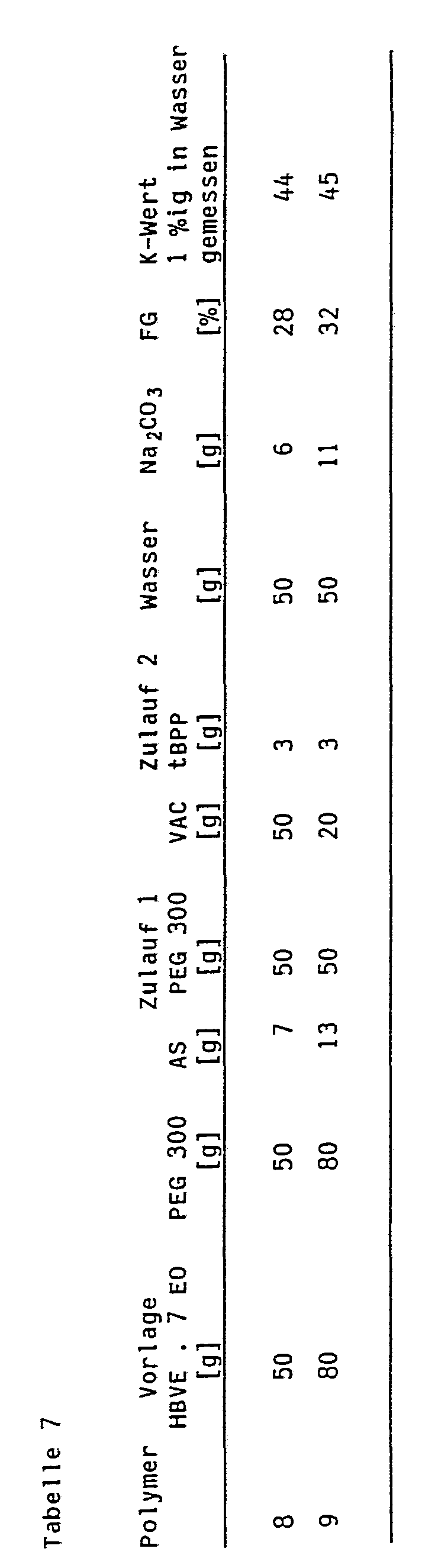
  • the following table shows the starting materials and quantities:
  • Polymer 18-20 In the apparatus of Example 1-5, 1/10 of a mixture consisting of the addition product of ethylene oxide with 4-hydroxybutyl vinyl ether, polyethylene oxide with a molecular weight of 300 and acrylic acid is introduced at 75 ° C. and by adding 1/10 of the Initiator amount initiated for polymerization. The remaining monomer mixture is metered in so quickly that the temperature can be kept at 80.degree. After the polymerization is complete, the K value of the polymer is determined and the polymer is quantitatively neutralized by adding stoichiometric amounts of aqueous soda solution. Dilution with water results in a clear solution with the stated polymer contents:
  • the copolymers obtained according to Examples 30, 32, 34 and 36 were examined for hydrolytic degradation. For this purpose, the decrease in viscosity of 5% solutions of the polymers in water at the corresponding pH values was monitored. An Ubbelohde viscometer was used as the measuring device. The measurements were carried out at 25 ° C. The following pH values were set: pH of 2.5: 1% aqueous acetic acid
  • pH of 4.6 equimolar mixture of acetic acid and sodium acetate pH of 5.3: addition of 0.1% acetic acid
  • pH of 6.2 addition of 0.1% acetic acid.
  • the decrease in run-out time in the viscometer at 25 ° C was characterized by the half-life: T half and the end value of the run-up time (time for complete depolymerization): T end .
  • Examples 38-42 A mixture of the anhydrous surfactant A (addition product of 7 mol of ethylene oxide and 1 mol of a C 13 / C 15 alcohol mixture) and the polymer 4 described above are prepared. The proportion of polymer 4 in the mixture is 5%. Table 10 shows the viscosities of the mixture of surfactant A and polymer 4 described at different water contents. As can be seen from this, polymer 4 acts as a viscosity lowering agent for the water-containing surfactant A.
  • a 40% aqueous solution of surfactant A is with the in
  • Surfactant A is diluted to 40% by weight by adding water and the viscosity of the mixture is measured. It is 744 mPas.
  • the non-hydrolyzed polymer 4 ie the copolymer obtained by radical polymerization of the addition product of 7 moles of ethylene oxide with 1 mole of hydroxybutyl vinyl ether and diethyl maleate, is made up in the form of a 5% solution in anhydrous surfactant A by adding water to 40% by weight. diluted. The viscosity of this
  • the polymers to be used according to the invention are important auxiliaries in the production of phosphate-reduced and phosphate-free washing and
  • the slurry concentration in the crutcher can be increased to at least 80%. This means better economy through cheaper utilization of the spray tower and a saving in energy because less water has to be evaporated.
  • the homogenizing and viscosity-lowering effect of the polymers to be used according to the invention is illustrated below by viscosity measurements on detergent formulations.
  • a rheometer from Physika serves as the measuring device. Measuring system is a Z 3 DIN type.
  • a slurry of 80% by weight detergent components and 20% by weight water is used as the detergent slurry.
  • the polymers given in Table 13 in an amount of 2% by weight, based on the detergent formulation, are used as viscosity-reducing additives.
  • the detergent for making the slurry is composed as follows:
  • the whiteness differences on the individual fabrics are given before and after washing.

Landscapes

  • Chemical & Material Sciences (AREA)
  • Chemical Kinetics & Catalysis (AREA)
  • Organic Chemistry (AREA)
  • Life Sciences & Earth Sciences (AREA)
  • Engineering & Computer Science (AREA)
  • Oil, Petroleum & Natural Gas (AREA)
  • Wood Science & Technology (AREA)
  • Health & Medical Sciences (AREA)
  • Medicinal Chemistry (AREA)
  • Polymers & Plastics (AREA)
  • Addition Polymer Or Copolymer, Post-Treatments, Or Chemical Modifications (AREA)
  • Detergent Compositions (AREA)

Abstract

Copolymerisate von Hydroxyalkylvinylethern, die erhältlich sind durch kationisch oder radikalisch initiierte Copolymerisation von: (a) 99 bis 1 Gew.-% Hydroxyalkylvinylethern, (b) 1 bis 99 Gew.-% Additionsprodukten von C2- bis C4-Alkylenoxiden an Hydroxyalkylvinylether und (c) 0 bis 98 Gew.-% anderen copolymerisierbaren Monomeren, und Verwendung der genannten Copolymerisate sowie von kationisch oder radikalisch polymerisierten Hydroxyalkylvinylethern, die die Monomeren (a) oder (b) als alleinige Monomere oder in Mischung mit anderen copolymerisierbaren Monomeren einpolymerisiert enthalten, als Zusatz zu Wasch- und Reinigungsmitteln in Mengen von 0,1 bis 50 Gew.-%.

Description

Copolymerisate von Hydroxyalkylvinylethern und Verwendung von Homo- und Copolymerisaten von Hydroxyalkylvinylethern in
Wasch- und Reinigungsmitteln Beschreibung
Die Erfindung betrifft Copolymerisate aus Hydroxyalkylvinylethern, Additionsprodukten von C2- bis C4-Alkylenoxiden an Hydroxyalkylvinylether und/oder Polytetrahydrofuranvinylether und gegebenenfalls anderen copolymerisierbaren Monomeren und
Verwendung der genannten Copolymerisate sowie die Verwendung von kationisch oder radikalisch polymerisierten Hydroxyalkylvinylethern, die die Monomeren (a) oder (b) als alleinige Monomere oder in Mischung mit anderen copolymerisierbaren Monomeren einpolymerisiert enthalten, als Viskositätserniedriger für Tenside und als Zusatz zu Wasch- und Reinigungsmitteln.
Aus der US-A-2 104 004 ist ein Verfahren zur kationischen
Polymerisation von Vinylethern bekannt, bei dem man als
Katalysator 0,001 bis 5 Gew.-% einer praktisch wasserfreien anorganischen Säure einsetzt. Geeignete Katalysatoren sind beispielsweise Aluminiumchlorid, Eisenchlorid, Schwefelsäure, Salzsäure und Bortrifluorid. Aus der US-B-26 407 ist die radikalische Copolymerisation von
Divinylverbindungen, wie Divinylether, Divinyldimethylsilan oder Divinylsülfon mit monoethylenisch ungesättigten Monomeren bekannt, z.B. Vinylacetat, Maleinsäureanhydrid oder Fumarsäuredimethylester. Geeignete Katalysatoren sind Peroxiverbindungen, wie Di-tert.-butylperoxid, Wasserstoffperoxid, Alkylhydroperoxide und Diacylperoxide. Außerdem eignen sich Ziegler-Katalysatoren zur Initiierung der Polymerisation. Die so erhältlichen Polymerisate sind faser- und filmbildend und können zur Herstellung von Beschichtungen oder Verpackungsmaterialien verwendet werden. Sie eignen sich außerdem als Schmiermittel und Schmiermitteladditive, Klebstoffe und als Vernetzungsmittel für Epoxyharze.
Aus der US-A-3 328 468 ist die Herstellung von Homopolymerisaten des Monovinylethers von Diethylenglykol unter Verwendung von Polymerisationsinitiatoren bekannt, die unter den Polymeri sationsbedingungen Radikale bilden. Die Hydroxylgruppe der Monovinylether von Diethylenglykol bleibt bei der radikalischen Polymerisation praktisch unverändert. Die so erhältlichen Polymeren können Polyole bei der Schaumstoffherstellung ersetzen. Wie aus dieser Literaturstelle außerdem bekannt ist, können Monovinylether von Diolen unter Einwirkung kationischer Initiatoren unter Bildung von Polyacetalen polymerisiert werden.
Aus der EP-A-0 359 055 sind Waschmittelformulierungen bekannt, die 0,5 bis 65 Gew.-% eines oberflächenaktiven Mittels und 1 bis 80 Gew.-% eines Builders enthalten, der aus einem Polymer besteht, das durch radikalische Copolymerisation von Divinylether und Maleinsäureanhydrid im Molverhältnis 1:2 und anschließende Hydrolyse der Anhydridgruppen und Neutralisation erhältich ist.
Aus der EP-A-0 379 166 sind u.a. auch Copolymerisate aus Alkylvinylethern und hydroxylgruppenhaltigen Vinylethern, wie
Hydroxyethylvinylether, Hydroxypropylvinylether, Hydroxybutylvinylether und Alkoxylaten dieser hydroxylgruppenhaltigen Vinylether bekannt. Die Copolymerisate werden in Beschichtungs- und Formmassen zur Verbesserung des Verlaufs oder als Antischaummittel eingesetzt. Aus der US-A-3 131 162 ist die Copolymerisation von Monovinylethern von Glykolen mit vinylestern von gesättigten Fettsäuren mit einer Kohlenstoffkette mit bis zu 6 Kohlenstoffatomen in Gegenwart von Peroxiden bekannt. Die Copolymerisate können unter Zusatz üblicher Vulkanisierhilfsmittel zu gummiartigen Materialien vulkanisiert werden.
Der vorliegenden Erfindung liegt die Aufgabe zugrunde, neue Stoffe zur Verfügung zu stellen. Eine andere Aufgabe besteht darin, die Primär- und Sekundärwaschwirkung von Waschmitteln zu verbessern und die Viskosität von wäßrigen Tensidlosungen und Waschmittelslurries zu erniedrigen.
Die Aufgabe wird erfindungsgemäß gelöst mit Copolymerisaten von Hydroxyalkylvinylethern, die erhältlich sind durch kationisch oder radikalisch initiierte Copolymerisation von (a) 99 bis 1 Gew.-% Hydroxyalkylvinylethern,
(b) 1 bis 99 Gew.-% Additionsprodukten von C2- bis C4-Alkylenoxiden an Hydroxyalkylvinylether und/oder Polytetrahydrofuranvinylether und
(c) 0 bis 98 Gew.-% anderen copolymerisierbaren Monomeren.
Eine der oben definierten Aufgaben wird außerdem gelöst mit der Verwendung von Copolymerisaten, die erhältich sind durch kationisch oder radikalisch initiierte Copolymeriation von
(a) 99 bis 1 Gew.-% Hydroxyalkylvinylethern, (b) 1 bis 99 Gew.-% Additionsprodukten von C2- bis C4-Alkylenoxiden oder Tetrahydrofuran an Hydroxyalkylvinylether und
(c) 0 bis 98 Gew.-% anderen copolymerisierbaren Monomeren, sowie von kationisch oder radikalisch polymerisierten Hydroxyalkylvinylethern, die die Monomeren (a) oder (b) als al l e i n i ge Monomere oder in Mischung mit anderen copolymerisierbaren Monomeren einpolymerisiert enthalten, als Zusatz zu Waschmitteln in Mengen von 0,1 bis 50 Gew.-%.
Als Monomere der Gruppe (a) kommen alle Hydroxyalkylvinylether in Betracht, die sich von mindestens 2 OH-Gruppen aufweisenden Verbindungen ableiten, bei denen das Wasserstoffatom einer OH-Gruppe durch die Vinylgruppe ersetzt ist. Diese Verbindungen können beispielsweise mit Hilfe der folgenden allgemeinen Formel charakterisiert werden:
CH2=CH-O-R-OH (I), in der R einen mindestens zweiwertigen Rest bedeutet, der gegebenenfalls noch substituiert sein kann, z.B. R = C2- bis C20-Alkylen, Phenylen, mit OH-Gruppen oder mit Estergruppen substituierte C3- bis C20-Alkylen- oder Phenylengruppen bedeutet. Einzelne Verbindungen dieser Art sind beispielsweise Hydroxyethylvinylether, 3-Hydroxypropylvinylether, 2-Hydroxypropylvinylether, 2-Hydroxy-2-methyl-propylvinylether, 2-Hydroxybutylvinylether, 3-Hydroxybutylvinylether, 4-Hydroxybutylvinylether, 2-Hydroxy-2-ethyl-ethylvinylether, 3-Hydroxy¬
3-methyl-propylvinylether, 3-Hydroxy-2-methyl-propylvinylether, 3-Hydroxy-1-methyl-propylvinylether, Hydroxypentylvinylether, 6-Hydroxyhexyl vinylether, 4-Hydroxy-1,4-dimethyl-butylvinylether, Brenzkatechin-, Resorcin- und Hydrochinonomonovinylether,
2-Hydroxycyclohexylvinylether, 3-Hydroxycyclohexylvinylether,
4-Hydroxycyclohexylvinylether, Hydroxyheptylvinylether, Hydroxyoctylvinylether, 4-(Hydroxymethyl)-cyclohexylmethylvinylether, Hydroxydecylvinylether sowie Monovinylether von Polyhydroxyverbindungen, wie beispielsweise Glycerinmonovinylether,
Erythritmonovinylether, Sorbitmonovinylether, Weinsäurediethylestermonovinylether, 2,2-Bis-(hydroxymethyl)-propionsäureethylestermonovinylether sowie Monovinylether von Mono-, Di- und Trisacchariden, Ol igosacchar i den und Zuckersäureestern. Als Sachcharide können beispielsweise verwendet werden: Glucose, Methylglucosid, Butylglucosid, Saccharose, Palatinose, Palatinit, Lactose, Maltose, Fructose, Leucrose, Panose, Dextrine, Isomaltose, Trehalurose, Raffinose, Panose. Als Zuckersäuren können beispielsweise verwendet werden: Galacturonsäure, Galactonsäure, Galactensaure, Galactarsaure, Gluconsaure. Vorzugsweise verwendet man aus dieser Gruppe von Vinylethern die isomeren Hydroxybutylvinylether, insbesondere 4-Hydroxybutyl-1-vinylether und
6-Hydroxyhexylvinylether sowie 4-(Hydroxymethyl)cyclohexylmethylvinylether. Die Monomeren der Gruppe (a) sind zu 99 bis 1, vorzugsweise 90 bis 10 Gew.-% am Aufbau der Copolymerisate beteiligt.
Als Monomere der Gruppe (b) kommen die Additionsprodukte von C2- bis C4-Alkylenoxiden an die Hydroxyalkylvinylether in
Betracht, die als Monomere der Komponente (a) oben definiert sind. Geeignete Alkylenoxide sind Ethylenoxid, Propylenoxid, Butylenoxid-1,2, Butylenoxid-2, 3 und Isobutylenoxid. Die
Alkylenoxide werden an die Hydroxyalkylvinylether angelagert, um die Monomeren der Komponenten (b) zu erhalten. Verbindungen dieser Art sind bekannt. Die Monomeren der Komponenten (b) können jedoch auch durch Vinylierung von Polyalkylenglykolen hergestellt werden. Einzelne Monomere der Komponente (b) sind beispielsweise die Additionsprodukte, die erhältlich sind durch Addition von 3 Mol Ethylenoxid an 1 Mol 3-Hydroxypropylvinylether, 4 Mol Butylenoxid an 1 Mol 2-Hydroxypropylvinylether, 10 Mol Ethylenoxid an 1 Mol 2-Hydroxy-2-methyl-propylvinylether, 3 Mol Ethylenoxid an 1 Mol 4-Hydroxybutylvinylether, 7 Mol
Ethylenoxid an 1 Mol 4-Hydroxybutylvinylether, 11 Mol Ethylenoxid an 1 Mol 4-Hydroxybutylvinylether, 25 Mol Ethylenoxid an 1 Mol 4-Hydroxybutylvinylether, 50 Mol Ethylenoxid an 1 Mol 4-Hydroxybutylvinylether, 3 Mol Propylenoxid an 1 Mol 4-Hydroxybutylvinylether, 11 Mol Butylenoxid an 1 Mol 4-Hydroxybutylvinylether, 1 Mol Ethylenoxid an 1 Mol 4-Hydroxypentylvinylether, 100 Mol Propylenoxid an 1 Mol 6-Hydroxyhexylvinylether, 30 Mol Ethylenoxid an 1 Mol 4-Hydroxy-1,4-dimethylbutylvinylether und 50 Mol Ethylenoxid an 1 Mol Hydroxyheptylvinylether.
Weiterhin sind geeignete Monomere der Komponente (b) zum
Beispiel Diethylenglykolmonovinylether, Triethylenglykolmonovinylether, Tetraethylenglykolmonovinylether, allgemein Polyethylenglykolmonovinylether mit Molgewichten bis 20.000 sowie Dipropylenglykolmonovinylether, Tripropylenglykolmonovinylether, Tetrapropylenglykolmonovinylether, Dibutylenglykolmonovinylether, Tributylenglykolmonovinylether sowie gemischte Glykole wie
Ethylen-propylenglykolmonovinylether, Diethylenglykolpropylenglykolmonovinylether.
Außerdem kommen Blockcopolymerisate der Alkylenoxide in
Betracht, die durch Anlagerung von zunächst Ethylenoxid und anschließend Propylenoxid an Hydroxylalkylvinylether der
Formel I erhältlich sind. Ebenso sind als Monomere der
Komponente (b) solche Additionsprodukte geeignet, die durch Anlagerung von Propylenoxid und anschließend Ethylenoxid und gegebenenfalls Butylenoxid an Verbindungen der Formel I erhältlich sind. Ebenso eignen sich Polytetrahydrofuranmonovinylether, die durch Vinylierung von Polytetrahydrofuranen mit den Molekulargewichten von 250 bis 4.500 erhältlich sind.
Außerdem können Umsetzungsprodukte von Alkylenoxiden mit Monovinylethern von Polyhydroxyverbindungen eingesetzt werden, beispielsweise Umsetzungsprodukte von 1 Mol Glycerinmonovinylether mit 25 Mol Ethylenoxid, 1 Mol Erythritmonovinylether mit 7 Mol Propylenoxid, 1 Mol Sorbitmonovinylether mit 3 Mol Butylenoxid, 1 Mol Weinsäurediethylestermonovinylether mit 11 Mol Ethylenoxid, 1 Mol Bis-(hydroxymethyl)-propionsäureethylester mit 25 Mol Propylenoxid und 1 Mol Glykosemonovinylether mit 50 Mol Ethylenoxid. Vorzugsweise verwendet man als Monomere der
Gruppe (b) solche Additionsprodukte von Alkyenoxiden an Hydroxyalkylvinylether, die wasserlöslich sind (z.B. wenn sich
mindestens 1 g der alkoxylierten Verbindungen in 1 1 Wasser löst). Die Alkylenoxide werden im allgemeinen in Mengen von 1 bis 100, vorzugsweise 2 bis 60 Mol an 1 Mol Hydroxyalkylvinylether angelagert. Zur Herstellung der erfindungsgemäßen Copolymerisate kann man jedoch auch noch größere Mengen an Alkylenoxiden an die Verbindungen der Formel I anlagern. Von den Monomeren (b) kommen vorzugsweise die Additionsprodukte von 1 bis 100 Mol Ethylenoxid an 1 Mol Hydroxybutylvinylether in Betracht. Die Monomeren (b) sind zu 1 bis 99, vorzugsweise 10 bis 90 Gew.-% am Aufbau der Copolymerisate beteiligt.
Als Monomere (c) kommen alle anderen Monomeren in Betracht, die mit den Monomeren (a) und (b) copolymerisierbar sind. Beispiele hierfür sind monoethylenisch ungesättigte C3- bis C8-Carbonsäuren, wie Acrylsäure, Methacrylsäure, Ethacrylsäure, Maleinsäure, Fumarsäure, Aconitsäure und Itaconsäure. Außerdem eignen sich die Ester der genannten Carbonsäuren mit einwertigen C1- bis C18-Alkoholen oder mehrwertigen C2- bis C8-Alkoholen, beispielsweise seien folgende Ester genannt: Acrylsäuremethylester, Acrylsäureethylester, Acrylsäure-tert.-butylester, Acrylsäure-n-butylester, Acrylsäureethylhexylester, Methacrylsäuremethylester, Methacrylsäureethylester, Methacrylsäure-n-propylester, Methacrylsäureisopropylester, Methacrylsäure-n-butylester, Methacrylsäureisobutylester, Acrylsäureisopropylester, Maleinsäuremonomethylester, Maleinsäuredimethylester, Maleinsäuremonoethylester, Maleinsäurediethylester, Maleinsäuremonoisopropylester, Maleinsäuredi-n-propylester, Maleinsäuremono-n-butylester, Maleinsäuredi-n-butylester, Maleinsäuremonoisodecyiester und Maleinsäuremonoisononylester. Soweit die obengenannten
Carbonsäuren Anhydride bilden, sind auch die Anhydride als
Comonomere bei der Copolymerisation einsetzbar, z.B. Maleinsäureanhydrid, Acrylsäureanhydrid, Methacrylsäureanhydrid und Itaconsäureanhydrid. Außerdem eignen sich die Amide der
Carbonsäuren wie Acrylamid und Methacrylamid und Nitrile der genannten Carbonsäuren wie Acrylnitril und Methacrylnitril. Weitere Comonomere der Gruppe (c) sind Vinylester, die sich vorzugsweise von C1- bis C18-gesättigten Carbonsäuren ableiten, z.B. Vinylformiat, Vinylacetat, vinylpropionat, Vinylbutyrat, Vinylpivalat und Vinylstearat. Eine weitere Klasse von Verbindungen der Klasse (c) sind Alkylvinylether, vorzugsweise solche, die sich von C1- bis C18-Alkoholen ableiten, wie Methylvinylether, Ethylvinylether, Propylvinylether, n-Butylvinylether, tert.-Butyl vinylether, sec.-Butylvinylether, iso-Butylvinylether, Dodecylvinylether, Octadecylvinylether und Styrol.
Zur Erhöhung des Molekulargewichts der Copolymerisate kann man als Monomere der Gruppe (c) auch die üblicherweise bei der radikal ischen Copolymerisation eingesetzten Vernetzer in
Betracht.
Die Vernetzer enthalten mindestens zwei nicht konjugierte, ethylenisch ungesättigte Doppelbindungen. Geeignete Vernetzer sind beispielsweise N,N'-Methylenbisacrylamid, Polyethylenglykoldiacrylate und Polyethylenglykoldimethacrylate, die sich jeweils von Polyethylenglykolen eines Molekulargewichts von 126 bis 8500 ableiten, Trimethylolpropantriacrylat, Trimethylolpropantrimethacrylat, Ethylenglykoldiacrylat, Propylenglykoldiacrylat, Butandioldiacrylat, Hexandioldiacrylat, Hexandioldimethacrylat, Diacrylate und Dimethacrylate von Blockcopolymerisaten aus Ethylenoxid und Propylenoxid, zweifach bzw.
dreifach mit Acrylsäure oder Methacrylsäure veresterte
Anlagerungsprodukte von Ethylenoxid und/oder Propylenoxid an Trimethylolpropan, mindestens zweifach mit Acrylsäure oder
Methacrylsäure veresterte mehrwertige Alkohole, wie Glycerin oder Pentaerythrit, Triallylamin, Tetraallylethylendiamin, Divinylbenzol, Diallylphthalat, Polyethylenglykoldivinylether,
Trimethylolpropandially lether, Polyethylenglykoldivinylether, Butandioldivinylether, Pentaerythrittriallylether und/oder
Divinylethylenharnstoff und/oder Triallylmonoalkylammoniumsalze, wie z.B. Triallylmethylammoniumchlorid. Vorzugsweise setzt man wasserlösliche Vernetzer ein, z.B. N, N'-Methylen-bisacrylamid, Polyethylenglykoldiacrylate, Polyethylenglykoldimethacrylate, Pentaerythrittriallylether und/oder Divinylharnstoff. Bevorzugt eingesetzte Vernetzer sind Divinylether von C2- bis C20-Diolen, Polyalkylenglykolen und Diphenolen, wie z.B. 1,2-Ethylenglykoldivinylether, 1,4-Butandioldivinylether,
1,4-Bis-(hydroxymethyl)-cyclohexyldivinylether und 1,6-Hexandioldivinylether, Diethylenglykoldivinylether und Hydrochinondivinylether. Falls bei der radikalischen Polymerisation Vernetzer eingesetzt werden, so betragen die angewendeten Mengen 0,1 bis 15, vorzugsweise 0,2 bis 5 Gew.-%. Es können auch Polytetrahydrofurandivinylether mit Molgewichten von 250 bis 4500 eingesetzt werden. Bei der kationischen Polymerisation setzt man bevorzugt als copolymerisierbare Monomere (c) mindestens zwei Vinylethergruppen enthaltende Monomere ein. Bevorzugt sind Divinylether, wobei sämtliche Divinylether einsetzbar sind, z.B. die oben bereits erwähnten Divinylether von C2- bis C20-Alkylendiolen bzw.
Divinylether von Polyalkylenglykolen eines Molekulargewichts bis zu 35.000 des Polyalkylenglykolsegments. Bei der kationischen Copolymerisation werden bevorzugt Butandioldivinylether, insbesondere 1,4-Butandioldivinylether, 1,6-Hexandioldivinylether und 1,4-Bis-(hydroxymethyl)-cyclohexyldivinylether eingesetzt. Die Mengen betragen hierbei bis zu 20 Gew.-%, bezogen auf die
Monomeren (a) und (b).
Für die kationische Copolymerisation kommen außerdem zur
Erhöhung des Molekulargewichts der Copolymerisate Diole oder Polyole in Betracht. Vorzugsweise verwendet man C2- bis
C20-Diole, z.B. Ethylenglykol, Propylenglykol, 1,4-Butandiol, 1,2-Butandiol, 1,3-Butandiol, 1,6-Hexandiol- und Polyalkylenglykole mit Molekulargewichten bis 35.000, beispielsweise
Diethylenglykol, Triethylenglykol, Tetraethylenglykol, Pentaethylenglykol, Hexaethylenglykol, Dipropylenglykol, Copolymerisate aus Ethylenoxid und Propylenoxid sowie Copolymerisate aus Ethylenoxid und Butylenoxid oder Copolymerisate aus Ethylenoxid und Tetrahydrofuran. Die Copolymerisate können die Monomeren in statistischer Verteilung oder in Form von Blöcken enthalten. Diese Monomere sind bei der Copolymerisation, falls sie eingesetzt werden, in Mengen von 0,1 bis 20 Gew.-% anwesend. Polyalkylenoxide können bei der Alkoxylierung von Hydroxyalkylvinylethern (Monomere a) entstehen. Bei der kationischen Copolymerisation können die mindestens zwei Vinylethergruppen enthaltenden Monomeren und die mindestens zwei OH-Gruppen aufweisenden Verbindungen, z.B. Alkylenglykole, gemeinsam eingesetzt werden, um Polymerisate mit hohen Molekulargewichten zu erhalten. Hierfür ist es dann allerdings erforderlich, daß Vinylgruppen und OH-Gruppen in der Monomermischung in etwa äquimolarem
Verhältnis vorliegen.
Die Monomeren (a), (b) und gegebenenfalls (c) können sowohl radikalisch als auch kationisch copolymerisiert werden. Bei der radikalisch initiierten Copolymerisation tritt über die Doppelbindungen der Monomeren eine C-C-Verknüpfung unter Bildung von Polymeren ein.
Als Initiatoren kann man sämtliche dafür bekannten Radikalspender einsetzen. Diese Initiatoren können in Wasser löslich oder auch unlöslich sein. In Wasser lösliche Initiatoren sind beispielsweise anorganische Peroxide, wie Kalium-, Natrium- und Ammoniumperoxodisulfat sowie Wasserstoffperoxid. Außerdem eignen sich als Initiatoren organische Peroxide, Hydroperoxide, Persäuren, Ketonperoxide, Perketale und Perester, z.B. Methylethylketonhydroperoxid, Cumolhydroperoxid, tert.-Butylhydroperoxid,
1,1-(di-tert.-Butylperoxy)cyclohexan, Di-(tert.-Butyl)peroxid, tert.-Butyl-oxyperpivalat, Ethylhexylperoctoat, tert.-Butylmonoperoxy-maleat, Dicyclohexylperoxydicarbonat, Dibenzoylperoxid, Diacetylperoxid, Didecanoylperoxid sowie Mischungen von Peroxiden. Außerdem eignen sich Redoxsysteme, die außer einer Peroxyverbindung noch eine reduzierendwirkende Komponente enthalten. Geeignete reduzierende Komponenten sind beispielsweise Cer-III und Eisen-II-Salze, Natriumsulfit, Natriumhydrogensulfit, Natriumdithionit, Ascorbinsäure und Natriumformaldehydsulfoxylat. Die Auswahl geeigneter Initiatoren erfolgt vorzugsweise in der Weise, daß man solche Radikale bildenden Verbindungen einsetzt, die bei der jeweils gewählten Polymerisationstemperatur eine
Halbwertszeit von weniger als 3 Stunden aufweisen. Falls man die Polymerisation zunächst bei niedrigerer Temperatur startet und bei höherer Temperatur zu Ende führt, so ist es zweckmäßig, mit mindestens zwei bei verschiedenen Temperaturen zerfallenden Initiatoren zu arbeiten, nämlich zunächst einen bereits bei niedrigerer Temperatur zerfallenden Initiator für den Start der Polymerisation und dann die Hauptpolymerisation mit einem
Initiator zu Ende zu führen, der bei höherer Temperatur zerfällt. Durch Zusatz von Schwermetallsalzen, z.B. Kupfer-, Kobalt-, Mangan-, Eisen-, Nickel- und Chromsalzen zu peroxydischen Katalysatoren kann die Zerfallstemperatur der peroxydischen Katalysatoren erniedrigt werden. Geeignete Initiatoren sind außerdem Azoverbindungen, wie
2,2'-Azobisisobutyronitril, 2,2'-Azobis(2-amidinopropan)dihydrochlorid, 2,2'-Azobis(2-methylpropionamidin)dihydrochlorid, 2,2'-Azobis(2,4-dimethylvaleronitril) und Dimethyl-2,2'-azobisisobutyrat. Besonders bevorzugt werden Wasserstoffperoxid, Kalium-, Natrium- und Ammoniumperoxodisulfat, tert.-Butylperpivalat, 2,2'-Azobis-(2,4-dimethylvaleronitril) und Di-tert.- Butylperoxid als Initiator bei der Polymerisation eingesetzt. Bezogen auf die zu polymerisierenden Monomeren verwendet man üblicherweise 0,5 bis 10, vorzugsweise 1 bis 8 Gew.-% eines
Radikale bildenden Initiators oder eines Gemisches von solchen Polymerisationsinitiatoren. Die Einsatzmenge des Initiators hat bekanntlich einen erheblichen Einfluß auf das Molekulargewicht der entstehenden Homo- und Copolymerisate.
Die radikalische Polymerisation erfolgt vorzugsweise in Gegenwart eines Verdünnungsmittels. Hierbei kann es sich um Lösemittel für die Monomeren und die Polymerisate bzw. lediglich um Lösemittel für die Monomeren handeln. Geeignete Lösemittel sind beispielsweise Ether, wie Diethylether, Dibutylether, Diisobutylether,
Methyl-tert.-butylether, cyclische Ether, wie Tetrahydrofuran und Dioxan, Mono- oder Dialkylether von Mono- oder Polyethylenglykolen, z.B. Ethylenglykoldimethylether, Ethylenglykoldibutylether, Diethylglykoldimethylether, Diethylenglykoldibutylether, Monoalkylether von Mono- oder Polyethylenglykolacetaten, wie Methylglykolacetat, Butylglykolacetat, Methyldiethylenglykolacetat, Butyldiethylenglykolacetat, sowie Anlagerungsprodukte von Alkylenoxiden mit 2 bis 4 C-Atomen an C1- bis
C28-Alkohole oder Alkylphenole. Die Molekulargewichte dieser Anlagerungsprodukte können bis zu 8000, vorzugsweise bis zu 6000 betragen. Sofern zur Herstellung der Anlagerungsprodukte
mindestens 2 verschiedene Alkylenoxide eingesetzt werden, so können die Alkylenoxideinheiten in den Reationsprodukten
statistisch verteilt sein oder in Form von Blöcken vorliegen. Solche Reaktionsprodukte sind Bestandteile von Flüssigwaschmitteln. Da die Polymerisate in Waschmitteln eingesetzt werden, stellt man sie vorteilhafterweise in den beschriebenen
Anlagerungsprodukten als Lösemittel her und kann die anfallende Polymerlösung unmittelbar zur Herstellung der Waschmittelformulierung einsetzen. Prinzipiell können bei der radikalischen Copolymerisation sämtliche nichtionischen Tenside, die in
Waschmitteln eingesetzt werden, als Verdünnungsmittel verwendet werden. Bevorzugte Lösemittel für die Polymerisation sind z.B. Umsetzungsprodukte von einwertigen C1-bis C28-alipnatischen
Alkoholen oder C1- bis C18-Alkylphenolen mit Ethylenoxid,
Propylenoxid und/oder Butylenoxid, z.B. die Anlagerungsprodukte von 3 bis 11 Mol Ethylenoxid an ein Mol eines C13/C15-Alkohols, Anlagerungsprodukte von 5 bis 15 Mol Ethylenoxid an 1 Mol Nonylphenol, Anlagerungsprodukte von 7 bis 11 Mol Ethylenoxid und 3 bis 5 Mol Propylenoxid an 1 Mol Oleylalkohol und Anlagerungsprodukte von 5 bis 15 Mol Ethylenoxid an 1 Mol Stearylalkohol oder Taigfettalkohol. Außerdem eignen sich die Anlagerungsprodukte von Ethylenoxid, Propylenoxid und Butylenoxid an mehrwertige Alkohole, z.B. Glykol, Diethylenglykol, Triethylenglykol, Tetraethylenglykol, Propylenglykol, Dipropylenglykol, Blockcopolymerisate aus Ethylenoxid und Propylenoxid, Glycerin und Oligoglycerine. Besonders bevorzugt aus dieser Gruppe von
Verbindungen sind Diethylenglykol und Polyethylenglykole mit Kondensationsgraden bis 25.
Weitere geeignete Lösemittel sind C1- bis C6-Alkohole, wie
Methanol, Ethanol, Isopropanol, n-Propanol, Butanole, n-Hexanol und Cyclohexanol, Ketone, z.B. Aceton, Ethylmethylketon und
Cyclohexanon, Ester, z.B. Essigsäureethylester, sowie Wasser und Mischungen von Wasser mit wasserlöslichen organischen Lösemitteln. Sofern ein inertes Lösemittel bei der Polymerisation verwendet wird, betragen die Konzentrationen der Monomeren darin 10 bis 90, vorzugsweise, 15 bis 70 Gew.-%.
Die Polymerisation der Monomeren der Gruppen a) bis c) kann gegebenenfalls zusätzlich in Gegenwart von Reglern durchgeführt werden. Geeignete Regler sind beispielsweise Mercaptoverbindüngen, wie Mercaptoethanol, Mercaptopropanol, Mercaptobutanol, Mercaptoessigsäure, Mercaptopropionsäure, Butylmercaptan und Dodecylmercaptan. Als Regler eignen sich außerdem Allylverbindungen, wie Allylalkohol, Aldehyde, wie Formaldehyd, Acetaldehyd, Propionaldehyd, n-Butyraldehyd und Isobutyraldehyd,
Ameisensäure, Ammoniumformiat, Propionsäure, Hydroxylammoniumsulfat und Butenole. Regler werden insbesondere dann eingesetzt, wenn man größere Mengen an vernetzend wirkenden Monomeren der Gruppe c) bei der Polymerisation anwendet. Aufgrund des Einsatzes der Regler erhält man in solchen Fällen wasserlösliche Polymerisate bzw. Polymerisate, die sich leicht in Wasser dispergieren lassen.
Die Copolymerisation kann auch ohne Verdünnungsmittel durchgeführt werden. Diese Verfahrensvariante eignet sich ganz besonders dann, wenn man als Monomer der Komponente (b) höher ethoxylierte Hydroxyal kylvinylether einsetzt, z.B. bei Umsetzungsprodukten von 4-Hydroxybutylvinylether mit 3, 7, 11, 25 oder 50 Mol Ethylenoxid pro Mol 4-Hydroxybutylvinylether und als Monomer der Komponente (c) Maleinsäuredimethylester oder Maleinsäurediethylester. Der Fortschritt der Copolymerisation kann aufgrund der Abnahme des Vinylethergehalts im Reaktionsgemisch mit Hilfe einer
Jodtitration leicht verfolgt werden. Nach der Polymerisation können restliche Vinyletherendgruppen durch Behandlung der
Polymerisate in wäßrig saurem Medium gespalten werden. Der dabei entstehende Acetaldehyd kann leicht mit Hilfe einer Wasserdampfdestillation aus der wäßrigen Polymerlösung entfernt werden. Auf diese Weise gelingt es, praktisch restmonomerfreie Copolymerisate herzustellen. Die Copolymerisate können im Anschluß an die Polymerisation noch modifiziert werden. So ist es beispielsweise möglich, Copolymerisate, die die Monomeren (a), (b) und als Monomer (c) einen Ester einer ethylenisch ungesättigten Carbonsäure einpolymerisiert enthalten, durch Behandlung mit wäßrigen Basen, z.B. Natronlauge unter Esterhydrolyse zu einem Carboxylatgruppen enthaltenden
Copolymerisat abzuwandeln. Eine andere Möglichkeit besteht darin, Hydroxylamin, Ammoniak oder Amine auf Estergruppen einpolymerisiert enthaltende erfindungsgemäße Copolymerisate einwirken zu lassen, so daß man Hydroxamsäuren oder Carbonsäureamide erhält. Hier ist eine Vielzahl von Folgereaktion zur Modifizierung der erfindungsgemäßen Copolymerisate möglich.
Die Monomeren (a), (b) und gegebenenfalls (c) können auch
kationisch polymerisiert werden. Hierbei addiert die OH-Gruppe eines Monomeren an die Vinylethergruppe des Nachbarmoleküls unter Bildung eines Acetaldehydacetals. Bei dieser Polymerisation erhält man eine polymere Hauptkette, in der die Monomereinheiten über Acetaldehydacetale miteinander verknüpft sind. Die
kationische Copolymerisation der Monomeren der Gruppen (a) und (b) kann mit Hilfe von allen organischen oder anorganischen sauer reagierenden Stoffen initiiert werden. Geeignete kationische Initiatoren sind beispielsweise Oxalsäure, Weinsäure, Adipinsäure, Bernsteinsäure, Bernsteinsäureanhydrid, Zitronensäure, Ameisensäure, Essigsäure, Propionsäure, Äpfelsäure, ein- oder mehrfach halogenierte Carbonsäuren, wie Trifluoressigsäure oder Trichloressigsäure, Chlorwasserstoff, Bromwasserstoff, Jodwasserstoff, Schwefelsäure, Phosphorsäure, Benzolsulfonsäure, p-Toluolsulfonsäure, Borsäure, Ascorbinsäure, saures Aluminiumoxid, Aluminiumsulfat, Kaliumaluminiumsulfat, Eisen-II-sulfat, Eisen-III-sulfat, Aluminiumoxid, Titanylsulfat, Eisen-Ill- chlorid, Bortrifluorid, Bortrichlorid, Bortribromid, Jod,
Ionenaustauscher in der Säureform und mit Säure beladene inerte feste Stoffe. Die Initiatoren für die kationische Polymerisation werden üblicherweise in Mengen von 0,001 bis 20, vorzugsweise 0,01 bis 1 Gew.-%, bezogen auf die Monomeren der Gruppen (a) und (b), eingesetzt. Die Copolymerisation verläuft stark exotherm. Die Reaktionstemperaturen betragen je nach Aktivität des eingesetzten Initiators zwischen -20 und 250, vorzugsweise 0 bis 200°C. Beispielsweise reagieren die Monomeren (a) und (b) bei Anwesenheit von 0,1 bis 5 Gew.-% p-Toluolsulfonsäure bereits bei 40°C in einer exothermen Reaktion innerhalb von 10 min. vollständig ab. Verwendet man zur Initiierung der Copolymerisation 0,2 Gew.-% Oxalsäure, so ist die Copolymerisation bei 90°C innerhalb
1 Stunde und bei 130°C bereits innerhalb von 10 Minuten beendet. Es ist aber auch möglich, die mittels Oxalsäure initiierte
Copolymerisation bei 200°C innerhalb weniger Sekunden ablaufen zu lassen. Allgemein wählt man bei der Initiierung mittels
schwächerer Säuren (Weinsäure, Oxalsäure oder Zitronensäure) Temperaturen oberhalb von 70°C, während man bei Verwendung von starken Säuren, wie Toluolsulfonsäure, die Reaktionstemperaturen unter 70°C hält. Bei der Copolymerisation entstehen meistens farblose und bei Verwendung von Oxalsäure und Weinsäure als Katalysator thermische sehr beständige öle oder Harze. Die
Temperaturbeständigkeit der so hergestellten Copolymerisate reicht bis zu 250°C. Die kationische Polymerisation der Monomeren (a) und (b) wird bevorzugt in Abwesenheit eines Lösemittels durchgeführt. Es ist aber auch möglich, in Gegenwart von inerten Verdünnungsmittel zu arbeiten. Dies kann in bestimmten Fällen von Vorteil sein, weil die Reaktionswärme dann mit Hilfe des verdampfenden Verdünnungsmittels leicht abgeführt werden kann. Bei Verwendung einer starken Säure als Initiator benutzt man bevorzugt eine Lösung des Initiators in einem Verdünnungsmittel, beispielsweise eine 0, 005 bi s 10 gew. -%i ge, besonders bevorzugt ei ne 0, 01 b i s 5 gew .-%ige Lösung von p-Toluolsulfonsäure in Toluol.
Als Verdünnungsmittel bei der kationischen Copolymerisation kommen alle Verdünnungsmittel in Betracht, die keine funktioneilen Gruppen tragen, die mit Vinylethern reagieren können.
Vorzugsweise werden solche Verdünnungsmittel verwendet, die leicht in wasserfreier Form erhältlich und nicht hygroskopisch sind. Beispiele für geeignete Verdünnungsmittel sind Essigsäureethylester, Diethylenglykoldiethylether, Ethoxyethylacetat, Butoxyethylacetat, aliphatische Kohlenwasserstoffe, wie Pentan, Hexan, Cyclohexan, n-Heptan, n-Octan und Isooctan sowie
aromatische Kohlenwasserstoffe, wie Toluol, Xylol, Mesitylen, Tetraiin und Ansiol. Geeignete Lösungsmittel sind ferner
Tetrahydrofuran, Dioxan und Decalin, Aceton, Ethylenmethylketon und Cyclohexanon.
Die Copolymerisation kann beispielsweise als Eintopfreaktion durchgeführt werden. Hierzu kann man die Monomeren der Gruppen (a) und (b) und gegebenenfalls (c) in einem Reaktionsgefäß unter Ausschluß von Luftfeuchtigkeit mischen, mit Initiator versetzen und auf die erforderliche Reaktionstemperatur erwärmen. In einer bevorzugten Ausführungsform legt man die gesamte Initiatormenge im Reaktionsgefäß zusammen mit 10 % der zu polymerisierenden Monomermϊschung der Komponenten (a), (b) und gegebenenfalls (c) bei 20°C vor und startet die Polymerisationsreaktion vorzugsweise unter Inertgasatmosphäre durch Erhitzen der im Reaktionsgefäß vorgelegten Komponenten. Hierbei wird die Mischung gerührt und auch während der folgenden Copolymerisation. Sobald die Polymerisation in Gang gekommen ist, gibt man die restliche Monomermischung der Verbindungen der Komponenten (a), (b) und (c) kontinuierlich oder absatzweise zur Vorlage in dem Maße zu, daß die Polymerisationswärme sicher abgeführt werden kann. Wenn man Oxalsäure, Weinsäure oder Zitronensäure als Initiator einsetzt, benötigt man zum Start der Copolymerisation der Monomeren (a), (b) und gegebenenfalls (c) Temperaturen von etwa 70 bis etwa 160°C. Die Säuren lösen sich dann in der Monomermischung zu einer homogenen Lösung und die Polymerisation beginnt.
Bei Initiatoren, die sich in der Monomermischung nicht lösen, wird die heterogene Reaktionsmischung auf eine Temperatur in dem Bereich von 100 bis 250°C erwärmt, bis die Polymerisation startet.
Nach der Copolymerisation wird der Initiator entweder abgetrennt oder desaktiviert. Eine Desaktivierung des Katalysators
empfiehlt sich deshalb, weil die Copolymerisate in Gegenwart von sauer reagierenden Stoffen und Wasser oder von anderen
protischen Lösemitteln einer Hydrolyse unter Molgewichtsabbau unterliegen. Zur Desaktivierung des Initiators versetzt man das Reaktionsgemisch nach Abschluß der Copolymerisation und
gegebenenfalls nach einem Abkühlen der Reaktionsmischung mit Alkalien, bevorzugt Natriumhydrogencarbonat, Natronlauge,
Kalilauge, Natriumcarbonat, Kaliumcarbonat, Ammoniumcarbonat, Aminen, wie Ammoniak, Methylamin, Dimethylamin, Trimethylamin, Ethylamin, Diethylamin, Dibutylamin, Tributylamin, Ethanolamin, Diethanolamin, Triethanolamin, Morpholin oder Salzen aus starken Basen und schwachen Säuren, wie Natriumacetat, Natriumformiat oder Kai iumhydrogencarbonat. Zur Desaktivierung der sauren
Initiatoren eignet sich außerdem Calciumoxid, Calciumhydroxid, basisches Aluminiumoxid sowie basische Ionenaustauscher. Unlösliche Initiatoren können leicht durch Abfiltrieren entfernt werden.
Das Copolymerisat kann nach Desaktivierung oder Abtrennung des Initators durch Zugabe von Wasser in eine Polymerlösung oder eine Dispersion überführt werden. Die Copolymerisatlösungen können gereinigt werden, indem man sie einer Wasserdampfdestillation unterwirft und dabei flüchtige Anteile
abdestilliert. Während der Wasserdampfdestillation sollte der pH-Wert des wäßrigen Mediums oberhalb von 7 liegen. Copolymerisate, die einer Wasserdampfdestillation unterworfen wurden, verfärben sich nicht, wenn man sie einer alkalischen Nachbehandlung unterwirft. Die Copolymerisate können 99 bis 1, vorzugsweise 90 bis
10 Gew.-% mindestens eines Monomeren der Gruppe (a) und 1 bis 99, vorzugsweise 10 bis 90 Gew.-% mindestens eines Monomer der Gruppe (b) einpolymerisiert enthalten. Die Monomeren werden vorzugsweise derart ausgewählt, daß in Wasser lösliche oder dispergierbare Copolymerisate entstehen. Durch Variation der Mischungsverhältnisse von Monomeren der Gruppe (b) und Monomeren der Gruppe (a) kann die Löslichkeit der erhaltenen Copolymerisate in Wasser beeinflußt werden. Die Copolymerisate haben in Abhängigkeit des Verhältnisses der einpolymerϊsierten Monomeren der Gruppen (a) und (b) in Form von 1 %igen wäßrigen Lösungen bei einem pH-Wert von 7,5 Trübungspunkte von 0 bis 100, vorzugsweise 5 bis 85°C. Durch eine Erhöhung des Molekulargewichts kann der Trübungspunkt der Copolymerisate bei konstantem Verhältnis der Monomeren der Gruppe (a) und (b) herabgesetzt werden. Das Molekulargewicht der Copolymerisate kann mit Hilfe der
Initiatormenge beeinflußt werden. Eine steigende Initiatormenge führt zu Copolymeri säten mit niedrigerem Molekulargewicht.
Außerdem läßt sich das Molekulargewicht der Copolymerisate durch Mitverwendung von copolymerisierbaren Monomeren der Gruppe (c) beeinflussen. Wie oben bereits ausgeführt, sind Divinylether und mindestens zwei OH-Gruppen enthaltende Verbindungen geeignete Comonomere (c), die bei der kationischen Copolymerisation von (a) und (b) das Molekulargewicht der Copolymerisate erhöhen.
Falls bei der Herstellung der Monomeren (b) durch Alkoxylierung der Monomeren der Gruppe (a) als Verunreinigung Polyalkylenglykole enthalten sind, die nicht ohne weiteres abgetrennt werden können, so können diese Mischungen aus alkoxylierten Hydroxyalkylvinylethern und Polyalkylenglykolen bei der Copolymerisation eingesetzt werden. Polyalkylenglykole wirken als Diole bei der Polymerisation von Monomeren der Gruppen (a) und (b) molekulargewichtsbegrenzend. In diesem Fall setzt man vorzugsweise eine der OH-Gruppen äquimolare Menge an Vinylethergruppen in Form von Divϊnylethern zu, so daß man Copolymerisate mit höheren Molekulargewichten erhält. Falls die Divinylether im überstöchiometrischem Verhältnis zu den Polyalkylenglykolen eingesetzt werden, so wirken sie molekulargewichtsbegrenzend. Die Divinylether werden, sofern sie bei der Copolymerisation mitverwendet werden, in Mengen bis zu 10 Gew.-% eingesetzt. Die Copolymerisate aus kationisch polymerisierten Monomeren (a), (b) und gegebenenfalls (c) sind in wäßrigen Lösungen bei pH-Werten unterhalb von 7 nicht beständig. Unter diesen Bedingungen tritt eine hydrolytische Spaltung der Copolymeren ein. So werden beispielsweise Copolymerisate, die durch kationische Polymerisation der Monomeren (a) und (b) hergestellt werden, in wäßriger Lösung bei einem pH-Wert von 6,2 innerhalb von 10 bis 20 Tagen, bei einem pH-Wert von 5,3 innerhalb 1 bis 10 Tagen, bei einem pH-Wert von 4,7 innerhalb von 1 bis 30 Stunden und bei einem pH-Wert von 2,5 innerhalb von 1 bis 90 Minuten hydrolysiert. Auf die Empfindlichkeit der Copolymerisate gegenüber Säuren ist daher bei der Verarbeitung und Lagerung zu achten. Die Copolymerisate werden als Zusatz zu Waschmitteln verwendet. Außer den erfindungsgemäßen Copolymerisaten können auch die radikalisch oder kationisch polymerisierten Homopolymerisate der Monomeren (a) und (b) als Waschmittelzusatz verwendet werden. Solche Homopolymerisate gehören zum Stand der Technik. Außerdem können die bekannten Copolymerisate von Hydroxyalkylvinylether und anderen damit copolymerisierbaren Monomeren als Waschmittelzusatz verwendet werden. Diese Copolymerisate enthalten mindestens 1 Gew.-% mindestens eines Hydroxyalkylvinylethers der Komponente (a) und mindestens ein Monomer der obengenannten Komponente (c). Außerdem kommen als Zusatz zu Waschmitteln
Copolymerisate aus den Monomeren (b) und den Monomeren (c) in Betracht. Die Monomeren der Komponenten (b) sind in diesen
Copolymerisaten zu mindestens 1 Gew.-% in einpolymerisierter Form enthalten. Die Copolymerisate, die als charakteristische Monomere entweder (a) oder (b) enthalten, sind durch kationische oder durch radikalische Copolymerisation herstellbar. Einige Polymere dieser Art sind aus dem oben zitierten Stand der Technik für andere Anwendungen bekannt. Von besonderem Interesse sind
Copolymerisate aus
4-Hydroxybutylvinylether und Vinylacetat,
4-Hydroxybutylvinylether und Acrylsäure oder Methacrylsäure, 4-Hydroxyalkylvinylether und Maleinsäurediethyl- oder
dimethylester,
4-Hydroxyalkylvinylether und Maleinsäureanhydrid. Bevorzugt zur Anwendung gelangende Copolymerisate, die Monomere der Gruppe (b) als charakteristischen Baustein enthalten, sind beispielsweise Copolymerisate aus (1) dem Umsetzungsprodukt von 1 Mol 4-Hydroxybutylvinylether mit 3 Mol, 7 Mol, 11 Mol, 25 Mol und 50 Mol Ethylenoxid und
(2) Maleinsäurediethylester, Maleinsäuredimethylester, Acrylsäure, Methacrylsäure, Maleinsäureanhydrid, Methyl-(meth)- acrylat, Butyl-(meth)acrylat, t-Butylacrylat oder
Ethylacrylat sowie
Terpolymerisate aus
(1) dem Umsetzungsprodukt von 4-Hydroxybutylvinylester mit 3 bis 25 Mol Ethylenoxid,
(2) Acrylsäure, Methacrylsäure, Maleinsäureanhydrid oder Maleinsäurediethylester und
(3) Vinylacetat.
Die erfindungsgemäßen Copolymerisate sowie die kationisch oder radikalisch polymerisierten Hydroxyalkylvinylether, die die
Monomeren (a) oder (b) als alleinige Monomere oder in Mischung mit anderen copolymerisierbaren Monomeren einpolymerisiert enthalten, haben K-Werte von 9 bis 100, vorzugsweise 10 bis 70 (bestimmt nach H. Fikentscher in 1 %iger Lösung in Tetrahydrofuran bei 25°C).
Die oben beschriebenen Homo- und Copolymerisate können als
Viskositätserniedriger für Tenside verwendet werden. Beim
Verdünnen von konzentrierten, wasserarmen oder wasserfreien
Tensidformulierungen mit Wasser, wie dies im Bereich der gewerblichen Wäschereien oder bei der Herstellung von Waschmittelformulierungen üblich ist, tritt häufig ein Konzentrationsbereich mit einer sehr hohen Viskosität auf. Diese Erscheinung ist beim Transport der Formulierungen in Rohrleitungen, der Dosierung mit Hilfe von Pumpen und der Auflösegeschwindigkeit in der Waschflotte oft störend. Bei einer hohen Viskosität muß ein hoher Aufwand an mechanischer Energie zur Verarbeitung der Tenside aufgewandt werden. Außerdem ist der weitere Auflösevorgang der Tenside aufgrund der hohen Viskosität eines teilweise verdünnten Tensids mit erhöhtem Zeitaufwand verbunden. Die Zunahme der
Viskosität von Tensiden beim Verdünnen mit Wasser tritt vor allem bei nichtionischen Tensiden auf, insbesondere bei polyalkoxylierten Verbindungen. Sofern man den Tensiden die oben beschriebenen Copolymerisate in Mengen von 0,1 bis 50, vorzugsweise 0,5 bis 10 Gew.-% zusetzt, kann die Viskosität solcher Mischungen beim Verdünnen deutlich vermindert werden. Die erfindungsgemäß zu verwendenden Homo- und Copolymerisate werden dabei vorzugsweise zuerst im konzentrierten Tensid gelöst oder dispergiert. Danach wird die Mischung durch Zugabe von Wasser verdünnt. Das mit den erfindungsgemäß zu verwendenden Polymeren versetzte Tensidkonzentrat kann auch in eine wäßrige Waschflotte eingetragen werden. Es ist aber auch möglich, eine bereits mit Wasser versetzte hochviskose verdünnte wäßrige Tensidlösung mit den erfindungsgemäß zu verwendenden Polymerisaten zu versetzen, um die Viskosität nachträglich zu erniedrigen.
Die erfindungsgemäßen Copolymerisate werden als Zusatz zu
Wasch- und Reinigungsmitteln verwendet.
Die Wasch- und Reinigungsmittel enthalten als wesentliche
Bestandteile außer den oben beschriebenen Polymerisaten
mindestens ein anionisches Tensid, ein nichtionisches Tensid oder deren Mischungen. Die Wasch- und Reinigungsmittel können als Pulver oder als Flüssigformulierung vorliegen. Die erfindungsgemäß zu verwendenden Copolymerisate eignen sich insbesondere zur Herstellung von Flüssigwaschmittelformulierungen.
Geeignete anionische Tenside sind beispielsweise Natriumalkylbenzolsulfonate, Fettalkoholsulfate und Fettalkoholpolyglykolethersulfate. Einzelne Verbindungen dieser Art sind beispielsweise C8- bis
C12-Alkylbenzolsulfonate, C12- bis C16-Alkansulfonate, C12- bis C16-Alkylsulfate, C12- bis C16-Alkylsulfosuccinate und sulfatierte ethoxylierte C12- bis C16-Alkanole. Als anionische Tenside eignen sich außerdem sulfatierte Fettsäurealkanolamide, Fettsäuremonoglyceride oder Umsetzungsprodukte von 1 bis 4 Mol Ethylenoxid mit primären oder sekundären Fettalkoholen oder Alkylphenolen. Weitere geeignete anionische Tenside sind
Fettsäureester bzw. Fettsäureami de von Hydroxy- oder Aminocarbonsäuren bzw. -sulfonsäuren, wie beispielsweise die Fettsäuresarkoside, -glykolate, -lactate, -tauride oder -isothionate. Die anionischen Tenside können in Form der Natrium-, Kalium- und Ammoniumsalze sowie als lösliche Salze organischer Basen, wie Mono-, Di- oder Triethanolamin oder andere substituierter Amine vorliegen. Zu den anionischen Tensiden gehören auch die üblichen Seifen, d.h. die Alkalisalze der natürlichen Fettsäuren.
Als nichtionische Tenside (Nonionics) sind z.B. Anlagerungsprodukte von 3 bis 40, vorzugsweise 4 bis 20 Mol Ethylenoxid an 1 Mol Fettalkohol, Alkylphenol, Fettsäure, Fettami n, Fettsäureamid oder Alkansulfonamid verwendbar. Besonders wichtig sind die Anlagerungsprodukte von 5 bis 16 Mol Ethylenoxid an Kokos- oder Taigfettalkohole, an Oleylalkohol oder an synthetische Alkohole mit 8 bis 18, vorzugsweise 12 bis 18 C-Atomen, sowie an
Mono- oder Dialkylphenole mit 6 bis 14 C-Atomen in den Alkylresten. Neben diesen wasserlöslichen Nonionics sind aber auch nicht bzw. nicht vollständig wasserlösliche Polyglykolether mit 1 bis 4 Ethylenglykoletherresten im Molekül von Interesse, insbesondere wenn sie zusammen mit wasserlöslichen nichtionischen oder anionischen Tensiden eingesetzt werden. Weiterhin sind als nichtionische Tenside die wasserlöslichen, 20 bis 250 Ethylenglykolethergruppen und 10 bis 100 Propylenglykolethergruppen enthaltenden Anlagerungsprodukte von Ethylenoxid an Polypropylenglykolether, Alkylendiaminopolypropylenglykol und Alkylpolypropylenglykole mit 1 bis 10 C-Atomen in der Alkylkette brauchbar, in denen die Polypropylenglykoletherkette als hydrophober Rest fungiert. Auch nichtionische Tenside vom Typ der Aminoxide oder Sulfoxide sind verwendbar.
Das Schaumvermögen der Tenside läßt sich durch Kombination geeigneter Tensidtypen steigern oder verringern. Eine Verringerung läßt sich ebenfalls durch Zusätze von nichttensidartigen organischen Substanzen erreichen.
Die flüssigen, wäßrigen Waschmittel enthalten 10 bis 50 Gew.-% an Tensiden. Sie können dabei ein anionisches oder nichtionisches Tensid in der angegebenen Menge enthalten. Es ist jedoch auch möglich, Mischungen aus anionischen und nichtionischen Tensiden einzusetzen. In einem solchen Fall wählt man den Gehalt an anionischen Tensiden im Flüssigwaschmittel von 10 bis 30 Gew.-% und den Gehalt an nichtionischen Tensiden im Flüssigwaschmittel von 5 bis 20 Gew.-%, bezogen auf die gesamte Waschmittelformulierung. Die Polymerisate können auch in konzentrierten Flüssigwaschmitteln, Kompaktwaschmitteln und zeolithhaltigen Waschmitteln eingesetzt werden. Sie finden auch Anwendung in Schichtsilikaten enthaltenden Waschmitteln. Flüssigwaschmittel enthalten als wesentliche Komponente die gemäß Erfindung zu verwendenden Copolymerisate in Mengen von 0,1 bis 20, vorzugsweise 1 bis 10 Gew.-% sowie gegebenenfalls Wasser in Mengen von 10 bis 80.
Flüssigwaschmittel können außerdem zur Modifizierung gegebenenfalls noch weitere Stoffe enthalten. Hierzu gehören beispielsweise Alkohole, wie Ethanol, n-Propanol und Isopropanol. Diese Stoffe werden, falls sie zur Anwendung gelangen, in Mengen von 3 bis 8 Gew.-%, bezogen auf die gesamte Waschmittelformulierung, verwendet. Außerdem können die Flüssigwaschmittel gegebenenfalls Hydrotrope enthalten. Hierunter werden Verbindungen verstanden wie 1,2-Propandiol, Cumolsulfonat und Toluolsulfonat. Falls derartige Verbindungen zur Modifizierung der Flüssigwaschmittel eingesetzt werden, beträgt ihre Menge, bezogen auf das Gesamtgewicht des Flüssigwaschmittels, 2 bis 5 Gew.-%. In vielen Fällen hat sich zur Modifizierung auch ein Zusatz von Komplexbildnern als vorteilhaft erwiesen. Komplexbildner sind beispielsweise Ethylendiamintetraessigsäure, Nitrilotriacetat und Isoserindiessigsäure sowie Phosphonate, wie Aminotrismethylenphosphonsäure, Hydroxyethandiphosphonsäure, Ethylendiamintetramethylenphosphonsäure und deren Salze. Die Komplexbildner werden in Mengen von 0,1 bis 10 Gew.-%, bezogen auf das Flüssigwaschmittel, eingesetzt. Die Flüssigwaschmittel können außerdem Zitrate, Di- oder Triethanolamin, Trübungsmittel, optische Aufheller, Enzyme, Parfümöle und Farbstoffe enthalten. Diese Stoffe sind, falls sie zur Modifizierung der Flüssigwaschmittel verwendet werden, zusammen in Mengen bis zu 5 Gew.-% anwesend. Die Flüssigwaschmittel sind vorzugsweise phosphatfrei. Sie können jedoch auch Phosphate enthalten, z.B. Pentanatriumtriphosphat und/oder
Tetrakai iumpyrophosphat. Falls Phosphate eingesetzt werden, beträgt der Anteil der Phosphate an der Gesamtformulierung des
Flüssigwaschmittels 10 bis 25 Gew.-%, berechnet als Pentanatriumtriphosphat. Die Flüssigwaschmittel können auch Na-Aluminiumsilikat (Zeolith A) enthalten. Die davon eingesetzten Mengen betragen im allgemeinen 10 bis 30 Gew.-%. In strukturierten, zeolithhaltigen Flüssigwaschmitteln wirken die erfindungsgemäßen Copolymerisate aufgrund ihrer guten dispergierenden Eigenschaften homogenisierend und stabilisierend. Die oben beschriebenen Flüssigwaschmittel haben gegenüber den pulverförmigen Waschmitteln den Vorteil, daß sie leicht dosierbar sind und bei niedrigeren Waschtemperaturen ein sehr gutes
Fett- und öllösevermögen bei fettverschmutzter Wäsche aufweisen. Flüssigwaschmittel enthalten hohe Anteile an Waschaktivsubstanzen, die die Schmutzentfernung aus dem Textilgewebe bereits bei Waschtemperaturen von 40 bis 60°C bewirken. Die dispergierenden Eigenschaften von Polymerisaten konnten bisher nicht in wäßrigen flüssigen Waschmitteln genutzt werden, weil in Folge hoher Elektrolytkonzentrationen in den Waschmitteln mit den
Polymeren keine stabilen Lösungen erhalten werden konnten. Mit den erfindungsgemäß zu verwendenden Homo- und Copolymerisaten ist es nunmehr möglich, stabile wäßrige Lösungen von Flüssigwaschmitteln herzustellen und die Wascheigenschaften von FlüssigWaschmitteln deutlich zu verbessern. Die Wirksamkeit der erfindungsgemäß zu verwendenden Homo- und Copolymerisate in Flüssigwaschmitteln wird in den Beispielen mit Hilfe der Primär- und Sekundärwaschwirkung dieser Waschmittel demonstriert. Unter Primärwaschwirkung versteht man die eigentliche Schmutzentfernung vom Textilmaterial. Als Grad für die Schmutzentfernung wird dabei der Unterschied im Weißgrad zwischen dem ungewaschenen und dem gewaschenen Textilmaterial nach einer Wäsche bestimmt. Als textiles Testmaterial verwendet man Baumwoll-, Baumwoll/Polyester- und Polyester-Gewebe mit Standardanschmutzung. Nach jeder Wäsche wird der Weißgrad des Gewebes in % Remission in einem Photometer Elrepho 2000 der Firma Datacolor bestimmt.
Unter Sekundärwaschwirkung werden die Effekte verstanden, die durch die Wϊederanlagerung des vom Gewebe abgelösten Schmutzes auf das Gewebe in der Waschflotte zustande kommen. Die Sekundärwaschwirkung kann erst nach mehreren Wäschen, z.B. 3, 5, 10 oder sogar erst 20 Wäschen sichtbar werden, die sich in einer
zunehmenden Vergrauung (Redeposition bemerkbar macht), d.h. Ansammlung von Schmutz aus der Waschflotte auf dem Gewebe. Zur Bestimmung der Vergrauungsneigung wäscht man Standardschmutzgewebe zusammen mit weißem Testgewebe mehrfach und erneuert das Schmutzgewebe nach jeder Wäsche. Der von dem Schmutzgewebe abgelöste Schmutz, der während der Wäsche auf das weiße Testgewebe aufzieht, bewirkt dabei einen Abfall im Weißgrad, der gemessen wird. Die erfindungsgemäß in Waschmitteln zu ver wendenden Homo- und Copolymerisate oder deren wasserlösliche Salze können auch zur Formulierung von pulverförmigen Waschmitteln eingesetzt werden. Die Zusammensetzung von pulverförmigen Waschmittelformulierungen kann sehr unterschiedlich sein. Phosphatfreie Waschmittelformulierungen, besonders konzentrierte, pulverförmige Kompaktwaschmittel können neben den üblichen Tensidanteilen als Builder Zeolith und/oder Schichtsilikate in Form kristalliner oder amorpher pulverförmiger hydratisierter Natronwassergläser enthalten. Gleiches gilt für die Zusammensetzung von Reinigungsmittelformulierungen. Wasch- und Reinigungsmittelformulierungen enthalten üblicherweise Tenside und gegebenenfalls Builder. Diese Angaben gelten sowohl für flüssige als auch für pulverförmige Wasch- und Reinigungsmittelformulierungen. Beispiele für die
Zusammensetzung von Waschmittelformulierungen, die in Europa, in den USA und in Japan gebräuchlich sind, findet man beispielsweise in Chemical and Engn. News, Band 67, 35 (1989) tabellarisch dargestellt sowie in Ullmanns Encyklopädie der technischen Chemie, Verlag Chemie, Weinheim 1983, 4. Auflage,
Seiten 63-160.
Die Prozentangaben in den Beispielen sind Gew.-%. Die K-Werte wurden nach H. Fikentscher, Zellulosechemie, Band 13, 58-64 und 71-74 (1932) bestimmt, und zwar - falls nich anders angegeben - in 1 gew.-%iger Lösung in Tetrahydrofuran bei 25°C.
Beispiele In den Beispielen wurden folgende Abkürzungen verwendet:
HBVE: 4-Hydroxybutylvinylether
HBVE . x EO: Umsetzungsprodukt von 1 mol
4-Hydroxymethylvinylether mit x mol Ethylenoxid Tensid A: Umsetzungsprodukt von 1 mol C13-/C15-Alkohol mit
7 mol Ethylenoxid
tBPP: tert.-Butylperpivalat
THF: Tetrahydrofuran
PEG 300: Polyethy lenglykol mit einem Molgewicht von 300 FG: Feststoffgehalt Waschmittel, die kristalline Schichtsilikate enthalten, werden beschrieben in: Seifen, öle, Fette, Wachse, 116, 20 (1990), S. 805-808. VEG: jodometrisch erfaßbare Vinyletherendgruppen im
Copolymerisat
AS: Acrylsäure
VAc: Vinylacetat
HHVE: 6-Hydroxyhexylvinylether
MSE: Maleinsäurediethylether
Allgemeine Vorschrift zur Herstellung von Copolymerisaten aus 4-Hydroxybutylvinylether, ethoxyliertem 4-Hydroxybutylvinylether und Maleinsäureethylester.
Beispiele 1 bis 5
In einem 500 ml fassenden Rundkolben, der mit Rührer, Thermometer, einer Vorrichtung zum Arbeiten unter Inertgas und drei Zulaufgefäßen versehen ist, werden die in Tabelle 1 angegebenen Mengen an 4-Hydroxybutylvinylether, ethoxylierten 4-Hydroxybutylvinylether und Verdünnungsmittel (Umsetzungsprodukt von 1 Mol C13-/C15-Alkohol mit 7 Mol Ethylenoxid = Tensid A)) vorgelegt und mit 5 g Natriumhydrogencarbonat versetzt. Die vorgelegte Monomermischung wird dann unter Stickstoff auf 70°C erhitzt. Sobald diese Temperatur erreicht ist, beginnt man gleichzeitig mit der Zugabe der Zuläufe 1 und 2. Die Zulaufzeiten betragen jeweils 2 Stunden. Danach wird das Reaktionsgemisch noch weitere 2 Stunden bei der Temperatur weitergerührt. Man erhält 50 gew.-%ige Lösungen von Copolymerisaten in einem nichtionischen Tensid. Die Copolymerisate haben die in Tabelle 1 angegebenen K-Werte.
-
Figure imgf000027_0001
Beispiele 6-10 Diese Copolymerisate werden bei 70°C mit den in Tabelle 2 angegebenen Einsatzstoffen nach der Verfahrensweise gemäß den Beispielen 1 bis 5 hergestellt und anschließend einer
alkalischen Nachbehandlung unterworfen. Man erhält 50 gew.-%ige Lösungen von Copolymerisaten in einem nichtionischen Tensid. Die Copolymerisate haben die in Tabelle 2 angegebenen K-Werte. Die 50 %igen Copolymerisatlosungen werden mit der in Tabelle 2 angegebenen Menge an Wasser versetzt und im Eisbad auf 5°C abgekühlt. Dann fügt man unter ständiger Kühlung die in
Tabelle 2 angegebenen Mengen an 50 %iger wäßriger Natronlauge innerhalb von 30 Minuten zu und rührt das Gemisch noch 5 Stunden unter Kühlung im Eisbad und läßt es dann auf 20°C erwärmen. Die Zusammensetzung der so erhältlichen Copolymerisatlosungen ist in Tabelle 2 angegeben.
Figure imgf000028_0001
Beispiel 11
In einem 500 ml fassenden Rundkolben, der mit Rührer, Thermometer, einer Vorrichtung für das Arbeiten unter Stickstoff und zwei Dosiereinrichtungen versehen ist, werden 50 g 4-Hydroxybutylvinylether, 50 g eines Umsetzungsproduktes von 4-Hydroxybutylvinylether mit 7 Mol Ethylenoxid und 100 g Polyethylenoxid mit einem Molekulargewicht von 300 vorgelegt und auf 70°C erwärmt. Sobald diese Temperatur erreicht ist, werden 39 g Acrylsäure und gleichzeitig aus der anderen Dosiereinrichtung 6 g tert.-Butylperpivalat innerhalb 1 Stunde zudosiert. Nach Beendigung der Acrylsäure- und Initiatorzugabe rührt man das Reaktionsgemisch noch 30 Minuten bei 75°C und gibt dann 50 g Wasser zu und erwärmt die Lösung auf eine Temperatur von 100°C. Durch Einleiten von Wasserdampf werden flüchtige Komponenten aus der Mischung entfernt. Danach läßt man das Reaktionsgemisch auf 20°C abkühlen und neutralisiert es durch Zugabe von 28 g festem, wasserfreien Natriumcarbonat. Durch 5-stündiges Rühren bei 20°C erhält man eine Lösung des neutralisierten Polymerisates in einer Mischung aus Wasser und Polyethylenglykol. Geringe Anteile an nichtgelöstem Natriumcarbonat werden über ein Filtertuch abfiltriert. Der Polymergehalt der Lösung beträgt 26 %. Das Copolymerisat hat einen K-Wert von 61 (gemessen in 1 %iger wäßriger Lösung bei 25°C).
Beispiel 12
Nach der im Beispiel 11 angegebenen Vorschrift wird ein Copolymerisat hergestellt, indem man zu einer Vorlage aus einer
Mischung von 100 g eines Polyethylenglykols mit einem Molekulargewicht von 300, 20 g 4-Hydroxybutylvinylether und 80 g des Anlagerungsproduktes von 7 Mol Ethylenoxid an 1 Mol 4-Hydroxybutylvinylether als Zulauf 1 eine Mischung aus 28 g Acrylsäure und 28 g eines Polyethylenglykols mit einem Molekulargewicht von 300 und als Zulauf 2 3 g tert.-Butylperpivalat innerhalb von
1 Stunde zudosiert. Nach Zugabe von 50 g Wasser zu der Reaktionsmischung erwärmt man sie auf 100°C und entfernt flüchtige Komponenten durch Einleiten von Wasserdampf. Die Reaktionsmischung wird dann mit 19 g wasserfreiem Natriumcarbonat versetzt. Nach dem Filtrieren enthält man eine 28 %ige Copolymerisatlösung in einer Mischung aus Wasser und Polyethylenglykol. Das Copolymerisat hat in 1 %iger wäßriger Lösung bei 25°C einen K-Wert von 42. Beispiele 13-16
In einem 500 ml fassenden Rundkolben, der mit Rührer, Thermometer, einer Vorrichtung für das Arbeiten unter Stickstoff und zwei Dosiereinheiten versehen ist, werden die in Tabelle 3 angegebenen Mengen an 4-Hydroxybutylvinylether und ethoxyliertem 4-Hydroxybutylether vorgelegt und unter Stickstoffatmosphäre auf eine Temperatur von 75°C erhitzt. Sobald diese Temperatur erreicht ist, beginnt man gleichzeitig die Zuläufe 1 und 2 zuzugeben. Die Zulaufzeiten betragen jeweils 1 Stunde. Nach Beendigung der Zuläufe werden dem Reaktionsgemisch ständig Proben entnommen und mittels Jodtitration auf Vinyletherendgruppen titriert. In Tabelle 3 sind die Konzentrationen an Vinyletherendgruppen in mmol nach einer Polymerisationszeit von 3 Stunden angegeben. Um die restlichen vinylethergruppen zu zerstören, versetzt man das Copolymerisat mit 200 g Wasser und 1 g 30 %iger wäßriger Salzsäure und entfernt die flüchtigen Komponenten mit Hilfe einer Wasserdampfdestillation. Nach dem Abkühlen wird das Reaktionsgemisch durch Zugabe von 3 ml 25 %iger wäßriger Natronlauge neutralisiert. Die K-Werte der Copolymerisate sowie der
Feststoffgehalt der Reaktionslösungen ist in Tabelle 3 angegeben. Die Copolymerisate enthalten keine nachweisbaren Vinylethergruppen mehr.
Figure imgf000031_0001
Herstellung von Copolymerisaten aus 4-Hydroxyalkylvinylethern und ethoxylierten 4-Hydroxybutylvinylether durch kationisch initiierte Polymerisation Beispiele 17-28
In einem 250 ml fassenden Dreihalskolben, der mit Rührer, Stickstoffeinlaß, Thermometer und Rückflußkühler mit Blasenzähler versehen ist, werden 0,15 g wasserfreie feinpulvrige Oxalsäure vorgelegt. Dann wird jeweils die in Tabelle 4 angegebene Mischung aus 4-Hydroxybutylvinylether und ethoxyliertem Hydroxybutyl- vinylether in einer Portion zugegeben und bei 20°C gemischt, bis sich die Oxalsäure in der Monomermischung fein verteilt hat. Das Reaktionsgemisch wird dann auf 100°C erhitzt, wobei sich die Oxalsäure in der Monomermischung zu einer klaren Lösung auflöst. Gleichzeitig beginnt die exotherme Copolymerisation, die zu einem Temperaturanstieg der Reaktionsmischung innerhalb von 2 Minuten auf 120 bis 190°C führt. Nach Abklingen der Wärmeentwicklung kühlt man die Reaktionsmischuπg auf 20°C, gibt jeweils 1 g fein zerstoßendes Natriumhydrogencarbonat zu und suspendiert es in der Reaktionsmischung durch Rühren. Danach fügt man 100 g Wasser in einer Portion zu und entfernt die flüchtigen Anteile durch
Wasserdampfdestillation. Nach dem Abkühlen auf 20°C erhält man eine klare bis weißlich trübe 30 %ige Lösung eines Copolymerisats in Wasser mit den in Tabelle 4 angegebenen Eigenschaften.
Figure imgf000033_0001
Beispiel 29
Wie zu den Beispielen 17-28 angegeben, polymerisiert man eine Monomermischung aus 15 g 4-Hydroxybutylvinylether, 35 g des Additionsproduktes von 3 Mol Ethylenoxid an 1 Mol 4-Hydroxybutylvinylether und 0,7 g 1,4-Butandioldivinylether mit dem unterschied, daß man 1/5 der Monomermischung zusammen mit Oxalsäure auf eine Temperatur von 120°C erwärmt und nach dem Start der Polymerisation die restliche Monomermenge mit einer solchen Geschwindigkeit zudosiert, daß die Temperatur der Reaktionsmischung während der Polymerisation auf 120°C gehalten wird. Man erhält ein Copolymerisat mit einem K-Wert von 35. Der Trübungspunkt einer 1 %igen wäßrigen Lösung des Copolymerisates beträgt 25°C.
Beispiel 30
Beispiel 29 wird mit der Ausnahme wiederholt, daß man die Copolymerisation in Abwesenheit von 1,4-Butandioldivinylether mit 5 g 4-Hydroxybutylvinylether und 45 g des Additionsproduktes von
3 Mol Ethylenoxid an 1 Mol 4-Hydroxybutylvinylether durchführt. Man erhält ein Copolymerisat mit einem K-Wert von 33. Eine 1 %ige wäßrige Copolymerisatlösung hat einen Trübungspunkt von 36°C. Beispiele 31-37
Nach der in Beispiel 29 gegebenen Herstellvorschrift werden die in Tabelle 8 angegebenen Einsatzstoffe kationisch copolymerisiert. Als Polymerisationsinitiator wurde in allen Fällen 0,15 g Oxalsäure verwendet. Nach Beendigung der Copolymerisation wurde jeweils 1 g Natriumhydrogencarbonat zur Neutralisation der Oxalsäure zugegeben. Wie im Beispiel 29 angegeben, wird auch bei der Herstellung der Polymeren 31-37 durch Zugabe von jeweils 100 g Wasser eine Polymerlösung hergestellt. Die Trübungspunkte 1 %iger wäßriger Lösungen sowie die K-Werte der Copolymeren sind in
Tabelle 5 angegeben.
Figure imgf000035_0001
Herstellung nicht erfindungsgemäßer Polymerisate für die erfindungsgemäße Verwendung in Waschmitteln
Polymerisate 1 bis 3 Diese Polymerisate wurden nach der allgemeinen Herstellvorschrift für die Beispiele 1-5 mit den aus der Tabelle 6 ersichtlichen Mengen an Einsatzstoffen erhalten. Die K-Werte der Polymerisate sind ebenfalls in der Tabelle 6 angegeben.
Figure imgf000035_0002
Polymeri sat 4
Nach der allgemeinen Vorschrift für die Beispiele 6-10 wird ein Copolymerisat hergestellt, indem man 106 g des Additionsproduktes von 7 Mol Ethylenoxid an 1 Mol 4-Hydroxybutylvinylether in 106 g eines nichtionischen Tensids (Umsetzungsprodukt von 1 Mol
C13-/C15-Alkohol mit 7 Mol Ethylenoxid) vorlegt und als Zulauf 1 eine Mischung aus 43 g Maleinsäurediethyleester und 43 g des genannten nichtionischen Tensids und als Zulauf 26 g
tert.-Butylperpivalat zugibt. Man erhält ein Copolymerisat mit einem K-Wert von 14. Das Copolymerisat wird dann mit 100 g Wasser und 6 ml 50 %iger wäßriger Natronlauge versetzt, wobei die Estergruppen des Copolymerisates in Carboxylatgruppen überführt werden. Das Reaktionsgemisch besteht aus 29 % Copolymer, 29 % nϊchtionischem Tensid und 42 % Wasser.
Polymerisat 5
Wie bei Polymerisat 4 beschrieben, legt man ein Gemisch aus 150 g des Umsetzungsprodukt von 11 Mol Ethylenoxid mit 1 Mol
4-Hydroxybutylvinylether und 150 g des nichtionischen Tensids A vor, verwendet als Zulauf 1 eine Mischung aus 43 g Maleinsäurediethylester und 43 g des angegebenen Tensids und als Zulauf 2 6 g tert.-Butylperpivalat. Man erhält ein Copolymerisat mit einem K-Wert von 15, das anschließend mit 200 g Wasser und 10 g
50 %iger wäßriger Natronlauge behandelt wird. Die Reaktionsmischung besteht aus 24 % Copolymer, 24 % nichtionischem Tensid und 52 % Wasser. Polymerisat 6
Nach der im Beispiel 11 angegebenen Vorschrift gibt man zu einer Vorlage aus 100 g des Additionsproduktes von 7 Mol Ethylenoxid an 1 Mol Hydroxybutylvinylether und 100 g Polyethylenglykol mit einem Molekulargewicht von 300 als Zulauf 1 eine Mischung aus
22 g Acrylsäure und 12 g eines Polyethylenglykols vom Molekulargewicht 300 und als Zulauf 22 g tert.-Butyleerpivalat. Nach der Copolymerisation gibt man 50 g Wasser und 17 g wasserfreies
Natriumcarbonat hinzu. Man erhält eine Polymerlösung mit einem Polymergehalt von 28 % in einer Mischung aus Wasser und Polyethylenglykol. Der K-Wert des Polymerisates beträgt 40. Polymerisat 7
In der in Beispiel 11 beschriebenen Apparatur werden 20 g des Umsetzungsprodukts aus 4-Hydroxybutylvinylether mit 7 Mol
Ethylenoxid mit 20 g Polyethylenglykol vom Molekulargewicht 300 und unter Stickstoff auf 70°C erwärmt. Dann dosiert man innerhalb 1 Stunde eine Lösung aus 90 g Vinylacetat und 3 g Acrylsäure in 90 g Polyethylenglykol eines Molekulargewichts von 300 zu.
Gleichzeitig dosiert man dazu 3 g tert.-Butylperpivalat innerhalb von 1 Stunde. Nach Beendigung der Zuläufe wird das Reaktionsgemisch noch eine weitere Stunde bei 70°C gerührt, mit Wasser versetzt und flüchtige Anteile durch Einleiten von Wasserdampf entfernt. Nachdem man die Reaktionsmischung abgekühlt hat, wird sie durch Zugabe von Natriumcarbonat neutralisiert. Der K-Wert des Polymeren beträgt 17 (1 %ig in Wasser gemessen). Der Polymergehalt der Lösung beträgt 32 %.
Polymer 8 und 9 Gemäß der Herstellvorschrift für Polymer 7 werden die in
Tabelle 6 angegebenen Komponenten copolymerisiert. Man erhält klare Copolymerisatlosungen mit den in Tabelle 7 angegebenen Eigenschaften.
Figure imgf000038_0001
Polymere 10-13
Nach der für die Beispiele 13-16 gegebenen allgemeinen Vorschrift werden die in Tabelle 8 angegebenen Stoffe polymerisiert. Die Eigenschaften der dabei erhältlichen Copolymerisate sind in der Tabelle 8 ebenfalls angegeben.
Figure imgf000039_0001
Polymerisat 14
In der Apparatur von Beispiel 1-5 werden 1/10 einer Mischung, bestehend aus 122 g eines Additionsproduktes von 11 mol Ethylenoxid an 1 mol Methanol, 100 g eines Additionsproduktes von 7 mol Ethylenoxid an 1 mol 4-Hydroxybutyl vinylether und 22 g Acrylsäure vorgelegt und mit 0, 3 g tert.-Butylperpivalat versetzt. Man startet die Polymerisation durch Erwärmen auf 75°C und fügt die restliche Monomermischung so schnell zu, daß die Temperatur 80°C nicht übersteigt. Nachdem eine weitere Stunde bei 75°C gerührt worden ist, wird mittels Iodtitration der Vinylethergehalt auf 0,006 mol bestimmt. Man neutralisiert das Polymerisat durch Zugabe einer Lösung aus 40 g Natriumcarbonat-Decahydrat und 75 g Wasser. Die resultierende Polymerlösung wird auf einen Feststoffgehalt von 55 % eingestellt. Das nicht neutralisierte Polymerisat besitz einen K-Wert von 14. Polymerisate 15-17
In Analogie der Beschreibung von Polymerisat 4 wird ein tensidfreies Polymerisat hergestellt, indem eine Mischung eines Additionsproduktes von Ethylenoxid an 4-Hydroxybutylvinylether und Maleinsäurediethylester hergestellt wird und diese Mischung mittels tert.-Butylperpivalat bei 75°C polymerisiert wird. Nach Zugabe von 100 g Wasser zu dem Polymerisat wird Wasserdampf in die Lösung eingeleitet und danach durch Zugabe von 25 %iger wäßriger Natronlauge bei 20°C das Polymerisat alkalisch nachbehandelt. Einsatzstoffe und Mengen sind folgender Tabelle zu entnehmen:
Figure imgf000040_0001
Polymerisat 18-20 In der Apparatur von Beispiel 1-5 werden 1/10 einer Mischung, bestehend aus dem Additionsprodukt von Ethylenoxid an 4-Hydroxybutylvinylether, Polyethylenoxid mit einem Molekulargewicht 300 und Acrylsäure bei 75°C vorgelegt und durch Zugabe von 1/10 der Initiatormenge zur Polymerisation initiiert. Die restliche Monomermischung wird so schnell zudosiert, daß die Temperatur auf 80°C gehalten werden kann. Nach Beendigung der Polymerisation wird der K-Wert des Polymeren bestimmt und das Polymere durch Zugabe von stöchiometrischen Mengen an wäßriger Sodalösung quantitativ neutralisiert. Durch Verdünnen mit Wasser resultiert eine klare Lösung mit den angegebenen Polymergehalten:
Figure imgf000041_0001
Hydrolyse von Polyacetalen
Die gemäß den Beispielen 30, 32, 34 und 36 erhaltenen Copolymeren wurden auf hydrolytischen Abbau untersucht. Hierzu wurde die Viskositätsabnahme von 5 %igen Lösungen der Polymerisate in Wasser bei den entsprechenden pH-Werten verfolgt. Als Meßgerät wurde ein Ubbelohde-Viskosimeter verwendet. Die Messungen wurden bei 25°C durchgeführt. Folgende pH-Werte wurden eingestellt: pH von 2,5: 1 %ige wäßrige Essigsäure
pH von 4,6: äquimolare Mischung aus Essigsäure und Natriumacetat pH von 5,3: Zugabe von 0,1 %iger Essigsäure
pH von 6,2: Zugabe von 0,1 %iger Essigsäure.
Die Abnahme der Auslaufzeit im Viskosimeter bei 25°C wurde durch die Halbwertszeit: Thalb und des Endwertes der Auflaufzeit (Zeit für die völlige Depolymerisation): Tende charakterisiert.
Folgende Hydrolysezeiten wurden ermittelt:
Figure imgf000042_0001
Anwendungstechnische Beispiele
Beispiele 38-42 Man stellt eine Mischung aus dem wasserfreien Tensid A (Additionsprodukt von 7 Mol Ethylenoxid an 1 Mol eines C13/C15-Alkoholgemisches) und dem oben beschriebenen Polymer 4 her. Der Anteil von Polymer 4 in der Mischung beträgt 5 %. In Tabelle 10 sind die Viskositäten der beschriebenen Mischung aus Tensid A und Polymer 4 bei unterschiedlichen Gehalten an Wasser gegeben. Wie daraus ersichtlich ist, wirkt Polymer 4 als Viskositätserniedriger für das wasserhaltige Tensid A.
Tabelle 10
Bestimmung der Viskositätserniedrigenden Wirkung von Polymer 4
Meßapparatur: Brookfield-Viskosimeter
Beispiele 43-46
Eine 40 %ige wäßrige Lösung des Tensids A wird mit den in
Tabelle 1 angegebenen Mengen an Polymer 4 versetzt und jeweils die Viskosität gemessen. Wie aus der Tabelle 11 zu entnehmen ist, bewirkt ein Zusatz von Polymer 4 eine starke Reduzierung der Viskosität der wäßrigen Lösung des Tensids A.
Figure imgf000044_0001
Beispiele 47-50
Man legt eine wäßrige Lösung vor, die das Polymer 4 in den in Tabelle 12 angegebenen Konzentrationen enthält und trägt soviel nichtionisches Tensid unter Rühren ein, daß eine 40 %ige wäßrige Lösung an Tensid A resultiert. Die Viskositäten der erhaltenen Mischungen sind in Tabelle 12 angegeben.
Figure imgf000044_0002
Beispiel 51 a) Eine 5 %ige Lösung des Polymerisats 4 in wasserfreiem
Tensid A wird durch Zugabe von Wasser auf 40 Gew.-% verdünnt und die Viskosität der Mischung gemessen. Sie beträgt 744 mPas. b) Das nicht hydrolysierte Polymerisat 4, d.h. das durch radikalische Polymerisation des Additionsproduktes von 7 Mol Ethylenoxid an 1 Mol Hydroxybutylvinylether und Maleinsäurediethylester erhaltene Copolymerisat, wird in Form einer 5 %igen Lösung in wasserfreiem Tensid A durch Zugabe von Wasser auf 40 Gew.-% verdünnt. Die Viskosität dieser
Mischung beträgt 10.260 mPas.
Wie aus dem Vergleichsbeispiel 1 hervorgeht, beträgt dagegen die Viskosität einer 40 %igen wäßrigen Lösung des Tensids A ohne Polymerzusatz 158.000 mPas.
Aufgrund der Viskositätserniedrigenden Wirkung sind die erfindungsgemäß zu verwendenden Polymeren wichtige Hilfsmittel bei der Herstellung phosphatreduzierter und phosphatfreier Wasch- und
Reinigungsmittel. Durch die Verwendung dieser Hilfsmittel gelingt es, die Slurry-Konzentration im Crutcher auf mindestens 80 % anzuheben. Dies bedeutet eine bessere Wirtschaftlichkeit durch günstigere Auslastung des Sprühturmes sowie eine Einsparung an Energie, weil weniger Wasser verdampft werden muß. Die homogenisierende und Viskositätserniedrigende Wirkung der erfindungsgemäß zu verwendenden Polymerisate wird im folgenden durch Viskositätsmessungen an Waschmittelformulierungen veranschaulicht. Als Meßgerät dient ein Rheometer der Fa. Physika. Meßsystem ist ein Z 3 DIN-Typ. Als Waschmittelslurry wird eine Aufschlämmung von 80 Gew.-% Waschmittelbestandteilen und 20 Gew.-% Wasser verwendet. Als viskositätserniedrigende Zusätze werden die in Tabelle 13 jeweils angegebenen Polymerisate in einer Menge von 2 Gew.-%, bezogen auf die Waschmittelformulierung, eingesetzt.
Das Waschmittel zur Herstellung des Slurry setzt sich folgendermaßen zusammen:
10 Gew.-% Dodecylbenzolsulfonat in Form des Natriumsalzes
6 Gew.-% Tensid A
30 Gew.-% Zeolith A
10 Gew.-% Soda
5 Gew.-% Natriummetasilikat mit 5 H2O und
39 Gew.-% Natriumsulfat. Alle oben aufgeführten Waschmittelbestandteile und das in Tabelle 13 jeweils angegebene Polymerisat wurden bei 60°C mit Hilfe eines Flügelrührers in Wasser eingerührt, so daß eine Mischung, bestehend aus
80 Gew.-Teilen der oben beschriebenen Waschmittelbestandteile, 18 Gew.-Teilen Wasser und
2 Gew.-Teilen Polymer
entstand. Die Viskositäten der Slurries wurden bei einer Schwergeschwindigkeit von 45 Sekunden-1 gemessen. Die Ergebnisse sind in Tabelle 13 angegeben.
Figure imgf000047_0001
1) Als Polycarboxylat wurde ein handelsübl i ches Copolymer aus Acrylsäure und Maleinsäure mit einem Molekulargewicht von 70.000 verwendet.
Aus den Meßwerten ist deutlich zu erkennen, daß die Polymerisate homogenisierende und viskositätserniedrigende Wirkung auf die Waschmittelslurries besitzen. In den folgenden Beispielen wird der Einfluß der erfindungsgemäß in Waschmitteln zu verwendenden Homo- und Copolymerisate auf die Primärwaschwirkung und Vergrauung demonstriert. Die einschlägigen Versuche wurden unter folgenden Bedingungen durchgeführt: Waschgerät Launder-o-meter
Waschtemperatur 60°C
Wasserhärte 3 mmol Ca/1 = 16,8°d Verhältnis Ca:Mg
3:1
Waschzeit 30 min (einschl. Aufheizzeit)
Waschzyklen 4
Waschmitteldosierung 6 g/l
Flottenverhältnis 1:14,3 Gewebe
Weißgewebe: Baumwolle/Polyester-Geweber
Polyester-Gewebe Schmutzgewebe: WKF 20 D (Wäschereiforschung Krefeld)
(wird nach jeder Wäsche erneuert)
Weißgradmessung mit Elrepho 2000 der Firma Datacolorin %
Remission
Weißgrad der ungewaschenen Gewebe:
Baumwolle/Polyester 80,4
Polyester 78,0 WFK 20 D 37,8
Angegeben sind jeweils die Weißgraddifferenzen auf den einzelnen Geweben vor und nach der Wäsche. Je größer die Weißgraddifferenz auf dem Schmutzgewebe WFK 20 D ist, um so höher ist die Primärwaschwirkung. Je kleiner die Differenzen auf den Weißgeweben, um so besser ist die Vergrauungsinhibierung.
Zum Vergleich wurde eine polymerisatfreie Waschmittelformulierung getestet. Formulierung A:
10 % Natriumdodecylbenzolsulfonat, 50 %ig in Wasser
3 % des Reaktionsproduktes aus 1 Mol C13/C15-Oxoalkohol und 7 Mol Ethylenoxid (Tensid A)
2 % Polypropylenglykol MW 600
77 % Wasser
8 % Polymerisat gemäß Tabelle 14 bzw. 15. Die bezüglich der Vergrauung und der Primärwaschwirkung bei
Einsatz der erfindungsgemäß zu verwendenden Polymeren erzielten Effekte sind in den Tabellen 14 und 15 angegeben. Wie daraus zu entnehmen ist, verbessern die erfindungsgemäßen Polymeren und die erfindungsgemäß zu verwendenden Polymeren die Primärwaschwirkung der Waschmittelformulierung deutlich. Gleichzeitig wird teilweise auch eine Verbesserung der Vergrauungsinhibierung beobachtet. Alle gemäß Erfindung zu verwendenden Polymerisate waren ohne Probleme in die Waschmittel formulierung A einarbeitbar und führten im Gegensatz zu der Formulierung, die ein Polycarboxylat enthielt, zu stabilen, homogenen Lösungen.
Figure imgf000050_0001
Figure imgf000051_0001

Claims

Patentansprüche
1. Copolymerisate von Hydroxyalkylvinylethern, dadurch gekennzeichnet, daß sie erhältlich sind durch kationisch oder radikalisch initiierte Copolymerisation von
(a) 99 bis 1 Gew.-% Hydroxyalkylvinylethern,
(b) 1 bis 99 Gew.-% Additionsprodukten von C2- bis
C4-Alkylenoxiden an Hydroxyalkylvinylether und/oder
Polytetrahydrofuranvinylether und
(c) 0 bis 98 Gew.-% anderen copolymerisierbaren Monomeren.
2. Copolymerisate nach Anspruch 1, dadurch gekennzeichnet, daß sie erhältlich sind durch radikalisch initiierte Copolymerisation von
(a) 99 bis 1 Gew.-% Hydroxybutylvinylether,
(b) 1 bis 99 Gew.-% Additionsprodukten von 1 bis 100 Mol Ethylenoxid an 1 Mol Hydroxybutylvinylether und
(c) 0 bis 98 Gew.-% copolymerisierbaren monoethylenisch ungesättigten Monomeren.
3. Copolymerisate nach Anspruch 1, dadurch gekennzeichnet, daß sie erhältlich sind durch kationisch initiierte Copolymerisation von
(a) 99 bis 1 Gew.-% Hydroxybutylvinylether,
(b) 1 bis 99 Gew.-% Additionsprodukten von 1 bis 100 Mol Ethylenoxid an 1 Mol Hydroxylbutylvinylether und
(c) 0 bis 98 Gew.-% copolymerisierbaren Monomeren aus der Gruppe der Divinylether, der mindestens 2 OH-Gruppen aufweisen Verbindungen und deren Gemischen.
4. Verwendung von Copolymerisaten nach Anspruch 1 sowie von kationisch oder radikalisch polymerisierten Hydroxyalkylverbindungen, die die Monomeren (a) oder (b) als alleinige Monomere oder in Mischung mit anderen copolymerisierbaren Monomeren einpolymerisiert enthalten, als Viskositätserniedriger für Tenside.
5. Verwendung von Copolymerisaten nach Anspruch 1 sowie von kationisch oder radikalisch polymerisierten Hydroxyalkylvinylethern, die die Monomeren (a) oder (b) als alleinige Monomere oder in Mischung mit anderen copolymerisierbaren Monomeren einpolymerisiert enthalten, als Zusatz zu Waschund Reinigungsmitteln in Mengen von 0,1 bis 50 Gew.-%
Copolymerisate von Hydroxyalkylvinylethern und Verwendung von Homo- und Copolymerisaten von Hydroxyalkylvinylethern in
Wasch- und Reinigungsmitteln Zusammenfassung
Copolymerisate von Hydroxyalkylvinylethern, die erhältlich sind durch kationisch oder radikalisch initiierte Copolymerisation von
(a) 99 bis 1 Gew.-% Hydroxyalkylvinylethern,
(b) 1 bis 99 Gew.-% Additionsprodukten von C2- bis C4-Alkylenoxiden an Hydroxyalkylvinylether und
(c) 0 bis 98 Gew.-% anderen copolymerisierbaren Monomeren, und Verwendung der genannten Copolymerisate sowie von kationisch oder radikalisch polymerisierten Hydroxyalkylvinylethern, die die Monomeren (a) oder (b) als alleinige Monomere oder in
Mischung mit anderen copolymerisierbaren Monomeren einpolymerisiert enthalten, als Zusatz zu Wasch- und Reinigungsmitteln in Mengen von 0,1 bis 50 Gew.-%.
PCT/EP1992/002041 1991-09-13 1992-09-04 Copolymerisate von hydroxyalkylvinylethern und verwendung von homo- und copolymerisaten von hydroxyalkylvinylethern in wasch- und reinigungsmitteln Ceased WO1993006142A1 (de)

Priority Applications (4)

Application Number Priority Date Filing Date Title
DE59204523T DE59204523D1 (de) 1991-09-13 1992-09-04 Copolymerisate von hydroxyalkylvinylethern und verwendung von homo- und copolymerisaten von hydroxyalkylvinylethern in wasch- und reinigungsmitteln.
US08/185,971 US5576407A (en) 1991-09-13 1992-09-04 Copolymers of hydroxyalkyl vinyl ethers for use in detergents and cleaning agents
EP92918765A EP0603236B1 (de) 1991-09-13 1992-09-04 Copolymerisate von hydroxyalkylvinylethern und verwendung von homo- und copolymerisaten von hydroxyalkylvinylethern in wasch- und reinigungsmitteln
JP5505730A JPH06511021A (ja) 1991-09-13 1992-09-04 ヒドロキシアルキルビニルエーテルのコポリマー及び洗剤及び清浄剤中でのヒドロキシアルキルビニルエーテルのホモ−及びコポリマーの使用

Applications Claiming Priority (2)

Application Number Priority Date Filing Date Title
DE4130428A DE4130428A1 (de) 1991-09-13 1991-09-13 Copolymerisate von hydroxyalkylvinylethern und verwendung von homo- und copolymerisaten von hydroxyalkylvinylethern in wasch- und reinigungsmitteln
DEP4130428.4 1991-09-13

Publications (1)

Publication Number Publication Date
WO1993006142A1 true WO1993006142A1 (de) 1993-04-01

Family

ID=6440490

Family Applications (1)

Application Number Title Priority Date Filing Date
PCT/EP1992/002041 Ceased WO1993006142A1 (de) 1991-09-13 1992-09-04 Copolymerisate von hydroxyalkylvinylethern und verwendung von homo- und copolymerisaten von hydroxyalkylvinylethern in wasch- und reinigungsmitteln

Country Status (7)

Country Link
US (1) US5576407A (de)
EP (1) EP0603236B1 (de)
JP (1) JPH06511021A (de)
CA (1) CA2114847A1 (de)
DE (2) DE4130428A1 (de)
ES (1) ES2080514T3 (de)
WO (1) WO1993006142A1 (de)

Cited By (7)

* Cited by examiner, † Cited by third party
Publication number Priority date Publication date Assignee Title
WO2014079722A1 (en) 2012-11-20 2014-05-30 Basf Se Process for the production of a polyvinylether
US9447212B2 (en) 2013-03-08 2016-09-20 The Yokohama Rubber Co., Ltd. Production method for vinyl ether polymer
EP3318583A4 (de) * 2015-07-03 2019-03-27 Maruzen Petrochemical Co., Ltd. Verbessertes verfahren zur herstellung eines hydroxygruppenhaltigen vinyletherpolymers
US10323107B2 (en) 2013-10-30 2019-06-18 Basf Se Alkoxylates of S-vinylthioalkanols
WO2020084033A1 (de) 2018-10-26 2020-04-30 Basf Se Hydrophob assoziierende copolymere für die tertiäre erdölförderung umfassend monomere mit propylenoxy-einheiten
WO2020084046A1 (de) 2018-10-26 2020-04-30 Basf Se Verfahren zur herstellung von propylenoxy-haltigen hydrophob assoziierenden monomeren mittels dmc-katalyse
WO2024200585A1 (en) 2023-03-29 2024-10-03 Basf Se Reduction of acetaldehyde content in vinylether-based copolymers

Families Citing this family (12)

* Cited by examiner, † Cited by third party
Publication number Priority date Publication date Assignee Title
ATE398643T1 (de) * 2003-04-03 2008-07-15 Basf Se Gemische von (meth)acrylester von polyalkoxyliertem trimethylolpropan
CA2617645C (en) * 2005-08-03 2014-09-09 Merck Patent Gesellschaft Mit Beschraenkter Haftung Hydrophilic crosslinked polymer
WO2011060293A1 (en) * 2009-11-12 2011-05-19 Ndsu Research Foundation Polymers derived from plant oil
US9382352B2 (en) 2009-11-12 2016-07-05 Ndsu Research Foundation Polymers derived from plant oil
JP5936184B2 (ja) * 2012-02-14 2016-06-15 国立大学法人福井大学 ヒドロキシル基含有ビニルエーテルのホモポリマー又はランダム共重合体の製造方法
US8623151B2 (en) 2012-03-23 2014-01-07 Ecolab Usa Inc. Terpolymer containing maleic acid, vinyl acetate, and alkyl acrylate monomers for aluminum protection
US8740993B2 (en) 2012-03-23 2014-06-03 Ecolab Usa Inc. Method for reduced encrustation of textiles using a polymer comprising maleic acid, vinyl acetate, and alkyl acrylate
US9834626B2 (en) 2013-01-15 2017-12-05 Ndsu Research Foundation Plant oil-based materials
EP2840122A1 (de) 2013-08-21 2015-02-25 Basf Se Härtbare zusammensetzung auf der basis von hydroxylgruppen-enthaltendem polyvinylether
KR20170030538A (ko) * 2014-07-09 2017-03-17 바스프 에스이 중합체의 제조를 위한 공단량체로서의 반응성 단량체
WO2018153995A1 (en) * 2017-02-22 2018-08-30 Basf Se Use of copolymers as binders for pelletizing metal containing ores
US10767006B2 (en) * 2017-06-07 2020-09-08 Medtronic, Inc. Hydrogenation of tyrosine derived polyarylates

Citations (3)

* Cited by examiner, † Cited by third party
Publication number Priority date Publication date Assignee Title
DE1025146B (de) * 1951-03-09 1958-02-27 Rohm & Haas Verfahren zur Herstellung von Polymerisaten und Mischpolymerisaten
US2981692A (en) * 1957-02-04 1961-04-25 Dow Chemical Co Detergent compositions
US3131162A (en) * 1960-11-03 1964-04-28 Dow Chemical Co Copolymer of monovinyl ether of a glycol and vinyl ester of acetic acid and vulcanizate thereof

Family Cites Families (6)

* Cited by examiner, † Cited by third party
Publication number Priority date Publication date Assignee Title
US26407A (en) * 1859-12-13 Alexander beckers
US2104004A (en) * 1936-09-15 1938-01-04 Ackerman William Combined cultivator and weed cutter
US2828220A (en) * 1955-03-21 1958-03-25 Rohm & Haas Method of coating leather with polymers containing hydroxyl groups and the resulting article
US3328468A (en) * 1964-02-19 1967-06-27 Dow Chemical Co Method of preparing the homopolymer of the monovinyl ether of diethylene glycol
US4906397A (en) * 1988-09-15 1990-03-06 National Starch And Chemical Corporation Detergent compositions utilizing divinyl ether polymers as builders and novel divinyl ether polymers
DE3901608A1 (de) * 1989-01-20 1990-07-26 Byk Chemie Gmbh Beschichtungs- und formmassen enthaltend polymerisate von alkylvinylethern und deren verwendung als verlauf- oder antischaummittel

Patent Citations (3)

* Cited by examiner, † Cited by third party
Publication number Priority date Publication date Assignee Title
DE1025146B (de) * 1951-03-09 1958-02-27 Rohm & Haas Verfahren zur Herstellung von Polymerisaten und Mischpolymerisaten
US2981692A (en) * 1957-02-04 1961-04-25 Dow Chemical Co Detergent compositions
US3131162A (en) * 1960-11-03 1964-04-28 Dow Chemical Co Copolymer of monovinyl ether of a glycol and vinyl ester of acetic acid and vulcanizate thereof

Cited By (8)

* Cited by examiner, † Cited by third party
Publication number Priority date Publication date Assignee Title
WO2014079722A1 (en) 2012-11-20 2014-05-30 Basf Se Process for the production of a polyvinylether
US9447212B2 (en) 2013-03-08 2016-09-20 The Yokohama Rubber Co., Ltd. Production method for vinyl ether polymer
US10323107B2 (en) 2013-10-30 2019-06-18 Basf Se Alkoxylates of S-vinylthioalkanols
EP3318583A4 (de) * 2015-07-03 2019-03-27 Maruzen Petrochemical Co., Ltd. Verbessertes verfahren zur herstellung eines hydroxygruppenhaltigen vinyletherpolymers
US10633469B2 (en) 2015-07-03 2020-04-28 Maruzen Petrochemical Co., Ltd. Method for producing hydroxyl group-containing vinyl ether polymer
WO2020084033A1 (de) 2018-10-26 2020-04-30 Basf Se Hydrophob assoziierende copolymere für die tertiäre erdölförderung umfassend monomere mit propylenoxy-einheiten
WO2020084046A1 (de) 2018-10-26 2020-04-30 Basf Se Verfahren zur herstellung von propylenoxy-haltigen hydrophob assoziierenden monomeren mittels dmc-katalyse
WO2024200585A1 (en) 2023-03-29 2024-10-03 Basf Se Reduction of acetaldehyde content in vinylether-based copolymers

Also Published As

Publication number Publication date
CA2114847A1 (en) 1993-04-01
EP0603236A1 (de) 1994-06-29
DE4130428A1 (de) 1993-03-18
US5576407A (en) 1996-11-19
JPH06511021A (ja) 1994-12-08
DE59204523D1 (de) 1996-01-11
ES2080514T3 (es) 1996-02-01
EP0603236B1 (de) 1995-11-29

Similar Documents

Publication Publication Date Title
EP0603236B1 (de) Copolymerisate von hydroxyalkylvinylethern und verwendung von homo- und copolymerisaten von hydroxyalkylvinylethern in wasch- und reinigungsmitteln
EP0451508B1 (de) Verfahren zur Herstellung von Homo- und Copolymerisaten monoethylenisch ungesättigter Dicarbonsäuren und ihre Verwendung
EP0471710B1 (de) Copolymerisate, die polyalkylenoxid-blöcke enthaltende monomere einpolymerisiert enthalten, ihre herstellung und ihre verwendung
EP0824553B1 (de) Wasserlösliche copolymere und verfahren zu ihrer herstellung und ihre verwendung
EP0441197B1 (de) Propfcopolymerisate von Monosacchariden, Oligosacchariden, Polysacchariden und modifizierten Polysacchariden, Verfahren zu ihrer Herstellung und ihre Verwendung
DE3926059C2 (de) Phosphonomethylierte Polyvinylamine, Verfahren zu ihrer Herstellung und ihre Verwendung
EP0368214B1 (de) Verwendung von Copolymerisaten als Zusatz zu Flüssigwaschmitteln
EP0548639B1 (de) Die Verwendung von Polyacetalen auf Basis von Vinylethern und Dihydroxyverbindungen in Wasch- und Reinigungsmitteln
DE3837013A1 (de) Verwendung von partiell veresterten copolymerisaten in fluessigwaschmitteln
EP0573463A1 (de) Polyacetale, verfahren zu ihrer herstellung und ihre verwendung in wasch- und reinigungsmitteln.
WO1995030731A1 (de) Verwendung von pfropfpolymerisaten als zusatz zu wasch- und reinigungsmitteln
EP0165452B1 (de) Verfahren zur Herstellung von Mischpolymerisaten aus Vinylphosphonsäure und (Meth-)Acrylsäure in wässriger Lösung und ihre Verwendung
DE112014006990T5 (de) Sulfonatgruppenhaltiges polymer und verfahren zur herstellung hiervon
EP0377448A2 (de) Verwendung von Copolymerisaten aus 1,2-Di-alkoxyethylenen und monoethylenisch ungesättigten Dicarbonsäureanhydriden in Waschmitteln und Waschmittel, die diese Copolymerisate enthalten
EP0848723B1 (de) Pulverförmige, poröse, n-vinylimidazol-einheiten enthaltende polymere, verfahren zu ihrer herstellung und ihre verwendung
DE3744592C2 (de) Wasserlösliche Polymerisate enthaltende Geschirrspülmittel
EP0541588B1 (de) Verwendung von n-(alkyloxy-polyalkoxymethyl) carbonamid-gruppen aufweisenden polymerisaten als zusatz zu wasch- und reinigungsmitteln
DE4128510A1 (de) Phosphonomethylierte polyacrylamide, verfahren zu ihrer herstellung und ihre verwendung
EP0469018A1 (de) Copolymerisate auf basis von monoethylenisch ungesättigten dicarbonsäureanhydriden, diketen und monoethylenisch ungesättigten monocarbonsäuren, ihre herstellung und verwendung
DE2910133A1 (de) Gerueststoffsubstanzen fuer wasch- und reinigungsmittel, die aus einer mischung aus acrylsaeurecopolymerisaten und polymaleinsaeure bestehen
EP0765352B1 (de) Vinylformiateinheiten enthaltende copolymerisate, verfahren zu ihrer herstellung und ihre verwendung in wasch- und reinigungsmitteln

Legal Events

Date Code Title Description
AK Designated states

Kind code of ref document: A1

Designated state(s): CA JP US

AL Designated countries for regional patents

Kind code of ref document: A1

Designated state(s): AT BE CH DE DK ES FR GB GR IE IT LU MC NL SE

DFPE Request for preliminary examination filed prior to expiration of 19th month from priority date (pct application filed before 20040101)
WWE Wipo information: entry into national phase

Ref document number: 1992918765

Country of ref document: EP

WWE Wipo information: entry into national phase

Ref document number: 2114847

Country of ref document: CA

WWE Wipo information: entry into national phase

Ref document number: 08185971

Country of ref document: US

WWP Wipo information: published in national office

Ref document number: 1992918765

Country of ref document: EP

WWG Wipo information: grant in national office

Ref document number: 1992918765

Country of ref document: EP