WO1993007251A1 - Antimicrobial composition - Google Patents

Antimicrobial composition Download PDF

Info

Publication number
WO1993007251A1
WO1993007251A1 PCT/US1992/006695 US9206695W WO9307251A1 WO 1993007251 A1 WO1993007251 A1 WO 1993007251A1 US 9206695 W US9206695 W US 9206695W WO 9307251 A1 WO9307251 A1 WO 9307251A1
Authority
WO
WIPO (PCT)
Prior art keywords
blend
compound
composition according
weight
composition
Prior art date
Legal status (The legal status is an assumption and is not a legal conclusion. Google has not performed a legal analysis and makes no representation as to the accuracy of the status listed.)
Ceased
Application number
PCT/US1992/006695
Other languages
French (fr)
Inventor
John J. Merianos
Current Assignee (The listed assignees may be inaccurate. Google has not performed a legal analysis and makes no representation or warranty as to the accuracy of the list.)
ISP Investments LLC
Original Assignee
ISP Investments LLC
Priority date (The priority date is an assumption and is not a legal conclusion. Google has not performed a legal analysis and makes no representation as to the accuracy of the date listed.)
Filing date
Publication date
Priority claimed from US07/772,182 external-priority patent/US5196135A/en
Priority claimed from US07/772,409 external-priority patent/US5216030A/en
Priority claimed from US07/783,017 external-priority patent/US5242684A/en
Application filed by ISP Investments LLC filed Critical ISP Investments LLC
Priority to EP19920917984 priority Critical patent/EP0607162A4/en
Publication of WO1993007251A1 publication Critical patent/WO1993007251A1/en
Anticipated expiration legal-status Critical
Ceased legal-status Critical Current

Links

Classifications

    • C—CHEMISTRY; METALLURGY
    • C07—ORGANIC CHEMISTRY
    • C07C—ACYCLIC OR CARBOCYCLIC COMPOUNDS
    • C07C233/00—Carboxylic acid amides
    • C07C233/01—Carboxylic acid amides having carbon atoms of carboxamide groups bound to hydrogen atoms or to acyclic carbon atoms
    • C07C233/34—Carboxylic acid amides having carbon atoms of carboxamide groups bound to hydrogen atoms or to acyclic carbon atoms having the nitrogen atom of at least one of the carboxamide groups bound to a carbon atom of a hydrocarbon radical substituted by amino groups
    • C07C233/35—Carboxylic acid amides having carbon atoms of carboxamide groups bound to hydrogen atoms or to acyclic carbon atoms having the nitrogen atom of at least one of the carboxamide groups bound to a carbon atom of a hydrocarbon radical substituted by amino groups with the substituted hydrocarbon radical bound to the nitrogen atom of the carboxamide group by an acyclic carbon atom
    • C07C233/38—Carboxylic acid amides having carbon atoms of carboxamide groups bound to hydrogen atoms or to acyclic carbon atoms having the nitrogen atom of at least one of the carboxamide groups bound to a carbon atom of a hydrocarbon radical substituted by amino groups with the substituted hydrocarbon radical bound to the nitrogen atom of the carboxamide group by an acyclic carbon atom having the carbon atom of the carboxamide group bound to a carbon atom of an acyclic unsaturated carbon skeleton
    • A—HUMAN NECESSITIES
    • A01—AGRICULTURE; FORESTRY; ANIMAL HUSBANDRY; HUNTING; TRAPPING; FISHING
    • A01N—PRESERVATION OF BODIES OF HUMANS OR ANIMALS OR PLANTS OR PARTS THEREOF; BIOCIDES, e.g. AS DISINFECTANTS, AS PESTICIDES OR AS HERBICIDES; PEST REPELLANTS OR ATTRACTANTS; PLANT GROWTH REGULATORS
    • A01N33/00—Biocides, pest repellants or attractants, or plant growth regulators containing organic nitrogen compounds
    • A01N33/02—Amines; Quaternary ammonium compounds
    • A01N33/12—Quaternary ammonium compounds
    • C—CHEMISTRY; METALLURGY
    • C07—ORGANIC CHEMISTRY
    • C07C—ACYCLIC OR CARBOCYCLIC COMPOUNDS
    • C07C211/00—Compounds containing amino groups bound to a carbon skeleton
    • C07C211/62—Quaternary ammonium compounds
    • C07C211/63—Quaternary ammonium compounds having quaternised nitrogen atoms bound to acyclic carbon atoms
    • C—CHEMISTRY; METALLURGY
    • C07—ORGANIC CHEMISTRY
    • C07C—ACYCLIC OR CARBOCYCLIC COMPOUNDS
    • C07C217/00—Compounds containing amino and etherified hydroxy groups bound to the same carbon skeleton
    • C07C217/02—Compounds containing amino and etherified hydroxy groups bound to the same carbon skeleton having etherified hydroxy groups and amino groups bound to acyclic carbon atoms of the same carbon skeleton
    • C07C217/04—Compounds containing amino and etherified hydroxy groups bound to the same carbon skeleton having etherified hydroxy groups and amino groups bound to acyclic carbon atoms of the same carbon skeleton the carbon skeleton being acyclic and saturated
    • C07C217/06—Compounds containing amino and etherified hydroxy groups bound to the same carbon skeleton having etherified hydroxy groups and amino groups bound to acyclic carbon atoms of the same carbon skeleton the carbon skeleton being acyclic and saturated having only one etherified hydroxy group and one amino group bound to the carbon skeleton, which is not further substituted
    • C07C217/08—Compounds containing amino and etherified hydroxy groups bound to the same carbon skeleton having etherified hydroxy groups and amino groups bound to acyclic carbon atoms of the same carbon skeleton the carbon skeleton being acyclic and saturated having only one etherified hydroxy group and one amino group bound to the carbon skeleton, which is not further substituted the oxygen atom of the etherified hydroxy group being further bound to an acyclic carbon atom
    • C—CHEMISTRY; METALLURGY
    • C08—ORGANIC MACROMOLECULAR COMPOUNDS; THEIR PREPARATION OR CHEMICAL WORKING-UP; COMPOSITIONS BASED THEREON
    • C08K—Use of inorganic or non-macromolecular organic substances as compounding ingredients
    • C08K5/00—Use of organic ingredients
    • C08K5/16—Nitrogen-containing compounds
    • C08K5/17—Amines; Quaternary ammonium compounds
    • C08K5/19—Quaternary ammonium compounds

Definitions

  • antimicrobial compositions comprising:
  • R ⁇ and R 2 are independently C 12 or C 14 -alky1;
  • X is a halogen such as Cl, Br or I;
  • compositions exhibit excellent antibacterial activity, low toxicity, water solubility and a low irritation effect on the skin of the user.
  • the several bis-quaternary ammonium compounds which comprise the blend composition (a) are made by reacting one mole of a selected dihalo compound selected from:
  • X is a halide such as Cl, Br and I, with 2 moles of dodecyldimethyl a ine, tetradecyldimethylamine or predetermined mixtures thereof.
  • a typical reaction is the following:
  • a reaction mixture of one mole of dodecyldimethyla ine, one mole of the tetradecyldimethylamine and one mole of the selected dichloro compound will provide the following blend compositions:
  • Another way of introducing the quaternary nitrogen into the polymer structure is by using monomers with functionality, either tertiary amine or reactive alkylating groups which are quaternizable.
  • the following vinyl ammonium monomers can be copolymerized with vinyl pyrrolidone by solution polymerization in isopropyl alcohol or by precipitation polymerization in cyclohexane or heptane and under conditions to provide low molecular weight copolymers, i.e. about 10,000 to about 20,000, suitable for coprecipitation or admixture with the blend of bis-quaternary ammonium compounds.
  • a preferred copolymer is the copolymer of vinylpyrrolidone and MAPTAC, which is known as GAFQUAT ® HS-100 resin (ISP) , and is supplied as a 20% aqueous solution.
  • the coprecipitate product comprising the blend composition and copolymer usually is prepared by reacting predetermined amounts of a dilute aqueous solution of the blend composition and copolymer, usually from 90:10 to 10:90 wt. ratio of each, respectfully, and removing the solvent.
  • the desired coprecipitate is formed as a solid product.
  • the antimicrobial compositions of the invention may be used as such; however, preferably they are admixed with inert materials as pharmaceutical and cosmetic formulations, e.g. in the form of powders, solutions, lotions, suspensions and the like. Typical inert additives include water, alcohols, starch, and the like. Active ingredients also may be included in the product, if desired.
  • coprecipitate form of the antibacterial product of the invention is favored, admixtures of the blend and copolymer also may be used to prepare commercial compositions.
  • the antimicrobial activity of the products herein are represented by their Minimum Inhibitory Concentration (MIC) against E.Coli, a Gram negative microorganism. Their effect on skin is indicated by an Irritation Index.
  • MIC Minimum Inhibitory Concentration
  • Irritation Index an Irritation Index
  • the antibacterial activity of the compositions of the invention are up to 12.5 times more favorable than the individual compounds of the blend; the product containing the D blend shows only 1/3 to 1/4 as much irritation to the skin as the H and L blend products, respectively; and the blends are 5-20 less toxic than the individual compounds in the blends.
  • the antimicrobial blend composition of bis-quaternary ammonium compounds is selected from those represented by the formula
  • R j L and R are independently C 12 or
  • X ⁇ is a halogen such as Cl, Br or I; and in the weight ratio of about 25% of the compound where both R. ⁇ and R 2 are C 12 -alkyl;
  • the blend composition with polyvinylpyrrolidone usually is prepared by reacting a dilute solution of the blend composition in alcohol or water, preferably methanol, with a dilute solution of the bisquat blend composition in the same solvent, and removing the solvent to form the desired coprecipitate solid product.
  • the blend coprecipitate compositions of the invention are prepared by refluxing the selected dichloro compound, the amines, and an alkali metal halide, in alcoholic solution, removing the solvent, precipitating the blend of bisquats in an organic solvent in substantially quantitative yield, and reacting a solution of the thus-prepared bisquat in methanol or water with a solution of soluble polyvinylpyrrolidone in the same solvent, and removing the solvent under reduced pressure to form the solid coprecipitate product.
  • blend compositions with polyvinylpyrrolidone exhibit an enhanced antimicrobial activity and reduced toxicity as compared to the individual compounds therein. Furthermore, they show excellent solubility in water, and less irritation to the user, as compared to the blend composition itself, that is, without polyvinylpyrrolidone.
  • the antimicrobial compositions of the invention may be used as such, or, preferably, admixed with an inactive or inert component to prepare pharmaceutical formulations such as powders, solutions, lotions, suspensions and the like. Typical additives include water, alcohols, starch, etc. Other active ingredients may be included if desired.
  • coprecipitate form is favored, mixtures of the blend composition and polyvinylpyrrolidone may be used as well.
  • Typical antimicrobial activities represented by their Minimum Inhibitory Concentration (MIC) , against E.Coli, a gram negative microorganism, is presented in the Table below for both the individual compounds in blend composition D and the D, H and L blend compositions with polyvinylpyrrolidone at different relative amounts of the compounds therein (as measured in a 10% active solution) .
  • MIC Minimum Inhibitory Concentration
  • compositions of the invention also have increased water solubility than blends without PVP.
  • the LD 50 toxicity of the D blend-PVP compositions above also is reduced by a factor of 5-6 as compared to the individual compounds in the blend, furthermore they exhibit a substantially reduced irritation to the skin as compared to the individual compounds or the blend without PVP.
  • the blend composition comprised 25% by weight of A, 50% by weight of B and 25% by weight of C compounds.
  • Typical antimicrobial activities represented by their Minimum Inhibitory Concentration (MIC) against E.Coli, a gram negative microorganism, is presented in the Table below for both the individual compounds in blend composition D and the blend composition itself, with PVP, with different relative amounts of the A, B and C compounds therein (as measured in a 10% active solution) .
  • MIC Minimum Inhibitory Concentration
  • the MIC values of the D blend compositions in the TABLE are up to 25 times more favorable than the individual compounds in the blend.
  • the LDt jQ toxicity of the blend composition D (without PVP) above also is observed to be reduced by a factor of 5-6 as compared to the individual compounds.

Landscapes

  • Chemical & Material Sciences (AREA)
  • Organic Chemistry (AREA)
  • Life Sciences & Earth Sciences (AREA)
  • Health & Medical Sciences (AREA)
  • Dentistry (AREA)
  • Zoology (AREA)
  • Pest Control & Pesticides (AREA)
  • Engineering & Computer Science (AREA)
  • Agronomy & Crop Science (AREA)
  • General Health & Medical Sciences (AREA)
  • Wood Science & Technology (AREA)
  • Plant Pathology (AREA)
  • Environmental Sciences (AREA)
  • Chemical Kinetics & Catalysis (AREA)
  • Medicinal Chemistry (AREA)
  • Polymers & Plastics (AREA)
  • Agricultural Chemicals And Associated Chemicals (AREA)
  • Medicinal Preparation (AREA)
  • Pharmaceuticals Containing Other Organic And Inorganic Compounds (AREA)

Abstract

An antimicrobial, low toxicity, non-irritating composition comprises a blend of several bis-quaternary ammonium compounds optionally coprecipitated (1) with a copolymer of vinylpyrrolidone and an acrylamido or vinyl quaternary ammonium monomer, or (2) polyvinylpyrrolidone.

Description

ANTIMICROBIAL COMPOSITION
In one embodiment, what is provided herein are antimicrobial compositions comprising:
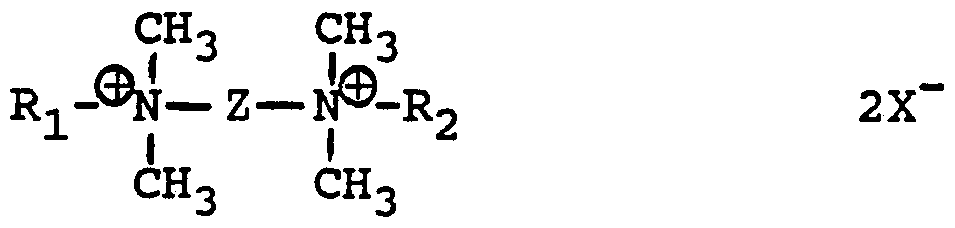
(a) a blend of bis-guaternary ammonium compounds selected from those represented by the formula:
Figure imgf000003_0001
in which Z is —-CH2CΗ20)nCH2CH2- where n is 1 or 2; or
-CH2CH=CH-CH2-; and
R± and R2 are independently C12 or C14-alky1; and
X is a halogen such as Cl, Br or I;
in the weight ratio of about
25% of the compound where both R^. an( R2 are C12-alkyl;
50% of the compound where R^ is C12-alkyl and R2 is C14-alkyl; and
25% of the compound where both R.^ and R2 are C14-alkyl; the stated weight percents being + 20%; and
(b) a copolymer of vinylpyrrolidone and an acrylamido or vinyl quaternary ammonium monomer coprecipitated or in admixture with (a) . Z in the formula can be -^-CH2CH20—,—n and n is 2; and the monomer is an acrylamido quaternary ammonium monomer. These compositions exhibit excellent antibacterial activity, low toxicity, water solubility and a low irritation effect on the skin of the user.
The several bis-quaternary ammonium compounds which comprise the blend composition (a) are made by reacting one mole of a selected dihalo compound selected from:
XCH2CH2OCH2CH2X,
XCH2CH2OCH2CH2OCH2CH2X and
XCH2CH=CHCH2X;
where X is a halide such as Cl, Br and I, with 2 moles of dodecyldimethyl a ine, tetradecyldimethylamine or predetermined mixtures thereof.
A typical reaction is the following:
ClCH2CH2OCH2CH2OCH2CH2Cl (1 mole)
+2C12H25N(CH3)2 ^
Figure imgf000004_0001
Accordingly, a reaction mixture of one mole of dodecyldimethyla ine, one mole of the tetradecyldimethylamine and one mole of the selected dichloro compound will provide the following blend compositions:
BLEND COMPOSITION D Compound A
Figure imgf000005_0001
Compound B
Figure imgf000005_0002
Compound C
Figure imgf000005_0003
BLEND COMPOSITION H
Compound A1
Figure imgf000006_0001
Compound B '
Figure imgf000006_0002
Compound C
Figure imgf000006_0003
BLEND COMPOSITION L
Compound A"
Figure imgf000007_0001
Compound B"
Figure imgf000007_0002
Compound C"
Figure imgf000007_0003
where the stated percentages are + 20%; of course, by varying the relative amounts of starting materials, a blend of different percentages of the individual compounds may be obtained.
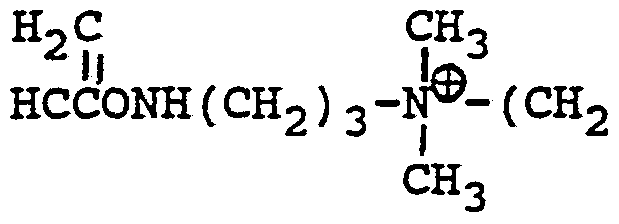
Another way of introducing the quaternary nitrogen into the polymer structure is by using monomers with functionality, either tertiary amine or reactive alkylating groups which are quaternizable. The following vinyl ammonium monomers can be copolymerized with vinyl pyrrolidone by solution polymerization in isopropyl alcohol or by precipitation polymerization in cyclohexane or heptane and under conditions to provide low molecular weight copolymers, i.e. about 10,000 to about 20,000, suitable for coprecipitation or admixture with the blend of bis-quaternary ammonium compounds.
Methacrylamidopropyl Trimethylammonium Chloride (MAPTAC)
Cl
Figure imgf000008_0001
Dodecyldimethylammonium Propyl Methacrylamide Bromide or Iodide Salts
Figure imgf000008_0002
Dodecyldimethylammonium Propyl Acrylamide Bromide or Iodide Salts
)11CH3 I /Br
Figure imgf000008_0003
Dodecyldimethyl (Vinyl Benzyl) Ammonium Chloride
Figure imgf000009_0001
Didecylmethyl (Vinyl Benzyl) Ammonium Chloride
Figure imgf000009_0002
A preferred copolymer is the copolymer of vinylpyrrolidone and MAPTAC, which is known as GAFQUAT® HS-100 resin (ISP) , and is supplied as a 20% aqueous solution.
The coprecipitate product comprising the blend composition and copolymer usually is prepared by reacting predetermined amounts of a dilute aqueous solution of the blend composition and copolymer, usually from 90:10 to 10:90 wt. ratio of each, respectfully, and removing the solvent. The desired coprecipitate is formed as a solid product.
These products exhibit an enhanced antimicrobial activity and reduced toxicity as compared to the individual compounds of the blend composition. Furthermore, they show excellent solubility in water, low toxicity and little irritation for the user. The antimicrobial compositions of the invention may be used as such; however, preferably they are admixed with inert materials as pharmaceutical and cosmetic formulations, e.g. in the form of powders, solutions, lotions, suspensions and the like. Typical inert additives include water, alcohols, starch, and the like. Active ingredients also may be included in the product, if desired.
While the coprecipitate form of the antibacterial product of the invention is favored, admixtures of the blend and copolymer also may be used to prepare commercial compositions.
The antimicrobial activity of the products herein are represented by their Minimum Inhibitory Concentration (MIC) against E.Coli, a Gram negative microorganism. Their effect on skin is indicated by an Irritation Index. These properties are presented in the Table below for the individual compounds in blend D and the invention composition of several D, H and L blend compositions coprecipitated in a 50:50 wt. ratio with with GAFQUAT® HS-100.
TABLE 1
Compound/Composition MIC Irritation Index
A compound in D blend 100
B compound in D blend 50
C compound in D blend 125
D blend Of 25A/50B/25C 10 coprecipitated with GAFQUAT® HS-100 (50:50)
D blend of 40A/20B/40C 20 coprecipitated with GAFQUAT® HS-100 (50:50)
D blend of 33A/33B/33C 20 coprecipitated with GAFQUAT® HS-100 (50:50)
D blend ofl0A/80B/10C 20 coprecipitated with GAFQUAT® HS-100 (50:50)
H blend of 25A-/50B- /25C1 30 coprecipitated with GAFQUAT® HS-100 (50:50)
L blend of 25A"/50BI•/25C,■ 10 coprecipitated with GAFQUAT® HS-100 (50:50)
redness of skin, 1000 ppm active in water, scale of 1 to 10, with 10 being most irritating
The LD50 toxicity of the blend compositions, D, above, with the copolymer, are reduced by a factor of 5-20 as compared to the individual compounds in the blend, as shown in Table 2 below. TABLE 2
Compound/Composition i 5o (g/fo?)
A compound in D blend 0.30 B compound in D blend 0.70 C compound in D blend 0.95 D blend of 25A/50B/25C 5.75 coprecipitated with GAFQUAT® HS-100 (50:50)
H blend of 25AI/50B,/25C 5.25 coprecipitated with GAFQUAT® HS-100 (50:50)
L blend of 25A,,/50B"/25C" coprecipitated with GAFQUAT® HS-100 (50:50) 6.25
Accordingly, the antibacterial activity of the compositions of the invention are up to 12.5 times more favorable than the individual compounds of the blend; the product containing the D blend shows only 1/3 to 1/4 as much irritation to the skin as the H and L blend products, respectively; and the blends are 5-20 less toxic than the individual compounds in the blends.
EXAMPLE 1
Preparation of Bisquat Blend Composition
A reaction solution of: l,2-bis(2-chloroethoxy) ethane 37.5 g. , 0.2 mole;
Dodecyldimethylamine 42.6 g. , 0.2 mole;
Tetradecyldimethylamine 48.4 g., 0.2 mole;
Potassium Iodide 5 g. ; and
Methanol 200 g. , was mixed well and heated to 90-l00°C. for 12 hours. Then the solvent was removed to give a heavy syrupy residue which was treated with acetone to precipitate out the . bis-quats blend composition in a yield of at least 95%. The composition comprised 25% by weight of A, 50% by weight of B and 25% by weight of C, above.
EXAMPLE 2
Preparation of the Coprecipitate Product
90 g. of a 1% by weight aqueous solution of GAFQUAT® HS-100 was mixed with 10 g. of the bis-quat blend of Example 1. Then water was removed under reduced pressure. A solid coprecipitate was formed which analyzed 10% by weight active bis-quat blend, and 50% by weight copolymer.
In other embodiments, the antimicrobial blend composition of bis-quaternary ammonium compounds is selected from those represented by the
Figure imgf000013_0001
in which Z is —f-CH2CH20)nCH2CH2- where n is 1 (H Blend) or 2 (D Blend) ; or
-CH2CH=CH-CH2- (L Blend) ; and
RjL and R are independently C12 or
C14-alkyl;
X~ is a halogen such as Cl, Br or I; and in the weight ratio of about 25% of the compound where both R.^ and R2 are C12-alkyl;
50% of the compound where R.^ is C12-alkyl and R2 is C1 -alkyl; and
25% of the compound where both ^ and 2 are C14-alkyl;
the stated weight percents being + 20%; and, optionally, including polyvinylpyrrolidone (PVP) as a coprecipitate or in admixture therewith.
The blend composition with polyvinylpyrrolidone usually is prepared by reacting a dilute solution of the blend composition in alcohol or water, preferably methanol, with a dilute solution of the bisquat blend composition in the same solvent, and removing the solvent to form the desired coprecipitate solid product. More particularly, the blend coprecipitate compositions of the invention are prepared by refluxing the selected dichloro compound, the amines, and an alkali metal halide, in alcoholic solution, removing the solvent, precipitating the blend of bisquats in an organic solvent in substantially quantitative yield, and reacting a solution of the thus-prepared bisquat in methanol or water with a solution of soluble polyvinylpyrrolidone in the same solvent, and removing the solvent under reduced pressure to form the solid coprecipitate product.
These blend compositions with polyvinylpyrrolidone exhibit an enhanced antimicrobial activity and reduced toxicity as compared to the individual compounds therein. Furthermore, they show excellent solubility in water, and less irritation to the user, as compared to the blend composition itself, that is, without polyvinylpyrrolidone. The antimicrobial compositions of the invention may be used as such, or, preferably, admixed with an inactive or inert component to prepare pharmaceutical formulations such as powders, solutions, lotions, suspensions and the like. Typical additives include water, alcohols, starch, etc. Other active ingredients may be included if desired.
While the coprecipitate form is favored, mixtures of the blend composition and polyvinylpyrrolidone may be used as well.
Typical antimicrobial activities, represented by their Minimum Inhibitory Concentration (MIC) , against E.Coli, a gram negative microorganism, is presented in the Table below for both the individual compounds in blend composition D and the D, H and L blend compositions with polyvinylpyrrolidone at different relative amounts of the compounds therein (as measured in a 10% active solution) .
TABLE 3
Compound or Blend MIC
A compound in D blend 100
C compound in D blend 125
B compound in D blend 50
D coprecipitate of 25A/50B/25C 5 composition with polyvinylpyrrolidone (50:50)
D coprecipitate of 40A/20B/40C 35 composition with polyvinylpyrrolidone (50:50)
D coprecipitate of 33A/33B/33C 30 composition with polyvinylpyrrolidone (50:50)
D coprecipitate oflOA/80B/10C 25 composition with polyvinylpyrrolidone (50:50)
H coprecipitate of 25A»/50B-/25C- 15 composition with polyvinylpyrrolidone (50:50)
L coprecipitate of 25A,,/50B"/25C" 5 composition with polyvinylpyrrolidone (50:50^
The MIC values of the blend-PVP coprecipitate compositions in the TABLE are up to 25 times more favorable than the individual compounds in the blend.
The compositions of the invention also have increased water solubility than blends without PVP.
The LD50 toxicity of the D blend-PVP compositions above also is reduced by a factor of 5-6 as compared to the individual compounds in the blend, furthermore they exhibit a substantially reduced irritation to the skin as compared to the individual compounds or the blend without PVP. EXAMPLE 3
Preparation of Blend D-PVP Composition
1. A reaction solution of: l,2-bis(2-chloroethoxy) ethane 37.5 g. , 0.2 mole; Dodecyldimethylamine 42.6 g., 0.2 mole; Tetradecyldimethylamine 48.4 g. , 0.2 mole; Potassium Iodide 5 g. ; and Methanol 200 g. ,
was mixed well and heated to 90-100°C. for 12 hours. Then the solvent was removed to give a heavy syrupy residue which was treated with acetone to precipitate out the bisquats of the D blend composition in a yield of at least 95%. The blend composition comprised 25% by weight of A, 50% by weight of B and 25% by weight of C compounds.
2. A 10% by weight solution of PVP-CI in methanol was mixed with a 10% solution of the bisquat prepared above in methanol. The solvent then was removed under reduced pressure whereupon a solid coprecipitate was formed which analyzed 50% by weight active D bisquat blend and 50% by weight PVP.
Typical antimicrobial activities, represented by their Minimum Inhibitory Concentration (MIC) against E.Coli, a gram negative microorganism, is presented in the Table below for both the individual compounds in blend composition D and the blend composition itself, with PVP, with different relative amounts of the A, B and C compounds therein (as measured in a 10% active solution) . TABLE 4
Compound or Blend MIC
A compound in D blend 100
B compound in D blend 50
C compound in D blend 125
D blend of 25A/50B/25C composition 5
D blend of 40A/20B/40C composition 35
D blend of 33A/33B/33C composition 30
D blend of 10A/80B/10C composition 25
The MIC values of the D blend compositions in the TABLE are up to 25 times more favorable than the individual compounds in the blend.
The LDtjQ toxicity of the blend composition D (without PVP) above, also is observed to be reduced by a factor of 5-6 as compared to the individual compounds.
Claims

WHAT IS CLAIMED IS:
1. An antimicrobial, low toxicity, non-irritating composition comprising
(a) a blend of bis-quaternary ammonium compounds having the formula:
Figure imgf000019_0001
in which Z is --CH2CH20)nCH2CH2- where n is 1 or 2 ; or
-CH2CH=CH-CH2-; and
R-L and R2 are independently C12 or C14-alkyl; and
X is a halogen such as Cl, Br or I;
in the weight ratio of about
25% by weight of the compound where both R^ and R2 are C12-alkyl;
50% by weight of the compound where R^ is C12-alkyl and R2 is C14-alkyl; and
25% by weight of the compound where both R and R2 are C14-alkyl; the stated weight percents being + 20%; and
(b) a copolymer of polyvinylpyrrolidone and an acrylamido or vinyl quaternary ammonium monomer coprecipitated or in admixture with said blend.
2. A composition according to claim 1 wherein Z is —t_-CH2CH 0)nCH2CH2-, or n is 1 or 2, or Z is -CH2CH=CH-CH2-, or X is Cl or Br, or wherein said weight percentages are + 5-10%, optionally includes an inert component.
3. A composition according to claim 1 wherein said copolymer is coprecipitated with the blend of bis-quaternary ammonium compounds.
4. A composition according to claim 1 wherein (a) and (b) are present in about a 50:50 wt. ratio.
5. A composition according to claim 1 wherein said acrylamido quaternary ammonium monomer is methacrylamidopropyl trimethylammonium chloride.
6. A composition according to claim 1 wherein said acrylamido quaternary ammonium monomer is dodecyldimethylammonium propyl methacrylamide or acrylamide bromide"or iodide.
7. A composition according to claim 1 wherein said vinyl quaternary ammonium monomer is dodecyldimethyl (vinylbenzyl) ammonium chloride or didecylmethyl (vinylbenzyl) ammonium chloride.
8. A composition according to claim 1 wherein (b) is absent.
9. A composition according to claim 1 wherein PVP is substituted for (b) .
PCT/US1992/006695 1991-10-07 1992-08-12 Antimicrobial composition Ceased WO1993007251A1 (en)

Priority Applications (1)

Application Number Priority Date Filing Date Title
EP19920917984 EP0607162A4 (en) 1991-10-07 1992-08-12 ANTI-MICROBIAL COMPOSITION.

Applications Claiming Priority (6)

Application Number Priority Date Filing Date Title
US772,182 1991-10-07
US772,409 1991-10-07
US07/772,182 US5196135A (en) 1991-10-07 1991-10-07 Antimicrobial, low toxicity, blend composition of bis-quaternary ammonium compounds
US07/772,409 US5216030A (en) 1991-10-07 1991-10-07 Antimicrobial, low toxicity, blend composition of bis-quaternary ammonium compounds and polyvinylpyrrolidone
US783,017 1991-10-25
US07/783,017 US5242684A (en) 1991-10-25 1991-10-25 Antimicrobial, low toxicity, non-irritating composition comprising a blend of bis-quaternary ammonium compounds coprecipitated with a copolymer of vinylpyrrolidone and an acrylamido or vinyl quaternary ammonium monomer

Publications (1)

Publication Number Publication Date
WO1993007251A1 true WO1993007251A1 (en) 1993-04-15

Family

ID=27419681

Family Applications (1)

Application Number Title Priority Date Filing Date
PCT/US1992/006695 Ceased WO1993007251A1 (en) 1991-10-07 1992-08-12 Antimicrobial composition

Country Status (4)

Country Link
EP (1) EP0607162A4 (en)
AU (1) AU2461892A (en)
CA (1) CA2120335A1 (en)
WO (1) WO1993007251A1 (en)

Cited By (2)

* Cited by examiner, † Cited by third party
Publication number Priority date Publication date Assignee Title
US5536494A (en) * 1994-10-04 1996-07-16 Alcon Laboratories, Inc. Polyethylene oxide-containing quaternary ammunium polymers and pharmaceutical compositions containing an antimicrobial amount of same
EP0859547A4 (en) * 1995-06-07 2000-12-20 Surmodics Inc COATINGS MAKING VIRUSES INACTIVE

Citations (1)

* Cited by examiner, † Cited by third party
Publication number Priority date Publication date Assignee Title
US5085860A (en) * 1989-11-20 1992-02-04 L'oreal Reducing composition for the permanent deformation of hair containing as a reducing agent, an amino mercaptoalkylamide or a salt thereof

Family Cites Families (4)

* Cited by examiner, † Cited by third party
Publication number Priority date Publication date Assignee Title
US2194906A (en) * 1936-04-11 1940-03-26 Ig Farbenindustrie Ag Nitrogenous condensation product and process of producing same
US2933529A (en) * 1956-01-09 1960-04-19 Rohm & Haas Symmetrical diquaternary ammonium compounds
CH409985A (en) * 1961-11-03 1966-03-31 Robapharm Ag Process for the preparation of new heterocyclic ammonium compounds
US3525793A (en) * 1969-06-30 1970-08-25 Millmaster Onyx Corp Microbiocidal quaternary ammonium compounds containing synergistic blends of alkyl groups

Patent Citations (1)

* Cited by examiner, † Cited by third party
Publication number Priority date Publication date Assignee Title
US5085860A (en) * 1989-11-20 1992-02-04 L'oreal Reducing composition for the permanent deformation of hair containing as a reducing agent, an amino mercaptoalkylamide or a salt thereof

Non-Patent Citations (3)

* Cited by examiner, † Cited by third party
Title
DEVINSKY et al., 41 Chemical Papers 803 (1987), see p. 803-14. *
Disinfectants, Sterilization and Preservatives, 1991, JOHN L. MERIANOS, "Quaternary Ammonium Antimicrobial Compounds", pp. 225-52, see pp. 230. *
See also references of EP0607162A4 *

Cited By (2)

* Cited by examiner, † Cited by third party
Publication number Priority date Publication date Assignee Title
US5536494A (en) * 1994-10-04 1996-07-16 Alcon Laboratories, Inc. Polyethylene oxide-containing quaternary ammunium polymers and pharmaceutical compositions containing an antimicrobial amount of same
EP0859547A4 (en) * 1995-06-07 2000-12-20 Surmodics Inc COATINGS MAKING VIRUSES INACTIVE

Also Published As

Publication number Publication date
EP0607162A1 (en) 1994-07-27
AU2461892A (en) 1993-05-03
CA2120335A1 (en) 1993-04-15
EP0607162A4 (en) 1994-11-17

Similar Documents

Publication Publication Date Title
CA2247375C (en) Synergistic antimicrobial compositions containing an ionene polymer and a salt of dodecylamine and methods of using the same
EP0200903B1 (en) Polymeric antibacterial compositions
JP2828291B2 (en) Low volatile salts
EP2325218A1 (en) Antimicrobial copolymers and uses thereof
AU689647B2 (en) Use of polyethylene oxide-containing polymeric quaternary ammonium compounds in pharmaceutical compositions
US5683709A (en) Poly(benzalkonium salt) as an anti-microbial agent for aqueous drug compositions
HU202180B (en) Process for producing 3,6-dichloro-2-methoxybenzoic acid salt
CA1072008A (en) Mixtures having antimicrobial or pesticidal effect
CA1106277A (en) Microbiocidal agents on the basis of alkyl- diguanidinium salts
DE2438035A1 (en) BIOCIDAL COMPOSITIONS
WO1991000082A2 (en) Antimicrobial polymeric bisbiguanides
US5512597A (en) Polymeric quaternary ammonium compounds and their use as ophthalmic antimicrobials
JPH0127045B2 (en)
CA2019979A1 (en) Antimicrobial polymeric bisbiguanides
US20130289011A1 (en) Antibacterial dispersion
EP0607162A4 (en) ANTI-MICROBIAL COMPOSITION.
US5196135A (en) Antimicrobial, low toxicity, blend composition of bis-quaternary ammonium compounds
US4444750A (en) Method of conditioning hair
Jones et al. p‐Vinylbenzyltrialkyl ammonium salts in vinyl polymerization
US4267281A (en) Controlled release pesticides
US20020006888A1 (en) Novel quaternary ammonium salt and process for the preparation thereof
KR0137407B1 (en) N, N-dialkylaminoalkyl (meth) acrylamide composition with improved storage
Ranucci et al. New quaternary ammonium polymers as antimicrobial agents. Part II. Alkylation products of linear aliphatic poly (aminodisulphides)
RU2272045C1 (en) Polydiallylamines and disinfecting agent comprising thereof
US5948882A (en) Film forming antiperspirant polymers

Legal Events

Date Code Title Description
AK Designated states

Kind code of ref document: A1

Designated state(s): AU CA JP KR

AL Designated countries for regional patents

Kind code of ref document: A1

Designated state(s): AT BE CH DE DK ES FR GB GR IE IT LU MC NL SE

WWE Wipo information: entry into national phase

Ref document number: 2120335

Country of ref document: CA

WWE Wipo information: entry into national phase

Ref document number: 1992917984

Country of ref document: EP

WWP Wipo information: published in national office

Ref document number: 1992917984

Country of ref document: EP

WWW Wipo information: withdrawn in national office

Ref document number: 1992917984

Country of ref document: EP