WO1993020056A1 - Melamine derivatives for use in the treatment of cancer - Google Patents

Melamine derivatives for use in the treatment of cancer Download PDF

Info

Publication number
WO1993020056A1
WO1993020056A1 PCT/GB1993/000625 GB9300625W WO9320056A1 WO 1993020056 A1 WO1993020056 A1 WO 1993020056A1 GB 9300625 W GB9300625 W GB 9300625W WO 9320056 A1 WO9320056 A1 WO 9320056A1
Authority
WO
WIPO (PCT)
Prior art keywords
compound
treatment
cancer
formula
compounds
Prior art date
Legal status (The legal status is an assumption and is not a legal conclusion. Google has not performed a legal analysis and makes no representation as to the accuracy of the status listed.)
Ceased
Application number
PCT/GB1993/000625
Other languages
French (fr)
Inventor
Michael Jarman
Helen Mary Coley
Current Assignee (The listed assignees may be inaccurate. Google has not performed a legal analysis and makes no representation or warranty as to the accuracy of the list.)
Individual
Original Assignee
Individual
Priority date (The priority date is an assumption and is not a legal conclusion. Google has not performed a legal analysis and makes no representation as to the accuracy of the date listed.)
Filing date
Publication date
Application filed by Individual filed Critical Individual
Priority to EP93907928A priority Critical patent/EP0632805B1/en
Priority to DK93907928T priority patent/DK0632805T3/en
Priority to US08/313,071 priority patent/US5534625A/en
Priority to AU38942/93A priority patent/AU676677B2/en
Priority to DE69319590T priority patent/DE69319590T2/en
Priority to JP5517201A priority patent/JPH07505380A/en
Publication of WO1993020056A1 publication Critical patent/WO1993020056A1/en
Anticipated expiration legal-status Critical
Priority to US08/631,659 priority patent/US5854244A/en
Ceased legal-status Critical Current

Links

Classifications

    • CCHEMISTRY; METALLURGY
    • C07ORGANIC CHEMISTRY
    • C07DHETEROCYCLIC COMPOUNDS
    • C07D251/00Heterocyclic compounds containing 1,3,5-triazine rings
    • C07D251/02Heterocyclic compounds containing 1,3,5-triazine rings not condensed with other rings
    • C07D251/12Heterocyclic compounds containing 1,3,5-triazine rings not condensed with other rings having three double bonds between ring members or between ring members and non-ring members
    • C07D251/26Heterocyclic compounds containing 1,3,5-triazine rings not condensed with other rings having three double bonds between ring members or between ring members and non-ring members with only hetero atoms directly attached to ring carbon atoms
    • C07D251/40Nitrogen atoms
    • C07D251/54Three nitrogen atoms
    • C07D251/70Other substituted melamines
    • AHUMAN NECESSITIES
    • A61MEDICAL OR VETERINARY SCIENCE; HYGIENE
    • A61PSPECIFIC THERAPEUTIC ACTIVITY OF CHEMICAL COMPOUNDS OR MEDICINAL PREPARATIONS
    • A61P35/00Antineoplastic agents

Definitions

  • This invention relates to novel 2,4,6-triamino-l,3,5-triazines, compositions containing them, processes for making them and their use in the treatment of carcinomas, particularly ovarian carcinomas.
  • Trimelamol 2,4,6-tris ⁇ (hydroxymethyl) (methyl) amino)-l,3,5-triazine
  • Trimelamol is clinically active, particularly against ovarian carcinomas, but its clinical development has been halted due to difficulties with formulation due to instability with respect to the formation of dimers during formulation. It has been established that the half-life of trimelamol activity in humans is short and that may limit its clinical efficacy (I.R. Judson, et al Cancer Res. 49, 5475-5479, 1989). We believe that this is, in part, due to the chemical instability of the N- hydroxymethyl functions resulting in the release of formaldehyde.
  • each R 1 which may be the same or different, is hydrogen, alkyl or an electron- withdrawing group and R 2 is hydrogen, alkyl or an electron-withdrawing organic group.
  • R 1 is hydrogen, alkyl or an electron- withdrawing group
  • R 2 is hydrogen, alkyl or an electron-withdrawing organic group.
  • all three groups R 1 are not hydrogen.
  • the alkyl group R 1 and/or R 2 is preferably a C r C 4 alkyl group, particularly methyl and it is preferred that all three R 1 groups, when alkyl, are all methyl.
  • Preferred electron-withdrawing organic groups are -CH 2 CF 3 and -CH 2 C ⁇ CH. Because of the greater stability conferred on such compounds by the presence of such electron withdrawing substituents, which may constitute in lengthening the half-life and also in improving amenability to formulation, they may be prepared by allowing tris-hydroxymethyl compounds or precursors thereof to decompose in aqueous organic media and separating from the mixture of products (see Fig. 1) thus generated the appropriate compounds of the present invention, for example by chromatography on silica gel.
  • trimelamol have a similar level of activity against carcinomas, particularly ovarian carcinomas, as trimelamol, but are more stable and do not form dimers and polymers and thus are more amenable to formulation.
  • the intermediates are prepared by reacting a cyanuric halide of general formula: wherein X is fiuoro or chloro with an amine of the formula R'-NH 2 or R 1 R 2 NH 2 , wherein R 1 and R 2 are as defined in formula (I), optionally in the presence of caesium fluoride.
  • the presence of these compounds does not significantly affect the activity of the preparation of the compound of the invention in biological assays.
  • the purity of the preparation may be increased by recrystallisation.
  • the material may be dissolved in methanol-water (eg at a ratio of 9:1), and recrystallised.
  • the compounds of this invention are biologically active and are of use against ovarian carcinomas, particularly against cisplatin-resistant ovarian carcinomas.
  • compositions which comprise, as active ingredient, at least one compound of general formula I, in association with a pharmaceutically acceptable carrier or diluent.
  • compositions for parenteral adinimstration will normally be solutions in aqueous saline, which is pyrogen free for human use. Such compositions can be administered intravenously or intraperitoneally.
  • compositions for oral administration will mostly be in solid or liquid form, mostly as tablets, capsules, lozenges, etc.
  • Liquid compositions can be solutions or dispersions in aqueous or non-aqueous media. Ideal solutions are of neutral or alkaline pH and of low ionic strength e.g. 5% dextrose.
  • Suitable daily doses of the compounds of the invention in therapeutic treatment of the human or animal body range from about lOOmg to 3g/m 2 body-surface.
  • HPLC analysis were stored in a water batii at 21°-24°C (to simulate room temperamre) or at 37°C in water, 0.9% NaCl or 5% dextrose. Aliquots were removed from each preparation at intervals to assess their stability (i.e. half-life, T 1/2 ) which was measured using HPLC analysis. This entailed an isocratic elution using a mobile phase comprising 10% acetonitrile, 90% 0.05M ammonium bicarbonate. The 15 cm column was packed with C8 octyl Spherisorb material. The column was encased in a cooling cabinet which was maintained at 14-17°C. Standards of freshly prepared solutions were run throughout the analysis period by way of controls.
  • T 1 2 measurements were made by measurement of the disappearance of compound by decreasing peak area with time, using a Data System 450MT2 data acquisition system (Kontron Instruments, Watford, UK) linked directly to the detector on the HPLC system (set at 225 nM). T , 2 measurements were read from a semi-logarithmic plot of peak area (y) versus time (x).
  • the cytotoxicity of CB7646 and CB7683 was compared with trimelamol against mammalian tumour cell lines using the MTT assay.
  • This assay is based upon the selective ability of living but not dead cells to reduce the tetrazolium salt MTT (3-[4,5-dimethylthiazol-2-yl]-25- diphenyl tetrazolium bromide) to purple formazan (Mosmann et al, 1983, J. Immun. Methods 65; 55-63; Carmichael et al (1987) Cancer Res. £7; 936-942).
  • Cell lines were grown in culture with continual drug exposure.
  • the ICs, values (in ⁇ m) of the compounds i.e. concentration giving 50% inhibition of cell growth as compared with untreated control) were determined, and are shown in Table 2.
  • Figures in parenthesis refer to standard deviation or +/- values for 2 or more measurements.
  • Example 6 was repeated to obtain more precise LD 50 values.
  • the LD 50 , EDo n and T.I. values were calculated and shown in Table 4.

Landscapes

  • Chemical & Material Sciences (AREA)
  • Organic Chemistry (AREA)
  • Health & Medical Sciences (AREA)
  • General Chemical & Material Sciences (AREA)
  • Medicinal Chemistry (AREA)
  • Nuclear Medicine, Radiotherapy & Molecular Imaging (AREA)
  • Chemical Kinetics & Catalysis (AREA)
  • Pharmacology & Pharmacy (AREA)
  • Life Sciences & Earth Sciences (AREA)
  • Animal Behavior & Ethology (AREA)
  • General Health & Medical Sciences (AREA)
  • Public Health (AREA)
  • Veterinary Medicine (AREA)
  • Pharmaceuticals Containing Other Organic And Inorganic Compounds (AREA)

Abstract

The present invention provides compounds of general formula (I) wherein each R1, which may be the same or different, is hydrogen, alkyl or an electron withdrawing group, R2 is hydrogen, alkyl or an electron withdrawing organic group. The compounds are analogues of trimelamol which have comparable activity but enhanced stability, and are useful as anticancer agents, particularly against ovarian carcinomas.

Description

Mel ami ne derivatives for use 1n the treatment of cancer
This invention relates to novel 2,4,6-triamino-l,3,5-triazines, compositions containing them, processes for making them and their use in the treatment of carcinomas, particularly ovarian carcinomas.
Trimelamol [2,4,6-tris{(hydroxymethyl) (methyl) amino)-l,3,5-triazine] is clinically active, particularly against ovarian carcinomas, but its clinical development has been halted due to difficulties with formulation due to instability with respect to the formation of dimers during formulation. It has been established that the half-life of trimelamol activity in humans is short and that may limit its clinical efficacy (I.R. Judson, et al Cancer Res. 49, 5475-5479, 1989). We believe that this is, in part, due to the chemical instability of the N- hydroxymethyl functions resulting in the release of formaldehyde. We have investigated reducing the number of N-hydroxymethyl functions and stabilizing these functions using electron-withdrawing organic groups (defined in the present context as electron-withdrawing relative to methyl), with a view to lengthening the half-life and also improving amenability to formulation, for example in aqueous solutions.
Accordingly this invention provides novel 2,4, 6-triammo-l,3,5-triazines having the following general formula:
Figure imgf000003_0001
wherein each R1 which may be the same or different, is hydrogen, alkyl or an electron- withdrawing group and R2 is hydrogen, alkyl or an electron-withdrawing organic group. Preferably, all three groups R1 are not hydrogen. The alkyl group R1 and/or R2 is preferably a CrC4 alkyl group, particularly methyl and it is preferred that all three R1 groups, when alkyl, are all methyl.
Preferred electron-withdrawing organic groups are -CH2CF3 and -CH2C≡CH. Because of the greater stability conferred on such compounds by the presence of such electron withdrawing substituents, which may constitute in lengthening the half-life and also in improving amenability to formulation, they may be prepared by allowing tris-hydroxymethyl compounds or precursors thereof to decompose in aqueous organic media and separating from the mixture of products (see Fig. 1) thus generated the appropriate compounds of the present invention, for example by chromatography on silica gel.
We have found that these new analogues of trimelamol have a similar level of activity against carcinomas, particularly ovarian carcinomas, as trimelamol, but are more stable and do not form dimers and polymers and thus are more amenable to formulation.
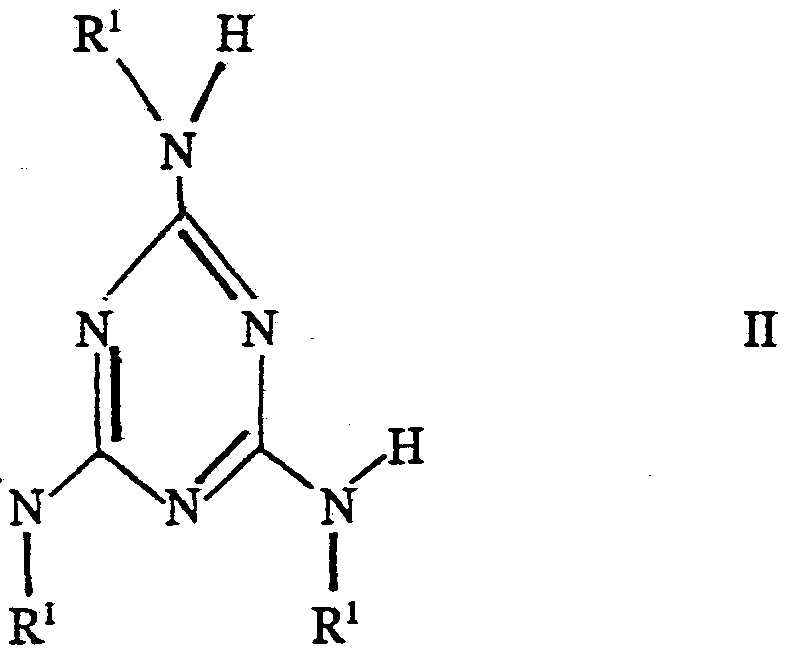
The compounds of the present invention are also prepared via novel intermediate compounds of the general formula:
R1 H
Figure imgf000004_0001
R1 R1
wherein R1 and R2 are as defined above for the formula I
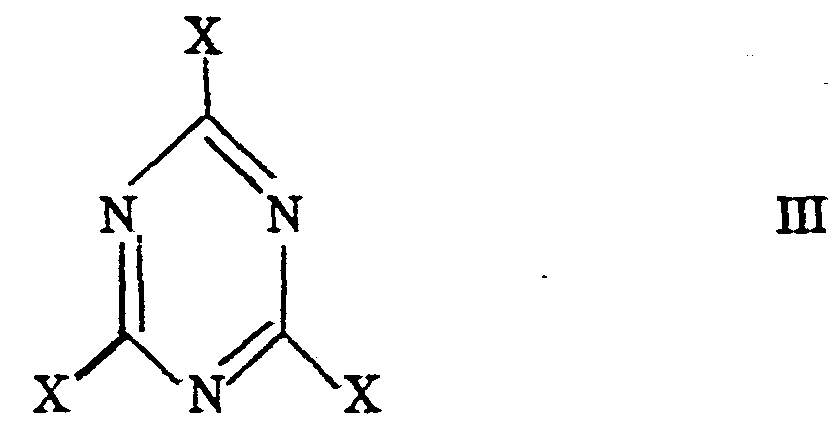
The intermediates are prepared by reacting a cyanuric halide of general formula:
Figure imgf000005_0001
wherein X is fiuoro or chloro with an amine of the formula R'-NH2 or R1R2NH2, wherein R1 and R2 are as defined in formula (I), optionally in the presence of caesium fluoride.
In the absence of caesium fluoride, less than three of the substituents on the 1,3,5-triazine ring may be displaced, which allows for the preparation of asymmetrical compounds.
Treatment of the intermediates II with aqueous formaldehyde, optionally in the presence of potassium carbonate, gives the compounds of formula (I). In order to provide compounds of the formula I in which R1 is methyl and R2 is hydrogen, starting from compounds of the formula II in which R1 and R2 are also methyl and hydrogen respectively, we prefer to use a concentration of formaldehyde of from about 2 to 5% (w/v), for example about 3% (w/v). This provides a final product which contains as the major product the compound of the formula I. A small amount of the corresponding trimelamol (i.e. R-=methyl, R2=CH2OH) and 'monomelamol' (i.e. three methyls but only one hydroxymethyl group) compounds will be produced. The presence of these compounds does not significantly affect the activity of the preparation of the compound of the invention in biological assays. However, if desired, the purity of the preparation may be increased by recrystallisation. For example, the material may be dissolved in methanol-water (eg at a ratio of 9:1), and recrystallised.
The compounds of this invention are biologically active and are of use against ovarian carcinomas, particularly against cisplatin-resistant ovarian carcinomas.
Also included within the scope of the present invention are pharmaceutical compositions which comprise, as active ingredient, at least one compound of general formula I, in association with a pharmaceutically acceptable carrier or diluent.
The compounds of the invention will normally be administered orally or by injection. Compositions for parenteral adinimstration will normally be solutions in aqueous saline, which is pyrogen free for human use. Such compositions can be administered intravenously or intraperitoneally.
Compositions for oral administration will mostly be in solid or liquid form, mostly as tablets, capsules, lozenges, etc. Liquid compositions can be solutions or dispersions in aqueous or non-aqueous media. Ideal solutions are of neutral or alkaline pH and of low ionic strength e.g. 5% dextrose.
Suitable daily doses of the compounds of the invention in therapeutic treatment of the human or animal body range from about lOOmg to 3g/m2 body-surface.
The following Examples illustrate the preparation of the compounds of the present invention.
Example 1
2.4-Bisr(nv roxymethyl) (methyl) amino1-6-methylamino-1.3.5-triazine
To a 3 % w/v aqueous solution of formaldehyde (15 ml) was added potassium carbonate (691 mg, 5 mmol) then
Figure imgf000007_0001
(841 mg, 5 mmol). The reaction mixture was stirred at room temperature until the initially clear solution (pH 11.5) became cloudy (2-3 h) then set aside overnight (16 h). The white granular solid which separated was recovered by filtration, washed with water (4 x 5 ml) and the product dried in vacuo over anhydrous CaCl2. Yield 593 mg (52%); Η-NMR spectrum δH
Figure imgf000007_0002
2.75 (app d, 3, HNCJfc), 4.99 (br s, 4, HOCHj), 5.36 (br s, 2, OH) 6.61 (br s, 1, NH); mass spectrum (FAB; glycerol/thioglycerol matrix) m/z 229 ([M+H]+, 70%), 211 (229-H2O, 100%), 199 (229- CH2O, 35%), 181 (199-H2O, 50%), 169 (199-CH2O, 30%). Anal. C8H16N6O2 requires C, 42.10; H, 7.07; N, 36.82: found C, 41.87; H, 7.01; N, 36.55%.
In the Examples which follow, this compound is referred to as CB7646.
Example 2
Further purification of title compound of Example 1.
Using the procedures described in Example 1 above, but with 10 times the amount of starting materials, 6.325 g of product was obtained. HPLC analysis revealed the preparation to have the following composition: title compound: 65%, trimelamol 22%, monohydroxymethyl derivative 12%.
This material (3 g) was dissolved in methanol-water, 9:1 (100 ml) at 37°C and cooled at - 20°C for 24 h. The white crystalline solid was recovered by rapid filtration and dried in vacuo over anhydrous CaCl2 to give 1.37 g of material having the following composition: title compound 87% trimelamol 4%, monohydroxymethyl derivative 9%. Signals in the Η-NMR spectrum (D2O, determined at 37°C) were: title compound δ 3.08 (HNCH3), 3.30
Figure imgf000008_0001
5.29 (HOCH-,): trimelamol 3.33 and 5.32; monohydroxymethyl derivative 3.05, 3.27 and 5.26.
Example 3
2.4-Bfcrflιvdroχymethviy2.2.2-ιrtfluor^^ triazine
A solution of 2-[([hydroxymethoxy]methyl)(2,2,2-trifIuoroethyl)amino]-4,6-bis (hydroxymethyl) (2,2,2-trifluoroethyl) amino-l,3,5-triazine(500 mg, 1.02 mmol) in a mixture of acetone (3 ml) and water (2 ml) was set aside at room temperature for 18 h. Acetone was removed under vacuum and the organic materials were extracted with diethyl ether.
The organic phase was concentrated and applied to a column (50 g, 3 cm dia.) of silica gel (Merck, Art. No. 9385) which was eluted with diethyl ether. There was successively eluted 2-[0ιydroxymemyI)(2,2,2-trifluoroeΛyl)aπιino]-4,6-bis [2,2,2-trifiuoroethyl)amino]-l,3,5- triazine (23 mg), the title compound (144 mg, 33% yield) and 2,4,6-tris [(hydroxymethyl) (2,2,2-trifluoroethyl) amino] 1,3,5-triazine (111 mg). The title compound is obtained as a white solid by trituration of the appropriate fractions with ice-cold water, recovery by filtration and desiccation in vacuo over calcium chloride. NMR spectrum: δH (Me2SO-dβ) 4.09 (brq, 2, F3CCI NH), 4.41 (brq, 4, F^d^NCH.OH) 5.06 (d, 4, J=7.1Hz, CKflR), 5.78 (brs, 2, OH), 7.80 (brs, 1, NH). δr70.23, -70.03 (2s, 3, F3CCH2NH) -68.3 (s, 6, F3CCH2NCH2OH).
In the Examples which follow, this compound is referred to as CB7683.
Example 4
Stability of Compounds of the invention.
(ϊ) Stability in solution.
Compounds were dissolved in DMSO to a concentration of 50mM. Aliquots were then dispersed into the appropriate medium to give a final concentration of 100μM in a volume of about 10ml. The diluted preparations of trimelamol and CB7646 (see Example 1) for _ _
HPLC analysis were stored in a water batii at 21°-24°C (to simulate room temperamre) or at 37°C in water, 0.9% NaCl or 5% dextrose. Aliquots were removed from each preparation at intervals to assess their stability (i.e. half-life, T1/2) which was measured using HPLC analysis. This entailed an isocratic elution using a mobile phase comprising 10% acetonitrile, 90% 0.05M ammonium bicarbonate. The 15 cm column was packed with C8 octyl Spherisorb material. The column was encased in a cooling cabinet which was maintained at 14-17°C. Standards of freshly prepared solutions were run throughout the analysis period by way of controls.
T1 2 measurements were made by measurement of the disappearance of compound by decreasing peak area with time, using a Data System 450MT2 data acquisition system (Kontron Instruments, Watford, UK) linked directly to the detector on the HPLC system (set at 225 nM). T, 2 measurements were read from a semi-logarithmic plot of peak area (y) versus time (x).
The results are shown in table 1 and indicate that CB7646 has superior stability.
TABLE 1
(if) Dimer/polvmer formation in solution.
An aqueous solution of CB7646 and trimelamol in 4ml aliquots at a concentration of 4-5 mg ml was left to stand overnight (14-16 hours) at room temperature. By the end of this period, the trimelamol solution had formed a heavy precipitate, indicative of dimer and polymer formation. Similar polymerisation of trimelamol over a period of time proved problematic during its Phase I and II clinical trials (Judson et al, 1989, Cancer Res. 49;5475- 5479; Judson et al, 1991, Br. J. Cancer 63; 311-313). In contrast, preparations of CB7646 prepared in Examples 1 and 2 did not form a precipitate, indicating the monomeric form is more stable that trimelamol.
Example 5
Cvtotoxicitv of Compounds of the Invention
The cytotoxicity of CB7646 and CB7683 was compared with trimelamol against mammalian tumour cell lines using the MTT assay. This assay is based upon the selective ability of living but not dead cells to reduce the tetrazolium salt MTT (3-[4,5-dimethylthiazol-2-yl]-25- diphenyl tetrazolium bromide) to purple formazan (Mosmann et al, 1983, J. Immun. Methods 65; 55-63; Carmichael et al (1987) Cancer Res. £7; 936-942). Cell lines were grown in culture with continual drug exposure. The ICs, values (in μm) of the compounds (i.e. concentration giving 50% inhibition of cell growth as compared with untreated control) were determined, and are shown in Table 2. Figures in parenthesis refer to standard deviation or +/- values for 2 or more measurements.
TABLE 2
Figure imgf000011_0001
Cell lines used:
PC6- murine plasmacytoma
Walker 256- rat mammary carcinoma
H69 - human small cell lung cancer
CHI, 41M- human epithelial ovarian cancer
The tests on Walker 256 and H69 cells were repeated using a preparation of CB7646 prepared by the recrystallisation method of Example 2. The results were:
Walker 256 - 10.5
H69 - 16.5
Example 6
Antitumour Activity Towards the ADJ/PC6 Tumour in Mice
The anti-tumour activity of CB 7646 prepared in accordance with Example 1 against ADJ/PC6 tumour in mice were compared with that of trimelamol. An implant of 1mm3 of tumour was made on day 1. On day 20, animals bearing tumours of comparative size were placed into groups of 4 and treated with drug on 5 consecutive days, and then left until day 30. Tumours from the σeated and controls were dissected and weighed as a measure of tumour growth. Compounds were given in 5% DMSO/dextrose. TABLE 3
% Inhibition at various Doses fTumour wt as % of Control Value)
Figure imgf000012_0001
For CB7646 (dimelamol) the results give LD^ > lOOmg/kg, EDgo 74mg/kg Therapeutic Index (IT) > 1.4
Example 7
Example 6 was repeated to obtain more precise LD50 values. The LD50, EDon and T.I. values were calculated and shown in Table 4.
TABLE 4
Figure imgf000012_0002
Example 8
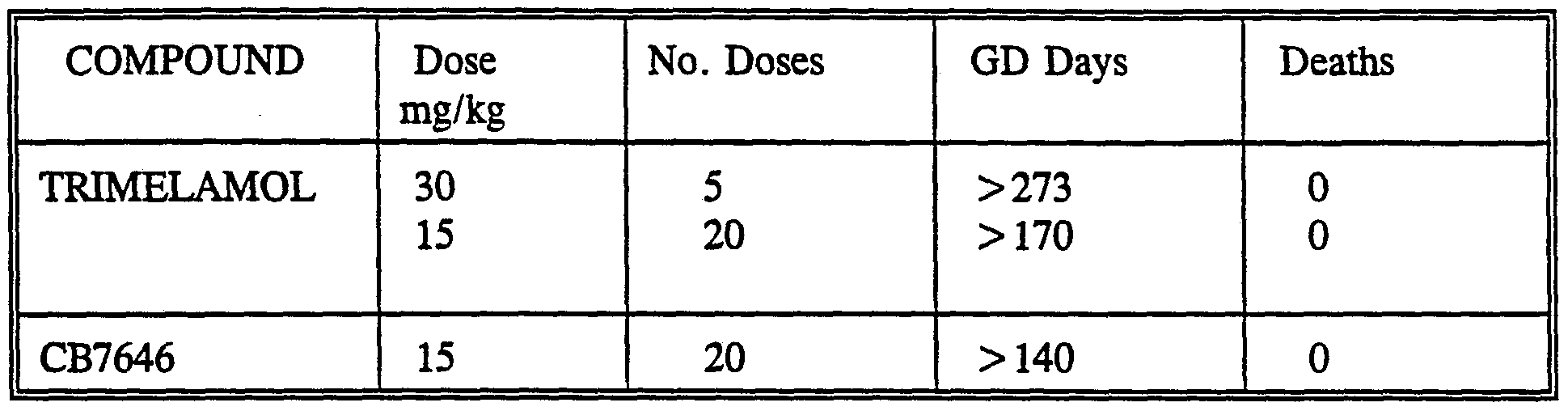
CB7646 was tested in vivo against ovarian cancer xenografts of the PXN65 cell line transplanted into mice, substantially in accordance with Harrap et al, Annals of Oncology, 1990, l;65-76. PXN65 is a cisplatin-sensitive line. Mice treated with either trimelamol or CB7646 showed tumour regression within 28 days whereas in untreated controls tumour growth was uncontrolled, leading to death. The results are summarised in Table 5. TABLE 5
Activity in vivo against PXN65 Xenografts
Figure imgf000013_0001
GD = Growth delay.
The data show that CB7646 has a comparable efficacy to trimelamol.

Claims

_ _CLAIMS
1. A compound of general formula:
Figure imgf000014_0001
wherein each R1, which may be the same or different, is hydrogen, alkyl or an electron withdrawing group, R2 is hydrogen, alkyl or an electron withdrawing organic group.
2. A compound according to claim 1 wherein each R1 is methyl and R2 is H.
3. A compound according to claim 1 wherein the electron-withdrawing organic groups is CF3CH2- or -CH2C≡CH.
4. A compound of general formula:
Figure imgf000014_0003
Figure imgf000014_0002
wherein R1 and R2 are as defined in claim 1.
5. A compound according to claim 1 , 2 or 3 for use in a method of treatment of the human or animal body by therapy practised on the human or animal body.
6. A compound according to claim 1, 2 or 3 for use in a method of treatment of cisplatin-resistant ovarian cancer.
7. A pharmaceutical composition comprising an active ingredient which is a compound as defined in claim 1, 2 or 3, together with an inert diluent or carrier.
8. Use of a compound as defined in any one of claims 1, 2 or 3 in the manufacture of a medicament for the treatment of cancer.
9. A process for the preparation of a compound of formula I as defined in any one of claims 1 to 3 which comprises reacting a compound of formula II as defined in claim 4 with formaldehyde, optionally in the presence of potassium carbonate.
10. A process according to claim 9 wherein the formaldehyde is used at a concentration of from 2 to 5% (w/v).
11. A process according to claim 9 or 10 which further comprises a recrystallisation step.
12. A process for the preparation of a compound as defined in claim 4 which comprises reacting a cyanuric halide of general formula:
Figure imgf000016_0001
wherein X is fluoro or chloro with an anύne of the formula R-NH2 or R R2NH2 wherein R1 and R2 are as defined in claim
1, optionally in the presence of caesium fluoride.
13. A process according to claim 12 wherein the cyanuric halide is treated consecutively with two different amines.
14. A method of treatment of cancer which comprises administering to a patient in need of treatment an effective amount of a compound according to claim 1, 2 or 3 or a composition according to claim 7.
PCT/GB1993/000625 1992-03-27 1993-03-26 Melamine derivatives for use in the treatment of cancer Ceased WO1993020056A1 (en)

Priority Applications (7)

Application Number Priority Date Filing Date Title
EP93907928A EP0632805B1 (en) 1992-03-27 1993-03-26 Melamine derivatives for use in the treatment of cancer
DK93907928T DK0632805T3 (en) 1992-03-27 1993-03-26 Melamine derivatives for use in the treatment of cancer
US08/313,071 US5534625A (en) 1992-03-27 1993-03-26 Melamine derivatives for use in the treatment of cancer
AU38942/93A AU676677B2 (en) 1992-03-27 1993-03-26 Melamine derivatives for use in the treatment of cancer
DE69319590T DE69319590T2 (en) 1992-03-27 1993-03-26 MELAMINE DERIVATIVES FOR USE IN TREATING CANCER
JP5517201A JPH07505380A (en) 1992-03-27 1993-03-26 Melamine derivatives for use in cancer treatment
US08/631,659 US5854244A (en) 1992-03-27 1996-04-02 Melamine derivatives for use in the treatment of cancer

Applications Claiming Priority (2)

Application Number Priority Date Filing Date Title
GB929206768A GB9206768D0 (en) 1992-03-27 1992-03-27 New compounds for use in the treatment of cancer
GB9206768.5 1992-03-27

Publications (1)

Publication Number Publication Date
WO1993020056A1 true WO1993020056A1 (en) 1993-10-14

Family

ID=10713003

Family Applications (1)

Application Number Title Priority Date Filing Date
PCT/GB1993/000625 Ceased WO1993020056A1 (en) 1992-03-27 1993-03-26 Melamine derivatives for use in the treatment of cancer

Country Status (10)

Country Link
US (2) US5534625A (en)
EP (1) EP0632805B1 (en)
JP (1) JPH07505380A (en)
AT (1) ATE168105T1 (en)
AU (1) AU676677B2 (en)
DE (1) DE69319590T2 (en)
DK (1) DK0632805T3 (en)
ES (1) ES2118945T3 (en)
GB (1) GB9206768D0 (en)
WO (1) WO1993020056A1 (en)

Cited By (10)

* Cited by examiner, † Cited by third party
Publication number Priority date Publication date Assignee Title
WO1999036410A1 (en) * 1998-01-13 1999-07-22 Scriptgen Pharmaceuticals, Inc. Triazine antiviral compounds
WO2000078738A1 (en) * 1999-06-23 2000-12-28 Parker Hughes Institute Melamine derivatives as potent anti-cancer agents
FR2801588A1 (en) * 1999-11-29 2001-06-01 Aventis Pharma Sa Diarylamino diazine and triazine derivatives are telomerase inhibitors and G-quadruplex stabilizers, useful in the treatment of cancers
WO2001040218A1 (en) * 1999-11-29 2001-06-07 Aventis Pharma S.A. Arylamine derivatives and their use as anti-telomerase agent
US6335339B1 (en) 1998-01-13 2002-01-01 Scriptgen Pharmaceuticals, Inc. Triazine antiviral compounds
FR2819255A1 (en) * 2001-01-09 2002-07-12 Aventis Pharma Sa CHEMICAL DERIVATIVES AND THEIR APPLICATION AS ANTITELOMERASE AGENT
FR2822468A1 (en) * 2001-03-23 2002-09-27 Aventis Pharma Sa New arylamino-substituted triazine or diazine derivatives, used as telomerase inhibiting anticancer agents, by fixing the G-quadruplex structure of DNA or RNA
WO2002076975A1 (en) * 2001-03-23 2002-10-03 Aventis Pharma S.A. Chemical derivatives and their use as anti-telomerase agent
US6858608B2 (en) 2001-01-09 2005-02-22 Aventis Pharma S.A. Chemical derivatives and their application as antitelomerase agents
US7482352B2 (en) 2001-03-23 2009-01-27 Aventis Pharma S.A. Chemical derivatives and their application as antitelomerase agents

Families Citing this family (5)

* Cited by examiner, † Cited by third party
Publication number Priority date Publication date Assignee Title
JPH0787424B2 (en) * 1993-06-30 1995-09-20 日本電気株式会社 Burst signal transmission system
CA2241525A1 (en) * 1995-12-27 1997-07-10 Nissan Chemical Industries, Ltd. Methods for modifying 1,3,5-triazine derivatives
US6645964B1 (en) * 1999-11-29 2003-11-11 Aventis Pharma S.A. Chemical derivatives and their application as antitelomerase agent
US20070232572A1 (en) * 2003-02-07 2007-10-04 Aventis Pharma S.A. Chemical derivatives as antitelomerase agents which bind specifically to the G-quadruplex DNA structures and their application as a specific anticancer agent
CN101684115B (en) * 2008-09-26 2011-12-21 上海医药工业研究院 4-(5-((2-(4-morpholinyl-6-phenylamino group-1,3,5-triazine-2-base) hydrazono) methyl) furan-2-base) benzoic acid, preparing method and application thereof

Citations (1)

* Cited by examiner, † Cited by third party
Publication number Priority date Publication date Assignee Title
EP0505220A1 (en) * 1991-03-22 1992-09-23 JARMAN, Michael New compounds for use in the treatment of cancer

Family Cites Families (10)

* Cited by examiner, † Cited by third party
Publication number Priority date Publication date Assignee Title
US2566225A (en) * 1951-08-28 Process for preparing substituted
US2476548A (en) * 1949-07-19 Preparation of triazinfliufitmlts
US2420157A (en) * 1943-02-12 1947-05-06 American Cyanamid Co Resin finishing of textiles
US2485059A (en) * 1944-05-06 1949-10-18 Monsanto Chemicals Melamine condensation product
US2476127A (en) * 1946-06-07 1949-07-12 American Cyanamid Co Reaction product of a polymethylol melamine and an aromatic amine
US2565194A (en) * 1947-03-27 1951-08-21 American Cyanamid Co Chlorotriazine resins and process of making the same
US2537131A (en) * 1947-07-18 1951-01-09 American Cyanamid Co Continuous process for the preparation of alkylated alkylol melamine
US2520619A (en) * 1948-10-05 1950-08-29 American Cyanamid Co Preparation of triethylenemelamine
US2709693A (en) * 1950-12-04 1955-05-31 Ciba Ltd Etherified condensation products of formaldehyde with amino-1:3:5-triazines containing at least two aminogroups
US2781553A (en) * 1953-03-13 1957-02-19 American Cyanamid Co Spray molding process

Patent Citations (1)

* Cited by examiner, † Cited by third party
Publication number Priority date Publication date Assignee Title
EP0505220A1 (en) * 1991-03-22 1992-09-23 JARMAN, Michael New compounds for use in the treatment of cancer

Non-Patent Citations (1)

* Cited by examiner, † Cited by third party
Title
CHEMICAL ABSTRACTS, vol. 114, 1991, Columbus, Ohio, US; abstract no. 253g, ARNOULD, R. ET AL. 'Compared cytotoxicity effects of five anticancer drugs on human ( HBL) and mouse (B16) melanoma cells in vitro.' *

Cited By (13)

* Cited by examiner, † Cited by third party
Publication number Priority date Publication date Assignee Title
WO1999036410A1 (en) * 1998-01-13 1999-07-22 Scriptgen Pharmaceuticals, Inc. Triazine antiviral compounds
US6335339B1 (en) 1998-01-13 2002-01-01 Scriptgen Pharmaceuticals, Inc. Triazine antiviral compounds
WO2000078738A1 (en) * 1999-06-23 2000-12-28 Parker Hughes Institute Melamine derivatives as potent anti-cancer agents
US6262053B1 (en) 1999-06-23 2001-07-17 Parker Hughes Institute Melamine derivatives as potent anti-cancer agents
FR2801588A1 (en) * 1999-11-29 2001-06-01 Aventis Pharma Sa Diarylamino diazine and triazine derivatives are telomerase inhibitors and G-quadruplex stabilizers, useful in the treatment of cancers
WO2001040218A1 (en) * 1999-11-29 2001-06-07 Aventis Pharma S.A. Arylamine derivatives and their use as anti-telomerase agent
FR2819255A1 (en) * 2001-01-09 2002-07-12 Aventis Pharma Sa CHEMICAL DERIVATIVES AND THEIR APPLICATION AS ANTITELOMERASE AGENT
WO2002055515A1 (en) * 2001-01-09 2002-07-18 Aventis Pharma S.A. Chemical derivatives and their use as anti-telomerase agent
US6858608B2 (en) 2001-01-09 2005-02-22 Aventis Pharma S.A. Chemical derivatives and their application as antitelomerase agents
US7179816B2 (en) 2001-01-09 2007-02-20 Aventis Pharma S.A. Chemical derivatives and their application as antitelomerase agents
FR2822468A1 (en) * 2001-03-23 2002-09-27 Aventis Pharma Sa New arylamino-substituted triazine or diazine derivatives, used as telomerase inhibiting anticancer agents, by fixing the G-quadruplex structure of DNA or RNA
WO2002076975A1 (en) * 2001-03-23 2002-10-03 Aventis Pharma S.A. Chemical derivatives and their use as anti-telomerase agent
US7482352B2 (en) 2001-03-23 2009-01-27 Aventis Pharma S.A. Chemical derivatives and their application as antitelomerase agents

Also Published As

Publication number Publication date
DE69319590T2 (en) 1998-11-12
AU3894293A (en) 1993-11-08
EP0632805B1 (en) 1998-07-08
AU676677B2 (en) 1997-03-20
DK0632805T3 (en) 1999-04-19
US5534625A (en) 1996-07-09
ES2118945T3 (en) 1998-10-01
JPH07505380A (en) 1995-06-15
EP0632805A1 (en) 1995-01-11
DE69319590D1 (en) 1998-08-13
US5854244A (en) 1998-12-29
GB9206768D0 (en) 1992-05-13
ATE168105T1 (en) 1998-07-15

Similar Documents

Publication Publication Date Title
EP0632805B1 (en) Melamine derivatives for use in the treatment of cancer
DE69523462T2 (en) SUBSTITUTED O6-BENZYLGUANINE
HU201773B (en) Process for producing rebeccamycin analogs and pharmaceutical compositions comprising such active ingredient
KR102736870B1 (en) Phosphate and phosphonate derivatives of 7-amino-5-thio-thiazolo[4,5-d]pyrimidine and their use in treating conditions associated with elevated levels of CX3CR1 and/or CX3CL1
FI80443B (en) 2-AMINO-3-ETHOXICARBONYLAMINO-6 - (P-FLUORBENZYLAMINO) PYRIDING LUCONATES AND PHARMACEUTICAL PRODUCTS SOM INNEHAOLLER DETTA AEMNE.
Jarman et al. Synthesis and cytotoxicity of potential tumor-inhibitory analogs of trimelamol (2, 4, 6-tris [(hydroxymethyl) methylamino]-1, 3, 5-triazine) having electron-withdrawing groups in place of methyl
IE902656A1 (en) Salts of n5,n10-methylene-5,6,7,8-tetrahydrofolic acid
SU795469A3 (en) Method of preparing uracyl derivatives
EP0026811B1 (en) Cephalosporin derivatives
WO1992016513A1 (en) New compounds for use in the treatment of cancer
WO1994006781A1 (en) New compounds for use in the treatment of cancer
FI57589C (en) REFERENCE TO A FRAME TRACTOR 6-SUBSTITUTE 3-CARBETOXYHYDRAZINOPYRIDAZINER
RU2768451C1 (en) Selective receptor antagonist type a2a
JPS61112078A (en) Substituted 7-oxomitosane
EP0545441A1 (en) Substituted benzoylurea derivatives or their salts, processes for their production and antitumor compositions containing them
EP0923932B1 (en) Composition containing antitumor agent
IL31690A (en) Piperazine derivatives having activity against certain forms of cancer
EP0177728B1 (en) Arphamenine derivatives, a process for their preparation and their use as medicament
WO2005026167A1 (en) Process for preparing famciclovir
KR920006420B1 (en) Method for preparing leuko borin calcium salt with optical activity
US20250295636A1 (en) Method for preparing 4-[5-[bis(2-chloroethyl)amino]-1-methyl-1h-benzo[d]imidazol-2-yl]butyric acid alkyl esters and formylated derivatives
CA2247329C (en) Composition containing antitumor agent
CN116529249A (en) Pyridopyrimidinones
JPS61204172A (en) 5-fluorouracil derivative
JPH0834789A (en) Pyrroloindolecarboxylic acid ester derivative and method for producing the same

Legal Events

Date Code Title Description
AK Designated states

Kind code of ref document: A1

Designated state(s): AU CA JP KR US

AL Designated countries for regional patents

Kind code of ref document: A1

Designated state(s): AT BE CH DE DK ES FR GB GR IE IT LU MC NL PT SE

121 Ep: the epo has been informed by wipo that ep was designated in this application
WWE Wipo information: entry into national phase

Ref document number: 1993907928

Country of ref document: EP

WWE Wipo information: entry into national phase

Ref document number: 08313071

Country of ref document: US

WWP Wipo information: published in national office

Ref document number: 1993907928

Country of ref document: EP

NENP Non-entry into the national phase

Ref country code: CA

WWG Wipo information: grant in national office

Ref document number: 1993907928

Country of ref document: EP