WO1993022471A1 - ALLIAGE Fe-Cr PRESENTANT UNE GRANDE APTITUDE AU FAÇONNAGE - Google Patents
ALLIAGE Fe-Cr PRESENTANT UNE GRANDE APTITUDE AU FAÇONNAGE Download PDFInfo
- Publication number
- WO1993022471A1 WO1993022471A1 PCT/JP1993/000580 JP9300580W WO9322471A1 WO 1993022471 A1 WO1993022471 A1 WO 1993022471A1 JP 9300580 W JP9300580 W JP 9300580W WO 9322471 A1 WO9322471 A1 WO 9322471A1
- Authority
- WO
- WIPO (PCT)
- Prior art keywords
- weight
- alloy
- content
- following formula
- resistance
- Prior art date
- Legal status (The legal status is an assumption and is not a legal conclusion. Google has not performed a legal analysis and makes no representation as to the accuracy of the status listed.)
- Ceased
Links
Classifications
-
- C—CHEMISTRY; METALLURGY
- C22—METALLURGY; FERROUS OR NON-FERROUS ALLOYS; TREATMENT OF ALLOYS OR NON-FERROUS METALS
- C22C—ALLOYS
- C22C38/00—Ferrous alloys, e.g. steel alloys
- C22C38/18—Ferrous alloys, e.g. steel alloys containing chromium
Definitions
- the present invention relates to a Fe-Cr alloy having excellent workability.
- the present invention relates to a Fe—Cr alloy having excellent acid resistance in addition to workability.
- the present invention also relates to a Fe-Cr alloy having excellent oxidation resistance in addition to workability.
- the present invention further relates to a Fe—Cr alloy having excellent acid resistance and oxidation resistance in addition to workability.
- Fe-Cr alloys are known as materials with excellent corrosion resistance, but various improvements in physical properties of Fe-Cr alloys, including improvements in corrosion resistance and workability, have been proposed as shown below. .
- Japanese Examined Patent Publication No. 63-58904 discloses a ferritic stainless steel with a Cr content of 11.0 to 16.0% by weight, especially with a specified Ti content and excellent overhangability and secondary workability. Suggests steel.
- Japanese Patent Publication No. 64-6264 discloses a Fe-Cr alloy with a Cr content of 8.0 to 35.0% by weight, particularly containing a specific amount of each of Si, Mn and Nb and having excellent rust resistance. An annealed material is proposed.
- Japanese Patent Application Laid-Open Publication No. 186451/1986 discloses that the Cr content is 25 to 50% by weight.
- Japanese Patent Application Laid-Open No. 62-267450 proposes a high-purity ferritic stainless steel, which is a Fe—Cr alloy containing 16 to 19% by weight of Cr and contains particularly a specific amount of Mo and has excellent intergranular corrosion resistance. are doing.
- Japanese Patent Application Laid-Open No. 112 & 7253 discloses that a Cr content is 15 to 26% by weight and an A1 content is 4 to 6% by weight.
- the oxidation resistance is a Fe-Cr-Al alloy containing a small amount of a rare earth element.
- A1 containing ferritic stainless steel with excellent manufacturability is proposed.
- Japanese Unexamined Patent Publication (Kokai) No. 232344/1990 discloses a Fe-Cr alloy containing 25.0 to 30.0% by weight of Cr, particularly a ferrite containing a specific amount of M0 and having excellent bioadhesion resistance and seawater resistance. Series stainless steel is proposed.
- JP-A-3-2355 discloses a Fe-Cr alloy with a Cr content of 16.0 to 25.0% by weight, particularly containing a specific amount of Nb in the ratio of the total amount of C and N.
- Proposal of ferritic stainless steel with excellent cold workability, toughness and corrosion resistance o Disclosure of the invention
- an object of the present invention is to provide an Fe—Cr alloy with improved workability.
- An object of the present invention is to provide a Fe—Cr alloy having W acidity and oxidation resistance in addition to workability.
- the present inventor has conducted intensive studies to achieve the above object. As a result, surprisingly, the amount of impurities such as C, N, 0, P, and S existing in the conventional Fe-Cr alloy is extremely small. The inventors have found that the e-Cr alloy is remarkably excellent in ductility, and have completed the present invention.
- the present invention provides a workability characterized by a Cr content of 3 to 60% by weight, a total amount of C, N, ⁇ , P and S of 10 Oppm or less, and a balance of Fe and unavoidable impurities. Provide excellent new Fe-Cr alloy.
- a Cr content is 5 to 60% by weight, a total amount of C, N, 0, P and S is 10 Oppm or less, and at least one selected from Ni, Co and Cu is described below.
- a Fe-Cr alloy excellent in workability and acid resistance characterized in that it is contained in an amount satisfying the formula (1) and the balance is Fe and unavoidable impurities.
- the present invention provides: 1: a content of 3 to 60% by weight, a total amount of C, N, ⁇ , P and S of 100 ppm or less, and one kind selected from Si, Mn and A1 The above is contained in an amount that satisfies the following formula (2) and Z or one or more selected from Ca, Mg and rare earth elements (REM) in an amount that satisfies the following formula (3), with the balance being Fe and unavoidable impurities.
- a Fe-Cr alloy having excellent workability and oxidation resistance.
- the present invention provides a method for producing a composite material having a Cr content of 5 to 60% by weight, and a combination of C, N, 0, P and S.
- Is not more than 10 Oppm contains at least one selected from Ni, Co and Cu in an amount that satisfies the following formula (1), and contains at least one selected from Si, Mn and A 1 Contains the amount satisfying the formula (2) and at least one selected from Z or C a, Mg and rare earth element (REM) in an amount satisfying the following formula (3), and the balance Fe and unavoidable impurities
- a Fe-Cr alloy excellent in workability, acid resistance and oxidation resistance characterized by comprising:
- an object of the present invention is to provide an Fe-Cr alloy having improved workability and strength at high temperatures.
- Another object of the present invention is to provide a Fe-Cr alloy having excellent acid resistance and Z or oxidation resistance in addition to workability and high-temperature strength.
- the present inventor has conducted intensive studies to achieve the above-mentioned object.
- impurities such as C, N, 0, P, S and the like existing in the conventional Fe-Cr alloy are extremely small.
- e-Cr alloy was found to have remarkably low ductility and excellent properties, and it was selected from Ti, Nb, Zr, V, Ta, W and B for Fe-Cr alloy with very few impurities.
- the inventors have found that the alloy at a specific amount of at least one of the above species has improved strength at high temperatures, and completed the present invention.
- the Cr content is 3 to 60% by weight, the total amount of C, N, 0, P, and S is 1 O Oppm or less, and Ti, Nb, Zr, V, Ta, W, and B are selected.
- the present invention provides a Fe-Cr alloy excellent in workability and high-temperature strength, characterized by containing at least one kind satisfying the following formula (1) and comprising the balance of Fe and inevitable impurities. 0.0 i% ⁇ T i + Nb + Zr + V + Ta + W-h50 B ⁇ 6E *%
- the Cr content is 5 to 60% by weight
- the total f of C, N, 0, P and S is 10 Oppm or less
- Ti, Nb, Zr, V, Ta At least one selected from W and B is contained in an amount satisfying the following formula (1)
- at least one selected from Ni, Co and Cu is contained in an amount satisfying the following formula (2).
- An Fe-Cr alloy excellent in workability, high-temperature strength and acidity characterized by being composed of e and ⁇ I evasive impurities is provided.
- the Cr content is 3 to 60% by weight, and the total amount of C, N, 0, P and S is 1%.
- O Oppm or less containing at least one selected from Ti, Nb, Zr, V, Ta, W and B in an amount satisfying the following formula (1), and further selected from A1, Si and Mn Contains at least one kind satisfying the following formula (3) and / or contains at least one kind selected from Ca, Mg and rare earth element (REM) satisfying the following formula (4), and the balance Fe and unavoidable Fe-Cr alloy with excellent workability, high-temperature strength and oxidation resistance characterized by being composed of chemical impurities.
- REM rare earth element
- the Cr content is 5 to 60% by weight
- the total amount of C, N, ⁇ , P and S is 1 O Oppm or less
- Ti, Nb, Zr, V, Ta, W and B It contains at least one selected from the group in an amount satisfying the following formula (1), and further contains at least one selected from Ni, Co and Cu in an amount satisfying the following formula (2), and further contains Al, Si and One or more selected from Mn satisfy the following formula (3), and one or more selected from Z or Ca, Mg and rare earth element (REM) satisfy the following formula (4).
- An Fe—Cr alloy excellent in workability, high-temperature strength, acid resistance and oxidation resistance characterized by comprising e and unavoidable impurities is provided.
- Fe-Cr alloys are still insufficient in the strength of corrosion resistance.
- they are required to be used for automotive exterior materials that require pitting corrosion resistance, exterior materials for buildings, and acid resistance.
- a main object of the present invention is to provide a Fe-Cr alloy with improved workability and excellent pitting resistance.
- Another object of the present invention is to provide a Fe—Cr alloy which has improved acid resistance in addition to the above-mentioned properties.
- Still another object of the present invention is to provide a Fe-Cr alloy which is excellent in workability and also excellent in acid resistance and oxidation resistance.
- the present inventor has conducted intensive research to achieve the above-mentioned huge, and surprisingly,
- Fe-Cr alloy with extremely small amount of impurities such as C, N, 0, P, S, etc. existing in Fe-Cr alloy has remarkably excellent ductility and excellent corrosion resistance I found something.
- the oxidation resistance is remarkably improved when one or more selected from A1, Si and Mn is added in a specific amount and / or one or more selected from Ca, Mg and REM is further added in a specific amount. And found that the present invention was completed.
- the Cr content is 5 to 60% by weight, the total amount of C, ⁇ , ⁇ 0, P and S is 100 ppm or less, and the M 0 content is 0.5—20. % By weight, and the balance
- An Fe-Cr alloy comprising Fe and unavoidable impurities is provided.
- the Cr content is 5 to 60% by weight, the total amount of C, N, ⁇ , P and S is 100 ppm or less, and the Mo content is 0.5 to 20% by weight.
- Excellent workability, pitting corrosion resistance and corrosion resistance characterized by containing at least one selected from Ni, Cu and Co in an amount that satisfies the following formula (1) and consisting of the balance of Fe and unavoidable impurities.
- Fe-Cr alloy is provided.
- the Cr content is 5 to 60% by weight, and the total amount of C, N, ⁇ , P and S is 1%.
- O Oppm or less, 1 ⁇ 0 content is 0.5 to 20% by weight, and at least one selected from A1, Si and Mn is an amount satisfying the following formula (2) and no or Ca, Mg and Excellent in workability, pitting corrosion resistance and oxidation resistance characterized by containing at least one element selected from rare earth elements (REM) in an amount satisfying the following formula (3) and being composed of the balance of Fe and unavoidable impurities.
- Fe-Cr alloy provided o
- the Cr content is 5 to 60% by weight, and C, N, 0, P and S The total amount is 100 ppm or less, the Mo content is 0.5 to 20% by weight, and at least one selected from Ni, Cu and Co is contained in an amount satisfying the following formula (1), and A1, Si and One or more selected from Mn satisfy the following formula (2) and / or one or more selected from Ca, Mg and rare earth elements (REM) satisfy the following formula (3), and the balance Fe and inevitable Characteristic impurities
- the present invention provides a Fe—Cr alloy excellent in workability, pitting corrosion resistance, acid resistance, and oxidation resistance.
- these Fe-Cr alloys have excellent corrosion resistance, but are still insufficient, and are especially required for water heater cans and automotive mufflers, which require pitting corrosion resistance and corrosion resistance at welds (intergranular corrosion resistance). Improvements in these properties are demanded for applications such as chemical blunts, which further require acid resistance.
- a first object of the present invention is to provide a Fe-Cr alloy having improved workability and excellent pitting and weld corrosion resistance.
- a second object of the present invention is to provide a Fe-Cr alloy having improved acid resistance and Z or oxidation resistance in addition to the above-mentioned properties.
- the present inventor has conducted intensive studies to achieve the above object. As a result, surprisingly, the amount of impurities such as C, N, 0, P, S and the like existing in the conventional Fe--Cr alloy is extremely small. e—Cr alloy is remarkably excellent in ductility and corrosion resistance; I found something.
- the acid resistance is significantly improved by adding a specific amount of one or more of Ni, Co, and Cu in addition to the above elements.
- the oxidation resistance was significantly improved by adding a specific amount of at least one of Si, Mn, A1 and at least one of Z or Ca, Mg, REM instead of the above elements. was completed.
- the Cr content is 5 to 60% by weight
- the total amount of C, N, 0, P and S is 1 O Oppm or less
- the Mo content is 0.5 to 20% by weight.
- Fe—Cr alloys with excellent workability, pitting corrosion resistance, and weld corrosion resistance are provided.
- the Cr content is 5 to 60% by weight
- the total amount of C, N, ⁇ , P and S is 100 ppm or less
- the Mo content is 0.5 to 20% by weight.
- at least one selected from Ti, Nb, Zr, V, Ta, W and B satisfies the following formula (1), and one or more selected from Ni, Cu and Co is formula
- An Fe—Cr alloy is provided which is excellent in workability, pitting corrosion resistance, weld corrosion resistance and acid resistance, characterized by being contained in an amount that satisfies (2), with the balance being Fe and unavoidable impurities.
- the Cr content is 5 to 60 wt%, and the total amount of C, N, 0, P and S is 100 wt%. pm or less, the Mo content is 0.5 to 20% by weight, and one or more selected from Ti, Nb, Zr, V, Ta, W and B satisfy the following formula (1).
- Si, Mn and A1 satisfying the following formula (3)
- Z or Ca Mg and rare earth element (REM) Fe—Cr alloy with excellent workability, pitting corrosion resistance, corrosion resistance at welds and oxidation resistance characterized by containing Fe in an amount satisfying the following formula (4) and the balance being Fe and evasive impurities: Is done.
- REM rare earth element
- Fig. 2 is a graph showing the relationship between the total amount of C, N, P, 0, and S and the degree of corrosion.
- FIG. 3 is a graph showing the relationship between the amount of Cr and the degree of corrosion.
- FIG. 4 is a graph showing the relationship between Ni + Co + 2Cu and the degree of corrosion.
- Fig. 5 is a graph showing the relationship between the total amount of C, N, P, 0, and S and the abnormal oxidation area.
- FIG. 6 is a graph showing the relationship between the Cr content and the increase in oxidation.
- Figure 7 shows the value of 3A1 + 2Si + Mn (a graph showing the relationship between weight and abnormal oxidation area). It is rough.
- FIG. 8 is a graph showing the relationship between the value of 4Ca + 4Mg + REM (weight and oxide film separation area ratio).
- Fig. 9 is a graph showing the relationship between the total amount of C, N, 0, P, and S and the tensile properties of Fe-18% Cr alloy.
- FIG. 10 is a graph showing the relationship between Ti + Nb + Zr + V + Ta + W + 50B and the increase in high-temperature yield strength.
- Fig. 11 is a graph showing the relationship between the total amount of C, N, P, 0, and S and the degree of corrosion.
- FIG. 12 is a graph showing the relationship between the Cr content and the degree of corrosion.
- FIG. 13 is a graph showing the relationship between i + Co + 2Cu and the degree of corrosion.
- FIG. 14 is a graph showing the relationship between Ti + Nb + Zn + Ta + V + W + 50B and the degree of corrosion.
- FIG. 15 is a graph showing the relationship between the Cr content and the weight loss after the oxidation resistance test.
- FIG. 16 is a graph showing the relationship between (3A1 + 2Si + Mn) and oxidation resistance.
- FIG. 17 is a graph showing the relationship between (4Ca + 4Mg + REM) and oxidation resistance.
- FIG. 18 is a graph showing the relationship between the total amount of C, N, 0, P and S and the tensile properties.
- FIG. 19 is a graph showing the relationship between the Mo content and the pitting potential.
- Fig. 2 is a graph showing the relationship between (Ni + Co + 2Cu) wt% and acid resistance. is there.
- FIG. 21 is a graph showing the relationship between (3Al + 2S i + Mn) and oxidation resistance.
- FIG. 22 is a graph showing the relationship between (4Ca + 4Mg + REM) and oxidation resistance.
- FIG. 23 is a graph showing the relationship between the total amount of C, N, 0, P and S and the bow extension characteristics.
- FIG. 24 is a graph showing the relationship between the Mo content and the pitting potential.
- FIG. 25 is a graph showing the relationship between (T i + Nb + Zr + V + Ta + W + 50 ⁇ B) wt% and intergranular corrosion resistance.
- FIG. 26 is a graph showing the relationship between (Ni + Co + 2Cu) wt% and acid resistance.
- FIG. 27 is a graph showing the relationship between (3Al + 2S i + Mn) and oxidation resistance.
- FIG. 28 is a graph showing the relationship between (4Ca + 4Mg + REM) and oxidation resistance.
- the present invention is composed of inventions roughly classified into four categories.
- the invention of each category is as follows, and will be described for each category in order. Also, the section of “Disclosure of the invention”, the section of “Example J”, and the “usability of production S_b” will be similarly explained for each power category so as to be easily understood.
- the present invention is an invention that claims priority over Japanese Patent Application No. 4-1111, Japanese Patent Application No. 4-11973558, and Japanese Patent Application No. 4-1112 & 751. Claims 1 to 4 and those disclosed in FIGS. 1 to 8.
- This invention is an invention claiming priority over Japanese Patent Application No. 4-1128751, Japanese Patent Application No. 4-1416153 and Japanese Patent Application No. 4-1141655. Claims 5 to 8 and FIGS. 9 to 17.
- This invention is an invention that extends priority of Japanese Patent Application No. 4-1114 / 30 and Japanese Patent Application No. 4-1141 / 566, and claims & ⁇ 1, 2 and Fig. 1 8 to FIG. 22 are disclosed.
- the present invention is an invention that prioritizes Japanese Patent Application No. 4-111252 and is disclosed in claims 13 to 16 and FIGS. 23 to 28.
- FIG. 1 shows the effects of C and N on the change in elongation and the change in power (yield strength) obtained by the bow I tension test (JISZ-2241) for the cold-rolled annealed sheet of Fe—18% Cr alloy.
- JISZ-2241 bow I tension test
- Fe-30Cr, C + N + O + S + P 500ppm, elongation 25%, power 450N / ⁇ 2
- the total amount of C, N, 0, P and S is less than 100 ppm.
- ductility that is, workability is remarkably excellent.
- the content exceeds 100 ppm, the ductility decreases and the workability decreases.
- the Cr content is 3 to 60% by weight, preferably 5 to 30% by weight. If it is less than 3% by weight, the corrosion resistance is inferior. If it exceeds 60% by weight, sufficient workability cannot be obtained even if C, N, 0, P and S are reduced.
- Fe—Cr alloys with a total content of C, N, 0, P, and S of 10 Oppm or less and a Cr content of 3 to 60% by weight have remarkably excellent workability and excellent corrosion resistance.
- Al, Mo, Nb, B, Si, Mn, Cu, Ni, Co, Other elements such as Ca can also be added.
- high-purity electrolytic iron and electrolytic Cr may be used as raw materials.
- high-purity elements are also used as raw materials for elements added as necessary.
- the raw material of the displacement is also the major impurity is oxygen, dissolved at a high ultra-high vacuum than 10_ 7 10 rr to remove this oxygen, producing F e-Cr alloy of the present invention by Sekizosu Rukoto can do.
- the effect of the component system of the present invention can be sufficiently obtained even in a hot-rolled annealed sheet or a cold-rolled annealed sheet, and the surface izLh of the cold-rolled annealed sheet can be sufficiently obtained by BA, 2B, 2D, HL, polishing, etc. Needless to say, its characteristics are utilized.
- Fig. 2 is a graph showing the relationship between the total amount of C, N, P, 0 and S and the degree of corrosion for the Fe-36% Cr-3.2% Co alloy. It is clear that the degree of corrosion is very low.
- Figure 3 shows the relationship between the Cr content and the degree of corrosion of the Fe-Cr-1.6i-1.4% Co alloy when the total amount of C, N, 0, P and S is 10 Oppm or less. This is shown in the graph for cases exceeding 10 ppm.
- Fig. 3 shows that the alloy with C + N + 0 + P + S less than 10 O ppm has a significantly lower degree of corrosion than the alloy with more than 100 ppm, and the tendency is higher when the Cr content is 5 wt% or more. Is clearly notable.
- the total amount of these elements is 10 Oppm or less, preferably 85 ppm or less. As described above, when the content is 10 Oppm or less, it exhibits excellent acid resistance in combination with other conditions and is excellent in workability.
- the alloy of the present invention contains one or more selected from these elements, and the amount is within a range that satisfies the following equation.
- Ni, Co, and Cu are as follows, for the same reasons as described above.
- Ni 0.05-5.0% by weight
- the Fe—Cr alloy of the present invention which has excellent processability and acid resistance, can be used as a raw material in ultra-high purity electrolytic Fe, electrolytic, electrolytic Ni, electrolytic, electrolytic Co, iodide Ti, electrolytic reduced Nb, molten salt electrolytic Zr. , Reduction V, electrolytic Ta, electrolytic reduction W, high-purity ferro-bore, etc.
- the main impurity in both contents is oxygen
- the F of the present invention is obtained by dissolving and producing under an ultra-high vacuum of more than 10 to 15 rr, preferably more than 10 to 70 rr to remove this oxygen.
- e—Cr alloy can be manufactured.
- Figure 5 shows C, N, 0, P and S for Fe-24 ⁇ Cr-0.1% REM (Y: 0.05%, La: 0.03%, Ce: 0.02%) alloy. Is a graph showing the relationship between the total amount of C and the abnormal oxidation area after the continuous oxidation test. It is clear that the abnormal oxidation area is extremely small when the total amount of C, N, 0, P, and S is 1 G 0 ppm or less. It's obvious o
- Figure 6 This is a graph showing the relationship between the Cr content and the oxidation increase after the oxidation test for the 6- ⁇ 1: -1 alloy. If the total amount of C, N, 0, P and S is less than 10 Oppm It has been clarified that when the Cr content is 3.0% by weight or more, the oxidation weight increase is significantly reduced.
- Figure 7 shows that the value of (3Al + 2S i + Mn) for the Fe--28% Cr alloy with a total amount of 5 lppm of C, N, P, 0 and S
- Figure 8 is C, N, 0, the total amount of P and S with respect Fe- 26% Cr alloy 1 ⁇ 2 of 72ppm, (4 C a + 4 M g + REM) values and oxide film after repeated heating test ⁇
- the Fe-Cr alloy of the present invention having excellent workability and oxidation resistance has the following three aspects, each of which will be described.
- Cr 3 to 60% by weight, preferably 10 to 40% by weight.
- the alloy is combined with other conditions to provide an alloy having excellent oxidation resistance.
- Excessive Cr content is not preferable because it causes a reduction in workability and saturates the effect of improving oxidation resistance.
- the total amount of these elements is 10 Oppm or less, preferably 85 ppm or less. By satisfying this condition, abnormal oxidation is suppressed. Then, when these conditions are combined with other conditions, an alloy having excellent oxidation resistance is obtained, and at the same time, an alloy having excellent ductility and good workability is obtained.
- the alloy of this embodiment contains one or more of these elements,
- Fe-Cr alloys satisfying the above conditions have excellent oxidation resistance and workability, they can be suitably used for automobile exhaust gas system members, pipes used in high-temperature repeated oxidation environments, and the like.
- At least one selected from Ca, Mg, and REM The upper part is included.
- the content of these elements satisfies the following formula (3), preferably (3a).
- These elements remarkably improve the protection of the oxide film formed on the surface of the alloy of the present embodiment, suppress abnormal oxidation which tends to occur in ultra-thin materials, and improve the adhesion between the oxide film and the base material. It has the function of making it good.
- Such an alloy of the second aspect of the present invention can be used for the same applications as the alloy of the first aspect.
- the total amount of N, 0, P, and S is 10 O ppm or less, and at least one selected from Si, Mn, and A1 is contained in an amount satisfying the above formula (2), and ,
- Fe—Cr alloys containing at least one selected from Ca, Mg and rare earth elements (REM) in an amount satisfying the above formula (3) are also alloys having even better oxidation resistance and workability. It is preferably used for the above applications.
- the raw materials used are ultra-high-purity electrolytic iron, electrolytic chromium, zone melt silicon, molten salt electrolytic manganese, and molten salt electrolytic.
- the raw material of the displacement also major impurity is oxygen, 1 0 in order to remove this oxygen - of the present invention by 5 ⁇ 0 rr high solubility under ultrahigh vacuum than, be ⁇ F e- C r alloy can be manufactured.
- This alloy of the present invention is obtained by taking into account, in addition to the alloy composition particularly excellent in acid resistance described in (II), the alloy composition particularly excellent in oxidation resistance described in (III). did Therefore, only the embodiment will be described below, and the detailed description is the same as that described in (III) and (II), and thus will be omitted.
- This invention has three embodiments as in the invention of (III). C + N + 0 + S + P ⁇ 1 O Oppm, and in addition to Cr: 5 to 60% by weight, it varies. part
- At least one selected from Ni, C0 and Cu is contained in an amount satisfying the following formula (1).
- At least one selected from Ni, C0 and Cu is contained in an amount satisfying the following formula (1).
- At least one selected from Ca, Mg and rare earth elements (REM) is contained in an amount sufficient to satisfy the following formula (3).
- At least one selected from Ni, Co and Cu is contained in an amount satisfying the following formula (1).
- the basic tensile properties are as follows.
- Fig. 10 is a graph showing the relationship between the value of (Ti + Nb + Zr + V + Ta + W + 5 OB) and the increase in high temperature resistance (900 ° C). %, The increase in high-temperature strength becomes 0.1 / mm 2 or more, and it is clear that the strength at high temperatures improves.
- the total amount of these elements is 100 ppm or less, preferably 85 ppm or less. This improves the ductility of the alloy, that is, the workability, and at the same time, combines with the condition of the Cr content specified above to provide excellent oxidation resistance. If this amount exceeds 100 ppm, such excellent effects are not exhibited.
- T i, Nb, Zr, V, Ta, W and B; containing one or more of these elements, and their contents are added so as to satisfy the following formula (1), preferably formula (1a).
- the content of Ti, Nb, Zr, V, Ta, W or B is preferably within the following range.
- T i T i ⁇ 5 (C% + N%)
- V 0.02 to 1% by weight
- T a 0.0 1% by weight
- W 0.03 to 1% by weight
- the alloy of the present invention that satisfies the above conditions has excellent workability and high-temperature strength, it is suitable for applications such as automobile exhaust gas pipes that require pipe forming and subsequent bending.
- Any of raw materials are principal impurity is oxygen, dissolved in order to remove the oxygen for example 10- 5 10 rr or under ultra-high vacuum, F e of the present invention by Kagizo - producing C r alloy be able to.
- Figure 9 shows the total amount of C, N, 0, P and S and the results of a tensile test at room temperature for an Fe-18% Cr alloy, based on a conventional alloy with the above total amount of about 500 ppm. It is a thing. It can be seen that when the content is 10 Oppm or less as compared with the conventional alloy, the elongation value is improved, the yield strength is remarkably reduced, and the ductility is significantly improved.
- FIG. 10 is a graph showing the relationship between the value of (Ti + Nb + Zr + V + Ta + W + 50B) and the increase in the high temperature resistance (900.C), where the above value is 0.01% by weight. After that, the increase in high-temperature resistance becomes 0.1 Xmm 2 or more, and it is clear that the strength at high temperatures improves. .
- Figure 11 shows that for Fe-36% Cr-3.2% Co alloy, C, N, P, 0 and It is a graph which shows the relationship between the total amount of S and the degree of corrosion, and it is clear that when the total amount is within 10 Oppm, the degree of corrosion is extremely low.
- Fig. 12 shows the relationship between the Cr content and the degree of corrosion for the Fe-Cr-1.6% Ni-1.4% Co alloy when the total amount of C, N, 0, P and S is 10 Oppm or less. It is shown in the graph for the case of and the case where it exceeds 100 ppm.
- Fig. 2 shows that the alloy with C + N + 0 +? +3 less than 100 ppm has a significantly lower corrosion rate than the alloy with more than 100 ppm, and the tendency is remarkable when the Cr content is 5 wt% or more. It is clear that there is.
- Cr 5 to 60% by weight, preferably 10 to 40% by weight.
- an alloy having excellent acid resistance can be obtained as described above.
- Excessive Cr content is undesirable because it causes a reduction in workability.
- the effect on the improvement of acid resistance is saturated.
- C, N, ⁇ , P, S The total amount of these elements is 10 Oppm or less. 85p pm or less. As described above, when it is not more than 100 ppm, it exhibits excellent high-temperature strength and acid resistance in combination with other conditions, and also has excellent workability.
- the content of Ti, Nb, Zr, V, Ta, W or B is preferably within the following range.
- Ta 0.0 1% by weight
- the alloy of the present invention contains one or more selected from these elements, and the amount is within a range that satisfies the following formula.
- Ni, Co, and Cu are as follows, for the same reasons as described above.
- the 6- (1 > alloy which satisfies the above conditions, exhibits not only excellent workability and high-temperature strength, but also remarkably excellent acid resistance.
- the Fe—Cr alloy described in (II) of the present invention may be, as raw materials, ultrahigh-purity electrolytic Fe, electrolytic Cr, electrolytic Ni, electrolytic Cu, electrolytic Co, iodide Ti, electrolytic reduced Nb, and molten salt Zr. , Reduction V, electrolytic Ta, electrolytic reduction W, high-purity ferroboron, and the like.
- Both main impurities of the content is oxygen, F e-Cr in the 10_ oxygen to remove 5 t 0 rr preferably dissolved at ultra high vacuum of more than 10_ 7 10 rr, more invention to ⁇ Alloys can be manufactured.
- Figure 9 shows the total amount of C, N, 0, P and S and the results of a tensile test at room temperature for the Fe-18% Cr alloy, based on the conventional alloy with the above total amount of about 500 ppm. It is a thing. It can be seen that when the content is 10 Oppm or less as compared with the conventional alloy, the value of elongation is improved, the yield strength is significantly reduced, and the ductility is improved.
- FIG. 10 is a graph showing the relationship between the value of (T i + Nb + Z r + V + Ta + W + 50 B) and the increase in high-temperature resistance (900 ° C.). When the on weight percent or more increase in temperature yield strength becomes 0. INZmm 2 or more, it is apparent that the strength at high temperatures is above improvement.
- Figure 15 shows the oxidation resistance test results for Fe—Cr alloys with the total amount of C + N + 0 + P + S not less than 10 ppm and not more than 10 ppm (1350 k in air, 12 hr 4 is a graph showing the weight loss after removing the call.
- the total content of C, N, 0, P, and S is 10 ppm or less, the properties equal to or higher than those of conventional stainless steel with a Cr content of 12% by weight or more Obviously, it is clear that low purity is achieved by high purification and resource saving is achieved.
- FIG. 16 is a graph showing the results of a shochu oxidation test (1350 K in air, weight loss after 12 hr scale removal) for Fe— (15-3%)% Cr alloy. It is clear that the oxidation resistance is excellent when (3Al + 2Si + Mn) is 0.1% by weight or more.
- Fig. 17 is a graph showing the results of an oxidation resistance test (weight reduction after removing 1350 K, 12 r scale in air) for Fe- (15 to 30)% Cr alloy. When (4 Ca + 4Mg + REM) is 0.001% by weight or more, it is apparent that the oxidation resistance is excellent.
- the Fe-Cr alloy of the present invention having excellent workability, high-temperature strength and oxidation resistance has the following three aspects, each of which will be described.
- the alloy is combined with the other conditions of the present invention to provide an alloy having excellent oxidation resistance.
- an excessive content exceeding 60% by weight is not preferable because the cost increases.
- the total amount of these elements is 10 Oppm or less, preferably 85 ppm or less.
- the content of Ti, Nb, Zr, V, Ta, W or B is preferably within the following range.
- T i T i ⁇ 5 (C weight% by weight)
- V 0.02 to 1% by weight
- A1, Si, Mn Contains one or more of these elements, and the content is added so as to satisfy the following formula (3), preferably (3a).
- the content of Al, Si or Mn is preferably within the following ranges.
- a 1 0.1 to 4% by weight
- At least one selected from Ca, Mg and REM is contained as follows.
- Ca, Mg, REM These elements are not essential components in the alloy of the present invention, but if they are contained so as to satisfy the following formula (4), the oxidation resistance is further improved and favorable results are obtained. However, if these elements are excessively contained and the value of (4Ca + 4Mg + REM) exceeds 0.2% by weight, surface defects of the alloy are likely to occur, which is not preferable.
- the content of Ca, Mg or REM is preferably in the following range.
- the alloy of the present invention that satisfies the above conditions is excellent in workability, and is also excellent in high-temperature strength and oxidation resistance, so that it is suitable for applications such as exhaust pipes for automobiles.
- ultrahigh-purity electrolytic iron and electrolytic Cr are used as raw materials.
- Both main impurities of the raw material is oxygen, dissolved at high ultrahigh vacuum than 10 one 7 t or r to remove this oxygen, to produce a Fe- Cr alloy of the present invention by ⁇ it can.
- the total amount of N, ⁇ , P and S is not more than 10 Oppm, and one or more selected from Ti, Nb, Zr, V, Ta, W and B are represented by the formula (1 ),
- Fe—Cr alloys containing at least one of the following in an amount that satisfies the formula (4) are also alloys having even better oxidation resistance and workability, and are preferably used for the above-mentioned applications.
- ultrahigh-purity electrolytic iron, electrolytic chromium, zone melt silicon, molten salt electrolytic manganese, molten salt electrolytic aluminum are used as raw materials.
- Both main impurities of the raw material is oxygen, dissolved in 1 0 one 5 0 higher under ultrahigh vacuum than rr to remove this oxygen, the F e- C r alloy of the present invention by ⁇ Can be manufactured.
- This alloy of the present invention is obtained by adding the alloy having particularly excellent oxidation resistance described in (II) in addition to the alloy composition having particularly excellent acid resistance described in (II). Therefore, only the mode is shown below, and the detailed description is omitted because it is as described in (II) and (III).
- This invention has three embodiments as in the invention of (III), and C + N + 0 + P ⁇ 100 ppm, Cr: 5-60% by weight, 0.01% ⁇ Ti + Nb + Zr + V + W + 50 B ⁇ 6% Description will be given for each mode.
- At least one selected from Ni, Co and Cu is contained in an amount satisfying the following formula (2).
- At least one selected from Ni, Co and Cu is contained in an amount satisfying the following formula (2).
- At least one selected from Ca, Mg and rare earth elements (REM) is represented by the following formula
- At least one selected from Ni, Co and Cu is contained in an amount satisfying the following formula (2).
- At least one selected from Ca, Mg and rare earth elements (REM) is represented by the following formula
- Figure 18 shows the effect of N, 0, P on the change in elongation and the change in yield strength obtained by the tensile test specified in JISZ-2241 for the cold-rolled annealed sheet of Fe-18% Cr alloy.
- the effect of the total amount of C, N, 0, P, and S is shown below, but it is clear that when the total amount of C, N, 0, P, and S is less than 10 ppm, the ductility is remarkably excellent, and the YS is also low, resulting in softening.
- the basic tensile properties are as follows.
- the total ff * of these elements is 10 Oppm or less. As described above, when it is 100 ppm or less, excellent ductility is exhibited, and workability is excellent.
- Mo 0.5 to 20% by weight, preferably 0.5 to 5% by weight.
- Fe—Cr alloys that satisfy the above conditions have excellent workability and excellent pitting resistance.
- FIG. 20 shows that the total amount of C, N, 0, P and S is 10 Oppm or less
- the alloy of the embodiment (II) which satisfies the above conditions is excellent in workability and extremely excellent in pitting corrosion resistance and acid resistance.
- the alloy of the present invention can obtain its effects in hot-rolled and cold-rolled annealed sheets.
- BA, 2B, 2D, HL, polishing, etc. are sufficient for final surface finish.
- FIG. 21 is a graph showing the results of an oxidation resistance test (weight reduction after removing the scale at 1350 K in the atmosphere for 12 hours) for a Fe— (15 to 30)% Cr alloy.
- Figure 22 shows the oxidation resistance test (atmosphere) for the Fe— (15-30)% Cr alloy.
- 9 is a graph showing the results of the weight reduction after removing the scale at 1350 K for 12 hr. It is clear that when (4Ca + 4Mg + REM) is 0.001% by weight or more, the oxidation resistance is excellent.
- the Fe—Cr alloy having excellent workability, pitting corrosion resistance, and oxidation resistance according to the present invention has the following three aspects, each of which will be described.
- the alloy is combined with the other conditions of the present invention to provide an alloy having excellent oxidizing properties. However, an excessive content exceeding 60% by weight is not preferable because the cost increases.
- the total amount of these elements is 10 Oppm or less, preferably 85 ppm or less.
- the ductility that is, the workability of the alloy is improved, and at the same time, it is combined with the condition of the Cr content specified above, and the oxidation resistance is excellent.
- the total amount exceeds 100 ppm, such an excellent effect is not exhibited.
- the Mo: Mo content is between 0.5 and 20% by weight, preferably between 0.5 and 5% by weight. When Mo is contained in the alloy in this range, the pitting corrosion resistance is improved. Excessive content exceeding ⁇ 20% by weight is not preferable because it increases the cost.
- the preferred content of each of Al, Si and Mn is as follows.
- At least one selected from Ca, Mg and REM is contained.
- the alloy of the present invention described in (II), which satisfies the above conditions, is excellent in workability, and is excellent in pitting corrosion resistance and oxidation resistance, and thus is suitable for applications such as automobile exhaust pipes.
- ultrahigh-purity electrolytic iron and electrolytic Cr are used as raw materials.
- Both main impurities of the raw material is oxygen, the dissolved oxygen at a high ultra high vacuum than 10 one 7 torr to remove, is possible to produce F e-Cr alloy of the present invention by Kagizo it can.
- an alloy that satisfies both the conditions of the alloy of the first embodiment and the conditions of the alloy of the second embodiment described above that is, the Cr content is 5 to 60 Efi%, C, N, 0, P, and so on. And the total amount of S is less than or equal to 1 O.Opm, the M0 content is 0.5 to 20% by weight, and one or more types selected from Si, Mn and A1 are represented by the formula (2) ), And furthermore, Fe-Cr alloys containing at least one element selected from Ca, Mg and rare earth elements (REM) in an amount satisfying the formula (3) are also more excellent in oxidation resistance. It is an alloy having properties and workability, and is preferably used for the above-mentioned applications.
- the raw material of the displacement also major impurity is oxygen, dissolved at a high ultra-high vacuum than 10- 5 1 orr to remove this oxygen, the F e-Cr alloy of the present invention by a child ⁇ Can be manufactured.
- the alloy according to the present invention has an excellent acid resistance in addition to the alloy composition described in (II).
- the alloy composition having excellent oxidation resistance as described in (III) is taken into account. Therefore, only the mode is shown below, and the detailed description is omitted because it is as described in (II) and (III).
- At least one selected from Ni, C0 and Cu is contained in an amount satisfying the following formula (1).
- At least one selected from Si, Mn and A1 is contained in an amount satisfying the following formula (2).
- At least one selected from Ni, C0 and Cu is contained in an amount satisfying the following formula (1).
- At least one selected from the group consisting of, Ca, Mg and rare earth elements (REM) At least one selected from the group consisting of, Ca, Mg and rare earth elements (REM)
- At least one selected from Ca, Mg and rare earth elements (REM) is contained in an amount sufficient to satisfy the following formula (3).
- Figure 23 shows the results of tensile tests at room temperature and the total amount of C, N, 0, P and S for Fe-18% Cr alloy, based on the conventional alloy with the above total amount of about 50 ppm. , It is shown. It can be seen that when the content is 10 O ppm or less as compared with the conventional alloy, the elongation value is increased, the P-Yield strength is remarkably reduced, and the ductility is significantly improved.
- the preparation method and measurement method of a test piece are as follows.
- Specimen Melted and fabricated in a vacuum furnace at 10 k £, hot rolled to 4 mm thickness, recrystallized and annealed, descaled, cold rolled to 0.8 mm thick, recrystallized and annealed Wood.
- the basic tensile properties are as follows.
- the preparation method and measurement method of a test piece are as follows.
- FIG. 25 shows the results of the intergranular corrosion test of the TIG weld for the Fe-2OCr alloy in which the total amount of C, N, 0, P and S is 100 ppm or less, (T i + Nb + Zr + V + Ta + W + 5 OxB) values are shown when the weight is changed. According to this, if the above value is 0.01% or more, the corrosion resistance of the weld zone is remarkable (intergranular corrosion resistance). ) Is clearly improved.
- the preparation method and measurement method of a test piece are as follows.
- Specimen Melted in a 10 kg vacuum furnace, keyed, hot rolled to a thickness of 4 mm, recrystallized, burned, descaled, cold rolled to a thickness of 0.8 mm, recrystallized, and resurfaced A # 500 polished sample was subjected to TIG welding (bead-on) to obtain ⁇ test material.
- the preparation method and measurement method of the test piece are as follows.
- Specimen Melted and forged in a 10 kg vacuum furnace, hot rolled to 4 mm thickness, recrystallized and annealed, descaled, cold rolled to 0.8 mm thick, recrystallized and annealed, Mary # 500 was polished and used as a test piece.
- Cr 5 to 60% by weight, preferably 10 to 35% by weight.
- the corrosion resistance of the alloy is excellent.
- Excess of more than 60% by weight of Cr is not preferred because the effect of improving corrosion resistance is almost saturated and becomes economically unreasonable, as well as lowering workability.
- C, N, 0, P, S The total amount of these elements is 100 ppm or less. As described above, when it is 100 ppm or less, excellent ductility is exhibited, and workability is excellent.
- Mo 0.5 to 20% by weight, preferably 1 to 10% by weight. If the content is 0.5% by weight or more, the pitting resistance is excellent, but an excessive content is uneconomical and not preferable.
- Ti, Nb, Zr, V, Ta, W, B The alloy of the present invention contains one or more of these elements, and the content satisfies the following formula (1). It is preferable to satisfy the expression (1a). 0.0 1% by weight ⁇ Ti + Nb + Zr + V + Ta + W + 50 B ⁇ 1.0% by weight
- Ti, Nb, Zr, V, Ta, W or B are preferably within the following ranges.
- Ta 0.5% by weight 0.5% by weight
- Fe—Cr alloys that satisfy the above conditions have excellent workability, and are also excellent in pitting corrosion resistance and corrosion resistance at welds (intergranular corrosion resistance), including water heater cans and automotive muffler materials. It can be preferably used for various applications.
- At least one of Ni, Cu and Co when the alloy has the following content (2), the alloy has excellent acid resistance.
- (2a) is satisfied.
- Ni, Co, and Cu are as follows, for the same reasons as described above.
- Ni 0.05 to 5.0% by weight
- Alloys that satisfy the conditions described in (I) or (II) above have excellent workability, and are remarkably excellent in pitting corrosion resistance, corrosion resistance at welds (intergranular corrosion resistance), and acid resistance. It is suitable for various uses including muffler materials, water heater cans, and materials for chemical plants.
- the Fe—Cr alloy described in (I) or (II) of the present invention first, high-purity electrolytic iron, electrolytic Cr, metal Mo, metal Ti, metal Nb, gold Genus Zr, metal V, metal Ta, metal W, high purity (F e -B), electrolytic Ni, electrolytic Cu and metal Co are used.
- the main impurity in all raw materials is oxygen.
- the Fe-Cr alloy of the present invention is manufactured by melting and manufacturing under an ultrahigh vacuum of 10 t0 rr or more. be able to.
- the Fe-Cr alloy of the present invention which is excellent in workability, pitting corrosion resistance, weld corrosion resistance and oxidation resistance, will be described.
- Figure 27 shows the oxidation resistance test (1350 K in air: 1350 K: after removing the scale for 12 hours) for a Fe— (15-30)% Cr alloy whose total amount of C, N, 0, P and S is 10 Oppm or less.
- 4 is a graph showing the results of (weight loss). It is clear that (3A1 + 2Si + Mn) has excellent oxidation resistance when it is 0.1% by weight or more.
- Figure 28 shows the oxidation resistance test (1350K in air, 12hr scale) for Fe— (15-30)% Gr alloy with the total amount of C, N, 0, P and S being less than 10 Oppm.
- 4 is a graph showing the results of the following (weight loss after removal). It is clear that (4Ca + 4Mg + REM) is excellent in oxidation resistance when it is more than 0.01% by weight.
- the Fe—Cr alloy having excellent workability and oxidation resistance according to the present invention has the following three embodiments, each of which will be described.
- Cr 5 to 60% by weight, preferably 10 to 40% by weight.
- the alloy is combined with other conditions to provide an alloy having excellent oxidation resistance.
- Excessive Cr content is not preferable because it causes a reduction in workability and saturates the effect of improving oxidation resistance.
- C, N, 0, P, S The total amount of these elements is 10 ppm or less, preferably 85 ppm or less. Abnormal oxidation is suppressed by fulfilling this condition. Then, when these conditions are combined with other conditions, an alloy having excellent oxidation resistance is obtained, and at the same time, an alloy having excellent ductility and good workability is obtained.
- Mo 0.5 to 20% by weight, preferably 1 to 10% by weight. When the weight is 0.5 weight or more, the pitting resistance is excellent, but the excessive content is uneconomical and not preferable.
- the alloy of the present invention contains one or more of these elements, and the content satisfies the following formula (1). Preferably, (1a) is satisfied.
- Fe—Cr alloys that satisfy the above conditions have excellent workability, and are also excellent in pitting corrosion resistance and corrosion resistance at welds (intergranular corrosion resistance), including water heater cans and automotive muffler materials. It can be preferably used for various applications.
- the alloy of this embodiment contains one or more of these elements, and the content satisfies the following formula (3), preferably (3a).
- the Fe-Cr alloy that satisfies the above conditions has excellent oxidation resistance and workability, it can be appropriately used for automobile exhaust gas system members, pipes used in a high-temperature repeated oxidation environment, and the like.
- At least one selected from Ca, Mg and REM is contained.
- the content of these elements is determined by the following formula (4), preferably
- These elements remarkably improve the protection of the oxide film formed on the surface of the alloy of the present embodiment, suppress abnormal oxidation which tends to occur in ultra-thin materials, and improve the adhesion between the oxide film and the base material. It has the function of making it good.
- Such an alloy of the second embodiment of the present invention can be used for the same applications as the alloy of the first embodiment.
- Third embodiment of the present invention
- the total amount of P and S is 1 ppm or less
- the content of M is 0.5 to 20% by weight
- Ti, Nb, Z, V, Ta, W and B are selected.
- At least one kind is contained in an amount satisfying the formula (1), and at least one kind selected from Si, Mn and A1 is contained in an amount satisfying the formula (2), and Ca, Mg and A Fe—Cr alloy containing one or more selected from rare earth elements (REM) in an amount satisfying the above formula (3) is also an alloy having more excellent oxidation resistance and workability, and is preferably used for the above application. Used.
- ultrahigh-purity electrolytic iron, electrolytic chromium, zone melt silicon, molten salt electrolytic manganese, molten salt electrolytic aluminum are used as raw materials.
- the raw material of the displacement also major impurity is oxygen, dissolved high under ultrahigh vacuum than 10 _ 5 1 0 rr to remove this oxygen, F e- C r of the present invention by Kagizo Alloys can be manufactured.
- This alloy of the present invention is obtained by taking into account, in addition to the alloy composition particularly excellent in acid resistance described in (II), the alloy composition particularly excellent in oxidation resistance described in (III). Therefore, only the mode is shown below, and the detailed description is omitted because it is as described in (II) and (III).
- This invention has three embodiments similar to the invention of (III), C + N + 0 + P ⁇ 100 ppm, Cr: 5 to 60% by weight, Mo: 0.5 to 20% by weight. Yes, 0.0 l% ⁇ Ti + Nb + Zr + V + W + 50B ⁇ 1%, and only the parts that change are described below for each embodiment.
- At least one selected from S i, Mn and A 1 is contained in an amount satisfying the following formula (3).
- At least one selected from Ni, Co and Cu is contained in an amount satisfying the following formula (2).
- At least one selected from Ca, Mg and rare earth elements (REM) is contained in an amount satisfying the following formula (4).
- At least one selected from Ni, Co and Cu is contained in an amount satisfying the following formula (2).
- At least one selected from Si, Mn and A1 is contained in an amount satisfying the following formula (3).
- One or more selected from Ca, Mg and rare earth elements (REM) are selected from Ca, Mg and rare earth elements (REM)
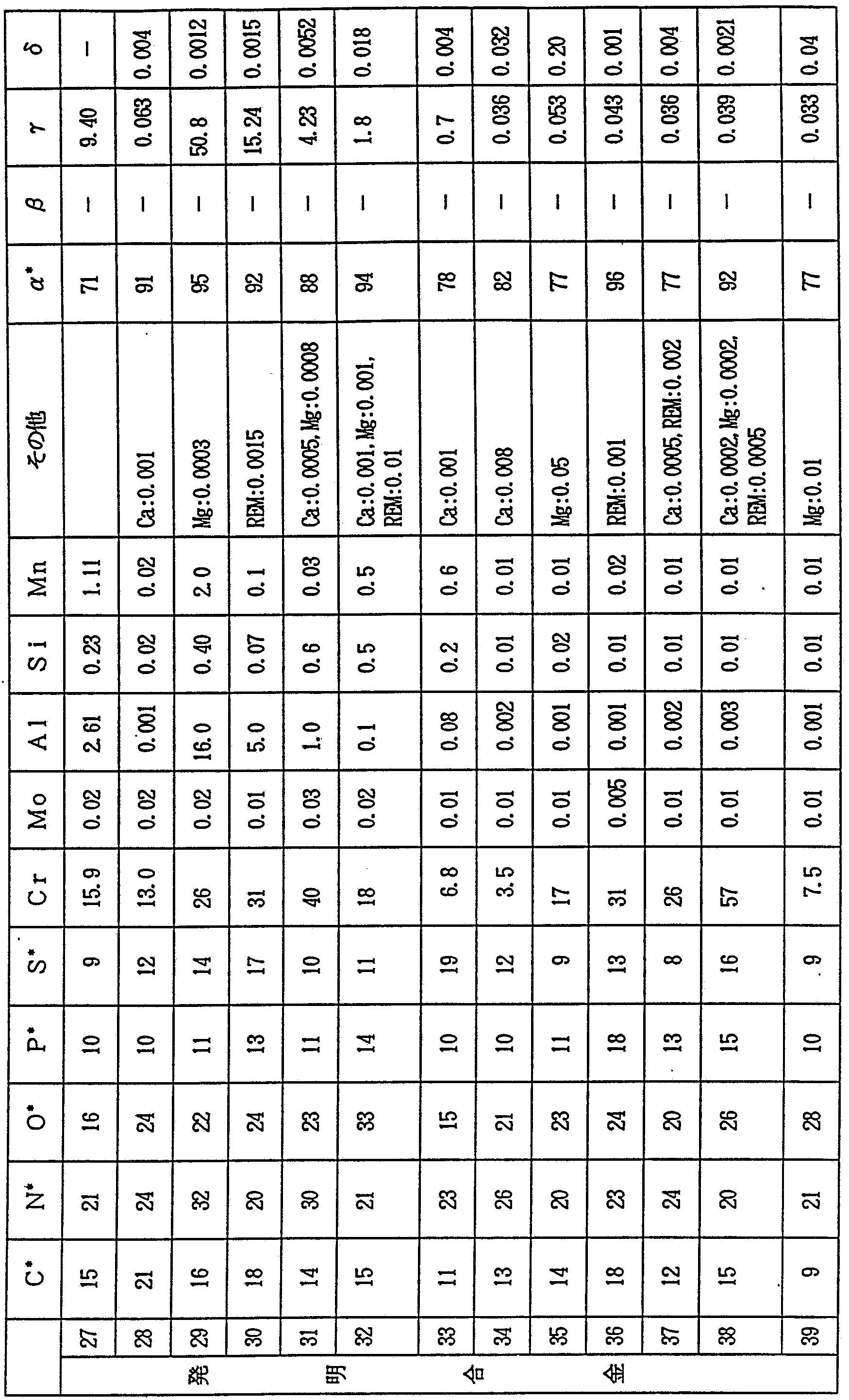
- Example 1 corresponding to invention alloys 1 to 13 and comparative alloys 1 to 12... corresponding to claim 1 10 kg of an alloy having the chemical composition shown in Table 1 was melt-produced in a vacuum melting furnace and heated. A hot-rolled sheet with a thickness of 4 mm is formed by cold rolling, subjected to hot-rolled sheet annealing for recrystallization, descaled, and then cold-rolled into a 0.7-mm-thick cold-rolled sheet. Then, recrystallization annealing was performed to obtain a cold-rolled annealed sheet.
- the elongation value was determined by a tensile test in accordance with JIS Z-2241, and after cold rolling of 50%, the value was 180 in the C direction.
- Table 2 shows the state of cracking when the contact bending test was performed.
- Table 2 shows the degree of rusting after a salt water spray test (24 hr) using 5% NaC1 at 50 at 5% NaC1 on the alloy plate with the total amount varied in various ways. (Score A: no rust, B: slight rust, C: small rust, D: large rust) o
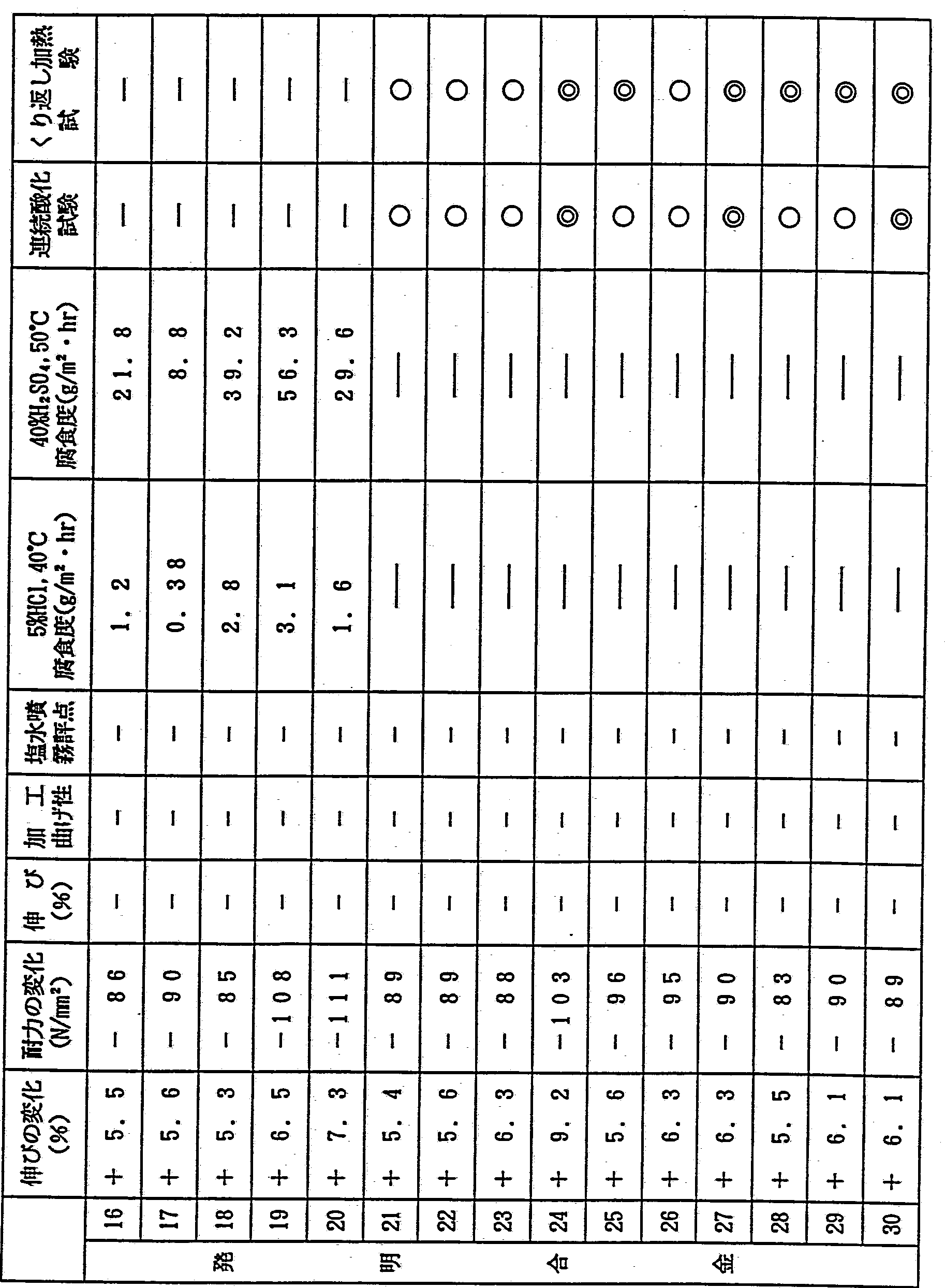
- Example 2 ... corresponding to invention alloys 14 to 20 and comparative alloys 13 and 14 ... corresponding to claim 2-A 100 kg high frequency induction heating ultra-high vacuum smelting furnace was used for the test materials having the component ranges shown in Table I. hand Produced. These test materials were forged, cut and hot rolled, then annealed and cold rolled to produce 1. Omm thick steel sheets.
- the corrosion rate (g / m 2 'hr) was measured.
- the results are summarized in Table 2. From the results in Table 2, it is clear that the corrosion in the acid immersion test is significantly suppressed in the component range of the present invention as compared with the material in the component range of the comparative example. In addition, for a material in which the total of C, N, 0, P and S is 10 Oppm or less, the effect is remarkable when Co + Ni + 2Cu is 0.01% or more.
- Example 3-1 corresponds to invention alloys 21 to 33
- comparative alloys 15 to 18 corresponds to claim 3.
- Test materials with the components shown in Table 1 were produced in a 100 kg high-frequency induction heating ultra-high vacuum melting furnace. These test materials were forged, cut, and hot-rolled, and then repeatedly sintered and cold-rolled to produce a foil strip having a thickness of 50 fim and a width of 20 Omm.
- the evaluation was performed as follows.
- test piece was repeatedly heated 1 time at 150 ° C for 30 minutes and then left to cool for 30 minutes 50 times, and then the separated area of the oxide film on the test piece was measured.
- the evaluation was performed as follows.
- the occurrence of abnormal oxidation was suppressed as compared with the component range of the comparative example, and the component range was covered with an oxide film having a sound and excellent adhesion.
- the oxide film of the comparative alloy showed poor adhesion and abnormal oxidation.
- the total of S, P, 0, N, and C is less than 10 ppm in Fe-Cr (3 ⁇ Cr ⁇ 60) alloy, and 1 out of Si, Al, and Mn. It is clear that adding Fe or two or more species in the range of 0.1 wt. 3 A 1 +2 S i + Mn ⁇ 50 wt.% Gives a Fe-Cr alloy with excellent oxidation resistance. .
- Specimens with the component ranges shown in Table 1 were prepared using a 100 kg high-frequency induction heating ultra-vacuum smelting furnace.These specimens were forged, cut, hot-rolled, and then annealed and cold-rolled. The process was repeated to produce a foil strip with a thickness of 50 m and a width of 200 m.
- Example 3-1 A continuous oxidation test and a repeated heating test were performed in the same manner as in Example 3-1 except that the temperature of the foil strip test piece (50 m 'X 5 Omm x 5 Omm) made from these materials was set to 1100 ° C. .
- the results are summarized in Table 2.
- the composition range of the alloy according to the present invention does not cause abnormal oxidation and is covered with a sound and highly adherent oxide film.
- Gold oxide film showed poor adhesion and showed abnormal oxidation.
- Fe, Cr (3 ⁇ Cr ⁇ 60) alloy, S, P, 0, N, and C were 100 ppmJK in total and Ca, Mg :, and REM were one or more types. It is clear that an alloy having excellent oxidation resistance can be obtained by setting 0.001 ⁇ 4Ca + 4Mg + REM ⁇ 0.2.
- Example 4 ... corresponding to invention alloys 42 to 44 and comparative alloy 21 ... corresponding to claim 4
- the test materials having the components shown in Table 1 were produced using a 100 kg high-frequency induction heating ultra-vacuum melting furnace. After forging, cutting, and hot rolling these test materials, annealing and cold rolling were repeated to produce a foil strip having a thickness of 50 jm and a width of 200 j / m.
- Fe-Cr alloys with excellent workability are provided, and alloys with excellent acid resistance and Z or oxidation resistance are provided. This allows the use of Fe-Cr alloys in a wide range of fields.
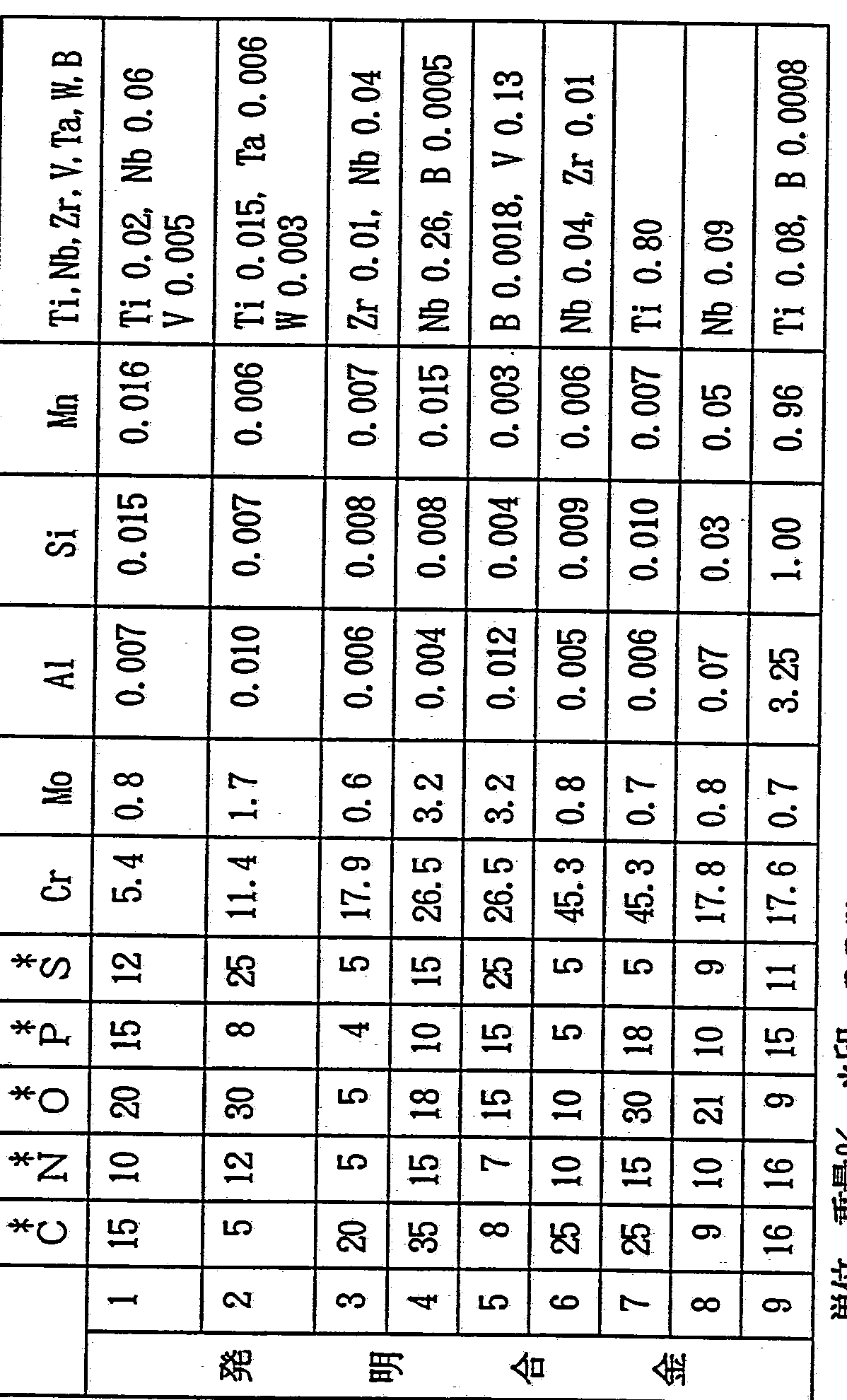
- Example 1 Corresponding to Invention Alloys 1 to 6 and Comparative Alloys 1 to 6 ... Corresponding to Claim 1 Alloys having the compositions shown in Table 1 were prepared using ultra-high-purity electrolytic iron and high-purity metal materials obtained by electrolysis. was melted in a 1 0 _ 5 T orr more of the ultra-high vacuum melting.
- the corrosion rate (g / m 2 -hr) was measured.
- the results are summarized in Table 2. From the results in Table 2, it is clear that the corrosion in the acid immersion test is significantly suppressed in the component range of the present invention as compared with the material in the component range of the comparative example.
- one or more of Ti, Nb, Zr, V, Ta, W, and B are used as 0.01% 3 ⁇ 4 %% Ti + Nb + Zr + V + Ta + W + 50B ⁇ It is evident that an alloy having even more excellent acid resistance can be obtained by containing in the range of 6.0 weight.
- Example 3 Corresponding to invention alloys 13 to 26 and comparative alloys 10 to 12 ...
- the alloys having compositions shown in Table 1 were melted in a high purity electrolytic iron and electrolytic C r and have use of high purity metal material 10 _ 7 To rr or ultrahigh vacuum melting.
- the alloys having compositions shown in Table 1 have use electrolytic C r and high purity metallic material as the ultra-high purity electrolytic iron 1 0 - melted in a 7 T 0 rr or ultrahigh vacuum melting.
- This about 1 20 finish of about 5 mm thick at the heating after hot rolling at 0, final 1.0 to 2.0 cold after rolling to 1 mm, for recrystallization and the adjustment of grain size was performed at 500—110 ° C.
- the alloy of the present invention is excellent in workability, strength at high temperature, or acid resistance and Z or oxidation resistance in addition to these, it is suitably used for applications such as pipes for automobile exhaust gas.
- Example 1 Corresponding to invention alloys 1 to 10 and comparative alloys 1 to 7 ... corresponding to claims 1 and 2
- a 10 kg alloy having the chemical composition shown in Table 1 was melted in a vacuum melting furnace, produced, and hot rolled.
- Comparative Alloy 4, Inventive Alloy 4, Inventive Alloy 5 A sample was prepared in the same manner as above, and was immersed for 4 hours in an aqueous solution of (5% FeCl 3 + 1 / 20N HC 1) with a pitting resistance of 30 ° C. The acid resistance was evaluated based on the corrosion rate calculated from the corrosion weight loss, and the acid resistance was evaluated based on the corrosion rate calculated from the corrosion weight loss after immersion in a 0.3% by weight HC1 aqueous solution for 4 hours. Table 2 shows the results.
- Comparative Alloy 3, Inventive Alloy 2, Inventive Alloy 8 Samples were prepared in the same manner as above, and had a pitting resistance of 80 ° C and 4 hours in an aqueous solution of (5% FeC13 + 1/2 ON HC1). The corrosion resistance was evaluated by the corrosion rate calculated from the corrosion weight loss after immersion, and the acid resistance was evaluated by the corrosion rate calculated from the corrosion weight loss after immersion in a 5% by weight HC1 aqueous solution for 4 hours. Table 2 shows the results.
- Comparative alloy 7, Inventive alloy 3, Inventive alloy 9 A sample was prepared in the same manner as above, and had a pitting resistance of 80 ° C, in an aqueous solution of (10% FeC13 + 1/2 ON HC1). The acid resistance was evaluated by the corrosion rate calculated from the corrosion weight loss after immersion for 4 hours, and the acid resistance was evaluated by the corrosion rate calculated from the corrosion weight loss after immersion for 4 hours in a 5% by weight HC1 aqueous solution. Table 2 shows the results.
- the pitting corrosion resistance is remarkably improved by containing M 0 in the range of the present invention, and the acid resistance is further improved by containing Ni, Co, and Cu in the range of the present invention.
- Example 2 Inventive alloys 1 to 25, corresponding to comparative alloys 8 to 11-, corresponding to claim 3 An alloy having the composition shown in Table 1 was prepared by using ultra-high-purity electrolytic iron, electrolytic Cr and high-purity metal material. and have use was melted in a 1 0 _ 7 T 0 rr or more of ultra-high vacuum.
- the specimen was heated at 135k for 12 hours in an electric furnace in the atmosphere, then cooled to room temperature, and the weight loss when the scale on the specimen surface was removed was measured.
- the oxidation resistance is significantly improved by containing Al, Si, Mn or Ca, Mg, REM or both in the range of the present invention.
- the alloys with the compositions shown in Table 1 are made of ultra-high purity electrolytic iron, electrolytic Cr and high-purity metal materials. Stomach was melted in a 1 0- 7 To rr or more of ultra-high vacuum.
- the basic tensile properties are as follows.
- the alloy of the present invention is excellent in workability and pitting corrosion resistance and, in addition, is excellent in acid resistance, Z or oxidation resistance, and is therefore suitably used for applications such as pipes for automobile exhaust gas.
- a 10 kg alloy having the chemical composition shown in Table 1 was melted and manufactured in a vacuum melting furnace, hot-rolled into a hot-rolled sheet having a thickness of 4 mm, and subjected to hot-rolled sheet annealing for recrystallization. After the scale, a cold-rolled sheet with a thickness of 0.7 mm was finally cold-rolled by recrystallization annealing to obtain a cold-rolled annealed sheet.
- the specimen surface using Emeri # 5 0 0 polished samples, pitting corrosion resistance is Ataishi commentary in corrosion rate calculated from the corrosion weight loss after immersing for 4 hours at Fe Cl 3 + HC 1 aqueous solution shown in Table 2,
- the oxidation test was performed by heat treatment at 135k for 12 hours in the air, and the weight loss after scale removal was evaluated.
- the pitting corrosion resistance is remarkably improved, and by adding an appropriate amount of Ti, Nb, V, Ta, W, Zr, B, the intergranular corrosion resistance at the weld is improved. You can see that. Furthermore, it is clear that acid resistance can be significantly improved by adding appropriate amounts of Ni, Co and Cu. It is also clear that the addition of one or more of Si, Mn, A1 and one or more of Z or Ca, Mg, REM improves the oxidation resistance.
- the Fe-Cr alloy has excellent workability and remarkably excellent pitting corrosion resistance and corrosion resistance at the weld (shoulder intergranular corrosion).
- Fe—Cr alloys containing at least one of Ni and CCo are remarkably excellent in acid resistance.
- the addition of at least one of Si, Mn, and AI and / or at least one of Ca, Mg, and REM further improves the oxidation resistance. These are useful for various purposes.
Landscapes
- Chemical & Material Sciences (AREA)
- Engineering & Computer Science (AREA)
- Materials Engineering (AREA)
- Mechanical Engineering (AREA)
- Metallurgy (AREA)
- Organic Chemistry (AREA)
- Heat Treatment Of Steel (AREA)
- Conductive Materials (AREA)
Description








Claims
Priority Applications (2)
| Application Number | Priority Date | Filing Date | Title |
|---|---|---|---|
| KR1019930704089A KR100253543B1 (ko) | 1992-04-30 | 1993-04-30 | 가공성이 우수한 Fe-Cr합금 |
| EP19930911960 EP0597129A4 (en) | 1992-04-30 | 1993-04-30 | Fe-cr alloy excellent in workability. |
Applications Claiming Priority (16)
| Application Number | Priority Date | Filing Date | Title |
|---|---|---|---|
| JP11143092 | 1992-04-30 | ||
| JP4/111014 | 1992-04-30 | ||
| JP11101492 | 1992-04-30 | ||
| JP4/111430 | 1992-04-30 | ||
| JP4/112522 | 1992-05-01 | ||
| JP11252292 | 1992-05-01 | ||
| JP11735892 | 1992-05-11 | ||
| JP4/117358 | 1992-05-11 | ||
| JP4/128751 | 1992-05-21 | ||
| JP12875192 | 1992-05-21 | ||
| JP14165692 | 1992-06-02 | ||
| JP14165392 | 1992-06-02 | ||
| JP4/141653 | 1992-06-02 | ||
| JP14165592 | 1992-06-02 | ||
| JP4/141655 | 1992-06-02 | ||
| JP4/141656 | 1992-06-02 |
Publications (1)
| Publication Number | Publication Date |
|---|---|
| WO1993022471A1 true WO1993022471A1 (fr) | 1993-11-11 |
Family
ID=27573008
Family Applications (1)
| Application Number | Title | Priority Date | Filing Date |
|---|---|---|---|
| PCT/JP1993/000580 Ceased WO1993022471A1 (fr) | 1992-04-30 | 1993-04-30 | ALLIAGE Fe-Cr PRESENTANT UNE GRANDE APTITUDE AU FAÇONNAGE |
Country Status (3)
| Country | Link |
|---|---|
| EP (1) | EP0597129A4 (ja) |
| KR (1) | KR100253543B1 (ja) |
| WO (1) | WO1993022471A1 (ja) |
Cited By (1)
| Publication number | Priority date | Publication date | Assignee | Title |
|---|---|---|---|---|
| CN119101854A (zh) * | 2024-07-02 | 2024-12-10 | 浙江鑫哲模具有限公司 | 一种冷作模具钢材料及其制备方法 |
Families Citing this family (11)
| Publication number | Priority date | Publication date | Assignee | Title |
|---|---|---|---|---|
| US6207103B1 (en) * | 1997-08-01 | 2001-03-27 | Kawasaki Steel Corporation | Fe-Cr-Si steel sheets having excellent corrosion resistance and method for manufacturing the same |
| AU737814B2 (en) * | 1997-11-17 | 2001-08-30 | Ceramic Fuel Cells Limited | A heat resistant steel |
| AUPP042597A0 (en) * | 1997-11-17 | 1997-12-11 | Ceramic Fuel Cells Limited | A heat resistant steel |
| DE19803084B4 (de) * | 1998-01-28 | 2005-07-28 | Max-Planck-Institut Für Eisenforschung GmbH | Verwendung von Stahlpulver auf der Basis Fe-Cr-Si für korrosionsbeständige Beschichtungen |
| DE19820806B4 (de) * | 1998-05-09 | 2004-03-04 | Max-Planck-Institut Für Eisenforschung GmbH | Verwendungen eines Leichtbaustahls |
| JP3480698B2 (ja) * | 1999-05-27 | 2003-12-22 | 兼次 安彦 | 高温における強度−延性バランスに優れるCr基合金 |
| KR100503548B1 (ko) | 2000-05-31 | 2005-07-25 | 제이에프이 스틸 가부시키가이샤 | 초기 녹발생 방지성, 가공성 및 용접성이 우수한 철-크롬합금 |
| US6884869B2 (en) | 2001-04-30 | 2005-04-26 | Seattle Genetics, Inc. | Pentapeptide compounds and uses related thereto |
| DE102007056144A1 (de) * | 2007-11-16 | 2009-05-20 | Volkswagen Ag | Abgaskrümmer oder Turboladergehäuse aus einer FeAl-Stahllegierung |
| DE102012004488A1 (de) | 2011-06-21 | 2012-12-27 | Thyssenkrupp Vdm Gmbh | Hitzebeständige Eisen-Chrom-Aluminium-Legierung mit geringer Chromverdampfungsrate und erhöhter Warmfestigkeit |
| WO2014097562A1 (ja) * | 2012-12-17 | 2014-06-26 | Jfeスチール株式会社 | ステンレス鋼板およびステンレス箔 |
Citations (7)
| Publication number | Priority date | Publication date | Assignee | Title |
|---|---|---|---|---|
| JPS5938300B2 (ja) * | 1981-02-13 | 1984-09-14 | 住友金属工業株式会社 | 耐食性のすぐれたフエライト系ステンレス鋼 |
| JPS6123259B2 (ja) * | 1982-04-07 | 1986-06-05 | Nippon Steel Corp | |
| JPS62199721A (ja) * | 1986-02-27 | 1987-09-03 | Nisshin Steel Co Ltd | 加工性の良好なフエライト系ステンレス鋼の鋼板または鋼帯の製造法 |
| JPS6358904B2 (ja) * | 1981-10-08 | 1988-11-17 | ||
| JPH01172524A (ja) * | 1987-12-28 | 1989-07-07 | Nisshin Steel Co Ltd | 耐食性に優れた高延性高強度の複相組織クロムステンレス鋼帯の製造法 |
| JPH01287253A (ja) * | 1988-05-16 | 1989-11-17 | Nisshin Steel Co Ltd | 耐酸化性および製造性に優れたa1含有フェライト系ステンレス鋼 |
| JPH0214419B2 (ja) * | 1983-04-02 | 1990-04-09 | Nippon Steel Corp |
-
1993
- 1993-04-30 EP EP19930911960 patent/EP0597129A4/en not_active Ceased
- 1993-04-30 WO PCT/JP1993/000580 patent/WO1993022471A1/ja not_active Ceased
- 1993-04-30 KR KR1019930704089A patent/KR100253543B1/ko not_active Expired - Fee Related
Patent Citations (7)
| Publication number | Priority date | Publication date | Assignee | Title |
|---|---|---|---|---|
| JPS5938300B2 (ja) * | 1981-02-13 | 1984-09-14 | 住友金属工業株式会社 | 耐食性のすぐれたフエライト系ステンレス鋼 |
| JPS6358904B2 (ja) * | 1981-10-08 | 1988-11-17 | ||
| JPS6123259B2 (ja) * | 1982-04-07 | 1986-06-05 | Nippon Steel Corp | |
| JPH0214419B2 (ja) * | 1983-04-02 | 1990-04-09 | Nippon Steel Corp | |
| JPS62199721A (ja) * | 1986-02-27 | 1987-09-03 | Nisshin Steel Co Ltd | 加工性の良好なフエライト系ステンレス鋼の鋼板または鋼帯の製造法 |
| JPH01172524A (ja) * | 1987-12-28 | 1989-07-07 | Nisshin Steel Co Ltd | 耐食性に優れた高延性高強度の複相組織クロムステンレス鋼帯の製造法 |
| JPH01287253A (ja) * | 1988-05-16 | 1989-11-17 | Nisshin Steel Co Ltd | 耐酸化性および製造性に優れたa1含有フェライト系ステンレス鋼 |
Non-Patent Citations (1)
| Title |
|---|
| See also references of EP0597129A4 * |
Cited By (1)
| Publication number | Priority date | Publication date | Assignee | Title |
|---|---|---|---|---|
| CN119101854A (zh) * | 2024-07-02 | 2024-12-10 | 浙江鑫哲模具有限公司 | 一种冷作模具钢材料及其制备方法 |
Also Published As
| Publication number | Publication date |
|---|---|
| EP0597129A4 (en) | 1994-08-10 |
| KR100253543B1 (ko) | 2000-04-15 |
| EP0597129A1 (en) | 1994-05-18 |
Similar Documents
| Publication | Publication Date | Title |
|---|---|---|
| KR101564152B1 (ko) | 내산화성과 고온 강도가 우수한 고순도 페라이트계 스테인리스 강판 및 그 제조 방법 | |
| JP4084733B2 (ja) | 延性に優れた高強度低比重鋼板およびその製造方法 | |
| KR101758567B1 (ko) | 강도 및 성형성이 우수한 클래드 강판 및 그 제조방법 | |
| KR101878245B1 (ko) | 내산화성이 우수한 페라이트계 스테인리스강 | |
| CN111989417A (zh) | 双相不锈钢复合钢板及其制造方法 | |
| WO2003106722A1 (ja) | 耐熱性フェライト系ステンレス鋼およびその製造方法 | |
| CN115698344B (zh) | 经冷轧和双重退火的钢板 | |
| JP2005015909A (ja) | 高強度低比重鋼板およびその製造方法 | |
| KR102870825B1 (ko) | 페라이트계 스테인리스강 및 그 제조 방법 | |
| WO1993022471A1 (fr) | ALLIAGE Fe-Cr PRESENTANT UNE GRANDE APTITUDE AU FAÇONNAGE | |
| AU2013243635B2 (en) | Cost-effective ferritic stainless steel | |
| JP2002105596A (ja) | 高耐候性、高加工性の熱延鋼板、およびその製造方法 | |
| WO1995013404A1 (en) | Stainless steel excellent in resistance to corrosion caused by molten salt and process for producing the steel | |
| JP2010121213A (ja) | 延性に優れた高強度低比重鋼板の製造方法 | |
| JP4471688B2 (ja) | 延性に優れた高強度低比重鋼板およびその製造方法 | |
| JP3269799B2 (ja) | 加工性、耐粒界腐食性および高温強度に優れるエンジン排気部材用フェライト系ステンレス鋼 | |
| JP4281535B2 (ja) | 耐面歪み性に優れたフェライト系ステンレス鋼板 | |
| JP7324844B2 (ja) | 低濃度硫酸/塩酸複合凝縮雰囲気で耐食性を有する鋼板およびその製造方法 | |
| JP5388577B2 (ja) | 加工性に優れた亜鉛メッキ用鋼板及びその製造方法 | |
| JPH055190A (ja) | 耐食性と深絞り性に優れた表層オーステナイト系ステンレス複層冷延鋼板及びその製造法 | |
| JP2801832B2 (ja) | 加工性に優れたFe−Cr合金 | |
| JP4715530B2 (ja) | 高温強度と靱性に優れたCr含有鋼板の製造方法およびCr含有鋼板 | |
| JP2864966B2 (ja) | 深絞り性と耐深絞り脆性とのバランスの優れた連続焼鈍冷延鋼板 | |
| JPH10237602A (ja) | 熱延板の低温靱性に優れたNb含有フェライト系ステンレス鋼 | |
| CA3195974C (en) | Ferritic stainless steel and component for exhaust gas |
Legal Events
| Date | Code | Title | Description |
|---|---|---|---|
| AK | Designated states |
Kind code of ref document: A1 Designated state(s): KR US |
|
| AL | Designated countries for regional patents |
Kind code of ref document: A1 Designated state(s): DE FR GB |
|
| ENP | Entry into the national phase |
Ref document number: 1993 170259 Country of ref document: US Date of ref document: 19931228 Kind code of ref document: A |
|
| WWE | Wipo information: entry into national phase |
Ref document number: 1993911960 Country of ref document: EP |
|
| WWE | Wipo information: entry into national phase |
Ref document number: 1019930704089 Country of ref document: KR |
|
| 121 | Ep: the epo has been informed by wipo that ep was designated in this application | ||
| WWP | Wipo information: published in national office |
Ref document number: 1993911960 Country of ref document: EP |
|
| WWR | Wipo information: refused in national office |
Ref document number: 1993911960 Country of ref document: EP |
|
| WWW | Wipo information: withdrawn in national office |
Ref document number: 1993911960 Country of ref document: EP |