WO1994002584A1 - Sensor devices - Google Patents

Sensor devices Download PDF

Info

Publication number
WO1994002584A1
WO1994002584A1 PCT/GB1993/001565 GB9301565W WO9402584A1 WO 1994002584 A1 WO1994002584 A1 WO 1994002584A1 GB 9301565 W GB9301565 W GB 9301565W WO 9402584 A1 WO9402584 A1 WO 9402584A1
Authority
WO
WIPO (PCT)
Prior art keywords
sensor device
polyvinyl chloride
membrane
polyaryl sulphone
sulphone
Prior art date
Legal status (The legal status is an assumption and is not a legal conclusion. Google has not performed a legal analysis and makes no representation as to the accuracy of the status listed.)
Ceased
Application number
PCT/GB1993/001565
Other languages
French (fr)
Inventor
Pankaj Madganlal Vadgama
Ian Mcintyre Christie
Yazid Mouloud Benmakroha
Current Assignee (The listed assignees may be inaccurate. Google has not performed a legal analysis and makes no representation or warranty as to the accuracy of the list.)
University of Manchester
Original Assignee
Victoria University of Manchester
Priority date (The priority date is an assumption and is not a legal conclusion. Google has not performed a legal analysis and makes no representation as to the accuracy of the date listed.)
Filing date
Publication date
Application filed by Victoria University of Manchester filed Critical Victoria University of Manchester
Priority to AU47158/93A priority Critical patent/AU4715893A/en
Priority to JP6504313A priority patent/JPH08502348A/en
Priority to DE69304921T priority patent/DE69304921T2/en
Priority to US08/374,739 priority patent/US5547561A/en
Priority to EP93917907A priority patent/EP0652941B1/en
Publication of WO1994002584A1 publication Critical patent/WO1994002584A1/en
Anticipated expiration legal-status Critical
Priority to GR960403482T priority patent/GR3022050T3/en
Ceased legal-status Critical Current

Links

Classifications

    • CCHEMISTRY; METALLURGY
    • C12BIOCHEMISTRY; BEER; SPIRITS; WINE; VINEGAR; MICROBIOLOGY; ENZYMOLOGY; MUTATION OR GENETIC ENGINEERING
    • C12QMEASURING OR TESTING PROCESSES INVOLVING ENZYMES, NUCLEIC ACIDS OR MICROORGANISMS; COMPOSITIONS OR TEST PAPERS THEREFOR; PROCESSES OF PREPARING SUCH COMPOSITIONS; CONDITION-RESPONSIVE CONTROL IN MICROBIOLOGICAL OR ENZYMOLOGICAL PROCESSES
    • C12Q1/00Measuring or testing processes involving enzymes, nucleic acids or microorganisms; Compositions therefor; Processes of preparing such compositions
    • C12Q1/001Enzyme electrodes
    • C12Q1/002Electrode membranes

Definitions

  • This invention relates to sensor devices such as are used in the determination of a component or components which may be present in a fluid sample, such as a physiological fluid (e.g. blood) or other fluids of biological origin (e.g. fruit), process fluids or effluents.
  • a fluid sample such as a physiological fluid (e.g. blood) or other fluids of biological origin (e.g. fruit), process fluids or effluents.
  • the forms of construction have much in common with each other, and mainly differ in the nature of the membrane or media within it or combined with it in some way.
  • Some forms of sensor rely on the components used to make the membrane, while others rely on the mode of fabrication of the membrane, selecting its physical properties (for example its porosity) or treatments given to it, as these factors can control its effectiveness and selectivity in use, or to the conditions under which the sensor is used.
  • sensors incorporate an enzyme, which converts one substrate compound or analyte into another which may then be more easily measured.
  • an enzyme which converts one substrate compound or analyte into another which may then be more easily measured.
  • oxidase enzymes which generate hydrogen peroxide — a substance which can be measured very conveniently and very accurately by electrolytic methods, especially ampere-metrically.
  • European Patent No. 216577 (of ICI PLC) which specifies an enzyme electrode sensor with membrane barrier of low (>5%) porosity.
  • the known sensors utilising various membrane materials, are very valuable in analytical techniques and the analysis of biological fluids (e.g. blood) for the presence of substances considered critical for medical reasons — e.g. glucose and other materials which may be oxidisable or reducable, or have toxic properties.
  • substances considered critical for medical reasons e.g. glucose and other materials which may be oxidisable or reducable, or have toxic properties.
  • membranes which are permeable to glucose are usually also permeable to other compounds which interfere with the analytical determination of the glucose.
  • Membrane materials vary in the degree of permeability or selectivity towards various species which may be present in samples to be examined, so no membrane material is universally appropriate and the choice depends partly upon the particular application for which it is to be used.
  • a sensor it is common to require a sensor to be highly selective or, at least, to be very efficient at excluding compounds which can interfere with the accuracy of the detection and determination of a desired chemical species, for example at an electrode surface. It is also desirable to have a form of sensor which can be used with accuracy at higher concentrations of glucose than are practicable with the conventional sensors and study media.
  • an improved sensor device comprising means for detecting components present in fluid samples and providing an output representative of the content of said component, comprising the said detecting means and a membrane barrier between the detecting means and the sample to be analysed, characterised in that the membrane barrier is composed of a combination comprising at least one polyvinyl chloride and at least one polyaryl sulphone.
  • a method for determining a component (an analyte) in a fluid sample which comprises contacting the sample with a sensor device as defined above. This is done especially by bringing the sample into contact with the membrane and measuring the response of the measuring means to the desired component (especially glucose) which has diffused through the membrane.
  • a sensor device as defined above.
  • the desired component especially glucose
  • PVC polyvinyl chloride
  • PS polyaryl sulphone
  • the sensor device comprises a detecting means in contact with an electrolyte medium and both are enclosed by a membrane of mixed PVC and PS polymers which provides an interface for contact with a sample to be analysed.
  • the polyvinyl chloride may be any polymer of vinyl chloride, as for example those made and available commercially,
  • the molecular weight of the PVC is relatively non-critical to the present invention; most commercial grades can be used satisfactorily, and the grade most appropriate for any particular use can be determined readily by simple trial.
  • a typical and convenient molecular weight is in the range 10,000 to 200,000 but products outside this range and mixtures of different molecular weight materials may be used if desired.
  • the polyaryl sulphone (PS) may be a sulphonated or an un- sulphonated material , or a mixture of two or more thereof.
  • a product comprising mainly one structure fitting the description "polyaryl sulphone" or it may be a mixture of such components having different structure or molecular configuration characteristics. Conveniently, it may be a commercially available product.
  • the polyaryl sulphone may be, for example, any of those compounds disclosed and more fully described in European Patent No. 225094, referred to therein as "sulphonated or un-sulphonated polyaryl sulphones" and, in abbreviated form, as "PAS.” These are described as polymers containing repeating units of the general formula -(-Ar - Y-)- wherein Ar represents a divalent aromatic radical and optionally, but preferably, at least some of the Ar groups are sulphonated, and Y represents - S0 2 -.
  • the group Ar is preferably a group containing at least two aromatic rings fused together or linked together by a direct bond or linked together by an aliphatic group, an oxygen atom or sulphur atom or a sulphone group.
  • the two types of polymer component (PVC and PS) should be, as far as is reasonably practicable, miscible with each other. So, it is preferred that the membranes made from them for the purposes of this invention are made by mixing the components thoroughly and intimately.
  • the membrane material i.e. the mixture of two polymers PVC and PS
  • the membrane material may be made into membranes by any known or conventional method. Most conveniently, this can be done by solution-casting techniques, using solvents to dissolve the polymers and then spreading the solution on a plate or flat surface and allowing the solvent to evaporate, leaving the polymers deposited as a film on the flat surface — from which it can then be removed for use.
  • the solvents which may be used for this vary, and any of those known in the art (individually or as mixtures) may be used.
  • the polymer composition of PVC and PS also comprises a plasticiser.
  • a plasticiser may be any compound which has the property of plasticising the components polymer or polymers, especially the PVC, and there is a wide variety of commercially available products to choose from.
  • An example of a preferred plasticiser is isopropyl myristate (IPM) .
  • the proportion of the plasticiser may vary considerably, and the optimum amount for any particular purpose can be determined by simple trial. In general, the proportion may be calculated as that appropriate for plasticising the amount of the PVC component used, and the proportion required in relation to the combined PVC and PS diminishes as the proportion of PVC in the mixture decreases.
  • plasticiser When a plasticiser is used, it may be incorporated in any known manner, but most conveniently by inclusion in the solution used for solution-casting — either by adding it as such to the final solution of the mixed polymers or by adding it in solution in one or other of the solutions of the component polymers or dissolved in a separate solvent.
  • the detecting means is most conveniently of one of an electrochemical nature, but other types (e.g. spectrophotometric or optical detecting systems) may be used if desired.
  • the detecting means will usually comprise an electrode system and a liquid or gel phase electrolyte-containing medium.
  • the electrolyte will be aqueous (i.e. aqueous or aqueous-based) but the use of non-aqueous electrolyte media (for example organic-based media) is not excluded.
  • the active electrode may be any of those known in the art, for example a metal electrode, but especial ly a platinum anode.
  • Thi s i s most conven ient l y made in combi nat ion w i th a si lver /si lver chloride counter-electrode, as for example in the so-cal led Clark electrode , which comprises a platinum electrode surrounded by a silver/silver chloride ring.
  • the sensor device of our invention can have a single membrane or, if desired, multiple layers of membrane material. When multiple layers of membrane are used, these may be the same or different, but we prefer that the outermost membrane, i.e. the one which furthest from the active electrode and is contacted with the sample under examination, is made of the membrane composition (mixed PVC and PS polymers) defined according to this invention. This arrangement gives the greatest contribution to determining the access of the components present in the sample to the active electrode surface.
  • the inner membrane layer or layers may be made of a wide variety of materials, as is known in the art. We prefer, however, that such an inner membrane is made of a porous film of polycarbonate. Alternatives include membranes (e.g. dialysis membranes) made of cellulose or cellulose derivatives.
  • the proportion of the two polymer components (PVC and PS) used to form the membrane may vary, and the proportion chosen for use in any particular case will depend upon such factors as the degree of selectivity desired and, of course, cost and ease of making it.
  • the most advantageous proportion is when the two components are in approximately 3:1 (PS:PVC) or 75/25, as the permeability to glucose at that ratio can be as much as 10 or even 100 times as great as it is for membranes made of the individual components (PVC or PS alone) .
  • the exact degree of enhancement of glucose permeability depends, of course, on the precise details and conditions involved, and this figure of up to 100 times will not necessarily be attained in every possible circumstance.
  • the thickness of the membranes can be of the order already used conventionally in the art, but may be varied as found most appropriate having regard for the particular mixed polymer composition being used and the conditions under which it is to be used. Thus a convenient thickness is in the range 10 to 40 am, though larger or smaller thicknesses can be used if desired.
  • the senor is in the conventional electrode cells. These can be polarised at the conventional potentials appropriate for the determination procedure, and using conventional media. Thus, a polarisation at +650 v in the usual phosphate/chloride buffer is usually most convenient except when the pH is raised from 7.4 to 13 (as discussed below) and the buffer and the polarisation may be altered to suit the high pH used.
  • Glucose sensors can be made which directly oxidise glucose at the electrode (anode) without any enzymatic action or the step of generation of hydrogen peroxide. This is very similar to other electro-analytical procedures, in which a component (e.g. paracetamol) is oxidised.
  • a component e.g. paracetamol
  • the mixed membrane composition PS/PVC has this property, and screens out such compounds as paracetamol, ascorbate and urate while being permeable to glucose.
  • an enzyme is present and in the other it is not present.
  • the alternative form, without an enzyme, preferably has the construction sequence:-
  • a high pH is necessary to render electroactive the glucose diffusing through the membrane.
  • high pH we mean a pH of at least 10, and preferably in the range 12 to 14.
  • a good and convenient pH is approximately 13.
  • the components are mainly the conventional ones, and the many variants known in the art may be used.
  • the permeability of the PVC/PS membrane is most marked with glucose, and this is seen as the basis for the most important and surprising effect and its most important utility.
  • the effect is not limited solely and absolutely to glucose, and other sugars can diffuse through it and be detected at high pH, like glucose, at an electrode, and so be detected and determined by means of the sensors and. methods of the present invention.
  • PVC and PS (and mixtures of PVC and PS) all have the ability to retain a stable high pH environment below the membrane, and so are very suitable for this form.
  • glucose concentrations are far beyond clinical glucose levels, but indicates the range of applicability and other uses, for example in the food and brewing industries.
  • the usefulness can be seen when one realises that the glucose concentrations to which the invention is applicable are of the order of up to 10% wei ht/volume, or even higher.
  • the advantage of the use of a high pH is that it enables glucose to be measured without oxygen dependence — i.e. there is no need to generate hydrogen peroxide in order to get a signal , and as there is no need to produce hydrogen peroxide there is then no need for either an enzyme or oxygen.
  • the sensors of the present invention there may be mentioned measurements in oxygen-deprived tissues (e.g. in tumours), in fruit and fruit products, in sugar manufacture, and in industrial fields for study or monitoring of process solutions or other media, or of industrial effluents.
  • our sensors can be applied to the study of fruit juices or to fruit as such, for it is not necessary to isolate the fruit juice and contact with a cut surface or by insertion into fruit, to secure a simple juice/sensor contact, can be quite sufficient for use in study and evaluation.
  • PVC polyvinyl chloride
  • IPM isopropyl myristate
  • the films or membranes made as described above were used as the membrane component of a sensor cell comprising a platinum anode and a surrounding silver/silver chloride ring in a Clark electrode assembly, and were found to show high permeability in favour of glucose when contacted with aqueous solutions containing glucose and various contaminants, e.g. paracetamol.

Landscapes

  • Chemical & Material Sciences (AREA)
  • Organic Chemistry (AREA)
  • Life Sciences & Earth Sciences (AREA)
  • Zoology (AREA)
  • Wood Science & Technology (AREA)
  • Proteomics, Peptides & Aminoacids (AREA)
  • Health & Medical Sciences (AREA)
  • Engineering & Computer Science (AREA)
  • Bioinformatics & Cheminformatics (AREA)
  • General Engineering & Computer Science (AREA)
  • Microbiology (AREA)
  • Molecular Biology (AREA)
  • Analytical Chemistry (AREA)
  • Biotechnology (AREA)
  • Physics & Mathematics (AREA)
  • Biochemistry (AREA)
  • Biophysics (AREA)
  • Immunology (AREA)
  • General Health & Medical Sciences (AREA)
  • Genetics & Genomics (AREA)
  • Investigating Or Analysing Biological Materials (AREA)
  • Push-Button Switches (AREA)
  • Measuring Or Testing Involving Enzymes Or Micro-Organisms (AREA)
  • Measuring Fluid Pressure (AREA)
  • Measuring Pulse, Heart Rate, Blood Pressure Or Blood Flow (AREA)
  • Saccharide Compounds (AREA)
  • Glass Compositions (AREA)
  • Measurement Of The Respiration, Hearing Ability, Form, And Blood Characteristics Of Living Organisms (AREA)

Abstract

Sensor devices for detecting components in fluid samples, especially by electrolytic analytical methods, comprising a detecting means (usually an anode, especially one of platinum) surrounded by a selectively permeable membrane barrier composed of a mixture of polyvinyl chloride and polyaryl sulphone polymers. Preferred proportions of the polymers are 1 to 9 parts of polyaryl sulphone for each part of polyvinyl chloride, and the mixture may be formed into membranes by solution casting. Preferably this barrier is used with an inner membrane, especially of porous polycarbonate. In use, these polymer mixtures are especially useful in their selective permeability to glucose. Also provided are methods for their use in analysis, and the polyvinyl chloride/polyaryl sulphone polymer compositions themselves and membranes made from them.

Description

SENSOR DEVICES.
This invention relates to sensor devices such as are used in the determination of a component or components which may be present in a fluid sample, such as a physiological fluid (e.g. blood) or other fluids of biological origin (e.g. fruit), process fluids or effluents.
Many forms of sensor have been proposed, and commonly these rely on some form of membrane to control the extent to which the components present in a sample under examination can gain access to an electrode, at which they can then be detected and determined. Especially, it is well known to make sensors using membranes to separate the media being analysed from the active electrode itself. The main function of the membrane is to separate, as far as possible, those components which are desirable (i.e. can take part in the reactions at the electrode on which the desired determination depends) from interferents (i.e. compounds which may be present but are undesirable because they either interfere with the progress of the desired determination reactions or take part in reactions of their own which compete with those of the component sought and distort or overwhelm the signals which are to be measured. The forms of construction have much in common with each other, and mainly differ in the nature of the membrane or media within it or combined with it in some way. Some forms of sensor rely on the components used to make the membrane, while others rely on the mode of fabrication of the membrane, selecting its physical properties (for example its porosity) or treatments given to it, as these factors can control its effectiveness and selectivity in use, or to the conditions under which the sensor is used.
Other forms of sensors incorporate an enzyme, which converts one substrate compound or analyte into another which may then be more easily measured. Especially, it is known to use oxidase enzymes, which generate hydrogen peroxide — a substance which can be measured very conveniently and very accurately by electrolytic methods, especially ampere-metrically.
An example is European Patent No. 216577 (of ICI PLC) which specifies an enzyme electrode sensor with membrane barrier of low (>5%) porosity.
Materials which have been proposed for the fabrica ion of membranes for sensors include polyvinyl chloride (PVC) — but it has been stated to be essential for it to be only in plasticised form, as described in European Patent Application No. 92302131.5.
It has also been proposed in European Patent Application No. 86308918.1 (Publication No. 225094) to use a sulphαnated or un- sulphonated polyaryl sulphone as membrane for a sensor of the enzyme electrode type.
The known sensors, utilising various membrane materials, are very valuable in analytical techniques and the analysis of biological fluids (e.g. blood) for the presence of substances considered critical for medical reasons — e.g. glucose and other materials which may be oxidisable or reducable, or have toxic properties. However, they are not entirely satisfactory in use, as membranes which are permeable to glucose are usually also permeable to other compounds which interfere with the analytical determination of the glucose. Membrane materials vary in the degree of permeability or selectivity towards various species which may be present in samples to be examined, so no membrane material is universally appropriate and the choice depends partly upon the particular application for which it is to be used.
It is common to require a sensor to be highly selective or, at least, to be very efficient at excluding compounds which can interfere with the accuracy of the detection and determination of a desired chemical species, for example at an electrode surface. It is also desirable to have a form of sensor which can be used with accuracy at higher concentrations of glucose than are practicable with the conventional sensors and study media.
We have now found that the selectivity of such a membrane- enclosed sensor can be significantly and surprisingly modified and improved by making the membrane of a mixture of polyvinyl chloride and a polyaryl sulphone, and that this mixture of polymers is surprisingly superior to either polymer component used alone, especially in its permeability to glucose.
Thus according to our invention we provide an improved sensor device comprising means for detecting components present in fluid samples and providing an output representative of the content of said component, comprising the said detecting means and a membrane barrier between the detecting means and the sample to be analysed, characterised in that the membrane barrier is composed of a combination comprising at least one polyvinyl chloride and at least one polyaryl sulphone.
According to a further feature of our invention we also provide a method for determining a component (an analyte) in a fluid sample, which comprises contacting the sample with a sensor device as defined above. This is done especially by bringing the sample into contact with the membrane and measuring the response of the measuring means to the desired component (especially glucose) which has diffused through the membrane. We also provide new polymer compositions, useful for making membranes having selectively permeable properties appropriate for incorporation in sensors for analytical and instrumental purposes, characterised in that they comprise a combination of at least one polyvinyl chloride and at least one polyaryl sulphone, and membranes made therefrom.
For convenience of description herein, we use the abbreviation "PVC" for the polyvinyl chloride and "PS" for the polyaryl sulphone.
Especially, in the devices and method of our invention, the sensor device comprises a detecting means in contact with an electrolyte medium and both are enclosed by a membrane of mixed PVC and PS polymers which provides an interface for contact with a sample to be analysed.
The polyvinyl chloride (PVC) may be any polymer of vinyl chloride, as for example those made and available commercially, The molecular weight of the PVC is relatively non-critical to the present invention; most commercial grades can be used satisfactorily, and the grade most appropriate for any particular use can be determined readily by simple trial. A typical and convenient molecular weight is in the range 10,000 to 200,000 but products outside this range and mixtures of different molecular weight materials may be used if desired. The polyaryl sulphone (PS) may be a sulphonated or an un- sulphonated material , or a mixture of two or more thereof. It may be used in a variety of forms, for example a product comprising mainly one structure fitting the description "polyaryl sulphone" or it may be a mixture of such components having different structure or molecular configuration characteristics. Conveniently, it may be a commercially available product.
The polyaryl sulphone may be, for example, any of those compounds disclosed and more fully described in European Patent No. 225094, referred to therein as "sulphonated or un-sulphonated polyaryl sulphones" and, in abbreviated form, as "PAS." These are described as polymers containing repeating units of the general formula -(-Ar - Y-)- wherein Ar represents a divalent aromatic radical and optionally, but preferably, at least some of the Ar groups are sulphonated, and Y represents - S02 -. The group Ar is preferably a group containing at least two aromatic rings fused together or linked together by a direct bond or linked together by an aliphatic group, an oxygen atom or sulphur atom or a sulphone group. The details and disclosures of that European Patent concerning the sulphone polymers is incorporated herein by reference, including the statement that some of the said polymers or copolymers are disclosed in and can be made by methods described in European Patent No. 8894.
It is preferred that the two types of polymer component (PVC and PS) should be, as far as is reasonably practicable, miscible with each other. So, it is preferred that the membranes made from them for the purposes of this invention are made by mixing the components thoroughly and intimately.
The membrane material (i.e. the mixture of two polymers PVC and PS) may be made into membranes by any known or conventional method. Most conveniently, this can be done by solution-casting techniques, using solvents to dissolve the polymers and then spreading the solution on a plate or flat surface and allowing the solvent to evaporate, leaving the polymers deposited as a film on the flat surface — from which it can then be removed for use. The solvents which may be used for this vary, and any of those known in the art (individually or as mixtures) may be used. It may not always be practicable to use the same solvent for both the PVC and the PS, so a very convenient procedure is to dissolve the PVC and PS separately in solvents best suited to each of them, and then to mix the resulting solutions in whatever proportions are considered most appropriate to obtain the desired proportion of the two polymers in the final deposited film. Among the various solvents which may be used, a convenient one for dissolving the PVC in particular is tetrahydrofuran (THF). This solvent casting method has the advantage of ensuring that the polymers are mixed as intimately as possible.
It is preferred that the polymer composition of PVC and PS also comprises a plasticiser. This may be any compound which has the property of plasticising the components polymer or polymers, especially the PVC, and there is a wide variety of commercially available products to choose from. An example of a preferred plasticiser is isopropyl myristate (IPM) . The proportion of the plasticiser may vary considerably, and the optimum amount for any particular purpose can be determined by simple trial. In general, the proportion may be calculated as that appropriate for plasticising the amount of the PVC component used, and the proportion required in relation to the combined PVC and PS diminishes as the proportion of PVC in the mixture decreases. When a plasticiser is used, it may be incorporated in any known manner, but most conveniently by inclusion in the solution used for solution-casting — either by adding it as such to the final solution of the mixed polymers or by adding it in solution in one or other of the solutions of the component polymers or dissolved in a separate solvent.
The detecting means is most conveniently of one of an electrochemical nature, but other types (e.g. spectrophotometric or optical detecting systems) may be used if desired. The detecting means will usually comprise an electrode system and a liquid or gel phase electrolyte-containing medium. In most applications the electrolyte will be aqueous (i.e. aqueous or aqueous-based) but the use of non-aqueous electrolyte media (for example organic-based media) is not excluded.
The active electrode may be any of those known in the art, for example a metal electrode, but especial ly a platinum anode. Thi s i s most conven ient l y made in combi nat ion w i th a si lver /si lver chloride counter-electrode, as for example in the so-cal led Clark electrode , which comprises a platinum electrode surrounded by a silver/silver chloride ring.
The sensor device of our invention can have a single membrane or, if desired, multiple layers of membrane material. When multiple layers of membrane are used, these may be the same or different, but we prefer that the outermost membrane, i.e. the one which furthest from the active electrode and is contacted with the sample under examination, is made of the membrane composition (mixed PVC and PS polymers) defined according to this invention. This arrangement gives the greatest contribution to determining the access of the components present in the sample to the active electrode surface.
When multiple membrane layers are used, the inner membrane layer or layers (i.e. one or more layers which lie within the outermost one, nearer to the active electrode itself and not in direct contact with the sample under examination) may be made of a wide variety of materials, as is known in the art. We prefer, however, that such an inner membrane is made of a porous film of polycarbonate. Alternatives include membranes (e.g. dialysis membranes) made of cellulose or cellulose derivatives. When the PVC/PS membrane is used as the outermost layer, and thereby this excludes substantially all the interferents likely to be of concern, then this allows greater freedom of choice of the material of any inner membrane which may be used — even towards the ideal of an inner membrane being only non-diffusion limiting, as the outermost layer will have provided the necessary screening from interferents.
The proportion of the two polymer components (PVC and PS) used to form the membrane may vary, and the proportion chosen for use in any particular case will depend upon such factors as the degree of selectivity desired and, of course, cost and ease of making it. The most advantageous proportion is when the two components are in approximately 3:1 (PS:PVC) or 75/25, as the permeability to glucose at that ratio can be as much as 10 or even 100 times as great as it is for membranes made of the individual components (PVC or PS alone) . The exact degree of enhancement of glucose permeability depends, of course, on the precise details and conditions involved, and this figure of up to 100 times will not necessarily be attained in every possible circumstance. As it will be appreciated, such a great increase, though welcome, is not essential for practical utility, so useful results can still be obtained when the proportions are more or less than this particular proportion — and particularly in the range 1 to 9 parts of PS for each part of PVC, though proportions outside these ranges may be vised if desired. The proportions are expressed here as ratios by weight.
The thickness of the membranes can be of the order already used conventionally in the art, but may be varied as found most appropriate having regard for the particular mixed polymer composition being used and the conditions under which it is to be used. Thus a convenient thickness is in the range 10 to 40 am, though larger or smaller thicknesses can be used if desired.
Use of the sensor is in the conventional electrode cells. These can be polarised at the conventional potentials appropriate for the determination procedure, and using conventional media. Thus, a polarisation at +650 v in the usual phosphate/chloride buffer is usually most convenient except when the pH is raised from 7.4 to 13 (as discussed below) and the buffer and the polarisation may be altered to suit the high pH used.
The advantages of the sensors and the membrane materials now specified are especially in respect of the diffusion facility of a sugar, especially glucose, though the membrane. Work with the improved sensors of the present invention show a vastly greater diffusion of glucose thoxigh the mixture of polymers than through either polymer alone. This is both highly surprising and very useful. This permeability to the glucose is especially noteworthy as it is associated with the ability to hold back (i.e. remain impermeable to) other components commonly present in media (especially biological fluids and media, for example blood) which interfere greatly with the detection of the glucose for clinical, monitoring or diagnostic purposes. Such interferents include ethanol , paracetamol, uric acid, phenolics, and the like.
Glucose sensors can be made which directly oxidise glucose at the electrode (anode) without any enzymatic action or the step of generation of hydrogen peroxide. This is very similar to other electro-analytical procedures, in which a component (e.g. paracetamol) is oxidised.
Up till now we have not been aware of any method by which the screening out of interferents (i.e. components which are electro-active but interfere with the determination of the selected component which it is desired to measure — particularly glucose) has been achieved by the use of a selective membrane. Surprisingly, the mixed membrane composition PS/PVC has this property, and screens out such compounds as paracetamol, ascorbate and urate while being permeable to glucose. There are two principal forms of construction which may be used to secure the advantages of the new membrane material we now propose. In one, an enzyme is present and in the other it is not present.
Using an enzyme, the basic construction sequence is:- SAMPLE
MEMBRANE (PVC/PS MIXTURE)
ENZYME
INNER MEMBRANE (E.G. POLYCARBONATE)
ELECTRODE. The alternative form, without an enzyme, preferably has the construction sequence:-
SAMPLE
MEMBRANE (PVC/PS MIXTURE)
SOLUTION AT HIGH pH
ELECTRODE. In this second form, a high pH is necessary to render electroactive the glucose diffusing through the membrane. By "high pH" we mean a pH of at least 10, and preferably in the range 12 to 14. A good and convenient pH is approximately 13. For these, the components (apart from the PVC/PS membrane) are mainly the conventional ones, and the many variants known in the art may be used.
The permeability of the PVC/PS membrane is most marked with glucose, and this is seen as the basis for the most important and surprising effect and its most important utility. The effect is not limited solely and absolutely to glucose, and other sugars can diffuse through it and be detected at high pH, like glucose, at an electrode, and so be detected and determined by means of the sensors and. methods of the present invention. PVC and PS (and mixtures of PVC and PS) all have the ability to retain a stable high pH environment below the membrane, and so are very suitable for this form.
Although the current values are low, the extreme selectivity renders such signals adequate for meaningful measurement. Thus, direct glucose oxidation at a Clark electrode using a 20 mM solution of glucose show a virtually zero response when the membrane is PVC or PS alone, but a response of over 100 nA for a 3:1 mixture of PS and PVC (PS:PVC). Using hydrogen peroxide at 1 mM concentration, an increase in response occurs as the proportion of PS added to PVC increases, but without any dramatic signs of selectivity at intermediate proportions. Using paracetamol at 1 mM concentration, a substantial response occurs for pure PVC but this falls off rapidly towards zero as PS is added to the PVC and reaches almost zero at the 3:1 PS:PVC. Extremely high concentrations of glucose can be measured with this technique, with remarkable selectivity against common interferents and no loss of linearity. For example, at pH 13 linear response (signal/concentration) has been demonstrated for glucose concentrations up to 600 mM (108 grams per litre) and beyond — with direct response of about 95 nA at the 600 mM level for the high pH sensor without enzyme but with a mixed PVC/PS membrane and only the sensor structure sequence:- Sample / mixed PVC.PS membrane / solution pH 13 / electrode.
(preferably with a thin underlying dialysis membrane to act as a thin layer of electrolyte to stop the anode and cathode being insulated from each other by the plastic membrane).
Such glucose concentrations are far beyond clinical glucose levels, but indicates the range of applicability and other uses, for example in the food and brewing industries. The usefulness can be seen when one realises that the glucose concentrations to which the invention is applicable are of the order of up to 10% wei ht/volume, or even higher.
The advantage of the use of a high pH is that it enables glucose to be measured without oxygen dependence — i.e. there is no need to generate hydrogen peroxide in order to get a signal , and as there is no need to produce hydrogen peroxide there is then no need for either an enzyme or oxygen. This simplifies the task of sensor construction and avoids dependence on the presence of oxygen or enzyme — both of which are factors which can limit the system and the components which it can be used to determine. This gives the sensor of the present invention a much wider scope of applicability than the glucose oxidase sensors to date.
Thus, as examples of uses which present difficulties for use of the conventional enzyme electrodes, but which can be dealt with much more easily by the sensors of the present invention, there may be mentioned measurements in oxygen-deprived tissues (e.g. in tumours), in fruit and fruit products, in sugar manufacture, and in industrial fields for study or monitoring of process solutions or other media, or of industrial effluents. For example, our sensors can be applied to the study of fruit juices or to fruit as such, for it is not necessary to isolate the fruit juice and contact with a cut surface or by insertion into fruit, to secure a simple juice/sensor contact, can be quite sufficient for use in study and evaluation.
The invention is illustrated but not limited by the following Example, in which the parts and percentages are by weight unless otherwise stated. EXAMPLE:
Using a grade of polyaryl sulphone (PS) supplied by a commercial company (ICI PLC) , the following solutions were prepared:- Solution 1:-
0.4 g of the PS in
7.5 mis of dimethylformamide + 2.5 mis of 2-methoxyethanol . Solution 2:-
0.06 g of polyvinyl chloride (PVC) and 150 ul of isopropyl myristate (IPM) in 5 mis of tetrahydrofuran.
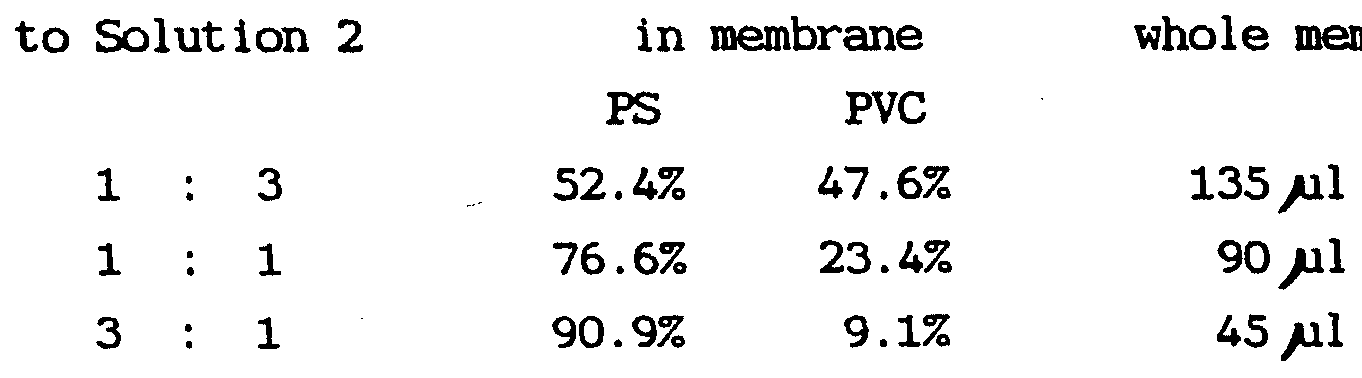
The two solutions were then mixed in ratios 3:1, 1:1 and 1:3 by volume, thus totalling 6mls each (solutions 1 and 2 in amounts of 4.5ml:1.5 ml, 3ml;3ml and 1.5ml:4.5ml) and the 6ml solutions were poured out into petri dishes and left open to the atmosphere for the solvent to evaporate and the residue to dry.
The resulting plastic films or membranes were formed:-
Ratio of Solution 1 Ratio of polymers IPM content in the
Figure imgf000013_0001
Using a grade of polyaryl sulphone (PS) supplied by another commercia1 company (A1drich Chemica1 Company), solutions were prepared as above except that Solution 1 was made by dissolving 0.4 g of the PS in 10 ml of tetrahydrofuran. Solution 2 was made as described above. Mixing and casting 6 ml portions in petri dishes to dry and form films was repeated, as described above.
The films or membranes made as described above were used as the membrane component of a sensor cell comprising a platinum anode and a surrounding silver/silver chloride ring in a Clark electrode assembly, and were found to show high permeability in favour of glucose when contacted with aqueous solutions containing glucose and various contaminants, e.g. paracetamol.

Claims

CLAIMS:
1. A sensor device comprising means for detecting components present in fluid samples and providing an output representative of the content of said component, comprising the detecting means and a membrane barrier between the detecting means and the sample to be analysed, characterised in that the membrane barrier is composed of a combination comprising at least one polyvinyl chloride and at least one polyaryl sulphone.
2. A sensor device as claimed in Claim 1 which comprises a detecting means in contact with an electrolyte medium and both are enclosed by a membrane of mixed polyvinyl chloride and polyaryl sulphone polymers which provides an interface for contact with a sample to be analysed, the said membrane being preferably of a thickness in the range 10 to 40 im.
3. A sensor device as claimed in Claim 1 or Claim 2 wherein the two polymer components (the polyvinyl chloride and the polyaryl sulphone) used are miscible with each other.
4. A sensor device as claimed in any of Claims 1 to 3 wherein the two polymer components (the polyvinyl chloride and the polyaryl sulphone) are mixed and formed by solution casting.
5. A sensor device as claimed in any of Claims 1 to 4 wherein the proportions of the two polymer components (the polyvinyl chloride and the ]?olyaryl sulphone) used are in the range 1 to 9 parts (and preferably about 3 parts) of the polyaryl sulphone for each part of the polyvinyl chloride, by weight.
6. A sensor device as claimed in any of Claims 1 to 5 wherein the polyvinyl chloride used has a molecular weight in the range 10,000 to 200,000.
7. A sensor device as claimed in any of Claims 1 to 6 wherein the polyaryl sulphone is sulphonated or un-sulphonated, or a mixture thereof.
8. A sensor device as claimed in any of Claims 1 to 7 wherein the mixture of the two polymer components (the polyvinyl chloride and the polyaryl sulphone) contains one or more plasticisers, for example Isopropyl myristate.
9. A sensor device as claimed in any of Claims 1 to 8 wherein the active electrode comprises is platinum metal.
10. A sensor device as claimed in any of Claims 1 to 9 wherein the active electrode is used as anode in conjunction with a silver/silver chloride cathode, preferably in the form of a ring surrounding it.
11. A sensor device as claimed in any of Claims 1 to 10 wherein the polyvinyl chloride/polyaryl sulphone is used as an outer layer in conjunction with an inner membrane which is made preferably of a porous film of polycarbonate.
12. A sensor device as claimed in any of Claims 1 to 11 wherein an enzyme is also present.
13. A sensor device comprising a mixture of polyvinyl chloride and polyaryl sulphone, substantially as described.
14. A method for determining a component (an analyte) in a fluid sample, using a sensor device as claimed in any of Claims 1 to 13, which comprises bringing the sample into contact with the mixed polymer membrane and measuring the response of the measuring means to the desired component which has diffused through the membrane.
15. A method as claimed in Claim 14 wherein the component (analyte) in the fluid sample being determined is glucose.
16. A method for determining a component (an analyte) in a fluid sample, substantially as described.
17. Polymer compositions, useful for making membranes having selectively permeable properties appropriate for incorporation in sensors for analytical and instrumental purposes, characterised in that they comprise a combination of at least one polyvinyl chloride and at least one polyaryl sulphone, and membranes made therefrom.
18. Polymer compositions and membranes made therefrom having selectively permeable properties, substantially as described.
PCT/GB1993/001565 1992-07-28 1993-07-23 Sensor devices Ceased WO1994002584A1 (en)

Priority Applications (6)

Application Number Priority Date Filing Date Title
AU47158/93A AU4715893A (en) 1992-07-28 1993-07-23 Sensor devices
JP6504313A JPH08502348A (en) 1992-07-28 1993-07-23 Sensor device
DE69304921T DE69304921T2 (en) 1992-07-28 1993-07-23 SENSOR DEVICES
US08/374,739 US5547561A (en) 1992-07-28 1993-07-23 Sensor devices and method of using same
EP93917907A EP0652941B1 (en) 1992-07-28 1993-07-23 Sensor devices
GR960403482T GR3022050T3 (en) 1992-07-28 1996-12-16 Sensor devices.

Applications Claiming Priority (2)

Application Number Priority Date Filing Date Title
GB929215971A GB9215971D0 (en) 1992-07-28 1992-07-28 Sensor devices
GB9215971.4 1992-07-28

Publications (1)

Publication Number Publication Date
WO1994002584A1 true WO1994002584A1 (en) 1994-02-03

Family

ID=10719391

Family Applications (1)

Application Number Title Priority Date Filing Date
PCT/GB1993/001565 Ceased WO1994002584A1 (en) 1992-07-28 1993-07-23 Sensor devices

Country Status (12)

Country Link
US (1) US5547561A (en)
EP (1) EP0652941B1 (en)
JP (1) JPH08502348A (en)
AT (1) ATE143050T1 (en)
AU (1) AU4715893A (en)
CA (1) CA2140444A1 (en)
DE (1) DE69304921T2 (en)
DK (1) DK0652941T3 (en)
ES (1) ES2093448T3 (en)
GB (1) GB9215971D0 (en)
GR (1) GR3022050T3 (en)
WO (1) WO1994002584A1 (en)

Cited By (3)

* Cited by examiner, † Cited by third party
Publication number Priority date Publication date Assignee Title
WO1997017607A1 (en) * 1995-11-08 1997-05-15 The Victoria University Of Manchester Membrane for chemical and biosensors
AT404992B (en) * 1997-04-17 1999-04-26 Avl List Gmbh SENSOR FOR DETERMINING AN ENZYME SUBSTRATE
DE102006020131B4 (en) * 2006-05-02 2012-04-26 Jinping Liu Nano- and microstructured biosensor and process for its preparation

Families Citing this family (3)

* Cited by examiner, † Cited by third party
Publication number Priority date Publication date Assignee Title
US6613379B2 (en) * 2001-05-08 2003-09-02 Isense Corp. Implantable analyte sensor
US7678567B2 (en) * 2004-07-26 2010-03-16 Kabushiki Kaisha Toshiba Optical biosensor
US20070021734A1 (en) * 2005-07-15 2007-01-25 Sai Bhavaraju Bioelectro-osmotic engine fluid delivery device

Citations (3)

* Cited by examiner, † Cited by third party
Publication number Priority date Publication date Assignee Title
EP0216577A2 (en) * 1985-09-16 1987-04-01 Imperial Chemical Industries Plc Sensor
EP0225094A2 (en) * 1985-11-28 1987-06-10 Imperial Chemical Industries Plc Membrane
EP0503943A1 (en) * 1991-03-14 1992-09-16 The Victoria University Of Manchester Sensor devices

Family Cites Families (2)

* Cited by examiner, † Cited by third party
Publication number Priority date Publication date Assignee Title
JPS5627643A (en) * 1979-08-14 1981-03-18 Toshiba Corp Electrochemical measuring device
US4678698A (en) * 1983-04-12 1987-07-07 Minnesota Mining And Manufacturing Company Contact lens cleaning article

Patent Citations (3)

* Cited by examiner, † Cited by third party
Publication number Priority date Publication date Assignee Title
EP0216577A2 (en) * 1985-09-16 1987-04-01 Imperial Chemical Industries Plc Sensor
EP0225094A2 (en) * 1985-11-28 1987-06-10 Imperial Chemical Industries Plc Membrane
EP0503943A1 (en) * 1991-03-14 1992-09-16 The Victoria University Of Manchester Sensor devices

Cited By (5)

* Cited by examiner, † Cited by third party
Publication number Priority date Publication date Assignee Title
WO1997017607A1 (en) * 1995-11-08 1997-05-15 The Victoria University Of Manchester Membrane for chemical and biosensors
AU716185B2 (en) * 1995-11-08 2000-02-24 Victoria University Of Manchester, The Membrane for chemical and biosensors
US6706532B2 (en) 1995-11-08 2004-03-16 The Victoria University Of Manchester Membrane for chemical and biosensors
AT404992B (en) * 1997-04-17 1999-04-26 Avl List Gmbh SENSOR FOR DETERMINING AN ENZYME SUBSTRATE
DE102006020131B4 (en) * 2006-05-02 2012-04-26 Jinping Liu Nano- and microstructured biosensor and process for its preparation

Also Published As

Publication number Publication date
AU4715893A (en) 1994-02-14
US5547561A (en) 1996-08-20
EP0652941B1 (en) 1996-09-18
CA2140444A1 (en) 1994-02-03
DK0652941T3 (en) 1997-02-24
DE69304921T2 (en) 1997-04-10
ES2093448T3 (en) 1996-12-16
GB9215971D0 (en) 1992-09-09
EP0652941A1 (en) 1995-05-17
GR3022050T3 (en) 1997-03-31
ATE143050T1 (en) 1996-10-15
DE69304921D1 (en) 1996-10-24
JPH08502348A (en) 1996-03-12

Similar Documents

Publication Publication Date Title
EP0204468B1 (en) Membrane
EP0216577B1 (en) Sensor
Mizutani et al. Amperometric l-lactate-sensing electrode based on a polyion complex layer containing lactate oxidase. Application to serum and milk samples
Emr et al. Use of polymer films in amperometric biosensors
AU595260B2 (en) Membrane
US6033866A (en) Highly sensitive amperometric bi-mediator-based glucose biosensor
Palleschi et al. Ideal hydrogen peroxide-based glucose sensor
EP0859954B1 (en) Biosensors comprising a membrane
EP0652942A1 (en) DETECTION DEVICES.
EP0652941B1 (en) Sensor devices
KR20130012059A (en) Biosensor desiccant system having enhanced measurement performance
Reddy et al. Ion exchanger modified PVC membranes—selectivity studies and response amplification of oxalate and lactate enzyme electrodes
Santoni et al. Enzyme electrode for glucose determination in whole blood
EP0916092A1 (en) Analytical method and apparatus
WO2001013103A1 (en) Analytical apparatus and method
WO2001006245A1 (en) Polymeric compositions and sensor devices
Buch-Rasmussen Determination of d-glucose in undiluted whole blood using chemically modified electrodes and segmented sample injection in a flow system
JPS59228160A (en) Amylase analyzing method

Legal Events

Date Code Title Description
AK Designated states

Kind code of ref document: A1

Designated state(s): AT AU BB BG BR BY CA CH CZ DE DK ES FI GB HU JP KP KR KZ LK LU MG MN MW NL NO NZ PL PT RO RU SD SE SK UA US VN

AL Designated countries for regional patents

Kind code of ref document: A1

Designated state(s): AT BE CH DE DK ES FR GB GR IE IT LU MC NL PT SE BF BJ CF CG CI CM GA GN ML MR NE SN TD TG

DFPE Request for preliminary examination filed prior to expiration of 19th month from priority date (pct application filed before 20040101)
121 Ep: the epo has been informed by wipo that ep was designated in this application
WWE Wipo information: entry into national phase

Ref document number: 2140444

Country of ref document: CA

WWE Wipo information: entry into national phase

Ref document number: 1993917907

Country of ref document: EP

WWE Wipo information: entry into national phase

Ref document number: 08374739

Country of ref document: US

WWP Wipo information: published in national office

Ref document number: 1993917907

Country of ref document: EP

REG Reference to national code

Ref country code: DE

Ref legal event code: 8642

WWG Wipo information: grant in national office

Ref document number: 1993917907

Country of ref document: EP