WO1994005672A1 - PROCESS FOR PREPARING CERTAIN PYRROLO[3,4- b]QUINOLINES, CERTAIN 1H-PYRANO[3',4':6,7]INDOLIZINO[1,2-b]QUINOLIN-3,14(4H,12H)-DIONES, AND CERTAIN 8-METHYL-7-(OXOPROPYL)-INDOLIZINO[1,2-b]QUINOLIN-9(11H)-ONES - Google Patents

PROCESS FOR PREPARING CERTAIN PYRROLO[3,4- b]QUINOLINES, CERTAIN 1H-PYRANO[3',4':6,7]INDOLIZINO[1,2-b]QUINOLIN-3,14(4H,12H)-DIONES, AND CERTAIN 8-METHYL-7-(OXOPROPYL)-INDOLIZINO[1,2-b]QUINOLIN-9(11H)-ONES Download PDF

Info

Publication number
WO1994005672A1
WO1994005672A1 PCT/US1993/008434 US9308434W WO9405672A1 WO 1994005672 A1 WO1994005672 A1 WO 1994005672A1 US 9308434 W US9308434 W US 9308434W WO 9405672 A1 WO9405672 A1 WO 9405672A1
Authority
WO
WIPO (PCT)
Prior art keywords
quinolin
process according
indolizino
compound
group
Prior art date
Legal status (The legal status is an assumption and is not a legal conclusion. Google has not performed a legal analysis and makes no representation as to the accuracy of the status listed.)
Ceased
Application number
PCT/US1993/008434
Other languages
French (fr)
Inventor
Joseph M. Fortunak
Zhiping Zhuang
Current Assignee (The listed assignees may be inaccurate. Google has not performed a legal analysis and makes no representation or warranty as to the accuracy of the list.)
SmithKline Beecham Corp
Original Assignee
SmithKline Beecham Corp
Priority date (The priority date is an assumption and is not a legal conclusion. Google has not performed a legal analysis and makes no representation as to the accuracy of the date listed.)
Filing date
Publication date
Application filed by SmithKline Beecham Corp filed Critical SmithKline Beecham Corp
Priority to AU51023/93A priority Critical patent/AU5102393A/en
Priority to EP93920496A priority patent/EP0660835A4/en
Priority to KR1019950700883A priority patent/KR950702987A/en
Priority to JP6507518A priority patent/JPH08501104A/en
Publication of WO1994005672A1 publication Critical patent/WO1994005672A1/en
Anticipated expiration legal-status Critical
Ceased legal-status Critical Current

Links

Classifications

    • CCHEMISTRY; METALLURGY
    • C07ORGANIC CHEMISTRY
    • C07DHETEROCYCLIC COMPOUNDS
    • C07D471/00Heterocyclic compounds containing nitrogen atoms as the only ring hetero atoms in the condensed system, at least one ring being a six-membered ring with one nitrogen atom, not provided for by groups C07D451/00 - C07D463/00
    • C07D471/02Heterocyclic compounds containing nitrogen atoms as the only ring hetero atoms in the condensed system, at least one ring being a six-membered ring with one nitrogen atom, not provided for by groups C07D451/00 - C07D463/00 in which the condensed system contains two hetero rings
    • C07D471/04Ortho-condensed systems
    • CCHEMISTRY; METALLURGY
    • C07ORGANIC CHEMISTRY
    • C07DHETEROCYCLIC COMPOUNDS
    • C07D471/00Heterocyclic compounds containing nitrogen atoms as the only ring hetero atoms in the condensed system, at least one ring being a six-membered ring with one nitrogen atom, not provided for by groups C07D451/00 - C07D463/00
    • C07D471/12Heterocyclic compounds containing nitrogen atoms as the only ring hetero atoms in the condensed system, at least one ring being a six-membered ring with one nitrogen atom, not provided for by groups C07D451/00 - C07D463/00 in which the condensed system contains three hetero rings
    • C07D471/14Ortho-condensed systems
    • CCHEMISTRY; METALLURGY
    • C07ORGANIC CHEMISTRY
    • C07DHETEROCYCLIC COMPOUNDS
    • C07D493/00Heterocyclic compounds containing oxygen atoms as the only ring hetero atoms in the condensed system
    • C07D493/12Heterocyclic compounds containing oxygen atoms as the only ring hetero atoms in the condensed system in which the condensed system contains three hetero rings
    • C07D493/14Ortho-condensed systems
    • YGENERAL TAGGING OF NEW TECHNOLOGICAL DEVELOPMENTS; GENERAL TAGGING OF CROSS-SECTIONAL TECHNOLOGIES SPANNING OVER SEVERAL SECTIONS OF THE IPC; TECHNICAL SUBJECTS COVERED BY FORMER USPC CROSS-REFERENCE ART COLLECTIONS [XRACs] AND DIGESTS
    • Y02TECHNOLOGIES OR APPLICATIONS FOR MITIGATION OR ADAPTATION AGAINST CLIMATE CHANGE
    • Y02PCLIMATE CHANGE MITIGATION TECHNOLOGIES IN THE PRODUCTION OR PROCESSING OF GOODS
    • Y02P20/00Technologies relating to chemical industry
    • Y02P20/50Improvements relating to the production of bulk chemicals
    • Y02P20/55Design of synthesis routes, e.g. reducing the use of auxiliary or protecting groups

Definitions

  • the present invention relates to a process for preparing certain pyrrolo-[3,4-b]quinolines, certain 1H-pyrano[3',4':6,7] indolizino[3,4-b]quinolin-3,14(4H,12H)-diones, specifically camptothecin and its analogs, and certain 8-methyl-7-(oxopropyl)-indolizino[3,2-b]quinolin-9(11H)-ones, specifically mappicine ketones and mappicines.
  • camptothecin itself is known to be cytotoxic at levels which inhibit tumor growth
  • certain water-soluble camptothecin analogs which exhibit litde or no cytotoxicity are efficacious against solid tumor types normally refractory to known treatments.
  • (S)-10-[(dimethylamino)methyl]-4-ethyl-4,9-dihydroxy-1H-pyrano[3',4':6,7] indolizino[1,2-b]quinolin-3,14(4H,12H)-dione commonly known as topotecan (Formula lb), which is disclosed in U.S. Pat No.5,004,758, issued to Boehm et al.
  • tumors include, but are not limited to, ovarian, esophageal, non-small cell lung and colorectal carcinomas.
  • topotecan is also useful for the preparation of a combination chemotherapeutic pharmaceutical composition which also comprises a platinum coordination compound, most preferably cis-platin.
  • a platinum coordination compound most preferably cis-platin.
  • the 4-(piperidino)-piperidinyl carbamate analogue of 7-ethyl-10-hydroxycamptothecin, commonly known as irinotecan (or CPT- 11) (Formula Ic) has also been shown to be efficacious against certain tumors. Both compounds are presently undergoing human clinical testing in refractory tumor types. Additionally, the 9-amino and 10,11-methylenedioxy analogs: of camptothecin (Formula Id) have shown promising antitumor activity in preclinical testing.
  • camptothecin molecule results in compounds possessing antiviral activity while exhibiting little or no cytotoxicity.
  • examples of such compounds include derivatives in which the E ring lactone has been replaced by some other functionality, i.e., two broad classes of compounds commonly called mappicine ketones and mappicines, of Formulas IIa and IIb respectively.
  • mappicine ketones and mappicines of Formulas IIa and IIb respectively.
  • These compounds which are useful in treating infections in humans and animals caused by a variety of viruses, (for example, Herpes simplex virus types 1 and 2, cytomegalovirus, and Varicella zoster virus) are disclosed in U.S. Ser. No. 07/606,216, filed by S. Petteway et al. on October 31,1990; U.S. Ser. No.
  • Camptothecins have also been recently shown to possess antiretroviral activity, specifically the ability to inhibit the replication of Human
  • HTV-1 Immunodeficiency Virus
  • HTV-1 at dosages non-cytotoxic to mammalian cells, and thus may be useful in the treatment of patients suffering from Acquired Immune Deficiency Syndrome (AIDS, see AIDS Res. Hum. Retr., 1991, 7, 65).
  • topoisomerase I is a monomeric enzyme with a molecular weight of approximately 100,000.
  • Camptothecin is known to exert its antitumor activity by stabilization of the covalently bound topoisomerase I - DNA complex. As a result, progression of the DNA replication sequence proceeds only as far as induction of a single strand break. The ultimate result of this inhibition of the DNA transcription/replication process is cell death. Camptothecin and a few of its close congeners are the only agents in clinical drug development which inhibit topoisomerase I.
  • Topoisomerase II consists of two identical subunits of molecular weight 170,000. Topoisomerase II induces transient breaks of both strands of the DNA helix and passes another double-stranded segment through the break.
  • Several commercially important oncolytic agents e.g., etoposide, doxorubicin and mitoxantrone
  • camptothecin does not inhibit topoisomerase ⁇
  • mappicines and mappicine ketones are known to inhibit topoisomerase II As such these compounds are of interest both as potential antineoplastic and antiviral agents.
  • camptothecin discloses a semisynthetic method of preparing certain water-soluble camptothecin analogs from camptothecin.
  • the only practical method for obtaining preparative- and commercial-scale quantities of camptothecin is by extraction of the tissues of the Camptotheca acuminata tree indigenous to the People's Republic of China or the Nothapodytes foetida shrub indigenous to India.
  • reliance on such natural sources has certain inherent disadvantages, including very high starting material cost (about $28,000/kg) and lack of a dependable source. Camptothecin has also been prepared from readily available materials by various totally synthetic approaches.
  • strategy A a tricyclic CDE ring system is prepared by known methods and is coupled with ortho-aminobenzaldehyde via a Friedlander quinoline synthesis.
  • the critical bond disconnection strategy is shown by the dashed line labelled A.
  • strategy B tricyclic ABC and bicyclic DE ring components are prepared separately by known methods and are coupled using a two-step, standard procedure to form the D ring pyridone.
  • the critical bond disconnection strategy is shown by the dashed line labelled B.
  • the tricyclic ABC ring fragment for strategy B is ultimately prepared via a Friedlander quinoline synthesis requiring several steps. The Friedlander quinoline synthesis is therefore a basic component of many of the known approaches.
  • the present invention provides an efficient general route for the facile synthesis of pyrrolo[3,4-b]quinolines, 8-methyl-7-(oxopropyl)indolizino[1,2-b]quinolin-9(11H)-ones and 1H-pyrano[3',4':6,7]indolizmo[1,2-b]qumolin-3,14(4H,12H)-diones, preferably camptothecin analogs.
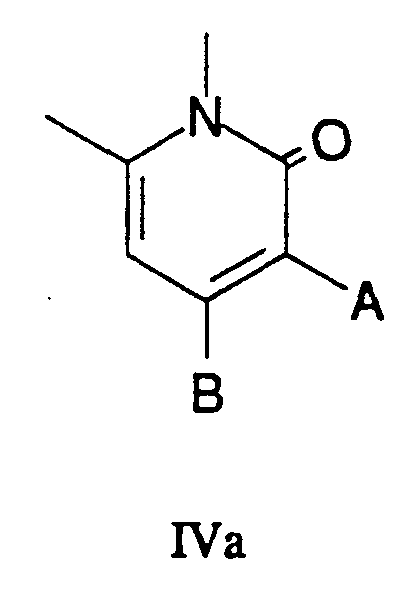
  • the present invention provides a process for preparing pyrrolo[3,4-b]quinolines, 8-methyl-7-(oxopropyl)indolizino[1,2-b]quinolin-9(11H)-ones; and 1H-pyrano[3',4':6,7]indolizino[1,2-b]quinolin-3,14(4H,12H)-diones, preferably camptothecin analogs , more preferably water-soluble camptothecin analogs, yet more preferably topotecan and irinotecan, most preferably topotecan, said process comprising the step of intramolecular [4+2] cycloaddition of the N-arylimidate portion of a compound of Formula IV with the unactivated acetylene portion of said compound, the compound of Formula IV being generated from compounds of Formula III (shown in Scheme 2 below and having the same substitutions as compounds of Formula IV), which are derived from generally available compounds.
  • R 1 H, OH, or OR, where R is an ester protecting group
  • R 2 H, NO 2 , or a protected amine function
  • R 3 H, C 2 H 5 , or a trialkylsilyl
  • R 4 H or CH 2 COOEt
  • R 5 COOMe or tosyl
  • R 4 and R 5 are joined together to form a substituted pyridone IIa:
  • A H, COOR, or a functionality for preparation of the hydroxymethyl (C-17) portion of an E ring lactone
  • B H, OH, an appropriate leaving group such as halide or
  • the present invention also provides a process for the preparation of 7-(1,1-bis-alkoxycarbonyl)propyl-8-methoxycarbonyl-5,6-dihydroindolizino[1,2-b]quinolin-9(11H)-ones, 8-methyl-7-(oxopropyl)indolizino[1,2-b]quinolin-9(11H)-ones; and 1H- pyrano[3 , ,4 , :6,7]indolizino[1,2-b]quinolin-3,14(4H,12H)-diones, preferably camptothecin analogs, more preferably water-soluble camptothecin analogs, yet more preferably topotecan and irinotecan, most preferably topotecan, said process comprising the step of coupling a vinyl triflate derived from a 7-hydroxy-5,6-dihydroindolizino[1,2-b]quinolin-9(11
  • the resulting 7-(1,1-bis-alkoxycarbonyl)propyl-8-methoxycarbonyl-5,6-dihydroindolizino[1,2-b]quinolin-9(11H)-one may be conveniently elaborated into a 1H-pyrano[3',4':6,7]indolizino[1,2-b]quinolin-3,14(4H,12H)-dione or a 8-methyl-7-(oxopropyl)indolizino[1,2-b]quinolin-9(11H)-one as disclosed elsewhere in the present application.
  • the present invention also provides a process for the preparation of pyrrolo[3,4-b]quinolines, 8-methyl-7-(oxopropyl)indolizino[1,2-b]quinolin-9(11H)-ones; and 1H-pyrano[3',4':6,7]indolizino[1,2-b]quinolin-3,14(4H,12H)-diones, preferably camptothecin analogs, more preferably water-soluble camptothecin analogs, yet more preferably topotecan and irinotecan, most preferably topotecan, said process comprising the steps of:
  • the present invention also provides a process for the preparation of camptothecin analogs which lack the lactone E ring, preferably 8-methyl-7-(oxopropyl)-indolizino[1,2-b]quinolin-9(11H)-ones, most preferably mappicines and mappicine ketones, said process comprising the steps of:
  • the present invention provides a process for the total synthesis of, depending upon choice of termination step, 4-ethyl-4-hydroxy-9-methoxy-1H-pyrano[3',4':6,7] indolizino[1,2-b]quinolin-3,14(4H, 12H)-dione, more commonly known as 10-methoxycamptothecin, 4-ethyl-4,9-dihydroxy-1H-pyrano[3',4':6,7] indolizino[1,2-b]quinolin-3,14(4H,12H)-dione, more commonly known as 10-hydroxycamptothecin, as well as of 10-[(dimethylamino)methyl]-4-ethyl-4,9-dihydroxy-1H-pyrano[3',4 , :6,7]indolizino[1,2-b]quinolin-3,14(4H,12H)-dione, more commonly known as topotecan, said process comprising the
  • tetrahydrofuran N,N-dimethylformamide, acetonitrile, acetone or N-methylpyrrolidinone, most preferably acetonitrile;at a temperature of about 20 -85°C, preferably about 60 - 85°C, most preferably at about the reflux temperature of acetonitrile; in the presence of a strong alkylatmg agent or such agent as is capable of transforming an amide into its corresponding O-alkylimidate or imidate ester, imidoyl halide, or a strong acid (such as aluminum chloride) capable of initiating a cyclodehydration, preferably trifluoromethanesulfonic anhydride, dimethylsulfate, alkyloxonium tetrafluoroborates, aluminum chloride, O-benzyltrichloroacetimidate, triphenylphosine/carbon tetrachloride, or triphenylphosphine/carbon tetrabromid
  • a camptothecin includes camptothecin and and any derivative thereof the structure of which is based on the 1H-pyrano[3',4':6,7] indolizino-[1,2-b]quinolin-3,14(4H,12H)-dione ring system.
  • pyrrolo[3,4-b]quinoline refers generally to compounds based on these ring systems.
  • camptothecin analog includes camptothecins as defined above and also includes derivatives of camptothecin wherein the E ring has been replaced with another functionality.
  • esteer protecting group is defined to include C 1 -C 6 alkyl groups as well as allyl, benzyl, phenyl and ⁇ , ⁇ , ⁇ -trichloroethyl.
  • amine protecting group is defined to include alkyl and arylsulfonate esters, carbamates of common alkyl groups such as methyl, ethyl, ⁇ , ⁇ , ⁇ -trichloroethyl, allyl, tert-butyl and phenyl, amides such as acetamido and propionamido, as well as common alkyl groups such as methyl and benzyl.
  • trimerkylsilyl is defined to include trimethyl, triethyl, triisopropyl and tripropylsilyl, as well as phenyldimethylsilyl and tert-butyldimethylsilyl.
  • the present invention provides a process for preparing pyrrolo[3,4-b]quinolines, 8-methyl-7-(oxopropyl)indolizino[1,2-b]quinolin-9(11H)-ones; and 1H-pyrano[3',4':6,7]indolizino[1,2-b]quinolin-3,14(4H,12H)-diones, preferably camptothecin analogs, more preferably water-soluble camptothecin analogs, yet more preferably topotecan and irinotecan, most preferably topotecan, the process comprising the step of intramolecular [4+2] cycloaddition of the N-arylimidate portion of a compound of Formula IV, generated from a starting material of Formula III, with the unactivated acetylene portion of said compound.
  • Scheme 2 illustrates one embodiment of the present process wherein R 4 and R 5 of the compound of Formula IV are not joined together to form a pyridone
  • X, R 1 -R 5 and Y are as defined for Formula IV;
  • the starting material of Formula III is heated in a polar solvent, preferably methylene chloride, 1,2-dichloroethane, 1,2-dimethoxyethane tetrahydrofuran, N,N-dimethylformamide, acetonitrile, acetone or N-methylpy ⁇ olidinone, most preferably acetonitrile; at a temperature of about 20 - 85 °C, preferably 60 - 85 °C, most preferably at the reflux temperature of acetonitrile; in the presence of a strong alkylating agent or such agent as is capable of producing either an O-alkylimidate or imidate ester, imidoyl halide, or such imide derivative as is capable of
  • cyclodehydration preferably trifluoromethanesulfonic anhydride, dimethylsulfate, alkyloxonium tetrafluoroborates, aluminum chloride, O-benzyltrichloroacetimidate, triphenylphosine/carbon tetrachloride, or triphenylphosphine/carbon tetrabromide, most preferably trimethyloxonium tetrafluoroborate, thereby generating the compound of Formula IV which then undergoes [4 + 2] cycloaddition to yield a pyrrolo[3,4-b]quinoline.
  • Compounds of Formula IV have not been isolated, but have been detected.
  • the products of the present process are either pharmaceutically useful themselves, e.g. topotecan, or are intermediates, e.g. 10-methoxycamptothecin, useful for elaboration into pharmaceutically useful compounds, particularly camptothecin analogs.
  • the present invention also provides a process for the preparation of 7-(1,1-bis-alkoxycarbonyl)propyl-8-methoxycarbonyl-5,6-dihydroindolizino[1,2-b]quinolin-9(11H)-ones, 8-methyl-7-(oxopropyl)indolizino[1,2-b]quinolin-9(11H)-ones; and1H-pyrano [3',4': 6,7] indolizino [1,2-b] quinolin - 3,14 (4H, 12H - diones, preferably camptothecin analogs, more preferably water-soluble camptothecin analogs, yet more preferably topotecan and irinotecan, yet more preferably topotecan and irinotecan, most preferably topotecan, said process, referring to Scheme 3, comprising the step of coupling a vinyl triflate dervived from a 7-hydroxy-5,6-dihydroindoli
  • the resulting 7-(1,1-bis-alkoxycarbonyl)propyl-8-methoxycarbonyl-5,6-dihydroindolizino[1,2-b]quinolin-9(11H)-one may be conveniently elaborated into a 1H-pyrano[3',4':6,7]indolizino-[1,2-b]quinolin-3,14(4H,12H)-dione or a 8-methyl-7-(oxopropyl)indolizino[1,2-b]quinolin-9(11H)-one as disclosed elsewhere in the present application.
  • R 4 H or CH 2 COOEt
  • R 5 COOMe, toluenesulfonyl, benzyl, COCH 3 ; or COCH 2 CH 3
  • Y M.
  • this embodiment of the present process may be conveniently used to provide a variety of useful
  • the compounds of Formula IV are readily prepared by known methods, for example as shown in Scheme 5 and Steps 1-3 of Scheme 7, below, and as is exemplified in me Example (Steps 1-3 ).
  • a polar solvent such as methylene chloride, 1,2-dichl ⁇ roethane, 1,2-dimethoxyethane tetrahydrofuran, N,N-dimethylformamide, acetonitrile, acetone or N-methylpyrrolidinone, but preferably acetonitrile; at a temperature of about 20 - 85 °C, preferably at 60 - 85 °C, most preferably at the reflux temperature of acetonitrile; in the presence of a strong alkylating agent or an agent capable of transforming an amide into its corresponding O-alkylimidate or imidate ester, or an imidoyl halide, e.g.
  • trifluoromethanesulfonic anhydride dimethylsulfate, alkyloxonium tetrafluoroborates, aluminum chloride, O-benzyltrichloroacetimidate, triphenylphosine/carbon tetrachloride, or
  • triphenylphosphine/carbon tetrabromide preferably trimethyloxonium
  • step (b) the substituted pyrrolo[3,4-b]quinoline resulting from step (a) is cyclized to a 7-hydroxy-5,6-dihydroindolizino[1,2-b]quinolin-9(11H)-one as follows.
  • the carbamate function protecting the C-ring nitrogen is hydrolytically cleaved, preferably with acetic acid saturated with HBr, to give the resulting tricyclic amine.
  • the amine is then coupled at the C-ring nitrogen with a monoalkyl malonyl chloride, preferably monomethyl malonyl chloride, to give the resulting malonate half-amide.
  • the D ring is formed when the malonate half-amide undergoes a Dieckmann condensation in the presence of base, preferably methoxide, to give a 7-hydroxy-8-methoxycarbonyl-5,6-dihydroindolizino[1,2-b]quinolin-9(11H)-one.
  • step (c) the vinyl triflate of the 7-hydroxy-8-methoxycarbonyl-5,6-dihydroindolizino[1,2-b]quinolin-9(11H)-one is coupled with a tertiary malonate anion to form a 7-(1,1-di-tert-butoxycarbonyl)propyl-8-methoxycarbonyl-5,6-dihydroindolizino[1,2-b]quinolin-9(11H)-one.
  • step (d) the diester is cyclized to form the lactone E ring of an indolizino[1,2-b]quinolinone, preferably a camptothecin analog.
  • 1,2 elimination of the tertiary hydrogen ⁇ to the quinolino nitrogen by oxidation in the presence of sodium nitrite or other oxidizing agents such as 2,3-dichloro-5,6-dicyano-1,4-benzoquinone (DDQ) gives the analogous indolizino[1,2-b]quinolin-9(11H)-one, followed by reduction of the carbomethoxy group at C-8 to a hydroxymemyl function and hydrolysis/decarboxylation of the malonate diester to give the resulting 4-ethyl- 1H- pyrano[3',4':6,7] indolizino[1,2-b]quinolin-3,14(4H,12H)-dione.
  • DDQ 2,3-dichloro-5,6-dicyano-1,4-benzoquinone
  • the 4-ethyl-1H-pyrano[3',4':6,7] indolizino[1,2-b]quinolin-3,14(4H,12H)-dione may be further reacted to form a tertiary alcohol ⁇ to the E ring carbonyl by air-oxidation, thus giving a camptothecin.
  • camptothecin may be further elaborated to give a variety of
  • camptothecin analogs For instance, cleavage of the methoxy group of 4-ethyl-4-hydroxy-9-methoxy-1H-pyrano[3',4 , :6,7] indolizino[1,2-b]quinolin-3,14(4H,12H)-dione (10-methoxycamptothecin) with HBr yields 10-hydroxycamptothecin, which is itself pharmaceutically useful. 10-Hydroxycamptothecin may be conveniently converted to topotecan by reaction with N.N.N'.N'-tetramethyldiaminomemane (BDAM).
  • BDAM N.N.N'.N'-tetramethyldiaminomemane
  • camptothecin products of the present process may further be converted to camptothecin analogs in which the E ring has been replaced by some other functionality, e.g., mappicines and mappicine ketones, for instance by the process described in our recently allowed U.S. Ser. No. 07/589,848, which discloses a semisynthetic method of preparing certain 8-methyl-7-(-oxopropyl)indolizino[1,2-b]quinolin-9(11H)-ones from camptothecin or derivitized camptothecins.
  • some other functionality e.g., mappicines and mappicine ketones
  • the starting material is a compound of Formula in wherein R 4 and R 5 are joined together to form a substituted pyridone.
  • the present invention provides a process for the preparation of camptothecin analogs which lack the lactone E ring, preferably 8-methyl-7-(oxopropyl)-indolizino [1,2-b]quinolin-9(11H)-ones, most preferably mappicines (1ib) and mappicine ketone (11a), said process comprising the steps of:
  • camptothecin analog which lacks the lactone E ring, preferably a 8-methyl-7-(oxopropyl)-indolizino[1,2-b]quinolin-9(11H)-one, most preferably a mappicine or mappicine ketone.
  • the present invention provides a process, as shown in Scheme 7, for the total synthesis of, depending upon choice of termination step, 4-ethyl-4-hydroxy-9-memoxy-1H-pyrano[3',4':6,7] indolizino[1,2-b]quinolin-3,14(4H, 12H)-dione, more commonly known as 10-methoxycamptothecin, 4-ethyl-4,9-dihydroxy-1H-pyrano[3',4 , :6,7] indolizino[1,2-b]quinolin-3,14(4H,12H)-dione, more commonly known as 10-hydroxycamptothecin, as well as of 10-[(dimethylamino)methyl]-4-ethyl-4,9-dihydroxy-1H-pyrano[3',4':6,7]indolizino[1,2-b]quinolin-3,14(4H,12H)-dione, more commonly known as topotecan, said
  • tetrahydrofuran N,N-dimeti ⁇ ylformamide, acetonitrile, acetone or N-methylpyrrolidinone, most preferably acetonitrile;at a temperature of about 20 -85°C, preferably about 60 - 85°C, most preferably at about the reflux temperature of acetonitrile; in the presence of a strong alkylating agent or such agent as is capable of transforming an amide into its corresponding O-alkylimidate or imidate ester, imidoyl halide, or a strong acid (such as aluminum chloride) capable of initiating a cyclodehydration, preferably trifluoromethanesulfonic anhydride, dimethylsulfate, alkyloxonium tetrafluoroborates, aluminum chloride, O-benzyltrichloroacetimidate, triphenylphosine/carbon tetrachloride, or triphenylphosphine/carbon tetra
  • step (b) hydrolyzing the carbamate function of the C-2 substituted pyrrolo[3,4-b]quinoline from step (a) with acetic acid saturated with HBr to give a tricyclic amine (X);
  • Soduim borohydride (200 mg, 3 eq.) was added in small portions to this stirred solution and the resulting mixture was stirred for 15 minutes after addition was complete.
  • the solvent was removed on a rotavapor and dilute hydrochloric acid (50 ml of 0.4% solution) was added to the residue.
  • the mixture was extracted with 3 ⁇ 100 ml of methylene chloride.
  • the combined organic layers were dried over magnesium sulfate and concentrated to give a dark solid to which trifluoroacetic acid (20 ml) was added.
  • the mixture was stirred at ambient temperature for 1 h. Trifluoroacetic acid was removed on a rotavapor and water (50 ml) was added to the residue.
  • the overall yield of topotecan for the total synthesis in 13 steps was about 5- 6%.

Landscapes

  • Chemical & Material Sciences (AREA)
  • Organic Chemistry (AREA)
  • Nitrogen Condensed Heterocyclic Rings (AREA)
  • Pharmaceuticals Containing Other Organic And Inorganic Compounds (AREA)

Abstract

The present invention provides a process for preparing certain pyrrolo[3,4-b]quinolines, certain 1H-pyrano[3',4':6,7]indolizino[1,2-b]quinolin-3,14(4H,12H)-diones, specifically camptothecin and its analogs, and certain 8-methyl-7-(oxopropyl)-indolizino[1,2-b]quinolin-9(11H)-ones, specifically mappicine ketones and mappicines, said process comprising the step of intramolecular [4+2] cycloaddition of the N-arylimidate portion of a compound of formula (IV) where: X=OH, OAlCl2, Cl, Br, I, F, OR, OSO2CF3 or any good leaving group or H; R1=H, or OR, where R is an ester protecting group; R2=H, NO2, or a protected amine function; R3=H, C2H5, or a trialkylsilyl; R4=H or CH2COOEt; R5=COOMe or tosyl; or R4 and R5 are joined together to form a substituted pyridone (IVa): Y=H or Y,R1=-OCH2O-, formula in which A=H,COOR, or a functionnality for preparation of the hydroxymethyl (C-17) portion of an E ring lactone; B=H, OH, an appropriate leaving group such as halide or O(trifluoromethanesulfonate) or a functionality for preparation of C-(18-21) of the E ring lactone portion of camptothecin, with the unactivated acetylene portion of said compound.

Description

PROCESS FOR PREPARING CERTAIN PYRROLO[3,4-b]QUTNOLINES, CERTAIN 1H-PYRANO[3',4':6,7]INDOLIZINO[1,2-b]QUINOLIN-3,14(4H,12H)- DIONES, AND CERTAIN 8-METHYL-7-(OXOPROPYL)-INDOLIZINO[1,2- b]QUINOLIN-9(11H)-ONES
FIELD OF THE INVENTION
The present invention relates to a process for preparing certain pyrrolo-[3,4-b]quinolines, certain 1H-pyrano[3',4':6,7] indolizino[3,4-b]quinolin-3,14(4H,12H)-diones, specifically camptothecin and its analogs, and certain 8-methyl-7-(oxopropyl)-indolizino[3,2-b]quinolin-9(11H)-ones, specifically mappicine ketones and mappicines.
BACKGROUND OF THE INVENTION
Certain 1H-pyrano[3',4':6,7]indolizino[1,2-b]quinolin-3,14(4H,12H)-diones are known to be pharinaceutically useful. Several important examples of such compounds are shown in Formulae Ia-Ie. Referring to these formulae, note that R3 is substituted at the 7-position, R2 is substituted at the 9-position, and R1 is substituted at the 10-position, and so forth. Each ring is designated by a letter A-E as shown. 4-Ethyl-4-hydroxy-1H-pyrano[3',4,:6,7] indolizino[1,2-b]quinolin-3,14(4H,12H)-dione, commonly known as camptothecin (Formula la, below), and certain of its close congeners are known to inhibit the growth of tumor cells both in vitro and in vivo.
Figure imgf000004_0001
Formula No. (Compound Name)
Ia (Camptothecin): R1=R2=R3=H
Ib (Topotecan): R1=OH, R2=-CH2N(CH3)2, R3=H
Ic (irinotecan/CPT-11): R1 =OC(O)-(4-piperidino)-piperidinyl,
R2=H, R3=C2H5
Id (9-aminocamptothecin): R1=H, R2=NH2, R3=H
Ie(10,11-methylenedioxy camptothecin): Y,R1=-OCH2O-, R2=R3=H
While camptothecin itself is known to be cytotoxic at levels which inhibit tumor growth, certain water-soluble camptothecin analogs which exhibit litde or no cytotoxicity are efficacious against solid tumor types normally refractory to known treatments. For instance, (S)-10-[(dimethylamino)methyl]-4-ethyl-4,9-dihydroxy-1H-pyrano[3',4':6,7] indolizino[1,2-b]quinolin-3,14(4H,12H)-dione, commonly known as topotecan (Formula lb), which is disclosed in U.S. Pat No.5,004,758, issued to Boehm et al. on April 2, 1991, is particularly useful in the treatment of a variety of cancerous tumors. As further disclosed in U.S. Ser. Nos.07/658,948, 07/658,936, and 07/658,937, filed by R. K. Johnson on February 21, 1991, and in U.S. Ser. No. 07/804,570, filed by R. K. Johnson on December 10, 1991, such tumors include, but are not limited to, ovarian, esophageal, non-small cell lung and colorectal carcinomas. As is further disclosed in U.S. Ser. No.07/793,041, filed by R. K. Johnson on November 15,1991, topotecan is also useful for the preparation of a combination chemotherapeutic pharmaceutical composition which also comprises a platinum coordination compound, most preferably cis-platin. The 4-(piperidino)-piperidinyl carbamate analogue of 7-ethyl-10-hydroxycamptothecin, commonly known as irinotecan (or CPT- 11) (Formula Ic), has also been shown to be efficacious against certain tumors. Both compounds are presently undergoing human clinical testing in refractory tumor types. Additionally, the 9-amino and 10,11-methylenedioxy analogs: of camptothecin (Formula Id) have shown promising antitumor activity in preclinical testing.
Figure imgf000005_0001
Figure imgf000005_0002
Certain other modifications of the camptothecin molecule result in compounds possessing antiviral activity while exhibiting little or no cytotoxicity. Examples of such compounds include derivatives in which the E ring lactone has been replaced by some other functionality, i.e., two broad classes of compounds commonly called mappicine ketones and mappicines, of Formulas IIa and IIb respectively. These compounds, which are useful in treating infections in humans and animals caused by a variety of viruses, (for example, Herpes simplex virus types 1 and 2, cytomegalovirus, and Varicella zoster virus) are disclosed in U.S. Ser. No. 07/606,216, filed by S. Petteway et al. on October 31,1990; U.S. Ser. No.
07/783,063, filed by H. S. Alaudeen on October 25, 1991; U.S. Ser. No.
07/870,649, filed by D. Berges et al. on April 17, 1992; and U.S. Ser. No.
07/868,824, filed by D. Berges et al. on April 14, 1992.
Camptothecins have also been recently shown to possess antiretroviral activity, specifically the ability to inhibit the replication of Human
Immunodeficiency Virus (HTV-1) at dosages non-cytotoxic to mammalian cells, and thus may be useful in the treatment of patients suffering from Acquired Immune Deficiency Syndrome (AIDS, see AIDS Res. Hum. Retr., 1991, 7, 65).
The mode of action of these compounds is grounded in the inhibition of the eukaryotic cellular enzymes topoisomerase I and II. See Cancer Res. 1988, 48, 1722; Molec. Pharmacol. 1988, 34, 755. In order to utilize its genetic information as a template for DN A transcription and replication, certain topological features of cellular DNA must be temporarily altered. Specifically, the supercoiled DNA helix must undergo relaxation/uncoiling, with subsequent unwinding of its helical structure, before the process of transcription and replication can proceed. Topoisomerase I is a monomeric enzyme with a molecular weight of approximately 100,000. This enzyme undergoes covalent binding to DNA and introduces a transient single strand break, unwinds the double helix (or allows it to unwind) and subsequently reseals the break before dissociating from the DNA strand. There is evidence that this mechanism of action is selectively important for the replication of DNA in tumori genic cells. Camptothecin is known to exert its antitumor activity by stabilization of the covalently bound topoisomerase I - DNA complex. As a result, progression of the DNA replication sequence proceeds only as far as induction of a single strand break. The ultimate result of this inhibition of the DNA transcription/replication process is cell death. Camptothecin and a few of its close congeners are the only agents in clinical drug development which inhibit topoisomerase I.
Topoisomerase II consists of two identical subunits of molecular weight 170,000. Topoisomerase II induces transient breaks of both strands of the DNA helix and passes another double-stranded segment through the break. Several commercially important oncolytic agents (e.g., etoposide, doxorubicin and mitoxantrone) are inhibitors of topoisomerase II. Although camptothecin does not inhibit topoisomerase π, related derivatives in which the E ring lactone has been replaced by an alternate functionality, i.e,. mappicines and mappicine ketones, are known to inhibit topoisomerase II As such these compounds are of interest both as potential antineoplastic and antiviral agents.
A number of approaches to the preparation of camptothecin and its analogs are known. These include several semisynthetic approaches for the transformation of camptothecin into various related analogs, e.g. topotecan, which rely on naturally occurring camptothecin as the starting material. For example, our U.S. Ser. No. 07/589,848, filed on September 28, 1990 and allowed according to the Notice of Allowance and Issue Fee Due dated June 17, 1992, discloses a semisynthetic method of preparing certain 8-methyl-7-(-oxopropyl)indolizino[1,2-b]quinolin-9(11H)-ones from camptothecin or derivitized camptothecins. U.S. Ser. No. 07/589,643, filed by P. Burk et al. on September 28, 1990, discloses a semisynthetic method of preparing certain water-soluble camptothecin analogs from camptothecin. At present, the only practical method for obtaining preparative- and commercial-scale quantities of camptothecin is by extraction of the tissues of the Camptotheca acuminata tree indigenous to the People's Republic of China or the Nothapodytes foetida shrub indigenous to India. However, as is well-known, reliance on such natural sources has certain inherent disadvantages, including very high starting material cost (about $28,000/kg) and lack of a dependable source. Camptothecin has also been prepared from readily available materials by various totally synthetic approaches. Recently, a 4+1 radical annulation in which a radical N-propargylated intermediate is intramolecularly cyclized to form the B and C rings of what is formally a camptothecin precursor was disclosed in J. Am. Chem. Soc. 1992, 114, 5863-5864. However, generally the published strategies for the total synthesis of 1H-pyrano[3',4':6,7]indolizino[1,2-b]quinolin-3,14(4H,12H)-diones, and specifically camptothecins, follow the two broad retrosynthetic outlines shown in Scheme 1.
Figure imgf000007_0001
In strategy A, a tricyclic CDE ring system is prepared by known methods and is coupled with ortho-aminobenzaldehyde via a Friedlander quinoline synthesis. As such, the critical bond disconnection strategy is shown by the dashed line labelled A. In strategy B, tricyclic ABC and bicyclic DE ring components are prepared separately by known methods and are coupled using a two-step, standard procedure to form the D ring pyridone. The critical bond disconnection strategy is shown by the dashed line labelled B. In many cases, the tricyclic ABC ring fragment for strategy B is ultimately prepared via a Friedlander quinoline synthesis requiring several steps. The Friedlander quinoline synthesis is therefore a basic component of many of the known approaches. However, such total syntheses are of limited value because they suffer from a variety of drawbacks: ortho-aminobenzaldehydes are difficult to prepare, are prone to polymerization, and require multi-step synthesis from commercially available starting materials for A-and B- ring analogs of camptothecin. Thus, many of these syntheses are
troublesome to perform and result in very poor chemical yields of the desired analog. Other strategies which rely on multi-step elaborations of commercially available quinolines suffer from similar drawbacks.
SUMMARY OF THE INVENTION
The present invention provides an efficient general route for the facile synthesis of pyrrolo[3,4-b]quinolines, 8-methyl-7-(oxopropyl)indolizino[1,2-b]quinolin-9(11H)-ones and 1H-pyrano[3',4':6,7]indolizmo[1,2-b]qumolin-3,14(4H,12H)-diones, preferably camptothecin analogs.
In a first aspect, the present invention provides a process for preparing pyrrolo[3,4-b]quinolines, 8-methyl-7-(oxopropyl)indolizino[1,2-b]quinolin-9(11H)-ones; and 1H-pyrano[3',4':6,7]indolizino[1,2-b]quinolin-3,14(4H,12H)-diones, preferably camptothecin analogs , more preferably water-soluble camptothecin analogs, yet more preferably topotecan and irinotecan, most preferably topotecan, said process comprising the step of intramolecular [4+2] cycloaddition of the N-arylimidate portion of a compound of Formula IV with the unactivated acetylene portion of said compound, the compound of Formula IV being generated from compounds of Formula III (shown in Scheme 2 below and having the same substitutions as compounds of Formula IV), which are derived from generally available compounds.
Figure imgf000009_0001
where:
X= OH, OAICI2, Cl, Br, I, F, OR, OSO2CF3 or any good leaving group or H
R1 = H, OH, or OR, where R is an ester protecting group;
R2 = H, NO2, or a protected amine function;
R3 = H, C2H5, or a trialkylsilyl;
R4 = H or CH2COOEt;
R5 = COOMe or tosyl; or
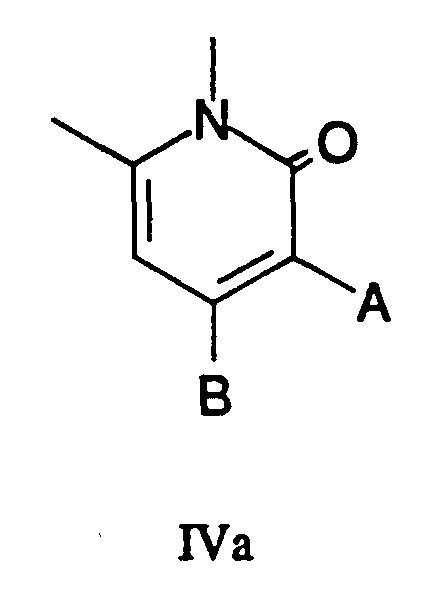
R4 and R5 are joined together to form a substituted pyridone IIa:
Y=H, or Y,R1 = -OCH2O-
Figure imgf000009_0002
where:
A = H, COOR, or a functionality for preparation of the hydroxymethyl (C-17) portion of an E ring lactone;
B = H, OH, an appropriate leaving group such as halide or
O(trifluoromethanesulfonate) or a functionality for preparation of C-(18-21) of the E ring lactone portion of camptothecin.
In a second aspect, the present invention also provides a process for the preparation of 7-(1,1-bis-alkoxycarbonyl)propyl-8-methoxycarbonyl-5,6-dihydroindolizino[1,2-b]quinolin-9(11H)-ones, 8-methyl-7-(oxopropyl)indolizino[1,2-b]quinolin-9(11H)-ones; and 1H- pyrano[3,,4,:6,7]indolizino[1,2-b]quinolin-3,14(4H,12H)-diones, preferably camptothecin analogs, more preferably water-soluble camptothecin analogs, yet more preferably topotecan and irinotecan, most preferably topotecan, said process comprising the step of coupling a vinyl triflate derived from a 7-hydroxy-5,6-dihydroindolizino[1,2-b]quinolin-9(11H)-one with a tertiary malonate anion to prepare a 7-(1,1-bis-alkoxycarbonyl)propyl-8-methoxycarbonyl-5,6-dihydroindolizino[1,2-b]quinolin-9(11H)-one. The resulting 7-(1,1-bis-alkoxycarbonyl)propyl-8-methoxycarbonyl-5,6-dihydroindolizino[1,2-b]quinolin-9(11H)-one may be conveniently elaborated into a 1H-pyrano[3',4':6,7]indolizino[1,2-b]quinolin-3,14(4H,12H)-dione or a 8-methyl-7-(oxopropyl)indolizino[1,2-b]quinolin-9(11H)-one as disclosed elsewhere in the present application.
In a third aspect, the present invention also provides a process for the preparation of pyrrolo[3,4-b]quinolines, 8-methyl-7-(oxopropyl)indolizino[1,2-b]quinolin-9(11H)-ones; and 1H-pyrano[3',4':6,7]indolizino[1,2-b]quinolin-3,14(4H,12H)-diones, preferably camptothecin analogs, more preferably water-soluble camptothecin analogs, yet more preferably topotecan and irinotecan, most preferably topotecan, said process comprising the steps of:
(a) intramolecular [4+2] cycloaddition of the N-arylimidate portion of a compound of Formula IV with the unactivated acetylene portion of said compound to give a pyrrolo[3,4-b]quinoline substituted with an acetate ester at C-2;
(b) cyclizing the 2-(acetate ester)-substituted pyrrolo[3,4-b)quinoline to form a 7-hydroxy-5,6-dihydroindottzino[1,2-b]quinolin-9(11H)-one;
(c) coupling a 7-trifluoromethanesulfonate derivative of the 7-hydroxy-5,6-dihydroindolizino[1,2-b]quinolin-9(11H)-one with a tertiary malonate anion to form a 5,6-dihydroindolizino[1,2-b]quinolin-9(11H)-one substituted at C-7 with an (alkyl)malonate diester, and
(d) converting the 7-(1,1-bis-alkoxycarbonyl)propyl-5,6-dihydroindohzino[1,2-b]quinolin-9(11H)-one into the lactone E ring of a 1H-pyτano[3',4':6,7]indolizino[1,2-b]quinolin-3,14(4H,12H)-dione, preferably a camptothecin analog.
In a fourth aspect, the present invention also provides a process for the preparation of camptothecin analogs which lack the lactone E ring, preferably 8-methyl-7-(oxopropyl)-indolizino[1,2-b]quinolin-9(11H)-ones, most preferably mappicines and mappicine ketones, said process comprising the steps of:
(a) intramolecular [4+2] cycloaddition of the N-arylimidate portion of a compound of Formula IV with the unactivated acetylene portion of said compound to give a pyrrolo[3,4-b]quinoline substituted with an acetate ester at C-2; (b) cyclizing the 2-substituted pyrrolo[3,4-b]quinoline to form a 7-hydroxy-5,6-dihydroindolizino[1,2-b]quinolin-9(11H)-one;
(c) coupling a 7-trifluoromethanesulfonate derivative of the 7-hydroxy-5,6- dihydroindolizino[1,2-b]quinolm~9(11H)-one with a tertiary malonate anion to form a 5,6-dihydroindolizino[1,2-b]quinolin-9(11H)-one substituted at C-7 with an (alkyl)malonate diester,
(d) converting the 7-(1,1-bis-alkoxycarbonyl)propyl-8-methoxycarbonyl-5,6-dihydroindolizino[1,2-b]quinolin-9(11H)-one into the lactone E ring of a 1H-pyrano[3',4':6,7]indolizino[1,2-b]quinolin-3,14(4H,12H)-dione, preferably a camptothecin analog;
(e) opening the E ring of said camptothecin analog with extrusion of carbon dioxide to provide, depending upon choice of termination step, a camptothecin analog which lacks the lactone E ring, preferably a 8-methyl-7-(oxopropyl)-indolizino[1,2-b]quinolin-9(11H)-one, most preferably a mappicine ketone; and (f) reduction of mappicine ketone with a hydride source such as sodium borohydride to give a mappicine.
In a fifth aspect, the present invention provides a process for the total synthesis of, depending upon choice of termination step, 4-ethyl-4-hydroxy-9-methoxy-1H-pyrano[3',4':6,7] indolizino[1,2-b]quinolin-3,14(4H, 12H)-dione, more commonly known as 10-methoxycamptothecin, 4-ethyl-4,9-dihydroxy-1H-pyrano[3',4':6,7] indolizino[1,2-b]quinolin-3,14(4H,12H)-dione, more commonly known as 10-hydroxycamptothecin, as well as of 10-[(dimethylamino)methyl]-4-ethyl-4,9-dihydroxy-1H-pyrano[3',4,:6,7]indolizino[1,2-b]quinolin-3,14(4H,12H)-dione, more commonly known as topotecan, said process comprising the steps of:
(a) heating a compound of Formula III (e.g. VII) in a polar solvent, preferably methylene chloride, 1,2-dichloroethane, 1,2-dimethoxyethane
tetrahydrofuran, N,N-dimethylformamide, acetonitrile, acetone or N-methylpyrrolidinone, most preferably acetonitrile;at a temperature of about 20 -85°C, preferably about 60 - 85°C, most preferably at about the reflux temperature of acetonitrile; in the presence of a strong alkylatmg agent or such agent as is capable of transforming an amide into its corresponding O-alkylimidate or imidate ester, imidoyl halide, or a strong acid (such as aluminum chloride) capable of initiating a cyclodehydration, preferably trifluoromethanesulfonic anhydride, dimethylsulfate, alkyloxonium tetrafluoroborates, aluminum chloride, O-benzyltrichloroacetimidate, triphenylphosine/carbon tetrachloride, or triphenylphosphine/carbon tetrabromide, most preferably trimethyloxonium tetrafluoroborate; to yield a pyrrolo[3,4-b]quinoline substituted at C-2 by an acetate ester, (b) hydrolyzing the carbamate function of the C-2 substituted pyrrolo[3,4-b]quinoline resulting from step (a) with acetic acid saturated with HBr to give a tricyclic amine;
(c) coupling said tricyclic amine with a monoalkyl malonyl chloride, preferably monomethyl malonyl chloride, to give the half-amide of a malonate diester,
(d) subjecting said diester to a Dieckmann condensation in the presence of base to give a a tetracyclic enol;
(e) forming a vinyl triflate of said tetracyclic enol, and coupling said triflate with a tertiary malonate anion to form a (1, 1-di-tert-butoxycarbonyl)propyl-8-methoxycarbonyl-5,6-dihydroindolizino[1,2-b]quinolin-9(11H)-one;
(f) 1,2- elimination of hydrogen at the 5,6 bond to give a 7-(1,1-bis-alkoxycarbonyl)propyl-8-methoxycarbonyl-indolizino[1,2-b]quinolin-9(11H)-one;
(g) reduction of the 8-methoxycarbonyl group, followed by hydrolysis-decarboxylation of the diester group at C-7, and lactone formation to give a 1H-pyrano[3',4':6,7] indolizino[1,2-b]quinolin-3,14(4H,12H)-dione;
(h) forming a tertiary alcohol α to the E ring carbonyl of said
product to give 10-methoxycamptothecin;
(i) cleaving the methyl ether of said 10-methoxycamptothecin to yield 10-hydroxycamptothecin; and
(j) alkylating the 9-position of said 10-hydroxy camptothecin by reaction with N,N,N',N,-tetramethyldiaminomethane (BDAM) to give topotecan.
DETAILED DESCRIPTION OF THE INVENTION
Here and throughout this application, the term "a camptothecin" includes camptothecin and and any derivative thereof the structure of which is based on the 1H-pyrano[3',4':6,7] indolizino-[1,2-b]quinolin-3,14(4H,12H)-dione ring system. The terms "pyrrolo[3,4-b]quinoline", "indolizino[1,2-b]quinolin-9(11H)-one" and 1H-pyrano[3',4':6,7] indolizino-[1,2-b]quinolin-3,14(4H,12H)-dione refer generally to compounds based on these ring systems. The term " camptothecin analog" includes camptothecins as defined above and also includes derivatives of camptothecin wherein the E ring has been replaced with another functionality. The term "ester protecting group" is defined to include C1-C6 alkyl groups as well as allyl, benzyl, phenyl and β,β,β-trichloroethyl. The term " amine protecting group" is defined to include alkyl and arylsulfonate esters, carbamates of common alkyl groups such as methyl, ethyl, β,β,β-trichloroethyl, allyl, tert-butyl and phenyl, amides such as acetamido and propionamido, as well as common alkyl groups such as methyl and benzyl. The term "trialkylsilyl" is defined to include trimethyl, triethyl, triisopropyl and tripropylsilyl, as well as phenyldimethylsilyl and tert-butyldimethylsilyl.
The present invention provides a process for preparing pyrrolo[3,4-b]quinolines, 8-methyl-7-(oxopropyl)indolizino[1,2-b]quinolin-9(11H)-ones; and 1H-pyrano[3',4':6,7]indolizino[1,2-b]quinolin-3,14(4H,12H)-diones, preferably camptothecin analogs, more preferably water-soluble camptothecin analogs, yet more preferably topotecan and irinotecan, most preferably topotecan, the process comprising the step of intramolecular [4+2] cycloaddition of the N-arylimidate portion of a compound of Formula IV, generated from a starting material of Formula III, with the unactivated acetylene portion of said compound. Scheme 2 illustrates one embodiment of the present process wherein R4 and R5 of the compound of Formula IV are not joined together to form a pyridone of Formula IVa.
Figure imgf000014_0001
X, R1-R5 and Y are as defined for Formula IV;
Figure imgf000015_0001
Figure imgf000016_0001
The starting material of Formula III is heated in a polar solvent, preferably methylene chloride, 1,2-dichloroethane, 1,2-dimethoxyethane tetrahydrofuran, N,N-dimethylformamide, acetonitrile, acetone or N-methylpyιτolidinone, most preferably acetonitrile; at a temperature of about 20 - 85 °C, preferably 60 - 85 °C, most preferably at the reflux temperature of acetonitrile; in the presence of a strong alkylating agent or such agent as is capable of producing either an O-alkylimidate or imidate ester, imidoyl halide, or such imide derivative as is capable of
cyclodehydration, preferably trifluoromethanesulfonic anhydride, dimethylsulfate, alkyloxonium tetrafluoroborates, aluminum chloride, O-benzyltrichloroacetimidate, triphenylphosine/carbon tetrachloride, or triphenylphosphine/carbon tetrabromide, most preferably trimethyloxonium tetrafluoroborate, thereby generating the compound of Formula IV which then undergoes [4 + 2] cycloaddition to yield a pyrrolo[3,4-b]quinoline. Compounds of Formula IV have not been isolated, but have been detected. The products of the present process are either pharmaceutically useful themselves, e.g. topotecan, or are intermediates, e.g. 10-methoxycamptothecin, useful for elaboration into pharmaceutically useful compounds, particularly camptothecin analogs.
The present invention also provides a process for the preparation of 7-(1,1-bis-alkoxycarbonyl)propyl-8-methoxycarbonyl-5,6-dihydroindolizino[1,2-b]quinolin-9(11H)-ones, 8-methyl-7-(oxopropyl)indolizino[1,2-b]quinolin-9(11H)-ones; and1H-pyrano [3',4': 6,7] indolizino [1,2-b] quinolin - 3,14 (4H, 12H - diones, preferably camptothecin analogs, more preferably water-soluble camptothecin analogs, yet more preferably topotecan and irinotecan, yet more preferably topotecan and irinotecan, most preferably topotecan, said process, referring to Scheme 3, comprising the step of coupling a vinyl triflate dervived from a 7-hydroxy-5,6-dihydroindolizino [1,2-b] quinolin-9(11M)-one (V) with a tertiary malonate anion to prepare a 7-(1,1-bis)-alkoxycarbonyl)propyl-8-methoxycarbonyl-5,6-dihydroindolizino [1,2-b] quinolin - 9(11M)-one (VI). The resulting 7-(1,1-bis-alkoxycarbonyl)propyl-8-methoxycarbonyl-5,6-dihydroindolizino[1,2-b]quinolin-9(11H)-one may be conveniently elaborated into a 1H-pyrano[3',4':6,7]indolizino-[1,2-b]quinolin-3,14(4H,12H)-dione or a 8-methyl-7-(oxopropyl)indolizino[1,2-b]quinolin-9(11H)-one as disclosed elsewhere in the present application.
In one preferred embodiment of the present invention, an exemplary illustration of which is shown in Scheme 4, the starting material (VII) has the structure (referring to Formula III in Scheme 2) wherein: R4 = H or CH2COOEt; R5 = COOMe, toluenesulfonyl, benzyl, COCH3; or COCH2CH3; and Y=M. As will be readily apparent to one of ordinary skill in the art, this embodiment of the present process may be conveniently used to provide a variety of useful
intermediates (pyrrolo[3,4-b]quinolines, indolizino[1,2-b]quinolin-9(11H)-ones and 1H-pyrano[3',4':6,7]indolizino[1,2-b]quinolin-3,14(4H,12H)-diones) and products, preferably camptothecin analogs, by the selection of appropriately substituted starting materials and of the appropriate terminating step. This process comprises the steps of:
(a) intramolecular [4+2] cycloaddition of the N-arylimidate portion of a compound of Formula IV (exemplified by Formula IV, Scheme 2) with the unactivated acetylene portion of said compound to give a pyrrolo[3,4-b]quinoline substituted with an acetate ester at C-2 (exemplified by Formula VIII, Scheme 4);
(b) cyclizing the 2-(acetate ester) substituted pyrrolo[3,4-b]quinoline to form a 7-hydroxy-5,6-dihydroindolizino[1,2-b]quinolin-9(11H)-one (e.g. XII, Scheme 7).
(c) coupling a 7-trifluoromethanesulfonate derivative of the 7-hydroxy-5,6-dihydroindolizino[1,2-b]quinolin-9(11H)-one with a tertiary malonate anion to form a 5,6-dihydroindolizino[1,2-b]quinolin-9(11H)-one substituted at C-7 an (alkyl) malonate diester (e.g. XIII, Scheme 7); and
(d) converting the 7-(1,1-bis-alkoxycarbonyl) propyl-5,6-dihydroindolizino[1,2-b]quinolin-9(11H)-one into the lactone E ring of a 1H-pyrano[3',4':6,7]indolizino[1,2-b]quinolin-3,14(4H,12H)-dione, preferably a camptothecin analog (e.g. XVI, Scheme 7). *
Figure imgf000018_0001
Figure imgf000019_0001
Referring to the above embodiment, the compounds of Formula IV are readily prepared by known methods, for example as shown in Scheme 5 and Steps 1-3 of Scheme 7, below, and as is exemplified in me Example (Steps 1-3 ). In step (a), the amide starting material of Formula IV is reacted in a polar solvent such as methylene chloride, 1,2-dichlσroethane, 1,2-dimethoxyethane tetrahydrofuran, N,N-dimethylformamide, acetonitrile, acetone or N-methylpyrrolidinone, but preferably acetonitrile; at a temperature of about 20 - 85 °C, preferably at 60 - 85 °C, most preferably at the reflux temperature of acetonitrile; in the presence of a strong alkylating agent or an agent capable of transforming an amide into its corresponding O-alkylimidate or imidate ester, or an imidoyl halide, e.g. trifluoromethanesulfonic anhydride, dimethylsulfate, alkyloxonium tetrafluoroborates, aluminum chloride, O-benzyltrichloroacetimidate, triphenylphosine/carbon tetrachloride, or
triphenylphosphine/carbon tetrabromide, preferably trimethyloxonium
tetrafluoroborate, thereby generating a compound of Formula IV which then undergoes [4 + 2] cycloaddition to yield a substituted pyrrolo[3,4-b]quinoline. The choice of solvents, temperature ranges, and alkylating agents applies to all embodiments disclosed in the present application.
In step (b), the substituted pyrrolo[3,4-b]quinoline resulting from step (a) is cyclized to a 7-hydroxy-5,6-dihydroindolizino[1,2-b]quinolin-9(11H)-one as follows. The carbamate function protecting the C-ring nitrogen is hydrolytically cleaved, preferably with acetic acid saturated with HBr, to give the resulting tricyclic amine. The amine is then coupled at the C-ring nitrogen with a monoalkyl malonyl chloride, preferably monomethyl malonyl chloride, to give the resulting malonate half-amide. The D ring is formed when the malonate half-amide undergoes a Dieckmann condensation in the presence of base, preferably methoxide, to give a 7-hydroxy-8-methoxycarbonyl-5,6-dihydroindolizino[1,2-b]quinolin-9(11H)-one.
When synthesis of an indolizino[1,2-b]quinolin-9(11H)-one is desired, the 7-hydroxy-8-methoxycarbonyl-5,6-dihydroindolizino[1,2-b]quinolin-9(11H)-one is further reacted as follows. In step (c), the vinyl triflate of the 7-hydroxy-8-methoxycarbonyl-5,6-dihydroindolizino[1,2-b]quinolin-9(11H)-one is coupled with a tertiary malonate anion to form a 7-(1,1-di-tert-butoxycarbonyl)propyl-8-methoxycarbonyl-5,6-dihydroindolizino[1,2-b]quinolin-9(11H)-one. In step (d), the diester is cyclized to form the lactone E ring of an indolizino[1,2-b]quinolinone, preferably a camptothecin analog. More specifically, 1,2 elimination of the tertiary hydrogen α to the quinolino nitrogen by oxidation in the presence of sodium nitrite or other oxidizing agents such as 2,3-dichloro-5,6-dicyano-1,4-benzoquinone (DDQ) gives the analogous indolizino[1,2-b]quinolin-9(11H)-one, followed by reduction of the carbomethoxy group at C-8 to a hydroxymemyl function and hydrolysis/decarboxylation of the malonate diester to give the resulting 4-ethyl- 1H- pyrano[3',4':6,7] indolizino[1,2-b]quinolin-3,14(4H,12H)-dione. The 4-ethyl-1H-pyrano[3',4':6,7] indolizino[1,2-b]quinolin-3,14(4H,12H)-dione may be further reacted to form a tertiary alcohol α to the E ring carbonyl by air-oxidation, thus giving a camptothecin.
The camptothecin may be further elaborated to give a variety of
camptothecin analogs. For instance, cleavage of the methoxy group of 4-ethyl-4-hydroxy-9-methoxy-1H-pyrano[3',4,:6,7] indolizino[1,2-b]quinolin-3,14(4H,12H)-dione (10-methoxycamptothecin) with HBr yields 10-hydroxycamptothecin, which is itself pharmaceutically useful. 10-Hydroxycamptothecin may be conveniently converted to topotecan by reaction with N.N.N'.N'-tetramethyldiaminomemane (BDAM). The camptothecin products of the present process may further be converted to camptothecin analogs in which the E ring has been replaced by some other functionality, e.g., mappicines and mappicine ketones, for instance by the process described in our recently allowed U.S. Ser. No. 07/589,848, which discloses a semisynthetic method of preparing certain 8-methyl-7-(-oxopropyl)indolizino[1,2-b]quinolin-9(11H)-ones from camptothecin or derivitized camptothecins.
In another preferrred embodiment of me present invention, which is illustrated retrosynthetically in Scheme 6, the starting material is a compound of Formula in wherein R4 and R5 are joined together to form a substituted pyridone.
Figure imgf000021_0001
In yet another preferred embodiment, the present invention provides a process for the preparation of camptothecin analogs which lack the lactone E ring, preferably 8-methyl-7-(oxopropyl)-indolizino [1,2-b]quinolin-9(11H)-ones, most preferably mappicines (1ib) and mappicine ketone (11a), said process comprising the steps of:
(a) intramolecular [4+2] cycloaddition of the N-arylimidate portion of a compound of Formula IV with the unactivated acetylene portion of said compound to give a pyrτolo[3,4-b]quinoline substituted with an acetate ester at C-2;
(b) cyclizing the 2-substituted pyrrolo[3,4-b]quinoline to form a 7-hydroxy-5,6-dihydroindolizino[1,2-b]quinolin-9(11H)-one;
(c) coupling a 7-trifluoromethanesulfonate derivative of the 7-hydroxy-5,6-dihydroindolizino[1,2-b]quinolin-9(11H)-one with a tertiary malonate anion to form a 5,6-dihydroindolizino[1,2-b]quinolin-9(11H)-one substituted at C-7 with an (alkyl)malonate diester,
(d) converting the 7-(1,1-bis-alkoxycarbonyl)propyl-8-methoxycarbonyl- 5,6-dihydroindolizino[1,2-b]quinolin-9(11H)-one into the lactone E ring of a 1H-pyrano[3',4':6,7]indolizino[1,2-b]quinolin-3,14(4H,12H)-dione, preferably a camptothecin analog; and
(e) opening the E ring of said camptothecin analog with extrusion of, depending upon choice of termination step, carbon dioxide to provide a
camptothecin analog which lacks the lactone E ring, preferably a 8-methyl-7-(oxopropyl)-indolizino[1,2-b]quinolin-9(11H)-one, most preferably a mappicine or mappicine ketone.
Most preferably, the present invention provides a process, as shown in Scheme 7, for the total synthesis of, depending upon choice of termination step, 4-ethyl-4-hydroxy-9-memoxy-1H-pyrano[3',4':6,7] indolizino[1,2-b]quinolin-3,14(4H, 12H)-dione, more commonly known as 10-methoxycamptothecin, 4-ethyl-4,9-dihydroxy-1H-pyrano[3',4,:6,7] indolizino[1,2-b]quinolin-3,14(4H,12H)-dione, more commonly known as 10-hydroxycamptothecin, as well as of 10-[(dimethylamino)methyl]-4-ethyl-4,9-dihydroxy-1H-pyrano[3',4':6,7]indolizino[1,2-b]quinolin-3,14(4H,12H)-dione, more commonly known as topotecan, said process comprising the steps of:
(a) heating a compound of Formula in (e.g. VII) in a polar solvent, preferably methylene chloride, 1,2-dichloroethane, 1,2-dimethoxyethane
tetrahydrofuran, N,N-dimetiιylformamide, acetonitrile, acetone or N-methylpyrrolidinone, most preferably acetonitrile;at a temperature of about 20 -85°C, preferably about 60 - 85°C, most preferably at about the reflux temperature of acetonitrile; in the presence of a strong alkylating agent or such agent as is capable of transforming an amide into its corresponding O-alkylimidate or imidate ester, imidoyl halide, or a strong acid (such as aluminum chloride) capable of initiating a cyclodehydration, preferably trifluoromethanesulfonic anhydride, dimethylsulfate, alkyloxonium tetrafluoroborates, aluminum chloride, O-benzyltrichloroacetimidate, triphenylphosine/carbon tetrachloride, or triphenylphosphine/carbon tetrabromide, most preferably trimethyloxonium tetrafluoroborate; to generate a compound of Formula IV which undergoes [4 + 2] cycloaddition to yield a pyrrolo[3,4-b]quinoline substituted at C-2 by an acetate ester (VIII);
(b) hydrolyzing the carbamate function of the C-2 substituted pyrrolo[3,4-b]quinoline from step (a) with acetic acid saturated with HBr to give a tricyclic amine (X);
(c) coupling said tricyclic amine with a monoalkyl malonyl chloride, preferably monomediyl malonyl chloride, to give me half-amide of a malonate diester (XI);
(d) subjecting said malonate half-amide to a Dieckmann condensation in the presence of an alkoxide to give a a tetracyclic enol (XII);
(e) forming a vinyl triflate of said tetracyclic enol, and coupling said triflate with a tertiary malonate anion to form a 7-(1,1-di-tert-butoxycarbonyl)propyl-8-methoxycarbonyl-5,6-dihydroindolizino[1,2-b]quinolin-9(11H)-one (XIII);
(f) 1,2 elimination of hydrogen at the 5,6 bond of the 7-(1,1-di-tert-butoxycarbonyl)propyl-8-methoxycarbonyl-5,6-dihydroindolizino[1,2-b]quinolin-9(11H)-one to give a 7-(1,1-di-tert-butoxycarbonyl)propyl-8-methoxycarbonyl-indolizino[1,2-b]quinolin-9(11H)-one (XIV);
(g) reduction of the 8-methoxycarbonyl group of the 7-(1,1-di-tert-butoxycarbonyl)propyl-8-methoxycarbonyl-indolizino[1,2-b]quinolin-9(11H)-one, followed by hydrolysis-decarboxylation of the diester group at C-7, and lactone formation to give a 4-ethyl-9-methoxy-1H-pyrano[3',4':6,7] indolizino[1,2-b]quinolin-3,14(4H,12H)-dione (XV);
(h) forming a tertiary alcohol α to the E ring carbonyl of said 4-ethyl-9-methoxy-1H-pyrano[3',4':6,7] indolizino[1,2-b]quinolin-3,14(4H,12H)-dione to give 10-methoxycamptothecin (XVI);
(i) cleaving the methyl ether of said 10-medιoxycamptothecin to yield 10-hydroxycamptothecin (XVII); and
(j) alkylating the 9-position of said 10-hydroxycamptothecin by reaction with N,N,N',N'-tetramethyldiaminomethane (BDAM) to give topotecan (XVII). As may be seen in both Schemes 5 and 7, the starting material of Formula III (e.g. VIII) may be prepared from a variety of readily available starting materials using well-known methods.
Figure imgf000024_0001
Figure imgf000025_0001
The most preferred process of the present invention, which provides for the total synthesis of topotecan, is further described in the Example below.
EXAMPLE
In the following synthetic Example, temperature is in degrees Centigrade (°C). Unless otherwise indicated, all of the starting materials were obtained from commercial sources. Without further elaboration, it is believed that one skilled in the art can, using the preceding description, utilize the present invention to its fullest extent. This Example is given merely to illustrate the present invention, and should not be construed as limiting the scope thereof in any way. Reference is made to the claims for what is reserved to the inventors hereunder.
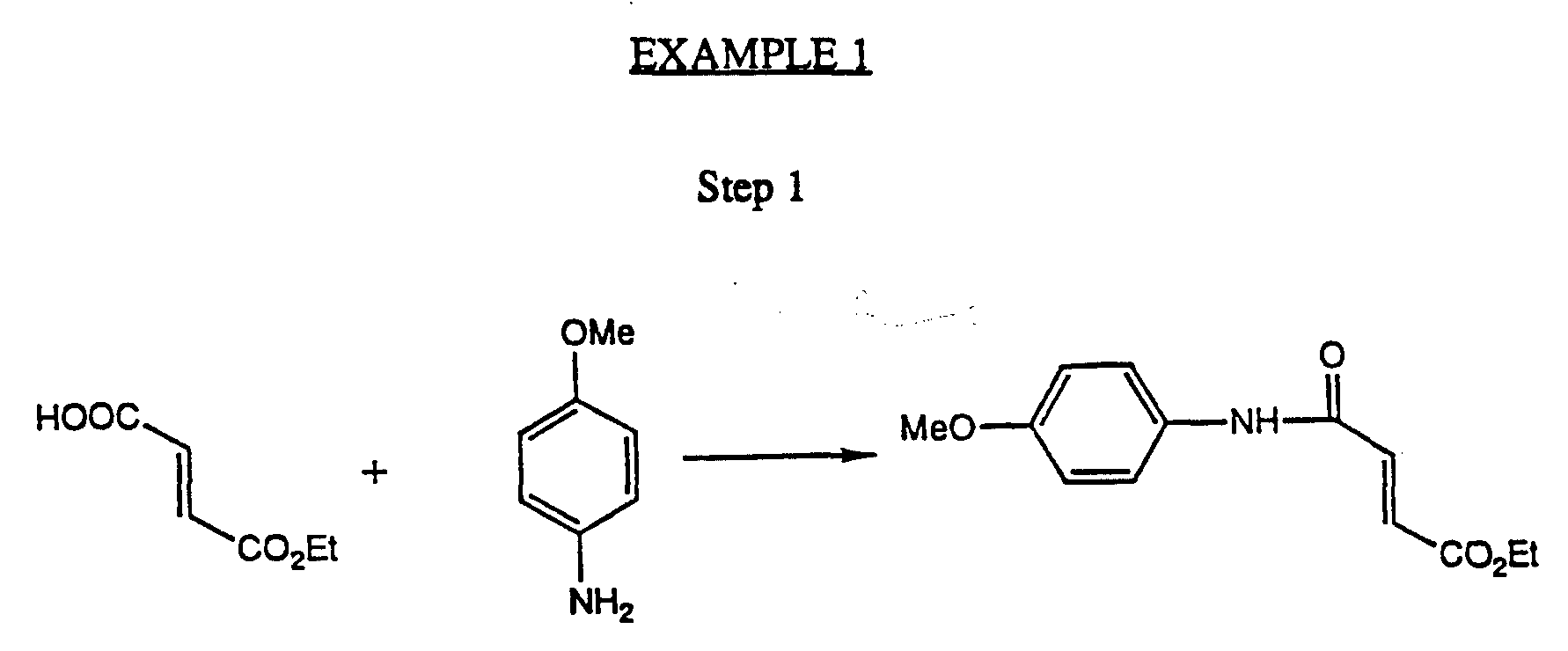
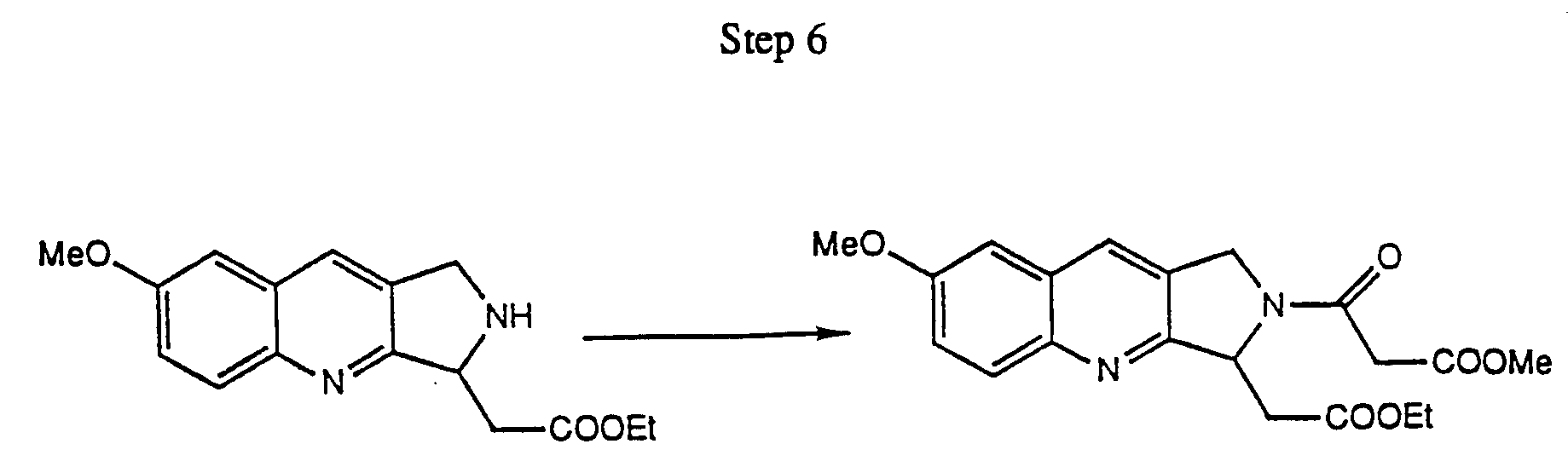
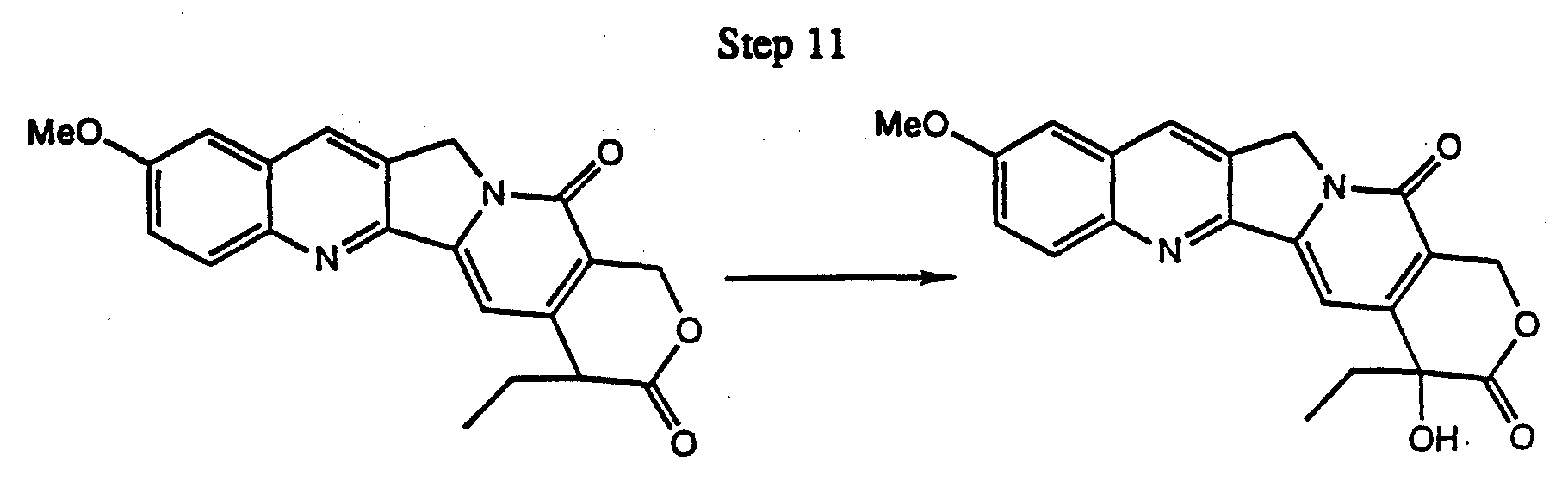
The following Example describes the most preferred process of the present invention for the total synthesis of topotecan, which process is outlined in Scheme 7. The steps in the Example correspond numerically with the steps outlined in Scheme 7.
Figure imgf000026_0001
To a stirred suspension of fumaric acid monoethyl ester (100 g, 95% purity; 0.66 mol) p-anisidine (90 g, 99% purity, 1.1 eq.) and 1-hydroxybenzotriazole (89 g, 1 eq.) in methylene chloride (3000 ml) was added dimethylaminopropyl ethyl cabodiimide (WSC, 125 g, leq.). The resulting mixture was stirred at 20 °C for 16 hours. Additional methylene chloride (2000 ml) was added and the mixture was successively washed with dilute, aqueous, hydrochloric acid (10%, 1500 ml) and water (2 ×1500 ml). The organic layer was evaporated to give a crude, greenish-yellow solid which was triturated with 500 ml of diediyl ether and isolated by filtration to give 147 g of a yellow powder (89% yield) mp 144-145 °C. IR (KBr) 3400-3200, 1720, 1699, 1687, 1672, 1651, 1638, 1613, 1556, 1509, 1240, 1163, 843, 830 cm-1;
1H NMR (δ, CDCI3): 1.30 (t, J = 7.1 Hz, 3H, CH2CH3), 3.77 (s, 3H, OCH3), 4.25 (q, J = 7.1 Hz, 2H, CH2CH3), 6.85 (d, J = 8.8 Hz, 2H, aromatic), 6.91, 7.07 (AB, q,
J = 15.3 Hz, 4H, olefin), 7.50 (d, J = 8.9 Hz, 2H, aromatic), 7.84 (br, 1H, NH); 1H NMR (δ, MeOD): 1.23 (t, J = 7.0 Hz, 3H, CH2CH3), 3.69 (s, 3H, OCH3), 4.16 (q, J = 7.1 Hz, 2H, CH2CH3), 6.71, 7.08 (AB, q, J = 15.3 Hz, 4H, olefin), 6.81 (d, J = 9.1 Hz, 2H, aromatic), 7.47 (d, J = 9.1 Hz, 2H, aromatic); MS m/z 250 (MH+), 204, 176, 127.
Figure imgf000027_0001
A mixture of fumaric acid mono p-memoxy phenyl amide mono ethyl ester (50g, 0.2 mol) and propargyl amine (40 ml, 3 eq.) in tBuOH (700 ml) was stirred under reflux at 100 °C for 24 h. The reaction mixture was cooled to 20 °C and solvent was removed on a rotavapor. Ethyl acetate (1500 ml) was added to the remaining thick oil. The resulting solution was washed with hydrochloric acid (10%, 3 × 500 ml). The aqueous phase was then made basic to a pH of
approximately 8 by the slow addition of solid sodium bicarbonate. The resulting suspension was extracted with ethyl acetate (3 × 500 ml). The combined organic layers were washed with water (300 ml) dried and evaporated to give a black semisolid which was treated with hexane:ethyl acetate (1:1) and filtered. The filtrate was concentrated using a rotary evaporator to give a brown oil which slowly formed a solid. The solid could be crystallized by trituration with t-butyl methyl ether to give white crystals, mp 66-67 °C (52.4g, 85.9% yield).
IR (KBr) 3400-3200, 2048 1734, 1650, 1605, 1552, 1514, 1464, 1272, 1248, 1178, 1165, 833 cm-1; 1H NMR (δ, CDCl3): 1.23 (t, J = 7.1 Hz, 3H, CH2CH3), 2.24 (t, J = 2.4 Hz, 1H, alkyne), 2.81, (AB, q, J = 16.6, 7.3Hz, 1H, CH2COO), 2.94 (AB, q, J = 16.6, 4.2 Hz, 1H, CH2COO), 3.45, 3.55 (AB, d,d, J = 17.0, 2.4 Hz, 2H, CH2NH), 3.65 (d,d, J = 7.3, 4.3 Hz, 1H, OCCHNH), 3.76 (s, 3H, OCH3), 4.14 (q, J = 7.1 Hz, 2H, CH2CH3), 6.84 (d, J = 8.9 Hz, 2H, aromatic), 7.46 (d, J = 8.9 Hz, 2H, aromatic), 9.13 (br, 1H, NH);
MS m/z 305 (MH+), 259, 217, 182, 154, 123.
The white grey solid obtained as a byproduct from the initial filtration from hexane:ethyl acetate was N-propargyl aspartic N-p-methoxy phenylamide, mp 165- 166 °C. 1H NMR (δ, CDCl3): 2.30 (t, J = 2.4 Hz, 1H, alkyne), 2.69, (AB, q, J = 17.9, 5.3Hz, 1H, CH2CO2R), 3.09 (AB, q, J = 17.9, 8.3 Hz, 1H, CH2CON), 3.46, 3.70 (AB, d,d, J = 17.4, 2.4 Hz, 2H, CH2NH), 3.80 (s, 3H, OCH3), 4.17 (d,d, J = 8.3, 5.2 Hz, 1H, OCCHNH), 6.96 (d, J = 8.9 Hz, 2H, aromatic), 7.18 (d, J = 8.9 Hz, 2H, aromatic).
Figure imgf000028_0001
To a solution of starting amine (44.66g, 0.146 mol) and pyridine (15.1g, 1.3 eq.) in methylene chloride (150 ml) was added neat methyl chloroformate (14.9 ml, 1.3 eq.) drop wise with the internal temperature maintained at 0 °C with cooling. The resulting mixture was stirred at 0 °C for 30 min. Additional methylene chloride (400 ml) was added to the reaction mixture. The solution was successively washed with aqueous hydrochloric acid (10%, 2 × 150 ml) and saturated sodium chloride solution (2 × 150 ml). The organic solvent was removed on a rotavapor to give a brown oil which was passed through a silica gel pad (200 g) with ether as eluent. The filtrate was concentrated on a rotavapor to give the desired product (41.46g) in 78% yield, which was used as obtained. The product could be recrystallized in approximately 95% recovery by trituration with diethyl ether to give white crystals with mp 97-98 °C.
IR (KBr) 3300, 2120, 1725, 1709, 1687, 1600, 1512, 1463, 1247, 1173, 830 cm-1; 1H NMR (δ, CDCl3): 1.25 (t, J = 7.1 Hz, 3H, CH2CH3), 2.30 (br, 1H, alkyne), 2.89, 3.31 (br, 2H, CH2COO), 3.76 (s, 3H, OCH3),4.06, 4.22 (AB, d,d, J = 18, 2.3 Hz, 2H, CH2NH),4.56 - 4.98 (br, 1H, OCCHNH), 6.82 (d, J = 8.9 Hz, 2H, aromatic), 7.36 (d, J = 8.9 Hz, 2H, aromatic), 7.90 - 8.03 (br, 1H, NH);
MS m/z 363 (MH+), 331, 317, 240, 212, 123.
Figure imgf000029_0001
A mixture of carbamate (27.7 g, 0.077 mol) and trimethyloxonium tetrafluoroborate (40g, 3.5 eq.) in acetonitrile (500 ml) was stirred under reflux for 2.5 h. After cooling to ambient temperature, saturated sodium chloride solution (200 ml) was added with continued stirring. The organic layer was separated and the aqueous phase was extracted with 3 × 300 ml of ethyl acetate. The combined organic phase was washed with saturated sodium bicarbonate solution (3 × 100 ml) and saturated sodium chloride solution (100 ml) dried, and evaporated to give a yellow semisolid which was recrystallized from methanol to give 25.4 g of yellow solid, mp 132-134 °C.
IR (KBr) 1728, 1701, 1623, 1577, 1504, 1451, 1228, 1122, 1029, 825, 769 cm-1; 1H NMR (δ, CDCl3): 1.06, 1.08 (t,t, J = 7.3 Hz, 3H, CH2CH3), 3.80 (br, 2H, CH2COO), 3.78, 3.80 (s,s, 3H, OCH3), 3.90 (s, 3H, OCH3), 4.78 - 4.95 (m, 2H, CH2NH), 5.29 (d, J = 14.1Hz, 1H, OCCHNH), 7.05 (s, 1H, aromatic), 7.31 (d,d, J = 9.2, 2.8 Hz, 1H, aromatic), 7.84, 7.88 (s, s, 1H, aromatic), 7.91 (d, J = 9.0 Hz, 1H, aromatic); MS m/z 345 (MH+), 317, 299, 285, 271, 257.
Figure imgf000030_0001
COOEt
To the tricyclic compound (25.4g) was added a solution of acetic acid saturated with hydrobromic acid (129 ml) and me mixture was stirred at ambient temperature for 24 h. The solvent was removed on a rotavapor and 300 ml of water was added to the residue. The mixture was extracted with 2 × 200 ml of ethyl acetate and the organic extracts were discarded. The aqueous phase was made alkaline with solid sodium carbonate to a pH of >10. The resulting precipitated solid was collected by filtration and dried in oven (45 °C/740 mm) to give 8.98 g of product The aqueouse phase obtained after filtration was further extracted with 3 × 400 ml of methylene chloride. This organic phase was dried and evaporated to give a black oil to which ethyl acetate (100 ml) was added. The resulting mixture was washed with dilute, aqueous hydrochloric acid (3%, 3 x 100 ml). The aqueous phase was made basic by the addition of sodium bicarbonate to a pH > 8, then extracted with methylene chloride, dried, and evaporated to give 2.25 g of product which was combined with the first isolated fraction, giving a total yield of 11.13 g of a yellow solid, m.p. 83-86 °C (51% total yield for 2 steps from the uncyclized carbamate).
IR (KBr) 3350, 1723, 1622, 1502, 1236, 1183, 1026, 893, 842 cm-1;
tø NMR (δ, CDCl3): 1.24 (t, J = 7.1 Hz, 3H, CH2CH3), 2.63 (d,d, J = 16.5, 9.8Hz, 1H, CH2COO), 3.26 (d, d, J = 16.5, 2.9 Hz, 1H, CH2COO), 3.89 (s, 3H, OCH3), 4.16 (q, d, J = 7.0, 1.3 Hz, 2H, CH2CH3), 4.36 (s, 2H, CH2NH), 4.84 (d, d, J = 9.8, 2.8Hz, 1H, OCCHNH), 7.03 (d, J = 2.7Hz, 1H, aromatic), 7.29 (d,d, J = 9.2, 2.8 Hz, 1H, aromatic), 7.82 (s, 1H, aromatic), 7.91 (d, J = 9.2 Hz, 1H, aromatic);
MS m/z 287 (MH+), 199.
Figure imgf000031_0001
To a solution of the tricyclic amine (6.98g, 24.4 mmol) in methylene chloride (250 m l) was added pyridine (3.0g, 1 .56 eqoride (2.66 ml, 95% purity, 1.3 eq.) was then added dropwise, neat, at a rate so as to maintain the internal temperamre at 0 °C. The mixture was stirred at 0 °C for an additional 1 hour after addition was complete. Methylene chloride (350 ml) was added and the resulting solution was washed with hydrochloric acid (10%, 2 × 100 ml) followed by saturated, aqueous, sodium bicarbonate solution and saturated, aqueous, sodium chloride solution. The organic layer was dried and evaporated to give 10.4 g of crude product as a heavy oil which was used in the next reaction without further purification. An analytical sample was obtained by recrystallization from 1:1 ethyl acetate:hexane to give a white powder, mp 1145-116 °C.
IR (KBr) 1747, 1737, 1654, 1621, 1503, 1441, 1135, 900, 846 cm-1;
1H NMR (δ, CDCl3): 1.08 (t J = 7.3 Hz, 3H, CH2CH2), 3.24 (dd, J = 17.2, 3.3 Hz, 1H, CH2COO), 3.55, 3.57 (2 × s, 2H, COCH2COO), 3.78 (s, 3H, COCCH3), 3.93 (q, J = 7.2 Hz, 2H, CH2CH3), 3.93 (s, 3H, OCH3), 4.98, 5.07 (AB, d, J = 13.6 Hz, 2H CH2N), 5.47 (t, J = 3.8 Hz, 1H, CHNH), 7.07 (d, J = 2.7 Hz, 1H, aromatic), 7.35 (dd, J = 9.2, 2.8 Hz, 1H, aromatic), 7.88 (s, 1H, aromatic), 7.95 (d, J = 9.1 Hz, 1H, aromatic)
MS m/z 387 (MH+), 355, 313, 299, 285, 239, 199, 101 .
Figure imgf000032_0001
To a solution of starting material (10.4g) in mixed solvent (216 ml, methanol:toluene = 1: 5) was added sodium methoxide solution (7.4 ml of 25% solution in methanol, 1.2 eq.) dropwise at ambient temperature. The resulting mixture was stirred at 20 °C for 1 h. Water (250 ml) was added with stirring and the layers were separated. The organic layer was extracted with water. The combined aqueous phases were acidified with hydrochloric acid (10%) to a pH < 2. The precipitate was collected by filtration and washed with water until neutral as indicated by pH paper. The white solid was dried under vacuum (60 °C/ 740 mm) to give 5.73g of product , mp 219 - 220 °C (69% yield for 2 steps).
IR (KBr) 3429, 1673, 1661, 1643, 1623, 1567, 1501, 1450, 1238, 1227, 1377, 1046, 1026, 822 cm-1;
1HNMR (δ, CDCl3): 2.86 (d,d, J = 17, 13.6Hz, 1H, CH2COO), 3.31 (d, d, J = 17, 4.4Hz, 1H, CH2COO), 3.92 (s, 3H, OCH3), 3.93 (s, 3H, OCH3), 4.75, 5.13 (AB, d, J = 17 Hz, 2H, CH2NH), 5.14 (d, d, J = 13.5, 4.5Hz, 1H, OCCHNH), 7.07 (d, J = 2.7Hz, 1H, aromatic), 7.36 (d,d, J = 9.2, 2.8 Hz, 1H, aromatic), 7.94 (d, J = 9.3 Hz, 1H, aromatic), 7.97 (s, 1H, aromatic) 13.89 (s, 1H, OH);
MS m/z 341 (MH+), 337, 323, 309, 283, 265. Step 8 To a suspension of the tetracyclic enol (1g, 2.9 mmol) in methylene chloride (50 ml) was added triethylamine (0.5 ml, 1.2 eq.). The resulting brown solution was cooled to -78 °C using a dry ice-acetone bath. Trifluoromethanesulfonic anhydride (0.6 ml, 1.2 eq.) was added dropwise, neat. After me addition was complete, the dry ice-acetone bath was replaced by an ice bath and the reaction mixture was stirred at 0 °C for another hour, then poured into ice water (100 ml). The mixture was extracted with 3 × 100 ml of methylene chloride. The combined organic phases were washed with water (100 ml) dried, and evaporated to give a brown solid which was used directly in the next reaction.
1H NMR (δ, CDCl3): 2.75, 3.12 (AB, d,d, J = 15.9, 13.8Hz, 1H, CH2COO), 3.25, 3.48 (AB, d, d, J = 17.3, 5.3 Hz, 1H, CH2COO), 3.82, 3.92 (s, s, 3H, OCH3), 3.95, 3.96 (s, s, 3H, OCH3), 4.80, 5.14 (AB, d, J = 17.8 Hz, 2H, CH2NH), 5.39 (d, d, J = 15.0, 4.5Hz, 1H, OCCHNH), 7.11 (d, J = 2.7Hz, 1H, aromatic), 7.42 (d,d, d, J = 9.4, 2.9, 2.9 Hz, 1H, aromatic), 7.99 (d, J = 9.2 Hz, 1H, aromatic), 8.03, 8.04 (s, s, 1H, aromatic).
To a suspension of sodium hydride (132 mg, 80% in mineral oil, 1.3 eq.) in THF (10 ml) was added a solution of ethyl, di-tert-butyl malonate (1.43g, 2eq.) in THF (10 ml) dropwise. The resulting mixture was stirred at 20 °C for 15 min. The mixture became a clear solution, to which the triflate obtained above in THF (50 ml) was added dropwise. The resulting dark green mixture was stirred at 20 °C for 1 h and poured into 150 ml of ice-cold water containing 2 ml of acetic acid. The mixture was extracted with 3 × 150 ml of methylene chloride. The combined organic layers were dried over magnesium sulfate and evaporated to give a black semisolid which was purified by flash chromatography (2 :1 hexane:ethyl acetate as eluant) to give the desired product (680 mg) in 41% yield. The product was isolated as fluffy, tan crystals, mp 88-91 °C. IR (KBr) 1736, 1665, 1623, 1504, 1368, 1130, 1158, 1231, 1253, 832, 726 cm-1; 1H NMR (δ, CDCl3): 1.03 (t, J = 7.3 Hz, 3H, CH2CH3), 1.48, 1.51 (s, s, 9H, CCH3), 2.05, 2.19 (q, d, J = 14.2, 7.3Hz, 2H, CH2CH3), 2.65 (d, d, J = 14.2, 14.2 Hz, 1H, CH2COO), 3.21 (d, d, J = 16.4, 4.1 Hz, 1H, CH2COO), 3.80 (s, 3H, OCH3), 3.92 (s, 3H, OCH3), 4.76, 5.14 (AB, d, J = 16.4 Hz, 2H, CH2NH), 5.13 (d, d, J = 13.9, 4.0Hz, 1H, OCCHNH), 7.07 (d, J = 2.5Hz, 1H, aromatic), 7.33 (d,d, J = 9.2, 2.6 Hz, 1H, aromatic), 7.94 (d, J = 9.2 Hz, 1H, aromatic), 7.95 (s, 1H, aromatic); MS m/z 567 (MH+), 511, 479, 467, 411, 379, 323.
Figure imgf000034_0001
A mixture of the starting material (1.84g, 3.25 mmol) and sodium nitrite (1.15g, 95% purity, 5 eq.) in 39 ml of 10:3 acetic acid:water was stirred at 65 °C 8 h. The reaction mixture was cooled to ambient temperature and poured into 300 ml of ice-water. The mixture was extracted with 3 × 200 ml of methylene chloride and the organic layers were dried over magnesium sulfate. The organic layer was concentrated on a rotavapor to give 1.8 g of yellow solid (98% crude yield) which was pure enough to carry direcdy on to the next reaction. An analytical sample was obtained by recrystallization from methylene chloride:hexane, mp 198-200 °C. IR (KBr) 1742, 1730, 1649, 1623, 1605, 1510, 1370, 1254, 844, 834 cm-1;
1H NMR (δ, CDCl3): 1.00 (t, J = 7.4 Hz, 3H, CH2CH3), 1.50 (s, 9H, CCH3), 2.38 (q, J = 7.4Hz, 2H, CH2CH3), 3.89 (s, 3H, OCH3), 3.98 (s, 3H, OCH3), 5.27(s, 2H, CH2NH), 7.15 (d, J = 2.7Hz, 1H, aromatic), 7.25 (s, 1H, aromatic), 7.45 (d,d, J = 9.3, 2.8 Hz, 1H, aromatic), 8.09 (d, J = 9.4 Hz, 1H, aromatic), 8.24 (s, 1H, aromatic);
MS m/z 565 (MH+), 509, 493, 477, 465, 453, 409, 393, 377, 365, 333.
Figure imgf000034_0002
To a solution of starting material (1.24g, 2.2 mmol) in dimethoxyethane (50 ml) was added DIBAL (11 ml, 1.0M in hexane, 5 eq.) dropwise at 0 °C. The colour turned from yellow to blue and finally to dark brown. After the addition was complete, the mixture was stirred at 0 °C for lh and poured into a ice water (300 ml). The mixture was extracted with 3 × 250 ml of mediylene chloride. The organic layers were dried and evaporated to give 1.18 g of yellow solid, to which was added a 50 ml of 3:2 methanol:hydrochloric acid. Soduim borohydride (200 mg, 3 eq.) was added in small portions to this stirred solution and the resulting mixture was stirred for 15 minutes after addition was complete. The solvent was removed on a rotavapor and dilute hydrochloric acid (50 ml of 0.4% solution) was added to the residue. The mixture was extracted with 3 × 100 ml of methylene chloride. The combined organic layers were dried over magnesium sulfate and concentrated to give a dark solid to which trifluoroacetic acid (20 ml) was added. The mixture was stirred at ambient temperature for 1 h. Trifluoroacetic acid was removed on a rotavapor and water (50 ml) was added to the residue. The mixture was extracted with 3 × 100 ml of methylene chloride.The combined organic layers were dried over magnesium sulfate and concentrated to give 774 mg of crude product (98% yield) which was carried directly on to the next reaction. An analytical sample was obtained by recrystallization from methylene chloride:hexane, mp 259-261 °C.
IR (KBr) 1735, 1657, 1604, 1506, 1243, 825cm"1;
1H NMR (δ, CDCl3): 1.09 (t J = 7.4 Hz, 3H, CH2CH3), 2.09 (m, 2H, CH2CH3), 3.61 (t, J = 6.5 Hz, 1H, CHCOO), 3.98 (s, 3H, OCH3), 5.27 (s, 2H, CH2NH), 5.39, 5.56 (AB, d, J = 16.0 Hz, 2H, CH2OCO), 7.13 (s, 1H, aromatic), 7.16 (d, J = 2.7 Hz, 1H, aromatic), 7.47 (d, d, J = 19.3, 2.7Hz, 1H, aromatic), 8.10 (d, J = 9.3 Hz, 1H, aromatic), 8.25 (s, 1H, aromatic);
MS m/z 363 (MH+), 333, 319.
Figure imgf000035_0001
To a solution of starting material (665 mg, 1.84 mmol) in 60 ml of N,N- dimethylformamide was added piperidine (3.2 ml) and oxgen gas was bubbled through the solution for 6 h with stirring. DMF was removed on a rotavapor to give 680 mg of brown solid, mp 278 -280 °C (100%). The crude product showed >95% total area response for the desired product as indicated by HPLC, and was carried on as obtained.
IR (KBr) 3400, 1738, 1656, 1600, 1512, 1267, 1165, 1156, 1105, 825cm-1;
1H NMR (δ, CDCl3): 1.05 (t, J = 7.1 Hz, 3H, CH2CH3), 1.91 (q, J = 7.1 Hz, 2H,
CH2CH3), 3.70 (s, 1H, OH), 3.99 (s, 3H, OCH3), 5.28 (s, 2H, CH2NH), 5.32, 5.76
(AB, d, J = 15.8 Hz, 2H, CH2OCO), 7.17 (s, 1H, aromatic), 7.48 (d, J = 10.0 Hz, 1H, aromatic), 7.62 (s, 1H, aromatic), 8.13 (d, J = 9.3 Hz, 1H, aromatic), 8.27 (s, 1H, aromatic);
MS m/z 379 (MH+), 335, 333.
Figure imgf000036_0001
A mixture of starting material (60 mg, 0.16 mmol) and HBr (48% solution, 3 ml) was refluxed at 155 °C for 2 h. The reaction mixture was cooled to ambient temperature. Water (50 ml) was added and the mixture was extracted with methylene chloride:mcthanol. The organic layers were dried over magnesium sulfate and concentrated to give crude product which was purified by silica gel
chromatography using a chromatotron to give the desired product (42 mg, 72% yield) with mp 269 - 272 °C which was spectroscopically and chromatographically identical to a sample prepared independently by semisynthesis from naturally- occurring camptothecin.
1H NMR (δ, DMSO-d6): 0.87 (t, J = 7.3 Hz, 3H, CH2CH3), 1.85 ( hept, J = 7.3 Hz, 2H, CH2CH3), 5.22 (s, 2H, CH2N), 5.40 (s, 2H, CH2OCO), 7.25 (s, 1H, aromatic), 7.28 (s, 1H, aromatic), 7.41 (d, J = 9.1 Hz, 1H, aromatic), 8.01 (d, J = 9.1 Hz, 1H, aromatic), 8.45 (s, 1H, aromatic);
Figure imgf000037_0001
To a solution of starting material (20 mg, 0.05 mmol) in 3 ml of 2:1 mediylene chloride: 1-propanol was added 0.05 ml (1.5 eq) of N,N,N',N'- tetramethyldiaminomethane (BDAM) and the mixture was stirred at ambient temperamre for 16 h. Hydrochloric acid (1 ml of 37% aqueous in 5 ml of 1-PrOH) was slowly added and the mixture was stirred at ambient temperature for another 5h. The solvent was removed in vacuo to give a hygroscopic, brown semisolid which was purified by reverse-phase HPLC (acetonitrile :wateπtrifluoroacetic acid; 16 : 84 : 1.5) to give racemic SK&F 104864 in approximately 88% yield from 10- hydroxycamptothecin. The identity of the product was confirmed by compari son of NMR and Mass spectra as well as chromatographic behavior with an authentic sample of the desired product.
1H NMR (δ, DMSO-d6): 0.87 (t, J = 7.2 Hz, 3H, CH2CH3), 1.86 ( hept, J = 7.0 Hz, 2H, CH2CH3), 2.84 (s, 6 H, NCH3), 4.72 [s, 2H, CH2N(CH3)2], 5.28 (s, 2H, CH2N), 5.41 (s, 2H, CH2OCO), 6.50 (s, 1H, OH), 7.28 (s, 1H, aromatic), 7.64 (d, J = 9.2 Hz, 1H, aromatic), 8.18 (d, J = 9.2 Hz, 1H, aromatic), 8.91 (s, 1H, aromatic); MS m/z 422 (MH+), 377, 307, 289, 220, 154, 136, 107, 77.
The overall yield of topotecan for the total synthesis in 13 steps was about 5- 6%.

Claims

We claim:
1. A process for preparing a compound selected from the group consisting essentially of pyrrolo[3,4-b]quinolines, 1H-pyrano[3',4':6,7]indolizino[1,2-b]quinolin-3,14(4H,12H)-diones, and 8-medιyl-7-(oxopropyl)-indolizino[1,2-b]quinolin-9(11H)-ones, said process comprising the step of intramolecular [4+2] cycloaddition of the N-arylimidate portion of a compound of Formula IV:
Figure imgf000038_0001
where:
X=OH, OAICI2, Cl, Br, I, F, OR, OSO2CF3 or any good leaving group or H
R1 = H, OH, or OR, where R is an ester protecting group;
R2 = H, NO2, or a protected amine function;
R3 = H, C2H5, or a trialkylsilyl;
R4 = H or CH2COOEt;
R5 = COOMe or tosyl; or
R4 and R5 are joined together to form a substituted pyridone IVa:
Y=H or Y,Rι = -OCH2O-
Figure imgf000038_0002
where:
A = H, COOR, or a functionality for preparation of the hydroxymethyl (C-17) portion of an E ring lactone; B = H, OH, an appropriate leaving group such as halide or
O(trifluoromethanesulfonate) or a functionality for preparation of C- (18-21) of the E ring lactone portion of camptothecin. with the unactivated acetylene portion of said compound.
2. A process according to Claim 1 wherein said step further comprises heating said compound of Formula IV, a compound Formula III, corresponding to in a polar solvent at a temperature of about 20-85°C in the presence of an agent selected from the group consisting essentially of a strong alkylating agent, such agent as is capable of producing either an O-alkylimidate or imidate ester, imidoyl halide, and such imide derivative as is capable of cyclodehydration.
3. A process according to Claim 2 wherein said polar solvent is selected from a group consisting essentially of mediylene chloride, 1,2-dichloroethane, 1,2-dimethoxyediane tetrahydrofuran, N,N-dimethylformamide, acetonitrile, acetone and N-methylpyrrolidinone.
4. A process according to Claim 3 wherein said polar solvent is acetonitrile.
5. A process according to Claim 2 wherein said temperature is about 60-85°C.
6. A process according to Claim 5 wherein said temperature is about the reflux temperature of acetonitrile.
7. A process according to Claim 2 wherein said strong alkylating agent or such agent as is capable of producing either an O-alkylimidate or imidate ester, imidoyl halide, or such imide derivative as is capable of cyclodehydration, is selected from a group consisting essentially of trifluoromethanesulfonic anhydride, dimethylsulfate, alkyloxonium tetrafluoroborates, aluminum chloride, O-benzyltrichloroacetimidate, triphenylphosine/carbon tetrachloride, or triphenylphosphine/carbon tetrabromide
8. A process according to Claim 7 wherein said agent is trimethyloxonium tetrafluoroborate.
9. A process according to Claim 1 wherein said compound is a
1H-pyrano[3',4':6,7]indolizino[1,2-b]quinolin-3,14(4H,12H)-dione.
10. A process according to Claim 9 wherein said 1H-pyrano[3',4':6,7]indolizino[1,2-b]quinolin-3,14(4H,12H)-dione is a camptothecin analog.
11. A process according to Claim 10 wherein said camptothecin analog is a water-soluble camptothecin analog.
12. A process according to Claim 11 wherein said water-soluble camptothecin analog is selected from the group consisting essentially of topotecan and irinotecan.
13. A process according to Claim 12 wherein said water-soluble camptothecin analog is topotecan.
14. A process according to Claim 1 wherein said compound is a 8-methyl-7-(oxopropyl)-indolizino[1,2-b]quinolin-9(11H)-one.
15. A process according to Claim 14 wherein said 8-methyl-7-(oxopropyl)-indolizino[1,2-b]quinolin-9(11H)-one is a mappicine.
16. A process according to Claim 14 wherein said 8-methyl-7-(oxopropyl)-indolizino[1,2-b]quinolin-9(11H)-one is a mappicine ketone.
17. A process for preparing a 7-(1,1-bis-alkoxycarbonyl)propyl-8-methoxycarbonyl-5,6-dihydroindolizino[1,2-b]quinolin-9(11H)-one, said process comprising the step of coupling a vinyl triflate derived from a 7-hydroxy-5,6-dihydroindolizino[1,2-b]quinolin-9(11H)-one with a tertiary malonate anion.
18. A process for preparing a 1H-pyrano[3' 4':6 ]indolizino[1,2-b]quinolin-3,14(4H,12H)-dione, said process comprising the steps of:
(a) intramolecular [4+2] cycloaddition of the N-arylimidate portion of a compound of Formula IV:
Figure imgf000040_0001
where:
X=OH, OAICI2, Cl, Br, I, F, OR, OSO2CF3 or any good leaving group or H
R1 = H, OH, OR, where R is an ester protecting group;
R2 = H, NO2, or a protected amine function;
R3 = H, C2H5, or a trialkylsilyl;
R4 = H or CH2COOEt;
R5 = COOMe or tosyl; or
R4 and R5 are joined together to form a substituted pyridone IV:
Y=OH, OAICI2, Cl, Br, I, F, OR, OSO2CF3 or any good leaving group or H
Figure imgf000041_0001
where:
A = H, COOR, or a functionality for preparation of the hydroxymethyl (C-17) portion of an E ring lactone;
B = H, OH, an appropriate leaving group such as halide or
O(trifluoromethanesulfonate) or a functionality for preparation of C- (18-21) of the E ring lactone portion of camptothecin. with the unactivated acetylene portion of said compound to form a 2-(acetate ester) substimted pyrrolo [3,4-b]quinoline;
(b) cyclizing said 2-(acetate ester) substituted pyrrolo[3,4-b]quinoline to form a 5,6-dihydroindolizino[1,2-b]quinolin-9(11H)-one substituted at C-7 with an
(alkyl malonate) diester,
(c) coupling a 7-substituted vinyl triflate of said 7-hydroxy-5,6-dihydroindolizino[1,2-b]quinolin-9(11H)-one with a tertiary malonate anion to form a 5,6-dihydroindolizino[1,2-b]quinolin-9(11H)-one substituted at C-7 an (alkyl malonate) diester, and (d) converting said 7-(1,1-bis-alkoxycarbonyl)propyl-5,6-dihydroindolizino[1,2-b]quinolin-9(11H)-one into the lactone E ring of a 1H-pyrano[3,,4':6,7]indolizino[1,2-b]quinolin-3,14(4H,12H)-dione.
19. A process according to Claim 18 wherein said step (a) further comprises heating a compound of Formula m, corresponding to said compound of Formula
IV, in a polar solvent at a temperature of about 20-85°C in me presence of an agent selected from the group consisting essentially of a strong alkylating agent; such agent as is capable of producing either an O-alkylimidate or imidate ester, imidoyl halide; and such imide derivative as is capable of cyclodehydration.
20. A process according to Claim 19 wherein said polar solvent is selected from a group consisting essentially of methylene chloride, 1,2-dichloroethane, 1,2-dimethoxyediane tetrahydrofuran, N,N-dimetiιylformamide, acetonitrile, acetone and N-mediylpyrrolidinone.
21. A process according to Claim 20 wherein said polar solvent is acetonitrile.
22. A process according to Claim 19 wherein said temperature is about 60-85°C.
23. A process according to Claim 22 wherein said temperature is about the reflux temperature of acetonitrile.
24. A process according to Claim 19 wherein said strong alkylating agent or such agent as is capable of producing either an O-alkylimidate or imidate ester, imidoyl halide, or such imide derivative as is capable of cyclodehydration, is selected from a group consisting essentially of trifluoromethanesulfonic anhydride, dimethylsulfate, alkyloxonium tetrafluoroborates, aluminum chloride, O-benzyltrichloroacetimidate, triphenylphosine/carbon tetrachloride, or
triphenylphosphine/carbon tetrabromide.
25. A process according to Claim 19 wherein said agent is trimethyloxonium tetrafluoroborate.
26. A process according to Claim 18 wherein said compound is a
camptothecin analog.
27. A process according to Claim 26 wherein said camptothecin analog is a water-soluble camptothecin analog.
28. A process according to Claim 27 wherein said water-soluble camptothecin analog is selected from the group consisting essentially of topotecan and irinotecan.
29. A process according to Claim 28 wherein said water-soluble camptothecin analog is topotecan.
30. A process according to Claim 1 wherein R4 and R5 of said compound of Formula IV are joined together to form a substituted pyridone.
31. A process for the total synthesis of topotecan,, said process comprising the steps of:
(a) intramolecular [4+2] cycloaddition of the N-arylimidate portion of a compound of Formula IV:
Figure imgf000043_0001
where:
X=OH, OAICI2, Cl, Br, I, F, OR, OSO2CF3 or any good leaving group or H
R1 = OMe;
R2 = H;
R3 = H;
R4 = CH2COOEt; and
R5 = COOMe;
Y=H or Y,R1 = -OCH2O- with the unactivated acetylene portion of said compound by heating a compound of Formula III, corresponding to compound of Formula IV, in a polar solvent at a temperature of about 20-85 °C in the presence of a strong alkylating agent or such agent as is capable of transforming an amide into its corresponding O-alkylimidate or imidate ester, imidoyl halide, or a strong acid (such as aluminum chloride) capable of initiating a cyclodehydretion to yield a pyrrolo[3,4-b]quinoline substituted at C-2 by an acetate ester,
(b) hydrolyzing the carbamate function of the C-2 substituted pyrrolo[3,4-b]quinoline from step (a) with acetic acid saturated with HBr to give a tricyclic amine;
(c) coupling said tricyclic amine with a monoalkyl malonyl chloride, preferably monomethyl malonyl chloride, to give the half-amide of a malinate diester,
(d) subjecting said malonate half-amide to a Dieckmann condensation in the presence of an alkoxide to give a a tetracyclic enol;
(e) forming a vinyl triflate of said tetracyclic enol, and coupling said triflate with a tertiary malonate anion to form a 7-(1,1-di-tert-butoxycarbonyl)propyl-8-methoxycarbonyl-5,6-dihydroindolizino[1,2-b]quinolin-9(11H)-one;
(f) 1,2 elimination of hydrogen at the 5,6 bond to give 7-(1,1-di-tert-butoxycarbonyl)propyl-8-methoxycarbonyl-indolizino[1,2-d]quinolin-9(11H)-one;
(g) reduction of the 8-methoxycarbonyl group of the 7-(1,1-di-tert-butoxycarbonyl)propyl-8-methoxycarbonyl-indolizino[1,2-b]quinolin-9(11H)-one, followed by hydrolysis-decarboxylation of the diester group at C-7, and lactone formation to give a 4-ethyl-9-methoxy-1H-pyrano[3',4':6,7] indolizino[1,2-b]quinolin-3,14(4H,12H)-dione;
(h) forming a tertiary alcohol α to the E ring carbonyl of said 4-ethyl-9-methoxy-1H-pyrano[3',4':6,7] indolizino[1,2-b]quinolin-3,14(4H,12H)-dione to give 10-methoxycamptothecin;
(i) cleaving the methyl ether of said 10-medιoxycamptothecin to yield 10-hydroxycamptothecin; and
(j) alkylating the 9-position of said 10-hydroxycamptothecin by reaction with N,N,N',N'-tetramethyldiaminomethane (BDAM) to give topotecan.
32. A process according to Claim 31 wherein said polar solvent is selected from a group consisting essentially of methylene chloride, 1,2-dichloroethane, 1,2-dimethoxyethane tetrahydrofuran, N,N-dimethylformamide, acetonitrile, acetone and N-methylpyrrolidinone.
33. A process according to Claim 32 wherein said polar solvent is acetonitrile.
34. A process according to Claim 19 wherein said temperature is about 60-85°C.
35. A process according to Claim 34 wherein said temperature is about the reflux temperature of acetonitrile.
36. A process according to Claim 31 wherein said strong alkylating agent or such agent as is capable of producing either an O-alkylimidate or imidate ester, imidoyl halide, or such imide derivative as is capable of cyclodehydration, is selected from a group consisting essentially of trifluoromethanesulfonic anhydride, dimediylsulfate, alkyloxonium tetrafluoroborates, aluminum chloride, O-benzyltrichloroacetimidate, triphenylphosine/carbon tetrachloride, or
triphenylphosphine/carbon tetrabromide
37. A process according to Claim 32 wherein said agent is trimethyloxonium tetrafluoroborate.
38. A process for the preparation of a camptothecin analog which lacks the lactone E ring, said process comprising the steps of:
(a) intramolecular [4+2] cycloaddition of the N-arylimidate portion of a compound of Formula IV:
Figure imgf000045_0001
where:
X=OH, OAICI2, Cl, Br, I, F, OR, OSO2CF3 or any good leaving group or H
R1 = H, OH, or OR, where R is an ester protecting group;
R2 = H, NO2, or a protected amine function;
R3 = H, C2H5, or a trialkylsilyl;
R4 = H or CH2COOEt;
R5 = COOMe or tosyl; or
R4 and R5 are joined together to form a substituted pyridone IV:
Y=H or Y,R1= -OCH2O-
Figure imgf000046_0001
where:
A = H, COOR, or a functionality for preparation of the hydroxymethyl (C-17) portion of an E ring lactone;
B = H, OH, an appropriate leaving group such as halide or
O(trifluoromethanesulfonate) or a functionality for preparation of C- (18-21) of the E ring lactone portion of camptothecin; with the unactivated acetylene portion of said compound to give a pyrrolo[3,4-b]quinoline substituted with an acetate ester at C-2;
(b) cyclizing the 2-substituted pyrrolo[3,4-b]quinoline to form a 7-hydroxy-5,6-dihydroindolizmo[1,2-b]quinolin-9(11H)-one;
(c) coupling a 7-trifluoromedιanesulfonate derivative of the 7-hydroxy-5,6-dihydroindolizino[1,2-b]quinolin-9(11H)-one with a tertiary malonate anion to form a 5,6-dihydroindolizino[1,2-b]quinolin-9(11H)-one substituted at C-7 with an (alkyl)malonate diester,
(d) converting the 7-(1,1-bis-alkoxycarbonyl)propyl-8-methoxycarbonyl-5,6-dihydroindolizino[1,2-b]quinolin-9(11H)-one into the lactone E ring of a 1H-pyrano[3',4':6,7]indolizino[1,2-d]quinolin-3,14(4H,12H)-dione, preferably a camptothecin analog; and
(e) opening the E ring of said camptothecin analog with extrusion of, depending upon choice of termination step, carbon dioxide to provide a
camptothecin analog which lacks the lactone E ring, preferably a mappicine or mappicine ketone.
39. A process according to Claim 38 wherein said camptothecin analog which lacks the lactone E ring is an 8-methyl-7-(oxopropyl)-indolizmo[1,2-b]quinolin-9(11H)-one.
40. A process according to Claim 39 wherein said 8-methyl-7-(oxopropyl)-indolizino[1,2-b]quinolin-9(11H)-one is a mappicine.
41. A process according to Claim 39 wherein said 8-methyl-7-(oxopropyl)-indolizino[1,2-b]quinolin-9(11H)-one is a mappicine ketone.
PCT/US1993/008434 1992-09-08 1993-09-08 PROCESS FOR PREPARING CERTAIN PYRROLO[3,4- b]QUINOLINES, CERTAIN 1H-PYRANO[3',4':6,7]INDOLIZINO[1,2-b]QUINOLIN-3,14(4H,12H)-DIONES, AND CERTAIN 8-METHYL-7-(OXOPROPYL)-INDOLIZINO[1,2-b]QUINOLIN-9(11H)-ONES Ceased WO1994005672A1 (en)

Priority Applications (4)

Application Number Priority Date Filing Date Title
AU51023/93A AU5102393A (en) 1992-09-08 1993-09-08 Process for preparing certain pyrrolo(3,4- b)quinolines, certain 1H-pyrano(3',4':6,7)indolizino(1,2-b)quinolin-3,14(4H,12H) -diones, and certain
EP93920496A EP0660835A4 (en) 1992-09-08 1993-09-08 Process for preparing certain pyrrolo 3,4- -i(b))quinolines, certain 1h-pyrano 3',4':6,7)indolizino 1,2--i(b))quinolin-3,14(4h,12h)-diones, and certain 8-methyl-7-(oxopropyl)-indolizino 1,2--i(b))quinolin-9(11h)-ones.
KR1019950700883A KR950702987A (en) 1992-09-08 1993-09-08 Specific pyrrolo [3,4-b] quinoline, specific 1H-pyrano [3 ', 4': 6,7] indolizino [1,2-b] quinoline-3,14 (4H, 12H) -dione And PROCESS FOR PREPARING CERTAIN PYRROLO [3,4-b], for the preparation of certain 8-methyl-7- (oxopropyl) -indolinino [1,2-b] quinolin-9- (11H) -ones. QUINOLINES, CERTAIN 1H-PYRANO [3 ′, 4 ′: 6,7] INDOLIZINO [1,2-b] QUINOLIN-3,14 (4H, 12H) -DIONES, AND CERTAIN 8-METHYL-7- (OXOPROPYL)- INDOLIZINO [1,2-b] QUINOLIN-9 (11H) -ONES
JP6507518A JPH08501104A (en) 1992-09-08 1993-09-08 Certain pyrrolo [3,4-b quinolines, certain 1H-pyrano [3 ', 4': 6,7 indolizino [1,2-b quinoline-3,14 (4H, 12H) -diones and Process for the production of certain 8-methyl-7- (oxopropyl) -indolidino [1,2-bquinolin-9 (11H) -ones

Applications Claiming Priority (2)

Application Number Priority Date Filing Date Title
US94149692A 1992-09-08 1992-09-08
US07/941,496 1992-09-08

Publications (1)

Publication Number Publication Date
WO1994005672A1 true WO1994005672A1 (en) 1994-03-17

Family

ID=25476581

Family Applications (1)

Application Number Title Priority Date Filing Date
PCT/US1993/008434 Ceased WO1994005672A1 (en) 1992-09-08 1993-09-08 PROCESS FOR PREPARING CERTAIN PYRROLO[3,4- b]QUINOLINES, CERTAIN 1H-PYRANO[3',4':6,7]INDOLIZINO[1,2-b]QUINOLIN-3,14(4H,12H)-DIONES, AND CERTAIN 8-METHYL-7-(OXOPROPYL)-INDOLIZINO[1,2-b]QUINOLIN-9(11H)-ONES

Country Status (11)

Country Link
EP (1) EP0660835A4 (en)
JP (1) JPH08501104A (en)
KR (1) KR950702987A (en)
CN (1) CN1096297A (en)
AU (2) AU5102393A (en)
CA (1) CA2144048A1 (en)
MX (1) MX9305517A (en)
NZ (1) NZ255942A (en)
TW (1) TW246674B (en)
WO (1) WO1994005672A1 (en)
ZA (1) ZA936580B (en)

Cited By (1)

* Cited by examiner, † Cited by third party
Publication number Priority date Publication date Assignee Title
US6660861B1 (en) * 2003-03-27 2003-12-09 Council Of Scientific And Industrial Research Process for preparing Topotecan from 10-hydroxy-4-(S) camptothecin

Families Citing this family (3)

* Cited by examiner, † Cited by third party
Publication number Priority date Publication date Assignee Title
CN2757510Y (en) 2004-12-06 2006-02-08 鸿富锦精密工业(深圳)有限公司 Radiator buckle
US7520313B2 (en) 2006-03-16 2009-04-21 Fu Zhun Precision Industry (Shen Zhen) Co., Ltd. Locking device for heat sink
CN105859716B (en) * 2016-05-06 2018-03-09 华东师范大学 In a kind of synthesis camptothecine compounds 56 and ring structure method

Citations (6)

* Cited by examiner, † Cited by third party
Publication number Priority date Publication date Assignee Title
JPS49117491A (en) * 1973-03-26 1974-11-09
JPS5217499A (en) * 1975-07-31 1977-02-09 Nippon Chemiphar Co Ltd Preparation of mappicine
DE2534601A1 (en) * 1975-08-02 1977-02-17 Basf Ag Camptothecin analogues prepn. - involving alkylation prior to reduction and lactonization of chloro-camptothecin precursors
US4914205A (en) * 1987-06-25 1990-04-03 Kabushiki Kaisha Yakult Honsha Camptothecin derivatives
JPH0383986A (en) * 1989-08-29 1991-04-09 Yakult Honsha Co Ltd New quinoline derivative and its production
US5155225A (en) * 1990-09-28 1992-10-13 Smithkline Beecham Corporation Method for making certain pyrano[3',4':6,7]indolizino-[1,2-B]quinolinones

Patent Citations (6)

* Cited by examiner, † Cited by third party
Publication number Priority date Publication date Assignee Title
JPS49117491A (en) * 1973-03-26 1974-11-09
JPS5217499A (en) * 1975-07-31 1977-02-09 Nippon Chemiphar Co Ltd Preparation of mappicine
DE2534601A1 (en) * 1975-08-02 1977-02-17 Basf Ag Camptothecin analogues prepn. - involving alkylation prior to reduction and lactonization of chloro-camptothecin precursors
US4914205A (en) * 1987-06-25 1990-04-03 Kabushiki Kaisha Yakult Honsha Camptothecin derivatives
JPH0383986A (en) * 1989-08-29 1991-04-09 Yakult Honsha Co Ltd New quinoline derivative and its production
US5155225A (en) * 1990-09-28 1992-10-13 Smithkline Beecham Corporation Method for making certain pyrano[3',4':6,7]indolizino-[1,2-B]quinolinones

Non-Patent Citations (6)

* Cited by examiner, † Cited by third party
Title
Jour. Am. Chem. Soc., Vol. 111, issued 1989, HAYAKAWA et al., "Competitive Intramolecular (4+2) Cycloaddition and Tandem (2+2) Cycloaddition (3,3)-Sigma-Tropic Rearrangement Sequence of Allenyl3-Vinyl-2-Cyclohexene Ethers: Evidence for Switching of the Reactive Pathway by the Substituent Effects", see *
Jour. Am. Chem. Soc., Vol. 114, issued July 1992, CURRAN et al., "New 4+1 Radical Annulations. A Formal Total Synthesis of (+) Camptothecin", pages 5863-4, see entire document. *
See also references of EP0660835A4 *
Tetrahedron Letters, Vol. 27, No. 40, issued 1986, K.J. SHEA et al., "The Intramolecular Diels-Alder Cycloaddition of N Dienoyl Acrylimidates. New Methodology for the Construction of Nitrogen Heterocycles", pages 4837-40, see Scheme 1, page 4839. *
Tetrahedron Letters, Vol. 32, No. 52, issued 1991, D.L. BOGER et al., "Studies on the Synthesis of Rubrolone; 4 Pi Participation of O-AlkylAlpha, Beta, Unsaturated Oximesin Intramolecular (4+2) Cycloaddition Reactions", pages 7643-46, see page 7643, Scheme 1 and page 7645. *
Tetrahedron, Vol. 44, No. 13, issued 1985, C. CLARKE et al., "An Approach to the Synthesis of Gelsemine: The Intramolecular Reaction of an Allylsilane with an Acyliminium Ion for the Synthesis of the Quaternary Centres", pages 3931-44. *

Cited By (1)

* Cited by examiner, † Cited by third party
Publication number Priority date Publication date Assignee Title
US6660861B1 (en) * 2003-03-27 2003-12-09 Council Of Scientific And Industrial Research Process for preparing Topotecan from 10-hydroxy-4-(S) camptothecin

Also Published As

Publication number Publication date
AU5102393A (en) 1994-03-29
KR950702987A (en) 1995-08-23
EP0660835A4 (en) 1995-08-16
MX9305517A (en) 1994-05-31
TW246674B (en) 1995-05-01
NZ255942A (en) 1996-11-26
AU2859197A (en) 1997-10-23
JPH08501104A (en) 1996-02-06
EP0660835A1 (en) 1995-07-05
CA2144048A1 (en) 1994-03-17
CN1096297A (en) 1994-12-14
ZA936580B (en) 1994-08-01

Similar Documents

Publication Publication Date Title
US5244903A (en) Camptothecin analogs as potent inhibitors of topoisomerase I
FI91872C (en) Process for the preparation of therapeutically active pyranoindolizinoquinoline derivatives
US5106742A (en) Camptothecin analogs as potent inhibitors of topoisomerase I
US4981968A (en) Synthesis of camptothecin and analogs thereof
ES2254600T3 (en) NEW ANALOGS OF CAMPTOTECHINE, PREPARATION PROCEDURES, ITS APPLICATION AS MEDICATIONS AND PHARMACEUTICAL COMPOSITIONS CONTAINING THEM.
WO1998035940A1 (en) Highly lipophilic camptothecin derivatives
US5364858A (en) Camptothecin analogs as potent inhibitors of topoisomerase I
US5405963A (en) Process for asymmetric total synthesis of camptothecin analogues
WO1996021666A1 (en) Camptothecin derivatives and its manufacturing method
NZ520835A (en) Alkylated imidazopyridine derivatives
EP0555347A1 (en) SUBSTITUTED INDOLIZINO 1,2-b]QUINOLINONES
JP2003528879A (en) Tricyclic imidazopyridine
WO1994005672A1 (en) PROCESS FOR PREPARING CERTAIN PYRROLO[3,4- b]QUINOLINES, CERTAIN 1H-PYRANO[3&#39;,4&#39;:6,7]INDOLIZINO[1,2-b]QUINOLIN-3,14(4H,12H)-DIONES, AND CERTAIN 8-METHYL-7-(OXOPROPYL)-INDOLIZINO[1,2-b]QUINOLIN-9(11H)-ONES
NZ248841A (en) Pyrido[4,3-b]carbazole derivatives (or ellipticines) and medicaments
MXPA04011682A (en) Camptothecins with a modified lactone ring.
CA2161318A1 (en) New anthraquinonic derivatives having an antitumor activity, and applications thereof
Albright et al. Synthesis of 1, 4, 5, 6‐tetrahydropyrazolo [3, 4‐d] pyrido [3, 2‐b] azepine
IL144987A (en) Homocamptothecin derivatives and medicaments containing them
US6169080B1 (en) Highly lipophilic camptothecin derivatives
US6500953B1 (en) Preparation of camptothecin and nothapodytine derivatives
Hepburn et al. A concise synthesis of further thiophene analogues of kuanoniamine a
Groundwater et al. Synthesis of pyrido [2, 3-c] acridines
Hermecz et al. A ring transformation of 6, 7-dihydro-4H-pyrido [1, 2-a] pyrimidin-4-ones
MXPA01000767A (en) Preparation of camptothecin and nothapodytine derivatives
JPH0517479A (en) Fluoroethylcamptothecin derivative

Legal Events

Date Code Title Description
AK Designated states

Kind code of ref document: A1

Designated state(s): AU BB BG BR BY CA CZ FI HU JP KP KR KZ LK LV MG MN MW NO NZ PL RO RU SD SK UA US VN

AL Designated countries for regional patents

Kind code of ref document: A1

Designated state(s): AT BE CH DE DK ES FR GB GR IE IT LU MC NL PT SE BF BJ CF CG CI CM GA GN ML MR NE SN TD TG

DFPE Request for preliminary examination filed prior to expiration of 19th month from priority date (pct application filed before 20040101)
121 Ep: the epo has been informed by wipo that ep was designated in this application
WWE Wipo information: entry into national phase

Ref document number: 255942

Country of ref document: NZ

WWE Wipo information: entry into national phase

Ref document number: 2144048

Country of ref document: CA

WWE Wipo information: entry into national phase

Ref document number: 1993920496

Country of ref document: EP

ENP Entry into the national phase

Ref document number: 1995 397214

Country of ref document: US

Date of ref document: 19950407

Kind code of ref document: A

WWP Wipo information: published in national office

Ref document number: 1993920496

Country of ref document: EP

WWW Wipo information: withdrawn in national office

Ref document number: 1993920496

Country of ref document: EP