WO1994006462A1 - Use of lectins for treatment of skin diseases - Google Patents
Use of lectins for treatment of skin diseases Download PDFInfo
- Publication number
- WO1994006462A1 WO1994006462A1 PCT/GB1993/001919 GB9301919W WO9406462A1 WO 1994006462 A1 WO1994006462 A1 WO 1994006462A1 GB 9301919 W GB9301919 W GB 9301919W WO 9406462 A1 WO9406462 A1 WO 9406462A1
- Authority
- WO
- WIPO (PCT)
- Prior art keywords
- lectin
- lectins
- treatment
- keratinocytes
- use according
- Prior art date
- Legal status (The legal status is an assumption and is not a legal conclusion. Google has not performed a legal analysis and makes no representation as to the accuracy of the status listed.)
- Ceased
Links
Classifications
-
- A—HUMAN NECESSITIES
- A61—MEDICAL OR VETERINARY SCIENCE; HYGIENE
- A61K—PREPARATIONS FOR MEDICAL, DENTAL OR TOILETRY PURPOSES
- A61K38/00—Medicinal preparations containing peptides
- A61K38/16—Peptides having more than 20 amino acids; Gastrins; Somatostatins; Melanotropins; Derivatives thereof
- A61K38/168—Peptides having more than 20 amino acids; Gastrins; Somatostatins; Melanotropins; Derivatives thereof from plants
-
- A—HUMAN NECESSITIES
- A61—MEDICAL OR VETERINARY SCIENCE; HYGIENE
- A61K—PREPARATIONS FOR MEDICAL, DENTAL OR TOILETRY PURPOSES
- A61K36/00—Medicinal preparations of undetermined constitution containing material from algae, lichens, fungi or plants, or derivatives thereof, e.g. traditional herbal medicines
- A61K36/06—Fungi, e.g. yeasts
- A61K36/07—Basidiomycota, e.g. Cryptococcus
- A61K36/071—Agaricus
-
- A—HUMAN NECESSITIES
- A61—MEDICAL OR VETERINARY SCIENCE; HYGIENE
- A61K—PREPARATIONS FOR MEDICAL, DENTAL OR TOILETRY PURPOSES
- A61K8/00—Cosmetics or similar toiletry preparations
- A61K8/18—Cosmetics or similar toiletry preparations characterised by the composition
- A61K8/30—Cosmetics or similar toiletry preparations characterised by the composition containing organic compounds
- A61K8/64—Proteins; Peptides; Derivatives or degradation products thereof
- A61K8/645—Proteins of vegetable origin; Derivatives or degradation products thereof
-
- A—HUMAN NECESSITIES
- A61—MEDICAL OR VETERINARY SCIENCE; HYGIENE
- A61K—PREPARATIONS FOR MEDICAL, DENTAL OR TOILETRY PURPOSES
- A61K8/00—Cosmetics or similar toiletry preparations
- A61K8/18—Cosmetics or similar toiletry preparations characterised by the composition
- A61K8/96—Cosmetics or similar toiletry preparations characterised by the composition containing materials, or derivatives thereof of undetermined constitution
- A61K8/97—Cosmetics or similar toiletry preparations characterised by the composition containing materials, or derivatives thereof of undetermined constitution from algae, fungi, lichens or plants; from derivatives thereof
- A61K8/9728—Fungi, e.g. yeasts
-
- A—HUMAN NECESSITIES
- A61—MEDICAL OR VETERINARY SCIENCE; HYGIENE
- A61Q—SPECIFIC USE OF COSMETICS OR SIMILAR TOILETRY PREPARATIONS
- A61Q19/00—Preparations for care of the skin
-
- A—HUMAN NECESSITIES
- A61—MEDICAL OR VETERINARY SCIENCE; HYGIENE
- A61Q—SPECIFIC USE OF COSMETICS OR SIMILAR TOILETRY PREPARATIONS
- A61Q5/00—Preparations for care of the hair
- A61Q5/02—Preparations for cleaning the hair
-
- A—HUMAN NECESSITIES
- A61—MEDICAL OR VETERINARY SCIENCE; HYGIENE
- A61K—PREPARATIONS FOR MEDICAL, DENTAL OR TOILETRY PURPOSES
- A61K2800/00—Properties of cosmetic compositions or active ingredients thereof or formulation aids used therein and process related aspects
- A61K2800/74—Biological properties of particular ingredients
- A61K2800/75—Anti-irritant
Definitions
- the present invention relates to the use of lectins for the treatment of skin disorders associated with hyperproliferation of keratinocytes or with hyperkeratosis, particularly, but not exclusively, psoriasis and benign keratoses.
- Lectins are plant or animal proteins or glycoproteins of non-immune origin with specific affinity for carbohydrates.
- Lectins have been used widely as probes for locating carbohydrate groups in cell membranes, since they have affinities for certain saccharides. Certain lectins are known to act as itogens, i.e. stimulators of cell proliferation.
- peanut agglutinin PNA
- Conconavalin A Con-A
- phyto-hemagglutinin have a mitogenic effect on haematopoietic cells.
- the TF antigen (galactose ⁇ -1 ,3-N-acetylgalactosamine ⁇ -) is expressed on normal human keratinocytes. It is the receptor for several lectins including Arachis hypogaea (peanut agglutinin), Amarinthus caudatus (amarinthin lectin), Artocarpus inteqrifolia (jacalin lectin) and Agaricus bisporus lectin.
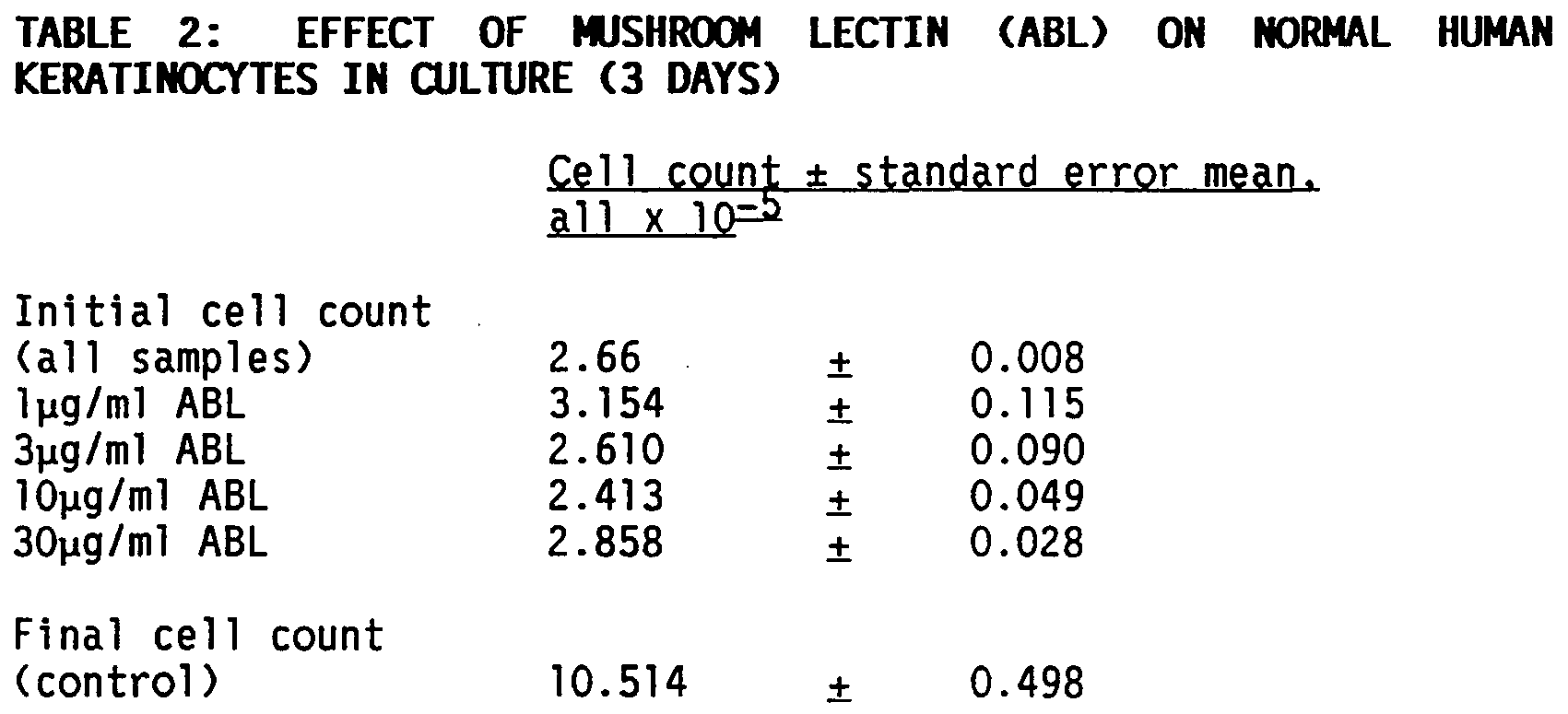
- a ⁇ aricus bisporus lectin has the unusual property of inhibiting proliferation in keratinocytes without causing significant cytotoxcity. Keratinocytes are the predominant cells (> 95%) of the epidermis, which is the upper section of the skin tissue. Keratinocytes are continually dividing in the basal layer to produce fresh cells, which migrate towards the skin surface, eventually dying in the upper levels. Hyperproliferation of the epidermis produces excessive scale, comprising dead cells, which is manifested in psoriasis, for example.
- ABL differs from PNA in its ability to bind sialylated TF antigen
- the inventor believes that lectins which bind to sialylated TF antigen inhibit the proliferation of cells.
- the invention includes (D a method of treating a patient suffering from a skin disorder caused by or associated with hyperproliferation of keratinocytes or hyperkeratosis, especially psoriasis and benign keratoses, which comprises administering to the patient a therapeutically effective amount of a said lectin, and (2) the use of a said lectin in the manufacture of a medicament for the treatment of such a skin disorder.
- the invention also includes a pharmaceutical composition
- a pharmaceutical composition comprising a lectin which is capable of binding sialylated TF antigen and a pharmaceutically acceptable carrier or diluent appropriate to application to the skin.
- the composition is a cream, ointment, gel, cosmetic lotion containing a perfume ingredient or a shampoo. Description of the preferred embodiments
- Jacalin lectin which comes from the seeds of the jackfruit, Artocarpus inteqrifolia. is another example of a lectin which binds to sialylated TF antigen and its use for the purposes of the invention is also within the invention.
- Another example of a lectin within the definition is amaranthin (Amaranthus caudatus) lectin.
- the lectins are preferably formulated for application to the skin in emulsions, solutions or suspensions.
- Solutions in aqueous or non-toxic organic solvents can be used as skin lotions.
- Suspensions in water together with surfactants can be used as shampoos for application to the hair, e.g. to treat psoriasis of the scalp.
- Oil-in-water and water-in-oil emulsions can be formulated for application to irritated skin. Any formulation using ingredients and recipes known in the skin cream, cosmetic lotion or hair shampoo industries, mutatis mutandis, is usable in the present invention.
- the concentration of lectin to be applied is preferably within the range 0.01 to 1%, especially 0.05-0.5% and most especially about 0.1% w/w.
- the invention is applicable to the treatment of any skin disease caused (at least in part) by excessive growth or proliferation of keratinocytes.
- a disease is considered to be caused at least in part by such proliferation if expert opinion is that it is or may be a contributory factor, so that it would be relevant clinically to treat the disease by reducing or preventing the growth of keratinocytes.
- the preferred diseases for treatment are those referred to above.
- the following Example illustrates the invention Example
- Normal keratinocytes were extracted by trypsinisation from human foreskin, passaged and cultured in CDB153 serum-free medium containing hydrocortisone 50 ⁇ mol/1, insulin 5mg/l, transferrin 5mg/ml and Epidermal Growth Factor 10 ⁇ g/1.
- Cell aliquots were cultured for three days at 37°C in 5% CO2 in the presence of varying concentrations of lectin, each tested in triplicate, then trypsinised, harvested and counted using a Coulter cell counter.
- the normal human keratinocytes were incubated with 1 ⁇ g/ml. of ABL for 1, 4, 8 and 72 hours, after which the ABL was washed 3 x with PBS and replaced by the normal medium. All cells were grown for 72 hours in total and then counted and compared with control cells to which no ABL had been added, incubated for 72 hours. Taking the increase in cell count of the control over the 72 hour period arbitrarily as 100, the corresponding increases in cell count for the samples incubated with ABL were
Landscapes
- Health & Medical Sciences (AREA)
- Life Sciences & Earth Sciences (AREA)
- Animal Behavior & Ethology (AREA)
- General Health & Medical Sciences (AREA)
- Public Health (AREA)
- Veterinary Medicine (AREA)
- Mycology (AREA)
- Epidemiology (AREA)
- Natural Medicines & Medicinal Plants (AREA)
- Engineering & Computer Science (AREA)
- Botany (AREA)
- Microbiology (AREA)
- Medicinal Chemistry (AREA)
- Biotechnology (AREA)
- Birds (AREA)
- Chemical & Material Sciences (AREA)
- Pharmacology & Pharmacy (AREA)
- Proteomics, Peptides & Aminoacids (AREA)
- Immunology (AREA)
- Bioinformatics & Cheminformatics (AREA)
- Dermatology (AREA)
- Gastroenterology & Hepatology (AREA)
- Alternative & Traditional Medicine (AREA)
- Medical Informatics (AREA)
- Medicines That Contain Protein Lipid Enzymes And Other Medicines (AREA)
- Medicines Containing Plant Substances (AREA)
- Peptides Or Proteins (AREA)
- Cosmetics (AREA)
- Medicinal Preparation (AREA)
Abstract
Description

Claims
Priority Applications (4)
| Application Number | Priority Date | Filing Date | Title |
|---|---|---|---|
| EP94910257A EP0661995B1 (en) | 1992-09-19 | 1993-09-10 | Use of lectins for treatment of skin diseases |
| US08/403,700 US5607679A (en) | 1992-09-19 | 1993-09-10 | Lectins for treatment of skin diseases |
| DE69312948T DE69312948T2 (en) | 1992-09-19 | 1993-09-10 | USE OF LECTINES FOR THE TREATMENT OF DISEASES |
| AU49783/93A AU670628B2 (en) | 1992-09-19 | 1993-09-10 | Use of lectins for treatment of skin diseases |
Applications Claiming Priority (2)
| Application Number | Priority Date | Filing Date | Title |
|---|---|---|---|
| GB929219905A GB9219905D0 (en) | 1992-09-19 | 1992-09-19 | Lectins |
| GB9219905.8 | 1992-09-19 |
Publications (1)
| Publication Number | Publication Date |
|---|---|
| WO1994006462A1 true WO1994006462A1 (en) | 1994-03-31 |
Family
ID=10722223
Family Applications (1)
| Application Number | Title | Priority Date | Filing Date |
|---|---|---|---|
| PCT/GB1993/001919 Ceased WO1994006462A1 (en) | 1992-09-19 | 1993-09-10 | Use of lectins for treatment of skin diseases |
Country Status (9)
| Country | Link |
|---|---|
| US (1) | US5607679A (en) |
| EP (1) | EP0661995B1 (en) |
| AT (1) | ATE156364T1 (en) |
| AU (1) | AU670628B2 (en) |
| CA (1) | CA2144050A1 (en) |
| DE (1) | DE69312948T2 (en) |
| ES (1) | ES2107198T3 (en) |
| GB (2) | GB9219905D0 (en) |
| WO (1) | WO1994006462A1 (en) |
Cited By (1)
| Publication number | Priority date | Publication date | Assignee | Title |
|---|---|---|---|---|
| US5739102A (en) * | 1996-04-19 | 1998-04-14 | British Technology Group Limited | Wound healing |
Families Citing this family (9)
| Publication number | Priority date | Publication date | Assignee | Title |
|---|---|---|---|---|
| US6200569B1 (en) | 1997-11-05 | 2001-03-13 | Tang-An Medical Co., Ltd. | Composition and method for increasing insulin activity |
| US6093745A (en) * | 1997-11-25 | 2000-07-25 | Psorx, L.L.C. | Methods and composition for treating skin proliferative diseases |
| US6861077B1 (en) | 2000-03-17 | 2005-03-01 | L'oreal S.A. | Use of plant extracts in a cosmetic composition to protect keratinous fibers |
| US6645502B2 (en) | 2001-09-17 | 2003-11-11 | Revlon Consumer Products Corporation | Anhydrous cosmetic compositions containing mushroom extract |
| US6923494B2 (en) * | 2002-08-23 | 2005-08-02 | General Electric Company | Pedestrian energy absorber for automotive vehicles |
| US20040126449A1 (en) * | 2002-12-30 | 2004-07-01 | Gopa Majmudar | Topical composition and methods for treatment of aged or environmentally damaged skin |
| GB0819883D0 (en) | 2008-10-29 | 2008-12-03 | Azyme Res As | Product and uses |
| PT3418296T (en) | 2009-02-18 | 2024-10-04 | Unichem Lab Ltd | Cancer cell binding recombinant lectins with antitumor activity and method of preparation |
| BR112021004792A2 (en) * | 2018-09-16 | 2021-08-03 | Unichem Laboratories Ltd | protein for treating inflammatory diseases |
Citations (1)
| Publication number | Priority date | Publication date | Assignee | Title |
|---|---|---|---|---|
| JPS61205218A (en) * | 1985-03-08 | 1986-09-11 | Ajinomoto Co Inc | Antitumor agent |
Family Cites Families (6)
| Publication number | Priority date | Publication date | Assignee | Title |
|---|---|---|---|---|
| US4217341A (en) * | 1977-12-07 | 1980-08-12 | The University of Louisville | Composition and method for inhibiting the adherence of dental plaque-producing bacteria to smooth surfaces |
| DE3067048D1 (en) * | 1979-12-03 | 1984-04-19 | Kitasato Inst | A process for preparing substances having interferon inducing activity and interferon inducers |
| JPS6013004B2 (en) * | 1980-08-06 | 1985-04-04 | 北里研究所(社団法人) | Production method of interferon inducer |
| US4742046A (en) * | 1984-08-03 | 1988-05-03 | Medisearch S.A. | Methods and compositions for inhibiting the infectious activity of viruses |
| JPS61165334A (en) * | 1984-08-03 | 1986-07-26 | メデイサ−チ、エス、ア− | Inhibition for viral infection activity and composition |
| JPH0825890B2 (en) * | 1987-06-18 | 1996-03-13 | 呉羽化学工業株式会社 | Antiviral agent |
-
1992
- 1992-09-19 GB GB929219905A patent/GB9219905D0/en active Pending
-
1993
- 1993-09-10 ES ES94910257T patent/ES2107198T3/en not_active Expired - Lifetime
- 1993-09-10 US US08/403,700 patent/US5607679A/en not_active Expired - Fee Related
- 1993-09-10 WO PCT/GB1993/001919 patent/WO1994006462A1/en not_active Ceased
- 1993-09-10 CA CA002144050A patent/CA2144050A1/en not_active Abandoned
- 1993-09-10 DE DE69312948T patent/DE69312948T2/en not_active Expired - Fee Related
- 1993-09-10 AT AT94910257T patent/ATE156364T1/en not_active IP Right Cessation
- 1993-09-10 GB GB9318807A patent/GB2270626B/en not_active Revoked
- 1993-09-10 AU AU49783/93A patent/AU670628B2/en not_active Ceased
- 1993-09-10 EP EP94910257A patent/EP0661995B1/en not_active Expired - Lifetime
Patent Citations (1)
| Publication number | Priority date | Publication date | Assignee | Title |
|---|---|---|---|---|
| JPS61205218A (en) * | 1985-03-08 | 1986-09-11 | Ajinomoto Co Inc | Antitumor agent |
Non-Patent Citations (1)
| Title |
|---|
| DATABASE WPI Section Ch Week 8643, Derwent World Patents Index; Class B04, AN 86-281595 * |
Cited By (1)
| Publication number | Priority date | Publication date | Assignee | Title |
|---|---|---|---|---|
| US5739102A (en) * | 1996-04-19 | 1998-04-14 | British Technology Group Limited | Wound healing |
Also Published As
| Publication number | Publication date |
|---|---|
| US5607679A (en) | 1997-03-04 |
| GB2270626B (en) | 1996-03-13 |
| EP0661995A1 (en) | 1995-07-12 |
| AU670628B2 (en) | 1996-07-25 |
| GB9318807D0 (en) | 1993-10-27 |
| ES2107198T3 (en) | 1997-11-16 |
| DE69312948D1 (en) | 1997-09-11 |
| EP0661995B1 (en) | 1997-08-06 |
| DE69312948T2 (en) | 1998-01-02 |
| CA2144050A1 (en) | 1994-03-31 |
| ATE156364T1 (en) | 1997-08-15 |
| GB2270626A (en) | 1994-03-23 |
| GB9219905D0 (en) | 1992-11-04 |
| AU4978393A (en) | 1994-04-12 |
Similar Documents
| Publication | Publication Date | Title |
|---|---|---|
| DE69731955T2 (en) | COMBINATION OF ACID PROTEASE ENZYMES AND ACID BUFFERS AND THEIR USE | |
| US20020098213A1 (en) | Use of ellagic acid and its derivatives in cosmetics and dermatology | |
| US5607679A (en) | Lectins for treatment of skin diseases | |
| CN113876611A (en) | Application of sialic acid in preparation of preparation for promoting collagen production | |
| KR20100032099A (en) | Cosmetic composition comprising stem cell culture | |
| DE68905342T2 (en) | USE OF MINOXIDIL FOR Wounds Healing. | |
| US6193975B1 (en) | Use of potentilla erecta extract in the cosmetic and pharmaceutical field | |
| US6962712B2 (en) | Cosmetic or dermatological composition comprising of a combination of an elastase inhibitor of the N-acylaminoamide family and at least one antifungal agent or at least one antibacterial agent | |
| JP3249844B2 (en) | Skin cosmetics | |
| KR20040079417A (en) | Topical anti-inflammatory compositions and methods of reducing inflammation | |
| JPH11100320A (en) | Preparation for external use for skin | |
| AU2002324634B2 (en) | Method of skin exfoliation | |
| AU2002324634A1 (en) | Method of skin exfoliation | |
| CN114099366A (en) | Sterile anti-aging wrinkle-removing combined liquid for promoting cell energy metabolism and preparation method and application thereof | |
| CA1270202A (en) | Moisture-retaining preparation for dermal use | |
| FIEDLER‐WEISS et al. | Response to minoxidil in severe alopecia areata correlates with T lymphocyte stimulation | |
| Cellini et al. | Epidermal growth factor in the topical treatment of herpetic corneal ulcers | |
| JP2002526395A (en) | Use of Bold extract in cosmetic or dermatological products | |
| CN111714396A (en) | Composition containing ectoin and application thereof in laser beauty treatment | |
| JP2008100943A (en) | External preparation for skin having insulin-like growth factor-1 secretion promoting action | |
| CN117959201B (en) | Composition with dual effects of soothing skin and repairing scars, and preparation method and application thereof | |
| JPH09176036A (en) | Biological hyaluronic acid synthesis promoter | |
| US20250034208A1 (en) | Peptides and pharmaceutical and cosmetic compositions containing them | |
| KR20090059230A (en) | Cosmetic composition to prevent hair loss, anti-inflammatory, hair root cell activation and hair growth | |
| SU1395328A1 (en) | Method of treatment of diffusion neurodermite |
Legal Events
| Date | Code | Title | Description |
|---|---|---|---|
| AK | Designated states |
Kind code of ref document: A1 Designated state(s): AU CA US |
|
| AL | Designated countries for regional patents |
Kind code of ref document: A1 Designated state(s): AT BE CH DE DK ES FR GB GR IE IT LU MC NL PT SE |
|
| DFPE | Request for preliminary examination filed prior to expiration of 19th month from priority date (pct application filed before 20040101) | ||
| 121 | Ep: the epo has been informed by wipo that ep was designated in this application | ||
| WWE | Wipo information: entry into national phase |
Ref document number: 2144050 Country of ref document: CA |
|
| WWE | Wipo information: entry into national phase |
Ref document number: 08403700 Country of ref document: US |
|
| WWE | Wipo information: entry into national phase |
Ref document number: 1994910257 Country of ref document: EP |
|
| WWP | Wipo information: published in national office |
Ref document number: 1994910257 Country of ref document: EP |
|
| WWG | Wipo information: grant in national office |
Ref document number: 1994910257 Country of ref document: EP |