WO1994012165A2 - Enzyme inhibitors - Google Patents

Enzyme inhibitors Download PDF

Info

Publication number
WO1994012165A2
WO1994012165A2 PCT/GB1993/002437 GB9302437W WO9412165A2 WO 1994012165 A2 WO1994012165 A2 WO 1994012165A2 GB 9302437 W GB9302437 W GB 9302437W WO 9412165 A2 WO9412165 A2 WO 9412165A2
Authority
WO
WIPO (PCT)
Prior art keywords
isothiourea
ethyl
group
methyl
amino
Prior art date
Legal status (The legal status is an assumption and is not a legal conclusion. Google has not performed a legal analysis and makes no representation as to the accuracy of the status listed.)
Ceased
Application number
PCT/GB1993/002437
Other languages
French (fr)
Other versions
WO1994012165A3 (en
Inventor
Edward Patrick Garvey
Gerald Joseph Tanoury
Jeffrey Alan Oplinger
Eric Steven Furfine
Current Assignee (The listed assignees may be inaccurate. Google has not performed a legal analysis and makes no representation or warranty as to the accuracy of the list.)
Wellcome Foundation Ltd
Original Assignee
Wellcome Foundation Ltd
Priority date (The priority date is an assumption and is not a legal conclusion. Google has not performed a legal analysis and makes no representation as to the accuracy of the date listed.)
Filing date
Publication date
Priority claimed from GB929224948A external-priority patent/GB9224948D0/en
Priority claimed from GB939315159A external-priority patent/GB9315159D0/en
Priority claimed from GB939319663A external-priority patent/GB9319663D0/en
Application filed by Wellcome Foundation Ltd filed Critical Wellcome Foundation Ltd
Priority to EP94900266A priority Critical patent/EP0670720A1/en
Priority to AU55330/94A priority patent/AU5533094A/en
Priority to JP6512923A priority patent/JPH08503940A/en
Publication of WO1994012165A2 publication Critical patent/WO1994012165A2/en
Publication of WO1994012165A3 publication Critical patent/WO1994012165A3/en
Anticipated expiration legal-status Critical
Ceased legal-status Critical Current

Links

Classifications

    • CCHEMISTRY; METALLURGY
    • C07ORGANIC CHEMISTRY
    • C07DHETEROCYCLIC COMPOUNDS
    • C07D207/00Heterocyclic compounds containing five-membered rings not condensed with other rings, with one nitrogen atom as the only ring hetero atom
    • C07D207/02Heterocyclic compounds containing five-membered rings not condensed with other rings, with one nitrogen atom as the only ring hetero atom with only hydrogen or carbon atoms directly attached to the ring nitrogen atom
    • C07D207/30Heterocyclic compounds containing five-membered rings not condensed with other rings, with one nitrogen atom as the only ring hetero atom with only hydrogen or carbon atoms directly attached to the ring nitrogen atom having two double bonds between ring members or between ring members and non-ring members
    • C07D207/32Heterocyclic compounds containing five-membered rings not condensed with other rings, with one nitrogen atom as the only ring hetero atom with only hydrogen or carbon atoms directly attached to the ring nitrogen atom having two double bonds between ring members or between ring members and non-ring members with only hydrogen atoms, hydrocarbon or substituted hydrocarbon radicals, directly attached to ring carbon atoms
    • C07D207/33Heterocyclic compounds containing five-membered rings not condensed with other rings, with one nitrogen atom as the only ring hetero atom with only hydrogen or carbon atoms directly attached to the ring nitrogen atom having two double bonds between ring members or between ring members and non-ring members with only hydrogen atoms, hydrocarbon or substituted hydrocarbon radicals, directly attached to ring carbon atoms with substituted hydrocarbon radicals, directly attached to ring carbon atoms
    • C07D207/333Radicals substituted by oxygen or sulfur atoms
    • AHUMAN NECESSITIES
    • A61MEDICAL OR VETERINARY SCIENCE; HYGIENE
    • A61KPREPARATIONS FOR MEDICAL, DENTAL OR TOILETRY PURPOSES
    • A61K31/00Medicinal preparations containing organic active ingredients
    • A61K31/13Amines
    • A61K31/155Amidines (), e.g. guanidine (H2N—C(=NH)—NH2), isourea (N=C(OH)—NH2), isothiourea (—N=C(SH)—NH2)
    • AHUMAN NECESSITIES
    • A61MEDICAL OR VETERINARY SCIENCE; HYGIENE
    • A61KPREPARATIONS FOR MEDICAL, DENTAL OR TOILETRY PURPOSES
    • A61K31/00Medicinal preparations containing organic active ingredients
    • A61K31/33Heterocyclic compounds
    • A61K31/38Heterocyclic compounds having sulfur as a ring hetero atom
    • AHUMAN NECESSITIES
    • A61MEDICAL OR VETERINARY SCIENCE; HYGIENE
    • A61KPREPARATIONS FOR MEDICAL, DENTAL OR TOILETRY PURPOSES
    • A61K31/00Medicinal preparations containing organic active ingredients
    • A61K31/33Heterocyclic compounds
    • A61K31/395Heterocyclic compounds having nitrogen as a ring hetero atom, e.g. guanethidine or rifamycins
    • A61K31/40Heterocyclic compounds having nitrogen as a ring hetero atom, e.g. guanethidine or rifamycins having five-membered rings with one nitrogen as the only ring hetero atom, e.g. sulpiride, succinimide, tolmetin, buflomedil
    • AHUMAN NECESSITIES
    • A61MEDICAL OR VETERINARY SCIENCE; HYGIENE
    • A61KPREPARATIONS FOR MEDICAL, DENTAL OR TOILETRY PURPOSES
    • A61K31/00Medicinal preparations containing organic active ingredients
    • A61K31/33Heterocyclic compounds
    • A61K31/395Heterocyclic compounds having nitrogen as a ring hetero atom, e.g. guanethidine or rifamycins
    • A61K31/41Heterocyclic compounds having nitrogen as a ring hetero atom, e.g. guanethidine or rifamycins having five-membered rings with two or more ring hetero atoms, at least one of which being nitrogen, e.g. tetrazole
    • A61K31/425Thiazoles
    • AHUMAN NECESSITIES
    • A61MEDICAL OR VETERINARY SCIENCE; HYGIENE
    • A61KPREPARATIONS FOR MEDICAL, DENTAL OR TOILETRY PURPOSES
    • A61K31/00Medicinal preparations containing organic active ingredients
    • A61K31/33Heterocyclic compounds
    • A61K31/395Heterocyclic compounds having nitrogen as a ring hetero atom, e.g. guanethidine or rifamycins
    • A61K31/495Heterocyclic compounds having nitrogen as a ring hetero atom, e.g. guanethidine or rifamycins having six-membered rings with two or more nitrogen atoms as the only ring heteroatoms, e.g. piperazine or tetrazines
    • A61K31/505Pyrimidines; Hydrogenated pyrimidines, e.g. trimethoprim
    • AHUMAN NECESSITIES
    • A61MEDICAL OR VETERINARY SCIENCE; HYGIENE
    • A61KPREPARATIONS FOR MEDICAL, DENTAL OR TOILETRY PURPOSES
    • A61K31/00Medicinal preparations containing organic active ingredients
    • A61K31/33Heterocyclic compounds
    • A61K31/395Heterocyclic compounds having nitrogen as a ring hetero atom, e.g. guanethidine or rifamycins
    • A61K31/535Heterocyclic compounds having nitrogen as a ring hetero atom, e.g. guanethidine or rifamycins having six-membered rings with at least one nitrogen and one oxygen as the ring hetero atoms, e.g. 1,2-oxazines
    • AHUMAN NECESSITIES
    • A61MEDICAL OR VETERINARY SCIENCE; HYGIENE
    • A61PSPECIFIC THERAPEUTIC ACTIVITY OF CHEMICAL COMPOUNDS OR MEDICINAL PREPARATIONS
    • A61P29/00Non-central analgesic, antipyretic or antiinflammatory agents, e.g. antirheumatic agents; Non-steroidal antiinflammatory drugs [NSAID]
    • AHUMAN NECESSITIES
    • A61MEDICAL OR VETERINARY SCIENCE; HYGIENE
    • A61PSPECIFIC THERAPEUTIC ACTIVITY OF CHEMICAL COMPOUNDS OR MEDICINAL PREPARATIONS
    • A61P31/00Antiinfectives, i.e. antibiotics, antiseptics, chemotherapeutics
    • A61P31/04Antibacterial agents
    • AHUMAN NECESSITIES
    • A61MEDICAL OR VETERINARY SCIENCE; HYGIENE
    • A61PSPECIFIC THERAPEUTIC ACTIVITY OF CHEMICAL COMPOUNDS OR MEDICINAL PREPARATIONS
    • A61P37/00Drugs for immunological or allergic disorders
    • AHUMAN NECESSITIES
    • A61MEDICAL OR VETERINARY SCIENCE; HYGIENE
    • A61PSPECIFIC THERAPEUTIC ACTIVITY OF CHEMICAL COMPOUNDS OR MEDICINAL PREPARATIONS
    • A61P37/00Drugs for immunological or allergic disorders
    • A61P37/02Immunomodulators
    • A61P37/06Immunosuppressants, e.g. drugs for graft rejection
    • AHUMAN NECESSITIES
    • A61MEDICAL OR VETERINARY SCIENCE; HYGIENE
    • A61PSPECIFIC THERAPEUTIC ACTIVITY OF CHEMICAL COMPOUNDS OR MEDICINAL PREPARATIONS
    • A61P43/00Drugs for specific purposes, not provided for in groups A61P1/00-A61P41/00
    • AHUMAN NECESSITIES
    • A61MEDICAL OR VETERINARY SCIENCE; HYGIENE
    • A61PSPECIFIC THERAPEUTIC ACTIVITY OF CHEMICAL COMPOUNDS OR MEDICINAL PREPARATIONS
    • A61P9/00Drugs for disorders of the cardiovascular system
    • A61P9/02Non-specific cardiovascular stimulants, e.g. drugs for syncope, antihypotensives
    • CCHEMISTRY; METALLURGY
    • C07ORGANIC CHEMISTRY
    • C07CACYCLIC OR CARBOCYCLIC COMPOUNDS
    • C07C335/00Thioureas, i.e. compounds containing any of the groups, the nitrogen atoms not being part of nitro or nitroso groups
    • C07C335/30Isothioureas
    • C07C335/32Isothioureas having sulfur atoms of isothiourea groups bound to acyclic carbon atoms
    • CCHEMISTRY; METALLURGY
    • C07ORGANIC CHEMISTRY
    • C07DHETEROCYCLIC COMPOUNDS
    • C07D213/00Heterocyclic compounds containing six-membered rings, not condensed with other rings, with one nitrogen atom as the only ring hetero atom and three or more double bonds between ring members or between ring members and non-ring members
    • C07D213/02Heterocyclic compounds containing six-membered rings, not condensed with other rings, with one nitrogen atom as the only ring hetero atom and three or more double bonds between ring members or between ring members and non-ring members having three double bonds between ring members or between ring members and non-ring members
    • C07D213/04Heterocyclic compounds containing six-membered rings, not condensed with other rings, with one nitrogen atom as the only ring hetero atom and three or more double bonds between ring members or between ring members and non-ring members having three double bonds between ring members or between ring members and non-ring members having no bond between the ring nitrogen atom and a non-ring member or having only hydrogen or carbon atoms directly attached to the ring nitrogen atom
    • C07D213/24Heterocyclic compounds containing six-membered rings, not condensed with other rings, with one nitrogen atom as the only ring hetero atom and three or more double bonds between ring members or between ring members and non-ring members having three double bonds between ring members or between ring members and non-ring members having no bond between the ring nitrogen atom and a non-ring member or having only hydrogen or carbon atoms directly attached to the ring nitrogen atom with substituted hydrocarbon radicals attached to ring carbon atoms
    • C07D213/28Radicals substituted by singly-bound oxygen or sulphur atoms
    • C07D213/32Sulfur atoms
    • CCHEMISTRY; METALLURGY
    • C07ORGANIC CHEMISTRY
    • C07DHETEROCYCLIC COMPOUNDS
    • C07D277/00Heterocyclic compounds containing 1,3-thiazole or hydrogenated 1,3-thiazole rings
    • C07D277/02Heterocyclic compounds containing 1,3-thiazole or hydrogenated 1,3-thiazole rings not condensed with other rings
    • C07D277/08Heterocyclic compounds containing 1,3-thiazole or hydrogenated 1,3-thiazole rings not condensed with other rings having one double bond between ring members or between a ring member and a non-ring member
    • C07D277/12Heterocyclic compounds containing 1,3-thiazole or hydrogenated 1,3-thiazole rings not condensed with other rings having one double bond between ring members or between a ring member and a non-ring member with hetero atoms or with carbon atoms having three bonds to hetero atoms with at the most one bond to halogen, e.g. ester or nitrile radicals, directly attached to ring carbon atoms
    • C07D277/18Nitrogen atoms
    • CCHEMISTRY; METALLURGY
    • C07ORGANIC CHEMISTRY
    • C07DHETEROCYCLIC COMPOUNDS
    • C07D277/00Heterocyclic compounds containing 1,3-thiazole or hydrogenated 1,3-thiazole rings
    • C07D277/02Heterocyclic compounds containing 1,3-thiazole or hydrogenated 1,3-thiazole rings not condensed with other rings
    • C07D277/20Heterocyclic compounds containing 1,3-thiazole or hydrogenated 1,3-thiazole rings not condensed with other rings having two or three double bonds between ring members or between ring members and non-ring members
    • C07D277/32Heterocyclic compounds containing 1,3-thiazole or hydrogenated 1,3-thiazole rings not condensed with other rings having two or three double bonds between ring members or between ring members and non-ring members with hetero atoms or with carbon atoms having three bonds to hetero atoms with at the most one bond to halogen, e.g. ester or nitrile radicals, directly attached to ring carbon atoms
    • C07D277/38Nitrogen atoms
    • C07D277/40Unsubstituted amino or imino radicals
    • CCHEMISTRY; METALLURGY
    • C07ORGANIC CHEMISTRY
    • C07DHETEROCYCLIC COMPOUNDS
    • C07D333/00Heterocyclic compounds containing five-membered rings having one sulfur atom as the only ring hetero atom
    • C07D333/02Heterocyclic compounds containing five-membered rings having one sulfur atom as the only ring hetero atom not condensed with other rings
    • C07D333/04Heterocyclic compounds containing five-membered rings having one sulfur atom as the only ring hetero atom not condensed with other rings not substituted on the ring sulphur atom
    • C07D333/06Heterocyclic compounds containing five-membered rings having one sulfur atom as the only ring hetero atom not condensed with other rings not substituted on the ring sulphur atom with only hydrogen atoms, hydrocarbon or substituted hydrocarbon radicals, directly attached to the ring carbon atoms
    • C07D333/14Radicals substituted by singly bound hetero atoms other than halogen
    • C07D333/18Radicals substituted by singly bound hetero atoms other than halogen by sulfur atoms

Definitions

  • the present invention relates to isothiourea derivatives, to methods for their manufacture, to pharmaceutical compositions containing them and to their use in therapy, in particular their use as nitric oxide synthase inhibitors.
  • endothelium-derived relaxing factor a labile humoral factor termed endothelium-derived relaxing factor (EDRF).
  • NO nitric oxide
  • NO is the endogenous stimulator of the soluble guanylate cyclase and is involved in a number of biological actions in addition to endothelium-dependent relaxation including, cytotoxicity of phagocytic cells and cell-to-cell communication in the central nervous sytem (see Moncada elal, Biochemical Pharmacology, 2-S 1709-1715 (1989) and Moncada et al, Pharmacological Review, 42, 109-142 (1991)). It is now thought that excess NO production may be involved in a number of conditions, particularly conditions which involve systemic hypotension such as septic (toxic) shock and therapy with certain cytokines.
  • L-NMMA L-arginine analogue L-N- monomemyl-arginine
  • L-NMMA L-N- monomemyl-arginine
  • the therapeutic use of certain other NO synthase inhibitors apart from L- NMMA for the same purpose has also been proposed in WO 91/04024 and in EP-A- 0446699.
  • a constitutive, Ca "H” /calmodulin dependent enzyme located in the endothelium, that releases NO in response to receptor or physical stimulation.
  • a constitutive, Ca ⁇ 'calmodulin dependent enzyme located in the brain, that releases NO in response to receptor or physical stimulation.
  • the NO released by the constitutive enzymes acts as a transduction mechanism underlying several physiological responses.
  • the function of the NO produced by the inducible enzyme is as a cytotoxic molecule for fighting tumour cells and invading microorganisms (Wright et al., Card. Res. 26, 48-57 (1992) and Moncada si al, Pharmacological Review, 41, 109-142 (1991)). It also appears that the adverse effects of excess NO production, in particular pathological vasodilation and tissue damage, may result largely from the effects of NO synthesised by the inducible NO synthase.
  • the NO synthase inhibitors proposed for therapeutic use so far, and in particular L-NMMA, are non-selective in that they inhibit both the constitutive and the inducible NO synthase enzymes.
  • Use of such a non-selective NO synthase inhibitor requires that great care be taken in order to avoid the potentially serious consequences of over-inhibition of the constitutive NO-synthase enzyme including hypertension, thrombosis, CNS toxicity and tissue damage.
  • L-NMMA for the treatment of septic shock it has been recommended that the patient must be subject to continuous blood pressure monitoring throughout the treatment.
  • NO synthase inhibitors which are selective in the sense that they inhibit the inducible NO synthase enzyme to a considerably greater extent than the constitutive NO synthase enzyme would be of even greater therapeutic benefit and much easier to use.
  • isothioureas are inhibitors of NO synthase, and are useful in the treatment of systemic hypotension, and. in particular, the treatment of septic shock.
  • many of these compounds possess selectivity for the inducible NO synthase enzyme as compared with the constitutive NO synthase enzymes.
  • the present invention provides a method of treatment of conditions requiring inhibition of the nitric oxide synthase enzyme, which comprises administering to a mammal in need thereof an effective amount of an isothiourea derivative having an inhibitory effect against the NO synthase enzyme, or a pharmaceutically acceptable salt thereof.
  • the present invention provides the use of an isothiourea having an inhibitory effect against the NO synthase enzyme for the manufacture of a medicament for the treatment of conditions where there is an advantage in inhibiting the NO synthase enzyme.
  • a method of treatment of systemic hypotension and/or septic shock which comprises administering to a mammal in need thereof an effective amount of an isothiourea derivative having an inhibitory effect against the NO synthase enzyme, or a pharmaceutically acceptable salt thereof.
  • an isothiourea derivative having an inhibitory effect against the NO synthase enzyme for the manufacture of a medicament for the treatment of systemic hypotension and/or septic shock.
  • cytokines such as TNF, IL-1 and IL-2
  • cytokine- inducing agents for example 5, 6-dimethylxanthenone acetic acid
  • compounds which inhibit NO synthesis may be of use in reducing the NO concentration in patients suffering from inflammatory conditions in which an excess of NO contributes to the pathophysiology of the condition, for example adult respiratory distress syndrome (ARDS) and myocarditis.
  • ARDS adult respiratory distress syndrome
  • an NO synthase enzyme may be involved in the degeneration of cartilage which takes place in autoimmune and/or inflammatory conditions such as arthritis, rheumatoid arthritis, chronic bowel disease and systemic lupus erythematosis (SLE). It is also thought that an NO synthase enzyme may be involved in insulin- dependent diabetes mellitis.
  • a yet further aspect of the present invention provides an isothiourea derivative or salt thereof in the manufacture of a medicament for use in cytokine or cytokine-inducing therapy, as an adjuvant to short term immunosuppression in transplant therapy, for the treatment of patients suffering from inflammatory conditions in which an excess of NO contributes to the pathophysiology of the condition, in autoimmune and/or inflammatory indications and in insulin-dependent diabetes mellitis.
  • a still further aspect provides a method of treatment of adverse effects associated with cytokine therapy, of short term immunosuppression in transplant therapy, of patients suffering from inflammatory conditions in which an excess of NO contributes to the pathophysiology of the condition, of autoimmune and/or inflammatory indications and of insulin-dependent diabetes mellitis, which comprises administering to a mammal in need thereof an effective amount of an isothiourea derivative having an inhibitory effect against the NO synthase enzyme or a pharmaceutically acceptable salt thereof.
  • treatment of a patient is intended to include prophylaxis; the term “mammal” is intended to include a human or an animal.
  • Preferred isothioureas include those of formula (I)
  • R is (1) a C ⁇ _i4 hydrocarbyl group
  • each group R being optionally substituted by one or two groups independently selected from:
  • X is oxygen, C(O) m wherein m is 1 or 2, S(O) n wherein n is 0, 1, or 2, or NR2 wherein R2 is hydrogen, C ⁇ . alkyl or C3.6 cycloalkyl or R2 is linked to R! to form a C2- alkylene group;
  • R! is hydrogen; or C ⁇ . alkyl, C2-6 alkenyl, C3.6 cycloalkyl, C7.9 aralkyl, C6-10 aryl, or a 5- or 6- membered heterocyclic group, each group optionally substituted by one or two groups independently selected from C ⁇ _3 alkyl, hydroxy, C1-.3 alkoxy, amino, C1.3 alkylamino, halo, nitro, or a group C(O) m > R ⁇ b wherein m' is 1 or 2 and R ⁇ b is hydrogen or C 1-4 alkyl; or R-- is a group NR ⁇ R4 wherein R ⁇ and R ⁇ are the same or different and each is hydrogen or C 1-4 alkyl or R ⁇ and R 4 are linked to form a C2- alkylene group;
  • Y is oxygen, S(O) n wherein n is as hereinbefore defined, or NR-5 wherein
  • R 5 is hydrogen or C ⁇ _4 alkyl; w is O or l; Q is C2-4 hydrocarbyl
  • R is
  • R? and R ⁇ are each independently selected from hydrogen, C ⁇ _4 alkyl, C2-4 alkenyl, Cj_4 alkoxyalkyl; or R? and R ⁇ are linked to form a 5- or 6-membered heterocyclic ring;
  • R is N
  • R ⁇ b and R ⁇ b are independently selected from hydrogen or Cj_ alkyl, preferably hydrogen, methyl or ethyl;
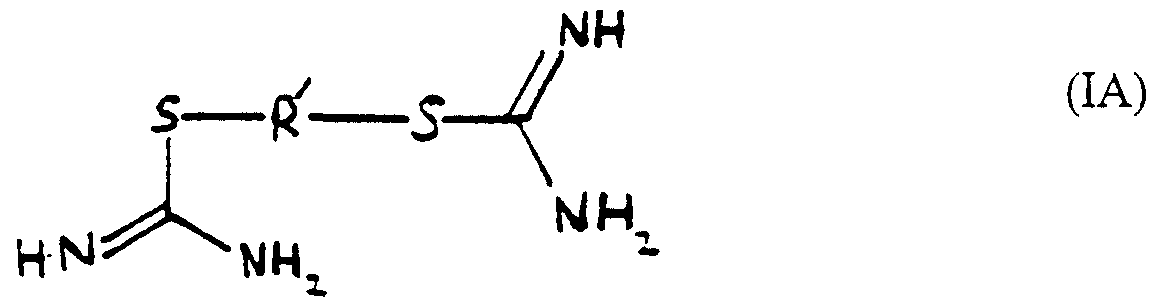
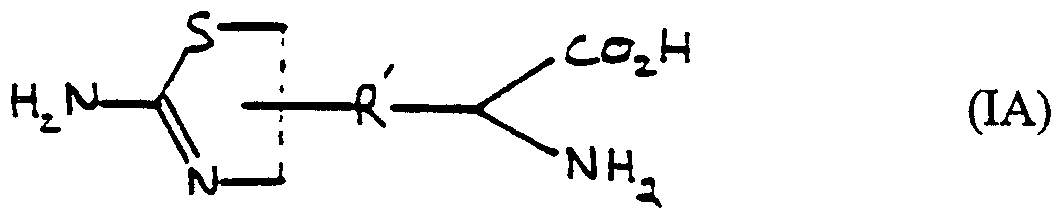
  • Formula (I) includes isothiourea derivatives of formula (IA), (IB) and (IC)
  • R' is a Cj.g alkylene group or a C2-8 alkenylene or alkynylene group each optionally containing a phenyl ring, a 5- or 6-membered heterocyclic ring or a group X as hereinbefore defined, and the dotted line represents a double or a single bond.
  • Formula I also includes compounds of formula (II)
  • R a is a C _$ hydrocarbyl or 5- or 6-membered heterocyclic ring or a 9-membered bicyclic heterocyclic ring system each optionally substituted by halo or by one or two groups -X a R la wherein R la is hydrogen, C ⁇ .
  • t is 0 to 4 and w 3 - is 0 or 1
  • Y a is oxygen, sulphur and NR? a wherein R? a is hydrogen or C ⁇ _4 alkyl:
  • R a links the sulphur atom to one of the nitrogen atoms in the compound of the formula (I) to form a 5- or 6-membered heterocyclic ring, with the proviso that R a is not methyl.
  • One preferred group of compounds are those wherein R is not methyl, ethyl, propyl or isopropyl.
  • Preferred compounds of die formula (I) include:
  • Especially preferred compounds include S,S'-(l,3-phenylenebis(l,2- ethanediyl))diisothiourea, S,S'-(l,4-phenylenebis(l,2-ethanediyl)) diisothiourea, S-(2-(5- antidinot_do)methyl)-2-thienyl)ethyl)isothiourea, S-(3-(5-(2-amidinothio)ethyl)-2- thienyl)propyl)isothiourea and S-(2'-(3-methoxyphenyl) ethyl)isothiourea.
  • S-ethylisothiourea S-propylisothiourea and S-isopropylisothiourea, particularly S-ethylisothiourea and S- isopropylisothiourea, and especially S-ethylisothiourea.
  • hydrocarbyl group is meant a group that contains only carbon and hydrogen atoms but may contain double and/or triple bonds and which may be cyclic or aromatic in nature.
  • heterocyclic ring a cyclic compound containing one to three hetero atoms selected from oxygen, sulphur and nitrogen, and preferably nitrogen or sulphur.
  • halo is meant fluoro, chloro, bromo or iodo, and preferably bromo.
  • the compounds of formula (I) may include a number of asymmetric centres in the molecule depending on the precise meaning of the various groups and formula (I) is intended to include all possible isomers.
  • the present invention provides an isothiourea of the formula (I) other than benzylisothiourea, S.S-(l,4-phenylenebis(methylene))diisothiourea and S-(2- (dimethylamino)ethyl)isothiourea, or a pharmaceutically acceptable salt thereof having an inhibitory effect against the NO synthase enzyme for use in medicine.
  • Such compounds include:
  • the present invention includes isothioureas in the form of salts, in particular acid addition salts.
  • Suitable salts include those formed with both organic and inorganic acids.
  • Such acid addition salts will normally be pharmaceutically acceptable although salts of non- pharmaceutically acceptable salts may be of utility in the preparation and purification of the compound in question.
  • preferred salts include those formed from hydrochloric, hydrobromic, sulphuric, citric, tartaric, phosphoric, lactic, pyruvic, acetic, trifluoroacetic, succinic, oxalic, fumaric, maleic, oxaloacetic, methanesulphonic, ethanesulphonic, p- toluenesulphonic, benzenesulphonic and isethionic acids.
  • Salts of isothioureas can be made by reacting the appropriate compound in the form of the free base with the appropriate acid.
  • the isothioureas of the present invention Whilst it may be possible for the isothioureas of the present invention to be administered as the raw chemical, it is preferable to present them as a pharmaceutical formulation.
  • the present invention provides a pharmaceutical formulation comprising an isothiourea of the present invention or a pharmaceutically acceptable salt or solvate thereof, together with one or more pharmaceutically acceptable carriers therefor and optionally one or more other therapeutic ingredients, for example an antibiotic, and/or a volume replacement liquid.
  • the carriers must be "acceptable" in the sense of being compatible with the other ingredients of the formulation and not deleterious to die recipient thereof.
  • the formulations include tiiose suitable for oral, parenteral (including subcutaneous, intradermal, intramuscular, intravenous and intraarticular), rectal and topical (including dermal, buccal, sublingual and intraocular) administration although the most suitable route may depend upon for example the condition and disorder of the recipient.
  • the formulations may conveniently be presented in unit dosage form and may be prepared by any of the methods well known in the art of pharmacy. All methods include the step of bringing into association a compound of formula (I) or a pharmaceutically acceptable salt or solvate thereof ("active ingredient”) with the carrier which constitutes one or more accessory ingredients.
  • formulations are prepared by uniformly and intimately bringing into association the active ingredient with liquid carriers or finely divided solid carriers or both and then, if necessary shaping the product into the desired formulation.
  • Formulations of the present invention suitable for oral administration may be presented as discrete units such as capsules, cachets or tablets each containing a predetermined amount of the active ingredient; as a powder or granules; as a solution or a suspension in an aqueous liquid or a non-aqueous liquid: or as an oil-in-water liquid emulsion or a water-in-oil liquid emulsion.
  • the active ingredient may also be presented as a bolus, electuary or paste.
  • a tablet may be made by compression or moulding, optionally witii one or more accessory ingredients.
  • Compressed tablets may be prepared by compressing in a suitable machine the active ingredient in a free-flowing form such as a powder or granules, optionally mixed with a binder, lubricant, inert diluent, lubricating, surface active or dispersing agent.
  • Moulded tablets may be made by moulding in a suitable machine a mixture of the powdered compound moistened with an inert liquid diluent.
  • the tablets may optionally be coated or scored and may be formulated so as to provide slow or controlled release of the active ingredient therein.
  • Formulations for parenteral administration include aqueous and non-aqueous sterile injection solutions which may contain anti-oxidants, buffers, bacteriostats and solutes which render die formulation isotonic with the blood of die intended recipient; and aqueous and. non-aqueous sterile suspensions which may include suspending agents and thickening agents.
  • the formulations may be presented in unit-dose or multi-dose containers, for example sealed ampoules and vials, and may be stored in a freeze-dried (lyophilised) condition requiring only the addition of die sterile liquid carrier, for example, saline, water- for-injection, immediately prior to use. Altematively, the formulations may be presented for continuous infusion.
  • Extemporaneous injection solutions and suspensions may be prepared from sterile powders, granules and tablets of the kind previously described.
  • Formulations for rectal administration may be presented as a suppository with the usual carriers such as cocoa butter or polyethylene glycol.
  • Formulations for topical administraton in the mouth include lozenges comprising the active ingredient in a flavoured basis such as sucrose and acacia or tragacanth, and pastilles comprising the active ingredient in a basis such as gelatin and glycerin or sucrose and acacia.
  • Preferred unit dosage formulations are those containing an effective dose, as herein below recited, or an appropriate fraction thereof, of the active ingredient.
  • formulations of this invention may include other agents conventional in the art having regard to the type of formulation in question, for example those suitable for oral administration may include flavouring agents.
  • the compounds of the invention may be administered orally or via injection at a dose of from 0.1 to 250mg/kg per day.
  • the dose range for adult humans is generally from 5mg to 17.5g/day, preferably 5mg to 2g/day and most preferably lOmg to lg/day.
  • Tablets or other forms of presentation provided in discrete units may conveniently contain an amount of compound of the invention which is effective at such dosage or as a multiple of the same, for instance, units containing 5mg to 500mg, usually around lOmg to 200mg.
  • the compounds of formula (I) are preferably administered orally or by injection (intravenous or subsutaneous).
  • the precise amount of compound administered to a patient will be the responsibility of the attendant physician. However the dose employed will depend on a number of factors, including the age and sex of die patient, the precise disorder being treated, and its severity. Also the route of administration may vary depending on the condition and its severity.
  • the present invention also provides processes for the preparation of novel compounds as hereinbefore defined, analagous to those known in the art for preparing isothiourea derivatives.
  • compounds of formula (I) or protected derivatives thereof may be prepared by the reaction of thiourea with a compound RL(L') r wherein R is as hereinbefore defined, L and L' are both leaving groups, for example a halo atom such as bromo, and r is 0 or 1, followed by deprotection if necessary.
  • compounds of formula (IA) as hereinbefore defined may be prepared by the reaction of thiourea with a compound LR'L' wherein L.L' and R' are as hereinbefore defined.
  • the reaction is carried out in a polar solvent, such as ethanol, at a temperature of from 20°C to the refluxing solvent temperature.
  • R 1 and th defined, and P and P' are the same or different and are both protecting groups such as benzyl, benzyloxycarbonyl or tert- butoxycarbonyl.
  • the reaction may be carried out in trifluoroacetic acid at a non-extreme temperature of from -20°C to 100°C such as 0°C in the presence of scavenger molecules such as thioanisole and 1, 2-ethanedithiol.
  • compounds of formula (IB1) may be prepared from a compound of formula (IB2)
  • R, P and P' are as hereinbefore defined, by displacement of tosylate with azide anion in a polar solvent such as dimethyl formamide at non-extreme temperature of from - 20°C to 200°C such as the refluxing solvent temperature.
  • R 1 , P' and P are as hereinbefore defined, by die addition of ti iocyanate anion to yield a ring-opened alkoxide which may be trapped as the tosyl derivative (IB3) by the addition of para-toluenesulphonyl chloride.
  • Compounds of formula (IB4) may be prepared by methods known to a person skilled in the art.
  • Compounds of formula (IB5) may be prepared form the corresponding epoxide by ring opening with azide anion followed by trapping of the alkoxide by para-toluenesulphonyl chloride in a polar solvent such as dimethylformamide at non-extreme temperatures of from -20°C to 200°C such as 100°C (Tetrahedron Lett. 1990, 21 (2), 221).
  • a polar solvent such as dimethylformamide
  • compounds of formula (IBl) may be prepared by die cyclisation of chloroacetals of formula (IB6)
  • R', P and P* are as hereinbefore defined and R ⁇ is a C1-4 alkyl group, with thiourea.
  • the reaction may be carried out in a polar solvent such as acetone or ethanol at a non-extreme temperature of from -20°C to 200°C (Chem. Abs. 54:14230d).
  • compounds of formula (IBl) may be prepared by methods known in the art, for example ⁇ -N-ben_ ⁇ loxycarbonyl- ⁇ -(2'-amino-4'-thiazolyl) alanine benzyl ester (Syndietic Communications 1990, 20. (30), 3097-3102).
  • the cyclisaton reaction may be carried out in a polar solvent such as acetone at a non-extreme temperature of from -20°C to 200°C such as 20°C.
  • Compounds of formula (IC1) may be prepared from compounds of formula HO2C-R-CO2H, wherein R' is as hereinbefore defined by methods " known in the art (J. Chem. Soc. 1940, 1304-7; Chem. Abs. 35: 113 3 ).
  • ⁇ -(2'-amino-4'-thiazolyl)-L homoalanine was prepared from ⁇ -N-t-butoxycarbonyl- ⁇ -(2'- amino-4'-d_iazolyl)-L-homoalanine benzyl ester (Patt et al. Synth. Commun. 1990, 2-0 (20), 3097-3102) in 9.6% yield, according to the method of Example 6.
  • Ci2H2 ⁇ Br2N S 2 C, 32.44; H, 4.54; Br, 35.97; N, 12.61; S, 14.43. Found: C, 32.52; H, 4.49; Br, 36.04; N, 12.61; S, 14.35.
  • the concentrated filtrate (oil) was taken up into metiianol/ethanol and treated with ethanolic hydrogen chloride until no further precipitation was observed and the mixture was filtered.
  • the oil resulting from concetration of the filtrate was purified by ion-exchange chromatography (Dowex 50X8. strongly acidic) eluting with 0.1N ammonium hydroxide.
  • the ninhydrin positive fractions were pooled and freeze-dried to yield 0.453g of a light tan-coloured solid contaminated with dimethylformamide.
  • t-Boc and t-butyl ester protecting groups were removed as follows: To a solution of 1.68g 4-((2-amino-4-thiazolyl)methyl)-N ⁇ -t-Boc-L-homoalanine t-butyl ester in 35 mL dioxane was added 1.1 mL triethylsilane and 8 mL 4N hydrochloric acid in dioxane solution. The mixture was filtered and the solids rinsed with dioxane after stirring for 16 hours at 22°C. The NMR of a crude sample indicated incomplete reaction. Redissolved the crude solid in 20 mL dioxane and treated with 4N hydrochloric acid (5 mL) for 4 hours.
  • the dibromide product (1.10g, 3.87 mmol) in 50 mL ethanol was treated with 0.59 g (7.75 mmol) thiourea.
  • the solution was stirred at reflux for 2 h.
  • the concentrated solution was purified by prepative HPLC (Waters C18 BondaPak PrepPak cartridge) witii a memanol/water/trifluoroacetic acid gradient (5/95/0.1 to 90/10/0.1).
  • 5-Formyl-2-thiopheneacetic acid etiiyl ester was prepared as described in example 13. To a solution of 2.0g (10.09 mmol) of this ester in 100 mL tetrahydrofuran was added 3.87 g (11.10 mmol) carbethoxymethylenetriphenylphosphorane. The solution was refluxed overnight and concentrated. The crude product was combined with a second 2.0g reaction utilizing 10.54g (30.27mmol) carboethoxymethylenetriphenyl- phosphorane refluxed in 100 mL tetrahydrofuran for 3h.
  • Examples 15-17 were prepared by the method of example 2.
  • the crude products were purified by preparative HPLC (Waters, C18 BondaPak PrepPak cartridge). Gradient elutions with methanol/water/trifluoroacetic acid (5/95/0.1 to 90/10/0.1) followed by freeze- drying provided the target amino acids as trifluoroacetic acid addition salts.
  • the crude bromide was dissolved in 95% ethanol (10ml), and thiourea (251mg, 3.30 mmol) was added. The reaction mixture was warmed to reflux for 16 hr, cooled to room temperature, and the solvent was removed in vacuo . The crude yellow solid was suspended in acetone, and die mixture was warmed to reflux for 10 min. The hot solution was filtered to give a white solid.
  • NO synthase inhibition was determined by me following procedure:
  • Amion and chorion were removed from fresh placenta, which was then rinsed witii 0.9% NaCl.
  • the tissue was homogenized in a Waring blender in 3 volumes of HEDS buffer (20 mM Hepes pH 7.8, 0.1 mM EDTA, 5mM DTT, 0.2M sucrose) plus 0.1 mM PMSF.
  • the homogenate was filtered through cheesecloth and then centrifuged at lOOOg for 20 min. The supernatant was recentrifuged at 27,500g for 30 min. Solid ammonium sulfate was- added to die supernatant to give 32% saturation.
  • Precipitated protein was pelleted at 25,000g and then redissolved in a minimal volume of HEDS buffer plus 0.1 mM PMSF, lO ⁇ g/ml leupeptin and soybean trypsin inhibitor, and l ⁇ g/ml pepstatin. The redissolved pellet was centrigued at 15,000g for 10 min. To the supernatant was added 1/20 volume at 2,5' ADP agarose resin (Sigma), and me slurry was mixed slowly overnight. In the morning, slurry was packed into a column. The resin was sequentially washed with HEDS, 0.5M NaCl in HEDS, HEDS, and then NOS was eluted with 10 mM NADPH in HEDS. The enzyme could be concentrated by ultrafiltration and quick frozen and stored at -70°C without loss in activity for at least 3 months.
  • NOS was assayed for the formation of citrulline following the procedure of Schmidt et al (PNAS 88 365-369, 1991) with these modifications: 20 mM Hepes, pH 7.4, lO ⁇ g/ml calmodulin. 2.5 mM CaC , 2.5 mM DTT, 125 ⁇ M NADPH, lO ⁇ M tetrahydrobiopterin, 0.5mg/ml BSA. and l ⁇ M L-[ 14 C]arginine (New England Nuclear). Linearity of NOS- catalyzed rate was confirmed prior to kinetic studies mat used single time point determination of rate. Purification of NOS from cvtokine-induced human colorectal adenocarcinoma DLD-1 cells.
  • DLD-1 (ATCC No. CCL 221) were grown at 37°C, 5% CO2 in RPMI 1640 medium supplemented witii L- glutamine, penicillin, streptomycin, and 10% heat-inactivated fetal bovine serum.
  • Cells were grown to confluence and then die following cocktail of cytokines were added: 100 units/ml interferon-gamma, 200 units/ml interleukin-6, 10 ng/ml tumor necrosis factor, and 0.5 ng/ml interleukin- IB.
  • cytokines 100 units/ml interferon-gamma, 200 units/ml interleukin-6, 10 ng/ml tumor necrosis factor, and 0.5 ng/ml interleukin- IB.
  • cytokines 100 units/ml interferon-gamma
  • 200 units/ml interleukin-6 10 ng/ml tumor necrosis factor
  • 0.5 ng/ml interleukin- IB
  • citrulline were assayed as described above except that 10 ⁇ M FAD was included and calmodulin and CaCb excluded from die assay mix.
  • Human brain NOS Human brain NOS was prepared using variations of the procedures of Schmidt et al. (PNAS US 365-369, 1991), Mayer et al. (Fed. Eur. Biochem. Soc. 288 187-191, 1991), and Bredt and Snyder, (PNAS 87 682-685, 1990). Briefly, fresh whole brains (3 with myelinated tissue disected away, 1050g) were homogenized in cold buffer A (50 mM HEPES, pH 7.5 (pH at RT) and 0.5 mM EDTA, 10 mM DTT, 3.6 L total volume) with a polytron. The mixture was centrifuged at 13,000g for 1 hour and die supernatant fluid was removed (about 2050ml).
  • cold buffer A 50 mM HEPES, pH 7.5 (pH at RT) and 0.5 mM EDTA, 10 mM DTT, 3.6 L total volume
  • the column was washed with 100ml buffer A, 200ml buffer A with 500 mM NaCl, 100ml Buffer A, then 30ml buffer A with 5 mM NADPH.
  • To the enzyme solution was added tetrahydrobiopterin to lO ⁇ M, FAD and FMN to l ⁇ M, and Tween to 0.1%. This solution was concentrated by Centriprep-30 to a volume of approximately 500 ⁇ l. Enzyme activity was determined as described by Schmidt et al. 1991, except that lO ⁇ M tetrahydrobiopterin was included in the assay.
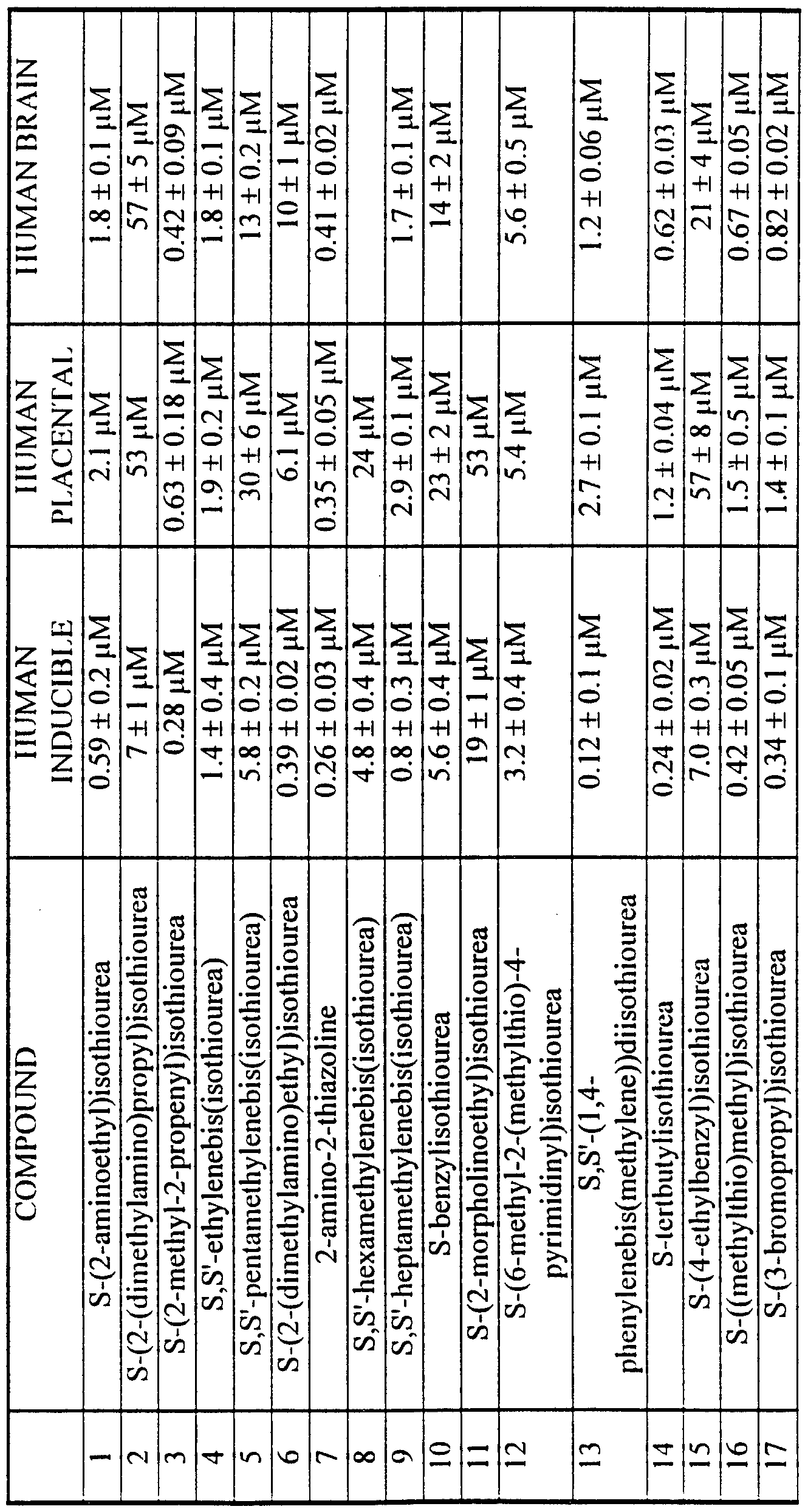
  • Values are inhibition constants (Ki) obtained from measuring percent inhibition at three or more concentrations of inhibitor and assuming competitive inhibition with respect to arginine.

Landscapes

  • Health & Medical Sciences (AREA)
  • Chemical & Material Sciences (AREA)
  • Organic Chemistry (AREA)
  • Veterinary Medicine (AREA)
  • Medicinal Chemistry (AREA)
  • Pharmacology & Pharmacy (AREA)
  • Life Sciences & Earth Sciences (AREA)
  • Animal Behavior & Ethology (AREA)
  • General Health & Medical Sciences (AREA)
  • Public Health (AREA)
  • General Chemical & Material Sciences (AREA)
  • Bioinformatics & Cheminformatics (AREA)
  • Chemical Kinetics & Catalysis (AREA)
  • Epidemiology (AREA)
  • Nuclear Medicine, Radiotherapy & Molecular Imaging (AREA)
  • Engineering & Computer Science (AREA)
  • Immunology (AREA)
  • Heart & Thoracic Surgery (AREA)
  • Cardiology (AREA)
  • Communicable Diseases (AREA)
  • Pain & Pain Management (AREA)
  • Rheumatology (AREA)
  • Oncology (AREA)
  • Transplantation (AREA)
  • Pharmaceuticals Containing Other Organic And Inorganic Compounds (AREA)
  • Acyclic And Carbocyclic Compounds In Medicinal Compositions (AREA)
  • Thiazole And Isothizaole Compounds (AREA)
  • Pyrrole Compounds (AREA)
  • Organic Low-Molecular-Weight Compounds And Preparation Thereof (AREA)

Abstract

Isothiourea derivatives and their use in medicine, particularly in the treatment of conditions where there is an advantage in inhibiting nitric oxide synthase, pharmaceutical formulations comprising the same and processes for the preparation thereof are disclosed.

Description

ENZYME INHIBITORS
The present invention relates to isothiourea derivatives, to methods for their manufacture, to pharmaceutical compositions containing them and to their use in therapy, in particular their use as nitric oxide synthase inhibitors.
It has been known since the early 1980's that the vascular relaxation brought about by acetylcholine is dependent on the presence of the endothelium and this activity was ascribed to a labile humoral factor termed endothelium-derived relaxing factor (EDRF). The activity of nitric oxide (NO) as a vasodilator has been known for well over 100 years and NO is the active component of amylnitrite, glyceryltrinitrite and other nitrovasodilators. The recent identification of EDRF as NO has coincided with the discovery of a biochemical pathway by which NO is synthesised from the amino acid L-arginine by the enzyme NO synthase.
NO is the endogenous stimulator of the soluble guanylate cyclase and is involved in a number of biological actions in addition to endothelium-dependent relaxation including, cytotoxicity of phagocytic cells and cell-to-cell communication in the central nervous sytem (see Moncada elal, Biochemical Pharmacology, 2-S 1709-1715 (1989) and Moncada et al, Pharmacological Review, 42, 109-142 (1991)). It is now thought that excess NO production may be involved in a number of conditions, particularly conditions which involve systemic hypotension such as septic (toxic) shock and therapy with certain cytokines.
The synthesis of NO from L-arginine can be inhibited by the L-arginine analogue L-N- monomemyl-arginine (L-NMMA) and the therapeutic use of L-NMMA for the treatment of septic shock and other types of systemic hypotension has been proposed (WO 91/04024 and GB-A-2240041). The therapeutic use of certain other NO synthase inhibitors apart from L- NMMA for the same purpose has also been proposed in WO 91/04024 and in EP-A- 0446699.
It has recently become apparent that there are at least three types of NO synthase enzymes as follows:
(i) a constitutive, Ca"H"/calmodulin dependent enzyme, located in the endothelium, that releases NO in response to receptor or physical stimulation. (ii) a constitutive, CaΑ'calmodulin dependent enzyme, located in the brain, that releases NO in response to receptor or physical stimulation.
(iii) a Ca"*" " independent enzyme which is induced after activation of vascular smooth muscle, macrophages, endotheiial cells, and a number of other cells by endotoxin and cytokines. Once expressed this inducible NO synthase synthesises NO for long periods.
The NO released by the constitutive enzymes acts as a transduction mechanism underlying several physiological responses. The function of the NO produced by the inducible enzyme is as a cytotoxic molecule for fighting tumour cells and invading microorganisms (Wright et al., Card. Res. 26, 48-57 (1992) and Moncada si al, Pharmacological Review, 41, 109-142 (1991)). It also appears that the adverse effects of excess NO production, in particular pathological vasodilation and tissue damage, may result largely from the effects of NO synthesised by the inducible NO synthase.
The NO synthase inhibitors proposed for therapeutic use so far, and in particular L-NMMA, are non-selective in that they inhibit both the constitutive and the inducible NO synthase enzymes. Use of such a non-selective NO synthase inhibitor requires that great care be taken in order to avoid the potentially serious consequences of over-inhibition of the constitutive NO-synthase enzyme including hypertension, thrombosis, CNS toxicity and tissue damage. In particular, in the case of the therapeutic use of L-NMMA for the treatment of septic shock it has been recommended that the patient must be subject to continuous blood pressure monitoring throughout the treatment. Thus, whilst non-selective NO synthase inhibitors have therapeutic utility provided that appropriate precautions are taken, NO synthase inhibitors which are selective in the sense that they inhibit the inducible NO synthase enzyme to a considerably greater extent than the constitutive NO synthase enzyme would be of even greater therapeutic benefit and much easier to use.
The preparation and biological properties of isothioureas have been reported in the literature (Schroeder, Chem. Revs., 1955, ≤≤, 181; Doherty sial, J.Am.Chem. Soc, 1957, 72, 5667 and Brand and Brand. Org. Synth., 1942, 22, 59; Smirk ei al, Brit. Med. J. 1941, 510-11 J.Physiol., 1942, 1-QQ, 474-483; Lancet, 1942, 301-303; J Physiol., 1943, i, 379-388 Fastier, Brit. J. Pharmacol., 1948, i, 198). We have now found that isothioureas are inhibitors of NO synthase, and are useful in the treatment of systemic hypotension, and. in particular, the treatment of septic shock. In addition, many of these compounds, possess selectivity for the inducible NO synthase enzyme as compared with the constitutive NO synthase enzymes.
Accordingly, the present invention provides a method of treatment of conditions requiring inhibition of the nitric oxide synthase enzyme, which comprises administering to a mammal in need thereof an effective amount of an isothiourea derivative having an inhibitory effect against the NO synthase enzyme, or a pharmaceutically acceptable salt thereof. In another aspect, the present invention provides the use of an isothiourea having an inhibitory effect against the NO synthase enzyme for the manufacture of a medicament for the treatment of conditions where there is an advantage in inhibiting the NO synthase enzyme.
More specifically, there is provided a method of treatment of systemic hypotension and/or septic shock which comprises administering to a mammal in need thereof an effective amount of an isothiourea derivative having an inhibitory effect against the NO synthase enzyme, or a pharmaceutically acceptable salt thereof. In a further aspect, there is provided the use of an isothiourea derivative having an inhibitory effect against the NO synthase enzyme for the manufacture of a medicament for the treatment of systemic hypotension and/or septic shock.
Further conditions where there is an advantage in inhibiting NO production from L-arginine include therapy with cytokines such as TNF, IL-1 and IL-2 or therapy with cytokine- inducing agents, for example 5, 6-dimethylxanthenone acetic acid, and as an adjuvant to short term immunosuppression in transplant therapy. In addition compounds which inhibit NO synthesis may be of use in reducing the NO concentration in patients suffering from inflammatory conditions in which an excess of NO contributes to the pathophysiology of the condition, for example adult respiratory distress syndrome (ARDS) and myocarditis.
There is also evidence that an NO synthase enzyme may be involved in the degeneration of cartilage which takes place in autoimmune and/or inflammatory conditions such as arthritis, rheumatoid arthritis, chronic bowel disease and systemic lupus erythematosis (SLE). It is also thought that an NO synthase enzyme may be involved in insulin- dependent diabetes mellitis. Therefore, a yet further aspect of the present invention provides an isothiourea derivative or salt thereof in the manufacture of a medicament for use in cytokine or cytokine-inducing therapy, as an adjuvant to short term immunosuppression in transplant therapy, for the treatment of patients suffering from inflammatory conditions in which an excess of NO contributes to the pathophysiology of the condition, in autoimmune and/or inflammatory indications and in insulin-dependent diabetes mellitis. A still further aspect provides a method of treatment of adverse effects associated with cytokine therapy, of short term immunosuppression in transplant therapy, of patients suffering from inflammatory conditions in which an excess of NO contributes to the pathophysiology of the condition, of autoimmune and/or inflammatory indications and of insulin-dependent diabetes mellitis, which comprises administering to a mammal in need thereof an effective amount of an isothiourea derivative having an inhibitory effect against the NO synthase enzyme or a pharmaceutically acceptable salt thereof.
As used herein, reference to "treatment" of a patient is intended to include prophylaxis; the term "mammal" is intended to include a human or an animal.
Preferred isothioureas include those of formula (I)
Figure imgf000006_0001
or a salt thereof, wherein
R is (1) a Cι_i4 hydrocarbyl group; or
(2) a 5- or 6-membered heterocyclic ring; or
(3) a 9-membered bicyclic heterocyclic ring system
each group R being optionally substituted by one or two groups independently selected from:
(a) halo;
(b) -XR1 wherein
X is oxygen, C(O)m wherein m is 1 or 2, S(O)n wherein n is 0, 1, or 2, or NR2 wherein R2 is hydrogen, C\. alkyl or C3.6 cycloalkyl or R2 is linked to R! to form a C2- alkylene group;
R! is hydrogen; or C \. alkyl, C2-6 alkenyl, C3.6 cycloalkyl, C7.9 aralkyl, C6-10 aryl, or a 5- or 6- membered heterocyclic group, each group optionally substituted by one or two groups independently selected from Cι_3 alkyl, hydroxy, C1-.3 alkoxy, amino, C1.3 alkylamino, halo, nitro, or a group C(O)m> R^b wherein m' is 1 or 2 and R^b is hydrogen or C 1-4 alkyl; or R-- is a group NR^R4 wherein R^ and R^ are the same or different and each is hydrogen or C 1-4 alkyl or R^ and R4 are linked to form a C2- alkylene group;
MM
(c) a group (Y)w-Q-S-^ wherein
Y is oxygen, S(O)n wherein n is as hereinbefore defined, or NR-5 wherein
R5 is hydrogen or Cι_4 alkyl; w is O or l; Q is C2-4 hydrocarbyl
or the imino nitrogen is linked to the group R or to the group Q to form a
5- or 6-membered heterocyclic ring;
(d) a group A wherein A is a heterocyclic ring system optionally substituted by a group (Y)w -Q- S— •< as hereinbefore defined; or
(e) a C\. alkyl, C2-6 alkenyl or alkynyl or C3.6 cycloalkyl group;
or one of the carbon atoms in R is linked to me imino nitrogen atom in the compoimd of formula (I) to form a 5- or 6- membered heterocyclic ring;
with the proviso that R is not methyl.
Suitably R is
(1) Cι_8 alkyl;
(2) C2-8 alkenyl or alkynyl;
(3) a group -(CH2)p— ^"* CH2)q CH3 wherein p is 0 to 4 and q is 0 to 3; or
(4) a 5- or 6- membered heterocyclic ring,
each optionally substituted by one or two groups which may be the same or different selected from
(a) halo ; (b) OR^b wherein R^b is as hereinbefore defined;
(c) C(O)mR2b wherein m and R^b are as hereinbefore defined;
(d) S(O)n R wherein n is as hereinbefore defined and R> is C\^. alkyl optionally substituted by one or two groups independently selected from amino or C(O)mR2b as hereinbefore defined;
(e) NR7R°" wherein R? and R^ are each independently selected from hydrogen, Cι_4 alkyl, C2-4 alkenyl, Cj_4 alkoxyalkyl; or R? and R^ are linked to form a 5- or 6-membered heterocyclic ring;
(f) a phenyl ring or a 5- or 6-membered heterocyclic ring each optionally substituted by a group OR^b as hereinbefore defined or by a group Q-S— wherein Q is as hereinbefore defined; or the imino nitrogen is linked to the group Q to form a thiazole or thiazoline ring; or
(g) C 1.4 alkyl when R is a heterocylic ring;
or one of the carbon atoms in R is linked to the imino nitrogen in the compound of formula (I) to form a thiazole or thiazoline ring.
Most suitably R is
(1) C alkyl;
(2) C2-4 alkenyl;
(3) a group -(CH2) -* *(CH2)q CH3 wherein p is 1 or 2 and q is 0 or 1; or
(4) a 5- or 6-membered heterocyclic ring containing one or two nitrogen atoms.
each optionally, substituted by one or two groups, which may be the same or different, selected from
(a) halo, preferably bromo; (b) a group OR^b' wherein R^b' is hydrogen or methyl;
(c) a group C(O)m R^b' wherein m and R^b' are as hereinbefore defined;
(d) a group SR^ wherein R^ is methyl or ethyl;
(e) a group NR^b R°>b wherein R^b and R^b are independently selected from hydrogen or Cj_ alkyl, preferably hydrogen, methyl or ethyl;
(f) a phenyl ring optionally substituted by a group OR D or a group Q-S— ••<; as hereinbefore defined;
(g) a 5- or 6-membered heterocyclic ring containing one or two heteroatoms independently selected from nitrogen or oxygen; or
(h) C i _4 alkyl, preferably methyl
or one of the carbon atoms in R is linked to the imino nitrogen in the compound of formula (I) to form a thiazole or thiazoline ring.
Formula (I) includes isothiourea derivatives of formula (IA), (IB) and (IC)
Figure imgf000009_0001
wherein R' is a Cj.g alkylene group or a C2-8 alkenylene or alkynylene group each optionally containing a phenyl ring, a 5- or 6-membered heterocyclic ring or a group X as hereinbefore defined, and the dotted line represents a double or a single bond. Formula I also includes compounds of formula (II)
or a salt thereof, wherein Ra is a C _$ hydrocarbyl or 5- or 6-membered heterocyclic ring or a 9-membered bicyclic heterocyclic ring system each optionally substituted by halo or by one or two groups -XaRla wherein Rla is hydrogen, C\. alkyl, C3.6 cycloalkyl, C7-.9 aralkyl, Cg.jo aryl, or a 5- or 6-membered heterocyclic group each optionally substituted by C1..3 alkyl, C1.3 alkoxy, amino, halo or nitro or R*a is a group N ^ R a wherein R^a and R4a aj-g &,= same or different and each is hydrogen or C 1.3 alkyl or R^a and R^a are linked to form a C2-6 alkylene group and Xa is oxygen, C(O)m a wherein ma is 1 or 2, S(O)n a wherein na is 0, 1 or 2 or NR^a wherein R^a is hydrogen, C β alkyl or C3.6 cycloalkyl or R^a is linked to R a to form a C2- alkylene group, or by a group
Figure imgf000010_0002
wherein t is 0 to 4 and w3- is 0 or 1, Ya is oxygen, sulphur and NR?a wherein R?a is hydrogen or C ι_4 alkyl:
or Ra links the sulphur atom to one of the nitrogen atoms in the compound of the formula (I) to form a 5- or 6-membered heterocyclic ring, with the proviso that Ra is not methyl.
One preferred group of compounds are those wherein R is not methyl, ethyl, propyl or isopropyl.
Preferred compounds of die formula (I) include:
S-(2-aminoethyl)isothiourea
S-(2-(dimethyl_mino)propyl)isothiourea
S-(2-methyl-2-propenyl)isothiourea
S,S'-ethylenebis(isothiourea)
S.S'-pentamethylenebis(isothiourea)
S-(2-(dimethylamino)ethyl)isothiourea 2-amino-2-thiazoline
S.S'- hexamethylenebis(isothiourea)
S.S'- heptamethylenebis(isothiourea)
S -benzylisothiourea
S-(2-morpholinoethyl)isothiourea
S-(6-methyl-2-(methyltWo)-4-pyrimidinyl)isothiourea
S ,S'-( 1 ,4-phenylenebis(methylene))diisothiourea
S-tertbutylisothiourea
S-(4-ethylbenzyl)isothiourea
S-((methylthio)methyl)isothiourea
S-(3-bromopropyl)isothiourea
S-(2-bromoethyl)isothiourea
S-(3-methyl-2-butenyl)isothiourea
S-allylisothiourea
S-(3-aminopropyl)isothiourea
S,S'-(l,3-phenylenebis(methylene))diisothiourea
S,S'-(2-methylene- 1 ,3-propanediyl) diisodiiourea
S , S'-(2-butyne- 1 ,4-diyl)diisotiιiourea
S,S'-(1 ,3-phenylenebis(l ,2-ethanediyl))diisodιiourea
S,S'-( 1 ,4-phenylenebis( 1 ,2-ethanediyl))diisothiourea
2-amino-5-methylthiazole
S-((2-amino-4-thiazolyl)methyl-L-cysteine
3 ((2-aιnino-4-thiazolyl)methyl-L-alanine
2-amino-4-methylthiazole
2-amino-4,5-dimemylthiazole
S-(2-( 1 H-pyrrol- 1 -yl)ethy l)iso thiourea
S-(3-hydroxypropyl)isothiourea
S-(2-(phenyl)ethyl)isothiourea
S-(2-(3-methoxyphenyl)ethyl)isothiourea
4-((2-ammo-4-thiazolyl)memyl)-L-homoalanine
N,N- 1 ,3 ,phenylenebis(methylene))bis(S-methylisothiourea)
N,N-( 1 ,3-phenylenebis(methylene))bis(S-ethylisothiourea)
S-(2-(5-((_midinothio)methyl)-2-thienyl)ethyl)isothiourea
S-(3-(4-((amidinothio)methyl)phenyl)propyl)isothiourea
S-(3-(5-(2-__mdinothio)ethyl)-2-thienyl)propyl)isothiourea
S-(2-(4-fluorophenyl)ethyl)isothiourea
S-(2-(4-bromophenyl)ethyl)isothiourea S -(2-(3 -methoxyphenyl)ethy l)isothiourea
S-(2-(3-methylphenyl)ethyl)isothiourea
S-(2-(4-ethoxyphenyl)ethyl)isothiourea
S-(2-(4-methoxyphenyl)ethyl)isothiourea
S-(2-(2-bromophenyl)ethyl)isothiourea
S-(2-(2-fluorophenyl)ethyl)isothiourea
S-(2-(3-nitrophenyl)ethyl)isothiourea
S-(3-(lH-pyrrol-l-yl)propyl)isothiourea
S-(2-(2-chlorophenyl)ethyl)isothiourea
S-(2-(2,5-dimethylphenyl)ethyl)isothiourea
S-(2-(4-ethoxy-3-methoxyphenyl)ethyl)isothiourea
and salts thereof.
Especially preferred compounds include S,S'-(l,3-phenylenebis(l,2- ethanediyl))diisothiourea, S,S'-(l,4-phenylenebis(l,2-ethanediyl)) diisothiourea, S-(2-(5- antidinot_do)methyl)-2-thienyl)ethyl)isothiourea, S-(3-(5-(2-amidinothio)ethyl)-2- thienyl)propyl)isothiourea and S-(2'-(3-methoxyphenyl) ethyl)isothiourea.
Other preferred compounds for the treatment of Septic Shock are S-ethylisothiourea, S- propylisothiourea and S-isopropylisothiourea, particularly S-ethylisothiourea and S- isopropylisothiourea, and especially S-ethylisothiourea.
By the term "hydrocarbyl" group is meant a group that contains only carbon and hydrogen atoms but may contain double and/or triple bonds and which may be cyclic or aromatic in nature.
By the term "heterocyclic ring" is meant a cyclic compound containing one to three hetero atoms selected from oxygen, sulphur and nitrogen, and preferably nitrogen or sulphur.
By the term "halo " is meant fluoro, chloro, bromo or iodo, and preferably bromo.
The compounds of formula (I) may include a number of asymmetric centres in the molecule depending on the precise meaning of the various groups and formula (I) is intended to include all possible isomers. In a further aspect the present invention provides an isothiourea of the formula (I) other than benzylisothiourea, S.S-(l,4-phenylenebis(methylene))diisothiourea and S-(2- (dimethylamino)ethyl)isothiourea, or a pharmaceutically acceptable salt thereof having an inhibitory effect against the NO synthase enzyme for use in medicine.
In another aspect the present invention provides novel compounds of the formula (IA), (IB) and (IC) as hereinbefore defined. Such compounds include:
S,S'-( 1 ,4-phenylenebis( 1 ,2-ethanediyl))diisotiιiourea S-(2-( 1 H-pyrrol- 1 -y l)ethy l)isothiourea S-((2-amino-4-thiazolyl)methyl)-L-cysteine γ -(2'-amino-4-thiazolyl)-L-homoalanine S,S'-(l,2-phenylenebis(1.2-ethanediyl))diisothiourea β -(2'-amino-4'-thiazolyl)-L-alanine S-(2,-____ino-5'-(R,S)-thiazolinylmethyl)-L-cysteine 4-((2-amino-4-thiazolyl)methyl)-L-homoalanine N,N-( 1 ,3-phenylenebis(methylene))bis(S-methylisothiourea) N,N-( 1 ,3-phenylenebis(methylene))bis(S-ethylisothiourea) S-(3-(4-((amidinothio)methyl)phenyl)propyl)isothiourea S-(2-(5-((amidinothio)methyl)-2-thienyl)ethyl)isothiourea S-(3-(5-(2-an_idinothio)ethyl)-2-thienyl)propyl)isothiourea S-((2-amino-4-thiazolyl)methyl)-D-cysteine S-((2-amino-4-thiazolyl)methyl)-(D,L)-homocysteine S-(2-(2-amino-4-thiazolyl)ethyl)-L-cysteine S-(2-(4-fluorophenyl)ethyl)isothiourea S-(2-(4-bromophenyl)ethyl)isothiourea S-(2-(3-methoxyphenyl)ethyl)isothiourea S-(2-(3-methylphenyl)ethyl)isothiourea S-(2-(4-ethoxyphenyl)ethyl)isothiourea S-(2-(4-methoxyphenyl)ethyl)isothiourea S-(2-(2-bromophenyl)ethyl)isothiourea S-(2-(2-fluorophenyl)ethyl)isothiourea S-(2-(3-nitrophenyl)ethyl)isothiourea S-(3-( 1 H-pyrrol- 1 -yl)propyl)isothiourea S-(2-(4-ethoxy-3-methoxyphenyl)ethyl)isothiourea S-(2-(2,4.6-trimethylphenyl)ethyl)isothiourea S-(2-(2.6-dimethoxyphenyl)ethyl)isothiourea
and salts thereof.
The present invention includes isothioureas in the form of salts, in particular acid addition salts. Suitable salts include those formed with both organic and inorganic acids. Such acid addition salts will normally be pharmaceutically acceptable although salts of non- pharmaceutically acceptable salts may be of utility in the preparation and purification of the compound in question. Thus, preferred salts include those formed from hydrochloric, hydrobromic, sulphuric, citric, tartaric, phosphoric, lactic, pyruvic, acetic, trifluoroacetic, succinic, oxalic, fumaric, maleic, oxaloacetic, methanesulphonic, ethanesulphonic, p- toluenesulphonic, benzenesulphonic and isethionic acids. Salts of isothioureas can be made by reacting the appropriate compound in the form of the free base with the appropriate acid.
Whilst it may be possible for the isothioureas of the present invention to be administered as the raw chemical, it is preferable to present them as a pharmaceutical formulation. According to a further aspect, the present invention provides a pharmaceutical formulation comprising an isothiourea of the present invention or a pharmaceutically acceptable salt or solvate thereof, together with one or more pharmaceutically acceptable carriers therefor and optionally one or more other therapeutic ingredients, for example an antibiotic, and/or a volume replacement liquid. The carriers) must be "acceptable" in the sense of being compatible with the other ingredients of the formulation and not deleterious to die recipient thereof.
The formulations include tiiose suitable for oral, parenteral (including subcutaneous, intradermal, intramuscular, intravenous and intraarticular), rectal and topical (including dermal, buccal, sublingual and intraocular) administration although the most suitable route may depend upon for example the condition and disorder of the recipient. The formulations may conveniently be presented in unit dosage form and may be prepared by any of the methods well known in the art of pharmacy. All methods include the step of bringing into association a compound of formula (I) or a pharmaceutically acceptable salt or solvate thereof ("active ingredient") with the carrier which constitutes one or more accessory ingredients. In general the formulations are prepared by uniformly and intimately bringing into association the active ingredient with liquid carriers or finely divided solid carriers or both and then, if necessary shaping the product into the desired formulation. Formulations of the present invention suitable for oral administration may be presented as discrete units such as capsules, cachets or tablets each containing a predetermined amount of the active ingredient; as a powder or granules; as a solution or a suspension in an aqueous liquid or a non-aqueous liquid: or as an oil-in-water liquid emulsion or a water-in-oil liquid emulsion. The active ingredient may also be presented as a bolus, electuary or paste.
A tablet may be made by compression or moulding, optionally witii one or more accessory ingredients. Compressed tablets may be prepared by compressing in a suitable machine the active ingredient in a free-flowing form such as a powder or granules, optionally mixed with a binder, lubricant, inert diluent, lubricating, surface active or dispersing agent. Moulded tablets may be made by moulding in a suitable machine a mixture of the powdered compound moistened with an inert liquid diluent. The tablets may optionally be coated or scored and may be formulated so as to provide slow or controlled release of the active ingredient therein.
Formulations for parenteral administration include aqueous and non-aqueous sterile injection solutions which may contain anti-oxidants, buffers, bacteriostats and solutes which render die formulation isotonic with the blood of die intended recipient; and aqueous and. non-aqueous sterile suspensions which may include suspending agents and thickening agents. The formulations may be presented in unit-dose or multi-dose containers, for example sealed ampoules and vials, and may be stored in a freeze-dried (lyophilised) condition requiring only the addition of die sterile liquid carrier, for example, saline, water- for-injection, immediately prior to use. Altematively, the formulations may be presented for continuous infusion.
Extemporaneous injection solutions and suspensions may be prepared from sterile powders, granules and tablets of the kind previously described.
Formulations for rectal administration may be presented as a suppository with the usual carriers such as cocoa butter or polyethylene glycol.
Formulations for topical administraton in the mouth, for example buccally or sublingually, include lozenges comprising the active ingredient in a flavoured basis such as sucrose and acacia or tragacanth, and pastilles comprising the active ingredient in a basis such as gelatin and glycerin or sucrose and acacia. Preferred unit dosage formulations are those containing an effective dose, as herein below recited, or an appropriate fraction thereof, of the active ingredient.
It should be understood that in addition to me ingredients particularly mentioned above, the formulations of this invention may include other agents conventional in the art having regard to the type of formulation in question, for example those suitable for oral administration may include flavouring agents.
For each of the aforementioned conditions, the compounds of the invention may be administered orally or via injection at a dose of from 0.1 to 250mg/kg per day. The dose range for adult humans is generally from 5mg to 17.5g/day, preferably 5mg to 2g/day and most preferably lOmg to lg/day. Tablets or other forms of presentation provided in discrete units may conveniently contain an amount of compound of the invention which is effective at such dosage or as a multiple of the same, for instance, units containing 5mg to 500mg, usually around lOmg to 200mg.
The compounds of formula (I) are preferably administered orally or by injection (intravenous or subsutaneous). The precise amount of compound administered to a patient will be the responsibility of the attendant physician. However the dose employed will depend on a number of factors, including the age and sex of die patient, the precise disorder being treated, and its severity. Also the route of administration may vary depending on the condition and its severity.
The present invention also provides processes for the preparation of novel compounds as hereinbefore defined, analagous to those known in the art for preparing isothiourea derivatives.
Thus, compounds of formula (I) or protected derivatives thereof may be prepared by the reaction of thiourea with a compound RL(L')r wherein R is as hereinbefore defined, L and L' are both leaving groups, for example a halo atom such as bromo, and r is 0 or 1, followed by deprotection if necessary.
More specifically,
(i) compounds of formula (IA)
Figure imgf000017_0001
as hereinbefore defined, may be prepared by the reaction of thiourea with a compound LR'L' wherein L.L' and R' are as hereinbefore defined. Suitably the reaction is carried out in a polar solvent, such as ethanol, at a temperature of from 20°C to the refluxing solvent temperature.
Compounds of the formula LR'L' are commercially available or may be prepared from the corresponding diol, HO-R'-OH, suitably by reaction in a polar solvent such as dichloromethane in the presence of a halogenating agent such as carbon tetrabromide and tripheny lphosphine .
Compounds of formula HO-R'-OH are commmercially available or may be prepared by methods known in the art.
(ii) Compounds of formula (IB)
Figure imgf000017_0002
as hereinbefore defined may be prepared by deprotection of a compound of formula (IB1)
wherein R1 and th defined, and P and P' are the same or different and are both protecting groups such as benzyl, benzyloxycarbonyl or tert- butoxycarbonyl. The reaction may be carried out in trifluoroacetic acid at a non-extreme temperature of from -20°C to 100°C such as 0°C in the presence of scavenger molecules such as thioanisole and 1, 2-ethanedithiol.
When the dotted line represents a single bond and die substituent is in the 4-position, compounds of formula (IB1) may be prepared from a compound of formula (IB2)
(IB2)
Figure imgf000017_0004
wherein R', P and P' are as hereinbefore defined. The reduction of azide to amine and cyclization to thiazoline may be carried out in tetrahydrofuran in die presence of tripheny lphosphine .
Compounds of formula (IB2) may be prepared from compounds of formula (IB3)
Figure imgf000018_0001
wherein R, P and P' are as hereinbefore defined, by displacement of tosylate with azide anion in a polar solvent such as dimethyl formamide at non-extreme temperature of from - 20°C to 200°C such as the refluxing solvent temperature.
Compounds of formula (IB3) may be prepared from compounds of formula (IB4)
Figure imgf000018_0002
wherein R1, P' and P are as hereinbefore defined, by die addition of ti iocyanate anion to yield a ring-opened alkoxide which may be trapped as the tosyl derivative (IB3) by the addition of para-toluenesulphonyl chloride. Compounds of formula (IB4) may be prepared by methods known to a person skilled in the art.
When the dotted line represents a single bond and the substituent is in the 5 -position compounds of formula (IB1) may be prepared from a compound of formula (IB5)
Figure imgf000018_0003
by the displacement of tosylate with tiiiocyanate anion (Tetrahedron Asymmetry 1992, 749- 752), which may be carried out in a polar solvent such as ethanol at non-extreme temperatures, of from -20°C to 200°C such as the refluxing solvent temperature, followed by a cyclisation by methods analagous to tiiose described for the preparation of compounds of formula (IB) from those of formula (IB2). Compounds of formula (IB5) may be prepared form the corresponding epoxide by ring opening with azide anion followed by trapping of the alkoxide by para-toluenesulphonyl chloride in a polar solvent such as dimethylformamide at non-extreme temperatures of from -20°C to 200°C such as 100°C (Tetrahedron Lett. 1990, 21 (2), 221).
When the dotted line represents a double bond and die substituent on the thiazole ring is in the 5-position, compounds of formula (IBl) may be prepared by die cyclisation of chloroacetals of formula (IB6)
Figure imgf000019_0001
wherein R', P and P* are as hereinbefore defined and R^ is a C1-4 alkyl group, with thiourea. The reaction may be carried out in a polar solvent such as acetone or ethanol at a non-extreme temperature of from -20°C to 200°C (Chem. Abs. 54:14230d).
Compounds of formula (IB6) may be prepared from sulphuryl chloride and aldehydes of formula (IB7)
Figure imgf000019_0002
wherein R', P and P' are as hereinbefore defined (Proc. Indian. Acad. Sci. 1941, 14A, 630-5; Chem Abs. 36: 41 Oz). Compounds of formula (IB7) are commercially available or may be prepared by methods known to a person skilled in the art.
When the dotted line represents a double bond and the substituent on die thiazole ring is in the 4-position, compounds of formula (IBl) may be prepared by methods known in the art, for example α-N-ben_^loxycarbonyl-β-(2'-amino-4'-thiazolyl) alanine benzyl ester (Syndietic Communications 1990, 20. (30), 3097-3102).
(iii) Compounds of formula (IC)
Figure imgf000019_0003
may be prepared: (a) When the dotted line represents a single bond and the substitutent is in the 4- position, by metiiods analagous to those described for the preparation of compounds of formula (IB) from those of formula (IB4).
(b) When the dotted line represents a single bond and die substituent is in the 5- position of die thiazoline ring, by methods analagous to those decribed for the preparation of compounds of formula (IB) from those of formula (TB5)
c) When the dotted line represents a double bond and the substituent is in the 4- position of the thiazole ring, by the reaction of a compound of formula (IC1)
Figure imgf000020_0001
with thiourea. Suitably the cyclisaton reaction may be carried out in a polar solvent such as acetone at a non-extreme temperature of from -20°C to 200°C such as 20°C.
Compounds of formula (IC1) may be prepared from compounds of formula HO2C-R-CO2H, wherein R' is as hereinbefore defined by methods "known in the art (J. Chem. Soc. 1940, 1304-7; Chem. Abs. 35: 1133).
d) When the dotted line represents a double bond and die substituent is in the 5- position of die thiazole ring, by methods analagous to those decribed for the preparation of a compound of formula (IB) from a compound of formula (IB6).
The activity of compounds of die formula (I) as inhibitors of isolated NO syntiiase enzymes has been demonstrated against NO synthase enzymes isolated from the human placenta, brain and cytokine-induced carcinoma cells.
The present invention will now be described by way of example only:-
Example l
Preparation of S.S'-Cl .4-Phenylenehisfl .2-ethanedivl .. diisothiourea dihvdrobromide A solution of 1,4-phenylenediacetic acid (lO.Og, 51.5 mmol) in tetrahydrofuran (200mL) was added dropwise to a 0°C stirred suspension of lithium aluminium hydride (3.9 lg, 103 mmol) in tetrahydrofuran (30mL). The mixture was warmed to reflux for 3 hours and then cooled to 0°C. The excess lithium aluminium hydride was quenched by the slow addition of water (4.0mL), 15% sodium hydroxide (4.0mL), and water (12mL). The suspension was stirred with magnesium sulphate for five minutes, filtered and concentrated. The crude oil was purified by silica gel chromatography (ethyl acetate/hexanes gradient, 50-100%) to provide intermediate diol (7.38g, 86%) as a clear, colourless oil. A solution of this oil in dichloromethane (200mL) at 0°C was treated with carbon tetrabromide (32.4g, 97.7mmol) and triphenylphosphine (25.6g, 97.7 mmol). The mixture was stirred at 20°C for four hours before pentane (500mL) was added. After standing for 15 hours, the solution was decanted from a brown-coloured solid, concentrated and purified by silica gel chromatography (ethyl acetate/hexanes gradient 0-20%) to yield l,4-phenylenebis(l,2-ethanediyl) dibromide (8.2g, 64%) as an oil. A solution of die dibromide (4.0g, 13.7mmol) and thiourea (2.09g, 27.4mmol) in absolute ethanol (lOOmL) was refluxed for 2 hours, cooled and concentrated to dryness. The crude solid was recrystallized from ethanol to yield 1 ,4-phenylenebis (1,2- ethanediyl))diisodιiourea dihydrobromide (2.89g, 47%) as a white crystalline solid. M.p. = 234-236°C. lU NMR (200 MHz, D2O) δ 7.26 (s, 4H),"3.38 (t, J=7.0 Hz, 4H), 3.01 (t, J=7.0 Hz, 4H). Anal. Calcd. for C12H2θBr2N4S2: C, 32.44; H, 4.54; Br, 35.97; N, 12.61; S, 14.43. Found: C, 32.45; H, 4.59; Br, 35.89; N, 12.51; S, 14.35.
Example 2
Preparation of S-lY2-amino-4-thiazolv1 ^methvl VL-cvsteine
To a solution of 2-amino-4-chloromethylthiazole (Spraque, J.M. et al. J. Am. Chem.Soc. 1946, 6JL 2155-2159) (l.Og, 5.4mmol) and L-cysteine hydrochloride (804 mg, 5.1 mmol) in dimethylformamide (10ml) was added potassium carbonate (2.5 g). The suspension was stirred at 22°C for 18 hours. The resulting mixture was concentrated to dryness, redissolved into water, and loaded onto an ion-exchange column (Dowex 50X8, strongly acidic). The product was eluted with a gradient of ammonium hydroxide (0.1N to 0.5N). The pooled product fractions were partially concentrated and freeze-dried to yield S-(2'-amino-4'- thiazolylmethyl)-L-cysteine (1.04g, 87%) as a tan-coloured, electrostatic solid. 1H NMR (300 MHz. D2O) δ 6.5 (s,lH), 3.8 (m, 1H), 3.6 (s, 2H), 3.05-2.85 (m, 2H). Mass Spectrum (CI) 234 (M + 1, 71%).
Example 3 Preparation of v-f2'-amino-4'-thiazolvl .-L-homoalanine .3-ff2-Amino-4-thiazolvnmethvl-L-alanine.
γ-(2'-amino-4'-thiazolyl)-L homoalanine was prepared from α-N-t-butoxycarbonyl-γ-(2'- amino-4'-d_iazolyl)-L-homoalanine benzyl ester (Patt et al. Synth. Commun. 1990, 2-0 (20), 3097-3102) in 9.6% yield, according to the method of Example 6. H NMR (D2O) δ 6.5 (s,lH), 3.9 (t, J=6.4 Hz), 2.75 (m, 2H), 2.2 (m,2H).
Anal. Calcd. for CyHi 1N3θ2S»C2HF3θ2«0.3 H2O: C, 29.31; H, 2.89; N, 8.54; S, 6.52. Found: C, 29.37; H, 3.02; N, 8.53; S, 6.63.
Example 4
Preparation of S.S'-α .3-phenvlenebisα.2-ethanedivl .. diisothiourea diihvdrobromide
S,S'-(l,3-phenylenebis(l,2-ethanediyl))diisothiourea dihydrobromide was prepared according to d e method of Example 1 from 1,3-phenylenediacetic acid (Aldrich). Recrystallization from ethanol gave a white crystalline solid (m.p. 194-190°C). *H NMR (200 MHz, D2O) δ 7.4-7.2 (m, 4H), 3.39 (t, J=6.9 Hz, 4H), 3.02 (t, J=6.9 Hz, 4H). Anal. Calcd. for Ci2H2θBr2N S2: C, 32.44; H, 4.54; Br, 35.97; N, 12.61; S, 14.43. Found: C, 32.52; H, 4.49; Br, 36.04; N, 12.61; S, 14.35.
Example 5
Preparation of S.S'-π.2-Phenvlenebis Cl .2-ethanedivlY. diisothiourea dihydrobromide
S,S'-(l,2-phenylenebis(l,2-etiιanediyl))diisothiourea dihydrobromide was prepared from 1,2-phenylenediacetic acid (Aldrich) in 30% overall yield as a yellow foam according to die method of Example 1.
!H NMR (300 MHz, D2O) δ 7.29 (s, 4H), 3.38 (t, J=7.0 Hz, 4H), 3.09 (t, J=7.0 Hz). Recrystallization from etiianol gave an analytical sample, m.p. = 205-207°C.
Anal. Calcd. for C12H2θBr2N S2: C, 32.44; H, 4.54; Br, 35.97; N, 12.61; S, 14.43. Found: C, 32.47; H, 4.58; Br, 35.92; N, 12.58; S, 14.43.
Example 6
Preparation of β-f2'-amino-4'-thiazolvl . alanine
G-f2-amino-4-thiazolvn-L-alanine. To a stirred solution of α-N-t-butoxycarbonyl-β-(2'-amino-4'-thiazolyl)alanine benzyl ester (1.47g) (Patt et al., Synth. Commun. 1990, 2Ω (20), 2097-3102) in dichloromethane (15ml) at -88°C under a nitrogen atmosphere was added triethyl silane (3ml) followed by trifluoroacetic acid (3ml). The solution was warmed to room temperature over one hour before concentrating. The residue was treated with acetic acid (30mL), 20% Pd/C (2.0g), and 1,4-cyclohexadiene (20mL). The mixture was sonicated from room temperature to 33° C over 2 hours and filtered through celite washing with water. The filtrate was concentrated and redissolved into 30 mL of acetic acid and treated with 2.0 grams of fresh 20% Pd/C and 2mL of 1,4-cyclohexadiene. After sonnicating for two hours, the suspension was filtered through celite. This process of adding fresh catalyst was repeated three times before the crude product was purified by repetative semi-prep reverse phase chromatography (C-18, elution with 10% methanol/water contining 0.1 % triluoroacetic acid). Freeze-dried product fractions gave 337 mg (18%) of β-(2'-a_nino-4'-thiazolyl)-L -alanine as a stick}' glass-like solid.
*H NMR (D2O) δ 6.6 (s, 1H), 4.0 (t, J=7.6 Hz, 1H,) 3.15 (m, 2H). Mass spectrum (CI) 188 (M+l).
Anal. Calcd. for C^H^FoOgS: C, 27.23; H, 2.29; N, 7.94; S, 6.06. Found: C, 27.22; H, 2.42; N, 7.8; S, 5.67.
Example 7
Preparation of S. S'-.2.6-pvridvlenebisrmethvlene^. diisothiourea
To a solution of 2,6- pyridinedimethanol (5.0g, 35.9 mmol) in dichloromethane (200ml) at 0°C was added carbon tetrabromide (23.83g, 71.9 mmol) and triphenylphosphine (18.85 g, 71.9 mmol). The solution was stirred witii warming to
20°C over six hours. Pentane (300mL) was added. The solution was allowed to stand at 20 °C for 16 hours before filtering to remove solid impurites. The filtrate was concentrated to an oil that was purified by silica gel chromatography (hexanes, then 10% ethyl acetate/hexanes) to give 2,6-pyridinedibromide (4.47, 47%) as an off-white powdery solid. To a solution of 2,6-pyridinedibromide (3.94 g, 14.87mmol) in ethanol (100ml) was added thiourea (2.26.g, 29.74 mmol), and the resulting suspension was stirred at reflux for two hours. The solution was concentrated to dryness to yield S,S'(2.6- pyridylenebis(methylene)) diisothiourea (5.3g, 83.9%) as a white powder. H NMR (200 MHz. DMSO) δ 7.95 (t, J= 7.6 Hz. 1H . 7.51 (d. J=7.8 Hz. 2H), 4.65 (s, 4H)- I".
Anal. Calcd for C9H15N5S2Br2»0.6 H2O: C. 25.26; H 3 .81; N. 16.36; S, 14.98: Br. 37.34 Found: C. 25.3; H, 3.78; N, 16.25; S, 14.94: Br. 37.38.
Example 8
Preparation of S-f2'-amino-5'- (R.SVthiazolinvlmethvl .-L-cvsteine
To a solution of 2-amino-5-iodomethylthiazoline (4.44g, 12mmol) (Creeke & Mellor, Tet. Lett. 1989, 2_2 (33), 4435-4438) and L-cysteine hydrochloride (1.76g, lO.Ommol) in dimetiiylformamide (75 ml) was added potassium carbonate (5.0g 36mmol). The suspension was stirred at 22°C for 72 hours and refluxed for 30 minutes. Acetonitrile was added and d e mixture filtered. The solids obtained were washed repeatedly with warm methanol. Dilution of the methanol solutions with ethanol produced a white precipitate that was removed by filtration . The concentrated filtrate (oil) was taken up into metiianol/ethanol and treated with ethanolic hydrogen chloride until no further precipitation was observed and the mixture was filtered. The oil resulting from concetration of the filtrate was purified by ion-exchange chromatography (Dowex 50X8. strongly acidic) eluting with 0.1N ammonium hydroxide. The ninhydrin positive fractions were pooled and freeze-dried to yield 0.453g of a light tan-coloured solid contaminated with dimethylformamide. This solid was purified by preparative HPLC (C18 reverse phase, methanol :water:trifluororacetic acid/5 :95:0.1) to yield 0.36g of a S-(2'-amino-5'- (R, S)-thiazolinylmethyl)-L-cysteine as the trifluoroacetate salt. TLC (ammonium hydroxide: methanol/ 1:50) Rf = 0.5. ]H NMR (200 MHz, D2O) δ 4.37-4.24 (m, IH), 4.11-3.87 (m, 3H), 3.27-3.13 (m, 2H), 3.05-2.97 (m, 2H). Mass spectrum (FAB) 236.0 (M + 1, 48%).
Anal. Calcd for C7Hi3N3O2S2»3 (C2HF3O2): C, 27.04; H, 2.79; N, 7.28; S, 11.11. Found: C, 27.32; H, 2.91; N, 7.41; S, 11.17.
Example 9
Preparation of 4-(Y2-amino-4-thiazolvnmethvlVI ,-homoalanine
4-((2-a__n o-4-thiazolyl)methyl)-Nα-t-Boc-L-homoalanine t-butyl ester was prepared by the •method of Patt et al, (Synth. Commun. 1990, 2ϋ (20), 3097-3102) in 45% overall yield (1.3g) from N-t-Boc-L-2-aminoadipic acid 1 -t-butyl ester (Ramsamy et al. Synthesis. 1982, 42-43). The t-Boc and t-butyl ester protecting groups were removed as follows: To a solution of 1.68g 4-((2-amino-4-thiazolyl)methyl)-Nα-t-Boc-L-homoalanine t-butyl ester in 35 mL dioxane was added 1.1 mL triethylsilane and 8 mL 4N hydrochloric acid in dioxane solution. The mixture was filtered and the solids rinsed with dioxane after stirring for 16 hours at 22°C. The NMR of a crude sample indicated incomplete reaction. Redissolved the crude solid in 20 mL dioxane and treated with 4N hydrochloric acid (5 mL) for 4 hours. The solids were isolated by filtration, dissolved into water, and freeze-dried to yield 1.23g (80%) of 4-((2-amino-4-thiazolyl)methyl)-L-homoalamne as a hygroscopic white solid (Bis-hydrochloride hydrated witii 1.4 mol % water and solvated with 0.3 mol % dioxane). Analytical HPLC; Phenomenex C 18, water/methanol/trifluoroacetic acid (95/5/0.1), k' = 0.34. *H NMR (300 MHz, DMSO-d6) δ 9.25 (br s, 2H), 8.5(br s 2H), 6.55 (s, IH), 3.93 (m, IH), 2.6 (m, 2H), 1.8 (m, 4H).
Anal. Calcd. for C8H13N3O2S • 2HC1 • 1.4 H O • 0.3 dioxane: C, 32.51; H, 5.99; N, 12.36; S, 9.43; Cl, 20 86. Found: C, 32.28; H, 5.72; N 12.71; S, 9.60; Cl, 20.86.
Example 1
Preparation of N.N'-f 1.3-Phenvlenebis. methvleneϊ)bisf S-methvlisothiourca .
To a 0°C stirred solution of 3.30g (25 mmol) m-xylylenediamine (Aldrich Chemical) in 100 mL dichloromethane was added 7.0 mL (52 mmol) benzoylisothiocyanate. The mixture was stirred at 20 °C for 18 h and die solvent was removed under reduced pressure. The crude solids (pale yellow) were suspended in 100 mL 10% sodium hydroxide solution and refluxed for 5 minutes. The mixture was acidified with concentrated hydrochloric acid while still hot, cooled, and then made basic by me addition of ammonium hydroxide. The white solids tiiat precipitated were collected and dried at 60 °C under reduced pressure to a constant weight to yield 4.82 g bis-tbiourea intermediate as an off-white solid.
Anal.Calcd. for C104N4S2: C, 47.22; H, 5.55; N, 22.03; S, 25.10. Found: C, 47.49; H, 5.50; N, 21.81; S, 25.01.
To a solution of 2.54 g (10 mmol) of bis-thiourea intermediate in 25 mL dimethylformamide was added 5.0 mL (80 mmol) iodometi ane. The solution was stirred 65 h at 20 °C, the solvent was removed under reduced pressure, and die residue was recrystallized from hot ethanol. The pale yellow crystals were dried under reduced pressure at 60°C to yield 4.28g (81%) N,N'-( 1,3 -Phenyl- enebis(methylene))bis(S- methylisothiourea). m.p. = 164-167°C. TLC (one spot on silica gel with 1% ammonium hydroxide in methanol, Rf = 0.48). lU NMR (300 MHz DMSO/T O) δ 7.5-7.4 (m, IH), 7.35-7.2 (m,3H), 4.59 (s, 4H), 2.65 (s,6H). Anal.Calcd. for C^H^N^ • 1.9 HI: C, 27.43; H, 3.82; N, 10.66; S, 12.20; I, 45.89. Found: C, 27.30; H. 3.91; N, 10.57; S, 12.19; I, 45.92.
Example 1 1
Preparation of N. N'-fl .S-Phenvlenebisdnethylene VlbisfS-ethylisothiourea)
To a solution of 1.0 g (3.93 mmol) of the bis-thiourea prepared in example 10 in 20 mL ethanol was added 6.29 g (78.62 mmol) of iodoediane. The mixture was heated to reflux for 8 h and concentrated to a foam under reduced pressure. The crude product was purified by silica gel chromatography with methanol in dichloromethane (10% to 20%) to yield 1.66g (74%) of N,N'-(l,3-Phenylenebis(methylene))bis(S-ethyliosothiourea). TLC (Rf = 0.3-0.48, 20% methanol in dichloromethane). Mass spectrum (FAB) 311.2 (M+l). lH NMR (200 MHz, DMSO-d6)δ 7.5-7.4 (m, IH), 7.31-7.22 (m, 3H), 4.58 (s, 4H), 3.20 (q, J = 7.4 Hz, 4H), 1.28 (t, J = 7.4 Hz, 6H).
Anal. Calcd. for C14H2 N4S • 2HI : C, 29.69; H, 4.27; N, 9.89; S, 11.32; I, 44.82. Found : C, 29.44; H, 4.25; N, 9.64; S, 11.50; 1, 44.65.
Example 12
Preparation of S-(3-(4-((AmidinQthio)methyl)phenyl)propyDi§ot iourga
From 3-(4-Carboxyphenyl)propionic acid (Lancaster Synthesis) was prepared (3-(4- ((Amidinothio)methyl)phenyl)propyl)isothiourea as a white solid (2.95 g, m.p. = 190-195 ° C) by die method of example 1. Mass spectrum (FAB) 283 (M+l). lK NMR (200 MHz, D2O) δ 7.38 (d, J = 8.1 Hz, 2H), 7.26 (d, J = 8.1, Hz, 2H), 4.36 (s, 2H), 3.06 (t, J = 7.2 Hz, 2H), 2.74 (t, J = 7.4 Hz, 2H), 2.1-1.9 (m, 2H).
Anal.Calcd. for C128N4S2 • 2HBr : C, 32.44; H, 4.54; N, 12.61; S, 14.43; Br, 35.97. Found : C, 32.53; H, 4.58; N, 12.56; S, 14.34; Br, 35.85.
Example 13
Preparation of S-r2-r5-r(Amidiothio^methvn-2-thienvnethvnisothiourea
To a solution of 21.48 g (0.19 mol) α, α-dichloromethyl methyl ether (Fluka) in 300 mL dichloromethane at 0°C was added 44.76 g (0.172 mol) tin (IV) chloride (Aldrich). After 15 minutes, a solution of 24.01 g (0.14 mol) ethyl 2-thiopheneacetate (Aldrich) in 50 mL dichloromethane was added dropwise over several minutes. The mixture was poured into water and ice after 1 h and stirred for 30 minutes. The dichloromethane layer was washed with water, dried over sodium sulfate, and concentrated. The crude product was purified by silica gel chromatography with 10% ethyl acetate in hexanes to yield 22.85 g (82%) of 5- formyl-2-thiopheneacetic acid ethyl ester intermediate.
To a 0°C stirred suspension of 0.77g (20.29 mmol) lithium aluminum hydride (Aldrich) in 200 mL tetrahydrofuran was added a solution of 2.0 g (10.09 mmol) of the intermediate prepared above in 50 mL tetrahydrofuran. The suspension was stirred at 20°C for 16 h, cooled to 0°C, and die excess hydride was quenched by die careful addition of 0.8 mL water, 0.8 mL IN sodium hydroxide solution, and 2.4 mL water. The suspension was stirred with magnesium sulfate, filtered, concentrated, and purified by silica gel chromatography with 50% ethyl acetate in hexanes to 100% ethyl acetate. There was isolated 1.07 g (67%) of diol intermediate mat was converted directly to dibromide as follows.
The diol intermediate (1.07 g, 6.76 mmol) in 50 mL dichloromethane at 0°C was treated with 3.90 g (14.87 mmol) triphenylphosphine and 4.93 g (14.87 mmol) carbon tetrabromide. The solution was stirred for 1 h before 200 mL pentane was added. The supernateήt was decanted from an oily residue, concentrated, and purified by silica gel chromatography .with hexanes to give 1.1 Og (57%) of a dibromide intermediate. The dibromide product (1.10g, 3.87 mmol) in 50 mL ethanol was treated with 0.59 g (7.75 mmol) thiourea. The solution was stirred at reflux for 2 h. The concentrated solution was purified by prepative HPLC (Waters C18 BondaPak PrepPak cartridge) witii a memanol/water/trifluoroacetic acid gradient (5/95/0.1 to 90/10/0.1). The pooled product fractions were concentrated, diluted with water, and freeze-dried to yield 306 mg of S-(2-(5-((Ami__nothio)methyl)-2- thienyl)ethyl)isodιiourea as a bis-trifluoroacetic acid salt and 0.1 mol hydrate (mp = 186- 190°C). lH NMR (200 MHz, D2O) δ 6.98 (d, J = 3.5 Hz, IH), 4.57 (s, 2H), 3.38 (t, J = 6.5 Hz, 2H), 3.2 (t, J=6.5 Hz, 2H).
Anal. Calcd. for CoHι4N4S3 • 2.0 C2HF3O2 • 0.1 H2O : C, 30.96; H, 3.24; N, 11.11; S, 19.08. Found: C, 31.02; H, 3.19; N, 11.00; S, 18.97.
Example H
Preparation of S-r3-('5-r2-(Αmidinothio ethvlV2-thienvl)propvnisothiourea
5-Formyl-2-thiopheneacetic acid etiiyl ester was prepared as described in example 13. To a solution of 2.0g (10.09 mmol) of this ester in 100 mL tetrahydrofuran was added 3.87 g (11.10 mmol) carbethoxymethylenetriphenylphosphorane. The solution was refluxed overnight and concentrated. The crude product was combined with a second 2.0g reaction utilizing 10.54g (30.27mmol) carboethoxymethylenetriphenyl- phosphorane refluxed in 100 mL tetrahydrofuran for 3h. The combined crude products were purified by silica gel chromatography (10% ethyl acetate/hexane) to yield 2.39g (44%) of enediester intermediate. To a solution of l.Og (3.73 mmol) of this ene-diester in 50 mL ethanol was added l.Og 10% palladium on carbon. The mixture was shaken at 20°C under 50 psi hydrogen for 14 h. The catalyst was removed by filtration through celite and die solution was concentrated to yield l.Og of crude diester intermediate. The final tiiree reactions on this intermediate, including lithium aluminum hydride reduction (82%), bromination of die resulting diol (78%), and alkylation of d e dibromide wim thiourea (88%) were analogous to those described in example 13. The crude product of the alkylation reaction was purified by preparative HPLC (Waters, C18 BondaPak PrepPak cartridge) eluting with a methanol/water gradient from 10% to 90% metiianol over 40 minutes (solutions were buffered witii 0.1%> trifluoroactic acid). The product fractions were freeze-dried to yield 1.53g of S-((3-(5-(2-(Amidmothio)ethyl)-2-thienyl)propyl)isothiourea as a mixed salt (1.0 HBr, 1.1 TFA) and 0.5 mol of solvation with methanol. M.p. = 146-151°C. Mass spectrum (FAB) 303. (M+l). IH NMR (200 MHz, D2O) δ 6.77 (d, J = 3.3 Hz, IH), 6.73 (d, J = 3.3 Hz, IH), 3.37 (t, J = 6.6 Hz, 2H), 3.21-3.03 (m, 2H), 2.91 (t, J = 7.2 Hz, 2H), 2.1- 1.95 (m, 2H).
Anal. Calcd, for Cι ιHι8N4S3 • 1.0 HBr • 1.1 C2HF3O2 • 0.5 H O; C, 31.35; H, 4.24; Br, 15.22; N, 10.68; S, 18.05. Found: C, 31.59; H, 4.01; Br, 14.94; N, 10.45; S, 18.05.
Examples 15-17 were prepared by the method of example 2. The crude products were purified by preparative HPLC (Waters, C18 BondaPak PrepPak cartridge). Gradient elutions with methanol/water/trifluoroacetic acid (5/95/0.1 to 90/10/0.1) followed by freeze- drying provided the target amino acids as trifluoroacetic acid addition salts.
Example 15
S-((2-Amino-4-thiazolvnmethvn-D-cvsteine
Prepared from D-cysteine and 2-amino-4-chloromethylti_iazole (Spraque, J.M. et al. J. Am. Chem. Soc. 1946. 68, 2155-2159). Analytical HPLC - phenomenex C18, water/methanol/hepentafluorobutyric acid (80/20/0.17), one peak, k' = 1.9. UV (pH 7.0 buffer) λmax 254 nm (log ε 3.73). lU NMR (200 MHz. DMSO-d6) δ 8.1 (br, 2H), 8.1-7.5 (br, 2H), 6.5 (s, IH), 4.25 (m, IH), 3.65 (d. J = 6 Hz.2H), 3.0 (m. 2H). Anal.Calcd. for C7H11N3O2S • 2.3 C2HF3O2 • 0.1 H2O; C, 27.92; H, 2.72; N, 8.43; S. 12.85. Found: C, 28.00: H, 2.89; N. 8.74; S, 12.62.
Example 16 S-((2-Amino-4-thiazolvnmethvlV(D.LVhomocvsteine
Prepared from (D,L)-homocysteine and 2-amino-4-chloromethyldιiazole (Spraque, J.M. et al J.Am.Chem.Soc. 1946. 68, 2155-2159). Analytical HPLC - phenomenex C18, water/methanol trifluoroacetic acid (95/5/0.1), one peak, k' = 2.3. UV (pH 7.0 buffer) λmax 254 nm (log ε 3.73). 1__ NMR (200 MHz, DMSO-d6)δ 8.5-8.0 (br, 2H), 7.2-7.0 (br, 2H), 6.35 (s, IH), 4.0 (t, J = 4 Hz, IH), 3.55 (s, 2H), 2.6 (m, 2H), 2.0 (m, 2H).
Anal.Calcd. for CgH^N^S • 1.1 C2HF3O2 • 1.0 H2O; C, 31.35; H, 4.15; N, 10.75; S. 16.41. Found: C, 31.30; H, 4.07; N, 10.73; S, 16.31.
Example 17
S-(2-(2-Amino-4-thiazolvl .ethvl.- -cvsteine
From L-cysteine and 2-amino-4-(2-bromoethyl)thiazole (prepared from l,5-dibromo-2- butanone by the method of Spraque et al. J.Am.Chem.Soc. 1946. 68, 2155-2159). Analytical HPLC - phenomenex C18, water/methanol/trifluoroacetic acid (95/5/01), one peak, k' = 2.6. UV (pH 7.0 buffer) λmax 256 nm (log ε 3.71). lR NMR (200 MHz, DMSO- d6) δ 9.2-8.8 (br, 2H), 8.6-8.2 (br, 2H), 6.6 (s, IH), 4.2 (m, IH), 3.0 (m, 2H), 2.8 (m, 4H).
Anal.Calcd. for C8H13N3O2S2 • 2.0 C2HF3O2 • 2.4 H2O; C, 27.79: H, 3.85; N, 8.10; S, 12.37. Found: C, 27.65; H, 3.69; N, 8.02; S, 12.38.
Example 18
Preparation of S-(2-(4-hromophenvnethvl .isothiourea hvdrobromide
To a solution of 4-bromophenethyl alcohol (720mg, 0.50ml, 3.58mmol) and •triphenylphosphine (1.13g, 4.30 mmol) in dichloromethane (7.0ml) at 0°C was added carbon tetrabromide (1.42g, 4.30mmol). The reaction mixture was stirred for 30 min while warming to room temperature. The solution was poured into hexane (100ml) and filtered throueh celite. The solvents were removed in_ vacuo. hexane was added, and the solution was filtered through celite. After removing the solvent in_ vacuo. the crude material was kugelrohr distilled (120°C/70μm Hg) to give a clear oil.
The clear oil was dissolved in 95% ethanol (7.0ml), and tiiiourea (300mg, 3.94 mmol) was added. The reaction mixture was warmed to reflux for 16 hr, cooled to room temperature, and the solvent was removed in. vacuo to give a white solid. The solid was suspended in hot acetone and filtered to give 832mg (68% yield) of die title compound.
lR NMR (300 MHz, d6-DMSO); δ 9.02 (s, 4H), 7.52 (d, J = 8.3 Hz, 2H), 7.26 (d, J = 8.3 Hz, 2H), 3.43 (t, J = 7.6 Hz, 2H), 291 (t, J = 7.4 Hz, 2H).
M.S. (Cl) for C9Hi2N SBr2, m/z (relative intensity) 259 (M+-Br, 100), 183 (68), 77 (92).
Elemental Analysis for CoH^SB , calcd. C, 31.79; H, 3.56; N, 8.24; S. 9.43: Br. 46.99. Found C, 31.84; H, 3.59; N, 8.19; S, 9.34, Br, 46.92.
Example 19
Preparation of S-(2-(4-fluorophenvnethvl .isothiourea hvdrohromide.
Prepared from 4-fluorophenethyl alcohol according to die method of Example 18. The title compound was purified by recrystallization from absolute ethanol.
lR NMR (300 MHz, d6-DMSO); δ 9.10 (br. s, 2H), 8.96 (br. s, 2H), 7.32 (m, 2H), 7.14 (m, 2H), 3.43 (t, J = 6.8 Hz. 2H), 2.91 (t, J = 6.8 Hz, 2H).
M.S.(CI) for C9H12N2SFBr, m/z (relative intensity) 199 (M+-Br, 42), 77 (100). Elemental Analysis for (C9Hi2N2SF)(CH4N2S)o.63(HBr)i.o65 calcd. C, 34.84; H, 4.43; N, 13.75; S, 15.74; Br, 25.51. Found C, 35.31; H, 4.41; N, 13.62; S, 15.51; Br, 25.92.
Example 20
Preparation of S-(2-(4-etho-ry-3-methoxvphenvnethvl .isothiourea hvdrobromide.
Prepared from 4-ethoxy-3-methoxyphenethyl alcohol according to the method of Example 18. The title compound was purified by recrystallization from absolute enthanol. lK NMR (300 MHz, d6-DMSO); δ 8.95 (br, s, 4H), 6.87 (s, IH), 6.84 (d, J = 8.1 Hz. IH), 6.73 (d, J = 8.2 Hz, IH), 3.94 (q, J = 7.0 Hz, 2H), 3.73 (s, 3H), 3.39 (t, J = 7.3 Hz. 2H), 2.83 (t, J = 7.4 Hz, 2H), 1.28 (t, J = 7.0 Hz, 3H).
M.S. (Cl) for C12Hi9N2O2SBr, mZz (relative intensity) 255 (M+-Br, 56), 179 (100).
Elemental Analysis for Ci2Hi9N2θ2SBr, calcd. C, 42.99; H, 5.71; N, 8.36; S, 9.56; Br, 23.83. Found C, 43.09; H, 5.73; N, 8.42; S, 9.61; Br, 23.89.
Example 21
Preparation of S-f2-f4-ethoxyphenvnethvl sothiourea hvdrochloride.
Prepared from 4-ethoxyphenetiιyl alcohol according to die metiiod of Example 18. The crude product was dissolved in water, and 2 molar equivalents of aqueous sodium picrate was added. The bright yellow precipitate was isolated by filtration and chromatographed on AG1-X2 anion exchange resin (200-400 mesh, chloride form, 10:1 water: methanol eluant) to give the hydrochloride salt.
*H NMR (300 MHz, d6-DMSO); δ 9.19 (br. s, 4H), 7.19 (d, J = 8.1 Hz, 2H), 6.82 (d, J = 8.1 Hz, 2H), 3.94 (q, J = 7.0 Hz, 2H), 3.39 (t, J = 7.3 Hz, 2H), 2.83 (t, J = 7.4 Hz, 2H), 1.28 (t, J = 7.0 Hz, 3H).
M.S. (Cl) for C! ιHι7N2OSCl, m/z (relative intensity) 225 (M+-C1, 37), 149 (100).
Elemental Analysis for (CnH16N2OS)(HCl)1.o8(CH4N2S)o.08(H2°)0.16. calcd- > 48.81; H, 6.55; N, 11.10; S, 12.70; Cl, 14.04. Found C, 48.91; H, 6.41; N, 11.12; S, 12.55; Cl, 14.20.
Example 22
Preparation of S-(2-(2.6-dimethoxyphenvnethvnisothiourea hvdrochloride.
Prepared from 2,6-dimetiιoxyphenethyl alcohol according to die metiiod of Example 21.
iH NMR (300 MHz, d^-DMSO; δ 9.14 (br. s, 4H), 7.18 (t, J = 8.2 Hz, IH), 6.07 (d, J = 8.2 Hz, 2H), 3.73 (s, 6H), 3.39 (t, J = 7.3 Hz.2H), 2.83 (t, J = 7.4 Hz, 2H).
M.S. (Cl) for C11H17N2O2SCL m/z (relative intensity) 241 (M+-C1, 25), 165 (100). Elemental Analysis for C11H17N2O2SCI, calcd. C, 47.74; H, 6.19; N, 10.12; S. 11.48; Cl. 12.81. Found C, 47.77: H, 6.19: N, 10.07: S, 11.48; Cl, 12.87.
Example 23
Preparation of S-(2-(4-methoxvphenvl .ethvnisothiourea hvdrochloride.
Prepared from 4-methoxyphenethyl alcohol according to the method of Example 21.
!H NMR (300 MHz, d^-DMSO); δ 9.19 (br, s, 4H), 7.19 (d, J = 8.0 Hz, 2H), 6.82 (d, J = 8.1 Hz, 2H), 3.73 (s, 3H), 3.39 (t, J = 7.3 Hz, 2H), 2.83 (t, J = 7.2 Hz, 2H).
M.S. (Cl) for Ci ιHι7N2OSCl, m/z (relative intensity) 211 (M+-C1, 22), 135 (100).
Elemental Analysis for (C10H15N2OSC1), calcd. C, 48.68; H, 6.13; N, 11.36; S, 12.89; Cl, 14.45. Found C, 48.70: H, 6.10; N, 11.36; S, 12.89; Cl, 14.45.
Example 24
Preparation of 2-(2-(3-methoxvphenvl . ethvnisothiourea hvdrochloride.
Prepared from 3-methoxyphenethyl alcohol according to die method of Example 21.
!H NMR (300 MHz, d^-DMSO); δ 9.00 (br. s, 4H), 7.21 (t, J = 7.9 Hz, IH), 6.80 (m, 3H), 3.72 (s, 3H), 3.43 (t, J = 7.0 Hz, 2H), 2.88 (t, J = 7.4 Hz, 2H).
M.S. (CI) for C10Hi7N2OSCl, m/z (relative intensity) 211 (M+-C1, 100), 135 (10), 77 (70).
Elemental Analysis for (CιoHi6N2θS)(HCl)ι<θ5(CH4N2S)o.2θ(H2θ)θ.05 , calcd. C, 45.39; H, 6.13; N, 12.62; S, 14.45; Cl, 13.61. Found C, 45.28; H, 6.18; N, 12.54; S, 14.43; Cl, 13.65.
Example 25
Preparation of S-(2-(2.4.6-trimethvlphenvl .ethvnisoti iourea hvdrobromide.
Prepared from 2,4,6-trimethoxyphenethyl alcohol according to die metiiod of Example 18. The title compound was purified by recrystallization from absolute ethanol. H NMR (300 MHz. d6-DMSO); δ 9.00 (s. 4H), 6.80 (s, 2H), 3.24 (t, J = 6.8 Hz, 2H), 2.84
(t, J = 6.7 Hz, 2H), 2.49 (s, 3H), 2.28 (s, 6H).
M.S. (Cl) for Ci2Hi9N2SBr, m/z (relative intensity) 223 (M+-Br, 50), 147 (100).
Elemental Analysis for C^H^^SBr, calcd. C, 47.53; H, 6.32; N, 9.24; S, 10.57; Br, 26.53. Found C, 47.26; H, 6.30; N, 9.34; S, 10.49; Br. 26.48.
Example 26
Preparation of S-(2-(3-methvIphenvl.ethvnisothiourea hvdrobromide.
Prepared from 3-methylphenetiιyl alcohol according to the method of Example 18. The title compound was purified by recrystallization from absolute etiianol.
!H NMR (300 MHz, d6-DMSO); δ 9.08 (br, s, 2H), 9.03 (br. s, 2H), 7.20 (t, J = 7.5 Hz, IH), 7.08 (m, 3H), 3.43 (t, J = 7.8 Hz, 2H), 2.88 (t, J = 7.6 Hz, 2H), 2.28 (s, 3H).
M.S. (Cl) for C10H15N2SBr, m z (relative intensity) 195 (M+-Br, 100), 119 (56), 77 (42).
Elemental Analysis for (CioHi5N2SBr)(CH4N2S)0.i , calcd. C, 42.60; H, 5.49; N, 11.17; S, 12.79; Br, 27.95. Found C, 42.66; H, 5.50; N, 11.20; S, 12.57; Br, 27.79.
Example 27
Preparation of S-(2-(2-fluorophenvnethvnisothiourea hvdrochloride
Prepared from 2-fluorophenethyl alcohol according to the method of Example 21.
!H NMR (300 MHz, d6-DMSO); δ 9.21 (br. s, 4H), 7.39 (m, IH), 7.28 (m, IH), 7.17 (m, 2H), 3.43 (t, J = 7.7 Hz, 2H), 2.92 (t, J = 7.8 Hz, 2H).
M.S. (Cl) for C9H12N2SFC1, m z (relative intensity) 199 (M+-C1, 100), 123 (39). Elemental Analysis for C9H1 N2SFC1, calcd. C, 46.05; H, 5.15; N. 11.93; S, 13.66; Cl, 15.10. Found C, 45.93; H, 5.11; N, 11.83; S, 13.59; Cl, 15.14.
Example 28
Preparation of S-(2-(3-nitrophenvl.ethvl . isothiourea hvdrobromide To a solution of 3-nitrophenethyl alcohol (500mg, 2.99 mmol) and pyridine (35.6mg, 36μl. 0.45mmol) in THF (10ml) at 0°C was added phosphorus tribromide (298 mg, 0.10ml, 1.10 mmol). A white precipitate formed immediately. The reaction mixture was warmed to room temperature and stirred for 1 hr. Water and ether were added, and die phases were separated. The organic phase was washed with saturated aqueous sodium bicarbonate and dried over anhydrous magnesium sulfate. The mixture was filtered, and d e solvents were removed in. vacuo to give a brown oil.
The crude bromide was dissolved in 95% ethanol (10ml), and thiourea (251mg, 3.30 mmol) was added. The reaction mixture was warmed to reflux for 16 hr, cooled to room temperature, and the solvent was removed in vacuo . The crude yellow solid was suspended in acetone, and die mixture was warmed to reflux for 10 min. The hot solution was filtered to give a white solid.
--H NMR (300 MHz, d6-DMSO); δ 9.12 (br. s, 2H), 8.96 (br. s, 2H), 8.22 (s, IH), 8.14 (d, J = 7.9 Hz, IH), 7.78 (d, J = 7.6 Hz, IH), 7.64 (t, J = 8.0 Hz, IH), 3.50 (t, J = 7.0 Hz, 2H), 3.10 (t, J = 7.2 Hz, 2H).
M.S. (Cl) for C9H1 N3θ2SBr, m/z (relative intensity) 226 (M+-Br, 26), 136 (36), 76 (81).
Elemental Analysis for C9Hi2N2θ2SBr, calcd. C, 35.31; H, 3.95; N, 13.72; S, 10.47; Br, 26.10. Found C, 35.22; H, 3.88; N, 13.62; S, 10.36; Br, 26.18.
Example 29
Preparation of S-(2-( 1 H-pyrrol- 1 -yl)et yl isothiourea
To a solution of freshly distilled N-(2-bromoethyl)pyrrole (l.OOg, 5.74 mmol) in 95% ethanol (12ml) at room temperature was added thiourea (415mg, 5.74mmol). The solution was stirred at reflux for 22 hr, cooled to room temperature, and die mixture was concentrated in vacuo to give a thick slightiy beige oil. The oil was allowed to crystallize at room temperature over 16 hr, and the crystals were filtered and rinsed with chloroform (10ml) to give 1.078g of the title compound as slightly beige needle-like crystals (75% yield).
IH NMR (300 MHz, d6-DMSO); δ 9.06 (br. s, 4H), 6.80 (t, J = 2.10 Hz, 2H), 5.99 (t, J = 2.10 Hz. 2H), 4.12 (t, J = 6.50 Hz, 2H), 3.52 (t, J = 6.50 Hz.2H). M.S. (Cl) for C7Hi2N3SBr, WZ (relative intensity) 170 (M+-Br.l00 , 153 (13), 103 (14), 94 (14), 93 (10), 77 (24).
Elemental Analysis for C7Hi2N3SBr, calcd. C, 33.61; H, 4.84; N, 16.80; S, 12.82; Br. 31.94. Found C, 33.68; H, 4.84: N, 16.74: S, 12.74; Br. 31.99. m.p. 94.6 - 95.0°C.
Example 30
NO synthase inhibition was determined by me following procedure:
Purification of NOS from human placenta
Amion and chorion were removed from fresh placenta, which was then rinsed witii 0.9% NaCl. The tissue was homogenized in a Waring blender in 3 volumes of HEDS buffer (20 mM Hepes pH 7.8, 0.1 mM EDTA, 5mM DTT, 0.2M sucrose) plus 0.1 mM PMSF. The homogenate was filtered through cheesecloth and then centrifuged at lOOOg for 20 min. The supernatant was recentrifuged at 27,500g for 30 min. Solid ammonium sulfate was- added to die supernatant to give 32% saturation. Precipitated protein was pelleted at 25,000g and then redissolved in a minimal volume of HEDS buffer plus 0.1 mM PMSF, lOμg/ml leupeptin and soybean trypsin inhibitor, and lμg/ml pepstatin. The redissolved pellet was centrigued at 15,000g for 10 min. To the supernatant was added 1/20 volume at 2,5' ADP agarose resin (Sigma), and me slurry was mixed slowly overnight. In the morning, slurry was packed into a column. The resin was sequentially washed with HEDS, 0.5M NaCl in HEDS, HEDS, and then NOS was eluted with 10 mM NADPH in HEDS. The enzyme could be concentrated by ultrafiltration and quick frozen and stored at -70°C without loss in activity for at least 3 months.
Assay for human placental NOS
NOS was assayed for the formation of citrulline following the procedure of Schmidt et al (PNAS 88 365-369, 1991) with these modifications: 20 mM Hepes, pH 7.4, lOμg/ml calmodulin. 2.5 mM CaC , 2.5 mM DTT, 125μM NADPH, lOμM tetrahydrobiopterin, 0.5mg/ml BSA. and lμM L-[14C]arginine (New England Nuclear). Linearity of NOS- catalyzed rate was confirmed prior to kinetic studies mat used single time point determination of rate. Purification of NOS from cvtokine-induced human colorectal adenocarcinoma DLD-1 cells.
DLD-1 (ATCC No. CCL 221) were grown at 37°C, 5% CO2 in RPMI 1640 medium supplemented witii L- glutamine, penicillin, streptomycin, and 10% heat-inactivated fetal bovine serum. Cells were grown to confluence and then die following cocktail of cytokines were added: 100 units/ml interferon-gamma, 200 units/ml interleukin-6, 10 ng/ml tumor necrosis factor, and 0.5 ng/ml interleukin- IB. At 18-24 hr post-induction, cells were harvested by scraping and washed with phosphate-buffered saline. Pelleted cells were stored at -70°C. Purification of the induced NOS was performed at 4°C. Crude extract was prepared by tiiree cycles of freeze/thawing cells in TDGB (20 mM tris pH 7.5, 10% glycerol, lmM DTT, 2 μM tetrahydrobiopterin). Extract was applied directly onto a column of 2',5' ADP sepharose (Pharmacia). Resin was sequentially washed witii TDGB, 0.5M NaCl in TDGB, TDGB. NOS was eluted with 2 mM NADPH in TDGB. BSA was immediately added to give a final concentration of 1 mg/ml. NOS could be quick frozen and stored at -70°C without loss in activity for at least 2 months.
Assay for inducible human NOS.
The formation of citrulline were assayed as described above except that 10 μM FAD was included and calmodulin and CaCb excluded from die assay mix.
Purification of NOS from human brain
Human brain NOS was prepared using variations of the procedures of Schmidt et al. (PNAS US 365-369, 1991), Mayer et al. (Fed. Eur. Biochem. Soc. 288 187-191, 1991), and Bredt and Snyder, (PNAS 87 682-685, 1990). Briefly, fresh whole brains (3 with myelinated tissue disected away, 1050g) were homogenized in cold buffer A (50 mM HEPES, pH 7.5 (pH at RT) and 0.5 mM EDTA, 10 mM DTT, 3.6 L total volume) with a polytron. The mixture was centrifuged at 13,000g for 1 hour and die supernatant fluid was removed (about 2050ml). To the supernatant fluid, solid ammonium sulfate (365g, about 30% of saturation) was added and stirred slowly for a total of 30 minutes. The precipitate was pelleted at 13,000g for 30 minutes and die pellet was resuspended in ~400ml of buffer A with 4μM tetrahydrobiopterin. 1 μM FAD (Sigma), and lμM FMN (Sigma). The solution was centrifuged at 41,000g for 60 minutes. The supernatant was removed, frozen by pouring into liquid nitrogen, and stored overnight at -70°C. The mixture was thawed and passed through at 2',5' ADP-agarose column (0.4g swelled in buffer A) at 4ml/min. The column was washed with 100ml buffer A, 200ml buffer A with 500 mM NaCl, 100ml Buffer A, then 30ml buffer A with 5 mM NADPH. To the enzyme solution was added tetrahydrobiopterin to lOμM, FAD and FMN to lμM, and Tween to 0.1%. This solution was concentrated by Centriprep-30 to a volume of approximately 500μl. Enzyme activity was determined as described by Schmidt et al. 1991, except that lOμM tetrahydrobiopterin was included in the assay.
The inhibition results are shown in Table 1.
Values are inhibition constants (Ki) obtained from measuring percent inhibition at three or more concentrations of inhibitor and assuming competitive inhibition with respect to arginine.
Table 1
Inhibition of Nitric Oxide Synthase
Figure imgf000038_0001
Figure imgf000039_0001
Figure imgf000039_0002

Claims

CLAIMS 1) Use of an isothiourea derivative having an inhibitory effect against the NO synthase enzyme for the manufacture of a medicament for the treatment of a condition where tiiere is an advantage in inhibiting the NO synthase enzyme. 2) Use according to Claim 1 wherein the isothiourea derivative is a compound of formula (I) or a salt thereof, wherein R is (1) a C i _ 14 hydrocarbyl group; or (2) a 5- or 6-membered heterocyclic ring; or (3) a 9-membered bicyclic heterocyclic ring system each group R being optionally substituted by one or two groups independently selected from: (a) halo; (b) -XR1 wherein X is oxygen, C(O)m wherein m is 1 or 2, S(O)n wherein n is 0, 1 , or 2, or NR2 wherein R^ is hydrogen, C\. alkyl or C3.6 cycloalkyl or R-2 is linked to R1 to form a C2-6 alkylene group; Rl is hydrogen; or C\. alkyl, C2- alkenyl, C3.6 cycloalkyl, C7.9 aralkyl, Cg.^ zuj^ or a 5- or 6- membered heterocyclic group, each group optionally substituted by one or two groups independently selected from C1-.3 alkyl, hydroxy, C1.3 alkoxy, amino, C1.3 alkylamino, halo, nitro, or a group C(O)m- R^b wherein m1 is 1 or 2 and R^b 1S hydrogen or C\_A alkyl; or Rl is a group NR^R^ wherein R- and R are the same or different and each is hydrogen or C \ .4 alkyl or R^ and R^ are linked to form a C2-6 alkylene group; (c) a group (Y)w-Q-S— ^ wherein Y is oxygen, S(O)n wherein n is as hereinbefore defined, or NR-5 wherein R5 is hydrogen or C 1.4 alkyl; w is O or l; Q is C2.4. hydrocarbyl or the imino nitrogen is linked to die group R or to the group Q to form a 5- or 6-membered heterocyclic ring; or (d) a group A wherein A is a heterocyclic ring system optionally substituted by a group (Y)w -Q- S—< as hereinbefore defined; or W _ (e) Cι_6 alkyl, C2-6 alkenyl or alkynyl or a C3.6 cycloalkyl group; or one of the carbon atoms in R is linked to the imino nitrogen atom in the compound of formula (I) to form a 5- or 6- membered heterocyclic ring; with the proviso that R is not methyl. 3) Use according to Claim 2 wherein R is
(1) C alkyl;
(2) C2.4 alkenyl;
(3) a group -(CH2)p_^-^- (CH2)π CH3 wherein p is 1 or 2 and q is 0 or 1 ; or
(4) a 5- or 6-membered heterocyclic ring containing one or two nitrogen atoms.
each optionally substituted by one or two groups, which may be the same or different, selected from
(a) halo, preferably bromo; (b) a group OR-^b' wherein R-^ ' is hydrogen or methyl;
(c) a group C(O)m R-^b' wherein m and R^b' are as hereinbefore defined;
(d) a group SR^ wherein R^ is methyl or ethyl;
(e) a group NR^3 R^b wherein R^b and R^b are independently selected from hydrogen or C 1- alkyl, preferably hydrogen, methyl or ethyl;
(f) a phenyl ring optionally substituted by a group OR^b' or a group Q-S— N>H__ as hereinbefore defined;
(g) a 5- or 6-membered heterocyclic ring containing one or two heteroatoms independently selected from nitrogen or oxygen; or
(h) C 1.4 alkyl, preferably methyl
or one of the carbon atoms in R is linked to the imino nitrogen in the compound of formula (I) to form a thiazole or tiiiazoline ring.
4) Use according to Claims 2 or 3 with the proviso that R is not etiiyl, propyl or isopropyl.
5) Use according Claims 1 to 2 wherein die isothiourea derivative is a compound of formula (IA), (IB) or (IC).
Figure imgf000042_0001
Figure imgf000042_0002
Figure imgf000043_0001
wherein R' is a Cι_8 alkylene group, C2- alkenylene or alkynylene group each optionally containing a phenyl ring, a 5- or 6-membered heterocyclic ring or a group X as hereinbefore defined, and the dotted line represents a double or a single bond.
6) Use according to Claim 1 wherein die isotiiiourea derivative is a compound of formula (II)
Figure imgf000043_0002
or a salt thereof, wherein Ra is a C\. hydrocarbyl or 5- or 6-membered heterocyclic ring or a 9-membered bicyclic heterocyclic ring system each optionally substituted by halo or by one or two groups -XaR*a wherein R*a is hydrogen, C\. alkyl, C3.6 cycloalkyl, C7.9 aralkyl, Cg-io -^yl, or a 5- or 6-membered heterocyclic group each optionally substituted by C 1.3 alkyl, C1-.3 alkoxy, amino, halo or nitro or R*a is a group N ^aR^a wherein R^a and R^a are the same or different and each is hydrogen or C 1.3 alkyl or R^a and R^a are linked to form a C2-6 alkylene group and Xa is oxygen, C(O)m a wherein ma is 1 or 2, S(O)n a wherein na is 0, 1 or 2 or NR2a wherein R2a is hydrogen, C\. alkyl or C3.6 cycloalkyl or R2a is linked to R*a to form a C2- alkylene group, or by a group
Figure imgf000043_0003
wherein t is 0 to 4 and vfi is 0 or 1, Ya is oxygen, sulphur and NR?a wherein R^a is hydrogen or C 1- alkyl:
or Ra links the sulphur atom to one of the nitrogen atoms in the compound of the formula (I) to form a 5- or 6-membered heterocyclic ring, with the proviso that Ra is not methvl. 7) Use according to any of Claim 1 to 6 wherein the isothiourea derivative is selected from
S-(2-aminoethyl)isothiourea
S-(2-(dimethylamino)propyl)isothiourea
S-(2-methyl-2-propenyl)isothiourea
S,S'-ethylenebis(isothiourea)
S.S'-pentamethylenebis(isodιiourea)
S-(2-(dimethylamino)ethyl)isothiourea
2-_mino-2-thiazoline
S,S'- hexamethylenebis(isodιiourea)
S,S'- heptamethylenebis(isothiourea)
S-benzylisothiourea
S-(2-morpholinoethyl)isodιiourea
S-(6-methyl-2-(me yltWo)-4-pyrimidinyl)isothiourea
S,S'-(l,4-phenylenebis(methylene))diisothiourea
S-tertbutylisothiourea
S-(4-ethylbenzyl)isothiourea
S-((methylthio)methyl)isothiourea
S-(3-bromopropyl)isothiourea
S-(2-bromoethyl)isothiourea
S-(3 -methy 1-2-buteny l)isodιiourea
S-allylisothiourea
S-(3-aminopropyl)isothiourea
S,S'-( 1 ,3-phenylenebis(methylene))diisothiourea
S,S'-(2-methylene-l,3-propanediyl) diisothiourea
S,S'-(2-butyne-l ,4-diyl)diisodιiourea
S,S'-( 1 ,3 -phenylenebis( 1 ,2-ethanediyl))diisodιiourea
S,S'-(l,4-phenylenebis(l,2-ethanediyl))diisothiourea
2-amino-5-methylthiazole
S-((2-amino-4-thiazolyl)methyl-L-cysteine
3 ((2-__ϊiino*^-tlriazolyl)methyl-L-alanine
2-amino-4-methyldiiazole
2-amino-4,5-dimedιyldιiazole
S-(2-( 1 H-pyrrol- 1 -yl)ethyl)isothiourea
S -(3 -hy droxypropy l)isothiourea _>
S-(2-(phenyl)edιyl)isothiourea
S-(2-(3-methoxyphenyl)ethyl)isothiourea
4-((2-amino-4-thiazolyl)methyl)-L-homoalanine
N.N- 1 ,3 ,phenylenebis(methylene))bis(S-methylisodιiourea)
N,N-( 1 ,3 -phenylenebis(methylene))bis(S-ethylisodιiourea)
S-(2-(5-((aπύdmotWo)memyl)-2-thienyl)ethyl)isodιiourea
S-(3-(4-((amidinothio)methyl)phenyl)propyl)isothiourea
S-(3-(5-(2-ami_inothio)ethyl)-2-thienyl)propyl)isothiourea
S-(2-(4-fluorophenyl)ethyl)isothiourea
S-(2-(4-bromophenyl)ethyl)isothiourea
S-(2-(3-methoxyphenyl)ethyl)isothiourea
S-(2-(3-methylphenyl)ethyl)iso_hiourea
S-(2-(4-ethoxyphenyl)ethyl)isotbiourea
S-(2-(4-methoxyphenyl)ethyl)isothiourea
S-(2-(2-bromophenyl)ethyl)isothiourea
S-(2-(2-fluorophenyl)ethyl)isothiourea
S-(2-(3 -nitrophenyl)ethyl)isothiourea
S-(3 -( 1 H-pyrrol- 1 -y l)propyl)isothiourea
S-(2-(2-chlorophenyl)ethyl)isothiourea
S-(2-(2,5-dimethylphenyl)ethyl)isothiourea
S-(2-(4-ethoxy-3-methoxyphenyl)ethyl)isothiourea
or a salt thereof.
8) Use according to any of Claims 1 to 3 or 6 wherein the isothiourea derivative is selected from
S-ethylisothiourea
S-propylisothiourea
S-isopropylisothiourea.
9) Use of an isotiiiourea according to Claim 1 for the treatment of systemic hypotension.
10) Use of an isothiourea according to Claim 1 or 2 for the treatment of Septic Shock. 11 ) Use of an isothiourea according to Claim 9 wherein the systemic hypotension is caused by cytokine or cytokine-inducing therapy.
12) Use of an isothiourea according to Claim 1 for the treatment of short term immunosuppression.
13) Use of an isothiourea according to Claim 1 for the treatment of an autoimmune disease.
14) Use of an isothiourea according to Claim 1 for the treatment of an inflammatory condition.
15) An isothiourea derivative of formula(I) other than S-ethylisotiiiourea, S- propylisothiourea, S-isopropylisothiourea, benzylisothiourea, S,S-(l,4-phenylenebis (methylene))diisothiourea and S-(2-(dimethyl_ι_ιino)ethyl)isod_iourea for use in medicine.
16) A novel isotiiiourea derivative of formula (IA), (IB) or (IC) as hereinbefore defined.
17) An isothiourea derivative according to Claim 16 which is selected from
S,S'-( 1 ,4-phenylenebis( 1 ,2-ethanediyl))diisothiourea S-(2-( 1 H-pyrrol- 1 -yl)ethyl)isothiourea S-((2-amino-4-thiazolyl)medιyl)-L-cysteine γ -(2'-amino-4-tiiiazolyl)-L-homoalanine S,S'-(l,2-phenylenebis(l,2-ethanediyl))diisodιiourea β -(2'-amino-4l-thiazolyl)-L-alanine S-(2'-amino-5'-(R,S)-thiazolinylmethyl)-L-cysteine 4-((2-aj_ιino-4-thiazolyl)me_hyl)-L-homoalanine N,N-( 1 ,3-phenylenebis(methylene))bis(S-metiιylisothiourea) N,N-( 1 ,3-phenylenebis(methylene))bis(S-ethylisothiourea) S-(3-(4-((amidinothio)methyl)phenyl)propyl)isothiourea S-(2-(5-((amidinodιio)methyl)-2-thienyl)ethyl)isot_iourea S-(3-(5-((2-an_idino_hio)ethyl)-2-thienyl)propyl)isothiourea S-((2-a_τιino-4-thiazolyl)methyl)-D-cysteine S-((2-amino-4-thiazolyl)methyl)-(D,L)-homocysteine .
S-(2-(2-amino-4-thiazolyl)ethyI)-L-cysteine
S-(2-(4-fluorophenyl)ethyl)isothiourea
S-(2-(4-bromophenyl)ethyl)isodιiourea
S-(2-(3-methoxyphenyl)ed yl)isothiourea
S-(2-(3-methylphenyl)edιyl)isothiourea
S-(2-(4-ethoxyphenyl)ethyl)isothiourea
S-(2-(4-methoxyphenyl)edιyl)isodιiourea
S-(2-(2-bromophenyl)ethyl)isodιiourea
S-(2-(2-fluorophenyl)ethyl)isot_iourea
S-(2-(3 -nitrophenyl)ethy l)isothiourea
S-(3 -( 1 H-pyrrol- 1 -yl)propy l)isothiourea
S-(2-(4-ethoxy-3-methoxyphenyl)ed yl)isothiourea
S-(2-(2,4,6-trimethylphenyl)ethyl)isothiourea
S-(2-(2,6-dimethoxyphenyl)ethyl)isothiourea
and salts thereof.
18) A process for the preparation of an isothiourea derivative according to Claim 16 which comprises
a) the reaction of thiourea with a compound RL(L')r wherein R is as hereinbefore defined, L and L' are both leaving groups and r is 0 or 1 followed by deprotection if necessary; or
b) by deprotection of a compound of formula (IB 1 )
Figure imgf000047_0001
wherein R' and die dotted line are as hereinbefore defined, and P and P' are the same or different and are both protecting groups.
19) A pharmaceutical formulation which comprises an isothiourea derivative as hereinbefore defined otiier than S-ethylisothiourea, S-propylisothiourea, S, isopropylisothiourea, S-benzylisothiourea, S,S-( 1 ,4-phenylenebismethylene) diisothiourea and S-(2-(dimedιylamino)ethyl) isotiiiourea or a pharmaceutically acceptable salt or solvate thereof, together with one or more pharmaceutically acceptable carriers therefor and optionally one or more other therapeutic ingredients.
20) A method of treatment of a condition where there is an advantage in inhibiting the NO synthase enzyme which comprises administering a therapeutically effective amount of an isothiourea derivative having an inhibitory effect against the NO synthase enzyme.
PCT/GB1993/002437 1992-11-27 1993-11-26 Enzyme inhibitors Ceased WO1994012165A2 (en)

Priority Applications (3)

Application Number Priority Date Filing Date Title
EP94900266A EP0670720A1 (en) 1992-11-27 1993-11-26 Enzyme inhibitors
AU55330/94A AU5533094A (en) 1992-11-27 1993-11-26 Enzyme inhibitors
JP6512923A JPH08503940A (en) 1992-11-27 1993-11-26 Enzyme inhibitors

Applications Claiming Priority (6)

Application Number Priority Date Filing Date Title
GB929224948A GB9224948D0 (en) 1992-11-27 1992-11-27 Nitric oxide synthase inhibitors
GB9224948.1 1992-11-27
GB9315159.5 1993-07-22
GB939315159A GB9315159D0 (en) 1993-07-22 1993-07-22 Nitric oxide synthase inhibitors
GB939319663A GB9319663D0 (en) 1993-09-23 1993-09-23 Enzyme inhibitors
GB9319663.2 1993-09-23

Publications (2)

Publication Number Publication Date
WO1994012165A2 true WO1994012165A2 (en) 1994-06-09
WO1994012165A3 WO1994012165A3 (en) 1994-12-08

Family

ID=27266488

Family Applications (1)

Application Number Title Priority Date Filing Date
PCT/GB1993/002437 Ceased WO1994012165A2 (en) 1992-11-27 1993-11-26 Enzyme inhibitors

Country Status (7)

Country Link
EP (1) EP0670720A1 (en)
JP (1) JPH08503940A (en)
CN (1) CN1095710A (en)
AU (1) AU5533094A (en)
IL (1) IL107771A0 (en)
SI (1) SI9300616A (en)
WO (1) WO1994012165A2 (en)

Cited By (57)

* Cited by examiner, † Cited by third party
Publication number Priority date Publication date Assignee Title
WO1995005363A1 (en) * 1993-08-12 1995-02-23 Astra Aktiebolag Amidine derivatives with nitric oxide synthetase activities
WO1995011231A1 (en) * 1993-10-21 1995-04-27 G. D. Searle & Co. Amidino derivatives useful as nitric oxide synthase inhibitors
WO1996009286A1 (en) * 1994-09-20 1996-03-28 Astra Aktiebolag Isothiourea derivatives as no synthase inhibitors
WO1996014842A1 (en) * 1994-11-15 1996-05-23 Merck & Co., Inc. Substituted heterocycles as inhibitors of nitric oxide synthase
EP0717040A1 (en) 1994-12-14 1996-06-19 Japan Tobacco Inc. Thiazine or thiazepine derivatives which inhibit NOS
WO1996018617A1 (en) * 1994-12-12 1996-06-20 Merck & Co., Inc. Substituted 2-acylamino-pyridines as inhibitors of nitric oxide synthase
FR2728261A1 (en) * 1994-12-14 1996-06-21 Japan Tobacco Inc THIAZINE OR THIAZEPINE DERIVATIVES USEFUL AS INHIBITORS OF NO-SYNTHETASE
EP0718294A1 (en) * 1994-12-16 1996-06-26 Hoechst Aktiengesellschaft 2-Amino-1,3-thiazepines and their use as inhibitors of the nitrogene oxide synthase
FR2730733A1 (en) * 1995-02-17 1996-08-23 Hoechst Lab Novel nitro ethylenic sulphur derivatives
WO1996030350A1 (en) * 1995-03-27 1996-10-03 Fujisawa Pharmaceutical Co., Ltd. Amidine derivatives
WO1996033175A1 (en) * 1995-04-20 1996-10-24 G.D. Searle & Co. Cyclic amidino agents useful as nitric oxide synthase inhibitors
US5674907A (en) * 1995-03-24 1997-10-07 Children's Hospital Medical Center Mercapto derivatives as inhibitors of nitric oxide synthase
US5786364A (en) * 1995-02-11 1998-07-28 Astra Aktiebolag Bicyclic isothiourea derivatives useful in therapy
US5807886A (en) * 1994-05-07 1998-09-15 Astra Aktiebolag Bicyclic amidine dervatives as inhibitors of nitric oxide synthetase
US5849782A (en) * 1995-01-13 1998-12-15 The General Hospital Corporation Methods of inhibiting neurodegenerative diseases
US5908842A (en) * 1995-12-08 1999-06-01 Merck & Co., Inc. Substituted 2-acylamino-pyridines as inhibitors of nitric oxide synthase
US5929063A (en) * 1995-03-24 1999-07-27 Children's Hospital Medical Center Mercapto and seleno derivatives as inhibitors of nitric oxide synthase
US5945408A (en) * 1996-03-06 1999-08-31 G.D. Searle & Co. Hydroxyanidino derivatives useful as nitric oxide synthase inhibitors
US5958958A (en) * 1997-07-22 1999-09-28 G.D. Searle & Co. 1,2,4-oxa diazolino and 1,24-oxa diazolidion heterocycles as useful nitric oxide synthase inhibitors
WO1999051215A3 (en) * 1998-04-06 2000-03-09 Fujisawa Pharmaceutical Co Immunosuppressive imidazole derivatives and their combination preparations with tacrolimus or cyclosporins
US6090839A (en) * 1996-12-23 2000-07-18 Merck & Co., Inc. Antidiabetic agents
WO2000048591A1 (en) * 1999-02-16 2000-08-24 Angiogene Pharmaceuticals Ltd. Combinations for the treatment of diseases involving angiogenesis
US6160000A (en) * 1996-12-23 2000-12-12 Merck & Co., Inc. Antidiabetic agents based on aryl and heteroarylacetic acids
WO2001074351A1 (en) * 2000-03-31 2001-10-11 Universitair Medisch Centrum Composition for the prevention and/or treatment, in newborn babies, of the effects of complications during childbirth
WO2001093867A1 (en) * 2000-06-09 2001-12-13 Aventis Pharma S.A. 4,5-dihydro-thiazo-2-ylamine derivatives and their use as no-synthase inhibitors
WO2001094325A1 (en) * 2000-06-09 2001-12-13 Aventis Pharma S.A. 2-aminothiazoline derivatives and their use as no-synthase inhibitors
US6344473B1 (en) 2000-08-07 2002-02-05 G.D. Searle & Co. Imidazoles useful as nitric oxide synthase inhibitors
US6403830B2 (en) 2000-03-24 2002-06-11 Pharmacia Corporation Amidino compound and salts thereof useful as nitric oxide synthase inhibitors
WO2001053257A3 (en) * 2000-01-19 2002-06-27 Cadila Healthcare Ltd Compounds having hypolipedemic and hypocholesteremic activities, process for their preparation and pharmaceutical compositions containing them
US6420566B2 (en) 2000-06-09 2002-07-16 Aventis Pharma S.A. Pharmaceutical compositions containing a 4, 5-dihydro-1, 3-thiazol-2-ylamine derivative, novel derivatives and preparation thereof
US6451821B1 (en) 2000-06-09 2002-09-17 Aventis Pharma S.A. Use of 2-aminothiazoline derivatives as inhibitors of inducible no-synthase
US6465686B2 (en) 2000-04-13 2002-10-15 Pharmacia Corporation Halogenated 2-amino-5,6 heptenoic acid derivatives useful as nitric oxide synthase inhibitors
US6465518B2 (en) 2000-04-13 2002-10-15 Pharmacia Corporation Halogenated 2-amino-4, 5 heptenoic acid derivatives useful as nitric oxide synthase inhibitors
US6489323B1 (en) 1998-06-10 2002-12-03 G.D. Searle & Co. Heterobicyclic and tricyclic nitric oxide synthase inhibitors
US6545170B2 (en) 2000-04-13 2003-04-08 Pharmacia Corporation 2-amino-5, 6 heptenoic acid derivatives useful as nitric oxide synthase inhibitors
US6552052B2 (en) 1998-06-10 2003-04-22 Monsanto/G.D. Searle Pyrrolo[2,1-c][1,2,4] thiadiazoles and Pyrollo[2,1-c][1,12,4]oxadiazoles useful as nitric oxide synthase inhibitors
WO2003040142A1 (en) * 2001-11-09 2003-05-15 Aventis Pharma S.A. 2-amino-4-heteroarylethyl thiazoline derivatives and their use an inhibitors of inducible no-synthase
WO2003040115A1 (en) * 2001-11-09 2003-05-15 Aventis Pharma S.A. 2-amino-thiazoline derivatives and their use as inhibitors of inducible no-synthase
FR2832150A1 (en) * 2001-11-09 2003-05-16 Aventis Pharma Sa New 2-amino-4-(pyridylmethyl) thiazoline derivatives having inducible NO-synthase inhibiting activity, useful for treating of Parkinson's disease, cerebral disorders, migraines, depression, diabetes
FR2832152A1 (en) * 2001-11-09 2003-05-16 Aventis Pharma Sa New 2-amino-thiazoline derivatives having inducible NO-synthase inhibiting activity, useful for treating Parkinson's, cerebral disorders, migraines, depression, diabetes
FR2832151A1 (en) * 2001-11-09 2003-05-16 Aventis Pharma Sa New 2-amino-4-(heteroarylethyl) thiazoline derivatives having inducible NO-synthase inhibiting activity, useful for treating Parkinson's, cerebral disorders, migraines, depression, diabetes
US6586471B1 (en) 2000-04-13 2003-07-01 G. D. Searle Halogenated 2-amino-3, 4 heptenoic acid derivatives useful as nitric oxide synthase inhibitors
WO2003039446A3 (en) * 2001-11-09 2003-11-27 Aventis Pharma Sa Use of 2-amino-4-pyridylmethyl-thiazoline derivatives as inhibitors of inducible no-synthase
US6787668B2 (en) 2000-04-13 2004-09-07 Pharmacia Corporation 2-amino-4,5 heptenoic acid derivatives useful as nitric oxide synthase inhibitors
US6956131B2 (en) 2000-04-13 2005-10-18 Pharmacia Corporation 2-amino-3, 4 heptenoic compounds useful as nitric oxide synthase inhibitors
US7012098B2 (en) 2001-03-23 2006-03-14 Pharmacia Corporation Inhibitors of inducible nitric oxide synthase for chemoprevention and treatment of cancers
US7087633B2 (en) 2000-03-31 2006-08-08 Universitair Medisch Centrum Method for treating perinatal asphyxia in a human or animal neonate
WO2007108004A3 (en) * 2006-03-23 2008-01-17 Meditor Pharmaceuticals Ltd S-alkylisothiouronium derivatives for the treatment of inflammatory diseases
WO2010113848A1 (en) 2009-03-31 2010-10-07 塩野義製薬株式会社 Isothiourea derivative or isourea derivative having bace1 inhibitory activity
US8168630B2 (en) 2007-04-24 2012-05-01 Shionogi & Co., Ltd. Aminodihydrothiazine derivatives substituted with a cyclic group
US8173642B2 (en) 2005-10-25 2012-05-08 Shionogi & Co., Ltd. Aminodihydrothiazine derivatives
US8637504B2 (en) 2008-06-13 2014-01-28 Shionogi & Co., Ltd. Sulfur-containing heterocyclic derivative having beta secretase inhibitory activity
US8653067B2 (en) 2007-04-24 2014-02-18 Shionogi & Co., Ltd. Pharmaceutical composition for treating Alzheimer's disease
US8703785B2 (en) 2008-10-22 2014-04-22 Shionogi & Co., Ltd. 2-aminopyrimidin-4-one and 2-aminopyridine derivatives both having BACE1-inhibiting activity
US8927721B2 (en) 2010-10-29 2015-01-06 Shionogi & Co., Ltd. Naphthyridine derivative
US8999980B2 (en) 2009-12-11 2015-04-07 Shionogi & Co., Ltd. Oxazine derivatives
US9758513B2 (en) 2012-10-24 2017-09-12 Shionogi & Co., Ltd. Dihydrooxazine or oxazepine derivatives having BACE1 inhibitory activity

Families Citing this family (3)

* Cited by examiner, † Cited by third party
Publication number Priority date Publication date Assignee Title
CN101372471B (en) * 2008-10-08 2010-12-22 中国科学院化学研究所 Novel use of alkyl isourea compound and analogues thereof
EP2634188A4 (en) 2010-10-29 2014-05-07 Shionogi & Co Fused aminodihydropyrimidine derivative
US8883779B2 (en) 2011-04-26 2014-11-11 Shinogi & Co., Ltd. Oxazine derivatives and a pharmaceutical composition for inhibiting BACE1 containing them

Family Cites Families (11)

* Cited by examiner, † Cited by third party
Publication number Priority date Publication date Assignee Title
GB1178242A (en) * 1966-02-05 1970-01-21 Wellcome Found Novel Biologically Active Bis-Isothioureas
US3790600A (en) * 1972-04-06 1974-02-05 Uniroyal Inc 2-(3-benzo(b)thenyl)-2-thiopseudourea and its pharmaceutically acceptable salts
US3954982A (en) * 1972-04-20 1976-05-04 Smith Kline & French Laboratories Limited Pharmaceutical compositions and method of inhibiting H-1 and H-2 histamine receptors
ZA771408B (en) * 1976-03-29 1978-04-26 Smith Kline French Lab Pharmaceutical compositions
US4208430A (en) * 1979-03-15 1980-06-17 Smithkline Corporation Pharmaceutical compositions and method of inhibiting phenylethanolamine N-methyltransferase
US4262125A (en) * 1979-07-23 1981-04-14 American Home Products Corporation (1H-Imidazol-5-ylmethyl)isothioureas
EP0245669B1 (en) * 1986-05-14 1993-12-01 Medopharm Arzneimittelwerk Dr. Zillich GmbH &amp; Co. Pharmaceutical preparation for preventing damage to living cells by free radicals, or for increasing the efficacy of organic sulphur compounds, and process for increasing the life span of isolated organs
GB8916947D0 (en) * 1989-07-25 1989-09-13 Smith Kline French Lab Medicaments
CA2066728C (en) * 1989-09-19 2001-12-25 Jan K. Hellstrand Anti-tumor preparation comprising interleukin-2 and histamine, analogs thereof or h2-receptor agonists
ATE191847T1 (en) * 1991-12-16 2000-05-15 Univ Washington USE OF AMINOGUAMIDINE FOR THE PRODUCTION OF A MEDICINAL PRODUCT FOR SUPPRESSING NITROGEN OXIDE FORMATION
KR100892685B1 (en) * 2007-11-09 2009-04-15 주식회사 하이닉스반도체 EAC system

Cited By (100)

* Cited by examiner, † Cited by third party
Publication number Priority date Publication date Assignee Title
US6030985A (en) * 1993-08-12 2000-02-29 Astra Aktiebolag Amidine derivatives with nitric oxide synthetase activities
US5807885A (en) * 1993-08-12 1998-09-15 Astra Aktiebolag Amidine derivatives with nitric oxide synthetase activities
WO1995005363A1 (en) * 1993-08-12 1995-02-23 Astra Aktiebolag Amidine derivatives with nitric oxide synthetase activities
EP0897912A1 (en) * 1993-10-21 1999-02-24 G.D. Searle & Co. Amidino derivatives useful as nitric oxide synthase inhibitors
WO1995011231A1 (en) * 1993-10-21 1995-04-27 G. D. Searle & Co. Amidino derivatives useful as nitric oxide synthase inhibitors
US5854234A (en) * 1993-10-21 1998-12-29 G. D. Searle & Co. Amidino dervatives useful as nitric oxide synthase inhibitors
US6046211A (en) * 1993-10-21 2000-04-04 G.D. Searle & Co. Amidino derivatives useful as nitric oxide synthase inhibitors
AU688811B2 (en) * 1993-10-21 1998-03-19 G.D. Searle & Co. Amidino derivatives useful as nitric oxide synthase inhibitors
US6448286B1 (en) 1993-10-21 2002-09-10 G.D. Searle & Co. Imino pyrrolidine derivatives useful as nitric oxide synthase inhibitors
US6071906A (en) * 1993-10-21 2000-06-06 G. D. Searle & Co. Imidino piperidine derivatives useful as nitric oxide synthase inhibitors
US5807886A (en) * 1994-05-07 1998-09-15 Astra Aktiebolag Bicyclic amidine dervatives as inhibitors of nitric oxide synthetase
US6117898A (en) * 1994-05-07 2000-09-12 Astra Aktiebolag Bicyclic amidine derivatives as inhibitors of nitric oxide synthetase
US5721247A (en) * 1994-09-20 1998-02-24 Astra Aktiebolag Isothiourea derivatives useful in therapy
WO1996009286A1 (en) * 1994-09-20 1996-03-28 Astra Aktiebolag Isothiourea derivatives as no synthase inhibitors
WO1996014842A1 (en) * 1994-11-15 1996-05-23 Merck & Co., Inc. Substituted heterocycles as inhibitors of nitric oxide synthase
WO1996018617A1 (en) * 1994-12-12 1996-06-20 Merck & Co., Inc. Substituted 2-acylamino-pyridines as inhibitors of nitric oxide synthase
FR2728261A1 (en) * 1994-12-14 1996-06-21 Japan Tobacco Inc THIAZINE OR THIAZEPINE DERIVATIVES USEFUL AS INHIBITORS OF NO-SYNTHETASE
EP0717040A1 (en) 1994-12-14 1996-06-19 Japan Tobacco Inc. Thiazine or thiazepine derivatives which inhibit NOS
EP0718294A1 (en) * 1994-12-16 1996-06-26 Hoechst Aktiengesellschaft 2-Amino-1,3-thiazepines and their use as inhibitors of the nitrogene oxide synthase
US6133306A (en) * 1995-01-13 2000-10-17 The General Hospital Corporation Methods of inhibiting neurodegerative diseases
US5849782A (en) * 1995-01-13 1998-12-15 The General Hospital Corporation Methods of inhibiting neurodegenerative diseases
US5786364A (en) * 1995-02-11 1998-07-28 Astra Aktiebolag Bicyclic isothiourea derivatives useful in therapy
FR2730733A1 (en) * 1995-02-17 1996-08-23 Hoechst Lab Novel nitro ethylenic sulphur derivatives
US5985917A (en) * 1995-03-24 1999-11-16 Children's Hospital Medical Center Mercapto and seleno derivatives as inhibitors of nitric oxide synthase
US5674907A (en) * 1995-03-24 1997-10-07 Children's Hospital Medical Center Mercapto derivatives as inhibitors of nitric oxide synthase
US5929063A (en) * 1995-03-24 1999-07-27 Children's Hospital Medical Center Mercapto and seleno derivatives as inhibitors of nitric oxide synthase
US5952385A (en) * 1995-03-24 1999-09-14 Children's Hospital Medical Center Mercapto derivatives as inhibitors of nitric oxide synthase
WO1996030350A1 (en) * 1995-03-27 1996-10-03 Fujisawa Pharmaceutical Co., Ltd. Amidine derivatives
AU712315B2 (en) * 1995-04-20 1999-11-04 G.D. Searle & Co. Cyclic amidino agents useful as nitric oxide synthase inhibitors
WO1996033175A1 (en) * 1995-04-20 1996-10-24 G.D. Searle & Co. Cyclic amidino agents useful as nitric oxide synthase inhibitors
US5883251A (en) * 1995-04-20 1999-03-16 G. D. Searle & Co. Azepine derivatives useful as nitric oxide synthase inhibitors
US5908842A (en) * 1995-12-08 1999-06-01 Merck & Co., Inc. Substituted 2-acylamino-pyridines as inhibitors of nitric oxide synthase
US5945408A (en) * 1996-03-06 1999-08-31 G.D. Searle & Co. Hydroxyanidino derivatives useful as nitric oxide synthase inhibitors
US6160000A (en) * 1996-12-23 2000-12-12 Merck & Co., Inc. Antidiabetic agents based on aryl and heteroarylacetic acids
US6090839A (en) * 1996-12-23 2000-07-18 Merck & Co., Inc. Antidiabetic agents
US5958958A (en) * 1997-07-22 1999-09-28 G.D. Searle & Co. 1,2,4-oxa diazolino and 1,24-oxa diazolidion heterocycles as useful nitric oxide synthase inhibitors
US6136829A (en) * 1997-07-22 2000-10-24 G.D. Searle & Co. Oxathiadiazole derivatives usful as iNOS inhibitors
US5981556A (en) * 1997-07-22 1999-11-09 G.D. Searle & Co. 1,3-diazolino and 1,3-diazolidino heterocycles as useful nitric oxide synthase inhibitors
WO1999051215A3 (en) * 1998-04-06 2000-03-09 Fujisawa Pharmaceutical Co Immunosuppressive imidazole derivatives and their combination preparations with tacrolimus or cyclosporins
US6489323B1 (en) 1998-06-10 2002-12-03 G.D. Searle & Co. Heterobicyclic and tricyclic nitric oxide synthase inhibitors
US6552052B2 (en) 1998-06-10 2003-04-22 Monsanto/G.D. Searle Pyrrolo[2,1-c][1,2,4] thiadiazoles and Pyrollo[2,1-c][1,12,4]oxadiazoles useful as nitric oxide synthase inhibitors
WO2000048591A1 (en) * 1999-02-16 2000-08-24 Angiogene Pharmaceuticals Ltd. Combinations for the treatment of diseases involving angiogenesis
US7087627B1 (en) 1999-02-16 2006-08-08 Angiogene Pharmaceuticals Ltd. Combinations for the treatment of diseases involving angiogenesis
EA007959B1 (en) * 2000-01-19 2007-02-27 Кадила Хелзкэр Лтд. Compounds having hypocholesteremic activities, process for their preparation and pharmaceutical compositions containing them
WO2001053257A3 (en) * 2000-01-19 2002-06-27 Cadila Healthcare Ltd Compounds having hypolipedemic and hypocholesteremic activities, process for their preparation and pharmaceutical compositions containing them
CZ304346B6 (en) * 2000-01-19 2014-03-19 Cadila Healthcare Ltd. Substituted pyrrole derivative exhibiting hypolipidemic and hypocholesteremic activity , process for its preparation and pharmaceutical composition containing thereof
HRP20020643B1 (en) * 2000-01-19 2015-04-24 Cadila Healthcare Ltd Zydus Tower, Satellite Cross Roads, Rrd Center NEW COMPOUNDS CONTAINING HYPOLYPEDEMIC, HYPOCOLESTEREMIC ACTIVITIES, THE PROCEDURE OF THEIR PREPARATION AND THE PHARMACEUTICAL PREPARATIONS CONTAINING THEM
US7102013B2 (en) 2000-03-24 2006-09-05 Pharmacia Corporation Methods of making amidino compounds useful as nitric oxide synthase inhibitors
US6403830B2 (en) 2000-03-24 2002-06-11 Pharmacia Corporation Amidino compound and salts thereof useful as nitric oxide synthase inhibitors
US6914158B2 (en) 2000-03-24 2005-07-05 Pharmacia Corporation Amidino compounds useful as nitric oxide synthase inhibitors
US6586474B2 (en) 2000-03-24 2003-07-01 Pharmacia Corporation Amidino compounds useful as nitric oxide synthase inhibitors
US7087633B2 (en) 2000-03-31 2006-08-08 Universitair Medisch Centrum Method for treating perinatal asphyxia in a human or animal neonate
WO2001074351A1 (en) * 2000-03-31 2001-10-11 Universitair Medisch Centrum Composition for the prevention and/or treatment, in newborn babies, of the effects of complications during childbirth
US6894069B2 (en) 2000-03-31 2005-05-17 Universitair Medisch Centrum Method for treating perinatal asphyxia in a human or animal neonate
US6586471B1 (en) 2000-04-13 2003-07-01 G. D. Searle Halogenated 2-amino-3, 4 heptenoic acid derivatives useful as nitric oxide synthase inhibitors
US6545170B2 (en) 2000-04-13 2003-04-08 Pharmacia Corporation 2-amino-5, 6 heptenoic acid derivatives useful as nitric oxide synthase inhibitors
US6465686B2 (en) 2000-04-13 2002-10-15 Pharmacia Corporation Halogenated 2-amino-5,6 heptenoic acid derivatives useful as nitric oxide synthase inhibitors
US6465518B2 (en) 2000-04-13 2002-10-15 Pharmacia Corporation Halogenated 2-amino-4, 5 heptenoic acid derivatives useful as nitric oxide synthase inhibitors
US6956131B2 (en) 2000-04-13 2005-10-18 Pharmacia Corporation 2-amino-3, 4 heptenoic compounds useful as nitric oxide synthase inhibitors
US6787668B2 (en) 2000-04-13 2004-09-07 Pharmacia Corporation 2-amino-4,5 heptenoic acid derivatives useful as nitric oxide synthase inhibitors
AU2001266123B2 (en) * 2000-06-09 2007-01-25 Aventis Pharma S.A. 4,5-dihydro-thiazo-2-ylamine derivatives and their use as no-synthase inhibitors
WO2001093867A1 (en) * 2000-06-09 2001-12-13 Aventis Pharma S.A. 4,5-dihydro-thiazo-2-ylamine derivatives and their use as no-synthase inhibitors
US6451821B1 (en) 2000-06-09 2002-09-17 Aventis Pharma S.A. Use of 2-aminothiazoline derivatives as inhibitors of inducible no-synthase
US6699895B2 (en) 2000-06-09 2004-03-02 Aventis Pharma S.A. 2-aminothiazoline derivatives and process for preparing the same
WO2001094325A1 (en) * 2000-06-09 2001-12-13 Aventis Pharma S.A. 2-aminothiazoline derivatives and their use as no-synthase inhibitors
FR2810037A1 (en) * 2000-06-09 2001-12-14 Aventis Pharma Sa Inducible nitrogen monoxide synthase inhibitors comprising new or known 4- and/or 5-substituted 4,5-dihydro-thiazol-2-ylamine compounds, useful e.g. for treating neurodegenerative or inflammatory diseases
FR2810036A1 (en) * 2000-06-09 2001-12-14 Aventis Pharma Sa Compositions containing new or known 4-substituted 4,5-dihydro-thiazol-2-ylamines, as inducible nitrogen monoxide synthase inhibitors useful e.g. for treating neurodegenerative or inflammatory diseases
US6420566B2 (en) 2000-06-09 2002-07-16 Aventis Pharma S.A. Pharmaceutical compositions containing a 4, 5-dihydro-1, 3-thiazol-2-ylamine derivative, novel derivatives and preparation thereof
US6344473B1 (en) 2000-08-07 2002-02-05 G.D. Searle & Co. Imidazoles useful as nitric oxide synthase inhibitors
US7012098B2 (en) 2001-03-23 2006-03-14 Pharmacia Corporation Inhibitors of inducible nitric oxide synthase for chemoprevention and treatment of cancers
US7227022B2 (en) 2001-11-09 2007-06-05 Aventis Pharma Sa Use of 2-amino-thiazoline derivatives as inhibitors of inducible no-synthase
FR2832150A1 (en) * 2001-11-09 2003-05-16 Aventis Pharma Sa New 2-amino-4-(pyridylmethyl) thiazoline derivatives having inducible NO-synthase inhibiting activity, useful for treating of Parkinson's disease, cerebral disorders, migraines, depression, diabetes
US6953796B2 (en) 2001-11-09 2005-10-11 Aventis Pharma S.A. Use of 2-amino-thiazoline derivatives as inhibitors of inducible No-synthase
FR2832152A1 (en) * 2001-11-09 2003-05-16 Aventis Pharma Sa New 2-amino-thiazoline derivatives having inducible NO-synthase inhibiting activity, useful for treating Parkinson's, cerebral disorders, migraines, depression, diabetes
US6872740B2 (en) 2001-11-09 2005-03-29 Aventis Pharma S.A. Use of 2-amino-4-heteroarylethyl-thiazoline derivatives as inhibitors of inducible no-synthase
FR2832151A1 (en) * 2001-11-09 2003-05-16 Aventis Pharma Sa New 2-amino-4-(heteroarylethyl) thiazoline derivatives having inducible NO-synthase inhibiting activity, useful for treating Parkinson's, cerebral disorders, migraines, depression, diabetes
WO2003040115A1 (en) * 2001-11-09 2003-05-15 Aventis Pharma S.A. 2-amino-thiazoline derivatives and their use as inhibitors of inducible no-synthase
US6762196B2 (en) 2001-11-09 2004-07-13 Aventis Pharma S. A. Use of 2-amino-4-pyridylmethyl-thiazoline derivatives as inhibitors of inducible no-synthase
CN1314674C (en) * 2001-11-09 2007-05-09 安万特医药股份有限公司 2-Amino-dihydrothiazole derivatives and their use as inducible NO-synthase inhibitors
US6699867B2 (en) 2001-11-09 2004-03-02 Aventis Pharma S.A. Use of 2-amino-thiazoline derivatives as inhibitors of inducible NO-synthase
WO2003040142A1 (en) * 2001-11-09 2003-05-15 Aventis Pharma S.A. 2-amino-4-heteroarylethyl thiazoline derivatives and their use an inhibitors of inducible no-synthase
WO2003039446A3 (en) * 2001-11-09 2003-11-27 Aventis Pharma Sa Use of 2-amino-4-pyridylmethyl-thiazoline derivatives as inhibitors of inducible no-synthase
US8546380B2 (en) 2005-10-25 2013-10-01 Shionogi & Co., Ltd. Aminodihydrothiazine derivatives
US8815851B2 (en) 2005-10-25 2014-08-26 Shionogi & Co., Ltd. Aminodihydrothiazine derivatives
US9029358B2 (en) 2005-10-25 2015-05-12 Shionogi & Co., Ltd. Aminodihydrothiazine derivatives
US8173642B2 (en) 2005-10-25 2012-05-08 Shionogi & Co., Ltd. Aminodihydrothiazine derivatives
US8633188B2 (en) 2005-10-25 2014-01-21 Shionogi & Co., Ltd. Aminodihydrothiazine derivatives
WO2007108004A3 (en) * 2006-03-23 2008-01-17 Meditor Pharmaceuticals Ltd S-alkylisothiouronium derivatives for the treatment of inflammatory diseases
US8653067B2 (en) 2007-04-24 2014-02-18 Shionogi & Co., Ltd. Pharmaceutical composition for treating Alzheimer's disease
US8884062B2 (en) 2007-04-24 2014-11-11 Shionogi & Co., Ltd. Aminodihydrothiazine derivatives substituted with a cyclic group
US8168630B2 (en) 2007-04-24 2012-05-01 Shionogi & Co., Ltd. Aminodihydrothiazine derivatives substituted with a cyclic group
US8541408B2 (en) 2007-04-24 2013-09-24 Shionogi & Co., Ltd. Aminodihydrothiazine derivatives substituted with a cyclic group
US8637504B2 (en) 2008-06-13 2014-01-28 Shionogi & Co., Ltd. Sulfur-containing heterocyclic derivative having beta secretase inhibitory activity
US9650371B2 (en) 2008-06-13 2017-05-16 Shionogi & Co., Ltd. Sulfur-containing heterocyclic derivative having beta secretase inhibitory activity
US8703785B2 (en) 2008-10-22 2014-04-22 Shionogi & Co., Ltd. 2-aminopyrimidin-4-one and 2-aminopyridine derivatives both having BACE1-inhibiting activity
WO2010113848A1 (en) 2009-03-31 2010-10-07 塩野義製薬株式会社 Isothiourea derivative or isourea derivative having bace1 inhibitory activity
US8999980B2 (en) 2009-12-11 2015-04-07 Shionogi & Co., Ltd. Oxazine derivatives
US9656974B2 (en) 2009-12-11 2017-05-23 Shionogi & Co., Ltd. Oxazine derivatives
US8927721B2 (en) 2010-10-29 2015-01-06 Shionogi & Co., Ltd. Naphthyridine derivative
US9758513B2 (en) 2012-10-24 2017-09-12 Shionogi & Co., Ltd. Dihydrooxazine or oxazepine derivatives having BACE1 inhibitory activity

Also Published As

Publication number Publication date
IL107771A0 (en) 1994-02-27
SI9300616A (en) 1994-06-30
AU5533094A (en) 1994-06-22
JPH08503940A (en) 1996-04-30
CN1095710A (en) 1994-11-30
WO1994012165A3 (en) 1994-12-08
EP0670720A1 (en) 1995-09-13

Similar Documents

Publication Publication Date Title
WO1994012165A2 (en) Enzyme inhibitors
US6803365B2 (en) Imidazo[1,3,5]triazinones and the use thereof
WO1995009619A2 (en) Substituted urea and isothiourea derivatives as no synthase inhibitors
EP0705257B1 (en) Aminoacid derivatives as no synthase inhibitors
MXPA05005406A (en) Novel chemical compounds.
CA3105506A1 (en) Dimeric immuno-modulatory compounds against cereblon-based mechanisms
EP0138464A2 (en) 2-Amino-5-hydroxy-4-methylpyrimidine derivatives
AU2017339104B2 (en) 2-amino-N-(arylsulfinyl)-acetamide compounds as inhibitors of bacterial aminoacyl-tRNA synthetase
JPH10508847A (en) Aminotetrazole derivatives useful as nitric oxide synthase inhibitors
KR20010034598A (en) Halogenated amidino amino acid derivatives useful as nitric oxide synthase inhibitors
US5063240A (en) Novel compounds
JPH10505862A (en) Isothiourea derivatives as NO synthase inhibitors
US6683081B2 (en) Triazolotriazinones and the use thereof
JP2025156455A (en) Thiazolo[5,4-b]pyridine MALT-1 inhibitors
HU181960B (en) Process for producing substituted imidazolylmethylthio-compounds
EP0251453A2 (en) Substituted amino-dihydrooxazoles, -thiazoles and -imidazoles, process for their preparation and pharmaceutical compositions containing them
EP1178963A1 (en) Ion channel modulating agents
AU2003238915A1 (en) (halo-benzo carbonyl)heterobicyclic p38 kinase inhibiting agents
KR20090024705A (en) Ruthenium II Compound
CN103435562B (en) 6-replaces Benzodiazepine-2,4-cyclohexadione compounds and uses thereof
JP7815213B2 (en) Benzylamine derivatives, their preparation method and uses
RU2026288C1 (en) Derivatives of pyrrolo-(2,1-b)-thiazole and derivatives of 2-thioxopyrrolidine as intermediate products for synthesis of pyrrolo-(2,1-b)-thiazole derivatives
US6090846A (en) Substituted urea and isothiourea derivatives as no synthase inhibitors
KR20020079963A (en) Medicament for Viral Diseases
US6225305B1 (en) Substituted urea and isothiorea derivatives as no synthase inhibitors

Legal Events

Date Code Title Description
AK Designated states

Kind code of ref document: A2

Designated state(s): AT AU BB BG BR BY CA CH CZ DE DK ES FI GB HU JP KP KR KZ LK LU LV MG MN MW NL NO NZ PL PT RO RU SD SE SK UA US UZ VN

AL Designated countries for regional patents

Kind code of ref document: A2

Designated state(s): AT BE CH DE DK ES FR GB GR IE IT LU MC NL PT SE BF BJ CF CG CI CM GA GN ML MR NE SN TD TG

DFPE Request for preliminary examination filed prior to expiration of 19th month from priority date (pct application filed before 20040101)
121 Ep: the epo has been informed by wipo that ep was designated in this application
AK Designated states

Kind code of ref document: A3

Designated state(s): AT AU BB BG BR BY CA CH CZ DE DK ES FI GB HU JP KP KR KZ LK LU LV MG MN MW NL NO NZ PL PT RO RU SD SE SK UA US UZ VN

AL Designated countries for regional patents

Kind code of ref document: A3

Designated state(s): AT BE CH DE DK ES FR GB GR IE IT LU MC NL PT SE BF BJ CF CG CI CM GA GN ML MR NE SN TD TG

WWE Wipo information: entry into national phase

Ref document number: 1994900266

Country of ref document: EP

ENP Entry into the national phase

Ref country code: US

Ref document number: 1995 436465

Date of ref document: 19950719

Kind code of ref document: A

Format of ref document f/p: F

WWP Wipo information: published in national office

Ref document number: 1994900266

Country of ref document: EP

REG Reference to national code

Ref country code: DE

Ref legal event code: 8642

NENP Non-entry into the national phase

Ref country code: CA

WWW Wipo information: withdrawn in national office

Ref document number: 1994900266

Country of ref document: EP