WO1995000511A1 - Condensed 4-aminopyridines with antirheumatic activity - Google Patents
Condensed 4-aminopyridines with antirheumatic activity Download PDFInfo
- Publication number
- WO1995000511A1 WO1995000511A1 PCT/EP1994/001923 EP9401923W WO9500511A1 WO 1995000511 A1 WO1995000511 A1 WO 1995000511A1 EP 9401923 W EP9401923 W EP 9401923W WO 9500511 A1 WO9500511 A1 WO 9500511A1
- Authority
- WO
- WIPO (PCT)
- Prior art keywords
- group
- alkyl group
- halo
- represents hydrogen
- optionally substituted
- Prior art date
- Legal status (The legal status is an assumption and is not a legal conclusion. Google has not performed a legal analysis and makes no representation as to the accuracy of the status listed.)
- Ceased
Links
- 0 B*(*)c1c(*)cnc2c1cc(C)c(*)n2 Chemical compound B*(*)c1c(*)cnc2c1cc(C)c(*)n2 0.000 description 4
Classifications
-
- C—CHEMISTRY; METALLURGY
- C07—ORGANIC CHEMISTRY
- C07D—HETEROCYCLIC COMPOUNDS
- C07D471/00—Heterocyclic compounds containing nitrogen atoms as the only ring hetero atoms in the condensed system, at least one ring being a six-membered ring with one nitrogen atom, not provided for by groups C07D451/00 - C07D463/00
- C07D471/02—Heterocyclic compounds containing nitrogen atoms as the only ring hetero atoms in the condensed system, at least one ring being a six-membered ring with one nitrogen atom, not provided for by groups C07D451/00 - C07D463/00 in which the condensed system contains two hetero rings
- C07D471/04—Ortho-condensed systems
-
- A—HUMAN NECESSITIES
- A61—MEDICAL OR VETERINARY SCIENCE; HYGIENE
- A61P—SPECIFIC THERAPEUTIC ACTIVITY OF CHEMICAL COMPOUNDS OR MEDICINAL PREPARATIONS
- A61P29/00—Non-central analgesic, antipyretic or antiinflammatory agents, e.g. antirheumatic agents; Non-steroidal antiinflammatory drugs [NSAID]
-
- C—CHEMISTRY; METALLURGY
- C07—ORGANIC CHEMISTRY
- C07H—SUGARS; DERIVATIVES THEREOF; NUCLEOSIDES; NUCLEOTIDES; NUCLEIC ACIDS
- C07H15/00—Compounds containing hydrocarbon or substituted hydrocarbon radicals directly attached to hetero atoms of saccharide radicals
- C07H15/26—Acyclic or carbocyclic radicals, substituted by hetero rings
Definitions
- the present invention relates to therapeutic agents, and in particular to substituted ring-fused
- 4-aminopyridines to processes for their preparation, to pharmaceutical compositions containing them and to their therapeutic activity as anti-rheumatic agents.
- Rheumatoid arthritis is currently treated with anti-inflammatory agents, which alleviate the symptoms but do not affect the progression of the condition, or with disease-modifying antirheumatic drugs e.g. gold compounds, D-penicillamine, sulphasalazine, azathioprine and methotrexate.
- disease-modifying antirheumatic drugs e.g. gold compounds, D-penicillamine, sulphasalazine, azathioprine and methotrexate.
- most disease-modifying antirheumatic drugs are associated with side-effects, often of a serious nature. This means that such drugs are often only used as a last resort in the most serious cases. Consequently a need exists for a less toxic, disease-modifying, antirheumatic drug which may be administered orally.
- EP 0,361,177 discloses compounds of formula A
- R represents alkyl, cyclopropyl, methylairdno and p-fluorophenyl
- R 1 represents hydrogen or a C 1-2 alkyl group
- R 2 represents halo
- A represents -CH- or -N-. It is disclosed that these compounds may be used to treat rheumatoid arthritis by intra-articular administration.
- Japanese patent application number 38774/69, publication number J47-29519 (1972) discloses ethyl 4-anilino-7-methyl-1,8-naphthyridine-3-carboxylate amongst a number of compounds which are prepared as intermediates for use in the preparation of anti-bacterial agents. It is suggested that these intermediates possess anti-bacterial and antiprotozoal activity but no results are given.
- the present invention relates to compounds of formula I
- R 1 represents hydrogen, halo, a C 1-6 alkyl group, hydroxy, a carboxy C 2-4 alkenyl group, a C 2-6 alkoxycarbonyl C 2-4 alkenyl group, a hydroxy C 1-6 alkyl group, a carboxy C 1-4 alkyl group, a C 2-6 alkoxycarbonyl C 1-4 alkyl group, a C 1-6 alkoxy group, a halogenated C 1-6 alkyl group, a carboxy group, a C 2-6 alkoxycarbonyl group, a C 1-6 alkanoylamino group or a carbamoyl C 2-4 alkenyl group;
- R 2 represents hydrogen, a C 1-6 alkyl group, halo, a C 1-6 alkoxy group, hydroxy, a C 1-6 alkanoyloxy group (which may be substituted by a C 1-6 alkanoyloxy group), or a phenoxy group (optionally substituted by a C
- R 3 represents hydrogen or a C 1-4 alkyl group
- R 4 represents hydrogen, halo, a C 2-7 alkoxycarbonyl group, cyano, a benzyloxycarbonyl group (optionally substituted by a C 1-4 alkyl group, halo or a C 1-4 alkoxy group), a C 1-6 alkanoyl group, a benzoyl group (optionally substituted by a C 1-4 alkyl group, halo or a C 1-4 alkoxy group), a C 1-6 alkyl group [optionally substituted by one or more hydroxy groups and or an amino group of formula -NR x R y (in which R x and R y independently represent hydrogen or a C 1-4 alkyl group or R x and R y together with the nitrogen atom to which they are attached form a pyrrolidine ring, a morpholine ring or a piperidine ring)], a carboxy group, a C 1-6 alkylthio group or a carbamoyl group of formula -CONR
- R 5 represents hydrogen or a C 1-4 alkyl group
- R 9 represents hydrogen or a C 1-4 alkyl group
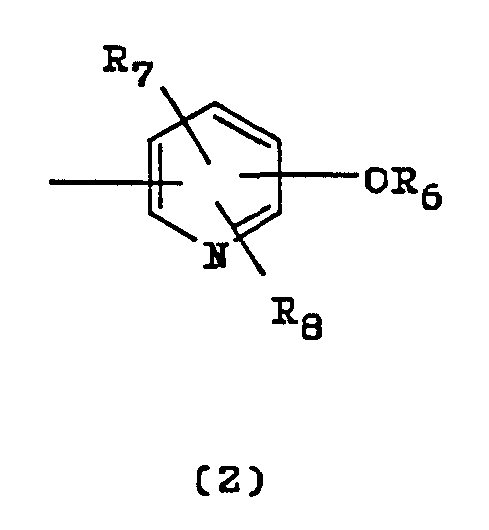
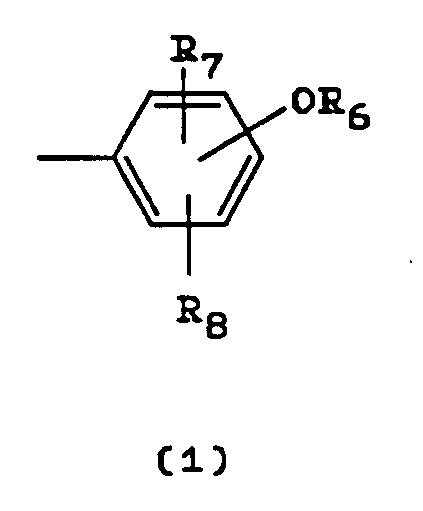
- R 10 represents a group of formula 1, 2 or 3:
- R 6 represents hydrogen, a C 1-6 alkyl group [optionally substituted by one or more of the following: hydroxy, halo, an amino group of formula-NR 12 R 13 (in which R 12 and R 13 independently represent hydrogen or a C 1-4 alkyl group or R 12 and R 13 together with the nitrogen atom to which they are attached form a pyrrolidine ring, a morpholine ring or a piperidine ring), a C 2-7 alkoxycarbonyl group or a carbamoyl group of formula CONR 14 R 15 (in which R 14 and R 15 independently represent hydrogen or a C 1-6 alkyl group or R 14 and R 15 together with the nitrogen to which they are attached form a pyrrolidine ring, a morpholine ring or piperidine ring)]; a C 3-12 alicyclic hydrocarbon group, a phenyl group (optionally substituted by a C 1-4 alkyl group, halo or a C 1-4 alkoxy group), a C
- R 7 and R 8 independently represent hydrogen, hydroxy, halo, trifluoromethyl, trifluoromethoxy, a C 1-6 alkyl group, a carboxy group, a C 1-6 alkoxy group, or a C 2-7 alkoxycarbonyl group; with a first proviso that when R 1 represents hydrogen, a C 1-6 alkyl group, hydroxy, a carboxy C 2-4 alkenyl group, a C 2-6 alkoxycarbonyl C 2-4 alkenyl group, a hydroxy C 1-6 alkyl group, a carboxy C 1-4 alkyl group, a C 2-6 alkoxycarbonyl C 1-4 alkyl group, a C 1-6 alkoxy group, a halogenated C 1-6 alkyl group, a carboxy group, a C 2-6 alkoxycarbonyl group or a C 1-6 alkanoylamino group; and R 2 represents hydrogen, halo, a C 1-6 alkoxy group, hydroxy, a
- R 4 represents hydrogen, halo, a C 2-7 alkoxycarbonyl group, a benzyloxycarbonyl group (optionally substituted by a C 1-4 alkyl group, halo or a C 1-4 alkoxy group), a C 1-6 alkanoyl group, a benzoyl group (optionally substituted by a C 1-4 alkyl group, halo or a C 1-4 alkoxy group), carbamoyl, a C 1-6 alkyl group, a carboxy group, a C 1-6 hydroxyalkyl group or a C 1-6 alkylthio group; and
- R 5 represents hydrogen or a C 1-4 alkyl group
- R 10 represents a group of formula (1)
- R 6 represents hydrogen, a C 1-6 alkyl group [optionally substituted by one or more of the following: hydroxy, halo or an amino group of formula-NR 12 R 13 (in which R 12 and R 13 independently represent hydrogen or a C 1-4 alkyl group or R 12 and R 13 together with the nitrogen atom to which they are attached form a pyrrolidine ring, a morpholine ring or a piperidine ring)], a C 3-12 alicyclic hydrocarbon group, a phenyl group (optionally substituted by a C 1-4 alkyl group, halo or a C 1-4 alkoxy group), a C 3-6 cycloalkyl C 1-4 alkyl group or a benzyl group (optionally substituted by a C 1-4 alkyl group, halo or a C 1-4 alkoxy group); and
- R 7 represents hydrogen, halo, trifluoromethyl, trifluoromethoxy, a C 1-6 alkyl group, a carboxy group, or a C 1-6 alkoxy group;
- R 8 represents hydrogen, halo, trifluoromethyl, trifluoromethoxy, a C 1-6 alkyl group or a C 1-6 alkoxy group; and R 9 represents hydrogen or a C 1-4 alkyl group
- A is other than CR 3 in which R 3 represents hydrogen or a C 1-4 alkyl group and a second proviso that when A represents N and B represents CH; R 1 represents halo or a halogenated C 1-6 alkyl group; and R 2 , R 4 , R 5 and R 9 each represent hydrogen then R 10 is other than 4-hydroxyphenyl.
- an alkyl group containing 3 or more carbon atoms may be straight or branched, for example, propyl includes n-propyl and isopropyl and butyl includes n-butyl, sec-butyl, isobutyl and tert-butyl. Alicyclic groups may be bridged.
- a monosaccharide group or a disaccharide group (optionally derivatised by one or more of the following: oxidation; oxidation followed by esterification ; esterification or acetalisation);” is used to indicate that the monosaccharide or disaccharide has been derivatised in one of the following ways.
- the 6-position of the saccharide may be oxidised to give the corresponding 6-carboxylic acid e.g. glucose may be oxidised to give glucuronic acid or a hydroxyl group on the saccharide may be oxidised to give a keto-sugar.
- a carboxylic acid produced by oxidation may be esterified by methods known to those skilled in the art.
- a free hydroxy group on the saccharide may be esterified by treatment with an organic acid or an organic acid derivative.
- hydroxy groups on adjacent carbon atoms of the saccharide may be reacted with an aldehyde or a ketone to give an acetal or a ketal.
- R 1 represents hydrogen, halo, a C 1-6 alkyl group, hydroxy, a carboxy C 2-4 alkenyl group, a C 2-6 alkoxycarbonyl C 2-4 alkenyl group, a hydroxy C 1-6 alkyl group, a carboxy C 1-4 alkyl group, a C 2-6 alkoxycarbonyl C 1-4 alkyl group, a C 1-6 alkoxy group, a halogenated C 1-6 alkyl group, a carboxy group, a C 2-6 alkoxycarbonyl group, a C 1-6 alkanoylamino group or a carbamoyl C 2-4 alkenyl group;
- R 2 represents hydrogen, a C 1-6 alkyl group, halo, a C 1-6 alkoxy group, a C 1-6 alkyl group, a C 1-6 alkoxy group, hydroxy, a C 1-6 alkanoyloxy group (which may be substituted by a C 1-6 alkanoyl
- R 4 represents hydrogen, carbamoyl, a C 2-7 alkoxycarbonyl group or cyano
- R 6 represents hydrogen, a C 1-6 alkyl group [optionally substituted by one or more of the following: hydroxy, halo, an amino group of formula-NR 12 R 13 (in which R 12 and R 13 independently represent hydrogen or a C 1-4 alkyl group or R 12 and R 13 together with the nitrogen atom to which they are attached form a pyrrolidine ring, a morpholine ring or a piperidine ring), a C 2 -7 alkoxycarbonyl group or a carbamoyl group of formula CONR 14 R 15 (in which R 14 and R 15 independently represent hydrogen or a C 1-6 alkyl group or R 14 and R 15 together with the nitrogen atom to which they are attached form a pyrrolidine ring, a morpholine ring or piperidine ring)], a C 3-12 alicyclic hydrocarbon group, a phenyl group (optionally substituted by a C 1-4 alkyl group, halo or a C 1-4 alkoxy group), a
- R 7 and R 8 independently represent hydrogen, hydroxy, halo, trifluoromethyl, trifluoromethoxy, a C 1-6 alkyl group, a carboxy group, a C 1-6 alkoxy group, or a C 2-7 alkoxycarbonyl group.
- R 1 , R 2 , R 4 and R 10 are listed below.
- R 1 represents hydrogen or chloro. More preferably R 1 represents hydrogen.
- R 2 represents hydrogen, a C 1-4 alkyl group, a C 1-4 alkoxy group (for example methoxy, ethoxy, propoxy or butoxy), or phenoxy. More preferably R 2 represents hydrogen, ethyl, ethoxy, or phenoxy. Most preferably R 2 represents ethoxy.
- R 4 represents hydrogen or a C 2-5 alkoxycarbonyl group (for example methoxycarbonyl, ethoxycarbonyl, propoxycarbonyl or butoxycarbonyl).
- R 4 represents a C 2-4 alkoxycarbonyl group. Most preferably R 4 represents ethoxycarbonyl.
- R 10 represents 4-methoxyphenyl, 4-(2-pyridyloxyphenyl), 2-ethoxy-5-pyridyl, 4-(2- hydroxyethoxy)phenyl, [4-( ⁇ -D-galactopyranosyl)phenyl, 4-(2,3-dihydroxypropoxy)phenyl or 3-ethoxycarbonyl-4- hydroxyphenyl. Most preferably R 10 represents 4- methoxyphenyl.
- a second preferred group of compounds of formula I is represented by formula IIb in which
- R 1 represents hydrogen, a C 1-4 alkyl group, a C 1-4 alkoxy group or a carbamoyl C 2-4 alkenyl group
- R 2 represents hydrogen, a C 1-4 alkoxy group or acetoxyacetoxy
- R 4 represents hydrogen, a C 2-7 alkoxycarbonyl group, cyano or carbamoyl
- R 10 represents a group of formula 1, 2 or 3 :
- R 6 represents hydrogen, a C 1-6 alkyl group [optionally substituted by one or more of the following: hydroxy, halo, an amino group of formula-NR 12 R 13 (in which R 12 and R 13 independently represent hydrogen or a C 1-4 alkyl group or R 12 and R 13 together with the nitrogen atom to which they are attached form a pyrrolidine ring, a morpholine ring or a piperidine ring), a C 2-7 alkoxycarbonyl group or a carbamoyl group of formula CONR 14 R 15 (in which R 14 and R 15 independently represent hydrogen or a C 1-6 alkyl group or R 14 and R 15 together with the nitrogen to which they are attached form a pyrrolidine ring, a morpholine ring or piperidine ring)]; a C 3-12 alicyclic hydrocarbon group, a phenyl group (optionally substituted by a C 1-4 alkyl group, halo or a C 1-4 alkoxy group), a C
- R 7 and R 8 independently represent hydrogen, hydroxy, halo, trifluoromethyl, trifluoromethoxy, a C 1-6 alkyl group, a carboxy group, a C 1-6 alkoxy group, or a C 2-7 alkoxycarbonyl group.
- R 1 , R 2 . R 4 and R 10 are listed below.
- R 1 represents hydrogen, a C 1-3 alkyl group or a C 1-3 alkoxy group. More preferably R 1 represents hydrogen, methyl, ethyl or ethoxy. Most preferably R 1 represents methyl.
- R 2 represents a C 1-4 alkoxy group. More preferably R 2 represents ethoxy or propoxy. Most preferably R 2 represents ethoxy.
- R 4 represents cyano, carbamoyl or a C 2-5 alkoxycarbonyl group. More preferably R 4 represents a C 2-5 alkoxycarbonyl group. More preferably R 4 represents ethoxycarbonyl.
- R 10 represents 4-methoxyphenyl, 6-ethoxy-3-pyridyl, 6-hydroxy-3-pyridyl, 6-ethoxy-2-pyridyl, 4-(carbamoylmethoxy)phenyl, 2,4-dihydroxy-5-pyrimidinyl, 2-(pyrid-3-yloxy)pyrid-5-yl, 2-phenoxy-5-pyridyl, 4-(ethoxycarbonylmethoxy)phenyl, 3-ethoxycarbonyl-4-hydroxyphenyl, 4-(2-pyridyloxy)phenyl, 4-( ⁇ -D-lactopyranosyl)phenyl or 4-( ⁇ -D-galactopyranosyl)-phenyl.
- R 1 represents hydrogen, a C 1-4 alkyl group or a C 1-4 alkoxy group
- R 2 represents hydrogen or 1-4 alkoxy group
- R 4 represents hydrogen or a C 2-5 alkoxycarbonyl group.
- R 1 represents hydrogen or a C 1-4 alkyl group. More preferably R 1 represents methyl.
- R 2 represents hydrogen, methoxy, ethoxy or propoxy. More preferably R 2 represents ethoxy.
- R 4 represents hydrogen, methoxycarbonyl, ethoxycarbonyl or propoxycarbonyl. More preferably R 4 represents ethoxycarbonyl.
- R 1 represents hydrogen, a C 1-4 alkyl group or a C 1-4 alkoxy group
- R 2 represents hydrogen or a C 1-4 alkoxy group
- R 4 represents hydrogen or a C 2-5 alkoxycarbonyl group
- R 6 represents hydrogen or a C 1-4 alkyl group.
- R 1 represents hydrogen, methyl, ethyl or ethoxy. More preferably R 1 represents methyl.
- R 2 represents hydrogen, methoxy, ethoxy or propoxy. More preferably R 2 represents ethoxy.
- R 4 represents hydrogen, methoxycarbonyl, ethoxycarbonyl or propoxycarbonyl. More preferably R 4 represents hydrogen or ethoxycarbonyl.
- R 6 represents hydrogen, methyl, ethyl or propyl. More preferably R 6 represents ethyl.
- Specific compounds of formula I are:
- a compound of formula I When a compound of formula I contains a single chiral centre it may exist in two enantiomeric forms.
- the present invention includes individual enantiomers and mixtures of those enantiomers.
- the enantiomers may be obtained by methods known to those skilled in the art.
- Such methods typically include resolution via formation of diastereoisomeric salts or complexes which may be separated, for example, by crystallisation; resolution via formation of diastereoisomeric derivatives or complexes which may be separated, for example, by crystallisation, gas-liquid or liquid chromatography; selective reaction of one enantiomer by reaction with an enantiomer-specific reagent, for example, enzymatic esterification, oxidation or reduction, followed by separation of the modified and unmodified enantiomers; or gas-liquid or liquid chromatography in a chiral environment, for example on a chiral support such as silica with a bound chiral ligand or in the presence of a chiral solvent.
- enantiomers may be synthesised by asymmetric synthesis using optically active reagents, substrates, catalysts or solvents, or by converting one enantiomer into the other by asymmetric transformation.
- a compound of formula I When a compound of formula I contains more than one chiral centre it may exist in diastereoisomeric forms.
- the diastereoisomeric pairs may be separated by methods known to those skilled in the art, for example, chromatography or crystallisation and the individual enantiomers within each pair may be separated as described above.
- the present invention includes each diastereoisomer of compounds of formula I or II and mixtures thereof.
- Certain compounds of formula I may exist in different tautomeric forms which fall within the scope of the present invention. Some compounds of formula I may exist in the form of solvates, for example, hydrates, which also fall within the scope of the present invention.
- the compounds of formula I may form organic or inorganic salts, for example, the compounds of formula I may form acid addition salts with inorganic or organic acids, e.g. hydrochloric acid, hydrobromic acid, fumaric acid, tartaric acid, citric acid, sulphuric acid, hydriodic acid, maleic acid, acetic acid, succinic acid, benzoic acid, pamoic acid, palmitic acid, dodecanoic acid and acidic amino acids such as glutamic acid.
- Some compounds of formula I may form base addition salts, for example, with alkali metals for example sodium hydroxide, or with aminoacids for example, lysine or arginine.
- salts may be used in therapy in place of the corresponding compounds of formula I.
- Such salts are prepared by reacting the compound of formula I with a suitable acid or base in a conventional manner.
- Such salts may also exist in form of solvates (for example, hydrates).
- Certain compounds of formula I may exist in more than one crystal form and the present invention includes each crystal form and mixtures thereof.
- the present invention also provides pharmaceutical compositions containing a therapeutically effective amount of a compound of formula I (including the compounds of the second proviso) together with a pharmaceutically acceptable diluent or carrier.
- Such pharmaceutical formulations may be used in the treatment of rheumatic diseases for example rheumatoid arthritis or osteoarthritis.
- the term "active compound” denotes a compound of formula I.
- the active compound may be administered orally, rectally, parenterally, topically, ocularly, aurally, nasally, intravaginally or to the buccal cavity, to give a local and/or systemic effect.
- the therapeutic compositions of the present invention may take the form of any of the known pharmaceutical compositions for such methods of administration.
- the compositions may be formulated in a manner known to those skilled in the art so as to give a controlled release, for example rapid release or sustained release, of the compounds of the present invention.
- Pharmaceutically acceptable carriers suitable for use in such compositions are well known in the art of pharmacy.
- the compositions of the invention may contain 0.1-99% by weight of active compound.
- the compositions of the invention are generally prepared in unit dosage form. Preferably the unit dosage of active ingredient is 1-500 mg.
- the excipients used in the preparation of these compositions are the excipients known in the pharmacist's art.
- compositions for oral administration are preferred compositions of the invention and there are known pharmaceutical forms for such administration, for example tablets, capsules, granules, syrups and aqueous or oily suspensions.
- Tablets may be prepared from a mixture of the active compound with fillers such as lactose or calcium phosphate, disintegrating agents, for example maize starch, lubricating agents, for example magnesium stearate, binders for example microcrystalline cellulose or polyvinyl pyrrolidone and other optional ingredients known in the art to permit tableting the mixture by known methods.
- the tablets may, if desired, be coated using known methods and excipients which may include enteric coating using for example hydroxypropylmethylcellulose phthalate.
- the tablets may be formulated in a manner known to those skilled in the art so as to give a sustained release of the compounds of the present invention.
- Such tablets may, if desired, be provided with enteric coatings by known methods, for example by the use of cellulose acetate phthalate.
- capsules for example hard or soft gelatin capsules, containing the active compound with or without added excipients, may be prepared by known methods and, if desired, provided with enteric coatings in a known manner.
- the tablets and capsules may conveniently each contain 0.1 to 1000 mg (for example 10 mg, 50 mg, 100 mg, 200 mg, 400 mg or 800 mg) of the active compound.
- compositions for oral administration include, for example, aqueous suspensions containing the active compound in an aqueous medium in the presence of a non-toxic suspending agent such as sodium carboxymethylcellulose, and oily suspensions containing a compound of the present invention in a suitable vegetable oil, for example sunflower oil.
- a non-toxic suspending agent such as sodium carboxymethylcellulose
- oily suspensions containing a compound of the present invention in a suitable vegetable oil for example sunflower oil.
- the active compound may be formulated into granules with or without additional excipients.
- the granules may be ingested directly by the patient or they may be added to a suitable liquid carrier (for example water) before ingestion.
- the granules may contain disintegrants (for example a pharmaceutically acceptable effervescent couple formed from an acid and a carbonate or bicarbonate salt) to facilitate dispersion in the liquid medium.
- compositions for topical administration are also preferred compositions of the invention.
- the pharmaceutically active compound may be dispersed in a pharmaceutically acceptable cream, ointment or gel.
- a suitable cream may be prepared by incorporating the active compound in a topical vehicle such as petrolatum and/or light liquid paraffin, dispersed in an aqueous medium using surfactants.
- An ointment may be prepared by mixing the active compound with a topical vehicle such as a mineral oil, petrolatum and/or a wax e.g. paraffin wax or beeswax.
- a gel may be prepared by mixing the active compound with a topical vehicle comprising a gelling agent e.g. basified Carbomer BP, in the presence of water.
- Topically administrable compositions may also comprise a matrix in which the pharmaceutically active compounds of the present invention are dispersed so that the compounds are held in contact with the skin in order to administer the compounds transdermally.
- a suitable transdermal composition may be prepared by mixing the pharmaceutically active compound with a topical vehicle, such as described above, together with a potential transdermal accelerant such as dimethyl sulphoxide or propylene glycol.
- compositions of the invention suitable for rectal administration are known pharmaceutical forms for such administration, for example suppositories with hard fat, synthetic glycerides or polyethylene glycol bases.
- Compositions of the invention suitable for parenteral administration are known pharmaceutical forms for such administration, for example sterile suspensions or sterile solutions in a suitable solvent.
- compositions of the invention suitable for inhalation via the mouth and/or the nose are the known pharmaceutical forms for such administration, for example aerosols, nebulised solutions or powders. Metered dose systems, known to those skilled in the art, may be used.
- Compositions suitable for application to the buccal cavity include slow dissolving tablets, troches, chewing gum, gels, pastes, powders, mouthwashes or rinses.
- the compounds of the present invention may also be administered by continuous infusion either from an external source, for example by intravenous infusion, or from a source of the compound placed within the body.
- Internal sources include implanted reservoirs containing the compound to be infused which is continuously released for example by osmosis and implants which may be a) liquid such as an oily solution or suspension of the compound to be infused for example in the form of a very sparingly water-soluble derivative such as a dodecanoate salt or b) solid in the form of an implanted support for example of a synthetic resin of waxy material for the compound to be infused.
- the support may be a single body containing all the compound or a series of several bodies each containing part of the compound to be delivered.
- the active compound may, if desired, be associated with other compatible pharmacologically active ingredients, for example, a non-steroidal antiinflammatory agent e.g. ibuprofen, S(+)-ibuprofen, flurbiprofen or S(+)-flurbiprofen, an analgesic or an antipyretic agent.
- a non-steroidal antiinflammatory agent e.g. ibuprofen, S(+)-ibuprofen, flurbiprofen or S(+)-flurbiprofen, an analgesic or an antipyretic agent.
- the compounds of formula I are indicated for use as anti-rheumatic agents by their activity demonstrated by means of tests on standard laboratory animals. Such tests include, for example, the oral administration of compounds of formula I to mice with experimental antigen-induced arthritis.
- Compounds of formula I are suitable for use in treating rheumatic diseases for example rheumatoid arthritis, osteoarthritis, osteoporosis, crystal arthropathies (e.g. gout), reactive arthritis, ankylosing spondylitis or psoriatic arthropathy.
- Compounds of formula I may also be suitable for the treatment of diseases of the oral cavity for example periodontitis, gingivitis and alveolar bone resorption. Accordingly, in a further aspect, the present invention also includes a method of treating rheumatic diseases, particularly rheumatoid arthritis and osteoarthritis, comprising the administration of a therapeutically effective amount of a compound of formula I (including the compounds of the second proviso) to a mammal in need thereof. Compounds of formula I may also be administered in a prophylactic manner to mammals, particularly humans who have been identified as being susceptible to arthritic diseases.
- a suitable dose for oral administration to mammals is generally within the range 0.01-80 mg/kg/ day, more usually 0.2-40 mg/kg/day given in single or divided doses.
- a suitable dose is generally within the range 0.001-80 mg/kg/day, more usually 0.2-40 mg/kg/day given in single or divided doses or by continuous infusion.
- a suitable preparation for topical administration generally contains the active ingredient within the range 0.01-20% by weight, more usually 0.05- 5% by weight. Oral administration is preferred.
- compositions containing a therapeutically effective amount of a compound of formula I may be used to treat rheumatic diseases such as rheumatoid arthritis and osteoarthritis.
- the amount of the compound of formula I administered per day is in the range 0.1 to 6000 mg.
- the present invention provides the use of a compound of formula I (including the compounds of the second proviso) in the manufacture of a medicament for use in the treatment of a rheumatic disease such as rheumatoid arthritis and osteoarthritis.
- a rheumatic disease such as rheumatoid arthritis and osteoarthritis.
- Compounds of formula I in which R 1 represents a carboxy C 2-4 alkyl group may be prepared by reducing a compound of formula I in which R 1 represents a carboxy C 2-4 alkenyl group, for example with a reducing agent, e.g. hydrogen in the presence of a catalyst e.g. palladium.
- Compounds of formula I in which R 1 represents hydroxy may be prepared by hydrolysis of a compound of formula I in which R 1 represents a C 1-6 alkoxy group, for example using a base e.g. sodium hydroxide.
- Compounds of formula I in which R 4 represents an ⁇ -hydroxy C 1-6 alkyl group may be prepared by reducing a compound of formula I in which R 4 represents a C 2-7 alkoxycarbonyl group or a C 1-6 alkanoyl group, by methods known to those skilled in the art, for example using lithium aluminium hydride or lithium triethylborohydride.
- Compounds of formula I in which R 2 represents hydroxy may be prepared by reacting a compound of formula I in which R 2 represents a C 1-6 alkoxy group with a de-alkylating agent for example aluminium chloride.
- Compounds of formula I in which R 4 represents carboxy may be prepared by hydrolysis of compounds of formula I in which R 4 represents a C 2-6 alkoxycarbonyl group by methods known to those skilled in the art, for example using an acid e.g. hydrochloric acid or a base e.g. sodium hydroxide.
- Compounds of formula I in which R 1 represents an ⁇ -hydroxy C 1-6 alkyl may be prepared by reducing a compound of formula I in which R 1 represents a C 2-6 alkoxycarbonyl group or a C 2-6 alkoxycarbonyl C 1-4 alkyl group by methods known to those skilled in the art for example using lithium aluminium hydride or lithium triethylborohydride.
- Compounds of formula I in which R 1 represents a carboxyvinyl group may be prepared by reacting compounds of formula I in which R 1 represents methyl with glyoxylic acid for example by heating together optionally in the presence of a catalyst e.g. trifluoroacetic acid.
- a catalyst e.g. trifluoroacetic acid.
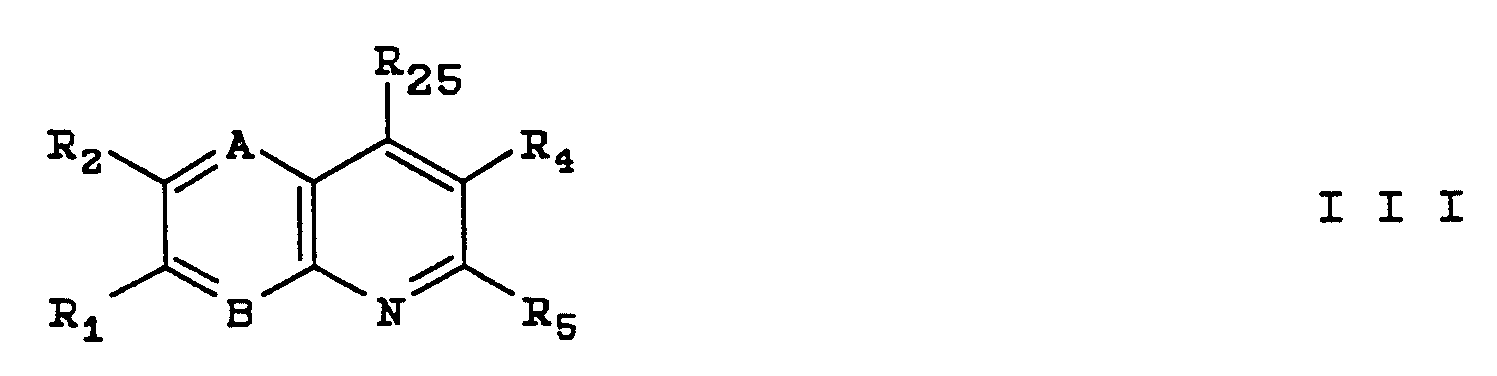
- R 25 represents a leaving group, including halo, e.g. bromo, chloro, mercapto or methylthio with a compound of formula IV or a salt thereof by heating, optionally in the presence of an inert organic liquid which is preferably a solvent for the reactants, e.g. an alcohol or an ether, at a temperature in the range 0-150°C, preferably in the range 30-120°C, at atmospheric pressure, optionally in the presence of an acid, for example hydrochloric acid, or a base, for example sodium carbonate or sodium bicarbonate.
- an inert organic liquid which is preferably a solvent for the reactants, e.g. an alcohol or an ether, at a temperature in the range 0-150°C, preferably in the range 30-120°C, at atmospheric pressure, optionally in the presence of an acid, for example hydrochloric acid, or a base, for example sodium carbonate or sodium bicarbonate.
- R 20 represents a leaving group, for example halo, with an alkali metal C 1-6 alkoxide, by heating optionally in the presence of an inert organic liquid which is preferably a solvent for the reactants, for example an alcohol, at a temperature in the range 50- 250°C preferably 150-200°C preferably in a sealed vessel under pressure.
- an inert organic liquid which is preferably a solvent for the reactants, for example an alcohol
- R 1 represents hydroxy
- R 1 represents hydroxy
- R 20 represents a leaving group, for example halo
- R 20 represents a leaving group, for example halo
- halogenating agent for example phosphorus oxychloride or phosphorus oxybromide at a temperature in the range 0-150°C, preferably 20-100°C, optionally in the presence of an inert organic liquid which is preferably a solvent for the reactants.
- a halogenating agent for example phosphorus oxychloride or phosphorus oxybromide
- an inert organic liquid which is preferably a solvent for the reactants.
- Compounds of formula V in which R 4 represents hydrogen may be prepared by heating compounds of formula V in which R 4 represents COOR 16 and R 16 represents hydrogen or a C 1-4 alkyl group, with aqueous sodium hydroxide solution in a sealed vessel or by thermal decarboxylation of compounds of formula V in which R 16 represents hydrogen optionally in the presence of an organic liquid, for example quinoline or liquid petrolatum.
- Compounds of formula VI may be prepared by oxidising compounds of formula V in which R 1 represents a C 1-6 alkyl group, for example with selenium dioxide, or by oxidising compounds of formula V in which R 1 represents a carboxyvinyl group for example with potassium permanganate.
- Compounds of formula VII may be prepared by heating compounds of formula VIII
- R 17 represents a C 1-4 alkyl group in the presence of a suitable solvent, for example diphenyl ether or liquid petrolatum at a temperature in the range 150 to 350°C, or by reacting compounds of formula VIII with phosphorus oxychloride in the presence of polyphosphoric acid.
- a suitable solvent for example diphenyl ether or liquid petrolatum at a temperature in the range 150 to 350°C, or by reacting compounds of formula VIII with phosphorus oxychloride in the presence of polyphosphoric acid.
- Compounds of formula VIII, in which R 1 represents a substituent as defined above, other than hydrogen, may be heated in the presence of an organic liquid, for example diphenyl ether or liquid petrolatum at a temperature in the range of 150 to 350°C to produce compounds of formula V.
- an organic liquid for example diphenyl ether or liquid petrolatum at a temperature in the range of 150 to 350°C to produce compounds of formula V.
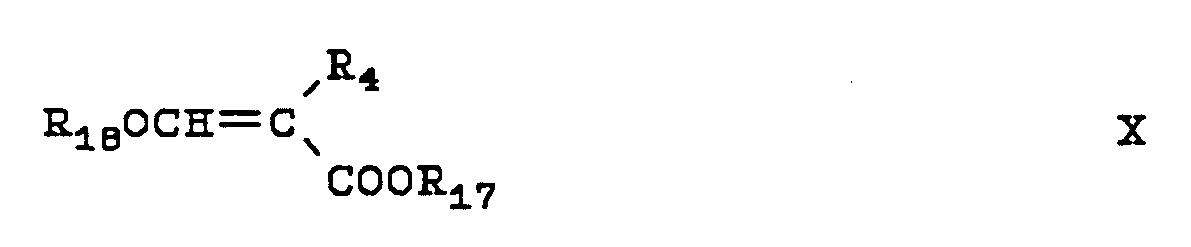
- R 17 or R 18 independently represent a C 1-4 alkyl group or with a compound of formula XI or a salt thereof, e.g. the sodium salt, in which R 17 represents a C 1-4 alkyl group, in the presence of a suitable solvent, for example ethanol, at a temperature in the range 50 to 200°C.
- a suitable solvent for example ethanol
- Compounds of formula VIII in which R 5 represents hydrogen may also be prepared by reacting a compound of formula IX with a tri (C 1-4 alkyl) orthoformate and a compound of formula R 4 CH 2 CO 2 R 17 , for example by heating, optionally in the presence of a solvent for example acetic anhydride and/or a Lewis acid catalyst for example zinc chloride.
- O 2 N-R 10 X I I may be reduced for example, by heating in the presence of reduced iron powder and dilute acid or by hydrogenation in the presence of a catalyst e.g. palladium, to prepare compounds of formula IV, in which R 9 represents hydrogen.
- a catalyst e.g. palladium
- R 21 represents halo, for example chloro or bromo, with a compound of formula IV using conditions analogous to those described for the preparation of compounds of formula I from a compound of formula III and a compound of formula IV.
- the therapeutic activity of the compounds of the present invention has been demonstrated by tests which include the oral administration of the compounds to mice with experimental antigen-induced arthritis.
- the compounds showed activity in the following test:
- mice Female BALB/c mice, 8 weeks of age were used: each control group contained either 35, 60 or 80 mice and each test group contained either 13, 15 or 20 mice respectively.
- the mice were sensitised by subcutaneous injection into the flank with an emulsion (0.1 ml) consisting of a solution of methylated bovine serum albumin (m-BSA) (0.1 mg) in sterile aqueous sodium chloride solution (0.05 ml; 0.15 M) and Complete Adjuvant (0.05 ml) containing, in total, Mycobacterium (0.075 mg).
- m-BSA methylated bovine serum albumin
- Identical injections were administered after 7 days. After a further 14 days the left kneejoint of each mouse was injected with a solution of m- BSA (0.1 mg) in aqueous sodium chloride solution (0.01 ml; 0.15 M) (intra-articular challenge). This procedure induced a chronic erosive arthritis restricted to the challenged joint.
- the test compounds were suspended in a vehicle of aqueous carboxymethyl cellulose solution (0.25% w/v) containing TWEEN®80 (1.5% w/v) at varying dosages and 0.1 ml was administered to each test mouse by gastric intubation. The control mice received the vehicle with no test compound. Administration occurred daily for 28 days commencing 14 days after intra-articular challenge. After 42 days the test was terminated and the animals were killed using a rising concentration of carbon dioxide and the arthritic hind leg removed.
- the femur and tibia were cut midway along their length and the knee-joint trimmed free of skin and musculature.
- the arthritic joints were placed in perforated plastic holders and fixed in 10% formol saline for at least 48 hours. They were then decalcified in 5% formic acid for 72 hours with constant agitation (replacing the formic acid after the first 24 hours), washed in water, dehydrated in alcohol and embedded in paraffin wax.
- the joints were sectioned in the sagittal plane at 5 ⁇ m and stained with Van Gieson's stain. Each joint was sectioned at two levels.
- the severity of arthritis was assessed by examination of the prepared sections. Synovitis and pannus formation were graded on a 0-5 scale, by a skilled operator, according to the degree of synovial lining cell hypertrophy and hyperplasia, infiltration of the synovium by lymphocytes, plasma cells, monocytes/macrophages, fibroblasts and polymorphonuclear (PMN) leukocytes and the degree of pannus formation. Erosions of cartilage and bone were also graded on a 0-5 scale, by a skilled operator, the score reflecting the proportion of articular surface eroded as well as the depth of the erosions. Using the combined data the drug effects were expressed as the percentage change in the mean scores for synovitis and erosions compared to those of the control group. The data were then analysed using the Mann-Whitney U-test.
- analysis of macerated specimens of tibial epiphyses using an image analysis system may be used to assess the extent of hard tissue erosions. Active compounds are those which significantly reduce these erosions.
- IMS industrial methylated spirit
- DMF N,N-dimethylformamide
- THF tetrahydrofuran
- EXAMPLE A1 2-Chloro-5-nitropyridine (30.0 g) was added to a solution of sodium metal (4.4 g) in absolute ethanol (250 ml) under a nitrogen atmosphere. The mixture was boiled under reflux for 4 hours, then cooled slightly and filtered. The filtrate was cooled in ice and filtered to give 2-ethoxy-5-nitropyridine, m.p. 85-88°C. b) 2-Ethoxy-5-nitropyridine (12.0 g) in IMS (250 ml) was hydrogenated at ambient temperature at atmospheric pressure over 10% palladium charcoal (0.5 g). The catalyst was removed by filtration and the filtrate evaporated to give an oil. The oil was dissolved in ether, filtered and evaporated.
- Ethyl 4-hydroxy-6-methoxy-1,5-naphthyridine-3-carboxylate was prepared in a similar manner to that described in Example A1.
- EXAMPLE A6 a) Sodium metal (46.2 g) was dissolved in absolute ethanol (1 1) with stirring under nitrogen. 3-Hydroxy- 2-methylpyridine (200 g prepared as described in C.A. 48, P4597 h) was added. The mixture was stirred at ambient temperature for 30 minutes and then a solution of bromoethane (150 ml) in absolute ethanol (100 ml) was added. The mixture was boiled under reflux for 5 hours then cooled and filtered. The filtrate was evaporated and the residue partitioned between dichloromethane and water. The organic layer was separated off and the aqueous layer extracted with dichloromethane. The combined organic extracts were dried and evaporated.
- EXAMPLE A7 a) A mixture of 6-ethoxypyridin-2-amine (8.0 g) and diethyl ethoxymethylenemalonate (12.5 g) was heated at 95°C under vacuum for 3 hours and then heated at 95°C at atmospheric pressure for 18 hours. The mixture was cooled to ambient temperature, diluted with petroleum ether b.p. 40-60°C and filtered to give diethyl (6- ethoxy-2-pyridylamino)methylenemalonate, m.p. 58-60°C. b) The malonate from a) (15.3 g) was dissolved in diphenyl ether (50 ml) and added dropwise to boiling diphenyl ether (75 ml).
- Ethyl 4-hydroxy-7-methy1-6-propoxy-1, 8-naphthyridine-3-carboxylate, m.p. 231-235°C was prepared from 3-hydroxy-2-methylpyridine in a similar manner to Example 6e.
- Ethyl 4-hydroxy-7-methyl-1,8-naphthyridine-3-carboxylate was prepared as described in Aust. J. Chem., 1984, 1065.
- Ethyl 6-ethoxy-4-hydroxy-1,5-naphthyridine-3-carboxylate (3.0 g) was added to phosphorus oxychloride (25 ml), with stirring, at ambient temperature. The mixture was heated at 50°C for 45 minutes. The mixture was cooled to 10°C and added to ice/water at less than 5°C. The mixture was then basified with concentrated aqueous ammonia solution SG 0.88 at less than 5°C. The mixture was extracted with dichloromethane to give ethyl 4-chloro-6-ethoxy-1,5-naphthyridine-3-carboxylate, m.p. 61-64°C.
- Ethyl 3-ethoxy-8-hydroxypyrido[2,3-b]pyrazine-7-carboxylate (2.5 g) was added to a stirred solution of phosphorus oxychloride (50 ml) with stirring. The mixture was heated at 50°C for 3 hours and then worked up as described in Example B1 to give ethyl 8-chloro-3- ethoxypyrido[2,3-b]pyrazine-7-carboxylate which was used directly.
- Ethyl 6-ethoxy-4-hydroxy-7-methyl-1,8- naphthyridine-3-carboxylate (2.5 g) was added to phosphorus oxychloride (20 ml) with stirring at ambient temperature. The mixture was warmed to 40°C and kept at this temperature for 1 hour then cooled to 10°C. The mixture was added to excess ice/water and the mixture basified with aqueous ammonia solution (specific gravity 0.88) while keeping the temperature below 5°C. The product was extracted into dichloromethane.
- EXAMPLE B9 a) A mixture of ethyl 6-ethoxy-4-hydroxy-7-methyl-1,8- naphthyridine-3-carboxylate (5.0 g) and ethanol saturated with ammonia (80 ml) was stirred and heated in a sealed vessel at 210°C (external temperature) for 20 hours. The mixture was cooled and filtered to give a solid. The filtrate was evaporated under reduced pressure and the residue was washed with ether, then water, to give a second crop of solid. 1 H nmr showed that both crops contained 6-ethoxy-4-hydroxy-7-methyl- 1,8-naphthyridine-3-carboxamide along with some starting material. The two crops were combined and used in b).
- EXAMPLE B10 Ethyl 4-chloro-7-methyl-6-propoxy-1,8-naphthyridine-3-carboxylate, m.p. 100-106°C was prepared in a similar manner to Example B6, starting from the product of Example A8.
- EXAMPLE B12 a) A mixture of ethyl 6-ethoxy-4-hydroxy-7-methyl-1,8-naphthyridine-3-carboxylate (10.0 g), 5M sodium hydroxide solution (200 ml), IMS (64 ml) and water
- EXAMPLE B13 Ethyl 4-chloro-7-methyl-1,8-naphthyridine-3-carboxylate, m.p. 89-90°C, was prepared from the product of Example A9 in an analogous manner to Example B6.
- EXAMPLE C1 a) 4-Nitrophenoxyacetic acid (10.2 g) was added to thionyl chloride (50 ml) and the mixture was boiled under reflux for 1.5 hours. Excess thionyl chloride was distilled off and the residue was heated with toluene (2 ⁇ 50 ml) and the toluene removed by distillation to leave an oil which solidified on cooling. The acid chloride was added in portions to a stirred mixture of absolute ethanol (50 ml) and concentrated aqueous ammonia (50 ml, SG 0.880) at 10-15°C. The mixture was stirred for 45 minutes at 10-15°C and then allowed to warm up to ambient temperature.
- EXAMPLE C4 a) Sodium hydride (1.53 g, 60% dispersion in mineral oil) was added in portions to a solution of 1,2:5,6-di-O-isopropylidene-D-glucofuranose (10.0 g) in DMF (40 ml) and toluene (80 ml) with stirring under nitrogen. The mixture was boiled under reflux for 15 minutes then cooled and 4-fluoronitrobenzene (5.4 g) was added. The resulting solution was boiled under reflux for 5 hours. The mixture was cooled and washed with water. The organic phase was separated, dried and evaporated under reduced pressure. The residue was recrystallised from IMS to give 1,2:5,6-di-O-isopropylidene-3-O-(4-nitrophenyl)-D-glucofuranose, m.p. 122-126°C.
- the solid was purified by column chromatography on silica using ethyl acetate as the mobile phase to give ethyl 6-methoxy-4-(4-methoxyanilino)-1,5-naphthyridine-3-carboxylate, m.p. 115-117°C.
- EXAMPLE 7 A mixture of ethyl 4-chloro-6-ethoxy-1,5- naphthyridine-3-carboxylate (2.4 g), 4-(2- hydroxyethoxy)aniline (1.4 g), anhydrous potassium carbonate (2.49 g) and THF (70 ml) was stirred at ambient temperature for 3 days. The mixture was filtered and the filtrate evaporated to dryness. The residue was ground up in ether and filtered. The residue was dissolved in dichloromethane and purified by chromatography on silica. The product fractions were combined, dissolved in IMS (150 ml) and saturated with hydrogen chloride gas. The mixture was cooled in ice and diluted with ether to induce precipitation.
- EXAMPLE 16 a A mixture of ethyl 4-chloro-6-ethoxy-7-methyl-1,8-naphthyridine-3-carboxylate (3.5 g) and 4-methoxyaniline (1.5 g) in ethanol (50 ml) was boiled under reflux for 1.5 hours. The mixture was concentrated to half the volume, cooled and ether added. The solid was collected by filtration to give ethyl 6-ethoxy-4-(4-methoxyanilino)-7-methyl-1,8-naphthyridine-3-carboxylate hydrochloride, m.p. 260-262°C.
- EXAMPLE 17 A mixture of ethyl 4-chloro-6-ethoxy-7-methyl-1,8- naphthyridine-3-carboxylate (2.4 g), 5-amino-2- ethoxypyridine (1.15 g) and IMS (50 ml) was boiled under reflux for 1.5 hours. The mixture was cooled and filtered to give ethyl 6-ethoxy-4-(2-ethoxy-5- pyridylamino)-7-methyl-1,8-naphthyridine-3-carboxylate hydrochloride, m.p. 221-223°C.
- EXAMPLE 28 A mixture of ethyl 4-chloro-6-ethoxy-7-methyl-1,8-naphthyridine-3-carboxylate (3.1 g), 4-aminophenoxy-acetic acid hydrochloride (2.17 g) (prepared by reduction of 4-nitrophenoxyacetic acid using hydrogen and 10% palladium charcoal in a similar manner to Example C1 followed by treatment with 5 M hydrochloric acid and then evaporation) and absolute ethanol (30 ml) was boiled under reflux for 4 hours.
- 4-aminophenoxy-acetic acid hydrochloride (2.17 g) (prepared by reduction of 4-nitrophenoxyacetic acid using hydrogen and 10% palladium charcoal in a similar manner to Example C1 followed by treatment with 5 M hydrochloric acid and then evaporation) and absolute ethanol (30 ml) was boiled under reflux for 4 hours.
- EXAMPLE 42 Ethyl 4- (4-hydroxyanilino) -6-methoxy-1,5-naphthyridine-3-carboxylate hydrochloride, m.p. 205-207°C.
- Tablets are prepared from the following ingredients.
- the active compound, the lactose and some of the starch are de-aggregated, blended and the resulting mixture is granulated with a solution of the polyvinylpyrrolidone in ethanol.
- the dry granulate is blended with magnesium stearate and the rest of the starch.
- the mixture is then compressed in a tableting machine to give tablets containing 10 mg of active compound.
- Example W Tablets are prepared by the method of the previous Example.
- the tablets are enteric coated in a conventional manner using a solution of 20% cellulose acetate phthalate and 3% diethyl phthalate in ethanol :dichloromethane (1:1).
- Example X
- suppositories 100 parts by weight of active compound is incorporated in 1300 parts by weight of semi-synthetic glycerides as the suppository base and the mixture formed into suppositories each containing 100 mg of active ingredient.
- capsules 50 parts by weight of active compound, 300 parts by weight of lactose and 3 parts by weight of magnesium stearate are de-aggregated and blended. The mixture is filled into hard gelatin capsules, each capsule containing 50 mg of active ingredient.
- the active compound is incorporated into the base by thorough homogenization until the drug is evenly distributed.
- the ointment is packed into 10 g amber jars with screw-capped lined lids. Active compound 0.1 g
Landscapes
- Chemical & Material Sciences (AREA)
- Organic Chemistry (AREA)
- Health & Medical Sciences (AREA)
- Life Sciences & Earth Sciences (AREA)
- General Health & Medical Sciences (AREA)
- Engineering & Computer Science (AREA)
- Biochemistry (AREA)
- Biotechnology (AREA)
- Genetics & Genomics (AREA)
- Molecular Biology (AREA)
- Pain & Pain Management (AREA)
- Rheumatology (AREA)
- Chemical Kinetics & Catalysis (AREA)
- General Chemical & Material Sciences (AREA)
- Medicinal Chemistry (AREA)
- Nuclear Medicine, Radiotherapy & Molecular Imaging (AREA)
- Pharmacology & Pharmacy (AREA)
- Animal Behavior & Ethology (AREA)
- Public Health (AREA)
- Veterinary Medicine (AREA)
- Pharmaceuticals Containing Other Organic And Inorganic Compounds (AREA)
Abstract
Description






Claims






Priority Applications (5)
| Application Number | Priority Date | Filing Date | Title |
|---|---|---|---|
| JP7502401A JPH08511787A (en) | 1993-06-22 | 1994-06-10 | Fused 4-aminopyridine having antirheumatic effect |
| EP94919629A EP0705260B1 (en) | 1993-06-22 | 1994-06-10 | Condensed 4-aminopyridines with antirheumatic activity |
| AU70717/94A AU7071794A (en) | 1993-06-22 | 1994-06-10 | Condensed 4-aminopyridines with antirheumatic activity |
| US08/564,154 US5780482A (en) | 1993-06-22 | 1994-06-10 | Condensed 4-aminopyridines with antirheumatic activity |
| DE69416835T DE69416835T2 (en) | 1993-06-22 | 1994-06-10 | CONDENSED 4-AMINOPYRIDINE WITH ANTIRHEUMATIC EFFECT |
Applications Claiming Priority (2)
| Application Number | Priority Date | Filing Date | Title |
|---|---|---|---|
| GB939312891A GB9312891D0 (en) | 1993-06-22 | 1993-06-22 | Therapeutic agents |
| GB9312891.6 | 1993-06-22 |
Publications (1)
| Publication Number | Publication Date |
|---|---|
| WO1995000511A1 true WO1995000511A1 (en) | 1995-01-05 |
Family
ID=10737603
Family Applications (1)
| Application Number | Title | Priority Date | Filing Date |
|---|---|---|---|
| PCT/EP1994/001923 Ceased WO1995000511A1 (en) | 1993-06-22 | 1994-06-10 | Condensed 4-aminopyridines with antirheumatic activity |
Country Status (7)
| Country | Link |
|---|---|
| US (1) | US5780482A (en) |
| EP (1) | EP0705260B1 (en) |
| JP (1) | JPH08511787A (en) |
| AU (1) | AU7071794A (en) |
| DE (1) | DE69416835T2 (en) |
| GB (1) | GB9312891D0 (en) |
| WO (1) | WO1995000511A1 (en) |
Cited By (17)
| Publication number | Priority date | Publication date | Assignee | Title |
|---|---|---|---|---|
| US6169091B1 (en) | 1995-10-11 | 2001-01-02 | Glaxo Wellcome Inc. | Bicyclic heteroaromatic compounds as protein tyrosine kinase inhibitors |
| US6608048B2 (en) | 2000-03-28 | 2003-08-19 | Wyeth Holdings | Tricyclic protein kinase inhibitors |
| US6706699B2 (en) | 2001-06-21 | 2004-03-16 | Ariad Pharmaceuticals, Inc. | Quinolines and uses thereof |
| US6713485B2 (en) | 1998-01-12 | 2004-03-30 | Smithkline Beecham Corporation | Heterocyclic compounds |
| US6933299B1 (en) | 1999-07-09 | 2005-08-23 | Smithkline Beecham Corporation | Anilinoquinazolines as protein tyrosine kinase inhibitors |
| US7084147B2 (en) | 1999-07-09 | 2006-08-01 | Smithkline Beecham Corporation | Anilinoquinazaolines as protein tyrosine kinase inhibitors |
| WO2007041379A1 (en) * | 2005-09-30 | 2007-04-12 | Bristol-Myers Squibb Company | Met kinase inhibitors |
| WO2007081517A2 (en) | 2005-12-21 | 2007-07-19 | Abbott Laboratories | Anti-viral compounds |
| WO2007076034A3 (en) * | 2005-12-21 | 2007-10-04 | Abbott Lab | Anti-viral compounds |
| WO2007076035A3 (en) * | 2005-12-21 | 2007-10-04 | Abbott Lab | Anti-viral compounds |
| US7279487B2 (en) | 2002-01-17 | 2007-10-09 | Merck & Co., Inc. | Hydroxynaphthyridinone carboxamides useful as HIV integrase inhibitors |
| WO2010084152A1 (en) | 2009-01-21 | 2010-07-29 | Basilea Pharmaceutica Ag | Novel bicyclic antibiotics |
| EP2345652A1 (en) | 2005-12-21 | 2011-07-20 | Abbott Laboratories | Antiviral compounds |
| US8236950B2 (en) | 2006-12-20 | 2012-08-07 | Abbott Laboratories | Anti-viral compounds |
| US8415333B2 (en) | 2009-02-24 | 2013-04-09 | Respiratorious Ab | Bronchodilating diazaheteroaryls |
| TWI392676B (en) * | 2005-12-21 | 2013-04-11 | Abbott Lab | Anti-viral compounds,process for preparation and uses thereof |
| US8759338B2 (en) | 2008-09-02 | 2014-06-24 | Novartis Ag | Heterocyclic kinase inhibitors |
Families Citing this family (7)
| Publication number | Priority date | Publication date | Assignee | Title |
|---|---|---|---|---|
| ES2216884T3 (en) * | 1999-04-21 | 2004-11-01 | Wyeth Holdings Corporation | 3-CIANO- (1.7), (1.5) AND (1.8) -NFTIRIDINE SUBSTITUTES THAT ARE INHIBITORS OF THYROSINE-KINASES. |
| WO2003047307A2 (en) * | 2001-11-27 | 2003-06-05 | Corporation For National Research Initiatives | A miniature condenser microphone and fabrication method therefor |
| EP1633718B1 (en) | 2003-06-17 | 2012-06-06 | Millennium Pharmaceuticals, Inc. | COMPOSITIONS AND METHODS FOR INHIBITING TGF-s |
| MX2009010517A (en) * | 2007-04-05 | 2009-10-19 | Amgen Inc | Aurora kinase modulators and method of use. |
| KR20140015121A (en) * | 2009-06-25 | 2014-02-06 | 암젠 인크 | Heterocyclic compounds and their uses |
| US10239875B2 (en) | 2017-06-16 | 2019-03-26 | King Saud University | Naphthyridinyl hydrazine derivatives as potent peripheral analgesic agents |
| MA52954A (en) | 2018-06-21 | 2021-04-28 | Cellestia Biotech Ag | PROCESS FOR THE MANUFACTURE OF DIARYL AMINOETHERS AND HYDROCHLORIDE SALTS OF DIARYL AMINOETHERS |
Citations (2)
| Publication number | Priority date | Publication date | Assignee | Title |
|---|---|---|---|---|
| EP0410762A1 (en) * | 1989-07-27 | 1991-01-30 | DowElanco | Naphthyridine derivatives |
| WO1993013097A1 (en) * | 1991-12-23 | 1993-07-08 | The Boots Company Plc | Anti-rheumatic naphthyridine derivatives |
Family Cites Families (8)
| Publication number | Priority date | Publication date | Assignee | Title |
|---|---|---|---|---|
| US4466965A (en) * | 1982-07-26 | 1984-08-21 | American Hospital Supply Corporation | Phthalazine compounds, compositions and use |
| NO174506B (en) * | 1984-10-30 | 1994-02-07 | Usv Pharma Corp | Analogous procedure for the preparation of therapeutically active compounds |
| EP0222839A4 (en) * | 1985-05-17 | 1988-11-09 | Univ Australian | Antimalarial compounds. |
| JPS6368568A (en) * | 1986-09-10 | 1988-03-28 | Otsuka Pharmaceut Factory Inc | P-aminophenol derivative |
| JPH07116187B2 (en) * | 1987-07-22 | 1995-12-13 | シェリング・コーポレーション | Bicyclic compounds, their use as pharmaceuticals, processes for their preparation, and intermediates useful in their manufacture |
| US4978661A (en) * | 1988-09-29 | 1990-12-18 | Innocenzo Caruso | Use of 6-halo-4-quinolone compounds and pharmaceutical compositions thereof for the preparation of a medicament for the therapeutical application in rheumatoid arthritis |
| GR900100380A (en) * | 1989-05-20 | 1991-10-10 | Fisons Plc | Method of preparation of anti-inflammatory derivatives of aminophenol. |
| JP2988739B2 (en) * | 1990-04-16 | 1999-12-13 | 協和醗酵工業株式会社 | 1,8-naphthyridin-2-one derivatives |
-
1993
- 1993-06-22 GB GB939312891A patent/GB9312891D0/en active Pending
-
1994
- 1994-06-10 EP EP94919629A patent/EP0705260B1/en not_active Expired - Lifetime
- 1994-06-10 WO PCT/EP1994/001923 patent/WO1995000511A1/en not_active Ceased
- 1994-06-10 JP JP7502401A patent/JPH08511787A/en active Pending
- 1994-06-10 DE DE69416835T patent/DE69416835T2/en not_active Expired - Fee Related
- 1994-06-10 US US08/564,154 patent/US5780482A/en not_active Expired - Lifetime
- 1994-06-10 AU AU70717/94A patent/AU7071794A/en not_active Abandoned
Patent Citations (2)
| Publication number | Priority date | Publication date | Assignee | Title |
|---|---|---|---|---|
| EP0410762A1 (en) * | 1989-07-27 | 1991-01-30 | DowElanco | Naphthyridine derivatives |
| WO1993013097A1 (en) * | 1991-12-23 | 1993-07-08 | The Boots Company Plc | Anti-rheumatic naphthyridine derivatives |
Non-Patent Citations (1)
| Title |
|---|
| R. DUANE SOFIA ET AL.: "Comparative effects of antiarthritic and other carrageean edema tests in rats", PHARMACOLOGICAL RESEARCH COMMUNICATIONS, vol. 11, no. 2, 1979, LONDON, GB, pages 179 - 193 * |
Cited By (36)
| Publication number | Priority date | Publication date | Assignee | Title |
|---|---|---|---|---|
| US6169091B1 (en) | 1995-10-11 | 2001-01-02 | Glaxo Wellcome Inc. | Bicyclic heteroaromatic compounds as protein tyrosine kinase inhibitors |
| US7109333B2 (en) | 1998-01-12 | 2006-09-19 | Smithkline Beecham Corporation | Heterocyclic compounds |
| US8912205B2 (en) | 1998-01-12 | 2014-12-16 | Glaxosmithkline Llc | Bicyclic heteroaromatic compounds as protein tyrosine kinase inhibitors |
| US6713485B2 (en) | 1998-01-12 | 2004-03-30 | Smithkline Beecham Corporation | Heterocyclic compounds |
| US6727256B1 (en) | 1998-01-12 | 2004-04-27 | Smithkline Beecham Corporation | Bicyclic heteroaromatic compounds as protein tyrosine kinase inhibitors |
| US9199973B2 (en) | 1998-01-12 | 2015-12-01 | Novartis Ag | Bicyclic heteroaromatic compounds as protein tyrosine kinase inhibitors |
| US8513262B2 (en) | 1998-01-12 | 2013-08-20 | Glaxosmithkline Llc | Bicyclic heteroaromatic compounds as protein tyrosine kinase inhibitors |
| US6933299B1 (en) | 1999-07-09 | 2005-08-23 | Smithkline Beecham Corporation | Anilinoquinazolines as protein tyrosine kinase inhibitors |
| US7084147B2 (en) | 1999-07-09 | 2006-08-01 | Smithkline Beecham Corporation | Anilinoquinazaolines as protein tyrosine kinase inhibitors |
| US7507741B2 (en) | 1999-07-09 | 2009-03-24 | Smithkline Beecham Corporation | Heterocyclic compounds |
| US7189734B2 (en) | 1999-07-09 | 2007-03-13 | Smithkline Beecham Corporation | Anilinoquinazaolines as protein tyrosine kianse inhibitors |
| US7265123B2 (en) | 1999-07-09 | 2007-09-04 | Smithkline Beecham Corporation | Heterocyclic compounds |
| US6608048B2 (en) | 2000-03-28 | 2003-08-19 | Wyeth Holdings | Tricyclic protein kinase inhibitors |
| US7009054B2 (en) | 2001-06-21 | 2006-03-07 | Ariad Pharmaceuticals, Inc. | Quinolines and uses thereof |
| US6706699B2 (en) | 2001-06-21 | 2004-03-16 | Ariad Pharmaceuticals, Inc. | Quinolines and uses thereof |
| US7279487B2 (en) | 2002-01-17 | 2007-10-09 | Merck & Co., Inc. | Hydroxynaphthyridinone carboxamides useful as HIV integrase inhibitors |
| WO2007041379A1 (en) * | 2005-09-30 | 2007-04-12 | Bristol-Myers Squibb Company | Met kinase inhibitors |
| US7547782B2 (en) | 2005-09-30 | 2009-06-16 | Bristol-Myers Squibb Company | Met kinase inhibitors |
| US7763731B2 (en) | 2005-12-21 | 2010-07-27 | Abbott Laboratories | Anti-viral compounds |
| WO2007076034A3 (en) * | 2005-12-21 | 2007-10-04 | Abbott Lab | Anti-viral compounds |
| US7910595B2 (en) | 2005-12-21 | 2011-03-22 | Abbott Laboratories | Anti-viral compounds |
| US7915411B2 (en) | 2005-12-21 | 2011-03-29 | Abbott Laboratories | Anti-viral compounds |
| EP2345652A1 (en) | 2005-12-21 | 2011-07-20 | Abbott Laboratories | Antiviral compounds |
| RU2441869C2 (en) * | 2005-12-21 | 2012-02-10 | Эбботт Лэборетриз | Antiviral compouds |
| AU2006330924B2 (en) * | 2005-12-21 | 2012-03-15 | Abbvie Inc. | Anti-viral compounds |
| US8338605B2 (en) | 2005-12-21 | 2012-12-25 | Abbott Laboratories | Anti-viral compounds |
| WO2007081517A2 (en) | 2005-12-21 | 2007-07-19 | Abbott Laboratories | Anti-viral compounds |
| TWI392676B (en) * | 2005-12-21 | 2013-04-11 | Abbott Lab | Anti-viral compounds,process for preparation and uses thereof |
| WO2007076035A3 (en) * | 2005-12-21 | 2007-10-04 | Abbott Lab | Anti-viral compounds |
| US8236950B2 (en) | 2006-12-20 | 2012-08-07 | Abbott Laboratories | Anti-viral compounds |
| US8759338B2 (en) | 2008-09-02 | 2014-06-24 | Novartis Ag | Heterocyclic kinase inhibitors |
| WO2010084152A1 (en) | 2009-01-21 | 2010-07-29 | Basilea Pharmaceutica Ag | Novel bicyclic antibiotics |
| US8716280B2 (en) | 2009-01-21 | 2014-05-06 | Basilea Pharmaceutica Ag | Bicyclic antibiotics |
| US8927542B2 (en) | 2009-01-21 | 2015-01-06 | Basilea Pharmaceutica Ag | Bicyclic antibiotics |
| US9133219B2 (en) | 2009-01-21 | 2015-09-15 | Basilea Pharmaceutica Ag | Bicyclic antibiotics |
| US8415333B2 (en) | 2009-02-24 | 2013-04-09 | Respiratorious Ab | Bronchodilating diazaheteroaryls |
Also Published As
| Publication number | Publication date |
|---|---|
| EP0705260B1 (en) | 1999-03-03 |
| DE69416835T2 (en) | 1999-07-01 |
| AU7071794A (en) | 1995-01-17 |
| EP0705260A1 (en) | 1996-04-10 |
| GB9312891D0 (en) | 1993-08-04 |
| DE69416835D1 (en) | 1999-04-08 |
| US5780482A (en) | 1998-07-14 |
| JPH08511787A (en) | 1996-12-10 |
Similar Documents
| Publication | Publication Date | Title |
|---|---|---|
| EP0705260B1 (en) | Condensed 4-aminopyridines with antirheumatic activity | |
| EP0618916B1 (en) | Anti-rheumatic naphthyridine derivatives | |
| EP0784622B1 (en) | Naphthyridinone derivatives | |
| US10611759B2 (en) | Glutaminase inhibitors | |
| SU1060112A3 (en) | Process for preparing derivatives of 1,8-naphthyridine-3-carboxylis asid or their salts | |
| RO117917B1 (en) | Imidazopyridine derivatives and processes for preparing the same, and medicament | |
| JPH0327380A (en) | 1h-imdazo (4,5-c) quinoline -4-amines | |
| JPH02247175A (en) | 3-(1,2,5,6-tetrahydropyridyl)-pyridine | |
| NZ251525A (en) | 1-phenyl-2-oxopyrido [2,3-d]pyrimidine derivatives and pharmaceutical compositions | |
| NZ244075A (en) | 1h-imidazo-[4,5-c]quinoline derivatives, preparation, intermediates and pharmaceutical compositions thereof | |
| CN113396149B (en) | Regulators of TREX1 | |
| JP3526305B2 (en) | Alkoxyalkali carbamate of imidazo (1,2-a) pyridine | |
| RS49607B (en) | BENZONAFTTIRIDINES AS BRONCHIAL THERAPEUTICS | |
| JP2948660B2 (en) | New pyridonecarboxylic acid derivatives | |
| EP0784623B1 (en) | Naphthyridine derivatives | |
| CN104837827A (en) | Pyridone derivatives and uses thereof in treatment of tuberculosis | |
| WO1995007909A1 (en) | Alkyl-1-alkyl-4-hydroxy-2-oxo-1,8-naphthyridine-3-carboxylates as anti-rheumatic agents | |
| NZ290819A (en) | Acyl 8-benzyloxy- or 8-benzylaminoimidazopyridines | |
| EP0339406A1 (en) | Quinoline-3-carboxylic acid derivatives, process for preparing the same, and composition exhibiting excellent antibacterial effect containing the same | |
| KR20020050283A (en) | Use of 9-substituted hypoxanthine derivatives to stimulate regeneration of nervous tissue | |
| MXPA99004345A (en) | Benzonaphthyridines as bronchial therapeutics | |
| HK1015783B (en) | Camptothecin analogues, preparation methods therefor, use thereof as drugs, and pharmaceutical compositions containing said analogues | |
| HK1015783A1 (en) | Camptothecin analogues, preparation methods therefor, use thereof as drugs, and pharmaceutical compositions containing said analogues |
Legal Events
| Date | Code | Title | Description |
|---|---|---|---|
| AK | Designated states |
Kind code of ref document: A1 Designated state(s): AT AU BB BG BR BY CA CH CN CZ DE DK ES FI GB GE HU JP KE KG KP KR KZ LK LU LV MD MG MN MW NL NO NZ PL PT RO RU SD SE SI SK TJ TT UA US UZ VN |
|
| AL | Designated countries for regional patents |
Kind code of ref document: A1 Designated state(s): AT BE CH DE DK ES FR GB GR IE IT LU MC NL PT SE BF BJ CF CG CI CM GA GN ML MR NE SN TD TG |
|
| DFPE | Request for preliminary examination filed prior to expiration of 19th month from priority date (pct application filed before 20040101) | ||
| 121 | Ep: the epo has been informed by wipo that ep was designated in this application | ||
| WWE | Wipo information: entry into national phase |
Ref document number: 08564154 Country of ref document: US |
|
| WWE | Wipo information: entry into national phase |
Ref document number: 1994919629 Country of ref document: EP |
|
| WWP | Wipo information: published in national office |
Ref document number: 1994919629 Country of ref document: EP |
|
| REG | Reference to national code |
Ref country code: DE Ref legal event code: 8642 |
|
| NENP | Non-entry into the national phase |
Ref country code: CA |
|
| WWG | Wipo information: grant in national office |
Ref document number: 1994919629 Country of ref document: EP |