WO1995017405A1 - Indoline derivatives, method of preparation and their use as pharmaceuticals - Google Patents

Indoline derivatives, method of preparation and their use as pharmaceuticals Download PDF

Info

Publication number
WO1995017405A1
WO1995017405A1 PCT/EP1994/004220 EP9404220W WO9517405A1 WO 1995017405 A1 WO1995017405 A1 WO 1995017405A1 EP 9404220 W EP9404220 W EP 9404220W WO 9517405 A1 WO9517405 A1 WO 9517405A1
Authority
WO
WIPO (PCT)
Prior art keywords
formula
compound
compounds
pharmaceutically acceptable
mixture
Prior art date
Legal status (The legal status is an assumption and is not a legal conclusion. Google has not performed a legal analysis and makes no representation as to the accuracy of the status listed.)
Ceased
Application number
PCT/EP1994/004220
Other languages
French (fr)
Inventor
Peter Charles North
Malcolm Clive Carter
Current Assignee (The listed assignees may be inaccurate. Google has not performed a legal analysis and makes no representation or warranty as to the accuracy of the list.)
Glaxo Group Ltd
Original Assignee
Glaxo Group Ltd
Priority date (The priority date is an assumption and is not a legal conclusion. Google has not performed a legal analysis and makes no representation as to the accuracy of the date listed.)
Filing date
Publication date
Application filed by Glaxo Group Ltd filed Critical Glaxo Group Ltd
Priority to AU12743/95A priority Critical patent/AU684877B2/en
Priority to JP7517174A priority patent/JPH09507057A/en
Priority to US08/652,460 priority patent/US5633276A/en
Priority to EP95903817A priority patent/EP0736028A1/en
Publication of WO1995017405A1 publication Critical patent/WO1995017405A1/en
Anticipated expiration legal-status Critical
Ceased legal-status Critical Current

Links

Classifications

    • CCHEMISTRY; METALLURGY
    • C07ORGANIC CHEMISTRY
    • C07DHETEROCYCLIC COMPOUNDS
    • C07D307/00Heterocyclic compounds containing five-membered rings having one oxygen atom as the only ring hetero atom
    • C07D307/77Heterocyclic compounds containing five-membered rings having one oxygen atom as the only ring hetero atom ortho- or peri-condensed with carbocyclic rings or ring systems
    • C07D307/78Benzo [b] furans; Hydrogenated benzo [b] furans
    • C07D307/79Benzo [b] furans; Hydrogenated benzo [b] furans with only hydrogen atoms, hydrocarbon or substituted hydrocarbon radicals, directly attached to carbon atoms of the hetero ring
    • AHUMAN NECESSITIES
    • A61MEDICAL OR VETERINARY SCIENCE; HYGIENE
    • A61PSPECIFIC THERAPEUTIC ACTIVITY OF CHEMICAL COMPOUNDS OR MEDICINAL PREPARATIONS
    • A61P13/00Drugs for disorders of the urinary system
    • A61P13/02Drugs for disorders of the urinary system of urine or of the urinary tract, e.g. urine acidifiers
    • AHUMAN NECESSITIES
    • A61MEDICAL OR VETERINARY SCIENCE; HYGIENE
    • A61PSPECIFIC THERAPEUTIC ACTIVITY OF CHEMICAL COMPOUNDS OR MEDICINAL PREPARATIONS
    • A61P15/00Drugs for genital or sexual disorders; Contraceptives
    • AHUMAN NECESSITIES
    • A61MEDICAL OR VETERINARY SCIENCE; HYGIENE
    • A61PSPECIFIC THERAPEUTIC ACTIVITY OF CHEMICAL COMPOUNDS OR MEDICINAL PREPARATIONS
    • A61P25/00Drugs for disorders of the nervous system
    • A61P25/04Centrally acting analgesics, e.g. opioids
    • AHUMAN NECESSITIES
    • A61MEDICAL OR VETERINARY SCIENCE; HYGIENE
    • A61PSPECIFIC THERAPEUTIC ACTIVITY OF CHEMICAL COMPOUNDS OR MEDICINAL PREPARATIONS
    • A61P25/00Drugs for disorders of the nervous system
    • A61P25/08Antiepileptics; Anticonvulsants
    • AHUMAN NECESSITIES
    • A61MEDICAL OR VETERINARY SCIENCE; HYGIENE
    • A61PSPECIFIC THERAPEUTIC ACTIVITY OF CHEMICAL COMPOUNDS OR MEDICINAL PREPARATIONS
    • A61P25/00Drugs for disorders of the nervous system
    • A61P25/18Antipsychotics, i.e. neuroleptics; Drugs for mania or schizophrenia
    • AHUMAN NECESSITIES
    • A61MEDICAL OR VETERINARY SCIENCE; HYGIENE
    • A61PSPECIFIC THERAPEUTIC ACTIVITY OF CHEMICAL COMPOUNDS OR MEDICINAL PREPARATIONS
    • A61P25/00Drugs for disorders of the nervous system
    • A61P25/20Hypnotics; Sedatives
    • AHUMAN NECESSITIES
    • A61MEDICAL OR VETERINARY SCIENCE; HYGIENE
    • A61PSPECIFIC THERAPEUTIC ACTIVITY OF CHEMICAL COMPOUNDS OR MEDICINAL PREPARATIONS
    • A61P3/00Drugs for disorders of the metabolism
    • A61P3/04Anorexiants; Antiobesity agents
    • CCHEMISTRY; METALLURGY
    • C07ORGANIC CHEMISTRY
    • C07DHETEROCYCLIC COMPOUNDS
    • C07D311/00Heterocyclic compounds containing six-membered rings having one oxygen atom as the only hetero atom, condensed with other rings
    • C07D311/02Heterocyclic compounds containing six-membered rings having one oxygen atom as the only hetero atom, condensed with other rings ortho- or peri-condensed with carbocyclic rings or ring systems
    • C07D311/04Benzo[b]pyrans, not hydrogenated in the carbocyclic ring
    • C07D311/58Benzo[b]pyrans, not hydrogenated in the carbocyclic ring other than with oxygen or sulphur atoms in position 2 or 4
    • CCHEMISTRY; METALLURGY
    • C07ORGANIC CHEMISTRY
    • C07DHETEROCYCLIC COMPOUNDS
    • C07D491/00Heterocyclic compounds containing in the condensed ring system both one or more rings having oxygen atoms as the only ring hetero atoms and one or more rings having nitrogen atoms as the only ring hetero atoms, not provided for by groups C07D451/00 - C07D459/00, C07D463/00, C07D477/00 or C07D489/00
    • C07D491/02Heterocyclic compounds containing in the condensed ring system both one or more rings having oxygen atoms as the only ring hetero atoms and one or more rings having nitrogen atoms as the only ring hetero atoms, not provided for by groups C07D451/00 - C07D459/00, C07D463/00, C07D477/00 or C07D489/00 in which the condensed system contains two hetero rings
    • C07D491/04Ortho-condensed systems

Definitions

  • This invention relates to tricyclic indoline derivatives, to processes for their preparation, to pharmaceutical compositions containing them and to their medical use.
  • R1 is hydrogen, halogen or C-
  • R 2 is a group of formula -CR 3 R 4 (CH 2 ) p NR 5 COR 6 ;
  • R 3 , R 4 and R 5 which may be the same or different, are hydrogen or C-
  • an alkyl group may be a straight chain or branched chain alkyl group.
  • suitable alkyl groups include C-
  • a preferred alkyl group is methyl.
  • a halogen substituent may be, for example, fluorine, chlorine, bromine or iodine.
  • R 2 preferably represents a group -CR 3 R (CH2) p NHCOR 6 wherein R 3 and R 4 each independently represent hydrogen or C-1.3 alkyl (e.g. methyl), p is an integer of 1 or 2, especially 1, and R 6 is C-
  • R 1 examples include hydrogen, halogen (e.g. chlorine) and C -3 alkyl (e.g. methyl).
  • R 1 examples include hydrogen, halogen (e.g. chlorine) and C -3 alkyl (e.g. methyl).
  • a preferred group of compounds of the invention are compounds of formula
  • Particular compounds according to the present invention include: N-[2-(2,3,8,9-Tetrahydro-7H-pyrano[2 I 3-g]indol-1-yl)-ethyl]-acetamide; N-[2-(2 I 3,7,8-Tetrahydro-1H-furo[2,3-g]indol-1-yl)-ethyl]-acetamide; N-[2-(5-Chloro-2,3 I 7,8-tetrahydro-1H-furo[2,3-g]indol-1-yl)-ethyl]-acetamide; Cyclopropanecarboxylic acid [2-(2,3.7.8-tetrahydro-1H-furo[2.3-g]indol-1-yl)- ethyl]-amide; and pharmaceutically acceptable salts and solvates thereof.
  • a particularly suitable compound according to the present invention is N-[2-(2,3,7,8-Tetrahydro-1 H-furo[2,3-g]indol-1 -yl)-ethyl]-acetamide, and pharmaceutically acceptable salts and solvates thereof.
  • Pharmaceutically acceptable salts of the compounds of formula (I) include those derived from pharmaceutically acceptable inorganic and organic acids.
  • suitable acids include hydrochloric, hydrobromic, sulphuric, nitric, perchloric, fumaric, rnaleic, phosphoric, glycollic, lactic, salicylic, succinic, toluene-p-sulphonic, tartaric, acetic, citric, methanesulphonic, formic, benzoic, malonic, naphthalene-2-sulphonic and benzenesulphonic acids.
  • a particularly suitable pharmaceutically acceptable salt of the compounds of formula (I) is the hydrochloride salt.
  • Other acids such as oxalic, while not, in themselves pharmaceutically acceptable, may be useful as intermediates in obtaining the compounds of the invention and their pharmaceutically acceptable acid addition salts.
  • references hereinafter to a compound of formula (I) includes the compound and its pharmaceutically acceptable salts.
  • the compounds of formula (I) may contain at least one asymmetric carbon atom and may exist as stereoisomers.
  • the compounds of formula (I) thus include the d- and l-isomers and mixtures, for example racemic mixtures, thereof.
  • the compounds of formula (I) are of use in the treatment of disorders which arise from a disturbed functioning of the melatonin system.
  • the compounds of formula (I) may be used in the treatment of chronobiological disorders, especially in the elderly population, glaucoma, cancer, psychiatric disorders, osteoporosis, neurodegenerative diseases or neuroendocrine disorders arising as a result of or influenced by the melatonin system.
  • Chronobiological disorders include seasonal affective disorders (SAD), primary and secondary insomnia disorders, primary and secondary hypersomnia disorders, sleep-wake schedule disorders (including • advanced phase type, delayed phase type, disorganised type and frequently-changing type) and other dyssomnias, especially those caused by ageing, dementias, blindness shift work and by rapid time-zone travel, commonly known as jet lag.
  • Cancers which may be treated with a compound of formula (I) include solid tumours, e.g. melanomas and breast carcinomas.
  • Psychiatric disorders which may be related to altered melatonin function or influenced by melatonin and circadian rhythms include mood disorders (including bipolar disorders of all types, major depression, dysthymia and other depressive disorders), psychoactive substance dependence and abuse, anxiety disorders (including panic disorder, agoraphobia, social phobia, simple phobia, obsessive-compulsive disorder, post-traumatic stress disorder and generalised anxiety disorder), schizophrenia, epilepsy and epileptic seizures (including grand mal, petit mal, myoclonic epilepsy and partial seizures), disorders of involuntary movement (including those due to Parkinson's disease, and drug- induced involuntary movements) and dementias (including primary degenerative dementia of the Alzheimer type).
  • mood disorders including bipolar disorders of all types, major depression, dysthymia and other depressive disorders
  • psychoactive substance dependence and abuse anxiety disorders (including panic disorder, agoraphobia, social phobia, simple phobia, obsessive-compulsive disorder, post-traumatic stress disorder and generalised
  • Neurodegenerative diseases which may be related to altered melatonin function or influenced by melatonin and biological rhythms include multiple sclerosis and stroke.
  • Neuroendocrine disorders which may be related to altered melatonin function or influenced by melatonin and biological rhythms include peptic ulceration, emesis, psoriasis, benign prostatic hyperplasia, hair condition and body weight.
  • Particular neuroendocrine disorders which may be treated include those relating to the regulation of reproductive maturation and function include idiopathic delayed puberty, sudden infant death, premature labour, infertility, antifertility, premenstrual syndrome (including late luteal phase dysphoric disorder) and sexual dysfunction (including sexual desire disorders, male erectile disorder, post-menopausal disorders and orgasm disorders).
  • the compounds may also be used to manipulate breeding cycles, body weight, coat colour and oviposition of susceptible hosts, including birds, insects and mammals.
  • the compounds of formula (I) may also have sedative, anti- inflammatory and analgesic effects, effects on the microcirculation and immunomodulant effects and may be useful for the treatment of hypertension, migraine, cluster headache, arthritis, regulation of appetite and in the treatment of eating disorders such as obesity, anorexia nervosa and bulimia nervosa.
  • a compound of formula (I) for use in therapy, in particular in human medicine. It will be appreciated that use in therapy embraces but is not necessarily limited to use of a compound of formula (I) as an active therapeutic substance.
  • a compound of formula (I) for use in the preparation of a medicament for use in the treatment of conditions associated with a disturbed functioning of the melatonin system.
  • a method for the treatment of a mammal, including man comprising administration of an effective amount of a compound of formula (I), in particular for the treatment of conditions associated with a disturbed functioning of the melatonin system.
  • a compound of formula (I) may be administered as the raw chemical it is preferable to present the active ingredient as a pharmaceutical formulation.
  • the invention thus further provides a pharmaceutical formulation comprising a compound of formula (I) together with one or more pharmaceutically acceptable carriers therefor.
  • the carrier(s) must be 'acceptable' in the sense of being compatible with the other ingredients of the formulation and not deleterious to the recipient thereof.
  • a process of preparing a pharmaceutical formulation which process comprises mixing a compound of formula (I) with one or more pharmaceutically acceptable carriers therefor.
  • compositions include those suitable for oral, rectal, vaginal, nasal, topical or parenteral (including intramuscular, subcutaneous and intravenous) administration or in a form suitable for administration by inhalation or insufflation.
  • the formulations may, where appropriate, be conveniently presented in discrete dosage units and may be prepared by any of the methods well known in the art of pharmacy. All methods include the step of bringing into association the active compound with liquid carriers or finely divided solid carriers or both and then, if necessary, shaping the product into the desired formulation.
  • the pharmaceutical compositions may take the form of, for example, tablets or capsules prepared by conventional means with pharmaceutically acceptable excipients such as binding agents (e.g. pregelatinised maize starch, polyvinylpyrrolidone or hydroxypropyl methylcellulose); fillers (e.g. lactose, microcrystalline cellulose or calcium phosphate); lubricants (e.g. magnesium stearate, talc or silica); disintegrants (e.g. potato starch or sodium starch glycollate); or wetting agents (e.g. sodium lauryl sulphate).
  • binding agents e.g. pregelatinised maize starch, polyvinylpyrrolidone or hydroxypropyl methylcellulose
  • fillers e.g. lactose, microcrystalline cellulose or calcium phosphate
  • lubricants e.g. magnesium stearate, talc or silica
  • disintegrants e.g. potato starch or sodium starch glycollate
  • Liquid preparations for oral administration may take the form of, for example, solutions, syrups or suspensions, or they may be presented as a dry product for constitution with water or other suitable vehicle before use.
  • Such liquid preparations may be prepared by conventional means with pharmaceutically acceptable additives such as suspending agents (e.g. sorbitol syrup, methyl cellulose or hydrogenated edible fats); emulsifying agents (e.g. lecithin or acacia); non-aqueous vehicles (e.g. almond oil, oily esters or ethyl alcohol); and preservatives (e.g. methyl or propyl-g-hydroxybenzoates or sorbic acid).
  • suspending agents e.g. sorbitol syrup, methyl cellulose or hydrogenated edible fats
  • emulsifying agents e.g. lecithin or acacia
  • non-aqueous vehicles e.g. almond oil, oily esters or ethyl alcohol
  • preservatives e.g
  • compositions may take the form of buccal or sub-lingual tablets, drops or lozenges formulated in conventional manner.
  • the compounds may be formulated as creams, gels, ointments or lotions or as a transdermal patch.
  • Such compositions may for example be formulated with an aqueous or oily base with the addition of suitable thickening, gelling, emulsifying, stabilising, dispersing, suspending and/or colouring agents.
  • the compounds of the invention may be formulated for parenteral administration by injection, conveniently intravenous, intramuscular or subcutaneous injection, for example by bolus injection or continuous intravenous infusion.
  • Formulations for injection may be presented in unit dosage form e.g. in ampoules or in multi-dose containers, with an added preservative.
  • the compositions may take such forms as suspensions, solutions or emulsions in oily or aqueous vehicles, and may contain formulatory agents such as suspending, stabilising and/or dispersing agents.
  • the active ingredient may be in powder form for constitution with a suitable vehicle, e.g. sterile pyrogen-free water, before use.
  • the compounds of the invention may also be formulated in rectal compositions such as suppositories or retention enemas, e.g. containing conventional suppository bases such as cocoa butter or other glyceride.
  • Pessaries for vaginal administration may be formulated in a similar manner.
  • the compounds of the invention may be used, for example, as a liquid spray, as a powder or in the form of drops.
  • the compounds according to the invention are conveniently delivered in the form of an aerosol spray presentation from pressurised packs or a nebuliser, with the use of a suitable propellant, e.g. dichlorodifluoromethane, trichlorofluoromethane, dichlorotetrafluoroethane, carbon dioxide or other suitable gas.
  • a suitable propellant e.g. dichlorodifluoromethane, trichlorofluoromethane, dichlorotetrafluoroethane, carbon dioxide or other suitable gas.
  • the dosage unit may be determined by providing a valve to deliver a metered amount.
  • Capsules and cartridges of e.g. gelatin for use in an inhaler or insufflator may be formulated containing a powder mix of a compound of the invention and a suitable powder base such as lactose or starch.
  • compositions described above may be presented in a conventional manner associated with controlled release forms.
  • the active ingredient may conveniently be presented in unit dose form.
  • a convenient unit dose formulation contains the active ingredient in an amount of from about 0.01 mg to about 200mg.
  • the compound may be administered in single or divided doses and may be administered one or more times, for example 1 to 4 times per day.
  • a proposed dose of the compounds of the invention for oral, rectal, vaginal, intranasal, topical or parenteral administration to man (of approximately 70kg bod weight) for the treatment of conditions associated with a disturbed functioning of the melatonin system is 0.01 to 200mg of the active ingredient per unit dose which could be administered, for example, 1 to 4 times per day.
  • a unit dose will preferably contain from 0.1 to 200mg of the active ingredient.
  • a unit dose for parenteral administration will preferably contain 0.1 to 5 mg of the active ingredient.
  • Aerosol formulations are preferably arranged so that each metered dose or 'puff delivered from a pressurised aerosol contains 0.2 mg to 2 mg of a compound of the invention, and capsules and cartridges delivered from an insufflator or an inhaler, contain 0.2 mg to 20 mg of a compound of the invention.
  • the overall daily dose by inhalation with an aerosol will be within the range 1 mg to 100 mg. Administration may be several times daily, for example from 2 to 8 times, giving for example 1 , 2 or 3 doses each time.
  • Dosages of the compounds of the invention for rectal, vaginal, intranasal or topical administration are similar to those for oral administration.
  • the compounds of the invention may, if desired, be administered in combination with one or more other therapeutic agents such as a hypnotic or antidepressant agent, or an anti-cancer agent such as tamoxiphen, or in combination with radiation therapy to treat cancer.
  • a hypnotic or antidepressant agent such as a hypnotic or antidepressant agent, or an anti-cancer agent such as tamoxiphen
  • radiation therapy to treat cancer.
  • the combinations referred to above may conveniently be presented for use in the form of a pharmaceutical formulation and thus pharmaceutical formulations comprising a compound of formula (I) together with at least one other therapeutic agent and one or more pharmaceutically acceptable carriers therefor comprise a further aspect of the invention.
  • the compounds of formula (I) may be administered either sequentially or simultaneously by any convenient route.
  • each component of the combination will in general be that employed for each component when used alone.
  • Compounds of formula (I) and pharmaceutically acceptable salts and solvates (e.g. hydrates) thereof may be prepared by methods known in the art for the preparation of analogous compounds.
  • the compounds of formula (I) may be prepared by the methods outlined below and which form a further aspect of the invention.
  • R1, R 3 , R 4 , R ⁇ , n and p are as defined for formula (I).
  • a compound of formula (I) may be prepared by acylation of a compound of formula (II)
  • Suitable acylating agents which may conveniently be used in the above process include acid anhydrides and acid halides.
  • the reaction is conveniently effected in a suitable solvent such as an ether (e.g. diethyl ether, tetrahydrofuran or dioxan), a hydrocarbon such as toluene or a halogenated hydrocarbon (e.g. dichloromethane), preferably in the presence of a base such as pyridine or a tertiary amine (e.g, diisopropylethylamine), at a temperature in the range of 0 to 100°C, preferably 0 to 20°C.
  • a suitable solvent such as an ether (e.g. diethyl ether, tetrahydrofuran or dioxan), a hydrocarbon such as toluene or a halogenated hydrocarbon (e.g. dichloromethane), preferably in the presence of a base such as pyridine or a ter
  • the reduction may conveniently be effected using a boron hydride reducing agent such as borane- tetrahydrofuran complex in an ether solvent (e.g. tetrahydrofuran) optionally in the presence of a suitable acid (e.g. trifluoroacetic acid, hydrochloric acid or the like) at a suitable temperature, for example from 0° to 100°C.
  • a suitable acid e.g. trifluoroacetic acid, hydrochloric acid or the like
  • the reduction may employ catalytic hydrogenation in the presence of a noble metal catalyst, such as platinum, palladium or the like, in a suitable organic solvent, such as an alcoholic solvent, e.g. ethanol, conveniently at a temperature in the range of 0° to 100°C, aptly at room temperature.
  • Compounds of formula (II) in which R 5 is C ⁇ _ ⁇ alkyl may be prepared by N- alkylation of compounds of formula (II) in which R 5 is hydrogen using standard procedures.
  • HalCR 3 R 4 (CH2) p - CN in which Hal is a halogen atom (fluorine, bromine, chlorine or iodine), suitably in the presence of a base.
  • the alkylation may be carried out under standard conditions.
  • the reaction may be effected in a ketonic solvent in the presence of an alkali or alkaline earth metal carbonate (e.g. potassium carbonate) at an elevated temperature (e.g. under reflux).
  • the reaction may be effected in dimethylformamide in the presence of an alkali metal hydride (e.g. sodium hydride) at about ambient temperature.
  • an alkali metal hydride e.g. sodium hydride
  • compounds of formula (V) may be decarboxylated by heating the compounds at a very high temperature (e.g. at about 250°C), optionally in the presence of copper and a suitable copper salt, such as copper (I) oxide, cuprous oxide and the like.
  • a very high temperature e.g. at about 250°C
  • copper and a suitable copper salt such as copper (I) oxide, cuprous oxide and the like.
  • the cyclisation reaction may conveniently be effected by heating (VI) to reflux in an aromatic hydrocarbon solvent (e.g. xylene).
  • Conversion of the so-formed ester to the corresponding acid of formula (V) involves routine hydrolysis, for example using a base such as a hydroxide (e.g. sodium hydroxide) at an elevated temperature (e.g. under reflux).
  • a base such as a hydroxide (e.g. sodium hydroxide) at an elevated temperature (e.g. under reflux).
  • alkyl azidoacetate in the presence of a strong base (e.g. potassium tert- butoxide) at a temperature of from -20° to +10°C.
  • a strong base e.g. potassium tert- butoxide
  • X represents a halogen atom (e.g. fluorine) and R is a d- ⁇ alkyl group, such as methyl or ethyl.
  • Preparation of compounds of formula (IV) typically involves addition of a solution of compounds of formula (VIII) (suitably in a chlorinated organic solvent such as dichloromethane, dichloroethane or the like) to an acidic medium, such as halogenated acetic acid and/or acetic anhydride optionally in a chlorinated organic solvent as described above.
  • an acidic medium such as halogenated acetic acid and/or acetic anhydride optionally in a chlorinated organic solvent as described above.
  • the addition is carried out at 0°C under an inert atmosphere such as nitrogen.
  • the reaction may be progressed by allowing the reagents to reach room temperature, and stirring for about 18 to 20 hours.
  • the resulting mixture is generally treated with a base, such as an alkali metal hydrox
  • acylating agents such as acid anhydrides and acid halides.
  • a halogenated acetic anhydride (aptly trif luoroacetic anhydride) in a chlorinated organic solvent as described above is added to a solution of a compound of formula (IX) in a basic solvent, such as triethylamine and the like.
  • a basic solvent such as triethylamine and the like.
  • the addition is carried out at 0°C under an inert atmosphere such as nitrogen.
  • acetal derivatives are aptly reacted with a suitable acetal derivative, conveniently in the presence of a base (an alkali metal carbonate being an example of an appropriate base), with heating over a prolonged period of time (such as 40 to 65 hours) at an elevated temperature in the range of 90° to 110°C, in order to yield compounds of formula (IX).
  • a base an alkali metal carbonate being an example of an appropriate base
  • R 1 represents halogen
  • compounds of formula (I) in which R 1 represents halogen may be prepared via compounds of formulae (II), (III) and (IV) wherein R 1 represents halogen employing process steps substantially as hereinbefore described.
  • compounds of formula (IV) in which R 1 represents halogen are prepared from compounds of formula (XI) wherein R 1 represents halogen and the dotted line indicates an optional double bond.
  • a compound of formula (XI) is dissolved in an organic solvent, such as an alcoholic solvent, acidified, and the mixture subjected to stirring and refluxing for a suitable length of time to yield a corresponding compound of formula (IV).
  • an organic solvent such as an alcoholic solvent
  • compounds of formula (XI) wherein R 1 represents hydrogen as described above may be prepared from compounds of formula (IV) wherein R 1 represents hydrogen by reaction of the latter with an appropriate anhydride in an acidic medium.
  • a compound of formula (I) may be prepared from a compound of formula (XII) suitably by stirring for several hours (17 to 19 hours) in a basic medium, conveniently an alkali metal hydroxide or the like, under an inert atmosphere such as nitrogen, followed by refluxing for 1 to 2 hours.
  • a compound of formula (XII) may be prepared by acylation of a compound of formula (II) employing acylation techniques substantially as hereinbefore described.
  • a compound of formula (I) may be prepared by alkylating a saturated compound of formula (IV).
  • alkylation is achieved by refluxing a compound of formula (IV) together with an alkylating agent over several days.
  • Suitable alkylating agents include
  • HalCR 3 R 4 (CH 2 ) p NR 5 COR 6 (wherein Hal, R 3 , R 4 , R 5 , R 6 and p are as hereinbefore defined), ANR 5 COR 6 wherein A represents a 2-membered alkyl chain or the like.
  • a compound of formula (I) may be prepared by subjecting a protected derivative of a compound of formula (I) or a salt thereof to reaction to remove the protecting group or groups.
  • the following reactions may according to process (D), if desirable and/or if necessary, be carried out in any appropriate sequence: (i) removal of any protecting groups; and (ii) conversion of a compound of formula (I) or a salt thereof into a pharmaceutically acceptable salt thereof.
  • the protecting groups used in the preparation of compounds of formula (I) may be used in conventional manner. See for example 'Protective Groups in Organic Chemistry' Ed.J.F.W. McOmie (Plenum Press 1973) or 'Protective Groups in Organic Synthesis' by Theodora W Greene (John Wiley and Sons 1991).
  • compounds of formula (I) may be prepared from other compounds of formula (I) by interconversion reactions.
  • acid addition salts of compounds of formula (I) may be prepared from a corresponding compound of formula (I) by suitable acid treatment, for example addition of a suitable acid, such as hydrochloric acid, generaly in the presence of an organic solvent such as an alcohol or ester.
  • a suitable acid such as hydrochloric acid
  • an organic solvent such as an alcohol or ester.
  • an acid may be added dropwise to a solution of a compound of formula (I) in an appropriate organic solvent as described above, optionally under an inert atmosphere such as nitrogen.
  • a compound of the invention for example as an acid addition salt
  • this may be achieved by treating the free base of general formula (I) with an appropriate acid, preferably with an equivalent amount, or with creatinine sulphate in a suitable solvent (e.g. ethanol).
  • a suitable solvent e.g. ethanol
  • Compounds of the invention may be isolated in association with solvent molecules by crystallisation from or evaporation of an appropriate solvent.
  • Individual enantiomers of the compounds of the invention may be prepared from racemates by resolution using methods known in the art for the separation of racemic mixtures into their constituent enantiomers, for example using chiral HPLC.
  • the general methods indicated above for the preparation of the compounds of the invention may also be used for the introduction of the desired groups at an intermediate stage in the preparation of the required compound. It should therefore be appreciated that in such multi-stage processes, the sequence of reactions should be chosen in order that the reaction conditions do not affect groups present in the molecule which are desired in the final product.
  • THF means tetrahydrofuran.
  • EtOH means ethanol.
  • EtOAc means ethyl acetate.
  • DMF means dimethylformamide.
  • NH 3 means commercially available aqueous ammonium hydroxide.
  • TFA means trifluoroacetic acid.
  • TFAA means trifluoroacetic anhydride.
  • Dried means dried over anhydrous sodium sulphate (unless otherwise stated). Chromatography was performed on silica (Merck 9385 unless otherwise stated). System A is dichloromethane/ethanol/aqueous ammonia.
  • T.l.c. means thin layer chromatography on silica gel. The n.m.r. analysis was conducted at 250mHz.
  • Bromoacetaldehyde diethyl acetal (11.8ml) was added to a mixture of chroman- 5-yl-amine (5.85g) (prepared according to J. Heterocyclic Chem.. (1973), Vol 10 (4) page 623), and potassium carbonate (10.84g) in dry DMF (70ml) at room temperature under N 2 .
  • the mixture was heated at 100°C for 60h.
  • the cooled mixture was partitioned between water (800ml) and ether (3x200ml).
  • the combined organic extracts were washed with brine water 1:1 (2x200ml) and dried.
  • the solvent was evaporated and the residue purified by flash column chromatography on silica.
  • Trifluoroacetic anhydride (4.12ml) was added dropwise to a cooled (0 ⁇ C) stirring solution of the intermediate 20 (6.67g) and triethylamine (4.06ml) in dichloromethane (100ml) under nitrogen. The mixture was warmed to room temperature and stirred for V ⁇ h. The reaction mixture was partitioned between water and dichloromethane. The aqueous phase was re-extracted with dichloromethane.
  • Example 3 The title compound of Example 3 (334mg) was dissolved in ethyl acetate (20ml) and was treated with ethereal HCl (1.35ml). This was stirred at room temperature for 2h and then the solvent was evaporated to give the title compound as a pale green powder (383mg), m.p. 152-154°C.
  • T.l.c. System A 100:8:1, Rf 0.41.
  • Example 9 Compounds of formula (I) have been included in pharmacy formulations, and details of such formulations are given below. TABLETS FOR ORAL ADMINISTRATION A. Direct Compression
  • the active ingredient was sieved and blended with the excipients.
  • the resultant mix was compressed into tablets using a tablet machine fitted with appropriately sized concave punches.
  • the active ingredient was sieved through a suitable sieve and blended with lactose, starch and pregelatinised maize starch. Suitable volumes of purified water were added and the powders were granulated. After drying, the granules were screened and blended with the magnesium stearate. The granules were then compressed into tablets using suitable diameter punches.
  • Tablets of other strengths may be prepared by for example altering the ratio of active ingredient to lactose or the compression weight and using punches to suit.
  • the active ingredient and lactose were mixed together and granulated by the addition of purified water.
  • the granules obtained after mixing were dried and passed through a screen, and the resulting granules were then mixed with the other tablet core excipients. The mix is compressed into tablets.
  • the tablets may be film coated with suitable film-forming materials, such as hydroxypropyl methylcellulose, using standard techniques.
  • suitable film-forming materials such as hydroxypropyl methylcellulose
  • the tablets may be sugar coated, or enteric coated.
  • Opaspray white is a proprietory film coating suspension, obtainable from Colorcon Ltd, UK, which contains hydroxypropyl methylcellulose and titanium dioxide.
  • the tablets were film coated using the coating suspension in conventional film coating equipment.
  • the active ingredient, anhydrous monosodium citrate, sodium bicarbonate and aspartame were mixed together and granulated by the addition of a solution of the polyvinylpyrrolidone in the alcohol.
  • the granules obtained after mixing were dried and passed through a screen, and the resulting granules were then mixed with the sodium benzoate and flavourings.
  • the granulated material was compressed into tablets using a machine fitted with 20mm punches.
  • a rotary machine fitted with 20mm punches may also be used for tabletting.
  • Liquid formulations were prepared by slow addition of active ingredient into the other ingredients at 35-50°C with constant mixing (amounts are given as percentage w/w).
  • liquid formulations were filled into hard gelatin capsules, each capsule containing 25mg of active ingredient.
  • a form of directly compressible starch is A form of directly compressible starch.
  • the active ingredient was sieved and blended with the excipients.
  • the mix was filled into size No. 2 hard gelatin capsules using suitable machinery.
  • Other doses may be prepared by altering the fill weight and if necessary changing the capsule size to suit.
  • the hydroxypropylmethylcellulose was dispersed in hot water, cooled and then mixed with an aqueous solution containing the active ingredient and the other components of the formulation. The resultant solution was adjusted to volume and mixed. The syrup was clarified by filtration.
  • the aluminium monostearate was dispersed in about 90% of the fractionated coconut oil.
  • the resulting suspension was heated to 115°C while stirring and then cooled.
  • the sweetening agent, flavour and colour were added and the active ingredient was suitably dispersed.
  • the suspension was made up to volume with the remaining fractionated coconut oil and mixed.
  • Active ingredient/lactose granule* 49.0 Compressible sugar NF 50.5 Magnesium Stearate BP 0.5 Compression Weight 100.0
  • the active ingredient was sieved through a suitable sieve, blended with the excipients and compressed using suitable punches. Tablets of other strengths may be prepared by altering either the ratio of active ingredient to excipients or the compression weight and using punches to suit.
  • a suspension of the active ingredient in molten Witepsol was prepared and filled using suitable machinery, into 1g size suppository moulds.
  • the active ingredient was dissolved in a portion of the Sodium Chloride Intravenous Infusion, the solution made to volume with the Sodium Chloride Intravenous Infusion, and the solution thoroughly mixed.
  • the solution was filled into clear, Type 1, glass 1ml ampoules and sealed by fusion of the glass under a nitrogen or air headspace.
  • the ampoules were sterilised by autoclaving at 121 °C for not less than 15 minutes. Alternatively the solution may be sterilised by filtration prior to filling aseptically into ampoules.
  • the active ingredient was micronised in a fluid energy mill to a fine particle size range prior to blending with normal tabletting grade lactose in a high energy mixer.
  • the powder blend was filled into No 3 hard gelatin capsules on a suitable encapsulating machine.
  • the contents of the cartridges were administered using a powder inhaler such as the Glaxo Rotahaler.
  • the active ingredient was micronised in a fluid energy mill to a fine particle size range.
  • the oleic acid was mixed with the trichloromethane at a temeprature of 10-15°C and the micronised drug was mixed into the solution with a high shear mixer.
  • the suspension was metered into aluminium aerosol cans and suitable metering valves, delivering 85mg of suspension, were crimped onto the cans and the dichlorodifluoromethane was pressure filled into the cans through the valves.
  • Active ingredient 7.0 Sodium Chloride BP 0.9 Purified Water BP to 100 Shot Weight 100mg (equivalent to 7mg active ingredient)
  • the active ingredient and sodium chloride were dissolved in a portion of the water, the solution made to volume with the water and the solution thoroughly mixed.
  • the pH may be adjusted to facilitate solution of the active ingredient, using acid or alkali and/or subsequently adjusted ideally to near neutrality taking into account the pH for optimum stability.
  • suitable buffer salts may be used.
  • the solution may be preserved with, for example, benzalkanium chloride and phenylethyl alcohol, for a multi-dose nasal spray.

Landscapes

  • Health & Medical Sciences (AREA)
  • Chemical & Material Sciences (AREA)
  • Organic Chemistry (AREA)
  • Engineering & Computer Science (AREA)
  • Bioinformatics & Cheminformatics (AREA)
  • General Health & Medical Sciences (AREA)
  • Veterinary Medicine (AREA)
  • Chemical Kinetics & Catalysis (AREA)
  • General Chemical & Material Sciences (AREA)
  • Medicinal Chemistry (AREA)
  • Nuclear Medicine, Radiotherapy & Molecular Imaging (AREA)
  • Pharmacology & Pharmacy (AREA)
  • Life Sciences & Earth Sciences (AREA)
  • Animal Behavior & Ethology (AREA)
  • Public Health (AREA)
  • Neurosurgery (AREA)
  • Neurology (AREA)
  • Biomedical Technology (AREA)
  • Pain & Pain Management (AREA)
  • Urology & Nephrology (AREA)
  • Anesthesiology (AREA)
  • Diabetes (AREA)
  • Hematology (AREA)
  • Psychiatry (AREA)
  • Obesity (AREA)
  • Reproductive Health (AREA)
  • Endocrinology (AREA)
  • Child & Adolescent Psychology (AREA)
  • Pharmaceuticals Containing Other Organic And Inorganic Compounds (AREA)
  • Indole Compounds (AREA)
  • Furan Compounds (AREA)
  • Nitrogen Condensed Heterocyclic Rings (AREA)
  • Plural Heterocyclic Compounds (AREA)

Abstract

A compound of formula (I), wherein R1 is hydrogen, halogen or C¿1-6? alkyl; R?2¿ is a group of the formula (I) -CR3R4(CH2)pNR?5COR6; R3, R4 and R5¿, which may be the same or different, are hydrogen or C¿1-6?alkyl; R?6¿ is C¿1-6?alkyl or C3-7 cycloalkyl; n is an integer of 2, 3 or 4; p is an integer of 1, 2, 3 or 4; and pharmaceutically acceptable salts and solvates thereof. A compound of formula (I) is useful in the treatment of conditions associated with a disturbed functioning of the melatonin system.

Description

INDOLINE DERIVATIVES / METH0O OF PREPARATION ANB---ΪHEIR USE AS PHARMACEUTICALS
This invention relates to tricyclic indoline derivatives, to processes for their preparation, to pharmaceutical compositions containing them and to their medical use.
The invention thus provides compounds of formula (I)
Figure imgf000003_0001
wherein R1 is hydrogen, halogen or C-|_6 alkyl;
R2 is a group of formula -CR3R4(CH2)pNR5COR6;
R3, R4 and R5, which may be the same or different, are hydrogen or C-|_6alkyl; R6 is C-j_6alkyl or C3.7 cycloalkyl; n is an integer of 2,3 or 4; p is an integer of 1,2,3 or 4; and pharmaceutically acceptable salts and solvates (e.g. hydrates) thereof.
It will be appreciated that in formula (I) hereinabove the substituent R^ may be attached at either available position on the phenyl portion of the tricylic ring. As used herein, an alkyl group may be a straight chain or branched chain alkyl group. Examples of suitable alkyl groups include C-|_4 alkyl groups, for example methyl, ethyl and isopropyl groups. A preferred alkyl group is methyl.
A halogen substituent may be, for example, fluorine, chlorine, bromine or iodine.
R2 preferably represents a group -CR3R (CH2)pNHCOR6 wherein R3 and R4 each independently represent hydrogen or C-1.3 alkyl (e.g. methyl), p is an integer of 1 or 2, especially 1, and R6 is C-|_3 alkyl (e.g. methyl) or C3.5 cycloalkyl (e.g. cyclopropyl or cyclobutyl).
Examples of the group R1 include hydrogen, halogen (e.g. chlorine) and C -3 alkyl (e.g. methyl). A preferred group of compounds of the invention are compounds of formula
(la)
Figure imgf000004_0001
and pharmaceutically acceptable salts and solvates (e.g. hydrates) thereof, wherein R^ and R2 are as defined hereinabove.
It is to be understood that the present invention covers all combinations of particular and preferred groups described hereinabove.
Particular compounds according to the present invention include: N-[2-(2,3,8,9-Tetrahydro-7H-pyrano[2I3-g]indol-1-yl)-ethyl]-acetamide; N-[2-(2I3,7,8-Tetrahydro-1H-furo[2,3-g]indol-1-yl)-ethyl]-acetamide; N-[2-(5-Chloro-2,3I7,8-tetrahydro-1H-furo[2,3-g]indol-1-yl)-ethyl]-acetamide; Cyclopropanecarboxylic acid [2-(2,3.7.8-tetrahydro-1H-furo[2.3-g]indol-1-yl)- ethyl]-amide; and pharmaceutically acceptable salts and solvates thereof.
A particularly suitable compound according to the present invention is N-[2-(2,3,7,8-Tetrahydro-1 H-furo[2,3-g]indol-1 -yl)-ethyl]-acetamide, and pharmaceutically acceptable salts and solvates thereof.
Pharmaceutically acceptable salts of the compounds of formula (I) include those derived from pharmaceutically acceptable inorganic and organic acids. Examples of suitable acids include hydrochloric, hydrobromic, sulphuric, nitric, perchloric, fumaric, rnaleic, phosphoric, glycollic, lactic, salicylic, succinic, toluene-p-sulphonic, tartaric, acetic, citric, methanesulphonic, formic, benzoic, malonic, naphthalene-2-sulphonic and benzenesulphonic acids. A particularly suitable pharmaceutically acceptable salt of the compounds of formula (I) is the hydrochloride salt. Other acids such as oxalic, while not, in themselves pharmaceutically acceptable, may be useful as intermediates in obtaining the compounds of the invention and their pharmaceutically acceptable acid addition salts.
References hereinafter to a compound of formula (I) includes the compound and its pharmaceutically acceptable salts.
The compounds of formula (I) may contain at least one asymmetric carbon atom and may exist as stereoisomers. The compounds of formula (I) thus include the d- and l-isomers and mixtures, for example racemic mixtures, thereof.
The compounds of formula (I) are of use in the treatment of disorders which arise from a disturbed functioning of the melatonin system. . In particular the compounds of formula (I) may be used in the treatment of chronobiological disorders, especially in the elderly population, glaucoma, cancer, psychiatric disorders, osteoporosis, neurodegenerative diseases or neuroendocrine disorders arising as a result of or influenced by the melatonin system.
Chronobiological disorders include seasonal affective disorders (SAD), primary and secondary insomnia disorders, primary and secondary hypersomnia disorders, sleep-wake schedule disorders (including • advanced phase type, delayed phase type, disorganised type and frequently-changing type) and other dyssomnias, especially those caused by ageing, dementias, blindness shift work and by rapid time-zone travel, commonly known as jet lag. Cancers which may be treated with a compound of formula (I) include solid tumours, e.g. melanomas and breast carcinomas.
Psychiatric disorders which may be related to altered melatonin function or influenced by melatonin and circadian rhythms include mood disorders (including bipolar disorders of all types, major depression, dysthymia and other depressive disorders), psychoactive substance dependence and abuse, anxiety disorders (including panic disorder, agoraphobia, social phobia, simple phobia, obsessive-compulsive disorder, post-traumatic stress disorder and generalised anxiety disorder), schizophrenia, epilepsy and epileptic seizures (including grand mal, petit mal, myoclonic epilepsy and partial seizures), disorders of involuntary movement (including those due to Parkinson's disease, and drug- induced involuntary movements) and dementias (including primary degenerative dementia of the Alzheimer type).
Neurodegenerative diseases which may be related to altered melatonin function or influenced by melatonin and biological rhythms include multiple sclerosis and stroke.
Neuroendocrine disorders which may be related to altered melatonin function or influenced by melatonin and biological rhythms include peptic ulceration, emesis, psoriasis, benign prostatic hyperplasia, hair condition and body weight. Particular neuroendocrine disorders which may be treated include those relating to the regulation of reproductive maturation and function include idiopathic delayed puberty, sudden infant death, premature labour, infertility, antifertility, premenstrual syndrome (including late luteal phase dysphoric disorder) and sexual dysfunction (including sexual desire disorders, male erectile disorder, post-menopausal disorders and orgasm disorders). The compounds may also be used to manipulate breeding cycles, body weight, coat colour and oviposition of susceptible hosts, including birds, insects and mammals. The compounds of formula (I) may also have sedative, anti- inflammatory and analgesic effects, effects on the microcirculation and immunomodulant effects and may be useful for the treatment of hypertension, migraine, cluster headache, arthritis, regulation of appetite and in the treatment of eating disorders such as obesity, anorexia nervosa and bulimia nervosa.
There is thus provided in a further aspect of the invention a compound of formula (I) for use in therapy, in particular in human medicine. It will be appreciated that use in therapy embraces but is not necessarily limited to use of a compound of formula (I) as an active therapeutic substance.
There is also provided as another aspect of the invention a compound of formula (I) for use in the preparation of a medicament for use in the treatment of conditions associated with a disturbed functioning of the melatonin system. In an alternative or further aspect of the invention there is provided a method for the treatment of a mammal, including man, comprising administration of an effective amount of a compound of formula (I), in particular for the treatment of conditions associated with a disturbed functioning of the melatonin system.
It will be appreciated by those skilled in the art that reference herein to therapy and treatment extends to prophylaxis as well as the treatment of established symptoms.
While it is possible that, for use in therapy, a compound of formula (I) may be administered as the raw chemical it is preferable to present the active ingredient as a pharmaceutical formulation. The invention thus further provides a pharmaceutical formulation comprising a compound of formula (I) together with one or more pharmaceutically acceptable carriers therefor. The carrier(s) must be 'acceptable' in the sense of being compatible with the other ingredients of the formulation and not deleterious to the recipient thereof. There is further provided by the present invention a process of preparing a pharmaceutical formulation, which process comprises mixing a compound of formula (I) with one or more pharmaceutically acceptable carriers therefor. Pharmaceutical formulations include those suitable for oral, rectal, vaginal, nasal, topical or parenteral (including intramuscular, subcutaneous and intravenous) administration or in a form suitable for administration by inhalation or insufflation. The formulations may, where appropriate, be conveniently presented in discrete dosage units and may be prepared by any of the methods well known in the art of pharmacy. All methods include the step of bringing into association the active compound with liquid carriers or finely divided solid carriers or both and then, if necessary, shaping the product into the desired formulation.
For oral administration, the pharmaceutical compositions may take the form of, for example, tablets or capsules prepared by conventional means with pharmaceutically acceptable excipients such as binding agents (e.g. pregelatinised maize starch, polyvinylpyrrolidone or hydroxypropyl methylcellulose); fillers (e.g. lactose, microcrystalline cellulose or calcium phosphate); lubricants (e.g. magnesium stearate, talc or silica); disintegrants (e.g. potato starch or sodium starch glycollate); or wetting agents (e.g. sodium lauryl sulphate). The tablets may be coated by methods well known in the art. Liquid preparations for oral administration may take the form of, for example, solutions, syrups or suspensions, or they may be presented as a dry product for constitution with water or other suitable vehicle before use. Such liquid preparations may be prepared by conventional means with pharmaceutically acceptable additives such as suspending agents (e.g. sorbitol syrup, methyl cellulose or hydrogenated edible fats); emulsifying agents (e.g. lecithin or acacia); non-aqueous vehicles (e.g. almond oil, oily esters or ethyl alcohol); and preservatives (e.g. methyl or propyl-g-hydroxybenzoates or sorbic acid).
For topical administration in the mouth, the compositions may take the form of buccal or sub-lingual tablets, drops or lozenges formulated in conventional manner.
For topical administration to the epidermis the compounds may be formulated as creams, gels, ointments or lotions or as a transdermal patch. Such compositions may for example be formulated with an aqueous or oily base with the addition of suitable thickening, gelling, emulsifying, stabilising, dispersing, suspending and/or colouring agents.
The compounds of the invention may be formulated for parenteral administration by injection, conveniently intravenous, intramuscular or subcutaneous injection, for example by bolus injection or continuous intravenous infusion. Formulations for injection may be presented in unit dosage form e.g. in ampoules or in multi-dose containers, with an added preservative. The compositions may take such forms as suspensions, solutions or emulsions in oily or aqueous vehicles, and may contain formulatory agents such as suspending, stabilising and/or dispersing agents. Alternatively, the active ingredient may be in powder form for constitution with a suitable vehicle, e.g. sterile pyrogen-free water, before use.
The compounds of the invention may also be formulated in rectal compositions such as suppositories or retention enemas, e.g. containing conventional suppository bases such as cocoa butter or other glyceride.
Pessaries for vaginal administration may be formulated in a similar manner. For intranasal administration the compounds of the invention may be used, for example, as a liquid spray, as a powder or in the form of drops.
For administration by inhalation the compounds according to the invention are conveniently delivered in the form of an aerosol spray presentation from pressurised packs or a nebuliser, with the use of a suitable propellant, e.g. dichlorodifluoromethane, trichlorofluoromethane, dichlorotetrafluoroethane, carbon dioxide or other suitable gas. In the case of a pressurised aerosol the dosage unit may be determined by providing a valve to deliver a metered amount. Capsules and cartridges of e.g. gelatin for use in an inhaler or insufflator may be formulated containing a powder mix of a compound of the invention and a suitable powder base such as lactose or starch.
Any of the pharmaceutical compositions described above may be presented in a conventional manner associated with controlled release forms. The active ingredient may conveniently be presented in unit dose form. A convenient unit dose formulation contains the active ingredient in an amount of from about 0.01 mg to about 200mg.
It will be appreciated that the precise dose administered will depend on the age and condition of the patient, the particular compound used and the frequency and route of administration and will ultimately be at the discretion of the attendant physician. The compound may be administered in single or divided doses and may be administered one or more times, for example 1 to 4 times per day.
A proposed dose of the compounds of the invention for oral, rectal, vaginal, intranasal, topical or parenteral administration to man (of approximately 70kg bod weight) for the treatment of conditions associated with a disturbed functioning of the melatonin system is 0.01 to 200mg of the active ingredient per unit dose which could be administered, for example, 1 to 4 times per day.
For oral administration a unit dose will preferably contain from 0.1 to 200mg of the active ingredient. A unit dose for parenteral administration will preferably contain 0.1 to 5 mg of the active ingredient.
Aerosol formulations are preferably arranged so that each metered dose or 'puff delivered from a pressurised aerosol contains 0.2 mg to 2 mg of a compound of the invention, and capsules and cartridges delivered from an insufflator or an inhaler, contain 0.2 mg to 20 mg of a compound of the invention. The overall daily dose by inhalation with an aerosol will be within the range 1 mg to 100 mg. Administration may be several times daily, for example from 2 to 8 times, giving for example 1 , 2 or 3 doses each time.
Dosages of the compounds of the invention for rectal, vaginal, intranasal or topical administration are similar to those for oral administration.
The compounds of the invention may, if desired, be administered in combination with one or more other therapeutic agents such as a hypnotic or antidepressant agent, or an anti-cancer agent such as tamoxiphen, or in combination with radiation therapy to treat cancer. The combinations referred to above may conveniently be presented for use in the form of a pharmaceutical formulation and thus pharmaceutical formulations comprising a compound of formula (I) together with at least one other therapeutic agent and one or more pharmaceutically acceptable carriers therefor comprise a further aspect of the invention. When compounds of formula (I) are used in combination with other therapeutic agents, the compounds may be administered either sequentially or simultaneously by any convenient route.
When such combinations are employed the dose of each component of the combination will in general be that employed for each component when used alone. Compounds of formula (I) and pharmaceutically acceptable salts and solvates (e.g. hydrates) thereof, may be prepared by methods known in the art for the preparation of analogous compounds. In particular the compounds of formula (I) may be prepared by the methods outlined below and which form a further aspect of the invention. In the following processes, R1, R3, R4, R^, n and p are as defined for formula (I).
According to one general process (A) a compound of formula (I) may be prepared by acylation of a compound of formula (II)
Figure imgf000010_0001
Suitable acylating agents which may conveniently be used in the above process include acid anhydrides and acid halides. The reaction is conveniently effected in a suitable solvent such as an ether (e.g. diethyl ether, tetrahydrofuran or dioxan), a hydrocarbon such as toluene or a halogenated hydrocarbon (e.g. dichloromethane), preferably in the presence of a base such as pyridine or a tertiary amine (e.g, diisopropylethylamine), at a temperature in the range of 0 to 100°C, preferably 0 to 20°C.
Compounds of formula (II) in which R5 is hydrogen may conveniently be prepared by the reduction of compounds of formula (III)
Figure imgf000010_0002
(wherein the dotted line indicates an optional double bond). The reduction may conveniently be effected using a boron hydride reducing agent such as borane- tetrahydrofuran complex in an ether solvent (e.g. tetrahydrofuran) optionally in the presence of a suitable acid (e.g. trifluoroacetic acid, hydrochloric acid or the like) at a suitable temperature, for example from 0° to 100°C. Alternatively, the reduction may employ catalytic hydrogenation in the presence of a noble metal catalyst, such as platinum, palladium or the like, in a suitable organic solvent, such as an alcoholic solvent, e.g. ethanol, conveniently at a temperature in the range of 0° to 100°C, aptly at room temperature.
Compounds of formula (II) in which R5 is Cι_β alkyl may be prepared by N- alkylation of compounds of formula (II) in which R5 is hydrogen using standard procedures.
Compounds of formula (III) may conveniently be prepared by alkylating compounds of formula (
Figure imgf000011_0001
using an agent HalCR3R4(CH2)p- CN in which Hal is a halogen atom (fluorine, bromine, chlorine or iodine), suitably in the presence of a base. The alkylation may be carried out under standard conditions. For example, the reaction may be effected in a ketonic solvent in the presence of an alkali or alkaline earth metal carbonate (e.g. potassium carbonate) at an elevated temperature (e.g. under reflux). Alternatively, the reaction may be effected in dimethylformamide in the presence of an alkali metal hydride (e.g. sodium hydride) at about ambient temperature.
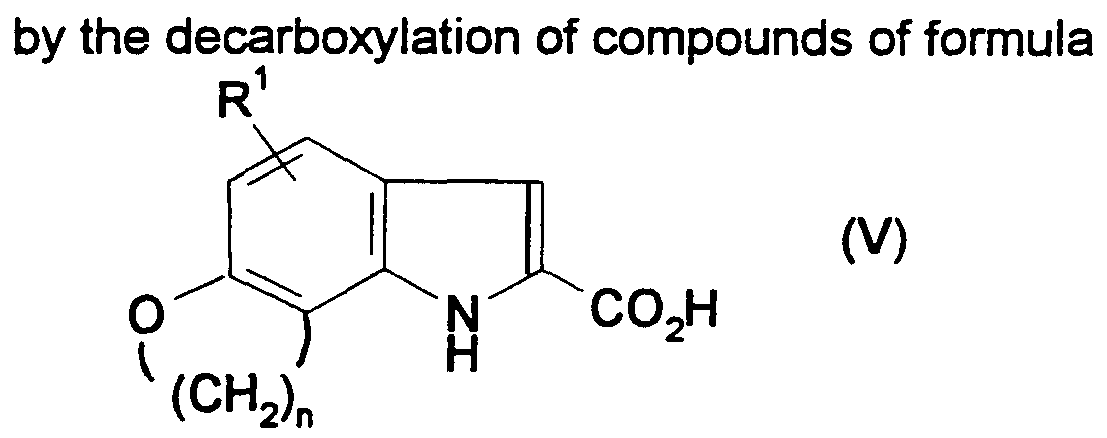
Compounds of formula (IV) in which the dotted line indicates a double bond may be prepared (V)
Figure imgf000011_0002
Thus, compounds of formula (V) may be decarboxylated by heating the compounds at a very high temperature (e.g. at about 250°C), optionally in the presence of copper and a suitable copper salt, such as copper (I) oxide, cuprous oxide and the like.
Compounds of formula (IV) in which the dotted line indicates a double bond may be converted to the corresponding saturated analogues of formula (IV) by reduction, for example using the conditions described above to prepare the compounds of formula (II) from compounds of formula (ill). Compounds of formula (V) may be prepared by the cyclisation and deesterification of compounds of formula (VI)
Figure imgf000012_0001
(wherein R is a C-|_6 alkyl group, e.g. methyl). The cyclisation reaction may conveniently be effected by heating (VI) to reflux in an aromatic hydrocarbon solvent (e.g. xylene). Conversion of the so-formed ester to the corresponding acid of formula (V) involves routine hydrolysis, for example using a base such as a hydroxide (e.g. sodium hydroxide) at an elevated temperature (e.g. under reflux).
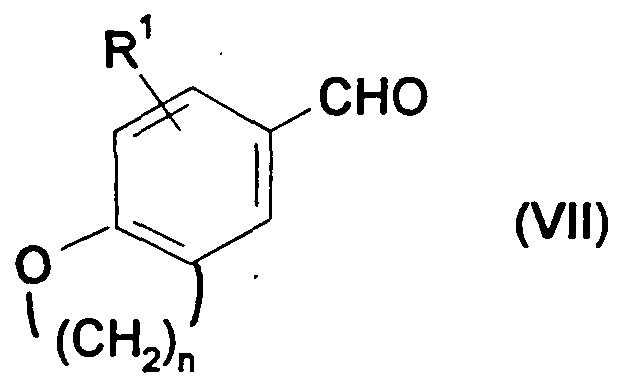
Compounds of formula (VI) may be prepared by treating compounds of formula (VII)
Figure imgf000012_0002
with an alkyl azidoacetate in the presence of a strong base (e.g. potassium tert- butoxide) at a temperature of from -20° to +10°C.
Compounds of formula (VII) are either known compounds described, for example, in WO 86/07056 or may be prepared by methods analogous to those described therein.
Alternatively compounds of formula (IV) in which the dotted line indicates a double bond may rmula (VIII)
Figure imgf000012_0003
wherein X represents a halogen atom (e.g. fluorine) and R is a d-βalkyl group, such as methyl or ethyl. Preparation of compounds of formula (IV) typically involves addition of a solution of compounds of formula (VIII) (suitably in a chlorinated organic solvent such as dichloromethane, dichloroethane or the like) to an acidic medium, such as halogenated acetic acid and/or acetic anhydride optionally in a chlorinated organic solvent as described above. Suitably the addition is carried out at 0°C under an inert atmosphere such as nitrogen. The reaction may be progressed by allowing the reagents to reach room temperature, and stirring for about 18 to 20 hours. The resulting mixture is generally treated with a base, such as an alkali metal hydroxide, prior to extraction of desired compounds of formula (IV).
Compounds of formula (VIII) are suitably prepared by acylation of compounds of formula (IX)
Figure imgf000013_0001
employing suitable acylating agents such as acid anhydrides and acid halides. Suitably a halogenated acetic anhydride (aptly trif luoroacetic anhydride) in a chlorinated organic solvent as described above is added to a solution of a compound of formula (IX) in a basic solvent, such as triethylamine and the like. Generally the addition is carried out at 0°C under an inert atmosphere such as nitrogen.
Preparation of compounds of formula (IX) suitably employs known starting materials of formula (X) shown below, which starting materials can be prepared according to J. Heterocyclic Chem.. (1973), Vol 10(4), page 623. Compounds of formula (X)
Figure imgf000013_0002
are aptly reacted with a suitable acetal derivative, conveniently in the presence of a base (an alkali metal carbonate being an example of an appropriate base), with heating over a prolonged period of time (such as 40 to 65 hours) at an elevated temperature in the range of 90° to 110°C, in order to yield compounds of formula (IX).
Compounds of formula (I) in which R1 represents halogen may be prepared via compounds of formulae (II), (III) and (IV) wherein R1 represents halogen employing process steps substantially as hereinbefore described. Suitably compounds of formula (IV) in which R1 represents halogen are prepared from compounds of formula (XI) wherein R1 represents halogen and the dotted line indicates an optional double bond.
Figure imgf000014_0001
Aptly a compound of formula (XI) is dissolved in an organic solvent, such as an alcoholic solvent, acidified, and the mixture subjected to stirring and refluxing for a suitable length of time to yield a corresponding compound of formula (IV).
Conveniently a compound of formula (XI) wherein R1 represents halogen as described above is prepared from a corresponding compound of formula (XI) wherein R1 represents hydrogen by halogenation employing suitable halogenating agents and techniques.
Suitably compounds of formula (XI) wherein R1 represents hydrogen as described above may be prepared from compounds of formula (IV) wherein R1 represents hydrogen by reaction of the latter with an appropriate anhydride in an acidic medium. According to a further embodiment of the present invention, there is provided a further general process (B) wherein a compound of formula (I) may be prepared from a compound of formula (XII)
Figure imgf000015_0001
suitably by stirring for several hours (17 to 19 hours) in a basic medium, conveniently an alkali metal hydroxide or the like, under an inert atmosphere such as nitrogen, followed by refluxing for 1 to 2 hours.
Aptly a compound of formula (XII) may be prepared by acylation of a compound of formula (II) employing acylation techniques substantially as hereinbefore described.
According to a yet further embodiment of the present invention, there is provided a general process (C) whereby a compound of formula (I) may be prepared by alkylating a saturated compound of formula (IV). Suitably alkylation is achieved by refluxing a compound of formula (IV) together with an alkylating agent over several days. Suitable alkylating agents include
HalCR3R4(CH2)pNR5COR6 (wherein Hal, R3, R4, R5, R6 and p are as hereinbefore defined), ANR5COR6 wherein A represents a 2-membered alkyl chain or the like.
Compounds of formulae (II) - (IX), (XI) and (XII) are novel intermediates and represent further individual aspects of the present invention. Compounds of formula (IVa) represent a further particular aspect of the invention.
Figure imgf000015_0002
According to another general process (D), a compound of formula (I) may be prepared by subjecting a protected derivative of a compound of formula (I) or a salt thereof to reaction to remove the protecting group or groups.
Thus, according to a further aspect of the invention, the following reactions may according to process (D), if desirable and/or if necessary, be carried out in any appropriate sequence: (i) removal of any protecting groups; and (ii) conversion of a compound of formula (I) or a salt thereof into a pharmaceutically acceptable salt thereof.
Thus, at an earlier stage in the preparation of a compound of formula (I) it may have been necessary and/or desirable to protect one or more sensitive groups in the molecule to prevent undesirable side reactions.
The protecting groups used in the preparation of compounds of formula (I) may be used in conventional manner. See for example 'Protective Groups in Organic Chemistry' Ed.J.F.W. McOmie (Plenum Press 1973) or 'Protective Groups in Organic Synthesis' by Theodora W Greene (John Wiley and Sons 1991).
According to another general process (E), compounds of formula (I) may be prepared from other compounds of formula (I) by interconversion reactions. In particular, acid addition salts of compounds of formula (I) may be prepared from a corresponding compound of formula (I) by suitable acid treatment, for example addition of a suitable acid, such as hydrochloric acid, generaly in the presence of an organic solvent such as an alcohol or ester. Aptly the reagents may be stirred at room temperature for a convenient length of time. Alternatively, an acid may be added dropwise to a solution of a compound of formula (I) in an appropriate organic solvent as described above, optionally under an inert atmosphere such as nitrogen.
Where it is desired to isolate a compound of the invention as a salt, for example as an acid addition salt, this may be achieved by treating the free base of general formula (I) with an appropriate acid, preferably with an equivalent amount, or with creatinine sulphate in a suitable solvent (e.g. ethanol). Compounds of the invention may be isolated in association with solvent molecules by crystallisation from or evaporation of an appropriate solvent.
Individual enantiomers of the compounds of the invention may be prepared from racemates by resolution using methods known in the art for the separation of racemic mixtures into their constituent enantiomers, for example using chiral HPLC.
As well as being employed as the last main step in the preparative sequence, the general methods indicated above for the preparation of the compounds of the invention may also be used for the introduction of the desired groups at an intermediate stage in the preparation of the required compound. It should therefore be appreciated that in such multi-stage processes, the sequence of reactions should be chosen in order that the reaction conditions do not affect groups present in the molecule which are desired in the final product.
The invention is further illustrated by the following Examples which should not be construed as constituting a limitation thereto. All temperatures are in °C. THF means tetrahydrofuran. EtOH means ethanol. EtOAc means ethyl acetate. DMF means dimethylformamide. NH3 means commercially available aqueous ammonium hydroxide. TFA means trifluoroacetic acid. TFAA means trifluoroacetic anhydride. Dried means dried over anhydrous sodium sulphate (unless otherwise stated). Chromatography was performed on silica (Merck 9385 unless otherwise stated). System A is dichloromethane/ethanol/aqueous ammonia. T.l.c. means thin layer chromatography on silica gel. The n.m.r. analysis was conducted at 250mHz.
Intermediate 1 2-Azido-3-(2.3-dihvdro-benzofuran-5-yl.-acrylic acid methyl ester
To a cold (-10°C) stirred solution of potassium tert-butoxide (6.06g) in dry methanol (40ml) was added dropwise a mixture of 2,3-dihydrobenzofuran-5- carboxaldehyde (2g) and methyl azidoacetate (6.21 g). The mixture was stirred for 1h at -10°C and then stored at 0°C for 18h. The resulting pale yellow microcrystals were collected by filtration to give the title compound (3.12g), m.p. 77-80°C.
Intermediate 2
7.8-Dihvdro-1 H-furor2.3-α1indole-2-carboxylic acid A solution of Intermediate 1 (3.1g) in xylene (350ml) was heated to reflux for 2h. The cooled mixture was washed with water (100ml) and then the aqueous layer extracted with xylene (50ml). The combined organic phases were dried and evaporated, and the residue dissolved in ethanol (40ml). 2N Sodium hydroxide was added (20ml) and the mixture heated to reflux for 2h. The ethanol was evaporated and the mixture extracted with ether (2x50ml). The aqueous layer was then acidified and extracted with EtOAc (2x75ml). The dried extracts were evaporated to give the title compound as a yellow/orange solid (878mg), m.p. 160°C (chars) 213°C (dec).
Intermediate 3 7.8-Dihvdro-1 H-furor2.3-α1indole
Intermediate 2 (875mg) was placed in a pre-heated Woods metal bath (ca. 250°C) for 2min until CO2 evolution had ceased. The material was pre- absorbed onto silica gel and then chromatographed (35g). Elution with EtOAc: cyclohexane (1 :4) gave the title compound as a beige solid (232mg).
1H n.m.r.(CDCl3) 7.82δ (1H,br s), 7.4δ (1H,d), 7.09δ (1H,m), 6.73δ (1H,d), 6.52δ (1jd,m), 4.67δ (2H,t), 3.32δ (2H,t).
Intermediate 4 2.3.7.8-Tetrahvdro-1H-furof2.3-α1indole
Intermediate 3 (275mg) was dissolved in borane THF complex (1M solution, 2.6ml) and was stirred at 0°C under N2, then trifluoroacetic acid (2.6ml) was added dropwise. Stirring was maintained at 0°C for 45min and saturated potassium carbonate solution added. The mixture was extracted with EtOAc (2x30ml). The dried extracts were evaporated and the residue chromatographed on silica gel (30g). Elution with EtOAc: cyclohexane (1:2) gave the title compound as a pale brown oil, which solidified (215mg), m.p. 48- 50°C. T.l.c. EtOAc:cyclohexane (1 :2) Rf 0.25.
Intermediate 5
(2.3.7.8-Tetrahvdro-1 H-furor2.3-qlindol-1 -yl .acetonitrile
A mixture of Intermediate 4 (122mg), iodoacetonitrile (0.06ml) and potassium carbonate (105mg) in methyl isobutyl ketone (5ml) was heated to reflux, under N2, for 18h. The cooled mixture was partitioned between 2N Na2C03 (20ml) and EtOAc (2x30ml). The dried extracts were evaporated and the residue chromatographed on silica gel (35g). Elution with EtOAc: cyclohexane (1 :3) gave the title compound as a beige solid (123mg), m.p. 122-4°C. T.l.c. EtOAc:cyclohexane (1:2) Rf 0.37.
Intermediate 6
(7.8-Pihvdro-1 H-furor2.3-α1indol-1 -vhacetonitrile
To a stirred solution of Intermediate 3 (227mg) in dry DMF (8ml), was added sodium hydride (60% in oil, 85mg). The mixture was stirred for 0.5h and then chloroacetonitrile (0.13ml) was added dropwise. The mixture was then left to stand at 20βC for 2 days and was then partitioned between 2N Na2C03 solution (60ml) and EtOAc (2x70ml). The dried extracts were evaporated and the residue chromatographed on silica gel (40g). Elution with EtOAc: cyclohexane (1:3) gave the title compound as an off-white solid (109mg). 1H n.m.r.(CDCl3) 7.38δ (1H,d), 6.9δ (1H,d), 6.77δ (1H,d), 6.53δ (1H,d), 5.04δ (2H,s), 4.70δ (2H,t), 3.65 (2H,t).
Intermediate 7 2-(2.3,7.8-Tetrahvdro-1H-furor2.3-αlindol-1-vnethylamine (a) A solution of Intermediate 6 (160mg) in dry THF (5ml) was treated with borane THF complex (1M in THF, 8ml) and was stirred, under N2, at 20°C for 18h. The mixture was then cooled (0°C) and trifluoroacetic acid (5ml) added. After a further 30min saturated potassium carbonate solution was added, dropwise initially, and then the mixture was extracted with EtOAc (2x40ml). The dried extracts were evaporated and chromatographed on silica gel (20g). Elution with System A (100:8:1) gave the title compound as a pale brown semi- solid (80mg).
1H n.m.r.(CDCl3) 6.82δ (1H,d), 6.18δ (1H,d), 4.52δ (2H,t), 3.37δ (2H,t), 3.32-3.2 δ (4H,2xt), 2.97-2.87δ (4H,2xt), 1.8δ (2H,br s).
(b) To a stirred, refluxing, solution of Intermediate 5 (203mg) in dry THF (10ml) was added dropwise borane THF complex (1M solution, 3ml). Heating was maintained for 5h and then the mixture was cooled, and methanol (3ml) added, cautiously at first. 2N HCl (3ml) was then added, and the mixture heated to reflux for a further 1h. The cooled mixture was then partitioned between saturated K2CO3 (40ml) and EtOAc (2x35ml). The dried extracts were evaporated and the residue chromatographed on silica gel (25g). Elution with System A (100:8:1) gave the title compound as a pale yellow oil which solidified (166mg). The n.m.r. data for this solid was consistent with that for the same compound prepared in part (a) above.
Intermediate 8
Chroman-5-yl-(2.2-diethoxy-ethvπ-amine
Bromoacetaldehyde diethyl acetal (11.8ml) was added to a mixture of chroman- 5-yl-amine (5.85g) (prepared according to J. Heterocyclic Chem.. (1973), Vol 10 (4) page 623), and potassium carbonate (10.84g) in dry DMF (70ml) at room temperature under N2. The mixture was heated at 100°C for 60h. The cooled mixture was partitioned between water (800ml) and ether (3x200ml). The combined organic extracts were washed with brine water 1:1 (2x200ml) and dried. The solvent was evaporated and the residue purified by flash column chromatography on silica. Elution with cyclohexane/ethyl acetate 6:1 gave the title compound as a pale yellow oil (8.0g). T.l.c. Si02 cyclohexane/ethyl acetate 6:1 , Rf 0.35.
Intermediate 9
N-Chroman-5-yl-N-f2.2-diethoxy-ethvπ-2.2.2-trifluoro-acetamide Trifluoroacetic anhydride (4.67ml) in dry dichloromethane (10ml) was added dropwise to a solution of Intermediate 8 (7.99g) and triethylamine (4.62ml) in dry dichloromethane (190ml) at 0°C under N2. The mixture was allowed to warm to room temperature and stirred for 2h. The mixture was washed with water (2x100ml) and dried. The solvent was evaporated to give the title compound as a pale yellow oil (10.35g). T.l.c. cyclohexane/ethyl acetate (6:1), Rf 0.6
Intermediate 10
1.7.8.9-Tetrahvdro-pyranof2,3-g1indole
A solution of Intermediate 9 (0.1g) in dry dichloromethane (1ml) was added dropwise to a solution of TFA (1.5ml) and TFAA (1.0ml) in dry dichloromethane (10ml) at 0°C under N2. The mixture was allowed to warm to room temperature and stirred for 20h. The solution was cooled and basified to pH12 with 5% potassium hydroxide in methanol. The mixture was stirred for 5min, then evaporated. The residue was partitioned between water (15ml) and ethyl acetate (3x10ml). The combined organic extracts were washed with brine (1x20ml) and dried. The solvent was evaporated and the residue purified by flash chromatography on silica. Elution with cyclohexane/ethyl acetate 10:1 gave the title compound as a colourless solid (21.7mg). T.l.c.cyclohexane/ethyl acetate (4:1), Rf 0.35.
Intermediate 11 1.2.3.7.8.9-Hexahvdro-pyranor2.3-α1indole Borane (1.0M in THF; 5ml) was added dropwise to a solution of Intermediate 10 (434mg) in dry THF (10ml) at 0°C under N2. Trifluoroacetic acid (32ml) was then added dropwise and the mixture stirred for 10min at 0°C. 2N sodium hydroxide (8ml) was added dropwise cautiously at 0°C to pH12. The mixture was then partitioned between water (15ml) and ethyl acetate (3x15ml). The combined organic extracts were washed with brine (1x20ml) and dried. The solvent was evaporated and the mixture was purified by flash column chromatography on silica. Elution with cyclohexane/ethyl acetate 4:1 gave the title compound as a colourless gum (222mg). T.l.c. Ethyl acetate/cyclohexane (4: 1 ), Rf 0.3.
Intermediate 12
(2.3.8.9-Tetrahvdro-7H-pyranor2.3-α1indol-1-yl.-acetonitrile lodoacetonitrile (0.11ml) was added to a mixture of Intermediate 11 (222mg) and potassium carbonate (210mg) in MIBK (10ml) at room temperature. The mixture was heated under reflux for 5h, cooled to room temperature, then partitioned between water (15ml) and ethyl acetate (3x15ml). The combined organic extracts were washed with brine (1x20ml) and dried (MgS0 ). The solvent was evaporated and the residue purified by flash column chromatography on silica. Elution with cyclohexane/ethyl acetate 5:1 gave the title compound as a colourless gum which crystallised on standing (0.25g). T.l.c. cyclohexane/ethyl acetate (3:1), Rf 0.37.
Intermediate 13 2-f2.3.8.9-Tetrahvdro-7H-pyranor2.3-α1indol-1-vh-ethylamine
Borane (1.0M; 2.27ml) was added dropwise to a solution of Intermediate 12 (243mg) in dry THF (5ml) at 0°C under N2. The solution was heated under reflux for 3h, cooled to 0°C and methanol (1ml) was added cautiously dropwise until effervessing ceased. 2N HCl (2ml) was added (to pH1) and the mixture heated under reflux for 15min, cooled to 0°C and basified to pH12 with 2N NaOH (3ml). The mixture was partitioned between water (10ml) and ethyl acetate (3x15ml). The combined organic extracts were washed with brine (1x15ml) and dried. The solvent was evaporated and the residue purified by flash column chromatography on silica. Elution with dichloromethane/ethanol/ammonia 100:8:1 gave the title compound as a colourless gum (160mg). T.l.c.Dichloromethane/ethanol/ammonia (100:8:1), Rf 0.3.
Intermediate 14
2.3.7.8-Tetrahvdro-1 H-furor2.3-α1indole-1 -carbaldehvde To a stirred solution of Intermediate 4 (320mg) in formic acid (3ml) was added dropwise acetic anhydride (1ml). The mixture was then heated to ca. 60°C for 20min. The mixture was then added cautiously to 2N Na2C03, and was extracted into EtOAc. Evaporation of the dried extract gave an off-white solid (360mg). T.l.c.(Si02) CH2CI2:EtOH:NH3; 400:8:1 , Rf 0.29
Intermediate 15 5-Chloro-2.3.7.8-tetrahvdro-1 H-furor2.3-α1indole-1 -carbaldehvde
A stirred solution of Intermediate 14 (180mg) in glacial acetic acid (4ml) was treated with N-chlorosuccinimide (140mg) and was stirred for 7h. The mixture was partitioned between 2N Na2C03 and EtOAc. Evaporation of the dried extracts gave a grey solid (218mg). T.l.c. (Si02) EtOAc: cyclohexane; 1 :1 , Rf 0.19
Intermediate 16
5-Chloro-2.3.7.8-tetrahvdro-1H-furor2.3-g1indole
Intermediate 15 (210mg) was dissolved in methanol (5ml) and 2N HCl (1ml) added. The mixture was stirred at 20°C for 18h, then at reflux for 1h. The mixture was allowed to cool, and the methanol evaporated. The residue was then partitioned between 2N Na2C03 and EtOAc. The dried extracts were evaporated to give a brown solid (166mg).
T.l.c.(Si02) EtOAc:cyclohexane; 1:1 , Rf 0.36
Intermediate 17
(5-Chloro-2.3.7.8-tetrahvdro-1H-furor2.3-q1indol-1-yl)-acetonitrile
A stirred solution of Intermediate 16 (165mg), iodoacetonitrile (0.073ml) and potassium carbonate (140mg) in methyl isobutyl ketone (10ml) was heated to reflux for 18h under N2. The mixture was cooled, and partitioned between 2N Na2C03 and EtOAc. The dried extracts were evaporated to give a dark residue which was chromatographed on silica gel. Elution with CH2CI2:EtOH:NH3; 400:8:1 gave a pale brown solid (155mg). T.l.c.(Si02) CH2CI2:EtOH:NH3; 400:8:1, Rf 0.67
Intermediate 18
2-(5-Chloro-2.3.7.8-tetrahvdro-1H-furor2.3-αlindol-1-vn-ethylamine
A mixture of Intermediate 17 (150mg) in dry THF (5ml) Containing borane THF
(1M in THF, 1.9ml) was heated to reflux, under N2, for 18h. The mixture was cooled, and methanol (2ml) added dropwise. 2N HCl (4ml) was then added, and the mixture heated to reflux for a further 1h. After cooling, the mixture was partitioned between saturated K2C03 and EtOAc. The dried extracts were evaporated, and the red crystalline solid chromatographed on silica gel. Elution with CH2CI2:EtOH:NH3; 100:8:1 gave a pink crystalline solid (110mg). T.l.c.(Si02) CH2CI2:EtOH:NH3; 100:8:1, Rf 0.44
Intermediate 19
Cvclopropanecarboxylic acid (cvclopropanecarbonylH2-(2.3.7.8-tetrahvdro-1 H- furof2.3-α1indol-1-vπ-ethvπ-amide To a cold (0°C) stirred solution of Intermediate 7 (111mg) in CH2CI2 (10ml) and diisopropylethylamine (0.14ml) was added cyclopropyl carbonyl chloride (0.074ml) dropwise under N2. The cooling bath was removed and the mixture stirred at 20°C for 18h. The mixture was partitioned between 2N Na2C03 and EtOAc. The dried extracts were evaporated and the residue chromatographed on silica gel. Elution with EtOAc: cyclohexane; 1 :4 gave a colourless oil (141 mg) which slowly crystallised. T.l.c.(Si02) CH2CI2:EtOH:NH3; 200:8:1, Rf 0.86
Intermediate 20 (2.2-Diethoxy-ethylH2.3-dihvdro-benzofuran-4-yl.-amine
A mixture of 2,3-dihydro-benzofuran-4-ylamine (preparation. J. Hetereocvclic Chem.. 18, 1333 (1980)) (4.34g), potassium carbonate (8.87g) and bromo acetaldehyde diethyl acetal (9.7ml) in dry DMF (60ml) was heated to 100°C for 2 days under . The mixture was cooled and was partitioned between water and ethyl acetate. The dried extracts were evaporated and the residue chromatographed on silica gel (250g). Elution with ethyl acetate: cyclohexane 1 :4 gave the title compound as a pale yellow oil (4.95g). T.l.c. EtOAc: cyclohexane 1:1, Rf 0.73. Analysis Found: C.66.8; H.8.5; N.5.35; C14H21N03 requires: C.66.9; H.8.4; N,5.55%
Intermediate 21
N-f2.2-Diethoxy-ethvπ-N-f2.3-dihvdro-benzofuran-4-yl)-2.2.2-trifluoro-acetamide Trifluoroacetic anhydride (4.12ml) was added dropwise to a cooled (0βC) stirring solution of the intermediate 20 (6.67g) and triethylamine (4.06ml) in dichloromethane (100ml) under nitrogen. The mixture was warmed to room temperature and stirred for VΛh. The reaction mixture was partitioned between water and dichloromethane. The aqueous phase was re-extracted with dichloromethane. The combined organic layers were dried, evaporated and chromatographed on silica gel eluting with ethyl acetate:cyclohexane 1:9 gave the title compound (8.31 g) as a yellow oil. T.l.c. Cyclohexane: EtOAc (4:1), Rf 0.38. Analysis Found: C.55.30; H.5.74; N.3.96; C16H20F3NO4 requires: C.55.33; H.5.8; N,4.03%
Intermediate 22
7.8-Dihvdro-1H-furor2.3-α1indole
A solution of the intermediate 21 (8.27g) in dichloromethane (80ml) was added dropwise to a stirred solution of trifluoroacetic acid (80ml) and trifluoroacetic anhydride (53ml) in dichloromethane (800ml) at 0°C under nitrogen. This was warmed to room temperature and stirred for 20h. The cooled reaction mixture was basified with 2N sodium hydroxide and then stirred for VΛh at room temperature. The organic phase was separated and the aqueous layer was re- extracted with dichloromethane. The combined organic phases were dried, evaporated and chromatographed on silica gel eluting with EtOAc: Cyclohexane (1:9) gave the title compound as a beige solid (2.6g). T.l.c.cyclohexane.ethyl acetate 7:3, Rf 0.43. Analysis Found: C.75.31 ; H.5.65; N.8.62; C10H9NO requires: C,75.45; H.5.70; N,8.80% Example 1
N-r2-f2.3.8.9-Tetrahvdro-7H-Pyranor2.3-αlindol-1-yl)-ethvn-acetamide Acetic anhydride (0.104ml) was added to a solution of the Intermediate 13 (160mg) and pyridine (0.12ml) in dry THF (4ml) at 0βC under N2. The mixture was allowed to warm to room temperature and stirred for 3h. The solvent was evaporated and the residue purified by flash column chromatography on silica. Elution with ethyl acetate gave the title compound as colourless crystals (151mg), m.p. 91-93°C. T.l.c. Ethyl acetate, Rf 0.2.
Example 2
N-f2-f2.3.8.9-Tetrahvdro-7H-pyranor2.3-g1indol-1-yl)-ethvn-acetamide hvdrochloride
Ethereal HCl (0.25ml) was added dropwise to a solution of the title compound of Example 1 (56mg) in ethanol (2ml) at 0°C under N2. The solvent was evaporated and the residue triturated under ether (2x1 ml). The solvent was decanted to give the title compound as a colourless solid (63mg), m.p. 179-
181°C.
Analysis Found: C.58.6; H.7.5; N.8.95; C15H20N2O2.HCI requires: C,58.6; H.7.3; N,9.1 % H N.m.r. (CD3OD; δ) 7.2δ (li±d), 6.9δ QH, d), 4.24δ (2H,t), 4.07δ (2H,t), 3.6δ
(4H,AA'BB'), 3.28δ (2H,t), 2.88δ (2H,t), 2.1-1.95δ (5H,m+s)
Example 3 N-r2-f2.3.7.8-Tetrahvdro-1H-furor2.3-q1indol-1-yl)ethvn-acetamide
To a stirred solution of Intermediate 7 (77mg) in dry THF (5ml) containing pyridine (0.09ml) was added acetic anhydride (0.06ml). After 18h at 20°C the mixture was partitioned between 2N Na2Cθ3 (30ml) and EtOAc (2x30ml). The dried extracts were evaporated and the residue chromatographed on silica gel (20g). Elution with System A (200:8:1) gave the tit|e compound as a colourless crystalline solid (56mg), m.p. 126-7°C. T.l.cSystem A (100:8:1) Rf 0.42.
Example 4 N-r2- 2.3.7.8-Tetrahvdro-1H-furor2.3-α1indol-1-vn-ethvn-acetamide hvdrochloride
The title compound of Example 3 (334mg) was dissolved in ethyl acetate (20ml) and was treated with ethereal HCl (1.35ml). This was stirred at room temperature for 2h and then the solvent was evaporated to give the title compound as a pale green powder (383mg), m.p. 152-154°C.
T.l.c. System A 100:8:1, Rf 0.41.
Analysis Found: C.59.45; H.7.15; N.9.55; Cl.12.8;
C14H18N202.HCI requires: C.59.45; H.6.75; N.9.9; Cl,12.55%
Example 5
N-f2-f5-Chloro-2.3.7.8-tetrahvdro-1H-furor2.3-o1indol-1-vn-ethvn-acetamide
A solution of Intermediate 18 (107mg) in dry THF (5ml) and dry pyridine
(0.11ml) was treated with acetic anhydride (0.085ml) and left for 2 days at 20°C under N2. The mixture was partitioned between 2N Na2C03 and EtOAc. The dried extracts were evaporated, and the residue chromatographed on silica gel.
Elution with CH2CI2:EtOH:NH3; 200:8:1 gave the title compound as a colourless crystalline solid (114mg), m.p. 147-9βC.
Assay Found: C.60.15; H.6.35; N, 10.05; C14H17CIN202 requires: C.59.9; H.6.1 ; N,10.0%
T.l.c.(Si02) CH2CI2:EtOH:NH3; 100:8:1, Rf 0.69
Example 6
Cvclopropanecarboxylic acid r2-(2.3.7.8-tetrahvdro-1 H-furor2.3-α1indol-1-yl)- ethyll-amide
Intermediate 19 (140mg) was stirred in methanol (10ml) and 2N NaOH (4ml) at 20βC under N2 for 18h, and then at reflux for 1h. The mixture was diluted with water and extracted with EtOAc. The dried extracts were evaporated giving the title compound as a colourless solid (111mg), m.p. 147-9βC. Assay Found: C.70.9; H.7.45; N.10.15;
C16H20N2O2 requires: C.70.55; H.7.4; N,10.3% T.l.c. (Si02) CH2CI2:EtOH:NH3; 200:8:1 , Rf 0.48
Example 7 N-f2-f2.3.7.8-Tetrahvdro-1 H-furor2.3-α1indol-1-vn-ethvn-acetamide A mixture of Intermediate 4 (50mg), potassium iodide (1g) and N-(2- chloroethyl)acetamide (96mg) in acetone (5ml) was heated to reflux for 2 days. The cooled mixture was partitioned between water and ethyl acetate. The extracts were dried, and evaporated, and the residue chromatographed on silica gel. Elution with CH2CI2:EtOH:NH3; 400:8:1 gave a sample of desired material (69mg).
TJ.c.(Si02) System A; 100:8:1, Rf 0.42
*H n.m.r. agrees with assignment for alternative routes of preparation. 6.85δ (1H,d), 6.2δ (IH.d), 5.86δ (l±l.brs), 4.52δ (2H,t), 3.5-3.3δ (6H,m), 3.22δ (2H,t), 2.93δ (2H,t), 2.0δ (3H,s)
Example 8
Compounds of formula (I) have been shown to exhibit high affinity and selectivity for binding to melatonin receptors in chicken retinal membranes, measured according to the methods of Dubocovich and Takahashi (Proc. Natl. Acad. Sci. (1988), 84, 3916-3820). The compounds of formula (I) have either melatonin agonist or antagonist activity as demonstrated in rabbit retina, according to the methods of Dubocovich (J. Pharmacol. Exp. Therap. (1985), 234. 395-401 ). The results obtained for particular compounds according to the present invention are as follows:
Compound Chicken retina Ki (nM) Rabbit retina IC (nM)
Example 2 4.92 0.950
Example 3 0.42 0.040
Example 5 3.21 0.004
Example 6 1.68 0.200
Example 9 Compounds of formula (I) have been included in pharmacy formulations, and details of such formulations are given below. TABLETS FOR ORAL ADMINISTRATION A. Direct Compression
mg/tablet
Active ingredient 49.0
Anhydrous Lactose 55.2
Microcrystalline cellulose 37.5
Pregelatinised maize starch 7.5
Magnesium stearate 0.8
The active ingredient was sieved and blended with the excipients. The resultant mix was compressed into tablets using a tablet machine fitted with appropriately sized concave punches.
B. Wet Granulation
mg/tablet
Active ingredient 7.0
Lactose BP 146.5
Starch BP 30.0
Pregelatinised Maize Starch BP 15.0
Magnesium Stearate BP 1.5
Compression weight 200.0
The active ingredient was sieved through a suitable sieve and blended with lactose, starch and pregelatinised maize starch. Suitable volumes of purified water were added and the powders were granulated. After drying, the granules were screened and blended with the magnesium stearate. The granules were then compressed into tablets using suitable diameter punches.
Tablets of other strengths may be prepared by for example altering the ratio of active ingredient to lactose or the compression weight and using punches to suit. Unit formula
(mg/tablet)
Active ingredient/lactose granule* 93.0
Microcrystalline cellulose Ph Eur 5.5
Croscarmellose Sodium USNF 1.0
Magnesium Stearate Ph Eur 0.5
* Active ingredient/lactose granule mg
Active ingredient 140.0 Lactose Ph Eur 170 mesh 140.0 Purified water Ph Eur qs +
+ The water does not appear in the final product. Typical range 100-140g per kg of blend.
The active ingredient and lactose were mixed together and granulated by the addition of purified water. The granules obtained after mixing were dried and passed through a screen, and the resulting granules were then mixed with the other tablet core excipients. The mix is compressed into tablets.
The tablets may be film coated with suitable film-forming materials, such as hydroxypropyl methylcellulose, using standard techniques. Alternatively the tablets may be sugar coated, or enteric coated.
Coating Suspension % w/w
Hydroxypropyl methylcellulose Ph Eur 10.0 Opaspray white # 5.0 Purified water Ph Eur to 100.0++ ++ The water does not appear in the final product. The maximum theoretical weight of solids applied during coating is 11 mg/tablet.
# Opaspray white is a proprietory film coating suspension, obtainable from Colorcon Ltd, UK, which contains hydroxypropyl methylcellulose and titanium dioxide.
The tablets were film coated using the coating suspension in conventional film coating equipment.
EFFERVESCENT TABLET
mg/tablet
Active ingredient 140.0mg
Sodium bicarbonate 656.4mg
Monosodium citrate anhydrous 659.5mg
Aspartame 40.0mg
Polyvinylpyrrolidone 32.0mg
Sodium benzoate 48.0mg
Orange flavour 16.0mg
Lemon flavour 8.0mg
Absolute alcohol for granulation
The active ingredient, anhydrous monosodium citrate, sodium bicarbonate and aspartame were mixed together and granulated by the addition of a solution of the polyvinylpyrrolidone in the alcohol. The granules obtained after mixing were dried and passed through a screen, and the resulting granules were then mixed with the sodium benzoate and flavourings. The granulated material was compressed into tablets using a machine fitted with 20mm punches.
A rotary machine fitted with 20mm punches may also be used for tabletting. LIQUID AND CAPSULE FORMULATIONS FOR ORAL ADMINISTRATION
Liquid formulations were prepared by slow addition of active ingredient into the other ingredients at 35-50°C with constant mixing (amounts are given as percentage w/w).
Example A B
Active ingredient 18.2 18.2
Oleic acid 60.985 68.485
Polyethylene glycol 600 7.3 7.3
Propylene glycol 6.0 6.0
Polysorbate 80 7.5 -
Ascorbyl palmitate 0.015 0.015
The liquid formulations were filled into hard gelatin capsules, each capsule containing 25mg of active ingredient.
CAPSULES
mg/capsule
Active ingredient 49.0 * Starch 1500 150.0 Magnesium Stearate BP 1.0 Fill weight 200.0
A form of directly compressible starch.
The active ingredient was sieved and blended with the excipients. The mix was filled into size No. 2 hard gelatin capsules using suitable machinery. Other doses may be prepared by altering the fill weight and if necessary changing the capsule size to suit. SYRUP
Sucrose Free Presentation mg/5ml dose
Active ingredient 49.0
Hydroxypropylmethylcellulose USP 22.5
(viscosity type 4000)
Buffer )
Flavour ) as required
Colour )
Preservative )
Sweetener )
Purified water BP to 5.0ml
The hydroxypropylmethylcellulose was dispersed in hot water, cooled and then mixed with an aqueous solution containing the active ingredient and the other components of the formulation. The resultant solution was adjusted to volume and mixed. The syrup was clarified by filtration.
SUSPENSION
mg/5ml dose
Active ingredient 49.0
Aluminium monostearate 75.0
Sweetening agent ) as required
Flavour )
Colour )
Fractionated coconut oil to 5.0ml
The aluminium monostearate was dispersed in about 90% of the fractionated coconut oil. The resulting suspension was heated to 115°C while stirring and then cooled. The sweetening agent, flavour and colour were added and the active ingredient was suitably dispersed. The suspension was made up to volume with the remaining fractionated coconut oil and mixed.
SUB-LINGUAL TABLET
(mg/tablet)
Active ingredient/lactose granule* 49.0 Compressible sugar NF 50.5 Magnesium Stearate BP 0.5 Compression Weight 100.0
The active ingredient was sieved through a suitable sieve, blended with the excipients and compressed using suitable punches. Tablets of other strengths may be prepared by altering either the ratio of active ingredient to excipients or the compression weight and using punches to suit.
SUPPOSITORY FOR RECTAL ADMINISTRATION
Active ingredient 49.0mg Witepsol W32 1.0g
A proprietary grade of Adeps Solidus Ph Eur
A suspension of the active ingredient in molten Witepsol was prepared and filled using suitable machinery, into 1g size suppository moulds. INJECTION FOR SUBCUTANEOUS ADMINISTRATION
mg/ml
Active ingredient 0.896 Sodium Chloride Intravenous to 1 ml Infusion, BP, 0.9% w/v Batch size 2500ml
The active ingredient was dissolved in a portion of the Sodium Chloride Intravenous Infusion, the solution made to volume with the Sodium Chloride Intravenous Infusion, and the solution thoroughly mixed. The solution was filled into clear, Type 1, glass 1ml ampoules and sealed by fusion of the glass under a nitrogen or air headspace. The ampoules were sterilised by autoclaving at 121 °C for not less than 15 minutes. Alternatively the solution may be sterilised by filtration prior to filling aseptically into ampoules.
FOR INHALATION Inhalation Cartridges
mg/cartridge
Active ingredient (micronised) 0.56 Lactose BP 25.00
The active ingredient was micronised in a fluid energy mill to a fine particle size range prior to blending with normal tabletting grade lactose in a high energy mixer. The powder blend was filled into No 3 hard gelatin capsules on a suitable encapsulating machine. The contents of the cartridges were administered using a powder inhaler such as the Glaxo Rotahaler. Metered Dose Pressurised Aerosol
Suspension Aerosol mg/metered Per can dose
Active ingredient (micronised) 0.280 73.92mg
Oleic Acid BP 0.020 5.28mg
Trichlorofluoromethane BP 23.64 5.67g
Dichlorodifluoromethane BP 61.25 14.70g
The active ingredient was micronised in a fluid energy mill to a fine particle size range. The oleic acid was mixed with the trichloromethane at a temeprature of 10-15°C and the micronised drug was mixed into the solution with a high shear mixer. The suspension was metered into aluminium aerosol cans and suitable metering valves, delivering 85mg of suspension, were crimped onto the cans and the dichlorodifluoromethane was pressure filled into the cans through the valves.
NASAL SPRAY
% w/v
Active ingredient 7.0 Sodium Chloride BP 0.9 Purified Water BP to 100 Shot Weight 100mg (equivalent to 7mg active ingredient)
The active ingredient and sodium chloride were dissolved in a portion of the water, the solution made to volume with the water and the solution thoroughly mixed.
The pH may be adjusted to facilitate solution of the active ingredient, using acid or alkali and/or subsequently adjusted ideally to near neutrality taking into account the pH for optimum stability. Alternatively, suitable buffer salts may be used. The solution may be preserved with, for example, benzalkanium chloride and phenylethyl alcohol, for a multi-dose nasal spray.

Claims

A compound of formula (I)
Figure imgf000037_0001
wherein R1 is hydrogen, halogen or C-|_6 alkyl;
R2 is a group of formula -CR3R4(CH2)pNR5COR6;
R3, R4 and R5, which may be the same or different, are hydrogen or C-j. βalkyl;
R6 is C-|_6alkyl or C3-.7 cycloalkyl; n is an integer of 2,3 or 4; p is an integer of 1 ,2,3 or 4; and pharmaceutically acceptable salts and solvates thereof.
A compound of formula (la)
Figure imgf000037_0002
wherein R1 is hydrogen, halogen or Cι_e alkyl;
R2 is a group of formula -CR3R4(CH2)pNR5COR6;
R3, R4 and R5, which may be the same or different, are hydrogen or C-|. galkyl;
R 3 is C-|_6alkyl or C3.7 cycloalkyl; p is an integer of 1 ,
2,3 or 4; and pharmaceutically acceptable salts and solvates thereof. 3. A compound according to Claim 1 or 2, wherein R2 represents a group -CR3R4(CH2)pNHCOR6 wherein R3 and R4 each independently represent hydrogen or C1-3 alkyl, p is an integer of 1 or 2, and R^ is C1-.
3 alkyl or 03.5 cycloalkyl.
4. A compound according to any of claims 1 to 3, wherein R1 is selected from the group consisting of hydrogen, chlorine and C<j_3 alkyl.
5. N-[2-(2,3,8,9-Tetrahydro-7H-pyrano[2,3-g]indol-1-yl)-ethyl]-acetamide; N-[2-(5-Chloro-2,3,7,8-tetrahydro-1H-furo[2,3-g]indol-1-yl)-ethyl]- acetamide;
Cyclopropanecarboxylic acid [2-(2,3,7,8-tetrahydro-1 H-furo[2,3-g]indol-1 - yl)-ethyl]-amide; and pharmaceutically acceptable salts and solvates thereof.
6. N-[2-(2,3,7,8-Tetrahydro-1 H-furo[2,3-g]indol-1-yl)-ethyl]-acetamide and pharmaceutically acceptable salts and solvates thereof.
7. A pharmaceutical formulation comprising a compound of formula (I) according to any of claims 1 to 6, together with one or more pharmaceutically acceptable carriers therefor.
8. A process of preparing a pharmaceutical formulation comprising a compound of formula (I) according to any of claims 1 to 6, together with one or more pharmaceutically acceptable carriers therefor, which process comprises mixing said compound of formula (I) together with said one or more pharmaceutically acceptable carriers therefor.
9. A compound of formula (I) according to any of Claims 1 to 6, for use in therapy.
10. A compound of formula (I) according to any of Claims 1 to 6, for use in the preparation of a medicament for use in the treatment of conditions associated with a disturbed functioning of the melatonin system.
11, A method of treating a mammal, including man, comprising administration of an effective amount of a compound of formula (I) according to any of Claims 1 to 6, for the treatment of conditions associated with a disturbed functioning of the melatonin system.
12. A process of preparing a compound of formula (I) according to any of Claims 1 to 6, which process comprises:
(a) acylation of a compound of formula (II)
Figure imgf000039_0001
or (b) treating a compound of formula (XII)
Figure imgf000039_0002
with an alkali metal hydroxide;
or (c) alkylation of a compound of formula (IV)
Figure imgf000039_0003
13. Compounds of formulae (II), (III), (IV), (IVa), (V), (VI), (VII). (VIII), (IX), (XI) and (XII).
PCT/EP1994/004220 1993-12-22 1994-12-20 Indoline derivatives, method of preparation and their use as pharmaceuticals Ceased WO1995017405A1 (en)

Priority Applications (4)

Application Number Priority Date Filing Date Title
AU12743/95A AU684877B2 (en) 1993-12-22 1994-12-20 Indoline derivatives, method of preparation and their use as pharmaceuticals
JP7517174A JPH09507057A (en) 1993-12-22 1994-12-20 Indoline derivatives, their production and their use as a medicine
US08/652,460 US5633276A (en) 1993-12-22 1994-12-20 Indoline derivatives, method of preparation and use
EP95903817A EP0736028A1 (en) 1993-12-22 1994-12-20 Indoline derivatives, method of preparation and their use as pharmaceuticals

Applications Claiming Priority (2)

Application Number Priority Date Filing Date Title
GB939326192A GB9326192D0 (en) 1993-12-22 1993-12-22 Chemical compounds
GB9326192.3 1993-12-22

Publications (1)

Publication Number Publication Date
WO1995017405A1 true WO1995017405A1 (en) 1995-06-29

Family

ID=10747030

Family Applications (1)

Application Number Title Priority Date Filing Date
PCT/EP1994/004220 Ceased WO1995017405A1 (en) 1993-12-22 1994-12-20 Indoline derivatives, method of preparation and their use as pharmaceuticals

Country Status (15)

Country Link
US (1) US5633276A (en)
EP (1) EP0736028A1 (en)
JP (1) JPH09507057A (en)
AP (1) AP535A (en)
AU (1) AU684877B2 (en)
CA (1) CA2179402A1 (en)
CO (1) CO4340623A1 (en)
GB (1) GB9326192D0 (en)
IL (1) IL112097A (en)
IS (1) IS4244A (en)
MY (1) MY131641A (en)
SV (1) SV1994000083A (en)
TW (1) TW291479B (en)
WO (1) WO1995017405A1 (en)
ZA (1) ZA9410056B (en)

Cited By (15)

* Cited by examiner, † Cited by third party
Publication number Priority date Publication date Assignee Title
FR2741799A1 (en) * 1995-12-04 1997-06-06 Oreal USE OF MELATONIN IN A COMPOSITION FOR TREATING SKIN SIGNS OF FATIGUE CONDITIONS
WO1997032871A1 (en) * 1996-03-08 1997-09-12 Takeda Chemical Industries, Ltd. Tricyclic compounds, their production and use
WO1998052935A1 (en) * 1997-05-16 1998-11-26 Adir Et Compagnie Substituted heterocyclic compounds, method for preparing and compositions containing same
US5856529A (en) * 1996-12-10 1999-01-05 Bristol-Myers Squibb Company Benzofuran and dihydrobenzofuran melatonergic agents
US5948817A (en) * 1997-03-05 1999-09-07 Bristol-Myers Squibb Company Polycyclic ethyl alkylamide melatonergic agents
US6034239A (en) * 1996-03-08 2000-03-07 Takeda Chemical Industries, Ltd. Tricyclic compounds, their production and use
US6211225B1 (en) 1999-06-30 2001-04-03 Bristol-Meyers Squibb Heterocyclic aminopyrrolidine derivatives as melatonergic agents
US6214869B1 (en) 1998-06-05 2001-04-10 Bristol-Myers Squibb Heterocyclic cis cyclopropane derivatives as melatonergic agents
EP0990650A4 (en) * 1997-06-13 2002-02-13 Yamanouchi Pharma Co Ltd Tricyclic pyrrole or pyrazole derivatives
EP1199304A1 (en) * 1997-03-05 2002-04-24 Takeda Chemical Industries, Ltd. Bicyclic compounds and pharmaceutical composition containing tricyclic compound for treating or preventing sleep disorders
AU774337B2 (en) * 1999-08-11 2004-06-24 Vernalis Research Limited Condensed indoline derivatives and their use as 5HT, in particular 5HT2C, receptor ligands
US7008940B1 (en) 1999-08-20 2006-03-07 Takeda Pharmaceutical Company Limited Dihydrobenzofuran derivatives, process for the preparing thereof and agents
WO2009053440A1 (en) * 2007-10-25 2009-04-30 Ferrer Internacional S.A. Indoline compounds
WO2010012789A1 (en) * 2008-07-30 2010-02-04 Ferrer Internacional S. A. 1,6-dihydro-2h-3-oxa-6-aza-as-indacene compounds
WO2018076090A1 (en) 2016-10-24 2018-05-03 Aché Laboratórios Farmacêuticos S.A. Compounds, process for obtaining the compounds, pharmaceutical composition, use of the compounds and method for treating psychiatric disorders and/or sleep disorders

Families Citing this family (7)

* Cited by examiner, † Cited by third party
Publication number Priority date Publication date Assignee Title
US7012090B1 (en) 2000-03-17 2006-03-14 Alcon, Inc. Pyranoindoles for treating glaucoma
WO2001070745A1 (en) * 2000-03-17 2001-09-27 Alcon, Inc. Pyranoindoles for treating glaucoma
ES2172415B2 (en) 2000-07-28 2003-11-16 Univ Madrid Complutense TREATMENT OF GLAUCOMA AND OCULAR HYPERTENSION THROUGH A MELATONINE ANALOG.
US6743448B2 (en) * 2000-12-11 2004-06-01 Abraham H. Kryger Topical testosterone formulations and associated methods
WO2002079153A1 (en) * 2001-03-28 2002-10-10 Biocatalytics, Inc. Method for producing tryptamine derivatives
AR059935A1 (en) * 2006-03-20 2008-05-07 Takeda Pharmaceutical PHARMACEUTICAL COMPOSITION FOR THE PREVENTION OR TREATMENT OF IRRITABLE COLON SYNDROME
KR20090086641A (en) * 2006-12-08 2009-08-13 다케다 야쿠힌 고교 가부시키가이샤 Tricyclic Compounds and Medical Uses thereof

Citations (2)

* Cited by examiner, † Cited by third party
Publication number Priority date Publication date Assignee Title
EP0043752A1 (en) * 1980-06-26 1982-01-13 SOCIETE DE RECHERCHES INDUSTRIELLES S.O.R.I. Société anonyme dite: Pyranoindole derivative and process for its preparation
EP0207605A1 (en) * 1985-05-21 1987-01-07 Pfizer Inc. Hypoglycemic thiazolidinediones

Family Cites Families (1)

* Cited by examiner, † Cited by third party
Publication number Priority date Publication date Assignee Title
US4738972A (en) * 1985-05-21 1988-04-19 Pfizer Inc. Hypoglycemic thiazolidinediones

Patent Citations (2)

* Cited by examiner, † Cited by third party
Publication number Priority date Publication date Assignee Title
EP0043752A1 (en) * 1980-06-26 1982-01-13 SOCIETE DE RECHERCHES INDUSTRIELLES S.O.R.I. Société anonyme dite: Pyranoindole derivative and process for its preparation
EP0207605A1 (en) * 1985-05-21 1987-01-07 Pfizer Inc. Hypoglycemic thiazolidinediones

Non-Patent Citations (1)

* Cited by examiner, † Cited by third party
Title
P. T. KIM ET AL: "Synthèse de pyranno(f et g)indoles", CANADIAN JOURNAL OF CHEMISTRY., vol. 60, no. 16, 1982, OTTAWA CA, pages 2093 - 2098 *

Cited By (34)

* Cited by examiner, † Cited by third party
Publication number Priority date Publication date Assignee Title
FR2741799A1 (en) * 1995-12-04 1997-06-06 Oreal USE OF MELATONIN IN A COMPOSITION FOR TREATING SKIN SIGNS OF FATIGUE CONDITIONS
CN100441574C (en) * 1996-03-08 2008-12-10 武田药品工业株式会社 Tricyclic compounds and their preparation and use
CN100443480C (en) * 1996-03-08 2008-12-17 武田药品工业株式会社 Tricyclic compounds, their preparation and use
KR100494214B1 (en) * 1996-03-08 2005-11-25 다케다 야쿠힌 고교 가부시키가이샤 Tricyclic compounds, their production and use
US6034239A (en) * 1996-03-08 2000-03-07 Takeda Chemical Industries, Ltd. Tricyclic compounds, their production and use
WO1997032871A1 (en) * 1996-03-08 1997-09-12 Takeda Chemical Industries, Ltd. Tricyclic compounds, their production and use
EP1550655A1 (en) * 1996-03-08 2005-07-06 Takeda Pharmaceutical Company Limited Bicyclic intermediates
US5856529A (en) * 1996-12-10 1999-01-05 Bristol-Myers Squibb Company Benzofuran and dihydrobenzofuran melatonergic agents
US5981571A (en) * 1996-12-10 1999-11-09 Bristol-Myers Squibb Company Benzodioxa alkylene ethers as melatonergic agents
US6060506A (en) * 1996-12-10 2000-05-09 Bristol-Myers Squibb Company Benzopyran derivatives as melatonergic agents
EP1199304A1 (en) * 1997-03-05 2002-04-24 Takeda Chemical Industries, Ltd. Bicyclic compounds and pharmaceutical composition containing tricyclic compound for treating or preventing sleep disorders
US5948817A (en) * 1997-03-05 1999-09-07 Bristol-Myers Squibb Company Polycyclic ethyl alkylamide melatonergic agents
WO1998052935A1 (en) * 1997-05-16 1998-11-26 Adir Et Compagnie Substituted heterocyclic compounds, method for preparing and compositions containing same
EP0990650A4 (en) * 1997-06-13 2002-02-13 Yamanouchi Pharma Co Ltd Tricyclic pyrrole or pyrazole derivatives
EP1082115A4 (en) * 1998-06-05 2002-10-24 Bristol Myers Squibb Co Heterocyclic cis cyclopropane derivatives as melatonergic agents
US6214869B1 (en) 1998-06-05 2001-04-10 Bristol-Myers Squibb Heterocyclic cis cyclopropane derivatives as melatonergic agents
US6211225B1 (en) 1999-06-30 2001-04-03 Bristol-Meyers Squibb Heterocyclic aminopyrrolidine derivatives as melatonergic agents
US7166613B2 (en) 1999-08-11 2007-01-23 Vernalis Research Limited Condensed indoline derivatives and their use as 5HT, in particular 5HT2c, receptor ligands
US7166632B2 (en) 1999-08-11 2007-01-23 Vernalis Research Limited Condensed indoline derivatives and their use as 5HT, in particular 5HT2C, receptor ligands
US7173056B2 (en) 1999-08-11 2007-02-06 Vernalis Research Limited Condensed indoline derivatives and their use as 5HT, in particular 5HT2C, receptor ligands
US7323486B2 (en) 1999-08-11 2008-01-29 Vernalis Research Limited Condensed indoline derivatives and their use as 5HT, in particular 5HT2C, receptor ligands
US7323487B2 (en) 1999-08-11 2008-01-29 Vernalis Research Limited Condensed indoline derivatives and their use as 5HT, in particular 5HT2C, receptor ligands
US7323473B2 (en) 1999-08-11 2008-01-29 Vernalis Research Limited Condensed indoline derivatives and their use as 5-HT, in particular 5-HT2C, receptor ligands
US6962939B1 (en) 1999-08-11 2005-11-08 Vernalis Research Limited Condensed indoline derivatives and their use as 5HT, in particular 5HT2C, receptor ligands
AU774337B2 (en) * 1999-08-11 2004-06-24 Vernalis Research Limited Condensed indoline derivatives and their use as 5HT, in particular 5HT2C, receptor ligands
US7008940B1 (en) 1999-08-20 2006-03-07 Takeda Pharmaceutical Company Limited Dihydrobenzofuran derivatives, process for the preparing thereof and agents
WO2009053440A1 (en) * 2007-10-25 2009-04-30 Ferrer Internacional S.A. Indoline compounds
ES2331274A1 (en) * 2007-10-25 2009-12-28 Ferrer Internacional, S.A. Indoline compounds
ES2331274B1 (en) * 2007-10-25 2010-10-21 Ferrer Internacional, S.A. INDOLINE COMPOUND
WO2010012789A1 (en) * 2008-07-30 2010-02-04 Ferrer Internacional S. A. 1,6-dihydro-2h-3-oxa-6-aza-as-indacene compounds
CN102112480A (en) * 2008-07-30 2011-06-29 菲尔若国际公司 1, 6-dihydro-2H-3-oxa-6-aza-as-indacene compounds
US8227501B2 (en) 2008-07-30 2012-07-24 Ferrer Internacional, S.A. 1,6-dihydro-2H-3-oxa-6-aza-as-indacene compounds
WO2018076090A1 (en) 2016-10-24 2018-05-03 Aché Laboratórios Farmacêuticos S.A. Compounds, process for obtaining the compounds, pharmaceutical composition, use of the compounds and method for treating psychiatric disorders and/or sleep disorders
EP3741760A1 (en) 2016-10-24 2020-11-25 Aché Laboratórios Farmacêuticos S.A. Compounds, process for obtaining the compounds, pharmaceutical composition, use of the compounds and method for treating psychiatric disorders and/or sleep disorders

Also Published As

Publication number Publication date
EP0736028A1 (en) 1996-10-09
AU684877B2 (en) 1998-01-08
TW291479B (en) 1996-11-21
IS4244A (en) 1995-06-23
US5633276A (en) 1997-05-27
CA2179402A1 (en) 1995-06-29
CO4340623A1 (en) 1996-07-30
JPH09507057A (en) 1997-07-15
SV1994000083A (en) 1995-07-24
ZA9410056B (en) 1995-10-18
AP535A (en) 1996-09-16
AP9400706A0 (en) 1995-01-31
GB9326192D0 (en) 1994-02-23
MY131641A (en) 2007-08-30
AU1274395A (en) 1995-07-10
IL112097A (en) 1998-06-15
IL112097A0 (en) 1995-03-15

Similar Documents

Publication Publication Date Title
AP535A (en) Indoline derivatives, method of preparation and use.
JP2941309B2 (en) Compound
KR930003759B1 (en) Process for the preparation of an indole derivatives
EP0690843B1 (en) Formyl- or cyano- substituted indole derivatives having dopaminergic activity
JP2000511518A (en) Benzofurans and benzopyrans as chronobiological agents
JPH10508297A (en) Substituted arylpiperazines as neurokinin antagonists
JP2000510153A (en) Spiro-piperidine derivatives and their use as therapeutics
JPH08506823A (en) Aza cyclic compounds, compositions containing the compounds and use of the compounds as tachykinin antagonists
LU85743A1 (en) HETEROCYCLIC COMPOUNDS
JPS6277383A (en) Heterocyclic compound
US7060710B2 (en) Isoxazole pyrazoloindane derivatives as cognition enhancing GABAA α5 subtype ligands
JPH0419221B2 (en)
JPH10502336A (en) Naphthalene derivatives, production method and use
CH667454A5 (en) DERIVATIVES OF INDOLES.
RU2169147C2 (en) DERIVATIVES OF CARBOXYLIC ACID AMIDES WITH HETEROCYCLIC SUBSTITUENTS AND COMPOSITION SHOWING ABILITY TO INHIBIT 5-HT1A- AND/OR alpfa- AND/OR alpfa- AND/OR alpfa- AND/OR α1-RECEPTORS
US20030073832A1 (en) Novel aminophenyl ketone derivatives
JPS62195363A (en) Chemical compound
JPH05262766A (en) Piperidylmethyl-substituted chroman derivatives
JPH0358987A (en) New compound, preparation thereof, and drug composition containing same
WO2001014384A1 (en) Tricyclic dihydrobenzofuran derivatives, process for the preparation thereof and agents
JPH09512034A (en) Indole derivatives as 5HT1-like agonists
JP2791069B2 (en) Cyclooctane neuroprotective agent
JPS6333362A (en) Indole derivative
CN101318943A (en) Substituted piperazine compounds, preparation method and application thereof, and pharmaceutical composition containing compounds
JPH10101644A (en) Pineal hormone agonist

Legal Events

Date Code Title Description
AK Designated states

Kind code of ref document: A1

Designated state(s): AM AT AU BB BG BR BY CA CH CN CZ DE DK ES FI GB GE HU JP KE KG KP KR KZ LK LT LU LV MD MG MN MW NL NO NZ PL PT RO RU SD SE SI SK TJ TT UA US UZ VN

AL Designated countries for regional patents

Kind code of ref document: A1

Designated state(s): KE MW SD SZ AT BE CH DE DK ES FR GB GR IE IT LU MC NL PT SE BF BJ CF CG CI CM GA GN ML MR NE SN TD TG

DFPE Request for preliminary examination filed prior to expiration of 19th month from priority date (pct application filed before 20040101)
121 Ep: the epo has been informed by wipo that ep was designated in this application
WWE Wipo information: entry into national phase

Ref document number: 1995903817

Country of ref document: EP

WWE Wipo information: entry into national phase

Ref document number: 08652460

Country of ref document: US

WWE Wipo information: entry into national phase

Ref document number: 2179402

Country of ref document: CA

WWP Wipo information: published in national office

Ref document number: 1995903817

Country of ref document: EP

REG Reference to national code

Ref country code: DE

Ref legal event code: 8642

WWR Wipo information: refused in national office

Ref document number: 1995903817

Country of ref document: EP

WWW Wipo information: withdrawn in national office

Ref document number: 1995903817

Country of ref document: EP