WO1995018103A1 - 7-[carboxyalkyl or alkenyl]-6-[alkyl or alkenyl] 3-oxo-2,4-dioxobicyclo-[3.2.1] octane and derivatives thereof - Google Patents

7-[carboxyalkyl or alkenyl]-6-[alkyl or alkenyl] 3-oxo-2,4-dioxobicyclo-[3.2.1] octane and derivatives thereof Download PDF

Info

Publication number
WO1995018103A1
WO1995018103A1 PCT/US1994/014012 US9414012W WO9518103A1 WO 1995018103 A1 WO1995018103 A1 WO 1995018103A1 US 9414012 W US9414012 W US 9414012W WO 9518103 A1 WO9518103 A1 WO 9518103A1
Authority
WO
WIPO (PCT)
Prior art keywords
oxo
dioxobicyclo
cis
octane
trans
Prior art date
Legal status (The legal status is an assumption and is not a legal conclusion. Google has not performed a legal analysis and makes no representation as to the accuracy of the status listed.)
Ceased
Application number
PCT/US1994/014012
Other languages
French (fr)
Inventor
Robert M. Burk
Achim H. Krauss
David F. Woodward
Current Assignee (The listed assignees may be inaccurate. Google has not performed a legal analysis and makes no representation or warranty as to the accuracy of the list.)
Allergan Inc
Original Assignee
Allergan Inc
Priority date (The priority date is an assumption and is not a legal conclusion. Google has not performed a legal analysis and makes no representation as to the accuracy of the date listed.)
Filing date
Publication date
Application filed by Allergan Inc filed Critical Allergan Inc
Priority to EP95904826A priority Critical patent/EP0737185B1/en
Priority to CA002180010A priority patent/CA2180010C/en
Priority to DE69417584T priority patent/DE69417584T2/en
Priority to JP7518044A priority patent/JPH09507229A/en
Priority to AU13361/95A priority patent/AU1336195A/en
Publication of WO1995018103A1 publication Critical patent/WO1995018103A1/en
Anticipated expiration legal-status Critical
Ceased legal-status Critical Current

Links

Classifications

    • CCHEMISTRY; METALLURGY
    • C07ORGANIC CHEMISTRY
    • C07DHETEROCYCLIC COMPOUNDS
    • C07D307/00Heterocyclic compounds containing five-membered rings having one oxygen atom as the only ring hetero atom
    • AHUMAN NECESSITIES
    • A61MEDICAL OR VETERINARY SCIENCE; HYGIENE
    • A61PSPECIFIC THERAPEUTIC ACTIVITY OF CHEMICAL COMPOUNDS OR MEDICINAL PREPARATIONS
    • A61P27/00Drugs for disorders of the senses
    • A61P27/02Ophthalmic agents
    • CCHEMISTRY; METALLURGY
    • C07ORGANIC CHEMISTRY
    • C07DHETEROCYCLIC COMPOUNDS
    • C07D319/00Heterocyclic compounds containing six-membered rings having two oxygen atoms as the only ring hetero atoms
    • C07D319/041,3-Dioxanes; Hydrogenated 1,3-dioxanes
    • C07D319/081,3-Dioxanes; Hydrogenated 1,3-dioxanes condensed with carbocyclic rings or ring systems
    • CCHEMISTRY; METALLURGY
    • C07ORGANIC CHEMISTRY
    • C07DHETEROCYCLIC COMPOUNDS
    • C07D493/00Heterocyclic compounds containing oxygen atoms as the only ring hetero atoms in the condensed system
    • C07D493/02Heterocyclic compounds containing oxygen atoms as the only ring hetero atoms in the condensed system in which the condensed system contains two hetero rings
    • C07D493/08Bridged systems

Definitions

  • the present invention relates to 7-[carboxyalkyl or alkenyl]-6- [alkyl or alkenyl]-3-oxo-2,4-dioxobicyclo[3.2.1] octanes and derivatives thereof.
  • hydroxyl, nitro, amino, amido, azido, oxime, thiol, ether and thiol ether derivatives of said carboxy group are contemplated.
  • 7-[6-carboxy-2-hexenyl]-6-[3-hydroxy- l -octenyl] of 3-oxo-2,4-dioxobicyclo-[3.2.1 ] octane and derivatives thereof are disclosed.
  • These compounds are useful as ocular hypotensives and as (a) thromboxane mimetics for the prevention of hemorrhaging as follows:, during surgery; tooth extraction; hemorrhaging associated with gastro-intestinal diseases and conditions such as hemorrhoids, inflammatory bowel diseases and gastric and peptic ulcers; as a result of stroke; as a complication in retinal diseases resulting in impaired vision and associated with menstruation, childbirth and uterine dysfunction and (b) selective vasoconstrictors for treating systemic hypotension, e.g.
  • Ocular hypotensive agents are useful in the treatment of a number of various ocular hypertensive conditions, such as post-surgical and post-laser trabeculectomy ocular hypertensive episodes, glaucoma, and as presurgical adjuncts.
  • Glaucoma is a disease of the eye characterized by increased intraocular pressure. On the basis of its etiology, glaucoma has been classified as primary or secondary. For example, primary glaucoma in adults (congenital glaucoma) may be either open-angle or acute or chronic angle-closure.
  • Secondary glaucoma results from pre-existing ocular diseases such as uveitis, intraocular tumor or an enlarged cataract.
  • the underlying causes of primary glaucoma are not yet known.
  • the increased intraocular tension is due to the obstruction of aqueous humor outflow.
  • the anterior chamber and its anatomic structures appear normal, but drainage of the aqueous humor is impeded.
  • the anterior chamber In acute or chronic angle-closure glaucoma, the anterior chamber is shallow, the filtration angle is narrowed, and the iris may obstruct the trabecular meshwork at the entrance of the canal of Schlemm. Dilation of the pupil may push the root of the iris forward against the angle, and may produce pupillary block and thus precipitate an acute attack. Eyes with narrow anterior chamber angles are predisposed to acute angle-closure glaucoma attacks of various degrees of severity.
  • Glaucoma is caused by any interference with the flow of aqueous humor from the posterior chamber into the anterior chamber and subsequently, into the canal of Schlemm. Inflammatory disease of the anterior segment may prevent aqueous escape by causing complete posterior synechia in iris bombe and may plug the drainage channel with exudates. Other common causes are intraocular tumors, enlarged cataracts, central retinal vein occlusion, trauma to the eye, operative procedures and intraocular hemorrhage. Considering all types together, glaucoma occurs in about
  • Such prostaglandins include PGF2 ⁇ , PGF ⁇ ⁇ , PGE2, and certain lipid- soluble esters, such as C to C5 alkyl esters, e.g. 1-isopropyl ester, of such compounds.
  • PGE2 and PGF2 ⁇ and the C j to C5 alkyl esters of the latter compound were reported to possess ocular hypotensive activity and were recommended for use in glaucoma management.
  • prostaglandins appear to be devoid of significant intraocular side effects
  • ocular surface (conjunctival) hyperemia and foreign-body sensation have been consistently associated with the topical ocular use of such compounds, in particular PGF2 ⁇ and its prodrugs, e.g. its
  • 11-acyl-prostaglandins such as 11-pivaloyl, 11-acetyl, 11- isobutyryl, 11-valeryl, and 11-isovaleryl PGF2 ⁇ .
  • Intraocular pressure reducing 15-acyl prostaglandins are disclosed in the co-pending application USSN 357,394 (filed 25 May 1989).
  • 11,15- 9,15- and 9,11-diesters of prostaglandins for example 11 , 15-dipivaloyl PGF2 ⁇ are known to have ocular hypotensive activity. See the co-pending patent applications USSN No. 385,645 filed 27 July 1990, now U.S. Patent No.
  • 6- [alkyl or alkenyl]-3-oxo-2,4-dioxobicyclo[3.2.1] octane and derivatives thereof, e.g. hydroxyl, nitro, amino, amido, azido, oxime, thiol, ether and thiol ether derivatives of said carboxy group are potent ocular hypotensive agents.
  • the vasoconstrictor properties would substantially reduce blood flow in blood vessels and could be used to prevent hemorrhaging associated with external or internal injuries without the risk of thrombosis.
  • These compounds may also be used as surgical adjuncts to reduce the bleeding from incisions at any anatomical location. Similarly, these compounds would be useful in limiting the bleeding associated with tooth extraction.
  • the ability of these compounds to prevent hemorrhage, without causing platelet aggregation and resultant thrombosis allows their safe application in systemic diseases where hemorrhage occurs. For example, bleeding from the gastro-intestinal tract associated with hemorrhoids, inflammatory bowel diseases, or gastric and peptic ulcer may be prevented. Bleeding associated with stroke may be prevented.
  • Bleeding associated with stroke may be reduced without causing thrombosis and a potentially fatal complication. Bleeding is also a frequent complication in retinal diseases and surgeries resulting in impaired vision. This would also be amenable to safe treatment by the vascular-selective thromboxane mimetics described herein.
  • the selective vasoconstrictor properties of these compounds may be used to treat systemic hypotension. They may also be employed to restore normal blood pressure in haemorragic, anaphylactic, or septic shock episodes, without the serious risks associated with typical thromboxane mimetics which would result from their pro-aggregatory effects on platelets.
  • the selective vasoconstrictor properties may also be used to provide local anti-inflammatory effects in tissues such as the eye, skin, and nose. They may also be used to limit plasma exudation in burns and scalds.
  • a thromboxane-like vasoconstrictor that does not cause platelet aggregation may also be useful in optimizing blood born delivery of drugs and diagnostics in encapsulating vehicles.
  • delivery of drugs or diagnostic substances encapsulated in heat-sensitive or light-sensitive liposomes to the retina may be safely enhanced by agents described herein which selectively produce vasoconstriction.
  • the profound ocular hypotensive activity of these cyclic carbonate compounds is unexpected, given that the benchmark thromboxane/endoperoxide mimetic U-46619 (Coleman, R.A., et.al., Br. J. Pharmacol. 71:773-778, 1981) causes ocular hypertension in primates.
  • the compounds herein would, therefore, be useful for treating glaucoma and ocular hypertension. They may also be useful as ocular surgical adjuncts for preventing ocular hypertensive episodes and reducing local bleeding. Moreover, when these compounds are used to treat glaucoma surprisingly, they cause no or significantly lower ocular surface hyperemia than many other compounds having hypotensive activity.
  • the present invention relates to methods of treating ocular hypertension which comprises administering an effective amount of a 7-[carboxyalkyl or alkenyl]-6-[alkyl or alkenyl]-3-oxo-2,4-dioxobicyclo[3.2.1] octane or a hydroxyl, nitro, amino, amido, azido, oxime, thiol, ether or thiol ether derivative thereof represented by the formula I
  • A is an alkylene or alkenylene radical having from two to seven carbon atoms, e.g. about four to six carbon atoms, which radical may be substituted with one or more hydroxy, oxo, alkyloxy or alkylcarboxy groups or said alkylene or alkenylene may have one or more enchained oxo radicals
  • B is a methyl radical or a cycloalkyl radical having from three to seven carbon atoms, e.g.
  • A may be a straight chain alkylene radical, e.g.
  • heptylene or alkenylene radical, e.g. 3-hydroxy- l -heptylenyl, or an ethylenyloxyethylenyl radical and B may be selected from the group consisting of methyl, cyclopentyl, cyclohexyl, phenyl, thienyl, furanyl, pyridyl, etc. B may also be substituted by radicals selected from the group consisting of halo, e.g. fluoro, chloro, etc., nitro, amino, thiol, hydroxy, alkyloxy, alkylcarboxy, etc.
  • B is methyl, cyclohexyl or phenyl.
  • the present invention relates to the use of 7- [carboxylalkyl or alkenyl]-6-[alkyl or alkenyl]-3-oxo-2,4- dioxobicyclo[3.2.1] octane or a hydroxyl, nitro, amino, amido, azido, oxime, thiol, ether or thiol ether derivative thereof as ocular hypotensives.
  • These therapeutic agents are represented by compounds having the formula I,
  • A is an alkylene or alkenylene radical having from two to seven carbon atoms, e.g. about four to six carbon atoms, which radical may be substituted with one or more hydroxy, oxo, alkyloxy or alkylcarboxy groups or said alkylene or alkenylene radical may have one or more enchained oxo radicals
  • B is a methyl radical or a cycloalkyl radical having from three to seven carbon atoms, e.g.
  • A may be a straight chain alkylene radical, e.g. heptylene, or alkenylene radical, e.g.
  • B may be selected from the group consisting of methyl, cyclopentyl, cyclohexyl, phenyl, thienyl, furanyl, pyridyl, etc.
  • B may also be substituted by radicals selected from the group consisting of halo, e.g. fluoro, chloro, etc., nitro, amino, thiol, hydroxy, alkyloxy, alkylcarboxy, etc.
  • B is methyl, cyclohexyl or phenyl; or a pharmaceutically-acceptable salt thereof.
  • alkyl refers to alkyl groups having from one to ten carbon atoms
  • cycloalkyl refers to cycloalkyl groups having from three to seven carbon atoms
  • aryl refers to aryl groups having from four to ten carbon atoms.
  • saturated or unsaturated acyclic hydrocarbon group is used to refer to straight or branched chain, saturated or unsaturated hydrocarbon groups having from one to about six, preferably one to about four carbon atoms.
  • groups include alkyl, alkenyl and alkynyl groups of appropriate lengths, and preferably are alkyl, e.g. methyl, ethyl, propyl, butyl, pentyl, or hexyl, or an isomeric form thereof.
  • the method of the present invention comprises administering a 7-[carboxyalkyl or alkenyl]-6-[alkyl or alkenyl]-3-oxo-2,4-dioxobicyclo[3.2.1] octane or a hydroxyl, nitro, amino, amido, azido, oxime, thiol, ether and thiol ether derivative thereof represented by the formula II
  • the derivative used in the above method of treatment is a compound of formula III.
  • R 7 preferably is phenyl, and the heteroaromatic rings have oxygen, nitrogen or sulfur as a heteroatom, i.e., R 7 may be thienyl, furanyl, pyridyl, etc.
  • the present invention relates to pharmaceutical compositions comprising a therapeutically effective amount of a compound of formulae (I), (II), or (III) wherein the symbols have the above meanings, or a pharmaceutically acceptable salt thereof in admixture with a non-toxic, pharmaceutically acceptable liquid vehicle.
  • the present invention relates to
  • Preferred representatives of the compounds within the scope of the present invention are the compounds of formula III wherein X is -COOR4, -CH2OH and -C(0)N(R4)2, wherein R4 is defined above, and the pharmaceutically acceptable salts thereof.
  • Specific compounds within the scope of this invention are as follows:
  • a pharmaceutically acceptable salt is any salt which retains the activity of the parent compound and does not impart any deleterious or undesirable effect on the subject to whom it is administered and in the context in which it is administered.
  • Such salts are those formed with pharmaceutically acceptable cations, e.g., alkali metals, alkali earth metals, etc.
  • compositions may be prepared by combining a therapeutically effective amount of at least one compound according to the present invention, or a pharmaceutically acceptable salt thereof, as an active ingredient, with conventional ophthalmically acceptable pharmaceutical excipients, and by preparation of unit dosage forms suitable for topical ocular use.
  • the therapeutically efficient amount typically is between about 0.0001 and about 5% (w/v), preferably about 0.001 to about 1.0% (w/v) in liquid formulations.
  • solutions are prepared using a physiological saline solution as a major vehicle.
  • the pH of such ophthalmic solutions should preferably be maintained between 4.5 and 8.0 with an appropriate buffer system, a neutral pH being preferred but not essential.
  • the formulations may also contain conventional, pharmaceutically acceptable preservatives, stabilizers and surfactants.
  • Preferred preservatives that may be used in the pharmaceutical compositions of the present invention include, but are not limited to, benzalkonium chloride, chlorobutanol, thimerosal, phenylmercuric acetate and phenylmercuric nitrate.
  • a preferred surfactant is, for example, Tween 80.
  • various preferred vehicles may be used in the ophthalmic preparations of the present invention. These vehicles include, but are not limited to, polyvinyl alcohol, povidone, hydroxypropyl methyl cellulose, poloxamers, carboxymethyl cellulose, hydroxyethyl cellulose cyclodextrin and purified water.
  • Tonicity adjustors may be added as needed or convenient. They include, but are not limited to, salts, particularly sodium chloride, potassium chloride, mannitol and glycerin, or any other suitable ophthalmically acceptable tonicity adjustor.
  • buffers include acetate buffers, citrate buffers, phosphate buffers and borate buffers. Acids or bases may be used to adjust the pH of these formulations as needed.
  • an ophthalmically acceptable antioxidant for use in the present invention includes, but is not limited to, sodium metabisulfite, sodium thiosulfate, acetylcysteine, butylated hydroxyanisole and butylated hydroxytoluene.
  • excipient components which may be included in the ophthalmic preparations are chelating agents.
  • the preferred chelating agent is edentate disodium, (sodium EDTA) although other chelating agents may also be used in place of or in conjunction with it.
  • the ingredients are usually used in the following amounts:
  • Ingredient Amount (% w/v) active ingredient about 0.001-5 preservative 0-0. 10 vehicle 0-40 tonicity adjustor 0- 1 0 buffer 0.01 - 10 pH adjustor q.s. pH 4.5-7.5 antioxidant as needed surfactant as needed purified water as needed to make
  • the actual dose of the active compounds of the present invention depends on the specific compound, and on the condition to be treated; the selection of the appropriate dose is well within the knowledge of the skilled artisan.
  • the ophthalmic formulations of the present invention are conveniently packaged in forms suitable for metered application, such as in containers equipped with a dropper, to facilitate application to the eye.
  • Containers suitable for dropwise application are usually made of suitable inert, non- toxic plastic material, and generally contain between about 0.5 and about 15 ml solution.
  • One package may contain one or more unit doses.
  • Especially preservative-free solutions are often formulated in non-resealable containers containing up to about ten, preferably up to about five units doses, where a typical unit dose is from one to about 8 drops, preferably one to about 3 drops.
  • the volume of one drop usually is about 20-35 ⁇ l.
  • CYCLOPENTANE HEPTENOIC ACID 5-CIS-2-(3A-t- BUTYLDIMETHYL-SILYLOXY-l-TRANS-OCTENYL)-3,5- DIHYDROXY, [l ⁇ , 2 ⁇ , 3 ⁇ , 5 ⁇ ] METHYL ESTER.
  • Example 12 7-[6-CARBOXY-2-CIS-HEXENYL]-6-[3 ⁇ -PIVALOYLOXY- l-TRANS-OCTENYL]-3-OXO-2,4-DIOXOBICYCLO[3.2.1]
  • Example 13 The compound of Example 11 was treated according to the procedure of Example 7 to yield the named compound.
  • Example 13 The compound of Example 11 was treated according to the procedure of Example 7 to yield the named compound.
  • Example 16 The compound of Example 14 was converted into the named compound at 95% yield by the procedure of Example 6.
  • EP 3 -activity was measured as inhibition of the twitch response induced by electrical field stimulation in the isolated guinea pig was deferens and as contraction of the longitudinal smooth muscle of the isolated chick ileum.
  • TP-vasoconstrictor activity was measured as contraction of rings of the isolated rat thoracic aorta. Effects on platelets from healthy human donors were measured by incubating platelet-rich plasma with the compounds described herein. Inhibition of aggregation was determined by the ability of the compounds described herein to inhibit platelet aggregation in platelet-rich plasma induced by 20 ⁇ M ADP. The activity profile of various compounds is reported in Table 1.
  • Table 1 reveals an unexpected and unique trend in biological activity associated with certain examples of formula III.
  • thromboxane (TP-) receptor agonists indiscriminately cause both platelet aggregation and smooth muscle contraction. It has, therefore, been concluded that there is no convincing evidence that subtypes of the TP-receptor exist (Jones, R.L., Wilson, N.H., Armstrong, R.A., Tymkewycz, P.M. Colloque INSERM 152:335- 344, 1987). Examples 4, 15 and 16 exhibit pronounced activity in contracting vascular smooth muscle but have no or minimal ability to cause platelet aggregation.
  • examples 4, 15 and 16 to cause contraction of vascular smooth without causing platelet aggregation involves selective stimulation of a subtype of TP-receptor present on vascular smooth muscle.
  • a TP-receptor antagonist blocks the effect of agonists which are selective for the vascular TP-receptor (Example 4) and non- selective with respect to vascular and platelet TP- receptors (Example 7, U-46619), see Table 2. This shows that Example 4 and its congeners, which show selectivity for contracting vascular smooth muscle, produce their effect by interacting with a subtype of TP-receptor as opposed to some other type of eicosanoid receptor.
  • Example 4 neither causes platelet aggregation nor inhibits the ability of U-46619 or Example 7 to cause platelet aggregation, see Table 3. Moreover, Example 4 did not inhibit ADP or arachidonic acid induced platelet aggregation (Table 4) and, therefore, its activity cannot be ascribed to a mechanism which opposes the aggregatory response, e.g., behaving as a prostacyclin or prostaglandin D2 mimetic, inhibition of cyclooxygenase.
  • formula III selectively constrict smooth muscle by stimulating a TP- receptor subtype which exists on smooth muscle but not on platelets.
  • the effects of four examples of Formula III and the thromboxane mimetic U-46619 on intraocular pressure are provided in the following tables.
  • the compounds were prepared at the said concentrations in a vehicle comprising 0.1% polysorbate 80 and 10 mM TRIS base. Dogs and monkeys were treated by administering 25 ul to the ocular surface, the contralateral eye received vehicle as a control. Intraocular pressure was measured by applanation pneumatonometry. Experiments were performed with dogs and monkeys. Dog intraocular pressure was measured immediately before drug administration and at 2, 4 and 6 hour thereafter. Additional studies in monkeys were performed over a 5 day period and drug was administered at times 0, 6, 24, 30, 48, 54, 72, 78, and 96 hours. Monkey intraocular pressure was recorded just before drug administration on each day and at the 2 and 4 hour time intervals between dosing.

Landscapes

  • Chemical & Material Sciences (AREA)
  • Organic Chemistry (AREA)
  • Health & Medical Sciences (AREA)
  • Pharmacology & Pharmacy (AREA)
  • Animal Behavior & Ethology (AREA)
  • Bioinformatics & Cheminformatics (AREA)
  • Chemical Kinetics & Catalysis (AREA)
  • General Chemical & Material Sciences (AREA)
  • Medicinal Chemistry (AREA)
  • Nuclear Medicine, Radiotherapy & Molecular Imaging (AREA)
  • Ophthalmology & Optometry (AREA)
  • Life Sciences & Earth Sciences (AREA)
  • Engineering & Computer Science (AREA)
  • General Health & Medical Sciences (AREA)
  • Public Health (AREA)
  • Veterinary Medicine (AREA)
  • Organic Low-Molecular-Weight Compounds And Preparation Thereof (AREA)
  • Pharmaceuticals Containing Other Organic And Inorganic Compounds (AREA)
  • Acyclic And Carbocyclic Compounds In Medicinal Compositions (AREA)
  • Heterocyclic Compounds That Contain Two Or More Ring Oxygen Atoms (AREA)

Abstract

The present invention relates to 7-[carboxyalkyl or alkenyl]-6-[alkyl or alkenyl]-3-oxo-2,4-dioxobicyclo[3.2.1] octanes and derivatives thereof. In particular, hydroxyl, nitro, amino, amido, azido, oxime, thiol, ether and thiol ether derivatives of said carboxy group are contemplated. In particular, 7-[6-carboxy-2-hexenyl]-6-[3-hydroxy-1-octenyl] of 3-oxo-2,4-dioxobicyclo-[3.2.1] octane and derivatives thereof are disclosed. These compounds are useful as ocular hypotensives and as (a) thromboxane mimetics for the prevention of hemorrhaging as follows: during surgery; tooth extraction; hemorrhaging associated with gastro-intestinal diseases and conditions such as hemorrhoids, inflammatory bowel diseases and gastric and peptic ulcers; as a result of stroke; as a complication in retinal diseases resulting in impaired vision and associated with menstruation, childbirth and uterine dysfunction and (b) selective vasoconstrictors for treating systemic hypotension, e.g. in restoring normal blood pressure in hemorrhagic, anaphylactic, or septic shock victims; to provide local anti-inflammatory effects in the eye, skin and nose; to limit plasma exudation in burns, etc. and optimizing blood-born delivery of drugs and diagnostics in encapsulating vehicles.

Description

7-[CARBOXYALKYL OR ALKENYL]-6-[ALKYL OR ALKENYL] 3-OXO-2,4-DIOXOBICYCLO-[3.2.1] OCTANE AND DERIVATIVES THEREOF
Field of the Invention
The present invention relates to 7-[carboxyalkyl or alkenyl]-6- [alkyl or alkenyl]-3-oxo-2,4-dioxobicyclo[3.2.1] octanes and derivatives thereof. In particular, hydroxyl, nitro, amino, amido, azido, oxime, thiol, ether and thiol ether derivatives of said carboxy group are contemplated. In particular, 7-[6-carboxy-2-hexenyl]-6-[3-hydroxy- l -octenyl] of 3-oxo-2,4-dioxobicyclo-[3.2.1 ] octane and derivatives thereof are disclosed. These compounds are useful as ocular hypotensives and as (a) thromboxane mimetics for the prevention of hemorrhaging as follows:, during surgery; tooth extraction; hemorrhaging associated with gastro-intestinal diseases and conditions such as hemorrhoids, inflammatory bowel diseases and gastric and peptic ulcers; as a result of stroke; as a complication in retinal diseases resulting in impaired vision and associated with menstruation, childbirth and uterine dysfunction and (b) selective vasoconstrictors for treating systemic hypotension, e.g. in restoring normal blood pressure in hemorrhagic, anaphylactic, or septic shock victims; to provide local anti-inflammatory effects in the eye, skin and nose; to limit plasma exudation in burns, etc. and optimizing blood born delivery of drugs and diagnostics in encapsulating vehicles.
Background of the Invention
Ocular hypotensive agents are useful in the treatment of a number of various ocular hypertensive conditions, such as post-surgical and post-laser trabeculectomy ocular hypertensive episodes, glaucoma, and as presurgical adjuncts. Glaucoma is a disease of the eye characterized by increased intraocular pressure. On the basis of its etiology, glaucoma has been classified as primary or secondary. For example, primary glaucoma in adults (congenital glaucoma) may be either open-angle or acute or chronic angle-closure.
Secondary glaucoma results from pre-existing ocular diseases such as uveitis, intraocular tumor or an enlarged cataract.
The underlying causes of primary glaucoma are not yet known. The increased intraocular tension is due to the obstruction of aqueous humor outflow. In chronic open-angle glaucoma, the anterior chamber and its anatomic structures appear normal, but drainage of the aqueous humor is impeded.
In acute or chronic angle-closure glaucoma, the anterior chamber is shallow, the filtration angle is narrowed, and the iris may obstruct the trabecular meshwork at the entrance of the canal of Schlemm. Dilation of the pupil may push the root of the iris forward against the angle, and may produce pupillary block and thus precipitate an acute attack. Eyes with narrow anterior chamber angles are predisposed to acute angle-closure glaucoma attacks of various degrees of severity.
Secondary glaucoma is caused by any interference with the flow of aqueous humor from the posterior chamber into the anterior chamber and subsequently, into the canal of Schlemm. Inflammatory disease of the anterior segment may prevent aqueous escape by causing complete posterior synechia in iris bombe and may plug the drainage channel with exudates. Other common causes are intraocular tumors, enlarged cataracts, central retinal vein occlusion, trauma to the eye, operative procedures and intraocular hemorrhage. Considering all types together, glaucoma occurs in about
2% of all persons over the age of 40 and may be asymptotic for years before progressing to rapid loss of vision. In cases where surgery is not indicated, topical β-adrenoreceptor antagonists have traditionally been the drugs of choice for treating glaucoma. Prostaglandins were earlier regarded as potent ocular hypertensives; however, evidence accumulated in the last two decades shows that some prostaglandins are highly effective ocular hypotensive agents and are ideally suited for the long- term medical management of glaucoma. (See, for example,
Starr, M.S. Exp. Eve Res. 1971, 11, pp. 170-177; Bito, L. Z. Biological Protection with Prostaglandins Cohen, M. M., ed., Boca Raton, Fla, CRC Press Inc., 1985, pp. 231-252; and Bito, L. Z., Applied Pharmacology in the Medical Treatment of Glaucomas Drance, S. M. and Neufeld, A. H. eds., New York,
Grune & Stratton, 1984, pp. 477-505). Such prostaglandins include PGF2α, PGFι α, PGE2, and certain lipid- soluble esters, such as C to C5 alkyl esters, e.g. 1-isopropyl ester, of such compounds. In the United States Patent No. 4,599,353 certain prostaglandins, in particular PGE2 and PGF2α and the Cj to C5 alkyl esters of the latter compound, were reported to possess ocular hypotensive activity and were recommended for use in glaucoma management. Although the precise mechanism is not yet known, recent experimental results indicate that the prostaglandin- induced reduction in intraocular pressure results from increased uveoscleral outflow [Nilsson et al., I n v e s t . Ophthalmol. Vis. Sci. 28fsuppD. 284 (1987)]. The isopropyl ester of PGF2α has been shown to have significantly greater hypotensive potency than the parent compound, which was attributed to its more effective penetration through the cornea. In 1987 this compound was described as "the most potent ocular hypotensive agent ever reported." [See, for example, Bito, L. Z., Arch. Ophthalmol. 105.
1036 (1987), and Siebold et al., Prodrug 5. 3 (1989)].
Whereas prostaglandins appear to be devoid of significant intraocular side effects , ocular surface (conjunctival) hyperemia and foreign-body sensation have been consistently associated with the topical ocular use of such compounds, in particular PGF2α and its prodrugs, e.g. its
1-isopropyl ester, in humans. The clinical potential of prostaglandins in the management of conditions associated with increased ocular pressure, e.g. glaucoma, is greatly limited by these side effects.
Certain phenyl and phenoxy mono, tri and tetra nor prostaglandins and their 1 -esters are disclosed in European Patent Application 0,364,417 as useful in the treatment of glaucoma or ocular hypertension.
In a series of co-pending United States patent applications assigned to Allergan, Inc. prostaglandin esters with increased ocular hypotensive activity accompanied with no or substantially reduced side-effects are disclosed. The co- pending USSN 386,835 (filed 27 July 1989), relates to certain
11-acyl-prostaglandins, such as 11-pivaloyl, 11-acetyl, 11- isobutyryl, 11-valeryl, and 11-isovaleryl PGF2α. Intraocular pressure reducing 15-acyl prostaglandins are disclosed in the co-pending application USSN 357,394 (filed 25 May 1989). Similarly, 11,15- 9,15- and 9,11-diesters of prostaglandins, for example 11 , 15-dipivaloyl PGF2α are known to have ocular hypotensive activity. See the co-pending patent applications USSN No. 385,645 filed 27 July 1990, now U.S. Patent No. 4,994,274; 584,370 which is a continuation of USSN No. 386,312, and 585,284, now U.S. Patent No. 5,034,413 which is a continuation of USSN 385,834, where the parent applications were filed on 27 July 1989. The disclosures of these patent applications are hereby expressly incorporated by reference.
Summary of the Invention
We have found that certain 7-[carboxylalkyl or alkenyl]-
6- [alkyl or alkenyl]-3-oxo-2,4-dioxobicyclo[3.2.1] octane and derivatives thereof, e.g. hydroxyl, nitro, amino, amido, azido, oxime, thiol, ether and thiol ether derivatives of said carboxy group are potent ocular hypotensive agents. We have further found the unique ability of several of the compounds described herein to mimic the vasoconstrictor properties of thromboxane A2 and its endoperoxide precursors, without causing concomitant platelet aggregation, provides a diverse variety of medical uses. Their potent vasoconstrictor properties may be safely used in therapy as they do not cause the platelet aggregation and resultant thrombosis that would arise from using known thromboxane mimetics.
The vasoconstrictor properties would substantially reduce blood flow in blood vessels and could be used to prevent hemorrhaging associated with external or internal injuries without the risk of thrombosis. These compounds may also be used as surgical adjuncts to reduce the bleeding from incisions at any anatomical location. Similarly, these compounds would be useful in limiting the bleeding associated with tooth extraction. The ability of these compounds to prevent hemorrhage, without causing platelet aggregation and resultant thrombosis, allows their safe application in systemic diseases where hemorrhage occurs. For example, bleeding from the gastro-intestinal tract associated with hemorrhoids, inflammatory bowel diseases, or gastric and peptic ulcer may be prevented. Bleeding associated with stroke may be prevented. Bleeding associated with stroke may be reduced without causing thrombosis and a potentially fatal complication. Bleeding is also a frequent complication in retinal diseases and surgeries resulting in impaired vision. This would also be amenable to safe treatment by the vascular-selective thromboxane mimetics described herein.
Excessive bleeding associated with menstruation, childbirth, and uterine dysfunction may also be safely treated.
The selective vasoconstrictor properties of these compounds may be used to treat systemic hypotension. They may also be employed to restore normal blood pressure in haemorragic, anaphylactic, or septic shock episodes, without the serious risks associated with typical thromboxane mimetics which would result from their pro-aggregatory effects on platelets.
The selective vasoconstrictor properties may also be used to provide local anti-inflammatory effects in tissues such as the eye, skin, and nose. They may also be used to limit plasma exudation in burns and scalds.
A thromboxane-like vasoconstrictor that does not cause platelet aggregation may also be useful in optimizing blood born delivery of drugs and diagnostics in encapsulating vehicles. For example, delivery of drugs or diagnostic substances encapsulated in heat-sensitive or light-sensitive liposomes to the retina may be safely enhanced by agents described herein which selectively produce vasoconstriction. Finally, the profound ocular hypotensive activity of these cyclic carbonate compounds is unexpected, given that the benchmark thromboxane/endoperoxide mimetic U-46619 (Coleman, R.A., et.al., Br. J. Pharmacol. 71:773-778, 1981) causes ocular hypertension in primates. The compounds herein would, therefore, be useful for treating glaucoma and ocular hypertension. They may also be useful as ocular surgical adjuncts for preventing ocular hypertensive episodes and reducing local bleeding. Moreover, when these compounds are used to treat glaucoma surprisingly, they cause no or significantly lower ocular surface hyperemia than many other compounds having hypotensive activity.
The present invention relates to methods of treating ocular hypertension which comprises administering an effective amount of a 7-[carboxyalkyl or alkenyl]-6-[alkyl or alkenyl]-3-oxo-2,4-dioxobicyclo[3.2.1] octane or a hydroxyl, nitro, amino, amido, azido, oxime, thiol, ether or thiol ether derivative thereof represented by the formula I
Figure imgf000009_0001
wherein A is an alkylene or alkenylene radical having from two to seven carbon atoms, e.g. about four to six carbon atoms, which radical may be substituted with one or more hydroxy, oxo, alkyloxy or alkylcarboxy groups or said alkylene or alkenylene may have one or more enchained oxo radicals, and B is a methyl radical or a cycloalkyl radical having from three to seven carbon atoms, e.g. about five to six carbon atoms, or an aryl radical, selected from the group consisting of hydrocarbyl aryl and heteroaryl radicals wherein the heteroatom is selected from the group consisting of nitrogen, oxygen and sulfur atoms, and X is selected from the group consisting of halo, nitro, cyano, -COOR4, -CH2OR4, -C(0)N(R4)2, -CH2N(R4)2 -CH=N-OH and -CH2SR4 radicals wherein R4 is hydrogen, C \ to Cio alkyl, phenyl or benzyl; or a pharmaceutically acceptable salt thereof. For example, A may be a straight chain alkylene radical, e.g. heptylene, or alkenylene radical, e.g. 3-hydroxy- l -heptylenyl, or an ethylenyloxyethylenyl radical and B may be selected from the group consisting of methyl, cyclopentyl, cyclohexyl, phenyl, thienyl, furanyl, pyridyl, etc. B may also be substituted by radicals selected from the group consisting of halo, e.g. fluoro, chloro, etc., nitro, amino, thiol, hydroxy, alkyloxy, alkylcarboxy, etc. Preferably, B is methyl, cyclohexyl or phenyl.
Detailed Description of the Invention
The present invention relates to the use of 7- [carboxylalkyl or alkenyl]-6-[alkyl or alkenyl]-3-oxo-2,4- dioxobicyclo[3.2.1] octane or a hydroxyl, nitro, amino, amido, azido, oxime, thiol, ether or thiol ether derivative thereof as ocular hypotensives. These therapeutic agents are represented by compounds having the formula I,
Figure imgf000010_0001
wherein A is an alkylene or alkenylene radical having from two to seven carbon atoms, e.g. about four to six carbon atoms, which radical may be substituted with one or more hydroxy, oxo, alkyloxy or alkylcarboxy groups or said alkylene or alkenylene radical may have one or more enchained oxo radicals, and B is a methyl radical or a cycloalkyl radical having from three to seven carbon atoms, e.g. about five to six carbon atoms, or an aryl radical, selected from the group consisting of hydrocarbyl aryl and heteroaryl radicals wherein the heteroatom is selected from the group consisting of nitrogen, oxygen and sulfur atoms, and X is selected from the group consisting of halo, nitro, cyano, -COOR4, -CH2OR4, -C(0)N(R4)2, -CH2N(R4)2 -CH=N-OH and -CH2SR4 radicals wherein R4 is hydrogen, Cl to ClO alkyl, phenyl or benzyl. For example, A may be a straight chain alkylene radical, e.g. heptylene, or alkenylene radical, e.g. 3-hydroxy-l-heptylenyl, or an ethylenyloxyethylenyl radical and B may be selected from the group consisting of methyl, cyclopentyl, cyclohexyl, phenyl, thienyl, furanyl, pyridyl, etc. B may also be substituted by radicals selected from the group consisting of halo, e.g. fluoro, chloro, etc., nitro, amino, thiol, hydroxy, alkyloxy, alkylcarboxy, etc. Preferably, B is methyl, cyclohexyl or phenyl; or a pharmaceutically-acceptable salt thereof. For the purpose of this invention, unless further limited, the term "aliphatic" means linear and branched alkylene and alkenylene radicals, the terms "alkylene" and "alkenylene" mean divalent radicals derived from alkanes and alkenes, respectively. The term "alkyl" refers to alkyl groups having from one to ten carbon atoms, the term "cycloalkyl" refers to cycloalkyl groups having from three to seven carbon atoms, the term "aryl" refers to aryl groups having from four to ten carbon atoms. The term "saturated or unsaturated acyclic hydrocarbon group" is used to refer to straight or branched chain, saturated or unsaturated hydrocarbon groups having from one to about six, preferably one to about four carbon atoms. Such groups include alkyl, alkenyl and alkynyl groups of appropriate lengths, and preferably are alkyl, e.g. methyl, ethyl, propyl, butyl, pentyl, or hexyl, or an isomeric form thereof.
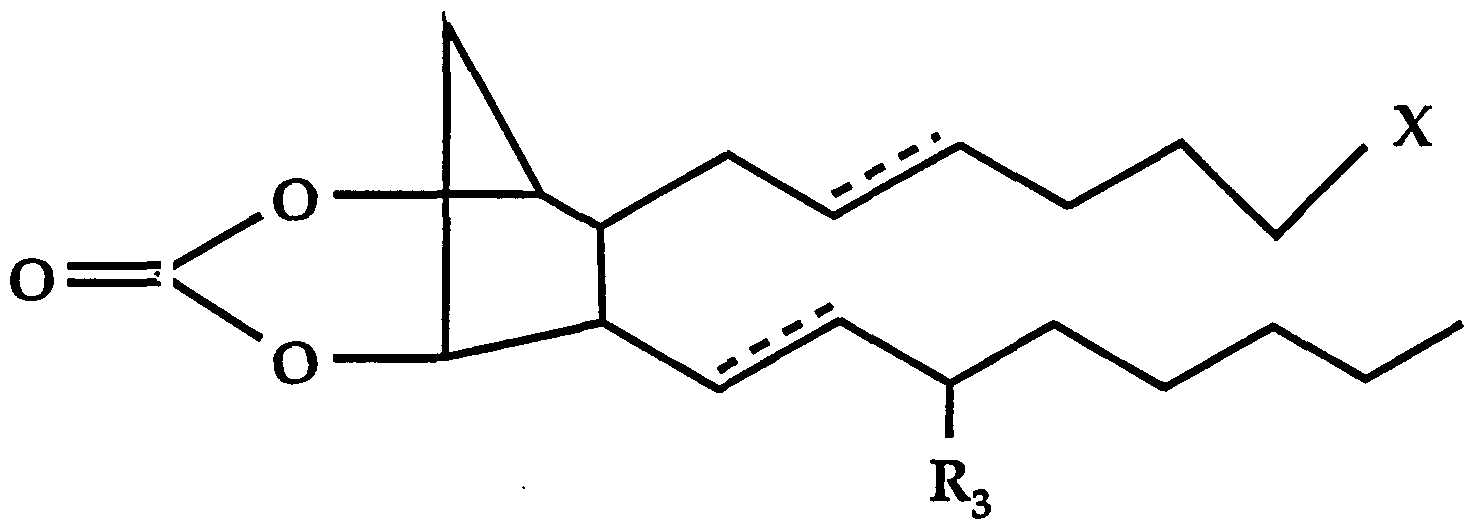
More preferably the method of the present invention comprises administering a 7-[carboxyalkyl or alkenyl]-6-[alkyl or alkenyl]-3-oxo-2,4-dioxobicyclo[3.2.1] octane or a hydroxyl, nitro, amino, amido, azido, oxime, thiol, ether and thiol ether derivative thereof represented by the formula II
Figure imgf000011_0001
wherein either the α or ω chain may be unsaturated, i.e. the dashed bonds represent a single bond or a double bond which can be in the cis or trans configuration and R3 is =0, -OH or -0 (CO)R.^; wherein R is a saturated or unsaturated acyclic hydrocarbon group having from 1 to about 20 carbon atoms, or -(CH2)mR.z wherein m is 0-10, preferably 0-4; and R.7_ is an aliphatic ring from about 3 to about 7 carbon atoms, or an aryl or heteroaryl ring, as defined above; or a pharmaceutically acceptable salt thereof. Preferably the derivative used in the above method of treatment is a compound of formula III.
Figure imgf000012_0001
wherein hatched lines indicate α configuration, solid triangles are used to indicate β configuration.
As an aromatic ring, R7 preferably is phenyl, and the heteroaromatic rings have oxygen, nitrogen or sulfur as a heteroatom, i.e., R7 may be thienyl, furanyl, pyridyl, etc.
In a further aspect, the present invention relates to pharmaceutical compositions comprising a therapeutically effective amount of a compound of formulae (I), (II), or (III) wherein the symbols have the above meanings, or a pharmaceutically acceptable salt thereof in admixture with a non-toxic, pharmaceutically acceptable liquid vehicle. In a still further aspect, the present invention relates to
7-[carboxylalkyl or alkenyl]-6- [alkyl or alkenyl]-3-oxo-2,4- dioxobicyclo[3.2.1] octane, or hydroxyl, nitro, amino, amido, azido, oxime, thiol, ether or thiol ether derivatives thereof, of the above formulae, wherein the substituents and symbols are as defined hereinabove, or a pharmaceutically acceptable salt of such compounds.
Preferred representatives of the compounds within the scope of the present invention are the compounds of formula III wherein X is -COOR4, -CH2OH and -C(0)N(R4)2, wherein R4 is defined above, and the pharmaceutically acceptable salts thereof. Specific compounds within the scope of this invention are as follows:
7-[6-carboxy-2-cis-hexenyl]-6-[3α-hydroxy- l -trans- octenyl]-3-oxo-2,4-dioxobicyclo[3.2.1]octane
7-[6-carbomethoxy-2-cis-hexenyl-6- [3α-hydroxy- l - trans-octenyl]-3-oxo-2,4-dioxobicyclo[3.2.1] octane
7- [6-carbomethoxy-2-cis-hexenyl-6-[3α-pivaloyloxy- l- trans-octenyl]-3-oxo-2,4-dioxobicyclo[3.2.1] octane
7-[7-hydroxy-2-cis-heptenyl-6-[3α-hydroxy- l -trans- octenyl]-3-oxo-2,4-dioxobicyclo[3.2.1] octane
7-[6-carbobenzoxy-2-cis-hexenyl-6-[3α-hydroxy- l - trans-octenyl]-3-oxo-2,4-dioxobicyclo[3.2.1] octane
7-[6-carbobenzoxy-2-cis-hexenyl]-6-[3α-pivaloyloxy-l - trans-octenyl]-3-oxo-2,4-dioxobicyclo[3.2.1 ]octane
7-[6-carboamino-2-cis-hexenyl-6-[3α-hydroxy- l -trans- octenyl]-3-oxo-2,4-dioxobicyclo[3.2.1]octane
7-[6-carboisopropylamino-2-cis-hexenyl]-6-[3α- hydroxy- l -trans-octenyl]-3-oxo-2,4-dioxobicyclo [3.2. 1 ] octane
7-[6-carboxy-2-cis-hexenyl]-6-[3α-pivaloloxy- 1 -trans- octenyl]-3-oxo-2,4-dioxobicyclo [3.2.1] octane
A pharmaceutically acceptable salt is any salt which retains the activity of the parent compound and does not impart any deleterious or undesirable effect on the subject to whom it is administered and in the context in which it is administered. Such salts are those formed with pharmaceutically acceptable cations, e.g., alkali metals, alkali earth metals, etc.
Pharmaceutical compositions may be prepared by combining a therapeutically effective amount of at least one compound according to the present invention, or a pharmaceutically acceptable salt thereof, as an active ingredient, with conventional ophthalmically acceptable pharmaceutical excipients, and by preparation of unit dosage forms suitable for topical ocular use. The therapeutically efficient amount typically is between about 0.0001 and about 5% (w/v), preferably about 0.001 to about 1.0% (w/v) in liquid formulations.
For ophthalmic application, preferably solutions are prepared using a physiological saline solution as a major vehicle. The pH of such ophthalmic solutions should preferably be maintained between 4.5 and 8.0 with an appropriate buffer system, a neutral pH being preferred but not essential. The formulations may also contain conventional, pharmaceutically acceptable preservatives, stabilizers and surfactants.
Preferred preservatives that may be used in the pharmaceutical compositions of the present invention include, but are not limited to, benzalkonium chloride, chlorobutanol, thimerosal, phenylmercuric acetate and phenylmercuric nitrate. A preferred surfactant is, for example, Tween 80. Likewise, various preferred vehicles may be used in the ophthalmic preparations of the present invention. These vehicles include, but are not limited to, polyvinyl alcohol, povidone, hydroxypropyl methyl cellulose, poloxamers, carboxymethyl cellulose, hydroxyethyl cellulose cyclodextrin and purified water.
Tonicity adjustors may be added as needed or convenient. They include, but are not limited to, salts, particularly sodium chloride, potassium chloride, mannitol and glycerin, or any other suitable ophthalmically acceptable tonicity adjustor.
Various buffers and means for adjusting pH may be used so long as the resulting preparation is ophthalmically acceptable. Accordingly, buffers include acetate buffers, citrate buffers, phosphate buffers and borate buffers. Acids or bases may be used to adjust the pH of these formulations as needed.
In a similar vein, an ophthalmically acceptable antioxidant for use in the present invention includes, but is not limited to, sodium metabisulfite, sodium thiosulfate, acetylcysteine, butylated hydroxyanisole and butylated hydroxytoluene.
Other excipient components which may be included in the ophthalmic preparations are chelating agents. The preferred chelating agent is edentate disodium, (sodium EDTA) although other chelating agents may also be used in place of or in conjunction with it.
The ingredients are usually used in the following amounts:
Ingredient Amount (% w/v) active ingredient about 0.001-5 preservative 0-0. 10 vehicle 0-40 tonicity adjustor 0- 1 0 buffer 0.01 - 10 pH adjustor q.s. pH 4.5-7.5 antioxidant as needed surfactant as needed purified water as needed to make
100%
The actual dose of the active compounds of the present invention depends on the specific compound, and on the condition to be treated; the selection of the appropriate dose is well within the knowledge of the skilled artisan.
The ophthalmic formulations of the present invention are conveniently packaged in forms suitable for metered application, such as in containers equipped with a dropper, to facilitate application to the eye. Containers suitable for dropwise application are usually made of suitable inert, non- toxic plastic material, and generally contain between about 0.5 and about 15 ml solution. One package may contain one or more unit doses.
Especially preservative-free solutions are often formulated in non-resealable containers containing up to about ten, preferably up to about five units doses, where a typical unit dose is from one to about 8 drops, preferably one to about 3 drops. The volume of one drop usually is about 20-35 μl.
This invention is further illustrated by the following non-limiting examples.
Example 1
CYCLOPENTANE HEPTENOIC ACID, 5-CIS-2-(3A-t- BUTYLDIMETHYL-SILYLOXY-l-TRANS-OCTENYL)-3,5- DIHYDROXY, [lα, 2β, 3α, 5α] METHYL ESTER.
PGF2α (542 mg, 1.53 mmol) was dissolved in ethylether
(Et2θ) (20 mL) and cooled to 0°C. A solution of CH2N2 in Et2θ was added dropwise to the above suspension until a yellow color persisted. The solution was warmed to 25° C for 0.5 h and then concentrated in vacuo to yield PGF 2α methyl ester as an oil.
The crude ester was heated at reflux with n-butyl boronic acid (0.188 g, 1.84 mmol) in CH2Cl2(3.1 mL) for 2h. The volatile s were removed under vacuum to yield the crude boronate ester which was immediately diluted with CH2CI2 (3 mL) and cooled to 0°C. 2,6-Lutidine (0.43 mL, 3.7 mmol) was added followed by t-butyldimethylsilyl trifluoromethane- sulfonate (0.67 mL, 2.9 mmol). The reaction solution was then warmed to 23 °C for 16h, concentrated, and rediluted with methanol (40mL). After stirring for 24 h, the methanol was removed under vacuum and the residue was purified by FCC (2: 1 hexane (hex)/ethyl acetate (EtOAc), silica gel) to yield
(0.697, 92% yield) of the named product as an oil.
Example 2 7-[6-CARBOMETHOXY-2-CIS-HEXENYL]-6-[3α-t- BUTYLDIMETHYLSILYLOXY-l-TRANS-OCTENYL]-3-OXO-
2,4-DIOXOBICYCLO [3.2.1] OCTANE
149 mg (0.318 mmol) of the compound of Example 1 were dissolved in 1.6 ml of CH2CI2 and cooled to at -78°C . 0.154 mL (0.6 mmol) of pyridine were then added and stirring was continued for 5 minutes. 48 mg (0.5 mmol) of triphosgene dissolved in 1 mL CH2CI2 was slowly added and the resulting mixture was stirred for an additional hour before being allowed to slowly warm to room temperature. After standing overnight the reaction was quenched with saturated aqueous
NH4CI, diluted with EtOAc and the resulting reaction mixture was worked up washing the organic portion with 1 N HC1, N a H C θ 3 and brine. The organic layer was dried over anhydrous MgS θ4 to yield 149 mg of a crude fraction including the named compound.
Example 3
7-[7-HYDROXY-2-CIS-HEPTENYL]-6-[3α-t-
BUTYLDIMETHYLSILYLOXY-l-TRANS-OCTENYL]-3-OXO- 2,4-DIOXOBICYCLO [3.2.1] OCTANE
73 mg (0.143 mmol) of the compound of Example 2 were dissolved in a 0.28 mL of ethylether (Et2θ) and then 3.0 mg of lithium borohydride (LiBH4 ) were added and the mixture stirred at 23° C overnight. The reaction was quenched using
2.0 N NaOH and the resulting reaction mixture was worked up by consecutive treatment with EtOAc and brine. The resulting organic layer was concentrated in vacuo and dried over anhydrous MgSθ4 to yield 63 mg of the named compound.
Example 4
7-[7-HYDROXY-2-CIS-HEPTENYL]-6-[3α-HYDROXY-l- TRANS-OCTENYL]-3-OXO-2,4-DIOXOBICYCLO [3.2.1]
OCTANE
14 mg (0.03 mmol) of the compound of Example 3 were dissolved in THF and 0.045 mL of a 1.0 M solution of tetrabutyl ammonium fluoride (Bu4NF) were added. After stirring under argon at room temperature for 5 hours the resulting reaction mixture was worked up by dilution with EtOAc and washing with H2θ. The organic layer was dried over anhydrous MgS04, filtered, and concentrated in vacuo to yield 83 mg of crude product. The crude product was purified by consecutive elution on silica gel with a solution of 60% EtOAc in hexane to yield the named compound.
Example 4a
CYCLOPENTANE HEPTENOIC ACID, 5-CIS-2-(3-t-
BUTYLDIMETHYLSILYLOXY-l-TRANS-OCTENYL)-3,5-
DIHYDROXY,[lα, 2β, 3α, 5α] BENZYL ESTER
A solution of the ester of Example 1 (556 mg, 1.17 mmol) in 0.5 N aqueous lithium hydroxide (3.5 mL, 1.76 mmol) and THF (7.0 mL) was stirred at 23° C for 24 h and acidified with 10% citric acid. The mixture was extracted with EtOAc and the combined organics were dried (MgSθ4), filtered and concentrated in vacuo.
The crude residue was treated with 0-benzyl-N,N'- diisopropylisourea (0.41g, 1.76 mmol) and heated to 65° C in benzene (7.0 mL) for 24 h. The reaction was cooled to room temperature and stripped of the solvent. FCC (2:1 hex/EtOAc) of the residue gave 553 mg (85%) of the named compound. Example 5
7-[6-CARBOBENZOXY-2-CIS-HEXENYL]-6-[3α-t-
BUTYLDIMETHYLSILYLOXY-l-TRANS-OCTENYL]-3-OXO-
2,4-DIOXOBICYCLO [3.2.1] OCTANE
330 mg (0.591 mmol) of the compound of Example 4a were treated in accordance with the procedure of Example 2 to yield 235.7 mg (68% yield) of the named compound.
Example 6
7-[6-CARBOBENZOXY-2-CIS-HEXENYL]-6-[3α-HYDROXY- l-TRANS-OCTENYL]-3-OXO-2,4-DIOXOBICYCLO [3.2.1]
OCTANE
60 mg (0.1027 mmol) of the compound of Example 5 in 1.0 mL of THF was treated with 0.2054 mL a 1.0 M solution of Bu4NF and stirred at 23°C for 16 hours. The reaction mixture was diluted with EtOAc and washed, consecutively, with H2θ and brine and dried over anhydrous MgSθ4. The dried organic phase was filtered and the filtrate concentrated under vacuum. Elution on silica gel with a 1:1 mixture of hexane and EtOAc yielded 29.7 mg (62% yield) of the named compound.
Example 7
7-[6-CARBOXY-2-CIS-HEXENYL]-6-[3α-HYDROXY-l- TRANS-OCTENYL]-3-OXO-2,4-DIOXOBICYCLO [3.2.1]
OCTANE
25 mg (0.0531 mmol) of the compound of Example 6 was mixed with 8 mg of a catalyst comprising 10% Palladium, by weight, on carbon and 0.25 mL of l -methyl- 1 ,4- cyclohexadiene in 1.0 mL of methanol and heated at 35°C. In 20 minutes the reaction was complete and the reaction mixture was diluted with CH2CI2 and filtered. The filtrate was concentrated in vacuo and eluted on silica gel with EtOAc to yield 20 mg (99% yield) of the named compound.
Example 8 CYCLOPENTANE HEPTENOIC ACID, 5-CIS-2-(3α-
HYDROXY-l-TRANS-OCTENYL)-3,5-HYDROXY, [lot, 2β,
3α, 5a] BENZYL ESTER
1.75 g (4.93 mmol) of the prostaglandin F2α were mixed with 1.73 g (7.40 mmol) of 0-benzyl-N,N'-diisopropylisourea in
25 mL of benzene and heated to 65° C to yield a crude fraction containing the named compound. After separation of the crude from the solvent, treatment by consecutive elution on silica gel with a 1 : 1 mixture of hexane and EtOAc followed by 95:5 mixture of EtOAc and methanol gave 2.08 g (95% yield) of the named compound.
Example 9 CYCLOPENTANE HEPTENOIC ACID, 5-CIS-2-(3α- PIVALOYLOXY-l-TRANS-OCTENYL)-3,5-DIHYDROXY,
[lα, 2β, 3α, 5α] BENZYL ESTER
1.13 gm (2.54 mmol) of the compound of Example 8 and 0.39 g (3.81 mmol) of n-butylboronic acid in 28 mL of toluene were heated at reflux for 72 hours with azeotropical removal of water. The reaction mixture was cooled to 23° C and concentrated in vacuo. The residue was diluted with CH2CI2 and reacted with 0.77 mL (3.81 mmol) of trimethylacetylchloride, 1.06 mL (7.63mmol) of triethylamine and 155 mg (1.27 mmol) of DMAP (4-dimethylaminopyridine) and stirred at 23° C for 48 hours. The resulting reaction mixture was concentrated, dissolved in methanol and stirred overnight. The methanol was removed in vacuo and the residue was purified by elution on silica gel with a 2: 1 mixture of hexane and EtOAc to afford 0.87 gm (65% yield) of the named compound was obtained. Example 10
CYCLOPENTANE HEPTENOIC ACID, 5-CIS-2-(3α-
PIVALOYLOXY-l-TRANS-OCTENYL)-3-HYDROXY, 5-
IMIDAZOLYLOXY [lα, 2β, 3α, 5a] BENZYL ESTER
211 mg (0.399 mmol) of the compound of Example 9 and 77.7 mg (0.479 mmol) of 1,1-carbonyldiimidazole were dissolved in 1.0 mL of CH2CI2 and stirred for 24 hours at 23°C to yield the named compound.
Example 11
7-[6-CARBOBENZOXY-2-CIS-HEXENYL]-6-[3α-
PIVALOYLOXY-l-TRANS-OCTENYL]-3-OXO-2,4-
DIOXOBICYCLO[3.2.1]OCTANE
0.133 mmol of the compound of Example 10 and 0.14 mL (1.33 mmol) of t-butylamine dissolved in CH2CI2 were heated to 45° C for 48 hours. The reaction mixture was cooled to room temperature, concentrated in vacuo and eluted on silica gel with a 3:1 mixture of hexane and EtOAc to yield 31 mg (42% yield) of the named compound.
Example 12 7-[6-CARBOXY-2-CIS-HEXENYL]-6-[3α-PIVALOYLOXY- l-TRANS-OCTENYL]-3-OXO-2,4-DIOXOBICYCLO[3.2.1]
OCTANE
The compound of Example 11 was treated according to the procedure of Example 7 to yield the named compound. Example 13
CYCLOPENTANE HEPTENAMIDE, 5-CIS-2-[3ct-t-
BUTYLDIMETHYLSILYLOXY-l-TRANS-OCTENYL)-3,5
DIHYDROXY, [let, 2β, 3α, 5α]
460 mg (0.954 mmol) of the compound of Example 1 was reacted with an excess of NH3 in 6.0 mL of methanol to yield a solution including the named compound. The excess solvent and unreacted NH3 were evaporated and the residue was purified by elution on silica gel, consecutively, with 100%
EtOAc followed by a 9: 1 mixture of CH2CI2 and methanol to yield 395 mg (89% yield) of the named compound.
Example 14 7-[6-CARBOAMINO-2-CIS-HEXENYL]-6-[3ct-t-
BUTYLDIMETHYLSILYLOXY-l-TRANS-OCTENYL]-3-OXO- 2,4-DIOXOBICYCLO[3.2.1]OCTANE
256 mg (0.548 mmol) of the compound of Example 13, 5 mg (0.040 mmol) of 4-dimethylamino pyridine (DMAP) and 98 mg. (0.602 mmol) of 1,1 carbonyldiimidazole were reacted in 1.5 ml of CH2CI2, for 24 hours at 23°C. The resulting reaction solution was concentrated in vacuo and the residue purified by elution with 100% EtOAc. The resulting reaction product was stirred with 71 uL DBU (0.474 mmol) in 1.0 mL of benzene for
24 hours at 23° C. After concentration in vacuo and elution on silica gel with a 2:1 mixture of EtOAc and hexane, 25 mg (10% yield) of the named compound were obtained.
Example 15
7-[6-CARBOAMINO-2-CIS-HEXENYL]-6-[3ct-HYDROXY- l-TRANS-OCTENYL]-3-OXO-2,4-DIOXOBICYCLO[3.2.1]
OCTANE
The compound of Example 14 was converted into the named compound at 95% yield by the procedure of Example 6. Example 16
7-[6-CARBOXY-2-CIS-HEXENYL]-6-[3ct-t-
BUTYLDIMETHYLSILYLOXY-l-TRANS-OCTENYL]-3-OXO-
2,4-DIOXOBICYCLO[3.2.1]OCTANE
156 mg (0.267 mmol) of the compound of Example 5 were treated in accordance with the procedure as Example 7 to yield the corresponding carboxylic acid (99%) yield).
Example 17
7-[6-CARBOISOPROPYLAMINO-2-CIS-HEXENYL]-6-[3ct-
HYDROXY-l-TRANS-OCTENYL]-3-OXO-2,4-
DIOXOBICYCLO [3.2.1] OCTANE
75 mg (0.151 mmol) of the compound of Example 16 in
CH2CI2 were reacted with 1.5 mL of SOC12 at 0°C for 1 h. 69 mg (1.17 mmol) of isopropylamine were added and the resultant solution was warmed to 23° C for 16 h to yield a reaction mixture which upon removal of the excess solvent and purification by elution on silica gel with a 1 :1 mixture of hexane and EtOAc gave 4.8 mg (8% yield) of the named compound.
Example 18A CYCLOPENTANE HEPTENOIC ACID, 5-CIS-2-(3ct-
PIVALOYLOXY-l-TRANS-OCTENYL)-3,5-DIHYDROXY,
[let, 2β, 3ot, 5ot] METHYL ESTER
PGF2ct methyl ester (prepared as described in Example 1) was treated according to the procedure of Example 9 to yield the named compound. Example 18B CYCLOPENTANE HEPTENOIC ACID, 5-CIS-2-(3α-
PIVALOYLOXY-l-TRANS-OCTENYL)-3-HYDROXY, 5- IMIDAZOLYOXY, [let, 2β, 3α, 5a] METHYL ESTER
A solution of the compound of Example 18A (75 mg 0.166 mmol) in THF (1.0 mL) was heated to 50° C and triphosgene (16.4 mg, 0.0553 mmol) was added. After 2 h imidazole (22.6 mg, 0.332 mmol) was added and a white precipitate formed immediately. The reaction was stirred an additional 16 h, allowed to cool to room temperature, and concentrated in vacuo. Purification of the residue by FCC (1 :1 hex/EtoAc, silica gel) afforded the 45.3 mg of the named compound, i.e 50% yield.
Example 18C
7-[6-CARBOMETHOXY-2-CIS-HEXENYL]-6-[3ot-
PIVALOYLOXY-l-TRANS-OCTENYL]-3-OXO-2,4- DIOXOBICYCLO [3.2.1]OCTANE
A solution of the compound of Example 18B (17.4 mg, 0.032 mmol) in benzene (0.75 mL) was treated with 1 ,8- diazabicyclo [5.4.0] undec-7-ene (DBU) (24 μL , 0.159 mmol) at 23° C. After 12 h the reaction solution was concentrated i n vacuo and the residue was purified by FCC (1 : 1 hex/EtoAc, silica gel) to give 12.9 mg (85% yield) of the named compound.
PROSTANOID RECEPTOR ACTIVITY
Activity at different prostanoid receptors was measured in vitro in isolated smooth muscle preparations. FP-activity was measured as contraction of the isolated feline iris sphincter. EPi -activity was measured as contraction of the longitudinal smooth muscle of the isolated guinea pig ileum.
EP 3 -activity was measured as inhibition of the twitch response induced by electrical field stimulation in the isolated guinea pig was deferens and as contraction of the longitudinal smooth muscle of the isolated chick ileum. TP-vasoconstrictor activity was measured as contraction of rings of the isolated rat thoracic aorta. Effects on platelets from healthy human donors were measured by incubating platelet-rich plasma with the compounds described herein. Inhibition of aggregation was determined by the ability of the compounds described herein to inhibit platelet aggregation in platelet-rich plasma induced by 20 μM ADP. The activity profile of various compounds is reported in Table 1.
In addition, inhibition by the thromboxane A2-receptor antagonist SQ29,548 ([lS-[l ot , 2α (5Z), 3ct, 4ot]]-7- [3- [[2- [phenylamino)carbonyl]hydrazino]methyl]-7-oxabicyclo[2.2.1] hept-2-yl]-5-heptenoic acid) of vasoconstrictor activity was investigated. For that purpose, activity of the compound of Example 4, the compound of Example 7, and U-46619 (9,11- dideoxy-9ot, l l ct-methanoepoxy prostaglandin F2ot). a potent and stable thromboxane A2 analog, was measured in rings of the isolated rat thoracic aorta, first in the absence and then in the presence of SQ29,548 (1 uM). The results are reported in Table 2.
Example 19
PHARMACOLOGICAL SELECTIVITY FOR A
TP-RECEPTOR SUBTYPE PRESENT ON VASCULAR
SMOOTH MUSCLE
Examination of Table 1 reveals an unexpected and unique trend in biological activity associated with certain examples of formula III. Typically, thromboxane (TP-) receptor agonists indiscriminately cause both platelet aggregation and smooth muscle contraction. It has, therefore, been concluded that there is no convincing evidence that subtypes of the TP-receptor exist (Jones, R.L., Wilson, N.H., Armstrong, R.A., Tymkewycz, P.M. Colloque INSERM 152:335- 344, 1987). Examples 4, 15 and 16 exhibit pronounced activity in contracting vascular smooth muscle but have no or minimal ability to cause platelet aggregation.
Further evidence is provided below to demonstrate that the ability of examples 4, 15 and 16 to cause contraction of vascular smooth without causing platelet aggregation involves selective stimulation of a subtype of TP-receptor present on vascular smooth muscle.
1. A TP-receptor antagonist blocks the effect of agonists which are selective for the vascular TP-receptor (Example 4) and non- selective with respect to vascular and platelet TP- receptors (Example 7, U-46619), see Table 2. This shows that Example 4 and its congeners, which show selectivity for contracting vascular smooth muscle, produce their effect by interacting with a subtype of TP-receptor as opposed to some other type of eicosanoid receptor.
2. The compound Example 4 neither causes platelet aggregation nor inhibits the ability of U-46619 or Example 7 to cause platelet aggregation, see Table 3. Moreover, Example 4 did not inhibit ADP or arachidonic acid induced platelet aggregation (Table 4) and, therefore, its activity cannot be ascribed to a mechanism which opposes the aggregatory response, e.g., behaving as a prostacyclin or prostaglandin D2 mimetic, inhibition of cyclooxygenase.
Thus, it appears that certain examples of formula III selectively constrict smooth muscle by stimulating a TP- receptor subtype which exists on smooth muscle but not on platelets.
Example 20 EFFECTS ON INTRAOCULAR PRESSURE
The effects of four examples of Formula III and the thromboxane mimetic U-46619 on intraocular pressure are provided in the following tables. The compounds were prepared at the said concentrations in a vehicle comprising 0.1% polysorbate 80 and 10 mM TRIS base. Dogs and monkeys were treated by administering 25 ul to the ocular surface, the contralateral eye received vehicle as a control. Intraocular pressure was measured by applanation pneumatonometry. Experiments were performed with dogs and monkeys. Dog intraocular pressure was measured immediately before drug administration and at 2, 4 and 6 hour thereafter. Additional studies in monkeys were performed over a 5 day period and drug was administered at times 0, 6, 24, 30, 48, 54, 72, 78, and 96 hours. Monkey intraocular pressure was recorded just before drug administration on each day and at the 2 and 4 hour time intervals between dosing.
The examples of Formula III examined showed a pronounced ocular hypotensive effect in both dogs and monkeys (Tables 5 and 6) . In contrast, the thromboxane/endoperoxide mimetic U-46619 produced an increase in intraocular pressure. Thus, the cyclic carbonate derivatives described herein caused a profound decrease in intraocular pressure which was unexpected given the absence of ocular hypotensive activity associated with U-46619. Since the in vitro pharmacological effects of the cyclic carbonate analogs (a) cannot be attributed to stimulation of other known prostanoid receptors and (b) are susceptible to a thromboxane antagonist, it is concluded that the ocular hypotensive activity of these compounds is related to selective stimulation of a thromboxane receptor subtype. The foregoing description details specific methods and compositions that can be employed to practice the present invention, and represents the best mode contemplated. However, it is apparent from one of ordinary skill in the art that further compounds with the desired pharmacological properties can be prepared in an analogous manner, and that the disclosed compounds can also be obtained from different starting compounds via different chemical reactions. Similarly, different pharmaceutical compositions may be prepared and used with substantially the same results. Thus, however detailed the foregoing may appear in text, it should not be construed as limiting the overall scope hereof; rather, the ambit of the present invention is to be governed only by the lawful construction of the appended claims.

Claims

1. A method of treating ocular hypertension which comprises applying to the eye an amount sufficient to treat > ocular hypertension of a compound of formula I
Figure imgf000029_0001
wherein A is an alkylene or alkenylene radical having from two to seven carbon atoms, which radical may be substituted with one or more hydroxy, oxo, alkyloxy or alkylcarboxy groups or said alkylene or alkenylene may have one or more enchained oxo radicals, and B is a methyl radical or a cycloalkyl radical having from three to seven carbon atoms, or an aryl radical, selected from the group consisting of hydrocarbyl aryl and heteroaryl radicals wherein the heteroatom is selected from the group consisting of nitrogen, oxygen and sulfur atoms, or substituted derivatives of said methyl, cycloalkyl or aryl radicals wherein said substituent is selected from the group consisting of halo, nitro, amino, thiol, hydroxy, alkyloxy and alkylcarboxy; and X is selected from the group consisting of halo, nitro, cyano, -COOR4 , -CH2O H , -C(0)N(R4)2, -CH2N(R4)2 -CH=N-OH and -CH2SR4 radicals wherein R4 is hydrogen, Ci to C10 alkyl, phenyl or benzyl; or a pharmaceutically acceptable salt thereof.
2. The method of claim 1 wherein said compound is a compound of formula II
Figure imgf000030_0001
wherein either the α or ω chain may be unsaturated, i.e. the dashed bonds represent a single bond or a double bond which can be in the cis or trans configuration and R3 is =0, -OH or -O(CO) Re ; wherein R6 is a saturated or unsaturated acyclic hydrocarbon group having from 1 to about 20 carbon atoms, or -(CH2)mR7 wherein m is 0-10, and R7 is an aliphatic ring having from about 3 to about 7 carbon atoms, or an aryl radical selected from the group consisting of hydrocarbyl aryl and heteroaryl radicals wherein the heteroatom is selected from the group consisting of nitrogen, oxygen and sulfur atoms; or a pharmaceutically acceptable salt thereof.
3. The method of claim 2 wherein said compound is a compound of formula III
Figure imgf000030_0002
wherein hatched lines indicate ct configuration, solid triangles are used to indicate β configuration.
4. The method of claim 3 wherein X is selected from the group consisting of -COOR4 , -CH2O R4, -CH2N(R4)2 and -C(0)N(R4)2-
5. The method of claim 4 wherein the compound is selected from the group consisting of
7-[6-carboxy-2-cis-hexenyl]-6-[3ct-hydroxy- l -trans- octenyl]-3-oxo-2,4-dioxobicyclo[3.2.1]octane
7-[6-carbomethoxy-2-cis-hexenyl]-6- [3ot-hydroxy- l - trans-octenyl]-3-oxo-2,4-dioxobicyclo[3.2.1 ]octane
7-[6-carbomethoxy-2-cis-hexenyl]-6-[3α-pivaloxy- l - trans-octenyl]-3-oxo-2,4-dioxobicyclo[3.2.1]octane
7- [7-hydroxy-2-cis-heptenyl]-6- [3α-hydroxy- l -trans- octenyl]-3-oxo-2,4-dioxobicyclo[3.2.1]octane
7-[6-carbobenzoxy-2-cis-hexenyl]-6-[3α-hydroxy- l - trans-octenyl]-3-oxo-2,4-dioxobicyclo[3.2.1]octane
7-[6-carboamino-2-cis-hexenyl]-6-[3ot-hydroxy- l -trans- octenyl]-3-oxo-2, 4-dioxobicyclo [3.2.1] octane
7-[6-carboisopropylamino-2-cis-hexenyl]-6- [3ot- hydroxy-l-trans-octenyl]-3-oxo-2,4-dioxobicyclo[3.2.1] octane
7-[6-carboxy-2-cis-hexenyl]-6-[3ot-pivaloyloxy- l -trans- octenyl]-3-oxo-2,4-dioxobicyclo[3.2.1]octane
7-[6-carboxbenzoxy-2-cis-hexenyl]-6-[3ot-pivaloyloxy- l -trans-octenyl]-3-oxo-2,4-dioxobicyclo[3.2.1]octane
6. A pharmaceutical composition for treating ocular hypertension which comprises a therapeutically-effective amount of a compound of formula I
Figure imgf000032_0001
wherein A is an alkylene or alkenylene radical having from two to seven carbon atoms, which radical may be substituted with one or more hydroxy, oxo, alkyloxy or alkylcarboxy groups or said alkylene or alkenylene may have one or more enchained oxo radicals, and B is a methyl radical or a cycloalkyl radical having from three to seven carbon atoms, or an aryl radical, selected from the group consisting of hydrocarbyl aryl and heteroaryl radicals wherein the heteroatom is selected from the group consisting of nitrogen, oxygen and sulfur atoms, or substituted derivatives of said methyl, cycloalkyl or aryl radicals wherein said substituent is selected from the group consisting of halo, nitro, amino, thiol, hydroxy, alkyloxy and alkylcarboxy; and X is selected from the group consisting of halo, nitro, cyano, -COOR4 , -CH2O H ,
-C(0)N(R4)2, -CH2N(R4)2 -CH=N-OH and -CH2SR4 radicals wherein R4 is hydrogen, C\ to C10 alkyl, phenyl or benzyl; or a pharmaceutically acceptable salt thereof.
7. A pharmaceutical composition of claim 6 wherein said compound is a compound of formula II
Figure imgf000033_0001
wherein either the α or ω chain may be unsaturated, i.e. the dashed bonds represent a single bond or a double bond which can be in the cis or trans configuration and R3 is =0, -OH or -O(CO) Rβ', wherein R6 is a saturated or unsaturated acyclic hydrocarbon group having from 1 to about 20 carbon atoms, or -(CH2)mR7 wherein m is 0-10, and R7 is an aliphatic ring having from about 3 to about 7 carbon atoms, or an aryl radical selected from the group consisting of hydrocarbyl aryl and heteroaryl radicals wherein the heteroatom is selected from the group consisting of nitrogen, oxygen and sulfur atoms; or a pharmaceutically acceptable salt thereof.
8. A pharmaceutical composition of claim 7 wherein said compound is a compound of formula III
Figure imgf000033_0002
wherein hatched lines indicate a configuration, solid triangles are used to indicate β configuration.
9. A pharmaceutical composition of claim 8 wherein X is selected from the group consisting of -COOR4, -CH2O R4,
-CH2N(R4)2 and -C(0)N(R4)2.
10. A pharmaceutical composition of claim 9 wherein the compound is selected from the group consisting of
7-[6-carboxy-2-cis-hexenyl]-6-[3ot-hydroxy- l -trans- octenyl]-3-oxo-2,4-dioxobicyclo[3.2.1]octane
7-[6-carboxy-2-cis-hexenyl]-6-[3ot-pivaloxy- l -trans- octenyl]-3-oxo-2,4-dioxobicyclo[3.2.1]octane
7-[6-carbomethoxy-2-cis-hexenyl]-6-[3ot-hydroxy- l - trans-octenyl]-3-oxo-2,4-dioxobicyclo[3.2.1]octane
7-[7-hydroxy-2-cis-heptenyl]-6-[3ct-hydroxy- l -trans- octenyl]-3-oxo-2,4-dioxobicyclo[3.2.1]octane
7-[6-carbobenzoxy-2-cis-hexenyl]-6-[3ot-hydroxy- l - trans-octenyl]-3-oxo-2,4-dioxobicyclo[3.2.1]octane s-octenyl]-3-oxo-2,4-dioxobicyclo [3.2.1] octane
7-[6-carboamino-2-cis-hexenyl]-6-[3ct-hydroxy-l-trans- octenyl]-3-oxo-2,4-dioxobicyclo[3.2.1]octane.
7-[6-carboisopropylamino-2-cis-hexenyl]-6-[3α- hydroxy-l-trans-octenyl]-3-oxo-2,4-dioxobicyclo[3.2.1] octane
7-[6-carboxy-2-cis-hexenyl]-6-[3ot-pivaloyloxy- l-trans- octenyl]-3-oxo-2,4-dioxobicyclo[3.2.1]octane
7-[6-carboxbenzoxy-2-cis-hexenyl]-6-[3ot-pivaloyloxy- l-trans-octenyl]-3-oxo-2,4-dioxobicyclo[3.2.1]octane
1 1. A compound selected from the group consisting of compounds represented by formula I
Figure imgf000035_0001
wherein A is an alkylene or alkenylene radical having from two to seven carbon atoms, which radical may be substituted with one or more hydroxy, oxo, alkyloxy or alkylcarboxy groups or said alkylene or alkenylene may have one or more enchained oxo radicals, and B is a methyl radical or a cycloalkyl radical having from three to seven carbon atoms, or an aryl radical, selected from the group consisting of hydrocarbyl aryl and heteroaryl radicals wherein the heteroatom is selected from the group consisting of nitrogen, oxygen and sulfur atoms, or substituted derivatives of said methyl, cycloalkyl or aryl radicals wherein said substituent is selected from the group consisting of halo, nitro, amino, thiol, hydroxy, alkyloxy and alkylcarboxy; and X is selected from the group consisting of halo, nitro, cyano, -COOR4, -CH2O H , -C(0)N(R4)2, -CH2N(R4)2 -CH=N-OH and -CH2SR4 radicals wherein R4 is hydrogen, Ci to Cio alkyl, phenyl or benzyl; or a pharmaceutically acceptable salt thereof.
12. A compound of claim 11 wherein said compound is a compound of formula II
Figure imgf000036_0001
wherein either the ot or ω chain may be unsaturated, i.e. the dashed bonds represent a single bond or a double bond which can be in the cis or trans configuration and R3 is =0, -OH or -O(CO) Re; wherein R is a saturated or unsaturated acyclic hydrocarbon group having from 1 to about 20 carbon atoms, or -(CH2)m 7 wherein m is 0-10, and R7 is an aliphatic ring having from about 3 to about 7 carbon atoms, or an aryl radical selected from the group consisting of hydrocarbyl aryl and heteroaryl radicals wherein the heteroatom is selected from the group consisting of nitrogen, oxygen and sulfur atoms; or a pharmaceutically acceptable salt thereof.
13. A compound of claim 12 wherein said compound is a compound of formula III
Figure imgf000036_0002
wherein hatched lines indicate ot configuration, solid triangles are used to indicate β configuration.
14. A compound of claim 13 wherein X is selected from the group consisting of -COOR4, -CH2O R4 and -CH2N(R4)2, -C(0)N(R4)2-
15. A compound of claim 14 wherein the compound is selected from the group consisting of
7-[6-carboxy-2-cis-hexenyl-6-[3ct-hydroxy- l-trans- octenyl]-3-oxo-2,4-dioxobicyclo[3.2.1]octane
7-[6-carbomethoxy-2-cis-hexenyl-6-[3α-hydroxy- l - trans-octenyl]-3-oxo-2,4-dioxobicyclo[3.2.1]octane
7-[6-carbomethoxy-2-cis-hexenyl-6-[3α-pivaloyloxy-l- trans-octenyl]-3-oxo-2,4-dioxobicyclo[3.2.1]octane
7-[7-hydroxy-2-cis-heptenyl-6-[3ot-hydroxy- l -trans- octenyl]-3-oxo-2,4-dioxobicyclo[3.2.1]octane
7-[6-carbobenzoxy-2-cis-hexenyl-6-[3α-hydroxy-l - trans-octenyl]-3-oxo-2,4-dioxobicyclo[3.2.1]octane
7-[6-carboamino-2-cis-hexenyl]-6-[3ot-hydroxyl- l - trans-octenyl]-3-oxo-2,4-dioxobicyclo[3.2.1]octane
7-[6-carboisopropylamino-2-cis-hexenyl]-6-[3ot- hydroxy-l-trans-octenyl]-3-oxo-2,4-dioxobicyclo[3.2.1] octane
7-[6-carboxy-2-cis-hexenyl]-6-[3ot-pivaloloxy-l -trans- octenyl]-3-oxo-2,4-dioxobicyclo[3.2.1]octane
7-[6-carbobenzoxy-2-cis-hexenyl]-6-[3α-pivaloyloxy- l - trans-octenyl]-3-oxo-2,4-dioxobicyclo[3.2.1]octane
PCT/US1994/014012 1993-12-28 1994-12-05 7-[carboxyalkyl or alkenyl]-6-[alkyl or alkenyl] 3-oxo-2,4-dioxobicyclo-[3.2.1] octane and derivatives thereof Ceased WO1995018103A1 (en)

Priority Applications (5)

Application Number Priority Date Filing Date Title
EP95904826A EP0737185B1 (en) 1993-12-28 1994-12-05 7-[carboxyalkyl or alkenyl]-6-[alkyl or alkenyl] 3-oxo-2,4-dioxobicyclo-[3.2.1] octane and derivatives thereof
CA002180010A CA2180010C (en) 1993-12-28 1994-12-05 7-[carboxyalkyl or alkenyl]-6-[alkyl or alkenyl] 3-oxo-2,4-dioxobicyclo-[3.2.1] octane and derivatives thereof
DE69417584T DE69417584T2 (en) 1993-12-28 1994-12-05 7- [CARBOXYALKYL OR ALKENYL] -6- [ALKYL OR ALKENYL] 3-OXO-2,4-DIOXOBICYCLO- [3.2.1] OCTANE AND THEIR DERIVATIVES
JP7518044A JPH09507229A (en) 1993-12-28 1994-12-05 7- [carboxyalkyl or alkenyl] -6- [alkyl or alkenyl] -3-oxo-2,4-dioxobicyclo [3.2.1] octane and its derivatives
AU13361/95A AU1336195A (en) 1993-12-28 1994-12-05 7-(carboxyalkyl or alkenyl)-6-(alkyl or alkenyl) 3-oxo-2,4-dioxobicyclo-(3.2.1) octane and derivatives thereof

Applications Claiming Priority (2)

Application Number Priority Date Filing Date Title
US08/174,534 1993-12-28
US08/174,534 US5416106A (en) 1993-12-28 1993-12-28 7-[carboxyalkyl or alkenyl]-6-[alkyl or alkenyl]3-oxo-2,4-dioxobicyclo-[3.2.1] octane and derivatives thereof

Publications (1)

Publication Number Publication Date
WO1995018103A1 true WO1995018103A1 (en) 1995-07-06

Family

ID=22636517

Family Applications (1)

Application Number Title Priority Date Filing Date
PCT/US1994/014012 Ceased WO1995018103A1 (en) 1993-12-28 1994-12-05 7-[carboxyalkyl or alkenyl]-6-[alkyl or alkenyl] 3-oxo-2,4-dioxobicyclo-[3.2.1] octane and derivatives thereof

Country Status (8)

Country Link
US (2) US5416106A (en)
EP (1) EP0737185B1 (en)
JP (1) JPH09507229A (en)
AU (1) AU1336195A (en)
CA (1) CA2180010C (en)
DE (1) DE69417584T2 (en)
ES (1) ES2133721T3 (en)
WO (1) WO1995018103A1 (en)

Cited By (2)

* Cited by examiner, † Cited by third party
Publication number Priority date Publication date Assignee Title
WO2000066577A3 (en) * 1999-04-29 2001-03-01 Allergan Sales Inc Brigded cycloalkanes as thromboxane ligands without blood clotting effects
US9688689B2 (en) 2014-05-13 2017-06-27 Novartis Ag Compounds and compositions for inducing chondrogenesis

Families Citing this family (5)

* Cited by examiner, † Cited by third party
Publication number Priority date Publication date Assignee Title
US5741812A (en) * 1993-12-28 1998-04-21 Allergan Thromboxane ligands without blood clotting side effects
US6462077B1 (en) * 1993-12-28 2002-10-08 Allergan, Inc. Thromboxane ligands without blood clotting side effects
US5650431A (en) * 1993-12-28 1997-07-22 Allergan Thromboxane ligands without blood clotting side effects
US5416106A (en) * 1993-12-28 1995-05-16 Allergan, Inc. 7-[carboxyalkyl or alkenyl]-6-[alkyl or alkenyl]3-oxo-2,4-dioxobicyclo-[3.2.1] octane and derivatives thereof
RU2246730C1 (en) * 2003-06-03 2005-02-20 Государственное учреждение "Нижегородский научно-исследовательский институт травматологии и ортопедии Министерства здравоохранения Россиийской Федерации" Method for evaluating anticoagulant-fibrinolytic blood potential at burn disease

Citations (2)

* Cited by examiner, † Cited by third party
Publication number Priority date Publication date Assignee Title
EP0364417A1 (en) * 1988-09-06 1990-04-18 Pharmacia AB Prostaglandin derivatives for the treatment of glaucoma or ocular hypertension
WO1993014743A2 (en) * 1992-02-04 1993-08-05 Allergan, Inc. Polar c-1 esters of prostaglandins

Family Cites Families (4)

* Cited by examiner, † Cited by third party
Publication number Priority date Publication date Assignee Title
US4599353A (en) * 1982-05-03 1986-07-08 The Trustees Of Columbia University In The City Of New York Use of eicosanoids and their derivatives for treatment of ocular hypertension and glaucoma
US5034413A (en) * 1989-07-27 1991-07-23 Allergan, Inc. Intraocular pressure reducing 9,11-diacyl prostaglandins
US4994274A (en) * 1989-07-27 1991-02-19 Allergan, Inc. Intraocular pressure reducing 11,15-diacyl prostaglandins and method of using
US5416106A (en) * 1993-12-28 1995-05-16 Allergan, Inc. 7-[carboxyalkyl or alkenyl]-6-[alkyl or alkenyl]3-oxo-2,4-dioxobicyclo-[3.2.1] octane and derivatives thereof

Patent Citations (2)

* Cited by examiner, † Cited by third party
Publication number Priority date Publication date Assignee Title
EP0364417A1 (en) * 1988-09-06 1990-04-18 Pharmacia AB Prostaglandin derivatives for the treatment of glaucoma or ocular hypertension
WO1993014743A2 (en) * 1992-02-04 1993-08-05 Allergan, Inc. Polar c-1 esters of prostaglandins

Non-Patent Citations (1)

* Cited by examiner, † Cited by third party
Title
R. M. BURK ET AL.: "Synthesis of a novel series of 3-oxo-2,4-dioxobicyclo[3.2.1]octanes: additional evidence for two thromboxane receptor subtypes", BIOORG. AND MED. CHEMISTRY LETTERS, vol. 4, no. 17, 1994, pages 2103 - 2106 *

Cited By (7)

* Cited by examiner, † Cited by third party
Publication number Priority date Publication date Assignee Title
WO2000066577A3 (en) * 1999-04-29 2001-03-01 Allergan Sales Inc Brigded cycloalkanes as thromboxane ligands without blood clotting effects
US9688689B2 (en) 2014-05-13 2017-06-27 Novartis Ag Compounds and compositions for inducing chondrogenesis
US10188638B2 (en) 2014-05-13 2019-01-29 Novartis Ag Compounds and compositions for inducing chondrogenesis
US10383863B2 (en) 2014-05-13 2019-08-20 Novartis Ag Compounds and compositions for inducing chondrogenesis
US10660881B2 (en) 2014-05-13 2020-05-26 Novartis Ag Compounds and compositions for inducing chondrogenesis
US11510912B2 (en) 2014-05-13 2022-11-29 Novartis Ag Compounds and compositions for inducing chondrogenesis
US12280041B2 (en) 2014-05-13 2025-04-22 Novartis Ag Compounds and compositions for inducing chondrogenesis

Also Published As

Publication number Publication date
DE69417584D1 (en) 1999-05-06
EP0737185A1 (en) 1996-10-16
US5516791A (en) 1996-05-14
US5416106A (en) 1995-05-16
CA2180010A1 (en) 1995-07-06
DE69417584T2 (en) 1999-10-07
AU1336195A (en) 1995-07-17
EP0737185B1 (en) 1999-03-31
ES2133721T3 (en) 1999-09-16
CA2180010C (en) 2005-06-21
JPH09507229A (en) 1997-07-22

Similar Documents

Publication Publication Date Title
US5688819A (en) Cyclopentane heptanoic acid, 2-cycloalkyl or arylalkyl derivatives as therapeutic agents
EP0737184B1 (en) Cyclopentane(ene) heptenoic or heptanoic acids and derivatives thereof useful as therapeutic agents
US6403649B1 (en) Non-acidic cyclopentane heptanoic acid,2-cycloalkyl or arylalkyl derivatives as therapeutic agents
EP0888298B1 (en) Cyclopentane heptan(ene)oic acid, 2-heteroarylalkenyl derivatives as therapeutic agents
EP0725643B1 (en) Cyclopentane heptanoic or heptenoic acid, 2-arylalkyl or arylalkenyl and derivatives as therapeutic agents
US5262437A (en) Homo-prostaglandin derivatives as ocular hypotensives
EP0585380B1 (en) Ocular hypotensive 2-decarboxyl-2-acylthioalkyl prostaglandin derivatives
JP2001521487A (en) Use of phosphinyloxyalkyl and phosphonamidoalkyl derivatives of cyclopentane (ene) as pharmaceuticals
EP0737185B1 (en) 7-[carboxyalkyl or alkenyl]-6-[alkyl or alkenyl] 3-oxo-2,4-dioxobicyclo-[3.2.1] octane and derivatives thereof
US6248783B1 (en) Cyclopentane 1-hydroxy alkyl or alkenyl-2-one or 2-hydroxy derivatives as therapeutic agents
US5328933A (en) Cyclopentane heptenylnitro and heptanylnitro-2-aliphatic or aryl aliphatic derivatives and homologues
WO1994008586A2 (en) Azido derivatives of cyclopentane heptanoic or heptenoic acid
EP0562006B1 (en) Homo-prostaglandin derivatives as ocular hypotensives
US7019149B2 (en) Thromboxane ligands without blood clotting side effects
US5650431A (en) Thromboxane ligands without blood clotting side effects
IE920397A1 (en) 2-decarboxyl-2-hydroxyalkyl-5-trans prostaglandin f¹derivatives
WO2000066577A2 (en) Brigded cycloalkanes as thromboxane ligands without blood clotting effects

Legal Events

Date Code Title Description
AK Designated states

Kind code of ref document: A1

Designated state(s): AT AU BB BG BR BY CA CH CN CZ DE DK ES FI GB HU JP KP KR KZ LK LU LV MG MN MW NL NO NZ PL PT RO RU SD SE SK UA UZ VN

AL Designated countries for regional patents

Kind code of ref document: A1

Designated state(s): AT BE CH DE DK ES FR GB GR IE IT LU MC NL PT SE BF BJ CF CG CI CM GA GN ML MR NE SN TD TG

121 Ep: the epo has been informed by wipo that ep was designated in this application
DFPE Request for preliminary examination filed prior to expiration of 19th month from priority date (pct application filed before 20040101)
WWE Wipo information: entry into national phase

Ref document number: 1995904826

Country of ref document: EP

WWE Wipo information: entry into national phase

Ref document number: 2180010

Country of ref document: CA

REG Reference to national code

Ref country code: DE

Ref legal event code: 8642

WWP Wipo information: published in national office

Ref document number: 1995904826

Country of ref document: EP

WWG Wipo information: grant in national office

Ref document number: 1995904826

Country of ref document: EP