WO1995026329A1 - Novel glycine derivatives, intermediates therefor and cleanser compositions comprising them - Google Patents
Novel glycine derivatives, intermediates therefor and cleanser compositions comprising them Download PDFInfo
- Publication number
- WO1995026329A1 WO1995026329A1 PCT/JP1995/000581 JP9500581W WO9526329A1 WO 1995026329 A1 WO1995026329 A1 WO 1995026329A1 JP 9500581 W JP9500581 W JP 9500581W WO 9526329 A1 WO9526329 A1 WO 9526329A1
- Authority
- WO
- WIPO (PCT)
- Prior art keywords
- group
- carbon atoms
- linear
- following formula
- total
- Prior art date
- Legal status (The legal status is an assumption and is not a legal conclusion. Google has not performed a legal analysis and makes no representation as to the accuracy of the status listed.)
- Ceased
Links
- 0 C=*CNCCC#N Chemical compound C=*CNCCC#N 0.000 description 1
Classifications
-
- C—CHEMISTRY; METALLURGY
- C07—ORGANIC CHEMISTRY
- C07C—ACYCLIC OR CARBOCYCLIC COMPOUNDS
- C07C235/00—Carboxylic acid amides, the carbon skeleton of the acid part being further substituted by oxygen atoms
- C07C235/02—Carboxylic acid amides, the carbon skeleton of the acid part being further substituted by oxygen atoms having carbon atoms of carboxamide groups bound to acyclic carbon atoms and singly-bound oxygen atoms bound to the same carbon skeleton
- C07C235/04—Carboxylic acid amides, the carbon skeleton of the acid part being further substituted by oxygen atoms having carbon atoms of carboxamide groups bound to acyclic carbon atoms and singly-bound oxygen atoms bound to the same carbon skeleton the carbon skeleton being acyclic and saturated
- C07C235/12—Carboxylic acid amides, the carbon skeleton of the acid part being further substituted by oxygen atoms having carbon atoms of carboxamide groups bound to acyclic carbon atoms and singly-bound oxygen atoms bound to the same carbon skeleton the carbon skeleton being acyclic and saturated having the nitrogen atom of at least one of the carboxamide groups bound to an acyclic carbon atom of a hydrocarbon radical substituted by carboxyl groups
-
- A—HUMAN NECESSITIES
- A61—MEDICAL OR VETERINARY SCIENCE; HYGIENE
- A61K—PREPARATIONS FOR MEDICAL, DENTAL OR TOILETRY PURPOSES
- A61K8/00—Cosmetics or similar toiletry preparations
- A61K8/18—Cosmetics or similar toiletry preparations characterised by the composition
- A61K8/30—Cosmetics or similar toiletry preparations characterised by the composition containing organic compounds
- A61K8/40—Cosmetics or similar toiletry preparations characterised by the composition containing organic compounds containing nitrogen
- A61K8/44—Aminocarboxylic acids or derivatives thereof, e.g. aminocarboxylic acids containing sulfur; Salts; Esters or N-acylated derivatives thereof
-
- A—HUMAN NECESSITIES
- A61—MEDICAL OR VETERINARY SCIENCE; HYGIENE
- A61Q—SPECIFIC USE OF COSMETICS OR SIMILAR TOILETRY PREPARATIONS
- A61Q19/00—Preparations for care of the skin
- A61Q19/10—Washing or bathing preparations
-
- A—HUMAN NECESSITIES
- A61—MEDICAL OR VETERINARY SCIENCE; HYGIENE
- A61Q—SPECIFIC USE OF COSMETICS OR SIMILAR TOILETRY PREPARATIONS
- A61Q5/00—Preparations for care of the hair
- A61Q5/02—Preparations for cleaning the hair
-
- C—CHEMISTRY; METALLURGY
- C07—ORGANIC CHEMISTRY
- C07C—ACYCLIC OR CARBOCYCLIC COMPOUNDS
- C07C229/00—Compounds containing amino and carboxyl groups bound to the same carbon skeleton
- C07C229/02—Compounds containing amino and carboxyl groups bound to the same carbon skeleton having amino and carboxyl groups bound to acyclic carbon atoms of the same carbon skeleton
- C07C229/04—Compounds containing amino and carboxyl groups bound to the same carbon skeleton having amino and carboxyl groups bound to acyclic carbon atoms of the same carbon skeleton the carbon skeleton being acyclic and saturated
- C07C229/06—Compounds containing amino and carboxyl groups bound to the same carbon skeleton having amino and carboxyl groups bound to acyclic carbon atoms of the same carbon skeleton the carbon skeleton being acyclic and saturated having only one amino and one carboxyl group bound to the carbon skeleton
- C07C229/10—Compounds containing amino and carboxyl groups bound to the same carbon skeleton having amino and carboxyl groups bound to acyclic carbon atoms of the same carbon skeleton the carbon skeleton being acyclic and saturated having only one amino and one carboxyl group bound to the carbon skeleton the nitrogen atom of the amino group being further bound to acyclic carbon atoms or to carbon atoms of rings other than six-membered aromatic rings
- C07C229/16—Compounds containing amino and carboxyl groups bound to the same carbon skeleton having amino and carboxyl groups bound to acyclic carbon atoms of the same carbon skeleton the carbon skeleton being acyclic and saturated having only one amino and one carboxyl group bound to the carbon skeleton the nitrogen atom of the amino group being further bound to acyclic carbon atoms or to carbon atoms of rings other than six-membered aromatic rings to carbon atoms of hydrocarbon radicals substituted by amino or carboxyl groups, e.g. ethylenediamine-tetra-acetic acid, iminodiacetic acids
-
- C—CHEMISTRY; METALLURGY
- C07—ORGANIC CHEMISTRY
- C07C—ACYCLIC OR CARBOCYCLIC COMPOUNDS
- C07C233/00—Carboxylic acid amides
- C07C233/01—Carboxylic acid amides having carbon atoms of carboxamide groups bound to hydrogen atoms or to acyclic carbon atoms
- C07C233/45—Carboxylic acid amides having carbon atoms of carboxamide groups bound to hydrogen atoms or to acyclic carbon atoms having the nitrogen atom of at least one of the carboxamide groups bound to a carbon atom of a hydrocarbon radical substituted by carboxyl groups
- C07C233/46—Carboxylic acid amides having carbon atoms of carboxamide groups bound to hydrogen atoms or to acyclic carbon atoms having the nitrogen atom of at least one of the carboxamide groups bound to a carbon atom of a hydrocarbon radical substituted by carboxyl groups with the substituted hydrocarbon radical bound to the nitrogen atom of the carboxamide group by an acyclic carbon atom
- C07C233/47—Carboxylic acid amides having carbon atoms of carboxamide groups bound to hydrogen atoms or to acyclic carbon atoms having the nitrogen atom of at least one of the carboxamide groups bound to a carbon atom of a hydrocarbon radical substituted by carboxyl groups with the substituted hydrocarbon radical bound to the nitrogen atom of the carboxamide group by an acyclic carbon atom having the carbon atom of the carboxamide group bound to a hydrogen atom or to a carbon atom of an acyclic saturated carbon skeleton
-
- C—CHEMISTRY; METALLURGY
- C07—ORGANIC CHEMISTRY
- C07C—ACYCLIC OR CARBOCYCLIC COMPOUNDS
- C07C255/00—Carboxylic acid nitriles
- C07C255/01—Carboxylic acid nitriles having cyano groups bound to acyclic carbon atoms
- C07C255/24—Carboxylic acid nitriles having cyano groups bound to acyclic carbon atoms containing cyano groups and singly-bound nitrogen atoms, not being further bound to other hetero atoms, bound to the same saturated acyclic carbon skeleton
-
- C—CHEMISTRY; METALLURGY
- C07—ORGANIC CHEMISTRY
- C07C—ACYCLIC OR CARBOCYCLIC COMPOUNDS
- C07C255/00—Carboxylic acid nitriles
- C07C255/01—Carboxylic acid nitriles having cyano groups bound to acyclic carbon atoms
- C07C255/24—Carboxylic acid nitriles having cyano groups bound to acyclic carbon atoms containing cyano groups and singly-bound nitrogen atoms, not being further bound to other hetero atoms, bound to the same saturated acyclic carbon skeleton
- C07C255/29—Carboxylic acid nitriles having cyano groups bound to acyclic carbon atoms containing cyano groups and singly-bound nitrogen atoms, not being further bound to other hetero atoms, bound to the same saturated acyclic carbon skeleton containing cyano groups and acylated amino groups bound to the carbon skeleton
-
- C—CHEMISTRY; METALLURGY
- C09—DYES; PAINTS; POLISHES; NATURAL RESINS; ADHESIVES; COMPOSITIONS NOT OTHERWISE PROVIDED FOR; APPLICATIONS OF MATERIALS NOT OTHERWISE PROVIDED FOR
- C09K—MATERIALS FOR MISCELLANEOUS APPLICATIONS, NOT PROVIDED FOR ELSEWHERE
- C09K23/00—Use of substances as emulsifying, wetting, dispersing, or foam-producing agents
- C09K23/28—Aminocarboxylic acids
-
- C—CHEMISTRY; METALLURGY
- C11—ANIMAL OR VEGETABLE OILS, FATS, FATTY SUBSTANCES OR WAXES; FATTY ACIDS THEREFROM; DETERGENTS; CANDLES
- C11D—DETERGENT COMPOSITIONS; USE OF SINGLE SUBSTANCES AS DETERGENTS; SOAP OR SOAP-MAKING; RESIN SOAPS; RECOVERY OF GLYCEROL
- C11D1/00—Detergent compositions based essentially on surface-active compounds; Use of these compounds as a detergent
- C11D1/02—Anionic compounds
- C11D1/04—Carboxylic acids or salts thereof
- C11D1/10—Amino carboxylic acids; Imino carboxylic acids; Fatty acid condensates thereof
Definitions
- the present invention relates to novel glycine derivatives of low skin irritancy and high foaming power, processes for producing the same, and cleanser compositions containing such glycine derivatives.
- the present invention relates to other glycine derivatives which are useful as intermediates for synthesizing the above-mentioned glycine
- compositions containing such glycine derivatives are provided.
- the present invention relates to a method of washing skin or hair using such a cleanser composition, i.e., an use of the cleanser composition.
- surfactants such as acylated amino acids, imidazoline surfactants, alkyl phosphate salts, betaine
- surfactants and saccharide surfactants have been developed and employed as surfactants meeting these requirements.
- the surfactants that are generally used for, e.g., a shampoo, a body cleanser, a tableware detergent are still anionic surfactants such as higher fatty acid salts (soaps), alkyl sulfates (AS),
- soap When, for example, soap is used for skin cleansing, soap scum (Ca salt of higher fatty acid) is formed and adheres to the skin during rinsing, so that the smoothness of the skin surface is remarkably lowered to result in squeakiness and stiffness.
- soap scum Ca salt of higher fatty acid
- an alkyl sulfate or an alkyl sulfonate is used for skin cleansing, it is poor in foam breaking and causes a problem with respect to comport in use such as sliminess and stickiness, though it does not result in squeakiness and stiffness.
- auxiliaries such as oils, e.g., a higher alcohol, and auxiliary cleansers are contained in cleanser compositions such as shampoos, body cleansers and tableware detergents.
- cleanser compositions such as shampoos, body cleansers and tableware detergents.
- cleanser compositions each containing an anionic surfactant of an acylimino dibasic acid type have been proposed [see Japanese Patent Publication-A Nos. 54-30207 (published on March 6, 1979), 5-117139 (published on May 14, 1993) and 6- 80987 (published on March 22, 1994)].
- these cleanser compositions are improved in detergency, foaming power and comfort in use, as compared with those in the prior art, they have a drawback in that the storage stability at, especially, low temperatures is poor, because the anionic surfactants of the acylimino dibasic acid type are derivative of an iminodiacetic acid.
- surfactants exhibit excellent foaming and foam stability, are free from sliminess and stickiness and exhibit excellent foam breaking during rinsing, have reduced irritancy and are excellent in storage stability at low temperatures.
- amide surfactants each having two hydrophilic groups derived from glycine are excellent in environmental protection and safety, have high foaming power and detergency, are excellent comfort in use, and can be used for various purposes.
- the cleanser compositions comprising an amide surfactant having two hydrophilic groups derived from glycine and a specific sugar surfactant, a specific ether-type acetic acid surfactant or a specific fatty acid amide derivative are excellent in foaming and foam stability, are free from sliminess and stickiness and exhibit excellent foam breaking during rinsing, have reduced irritancy, and are excellent in storage stability at low
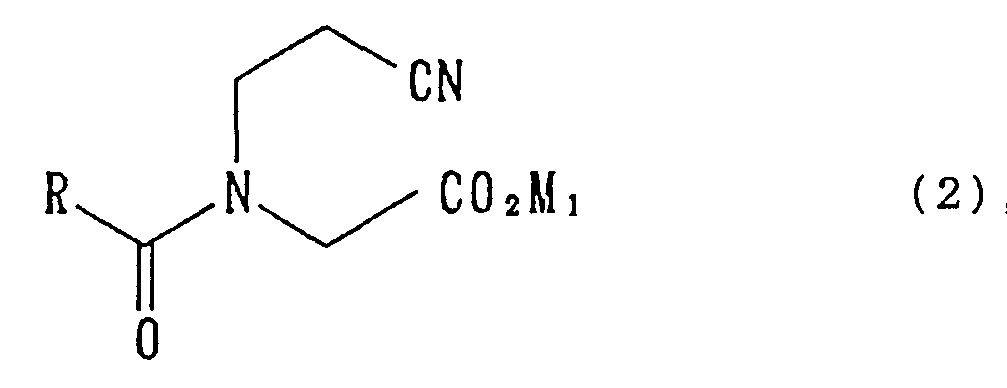
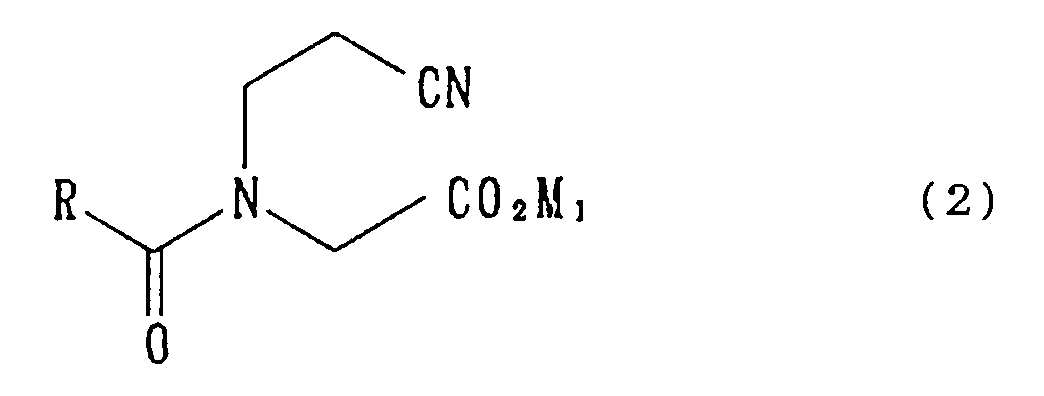
- the present invention provides glycine derivatives represented by the following formulas (1) to (4): , ,
- R is a linear or branched alkyl group having 11 to 13 carbon atoms, a linear or branched alkenyl group having 11 to 13 carbon atoms, or a linear or branched hydroxyalkyl group having 11 to 13 carbon atoms
- M 1 and M 2 are the same or different from each other and each independently is a hydrogen atom, an alkali metal atom, 1/2 (an alkaline earth metal atom), an ammonium group, a monoalkanolammonium group having 1 to 22 carbon atoms, a dialkanolammonium group having 2 to 22 carbon atoms in total, a trialkanolammonium group having 3 to 22 carbon atoms in total, or a protonated basic amino acid.
- the present invention provides:
- a process for producing the glycine derivative represented by the above formula (1) which comprises reacting the glycine derivative represented by the above formula (3) with an acid chloride represented by the formula: RCOCl (wherein R is as defined above) (6), optionally followed by salt exchange;
- a process for producing the glycine derivative represented by the above formula (1) which comprises a step of reacting glycine or a salt thereof represented by the formula: (wherein M 1 is as
- the present invention provides:
- a process for producing the glycine derivative represented by the above formula (2) which comprises reacting the glycine derivative represented by the above formula (4) with an acid chloride represented by the formula: RCOCl (wherein R is as defined above) (6), optionally followed by salt exchange;
- the present invention provides:
- the present invention provides a process for producing a glycine derivative represented by the above formula (4) which comprises reacting glycine or a salt thereof represented by the formula: (wherein M 1 is as defined above) (5)
- the present invention also provides:
- a cleanser composition comprising the glycine derivative represented by the above formula (1) and a sugar surfactant represented by the formula:
- R 1 -(OR 2 ) m -G n (wherein R 1 is a linear or branched alkyl group having 8 to 18 carbon atoms, a linear or
- R 2 is an alkylene group having 2 to 4 carbon atoms
- G is a residue derived from a reducing sugar having 5 to 6 carbon atoms
- m is a number of 0 to 10 and n is a number of 1 to 10) (7);
- a cleanser composition comprising the glycine derivative represented by the above formula (1) and an ether-type acetic acid surfactant represented by the formula: R 3 -Z- (CH 2 CH 2 O) 1 -CH 2 CO 2 X (wherein R 3 is a linear or branched alkyl group having 5 to 21 carbon atoms or a linear or branched alkenyl group having 5 to 21 carbon atoms, Z is a group represented by the formula: -O- or a group represented by the formula: -CONH-, X is a hydrogen atom, an alkali metal atom, 1/2(an alkaline earth metal atom), an ammonium group, a monoalkanolammonium group having 1 to 22 carbon atoms, a dialkanolammonium group having 2 to 22 carbon atoms in total, a trialkanolammonium group having 3 to 22 carbon atoms in total or a protonated basic amino acid, and 1 is a number of 2 to 15
- a cleanser composition comprising the glycine derivative represented by the above formula (1) and a fatty acid amide derivative represented by the
- R 5 and R 6 are the same or different from each other and each independently is a hydrogen atom, an alkyl group having 1 to 3 carbon atoms, a hydroxyalkyl group having 1 to 3 carbon atoms or a group represented by the formula: -(C 2 H 4 O) k H (wherein k is a number of 2 to 4) (9); and
- cleanser compositions according to the present invention those having a pH of 4 to 6.5 are preferable.
- the present invention provides a method of washing skin or hair which comprises contacting the skin or hair with the cleanser composition of the present invention described above, and an use of the cleanser composition of the present invention
- Fig. 1 is the 1 H-NMR spectrum of the sodium
- Fig. 2 is the 1 H-NMR spectrum of the N-cyanoethyl-N-dodecanoylglycine obtained in Example 2.
- Fig. 3 is the 1 H-NMR spectrum of the N-carboxy-ethyl-N-dodecanolyglycine obtained in Example 6.
- Fig. 4 is the 1 H-NMR spectrum of the disodium N-carboxyethylglycinate obtained in Example 7.
- R is a linear or branched alkyl group having 11 to 13 carbon atoms, a linear or branched alkenyl group having 11 to 13 carbon atoms, or a linear or branched hydroxyalkyl group having 11 to 13 carbon atoms.
- n-undecyl group n-dodecyl group, n-tridecyl group and hydroxyundecyl group.
- surfactants wherein R is a linear or branched alkyl group having 11 to 13 carbon atoms and other surfactants wherein R is a linear or
- branched alkenyl group having 11 to 13 carbon atoms are preferred from the viewpoint of foaming power, and those wherein R is a linear alkyl group having 11 to 13 carbon atoms are especially preferred.
- the surfactant represented by the above-mentioned formula (1) or (2) is a mixture of compounds which are
- M 1 and M 2 are the same or different from each other and each independently is a hydrogen atom, an alkali metal atom, 1/2(an alkaline earth metal atom), an ammonium group, a monoalkanolammonium group having 1 to 22 carbon atoms, a dialkanolammonium group having 2 to 22 carbon atoms in total, a trialkanolammonium group having 3 to 22 carbon atoms in total or a protonated basic amino acid.
- the scope of the protonated basic amino acid includes protonated basic amino acids and inorganic salts thereof.
- M 1 and M 2 include a hydrogen atom, a sodium atom, a potassium atom, 1/2(an magnesium atom), 1/2(an calcium atom), an ammonium group, a monoethanolammonium group, a diethanolammonium group, a triethanolammonium group, a protonated glutamine, a protonated arginine, a protonated histidine and a protonated lysine.
- a hydrogen atom, a sodium atom, a potassium atom, 1/2(an magnesium atom), an ammonium group, a monoethanolammonium group, a diethanolammonium group and a triethanolammonium group are preferred.
- a hydrogen atom, a sodium atom, a potassium atom and an ammonium group are especially preferred.
- glycine derivative (1) represented by the above general formula (1) (hereinafter referred to simply as “glycine derivative (1)”) can be synthesized via the following synthetic route.
- This step comprises reacting glycine or a salt thereof represented by the formula (5): ,
- glycine or its salt (5) with acrylonitrile to give a glycine derivative represented by the formula (4): ,
- This step comprises hydrolyzing the cyano group of the glycine derivative (4), optionally followed by salt exchange to give a glycine derivative represented by the formula (3):
- glycosyl derivative (3) (hereinafter referred to simply as "glycine derivative (3)").
- This step comprises reacting the glycine
- acid chloride (6) (hereinafter referred to simply as “acid chloride (6)”), optionally followed by salt exchange to give a glycine derivative represented by the formula (2): , wherein R and M 1 are each as defined above,
- M 1 are each as defined above), which issimilar to the glycine derivative (2) in view of their chemical structures, on an industrial scale is difficult.
- This step comprises hydrolyzing the cyano group of the glycine derivative (2), optionally followed by salt exchange to give the glycine derivative (1).
- This step comprises reacting the glycine
- This step is one in which the glycine or its salt (5) is reacted with acrylonitrile to thereby obtain the glycine derivative (4).
- the glycine or its salt and acrylonitrile as the starting materials may be those which are produced by the known processes, or those which are commercially available. If necessary, the starting materials may be purified by recrystallization, distillation or other means before use.
- glycine or its salt (5) examples include glycine, sodium glycinate, potassium
- glycinate lithium glycinate, magnesium glycinate, calcium glycinate and ammonium glycinate.
- sodium glycinate, potassium glycinate and ammonium glycinate are especially preferred.
- the glycine derivative (4) can be obtained by reacting 1 equivalent of the glycine or its salt (5) with 0.5 to 10 equivalents, preferably 0.75 to 5 equivalents, of acrylonitrile in water at an appropriate temperature between 10 and 100°C,
- reaction time is longer than 100 hours, side reactions such as hydrolysis of the cyano group occur unfavorably.
- acrylonitrile be gradually added to the aqueous solution of the glycine or its salt (5) to obtain an improved yield, because of markedly reduction of the side reactions such as polymerization of acrylonitrile.
- the glycine derivative (4) obtained in this step may be used as is in the subsequent step. If desired, however, it may be recrystallized with the use of a solvent such as water, methanol and ethanol to thereby give a highly purified product.
- the thus-obtained glycine derivative (4) is also a novel substance.
- This step is one in which the cyano group of the glycine derivative (4) obtained in the step A is hydrolyzed preferably in the presence of a basic substance to thereby obtain a glycine derivative (3).
- Examples of the basic substances to be used in this step include alkali metal hydroxides and alkaline earth metal hydroxides. Specific examples thereof include sodium hydroxide, potassium hydroxide, magnesium hydroxide, calcium hydroxide and barium hydroxide.
- the glycine derivative (3) can be obtained by reacting the glycine derivative (4) in the presence of 0.1 to 30 equivalents, preferably 0.5 to 15 equivalents, based on 1 equivalent of the glycine derivative (4), of the basic substance in the presence of water and, if necessary, a polar solvent such as methanol, ethanol, isopropanol, acetone, 1,3-propanediol and propylene glycol, at an appropriate temperature between 50 and 100° C, preferably between 70 and 100° C for 0.5 to 100 hours, optionally followed by counter ion exchange with the use of an electrodialyzer.
- a polar solvent such as methanol, ethanol, isopropanol, acetone, 1,3-propanediol and propylene glycol
- the glycine derivative (3) obtained in this step may be used as is in the subsequent step. If desired, however, it may be recrystallized with the use of a solvent such as water, methanol and ethanol to thereby give a highly purified product.
- the thus obtained glycine derivative (3) is also a novel substance.
- This step is one in which the glycine derivative (4) obtained in the step A is reacted with an acid chloride (6) preferably in the presence of an alkali substance to thereby obtain a glycine derivative (2).
- the acid chloride (6) as one of the starting materials may be one produced by the known process, or commercially available one. If necessaryy, the starting material may be purified by distillation or other means before use. Specific examples of the acid chlorides (6) include single-composition fatty acid chlorides such as dodecanoyl chloride and
- tetradecanoyl chloride and mixed-composition fatty acid chlorides such as cocoyl chloride.
- the glycine derivative (2) can be obtained by reacting 1 equivalent of the glycine derivative (4) with generally 0.8 to 5.0 equivalents, preferably 0.9 to 1.3 equivalents, of the acid
- a polar solvent such as methanol, ethanol, isopropanol, acetone, 1,3-propanediol and propylene glycol at an appropriate temperature between 0 and 100°C, preferably between 10 and 50°C for 0.5 to 100 hours, optionally followed by counter ion exchange with the use of an electrodialyzer.
- an alkali substance be added to the reaction system so as to maintain the pH of the system on the alkaline side, preferably to maintain the pH in the range of 9.0 to 11.0 for securing the reactivity by suppressing the decomposition of the acid chloride ( 6 ) .
- the pH of the reaction system is below the above range, the hydrochloric acid produced as a by-product in
- alkali substances to be employed include inorganic bases such as sodium hydroxide, potassium hydroxide, calcium hydroxide, barium hydroxide and sodium carbonate, and organic bases such as triethylamine, pyridine and 4-dimethylaminopyridine.
- inorganic bases such as sodium hydroxide, potassium hydroxide, calcium hydroxide, barium hydroxide and sodium carbonate
- organic bases such as triethylamine, pyridine and 4-dimethylaminopyridine.
- sodium hydroxide and potassium hydroxide calcium hydroxide, barium hydroxide and sodium carbonate
- organic bases such as triethylamine, pyridine and 4-dimethylaminopyridine.
- potassium hydroxide are especially practical. These alkali substances are used in amounts such that the pH of the system can be maintained within the above range.
- the glycine derivative (2) obtained in this step may be used as is in the subsequent step. If desired, however, it may be recrystallized with the use of a solvent such as water, methanol and ethanol.
- the glycine derivative (2) may be purified by treating the same with a strong acid such as hydrochloric acid and sulfuric acid to thereby obtain a glycine derivative (2) in acidic form, then recrystallizing this acidic derivative from a solvent such as acetone, hexane, petroleum ether, methanol, ethanol and butanol, and thereafter neutralyzing it with a suitable neutralizer to thereby give a glycine derivative (2).
- a strong acid such as hydrochloric acid and sulfuric acid
- a solvent such as acetone, hexane, petroleum ether, methanol, ethanol and butanol
- the thus-obtained glycine derivative (2) is also a novel substance.
- This step is one in which the cyano group of the glycine derivative (2) obtained in the step C is hydrolyzed preferably in the presence of a basic substance to thereby obtain a glycine derivative (1).
- Examples of the basic substances to be used in this step include alkali metal hydroxides and alkaline earth metal hydroxides. Specific examples thereof include sodium hydroxide, potassium hydroxide, magnesium hydroxide, calcium hydroxide and barium hydroxide.
- the glycine derivative (1) can be obtained by reacting the glycine derivative (2) in the presence of 0.1 to 30 equivalents, preferably 0.5 to 15 equivalents, based on 1 equivalent of the glycine derivative (2), of the basic substance in the presence of water and, if necessary, a polar solvent such as methanol, ethanol, isopropanol, acetone,
- 1,3-propanediol and propylene glycol at an appropriate temperature between 50 and 100°C, preferably between 70 and 100°C for 0.5 to 100 hours, optionally followed by counter ion exchange with the use of an
- the glycine derivative (1) obtained in this step may be used as is as a component of, for example, a cleanser composition. If desired, however, it may be recrystallized with the use of a solvent such as water, methanol and ethanol.
- the glycine derivative (1) may be purified by treating the same with a strong acid such as hydrochloric acid and sulfuric acid to thereby obtain a glycine derivative (1) in acidic form, then recrystallizing this acidic derivative from a solvent such as acetone, hexane, petroleum ether, methanol, ethanol and butanol, and thereafter neutralyzing it with a suitable neutralizer to thereby give a glycine derivative (1).
- a strong acid such as hydrochloric acid and sulfuric acid
- This step is one in which the glycine derivative (3) obtained in the step B is reacted with an acid chloride (6) preferably in the presence of an alkali substance to thereby obtain a glycine derivative (1).
- the acid chloride (6) as one of the starting materials is the same one as that used in the above step C.
- the glycine derivative (1) can be obtained by reacting 1 equivalent of the glycine derivative (3) with generally 0.8 to 5.0 equivalents, preferably 0.9 to 1.3 equivalents, of the acid
- a polar solvent such as methanol, ethanol, isopropanol, acetone, 1,3-propanediol and propylene glycol at an appropriate temperature between 0 and 100°C, preferably between 10 and 50°C for 0.5 to 100 hours, optionally followed by counter ion exchange with the use of an electrodialyzer.
- an alkali substance be added to the reaction system so as to maintain the pH of the system on the alkaline side, preferably to maintain the pH in the range of 9.0 to 11.0 for securing the reactivity by suppressing the decomposition of the acid chloride (6).
- the pH of the reaction system is below the above range, the hydrochloric acid produced as a by-product in
- alkali substances to be used in this step include inorganic bases such as sodium hydroxide, potassium hydroxide, calcium
- hydroxide barium hydroxide and .sodium carbonate, and organic bases such as triethylamine, pyridine and 4-dimethylaminopyridine. Of these, sodium hydroxide and potassium hydroxide are especially practical.
- alkali substances are used in amounts such that the pH of the system can be maintained within the above range.
- the glycine derivative (1) obtained in this step may be used as is as a component of, for example, a cleanser composition. If desired, however, it may be subjected to the same aftertreatment as the one described in step D to thereby obtain a product of increased purity.
- the glycine derivatives (1) and (2) according to the present invention are novel surfactants which are excellent in not only safety but also foaming power, detergency, comfort in use and general purpose
- a cleanser composition for, e.g., hair, body or tableware.
- the cleanser composition of the present invention contains the glycine derivative (1) or (2) as an essential component.
- the cleanser composition of the present invention may contain one of the glycine derivatives (1), or two or more of them.
- the cleanser composition of the present invention may contain one of the glycine derivatives (2), or two or more of them.
- the amount of the glycine derivative (1) or (2) contained is preferably 0.1 to 99% by weight, still more preferably 0.1 to 70% by weight, based on the total weight of the composition.
- the compositions will also contain water.
- the cleanser composition containing the glycine derivative (1) according to the present invention may further contain a sugar surfactant represented by the formula: R 1 -(OR 2 ) m -G n (wherein R 1 is a linear or
- R 2 is an alkylene group having 2 to 4 carbon atoms
- G is a residue derived from a reducing sugar having 5 to 6 carbon atoms
- m is a number of 0 to 10 and n is a number of 1 to 10) (7)
- an ether-type acetic acid surfactant represented by the following formula:
- R 3 -Z-(CH 2 CH 2 O) 1 -CH 2 CO 2 X (wherein R 3 is a linear or branched alkyl group having 5 to 21 carbon atoms or a linear or branched alkenyl group having 5 to 21 carbon atoms, Z is a group represented by the formula: -O- or a group represented by the formula: -CONH-, X is a hydrogen atom, an alkali metal atom, 1/2 (an alkaline earth metal atom), an ammonium group, a monoalkanol-ammonium group having 1 to 22 carbon atoms, a
- alkyl group having 7 to 21 carbon atoms and R 5 and R 6 are the same or different from each other and each independently is a hydrogen atom, an alkyl group having 1 to 3 carbon atoms, a hydroxyalkyl group having 1 to 3 carbon atoms or a a group represented by the formula: -(C 2 H 4 O) k H (wherein k is a number of 2 to 4) (9).
- R 1 is a linear or branched alkyl group having 8 to 18 carbon atoms, a linear or branched alkenyl group having 8 to 18 carbon atoms, or a substituted phenyl group having a linear or branched alkyl group of 8 to 18 carbon atoms.
- An alkyl group having 10 to 14 carbon atoms is
- R 2 is an alkylene group having 2 to 4 carbon atoms. Ethylene group or propylene group is preferable as R 2 .
- G is a residue derived from a reducing sugar having 5 to 6 carbon atoms. Its structure is
- sugar surfactant (7) which provides the residue represented by G
- monosaccharides such as glucose, galactose, fructose, xylose, mannose, lyxose and arabinose
- polysaccharides such as maltose, xylobiose, isomaltose, cellobiose, gentiobiose, lactose, sucrose, nigerose, turanose, raffinose, gentianose and melezitose, and mixtures thereof.
- glucose, galactose and fructose are particularly preferred.
- n is an average sugar polymerization degree, being a number of 1 to 10, which is preferably selected taking the properties attributed to the functional group, R 1 , into account.
- R 1 is a hydrophobic group having 8 to 11 carbon atoms
- n is preferably in the range of 1 to 1.4
- R 1 is a hydrophobic group having 12 to 14 carbon atoms
- n is preferably in the range of 1.5 to 4.0.
- the average sugar polymerization degree n is determined by the proton-NMR method.
- alkylpolyglucosides wherein m is 0 and G is a residue derived from
- glucose i.e., those represented by the formula: R 1 -G n , are particularly preferred.
- the sugar surfactant (7) may be used individually, or a plurality thereof may be used in combination.
- the amount of the glycine derivative (1) which depends on, for example, the form of the cleanser composition, is preferably from 2 to 60% by weight, especially preferably from 5 to 50% by weight, based on the total weight of the composition.
- Such cleanser compositions exhibit excellent foaming and give clean feeling after
- the amount of the sugar surfactant (7) which depends on, for example, the form of the
- cleanser composition is preferably from 2 to 60% by weight, especially preferably from 5 to 50% by weight, based on the total weight of the composition.
- Such cleanser compositions exhibit excellent foaming and are also improved in the storage stability at low temperatures.
- the weight ratio of the glycine derivative (1) to the sugar surfactant (7) is preferably from 1/30 to 30/1, still more preferably from 1/10 to 10/1, and especially preferably from 1/1 to 4/1.
- R 3 is a linear or branched alkyl group having 5 to 21 carbon atoms or a linear or branched alkenyl group having 5 to 21 carbon atoms.
- a linear or branched alkyl group having 11 to 15 carbon atoms and a linear or branched alkenyl group having 11 to 15 carbon atoms are preferable.
- 1, which represents an average number of oxyethylene groups is a number of 2 to 15, of which a number of 2 to 8 is preferred.
- the ether-type acetic acid surfactant represented by the above-mentioned formula (8) wherein 1 exceeds 15 is poor in foaming power. On the other hands, the one wherein 1 is less than 2 cannot give a composition containing it in a high concentration.
- the counter ion, X be an alkali metal, especially potassium atom or sodium atom. And it is preferred that the counter ion, X, be identical with M 1 and/or M 2 of the glycine derivative (1) simultaneously used.
- the ether-type acetic acid surfactant (8) may be used individually, or a plurality thereof may be used in combination.
- the amount of the glycine derivative (1) which depends on, for example, the form of the cleanser composition, is preferably from 2 to 60% by weight, especially preferably from 5 to 50% by weight, based. on the total weight of the composition.
- Such cleanser compositions exhibit excellent foaming and give a clean feeling after washing.
- the amount of the ether-type acetic acid surfactant (8) which depends on, for example, the form of the cleanser composition, is preferably from 2 to 60% by weight, especially preferably from 5 to 50% by weight, based on the total weight of the composition.
- Such cleanser compositions exhibit excellent foaming and are also improved in storage stability at low temperatures.
- the weight ratio of the glycine derivative (1) to the ether-type acetic acid surfactant (8) is
- R 4 is a linear or branched alkyl group having 7 to 21 carbon atoms.
- a linear or branched alkyl group having 12 to 18 carbon atoms e.g., dodecyl group, tridecyl group, tetradecyl group, pentadecyl group or heptadecyl group, is especially preferred.
- R 5 and R 6 it is preferred that both are hydroxyalkyl groups, especially hydroxyethyl groups, or that one is a hydroxyalkyl group, especially a hydroxyethyl group while the other is a hydrogen atom.
- fatty acid amide derivatives represented by the above-mentioned formula (9) (hereinafter referred to "fatty acid amide
- the fatty acid amide derivative (9) may be used individually, or a plurality thereof may be used in combination.
- the amount of the glycine derivative (1) which depends on, for example, the form of the cleanser composition, is preferably from 2 to 60% by weight, especially preferably from 5 to 50% by weight, based on the total weight of the composition.
- Such cleanser compositions exhibit excellent foaming and give a clean feeling after washing.
- the amount of the fatty acid amide derivative (9), which depends on, for example, the form of the cleanser composition is preferably from 0.1 to 10% by weight, especially preferably from 1 to 5% by weight, based on the total weight of the
- Such cleanser compositions give a very creamy foam.
- the weight ratio of the glycine derivative (1) to the fatty acid amide derivative (9) is preferably from 100/1 to 2/1, especially 50/1 to 5/1.
- the sum of the glycine derivative (1) and the fatty acid amide derivative (9), which depends on, for example, the form of the cleanser composition, is preferably, based on the total weight of the composition, from 5 to 50% by weight in the case of a liquid cleanser
- composition from 15 to 70% by weight in the case of a pasty cleanser composition, and from 40 to 95% by weight in the case of a solid cleanser composition.
- the cleanser composition of the present invention may contain other conventional components of cleanser compositions for the hair, body, and tableware as long as the presence of such components is not detrimental to the effect of the present invention.
- the such other components include anionic surfactants (such as alkyl sulfate salts, polyoxyethylene alkyl ether sulfate salts, alkylbenzen.e sulfonates, higher fatty acid salts, ⁇ -olefin sulfonates, alkyl-sulfonates, N-alkylcarbamylalkanol sulfate salts, N-alkanoylethanolamide sulfate salts, fatty acid glyceride sulfates, alkyl glyceryl ether sulfates, taurinate surfactants, sarcosinate surfactants, isethionate surfactants and N-acylated acidic amino acid surfactants), amphoteric surfactants (such as alkylbe
- polyoxyethylene alkyl ethers polyoxyethylene fatty acid esters, monofatty acid esters of glycerol, fatty acid sorbitan esters and alkylpolyglycosides
- cationic surfactants such as alkyltrimethylammonium chlorides, dialkyldimethylammonium chlorides and ethyl (lanonlin fatty acid) aminopropylethyldimethylammonium sulfate
- humectants such as glycerol, propylene glycol and ethylene glycol
- the cleanser composition of the present invention contains the glycine derivative (1), and the sugar surfactant (7), the ether-type acetic acid surfactant (8) or the fatty acid amide derivative (9) as essential components
- the composition may contain, as long as the presence of such a surfactant is not detrimental to the effect of the present invention, a surfactant other than those described above, for example, an anionic surfactant such as an N-acyl sarcosine salt, an alkyl ether sulfate and a polyoxyethylene alkyl ether sulfate, a nonionic surfactant such as a polyoxyethylene alkyl ether, a sugar ester surfactant and a sugar amide surfactant, or an anionic surfactant such as an N-acyl sarcosine salt, an alkyl ether sulfate and a polyoxyethylene alkyl ether sulfate, a nonionic surfactant such as a polyoxyethylene alkyl
- amphoteric surfactant such as an imidazoline
- the cleanser composition may contain, as long as the presence of such components is not detrimental to the effect of the present invention, other conventional components of cleanser compositions, for example, viscosity modifiers such as a carboxyvinyl polymer, methylcellulose, ethanol and a polyoxyethylene glycol distearate, pearling agents, fragrances, coloring matters, ultraviolet absorbers, antioxidants,
- viscosity modifiers such as a carboxyvinyl polymer, methylcellulose, ethanol and a polyoxyethylene glycol distearate
- pearling agents such as a carboxyvinyl polymer, methylcellulose, ethanol and a polyoxyethylene glycol distearate
- pearling agents such as a carboxyvinyl polymer, methylcellulose, ethanol and a polyoxyethylene glycol distearate
- pearling agents such as a carboxyvinyl polymer, methylcellulose, ethanol and a polyoxyethylene glycol distearate
- pearling agents such as a carboxyvinyl polymer, methyl
- solution obtained by diluting the cleanser composition of the present invention 10-fold by weight with water be in the range of 4 to 9, especially 4 to 6.5.
- An acid or a base may be added to the cleanser
- the cleanser composition of the present invention may be produced according to conventional procedures.
- the form of the cleanser composition is not
- the form include liquid, pasty, creamy, solid and powdery forms. It is especialy preferred that the cleanser composition be in the form of a liquid, paste or cream.
- water is preferably employed as a liquid medium. The amount of water contained in the liquid cleanser composition is preferably from 50 to 90% by weight, based on the total weight of the composition.
- the cleanser composition of the present invention exhibits excellent foaming and foam stability in washing, exhibits excellent foam breaking and is free from sliminess and stickiness during rinsing, has reduced irritancy to the skin and is excellent in the storage stability at low temperatures.
- the cleanser composition of the present invention may be used to wash the hair and/or body as well as articles such as tableware.
- a composition according to the present invention is applied to the hair, skin or article for a sufficient time to effect cleaning of the hair, skin or article, and then rinsed from the hair, skin or article with water.
- the cleanser composition of the present invention is suitable as one for body such as skin and hair, especially as a skin cleanser composition.
- the hair or skin be human
- the present compositions may also be used to wash the hair or skin of animals such as cats, dogs, etc.
- N-cyanoethyl-N-dodecanoylglycine represented by the following formula was obtained.
- the acid value thereof was 189.2 (calculated: 180.73).
- Sodium N-cyanoethylglycinate was acylated with the use of dodecanoyl chloride and a 48% aqueous solution of NaOH in the same manner as that of Example 2.
- the pH of the resultant aqueous solution of the reaction mixture was adjusted to 7.0 with concentrated hydrochloric acid.
- the obtained aqueous solution was desalted with the use of an electrodialyzer to thereby reduce the salt concentration to 2% or below.
- N-cyanoethyl-N-dodecanoylglycinate was obtained.
- reaction mixture was stirred at 60°C for 1 hour.
- 300 ml of an aqueous solution of 63.95 g (1.5988 mol) of NaOH was fed into thereto while stirring. Thereafter, the temperature was raised to 80°C, and the reaction solution was stirred for 2 hours. During this period, nitrogen gas was blown into the reaction solution, thereby continuously eliminating generated ammonia gas from the system.
- reaction system was maintained at a pH of from 9 to 11 by dropwise adding a 40% aqueous solution of NaOH while the temperature was maintained at 10 to 25°C. After the completion of the dropwise addition, the reaction mixture was stirred at room temperature for 2 hours. Thereafter, the pH of the reaction mixture was adjusted to 1.2 with concentrated hydrochloric acid. A formed white precipitate was separated by
- Disodium N-carboxyethylglycinate was acylated with the use of dodecanoyl chloride and a 48% aqueous solution of NaOH in the same manner as that in Example 8.
- the pH of the resultant aqueous solution of the reaction mixture was adjusted to 7.0 with concentrated hydrochloric acid.
- the obtained aqueous solution was desalted with the use of an electrodialyzer to thereby reduce the salt concentration to 2% or below.
- sodium N-carboxyethyl-N-dodecanoylglycinate (the term, "sodium” includes monosodium, disodium, and a mixture of monosodium and disodium, herein) as a colorless powder.
- a 30% aqueous solution of KOH was further added in an amount such that the sum of the amount of KOH and that previously added for pH adjustment was 150.00 g (2.673 mol).
- the reaction solution thus obtained was stirred at 80°C for 2 hours. During this period, nitrogen gas was blown into the reaction solution, thereby continuously eliminating generated ammonia gas from the system. Thereafter, the reaction solution was cooled to room temperature, and then the pH of the system was adjusted to 6.0 with concentrated hydrochloric acid. The obtained aqueous solution was desalted with the use of an electrodialyzer.
- potassium N-carboxyethyl-N-dodecanoylglycinate (the term, “potassium” includes monopotassium, dipotassium, and a mixture of monopotassium and dipotassium, herein) was obtained in the form of an aqueous
- Example 8 distilled water was added in a volume of three times that of the N-carboxyethyl-N-dodecanoylglycine. Then, the resultant suspension was heated to 40°C while stirring. Powdery Mg(OH) 2 was gradually added thereto while stirring to thereby adjust the pH of the system to 6.0.
- an aqueous solution of magnesium N-carboxyethyl-N-dodecanoylglycinate (the term, "magnesium" includes
- reaction mixture was stirred at 50°C for 1 hour, and the temperature was lowered to room temperature.
- the 30% aqueous solution of NaOH was added in an amount such that the sum of the amount of NaOH and that previously added for pH adjustment was 75.67 g (1.892 mol). Thereafter, the reaction solution was stirred at 90°C for 3 hours. During this period, nitrogen gas was blown into the reaction solution, thereby continuously eliminating generated ammonia gas from the system. Thereafter, the reaction solution was cooled to room temperature, and the pH thereof was adjusted to 1.0 with concentrated hydrochloric acid. A formed white precipitate was separated by
- the volume of foam was measured 10 sec and 120 sec after the discontinuation of the foaming.
- aqueous surfactant solution having a concentration of 10% by weight was applied to the flank, whose hair had been cropped and shaved, of a white Hartley guinea pig (6 weeks old, female) once a day for four consecutive days, and the skin irritation was judged.
- the part where the solution was applied was observed 24 hours after the fourth application and the result of the observation was scored according to the following criteria.
- the obtained shampoo not only was excellent in foaming power and detergency, but also ensured a good feeling in the washing and
- the obtained shampoo not only was excellent in foaming power and detergency, but also ensured a good feeling in the washing and
- a body shampoo (pH 6.0) having the following
- composition was prepared.
- the obtained body shampoo was excellent in foaming power and detergency, and
- composition was prepared.
- the obtained body shampoo was excellent in foaming power and detergency, and
- sodium N-carboxyethyl-N-dodecanoylglycinate obtained in Example 9 10.0% by weight sodium N-cyanoethy1-N-dodecanoylglycinate obtained in Example 3 5.0
- the pH value of each of the cleanser compositions was determined by diluting the composition 10-fold by weight with water to thereby prepare an aqueous solution, taking 50 ml therefrom and measuring the pH thereof at 25°C with the use of pH meter F-14 manufactured by Horiba.
- Each of the cleanser compositions was diluted 10-fold with water to thereby obtain an aqueous solution, and 100 ml (temperature of the solution: 40°C) of the aqueous solution was poured into a graduated cylinder. Then, an agitation blade was set in the aqueous solution and revolved. The agitation blade was revolved at 1000 rpm, and its revolution was reversed every 5 seconds. The volume (ml) of foam formed 30 sec after the start of the agitation was measured and defined as the foaming volume, which was evaluated by the following criterion:
- ⁇ foaming volume of not less than 160 ml but
- ⁇ foaming volume of not less than 120 ml but
- Components (1) and (6) were added to hot purified water (7) and dissolved therein. After the resultant aqueous solution was cooled, components (2) to (5) were added thereto, thereby obtaining a transparent liquid cleanser composition.
- the pH of an aqueous solution obtained by diluting the resultant cleanser composition 10-fold by weight with water was 6.0.
- the cleanser composition When the obtained liquid cleanser composition was used in cleansing the skin and hair, the cleanser composition was excellent in the foaming and
- Component (2) and subsequently component (1) were added to hot purified water (7) to thereby neutralize and dissolve. After the resultant aqueous solution was cooled, components (3) to (5) were added thereto, thereby obtaining a transparent liquid cleanser composition.
- the pH of an aqueous solution obtained by diluting the resultant cleanser composition 10-fold by weight with water was 6.5.
- composition in cleansing the face demonstrated that the cleanser composition was excellent in foaming and rinsability, gave a clean feeling, did not give a feeling of stiffness after drying, and was also excellent in the comfort in use thereof. Further, its irritation to the skin was low, and the storage stability thereof was excellent.
- the pH value of each of the cleanser compositions was determined by diluting the composition 10-fold by weight with water to thereby prepare an aqueous solution, taking 50 ml therefrom and measuring the pH thereof at 25°C with the use of pH meter F-14 manufactured by Horiba.
- Components (1) and (2) were added to hot purified water (6) and dissolved therein. After the resultant aqueous solution was cooled, components (3) to (5) were added thereto, thereby obtaining a transparent liquid cleanser composition.
- the pH of an aqueous solution obtained by diluting the resultant cleanser composition 10-fold by weight with water was 6.0.
- Component (3) and subsequently components (1) and (2) were added to hot purified water (7) to thereby neutralize and dissolve. After the resultant aqueous solution was cooled, components (4) to (6) were added thereto, thereby obtaining a transparent liquid cleanser composition.
- composition in cleansing the face demonstrated that the cleanser composition was excellent in foaming and rinsability, gave a clean feeling, did not give a feeling of stiffness after drying, and was also excellent in the comfort in use thereof.
- the pH value of each of the cleanser compositions was determined by diluting the composition 10-fold by weight with water to thereby prepare an aqueous solution, taking 50 ml therefrom and measuring the pH thereof at 25°C with the use of pH meter F-14 manufactured by Horiba.
- Component (3) and subsequently components (1) and (2) were added to hot purified water (7) to thereby neutralize and dissolve. Then, components (4) and (5) were added thereto and mixed therewith. After the resultant aqueous solution was cooled, component (6) was added thereto, thereby obtaining a transparent liquid cleanser composition (face cleanser).
- face cleanser The pH of an aqueous solution obtained by diluting the resultant face cleanser 10-fold by weight with water was 6.0.
- the face cleanser was excellent in foaming and rinsability, gave a clean feeling, did not give feeling of stiffness after drying, and was also excellent in the comfort in use thereof. Also, its irritation to the skin was low, and the storage stability thereof was excellent.
Landscapes
- Chemical & Material Sciences (AREA)
- Organic Chemistry (AREA)
- Life Sciences & Earth Sciences (AREA)
- Health & Medical Sciences (AREA)
- Animal Behavior & Ethology (AREA)
- Veterinary Medicine (AREA)
- Public Health (AREA)
- General Health & Medical Sciences (AREA)
- Engineering & Computer Science (AREA)
- Molecular Biology (AREA)
- Materials Engineering (AREA)
- Dermatology (AREA)
- Wood Science & Technology (AREA)
- Oil, Petroleum & Natural Gas (AREA)
- Birds (AREA)
- Epidemiology (AREA)
- Chemical Kinetics & Catalysis (AREA)
- Organic Low-Molecular-Weight Compounds And Preparation Thereof (AREA)
- Detergent Compositions (AREA)
- Cosmetics (AREA)
Abstract
Description




Claims







Priority Applications (4)
| Application Number | Priority Date | Filing Date | Title |
|---|---|---|---|
| EP95913359A EP0752983B1 (en) | 1994-03-29 | 1995-03-28 | Novel glycine derivatives, intermediates therefor and cleanser compositions comprising them |
| KR1019960705373A KR100226092B1 (en) | 1994-03-29 | 1995-03-28 | New Glycine Derivatives, Intermediates thereof and Detergent Compositions Comprising the Same |
| US08/704,775 US6121470A (en) | 1994-03-29 | 1995-03-28 | Glycine derivatives, intermediates therefor and cleanser compositions comprising them |
| DE69511387T DE69511387T2 (en) | 1994-03-29 | 1995-03-28 | NEW GLYCINE DERIVATIVES, INTERMEDIATE PRODUCTS, AND THESE CLEANING COMPOSITIONS CONTAINING THEM |
Applications Claiming Priority (2)
| Application Number | Priority Date | Filing Date | Title |
|---|---|---|---|
| JP6058853A JP2851788B2 (en) | 1994-03-29 | 1994-03-29 | Novel glycine derivative, method for producing the same and intermediates thereof, and detergent composition containing glycine derivative |
| JP6/58853 | 1994-03-29 |
Publications (1)
| Publication Number | Publication Date |
|---|---|
| WO1995026329A1 true WO1995026329A1 (en) | 1995-10-05 |
Family
ID=13096252
Family Applications (1)
| Application Number | Title | Priority Date | Filing Date |
|---|---|---|---|
| PCT/JP1995/000581 Ceased WO1995026329A1 (en) | 1994-03-29 | 1995-03-28 | Novel glycine derivatives, intermediates therefor and cleanser compositions comprising them |
Country Status (8)
| Country | Link |
|---|---|
| US (1) | US6121470A (en) |
| EP (1) | EP0752983B1 (en) |
| JP (1) | JP2851788B2 (en) |
| KR (1) | KR100226092B1 (en) |
| CN (2) | CN1245936C (en) |
| DE (1) | DE69511387T2 (en) |
| ES (1) | ES2135716T3 (en) |
| WO (1) | WO1995026329A1 (en) |
Families Citing this family (3)
| Publication number | Priority date | Publication date | Assignee | Title |
|---|---|---|---|---|
| US20130203701A1 (en) | 2010-09-17 | 2013-08-08 | Maine Natural Health, Inc. | Compositions containing omega-3 oil and uses thereof |
| WO2012037328A2 (en) * | 2010-09-17 | 2012-03-22 | Maine Natural Health, Inc. | Compositions containing omega-3 oil with an anti-inflammatory agent and uses thereof |
| US20180148390A1 (en) * | 2016-10-25 | 2018-05-31 | Waterscience, Inc. | Method and composition for retaining nutrients in soil at planting sites |
Citations (2)
| Publication number | Priority date | Publication date | Assignee | Title |
|---|---|---|---|---|
| US4650613A (en) * | 1984-12-28 | 1987-03-17 | Monsanto Company | Process for preparing N-phosphonomethylglycine and derivatives |
| DE3717961A1 (en) * | 1986-10-27 | 1988-05-05 | Stockhausen Chem Fab Gmbh | METHOD FOR PRODUCING N, N-DISUBSTITUTED SS-AMINOPROPIONIC ACIDS AND THE USE THEREOF AS EMULSIFIERS, WETTING AGENTS, TENSIDES IN CLEANING AGENTS AND FOR HYDROPHOBIZING LEATHER AND FURS |
Family Cites Families (1)
| Publication number | Priority date | Publication date | Assignee | Title |
|---|---|---|---|---|
| JPH05105900A (en) * | 1991-08-27 | 1993-04-27 | Kao Corp | Cleaning agent for cleaning apparatus |
-
1994
- 1994-03-29 JP JP6058853A patent/JP2851788B2/en not_active Expired - Fee Related
-
1995
- 1995-03-28 KR KR1019960705373A patent/KR100226092B1/en not_active Expired - Fee Related
- 1995-03-28 CN CNB021248702A patent/CN1245936C/en not_active Expired - Fee Related
- 1995-03-28 WO PCT/JP1995/000581 patent/WO1995026329A1/en not_active Ceased
- 1995-03-28 CN CN95193155A patent/CN1100751C/en not_active Expired - Fee Related
- 1995-03-28 US US08/704,775 patent/US6121470A/en not_active Expired - Lifetime
- 1995-03-28 ES ES95913359T patent/ES2135716T3/en not_active Expired - Lifetime
- 1995-03-28 EP EP95913359A patent/EP0752983B1/en not_active Expired - Lifetime
- 1995-03-28 DE DE69511387T patent/DE69511387T2/en not_active Expired - Fee Related
Patent Citations (2)
| Publication number | Priority date | Publication date | Assignee | Title |
|---|---|---|---|---|
| US4650613A (en) * | 1984-12-28 | 1987-03-17 | Monsanto Company | Process for preparing N-phosphonomethylglycine and derivatives |
| DE3717961A1 (en) * | 1986-10-27 | 1988-05-05 | Stockhausen Chem Fab Gmbh | METHOD FOR PRODUCING N, N-DISUBSTITUTED SS-AMINOPROPIONIC ACIDS AND THE USE THEREOF AS EMULSIFIERS, WETTING AGENTS, TENSIDES IN CLEANING AGENTS AND FOR HYDROPHOBIZING LEATHER AND FURS |
Non-Patent Citations (2)
| Title |
|---|
| KAO CORP.: "Dishwashing detergents for automatic dishwashers", STN: INFORMATION SERVICE: FILE CA; ABSTRACT NO. 141674, vol. 119 * |
| STN-INFORMATION SERVICE FILE: REGISTRY * |
Also Published As
| Publication number | Publication date |
|---|---|
| KR970702241A (en) | 1997-05-13 |
| CN1148846A (en) | 1997-04-30 |
| EP0752983A1 (en) | 1997-01-15 |
| CN1245936C (en) | 2006-03-22 |
| JP2851788B2 (en) | 1999-01-27 |
| CN1100751C (en) | 2003-02-05 |
| JPH07267909A (en) | 1995-10-17 |
| ES2135716T3 (en) | 1999-11-01 |
| CN1425364A (en) | 2003-06-25 |
| EP0752983B1 (en) | 1999-08-11 |
| DE69511387T2 (en) | 2000-01-20 |
| DE69511387D1 (en) | 1999-09-16 |
| US6121470A (en) | 2000-09-19 |
| KR100226092B1 (en) | 1999-10-15 |
Similar Documents
| Publication | Publication Date | Title |
|---|---|---|
| EP0690044B1 (en) | Process for producing amidoether carboxylic acid or salt thereof, and surface active agent mixture containing the same | |
| EP0670827B1 (en) | Alkylglyceramides and their use as surfactants | |
| US6057282A (en) | High purity imidazoline-based amphoacetate surfactants | |
| WO2004092315A1 (en) | Cleaning agent composition | |
| US5869532A (en) | Taurine derivatives for use in cleanser compositions | |
| WO1995008614A1 (en) | Detergent composition | |
| US20040136939A1 (en) | Method for the production of surface active agent mixtures | |
| JPH01106893A (en) | Phosphoric acid ester, its production, and detergent composition containing the same | |
| EP0752983B1 (en) | Novel glycine derivatives, intermediates therefor and cleanser compositions comprising them | |
| EP0723004A1 (en) | Detergent composition | |
| JPH09227479A (en) | Novel amide ester carboxylic acid or salt thereof, process for producing them, and detergent composition containing them | |
| JP2000509086A (en) | Ultra-low irritation detergent composition | |
| JPH0987289A (en) | Surfactant | |
| US4812254A (en) | Detergent composition | |
| JP2001026795A (en) | Washing agent composition | |
| JPH0967333A (en) | Polyoxypropylene fatty acid alkanolamide sulfuric acid ester salt compound mixture, its production and detergent composition | |
| JPH08505900A (en) | Concentrated surfactant composition | |
| JPH08231983A (en) | Detergent mixture | |
| JPH0725655B2 (en) | Azor Luchamp Composition | |
| EP2380955A1 (en) | Cleanser composition, process for producing same, amphiphilic compound, and composition | |
| JP2000001468A (en) | Glyceryl etherified polyhydric alcohol sulfate compound, anionic surfactant and detergent composition containing the same | |
| JPH09143134A (en) | Method for producing amide ether carboxylate | |
| JPH11140485A (en) | Detergent composition | |
| JP3408290B2 (en) | Novel sulfate ester, salt thereof and method for producing the same, and detergent composition containing the sulfate ester or salt thereof | |
| JPH0860182A (en) | Detergent composition |
Legal Events
| Date | Code | Title | Description |
|---|---|---|---|
| WWE | Wipo information: entry into national phase |
Ref document number: 95193155.5 Country of ref document: CN |
|
| AK | Designated states |
Kind code of ref document: A1 Designated state(s): CN KR US |
|
| AL | Designated countries for regional patents |
Kind code of ref document: A1 Designated state(s): AT BE CH DE DK ES FR GB GR IE IT LU MC NL PT SE |
|
| DFPE | Request for preliminary examination filed prior to expiration of 19th month from priority date (pct application filed before 20040101) | ||
| 121 | Ep: the epo has been informed by wipo that ep was designated in this application | ||
| WWE | Wipo information: entry into national phase |
Ref document number: 1995913359 Country of ref document: EP |
|
| WWE | Wipo information: entry into national phase |
Ref document number: 08704775 Country of ref document: US |
|
| WWE | Wipo information: entry into national phase |
Ref document number: 1019960705373 Country of ref document: KR |
|
| WWP | Wipo information: published in national office |
Ref document number: 1995913359 Country of ref document: EP |
|
| WWG | Wipo information: grant in national office |
Ref document number: 1995913359 Country of ref document: EP |