WO1995032801A1 - A process for improving the effectiveness of a process catalyst - Google Patents
A process for improving the effectiveness of a process catalyst Download PDFInfo
- Publication number
- WO1995032801A1 WO1995032801A1 PCT/US1995/006717 US9506717W WO9532801A1 WO 1995032801 A1 WO1995032801 A1 WO 1995032801A1 US 9506717 W US9506717 W US 9506717W WO 9532801 A1 WO9532801 A1 WO 9532801A1
- Authority
- WO
- WIPO (PCT)
- Prior art keywords
- catalyst
- reformer
- refinery
- reducing agent
- mekor
- Prior art date
- Legal status (The legal status is an assumption and is not a legal conclusion. Google has not performed a legal analysis and makes no representation as to the accuracy of the status listed.)
- Ceased
Links
Classifications
-
- B—PERFORMING OPERATIONS; TRANSPORTING
- B01—PHYSICAL OR CHEMICAL PROCESSES OR APPARATUS IN GENERAL
- B01J—CHEMICAL OR PHYSICAL PROCESSES, e.g. CATALYSIS OR COLLOID CHEMISTRY; THEIR RELEVANT APPARATUS
- B01J38/00—Regeneration or reactivation of catalysts, in general
- B01J38/48—Liquid treating or treating in liquid phase, e.g. dissolved or suspended
- B01J38/50—Liquid treating or treating in liquid phase, e.g. dissolved or suspended using organic liquids
- B01J38/52—Liquid treating or treating in liquid phase, e.g. dissolved or suspended using organic liquids oxygen-containing
-
- B—PERFORMING OPERATIONS; TRANSPORTING
- B01—PHYSICAL OR CHEMICAL PROCESSES OR APPARATUS IN GENERAL
- B01J—CHEMICAL OR PHYSICAL PROCESSES, e.g. CATALYSIS OR COLLOID CHEMISTRY; THEIR RELEVANT APPARATUS
- B01J23/00—Catalysts comprising metals or metal oxides or hydroxides, not provided for in group B01J21/00
- B01J23/90—Regeneration or reactivation
- B01J23/96—Regeneration or reactivation of catalysts comprising metals, oxides or hydroxides of the noble metals
-
- C—CHEMISTRY; METALLURGY
- C10—PETROLEUM, GAS OR COKE INDUSTRIES; TECHNICAL GASES CONTAINING CARBON MONOXIDE; FUELS; LUBRICANTS; PEAT
- C10G—CRACKING HYDROCARBON OILS; PRODUCTION OF LIQUID HYDROCARBON MIXTURES, e.g. BY DESTRUCTIVE HYDROGENATION, OLIGOMERISATION, POLYMERISATION; RECOVERY OF HYDROCARBON OILS FROM OIL-SHALE, OIL-SAND, OR GASES; REFINING MIXTURES MAINLY CONSISTING OF HYDROCARBONS; REFORMING OF NAPHTHA; MINERAL WAXES
- C10G35/00—Reforming naphtha
- C10G35/04—Catalytic reforming
- C10G35/06—Catalytic reforming characterised by the catalyst used
Definitions
- TECHNICAL FIELD This invention relates to a process for improving the effectiveness of a process catalyst.
- the process comprises treating the process catalyst with a reducing agent selected from the group consisting of hydrazine, oximes, hydroxylamines, carbohydrazide, erythorbic acid, and mixtures thereof.
- Catalytic reforming is used in the refining of crude oil to increase the yield of higher octane gasoline which sells at higher prices.
- the paraffins and naphthenes are passed through the reformer with the goal of minimizing cracking. Instead their structure is rearranged to form higher octane aromatics.
- Essentially catalytic reforming converts low octane paraffins to naphthenes. Naphthenes are converted to higher octane aromatics. Aromatics are left essentially unchanged.
- Refineries generally use a platinum catalyst or platinum alloy supported on a silica or silica-aluminum substrate as the reforming catalyst, although other catalysts, including the oxides of aluminum, chromium, molybdenum, cobalt, and silicon can be used.
- the catalyst becomes contaminated with metals, such as lead, iron, nickel, vanadium, sulfur compounds, arsenic, and coke. The result is that the catalyst becomes inactive and the efficiency of the reformer decreases.
- metals such as lead, iron, nickel, vanadium, sulfur compounds, arsenic, and coke.
- the catalyst becomes inactive and the efficiency of the reformer decreases.
- most reformer catalysts have a guard bed for the catalyst which removes contaminants from the feed stream. Over a period of time. contaminants still break through to the reformer catalyst and reduce catalytic activity.
- the reaction temperature of the reformer is increased to maintain the desired output.
- organic chloride containing compounds are fed to the reformer to reactivate the catalyst on a periodic basis or continuously at a low dosage.
- the activity of the reformer catalyst is a function of surface area, pore volume, active platinum and organic chloride content. The efficiency of the reformer is reduced during operation by coke deposition, chloride loss, and contaminants such as sulfur, lead, heavy metals, and oxygen.
- the catalyst When the catalyst becomes depleted, it is necessary to regenerate the catalyst.
- the activity of the catalyst can be restored by high temperature oxidation of the coke followed by chloriding. This regenerative process allows the reformer to operate for up to a 24 month period between regenerations. Normally the catalyst can be regenerated at least three times before it has to be replaced and returned to the manufacturer for reclamation.
- This invention relates to a process for improving the effectiveness of a process catalyst which comprises: treating said process catalyst with an effective amount of a reducing agent selected from the group consisting of hydrazine, oximes, hydroxylamines, carbohydrazide, erythorbic acid, and mixtures.
- a reducing agent selected from the group consisting of hydrazine, oximes, hydroxylamines, carbohydrazide, erythorbic acid, and mixtures.
- Indirect evidence and direct evidence indicates that the treatment of the process catalyst by the subject process reduces or retards the formation of metal contaminants, oxygen, sulfur, and coke on the process catalyst.
- the process could be alternatively characterized as a process for reducing and/or retarding the contamination of a process catalyst.
- Reducing or retarding the contamination of the process catalyst results in the increased effectiveness of the reformer. This is shown by yields across the reformer, higher octane gasoline, and less benzene in the reformate. Moreover, since yields of higher octane gasoline are increased, the refinery can blend lower grade fuels into the gasoline. Furthermore, the reformer can also be operated at lower temperature and pressure thus minimizing coking and cracking while making the same octane gasoline and improving yield. Finally, the refinery can save money and time spent on catalyst regeneration by increasing the life of the catalyst and the time between regenerations.
- Process catalysts which benefit from this treatment include reforming, hydrotreating, hydrocracking, isomerization, hydrogenation, and guard bed catalysts. Treating the process catalyst involves adding the reducing agent to a process stream which will enable the reducing agent to come into contact with the process catalyst. Examples of process streams which will provide such contact between the reducing agent and the process catalyst include stripper steam, crude overhead, naphtha, splitter feed, refining feed, and feedlines for chloriding chemicals used in the reformer.
- FIG. 1 is a schematic diagram of a simple refinery.
- CCBT catalyst contamination before treatment
- CYH cyclohexane
- DREWCOR is a registered trademark of Ashland Oil, Inc.
- DREWCOR 2130 corrosion inhibitor is chemically defined as a blend of amines and MEKOR such that the amount of MEKOR is about 5 percent by weight.
- FEED POINT place where reducing agent is injected into the sulfur containing hydrocarbon process stream.
- REFINERY PROCESS CATALYST a refinery process catalyst is a catalyst used in refining crude oil, particularly catalysts used in the reforming of gasoline.
- REFINERY PROCESS STREAM any refinery stream which comes into contact with a refinery process catalyst, particularly hydrocarbon streams which flow through the reformer of the refinery and come into contact with the reformer catalyst, most particularly three phase refinery process streams which carry a liquid hydrocarbon phase, a gaseous hydrocarbon phase, and an aqueous phase.
- MOTOR OCTANE NUMBER motor octane number measured by ASTM D-357 and is a guide to engine performance at high speeds or under heavy load conditions.
- PETROLEUM PRODUCTS products produced by refining crude oil including gasoline, diesel fuel, propane, jet fuel, kerosene, propane, naphtha, benzene, gasoline, aniline, etc.
- ppm parts per million MEKOR.
- REFORMATE reformed aromatics, primarily naphtha, which is upgraded in octane by means of catalytic reforming.
- RESEARCH OCTANE NUMBER (RON) research octane number measured by ASTM D-2699. A standardized test engine operating under standardized conditions (600 rpm) is used. Results are comparable to those obtained in an automobile engine operated at low speed.
- SAMPLE POINT place where a sample of a treated hydrocarbon stream is taken to determine if there was a reduction in catalyst contaminants.
- R + M average of RON and MON. 2
- YIELD a percentage calculated by subtracting the liquid weight of the product that comes out of the reformer from the liquid weight of the feed which goes into the reformer and then dividing by 100.
- FIG. 1 illustrates the flow chart of a simple refinery. It shows the sample points 1-12 for the process streams tested, feedpoints for MEKOR 21-27, storage tanks
- Raw untreated crude oil 31 is fed to the desalter 54 where it is desalted and pumped into the crude tower 51.
- a crude gasoline fraction is pumped into the raw gas accumulator 53 and then to the splitter tower 55.
- Fractions of the separated gasoline are pumped from the splitter tower to the depropanizer 57, the reformer 41-44, and to the hydrogen separator 59.
- the fraction from the hydrogen separator is pumped to the stabilizer tower 60.
- MEKOR is fed into the process at feedpoints 21-27. Sample points include 1-12.
- This process relates to improving the effectiveness of a refinery process catalyst. It is believed this improved effectiveness results because the treatment reduces and/or retards the contamination of the refinery process catalyst.
- Sources of catalyst contamination are metals, such as lead, iron, vanadium, and nickel, sulfur compounds, arsenic, and coke.
- the reducing agents used in this process for improving the effectiveness a process catalyst are selected from the group consisting of hydrazine, oximes, hydroxylamines (such as N,N-diethylhydroxylamine) , erythorbic acid, and mixtures thereof. These reducing agents are described in U.S. Patents 5,213,678 and 4,350,606 which are hereby incorporated by reference. Preferably used as reducing agents are oximes such as the ones described in U.S. Patent 5,213,678 as having the formula:
- R x and R 2 are the same or different and are selected from hydrogen, lower alkyl groups of 1-8 carbon atoms and aryl groups, and mixtures thereof.
- Most preferably used as the oxime are aliphatic oximes, particularly methyl ethyl ketoxi e.
- an effective amount of reducing agent used to improve the effectiveness of the process catalyst will depend somewhat upon the specific result wanted: improvement of the reformer yield, improved yield of high octane gasoline, reduced yield of benzene, reducing or retarding the contamination of the refiner.
- all these benefits are interrelated, and it is difficult to relate an effective amount of reducing agent to one of these parameters, or state an exact amount of reducing agent which will relate to all benefits wanted.
- an effective amount will range from 5 ppm to 100 ppm of reducing agent based upon the catalyst feed stock, preferably from 50 ppm to 100 ppm.
- the catalyst feed stock typically consists of splitter bottoms, reformer feed, and process streams entering the reformer catalyst.
- the reducing agent is added to the process stream continuously.
- MEKOR to improve the efficiency of a process catalyst used in the reformer of a refinery and the octane rating of the gasoline coming out of the reformer which is typically operated at temperatures of 500°C to 525°C and is under a pressure of 200 to 300 psig.
- the process catalyst was a platinum catalyst arranged on a fixed bed.
- MEKOR was added to the reformer 41-44 to a pressurized naphtha feed line 25. The temperature of the naphtha feed line was about 250 °C to about 300°C.
- MEKOR to a process stream was a small refinery which refines approximately 10,000 barrels of crude oil per day.
- the diagram of the refinery is shown in Figure 1.
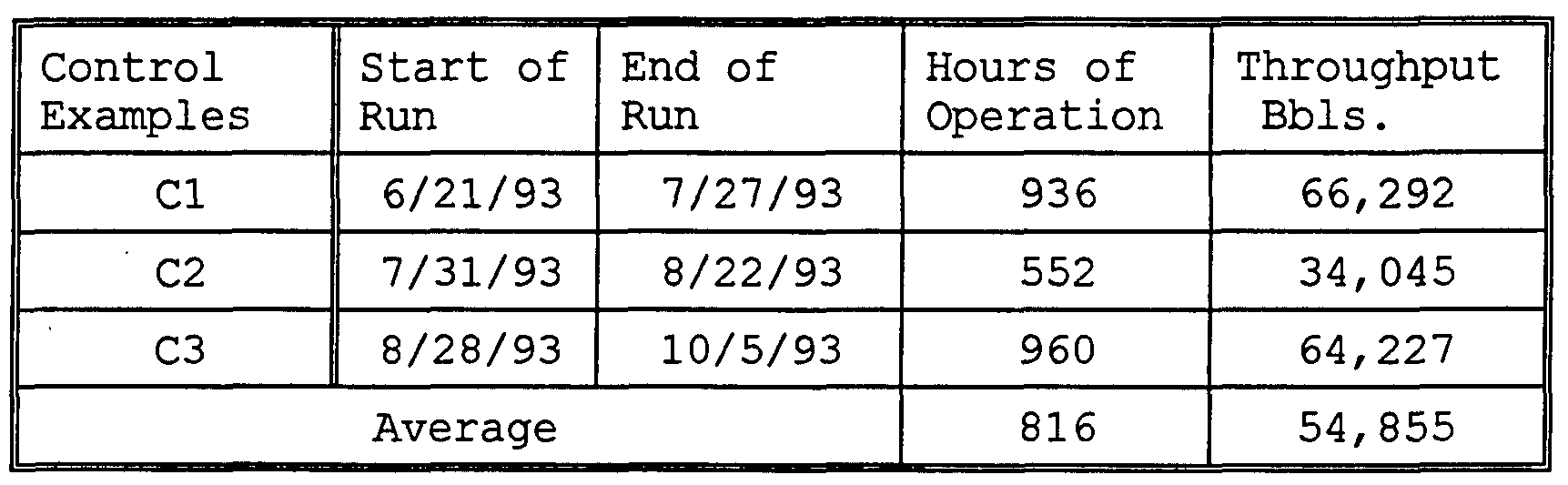
- Control Examples C1-C3 in Table I show how the catalyst was working in the reformer before adding MEKOR.
- Tables III and IV show the addition of MEKOR increases yield and octane number and decreases the aniline number.
- Table V Benzene Produced From Hydrocracking Reaction
- Table V shows that the addition of MEKOR lowers the amount of benzene produced from the hydrocracking reaction. This is significant because future regulations by the Environmental Protection Agency will limit the amount of benzene in gasoline to less than one percent by weight. Furthermore, if higher octane gasoline can be produced in a higher yield with less benzene, undesirable side reactions will be reduced.
Landscapes
- Chemical & Material Sciences (AREA)
- Engineering & Computer Science (AREA)
- Organic Chemistry (AREA)
- Chemical Kinetics & Catalysis (AREA)
- Materials Engineering (AREA)
- Oil, Petroleum & Natural Gas (AREA)
- General Chemical & Material Sciences (AREA)
- Production Of Liquid Hydrocarbon Mixture For Refining Petroleum (AREA)
- Catalysts (AREA)
Abstract
Description

Claims
Priority Applications (3)
| Application Number | Priority Date | Filing Date | Title |
|---|---|---|---|
| EP95921451A EP0762937A4 (en) | 1994-06-01 | 1995-05-30 | A process for improving the effectiveness of a process catalyst |
| JP8501078A JPH10503704A (en) | 1994-06-01 | 1995-05-30 | A method for improving the efficiency of process catalysts. |
| AU26528/95A AU704259B2 (en) | 1994-06-01 | 1995-05-30 | A process for improving the effectiveness of a process catalyst |
Applications Claiming Priority (2)
| Application Number | Priority Date | Filing Date | Title |
|---|---|---|---|
| US25201294A | 1994-06-01 | 1994-06-01 | |
| US08/252,012 | 1994-06-01 |
Publications (1)
| Publication Number | Publication Date |
|---|---|
| WO1995032801A1 true WO1995032801A1 (en) | 1995-12-07 |
Family
ID=22954267
Family Applications (1)
| Application Number | Title | Priority Date | Filing Date |
|---|---|---|---|
| PCT/US1995/006717 Ceased WO1995032801A1 (en) | 1994-06-01 | 1995-05-30 | A process for improving the effectiveness of a process catalyst |
Country Status (7)
| Country | Link |
|---|---|
| US (1) | US5648305A (en) |
| EP (1) | EP0762937A4 (en) |
| JP (1) | JPH10503704A (en) |
| AU (1) | AU704259B2 (en) |
| CA (1) | CA2191743A1 (en) |
| WO (1) | WO1995032801A1 (en) |
| ZA (1) | ZA954204B (en) |
Cited By (1)
| Publication number | Priority date | Publication date | Assignee | Title |
|---|---|---|---|---|
| WO2005016518A1 (en) * | 2003-08-08 | 2005-02-24 | Total France | Hydrotreating and/or hydrocracking catalyst of hydrocarbons and preparation thereof |
Families Citing this family (10)
| Publication number | Priority date | Publication date | Assignee | Title |
|---|---|---|---|---|
| DE10047703A1 (en) * | 2000-09-25 | 2002-04-11 | Basf Ag | Process for the regeneration of catalysts |
| US6915850B2 (en) | 2001-04-24 | 2005-07-12 | Shell Oil Company | In situ thermal processing of an oil shale formation having permeable and impermeable sections |
| US7156176B2 (en) | 2001-10-24 | 2007-01-02 | Shell Oil Company | Installation and use of removable heaters in a hydrocarbon containing formation |
| DE102004010014B4 (en) * | 2004-03-01 | 2011-01-05 | Enerday Gmbh | Reformer and method for converting fuel and oxidant to reformate |
| JP5456318B2 (en) | 2005-10-24 | 2014-03-26 | シエル・インターナシヨネイル・リサーチ・マーチヤツピイ・ベー・ウイ | Method for removing occlusive composition by hydrotreating a liquid stream |
| US7610962B2 (en) | 2006-04-21 | 2009-11-03 | Shell Oil Company | Sour gas injection for use with in situ heat treatment |
| GB2461362A (en) | 2006-10-20 | 2010-01-06 | Shell Int Research | Systems and processes for use in treating subsurface formations |
| EP2137375A4 (en) | 2007-04-20 | 2015-11-18 | Shell Int Research | IN SITU RECOVERY FROM RESIDUAL HEATED SECTIONS IN A FORMATION CONTAINING HYDROCARBONS |
| US8011451B2 (en) | 2007-10-19 | 2011-09-06 | Shell Oil Company | Ranging methods for developing wellbores in subsurface formations |
| US20110054227A1 (en) * | 2009-08-26 | 2011-03-03 | Chevron Phillips Chemical Company Lp | Process to Protect Hydrogenation and Isomerization Catalysts Using a Guard Bed |
Citations (8)
| Publication number | Priority date | Publication date | Assignee | Title |
|---|---|---|---|---|
| US3879311A (en) * | 1973-04-26 | 1975-04-22 | Nat Distillers Chem Corp | Catalyst regeneration |
| US4101444A (en) * | 1976-06-14 | 1978-07-18 | Atlantic Richfield Company | Catalyst demetallization utilizing a combination of reductive and oxidative washes |
| US4190554A (en) * | 1976-12-22 | 1980-02-26 | Osaka Gas Company, Ltd. | Method for reactivation of platinum group metal catalyst with aqueous alkaline and/or reducing solutions |
| US4551226A (en) * | 1982-02-26 | 1985-11-05 | Chevron Research Company | Heat exchanger antifoulant |
| US5100532A (en) * | 1990-12-05 | 1992-03-31 | Betz Laboratories, Inc. | Selected hydroxy-oximes as iron deactivators |
| US5213678A (en) * | 1991-02-08 | 1993-05-25 | Ashchem I.P., Inc. | Method for inhibiting foulant formation in organic streams using erythorbic acid or oximes |
| US5243063A (en) * | 1991-11-12 | 1993-09-07 | Ashchem I.P., Inc. | Method for inhibiting foulant formation in a non-aqueous process stream |
| US5282957A (en) * | 1992-08-19 | 1994-02-01 | Betz Laboratories, Inc. | Methods for inhibiting polymerization of hydrocarbons utilizing a hydroxyalkylhydroxylamine |
Family Cites Families (16)
| Publication number | Priority date | Publication date | Assignee | Title |
|---|---|---|---|---|
| US2336598A (en) * | 1939-11-03 | 1943-12-14 | Du Pont | Stabilization of organic substances |
| US2446969A (en) * | 1946-08-14 | 1948-08-10 | Standard Oil Dev Co | Inhibition of diolefin polymer growth |
| US2483778A (en) * | 1946-08-14 | 1949-10-04 | Standard Oil Dev Co | Inhibition of resin growth from diolefins |
| US2947795A (en) * | 1958-12-05 | 1960-08-02 | Du Pont | Process for stabilizing monovinylacetylene containing impurities |
| US3683024A (en) * | 1968-06-18 | 1972-08-08 | Texaco Inc | O-polyalkoxylated high molecular weight-n-alkanone and n-alkanal oximes |
| GB1566106A (en) * | 1976-03-17 | 1980-04-30 | Nat Res Dev | Additives for aviation and similar fuels |
| US4237326A (en) * | 1979-05-30 | 1980-12-02 | Mitsubishi Petrochemical Company Limited | Method of inhibiting polymerization of styrene |
| US4269717A (en) * | 1980-04-17 | 1981-05-26 | Nalco Chemical Company | Boiler additives for oxygen scavenging |
| US4350606A (en) * | 1980-10-03 | 1982-09-21 | Dearborn Chemical Company | Composition and method for inhibiting corrosion |
| FR2523149A1 (en) * | 1982-03-15 | 1983-09-16 | Catalyse Soc Prod Francais | NEW CATALYST SUPPORTING PALLADIUM-OR, ITS PREPARATION AND USE IN SELECTIVE HYDROGENATION REACTIONS OF DIOLEFINIC AND / OR ACETYLENE HYDROCARBONS |
| US4497702A (en) * | 1982-08-09 | 1985-02-05 | Atlantic Richfield Company | Corrosion inhibition |
| JPS59199042A (en) * | 1983-04-28 | 1984-11-12 | Nissan Motor Co Ltd | Catalyst for reforming methanol |
| US4487745A (en) * | 1983-08-31 | 1984-12-11 | Drew Chemical Corporation | Oximes as oxygen scavengers |
| US4556476A (en) * | 1984-08-10 | 1985-12-03 | Atlantic Richfield Company | Method for minimizing fouling of heat exchanger |
| JPS6413041A (en) * | 1987-07-07 | 1989-01-17 | Hakuto Kagaku Kk | Agent for suppressing growth of polymer in olefin-production apparatus |
| US4927519A (en) * | 1988-04-04 | 1990-05-22 | Betz Laboratories, Inc. | Method for controlling fouling deposit formation in a liquid hydrocarbonaceous medium using multifunctional antifoulant compositions |
-
1995
- 1995-05-23 ZA ZA954204A patent/ZA954204B/en unknown
- 1995-05-30 JP JP8501078A patent/JPH10503704A/en active Pending
- 1995-05-30 AU AU26528/95A patent/AU704259B2/en not_active Ceased
- 1995-05-30 EP EP95921451A patent/EP0762937A4/en not_active Ceased
- 1995-05-30 CA CA002191743A patent/CA2191743A1/en not_active Abandoned
- 1995-05-30 WO PCT/US1995/006717 patent/WO1995032801A1/en not_active Ceased
-
1996
- 1996-05-24 US US08/656,004 patent/US5648305A/en not_active Expired - Fee Related
Patent Citations (8)
| Publication number | Priority date | Publication date | Assignee | Title |
|---|---|---|---|---|
| US3879311A (en) * | 1973-04-26 | 1975-04-22 | Nat Distillers Chem Corp | Catalyst regeneration |
| US4101444A (en) * | 1976-06-14 | 1978-07-18 | Atlantic Richfield Company | Catalyst demetallization utilizing a combination of reductive and oxidative washes |
| US4190554A (en) * | 1976-12-22 | 1980-02-26 | Osaka Gas Company, Ltd. | Method for reactivation of platinum group metal catalyst with aqueous alkaline and/or reducing solutions |
| US4551226A (en) * | 1982-02-26 | 1985-11-05 | Chevron Research Company | Heat exchanger antifoulant |
| US5100532A (en) * | 1990-12-05 | 1992-03-31 | Betz Laboratories, Inc. | Selected hydroxy-oximes as iron deactivators |
| US5213678A (en) * | 1991-02-08 | 1993-05-25 | Ashchem I.P., Inc. | Method for inhibiting foulant formation in organic streams using erythorbic acid or oximes |
| US5243063A (en) * | 1991-11-12 | 1993-09-07 | Ashchem I.P., Inc. | Method for inhibiting foulant formation in a non-aqueous process stream |
| US5282957A (en) * | 1992-08-19 | 1994-02-01 | Betz Laboratories, Inc. | Methods for inhibiting polymerization of hydrocarbons utilizing a hydroxyalkylhydroxylamine |
Non-Patent Citations (1)
| Title |
|---|
| See also references of EP0762937A4 * |
Cited By (3)
| Publication number | Priority date | Publication date | Assignee | Title |
|---|---|---|---|---|
| WO2005016518A1 (en) * | 2003-08-08 | 2005-02-24 | Total France | Hydrotreating and/or hydrocracking catalyst of hydrocarbons and preparation thereof |
| CN1845789B (en) * | 2003-08-08 | 2011-05-11 | 道达尔炼油与销售部 | Hydrotreating and/or hydrocracking catalyst of hydrocarbons and preparation thereof |
| US8535515B2 (en) | 2003-08-08 | 2013-09-17 | Total France | Hydrotreating and/or hydrocracking catalyst of hydrocarbons and preparation thereof |
Also Published As
| Publication number | Publication date |
|---|---|
| AU704259B2 (en) | 1999-04-15 |
| ZA954204B (en) | 1996-01-22 |
| EP0762937A4 (en) | 1997-08-13 |
| JPH10503704A (en) | 1998-04-07 |
| AU2652895A (en) | 1995-12-21 |
| CA2191743A1 (en) | 1995-12-07 |
| US5648305A (en) | 1997-07-15 |
| EP0762937A1 (en) | 1997-03-19 |
Similar Documents
| Publication | Publication Date | Title |
|---|---|---|
| AU756565B2 (en) | Production of low sulfur/low aromatics distillates | |
| US5648305A (en) | Process for improving the effectiveness of process catalyst | |
| JP5396084B2 (en) | Selective naphtha hydrodesulfurization with high-temperature mercaptan decomposition | |
| AU2009272608A1 (en) | Process for the hydrogenation of benzene | |
| JPH05508172A (en) | How to reduce benzene in gasoline | |
| CA2488239C (en) | Process to remove sulfur contaminants from hydrocarbon streams | |
| CA2048066C (en) | Method of start-up of a contaminated hydrocarbon-conversion system using a contaminant-sensitive catalyst | |
| Martino | Catalytic reforming | |
| WO1997003150A1 (en) | Process for the hydrogenation of a thiophenic sulfur containing hydrocarbon feed | |
| US6835301B1 (en) | Production of low sulfur/low aromatics distillates | |
| EP0463851B1 (en) | Catalytic reforming process comprising removal of sulfur from recycle gas streams | |
| US5108582A (en) | Cleanup of hydrocarbon-conversion system | |
| Egolf et al. | The Honeywell UOP CCR Platforming™ Process for BTX Production (Case Study) | |
| JP4856837B2 (en) | Production of low sulfur / low aromatic distillate | |
| US5770781A (en) | Method for eliminating carbon oxides in feeds to a C5 and C6 paraffin isomerization process | |
| WO2005061677A1 (en) | A process for reducing sulfur and olefin contents in gasoline | |
| US20040030208A1 (en) | Process for hydrogenation of aromatics in hydrocarbon feedstocks containing thiopheneic compounds | |
| KR20040020921A (en) | Improved catalytic reforming process | |
| JP4294569B2 (en) | High octane method for petrochemical raffinate | |
| WO2002024834A1 (en) | Improved catalytic reforming process | |
| AU2001261692A1 (en) | Improved catalytic reforming process | |
| WO1999049002A1 (en) | Hydrogenation process |
Legal Events
| Date | Code | Title | Description |
|---|---|---|---|
| AK | Designated states |
Kind code of ref document: A1 Designated state(s): AT AU BB BG BR BY CA CH CZ DE DK ES FI GB HU JP KP KR KZ LK LU MG MN MW NO NZ PL PT RO RU SD SE SK UA VN |
|
| AL | Designated countries for regional patents |
Kind code of ref document: A1 Designated state(s): AT BE CH DE DK ES FR GB GR IE IT LU MC NL PT SE BF BJ CF CG CI CM GA GN ML MR NE SN TD TG |
|
| DFPE | Request for preliminary examination filed prior to expiration of 19th month from priority date (pct application filed before 20040101) | ||
| 121 | Ep: the epo has been informed by wipo that ep was designated in this application | ||
| WWE | Wipo information: entry into national phase |
Ref document number: 1995921451 Country of ref document: EP |
|
| WWE | Wipo information: entry into national phase |
Ref document number: 2191743 Country of ref document: CA |
|
| WWP | Wipo information: published in national office |
Ref document number: 1995921451 Country of ref document: EP |
|
| REG | Reference to national code |
Ref country code: DE Ref legal event code: 8642 |
|
| WWR | Wipo information: refused in national office |
Ref document number: 1995921451 Country of ref document: EP |
|
| WWW | Wipo information: withdrawn in national office |
Ref document number: 1995921451 Country of ref document: EP |