WO1996004882A1 - Denture adhesive - Google Patents
Denture adhesive Download PDFInfo
- Publication number
- WO1996004882A1 WO1996004882A1 PCT/US1995/009918 US9509918W WO9604882A1 WO 1996004882 A1 WO1996004882 A1 WO 1996004882A1 US 9509918 W US9509918 W US 9509918W WO 9604882 A1 WO9604882 A1 WO 9604882A1
- Authority
- WO
- WIPO (PCT)
- Prior art keywords
- salt
- denture adhesive
- adhesive composition
- neutralized
- copolymer
- Prior art date
- Legal status (The legal status is an assumption and is not a legal conclusion. Google has not performed a legal analysis and makes no representation as to the accuracy of the status listed.)
- Ceased
Links
Classifications
-
- G—PHYSICS
- G01—MEASURING; TESTING
- G01N—INVESTIGATING OR ANALYSING MATERIALS BY DETERMINING THEIR CHEMICAL OR PHYSICAL PROPERTIES
- G01N19/00—Investigating materials by mechanical methods
- G01N19/04—Measuring adhesive force between materials, e.g. of sealing tape, of coating
-
- A—HUMAN NECESSITIES
- A61—MEDICAL OR VETERINARY SCIENCE; HYGIENE
- A61K—PREPARATIONS FOR MEDICAL, DENTAL OR TOILETRY PURPOSES
- A61K6/00—Preparations for dentistry
- A61K6/30—Compositions for temporarily or permanently fixing teeth or palates, e.g. primers for dental adhesives
- A61K6/35—Preparations for stabilising dentures in the mouth
-
- A—HUMAN NECESSITIES
- A61—MEDICAL OR VETERINARY SCIENCE; HYGIENE
- A61P—SPECIFIC THERAPEUTIC ACTIVITY OF CHEMICAL COMPOUNDS OR MEDICINAL PREPARATIONS
- A61P1/00—Drugs for disorders of the alimentary tract or the digestive system
- A61P1/02—Stomatological preparations, e.g. drugs for caries, aphtae, periodontitis
Definitions
- the invention relates to denture adhesives and to methods for making and using denture adhesives.
- a denture adhesive may be applied to the denture.
- the denture adhesive acts both as an adherent and as a gasket or cushion between the dentures and the gums of the denture wearer. Denture adhesives are required to provide a diverse range of seemingly contradictory properties in an
- Denture adhesives must develop a quick tack upon contact with the oral mucosa to prevent the denture from coming loose; they must also develop cohesive strength quickly when hydrate ⁇ with moisture or saliva. They must also hold the denture in place for an indefinite period of time during use. They snould only need to be applied once per day and should be nonroxic and
- That patent describes synthetic, water sensitized but water insoluble, materials comprising mixed partial salts of lower alkyl vinyl ether - maleic anhydride copolymers for stabilizing dentures.
- the salts mentioned in the patent are a mixture of (a) calcium and (b) alkalies, including sodium, potassium and quaternary ammonium compounds in a 1:1 to 5:1 molar ratio.
- the calcium and alkali materials are added to the copolymer to form a mixed salt.
- This class of materials has been described in a variety of other patents.
- the principal object of the present invention therefore is to provide a new and improved denture adhesive composition that exhibits sufficient tack initially upon contact with oral mucosa, and builds up a cohesive strength for good hold characteristics when hydrated with moisture or saliva to be able to resist stresses such as those that occur upon
- Another object of the invention is to provide an adhesive in which the improved adhesive retains its adhesive properties for prolonged periods of time and resists wash out.
- the invention provides a denture adhesive comprising a sodium/magnesium/zinc salt or a magnesium/zinc salt, preferably in the form of partial salts, of a maleic acid/alkyl vinyl ether copolymer.
- the invention further provides a method for securing a removable dental device in the mouth comprising applying a denture adhesive comprising a zinc/magnesium salt or a sodium/magnesium/zinc salt, preferably in the form of partial salts, of a maleic acid/alkyl vinyl ether copolymer.
- FIG. 1 shows the testing apparatus used to measure the adhesion strength of salts made in accordance with the
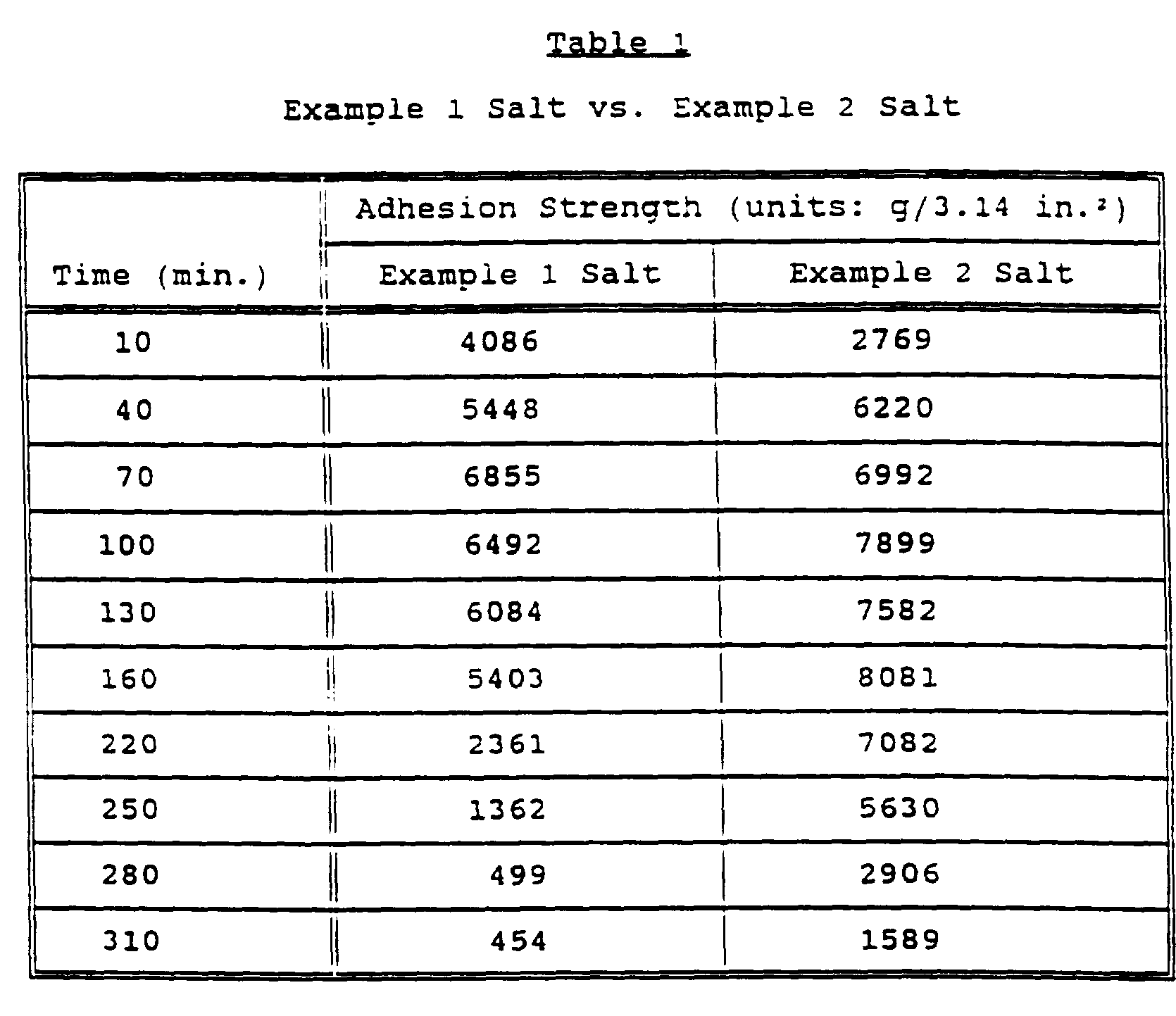
- FIG. 2 is a graph of the adhesion strengths of the salts of Example 1 and of Example 2 over time.
- FIG. 3 is a graph of the adhesion strengths of the first batch of salts of Example 3 and of Example 4 over time.
- FIG. 4 is a graph of the adhesion strengths of the second batch of salts of Example 3 and of Example 4 over time.
- FIG. 5 is a graph of the adhesion strengths of the third batch of salts of Example 3 and of Example 4 over time.
- the polymer salts of the present invention are the mixed partial salts of C1 - C4 alkyl vinyl ether maleic acid copolymer.
- Methyl vinyl ether/maleic anhydride copolymer which has a specific viscosity larger than 1.2 in methyl ethyl ketone at 25oC is the preferred copolymer.
- copolymers are selected from the copolymers set forth in (P/1-880)
- copolymers of that invention are the preferred copolymers, this invention is not limited to the use of those copolymers.
- the degree of substitution limits for alkyl vinyl ether/maleic acid (MVE/MA) partial salts of the invention are: (a) from about 5% to about 55% magnesium, more preferably from about 15% to about 45% magnesium, and most preferably from about 20% to about 40% magnesium; (b) from about 5% to about 65% zinc, more preferably from about 10% to about 60% zinc, and most preferably from about 15% to about 55% zinc; and (c) from about 0% to about 40% sodium, preferably from about 0% to about 35% sodium, and most preferably from about 0% to about 30% sodium.
- This polymer salt is prepared by the partial neutralization of MVE/MA copolymer with the oxides and
- the metal compounds used react with the carboxylic acid groups on the copolymer and neutralize them. Preferably less than 100% of the carboxylic acid groups on the copolymer chain are neutralized. More preferably, the metal compounds neutralize from about 20% to about 95% of the carboxylic acid groups of the copolymer and most preferably from about 30% to about 90% of the carboxylic acid groups.
- the anion portion of the compound is not restricted, although it is preferably an oxide, hydroxide, carbonate or halide.
- the halides are particularly preferred, although they are preferably an oxide, hydroxide, carbonate or halide.
- chlorides are most preferred.
- the oxides or hydroxides are preferred because of their ease of handling, availability and the generally innocuous nature of the by- products formed in their reaction with carboxylic acids.
- a solution of the polymer is prepared, usually at an elevated temperature, and a solution or dispersion of the metal compounds is also prepared. After the heated polymer solution has cooled sufficiently, the solution or dispersion of metal compound and the polymer solution are combined and allowed to react.
- the product salt formed is dried, either in a tray or drum drier and preferably milled to less than about 100 mesh, then dispersed in a
- MVE/MA copolymer is available from ISP Corporation in NJ, under the trade name Gantrez ® .
- the polymer is available in a Gantrez-S series which is methyl vinyl ether/maleic acid and in a Gantrez AN series, which is methyl vinyl ether/maleic anhydride.
- Denture adhesives of this invention can be formulated in the form of a powder, a liquid or a cream.
- the compositions also contain other active and non-active ingredients.
- the denture adnesive composition of the present invention contains a denture adhesive effective amount of a denture adhesive salt and a pharmacologically acceptable carrier therefor.
- the denture adhesive salt usually comprises from about 15% to about 55% by weight of the denture adhesive composition. Preferably it is from about 18% to about 52% by weight of the denture adhesive composition, and most preferably from about 27% to about 36% by weight of the composition in a cream formulation and about 45% to about 55% by weight in a powder formulation.
- the active ingredients in the adhesive are the active ingredients in the adhesive.
- Non-active ingredient may include petrolatum, mineral oil, flavors, colors, preservatives, thickeners and non-toxic anticaking agent such as silica and talc.
- the composition contains a pharmacologically acceptable carrier.
- the pharmacologically acceptable carrier contains conventional materials and if desired, can contain any adhesive adjuvants which have heretofore been used.
- the carrier may contain a carboxymethyl cellulose gum which is used for sensitizing the adhesive to moisture and enhancing the cohesive properties of the formulation and improving gel strength. Carboxyethyl cellulose and carboxypropyl cellulose materials may also be used.
- the cellulose gum preferably comprises from about 10% to about 30% by weight of the denture adhesive cream composition, more preferably from about 15% to about 25% and most preferably from about 20% to about 22% of the composition for a cream formula.
- the cellulose gum preferably comprises from about 45% to about 55% of the composition.
- the cellulose gum may be present in the form of a full or partial salt, preferably a sodium salt.
- Non-active ingredients that may be present in the carrier portion of the denture adhesive composition include thickening agents such as petrolatum, waxes, mineral oil and other oils; flavors such as synthetic flavor oils and/or oils derived from plants and fruits; colors suitable for food, drug and cosmetic use and known as FDSC colors; preservatives such as the parabens, benzoic acid and benzoates and the like; viscosity modifiers; and non-toxic anti-caking agents such as silica, magnesium stearate and talc.
- the mineral oil or the like preferably comprises from about 10% to about 35%, preferably from about 12% to about 17% by weight of the composition, and petrolatum and the like preferably comprise from about 20% to about 50%, preferably from about 25% to about 45% by weight of the composition.
- compositions for denture adhesive creme formulations using a 20% Mg / 40% Zn / 5% Na salt are as
- compositions for a denture adhesive cream specially formulated to be compatible with a pump container and a powder formulation, both using a 20% Mg / 40% Zn / 5% Na salt are as follows:
- a comparative salt was prepared by the same process as set forth in Example 1 except that a mole equivalent amount of Ca(OH) 2 was substituted for the amount of MgO used in Example l.
- the resulting salt is a 10% Ca / 45% Zn / 20% Na salt of MVE/MA copolymer.
- the dried Mg/Zn/Na Gantrez salt was then milled through a suitable mill and screened through a #100 mesh sieve. A one percent solution of the resulting powder would have a pH of from about 5 to about 7. This salt is a 20% Mg / 40% Zn / 10% Na salt of MVE/MA copolymer.
- a comparative salt was prepared by the same process as set forth in Example 3 except that a molar equivalent amount of Ca(OH) 2 was substituted for the amount of MgO used in Example 3.
- the resulting salt is a 20% Ca / 40% Zn / 10% Na salt of MVE/MA copolymer.
- the dried Mg/Zn Gantrez salt was then milled through a suitable mill and screened through a #100 mesh sieve. A one percent solution of the resulting powder would have a pH of from about 4.5 to about 6.5. This salt is a 47.5% Mg / 17.5% Zn salt of MVE/MA copolymer.
- Denture adhesive compositions were prepared from the finely milled salts of Examples 1-4 and were tested for adhesion strength using the mechanism shown in Figure l in the following manner:
- the cloth absorbs water during the test to hydrate the salts.
- the cloth is made from cotton and rayon and is commercially available from Mark V Laboratory);
- the resulting solution was transferred to shallow stainless steel drying trays, and the trays were placed in a hot air convection oven at 70oC for 18-20 hours.
- the dried Mg/Zn/Na Gantrez salt was then milled through a suitable mill and then screened through a #100 mesh sieve.
- a one percent solution of the powder would have a pH of from about 5 to about 7.
- This salt is a 40% Mg/30% Zn/10% Na salt of MVE/MA copolymer.
- Salt from tne foregoing examples were combined with silica (1% based on the combination) and tested for adhesion as described above.
- the results are set forth in Figures 2 through 5, respectively, and in each case the salt of the invention is shown by the dots and the comparative salt is shown by the crosses.
Landscapes
- Health & Medical Sciences (AREA)
- Life Sciences & Earth Sciences (AREA)
- General Health & Medical Sciences (AREA)
- Veterinary Medicine (AREA)
- Chemical & Material Sciences (AREA)
- Public Health (AREA)
- Animal Behavior & Ethology (AREA)
- Oral & Maxillofacial Surgery (AREA)
- Physics & Mathematics (AREA)
- Epidemiology (AREA)
- Pathology (AREA)
- Immunology (AREA)
- General Physics & Mathematics (AREA)
- Biochemistry (AREA)
- Analytical Chemistry (AREA)
- Chemical Kinetics & Catalysis (AREA)
- Bioinformatics & Cheminformatics (AREA)
- Organic Chemistry (AREA)
- General Chemical & Material Sciences (AREA)
- Medicinal Chemistry (AREA)
- Nuclear Medicine, Radiotherapy & Molecular Imaging (AREA)
- Engineering & Computer Science (AREA)
- Pharmacology & Pharmacy (AREA)
- Dental Preparations (AREA)
- Adhesives Or Adhesive Processes (AREA)
- Addition Polymer Or Copolymer, Post-Treatments, Or Chemical Modifications (AREA)
- Polishing Bodies And Polishing Tools (AREA)
- Valve Device For Special Equipments (AREA)
Abstract
Description




Claims
Priority Applications (15)
| Application Number | Priority Date | Filing Date | Title |
|---|---|---|---|
| CA002197188A CA2197188C (en) | 1994-08-10 | 1995-08-07 | Denture adhesive |
| JP50741496A JP4077511B2 (en) | 1994-08-10 | 1995-08-07 | Denture adhesive |
| SK184-97A SK18497A3 (en) | 1994-08-10 | 1995-08-07 | Denture adhesive composition |
| RO97-00261A RO119064B1 (en) | 1994-08-10 | 1995-08-07 | Adhesive salt and dental adhesive composition |
| UA97030984A UA49808C2 (en) | 1994-08-10 | 1995-08-07 | Denture adhesive, method for manufacture and adhesive composition |
| BR9508794A BR9508794A (en) | 1994-08-10 | 1995-08-07 | Composition of denture adhesive and method for its adhesion |
| DE69534531T DE69534531T2 (en) | 1994-08-10 | 1995-08-07 | BIT ADHESIVE |
| AT95928317T ATE306887T1 (en) | 1994-08-10 | 1995-08-07 | DENTAL ADHESIVES |
| EP95928317A EP0774949B1 (en) | 1994-08-10 | 1995-08-07 | Denture adhesive |
| MX9701020A MX9701020A (en) | 1994-08-10 | 1995-08-07 | Denture adhesive. |
| RU97103942A RU2144926C1 (en) | 1994-08-10 | 1995-08-07 | Adhesive for dentures |
| NZ291099A NZ291099A (en) | 1994-08-10 | 1995-08-07 | Denture adhesive composition comprising a mixed partial zn or mg salt of an alkyl vinyl ether and maleic anhydride or maleic acid copolymer |
| AU32132/95A AU697618B2 (en) | 1994-08-10 | 1995-08-07 | Denture adhesive |
| HU9700363A HU227335B1 (en) | 1994-08-10 | 1995-08-07 | Denture adhesive composition and process for adhering denture to mucous membrane of oral cavity |
| BG101208A BG101208A (en) | 1994-08-10 | 1997-02-07 | Dental prosthesis adhesive |
Applications Claiming Priority (2)
| Application Number | Priority Date | Filing Date | Title |
|---|---|---|---|
| US08/288,586 US5525652A (en) | 1994-08-10 | 1994-08-10 | Denture adhesive |
| US08/288,586 | 1994-08-10 |
Publications (1)
| Publication Number | Publication Date |
|---|---|
| WO1996004882A1 true WO1996004882A1 (en) | 1996-02-22 |
Family
ID=23107754
Family Applications (1)
| Application Number | Title | Priority Date | Filing Date |
|---|---|---|---|
| PCT/US1995/009918 Ceased WO1996004882A1 (en) | 1994-08-10 | 1995-08-07 | Denture adhesive |
Country Status (25)
| Country | Link |
|---|---|
| US (1) | US5525652A (en) |
| EP (1) | EP0774949B1 (en) |
| JP (2) | JP4077511B2 (en) |
| KR (1) | KR100356255B1 (en) |
| CN (1) | CN1159752A (en) |
| AT (1) | ATE306887T1 (en) |
| AU (1) | AU697618B2 (en) |
| BG (1) | BG101208A (en) |
| BR (1) | BR9508794A (en) |
| CA (1) | CA2197188C (en) |
| CY (1) | CY2574B1 (en) |
| CZ (1) | CZ37697A3 (en) |
| DE (1) | DE69534531T2 (en) |
| DK (1) | DK0774949T3 (en) |
| ES (1) | ES2249771T3 (en) |
| HU (1) | HU227335B1 (en) |
| IL (1) | IL114885A (en) |
| MX (1) | MX9701020A (en) |
| NZ (1) | NZ291099A (en) |
| PL (1) | PL318522A1 (en) |
| RO (1) | RO119064B1 (en) |
| RU (1) | RU2144926C1 (en) |
| SK (1) | SK18497A3 (en) |
| UA (1) | UA49808C2 (en) |
| WO (1) | WO1996004882A1 (en) |
Cited By (1)
| Publication number | Priority date | Publication date | Assignee | Title |
|---|---|---|---|---|
| WO2023152199A1 (en) * | 2022-02-09 | 2023-08-17 | Unilever Ip Holdings B.V. | Use of oral care composition comprising zinc |
Families Citing this family (43)
| Publication number | Priority date | Publication date | Assignee | Title |
|---|---|---|---|---|
| ES2249772T3 (en) * | 1994-08-10 | 2006-04-01 | Block Drug Company, Inc. | ADHESIVE COMPOSITION FOR IMPROVED POSTED DENTURES. |
| US5658586A (en) * | 1994-10-28 | 1997-08-19 | The Procter & Gamble Company | Denture stabilizing compositions |
| EP0788341B1 (en) * | 1994-10-28 | 2001-07-04 | The Procter & Gamble Company | Denture stabilizing compositions |
| US5750591A (en) * | 1996-02-29 | 1998-05-12 | The Block Drug Company | Denture adhesive containing partial zirconium, calcium, sodium gantrez salt |
| US6069188A (en) * | 1996-07-08 | 2000-05-30 | The Procter & Gamble Company | Denture stabilizing compositions |
| US5872161A (en) * | 1997-03-27 | 1999-02-16 | The Procter & Gamble Company | Denture adhesive compositions |
| US5877233A (en) * | 1997-03-27 | 1999-03-02 | The Proctor & Gamble Company | Denture adhesive compositions |
| US5872160A (en) * | 1997-03-27 | 1999-02-16 | The Procter &Gamble Company | Denture stabilizing compositions |
| US6025411A (en) * | 1997-06-23 | 2000-02-15 | Block Drug Company, Inc. | Denture adhesive comprising a polymeric activator and methods of preparing the same |
| US6423762B1 (en) | 1998-09-30 | 2002-07-23 | Block Drug Company, Inc. | Denture adhesive compositions comprising a polymeric activator |
| US6110989A (en) * | 1998-09-30 | 2000-08-29 | Block Drug Company, Inc. | Denture adhesive |
| US6918765B1 (en) | 1999-01-25 | 2005-07-19 | Dentsply Research & Development Corp. | Hydrogel dental adhesive composition, product, system, method and dispenser |
| US6617374B1 (en) | 1999-04-14 | 2003-09-09 | The Procter & Gamble Company | Denture adhesives with mixed salts of alkyl vinyl ether-maleic copolymer or terpolymer |
| US6355706B1 (en) | 1999-04-14 | 2002-03-12 | The Procter & Gamble Company | Denture adhesives with mixed salt copolymers of terpolymers |
| US7029690B1 (en) * | 1999-07-22 | 2006-04-18 | Clinically Clean Inc. | Oral fluid absorbing compositions and system for application thereof in a method of dental arch treatment |
| US7955591B1 (en) | 1999-07-22 | 2011-06-07 | Wehrli Janet M | Oral fluid absorbing compositions and system for application thereof in a method of dental arch treatment and teeth recalcification |
| DE60015790T2 (en) * | 1999-12-08 | 2005-11-03 | The Procter & Gamble Company, Cincinnati | TOOTH PROSTHETIC ADHERENCE FOR CONTROLLING TOOTH STONE TRAINING |
| US6475497B1 (en) * | 1999-12-08 | 2002-11-05 | The Procter & Gamble Company | Tartar control denture adhesive compositions |
| US6475498B1 (en) * | 1999-12-08 | 2002-11-05 | The Procter & Gamble Company | Method to inhibit tartar and stain using denture adhesive compositions |
| WO2001045644A2 (en) | 1999-12-23 | 2001-06-28 | Combe International Ltd. | Dental adhesive device and method for producing same |
| GB2395283B (en) * | 2002-11-12 | 2004-09-22 | Reckitt Benckiser | Apparatus and method |
| US20050192376A1 (en) * | 2004-02-26 | 2005-09-01 | Ha Thinh N. | Denture care method and kit |
| US8268371B2 (en) * | 2005-08-22 | 2012-09-18 | Kraft Foods Global Brands Llc | Degradable chewing gum |
| EP1948118A2 (en) | 2005-11-09 | 2008-07-30 | The Procter and Gamble Company | Denture adhesive articles |
| US20100317763A1 (en) * | 2005-11-09 | 2010-12-16 | Jayanth Rajaiah | Denture Adhesive Articles |
| US20090238776A1 (en) * | 2005-11-09 | 2009-09-24 | Arif Ali Baig | Oral Care Compositions and Methods |
| US20070185236A1 (en) * | 2005-11-09 | 2007-08-09 | Jayanth Rajaiah | Denture adhesive compositions |
| US20070185237A1 (en) * | 2005-11-09 | 2007-08-09 | Jayanth Rajaiah | Denture adhesive articles |
| US20070185235A1 (en) * | 2005-11-09 | 2007-08-09 | Jayanth Rajaiah | Denture adhesive compositions |
| US20070149642A1 (en) * | 2005-12-28 | 2007-06-28 | Sunstar, Inc. | Denture fixative composition |
| US20090104128A1 (en) * | 2007-10-17 | 2009-04-23 | Orahealth Corporation | Denture adhesive compositions with anti-ucler agents |
| EP2280682A2 (en) * | 2008-06-04 | 2011-02-09 | The Procter & Gamble Company | Denture adhesive compositions and methods |
| US20110065831A1 (en) * | 2009-09-11 | 2011-03-17 | Borja Michael J | Hydrogel Denture Adhesive |
| US20110065830A1 (en) * | 2009-09-11 | 2011-03-17 | Borja Michael J | Hydrogel Denture Adhesive |
| US8735465B2 (en) | 2010-03-10 | 2014-05-27 | The Procter & Gamble Company | Denture adhesive compositions |
| CN101797209A (en) * | 2010-04-07 | 2010-08-11 | 丹尼斯克(张家港)亲水胶体有限公司 | False teeth base tray adhesive ointment and preparation process thereof |
| US8835529B2 (en) | 2011-10-12 | 2014-09-16 | The Procter & Gamble Co. | Denture adhesive compositions |
| CN103857373B (en) | 2011-10-12 | 2016-12-14 | 宝洁公司 | Denture adhesive composition |
| US9408780B2 (en) | 2012-01-26 | 2016-08-09 | Combe Incorporated | Denture adhesive hydrogel with dry tack |
| JP6483490B2 (en) * | 2015-03-23 | 2019-03-13 | 学校法人北里研究所 | X-ray CT system phantom |
| CN109196002A (en) * | 2016-03-03 | 2019-01-11 | 博爱新开源医疗科技集团股份有限公司 | Fine and the inorganic salt copolymer of uniform methyl vinyl ether-maleic acid and its purposes in oral care and medicinal application |
| CN106283698A (en) * | 2016-08-15 | 2017-01-04 | 安徽省银锐玻璃机械有限公司 | For making the elastic gel of glass cutting machine work top |
| JP7214647B2 (en) | 2017-03-23 | 2023-01-30 | ルブリゾル アドバンスド マテリアルズ, インコーポレイテッド | improved denture adhesive |
Citations (3)
| Publication number | Priority date | Publication date | Assignee | Title |
|---|---|---|---|---|
| US4910247A (en) * | 1989-03-27 | 1990-03-20 | Gaf Chemicals Corporation | Adhesive composition |
| US5073604A (en) * | 1989-05-04 | 1991-12-17 | Richardson-Vicks, Inc. | Denture stabilizing compositions |
| US5298534A (en) * | 1993-03-01 | 1994-03-29 | Isp Investments Inc. | Denture adhesive |
Family Cites Families (12)
| Publication number | Priority date | Publication date | Assignee | Title |
|---|---|---|---|---|
| US3003988A (en) * | 1958-10-16 | 1961-10-10 | Clark Cleveland Inc | Stabilizer for dentures |
| GB1492038A (en) * | 1975-12-17 | 1977-11-16 | Smith & Nephew Res | Water-hardenable powder material particularly for use in an orthopaedic bandage |
| US4138477A (en) * | 1976-05-28 | 1979-02-06 | Colgate Palmolive Company | Composition to control mouth odor |
| US4373036A (en) * | 1981-12-21 | 1983-02-08 | Block Drug Company, Inc. | Denture fixative composition |
| US4514528A (en) * | 1983-02-16 | 1985-04-30 | Richardson-Vicks Inc. | Hydrophilic denture adhesive |
| CA1263790A (en) * | 1983-08-01 | 1989-12-05 | Armand Joseph Desmarais | Denture adhesive composition |
| US4758630A (en) * | 1986-10-27 | 1988-07-19 | Richardson-Vicks Inc. | Denture stabilizing zinc and strontium salts of ave/ma copolymer |
| HUT64464A (en) * | 1990-12-21 | 1994-01-28 | Richardson Vicks Inc | Preparative for stabilizing artificial teeth |
| EP0563285A1 (en) * | 1990-12-21 | 1993-10-06 | Richardson-Vicks, Inc. | Denture stabilizing compositions |
| PL168054B1 (en) * | 1990-12-21 | 1995-12-30 | Richardson Vicks Inc | Artificial denture stabilising composition |
| US5239017A (en) * | 1991-04-26 | 1993-08-24 | Isp Investments Inc. | Continuous process for the production of pressure sensitive adhesive mass compositions and articles made therefrom |
| JP3179102B2 (en) * | 1991-06-10 | 2001-06-25 | リチャードソン、ビックス、インコーポレーテッド | Denture stabilizing composition with improved retention |
-
1994
- 1994-08-10 US US08/288,586 patent/US5525652A/en not_active Expired - Lifetime
-
1995
- 1995-08-07 AU AU32132/95A patent/AU697618B2/en not_active Expired
- 1995-08-07 PL PL95318522A patent/PL318522A1/en unknown
- 1995-08-07 UA UA97030984A patent/UA49808C2/en unknown
- 1995-08-07 JP JP50741496A patent/JP4077511B2/en not_active Expired - Lifetime
- 1995-08-07 NZ NZ291099A patent/NZ291099A/en not_active IP Right Cessation
- 1995-08-07 DE DE69534531T patent/DE69534531T2/en not_active Expired - Lifetime
- 1995-08-07 KR KR1019970700776A patent/KR100356255B1/en not_active Expired - Lifetime
- 1995-08-07 CZ CZ97376A patent/CZ37697A3/en unknown
- 1995-08-07 HU HU9700363A patent/HU227335B1/en unknown
- 1995-08-07 RU RU97103942A patent/RU2144926C1/en active
- 1995-08-07 RO RO97-00261A patent/RO119064B1/en unknown
- 1995-08-07 CN CN95195498A patent/CN1159752A/en active Pending
- 1995-08-07 ES ES95928317T patent/ES2249771T3/en not_active Expired - Lifetime
- 1995-08-07 EP EP95928317A patent/EP0774949B1/en not_active Expired - Lifetime
- 1995-08-07 AT AT95928317T patent/ATE306887T1/en active
- 1995-08-07 WO PCT/US1995/009918 patent/WO1996004882A1/en not_active Ceased
- 1995-08-07 BR BR9508794A patent/BR9508794A/en not_active IP Right Cessation
- 1995-08-07 DK DK95928317T patent/DK0774949T3/en active
- 1995-08-07 CA CA002197188A patent/CA2197188C/en not_active Expired - Lifetime
- 1995-08-07 MX MX9701020A patent/MX9701020A/en unknown
- 1995-08-07 SK SK184-97A patent/SK18497A3/en unknown
- 1995-08-09 IL IL11488595A patent/IL114885A/en active IP Right Grant
-
1997
- 1997-02-07 BG BG101208A patent/BG101208A/en unknown
-
2006
- 2006-09-14 JP JP2006250148A patent/JP4273146B2/en not_active Expired - Lifetime
-
2007
- 2007-04-19 CY CY0700008A patent/CY2574B1/en unknown
Patent Citations (3)
| Publication number | Priority date | Publication date | Assignee | Title |
|---|---|---|---|---|
| US4910247A (en) * | 1989-03-27 | 1990-03-20 | Gaf Chemicals Corporation | Adhesive composition |
| US5073604A (en) * | 1989-05-04 | 1991-12-17 | Richardson-Vicks, Inc. | Denture stabilizing compositions |
| US5298534A (en) * | 1993-03-01 | 1994-03-29 | Isp Investments Inc. | Denture adhesive |
Cited By (1)
| Publication number | Priority date | Publication date | Assignee | Title |
|---|---|---|---|---|
| WO2023152199A1 (en) * | 2022-02-09 | 2023-08-17 | Unilever Ip Holdings B.V. | Use of oral care composition comprising zinc |
Also Published As
| Publication number | Publication date |
|---|---|
| JPH10506928A (en) | 1998-07-07 |
| AU697618B2 (en) | 1998-10-15 |
| EP0774949A4 (en) | 2000-03-29 |
| DK0774949T3 (en) | 2006-01-30 |
| EP0774949A1 (en) | 1997-05-28 |
| NZ291099A (en) | 1998-03-25 |
| KR970704411A (en) | 1997-09-06 |
| US5525652A (en) | 1996-06-11 |
| UA49808C2 (en) | 2002-10-15 |
| AU3213295A (en) | 1996-03-07 |
| RU2144926C1 (en) | 2000-01-27 |
| BG101208A (en) | 1998-04-30 |
| KR100356255B1 (en) | 2003-02-11 |
| DE69534531T2 (en) | 2006-06-22 |
| MX9701020A (en) | 1997-05-31 |
| CA2197188A1 (en) | 1996-02-22 |
| BR9508794A (en) | 1998-05-19 |
| CA2197188C (en) | 2004-03-16 |
| RO119064B1 (en) | 2004-03-30 |
| JP2007002263A (en) | 2007-01-11 |
| DE69534531D1 (en) | 2006-03-02 |
| CY2574B1 (en) | 2008-07-02 |
| IL114885A (en) | 1999-12-22 |
| ATE306887T1 (en) | 2005-11-15 |
| CZ37697A3 (en) | 1997-06-11 |
| PL318522A1 (en) | 1997-06-23 |
| ES2249771T3 (en) | 2006-04-01 |
| CN1159752A (en) | 1997-09-17 |
| EP0774949B1 (en) | 2005-10-19 |
| JP4273146B2 (en) | 2009-06-03 |
| SK18497A3 (en) | 1997-09-10 |
| HUT77247A (en) | 1998-03-02 |
| IL114885A0 (en) | 1995-12-08 |
| JP4077511B2 (en) | 2008-04-16 |
| HU227335B1 (en) | 2011-03-28 |
Similar Documents
| Publication | Publication Date | Title |
|---|---|---|
| AU697618B2 (en) | Denture adhesive | |
| US4758630A (en) | Denture stabilizing zinc and strontium salts of ave/ma copolymer | |
| AU698361B2 (en) | Improved denture adhesive composition | |
| US5369145A (en) | Denture adhesive | |
| CZ264493A3 (en) | Mixtures for fastening artificial teeth with improved holding | |
| AU2003301139B2 (en) | Denture adhesive |
Legal Events
| Date | Code | Title | Description |
|---|---|---|---|
| WWE | Wipo information: entry into national phase |
Ref document number: 95195498.9 Country of ref document: CN |
|
| AK | Designated states |
Kind code of ref document: A1 Designated state(s): AU BG BR CA CN CZ HU JP KR MX NZ PL RO RU SG SK UA |
|
| AL | Designated countries for regional patents |
Kind code of ref document: A1 Designated state(s): AT BE CH DE DK ES FR GB GR IE IT LU MC NL PT SE |
|
| DFPE | Request for preliminary examination filed prior to expiration of 19th month from priority date (pct application filed before 20040101) | ||
| 121 | Ep: the epo has been informed by wipo that ep was designated in this application | ||
| WWE | Wipo information: entry into national phase |
Ref document number: 1019970700776 Country of ref document: KR |
|
| WWE | Wipo information: entry into national phase |
Ref document number: 291099 Country of ref document: NZ Ref document number: 18497 Country of ref document: SK Ref document number: PV1997-376 Country of ref document: CZ Ref document number: 97-00261 Country of ref document: RO |
|
| WWE | Wipo information: entry into national phase |
Ref document number: 2197188 Country of ref document: CA Ref document number: 1995928317 Country of ref document: EP |
|
| WWP | Wipo information: published in national office |
Ref document number: 1995928317 Country of ref document: EP |
|
| WWP | Wipo information: published in national office |
Ref document number: PV1997-376 Country of ref document: CZ |
|
| WWP | Wipo information: published in national office |
Ref document number: 1019970700776 Country of ref document: KR |
|
| WWG | Wipo information: grant in national office |
Ref document number: 1019970700776 Country of ref document: KR |
|
| WWR | Wipo information: refused in national office |
Ref document number: PV1997-376 Country of ref document: CZ |
|
| WWG | Wipo information: grant in national office |
Ref document number: 1995928317 Country of ref document: EP |