WO1996011192A1 - Lta4 hydrolase inhibitors - Google Patents

Lta4 hydrolase inhibitors Download PDF

Info

Publication number
WO1996011192A1
WO1996011192A1 PCT/US1995/012365 US9512365W WO9611192A1 WO 1996011192 A1 WO1996011192 A1 WO 1996011192A1 US 9512365 W US9512365 W US 9512365W WO 9611192 A1 WO9611192 A1 WO 9611192A1
Authority
WO
WIPO (PCT)
Prior art keywords
compound according
phenoxy
ethyl
phenylmethyl
methyl
Prior art date
Legal status (The legal status is an assumption and is not a legal conclusion. Google has not performed a legal analysis and makes no representation as to the accuracy of the status listed.)
Ceased
Application number
PCT/US1995/012365
Other languages
French (fr)
Inventor
Nizal Samuel Chandrakumar
Barbara Baosheng Chen
Michael Clare
Bipinchandra Nanubhai Desai
Steven Wakefield Djuric
Stephan Hermann Docter
Alan Frank Gasiecki
Richard Arthur Haack
Chi-Dean Liang
Julie Marion Miyashiro
Thomas Dale Penning
Mark Andrew Russell
Stella Siu-Tzyy Yu
Current Assignee (The listed assignees may be inaccurate. Google has not performed a legal analysis and makes no representation or warranty as to the accuracy of the list.)
GD Searle LLC
Original Assignee
GD Searle LLC
Priority date (The priority date is an assumption and is not a legal conclusion. Google has not performed a legal analysis and makes no representation as to the accuracy of the date listed.)
Filing date
Publication date
Application filed by GD Searle LLC filed Critical GD Searle LLC
Priority to AT95934554T priority Critical patent/ATE224381T1/en
Priority to JP8512608A priority patent/JPH10512848A/en
Priority to DK95934554T priority patent/DK0804427T3/en
Priority to DE69528287T priority patent/DE69528287T2/en
Priority to AU36865/95A priority patent/AU3686595A/en
Priority to EP95934554A priority patent/EP0804427B1/en
Publication of WO1996011192A1 publication Critical patent/WO1996011192A1/en
Anticipated expiration legal-status Critical
Ceased legal-status Critical Current

Links

Classifications

    • CCHEMISTRY; METALLURGY
    • C07ORGANIC CHEMISTRY
    • C07DHETEROCYCLIC COMPOUNDS
    • C07D295/00Heterocyclic compounds containing polymethylene-imine rings with at least five ring members, 3-azabicyclo [3.2.2] nonane, piperazine, morpholine or thiomorpholine rings, having only hydrogen atoms directly attached to the ring carbon atoms
    • C07D295/16Heterocyclic compounds containing polymethylene-imine rings with at least five ring members, 3-azabicyclo [3.2.2] nonane, piperazine, morpholine or thiomorpholine rings, having only hydrogen atoms directly attached to the ring carbon atoms acylated on ring nitrogen atoms
    • C07D295/18Heterocyclic compounds containing polymethylene-imine rings with at least five ring members, 3-azabicyclo [3.2.2] nonane, piperazine, morpholine or thiomorpholine rings, having only hydrogen atoms directly attached to the ring carbon atoms acylated on ring nitrogen atoms by radicals derived from carboxylic acids, or sulfur or nitrogen analogues thereof
    • C07D295/182Radicals derived from carboxylic acids
    • C07D295/185Radicals derived from carboxylic acids from aliphatic carboxylic acids
    • AHUMAN NECESSITIES
    • A61MEDICAL OR VETERINARY SCIENCE; HYGIENE
    • A61PSPECIFIC THERAPEUTIC ACTIVITY OF CHEMICAL COMPOUNDS OR MEDICINAL PREPARATIONS
    • A61P17/00Drugs for dermatological disorders
    • AHUMAN NECESSITIES
    • A61MEDICAL OR VETERINARY SCIENCE; HYGIENE
    • A61PSPECIFIC THERAPEUTIC ACTIVITY OF CHEMICAL COMPOUNDS OR MEDICINAL PREPARATIONS
    • A61P29/00Non-central analgesic, antipyretic or antiinflammatory agents, e.g. antirheumatic agents; Non-steroidal antiinflammatory drugs [NSAID]
    • AHUMAN NECESSITIES
    • A61MEDICAL OR VETERINARY SCIENCE; HYGIENE
    • A61PSPECIFIC THERAPEUTIC ACTIVITY OF CHEMICAL COMPOUNDS OR MEDICINAL PREPARATIONS
    • A61P43/00Drugs for specific purposes, not provided for in groups A61P1/00-A61P41/00
    • CCHEMISTRY; METALLURGY
    • C07ORGANIC CHEMISTRY
    • C07CACYCLIC OR CARBOCYCLIC COMPOUNDS
    • C07C217/00Compounds containing amino and etherified hydroxy groups bound to the same carbon skeleton
    • C07C217/02Compounds containing amino and etherified hydroxy groups bound to the same carbon skeleton having etherified hydroxy groups and amino groups bound to acyclic carbon atoms of the same carbon skeleton
    • C07C217/04Compounds containing amino and etherified hydroxy groups bound to the same carbon skeleton having etherified hydroxy groups and amino groups bound to acyclic carbon atoms of the same carbon skeleton the carbon skeleton being acyclic and saturated
    • C07C217/06Compounds containing amino and etherified hydroxy groups bound to the same carbon skeleton having etherified hydroxy groups and amino groups bound to acyclic carbon atoms of the same carbon skeleton the carbon skeleton being acyclic and saturated having only one etherified hydroxy group and one amino group bound to the carbon skeleton, which is not further substituted
    • C07C217/14Compounds containing amino and etherified hydroxy groups bound to the same carbon skeleton having etherified hydroxy groups and amino groups bound to acyclic carbon atoms of the same carbon skeleton the carbon skeleton being acyclic and saturated having only one etherified hydroxy group and one amino group bound to the carbon skeleton, which is not further substituted the oxygen atom of the etherified hydroxy group being further bound to a carbon atom of a six-membered aromatic ring
    • C07C217/16Compounds containing amino and etherified hydroxy groups bound to the same carbon skeleton having etherified hydroxy groups and amino groups bound to acyclic carbon atoms of the same carbon skeleton the carbon skeleton being acyclic and saturated having only one etherified hydroxy group and one amino group bound to the carbon skeleton, which is not further substituted the oxygen atom of the etherified hydroxy group being further bound to a carbon atom of a six-membered aromatic ring the six-membered aromatic ring or condensed ring system containing that ring not being further substituted
    • CCHEMISTRY; METALLURGY
    • C07ORGANIC CHEMISTRY
    • C07CACYCLIC OR CARBOCYCLIC COMPOUNDS
    • C07C229/00Compounds containing amino and carboxyl groups bound to the same carbon skeleton
    • C07C229/02Compounds containing amino and carboxyl groups bound to the same carbon skeleton having amino and carboxyl groups bound to acyclic carbon atoms of the same carbon skeleton
    • C07C229/04Compounds containing amino and carboxyl groups bound to the same carbon skeleton having amino and carboxyl groups bound to acyclic carbon atoms of the same carbon skeleton the carbon skeleton being acyclic and saturated
    • C07C229/06Compounds containing amino and carboxyl groups bound to the same carbon skeleton having amino and carboxyl groups bound to acyclic carbon atoms of the same carbon skeleton the carbon skeleton being acyclic and saturated having only one amino and one carboxyl group bound to the carbon skeleton
    • C07C229/10Compounds containing amino and carboxyl groups bound to the same carbon skeleton having amino and carboxyl groups bound to acyclic carbon atoms of the same carbon skeleton the carbon skeleton being acyclic and saturated having only one amino and one carboxyl group bound to the carbon skeleton the nitrogen atom of the amino group being further bound to acyclic carbon atoms or to carbon atoms of rings other than six-membered aromatic rings
    • C07C229/12Compounds containing amino and carboxyl groups bound to the same carbon skeleton having amino and carboxyl groups bound to acyclic carbon atoms of the same carbon skeleton the carbon skeleton being acyclic and saturated having only one amino and one carboxyl group bound to the carbon skeleton the nitrogen atom of the amino group being further bound to acyclic carbon atoms or to carbon atoms of rings other than six-membered aromatic rings to carbon atoms of acyclic carbon skeletons
    • CCHEMISTRY; METALLURGY
    • C07ORGANIC CHEMISTRY
    • C07CACYCLIC OR CARBOCYCLIC COMPOUNDS
    • C07C237/00Carboxylic acid amides, the carbon skeleton of the acid part being further substituted by amino groups
    • C07C237/02Carboxylic acid amides, the carbon skeleton of the acid part being further substituted by amino groups having the carbon atoms of the carboxamide groups bound to acyclic carbon atoms of the carbon skeleton
    • C07C237/04Carboxylic acid amides, the carbon skeleton of the acid part being further substituted by amino groups having the carbon atoms of the carboxamide groups bound to acyclic carbon atoms of the carbon skeleton the carbon skeleton being acyclic and saturated
    • C07C237/06Carboxylic acid amides, the carbon skeleton of the acid part being further substituted by amino groups having the carbon atoms of the carboxamide groups bound to acyclic carbon atoms of the carbon skeleton the carbon skeleton being acyclic and saturated having the nitrogen atoms of the carboxamide groups bound to hydrogen atoms or to acyclic carbon atoms
    • CCHEMISTRY; METALLURGY
    • C07ORGANIC CHEMISTRY
    • C07DHETEROCYCLIC COMPOUNDS
    • C07D277/00Heterocyclic compounds containing 1,3-thiazole or hydrogenated 1,3-thiazole rings
    • C07D277/02Heterocyclic compounds containing 1,3-thiazole or hydrogenated 1,3-thiazole rings not condensed with other rings
    • C07D277/20Heterocyclic compounds containing 1,3-thiazole or hydrogenated 1,3-thiazole rings not condensed with other rings having two or three double bonds between ring members or between ring members and non-ring members
    • C07D277/22Heterocyclic compounds containing 1,3-thiazole or hydrogenated 1,3-thiazole rings not condensed with other rings having two or three double bonds between ring members or between ring members and non-ring members with only hydrogen atoms, hydrocarbon or substituted hydrocarbon radicals, directly attached to ring carbon atoms
    • C07D277/24Radicals substituted by oxygen atoms
    • CCHEMISTRY; METALLURGY
    • C07ORGANIC CHEMISTRY
    • C07DHETEROCYCLIC COMPOUNDS
    • C07D295/00Heterocyclic compounds containing polymethylene-imine rings with at least five ring members, 3-azabicyclo [3.2.2] nonane, piperazine, morpholine or thiomorpholine rings, having only hydrogen atoms directly attached to the ring carbon atoms
    • C07D295/04Heterocyclic compounds containing polymethylene-imine rings with at least five ring members, 3-azabicyclo [3.2.2] nonane, piperazine, morpholine or thiomorpholine rings, having only hydrogen atoms directly attached to the ring carbon atoms with substituted hydrocarbon radicals attached to ring nitrogen atoms
    • C07D295/08Heterocyclic compounds containing polymethylene-imine rings with at least five ring members, 3-azabicyclo [3.2.2] nonane, piperazine, morpholine or thiomorpholine rings, having only hydrogen atoms directly attached to the ring carbon atoms with substituted hydrocarbon radicals attached to ring nitrogen atoms substituted by singly bound oxygen or sulfur atoms
    • C07D295/084Heterocyclic compounds containing polymethylene-imine rings with at least five ring members, 3-azabicyclo [3.2.2] nonane, piperazine, morpholine or thiomorpholine rings, having only hydrogen atoms directly attached to the ring carbon atoms with substituted hydrocarbon radicals attached to ring nitrogen atoms substituted by singly bound oxygen or sulfur atoms with the ring nitrogen atoms and the oxygen or sulfur atoms attached to the same carbon chain, which is not interrupted by carbocyclic rings
    • C07D295/088Heterocyclic compounds containing polymethylene-imine rings with at least five ring members, 3-azabicyclo [3.2.2] nonane, piperazine, morpholine or thiomorpholine rings, having only hydrogen atoms directly attached to the ring carbon atoms with substituted hydrocarbon radicals attached to ring nitrogen atoms substituted by singly bound oxygen or sulfur atoms with the ring nitrogen atoms and the oxygen or sulfur atoms attached to the same carbon chain, which is not interrupted by carbocyclic rings to an acyclic saturated chain
    • CCHEMISTRY; METALLURGY
    • C07ORGANIC CHEMISTRY
    • C07DHETEROCYCLIC COMPOUNDS
    • C07D295/00Heterocyclic compounds containing polymethylene-imine rings with at least five ring members, 3-azabicyclo [3.2.2] nonane, piperazine, morpholine or thiomorpholine rings, having only hydrogen atoms directly attached to the ring carbon atoms
    • C07D295/16Heterocyclic compounds containing polymethylene-imine rings with at least five ring members, 3-azabicyclo [3.2.2] nonane, piperazine, morpholine or thiomorpholine rings, having only hydrogen atoms directly attached to the ring carbon atoms acylated on ring nitrogen atoms
    • C07D295/20Heterocyclic compounds containing polymethylene-imine rings with at least five ring members, 3-azabicyclo [3.2.2] nonane, piperazine, morpholine or thiomorpholine rings, having only hydrogen atoms directly attached to the ring carbon atoms acylated on ring nitrogen atoms by radicals derived from carbonic acid, or sulfur or nitrogen analogues thereof
    • C07D295/215Radicals derived from nitrogen analogues of carbonic acid
    • CCHEMISTRY; METALLURGY
    • C07ORGANIC CHEMISTRY
    • C07DHETEROCYCLIC COMPOUNDS
    • C07D295/00Heterocyclic compounds containing polymethylene-imine rings with at least five ring members, 3-azabicyclo [3.2.2] nonane, piperazine, morpholine or thiomorpholine rings, having only hydrogen atoms directly attached to the ring carbon atoms
    • C07D295/22Heterocyclic compounds containing polymethylene-imine rings with at least five ring members, 3-azabicyclo [3.2.2] nonane, piperazine, morpholine or thiomorpholine rings, having only hydrogen atoms directly attached to the ring carbon atoms with hetero atoms directly attached to ring nitrogen atoms
    • C07D295/26Sulfur atoms

Definitions

  • This invention relates generally to anti- inflammatory compounds and pharmaceutical compositions, and more particularly to anti-inflammatory compounds and compositions which are capable of inhibiting leukotriene A 4 hydrolase.
  • LTA 4 hydrolase is a requisite enzyme in the biosynthetic pathway leading to LTB 4 formation.
  • LTB 4 is a proinflammatory compound.
  • R. Lewis, et al., N. Engl . J . Med. 323, 645-655 (1990) have demonstrated that LTB 4 is a potent granulocyte agonist inducing chemotaxis, aggregation, degranulation, adherence and priming of inflammatory cells for induction by other agonists. Binding of LTB 4 to receptors is stereospecific with two distinct classes of binding sites.
  • the LTB 4 receptor is associated with a GTP-binding protein that regulates affinity and transduces signals.
  • Elevated LTB 4 levels have been reported for many diseases. Most prominently, elevated LTB 4 levels have been correlated to the pathology of inflammatory bowel disease (IBD) including Crohn's disease and ulcerative colitis and in psoriasis.
  • IBD inflammatory bowel disease
  • LTB 4 LTB 4 which may contribute to disease processes are: stimulation of mucus secretion; stimulation of cytokine production; and the ability to act synergistically with other inflammatory mediators such as prostaglandins and cysteinyl leukotrienes thereby amplifying the inflammatory process.
  • LTB 4 biosynthesis from arachidonic acid involves the action of 2 enzymes, 5- lipoxygenase [5-LO] and LTA 4 hydrolase.
  • 5-LO transforms arachidonic acid to 5-HPETE and subsequent formation of LTA 4 , which is an unstable allylic epoxide intermediate which is enzymatically hydrolyzed by LTA 4 hydrolase to form the dihydroxy acid LTB 4 .
  • LTA 4 hydrolase is distinct from cytosolic and microsomal epoxide hydrolases based on strict substrate requirements, product formation [5(S),12(R) vs. 5(S),6(R) for mouse liver cytosolic epoxide hydrolase, and lack of inhibition by inhibitors of cytosolic epoxide hydrolase.
  • LTA 4 hydrolase appears to be ubiquitously distributed in mammalian tissues even in cell types that do not express 5-LO, suggesting the importance of transcellular metabolism of LTA 4 . While peptidomimetic compounds such as bestatin and captopril have been shown to exhibit LTA 4 hydrolase inhibitory activity, they are not able to satisfy the requirement of a small organic compound which is capable of cellular penetration. It would therefore be very advantageous to be able to provide low molecular weight inhibitors of LTB 4 biosynthesis which preferably exhibit oral activity in vivo at desirably low concentrations.
  • Q is selected from the group consisting of:
  • Y is selected from the group consisting of (i)-O-, (ii) -s-,
  • R is selected from the group consisting of:
  • Z is selected from the group consisting of:
  • R 1 and R 2 are independently selected from the group consisting of: (i) H,
  • R 3 and R 4 are independently H or lower alkyl
  • R 5 and R 6 are independently selected from the group consi
  • R 7 is H, halogen, lower alkyl, lower alkoxy, n"-ro, hydroxy, or R 7 taken together with R 10 is an al>. lene group having one or two carbon atoms;
  • R 8 and R 9 are independently H, halogen, lower alkyl, lower alkoxy, NH 2 , N0 2 or OH;
  • R 10 is H, lower alkyl, or R 10 taken together with R 7 is an alkylene group having one or two carbon atoms;
  • R 11 is H or lower alkyl
  • R 12 is selected from the group consisting of:
  • R 13 and R 14 are independently hydrogen, -(CH 2 ) radicalCOR 15 , provided that at least one of R 13 and R M is hydrogen;
  • R 15 is -OR 16 , -NHR' 6 or -NHNH 2 ;
  • R 16 is H, lower alkyl or benzyl
  • R ⁇ is H, lower alkyl, benzyl, -COR 16 or -CONH 2 ;
  • X 1 is NR18 , -S-, or -0-, wherein R 18 is H, lower /
  • alkyl -C0NH 2 , CSNH 2 , -C0CH 3 or -S0 2 CH 3 ;
  • a and b are independently integers of from 0 to 5;
  • n 1, 2 or 3;
  • n 0, 1, 2 or 3;
  • p 1 or 2;
  • q is 1, 2 or 3; provided however that where R is C(R 10 ) (R ⁇ )-(CH 2 ) m , and R 10 taken together with R 7 forms an alkylene group having one or two carbon atoms, then -Ar 2 -Y-R is
  • X is -CH- or -N-, and r is 1 or 2, further provided that wherein R 1 , R 2 or both R 1 and R 2 are -(CH-jJ.COR 15 , then a is not O.
  • the present invention entails compounds of the formula I
  • Ar 1 is an aryl moiety selected from the group consisting of:
  • phenyl mono-, di-, or tri-substituted phenyl with the substituents selected from the group consisting of Cl, Br, F, CF 3 , lower alkyl, lower alkoxy, NH 2 , N0 2 and OH;
  • 2-, 4- or 5- thiazolyl (iii) 2-, 3- or 4-pyridinyl, (iv) 2- or 3-thienyl, and (v) 2- or 3-furyl
  • Ar 2 is an aryl moiety selected from the group consisting
  • Q is selected from the group consisting of:
  • Y is selected from the group consisting of (i)-O-, ( ⁇ ) -S-, (iii) -NH-, (iv) -S(O)-, and (v) -S(0 2 )-;
  • R is selected from the group consisting of:
  • Z is selected from the group consisting of:
  • R 1 and R 2 are independently selected from the group consisting of: (i) H,
  • R 3 and R 4 are independently H or lower alkyl
  • R 5 and R 6 are independently selected from the group consisting of:
  • R 7 is H, halogen, lower alkyl, lower alkoxy, nitro, hydroxy, or R 7 taken together with R 10 is an alkylenyl group having one or two carbon atoms;
  • R* and R 9 are independently H, halogen, lower alkyl, lower alkoxy, NH 2 , N0 2 or OH;
  • R 10 is H, lower alkyl, or R 10 taken together with R 7 is an alkylenyl group having one or two carbon atoms;
  • R 11 is H or lower alkyl
  • R 12 is selected from the group consisting of: (i) H,
  • R 13 and R 14 are independently hydrogen , - (CH 2 ) t COR 15 , provided that at least one of R 13 and R 14 is hydrogen ;
  • R 15 is -OR 16 , -NHR 16 or -NHNH 2 ;
  • R 16 is H, lower alkyl or benzyl
  • R 17 is H, lower alkyl, benzyl, -COR 16 or -CONH 2 ;
  • alkyl -CONH 2 , CSNH 2 , -COCH, or -S0 2 CH 3 ;
  • a and b are independently integers of from 0 to 5;
  • n 0, 1, 2 or 3;
  • p 1 or 2;
  • q 1, 2 or 3;
  • R is C(R 10 ) (R ⁇ )-(CH 2 ) B , and R 10 taken together with R 7 forms an alkylenyl group having one or two carbon atoms, then -Ar ⁇ -Y-R- is
  • R 1 and/or R 2 is -(CH 2 ) t COR 15 , then a is not 0.
  • the present invention entails compounds of formula I Ar 1 -Q-Ar 2 -Y-R-z, wherein Z is an amine moiety of the formula
  • the present invention includes compounds of formula I Ar Q-A ⁇ -Y-R-Z, wherein Z is
  • R 3 , R 4 , R s and R 6 are defined as set forth hereinbefore.
  • the present invention entails compounds of the formula Ar 1 -Q-Ar 2 -Y-
  • the compounds of the present invention may comprise a carboxylic acid or ester moiety. It will be appreciated by the art-skilled that a compound of the present invention comprising an ester moiety is readily converted, in vivo , especially when administered orally, into its corresponding carboxylic acid form.
  • the ester-containing compounds of the present invention are therefore prodrugs of their carboxylic acid form.
  • the present invention concerns compounds of formula I Ar ⁇ Q-Ar ⁇ Y-R-Z, wherein Z is a monocyclic or bicyclic heteroaromatic moiety having at least one heteroatom, the at least one heteroatom being nitrogen, wherein the monocyclic heteroaromatic moiety comprises a 5- or 6- membered ring and the bicyclic heteroaromatic moiety comprises a fused 9- or 10-membered ring.
  • the invention entails pharmaceutical composition comprising a pharmacologically effective amount of a compound of formula I and a pharmaceutically acceptable carrier.
  • the present invention involves a method for treating a mammal exhibiting an LTB4 mediated inflammatory condition comprising administering to the mammal a pharmacologically effective amount of a compound of formula I.
  • lower alkyl means straight or branched chain alkyl having 1 to 6 carbon atoms such as methyl, ethyl, propyl, butyl, pentyl, hexyl and the branched chain isomers thereof.
  • lower alkoxy means straight or branched chain alkoxy having 1 to 6 carbon atoms such as methoxy, ethoxy, propoxy, butoxy, pentoxy, hexoxy and the branched chain isomers thereof.
  • halo means fluoro, cloro, bromo, or iodo.
  • monocyclic or bicyclic heteroaromatic moiety having at least one heteroatom which is nitrogen, includes but is not limited to imidazole. triazole, benzimidazole, imidazopyridine, triazolopyridine, thiazole, purine and the like. Such monocyclic and bicyclic heteroaromatic moieties having at least two nitrogen atoms may be bonded, in a compound of the present invention, through any of the nitrogen atoms, as will be appreciated by the person of ordinary skill in the art, to provide two or more conformational isomers.
  • Such monocyclic heteroaromatic and bicyclic heteroaromatic compounds are included in the group of compounds referred to herein as "ZH", which group also includes non-aromatic compounds.
  • Non-aromatic compounds which are contemplated by reference to “ZH” include acyclic amines, monocyclic amines, and bicyclic amines as defined herein.
  • a compound of formula I, which comprises a "Z moiety” may be readily formed by reacting a compound of the formula Ar'-Q-Ar 2 -R-Cl or Ar 1 - Q-Ar 2 -R-OTs with an amine or heteroaromatic compound, ZH.
  • a bond drawn across a bond in a ring indicates that the bond can be to any available atom of the ring structure.
  • pharmaceutically acceptable salts is intended to include those salts capable of being formed with the compounds of the present invention without materially altering the chemical structure or pharmacological properties thereof.
  • Such salts include inorganic and organic cations or acid addition salts, such as sodium, potassium, calcium, ammonium, alkylammonium, quaternary ammonium, triethanolamine, lysine, hydrochloride, hydrobromide, etc. well known to those skilled in the art.
  • the foregoing salts are prepared in the conventional manner by neutralization of the compounds of formula I with the desired base or acid.
  • the compounds of the present invention can be administered to a patient in such oral dosage forms as tablets, capsules, pills, powders, granules, elixirs or syrups, as well as aerosols for inhalation.
  • administration may be effected intravascularly, subcutaneously, or intramuscularly using dosage forms known to those of ordinary skill in the pharmaceutical arts.
  • the preferred form of administration is oral.
  • An effective but non-toxic amount of the compound is employed in treatment.
  • the dosage regimen utilizing the present compounds is selected in accordance with a variety of factors including the type, age, weight, sex and medical condition of the patient; the severity of the condition to be ameliorated; and the route of administration.
  • a physician of ordinary skill can readily determine and prescribe a "pharmaceutically effective amount" of a compound of Formula I, that is, the effective amount of the compound required to prevent, treat or arrest the progress of the condition.
  • Dosages of the compounds of the present invention will range generally between 0.1 mg/kg/day to about 100 mg/kg/day and preferably between about 0.5 mg/kg/day to about 50 mg/kg/day when administered to patients suffering from allergic or hypersensitivity reactions or inflammation.
  • the compounds may also be administered transdermally or topically to treat proliferative skin conditions such as psoriasis.
  • the daily dosage may be administered in a single dose or in equal divided doses three to four times daily.
  • LTA 4 hydrolase inhibitor means a compound which is capable of exhibiting an IC J0 of less than 1 mM in an in vitro assay employing 10 ⁇ g/ml of LTA 4 hydrolase enzyme (specific activity 600 nMoles LTB 4 /min/mg of enzyme) in the presence of 25 ⁇ M substrate (LTA 4 ) in a total reaction volume of 100 ⁇ l.
  • compositions and methods of the present invention at least one of the active compounds of formula I or a pharmaceutically acceptable salt thereof will typically be administered in admixture with suitable pharmaceutical diluents, excipients or carriers (collectively referred to herein as "carrier" materials) suitably selected with respect to the intended form of administration, that is, oral tablets, capsules, elixirs, syrups and the like, and consistent with conventional pharmaceutical practices.
  • carrier suitable pharmaceutical diluents, excipients or carriers
  • the active drug component may be combined with any oral non-toxic pharmaceutically acceptable inert carrier such as lactose, starch, sucrose, cellulose, magnesium stearate, dicalcium phosphate, calcium sulfate, mannitol and the like; for oral administration in liquid form, the active drug component may be combined with any oral non-toxic pharmaceutically acceptable inert carrier such as ethanol and the like.
  • suitable binders, lubricants, disintigrating agents and coloring agents can also be incorporated in the mixture.
  • Suitable binders include starch, gelatin, natural sugars, corn sweeteners, natural and synthetic gums such as acacia, sodium alginate, carboxymethylcellulose, polyethylene glycol and waxes.
  • Lubricants for use in these dosage forms include boric acid, sodium benzoate, sodium acetate, sodium chloride and the like.
  • Disintigrators include, without limitation, starch, methylcellulose, agar, bentonite, guar gum and the like.
  • the compounds of Formula I are useful in treating inflammatory conditions mediated by LTB 4 production in mammals such as psoriasis, contact and atropic dermatitis, Crohn's disease, ulcerative colitis, inflammatory bowel disease, multiple sclerosis, ankylosing spondylitis arthritis, asthma and the like.
  • the compounds of Formula I can be used in preventing recurring inflammatory attacks.
  • a physician or veterinarian of ordinary skill can readily determine whether a subject exhibits the inflammatory condition.
  • a preferred utility relates to treatment of ulcerative colitis.
  • Hep heptane Preparation of the compounds of formula I may be accomplished via one or more of the synthetic schemes which are set forth hereinafter.
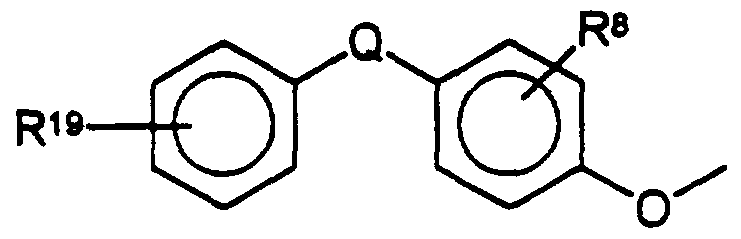
  • Schemes 1-4 depict various methods for preparing substituted phenols of the formula Ar 1 -Q-Ar 2 -OH, wherein Ar 1 and Ar 2 are independently phenyl, substituted phenyl, pyridy1 or thieny1 moieties.
  • Scheme 1 shows methods for producing compounds of the formula Ar 1 -CH j -Ai ⁇ -OH wherein Ar 2 is a phenyl moiety.
  • Scheme 1 shows two related precursor compounds (1, 2) which may be employed as a starting material.
  • Compound 1 is an alkylated or silylated derivative of p-bromophenol.
  • a convenient starting material l is l- bromo,4-methoxyphenol (i.e., R is methyl).
  • compound 1 may be readily provided by silylation of p-bromophenol with t-butyldiphenylsilyl chloride or other silylating agents (see, Example 2) .
  • compound 1 may be reacted with tert-butyl lithium in an ethereal solvent at low temperature, such as in THF at -78"C, and quenched with an arylaldehyde (A ⁇ CHO) to yield compound 3.
  • arylaldehyde A ⁇ CHO
  • a p-methoxybenzaldehyde or a silylated derivative of p-hydroxybenzaldehyde see, Example 1 may be employed.
  • Compound 2 may be reacted with an aryl lithium (Ar 1 Li) or aryl magnesium bromide (Ar 1 MgBr) to yield compound 3.
  • compound 3 is reduced, e.g., by hydrogenation over palladium on carbon or with triethylsilane, to provide compound 4.
  • Compound 4 is readily deprotected using TBAF in THF (desilylation) or using BBr 3 in methylene chloride at -78'C (dealkylation) to provide compound 5.
  • Scheme 2 depicts the preparation of compounds of formula Ar 1 -CH 2 -Ar-OH wherein -Ar 2 -OH is a substituted phenol R (R)PhOH and R 8 and R 9 are as defined hereinbefore.
  • the substituted phenol 7 is reacted with a suitable aryloyl chloride to give the intermediate aryloyl ester (not shown) which is heated to a temperature of about 160'C in the presence of A1C1 3 to promote Fries rearrangement which affords the desired compound 8, having the specifically substituted Ar 2 moiety.
  • Compound 8 may be reduced utilizing the two-step reduction sequence (Scheme 1, steps (c) and (d) ) to provide compound 9.
  • Scheme 3 shows a general method for the preparation of phenols of the formula Ar ⁇ O-A ⁇ -OH wherein Ar 1 is a substituted phenol.
  • Ar 1 may be any substituted arylphenol which is capable of reacting with 4-iodoanisole in an Ullman coupling reaction. See, A. Moroz, et al., Russ . Chem . Rev . 43, 679 (1974) .
  • the Ullman reaction is carried out conventionally in the presence of activated copper or copper iodide at a temperature of about 150"C to 200 * C.
  • a particularly preferred substituted phenol for providing compounds of the present invention having a substituted Ar 1 moiety is 4-fluorophenol.
  • Scheme 4 shows a synthesis for making compounds of the formula Ar ⁇ O-pyridyl-OH (i.e., Ar 2 is pyridyl) .
  • 2-amino-5-bromopyridine is combined with an excess of a suitable phenol (Ar'OH) and coupled utilizing the Ullman reaction, essentially as described with reference to Scheme 3, to provide the aminopyridine derivative 10.
  • Compound 10 is diazotized with sodium nitrite/H 2 S0 4 /H 2 0 and decomposed to afford compound ll.
  • Scheme 5 shows the preparation of compounds of the general formula Ar 1 -Q-Ar 2 -Y-R-Z (Formula I) from compounds of the formula Ar 1 -Q-Ar 2 -YH (12) (wherein R is ethylene, Y is -O-, -NH- or -S-, R 20 and R 21 are independently hydrogen or lower alkyl, and wherein Ar 1 , Q, Ar 2 , and Z are previously defined).
  • Compounds of the formula Ar ⁇ Q-Ar ⁇ YH may be made in accordance with Schemes 1-4 or may be obtained commercially, including 4-hydroxydiphenylmethane, 4-hydroxybenzophenone, 4- benzyloxyphenol, etc.
  • a compound of the formula Ar'-Q-Ar'-YH (12) may be converted into a compound of the present invention via alkylation with any of a variety of chloroethylaminoalkyl analogs, wherein the aminoalkyl moiety may be cyclic or acyclic.
  • Q is carbonyl
  • the carbonyl moiety of compound 13 is reduced to -CH 2 - as depicted in steps (c) and (d) of Scheme 1 to afford compound 14.
  • Scheme 6 shows a presently preferred method for preparing compounds of the formula Ar 1 -Q-Ar 2 -0-R-Z, wherein R is a linear alkylene moiety.
  • Scheme 6 depicts alternate reaction pathways for adding an alkylene linker moiety, R (as defined in formula I) to the phenolic hydroxyl group of compound 15, which alkylene linker terminates in a reactive halogen or tosylate group.
  • compound 15 is reacted with ethylene carbonate in DMF in the presence of nBu 4 NBr to give compound 16 which is subsequently reacted with tosylchloride in dichloromethane and pyridine to provide compound 17 wherein X is -OTs.
  • R is a Cj-C 6 alkylene moiety
  • compound 15 is reacted with CH 2 Cl-(CH 2 ) m -CH 2 Br(wherein m is 1-4)in the presence of DMF and NaH to provide compound 17 wherein X is Cl.
  • Compound 17 is reacted with a nitrogen containing compound of the formula ZH in DMF at 60° in the presence of K 2 CC 3 , to give compound 18, wherein Z is an acyclic amine moiety, a monocyclic or bicyclic amine moiety or a monocyclic or bicyclic heteroaromatic moiety as defined hereinbefore with reference to compounds of Formula I.
  • Scheme 7 describes a method for making compounds of the Formula I wherein Ar is thiophene.
  • the synthesis entails reaction of 2-bromothiophene or 2- iodothiophene with a terminally substituted diol of the formula CH 2 OH-(CH 2 ) m -CH 2 OH wherein m -» 0-4.
  • diols include ethylene glycol, 1,3 propanediol, 1,4 butanediol and 1,5 pentanediol and 1,6 hexanediol.
  • the reaction is carried in the presence of copper (II) oxide in the diol as solvent at 120 * C to afford compound 19.
  • Scheme 8 describes the synthesis of compounds of Formula I wherein -Q-Ar 2 - is "-CHjO-phenyl-" and Ar 1 may be any of a variety of aryl moieities (see, for example, Table 13) .
  • the synthesis starts with a compound of Formula I wherein A ⁇ -Q- is Ph-CH 2 -0- (23) , and debenzylates the compound, employing H 2 , 4% Pd/C, EtOH, to afford intermediate phenol 24 which is alkylated in the presence of NaH in DMF with any of a variety of arylmethybromides to afford compound 25.
  • Suitable arylmethylbromides include, but are not limited to the arylmethylbromides enumerated with reference to Scheme 7.
  • Scheme 9 generally depicts methods for preparing compounds of Formula I wherein Ar 2 is a 2,5- disubstituted pyridinyl moiety.
  • Such compounds of the present invention may be prepared starting from the acid chloride of 2-chloro-5-pyridine-carboxylic acid.
  • the acid chloride 26 is combined with a suitable aryl compound (Ar 1 ) and reacted under Friedel-Crafts acylation conditions to provide the chloropyridinyl containing ketone 27, which is reacted with a suitable hydroxyalkylamine of the formula HO-R-Z, wherein R and Z are as defined hereinbefore, to yield compound 28 which is subject to a 2-step reduction (shown in steps (c) and (d) of Scheme 1) to provide compound 29 which is a compound of Formula I.
  • Scheme 10 describes preparation of a variety of compounds of the formula HO-R-Z 33 wherein R is alkylene and Z is defined hereinbefore. These compounds may be employed in the methods described in Scheme 9, step b.
  • a benzyloxyalcohol 30 is converted into the corresponding tosylate 31 by reaction with tosylchloride in the presence of pyridine and methylene chloride at 0 * C which is reacted with a secondary amine of the formula
  • compound 32 is hydrogenated [H 2 /Pd, ethanol] to afford compounds of the formula HO-R-Z (33) , wherein R is alkylene, and coupled to compounds of the formula Ar--Q-Ar 2 -OH (see schemes 1-4) in the presence of diethylazodicarboxylate (DEAD) and triphenylphosphine in THF (O. Mitsunoba, Synthesis , 1, (1981)) to provide compound 34 which is a compound of Formula I.
  • the present invention entails the compound of the formula
  • R 22 H. lower alkyl.
  • compound 35 is alkylated in DMF in the presence of sodium hydride with allylbromide or a 2-methyl substituted allylbromide to afford the corresponding O-allyl ether (not shown) , which is heated to 230°C in a Claissen rearrangement reaction, followed by oxidative cyclization with metachloroperbenzoic acid (mCPBA) in chloroform to yield the alcohol 36.
  • mCPBA metachloroperbenzoic acid
  • Alcohol 36 is reacted with tosyl chloride in pyridine/methylene chloride mixture at 0 * C to afford the corresponding tosylate 37, which is then condensed (in DMF in the presence of potassium carbonate) with a primary or secondary amine, ZH, or an aromatic nitrogen containing heterocycle, ZH, wherein Z is define hereinbefore to afford compound 38 which is a compound of formula I.
  • Scheme 12
  • step (a) the phenol 35 is converted into its corresponding diethylcarbamate 39 employing diethylcarbamoylchloride, KH, and DMF.
  • step (b) the diethylcarbamate compound 39 is then ortho-lithiated (sec.butyllithium, E ⁇ O, TMEDA) and quenched with DMF to afford aldehyde 40.
  • the aldehyde 40 is reacted with allylmagnesium bromide in step (c) and the resulting alcohol 41 is reduced and deprotected in step (d) utilizing sulphur- trioxide/pyridine in THF, followed by addition of lithium aluminum hydride to afford phenol 42, which is substituted with but-3-ene in the position ortho to the phenolic hydroxyl.
  • Phenol 42 is oxidatively cyclized in two steps, via epoxide 43 utilizing mCPBA in CHC1 2 , followed by acid-catalyzed epoxide ring opening with tosic acid in CHC1 3 in step (f) to afford the tetrahydrobenzopyran containing alcohol 44.
  • Alcohol 44 may be further converted into compounds of the formula I, via formation of the corresponding tosylate 45, followed by displacement with compounds of the formula ZH, as described in Scheme 6.
  • Scheme 13 represents an alternative procedure to that shown in Scheme 6 for attaching an hydoxyethylene moiety to phenols of the formula Ar ⁇ Q-Ar ⁇ OH (15) .
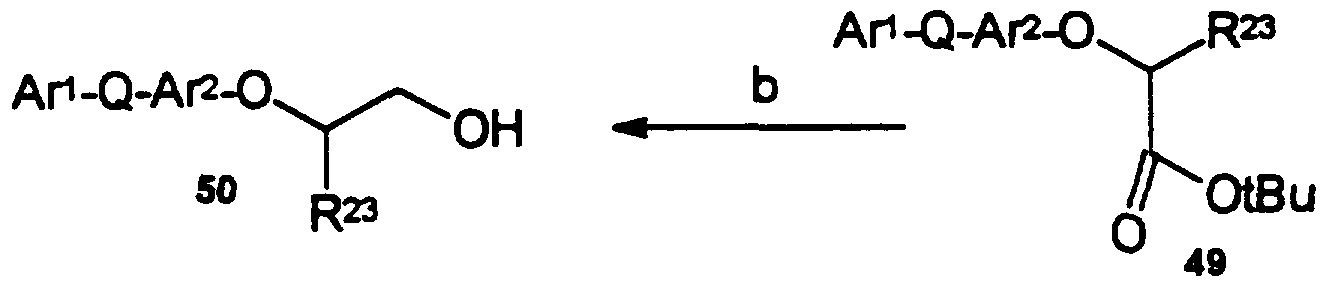
  • phenol 15 is alkylated with t-butylbromoacetate in THF in the presence of sodium hydride to yield t-butyl ester 47, which is then reduced with LAH in THF to afford the hydroxyethylene substituted analogs, Ar 1 -Q-Ar 2 -0-CH 2 CH 2 - OH 48.
  • t-butyl ester 47 may be alpha-alkylated via reaction with LDA in THF at -78 * C, followed by quenching with an alkylhalide (R n X) at -78 ⁇ C.
  • R n X alkylhalide
  • the resulting alpha-substituted ester 49 is reduced (LAH in THF) to afford compound 50 having a branched alkylene moiety.
  • R H, CH 3 , CH 2 CH 3 or benzyl
  • Scheme 14 describes yet another synthetic pathway utilizing t-butyl ester ⁇ as a starting material for the preparation of compounds of Formula I.
  • the t-butyl ester is deprotected with trifluoroacetic acid in methylene chloride to afford the corresponding acid 51 which is then coupled to an amine compound of the
  • R 20 and R 21 are independently hydrogen or alkyl and optionally the defined amine may be a cyclic amine.
  • Amide 52 may be reduced with lithium aluminum hydride in THF to give compound 53, provided that neither R 0 nor R 21 is (nor comprises) a functional moiety, such as an amide, ester, nitrile or the like, which is reactive toward LAH.
  • Compound 53 is a compound of formula I.
  • Scheme 15 depicts a preferred method for preparing compounds of Formula I which comprise sterically hindered amines such as 2,6-dimethylpiperidine, 2,5- dimethylpyrrolidine and the like.
  • the sterically hindered amine is acylated with chloroacetylchloride in methylene chloride/pyridine at O'C to afford oe-chloroamide 54.
  • Alkylation of a phenol of the formula Ar 1 -Q-Ar 2 -OH with the ⁇ -chloroamide 54 [DMF,NaH] affords amide 55.
  • the amide group of compound 55 is the only moiety which is reactive toward LAH, reduction of compound 55 with LAH in THF provides a compound 56 which is a compound of Formula I.
  • n 1-4
  • Scheme 16 describes yet another method for preparation of compounds of Formula I in which compound 15 is alkylated with a bromodimethyl acetal (60) in DMF in the presence of NaH to afford acetal 57. Subsequent deprotection with toluene-4-sulfonic acid in THF/H 2 0 affords intermediate aldehyde 58 which is reductively aminated [EtOH, KOH, NaBH 3 CN] with an amine of the formula HN ⁇ 2 to afford compound 59 which is a compound of Formula I.
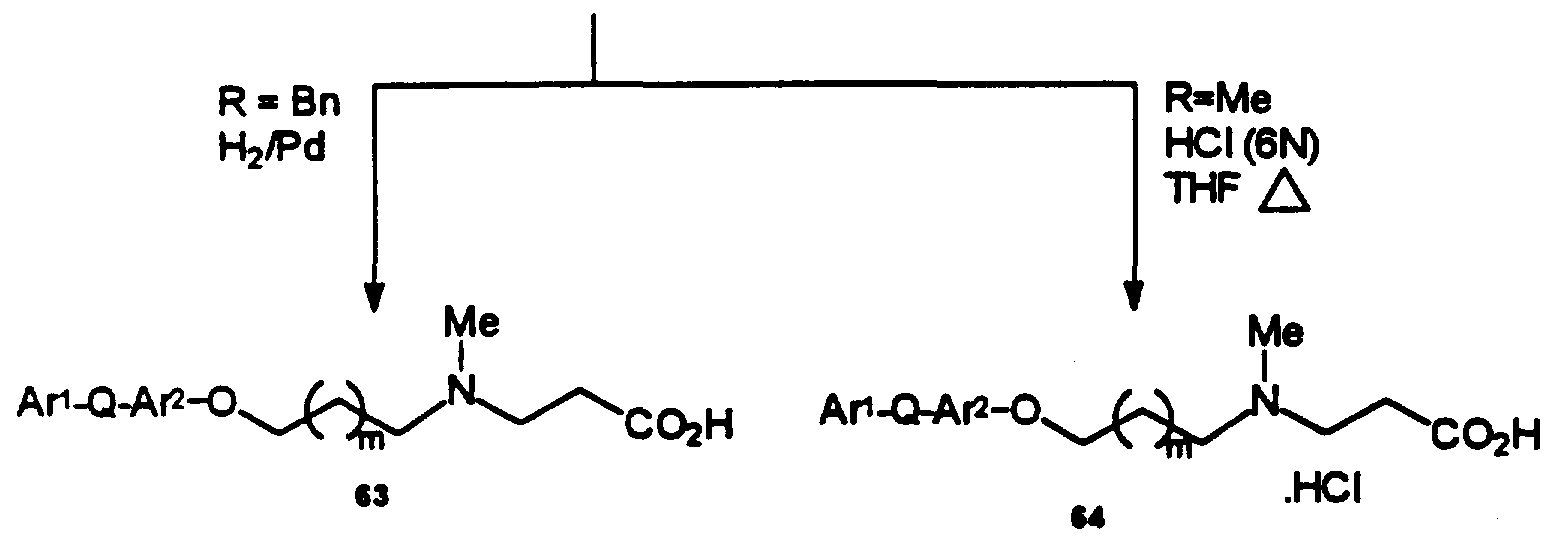
  • Scheme 17 shows a preferred method for preparing compounds 63 and 64 employing an intermediate chloride 60 as an alternative to using the corresponding tosylate.
  • Compound 60 is aminated with a 100-fold excess of methylamine in acetonitrile at 60'c - 70 * C to afford secondary amine 61.
  • compound 61 is a compound of Formula I
  • compound 61 may be further elaborated by reaction with a benzylacrylate ester or a methylacrylate ester to provide compound 62 which is also a compound of Formula I.
  • ester 62 is a benzyl ester, it may be converted into its corresponding acid 63 by hydrogenation (H 2 /Pd/EtOH at 2 psi) ; and where ester 62 is alkyl ester, it may be converted into its corresponding acid as the hydrochloride salt 64 via hydrolysis with 6N HCl in THF at 60°C.
  • the nitrogen-containing moiety comprises at least one polar moiety, such as a carboxylic acid or ester moiety or a carboxamide, acylhydrazide, alkylamide or alanineamide moiety or the like.
  • R M alkyl, branched alkyl, aryl.
  • Scheme 18 illustrates further modification of a compound 65 which is also referred to herein as a ⁇ - alanine-based compound of Formula I.
  • Compound 65 which is representative, is reductively aminated with a C,-C 4 aldehyde or ketone included but not limited to formaldehyde, acetaldehyde, 1-propanal, acetone, methyl-ethyl ketone and the like to provide compound 66 which is a compound of Formula I.
  • Compound 66 may optionally be converted tertiary alcohol 67 (also a compound of Formula I) by reaction with methyImagnesium bromide in ether at 0 ⁇ C.
  • Scheme 19 illustrates a method for introducing one or two methyl substitution(s) into the backbone of the -alanine moiety of compound 62.
  • Compound 62 may be sequentially alpha-methylated by reaction with LDA in THF at -78°C followed by quenching with methyliodide to afford compound 68 or compound 69.
  • S chemes 20 and 21 show modification of a compound 7 0 comprising an ester-containing Z group to produce compound 71 or compound 72 possessing a variety of polar substitutions.
  • Scheme 20 depicts the modification of a compound 70 which comprises an ester moiety in which the ester is modified by the addition of a nucleophile such as an amine or hydrazine to provide compound 71 as shown in the "Exemplified Reactions" set forth in equations (a)- (h) of Scheme 20.
  • Scheme 21 depicts the modification of a compound 70 which comprises an ester moiety in which the ester is modified by the addition of a nucleophile such as an amine or hydrazine to provide compound 71 as shown in the "Exemplified Reactions" set forth in equations (a)- (h) of Scheme 20.
  • Scheme 21 shows the conversion of compound 70 which comprises an ester moiety to corresponding acid 72 via one of three reactions: (l) basic hydrolysis; (2) acidic hydrolysis, which is preferred where R is a lower alkyl or benzyl; or (3) hydrogenolysis over palladium on carbon in EtOH, which is especially preferred where R is benzyl.
  • Schemes 22 and 23 show alternative methods for preparing a nitrile containing compound 74 which is a compound of Formula I and which conveniently may be employed as an intermediate in the preparation of various compounds of the present invention described in Scheme 24 below.
  • Scheme 23 shows a synthetic route to compound 74 which is analogous to Scheme 22.
  • the t- butoxycarbonyl-protected (i.e., BOC-protected) piperidine amide 75 is dehydrated using the conditions described in Scheme 22 (TFAA/pyridine) to afford protected nitrile 76.
  • Deprotection of nitrile 76 with trifluoroacetic acid in methylene chloride at 0°C affords the corresponding secondary amine 77 which may be coupled to compound 17 essentially as described in Scheme 6 (step d) to afford nitrile-containing compounds of the present invention, which may be utilized as described in Scheme 24.
  • Scheme 24 shows several reaction pathways which may be used to modify the nitrile moiety of compound 78 to afford a variety of compounds of the present inventions.
  • step (a) the nitrile moiety of compound 78 is condensed with hydroxylamine in an alcoholic solvent such as ethanol, propanol, butanol, or the like to afford the corresponding hydroxyamidine 79 which is a compound of the present invention as well as an intermediate for step (b) of this Scheme.
  • hydroxyamidine 79 may be hydrogenated in ethanol over palladium on carbon to afford the corresponding amidine 80 which is a compound of the present invention.
  • hydroxyamidine 79 may be cyclized with phosgene in toluene at 60°C to yield 81 which is a compound of the present invention.
  • Scheme 21 furthers shows, in step d, reacting nitrile 78 with tri ethyl-tin azide in xylene at 130°c to afford the corresponding tetrazole containing compound 82 which is a compound of the present invention.
  • Scheme 25 illustrates modification of compounds having a cyclic amine moiety derivatized with an acetamide group (compound 83) to convert the acetamide moiety to a primary amine (HCl/EtOH/H 2 0 80°-100°C) to provide compound 84 which, in turn, may be modified to a urea moiety (TMS-NCO) to provide compound 85 or to an alpha-chloroamide moiety to provide compound 86.
  • a primary amine HCl/EtOH/H 2 0 80°-100°C
  • TMS-NCO urea moiety
  • Scheme 27 shows methods for preparing compounds of the invention having a 4-substituted 2-methyl piperadine moiety.
  • di-protected 4- piperadol 91 is methylated in the 2-position using the method of P. Beak, et al., J. Org. Chem . 58, 1109 (1993).
  • the 2-methyl derivative 92 is deprotected using trifluoracetic acid in methylene chloride at 0 ⁇ C to yield the secondary amine 93 which, in turn, is coupled to a compound of the formula Ar 1 -Q-Ar 2 -CH 2 C0 2 H (compound 51, wherein R is hydrogen) using the method described in Scheme 14, step (b) .
  • the resulting amide 94 may be reduced and desilylated in one step with LAH in THF at room temperature to afford the trans di- substituted piperadine 95 which is a compound of the present invention.
  • amide 94 may be desilylated (TBAF) to afford alcohol 96 which is subjected co a four-step reaction sequence (steps (f) (l)-(f) (4) ) to afford cis 2-methyl, 4-amino piperadine 97.
  • the four-step reaction scheme consists of reacting the alcohol 96 with TsCI in methylene chloride/pyridine at 0°C to give the corresponding tosylate which is displaced with sodium azide in DMF (60 ⁇ -80 ⁇ C) to afford the corresponding azide having inverted stereochemistry (i.e., trans ⁇ cis).
  • the azide is hydrogenated at atmospheric pressure in methanol over 4% palladium on carbon to afford the ccresponding amine of the formula
  • Scheme 28 shows methods for making cis 2-methyl, 4-substituted piperidines, 100, (which are compounds encompassed within "ZH” as used herein) which compounds can be coupled in a coupling reaction as described in Scheme 6 to afford compounds of formula I.
  • Scheme 28 starts with commercially available 2-chloro-6-methyl pyridine-4-carbonylchloride (Maybridge Chem.) which is reacted with one of the following: (1) ammonium hydroxide; (2) methanol; or (3) methylamine.
  • the reactions each may be carried out in methylene chloride at 0 ⁇ C to afford a substituted pyridine of the formula 99 wherein R is (1) NH 2 ; (2) OCH 3 ; or (3) NHCH 3 , respectively.
  • Compound 99 is hydrogenated over ruthenium catalyst (e.g. 5% ruthenium on charcoal) at 140 ⁇ C at 60 psi to afford a cis 2-methyl,4-substituted piperidine 100.
  • Scheme 29 shows methods for preparing cis 2,6 dimethyl, 4-substituted piperidines 103 and 105 (which compounds are also encompassed within "ZH” as defined herein) which may be coupled in a coupling reaction as described in Scheme 6 to afford compounds of the present invention.
  • Scheme 29 starts from 2,6- dimethy1-4-cyanopyridine 101 which is prepared in accordance with the method of Feely, et al., JACS ___, 4004 (1959) .
  • Compound 101 is hydrolyzed using basic hydrogen peroxide in ethanol to afford primary amide 102 which, in turn, is hydrogenated under the conditions described in Scheme 28 to afford the corresponding tri-substituted piperidine 103.
  • primary amide 102 may be esterified using HCl(g) in methanol to afford the corresponding methylester 104 which, in turn, may be hydrogenated as described in Scheme 28 to afford the corresponding tri- substituted piperidine 105.
  • R is H or Me
  • Scheme 30 shows methods for preparing 2-methyl 4- substituted piperidines and 2,6-dimethyl 4-substituted piperidines 108 which can be coupled as described in Scheme 6 to afford compounds of the present invention.
  • compound 106 may be prepared by the combination of the method of R.F. Evans et al. , JOC 21, 1665 (1962), followed by the method of R.J. Martins et al., RECUEIL 655 (1967).
  • Compound 106 is acetylated using acetic anhydride and pyridine and the resultant acetamide 107 is hydrogenated under the conditions described in Scheme 28 to afford compound 108.
  • Scheme 31 shows a method for preparing substituted tropones (referred to herein as "ZH") which tropones may be coupled in accordance with Scheme 6 to provide compounds of the present invention.
  • tropone 109 (which may be derived from commercially available N-methyl tropone) is N-benzylated with benzylbromide in DMF in the presence of K 2 C0 3 at 0°c to provide 110 which is homologated with the lithium anion derived from dimethylsilyldithiane (THF, nBuLi, 0°C) to give the dithiane adduct 111.
  • the dithiane adduct 111 is converted into the corresponding methyl ester using mercuric chloride- catalyzed hydrolysis in methanol to provide methyl ester 112 which is debenzylated via hydrogenation in methanol/concentrated hydrochloric acid over palladium hydroxide on carbon at 60 psi to afford carboxymethyl- substituted tropane 113. It should be understood that such carboxymethyl-substituted tropanes may be further modified in accordance with the method described in Schemes 20 and 21 to provide a wide variety of substituted tropones.
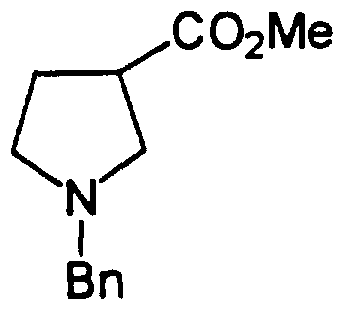
  • Scheme 32 shows the preparation of 3-substituted pyrrolidine 119 from methy-l-benzyl-5-oxo-3-pyrrolidine carboxylate 114 which is commercially available.
  • compound 114 is reduced with LAH in THF at room temperature to afford alcohol 115, which is then reacted with thionyl chloride at reflux to give to the corresponding chloride 116.
  • Compound 116 is then treated with aqueous sodium cyanide at 100°C for about 48 hours to yield the nitrile 117.
  • Scheme 33 shows a 3-step procedure for the preparation of [2.2.1]-2-aza-bicycloheptane 123 from 2- (carbobenzyloxy) 2-azabicyclo[2.2. l]heptan-5-one 120.
  • Compound 120 is prepared as described by F. Ivy Carroll, et al., J. Med. Chem. ___, 2184 (1992) .
  • Compound 120 is condensed with methyl (triphenylphosphoranylidene)acetate in THF at 50 ⁇ -70°C to afford a , ⁇ unsaturated ester 121.
  • Reduction of compound 121 with magnesium in methanol affords the corresponding saturated ester 122.
  • Compound 122 is decarbobenzyloxylated [5% Pd/C, MeOH, aq, HCl] to afford the corresponding amine 123.
  • SCHEME 34
  • Scheme 34 shows the preparation of compounds of the present invention which are characterized as containing a 2-aza[2.2.1]bicyclo heptane or 2- aza[2.2.2]bicyclooctane moiety.
  • Tosylate 124 is displaced with sodium azide in DMF to afford the corresponding azide 125.
  • Azide 125 is reduced with LAH in THF to afford the corresponding primary amine 126.
  • Primary amine 126 may be further condensed in an aza Diels-Alder reaction in the presence of either cyclopentadiene or 1,3 cyclohexadiene [40% aqueous formaldehyde, in IN HCl] to afford azabicyclic alkenes 127 which may be hydrogenated in ethanol over 4% palladium on carbon at 5 psi to afford compounds 128.
  • Scheme 35 describes preparation of compounds 133 of the invention having a 3-aza[3.2.1]bicyclo octane-7- methoxycarbonyl moiety.
  • 5-norbornene-2-carboxylate is esterified in DMF containing methyl iodide and potassium carbonate.
  • the resulting methyl ester 130 is dihydroxylated with catalytic osmium tetroxide in acetone/H 2 0 using N-methylmorpholine oxide to recycle the catalyst.
  • the resulting diol 131 is cleaved with aqueous sodium periodate in t-butanol to afford dialdehyde 132.
  • Condensation of dialdehyde 132 with amine 126 in methanol followed by reduction with sodium cyanoborohydride affords compound 133 which is a compound of the invention.
  • Example 1
  • Example 3 title compound was prepared in the same manner as Example 44 sustituting 4-hydroxybenzaldehyde.
  • the crude aldehyde was chromatographed (silica gel, methanol/methylene chloride/ammonium hydroxide 5/94/1) to afford an amber oil.
  • the product had the following properties: H.R.M.S. M + calcd for C, 3 H, 7 N0 2 : 219.1259. Found 219.1239.
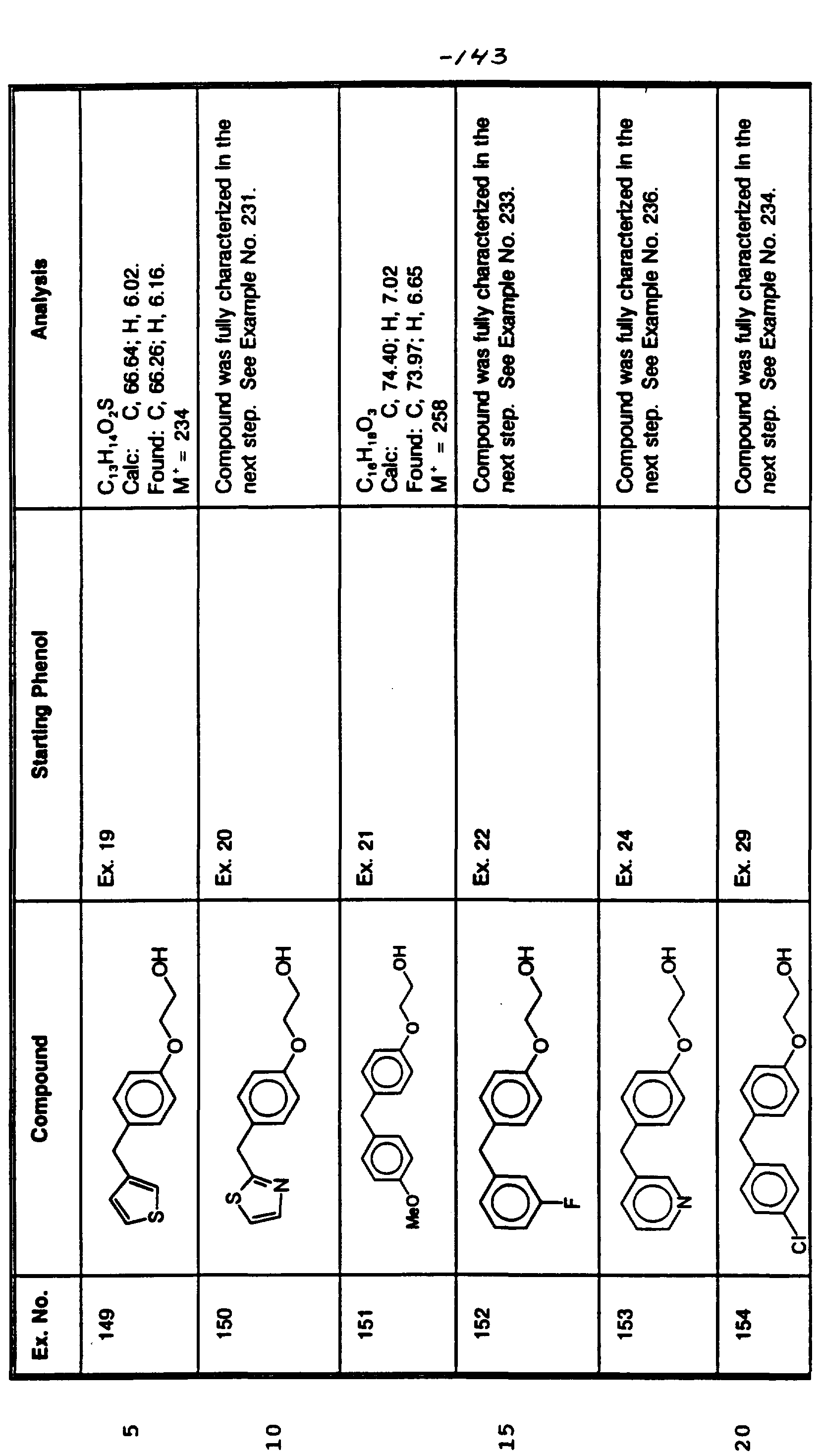
  • Example 4 The product of example 4 (0.5 mmol) was mixed with Et 3 SiH (0.5 mL, Aldrich) and TFA (0.4mL) and stirred at room temperature for 6 hours under Argon. The reaction mixture was concentrated and the residue obtained was basified with 10% aqueous NaOH solution. The reaction solution was extracted with ether (3 X 10 mL) . The combined organic layers were washed with brine, dried (Na 2 S0 4 ) and filtered. The filtrate was concentrated to give 160 mg product. The resulting product was fully characterized in the next step. See Example No. 148. The compounds exemplified in Table 2 were prepared essentially as described in Example 11, above, except that the precursor compounds of Examples 5-10 were substituted for the compound of Example 4.
  • Example 11 The product of example 11 was treated with tetrabutylammonium fluoride (2.5 mL of IM solution, Aldrich) and the mixture was stirred at room temperature for 2 hours. The solvent was removed under reduced pressure, the residue obtained was treated with water and ether. The organic layer was separated and washed two times with water and brine, dried over Na 2 S0 4 and concentrated in vacuo to give 90 mg of the title compound as yellow oil. The resulting product was fully characterized in the next step. See Example No. 148.
  • a solution of thioformamide in dioxane was prepared by refluxing formamide (1.5 mL, 43 mmol) and P J S J (3.3 g, 7.3 mmol) in 70 mL dioxane for 2 h.
  • the solution was added to a solution of the product from Example 26 (1.0 g, 4.1 mmol) and 2 g MgC0 3 in 10 mL dioxane and the mixture refluxed for 1 h.
  • the mixture was cooled and poured into ether and IN NaOH.
  • the ether layer was separated and was washed with brine, dried over Na 2 S0 4 and concentrated. Flash chromatography using a gradient of 10:1 to 5:1 hexane/EtOAc provided the title compound as a colorless oil.
  • Example 28
  • Example 4 The compounds exemplified in Table 4 were prepared essentially as described in Example 30 with the exception of Example 39 which was prepared from 2- methoxyphenol, benzoic acid and polyphosphoric acid at 120°C for 1 hour, with the disclosed substitutions being made for 2-chlorophenol. TABLE 4
  • Example 40 The product of Example 40 (1.45 g, 6.64 mmol) was stirred in 40 mL CH 2 C1 2 at -78 * C and 7 mL of IN BBr 3 in CH 2 C1 2 was added. After stirring at 0 * C for 30 min and 25 * C for 20 h, the mixture was poured into H 2 0. The CH 2 C1 2 was separated, washed with brine, dried over Na 2 S0 4 and concentrated. Recrystallization from hexane/CH 2 Cl 2 provided the product as a white solid: mp 91-94 * C;
  • the HCl salt was generated with ethanolic HCl to provide, after concentration, the title compound as a white solid: mp 180-182 * C (d) ; Anal, calc'd for C JJ H ZJ NOS ' HCI: C, 65.22; H, 6.91; N, 4.00; Cl, 10.13. Found: C, 65.16; H, 7.20; N, 3.95; Cl, 9.84.
  • a inopyridine (586 mg, 6.2 mmol) was dissolved in 2 mL methanol. To the pyridine was added 2 mL 5N HC1/CH 3 0H followed by the aldehyde from Example 3. Sodium cyanoborohydride (60 mg) was added to the mixture which was stirred for 12 hours at RT. The reaction was quenched with 20 mL 10% sodium hydroxide and extracted with 3 X 50 mL ethyl acetate. The combined organic phases were dried (MgS0 4 ) , filtered and concentrated to afford a brown oil. The crude product was chromatographed (silica gel, methanol/methylene chloride/ammonium hydroxide 2/97.5//0.5) to give yellow crystals.
  • Oxalyl chloride (0.56 ml, 6.35 mmol) was added to a stirred solution of 6-Chloronicotinic acid (1 g, 6.35 mmol; Aldrich) in THF (10 ml). After the addition of a drop of DMF to initiate the reaction, the mixture was stirred at room temperature for another 10 minutes. The solvent was removed in vacuo and the acid chloride was then dissolved in benzene (20 ml). A1C1 3 (2.1 g, 15.9 mmol) was then added slowly and the reaction was stirred at reflux for 1.5 hours. The mixture was then concentrated and flash chromatographed through a pad of silica gel (10% EA ⁇ 90% hexane) to afford 1.35 g. of a pale yellow solid. The resulting product had the following properties:
  • Example 75 The product from Example 75 (0.1 g, 0.33 mmol) was subjected to the reaction conditions described for the preparation of Example 11. The crude product was chromatographed on silica gel eluting with ethyl acetate:hexane (1:1) saturated with aqueous concentrated ammonium hydroxide. This produced 0. 07 g (74 %) of the title compound .
  • This example demonstrates reduction of benzylic alcohols using triethylsilane.
  • Example 93 The alcohol of Example 93 was converted to its corresponding acetate with Ac 2 0 and then hydrogenated
  • Example 148 The compounds exemplified in the following Table were prepared essentially as described in Example 148, except that the phenol of example 18 was replaced with the corresponding phenol designated in the Table.
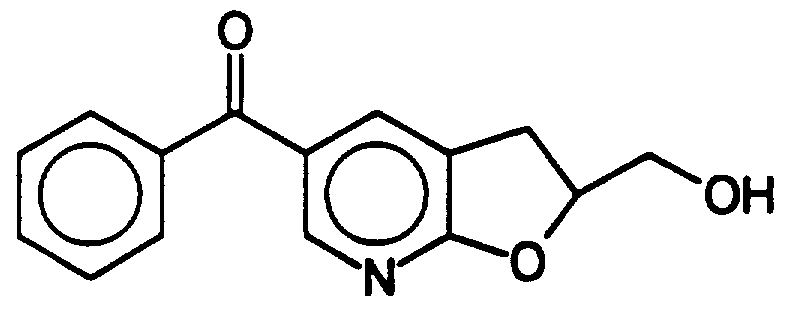
  • the product (8.8 g) was heated to 215-220 ⁇ C for 8 hours. After cooling, the resulting product was chromatgraphed over silica gel using 6% ethyl acetate in hexane to give the corresponding rearranged product (8 g) .
  • This material was taken-up in CHC1 3 (500 mL) . The solution was stirred and cooled to 0 ⁇ C. To this was added Na 2 C0 3 (4 g) and 3-chloroperoxybenzoic acid (9 g, 80-85%, Aldrich) suspended in CHC1 3 (100 mL) . After 4.5 hours, the mixture was filtered through celite and the filtrate washed with 5% aqueous Na 2 C0 3 solution.
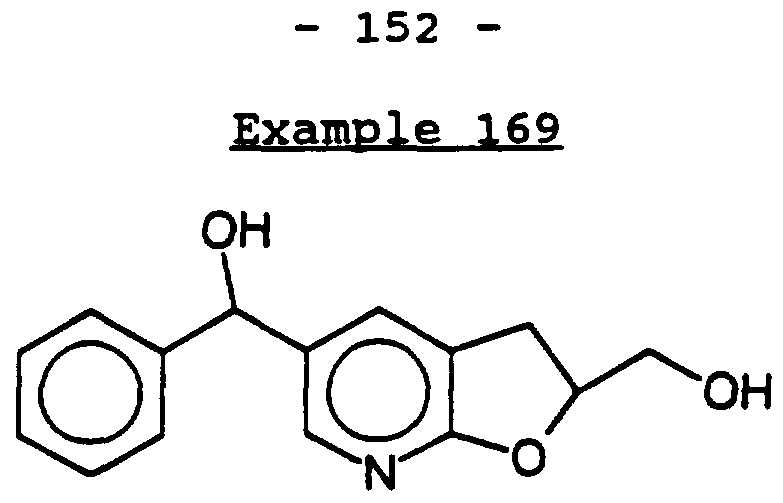
  • Example 168 To a stirred solution of the product of Example 168 (0.8 g) in THF (50 mL) was added sodium borohydride (0.4 g) and the mixture refluxed for 1 hour. The mixture was treated with saturated aqueous NH 4 C1 with caution and extracted with ethyl acetate. The organic phase was washed with water, dried over MgS0 4 to give the title product as a colorless solid.
  • Example 169 The product of Example 169 was hydrogenated in a parr apparatus in a mixture of ethyl acetate and acetic acid over 5% Pd on carbon under 5 psi hydrogen atmosphere at room temperature for 3 hours. The reaction mixture was filtered and the filtrate concentrated. The residue was chromatographed over silica gel using ethyl acetate as eluant to give the title product as a colorless solid (0.3 g) .
  • a 35% mineral oil suspension of potassium hydride (12 g) was washed with hexane and suspended in THF (150 mL) at -78°C. The mixture was stirred and 4- hydroxydiphenylmethane (18.5 g) was added as solid in several portions over 0.5 hours. The mixture was allowed to warm to 0°C over 2 hours and cooled back to -78°C. To this was added diethylcarbamoylchloride (13.6 g, Aldrich) over 0.25 hours and the mixture allowed to warm to room temperature over 16 hours. The mixture was refluxed for 0.5 hours and cooled in ice.
  • Example 171 To a stirred solution the product of Example 171 (5.085 g) in ether (150 mL) and tetramethylethylene- diamine (3 mL) at -78°C was added a 1.3 molar solution of sec.butyl lithium in cyclohexane (16 mL) . After 1 hour, dimethylforamide (1.45 mL) was added. After 2 hours, saturated aqueous NH 4 C1 was added and the layers separated. The organic phase was dried over MgS0 4 and concentrated. The residue was chromatographed over silica gel using 20% ethyl acetate in hexane to to give the title product as thick oil (5.1 g) .
  • Example 172 The product of Example 172 was taken-up in ether (125 mL) and the solution cooled to -78 ⁇ C. To this stirred solution was added a IN ether solution of allyImagnesium bromide (16 mL) . After 10 minutes, the mixture was warmed to 0°C and quenched carefully with saturated aqueous NH 4 C1. The layers were separated and the organic phase was dried over MgS0 4 and concentrated. The residue was chromatographed over silica gel using 20% to 30% ethyl acetate in hexane to give the title product as a thick gum (3.9 g) .
  • Example 175 A solution of the product of Example 175 (0.18 g) and para-toluenesulphonic acid (5 mg) in CHC1 3 (5 mL) was allowed to stand at room temperature for 16 hours. The solution was washed with water and dried over MgS0 4 to give the title product as a thick gum.
  • Example 166 The procedure of Example 166 was repeated using 4- phenoxyphenol (Aldrich) and allyl bromide in the place of 4-hydroxy-diphenylmethane and 3-chloro-2- methylpropane respectively to obtain the title compound as a thick liquid.
  • Example 198 The product from Example 198 (2.78 g, 9.3 mmol) was dissolved in 35 mL THF in a Parr Shaker apparatus. A catalytic amount of 4% Pd/C was added, and the reaction was run under 60 p.s.i. of H 2 at room temperature for 23 hours. The reaction was filtered through Celite and concentrated to afford the product (1.49 g, 78%) as yellow crystals.
  • the product had the following properties: mp 113-115°.
  • Example 199 (0.34g, 1.7mmol) and sodium hydride (O.llg, 2.8 mmol, 60% dispersion in mineral oil) in 25 mL DMF at RT overnight.
  • the reaction was poured into 100 mL water and washed with 4 X 50 mL ethyl acetate.
  • the organic phases were dried (Na 2 S0 4 ) and concentrated to afford an amber oil.
  • the crude product was chromatographed (silica gel, ethanol/methyiene chloride/ammonium hydroxide 5/94/1) to give an amber oil.
  • the product had the following properties:
  • example 326 (0.30 g, l.l mmol in CH 2 C1 2 (6 L) was added methyl acrylate (Aldrich, 0.13 L, 1.5 mmol) at r.t. The reaction was allowed to stir at r.t. for 17 hours, and then concentrated under a stream of nitrogen gas. The residue was purified by column chromatography using 10% MeOH/CH 2 Cl 2 as eluant to afford 0.32 g of the title compound as a clear colorless oil. The resulting product had the following properties: Analysis calcd for C, 9 H 2j NOjS: C, 65.58; H, 7.25; N, 4.03. Found: C, 65.38; H, 7.30; N, 3.95.
  • example 330 80 mg, 0.23 mmol was added 6 N HCl (1 mL) .
  • the reaction was heated to 70°C for 4 hours, then concentrated in vacuo to give a white solid.
  • the solid was slurried with Et20 and collected by vacuum filtration to give 110 mg of the title compound.
  • the resulting product had the following properties: Analysis calcd for C, 9 H 24 N0 3 SC1 1.3 H 2 0: C, 56.30; H, 6.01; N, 3.46. Found: C, 56.05; H, 6.22; N, 3.37.
  • Example 180 A mixture of the product of Example 180 (0.48 g) , N- benzylpiperazine (1 mL) , K 2 C0 3 (0.7 g) in DMF (4 mL) was heated to 80°C for 16 hr. The volatiles were removed in vacuo and the residue was extracted with ethyl acetate and water. The organic phase was washed with water (3 times) , dried over MgS0 4 and concentrated. The residue was chromatographed over silica gel using CHC13/EtOH/aqueous NH3 (85/14/1) as eluant to give a N- benzyl piperazine derivative.
  • Example 366 To a stirred solution of the product of Example 366 (1 g, 7 mmol) in tetrahydrofuran (20 mL) at -50°C was added n-butyllithium (1.6 M in THF, 10 mL, 16 mmol) dropwise over one minute. The mixture was slowly warmed over one hour to -20°C and then cooled to -50°C. The mixture was then treated with benzyl bromide (0.9 mL, 7.6 mmol) and warmed to room temperature over one hour. The mixture was poured into water (50 mL) , saturated brine (25 mL) and dried over MgS04. After filtration, the volatile components were removed at reduced pressure on a rotary evaporator. The crude product was used in Example 368 without further purification.
  • n-butyllithium 1.6 M in THF, 10 mL, 16 mmol
  • Example 368 To a stirred solution of the product of Example 368 (0.1 g, 0.26 mmol) and isonipecotamide (0.06 g, 0.5 mmol, Aldrich) in N,N-dimethylformamide (5 mL) was added anhydrous potassium carbonate (0.25 g) in one portion. This mixture was heated at 80°C for 18 hours. The mixture was poured into water (100 mL) and extracted with 25 mL of ethyl acetate. The ethyl acetate was washed 2 times with water (2 x 25 mL) , saturated brine (25 mL) and dried over MgS0 4 . After filtration, the volatile components were removed at reduced pressure on a rotary evaporator.
  • Example 368 The product from Example 368 (0.1 g, 0.26 mmol) and ethyl isonipecotate (0.08 g, 0.5 mmol, Aldrich) was subjected to the reaction conditions described for the preparation of Example 369.
  • the crude product was chromatographed on silica gel eluting with ethyl acetate:hexane (1:1) saturated with aqueous concentrated ammonium hydroxide.
  • the product was taken up in ether (5 mL) and treated with hydrogen chloride and the resulting solid was triturated with ether. This produced 0.06 g (56%) of the title compound.
  • 1,3-Propanediol 200 mL, Aldrich was subjected to the reaction conditions described for the preparation of Example 366. This produced 13.2 g (70%) of the title compound.
  • Example 372 The product from Example 372 (6 g, 37.9 mmol) was subjected to the reaction conditions described for the preparation of Example 362. The residue was chromatographed on a reverse phase column gradient eluting with methanol-water. This produced 0.76 g (7.9%) of the title compound.
  • Example 373 The product from Example 373 (0.5 g, 2.01 mmol) was subjected to the reaction conditions described for the preparation of Example 368. The crude product was chromatographed on silica gel gradient eluting with ethyl acetate: exane (1:19 to 1:9). This produced 0.53 g (65%) of the title compound.

Landscapes

  • Chemical & Material Sciences (AREA)
  • Organic Chemistry (AREA)
  • Health & Medical Sciences (AREA)
  • Medicinal Chemistry (AREA)
  • Chemical Kinetics & Catalysis (AREA)
  • General Chemical & Material Sciences (AREA)
  • Nuclear Medicine, Radiotherapy & Molecular Imaging (AREA)
  • Pharmacology & Pharmacy (AREA)
  • Life Sciences & Earth Sciences (AREA)
  • Animal Behavior & Ethology (AREA)
  • General Health & Medical Sciences (AREA)
  • Public Health (AREA)
  • Veterinary Medicine (AREA)
  • Engineering & Computer Science (AREA)
  • Bioinformatics & Cheminformatics (AREA)
  • Pharmaceuticals Containing Other Organic And Inorganic Compounds (AREA)
  • Rheumatology (AREA)
  • Dermatology (AREA)
  • Pain & Pain Management (AREA)
  • Preparation Of Compounds By Using Micro-Organisms (AREA)
  • Medicines Containing Material From Animals Or Micro-Organisms (AREA)
  • Nitrogen Condensed Heterocyclic Rings (AREA)
  • Plural Heterocyclic Compounds (AREA)
  • Furan Compounds (AREA)
  • Organic Low-Molecular-Weight Compounds And Preparation Thereof (AREA)
  • Heterocyclic Compounds That Contain Two Or More Ring Oxygen Atoms (AREA)
  • Acyclic And Carbocyclic Compounds In Medicinal Compositions (AREA)
  • Epoxy Compounds (AREA)
  • Hydrogenated Pyridines (AREA)
  • Heterocyclic Compounds Containing Sulfur Atoms (AREA)
  • Pyrrole Compounds (AREA)
  • Other In-Based Heterocyclic Compounds (AREA)
  • Pyridine Compounds (AREA)
  • Indole Compounds (AREA)
  • Quinoline Compounds (AREA)
  • Thiazole And Isothizaole Compounds (AREA)

Abstract

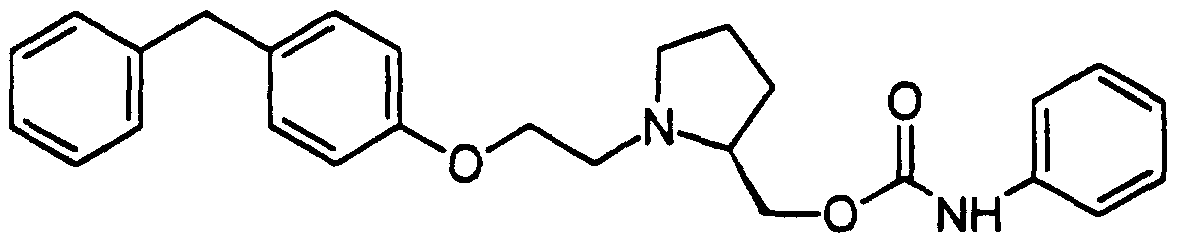
The present invention provides compounds of the formula Ar1-Q-Ar2-Y-R-Z and pharmaceutically acceptable salts thereof wherein Ar?1 and Ar2¿ are optionally substituted aryl moieties, Z is an optionally substituted nitrogen-containing moiety which may be an acyclic, cyclic or bicyclic amine or an optionally substituted monocyclic or bicyclic nitrogen-containing heteroaromatic moiety; Q is a linking group capable of linking two aryl groups; R is an alkylene moiety; Y is a linking moiety capable of linking an aryl group to an alkylene moiety and wherein Z is bonded to R through a nitrogen atom. The compounds and pharmaceutical compositions of the present invention are useful in the treatment of inflammatory diseases which are mediated by LTB¿4? production, such as psoriasis, ulcerative colitis, IBD and asthma.

Description

LTAt HYDROLASE INHIBITORS
FIELD OF THE INVENTION
This invention relates generally to anti- inflammatory compounds and pharmaceutical compositions, and more particularly to anti-inflammatory compounds and compositions which are capable of inhibiting leukotriene A4 hydrolase.
LTA4 hydrolase is a requisite enzyme in the biosynthetic pathway leading to LTB4 formation. LTB4 is a proinflammatory compound. R. Lewis, et al., N. Engl . J . Med. 323, 645-655 (1990) have demonstrated that LTB4 is a potent granulocyte agonist inducing chemotaxis, aggregation, degranulation, adherence and priming of inflammatory cells for induction by other agonists. Binding of LTB4 to receptors is stereospecific with two distinct classes of binding sites. A. Lin, et al., Prostaglandins 28, 837-849 (1984) . A high affinity site [4-5xl0'10 M] mediates chemotaxis and chemokinesis while lower affinity sites [0.6-5xl0'7 M] stimulate granular secretion and oxidative burst. The LTB4 receptor is associated with a GTP-binding protein that regulates affinity and transduces signals. T. Schepers, et al., J . Biol . Chem . 267, 159-165 (1992). Elevated LTB4 levels have been reported for many diseases. Most prominently, elevated LTB4 levels have been correlated to the pathology of inflammatory bowel disease (IBD) including Crohn's disease and ulcerative colitis and in psoriasis. P. Sharon, et al., Gastroent . 86, 453-460; K. Lauritsen, et al., Gastroent . 95, 11-17 (1989); S. Brain, et al., Br . J. Pharm . , 83, 313-317 (1984). Other properties of LTB4 which may contribute to disease processes are: stimulation of mucus secretion; stimulation of cytokine production; and the ability to act synergistically with other inflammatory mediators such as prostaglandins and cysteinyl leukotrienes thereby amplifying the inflammatory process.
B. Samuelsson, et al., J. Biol Chem. , 264, 19469- 19472 (1989) have shown that LTB4 biosynthesis from arachidonic acid involves the action of 2 enzymes, 5- lipoxygenase [5-LO] and LTA4 hydrolase. 5-LO transforms arachidonic acid to 5-HPETE and subsequent formation of LTA4, which is an unstable allylic epoxide intermediate which is enzymatically hydrolyzed by LTA4 hydrolase to form the dihydroxy acid LTB4.
LTA4 hydrolase is distinct from cytosolic and microsomal epoxide hydrolases based on strict substrate requirements, product formation [5(S),12(R) vs. 5(S),6(R) for mouse liver cytosolic epoxide hydrolase, and lack of inhibition by inhibitors of cytosolic epoxide hydrolase. LTA4 hydrolase appears to be ubiquitously distributed in mammalian tissues even in cell types that do not express 5-LO, suggesting the importance of transcellular metabolism of LTA4. While peptidomimetic compounds such as bestatin and captopril have been shown to exhibit LTA4 hydrolase inhibitory activity, they are not able to satisfy the requirement of a small organic compound which is capable of cellular penetration. It would therefore be very advantageous to be able to provide low molecular weight inhibitors of LTB4 biosynthesis which preferably exhibit oral activity in vivo at desirably low concentrations.
Summary of the Invention Applicants have now discovered that compounds of the formula I
Ar'-Q-A^-Y-R-Z
(I) and pharmaceutically acceptable salts and stereoisomers thereof possess LTA4 hydrolase inhibitor activity, wherein: Ar1 is an aryl moiety selected from the group consisting of:
(i) phenyl, mono-, di-, or tri-substituted phenyl with the substituents selected from the group consisting of Cl, Br, F, CF3/ lower alkyl, lower alkoxy, NH2, N02 and OH;
(ii) 2-, 4- or 5- thiazolyl,
(iii) 2-, 3- or 4-pyridinyl,
(iv) 2- or 3-thienyl, and
(v) 2- or 3-furyl; Ar2 is an aryl moiety selected from the group consisting
Figure imgf000005_0001
Figure imgf000005_0002
Figure imgf000005_0003
(iv)
Q is selected from the group consisting of:
Figure imgf000005_0004
(vi ) -NHCH2- ,
(vii ) -CH2NH- ,
(viii) -CF2- ,
( ix) -CH=CH- , (X) -CH2CH2- , and
(xi) carbon-carbon single bond;
Y is selected from the group consisting of (i)-O-, (ii) -s-,
(iii) -NH-,
(iv) -S(O)-, and
(v) -S(02)-;
R is selected from the group consisting of:
(i) linear or branched C2-C6 alkylene; or (ii) C(R,0)(Ru)-(CH2)m; and
Z is selected from the group consisting of:
(vii) a monocyclic or bicyclic heteroaromatic moiety having at least one heteroatom, wherein the heteroatom is nitrogen, and wherein the monocyclic heteroaromatic moiety comprises a 5- or 6-membered ring and the bicyclic heteroaromatic moiety comprises a fused 9- or 10-membered ring;
wherein R1 and R2 are independently selected from the group consisting of: (i) H,
(ii) lower alkyl or allyl, (iii) benzyl, (iv) -(CH2)aCOR15,
Figure imgf000007_0001
(vi) -(CH2)a-OH R3 and R4 are independently H or lower alkyl;
R5 and R6 are independently selected from the group consi
Figure imgf000007_0002
NH
(iii) -(CH2)βC0R15, (viii) <J ,
NH2
(IV) -(CH2)aC0NH(CH2)bC02R >1l6β, (ix)
Figure imgf000007_0003
(v) -NHR17,
R7 is H, halogen, lower alkyl, lower alkoxy, n"-ro, hydroxy, or R7 taken together with R10 is an al>. lene group having one or two carbon atoms;
R8 and R9 are independently H, halogen, lower alkyl, lower alkoxy, NH2, N02 or OH; R10 is H, lower alkyl, or R10 taken together with R7 is an alkylene group having one or two carbon atoms;
R11 is H or lower alkyl;
R12 is selected from the group consisting of:
(i) H,
(ii) -OH or =0,
Figure imgf000008_0001
(iv) -(CH2),CONH(CH2)bC02R16,
(v) -NHR17;
R13 and R14 are independently hydrogen, -(CH2)„COR15 , provided that at least one of R13 and RM is hydrogen;
R15 is -OR16, -NHR'6 or -NHNH2;
R16 is H, lower alkyl or benzyl;
Rπ is H, lower alkyl, benzyl, -COR16 or -CONH2;
X1 is NR18 , -S-, or -0-, wherein R18 is H, lower /
alkyl, -C0NH2, CSNH2, -C0CH3 or -S02CH3;
a and b are independently integers of from 0 to 5;
m is 1, 2 or 3;
n is 0, 1, 2 or 3;
p is 1 or 2; and
q is 1, 2 or 3; provided however that where R is C(R10) (Rπ)-(CH2)m, and R10 taken together with R7 forms an alkylene group having one or two carbon atoms, then -Ar2-Y-R is
Figure imgf000009_0001
wherein X is -CH- or -N-, and r is 1 or 2, further provided that wherein R1, R2 or both R1 and R2 are -(CH-jJ.COR15, then a is not O.
Detailed Description of the Invention
In one of its embodiments, the present invention entails compounds of the formula I
A^-Q-Ai^-Y-R-Z
(I) and pharmaceutically acceptable salts and stereoisomers thereof, wherein:
Ar1 is an aryl moiety selected from the group consisting of:
(i) phenyl, mono-, di-, or tri-substituted phenyl with the substituents selected from the group consisting of Cl, Br, F, CF3, lower alkyl, lower alkoxy, NH2, N02 and OH; (ii) 2-, 4- or 5- thiazolyl, (iii) 2-, 3- or 4-pyridinyl, (iv) 2- or 3-thienyl, and (v) 2- or 3-furyl; Ar2 is an aryl moiety selected from the group consisting
Figure imgf000010_0001
Figure imgf000010_0002
Figure imgf000010_0003
Figure imgf000010_0004
Q is selected from the group consisting of:
Figure imgf000010_0005
Y is selected from the group consisting of (i)-O-, (ϋ) -S-, (iii) -NH-, (iv) -S(O)-, and (v) -S(02)-;
R is selected from the group consisting of:
(i) linear or branched C2-C6 alkylene; or (ii) C(R10)(R")-(CH2)m; and
Z is selected from the group consisting of:
Figure imgf000011_0001
(vii) a monocyclic or bicyclic heteroaromatic moiety having at least one heteroatom, wherein the heteroatom is nitrogen, and wherein the monocyclic heteroaromatic moiety comprises a 5- or 6-membered ring and the bicyclic heteroaromatic moiety comprises a fused 9- or 10-membered ring;
wherein R1 and R2 are independently selected from the group consisting of: (i) H,
(ii) lower alkyl or allyl, (iϋ) benzyl, (iv) -(CH2).C0R15,
Figure imgf000012_0001
R3 and R4 are independently H or lower alkyl;
R5 and R6 are independently selected from the group consisting of:
Figure imgf000012_0002
(ii) -OH, =0, or -(CH2).0H (vii)
Figure imgf000012_0003
Figure imgf000012_0004
(iv) -(CH2).CONH(CH2)bC02R16, (ix)
Figure imgf000012_0005
(v) -NHR17,
R7 is H, halogen, lower alkyl, lower alkoxy, nitro, hydroxy, or R7 taken together with R10 is an alkylenyl group having one or two carbon atoms;
R* and R9 are independently H, halogen, lower alkyl, lower alkoxy, NH2, N02 or OH;
R10 is H, lower alkyl, or R10 taken together with R7 is an alkylenyl group having one or two carbon atoms;
R11 is H or lower alkyl;
R12 is selected from the group consisting of: (i) H,
(ii) -OH or =0, (iii) -(CH2).COR15, ( i V ) - ( CH2 ) .CONH ( CH2 ) bC02R16 , (V) -NHR17 ;
R13 and R14 are independently hydrogen , - (CH2) tCOR15 , provided that at least one of R13 and R14 is hydrogen ;
R15 is -OR16, -NHR16 or -NHNH2 ;
R16 is H, lower alkyl or benzyl;
R17 is H, lower alkyl, benzyl, -COR16 or -CONH2;
X 11 i•s -S-, or -O-, wherei.n R.1.* i.s H, lower
Figure imgf000013_0001
alkyl, -CONH2, CSNH2, -COCH, or -S02CH3;
a and b are independently integers of from 0 to 5;
is 1, 2 or 3;
n is 0, 1, 2 or 3;
p is 1 or 2; and
q is 1, 2 or 3;
provided however that where R is C(R10) (Rπ)-(CH2)B, and R10 taken together with R7 forms an alkylenyl group having one or two carbon atoms, then -Ar^-Y-R- is
Figure imgf000013_0002
wherein X is -CH- or -N-, and r is 1 or 2, further provided that wherein Z is
Figure imgf000014_0001
and R1 and/or R2 is -(CH2)tCOR15, then a is not 0.
In one of its embodiments the present invention entails compounds of formula I Ar1-Q-Ar2-Y-R-z, wherein Z is an amine moiety of the formula
Figure imgf000014_0002
In another of its embodiments the present invention includes compounds of formula I Ar Q-A^-Y-R-Z, wherein Z is
Figure imgf000014_0003
wherein R3, R4, Rs and R6 are defined as set forth hereinbefore.
In another of its embodiments the present invention entails compounds of the formula Ar1-Q-Ar2-Y-
R-Z wherein when Ar^Q-Ar^Y is era
Figure imgf000014_0004
are not simultaneously H or lower alkyl; or (B) R3, R4, RJ and R6 are not simultaneously H.
The compounds of the present invention, in several embodiments, may comprise a carboxylic acid or ester moiety. It will be appreciated by the art-skilled that a compound of the present invention comprising an ester moiety is readily converted, in vivo , especially when administered orally, into its corresponding carboxylic acid form. The ester-containing compounds of the present invention are therefore prodrugs of their carboxylic acid form. In another of its embodiments the present invention concerns compounds of formula I Ar^Q-Ar^Y-R-Z, wherein Z is a monocyclic or bicyclic heteroaromatic moiety having at least one heteroatom, the at least one heteroatom being nitrogen, wherein the monocyclic heteroaromatic moiety comprises a 5- or 6- membered ring and the bicyclic heteroaromatic moiety comprises a fused 9- or 10-membered ring.
In another of its aspects the invention entails pharmaceutical composition comprising a pharmacologically effective amount of a compound of formula I and a pharmaceutically acceptable carrier. In still another of its embodiments the present invention involves a method for treating a mammal exhibiting an LTB4 mediated inflammatory condition comprising administering to the mammal a pharmacologically effective amount of a compound of formula I.
The term "lower alkyl" means straight or branched chain alkyl having 1 to 6 carbon atoms such as methyl, ethyl, propyl, butyl, pentyl, hexyl and the branched chain isomers thereof.
The term "lower alkoxy" means straight or branched chain alkoxy having 1 to 6 carbon atoms such as methoxy, ethoxy, propoxy, butoxy, pentoxy, hexoxy and the branched chain isomers thereof.
The term "allyl" as used herein means the 1- propenyl radical, -CH2-CH2«=CH2.
The term "halo" means fluoro, cloro, bromo, or iodo. The phrase "monocyclic or bicyclic heteroaromatic moiety" having at least one heteroatom which is nitrogen, includes but is not limited to imidazole. triazole, benzimidazole, imidazopyridine, triazolopyridine, thiazole, purine and the like. Such monocyclic and bicyclic heteroaromatic moieties having at least two nitrogen atoms may be bonded, in a compound of the present invention, through any of the nitrogen atoms, as will be appreciated by the person of ordinary skill in the art, to provide two or more conformational isomers.
Such monocyclic heteroaromatic and bicyclic heteroaromatic compounds are included in the group of compounds referred to herein as "ZH", which group also includes non-aromatic compounds. Non-aromatic compounds which are contemplated by reference to "ZH" include acyclic amines, monocyclic amines, and bicyclic amines as defined herein. A compound of formula I, which comprises a "Z moiety" may be readily formed by reacting a compound of the formula Ar'-Q-Ar2-R-Cl or Ar1- Q-Ar2-R-OTs with an amine or heteroaromatic compound, ZH. Included within the classes and subclasses of compounds embraced by Formula I are isomeric forms of the described compounds including diastereoisomers, enantio ers and tautoineric forms of the described compounds. Pharmaceutically acceptable salts of such compounds are also included as well as pharmaceutically acceptable salts of such isomers and tautomers.
In the structures herein a bond drawn across a bond in a ring indicates that the bond can be to any available atom of the ring structure. The expression "pharmaceutically acceptable salts" is intended to include those salts capable of being formed with the compounds of the present invention without materially altering the chemical structure or pharmacological properties thereof. Such salts include inorganic and organic cations or acid addition salts, such as sodium, potassium, calcium, ammonium, alkylammonium, quaternary ammonium, triethanolamine, lysine, hydrochloride, hydrobromide, etc. well known to those skilled in the art. The foregoing salts are prepared in the conventional manner by neutralization of the compounds of formula I with the desired base or acid.
The compounds of the present invention can be administered to a patient in such oral dosage forms as tablets, capsules, pills, powders, granules, elixirs or syrups, as well as aerosols for inhalation. Likewise, administration may be effected intravascularly, subcutaneously, or intramuscularly using dosage forms known to those of ordinary skill in the pharmaceutical arts. In general, the preferred form of administration is oral. An effective but non-toxic amount of the compound is employed in treatment. The dosage regimen utilizing the present compounds is selected in accordance with a variety of factors including the type, age, weight, sex and medical condition of the patient; the severity of the condition to be ameliorated; and the route of administration. A physician of ordinary skill can readily determine and prescribe a "pharmaceutically effective amount" of a compound of Formula I, that is, the effective amount of the compound required to prevent, treat or arrest the progress of the condition. Dosages of the compounds of the present invention will range generally between 0.1 mg/kg/day to about 100 mg/kg/day and preferably between about 0.5 mg/kg/day to about 50 mg/kg/day when administered to patients suffering from allergic or hypersensitivity reactions or inflammation. The compounds may also be administered transdermally or topically to treat proliferative skin conditions such as psoriasis. The daily dosage may be administered in a single dose or in equal divided doses three to four times daily.
As used herein the phrase "LTA4 hydrolase inhibitor" means a compound which is capable of exhibiting an ICJ0 of less than 1 mM in an in vitro assay employing 10 μg/ml of LTA4 hydrolase enzyme (specific activity 600 nMoles LTB4/min/mg of enzyme) in the presence of 25 μM substrate (LTA4) in a total reaction volume of 100 μl.
In the pharmaceutical compositions and methods of the present invention, at least one of the active compounds of formula I or a pharmaceutically acceptable salt thereof will typically be administered in admixture with suitable pharmaceutical diluents, excipients or carriers (collectively referred to herein as "carrier" materials) suitably selected with respect to the intended form of administration, that is, oral tablets, capsules, elixirs, syrups and the like, and consistent with conventional pharmaceutical practices. For instance, for oral administration in the form of tablets or capsules, the active drug component may be combined with any oral non-toxic pharmaceutically acceptable inert carrier such as lactose, starch, sucrose, cellulose, magnesium stearate, dicalcium phosphate, calcium sulfate, mannitol and the like; for oral administration in liquid form, the active drug component may be combined with any oral non-toxic pharmaceutically acceptable inert carrier such as ethanol and the like. Moreover, when desired or necessary, suitable binders, lubricants, disintigrating agents and coloring agents can also be incorporated in the mixture. Suitable binders include starch, gelatin, natural sugars, corn sweeteners, natural and synthetic gums such as acacia, sodium alginate, carboxymethylcellulose, polyethylene glycol and waxes. Lubricants for use in these dosage forms include boric acid, sodium benzoate, sodium acetate, sodium chloride and the like. Disintigrators include, without limitation, starch, methylcellulose, agar, bentonite, guar gum and the like. By virtue of their activity as LTA4 hydrolase inhibitors, the compounds of Formula I are useful in treating inflammatory conditions mediated by LTB4 production in mammals such as psoriasis, contact and atropic dermatitis, Crohn's disease, ulcerative colitis, inflammatory bowel disease, multiple sclerosis, ankylosing spondylitis arthritis, asthma and the like. Similarly, the compounds of Formula I can be used in preventing recurring inflammatory attacks. A physician or veterinarian of ordinary skill can readily determine whether a subject exhibits the inflammatory condition. A preferred utility relates to treatment of ulcerative colitis.
Among the compounds of the present invention which possess LTA4 hydrolase inhibiting activity are the following:
1-[2-(4-phenoxyphenoxy)ethyl]pyrrolidine;
1-[2-(4-phenylmethy1)phenoxyethyl]pyrrolidine;
1-[2-[4-(2-phenylethenyl)phenoxy]ethyl]pyrrolidine; 1-[2-[4-(4-fluorophenoxy)phenoxy]ethyl]pyrrolidine;
4-[ [4-[2-(l-pyrrolidinyl)ethoxy]phenyl]methyl]thiazole; l-[2-[4-(phenylmethoxy)phenoxy]ethyl]pyrrolidine;
4-[4-[2-(l-pyrrolidinyl)ethoxy]phenyl]benzoic acid;
4-[4-[2-(l-pyrrolidinyl)ethoxy]phenoxy]benzoic acid; 5-phenoxy-2-[2-(l-pyrrolidinyl)ethoxy]pyridine;
1-[2-[4-(2-pheny1ethyl)phenoxy]ethyl]pyrrolidine; l-[2-[4-[ (difluoro)phenylmethy1]phenoxy]ethyl]- pyrrolidine; l-[2-[4-(phenylmethy1)phenylthio]ethyl]pyrrolidine, monohydrochloride;
1-[2-[4-(phenylmethy1)phenylsulfinyl]ethyl]pyrrolidine, monohydrochloride;
N-[[4-[2-(1-pyrrolidiny1)ethoxy]phenyl]met i l]-3- pyridinamine; N-(4-phenoxyphenyl)-l-pyrrolidine ethanamine, monohydrochloride;
5- (phenylmethyl) -2-[2- (l-pyrrolidinyl) ethoxy]thiazole; 1-[2-[2-fluoro-4-(phenylmethy1)phenoxy]ethyl]- pyrrolidine;
1-[2-[3-fluoro-4-(phenylmethy1)phenoxy]ethyl]- pyrrolidine; 1-[2-[2-methy1-4-(phenylmethyl)phenoxy]ethyl]- pyrrolidine;
1-[2-[2,6-difluoro-4-(phenylmethy1)phenoxy]ethyl]- pyrrolidine;
2-[4-[2-(l-pyrrolidiny1)ethoxy]phenylmethy1]thiazole; 5-[[4-[2-(1-pyrrolidinyl)ethoxy]phenyl]methyl]thiazole; methyl 5-(phenylmethyl)-2-[2-(l-pyrrolidiny1)ethoxy]- benzoate;
3-[4-[2-(1-pyrrolidiny1)ethoxy]phenylmethy1]pyridine;
4-[4-[2-(l-pyrrolidiny1)ethoxy]phenylmethyl]pyridine; l-[2-[4-[ (3-methoxyphenyl)methyl]phenoxy]ethyl]- pyrrolidine; l-[2-[4-[4-(methoxypheny1)methy1]phenoxy]ethy1]- pyrrolidine;
1-[2-[4-[ (2-methoxypheny1)methy1]phenoxy]ethy1]- pyrrolidine;
1-[2-[4-[ (1,3-benzodioxol-5-y1)methyl]phenoxy]ethyl]- pyrrolidine;
2-[4-[2-(l-pyrrolidiny1)ethoxy]phenylmethyl]quinoline;
3-[4-[2-(l-pyrrolidiny1)ethoxy]phenylmethyl]quinoline; l-[2-[4-[ (2-thiophenyl)methyl]phenoxy]ethyl]pyrrolidine;
1-[2-[4-[ (3-thiopheny1)methyl]phenoxy]ethyl]pyrrolidine;
1-12-[4-[ (2-furanyl)methyl]phenoxy]ethyl]pyrrolidine;
1-[2-[4-[ (3-furanyl)methyl]phenoxy]ethyl]pyrrolidine;
2-[[4-[2-(1-pyrrolidinyl)ethoxy]phenyl]methyl]pyridine; l-[2-[4-[ (4-fluorophenyl)methyl]phenoxy]ethyl]- pyrrolidine;
1-[2-[4-[ (4-chloropheny1)methyl]phenoxy]ethy1]- pyrrolidine;
1-[2-[4-[ (2-fluoropheny1)methyl]phenoxy]ethyl]- pyrrolidine;
1-[2-[4-[ (3-fluoropheny1)methy1]phenoxy]ethyl]- pyrrolidine; 1-[2-[4-[ (3-chloropheny1)methyl]phenoxy]ethyl]- pyrrolidine;
1-12-[ [5-(phenylmethy1)pyridin-2-y1]oxy]ethyl]-4- piperidine-carboxamide; l-[2-[4-(2-naphthalenyl)methoxy]phenoxyethy1]- pyrrolidine;
3-[4-[2-(l-pyrrolidiny1)ethoxy]phenoxymethy1]quinoline;
2-methyl-4-[ [4-[2-(l-pyrrolidinyl)ethoxy]phenoxy]- methyl]thiazole; l-[2-[4-[ (4-bromophenyl)methoxy]phenoxy]ethyl]- pyrrolidine;
1-[2-[4-[ (2,6-dichlorophenyl)methoxy]phenoxy]ethyl]- pyrrolidine; l-[2-[4-[ (4-fluoropheny1)methoxy]phenoxy]ethy1]- pyrrolidine; l-[2-[4-[ (3-chloropheny1)methoxy]phenoxy]ethyl]- pyrrolidine; l-[2-[4-[(2-fluoropheny1)methoxy]phenoxy]ethy1]- pyrrolidine; l-[2-[4-[ (2-chlorophenyl)methoxy]phenoxy]ethyl]- pyrrolidine; l-[2-[4-[[ (3-trifluoromethyl)phenyl]methoxy]phenoxy]- ethy1]-pyrrolidine;
1-[2-[4-[ (2-methylpheny1)methoxy]phenoxy]ethy1]- pyrrolidine;
1-[2-[4-[ (3-fluorophenyl) ethoxy]phenoxy]ethyl]- pyrrolidine;
1-[2-[4-[ (4-methylpheny1)methoxy]phenoxy]ethy1]- pyrrolidine; l-[2-[4-[(4-methoxypheny1)methoxy]phenoxy]ethyl]- pyrrolidine;
1-[2-[4-[ (l-naphthyl)methoxy]phenoxy]ethyl]pyrrolidine;
1-[2-[4-[ (2-thiophenyl)methoxy]phenoxy]ethyl]- pyrrolidine; methyl-1-[2-[4-(phenylmethyl)phenoxy]ethyl]-2S- pyrrolidine-2-carboxylate, monohydrochloride, hydrate; l-[3-[4-(phenylmethyl)phenoxy]propyl]-4-piperidine- carboxamide;
N-[l-[2-[4-(phenylmethyl)phenoxy)ethyl]pyrrolidin-3-yl] acetamide, monohydrochloride; phenylmethyl l-[3-[4-(phenylmethyl)phenoxy]propyl]-L- prolinate; l-[2-[4-[ (2-thiophenyl)methyl]phenoxy]ethyl-4- piperidine-carboxamide; l-[2-[4-[ (3-thiophenyl)methyl]phenoxy]ethyl]-4- piperidine-carboxamide; l-[2-[4-[ (2-thiazolyl)methyl]phenoxy]ethyl]-4- piperidine-carboxamide;
1-[2-[4-[ (4-methoxypheny1)methy1]phenoxy]ethy1]-4- piperidine-carboxamide; l-[2-[4-[ (4-fluorophenyl)methyl]phenoxy]ethyl]-4- piperidine-carboxamide;
N-[1-[2-[4-(phenylmethyl)phenoxy]ethyl]piperidin-4-yl]- acetamide;
N-[2-[4-(phenylmethyl)phenoxy]ethyl]cyclohexanamine, monohydrochloride;
N-[2-[4-(phenylmethyl)phenoxy]ethyl]cyclopentanamine , monohydrochloride; l-[2-[4-(phenylmethyl)phenoxy]ethyl]piperidine-4- carboxamide; 1-[2-[ -(phenylmethyl)phenoxy]ethyl]-3-piperidine- carboxamide; l-[3-[4-(phenylmethyl)phenoxy]propyl]-3-piperidine- carboxamide; ethyl-1-[2-[4-(phenylmethyl)phenoxy]ethyl]-4- piperidine-carboxylate, monohydrochloride;
8-[2-[4-(phenylmethyl)phenoxy]ethyl]-1, -dioxa-8- azaspiro[4.5]-decane, monohydrochloride; 1-[2-[4-(phenylmethyl)phenoxy]ethyl]-4-piperidinol, monohydrochloride; N-[1-[2-[4-(phenylmethyl)phenoxy]ethyl]piperidin-4-yl]- 2-benzo[b]furancarboxamide; ethyl 3-[[[l-[2-[4-(phenylmethyl)phenoxy]ethyl]- piperidine-4-yl]-carbonyl]amino]propanoate;
1-[3-(4-phenoxyphenoxy)propyl]-3-piperidinecarboxamide;
1-[3-(4-phenoxyphenoxy)propyl]-4-piperidinecarboxamide; 1-[2-(4-phenoxyphenoxy)ethyl]-4-piperidinecarboxamide; l-[2-(4-phenoxyphenoxy)ethy1]-3-piperidinecarboxamide; ethyl 1-[2-(4-phenoxyphenoxy)ethyl]-4-piperidine- carboxylate, monohydrochloride;
N-methyl-1-[2-(4-phenoxyphenoxy)ethyl]-4-piperidine- carboxamide;
4-[2-[4-(phenylmethyl)phenoxy]ethyl]morpholine, monohydrochloride;
1-[3-[4-(phenylmethyl)phenoxy]propyl]pyrrolidine;
1,1-dimethylethyl 1-[3-[4-(phenylmethyl)phenoxy]- propyl]-L-prolinate; phenylmethy1 3-[[3-[4-(phenylmethy1)phenoxy]propy1]- amino]propanoate; methyl 4-oxo-l-[3-[4-(phenylmethyl)phenoxy]propyl]- piperidine-3-carboxylate; 1,1-dimethylethyl 1-[3-[4-(phenylmethyl)phenoxy]- propyl]piperidine-4-carboxylate; ethyl N-[3-[4-(phenylmethyl)phenoxy]propyl]glycinate; ethyl 3-[ [3-[4-(phenylmethyl)phenoxy]propyl]amino]- propanoate; phenylmethyl 3-[[2-[4-(phenylmethyl)phenoxy]ethyl]- amino]propanoate; methyl 3-[[3-[4-(phenylmethyl)phenoxy]propyl]amino]- propanoate;
1,1-dimethylethyl 3-[[3-[4-(phenylmethyl)phenoxy]- propyl]amino]propanoate; ethyl 1-[3-[4-(phenylmethyl)phenoxy]propylJpiperidine-
3-carboxylate; ethyl l-[2-[4-(phenylmethyl)phenoxy]ethyl]-3-piperidine carboxylate; ethyl beta-[[2-[4-(phenylmethyl)phenoxy]ethyl]amino]-3- pyridinepropanoate; ethyl 3-[4-[4-(phenylmethyl)phenoxy]butylamino]- propanoate; phenylmethy1 3-[[4-[4-(phenylmethy1)phenoxy]buty1]- amino]-propanoate; ethyl 3-[[5-[4-(phenylmethyl)phenoxy]pentyl]amino]- propanoate; methy1 1-[2-[4-(phenylmethy1)phenoxy]ethy1]-3- pyrrolidineacetate; methy1 1-[2-[4-(phenylmethy1)phenoxy]ethy1]-3- pyrrolidinecarboxylate;
1-[hexahydro-4-[2-[4-(phenylmethyl)phenoxy]ethyl]- pyrazin-l-yl]-ethanone, monohydrochloride;
1-[2-[4-(phenylmethyl)phenoxy]ethyl]-4-piperidine- carbonitrile, monohydrochloride; l-[ [2,3-dihydro-5-(phenylmethyl)benzofuran-2-yl]- methyl]-4-piperidinecarboxamide; ethyl l-[[2,3-dihydro-5-(phenylmethyl)benzo[b]furan-2- yl]methyl]-4-piperidine carboxylate, monohydrochloride;
(+)-l-[[2,3-dihydro-2-methy1-5-(phenylmethyl)benzo[b]- furan-2-yl]methyl] pyrrolidine, monohydrochloride;
(+)-l-[[2,3-dihydro-3-methyl-5-(phenylmethyl)benzo[b]- furan-2-y1]methyl]- -piperidinecarboxamide;
2,3-dihydro-5-(phenylmethyl)-2-(l-pyrrolidinylmethyl)- furo[2,3-b]-pyridine, dihydrochloride; (+)-l-[ [5-(phenylmethyl)furo[2,3-b]pyridin-2-yl]- methyl]-4-piperidine carboxamide;
1-[ [2,3-dihydro-5-phenoxybenzo[b]furan-2-yl]methyl]- pyrrolidine, monohydrochloride; l-[[2,3-dihydro-5-phenoxybenzo[b]furan-2-yl]methyl-4- piperidinecarboxamide; ethyl l-[ (2,3-dihydro-5-phenoxybenzo[b]furan-2-yl)- methyl]-4-piperidinecarboxylate, monohydrochloride;
(+)-1-[[3,4-dihydro-6-(phenylmethyl)-2H- benzopyran-2-y1]methy1]-4-piperidine, monohydroch1oride carboxamide; l-[[2,3-dihydro-5-(phenylmethyl)benzo[b]furan-2-yl]- methyl]-N-methy1-4-piperidine carboxamide; l-[ (2,3-dihydro-5-phenoxybenzo[b]furan-2-yl]methyl]-N- methy1- -piperidinecarboxamide;
2S-alpha-methy1-1-[2-[4-(phenylmethyl)phenoxy]- ethyl]-4-alpha-pyridinecarboxamide;
N-methyl-1-[2-[4-(phenylmethyl)phenoxy]ethyl]-
4-piperidinecarboxamide;
[ [2,3-dihydro-5-(phenylmethyl)benzofuran-2-yl]methyl]-
1-pyrazinecarboxamide;
4-[2-[4-(phenylmethy1)phenoxy]ethyl]-4H-imidazo[4 ,5-b]- pyridinej
1-[2-[4-(phenylmethy1)phenoxy]ethy1]-IH-imidazo[4 ,5-b]- pyridine
3-[2-[4- phenylmethy1)phenoxy]ethy1]-3H-imidazo[4,5-b]- pyridine l-[2-[4- phenylmethyl)phenoxy]ethyl]-lH-benzimidazole;
5-[2-[4- phenylmethyl)phenoxy]ethyl]-5H-imidazo[4,5-c]- pyridine hydrate; l-[2-[4- phenylmethyl)phenoxy]ethyl]-IH-imidazo[4,5-c]- pyridine
3-[2-[4- phenylmethy1)phenoxy]ethy1]-3H-imidazo[4,5-c]- pyridine
3-[3-[4- phenylmethy1)phenoxy]propyl]-3H-imidazo[4,5-b] pyridine l-[3-[4- phenylmethyl)phenoxy]propyl]-IH-imidazo[4,5-b] pyridine l-[2-[4- phenylmethyl)phenoxy]ethyl]-IH-pyrrolol[3,2-b] pyridine;
1-[3-(4-phenoxyphenoxy)propyl]-lH-benzimidazole; l-[2-(4-phenoxyphenoxy)ethyl]-lH-benzimidazole; 1-[2-[4-(phenyImethoxy)phenoxy]ethyl]-lH-benzimidazole; 3-[2-[4-(phenylmethoxy)phenoxy]ethyl]-3H-imidazo[4,5-b] pyridine;
1-[2-[4-(phenyImethoxy)phenoxy]ethyl]-IH-imidazo[4,5-b] pyridine;
4-[2-[4-(phenyImethoxy)phenoxy]ethyl]-4H-imidazo[4,5-b] pyridine; 3-[2-[4-(phenyImethoxy)phenoxy]ethyl]-3H-imidazo[4,5-c] pyridine;
1-[2-[4-(phenyImethoxy)phenoxy]ethyl]-IH-imidazo[4,5-c] pyridine; 5-[2-[4-(phenylmethoxy)phenoxy]ethyl]-5H-imidazo[4,5-c] pyridine;
3-[2-(4-phenoxyphenoxy)ethyl]-3H-imidazo[4,5-b]pyridine; l-[2-(4-phenoxyphenoxy)ethyl]-IH-imidazo[4,5-b]pyridine;
4-[2-(4-phenoxyphenoxy)ethyl]-4H-imidazo[4,5-b]pyridine; 5-[2-(4-phenoxyphenoxy)ethyl]-5H-imidazo[4,5-c]pyridine;
1-[2-(4-phenoxyphenoxy)ethyl]-IH-imidazo[4,5-c]pyridine;
3-[2-(4-phenoxyphenoxy)ethyl]-3H-imidazo[4,5-c]pyridine;
3-[3-(4-phenoxyphenoxy)propyl]-3H-imidazo[4,5-b]- pyridine; 1-[3-(4-phenoxyphenoxy)propyl]-IH-imidazo[4,5-b]- pyridine;
4-[3-(4-phenoxyphenoxy)propyl]-4H-imidazo[4,5-b]- pyridine;
3-[3-(4-phenoxyphenoxy)propyl]-3H-imidazo[4,5-c]- pyridine;
1-[3-(4-phenoxyphenoxy)propyl]-IH-imidazo[4,5-c]- pyridine;
5-[3-(4-phenoxyphenoxy)propyl]-5H-imidazo[4,5-c]- pyridine; l-[2-[4-(phenylmethyl)phenoxy]ethyl]-lH-imidazole, monohydrochloride;
2,3,6,7-tetrahydro-l,3-dimethyl-7-[2-[4-(phenylmethyl)- phenoxy]ethyl]-lH-purine-2,6-dione;
3-[2-[4-(4-fluorophenoxy)phenoxy]ethyl]-3H-imidazo- [4,5-b]pyridine;
1-[2-[4-(4-fluorophenoxy)phenoxy]ethyl]-lH-imidazo-
[4,5-b]pyridine;
3-[2-[4-(4-fluorophenoxy)phenoxy]ethyl]-3H-imidazo-
[4,5-c]pyridine; 1-[2-[4-(4-fluorophenoxy)phenoxy]ethyl]-IH-imidazo-
[4,5-c]pyridine; 5-[2-[4-(4-fluorophenoxy)phenoxy]ethyl]-5H-imidazo-
[4,5-c]pyridine;
3-[3-[4-(phenylmethyl)phenoxy]propyl]-3H-imidazo[4,5-c] pyridine; 1-[3-[4-(phenylmethyl)phenoxy]propyl]-IH-imidazo[4,5-c] pyridine;
5-[3-[4-(phenylmethyl)phenoxy]propyl]-5H-imidazo[4,5-c] pyridine;
7-[2-[4-(phenylmethyl)phenoxy]ethyl]-7H-purine; 9-[2-[4-(phenylmethyl)phenoxy]ethyl]-9H-purine;
1-[2-[4-(phenylmethyl)phenoxy]ethyl]-lH-purine;
3-[2-[4-(phenylmethyl)phenoxy]ethyl]-3H-purine, monohydrochloride;
3-[ [2,3-dihydro-5-(phenylmethyl)benzo[b]furan-2-y1]- methyl]-3H-imidazo[4,5-b]pyridine, monohydrochloride;
1-[ [2,3-dihydro-5-(phenylmethyl)benzo[b]furan-2-yl]- methyl]-IH-imidazo[4,5-b]pyridine;
4-[ [2,3-dihydro-5-(phenylmethyl)benzo[b]furan-2-yl]- methyl]-4H-imidazo[4,5-b]pyridine, hydrochloride; 3-[ [2,3-dihydro-5-(phenylmethyl)benzo[b]furan-2-yl]- methy1]-3H-1,2,3-triazolo[4,5-b]pyridine;
2-[ [2,3-dihydro-5-(phenylmethyl)benzo[b]furan-2-yl]- methyl]-2H-1,2,3-triazolo[4,5-b]pyridine;
1-[ [2,3-dihydro-5-(phenylmethyl)benzo[b]furan-2-yl]- methy1-lH-l,2,3-triazolo[4,5-b]pyridine;
2-[ [2,3-dihydro-5-(phenylmethyl)benzo[b]furan-2-yl]- methyl]-2H-1,2,3-triazolo[4 ,5-c]pyridine, monohydrochloride;
1-[ [2,3-dihydro-5-(phenylmethyl)benzo[b]furan-2-yl]- methyl]-1H-1,2,3-triazolo[4,5-c]pyridine, monohydrochloride;
1-[2-[4-(phenylmethyl)phenoxy]ethyl]-lH-benzimidazole-
5-amine; l-[2-[4-(phenylmethyl)phenoxy]ethyl]-lH-benzimidazole- 6-amine;
1-[2-[4-(phenylmethyl)phenoxy]ethyl]-IH-imidazo[4,5-b]- pyridinium 4-oxide; 3-[2-[4-(phenylmethyl)phenoxy]ethy1]-3H-imidazo[4,5-c]- pyridiniu , 5-oxide;
1-[2-[4-(phenylmethyl)phenoxy]ethyl]-IH-imidazo[ ,5-c]- pyridinium, 5-oxide; 1-[2-[4-(phenylmethyl)phenoxy]ethyl]-2-pyrrolidine- methanol, monohydrochloride;
1-[2-[4-(phenylmethyl)phenoxy]ethyl]-3-pyrrolidinol; hexahydro-l-[2-[4-(phenylmethyl)phenoxy]ethyl]-lH- azepine, monohydrochloride; l-[2-[4-(phenylmethyl)phenoxy]ethyl]azocine, monohydrochloride;
2,5-dimethyl-l-[2-[4-(phenylmethyl)phenoxy]ethyl]- pyrrolidine, monohydrochloride;
2S-(methoxymethyl)-1-[2-[4-(phenylmethyl)phenoxy]- ethyl]pyrrolidine, monohydrochloride;
1-[2-[ -(phenylmethyl)phenoxy]ethyl]piperidine, monohydrochloride;
2,6-dimethyl-l-[2-[4-(phenylmethyl)phenoxy]ethy1]- piperidine, monohydrochloride; l-[2-[4-(phenylmethyl)phenoxy]propyl]piperidine, monohydrochloride; hexahy ro-1-[2-[4-(phenylmethyl)phenoxy]propyl]-1H- azepine, monohydrochloride;
[2-[4-(phenylmethyl)phenoxy]butyl]pyrrolidine, monohydrochloride;
2-[4-(phenylmethy1)phenoxy]ethy1]-1-[2-phenylmethy1]- pyrrolidine, monohydrochloride; ethyl beta-[ [3-[4-(phenylmethyl)phenoxy]propyl]amino]-
4-pentynoate; ethyl beta-[ [2-[4-(phenylmethyl)phenoxy]ethyl]amino]-
4-pentynoate; phenylmethyl 3-[[3-[4-(phenylmethyl)henoxy]propyl]
(2-propeny1)amino]propanoate; ethyl [ [ -[4-(phenylmethyl)phenoxy]butyl]- (2-propeny1)amino]propanoate; ethyl 3-[methyl-[3-[4-(phenylmethyl)phenoxy]propyl]- amino]propanoate; mes1thyl 3-[methyl[3-[4-(phenylmethyl)phenoxy]propyl]- amino]propanoate, hydrate; ethyl 3-[ [3-[4-(phenylmethyl)phenoxy]propyl]
(pyridin-3-ylmethyl)amino]propanoate; ethyl [methyl[4-[4-(phenylmethyl)phenoxy]butyl]amino]- propanoate, triethylamine salt;
1,1-dimethy1-3-[ [3-[4-(phenylmethyl)phenoxy]propyl] amino]propanol; phenylmethyl 2,2-dimethyl-3-[methyl[3-[4-(phenylmethyl) phenoxy]propyl]amino]propanoate;
1-[2-[4-(phenylmethyl)phenoxy]ethyl]-4-piperidine- carboxylic acid hydrazide;
N-[2-(aminocarbonyl)ethyl]-l-[2-[4-(phenylmethyl)- phenoxy]ethyl]-4-piperidinecarboxamide; N-methyl-3-[[3-[4-(phenylmethyl)phenoxy]propyl]amino]- propanamide;
3-[[3-[4-(phenylmethyl)phenoxy]propyl]amino]propanamide;
1-(4-morpholinyl)-3-[[3-[4-(phenylmethyl)phenoxy]- propyl]amino]-1-propanone; 1-[2-[4-(phenylmethyl)phenoxy]ethyl]-3-pyrrolidine- carboxamide;
1-[2-[4-(phenylmethyl)phenoxy]ethyl]-3-pyrrolidine- acetamide;
[1-[2-[4-(phenylmethyl)phenoxy]ethyl]-2S-pyrrolidin-2- yl]methyl N-phenylcarbamate;
1-[2-[4-(phenylmethyl)phenoxy]ethyl]-4-piperidine- carboxylic acid, monohydrochloride, hydrate;
1-[3-[4-(phenylmethyl)phenoxy]propyl]-2S-pyrrolidine-2- carboxylic acid; 3-[[3-[4-(phenylmethyl)phenoxy]propyl]amino]propanoic acid;
2-methy1-3-[methyl[3-[4-(phenylmethyl]propyl]amino]- propanoic acid;
3-[[4-[4-(phenylmethyl)phenoxy]butyl]amino]propanoic acid;
3-[methyl[3-[4-(phenylmethyl)phenoxy]propyl]amino]- propanoic acid; 1-[2-[4-(phenylmethyl)phenoxy]ethyl]-3-pyrrolidinamine, dihydrochloride;
N-[1-[2-[4-(phenylmethy1)phenoxy]ethy1]pyrrolidin-3-yl] urea; alpha-chloro-N-[1-[2-[4-(phenylmethyl)phenoxy]ethyl]pyr rolidin-3-yl]acetamide, monohydrochloride;
1-[2-[4-(phenylmethyl)phenoxy]ethyl]-4-piperidinamine;
N-[l-[2-[4-(phenylmethyl)phenoxy]ethyl]piperidin-4-yl]- urea; hexahydro-l-[2-[4-(phenylmethyl)phenoxy]ethyl]pyrazine, dihydrochloride; hexahydro-4-[2-[4-(phenylmethyl)phenoxy]ethyl]-
1-pyrazinethioamide; hexahydro-4-[2-[4-(phenylmethyl)phenoxy]ethyl]- 1-pyrazinecarboxamide; hexahydro-1-methylsulfonyl-4-[2-[4-(phenylmethyl)- phenoxy]ethy1]pyrazine; ,
N-[2-alpha-methyl-l-[2-[4-(phenylmethyl)phenoxy]ethyl]- piperidin-4-beta-yl]acetamide; 4-hydroxy-cis-2-methy1-1-[2-[4-(phenylmethyl)phenoxy]- ethy1]piperidine, monohydrochloride;
2-[4-(phenylmethyl)phenoxy]ethanamine, monohydrochloride;
(±)ethyl 2-methyl-l-[2-[4-(phenylmethyl)phenoxy]ethyl]- piperidine-4-carboxylate; phenylmethy1 3-[ [3-(4-phenoxyphenoxy)propy1]amino]- propanoate; phenylmethyl 3-[methyl[3-(4-phenoxyphenoxy)propyl]- amino]propanoate; methyl 8-[2-[4-(phenylmethyl)phenoxy]ethyl]-8- azabicyclo[3.2.l]octane-3-carboxylate;
3-[[3-(4-phenoxyphenoxy)propyl]amino]propanoic acid; ethyl l-[2-(4-phenoxyphenoxy)ethyl]piperidine-4- acetate, monohydrochloride; ethyl l-[2-[[5-(phenylmethyl)thien-2-yl]oxy]ethyl]- piperidine-4-carboxylate; 3-[methyl[3-(4-phenoxyphenoxy)propyl]amino]propanoic acid; phenylmethyl 3-[ [4-(4-phenoxyphenoxy)butyl]amino]- propanoate; 5-[l-[2-[4-(phenylmethyl)phenoxy]ethyl]piperidin-4-y1]- lH-tetrazole;
(cis)-2R,6-dimethyl-l-[2-[4-(phenylmethyl)phenoxy]- ethyl]piperidine-4-carboxamide;
3-[ [4-(4-phenoxyphenoxy)butyl]amino]propanoic acid; ethyl l-[2-[4-[ [3-fluorophenyl)methyl]phenoxy]ethyl]- piperidine-4-carboxylate; ethyl 1-[2-[4-(2-thienylmethyl)phenoxy]ethyl]- piperidine-4-carboxylate;
3~[ [3~C4-[ (4-fluorophenyl)methyl]phenoxy]propyl]- methylamino]propanoic acid, monohydrochloride; methyl 3-[methyl[3-[4-(2-thienylmethy1)phenoxy]propyl]- amino]propanoate;
3-[methyl[3-[4-(2-thienylmethyl)phenoxy]propyl]amino]- propanoic acid, monohydrochloride; l-[2-(4-phenoxyphenoxy)ethyl]piperidine-4-carboxylic acid, monohydrochloride; methyl 3-[3-[4-[ (4-fluorophenyl)methyl]phenoxy]propyl]- methylamino]propanoate; ethyl l-[2-[4-[ (4-fluorophenyl)methyl]phenoxy]ethyl]- piperidine-4-carboxylate; ethyl 1-[2-[4-(3-thienylmethyl)phenoxy]ethyl]- piperidine-4-carboxylate; methyl 3-[methyl[3-[4-(3-thienylmethyl)phenoxy]propyl]- amino]propanoate; 5-[2-methyl-l-[2-[4-(phenylmethyl)phenoxy]ethyl]- piperidin-4-yl]-lH-tetrazole, monohydrate; methy1 3-[[3-[4-(4-fluorophenoxy)phenoxy]propy1]- methylamino]propanoate;
1-[2-[4-[ (4-fluorophenyl)methyl]phenoxy]ethyl]- piperidine-4-carboxylic acid, monohydrochloride;
1-[2-[4-(3-thienylmethyl)phenoxy]ethyl]piperidine-4- carboxylic acid, monohydrochloride; 3-[methyl[3-[4-(3-thienylmethyl)phenoxy]propyl]amino]- propanoic acid, monohydrochloride; ethyl 1-[2-[4-(4-fluorophenoxy)phenoxy]ethyl]- piperidine-4-carboxylate, monohydrochloride; 1-[2-[4-(4-fluorophenoxy)phenoxy]ethyl]piperidine-4- carboxylic acid, monohydrochloride;
1-[2-[4-[ (3-fluorophenyl) ethyl]phenoxy]ethyl]-4- carboxylic acid, monohydrochloride;
5-phenylmethyl-2-[2-(1-pyrrolidinyl)ethoxy]pyridine; methyl(cis)-2R,6-dimethyl-l-[2-[4-(phenylmethyl)- phenoxy]ethyl]piperidine-4-carboxylate; ethyl 3-[[4-[4-phenoxyphenoxy]butyl]amino]propanoate;
1-[2-[4-(2-thienylmethyl)phenoxy]ethyl]piperidine-4- carboxylic acid, monohydrochloride. The compounds of the invention are prepared from readily available starting materials by any of the following alternate processes in a conventional manner.
The following reaction schemes describe methods which can be employed for preparing the compounds of formula I, including starting materials, intermediates and reaction conditions. The following terms, as used herein, have the definitions which are given in the table below.
NMMO N-methylmorpholine-N-oxide
Me methyl
SitBuMe2 t-butyldimethylsilyl nBuLi n-butyllithium
THF tetrahydrofuran
Et20 diethyl ether
EtOH ethyl alcohol
Pd/C palladium on carbon
TFA trifluoroacetic acid
Et3SiH triethylsilane
TBAF tetrabutylammonium fluoride
DMF dimethylformamide nBu4NBr tetra-n-butylammonium bromide
TsCl tosylchloride or p-toluenesulfonyl chloride
TsO tosylate or p-toluenesulfonate
MeOH methyl alcohol
AcOH acetic acid
Bn benzyl
DEAD diethylazodicarboxylate
Ph3P triphenylphosphine
MCPBA metachloroperbenzoic acid
LAH lithium aluminum hydride
TSOH tosic acid or p-toluenesulfonic acid
LDA lithium diisopropylamide
DSC disuccinylcarbonate nBuOH n-butyl alcohol
TFAA trifluoroacetic anhydride
Me3SnN3 trimethyl-tin azide
TMS trimethyl silyl
A^O acetic anhydride
Ac acetate
EtOAc ethyl acetate
Hep heptane Preparation of the compounds of formula I may be accomplished via one or more of the synthetic schemes which are set forth hereinafter.
Schemes 1-4 depict various methods for preparing substituted phenols of the formula Ar1-Q-Ar2-OH, wherein Ar1 and Ar2are independently phenyl, substituted phenyl, pyridy1 or thieny1 moieties.
Scheme 1
■■-©--» OHC —θ/ °R
Figure imgf000035_0001
where Ar = f- T<" C,- T'
where R = Me, e" where R = SitBuMe2. e:
Figure imgf000035_0002
Figure imgf000035_0003
Scheme 1 shows methods for producing compounds of the formula Ar1-CHj-Ai^-OH wherein Ar2 is a phenyl moiety. Scheme 1 shows two related precursor compounds (1, 2) which may be employed as a starting material. Compound 1 is an alkylated or silylated derivative of p-bromophenol. A convenient starting material l is l- bromo,4-methoxyphenol (i.e., R is methyl). On the other hand, compound 1 may be readily provided by silylation of p-bromophenol with t-butyldiphenylsilyl chloride or other silylating agents (see, Example 2) . In either event, compound 1 may be reacted with tert-butyl lithium in an ethereal solvent at low temperature, such as in THF at -78"C, and quenched with an arylaldehyde (A^CHO) to yield compound 3. Similarly, starting from compound 2, a p-methoxybenzaldehyde or a silylated derivative of p-hydroxybenzaldehyde (see, Example 1) may be employed. Compound 2 may be reacted with an aryl lithium (Ar1Li) or aryl magnesium bromide (Ar1MgBr) to yield compound 3. Regardless of which route is chosen, compound 3 is reduced, e.g., by hydrogenation over palladium on carbon or with triethylsilane, to provide compound 4. Compound 4 is readily deprotected using TBAF in THF (desilylation) or using BBr3 in methylene chloride at -78'C (dealkylation) to provide compound 5.
Compounds 5 of the formula Ar^CHj-Ar^-OH, wherein Ar1 is a para-halogen-substituted phenyl moiety, such compounds are preferably provided by sodium borohydride reduction of a compound 6 to provide compound 3, followed by hydrogenation as described above to afford compound 5.
Figure imgf000037_0002
Figure imgf000037_0001
c) NaBI-U EtOH. d) TFA, Cl-bCb. Et3SiH.
Scheme 2 depicts the preparation of compounds of formula Ar1-CH2-Ar-OH wherein -Ar2-OH is a substituted phenol R (R)PhOH and R8 and R9 are as defined hereinbefore. In this reaction sequence, the substituted phenol 7 is reacted with a suitable aryloyl chloride to give the intermediate aryloyl ester (not shown) which is heated to a temperature of about 160'C in the presence of A1C13 to promote Fries rearrangement which affords the desired compound 8, having the specifically substituted Ar2 moiety. Compound 8 may be reduced utilizing the two-step reduction sequence (Scheme 1, steps (c) and (d) ) to provide compound 9.
Scheme 3
a
Aιϊ-OH Ari-O-Ar2-O e Aιϊ-O-Ar2-OH
a) KOH, μAr∑-OMe, Cu°, 160 tf. b) CH2Cl2, BBr3, -7tfC.
Scheme 3 shows a general method for the preparation of phenols of the formula Ar^O-A^-OH wherein Ar1 is a substituted phenol. Ar1 may be any substituted arylphenol which is capable of reacting with 4-iodoanisole in an Ullman coupling reaction. See, A. Moroz, et al., Russ . Chem . Rev . 43, 679 (1974) . The Ullman reaction is carried out conventionally in the presence of activated copper or copper iodide at a temperature of about 150"C to 200*C. A particularly preferred substituted phenol for providing compounds of the present invention having a substituted Ar1 moiety is 4-fluorophenol.
Scheme 4
Figure imgf000039_0001
a) AriOH, Cul, K2CO3. b) 4N-H2SO4l NaNO2.
Scheme 4 shows a synthesis for making compounds of the formula Ar^O-pyridyl-OH (i.e., Ar2 is pyridyl) . In the reaction, 2-amino-5-bromopyridine is combined with an excess of a suitable phenol (Ar'OH) and coupled utilizing the Ullman reaction, essentially as described with reference to Scheme 3, to provide the aminopyridine derivative 10. Compound 10 is diazotized with sodium nitrite/H2S04/H20 and decomposed to afford compound ll.
Scheme 5
Figure imgf000040_0001
a) CWoroethylaminoalkyI, DMF, K2CO3 - 50-8( C. o b) where Q = II
1) NaBH4
2) Et3SiH
Scheme 5 shows the preparation of compounds of the general formula Ar1-Q-Ar2-Y-R-Z (Formula I) from compounds of the formula Ar1-Q-Ar2-YH (12) (wherein R is ethylene, Y is -O-, -NH- or -S-, R20 and R21 are independently hydrogen or lower alkyl, and wherein Ar1, Q, Ar2, and Z are previously defined). Compounds of the formula Ar^Q-Ar^YH may be made in accordance with Schemes 1-4 or may be obtained commercially, including 4-hydroxydiphenylmethane, 4-hydroxybenzophenone, 4- benzyloxyphenol, etc.
A compound of the formula Ar'-Q-Ar'-YH (12) may be converted into a compound of the present invention via alkylation with any of a variety of chloroethylaminoalkyl analogs, wherein the aminoalkyl moiety may be cyclic or acyclic. Where Q is carbonyl, the carbonyl moiety of compound 13 is reduced to -CH2- as depicted in steps (c) and (d) of Scheme 1 to afford compound 14.
Scheme 6
Figure imgf000042_0001
Figure imgf000042_0002
a) Ethylene Carbonate, DMF, nBi NBr, 14θfc. b) TsCI, Pyridine, CH2CI2l 0°C (m = 0). c) NaH, DMF, c ^f^Br, 50°C. d) DMF, K2CO3, ZH, wherein Z is defined hereinbefore.
Scheme 6 shows a presently preferred method for preparing compounds of the formula Ar1-Q-Ar2-0-R-Z, wherein R is a linear alkylene moiety.Scheme 6 depicts alternate reaction pathways for adding an alkylene linker moiety, R (as defined in formula I) to the phenolic hydroxyl group of compound 15, which alkylene linker terminates in a reactive halogen or tosylate group. In the pathway which provides compound 17 wherein R is ethylene (i.e., R provides a 2 carbon linker) compound 15 is reacted with ethylene carbonate in DMF in the presence of nBu4NBr to give compound 16 which is subsequently reacted with tosylchloride in dichloromethane and pyridine to provide compound 17 wherein X is -OTs.
Where R is a Cj-C6 alkylene moiety, compound 15 is reacted with CH2Cl-(CH2)m-CH2Br(wherein m is 1-4)in the presence of DMF and NaH to provide compound 17 wherein X is Cl. Compound 17 is reacted with a nitrogen containing compound of the formula ZH in DMF at 60° in the presence of K2CC3, to give compound 18, wherein Z is an acyclic amine moiety, a monocyclic or bicyclic amine moiety or a monocyclic or bicyclic heteroaromatic moiety as defined hereinbefore with reference to compounds of Formula I.
Scheme 7
Figure imgf000044_0001
21
2H, K2Cθ3 DMF 60°C.
Figure imgf000044_0002
Scheme 7 describes a method for making compounds of the Formula I wherein Ar is thiophene. The synthesis entails reaction of 2-bromothiophene or 2- iodothiophene with a terminally substituted diol of the formula CH2OH-(CH2)m-CH2OH wherein m -» 0-4. Such diols include ethylene glycol, 1,3 propanediol, 1,4 butanediol and 1,5 pentanediol and 1,6 hexanediol. The reaction is carried in the presence of copper (II) oxide in the diol as solvent at 120*C to afford compound 19. Compound 19 is lithiated on the thiophene ring with nBuLi (2 equivalents) in THF at -78βC to produce the corresponding 5-lithio anion of compound 19 which is then quenched with a suitable arylmethylbromide (Ar-CH2Br) , for example, benzylbromide, to afford compound 20, which may be converted into compound of Formula I via tosylation followed by displacement as described in Scheme 6 (20 → 21 → 22) .
Scheme 8
Figure imgf000046_0001
Scheme 8 describes the synthesis of compounds of Formula I wherein -Q-Ar2- is "-CHjO-phenyl-" and Ar1 may be any of a variety of aryl moieities (see, for example, Table 13) . The synthesis starts with a compound of Formula I wherein A^-Q- is Ph-CH2-0- (23) , and debenzylates the compound, employing H2, 4% Pd/C, EtOH, to afford intermediate phenol 24 which is alkylated in the presence of NaH in DMF with any of a variety of arylmethybromides to afford compound 25. Suitable arylmethylbromides include, but are not limited to the arylmethylbromides enumerated with reference to Scheme 7.
Scheme 9
Figure imgf000047_0001
2 -step reduction
Figure imgf000047_0002
28
a) An, AICI3, Benzene. 70t.
Figure imgf000047_0003
b) HO-R-Z, Benzene, NaH. c) EtOH, NaBH4. d) 4% Pd C, MeOH/40%AcOH.
Scheme 9 generally depicts methods for preparing compounds of Formula I wherein Ar2 is a 2,5- disubstituted pyridinyl moiety. Such compounds of the present invention may be prepared starting from the acid chloride of 2-chloro-5-pyridine-carboxylic acid. The acid chloride 26 is combined with a suitable aryl compound (Ar1) and reacted under Friedel-Crafts acylation conditions to provide the chloropyridinyl containing ketone 27, which is reacted with a suitable hydroxyalkylamine of the formula HO-R-Z, wherein R and Z are as defined hereinbefore, to yield compound 28 which is subject to a 2-step reduction (shown in steps (c) and (d) of Scheme 1) to provide compound 29 which is a compound of Formula I. Scheme 10
BnO -~a» OH a
Bn°^ -0Ts
Figure imgf000048_0001
Figure imgf000048_0002
a) TsCI, Pyridine, CH2CI2 b) DMF,K2CO3 c) H2Pd,EtOH d)
Figure imgf000048_0003
DEAD, Ph3P, THF.
Scheme 10 describes preparation of a variety of compounds of the formula HO-R-Z 33 wherein R is alkylene and Z is defined hereinbefore. These compounds may be employed in the methods described in Scheme 9, step b. In Scheme 10, a benzyloxyalcohol 30 is converted into the corresponding tosylate 31 by reaction with tosylchloride in the presence of pyridine and methylene chloride at 0*C which is reacted with a secondary amine of the formula
Figure imgf000049_0001
in DMF at 60°C, in the presence of K2C03 to provide compound 32. Compound 32 is hydrogenated [H2/Pd, ethanol] to afford compounds of the formula HO-R-Z (33) , wherein R is alkylene, and coupled to compounds of the formula Ar--Q-Ar2-OH (see schemes 1-4) in the presence of diethylazodicarboxylate (DEAD) and triphenylphosphine in THF (O. Mitsunoba, Synthesis , 1, (1981)) to provide compound 34 which is a compound of Formula I. In another of its embodiments the present invention entails the compound of the formula
Figure imgf000049_0002
wherein r is 1 or 2, and Ar1, Q, X and Z are as defined hereinbefore. In this embodiment of the invention the compounds are rotationally constrained by fusion of a portion of the linker group R to the Ar2 moiety through a 5- or 6-membered fused ring (i.e., dihydrobenzofuran or tetrahydrobenzopyran) . Scheme 11
Figure imgf000050_0001
where X = CH, N.
Figure imgf000050_0002
c. ZH, DMF, K2CO3.
R22 = H. lower alkyl.
With reference to Scheme 11, compound 35 is alkylated in DMF in the presence of sodium hydride with allylbromide or a 2-methyl substituted allylbromide to afford the corresponding O-allyl ether (not shown) , which is heated to 230°C in a Claissen rearrangement reaction, followed by oxidative cyclization with metachloroperbenzoic acid (mCPBA) in chloroform to yield the alcohol 36. Alcohol 36 is reacted with tosyl chloride in pyridine/methylene chloride mixture at 0*C to afford the corresponding tosylate 37, which is then condensed (in DMF in the presence of potassium carbonate) with a primary or secondary amine, ZH, or an aromatic nitrogen containing heterocycle, ZH, wherein Z is define hereinbefore to afford compound 38 which is a compound of formula I. Scheme 12
Figure imgf000051_0001
45 h
Figure imgf000051_0002
b. (1) Sec BuLi, Et20,TMEDA;
Figure imgf000051_0003
(2) DMF.
Figure imgf000051_0004
d. (1) SO-ypyridine. THF; (2) LAH. e. mCPBA,CHCb. fC. f. TsOH.CHCb- g. TsCI, pyridine, d-feCfe. Ofc. h. ZH, K2CO3, DMF. Scheme 12 shows a method for preparing compounds of the present invention from phenols of the formula 35. Phenol 35 can be transformed into tetrahydrobenzopyran analogs via the following six-step (steps (a) -(f)) procedure. In step (a), the phenol 35 is converted into its corresponding diethylcarbamate 39 employing diethylcarbamoylchloride, KH, and DMF. In step (b) , the diethylcarbamate compound 39 is then ortho-lithiated (sec.butyllithium, E^O, TMEDA) and quenched with DMF to afford aldehyde 40. The aldehyde 40 is reacted with allylmagnesium bromide in step (c) and the resulting alcohol 41 is reduced and deprotected in step (d) utilizing sulphur- trioxide/pyridine in THF, followed by addition of lithium aluminum hydride to afford phenol 42, which is substituted with but-3-ene in the position ortho to the phenolic hydroxyl. Phenol 42 is oxidatively cyclized in two steps, via epoxide 43 utilizing mCPBA in CHC12, followed by acid-catalyzed epoxide ring opening with tosic acid in CHC13 in step (f) to afford the tetrahydrobenzopyran containing alcohol 44. Alcohol 44 may be further converted into compounds of the formula I, via formation of the corresponding tosylate 45, followed by displacement with compounds of the formula ZH, as described in Scheme 6.
Scheme 13
Figure imgf000053_0001
Figure imgf000053_0002
a) THF, NaH, tButytbromoacetate. b) THF, LAH. c) THF, LDA, -78°C; R∞X, wherein R23 is bwer alkyl or benzyl and XisBrorl
Scheme 13 represents an alternative procedure to that shown in Scheme 6 for attaching an hydoxyethylene moiety to phenols of the formula Ar^Q-Ar^OH (15) . In the methods depicted in Scheme 13, phenol 15 is alkylated with t-butylbromoacetate in THF in the presence of sodium hydride to yield t-butyl ester 47, which is then reduced with LAH in THF to afford the hydroxyethylene substituted analogs, Ar1-Q-Ar2-0-CH2CH2- OH 48. In an analogous reaction sequence, t-butyl ester 47 may be alpha-alkylated via reaction with LDA in THF at -78*C, followed by quenching with an alkylhalide (RnX) at -78βC. The resulting alpha-substituted ester 49 is reduced (LAH in THF) to afford compound 50 having a branched alkylene moiety.
The synthetic route described in Scheme 13 provides compounds which may be employed in steps (c) and (d) of Scheme 6 to provide compounds of Formula I having a linear or branched alkylene moiety.
Scheme 14
Figure imgf000055_0001
R = H, CH3, CH2CH3 or benzyl
Figure imgf000055_0002
reactive towards LAH reduction.
Scheme 14 describes yet another synthetic pathway utilizing t-butyl ester ϋ as a starting material for the preparation of compounds of Formula I. Here, the t-butyl ester is deprotected with trifluoroacetic acid in methylene chloride to afford the corresponding acid 51 which is then coupled to an amine compound of the
formula ne and DMF to yield
Figure imgf000056_0001
amide 52. As depicted, R20 and R21 are independently hydrogen or alkyl and optionally the defined amine may be a cyclic amine. Amide 52 may be reduced with lithium aluminum hydride in THF to give compound 53, provided that neither R0nor R21 is (nor comprises) a functional moiety, such as an amide, ester, nitrile or the like, which is reactive toward LAH. Compound 53 is a compound of formula I.
Scheme 15
Figure imgf000057_0001
54
Figure imgf000057_0002
a) Chloroacetylchloride, CH2Cl2 Pyridine, 0°C. b) DMF, NaH. c) LAH, THF.
wherein does not contain functionality
Figure imgf000057_0003
reactive towards LAH reduction.
Scheme 15 depicts a preferred method for preparing compounds of Formula I which comprise sterically hindered amines such as 2,6-dimethylpiperidine, 2,5- dimethylpyrrolidine and the like. In this method, the sterically hindered amine is acylated with chloroacetylchloride in methylene chloride/pyridine at O'C to afford oe-chloroamide 54. Alkylation of a phenol of the formula Ar1-Q-Ar2-OH with the α-chloroamide 54 [DMF,NaH] affords amide 55. Provided that the amide group of compound 55 is the only moiety which is reactive toward LAH, reduction of compound 55 with LAH in THF provides a compound 56 which is a compound of Formula I. Scheme 16
Figure imgf000058_0001
n = 1-4
Figure imgf000058_0002
Scheme 16 describes yet another method for preparation of compounds of Formula I in which compound 15 is alkylated with a bromodimethyl acetal (60) in DMF in the presence of NaH to afford acetal 57. Subsequent deprotection with toluene-4-sulfonic acid in THF/H20 affords intermediate aldehyde 58 which is reductively aminated [EtOH, KOH, NaBH3CN] with an amine of the formula HN ^2 to afford compound 59 which is a compound of Formula I.
Figure imgf000059_0003
ιW*) « Bn, tower alkyl
Figure imgf000059_0002
Scheme 17 shows a preferred method for preparing compounds 63 and 64 employing an intermediate chloride 60 as an alternative to using the corresponding tosylate. Compound 60 is aminated with a 100-fold excess of methylamine in acetonitrile at 60'c - 70*C to afford secondary amine 61. While compound 61 is a compound of Formula I, compound 61 may be further elaborated by reaction with a benzylacrylate ester or a methylacrylate ester to provide compound 62 which is also a compound of Formula I. Where the ester 62 is a benzyl ester, it may be converted into its corresponding acid 63 by hydrogenation (H2/Pd/EtOH at 2 psi) ; and where ester 62 is alkyl ester, it may be converted into its corresponding acid as the hydrochloride salt 64 via hydrolysis with 6N HCl in THF at 60°C.
Among the preferred compounds of the present invention are those in which the nitrogen-containing moiety (i.e., Z, as defined herein) comprises at least one polar moiety, such as a carboxylic acid or ester moiety or a carboxamide, acylhydrazide, alkylamide or alanineamide moiety or the like.
Scheme 18
Figure imgf000061_0001
•7
RM = alkyl, branched alkyl, aryl.
Scheme 18 illustrates further modification of a compound 65 which is also referred to herein as a β- alanine-based compound of Formula I. Compound 65, which is representative, is reductively aminated with a C,-C4 aldehyde or ketone included but not limited to formaldehyde, acetaldehyde, 1-propanal, acetone, methyl-ethyl ketone and the like to provide compound 66 which is a compound of Formula I. Compound 66 may optionally be converted tertiary alcohol 67 (also a compound of Formula I) by reaction with methyImagnesium bromide in ether at 0βC.
Figure imgf000062_0002
Figure imgf000062_0001
Mel=CH3I 6i
Scheme 19 illustrates a method for introducing one or two methyl substitution(s) into the backbone of the -alanine moiety of compound 62. Compound 62 may be sequentially alpha-methylated by reaction with LDA in THF at -78°C followed by quenching with methyliodide to afford compound 68 or compound 69.
Schemes 20 and 21 show modification of a compound 70 comprising an ester-containing Z group to produce compound 71 or compound 72 possessing a variety of polar substitutions.
Scheme 20
Figure imgf000064_0001
where — = A — Q— Ars— Y— R —
Exemplified Reactions
Figure imgf000064_0002
-tr CONHNKfe
NH2CH3 b) ~N — COEt nBuOH CONHCH3
Figure imgf000064_0003
Figure imgf000064_0004
H2O
Scheme 20 depicts the modification of a compound 70 which comprises an ester moiety in which the ester is modified by the addition of a nucleophile such as an amine or hydrazine to provide compound 71 as shown in the "Exemplified Reactions" set forth in equations (a)- (h) of Scheme 20. Scheme 21
Figure imgf000065_0001
or
3) PdIC, H , BOH where ~ = Ari-Q-Ar2-Y-R- and R26 = lower alkyl or benzyl
Exemplified Reactions
Figure imgf000065_0002
_N-"-^Cθ2Bn 1,2,3 c) ~N ^Cθ2H
I I H H
Figure imgf000065_0003
1.2,3 e) _^N-^^C°2Bn ~N-\/Cθ2H
I I H H
1,2,3
~N ^Cθ2Bn ~N-\/C02H
I Me Me
Scheme 21 shows the conversion of compound 70 which comprises an ester moiety to corresponding acid 72 via one of three reactions: (l) basic hydrolysis; (2) acidic hydrolysis, which is preferred where R is a lower alkyl or benzyl; or (3) hydrogenolysis over palladium on carbon in EtOH, which is especially preferred where R is benzyl.
Schemes 22 and 23 show alternative methods for preparing a nitrile containing compound 74 which is a compound of Formula I and which conveniently may be employed as an intermediate in the preparation of various compounds of the present invention described in Scheme 24 below.
Scheme 22
Figure imgf000066_0001
TFAA,pyridine
Figure imgf000066_0002
74
In Scheme 22 dehydration of a carboxamide containing compound 73 with trifluoracetic anhydride in pyridine/THF at 0°C affords the corresponding nitrile containing compound 74, Scheme 23
Figure imgf000067_0001
TFA
Figure imgf000067_0002
74
Scheme 23 shows a synthetic route to compound 74 which is analogous to Scheme 22. In Scheme 23, the t- butoxycarbonyl-protected (i.e., BOC-protected) piperidine amide 75 is dehydrated using the conditions described in Scheme 22 (TFAA/pyridine) to afford protected nitrile 76. Deprotection of nitrile 76 with trifluoroacetic acid in methylene chloride at 0°C affords the corresponding secondary amine 77 which may be coupled to compound 17 essentially as described in Scheme 6 (step d) to afford nitrile-containing compounds of the present invention, which may be utilized as described in Scheme 24.
Scheme 24
Figure imgf000068_0001
Scheme 24 shows several reaction pathways which may be used to modify the nitrile moiety of compound 78 to afford a variety of compounds of the present inventions. In step (a) the nitrile moiety of compound 78 is condensed with hydroxylamine in an alcoholic solvent such as ethanol, propanol, butanol, or the like to afford the corresponding hydroxyamidine 79 which is a compound of the present invention as well as an intermediate for step (b) of this Scheme. Thus, in step (b) , hydroxyamidine 79 may be hydrogenated in ethanol over palladium on carbon to afford the corresponding amidine 80 which is a compound of the present invention. Alternatively, hydroxyamidine 79 may be cyclized with phosgene in toluene at 60°C to yield 81 which is a compound of the present invention. Scheme 21 furthers shows, in step d, reacting nitrile 78 with tri ethyl-tin azide in xylene at 130°c to afford the corresponding tetrazole containing compound 82 which is a compound of the present invention.
Scheme 25
Figure imgf000070_0001
Scheme 25 illustrates modification of compounds having a cyclic amine moiety derivatized with an acetamide group (compound 83) to convert the acetamide moiety to a primary amine (HCl/EtOH/H20 80°-100°C) to provide compound 84 which, in turn, may be modified to a urea moiety (TMS-NCO) to provide compound 85 or to an alpha-chloroamide moiety to provide compound 86.
Compounds 84, 85 and 86 are compounds of the present invention.
Compounds of the present invention containing a piperazine moiety, compound 87, may be derivatized in essentially the same manner as described in Scheme 24 to yield derivatized piperazine compounds which include methylsulfonamide-containing compound 88, thiourea- containing compound 89 or urea-containing compound 90, as illustrated in Scheme 26. Scheme 26
Figure imgf000071_0001
— = Ar--Q-Af2-OR-
Figure imgf000071_0002
Scheme 27
Figure imgf000072_0001
g) Ac--0, pyridine, Ch^ ^ Scheme 27 shows methods for preparing compounds of the invention having a 4-substituted 2-methyl piperadine moiety. In Scheme 27, di-protected 4- piperadol 91 is methylated in the 2-position using the method of P. Beak, et al., J. Org. Chem . 58, 1109 (1993). The 2-methyl derivative 92 is deprotected using trifluoracetic acid in methylene chloride at 0βC to yield the secondary amine 93 which, in turn, is coupled to a compound of the formula Ar1-Q-Ar2-CH2C02H (compound 51, wherein R is hydrogen) using the method described in Scheme 14, step (b) . The resulting amide 94 may be reduced and desilylated in one step with LAH in THF at room temperature to afford the trans di- substituted piperadine 95 which is a compound of the present invention.
Alternatively, amide 94 may be desilylated (TBAF) to afford alcohol 96 which is subjected co a four-step reaction sequence (steps (f) (l)-(f) (4) ) to afford cis 2-methyl, 4-amino piperadine 97. The four-step reaction scheme consists of reacting the alcohol 96 with TsCI in methylene chloride/pyridine at 0°C to give the corresponding tosylate which is displaced with sodium azide in DMF (60β-80βC) to afford the corresponding azide having inverted stereochemistry (i.e., trans → cis). The azide is hydrogenated at atmospheric pressure in methanol over 4% palladium on carbon to afford the ccresponding amine of the formula
Figure imgf000073_0001
the amide function of which is reduced with LAH in THF at room temperature to afford compound 97. Optional acylation of the 4-amino moiety of compound 97 affords compound 98.
Figure imgf000074_0001
a) (1) NH4OH CH2CI2 R27=NH21OCH3lNHCH3 or
(2) MeOH or
(3) CH2CI2 MeNH2 b) H2, Ru, 60 psi, 140 C
Scheme 28 shows methods for making cis 2-methyl, 4-substituted piperidines, 100, (which are compounds encompassed within "ZH" as used herein) which compounds can be coupled in a coupling reaction as described in Scheme 6 to afford compounds of formula I. Scheme 28 starts with commercially available 2-chloro-6-methyl pyridine-4-carbonylchloride (Maybridge Chem.) which is reacted with one of the following: (1) ammonium hydroxide; (2) methanol; or (3) methylamine. The reactions each may be carried out in methylene chloride at 0βC to afford a substituted pyridine of the formula 99 wherein R is (1) NH2; (2) OCH3; or (3) NHCH3, respectively. Compound 99 is hydrogenated over ruthenium catalyst (e.g. 5% ruthenium on charcoal) at 140βC at 60 psi to afford a cis 2-methyl,4-substituted piperidine 100.
Figure imgf000075_0001
Scheme 29 shows methods for preparing cis 2,6 dimethyl, 4-substituted piperidines 103 and 105 (which compounds are also encompassed within "ZH" as defined herein) which may be coupled in a coupling reaction as described in Scheme 6 to afford compounds of the present invention. Scheme 29 starts from 2,6- dimethy1-4-cyanopyridine 101 which is prepared in accordance with the method of Feely, et al., JACS ___, 4004 (1959) . Compound 101 is hydrolyzed using basic hydrogen peroxide in ethanol to afford primary amide 102 which, in turn, is hydrogenated under the conditions described in Scheme 28 to afford the corresponding tri-substituted piperidine 103.
Alternatively, primary amide 102 may be esterified using HCl(g) in methanol to afford the corresponding methylester 104 which, in turn, may be hydrogenated as described in Scheme 28 to afford the corresponding tri- substituted piperidine 105.
Scheme 30
Figure imgf000077_0001
108
R is H or Me
a) Ac2O, pyridine b) H2/Ru, 60 psi, methanol
Scheme 30 shows methods for preparing 2-methyl 4- substituted piperidines and 2,6-dimethyl 4-substituted piperidines 108 which can be coupled as described in Scheme 6 to afford compounds of the present invention. In Scheme 30, compound 106 may be prepared by the combination of the method of R.F. Evans et al. , JOC 21, 1665 (1962), followed by the method of R.J. Martins et al., RECUEIL 655 (1967). Compound 106 is acetylated using acetic anhydride and pyridine and the resultant acetamide 107 is hydrogenated under the conditions described in Scheme 28 to afford compound 108.
Scheme 31
Figure imgf000078_0001
112
Figure imgf000078_0002
a) DMF, K2CO3l BnBr 0°C — ^ r.t b) TrimethyisilylditNane, THF, nBuLi, 0 C. c) CH3OH, 6N HCl, HgCI2l TFA. d) CH3OH, cone. HCl, Pd(OH)2/C, 60 psi.
Scheme 31 shows a method for preparing substituted tropones (referred to herein as "ZH") which tropones may be coupled in accordance with Scheme 6 to provide compounds of the present invention. In Scheme 28, tropone 109 (which may be derived from commercially available N-methyl tropone) is N-benzylated with benzylbromide in DMF in the presence of K2C03 at 0°c to provide 110 which is homologated with the lithium anion derived from dimethylsilyldithiane (THF, nBuLi, 0°C) to give the dithiane adduct 111.
The dithiane adduct 111 is converted into the corresponding methyl ester using mercuric chloride- catalyzed hydrolysis in methanol to provide methyl ester 112 which is debenzylated via hydrogenation in methanol/concentrated hydrochloric acid over palladium hydroxide on carbon at 60 psi to afford carboxymethyl- substituted tropane 113. It should be understood that such carboxymethyl-substituted tropanes may be further modified in accordance with the method described in Schemes 20 and 21 to provide a wide variety of substituted tropones.
Scheme 32
Figure imgf000080_0001
Figure imgf000080_0003
Figure imgf000080_0002
Figure imgf000080_0004
e) o. MeOH, 10% Pd/C Scheme 32 shows the preparation of 3-substituted pyrrolidine 119 from methy-l-benzyl-5-oxo-3-pyrrolidine carboxylate 114 which is commercially available. In step (a) of Scheme 32 compound 114 is reduced with LAH in THF at room temperature to afford alcohol 115, which is then reacted with thionyl chloride at reflux to give to the corresponding chloride 116. Compound 116 is then treated with aqueous sodium cyanide at 100°C for about 48 hours to yield the nitrile 117. Hydrolysis of nitrile 117 in methanolic HCl affords methyl ester 118, which may be debenzylated using hydrogen-transfer hydrogenation conditions (1,4 cyclohexadiene, methanol 10% Pd/C) to provide the 3-substituted pyrrolidine 119.
Figure imgf000082_0001
Figure imgf000082_0003
)
Figure imgf000082_0002
Scheme 33 shows a 3-step procedure for the preparation of [2.2.1]-2-aza-bicycloheptane 123 from 2- (carbobenzyloxy) 2-azabicyclo[2.2. l]heptan-5-one 120. Compound 120 is prepared as described by F. Ivy Carroll, et al., J. Med. Chem. ___, 2184 (1992) . Compound 120 is condensed with methyl (triphenylphosphoranylidene)acetate in THF at 50β-70°C to afford a , β unsaturated ester 121. Reduction of compound 121 with magnesium in methanol affords the corresponding saturated ester 122. Compound 122 is decarbobenzyloxylated [5% Pd/C, MeOH, aq, HCl] to afford the corresponding amine 123. SCHEME 34
Figure imgf000083_0001
Figure imgf000083_0002
Scheme 34 shows the preparation of compounds of the present invention which are characterized as containing a 2-aza[2.2.1]bicyclo heptane or 2- aza[2.2.2]bicyclooctane moiety. Tosylate 124 is displaced with sodium azide in DMF to afford the corresponding azide 125. Azide 125 is reduced with LAH in THF to afford the corresponding primary amine 126. Primary amine 126 may be further condensed in an aza Diels-Alder reaction in the presence of either cyclopentadiene or 1,3 cyclohexadiene [40% aqueous formaldehyde, in IN HCl] to afford azabicyclic alkenes 127 which may be hydrogenated in ethanol over 4% palladium on carbon at 5 psi to afford compounds 128.
Compounds 126, 127 and 128 are compounds of the present invention. SCHEME 35
Figure imgf000084_0001
Scheme 35 describes preparation of compounds 133 of the invention having a 3-aza[3.2.1]bicyclo octane-7- methoxycarbonyl moiety. 5-norbornene-2-carboxylate is esterified in DMF containing methyl iodide and potassium carbonate. The resulting methyl ester 130 is dihydroxylated with catalytic osmium tetroxide in acetone/H20 using N-methylmorpholine oxide to recycle the catalyst. The resulting diol 131 is cleaved with aqueous sodium periodate in t-butanol to afford dialdehyde 132. Condensation of dialdehyde 132 with amine 126 in methanol followed by reduction with sodium cyanoborohydride affords compound 133 which is a compound of the invention. Example 1
Figure imgf000085_0001
To a stirred solution of 4-hydroxybenzaldehyde (12.3 g, 0.1 mol, Aldrich) in DMF (50 L) was added t-butyldimethylsilyl chloride (18.1 g, 0.12 mol) and imidazole (17 g, 0.25 mol). The mixture was stirred at room temperature for 16 hours, and diluted with pentane (200 mL) . The organic layer was washed with water (3 X) and brine, dried over Na2S04 and concentrated in vacuo to give 25 g of the title compound as yellow oil. The resulting product had the following properties: *H NMR: 300 MHz spectrum consistent with proposed structure.
M + _ 236.
Example 2
Figure imgf000085_0002
The compound of example 2 was prepared in the same manner as described in example 1, replacing 4- hydroxybenzaldehyde by 4-bromophenol. The resulting product had the following properties: Η NMR: 300 MHz spectrum consistent with proposed structure. Analysis Calcd for C12H190SiBr 0.4H2O: C, 48.94; H, 6.78. Found: C, 48.82; H, 6.73. M+ = 287.
Example 3
Figure imgf000086_0001
title compound was prepared in the same manner as Example 44 sustituting 4-hydroxybenzaldehyde. The crude aldehyde was chromatographed (silica gel, methanol/methylene chloride/ammonium hydroxide 5/94/1) to afford an amber oil. The product had the following properties: H.R.M.S. M+ calcd for C,3H,7N02: 219.1259. Found 219.1239.
Figure imgf000086_0002
2-Bromothiophene (815 g, 5 mmols, Aldrich) was dissolved in dry THF (20 mL) and cooled to -78°C. n-Butyllithium (3.4 mL of 1.6M solution) was added and the reaction was stirred for 2 hours under Argon. The aldehyde of Example 1 (1.18 g, 5 mmols) in THF (1 mL) was added and reaction mixture allowed to warm to room temperature over 1.5 hours. Water was added and the solution was extracted with ethyl acetate (3 X 30 L) . The combined organic layers were washed with brine, dried over Na2S04, filtered and concentrated in vacuo. The residue was chromatographed on silica gel using EtOAc/Hep (20/80) as eluant to give 160 mg of compound as yellow oil. The resulting product had the following properties: 'H NMR: 300 MHz spectrum consistent with proposed structure. The compounds exemplified in Table 1 were prepared essentially as described in Example 4 above except that 2-bromothiophene was replaced with the indicated aryl(halide)compound.
TABLE 1
Figure imgf000088_0001
Figure imgf000089_0001
Figure imgf000090_0001
4-Bromoanisole (1.5 g, 8 mmol, Aldrich) was dissolved in dry THF (35 mL) and cooled to -78°C. n-Butyllithium (5 mL of 1.6M solution) was added and the reaction was stirred for 2 hours under Argon. 3-pyridinecarboxaldehyde (856 mg, 8 mmol) in THF (l mL) was added and reaction mixture allowed to warm to room temperature over 1.5 hours. Water was added and the solution was extracted with ethyl acetate (3 X 30 mL) . The combined organic layers were washed with brine, dried over Na2S04, filtered and concentrated in vacuo . The residue was chromatographed on silica gel using EtOAc/Hep (20/80) as eluant to give 1 g of compound as white solid. The resulting product had the following properties: Η NMR: 300 MHz spectrum consistent with proposed structure. Analysis calcd for C13H,3N02 o.l H20: C, 71.94; H, 6.13; N, 6.45. Found: C, 72.04; H, 6.19; N, 6.39.
Example 11
Figure imgf000090_0002
The product of example 4 (0.5 mmol) was mixed with Et3SiH (0.5 mL, Aldrich) and TFA (0.4mL) and stirred at room temperature for 6 hours under Argon. The reaction mixture was concentrated and the residue obtained was basified with 10% aqueous NaOH solution. The reaction solution was extracted with ether (3 X 10 mL) . The combined organic layers were washed with brine, dried (Na2S04) and filtered. The filtrate was concentrated to give 160 mg product. The resulting product was fully characterized in the next step. See Example No. 148. The compounds exemplified in Table 2 were prepared essentially as described in Example 11, above, except that the precursor compounds of Examples 5-10 were substituted for the compound of Example 4.
TABLE 2
AriCH(OH)Ar2 _0R "SiEt3„ ArlCH2Ar2- OR
Figure imgf000092_0001
Figure imgf000093_0001
Figure imgf000094_0001
The product of example 11 was treated with tetrabutylammonium fluoride (2.5 mL of IM solution, Aldrich) and the mixture was stirred at room temperature for 2 hours. The solvent was removed under reduced pressure, the residue obtained was treated with water and ether. The organic layer was separated and washed two times with water and brine, dried over Na2S04 and concentrated in vacuo to give 90 mg of the title compound as yellow oil. The resulting product was fully characterized in the next step. See Example No. 148.
The compounds exemplified in Table 3 were prepared essentially as described in Example 18, above, except that the silylated precursor compounds indicated in Table 3 were substituted for the compound of Example 11.
TABLE 3
ArlCH3Ar2— OR TBAF » ArlCH2Ar2— OH
Figure imgf000095_0001
Figure imgf000095_0002
Figure imgf000096_0002
Figure imgf000096_0001
Example 24
Figure imgf000097_0001
The product of example 17 (500 mg, 2.5 mmol) was dissolved in CH2C12 (10 mL) and cooled to -78βC. Boron tribromide (3 mL of IM solution in CH2C12, Aldrich) was added and the reaction mixture allowed to warm to room temperature over 1 hour. The reaction mixture was continued to stir for 6 hours. Water was added and the reaction solution was extracted with CH2C12 (30 mL X 3) . The combined organic layers were washed with brine, dried over Na2S04, filtered and concentrated in vacuo . The resulting product had the following properties: Η NMR: 300 MHz spectrum consistent with proposed structure.
M+ = 185.
Example 25
Figure imgf000097_0002
4-Fluoro-4'-hydroxybenzophenone (2 g, 9.3 mmol) was dissolved in EtOH (85 mL) and water (17 mL) and cooled to 0°C. Sodium borohydride (1.7g, 46 mmol) was added and the mixture was stirred at room temperature for 16 hours. The mixture was treated with IN NaOH and extracted with ethyl acetate. The organic phase was washed with brine, dried over Na2S04 and concentrated. The residue was deoxygenated in the same manner as described in example ll. The resulting product had the following properties: Η NMR: 300 MHz spectrum consistent with proposed structure. Analysis calcd for C,3H„OF 0.1 HjO: C, 76.53; H, 5.53. Found: C, 76.49; H, 5.46. M+ = 202. Example 26
Figure imgf000098_0001
To a solution of 4-methoxyphenylacetic acid (3.32 g, 20 mmol) in benzene (30 mL) was added oxalyl chloride (2.0 mL, 23 mmol) followed by 1 drop of DMF. The mixture was stirred at 25'C for 1.5 h and concentrated. To a solution of the crude acid chloride in ether (50 mL) at 0*C was added ethereal diazomethane until N2 evolution ceased. HBr gas was bubbled through the solution at 0*C for 30 min (until N2 no longer evolved) . The solution was washed with water, dilute NaHCOj and brine and the ether layer dried over Na2S04 and concentrated to provide a brown oil which was used without further purification.
Example 27
Figure imgf000098_0002
A solution of thioformamide in dioxane was prepared by refluxing formamide (1.5 mL, 43 mmol) and PJSJ (3.3 g, 7.3 mmol) in 70 mL dioxane for 2 h. The solution was added to a solution of the product from Example 26 (1.0 g, 4.1 mmol) and 2 g MgC03 in 10 mL dioxane and the mixture refluxed for 1 h. The mixture was cooled and poured into ether and IN NaOH. The ether layer was separated and was washed with brine, dried over Na2S04 and concentrated. Flash chromatography using a gradient of 10:1 to 5:1 hexane/EtOAc provided the title compound as a colorless oil. Example 28
Figure imgf000099_0001
To a solution of the product from Example 27 (0.52 g, 2.53 mmol) in CH2C12 (10 mL) at -78*C was added 8 mL of IN BBr3 in CH2C12 and the mixture stirred at - 78*C for 20 min and at 25*C for 16 h. The mixture was poured into H20 and the CH2C12 was separated, washed with brine, dried over Na2S04 and concentrated to provide the product as a boronic acid complex. The product was dissolved in methanol and treated with concentrated HCl. After stirring at 25*C for 25 h, the mixture was concentrated to give the title compound as an oil.
Example 29
Figure imgf000100_0001
The compound of example 29 was prepared in the same manner as described in example 25, replacing 4- fluoro-4'-hydroxybenzophenone with 4-chloro-4'- hydroxybenzophenone. The resulting product had the following properties: Η NMR: 300 MHz spectrum consistent with proposed structure. Analysis Calcd for CI3HU0C1 0.7H20: Calculated: C, 67.51; H, 5.40. Found: C, 67.46; H, 5.31.
M+ 218.
Example 30
Figure imgf000100_0002
To a stirred solution of 2-chlorophenol (5 g, 38.9 mmol, Aldrich) and pyridine (3.2 mL, 40 mmol) in methylene chloride (100 mL) was added benzoyl chloride (0.1 mL) dropwise over 15 minutes. The solution was stirred 4 hours at room temperature and then poured onto crushed ice (100 mL) , allowed to warm to room temperature and stirred 18 hours. The mixture was extracted with 100 mL of ethyl acetate and the ethyl acetate was washed with 10% aqueous HCl (25 mL) , water (25 mL) , 10% aqueous NaOH (25 mL) water (25 mL) , saturated brine (25 mL) and dried over MgS04. After filtration, the volatile components were removed at reduced pressure on a rotary evaporator. The reaction was assumed to be quantitative (no 2-chlorophenol present upon TLC analysis) . This crude benzoate (1.1 g) without further purification was treated with aluminum chloride (1 g, 7.5 mmol) in small portions over 5 minutes. This mixture was then heated to 160"C (oil bath temperature) for 2 hours. The resulting brown mass was cooled to room temperature and treated with crushed ice/concentrated HCl (1:1 by volume, total volume 100 mL) for 30 minutes. The aqueous mixture was then extracted with two 50 mL portions of ethyl acetate. The combined extracts were washed twice with 10% aqueous NaOH (25 mL) . These base extracts were combined and washed with ethyl acetate (25 mL) . The base extracts were then acidified by the dropwise addition of concentrated HCl. The resulting precipitate was filtered and washed with water This produced 0.63 g (59 %) of the title compound.
HRMS (M+) for C13H,35C102 Calculated: 232.0291 Found: 232.0310
The compounds exemplified in Table 4 were prepared essentially as described in Example 30 with the exception of Example 39 which was prepared from 2- methoxyphenol, benzoic acid and polyphosphoric acid at 120°C for 1 hour, with the disclosed substitutions being made for 2-chlorophenol. TABLE 4
Figure imgf000102_0001
Figure imgf000102_0002
Figure imgf000102_0003
Figure imgf000103_0001
Example 40
Figure imgf000104_0001
4-Fluorophenol (8.8 g, 78.5 mmol) and KOH (4 g, 71.3 mmol) were heated together in a round-bottom flask with a bunson burner until the KOH dissolved. A catalytic amount of activated Cu (-100 mg) was added, followed by 4-iodoanisole (15 g, 64 mmol) . The mixture was heated at 160"C for 1.75 hours and poured into cold dilute aqueous NaOH. The solution was extracted with 3 portions of ether and the combined extracts were washed with brine, dried over Na2S04 and concentrated to provide the crude product. Flash chromatography on silica gel using 40:1 hexane/EtOAc gave the product (3.7 g, 17 mmol) as a colorless oil:
Anal, calc'd for C,3H„F02: Calculated: C, 71.55; H, 5.08. Found: C, 71.44; H, 5.13.
Example 41
Figure imgf000104_0002
The product of Example 40 (1.45 g, 6.64 mmol) was stirred in 40 mL CH2C12 at -78*C and 7 mL of IN BBr3 in CH2C12 was added. After stirring at 0*C for 30 min and 25*C for 20 h, the mixture was poured into H20. The CH2C12 was separated, washed with brine, dried over Na2S04 and concentrated. Recrystallization from hexane/CH2Cl2 provided the product as a white solid: mp 91-94*C;
Anal, calc'd for C-uHjFOj•0.1 H20: Calculated: C, 69.97; H, 4.50. Found: C, 69.93; H, 4.54.
Example 42
Figure imgf000105_0001
To an excess of phenol (4 g) in a round bottom flask was added K2C03 (3.2 g, 23.2 mmol), Cul (110 mg, 0.58 mmol) and 2-amino-5-bromopyridine. The reaction mixture was stirred at 180°C for 16 hours, cooled to room temperature and diluted with 50 ml of 10% NaOH. The aqueous layer was extracted with two 40 ml portions of ethyl acetate. The organic layers were combined, dried, concentrated and chromatographed on a 4 mm chromatotron plate (20% ethyl acetate/80% hexane) . The product was identified by NMR and used in the next example.
Example 43
Figure imgf000106_0001
To the product of example 42 (1.5 g, 8.1 mmol) in 20 ml of 40 N H2S04 was added to NaN03 (685 mg, 8.1 mmol) at 0° C. The reaction was then stirred at room temperature for 0.5 hour followed by the addition of 50 ml of water. The reaction was extracted with 100 ml of ethyl acetate, the organic layer dried and the solvent removed in vacuo . Recrystallization of the crude solid from 50% CH2Cl2/50% hexane afforded the title compound.
Example 44
i - - t -phenoxyphenoxyϊethvllpyrrolidine
Figure imgf000107_0001
A solution of 4-phenc yphenol (0.56 g, 3.0 mmol), 1-(2-chloroethyl)-pyrrolidine HCl (0.51 g, 3.0 mmol) and powdered K2C03 (1.2 g, 8.7 mmol) in 30 mL DMF was stirred at 80-90'C for 15 hours. The solution was cooled, poured into Et20 and water and the ether layer washed with water and brine, dried over Na2S04 and concentrated in vacuo to give 0.79 g of a brown oil. The crude product was flashed chromatographed on silica gel using a gradient of 2:1 hexan /EtOAc to 100 % EtOAc to provide the title compound (0.65 g, 76.5%) as a light yellow oil:
Analysis calculated for C H2,N02: Calculated: C, 76.30; H, 7.47; N, 4.94. Found: C, 76.51; H, 7.50; N, 4.84.
The compounds exemplified in the following Table were prepared essentially as described in Example 44 with substitution of the indicated phenol for 4- phenoxyphenol. TABLE 5
Figure imgf000108_0001
10
Figure imgf000108_0003
Figure imgf000108_0002
Figure imgf000109_0001
Figure imgf000110_0001
Ex. No. Compound Starting Material Analysis
54 Ex. 32 HRMS (M + ) for C„H20FN02 Calc: 313.1478 Found: 313.1490
Figure imgf000110_0002
55 Ex. 33 HRMS (M + ) for C„H20FN02 Calc: 313.1478 Found: 313.1479
Figure imgf000110_0003
56 Ex. 34 HRMS (M+) for C20H„N02 Calc: 309.1729 Found: 309.1707
Figure imgf000110_0004
57 Ex. 35 HRMS (M + ) for CJOHJJNOJ Calc: 309.1729 Found: 309.1738
Figure imgf000110_0005
Figure imgf000111_0001
Figure imgf000112_0001
- Ill - Example 66
Figure imgf000113_0001
The product from Example 46 (0.103 g, 0.35 mmol) was hydrogenated in MeOH (20 mL) with catalytic 4% Pd/C under 5 psi H2 pressure at 25'C for 4h. The solution was concentrated and filtered through a plug of silica gel using EtOAc to give the title compound (0.093 g, 0.315 mmol) as a colorless oil: Η NMR (CDC13) <5 1.83 (4H, m) , 2.62 (4H, m) , 2.87 (6H, m) , 4.09 (2H, t) , 6.83 (2H, d) , 7.08 (2H, d) , 7.19 (3H, t) , 7.28 (2H, t) ; HRMS, m/z 295.1928 (calc'd for
Figure imgf000113_0002
295.1936).
Example 67
Figure imgf000113_0003
The product from Example 47 (0.5 g, 1.69 mmol), 1,2-ethanedithiol (0.28 mL, 3.38 mmol) and BF3*2AcOH (0.47 mL, 3.38 mmol) were combined and stirred at 25*C for 21 h. The mixture was poured into EtOAc and aqueous NaHC03 and the EtOAc washed with 15% NaOH and brine, dried over Na2S04 and concentrated to give the crude thioketal. A solution of l,3-dibromo-5,5- dimethylhydantoin (0.48 g, 1.69 mmol) in CH2C12 (5 mL) was cooled to -78*C and hydrogen fluoride-pyridine (0.8 mL, 3.5 mmol) was added, followed by a solution of the thioketal in CH2C12 (3 mL) . After stirring at -78'C for 1 h, the mixture was poured into CH2C12 and aqueous NaHC03and the CH2C12 separated, washed with brine, dried over Na2S04 and concentrated to give the crude product. Flash chromatography on silica gel using a gradient of 2:1 hexane/EtOAc to 100 % EtOAc provided the title compound (0.108 g, 20%) as a light yellow oil: Η NMR (CDClj) d 1.82 (4H, m) , 2.65 (4H, m) , 2.82 (2H, t) , 4.15 (2H, t) , 6.94 (2H, d) , 7.44 (7H, m) ; HRMS, m/z 317.1583 (calc'd for C„H2,NOF2, 317.1591).
Example 68
Figure imgf000114_0001
HCl
The title compound was prepared in the same manner as Example 44 using 4-benzylthiophenol as the starting material and stirring at 80*C for 6.5 h. The crude product was treated with ethanolic HCl to give, after washing with ether, the HCl salt as a white solid: mp 137-139*C; Anal, calc'd for C^^NS•HCl: C, 68.34; H, 7.24; N, 4.19; Cl, 10.62. Found: C, 68.33; H, 7.27; N, 4.15; Cl, 10.36.
Example 69
Figure imgf000114_0002
A solution of the product from Example 68 (0.5 g, 1.5 mmol) and 80-85% mCPBA (0.32 g, -1.5 mmol) in CH2C12 (20 mL) was stirred at 0"C for 2 h. The mixture was concentrated and flash chromatographed on silica gel using a gradient of 100:1:1 to 100:4:1 CH2Cl2/Me0H/NH40H. The HCl salt was generated with ethanolic HCl to provide, after concentration, the title compound as a white solid: mp 180-182*C (d) ; Anal, calc'd for CJJHZJNOS'HCI: C, 65.22; H, 6.91; N, 4.00; Cl, 10.13. Found: C, 65.16; H, 7.20; N, 3.95; Cl, 9.84.
Example 70
Figure imgf000115_0001
A inopyridine (586 mg, 6.2 mmol) was dissolved in 2 mL methanol. To the pyridine was added 2 mL 5N HC1/CH30H followed by the aldehyde from Example 3. Sodium cyanoborohydride (60 mg) was added to the mixture which was stirred for 12 hours at RT. The reaction was quenched with 20 mL 10% sodium hydroxide and extracted with 3 X 50 mL ethyl acetate. The combined organic phases were dried (MgS04) , filtered and concentrated to afford a brown oil. The crude product was chromatographed (silica gel, methanol/methylene chloride/ammonium hydroxide 2/97.5//0.5) to give yellow crystals. The product had the following properties: Anal, calcd for CI8H24N300.25 H20: C, 71.61; H, 7.85; N, 13.92. Found C, 71.54; H, 7.84; N, 13.78. Example 71
Figure imgf000116_0001
The title compound was prepared in the same manner as Example 44 using 4-phenoxyaniline as the starting material and stirring at 60*C for 20 h, to provide a tan solid. This was dissolved in MeOH and treated with ethanolic HCl to provide, after concentration, the HCl salt. Recrystallization afforded a C02 complex of the product as white plates: mp 202-202.5*C; Anal, calc'd for C,,H22N20«HC1'C02: C, 62.89; H, 6.39; N, 7.72; Cl, 9.77. Found: C, 62.64; H, 6.43; N, 7.59; Cl, 9.81.
Figure imgf000116_0002
Oxalyl chloride (0.56 ml, 6.35 mmol) was added to a stirred solution of 6-Chloronicotinic acid (1 g, 6.35 mmol; Aldrich) in THF (10 ml). After the addition of a drop of DMF to initiate the reaction, the mixture was stirred at room temperature for another 10 minutes. The solvent was removed in vacuo and the acid chloride was then dissolved in benzene (20 ml). A1C13 (2.1 g, 15.9 mmol) was then added slowly and the reaction was stirred at reflux for 1.5 hours. The mixture was then concentrated and flash chromatographed through a pad of silica gel (10% EA\90% hexane) to afford 1.35 g. of a pale yellow solid. The resulting product had the following properties:
Analysis calculated for C,2H8N0C1:
Calculated: C, 66.22; H, 3.70; N, 6.44.
Found: C, 66.11; H, 3.63; N, 6.32. m.p. 55°-56βC.
Example 73
Figure imgf000117_0001
NaH (75 mg, 1.84 mmol; 60% dispersion) was added to a solution of pyrrolidinoethanol (450 mg, 1.84 mmol; Aldrich) in benzene (20 ml) . The mixture was stirred at room temperature for 10 minutes and then the product from example 71 was added and the reaction was allowed to stir for 4 hours. The reaction was diluted with 50 ml of EA and the organic layer was washed with 100 ml of H20. The organic layer was dried, concentrated, and chromatographed on a 2 mm chromatotron plate (90
CH2C12\4 MeOH\l NH40H) to afford 480 mg of pure product.
Analysis Calculated for C,$H0N2O2 0.2 H20: Calculated: C, 72.07; H, 6.85; N, 9.34. Found: C, 72.09; H, 6.89; N, 9.30. Example 74
Figure imgf000118_0001
l-(2-hydroxyethyl)pyrrolidine (10 mL, 85.5 mmol, Aldrich) was treated with sodium hydride (50% dispersion in mineral oil, 0.5 g, 10.4 mmol) in small portions over 15 minutes and stirred 0.5 hour. To this solution was added 2-bromothiazole (1.6 g, 9.6 mmol, Aldrich) and the mixture was stirred 18 hours at room temperature. The mixture was poured into water (250 mL) and extracted with two 50 mL portions of ethyl acetate. The combined ethyl acetate extracts were washed with water (2 x 50 mL) , saturated brine (50 mL) and dried over MgS04. After filtration, the volatile components were removed at reduced pressure on a rotary evaporator. The residue was chromatographed on silica gel gradient eluting with ether:hexane (1:1 to 100% ether) saturated with aqueous concentrated ammonium hydroxide. This produced 1.4 g (74 %) of the title compound.
HRMS (MH+) for
Figure imgf000118_0002
calculated: 199.0905 found: 199.0924
Example 75
Figure imgf000119_0001
To a cooled (-40 *C) and stirred solution of the product of Example 74 (0.1 g, 0.5 mmol) in tetrahydrofuran (5 mL) was added n-butyllithium (1.6 M in THF, 0.38 mL, 0.6 mmol) dropwise over one minute.
The mixture was allowed to warm to 0"C and stirred for 1 hour. The mixture was then treated with benzaldehyde (0.1 mL, 1.0 mmol) and stirred for 15 minutes. The mixture was poured into water (25 mL) and extracted with 25 mL of ethyl acetate. The ethyl acetate was washed 2 times with water (2 x 10 mL) , saturated brine (10 mL) and dried over MgS04. After filtration, the volatile components were removed at reduced pressure on a rotary evaporator. This produced 0.1 g (66 %) of the title compound.
HRMS (MH+) for ClgH21N2o2S calculated : 305. 1324 found : 305. 1326
Example 76
Figure imgf000119_0002
The product from Example 75 (0.1 g, 0.33 mmol) was subjected to the reaction conditions described for the preparation of Example 11. The crude product was chromatographed on silica gel eluting with ethyl acetate:hexane (1:1) saturated with aqueous concentrated ammonium hydroxide. This produced 0. 07 g (74 %) of the title compound .
HRMS (MH+) for C16H21N2OS calculated: 289. 1375 found : 289 . 1373
Figure imgf000120_0001
A mixture of 4-Bromophenol (20g) , K2C03 (35g) , l°(2-Chloroethyl)pyrrolidine »HC1 (19.7g) in DMF was heated to 70°C overnight. The mixture was cooled to room temperature and quenched with water, extracted with ethyl acetate. The organic phase was washed with water (3 times) , dried over MgS04 and concentrated. The residue was chromatographed over silica gel using
EtOH/CH2Cl2/NH4OH (4/95/1) as eluent to give 15g of title product.
Example 78
Figure imgf000120_0002
l-[2-(4-Bromophenoxy)ethyl] yrrolidine (540.3 mg, 2 mmol, Aldrich) was dissolved in dry THF (6 L) and cooled to -78° C. t-Butyllithium (2.4 mL of 1.8M solution) was added and the reaction was stirred for 4 h under Argon. 3-Pyridinecarboxaldehyde (214.2 mg, 2 mmol, Aldrich) in THF (0.5 mL) was added and reaction mixture allowed to warm to r.t. over 1 h. Water was added and the reaction solution was extracted with ethyl acetate (3 X 20 mL) . The combined organic layers were washed with brine, dried over Na2S04, filtered and concentrated in vacuo. The residue was chromatographed on silica gel using
Figure imgf000121_0001
(95/5/0.5) as eluant to give 220 mg of compound as yellow oil: Η NMR: 300 MHz spectrum consistent with proposed structure. Analysis Calcd for C-JH-BN-JOJ0.6H20: C, 69.92; H, 7.56; N, 9.06. Found: c, 69.60; H, 7.31; N, 8.94.
The compounds exemplified in the following Table were prepared essentially as described in Example 78.
TABLE 6
ArCHO +
Figure imgf000122_0001
M = Li, MgBr
Figure imgf000122_0002
Figure imgf000123_0001
Figure imgf000124_0001
Figure imgf000125_0001
Figure imgf000126_0001
Figure imgf000126_0003
Compound of Example 91 was desiylated using the method described in Example 18
10
I
Figure imgf000126_0002
Example 97
Figure imgf000127_0001
To a solution of thiazole (0.5 g, 5.87 mmol) in THF (15 mL) at 0*C was added 1.6 M nBuLi in hexanes (3.75 mL, 6 mmol) and the mixture stirred at 0"C for 15 min. This solution was added to a solution of the product from Example 3 (1.1 g, 5.0 mmol) in THF (20 mL) at -78*C and the mixture stirred for 45 min. The reaction mixture was quenched with saturated NH4C1 and poured into ether and water. The ether layer was separated, washed with brine, dried over Na2S04 and concentrated. Flash chromatography on silica gel using a gradient of 100:1:0.5 to 100:2:0.5 CH2Cl2/MeOH/NH4OH gave the title compound (1.12 g, 74%) as a light brown solid: Anal, calc'd for C-.jH-røN-jO.-.S•0.30 H20: C, 62.03; H, 6.70; N, 9.04. Found: C, 62.04; H, 6.64; N, 9.07.
Example 98
Figure imgf000127_0002
To a solution of 2-trimethylsilylthiazole (1.09 g, 6.9 mmol) in THF (25 mL) at -78*C was added 1.6 M n- BuLi in hexanes (4.5 mL, 7.2 mmol) and the mixture warmed to -50*C for 1 min and cooled to -78*C. A solution of the product from Example 3 (1.4 g, 6.4 mmol) in THF (6 mL) was added and the mixture stirred at -78*C for 45 min. The reaction mixture was quenched with saturated NH4C1 and poured into ether and water. The ether layer was separated, washed with brine, dried over Na2S04 and concentrated. Flash chromatography on silica gel using a gradient of 100:2:0.5 to 100:3:0.5 CH2Cl2/MeOH/NH4OH gave the title compound (0.42 g) .
Example 99
Figure imgf000128_0001
To a stirred solution of the ketone of example 50 (850 mg) in EtOH (25 ml) was added water (5 ml) , then NaBH4 (513 mg) was added pinch by pinch and the mixture stirred at room temperature for 2 hours. The reaction mixture was quenched with 1 N NaOH, extracted with ethyl acetate, dried over MgS04 and concentrated. The residue was chromatographed over silica gel using 4/95/1 EtOH/CH^^/N^OH to give the title product (500 mg) .
Analysis Calculated for C19H2l FN02
Calculated: C, 72.35; H, 7.03; N, 4.44 Found: C, 72.01; H, 7.01; N, 4.38 TABLE 7
AriCOAr o AriCHOHAr-
Figure imgf000129_0001
Figure imgf000130_0001
Figure imgf000131_0001
Example ?
Figure imgf000132_0001
This example demonstrates the reduction of benzylic alcohols using hydrogenation in the presence of palladium. The product of example 111 (250 mg, 0.84 mmol) was dissolved in 20 ml of 60% MeOH\40% acetic acid and transferred to a Parr shaker along with a catalytic amount of 4% Pd\C. The reaction was shaken for 5 hours at room temperature under a 5 psi pressure of H2. The reaction mixture was filtered and basified with 10%
NaOH. The mixture was extracted with 2 25 ml portions of EA which were combined. The organic layer was dried and the solvent removed in vacuo to afford pure product.
Analysis calculated for CUH-QN∞ 0.25 H20: Calculated: C, 75.36; H, 7.91; N, 9.76. Found: C, 75.43; H, 8.13; N, 9.45.
Example 113
Figure imgf000132_0002
This example demonstrates reduction of benzylic alcohols using triethylsilane.
To a stirred solution of the product from Example 100 (0.26 g, 0.78 mmol) and triethylsilane (l mL) in methylene chloride (5 mL) was added trifluoroacetic acid (0.1 mL) in one portion. This solution was stirred 10 minutes at room temperature. The mixture was poured into 5% aqueous Na2C03 (25 nL) and extracted with 25 mL of ethyl acetate. The eth 1 acetate was washed 2 times with water (2 x 10 mL) , saturated brine (10 mL) and dried over MgS04. After filtration, the volatile components were removed at reduced pressure on a rotary evaporator. The crude product was chromatographed on silica gel gradient eluting with ethyl acetate: exane (1:9 to 1:1) saturated with aqueous concentrated ammonium hydroxide. This produced 0.22 g (89%) of the title compound.
Figure imgf000133_0001
Calculated: 315.1390 Found: 315.1385
In the same manner as described in example 112 the compounds described in Table 8 were reduced.
TABLE 8
Figure imgf000134_0001
I V.
10
I
Figure imgf000134_0002
Figure imgf000134_0003
Figure imgf000135_0001
Figure imgf000136_0001
Figure imgf000137_0001
I
Figure imgf000137_0002
Figure imgf000138_0001
Figure imgf000139_0001
Figure imgf000140_0001
The alcohol of Example 93 was converted to its corresponding acetate with Ac20 and then hydrogenated
I
I
Example 145
Figure imgf000141_0001
To a stirred solution of 15.2 g of 2- benzyloxyethanol in 100 ml of CH2C12 and 50 ml pyridine was added 20 g of p-toluenesulfonyl chloride and 20 mg of N,N-dimethylaminopyridine at 0°C. The mixture was stirred at 0βC for 10 minutes, warmed up to 25°C and stirred at 25βC for 4 hrs, and concentrated in vacuo. The residue was extracted with ethyl acetate, washed with water, dried over Na2S04 and concentrated in vacuo gave crude oily gum which was flash chromatographed on silica to give 6.5 g of corresponding tosylate which was reacted with isonipecotamide to provide the title compound following the procedure described in example 10.
Calcd for C^H^N^O1H20: C, 68.20; H, 8.47; N, 10.61
Found: C, 68.28; H, 8.31; N, 10.44
Example 146
Preparation of l-T2-r (5-benzovlPvridin-2-vHoxvlethvlV
4-piperidinecarboxamide
Figure imgf000141_0002
A solution of 1.5 g of the compound of example 145 in 25 ml of ethanol in a parr shaker was exposed to hydrogen gas at 25°C at 60 psi pressure for 23 hrs. The catalyst was removed by filtration and the filtrate was concentrated in vacuo to afford an oily gum. To a stirred solution of 344 mg of the gum in 6 ml of DMF was added 200 mg of 50% NaH (in oil) and the mixture was stirred at 25° C for 15 minutes under nitrogen atmosphere. 436 mg of the compound of example 73 was added to the mixture and was stirred at 25°C for 4 hrs, quenched with water and the mixture was poured into water and was extracted with ethyl acetate. The organic extract was washed with water, dried over Na2S04 and concentrated in vacuo to give 380 mg of oily residue, which was chromatographed on silica gel using 85% CHC13, 14% ethanol and 1% NH4OH as eluant to provide 14 mg of title compound as white crystaline solid. Calcd for C-røH-oNjO-,-1/4H20: C, 67.11; H, 6.62; N, 11.74
Found: C, 67.17; H, 6.94; N, 11.63
Example 147
Figure imgf000142_0001
To a stirred solution of 365 mg of the compound prepared in example 146 in 5 ml of ethanol was added 365 mg of NaBH4 and the mixture was stirred at room temperature for 1 hr. The mixture was poured into water and extracted with ethyl acetate. The organic phase was washed with water, dried over Na2S04, concentrated in vacuo to yield crude residue. The crude residue was chromatographed on silica gel using 80% CHC13, 19% ethanol and 1% NH40H as eluant to provide 210 mg of an oily gum. To a solution of the oily gum in 10 ml of ethanol containing 1 ml of glacial acetic acid, in a parr shaker was exposed to hydrogen gas at 25βC over 10% Pd/C catalyst at 5 psi pressure for 6 hrs. The catalyst was removed by filtration and the solvent was removed from the filtrate under reduced pressure to give an oily residue. The oily residue was extracted with ethyl acetate, washed with 10% K2C03 solution and water, dried over Na2S04, concentrated in vacuo to provide a residue which was chromatographed on silica gel using 85% CHC13, 14% ethanol and 1% NH4OH as eluant to provide 110 mg of the title compound 57 as white solid. Calcd for CH^N-A .1/4 H20: C, 69.84; H, 7.47; N, 12.22
Found: C, 69.39; H, 7.78; N, 11.98
Example 148
Figure imgf000143_0001
The phenol of example 18 (90 mg, 0.47 mmol) was dissolved in DMF (2 mL) . To this was added tetrabutylammoniu bromide (16 mg, 0.05 mmol) and ethylene carbonate (62 mg, 0.71 mmol). The mixture was heated at 140βC under Argon for 4 hours. The reaction was cooled to room temperature and the solvent was removed under reduced pressure. The residue was dissolved in EtCAc and washed with brine, dried (Na2S04) and concentrated to provide the title compound as yellow oil. The resulting product had the following properties: Η NMR: 300 MHz spectrum consistent with proposed structure.
Analysis Calculated for C13H1402S 0.7H2O:
Calc: C, 63.23; H, 6.29.
Found: C, 63.20; H, 5.83. M+ = 234
The compounds exemplified in the following Table were prepared essentially as described in Example 148, except that the phenol of example 18 was replaced with the corresponding phenol designated in the Table.
TABLE 9
Figure imgf000145_0001
Figure imgf000145_0002
Figure imgf000145_0003
Figure imgf000146_0001
10
I
1
Figure imgf000147_0001
To a solution of the product from Example 48 (2.04 g, 10 mmol) in 25 mL DMF was added t-butyl bromoacetate (1.9 mL, 11.8 mmol) and catalytic n-Bu4NI, followed by
60% NaH dispersion in oil (0.48 g, 12 mmol). The mixture was heated at 60*C for 3.5 hours and cooled.
The mixture was poured into ether and water and the ether layer separated, washed with brine, dried over Na2S04 and concentrated. Flash chromatography on silica using 20:1 hexane/EtOAc to provide the title compound (2.84 g, 89%) as a colorless oil.
Anal, calc'd for C,gH,9F04: Calculated: C, 67.91; H, 6.02.
Found: C, 67.67; H, 6.18.
TABLE 10
10
3N
15 I
Figure imgf000148_0002
20
Figure imgf000148_0001
Example 161
Figure imgf000149_0001
To a solution of the product from Example 157 (2.7 g, 8.48 mmol) in THF (50 mL) was added solid LAH (0.38 g, 10 mmol) in portions and the mixture stirred at 25*C for 30 minutes. The mixture was poured into EtOAc and water and the EtOAc layer separated, washed with brine, dried over Na2S04 and concentrated to provide the title compound (2.08 g, 99%) as a white solid: mp 78-79*C;
Anal, calc'd for C,4H13F03•0.2 H20: Calculated: C, 66.77; H, 5.36. Found: C, 66.97; H, 5.38.
TABLE 11
Figure imgf000150_0001
ExflTnpl-? 155
Figure imgf000151_0001
To a stirred solution of 4-hydroxy-diphenylmethane (20 g, Aldrich) in CH2C12 (100 mL) was added 50% aqueous solution of NaOH (50 mL) followed by allyl bromide (15 mL, Aldrich) and tetraethylammonium bromide (1 g) , After 16 hours, the layers were separated. The aqueous phase was extracted with ether. The combined organic extract was dried over MgS04 and distilled to give 4- allyloxy-diphenylmethane (16 g) . B.p. 130-135βC/l mm. This product (16 g) was heated to 230°C for 8 hours. After cooling, the resulting product was taken-up in
CHC13 (500 mL) . The solution was stirred and cooled to 0°C. To this was added 3-chloroperoxybenzoic acid (16 g, 80-85%, Aldrich) suspended in CHC13(100 mL) . After 2 hours, the mixture was filtered through celite and the filtrate washed with saturated NaHC03 solution. The organic extract was dried over MgS04, and heated to reflux with 1-methy1-morpholine (10 mL) for 15 minutes. The mixture was concentrated and the residue chromatographed over silica gel using 30% ethyl acetate in hexane to give the title product (10 g) as a colourless thick oil.
Example 166
Figure imgf000151_0002
To a stirred solution of 4-hydroxy-diphenylmethane
(25 g, Aldrich) in CH2C12 (200 L) was added 50% aqueous solution of NaOH (50 mL) followed by 3-chloro-2- methylpropene (50 mL, Aldrich) and tetrabutylammonium bromide (1 g) , After 16 hours, the layers were separated. The aqueous phase was extracted with ether. The combined organic extract was dried over MgS04 and distilled to give 4-methallyloxy-diphenylmethane (16 g) . B.p. 135°C/1 mm.
The product (8.8 g) was heated to 215-220βC for 8 hours. After cooling, the resulting product was chromatgraphed over silica gel using 6% ethyl acetate in hexane to give the corresponding rearranged product (8 g) . This material was taken-up in CHC13 (500 mL) . The solution was stirred and cooled to 0βC. To this was added Na2C03 (4 g) and 3-chloroperoxybenzoic acid (9 g, 80-85%, Aldrich) suspended in CHC13 (100 mL) . After 4.5 hours, the mixture was filtered through celite and the filtrate washed with 5% aqueous Na2C03 solution. The organic extract was dried over MgS04 and concentrated to 100 mL. To this solution was added para-toluenesulphonic acid (0.5 g) and the mixture let stand at room temperature for 16 hours. The solution was then concentrated and the residue chromatographed over silica gel using 30% ethyl acetate in hexane to give the title product (10 g) as a colorless thick oil.
Example 167
Figure imgf000152_0001
A 60% mineral oil suspension of sodium hydride (1.9 g) was washed with hexane and suspended in THF
(200 mL) at -78°C. To this stirred solution was added allyl alcohol (3 mL) . After 1 hour, the product of Example 73 was added in one lot and the mixture stirred for 16 hours. Then allyl alcohol (5 mL) was added and the mixture refluxed for 0.25 hours. The mixture was cooled, washed with water, dried over MgS04 and concentrated to give a thick liquid. A solution of this material in diphenylether (20 ml) was heated to reflux for 5 hours. The mixture was cooled and chromatographed over silica gel using 80-100% ethyl acetate in hexane to give the title product (1.8 g) as a white solid.
Example 168
Figure imgf000153_0001
To a stirred solution of the product of Example- 167 (1.1 g) in CHC13 (20 mL) at 0βC was added 3- chloroperoxybenzoic acid (1.5 g, 50-60%, Aldrich) suspended in CHC13 (5 mL) . After 2 hours, 3- chloroperoxybenzoic acid (0.5 g, 80-85%, Aldrich) was added to the reaction mixture. After 4 hours, the mixture was allowed to warm to room temperature over lhr. The mixture was washed with 5% aqueous K2C03 solution, dried over MgS04 and concentrated. The residue was chromatographed over silica gel using 50% ethyl acetate in hexane as eluant to give a mixture of an epoxide and the title product. This mixture in ethyl acetate (20 mL) was allowed to stand at room temperature with para-toluenesulfonic acid (20 mg) for 16 hours. The solution was washed with water, dried over MgS04 and concentrated to give the title product as a white solid (0.85 g) .
Figure imgf000154_0001
To a stirred solution of the product of Example 168 (0.8 g) in THF (50 mL) was added sodium borohydride (0.4 g) and the mixture refluxed for 1 hour. The mixture was treated with saturated aqueous NH4C1 with caution and extracted with ethyl acetate. The organic phase was washed with water, dried over MgS04 to give the title product as a colorless solid.
Example 170
Figure imgf000154_0002
The product of Example 169 was hydrogenated in a parr apparatus in a mixture of ethyl acetate and acetic acid over 5% Pd on carbon under 5 psi hydrogen atmosphere at room temperature for 3 hours. The reaction mixture was filtered and the filtrate concentrated. The residue was chromatographed over silica gel using ethyl acetate as eluant to give the title product as a colorless solid (0.3 g) .
Example 171
Figure imgf000154_0003
A 35% mineral oil suspension of potassium hydride (12 g) was washed with hexane and suspended in THF (150 mL) at -78°C. The mixture was stirred and 4- hydroxydiphenylmethane (18.5 g) was added as solid in several portions over 0.5 hours. The mixture was allowed to warm to 0°C over 2 hours and cooled back to -78°C. To this was added diethylcarbamoylchloride (13.6 g, Aldrich) over 0.25 hours and the mixture allowed to warm to room temperature over 16 hours. The mixture was refluxed for 0.5 hours and cooled in ice.
To this was added water and the organic phase was dried over MgS04 and distilled to give the title product as a colorless liquid. B.p. 170-175°C/0.05 mm.
Example 172
Figure imgf000155_0001
To a stirred solution the product of Example 171 (5.085 g) in ether (150 mL) and tetramethylethylene- diamine (3 mL) at -78°C was added a 1.3 molar solution of sec.butyl lithium in cyclohexane (16 mL) . After 1 hour, dimethylforamide (1.45 mL) was added. After 2 hours, saturated aqueous NH4C1 was added and the layers separated. The organic phase was dried over MgS04 and concentrated. The residue was chromatographed over silica gel using 20% ethyl acetate in hexane to to give the title product as thick oil (5.1 g) .
Figure imgf000156_0001
The product of Example 172 was taken-up in ether (125 mL) and the solution cooled to -78βC. To this stirred solution was added a IN ether solution of allyImagnesium bromide (16 mL) . After 10 minutes, the mixture was warmed to 0°C and quenched carefully with saturated aqueous NH4C1. The layers were separated and the organic phase was dried over MgS04 and concentrated. The residue was chromatographed over silica gel using 20% to 30% ethyl acetate in hexane to give the title product as a thick gum (3.9 g) .
Example 174
Figure imgf000156_0002
To a stirred solution of the product of Example 173 (1.24 g) in THF (30 mL) at 0°C was added sulfur trioxide-pyridine complex (0.812 g, Aldrich). After 0.5 hours, the mixture was allowed to stand at 4°C for 16 hours. Then the mixture was stirred at 0βC for 4 hours and cooled to -78°C. To this mixture was added lithium aluminium hydride (1 g) in one lot. The mixture was allowed to warmed to 0βC over 1 hour, then to room temperature over 3 hours. To this was added, carefully, water and then excess of IN HCl. The mixture was extracted with ether. The combined organic extract was dried and concentrated to give the title product as a thick gum (0.38 g) .
Example 175
Figure imgf000157_0001
To a stirred solution of the product of Example- 174 (0.38 g) in CHC13 (5 mL) at 0°C was added 3- chloroperoxybenzoic acid (0.38 g, 80-85%, Aldrich) suspended in CHC13 (3 mL) . After 1 hour 3- chloroperoxybenzoic acid (0.38 g, 80-85%, Aldrich) was added. After 1 hour, the mixture was washed with saturated NaHC03. The organic phase was dried by gravity filtration and concentrated. The residue was chromatographed over silica gel using 20% ethyl acetate in hexane to give the title product as a colorless gum (0.18 g) .
Example 176
Figure imgf000157_0002
A solution of the product of Example 175 (0.18 g) and para-toluenesulphonic acid (5 mg) in CHC13 (5 mL) was allowed to stand at room temperature for 16 hours. The solution was washed with water and dried over MgS04 to give the title product as a thick gum.
Figure imgf000158_0001
The procedure of Example 166 was repeated using 4- phenoxyphenol (Aldrich) and allyl bromide in the place of 4-hydroxy-diphenylmethane and 3-chloro-2- methylpropane respectively to obtain the title compound as a thick liquid.
Figure imgf000158_0002
4-Phenoxyphenol (4.66g, 25 mmol), 3-chloro-l- propanol (2.51g, 26.5 mmol), and tetrabutylammonium iodide (82mg, 0.22 mmol) were dissolved in 50 mL DMF. Sodium hydride (1.33g, 33.2 mmol, 60% dispersion in mineral oil) was added slowly to the reaction mixture which was stirred at 60°C for 12 hours. The reaction was poured into 400 mL water and extracted with 4 X 150 mL ethyl acetate. The combined organic phases were dried (MgS04) , filtered and concentrated to afford a brown oil. The crude oil was chromatographed (silica gel, 20% ethyl acetate/hexane) to give the pure product as white crystals (3.58g, 59%). The product had the following properties: Anal, calcd for C1SH)603: C, 73.75; H, 6.60. Found C, 73.36: H, 6.65. Example 179
Figure imgf000159_0001
The alcohol of example 148 (90 mg, 0.38 mmols) was dissolved in a mixture of CH2C12 (2 mL) and pyridine. The solution was cooled to 0° under Argon, and then p-toluenesulfonyl chloride (87 mg, 0.46 mmol) followed by DMAP (3 mg) were added to the mixture. The reaction mixture was stirred at 0°C for 0.5 hours, and then warmed up to room temperature and stirred for 16 hours. The solvent was removed under reduced pressure. The residue was dissolved in ether, washed with saturated KHS04 and brine, dried (Na2S04) and filtered. The filtrate was concentrated to give 120 mg of the title compound as yellow oil.
The compounds in Table 12 were made in an analogous manner. The resulting product was fully characterized in the next step. See Example No. 229.
TABLE 12
Figure imgf000160_0001
Figure imgf000161_0001
I
Figure imgf000162_0001
Figure imgf000163_0001
I
Example 198
Figure imgf000164_0001
4-(Benzyloxy)phenol (0.41g, 2.05 mmol), l-(2- chloroethyl)pyrrolidine hydrochloride (0.36g, 2.1 mmol) and powdered potassium carbonate (1.09g, 7.9 mmol) were stirred in 23 mL of N,N-dimethylformamide at 80°C for 12 hours. The reaction was cooled to room temperature and poured into 300 mL water. The aqueous phase was extracted with 4 X 50 mL ethyl acetate. The combined organic washes were dried (NaS04) , filtered, and concentrated to afford 0.43 g amber oil. The crude product was chromatographed (silica gel, 20% methanol/heptane) to give the pure product (0.39 g, 64%) as a pale yellow solid. The product had the following properties:
Analysis calculated for C,9H23NO20.10 H20: Calc: C, 76.27; H, 7.82; N, 4.68. Found: C, 76.09; H, 7.80; N, 4.62.
Example 199
Figure imgf000164_0002
The product from Example 198 (2.78 g, 9.3 mmol) was dissolved in 35 mL THF in a Parr Shaker apparatus. A catalytic amount of 4% Pd/C was added, and the reaction was run under 60 p.s.i. of H2 at room temperature for 23 hours. The reaction was filtered through Celite and concentrated to afford the product (1.49 g, 78%) as yellow crystals. The product had the following properties: mp 113-115°.
Analysis calculated for C12H17N020.25H2O: Calc: C, 68.06; H, 8.33; N, 6.61. Found: C, 68.16; H, 8.06; N, 6.55.
Example 200
Figure imgf000165_0001
2-(Bromomethyl)naphthalene (0.36g, 1.6 mmol), the phenol from Example 199 (0.33g, 1.6 mmol) and powdered potassium carbonate (0.52, 3.8 mmol) were stirred in 15 mL DMF at 80° for 12 hours. The reaction was cooled to room temperature and poured into 200 mL water. The aqueous phase was extracted with 4 X 30 mL ethyl acetate. The combined organic washes were dried (NaS04) , filtered, and concentrated to afford a tan solid which was recrystallized from ethyl acetate/hexane to give the pure product (67 mg, 12%) . The product had the following properties: H.R.M.S. M+ calculated for CBH-BNO-J: Calc: 347.1886. Found: 347.1856.
The compounds exemplified in the following Table were prepared essentially as described in Example 200 except that 2-(Bromoethyl)naphthalene was replaced by the designated Ar1 Precursor. TABLE 13
Figure imgf000166_0001
Figure imgf000167_0001
t
Figure imgf000167_0003
Figure imgf000167_0002
&v
Figure imgf000168_0001
Example 215
Figure imgf000169_0001
2-Thiophenemethanol (4.18g, 36.6 mmol), tosyl chloride (7.09g, 37.2 mmol) and pyridine (3 mL, 37.1 mmol) were stirred in 100 mL methylene chloride at RT for 12 hours. The reaction was poured into 200 mL water. The phases were separated, and the organic phase was washed with 2 X 200 mL 10% HCl, 2 X 200 mL water, and dried (Na2S04) . The resultant crude tosylate (1.05g, 3.9 mmol) was reacted with the phenol from
Example 199 (0.34g, 1.7mmol) and sodium hydride (O.llg, 2.8 mmol, 60% dispersion in mineral oil) in 25 mL DMF at RT overnight. The reaction was poured into 100 mL water and washed with 4 X 50 mL ethyl acetate. The organic phases were dried (Na2S04) and concentrated to afford an amber oil. The crude product was chromatographed (silica gel, ethanol/methyiene chloride/ammonium hydroxide 5/94/1) to give an amber oil. The product had the following properties:
Analysis calculated for C17H2,N02S0.15 H-,0: Calc: C, 66.70; H, 7.01; N, 4.58. Found: C, 66.72; H, 6.94; N, 4.47. Example 216
Figure imgf000170_0001
4-Hydroxydiphenyl methane (Aldrich) 1.84 g in 50 ml dimethylformamide (DMF) was added sodium hydride (60% dispersion in mineral oil) 0.5 g (Aldrich) portionwise at R.T. during 15 min. The reaction mixture was stirred for 1/2 hr and 1.57 g of l-bromo-3-chloro propane (Aldrich) in 10 ml of DMF was added dropwise during 10 min and the mixture was stirred at room temperature overnight. Diethyl ether 100 ml and 3 ml of water was added to the reaction mixture and the organic phase was further washed with H20 (10 ml x 2) , dried, filtered, the solvent removed in vacuo, and the organic material was chromatographed over silica gel using 5% EtOAc in hexane and gave the title compound as colorless thick oil 2.1 g.
TABLE 14
DMF
A QAr2O-H — - - AΓ1QAΓ2-O-R-X
Cl-R-X"
X' = Br, OH. X = OTs, Cl.
Figure imgf000171_0001
Figure imgf000171_0002
Figure imgf000172_0001
Figure imgf000172_0002
Example 225 (Mehod h)
Methvl l-r2-r4-(phenvlmethvlΪPhenoxv1ethvl1-2S- pyrrolidine-2-carboxvlate. monohydrochloride. hvdrate
Figure imgf000173_0001
To a stirred solution of 165 mg of L-proline methyl ester hydrochloride in 5 ml of N,N- dimethylformamide was added 500 mg of powdered potassium carbonate and the mixture was stirred under a nitrogen atmosphere at room temperature for 10 minutes. 382 mg of the compound of example 186 was added to the mixture and was heated to 65° and stirred under a nitrogen atmosphere for 4 hrs. The mixture was cooled to room temperature and the solvent was removed by evaporation under reduced pressure to give crude oily gum, which was extracted with ethyl acetate and was washed with water, dried over sodium sulfate and concentrated in vacuo to give crude product which was chromatographed on silica using 75% toluene, 25% ethyl acetate as mobile phase to yield 180 mg of oily gum which was converted into its HCl salt using 6 N HCl: Dioxane and crystallization from ether gave 158 mg of the title compound as white crystalline solid.
Analysis Calculated for C2,H25N03HC1 H20: Calculated: C, 64.03; H, 7.16; N, 3.56. Found: C, 63.76; H, 7.14; N, 3.51. Example 226 (Method )
Preparation of1-r3-r4-(phenvl ethvUPhenoxvlproovll 4-piperidinecarboxamide
Figure imgf000174_0001
+0.25 H2O
To a stirred solution of 260.5 mg of the compound of example 216 in 5 ml of N,N-dimethyIformamide was added 300 mg of powdered K2C03 and was stirred under nitrogen atmosphere for 10 minutes. 150 mg of isonipecotamide was added to the mixture and it was heated to 65°C and was stirred at 65°C under nitrogen atmosphere for 4 hours. The mixture was cooled to room temperature and solvent was removed by evaporation under reduced pressure to give crude oily gum which was dissolved in ethyl acetate and was washed with water, dried over sodium sulfate and concentrated in vacuo to give crude product, which upon crystallization from diethyl ether gave the title compound.
Analysis Calculated C22H28N2021/4 H20: Calculated: C, 74.02; H, 8.05; N, 7.85
Found: C, 73.98; H, 8.19; N, 7.72
Example 227 (Method C)
Figure imgf000174_0002
To a stirred suspension of 3-acetamido pyrrolidine (260 mg,) and potassium carbonate (700 mg, finely divided) in DMF (15 ml) , Tosylate of example 186 (700 mg) was added. The reaction mixture was heated at 60°C for 10 hours, evaporated and the residue partitioned between ethyl acetate and sat potassium carbonate solution. The ethyl acetate layer was separated, dried (Na2S04) and evaporated to afford a yellow oil that was further purified by radial chromatography on silica (eluant; methylene chloride/ ethanol, 97/3) to yield a clear oil (400mg) .
The resulting oil was further purified by crystallization as its HCl salt (ethanol/diethyl ether) to afford the title compound (400 mg) .
Analysis Calculated for C,H26N202 .1HC1: Calculated: C, 67.28; H, 7.26; N, 7.47.
Found: C, 67.47; H, 7.97; N, 6.88.
Example 228 (Method O)
Phenvlmethvl 1-r3-r4-(phenvlmethvlϊphenoxvV
PΓ*?PY3,1-k-prς>linat*?
Figure imgf000176_0001
To product of example 216 (0.27 g) and 240 mg L-proline benzyl ester hydrochloride in 5 ml DMF was added powdered K2C03 280 mg, sodium iodide 50 mg. The reaction mixture was heated at 80° overnight under nitrogen.
It was then cooled to room temperature and 50 ml of ether and 3 ml of water were added. The organic phase was further washed with water (10 ml x 2) and dried. It was filtered and solvent was removed under vacuo. The residue was chromatographed over silica gel using 10:90:1 EtOAc: hexane: Et3N to give the title compound as colorless oil. 0.32 g was obtained.
Analysis for C2„H3N03:
Calculated: C, 78.29; H, 7.27; N, 3.26. Found: C, 78.42; H, 7.15; N, 3.10. REACTION
HZ
AR1^ ^AR2— Y— R-X AR1^ ^AR2— Y-R-Z
DMF, K2CO3
X = OTs, Cl or Br 60°
TABLE 15
Figure imgf000177_0001
10
15
Figure imgf000178_0001
10
15
Figure imgf000179_0001
Figure imgf000180_0002
Figure imgf000180_0001
Figure imgf000181_0001
Figure imgf000182_0001
Figure imgf000183_0001
Figure imgf000184_0001
Figure imgf000184_0002
10
15
20
Figure imgf000185_0001
Figure imgf000185_0002
Figure imgf000186_0001
Figure imgf000186_0002
Figure imgf000187_0001
Figure imgf000187_0002
Figure imgf000188_0001
Figure imgf000188_0002
03 -J
Figure imgf000189_0001
Figure imgf000189_0002
Figure imgf000190_0001
Figure imgf000191_0001
Figure imgf000192_0001
ISOLATION/PURIFICATION PROCEDURES
A 84/15/1 CHCI3/ElθH/NH.θH H 1/1 EtOAc/Hβptana
B 75/25 Toluene/Ethyl Acetate I. 50.50:1 EtOAc/Toluβna/TEA
20 C Crystallization from Et,θ J 10 1:1 EtOH/ElOAc TEA
0 97/3 Mβttiylβna Chlorlda/Ethanol K 1/9β 5/05 MβθH/CH,α./NH,θH
E 10/90/1 EtθAc:Hβxanβ:NEt3 L 3/97/traca EtOH/EtOAc/NH.OH
F 99/1 EtOAc/NEIj M 100:0505 CH.CI./ βOH/NH.OH
G 20/80/1 EtOAc Toluβna/TEA N 85/14/1 CHCI3/ElOH/NH.OH
Example 326
Figure imgf000193_0001
To a stirred solution of methyla ine (40% solution in H20, Aldrich) (13.7 mL, 180 mmol) was added a solution of example 220 (0.47 g, 1.8 mmol, in CH3CN 5 L) . The resulting mixture was heated to 45-50βC for 4-5 hours and then allowed to stir at r.t. for 15 hours. The reaction was concentrated in vacuo and the aqueous residue extracted with EtOAc (2 x 15 mL) . The organic layers were combined and acidified with IN HCl to PH 1 at 0βC. A white precipitate was formed, and the solid was collected by vacuum filtration. The solid was washed with IN HCl, followed by hexane to afford 0.35 g salt. The solid was dissolved in 10% NaOH (30 mL) and extracted with Et20 (2 x 20 L) . The organic layers were combined, dried over Na2S04, and concentrated in vacuo to give the free amine as a clear colorless oil (0.3 g) . The resulting product was fully characterized in the next step. See Example No. 330.
TABLE 16
Figure imgf000194_0001
Example 330
Figure imgf000195_0001
To a stirred solution of example 326 (0.30 g, l.l mmol in CH2C12 (6 L) was added methyl acrylate (Aldrich, 0.13 L, 1.5 mmol) at r.t. The reaction was allowed to stir at r.t. for 17 hours, and then concentrated under a stream of nitrogen gas. The residue was purified by column chromatography using 10% MeOH/CH2Cl2 as eluant to afford 0.32 g of the title compound as a clear colorless oil. The resulting product had the following properties: Analysis calcd for C,9H2jNOjS: C, 65.58; H, 7.25; N, 4.03. Found: C, 65.38; H, 7.30; N, 3.95.
TABLE 17
10
15
Figure imgf000196_0001
20 I
Example 334
Figure imgf000197_0001
To a stirred solution of example 330 (80 mg, 0.23 mmol) was added 6 N HCl (1 mL) . The reaction was heated to 70°C for 4 hours, then concentrated in vacuo to give a white solid. The solid was slurried with Et20 and collected by vacuum filtration to give 110 mg of the title compound. The resulting product had the following properties: Analysis calcd for C,9H24N03SC1 1.3 H20: C, 56.30; H, 6.01; N, 3.46. Found: C, 56.05; H, 6.22; N, 3.37.
TABLE 18
10
Figure imgf000198_0001
15
\
Example 337
Figure imgf000199_0001
+ 0.5 H2O
A mixture of the product of Example 180 (0.48 g) , N- benzylpiperazine (1 mL) , K2C03 (0.7 g) in DMF (4 mL) was heated to 80°C for 16 hr. The volatiles were removed in vacuo and the residue was extracted with ethyl acetate and water. The organic phase was washed with water (3 times) , dried over MgS04 and concentrated. The residue was chromatographed over silica gel using CHC13/EtOH/aqueous NH3 (85/14/1) as eluant to give a N- benzyl piperazine derivative. This product in 30 mL of ethanol was hydrogenated over 20% Pd(OH)2 on carbon at 60 psi hydrogen atmosphere for 18.4 h. The mixture was filtered and the filtrate concentrated. The residue (Sample A) was heated to reflux with toluene (4 mL) and trimethylsilylisocyanate (2.5 mL) for 3h. The mixture was cooled and chromatographed over silica gel using CHC13/EtOH/aqueous NH3 (85/14/1) as eluant to give the title product as a white solid.
Anal, for C-jjHyNjOj. 0.5 H20
Figure imgf000199_0002
Example 338 A. B and C
Figure imgf000200_0001
To a stirred solution of 1.5 g of tosylate prepared in example 186 in 20 ml of N,N- dimethylformamide was added 1.5 g of K2C03 and 480 mg of 4-azabenzimidazole. The mixture was heated to 65°C for 4 hours, the mixture was cooled to room temperature and extracted with ethyl acetate. The organic extract was washed with water, dried over Na2S04 and concentrated in vacuo to give crude oily gum which was chromatographed over silica gel to yield the title compounds 338A, 338B and 338C (in order of elution) . A: Calcd for C^Hj^O-1/2H20:
Calculated: C, 74.53; H, 5.96; N, 12.42 Found: C, 74.30; H, 5.81; N, 12.45
B: Calcd for C^H^O:
Calculated: C, 76.57; H, 5.89; N, 12.76 Found: C, 76.48; H, 5.76; N, 12.81
C: Calcd for C^H^O-1/4H20:
Calculated: C, 75.54; H, 5.89; N, 12.59 Found: C, 75.80; H, 5.75; N, 12.64 TABLE 19
Figure imgf000201_0001
Figure imgf000201_0002
Figure imgf000202_0001
Figure imgf000203_0001
to o
Figure imgf000203_0002
Figure imgf000205_0001
C zzO
s
Figure imgf000206_0001
Figure imgf000207_0001
Figure imgf000207_0002
CO rn
ro
Figure imgf000208_0001
Figure imgf000209_0002
Figure imgf000209_0001
Figure imgf000210_0001
Example 362 A and B
Figure imgf000211_0001
+0.25 H2O
To a stirred solution of 764 mg of the tosylate prepared according to example 186 in 10 ml of DMF was placed 1 g of K2C03 and 326 mg of 5-nitrobenzimidazole. The reaction mixture was heated to 65° C and was stirred at 65βC under nitrogen atmosphere for 4 hours. The reaction mixture was cooled to room temperature, poured into water and extracted with ethyl acetate. The organic extract was washed with water, dried over Na2S04 and concentrated in vacuo to afford a residue which was taken up in 8 ml of 1:1 mixture of ethanol and HCl. The mixture was treated with 800 mg of SnCl2 2H20 in 1 ml of concentrated HCl. The mixture was heated on the steam bath for 45 minutes, cooled to room temperature and neutralized 10% NaOH solution. The basic solution was extracted with ethyl acetate. The organic extract was washed with water, dried over Na2S04, concentrated in vacuo to yield an oily residue which was chromatographed on silica gel using 92.5% CHClj, 7% ethanol, and 0.5% NH4OH as eluant to provide the title compounds. A: Calcd for
Figure imgf000212_0001
1/4H20:
Calc: C, 75.91; H, 6.23; N, 12.08
Found: C, 75.96; H, 6.10; N, 12.03
B: Calcd for C^H^O-1/4H20:
Calc: C, 75.95; H, 6.23; N, 12.08
Found: C, 75.73; H, 6.05; N, 11.94
Exam le 353
Figure imgf000212_0002
+0.25 H2O
To a stirred solution of 200 mg of the compound prepared in example 338B in 5 ml of CHC13 was added 200 mg of 80-85% m-chloroperoxybenzoic acid and the mixture was stirred at room temperature for 1 hr. The mixture was diluted with 10 ml of CHC13 and was washed with 10% K2C03 solution and water, dried over Na2S04 and concentrated. The residue was chromatographed over silica gel using 85% CHC13, 14% ethanol and 1% aqueous NaOH as eluant to yield the title compound as white solid (example 49) . Calcd for C^ ^1/4H20: Calc: C, 72.09: H, 5.62; N, 12.01 Found: C, 71.71; H, 5.50; N, 11.81 Example 364
Figure imgf000213_0001
+0.25 H2O
Following the procedure described in example 363 and replacing the compound of example 338B with the compound of example 340C provided the title compound as white solid.
Calcd for 0^,^302-1/4^0: Calc: C, 72.09; H, 5.02; N, 12.01 Found: C, 72.16; H, 5.62; N, 11.96
Example 365
Figure imgf000213_0002
+0.25 H2O
Following the procedure described in example 363 and replacing the compound of example 338B with the compound of example 340B provided the title compound as white solid.
Calcd for C^H^O-,-1/4H20: Calc: C, 72.09; H, 5.62; N, 12.01 Found: C, 72.31; H, 5.82; N, 12.05 Example 366
Figure imgf000214_0001
To stirred ethylene glycol (200 mL) was added sodium pellets (5.75 g, 250 mmol, Aldrich). After the sodium was dissolved the solution was cooled to room temperature. To this solution was added copper (II) oxide (4.8 g, 60 mmol), and 2-iodothiophene (25 g, 119 mmol) . This mixture was then heated at 120°C for 40 hours. The mixture was cooled to room temperature and poured into water (1000 mL) . The aqueous mixture was then extracted with two 250 mL portions of ether. The combined ether extracts were washed 3 times with water (2 x 100 mL) , saturated brine (100 mL) and dried over MgS04. After filtration, the volatile components were removed at reduced pressure on a rotary evaporator. The residue was chromatographed on silica gel gradient eluting with ethyl acetate:hexane (100% hexane to 1:5). This produced 15.9 g (30.3%) of the title compound as an oil.
HRMS (M+) for C6H802S
Calculated: 144.0245 Found: 144.0245
Example 367
Figure imgf000214_0002
To a stirred solution of the product of Example 366 (1 g, 7 mmol) in tetrahydrofuran (20 mL) at -50°C was added n-butyllithium (1.6 M in THF, 10 mL, 16 mmol) dropwise over one minute. The mixture was slowly warmed over one hour to -20°C and then cooled to -50°C. The mixture was then treated with benzyl bromide (0.9 mL, 7.6 mmol) and warmed to room temperature over one hour. The mixture was poured into water (50 mL) , saturated brine (25 mL) and dried over MgS04. After filtration, the volatile components were removed at reduced pressure on a rotary evaporator. The crude product was used in Example 368 without further purification.
Example 59
Figure imgf000215_0001
To a cooled (0°C) and stirred solution of the product of Example 367 (1.6 g, 7 mmol) in methylene chloride (25 mL) was added pyridine (2.2 mL, 28 mmol) and p-toluenesulfonyl chloride (2.7 g, 14 mmol). The mixture was allowed to warm to room temperature and stirred for 18 hours. The mixture was poured into water (100 mL) and extracted with two 50 mL portions of ethyl acetate. The combined ethyl acetate extracts were washed 2 times with water (2 x 25 mL) , saturated brine (25 mL) and dried over MgS04. After filtration, the volatile components were removed at reduced pressure on a rotary evaporator. The residue was chromatographed on a reverse phase column gradient eluting with methanol-water. This produced 0.64 g (24%) of the title compound.
HRMS (M+) for CJOHMSJO, Calculated: 388.0803
Found: 388.0803 Example 369
Figure imgf000216_0001
To a stirred solution of the product of Example 368 (0.1 g, 0.26 mmol) and isonipecotamide (0.06 g, 0.5 mmol, Aldrich) in N,N-dimethylformamide (5 mL) was added anhydrous potassium carbonate (0.25 g) in one portion. This mixture was heated at 80°C for 18 hours. The mixture was poured into water (100 mL) and extracted with 25 mL of ethyl acetate. The ethyl acetate was washed 2 times with water (2 x 25 mL) , saturated brine (25 mL) and dried over MgS04. After filtration, the volatile components were removed at reduced pressure on a rotary evaporator. The residue was chromatographed on silica gel gradient eluting with hexane:ethyl acetate (1:1 to 100% ethyl acetate) saturated with aqueous concentrated ammonium hydroxide. The solid produced was triturated with ether. This produced 0.02 g (22.3%) of the title compound.
HRMS (M+) for C19H24N2S02: Calculated: 344.1558 Found: 344.1566.
Example 370
Figure imgf000216_0002
The product from Example 368 (0.1 g, 0.26 mmol) and ethyl isonipecotate (0.08 g, 0.5 mmol, Aldrich) was subjected to the reaction conditions described for the preparation of Example 369. The crude product was chromatographed on silica gel eluting with ethyl acetate:hexane (1:1) saturated with aqueous concentrated ammonium hydroxide. The product was taken up in ether (5 mL) and treated with hydrogen chloride and the resulting solid was triturated with ether. This produced 0.06 g (56%) of the title compound.
HRMS (M+) for
Figure imgf000217_0001
Calculated: 373.1712
Found: 373.1715
Example 371
Figure imgf000217_0002
To a stirred solution of the product of Example
370 (0.04 g, 0.1 mmol) in tetrahydrofuran (2 mL) was added 6N HCl (5 drops) . This solution was heated at
60°C for 5 hours. The volatile components were removed at reduced pressure on a rotary evaporator and the residue was triturated with ether to give the title compound.
HRMS (MH+) for C19H23N03S : Calculated : 346 . 1477 Found : 346 . 1479 .
Example 372
Figure imgf000217_0003
1,3-Propanediol (200 mL, Aldrich) was subjected to the reaction conditions described for the preparation of Example 366. This produced 13.2 g (70%) of the title compound.
HRMS (M+) for C-*H,0O2S: Calculated: 158.0402
Found: 158.0397. Example 373
Figure imgf000218_0001
The product from Example 372 (6 g, 37.9 mmol) was subjected to the reaction conditions described for the preparation of Example 362. The residue was chromatographed on a reverse phase column gradient eluting with methanol-water. This produced 0.76 g (7.9%) of the title compound.
HRMS (M+ ) for C,4602S : Calculated: 248.0871 Found: 248.0874,
Example 374
Figure imgf000218_0002
The product from Example 373 (0.5 g, 2.01 mmol) was subjected to the reaction conditions described for the preparation of Example 368. The crude product was chromatographed on silica gel gradient eluting with ethyl acetate: exane (1:19 to 1:9). This produced 0.53 g (65%) of the title compound.
NMR (CDC13) : 7.76 (d, 2H) , 7.35-7.19 (complex, 7H) , 6.37 (d, IH), 5.90 (d, IH) , 4.16 (T, 2H) , 3.98 (S, 2H) , 3.95 (T, 2H) , 2.39 (S, 3H) , 2.06 (Pent., 2H) . Example 375
Figure imgf000219_0001
The product from Example 374 (0.2 g, 0.5 mmol) and N-methyl-jS-alanine was subjected to the reaction conditions described for the preparation of Example
369. The crude product was chromatographed on silica gel eluting with ethyl acetate:hexane (1:4). The product was taken up in ether (5 mL) and treated with hydrogen chloride and the resulting solid was triturated with ether. This produced 0.08 g (42%) of the title compound.
HRMS (MH+) for C19H25SN03: Calculated: 348.1633
Found: 348.1651.
Example ??6
Figure imgf000220_0001
To a stirred suspension of sodium hydride (prewashed with hexane) (3.2g, 50% oil dispersion) in DMF (100 ml) 4-hydroxydiphenylmethane (lOg, 54 mmol) was added. The reaction mixture stirred at room temperature for 30 minutes, cooled to 0°c and tetra-n-butylammonium iodide (cat) followed by tert butylbromo acetate (9.6 ml, 1.1 eq) were added. After 30 minutes the reaction mixture was quenched into a mixture of 2N hydrochloric acid/ice and the resulting solution extracted into diethyl ether. The organic extracts were separated, washed with saturated potassium hydrogen sulfate, followed by saturated potassium carbonate, dried (Na2S04) and evaporated to afford the title compound as a yellow oil.
The resulting yellow oil was further purified by chromatography on silica (eluant: diethyl ether/hexane 10/90) to afford the title compound as a colorless oil (15.02 g) . NMR spectrum of this oil was consistent with the proposed structure.
Example 377
Figure imgf000221_0001
To a stirred solution of the t-butyl ester from example 376 (2.78g,lOmmol) in THF(lOOml) at -78°C, lithium diisopropylamide (6ml, 2M solution (Aldrich),
1.2 eq ) was added. The reaction mixture was stirred at -78°C for 40 min, quenched with methyl iodide (1ml, excess) and allowed to attain room temperature. The reaction mixture was evaporated, and partitioned between diethyl ether and saturated potassium hydrogen sulfate solution. The organic extracts were separated , dried (Na2S04) and evaporated to afford a yellow oil (3.2g). The crude product was purified by chromatography on silica (eluant; hexane/diethyl ether, 80/20) to afford the title compound (2.76g, ) .
This compound was characterized by NMR and fully authenticated at the next step (Example 381) .
TABLE 20
Figure imgf000222_0001
Example 380
Figure imgf000223_0001
To a stirred solution of t-butyl ester from example 376 (9.60 g, 34.5 mmol) in methylene chloride (50 ml) and methanol (5 ml) at 0βC trifluoroacetic acid (50 ml, prechilled in ice) was added. The reaction mixture was stirred at 0°C for 20 minutes, then allowed to attain room temperature overnight. The reaction mixture was evaporated to afford an off white solid which was recrystallized from diethyl ether/hexane to yield the title compound (6.12 g) .
Analysis Calculated for C1SH1403 0.1 HzO: Calculated: C, 73.82; H, 5.86. Found: C, 73.77; H, 5.76.
Following examples were carried out (i.e. examples 381, 382, 383) as described in Example 380.
TABLE 21
I
I
Figure imgf000224_0001
Example 384
Figure imgf000225_0001
To a stirred solution of the acid from example 380 (800 mg, 3.31 mmol) in dimethylformamide (10 ml) and pyridine (2 ml) , disuccinyl carbonate (842 mg) and
4-dimethylaminopyridine (cat) were added. The reaction mixture was stirred at room temperature for 50 minutes and then D-prolinol (500 mg) was added. The reaction mixture was stirred overnight, evaporated, and partitioned between ethyl acetate and saturated potassium hydrogen sulfate solution. The organic extracts were separated, dried (Na2S04) and evaporated to afford an off white solid (crude yield = 1.20 g) . The crude solid was dissolved in acetic anhydride, to which pyridine (2-drops) were added. The reaction mixture was stirred for 4 hours, quenched with saturated sodium hydrogen carbonate solution and extracted into ethyl acetate. The organic extracts were separated, dried (Na2S04) and evaporated to afford an off white solid. This crude product was further purified by chromatography on silica (eluant; diethyl ether) to afford the title compound (920 mg) .
Analysis calculated for C-2H2JN04 0.15 H20: Calc: C, 71.39; H, 6.89; N, 3.78. Found: C, 71.37; H, 6.82; N, 3.70. Example 385
Figure imgf000226_0001
The title compound was prepared from the amide described in example 384 (650 mg) in a manner identical to that described in example 397. This afforded the title compound (360 mg) .
Analysis calculated for C^H^NO-, .1 HCl. 0.8 H20: Calc: C, 66.30; H, 7.68; N, 3.87. Found: C, 66.13; H, 7.71; N, 4.21.
Example 39$
Figure imgf000226_0002
The title compound was prepared as described in examples 384 and 385 above, replacing D-prolinol with 3-hydroxy pyrrolidine, to afford the title compound (100 mg) .
Analysis calculated for
Figure imgf000226_0003
.1 HCl. 0.5 H20: Calc: C, 66.56; H, 7.35; N, 4.09. Found: C, 66.42; H, 7.06; N, 4.53. Example 387
1-fl-pjperidinvli-2-f4-fphenvlmethvl \ - phenoxvlethanone
Figure imgf000227_0001
245 mg of sodium hydride (50% in oil) washed with hexane to remove the oil, was added to the solution of 920 mg of 4-hydroxydiphenylmethane in 10 ml of N,N- dimethylformamide. The mixture was stirred at room temperature under nitrogen atmosphere for 10 minutes, and then 806 mg of l-(chloroacetyl)piperidine was added to the mixture. The reaction mixture was poured into water and was extracted with ether. The ether extract was washed with water, followed by 10% NaOH solution, dried over Na2S04. The solvent was removed by evaporation under reduced pressure to provide crude product which was crystallized from ether/hexane to provide 656 mg of the title compound as white crystalline solid.
Analysis calculated for C^HaNO-,: Calc: C, 77.64; H, 7.49; N, 4.53. Found: C, 77.83; H, 7.49; N, 4.49. Example 88
- ( 2 . 6-dimethvlpiperidin-l-vH -2- f 4- ( phenvlmethvl - phenoxvlethanone
Figure imgf000228_0001
Following the procedure described in example 387 and replacing l-(chloroacetyl)piperidine with 1- (chloroacetyl)-2,6-dimethylpiperidine yielded the title compound.
Analysis calculated for
Figure imgf000228_0002
01H20: Calc: C, 77.89; H, 8.08, N, 4.13. Found: C, 77.84, H, 8.16; N, 4.13.
Example 389
Figure imgf000228_0003
To stirred solution of the acid from example 380 (800 mg, 3.31 mmol) in dimethyIformamide (10 ml) and pyridine (2 ml) , disuccinyl carbonate (842 mg) and 4-dimethylaminopyridine (cat) were added. The reaction mixture was stirred at room temperature for 50 minutes and then hexamethyleneimine (330 mg) was added. The reaction mixture was stirred overnight, evaporated, and partitioned between ethyl acetate and saturated potassium hydrogen sulfate solution. The organic extracts were separated, dried (Na2S04) and evaporated to afford an off white solid (crude yield =1.1 g) . The crude product was purified by chromatography on silica (eluant; diethyl ether/hexane, 70/30) to afford the title compound (800 mg) .
Analysis calculated for C^-H-uNO-, 0.15 H20: Calc: C, 77.34; H, 7.82; N, 4.29. Found: C, 77.40; H, 7.84; N, 4.30.
The compounds described in the following table were prepared essentially as described in Example 384.
TABLE 22
Figure imgf000230_0001
Figure imgf000230_0002
I
t
Figure imgf000231_0001
Example 397
Figure imgf000232_0001
To a stirred suspension of Lithium aluminum hydride (400 mg, excess) in THF (10 ml) at room temperature, the amide for example 389 (700 mg) was added. The reaction mixture was stirred at room temperature for 3 hours, quenched with water (1 ml) and then diluted with ethyl acetate (50 ml) . The reaction mixture was filtered and the mother liquors evaporated to afford a colorless oil. The free amine was converted to its HCl salt and crystallized from ethanol/diethyl ether to afford the title compound (545 mg) .
Analysis calculated for
Figure imgf000232_0002
1 HCl 0.2 H20: Calc: C, 72.17; H, 8.19; N, 4.01. Found: C, 72.21; H, 8.21; N, 4.07.
TABLE 23
Figure imgf000233_0001
Figure imgf000234_0001
Figure imgf000234_0002
Figure imgf000234_0003
Example 407
Figure imgf000235_0001
1) 3-Bromo propionaldehyde dimethyl acetal was reacted with 4-hydroxy diphenyl methane as in example 216 and was purified through column chromatography to afford intermediate A.
Figure imgf000235_0002
2) 1 g of intermediate & in 10 ml of THF was added 0.5 ml of H20. P-toluenesulfonic acid 50 mg was added and heated to 70° overnight. The solvent was removed and the organic material was extracted with 30 ml ether. The etherial extracts were dried (Na2S04) and evaporated to afford to intermediate aldehyde g.
Figure imgf000235_0003
B
3) The intermediate B 240 mg in 3 ml of EtOH was added 177 mg of ethyl 3-amino pentyn-1-carboxylate (The
NutraSweet Company)and 1 mmole of KOH (56 mg) and was stirred for 1/2 hr. 63 mg of NaBH3CN was then added and the reaction was worked up as example 12 and after chromatography to provide 20 mg of the title compound as a colorless oil. Analysis for C^H-^NO,0. IH2O
Theory Found
c 74.18 74.17 H 7.36 7.66 N 3.75 3.77
Example 408
Figure imgf000236_0001
The title compound was prepared in accordance with example 407 except that bromoacetaldehyde diethyl acetal was used instead of 3-bromopropionaldehyde dimethyl acetal.
Analysis for C-sH-oNO-,
o Found
C H N
Figure imgf000236_0002
Example 409
Figure imgf000237_0001
To a stirred solution 100 mg of the compound of example 261 in 5 ml DMF was added NaH 12 mg (60% dispersion, Aldrich) . After 10 minutes of stirring, 30 mg benzyl bromide (Aldrich) in 2 ml DMF was added dropwise stirred at room temperature for 1 hr. Organic material was extracted with 30 ml ether and was washed with H20(5 ml x 3) , dried, and purified by column chromatography to provide 60 mg of the title compound as a colorless oil.
Analysis for
Figure imgf000237_0002
T Fou d
Figure imgf000237_0003
Example 410
Preparation of ethvl rr4-r4-(phenvlmethvlϊphenoxvV butvll f2-propenvl)amino1propanoate
Figure imgf000238_0001
150 mg of the compound of example 271 was reacted in accordance with the method of example 409 to provide 100 mg of the title compound as a colorless oil.
Analysis for
Figure imgf000238_0002
Theory Found
C H N
Figure imgf000238_0004
Example 411
Figure imgf000238_0003
To 100 mg of the compound of example 261 and 0.1 ml of 37% aq HCHO in 2 ml of CH3CN was added 25 mg of NaBH3CN and the reaction mixture stirred for 15 min. Two drops of glacial acetic acid was added and the reaction mixture was stirred for another 30 min. Solvent was removed in vacuo and the remaining mixture was basicified with 15%KOH to pH 8 and the organic material was extracted with 20 ml ether. The organic phase was washed with H20 (10 ml x 3) and was dried. It was filtered and the resulting oily substance was purified by silica gel chromatography using 50:50:1- EtOAc:tol:TEA as eluant to provide 90 mg of the title compound.
Analysis for C-yH^NOS0.2H20
Theory Found
c 76. 39 76. 10
H 7. 03 7 . 05 N 3 . 56 3 .48
Example 412
Figure imgf000239_0001
170 mg of the compound of example 265 was converted to 100 mg of the title compound using the procedure described in example 411.
Analysis for C22H29N03
Found
Figure imgf000239_0002
Example 413
Figure imgf000240_0001
H2O
160 mg of the compound of example 267 was converted to 37.4 mg of the title compound following the procedure of example 411.
Analysis for C^H-HNO,-H20
Theory Found
C 70.17 69.85 H 8.13 8.04 N 3.90 3.92
Example 414
Figure imgf000240_0002
+0.2H2O
770 mg of the compound of example 265 was reacted with 3-pyridine carboxaldehyde (Aldrich) 0.12 g- following the procedure of example 411. Silica gel chromatography afforded 0.7 g of the title compound. Analysis for C^H^N^0.2H20
Theory Found
C H N
Figure imgf000241_0004
^Example 415
Figure imgf000241_0001
+0.4 Et3N 0.2 H20
640 mg of the compound of example 272 was reacted in accordance with the method described in example 411 to obtain 350 mg of the title compound as a colorless oil.
Analysis for
Figure imgf000241_0002
0.4 Et3N-0.2H2O
Theory Found
C 73.76 73.43 H 9.11 8.66
N 4.74 4.33
Example 416
Figure imgf000241_0003
+ 0.5 H2O The compound of example 265 (267 mg) in anhyd. THF was cooled to 0°C and 2 mmol of MeMgCl in THF was added during 1/2 hr and stirred at room temperature for 1/2 hr. 2 ml of aqueous NH4C1 solution was added dropwise at 0°C and the solvent was removed in vacuo. The organic material was extracted with 30 ml ether and was chromatographed in a silica gel column using 20:80:l-EtOH:EtOAc-TEA as eluant to provide 75 mg of the title compound as a colorless oil.
Analysis for C^H^NO-,0.5H20
Found
Figure imgf000242_0003
Figure imgf000242_0001
1.13 g of the compound of example 411 in THF was added dropwise to 3 mmol of LDA in 20 ml of THF at -78° during 1/2 hr. After 1/2 hr at -78°, 5 mmol of methyl iodide was added and reaction mixture was warmed to room temperature. Solvent was removed in vacuo and organic material was extracted with 50 ml ether and was dried. The desired product, 590 mg of the title compound, was obtained from column chromatography as a colorless oil.
Analysis for
Figure imgf000242_0002
0.2H20
Figure imgf000243_0003
Example 418
Figure imgf000243_0001
Product of example 417, (290 mg) was subjected to conditions described in example 417 and after chromatography on silica gel, a colorless oil was obtained, 21.4 mg.
Analysis for C-^H^NO-, EtOAc
Theorv Found
C 74.27 74.54 H 8.12 7.76 N 2.62 2.66
Example 419
Figure imgf000243_0002
To a stirred solution of 350 mg of the ester of example 245 in 3 ml of n-butanol was added 1 g of hydrazine hydrate and the mixture was heated to reflux and was allowed to reflux under nitrogen atmosphere for 6 hours. The mixture was cooled to room temperature. The solvent was removed by evaporation under reduced pressure to give the crude oily gum, which upon crystallization from diethyl ether provided the title compound as white solid.
Calcd for C^H^N^O2H20: C, 70.64; H, 7.73; N, 11.77.
Found: C, 70.62; H, 7.88; N, 11.71.
Figure imgf000244_0001
Following the procedure described in example 419 and replacing hydrazine hydrate with 40% methyl amine provided the title compound.
Calcd for C22H28N202: C, 74.97; H, 8.01; N, 7.95. Found: C, 74.67; H, 8.48; N, 7.88.
Figure imgf000244_0002
To a stirred solution of 600 mg of the compound of example 249 in 10 ml of ethanol was condensed 1 ml of liquid ammonia and the mixture was heated in a pressure vessel to 85° C under 200 psi for 4 hours. The mixture was cooled and filtered. The filtrate was concentrated under vacuo to give an oily gum which was chromatographed on silica using 85% CHC13: 14% ethanol: 1% NH40H as mobile phase to provide 180 mg of the title compound.
Calcd for C-MHH^O,: C, 70.39; H, 7.63; N, 10.26 Found: C, 70.17; H, 7.92; N, 10.19
Example 422
Figure imgf000245_0001
+0.3 H2O
150 mg (0.44 mmol) of the compound of example 265 were dissolved in 10 ml of 40% methylamine (wt.% solution in water) . A catalytic amount of NaCN was added and the reaction was stirred at 50° C for 2 hours. The reaction was cooled and the mixture was diluted with 50 ml of H20 and then extracted with two 25 ml portions of EA. The organic layers were combined, dried and concentrated. Chromatography was carried out on a 1 mm chromatotron plate (90% EA\9% MeOH\l % triethylamine) to afford 100 mg of pure product. Calcd for C20H26N2O2 0.3 H20: Calculated: C, 72.39; H, 8.08; N, 8.44. Found: C, 72.36; H, 8.09; N, 8.22.
Example 4^3
Figure imgf000245_0002
+0.3 H2O The title compound was prepared essentially as described in Example 422 except that ammonium hydroxide was used instead of methylamine. Analysis Cald. for C19H24N202 0.3 H20 Calc: C, 71.81; H, 7.80; N, 8.81.
Found: C, 72.10; H, 7.94; N, 8.55.
Example 424
Figure imgf000246_0001
+0.6 H2O
The title compound was prepared essentially as described in Example 422 except that morpholine was used instead of methylamine.
Calc: C, 70.24; H, 8.00; N, 7.12. Found: C, 70.09; H, 8.13; N, 7.46,
Example 425
Figure imgf000246_0002
The product from Example 276 (0.20 g) was stirred in concentrated NH4OH (3 mL) with catalytic NaCN at reflux in a sealed vial for 23 h. The mixture was cooled and poured into EtOAc and water. The EtOAc layer was separated, washed with brine, dried over Na2S04 and concentrated. Flash chromatography on silica gel using a gradient of 99:1:0.5 to 97:3:0.5
CH2Cl2/MeOH/NH4OH gave the title compound (0.052 g) as a colorless oil: Anal, calc'd for C^H-MNJO^ C, 74.05; H, 7.46; N, 8.63. Found: C, 74.12; H, 7.76; N, 8.44.
Example 426
Figure imgf000247_0001
The product from Example 275 (254 mg, 0.72 mmol) and a catalytic amount of sodium cyanide were dissolved in 10 mL ammonium hydroxide. The reaction was refluxed for 12 hours. After cooling to RT, the reaction was neutralized with 10% HCl. The aqueous phases was extracted with 4 X 30 mL ethyl acetate. The combined organic extracts were dried (Na2S04) , filtered, and concentrated to afford the crude product as a white solid. The product was chromatographed (silica gel, methanol/methylene chloride/ammonium hydroxide 2/97.5/0.5) to afford the pure product as a white solid. The product had the following properties: mp 106-107βC. Anal, calcd for C^H^NO-,: C, 74.53; H, 7.74; N, 8.28. Found C, 74.36; H, 7.66; N, 8.12.
Example 427
Figure imgf000247_0002
A solution of 153 mg of the product from example 305 in 5 mL of ethanol and 5 mL of concentrated ammonium hydroxide solution was prepared and placed in a Parr bottle. The vessel was stoppered and stirred at room temperature for 48 hours. The reaction mixture was concentrated and the residue was purified on prep plates eluting with 89.5% CHC13-10.0% ethanol-0.5% NH4OH to yield 59 mg of white powder.
Analysis for C21H26N203 -1.0 H20
Figure imgf000248_0002
Example 428
Figure imgf000248_0001
To a stirred solution of the alcohol from example 385 (100 mg, 0.29 mmol) in methylene chloride (5 ml) and triethylamine (0.5 ml, excess) at 0°C, phenyl isocyanate was added. The reaction mixture was stirred overnight, evaporated and partitioned between ethyl acetate and saturated potassium hydrogen sulfate solution. The organic layer was separated, washed with saturated potassium hydrogen carbonate solution followed by brine. The organic extracts were dried (Na2S04) and evaporated to afford a white solid. The crude product was purified by radial chromatography (eluant:ethyl acetate)to afford the title compound (45 mg)
Ana 1. Calc. Cr*H30N2O3 :
Calc: C , 75. 32 ; H , 7 . 02 ; N , 6. 51.
Found: C , 74 . 96 ; H , 6 . 84 ; N , 6. 70. Example 429
Figure imgf000249_0001
To a stirred solution of the ester of example 245 in 8.0 ml of methanol was added 2 ml of IN NaOH solution. The mixture was heated and allowed to reflux for 1 hour. The reaction mixture was cooled to room temperature and the solvent removed by evaporation under reduced pressure to give a solid residue which was taken up in 10 ml of water and neutralized with 2N HCl until it turned cloudy (pH=4.65). The solution was extracted with ethyl acetate and washed with water and dried over Na2S04. The solvent was removed by evaporation under reduced pressure to give an oily gum which was converted to HCl salt with ethanolic HCl to give 33 mg of the title compound as a white solid. Calcd for
Figure imgf000249_0002
Calculated: C, 64.03; H, 7.16; N, 3.56 Found: C, 63.53; H, 6.70; N, 3.59
Example 430
Figure imgf000249_0003
The compound of example 228 (0.2 g) was hydrogenated over 4 % Pd/C in 10 ml 3A EtOH, 5 psi for 1.6 hrs. Concentration of the EtOH sol. gave 0.12 g of the title product as white precipitate. The title compound was recrystallized from toluene (m.p. 165- 169) . Analysis for C2,H24N03 05H20 Theorv _______
C 72.60 72.88 H 7.25 7.51 N 4.03 3.96
Exam le 431
Figure imgf000250_0001
+0.6H2O
800 mg of the compound of example 261 was hydrogenated over 4% Pd/C in 3A EtOH 20 ml at 5 psi for 2 hr, filtered and recrystallized from 3A EtOH to provide 120 mg of the title compound (m.p. 165-167°) .
Analysis for C^aNO-,0.6H20
Theory Found
C 70.39 70.15 H 7.52 7.29 N 4.32 4.24
Example 432
Figure imgf000250_0002
0.1 g of the compound of example 417 was hydrogenated over 4% Pd/C in EtOH as described in example 431. Removal of the solvent in vacuo followed by silica gel chromatography provided 80 mg of the title compounds as yellow oil.
Analysis for
Figure imgf000251_0001
0.2C-,Hg
Theorv Found
C H N
Figure imgf000251_0003
Example 433
Figure imgf000251_0002
The compound of example 273 was hydrogenated as was described for example 431 to afford 70 mg of the title compound, m.p. 140-141.
Analysis for 0-^2^03
Theorv Found
C H N
Figure imgf000251_0004
Example 434
Figure imgf000252_0001
The compound of example 411 was hydrogenated as example 431 to afford 30 mg of the title compound as white needles (m.p. 113-116) .
Analysis for C20H25NO3-0.2EtoAc
Theorv Found
C 72.40 72.10 H 7.77 8.00 N 4.06 4.41
Example 435
Figure imgf000252_0002
The product from Example 325 (100 mg) was dissolved in 5 ml of freshly distilled THF and was treated with 0.5 mL of 6N HCl and the mixture was refluxed for 4 hours. The reaction mixture was cooled to room temperature and was concentrated in vacuo to yield solid residue, which upon crystallization from ether yielded 78 mg of title compound.
Calculated for C2,H23N03 «HC1:
Calc: C, 65.88; H, 6.58; N, 3.66.
Found: C, 66.06; H, 6.83; N, 3.36. Example 436
Figure imgf000253_0001
To a stirred solution of example 309 (30 mg, 0.08 mmols) in THF (2.5 mL) was added 6 N HCl (1 mL) at r.t. The resulting solution was heated to 85°C for 5 hours. The reaction was concentrated in vacuo to give a sticky gum. The residue was washed with Et20 and then slurried in EtOAc. The solid was collected by vacuum filtration to give 19 mg off-white solid. The resulting product had the following properties: Analysis calcd for C-jjH-jjNOjFCl 0.8 H20: C, 61.78; H, 6.57; N, 3.43. Found: C, 61.41; H, 6.09; N, 3.26. M+= 357.
TABLE 16a
10
Figure imgf000254_0001
15
Example 440
Figure imgf000255_0001
A solution of 20 mL of 3:1 concentrated hydrochloric acid - water and 725 mg of the product from example 308 was refluxed for 12 hours. The reaction mixture was concentrated and the residue repeatedly azeotroped with toluene and then the residue was dried in vacuo. This material was dissolved in 50 mL of anhydrous methanol and saturated with anhydrous HCl gas with chilling in an ice bath for 1 hour. The reaction mixture was then degassed and concentrated to a small volume and partitioned between 10% K2C03 solution and ethyl acetate. The aqueous portion was extracted with additional ethyl acetate and the combined organic extracts washed with saturated NaCl solution, dried over MgS04 and concentrated. The product was purified on a silica gel column eluting with 94.5% CH2C12 - 5.0% CH3OH - 0.5% NH4OH to afford 333 mg of viscous oil.
Anal, for C^H^NO-, -0.25 H-O:
Figure imgf000255_0002
Example 4 1
Figure imgf000256_0001
HCl
To a stirred solution of 300 mg of the amide of example 242 in 5 ml of THF containing 0.3 ml of pyridine was added 0.2 ml of trifluoroacetic anhydride at 0°C and the mixture was stirred at 0° to 5°C for 30 minutes. The reaction was warmed up to room temperature and was allowed to stir at room temperature for 16 hours. The solvent was removed by evaporation under reduced pressure to give an oily gum which was chromatographed on silica gel using 92.5 % CHC13: 7% ethanol and 0.5 % NH40H as a mobile phase to give oily gum which was converted into HCl salt followed by crystallization from ether to provide the title compound.
Calcd for C2,H24N20HC1-0.3 H20:
Calculated: C, 69.82; H, 7.12; N, 7.73.
Found: C, 69.36; H, 6.89; N, 7.66.
Example 442
Figure imgf000256_0002
To a stirred suspension of isonipecotamide (35 g, Aldrich) in triethyamine (36 mL) and CHCL3 (400 mL) at 0°C was added ditertiary butyldicarbonate (55 g, Aldrich) . The mixture was allowed to warm to room temperature over 3 hr. The volatiles were removed and the residue was taken up in a mixture of CH2C13 and ether. The organic solution was washed with water, dried over MgS04 and concentrated in vacuo to give the title compound, as a white solid (51 g) .
xample 443
Figure imgf000257_0001
To a stirred solution of the product of Example 442 (51 g) in pyridine (175 mL) at 0°C was added trifluoroacetic anhydride (38 mL) over 45 min. The mixture was allowed to warm to room temperature over 16 hr. The mixture was concentrarted in vacuo to l/3rd its original volume and poured into ice-cold water.
The mixture was extracted with CHC13. The organic phase was washed with water (2 times) , dried over MgS04 and distilled in vacuo to give the title compound (32 g, Bp = 110C-115°C/0.01 mm).
Example 444
Figure imgf000257_0002
Following the procedure described in example: 441 and replacing the compound of example 242 with the compound of example 297 yields the title compound as HCl salt. Calcd. for C22H26N20 .HCl -0.25 H20: Calc: C, 70.38; H, 7.38; N, 7.46
Found: C, 70.10; H, 7.00; N, 7.35
xam le 44?
Figure imgf000258_0001
To a stirred solution of 250 mg of the compound of example 444 in 10 ml of absolute ethanol containing 500 mg of triethylamine is added 250 mg of NH20H.HC1 and the mixture is heated to reflux and is allowed to reflux for 2 hours. The mixture is cooled to room temperature and is concentrated in vacuo to provide a crude oily gum, which is extracted with ethyl acetate. The organic extract is washed with water, dried over Na2S04 and concentrated in vacuo to give a residue which is chromatographed on silica gel using 85% CHC13, 14% ethanol, and 1% NHaOH as eluant to provide 166 mg of the title compound, as white solid.
Calcd. for
Figure imgf000258_0002
- h H20:
Calc: C, 71.03; H, 7.99; N, 11.30
Found: C, 71.28; H, 7.92; N, 11.16.
Example 446
Figure imgf000258_0003
To a stirred solution of the product of Example 284 (1.5 g) and hydroxylamine hydrochloride (0.38 g, Aldrich) in ethanol (10 mL) was added sodium ethoxide (0.38 g) and the mixture heated to reflux for 4h and allowed to stand at room temperature for 2 days. The volatiles were removed and the residue chromatographed over silica gel using CHC13/Ethanol/Aqueous NH3 85/14/1, to give the title product as a colorless solid.
Anal, for C^H^N^
Calculated Found
Figure imgf000259_0001
The procedure of Example 446 was repeated using the product of Example 441 in the place of the product of Example 284 to give the title product as a colorless solid.
Anal, for C24H31N304. 0.25 H20
Calculated Found
Figure imgf000259_0002
Example 448
Figure imgf000260_0001
To a stirred solution of the product of Example 447 (0.45 g) in THF (10 mL at -60βC was added a toluene solution of phosgene (0.931 M, 3.3 mL, Fluka) . The mixture was allowed to warm to room temperature over 16 hr. The volatiles were removed and the residue chromatographed over silica gel using CHCl3/Ethanol/Aqueous NH3 25/10/1, to give the title product as a colorless hygroscopic solid.
Anal, for C^H^N-^. 0.5 H20
Figure imgf000260_0003
Figure imgf000260_0002
A solution of the product of Example 447 (0.576 g) in ethanol (15 mL) and acetic acid (3 mL) was hydrogenated in a parr hydrogenation apparatus over 4% Pd/C under 60 psi of hydrogen pressure for 24 hr. The solution was filtered and the filtrate concentrated. The residue was chromatographed over reverse phase silica gel using methanol/water as eluant of provide the free base of the title product. This material was taken in a small volume of ethanol and saturated ethanol HCl was added. The mixture was concentrated. The residue was dried at 78°C/0.5mm to give the title compound as a sticky solid.
Anal, for C^H^O. 1.9 HCl. 0.75 H20
Calculated Found
60.02
7.29
10.00
16.03
Figure imgf000261_0002
Figure imgf000261_0001
The product from Example 441 (350 mg) was dissolved in xylene (15 ml) and was treated with NaN3 (220 mg) , tributyltin chloride (0.38 ml) and LiCl (140 mg) , and the mixture was heated to reflux under nitrogen atm. and was allowed to reflux for 20 hours. The mixture was cooled to room temperature and concentrated in vacuo to afford an oily gum which was taken up in methanol (-20 ml) and filtered. The filtrate was concentrated in vacuo to provide an oily gum which upon reverse phase column chromatography yielded 182 mg of the title compound as white solid.
Calculated for C^H^O -0.6 H20:
Calc: C, 67.39; H, 7.06; N, 18.71.
Found: C, 66.97; H, 6.87; N, 19.10. Example 451
Figure imgf000262_0001
Following the procedure described in Example 450, and replacing the product of Example 441, with the product of Example 444, provided the title compound as white solid.
Calculated for ^H^O -H20: Calc: C, 66.81; H, 7.39; N, 17.71. Found: C, 67.12; H, 7.10; N, 17.63.
Example 452
Figure imgf000262_0002
The product from Example 256 (1.12g, 3.3 mmol) was dissolved in 50 L 1.2 N HCl and stirred at 100°C for 12 hours. The reaction was cooled to RT and made basic with 10% NaOH. The aqueous phases was extracted with 5 X 40 mL ethyl acetate. The combined organic extracts were dried (Na2S04) , filtered, and concentrated to afford a brown oil. The product had the following properties: Anal, calcd for C19H24N200.70 H20: Calculated: C, 73.85; H, 8.28; N, 9.07.
Found: C, 73.79; H, 8.09; N, 8.84. Example 453
Figure imgf000263_0001
SC-57244
The product from Example 452 (645mg, 2.16 mmol) and trimethylsilylisocyanate (364mg, 3.16 mmol) were dissolved in 10 mL THF. The reaction was stirred for 12 hours at RT under argon. The reaction was quenched with 10 mL methanol. The solvent was concentrated in vacuo and the residue was dissolved in 20 mL methylene chloride. The organic phases was washed with 3 X 20 mL water and dried (Na2S04) to afford the crude product as a tan solid. The solid was recrystallized from methanol/diethyl ether to give the pure product as a tan solid. The product had the following properties: mp 132-134°C. Anal, calcd for C20H2JN3O20.10 H20: C,
70.40; H, 7.44; N, 12.31. Found C, 70.36; H, 7.47; N, 12.22.
Example 454
Figure imgf000263_0002
HCl
To a stirred solution of the amine from example 452 (100 mg, 0.34 mmol) in methylene chloride (1 ml) at room temperature, chloroacetyl chloride (30 μmol, 1.1 eq) was added. The reaction mixture was stirred at room temperature for 10 min, evaporated and the residue crystallized from diethyl ether to afford the title compound (111 mg)
Anal. calc.
Figure imgf000264_0001
.1HC1 0.25 H20:
Calc: C, 60.80; H, 6.68; N, 6.75.
Found: C, 60.72; H, 6.38; N, 6.53.
Example 455
Figure imgf000264_0002
HCl HCl
+0.5H2O
The title compound was prepared from the compound of example 238 (500 mg) in a manner identical to that described in example 452. This afforded the title compound as a white solid (401 mg) Anal. calc. C20H26N2O2 HCl 0.5 H20: Calc: C, 61.22; H, 7.45; N, 7.14. Found: C, 61.20; H, 7.50; N, 7.07.
Example 456
Figure imgf000264_0003
To a stirred solution of the amine from example 455 (180 mg, 0.47 mmol) and triethylamine (1 ml) in THF(4 ml) trimethylsilyl isocyanate (70 μl, 1.5 eq) was added. The reaction mixture was stirred at room temperature for 3h, evaporated and the crude product precipitated from diethyl ether to afford the title compound (175mg) Anal. calc.
Figure imgf000264_0004
.0.4 H20: Calc: C, 69.93; H, 7.77; N, 11.65, Found: C, 69.80; H, 7.69; N, 11.78,
Example 457
Figure imgf000265_0001
HCl
HCl
A mixture of the product of Example 277 and excess of 3 N HCl was heated on a steam-bath for 16 hr. The volatiles were removed in vacuo to provide the title compound as a white solid.
Anal. calc. for C„H24N20. 2HC1
Calculated Found
61.79 7.10 7.58
19.20
Figure imgf000265_0002
A mixture of the free base of the product of Example 457 (0.23 g) , trimethylsilylisothiocyanate (0.81 mL,
Aldrich), K2C03 (100 mg) and toluene (5 mL) was heated to reflux for 16 hours. The mixture was concentrated and the residue chromatographed on silica gel using CHCl3/ethanol/aqueous NH3, 85/14/1, to give the title product as a solid.
Anal, for
Figure imgf000266_0001
0.25 H20
Calculated Found
Figure imgf000266_0002
The procedure of Example 458 was repeated using trimethylsilyl isocyanate in the place of trimethylsilyl isothiocynate to provide the title product as a solid.
Anal, for C^H-UNJOJ
Calculated
Found
70.77 C 70.54
7.42 H 7.75
12.38 N 12.31
Figure imgf000267_0001
To a stirred solution of the free base of the product of Example 457 (0.33 g) , and diisopropylethylamine (0.22 mL) in CH2C12 (5 mL) at -78°C was added methane sulfonylchloride (0.09 mL) . The mixture was allowed to warm to room temperature over 1 hr. To the reaction mixture was added saturated aqueous NaHC03 and extracted with ethyl acetate. The organic extract was washed with water, dried over MgS04 and concentrated in vacuo. The residue was crystallized from CH2C12 to give the title product as a white solid as carbondioxide adduct.
Anal. calc. for C20H2JN3OS. C02
Figure imgf000267_0002
Example 4S1
Figure imgf000268_0001
To a stirred solution of N-t-butyloxycarbonyl-4- hydroxypiperidine (3.00 g) and imidazole (2.7 g) in DMF (5 ml) at room temperature, t-butyldiphenylsilyl chloride (4.5 g) was added. The reaction mixture was stirred at room temperature overnight, quenched into water and the aqueous solution extracted into diethyl ether. The organic extracts were combined, dried (Na2S04) and evaporated to afford a clear oil. The crude product was purified by chromatography on silica (eluant, hexane/diethyl ether, 90/10) to afford the title compound (6.30 g)
Anal. calc. C26H37N03Si:
Calc: C, 71.03; H, 8.48; N, 3.19. Found C, 71.26; H, 8.39; N, 2.76.
Figure imgf000268_0002
To a stirred solution of the product from example 461 (800 g) in diethyl ether (5 ml) and TMEDA (1 ml) at -78°, sec butyl lithium was added. The reaction mixture was stirred at -78° for 3 hr and then quenched with methyl iodide (1 ml) The reaction mixture was allowed to attain room temperature and then partitioned between diethyl ether and water. The organic layer was separated, dried (Na2S04) and evaporated. The crude product was purified by chromatography on silica (eluant, hexane/diethyl ether, 75/25) to yield the title compound (650 mg) .
Example 463
Figure imgf000269_0001
To a stirred solution of the product from example 462 (110 mg) in methylene chloride (1 ml) at room temperature, trifluoroacetic acid (2 ml) was added. The reaction mixture was stirred at room temperature for 10 mins, evaporated and the residue partitioned between diethyl ether and saturated potassium hydrogen carbonate solution. The organic layer was separated, dried (Na2S04) and evaporated to afford a clear oil. The crude product was converted into its hydrochloride and crystallized from ethanol/diethyl ether to afford the title compound (40 mg)
Anal. calc. -nH-jjNOSi 1HC1.1H20: Calc: C, 64.76; H, 8.40; N, 3.43. Found: C, 64.60; H, 7.97; N, 3.47. Example 464
Figure imgf000270_0001
The title compound was prepared from the acid described in example 380 (1.89 mg) and the product from example 463 (2.3 g) in a manner analogous to that described in example 389. This afforded the title compound (2.55 g) .
Example 465
Figure imgf000270_0002
The title compound was prepared from the product of example 464 (2.5 g) in a manner identical to that described in example 397. This afforded the title compound (920 mg, 66%)
Anal. calc.
Figure imgf000270_0003
.1HC1. 0.4 H20: Calc: C, 68.33; H, 7.86; N, 3.79. Found: C, 68.45; H, 8.12; N, 3.74.
Example 466
Figure imgf000270_0004
To a stirred solution of the product from example 464 (2.0 g) in THF (10 ml) at room temperature, TBAF (5 ml) was added. The reaction mixture was stirred at room temperature overnight, evaporated and the crude residue partitioned between ethyl acetate and saturated potassium hydrogen carbonate solution. The organic extracts were separated, dried (Na2S04) and evaporated to afford the crude intermediate alcohol as a clear oil (1.80 g) . To a stirred solution of the above alcohol (1.8 g) in pyridine (10 ml) at 0°, toluene-4-sulfonyl chloride (800 mg) was added. The reaction mixture was stirred at room temperature for 24 h, evaporated and the residue partitioned between ethyl acetate and saturated potassium hydrogen carbonate solution. The organic extracts were separated, dried (Na2S0) and evaporated to afford a yellow oil. The crude product was purified by chromatography on silica (eluant, diethyl ether) to afford the title compound (500 mg) .
Example 467
Figure imgf000271_0001
To a stirred solution of the product from example 466 (400 mg 0.81 mmol) in DMF (5 ml) at 60°, sodium azide was added. The reaction mixture was stirred at 60° for 10 hr, evaporated and the residue partitioned between diethyl ether and water. The organic extracts were dried (Na2S04) , and evaporated to afford the crude intermediate azide (210 mg) . To a stirred solution of the above azide (210 mg,) in methanol (5 ml) over a hydrogen atmosphere, 5% Pd/C was added. The reaction mixture stirred at room temperature for 1 hr, evaporated and the residue suspended/dissolved in ethyl acetate. The organic solution was filtered (to remove the catalyst) and evaporated to afford the intermediate amine (150 mg) . To a stirred suspension of lithium aluminum hydride (50 mg) in THF (4 ml) at room temperature the above amine was added. The reaction mixture was stirred at room temperature for 30 mins, quenched with water (200 mg) and then diluted with ethyl acetate (20 ml) . The reaction mixture was filtered and the filtrate evaporated to afford the intermediate diamine (80 mg) . To a stirred solution of the above diamine (70 mg) in acetic anhydride (l ml) at room temperature, pyridine (3 drops) was added. The reaction mixture was stirred at room temperature for 15 mins, quenched with saturated sodium hydrogen carbonate solution and extracted into ethyl acetate. The organic extracts were dried (Na2S04) , evaporated, and the crude product was precipitated from diethyl ether to afford the title compound (62 mg) .
Ana1. calc.
Figure imgf000272_0001
Calculated: C, 75.38; H, 8.25; N, 7.64.
Found: C, 76.05; H, 8.89; N, 6.70.
Example 468
Figure imgf000272_0002
To a stirred solution of 100 ml of CH2C12 and 100 ml of 15M NI^OH solution is added 10.0 g of 2-chloro-6- methy1-4-pyridinecarbonyl chloride, and the mixture is stirred at room temperature for 30 minutes, during which time white solid is precipitated out of the mixture which is filtered and dried to provide 7.8 g of white solid. A solution of 5.5 g of the white solid in 55 ml of ethanol is exposed to hydrogen gas in parr bomb at 140°C at 1000 psi pressure for 18 hours. The mixture is cooled to room temperature. The catalyst is removed by filtration and the filtrate is concentrated in vacuo to provide 5.4 g of title compound as white crystaline solid.
Figure imgf000273_0001
Following the procedure described in example: 468 and replacing NH4OH with ethanol provides the title compound.
Example 470
Figure imgf000273_0002
Following the procedure described in example: 468 and replacing NH4OH with 40% CH3NH2 provides the title compound. ample 47
Figure imgf000274_0001
To a stirred suspension of nor-tropinone hydrochloride (REF) (9.2 g) in DMF (100 mL) at 0°C was added K2C03 (10 g) . After 5 min., benzyl bromide (7 mL) was added and the mixture allowed to warm to room temperature over 16 hr. The mixture was extracted with ethyl acetate and water. The organic phase was washed four times with water, dried over MgS04 and concentrated. The residue was chromatographed over silica gel using CHC13 containing 0.5% ethanol and a trace of aqueous NH3 to give the title product as a colorless thick liquid (12.8 g) .
Example 472
Figure imgf000274_0002
To a stirred solution of trimethylsilyldithiane (9.2 mL, Aldrich) in THF (175 mL) at 0°C was added in drops, n-butyl lithium (30.3 mL, 1.6 M cyclohexane solution) . After 45 min. , the product of Example 471 (12.8 g) in THF (20 mL) was added in drops. After 20 min. , water and ether were added to the reaction mixture. The organic phase was dried over MgS04 and concentrated to give the title compound as a thick foul smelling liquid (15.52 g) . Example 473
Figure imgf000275_0001
To a stirred solution of the product of Example 472 (15.52 g) in methanol (480 mL) was added aqueous HCl (6 N, 20.4 mL) , HgC12 (28 gj and trifluoro acetic acid (9.5 mL) . The mixture was heated to reflux for 3 hr. The mixture was filtered through celite. The filtrate was concentrated and the residue chromatographed using CHCl3/Ethanol/aqueous NH3, 100/5/0.1, as eluant to provide the title compound as a thick liquid.
Example 474 H N o
HCI rHΛn H3
A solution of the product of Example 473 in methanol and Cone. HCl (2 L) was shaken in a parr hydrogenation apparatus over 40% Pd(OH)2/C under 60 psi hydrogen pressure at room temperature. After the uptake of hydrogen ceased, the solution was filtered and the filtrate concentrated in vacuo to give the title product. Example 475
Figure imgf000276_0001
Methyl-l-benzyl-5-oxo-3-pyrrolidine carboxylate (25g, 0.11 mol) was dissolved in 200 mL THF under argon. Lithium aluminum hydride (6.5g, 0.17 mol) was added slowly to the THF. After the addition was complete, the reaction was refluxed for 3 1/2 hours. The reaction was cooled to RT and quenched with water/diethyl ether. After filtering and concentrating in vacuo, the crude product was obtained as a yellow oil. The oil was chromatographed (silica gel, methanol/methylene chloride/ammonium hydroxide 5/94/1) to afford the pure product as a yellow oil. The product had the following properties: Anal, calcd for C,2HI7NO0.10 H20: C, 74.75; H, 8.98; N, 7.25. Found C, 74.66; H, 9.35; N, 7.20.
Figure imgf000276_0002
The product from Example 475 (0.46 g, 2.4 mmol) and thionyl chloride (1.5 mL, 20.6 mmol) were refluxed in 5 mL chloroform for 2 hours. The reaction was concentrated in vacuo, and the residue was dissolved in 20 mL water. 10% NaOH was added until the pH was -8. The aqueous phase was extracted with 5 X 30 mL ethyl acetate. The combined organic phases were dried
(Na2S04) , filtered and concentrated in vacuo to afford the chloride as an amber oil. The product had the following properties: Anal, calcd for C,2H,6NC10.20 H20: C, 67.57; H, 7.75; N, 6.57; Cl, 16.62. Found C, 67.57; H, 7.44; N, 6.48; Cl, 16.47.
Example 477
Figure imgf000277_0001
The product from Example 476 (2.52 g, 12 mmol), sodium cyanide (3 g, 61 mmol) and aliquot 336 (156 mg, 0.38 mmol) were stirred in 5 mL water at 100°C for 48 hours. The reaction was cooled to RT and poured into 50 mL water. The aqueous phase was extracted with 4 X 40 mL ethyl acetate. The combined organic extracts were dried (Na2S04) , filtered and concentrated to afford the crude product as a dark yellow oil. The oil was chromatographed (silica gel, methanol/methylene chloride/ammonium hydroxide 1/98.5/0.5) to give the pure product as a yellow oil. The product had the following properties: Anal, calcd for C13H,6N20.08 H20: C, 77.40; H, 8.07; N, 13.89. Found C, 77.46; H, 8.37; N, 13.84.
Example 478
Figure imgf000277_0002
The product from Example 477 (1.08 g, 5.4 mmol) was dissolved in 50 mL methanol and cooled to 0°C.
Acetyl chloride (25 mL, 35 mmol) was added slowly to the methanol. The reaction was stirred at RT for 12 hours. The solvent was concentrated in vacuo, and the residue was dissolved in 10 mL water. To the water was added 25 mL saturated sodium bicarbonate. The aqueous phase was extracted with 4 X 50 mL ethyl acetate. The combined organic extracts were dried (Na2S04) , filtered and concentrated to afford the crude ester as a yellow oil. The HCl salt was prepared by dissolving the ester in 5 mL diethyl ether and adding 3M ethanolic HCl dropwise. The pure HCl salt was obtained as a yellow oil. The product had the following properties: Anal, calcd for C,4H20NO2Cl 0.65 H20: C, 59.74; H, 7.63; N, 4.98. Found C, 59.68; H, 7.75; N, 5.05.
Example 479
Figure imgf000278_0001
The product from Example 478 (1.04 g, 3.8 mmol) and 1,4-cyclohexadiene (5 mL, 52 mmol) were dissolved in 20 mL methanol. The reaction flask was flushed with argon and 10% Pd/C (1.02 g) was added portionwise. The reaction was refluxed for 12 hours under argon. The reaction was filtered through Celite/silica gel. The solvent was concentrated in vacuo to afford the product as a yellow waxy solid. The product had the following properties: H.R.M.S. M+l calcd for C-*H13N02: 144.1025. Found 144.1011.
Example 480
Figure imgf000278_0002
To a solution of N-benzyl-N- (trimethylsilylmethyl)-aminoacetonitrile (7.6 g, 32.7 mmol) and methyl aerylate (3.0 mL, 33.3 mmol) in CH3CN (60 mL) was added AgF (4.5 g, 35.5 mmol) and the mixture stirred in the dark at 25"C for 19 h. The mixture was filtered and concentrated. Flash chromatography using a gradient of 10:1 to 3:1 hexane/EtOAc provided the title compound (3.3 g, 46%) as a colorless oil.
Example 481
Figure imgf000279_0001
The product from Example 480 (3.3 g, 15 mmol) was submitted to 60 psi H2 in a Parr shaker in EtOH with catalytic Pd(OH)2 at 25"C for 3 h. The solution was filtered and concentrated to provide the title compound.
Example 482
Figure imgf000279_0002
To a stirred solution of 2.28 g of BOC- isonipecotic acid in 10 ml of N,N-dimethyIformamide was placed 2.56 g of N,N-disuccinimidyl carbonate and 2 ml of pyridine. The mixture was treated with 20 mg of N,N-4-dimethylamino pyridine and 1.0 g of triethylamine. The reaction mixture was stirred at room temperature under nitrogen atmosphere for 40 minutes. 1.53 g of 0-alanine ethyl ester hydrochloride was added to the mixture. The mixture was stirred at room temperature for 16 hrs. The mixture was poured into water and extracted with ethyl acetate. The organic extract was washed with a saturated solution of KHC03, and water and saturated solution of KHS04 (KHC03 or KHS04) and dried over Na2S04. The solvent was removed by evaporation under reduced pressure to give crude oily gum which was taken up in 10 ml of 90% trifluoroacetic acid and was allowed to stir at room temperature for 30 minutes. The solvent was removed by evaporation under reduced pressure to give 1.6 g of title compound which was used in Example 249 without further purification.
Example 483
Figure imgf000280_0001
Following the procedure described in example 482 and replacing 0-alanine ethyl ester hydrochloride with 40% methylamine provided the title compound as TFA salt which was taken up to the next step without further purification.
Example 484
Figure imgf000280_0002
3-Pyrroline (6.91 g, 100 mmoles) was dissolved in 150 ml of 80:20 mixture of dioxane:H20 and was treated with 25 ml of Et3N and the mixture was stirred at room temperature for 10 minutes. Di-tert-butyl dicarbonate (18.6 g, 100 mmoles) was added and the mixture was stirred at 25°C for 6 hours. The mixture was concentrated in vacuo to yield oily residue, which was dissolved in ethyl acetate (-100 ml) , and was washed with water, dried over Na2S04, filtered and the filtrate was concentrated in vacuo to provide 8.6 g. The title compound whose H1 NMR 300 MHz spectrum was consistent with proposed structure.
Example 485
Figure imgf000281_0001
The compound was prepared following the methodology described in European patent EP 0 413 455 A2 and replacing l-benzyloxycarbonyl-3-pyrroline with the product from Example 484. H1 NMR 300 MHz spectrum was consistent with proposed structure.
Example 486
Figure imgf000281_0002
The product from Example 485 (1 g) was taken up in 20 ml of CH2C12 and was treated with 2 ml of TFA and the mixture was stirred at room temperature for 3 hours. The mixture was concentrated in vacuo to provide 1.15 g of title compound as oil whose H*NMR 300 MHz spectrum was consistent with proposed structure.
Example 487
Figure imgf000282_0001
A solution of 2.4 g of 2-(carbobenzyloxy) 2- azabicyclo[2.2.1]heptan-5-one (J. Med. Chem. 1992, 35, 2184-2191), 6.7 g of methyl
(triphenylphosphoranylidene) acetate (Aldrich) , 25 mL toluene and 10 mL THF was refluxed for 14 hours under
N2. The reaction mixture was cooled, concentrated and purified on a silica gel column eluting with 30% ethyl acetate in hexane to yield 2.31 g of a tinted liquid. The NMR spectra was consistent for the proposed structure.
Example 488
Figure imgf000282_0002
A mixture of 2.3 g of the product from example 487, 1.8 g of magnesium turnings, and 80 mL of anhydrous methanol was stirred under N2 with cooling in a water bath until all of the metal had dissolved (~4h) . A 100 mL portion of 3N HCl was added and stirred for 5 minutes and then concentrated to a volume of approximately 50 mL. The aqueous residue was extracted thoroughly with ether, the organic extracts concentrated and the residue purified on a silica gel column eluting with 40% ethyl acetate in hexane to yield 1.4 g of colorless liquid. The NMR spectra was consistent for the proposed structure.
Example 489
Figure imgf000283_0001
A solution of 1.3 g of the product from example 488 and 4.5 mL of IN HCl in 50 mL of methanol was decarbobenzyloxylated under an atmosphere of hydrogen using 50 mg of 5% palladium on carbon catalyst at room temperature for 16 hours. The reaction mixture was filtered through a pad of celite and the filtrate concentrated. The residue, 700 mg, was used directly in the next step without further purification. The NMR spectra was consistent for the proposed structure. Example 490
Figure imgf000284_0001
A solution of 4.9 g of 2-(carbobenzyloxy)-2- azabicyclo[2.2.1]heptan-6-one (J. Med. Chem. 1992, 35, 2184-2191) in 75 mL of toluene was reacted with 10.0 g of methyl (triphenylphosphoranylidene) acetate (Aldrich) as described in Example 487. The reaction was worked up and purified in the same manner to produce 6.9 g of colorless oil. The NMR spectra was consistent for the proposed structure.
Example 491
Figure imgf000284_0002
A mixture of 6.7 g of the product from example 490, 5.4 g of magnesium turning and 500 mL of anhydrous methanol was reacted as described in Example 488. The product was isolated as previously described to afford 5.0 g of viscous oil. The NMR spectra was consistent for the proposed structure. Example 492
Figure imgf000285_0001
A 1.4 g quantity of product from example 491 was decarbobenzyloxylated as described in Example 489. The product was isolated as previously described to yield 1.0 g of white solid. The NMR spectra was consistent for the proposed structure.
Example 493
Figure imgf000286_0001
A mixture of 3.0 g of N-benzyl-4-piperidone (Aldrich), 2.0 g of trimethylsilylcyanide (Aldrich), 64 mg of zinc iodide and 20 mL of CH2C12 was refluxed for 18 hours under N2. The reaction mixture was cooled and blown down under N2 and then concentrated in vacuo. The residue was dissolved in 7 mL of concentrated hydrochloric acid and stirred at room temperature for 30 hours. The reaction mixture was then concentrated to dryness and the residue repeatedly azeotroped with toluene and then dried in vacuo. The residue was dissolved in 75 L of methanol and anhydrous HCl gas was bubbled into the solution for 1 hour with chilling in an ice bath. The excess HCl was removed by bubbling N2 through the solution and then the reaction mixture was concentrated and partitioned between 10% K2C03 solution and ethyl acetate. The aqueous portion was extracted several times with ethyl acetate and the combined organic extracts were concentrated and purified on a silica gel column eluting with 97.5% CHCl3-2.0% CH3OH-0.5% NH40H to afford 1.5 g of white solid. The NMR spectra was consistent for the proposed structure.
Example 494
Figure imgf000286_0002
A mixture of 1.5 g of the product from example 493 in methanol containing excess dilute HCl solution was debenzylated using 20% palladium hydroxide on carbon at 5 psi for 20.6 hours at room temperature. The reaction mixture was filtered through a pad of celite and the filtrate was concentrated. The residue was azeotroped several times with toluene and then dried in vacuo. The NMR spectra was consistent for the proposed structure.
Example 495
Figure imgf000287_0001
A mixture of 12.0 g (31.4 mmol) of tosylate described in example 186, 3.2 g (50.1 mmol) of sodium azide and 100 mL of DMF were heated at 60°C for 5 hours under N2. The reaction mixture was cooled and partitioned between water and ether. The aqueous portion was extracted several times with ethyl acetate and the combined organic extracts were washed with saturated sodium chloride solution and dried over sodium sulfate, filtered and the filtrate concentrated to afford 8.5 g of golden liquid which was used without further purification.
NMR (CDClj) S 3.47 (t, 2H) , 3.89 (S, 2H) , 4.03 (t, 2H) , 6.8-7.3 (complex band, 9H) . E ample 4?e
Figure imgf000288_0001
In a flame dried flask under N2 was made a suspension of 2.30 g (60.6 mmol) of lithium aluminum hydride in 100 mL of anhydrous ether. The mixture was stirred and chilled to -70°C while a solution of 8.5 g (33.6 mmol) of the azide from example 495 in 50 mL of anhydrous ether was added dropwise. The reaction mixture was allowed to warm to room temperature and stirred for 3 hours. The reaction was then quenched by careful addition of 2.3 mL water, 2.3 mL of 15% aqueous sodium hydroxide solution, and 6.9 mL of water. The white suspension was stirred for 30 minutes, filtered, and the filtrate concentrated to produce 6.40 g of viscous oil which solidified upon chilling.
NMR (CDC13) S 3.92 (t, 2H) , 3.90 (S, 2H) , 3.04 (t, 2H) , 1.48 (broad band, 2H) , 6.8-7.3 (complex band, 9H) .
Example 497
Figure imgf000288_0002
In a Parr bottle was placed 568 mg of 1,3 cyclopentadiene, 704 mg of 37% aqueous formaldehyde solution, 1.5 g of amine from example 496 and 6.6 mL of IN HCl. The bottle was stoppered and the contents vigorously stirred at room temperature for 18 hours. The reaction mixture was partitioned between 2N NaOH solution and ethyl acetate. The aqueous portion was extracted several times with ethyl acetate and the combined organic extracts were washed with water, saturated NaCl solution, dried over Na2S04 and concentrated. The residue was purified on a silica gel column eluting with 97.0% CH2Cl2-2.5% CH3OH-0.5% NH4OH to afford 817 mg of product, m.p. 37-38°.
Anal , for ^H^NO O . Oδ H20
Figure imgf000289_0002
Example 498
Figure imgf000289_0001
In a Parr bottle was placed 801 mg of 1,3 cyclohexadiene, 819 mg of 37% aqueous formaldehyde solution, 2.0 g of amine from example 496 and 8.8 mL of IN HCl. The bottle was stoppered and the contents vigorously stirred at 55° for 48 hours. The reaction was worked up and purified as described in Example 497 to yield 375 mg of a light brown viscous oil. Anal , for C^HjjNO O . Σ H20
Figure imgf000290_0002
Figure imgf000290_0001
A solution of 171 mg of product from example 497 in ethanol was hydrogenated in a Parr shaker at room temperature and 5 psi for 1 hour using 4% palladium on carbon catalyst. The reaction mixture was filtered through a pad of celite, concentrated, and purified on a silica gel column eluting with 97.0% CH2Cl2-2.5% CH3OH- 0.5% NH4OH to yield 130 mg of viscous oil.
Anal, for Cj-H-jjNO'O.Σ H20
Figure imgf000290_0003
Example 500
Figure imgf000291_0001
A solution of 133 mg of product from example 498 in ethanol was hydrogenated and purified as described in example 499 to afford 88 mg of oil.
Anal, for C^H^NO-O^S H20
Figure imgf000291_0002
A mixture of 10 g of 5-norbornene-2-carboxylic acid (Pfaltz & Bauer), 11.1 g of K2C03, 12.1 g of methyl iodide (Aldrich) and 75 mL of DMF was stirred at room temperature for 18 hours. The reaction mixture was partitioned between ether and water and then the aqueous portion was extracted with ethyl acetate several times. The combined organic extracts were washed twice with saturated NaCl solution, dried over Na2S04, concentrated and the residue purified on a silica gel column eluting with 2.5% ethyl acetate in hexane to yield 6.2 g of a colorless sweet smelling liquid. The NMR spectra was consistent for the proposed structure.
Example 502
Figure imgf000292_0001
A mixture of 4.0 g of the product from example 501, 2.5 g of 4-methyl morpholine-N-oxide (Aldrich), 2 mL of a 2% solution of osmium tetroxide in isopropanol (Aldrich) , 50 mL of water, and 50 mL of acetone was stirred under N2 at room temperature for 18 hours. The reaction mixture was then partitioned between ethyl acetate and saturated NaCl solution and the aqueous portion was then extracted four times with additional ethyl acetate. The combined organic extracts were concentrated and the residue was purified on a silica gel column eluting with ethyl acetate to afford 4.6 g of a tan solid. The NMR spectra was consistent for the proposed structure.
Example 503
Figure imgf000292_0002
To a solution of 4.5 g of the product from example 502 in 100 mL of tert-butanol was added dropwise at room temperature a solution of 6.9 g of sodium periodate (Aldrich) in 25 mL of water. The resulting white suspension was stirred for 30 minutes and then filtered through a pad of celite. The filtrate was concentrated and the residue was purified on a silica gel column eluting with 80% ethyl acetate and 20% hexane to produce 1.6 g of a colorless liquid. The NMR spectra was consistent for the proposed structure.
Example 5Q4
Figure imgf000293_0001
To a solution of 300 mg of amine hydrochloride from example 496 in 5 mL of methanol at 0° under N2 was added 221 mg of the product from example 503 in 1 mL of methanol. The reaction was stirred for 5 minutes and then 126 mg of sodium cyanoborohydride (Aldrich) was added as a solid in portions over 10 minutes. The reaction was allowed to warm to room temperature, stirred overnight and then partitioned between 10% K2C03 solution and ethyl acetate. The aqueous portion was extracted several additional times with ethyl acetate and the combined organic extracts were concentrated and purified on silica gel column eluting with 40% ethyl acetate in hexane to afford 190 mg of a colorless oil.
Anal, for €^^-^03
Figure imgf000293_0002
Example 505
Figure imgf000294_0001
A solution of 3.0 g of 2-(carbobenzyloxy)-2- azabicyclo[2.2.1]heptan-5-one XJ. Med. Chem. 1992, 35, 2184-2191) and 1.2 g of lithium cyanide (Johnson & Matthey) in 40 mL of dry THF was stirred at room temperature under N2. A solution of 6.0 g of diethylcyanophosphonate (Aldrich) in 10 mL of dry THF was then added in one portion and the reaction stirred for 30 minutes. The reaction was quenched with 100 mL of water and extracted with ethyl acetate several times. The combined organic extracts were washed with saturated NaCl solution, dried over Na2S04 and concentrated. The residue was azeotroped several times with toluene. This material was dissolved in 25 mL of dry THF and 1.2 mL of tert-butanol and added to 367 mL of a 0.1 M solution of samarium diiodide in THF (Aldrich) in one portion under N2 at room temperature. The reaction was stirred for 1 hour and then quenched with 250 mL of IN HCl and stirred for 15 minutes. The reaction was extracted several times with ethyl acetate and the combined organic extracts were washed with 5% aqueous Na2S203 solution and then saturated NaCl solution, dried over Na2S04 and concentrated. The residue was purified on a silica gel column eluting with 40% ethyl acetate in hexane to afford 1.53 g of white solid. The NMR spectra was consistent for the proposed structure.
Figure imgf000295_0002
A 1.5 g quantity of the product from example 505 was decarbobenzyloxylated as described in example 489 to yield 1.0 g of salt. The NMR spectra was consistent for the proposed structure.
E ample $p7
Figure imgf000295_0001
To a stirred solution of 2,6-dimethyl-4- cyanopyridine, (3.0 g 22.5 mmol) (JACS, ____, 4004, (1959) in ethanol at 0°C (12 ml) , 30% hydrogen peroxide (9 ml, 87.3 mmol) followed by NaOH (2.16 g, 54 mmol) were added. The reaction mixture was stirred at 0°C for 30 minutes, diluted with water (50 ml) and extracted into CHC13 (3 x 50 ml). The organic extracts were separated, dried (Na2S04) and evaporated to afford the title compound (1.7 g, 50%). Example 5P9
Figure imgf000296_0001
The compound of example 487 (950 mg) ) was hydrogenated in a Parr shaker in EtOH (10 ml)/AcOH ( ml) at 1200 psi and 140°C over 5% Ru/C catalyst for 24 hours. The reaction mixture was filtered, evaporated and the resulting solid precipitated from diethyl ether/ethanol to afford the title compound (480 mg) which was used as is in Example 316.
Example 509
Figure imgf000296_0002
To a stirred solution of the compound from Example 507 (800 mg, 5.3 mmol) in methanol (35 ml), HCl gas was introduced through a gas inlet tube for 35 minutes. The reaction mixture was evaporated in vacuo, to afford the title compound (1.38 g) as a white solid. Example S Q
Figure imgf000297_0001
The title compound was prepared as described in Example 508, substituting the compound of Example 507 with that of 509.
The title compound was used as is in Example 317,
Example 511
Figure imgf000297_0002
To a mixture of acetic anhydride (6 ml) and pyridine (% ml), 4-amino-2,6-dimethylpyridine (1.0 g, 8.2 mmol) (Recucil 6., 655, (1967)) was added. The reaction mixture was stirred overnight, quenched with aqueous NaHC03 and extracted into CHC13 (2 x 50 ml) .
The organic extracts were dried (Na2S04) and evaporated to afford an off white solid. The crude product was purified by chromatography on silica (eluant, CHCl3/CH3OH/NH4OH, 85:14:1) to afford the title compound, (520 mg) . Example 512
Figure imgf000298_0001
The title compound was prepared as described in Example 508, substituting the compound of Example 507 with that of Example 511.
The title compound was used as is in Example 315,
LTA. Hvdrolase Methods The following Table presents data demonstrating the pharmacological activity of the LTA^ hydrolase inhibitors of the present invention having the formula I, Ar'-Q-A^-Y-R-Z, as defined herein. One or more of three different assays, (1) an in vitro LTA4 hydrolase enzyme assay, (2) a human whole blood assay utilizing calcium ionophore stimulation, and (3) a murine ex vivo assay utilizing calcium ionophore stimulation were employed to determine the level of LTA4 hydrolase inhibitor activity.
Recombinant Human LTA4 Hydrolase Assay for LTA4 Hydrolase Inhibitor Activity
Compounds of the present invention were tested for LTA< hydrolase inhibitor activity against recombinant human LTA< hydrolase (rhLTA4H) . Recombinant human LTA4 hydrolase-encoding vectors were prepared and used to express rhLTAH essentially as described by J. Gierse, et al.. Protein Expression and Purification , 4, 358-366 (1993) . Briefly, LTA4 hydrolase encoding DNA was amplified by polymerase chain reaction using a pair of oligonucleotide primers based on the nucleotide sequence from the 5'-end, and the complement of the 3'- end, of the coding region of the LTA< hydrolase gene, the nucleotide sequence of which gene is known. (See, C. Funk, et al., Proc. Natl . Acad. Sci . USA 84, 6677- 6681 (1987)). A λgtll human placental cDNA library (Clonetech, Palo Alto, CA) provided the nucleic acid template. The LTA4 hydrolase encoding region had a length of about 1.9 kb. The amplified 1.9 kb DNA was isolated and cloned into the genomic baculovirus, Autographa californica nuclear polyderosis virus
(AcNPV) DNA, and the baculovirus expression vector was transfected into Spodoptera frugiperda Sf-9 cells employing the calcium phosphase co-preciipitation method (see, M. Summers, et al., Tex. Agric. Exp. Stn . Bull . 1555, 1-57 (1987). Recombinant LTA< hydrolase enzyme was purified from the transfected Sf-9 cells essentially as described by J. Gierse, et al., supra. One or more predetermined amounts of a compound of the invention were incubated in assay buffer (0.1 M potassium phosphate, 5 mg/ml fatty acid free BSA, 10% DMSO, pH 7.4) for 10 minutes at room temperature with 250 ng of recombinant hLTA4H to allow binding, if any, between the enzyme and inhibitor. The stock enzyme solution was 1 mg/ml LTA4 hydrolase, 50 mM Tris, pH 8.0, 150 mM NaCl, 2.5 mM beta-mercaptoethanol, 50% glycerol. The specific activity of the enzyme was about 650 nMoles/min/mg. LTA (i.e., substrate) was prepared from the methyl ester of LTA4 (Biomol, Inc., Plymouth Meeting, PA) by treating the methyl ester with 30 molar equivalents of LiOH at room temperature for 18 hours. The LTA< substrate in its free acid form was kept frozen at -80" C until needed. LTA4 (free acid) was thawed and diluted in assay buffer (minus DMSO) to a concentration of 350 ng/ml and 25 μl (8 ng) of LTA< substrate was added to the reaction mixture (total volume of reaction mixture = 200 μl) at time zero. Each reaction was carried out at room temperature for 10 minutes. The reaction was stopped by diluting 25 μl of the reaction mixture with 500 μl of the assay buffer without DMSO. LTB4 was quantified in the diluted sample by a commercially available enzyme-linked immunoassay [Caymen Chemical Co., Ann Arbor, MI] using the method recommended in the manufacturer's instructions and compared to the amount of LTB4 produced in a negative control (i.e., essentially identical conditions except without addition of an inhibitor compound) . The IC^ was routinely calculated from the data produced. LTB4 and Thromboxane Production by Calcium Ionophore Stimulated Human Blood for LTA4 Hydrolase Inhibitor Activity
Human blood, collected in heparin-containing Vacutainer tubes, was diluted 1:4 with RPMI-1640 media and 200 μl of the diluted blood was added into each of the wells of a 96-well microtiter plate. One or more concentrations of the leukotriene A< hydrolase inhibitor compounds being tested were prepared (diluted in DMSO) and 2 μl added and gently mixed with the diluted whole blood. After incubating for 15 minutes at 37βC in a humidified incubator, calcium ionophore A23187 (Sigma Chemical Co., St. Louis, MO) was added to a final concentration of 20 mcg/ml and the incubation continued under the same conditions for an additional 10 minutes to allow LTB4 formation. The reaction was. terminated by centrifugation (833 g, 10 minutes at 4βC) and supernatant were analyzed for LTB4 and thromboxane by commercially available enzyme-linked immunoassays (Caymen Chemical Co., Ann Arbor, MI) according to the manufacturer's instructions. The IC50 of each test compound was determined from the amount of inhibition of LTB4 production as compared to an essentially identical assay in which no inhibitor compound was present.
Ex Vivo LTB4 and Thromboxane Production by calcium Ionophore Stimulated Mouse Blood for LTA4 Hydrolase inhibitor Activity Leukotriene A< hydrolase inhibitor compounds of the present invention were diluted to a predetermined concentration in phosphate buffered saline containing 2% DMSO and 1% Tween 80. The compounds were administered by oral gavage to adult male outbred mice weighing approximately 20-30 gm at a dose of 10 mg/kg body weight. (Compounds given at a dose of 50 mg/kg body weight are designtated in following Table by the symbol, *.) Sixty (60) minutes after administration of an LTA4 inhibitor compound of the invention, blood was collected (into heparin-containing tubes) from the retroorbital sinus. The heparinized blood was added to the wells of a microtiter plate along with an equal volume of RPMI-1640 media, and calcium ionophore A23187 was added to a final concentration of 20 mcg/ml. The mixture was incubated for 10 minutes at 37βC in a humidified incubator. The reaction was terminated by centrifugation (833 g, 10 minutes at 4°C) .
Supernatants were analyzed for LTB4 and thromboxane by commercially available enzyme-linked immunoassays [Caymen Chemical Co. , Ann Arbor, MI] in accordance with the manufacturer's instructions. The percent inhibition was determined by comparison to animals treated identically except that the solution admininstered by oral gavage was devoid of inhibitor compound.
LTA, HYDROLASE INHIBITOR ACTIVITY
Figure imgf000303_0001
Figure imgf000304_0001
Figure imgf000305_0001
Figure imgf000306_0001
Figure imgf000307_0001
Figure imgf000308_0001
Figure imgf000309_0001
Figure imgf000310_0001
Figure imgf000311_0001
Figure imgf000312_0001
Figure imgf000313_0001
Figure imgf000314_0001
Figure imgf000315_0001
Figure imgf000316_0001
-" means Not Determined

Claims

We Claim:
1. A compound of the Formula I:
Figure imgf000317_0001
(I) or a pharmaceutically acceptable salt thereof, wherein:
Ar1 is an aryl moiety selected from the group consisting of:
(i) phenyl, mono-, di-, or tri-substituted phenyl with the substituents selected from the group consisting of Cl, Br, F, CF3, lower alkyl, lower alkoxy, NH2, N02 and OH;
(ii) 2-, 4- or 5- thiazolyl,
(iii) 2-, 3- or 4-pyridinyl,
(iv) 2- or 3-thienyl, and
(v) 2- or 3-fury1; Ar2 is an aryl moiety selected from the group consisting
Figure imgf000317_0002
Figure imgf000317_0003
Figure imgf000317_0004
(iv)
Figure imgf000317_0005
Q is selected from the group consisting of:
Figure imgf000318_0001
R is selected from the group consisting of:
(i) linear or branched C2-C6 alkylenyl; or (ii) -C(R10) (Rπ)-(CH2)m-; and
Z is selected from the group consisting of:
0) —NS (iii) —N XL
Figure imgf000319_0001
Figure imgf000319_0002
(vii) a monocyclic or bicyclic heteroaromatic moiety having at least one heteroatom, wherein the heteroatom is nitrogen, and wherein the monocyclic heteroaromatic moiety comprises a 5- or 6-membered ring and the bicyclic heteroaromatic moiety comprises a fused 9- or 10-membered ring;
wherein R1 and R2 are independently selected from the group consisting of:
(i) H,
(ii) lower alkyl or allyl,
(iii) benzyl,
(iv) -(CH2),C0R15,
Figure imgf000319_0003
(vi) -(CH2).-OH;
R3 and R4 are independently H or lower alkyl; R5 and R6 are independently selected from the group co
Figure imgf000320_0001
N-OH
(ii) -OH, =0 or -(CH2).-0H, (vii) (
Figure imgf000320_0002
NH
(iii) -(CH2).COR15, (viii)
NH2
(iv) -(CH2),CONH(CH2)„C02R16, (ix)
Figure imgf000320_0003
Figure imgf000320_0004
R7 is H, halogen, lower alkyl, lower alkoxy, nitro, hydroxy, or R7 taken together with R10 is an alkylenyl group having one or two carbon atoms;
R* and R9 are independently H, halogen, lower alkyl, lower alkoxy, NH2, N02 or OH;
R10 is H, lower alkyl, or R10 taken together with R7 is an alkylenyl group having one or two carbon atoms;
Ru is H or lower alkyl;
R12 is selected from the group consisting of: (i) H,
(ii) -OH or =0, (iii) -(CH2).COR15, (iV) -(CH2),C0NH(CH2)bC02R16, (V) -NHR17; R13 and R14 are independently hydrogen , - (CH-jJ .COR15 , provided that at least one of R13 and R14 is hydrogen;
R15 is -OR16, -NHR16 or -NHNH2;
R16 is H, lower alkyl or benzyl;
R17 is H, lower alkyl, benzyl, -COR16 or -CONH2;
is NR18 i ~S- or -0-, wherein R™ is H, lower /
alkyl, -CONH2, -CSNH2, -COCH3 or -S02CH3;
a and b are independently integers of from 0 to 5;
m is 1, 2 or 3;
n is 0, 1, 2 or 3;
p is 1 or 2; and
q is 1, 2 or 3;
provided however that where R is -C(R10) (RM)-(CH2)m-, and R10 taken together with R7 forms an alkylenyl group having one or two carbon atoms, then -Ar-Y-R- is
Figure imgf000321_0001
wherein X is -CH- or -N-, and r is 1 or 2, further
provided that wherein Z is —N and either R1 or R2,
SR2
or both R1 and R2 are -(CH2)βCOR15, then a is not O; and further provided that wherein Ar'-Q-A^-Y- is
Figure imgf000322_0001
then (A) R1 and R2 are not simultaneously H or lower alkyl; or (B) R3, R4, R5 and R6 are not simultaneously H,
2. A compound according to Claim 1 wherein Z is an amine moiety of the formula
R1
R2
3. A compound according to Claim 2 wherein R1 is H or lower alkyl and R2 is -(CH2)βCOR15 wherein R15 is -OR16, -NHR16 or -NHNH2.
4. A compound according to Claim 3 wherein a is 1, 2 or 3.
5. A compound according to Claim 4 wherein R15 is -OR16 or -NHR16.
6. A compound according to Claim 5 wherein R 1160 is H
7. A compound according to Claim 5 wherein R16 is methyl, ethyl or benzyl.
8. A compound according to Claim 6 wherein R15 is
9. A compound according to Claim 6 wherein R15 is
-NHR16.
10. A compound according to Claim 7 wherein R15 is
11. A compound according to Claim 7 wherein R15 is -NHR16.
12. A compound according to Claim 3 wherein R15 is -NHNH-,.
13. A compound according to Claim 3 wherein Ar1-Q-Ar2-Y- is
Figure imgf000323_0001
wherein Q is -0-, -CH2-, -CF2- or -CH20-, R8 and R19 are independently H, lower alkyl, lower alkoxy, halogen, NH2 or N02.
14. A compound according to Claim 3 wherein Ar1-Q-Ar2-Y- is
Figure imgf000323_0002
X< is -S- or -CH=N-;
Q is -CH2-, -CF2-, -O- or -CH20-
15. A compound according to Claim 3 wherein Ar'-Q-Ar2-Y- is
Figure imgf000324_0001
X3 is -S-, -CH=N-; Q is -CH2-, -CF2-, -O- or -CH20-; R" is H, lower alkyl, lower alkoxy, halogen, NH2 or N02.
16. A compound according to Claim 3 wherein -Ar2-Y-R- is
Figure imgf000324_0002
17. A compound according to Claim 13 wherein Q is -CH2- or -O-, and
R19 is hydrogen or fluorine.
18. A compound according to Claim 14 wherein Q is -CH2- or -0-, and R19 is hydrogen or fluorine.
19. A compound according to Claim 15 wherein Q is -CH2- or -O-, and R19 is hydrogen or fluorine.
20. A compound according to Claim 19 wherein X3 is -CH=N-.
21. A compound according to Claim 18 wherein X2 is -S-.
22. A compound according to Claim l wherein Z is
Figure imgf000325_0001
wherein
R3 and R4 may independently be H or lower alkyl
R5 and R6 may independently be H, lower alkyl,
-(CH2).COR15 or -(CH2).CONH(CH2)bCOR16 n is 0, 1, 2 or 3.
23. A compound according to Claim 22 wherein one of R5 and R6 is H and the other of R* and R5 is -(CH2).COR,s.
24. A compound according to Claim 23 wherein a is 0, 1, 2 or 3.
25. A compound according to Claim 24 wherein R15 is -OR16 or -NHR16.
26. A compound according to Claim 25 wherein R16 is H.
27. A compound according to Claim 25 wherein R16 is methyl, ethyl or benzyl.
28. A compound according to Claim 26 wherein R,s is -OR16.
29. A compound according to Claim 26 wherein R15 is -NHR16.
30. A compound according to Claim 27 wherein R15 is -OR16.
31. A compound according to Claim 27 wherein R15 is -NHR16.
32. A compound according to Claim 23 wherein R,s is -NHNH2.
33. A compound according to Claim 23 wherein n is 0 or 1 and R3 and R4 are independently H or methyl.
34. A compound according to Claim 32 wherein n is 0 or 1, and R3 and R4 are independently H or methyl.
35. A compound according to Claim 23 wherein Ar--Q-Ar2-Y- is
Figure imgf000326_0001
wherein Q is -0-, -CH2-, -CF2- or -CH20-, R* and R19 are independently H, lower alkyl, lower alkoxy, halogen, NH2 or N02.
36. A compound according to Claim 23 wherein Ar'-Q-Ar2-Y- is
Figure imgf000326_0002
X2 is -S- or -CH=N-; Q is ■CH2-, -CF2-, -0- or -CH20-
37. A compound according to Claim 23 wherein Ar'-Q-A^-Y- is
Figure imgf000326_0003
X3 is -S-, -CH«N-; Q is ~CH2-, -CF2-, -O- or -CH20-; R19 is H, lower alkyl, lower alkoxy, halogen, NH2 or N02.
38. A compound according to Claim 23 wherein -Ar2-Y-R- is
Figure imgf000327_0001
39. A compound according to Claim 35 wherein Q is -CH2- or -0-, and
R19 is hydrogen or fluorine.
40. A compound according to Claim 36 wherein Q is -CH2- or -O-, and R19 is hydrogen or fluorine.
41. A compound according to Claim 37 wherein Q is -CH2- or -0-, and R19 is hydrogen or fluorine.
42. A compound according to Claim 41 wherein X3 is -CH=N-.
43. A compound according to Claim 40 wherein X2 is -S-.
44. A compound according to Claim 1 wherein Z is
Figure imgf000327_0002
45. A compound according to Claim 44 wherein R12 is -(CH2),C0Rls.
46. A compound according to Claim 45 wherein R15 is
-OR 16
47 . A compound according to Claim 45 wherein R15 is -NHR16.
48 . A compound according to Claim 45 wherein Ar'-Q-Ar'-Y- is
Figure imgf000328_0001
wherein Q is -O- , -CH2- , -CF2- or -CH20- , R8 and R19 are independently H, lower alkyl , lower alkoxy, halogen, NH2 or N02.
49 . A compound according to Claim 45 wherein Ar'-Q-Ar2-Y- is
X2 is -S- or -CH=N- ; Q is -CH2- , -CF2- , -0- or -CH20-
50. A compound according to Claim 45 wherein Ar'-Q-Ar2-Y- is
Figure imgf000328_0003
X3 is -S-, -CH=N-;
Q is -CH-,-, -CF2-, -0- or -CH20-; R19 is H, lower alkyl, lower alkoxy, halogen, NH2 or N02.
51. A compound according to Claim 45 wherein -Ar2-Y-R- is
Figure imgf000329_0001
52. A compound according to Claim 48 wherein Q is -CH2- or -O-, and
R19 is hydrogen or fluorine.
53. A compound according to Claim 49 wherein Q is -CH2- or -0-, and R19 is hydrogen or fluorine.
54. A compound according to Claim 50 wherein Q is -CH2- or -0-, and R19 is hydrogen or fluorine.
55. A compound according to Claim 54 wherein X3 is -CH=N-.
56. A compound according to Claim 53 wherein X2 is -S-.
57. A compound according to Claim 1 wherein Z is
Figure imgf000329_0002
58. A compound according to Claim 57 where R13 and Rκ are each hydrogen.
59. A compound according to Claim 57 wherein Ar1-Q-Ar2-Y- is
Figure imgf000330_0001
wherein Q is -O-, -CH2-, -CF2- or -CH20-, R8 and R19 are independently H, lower alkyl, lower alkoxy, halogen, NH2 or N02.
60. A compound according to Claim 57 wherein Ar'-Q-Ar^Y- is
Figure imgf000330_0002
X2 is -S- or -CH=N-; Q is -CH2-, -CF2-, -O- or -CH20-
61. A compound according to Claim 57 wherein Arl-Q-Ar2-Y- is
Figure imgf000330_0003
-S-, -CH=N-;
-CH2-, -CF2-, -O- or -CH20-;
Figure imgf000330_0004
H, lower alkyl, lower alkoxy, halogen,
NH2 or N02.
62. A compound according to Claim 57 wherein -Ar2-Y-R- is
Figure imgf000331_0001
63. A compound according to Claim 59 wherein Q is -CH2- or -0-, and
R19 is hydrogen or fluorine.
64. A compound according to Claim 60 wherein Q is -CH2- or -0-, and R19 is hydrogen or fluorine.
65. A compound according to Claim 61 wherein Q is -CH2- or -O-, and R19 is hydrogen or fluorine.
66. A compound according to Claim 65 wherein X3 is -CH=N-.
67. A compound according to Claim 64 wherein X2 is -S-.
68. A compound according to Claim 1 wherein Z is a monocyclic or bicyclic heteroaromatic moiety having at least one heteroatom, wherein the heteroatom is nitrogen, and wherein the monocyclic heteroaromatic moiety comprises a 5- or 6-membered ring and the bicyclic heteroaromatic moiety comprises a fused 9- or 10-membered ring.
69. A compound according to Claim 68 wherein Z is selected from the group consisting of imidazolyl, benzimidazolyl, imidazopyridinyl, triazopyridinyl, purinyl, triazolyl, and thiazolyl.
70. A compound according to Claim 69 wherein Ar1-Q-Ara-Y- is
Figure imgf000332_0001
wherein Q is -0-, -CH2-, -CF2- or -CH20-, R8 and R19 are independently H, lower alkyl, lower alkoxy, halogen, NH2 or N02.
71. A compound according to Claim 69 wherein Ar'-Q-Ar'-Y- is
Figure imgf000332_0002
X2 is -S- or -CH=N-; Q is CH2-, -CF2-, -O- or -CH20-
72. A compound according to Claim 69 wherein Ar,-Q-Ar2-Y- is
Figure imgf000332_0003
X3 is -S-, -CH-=N-; Q is -CH2-, -CF2-, -O- or -CH20-;
)1» is H, lower alkyl, lower alkoxy, halogen,
NH2 or N02.
73. A compound according to Claim 69 wherein -Ar2-Y-R- is
Figure imgf000333_0001
74. A compound according to Claim 70 wherein Q is -CH2- or -0-, and
R19 is hydrogen or fluorine.
75. A compound according to Claim 71 wherein Q is -CH2- or -0-, and R19 is hydrogen or fluorine.
76. A compound according to Claim 72 wherein Q is -CH2- or -O-, and R19 is hydrogen or fluorine.
77. A compound according to Claim 76 wherein X3 is -CH=N-.
78. A compound according to Claim 75 wherein X2 is -S-.
79. A compound according to Claim 1 wherein Ar'-Q-Ar2-Y- is
Figure imgf000333_0002
wherein Q is -0-, -CH2-, -CF2- or -CH20-, R* and R19 are independently H, lower alkyl, lower alkoxy, halogen, NH2 or N02.
80. A compound according to Claim 1 wherein Ar^Q-Ar^Y- is IS
Figure imgf000334_0001
or -CH=N- ;
Q is CH2- , -CF2- , -O- or -CH20-
81. A compound according to Claim 1 wherein Ar^Q-A^-Y- is
Figure imgf000334_0002
-S-, -CH=N-;
-CH2-, -CF2-, -O- or -CH20-;
Figure imgf000334_0004
H, lower alkyl, lower alkoxy, halogen,
NH2 or N02.
82. A compound according to Claim 1 wherein -Ar2-Y-R- is
Figure imgf000334_0003
83. A compound according to Claim 79 wherein Q is -CH2- or -0-, and
>I9 is hydrogen or fluorine.
84. A compound according to Claim 80 wherein Q is -CH2- or -0-, and R19 is hydrogen or fluorine.
85. A compound according to Claim 81 wherein Q is -CH2- or -0-, and R19 is hydrogen or fluorine.
86. A compound according to Claim 85 wherein X3 is -CH=N- .
87. A compound according to Claim 84 wherein X2 is -S-.
88. A compound according to Claim 1 which is selected from the group consisting of:
N-[1-[2-[4-(phenylmethyl)phenoxy]ethyl]- piperidin-4-y1]acetamide;
N-[1-[2-[4-(phenylmethyl)phenoxy]ethyl]- pyrrolidin-3-yl]urea;
N-[1-[2-[4-(phenylmethyl)phenoxy]ethyl]- piperidin-4-yl]urea; and
5-[2-methyl-l-[2-[4-(phenylmethyl)phenoxy]ethyl]- piperidin-4-yl]-lH-tetrazole, monohydrate.
89. A compound according to Claim 8 which is selected from the group consisting of:
3-[[3-[4-(phenylmethyl)phenoxy]propyl]amino]- propanoic acid;
3-[methy1[3-[4-(phenylmethy1)phenoxy]propy1]- amino]propanoic acid;
3-[[4-[4-(phenylmethyl)phenoxy]butyl]amino]- propanoic acid;
3~113~(4-phenoxyphenoxy)propyl]amino]- propanoic acid;
3-[methyl[3-(4-phenoxyphenoxy)propyl]amino]- propanoic acid; 3-[[4-(4-phenoxyphenoxy)butyl]amino]- propanoic acid;
3-[[3-[4-[ (4-fluorophenyl)methyl]phenoxy]propyl]- methylamino]propanoic acid, monohydrochloride;
-[methyl[3-[4-(2-thienylmethyl)phenoxy]propyl]amino]- propanoic acid, monohydrochloride; and
-[methyl[3-[4-(3-thienylmethyl)phenoxy]propyl]amino]- propanoic acid, monohydrochloride.
. A compound according to Claim 10 which is selected from the group consisting of:
ethy1 3-[[3-[4-(phenylmethy1)phenoxy]propy1]- amino]propanoate;
phenylmethyl 3 [methyl[3-[4-(phenylmethyl)- phenoxy]propyl]amino]propanoate;
ethy1 3-[[3-(4-phenoxyphenoxy)propy1]- amino]propanoate;
ethy1 3-[methy1-[3-[4-(phenylmethy1)phenoxy]- propyl]amino]propanoate;
methy1 3-[methy1[3-[4-(phenylmethy1)phenoxy]- propy1]amino]propanoate, hydrate;
ethyl 3-[4-[4-(phenylmethy1)phenoxy]- buty1]amino]propanoate;
phenylmethyl 3-[ [4-[4-(phenylmethyl)phenoxy]- buty1]amino]propanoate; phenylmethy1 3-[ [3-(4-phenoxyphenoxy)- propyl]amino]propanoate;
phenylmethy1 3-[methy1[3-(4-phenoxyphenoxy)- propyl]amino]propanoate;
phenylmethy1 3-[ [4-(4-phenoxyphenoxy)- butyl]amino]propanoate;
methyl 3-[methyl[3-[4-(2-thienylmethyl)- phenoxy]propyl]amino]propanoate;
methyl 3-[3-[4-[ (4-fluoropheny1)methyl]- phenoxy]propyl]-methylamino]propanoate;
ethyl 3-[[4-[4-phenoxyphenoxy]butyl]- amino]propanoate;
methyl 3-[methyl[3-[4-(3-thienylmethyl)- phenoxy]propyl]amino]propanoate; and
methyl 3-[ [3-[4-(4-fluorophenoxy)phenoxy]- propyl]methylamino]propanoate.
A compound according to Claim 28 which is selected from the group consisting of:
-[2-[4-(phenylmethyl)phenoxy]ethyl]-4-piperidine- carboxylic acid, monohydrochloride, hydrate;
1-[2-(4-phenoxyphenoxy)ethyl]piperidine-4- carboxylic acid, monohydrochloride;
1-[2-[4-[ (4-fluorophenyl)methyl]phenoxy]ethyl]- piperidine-4-carboxylic acid, monohydrochloride; 1-[2-[4-(3-thienylmethyl)phenoxy]ethyl]piperidine-4- carboxylic acid, monohydrochloride;
1-[2-[4-(4-fluorophenoxy)phenoxy]ethyl]piperidine-4- carboxylic acid, monohydrochloride;
1-[2-[4-[ (3-fluorophenyl)methyl]phenoxy]ethyl]-4- carboxylic acid, monohydrochloride; and
1-[2-[4-(2-thienylmethyl)phenoxy]ethyl]piperidine-4- carboxylic acid, monohydrochloride.
92. A compound according to Claim 29 which is selected from the group consisting of:
1-[2-[4-(phenylmethyl)phenoxy]ethyl]piperidine-
4-carboxamide;
1-[2-[4-(phenylmethyl)phenoxy]ethyl]-3- piperidinecarboxamide;
(+)2S-alpha-methyl-l-[2-[4-(phenylmethyl)- phenoxy]ethyl]-4-alpha-pyridinecarboxamide; and
(cis)-2R,6-dimethyl-l-[2-[4-(phenylmethyl)phenoxy]- ethy1]piperidine-4-carboxamide.
93. A compound according to Claim 30 which is selected from the group consisting of:
ethyl 1-[2-[4-(phenylmethyl)phenoxy]ethyl]-3- piperidine carboxylate;
ethy1 1-[2-[4-(phenylmethy1)phenoxy]ethy1]- 4-piperidine-carboxylate, monohydrochloride;
1-[2-(4-phenoxyphenoxy)ethy1]-4- piperidinecarboxamide;
methy1 1-[2-[4-(phenylmethy1)phenoxy]ethy1]- 3-pyrrolidineacetate;
methy1 1-[2-[4-(phenylmethy1)phenoxy]ethy1]- 3-pyrrolidine-carboxylate;
ethy1 1-[2-(4-phenoxyphenoxy)ethy1]-4- piperidinecarboxylate, monohydrochloride;
(±)ethyl 2-methyl-l-[2-[4-(phenylmethyl)phenoxy]- ethyl]piperidine-4-carboxylate;
ethyl 1-[2-(4-phenoxyphenoxy)ethyl]piperidine-4- acetate, monohydrochloride;
ethyl 1-[2-[[5-(phenylmethyl)thien-2-yl]oxy]ethyl]- piperidine-4-carboxylate;
ethyl l-[2-[4-[[3-fluorophenyl)methyl]phenoxy]ethyl]- piperidine-4-carboxylate;
ethyl 1-[2-[4-(2-thienylmethyl)phenoxy]ethyl]- piperidine-4-carboxylate;
ethyl l-[2-[4-[ (4-fluorophenyl)methyl]phenoxy]ethyl]- piperidine-4-carboxylate;
ethyl 1-[2-[4-(3-thienylmethyl)phenoxy]ethyl]- piperidine-4-carboxylate;
ethyl 1-[2-[4-(4-fluorophenoxy)phenoxy]ethyl]- piperidine-4-carboxylate, monohydrochloride; and
methyl(cis)-2R,6-dimethyl-l-[2-[4-(phenylmethyl)- phenoxy]ethyl]piperidine-4-carboxylate. A compound according to Claim 46 which is
methyl 8-[2-[4-(phenylmethyl)phenoxy]ethyl]-8- azabicyclo[3.2.1]octane-3-carboxylate.
PCT/US1995/012365 1994-10-11 1995-10-10 Lta4 hydrolase inhibitors Ceased WO1996011192A1 (en)

Priority Applications (6)

Application Number Priority Date Filing Date Title
AT95934554T ATE224381T1 (en) 1994-10-11 1995-10-10 LTA4 HYDROLASE INHIBITORS
JP8512608A JPH10512848A (en) 1994-10-11 1995-10-10 LTA lower 4 hydrolase inhibitor
DK95934554T DK0804427T3 (en) 1994-10-11 1995-10-10 LTA 4 hydrolase inhibitors
DE69528287T DE69528287T2 (en) 1994-10-11 1995-10-10 LTA4 HYDROLASE INHIBITORS
AU36865/95A AU3686595A (en) 1994-10-11 1995-10-10 Lta4 hydrolase inhibitors
EP95934554A EP0804427B1 (en) 1994-10-11 1995-10-10 Lta4 hydrolase inhibitors

Applications Claiming Priority (2)

Application Number Priority Date Filing Date Title
US08/321,183 1994-10-11
US08/321,183 US5585492A (en) 1994-10-11 1994-10-11 LTA4 Hydrolase inhibitors

Publications (1)

Publication Number Publication Date
WO1996011192A1 true WO1996011192A1 (en) 1996-04-18

Family

ID=23249548

Family Applications (1)

Application Number Title Priority Date Filing Date
PCT/US1995/012365 Ceased WO1996011192A1 (en) 1994-10-11 1995-10-10 Lta4 hydrolase inhibitors

Country Status (11)

Country Link
US (2) US5585492A (en)
EP (2) EP1221441A2 (en)
JP (1) JPH10512848A (en)
AT (1) ATE224381T1 (en)
AU (1) AU3686595A (en)
CA (1) CA2202371A1 (en)
DE (1) DE69528287T2 (en)
DK (1) DK0804427T3 (en)
ES (1) ES2183886T3 (en)
PT (1) PT804427E (en)
WO (1) WO1996011192A1 (en)

Cited By (39)

* Cited by examiner, † Cited by third party
Publication number Priority date Publication date Assignee Title
WO1996041625A1 (en) * 1995-06-12 1996-12-27 G.D. Searle & Co. Compositions comprising a cyclooxygenase-2 inhibitor and a leukotriene a4 hydrolase inhibitor
WO1998040370A1 (en) * 1997-03-12 1998-09-17 G.D. Searle & Co. Lta4 hydrolase inhibitors
WO1998040354A1 (en) * 1997-03-12 1998-09-17 G.D. Searle & Co. Lta4 hydrolase inhibitors
WO1998040364A1 (en) * 1997-03-12 1998-09-17 G.D. Searle & Co. Lta4 hydrolase inhibitors
WO1998055454A3 (en) * 1997-06-05 1999-03-04 Takeda Chemical Industries Ltd Benzofurans and benzothophenes as suppressors of neurodegeneration
WO2000007977A1 (en) * 1998-07-31 2000-02-17 Boehringer Ingelheim Pharma Kg Novel phenylethylamine derivatives, a method for the production thereof and their use as medicaments
WO1999062908A3 (en) * 1998-06-04 2000-03-30 Abbott Lab Cell adhesion-inhibiting antinflammatory compounds
US6150417A (en) * 1996-09-27 2000-11-21 Societe De Conseils De Recherches Et D'applications Scientifiques Phenoxyethylamine derivatives, method of preparation application as medicine and pharmaceutical compositions containing same
WO2000075145A1 (en) * 1999-06-03 2000-12-14 Abbott Laboratories Cell adhesion-inhibiting antiinflammatory compounds
US6232320B1 (en) 1998-06-04 2001-05-15 Abbott Laboratories Cell adhesion-inhibiting antiinflammatory compounds
WO2002074758A3 (en) * 2001-03-16 2003-03-20 Abbott Lab Novel amines as histamine-3 receptor ligands and their therapeutic applications
WO2002076925A3 (en) * 2001-03-23 2003-09-18 Lilly Co Eli Non-imidazole aryl alkylamines compounds as histamine h3 receptor antagonists, preparation and therapeutic uses
WO2004005286A2 (en) 2002-07-03 2004-01-15 K.U.Leuven Research & Development Viral inhibitors
WO2005063744A2 (en) 2003-12-22 2005-07-14 K.U. Leuven Research & Development IMIDAZO[4,5-c]PYRIDINE COMPOUNDS AND METHODS OF ANTIVIRAL TREATMENT
US6969730B2 (en) 2001-03-16 2005-11-29 Abbott Laboratories Amines as histamine-3 receptor ligands and their therapeutic applications
US7314937B2 (en) 2002-03-21 2008-01-01 Eli Lilly And Company Non-imidazole aryl alkylamines compounds as histamine H3 receptor antagonists, preparation and therapeutic uses
WO2008019306A3 (en) * 2006-08-04 2008-04-17 Decode Genetics Ehf Aryl amino acid derivatives as inhibitors of lta4h (leukotriene a4 hydrolase) for treating inflammation
US7435837B2 (en) 2003-10-24 2008-10-14 Wyeth Dihydrobenzofuranyl alkanamine derivatives and methods for using same
US7507531B2 (en) 2002-10-17 2009-03-24 Decode Genetics Chf. Use of 5-lipoxygenase activating protein (FLAP) gene to assess susceptibility for myocardial infarction
WO2010132599A1 (en) 2009-05-14 2010-11-18 Janssen Pharmaceutica Nv Compounds with two fused bicyclic heteroaryl moieties as modulators of leukotriene a4 hydrolase
US7851486B2 (en) 2002-10-17 2010-12-14 Decode Genetics Ehf. Susceptibility gene for myocardial infarction, stroke, and PAOD; methods of treatment
US7939527B2 (en) 2008-04-11 2011-05-10 Janssen Pharmaceutica Nv Thiazolopyridin-2-yloxy-phenyl and thiazolopyrazin-2-yloxy-phenyl amines as modulators of leukotriene A4 hydrolase
CN103338767A (en) * 2010-08-04 2013-10-02 弗吉尼亚大学专利基金会 Compositions and methods for treating inflammatory diseases
CN104220440A (en) * 2012-03-29 2014-12-17 巴斯夫欧洲公司 N-substituted hetero-bicyclic compounds and derivatives for combating animal pests II
US8920820B2 (en) 2001-12-12 2014-12-30 Boehringer Ingelheim Vetmedica Gmbh Highly concentrated stable meloxicam solutions for needleless injection
US8992980B2 (en) 2002-10-25 2015-03-31 Boehringer Ingelheim Vetmedica Gmbh Water-soluble meloxicam granules
US9101529B2 (en) 2009-10-12 2015-08-11 Boehringer Ingelheim Vetmedica Gmbh Containers for compositions comprising meloxicam
US9133146B2 (en) 2011-03-14 2015-09-15 Boehringer Ingelheim International Gmbh Benzodioxane inhibitors of leukotriene production
US9139567B2 (en) 2011-07-19 2015-09-22 Boehringer Ingelheim International Gmbh Arylpyrazole ethers as inhibitors of leukotriene A4 hydrolase
US9149480B2 (en) 2010-03-03 2015-10-06 Boehringer Ingeleheim Vetmedica GmbH Use of meloxicam for the long-term treatment of musculoskeletal disorders in cats
US9303018B2 (en) 2013-07-15 2016-04-05 Boehringer Ingelheim International Gmbh Inhibitors of leukotriene production
US9403830B2 (en) 2012-07-17 2016-08-02 Boehringer Ingelheim International Gmbh Inhibitors of leukotriene production
US9573957B2 (en) 2013-07-15 2017-02-21 Boehringer Ingelheim International Gmbh Inhibitors of leukotriene production
US9662339B2 (en) 2012-03-06 2017-05-30 Boehringer Ingelheim International Gmbh Benzodioxane inhibitors of leukotriene production for combination therapy
US9795568B2 (en) 2010-05-05 2017-10-24 Boehringer Ingelheim Vetmedica Gmbh Low concentration meloxicam tablets
US9993557B2 (en) 2000-06-20 2018-06-12 Boehringer Ingelheim Vetmedica Gmbh Highly concentrated stable meloxicam solutions
US10464896B2 (en) 2015-06-11 2019-11-05 Basilea Pharmaceutica International AG Efflux-pump inhibitors and therapeutic uses thereof
US10548901B2 (en) 2004-02-23 2020-02-04 Boehringer Ingelheim Vetmedica Gmbh Meloxicam for the treatment of respiratory diseases in pigs
US11957671B2 (en) 2021-11-01 2024-04-16 Alkahest, Inc. Benzodioxane modulators of leukotriene A4 hydrolase (LTA4H) for prevention and treatment of aging-associated diseases

Families Citing this family (27)

* Cited by examiner, † Cited by third party
Publication number Priority date Publication date Assignee Title
TW526202B (en) 1998-11-27 2003-04-01 Shionogi & Amp Co Broad spectrum cephem having benzo[4,5-b]pyridium methyl group of antibiotic activity
US6620839B2 (en) * 2000-07-13 2003-09-16 Abbott Laboratories 1,3-disubstituted and 1,3,3-trisubstituted pyrrolidines as histamine-3 receptor ligands and their therapeutic applications
JP4516717B2 (en) * 2000-07-13 2010-08-04 アボット・ラボラトリーズ 1,3-Disubstituted pyrrolidines and 1,3,3-trisubstituted pyrrolidines as histamine-3 receptor ligands and their therapeutic applications
ATE319696T1 (en) * 2000-08-08 2006-03-15 Ortho Mcneil Pharm Inc NON-IMIDAZOLE ARYLOXYALKYLAMINES AS H3 RECEPTOR LIGANDS
US6316475B1 (en) * 2000-11-17 2001-11-13 Abbott Laboratories Aminoalkoxybiphenylcarboxamides as histamine-3 receptor ligands and their therapeutic applications
MXPA05003715A (en) * 2002-10-07 2005-09-30 Univ California Modulation of anxiety through blockade of anandamide hydrolysis.
PT1660491E (en) * 2003-07-28 2008-10-10 Janssen Pharmaceutica Nv Benzimidazole, benzthiazole and benzoxazole derivatives and their use as lta4h modulators
US20050261347A1 (en) * 2003-10-24 2005-11-24 Wyeth Dihydrobenzofuranyl alkanamine derivatives and methods for using same
EP1748767B1 (en) * 2004-05-28 2011-12-28 Unigen, Inc. 1-(3-methyl-2,4-dimethoxyphenyl)-3-(2',4'-dihydroxyphenyl)-propane as a potent tyrosinase inhibitor
BRPI0513811A (en) * 2004-07-27 2008-07-15 Gilead Sciences Inc imidazo [4,5-d] pyrimidines, their uses and processes of preparation
NZ556624A (en) * 2004-12-21 2010-06-25 Gilead Sciences Inc 5-((3-(2,4-trifluoromethyphenyl)isoxazol-5-yl)methyl)-2-(2-fluorophenyl)-5H-imidazo[4,5-c]pyridine and method of antiviral treatment
EP1868605A2 (en) * 2005-03-31 2007-12-26 Janssen Pharmaceutica, N.V. Phenyl and pyridyl lta4h modulators
AU2006239897A1 (en) * 2005-04-22 2006-11-02 Wyeth Crystal forms of {[(2R)-7-(2,6-dichlorophenyl)-5-fluoro-2,3-dihydro-1-benzofuran-2-yl]methyl}amine hydrochloride
JP2008545008A (en) * 2005-06-30 2008-12-11 プロシディオン・リミテッド GPCR agonist
EP1976828B1 (en) 2005-12-29 2016-12-21 Celtaxsys, Inc. Diamine derivatives as inhibitors of leukotriene a4 hydrolase
JP4904948B2 (en) * 2006-07-04 2012-03-28 住友化学株式会社 Method for producing intermediate alcohol compound
SG175604A1 (en) * 2006-07-07 2011-11-28 Gilead Sciences Inc Novel pyridazine compound and use thereof
UA99466C2 (en) 2007-07-06 2012-08-27 Гилиад Сайенсиз, Инк. Crystalline pyridazine compound
PA8802501A1 (en) * 2007-10-31 2009-06-23 Janssen Pharmaceutica Nv BRIDGE DIAMINES OR FUSIONATED SUBSTITUTED WITH ARILO AS MODULATORS OF LEUCOTRENE, HYDROLASS
KR101988329B1 (en) * 2008-07-21 2019-06-12 유니젠, 인크. Series of skin-whitening (lightening) compounds
CN101874798B (en) * 2010-06-29 2012-08-29 北京大学 Difunctional inhibitor of leukotriene A4 hydrolase and cyclooxygenase and application thereof
JP6216312B2 (en) 2011-03-24 2017-10-18 ユニゲン・インコーポレーテッド Compounds and methods for preparing diarylpropanes
ES2626360T3 (en) 2012-03-30 2017-07-24 Basf Se N-substituted thiocarbonyl pyridinylidene compounds and their use to combat animal pests
MX2015011677A (en) * 2013-03-14 2016-07-08 Celtaxsys Inc Inhibitors of leukotriene a4 hydrolase.
US10206397B2 (en) 2013-09-19 2019-02-19 Basf Se N-acylimino heterocyclic compounds
CN107846898B (en) * 2015-05-01 2023-07-14 佐治亚州立大学研究基金会 Benphenylcarbinol Derivatives for Management of Hypoxia Inducible Factor-Associated Conditions
EP3551611A1 (en) * 2016-12-09 2019-10-16 Celtaxsys Inc. Monamine and monoamine derivatives as inhibitors of leukotriene a4 hydrolase

Citations (1)

* Cited by examiner, † Cited by third party
Publication number Priority date Publication date Assignee Title
WO1994000420A1 (en) * 1992-06-18 1994-01-06 The Scripps Research Institute Novel tight-binding inhibitors of leukotriene a4 hydrolase

Family Cites Families (21)

* Cited by examiner, † Cited by third party
Publication number Priority date Publication date Assignee Title
DE527714C (en) * 1929-11-03 1931-06-20 Hoffmann La Roche & Co Akt Ges Process for the preparation of soluble compounds of oxydiphenyl ethers or oxydiphenyl sulfides and their derivatives
DE1137733B (en) * 1954-06-05 1962-10-11 Chem Fab Promonta G M B H Process for the preparation of aryl and thienylmethylphenylalkylamines
GB1134290A (en) * 1967-12-18 1968-11-20 Dresden Arzneimittel Isoindolino-ethyl aryl ethers
US4038319A (en) * 1970-12-28 1977-07-26 Laboratoires Laroche Navarron Substituted phenoxyalkylamines, process for their preparation and applications thereof
HU170392B (en) * 1974-07-19 1977-06-28
DE2443297A1 (en) * 1974-09-10 1976-03-18 Hoechst Ag ANTHELMINTHICALLY ACTIVE BASIC SUBSTITUTED 2-CARBALKOXY-AMINO-BENZIMIDAZOLYL-5 (6) -PHENYL ETHERS AND KETONES AND THE PROCESS FOR THEIR PRODUCTION
AU4690979A (en) * 1978-05-16 1979-11-29 F. Hoffmann-La Roche Ag Heterocyclic compounds
US4280014A (en) * 1979-02-27 1981-07-21 Bicc Limited Electric cable installations
US4417052A (en) * 1980-02-15 1983-11-22 Sterling Drug Inc. Phenyl-lower-alkyl piperidines and pyrrolidines
EP0052311A1 (en) * 1980-11-19 1982-05-26 Sterling Drug Inc. 1-((Benzoylphenyl) - lower-alkyl) piperidines and carbinol analogs and preparation thereof
US4339576A (en) * 1980-11-19 1982-07-13 Sterling Drug Inc. Anti-asthmatic, anti-allergic, anti-cholinergic, bronchodilator and anti-inflammatory 1-[(benzoylphenyl)-lower-alkyl]piperidines and analogs thereof
HU186655B (en) * 1982-12-28 1985-09-30 Richter Gedeon Vegyeszet Process for producing new piperidine derivatives, acid additional salts and quaternary salts and pharmaceutical compositions containing them
CA1229604A (en) * 1984-02-14 1987-11-24 Lorne J. Brandes Aminoalkyl ethers of phenols as antiproliferative anticancer agents
US4829068A (en) * 1987-03-18 1989-05-09 University Of Manitoba Treatment of disorders of the gastro-intestinal tract
JPH02134375A (en) * 1988-09-21 1990-05-23 G D Searle & Co 3-oxiranyl benzoic acid and its derivative
EP0563127B1 (en) * 1990-12-17 1994-09-07 University Of Manitoba Improved treatment method for cancer
GB9303210D0 (en) * 1993-02-17 1993-03-31 Univ Manitoba Cancer treatment
US5192786A (en) * 1990-12-21 1993-03-09 Ortho Pharmaceutical Corporation Substituted biphenylalkoxyamines
GB9207855D0 (en) * 1992-04-09 1992-05-27 Ici Plc Therapeutic amines
JPH06239815A (en) * 1993-02-16 1994-08-30 Teijin Ltd 2-aminoethoxybenzene derivative and medicinal composition
US5432168A (en) * 1993-12-27 1995-07-11 University Of Manitoba Method of treatment of hormone-unresponsive metastatic prostate cancer

Patent Citations (1)

* Cited by examiner, † Cited by third party
Publication number Priority date Publication date Assignee Title
WO1994000420A1 (en) * 1992-06-18 1994-01-06 The Scripps Research Institute Novel tight-binding inhibitors of leukotriene a4 hydrolase

Non-Patent Citations (1)

* Cited by examiner, † Cited by third party
Title
R. LABAUDINIÈRE, ET AL.: "omega-((omega-araylalkyl)aryl)alkanoic acids: a new class of specific LTA4 hydrolase inhibitors", JOURNAL OF MEDICINAL CHEMISTRY, vol. 35, no. 17, WASHINGTON US, pages 3156 - 3169 *

Cited By (64)

* Cited by examiner, † Cited by third party
Publication number Priority date Publication date Assignee Title
US5990148A (en) * 1995-06-12 1999-11-23 G.D. Searle & Co. Treatment of inflammation and inflammation-related disorders with a combination of a cyclooxygenase-2 inhibitor and a leukotriene A4 hydrolase inhibitor
WO1996041625A1 (en) * 1995-06-12 1996-12-27 G.D. Searle & Co. Compositions comprising a cyclooxygenase-2 inhibitor and a leukotriene a4 hydrolase inhibitor
US6150417A (en) * 1996-09-27 2000-11-21 Societe De Conseils De Recherches Et D'applications Scientifiques Phenoxyethylamine derivatives, method of preparation application as medicine and pharmaceutical compositions containing same
US6162823A (en) * 1997-03-12 2000-12-19 G.D. Searle & Co. LTA4 hydrolase inhibitors
WO1998040370A1 (en) * 1997-03-12 1998-09-17 G.D. Searle & Co. Lta4 hydrolase inhibitors
WO1998040354A1 (en) * 1997-03-12 1998-09-17 G.D. Searle & Co. Lta4 hydrolase inhibitors
WO1998040364A1 (en) * 1997-03-12 1998-09-17 G.D. Searle & Co. Lta4 hydrolase inhibitors
US5925654A (en) * 1997-03-12 1999-07-20 G.D. Searle & Co. LTA4 , hydrolase inhibitors
US6110944A (en) * 1997-03-12 2000-08-29 G. D. Searle & Co. LTA4, hydrolase inhibitors
US6265433B1 (en) 1997-03-12 2001-07-24 G. D. Searle & Company LTA4 hydrolase inhibitors
WO1998055454A3 (en) * 1997-06-05 1999-03-04 Takeda Chemical Industries Ltd Benzofurans and benzothophenes as suppressors of neurodegeneration
US7008950B1 (en) 1997-06-05 2006-03-07 Takeda Chemical Industries, Ltd. Benzofurans as suppressors of neurodegeneration
US6579882B2 (en) 1998-06-04 2003-06-17 Abbott Laboratories Cell adhesion-inhibiting antiinflammatory compounds
WO1999062908A3 (en) * 1998-06-04 2000-03-30 Abbott Lab Cell adhesion-inhibiting antinflammatory compounds
US6232320B1 (en) 1998-06-04 2001-05-15 Abbott Laboratories Cell adhesion-inhibiting antiinflammatory compounds
WO2000007977A1 (en) * 1998-07-31 2000-02-17 Boehringer Ingelheim Pharma Kg Novel phenylethylamine derivatives, a method for the production thereof and their use as medicaments
WO2000075145A1 (en) * 1999-06-03 2000-12-14 Abbott Laboratories Cell adhesion-inhibiting antiinflammatory compounds
US9993557B2 (en) 2000-06-20 2018-06-12 Boehringer Ingelheim Vetmedica Gmbh Highly concentrated stable meloxicam solutions
WO2002074758A3 (en) * 2001-03-16 2003-03-20 Abbott Lab Novel amines as histamine-3 receptor ligands and their therapeutic applications
EP2258694A1 (en) * 2001-03-16 2010-12-08 Abbott Laboratories Amines as histamine-3 receptor ligands and their therapeutic applications
US7538138B2 (en) 2001-03-16 2009-05-26 Abbott Laboratories Amines as histamine-3 receptor ligands and their therapeutic applications
US6969730B2 (en) 2001-03-16 2005-11-29 Abbott Laboratories Amines as histamine-3 receptor ligands and their therapeutic applications
WO2002076925A3 (en) * 2001-03-23 2003-09-18 Lilly Co Eli Non-imidazole aryl alkylamines compounds as histamine h3 receptor antagonists, preparation and therapeutic uses
US10098891B2 (en) 2001-12-12 2018-10-16 Boehringer Ingelheim Vetmedica Gmbh Highly concentrated stable meloxicam solutions for needleless injection
US8920820B2 (en) 2001-12-12 2014-12-30 Boehringer Ingelheim Vetmedica Gmbh Highly concentrated stable meloxicam solutions for needleless injection
US7314937B2 (en) 2002-03-21 2008-01-01 Eli Lilly And Company Non-imidazole aryl alkylamines compounds as histamine H3 receptor antagonists, preparation and therapeutic uses
KR101131591B1 (en) 2002-07-03 2012-04-13 케이.유.루벤 리서치 앤드 디벨럽먼트 Viral inhibitors
WO2004005286A3 (en) * 2002-07-03 2004-03-18 Leuven K U Res & Dev Viral inhibitors
US7737162B2 (en) 2002-07-03 2010-06-15 Gilead Sciences, Inc. Viral inhibitors
EA013562B1 (en) * 2002-07-03 2010-06-30 К.Ю. Левен Рисерч Энд Дивелопмент Imidazolo[4,5-c]pyridine derivatives for treating viral infections
EP2332938A1 (en) 2002-07-03 2011-06-15 K.U. Leuven Research & Development Viral inhibitors
WO2004005286A2 (en) 2002-07-03 2004-01-15 K.U.Leuven Research & Development Viral inhibitors
US7851486B2 (en) 2002-10-17 2010-12-14 Decode Genetics Ehf. Susceptibility gene for myocardial infarction, stroke, and PAOD; methods of treatment
US7507531B2 (en) 2002-10-17 2009-03-24 Decode Genetics Chf. Use of 5-lipoxygenase activating protein (FLAP) gene to assess susceptibility for myocardial infarction
US9066955B2 (en) 2002-10-25 2015-06-30 Boehringer Ingelheim Vetmedica Gmbh Water-soluble meloxicam granules
US8992980B2 (en) 2002-10-25 2015-03-31 Boehringer Ingelheim Vetmedica Gmbh Water-soluble meloxicam granules
US7435837B2 (en) 2003-10-24 2008-10-14 Wyeth Dihydrobenzofuranyl alkanamine derivatives and methods for using same
WO2005063744A2 (en) 2003-12-22 2005-07-14 K.U. Leuven Research & Development IMIDAZO[4,5-c]PYRIDINE COMPOUNDS AND METHODS OF ANTIVIRAL TREATMENT
US10548901B2 (en) 2004-02-23 2020-02-04 Boehringer Ingelheim Vetmedica Gmbh Meloxicam for the treatment of respiratory diseases in pigs
WO2008019306A3 (en) * 2006-08-04 2008-04-17 Decode Genetics Ehf Aryl amino acid derivatives as inhibitors of lta4h (leukotriene a4 hydrolase) for treating inflammation
US7989480B2 (en) 2006-08-04 2011-08-02 Decode Genetics Ehf Aryl amino acid derivatives as inhibitors for treating inflammation
US8357684B2 (en) 2008-04-11 2013-01-22 Janssen Pharmaceutica Nv Thyazolopyridin-2-yloxy-phenyl and thiazolopyrazin-2-yloxy-phenyl amines as modulators of leukotriene A4 hydrolase
US7939527B2 (en) 2008-04-11 2011-05-10 Janssen Pharmaceutica Nv Thiazolopyridin-2-yloxy-phenyl and thiazolopyrazin-2-yloxy-phenyl amines as modulators of leukotriene A4 hydrolase
EP2336125A1 (en) 2008-04-11 2011-06-22 Janssen Pharmaceutica N.V. Thiazolopyridin-2-yloxy-phenyl and thiazolopyrazin-2-yloxy-phenyl amines as modulators of leukotriene A4 hydrolase
US8399465B2 (en) 2009-05-14 2013-03-19 Janssen Pharmaceutica Nv Compounds with two fused bicyclic heteroaryl moieties as modulators of leukotriene A4 hydrolase
WO2010132599A1 (en) 2009-05-14 2010-11-18 Janssen Pharmaceutica Nv Compounds with two fused bicyclic heteroaryl moieties as modulators of leukotriene a4 hydrolase
US9101529B2 (en) 2009-10-12 2015-08-11 Boehringer Ingelheim Vetmedica Gmbh Containers for compositions comprising meloxicam
US9186296B2 (en) 2009-10-12 2015-11-17 Boehringer Ingelheim Vetmedica Gmbh Containers for compositions comprising meloxicam
US9149480B2 (en) 2010-03-03 2015-10-06 Boehringer Ingeleheim Vetmedica GmbH Use of meloxicam for the long-term treatment of musculoskeletal disorders in cats
US9795568B2 (en) 2010-05-05 2017-10-24 Boehringer Ingelheim Vetmedica Gmbh Low concentration meloxicam tablets
US9943486B2 (en) 2010-05-05 2018-04-17 Boehringer Ingelheim Vetmedica Gmbh Low concentration meloxicam tablets
CN103338767A (en) * 2010-08-04 2013-10-02 弗吉尼亚大学专利基金会 Compositions and methods for treating inflammatory diseases
US9617197B2 (en) 2010-08-04 2017-04-11 University Of Virginia Patent Foundation Compositions and methods for treating inflammatory diseases
US9133146B2 (en) 2011-03-14 2015-09-15 Boehringer Ingelheim International Gmbh Benzodioxane inhibitors of leukotriene production
US9139567B2 (en) 2011-07-19 2015-09-22 Boehringer Ingelheim International Gmbh Arylpyrazole ethers as inhibitors of leukotriene A4 hydrolase
US9662339B2 (en) 2012-03-06 2017-05-30 Boehringer Ingelheim International Gmbh Benzodioxane inhibitors of leukotriene production for combination therapy
CN104220440B (en) * 2012-03-29 2017-07-07 巴斯夫欧洲公司 Prevent and treat the Heterobicyclic compounds and derivative I I of the N substitutions of animal pest
CN104220440A (en) * 2012-03-29 2014-12-17 巴斯夫欧洲公司 N-substituted hetero-bicyclic compounds and derivatives for combating animal pests II
US9403830B2 (en) 2012-07-17 2016-08-02 Boehringer Ingelheim International Gmbh Inhibitors of leukotriene production
US9573957B2 (en) 2013-07-15 2017-02-21 Boehringer Ingelheim International Gmbh Inhibitors of leukotriene production
US9303018B2 (en) 2013-07-15 2016-04-05 Boehringer Ingelheim International Gmbh Inhibitors of leukotriene production
US10464896B2 (en) 2015-06-11 2019-11-05 Basilea Pharmaceutica International AG Efflux-pump inhibitors and therapeutic uses thereof
US11957671B2 (en) 2021-11-01 2024-04-16 Alkahest, Inc. Benzodioxane modulators of leukotriene A4 hydrolase (LTA4H) for prevention and treatment of aging-associated diseases
US12496296B2 (en) 2021-11-01 2025-12-16 Alkahest, Inc. Benzodioxane modulators of leukotriene A4 hydrolase (LTA4H) for prevention and treatment of aging-associated diseases

Also Published As

Publication number Publication date
US5585492A (en) 1996-12-17
DE69528287D1 (en) 2002-10-24
EP0804427B1 (en) 2002-09-18
EP1221441A2 (en) 2002-07-10
CA2202371A1 (en) 1996-04-18
EP0804427A1 (en) 1997-11-05
ATE224381T1 (en) 2002-10-15
DK0804427T3 (en) 2003-01-27
AU3686595A (en) 1996-05-02
DE69528287T2 (en) 2003-07-31
PT804427E (en) 2003-01-31
US5719306A (en) 1998-02-17
JPH10512848A (en) 1998-12-08
ES2183886T3 (en) 2003-04-01

Similar Documents

Publication Publication Date Title
US6506876B1 (en) LTA4 hydrolase inhibitor pharmaceutical compositions and methods of use
EP0804427A1 (en) Lta4 hydrolase inhibitors
US7183415B2 (en) Quinoline compound
US7601868B2 (en) Amine derivative
US20160237036A1 (en) Azacyclic compounds
JP2010174041A (en) 1-substituted imidazole derivative as nos inhibitor
US20050148672A1 (en) Quaternary ammonium compounds
JP2010522766A (en) 11 beta-HSD1 active compound
CN1615861A (en) (1s,2s)-1-(4-hydroxyphenyl)-2-(4-hydroxy-4-phenylipiperidin-1-yl)-1-propanolmethanesulfonate trihydrate
BG66162B1 (en) Quinuclidine derivatives and medical compositions containing them
NZ337843A (en) Benzocycloheptathiophene compounds
US8080565B2 (en) Substituted 4-amino-benzylpiperidine compounds
US20060167038A1 (en) Pyrrolopyridine derivative and use thereof
CZ316497A3 (en) Novel heterocyclic compounds
US5925654A (en) LTA4 , hydrolase inhibitors
US20060270713A1 (en) 3-Aminopyrrolidines as inhibitors of monoamine uptake
US6110944A (en) LTA4, hydrolase inhibitors
US20220315567A1 (en) Substituted Ureas and Methods of Making and Using Same
FI106957B (en) Process for the preparation of alpha - [(2-aminoalkoxy) phenyl] omega-aryylalkanes useful as a drug
US7432280B2 (en) 3-aminopiperidines and 3-aminoquinuclidines as inhibitors of monoamine uptake
US11286241B2 (en) Compositions and methods for treating cancer
US20040242569A1 (en) Quatemary ammonium compounds
US4505918A (en) 4-[2-Pyridinylthio(oxy or amino)methyl]-1H-imidazoles and derivatives
US20250376477A1 (en) Analgesic delta opioid receptor bitopic ligands
WO2014071512A1 (en) Combination therapy and methods for the treatment of respiratory diseases

Legal Events

Date Code Title Description
AK Designated states

Kind code of ref document: A1

Designated state(s): AL AM AT AU BB BG BR BY CA CH CN CZ DE DK EE ES FI GB GE HU IS JP KE KG KP KR KZ LK LR LT LU LV MD MG MK MN MW MX NO NZ PL PT RO RU SD SE SG SI SK TJ TM TT UA UG US UZ VN

AL Designated countries for regional patents

Kind code of ref document: A1

Designated state(s): KE MW SD SZ UG AT BE CH DE DK ES FR GB GR IE IT LU MC NL PT SE BF BJ CF CG CI CM GA GN ML MR NE SN TD TG

DFPE Request for preliminary examination filed prior to expiration of 19th month from priority date (pct application filed before 20040101)
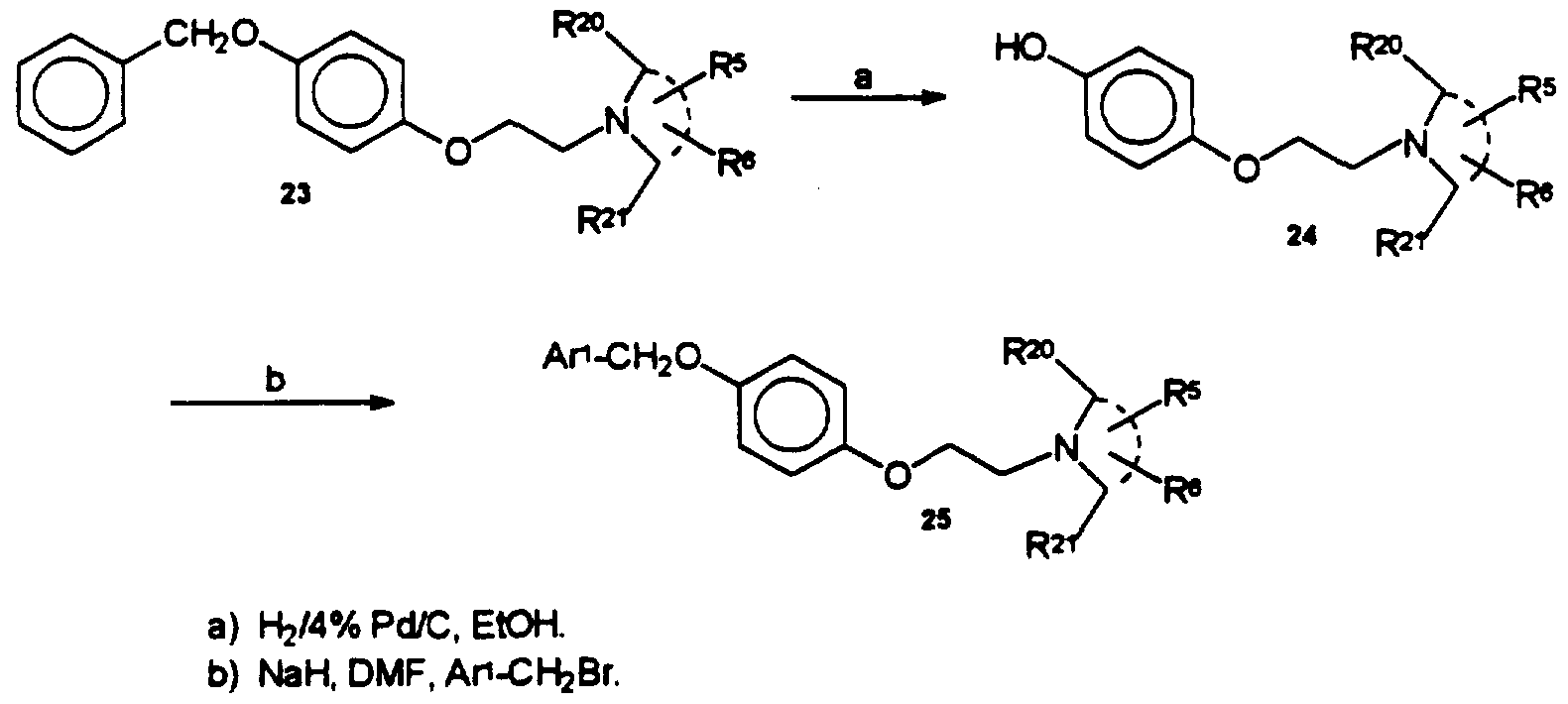
121 Ep: the epo has been informed by wipo that ep was designated in this application
ENP Entry into the national phase

Ref document number: 2202371

Country of ref document: CA

Ref country code: CA

Ref document number: 2202371

Kind code of ref document: A

Format of ref document f/p: F

WWE Wipo information: entry into national phase

Ref document number: 1995934554

Country of ref document: EP

REG Reference to national code

Ref country code: DE

Ref legal event code: 8642

WWP Wipo information: published in national office

Ref document number: 1995934554

Country of ref document: EP

WWG Wipo information: grant in national office

Ref document number: 1995934554

Country of ref document: EP