WO1996015196A1 - Azamethinfarbstoffe - Google Patents
Azamethinfarbstoffe Download PDFInfo
- Publication number
- WO1996015196A1 WO1996015196A1 PCT/EP1995/004314 EP9504314W WO9615196A1 WO 1996015196 A1 WO1996015196 A1 WO 1996015196A1 EP 9504314 W EP9504314 W EP 9504314W WO 9615196 A1 WO9615196 A1 WO 9615196A1
- Authority
- WO
- WIPO (PCT)
- Prior art keywords
- alkyl
- formula
- optionally substituted
- independently
- hydrogen
- Prior art date
- Legal status (The legal status is an assumption and is not a legal conclusion. Google has not performed a legal analysis and makes no representation as to the accuracy of the status listed.)
- Ceased
Links
- 0 Cc1cc(*ON=C=C)c(*=C(C=C2)*=C(C)C2=O)cc1 Chemical compound Cc1cc(*ON=C=C)c(*=C(C=C2)*=C(C)C2=O)cc1 0.000 description 1
- REXNLGPVELBGHO-UHFFFAOYSA-N OC(c(c(-c1ccccc1)n[o]1)c1I)=O Chemical compound OC(c(c(-c1ccccc1)n[o]1)c1I)=O REXNLGPVELBGHO-UHFFFAOYSA-N 0.000 description 1
- PVNIIMVLHYAWGP-UHFFFAOYSA-N OC(c1cccnc1)=O Chemical compound OC(c1cccnc1)=O PVNIIMVLHYAWGP-UHFFFAOYSA-N 0.000 description 1
- SIOXPEMLGUPBBT-UHFFFAOYSA-N OC(c1ncccc1)=O Chemical compound OC(c1ncccc1)=O SIOXPEMLGUPBBT-UHFFFAOYSA-N 0.000 description 1
- BSXLLFUSNQCWJP-UHFFFAOYSA-N OS(c1ccc[s]1)(=O)=O Chemical compound OS(c1ccc[s]1)(=O)=O BSXLLFUSNQCWJP-UHFFFAOYSA-N 0.000 description 1
Classifications
-
- B—PERFORMING OPERATIONS; TRANSPORTING
- B41—PRINTING; LINING MACHINES; TYPEWRITERS; STAMPS
- B41M—PRINTING, DUPLICATING, MARKING, OR COPYING PROCESSES; COLOUR PRINTING
- B41M5/00—Duplicating or marking methods; Sheet materials for use therein
- B41M5/26—Thermography ; Marking by high energetic means, e.g. laser otherwise than by burning, and characterised by the material used
- B41M5/382—Contact thermal transfer or sublimation processes
- B41M5/385—Contact thermal transfer or sublimation processes characterised by the transferable dyes or pigments
- B41M5/39—Dyes containing one or more carbon-to-nitrogen double bonds, e.g. azomethine
-
- C—CHEMISTRY; METALLURGY
- C09—DYES; PAINTS; POLISHES; NATURAL RESINS; ADHESIVES; COMPOSITIONS NOT OTHERWISE PROVIDED FOR; APPLICATIONS OF MATERIALS NOT OTHERWISE PROVIDED FOR
- C09B—ORGANIC DYES OR CLOSELY-RELATED COMPOUNDS FOR PRODUCING DYES, e.g. PIGMENTS; MORDANTS; LAKES
- C09B53/00—Quinone imides
-
- C—CHEMISTRY; METALLURGY
- C09—DYES; PAINTS; POLISHES; NATURAL RESINS; ADHESIVES; COMPOSITIONS NOT OTHERWISE PROVIDED FOR; APPLICATIONS OF MATERIALS NOT OTHERWISE PROVIDED FOR
- C09B—ORGANIC DYES OR CLOSELY-RELATED COMPOUNDS FOR PRODUCING DYES, e.g. PIGMENTS; MORDANTS; LAKES
- C09B55/00—Azomethine dyes
- C09B55/009—Azomethine dyes, the C-atom of the group -C=N- being part of a ring (Image)
Definitions
- the present invention relates to new azamethine dyes of the formula I.
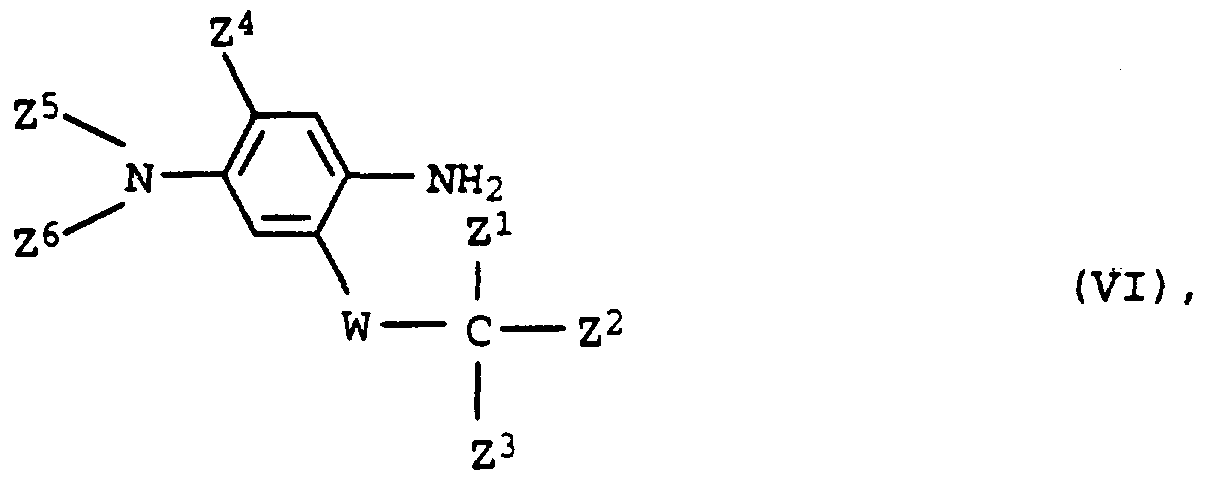
- W is oxygen, sulfur or a radical of the formula -NH-CO-,
- Ether function is interrupted, benzyl, phenylethyl, phenyl or C ⁇ -C alkoxy,
- Z 2 and Z 3 are each independently hydrogen
- the rest-CZ 1 Z 2 Z 3 may not be linear and is different from isopropyl
- Z 4 is hydrogen, C 1 -C 4 alkyl or -CC 4 alkoxy
- Z 5 and z 6 independently of one another, are each C 1 -C 6 -alkyl, which is optionally substituted and can be interrupted by 1 to 3 oxygen atoms in ether function, C 3 -C 4 -alkenyl, C 5 -C -cycloalkyl, phenyl or tolyl or together with the nitrogen atom connecting them a 5- or 6-membered saturated heterocyclic radical which optionally contains further heteroatoms, or Z 4 and Z 5 together form a 2- or 3-membered bridge member which may have a heteroatom, and
- T is the remainder of a cyclic CH-acidic compound H 2 T
- the object of the present invention was to provide new azamethine dyes which are advantageously suitable for non-impact printing processes, for example for thermal transfer, and in particular have high thermal stability, high lightfastness, high color strength and high brilliance.
- the new dyes should also advantageously be suitable for dyeing or printing textile materials.
- Oxygen atom is interrupted in ether function, -C ⁇ -C 4 ! Fluoroalkyl, optionally substituted phenyl, or Ci-C ⁇ -alkoxycarbonyl,
- Y 2 for cyano, carboxyl, Ci-C ⁇ -mono- or dialkylcarbamoyl, carboxyl or Ci-Cs-alkoxycarbonyl,
- Y 3 for -C-C ⁇ o-alkyl which is optionally substituted and can be interrupted by 1 to 3 oxygen atoms in ether function, C 5 -C 7 cycloalkyl, optionally substituted phenyl, or a radical of the formula NB --- B 2 , wherein B 1 and B 2 independently of one another each have the meaning of hydrogen, -CC-alkyl, optionally substituted phenyl, Ci-Cg-alkanoyl, phenylsulfonyl, pyridylsulfonyl, optionally substituted benzoyl, pyridylcarbonyl or thienylcarbonyl,
- -C-C 2 o-alkyl which is optionally substituted and can be interrupted by 1 to 4 oxygen atoms in ether function, optionally substituted phenyl, mercapto or optionally substituted CJ-C- 20- alkylthio, and
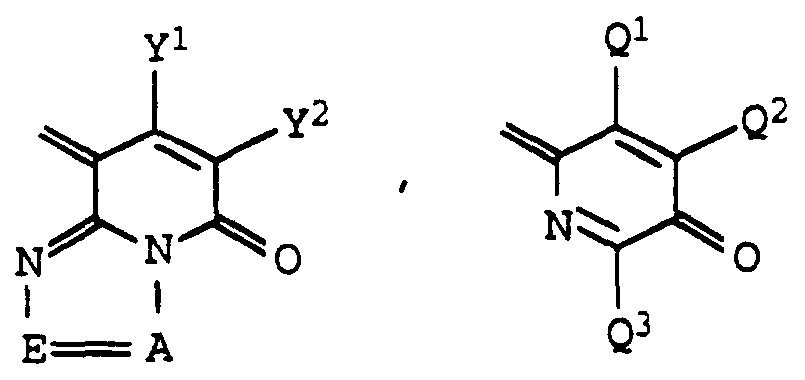
- Q 1 , Q 2 , Q 3 and Q 4 each independently of one another for hydrogen, C ⁇ -C ⁇ o-alkyl, C ⁇ -C ⁇ o-fluoroalkyl, C ⁇ -C 4 alkoxy, halogen, For ⁇ rylamino or a radical of the formula R 3 , - CO-OR 1 , -CO-NHR 1 , -CO-NH-CO-R 1 , -CO-NH-CO-R 3 , -CO-NH-S0 2 -R 3 , -NH-CO-R 1 , -NH-CO-OR 1 , -NH-CO-NR i R 2 , NH-CS-OR 1 , -NH-CS-NR- ⁇ R 2 , -NH-CO-R 3 , -NH-SO 2 - R 1 , -NH-SO 2 -R 3 or -NH-S0 2 -NR i R 2 , wherein R 1 and R 2 independently of one another each have the meaning of
- R 2 also the meaning of amino and R 3 the meaning of a 5- or 6-membered aromatic heterocyclic Residues which are optionally benzo-fused and have one or more heteroatoms selected from the group consisting of nitrogen, oxygen and sulfur, or Q 1 and Q 2 together with the carbons toffatomen, to which they are attached, represent a 5- or 6-membered carbocyclic or heterocyclic ring.
- Alkenyl groups can be straight-chain or branched. If substituted alkyl radicals occur in the formulas mentioned above, the substituents which can be substituted are, for example, optionally substituted phenyl, optionally substituted phenoxy, carboxyl, C 1 -C 20 -alkoxycarbonyl, the alkyl chain of which may be interrupted by 15 to 4 oxygen atoms in ether function and by phenyl or Phenoxy can be substituted, cyano, C ⁇ -C 6 -alkanoyloxy, C ⁇ -C 4 -alkylaminocarbonyloxy or C ⁇ -C -alkoxycarbonyloxy, where in the latter two cases the alkyl group can be substituted by phenyl or C ⁇ -C 4 -alkoxy , come into consideration 0.
- the alkyl radicals generally have 1 or 2 substituents.
- alkyl radicals which are interrupted by oxygen atoms in ether function occur in the abovementioned formulas, 5 alkyl radicals which are interrupted by 1 or 2 oxygen atoms in ether function are preferred.
- substituted phenyl radicals occur in the formulas mentioned above, the substituents which can be used are, for example, C 1 -C 4 -alkyl, 0 C 1 -C 4 -alkoxy, halogen, in particular chlorine or bromine,
- phenyl radicals generally have 1 to 3 substituents.
- Suitable radicals B 1 , B 2 , QJ, Q 2 , Q 3 , Q 4 , Ri, R 2 , Y 1 , Y 3 , Y 4 , Z 1 , 5 Z 2 , Z 3 , Z 4 , Z 5 and Z 6 are, for example, methyl, ethyl, propyl, isopropyl, butyl, isobutyl, sec-butyl or tert-butyl.
- Residues B 1 , B 2 , Q 1 , Q 2 , Q 3 , Q 4 , R 1 , R 2 , ⁇ 3 , ⁇ 4 , z 5 and Z 6 are furthermore, for example, pentyl, isopentyl, neopentyl, tert-pentyl, hexyl , 0 2-methylpentyl, heptyl, octyl, 2-ethylhexyl, isooctyl, nonyl, isononyl, decyl or isodecyl.
- Y 4 radicals are furthermore, for example, undecyl, dodecyl, tridecyl, isotridecyl, tetradecyl, pentadecyl, hexadecyl, heptadecyl, octadecyl,
- R 1 , R 2 , Y 1 , Y 3 , Y 4 , z 1 , Z 2 , Z 3 , Z 5 and Z 6 are, for example, methoxymethyl, 2-methoxyethyl, 2-ethoxyethyl or 2- or 3-methoxy - propyl.
- R 1 , R 2 , Y 3 , Y 4 , Z 5 and Z 6 are furthermore, for example, 2-propoxyethyl, 2-butoxyethyl, 2- or 3-ethoxypropyl, 2- or 3-propoxypropyl, 2- or 3-butoxypropyl, 2- or 4-methoxybutyl, 2- or 4-ethoxybutyl, 2- or 4-butoxybutyl, 3,6-dioxaheptyl, 3,6-dioxaoctyl, 4,8-dioxanonyl, 3,7-dioxaoctyl, 3,7 -Dioxanonyl, 4,7-dioxaoctyl, 4,7-dioxanonyl, 4,8-dioxadecyl, 3,6,9-trioxadecyl, 3,6,9-trioxa- undecyl, 2-carboxylethyl, 2- or 3-carboxylpropyl
- Residues Q 1 , Q 2 , Q 3 , Q 4 , R 1 , R 2 and Y 1 are furthermore, for example, fluoromethyl, difluoromethyl, trifluoromethyl, 1, 1, 1-trifluoroethyl, pentylfluoroethyl, bis (trifluoromethyl) methyl or heptafluoro- propyl.
- Residues Y 4 are, for example, 3,6,9,12-tetraoxatridecyl, 3, 6,9,12-tetraoxatetradecyl, methylthio, ethylthio, propylthio, isopropylthio, butylthio, isobutylthio, sec-butylthio, pentylthio, isopentylthio, neopentylthio, tert-pentylthio, hexylthio, heptylthio, 1-ethylpentylthio, octylthio, isooctylthio, 2-ethylhexylthio, nonylthio, isononylthio, decylthio, isodecylthio, undecylthio, dodecylthio, tridecylthio, isio tecidecyla
- B 1 , B 2 , Y 1 , Y 3 and Y 4 are furthermore, for example, phenyl, 2-, 3- or 4-methylphenyl, 2-, 3- or 4-ylphenyl, 2-, 3- or 4-propylphenyl , 2-, 3- or 4-isopropylphenyl, 2-, 3- or 4-butylphenyl, 2,4-dimethylphenyl, 2-, 3- or 4-methoxyphenyl, 2-, 3- or 4-ethoxyphenyl, 2-, 3- or 4-isobutoxyphenyl, 2,4-dimethoxyphenyl, 2-, 3- or 4-chlorophenyl, 2-, 3- or 4-carboxylphenyl or 2-, 3- or 4-nitrophenyl.
- Residues Q 1 , Q 2 , Q 3 , Q 4 , Y 3 , Z 5 and Z 6 are furthermore, for example, cyclopentyl, cyclohexyl or cycloheptyl.
- Z 5 and Z 6 are, for example, allyl or methallyl.
- Residues Y 2 are, for example, mono- or dimethylcarbamoyl, mono- or diethylcarbamoyl, mono- or dipropylcarbamoyl, mono- or diisopropylcarbamoyl, mono- or dibutylcarbamoyl, mono- or dipentylcarbamoyl, mono- or dihexylcarbamoyl, mono- or diheptylcarbloylylo-, mono- , Mono- or bis (2-ethylhexyl) carbamoyl or N-methyl-N-ethylcarbamoyl.
- B 1 and B 2 are furthermore, for example, formyl, acetyl, propionyl, butyryl, isobutyryl, pentanoyl, hexanoyl, heptanoyl, octanoyl, 2-E hylhexanoyl, isooctanoyl, nonanoyl, isononanoyl, benzoyl, 2-, 3- or 4-methylbenzoyl 2-, 3- or 4-methoxybenzoyl.
- Residues Y 1 and Y 2 are furthermore, for example, methoxycarbonyl, ethoxycarbonyl, propoxycarbonyl, isopropoxycarbonyl, butoxycarbonyl, isobutoxycarbonyl, sec-butoxycarbonyl, pentyloxycarbonyl, isopentyloxycarbonyl, neopentyloxycarbonyl, hexyloxycarbonyl, heptyloxycarbonyl, octyloxycarbonyl, isooyloxycarbonyl or isooctyloxycarbonyl, isooctyloxycarbonyl or isooctyloxycarbonyl or isooctyloxycarbonyl or isooctyloxycarbonyl,
- Residues Q 1 , Q 2 , Q 3 and Q 4 are, for example, fluorine, chlorine or bromine.
- Residues Q 1 , Q 2 , Q 3 , Q 4 , Z 1 and Z 4 are furthermore, for example, methoxy, ethoxy, propoxy, isopropoxy, butoxy, isobutoxy, sec-butoxy or ter-butoxy.
- Z 4 and Z 5 together represent a 2- or 3-membered bridge member, which may have a hetero atom, ethylene, 1,3-propylene, which is optionally substituted three times by methyl, or ethyleneoxy can be considered.
- Q 1 and Q 2 together with the carbon atoms to which they are attached represent a 5- or 6-membered carbocyclic or heterocyclic ring
- the benzene, pyridine, pyrrolinone or dihydropyridone ring are particularly suitable for this purpose, where these rings can each be substituted 1 to 3 times by C 1 -C 4 alkyl, C 1 -C 4 alkoxy or halogen.
- Z 5 and Z 6 together with the nitrogen atom connecting them represent a five- or six-membered saturated heterocyclic radical which may have further heteroatoms,
- pyrrolidinyl, piperidinyl, morpholinyl, piperazinyl or N- (-C 4 -alkyl) piperazinyl can be used.
- R 3 radicals are derived from a 5- or 6-membered aromatic heterocyclic radical which is optionally benzo-fused and which has one or more heteroatoms selected from the group consisting of nitrogen, oxygen and sulfur,
- Suitable heterocyclic base bodies which can carry substituents from which the radicals R 3 are derived are, for example
- Suitable radicals R 3 -CO or R 3 -S ⁇ 2 are in particular those 5- or 6-membered aromatic heterocyclic radicals which are derived from the following heterocyclic carboxylic acids R 3 -COOH or sulfonic acids R 3 -S0 3 H:
- Suitable radicals R 3 are in particular the radicals of the formulas purple to IIIj which have a single bond instead of the COOH or S0 3 H group.
- Azamethine dyes of the formula I in which W is a radical of the formula -NH-CO- are preferred.
- azamethine dyes of the formula I in which Z 1 , Z 2 and Z 3 each independently represent C 1 -C 4 -alkyl.
- azamethine dyes of the formula I in which Z 4 is hydrogen are also preferred.
- azamethine dyes of the formula I in which Z 5 and Z 6 independently of one another are each C 1 -C 6 alkyl or together with the nitrogen atom connecting them a 5- or 6-membered saturated heterocyclic radical which also has a nitrogen or oxygen atom in the ring may contain mean.
- azamethine dyes of the formula I in which TY 1 in the rest is C 1 -C 4 -alkyl.
- azamethine dyes of the formula I in which TY 2 in the rest is cyano are also preferred.
- azamethine dyes of the formula I in which TY 3 for C 1 -C 8 -alkyl, C 1 -C 9 -alkanoylamino, benzoyl-amino, bis (C 1 -C 9 -alkanoyDanu.no or N- (Ci-Ccj- Alkanoyl) -N-benzoyl-amino is.
- azamethine dyes of the formula I in which TY 4 has the meaning of C 1 -C 20 -alkyl, which can be interrupted by 1 to 4 oxygen atoms in ether function.
- azamethine dyes of the formula I in which TQ 1 , Q 2 , Q 3 and Q 4 in the radical independently of one another are each hydrogen, Ci-C ⁇ -alkyl, halogen or Ci-Cn-alkanoylamino or Q 1 and Q 2 together with the carbon atoms to which they are attached represent a benzene, pyridine, pyrrolinone or dihydropyridone ring, which may be substituted by C 1 -C 4 -alkyl or halogen.
- Azamethine dyes of the formula Ia are of particular technical interest
- Z 1 , Z 2 and Z 3 are each independently of one another C 1 -C 4 -alkyl, in particular methyl,
- Z 4 is hydrogen, -CC 4 -alkyl or -C-C 4 -alkoxy
- Z 5 and Z 6 each independently of one another C 1 -C 1 -alkyl
- Q 1 and Q 2 are each independently hydrogen, Ci-C ß- alkyl, trifluoromethyl or halogen and
- Q 3 is C 1 -C 8 -alkanoylamino, in particular C 2 -C 6 -alkanoylamino, or benzoylamino optionally substituted by methyl.
- Z 1 , Z 2 and Z 3 are each independently of one another C 1 -C 4 -alkyl, in particular methyl,
- Z 4 is hydrogen, -CC 4 -alkyl or -C-C 4 -alkoxy
- Z 5 and Z 6 each independently of one another C 1 -C 1 -alkyl
- Q i and Q 3 are each independently hydrogen, Ci-C ⁇ -alkyl, trifluoromethyl or halogen and
- Q 2 is C 1 -C 8 -alkanoylamino, in particular C2-C 8 -alkanoylamino, or benzoylamino optionally substituted by methyl.
- Azamethine dyes of the formula Ib are also of particular technical interest
- Z 1 , Z 2 and Z 3 are each independently of one another C 1 -C 4 -alkyl, in particular methyl,
- Z 4 is hydrogen, C ⁇ -C alkyl or -CC 4 alkoxy
- Z 5 and Z 6 are each independently of one another C 1 -C 1 -alkyl and
- Q 1 , Q 2 , Q 3 and Q 4 each independently represent hydrogen, -CC 6 alkyl, trifluoromethyl, halogen, Ci-Cn-alkanoylamino or benzoylamino optionally substituted by methyl.
- the azamethine dyes of the formula I can be obtained by methods known per se.
- Another object of the present invention is a method for transferring dyes from a support to a plastic-coated paper by diffusion or sublimation using an energy source, which is characterized in that a support is used on which a or more azamethine dyes of the formula I are located.
- the dyes of the formula I are processed in a suitable organic solvent or in mixtures of solvents with one or more binders, optionally with the addition of auxiliaries, to give a printing ink.
- a printing ink This contains the dyes of the formula I preferably in a molecularly disperse dissolved form.
- the printing ink can be applied to the inert carrier by means of a squeegee and the coloring e.g. can be dried in the air or with a hair dryer.
- Suitable organic solvents for the dyes of the formula I are e.g. those in which the solubility of the dyes of the formula I at a temperature of 20 ° C. is greater than 1% by weight, preferably greater than 5% by weight.
- Examples include ethanol, propanol, isobutanol, tetrahydrofuran, methylene chloride, methyl ethyl ketone, cyclopentanone, cyclohexanone, toluene, chlorobenzene or mixtures thereof.
- All resins or polymer materials which are soluble in organic solvents and which are capable of binding the dye mixtures to the inert carrier in an abrasion-resistant manner are suitable as binders. Preference is given to those binders which, after the printing ink has dried in air, absorb the dye mixture in the form of a clear, transparent film without the dye mixture visibly crystallizing out.
- Preferred binders are ethyl cellulose, ethyl hydroxyethyl cellulose, polyvinyl butyral, polyvinyl acetate, cellulose propionate or saturated linear polyesters.
- the weight ratio of binder: dye is generally 1: 1 to 10: 1.
- Suitable inert carriers are e.g. in US-A-5 132 439 or in the corresponding patent applications cited therein.
- the thickness of the dye carrier is generally 3 to 30 ⁇ m.
- all temperature-stable plastic layers with affinity for the dyes to be transferred can be used as the dye-receiving layer, e.g. modified polycarbonates or polyester. Further details can e.g. from US-A-5 132 439 or the corresponding patent applications cited therein.
- the transfer takes place by means of an energy source, for example by means of a laser or a thermal head, the latter having to be able to be heated to a temperature of .3 300 ° C. so that the dye transfer can take place in the time range t: 0 ⁇ t ⁇ 15 msec.
- the dye migrates from the transfer sheet and diffuses into the surface coating of the recording medium.
- the dyes of the formula I according to the invention are notable for advantageous transfer properties in dye transfer.
- the dyes of the formula I according to the invention are furthermore advantageously suitable for dyeing synthetic materials, e.g. of polyesters, polyamides or polycarbonates. Particular mention should be made of textile forms, such as fibers, yarns, threads, knitted fabrics, woven goods or non-wovens, made of polyester, modified polyester, e.g. anionically modified polyester, or blended fabrics of polyester with cellulose, cotton, viscose or wool, or polyamide.
- the dyeing and printing conditions are known per se.
- the dyes according to the invention can also be used to dye ceramic fibers, e.g. in hair dyeing or dyeing furs.
- the new dyes of the formula I are furthermore advantageously suitable for the production of color filters, such as those e.g. are described in EP-A-399 473.
- the Raney nickel was then separated off, the resulting solution was concentrated and added to 3 g (0.03 mol) of 2-acetaminophenol in 30 ml of ethanol and 50 ml of ethyl acetate. A solution of 4.2 g of sodium carbonate and 50 ml of water was added to the resulting mixture. A solution of 5.7 g (0.025 mol) of ammonium peroxodisulfate in 50 ml of water was then added dropwise. The organic phase was concentrated and the dye thus obtained was purified by column chromatography.
- the mixture was neutralized with 25% by weight ammonia water and the resulting nitroso compound was shaken out with ethyl acetate, which passed into the organic phase.
- the organic phase was concentrated, 200 ml of methanol and a catalytic amount of Raney nickel were added and the mixture was reduced with hydrogen. After the reduction, the catalyst was separated off and the solution was concentrated. A little ethanol was added to the resulting amino compound and a suspension of 4.9 g (0.025 mol) of the compound of the formula
- the resulting printing ink is applied with a 6 ⁇ doctor knife onto a 6 ⁇ m thick polyester film, on the back of which a suitable sliding layer is applied, and blown dry with a hair dryer for 1 minute. Before the ink ribbon can be printed, it must be left to air dry for at least 24 hours, since residual solvents can impair the printing process.
- the ink ribbons are printed on commercially available video printing paper (type VY-S from Hitachi) on a computer-controlled experimental arrangement which is equipped with a commercially available thermal head.
- the energy output of the thermal head is controlled by changing the voltage, the set pulse duration being 7 ms and only one pulse being output at a time.
- the energy delivered is between 0.7 and 2.0 mJ / dot.
- the first value relates to a binder based on polyester, the second to a binder based on polyvinyl butyral.
- dyes 5 and 28 brilliant dyeings in shades of blue and turquoise are obtained on polyester fabric under customary dyeing conditions (HT process). If the tert-butyl group contained in dyes 5 and 28 is replaced by a methyl group, the dye decomposes during the dyeing process. This demonstrates the high stability of the dyes according to the invention.
Landscapes
- Chemical & Material Sciences (AREA)
- Organic Chemistry (AREA)
- Physics & Mathematics (AREA)
- Optics & Photonics (AREA)
- Plural Heterocyclic Compounds (AREA)
- Coloring (AREA)
- Thermal Transfer Or Thermal Recording In General (AREA)
- Quinoline Compounds (AREA)
- Thiazole And Isothizaole Compounds (AREA)
- Pyridine Compounds (AREA)
- Nitrogen Condensed Heterocyclic Rings (AREA)
Abstract
Description





Claims


Priority Applications (4)
| Application Number | Priority Date | Filing Date | Title |
|---|---|---|---|
| DE59505671T DE59505671D1 (de) | 1994-11-12 | 1995-11-03 | Azamethinfarbstoffe |
| US08/817,921 US5811370A (en) | 1994-11-12 | 1995-11-03 | Azamethine dyes |
| JP8515689A JPH10508643A (ja) | 1994-11-12 | 1995-11-03 | アザメチン染料 |
| EP95937860A EP0791035B1 (de) | 1994-11-12 | 1995-11-03 | Azamethinfarbstoffe |
Applications Claiming Priority (2)
| Application Number | Priority Date | Filing Date | Title |
|---|---|---|---|
| DEP4440486.7 | 1994-11-12 | ||
| DE4440486A DE4440486A1 (de) | 1994-11-12 | 1994-11-12 | Azamethinfarbstoffe |
Publications (1)
| Publication Number | Publication Date |
|---|---|
| WO1996015196A1 true WO1996015196A1 (de) | 1996-05-23 |
Family
ID=6533176
Family Applications (1)
| Application Number | Title | Priority Date | Filing Date |
|---|---|---|---|
| PCT/EP1995/004314 Ceased WO1996015196A1 (de) | 1994-11-12 | 1995-11-03 | Azamethinfarbstoffe |
Country Status (5)
| Country | Link |
|---|---|
| US (1) | US5811370A (de) |
| EP (1) | EP0791035B1 (de) |
| JP (1) | JPH10508643A (de) |
| DE (2) | DE4440486A1 (de) |
| WO (1) | WO1996015196A1 (de) |
Citations (4)
| Publication number | Priority date | Publication date | Assignee | Title |
|---|---|---|---|---|
| US4975409A (en) * | 1988-11-11 | 1990-12-04 | Fuji Photo Film Co., Ltd. | Heat transfer dye providing material |
| EP0480252A1 (de) * | 1990-10-06 | 1992-04-15 | BASF Aktiengesellschaft | Pyridonfarbstoffe und ein Verfahren zu ihrer thermischen Übertragung |
| US5227359A (en) * | 1990-08-03 | 1993-07-13 | Fuji Photo Film Co., Ltd. | Heat transfer dye providing material |
| US5238903A (en) * | 1990-02-23 | 1993-08-24 | Fuji Photo Film Co., Ltd. | Heat-transfer dye-donating material |
Family Cites Families (10)
| Publication number | Priority date | Publication date | Assignee | Title |
|---|---|---|---|---|
| US5034371A (en) * | 1989-03-27 | 1991-07-23 | Fuji Photo Film Co., Ltd. | Thermal transfer image recording method and thermal transfer dye donating material |
| US4975410A (en) * | 1989-05-26 | 1990-12-04 | Eastman Kodak Company | Thermally-transferred color filter array element and process for preparing |
| DE3929698A1 (de) * | 1989-09-07 | 1991-03-14 | Basf Ag | Triazolopyridinfarbstoffe sowie ein verfahren zum thermischen transfer von methinfarbstoffen |
| DE4010269A1 (de) * | 1990-03-30 | 1991-10-02 | Basf Ag | Indonaphtholfarbstoffe und ein verfahren zu ihrer thermischen uebertragung |
| NL9001335A (nl) * | 1990-06-13 | 1992-01-02 | Jacobus Maria Snoeijers | Drager voor het ondersteunen van goederen. |
| DE4031255A1 (de) * | 1990-10-04 | 1992-04-09 | Basf Ag | Verfahren zur uebertragung von indoanilinfarbstoffen |
| DE4031254A1 (de) * | 1990-10-04 | 1992-04-09 | Basf Ag | Chinolinmethinfarbstoffe sowie ein verfahren zur thermischen uebertragung von methinfarbstoffen |
| DE4031804A1 (de) * | 1990-10-08 | 1992-04-09 | Basf Ag | Indophenolfarbstoffe und ein verfahren zu ihrer thermischen uebertragung |
| US5132439A (en) * | 1990-11-19 | 1992-07-21 | Promega Corporation | Protein staining compositions and methods |
| CN1042639C (zh) * | 1993-06-21 | 1999-03-24 | Dsm有限公司 | 乙烯与至少一种其它1-烯烃的低分子量共聚物的制备方法 |
-
1994
- 1994-11-12 DE DE4440486A patent/DE4440486A1/de not_active Withdrawn
-
1995
- 1995-11-03 WO PCT/EP1995/004314 patent/WO1996015196A1/de not_active Ceased
- 1995-11-03 DE DE59505671T patent/DE59505671D1/de not_active Expired - Lifetime
- 1995-11-03 US US08/817,921 patent/US5811370A/en not_active Expired - Fee Related
- 1995-11-03 EP EP95937860A patent/EP0791035B1/de not_active Expired - Lifetime
- 1995-11-03 JP JP8515689A patent/JPH10508643A/ja active Pending
Patent Citations (5)
| Publication number | Priority date | Publication date | Assignee | Title |
|---|---|---|---|---|
| US4975409A (en) * | 1988-11-11 | 1990-12-04 | Fuji Photo Film Co., Ltd. | Heat transfer dye providing material |
| US5238903A (en) * | 1990-02-23 | 1993-08-24 | Fuji Photo Film Co., Ltd. | Heat-transfer dye-donating material |
| US5227359A (en) * | 1990-08-03 | 1993-07-13 | Fuji Photo Film Co., Ltd. | Heat transfer dye providing material |
| EP0480252A1 (de) * | 1990-10-06 | 1992-04-15 | BASF Aktiengesellschaft | Pyridonfarbstoffe und ein Verfahren zu ihrer thermischen Übertragung |
| US5310942A (en) * | 1990-10-06 | 1994-05-10 | Basf Aktiengesellschaft | Pyridone dyes and thermal transfer thereof |
Also Published As
| Publication number | Publication date |
|---|---|
| EP0791035A1 (de) | 1997-08-27 |
| EP0791035B1 (de) | 1999-04-14 |
| DE4440486A1 (de) | 1996-05-15 |
| JPH10508643A (ja) | 1998-08-25 |
| US5811370A (en) | 1998-09-22 |
| DE59505671D1 (de) | 1999-05-20 |
Similar Documents
| Publication | Publication Date | Title |
|---|---|---|
| EP0787169B1 (de) | Farbstoffmischungen, enthaltend methin- und azofarbstoffe | |
| EP0569784B1 (de) | Cyan-Mischungen für den Farbstofftransfer | |
| EP0569785B1 (de) | Farbstoffmischungen für den Farbstofftransfer | |
| EP0791034B1 (de) | Methin- und azamethinfarbstoffe auf basis von trifluormethylpyridonen | |
| EP0773976B1 (de) | Azofarbstoffe mit einer kupplungskomponente aus der aminothiazolreihe | |
| EP0906370B1 (de) | Pyridonfarbstoffe | |
| EP0944673B1 (de) | Indoleninmethinfarbstoffe auf basis von trifluormethylpyridonen | |
| EP0763571B1 (de) | Farbmischungen, enhaltend Methin- und Anthrachinonfarbstoffe | |
| WO1997035926A1 (de) | Farbstoffmischungen, enthaltend thienyl- und/oder thiazolazofarbstoffe | |
| WO1997047690A1 (de) | Farbstoffmischungen | |
| EP0727463B1 (de) | Triazolopyridinfarbstoffe und deren Zwischenprodukte | |
| DE19920808A1 (de) | Methin- und Azamethinfarbstoffe auf Basis von 5-gliedrigen Heterocyclen, die eine Trifluormethylgruppe aufweisen | |
| EP0745107B1 (de) | Triazolopyridinfarbstoffe | |
| EP0791035B1 (de) | Azamethinfarbstoffe | |
| EP0736575B1 (de) | Azamethinfarbstoffe mit heterocyclischen Seitengruppen | |
| DE19650958A1 (de) | Indoleninmethinfarbstoffe auf Basis von Trifluormethylpyridonen | |
| EP0796297B1 (de) | Methinfarbstoffe auf basis von formylaminopyridonen | |
| EP0480281A1 (de) | Indophenolfarbstoffe und ein Verfahren zu ihrer thermischen Übertragung |
Legal Events
| Date | Code | Title | Description |
|---|---|---|---|
| AK | Designated states |
Kind code of ref document: A1 Designated state(s): CA CN JP KR US |
|
| AL | Designated countries for regional patents |
Kind code of ref document: A1 Designated state(s): AT BE CH DE DK ES FR GB GR IE IT LU MC NL PT SE |
|
| DFPE | Request for preliminary examination filed prior to expiration of 19th month from priority date (pct application filed before 20040101) | ||
| 121 | Ep: the epo has been informed by wipo that ep was designated in this application | ||
| WWE | Wipo information: entry into national phase |
Ref document number: 1995937860 Country of ref document: EP |
|
| WWE | Wipo information: entry into national phase |
Ref document number: 08817921 Country of ref document: US |
|
| WWP | Wipo information: published in national office |
Ref document number: 1995937860 Country of ref document: EP |
|
| NENP | Non-entry into the national phase |
Ref country code: CA |
|
| WWG | Wipo information: grant in national office |
Ref document number: 1995937860 Country of ref document: EP |