WO1996019556A1 - Detergent composition - Google Patents

Detergent composition Download PDF

Info

Publication number
WO1996019556A1
WO1996019556A1 PCT/EP1995/004639 EP9504639W WO9619556A1 WO 1996019556 A1 WO1996019556 A1 WO 1996019556A1 EP 9504639 W EP9504639 W EP 9504639W WO 9619556 A1 WO9619556 A1 WO 9619556A1
Authority
WO
WIPO (PCT)
Prior art keywords
anionic
water
nonionic
ratio
surfactant
Prior art date
Legal status (The legal status is an assumption and is not a legal conclusion. Google has not performed a legal analysis and makes no representation as to the accuracy of the status listed.)
Ceased
Application number
PCT/EP1995/004639
Other languages
French (fr)
Inventor
Feng-Lung Gordon Hsu
Mark Eric Pflugfelder
Charles Fraser Irwin
John Gerard Sheehan
Current Assignee (The listed assignees may be inaccurate. Google has not performed a legal analysis and makes no representation or warranty as to the accuracy of the list.)
Unilever NV
Original Assignee
Unilever NV
Priority date (The priority date is an assumption and is not a legal conclusion. Google has not performed a legal analysis and makes no representation as to the accuracy of the date listed.)
Filing date
Publication date
Application filed by Unilever NV filed Critical Unilever NV
Priority to EP95941626A priority Critical patent/EP0799295A1/en
Priority to AU43000/96A priority patent/AU4300096A/en
Priority to CA002208038A priority patent/CA2208038C/en
Priority to BR9510098A priority patent/BR9510098A/en
Publication of WO1996019556A1 publication Critical patent/WO1996019556A1/en
Anticipated expiration legal-status Critical
Ceased legal-status Critical Current

Links

Classifications

    • C—CHEMISTRY; METALLURGY
    • C11—ANIMAL OR VEGETABLE OILS, FATS, FATTY SUBSTANCES OR WAXES; FATTY ACIDS THEREFROM; DETERGENTS; CANDLES
    • C11D—DETERGENT COMPOSITIONS; USE OF SINGLE SUBSTANCES AS DETERGENTS; SOAP OR SOAP-MAKING; RESIN SOAPS; RECOVERY OF GLYCEROL
    • C11D1/00—Detergent compositions based essentially on surface-active compounds; Use of these compounds as a detergent
    • C11D1/66—Non-ionic compounds
    • C11D1/83—Mixtures of non-ionic with anionic compounds
    • C—CHEMISTRY; METALLURGY
    • C11—ANIMAL OR VEGETABLE OILS, FATS, FATTY SUBSTANCES OR WAXES; FATTY ACIDS THEREFROM; DETERGENTS; CANDLES
    • C11D—DETERGENT COMPOSITIONS; USE OF SINGLE SUBSTANCES AS DETERGENTS; SOAP OR SOAP-MAKING; RESIN SOAPS; RECOVERY OF GLYCEROL
    • C11D11/00—Special methods for preparing compositions containing mixtures of detergents
    • C11D11/0082—Special methods for preparing compositions containing mixtures of detergents one or more of the detergent ingredients being in a liquefied state, e.g. slurry, paste or melt, and the process resulting in solid detergent particles such as granules, powders or beads
    • C11D11/0088—Special methods for preparing compositions containing mixtures of detergents one or more of the detergent ingredients being in a liquefied state, e.g. slurry, paste or melt, and the process resulting in solid detergent particles such as granules, powders or beads the liquefied ingredients being sprayed or adsorbed onto solid particles
    • C—CHEMISTRY; METALLURGY
    • C11—ANIMAL OR VEGETABLE OILS, FATS, FATTY SUBSTANCES OR WAXES; FATTY ACIDS THEREFROM; DETERGENTS; CANDLES
    • C11D—DETERGENT COMPOSITIONS; USE OF SINGLE SUBSTANCES AS DETERGENTS; SOAP OR SOAP-MAKING; RESIN SOAPS; RECOVERY OF GLYCEROL
    • C11D1/00—Detergent compositions based essentially on surface-active compounds; Use of these compounds as a detergent
    • C11D1/02—Anionic compounds
    • C11D1/12—Sulfonic acids or sulfuric acid esters; Salts thereof
    • C11D1/14—Sulfonic acids or sulfuric acid esters; Salts thereof derived from aliphatic hydrocarbons or mono-alcohols
    • C11D1/146—Sulfuric acid esters
    • C—CHEMISTRY; METALLURGY
    • C11—ANIMAL OR VEGETABLE OILS, FATS, FATTY SUBSTANCES OR WAXES; FATTY ACIDS THEREFROM; DETERGENTS; CANDLES
    • C11D—DETERGENT COMPOSITIONS; USE OF SINGLE SUBSTANCES AS DETERGENTS; SOAP OR SOAP-MAKING; RESIN SOAPS; RECOVERY OF GLYCEROL
    • C11D1/00—Detergent compositions based essentially on surface-active compounds; Use of these compounds as a detergent
    • C11D1/02—Anionic compounds
    • C11D1/12—Sulfonic acids or sulfuric acid esters; Salts thereof
    • C11D1/22—Sulfonic acids or sulfuric acid esters; Salts thereof derived from aromatic compounds
    • C—CHEMISTRY; METALLURGY
    • C11—ANIMAL OR VEGETABLE OILS, FATS, FATTY SUBSTANCES OR WAXES; FATTY ACIDS THEREFROM; DETERGENTS; CANDLES
    • C11D—DETERGENT COMPOSITIONS; USE OF SINGLE SUBSTANCES AS DETERGENTS; SOAP OR SOAP-MAKING; RESIN SOAPS; RECOVERY OF GLYCEROL
    • C11D1/00—Detergent compositions based essentially on surface-active compounds; Use of these compounds as a detergent
    • C11D1/66—Non-ionic compounds
    • C11D1/72—Ethers of polyoxyalkylene glycols

Definitions

  • the weight ratio of the anionic surfactant to the nonionic is from 1:4 to 2:1, preferably 1:4 to 1:1 and where the mole ratio of water to the anionic surfactant is about 0.05 to 2.3 and preferably 0.05 to 2.0. If the water content is too low, the viscosity becomes to high.
  • the invention further provides for a process for stabilising the selected anionic to nonionic ratio HAMs by reducing the water content so that the mole ratio of water to anionic is less than about 2.3 and preferably less than about 2.0. Desirably the ratio is at least 0.05 and preferably 0.05 to 2.0.
  • an anionic surfactant comprising a sodium or potassium salt of an alkyl benzene sulphate and/or a primary alcohol sulphate in an amount not exceeding 60% by weight.
  • the major advantage is in lowering the water content in the HAM systems to a selected level.
  • the phase structure of the HAM is altered and the water activity is reduced.
  • PAS HAMs with 1:2 anionic/nonionic were of one phase: curved lamellar liquid crystals.
  • the exception was PAS at 0.2 wt . % water and 22°C, which forms an unknown meso phase.
  • LAS HAMs with 1:1 anionic:nonionic without high-temperature storage are lamellar liquid crystalline phases (L-alpha) .
  • LAS HAMs with 1:2 anioic/nonionic are a mixture of two equilibrium phases, inverse micelles and flat lamellar liquid crystals at water levels of 0.7 to 7% water and from 22°C to 80°C.
  • LAS 1:2 HAMs do not change their microstructure after prolonged storage at 80°C.
  • the volume fraction of inverse micelles is expected to increase as the anionic:non ⁇ on ⁇ c ratio decreases.
  • the water present may come from many sources and indeed i often added to LAS acid is an amount of 0.3 to 3% to reduce degradation.
  • Water is produced from the neutralisation reaction when the acid is neutralised with caustic. The amoun depends on the molecular weight of the acid since one mole of water is produced for one mole of neutralised acid.
  • the alkali metal hydroxide used to neutralise the acid is typically added as a 50% solution. This excess water contributes most of the water to the mixture.
  • the "natural" water content of a neutralised HAM containing LAS and/or PAS when expressed as the mole ratio of water to anionic, may vary from about 3.4 to 3.7 for molecular weights of the C e to C j. .. PAS acid of about 220 to 360 (Sodium salt 242 to 382) and from about 3.6 to 3.8 for molecular weights of the C 8 to C 16 LAS acid of about 263 to 403 (Sodium salt 285 to 425) .
  • a typical "natural" water and reduced water content calculated for a 1:2 PAS:NI high active mixture follows in table 1 below.
  • Nonionic composition assume 100% active
  • the nonionic surfactant is preferably an ethoxylated or mixed ethoxy-propoxylated primary or secondary aliphatic alcohol. Most preferred are ethoxylated primary alcohols, especially C & _ C 15 primary alcohols ethoxylated with from 2 to 25 moles of ethylene oxide per mole of alcohol.
  • the anionic surfactant component in the composition of the invention is a sodium or potassium salt of a primary alcohol or alkyl sulphate and/or an alkylbenzene sulphonate.
  • Suitable alkyl sulphates are sodium C l 2 -C 15 alkyl sulphates although other alkyl sulphates outside this carbon chain length range and potassium alkyl sulphates may also be used.
  • Especially suitable alkylbenzene sulphates include those having a C 10 to C 14 alkyl chain.
  • the method of preparation of the liquid mixture of the invention is important. Simple admixture of normally 30% aqueous neutralised PAS paste or 50% LAS paste with liquid nonionic surfactant in the desired proportions will not give a mobile isotropic liquid but instead will result in a highly viscous gel which is difficult to handle and to atomise.
  • anionic surfactant precursor acid may be mixed with nonionic surfactant, and the mixture treated with concentrated aqueous sodium hydroxide or potassium hydroxide to effect partial or complete neutralisation.
  • Mixtures which are fluid at 20°C to 80°C and contains, depending on the ratio of anionic to nonionic about 3% to 10% by weight of water may be produced by this method.
  • the mixtur is then further subjected to water emoval to about 0.2% to 8% so long as the mole ratio of water to anionic is 2.3 or less.
  • the mixture of the invention if sufficiently mobile and stabl at ambient temperature, are useful in their own right as concentrated liquid detergents. These may, for example, be used as such or in diluted form as dishwashing liquids or laundry detergents.
  • the final products of the invention are primarily concerned, however, with the preparation of granular detergent products b spraying the liquid mixtures of the invention onto absorbent granular base materials.
  • the limits on stability are still strict but the limits on fluidity are a little less stringent in that compositions of the invention while they must be stable should also be sufficiently mobile a a temperature within the range of from 20°C to 80°C to be sprayable.
  • the surfactant mixture of the invention may be sprayed onto a carrier material which is subsequently dry-mixed with other, necessary or desirable components of the final composition.
  • the carrier material may itself be spray-dried: examples of suitable absorbent spray- dried inorganic carrier materials are sodium carbonate/sodium bicarbonate mixtures as described and claimed in GB No. 1,595,769; sodium carbonate/sodium silicate mixtures as described in GB No. 1,595,770; and, of especial interest, crystal growth modified sodium carbonate monohydrate and crystal growth modified Burkeite (sodium carbonate/sodium sulphate) as described in EP No. 221,776.
  • Organic carrier materials are also suitable, such as citrates, polymers and the like.
  • Crystal growth modified sodium carbonate monohydrate and Burkeit may be prepared by spray-drying an aqueous slurry comprising sodium carbonate, and optionally also comprising sodium sulphate in a weight ratio of sodium carbonate to sodium sulphate being at least 10% by weight based on the dried powder; an effective amount of a crystal growth modifier which is an organic material having at least three carboxyl groups in the molecule and optionally one or more anionic and/or nonionic detergent active compounds, one or more detergency builders and/or one or more further heat-insensitive detergent components; the crystal growth modifier being incorporated in the slurry not later than the sodium carbonate; whereby crystal growth-modified by sodium carbonate monohydrate and/or crystal growth modified Burkeite is or are fromed in the slurry.
  • a crystal growth modifier which is an organic material having at least three carboxyl groups in the molecule and optionally one or more anionic and/or nonionic detergent active compounds, one or more detergency builders and/or one or more further heat-insensitive detergent
  • the crystal growth modifier is a polycarboxylate as described in U.S. Patent Nos. 4,826,632 and 4,923,636.
  • compositions of the invention may, if desired, be used in the compositions of the invention.
  • spray-dried absorbent materials is appropriate for the manufacture of detergent powders with a range of bulk densities from low (300 g/1) to quite high (800 g/1) .
  • detergency builders examples includesodium, tripoly , pyro- and orthophosphates, sodium aluminoscilicates includin zeolites, sodium carbonates sodium citrate and various organic detergency builders such as sodium nitrilotriacetate and 2 , 2 ' oxydisuccmates.
  • detergency builders will be present in amounts of from 15 to 50% by weight of the final product, amounts of from 25 to 40% by weight being more general .
  • Detergent powders according to the invention may contain other conventional ingredients added either via the slurry (if the absorbent is a spray-dried powder) or by simple mixing in accordance with their known properties.
  • Such ingredients include enzymes, fluorescers, antideposition agents, bleaches, bleach activators, bleach stabilisers, lather suppressors, dyes and perfumes.
  • ⁇ pH values of more than 2 in LAS/NI HAMs are indicative of instability. It is observed that lower water:anionic ratios provide enhanced stability.
  • PAS and LAS HAMs maybe inherently unstable exhibit a characteristics downward pH shift upon storage at 50-85°C.
  • PAS HAMs are stable only for days at elevated temperatures. If the pH drops below 7, decomposition is auto- catalytic and the PAS quickly decomposes into alcohol and acid rendering it useless as a surfactant. pH drift also occurs at lower storage temperatures albeit more slowly.
  • LAS HAMs typically exhibit a downward drift in pH and levels of about pH 4 to 5.
  • sample jars in the Example were not hermetically sealed to prevent pressure build-up and the oven humidity was not controlled, samples lost moisture during the study.
  • Table 3 contains only intial PAS HAM moisure values and water/anionic mole ratios, since all PAS HAM's decomposed before the completion of the eight week study.
  • the PAS HAM water/anionic mole ratios are initial values.
  • PAS HAMs are much less stable than LAS HAM's because the PAS (not the nonionic) determines the stability.
  • 80°C storage is a stringent test which provides trends which can be applied at lower (more realistic storage) temperatures e.g. ⁇ 60°C. Buffering only improves stability slightly; however, as shown in Table 3 reducing the water/anionic mole ratio to 0.09 improved stability significantly for a 1:2 (Lial 125) PAS/Neodol 25-7 HAM at 80°C.
  • Table 4 contains both initial and average LAS HAM moisutre values and water/anionic mole ratios. Unexpectedly, a slight reduction in water content improves stability significantly without buffering. The improvement is most pronounced as LAS:Nonionic ratio decreases and as initial pH decreases.
  • HAM odour improves significantly because other volatiles are removed during the water reduction process. For example, by reducing 1;2 LAS HAM water/anionic mole ratio fro its "natural" value of 3.4 to about 1.7 odour improved from a "3" to a "2" rating on a five-point subjective scale.
  • a mobile liquid mixture suitable for spraying is prepared by admixing 5 parts by weight of a nonionic surfactant (C 12-15 alcohol 7EO) with 16 2/3 parts by weight of an aqueous sodium ⁇ i 2 ⁇ c _4- PAS paste (30% active matter) and heating the resultant mixture under vacuum until it has lost about 16 parts by weight of water.
  • the resulting mobile liquid contains (by weight) 5% water, and has a water to anionic mole ratio of 1.9 47% primary alkyl sulphate and 47% nonionic surfactant.
  • a LAS containing mixture is prepared by substituting the PAS paste for 10 parts by weight of an aqueous sodium (C 10 - 12 ) alkylbenzene sulphonate paste (50% active) The resultant mixture is heated under vacuum until it has lost about 4.5 parts water to provide a mobile liquid with about 5% water which is stable.
  • aqueous crutcher slurry containing 46% by weight of water is spray-dried in a counter-current spray-drying tower to a base powder having a bulk density of 710 g/litre and a moisutre content of 15.8%.
  • the formulation of the powder prepared is as follows:
  • a mobile mixture of anionic and nonionic surfactant in accordance with the invention manufactured by mixing 3.8 parts of C 12 8 PAS acid with 6 parts of a C : _ 15 primary alcohol 7EO ethoxylate and neutralising the acid with caustic soda solution of 100°Tw is prepared. This mixture is then heated under vacuum until the water content is reduced to about 3%. The mole ratio of water to anionic is 1.4. This mixture is then sprayed onto the powder.
  • the powder is dosed with heat-sensitive components such as oxygen bleaches, perfumes and enzymes in accordance with conventional practice to produce a finished powder having the following composition:
  • the finished powder produced will have a bulk density of about 800 g/litre.
  • SAXS data were collected at both room temperature and 80°C fro samples sealed in tubes. However, SAXS data were collected only from 1:2 HAMs.
  • PAS 1:2 SAXS spectra of water-reduced (0.2 wt . % water) PAS 1:2 HAMs at 21°C and 80°C shows that PAS 1:2 at 0.2 wt % water and 22°C could be a mixture of liquid crystals and complex multiple L2 phases; peaks arise at 7.8, 5.2, 3.9 and 3.4 nm. In contrast, raising the temperature to 80°C results in a transition to an L-alpha (lamellar) phase, as indicated by a sharp peak at 3.5 nm. No micellar peak is evident.
  • anionic:nonionic ratio falls from 1:2 to 1:4 they are believed to be L-alpha liquid crystals with an increasing function of reverse mecelles.
  • Example 4 The procedure of Example 4 was repeated to determine the microstructures of 1:1 and 1:2 anionic:nonionic LAS HAMs by FFTEM and SAXS before and after eight weeks of storage at 80°C with varying amounts of water, at both 21°C and 80°C.
  • the average spatial extent of the lamellae is about 200 nm for 0.7%, 1 micrometer for 6.0%, and several micrometers for 7.8%.
  • LAS HAMs with 1:1 anionic:nonionic without h gh temperature storage are pure lamellar liquid crystalline phases (L-alpha) . It s believed that the loss in stability occurs for the same reasons described in Example 4.
  • LAS HAMs with 1:2 anionic/nonionic are a mixture of two equilibrium phases, inverse micelles and flat lamellar liquid crystals. This was determined from 0.7-7.0 wt . % water and from 22-80°C. As the water decreases and the temperature increases, the mixtures become less lamellar and more reverse micellar. The volume fraction of inverse micelles is expected to increase as the anionic:nonionic ratio decreases.

Landscapes

  • Chemical & Material Sciences (AREA)
  • Life Sciences & Earth Sciences (AREA)
  • Engineering & Computer Science (AREA)
  • Chemical Kinetics & Catalysis (AREA)
  • Oil, Petroleum & Natural Gas (AREA)
  • Wood Science & Technology (AREA)
  • Organic Chemistry (AREA)
  • Detergent Compositions (AREA)

Abstract

A liquid surfactant composition having good chemical stability and being mobile at 20 °C to 80 °C, containing up to 60 % anionic surfactant, up to 80 % nonionic surfactant and from 0.2 to 8 % by weight of water in an anionic/nonionic ratio of 1:4 to 2:1, and having a mole ratio of water to anionic of less than 2.3. The liquid composition material may be sprayed onto a solid particulate absorbent material to form a detergent powder or component thereof.

Description

Deterσent Composition
This invention relates to detergent compositions, in particular to fluid mixtures containing high active concentrations of anionic and nonionic surfactants (HAMS), to processes for stabilising them and to processes for converting them into detergent powders.
Recent trends in the detergents market are towards dense fabric washing powders. The reasons for this are partly due to reduced packaging costs and partly due to an improved washing performance because consumers tend to dispense washing powders by volume rather than by weight. The majority of washing powders are presently manufactured by spray-drying processes and this tends to produce powders of relatively low bulk density, typically less than 500 g/litre. The bulk density is very dependent on the amount and type of active detergent present in the powder during the spray-drying operation.
Sodium alkyl aryl sulphonates such as linear alkyl benzene sulphonates, (LAS) and sodium alkyl sulphates such as primary alcohol or alkyl sulphates (PAS) are particularly prone to produce light powders.
It has been discovered that powders with higher bulk densities can be obtained if part of the active detergent is sprayed onto the spray-dried powders rather than being incorporated into the detergent slurry before spray-drying.
However, in order to be suitable for spraying onto the powders, the active detergent (surfactants) must be sufficiently mobile at temperature below about 80°C to be atomised effectively and must be stable in this sprayable liquid form. Great Britain Patent No. 1,579,261 (Colgate-Palmolive Co.) relates to processes for converting various liquid or liquefiable detergents into detergent powders by spraying surfactants onto spray-dried builder beads. The specification refers to synthetic detergents such as nonionics, anionics, an cationics or combinations thereof as in general being liquid o liquefiable. Frequently, however, mixtures of aqueous anionic and nonionic surfactants are viscous gels which can only be oversprayed onto particulate absorbents if they are heated to temperature, typically about 90°C, at which they become sufficiently mobile. Heating to this temperature is severely disadvantageous in factory practice.
European Patent Application No. 88,612A (Brigemace) discloses mobile liquid detergents containing not more than 8% water and not less than 90% active detergent, including an anionic surfactant, a nonionic polyether, and coconut or mono- ordiethanolamide. Substantial quantities of a third ingredien are required in order to obtain sufficiently mobile liquid products.
Great Britain Patent Specification No. 1,169,594 (Unilever) discloses liquid detergent compositions comprising ammonium alkylbenzenesulphonate and a nonionic detergen . The compositions are prepared by passing ammonia through a mixture of alkylbenzenesulphonic acid and nonionic detergent.
U.S. Patent No. 4,052,342 to Fernley et al. and U.S. Patent No. 4,235,752 to Rossall et al . disclose blends of secondary alkyl sulphate with alcohol ethoxy sulphates.
U.S. Patent Nos. 4,862,632 and 4,923,636 (Blackburn et al.) and U.S. Patent No. 5,075,041 (E.F. Lutz) are related to producing selected combinations of surfactants. The instant invention addresses a critical area in the Blackburn patents mentioned above. Blackburn exemplifies water to LAS (C10-13) mole ratios of 4.1 to 2.7. The principal difference of the instant invention is in producing specific (lower) water contents with lower water to anionic mole ratios to achieve superior chemical stability.
The patent to Lutz mentioned above discloses a process of making a mixture of secondary alkyl sulphate and nonionic containing high concentrations of both surfactants via an olefin preparation route. The final product is said to be essentially free of water. Lutz does not discuss improvements in chemical stability.
High active mixtures (HAM's) which are completely free of water typically have higher viscosities than HAM's with ultra- low (1-5%) water. The instant invention produces a water content appropriate to maintain both higher stability and lower viscosity and to ensure that the appropriate phase is present in the surfactant combination.
In these high active mixtures of anionic and nonionic surfactants, prepared for example by neutralising the acid precursor of the anionic surfactant in the presence of the nonionic surfactant there is a tendency upon storage for the mixtures to degrade and for the pH to drift towards the acidic side which tendency if left unchecked may result in dissociation of the anionic surfactant in the case of PAS into the alcohol and acid, and/or oxidation of the nonionic surfactant. This degradation depends on the amount of water present in relation to the amount of anionic surfactant and also on the relative amounts of anionic surfactant to nonionic surfactant in the mixture as well as the initial pH. The appropriate water reduction and anionic to nonionic ratio produces relatively distinct phase changes in the HAM.
The microstructure of selected combinations of anionic to nonionic HAMs was investigated to determine whether specific phase structures existed at conditions which favoured stability.
The microstructure of PAS HAMs was investigated by freeze- fracture TEM (FFTEM) and small-angle x-ray scattering (SAXS) .
The FFTEM and SAXS techniques are well known in the art and are fully described in the following publications:
1. Bellare, J. R. , Davis H. T. , Scriven L. E., and Talmon Y., "Controlled Environment Vitrification System: An Improved Sample Preparation Technique", J. Elec. Micros. Tech., 10:87- 111, 1988.
2. Rash, J. E. and Hudson, C. S., Freeze-Fracture: Methods, Artifacts, and Interpretations. New York: Raven Press, 1979.
3. Cabane, B. , "Small-Angle Scattering Methods", Surfactant Solutions: New Methods of Investigation, Ch. 2, New York:
Marcel Dekker, Inc., 1987.
It has now been discovered that if the water content of selected high active anionic/nonionic mixtures containing LAS and/or PAS to nonionic ratios of anionic:nonionic of 1:4 to 2:1 is reduced so that the mole raio of water to anionic surfactant is kept below about 2.3, preferably below about 2.0 and desirably at least 0.05. This degradation and pH drift is substantially retarded. In a doctoral dissertation by Phillip Kyle Vinson entitled Cryo-electron Microscopy of Microstructures In Complex Liquids, the phase diagrams of complex surfactant liquids is fully treated. High active mixtures having lamellar structures will be found to have higher water activity related to larger d spacing. This d spacing is dependent on the amount of water present and the temperature. The less water available, the less opportunity for the nonionic complex to catalyze the decomposition. Another consequence of reduced water is a phase change from lamellar to reverse micelle thus trapping the water in the micelle core and even further reducing the opportunity for the nonionic complex to catalyze degradation.
According to the invention there is provided a liquid surfactant composition mobile at a temperature within the range of from 15°C to 80°C and consisting essentially of:
(a) anionic surfactant selected from a sodium and potassium salt of a primary alcohol sulphate and/or an alkyl benzene sulphate in an amount not exceeding 60% by weight,
(b) an ethoxylated nonionic surfactant in an amount not exceeding 80% by weight,
(c) the balance being water in an amount of about 0.2 to 8% by weight
where the weight ratio of the anionic surfactant to the nonionic is from 1:4 to 2:1, preferably 1:4 to 1:1 and where the mole ratio of water to the anionic surfactant is about 0.05 to 2.3 and preferably 0.05 to 2.0. If the water content is too low, the viscosity becomes to high. The invention further provides for a process for stabilising the selected anionic to nonionic ratio HAMs by reducing the water content so that the mole ratio of water to anionic is less than about 2.3 and preferably less than about 2.0. Desirably the ratio is at least 0.05 and preferably 0.05 to 2.0.
Where the anionic surfactant is PAS, t is preferred that the mole ratio of water to PAS is about 0.05 to 2.0, especiall 0.05 to 1.0 and desirably 0.05 to 0.2. In this case water is suitably present at a level of 0.2 to 7% and preferably to 5% by weight .
Where the anionic surfactant is LAS, the mole ratio of water to LAS is suitably about 0.1 to 2.3 and preferably 0.4 t 2.0. Desirably, in this case, water is present in an amount o 0.5 to 8%.
Yet a further process is disclosed for the manufacture of a particulate detergent composition or a component therefor which comprises spraying onto a solid particulate absorbent material at a temperature within the range of from 15°C to 80° a mobile liquid surfactant composition having a ratio of anionic surfactant to nonionic of 1:4 to 2:1 and a mole ratio of water to anionic of 0.05 to 2.3 consisting essentially of:
(a) an anionic surfactant comprising a sodium or potassium salt of an alkyl benzene sulphate and/or a primary alcohol sulphate in an amount not exceeding 60% by weight.
(b) an ethoxylated nonionic surfactant in an amount not exceeding 80% by weight. (c) water in an amount of about 0.2 to 8% by weight.
Primary alcohol sulphate/nonioic/water (PAS/NI/Water) mixtures and linear alkyl benzene sulphate/nonionic/water (LAS/NI/Water) mixtures are generally not chemically stable during high temperature storage, e.g., at 80°C, even though their water contents are less than 10% as described in the Blackburn patents mentioned above. Further reduction of the water content of 1:1 (Anionic:NI) HAM in accordance with the invention can dramatically increase the stability of HAM's during storage. This type of ultra-low-water-content, HAM system can be maufactured either by using low water content alkaline neutralization agents or removing the extra water after manufacturing the HAM. The HAM is suitably prepared as described in Blackburn's patents. The water removal process can remove other volatile components (improving odour) and can improve the rheological profile of HAM systems.
The major advantage is in lowering the water content in the HAM systems to a selected level. The phase structure of the HAM is altered and the water activity is reduced.
Most of the PAS HAMs with 1:2 anionic/nonionic were of one phase: curved lamellar liquid crystals. The exception was PAS at 0.2 wt . % water and 22°C, which forms an unknown meso phase.
The phase structure of the HAM is altered and the water activity is reduced. LAS HAMs with 1:1 anionic:nonionic without high-temperature storage are lamellar liquid crystalline phases (L-alpha) . LAS HAMs with 1:2 anioic/nonionic are a mixture of two equilibrium phases, inverse micelles and flat lamellar liquid crystals at water levels of 0.7 to 7% water and from 22°C to 80°C. Also, LAS 1:2 HAMs do not change their microstructure after prolonged storage at 80°C. The volume fraction of inverse micelles is expected to increase as the anionic:nonιonιc ratio decreases. There is a two phase equilibrium of inverse micelles and L-alpha liquid crystals found in LAS 1:1 and 1:2 HAMs from 21°C to 80°C. It is theorised that the volume fraction of the inverse micellar phase will rise as the anionic:nonionic ratio falls towards 1: and/or the water is reduced.
Preferred compositions according to the invention contain 20-60% anionic surfactant and 20-80% nonionic surfactant, and as little water as possible while still retaining the rheological advantages of some water. Compositions in which the ratio of anionic surfactant to nonionic surfactant is from 1:4 to 2:1 are of especial interest.
The water present may come from many sources and indeed i often added to LAS acid is an amount of 0.3 to 3% to reduce degradation. Water is produced from the neutralisation reaction when the acid is neutralised with caustic. The amoun depends on the molecular weight of the acid since one mole of water is produced for one mole of neutralised acid. In addition, the alkali metal hydroxide used to neutralise the acid is typically added as a 50% solution. This excess water contributes most of the water to the mixture.
In addition, small amounts of sulphuric acid from about 0.5 to 3.0 may be present in the acid and two moles of water are produced for each mole of acid neutralised. Thus, the "natural" water content of a neutralised HAM containing LAS and/or PAS, when expressed as the mole ratio of water to anionic, may vary from about 3.4 to 3.7 for molecular weights of the Ce to Cj... PAS acid of about 220 to 360 (Sodium salt 242 to 382) and from about 3.6 to 3.8 for molecular weights of the C8 to C16 LAS acid of about 263 to 403 (Sodium salt 285 to 425) . A typical "natural" water and reduced water content calculated for a 1:2 PAS:NI high active mixture follows in table 1 below.
TABLE 1
CALCULATED "NATURAL" AND REDUCED WATER MOLE/RATIO
Figure imgf000011_0001
Figure imgf000011_0002
Figure imgf000012_0001
A typical "natural" water and reduced water content calculated for a 1:1 LAS:NI high active mixture follows in Table 2 below.
TABLE 2
CALCULATED NATURAL AND REDUCED WATER MOLE/RATIO
Figure imgf000012_0002
Figure imgf000013_0001
Figure imgf000013_0002
The calculations in Tables 1 and 2 are based on the following analysis assumptions:
Primary alcohol sulphate anionic composition:
290 MW of PAS acid in raw material
96.4% active
1.4% sulphuric acid
2.2% free oil (Inerts)
0.0% water
LAS anionic composition: 333 MW of LAS acid in raw material 96.4% active 1.4% sulphuric acid 1.7% free oil (Inert) 0.5% water
Nonionic composition: assume 100% active
Sodium hydroxide composition:
40 MW of alkali
50 wt. % solution alkali
This also assumes that there is complete neutralisation of the PAS or LAS acid and sulphuric acid with no side reactions and the stoichiometric amount of alkali is used for the neutralisation.
The nonionic surfactant is preferably an ethoxylated or mixed ethoxy-propoxylated primary or secondary aliphatic alcohol. Most preferred are ethoxylated primary alcohols, especially C&_ C15 primary alcohols ethoxylated with from 2 to 25 moles of ethylene oxide per mole of alcohol. The anionic surfactant component in the composition of the invention is a sodium or potassium salt of a primary alcohol or alkyl sulphate and/or an alkylbenzene sulphonate. Suitable alkyl sulphates are sodium Cl 2-C15 alkyl sulphates although other alkyl sulphates outside this carbon chain length range and potassium alkyl sulphates may also be used. Especially suitable alkylbenzene sulphates include those having a C10 to C14 alkyl chain.
The method of preparation of the liquid mixture of the invention is important. Simple admixture of normally 30% aqueous neutralised PAS paste or 50% LAS paste with liquid nonionic surfactant in the desired proportions will not give a mobile isotropic liquid but instead will result in a highly viscous gel which is difficult to handle and to atomise.
According to a first method, liquid nonionic surfactant may be gradually added to an anionic surfactant paste (neuttral salt) which will typically have an active matter content of about 50% by weight. The resulting viscous mixture, containing more than 10% water, is then heated optionally, under vacuum to a sufficiently high temperature for a sufficient period of time for the water content to fall below 10% by evaporation. In the case of PAS, the temperature must be carefully controlled to avoid decomposi ion. A clear mobile liquid is obtained and this remains clear and mobile when allowed to cool to ambient temperature. This HAM may then further subjected to heating and vacuum to lower the mole ratio of the water to anionic to typically 2.3 or less.
According to a second method, anionic surfactant precursor acid may be mixed with nonionic surfactant, and the mixture treated with concentrated aqueous sodium hydroxide or potassium hydroxide to effect partial or complete neutralisation. Mixtures which are fluid at 20°C to 80°C and contains, depending on the ratio of anionic to nonionic about 3% to 10% by weight of water may be produced by this method. The mixtur is then further subjected to water emoval to about 0.2% to 8% so long as the mole ratio of water to anionic is 2.3 or less.
Where alkylbenzene sulphonic acid is employed, it may be in partially neutralised form if desired.
The mixture of the invention, if sufficiently mobile and stabl at ambient temperature, are useful in their own right as concentrated liquid detergents. These may, for example, be used as such or in diluted form as dishwashing liquids or laundry detergents.
The final products of the invention are primarily concerned, however, with the preparation of granular detergent products b spraying the liquid mixtures of the invention onto absorbent granular base materials. For this proposed use the limits on stability are still strict but the limits on fluidity are a little less stringent in that compositions of the invention while they must be stable should also be sufficiently mobile a a temperature within the range of from 20°C to 80°C to be sprayable.
The process of preparing granular materials is fully described in U.S. 4,826,632 and 4,923,636 both of which are incorporated by reference herein.
In an alternative approach, the surfactant mixture of the invention may be sprayed onto a carrier material which is subsequently dry-mixed with other, necessary or desirable components of the final composition. The carrier material may itself be spray-dried: examples of suitable absorbent spray- dried inorganic carrier materials are sodium carbonate/sodium bicarbonate mixtures as described and claimed in GB No. 1,595,769; sodium carbonate/sodium silicate mixtures as described in GB No. 1,595,770; and, of especial interest, crystal growth modified sodium carbonate monohydrate and crystal growth modified Burkeite (sodium carbonate/sodium sulphate) as described in EP No. 221,776. Organic carrier materials are also suitable, such as citrates, polymers and the like.
Crystal growth modified sodium carbonate monohydrate and Burkeit may be prepared by spray-drying an aqueous slurry comprising sodium carbonate, and optionally also comprising sodium sulphate in a weight ratio of sodium carbonate to sodium sulphate being at least 10% by weight based on the dried powder; an effective amount of a crystal growth modifier which is an organic material having at least three carboxyl groups in the molecule and optionally one or more anionic and/or nonionic detergent active compounds, one or more detergency builders and/or one or more further heat-insensitive detergent components; the crystal growth modifier being incorporated in the slurry not later than the sodium carbonate; whereby crystal growth-modified by sodium carbonate monohydrate and/or crystal growth modified Burkeite is or are fromed in the slurry.
The crystal growth modifier is a polycarboxylate as described in U.S. Patent Nos. 4,826,632 and 4,923,636.
Mixtures of any two or more crystal growth modifiers may, if desired, be used in the compositions of the invention. In general, the use of spray-dried absorbent materials is appropriate for the manufacture of detergent powders with a range of bulk densities from low (300 g/1) to quite high (800 g/1) .
In addition to the materials already referred to as necessaril being present because of the nature of the invention, a large number of other materials may be present in the compositions produced by the process of the invention. Although some of th absorbent materials referred to above can be materials which also have a detergency building action, it is also possible to add detergency builders to the compositions, by including them in any crutcher slurry which is produced and spray-dried, or b adding them to the composition produced by the spray-drying step. Examples of such detergency builders aresodium, tripoly , pyro- and orthophosphates, sodium aluminoscilicates includin zeolites, sodium carbonates sodium citrate and various organic detergency builders such as sodium nitrilotriacetate and 2 , 2 ' oxydisuccmates. Generally, detergency builders will be present in amounts of from 15 to 50% by weight of the final product, amounts of from 25 to 40% by weight being more general .
Detergent powders according to the invention may contain other conventional ingredients added either via the slurry (if the absorbent is a spray-dried powder) or by simple mixing in accordance with their known properties. Such ingredients include enzymes, fluorescers, antideposition agents, bleaches, bleach activators, bleach stabilisers, lather suppressors, dyes and perfumes. EXAMPLES
The invention is further illustrated by the following non- limiting Examples. All parts and proportions herein and in the appended claims are by weight unless otherwise indicated.
Example 1
Various PAS/NI HAM's were produced at a "natural" water level (3.4 to 3.7 water/anionic mole ratio) and an initial pH of about 11. Various LAS/NI HAMS were also prepared, by neutralising LAS acid in the presence of nonionic, at a "natural" water level (3.5 to 3.8 water/anionic mole ratio) . In all experiments the material was split: one portion was left "natural", the other was put into a 40°C vacuum oven to reduce moisture. Time in the vacuum oven determined the moisture content. There are three levels of reduced moisture (a) , (b) , and (c) being the lowest and (a) the highest amount of moisture.
Each "natural" and "reduced" sample was split into five jars and put into an 80°C oven to be analysed at 0,1,2,4 and 8 weeks. This temperature was used to accelerate test results although in practice significantly lower storage tempeatures are used, especially for PAS. Because HAM's are not necessarily physically stable, all samples were well-mixed before analyses which included: pH (10% solution) and moisture content (Karl Fischer) . The PAS is primary alkyl sulphate neutralised from an acid with an average molecular weight of 290 and the LAS has an average molecular weight of 333. The NI is a material which is a C11-15 primary alcohol ethoxylated with an average of 7 moles of ethylene oxide. The results of tests are reported in Tables 3 and 4 below. Table 3
Figure imgf000020_0001
Table 4
Figure imgf000021_0001
* These results are from the initial measurement and are not an average.
ΔpH values of more than 2 in LAS/NI HAMs are indicative of instability. It is observed that lower water:anionic ratios provide enhanced stability.
It is known from previous work in the art that "natural" water content PAS and LAS HAMs maybe inherently unstable exhibit a characteristics downward pH shift upon storage at 50-85°C. Typically PAS HAMs are stable only for days at elevated temperatures. If the pH drops below 7, decomposition is auto- catalytic and the PAS quickly decomposes into alcohol and acid rendering it useless as a surfactant. pH drift also occurs at lower storage temperatures albeit more slowly. LAS HAMs typically exhibit a downward drift in pH and levels of about pH 4 to 5.
Because the sample jars in the Example were not hermetically sealed to prevent pressure build-up and the oven humidity was not controlled, samples lost moisture during the study.
Table 3 contains only intial PAS HAM moisure values and water/anionic mole ratios, since all PAS HAM's decomposed before the completion of the eight week study. The PAS HAM water/anionic mole ratios are initial values. PAS HAMs are much less stable than LAS HAM's because the PAS (not the nonionic) determines the stability. 80°C storage is a stringent test which provides trends which can be applied at lower (more realistic storage) temperatures e.g. <60°C. Buffering only improves stability slightly; however, as shown in Table 3 reducing the water/anionic mole ratio to 0.09 improved stability significantly for a 1:2 (Lial 125) PAS/Neodol 25-7 HAM at 80°C.
Table 4 contains both initial and average LAS HAM moisutre values and water/anionic mole ratios. Unexpectedly, a slight reduction in water content improves stability significantly without buffering. The improvement is most pronounced as LAS:Nonionic ratio decreases and as initial pH decreases.
Another benefit is that HAM odour improves significantly because other volatiles are removed during the water reduction process. For example, by reducing 1;2 LAS HAM water/anionic mole ratio fro its "natural" value of 3.4 to about 1.7 odour improved from a "3" to a "2" rating on a five-point subjective scale.
Example 2
A mobile liquid mixture suitable for spraying is prepared by admixing 5 parts by weight of a nonionic surfactant (C12-15 alcohol 7EO) with 16 2/3 parts by weight of an aqueous sodium < i2~c_4- PAS paste (30% active matter) and heating the resultant mixture under vacuum until it has lost about 16 parts by weight of water. The resulting mobile liquid contains (by weight) 5% water, and has a water to anionic mole ratio of 1.9 47% primary alkyl sulphate and 47% nonionic surfactant.
A LAS containing mixture is prepared by substituting the PAS paste for 10 parts by weight of an aqueous sodium (C10-12) alkylbenzene sulphonate paste (50% active) The resultant mixture is heated under vacuum until it has lost about 4.5 parts water to provide a mobile liquid with about 5% water which is stable.
Example 3
An aqueous crutcher slurry containing 46% by weight of water is spray-dried in a counter-current spray-drying tower to a base powder having a bulk density of 710 g/litre and a moisutre content of 15.8%. The formulation of the powder prepared is as follows:
Figure imgf000024_0001
A mobile mixture of anionic and nonionic surfactant in accordance with the invention, manufactured by mixing 3.8 parts of C12 8 PAS acid with 6 parts of a C:_ 15 primary alcohol 7EO ethoxylate and neutralising the acid with caustic soda solution of 100°Tw is prepared. This mixture is then heated under vacuum until the water content is reduced to about 3%. The mole ratio of water to anionic is 1.4. This mixture is then sprayed onto the powder.
A liquid mixture of sodium monostearyl phosphate and petroleum -jelly in a weight ratio of 1:3:1 s then sprayed onto the powder at the rate of 0.8 parts to 63 parts.
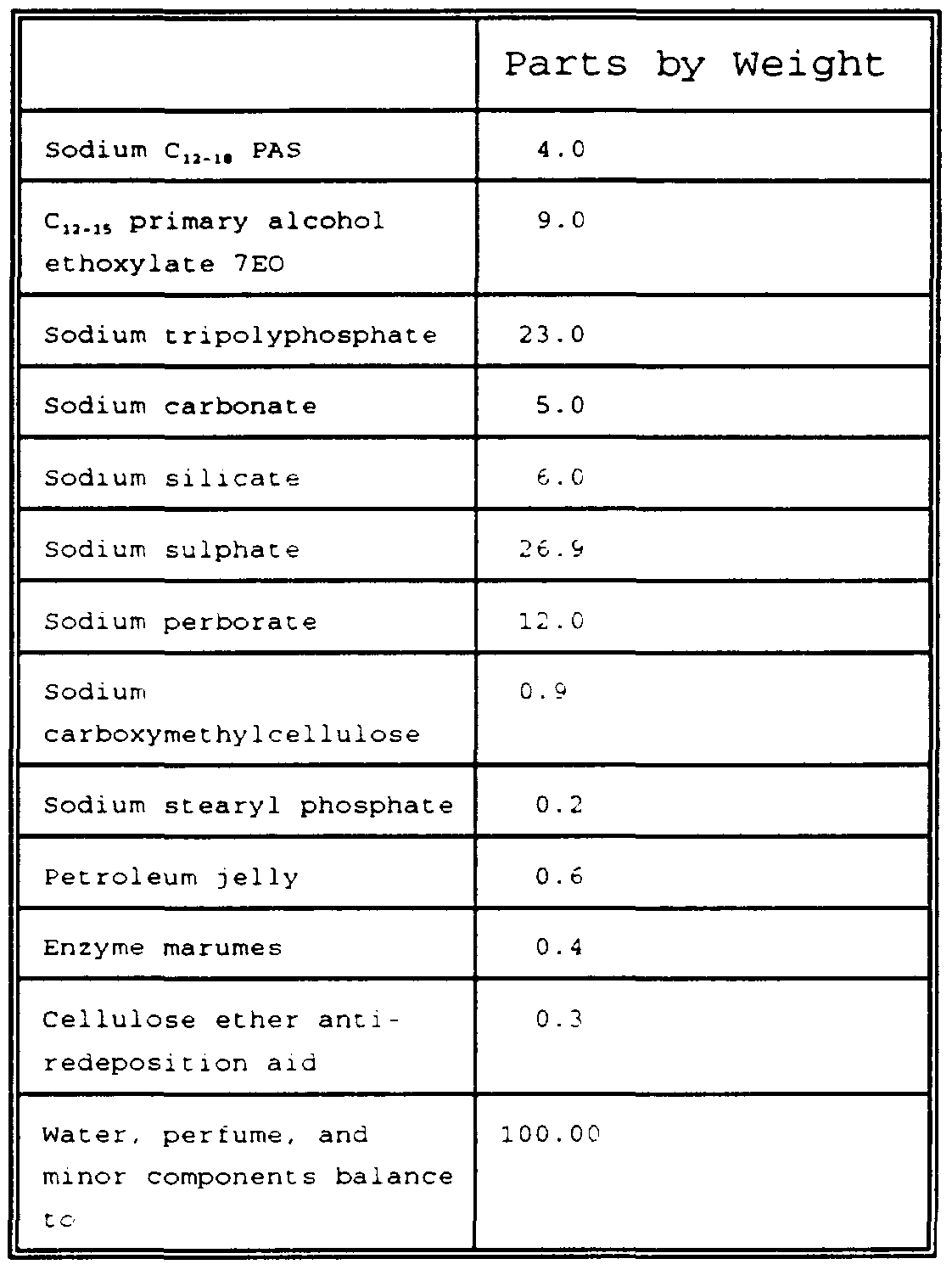
Finally, the powder is dosed with heat-sensitive components such as oxygen bleaches, perfumes and enzymes in accordance with conventional practice to produce a finished powder having the following composition:
Figure imgf000025_0001
The finished powder produced will have a bulk density of about 800 g/litre.
A C10.,. /LAS C -1_ 7EO Nonionic mixture in which the LAS acid is neutralised using 50% caustic soda is substituted for the PAS/NI mixture heated under vacuum to provide water to anionic mole ratio of 1.6 The resulting powder has the composition listed above expect the LAS replaced the PAS. EXAMPLE 4
The microstructures of 1:2 anionic:nonionic PAS HAMs were determined by FFTEM and SAXS before eight weeks of storage at 80°C with varying amounts of water. The microstructures were determined at both 21°C and 80°C. Samples for FFTEM were fast- frozen using a controlled environment vitrification chamber similar to the design of Bellare et al . (mentioned above) . Th chamber maintains equilibrium water content of samples prior t fast freezing by maintaining a saturated humid env πonment at a fixed temperature.
SAXS data were collected at both room temperature and 80°C fro samples sealed in tubes. However, SAXS data were collected only from 1:2 HAMs.
PAS 1:2. SAXS spectra of water-reduced (0.2 wt . % water) PAS 1:2 HAMs at 21°C and 80°C shows that PAS 1:2 at 0.2 wt % water and 22°C could be a mixture of liquid crystals and complex multiple L2 phases; peaks arise at 7.8, 5.2, 3.9 and 3.4 nm. In contrast, raising the temperature to 80°C results in a transition to an L-alpha (lamellar) phase, as indicated by a sharp peak at 3.5 nm. No micellar peak is evident.
SAXS and FFTEM results of 1:2 PAS HAMs at 6.4 wt % water, without high-temperature storage show that SAXS data at 21°C and 80°C both indicate pure L-alpha phases, with about 0.1 nm of swelling at 80°C compared to 21°C. It is believed that the reason for the loss in stability is that the increased swelling of the water phase at a higher temperature increases the water activity and allows hydrolysis of the nonionic complex and the PAS. The nonionic complex may provide catalysis for the hydrolysis of PAS. The FFTEM shows curved lamellar (L-alpha) liquid crystals. Again, no micellar region is seen. The above results show most of the PAS HAMs with 1:2 anionic/nonionic that were tested were of one phase: curved lamellar (L-alpha phase) liquid crystals. The exception was PAS at 0.2 wt . % water and 22°C, which forms an unknown meso phase which replaces the L-alpha phase.
As the anionic:nonionic ratio falls from 1:2 to 1:4 they are believed to be L-alpha liquid crystals with an increasing function of reverse mecelles.
EXAMPLE 5
The procedure of Example 4 was repeated to determine the microstructures of 1:1 and 1:2 anionic:nonionic LAS HAMs by FFTEM and SAXS before and after eight weeks of storage at 80°C with varying amounts of water, at both 21°C and 80°C.
LAS 1:1. FFTEM mocrographs at 21°C of LAS 1:1 HAMS at 0.7, 0.6 and 7.8 wt . % water, respectively, examined after one week of storage at room temperature, show that lamellar liquid crystals (an L-alpha phase) are prominent in all three samples, but the spatial extent of continuous lamellae increases as water is added. The average spatial extent of the lamellae is about 200 nm for 0.7%, 1 micrometer for 6.0%, and several micrometers for 7.8%.
LAS 1:2.
(a) LAS 1:2 HAMs were examined with both FFTEM and SAXS at both 22°C and 80°C. FFTEM of low water-content samples at 80°C are not reported because of difficulties in maintaining equilibrium hydration levels at 80°C prior to fast-freezing. (b) SAXS and FFTEM results were obtained from water-reduced LAS 1:2 HAMs after 8 weeks of storage at 80°C. The SAXS spectra of LAS 1:2 with 0.72 wt . % water at 21°C and 80°C both indicate an L-alpha phase in equilibrium with an inverse micellar phase (LI) . Raising the temperature to 80°C compresses the micellar spacing from 3.2 to 2.9 nm. SAXS of the same samples before eight weeks of storage were the same.
(c) An FFTEM micrograph shows that the L-alpha phase is suspended in the inverse micellar phase.
(d) SAXS of all the LAS 1:2 HAMs at 22°C and 80°C indicated no change in the phases present after eight weeks of storage at 80°C.
(e) SAXS spectra of LAS 1:2 with 7.0 wt . % water at 21°C and 80°C shows that the sharp L-alpha peak shifts from 3.5 nm at 21°C to 3.6 nm at 80°C. Also, the broad micellar peak is barely seen at 21°C while the micellar peak is prominent at 80°C.
(f) The FFTEM micrograph of LAS 1:2 at 80°C and 5.6 wt . % water shows that L-alpha sheets surrounded partly by an inverse micellar phase Lj .
Based on the above results, it appears that LAS HAMs with 1:1 anionic:nonionic without h gh temperature storage are pure lamellar liquid crystalline phases (L-alpha) . It s believed that the loss in stability occurs for the same reasons described in Example 4. LAS HAMs with 1:2 anionic/nonionic are a mixture of two equilibrium phases, inverse micelles and flat lamellar liquid crystals. This was determined from 0.7-7.0 wt . % water and from 22-80°C. As the water decreases and the temperature increases, the mixtures become less lamellar and more reverse micellar. The volume fraction of inverse micelles is expected to increase as the anionic:nonionic ratio decreases.

Claims

WHAT IS CLAIMED IS:
1. A high active detergent composition consisting essentially of: an anionic/nonionic detergent combination containing 0.2% to 8% water, and about 93% to about 98% of a surfactant mixtur has a ratio of anionic to nonionic of about 1:4 to about 2:1 said anionic being a C8_18 primary linear alkyl sulphate and/or a Cθ_ιe linear alkyl benzene sulphonate and said nonionic being a C8_20 primary alcohol ethoxylate with 1 to 12 ethylene oxide units said composition having a water to anionic ratio of less than 2.3 and a storage stability-chemical/pH stability of at least two weeks at 80°C.
2. A aqueous liquid surfactant composition mobile at a temperature within the range of from 20°C to 80°C characterised in that the composition consists essentially of:
(a) anionic surfactant selected from a sodium or potassiu salt of a primary alkyl sulphate and a sodium or potassium salt of a linear alkyl benzene sulphonate in an amount of about 20% to 60% by weight;
(b) an ethoxylated nonionic surfactant in an amount of about 20% to 80% be weight; and
(c) water in an amount of 0.2% to 8% by weight, wherein said composition has a mole ratio of water to anionic surfactant of less than 2.3.
3. A composition according to claim 2 wherein the weight ratio of component (a) to component (b) is within the range of from about 1:4 to about 2:1.
4. A composition according to any preceding claim having a water content of 0.2% to 7% in which the anionic surfactant consists essentially of a C8_18 primary linear alkyl sulphate, the water to anionic ratio is less than 2.0 and the composition has a phase structure which varies at 20°C to 80°C.
5. A composition according to claim 4 wherein said anionic to nonionic ratio is about 1:2 and said phase structure is a meso phase with SAXS peaks at 3 to 10 nm.
6. A composition according to claim 4 wherein said anionic to nonionic ratio is about 1:4 and said phase structure is essentially inverse micelles at 20°C to 80°C. The product of claim 1 wherein the mole ratio of water to anionic is reduced by vacuum stripping, thereby improving odour of the product.
7. A composition according to any one of claims 1 to 3 having a water content of 0.5% to 8% in which the anionic surfactant consists essentially of C8_ιe linear alkyl benzene sulphonate, and which has a storage stability - chemical pH stability of at least 6 weeks at 80°C and, optionally, the nonionic surfactant has a pH of about 5 to 7.
8. A composition according to claim 7 wherein said anionic to nonionic ratio is about 1:1 and said phase structure is principally curved lamellar liquid crystals.
9. A composition according to claim 7 wherein said anionic to nonionic ratio is about 1:4 and said phase structure is essentially all inverse micelles.
10. A composition according to claim 7 wherein said anionic to nonionic ratio is about 1:2 and said phase structure is composed of flat lamellar liquid crystals and inverse micelles.
11. A process for the manufacture of a particulate detergent composition or a component therefor which comprises spraying onto a solid particulate absorbent material at a temperature within the range of from 15°C to 80°C a mobile liquid surfactant composition having a ratio of anionic surfactant to nonionic of 1:4 to 2:1 and a mole ratio of water to anionic of 0.05 to 2.3 consisting essentially of:
(a) an anionic surfactant comprising a sodium or potassium salt of an alkyl benzene sulphate and/or a primary alcohol sulphate in an amount not exceeding 60% by weight.
(b) an ethoxylated nonionic surfactant in an amount not exceeding 80% by weight.
(c) water in an amount of about 0.2 to 8% by weight.
12. A detergent product obtainable by the process of claim 11
PCT/EP1995/004639 1994-12-22 1995-11-22 Detergent composition Ceased WO1996019556A1 (en)

Priority Applications (4)

Application Number Priority Date Filing Date Title
EP95941626A EP0799295A1 (en) 1994-12-22 1995-11-22 Detergent composition
AU43000/96A AU4300096A (en) 1994-12-22 1995-11-22 Detergent composition
CA002208038A CA2208038C (en) 1994-12-22 1995-11-22 Detergent composition
BR9510098A BR9510098A (en) 1994-12-22 1995-11-22 Highly active detergent composition Aqueous liquid surfactant composition Process for the manufacture of a particulate detergent composition or a component and detergent product

Applications Claiming Priority (4)

Application Number Priority Date Filing Date Title
US36207594A 1994-12-22 1994-12-22
US36208494A 1994-12-22 1994-12-22
US08/362,075 1994-12-22
US08/362,084 1994-12-22

Publications (1)

Publication Number Publication Date
WO1996019556A1 true WO1996019556A1 (en) 1996-06-27

Family

ID=27001550

Family Applications (1)

Application Number Title Priority Date Filing Date
PCT/EP1995/004639 Ceased WO1996019556A1 (en) 1994-12-22 1995-11-22 Detergent composition

Country Status (8)

Country Link
EP (1) EP0799295A1 (en)
CN (1) CN1175276A (en)
AR (1) AR000401A1 (en)
AU (1) AU4300096A (en)
BR (1) BR9510098A (en)
CA (1) CA2208038C (en)
TW (1) TW382025B (en)
WO (1) WO1996019556A1 (en)

Families Citing this family (2)

* Cited by examiner, † Cited by third party
Publication number Priority date Publication date Assignee Title
CN102864033A (en) * 2012-09-06 2013-01-09 南通华豪巨电子科技有限公司 Skin-protecting and heavy-duty detergent powder
TWI454571B (en) * 2012-10-16 2014-10-01 China Steel Corp Alkaline detergent composition

Citations (4)

* Cited by examiner, † Cited by third party
Publication number Priority date Publication date Assignee Title
EP0088612A1 (en) * 1982-03-06 1983-09-14 Bridgemace Limited Detergent
EP0265203A1 (en) * 1986-10-20 1988-04-27 Unilever Plc Detergent compositions
EP0436240A1 (en) * 1989-12-04 1991-07-10 Unilever N.V. Process for preparing a high bulk density detergent composition having improved dispensing properties
EP0544365A1 (en) * 1991-11-26 1993-06-02 Unilever N.V. Detergent compositions and process for preparing them

Patent Citations (4)

* Cited by examiner, † Cited by third party
Publication number Priority date Publication date Assignee Title
EP0088612A1 (en) * 1982-03-06 1983-09-14 Bridgemace Limited Detergent
EP0265203A1 (en) * 1986-10-20 1988-04-27 Unilever Plc Detergent compositions
EP0436240A1 (en) * 1989-12-04 1991-07-10 Unilever N.V. Process for preparing a high bulk density detergent composition having improved dispensing properties
EP0544365A1 (en) * 1991-11-26 1993-06-02 Unilever N.V. Detergent compositions and process for preparing them

Also Published As

Publication number Publication date
CA2208038A1 (en) 1996-06-27
CA2208038C (en) 2004-01-27
AU4300096A (en) 1996-07-10
CN1175276A (en) 1998-03-04
AR000401A1 (en) 1997-06-18
BR9510098A (en) 1998-07-14
TW382025B (en) 2000-02-11
EP0799295A1 (en) 1997-10-08

Similar Documents

Publication Publication Date Title
EP0439316B1 (en) Detergent composition
EP0550636B1 (en) Liquid detergent compositions
EP0265203B1 (en) Detergent compositions
US4923635A (en) Liquid detergent composition containing alkylbenzene sulfonate, alkyl ethanol ether sulfate, alkanolamide foam booster and magnesium and triethanolammonium ions
EP0110731B1 (en) Non-evaporative solidification of detergent pastes
US4692271A (en) Concentrated aqueous surfactant compositions
CA1110517A (en) Liquid detergent composition
JPH06100899A (en) Detergent composition
IE59693B1 (en) Liquid detergent composition
ZA200101221B (en) Particulate laundry detergent compositions containing nonionic surfactant granules.
US5668100A (en) Detergent mixtures and detergents or cleaning formulations with improved dissolving properties
JPS59135292A (en) Liquid detergent composition
JPH07501036A (en) Liquid or paste detergents or cleaning agents
CA1298163C (en) Surfactant mixtures and their use
JP2837325B2 (en) Detergent composition and method for producing the same
JPH07506610A (en) Method for producing detergent containing anionic surfactant
CA1220695A (en) Detergent compositions
KR19990008008A (en) Process for preparing granular detergent component or composition
CA2208038C (en) Detergent composition
US5219495A (en) Detergent compositions containing mobile liquid active systems
CA1184468A (en) Process for preparing low silicate detergent compositions
US4186114A (en) Free-flowing granular detergent compositions containing olefin sulfonates
EP0892843B1 (en) Modified aluminosilicate
AU619597B2 (en) A composition for softening fabrics
CA1042306A (en) Manufacture of improved aqueous alkali metal silicate-alkali metal hydroxyalkyl iminodiacetate compositions

Legal Events

Date Code Title Description
WWE Wipo information: entry into national phase

Ref document number: 95197609.5

Country of ref document: CN

AK Designated states

Kind code of ref document: A1

Designated state(s): AL AM AT AU BB BG BR BY CA CH CN CZ DE DK EE ES FI GB GE HU IS JP KE KG KP KR KZ LK LR LS LT LU LV MD MG MK MN MW MX NO NZ PL PT RO RU SD SE SG SI SK TJ TM TT UA UG UZ VN

AL Designated countries for regional patents

Kind code of ref document: A1

Designated state(s): KE LS MW SD SZ UG AT BE CH DE DK ES FR GB GR IE IT LU MC NL PT SE BF BJ CF CG CI CM GA GN ML MR NE SN TD TG

DFPE Request for preliminary examination filed prior to expiration of 19th month from priority date (pct application filed before 20040101)
121 Ep: the epo has been informed by wipo that ep was designated in this application
WWE Wipo information: entry into national phase

Ref document number: 1995941626

Country of ref document: EP

ENP Entry into the national phase

Ref document number: 2208038

Country of ref document: CA

Ref document number: 2208038

Country of ref document: CA

Kind code of ref document: A

WWP Wipo information: published in national office

Ref document number: 1995941626

Country of ref document: EP

REG Reference to national code

Ref country code: DE

Ref legal event code: 8642

WWW Wipo information: withdrawn in national office

Ref document number: 1995941626

Country of ref document: EP