WO1996022968A1 - Hydrocyanation of diolefins and isomerization of nonconjugated 2-alkyl-3-monoalkenenitriles - Google Patents

Hydrocyanation of diolefins and isomerization of nonconjugated 2-alkyl-3-monoalkenenitriles Download PDF

Info

Publication number
WO1996022968A1
WO1996022968A1 PCT/US1996/000548 US9600548W WO9622968A1 WO 1996022968 A1 WO1996022968 A1 WO 1996022968A1 US 9600548 W US9600548 W US 9600548W WO 9622968 A1 WO9622968 A1 WO 9622968A1
Authority
WO
WIPO (PCT)
Prior art keywords
alkyl
carbon atoms
improved process
independentiy
straight chain
Prior art date
Legal status (The legal status is an assumption and is not a legal conclusion. Google has not performed a legal analysis and makes no representation as to the accuracy of the status listed.)
Ceased
Application number
PCT/US1996/000548
Other languages
French (fr)
Inventor
Thomas Foo
James Michael Garner
Rafael Shapiro
Wilson Tam
Current Assignee (The listed assignees may be inaccurate. Google has not performed a legal analysis and makes no representation or warranty as to the accuracy of the list.)
EIDP Inc
Original Assignee
EI Du Pont de Nemours and Co
Priority date (The priority date is an assumption and is not a legal conclusion. Google has not performed a legal analysis and makes no representation as to the accuracy of the date listed.)
Filing date
Publication date
Priority claimed from US08/563,718 external-priority patent/US5821378A/en
Application filed by EI Du Pont de Nemours and Co filed Critical EI Du Pont de Nemours and Co
Priority to DE69605398T priority Critical patent/DE69605398T2/en
Priority to EP96902689A priority patent/EP0804412B1/en
Priority to JP52290296A priority patent/JP3959111B2/en
Priority to BRPI9606718-7A priority patent/BR9606718B1/en
Publication of WO1996022968A1 publication Critical patent/WO1996022968A1/en
Anticipated expiration legal-status Critical
Ceased legal-status Critical Current

Links

Classifications

    • CCHEMISTRY; METALLURGY
    • C07ORGANIC CHEMISTRY
    • C07FACYCLIC, CARBOCYCLIC OR HETEROCYCLIC COMPOUNDS CONTAINING ELEMENTS OTHER THAN CARBON, HYDROGEN, HALOGEN, OXYGEN, NITROGEN, SULFUR, SELENIUM OR TELLURIUM
    • C07F9/00Compounds containing elements of Groups 5 or 15 of the Periodic Table
    • C07F9/02Phosphorus compounds
    • C07F9/547Heterocyclic compounds, e.g. containing phosphorus as a ring hetero atom
    • C07F9/6564Heterocyclic compounds, e.g. containing phosphorus as a ring hetero atom having phosphorus atoms, with or without nitrogen, oxygen, sulfur, selenium or tellurium atoms, as ring hetero atoms
    • C07F9/6571Heterocyclic compounds, e.g. containing phosphorus as a ring hetero atom having phosphorus atoms, with or without nitrogen, oxygen, sulfur, selenium or tellurium atoms, as ring hetero atoms having phosphorus and oxygen atoms as the only ring hetero atoms
    • C07F9/6574Esters of oxyacids of phosphorus
    • C07F9/65746Esters of oxyacids of phosphorus the molecule containing more than one cyclic phosphorus atom
    • BPERFORMING OPERATIONS; TRANSPORTING
    • B01PHYSICAL OR CHEMICAL PROCESSES OR APPARATUS IN GENERAL
    • B01JCHEMICAL OR PHYSICAL PROCESSES, e.g. CATALYSIS OR COLLOID CHEMISTRY; THEIR RELEVANT APPARATUS
    • B01J31/00Catalysts comprising hydrides, coordination complexes or organic compounds
    • B01J31/16Catalysts comprising hydrides, coordination complexes or organic compounds containing coordination complexes
    • B01J31/18Catalysts comprising hydrides, coordination complexes or organic compounds containing coordination complexes containing nitrogen, phosphorus, arsenic or antimony as complexing atoms, e.g. in pyridine ligands, or in resonance therewith, e.g. in isocyanide ligands C=N-R or as complexed central atoms
    • B01J31/1845Catalysts comprising hydrides, coordination complexes or organic compounds containing coordination complexes containing nitrogen, phosphorus, arsenic or antimony as complexing atoms, e.g. in pyridine ligands, or in resonance therewith, e.g. in isocyanide ligands C=N-R or as complexed central atoms the ligands containing phosphorus
    • B01J31/185Phosphites ((RO)3P), their isomeric phosphonates (R(RO)2P=O) and RO-substitution derivatives thereof
    • CCHEMISTRY; METALLURGY
    • C07ORGANIC CHEMISTRY
    • C07CACYCLIC OR CARBOCYCLIC COMPOUNDS
    • C07C253/00Preparation of carboxylic acid nitriles
    • C07C253/08Preparation of carboxylic acid nitriles by addition of hydrogen cyanide or salts thereof to unsaturated compounds
    • C07C253/10Preparation of carboxylic acid nitriles by addition of hydrogen cyanide or salts thereof to unsaturated compounds to compounds containing carbon-to-carbon double bonds
    • CCHEMISTRY; METALLURGY
    • C07ORGANIC CHEMISTRY
    • C07FACYCLIC, CARBOCYCLIC OR HETEROCYCLIC COMPOUNDS CONTAINING ELEMENTS OTHER THAN CARBON, HYDROGEN, HALOGEN, OXYGEN, NITROGEN, SULFUR, SELENIUM OR TELLURIUM
    • C07F9/00Compounds containing elements of Groups 5 or 15 of the Periodic Table
    • C07F9/02Phosphorus compounds
    • C07F9/06Phosphorus compounds without P—C bonds
    • C07F9/08Esters of oxyacids of phosphorus
    • C07F9/141Esters of phosphorous acids
    • C07F9/1411Esters of phosphorous acids with hydroxyalkyl compounds with further substituents on alkyl
    • CCHEMISTRY; METALLURGY
    • C07ORGANIC CHEMISTRY
    • C07FACYCLIC, CARBOCYCLIC OR HETEROCYCLIC COMPOUNDS CONTAINING ELEMENTS OTHER THAN CARBON, HYDROGEN, HALOGEN, OXYGEN, NITROGEN, SULFUR, SELENIUM OR TELLURIUM
    • C07F9/00Compounds containing elements of Groups 5 or 15 of the Periodic Table
    • C07F9/02Phosphorus compounds
    • C07F9/06Phosphorus compounds without P—C bonds
    • C07F9/08Esters of oxyacids of phosphorus
    • C07F9/141Esters of phosphorous acids
    • C07F9/1412Polyol derivatives esterified at least twice by phosphorous acid groups
    • CCHEMISTRY; METALLURGY
    • C07ORGANIC CHEMISTRY
    • C07FACYCLIC, CARBOCYCLIC OR HETEROCYCLIC COMPOUNDS CONTAINING ELEMENTS OTHER THAN CARBON, HYDROGEN, HALOGEN, OXYGEN, NITROGEN, SULFUR, SELENIUM OR TELLURIUM
    • C07F9/00Compounds containing elements of Groups 5 or 15 of the Periodic Table
    • C07F9/02Phosphorus compounds
    • C07F9/06Phosphorus compounds without P—C bonds
    • C07F9/08Esters of oxyacids of phosphorus
    • C07F9/141Esters of phosphorous acids
    • C07F9/145Esters of phosphorous acids with hydroxyaryl compounds
    • CCHEMISTRY; METALLURGY
    • C07ORGANIC CHEMISTRY
    • C07FACYCLIC, CARBOCYCLIC OR HETEROCYCLIC COMPOUNDS CONTAINING ELEMENTS OTHER THAN CARBON, HYDROGEN, HALOGEN, OXYGEN, NITROGEN, SULFUR, SELENIUM OR TELLURIUM
    • C07F9/00Compounds containing elements of Groups 5 or 15 of the Periodic Table
    • C07F9/02Phosphorus compounds
    • C07F9/06Phosphorus compounds without P—C bonds
    • C07F9/08Esters of oxyacids of phosphorus
    • C07F9/141Esters of phosphorous acids
    • C07F9/146Esters of phosphorous acids containing P-halide groups
    • CCHEMISTRY; METALLURGY
    • C07ORGANIC CHEMISTRY
    • C07FACYCLIC, CARBOCYCLIC OR HETEROCYCLIC COMPOUNDS CONTAINING ELEMENTS OTHER THAN CARBON, HYDROGEN, HALOGEN, OXYGEN, NITROGEN, SULFUR, SELENIUM OR TELLURIUM
    • C07F9/00Compounds containing elements of Groups 5 or 15 of the Periodic Table
    • C07F9/02Phosphorus compounds
    • C07F9/06Phosphorus compounds without P—C bonds
    • C07F9/22Amides of acids of phosphorus
    • C07F9/24Esteramides
    • C07F9/2404Esteramides the ester moiety containing a substituent or a structure which is considered as characteristic
    • C07F9/242Esteramides the ester moiety containing a substituent or a structure which is considered as characteristic of hydroxyaryl compounds
    • CCHEMISTRY; METALLURGY
    • C07ORGANIC CHEMISTRY
    • C07FACYCLIC, CARBOCYCLIC OR HETEROCYCLIC COMPOUNDS CONTAINING ELEMENTS OTHER THAN CARBON, HYDROGEN, HALOGEN, OXYGEN, NITROGEN, SULFUR, SELENIUM OR TELLURIUM
    • C07F9/00Compounds containing elements of Groups 5 or 15 of the Periodic Table
    • C07F9/02Phosphorus compounds
    • C07F9/547Heterocyclic compounds, e.g. containing phosphorus as a ring hetero atom
    • C07F9/655Heterocyclic compounds, e.g. containing phosphorus as a ring hetero atom having oxygen atoms, with or without sulfur, selenium, or tellurium atoms, as the only ring hetero atoms
    • C07F9/65515Heterocyclic compounds, e.g. containing phosphorus as a ring hetero atom having oxygen atoms, with or without sulfur, selenium, or tellurium atoms, as the only ring hetero atoms the oxygen atom being part of a five-membered ring
    • C07F9/65517Heterocyclic compounds, e.g. containing phosphorus as a ring hetero atom having oxygen atoms, with or without sulfur, selenium, or tellurium atoms, as the only ring hetero atoms the oxygen atom being part of a five-membered ring condensed with carbocyclic rings or carbocyclic ring systems
    • CCHEMISTRY; METALLURGY
    • C07ORGANIC CHEMISTRY
    • C07FACYCLIC, CARBOCYCLIC OR HETEROCYCLIC COMPOUNDS CONTAINING ELEMENTS OTHER THAN CARBON, HYDROGEN, HALOGEN, OXYGEN, NITROGEN, SULFUR, SELENIUM OR TELLURIUM
    • C07F9/00Compounds containing elements of Groups 5 or 15 of the Periodic Table
    • C07F9/02Phosphorus compounds
    • C07F9/547Heterocyclic compounds, e.g. containing phosphorus as a ring hetero atom
    • C07F9/6564Heterocyclic compounds, e.g. containing phosphorus as a ring hetero atom having phosphorus atoms, with or without nitrogen, oxygen, sulfur, selenium or tellurium atoms, as ring hetero atoms
    • C07F9/6571Heterocyclic compounds, e.g. containing phosphorus as a ring hetero atom having phosphorus atoms, with or without nitrogen, oxygen, sulfur, selenium or tellurium atoms, as ring hetero atoms having phosphorus and oxygen atoms as the only ring hetero atoms
    • C07F9/6574Esters of oxyacids of phosphorus
    • C07F9/65744Esters of oxyacids of phosphorus condensed with carbocyclic or heterocyclic rings or ring systems
    • BPERFORMING OPERATIONS; TRANSPORTING
    • B01PHYSICAL OR CHEMICAL PROCESSES OR APPARATUS IN GENERAL
    • B01JCHEMICAL OR PHYSICAL PROCESSES, e.g. CATALYSIS OR COLLOID CHEMISTRY; THEIR RELEVANT APPARATUS
    • B01J2231/00Catalytic reactions performed with catalysts classified in B01J31/00
    • B01J2231/30Addition reactions at carbon centres, i.e. to either C-C or C-X multiple bonds
    • B01J2231/32Addition reactions to C=C or C-C triple bonds
    • B01J2231/323Hydrometalation, e.g. bor-, alumin-, silyl-, zirconation or analoguous reactions like carbometalation, hydrocarbation
    • BPERFORMING OPERATIONS; TRANSPORTING
    • B01PHYSICAL OR CHEMICAL PROCESSES OR APPARATUS IN GENERAL
    • B01JCHEMICAL OR PHYSICAL PROCESSES, e.g. CATALYSIS OR COLLOID CHEMISTRY; THEIR RELEVANT APPARATUS
    • B01J2231/00Catalytic reactions performed with catalysts classified in B01J31/00
    • B01J2231/50Redistribution or isomerisation reactions of C-C, C=C or C-C triple bonds
    • B01J2231/52Isomerisation reactions
    • BPERFORMING OPERATIONS; TRANSPORTING
    • B01PHYSICAL OR CHEMICAL PROCESSES OR APPARATUS IN GENERAL
    • B01JCHEMICAL OR PHYSICAL PROCESSES, e.g. CATALYSIS OR COLLOID CHEMISTRY; THEIR RELEVANT APPARATUS
    • B01J2531/00Additional information regarding catalytic systems classified in B01J31/00
    • B01J2531/02Compositional aspects of complexes used, e.g. polynuclearity
    • B01J2531/0261Complexes comprising ligands with non-tetrahedral chirality
    • B01J2531/0266Axially chiral or atropisomeric ligands, e.g. bulky biaryls such as donor-substituted binaphthalenes, e.g. "BINAP" or "BINOL"
    • BPERFORMING OPERATIONS; TRANSPORTING
    • B01PHYSICAL OR CHEMICAL PROCESSES OR APPARATUS IN GENERAL
    • B01JCHEMICAL OR PHYSICAL PROCESSES, e.g. CATALYSIS OR COLLOID CHEMISTRY; THEIR RELEVANT APPARATUS
    • B01J2531/00Additional information regarding catalytic systems classified in B01J31/00
    • B01J2531/80Complexes comprising metals of Group VIII as the central metal
    • B01J2531/84Metals of the iron group
    • B01J2531/847Nickel

Definitions

  • the present invention provides an improved process for the liquid phase hydrocyanation of diolefinic compounds and isomerization of the resulting nonconjugated acyclic nitriles comprising, reacting an acyclic aliphatic diolefinic compound, preferably butadiene, with a source of HCN, wherein the improvement comprises conducting the hydrocyanation and/or isomerzation in the presence of a catalyst precursor composition comprising zero-valent nickel and at least one multidentate phosphite ligand selected from the group consisting of compounds represented by Formulas I, II, III, IV, V, VI, VII, VIII, IX, X, XI, XII, XIII, XIV, and XV as set forth below:
  • each R 1 is independently a branched or straight chain alkyl of up to 12 carbon
  • each R 2' is independentiy H or a primary, secondary or tertiary hydrocarbyl of 1 to 12 carbon atoms at either the meta or para position to the oxygen; or CN, CO 2 R 4 or OR 4" wherein R 4 is a C 1 to C 6 alkyl at either the meta or para position to the oxygen of the phenoxy ring;
  • the reactions are most conveniently performed continuously from hydrocyanation of the starting diolefin to the final 3- and/or 4-monoalkene linear nitriles.
  • the processes can be conducted stepwise, i.e., the
  • ligands may be prepared by a variety of methods known in the art, for example, see descriptions in WO 93,03839, U.S. 4,769,498; U.S. 4,688,651, J. Amer. Chem. So c., 1993, 115, 2066.
  • the reaction of 2,2'-biphenol with phosphorus trichloride gives 1,1'-biphenyl-2,2'-diyl phosphorochloridite.
  • the zero-valent nickel can be prepared or generated according to techniques known in the art (U.S. 3,496,217; 3,631,191; 3,846,461; 3,847,959; and 3,903,120 which are incorporated herein by reference).
  • Zero-valent nickel compounds that contain ligands which can be displaced by the organophosphorus ligand are a preferred source of zero-valent nickel.
  • Two such preferred zero-valent nickel compounds are Ni(COD) 2 (COD is 1,5-cyclooctadiene) and
  • the reaction mixture is agitated, such as by stirring or shaking.
  • the cyanated product can be recovered by conventional techniques such as crystallization of the product from solution or by distillation.
  • the process is usually carried out "neat", i.e., without an added diluent or solvent.
  • Any solvent or diluent that is nondestructive of the catalyst can be used, however.
  • Suitable solvents include aliphatic or aromatic hydrocarbons (hexane, cyclohexane, benzene), ethers (diethyl ether, tetrahydrofuran, dioxane, glycol dimethyl ether, anisole), esters (ethyl acetate, methyl benzoate), nitriles
  • Ligand B Formula VI where R 2 is the cyclic group, -O-C(CH 3 ) 2 -CH 2 -

Landscapes

  • Chemical & Material Sciences (AREA)
  • Organic Chemistry (AREA)
  • Health & Medical Sciences (AREA)
  • Life Sciences & Earth Sciences (AREA)
  • Biochemistry (AREA)
  • General Health & Medical Sciences (AREA)
  • Molecular Biology (AREA)
  • Engineering & Computer Science (AREA)
  • Inorganic Chemistry (AREA)
  • Materials Engineering (AREA)
  • Chemical Kinetics & Catalysis (AREA)
  • Toxicology (AREA)
  • Organic Low-Molecular-Weight Compounds And Preparation Thereof (AREA)
  • Low-Molecular Organic Synthesis Reactions Using Catalysts (AREA)
  • Polyesters Or Polycarbonates (AREA)
  • Lubricants (AREA)
  • Luminescent Compositions (AREA)
  • Polyurethanes Or Polyureas (AREA)

Abstract

Improved liquid phase process useful in the hydrocyanation of diolefinic compounds to produce nonconjugated acyclic nitriles and to the liquid phase process of isomerization of the nitriles to 3- and/or 4-monoalkene linear nitriles. The improvement involves conducting the process in the presence of zero-valent nickel and a multidentate phosphite ligand. The invention also provides a novel method of making phosphorochloridite.

Description

TITLE
HYDROCYANATION OF DIOLEFINS AND
ISOMERIZAΗON OF NONCONJUGATED
2-ALKYL-3-MONOALKENENITRILES
FIELD OF THE INVENTION
This invention generally relates to an improved liquid phase process useful in the hydrocyanation of diolefinic compounds to produce nonconjugated acyclic nitriles and to a liquid phase process of isomerization of said nitriles to 3- and/or 4-monoalkene linear nitriles. The improvement resides in conducting the process in the presence of zero-valent nickel and a multidentate phosphite ligand.
BACKGROUND OF THE INVENTION
Catalytic hydrocyanation systems, particularly pertaining to the
hydrocyanation of olefϊns, are known in the art. For example, liquid phase systems useful for the hydrocyanation of butadiene to form pentenenitriles (PN) are known in the art. For example, Drinkard, U.S. 3,496,215, discloses the hydrocyanation of butadiene using monodentate nickel phosphite catalysts. As used in this patent, and as will be used herein, the term "pentenenitrile" is intended to mean
cyanobutene. Likewise, "butenenitrile" means cyanopropene. Bidentate phosphite ligands complexed to zero-valent nickel and platinum are known to be useful in the liquid phase hydrocyanation of butadiene, as described by Baker et al., J. Chem. Soc, Chem. Commun., 1991, pages 803-804.
The pentenenitriles so formed are subjected to further hydrocyanation and/or isomerization to form adiponitrile (ADN), a commercially important material in the manufacture of nylon. For example, Drinkard, U.S. 3,536,748, discloses the liquid phase isomerization of 2-methyl-3-butenenitrile in the presence of a zero valent nickel complex and Chia, U.S. 3,676,481, discloses an
improvement additionally utilizing tri(hydrocarbyl)boron promoters.
The hydrocyanation of activated olefins such as conjugated olefins (e.g., butadiene and styrene) and strained olefins (e.g., norbomene) proceeds without the use of a Lewis acid promoter, while hydrocyanation of unactivated olefins such as 1-octene and 3-pentenenitrile normally require the use of a Lewis acid promoter. Teachings regarding the use of a promoter in the hydrocyanation reaction appear, for example, in U.S. 3,496,217.
Certain multidentate phosphite ligands useful in the present invention for the hydrocyanation of diolefins have been used for the hydrocyanation of monoolefins. Commonly assigned, copending application Serial No. 08/424,351, filed April 26, 1995, and copending application U.S. Serial No. 08/505,137, filed July 21, 1995, disclose bidentate phosphite ligands preferably used in combination with a Lewis acid promotor to hydrocyanate monoolefins. The present invention provides for an improved process for the
hydrocyanation of diolefinic compounds, such as butadiene, and isomerization of nonconjugated acyclic nitriles without the need for Lewis acid promoters utilizing zero-valent nickel and a multidentate phosphite ligand. Other objects and advantages of the present invention will become apparent to those skilled in the art upon reference to the detailed description of the invention which hereinafter follows.
SUMMARY OF THE INVENTION
The present invention provides an improved process for the liquid phase hydrocyanation of diolefinic compounds and isomerization of the resulting nonconjugated acyclic nitriles comprising, reacting an acyclic aliphatic diolefinic compound, preferably butadiene, with a source of HCN, wherein the improvement comprises conducting the hydrocyanation and/or isomerzation in the presence of a catalyst precursor composition comprising zero-valent nickel and at least one multidentate phosphite ligand selected from the group consisting of compounds represented by Formulas I, II, III, IV, V, VI, VII, VIII, IX, X, XI, XII, XIII, XIV, and XV as set forth below:
Figure imgf000004_0001
wherein
each R1 is independently a branched or straight chain alkyl of up to 12 carbon
atoms, or OR4 wherein R4 is C1 to C12 alkyl;
each R5 is independently a tertiary substituted hydrocarbon of up to 12 carbon atoms;
Figure imgf000005_0002
wherein
each R6 and R7 is independently a tertiary substituted hydrocarbon of up to
12 carbon atoms; and
each R8 is independentiy H or a branched or straight chain alkyl of up to 12 carbon atoms, or OR4 wherein R4 is C1 to C12 alkyl;
Figure imgf000005_0001
wherein
each R9 is independentiy H or a branched or straight chain alkyl of up to 12 carbon atoms, or OR4 wherein R4 is C1 to C12 alkyl; and
each R10 is independently a tertiary substituted hydrocarbon of up to 12 carbon atoms;
Figure imgf000006_0001
wherein
each R14 is independently a tertiary substituted hydrocarbon of up to 12 carbon atoms or Si(R11)3 where R11 is independently a branched or straight chain alkyl of up to 12 carbon atoms or phenyl or R14 can be CO2R3" wherein R3" is a secondary alkyl of up to 6 carbon atoms;
Figure imgf000006_0002
wherein
R12 is H or a branched or straight chain alkyl of up to 12 carbon atoms; and
each R13 is independently a branched or straight chain alkyl of up to 12 carbon atoms;
Figure imgf000007_0001
Figure imgf000008_0001
wherein in Formulas VI through XV
each R1 is independently, H, halogen, a C1 to C12 alkyl, or OR3 wherein R3 is a C1 to C12 alkyl;
each R2 is independentiy a secondary or tertiary hydrocarbyl of 3 to 12 carbon atoms, or OR4" wherein R4" is C1 to C6 alkyl or benzyl; or a cyclic group of the formula
Figure imgf000009_0002
forming a five membered ring attached to the phenyl ring, wherein Rw is H or CH3 and Z is -O- or -CH2-;
each R2' is independentiy H or a primary, secondary or tertiary hydrocarbyl of 1 to 12 carbon atoms at either the meta or para position to the oxygen; or CN, CO2R4 or OR4" wherein R4" is a C1 to C6 alkyl at either the meta or para position to the oxygen of the phenoxy ring;
each R5' is independently H or a primary or secondary hydrocarbyl of 1 to 3 carbon atoms; for Formulas VI and IX, R5 can also be OR4" wherein R4" is a C1 to C6 alkyl; for Formulas X and XI, R5 can also be CO2R4 wherein R4 " is a C1 to C6 alkyl; and
each X is independently O or CH(R4'), wherein R4 is H, a substituted phenyl, or a C1 to C12 alkyl;
and wherein said reaction is carried out to ultimately produce 3 and/or 4-monoalkene linear nitriles.
The present invention provides an improved process for the liquid phase hydrocyanation of diolefinic compounds, reacting an acyclic aliphatic diolefinic compound, preferably butadiene, with a source of HCN, wherein the improvement comprises conducting the hydrocyanation in the presence of a catalyst precursor composition comprising zero-valent nickel and at least one multidentate phosphite ligand selected from the group consisting of compounds represented by
Formulas I, II, III, IV, V, VI, V , VIII, IX, X, XI, XII, XIII, XIV, and XV as set forth below:
Figure imgf000009_0001
wherein
each R1 is independently a branched or straight chain alkyl of up to 12 carbon atoms, or OR4 wherein R4 is C1 to C 12 alkyl;
each R5 is independently a branched or straight chain alkyl of up to 12 carbon atoms or OR4" wherein R4' is C1 to C6 alkyl;
Figure imgf000010_0001
wherein
each R6 and R7 is independentiy a tertiary substituted hydrocarbon of up to
12 carbon atoms; and
each R8 is independentiy H or a branched or straight chain alkyl of up to 12 carbon atoms, or OR4 wherein R4 is C1 to C12 alkyl;
Figure imgf000010_0002
wherein
each R9 is independentiy H or a branched or straight chain alkyl of up to 12 carbon atoms, or OR4 wherein R4 is C1 to C12 alkyl; and
each R10 is independently a branched or straight chain alkyl of up to 12 carbon atoms or OR4" wherein R4" is C1 to C6 alkyl;
Figure imgf000011_0001
wherein
each R14 is independently a branched or straight chain alkyl of up to 12 carbon atoms or Si(R 11)3 where R11 is independently a branched or straight chain alkyl of up to 12 carbon atoms or phenyl or CO2R4 wherein R4" is C1 to C6 alkyl;
Figure imgf000011_0002
wherein
R12 is H or a branched or straight chain alkyl of up to 12 carbon atoms; and each R13 is independently a branched or straight chain alkyl of up to 12 carbon atoms;
Figure imgf000012_0001
Figure imgf000013_0001
wherein in Formulas VI through XV
each R1 is independently, H, halogen, a C1 to C 12 alkyl, or OR3 wherein R3 is a C1 to C12 alkyl;
each R2 is independentiy a secondary or tertiary hydrocarbyl of 3 to 12 carbon atoms, or OR4" wherein R4" is C1 to C6 alkyl or benzyl; or a cyclic group of the formula
Figure imgf000014_0001
forming a five membered ring attached to the phenyl ring, wherein Rw is H or CH3 and Z is -O- or -CH2-;
each R2' is independentiy H or a primary, secondary or tertiary hydrocarbyl of 1 to 12 carbon atoms at either the meta or para position to the oxygen; or CN, CO2R4 or OR4" wherein R4 is a C1 to C6 alkyl at either the meta or para position to the oxygen of the phenoxy ring;
each R5' is independently H or a primary or secondary hydrocarbyl of 1 to 3 carbon atoms; for Formulas VI and IX, R5 can also be OR4 wherein R4" is a C1 to
C6 alkyl; for Formulas X and XI, R5' can also be CO2R4" wherein R4" is a C1 to C6 alkyl; and
each X is independently O or CH(R4 ), wherein R4' is H, a substituted phenyl, or a C1 to C12 alkyl;
and wherein said reaction is carried out to ultimately produce 3 and/or
4-monoalkene linear nitriles and 2-alkyl-3-monoalkenenitriles.
As used herein, the terms "secondary" and "tertiary" refer to the carbon atom bonded to an aromatic ring.
The reactions are most conveniently performed continuously from hydrocyanation of the starting diolefin to the final 3- and/or 4-monoalkene linear nitriles. However, the processes can be conducted stepwise, i.e., the
nonconjugated acyclic nitriles resulting from the hydrocyanation can be isolated per se, prior to isomerization. Furthermore, nonconjugated acyclic nitriles prepared by any method can be used as starting materials for the isomerization in accordance with this invention.
The invention also provides for certain multidentate phosphite ligands and catalyst precursor compositions made therefrom useful in these processes as well as a novel method of making phosphorochloridite.
In particular, the method of making phosphorochloridite comprises contacting a compound of the formula N(R18)2P(OR19)2, wherein R19 is substituted aryl, with gaseous hydrogen chloride (HCl) to produce HN(R18)2●HCl and (R19O)2PCl. Preferably, the reaction is run without excess HCl, or if excess HCl is present, the HCl is removed quickly after the reaction is complete to prevent decomposition of the (R19O)2PCl product.
A method is also provided for producing N ,N-dialkyldiarylphosphoramidite comprising contacting one equivalent of PCI3 in an inert solvent, such as heptane or toluene, with one equivalent of a secondary amine, such as diisopropylamine, and at least one equivalent of a tertiary amine, such as triethylamine, preferably in the range of about 5 to about 35°C, and subsequently adding about 1.9 equivalents of a substituted phenol and about 2.1 equivalents of a tertiary amine, such as triethylamine, preferably in the presence of a nucleophilic catalyst such as 4- dimethylaminopyridine, and allowing the components to react at about 25 to about
90°C. Practice of the above method eliminates the need to isolate the intermediate
(R18)2NPCI2.
DETAILED DESCRIPTION OF THE PREFERRED EMBODIMENTS
The catalyst precursor compositions useful in the processes of this invention are comprised of a multidentate phosphite ligand and zero-valent nickel. The preferred ligand of the invention (for hydrocyanation of diolefinic compounds and the subsequent and/or independent isomerization of nonconjugated acyclic nitriles to 3- and/or 4-monoalkene linear nitriles) is described below by Formula I, wherein each R1 is independently a branched or straight chain alkyl containing up to 12 carbon atoms, or OR4 wherein R4 is a C1 to C12 alkyl. R4 can be primary, secondary or tertiary; examples include methyl, ethyl, isopropyl and t-butyl. Each R1 may be the same or different. In a more preferred ligand, both R1 groups are OR4 wherein R4 is methyl. R5 is a tertiary substituted hydrocarbyl group containing up to 12 single bond carbon atoms. Most preferably, each R1 is OCH3 and each R5 is t-butyl. For the per se hydrocyanation of diolefinic compounds to nonconjugated acyclic nitriles, R5 is expanded to include secondary and primary alkyls of up to 12 carbon atoms and OR4" wherein R4" is C1 to C6 alkyl.
The catalyst composition is referred to as a "precursor" only to indicate in all likelihood, during the hydrocyanation reaction the structure of the active catalyst composition may in fact be complexed to an olefin.
These ligands may be prepared by a variety of methods known in the art, for example, see descriptions in WO 93,03839, U.S. 4,769,498; U.S. 4,688,651, J. Amer. Chem. So c., 1993, 115, 2066. The reaction of 2,2'-biphenol with phosphorus trichloride gives 1,1'-biphenyl-2,2'-diyl phosphorochloridite. The reaction of this chloridite with 2,2'-oϋhydroxy-3,3'-di-t-butyl-5,5'-dimethoxy-1,1'-biphenyl in the presence of triethylamine gives the most preferred ligand wherein R1 is methoxyl.
The phosphorochloridite may be prepared by a variety of methods known in the art, for example, see descriptions in Polymer, 1992, 33, 161; Inorganic Syntheses, 1966, 8, 68; U.S. 5,210,260; Z. Anorg. Allg. Chem., 1986, 535, 221. With bulky ortho-substituted phenols (e.g., 2-t-butylphenol ), phosphorochloridites can be prepared in situ from PCI3 and the phenol. With less bulky groups (e.g.,
2,3-dimethoxyphenol), purification by high vacuum distillation is typically necessary. High vacuum distillation is difficult for large scale operations.
An improved process for preparing the phosphorochloridite comprises treatment of N,N-dialkyl diarylphosphoramidite with HCl. ClP(OMe)2 has been prepared in this manner, see Z. Naturforsch, 1972, 27B, 1429; however, phosphorochloridites derived from substituted phenols have not been previously prepared using this procedure. N,N-dialkyl diarylphosphoramidites may be prepared by methods known in the art , for example, see descriptions in
Tetrahedron Letters, 1993, 34, 6451 and Aust. J. Chem, 1993, 233.
Other multidentate phosphite ligands of the invention are described above by Formulas II through XV. While these ligands are not as preferred as Formula I, they nevertheless are considered useful ligands of the present invention. Presently, while Formula I is most preferred, Formulas VII and XI are more preferred than the other remaining ligands.
The zero-valent nickel can be prepared or generated according to techniques known in the art (U.S. 3,496,217; 3,631,191; 3,846,461; 3,847,959; and 3,903,120 which are incorporated herein by reference). Zero-valent nickel compounds that contain ligands which can be displaced by the organophosphorus ligand are a preferred source of zero-valent nickel. Two such preferred zero-valent nickel compounds are Ni(COD)2 (COD is 1,5-cyclooctadiene) and
Ni(P(O-o-C6H4CH3)3)2(C2H4), both of which are known in the art. Alternatively, divalent nickel compounds may be combined with a reducing agent, and are then able to serve as suitable sources of zero-valent nickel in the reaction. Suitable divalent nickel compounds include compounds of the formula NiY2 where Y is halide, carboxylate, or acetylacetonate. Suitable reducing agents include metal borohydrides, metal aluminum hydrides, metal alkyls, Zn, Fe, Al, Na, or H2.
Elemental nickel, preferably nickel powder, when combined with a halogenated catalyst, as described in U.S. 3,903,120, is also a suitable source of zero-valent nickel.
The actual catalyst precursor is a complex of zero-valent nickel with the multidentate ligand, which is formed when those two materials are combined. An effective catalyst requires at least two moles of P atoms for one gram-atom of zero-valent nickel.
The diolefinic compounds reactants used in this invention include primarily conjugated diolefins containing from 4 to 10 carbon atoms; for example,
1,3-butadiene and cis and trans-2,4-hexadienes . Butadiene is especially preferred by reason of its commercial importance in the production of adiponitrile. Other suitable diolefinic compounds include diolefinic compounds substituted wit groups which do not deactivate the catalyst, for example, cis and trans-1,3- pentadienes.
The following Formulas XVI and XVII illustrate suitable representative starting diolefinic compounds; and Formulas XVIII, XIX, and XX represent the products obtained from 1,3-butadiene and HCN.
Figure imgf000017_0001
Figure imgf000017_0002
wherein each one of R15 and R16, independently, is H or a C1 to C3 alkyl.
3
Figure imgf000017_0003
Figure imgf000017_0004
Figure imgf000017_0005
It will be recognized that Compound XVI is a special case of
Formula XV II, where each one of R15 and R16 is hydrogen.
In the practice of the hydrocyanation of the diolefin in accordance with the present invention, the following description applies.
The hydrocyanation reaction can be carried out with or without a solvent. The solvent should be a liquid at the reaction temperature and inert towards the unsaturated compound and the catalyst. Generally, such solvents are hydrocarbons such as benzene, xylene, or nitriles such as acetonitrile, benzonitrile, or adiponitrile.
The exact temperature used is dependent, to a certain extent, on the particular catalyst being used, the particular unsaturated compound being used and the desired rate. Generally, temperatures of from -25 °C to 200°C, can be used with from 0°C to 150°C, being the preferred range.
The reaction may be carried out by charging a reactor with all of the reactants or preferably the reactor is charged with the catalyst or catalyst components, the unsaturated compound and whatever solvent is to be used and the hydrogen cyanide gas is swept over the surface of the reaction mixture or bubbled through said reaction mixture. If desired, when using a gaseous unsaturated organic compound, the hydrogen cyanide and the unsaturated organic compound may be fed together into the reaction medium. The molar ratio of HCN to catalyst generally is varied from about 10:1 to 100,000:1, preferably 100:1 to 5,000:1, for a batch operation. In a continuous operation, such as when using a fixed bed catalyst type of operation, a higher proportion of catalyst may be used such as 5: 1 to 100,000:1, preferably 100:1 to 5,000:1, HCN to catalyst.
Preferably, the reaction mixture is agitated, such as by stirring or shaking. The cyanated product can be recovered by conventional techniques such as crystallization of the product from solution or by distillation.
One can either isolate the 2-alkyl-3-monoalkenenitriles produced by the hydrocyanation of the diolefin or proceed continuously with the isomerization under similar reaction conditions.
The 2-alkyl-3-monoalkenenitriles used as the starting materials in the isomerization of this invention can result from the hydrocyanation of diolefin described above or can come from any other available source. The olefinic double bond in the 2-alkyl-3-monoalkenenitriles used as the starting materials in the isomerization of this invention cannot be conjugated to the triple bond of the cyano group. Suitable starting 2-alkyl-3-monoalkenenitriles can also cany groups which do not attack the catalyst, for example, another cyano group. Preferably, the starting 2-alkyl-3-monoalkenenitriles contain from 5 to 8 carbon atoms, excluding any additional substitution. 2-Methyl-3-butenenitrile is especially important in the production of adiponitrile. Other representative nitriles include 2-ethyl-3-butenenitrile and 2-propyl-3-butenenitrile.
The following Formulas XXI and XXII illustrate suitable representative starting 2-alkyl-3-monoalkenenitriles. When the starting nitrile is 2-methyl-3-butenenitrile, the isomerization products are those shown in Formulas XXIII and
Figure imgf000018_0001
It will be recognized that Formula XXI is a special case of Formula XXII, where R17 is hydrogen.
The isomerization process of this invention can be carried out, for example, at atmospheric pressure and at any temperature in the range of 10-200°C, preferably in the range 60-150°C. The pressure is not critical, however, and can be above or below atmospheric pressure if desired. Any of the conventional batch or continuous flow procedures may be used either in the liquid phase or in the vapor phase (with respect to the relatively volatile 2-methyl-3-butenenitrile reactant and linear pentenenitrile products). The reactor may be of any mechanically and chemically resistant material, and is usually of glass or an inert metal or alloy, e.g., nickel, copper, silver, gold, platinum, stainless steel, Monel®, Hastelloy®, etc.
The process is usually carried out "neat", i.e., without an added diluent or solvent. Any solvent or diluent that is nondestructive of the catalyst can be used, however. Suitable solvents include aliphatic or aromatic hydrocarbons (hexane, cyclohexane, benzene), ethers (diethyl ether, tetrahydrofuran, dioxane, glycol dimethyl ether, anisole), esters (ethyl acetate, methyl benzoate), nitriles
(acetonitrile, benzonitrile), etc.
A nonoxidizing environment is desirable in order to retard oxidative deactivation of the catalyst. Accordingly, an inert atmosphere, e.g., nitrogen, is normally and preferably used, although air may be used if desired at the expense of loss of a proportion of the catalyst through oxidation.
When the process is a typical batch operation in the liquid phase with or without a solvent, the catalytic nickel complex is soluble to some extent at temperatures within the operable range and is usually completely soluble at the most preferred operating temperature. However, the nickel complex is essentially nonvolatile, whereas the 2-methyl-3-butenenitrile reactant and the linear pentenenitrile products are relatively volatile. Accordingly, in a continuous flow procedure the catalyst may be a component of the flowing system in a completely liquid-phase operation, it may be in a mobile nonflowing liquid state in a semi-vapor phase operation, or it may be in a fixed-bed state (usually on a solid support) in a conventional flowing vapor-phase operation.
The time element in the process is not critical, and may generally be governed by practical considerations. The time required for a practical level of conversion of 2-methyl-3-butenenitrile to linear pentenenitriles is dependent upon the temperature of reaction, i.e., operation at lower temperature generally requires a longer time than operation at a higher temperature. A practical reaction time can be in the range of a few seconds to many hours, depending on the particular conditions and method of operation.
The molar ratio of 2-methyl-3-butenenitrile to catalyst is generally greater than 1:1, usually in the range from about 5:1 to 20,000:1, preferably 100:1 to 5,000: 1 , for a batch or continuous operation.
EXAMPLES
The invention will now be illustrated by the following non-limiting examples of certain preferred embodiments thereof, wherein all parts, proportions, and percentages are by weight, unless otherwise indicated. In the Examples, Ligand "A" is the ligand of Formula I, where each R1 is OCH3, and each R5 is t-butyl. EXAMPLE 1
Butadiene Hydrocyanation
A 25 wt% solution of 1,3 -butadiene was made by vacuum transfer of
11.52 g of 1 ,3-butadiene into 34.56 g of butyronitrile. A 25 wt% solution of HCN was made by the addition of 2.51 g of HCN to 7.50 g of propionitrile. The catalyst solution was prepared by the addition of 0.014 g of Ni(COD)2, (COD) =
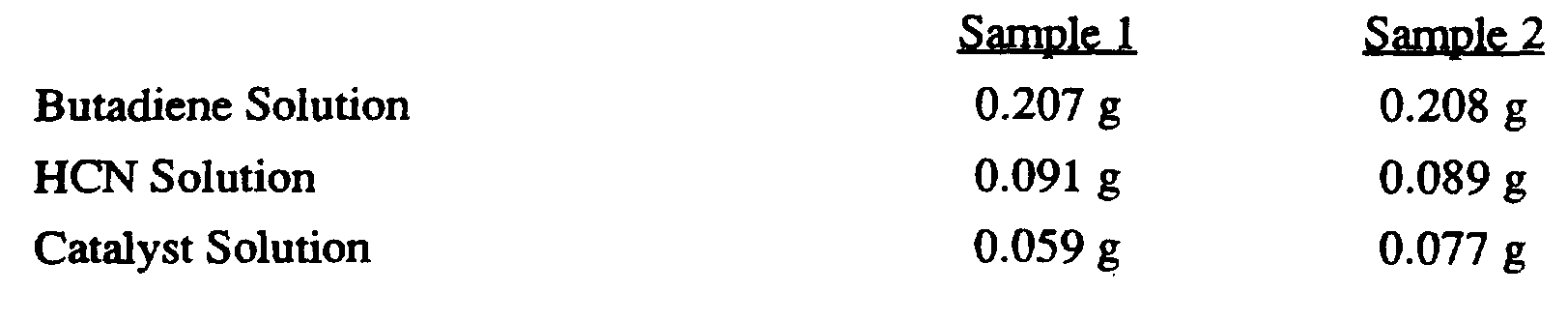
1,5-cyclooctadiene, and 0.118 g of Ligand "A" to 9.87 g of propionitrile. With these solutions, the following reaction mixtures were prepared in 2-ml GC vials equipped with micro-stirbars:
Figure imgf000020_0001
The GC vials were crimp-sealed with caps fitted with appropriately sized sheets of Nordel rubber to aid in containing the reaction mixtures. The vials were placed in a hot-block-stirrer set at 80°C. Sample 1 was removed after 1.0 hr of reaction time. Sample 2 was removed after 2.0 hrs of reaction time. Sample 3 was removed after 3.0 hrs of reaction time. The reaction was quenched in each case by diluting the reaction mixture with diglyme as a GC (gas chromatograph) solvent for product analysis. The propionitrile in the reaction mixture was used as an internal standard in the GC product analysis. The results of the analyses are shown in Table 1.
In inventive Examples 2-5, also shown in Table 1, the butadiene
hydrocyanation experiments were performed essentially as described above for Example 1, except that Examples 4 and 5 were performed at 140°C and at longer reaction times. The results are also shown in Table 1.
Comparative Example A
A 25 wt% solution of 1,3-butadiene was made by vacuum transfer of 11.52 g of 1 ,3-butadiene into 34.56 g of butyronitrile. A 25 wt% solution of HCN was made by the addition of 2.50 g of HCN to 7.50 g of propionitrile. The catalyst solution was prepared by the addition of 0.298 g of Ni(pTTP)4, pTTP = p- tritolylphosphite, and 0.157 g of pTTP to 9.565 g of propionitrile. With these solutions, the following reaction mixtures were prepared in 2-ml GC vials equipped with micro-stirbars:
Figure imgf000021_0002
The GC vials were crimp-sealed with caps fitted with appropriately sized sheets of Nordel rubber to aid in containing the reaction mixtures. The vials were placed in a hot-block-stirrer set at 80°C. Sample 1 was removed after 1.0 hr of reaction time. Sample 2 was removed after 2.0 hrs of reaction time. Sample 3 was removed after 3.0 hrs of reaction time. The reaction was quenched in each case by diluting the reaction mixture with diglyme as a GC solvent for product analysis.
The propionitrile in the reaction mixture was used as an internal standard in the GC product analysis. The results of the analyses are shown in Table 1.
In Comparative Example B, the butadiene hydrocyanation experiment was performed essentially as described above for Comparative Example A, and the results are also shown in Table 1.
In Comparative Examples C-G, the butadiene hydrocyanation experiments were performed as described above for inventive Examples 1-5, except that the "Pringle Ligand" (compound of Formula I where R1 and R5 = H) was used in place of Ligand "A". The results are shown in Table 1.
EXAMPLE 6
2M3BN (2-methyl-3-butenenitrilie) Isomerization
The catalyst solution was prepared by the addition of 0.014 g of Ni(COD)2 and 0.118 g of Ligand "A" to 9.87 g of propionitrile. A sample of 2M3BN was obtained from Huka Chemie AG, Buchs, Switzerland and distilled under nitrogen onto 100 parts per million of 2,6-di-tert-buryl-4-methylphenol. GC analysis of this sample showed it to be 81% 2M3BN. With these mixtures, the following reaction mixtures were prepared in 2-ml GC vials equipped with micro-stirbars:
Figure imgf000021_0001
The GC vials were crimp-sealed with caps fitted with appropriately sized sheets of Nordel rubber to aid in containing the reaction mixtures. Samples 1-3 were placed in a hot-block-stirrer set at 125°C. Sample 1 was removed after 1.0 hr of reaction time. Sample 2 was removed after 2.0 hrs of reaction time. Sample 3 was removed after 3.0 hrs of reaction time. The reaction was quenched in each case by diluting the reaction mixture with diglyme as a GC solvent for product analysis. The propionitrile in the reaction mixture was used as an internal standard in the GC product analysis. The results of the analyses are shown in Table 2.
In inventive Examples 7 and 8, the 2M3BN isomerization experiments were performed essentially as described above for Example 6, and the results are also shown in Table 2.
Comparative Example H
The catalyst solution was prepared by the addition of 0.298 g of Ni(pTTP)4 and 0.157 g of pTTP to 9.565 g of propionitrile. A sample of 2M3BN was obtained from Fluka Chemie AG, Buchs, Switzerland and distilled under nitrogen onto 100 parts per million of 2,6-di-tert-butyl-4-methylphenol. GC analysis of this sample showed it to be 82% 2M3BN. With these mixtures, the following reaction mixtures were prepared in 2-ml GC vials equipped with micro-stirbars:
Figure imgf000022_0001
The GC vials were crimp-sealed with caps fitted with appropriately sized sheets of Nordel rubber to aid in containing the reaction mixtures. Samples 1-3 were placed in a hot-block-stirrer set at 125°C. Sample 1 was removed after 1.0 hr of reaction time. Sample 2 was removed after 2.0 hrs of reaction time. Sample 3 was removed after 3.0 hrs of reaction time. The reaction was quenched in each case by diluting the reaction mixture with diglyme as a GC solvent for product analysis. The propionitrile in the reaction mixture was used as an internal standard in the GC product analysis. The results of the analyses are shown in Table 2.
In Comparative Example I, the 2M3BN isomerization experiment was performed essentially as described above for Example H, and the results are also shown in Table 2.
In Comparative Examples J and K, the 2M3BN isomerization experiments were performed essentially as described above for inventive Example 6, except that the "Pringle Ligand" was used in place of Ligand "A". The results are shown in Table 2.
Stock solutions of reactants and catalyst used in inventive Examples 9-53 and 60 were made, as appropriate for the particular experiment, in the following manner:
1.3-Butadiene Solution (BD): 25 wt% solutions of butadiene in nitrile solvent (chosen from propionitrile, butyronitrile or hexanenitrile) were made by vacuum transfer of a known quantity of butadiene into a three-fold amount of nitrile solvent. The resulting solutions were stored in a sealed vessel at -35°C until their use in experiments.
HCN Solution: 25 wt% solutions of HCN in nitrile solvent (chosen as above) were typically made by weighing 2.50 g of liquid HCN into 7.50 g of solvent, in a glovebox. The resulting solutions were stored at -35°C until their use in experiments.
Catalyst Solution: For a typical multidentate phosphite ligand, 1.2 mmol of P atoms and 0.055 g of Ni(COD)2 (0.2 mmol) were mixed in an amount of nitrile solvent (chosen as above) such that the total solution weight would be 10.00 g. The resulting catalyst solutions were typically used immediately after mixing.
2-Methyl-3-butenenitrile Mixture (2M3BN): A sample of 2M3BN was obtained as a mixture of pentenenitrile isomers, which contains 81-82% 2M3BN.
In inventive Examples 9-31 and 53, the butadiene hydrocyanation experiments were performed as follows. The results are shown in Table 3.
To 2 mL GC vials equipped with micro-stirbars, 0.075 g of Ni catalyst solution (1.5 μmol Ni), 0.080 g of HCN stock solution (740 μmol HCN), and 0.200 g of BD stock solution (925 μmol BD) were added. The GC vial caps were fitted with appropriately sized sheets of Nordel rubber to aid in containing the reaction mixtures after crimp-sealing. The vials were placed in a hot-block-stirrer set at 80°C. Samples were removed at the appropriate time points and quenched by cooling to -35°C. The reaction mixtures were then diluted in a GC solvent (chosen from glutaronitrile, diglyme or acetone) for product analysis as measured against the nitrile reaction solvent as an internal standard.
In inventive Examples 32-52 and 60, the 2M3BN isomerization
experiments were performed as follows. The results are shown in Table 4.
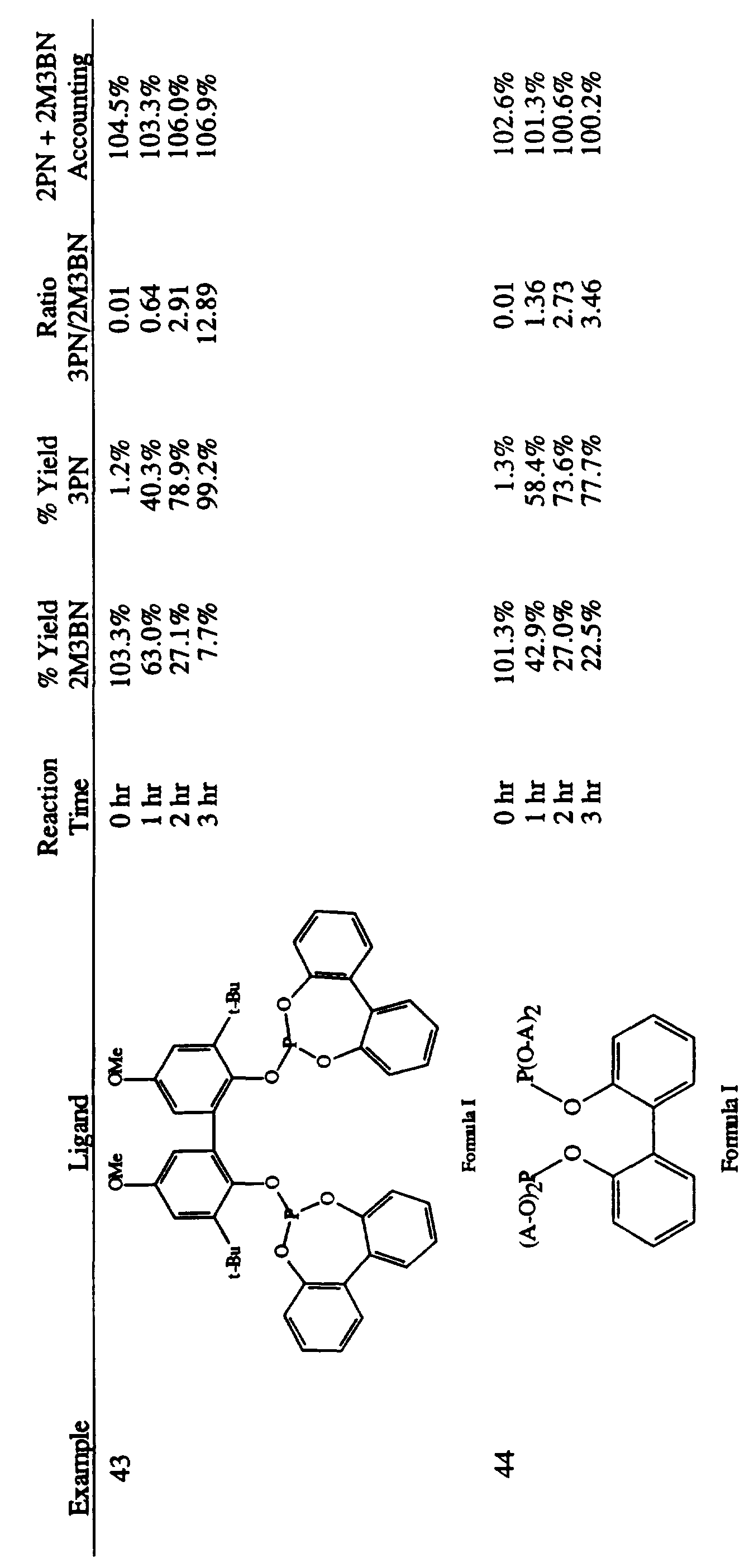
To 2 mL GC vials equiprped with micro-stirbars, 0.100 g of Ni catalyst solution (2.0 μmol Ni) and 0.100 g of the 2M3BN-containing mixture (1.0 mmol 2M3BN) were added. The GC vial caps were fitted with appropriately sized sheets of Nordel rubber to aid in containing the reaction mixtures after crimp-sealing. The vials were placed in a hot-block-stirrer set at 125°C. Samples were removed at the appropriate time points and diluted in acetone for a GC solvent. The nitrile reaction solvent was used as an internal standard in the analysis and accounting of the 3PN and 2M3BN reaction product mixture.
In Tables 3 and 4, the designation "OA" represents 2-isopropylphenoxyl where the oxygen is attached to phosphorus and the designation "OC" represents 2-isopropyl-5-methylphenoxyl where the oxygen is attached to phosphorus. In inventive Examples 54-59, 59A, 61-66 and 66A, stock solutions of reactants and catalyst were made, as appropriate for the particular experiment, in the following manner:
1.3-Butadiene Solution (BD): 25 wt% solutions of butadiene were made by vacuum transfer of a known quantity of butadiene into a three-fold amount of toluene. The resulting solutions were stored in sealed vessels at -35°C until their use in experiments.
HCN Solution: 25 wt% solutions of HCN were typically made by weighing 2.50 g of liquid HCN into 7.50 g of valeronitrile, in a glovebox. The resulting solutions were stored at -35°C until their use in experiments.
Catalyst Solution: For a typical multidentate phosphite ligand, 0.84 mmol of P atoms and 0.040 g of Ni(COD)2 (0.14 mmol) were mixed in an amount of either toluene or tetrahydrofuran such that the total solution weight would be 5.00 g. The resulting catalyst solutions were typically used immediately after mixing.
2-Methyl-3-butenenitrile Mixture (2M3BN): A sample of 2M3BN was obtained as a mixture of pentenenitrile isomers, which contains 81-82% 2M3BN. To 0.930 g of this mixture, 0.070 g of valeronitrile was added as an internal standard for the 2M3BN isomerization reaction.
Putadiene Hydrocyanation
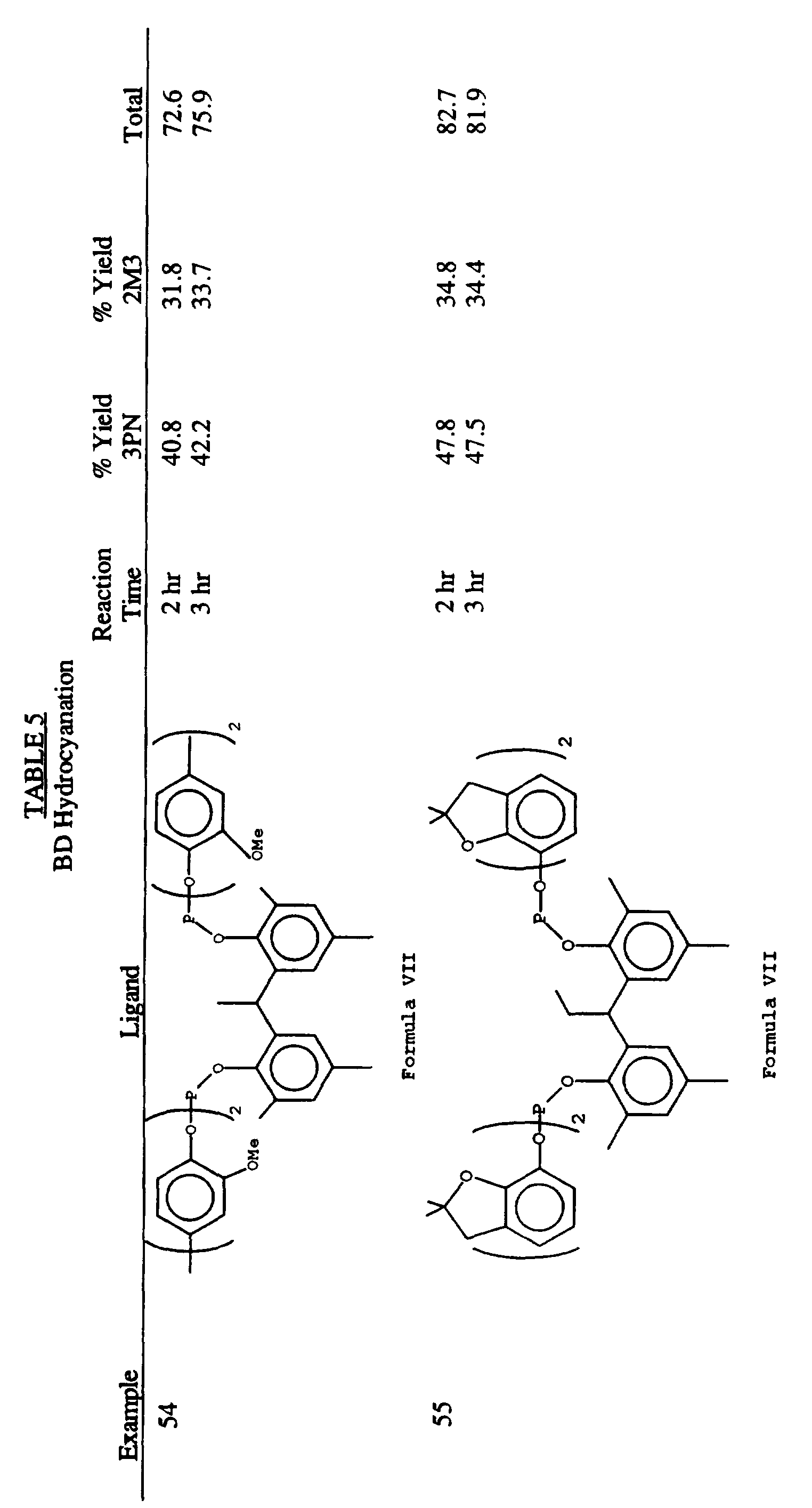
In inventive Examples 54-59 and 59A, the butadiene hydrocyanation experiments were performed as follows. The results are shown in Table 5.
To 4-mL screw-capped vials equipped with micro-stirbars, 0.060 g of Ni catalyst solution (1.68 μmol Ni), 0.090 g of HCN stock solution (832 μmol HCN), and 0.200 g of BD stock solution (925 μmol BD) were added. The vials were sealed with septum caps to contain the reaction mixtures. The vials were then placed in a hot-block-stirrer set at 80°C. Samples were removed at the appropriate time points and quenched by cooling to -35°C. The reaction mixtures were then diluted in diethylether as a GC solvent for product analysis. The valeronitrile in the reaction mixtures was used as an internal standard.
Comparative Example L
A 25 wt% solution of 1,3-butadiene was made by vacuum transfer of 5.37 g of 1,3-butadiene into 16.11 g of toluene. A 25 wt% solution of HCN was made by the addition of 1.25 g of HCN to 3.75 g of valeronitrile. The catalyst solution was prepared by the addition of 0.297 g of Ni(pTTP)4 and 0.155 g of pTTP to 6.71 g of toluene. With these solutions, the following reaction mixtures were prepared in 4-ml screw-capped vials equip>ped with micro-stirbars:
Figure imgf000025_0002
The vials were sealed with septum caps to contain the reaction mixtures. The vials were placed in a hot-block-stirrer set at 80°C. Sample 1 was removed after 1.5 h of reaction time. Sample 2 was removed after 2.5 h of reaction time. The reaction was quenched in each case by cooling the reaction mixture to -35°C. The reaction mixtures were then diluted in diethylether as a GC solvent for product analysis. The valeronitrile in the reaction mixture was used as an internal standard. The results of the analyses are shown in Table 5.
In Comparative Example M, the butadiene hydrocyanation experiment was performed essentially as described above for Example L, and the results are also shown in Table 5.
2M3BN Isomerization
In inventive Examples 61-66 and 66A, the 2M3BN isomerization experiments were performed as follows. The results are shown in Table 6.
To 4-mL screw-capped vials equipped with micro-stirbars, 0.070 g of Ni catalyst solution (2.0 μmol Ni) and 0.107 g of the 2M3BN-containing mixture (1.0 mmol 2M3BN) were added. The vials were sealed with septum caps to contain the reaction mixtures. The vials were then placed in a hot-block-stirrer set at 125°C. Samples were removed at the appropriate time points and quenched by cooling to -35°C. The reaction mixtures were then diluted in diethylether as a GC solvent for product analysis. The valeronitrile in the reaction mixtures was used as an internal standard in the analysis and accounting of the 3PN and 2M3BN reaction product mixture.
Comparative Example N
A 25 wt% solution of 1 ,3-butadiene was made by vacuum transfer of
5.37 g of 1,3-butadiene into 16.11 g of toluene. A 25 wt% solution of HCN was made by the addition of 1.25 g of HCN to 3.75 g of valeronitrile. The catalyst solution was prepared by the addition of 0.297 g of Ni(pTTP)4 and 0.155 g of pTTP to 6.71 g of toluene. With these solutions, the following reaction mixtures were prepared in 4-ml screw-capped vials equipped with micro-stirbars:
Figure imgf000025_0001
The vials were sealed with septum caps to contain the reaction mixtures.
The vials were placed in a hot-block-stirrer set at 125°C. Sample 1 was removed after 1.5 h of reaction time. Sample 2 was removed after 2.5 h of reaction time.
The reaction was quenched in each case by cooling the reaction mixture to -35°C. The reaction mixtures were then diluted in diethylether as a GC solvent for product analysis. The valeronitrile in the reaction mixture was used as an internal standard in the analysis and accounting of the 3PN and 2M3BN reaction product mixture.
The results of the analyses are shown in Table 6.
In Comparative Example O, the 2M3BN isomerization experiment was performed essentially as described above for Example N, and the results are also shown in Table 6.
Figure imgf000027_0001
Figure imgf000028_0001
Figure imgf000029_0001
Figure imgf000030_0001
Figure imgf000031_0001
Figure imgf000032_0001
Figure imgf000033_0001
Figure imgf000034_0001
Figure imgf000035_0001
Figure imgf000036_0001
Figure imgf000037_0001
Figure imgf000038_0001
Figure imgf000039_0001
Figure imgf000040_0001
Figure imgf000041_0001
Figure imgf000042_0001
Figure imgf000043_0001
Figure imgf000044_0001
Figure imgf000045_0001
Figure imgf000046_0001
Figure imgf000047_0001
Figure imgf000048_0001
Figure imgf000049_0001
Figure imgf000050_0001
Figure imgf000051_0001
Figure imgf000052_0001
Figure imgf000053_0001
Figure imgf000054_0001
Figure imgf000055_0001
Figure imgf000056_0001
Figure imgf000057_0001
Figure imgf000058_0001
Figure imgf000059_0001
Figure imgf000060_0001
Preparation of ligands containing ortho substituted oxygen containing groups are shown below.
EXAMPLE 67
Ligand B; Formula VI where R2 is the cyclic group, -O-C(CH3)2-CH2-
Figure imgf000061_0001
The chlorodite derived from 2,3-dihydro-2,2-dimethyl-7-benzofuranol was prepared in situ from PCI3 and 2,3-dihydro-2,2-dimethyl-7-benzofiιranol. A toluene solution containing 0.55 g (4 mmoles) of PCI3 and 1.314 g (8 mmoles) of 2,3-dihydro-2,2-dimethyl-7-benzofuranol was cooled to -30°C. A chilled toluene solution (-30°C) containing 1.0 g (10 mmoles) of NEt3 was slowly added dropwise to the above solution. The mixture was stirred overnight to give a solution of the chlorodite (31P nmr in toluene/CDCl3: 165 ppm). A toluene solution containing 0.372 g (2 mmoles) of 2,2'-biphenol and 0.6 g (6 mmoles) of NEt3 was added and the mixture was allowed to stiirred overnight. The mixture was filtered through celite, washed with toluene and solvent removed to give 1.84 g of the desired product. 31P nmr in C6D6: 131.9 ppm along with small peaks due to impurities at 146,133,132 ppm. FABMS (fast atom bombardment mass spectroscopy): Found: 899.23; calculated M+H with M = C52H52O10P2: 899.31.
EXAMPLE 68
Ligand C; Formula XI where R2 is the cyclic group, -O-C(CH3)2-CH2-
Figure imgf000062_0002
Ligand C was prepared similarly to Ligand B. 0.57 g (2 mmoles) of 1,1'-bi- 2-naphthol was used instead of biphenol. After the usual workup, 1.97 g of product was obtained as a white solid. 31P (ppm, C6D6): 131.26 with minor peaks at 147.3,133.1,131.5, and 131.0. FABMS (fast atom bombardment mass spectroscopy): Found: 999.24; calculated M+H with M = C60H56O10P2: 999.33.
EXAMPLE 69
Ligand D; Formula XI where R2 is OMe
Figure imgf000062_0001
The chlorodite derived from guaiacol was prepared in situ from PCI3 and guaiacol. A toluene solution containing 0.55 g (4 mmoles) of PCI3 and 0.993 g (8 mmoles) of guaiacol was cooled to -30°C. A chilled toluene solution (-30°C) containing 1.0 g (10 mmoles) of NEt3 was slowly added dropwise to the above solution. The mixture was stirred for 45 minutes at room temperature to give a solution of the chlorodite (31P (ppm, C6D6/toluene): 166.17). A toluene solution containing 0.573 g (2 mmoles) of 1,1'-bi-2-naphthol and 0.6 g (6 mmoles) of NEt3 was added and the mixture was allowed to stirred overnight. The mixture was filtered through celite, washed with toluene and solvent removed to give 1.67 g of the desired product. 31P nmr in C6D6: 131.7 ppm along with small peaks due to impurities at 147, 133, 128 ppm. This material was purified by flash column chromatography on silica gel eluted with 10-20% EtOAc/hexane to give the product as a white paste. 1H nmr (δ, CDCl3): 3.61 (s, 6H), 3.62 (s, 6H), 6.62-7.92 (m, 28H). 31P nmr (ppm, CDCl3): 132.04. FABMS (fast atom bombardment mass spectroscopy): Found: 837.03; calculated M-H with M = C48H40O10P2: 837.21.
EXAMPLE 70
Ligand E; Formula VIII with X is CH(Et) and R2 is -OCH2-Ph
Figure imgf000063_0001
Prepared similarly to Ligand B but used 1.602 g of 2-(benzyloxy)phenol instead of 2,3-dihydro-2,2-dimethyl-7-benzofiιranol and 541 mg (1.9 mmoles) of 2,2'-propylidenebis(4,6-dimethylphenol) (prepared according to Yamada et al., Bull. Chem. Soc. Jpn., 62, 3603 (1989)) instead of 2,2'-biphenol. After the usual workup, 2.167 g of a light tan paste was obtained. 31P (ppm, C6D6): 135.73 with minor peak at 132.8. FABMS (fast atom bombardment mass spectroscopy): Found: 1139.27; calculated M-H with M = C71H66O10P2: 1139.40.
EXAMPLE 71
Ligand F; Formula VI with R5' is H and R2 is -OCH2Ph
Figure imgf000064_0001
Prepared similarly to Ligand B but used 1.602 g of 2-(benzyloxy)phenol instead of 2,3-dihydro-2,2-dimethyl-7-benzofuranol. After the usual workup, 2.099 g of a light tan paste was obtained. 31P (ppm, C6D6): 131.95 with minor peaks at 146.6, 132.9. FABMS (fast atom bombardment mass spectroscopy): Found: 1043.24; calculated M+H with M = C64H52O10P2: 1043.31.
Examples 72 and 73 describe preparation of phosphorochloridite using N,N-dialkyl diarylphosphoramidite.
EXAMPLE 72
A. Bis[(2-isopropyl-5-methyl)phenyl]N,N-diisopropylphosphoramidite:
To solution of 25.0 g of PCI3 in 350 mL of dry toluene was added 19.1 g of dry diisopropylamine, maintaining the temperature at 5-7°C, and then 19.4 g of triethylamine was added, maintaining the temperature at 5-8°C. The mixture was allowed to stir at ambient temperature for 16 hrs, and then a solution of 52.4 g of thymol in 38.2 g of triethylamine and 50 mL of dry toluene was added at below 40°C, followed by 0.25 g of 4-dimethylaminopyridine in 40 mL of toluene. The mixture was heated at 80°C for 2 hrs, cooled to 12°C, and washed with water, aq NaCl, and again with water. The solution of the phosphoramidite was dried by distillation of 200 mL of solvent at reduced pressure between 60 and 70°C to afford a solution of the product which was of 90-95% purity by gas
chromatographic and 31P-NMR analysis (δ 143 ppm).
B. Bis(2-isopropylphenyl) N,N-diisopropylphosphoramidite:
To a solution of 15.0 g of 2-isopropylphenol and 10.5 g of triethylamine in 100 mL of hexane was added 60 mL of a solution of N,N-disopropylphosphor- amidous dichloride (0.825M in hexane) at ambient temperature over 45 minutes. The mixture was allowed to stir at ambient temperature for at least 16 h, the triethylamine hydrochloride was filtered and washed with two 100-mL portions of hexane, and the combined filtrate and washings were concentrated to provide
19.2 g of the product as an oil. A portion of this (11 g) was crystallized from
20 mL of cold methanol, washed with two 5-mL portions of cold methanol and suction-dried to provide 7.35 g of the pure phosphoramidite as a crystalline solid, mp 35°C. 31P-NMR (C6D6) δ 142.2 ppm; 1H-NMR (C6D6) δ 1.25 (m, 24H),
3.6 (septet, 2H), 3.9 (m, 2H), 7.0 (m, 4H), 7.2 (m, 4H), and 7.35 (m, 2H).
C. Bis(2-isopropylphenyl)phosphorochloridite:
A solution of 7.21 g of the product from Example 72B in 200 mL of cyclohexane was cooled to 0°C and anydrous HCl gas was bubbled in over ca. 20 min. Excess HCl was purged by bubbling dry nitrogen through the solution for 10 min. The diisopropylamine hydrochloride was filtered off in a drybox and washed with 50 mL of cyclohexane, and the combined filtrate and washings were concentrated to dryness in vacuo to provide 5.40 g of crude phosphorochloridite as an oil, judged to be 90% pure by 31P-NMR analysis. 31P-NMR (C6D6) δ
162.4 ppm. Small (5% each) peaks corresponding to triaryl phosphite and diary 1 hydrogenphosphonate were present as contaminants, but the chloridite was sufficiently pure to be used for subsequent ligand synthesis.
EXAMPLE 73
Preparation of Bis(2,3-dimethoxyphenyl)phosphorochloridite In a 250 mL 3-neck flask equipped with condenser, thermometer and addition funnel was charged with 21.547 g of 2,3-dimethoxyphenol, 14.2 g of NEt3, and 140 mg of 4-N,N-dimethylaminopyridine in 35 mL of cyclohexane. 139.8 mL of 0.5 M solution of N,N-diisopropyl-dichlorophosphoramidite in hexane was added dropwise over a period of 40 minutes. The mixture was heated to 65°C for 3.5 hours. The mixture was filtered through silica gel and washed with cyclohexane. The solution was cooled in an ice bath and 140 mL of 1 M HCl in ether was added over a period of 45 minutes. The mixture was stirred overnight, filtered, washed with toluene and solvent removed to give 15.98 g of the desired product as a clear pale yellow liquid. 31P NMR (ppm, C6D6): 169.9.
Although particular embodiments of the present invention have been described in the foregoing description, it will be understood by those skilled in the art that the invention is capable of numerous modifications, substitutions and rearrangements without departing from the spirit or essential attributes of the invention. Reference should be made to the appended claims, rather than the foregoing specification, as indicating the scope of the invention.

Claims

WHAT IS CLAIMED IS:
1. An improved process for the liquid phase hydrocyanation of diolefinic compounds and subsequent isomerization of the resulting nonconjugated 2-alkyl-3-monoalkenenitriles comprising reacting an acyclic aliphatic diolefinic compound with a source of HCN; the improvement comprising conducting the
hydrocyanation and subsequent isomerization in the presence of a catalyst precursor composition comprising zero-valent nickel and at least one multidentate phosphite ligand selected from the group consisting of compounds represented by
Formulas I, II, III, IV, V, VI, VII, VIII, IX, X, XI, XII, XIII, XIV and XV as set forth below:
Figure imgf000066_0001
wherein
each R1 is independentiy a branched or straight chain alkyl of up to 12 carbon
atoms, or OR4 wherein R4 is C1 to C12 alkyl;
each R5 is independently a tertiary substituted hydrocarbon of up to 12 carbon atoms;
Figure imgf000067_0001
wherein
each R6 and R7 is independently a tertiary substituted hydrocarbon of up to
12 carbon atoms; and
each R8 is independently H or a branched or straight chain alkyl of up to 12 carbon atoms, or OR4 wherein R4 is C1 to C12 alkyl;
Figure imgf000067_0002
wherein
each R9 is independently H or a branched or straight chain alkyl of up to 12 carbon atoms, or OR4 wherein R4 is C1 to C12 alkyl; and
each R10 is independentiy a tertiary substituted hydrocarbon of up to 12 carbon atoms;
Figure imgf000068_0002
wherein
each R14 is independentiy a tertiary substituted hydrocarbon of up to 12 carbon atoms or Si(R11)3 where R11 is independentiy a branched or straight chain alkyl of up to 12 carbon atoms or phenyl or CO2R3 wherein R3" is a secondary alkyl of up to 6 carbon atoms;
Figure imgf000068_0001
wherein
R12 is H or a branched or straight chain alkyl of up to 12 carbon atoms; and
each R13 is independentiy a branched or straight chain alkyl of up to 12 carbon atoms;
Figure imgf000069_0001
Figure imgf000070_0001
wherein in Formulas VI through XV
each R1 is independently, H, halogen, a C1 to C12 alkyl, or OR3 wherein R3 is a C1 to C12 alkyl;
each R2 is independentiy a secondary or tertiary hydrocarbyl of 3 to 12 carbon atoms, or OR4 wherein R4" is C1 to C6 alkyl or benzyl; or a cyclic group of the formula
Figure imgf000071_0001
forming a five membered ring attached to the phenyl ring, wherein Rw is H or CH3 and Z is -O- or -CH2-;
each R2' is independentiy H or a primary, secondary or tertiary hydrocarbyl of 1 to 12 carbon atoms at either the meta or para position to the oxygen; or CN, CO2R4" or OR4" wherein R4" is a C1 to C6 alkyl at either the meta or para position to the oxygen of the phenoxy ring;
each R5' is independentiy H or a primary or secondary hydrocarbyl of 1 to 3 carbon atoms; for Formulas VI and IX, R5 can also be OR4", wherein R4" is a C1 to C6 alkyl; for Formulas X and XI, R5' can also be CO2R4", wherein R4" is a C1 to C6 alkyl; and
each X is independentiy O or CH(R4'), wherein R4 is H, a substituted phenyl, or a C1 to C12 alkyl;
and wherein said reaction is carried out to produce 3 and/or 4-monoalkene linear nitriles.
2. The improved process of Claim 1 wherein the diolefinic compound is butadiene.
3. The improved process of Claim 1 wherein either hydrocyanation or isomerization is performed as a batch operation or both hydrocyanation and isomerization are performed as a batch operation.
4. The improved process of Claim 1 wherein either hydrocyanation or isomerization is performed continously or both hydrocyanation and isomerization are performed continuously.
5. The improved process of Claim 1 wherein the diolefin compound comprises conjugated diolefins containing from 4 to 10 carbon atoms.
6. The improved process of Claim 5 wherein the diolefin compound is selected from the group consisting of 1 ,3-butadiene, cis-2,4-hexadiene, trans-2,4-hexadiene, cis-1,3-pentadiene and trans-1,3-pentadiene.
7. The improved process of Claims 1 or 2 wherein the multidentate phosphite ligand is selected from the group consisting of compounds represented by Formulas I, VII and XI.
8. The improved process of Claim 7 wherein the multidentate phosphite ligand is represented by Formula I and wherein each R1 is OR4 wherein R4 is methyl.
9. The improved process of Claim 7 wherein the multidentate phosphite ligand is represented by Formula I and wherein each R1 is OR4 wherein R4 is methyl and each R5 is t-butyl.
10. The improved process of Claim 7 wherein the multidentate phosphite ligand is represented by Formula XI wherein each R2 is isopropyl, each R2' is H or methyl, and each R5' is H.
11. The improved process of Claim 7 wherein the multidentate phosphite ligand is represented by Formula VII wherein X is HC(methyl) or HC(ethyl), each R2 is isopropyl, each R2' is H, each R5 is methyl, and each R1 is methyl.
12. The improved process of Claim 1 wherein hydrocyanation is carried out at a temperature of from about 0°C to 150°C.
13. The improved process of Claim 3 wherein during hydrocyanation the molar ratio of HCN to catalyst precursor compound is between about 100: 1 to
5,000:1.
14. The improved process of Claim 4 wherein during hydrocyanation the molar ratio of HCN to catalyst precursor compound is between about 100: 1 to
5,000:1.
15. An improved process for the liquid phase hydrocyanation of acyclic aliphatic diolefinic compounds comprising reacting an acyclic aliphatic diolefinic compound with a source of HCN; the improvement comprising conducting the hydrocyanation reaction in the presence of a catalyst precursor composition comprising a zero-valent nickel and at least one multidentate phosphite ligand selected from the group consisting of compounds represented by Formulas I, II,III, IV, V, VI, VIII, IX, X, XI,XII,XIII,XIVand XV as set forth below:
Figure imgf000072_0001
wherein
each R1 is independently a branched or straight chain alkyl of up to 12 carbon
atoms, or OR4 wherein R4 is C1 to C 12 alkyl; each R5 is independently a branched or straight chain alkyl of up to 12 carbon atoms or OR4" wherein R4" is C1 to C6 alkyl;
Figure imgf000073_0002
wherein
each R6 and R7 is independently a tertiary substituted hydrocarbon of up to
12 carbon atoms; and
each R8 is independentiy H or a branched or straight chain alkyl of up to 12 carbon atoms, or OR4 wherein R4 is C1 to C12 alkyl;
Figure imgf000073_0001
wherein
each R9 is independentiy H or a branched or straight chain alkyl of up to 12 carbon atoms, or OR4 wherein R4 is C1 to C1 2 alkyl; and
each R10 is independently a branched or straight chain alkyl of up to 12 carbon atoms or OR4" wherein R4" is C1 to C6 alkyl;
Figure imgf000074_0001
wherein
each R14 is independently a branched or straight chain alkyl of up to 12 carbon atoms or Si(R1 1)3 where R11 is independently a branched or straight chain alkyl of up to 12 carbon atoms or phenyl or CO2R4 wherein R4" is C1 to C6 alkyl;
Figure imgf000074_0002
wherein
R12 is H or a branched or straight chain alkyl of up to 12 carbon atoms; and
each R13 is independentiy a branched or straight chain alkyl of up to 12 carbon atoms;
Figure imgf000075_0001
Figure imgf000076_0001
wherein in Formulas VI through XV
each R1 is independentiy, H, halogen, a C1 to C12 alkyl, or OR3 wherein R3 is a C1 to C12 alkyl;
each R2 is independentiy a secondary or tertiary hydrocarbyl of 3 to 12 carbon atoms, or OR4" wherein R4" is C1 to C6 alkyl or benzyl; or a cyclic group of the formula
Figure imgf000077_0001
forming a five membered ring attached to the phenyl ring, wherein Rw is H or CH3 and Z is -O- or -CH2-;
each R2 is independentiy H or a primary, secondary or tertiary hydrocarbyl of 1 to 12 carbon atoms at either the meta or para position to the oxygen; or CN, CO2R4" or OR4" wherein R4" is a C1 to C6 alkyl at either the meta or para position to the oxygen of the phenoxy ring;
each R5' is independently H or a primary or secondary or tertiary hydrocarbyl of 1 to 6 carbon atoms in; for Formulas VI and IX, R5' can also be OR4 , wherein R4" is a C1 to C6 alkyl; for Formulas X and XI, R5' can also be CO2R4", wherein R4" is a C1 to C6 alkyl; and
each X is independentiy O or CH(R4 ), wherein R4 is H, a substituted phenyl, or a C1 to C12 alkyl;
and wherein said reaction is carried out to produce a nonconjugated acyclic nitrile.
16. The improved process of Claim 15 wherein the diolefinic compound is butadiene.
17. The improved process of Claim 15 wherein hydrocyanation is performed as a batch operation.
18. The improved process of Claim 15 wherein hydrocyanation is performed continuously.
19. The improved process of Claim 15 wherein the diolefinic compound comprises conjugated diolefins containing from 4 to 10 carbon atoms.
20. The improved process of Claim 19 wherein the diolefinic compound is selected from the group consisting of 1,3-butadiene, cis -2,4-hexadiene, trans-2,4-hexadiene, cis -1,3-pentadiene and trans -1,3-pentadiene.
21. The improved process of Claim 15 or 16 wherein the multidentate phosphite ligand is selected from the group consisting of compounds represented by Formulas I, VII and XI.
22. The improved process of Claim 21 wherein the multidentate phosphite ligand is represented by Formula I and wherein each R1 is OR4 wherein R4 is methyl.
23. The improved process of Claim 21 wherein the multidentate phosphite ligand is represented by Formula I and wherein each R1 is OR4 wherein R4 is methyl, and each R5 is t-butyl.
24. The improved process of Claim 21 wherein the multidentate phosphite ligand is represented by Formula XI wherein each R2 is isopropyl, each R2' is H or methyl, and each R5' is H.
25. The improved process of Claim 21 wherein the multidentate phosphite ligand is represented by Formula VII wherein X is HC(methyl) or HC(ethyl), each R2 is isopropyl, each R2' is H, each R5' is methyl, and each R1 is methyl.
26. The improved process of Claim 15 wherein hydrocyanation is carried out at a temperature of from about 0°C to about 150°C.
27. The improved process of Claim 17 wherein the molar ratio of HCN to catalyst precursor compound is between about 100:1 to 5,000:1.
28. The improved process of Claim 18 wherein the molar ratio of HCN to catalyst precursor compound is between about 100:1 to 5,000:1.
29. An improved process for the isomerization of a nonconjugated 2-alkyl-3-monoalkenenitrile, the improvement comprising carrying out the isomerization in the presence of a catalyst precursor composition comprising a zero-valent nickel and at least one multidentate phosphite ligand selected from the group consisting of compounds represented by Formulas I, II, III, IV, V, VI, VII, VIII, IX, X, XI, XII, XIII, XIV and XV as set forth below:
Figure imgf000078_0001
wherein
each R1 is independently a branched or straight chain alkyl of up to 12 carbon atoms, or OR4 wherein R4 is C1 to C12 alkyl;
each R5 is independentiy a tertiary substituted hydrocarbon of up to 12 carbon atoms;
Figure imgf000079_0002
wherein
each R6 and R7 is independentiy a tertiary substituted hydrocarbon of up to
12 carbon atoms; and
each R8 is independentiy H or a branched or straight chain alkyl of up to 12 carbon atoms, or OR4 wherein R4 is C1 to C12 alkyl;
Figure imgf000079_0001
wherein
each R9 is independentiy H or a branched or straight chain alkyl of up to 12 carbon atoms, or OR4 wherein R4 is C1 to C12 alkyl; and
each R10 is independentiy a tertiary substituted hydrocarbon of up to 12 carbon atoms;
Figure imgf000080_0002
wherein
each R14 is independentiy a tertiary substituted hydrocarbon of up to 12 carbon atoms or Si(R11)3 where R11 is independentiy a branched or straight chain alkyl of up to 12 carbon atoms or phenyl or CO2R3 wherein R3" is a secondary alkyl of up to 6 carbon atoms;
Figure imgf000080_0001
wherein
R12 is H or a branched or straight chain alkyl of up to 12 carbon atoms; and
each R13 is independently a branched or straight chain alkyl of up to 12 carbon atoms;
Figure imgf000081_0001
Figure imgf000082_0001
wherein in Formulas VI through XV
each R1 is independently, H, halogen, a C1 to C12 alkyl, or OR3 wherein R3 is a C1 to C12 alkyl;
each R2 is independentiy a secondary or tertiary hydrocarbyl of 3 to 12 carbon atoms, or OR4" wherein R4" is C1 to C6 alkyl or benzyl; or a cyclic group of the formula
Figure imgf000083_0001
forming a five membered ring attached to the phenyl ring, wherein Rw is H or CH3 and Z is -O- or -CH2-;
each R2' is independentiy H or a primary, secondary or tertiary hydrocarbyl of 1 to 12 carbon atoms at either the meta or para position to the oxygen; or CN, CO2R4" or OR4" wherein R4" is a C1 to C6 alkyl at either the meta or para position to the oxygen of the phenoxy ring;
each R5 is independently H or a primary or secondary hydrocarbyl of 1 to 3 carbon atoms; for Formulas VI and IX, R5' can also be OR4", wherein R4" is a C1 to C6 alkyl; for Formulas X and XI, R5' can also be CO2R4", wherein R4" is a C1 to C6 alkyl; and
each X is independently O or CH(R4 '), wherein R4' is H, a substituted phenyl, or a C1 to C12 alkyl;
and wherein said isomerization is carried out to produce a 3 and/or 4-monoalkene linear nitriles.
30. The improved process of Claim 29 wherein the nonconjugated 2-alkyl-3-monoalkenenitrile is 2-methyl-3-butenenitrile.
31. The improved process of Claim 29 wherein isomerization is performed as a batch operation.
32. The improved process of Claim 29 wherein isomerization is performed continuously.
33. The improved process of Claim 29 wherein the nonconjugated 2-al_kyl-3-monoalkenenitrile is selected from the group consisting of 2-ethyl-3- butenenitrile and 2-propyl-3-butenenitrile.
34. The improved process of Claim 29 or 30 wherein the multidentate phosphite ligand is selected from the group consisting of compounds represented by Formulas I, VII and XI.
35. The improved process of Claim 34 wherein the multidentate phosphite ligand is represented by Formula I and wherein each R1 is OR4 wherein R4 is methyl.
36. The improved process of Claim 34 wherein the multidentate phosphite ligand is represented by Formula I and wherein each R1 is OR4 wherein R4 is methyl, and each R5 is t-butyl.
37. The improved process of Claim 34 wherein the multidentate phosphite ligand is represented by Formula XI wherein each R2 is isopropryl, each R2' is H or methyl, and each R5 is H.
38. The improved process of Claim 34 wherein the multidentate phosphite ligand is represented by Formula VII wherein X is HC(methyl) or
HC(ethyl), each R2 is isopropyl, each R2' is H, each R5' is methyl, and each R1 is methyl.
39. The improved process of Claim 29 wherein isomerization is carried out at a temperature of from about 60°C to about 150°C.
40. The improved process of Claim 31 wherein the molar ratio of nonconjugated 2-alkyl-3-monoalkenenitrile to catalyst precursor compound is between about 100:1 to 5,000:1.
41. The improved process of Claim 32 wherein the molar ratio of nonconjugated 2-alkyl-3-monoalkenenitrile to catalyst precursor compound is between about 100: 1 to 5,000: 1.
42. A multidentate phosphite ligand selected from the group consisting of Formulas I, III, IV, VI, VIII, IX, X, XI, XII, XIII, XIV and XV as set forth below:
Figure imgf000084_0001
wherein
each R1 is independentiy a branched or straight chain alkyl of up to 12 carbon
atoms, or OR4 wherein R4 is C1 to C12 alkyl;
each R5 is independently a secondary or straight chain alkyl of up to 12 carbon atoms or OR4" wherein R4" is C1 to C6 alkyl;
Figure imgf000085_0002
wherein
each R9 is independentiy H or a branched or straight chain alkyl of up to 12 carbon atoms, or OR4 wherein R4 is C1 to C 12 alkyl; and
each R10 is independentiy a secondary or straight chain alkyl of up to 12 carbon atoms or OR4" wherein R4" is C1 to C6 alkyl;
Figure imgf000085_0001
wherein
each R14 is independently a secondary or straight chain alkyl of up to 12 carbon atoms or CO2R4" wherein R4" is C1 to C6 alkyl;
Figure imgf000086_0001
Figure imgf000087_0001
wherein in Formulas VI through XV
each R1 is independently, H, halogen, a C1 to C12 alkyl, or OR3 wherein R3 is a C1 to C12 alkyl;
each R2 is independentiy a OR4" wherein R4" is C1 to C6 alkyl or benzyl; or a
cyclic group of the formula
Figure imgf000088_0001
forming a five membered ring attached to the phenyl ring, wherein Rw is H or CH3 and Z is -O- or -CH2-; for Formulas XII, XIII, XIV and XV;
each R2' is independentiy CN, or CO2R4 wherein R4" is a C1 to C6 alkyl at either the meta or para position to the oxygen of the phenoxy ring; for
Formulas XII , XIII, XIV and XV, R2' can also be OR4", wherein R4" is a C1 to C6 alkyl; or independently H, a halogen, or a primary, secondary, or tertiary hydrocarbyl of 1 to 6 carbon atoms;
each R5' is independently H or a primary or secondary or tertiary hydrocarbyl of 1 to 6 carbon atoms; for Formulas VI and IX, R5 can also be OR4", wherein R4" is a C1 to C6 alkyl; for Formulas X and XI, R5' can also be CO2R4" wherein R4" is a C1 to C6 alkyl; and
each X is independentiy O or CH(R4 ), wherein R4 is H, a substituted phenyl, or a C1 to C12 alkyl.
43. A catalyst precursor composition comprising zero-valent nickel and a multidentate phosphite ligand according to Claim 42.
44. The catalyst precursor composition of Claim 43 wherein the multidentate phosphite ligand is selected from the group consisting of compounds represented by Formulas I, IV, VII and XI.
45. The catalyst precursor composition of Claim 44 wherein the multidentate phopshite ligand is represented by Formula XI and wherein R2 is OR4" wherein R4" is a C1 to C6 alkyl.
46. The catalyst precursor composition of Claim 44 wherein the multidentate phopshite ligand is represented by Formula XI and wherein R2 is OCH3 and R2' and R5' are H.
47. A method of making phosphorochloridite comprising contacting a compound of the formula N(R18)2P(OR19)2, wherein R19 is substituted aryl, with gaseous hydrogen chloride to produce HN(R18)2●HCl and (R19O)2PCl.
48. The method of Claim 47 wherein the HCl is not present in excess.
49. A method for producing N,N-dialkyldiarylphosphoramidite comprising contacting one equivalent of PCI3 in an inert solvent with one equivalent of a secondary amine and at least one equivalent of a tertiary amine and subsequently adding about 1.9 equivalents of a substituted phenol and about 2.1 equivalents of a tertiary amine.
50. The method of Claim 49 wherein the solvent is toluene.
PCT/US1996/000548 1995-01-27 1996-01-17 Hydrocyanation of diolefins and isomerization of nonconjugated 2-alkyl-3-monoalkenenitriles Ceased WO1996022968A1 (en)

Priority Applications (4)

Application Number Priority Date Filing Date Title
DE69605398T DE69605398T2 (en) 1995-01-27 1996-01-17 CYAN HYDROGEN ADDITION TO DIOLEFINS AND ISOMERIZATION OF NON-CONJUGATED 2-LKYL-3-MONOALKENNITRILES
EP96902689A EP0804412B1 (en) 1995-01-27 1996-01-17 Hydrocyanation of diolefins and isomerization of nonconjugated 2-alkyl-3-monoalkenenitriles
JP52290296A JP3959111B2 (en) 1995-01-27 1996-01-17 Diolefin hydrocyanation and non-conjugated 2-alkyl-3-monoalkenenitrile isomerization
BRPI9606718-7A BR9606718B1 (en) 1995-01-27 1996-01-17 improved processes for liquid phase hydrocyanation, improved process for isomerization, multidentate phosphite binder and composition.

Applications Claiming Priority (4)

Application Number Priority Date Filing Date Title
US37942995A 1995-01-27 1995-01-27
US08/379,429 1995-11-28
US08/563,718 US5821378A (en) 1995-01-27 1995-11-28 Hydrocyanation of diolefins and isomerization of nonconjugated 2-alkyl-3-monoalkenenitriles
US08/563,718 1995-11-28

Publications (1)

Publication Number Publication Date
WO1996022968A1 true WO1996022968A1 (en) 1996-08-01

Family

ID=27008622

Family Applications (1)

Application Number Title Priority Date Filing Date
PCT/US1996/000548 Ceased WO1996022968A1 (en) 1995-01-27 1996-01-17 Hydrocyanation of diolefins and isomerization of nonconjugated 2-alkyl-3-monoalkenenitriles

Country Status (12)

Country Link
US (1) US5696280A (en)
EP (1) EP0804412B1 (en)
JP (1) JP3959111B2 (en)
CN (2) CN1076342C (en)
AT (2) ATE236172T1 (en)
BR (1) BR9606718B1 (en)
CA (1) CA2208040A1 (en)
DE (2) DE69627207T2 (en)
ES (2) ES2141474T3 (en)
ID (1) ID24513A (en)
IN (1) IN187044B (en)
WO (1) WO1996022968A1 (en)

Cited By (36)

* Cited by examiner, † Cited by third party
Publication number Priority date Publication date Assignee Title
WO1997033892A1 (en) * 1996-03-15 1997-09-18 Dsm N.V. Process to prepare a multidentate phosphite compound
WO1998027054A1 (en) * 1996-12-16 1998-06-25 Basf Aktiengesellschaft Monoolefinic c5-mononitriles, method for the production and the use thereof
WO1999006418A1 (en) * 1997-07-29 1999-02-11 E.I. Du Pont De Nemours And Company Selective synthesis of organodiphosphite compounds
WO1999006355A1 (en) * 1997-07-29 1999-02-11 E.I. Du Pont De Nemours And Company Hydrocyanation of diolefins and isomerization of nonconjugated 2-alkyl-3-monoalkenenitriles
WO1999006356A1 (en) * 1997-07-29 1999-02-11 E.I. Du Pont De Nemours And Company Hydrocyanation processes and multidentate phosphite ligand and nickel catalyst compositions therefor
WO1999006359A1 (en) * 1997-07-29 1999-02-11 E.I. Du Pont De Nemours And Company Improved hydrocyanation process
WO1999006357A1 (en) * 1997-07-29 1999-02-11 E.I. Du Pont De Nemours And Company Hydrocyanation of diolefins and isomerization of nonconjugated 2-alykl-3-monoalkenenitriles
WO1999013983A1 (en) * 1997-09-12 1999-03-25 Basf Aktiengesellschaft Catalyst comprising at least one phosphonite ligand based nickel (o) complex and method for the production of nitriles
US5910600A (en) * 1996-04-30 1999-06-08 Mitsubishi Chemical Corporation Bisphosphite compound, process for its production and hydroformylation process employing the bisphosphite compound
WO1999064155A1 (en) * 1998-06-05 1999-12-16 Basf Aktiengesellschaft Catalyst comprising a complex of a metal from subgroup viii based on a bidentate phosphonite ligand, and method for producing nitriles
WO2001021579A1 (en) * 1999-09-20 2001-03-29 E.I. Du Pont De Nemours And Company Multidentate phosphite ligands, catalytic compositions containing such ligands and catalytic processes utilizing such catalytic compositions
WO2001021580A1 (en) * 1999-09-20 2001-03-29 E.I. Du Pont De Nemours And Company Multidentate phosphite ligands, catalytic compositions containing such ligands and catalytic processes utilizing such catalytic compositions
WO2002013964A3 (en) * 2000-08-02 2002-07-18 Basf Ag Suitable catalyst for producing nitriles
US6486359B1 (en) 1998-06-18 2002-11-26 Basf Aktiengesellschaft Catalyst comprising a complex of a metal of subgroup viii based on a phosphinite ligand, and a method for hydroformylation
US6515161B1 (en) 1999-09-20 2003-02-04 E. I. Du Pont De Nemours And Company Hydroformylation process utilizing multidentate phosphite ligands
US6660876B2 (en) 2001-11-26 2003-12-09 E. I. Du Pont De Nemours And Company Phosphorus-containing compositions and their use in hydrocyanation, isomerization and hydroformylation reactions
KR100714324B1 (en) * 1999-09-20 2007-05-04 이 아이 듀폰 디 네모아 앤드 캄파니 Multidentate phosphite ligands, and catalyst compositions containing them
WO2008008928A3 (en) * 2006-07-14 2008-02-28 Invista Tech Sarl Process for making 3-pentenenitrile by hydrocyanation of butadiene
WO2008008929A3 (en) * 2006-07-14 2008-02-28 Invista Tech Sarl Process for making 3-pentenenitrile by hydrocyanation of butadiene
WO2009091771A3 (en) * 2008-01-15 2009-09-24 Invista Technologies S.A R.L Process for making and refining 3-pentenenitrile, and for refining 2-methyl-3-butenenitrile
US7629484B2 (en) 2006-03-17 2009-12-08 Invista North America S.A.R.L. Method for the purification of triorganophosphites by treatment with a basic additive
WO2010046226A1 (en) 2008-10-21 2010-04-29 Rhodia Operations Method for producing compounds including nitrile functions
WO2010086246A1 (en) 2009-01-29 2010-08-05 Rhodia Operations Method for producing compounds including nitrile functions
EP2239248A2 (en) 2002-12-02 2010-10-13 INVISTA Technologies S.à.r.l. A selective synthesis of organophosphites
US7897801B2 (en) 2003-05-12 2011-03-01 Invista North America S.A R.L. Process for the preparation of dinitriles
US7919646B2 (en) 2006-07-14 2011-04-05 Invista North America S.A R.L. Hydrocyanation of 2-pentenenitrile
US7973174B2 (en) 2005-10-18 2011-07-05 Invista North America S.A.R.L. Process of making 3-aminopentanenitrile
US8088943B2 (en) 2008-01-15 2012-01-03 Invista North America S.A R.L. Hydrocyanation of pentenenitriles
US8101790B2 (en) 2007-06-13 2012-01-24 Invista North America S.A.R.L. Process for improving adiponitrile quality
US8247621B2 (en) 2008-10-14 2012-08-21 Invista North America S.A.R.L. Process for making 2-secondary-alkyl-4,5-di-(normal-alkyl)phenols
US8338636B2 (en) 2009-08-07 2012-12-25 Invista North America S.A R.L. Hydrogenation and esterification to form diesters
US8373001B2 (en) 2003-02-10 2013-02-12 Invista North America S.A R.L. Method of producing dinitrile compounds
WO2013076569A1 (en) 2011-10-26 2013-05-30 Invista Technologies S.A R.L. Methods for producing organodi phosphites from phosphorochloridites characterized by measuring side- product levels to determine further additions
US8609901B2 (en) 2009-04-21 2013-12-17 Invista North America S.A R.L. Highly selective process for producing organodiphosphites
US9061970B2 (en) 2008-01-25 2015-06-23 Invista North America S.A.R.L. Production of compounds comprising nitrile functional groups
US9233917B2 (en) 2008-06-17 2016-01-12 Invista North America S.A R.L. Preparation of nitriles from ethylenically unsaturated compounds

Families Citing this family (20)

* Cited by examiner, † Cited by third party
Publication number Priority date Publication date Assignee Title
JP3812095B2 (en) 1997-10-28 2006-08-23 三菱化学株式会社 Method for producing aldehydes and bisphosphite used therefor
CA2328866A1 (en) * 1998-04-16 1999-10-21 E.I. Du Pont De Nemours And Company Hydrocyanation of olefins and isomerization of nonconjugated 2-alkyl-3-monoalkenenitriles
DE10136488A1 (en) * 2001-07-27 2003-02-06 Basf Ag Catalyst system comprising Ni(0) and phosphorous ligands is useful for the production of nitrile and dinitrile compounds
US6489517B1 (en) * 2001-11-26 2002-12-03 E. I. Du Pont De Nemours And Company Process for preparing 3,3′,6,6′-tetraalkyl-2,2′-biphenols and 3,3′,6,6′-tetraalkyl-5,5′-dihalo-2,2′-biphenols
EP1344770A1 (en) * 2002-03-12 2003-09-17 E.I. du Pont de Nemours and Company Process for the hydrocyanation of butadiene
WO2004078766A1 (en) * 2003-02-27 2004-09-16 Mitsubishi Chemical Corporation Optically active phosphites and phosphoramides bearing biphenol skeletons with axial chirality, and their use in catalytic asymmetric reactions
FR2854892B1 (en) 2003-05-12 2005-06-24 Rhodia Polyamide Intermediates PROCESS FOR PRODUCING DINITRILES
DE102004004720A1 (en) * 2004-01-29 2005-08-18 Basf Ag Process for the preparation of 3-pentenenitrile
DE102004004724A1 (en) * 2004-01-29 2005-08-18 Basf Ag Preparation of 3-pentenenitrile from 1,3-butadiene
CN1309728C (en) * 2004-07-30 2007-04-11 中国科学院上海有机化学研究所 Chiral organic, inorganic polymer assembled catalyst, synthesis method and use
US7287477B2 (en) * 2004-10-13 2007-10-30 Foster Wheeler Energy Corporation Cyclone bypass for a circulating fluidized bed reactor
BRPI0619982A2 (en) * 2005-12-15 2011-10-25 The Penn State Research Foundation tetraphosphorus binders for catalytic hydroformylation and related reactions
US7709674B2 (en) 2006-07-14 2010-05-04 Invista North America S.A R.L Hydrocyanation process with reduced yield losses
WO2008017626A1 (en) * 2006-08-08 2008-02-14 Basf Se Method for producing 3-pentenenitrile by means of the hydrocyanation of 1,3-butadiene
CN101687658B (en) 2007-05-14 2013-07-24 因温斯特技术公司 High efficiency reactor and process
FR2932476B1 (en) * 2008-06-17 2010-07-30 Rhodia Operations PROCESS FOR THE PRODUCTION OF NITRILIC COMPOUNDS FROM ETHYLENE-UNSATURATED COMPOUNDS
CN105753906A (en) * 2014-12-18 2016-07-13 中国科学院兰州化学物理研究所 Chiral bidentate phosphite ligand derived from cyclohexanediol and preparation method and application of ligand
EP4074720B1 (en) * 2021-04-16 2023-07-19 Evonik Operations GmbH Mixture of bisphosphites with an open and a closed volatile building block and its use as catalyst mixture in hydroformylation
CN113912516B (en) * 2021-10-15 2023-06-27 浙江新和成股份有限公司 Application of multidentate phosphite ligand in catalytic synthesis of adiponitrile
CN116947696A (en) * 2023-08-07 2023-10-27 刘凯凯 A method for in-situ catalytic synthesis of adiponitrile

Citations (4)

* Cited by examiner, † Cited by third party
Publication number Priority date Publication date Assignee Title
US2934564A (en) * 1957-11-08 1960-04-26 American Potash & Chem Corp Organohalophosphines
EP0005500A1 (en) * 1978-05-18 1979-11-28 Ciba-Geigy Ag Dioxaphosphepines, their preparation and use as stabilisers for organic materials
WO1993003839A1 (en) * 1991-08-21 1993-03-04 Union Carbide Chemicals & Plastics Technology Corporation Asymmetric syntheses
US5288918A (en) * 1992-09-29 1994-02-22 Union Carbide Chemicals & Plastics Technology Corporation Hydroformylation process

Family Cites Families (52)

* Cited by examiner, † Cited by third party
Publication number Priority date Publication date Assignee Title
GB1084599A (en) * 1964-10-15 1967-09-27 Asahi Chemical Ind Process for the preparation of unsaturated aliphatic nitriles
US3853948A (en) * 1965-11-23 1974-12-10 Du Pont Catalytic isomerization of 2-methyl-3-butenenitrile to linear pentene-nitriles
US3496215A (en) * 1965-11-23 1970-02-17 Du Pont Hydrocyanation of olefins using selected nickel phosphite catalysts
US3536748A (en) * 1965-11-23 1970-10-27 Du Pont Catalytic isomerization of 2-methyl-3-butenenitrile to linear pentenenitriles
GB1112539A (en) * 1965-11-26 1968-05-08 Du Pont Preparation of organic nitriles
US3485917A (en) * 1966-04-14 1969-12-23 Janssen Pharmaceutica Nv Composition and method for combating fungus with imidazole carboxylates
US3496210A (en) * 1966-07-28 1970-02-17 Du Pont Hydrocyanation of terminal alkynes
US3496217A (en) * 1967-05-23 1970-02-17 Du Pont Hydrocyanation of olefins
US3578695A (en) * 1967-07-26 1971-05-11 Standard Oil Co Ohio Olefinic nitriles by the catalytic oxidation of olefins using hydrogen cyanide
US3775461A (en) * 1967-11-06 1973-11-27 Du Pont Hydrocyanation of olefins
US3869500A (en) * 1968-03-23 1975-03-04 Asahi Chemical Ind Process for the production of unsaturated aliphatic nitriles
US3584029A (en) * 1968-04-09 1971-06-08 Asahi Chemical Ind Process for the production of lower saturated aliphatic nitriles
US3655723A (en) * 1969-10-31 1972-04-11 Du Pont Hydrocyanation of olefins
NL6916495A (en) * 1969-11-01 1971-05-04 Pivalonitrile from isobutene and hcn
US3631191A (en) * 1970-04-08 1971-12-28 Du Pont Synthesis of zero valent nickel-tetrakis triaryl phosphite complexes
JPS4928495B1 (en) * 1970-06-16 1974-07-26
US3676481A (en) * 1970-06-29 1972-07-11 Du Pont Catalytic isomerization of 2-methyl-3-butenenitrile to linear pentenenitriles in the presence of certain metal salt and/or tri(hydrocarbyl)boron promoters
US3739011A (en) * 1971-04-30 1973-06-12 Du Pont Catalytic isomerization of 2-methyl-3-butenenitrile to linear pentenenitriles
US3798256A (en) * 1971-08-02 1974-03-19 Du Pont Hydrocyanation of olefins
US3925445A (en) * 1971-08-02 1975-12-09 Du Pont Hydrocyanation of olefins
US3766231A (en) * 1971-08-02 1973-10-16 Du Pont Compounds of zero valent nickel containing n bonded nitriles
US3766237A (en) * 1972-01-25 1973-10-16 Du Pont Hydrocyanation of olefins
GB1417554A (en) * 1972-02-07 1975-12-10 Ici Ltd Organo metal complexes
US3773809A (en) * 1972-06-28 1973-11-20 Du Pont Separation of organic phosphorus compounds and their metal complexes from organic nitriles in the hydrocyanation of olefins
US3846461A (en) * 1972-10-25 1974-11-05 Du Pont Process of preparing a zerovalent nickel complex with organic phosphorus compounds
US3847959A (en) * 1972-10-25 1974-11-12 Du Pont Process of preparing a zerovalent nickel complex with organic phosphorus compounds
US3903120A (en) * 1973-06-19 1975-09-02 Du Pont Preparation of zerovalent nickel complexes from elemental nickel
US3852325A (en) * 1973-08-29 1974-12-03 Du Pont Selective isomerization of pentenenitriles
US3852328A (en) * 1973-09-26 1974-12-03 Du Pont Catalytic isomerization of 2-methyl-3-butenenitrile to a linear pentenenitrile
US3852329A (en) * 1973-10-02 1974-12-03 Du Pont Process for isomerization of 2-methyl-3-butene-nitrile to a linear pentenenitrile
US4298546A (en) * 1980-08-05 1981-11-03 E. I. Du Pont De Nemours And Company Isomerization of 2-methyl-3-butenenitrile
US4371474A (en) * 1982-01-13 1983-02-01 E. I. Du Pont De Nemours And Company Hydrocyanation of olefins
US4599206A (en) * 1984-02-17 1986-07-08 Union Carbide Corporation Transition metal complex catalyzed reactions
US4737588A (en) * 1984-12-28 1988-04-12 Union Carbide Corporation Transition metal complex catalyzed reactions
US4668651A (en) * 1985-09-05 1987-05-26 Union Carbide Corporation Transition metal complex catalyzed processes
US4774353A (en) * 1986-06-05 1988-09-27 E. I. Du Pont De Nemours And Company Triorganotin catalyst promoters for hydrocyanation
US4739000A (en) * 1986-07-22 1988-04-19 Ethyl Corporation Antioxidant aromatic tetraphosphites
US4705881A (en) * 1986-11-17 1987-11-10 E. I. Du Pont De Nemours And Company Continuous hydrocyanation process using zinc halide promoter
US4714773A (en) * 1987-01-09 1987-12-22 E. I. Du Pont De Nemours And Company Hydrocyanation of butadiene
US4783546A (en) * 1987-06-02 1988-11-08 E. I. Du Pont De Nemours And Company Preparation of 4-pentenenitrile by isomerization
US4874884A (en) * 1988-03-31 1989-10-17 E. I. Du Pont De Nemours And Company Promoter synergism in pentenenitrile hydrocyanation
DE4026406A1 (en) * 1990-08-21 1992-02-27 Basf Ag RHODIUM HYDROFORMYLATION CATALYSTS WITH BIS-PHOSPHITE LIGANDS
TW213465B (en) * 1991-06-11 1993-09-21 Mitsubishi Chemicals Co Ltd
JP3416956B2 (en) * 1991-06-11 2003-06-16 三菱化学株式会社 Hydroformylation method and bisphosphite compound
US5175335A (en) * 1991-11-12 1992-12-29 E. I. Du Pont De Nemours And Company Enantioselective hydrocyanation of aromatic vinyl compounds
US5292785A (en) * 1992-05-05 1994-03-08 Ciba-Geigy Corporation Bis-phosphite stabilized compositions
EP0730574B1 (en) * 1993-11-23 1998-08-19 E.I. Du Pont De Nemours And Company Processes and catalyst compositions for hydrocyanation of monoolefins
US5512695A (en) * 1994-04-14 1996-04-30 E. I. Du Pont De Nemours And Company Bidentate phosphite and nickel catalyst compositions for hydrocyanation of monoolefins
US5543536A (en) * 1994-04-26 1996-08-06 E. I. Du Pont De Nemours And Company Monodentate phosphite and nickel catalyst composition for monoolefin hydrocyanation
US5512696A (en) * 1995-07-21 1996-04-30 E. I. Du Pont De Nemours And Company Hydrocyanation process and multidentate phosphite and nickel catalyst composition therefor
US5440067A (en) * 1994-11-18 1995-08-08 E. I. Dupont De Nemours And Company Catalyzed gas phase isomerization of nonconjugated 2-alkyl-3-monoalkenenitriles
US5449807A (en) * 1994-11-18 1995-09-12 E. I. Du Pont De Nemours And Company Catalyzed vapor phase hydrocyanation of diolefinic compounds

Patent Citations (4)

* Cited by examiner, † Cited by third party
Publication number Priority date Publication date Assignee Title
US2934564A (en) * 1957-11-08 1960-04-26 American Potash & Chem Corp Organohalophosphines
EP0005500A1 (en) * 1978-05-18 1979-11-28 Ciba-Geigy Ag Dioxaphosphepines, their preparation and use as stabilisers for organic materials
WO1993003839A1 (en) * 1991-08-21 1993-03-04 Union Carbide Chemicals & Plastics Technology Corporation Asymmetric syntheses
US5288918A (en) * 1992-09-29 1994-02-22 Union Carbide Chemicals & Plastics Technology Corporation Hydroformylation process

Non-Patent Citations (5)

* Cited by examiner, † Cited by third party
Title
G. MÄRKL ET AL.: "Zur Chemie des Cyclooctatetraenyldilithiums", JOURNAL OF ORGANOMETALLIC CHEMISTRY, vol. 273, 1984, LAUSANNE CH, pages 1 - 29, XP002002593 *
J. HEINICKE ET AL.: "1,3-Carbanionische Umlagerungen, Synthese von Bis(o-hydroxyaryl)-Phosphorverbindungen", PHOSPHORUS, SULFUR SILICON RELAT. ELEM., vol. 44, no. 3-4, 1989, pages 209 - 16, XP000570204 *
M. J. BAKER ET AL.: "Chelating diphosphite complexes of nickel(0) and platinum(0): Their remarkable stability and hydrocyanation activity", JOURNAL OF THE CHEMICAL SOCIETY, CHEMICAL COMMUNICATIONS, 1991, LETCHWORTH GB, pages 803 - 4, XP002002591 *
M. J. BARKER ET AL.: "Chiral aryl diphosphites: a new class of ligands for hydrocyanation catalysis", JOURNAL OF THE CHEMICAL SOCIETY, CHEMICAL COMMUNICATIONS, 1991, LETCHWORTH GB, pages 1292 - 3, XP002002592 *
ZH. M. IVANOVA: "Phosphoramidous Difluorides", J. GEN. CHEM. USSR (ENGL. TRANSL.), vol. 35, 1965, pages 165 - 7, XP000570216 *

Cited By (66)

* Cited by examiner, † Cited by third party
Publication number Priority date Publication date Assignee Title
WO1997033892A1 (en) * 1996-03-15 1997-09-18 Dsm N.V. Process to prepare a multidentate phosphite compound
US5910600A (en) * 1996-04-30 1999-06-08 Mitsubishi Chemical Corporation Bisphosphite compound, process for its production and hydroformylation process employing the bisphosphite compound
WO1998027054A1 (en) * 1996-12-16 1998-06-25 Basf Aktiengesellschaft Monoolefinic c5-mononitriles, method for the production and the use thereof
RU2217416C2 (en) * 1996-12-16 2003-11-27 Басф Акциенгезелльшафт Method for preparing mixtures of monoolefinic c5-mononitriles and method for preparing adipodinitrile based on thereof
WO1999006359A1 (en) * 1997-07-29 1999-02-11 E.I. Du Pont De Nemours And Company Improved hydrocyanation process
US6020516A (en) * 1997-07-29 2000-02-01 E. I. Du Pont De Nemours And Company Hydrocyanation of diolefins and isomerization of nonconjugated 2-alkyl-3-monoalkenenitriles
JP2002509550A (en) * 1997-07-29 2002-03-26 イー・アイ・デュポン・ドウ・ヌムール・アンド・カンパニー Hydrocyanation of diolefins and isomerization of non-conjugated 2-alkyl-3-monoalkenenitrile
WO1999006357A1 (en) * 1997-07-29 1999-02-11 E.I. Du Pont De Nemours And Company Hydrocyanation of diolefins and isomerization of nonconjugated 2-alykl-3-monoalkenenitriles
WO1999006418A1 (en) * 1997-07-29 1999-02-11 E.I. Du Pont De Nemours And Company Selective synthesis of organodiphosphite compounds
WO1999006416A1 (en) * 1997-07-29 1999-02-11 E.I. Du Pont De Nemours And Company Selective synthesis of organodiphosphite compounds
US5959135A (en) * 1997-07-29 1999-09-28 E. I. Du Pont De Nemours And Company Hydrocyanation processes and multidentate phosphite ligand and nickel catalyst compositions thereof
US5981772A (en) * 1997-07-29 1999-11-09 E. I. Du Pont De Nemours And Company Hydrocyanation of diolefins and isomerization of nonconjugated 2-alkyl-3-monoalkenenitriles
WO1999006355A1 (en) * 1997-07-29 1999-02-11 E.I. Du Pont De Nemours And Company Hydrocyanation of diolefins and isomerization of nonconjugated 2-alkyl-3-monoalkenenitriles
WO1999006356A1 (en) * 1997-07-29 1999-02-11 E.I. Du Pont De Nemours And Company Hydrocyanation processes and multidentate phosphite ligand and nickel catalyst compositions therefor
US6031120A (en) * 1997-07-29 2000-02-29 E. I. Du Pont De Nemours And Company Selective synthesis of organodiphosphite compounds
US6069267A (en) * 1997-07-29 2000-05-30 E. I. Du Pont De Nemours And Company Selective synthesis of organodiphosphite compounds
US6120700A (en) * 1997-07-29 2000-09-19 E. I. Du Pont De Nemours And Company Hydrocyanation of diolefins and isomerization of nonconjugated 2-alkyl-3-monoalkenenitriles
US6171997B1 (en) 1997-07-29 2001-01-09 E. I. Du Pont De Nemours And Company Hydrocyanation of diolefins and isomerization of nonconjugated 2-aklyl-3-monoalkenenitriles
WO1999013983A1 (en) * 1997-09-12 1999-03-25 Basf Aktiengesellschaft Catalyst comprising at least one phosphonite ligand based nickel (o) complex and method for the production of nitriles
US6242633B1 (en) 1997-09-12 2001-06-05 Basf Aktiengesellschaft Catalyst comprising at least one phosphonite ligand based nickel (O) complex and method for the production of nitriles
US6355833B2 (en) 1997-09-12 2002-03-12 Basf Aktiengesellschaft Catalyst comprising at least one nickel(0) complex based on a phosphonite ligand, and the preparation of nitriles
WO1999064155A1 (en) * 1998-06-05 1999-12-16 Basf Aktiengesellschaft Catalyst comprising a complex of a metal from subgroup viii based on a bidentate phosphonite ligand, and method for producing nitriles
US6521778B1 (en) 1998-06-05 2003-02-18 Basf Aktiengesellschaft Catalyst comprising a complex of a metal from subgroup VIII based on a bidentate phosphonite ligand, and method for producing nitriles
US6486359B1 (en) 1998-06-18 2002-11-26 Basf Aktiengesellschaft Catalyst comprising a complex of a metal of subgroup viii based on a phosphinite ligand, and a method for hydroformylation
KR100714323B1 (en) * 1999-09-20 2007-05-04 이 아이 듀폰 디 네모아 앤드 캄파니 Catalytic Process Using Catalyst Compositions Containing Multidentate Phosphite Ligands
KR100714324B1 (en) * 1999-09-20 2007-05-04 이 아이 듀폰 디 네모아 앤드 캄파니 Multidentate phosphite ligands, and catalyst compositions containing them
US6515161B1 (en) 1999-09-20 2003-02-04 E. I. Du Pont De Nemours And Company Hydroformylation process utilizing multidentate phosphite ligands
US6380421B1 (en) 1999-09-20 2002-04-30 E. I. Du Pont De Nemours And Company Multidentate phosphite ligands, catalytic compositions containing such ligands and catalytic processes utilizing such catalytic compositions
WO2001021580A1 (en) * 1999-09-20 2001-03-29 E.I. Du Pont De Nemours And Company Multidentate phosphite ligands, catalytic compositions containing such ligands and catalytic processes utilizing such catalytic compositions
US6812352B2 (en) 1999-09-20 2004-11-02 Invista North America S.A.R.L. Multidentate phosphite ligands, catalytic compositions containing such ligands, and catalytic processes utilizing such catalytic compositions
WO2001021579A1 (en) * 1999-09-20 2001-03-29 E.I. Du Pont De Nemours And Company Multidentate phosphite ligands, catalytic compositions containing such ligands and catalytic processes utilizing such catalytic compositions
WO2002013964A3 (en) * 2000-08-02 2002-07-18 Basf Ag Suitable catalyst for producing nitriles
US6660876B2 (en) 2001-11-26 2003-12-09 E. I. Du Pont De Nemours And Company Phosphorus-containing compositions and their use in hydrocyanation, isomerization and hydroformylation reactions
US6924345B2 (en) 2001-11-26 2005-08-02 Invista North America S.A R.L. Phosphorus-containing compositions and their use in hydrocyanation, isomerization and hydroformylation reactions
EP1905511A2 (en) 2001-11-26 2008-04-02 INVISTA Technologies S.à.r.l. Phosphorus-containing compositions and their use in hydrocyanation, isomerization and hydroformylation reactions
EP2277623A2 (en) 2001-11-26 2011-01-26 INVISTA Technologies S.à.r.l. Polymeric phosphorus-containing compositions and their use in hydrocyanation, unsaturated nitrile isomerization and hydroformylation reactions
EP2243763A2 (en) 2002-12-02 2010-10-27 Invista Technologies S.à.r.l. A selective synthesis of organophosphites
EP2239248A2 (en) 2002-12-02 2010-10-13 INVISTA Technologies S.à.r.l. A selective synthesis of organophosphites
US8373001B2 (en) 2003-02-10 2013-02-12 Invista North America S.A R.L. Method of producing dinitrile compounds
US7897801B2 (en) 2003-05-12 2011-03-01 Invista North America S.A R.L. Process for the preparation of dinitriles
US7973174B2 (en) 2005-10-18 2011-07-05 Invista North America S.A.R.L. Process of making 3-aminopentanenitrile
US8178711B2 (en) 2006-03-17 2012-05-15 Invista North America S.A R.L. Method for the purification of triorganophosphites by treatment with a basic additive
US7629484B2 (en) 2006-03-17 2009-12-08 Invista North America S.A.R.L. Method for the purification of triorganophosphites by treatment with a basic additive
WO2008008929A3 (en) * 2006-07-14 2008-02-28 Invista Tech Sarl Process for making 3-pentenenitrile by hydrocyanation of butadiene
US7880028B2 (en) 2006-07-14 2011-02-01 Invista North America S.A R.L. Process for making 3-pentenenitrile by hydrocyanation of butadiene
US7709673B2 (en) 2006-07-14 2010-05-04 Invista North America S.A R.L. Process for making 3-pentenenitrile by hydrocyanation of butadiene
US7919646B2 (en) 2006-07-14 2011-04-05 Invista North America S.A R.L. Hydrocyanation of 2-pentenenitrile
US8394981B2 (en) 2006-07-14 2013-03-12 Invista North America S.A R.L. Hydrocyanation of 2-pentenenitrile
WO2008008928A3 (en) * 2006-07-14 2008-02-28 Invista Tech Sarl Process for making 3-pentenenitrile by hydrocyanation of butadiene
US8101790B2 (en) 2007-06-13 2012-01-24 Invista North America S.A.R.L. Process for improving adiponitrile quality
US8088943B2 (en) 2008-01-15 2012-01-03 Invista North America S.A R.L. Hydrocyanation of pentenenitriles
WO2009091771A3 (en) * 2008-01-15 2009-09-24 Invista Technologies S.A R.L Process for making and refining 3-pentenenitrile, and for refining 2-methyl-3-butenenitrile
US7977502B2 (en) 2008-01-15 2011-07-12 Invista North America S.A R.L. Process for making and refining 3-pentenenitrile, and for refining 2-methyl-3-butenenitrile
US9061970B2 (en) 2008-01-25 2015-06-23 Invista North America S.A.R.L. Production of compounds comprising nitrile functional groups
US9233917B2 (en) 2008-06-17 2016-01-12 Invista North America S.A R.L. Preparation of nitriles from ethylenically unsaturated compounds
US8247621B2 (en) 2008-10-14 2012-08-21 Invista North America S.A.R.L. Process for making 2-secondary-alkyl-4,5-di-(normal-alkyl)phenols
WO2010046226A1 (en) 2008-10-21 2010-04-29 Rhodia Operations Method for producing compounds including nitrile functions
US9174207B2 (en) 2008-10-21 2015-11-03 Invista North America S.A.R.L. Process for producing compounds comprising nitrile functions
WO2010086246A1 (en) 2009-01-29 2010-08-05 Rhodia Operations Method for producing compounds including nitrile functions
US8772549B2 (en) 2009-04-21 2014-07-08 INVISTA North America S.à r.l. Highly selective process for producing organodiphosphites
US8609901B2 (en) 2009-04-21 2013-12-17 Invista North America S.A R.L. Highly selective process for producing organodiphosphites
US8338636B2 (en) 2009-08-07 2012-12-25 Invista North America S.A R.L. Hydrogenation and esterification to form diesters
KR20140093218A (en) * 2011-10-26 2014-07-25 인비스타 테크놀러지스 에스.에이 알.엘. Methods for producing organodi phosphites from phosphorochloridites characterized by measuring side- product levels to determine further additions
WO2013076569A1 (en) 2011-10-26 2013-05-30 Invista Technologies S.A R.L. Methods for producing organodi phosphites from phosphorochloridites characterized by measuring side- product levels to determine further additions
US9221852B2 (en) 2011-10-26 2015-12-29 Invista North America S.A.R.L. Method for making organodiphosphites from phosphorochloridites characterized by measuring side-product levels to determine further additions
KR101890976B1 (en) 2011-10-26 2018-08-22 인비스타 텍스타일스 (유.케이.) 리미티드 Methods for producing organodi phosphites from phosphorochloridites characterized by measuring side- product levels to determine further additions

Also Published As

Publication number Publication date
ATE236172T1 (en) 2003-04-15
DE69605398D1 (en) 2000-01-05
DE69627207D1 (en) 2003-05-08
CN1169143A (en) 1997-12-31
ES2196481T3 (en) 2003-12-16
CN1356335A (en) 2002-07-03
CA2208040A1 (en) 1996-08-01
EP0804412B1 (en) 1999-12-01
IN187044B (en) 2002-01-05
CN1076342C (en) 2001-12-19
US5696280A (en) 1997-12-09
DE69605398T2 (en) 2000-07-27
BR9606718B1 (en) 2009-01-13
JP3959111B2 (en) 2007-08-15
ID24513A (en) 1996-07-25
ATE187161T1 (en) 1999-12-15
JPH10512879A (en) 1998-12-08
EP0804412A1 (en) 1997-11-05
CN100427495C (en) 2008-10-22
BR9606718A (en) 1998-01-13
DE69627207T2 (en) 2004-01-15
ES2141474T3 (en) 2000-03-16

Similar Documents

Publication Publication Date Title
EP0804412B1 (en) Hydrocyanation of diolefins and isomerization of nonconjugated 2-alkyl-3-monoalkenenitriles
EP0911339B1 (en) Method of making phosphorochloridites
EP1000021B1 (en) Hydrocyanation of diolefins and isomerization of nonconjugated 2-alykl-3-monoalkenenitriles
EP1000020B1 (en) Hydrocyanation of diolefins and isomerization of nonconjugated 2-alkyl-3-monoalkenenitriles
JP3535172B2 (en) Hydrocyanation process and polydentate phosphite and nickel catalyst compositions therefor
EP1000022B1 (en) Hydrocyanation processes and multidentate phosphite ligand and nickel catalyst compositions therefor
US5847191A (en) Process for the hydrocyanation of monoolefins using bidentate phosphite ligands and zero-valent nickel
EP1191018B1 (en) Process for the isomerization of nonconjugated 2-alkyl-3-monoalkenenitriles
US5543536A (en) Monodentate phosphite and nickel catalyst composition for monoolefin hydrocyanation
JP3519410B2 (en) Composition of bidentate phosphite and nickel catalyst for hydrocyanation of monoolefins
EP1073520B1 (en) Hydrocyanation of olefins and isomerisation of nonconjugated 2-alkyl-3-monoalkenenitriles

Legal Events

Date Code Title Description
WWE Wipo information: entry into national phase

Ref document number: 96191601.X

Country of ref document: CN

AK Designated states

Kind code of ref document: A1

Designated state(s): BR CA CN JP KR SG

AL Designated countries for regional patents

Kind code of ref document: A1

Designated state(s): AT BE CH DE DK ES FR GB GR IE IT LU MC NL PT SE

DFPE Request for preliminary examination filed prior to expiration of 19th month from priority date (pct application filed before 20040101)
121 Ep: the epo has been informed by wipo that ep was designated in this application
ENP Entry into the national phase

Ref document number: 2208040

Country of ref document: CA

Ref document number: 2208040

Country of ref document: CA

Kind code of ref document: A

WWE Wipo information: entry into national phase

Ref document number: 1996902689

Country of ref document: EP

WWE Wipo information: entry into national phase

Ref document number: 1019970704750

Country of ref document: KR

ENP Entry into the national phase

Ref document number: 1996 522902

Country of ref document: JP

Kind code of ref document: A

WWP Wipo information: published in national office

Ref document number: 1996902689

Country of ref document: EP

WWP Wipo information: published in national office

Ref document number: 1019970704750

Country of ref document: KR

WWG Wipo information: grant in national office

Ref document number: 1996902689

Country of ref document: EP

WWG Wipo information: grant in national office

Ref document number: 1019970704750

Country of ref document: KR