WO1996023864A1 - Nonionic surfactants with enhanced aqueous dissolution rates - Google Patents
Nonionic surfactants with enhanced aqueous dissolution rates Download PDFInfo
- Publication number
- WO1996023864A1 WO1996023864A1 PCT/US1996/001236 US9601236W WO9623864A1 WO 1996023864 A1 WO1996023864 A1 WO 1996023864A1 US 9601236 W US9601236 W US 9601236W WO 9623864 A1 WO9623864 A1 WO 9623864A1
- Authority
- WO
- WIPO (PCT)
- Prior art keywords
- formula
- composition
- independently
- weight percent
- ethoxylates
- Prior art date
- Legal status (The legal status is an assumption and is not a legal conclusion. Google has not performed a legal analysis and makes no representation as to the accuracy of the status listed.)
- Ceased
Links
- 0 CN(CCOC)*=C Chemical compound CN(CCOC)*=C 0.000 description 2
Classifications
-
- C—CHEMISTRY; METALLURGY
- C11—ANIMAL OR VEGETABLE OILS, FATS, FATTY SUBSTANCES OR WAXES; FATTY ACIDS THEREFROM; DETERGENTS; CANDLES
- C11D—DETERGENT COMPOSITIONS; USE OF SINGLE SUBSTANCES AS DETERGENTS; SOAP OR SOAP-MAKING; RESIN SOAPS; RECOVERY OF GLYCEROL
- C11D3/00—Other compounding ingredients of detergent compositions covered in group C11D1/00
- C11D3/02—Inorganic compounds ; Elemental compounds
- C11D3/04—Water-soluble compounds
- C11D3/046—Salts
-
- C—CHEMISTRY; METALLURGY
- C05—FERTILISERS; MANUFACTURE THEREOF
- C05G—MIXTURES OF FERTILISERS COVERED INDIVIDUALLY BY DIFFERENT SUBCLASSES OF CLASS C05; MIXTURES OF ONE OR MORE FERTILISERS WITH MATERIALS NOT HAVING A SPECIFIC FERTILISING ACTIVITY, e.g. PESTICIDES, SOIL-CONDITIONERS, WETTING AGENTS; FERTILISERS CHARACTERISED BY THEIR FORM
- C05G3/00—Mixtures of one or more fertilisers with additives not having a specially fertilising activity
-
- C—CHEMISTRY; METALLURGY
- C05—FERTILISERS; MANUFACTURE THEREOF
- C05G—MIXTURES OF FERTILISERS COVERED INDIVIDUALLY BY DIFFERENT SUBCLASSES OF CLASS C05; MIXTURES OF ONE OR MORE FERTILISERS WITH MATERIALS NOT HAVING A SPECIFIC FERTILISING ACTIVITY, e.g. PESTICIDES, SOIL-CONDITIONERS, WETTING AGENTS; FERTILISERS CHARACTERISED BY THEIR FORM
- C05G3/00—Mixtures of one or more fertilisers with additives not having a specially fertilising activity
- C05G3/50—Surfactants; Emulsifiers
-
- C—CHEMISTRY; METALLURGY
- C11—ANIMAL OR VEGETABLE OILS, FATS, FATTY SUBSTANCES OR WAXES; FATTY ACIDS THEREFROM; DETERGENTS; CANDLES
- C11D—DETERGENT COMPOSITIONS; USE OF SINGLE SUBSTANCES AS DETERGENTS; SOAP OR SOAP-MAKING; RESIN SOAPS; RECOVERY OF GLYCEROL
- C11D11/00—Special methods for preparing compositions containing mixtures of detergents
- C11D11/0082—Special methods for preparing compositions containing mixtures of detergents one or more of the detergent ingredients being in a liquefied state, e.g. slurry, paste or melt, and the process resulting in solid detergent particles such as granules, powders or beads
- C11D11/0088—Special methods for preparing compositions containing mixtures of detergents one or more of the detergent ingredients being in a liquefied state, e.g. slurry, paste or melt, and the process resulting in solid detergent particles such as granules, powders or beads the liquefied ingredients being sprayed or adsorbed onto solid particles
-
- C—CHEMISTRY; METALLURGY
- C11—ANIMAL OR VEGETABLE OILS, FATS, FATTY SUBSTANCES OR WAXES; FATTY ACIDS THEREFROM; DETERGENTS; CANDLES
- C11D—DETERGENT COMPOSITIONS; USE OF SINGLE SUBSTANCES AS DETERGENTS; SOAP OR SOAP-MAKING; RESIN SOAPS; RECOVERY OF GLYCEROL
- C11D17/00—Detergent materials or soaps characterised by their shape or physical properties
- C11D17/0039—Coated compositions or coated components in the compositions, (micro)capsules
Definitions
- the present invention relates to a process for the preparation of solid nonionic surfactant compositions and the compositions produced thereby which have dissolution rates in water much higher than the surfactants alone.
- Surfactants have many end-use applications well known to those in the art wherein it is desirable to be able to alter and/or control the dissolution rate of the surfactant once it is intimately admixed with water. In certain situations, it becomes desirable to slow the rate at which the surfactants solubilize, for example, when used in toilet bowl cleaning cakes. More often, it is desired to increase the rate at which the solid surfactant dissolves into the aqueous medium. This enhanced rate of dissolution would be desirable, for example, in dishwashing or laundry powdered detergent situations.
- Extrusion processing to prepare melt-admixed granules such as is taught in EP 501,798A1 has the disadvantage of always intimately admixing all of the components thus inherently placing a restriction on the individual components that can be utilized in such a process, i.e., they must be compatible. Furthermore, initially all of the material components will be exposed to the aqueous medium simultaneously, i.e., one cannot program for differing dissolution rates.
- Granule-type products i.e., multi-component particles are desirable in many end-use applications for they are more stable during storage and transport than mere physical mixtures of the dry individual components.
- spray-coated is meant that the solid surfactant is melted and coated upon the sulfate while still in the molten state. This is done by spraying the molten surfactant onto the diammonium sulfate particles in a coating blender.
- Complete coating of the sulfate particles is not always necessary but, rather, the degree of completeness of the coating is often determined by specific requirements such as the need to isolate the diammonium sulfate from other added incompatible adjuvants.
- the sprayed material while still in a tacky state, is then continuously tumbled to partially agglomerate or granulate the individual particles so as to yield dry flowable granules.
- nonionic surfactants whose dissolution rate can be enhanced by the processes of this invention are those known in the art which are solid or of a hard, nontacky wax consistency at room temperature.
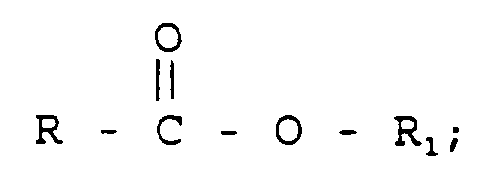
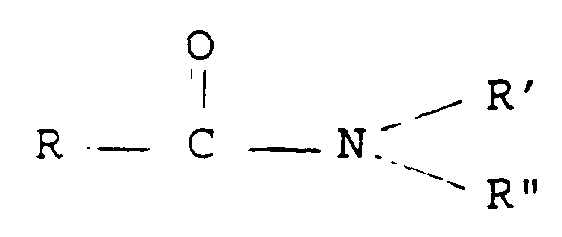
- nonionics are the following:
- R' and R" each can be -H, -CH 2 CH 2 OH, or
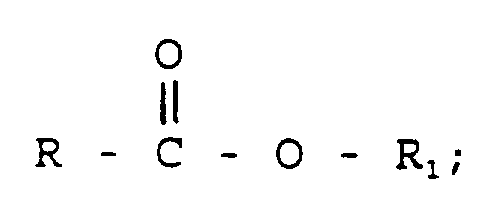
- esters such as:
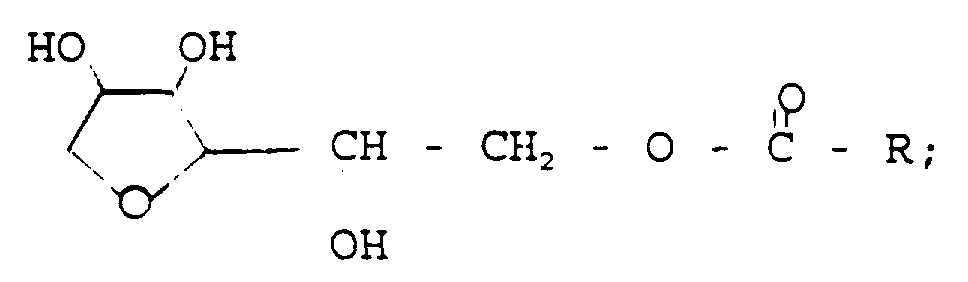
- thoxylates such as:
- R is a fatty alkyl group, preferably a C 6 - C 22 fatty alkyl group, most preferably a C 8 - C 18 fatty alkyl group;
- R 1 is -H or a fatty alkyl group, preferably -H or a C 6 - C 22 fatty alkyl group, most preferably -
- x, x', y, y' and n are each independently moles of ethylene oxide preferably 1 to 300; most preferably 1 to 150; and
- n, m', l and l' are each independently moles of propylene oxide, preferably 1 to 300; most preferably 1 to 150;
- the surfactant composition is a solid at room temperature (24oC), preferably a solid at 50oC.
- Mixtures of the above surfactants are acceptable and, in fact, mixtures of the above surfactants with other nonionics that alone are liquid even at room temperature may be acceptable provided that the amount or nature of the liquid surfactant is such that the final particulate product does not exhibit tackiness at room temperature. Preferably, tackiness is not exhibited even at 50oC.
- the solid, nonionic surfactant compositions of the instant invention should be present from greater than 30 to about 99 weight percent, preferably from about 50 to about 97 weight percent, said percent based on the total spray-coated formulation.
- the more preferred solid nonionic surfactants are the aforedescribed alkyl alcohol ethoxylates and alkylphenol ethoxylates.
- the most preferred solid nonionic surfactant is dinonylphenol ethoxylate ( ⁇ 100 EO) for it has been discovered that this compound possesses the ability to provide excellent wetting characteristics together with a high melting point. Furthermore, the material exhibits an ability to dissolve in aqueous medium without formation of a gel phase.
- the amount of diammonium sulfate to be spray-coated by the solid nonionic composition can be from about 1 to less than 70 weight percent, preferably from about 3 to about 50 weight percent based on the total weight of the final spray-coated composition.
- the essence of the instant invention lies in the discovery that if solid nonionic surfactant compositions are spray-coated upon diammonium sulfate, the dissolution rate of the dry surfactant particulate composition in aqueous solution is greatly enhanced. It is also hypothesized that in addition to the action of the ammonium sulfate per se upon the dissolution rate of the solid, nonionic surfactant composition, the coating process tends to entrap air within the coated granules thereby increasing the surface area ultimately exposed to the aqueous medium which increases the dissolution rate (as opposed to compaction and extrusion processes which tend to compress air out of the particles). Also, the pockets of entrapped air function as flotation aids which assist in keeping the coated granules from settling.
- the preferred process of the instant spray-coating invention comprises the steps of:
- the diammonium sulfate is initially blended for at least 10 minutes before the spraying step to ensure that the initial crystal sizes are uniformly distributed throughout the batch.
- the preferred spray blender-mixers are those of the Mark VI design manufactured by Continental Rollo or an equivalent.
- the mixture should continue to be blended for at least three additional minutes after the spraying has ceased.
- the additional components adhere to the surface of the coated granules, e.g., if an additional additive is a fine powder and one desires to reduce dusting in the final product, the material can be added while the coated granules are still tacky to obtain adherence, i.e., the material can be added before the coated material is completely cooled.
- additional components include anti-foam agents, flow agents, anti-caking agents, stabilizers, inert fillers, gas-generating agents, dyes, and/or any adjuvants particular to the specific end-use application of the resulting product.
- Optional adjuvants can be added from about 0 to about 20 weight percent of the granular composition.
- Inert ingredients can be present from about 0 to about 80 weight percent.
- One of the distinct advantages of the instant spray-coated, i.e., multi-layered particle is that it frees the preparer from many of the restrictions normally imposed upon multi-component systems manufacturers. For example, additional adjuvant components which normally would be incompatible with the diammonium sulfate can be made a part of the coated particle by introducing the component after the coating process is completed, but while the multi-layered material is still tacky so that the adjuvant can be adhered to the outer surface, i.e., the component would only be in contact with the nonionic composition layer.
- Another advantage realized by this adherence contact procedure is that since it allows material to be placed on the outside of the spray-coated particle, it gives the adhered material preferential or advanced exposure to the aqueous media. Thus, one can also selectively sequence the exposure times of certain components of the particle.
- the diammonium sulfate of the instant process preferably should be of a coarse grade; most preferably 95 weight percent of the material should be in the average particle size diameter of from about 200 to about 600 microns, i.e. 95 weight percent should pass through a 30 mesh (U. S. Standard) screen and not pass through a 70 mesh (U. S. Standard) screen. Elimination of fines is preferred to minimize compaction or undesirable agglomeration of the diammonium sulfate particles during the coating process.
- the coated composition may be used as is or, if preferred, screened to a desired particle size.
- a flaked dinonylphenol ethoxylate ( ⁇ 100 EO) (sold under the Rhone-Poulenc trademark Igepal DM-970 FLK) is blended with a sufficient amount of a liquid isodecyl alcohol ethoxylate (4 EO) (sold under the Rhone-Poulenc trademark Rhodasurf DA-530) to produce a non-tacky, solid mixture with an 85:15 respectively weight ratio surfactant Composition A (said nonionic surfactant composition blend also sold under the Rhone-Poulenc trademark AgRHô DS 420).
- isodecyl alcohol ethoxylate has an adverse effect on the melting point of the solid dinonylphenol ethoxylated surfactant, its presence is useful for the improved wetting characteristic it provides, i.e., the lower surface tension realized in the final aqueous solution as a result of its incorporation.
- dry diammonium sulfate is added to the dry Composition A prepared above in a Sigma Blade Mixer in a weight ratio of approximately 85:15 weight percent sulfate to surfactant. Blending is unable to be accomplished because the materials compress together and cake.
- the test is run again utilizing solely the flaked dinonylphenol ethoxylate ( ⁇ 100 EO), i.e., Igepal DM-970 FLK in lieu of Composition A. Again, the blending is unsuccessful because, even at room temperature, the surfactant and diammonium sulfate compact to form cakes.
- Diammonium sulfate is charged into a Continental Rollo mixer Mark VI blender. The sulfate is rotationally blended for about 10 minutes.
- a solid nonionic surfactant composition comprising dinonylphenol ethoxylate ( ⁇ 100 EO) (Igepal DM 970) and isodecyl alcohol ethoxylate (4 EO) (Igepal DA 530) respectively, (said nonionic surfactant composition blend sold under the Rhone-Poulenc trademark AgRH ⁇ DS 420) is heated at a temperature of about 85o C until the surfactant composition is melted. The molten surfactant is then sprayed onto the rotating diammonium sulfate through fine sized 8008E spray tips. The mixture is blended continuously for three additional minutes to ensure uniform coating and granulation.
- the mixture is then cooled to about 45o C at which time an antifoam agent is blended into the mixture for three minutes.
- the coated granular product is collected through a #8 (U. S.
- the resulting dissolution times of the solid nonionic surfactant compositions indicate the significantly enhanced dissolution rates that can be unexpectedly realized by this invention, i . e . , by the intimate spray-coating of diammonium sulfate with the surfactant .
- the coated products of this invention also realize a very uniform particle size together with excellent attrition resistance. Serendipitously, the process is significantly less energy intensive and more capital cost effective than other melt-admixing processes, e.g., extrusion processes of the prior art.
Landscapes
- Chemical & Material Sciences (AREA)
- Life Sciences & Earth Sciences (AREA)
- Organic Chemistry (AREA)
- Chemical Kinetics & Catalysis (AREA)
- Oil, Petroleum & Natural Gas (AREA)
- Wood Science & Technology (AREA)
- Engineering & Computer Science (AREA)
- Pest Control & Pesticides (AREA)
- Inorganic Chemistry (AREA)
- Detergent Compositions (AREA)
- Cosmetics (AREA)
- Agricultural Chemicals And Associated Chemicals (AREA)
- Glanulating (AREA)
Abstract
Description




Claims










Priority Applications (6)
| Application Number | Priority Date | Filing Date | Title |
|---|---|---|---|
| DE69627312T DE69627312T2 (en) | 1995-01-31 | 1996-01-31 | NON-ionic surfactants with improved aqueous dissolution rate |
| EP96905280A EP0807162B1 (en) | 1995-01-31 | 1996-01-31 | Nonionic surfactants with enhanced aqueous dissolution rates |
| AT96905280T ATE236972T1 (en) | 1995-01-31 | 1996-01-31 | NON-IONIC SURFACTANTS WITH IMPROVED AQUEOUS DISSOLUTION RATE |
| AU49086/96A AU716210B2 (en) | 1995-01-31 | 1996-01-31 | Nonionic surfactants with enhanced aqueous dissolution rates |
| CA002211693A CA2211693C (en) | 1995-01-31 | 1996-01-31 | Nonionic surfactants with enhanced aqueous dissolution rates |
| BR9607561-9A BR9607561A (en) | 1995-01-31 | 1996-01-31 | Non-ionic surfactants with increased aqueous dissolution rates |
Applications Claiming Priority (2)
| Application Number | Priority Date | Filing Date | Title |
|---|---|---|---|
| US08/382,301 US5567475A (en) | 1995-01-31 | 1995-01-31 | Nonionic surfactants with enhanced aqueous dissolution rates |
| US08/382,301 | 1995-01-31 |
Publications (1)
| Publication Number | Publication Date |
|---|---|
| WO1996023864A1 true WO1996023864A1 (en) | 1996-08-08 |
Family
ID=23508361
Family Applications (1)
| Application Number | Title | Priority Date | Filing Date |
|---|---|---|---|
| PCT/US1996/001236 Ceased WO1996023864A1 (en) | 1995-01-31 | 1996-01-31 | Nonionic surfactants with enhanced aqueous dissolution rates |
Country Status (8)
| Country | Link |
|---|---|
| US (1) | US5567475A (en) |
| EP (1) | EP0807162B1 (en) |
| AT (1) | ATE236972T1 (en) |
| AU (1) | AU716210B2 (en) |
| BR (1) | BR9607561A (en) |
| CA (1) | CA2211693C (en) |
| DE (1) | DE69627312T2 (en) |
| WO (1) | WO1996023864A1 (en) |
Cited By (4)
| Publication number | Priority date | Publication date | Assignee | Title |
|---|---|---|---|---|
| WO1997024423A1 (en) * | 1995-12-28 | 1997-07-10 | Rhone-Poulenc Surfactants & Specialties, L.P. | Processes for producing solid surfactant compositions with enhanced dissolution rates |
| WO2001051432A1 (en) * | 2000-01-07 | 2001-07-19 | Cognis Deutschland Gmbh & Co. Kg | Aqueous means containing micronutrients for plants |
| US8529694B2 (en) | 2006-10-26 | 2013-09-10 | Air Products And Chemicals, Inc. | Powdered acetylenic surfactants and compositions containing them |
| WO2016041649A1 (en) * | 2014-09-18 | 2016-03-24 | Unilever Plc | Liquid whitening composition |
Families Citing this family (6)
| Publication number | Priority date | Publication date | Assignee | Title |
|---|---|---|---|---|
| TW448106B (en) * | 1996-02-08 | 2001-08-01 | Teijin Ltd | Adherent polyester film laminate |
| US6117532A (en) * | 1997-10-30 | 2000-09-12 | E. I. Du Pont De Nemours And Company | Interdraw pretreatment for polyester film |
| US5985437A (en) * | 1997-12-04 | 1999-11-16 | E. I. Du Pont De Nemours And Company | Interdraw pretreatment for polyester film |
| CA2358187A1 (en) * | 2001-10-03 | 2003-04-03 | Mold-Masters Limited | Nozzle seal |
| DE10163281A1 (en) * | 2001-12-21 | 2003-07-03 | Cognis Deutschland Gmbh | Granulate giving easier incorporation into detergent or cleansing compositions contains both a room temperature solid nonionic surfactant and an anionic surfactant |
| WO2004046300A1 (en) * | 2002-11-14 | 2004-06-03 | The Procter & Gamble Company | Rinse aid containing encapsulated glasscare active salt |
Citations (4)
| Publication number | Priority date | Publication date | Assignee | Title |
|---|---|---|---|---|
| JPS5466260A (en) * | 1977-10-25 | 1979-05-28 | Showa Denko Kk | Slowly acting solid fertilizer |
| US4250043A (en) * | 1979-07-19 | 1981-02-10 | The Procter & Gamble Company | Detergent-compatible antistatic compositions |
| WO1987003579A1 (en) * | 1985-12-16 | 1987-06-18 | Skw Trostberg Aktiengesellschaft | Process for producing nitrogen fertilizers |
| JPH07286199A (en) * | 1994-04-15 | 1995-10-31 | Lion Corp | Method for producing tablet detergent composition |
Family Cites Families (4)
| Publication number | Priority date | Publication date | Assignee | Title |
|---|---|---|---|---|
| US4406808A (en) * | 1977-10-06 | 1983-09-27 | Colgate-Palmolive Company | High bulk density carbonate-zeolite built heavy duty nonionic laundry detergent |
| US4216027A (en) * | 1978-04-18 | 1980-08-05 | The Procter & Gamble Company | Method and apparatus for cleansing and disinfecting a flushing toilet |
| US5084087A (en) * | 1989-04-26 | 1992-01-28 | Basf Corporation | Ready to dilute adjuvant-containing postemergent herbicide formulations |
| RU2096955C1 (en) * | 1991-03-01 | 1997-11-27 | Е.И.Дюпон Де Немур Энд Компани | Water-dispersable granulated pesticide composition prepared by extrusion method and a method of its preparing |
-
1995
- 1995-01-31 US US08/382,301 patent/US5567475A/en not_active Expired - Fee Related
-
1996
- 1996-01-31 AT AT96905280T patent/ATE236972T1/en not_active IP Right Cessation
- 1996-01-31 BR BR9607561-9A patent/BR9607561A/en not_active IP Right Cessation
- 1996-01-31 DE DE69627312T patent/DE69627312T2/en not_active Expired - Fee Related
- 1996-01-31 CA CA002211693A patent/CA2211693C/en not_active Expired - Fee Related
- 1996-01-31 AU AU49086/96A patent/AU716210B2/en not_active Ceased
- 1996-01-31 EP EP96905280A patent/EP0807162B1/en not_active Expired - Lifetime
- 1996-01-31 WO PCT/US1996/001236 patent/WO1996023864A1/en not_active Ceased
Patent Citations (4)
| Publication number | Priority date | Publication date | Assignee | Title |
|---|---|---|---|---|
| JPS5466260A (en) * | 1977-10-25 | 1979-05-28 | Showa Denko Kk | Slowly acting solid fertilizer |
| US4250043A (en) * | 1979-07-19 | 1981-02-10 | The Procter & Gamble Company | Detergent-compatible antistatic compositions |
| WO1987003579A1 (en) * | 1985-12-16 | 1987-06-18 | Skw Trostberg Aktiengesellschaft | Process for producing nitrogen fertilizers |
| JPH07286199A (en) * | 1994-04-15 | 1995-10-31 | Lion Corp | Method for producing tablet detergent composition |
Non-Patent Citations (2)
| Title |
|---|
| DATABASE WPI Section Ch Week 7927, Derwent World Patents Index; Class B01, AN 79-49997b, XP002005056, "slow release fertiliser prodn." * |
| DATABASE WPI Section Ch Week 9601, Derwent World Patents Index; Class C11, AN 96-007117, XP002005055, "prepn. of tablet detergent compsn. having sufficient tablet strebgth and dissolving rapidly in water..." * |
Cited By (8)
| Publication number | Priority date | Publication date | Assignee | Title |
|---|---|---|---|---|
| WO1997024423A1 (en) * | 1995-12-28 | 1997-07-10 | Rhone-Poulenc Surfactants & Specialties, L.P. | Processes for producing solid surfactant compositions with enhanced dissolution rates |
| WO2001051432A1 (en) * | 2000-01-07 | 2001-07-19 | Cognis Deutschland Gmbh & Co. Kg | Aqueous means containing micronutrients for plants |
| US8529694B2 (en) | 2006-10-26 | 2013-09-10 | Air Products And Chemicals, Inc. | Powdered acetylenic surfactants and compositions containing them |
| WO2016041649A1 (en) * | 2014-09-18 | 2016-03-24 | Unilever Plc | Liquid whitening composition |
| WO2016041677A1 (en) * | 2014-09-18 | 2016-03-24 | Unilever Plc | Whitening composition |
| CN106661502A (en) * | 2014-09-18 | 2017-05-10 | 荷兰联合利华有限公司 | Whitening composition |
| CN106715664A (en) * | 2014-09-18 | 2017-05-24 | 荷兰联合利华有限公司 | liquid whitening composition |
| CN106715664B (en) * | 2014-09-18 | 2019-09-17 | 荷兰联合利华有限公司 | liquid whitening composition |
Also Published As
| Publication number | Publication date |
|---|---|
| EP0807162A1 (en) | 1997-11-19 |
| US5567475A (en) | 1996-10-22 |
| DE69627312D1 (en) | 2003-05-15 |
| AU716210B2 (en) | 2000-02-24 |
| DE69627312T2 (en) | 2003-10-16 |
| ATE236972T1 (en) | 2003-04-15 |
| EP0807162B1 (en) | 2003-04-09 |
| AU4908696A (en) | 1996-08-21 |
| BR9607561A (en) | 2000-10-31 |
| CA2211693C (en) | 2002-07-30 |
| CA2211693A1 (en) | 1996-08-08 |
Similar Documents
| Publication | Publication Date | Title |
|---|---|---|
| EP0807162B1 (en) | Nonionic surfactants with enhanced aqueous dissolution rates | |
| JPH04501129A (en) | Method for producing surfactant-containing granules | |
| WO1996023746A1 (en) | Dry-bonded nonionic adjuvants | |
| JPH04501730A (en) | Method for producing high-density zeolite-containing particles | |
| JPH11193397A (en) | Detergent particle composition and method for producing the same | |
| AU4772896A (en) | Pesticidal granules containing fertilizer and surfactant | |
| JPH09502468A (en) | Granular detergent composition containing surfactant and defoaming component | |
| EA001453B1 (en) | Process for the production of a detergent composition | |
| JPH0514759B2 (en) | ||
| WO1997024424A1 (en) | Processes for producing solid surfactant compositions with decreased dissolution rates | |
| US7279453B2 (en) | Foam regulating granulate | |
| WO1997024423A1 (en) | Processes for producing solid surfactant compositions with enhanced dissolution rates | |
| JP3161710B2 (en) | Surfactant composition | |
| US5739094A (en) | Free-flowing particulate detergent admix composition containing nonionic surfactant | |
| EP0923638A2 (en) | Process for preparing granular detergent components | |
| WO1997002338A1 (en) | Process for the production of a detergent composition | |
| EP0670880A1 (en) | Silicon-free foam-control agent | |
| EP1920040B1 (en) | Foam regulator granules for use as deposit preventing agents for machine-washing textiles | |
| WO1997002339A1 (en) | Granulated, powder- and fines-free detergents and cleaners of high bulk density | |
| CA2277937A1 (en) | Process for making a free-flowing particulate detergent admix containing nonionic surfactant | |
| JP2001240899A (en) | Method for producing high bulk density granular detergent composition | |
| JP2004175930A (en) | Particles for supporting surfactant | |
| JPH09100498A (en) | Nonionic surfactant-containing particles and method for producing high bulk density detergent using the same | |
| MXPA99006685A (en) | Process for making a free-flowing particulate detergent admix containing nonionic surfactant | |
| JPH09502208A (en) | Peroxy acid bleach precursor composition |
Legal Events
| Date | Code | Title | Description |
|---|---|---|---|
| AK | Designated states |
Kind code of ref document: A1 Designated state(s): AM AT AU BB BG BR BY CA CH CN CZ DE DK EE ES FI GB GE HU IS JP KE KG KP KR KZ LK LR LT LU LV MD MG MN MW MX NO NZ PL PT RO RU SD SE SG SI SK TJ TM TT UA UG UZ VN |
|
| AL | Designated countries for regional patents |
Kind code of ref document: A1 Designated state(s): KE LS MW SD SZ UG AT BE CH DE DK ES FR GB GR IE IT LU MC NL PT SE BF BJ CF CG CI CM GA GN ML MR NE SN TD TG |
|
| 121 | Ep: the epo has been informed by wipo that ep was designated in this application | ||
| DFPE | Request for preliminary examination filed prior to expiration of 19th month from priority date (pct application filed before 20040101) | ||
| ENP | Entry into the national phase |
Ref document number: 2211693 Country of ref document: CA Ref country code: CA Ref document number: 2211693 Kind code of ref document: A Format of ref document f/p: F |
|
| WWE | Wipo information: entry into national phase |
Ref document number: 1996905280 Country of ref document: EP |
|
| WWP | Wipo information: published in national office |
Ref document number: 1996905280 Country of ref document: EP |
|
| REG | Reference to national code |
Ref country code: DE Ref legal event code: 8642 |
|
| WWG | Wipo information: grant in national office |
Ref document number: 1996905280 Country of ref document: EP |