WO1996025411A1 - Certain bridged 4-phenyl-2-aminomethylimidazoles; new dopamine receptor subtype specific ligands - Google Patents
Certain bridged 4-phenyl-2-aminomethylimidazoles; new dopamine receptor subtype specific ligands Download PDFInfo
- Publication number
- WO1996025411A1 WO1996025411A1 PCT/US1996/001906 US9601906W WO9625411A1 WO 1996025411 A1 WO1996025411 A1 WO 1996025411A1 US 9601906 W US9601906 W US 9601906W WO 9625411 A1 WO9625411 A1 WO 9625411A1
- Authority
- WO
- WIPO (PCT)
- Prior art keywords
- carbon atoms
- alkyl
- nitrogen
- halogen
- alkoxy
- Prior art date
- Legal status (The legal status is an assumption and is not a legal conclusion. Google has not performed a legal analysis and makes no representation as to the accuracy of the status listed.)
- Ceased
Links
- 0 *Cc1nc(C*c2ccccc2-2)c-2[n]1 Chemical compound *Cc1nc(C*c2ccccc2-2)c-2[n]1 0.000 description 3
Classifications
-
- C—CHEMISTRY; METALLURGY
- C07—ORGANIC CHEMISTRY
- C07D—HETEROCYCLIC COMPOUNDS
- C07D235/00—Heterocyclic compounds containing 1,3-diazole or hydrogenated 1,3-diazole rings, condensed with other rings
- C07D235/02—Heterocyclic compounds containing 1,3-diazole or hydrogenated 1,3-diazole rings, condensed with other rings condensed with carbocyclic rings or ring systems
-
- A—HUMAN NECESSITIES
- A61—MEDICAL OR VETERINARY SCIENCE; HYGIENE
- A61P—SPECIFIC THERAPEUTIC ACTIVITY OF CHEMICAL COMPOUNDS OR MEDICINAL PREPARATIONS
- A61P25/00—Drugs for disorders of the nervous system
-
- A—HUMAN NECESSITIES
- A61—MEDICAL OR VETERINARY SCIENCE; HYGIENE
- A61P—SPECIFIC THERAPEUTIC ACTIVITY OF CHEMICAL COMPOUNDS OR MEDICINAL PREPARATIONS
- A61P25/00—Drugs for disorders of the nervous system
- A61P25/14—Drugs for disorders of the nervous system for treating abnormal movements, e.g. chorea, dyskinesia
- A61P25/16—Anti-Parkinson drugs
-
- A—HUMAN NECESSITIES
- A61—MEDICAL OR VETERINARY SCIENCE; HYGIENE
- A61P—SPECIFIC THERAPEUTIC ACTIVITY OF CHEMICAL COMPOUNDS OR MEDICINAL PREPARATIONS
- A61P25/00—Drugs for disorders of the nervous system
- A61P25/18—Antipsychotics, i.e. neuroleptics; Drugs for mania or schizophrenia
-
- A—HUMAN NECESSITIES
- A61—MEDICAL OR VETERINARY SCIENCE; HYGIENE
- A61P—SPECIFIC THERAPEUTIC ACTIVITY OF CHEMICAL COMPOUNDS OR MEDICINAL PREPARATIONS
- A61P25/00—Drugs for disorders of the nervous system
- A61P25/24—Antidepressants
-
- C—CHEMISTRY; METALLURGY
- C07—ORGANIC CHEMISTRY
- C07D—HETEROCYCLIC COMPOUNDS
- C07D403/00—Heterocyclic compounds containing two or more hetero rings, having nitrogen atoms as the only ring hetero atoms, not provided for by group C07D401/00
- C07D403/02—Heterocyclic compounds containing two or more hetero rings, having nitrogen atoms as the only ring hetero atoms, not provided for by group C07D401/00 containing two hetero rings
- C07D403/12—Heterocyclic compounds containing two or more hetero rings, having nitrogen atoms as the only ring hetero atoms, not provided for by group C07D401/00 containing two hetero rings linked by a chain containing hetero atoms as chain links
-
- C—CHEMISTRY; METALLURGY
- C07—ORGANIC CHEMISTRY
- C07D—HETEROCYCLIC COMPOUNDS
- C07D491/00—Heterocyclic compounds containing in the condensed ring system both one or more rings having oxygen atoms as the only ring hetero atoms and one or more rings having nitrogen atoms as the only ring hetero atoms, not provided for by groups C07D451/00 - C07D459/00, C07D463/00, C07D477/00 or C07D489/00
- C07D491/02—Heterocyclic compounds containing in the condensed ring system both one or more rings having oxygen atoms as the only ring hetero atoms and one or more rings having nitrogen atoms as the only ring hetero atoms, not provided for by groups C07D451/00 - C07D459/00, C07D463/00, C07D477/00 or C07D489/00 in which the condensed system contains two hetero rings
- C07D491/04—Ortho-condensed systems
Definitions
- This invention relates to certain bridged 4-phenyl-2-aminomethylimidazoles which selectively bind to dopamine receptor subtypes.
- This invention also relates to pharmaceutical compositions comprising such compounds. It further relates to the use of such compounds in the treatment of affective disorders such as schizophrenia, depression as well as certain movement disorders such as Parkinsonism and dystonia. Furthermore compounds of this invention are useful in treating the extrapyramidal side effects associated with the use of conventional neuroleptic agents.
- Schizophrenia or psychosis is a term used to describe a group of illnesses of unknown origin which affect approximately 2.5 million people in the United States. These disorders of the brain are characterized by a variety of symptoms which are classified as positive symptoms (disordered thought, hallucinations and delusions) and negative symptoms (social withdrawal and unresponsiveness). These disorders have an age of onset in adolescence or early adulthood and persist for many years. The disorders tend to become more severe during the patient's lifetime and can result in prolonged institutionalization. Within the United States of America, approximately 40% of all hospitalized psychiatric patients suffer from schizophrenia.
- neuroleptics This classification of anupsychotic medication was based largely on the activating (neuroleptic) properties of the nervous system by these drugs. Subsequently, neuroleptic agents were shown to increase the concentrations of dopamine metabolites in the brain. This finding suggested that altered neuronal firing of the dopamine system contributed in some way to the aberrant behavior observed in schizophrenic patients. Additional evidence indicated that dopamine could increase the activity of adenylate cyclase in the corpus striatum. an effect reversed by neuroleptic agents. Thus, cumulative evidence from these and later experiments strongly suggested that the neurotransmitter dopamine was involved in schizophrenia.
- dopamine receptors One of the major actions of antipsychotic medication is the blockade of dopamine receptors in brain Several dopamine systems appear to exist in the brain and at least five classes of dopamine receptors appear to mediate the actions of this transmitter. These dopamine receptors differ in their pharmacological specificity and were originally classified on the basis of their ability to bind various dopaminergic ligands
- the butyrophenones are a class of drugs containing many potent antipsychotic drugs Perhaps the most prominent member of this class of compounds is the antipsychotic drug halope ⁇ dol (l-(3-p-fluorobenzoylpropyl)-4-p-chlorophenyl-4-hydroxyp ⁇ pe ⁇ d ⁇ ne).
- Halope ⁇ dol binds relauvely weakly at the major dopamine receptor subtype which activates adenylate cyclase (commonly classified as the Dj dopamine receptor).
- halopendol displayed binding affinity at a dopamine receptor subtype which suppressed the activity of adenylate cyclase (commonly classified as D 2 receptors) in the subnanomolar range.
- D 2 receptors adenylate cyclase
- D3 and D 4 subtypes are pharmacologically related to the D 2 receptor via their ability to suppress the activity of adenylate cyclase
- the D 5 receptor is classified as a "D like" dopamine subtype through its ability t sumulate cyclase activity
- D 3 , D 4 and D5 and other as yet undiscovere dopamine receptors may cont ⁇ bute to this profile.
- Some of the atypical compounds posses similar activity at D 2 .
- D 3 and D 4 receptors The examples of this patent fall into this general class of molecules.
- WO 94/22839 descri bes certain 2- aminomethylbenzimidazoles as having affinity at dopamine receptors.
- the compounds of the present invention differ from those in WO 94/22839 in that the compounds of this invention possess a aromatic benzene ring fused in a [4.5-e] fashion to the benzimidazole substructure.
- This invention provides novel compounds of Formula I which interact with dopamine receptor subtypes.
- the invention provides pharmaceutical compositions comprising compounds of Formula I.
- the invention also provides compounds useful in treating affective disorders such as schizophrenia and depression as well as certain movement disorders such as Parkinsonism.
- compounds of this invention are useful in treating the extrapyramidal side effects associated with the use of conventional neuroleptic agents. Since particularly dopamine D 3 and D 4 receptor subtypes are concentrated in the limbic system (Science, 2 ⁇ 2: 1034 (Taubes. 1994)) which controls cognition and emotion, compounds which interact with these receptors are useful in the treatment of cognitive disorders.
- Such disorders include cognitive deficits which are a significant component of the negative symptoms (social withdrawal and unresponsiveness) of schizophrenia.
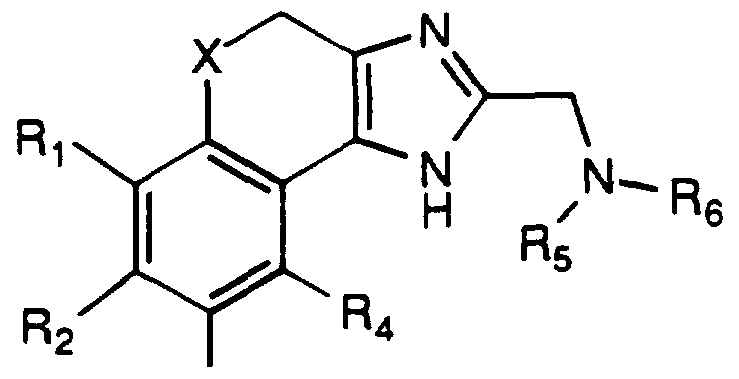
- Other disorders involving memory impairment or attention deficit disorders can also be treated with the compounds of this invention that interact specifically with dopamine D 3 and/or D 4 receptor subtypes. Accordingly, a broad embodiment of the invention is directed to compounds of Formula I:
- X is carbon or oxygen, provided that when X is oxygen, the oxygen is adjacent the 6-membered ring;
- Ri , R 2 , R 3 and R 4 are the same or different and represent hydrogen, halogen, hydroxy, amino, aminosulfonyl, alkylaminosulfonyl, alkylsulfonyl.
- arylalkylsulfonyl alkyl of 1 to 6 carbon atoms or alkoxy of 1 to 6 carbon atoms: and R 5 represents alkyl having 1-3 carbon atoms and R 6 is benzyl, optionally substituted with alkyl having 1-6 carbon atoms, alkoxy, hydroxy, or halogen: or NR5R6 represents heterocyclic six membered ring optionally substituted with alkyl having 1-6 carbon atoms, hydroxyl, halogen, aryl. alkylaryl where the alkyl po ⁇ ion is alkyl having 1 -6 carbon atoms, or heteroaryl.
- the invention also pertains to the use of compounds of general Formula I in the treatment of neuropsychological disorders.
- the pharmaceutical utility of compounds of this invention is indicated by the assays described below for dopamine receptor subtype affinity.
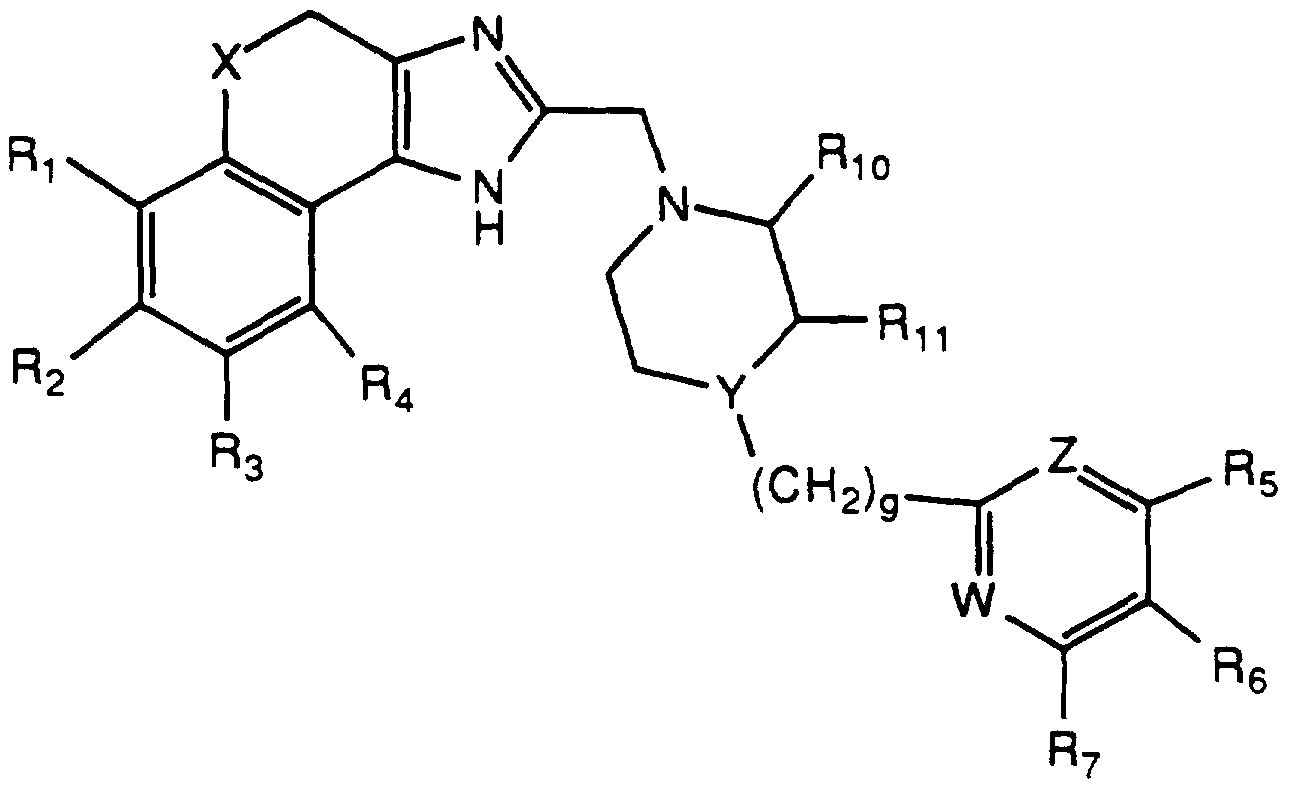
- W, Y and Z are the same or different and represent either carbon or nitrogen
- R ⁇ , R 2 , R 3 , R 4 , R 5 , Re, and R independently represent hydrogen, halogen, hydroxy, amino, aminosulfonyl, arylalkylsulfonyl or alkylsulfonyl where each alkyl portion has 1 to 6 carbon atoms, alkylaminosulfonyl where the alkyl portion has 1 to 6 carbon atoms, alkyl having 1 to 6 carbon atoms, or alkoxy of 1 to 6 carbon atoms:
- R l ⁇ and Rn are the same or different and represent alkyl groups having 1 to 6 carbon atoms: g is an integer from 0 to 4: and
- W and Z are both nitrogen: or W is CR 8 and Z is CR 9 ; or W is CR ⁇ and Z is nitrogen: or
- Z is CR 9 and W is nitrogen, where RR and R 9 are the same or different and represent hydrogen, halogen, alkyl having from 1 to 6 carbon atoms, or alkoxy having from 1 to 6 carbon atoms.
- RR and R 9 are the same or different and represent hydrogen, halogen, alkyl having from 1 to 6 carbon atoms, or alkoxy having from 1 to 6 carbon atoms.
- the invention also encompasses compounds of formula III:
- W, Y and Z are the same or different and represent either carbon or nitrogen
- Rj, R 2 , R 3 , R 4 , R5, R 6 , and R independently represent hydrogen, halogen, hydroxy, amino, aminosulfonyl, arylalkylsulfonyl or alkylsulfonyl where the alkyl po ⁇ ion has 1 to 6 carbon atoms, alkylaminosulfonyl where each alkyl portion has 1 to 6 carbon atoms, alkyl having 1 to 6 carbon atoms, or alkoxy of 1 to 6 carbon atoms:
- Rio and Ri 1 are the same or different and represent alkyl groups having 1 to 6 carbon atoms; g is an integer from 0 to 4: and
- W and Z are both nitrogen: or W is CR 8 and Z is CR 9 ; or W is CRSJ, and Z is nitrogen: or Z is CR 9 and W is nitrogen.
- Rg and R 9 are the same or different and represent hydrogen, halogen, alkyl having from 1 to 6 carbon atoms, or alkoxy having from 1 to 6 carbon atoms.
- the invention further encompasses compounds of formula IV:
- W, Y and Z are the same or different and represent either carbon or nitrogen
- Ri, R 2 , R 3 , R 4 , R 5 , Re, and R independently represent hydrogen, halogen, hydroxy, amin aminosulfonyl, arylalkylsulfonyl or alkylsulfonyl where each alkyl portion has 1 to carbon atoms, alkylaminosulfonyl where the alkyl portion has 1 to 6 carbon atoms, alk having 1 to 6 carbon atoms, or alkoxy of 1 to 6 carbon atoms;
- Rio and Rn are the same or different and represent alkyl groups having 1 to 6 carbon atoms; g is an integer from 0 to 4: and
- W and Z are both nitrogen; or W is CR 8 and Z is CR 9 ; or W is CRR and Z is nitrogen; or
- Z is CR 9 and W is nitrogen, where Rg and R 9 are the same or different and represent hydrogen, halogen, alk having from 1 to 6 carbon atoms, or alkoxy having from 1 to 6 carbon atoms.
- the invention also provides compounds of formula V:
- X is carbon or oxygen
- Rs and R 9 are the same or different and represent hydrogen, halogen, hydroxy, amino, aminosulfonyl, arylalkylsulfonyl, alkylsulfonyl, alkylaminosulfonyl, alkyl of 1 to 6 carbon atoms or alkoxy of 1 to 6 carbon atoms.
- the invention also provides compounds of formula VI:
- R i , Ri. R ? . R 4 , R 5 , R 6 , R 7 . s- R . R io and Rn are the same or different and represent hydrogen, halogen, hydroxy. amino. aminosulfonyl, arylalkylsulfonyl, alkylsulfonyl. alkylaminosulfonyl. alkyl of 1 to 6 carbon atoms or alkoxy of 1 to 6 carbon atoms.
- the invention also provides compounds of formula VII:
- Ri, R2, R 3 , R 4 and R 5 are the same or different and represnt hydrogen, halogen, hydroxy amino, aminosulfonyl, arylalkylsulfonyl, alkylsulfonyl, alkylaminosulfonyl, alkyl of 1 t
- the invention also provides compounds of formula VIII:
- X is carbon or oxygen
- Ri, R2, R 3 , R 4 , R 5 , R 6 and R are the same or different and represent hydrogen, halogen, hydroxy, amino, aminosulfonyl, arylalkylsulfonyl, alkylsulfonyl, alkylaminosulfonyl, alkyl of 1 to 6 carbon atoms or alkoxy of 1 to 6 carbon atoms.
- T e invention also provides compounds of formula IX:
- X is carbon or oxygen; and i. R2.
- R 3 , and R 4 are the same or different and represent hydrogen, halogen, hydroxy, amino. aminosulfonyl, arylalkylsulfonyl, alkylsulfonyl, alkylaminosulfonyl. alkyl of 1 to 6 carbon atoms or alkoxy of 1 to 6 carbon atoms.
- the invention also provides compounds of formula X:
- Ri, R 2 , R 3 , R 4 , R 5 , and R(, are the same or different and represent hydrogen, halogen, hydroxy, amino, aminosulfonyl.
- the invention further provides compounds of the formula:
- Y represents nitrogen or CH; i, R 2 . R 3 . and R 4 are the same or different and represent hydrogen or alkyl groups havinc 1 to
- Ri, R 2 , R 3 , and R 4 are the same or different and represent hydrogen or alkyl groups having 1 to
- R5 represents alkyl having 1-3 carbon atoms and R 6 is benzyl, optionally substituted with alkyl having 1-6 carbon atoms, alkoxy, hydroxy. or halogen.
- the invention also provides compounds of the formula:
- Y represents nitrogen or CH:
- Ri, R 2 , R 3 , and R 4 are the same or different and represent hydrogen or alkyl groups having 1 to
- R represents hydrogen, halogen, hydroxy, amino, alkyl having 1 to 6 carbon atoms, or alkoxy of 1 to 6 carbon atoms
- W and Z are the same or different and represent nitrogen or CR9 where R 9 represents hydrogen, halogen, alkyl having from 1 to 6 carbon atoms, or alkoxy having from 1 to 6 carbon atoms.
- N 5R 6 groups of formula I above include the following:
- OR represents hydroxy or alkoxy
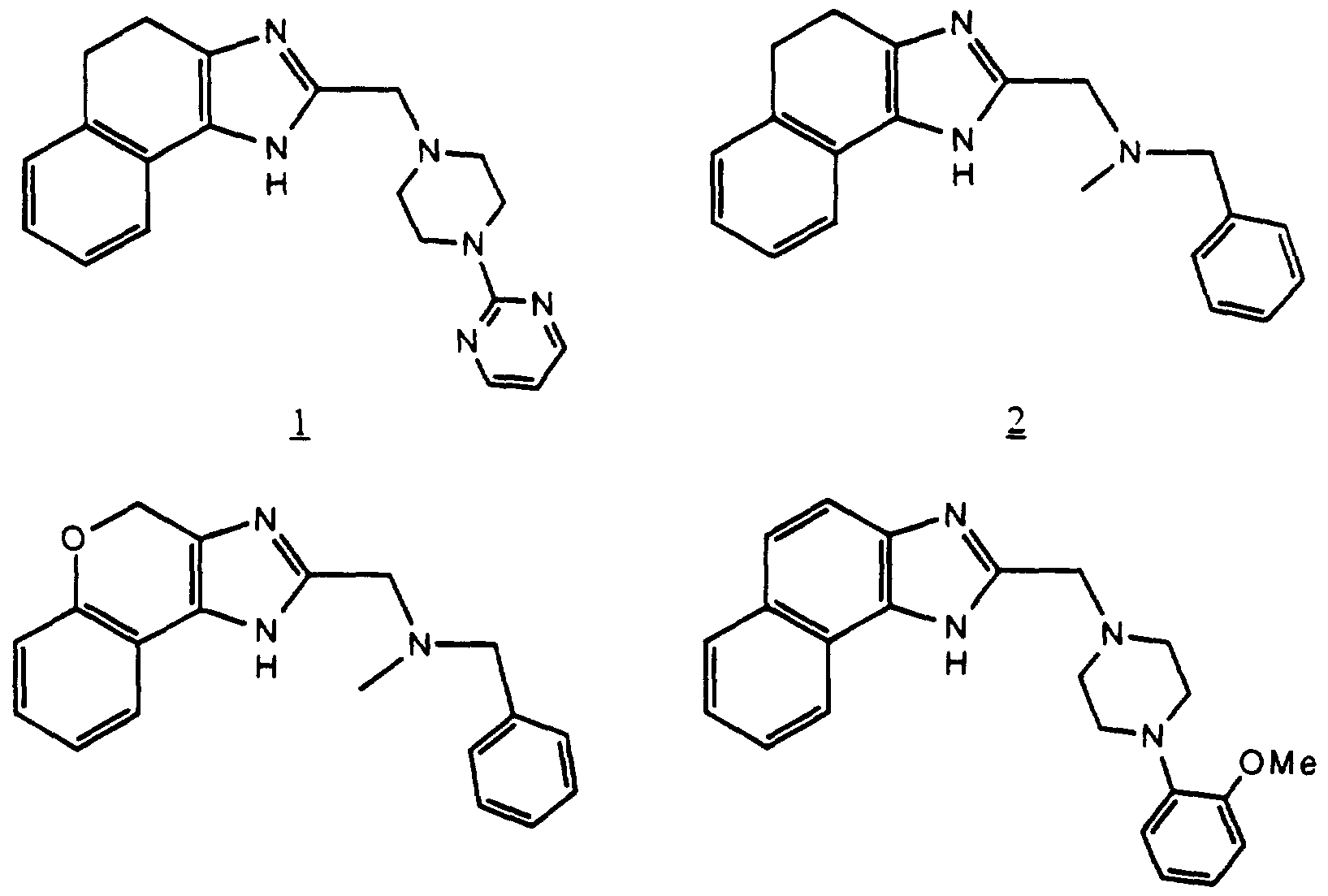
- NR5R 6 substituents are N-benzyl-N-methyl, 4-(2-pyrimidinyl)- piperazinyl. and 4-phenylpiperidinyl groups.
- Representative compounds of the present invention include, but are not limited to the compounds in Figure I and their pharmaceutically acceptable salts.
- Non-toxic pharmaceutically acceptable salts include salts of acids such as hydrochloric, phosphoric, hvdrobromic. sulfuric. sulfinic. formic, toluene sulfonic. hydroiodic. acetic and the like. Those skilled in the art will recognize a wide variety of non-toxic pharmaceutically acceptable addition salts.
- the present invention also encompasses the acylated prodrugs of the compounds of Formula I.
- aryl and “Ar” is meant an aromatic carbocyclic group having a single ring (e.g.. phenyl), multiple rings (e.g.. biphenyl), or multiple condensed rings in which at least one is> aromatic, (e.g., 1.2.3,4-tetrahydronaphthyl, naphthyl. anthryl, or phenanthryl), which can optionally be unsubstituted or substituted with e.g., halogen, lower alkyl, lower alkoxy. lower alkylthio, trifluoromethyl. lower acyloxy, aryl, heteroaryl. and hydroxy.
- alkyl and “lower alkyl” is meant straight and branched chain alkyl groups having from 1 -6 carbon atoms.
- lower alkoxy and “alkoxy” is meant straight and branched chain alkoxy group having from 1-6 carbon atoms.
- heteroaryl is meant 5, 6, or 7 membered aromatic ring systems having at least on hetero atom selected from the group consisting of nitrogen, oxygen and sulfur.
- heteroaryl groups are pyridyl, pyrimidinyl, pyrrolyl, pyrazolyl, pyrazinyl, pyridazinyl, oxazolyl furanyl, quinolinyl, isoquinolinyl, thiazolyl, and thienyl. which can optionally be unsubstitute or substituted with e.g., halogen, lower alkyl, lower alkoxy, lower alkylthio. trifluoromethyl lower acyloxy. aryl, heteroaryl, and hydroxy.
- halogen fluorine, chlorine, bromine and iodine.
- alkylsulfonyl is meant a sulfonyl group substituted with a lower alkyl group.
- arylalkylsulfonyl is meant a sulfonyl group substituted with an arylalkyl group.
- aminosulfonyl is meant a sulfonyl group substituted with an amino group.
- alkylaminosulfonyl is meant a sulfonyl group substituted with a lower alkylamino. o di-lower alkylamino group.
- the pharmaceutical utility of compounds of this invention are indicated by the following assays for dopamine receptor subtype affinity which demonstrate the interaction of the compounds with dopamine receptor subtypes.
- the interaction results in the pharmacological activities of these compounds which thus can be exploited in the treatment of affective disorders such as schizophrenia, depression as well as certain movement disorders such as Parkinsonism and dystonia.
- compounds of this invention are useful in treating the extrapyramidal side effects associated with the use of conventional neuroleptic agents. ⁇ .VfflY f r P anri ⁇ ⁇ recent ⁇ r bindin g activit y
- Pellets of COS cells containing recombinantly produced D2 or D3 receptors from African Green monkey were used for t he assays.
- the sample is homogenized in 100 volumes ( w/vol) of 0.05 M Tris HC1 buffer a t 4° C and pH 7.4.
- the sample is then centrifuged at 30 , 000 x g and resuspended and rehomogenized.
- the sample is then centrifuged as described and the final tissue sample is frozen un t il use.
- the tissue is resuspended 1 :20 ( wt/vol ) in 0.05 M Tris HC1 buffer containing 100 mM NaCl.
- Incubations are carried out at 48°C and contain 0.4 ml of tissue sample. 0.5 nM 3 H-YM 09151-2 and the compound of interest in a total incubation of 1.0 ml.
- Nonspecific binding is defined as t hat binding found in the presence of 1 ⁇ M spiperone without further additions , nonspecific binding is less than 20% of total binding.
- the binding characterisucs of examples of this invention for the D 2 and D 3 receptor subtypes are shown in Table 2 for Rat Striatal
- Clonal cell lines expressing the human dopamine D 4 receptor subtype were harvested i PBS and the cells centrifuged and the pellets stored at -80° C until used in the binding assay. Th pellets were resuspended and the cells lysed at 4° C in 50 mM Tris pH 7.4 buffer containing 12 mM NaCl. 1 mM EDTA and 5 mM MgCb. The homogenate is centrifuged at 48000 x g for 1 minutes at 4° C. The resul t ing pellet is resuspended in fresh buffer and centrifuged again.
- Afte resuspension of the pellet in fresh buffer a 100 ml aliquot is removed for protein determinatio
- the remaining homogena t e is centrifuged as above, the supernatant removed and the pellet store at 4° C until needed a t which time it is resuspended to a final concentration of 625 mg/ml ( 250 per sample) wi t h 50 mM Tris buffer (pH 7.4) and 120 mM NaCl just prior to use.
- Incubatio were carried out for 60 minutes at 25° C in the presence of 0.1 nM [ ⁇ H] YM-09151-2.
- Compounds 1 and 2 are particularly preferred embodiments of the present invention because of its potency in binding to dopamine receptor subtypes.
- active ingredient can be used alone or in combination with various excipients. stabilizers or agents to designed to prolong the action of the active ingredient in the treatment of neuropsychochological disorders such as, example, schizophrenia, dementia, depression. anxiety, Parkinson-like motor disorders and motion disorders related to the use of neuroleptic agents.
- neuropsychochological disorders such as, example, schizophrenia, dementia, depression. anxiety, Parkinson-like motor disorders and motion disorders related to the use of neuroleptic agents.
- the compounds of general Formula I may be administered orally, topically, parenterally, by inhalation or spray or rectally in dosage unit formulations containing conventional non-toxic pharmaceutically acceptable carriers, adjuvants and vehicles.
- parenteral as used herein includes subcutaneous inactions, intravenous, intramuscular, intrasternal lniecuon oi infusion techniques.
- a pharmaceutical formulation comp ⁇ sing a compound of general Formula I and a pharmaceutically acceptable earner.
- One or more compounds of general Formula I may be present in association with one or more non-toxic pharmaceutically acceptable earners and/or diluents and/or adjuvants and if desired other active ingredients
- the pharmaceutical compositions containing compounds of general Formula I may be in a form suitable for oral use. for example, as tablets, troches, lozenges, aqueous oi oily suspensions, dispersible powders or granules, emulsion, hard or soft capsules, or syrups or elixirs
- compositions intended for oral use may be prepared according to any method known to the art for the manufacture of pharmaceutical compositions and such composiuons may contain one or more agents selected from the group consisting of sweetening agents, flavoring agents, colo ⁇ ng agents and preserving agents in order to provide pharmaceutically elegant and palatable preparations Tablets contain the acuve ingredient in admixture with non-toxic pharmaceuucally acceptable excipients which are suitable for the manufacture of tablets.
- excipients may be for example, inert diluents, such as calcium carbonate, sodium carbonate, lactose, calcium phosphate or sodium phosphate; granulating and disintegrating agents, for example, corn starch, or alginic acid; binding agents, for example starch, gelatin or acacia, and lubneating agents, fo example magnesium stearate, stea ⁇ c acid or talc.
- the tablets may be uncoated or they may be coated by known techniques to delay disintegration and absorption in the gastrointesunal tract an thereby provide a sustained action over a longer pe ⁇ od.
- a time delay material suc as glyceryl monosterate or glyceryl distearate may be employed.
- Formulations for oral use may also be presented as hard gelatin capsules wherein th active ingredient is mixed with an inert solid diluent, for example, calcium carbonate, calciu phosphate or kaolin, or as soft gelaun capsules wherein the active ingredient is mixed with wate or an oil medium, for example peanut oil. liquid paraffin or olive oil.
- an inert solid diluent for example, calcium carbonate, calciu phosphate or kaolin
- an oil medium for example peanut oil. liquid paraffin or olive oil.
- Aqueous suspensions contain the active mate ⁇ als in admixture with excipients suitable fo the manufacture of aqueous suspensions.
- excipients are suspending agents, for exampl sodium carboxymethylcellulose. methylcellulose. hydropropyl methylcellulose. sodium algmate polyvinylpyrrolidone. gum tragacanth and gum acacia: dispersing or wetting agents may be naturally-occurring phosphatide. for example, lecithin, or condensation products of an alkylene oxide with fatty acids, for example polyoxyethylene stearate. or condensation products of ethylene oxide with long chain aliphatic alcohols, for example heptadecaethyleneoxycetanol.
- the aqueous suspensions may also contain one or more preservatives, for example ethyl, or n-propyl p-hydroxybenzoate, one or more coloring agents, one or more flavoring agents, and one or more sweetening agents, such as sucrose or saccharin.
- Oily suspensions may be formulated by suspending the active ingredients in a vegetable oil. for example arachis oil, olive oil.
- the oily suspensions may contain a thickening agent, for example beeswax, hard paraffin or cetyl alcohol.
- Sweetening agents such as those set forth above, and flavoring agents may be added to provide palatable oral preparations.
- These compositions may be preserved by the addition of an anti-oxidant such as ascorbic acid.
- Dispersible powders and granules suitable for preparation of an aqueous suspension by the addition of water provide the active ingredient in admixture with a dispersing or wetting agent, suspending agent and one or more preservatives.
- a dispersing or wetting agent e.g., glycerol, glycerol, glycerol, glycerol, glycerol, glycerol, glycerin, glycerin, glycerin, glycerin, glycerin, sorbitol, sorbitol, sorbitol, sorbitol, sorbitol, sorbitol, sorbitol, sorbitol, sorbitol, sorbitol, glycerol, glycerol, glycerol, glycerol, glycerol, glycerol, glycerol, glycerol, glycerol
- compositions of the invention may also be in the form of oil-in-water emulsions.
- the oily phase may be a vegetable oil, for example olive oil or arachis oil, or a mineral oil. for example liquid paraffin or mixtures of these.
- Suitable emulsifying agents may be naturally-occurring gums, for example gum acacia or gum tragacanth. naturally-occurring phosphatides. for example soy bean, lecithin, and esters or partial esters derived from fatty acids and hexitol. anhydrides, for example sorbitan monoleate. and condensation products of the said partial esters with ethylene oxide, for example polyoxyethylene sorbitan monoleate.
- the emulsions may also contain sweetening and flavoring agents.
- Syrups and elixirs may be formulated with sweetening agents, toi example glyceiol propylene glycol. sorbitor or sucrose Such formulations may also contain a demulcent, a preservative and flavo ⁇ ng and coloring agents
- the pharmaceutical compositions may be in the tor ot a sterile injectable aqueous or oleaginous suspension This suspension may be formulated according to the known art using those suitable dispersing or wetting agents and suspending agents which have been mentioned above
- the ste ⁇ le injectable preparation may also be ste ⁇ le injectable solution or suspension in a non-toxic parentally acceptable diluent oi solvent, for example as a solution in 1,3-butaned ⁇ ol Among the acceptable vehicles and solvents that may be employed are water.
- ste ⁇ le. fixed oils are convenuonallv employed as a solvent or suspending medium
- any bland fixed oil may be employed including syntheuc mono or diglyce ⁇ des In addiuon.
- fatty acids such as oleic acid find use in the preparauon of injectables
- the compounds of general Formula I may also be administered in the form of suppositories for rectal administration of the drug.
- These compositions can be prepared by mixing the drug with a suitable non-irritating excipient which is solid at ordinary temperatures but liquid at the rectal temperature and will therefore melt in the rectum to release the drug.
- a suitable non-irritating excipient which is solid at ordinary temperatures but liquid at the rectal temperature and will therefore melt in the rectum to release the drug.
- mate ⁇ als are cocoa butter and polyethylene glycols.
- Compounds of general Formula I may be administered parenterally in a stenle medium
- the drug depending on the vehicle and concentration used, can either be suspended or dissolved in the vehicle.
- adjuvants such as local anaesthetics, preservatives and buffering agents can be dissolved in the vehicle.
- Dosage levels of the order of from about 0 1 mg to about 140 mg per kilogram of body weight per day are useful in the treatment of the above-indicated conditions (about 0 5 mg to about 7 g per patient per day).
- the amount ot active ingredient that may be combined with the earner materials to produce a single dosage form will vary depending upon the host treated and the particular mode of administration.
- Dosage unit forms will generally contain between from about 1 mg to about 500 mg of an active ingredient.
- the specific dose level for any particular patient will depend upon a variety of factors including the activity of the specific compound employed, the age. body weight, general health, sex. diet, time of administration, route of administration, and rate of excretion, drug combination and the severity of the particular disease undergoing therapy.
- Scheme 1 depicts a representative route for the preparation of ethyl and oxomethyl bridged 4-phenyl-2-arrdnomethylimidazo.es of the invention.
- Scheme 2 shows a representative route for the preparation of the ethylene bridged 4- phenyl-2-aminomethylimidazoles of the invention.
- NRR' represents the group NR 5 R6 defined above or a protected precursor thereof.
- Example 2 The following compounds are prepared essentially according to the procedure described in Example 1.
- Example 3 Monochloroacetic acid (15g, 0.16 mol) and diaminonaphthlene (22. lg. 0.14 mol ) were refluxed in 60 ml of 5 N HC1 for 6 hours. The reaction was cooled in ice and neutralized with aqueous ammonium hydroxide. The precipitated product was collected by filtration and recrystallized from benzene/hexane (18.7g, 62%).
Landscapes
- Organic Chemistry (AREA)
- Chemical & Material Sciences (AREA)
- Health & Medical Sciences (AREA)
- Engineering & Computer Science (AREA)
- Bioinformatics & Cheminformatics (AREA)
- Biomedical Technology (AREA)
- Neurology (AREA)
- Neurosurgery (AREA)
- Pharmacology & Pharmacy (AREA)
- General Health & Medical Sciences (AREA)
- Nuclear Medicine, Radiotherapy & Molecular Imaging (AREA)
- General Chemical & Material Sciences (AREA)
- Chemical Kinetics & Catalysis (AREA)
- Life Sciences & Earth Sciences (AREA)
- Animal Behavior & Ethology (AREA)
- Medicinal Chemistry (AREA)
- Public Health (AREA)
- Veterinary Medicine (AREA)
- Psychiatry (AREA)
- Pain & Pain Management (AREA)
- Psychology (AREA)
- Pharmaceuticals Containing Other Organic And Inorganic Compounds (AREA)
- Plural Heterocyclic Compounds (AREA)
- Nitrogen Condensed Heterocyclic Rings (AREA)
Abstract
Description






Claims




Priority Applications (5)
| Application Number | Priority Date | Filing Date | Title |
|---|---|---|---|
| AU48674/96A AU4867496A (en) | 1995-02-15 | 1996-02-14 | Certain bridged 4-phenyl-2-aminomethylimidazoles; new dopamine receptor subtype specific ligands |
| JP52507696A JP3332929B2 (en) | 1995-02-15 | 1996-02-14 | Certain bridged 4-phenyl-2-aminomethylimidazoles: new dopamine receptor subtype-specific ligands |
| CA002213197A CA2213197C (en) | 1995-02-15 | 1996-02-14 | Certain bridged 4-phenyl-2-aminomethylimidazoles; new dopamine receptor subtype specific ligands |
| EP96904618A EP0809641A1 (en) | 1995-02-15 | 1996-02-14 | Certain bridged 4-phenyl-2-aminomethylimidazoles; new dopamine receptor subtype specific ligands |
| US08/913,116 US5948912A (en) | 1995-02-15 | 1996-02-14 | Certain bridged 4-phenyl-2-aminomethylimidazoles; new dopamine receptor subtype specific ligands |
Applications Claiming Priority (8)
| Application Number | Priority Date | Filing Date | Title |
|---|---|---|---|
| US38911195A | 1995-02-15 | 1995-02-15 | |
| US08/389,111 | 1995-02-15 | ||
| US46114395A | 1995-06-05 | 1995-06-05 | |
| US46131095A | 1995-06-05 | 1995-06-05 | |
| US08/463,759 US5773616A (en) | 1995-02-15 | 1995-06-05 | Certain bridged 4-phenyl-2-aminomethylimidazoles; new dopamine receptor subtype specific ligands |
| US08/461,310 | 1995-06-05 | ||
| US08/461,143 | 1995-06-05 | ||
| US08/463,759 | 1995-06-05 |
Related Parent Applications (1)
| Application Number | Title | Priority Date | Filing Date |
|---|---|---|---|
| US08/463,759 Continuation-In-Part US5773616A (en) | 1995-02-15 | 1995-06-05 | Certain bridged 4-phenyl-2-aminomethylimidazoles; new dopamine receptor subtype specific ligands |
Related Child Applications (2)
| Application Number | Title | Priority Date | Filing Date |
|---|---|---|---|
| US08/913,116 A-371-Of-International US5948912A (en) | 1995-02-15 | 1996-02-14 | Certain bridged 4-phenyl-2-aminomethylimidazoles; new dopamine receptor subtype specific ligands |
| US09/371,066 Continuation US6211366B1 (en) | 1995-02-15 | 1999-08-09 | Bridged 4-phenyl-2-aminomethylimidazoles |
Publications (1)
| Publication Number | Publication Date |
|---|---|
| WO1996025411A1 true WO1996025411A1 (en) | 1996-08-22 |
Family
ID=27503299
Family Applications (1)
| Application Number | Title | Priority Date | Filing Date |
|---|---|---|---|
| PCT/US1996/001906 Ceased WO1996025411A1 (en) | 1995-02-15 | 1996-02-14 | Certain bridged 4-phenyl-2-aminomethylimidazoles; new dopamine receptor subtype specific ligands |
Country Status (6)
| Country | Link |
|---|---|
| US (2) | US6211366B1 (en) |
| EP (1) | EP0809641A1 (en) |
| JP (1) | JP3332929B2 (en) |
| AU (1) | AU4867496A (en) |
| CA (1) | CA2213197C (en) |
| WO (1) | WO1996025411A1 (en) |
Cited By (4)
| Publication number | Priority date | Publication date | Assignee | Title |
|---|---|---|---|---|
| WO1998013356A1 (en) * | 1996-09-25 | 1998-04-02 | Takeda Chemical Industries, Ltd. | Trycyclic compounds as prostaglandin i2 receptor agonists |
| US6414154B1 (en) | 1998-05-20 | 2002-07-02 | Smithkline Beecham P.L.C. | Tetraisoquinoline derivatives as modulators of dopamine D3 receptors |
| US6605607B1 (en) | 1998-10-08 | 2003-08-12 | Smithkline Beecham P.L.C. | Tetrahydrobenzazepine derivatives useful as modulators of dopamine D3 receptors (antipsychotic agents) |
| WO2012110860A1 (en) * | 2011-02-17 | 2012-08-23 | Glenmark Pharmaceuticals S.A. | TRICYCLIC COMPOUNDS AS mPGES-1 INHIBITORS |
Families Citing this family (1)
| Publication number | Priority date | Publication date | Assignee | Title |
|---|---|---|---|---|
| WO1996025411A1 (en) * | 1995-02-15 | 1996-08-22 | Neurogen Corporation | Certain bridged 4-phenyl-2-aminomethylimidazoles; new dopamine receptor subtype specific ligands |
Citations (5)
| Publication number | Priority date | Publication date | Assignee | Title |
|---|---|---|---|---|
| US4075342A (en) * | 1974-11-23 | 1978-02-21 | Gruppo Lepetit, S.P.A. | Antireproductive imidazo[2,1-a]isoquinoline compounds |
| US4305954A (en) * | 1981-02-11 | 1981-12-15 | E. I. Du Pont De Nemours And Company | Antiinflammatory 3,4-dihydro(or 1,4-dihydro)-2-[(substituted)thio]-[1]benzopyrano[3,4-d]imidazoles and their corresponding sulfoxides and sulfones |
| JPH01193253A (en) * | 1988-01-29 | 1989-08-03 | Taisho Pharmaceut Co Ltd | Substituted imidazole compounds |
| JPH01211580A (en) * | 1988-02-18 | 1989-08-24 | Taisho Pharmaceut Co Ltd | Substituted imidazole derivative |
| WO1994022839A1 (en) * | 1993-03-30 | 1994-10-13 | Merck Sharp & Dohme Limited | Antipsychotic benzimidazole derivatives |
Family Cites Families (10)
| Publication number | Priority date | Publication date | Assignee | Title |
|---|---|---|---|---|
| EP0034249B1 (en) * | 1980-02-08 | 1984-10-24 | Gruppo Lepetit S.P.A. | New naphthimidazole and naphthoxazole derivatives, their preparation, and their use in pharmaceuticals |
| US4802085A (en) * | 1987-01-22 | 1989-01-31 | National Semiconductor Corporation | Apparatus and method for detecting and handling memory-mapped I/O by a pipelined microprocessor |
| DE4101686A1 (en) * | 1991-01-22 | 1992-07-23 | Merck Patent Gmbh | INDOLDER DERIVATIVES |
| FR2674856B1 (en) * | 1991-04-05 | 1993-07-30 | Esteve Labor Dr | NOVEL NON - SEDATIVE ANTIHISTAMINS, DERIVATIVES OF BENZIMIDAZOLE, PROCESS FOR THEIR PREPARATION AND THEIR USE AS MEDICAMENTS. |
| US5314896A (en) * | 1991-11-20 | 1994-05-24 | Warner-Lambert Company | 1,3-substituted cycloalkenes and cycloalkanes as central nervous system agents |
| JPH0665203A (en) * | 1992-06-25 | 1994-03-08 | Elf Sanofi | Heterocyclic derivative of piperazine |
| FI954738A7 (en) | 1993-04-06 | 1995-12-05 | Abbott Lab | Tetracycline compounds as dopamine agonists |
| US5773616A (en) * | 1995-02-15 | 1998-06-30 | Neurogen Corporation | Certain bridged 4-phenyl-2-aminomethylimidazoles; new dopamine receptor subtype specific ligands |
| US5948912A (en) * | 1995-02-15 | 1999-09-07 | Neurogen Corporation | Certain bridged 4-phenyl-2-aminomethylimidazoles; new dopamine receptor subtype specific ligands |
| WO1996025411A1 (en) * | 1995-02-15 | 1996-08-22 | Neurogen Corporation | Certain bridged 4-phenyl-2-aminomethylimidazoles; new dopamine receptor subtype specific ligands |
-
1996
- 1996-02-14 WO PCT/US1996/001906 patent/WO1996025411A1/en not_active Ceased
- 1996-02-14 AU AU48674/96A patent/AU4867496A/en not_active Abandoned
- 1996-02-14 EP EP96904618A patent/EP0809641A1/en not_active Withdrawn
- 1996-02-14 CA CA002213197A patent/CA2213197C/en not_active Expired - Fee Related
- 1996-02-14 JP JP52507696A patent/JP3332929B2/en not_active Expired - Fee Related
-
1999
- 1999-08-09 US US09/371,066 patent/US6211366B1/en not_active Expired - Fee Related
-
2001
- 2001-02-14 US US09/783,476 patent/US6436941B2/en not_active Expired - Fee Related
Patent Citations (5)
| Publication number | Priority date | Publication date | Assignee | Title |
|---|---|---|---|---|
| US4075342A (en) * | 1974-11-23 | 1978-02-21 | Gruppo Lepetit, S.P.A. | Antireproductive imidazo[2,1-a]isoquinoline compounds |
| US4305954A (en) * | 1981-02-11 | 1981-12-15 | E. I. Du Pont De Nemours And Company | Antiinflammatory 3,4-dihydro(or 1,4-dihydro)-2-[(substituted)thio]-[1]benzopyrano[3,4-d]imidazoles and their corresponding sulfoxides and sulfones |
| JPH01193253A (en) * | 1988-01-29 | 1989-08-03 | Taisho Pharmaceut Co Ltd | Substituted imidazole compounds |
| JPH01211580A (en) * | 1988-02-18 | 1989-08-24 | Taisho Pharmaceut Co Ltd | Substituted imidazole derivative |
| WO1994022839A1 (en) * | 1993-03-30 | 1994-10-13 | Merck Sharp & Dohme Limited | Antipsychotic benzimidazole derivatives |
Non-Patent Citations (2)
| Title |
|---|
| DATABASE WPI Week 8937, Derwent World Patents Index; AN 89-266856, XP002007433 * |
| DATABASE WPI Week 8940, Derwent World Patents Index; AN 89-288874, XP002007432 * |
Cited By (6)
| Publication number | Priority date | Publication date | Assignee | Title |
|---|---|---|---|---|
| WO1998013356A1 (en) * | 1996-09-25 | 1998-04-02 | Takeda Chemical Industries, Ltd. | Trycyclic compounds as prostaglandin i2 receptor agonists |
| US6248766B1 (en) | 1996-09-25 | 2001-06-19 | Takeda Chemical Industries, Ltd. | Tricyclic compounds, their production and use |
| US6417213B2 (en) | 1996-09-25 | 2002-07-09 | Takeda Chemical Industries, Ltd. | Tricyclic compound, their production and use |
| US6414154B1 (en) | 1998-05-20 | 2002-07-02 | Smithkline Beecham P.L.C. | Tetraisoquinoline derivatives as modulators of dopamine D3 receptors |
| US6605607B1 (en) | 1998-10-08 | 2003-08-12 | Smithkline Beecham P.L.C. | Tetrahydrobenzazepine derivatives useful as modulators of dopamine D3 receptors (antipsychotic agents) |
| WO2012110860A1 (en) * | 2011-02-17 | 2012-08-23 | Glenmark Pharmaceuticals S.A. | TRICYCLIC COMPOUNDS AS mPGES-1 INHIBITORS |
Also Published As
| Publication number | Publication date |
|---|---|
| US20010034444A1 (en) | 2001-10-25 |
| CA2213197A1 (en) | 1996-08-22 |
| JP3332929B2 (en) | 2002-10-07 |
| MX9706245A (en) | 1998-08-30 |
| AU4867496A (en) | 1996-09-04 |
| CA2213197C (en) | 2001-08-07 |
| EP0809641A1 (en) | 1997-12-03 |
| US6211366B1 (en) | 2001-04-03 |
| JPH10508871A (en) | 1998-09-02 |
| US6436941B2 (en) | 2002-08-20 |
Similar Documents
| Publication | Publication Date | Title |
|---|---|---|
| US5750700A (en) | Certain 1-substituted aminomethyl imidazole and pyrrole derivatives: novel dopamine receptor subtype specific ligands | |
| US5159083A (en) | Certain aminomethyl phenylimidazole derivatives; a class of dopamine receptor subtype specific ligands | |
| US6656943B2 (en) | 1-phenyl-4-benzlpiperazines: dopamine receptor subtype specific ligands | |
| WO1998029410A1 (en) | 1-(n'-(arylalkylaminoalkyl)) aminoisoindoles; dopamine receptor subtype specific ligands | |
| HUT61984A (en) | Process for producing condensed imidazole derivatives and pharmaceutical compositions comprising same | |
| US5912350A (en) | Certain aminomethyl biphenyl, aminomethyl phenyl pyridine and aminomethyl phenyl pyrimidine derivatives; novel dopamine receptor subtype selective ligands | |
| US6245768B1 (en) | 1-(N′-(arylalkylaminoalkyl)) aminoisoindoles; a new class of dopamine receptor subtype specific ligands | |
| WO2000018767A9 (en) | 2-piperazino alkylamino benzoazole derivatives: dopamine receptor subtype specific ligands | |
| US5602168A (en) | 1-(N'-(arylalkylaminoalkyl)) aminoisoindoles; dopamine receptor subtype specific ligands | |
| US6436941B2 (en) | 5,6-dihydro-napth[1,2-d]-imidazole, napth[1,2-d]imidazole, and chromane[3,4-d]imidazole derivatives | |
| HU195509B (en) | Process for producing pyridinyl-piperazine derivatives and pharmaceutical compositions containing them as active agents | |
| WO1999021848A2 (en) | Novel 1-(n'-(arylalkylaminoalkyl))aminoisoindoles; a new class of dopamine receptor subtype specific ligands | |
| US5789410A (en) | Certain bridged 4-phenyl-2-aminomethylimidazoles; new dopamine receptor subtype specific ligands | |
| US5744472A (en) | 1-(N'-(arylalkylaminoalkyl)) aminoisoindoles; a new class of dopamine receptor subtype specific ligands | |
| WO1996016057A1 (en) | Certain 1-substituted aminomethyl imidazole and pyrrole derivatives; novel dopamine receptor subtype specific ligands | |
| US5932729A (en) | 1-(N'-(arylalkylaminoalkyl)) aminoisoindoles; a new class of dopamine receptor subtype specific ligands | |
| US5948912A (en) | Certain bridged 4-phenyl-2-aminomethylimidazoles; new dopamine receptor subtype specific ligands | |
| US6252077B1 (en) | 1-(N′-(arylalkylaminoalkyl) aminoisoquinolines; a new class of dopamine receptor subtype specific ligands | |
| JP2918002B2 (en) | Aminomethyl aryl compounds; dopamine receptor subtype selective ligands | |
| US6002005A (en) | Certain 1-substituted aminomethyl imidazole and pyrrole derivatives: novel dopamine receptor subtype specific ligands | |
| MXPA97006245A (en) | Certain 4-phenyl-2-aminometilimimidazoles with chemical bridges, new specific ligands of the subopodel receiver of dopam | |
| AU4378400A (en) | New metalloprotease inhibitors, a process for their preparation and pharmaceutical compositions containing them | |
| MXPA99007112A (en) | 1-phenyl-4-benzylpiperazines:dopamine receptor subtype specific ligands (d4) |
Legal Events
| Date | Code | Title | Description |
|---|---|---|---|
| AK | Designated states |
Kind code of ref document: A1 Designated state(s): AL AM AT AU AZ BB BG BR BY CA CH CN CZ DE DK EE ES FI GB GE HU IS JP KE KG KP KR KZ LK LR LT LU LV MD MG MK MN MW MX NO NZ PL PT RO RU SD SE SG SI SK TJ TM TR TT UA UG US US US US UZ VN |
|
| AL | Designated countries for regional patents |
Kind code of ref document: A1 Designated state(s): KE LS MW SD SZ UG AT BE CH DE DK ES FR GB GR IE IT LU MC NL PT SE BF BJ CF CG CI CM GA GN ML MR NE SN TD TG |
|
| DFPE | Request for preliminary examination filed prior to expiration of 19th month from priority date (pct application filed before 20040101) | ||
| 121 | Ep: the epo has been informed by wipo that ep was designated in this application | ||
| ENP | Entry into the national phase |
Ref document number: 2213197 Country of ref document: CA Ref country code: CA Ref document number: 2213197 Kind code of ref document: A Format of ref document f/p: F |
|
| WWE | Wipo information: entry into national phase |
Ref document number: PA/a/1997/006245 Country of ref document: MX |
|
| WWE | Wipo information: entry into national phase |
Ref document number: 1996904618 Country of ref document: EP |
|
| WWP | Wipo information: published in national office |
Ref document number: 1996904618 Country of ref document: EP |
|
| REG | Reference to national code |
Ref country code: DE Ref legal event code: 8642 |
|
| WWE | Wipo information: entry into national phase |
Ref document number: 08913116 Country of ref document: US |
|
| WWW | Wipo information: withdrawn in national office |
Ref document number: 1996904618 Country of ref document: EP |