WO1997005309A1 - Fibres elastiques a base de polyurethanne-uree - Google Patents
Fibres elastiques a base de polyurethanne-uree Download PDFInfo
- Publication number
- WO1997005309A1 WO1997005309A1 PCT/JP1996/002098 JP9602098W WO9705309A1 WO 1997005309 A1 WO1997005309 A1 WO 1997005309A1 JP 9602098 W JP9602098 W JP 9602098W WO 9705309 A1 WO9705309 A1 WO 9705309A1
- Authority
- WO
- WIPO (PCT)
- Prior art keywords
- polyurethane
- rare
- weight
- sulfate
- elastic fiber
- Prior art date
- Legal status (The legal status is an assumption and is not a legal conclusion. Google has not performed a legal analysis and makes no representation as to the accuracy of the status listed.)
- Ceased
Links
Classifications
-
- D—TEXTILES; PAPER
- D01—NATURAL OR MAN-MADE THREADS OR FIBRES; SPINNING
- D01F—CHEMICAL FEATURES IN THE MANUFACTURE OF ARTIFICIAL FILAMENTS, THREADS, FIBRES, BRISTLES OR RIBBONS; APPARATUS SPECIALLY ADAPTED FOR THE MANUFACTURE OF CARBON FILAMENTS
- D01F6/00—Monocomponent artificial filaments or the like of synthetic polymers; Manufacture thereof
- D01F6/88—Monocomponent artificial filaments or the like of synthetic polymers; Manufacture thereof from mixtures of polycondensation products as major constituent with other polymers or low-molecular-weight compounds
- D01F6/94—Monocomponent artificial filaments or the like of synthetic polymers; Manufacture thereof from mixtures of polycondensation products as major constituent with other polymers or low-molecular-weight compounds of other polycondensation products
-
- D—TEXTILES; PAPER
- D01—NATURAL OR MAN-MADE THREADS OR FIBRES; SPINNING
- D01F—CHEMICAL FEATURES IN THE MANUFACTURE OF ARTIFICIAL FILAMENTS, THREADS, FIBRES, BRISTLES OR RIBBONS; APPARATUS SPECIALLY ADAPTED FOR THE MANUFACTURE OF CARBON FILAMENTS
- D01F6/00—Monocomponent artificial filaments or the like of synthetic polymers; Manufacture thereof
- D01F6/58—Monocomponent artificial filaments or the like of synthetic polymers; Manufacture thereof from homopolycondensation products
- D01F6/70—Monocomponent artificial filaments or the like of synthetic polymers; Manufacture thereof from homopolycondensation products from polyurethanes
-
- Y—GENERAL TAGGING OF NEW TECHNOLOGICAL DEVELOPMENTS; GENERAL TAGGING OF CROSS-SECTIONAL TECHNOLOGIES SPANNING OVER SEVERAL SECTIONS OF THE IPC; TECHNICAL SUBJECTS COVERED BY FORMER USPC CROSS-REFERENCE ART COLLECTIONS [XRACs] AND DIGESTS
- Y10—TECHNICAL SUBJECTS COVERED BY FORMER USPC
- Y10T—TECHNICAL SUBJECTS COVERED BY FORMER US CLASSIFICATION
- Y10T428/00—Stock material or miscellaneous articles
- Y10T428/29—Coated or structually defined flake, particle, cell, strand, strand portion, rod, filament, macroscopic fiber or mass thereof
- Y10T428/2913—Rod, strand, filament or fiber
Definitions
- the present invention relates to a polyurethane rare elastic fiber, particularly to a polyurethane rare elastic fiber having high breaking strength, and more preferably high breaking strength and breaking elongation.
- Polyurethane-rare elastic fibers exhibit excellent elasticity, high elongation, and high elastic recovery based on their unique elastic properties, and are used in various fields such as clothing and industrial materials. I have.
- Polyurethane-rare solutions used in the production of polyurethane-rare elastic fibers are susceptible to partial gelation due to aggregation of hard segments in the polymer and a rapid and large increase in viscosity. Molding processability is unstable.
- the polyurethane rare elastic fiber obtained from such a solution does not exhibit high breaking strength and high breaking elongation.
- Japanese Patent Publication No. 44-221113 or Japanese Patent Publication No. 45-10956 is known.
- Japanese Patent Publication No. 44-22113 discloses that after a small amount of monofunctional alcohol is reacted with an intermediate polymer (prepolymer) having isocyanate groups at both ends, the chain is extended with a bifunctional amine. This improves the stability of the polyurethane-urea polymer solution and improves the spinnability of the spinning stock solution.
- the elongation achieves the main purpose of preventing and stabilizing the urethane-rare polymer solution from gelling. Furthermore, when a monofunctional amine is reacted, the strength is increased by appropriately promoting branching and crosslinking due to side reactions other than chain elongation. The obtained stock solution is stable, but the fiber strength is 1.28 g Zd and the elongation is 580%, which is not satisfactory. Since the comparative example is a gelled undiluted solution, it is disclosed that the effect of improving the elongation is large.However, in general, the side reaction caused the improvement of the strength and elastic modulus, but the elongation was descend.
- the polyurethane-rare elastic fiber obtained by the above-mentioned known technique does not reach satisfactory strength in breaking strength, and does not achieve improvement in high breaking elongation.
- Japanese Patent Application Laid-Open No. 7-166426 discloses that polyurethan urea using only propylenediamine (1,2-diaminopropane) as a bifunctional amine is used to prepare a sulfonic acid metal salt. There is described a technology for improving the antistatic property of a polyurethane rare elastic fiber at the time of processing by adding the same. However, this public disclosure does not suggest the contribution of the material properties such as the strength and elongation of the polyurethane-rare elastic fiber by the addition of the sulfonate.
- polyurethane-rare elastic fibers using 1,2-diaminopropane as a bifunctional amine have a high strength when a sulfonate is added. Rather declines. Disclosure of the invention
- An object of the present invention is to provide a polyurethane-rare elastic fiber exhibiting high breaking strength and preferably further improving breaking elongation.
- the present inventors have found that, as a bifunctional amine, when a specific sulfonate or sulfate is added to a polyurethane urethane elastic fiber using a specific ratio of ethylenediamin, the breaking strength is improved. Furthermore, they found that the elongation at break was improved, and completed the present invention.
- the present invention relates to a polyurethane urea polymer obtained by reacting a polymer diol, an organic diisocyanate, and a bifunctional amine and a monofunctional amine mainly composed of ethylene diamine.
- a polyurethane rare elastic fiber containing a sulfonate or a sulfate having a hydrocarbon group having at least 6 or more and 20 or less carbon atoms.
- the polyurethane rare elastic fiber of the present invention has high breaking strength, and in a preferred embodiment, exhibits high breaking strength and high breaking elongation.
- the polyurethane urethane fiber of the present invention is produced, for example, by the following method.
- Polyether diol or polyester having a hydroxyl group at the terminal group An excess molar amount of an organic diisocyanate compound is reacted with a polymer diol such as sterdiol to synthesize an intermediate polymer having an isocyanate group at a terminal. Then, the intermediate polymer is reacted with a bifunctional amine and a monofunctional amine in which 75 mol% or more of the ethylene diamine is reacted to produce a polyurethane urea, and a solution of the polymer is spun. To produce polyurethane rare elastic fibers.
- the specific sulfonate or sulfate is added in a predetermined amount to a process for preparing a polyurethaneurea solution or to a stock solution for spinning a polymer prior to spinning.
- the polymer diol constituting the polyurethane rare elastic fiber is obtained by polymerizing a ring-opening-polymerizable monomer such as ethylene oxide, propylene oxide, tetrahydrofuran, or oxetane. Homopolymers or copolymers thereof, and a polyether such as a copolymer of a monomer capable of ring-opening polymerization and a bifunctional hydroxyl compound, for example, a copolymer of tetrahydrofuran and neopentyl glycol.
- a ring-opening-polymerizable monomer such as ethylene oxide, propylene oxide, tetrahydrofuran, or oxetane.
- a polyether such as a copolymer of a monomer capable of ring-opening polymerization and a bifunctional hydroxyl compound, for example, a copolymer of tetrahydrofuran and neopen
- One or more dibasic acids such as diol, sebacic acid, maleic acid, itaconic acid, adipic acid, malonic acid and ethylene glycol, propylene glycol, 1,4-butanediol, 2,3-buta Diol, hexanemethylene glycol, diethylene glycol, neopentyl glycol, etc.
- Polyester diol obtained from one or more diols, Polycarbonate diol, Polyester ether diol, Polyether diol, Polyester diol, Polyester diol, Polyester diol, Polyester diol, Polyester diol, Polyester diol, Polyester diol, Polyester diol, Polyester diol, Polyester derived from linear or branched alkylene glycols having 2 to 10 carbon atoms Carbonate diol Or a copolymer thereof.
- the number average molecular weight of the polymer diol is preferably from 500 to 10,000, more preferably from 1,000 to 3,000.
- organic diisocyanates include diphenylmethane diisocyanate, toluenediisocyanate, cyclohexylenediisocyanate, m- and p-dienediisocyanate. M, and p-xylylene diisocyanate, tetracyclyl m- and 1p-xylylene diisocyanate, hexamethylene diisocyanate, etc. .
- it is a diphenyl methane diisomethane having a benzene ring.
- the bifunctional amine constituting the polyurethane rare elastic fiber of the present invention is 75% by mole or more of ethylenediamine.
- the bifunctional amine and the organic diisocyanate constitute a rare moiety and govern the structure of the hard segment.
- the distance between two amino groups such as ethylenediamine is short and there is no sterically hindered group near the amino groups
- a polyurethane-rare polymer when used as a hard segmen, It has the highest hydrogen bonding strength and the highest heat resistance.
- the cohesion is high and the gel is easily formed.
- the present invention was applied to polyurethan rare, which is inherently highly cohesive. In this case, a remarkable effect can be obtained.
- 1,2-diaminopropane (1,2-propylenediamine) was used as a bifunctional amine.
- a sterically hindered functional group called a methyl group is introduced into the molecule, the inherent cohesiveness of the hard segment is low, and even if a sulfonate is added, no strength improvement effect is observed. Absent.
- bifunctional amines to be mixed with ethylenediamine examples include 1,2-propylenediamine, hexanemethylenediamine, trimethylenediamine, and trimethyldiamine.
- Examples of monofunctional amines that are used simultaneously include getylamine, dimethylamine, methylethylamine, dibutylamine, diisopropylamine, methylisopropylamine, and methylethylamine. N-butylamine and the like.
- Examples of the inert organic solvent used for the polyurethane rare polymer solution include dimethylformamide, dimethylacetamide, dimethylsulfoxide and the like.
- the sulfonate added to the polyurethane rare elastic fiber is a compound represented by the following general formulas [I] to [ ⁇ ].
- X is an alkali metal, an alkaline earth metal, an ammonium or organic ammonium
- Ar is , Benzene ring
- R 2 is ethylene Side and / or propylene oxide
- n is an integer from 1 to 10
- the sulfate compound added to the polyurethane rare elastic fiber is a compound represented by the following general formulas [W] to [V].
- R is a linear, branched or cyclic hydrocarbon group having 6 or more and 20 or less carbon atoms
- X is an alkali metal, an alkaline earth metal, ammonium or organic ammonium
- Ar is A benzene ring
- R 2 is ethylene oxide and / or propylene oxide
- n is an integer of 1 to 10.
- the compounds represented by the general formula [I] or [IV] are preferred from the viewpoint of the consumption properties and processing performance of the polyurethane rare elastic fiber.
- examples of the linear or branched hydrocarbon group having 6 to 20 carbon atoms include n-hexyl, isohexyl, and n-hexyl.
- One or two nonionic functional groups such as a hydroxyl group and a halogen group may be introduced as a side chain.
- carbon number of the hydrocarbon group is 5 or less, these compounds may bleed out to the surface of the yarn depending on the composition of the copolymer and the spinning conditions, resulting in yarn residue during knitting or weaving or knitting. Is generated.
- the number of carbon atoms is 21 or more, the solubility of these compounds in the spinning solvent of polyurethane urea is reduced, and may not be uniformly dispersed in the yarn. The degree of improvement cannot be achieved.
- alkali metal or alkaline earth metal examples include lithium, sodium, potassium, magnesium, and calcium.
- the organic ammonium is an organic ammonium composed of an organic amine compound represented by the general formula [VI] or an organic ammonium composed of a basic nitrogen-containing heterocyclic compound.
- R 3 is a linear, branched or cyclic (aromatic or alicyclic) hydrocarbon or hydroxy hydrocarbon group having 1 to 18 carbon atoms, and n is an integer of 1 to 4).
- Examples include monomethylamine, dimethylamine, trimethylamine, monoethylamine, getylamine, triethylamine, monoethanolamine, diethanolamine, trietaamine.
- Polyurethane-rare elastic yarns containing sulfonate or sulfate compounds in which X is an alkali metal or an alkaline earth metal have an elongation at break. No significant increase is observed, but high fracture strength is exhibited.
- Polyurethane-rare elastic yarns containing a sulfonate or sulfate compound in which X is ammonium or organic ammonium are particularly preferred because they exhibit not only high breaking strength but also high breaking elongation.
- the reason why the breaking strength of the elastic fiber is increased is that the addition of a sulfonate or a sulfate compound having a strongly ionic functional group such as a sulfonic acid group or a sulfate group results in a hard segment unit.
- the intermolecular hydrogen bond or intramolecular hydrogen bond in the inside is disturbed, and the hard segment becomes a smaller and more uniform dispersion layer, or the sulfonate compound or the sulfate compound becomes hard and soft.
- the interfacial energy of the hard segment is reduced, and the aggregation of energetically unstable hard segments is suppressed. This is probably because hard segment aggregates of various sizes do not exist in the yarn.
- the content of the sulfonate or sulfate compound suitable for the above conditions is from 0.05 to 5.0 parts by weight, preferably from 0.1 to 3.0 parts by weight, per 100 parts by weight of the polyurethane-rea. Parts, more preferably 0.1 to 0 parts by weight.
- the content is less than 0.05 parts by weight, an elastic fiber exhibiting high breaking strength cannot be obtained, and when the content exceeds 5.0 parts by weight, the obtained elastic fiber cannot be obtained. No significant increase in breaking strength is observed, and furthermore, a part of the added salt may precipitate on the yarn surface and reduce the workability, which is not preferable.
- Polyurethane-rare elastic fibers containing the above-mentioned salts are added to known stabilizers such as antioxidants, anti-coloring agents, ultraviolet absorbers, pigments such as titanium oxide, and additives such as power-proofing agents.
- stabilizers such as antioxidants, anti-coloring agents, ultraviolet absorbers, pigments such as titanium oxide, and additives such as power-proofing agents.
- oil or lubricant metal stearates to fibers.
- the type of the oil agent is not particularly limited, dimethyl polysiloxane, a modified polysiloxane-mineral oil into which an amino group, a vinyl group, an epoxy group, or the like is introduced, is desirable.
- the polyurethane rare elastic fiber of the present invention has higher breaking strength than the conventional polyurethane rare elastic fiber, preferably 1.5 g / d, more preferably 1.75 g / d (around 20 denier). In the case of fine materials). In addition, the elongation at break becomes 600% or more, and further 650% or more, without decreasing.
- the basic physical properties (rupture strength / elongation at break) of polyurethane urethane elastic fibers were measured at a temperature of 20 ° C and a humidity of 65% using a tensile tester Toyo Baldwin UTM-111-100. did.
- the test yarn was set in a test machine with an initial length of 50 mm, pulled at a stretching speed of SOOmmZmin until it broke, and the strength at break (unit: g) and elongation (elongation to original length, unit:%) were measured.
- PTMG polytetramethylene glycol
- MDI 4,4'-diphenylmethane diisocyanate
- a DMAc solution containing 18.3 parts by weight of ethylenediamine (hereinafter abbreviated as EDA) and 3.4 parts by weight of ethylamine (hereinafter abbreviated as DEA) was added to the vigorously stirred intermediate polymer to a concentration of about 35 parts by weight.
- EDA ethylenediamine
- DEA ethylamine
- This spinning stock solution was supplied to a dry spinning machine and spun at a winding speed of 800 m / min to obtain a polyurethane rare elastic fiber having a fineness of 20 denier / 2 filaments.
- Table 1 shows the physical properties of the obtained yarn.
- Example 1 According to the method of Example 1, the following sulfonate or sulfate compound (2) to (8) was added to the above-mentioned polyurethane urethane spinning solution in place of compound (1). A stock solution for spinning was prepared.
- Examples 2 to 8 shown in Table 1 were added such that the number of moles of the compound was equal to the number of moles of the compound (1) shown in Example 1.
- a sulfonate or sulfate compound of a metal having a small ion radius such as sodium as a counter cation was added to a polyurethane urethane spinning stock solution, and this spinning stock solution was added.
- Elastic fibers obtained by dry spinning show no significant increase in elongation at break, but Develop shear strength.
- Example 1 According to the method of Example 1, the following sulfonate or sulfate compounds (9) to (32) were added to the above-mentioned polyurethane rare spinning solution.
- a stock solution for spinning was prepared.
- Indecen-5 salt (9) pyridyl lauryl sulfate (10) monoethylamine lauryl sulfate (11) getylamine lauryl sulfate (12) triethylamine lauryl sulfate (13) lauryl sulfate Monoethanolamine salt (14) Diethanolamine lauryl sulfate (15) Triethanolamine salt of octyl sulfate (16) Triethanolamine salt of lauryl sulfate (17) Triethanolamine salt of cetyl sulfate Triethylamine salt (18) Triethanolamine stearyl sulfate (19) 2 — Tripentylamine salt of propylpentyl sulfate (20) 2 — Triethylamine salt of hexyldecanyl sulfate (21) 2 — Trietanolamine hexyldecanyl sulfate Luamine salt (22) 2 Heptyl ⁇ de
- Triethanolamine salt (29) Stearylpolyoxyethylene (5) Sulfuric acid
- Triethylamine benzenesulfonate (32) This spinning dope is subjected to fineness of 20 denier / 2 filaments using a dry spinning machine. A polyurethane urethane elastic fiber was obtained. Table 2 shows the physical properties of the obtained yarn.
- Examples 9 to 32 shown in Table 2 the compounds were added such that the number of moles of the compound was equal to the number of moles of the compound (1) shown in Example 1.
- the elastic fiber obtained by adding a superbasic sulfate such as 1,5-diazabicyclo [5.4.0] indecene-15 in Example 9 has the same properties as those in the case where the counter cation is sodium. Similarly, there is no significant increase in breaking elongation, but high breaking strength.
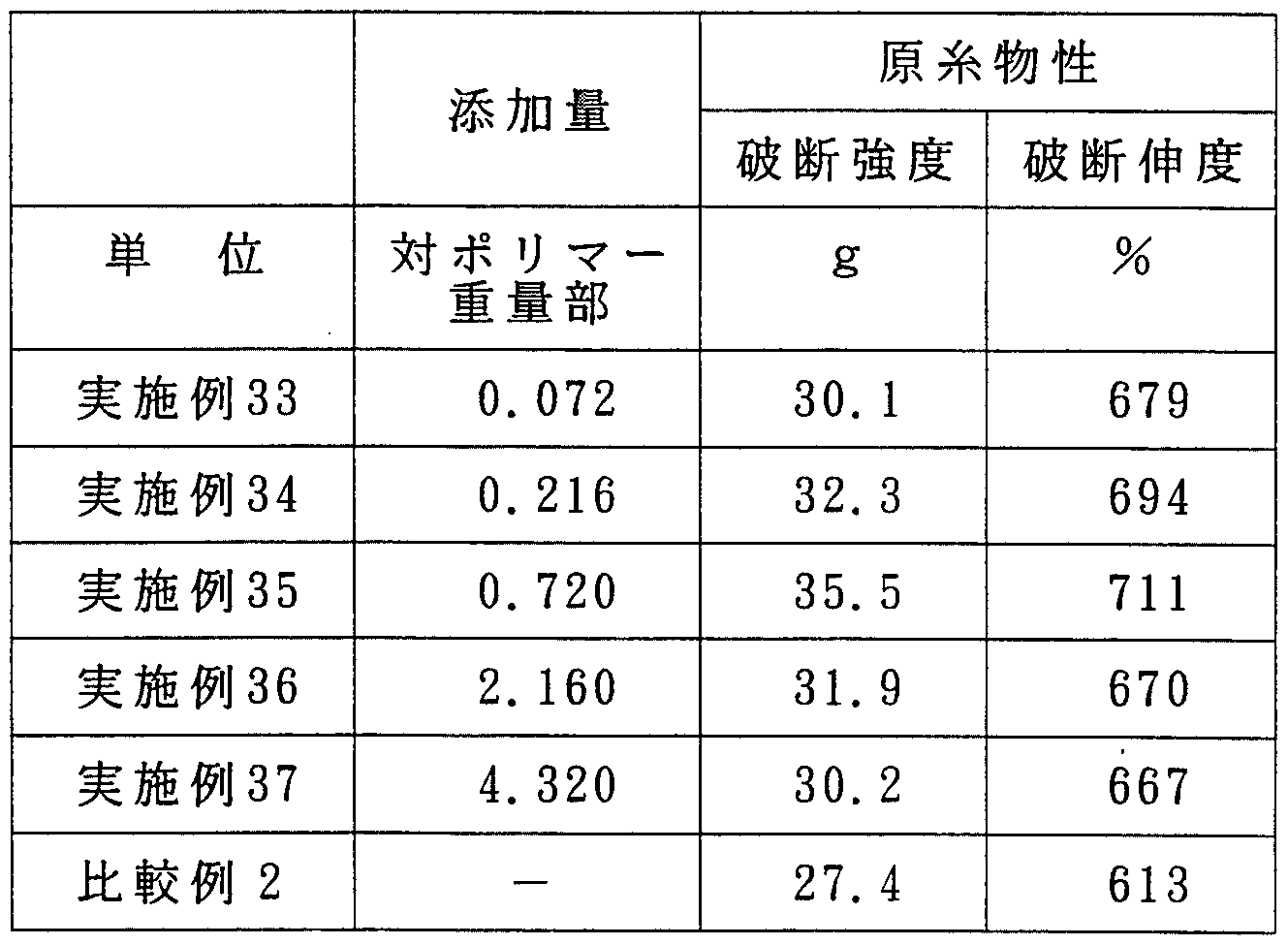
- Example 1 According to the method of Example 1, the above-mentioned polyurethane / rare spinning stock solution was used. Then, 0.072 to 4.320 parts by weight of a compound (25) (1,3,5,7-tetrametyl octyl sulfate triethanolamine salt) is added to 100 parts by weight of the polymer, followed by spinning. A stock solution was prepared.
- a compound (25) (1,3,5,7-tetrametyl octyl sulfate triethanolamine salt
- the spinning stock solution was thermoformed using a dry spinning machine to obtain polyurethane rare elastic fibers having a fineness of 20 denier and 2 filaments.
- Table 3 shows the results of the obtained yarns.
- a polyurethan-rea spinning stock solution was prepared in the same manner as in Example 1 except that no sulfonate or sulfate compound was added. This spinning stock solution was thermoformed using a dry spinning machine to obtain a polyurethane rare elastic fiber having a fineness of 20 deniers and 2 filaments. Table 3 shows the results of the obtained yarns.
- a DMAc solution containing 35 parts by weight of 1,2-propylene diamine (hereinafter abbreviated as PDA) and 3.3 parts by weight of DEA was added to the vigorously stirred intermediate polymer, and the concentration was adjusted. About 33% by weight of a polyurethane / rare spinning stock solution was obtained.
- This spinning stock solution was supplied to a dry spinning machine and spun at a winding speed of 800 m / min to obtain a polyurethane-rare elastic fiber having a fineness of 20 denier Z2 filament.
- the breaking strength of the obtained yarn was 28.1 g, and the breaking elongation was 468%.
- 1,000 parts by weight of PTMG having a number average molecular weight of 1,800 and 220 parts by weight of MDI are reacted while stirring at 65 ° C for 1 hour in a nitrogen gas atmosphere to produce an intermediate polymer having terminal isocyanate. Obtained. Then add dry DMAc to a concentration of 60%.
- a condensate of p-cresol, dicyclopentagen, and isoptylene having a molecular weight of about 2300 was used as 1% by weight based on the polymer solid content, and as an ultraviolet absorber, 2— (2—H Droxy-3, 5- Bis ( ⁇ , ⁇ -dimethylbenzyl) phenyl-12-benzotriazole was added in an amount of 0.5% by weight based on the solid content of the polymer to obtain a spinning dope composition having a concentration of about 38% by weight.
- This spinning stock solution was supplied to a dry spinning machine and spun at a winding speed of 800 mm to obtain a polyurethane rare elastic fiber having a fineness of 20 denier / 2 filaments.
- the breaking strength of the obtained yarn was 32.1 g, and the breaking elongation was 638%.
- a polyurethane urethane elastic fiber having a fineness of 20 denier Z2 filament was obtained in the same manner as in Example 38 except that the lauryl sulfate triethanolamine salt of Example 38 was added.
- the breaking strength of the obtained yarn was 29.8 g, and the breaking elongation was 607%.
- the polyurethane rare elastic fiber of the present invention is an elastic fiber exhibiting a remarkably high breaking strength and high elongation at break, it is a practically useful thin fiber.
- a denier polyurethane rare elastic fiber can be provided.
- the polyurethane-rare elastic fiber of the present invention has a high breaking elongation, it is possible to produce covering yarns and core yarns under a high draft, and a knitted fabric using a polyurethane-rare elastic yarn. However, it has the advantage of speeding up processing into woven fabric.
Landscapes
- Chemical & Material Sciences (AREA)
- Chemical Kinetics & Catalysis (AREA)
- General Chemical & Material Sciences (AREA)
- Engineering & Computer Science (AREA)
- Textile Engineering (AREA)
- Artificial Filaments (AREA)
- Polyurethanes Or Polyureas (AREA)
Description


Claims
Priority Applications (3)
| Application Number | Priority Date | Filing Date | Title |
|---|---|---|---|
| EP96925092A EP0843032A4 (en) | 1995-07-25 | 1996-07-25 | ELASTIC FIBERS MADE OF POLYURETHANE UREA |
| JP9507458A JP2968049B2 (ja) | 1995-07-25 | 1996-07-25 | ポリウレタンウレア弾性繊維 |
| US08/983,477 US5919564A (en) | 1995-07-25 | 1996-07-25 | Elastic polyurethaneurea fiber |
Applications Claiming Priority (2)
| Application Number | Priority Date | Filing Date | Title |
|---|---|---|---|
| JP18883195 | 1995-07-25 | ||
| JP7/188831 | 1995-07-25 |
Publications (1)
| Publication Number | Publication Date |
|---|---|
| WO1997005309A1 true WO1997005309A1 (fr) | 1997-02-13 |
Family
ID=16230607
Family Applications (1)
| Application Number | Title | Priority Date | Filing Date |
|---|---|---|---|
| PCT/JP1996/002098 Ceased WO1997005309A1 (fr) | 1995-07-25 | 1996-07-25 | Fibres elastiques a base de polyurethanne-uree |
Country Status (4)
| Country | Link |
|---|---|
| US (1) | US5919564A (ja) |
| EP (1) | EP0843032A4 (ja) |
| KR (1) | KR100242354B1 (ja) |
| WO (1) | WO1997005309A1 (ja) |
Cited By (4)
| Publication number | Priority date | Publication date | Assignee | Title |
|---|---|---|---|---|
| JP2003504521A (ja) * | 1999-07-02 | 2003-02-04 | コーロン インダストリーズ インク | ポリウレタンウレア弾性繊維およびその製造方法 |
| CN103732815A (zh) * | 2011-05-27 | 2014-04-16 | 东丽奥培隆特士有限公司 | 弹性织物 |
| JP2022069009A (ja) * | 2020-10-23 | 2022-05-11 | 東レ・オペロンテックス株式会社 | ポリウレタンウレア弾性繊維およびその製造方法 |
| JP2022069010A (ja) * | 2020-10-23 | 2022-05-11 | 東レ・オペロンテックス株式会社 | ポリウレタン弾性繊維およびその製造方法 |
Families Citing this family (10)
| Publication number | Priority date | Publication date | Assignee | Title |
|---|---|---|---|---|
| TW507028B (en) * | 1999-02-12 | 2002-10-21 | Asahi Chemical Ind | A moisture-absorbable synthetic fiber with an improved moisture-release property |
| DE19931255A1 (de) * | 1999-07-07 | 2001-01-11 | Bayer Ag | Polyurethanharnstoffasern mit erhöhter Festigkeit |
| KR100569679B1 (ko) * | 1999-11-08 | 2006-04-10 | 주식회사 코오롱 | 폴리우레탄우레아 탄성섬유 및 그의 제조방법 |
| US20060276613A1 (en) * | 2005-05-12 | 2006-12-07 | Iskender Yilgor | Polyurethaneurea segmented copolymers |
| CN101641465B (zh) * | 2006-12-15 | 2013-08-21 | 因维斯塔技术有限公司 | 聚氨酯弹力丝及其制备方法 |
| ES2386316T3 (es) * | 2006-12-15 | 2012-08-17 | Invista Technologies S.À.R.L. | Hilo elástico de poliuretano y procedimiento de producción del mismo |
| DE102008026264A1 (de) * | 2008-06-02 | 2009-12-03 | Emery Oleochemicals Gmbh | Antistatikmittel enthaltend Fettalkoholethersulfat und Polyethylenglycolfettsäureester |
| CN111868128B (zh) * | 2017-12-15 | 2022-11-08 | 莱卡英国有限公司 | 具有工程化片段分子量的聚合物 |
| TWI775508B (zh) * | 2021-06-30 | 2022-08-21 | 三芳化學工業股份有限公司 | 彈性纖維、彈性纖維包紗及其抽絲製造方法 |
| CN119409937B (zh) * | 2025-01-03 | 2025-08-15 | 河北铁科翼辰新材科技有限公司 | 一种高阻尼抗疲劳老化聚氨酯弹性体及其制备方法 |
Citations (3)
| Publication number | Priority date | Publication date | Assignee | Title |
|---|---|---|---|---|
| JPS4910955A (ja) * | 1972-05-31 | 1974-01-30 | ||
| JPS6115166B2 (ja) * | 1982-08-06 | 1986-04-23 | Toyo Boseki | |
| JPH07150417A (ja) * | 1993-09-30 | 1995-06-13 | E I Du Pont De Nemours & Co | 特定のアルカリ金属塩を含んでいるスパンデツクス |
Family Cites Families (5)
| Publication number | Priority date | Publication date | Assignee | Title |
|---|---|---|---|---|
| US3384623A (en) * | 1964-01-11 | 1968-05-21 | Toyo Spinning Co Ltd | Production of polyurethane elastomers |
| JPS4920398A (ja) * | 1972-05-25 | 1974-02-22 | ||
| JPS5116063B2 (ja) * | 1972-05-30 | 1976-05-21 | ||
| JPS6115166A (ja) * | 1984-06-30 | 1986-01-23 | Mita Ind Co Ltd | 現像剤案内機構 |
| JP3228383B2 (ja) * | 1993-11-29 | 2001-11-12 | 東洋紡績株式会社 | 制電性の改善された弾性糸 |
-
1996
- 1996-07-25 EP EP96925092A patent/EP0843032A4/en not_active Withdrawn
- 1996-07-25 US US08/983,477 patent/US5919564A/en not_active Expired - Lifetime
- 1996-07-25 KR KR1019980700564A patent/KR100242354B1/ko not_active Expired - Fee Related
- 1996-07-25 WO PCT/JP1996/002098 patent/WO1997005309A1/ja not_active Ceased
Patent Citations (3)
| Publication number | Priority date | Publication date | Assignee | Title |
|---|---|---|---|---|
| JPS4910955A (ja) * | 1972-05-31 | 1974-01-30 | ||
| JPS6115166B2 (ja) * | 1982-08-06 | 1986-04-23 | Toyo Boseki | |
| JPH07150417A (ja) * | 1993-09-30 | 1995-06-13 | E I Du Pont De Nemours & Co | 特定のアルカリ金属塩を含んでいるスパンデツクス |
Non-Patent Citations (1)
| Title |
|---|
| See also references of EP0843032A4 * |
Cited By (5)
| Publication number | Priority date | Publication date | Assignee | Title |
|---|---|---|---|---|
| JP2003504521A (ja) * | 1999-07-02 | 2003-02-04 | コーロン インダストリーズ インク | ポリウレタンウレア弾性繊維およびその製造方法 |
| CN103732815A (zh) * | 2011-05-27 | 2014-04-16 | 东丽奥培隆特士有限公司 | 弹性织物 |
| CN103732815B (zh) * | 2011-05-27 | 2016-08-24 | 东丽奥培隆特士有限公司 | 弹性织物 |
| JP2022069009A (ja) * | 2020-10-23 | 2022-05-11 | 東レ・オペロンテックス株式会社 | ポリウレタンウレア弾性繊維およびその製造方法 |
| JP2022069010A (ja) * | 2020-10-23 | 2022-05-11 | 東レ・オペロンテックス株式会社 | ポリウレタン弾性繊維およびその製造方法 |
Also Published As
| Publication number | Publication date |
|---|---|
| KR100242354B1 (ko) | 2000-03-02 |
| EP0843032A1 (en) | 1998-05-20 |
| US5919564A (en) | 1999-07-06 |
| KR19990035903A (ko) | 1999-05-25 |
| EP0843032A4 (en) | 1999-08-04 |
Similar Documents
| Publication | Publication Date | Title |
|---|---|---|
| US5919564A (en) | Elastic polyurethaneurea fiber | |
| JP2021507027A (ja) | 設計されたセグメント分子量を有するポリマー | |
| JPH03124813A (ja) | 高弾性、高強度エラスタン繊維およびその製造法 | |
| WO2025241464A1 (zh) | 一种生物基聚氨酯弹性纤维的制备方法 | |
| CN109322008B (zh) | 一种提高氨纶产品性能稳定性的方法 | |
| KR20050050475A (ko) | 내열성과 세트성이 우수한 폴리우레탄우레아 탄성섬유 및그의 제조방법 | |
| CN109338504B (zh) | 一种生物易降解氨纶用高性能聚氨酯及其制备方法 | |
| JP4343367B2 (ja) | 耐熱性に優れたポリウレタンウレア弾性繊維 | |
| JP4343351B2 (ja) | ポリウレタン繊維 | |
| JP2968049B2 (ja) | ポリウレタンウレア弾性繊維 | |
| CN120006407A (zh) | 一种高回弹高强伸氨纶纤维及其制备方法 | |
| KR101167377B1 (ko) | 열세트성이 향상된 폴리우레탄우레아 탄성사의 제조방법 | |
| US3642703A (en) | Method of improving the stability of polyurethane solutions | |
| KR19980029659A (ko) | 개선된 폴리우레탄 섬유용 중합물의 제조방법 | |
| JPWO1997005309A1 (ja) | ポリウレタンウレア弾性繊維 | |
| CN115522275A (zh) | 一种高回弹氨纶纤维及其制备方法 | |
| US3553173A (en) | Elastomeric filaments and fibers with an improved affinity for dyes | |
| JP4106828B2 (ja) | ポリウレタンウレア系樹脂の製造方法、及び合成皮革・弾性糸用ポリウレタンウレア系樹脂 | |
| KR100569679B1 (ko) | 폴리우레탄우레아 탄성섬유 및 그의 제조방법 | |
| JP3637503B2 (ja) | ポリウレタン系繊維、衣料および衣料用副資材 | |
| KR100514458B1 (ko) | 고내열성 폴리우레탄우레아 탄성섬유 및 그의 제조방법 | |
| JP4106827B2 (ja) | ポリウレタンウレア系樹脂の製造方法、及び合成皮革・弾性糸用ポリウレタンウレア系樹脂 | |
| JPH1077323A (ja) | ポリウレタンウレア重合体溶液及び該溶液から弾性成形体の製造方法。 | |
| US12325771B1 (en) | Preparation method for biobased polyurethane elastic fibers | |
| CN121161451A (zh) | 一种高应力高伸长氨纶纤维及其制备方法 |
Legal Events
| Date | Code | Title | Description |
|---|---|---|---|
| AK | Designated states |
Kind code of ref document: A1 Designated state(s): CA CN JP KR SG US |
|
| AL | Designated countries for regional patents |
Kind code of ref document: A1 Designated state(s): AT BE CH DE DK ES FI FR GB GR IE IT LU MC NL PT SE |
|
| DFPE | Request for preliminary examination filed prior to expiration of 19th month from priority date (pct application filed before 20040101) | ||
| 121 | Ep: the epo has been informed by wipo that ep was designated in this application | ||
| WWE | Wipo information: entry into national phase |
Ref document number: 08983477 Country of ref document: US |
|
| WWE | Wipo information: entry into national phase |
Ref document number: 1996925092 Country of ref document: EP |
|
| WWE | Wipo information: entry into national phase |
Ref document number: 1019980700564 Country of ref document: KR |
|
| WWP | Wipo information: published in national office |
Ref document number: 1996925092 Country of ref document: EP |
|
| NENP | Non-entry into the national phase |
Ref country code: CA |
|
| WWP | Wipo information: published in national office |
Ref document number: 1019980700564 Country of ref document: KR |
|
| WWG | Wipo information: grant in national office |
Ref document number: 1019980700564 Country of ref document: KR |
|
| WWW | Wipo information: withdrawn in national office |
Ref document number: 1996925092 Country of ref document: EP |