WO1997012890A1 - New cephem compounds - Google Patents
New cephem compounds Download PDFInfo
- Publication number
- WO1997012890A1 WO1997012890A1 PCT/JP1996/002797 JP9602797W WO9712890A1 WO 1997012890 A1 WO1997012890 A1 WO 1997012890A1 JP 9602797 W JP9602797 W JP 9602797W WO 9712890 A1 WO9712890 A1 WO 9712890A1
- Authority
- WO
- WIPO (PCT)
- Prior art keywords
- compound
- salt
- alkenyl
- amino
- ester
- Prior art date
- Legal status (The legal status is an assumption and is not a legal conclusion. Google has not performed a legal analysis and makes no representation as to the accuracy of the status listed.)
- Ceased
Links
- 0 **=C(*C(C1SCC(*)=C(*)N11)C1=O)C1=C(*)S=C(*)*1 Chemical compound **=C(*C(C1SCC(*)=C(*)N11)C1=O)C1=C(*)S=C(*)*1 0.000 description 2
Classifications
-
- C—CHEMISTRY; METALLURGY
- C07—ORGANIC CHEMISTRY
- C07D—HETEROCYCLIC COMPOUNDS
- C07D501/00—Heterocyclic compounds containing 5-thia-1-azabicyclo [4.2.0] octane ring systems, i.e. compounds containing a ring system of the formula:, e.g. cephalosporins; Such ring systems being further condensed, e.g. 2,3-condensed with an oxygen-, nitrogen- or sulfur-containing hetero ring
-
- A—HUMAN NECESSITIES
- A61—MEDICAL OR VETERINARY SCIENCE; HYGIENE
- A61P—SPECIFIC THERAPEUTIC ACTIVITY OF CHEMICAL COMPOUNDS OR MEDICINAL PREPARATIONS
- A61P31/00—Antiinfectives, i.e. antibiotics, antiseptics, chemotherapeutics
-
- A—HUMAN NECESSITIES
- A61—MEDICAL OR VETERINARY SCIENCE; HYGIENE
- A61P—SPECIFIC THERAPEUTIC ACTIVITY OF CHEMICAL COMPOUNDS OR MEDICINAL PREPARATIONS
- A61P31/00—Antiinfectives, i.e. antibiotics, antiseptics, chemotherapeutics
- A61P31/04—Antibacterial agents
-
- Y—GENERAL TAGGING OF NEW TECHNOLOGICAL DEVELOPMENTS; GENERAL TAGGING OF CROSS-SECTIONAL TECHNOLOGIES SPANNING OVER SEVERAL SECTIONS OF THE IPC; TECHNICAL SUBJECTS COVERED BY FORMER USPC CROSS-REFERENCE ART COLLECTIONS [XRACs] AND DIGESTS
- Y02—TECHNOLOGIES OR APPLICATIONS FOR MITIGATION OR ADAPTATION AGAINST CLIMATE CHANGE
- Y02P—CLIMATE CHANGE MITIGATION TECHNOLOGIES IN THE PRODUCTION OR PROCESSING OF GOODS
- Y02P20/00—Technologies relating to chemical industry
- Y02P20/50—Improvements relating to the production of bulk chemicals
- Y02P20/55—Design of synthesis routes, e.g. reducing the use of auxiliary or protecting groups
Definitions
- the present invention relates to new cephem compounds and pharmaceutically acceptable salts thereof.
- one object of the present invention is to provide the cephem compounds and pharmaceutically acceptable salts thereof, which show highly activity against a number of pathogenic microorganisms.
- Another object of the present invention is to provide processes for the preparation of the cephem compounds and salts thereof.
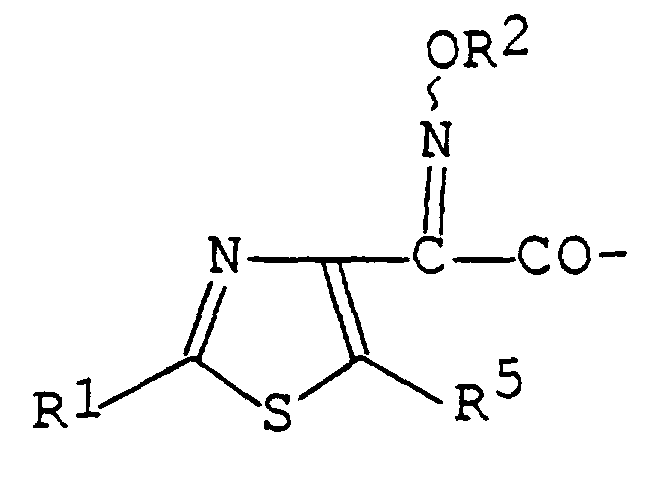
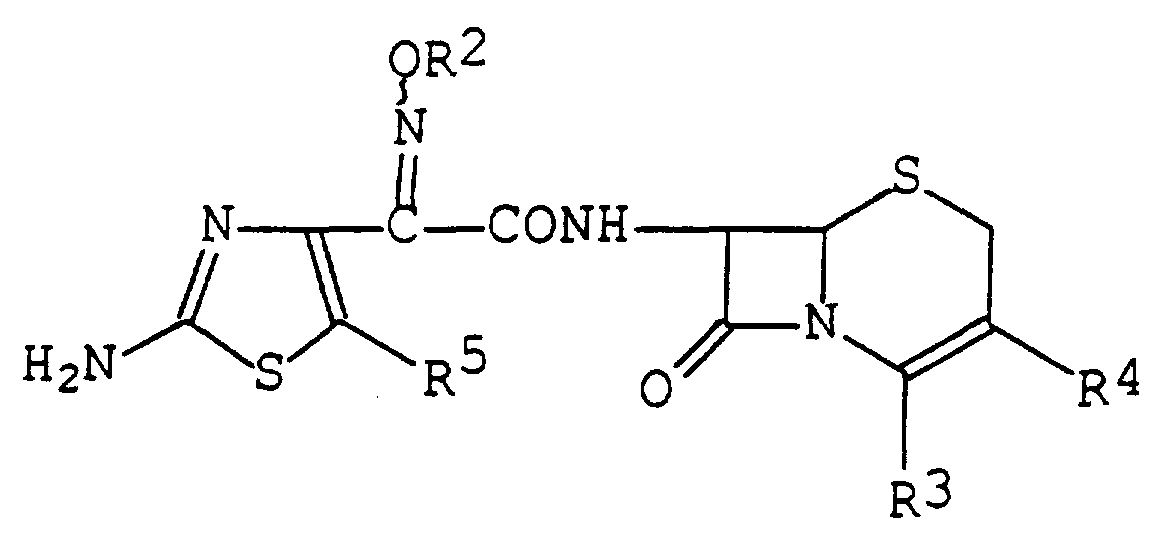
- R ⁇ is amino or protected amino
- R ⁇ is hydrogen or hydroxy protective group, R ⁇ is carboxy or protected carboxy,
- R ⁇ is hydrogen, lower alkenyl, acyloxy(lower)alkenyl, optionally substituted heterocyclic(lower) alkenyl, optionally substituted heterocyclic (lower)alkenylthio, optionally substituted heterocyclic(lower)alkylthio or optionally substituted heterocyclic-thio(lower)alkylthio ;
- R5 is halogen or lower alkyl
- the object compound (I) of the present invention can be prepared by the following processes.
- R is hydroxy protective group
- R ⁇ is protected carboxy
- R is heterocyclic(lower)alkylthio which is substituted by an imino protective group and R is heterocyclic(lower)alkylthio. - ,_ . _. « _ « PCT/JP96/02797 7/12890
- syn isomer(2) means one geometrical isomer having the partial structure represented by the following formula :
- anti isomer(E) means the other geometrical isomer having the partial structure represented by the following formula :
- R 1 , R ⁇ and R ⁇ are each as defined above.
- the compound (I) and the other compounds of this invention may include one or more stereoisomers due to asymmetric carbon atom(s), and all of such isomers andmixture thereof are included within the scope of this invention.
- lower is intended to mean 1 to 6 carbon atom(s) unless otherwise indicated.
- Suitable “lower alkyl” may include straight or branched one such as methyl, ethyl, propyl, isopropyl, butyl, t-butyl, pentyl, hexyl, and the like, in which more preferred one may be C1.-C4 alkyl and the most preferred one may be methyl, ethyl or propyl.
- Suitable "lower alkenyl” maybe straight or branchedones such as vinyl, allyl, 2-butenyl, 2-methyl-3-butenyl, 3- pentenyl, 1-hexenyl, or the like, in which the preferred one may be (C 2 ⁇ C 4 )alkenyl.
- Suitable "aryl” mayincludephenyl, naphthyl andthe like.
- Suitable “protected amino” may include an acylamino or an amino group substitutedby a conventional protecting group suchas ar(lower)alkyl whichmayhave suitable substituent(s) (e.g. benzyl, trityl, etc.) or the like.
- suitable "acyl moiety" in the term “acylamino” and “acyloxy” may include optionally substituted carbamoyl, aliphatic acyl group and acyl group containing an aromatic or heterocyclic ring.
- suitable examples of the said acyl maybe lower alkanoyl (e.g.
- yl acetyl, propionyl, butyryl, isobutyryl, valeryl, isovaleryl, oxalyl, succinyl, pivaloyl, etc.
- lower alkoxycarbonyl e.g. methoxycarbonyl, ethoxycarbonyl, propoxycarbonyl, isopropoxycarbonyl, butoxycarbonyl, tertiarybutoxy-carbonyl, pentyloxycarbonyl, hexyloxycarb ⁇ nyl, etc.
- lower alkanesulfonyl e.g.
- N- (lower) alkylcarbamoyl e.g. N-methylcarbamoyl, N- ethylcarba oyl, N-isopropylcarbamoyl, N-butylcarbamoyl, etc.
- N,N-di(lower) alkylcarbamoyl e.g.
- acyl moiety as stated above may have suitable substituent (s) such as halogen (e.g. chlorine, bromine, iodine or fluorine), lower alkyl as defined above, or the like.
- suitable substituent e.g. chlorine, bromine, iodine or fluorine
- Suitable "protected carboxy” may include esterified carboxy and the like.
- suitable example of said ester may be the ones such as lower alkyl ester (e.g., methyl ester, ethyl ester, propyl ester, isopropyl ester, butyl ester, isobutyl ester, t-butyl ester, pentyl ester, t-pentyl ester, hexyl ester, etc.); lower alkenyl ester (e.g., vinyl ester, allyl ester, etc.); lower alkynyl ester (e.g., ethynyl ester, propynyl ester, etc.); lower alkoxyalkyl ester (e.g., methoxymethyl ester, ethoxymethyl ester, isopropoxymethyl ester, 1-methoxyethyl ester, 1-ethoxyethyl ester, etc.); lower alkylthio
- lower alkanoyloxy(lower) lkyl ester e.g., acetoxymethyl ester, propionyloxymethyl ester, butyryloxymethyl ester, valeryloxymethyl ester, pivaloyloxy ethyl ester, hexanoyloxymethyl ester, 1-acetoxyethyl ester, 2- acetoxyethyl ester, 1-propionyloxyethyl ester, etc.
- cyclo(lower) alkylcarbonyloxy(lower) alkyl ester e.g., 1- (cyclohexylcarbonyloxy)ethyl ester, etc.
- lower alkoxycarbonyloxy(lower) alkyl ester e.g., methoxycarbonyloxymethyl ester, ethoxycarbonyloxymethyl ester, propoxycarbonyloxymethyl ester, l-(or 2-)- [
- ar(lower)alkyl ester for example, phenyl (lower)alkyl ester which may have one or more suitable substituent (s) (e.g., benzyl ester, 4-methoxybenzyl ester, 4-nitrobenzyl ester, phenethyl ester, trityl ester, benzhydryl ester, bis (methoxyphenyl)methyl ester, 3,4- di ethoxybenzyl ester, 4-hydroxy-3,5-di-t-butylbenzyl ester, etc.); aryl ester which may have one or more suitable substituent (s) such as substituted or unsubstituted phenyl ester (e.g., phenyl ester, tolyl ester, t-butylphenyl ester, xylyl ester, mesityl ester, cumenyl ester, 4-
- suitable substituent (s) e.g., benzyl ester, 4-
- Suitable "hydroxy protective group” may include an acyl group which is examplified in definition of "acyl moiety", cyclo(lower)alkenyl (preferable example is cyclo(C3- 8)alkenyl such as cyclopentenyl or cyclohexenyl, etc.) ar(lower) alkyl which may have one or more suitable substituent(s) (e.g., benzyl, 4-methoxybenzyl, trityl, etc.), trisubstituted silyl (e.g., trimethylsilyl, t- butyldimethylsilyl, etc.), tetrahydropyranyl and the like.
- suitable substituent(s) e.g., benzyl, 4-methoxybenzyl, trityl, etc.
- trisubstituted silyl e.g., trimethylsilyl, t- butyldimethylsilyl, etc.
- Suitable “heterocyclic group” in the "optionally substituted heterocyclic (lower) alkenyl”, “optionally substituted heterocyclic(lower) alkenylthio", “optionally substituted heterocyclic (lower) alkylthio” and “optionally substituted heterocyclic-thio (lower) alkylthio” means saturated or unsaturated, monocyclic or polycyclic heterocyclic group containing at least one hetero-atom such as an oxygen, sulfur, nitrogen atom and the like.
- heterocyclic group may be heterocyclic group such as unsaturated 3 to 8-membered heteromonocyclic group containing 1 to 4 nitrogen atom(s), for example, pyrrolyl, pyrrolinyl, imidazolyl, pyrazolyl, pyridyl, andits N-oxide, pyrimidyl, pyrazinyl, pyridazinyl, triazolyl (e.g., 4H-1,2, 4-triazolyl, 1H-1,2,3-triazolyl, 2H-1, 2,3triazolyl, etc.), tetrazolyl (e.g., lH-tetrazolyl, 2H-tetrazolyl, etc.), dihydrotriazinyl (e.g., 4, 5-dihydro-l,2, 4-triazinyl, 2,5- dihydro-1,2,4-triazinyl, etc.), etc.; saturated 3 to 8- membered
- oxolanyl etrahydropyranyl
- dioxolanyl e.g. tetrahydro-2H-pyran-2-yl, etc.
- unsaturated condensed heterocyclic group containing 1 to 2 oxygen atom(s) for example, isobenzofuranyl, chrome
- heterocyclic group in the "optionally substituted heterocyclic(lower) alkenyl", “optionally substituted heterocyclic(lower) alkenylthio", “optionally substituted heterocyclic(lower) lkylthio” and “optionally substituted heterocyclic-thio- (lower) lkylthio” may be unsaturated 3 to 8-memberedheteromonocyclic group containing 1 to 3 nitrogen atom(s), for example, pyrazolyl, pyridyl and triazolyl (e.g., 4H-1,2, 4-triazolyl, 1H-1,2, 3-triazolyl 2H-1,2,3-triazolyl, etc.).
- heterocyclic group mayhave one ormore (preferably 1 to 4) suitable substituent(s) such as lower alkyl, hydroxy, cyano, imino protective group or the like, in which the preferred one may be imino protective group.
- Suitable “imino protective group” may include a conventional amino protective group such as ar(lower) alkyl whichmay have suitable substituent (s) as exemplifiedbefore, an acyl group which is exemplified in the definition of "acylamino” as exemplified and the like.
- Suitable "halogen” may include fluoro, chloro, bromo and iodo.
- Suitable pharmaceutically acceptable salts of the object compound (I) are conventional non-toxic salts and include a metal salt such as an alkali metal salt (e.g. sodium salt, potassium salt, etc.) and an alkaline earth metal salt (e.g. calcium salt, magnesium salt, etc.), an ammonium salt, an organic base salt (e.g. trimethylamine salt, triethylamine salt, pyridine salt, picoline salt, dicyclohexylamine salt, N,N'-dibenzylethylenediamine salt, etc.), an organic acid salt (e.g.
- a metal salt such as an alkali metal salt (e.g. sodium salt, potassium salt, etc.) and an alkaline earth metal salt (e.g. calcium salt, magnesium salt, etc.), an ammonium salt, an organic base salt (e.g. trimethylamine salt, triethylamine salt, pyridine salt, picoline salt, dicyclohexylamine salt, N,N'-dibenzy
- formate acetate trifluoroacetate, maleate, tartrate, methanesulfonate, benzenesulfonate, toluenesulfonate, etc.
- an inorganic acid salt e.g. hydrochloride, hydrobromide, sulfate, phosphate, etc.
- a salt with an amino acid e.g. arginine salt, aspartic acid salt, glutamic acid salt, etc.
- the compound (I) or a salt thereof can be prepared by reacting the compound (II) or its reactive derivative at the amino group, or a salt thereof with the compound (III) or its reactive derivative at the carboxy group, or a salt thereof.
- Suitable reactive derivative at the amino group of the compound (II) may include Schiff's base type imino or its tautomeric enamine type isomer formed by the reaction of the compound (II) with a carbonyl compound such as aldehyde, ketone or the like; a silyl derivative formed by the reaction of the compound (II) with a silyl compound such as bis (trimethylsilyl) acetamide, mono(trimethylsilyl) acetamide [e.g.
- N- (trimethylsilyl) - acetamide] bis (trimethylsilyl)ureaor the like; aderivative formed by the reaction of the compound (II) with phosphorus trichloride or phosgene and the like.
- Suitable reactive derivative at the carboxy group of the compound (III) may include an acid halide, an acid anhydride, an activated amide, an activated ester, and the like.
- Suitable examples of the reactive derivative may be an acid chloride; an acid azide; a mixed acid anhydride with an acid such as substituted phosphoric acid (e.g. dialkylphosphoric acid, phenylphosphoric acid, diphenylphosphoric acid, dibenzylphosphoric acid, halogenatedphosphoric acid, etc.], dialkylphosphorous acid, sulfurous acid, thiosulfuric acid, sulfuric acid, sulfonic acid [e.g. methanesulfonic acid, etc.), aliphatic carboxylic acid (e.g.
- These reactive derivatives can optionally be selected from the above according to the kind of the compound (III) to be used.
- the reaction is usually carried out in a conventional solvent suchas acetonitrile, chloroform, methylene chloride, ethylene chloride, tetrahydrofuran, ethyl acetate, N,N- dimethylformamide, pyridine, water, alcohol (e.g. methanol, ethanol, etc.), acetone, dioxane, or anyother organic solvent which does not adversely influence the reaction.
- a conventional solvent suchas acetonitrile, chloroform, methylene chloride, ethylene chloride, tetrahydrofuran, ethyl acetate, N,N-
- the reaction when the compound (III) is used in a free acid form or its salt form, the reaction is preferably carried out in the presence of a conventional condensing agent such as N,N'-dicyclohexylcarbodiimide; N-cyclohexyl-N'- morpholinoethylcarbodiimide; N-cyclohexyl-N'- (4- diethylaminocyclohexyl) carbodiimide; N,N'- diethylcarbodiimide; N,N'-diisopropylcarbodiimide; N- ethyl-N'- (3-dimethylaminopropyl) carbodiimide; N,N'- carbonyl-bis (2-methylimidazole) ; pentamethylene-ketene-N- cyclohexylimine; diphenylketene-N-cyclohexylimine; ethoxyacetylene; 1-alkoxy-
- the reaction may also be carried out in the presence of an inorganic or organic base such as an alkali metal bicarbonate, tri(lower)alkylamine (e.g. triethylamine, diisopropylethylamine, etc.), pyridine, N- (lower) alkylmorpholine, N,N-di (lower) alkylbenzylamine, or the like.
- an inorganic or organic base such as an alkali metal bicarbonate, tri(lower)alkylamine (e.g. triethylamine, diisopropylethylamine, etc.), pyridine, N- (lower) alkylmorpholine, N,N-di (lower) alkylbenzylamine, or the like.
- the reaction temperature is not critical, and the reaction is usually carried out under cooling to warming.
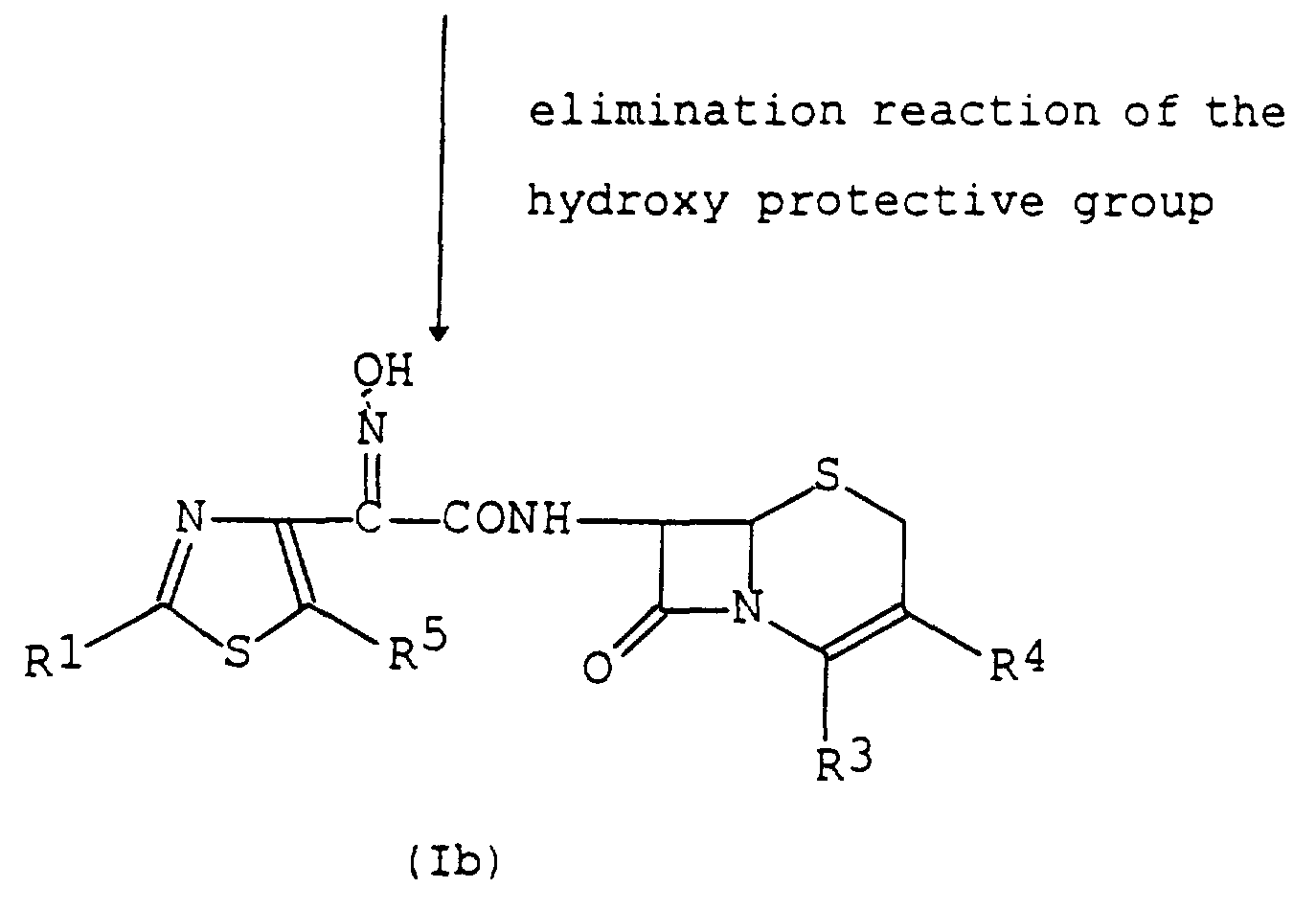
- the compound (lb) or a salt thereof can be prepared by subjecting the compound (la) or a salt thereof to an elimination reaction of the hydroxy protective group. Suitable method of this elimination reaction may include conventional one such as hydrolysis, reduction and the like.
- the hydrolysis is preferably carried out in the presence of a base or an acid including Lewis acid.
- Suitable base may include an inorganicbase andanorganic base such as an metal hydroxide (e.g. sodium hydroxide, magnesium hydroxide, etc.), metal alkoxide (e.g. sodium methoxide, potassium methoxide, etc.), metal carbonate or metal bicarbonate, trialkylamine (e.g. trimethylamine, triethylamine, etc.), picoline, 1, 5-diazabicyclo[4.3.0]- non-5-ene, 1, 4-diazabicyclo[2.2.2]octane, 1,8- diazabicyclo[5.4.0]undec-7-ene, or the like.
- metal hydroxide e.g. sodium hydroxide, magnesium hydroxide, etc.
- metal alkoxide e.g. sodium methoxide, potassium methoxide, etc.
- metal carbonate or metal bicarbonate e.g. trimethylamine, triethylamine, etc.
- trialkylamine e.g. trimethylamine
- Suitable acid may include an organic acid (e.g. formic acid, acetic acid, propionic acid, trichloroacetic acid, trifluoroacetic acid, etc.) and an inorganic acid (e.g. hydrochloric acid, hydrobromic acid, sulfuric acid, hydrogen chloride, hydrogen bromide, ammonium chloride, etc.).
- organic acid e.g. formic acid, acetic acid, propionic acid, trichloroacetic acid, trifluoroacetic acid, etc.
- inorganic acid e.g. hydrochloric acid, hydrobromic acid, sulfuric acid, hydrogen chloride, hydrogen bromide, ammonium chloride, etc.
- Lewis acid such as trihaloacetic acid (e.g. trichloroacetic acid, trifluoroacetic acid, etc.) or the like is preferably carried out in the presence of cation trapping agents (e.g. anisole, phenol, etc.).
- cation trapping agents
- the reaction is usually carried out in a solvent such as water, an alcohol (e.g. methanol, ethanol, etc.), methylene chloride, tetrahydrofuran, a mixture thereof or any other solvent which does not adversely influence to the reaction.
- a solvent such as water, an alcohol (e.g. methanol, ethanol, etc.), methylene chloride, tetrahydrofuran, a mixture thereof or any other solvent which does not adversely influence to the reaction.
- a liquid base or acid can be also used as the solvent.
- the reaction temperature is not critical and the reaction is usually carried out under cooling to warming.
- Reduction is carried out in a conventional manner, including chemical reduction and catalytic reduction.
- Suitable reducing agents to be used in chemical reduction are a combination of a metal (e.g. tin, zinc, iron, etc.) or metallic compound (e.g. chromium chloride, chromium acetate, etc.) and an organic or inorganic acid (e.g. formic acid, acetic acid, propionic acid, trifluoroacetic acid, p- toluenesulfonic acid, hydrochloric acid, hydrobromic acid, etc. ) a combination of a metal (e.g. tin, zinc, iron, etc.) or metallic compound (e.g. chromium chloride, chromium acetate, etc.) and an organic or inorganic acid (e.g. formic acid, acetic acid, propionic acid, trifluoroacetic acid, p- toluenesulfonic acid, hydrochloric acid, hydrobromic acid, etc. ) .
- a metal e.g. tin,
- Suitable catalysts to be used in catalytic reduction are conventional ones such as platinum catalysts (e.g. platinum plate, spongy platinum, platinum black, colloidal platinum, platinum oxide, platinum wire, etc.), palladium catalysts
- nickel catalysts e.g. reduced nickel, nickel oxide, Raney nickel, etc.
- cobalt catalysts e.g. reduced cobalt, Raney cobalt, etc.
- iron catalysts e.g. reduced iron, Raney iron, etc.
- copper catalysts e.g. reduced copper, Raney copper, Ullman copper, etc.
- the reduction is usually carried out in a conventional solvent which does not adversely influence the reaction such as water, methanol, ethanol, propanol, dioxane, tetrahydrofuran, N,N-dimethylformamide, or a mixture thereof.
- a conventional solvent which does not adversely influence the reaction
- the above-mentioned acids to be used in chemical reduction are in liquid, they can also be used as a solvent.
- the reactiontemperature of this reduction is not critical and the reaction is usually carried out under cooling to warming.
- the present invention includes, within the scope of the invention, the case that theprotectedamino group inR ⁇ and/or the protected carboxy group in R ⁇ and/or the imino protective group in are/is transformed into an amino group and/or a carboxy group and/or a hydrogen during this reaction respectively.
- the compound (Id) or a salt thereof can be prepared by subjecting the compound (Ic) or a salt thereof to an elimination reaction of the carboxy protective group.
- This reaction can be carried out in a similar manner to that of the aforementioned Process (2), and therefore the reagents tobeusedand the reactionconditions (e.g., solvent, reaction temperature, etc.) can be referred to those of the Process (2) .
- the reactionconditions e.g., solvent, reaction temperature, etc.
- the present invention includes, within the scope of the invention, the case that theprotectedamino group inR 1 and/or the hydroxyprotective group in R2 and/or the imino protective group in R 4 are/is transformed into an amino group and/or a hydrogen and/or a hydrogen during this reaction respectively.
- the compound (If) or a salt thereof can be prepared by subjecting the compound (Ie) or a salt thereof to an elimination reaction of the carboxy protective group.
- This reaction can be carried out in a similar manner to that of the aforementioned Process (2), and therefore the reagents tobe usedandthe reactionconditions (e.g., solvent, reaction temperature, etc.) can be referred to those of the Process (2) .
- the reagents tobe usedandthe reactionconditions e.g., solvent, reaction temperature, etc.
- the present invention includes, within the scope of the invention, the case that the hydroxy protective group in R
- ⁇ and/or the protected carboxy group in R 3 and/or the imino protective group in R4 are/is transformed into a hydrogen and/or an carboxy group and/or a hydrogen during this reaction respectively.
- the compound (Ih) or a salt thereof can be prepared by subjecting the compound (Ig) or a salt thereof to an elimination reaction of the carboxy protective group.
- This reaction can be carried out in a similar manner to that of the aforementioned Process (2) , and therefore the reagents tobe usedandthe reactionconditions (e.g., solvent, reaction temperature, etc.) can be referred to those of the reagents tobe usedandthe reactionconditions (e.g., solvent, reaction temperature, etc.) can be referred to those of the reagents tobe usedandthe reactionconditions (e.g., solvent, reaction temperature, etc.) can be referred to those of the
- the present invention includes, within the scope of the invention, the case that the protectedamino group in R 1 and/or the hydroxy protective group in R ⁇ and/or the protected carboxy group in R 3 are/is transformed into an amino group and/or a hydrogen and/or a hydrogen during this reaction respectively.
- Suitable salts of the object and starting compounds and their reactive derivatives in Processes (1) - (5) can be referred to the ones as exemplified for the compound (I) .
- the object compound (I) and pharmaceutically acceptable salts thereof are novel and exhibit high antimicrobial activity, inhibiting the growth of a wide variety of pathogenic microorganisms including Gram-positive and Gram-negative microorganisms and are useful as antimicrobial agents.
- Test method In vitro antibacterial activity were determined by the two-fold agar-plate dilution method as described below.
- Test compound was suspended in 0.5% methyl cellurose solution. The rats were atarvedovernightbefore dosingwith20mg /kg.
- Urine samples were collected at 0 to 6 and 6 to 24 hours after oral administration .
- Bile samples were collected at same interval as that of urine samples after a polyethylene cannula was inserted into the bile duct. Plasma samples were obtained by heart puncture at specified times after dosing. Concentrations of test compounds were measured by the disc-plate diffusion method using E. coli ATCC 39188 as test organism and nutrient agar (Difco) as the test medium.
- the diluents for standard curves were prepared with plasma from rat for determining the plasma levels, with 1/15 M phosphate buffer (pH7.0) for determining the urinary and biliary levels. The plate were incubated at 37 'C for 18 hours and the zone of inhibition were measured and the recovery rate was calculated by comparing with the standard.
- the object compound (I) and pharmaceutically acceptable salts thereof of the present invention are used in a form of conventional pharmaceutical preparation which contains said compound as an active ingredient, in admixture with pharmaceutically acceptable carriers such as an organic or inorganic solid or liquid excipient which is suitable for oral, parenteral and external administration.
- pharmaceutically acceptable carriers such as an organic or inorganic solid or liquid excipient which is suitable for oral, parenteral and external administration.
- the pharmaceutical preparations maybe in solid form such as tablet, granule, powder, capsule, or liquid form such as solution, suspension, syrup, emulsion, lemonade and the like.
- auxiliary substances, stabilizing agents, wetting agents and other commonly used additives such as lactose, citric acid, tartaric acid, stearic acid, magnesium stearate, terra alba, sucrose, cornstarch, talc, gelatin, agar, pectin, peanutoil, olive oil, cacao butter, ethylene glycol, and the like.
- the dosage of the compound (I) may vary and depend upon the age, conditions of the patient, a kind of diseases, a kind of the compound (I) to be applied, etc. In general, amounts between 1 mg and about 4,000 mg or even more per day may be administered to a patient.
- An average single dose of about lOmg, 50 mg, 100 mg, 250 mg, 500 mg, 1000 mg of the object compound (I) of the present invention may be used in treating diseases infected by pathogenic microorganisms.
- reaction mixture was poured into a mixture of 5% aqueous sodium thiosulfate solution (25 ml) and ethyl acetate (50 ml) under ice-cooling.
- the mixture was adjusted to pH 3.0 with 30% aqueous potassium carbonate solution under ice-cooling, stirred for 1 hour at the same temperature, and the resultingprecipitate was collectedby filtration to give 2-(5-chloro-2-formylaminothiazol-4-yl)-2-(Z)- (acetoxyimino) -acetic acid (4.02 g) .
- isopropylidene malonate (51.3 g) was dissolved in a solution of pyridine (69.7 ml) in dichloromethane (160ml) . To the solution was added dropwise above obtained combined solution at 5°C to 10°C and themixture was stirred for 3 hours at the same temperature. The solution was poured into a cooled 3N hydrochloric acid (200 ml) . The separated organic phase was washed with brine
- trimethylsilylacetamide 39.4 g
- trimethylchlorosilane (0.76 ml) were added successively to a suspension of 7 ⁇ -amino-3-[ (pyrazol-4- yl)methylthio]-3-cephem-4-carboxylic acid (9.4 g) in dichloromethane (100 ml) at0°C. The mixture was refluxed for
- Phosphorus oxychloride (0.42 g) was added to an ice- cooled solution of ethyl acetate (2 ml) and N,N-dimethyl- formamide (0.21 ml), and then stirred for 30 minutes at 5°C.
- Ethyl acetate (5.0 ml) and 2-[5-methyl-2- tritylaminothiazol-4-yl]-2-(Z) - (trityloxyimino) acetic acid (1.7 g) was added thereto at 5°C, the reaction mixture was stirred for 30 minutes at the same temperature.
- Example 9 The following compounds were obtained according to a similar manner to that of Example 4.
Landscapes
- Chemical & Material Sciences (AREA)
- Organic Chemistry (AREA)
- Health & Medical Sciences (AREA)
- Chemical Kinetics & Catalysis (AREA)
- Life Sciences & Earth Sciences (AREA)
- General Chemical & Material Sciences (AREA)
- Medicinal Chemistry (AREA)
- Nuclear Medicine, Radiotherapy & Molecular Imaging (AREA)
- Communicable Diseases (AREA)
- Pharmacology & Pharmacy (AREA)
- Oncology (AREA)
- Animal Behavior & Ethology (AREA)
- General Health & Medical Sciences (AREA)
- Public Health (AREA)
- Veterinary Medicine (AREA)
- Pharmaceuticals Containing Other Organic And Inorganic Compounds (AREA)
- Cephalosporin Compounds (AREA)
Abstract
Description






Claims




Priority Applications (7)
| Application Number | Priority Date | Filing Date | Title |
|---|---|---|---|
| AT96932012T ATE202108T1 (en) | 1995-09-29 | 1996-09-27 | CEPHEMEM COMPOUNDS |
| AU70962/96A AU7096296A (en) | 1995-09-29 | 1996-09-27 | New cephem compounds |
| EP96932012A EP0854875B1 (en) | 1995-09-29 | 1996-09-27 | New cephem compounds |
| US09/043,578 US5958914A (en) | 1995-09-29 | 1996-09-27 | Cephem compounds |
| DE69613385T DE69613385T2 (en) | 1995-09-29 | 1996-09-27 | CEPHEM CONNECTIONS |
| JP9514142A JPH11512737A (en) | 1995-09-29 | 1996-09-27 | New cephem compounds |
| US09/356,684 US6159961A (en) | 1995-09-29 | 1999-07-19 | Cephem compounds |
Applications Claiming Priority (2)
| Application Number | Priority Date | Filing Date | Title |
|---|---|---|---|
| GB9519883.4 | 1995-09-29 | ||
| GBGB9519883.4A GB9519883D0 (en) | 1995-09-29 | 1995-09-29 | New cephem compounds |
Related Child Applications (1)
| Application Number | Title | Priority Date | Filing Date |
|---|---|---|---|
| US09/043,578 Continuation US5958914A (en) | 1995-09-29 | 1996-09-27 | Cephem compounds |
Publications (1)
| Publication Number | Publication Date |
|---|---|
| WO1997012890A1 true WO1997012890A1 (en) | 1997-04-10 |
Family
ID=10781477
Family Applications (1)
| Application Number | Title | Priority Date | Filing Date |
|---|---|---|---|
| PCT/JP1996/002797 Ceased WO1997012890A1 (en) | 1995-09-29 | 1996-09-27 | New cephem compounds |
Country Status (9)
| Country | Link |
|---|---|
| US (2) | US5958914A (en) |
| EP (1) | EP0854875B1 (en) |
| JP (1) | JPH11512737A (en) |
| AT (1) | ATE202108T1 (en) |
| AU (1) | AU7096296A (en) |
| DE (1) | DE69613385T2 (en) |
| ES (1) | ES2157461T3 (en) |
| GB (1) | GB9519883D0 (en) |
| WO (1) | WO1997012890A1 (en) |
Cited By (4)
| Publication number | Priority date | Publication date | Assignee | Title |
|---|---|---|---|---|
| WO1999019330A1 (en) * | 1997-10-10 | 1999-04-22 | Fujisawa Pharmaceutical Co., Ltd. | Novel cephem compounds |
| WO2001004127A1 (en) * | 1999-07-07 | 2001-01-18 | F. Hoffmann-La Roche Ag | Vinylpyrrolidinone derivatives with substituted thiazole ring |
| US6255480B1 (en) | 1997-10-30 | 2001-07-03 | Ortho-Mcneil Pharmaceutical, Inc. | Aminothiazole derivatives useful in the preparation of β-lactam antibiotics |
| KR100429585B1 (en) * | 1998-08-31 | 2004-05-03 | 주식회사 엘지생명과학 | Orally available new cephalosporin antibiotics and their preparation |
Families Citing this family (2)
| Publication number | Priority date | Publication date | Assignee | Title |
|---|---|---|---|---|
| GB9519883D0 (en) * | 1995-09-29 | 1995-11-29 | Fujisawa Pharmaceutical Co | New cephem compounds |
| EP1444237A1 (en) * | 2001-11-12 | 2004-08-11 | Hans Rudolf Pfaendler | Novel c-3 s/o- and s/n formaldehe acetal derivatives of cephalo sporins and their use as antibiotics |
Citations (4)
| Publication number | Priority date | Publication date | Assignee | Title |
|---|---|---|---|---|
| FR2436787A1 (en) * | 1978-09-20 | 1980-04-18 | Shionogi & Co | PROCESS FOR THE PREPARATION OF NON-SUBSTITUTED 3-CEPHEM COMPOUNDS IN POSITION 3, WITH ANTIBACTERIAL PROPERTIES, AND NOVEL PRODUCTS THUS OBTAINED |
| GB2034692A (en) * | 1978-09-08 | 1980-06-11 | Fujisawa Pharmaceutical Co | New cephem compounds and processes for preparation thereof |
| EP0055465A2 (en) * | 1980-12-31 | 1982-07-07 | Fujisawa Pharmaceutical Co., Ltd. | 7-Acylaminocephalosporanic acid derivatives and processes for the preparation thereof |
| DE3339667A1 (en) * | 1982-11-05 | 1984-05-24 | Toshiyasu Suita Osaka Ishimaru | CEPHALOSPORINE COMPOUNDS FOR ORAL ADMINISTRATION |
Family Cites Families (3)
| Publication number | Priority date | Publication date | Assignee | Title |
|---|---|---|---|---|
| GR76342B (en) * | 1981-02-02 | 1984-08-06 | Fujisawa Pharmaceutical Co | |
| GB9519883D0 (en) * | 1995-09-29 | 1995-11-29 | Fujisawa Pharmaceutical Co | New cephem compounds |
| JP2875789B2 (en) * | 1996-11-22 | 1999-03-31 | 株式会社フジクラ | Liquid spraying device |
-
1995
- 1995-09-29 GB GBGB9519883.4A patent/GB9519883D0/en active Pending
-
1996
- 1996-09-27 EP EP96932012A patent/EP0854875B1/en not_active Expired - Lifetime
- 1996-09-27 ES ES96932012T patent/ES2157461T3/en not_active Expired - Lifetime
- 1996-09-27 AU AU70962/96A patent/AU7096296A/en not_active Abandoned
- 1996-09-27 JP JP9514142A patent/JPH11512737A/en active Pending
- 1996-09-27 AT AT96932012T patent/ATE202108T1/en not_active IP Right Cessation
- 1996-09-27 US US09/043,578 patent/US5958914A/en not_active Expired - Fee Related
- 1996-09-27 DE DE69613385T patent/DE69613385T2/en not_active Expired - Fee Related
- 1996-09-27 WO PCT/JP1996/002797 patent/WO1997012890A1/en not_active Ceased
-
1999
- 1999-07-19 US US09/356,684 patent/US6159961A/en not_active Expired - Fee Related
Patent Citations (4)
| Publication number | Priority date | Publication date | Assignee | Title |
|---|---|---|---|---|
| GB2034692A (en) * | 1978-09-08 | 1980-06-11 | Fujisawa Pharmaceutical Co | New cephem compounds and processes for preparation thereof |
| FR2436787A1 (en) * | 1978-09-20 | 1980-04-18 | Shionogi & Co | PROCESS FOR THE PREPARATION OF NON-SUBSTITUTED 3-CEPHEM COMPOUNDS IN POSITION 3, WITH ANTIBACTERIAL PROPERTIES, AND NOVEL PRODUCTS THUS OBTAINED |
| EP0055465A2 (en) * | 1980-12-31 | 1982-07-07 | Fujisawa Pharmaceutical Co., Ltd. | 7-Acylaminocephalosporanic acid derivatives and processes for the preparation thereof |
| DE3339667A1 (en) * | 1982-11-05 | 1984-05-24 | Toshiyasu Suita Osaka Ishimaru | CEPHALOSPORINE COMPOUNDS FOR ORAL ADMINISTRATION |
Cited By (4)
| Publication number | Priority date | Publication date | Assignee | Title |
|---|---|---|---|---|
| WO1999019330A1 (en) * | 1997-10-10 | 1999-04-22 | Fujisawa Pharmaceutical Co., Ltd. | Novel cephem compounds |
| US6255480B1 (en) | 1997-10-30 | 2001-07-03 | Ortho-Mcneil Pharmaceutical, Inc. | Aminothiazole derivatives useful in the preparation of β-lactam antibiotics |
| KR100429585B1 (en) * | 1998-08-31 | 2004-05-03 | 주식회사 엘지생명과학 | Orally available new cephalosporin antibiotics and their preparation |
| WO2001004127A1 (en) * | 1999-07-07 | 2001-01-18 | F. Hoffmann-La Roche Ag | Vinylpyrrolidinone derivatives with substituted thiazole ring |
Also Published As
| Publication number | Publication date |
|---|---|
| JPH11512737A (en) | 1999-11-02 |
| ES2157461T3 (en) | 2001-08-16 |
| DE69613385D1 (en) | 2001-07-19 |
| EP0854875B1 (en) | 2001-06-13 |
| EP0854875A1 (en) | 1998-07-29 |
| AU7096296A (en) | 1997-04-28 |
| DE69613385T2 (en) | 2001-10-18 |
| US6159961A (en) | 2000-12-12 |
| GB9519883D0 (en) | 1995-11-29 |
| ATE202108T1 (en) | 2001-06-15 |
| US5958914A (en) | 1999-09-28 |
Similar Documents
| Publication | Publication Date | Title |
|---|---|---|
| US5302712A (en) | Intermediates for cephem compounds | |
| US5244890A (en) | Cephem compounds | |
| US4499088A (en) | Cephem compounds | |
| EP0345671B1 (en) | Cephem compounds and processes for preparation thereof | |
| WO1992021683A1 (en) | New cephem compounds | |
| EP0237735B1 (en) | 3,7-Disubstituted-3-cephem compounds and process for production of the same | |
| KR880001411B1 (en) | Process for preparing cefem compound | |
| EP0667868B1 (en) | Cephem compounds | |
| US20050004094A1 (en) | Cephem compounds | |
| WO1997041128A1 (en) | 3-pyrazoliomethylcephem compounds as antimicrobial agents | |
| US4463003A (en) | Cephem compounds | |
| EP0854875B1 (en) | New cephem compounds | |
| EP0517041A1 (en) | New Cephem Compounds | |
| JPH0733777A (en) | New cephem compound | |
| US6468995B1 (en) | Cephem compounds | |
| EP0214462A2 (en) | 3,7-Disubstituted-3-cephem compounds and processes for production of the same | |
| JPH0641146A (en) | New cephem compound | |
| JPH06135972A (en) | New cephem compound | |
| WO1992018508A1 (en) | New cephem compounds | |
| KR970010070B1 (en) | Cefem compound and preparation method thereof | |
| CA2147609A1 (en) | Cephem compounds, and their pharmaceutical compositions | |
| JPH06306081A (en) | Novel cephem compound | |
| JPH0158193B2 (en) | ||
| JPS62289584A (en) | Cephem compound and salt thereof | |
| JPH04297481A (en) | Cephem compound |
Legal Events
| Date | Code | Title | Description |
|---|---|---|---|
| AK | Designated states |
Kind code of ref document: A1 Designated state(s): AU CA CN JP KR US |
|
| AL | Designated countries for regional patents |
Kind code of ref document: A1 Designated state(s): AT BE CH DE DK ES FI FR GB GR IE IT LU MC NL PT SE |
|
| DFPE | Request for preliminary examination filed prior to expiration of 19th month from priority date (pct application filed before 20040101) | ||
| 121 | Ep: the epo has been informed by wipo that ep was designated in this application | ||
| WWE | Wipo information: entry into national phase |
Ref document number: 09043578 Country of ref document: US |
|
| ENP | Entry into the national phase |
Ref country code: JP Ref document number: 1997 514142 Kind code of ref document: A Format of ref document f/p: F |
|
| WWE | Wipo information: entry into national phase |
Ref document number: 1996932012 Country of ref document: EP |
|
| WWP | Wipo information: published in national office |
Ref document number: 1996932012 Country of ref document: EP |
|
| NENP | Non-entry into the national phase |
Ref country code: CA |
|
| WWG | Wipo information: grant in national office |
Ref document number: 1996932012 Country of ref document: EP |