WO1997018184A1 - Fluorinated propranolol and related methods - Google Patents

Fluorinated propranolol and related methods Download PDF

Info

Publication number
WO1997018184A1
WO1997018184A1 PCT/US1996/017679 US9617679W WO9718184A1 WO 1997018184 A1 WO1997018184 A1 WO 1997018184A1 US 9617679 W US9617679 W US 9617679W WO 9718184 A1 WO9718184 A1 WO 9718184A1
Authority
WO
WIPO (PCT)
Prior art keywords
propranolol
compound
fluorinated
beta
antioxidant
Prior art date
Legal status (The legal status is an assumption and is not a legal conclusion. Google has not performed a legal analysis and makes no representation as to the accuracy of the status listed.)
Ceased
Application number
PCT/US1996/017679
Other languages
French (fr)
Other versions
WO1997018184A9 (en
Inventor
William B. Weglicki
I. Tong Mak
Hassan Y. Aboul-Enein
Current Assignee (The listed assignees may be inaccurate. Google has not performed a legal analysis and makes no representation or warranty as to the accuracy of the list.)
George Washington University
George Washington University Hospital
Original Assignee
George Washington University
George Washington University Hospital
Priority date (The priority date is an assumption and is not a legal conclusion. Google has not performed a legal analysis and makes no representation as to the accuracy of the date listed.)
Filing date
Publication date
Application filed by George Washington University, George Washington University Hospital filed Critical George Washington University
Priority to JP9518905A priority Critical patent/JP2000500451A/en
Priority to EP96940758A priority patent/EP0883596B1/en
Priority to DK96940758T priority patent/DK0883596T3/en
Priority to DE69615221T priority patent/DE69615221T2/en
Priority to AT96940758T priority patent/ATE205470T1/en
Publication of WO1997018184A1 publication Critical patent/WO1997018184A1/en
Publication of WO1997018184A9 publication Critical patent/WO1997018184A9/en
Anticipated expiration legal-status Critical
Ceased legal-status Critical Current

Links

Classifications

    • CCHEMISTRY; METALLURGY
    • C07ORGANIC CHEMISTRY
    • C07CACYCLIC OR CARBOCYCLIC COMPOUNDS
    • C07C217/00Compounds containing amino and etherified hydroxy groups bound to the same carbon skeleton
    • C07C217/02Compounds containing amino and etherified hydroxy groups bound to the same carbon skeleton having etherified hydroxy groups and amino groups bound to acyclic carbon atoms of the same carbon skeleton
    • C07C217/04Compounds containing amino and etherified hydroxy groups bound to the same carbon skeleton having etherified hydroxy groups and amino groups bound to acyclic carbon atoms of the same carbon skeleton the carbon skeleton being acyclic and saturated
    • C07C217/28Compounds containing amino and etherified hydroxy groups bound to the same carbon skeleton having etherified hydroxy groups and amino groups bound to acyclic carbon atoms of the same carbon skeleton the carbon skeleton being acyclic and saturated having one amino group and at least two singly-bound oxygen atoms, with at least one being part of an etherified hydroxy group, bound to the carbon skeleton, e.g. ethers of polyhydroxy amines
    • C07C217/30Compounds containing amino and etherified hydroxy groups bound to the same carbon skeleton having etherified hydroxy groups and amino groups bound to acyclic carbon atoms of the same carbon skeleton the carbon skeleton being acyclic and saturated having one amino group and at least two singly-bound oxygen atoms, with at least one being part of an etherified hydroxy group, bound to the carbon skeleton, e.g. ethers of polyhydroxy amines having the oxygen atom of at least one of the etherified hydroxy groups further bound to a carbon atom of a six-membered aromatic ring
    • AHUMAN NECESSITIES
    • A61MEDICAL OR VETERINARY SCIENCE; HYGIENE
    • A61PSPECIFIC THERAPEUTIC ACTIVITY OF CHEMICAL COMPOUNDS OR MEDICINAL PREPARATIONS
    • A61P5/00Drugs for disorders of the endocrine system
    • A61P5/24Drugs for disorders of the endocrine system of the sex hormones
    • A61P5/36Antigestagens
    • AHUMAN NECESSITIES
    • A61MEDICAL OR VETERINARY SCIENCE; HYGIENE
    • A61PSPECIFIC THERAPEUTIC ACTIVITY OF CHEMICAL COMPOUNDS OR MEDICINAL PREPARATIONS
    • A61P5/00Drugs for disorders of the endocrine system
    • A61P5/38Drugs for disorders of the endocrine system of the suprarenal hormones
    • A61P5/42Drugs for disorders of the endocrine system of the suprarenal hormones for decreasing, blocking or antagonising the activity of mineralocorticosteroids

Definitions

  • the field of this invention is pharmaceuticals which act as beta blockers and pharmaceuticals that act as antioxidants. Specifically, this invention relates to beta blockers with amplified and controlled antioxidant properties.
  • Beta blockers such as various forms of propranolol are known. It is known that a variety of heart and hypertension problems can be treated with beta blockers. However, an excessive treatment of beta blockers can cause undesirable side effects in patients.
  • Antioxidant agents are also known. It is also known that treatment by antioxidants may be used to treat similar and related heart and hypertension problems.
  • the inventors discovered significant membrane antioxidant activity for some fluorinated propranolol analogs.
  • the antioxidant potency of these preparations increases with the degree of fluorination.
  • Experimental results indicate that different isomers of propranolol (some of which may be pharmacologically active as beta blockers and some of which may be pharmacologically inactive as beta blockers) display equipotent antioxidant activity. That is, their antioxidant activity is independent of their pharmacological beta blocker activity.
  • Free radicals in the cell membranes cause lipid peroxidativc damage and protein oxidative damage. Antioxidants neutralize the free radicals before they can cause this damage or may block the early "chain reaction" of peroxidation in the cell membranes. Fluorination of propranolol increases the lipophilicity of the propranolol analogs and thereby causes the higher partitioning of the antioxidant agents into the biomembranes of cells; therefore, these fluo ⁇ nated propranolol beta blockers have greater antioxidant effect than the unfluo ⁇ nated propranolols, because the fluo ⁇ nated agents enter the membrane in greater quantity than the unfluo ⁇ nated propranolols.
  • the present invention includes fluorinated propranolol analogs and methods of use as simultaneous beta blockers and amplified antioxidants for the treatment of heart failure, hypertension, and related diseases.
  • the present invention further includes mixtures of (1) fluorinated antioxidant non-beta blocking isomers of propranolol, with (2) fluorinated antioxidant beta blocking isomers of propranolol, in a range of ratios.
  • This range of mixtures offers a range of choice of beta blocking intensity to correspond to a selected level of antioxidant activity, thereby avoiding excessive beta blocking for an individual case for a desired antioxidant unpact. That is, for a given antioxidant impact, the simultaneous beta blocker impact can be controlled.
  • fluorinated antioxidant beta blocking propranolols may include excessive beta blockade at higher dosage.
  • the mixtures of the present invention offer choices that avoid the problems associated with excessive beta blocking, while achieving the targeted antioxidant benefit.
  • This fluorination method may be applied to other beta blocking agents such as aterolol, metoprolol, and similar drugs, to enhance their lipophilicity and positioning into biological membranes.
  • Figure 1 shows the chemical structure of: propranolol (la), trifluoroethyl-propranolol
  • Figure 2 shows propranolol viewed perpendicular to its a) longitudinal (primary or 1 °) axis, b) secondary (2°) axis, and c) tertiary (3°) axis.
  • Figure 3 shows the atomic charges and the structure of a) propranolol, b) trifluoroethyl- propranolol, c) pentafluoropropyl-propranolol, and d) heptafluorobutyl-propranolol.
  • Figure 4 shows the distribution of charge densities in a) propranolol, b) trifluoroethyl- propranolol, c) pentafluoropropyl-propranolol, and d) heptafluorobutyl-propranolol. For each molecule two views are presented, one perpendicular to the 2° axis and the other perpendicular to the 3° axis.
  • Figure 5 shows the distribution of electrostatic potential in a) propranolol, b) trifluoroethyl-propranolol, c) pentafluoropropyl-propranolol, and d) heptafluorobutyl-propranolol. This view is perpendicular to the 3° axis of each molecule. The changes in the dotted contours represent the negative values.
  • Figure 6 shows the antioxidant activities of fluorinated propranolol analogs.
  • Figure 7 shows the antioxidant activities of nonfluorinated propranolol analogs.
  • Figure 8 shows the protective effects of F2 and F2-R on R.(DHF+Fe)- ⁇ nduced loss of endothelial cell glutathione (GSH)
  • Figure 9 shows the molecular structure of D-propranolol, and L-propranolol, which are both p ⁇ or art Table 1 shows optimized energies of the molecules.
  • Table 2 shows coordinates of propranolol (la).
  • Table 3 shows coordinates of trifluoroethyl-propranolol (lb)
  • Table 4 shows coordinates of pentafluoropropyl-propranolol (lc).
  • Table 5 shows coordinates of heptafluorobutyl-propranolol (Id)
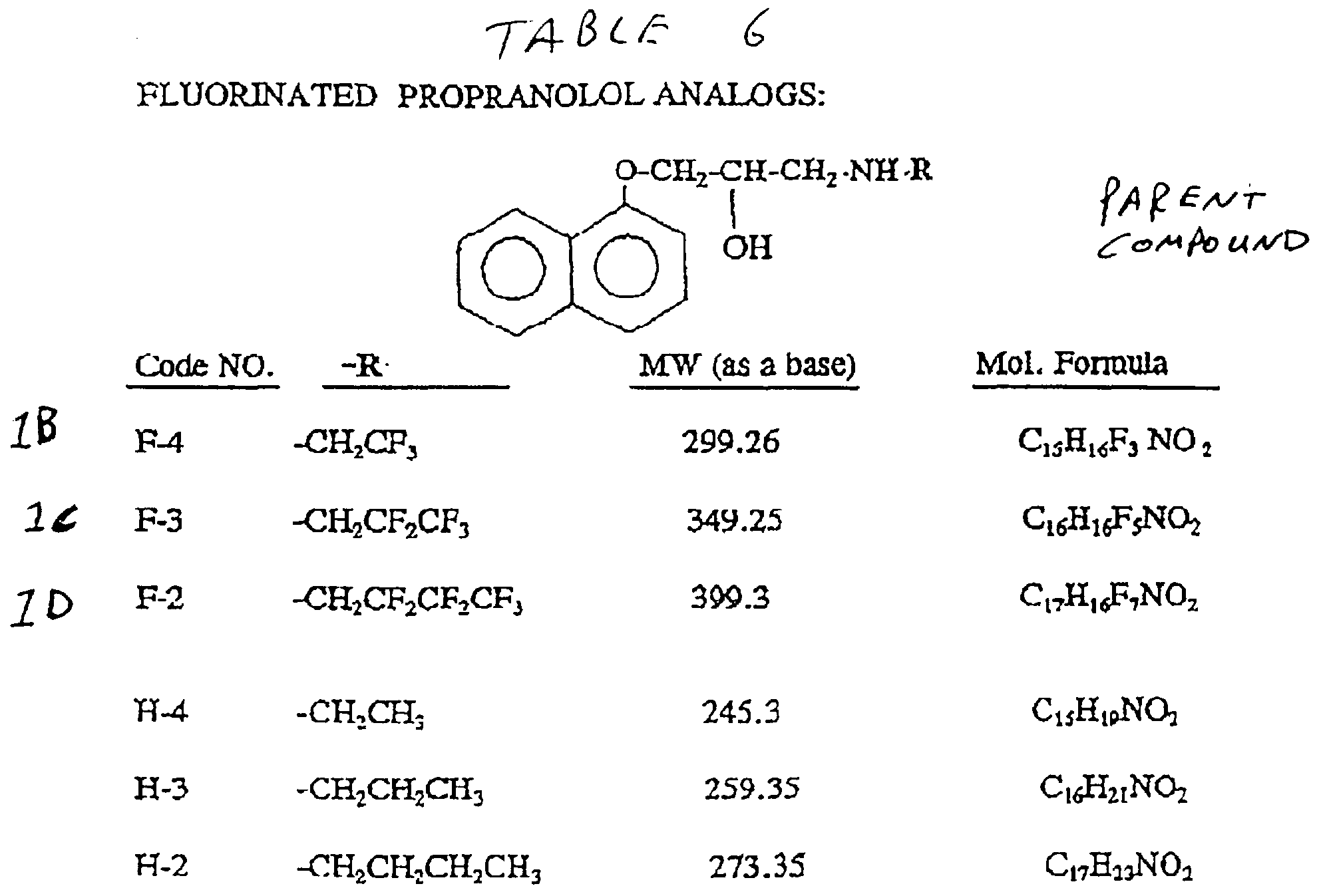
  • Table 6 shows fluo ⁇ nated propranolol analogs which are part of the present mvention
  • Table SI shows important bond angles (°) for the fluorinated analogs.
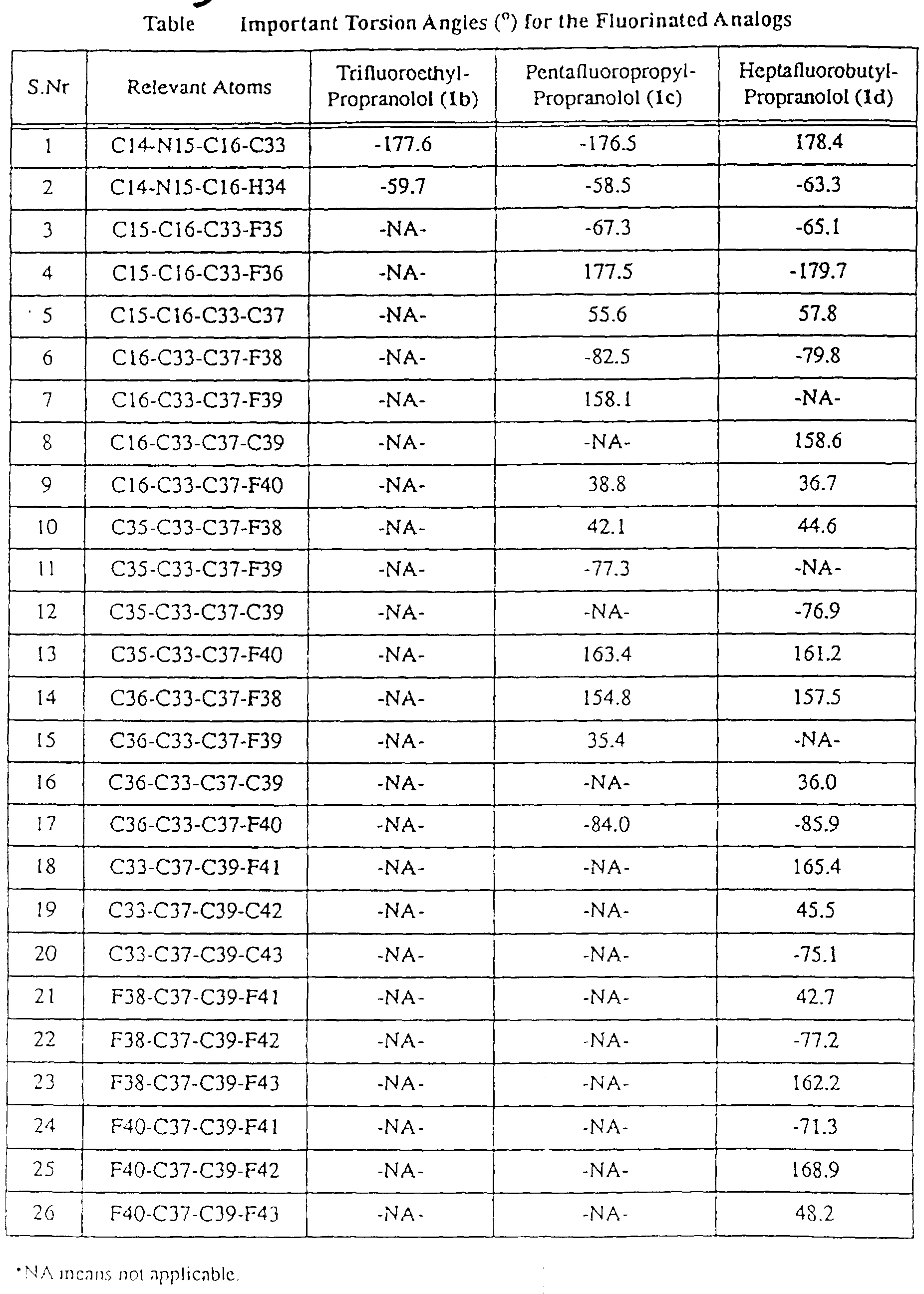
  • Table S2 shows important torsion angles (°) for the fluorinated analogs.
  • Table S3 shows dipole moments of the molecules.
  • Figure 9 shows the molecular structure of D-propranolol (i.e. , right or R-propranolol) and L-propranolol (i.e. , left or S-propranolol), which are both prior art L-propranolol is a beta- blocker, that is, it is pharmacologically active.
  • D- (or right-) propranolol is not a beta-blocker
  • Table 6 shows the molecular structure of the fluo ⁇ nated propranolol analogs, which are part of the present mvention
  • D- and L-propranolol have about the same anti-oxidant potency
  • the fluorination of propranolol (including both the D and L forms), or any other beta blockers enhance their antioxidant potency and protect cardiovascular, neurological and other tissues from free radical-mediated injury.
  • Clinical problems such as heart failure, myocardial infarction, ischemia/reperfusion injury, stroke, and related diseases), where excess free radicals contribute to mechanisms of injury, benefit from treatment by fluorinated beta blockers, including treatment by a combination of fluorinated D-propranolol and fluorinated L-propranolol.
  • Chemical modifications include variable degrees of fluorination of these molecules to provide variable clinical efficacy.
  • the new combination of a fluorinated active beta blocker e.g. , L-propranolol, at 5-10% of a full dose
  • a fluorinated inactive beta blocker e.g., D-propranolol at 95-90% of a full dose
  • Both oral and other methods of administration can be used.
  • the therapeutic strategies include delivery of fluorinated antioxidant doses combined with effective beta blocking doses to maintain the patient on adequate beta blockade, while enhancing greatly the antioxidant therapy.
  • the non-beta blocking form e.g. , fluorinated D-propranolol
  • the fluorinated drug may be administered alone or as an adjunct to other therapies, to treat diseases including thrombolysis, organ preservation, heart failure, restenosis of angioplasty arteries, inflammatory processes (e.g. in skin, lungs, and eyes) and other conditions.
  • Propranolol chemically known as l-isopropylamino-3-)l-naphthyloxy)-2-propanol (see Figure la) is the model parent drug for non-selective ⁇ -blockers, a "pure" antagonist of catecholamines at the receptor sites.
  • propranolol (besides j3-blockade), ix) to reduce the frequency and intensity of migraine headaches, x) to reduce somatic manifestations of anxiety and xi) to treat alcohol withdrawal.
  • the principal toxicities of propranolol result from the blockade of cardiac, vascular, or bronchial ⁇ - adrenoceptors. Most important predictable untoward reactions are in patients with reduced myocardial reserve, asthma, peripheral vascular insufficiency, and diabetes. Some patients experience a beta blocker withdrawal syndrome when discontinued after a long use. The manifestations of this are anxiety, tachycardia, increased intensity of angina, heart attack, or increase in blood pressure. These side effects of propranolol are not desired.
  • the naphthyl moiety in all the compounds is flat.
  • the bond angles of the naphthyl group are all approximately 120° each with minimal torsion within the rings. All the other bond angles range between 105° and 125°.
  • the side cham zigzags around an axis in the plane of the naphthyl group (view a in Figure 2). If the molecule is turned to view it from a side so that the naphthyl moiety becomes a straight line (view b in Figure 2), the side chain is also more or less a straight line with its axis making an angle of approximately 173.5° with the plane of the naphthyl group. Keeping the rings flat and viewing the molecule such that the side chain goes into the plane of the paper pe ⁇ endicularly (view c in Figure 2), the bond with
  • 017 atom (oxygen of the hydroxy 1 group) makes an angle of about -63 ° and the bond of the C34 atom an angle of about 121 ° with the plane of the rings.
  • the side chain zigzags in a similar way as in view a ( Figure 2) of the parent and its axis makes an angle of approximately 178.5° with the plane of the rings (in a view similar to view b of Figure 2). While, when the side chain projects perpendicularly mto the paper plane
  • the -CF 3 group projects almost pe ⁇ endicularly to the rest of the side chain (i e , the non-fluo ⁇ nated portion) in the direction opposite to that of the 017 atom
  • the bond with the 017 atom makes an angle of almost -118°, the bond of the C35 atom of almost -132°, and the bond of C37 atom of almost 115° with the plane of the rings.
  • the zigzagging of the non-fluorinated portion is similar to the parent (like in view a of Figure 2) and the axis of the non-fluorinated portion of the side chain makes an angle of about 178.5° with the plane of the rings (like in view b of Figure 2), the first portion of the fluorinated region of the side chain (i.e., C33-C37 link) is at about 93° to the non-fluorinated region of the side chain and the second region (i.e., C37-C39 link) is at about 254.5° to the first link (both of these in view b).
  • the bond of the 017 atom makes an angle of about 67° with the plane of the rings, the bond of C35 atom an angle of about 52°, and the bond of C37 atom of about -60°.
  • the dimensions of the molecule boxes together with the molecular volumes for the four molecules are as follows: propranolol 335.162 A 3 , trifluoroethyl propranolol 280.183 A 3 , pentafluoropropyl-propranolol 382.636 A 3 , and heptafluorobutyl propranolol 395.135 A 3 .
  • the heat of formation of the "CF 2 " increment group may be estimated and turns out to be in the range of -97.3 kcal/mol to -109.7 kcal/mol, with a mean of -103.5 kcal/mol.
  • Heat of formation attributable to CF 3 may be estimated to be approximately -160 kcal/mol.
  • the estimated heats of formation for the three derivatives from these figures come out to be -218 kcal/mol, -321 kcal/mol and -424 kcal/mol which are not significantly different from the respective values obtained from the AMI calculations (given in Table 1 below).
  • Dipole Moment The molecules do exhibit a sudden increase in the dipole moment from 1.303 Debyes to 4.142 Debyes when the two terminal methyl groups are replaced one by a hydrogen and the other by a -CF 3 group in lb. With further addition of fluorines there is a further increase in the dipole moment (to 4.162 and then to 4.497 Debyes), but not as dramatic. This simple measure indicates a significant redistribution of charge density. To quantify this change further, charge distributions and electrostatic potentials were studied and are discussed below. Charge Distributions: The changes in the charges distribution in the four compounds involve the ether oxygen (Oi l) and all the terminal fluorines. In propranolol most of the charge is concentrated on the ether oxygen.
  • Electrostatic Potentia The sites of most negative electrostatic potential move towards the terminal of the molecules from the parent to the derivatives as the number of fluorines increase.
  • the site In propranolol the site is near the ether oxygen, in lb it is more or less equally distributed between the ether oxygen and the fluorinated terminal, in lc the region of influence of the electrostatic potential progressively increases as it does again in Id.
  • the volume of this influence covers the region occupied by the nitrogen and the terminal fluorines in the three derivatives, but the increase in the number of fluorines make this region bigger.
  • liver microsomal membranes 0.2 mg/ml were resuspended in PBS.
  • the membrane samples were pretreated for 20 minutes with or without the drugs, before adding the free radical components (R.), which consisted of DHF (.83 mM) and Fe (25 ⁇ M FeCl 3 ) chelated by ADP (250 ⁇ M).
  • R. free radical components
  • membrane peroxidation was measured by the TBA (thio-barbituric acid) method as described in Mak & Weglicki, Methods in Enzvmologv 234: 620-630, 1994.
  • Drug effects are represented by the percentage of inhibition of the oxidation product formation.
  • Liver microsomal membranes were isolated from homogenized liver tissue by differential centrifugation according to the procedure of Mak & Weglicki, Pharmacological Research 25: 25-30, 1992.
  • the oxygen free radical system generates oxygen radicals to oxidize rat liver membranes in the experiment whose results are shown in Figures 6 and 7, and to oxidize endothelial cell glutathione in the experiment whose results are shown in Figure 8.
  • oxygen radicals are generated by the addition of DHF, Fe, and ADP.
  • oxygen radicals are generated by the addition of DHF and Fe. The detailed procedure and methods were described in Mak & Weglicki Methods in Enzymology. 234: 620-630, 1994).
  • F2-S active and inactive forms are far more effective as antioxidants, providing more than 50% protection from the R.(DHF + Fe)-induced loss of endothelial cell glutathione at a concentration of 5 ⁇ M.
  • Table 6 shows the molecular structure of types of fluorinated propranolols, that are part of the present invention.
  • the parent compound, a variation of propranolol is shown at the top of the Table.
  • the -R structures of F-4, F-3, and F-2 (lb, lc, and Id, respectively), are shown, with other data.
  • Equivalent data for H-4, H-3, and H-2 (which are the unfluorinated forms of F-4, F-3, and F-2) are also shown.
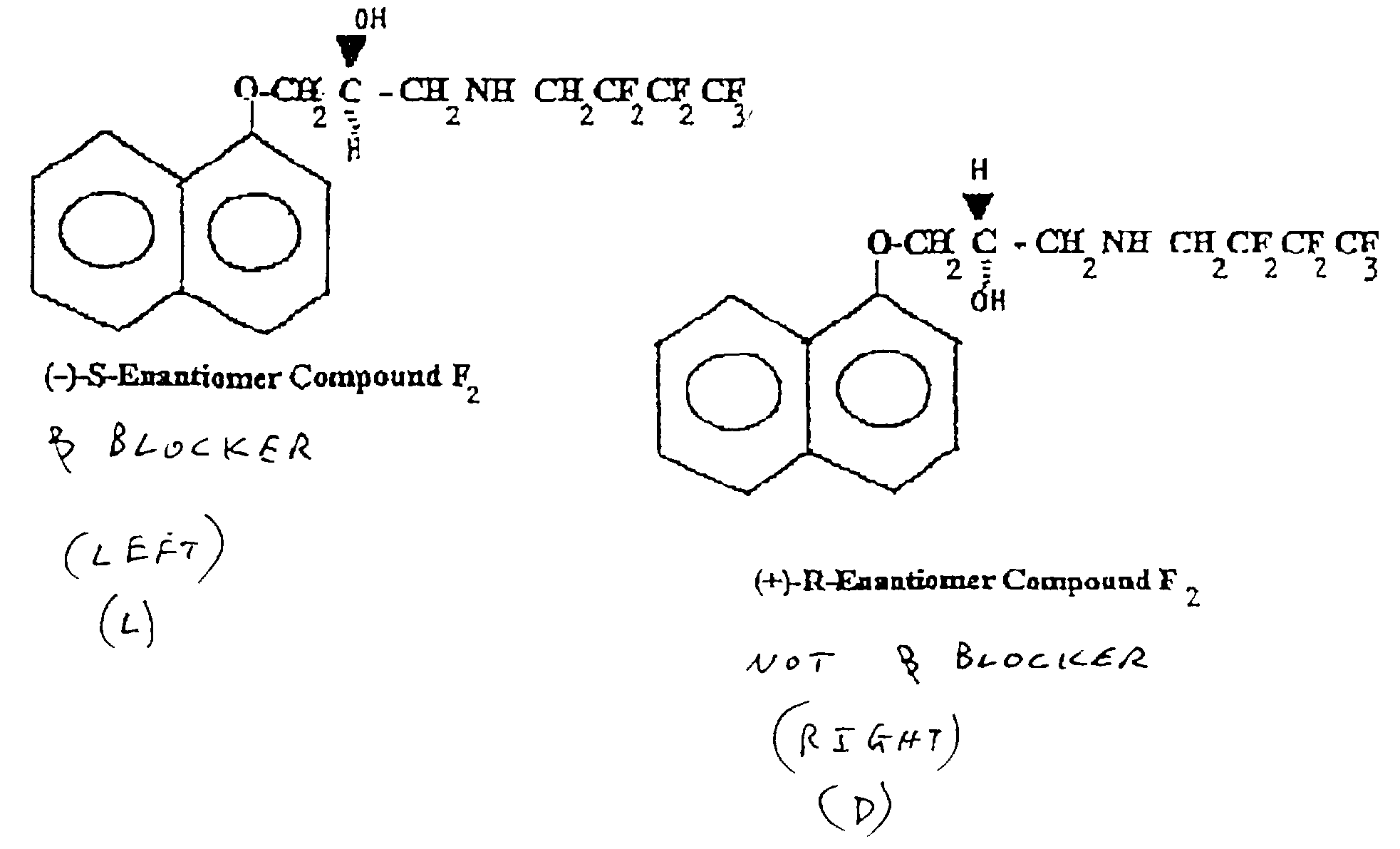
  • the S (or left) enantiomer of F-2 is shown, as is the R- (right or D-) enantiomer of F-2.
  • the anti-oxidant potency for each analog of propranolol is about the same for both the left and right form of that analog.
  • racemic propranolol 50 percent D-propranolol and 50 percent C- propranolol was used for the control (un-fluorinated) propranolol.
  • the left-most column shows the GSH level of the endothelial cells ("Veh. ”) without radicals or propranolol treatment.
  • the second column shows a 50 percent loss of the GSH caused by treatment with the radical system only.
  • the third column (“ + Prop. ") shows treatment of the cells (with radicals R.) with racemic propranolol (50 percent D- propronolol and 50 percent L-propranolol) only.
  • the fourth column (“ + F2”) shows the effect of treating the cells (with radicals R.) with a racemic mixture of 50 percent Left-F-2, and 50 percent Right F-2.
  • the fifth column (“ + F2R”) shows the effect of treating the cells (with radicals R.) with Right F-2.
  • the drugs Propranolol, the 50/50 mixture, and F2R, respectively
  • the fluorinated forms of propranolol of the present invention can be used to treat any disease that is responsive to anti-oxidant treatment.
  • the right (or D-) forms of the fluorinated propranolols would be especially indicated for treatment where beta-blocker effects or toxicity are anticipated as a problem.
  • Active beta blockers bind to the beta adrenergic receptors with high affinity whereas inactive compositions (non-beta blockers) will not.
  • reaction mixture was cooled to room temperature, and the resin was removed by Alteration Excess epichlorohyd ⁇ n was removed under vacuum, toulene (100ml) was added and then distilled in vacuum The residue was added dropwise to sodium hydride (18 g of 50% mineral oil dispersion) suspended in cold dry tetrahydrofuran (100ml). After the addition was completed, the reaction mixture was filtered and concentrated. The residue was dissolved in ether and the resulting precipitate was removed by Alteration. The filterate washed twice with 50ml of 10% sodium hydroxide solution, followed by 50ml of water and twice with 50ml of brine and dried over anhydrous potassium carbonate then filtered. The ethereal filterate was removed under vacuum where a yellow orange liquid (86g) was left. The product was then purified by fractional distillation at 64C at 0.015mmHg to give 68 g of the product as a colorless liquid.
  • ⁇ i ⁇ means not applicable ⁇ s

Landscapes

  • Chemical & Material Sciences (AREA)
  • Organic Chemistry (AREA)
  • Health & Medical Sciences (AREA)
  • Nuclear Medicine, Radiotherapy & Molecular Imaging (AREA)
  • Life Sciences & Earth Sciences (AREA)
  • Diabetes (AREA)
  • Endocrinology (AREA)
  • Chemical Kinetics & Catalysis (AREA)
  • General Chemical & Material Sciences (AREA)
  • Medicinal Chemistry (AREA)
  • Engineering & Computer Science (AREA)
  • Pharmacology & Pharmacy (AREA)
  • Bioinformatics & Cheminformatics (AREA)
  • Animal Behavior & Ethology (AREA)
  • General Health & Medical Sciences (AREA)
  • Public Health (AREA)
  • Veterinary Medicine (AREA)
  • Acyclic And Carbocyclic Compounds In Medicinal Compositions (AREA)
  • Saccharide Compounds (AREA)
  • Pharmaceuticals Containing Other Organic And Inorganic Compounds (AREA)
  • Organic Low-Molecular-Weight Compounds And Preparation Thereof (AREA)

Abstract

Fluorinated beta blockers, such as propranolol, are presented with amplified antioxidant effects and various levels of beta blocking effects. Mixtures are also presented of fluorinated antioxidant drugs, such as propranolol, with flurinated antioxidant non-beta blocking analogs of the same drugs. Methods of treatement of disease by the use of the fluorinated drugs and the mixtures are presented.

Description

FLUORINATED PROPRANOLOL AND RELATED METHODS
I. Background of the Invention The field of this invention is pharmaceuticals which act as beta blockers and pharmaceuticals that act as antioxidants. Specifically, this invention relates to beta blockers with amplified and controlled antioxidant properties.
Beta blockers such as various forms of propranolol are known. It is known that a variety of heart and hypertension problems can be treated with beta blockers. However, an excessive treatment of beta blockers can cause undesirable side effects in patients.
Antioxidant agents are also known. It is also known that treatment by antioxidants may be used to treat similar and related heart and hypertension problems.
There has been some knowledge of incidental antioxidant characteristics of some forms of beta blockers. However, the prior art has not examined the possibility of amplified and controlled antioxidant characteristics of the same pharmaceuticals which are used for beta blocker effects. The prior art has not investigated possible synergistic effects of treating hypertension, heart failure and other heart disorders with a combination of antioxidants and beta blockers, and, in particular, no work has been done to develop single pharmaceuticals with both amplified antioxidant and controlled beta blocker effects. II. Summary of the Invention
It is an object of the present invention to amplify and control the antioxidant effect of beta blockers. It is an object of the present invention to mix beta blocker forms of propranolol with non- beta blocker forms of propranolol, all with antioxidant effects or amplified antioxidant effects, to obtain a variety of mixtures with antioxidant effects which have a controlled range of beta blocker potency. An object of this, in turn, is to allow synergistic application of amplified antioxidant effects and beta blocking effects to treat a variety of medical conditions, including, for example, heart ailments, heart failure, hypertension and inflammatory processes, while controlling the undesirable side effects of excessive beta blockers for the individual patients.
As part of the present invention, the inventors discovered significant membrane antioxidant activity for some fluorinated propranolol analogs. The antioxidant potency of these preparations increases with the degree of fluorination. Experimental results indicate that different isomers of propranolol (some of which may be pharmacologically active as beta blockers and some of which may be pharmacologically inactive as beta blockers) display equipotent antioxidant activity. That is, their antioxidant activity is independent of their pharmacological beta blocker activity.
Free radicals in the cell membranes cause lipid peroxidativc damage and protein oxidative damage. Antioxidants neutralize the free radicals before they can cause this damage or may block the early "chain reaction" of peroxidation in the cell membranes. Fluorination of propranolol increases the lipophilicity of the propranolol analogs and thereby causes the higher partitioning of the antioxidant agents into the biomembranes of cells; therefore, these fluoπnated propranolol beta blockers have greater antioxidant effect than the unfluoπnated propranolols, because the fluoπnated agents enter the membrane in greater quantity than the unfluoπnated propranolols. Since free radicals are known to promote a number of cardiovascular and neurological diseases, including ischemia/reperfusion, aging, neurodegeneration, atherogenesis, inflammation and others, use of these fluorinated beta blocking agents provide additional beneficial effects as antioxidants where the increased free radical production is an important component of the disease pathogenesis. The present invention includes fluorinated propranolol analogs and methods of use as simultaneous beta blockers and amplified antioxidants for the treatment of heart failure, hypertension, and related diseases.
The present invention further includes mixtures of (1) fluorinated antioxidant non-beta blocking isomers of propranolol, with (2) fluorinated antioxidant beta blocking isomers of propranolol, in a range of ratios. This range of mixtures offers a range of choice of beta blocking intensity to correspond to a selected level of antioxidant activity, thereby avoiding excessive beta blocking for an individual case for a desired antioxidant unpact. That is, for a given antioxidant impact, the simultaneous beta blocker impact can be controlled.
Potential disadvantages of use of fluorinated antioxidant beta blocking propranolols may include excessive beta blockade at higher dosage. The mixtures of the present invention offer choices that avoid the problems associated with excessive beta blocking, while achieving the targeted antioxidant benefit. This fluorination method may be applied to other beta blocking agents such as aterolol, metoprolol, and similar drugs, to enhance their lipophilicity and positioning into biological membranes.
III. Brief Description of the Drawings Figure 1 shows the chemical structure of: propranolol (la), trifluoroethyl-propranolol
(lb), pentafluoropropyl-propranolol (lc), heptafluorobutyl-propranolol (Id). The schematic illustrates the common structure together with the numbers of the atoms. The table below the schematic gives the side chains Rl and R2 in the four molecules.
Figure 2 shows propranolol viewed perpendicular to its a) longitudinal (primary or 1 °) axis, b) secondary (2°) axis, and c) tertiary (3°) axis.
Figure 3 shows the atomic charges and the structure of a) propranolol, b) trifluoroethyl- propranolol, c) pentafluoropropyl-propranolol, and d) heptafluorobutyl-propranolol.
Figure 4 shows the distribution of charge densities in a) propranolol, b) trifluoroethyl- propranolol, c) pentafluoropropyl-propranolol, and d) heptafluorobutyl-propranolol. For each molecule two views are presented, one perpendicular to the 2° axis and the other perpendicular to the 3° axis.
Figure 5 shows the distribution of electrostatic potential in a) propranolol, b) trifluoroethyl-propranolol, c) pentafluoropropyl-propranolol, and d) heptafluorobutyl-propranolol. This view is perpendicular to the 3° axis of each molecule. The changes in the dotted contours represent the negative values.
Figure 6 shows the antioxidant activities of fluorinated propranolol analogs. Figure 7 shows the antioxidant activities of nonfluorinated propranolol analogs. Figure 8 shows the protective effects of F2 and F2-R on R.(DHF+Fe)-ιnduced loss of endothelial cell glutathione (GSH)
Figure 9 shows the molecular structure of D-propranolol, and L-propranolol, which are both pπor art Table 1 shows optimized energies of the molecules.
Table 2 shows coordinates of propranolol (la).
Table 3 shows coordinates of trifluoroethyl-propranolol (lb)
Table 4 shows coordinates of pentafluoropropyl-propranolol (lc).
Table 5 shows coordinates of heptafluorobutyl-propranolol (Id) Table 6 shows fluoπnated propranolol analogs which are part of the present mvention
Table SI shows important bond angles (°) for the fluorinated analogs.
Table S2 shows important torsion angles (°) for the fluorinated analogs.
Table S3 shows dipole moments of the molecules.
IV. Description of Preferred Embodiments
Figure 9 shows the molecular structure of D-propranolol (i.e. , right or R-propranolol) and L-propranolol (i.e. , left or S-propranolol), which are both prior art L-propranolol is a beta- blocker, that is, it is pharmacologically active. D- (or right-) propranolol is not a beta-blocker Table 6 shows the molecular structure of the fluoπnated propranolol analogs, which are part of the present mvention
The inventors have found that D- and L-propranolol have about the same anti-oxidant potency The fluorination of propranolol (including both the D and L forms), or any other beta blockers, enhance their antioxidant potency and protect cardiovascular, neurological and other tissues from free radical-mediated injury. Clinical problems (such as heart failure, myocardial infarction, ischemia/reperfusion injury, stroke, and related diseases), where excess free radicals contribute to mechanisms of injury, benefit from treatment by fluorinated beta blockers, including treatment by a combination of fluorinated D-propranolol and fluorinated L-propranolol.
Chemical modifications include variable degrees of fluorination of these molecules to provide variable clinical efficacy.
The new combination of a fluorinated active beta blocker (e.g. , L-propranolol, at 5-10% of a full dose), with a fluorinated inactive beta blocker (e.g., D-propranolol at 95-90% of a full dose) enhances antioxidant potency without excess beta blockade, and increases the safety margin of therapy. This is because excess beta blockade may depress cardiac function to unsafe levels, for example, for those with heart failure.
Both oral and other methods of administration (e.g., by intravenous infusion, topical, aerosol, or by organ preservation fluids) can be used. The therapeutic strategies include delivery of fluorinated antioxidant doses combined with effective beta blocking doses to maintain the patient on adequate beta blockade, while enhancing greatly the antioxidant therapy. In those clinical conditions where beta blockade may not be indicated, the non-beta blocking form (e.g. , fluorinated D-propranolol) of the fluorinated drug may be administered alone or as an adjunct to other therapies, to treat diseases including thrombolysis, organ preservation, heart failure, restenosis of angioplasty arteries, inflammatory processes (e.g. in skin, lungs, and eyes) and other conditions. Molecular Structure
Studies of the theoretical geometrical structure of propranolol and three of its fluorinated derivatives: l-(2,2,2-trifluoroethylamino)-3-(l-naphthyloxy)-2-propanol [trifluoroethyl- propranolol] , l -(2,2,3 ,3 , 3-pentafluoropropylamino)-3-( l-naphthyloxy)-2-propanol [pentafluoropropyl-propranolol], and l-(2,2,3,3,4,4,4-heptøfluorobutylamino)-3-(l-naphthyloxy)-
2-propanol [heptafluorobutyl-propranolol]. The semi-empirical method, AMI was used to optimize the structures. In the minimum energy state the geometries of the naphthyl moiety and the non-fluorinated portions of the analogs are quite similar to that of the parent. Dipole moments, charge density distributions, and electrostatic potential distributions all point to the significance of the ether oxygen in all four compounds and the increasing contribution of the side chain terminal to the activity of the molecule with increasing number of fluorines.
Propranolol, chemically known as l-isopropylamino-3-)l-naphthyloxy)-2-propanol (see Figure la) is the model parent drug for non-selective β -blockers, a "pure" antagonist of catecholamines at the receptor sites. It has been used i) to chronically lower blood pressure in (mild to moderate) hypertension, ii) to prevent reflex tachycardia in severe hypertension, iii) to reduce intraocular pressure in glaucomatous eyes, iv) to reduce the frequency of anginal episodes and improve exercise tolerance in many patients with angina, v) in the acute phase of a myocardial infarction to limit infarct size (a controversial use), vi) in the treatment of both supraventricular and ventricular arrhythmias, vii) to increase stroke volume in obstructive cardiomyopathy patents, viii) to inhibit peripheral conversion of thyroxine to triiodothyronine
(besides j3-blockade), ix) to reduce the frequency and intensity of migraine headaches, x) to reduce somatic manifestations of anxiety and xi) to treat alcohol withdrawal. The principal toxicities of propranolol result from the blockade of cardiac, vascular, or bronchial β- adrenoceptors. Most important predictable untoward reactions are in patients with reduced myocardial reserve, asthma, peripheral vascular insufficiency, and diabetes. Some patients experience a beta blocker withdrawal syndrome when discontinued after a long use. The manifestations of this are anxiety, tachycardia, increased intensity of angina, heart attack, or increase in blood pressure. These side effects of propranolol are not desired.
In search for compounds with better activity, some fluorinated derivatives of propranolol have been synthesized by the inventors, the structures of three of which are given herein, and are shown in Figures lb to Id, namely, l-(2,2,2-trifluoroethylamino)-3-(l-naphthyloxy)-2- propanol (lb, known as trifluoroethyl-propranolol), l-(2, 2,3,3, 3-pentafluoropropylamino)-3-(l- naphthyloxy)-2-propanol (lc, known as pentafluoropropyl-propranolol), and 1 -(2, 2, 3, 3, 4,4,4- heptafluorobutylamino)-3-(l-naphthyloxy)-2-propanol (Id, known as heptafluorobutyl- propranolol). Herein is described the computed atomic structure of propranolol and these three fluorinated analogs. This structural geometry is not known in the prior art and is part of the present invention.
The four structures above were created by the inventors using HyperChem for Windows and optimized with a semi-empirical technique, namely AMI . The Polak-Ribiere conjugate gradient method was used for optimization. The minimum energy states (with minimum binding energy) that were achieved were as shown in Table 1. Geometries: The geometrical coordinates of propranolol together with the charges on each atom are presented in Table 2. Similar information about the fluorinated derivatives is given in Tables 3 to 5. All the coordinates and distances in this paper are in angstroms (A). Except where significant, the particulars of the hydrogen atoms are not given here, and can be obtained from the authors.
The naphthyl moiety in all the compounds is flat. The bond angles of the naphthyl group are all approximately 120° each with minimal torsion within the rings. All the other bond angles range between 105° and 125°. In propranolol, the side cham zigzags around an axis in the plane of the naphthyl group (view a in Figure 2). If the molecule is turned to view it from a side so that the naphthyl moiety becomes a straight line (view b in Figure 2), the side chain is also more or less a straight line with its axis making an angle of approximately 173.5° with the plane of the naphthyl group. Keeping the rings flat and viewing the molecule such that the side chain goes into the plane of the paper peφendicularly (view c in Figure 2), the bond with
017 atom (oxygen of the hydroxy 1 group) makes an angle of about -63 ° and the bond of the C34 atom an angle of about 121 ° with the plane of the rings.
In lb, the side chain zigzags in a similar way as in view a (Figure 2) of the parent and its axis makes an angle of approximately 178.5° with the plane of the rings (in a view similar to view b of Figure 2). While, when the side chain projects perpendicularly mto the paper plane
(like view c in Figure 2) the bond with 017 atom makes about 66°, the C36 atom an angle of about 45.5° and the bond with C37 atom an angle of about -63.5 ° with the plane of the rings.
In lc, zigzagging of the non-fluoπnated portion of the side chain is similar to the parent
(like view a in Figure 2) and its axis makes an angle of approximately 177 5° with the plane of the rings (like in view b of Figure 2). The -CF3 group projects almost peφendicularly to the rest of the side chain (i e , the non-fluoπnated portion) in the direction opposite to that of the 017 atom When viewed from the side with the side chain going peφendicularly into the paper plane (like in view c of Figure 2) the bond with the 017 atom makes an angle of almost -118°, the bond of the C35 atom of almost -132°, and the bond of C37 atom of almost 115° with the plane of the rings.
In Id, the zigzagging of the non-fluorinated portion is similar to the parent (like in view a of Figure 2) and the axis of the non-fluorinated portion of the side chain makes an angle of about 178.5° with the plane of the rings (like in view b of Figure 2), the first portion of the fluorinated region of the side chain (i.e., C33-C37 link) is at about 93° to the non-fluorinated region of the side chain and the second region (i.e., C37-C39 link) is at about 254.5° to the first link (both of these in view b). In a view similar to view c of Figure 2, the bond of the 017 atom makes an angle of about 67° with the plane of the rings, the bond of C35 atom an angle of about 52°, and the bond of C37 atom of about -60°.
In all four compounds the oxygen of the hydroxyl group (017 atom) makes almost a right angle to the side chain in the side view (-90° in propranolol and lc and +90° in lb and Id, respectively, in a view similar to view b of Figure 2). There were mostly small changes in the geometry of the molecules with the introduction of the fluorine atoms, except near the side chain terminus. The geometries are illustrated in Figure 3 with the molecules displayed along their longitudinal axes together with charges on individual atoms.
The most important dipole moments, bond angles and the torsion angles of propranolol and the fluorinated analogs may be obtained from the supplementary material in Tables SI -S3 herein. Molecular Volumes: The sizes of the 4 molecules are not very different. In fact, there is a reduction in size from the parent to the 1st derivative (-CF3). The dimensions of the molecule boxes together with the molecular volumes for the four molecules are as follows: propranolol 335.162 A3, trifluoroethyl propranolol 280.183 A3, pentafluoropropyl-propranolol 382.636 A3, and heptafluorobutyl propranolol 395.135 A3.
Energies: The various energies (total energies, minimum binding energies, heats of formation, ionization potentials) relevant for the molecules are given in Table 1. From the data presented above, it appears that the influence of the fluorine atoms is primarily at the terminal in the geometry of the molecules. With each addition of the CF2 group the non-fluorinated portion of the side chain rotates about 180° about its axis. In their stable configurations the molecules are in the following order with respect to the values of the energies: for binding energies: lb > la > lc > Id; for total energies la > lb > lc > Id; and for heat of formation: la > lb > lc > Id. For the values of the energies see the above-mentioned tables. The ionization potentials of the four compounds discussed in this paper are almost the same (they differ in the second decimal place). As far as is known to the authors there does not seem to be a precedence of this in other series of polyfluoroalkyi amines.
The heat of formation of the "CF2" increment group may be estimated and turns out to be in the range of -97.3 kcal/mol to -109.7 kcal/mol, with a mean of -103.5 kcal/mol. Heat of formation attributable to CF3 may be estimated to be approximately -160 kcal/mol. Given the heat of formation of propranolol (-58 kcal/mol), the estimated heats of formation for the three derivatives from these figures come out to be -218 kcal/mol, -321 kcal/mol and -424 kcal/mol which are not significantly different from the respective values obtained from the AMI calculations (given in Table 1 below).
Dipole Moment: The molecules do exhibit a sudden increase in the dipole moment from 1.303 Debyes to 4.142 Debyes when the two terminal methyl groups are replaced one by a hydrogen and the other by a -CF3 group in lb. With further addition of fluorines there is a further increase in the dipole moment (to 4.162 and then to 4.497 Debyes), but not as dramatic. This simple measure indicates a significant redistribution of charge density. To quantify this change further, charge distributions and electrostatic potentials were studied and are discussed below. Charge Distributions: The changes in the charges distribution in the four compounds involve the ether oxygen (Oi l) and all the terminal fluorines. In propranolol most of the charge is concentrated on the ether oxygen. In lb, the charge is most distributed around the same oxygen and the terminal fluorines and to a lesser extent around the nitrogen. In lc and Id, charge distribution is again mostly around the ether oxygen (Oi l) and the terminal fluorines and to a lesser extent around the hydroxyl oxygen (017) and the nitrogen. The charge density distribution in the different molecules is shown in Figure 4.
Electrostatic Potentia : The sites of most negative electrostatic potential move towards the terminal of the molecules from the parent to the derivatives as the number of fluorines increase. In propranolol the site is near the ether oxygen, in lb it is more or less equally distributed between the ether oxygen and the fluorinated terminal, in lc the region of influence of the electrostatic potential progressively increases as it does again in Id. The volume of this influence covers the region occupied by the nitrogen and the terminal fluorines in the three derivatives, but the increase in the number of fluorines make this region bigger. Thus the most likely site of protonation or electrophilic attack move from the ether oxygen in the parent through equally likely at this oxygen and the terminal to more likely at the fluorinated portion of the side chain terminal particularly in Id. The regions are similar to those suggested by the charge density. As the number of fluorines increase in the molecule the corresponding region of influence also increases and reactivity would be expected to be stronger (i.e., stronger bonds are more likely to form). It is possible the binding to the receptor involves both the ether oxygen and the fluorines.
The molecular volumes and ionization potentials for the four compounds are almost equal. Significant changes in the molecules occur in the dipole moments, charge densities and the electrostatic potentials. Probably, the contribution from the changes in the charge density are sufficient to explain the changes in the biological activity of the four compounds as the number of fluorines on the molecules increases Their activity increases (the volumic region of negative influence) with the increase in the number of fluorines Maps of electrostatic potential distributions are given in Figure 5.
Anti-oxidant Activity: In Figures 6, 7, and 8, the following abbreviations have been used:
LPO - hpid peroxidation; μM - micro-molar; R - oxygen free radical system,
DHF - dihydroxyfumarate,
Fe - iron, ADP - adenosine diphosphate;
EC50 - effective concentration which inhibits 50% of membrane lipid peroxidation;
GSH - glutathione; and
PBS - phosphate-buffered saline. To test the antioxidant activity of the analogs, isolated liver microsomal membranes (0.2 mg/ml) were resuspended in PBS. The membrane samples were pretreated for 20 minutes with or without the drugs, before adding the free radical components (R.), which consisted of DHF (.83 mM) and Fe (25 μM FeCl3) chelated by ADP (250 μM). After 15-20 minutes of oxidation, membrane peroxidation was measured by the TBA (thio-barbituric acid) method as described in Mak & Weglicki, Methods in Enzvmologv 234: 620-630, 1994. Drug effects are represented by the percentage of inhibition of the oxidation product formation. Liver microsomal membranes were isolated from homogenized liver tissue by differential centrifugation according to the procedure of Mak & Weglicki, Pharmacological Research 25: 25-30, 1992.
The oxygen free radical system generates oxygen radicals to oxidize rat liver membranes in the experiment whose results are shown in Figures 6 and 7, and to oxidize endothelial cell glutathione in the experiment whose results are shown in Figure 8. In the experiments for Figures 6 and 7, oxygen radicals are generated by the addition of DHF, Fe, and ADP. In the experiment for Figure 8, oxygen radicals are generated by the addition of DHF and Fe. The detailed procedure and methods were described in Mak & Weglicki Methods in Enzymology. 234: 620-630, 1994). In Figures 6 and 7, and in Table 6, the items F-4, F-3, and F-2, are the preparations shown as lb, lc, and Id, respectively, in Figure 1 , and are part of the present invention. H-4, H-3, and H-2 are the un-fluorinated forms of F-4, F-3, and F-2, respectively.
A review and comparison of Figures 6 and 7 shows that fluorination significantly increases the antioxidant activity of the propranolol analogs. As indicated in Figure 6, the EC50
(concentration of test compound which will inhibit membrane lipid peroxidation by 50%) is 196 μM for propranolol, but only 21 μM for F-2, 38 μM for F-3, and 62 μM for F-4, indicating that the fluorinated compounds are much more effective antioxidants.
The data in Figure 8 demonstrate that while propranolol itself has a modest antioxidant effect, either F2-R (the form which is inactive as a beta-blocker) or a 50-50 mixture of F2-R and
F2-S (active and inactive forms) are far more effective as antioxidants, providing more than 50% protection from the R.(DHF + Fe)-induced loss of endothelial cell glutathione at a concentration of 5 μM.
Table 6 shows the molecular structure of types of fluorinated propranolols, that are part of the present invention. The parent compound, a variation of propranolol, is shown at the top of the Table. The -R structures of F-4, F-3, and F-2 (lb, lc, and Id, respectively), are shown, with other data. Equivalent data for H-4, H-3, and H-2 (which are the unfluorinated forms of F-4, F-3, and F-2) are also shown. At the bottom of the table, the S (or left) enantiomer of F-2 is shown, as is the R- (right or D-) enantiomer of F-2. The inventors find that each right (or D) form of propranolol, whether fluorinated or not, is not a beta blocker; and each S (or left) form of propranolol, whether fluorinated or not, is a beta blocker. Fluorination of each form increases its anti-oxidant effect, without changing its beta blocker potency, or lack of it. The anti-oxidant potency for each analog of propranolol is about the same for both the left and right form of that analog.
In Figures 6 and 7, racemic propranolol (50 percent D-propranolol and 50 percent C- propranolol) was used for the control (un-fluorinated) propranolol. In Figure 8, the left-most column shows the GSH level of the endothelial cells ("Veh. ") without radicals or propranolol treatment. The second column ("R. ") shows a 50 percent loss of the GSH caused by treatment with the radical system only. The third column (" + Prop. ") shows treatment of the cells (with radicals R.) with racemic propranolol (50 percent D- propronolol and 50 percent L-propranolol) only. The fourth column (" + F2") shows the effect of treating the cells (with radicals R.) with a racemic mixture of 50 percent Left-F-2, and 50 percent Right F-2. The fifth column (" + F2R") shows the effect of treating the cells (with radicals R.) with Right F-2.
In the third, fourth, and fifth columns, the drugs (Propranolol, the 50/50 mixture, and F2R, respectively) were each applied at a concentration of 5 micromolar. The fluorinated forms of propranolol of the present invention can be used to treat any disease that is responsive to anti-oxidant treatment. The right (or D-) forms of the fluorinated propranolols would be especially indicated for treatment where beta-blocker effects or toxicity are anticipated as a problem.
Active beta blockers bind to the beta adrenergic receptors with high affinity whereas inactive compositions (non-beta blockers) will not.
Method of Synthesis The synthesis of these compounds was achieved by the reaction of the glycidic ether (epoxide) namely, l '-(2,3- epoxypropoxy)naphthalene wi the appropriate fluorinated amine. Opening of the oxirane ring with these fluoπnated amines gives the fluorinated propranolol analogs as described below. SYNTHESIS OF (2RS) l'-(2,3-EPOXYPROPOXY)NAPHTHALENE.
SYNTHESIS OF <2RS)- 1 '-(2,3-EPOXYP OPOXY)NAPHTHALENE;
Figure imgf000019_0001
A method described by Oatis et al (see, J.E. Oatis, Jr., J P. Baker, J.R McCarthy, and D.R. Knapp, J Med. Chem., 26, 1687-1691 (1983)), was adopted for the systhesis of this intermediate. A mixture of 1-naphthol (0.5 mole) and 72 g of Dowex resin (chloride form) was refluxed for 2 hours in epichlorohydπn (400ml, 5 19 mole). The reaction mixture was cooled to room temperature, and the resin was removed by Alteration Excess epichlorohydπn was removed under vacuum, toulene (100ml) was added and then distilled in vacuum The residue was added dropwise to sodium hydride (18 g of 50% mineral oil dispersion) suspended in cold dry tetrahydrofuran (100ml). After the addition was completed, the reaction mixture was filtered and concentrated. The residue was dissolved in ether and the resulting precipitate was removed by Alteration. The filterate washed twice with 50ml of 10% sodium hydroxide solution, followed by 50ml of water and twice with 50ml of brine and dried over anhydrous potassium carbonate then filtered. The ethereal filterate was removed under vacuum where a yellow orange liquid (86g) was left. The product was then purified by fractional distillation at 64C at 0.015mmHg to give 68 g of the product as a colorless liquid.
THE SYSTHESIS OF THE FLUORINATED PROPRANOLOL ANALOGS
(RS)-l-(2,2,2-TRIFLUOROETHYLAMINO)-3-(l-NAPHTHYLOXY)-2-PROPANOL:
(RS)-l-(2,2^-TRTFLUOROETHY^^fvlINO)-3-(l-NAPHTHYLOXY)-2-PROPANOL:
Figure imgf000020_0001
A mixture of (2RS)- l '-(2,3-epoxypropoxy)naphthaIene (1.4 g, 6.49mmole) and 2,2,2,- trifluroethylamine (25 g, 252.4 mmole) weer heated in a sealed glass tube for about 115 hours at 100°C, Excess amine was distilled under vacuum and collected. The remaining solid was dissolved in ether and washed twice with 250ml of water. The ethereal solution was treated with dry hydrogen chloride gas to convert the amine to its hydrochloride salt which is collected as a off white solid ; m.p. 178- 180C; (yield 68%).
RS-l-f2.2.3.3.3-PENTAFLUOROPROPYLAMINOV3-π-NAPHTHYLOXY)-2-PROPANOL
Figure imgf000021_0001
The same as described above but using (2RS)- l'-(2,3, epoxypropoxy) naphtalene (1.7 g,8.5 mmole) and 2,2,3,3,3-pentafluropropylamine (25g. l70 mmole). The product is a white to off white solid, m.p. 227-228 C, (yield 58%) (RS)-l -r2.2,3.3.4.4.4-HEPTAFLUOROBUTYLAMINQ )-3-π -NAPHTHYLOXYY?- PROPANOL:
Figure imgf000022_0001
The same as described above but using (2RS)-r-(2,3-epoxypropoxy)naphthalene ((1.3g,6.49 mmole) and 2,2,3,3,4,4,4-hepafluorobutylamine (125,6 mmole). The hydrochloride salt obtained is a white to off white solid, m.p.236-237 C, (yield 67%).
Other Comments:
Much of the discussion herein involves fluorinated forms of propranolol, included analogs of propranolol with and without beta blocking effect. However, the present invention may apply to any beta-blocker drug that has anti-oxidant effects there are amplified by fluorination, and analog forms without beta blocking effect that also have antioxidant effect that is amplified by fluorination.
The embodiments described herein are merely illustrative of the principles of this invention. Other arrangements and advantages may be devised by those skilled in the art without departing from the spirit and scope of the invention. Accordingly, the invention should be deemed not to be limited to the above detailed description but only by the spirit and scope of the claims which follow, and their equivalents.
Table 1: Optimized Energies of the Molecules
Figure imgf000024_0001
Figure imgf000025_0001
Table 3: Coordinates of Trifluoroethyl-propranolol (lb)
Figure imgf000026_0001
Table 4: Coordinates of Pentafluoropropyl-PropranoIol (lc)
Figure imgf000027_0001
Table 5: Coordinates of Heptafluorobutyl-Propranolol (Id)
Figure imgf000028_0001
FLUORINATED PROPRANOLOL ANALOGS:
Figure imgf000029_0002
Figure imgf000029_0001
(+)-R-Eaaαti-)m-!r Compound F ,
A
A) I
Table Important Bond Angles (°) for the Fluorinated Analogs
Figure imgf000030_0001
' NΛ means noi applicable Table Important Torsion Angles (°) for the Fluorinated Analogs
Figure imgf000031_0001
iΛ means not applicable ≤s
Figure imgf000032_0001

Claims

CLAIMS We claim:
1. A compound of formula
Figure imgf000033_0001
wherein R represents a straight or branched chain alkyl group of 1-6 carbon atoms which is substituted with at least one fluorine atom.
2. The compound of claim 1 which has activity as a β-adrenergic blocker.
3. The compound of claim 1 which is inactive as a β-adrenergic blocker.
4. The compound of claim 1 which is an L-isomer.
5. The compound of claim 1 which is a D-isomer.
6. A composition comprising the compound of claim 2 and the compound of claim 3.
7. The composition of claim 6 wherein the ratio of the compound of claim 2 to the compound of claim 3 is between about 0.01 and 0.2.
8. The composition of claim 7 wherein the ratio is between about 0.05 and 0.1.
9. The compound of claim 1 wherein R is selected from the group consisting of -CH3CF3, - CH2CF2CF3 and -CH2CF2CF2CF3.
10. The compound of claim 9 which is active as a β-adrenergic blocker.
11. The compound of claim 9 which is inactive as a β-adrenergic blocker.
12. A composition comprising the compound of claim 10 and the compound of claim 9.
13. The composition of claim 12 wherein the ratio of the compound of claim 10 to the compound of claim 11 is between about 0.01 and 0.2.
14. The composition of claim 13 wherein the ratio is between about 0.05 and 0.1.
15. The compound of claim 9 which is a D-isomer.
16. The compound of claim 9 which is an L-isomer.
17. A method of treating a disease or disorder of the cardiovascular system comprising administering to an individual the compound of claim 1.
18. A method of treating a disease or disorder of the cardiovascular system comprising administering to an individual the composition of claim 6.
19. The method of claim 18 wherein said disease or disorder is selected from the group consisting of heart failure, myocardial infarction, atherosclerosis, stroke, hypertension and ischemia/reperfusion injury.
20. A method of treating a disease or disorder of the cardiovascular system comprising administering to an individual the compound of claim 9.
21. A method of treating a disease or disorder of the cardiovascular system comprising administering to an individual the composition of claim 12.
PCT/US1996/017679 1995-11-16 1996-11-16 Fluorinated propranolol and related methods Ceased WO1997018184A1 (en)

Priority Applications (5)

Application Number Priority Date Filing Date Title
JP9518905A JP2000500451A (en) 1995-11-16 1996-11-16 Fluorinated propranolol and related methods
EP96940758A EP0883596B1 (en) 1995-11-16 1996-11-16 Fluorinated propranolol and related methods
DK96940758T DK0883596T3 (en) 1995-11-16 1996-11-16 Fluorinated propranolol and related processes
DE69615221T DE69615221T2 (en) 1995-11-16 1996-11-16 FLUORINATED PROPRANOLOL AND SIMILAR PROCEDURES
AT96940758T ATE205470T1 (en) 1995-11-16 1996-11-16 FLUORINATED PROPRANOLOL AND SIMILAR METHODS

Applications Claiming Priority (4)

Application Number Priority Date Filing Date Title
US683595P 1995-11-16 1995-11-16
US879095P 1995-12-18 1995-12-18
US60/006,835 1995-12-18
US60/008,790 1995-12-18

Publications (2)

Publication Number Publication Date
WO1997018184A1 true WO1997018184A1 (en) 1997-05-22
WO1997018184A9 WO1997018184A9 (en) 1997-09-18

Family

ID=26676127

Family Applications (1)

Application Number Title Priority Date Filing Date
PCT/US1996/017679 Ceased WO1997018184A1 (en) 1995-11-16 1996-11-16 Fluorinated propranolol and related methods

Country Status (9)

Country Link
US (1) US5776985A (en)
EP (1) EP0883596B1 (en)
JP (1) JP2000500451A (en)
AT (1) ATE205470T1 (en)
DE (1) DE69615221T2 (en)
DK (1) DK0883596T3 (en)
ES (1) ES2163661T3 (en)
PT (1) PT883596E (en)
WO (1) WO1997018184A1 (en)

Family Cites Families (1)

* Cited by examiner, † Cited by third party
Publication number Priority date Publication date Assignee Title
NL300886A (en) * 1962-11-23

Non-Patent Citations (2)

* Cited by examiner, † Cited by third party
Title
GEN. PHARMAC., 1993, Vol. 24, No. 3, ALMOTREFI et al., "Synthesis and Pharmacological Evaluation of the Antifibrillatory Effect of Fluorinated Derivatives of Carazolol and Celiprolol: Comparison With Propranolol", pages 721-725. *
JOURNAL OF PHARMACEUTICAL SCIENCES, 1980, Vol. 69, No. 2, FEYNS et al., "Synthesis of Propranolol Mustard as a Possible Lung-Specific Antitumor Agent", pages 190-192. *

Also Published As

Publication number Publication date
PT883596E (en) 2002-02-28
DE69615221D1 (en) 2001-10-18
ATE205470T1 (en) 2001-09-15
DE69615221T2 (en) 2002-06-13
ES2163661T3 (en) 2002-02-01
EP0883596A1 (en) 1998-12-16
US5776985A (en) 1998-07-07
JP2000500451A (en) 2000-01-18
EP0883596B1 (en) 2001-09-12
DK0883596T3 (en) 2002-01-21
EP0883596A4 (en) 1999-05-06

Similar Documents

Publication Publication Date Title
EP0682664B1 (en) Compounds having both potent calcium antagonist and antioxidant activity and use thereof as cytoprotective agents
FI77018B (en) ANALOGIFICATION OF THE ANTIDEPRESSIVE ACTIVATED (-) - ENANTIERS OF N-METHYL-N- [3- (2-METHYLPHENOXY) -3-PHENYLPROPYL / AMINE IN THE PHARMACEUTICAL FORM OF THE PRODUCT &#34;SALT.
PT88251B (en) METHOD FOR PREPARING NEW ARYLOXY-INDENAMINE DERIVATIVES WITH ANTIDEPRESSIVE ACTIVITY AND PHARMACEUTICAL COMPOSITIONS THAT CONTAIN THEM
EP0302416B1 (en) 2-nitroimidazole derivatives useful as radiosensitizers for hypoxic tumor cells
NZ215348A (en) Phenyl carbamates and pharmaceutical compositions
JPH04208267A (en) New heterocyclic compound and drug composition containing the same compound
LU85856A1 (en) PHENETHANOLAMINE COMPOUNDS
PL90695B1 (en)
WO1983000688A1 (en) 2-ad2&#39;-hydroxy-3&#39;-(1,1-dimethylpropylamino)-propoxybd-beta-phenylpropiophenone, preparation and pharmaceutical compositions
FI93108C (en) Process for the preparation of 2-benzothiazoline derivatives useful as a drug
CA1336911C (en) Serotonin antagonists
JP2000509375A (en) Compositions comprising nitrone compounds for use in the treatment of ocular inflammation
EP0883596B1 (en) Fluorinated propranolol and related methods
JPS61257952A (en) Fluoroallylamine derivatives
WO1997018184A9 (en) Fluorinated propranolol and related methods
EP0081581B1 (en) Compositions for treating glaucoma
US5242943A (en) 3-aminopropoxyphenyl derivatives, their preparation and pharmaceutical compositions containing them
US4562206A (en) Orally effective inotropic compounds
EP0458642A1 (en) Amino bicyclic compounds
FR2479813A1 (en) ALCOXY PROPANOLAMINES USEFUL AS MEDICAMENTS AND PROCESS FOR THEIR PREPARATION
AU633841B2 (en) 3-aminopropyloxyphenyl derivatives, their preparation and pharmaceutical compositions containing them
JP4241926B2 (en) 3-Amino-propoxyphenyl derivatives (1)
US4670435A (en) 10,11-dihydro-5H-dibenzo[a,d]cycloheptadiene derivatives in a method for treating cardiac arrhythmia
GB2104073A (en) Fluorinated diamino-heptene and -heptyne derivatives
JPH0318607B2 (en)

Legal Events

Date Code Title Description
AK Designated states

Kind code of ref document: A1

Designated state(s): JP

AL Designated countries for regional patents

Kind code of ref document: A1

Designated state(s): AT BE CH DE DK ES FI FR GB GR IE IT LU MC NL PT SE

DFPE Request for preliminary examination filed prior to expiration of 19th month from priority date (pct application filed before 20040101)
121 Ep: the epo has been informed by wipo that ep was designated in this application
COP Corrected version of pamphlet

Free format text: PAGES 1-30,DESCRIPTION,REPLACED BY NEW PAGES 1-29;PAGES 31-33,CLAIMS,REPLACED BY NEW PAGES 30-32;PAGES 1/9-9/9,DRAWINGS,REPLACED BY NEW PAGES 1/12-12/12;DUE TO LATE TRANSMITTAL BY THE RECEIVING OFFICE

WWE Wipo information: entry into national phase

Ref document number: 1996940758

Country of ref document: EP

ENP Entry into the national phase

Ref country code: JP

Ref document number: 1997 518905

Kind code of ref document: A

Format of ref document f/p: F

WWP Wipo information: published in national office

Ref document number: 1996940758

Country of ref document: EP

WWG Wipo information: grant in national office

Ref document number: 1996940758

Country of ref document: EP