WO1997020197A2 - Method for identifying an unknown allele - Google Patents
Method for identifying an unknown allele Download PDFInfo
- Publication number
- WO1997020197A2 WO1997020197A2 PCT/GB1996/002959 GB9602959W WO9720197A2 WO 1997020197 A2 WO1997020197 A2 WO 1997020197A2 GB 9602959 W GB9602959 W GB 9602959W WO 9720197 A2 WO9720197 A2 WO 9720197A2
- Authority
- WO
- WIPO (PCT)
- Prior art keywords
- probes
- alleles
- gene
- allele
- hla
- Prior art date
- Legal status (The legal status is an assumption and is not a legal conclusion. Google has not performed a legal analysis and makes no representation as to the accuracy of the status listed.)
- Ceased
Links
Classifications
-
- C—CHEMISTRY; METALLURGY
- C12—BIOCHEMISTRY; BEER; SPIRITS; WINE; VINEGAR; MICROBIOLOGY; ENZYMOLOGY; MUTATION OR GENETIC ENGINEERING
- C12Q—MEASURING OR TESTING PROCESSES INVOLVING ENZYMES, NUCLEIC ACIDS OR MICROORGANISMS; COMPOSITIONS OR TEST PAPERS THEREFOR; PROCESSES OF PREPARING SUCH COMPOSITIONS; CONDITION-RESPONSIVE CONTROL IN MICROBIOLOGICAL OR ENZYMOLOGICAL PROCESSES
- C12Q1/00—Measuring or testing processes involving enzymes, nucleic acids or microorganisms; Compositions therefor; Processes of preparing such compositions
- C12Q1/68—Measuring or testing processes involving enzymes, nucleic acids or microorganisms; Compositions therefor; Processes of preparing such compositions involving nucleic acids
- C12Q1/6813—Hybridisation assays
- C12Q1/6827—Hybridisation assays for detection of mutation or polymorphism
-
- C—CHEMISTRY; METALLURGY
- C12—BIOCHEMISTRY; BEER; SPIRITS; WINE; VINEGAR; MICROBIOLOGY; ENZYMOLOGY; MUTATION OR GENETIC ENGINEERING
- C12Q—MEASURING OR TESTING PROCESSES INVOLVING ENZYMES, NUCLEIC ACIDS OR MICROORGANISMS; COMPOSITIONS OR TEST PAPERS THEREFOR; PROCESSES OF PREPARING SUCH COMPOSITIONS; CONDITION-RESPONSIVE CONTROL IN MICROBIOLOGICAL OR ENZYMOLOGICAL PROCESSES
- C12Q1/00—Measuring or testing processes involving enzymes, nucleic acids or microorganisms; Compositions therefor; Processes of preparing such compositions
- C12Q1/68—Measuring or testing processes involving enzymes, nucleic acids or microorganisms; Compositions therefor; Processes of preparing such compositions involving nucleic acids
- C12Q1/6809—Methods for determination or identification of nucleic acids involving differential detection
-
- C—CHEMISTRY; METALLURGY
- C12—BIOCHEMISTRY; BEER; SPIRITS; WINE; VINEGAR; MICROBIOLOGY; ENZYMOLOGY; MUTATION OR GENETIC ENGINEERING
- C12Q—MEASURING OR TESTING PROCESSES INVOLVING ENZYMES, NUCLEIC ACIDS OR MICROORGANISMS; COMPOSITIONS OR TEST PAPERS THEREFOR; PROCESSES OF PREPARING SUCH COMPOSITIONS; CONDITION-RESPONSIVE CONTROL IN MICROBIOLOGICAL OR ENZYMOLOGICAL PROCESSES
- C12Q1/00—Measuring or testing processes involving enzymes, nucleic acids or microorganisms; Compositions therefor; Processes of preparing such compositions
- C12Q1/68—Measuring or testing processes involving enzymes, nucleic acids or microorganisms; Compositions therefor; Processes of preparing such compositions involving nucleic acids
- C12Q1/6876—Nucleic acid products used in the analysis of nucleic acids, e.g. primers or probes
- C12Q1/6881—Nucleic acid products used in the analysis of nucleic acids, e.g. primers or probes for tissue or cell typing, e.g. human leukocyte antigen [HLA] probes
-
- C—CHEMISTRY; METALLURGY
- C12—BIOCHEMISTRY; BEER; SPIRITS; WINE; VINEGAR; MICROBIOLOGY; ENZYMOLOGY; MUTATION OR GENETIC ENGINEERING
- C12Q—MEASURING OR TESTING PROCESSES INVOLVING ENZYMES, NUCLEIC ACIDS OR MICROORGANISMS; COMPOSITIONS OR TEST PAPERS THEREFOR; PROCESSES OF PREPARING SUCH COMPOSITIONS; CONDITION-RESPONSIVE CONTROL IN MICROBIOLOGICAL OR ENZYMOLOGICAL PROCESSES
- C12Q2600/00—Oligonucleotides characterized by their use
- C12Q2600/156—Polymorphic or mutational markers
Definitions
- the invention relates to a method and a kit for identifying an unknown allele of a polyallelic gene.
- New molecular biological methods for detection of genetic polymorphism currently provide an opportunity to improve matching of unrelated donors as well as a research tool to investigate the relationship between genetic disparity and transplant complications. These molecular typing methods include sequence-specific amplification, hybridisation with oligonucleotide probes, heteroduplex analysis, single strand conformation polymorphism analysis and direct nucleotide sequencing.
- PCR-SSP Sequence specific primer amplification
- Another limitation of this method is that it detects a limited number of polymorphic sequences which are utilised to predict the entire sequence. If an unknown allele is present in a particular sample this extrapolation may be incorrect.
- This technique is based on the electrophoretic mobility of single stranded nucleic acids in a non-denaturing
- polyacrylamide gel which depends mainly on sequence-related conformation (11-13) .
- the technique can be employed for isolating single alleles which could then be used for further manipulation and analysis such as direct
- electrophoresis may be diagnostic for an allele (14,15) .
- SSCP DNA single strand to adopt many conformational forms under the same electrophoretic conditions resulting in the presence of several bands from the same product; this makes the identification more difficult.
- sensitivity of this method for detecting mutations or allelic variations there is a physical limitation in the size of the DNA fragment which is of the order of 200-400 base pairs (16).
- DGGE denaturing reagent
- TGGE temperature gradient
- Mismatched DNA hybrids may be formed at the end of each PCR cycle between coamplified alleles from a particular locus or loci due to primer cross reaction at sites with similar sequences.
- a proportion of sense strands of each allele may anneal to anti-sense strands of different alleles.
- the banding pattern obtained in PAGE analysis can be useful for identifying the alleles involved in the reaction (22-24) .
- Heteroduplex analysis is an approach that has been utilised to compare HLA genes of a particular donor and recipient. HLA genes are amplified, denatured (melted into single strands) and mixed together under conditions that promote renaturation to form double stranded molecules. If the HLA genes of a donor and recipient are similar but not
- SSO typing involves amplification of HLA alleles from a particular locus followed by hybridisation with a panel of oligonucleotide probes to detect polymorphic sequences that distinguish one allele or group of alleles from all others.
- a one step operation may not always differentiate all the known alleles; selected primers can be used to achieve amplification of individual alleles which are then identified by specific probes. This second stage of oligotyping is often referred to as high
- DNA templates for sequencing can be produced by a variety of methods, the most popular being the sequencing of cloned genomic or cDNA fragments, or the direct sequenciung of DNA fragments produced solely by PCR (as in 1.2 above). These templates represent a single sequence derived from one haplotype. Alleles from both haplotypes of a heterozygous sample may be co-amplified and sequenced together using locus-specific PCR primer.
- locus-specific amplification could be achieved.
- primers should ensure the effective amplification of target gene fragments. In practice however, trace amplification of competing, crosshybridising templates may also take place. In addition, due to the shared polymorphic sequence motifs between class I alleles of all three loci, non-specific coamplification of the DNA fragments would hinder specific identification. In practice, it would therefore be advantageous to use a method that allows the separation of the desired product from the undesirable PCR fragments.
- exons 2 and 3 of the HLA-A, B and C genes there are only a few locus specific sites which are located primarily in the central region of each exon which would restrict the amplification to incomplete exon fragments . As discussed above, this would reduce the allele specific information necessary for the identification of all allelic variants.
- the two polymorphic exons are flanked by introns 1 and 3, and separated by intron 2. Thus, the ideal location for primer sites to amplify exons 2 and 3 together as one fragment would be within introns 1 and 3.
- the invention provides a method for identifying an unknown allele of a polyallelic gene, which method comprises
- the kit preferably also comprises a database which indicates which probes in the panel recognise each allele of the polyallelic gene.
- the use of a panel of probes which each recognises a different motif allows identification of which motifs are present in the unknown allele.
- the alleles of the polyallelic gene (and alleles of other genes in a linked complex) each have a unique combination of motifs and so identification of this combination (or "fingerprint") leads to identification of the unknown allele.
- Figure 1 is a schematic representation of a polyallelic gene which has evolved by recombination events and to which the invention can be applied. See the Detailed Description of the Invention for more details.
- FIG. 2A shows a schematic overview of an embodiment of the "Complementary Strands Analysis” (CSA) technique that can be used to purify an allele for use in the method of the invention.
- CSA Complementary Strands Analysis
- Figure 2B shows results of this CSA technique.
- Figure 2B shows an autoradiograph of the separation of HLA-A, B and Cw alleles from three
- FIG. 3 shows the hybridisation pattern of an URSTO probe
- DNA from 15 1HW cell lines was processed by complementary strand analysis into allelic products. These were blotted on nylon membranes and was hybridised with URSTO probes (here 37). After washing the dots were developed and chemiluminescence were captured by
- FIG. 4 shows an HLA class I analysis of four cell lines with 12 URSTO probes.
- HLA-A, B and Cw alleles are blotted on the same membrane each membrane is hybridised with one probe. Locus specific amplification and allelic separation of the amplified fragments were performed as described in the Example below. DNA was applied to nylon membranes and these were
- the invention can be applied to any polyallelic gene system in which there are motifs that are present in some alleles but not in others.
- the invention is mainly applicable to polyallelic systems that have evolved by recombination events and/or by gene conversion in polygenic linked complexes.
- genes to which the invention can be applied are the mammalian MHC genes (e.g. the HLA class I and class II genes), the T cell receptor genes in
- Figure 1 illustrates a motif pattern that could have evolved from two alleles, each with four motifs
- the invention is particularly applicable to HLA class I genes.
- Comparison of HLA-A, B, C allelic sequences reveals a patchwork pattern in which an individual allele comprises a unique combination of sequence motifs, each of which is shared with other alleles, and only a few alleles have a specific sequence that is not present in other alleles (see Arnett and Parham (1995) Tissue Antigens 45 217-257).
- Many authors agree that this characteristic of the HLA class I genes has limited the resolution of all current DNA typing approaches. This feature itself has been exploited to facilitate the identification of all known class I alleles.
- this method differs from any other hitherto described method in that it does not target allele specific regions of the gene (cf SSO and SSP) but utilises recurring motifs which in specific combinations are unique for each allele.
- a very large number of allele specific motif patterns can be generated with probes.
- the number of motif patterns generated by these oligonucleotides are sufficient to identify at least 201 HLA class I alleles.
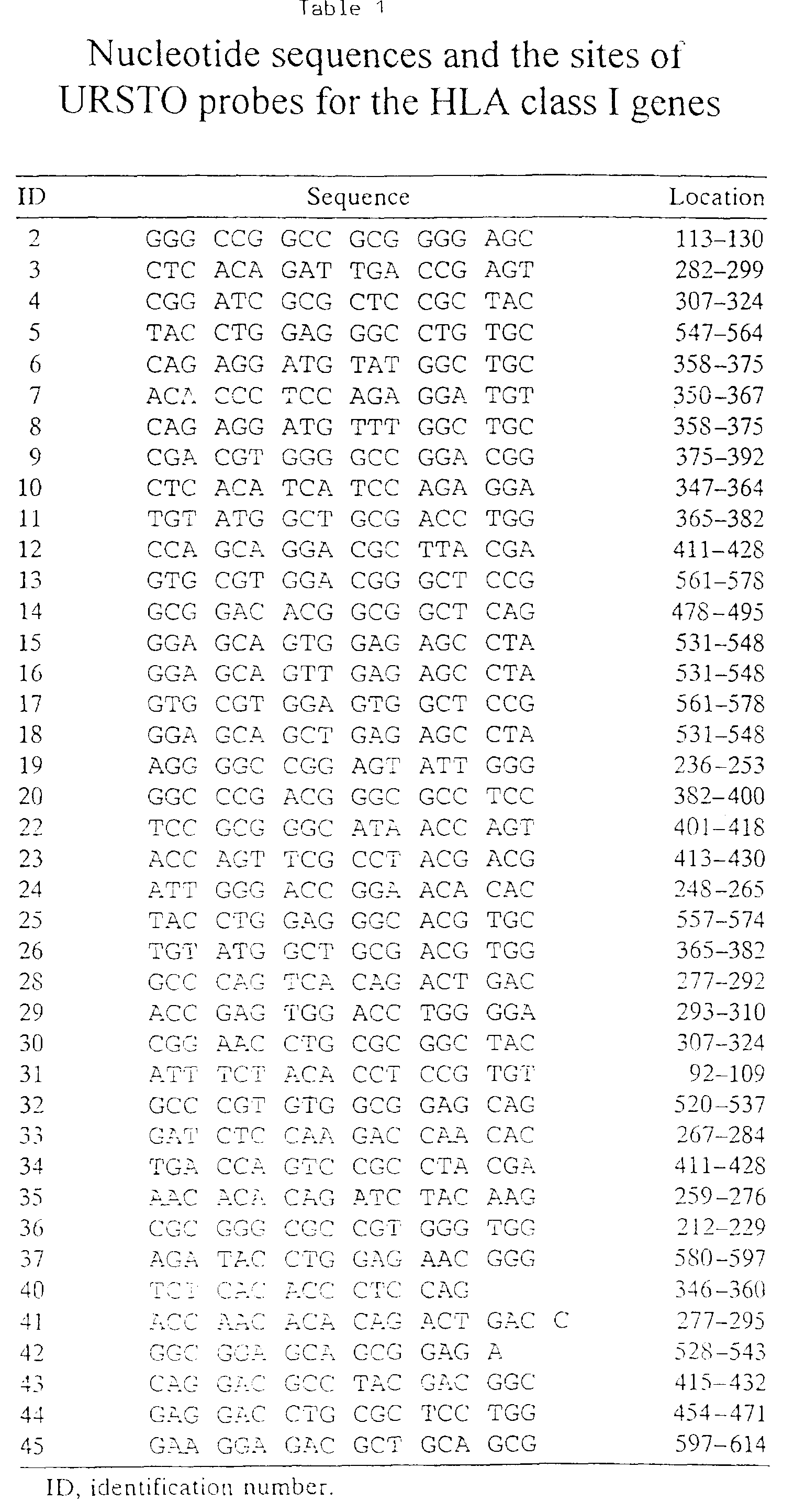
- the sequences of 40 oligonucleotides are given in Table 1 and the
- the database may be a paper database or a computer database.
- the database may be compiled by examining the sequences of the allele of the polyallelic genes and noting the probes which would be expected to bind to each allele. The accuracy of a database compiled by such a technique may be verified by experimentally determining which alleles are bound by each probe in the panel.
- Table 2 contains a database showing which of the 40 probes in Table 1 bind specific HLA class I alleles.
- the kit may also contain one or more known alleles as control(s). Such controls can be used to verify that an experiment carried out using the kit has worked correctly.
- This form of CSA overcomes the need for solid support systems by conjugating one primer of a pair of primers directly to a high molecular weight molecule (e.g. a protein).
- a high molecular weight molecule e.g. a protein
- the amplified product after hybridisation can be applied directly to a separating gel.
- the high molecular weight conjugates are retained in the gel compared to the duplex without attachment of the high molecular weight molecule.
- a method for separating an allele from a mixture of alleles which method comprises
- the amplification of the single strand can be done, for example, by asymmetric PCR.
- CSA overcomes the need for both solid support systems and conjugation of one primer of a pair to a high molecular weight molecule.
- a primer carrying a ligand such as a hapten in order to facilitate capture of the amplified strand with a receptor such as an antibody and separation of the amplified strand from other components in the amplification mixture.
- the reference allele may be provided in single-stranded form by essentially the same steps as used to provide the test alleles in single-stranded form.
- the CSA method provides an improvement over prior methods for separating alleles.
- the reference allele used in the CSA method generally has a known sequence. Further, the reference allele is usually chosen so as to have a similar allotype to an allotype that at least one of the test alleles is suspected of having. For example, it may be known that a test allele is of the HLA-A02 type from serological data, but it may not be known which of the seventeen A02 sub-types the allele is. In this case, the reference allele may be chosen to be of sub-type A0201 and the method of the present invention could then be used to determine which of the A02 sub-types the test allele is.
- the strand which is not bound to the support by the ligand is then discarded, although it is equally possible to retain the strand that is not bound to the support and discard the strand that is bound to the support.
- the strand that remains attached to the support may be recovered from the support by incubating the support under conditions such that the ligand/receptor complex
- polyacrylamide gel electrophoresis The electrophoresis may be carried out under denaturing or non-denaturing conditions. The use of denaturing conditions may enhance separation.
- the molecule may be a protein such as bovine serum albumin (BSA) .
- BSA bovine serum albumin
- the molecular weight of the high molecular weight molecule is such that it causes the DNA molecule to which it is attached to be sufficiently
- the molecular weight of the high molecular weight molecule may be from 10 to 200 kDa, preferably 20 to 100 kDa.
- the invention may be used to match a prospective donor in a tissue or organ transplant operation with a prospective recipient.
- the invention may be used to identify the alleles of the prospective recipient and donor, and hence to determine whether they have compatible alleles.
- the prospective recipient and donor may, for example, be a prospective recipient and donor in a bone marrow or kidney transplant operation.
- Other proposed uses of the invention include determination of the paternity of an individual by identifying one (or more) of his alleles to see if it is the same as a
- amplification of exons 2 and 3 is desirable, and the primers were therefore selected to amplify the stretch of the genome between intron 1 and intron 3.
- the localisation and nucleotide sequences of the HLA locus-specific primers used are given in the reagents section.
- PCR reactions were performed in a total volume of 100 ⁇ l using 1 ⁇ g of genomic DNA and 25 pmoles of each locus-specific primer.
- the 3' primer was biotinylated at the 5' end. This arrangement ensures the incorporation of the biotinylated primer onto the amplified antisense DNA strand.
- PCR conditions are given in the following table. Thermocycling conditions
- the bead suspension was heated at 95°C for 5 minutes, which ensures denaturation of the streptavidin molecule to release the biotinylated amplified anti-sense single strand which was then removed and placed in a clean tube.
- the isolates contained single biotinylated DNA strands from each allele.
- biotinylated anti-sense strand (s) from above were mixed with a locus specific reference sense strand, Rf A, Rf B and Rf C for HLA-A, B and C respectively (see below), and the mixture was heated at 95°C for 3 min., incubated at 70°C for 5 min. and then at 65°C for 45 min. Under these conditions the sense and anti-sense strands were
- heteroduplexes formed by each allele antisense strand with the locus specific reference sense strand could subsequently be separated from each other by electrophoresis in non-denaturing polyacrylamide gel.
- DNA was extracted from three homozygous 10th 1HW cell lines. The following cell lines were selected as locus specific reference DNA: STEINLIN (HLA-A*0101), SP0010 (HLA-B*4402) and STIENLIN (HLA-Cw*0701).
- heteroduplexes from heterozygote individuals were resolved into two bands, while DNA from homozygote subjects produced a single band.
- the bands were excised from the gel from which the DNA was eluted and blotted on the same membrane for three loci.
- the oligonucleotide probes were labelled with digoxigenin (DIG) at the 3' end (Boehringer, according to
- Hybridisation and washing solutions contained TMACl (3M), and membranes were hybridised at 54°C and washed at 58°C. Oligonucleotide binding was detected by chemiluminescence; anti-DIG-antibody conjugated to alkaline phosphatase and CSPD were added to membranes. After incubation the
- DNA was extracted from 63 B-lymphoblastoid cell lines; these included 22 heterozygous and 41 homozygous lines. After PCR amplification with locus specific primers as described above the anti-sense single strands were isolated and hybridised as described above with the
Landscapes
- Chemical & Material Sciences (AREA)
- Life Sciences & Earth Sciences (AREA)
- Organic Chemistry (AREA)
- Health & Medical Sciences (AREA)
- Proteomics, Peptides & Aminoacids (AREA)
- Zoology (AREA)
- Wood Science & Technology (AREA)
- Engineering & Computer Science (AREA)
- Analytical Chemistry (AREA)
- Immunology (AREA)
- Molecular Biology (AREA)
- Bioinformatics & Cheminformatics (AREA)
- Biotechnology (AREA)
- Biophysics (AREA)
- Physics & Mathematics (AREA)
- Genetics & Genomics (AREA)
- Biochemistry (AREA)
- Microbiology (AREA)
- General Engineering & Computer Science (AREA)
- General Health & Medical Sciences (AREA)
- Cell Biology (AREA)
- Measuring Or Testing Involving Enzymes Or Micro-Organisms (AREA)
- Testing, Inspecting, Measuring Of Stereoscopic Televisions And Televisions (AREA)
- Apparatus For Radiation Diagnosis (AREA)
Abstract
Description




Claims
Priority Applications (5)
| Application Number | Priority Date | Filing Date | Title |
|---|---|---|---|
| US09/077,619 US6500614B1 (en) | 1995-11-29 | 1996-11-29 | Method for identifying an unknown allele |
| AT96940033T ATE241703T1 (en) | 1995-11-29 | 1996-11-29 | METHOD FOR IDENTIFYING UNKNOWN ALLELES |
| EP96940033A EP0870056B1 (en) | 1995-11-29 | 1996-11-29 | Method for identifying an unknown allele |
| DE69628449T DE69628449T2 (en) | 1995-11-29 | 1996-11-29 | METHOD FOR IDENTIFYING UNKNOWN ALLELS |
| AU77037/96A AU7703796A (en) | 1995-11-29 | 1996-11-29 | Method for identifying an unknown allele |
Applications Claiming Priority (2)
| Application Number | Priority Date | Filing Date | Title |
|---|---|---|---|
| GBGB9524381.2A GB9524381D0 (en) | 1995-11-29 | 1995-11-29 | Method for identifying an unknown allele |
| GB9524381.2 | 1995-11-29 |
Publications (2)
| Publication Number | Publication Date |
|---|---|
| WO1997020197A2 true WO1997020197A2 (en) | 1997-06-05 |
| WO1997020197A3 WO1997020197A3 (en) | 1997-06-26 |
Family
ID=10784624
Family Applications (1)
| Application Number | Title | Priority Date | Filing Date |
|---|---|---|---|
| PCT/GB1996/002959 Ceased WO1997020197A2 (en) | 1995-11-29 | 1996-11-29 | Method for identifying an unknown allele |
Country Status (7)
| Country | Link |
|---|---|
| US (1) | US6500614B1 (en) |
| EP (1) | EP0870056B1 (en) |
| AT (1) | ATE241703T1 (en) |
| AU (1) | AU7703796A (en) |
| DE (1) | DE69628449T2 (en) |
| GB (1) | GB9524381D0 (en) |
| WO (1) | WO1997020197A2 (en) |
Cited By (8)
| Publication number | Priority date | Publication date | Assignee | Title |
|---|---|---|---|---|
| WO1998026091A3 (en) * | 1996-12-12 | 1998-09-17 | Visible Genetics Inc | Method and kit for HLA class I typing |
| GB2348284A (en) * | 1999-03-24 | 2000-09-27 | Clatterbridge Cancer Res Trust | Method for comparing nucleic acid sequences |
| WO2000061795A3 (en) * | 1999-04-09 | 2001-08-23 | Innogenetics Nv | Method for the amplification of HLA class I alleles |
| WO2003064670A1 (en) * | 2002-01-25 | 2003-08-07 | Applera Corporation | Single-tube, ready-to-use assay kits and methods using same |
| WO2004029289A3 (en) * | 2002-09-26 | 2004-07-22 | Roche Diagnostics Gmbh | Analysis of the hla class i genes and susceptibility to type i diabetes |
| CN101250587B (en) * | 2008-03-26 | 2012-01-04 | 上海市血液中心 | Method for identifying TAP allelomorph by SNPs combination |
| US8426129B2 (en) | 1998-04-20 | 2013-04-23 | Innogenetics N.V. | Method for typing HLA alleles |
| EP3080302A4 (en) * | 2013-12-10 | 2017-10-25 | Conexio Genomics Pty Ltd | Methods and probes for identifying gene alleles |
Families Citing this family (9)
| Publication number | Priority date | Publication date | Assignee | Title |
|---|---|---|---|---|
| US20030143554A1 (en) * | 2001-03-31 | 2003-07-31 | Berres Mark E. | Method of genotyping by determination of allele copy number |
| KR100571817B1 (en) * | 2003-09-19 | 2006-04-17 | 삼성전자주식회사 | Target nucleic acid detection method using a detection probe that hybridizes to a tag sequence |
| EP1536021A1 (en) * | 2003-11-27 | 2005-06-01 | Consortium National de Recherche en Genomique (CNRG) | Method for HLA typing |
| US20060235212A1 (en) * | 2004-12-22 | 2006-10-19 | Nickolai Alexandrov | Nucleic acid sequences encoding zinc finger proteins |
| US7335760B2 (en) * | 2004-12-22 | 2008-02-26 | Ceres, Inc. | Nucleic acid sequences encoding zinc finger proteins |
| US20090304901A1 (en) * | 2006-01-25 | 2009-12-10 | Steven Craig Bobzin | Modulating plant protein levels |
| US8222482B2 (en) * | 2006-01-26 | 2012-07-17 | Ceres, Inc. | Modulating plant oil levels |
| US7700734B2 (en) * | 2007-01-09 | 2010-04-20 | Shu-Wha Lin | Recombinant human factor IX and use thereof |
| WO2015054731A1 (en) * | 2013-10-15 | 2015-04-23 | Conexio Genomics Pty Ltd | Major histocompatibility complex single nucleotide polymorphisms |
Family Cites Families (6)
| Publication number | Priority date | Publication date | Assignee | Title |
|---|---|---|---|---|
| WO1992010589A1 (en) * | 1990-12-06 | 1992-06-25 | F. Hoffmann-La Roche Ag | Methods and reagents for hla drbeta dna typing |
| US5310893A (en) * | 1986-03-31 | 1994-05-10 | Hoffmann-La Roche Inc. | Method for HLA DP typing |
| GB9024005D0 (en) * | 1990-11-05 | 1990-12-19 | British Bio Technology | Process for amplifying nucleic acid |
| AU2491692A (en) | 1991-08-29 | 1993-04-05 | United States Of America, Represented By The Secretary, Department Of Health And Human Services, The | A method for discriminating and identifying alleles in complex loci |
| CA2081582A1 (en) * | 1991-11-05 | 1993-05-06 | Teodorica Bugawan | Methods and reagents for hla class i dna typing |
| IT1252295B (en) * | 1991-11-15 | 1995-06-08 | Schiapparelli Diagnostici Ismu | METHOD FOR DETECTING NUCLEIC ACIDS AND RELATED DIAGNOSTIC KIT |
-
1995
- 1995-11-29 GB GBGB9524381.2A patent/GB9524381D0/en active Pending
-
1996
- 1996-11-29 US US09/077,619 patent/US6500614B1/en not_active Expired - Fee Related
- 1996-11-29 WO PCT/GB1996/002959 patent/WO1997020197A2/en not_active Ceased
- 1996-11-29 AT AT96940033T patent/ATE241703T1/en not_active IP Right Cessation
- 1996-11-29 EP EP96940033A patent/EP0870056B1/en not_active Expired - Lifetime
- 1996-11-29 AU AU77037/96A patent/AU7703796A/en not_active Abandoned
- 1996-11-29 DE DE69628449T patent/DE69628449T2/en not_active Expired - Fee Related
Cited By (13)
| Publication number | Priority date | Publication date | Assignee | Title |
|---|---|---|---|---|
| WO1998026091A3 (en) * | 1996-12-12 | 1998-09-17 | Visible Genetics Inc | Method and kit for HLA class I typing |
| US8426129B2 (en) | 1998-04-20 | 2013-04-23 | Innogenetics N.V. | Method for typing HLA alleles |
| GB2348284A (en) * | 1999-03-24 | 2000-09-27 | Clatterbridge Cancer Res Trust | Method for comparing nucleic acid sequences |
| EP2314715A3 (en) * | 1999-04-09 | 2012-04-18 | Innogenetics N.V. | Method for the amplification of HLA class I alleles |
| WO2000061795A3 (en) * | 1999-04-09 | 2001-08-23 | Innogenetics Nv | Method for the amplification of HLA class I alleles |
| EP2319942A3 (en) * | 1999-04-09 | 2012-04-18 | Innogenetics N.V. | Method for the amplificiation of HLA class I alleles |
| WO2003064670A1 (en) * | 2002-01-25 | 2003-08-07 | Applera Corporation | Single-tube, ready-to-use assay kits and methods using same |
| US9464320B2 (en) | 2002-01-25 | 2016-10-11 | Applied Biosystems, Llc | Methods for placing, accepting, and filling orders for products and services |
| US10689692B2 (en) | 2002-01-25 | 2020-06-23 | Applied Biosystems, Llc | Methods for placing, accepting, and filling orders for products and services |
| WO2004029289A3 (en) * | 2002-09-26 | 2004-07-22 | Roche Diagnostics Gmbh | Analysis of the hla class i genes and susceptibility to type i diabetes |
| CN101250587B (en) * | 2008-03-26 | 2012-01-04 | 上海市血液中心 | Method for identifying TAP allelomorph by SNPs combination |
| EP3080302A4 (en) * | 2013-12-10 | 2017-10-25 | Conexio Genomics Pty Ltd | Methods and probes for identifying gene alleles |
| AU2014361730B2 (en) * | 2013-12-10 | 2021-02-25 | Illumina, Inc. | Methods and probes for identifying gene alleles |
Also Published As
| Publication number | Publication date |
|---|---|
| US6500614B1 (en) | 2002-12-31 |
| AU7703796A (en) | 1997-06-19 |
| ATE241703T1 (en) | 2003-06-15 |
| GB9524381D0 (en) | 1996-01-31 |
| EP0870056B1 (en) | 2003-05-28 |
| DE69628449D1 (en) | 2003-07-03 |
| EP0870056A2 (en) | 1998-10-14 |
| DE69628449T2 (en) | 2004-04-08 |
| WO1997020197A3 (en) | 1997-06-26 |
Similar Documents
| Publication | Publication Date | Title |
|---|---|---|
| EP0870056B1 (en) | Method for identifying an unknown allele | |
| US5759771A (en) | Method of determining a genotype by comparing the nucleotide sequence of members of a gene family and kit therefor | |
| US5629149A (en) | DNA sequence-based HLA typing method | |
| AU724531B2 (en) | Multiplex amplification of short tandem repeat loci | |
| US8394582B2 (en) | Identification of fetal DNA and fetal cell markers in maternal plasma or serum | |
| US6200747B1 (en) | Method and kits for detection of fragile X specific, GC-rich DNA sequences | |
| Liu et al. | Extended blood group molecular typing and next-generation sequencing | |
| US5578443A (en) | DNA sequence-based HLA typing method | |
| CA2139433A1 (en) | Methods of single nucleotide primer extension to detect specific alleles and kits therefor | |
| Williams et al. | Allele resolution of HLA‐A using oligonucleotide probes in a two‐stage typing strategy | |
| US6503707B1 (en) | Method for genetic typing | |
| JPH10506541A (en) | Probe system capable of performing HLA-DR type determination and type determination method using the probe | |
| US6994958B2 (en) | Methods for separating and/or identifying DNA molecules | |
| EP0672179B1 (en) | Nucleic acid analysis | |
| Thonnard et al. | HLA class II genotyping: two assay systems compared | |
| Moribe et al. | Complete HLA‐A DNA typing using the PCR‐RFLP method combined with allele group‐and sequence‐specific amplification | |
| Middleton | HLA typing from serology to sequencing era | |
| Williams et al. | Development of PCR‐SSOP for the identification of HLA‐A* 02 subtypes and determination of HLA‐A* 02 frequencies within different ethnic populations | |
| Mattiuz et al. | HLA‐B44 subtypes and the chance of finding HLA compatible donor/recipient pairs for bone marrow transplantation: a haplotype study of 303 Italian families | |
| Clay et al. | PCR‐SSO typing for DR4‐Dw subtypes: application to unrelated bone marrow transplant donor selection | |
| Horton et al. | HLA typing for DR3 and DR4 using artificial restriction fragment length polymorphism PCR from archival DNA. | |
| Browning et al. | Low resolution HLA-A locus typing by multiplex ARMS PCR | |
| Bugawan et al. | PCR-based DNA typing for the HLA-A locus using immobilized oligonucleotide probes (reverse dot blot) | |
| Eliaou et al. | HLA-A2 subtyping by non-radioactive reverse dot-blot procedure | |
| Sadler et al. | HLA-B locus DNA typing using sequence specific primers in allele or group specific ARMS/PCR |
Legal Events
| Date | Code | Title | Description |
|---|---|---|---|
| AK | Designated states |
Kind code of ref document: A2 Designated state(s): AL AM AT AU AZ BA BB BG BR BY CA CH CN CU CZ DE DK EE ES FI GB GE HU IL IS JP KE KG KP KR KZ LC LK LR LS LT LU LV MD MG MK MN MW MX NO NZ PL PT RO RU SD SE SG SI SK TJ TM TR TT UA UG US UZ VN AM AZ BY KG KZ MD RU TJ TM |
|
| AL | Designated countries for regional patents |
Kind code of ref document: A2 Designated state(s): KE LS MW SD SZ UG AT BE CH DE DK ES FI FR GB GR IE IT LU MC NL PT SE BF BJ CF CG |
|
| AK | Designated states |
Kind code of ref document: A3 Designated state(s): AL AM AT AU AZ BA BB BG BR BY CA CH CN CU CZ DE DK EE ES FI GB GE HU IL IS JP KE KG KP KR KZ LC LK LR LS LT LU LV MD MG MK MN MW MX NO NZ PL PT RO RU SD SE SG SI SK TJ TM TR TT UA UG US UZ VN AM AZ BY KG KZ MD RU TJ TM |
|
| AL | Designated countries for regional patents |
Kind code of ref document: A3 Designated state(s): KE LS MW SD SZ UG AT BE CH DE DK ES FI FR GB GR IE IT LU MC NL PT SE BF BJ CF CG |
|
| DFPE | Request for preliminary examination filed prior to expiration of 19th month from priority date (pct application filed before 20040101) | ||
| 121 | Ep: the epo has been informed by wipo that ep was designated in this application | ||
| WWE | Wipo information: entry into national phase |
Ref document number: 1996940033 Country of ref document: EP |
|
| NENP | Non-entry into the national phase |
Ref country code: JP Ref document number: 97520294 Format of ref document f/p: F |
|
| REG | Reference to national code |
Ref country code: DE Ref legal event code: 8642 |
|
| WWP | Wipo information: published in national office |
Ref document number: 1996940033 Country of ref document: EP |
|
| NENP | Non-entry into the national phase |
Ref country code: CA |
|
| WWE | Wipo information: entry into national phase |
Ref document number: 09077619 Country of ref document: US |
|
| WWG | Wipo information: grant in national office |
Ref document number: 1996940033 Country of ref document: EP |